Simple mistakes could not only invalidate travel insurance but also leave the medication ineffective or even ‘unsafe’
It is important to notify travel insurers(Image: GettyImages)
A warning has been issued to thousands of people who will be travelling abroad on weight loss treatments this summer as mistakes could mean they are not only ineffective but could be “unsafe” to use. Millions of people currently use the jabs to help weight loss but there are strict rules around their use.
A survey by ZAVAfound an estimated 337,000 people will holiday on Mounjaro or Wegovy this summer however if it is not carried and stored correctly it can be left “ineffective”. Experts at the firm have now provided three tips for travelling with Mounjaro and Wegovy, alongside the most important things to know before heading off.
You could be invalidating your travel insurance
When taking out travel insurance, you often need to declare any pre-existing conditions during an online application or by calling your insurer directly. Failing to declare the use of weight loss treatment could render your policy invalid, leaving you unable to make a claim should something go wrong, which could result in a bill worth thousands of pounds.
You should also check import restrictions to any country you are travelling to and verify if the medication can be brought into the country and how much you’re allowed to carry for personal use. Make sure to also take evidence of your prescription with you, whether it be in paper or digital form, and that your treatment is in its original packaging.
Insurers like Admiral don’t typically cover GLP-1 injections bought from an unofficial programme, if a medical professional isn’t monitoring them or hasn’t been declared. It is strongly advisable to follow up with a direct call to your insurer to confirm everything is properly documented. When in doubt, contact your insurer and your GP before travelling.
Storing jabs in hold luggage could freeze your medication
Putting injection weight loss treatments in with checked luggage can be a huge risk. The compartments where checked baggage is stored undergo huge changes in temperature and pressure that may alter the effectiveness of, or even damage, your medication. It can get very cold and may freeze and unfreeze the liquid in the pen, making the injections unsafe to take. Make sure to take a carry-on bag with you to store your medication in.
Essential liquid medicines are allowed through security, even if they are over 100ml; security often advises keeping medicines separate in your bag where possible, informing the Security Officer and bringing supporting documentation if possible. After this step, make sure that your medication stays in its original packaging. If you have any specific queries about carry-on luggage and medication, contact your airline provider.
Not having access to a fridge could damage your medication
Both Mounjaro and Wegovy must be stored by following the guidelines outlined in the patient information leaflets. The medication may be kept in a refrigerator at 2°C to 8°C or stored at room temperature, provided it does not exceed 30°C, for a maximum of 28-30 days.
Any pens exposed to temperatures above 30°C, or left unrefrigerated for more than 28 days for Wegovy and 30 days for Mounjaro, should be discarded immediately, as it could be unsafe to take. Patients travelling with weight loss injections are advised to contact their accommodation in advance to confirm refrigerator access and to verify that the appliance maintains an appropriate temperature, as this can vary between units. As the jabs are administered once weekly, most patients will use each pen within the 30-day unrefrigerated window, unless travel is extended or a dose is missed.
A train collision on Friday north of London resulted in at least 89 people being injured and Friday commutes into the city halted as emergency services responded to the incident. File Photo by Justin Lane/EPA-EFE
June 19 (UPI) — Two passenger trains collided north of London on Friday evening, snaring commutes as several train lines were closed as emergency services responded to the scene.
The two trains collided in Bedford, one from Corby and the other from Nottingham on the way to London St. Pancras, resulting in rail services to and from London St. Pancras being suspended, ABC News, The BBC and The Guardian reported.
The British Transport Police reported that 89 people were injured in the collision, 11 of whom were being treated for “very serious injuries.”
Officials are asking people to avoid the area, whether they are commuting or looking for a loved one, and local hospitals asked people not to come to the emergency room unless they have a serious emergency.
“I’m grateful to emergency services who are on the scene, attending to those affected,” British Secretary of State for Transport Heidi Alexander said in a statement on X.
“We’re working quickly with the rail industry and local partners to support passengers,” she said.
The collision occurred just after 3:00 p.m. local time on Friday as both trains were headed toward London.
U.K. Prime Minister Keir Starmer called the incident “hugely concerning” as other officials noted that a cause for the collision is not known yet but a full investigation will be conducted.
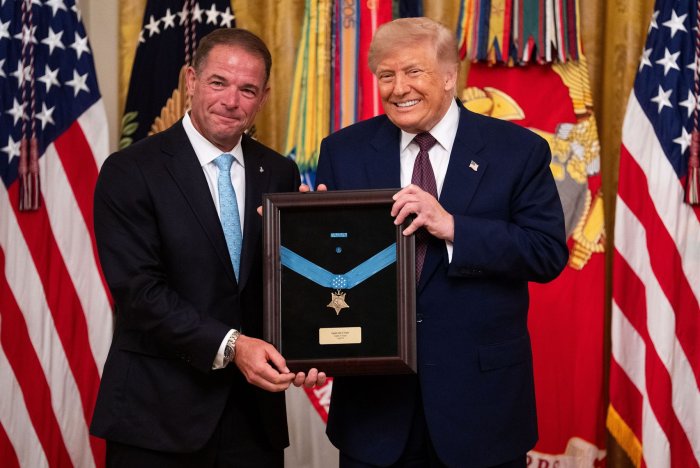
President Donald Trump presents a Medal of Honor to Tom Ripley on behalf of his father, John W. Ripley, during a Medal of Honor award ceremony in the East Room of the White House on Thursday. Photo by Aaron Schwartz/UPI | License Photo
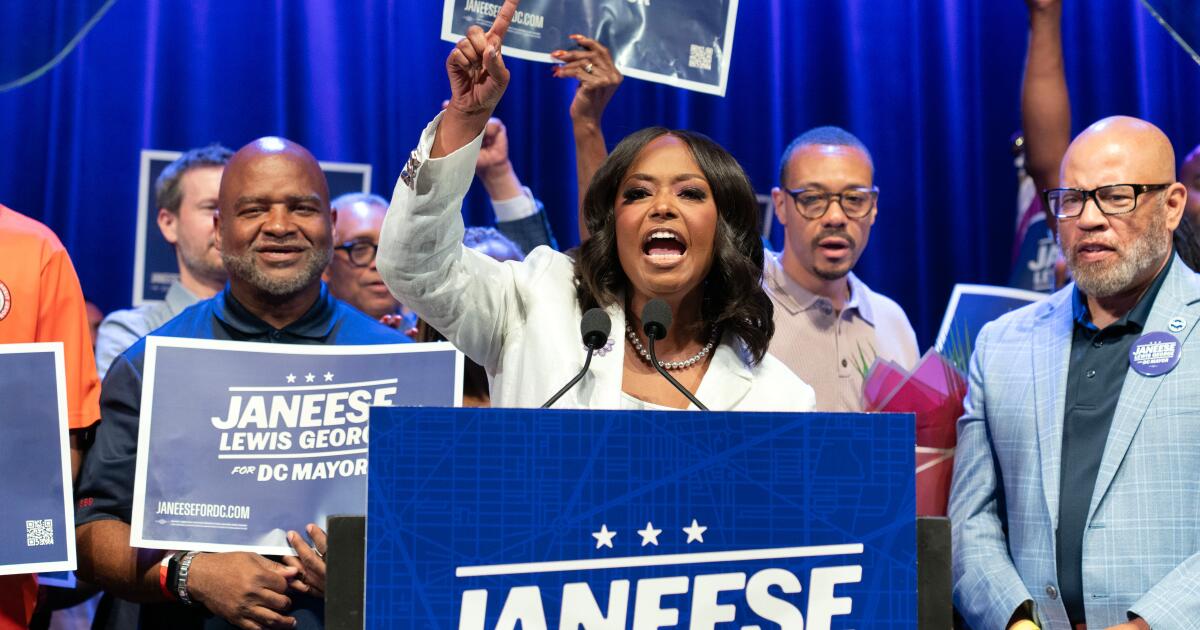
WASHINGTON — As Janeese Lewis George paves a path to the mayor’s office in Washington, D.C., she’s told voters they could have it all.
Her unapologetically expansive, left-wing agenda includes subsidized or even free childcare, increased down payment assistance for homebuyers and community resources to reduce crime, plus a promise to aggressively confront President Trump’s attempts to reshape the nation’s capital.
“People are tired of hearing what government can’t do. They want to hear what government can do,” Lewis George said in an interview before the city’s primary, where she defeated her Democratic opponents and positioned herself to win the general election in November in a city dominated by Democrats.
Lewis George’s victory signals a break with a quarter-century of centrist governance in Washington, and it puts her in the vanguard of democratic socialists who have ascended in urban politics over the last year. Zohran Mamdani toppled Andrew Cuomo, the scion of a political dynasty, on his way to becoming New York City mayor. Katie Wilson won an upset victory to lead Seattle last fall. And this month, Nithya Raman clinched a spot in the November runoff against Los Angeles Mayor Karen Bass.
All of them are members of the Democratic Socialists of America, or DSA. The political organization has seen its membership ranks swell from a few thousand to more than 100,000 nationwide over the last decade after an influx of younger Americans joined following the presidential bids of Vermont Sen. Bernie Sanders, also a self-described democratic socialist.
There’s little sign of national coordination among the candidates, and it’s unclear whether voters are gravitating toward their promises of improved government services, their vows to fight the Trump administration or their critiques of capitalism.
But from coast to coast, confrontational progressives are advancing in mayoral races. City leaders can draw outsized attention for their successes and failures, and democratic socialists will be under pressure from residents to deliver on their vows for a new kind of governance. Whether that translates to national politics is a next test for their movement.
“They are all channeling a displeasure with a status quo and a serious desire for economic populism that the establishment Democratic Party hasn’t been preaching,” said Eric Stern, a Democratic strategist with Fight Agency, a political consulting firm that strategized Mamdani’s mayoral campaign.
Stern added that Democratic voters appeared more willing to support the most progressive candidate in mayoral races rather than in contests for the U.S. House. Candidates like Mamdani and Raman, Stern said, are “daring voters to dream and fall in love not just with the individual candidates but also the political process as a whole.”
A rising left navigates America’s urban challenges
The trend of progressives surging in urban areas may have limits for its broader impact on Democratic politics. Democratic mayors in cities including Atlanta, Houston, Miami and San Francisco won on relatively moderate platforms in recent years.
Progressive have also faced noteworthy challenges. Chicago Mayor Brandon Johnson was endorsed by the city’s DSA chapter during his 2023 mayoral run but has since faced criticism from both moderate and liberal local leaders on issues such as immigration, the local budget and public safety. Recalls and public pressure ousted progressives elected to district attorney offices in multiple jurisdictions over the last five years, when criminal justice reform efforts ran into dissatisfaction over public disorder following the COVID-19 pandemic.
Trump’s hardline immigration and law enforcement tactics have also become a challenge for liberal cities. The president’s agenda poses an especially serious threat to Washington, D.C., because of its status as a federal territory.
“Maybe we take back Washington and run it on a federal basis,” Trump told reporters this month when asked about the potential election of a democratic socialist as the district’s mayor. “We won’t put up with it.”
But progressives hope the current wave of anti-Trump furor in deep blue cities across the country will help buoy the chances of those on the hard left.
“It’s not folks looking for the leftmost option so much as looking for a candidate who’s gonna be on their side,” said Ravi Mangla, speaking for the left-wing Working Families Party. The party often endorses the same candidates as the DSA and is readying to target more mayoral offices in the country’s biggest metropolises this fall and in 2028.
“It’s less about whether you are on the right or on the left so much as whether you are willing to punch up at the powerful,” he added.
Mamdani and Lewis George are both self-described “sewer socialists” who emphasize the need for responsive government services rather than critiques of market economics. The phrase recalls the socialist Gilded Age mayors whom critics derided as too preoccupied with managing public works projects.
The term’s revival is partly a strategic move to align leftist ideas with concerns over affordability and the economy, voters’ top concern in the midterm elections, and shift the public perception of democratic socialists from firebrands who support radical policies to independent-minded public servants.
“This is absolutely a change election and I’m excited to bring the change that people want, which is really putting people first in the city and having the moral clarity and courage to stand up to Trump,” Lewis George said.
For voters the ‘socialist’ label did not seem to matter
While conservatives have used the “socialist” label to attack Democrats as extreme or incompetent, some D.C. voters appeared ambivalent before Tuesday’s primary.
Several lifelong residents said they believed Lewis George was a “fighter” but didn’t think she’d have much of an impact on the local economy, given the city’s status as a federal district.
“I go back and forth on my own labels and whether I am supportive of that movement or not, but I am supportive of making D.C. more affordable,” Owen Fitzgerald, a University of Maryland graduate student, said of his support for democratic socialism.
Fitzgerald voted for Lewis George because she would stand up to Trump and said he’d first learned of her campaign from friends in his neighborhood. But he didn’t know she was a democratic socialist until he saw news reports describing her with the label.
“It sends a cultural message to this administration that the people who are surrounding them in the capital are opposed to their platform, opposed to their political agenda, and I think that it will send a message, both nationally and internationally,” Fitzgerald said.
Brenda Jaimes pushed her way through an ecstatic crowd in downtown Santa Ana Thursday night, stopping in the middle of Fourth Street and calling attention to herself by shouting, “Me! Me!”
Fans blew horns and spun noisemakers, chanting “México!” and “¡Sí se puede!” They brandished the Mexican flag seemingly everywhere: on banners, painted on cheeks, emblazoned on Jaimes’ tube top. They stood on the back of trucks and boogied.
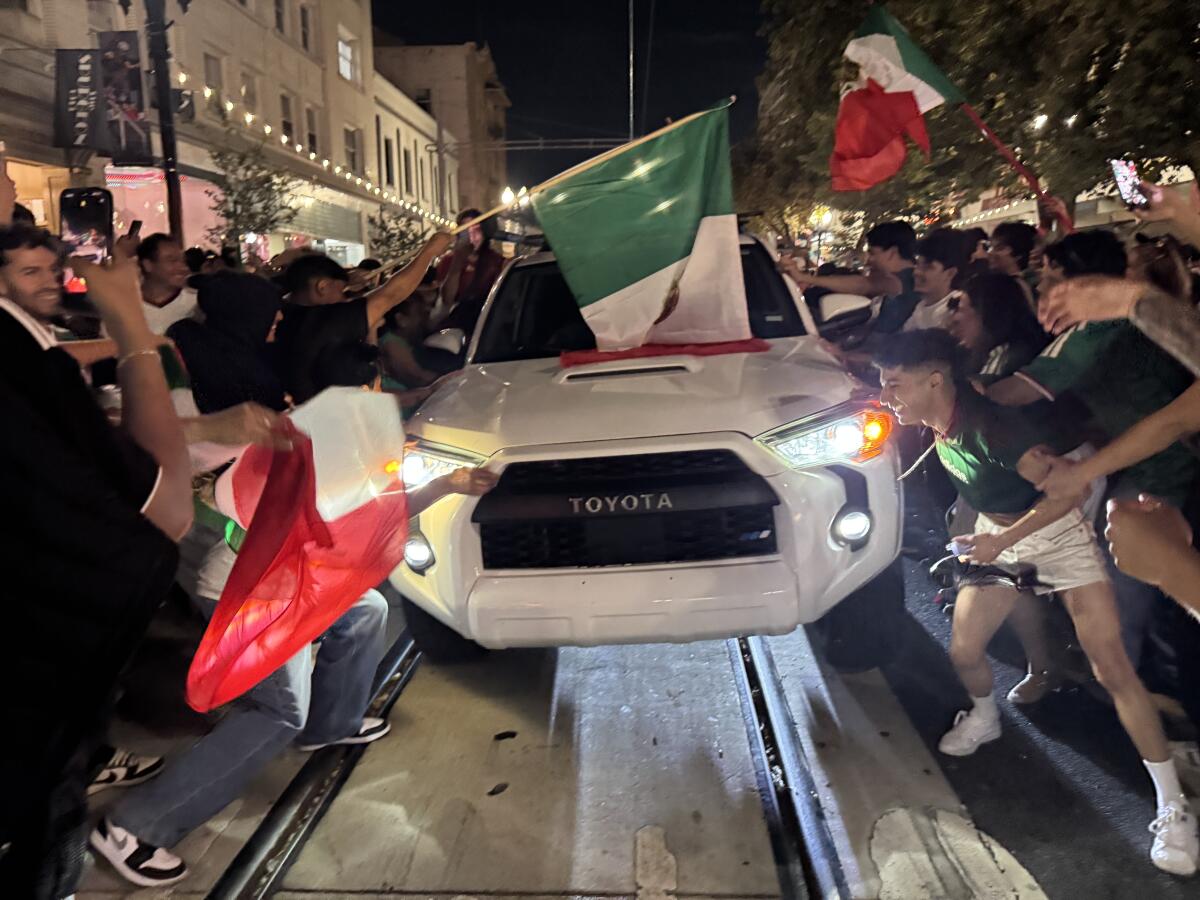
An Orange County Fire Authority truck flashed its sirens to cheers. A line of drivers cruised down Fourth Street — the historic cultural and economic heart of Latino Orange County — to high-five the crowd and let people shake their cars as if everyone was inside a bounce house.
Jaimes wanted something more dramatic.
She lay down in the arms of some men wearing green Mexico soccer jerseys. They counted to three, launched her a good 8 feet upward, then effortlessly caught the laughing Jaimes.
Scenes like this replicated themselves across Southern California after the match, from Koreatown to Boyle Heights to Pacoima to Huntington Park — really, anywhere with a big Latino population. It happens any time Mexico wins big in soccer. But the pachanga was even more pronounced in Santa Ana.
A year earlier, Fourth Street was empty. Federal immigration agents were seizing people across the city. The National Guard set up a roadblock complete with an armed Humvee for over a month, just a block away from where Jaimes and so many others celebrated.
One of the most Latino big cities in the country trembled in fear. On Thursday night, Santa Ana erupted in joy.
“This here is the antithesis of the raids last year,” said Sandra De Anda, who wore a Stetson and a Tigres Mexican soccer club jersey and waved a South Korea flag. She’s the director of policy and legal strategy at the Orange County Rapid Response Network.
Last June, the Santa Ana native joined thousands as they marched down Fourth Street for days demanding that ICE and the National Guard leave town. Through the rest of 2025, she and others in the Rapid Response Network fought la migra in courthouses and through fundraisers for immigrant detainees and their loved ones.
“They tried to take our community down, but they had no chance,” De Anda added as her boyfriend rushed off to join the celebration. “We Mexicans always get beat down, but we have pride. Tonight, you see how we stand up when we need to.”
Jaimes agreed.
“It’s so important to do this especially after last year,” she told me after her short turn as a Cirque du Soleil performer. “We don’t care what Trump can say about this. It was his birthday recently — who cares? This right here is real.”
Another young woman shrieked as she sailed above us. Jaimes pointed at her, then looked at me. “Throw yourself también [also], bro!”
I stuck to slapping the hoods and windows of so many cars that my hand turned black with soot.
Mexico soccer fans shake a car cruising down Fourth Street in downtown Santa Ana after Mexico’s 1-0 World Cup win over South Korea on Thursday.
(Gustavo Arellano / Los Angeles Times)
Seeing Mexico become the first country to win its World Cup group would be thrilling any year. But in 2026, when Trump continues to meddle in Latin American affairs while his migra goons keep launching raids across the country, the satisfaction hits that much more.
Few things irk Trump and his followers more than Mexicans succeeding at anything. Eleven years ago this week, he announced his presidential campaign by stating that Mexico was “not sending its best” immigrants but instead, people he claimed were mostly rapists and drug dealers. Trump has spent his two terms obsessing over the U.S.-Mexico border, attacking anything that reeks of diversity and demeaning Mexican President Claudia Sheinbaum as if she were a junior executive at one of his many failed companies.
Conservatives and more than a few liberals always get furious when Mexican Americans wave the flag of their ancestral homeland — but rooting for Mexico’s soccer team especially brings out the venom. Fans far outnumber supporters of the U.S. soccer team during matches in this country, which brings on accusations of treason against Mexican Americans even though other diasporas do the same, with nowhere near the same opprobrium.
Haters don’t get why so many Mexican Americans root for El Tri. The team embodies what it means to be Mexican: They’re a good group of folks who always seem to get bad breaks and never seem to win against the powers that be — but never stop fighting for a better day, while having fun doing so.
That’s why Americans of all ethnicities should back Mexico along with the U.S. side in this World Cup, which Trump has already sullied. The U.S. Department of Homeland Security denied a Somali referee entry into this country because he allegedly was “talking to some very bad people,” per the White House World Cup task force. The Trump administration is forcing Iran’s squad to base its training camp in Tijuana, which means players have to fly to matches in Los Angeles and Seattle instead of taking every other team’s short bus trip.
Every Mexico victory should give solace to the underdogs of the world and affirm the belief that a communion of nations engaged in friendly rivalries is better than Trump’s proclivity for launching indiscriminate raids and bombings. To cheer for Mexico is about as American as you can get right now.
Sydney Tran took her turn at the Fourth Street procession in a Honda Civic packed with friends. The crowd shook her car with such vigor that the 23-year-old Westminster resident couldn’t turn up the music like people shouted at her to do.
“This is crazy!” yelled Tran, who wore a Mexico soccer jersey. “I’m Vietnamese, but this is wonderful to see my Mexican friends so happy. They deserve to be happy — it’s been rough for them. It’s been rough for all immigrants.”
Mexico fans celebrate a goal while watching a FIFA World Cup soccer Group A matchup between Mexico and South Korea in Boyle Heights on Thursday.
(Eric Thayer / Los Angeles Times)
The festivities were still going strong when I left. Restaurants that were usually closed by 10 p.m. had lines out the door. Dance parties sprouted on sidewalks. Rancheras, funk and oldies blasted everywhere. The police were nowhere to be seen, unlike last year, when they broke up the anti-ICE protests with rubber bullets and tear gas.
Cynicism shot through me for a second. Mexico, which won on a fluke goal and two miraculous saves, stands virtually no chance of beating soccer titans like France and Argentina once the knockout stage of the World Cup begins. Trump’s immigration team vows that more raids are forthcoming. And I can only hope that the overwhelmingly young crowd will take the passion they showed for Mexican soccer to the ballot box this November.
Then I chilled out.
Everyone around me got to breathe and scream and let out their frustrations about our nation in the most delightful way imaginable. Reality would return the next morning — but for one night, for a few hours, life was wonderful for Mexican Americans, and better days ahead seemed possible. Sí se puede, indeed.
Daiki Kaneko had only 24 hours before his World Cup journey took him to Dallas, where his home country’s squad will take on Sweden.
The Japanese soccer fan was making the most of it on Tuesday in Inglewood, snapping pictures of SoFi Stadium before taking in a different kind of monument: a space-age, two-story branch of the chicken chain Raising Cane’s, complete with a 308-square-foot screen, a mirrored dog sculpture and a massive halo hovering around the exterior.
For Kaneko, 25, who lives in the Tokyo suburbs, it was the perfect encapsulation of American grandeur.
“All this for chicken,” he said. “I love America.”
Inglewood is already diverse — most residents are Latino or Black, and nearly a third are immigrants. But during the World Cup, it’s looking more like the United Nations. English, Japanese, Swiss, Iranians, Paraguayans, Bosnians, Belgians and others are flocking to the city of about 102,000, where eight matches are being played at SoFi Stadium.
Though visitors from abroad may not have heard of Inglewood until now, they’re soaking up the vibes of a city that has long been a major sports and entertainment hub, home to venues such as the Kia Forum and Intuit Dome, and a crucible of Black culture, immortalized in hip-hop songs by artists such as Tupac Shakur and Dr. Dre.
“We’re an international city now,” Mayor James Butts said.
Butts said locals were already proud of what the city has become, but the World Cup has put the celebratory feelings over the top.
“We have people from so many different countries migrating to Inglewood, and there’s an explosive sense of community pride,” he said.
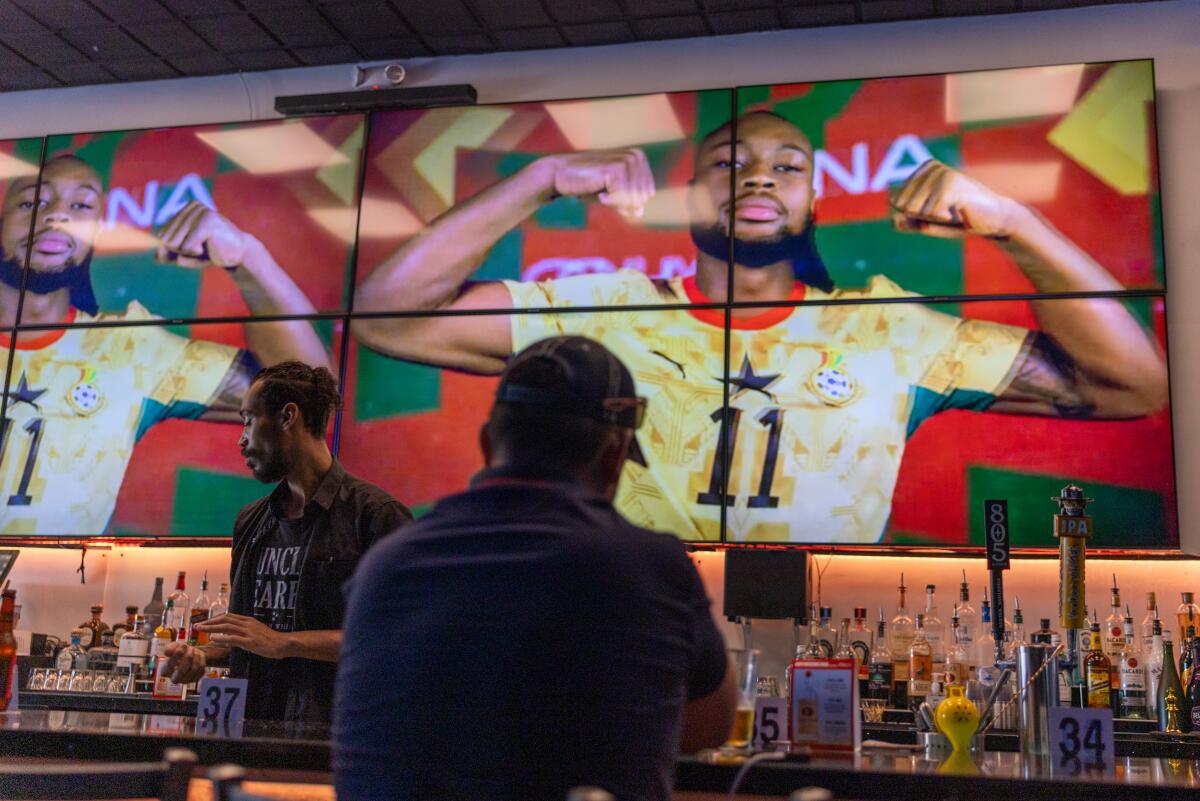
Bartender Elijah Gonzalez, left, mixes a drink at the Nile Bar in Inglewood while customers watch a World Cup soccer preview.
(Allen J. Schaben / Los Angeles Times)
City officials are doing everything they can to embrace the spirit of the tournament, including speeding up permits so small businesses and neighborhoods can hold World Cup gatherings and watch parties, Butts said. During the U.S.’s opening match against Paraguay on June 12, the city hosted the Wood Cup, a block party on Market Street that brought in more than 5,000 people.
Businesses across the city are embracing the tournament as well, vying for a piece of the roughly $17 million the city expects to haul in. For a few weeks, concerns about skyrocketing housing costs and gentrification, brought on by the city’s increasing popularity as a place to settle down, are taking a back seat to the sheer fun of international soccer.
The supersized Raising Cane’s had its grand opening on June 11, the first day of the tournament. During the USMNT’s opening match, Cinepolis, a luxury movie theater down the road from SoFi Stadium, turned into a global sports hub, according to CEO Luis Olloqui.
Maddy Daversa, a bartender at the Meeting Spot, a restaurant near the stadium, said 2,000 people poured in when the Americans played Paraguay.
“I was selling beers for five hours straight,” she said. “It was crazy.”
Daversa said the restaurant is usually closed on Mondays but opened in hopes of getting some spillover fans from the Iran-New Zealand game at SoFi.
“Every table was full,” she said. “We’re taking advantage.”
Tuesday was an off day for Inglewood, with no games at SoFi. But the energy was still palpable, with locals sporting soccer jerseys and tourists popping up across the city.
“I just want to be where the fans are,” said David Meier, a Swiss fan in town for his home country’s match against Bosnia-Herzegovina on Thursday.
Meier, 45, plans to explore L.A. via bars, restaurants and watch parties, taking in every game that his schedule will allow before heading north of the border to Vancouver, where Switzerland will face Canada on June 24.
“Everyone has been so kind,” he said. “Soccer and beer turns strangers into friends.”
Flags from countries competing in the World Cup are on display at Manchester Boulevard and South Market Street in Inglewood.
(Allen J. Schaben / Los Angeles Times)
The energy carried over to Market Street, a historic shopping district about a mile from SoFi Stadium. Businesses set up signs, posters and international flags to lure locals and tourists alike, while the Miracle Theater hosted a watch party for the match between France and Senegal.
Owen Smith, who co-owns the theater with his wife, Mariana, said a Senegalese friend who grew up in France asked if he would be willing to show the game on the big screen. A day later, fans of both teams assembled inside, snapping photos in front of a giant inflatable World Cup trophy in the lobby.
“The Miracle is a cultural event theater. It’s about accommodating the community,” Smith said.
Benyam Woldegiorgis, who co-owns the Nile Bar on Market Street, is showing every single World Cup match — all 104 of them.
“It brings in business,” he said. “Usually it’s just football, basketball and baseball, but now we’re adding soccer to the mix.”
Dionte Johnson, owner of the streetwear store Kingsrowe, partnered with Adidas to hold a watch party for the U.S. team’s opener and said the turnout was massive, bringing in loads of Mexico fans who are local residents, even though their team had already won their opener the day before.
“The downside of the World Cup is that tickets are so expensive, so a lot of locals can’t go check out the games themselves. That’s why we’re hosting events,” Johnson said. “The games are in our backyard, so this is something people have had on their calendar for a long time.”
Homeowners are cashing in as well, with some renting out their places on Airbnb for a small fortune, figuring that crashing on a friend’s couch or booking a hotel room elsewhere is well worth the lofty payouts brought by World Cup demand.
Across L.A., hotel demand lagged compared with initial expectations, but short-term rental prices still jumped 56% compared with typical rates, and more than 70% of rentals were booked by December 2025.
In Inglewood — especially for rentals walkable to SoFi Stadium — prices became dizzying.
David Orenstein and his wife, Peggy, run an Airbnb across the street from SoFi Stadium. It usually rents for $400 per night, but for the U.S. team’s opening game, it went for $3,000.
(Robert Gauthier / Los Angeles Times)
Peggy Orenstein and her husband, David, own a home steps from the stadium that typically rents for $400 a night on Airbnb. For the U.S. team’s opener, the nightly rate shot up to $3,000.
For other matches, the four-bedroom house is going for $1,200 to $1,500 a night. Orenstein said the high demand and international crowds are a teaser for what’s to come.
“Next up is the Olympics,” she said. “This is a great learning lesson for what we can expect.”
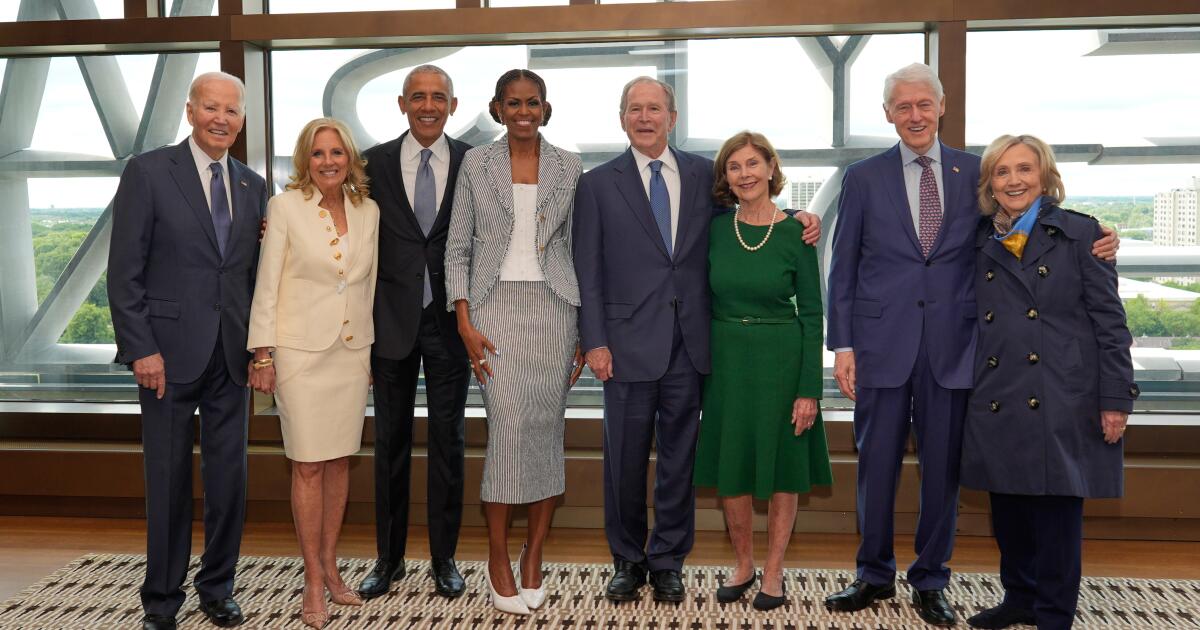
Former President Obama, joined by three former presidents, celebrated the opening of his presidential museum in Chicago in an extraordinary event Thursday that brought together world leaders, A-list celebrities, athletes and other internationally known figures.
Bruce Springsteen, Stevie Wonder, Christina Aguilera and Bono were all slated to perform at the dedication ceremony.
Obama and former First Lady Michelle Obama and their daughters shared the stage with former Presidents Biden, George W. Bush and Clinton, along with former First Ladies Jill Biden, Laura Bush and Hillary Rodham Clinton. Former Vice President Kamala Harris was also in attendance.
Obama and Michelle Obama are both expected to give remarks. The invite-only celebration was livestreamed and kicks off a weekend of events centered around the Obama Presidential Center, which opens to the general public on Friday, which is Juneteenth.
President Trump was not in attendance. He called the $850-million center a “total disaster” in a social media post in February.
Those at the event included California Gov. Gavin Newsom, a potential 2028 Democratic presidential candidate; civil rights leaders Andrew Young and Al Sharpton; Oprah Winfrey; comedians David Letterman, Conan O’Brien and Stephen Colbert; actor Tom Hanks; tennis legend Billie Jean King and Chicago Cubs Chairman Tom Ricketts.
Former world leaders in attendance included former German Chancellor Angela Merkel and former Canadian Prime Minister Justin Trudeau.
Jennifer Hudson sang the national anthem. Other musicians slated to perform include Common, Eddie Vedder, Marc Anthony and the Roots, which was serving as the house band.
The Thursday celebration “will reflect a spirit of inspiration and joy, with a big boost from the performers who are sharing their talent with us,” said Valerie Jarrett, the Obama Foundation’s chief executive and former Obama top advisor. “We hope to inspire people everywhere to believe in their power to bring change home.”
General admission tickets for the center are sold out through the end of October. But tens of thousands of people have already been offered a sneak peek of the nearly 20-acre campus on Chicago’s South Side in Jackson Park.
The center, located near where Obama lived and began his political career, is expected to attract more than 1 million visitors annually. It is adjacent to the Griffin Museum of Science and Industry in the lakefront park, and not far from the University of Chicago.
The campus includes a towering museum that covers the political and personal realms of the nation’s first Black president and first lady, while public spaces include a branch of the Chicago Public Library, a playground and athletic center, basketball courts and a picnic area with grills.
The tower’s design is meant to depict four hands coming together in solidarity. Wrapped around one side are 5-foot tall concrete capital letters, an excerpt of Obama’s 2015 speech commemorating the 50th anniversary of the Selma-to-Montgomery march. It begins, “You are America.”
In this week’s episode of The Envelope podcast, Rachel Sennott discusses finding the voice of “I Love L.A.” — and finding her footing as series creator — during a tumultuous time in her life.
Kelvin Washington: Welcome to The Envelope, Kelvin Washington alongside you know who, Yvonne Villarreal, Mark Olsen. Always great to have you two here and spend some time with you. We talked about it earlier, we had Emmy season — a few weeks ago we discussed it. But now Emmy nominations are on the way. Yvonne, I’ll start with you, just maybe someone, a show, a couple of things you’re looking at saying, “Hey, I would love to see this or that person nominated.”
Yvonne Villarreal: I wanna give some shout-outs to the women right now. I was really frustrated when Rhea Seehorn didn’t get love until the final season of “Better Call Saul,” and I’m hoping — and I do have a lot of hope — that she will be recognized for “Pluribus.” [I] was a really big fan of “The Comeback” this season. I would like to [see] Lisa Kudrow get in there. Show-wise, I would like to see “The Testaments” in there. I don’t know how much of a dark horse that one is, but that’s my pick for show.
Washington: You’ve been riding “The Testaments.” What about you, Mark?
Olsen: I’m sort of leapfrogging over nominations, and I’m just thinking about what would be exciting on the show. And last year, I remember Stephen Colbert won for talk show kind of right after his show had been canceled, and that seemed like a very exciting moment. And so this year, with Jimmy Kimmel, where this is the first Emmy cycle since he had his suspension last year, and really has been in the news, I just think if he were to be nominated and then to win, that just would be such an exciting moment at the show. What’s he gonna say? I just would really love to see that.
Washington: Yeah, he seems like he would have some things to say, right? Because just kind of the nature of who he is. We’ll have to wait and see. And just for me, a couple of people. Just a fan of this particular person, Janelle James is hilarious to me. She plays in “Abbott Elementary.” She plays that role great. And then this one is no real surprise, probably 50-plus-year career, but Martin Short. Every time I see him, he’s amazing, steals the scene. So those are folks that just jump off on the radar for me.
All right, I’ll get to you, Mark. You had a chance to sit down with Rachel Sennott of “I Love L.A.,” creator and star of it. Tell me a little bit more about that.
Olsen: She’s been kind of a real, like, bright light on the comedy scene for the last few years in films like “Shiva Baby,” “Bodies Bodies Bodies” and “Bottoms,” and, you know, she also was like a writer as well as a performer. And so with “I Love L.A.,” which is a look at sort of like the young creative class in Los Angeles, she is the star of the show, she created the show, she writes on the show, she’s executive producer, she actually made her directing debut with one of the episodes. And so it’s just exciting to see her sort of really like come into her voice and come into her own with this new show.
Washington: Kind of reminds me a little bit of, you know, now maybe a decade ago Issa Rae’s surge in L.A. and comedy creating, and then Riz Ahmed, who you spoke with last week — same thing creating and starring and stuff. Seems like that’s the energy [we’re] getting from a lot of the young talent. Well, here is Mark and Rachel now.
Rachel Sennott, creator and star of HBO’s “I Love L.A.”
(Evan Mulling / For The Times)
Mark Olsen: We’re here with Rachel Sennott, creator, executive producer, writer, star, and for the first time, director on the show “I Love L.A.,” as well as co-creator and writer on “Big Mistakes.” That’s a lot.
Rachel Sennott: When you say it like that, I’m like, “Oh, my God.” And I’m also a friend, daughter, let’s not forget girlfriend. Yeah, those are all things that I am doing. And I am so grateful and having so much fun doing that.
Olsen: Hopefully this isn’t something that just I get a kick out of, but we’re here at the L.A. Times offices in El Segundo, and the Randy Newman song “I Love L.A.,” one of the first lines in the song is “Rolling down the Imperial Highway.” And we are in fact on Imperial Highway.
Sennott: We’re here right now. We’re living it.
Olsen: Tell me about the title of the show, its relationship to the song and what was it that you liked about having the show called “I Love L.A.”
Sennott: We were between two titles for a while, “I Love L.A.” and “Climbers,” and the reason we went with “I Love L.A.” is because in the process of making the show, I moved here from New York and I had a hard time when I was first here. And in the process of filming the pilot, I really fell in love with L.A., and I think getting to make something here, I all of a sudden saw L.A. through this lens where everything was like a movie. I would go on my walks that I usually go on. I would walk through my neighborhood, I would go to my spots, and I just saw it through this different lens, and I was really falling in love with it in the process of making the show. And I think with “Climbers,” that title fell a little bit — it was a double meaning of like social climbers and then also, being the age that I am, where I feel like ever since I got to college, ever since I became an adult, there’s been this chaotic energy in the world and uncertain ground where things never felt expected. It was always unexpected events. Graduating into COVID and then there was a strike and everything. So I feel like Sisyphus, where you’re always pushing the rock up the hill and it’s never enough. But we were worried that “Climbers” would seem too negative … We didn’t want to set people up already judging the characters.
Olsen: And then what has it been like for you learning to be a showrunner in making “I Love L.A.”? It’s funny, your co-showrunner Emma Barrie, she mentioned how you were very organized, but she was struck that you had everything in a pink binder with horses on it. So it was you trying to learn this new thing while also holding on to your essence.
Sennott: I feel so grateful for everyone who works on the show with me. I learned a lot from Emma. I learned from Lorene [Scafaria], who inspired me so much as a director. Aida [Rodgers], our producer, Amy [Gravitt] and Allie [Wasserman] at HBO; Max [Silvestri], who’s one of our EPs and writers. Showrunning is a million different jobs, and some of the jobs I’d done before, some of them I hadn’t, and I felt like I got to see different people shine in certain things, people who are more talented or more skilled at structure than me, people who have directed before, people who understand shots and basically learn from everyone and see that everyone wants the show to be the best it can be. They’re bringing stuff to the table. And so I benefited from everyone else’s skills and talents and just being like, “If you know how to do this better than me, I’m gonna learn from you and watch you and hopefully take from that so I can do my job better.”
Olsen: In a lot of the press as you’ve been talking about the show, you’ve been talking a lot about the concept of the Saturn return and this sort of chaotic period people have in their late 20s. You yourself now are 30 —
Sennott: Yes, I made it. I literally just finished. I was relieved, but my Saturn return was the process, getting the show picked up and the first season of the show. That was my Saturn return.
Olsen: Can you already feel that something has settled or things are different somehow?
Sennott: Yes, a thousand percent. My Saturn return, the dates that it was the strongest were the month around when the show got picked up. Making the pilot was so amazing and I learned so much. And then I was in this moment where I had to pick — basically, I couldn’t take on acting jobs because I was gonna hopefully do the show, but I didn’t know if the show was picked up yet or not. And so I had to say no to certain things and kind of take this leap. At the same time I went through a breakup, and then I got arrested for having CBD in the Cayman Islands. And it was just a very chaotic month of my life where I was like in jail for six hours on a break with my boyfriend, so he, like, had no idea where I was, and I was like, I don’t even know if I have a show, I just said no to this other thing. I just felt like I didn’t know what was happening. I’m someone who it’s hard for me to take risks sometimes, and that was a big risk and leap into what I thought I should be doing. And then the rest of it was learning for the first season how to do a job I’d never done before. Obviously, I still have more to learn, but I think that was a big Saturn return for me, the roller coaster of it.
Olsen: It’s so interesting to hear you say that you think of yourself as a person who’s afraid of risk, because that’s not my impression of you.
Sennott: You’re like, “Stop taking risks. Chill on the risks, every second.” No, I think it’s more [that] I didn’t necessarily believe in myself as a creator on my own, and that was really scary for me. That was the risk, I think.
Olsen: Because especially in building up to making “I Love L.A.,” in your career, I feel like you’ve created this comedic persona for yourself. What is the biggest distinction between the Rachel I think I know and like the actual you?
Sennott: You mean the characters that I play? Or like the persona?
Olsen: These sort of hard-charging, very ambitious, but maybe not always understanding of themselves characters, and you. I’m just interested in how you see the distinction between that persona and the actual you.
Sennott: Well, I hope that the characters that I’ve played have been somewhat different from each other. I think “Shiva Baby,” that character, was a little bit more anxiety-inward. Alice in “Bodies” was way more outward and kind of no filter, said every inside thought. Maia on “I Love L.A.,” I think, is kind of bitter in the beginning of the first season and is pinning her failures, blaming them, on her friend. All of those characters, I always draw on some element of myself. I think all actors, you have to find some connection to the character. But I think I’m hopefully more grounded and balanced and mature than the character. I hope.
Olsen: You’ve talked about how “I Love L.A.” really explores the foibles and challenges that people have leading these very, like, online lives and the way that people nowadays are really sort of tethered to their phones all the time. Is that something that you feel like you grapple with yourself? Is it something you yourself have had to kind of get over?
Sennott: I would say I started my career on the internet, and I grew up on the internet, and basically, I created a different sort of persona on the internet that was based in truth of a time when I was in my early 20s in New York, and it was a lot more messy and a little chaotic, and I was just going through things in my life at that time [that inspired] — I say “writing,” but like the tweets, the jokes, the videos, whatever, that were coming out of me. And then I felt I changed, but I still wanted to kind of project that character. And so I actually ended up putting that character into Tallulah [played by Odessa A’zion]. And I think Maia was a little bit more the version of myself when I first moved to L.A. and I felt isolated and it was during COVID, and I felt I was kind of gripping onto my friends in a codependent way. And so I think the show is sort of dealing with, whether or not you’re an influencer or person online, anyone who’s grown up on the internet is projecting some sort of version of themselves. So I think it was that I was trying to explore.
Olsen: You mentioned that the character of Tallulah is this version of you that you used to be. So what was it like for you creating this character that was almost like your id unleashed?
Sennott: It felt like I was separating myself from her. At first, [it] maybe could have felt like a caricature. And then when we cast Odessa, who is so talented and just, as an actor, she has such depth and range, and I think she asked questions and brought so much to it. Then it actually made me sever myself from the character, and the character became its own thing that she brought to life.
Olsen: Your character, Maia, in some ways is the audience surrogate, she’s kind of the most “normal” character on the show. And considering that in “Bottoms” or “Bodies Bodies Bodies” you often were the outrageous character, what has it been like for you to play this character that’s a little more self-contained?
Sennott: It’s been fun. I think we sort of found her during the first season. I feel that Episodes 6 through 8 are really where the show finds its footing and where we find what’s the comedy of Maia. It takes a little for her to kind of crack open, what’s funny about her as a character, but also I think Tallulah is almost like an agent of change for her — Maia was set in her ways and sort of struggling and depressed, and I think Tallulah puts her on track, and she’s going through her Saturn return and all that stuff. And so I think we get to see at the end of the season and just having been writing Season 2, I think that we get see her do a lot more fun stuff.
Olsen: It’s funny, as viewers, a lot of times people say, “Oh, you know, there’s this show you should watch, it really gets going on like Episode 3” or whatever. And I don’t think I’ve ever heard a creator say before, like, “Oh, 6, 7, and 8, we figured it out.” Do you feel you knew that in the moment, or has that only come to you as you’ve been working on Season 2?
Sennott: I think as we were editing the first season. Tone is something that you can say, like, “We want it to be like, this needs this, and it’s that and that and the tone of that.” But tone is what you find in the edit. I think you shoot different versions of a line, of a scene, and then you piece it together. And I think for me, that’s when I felt like, “This is the tone of the show. This is the world of the show.” And in writing Season 2 as well, just living more in that world.
Olsen: You kind of touched on this, but the characters on the show, they kind of skirt this line between being endearing and annoying. What is it that you like about that?
Sennott: Because I think that’s how people are. I am not interested in seeing perfect people or people who are flawed in a way that’s not actually real. So I love all the characters. I think Alani [played by True Whitaker], for example, is someone where you could really easily be like, “Oh, a nepo baby, she’s so privileged, whatever.” I think she’s the character with the biggest heart. She’s the best friend out of the whole group. She cares for everyone. She’s so deeply sensitive. And she’s actually been through a lot of s— and she drops these little things, these clues where you’re like, “Gee, she went through something crazy but is choosing to look at life half-full,” and I think that’s fun. I like the characters who make you feel or expect something of them and then show you another side. Charlie [played by Jordan Firstman] I think does that as well, where you meet him and you think he’s a little acerbic, he’s a little judgmental, and then he goes through loss and grief when Lukas, spoilers, Lukas Landry dies, RIP Lukas. That’s really hard for him. I’ve been friends with Jordan for so long, and I love him so much. I think he’s so talented. But I think he showed a totally new side of himself with the character.
Olsen: I agree. I found those scenes very touching. There’s an emotion there that’s kind of unexpected. Another moment that I really like in the show is Odessa’s character, she wants to change a dinner reservation to five people at 8 o’clock. And then you have to spend hours trying to make that happen. And I really appreciated how it’s something that sounds like it should be simple, and for some people it’s no big deal. But then for other people, it’s the biggest hurdle imaginable. Did you like that the show explores this sort of proximity to ease? Sometimes you end up at this party in a big, big house, but it’s not your house. Was that something you wanted to explore about life in L.A.?
Sennott: Totally. There’s also something specific to L.A. and specific to the industry we’re exploring — which is the internet as opposed to Hollywood — that I would say is relatable to me, to anyone in their late 20s, early 30s. When you’re in your early 20s, everyone’s sort of grouped together or feels like they’re in the same bucket. It’s like, “Oh we’re all doing this same thing, we’re all roommates, we’re all in school together, we’re all whatever.” But people make decisions that you don’t even see. I feel like the first time I found out that one of my friends had a SEP IRA, I was like, “When did we all decide that we’re getting SEP IRAs?” And it was a friend who loves to party, and I was thrown. Now I’m panicking I didn’t do that. Or who’s getting in a serious relationship, whatever. People start making decisions in their late 20s, all of a sudden everyone’s off on different paths. It’s like, “Wait, you’re getting married, but you’re still partying the way that we did when we were in college.” This person is moving, this person is changing their career path. And so you all of a sudden feel a little bit betrayed or on your own, and it’s isolating, and that is something that, yes, we’re doing it through a specific lens of L.A. and this world and these characters, but I think it’s really relatable to people at that age.
Olsen: I’ve heard you describe yourself as a zillennial cusp.
Sennott: Yeah, I’m cusp, and I feel like I relate to a little bit of both.
Olsen: But do you feel a pressure for the show to feel like some sort of a generational statement, to capture these kind of big-picture things?
Sennott: No. Ayo [Edebiri] and I were texting each other because there’s always an article that’s like, “Turns out these b— are 30. Yeah. They’ve been lying the whole time. They said they’re Gen Z.” I’m like, “I didn’t say anything. I was born in ’95. I’m 30.” Call me what you want, but I was just writing to what I feel at the time. I think people who grew up on the internet in the way that I did will relate to it, but I think you can relate too if you’re older or you’re younger.
Olsen: As people are writing about the show, they very frequently are referencing “Girls,” “Insecure,” “Sex and the City.” But I’ve heard you reference “Entourage” quite a bit. Could you explain that?
Sennott: “Girls” and “Sex and the City” and “Insecure,” all of those shows, all HBO shows, are formative to me as an artist. I remember watching “Girls,” I was in high school and looking at colleges with my dad and we went and toured [New York University], and in the hotel room that night, he was like, “I heard so much about this new show, ‘Girls,’ we should watch it. And it was the episode with Patrick Wilson where they f— in his nice apartment the whole time, and we turned it on and my dad was like, “OK, you can watch this later on your own, this is for you.” And I remember going to bed being like, “I’ve gotta go to New York, like whoa, this is crazy.” I think naturally those were already gonna inspire me. “Entourage” and “Atlanta,” those were two references that I mentioned a lot when we were making the show. “Entourage” because I feel I got to come up in this industry with my friends, and when I’m with my friends I feel completely invincible, and so there was that aspect. It was like, “I wanna see ‘Entourage’ but from a different point of view and perspective and a slightly different industry.” And then “Atlanta,” there is already having a family relationship and friendship on top of managing. Like how [Earn] manages Paperboi. And then I think “Atlanta” did such a great job of capturing a city that has almost magical realism elements to it. And L.A., a lot of the time, there’s things that happen here that are crazy, that feel almost unreal, but they are real. So that was a big inspiration for the show as well. Like the opening of the show, sex during an earthquake. That’s happened to me, but it also feels a little ridiculous, but it happens in L.A.
Olsen: You mentioned earlier that in waiting for the show to come around, you felt you were having to turn things down or you were really having to sort of change your mindset in a way. Can you talk a little more about that? With the show “Big Mistakes” that you created with Dan Levy, is that one of the things that you had to step away from or readjust how you were gonna be involved because of the fact that you were going to have “I Love L.A.”?
Sennott: I was more talking about acting roles. When you step into a creator role, it’s a different mindset than acting jobs and you have to commit to a longer time period. When you’re just acting in things, you can pop in, pop out and you leave set and you’re like, “I love you guys so much. I’ll see you in a year at the premiere,” which is fabulous too — love doing that. But when you are creating something, you’re in it from beginning to end, and you really wanna give your all to it. So I think I was more talking about just, like, betting on myself as a creator, as opposed to just acting.
Olsen: And how has that felt now that you’re on the other side of it, with one season of “I Love L.A.” made? How do you feel about having made that decision, having bet on yourself like that?
Sennott: I think it’s changed me, in a way where I’m so happy I did it. And it’s sometimes harder and there’s more parts to it, but I feel more in myself creatively than I ever have before, I think.
Olsen: It changed you how?
Sennott: Just because you all of a sudden see all the different parts of the process of making something and all these different jobs that maybe I wasn’t as aware of before. And I think there’s also something beautiful about popping into something and acting and just being like, “I am present as my character. This is what I am thinking about. I’m thinking about what does the character want.” And that’s amazing too. But I feel so lucky to have been able to experience other parts of making something.
Olsen: What was it like learning how to switch hats, especially during production? I would imagine you have a producer brain, you have an actor brain, then for one episode you have a director brain.
Sennott: I had to like sort of take it day by day. There are days where it’s a lighter scene for me and I can be on the side approving locations, taking meetings during lunch. There was a day where I had two sex scenes, for Episodes 6 and 7. So we shot the end of 7, the fight scene with me and Josh [Hutcherson], and the sex scene where it’s Maia and Dylan but she’s fantasizing about Ben. It was a lot. And so I was like, to Emma and Max and Aida, “Let’s not do any other meetings today in the middle of the day,” and they were like, “Totally got you.” That day I was more focused. I really needed to be present in the scene and have this be my main focus. And then on a day where I’m shooting like, “you’re texting on your phone” and “you’re walking on your walking treadmill,” I can do other stuff. So I think it was just taking each day as it comes and having so much support from the rest of the team.
Olsen: It’s wild to think of just one day providing all this material for the show. Just a single day could be so pivotal.
Sennott: Yeah, totally. A lot can happen in a day and then other days you’re like, “I’m just opening doors.” You never know.
Olsen: How did you come to conceive of how you kind of wanted to depict the online world, how people text, whether they’re FaceTiming and things like that? The show obviously exists with that world, as part of it, but you didn’t spend a whole lot of time animating texts. How did you come to conceive of how to depict people’s online life?
Sennott: I wanted it to feel how it does in the real world, which is the internet is just a big part of everyone’s life, but people aren’t explaining it to each other all the time. So we wanted to have the internet feel like the real internet, but our own internet. We didn’t want to ever reference anything that would date us because the internet moves so fast. So, like, Coke Larry, for example, when Dylan gets made into a meme, whatever, that’s our own thing, but it moves the same way as the internet does. And we tried not to have too much phone screens, texting, whatever. Like for example you [just] see snippets of Tallulah making videos or posting or whatever. In “Entourage,” you don’t really see that much of Vince acting. You see all the stuff around it. So that was sort of our model for the show.
Olsen: You directed the final episode of the season. Do you expect to be directing more in Season 2?
Sennott: Yeah.
Olsen: And how did you find the experience? What did you like about it?
Sennott: I loved it. You’re just in every aspect of the process. You are thinking about everything, and it was so engaging and exciting, and afterwards I felt fried, and I like crawled onto the edit couch and I was like limp and it took a lot out of me. People describe it like giving birth. And then you’re like, “I gotta do it again.” So that’s kind of how I felt on the other end.
Olsen: Can you talk a little about that final episode? The show is called “I Love L.A.” You send the main characters to New York for the final episode, which has turned into kind of a controversial decision. A lot of people have talked about that. Can you talk just a little about deciding to end the season in New York?
Sennott: I think it was because it was sort of addressing the fact that these girls went to school in New York together. They lived in New York and they chose to move to L.A., and I think when you do that there’s always going to be the push and pull of the two cities, and going back to New York, it was almost like getting a chance to get back together with your ex and being like, “You know what, there’s a reason it didn’t work out.” And they end the episode with, “I miss L.A.” So I think that’s kind of what we were aiming to do.
Olsen: And then before we wrap up, I should be sure to ask, is there anything that you could tell us about Season 2? What can people look forward to?
Sennott: It’s sort of what we were talking about earlier, Episodes 6 through 8, I think, I just feel we’ve locked in to our tone, we get to see other sides of characters we haven’t before, we go deeper on certain characters. And I think there’s some fun stuff that we set up in the finale that we get to explore.
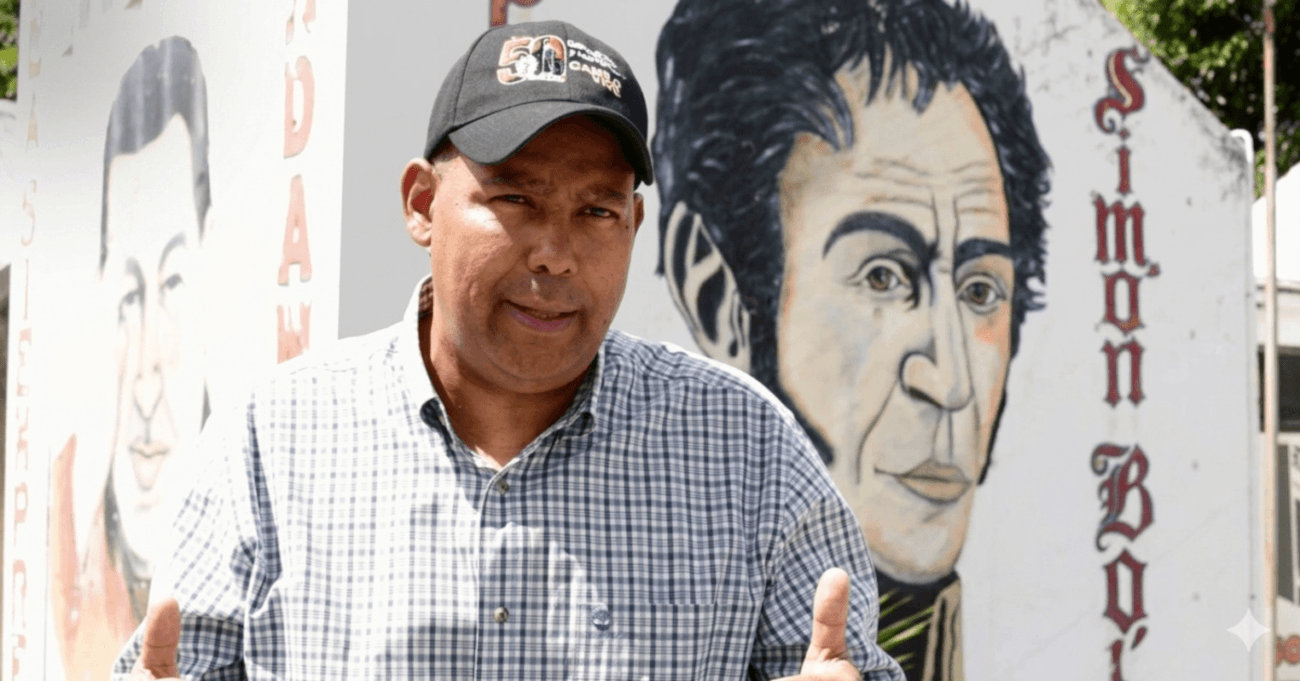
Contreras called for a unified Latin American response against ramped-up US aggression. (Tiempo)
Following the US attack on January 3, Venezuela was left in a state of turmoil and uncertainty that does not rule out further military actions. In recent days, there was “a joint operation between Venezuelan and US security agencies in the southeast of Bolívar state, in which organized crime networks were dismantled,” according to a statement from the Venezuelan government. Days earlier, the Coordinadora Simón Bolívar, a historic Chavista organization, had denounced DEA involvement in planning a repressive offensive with the aim of “decapitating” the popular movement in the iconic 23 de Enero neighborhood, which Juan Contreras describes as “the most important in Caracas.”
A community leader, social work graduate, and president of the Coordinadora, Contreras is a longtime Chavista activist and staunch defender of the Bolivarian Revolution. Today he believes there are “shameful situations that must be denounced,” but he holds the US government – ”our enemy” – responsible. Contreras was born and raised in the densely populated and combative 23 de Enero neighborhood, where he still lives and where he welcomed us to analyze the complex situation facing Venezuela, and in particular the social movements.
How are Venezuelan social organizations responding to what has been happening in the country since the US military attack on January 3?
What happened was an act of aggression, an act of war. They [the US] sought and continue to seek to break our people, but we in the social movements have kept up our efforts because we still believe in the revolutionary process. Our enemy is the US government, which must have realized that the problem wasn’t Chávez, because Chávez died and the revolution continued. President Maduro has been kidnapped, and here we are. What we’re experiencing today is unique in history; I don’t think anything like what’s happening in Venezuela has ever happened anywhere else in the world – the closest thing was in 1989 in Panama, when they kidnapped Noriega. But here, their narrative has fallen apart: it has not been proven that Venezuela is a drug trafficking country, that its government is linked to drug trafficking, or that President Nicolás Maduro was one of the biggest drug lords, as they claimed. On the contrary, today all those narratives have been debunked, and what is clear is that they are coming after our energy reserves. The Venezuelan people are well aware of this.
Is identifying a state of war and an enemy the context for the denunciation you issued about the danger of a DEA-orchestrated attack on 23 de Enero?
This is information we’ve received from a reliable source indicating that a large-scale operation is being planned against 23 de Enero, which is not far-fetched. 23 de Enero, as a barrio, has historical significance dating back to the Fourth Republic, between 1958 after the fall of Pérez Jiménez and the advent of democracy. That threat is very real. I believe that at the time, there was an underestimation of the threats posed by the US empire: the fact that our coasts were blockaded, the fact that our airspace was blockaded… Now, what we’re denouncing here has all the hallmarks of becoming a reality. It’s not just me saying this, nor the source that gave us this information, which is a reliable one. It’s that all the propaganda out there points in that direction, starting with the journalists who now live in Miami and are waging a full-scale campaign against the colectivos. “What’s going on with the colectivos? Why aren’t they attacking the colectivos? Why don’t they disarm the colectivos?” Marco Rubio himself has said it, and just recently one of the top military leaders said it: they’re coming for the “armed groups.” The problem is that, in their narrative, they label social movements as armed groups, accusing them of being armed in order to justify their aggression. Well, today our people are armed with consciousness; today, after 27 years, our people are more Bolivarian than ever. These are the people who placed their trust in Comandante Chávez, who committed to refounding the Bolivarian Republic of Venezuela. That is why we can understand all this cognitive warfare being waged against Venezuela.
There are no guerrillas here; what we have here is a people with a consciousness, a mobilized people, a people who, through culture, through popular education, have managed to advance in building the Bolivarian embryo from the barrio level, with the communal councils and the communes. So, the US seeks to dismantle that organization by employing the tactic of decapitation. They want to destroy the collectives, those who raise their voices against the empire, those who today denounce what is happening in our country, those of us who disagree with what is happening today, and who have maintained a principled and firm stance in the face of that aggression and invasion by the US empire.
Based on the information you have, how would the DEA carry out an attack of that kind on Venezuelan territory?
They have been operating by applying pressure. In all our countries, we have a repressive police force. Perhaps there is a segment of the police ranks – among their core leadership – that understands human rights issues, but there are other segments that are easily co-opted. We have 27 years of experience in which generals, colonels, and captains have turned their backs on us and served the empire’s policies. So, it’s not far-fetched to say that the United States is working with certain police forces, or with specific officials who might be willing to carry out an operation against the most important symbol in Caracas, which is the 23 de Enero parish. From 1958 to 1998, approximately 160 martyrs were killed there by the police. In other words, this is not crazy: it is serious, and as the pressure on our government to move toward an electoral process intensifies, the plan of aggression may also accelerate.
So, of course, it’s entirely possible that they’ll move forward with an action like this to eliminate what they consider “the Bolivarian resistance,” represented by social movements organized into communes, communal councils, and long-standing social organizations such as the Coordinadora Simón Bolívar, which is an expression of the popular power.
Did you receive any show of solidarity from the government?
Someone with influence within the government called us, reached out, we talked, and they agreed to investigate and look into the matter. What they recommended was caution: to steer clear of any provocation. And well, we’re waiting to see if what was discussed will be carried out, that a thorough investigation is conducted into what we’re denouncing. Because up until now, we thought [the US] would never invade, but they did; we underestimated them, and they invaded. And today they have the audacity to sell our oil, manage our finances, provoke us, and say they’re going to turn us into their 51st state. And on top of that, they’ve placed us under tutelage as if they were the owners of our country. This is, of course, shameful, and we must denounce it.
That is why we, as part of the popular movement, remain mobilized and continue to denounce what happened on January 3 and the consequences we are enduring in Bolívar’s homeland.
This situation has not yet had any international repercussions. What message do you have for the social and political forces in Latin America?
It has been 200 years since the Amphictyonic Congress, that call made by the Liberator to build a confederation of nations and defend ourselves against the US empire, which was already showing its claws. What better time to call for a continentalization of the struggle of our social organizations? It is not just Venezuela that is at risk: it is all of Latin America. They are coming for their backyard. Today, brazenly and in an interventionist manner, they are meddling in Colombia’s elections and declaring which candidate they want to win. They did the same in Honduras.
So, in light of these events, the call to expand the struggle across the continent must be a reality today. Latin America’s only chance to escape the aggression of Donald Trump’s administration is through the coordination of the popular and revolutionary movement across the region. We must unite, we must denounce this situation, and we must move forward, because they’re coming for everything. The only way forward is to make the struggle a continental one. This is something that, at one point, was not only stated by Bolívar but also attempted by Comandante Ernesto Guevara. I believe that is where we should focus our efforts: on uniting the popular and revolutionary forces of Latin America and the Caribbean.
Diversity in last year’s streaming films followed the same downward trend as theatrical releases, a new study found, with the percentage of people of color directing, writing and leading films diminishing.
In past years, streaming was considered a more accessible outlet for early-career female or BIPOC filmmakers, which was reflected in data about gender and racial representation. According to Part 2 of UCLA’s 2026 Hollywood Diversity Report, which was released Wednesday and analyzed all of the original English-language films distributed on major streaming platforms in 2025, that trend reversed across every category studied.
The share of streaming films directed by women declined to just over 23%, the lowest it’s been since 2022, when the annual study began analyzing streaming and theatrical films separately. Among those female directors, an overwhelming majority (81%) were allotted budgets below $20 million, while more than a quarter of the films directed by white men exceeded $50 million.
Only about 31% of streaming films last year had BIPOC directors, down 10% since 2024, when the proportion more closely reflected U.S. demographics.
“This is an industry in flux — and in reverse, especially when it comes to diversification,” Darnell Hunt, UCLA’s executive vice chancellor and provost and the report’s co-founder, said in a statement.
“Unfortunately, as we’ve seen with theatrical films, we’re now seeing the impact of this current political climate in very meaningful and concrete ways,” he continued. “As budgets tighten, opportunities for filmmakers of underrepresented backgrounds are always the first to be squeezed out.”
Despite losing ground behind the scenes and in front of the camera, women and people of color continued to drive streaming viewership in 2025, the report found.
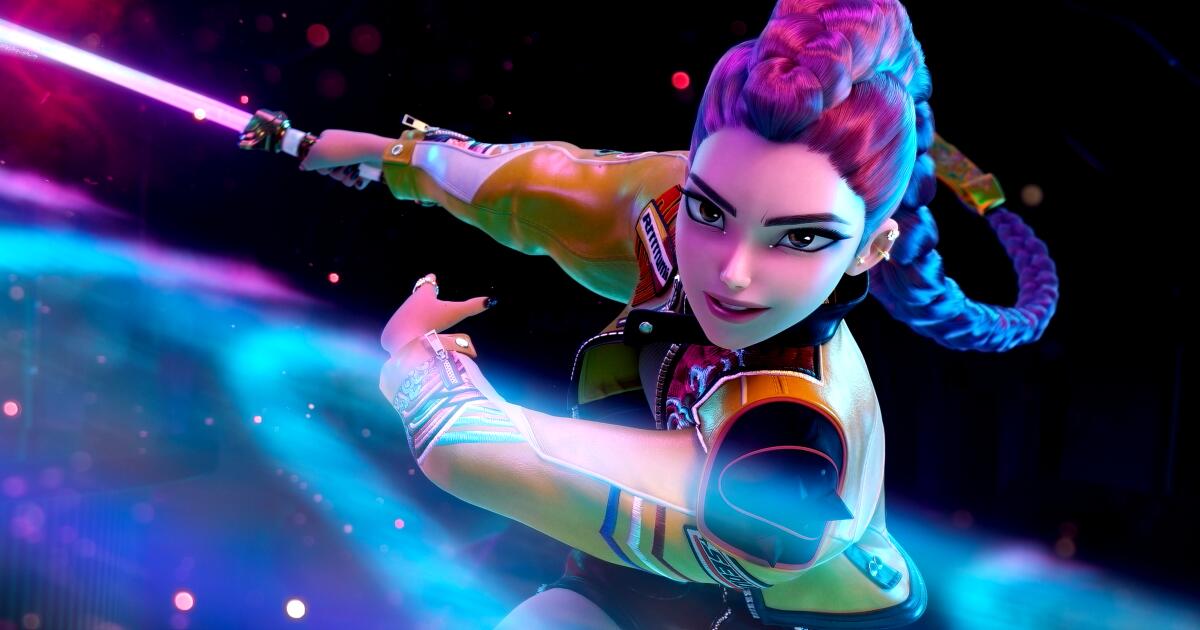
The year’s biggest streaming hit, “KPop Demon Hunters,” was also the most-watched original Netflix film of all time, and according to Neilsen ratings, it was most streamed by women in Latinx households, followed by women in Asian and Black households. The report acknowledged the film as a “bright spot” in a disappointing year for diversity.
Michael Tran, a sociologist who co-authored the report, noted that the film’s impact and earnings potential could have been even greater with a theatrical release.
“It was a missed opportunity for theaters,” Tran said. “We’ve tracked how diverse films tend to succeed at the box office, here and abroad. For ‘KPop Demon Hunters,’ we could have been talking about record-breaking box office receipts in addition to topping the ratings.”
When “KPop Demon Hunters” did briefly screen in theaters — for two days last August, with over 1,750 locations domestically and more than 1,150 sold-out screenings — it was the No. 1 movie that weekend, earning about $18 million in ticket sales (though Netflix does not report exact box office figures).
Data from the report also indicated that streaming films with at least somewhat diverse casts tended to outperform in terms of audience and social media engagement.
However, overall cast diversity in streaming films declined in 2025. For the first time since 2022, films with a majority-BIPOC cast did not represent the plurality of streaming titles. Most notably, the percentage of lead actors of color dropped from a high of 51% in 2024 to 36% in 2025.
Report authors called it an “industry-wide chilling effect” reminiscent of a similar decline in diversity among theatrical films in 2024. That said, streaming films continued to star BIPOC leads more often than their theatrical counterparts, the study found.
The overall number of streaming films also declined. While the annual UCLA report typically examines the top 100 original, English-language movies across streaming platforms, this time, there were only 89 for researchers to analyze.
In addition to studying race and gender demographics in the film industry, the report also examined on-camera representations of disability. According to the study, while adults with a disability make up at least 26% of the U.S. population, actors with a known disability represented 6.5% of total streaming movie actors, which is in line with the previous year.
According to the study’s authors, streamers hoping to compete in a fast-paced, globalized market should increase their diversity efforts in light of these results.
“Kids under 18 are already majority BIPOC. There’s no going back if a studio wants to be profitable and relevant to Gen Z and Gen Alpha,” said report co-founder and co-author Ana-Christina Ramón. “Severing all brand loyalty now will only make it more difficult to regain long-term subscribers in the future.”
But on the streets of L.A. over the last week, something very different has happened.
Fans from a kaleidoscope of cultural backgrounds have come together to act out the kind of world — and city — they want to live in.
On the shuttle bus from downtown to Inglewood on Monday, there were scores of people with Farsi-emblazoned shirts and crowds of grinning Kiwis as one would expect for the Iran-versus-New Zealand showdown that evening. However, there were also clusters of striped blue Argentina T-shirts, plenty of Team USA jerseys, and a loud group of fans chanting “Viva Mexico” from the back of the bus.
The mood was joyful before Monday’s match among fans of Iran’s national team. The players, because of restrictions by the Trump administration, have had to commute to the games from Tijuana.
(Allen J. Schaben / Los Angeles Times)
Similar scenes played out on the Metro K Line as World Cup-goers from all over traded stories of how they scored tickets, tips for navigating L.A.’s transit system, and wistful memories of tournaments past.
“This festival is about unity and bringing the whole world together; there are 48 nations and everybody is having a good time,” said Ardy Salem, an Iranian American dentist who traveled from the Bay Area to attend the game, as he surveyed the crowd outside SoFi Stadium on Monday with unabashed glee.
“Just for a moment,” he said, “we get to leave all the politics behind.”
David Leon, 32, of Watts was grinning from ear to ear as he stood outside the stadium entrance in his forest-green Mexico jersey, despite the fact that he initially didn’t support having the World Cup in Los Angeles.
“I thought it was going to be a big issue for a bunch of different people to come here,” Leon said.
Fans of New Zealand show their support as they perform the haka, a traditional Maori dance and chant, at Monday’s match.
(Allen J. Schaben / Los Angeles Times)
Leon worried that people from other countries would be turned off by American politics and fearful about traveling to the U.S.
“It really does bring people together from all these different ethnicities,” Leon said, looking at the lines of people waiting to get into the stadium. “I’ve seen Colombians, I’ve seen Mexicans, people from New Zealand, people from Iran, Germans, Spaniards.”
And for his own community of Mexican Americans, he said the matches had brought a much-needed infusion of joy. This time last year, Immigration and Customs Enforcement raids were roiling Los Angeles, instilling fear throughout immigrant households.
Fans of Mexico are on hand at Monday’s match at SoFi Stadium. Before the World Cup, there were widespread fears of ICE presence at the games.
(Kelvin Kuo/Los Angeles Times)
Just last month, about 2,000 SoFi Stadium workers threatened to strike if they didn’t receive assurance that immigration agents would be kept out of the venue during the World Cup.
Leon said he was definitely worried that ICE would take advantage of crowds gathering for the matches to perform further immigration enforcement.
But, so far, that has not been the case. Instead, many people in his hometown of Watts have been consumed with “World Cup fever,” calling out of work to attend watch parties at local bars and walking down the streets with eyes glued to a livestream of a game on a phone, he said.
While joy was the overriding mood among soccer fans gathered in Inglewood on Monday, the day was not entirely free of tension or pangs of grief for the people who were missing out on the fun.
James Carling, 63, of Ventura said it pains him to know that many fans from countries such as Iran, Haiti and Senegal are unable to attend the matches because of the Trump administration’s travel restrictions.
“Let’s face it, our government hasn’t made it easy for people to visit us, which is a shame,” he said outside the stadium. “There were people from countries whose teams made it [to the World Cup] who were not allowed to come and, sorry, that’s wrong.”
The shadow of the U.S. war with Iran and the anger many Iranian Americans feel over Iran’s current government were also present in Inglewood on Monday. Outside the stadium, some Iranian soccer fans had heated encounters with protesters who felt that supporting the Iranian national team was synonymous with supporting an oppressive regime.
Yet the atmosphere among the Iranians attending Monday night’s game was one of cathartic celebration, where for a few hours they could set aside geopolitical tensions and unite over the simple love of soccer.
In the stadium parking lot, David Arias, a Mexican American resident of Inglewood, gave a fist bump to Kam Pirouz, an Iranian fan who had traveled from Washington, D.C., to see the game.
Mexico and Iran are “homies right now,” Arias said, referencing the fact that the Iranian players are commuting to the Los Angeles games from Tijuana because of restrictions placed on them by the Trump administration.
Fans watch the World Cup group stage match between Iran and New Zealand at SoFi Stadium on Monday.
(Ronaldo Bolanos/Los Angeles Times)
Although Arias did not have tickets to the match, he said he could not resist the chance to meet people from all over the world. So he decided to take his local barbershop to the parking lot outside the stadium and offer free haircuts to fans.
With an hour to go before Monday night’s game, all three seats at his pop-up shop were occupied; Pirouz, the Iranian fan, was getting a fresh fade while seated next to a Mormon missionary from Utah and an Egyptian fan.
“It’s the World Cup, man, the entire world comes together, and it’s beautiful,” Pirouz said mid-haircut. “Best sport in the world.”
Times staff writer Seamus Bozeman contributed to this report.
Federal prosecutors announced charges Tuesday against 15 people who are accused of impeding federal agents during the Trump administration’s massive immigration surge in Minnesota earlier this year.
The investigation targeted two “Minneapolis-based antifa groups” whose members were trained in “surveillance, operational planning and rapid mobilization against law enforcement,” Minnesota U.S. Atty. Daniel N. Rosen said at a press conference.
The charges come as the Trump administration has escalated its attacks on “antifa,” an umbrella term for a diffuse movement of militant left-wing activists, which President Trump has described as a domestic terror group.
Rosen said some of those arrested identified as “antifa” while deploying a range of tactics to disrupt the immigration crackdown, such as “stalking” federal agents and using blocks of ice to slow their convoys. He declined to say whether any federal agents were injured as a result of their actions.
“Whether or not they actually, at the end of the day, cause bodily harm is not the measure of whether or not they committed a serious federal crime,” Rosen told reporters.
Twelve people were arrested Tuesday, two remain at large and one is already in custody, Rosen added. The names and specific charges of those arrested were not immediately available.
The charges come months after the administration’s “Operation Metro Surge” brought thousands of federal agents to the Twin Cities, setting off mass protests and leading to the fatal shooting of two U.S. citizens.
During the surge, convoys of agents in unmarked SUVs traveled through neighborhoods, at times banging down doors, waiting outside schools and demanding residents produce proof of citizenship.
Primarily organized through anonymous neighborhood messaging threads, a sprawling network of outraged Minnesotans quickly formed, with ordinary citizens and activists using whistles and car horns to call attention to the masked, heavily armed agents.
At the time, border czar Tom Homan indicated that federal authorities were probing “the organization and funding of the attacks on ICE.”
“They’ll be held accountable,” Homan said. “Justice is coming.”
Last September, Trump signed an order classifying antifa as a domestic terror organization and directing federal agencies to “investigate, disrupt, and dismantle” its affiliates and funders.
Democrats and several First Amendment groups have raised issue with the designation. While the federal government may designate foreign terror groups, there is no formal mechanism to apply the same label to domestic groups.
Trump has long invoked the term against a range of political opponents, including peaceful protesters without anarchist leanings.
WASHINGTON — As Spencer Pratt fell behind in the Los Angeles mayoral primary, an unexpected group began claiming election fraud: people tracking the Republican’s success on prediction markets, the increasingly popular online exchanges on which people can make bets on almost anything.
“Crazy how much voter fraud can be done with mail in ballots,” one user following bets on the mayoral race wrote last week on Kalshi, one of the top trading platforms.
“Same old California fraud,” said another who had bet that Pratt would win.
Election fraud claims extended to social media, where a handful of influencers who post content for prediction market platforms questioned the ballot count. “It’s a dead heat on Kalshi,” one user wrote on social media. “Is CA cheating to get Spencer Pratt out?”
Kalshi told the influencers to delete the posts, which violated company guidelines. Polymarket, the other leading platform, directed them to remove the paid partnership label from those posts.
The amplification of election misinformation by users who had money staked on the mayoral race adds a new twist to evolving scrutiny of prediction markets, and scholars say the ability to bet on elections broadly raises questions about whether the exchanges could alter how Americans engage in democracy.
“Elections are not a game,” said Davina Hurt, director of government ethics at the Markkula Center for Applied Ethics at Santa Clara University. “[If market] probabilities begin influencing donor decisions, media attention, the energy around [campaign] volunteers — at that point, markets aren’t just observing the election. They’re a part of it.”
Fans of the exchanges say they are powerful tools that can help decision makers, and company leaders have touted them as highly accurate predictors that can act as an antidote to misinformation and provide election insights.
“By shifting focus from ‘what people say’ to ‘where they put their money,’ and filtering out social media noise and pundit bias, we are providing a level of clarity and predictive power that cannot be matched,” said Kalshi spokesperson Dani Lever .
But these markets’ rapid rise has also raised a host of questions among members of Congress, state lawmakers and others — about betting on elections, wars and other political events, about potential insider trading, and about whether the platforms should be left to self-regulate. Some states are also in legal battles with the federal government over whether the activity amounts to gambling, which they seek to regulate.
“It’s like we’re in the 1930s with financial markets — we have some things that we want to regulate and restrict [as a country], and we’re sort of in the early stages of trying to lay out what the rules are,” said Koleman Strumpf, an economist at Wake Forest University.
Concerns about insider trading
The discourse around the Los Angeles mayoral race was the latest to raise questions at the intersection of prediction markets and politics. Earlier this year, an Army soldier was indicted after allegedly using his knowledge of the planned U.S. operation to capture former Venezuelan leader Nicolas Maduro to make bets on it, winning more than $400,000. He has pleaded not guilty.
Around the same time, several anonymous users reportedly earned $2.4 million combined by making remarkably prescient bets on the Iran war, prompting concern in Congress about insider trading. And during the primary elections, Kalshi fined a few politicians for betting on themselves, while the Justice Department began investigating a former congressman on similar charges.
Kalshi co-founder Luana Lopes Lara speaks at a conference in Santa Monica, Calif., in April.
(Anna Webber / Inc.)
The episodes set off a debate in Washington. The Republican-led House Oversight Committee opened an investigation into potential insider trading, and a bipartisan group in Congress has introduced a flurry of bills seeking to put up guardrails. It remains unclear whether any will pass this session.
The chatter in Congress appeared to lead the Commodities Futures Trading Commission, which regulates prediction markets, to propose a new framework last week to govern issues raised by lawmakers, such as potential betting on wars. Commission Chair Mike Selig said the proposal would allow for scrutiny of suspicious activity “while letting legitimate markets move forward pursuant to the public interest.”
The markets commission under former President Biden was viewed as somewhat skeptical of prediction markets; the agency under President Trump — whose eldest son holds advisory positions at both Polymarket and Kalshi — has been seen as more favorable to the industry. The federal government has sued several states over their attempts to regulate the markets under state laws banning sports gambling and other measures.
Sen. Adam Schiff (D-Calif.), who has introduced legislation on the topic, said the agency’s framework would benefit the industry at the expense of the public interest.
The agency lacks “the leadership, will and investigative staff needed to confront the dangers of election misinformation, insider trading, and more,” Schiff said, “and seems content to allow the industry to police itself.”
Making bets
As California’s primary neared, people staked their dollars on the state’s races in droves. On Kalshi, trading volume on one contract about who will win the L.A. mayoral race in November had reached more than $117 million as of Tuesday.
Prediction market users trade on the outcome of future events, making money if they’re correct and losing money if they’re wrong. Someone can purchase a contract on the prediction that L.A. Mayor Karen Bass will win in November, a yes contract, or on the prediction that she will lose, a no contract.
On Tuesday, Bass contracts on Kalshi were selling at 63 cents each for yes and 38 cents for no, meaning the market was forecasting a 63% chance of her winning. Users receive $1 per contract if their prediction is correct, creating a profit on their initial investment.
Prediction markets generally create more accurate forecasts than political polls, according to Strumpf, whose research has examined 30 years of prediction markets in various forms.
Many of the issues critics raise are theoretical and have not been seen in practice, Strumpf said. By his analysis, there is no evidence that the markets have ever influenced an election outcome. He said serious traders tend to do extensive research in order to make money, meaning their bets are educated.
Rep. Mike Levin (D-San Juan Capistrano), who has introduced legislation to prohibit event contracts involving terrorism, war, assassination and deaths, said the platforms may be useful in some cases but shouldn’t be left to police themselves. He said he’s concerned that the markets create “all the wrong incentives” for people, including political candidates and officials, to abuse inside knowledge.
“I don’t trust them to self-regulate at all,” Levin said of the companies. “The federal role should be guardrails that are reasonable and pragmatic.”
‘The sanctity of our elections’
Skeptics’ concerns regarding elections largely center around the markets’ introduction of a new way for money to potentially influence politics.
They say the desire to elevate a candidate’s market odds could create an incentive for market manipulation, and they worry that the votes of Americans using the market could be influenced by their desire to profit.
“This has real impacts for the sanctity of our elections,” said Assemblymember Maggy Krell (D-Sacramento), who raised concerns about how prediction markets could impact the democratic process in a March letter to the state’s Fair Political Practices Commission. (California lawmakers are looking at the issue, a spokesperson for Assembly Speaker Robert Rivas (D-Hollister) said, though none of the bills introduced this year have yet moved forward.)
The platforms create a potential new channel “for dark money to flow into our elections,” Krell said. “Specifically, someone who’s opposing or supporting a candidate could potentially use sites like Kalshi to elevate that candidate and impact the entire pool.”
The industry has endeavored to “get out in front” of concerns by creating their own policies aimed at preventing insider trading, market manipulation and other issues, said attorney Ronak D. Desai, partner and head of the congressional practice at the Washington law firm Paul Hastings.
Kalshi has a ban on those practices and has banned markets tied directly to death and war, Lever said. It also screens all new users and, in the first quarter of this year, blocked more than 100 potential insider trades and referred more than 20 cases to law enforcement.
In the case of the military member who bet on the United States’ operation in Venezuela, for instance, Polymarket caught the activity and referred the case to the Justice Department, a spokesperson said. The company has referred nearly 100 cases of suspicious activity to law enforcement, he said.
Election markets are not offered on Polymarket’s U.S. exchange — though users in the U.S. and other countries that ban the company’s international exchange are widely reported to access it using online tools.
“Polymarket prohibits trading based on stolen information, illegal tips, or information obtained in breach of a duty of trust, confidentiality, or other legal obligation,” the Polymarket spokesperson said in a statement.
Aaron Klein, senior fellow in the Center on Regulation and Markets at the Brookings Institution, predicted that pressure for further regulation would continue to mount.
“The top goal of a society is to have free and fair elections,” Klein said. “At a time in our nation’s history where people are doubting the integrity of elections and foreign governments are stoking those flames, we ought to be pretty careful.”
If you want personal stories of survival, family trauma or just how to get over a breakup, look no further than adult animation. Even better: Sometimes these shows do all that and are still funny. We’ve rounded up some of this season’s best examples in the genre.
‘Genndy Tartakovsky’s Primal’ (Adult Swim)
Set in an anachronistic world where prehumans and dinosaurs fight for survival, “Primal” is told sans dialogue and focuses on a Neanderthal named Spear (whose vocal grunts are provided by actor Aaron LaPlante) and a female Tyrannosaurusrex known as Fang. It’s raw, bloody and, somehow, tear-jerking.
“There’s drama, there’s violence, certainly there’s a bit of lightheartedness … we’re not trying to do it like a live-action thing, but we’re trying to get cinematic,” says creator Genndy Tartakovsky. “And because it’s dramatic and there’s no dialogue, we’re leaning into the visual storytelling of it all. This makes it seem a little bit more sophisticated.”
Tartakovsky says he even tries to make “the blood spurts look beautiful and designed”: “We’re not doing it for shock value.” The show also added the escaped female slave Mira (voiced by Laëtitia Eïdo) at the end of Season 1 because the creator felt it worked for the story.
‘Kevin’ (Prime Video)
Talking cats are not new to animation. But this one is going through the very human roller coaster of a relationship rebound and self-discovery.
Joe Wengert co-created “Kevin” with ex-girlfriend/series voice actor Aubrey Plaza as a cathartic thought experiment about their actual pet cat, Kevin. (Jason Schwartzman voices him in the show.)
“It’s more fun to write for the animals,” says Wengert, whose credits include Netflix’s animated “Big Mouth” and Fox’s live-action “New Girl.” “They have another level of crazy.”
The show also doubles as therapy.
“I’ve always been too into my relationship and I sort of neglect my friends,” he says, adding that “I’ve always wanted to write something about that, but it’s kind of sad when it’s a human man. It’s less sad when it’s a cat.”
‘Long Story Short’ (Netflix)
Raphael Bob-Waksberg, who also created Netflix’s “BoJack Horseman,” knows his beat is animated shows that are both funny and thought-provoking. He says the difference with “Long Story Short,” in addition to it being about humans and not an anthropomorphic horse, is that it has “sadness we can relate to.”
“Here, we see characters sad in the way that we are sad and we go, ‘Oh, this is not a cartoon exaggeration of our sadness.’ This is exactly the same as our sadness,” Bob-Waksberg says.
In order to keep the show from being a total buzzkill, the writers will craft scenes like an intense conversation between adult siblings about fertility treatments in the midst of the chaos and the bizarre costuming of a child’s dance concert.
He says you can do this in live-action, but it would have to be something in the Tina Fey-Robert Carlock style like NBC’s “30 Rock” or Netflix’s “Unbreakable Kimmy Schmidt,” which are known for rapid-fire bits.
“Usually in live-action, when you think about dramedy, your head goes to like, well, not too funny and not too dramatic. And my shows are kind of the opposite,” he laughs.
‘Mating Season’ (Netflix)
Like another show Andrew Goldberg co-created, Netflix’s “Big Mouth,” “Mating Season” is about sex and relationships. But, because it’s not about kids, it can be less metaphoric. And, because it’s about a group of Gen Z-ish forest animals, it can almost seem … cute?
“It feels less voyeuristic than with people,” Goldberg explains of “Mating Season.”
Goldberg, who loves nature documentaries like Netflix’s “Life on Our Planet,” says they opened the second episode of “Mating Season” with a parody documentary because “we wanted to remind people as much as possible that, yes, these are cartoon characters. But these animals are real, and they’re out there, and they’re going about their lives.”
He says the writers were also inspired by dating shows about humans such as Netflix’s “Love Is Blind” and Peacock’s “Love Island,” because “we really discovered, as we were writing the first season, how much the show was a romantic comedy.”
‘Strip Law’ (Netflix)
“Strip Law,” about a Las Vegas lawyer attempting to live up to his late mother’s legacy, is a David and Goliath story, in which Adam Scott’s Lincoln Gumb and a ragtag crew attempt to defeat the powerful and nefarious attorney Steve Nichols (Keith David). It’s also a send-up of legal procedurals, with Lincoln’s cases including a fight over who’s the real Santa Claus and a custody battle that devolves into a theological debate. Even the season finale is a meta masterpiece that’s told from the points of view of Lincoln’s rival attorneys.
“It would be disingenuous to say we weren’t at least a little trying to weird people out,” creator Cullen Crawford laughs.
Crawford cut some of his teeth on CBS’ “The Late Show With Stephen Colbert,” but says he switched formats when he got burned out writing jokes about President Trump. He says that, at least in the comedy world, “a good animation writer will be a good live-action writer and the other way around, to an extent, as long as you understand the mediums.”
The Iranian national team finally got to just play soccer.
Their journey to the World Cup has been uniquely fraught, with a war erupting between the host of their matches and their home country.
They had to relocate their base camp from Arizona to Tijuana, struggled to get all of their traveling party into the United States amid visa scrutiny and absorbed President Trump’s suggestion they may not be safe if they chose to play in the World Cup.
Iran forward Mohammad Mohebi (8) heads the ball for a goal during the second half against New Zealand in group play at the World Cup on Monday.
(Ronaldo Bolanos / Los Angeles Times)
With the focus shifted solely to soccer, Iran’s 2-2 draw with New Zealand in front of an announced crowd of 70,108 Monday night at SoFi Stadium may have felt like a victory because of the sheer fight it took for Team Melli to play in Inglewood.
After Belgium and Egypt tied 1-1 earlier Monday, all the teams in Group G are tied at one point apiece.
The All Whites showed no signs they were rattled by the pro-Iran crowd or their standing 65 slots behind Iran in FIFA world rankings.
Iran fell behind twice, but the team rallied to avoid plummeting to the bottom of its group.
A flurry of chances generated by both teams during stoppage time never translated into a winning goal.
New Zealand struck first.
New Zealand forward Elijah Just, right, celebrates after scoring his second goal against Iran on Monday.
(Robert Gauthier / Los Angeles Times)
Elijah Just rumbled toward the box and seemed to pinball around the Iranian defense. He passed to Sarpreet Singh, who chipped the ball to Chris Wood in the box. Wood then chested the ball back to Just, who took one touch before kicking the ball in for New Zealand’s first goal in the seventh minute.
A small but hearty contingent of New Zealand cheered.
After the hydration break, Iran’s Ramin Rezaeian pushed the ball into the box and tapped it to Saman Ghoddos. Shahriyar Moghanlou’s shot was blocked, but Rezaeian was in position to tap the deflection into the far lower left corner of the net in the 32nd minute.
The stadium roared as Mexico fans joined Iran fans cheering and waving flags.
1
2
3
4
1.Iran goalkeeper Alireza Beiranvand watches the ball go into the net after a goal by New Zealand forward Elijah Just in the first half.(Allen J. Schaben/Los Angeles Times)2.Iran defender Milad Mohammadi leaps over a New Zealand defender during the second half.(Kelvin Kuo / Los Angeles Times)3.New Zealand defender Finn Surman, top, goes after the ball in front of Iran forward Ali Alipour during the second half.(Allen J. Schaben / Los Angeles Times)4.Iranian soccer team fans show their support during the team’s 2-2 draw with New Zealand.(Kelvin Kuo / Los Angeles Times)
Both teams has chances to break the tie late in the first half.
New Zealand earned a free kick in the 45th minute just outside the box. Wood took a direct shot at the goal, but Iran goalkeeper Alireza Beiranvand gathered it with ease.
During first-half stoppage time, Rezaeian’s free kick was headed home by Ali Nemati, but Nemati was clearly offsides and the goal was waived off by the referees.
In the 54th minute, Iran turned the ball over and Just connected with Just for his second goal of the match.
Iran responded in the 64th minute with Rezaeian’s cross headed home by Mohammad Mohebi, tying the game and delighting fans.
Iran forward Mohammad Mohebi reacts after scoring against New Zealand in the second half Monday.
(Kelvin Kuo / Los Angeles Times)
Before the game, protesters outside SoFi Stadium argued Iran’s oppression regime should be sanctioned for human rights violations and banned from competition. Other Iranian Americans countered they gathered at the venue to cheer on players rather than Iran’s totalitarian leaders.
Iran captain and star striker Mehdi Taremi said before the game he hoped the team that has unified in the face of massive distractions could provide solace during a difficult time.
“We, the players of the national team, we play for every Iranian, be it the Iranian diaspora or be it Iranians in the country,” Taremi said through a FIFA interpreter. “Look, in every country, people have different opinions, but we are here as footballers to unite people, and we will try to bring joy to all Iranians, irrespective of where they live.
“Everyone is entitled to their own opinion, and we respect them, but we are here to bring joy to the Iranian people. We do not get involved in politics. We are here to play football.”
A weekend BASE jumping accident in a Utah canyon killed two people, one of them a daredevil athlete best known for performing onstage with Madonna at the 2012 Super Bowl, authorities said.
The Sheriff’s Office in Grand County, Utah, confirmed one of the dead was Andy Lewis, an extreme athlete known for feats in BASE jumping, a dangerous sport that involves parachuting to the ground after jumping from a tall fixed object such as a building, a bridge or a desert cliff overlooking a deep canyon.
In BASE jumping circles, Lewis had a huge following and a reputation for pushing the envelope — leaping into tighter spaces or deploying his parachute later than his peers would dare, said John McEvoy, a BASE jumping instructor in Twin Falls, Idaho, who has jumped with Lewis.
“He had an incredible level of athleticism and skill that was developed over years of practice,” McEvoy said. “But then he would take an incredible amount of risk.”
Lewis’ other sport made him an overnight celebrity, thanks to Madonna
Lewis was also a prominent figure in the niche sports of slacklining and tricklining, which combine elements of high-wire walking with aerial acrobatics — sometimes at perilous heights.
Lewis went from obscure athlete to overnight celebrity when he appeared onstage in Madonna’s 2012 Super Bowl halftime show. Dressed in a Roman toga, Lewis bounced and executed tricks on his inch-wide line as though it was a trampoline while Madonna sang behind him.
“My phone actually rang itself to death three days in a row,” Lewis said soon afterward in an appearance on Conan O’Brien’s late-night show.
Emergency responders were dispatched Sunday to a report of people injured in a BASE jumping attempt at Mineral Bottom, a remote desert area near the Utah-Colorado line, according to the Sheriff’s Office. Lewis and an unidentified 50-year-old man died at the scene, the office said in a news release.
Sheriff’s Lt. Al Cymbaluk confirmed to the Associated Press that it was Lewis the extreme athlete who died. He said he had no further details on the fatal accident.
BASE jumping is far more dangerous than skydiving
Though there’s no official tally of BASE jumping deaths, a list compiled by the website BASEaddict.com shows 540 total fatalities worldwide since 1981 — including 30 people killed last year. Prominent deaths include BASE jumper Dean Potter and his climbing partner, Graham Hunt, who were killed in 2015 while attempting a wingsuit flight in Yosemite National Park.
A study focused on BASE jumping in Norway, published in a medical journal in 2007, estimated that BASE jumping carried risks of injury or death five to eight times greater than skydiving.
Lewis openly acknowledged the sport’s inherent danger.
“It’s weird to think about how many people are dead, because it’s like a normal thing,” Lewis told documentary filmmaker Ella Warnick in an interview published last year.
Lewis owned BASE Jump Moab, a business that offered excursions to inexperienced customers using tandem jumps, in which the customer was harnessed to a guide wearing the parachute.
Sheriff’s spokesperson Cymbaluk said he didn’t know whether Lewis and the other man killed were performing a tandem jump.
Tandem BASE jumping carries additional risk because it straps together two people, one of whom generally lacks experience, under a single parachute, McEvoy said. But because they involve novices, they also tend to be the most low-risk, basic types of jumps.
“Within BASE, it’s a very controversial topic,” McEvoy said. “There’s a lot of people who say it’s the stupidest thing in the world and others arguing, `No, we’re giving people the experience of their lives.’”
No one immediately returned phone, text and Facebook messages left Monday for BASE Jump Moab.
Lewis won four straight world championships in competitive slacklining from 2008 through 2011. Lewis set a Guinness World Record for slackline surfing, swaying his feet side to side in a rocking motion that mimics surfing, while keeping his balance above China’s Diaoshuilou waterfall in 2011.
In 2014, he walked a slackline suspended between two hot air balloons more than 4,000 feet above the Nevada desert.
Several studios in Microsoft Corp.’s Xbox gaming division, including Montreal-based Compulsion Games and San Francisco-based Double Fine, are in active negotiations to spin off as they try to thwart closure, according to people familiar with the company’s plans.
Cambridge, England-based Ninja Theory, the maker of Hellblade, is also in conversations with Xbox, as are several other studios across the portfolio that are at risk of being shuttered.
The studios may still have the opportunity to buy themselves back from Xbox and go independent, although many employees will probably lose their jobs as a result, said the people, who asked not to be named because they were not authorized to speak to the press.
Employees at several studios have been informed of the situation and given permission to seek new work but were told that the status of the studios is still in flux.
An Xbox spokesperson declined to comment.
The potential closures are part of a broader reorganization being overseen by Asha Sharma, who took over as Xbox’s new chief executive in February.
Last week, Bloomberg News reported that the gaming division is planning significant layoffs. Sharma sent out a memo to staff lamenting the bleak state of the business, which has seen revenue and margins plummet in recent years. “Going forward, this cannot continue,” she wrote.
Compulsion Games, Double Fine and Ninja Theory all made award-winning games that were not commercial hits. But even some of Xbox’s more commercially successful studios are not yet sure how they will fit into Sharma’s new mandate, which will prioritize the biggest franchises as the company looks to return to growth.
Compulsion Games is the developer behind South of Midnight, which was released last year. Double Fine, best known for the Psychonauts series, released the smaller games Keeper and Kiln over the last year.
Xbox is facing the current challenges despite having made major purchases in recent years, including its acquisition of Activision Blizzard Inc. for $69 billion in a deal that closed in 2023.
Xbox Game Studios head Craig Duncan stepped down last week ahead of the layoffs, said the people familiar with Microsoft’s plans. Gaming newsletter the Game Business previously reported his departure.
WASHINGTON — While millions of soccer fans cheer or groan over World Cup matches spanning North America, health officials are on high alert for germs.
A heat wave may be the most obvious health threat. But infectious diseases can spread in a crowd, and experts are scrutinizing wastewater, hospital visits, even social media for any signs that an outbreak might be brewing.
Measles, one of the most contagious diseases, is among the top concerns, sparking a warning this week from the Pan American Health Organization, PAHO. With a nearly six-week stretch of packed stadiums, bars and tourist sites in 16 cities, officials are on the lookout for a long list of infections, from the stomach bug norovirus to mosquito-borne dengue fever.
“This is truly a marathon,” said Palak Raval-Nelson, Philadelphia’s health commissioner.
The mass gatherings come at a tense moment for budget-strapped health agencies in the U.S. The Centers for Disease Control and Prevention, hit hard by Trump administration staffing cuts, already was grappling with a growing Ebola outbreak in central Africa and a cruise ship hantavirus outbreak. While CDC officials have advised state and local health departments behind the scenes, it’s expected World Cup disease surveillance dashboard still was “in final development” days before games began, according to the Department of Health and Human Services.
“Our public health professionals are pretty stretched,” said global health specialist Rebecca Katz of Georgetown University, who is leading an unusual new hub to help.
At the Health Security Operations Center, a joint effort between Georgetown and MedStar Health, workers are analyzing data from around the country so they can alert health authorities, even emergency rooms, to any early signs of trouble. The center is issuing daily “situation reports” about disease trends around World Cup host cities and team base camps to several hundred local and federal public health groups, emergency management and hospital officials and others who’ve signed up.
“It’s important that we don’t become alarmist,” said MedStar emergency medicine specialist Dr. Shane Kappler. “We’re trying to be the insurance policy.”
Measles is a top concern for potential World Cup spread
Already more than 2,000 people in the U.S. have come down with measles this year, nearly as many as during all of last year, according to the CDC. Patients can spread measles before the rash appears and they realize they’re sick. Not too long ago, the U.S. seldom saw measles except from international travel by unvaccinated people.
Now with frequent U.S. outbreaks, “actually a lot of our international partners are worried about measles being exported to them after the games,” said Georgetown’s Katz.
Measles is spreading in Canada, too, and has exceeded 11,000 cases in Mexico, according to PAHO. It’s urging soccer fans to be sure they’re vaccinated, with a health campaign saying a single measles patient can spread the virus to up to 18 unprotected people.
Is Ebola a concern at the World Cup?
Brown University’s Dr. Craig Spencer, who survived Ebola while working in the West Africa outbreak over a decade ago, said he’s repeatedly asked about the risk of Ebola during the World Cup — but “for me, Ebola is not the No. 1 or No. 2 or even No. 3 threat.”
“I am concerned about importation of measles, I am much more concerned about the importation of other infectious threats that may not seem as scary to us as Ebola,” Spencer said.
Many health experts agree that the risk of Ebola spreading in the U.S. is very low. That’s partly because of government travel screenings and restrictions on people recently in outbreak-affected areas. Moreover, Ebola spreads by contact with bodily fluids from someone showing symptoms, not through the air like measles or respiratory viruses.
“One fortunate thing about this virus is you’re most contagious when you’re really quite ill. It’s not like COVID, where you could be sitting next to someone who doesn’t even know they’re infected and perhaps contract the virus,” said Jennifer Nuzzo, director of Brown’s Pandemic Center.
How to spot brewing diseases
There’s precedent for germs invading major sporting events. Canadian scientists linked a community measles outbreak to the 2010 Olympics in Vancouver, and clusters of norovirus had to be contained during the Olympics this year in Milan and in 2018 in South Korea.
One way to detect signs of trouble: People with certain viral or bacterial infections shed genetic material that sophisticated testing of wastewater can spot. For example, measles can appear in wastewater days before an emergency room sees its first patients.
A recent surveillance reports from Katz’s center note that wastewater testing recently found diarrhea-causing rotavirus, hepatitis A and norovirus in some parts of the U.S., something to watch as soccer crowds arrive.
In Dallas, officials ramped up wastewater screening including at the international airport, casting a wide net rather than looking for specific illnesses, said Dr. Phil Huang, director of Dallas County Health and Human Services.
His team also is enhancing the usual mosquito testing, checking not just for West Nile virus that regularly spreads in the U.S. but for viruses more common in other countries like dengue and chikungunya.
Public health officials have been preparing for months, said Philadelphia’s Raval-Nelson, including with mock emergency drills and communications with counterparts around the country.
“I don’t want to send a message that there’s one key thing,” she said. “We have the frameworks in place to carry out what we need to.”
NEW YORK — It was bedlam on Broadway as the New York Knicks won their first NBA championship in 53 years on Saturday night, with exuberant celebrations marred by mayhem and violence, including a shooting in Times Square.
Outside Madison Square Garden, a crowd watching on a big screen roared as the Knicks rallied from a 16-point deficit to beat the Spurs in San Antonio in Game 5 of the NBA Finals.
Soon after, tens of thousands of people filled the streets and the rowdiest among them were clashing with police, smashing windshields, scaling scaffolding, light poles and a statue, climbing into and atop school buses in Times Square and trying to hitch a ride on a moving fire truck.
Around 2 a.m., a 17-year-old was shot near 42nd Street and Broadway, police said. Bystander video captured the sound of at least seven shots and showed people crouching and running for cover. Police took the victim to the hospital because an ambulance could not get through the crowds, police said. A gun was recovered and three people were taken into custody.
Four people were stabbed or slashed, and one of the school buses, which was being used for World Cup transportation, was set on fire and engulfed in flames, police said. Other buses and five police cars were also damaged, police said.
In all, 63 people were arrested, with charges including assault on a police officer, criminal possession of a weapon, criminal mischief and disorderly conduct.
Knicks owner James Dolan, speaking in San Antonio after the game, urged fans to stay calm.
“We need to tell everybody in New York that we know that they’re celebrating, we want them to have a great time,” said Dolan, interrupting guard Josh Hart’s news conference. “Please be safe. Don’t get hurt; don’t hurt anybody.”
The city will officially celebrate the Knicks on Thursday with a parade and City Hall ceremony.
As the clock ticked to the final buzzer on Saturday night, anxiety that had dominated the game’s first three quarters gave way to euphoria. An orange-and-blue-tinted fever dream that started with the Knicks’ first playoff game two months ago ended in the third title in their 80-year history.
Fireworks boomed over Brooklyn and Central Park. Fans flocked to Times Square and ran through the streets. Outside the Garden, they sang the team’s anthem: “Go New York, Go New York, Go!”
Police officers and ambulance workers shouted, “Let’s go Knicks!” over loudspeakers in Brooklyn. Strangers shook hands and hugged. In the Lincoln Tunnel, where people were riding buses back from the World Cup at MetLife Stadium in New Jersey, drivers honked their horns in celebration.
“I’m so overwhelmed. I’m so happy,” said Mathieu Ogno of Long Island, who fought back tears as he soaked in the victory at a team-sanctioned watch party at Wollman Rink in Central Park.
Ogno wore the jersey of Knicks captain Jalen Brunson, whose 45 points propelled his team to victory and him to the NBA Finals MVP. Brunson’s gritty determination and chip-on-his-shoulder style have made him a fan favorite, embodying New York’s working-class ethos.
The Knicks’ championship — 19,392 days since their last — capped an extraordinary postseason for a franchise that hadn’t been to the NBA Finals since losing to the Spurs in 1999. Since April 23, the team has won 15 of 16 games, with its lone loss coming Monday in Game 3.
Their last title, in 1973, was also won on the road in a Game 5. Their first, in 1970, was won at home in a Game 7 thriller. Neither was celebrated with a parade.
“I’m happy to see my Knicks finally make it over the hump,” said Shawn Muoneke, 26. “I’ve seen them knock on the door. They were knocking on the door the past few years. But they finally made it over the hump, and I’m so happy to see it and I’m so happy I’m in the city to experience it.”
Muoneke, born a year after the Knicks’ last trip to the NBA Finals, started rooting for them when he was 10. He drove from Maryland to be in the city for Game 5 at the team’s Central Park watch party.
“I saw the ups, the downs and I watched the team come back up, and I was so happy to see them finally reach the highest echelon of stardom as a team,” Muoneke said.
After the Knicks’ win, he said, the vibes in the city “are the highest they’ve ever been.”
President Trump, a longtime Knicks fan who attended Game 3 at the Garden with Dolan, congratulated the team in a post on social media.
“What a year it has been but, even more so, what incredible playoff wins we have all witnessed, especially the last four — Maybe the greatest in the history of basketball,” Trump wrote.
With Brunson’s clutch performance, he added, “a superstar was born.”
After several dozen arrests throughout the playoffs and violence after Games 3 and 4 in New York that left officers injured and a teen in a coma, police girded for unrest as Saturday turned to Sunday.
“As we celebrate, be responsible, look out for one another, stay safe, be smart, and make this a night that reflects the very best of our city,” Mayor Zohran Mamdani said on social media. “Let’s go Knicks.”
Sisak and Lum write for the Associated Press. AP writer Emily Wang Fujiyama contributed to this report.
As soon as enough votes were counted to officially knock Tom Steyer out of the California governor’s race, the anti-billionaire schadenfreude kicked in.
Social media and legacy media, conservative and liberal, all seemed to have a rare melding of the minds, delivering endless variations of, “How dare he try to buy elected office! We showed him.”
“I hope you received the message from California that a power-hungry communist billionaire cannot buy the state!” wrote one detractor on social media. “How much money did you waste spamming Californians? Do you know how many hundreds of millions of dollars you wasted?”
“What a waste,” screamed a New York Times headline, slamming Steyer for not donating that money directly to building houses or funding Planned Parenthood — one-off actions that prop up broken systems instead of changing them.
I get it.
In an age when income inequality is reaching serf-lord levels, hating the rich seems easy and reasonable. You could take several zeros off the $200 million Steyer spent on his campaign and it would still be more than most of us make in a lifetime. That’s a rage-inducing reality for many, if not most of us, for whom pairing a full tank of gas with a restaurant dinner seems like careless luxury these days.
I’m not here to defend the nine-zeroes class. But maybe we should take a beat and make sure our outrage is working for us, not against us. While Steyer has spent the last few months advocating for universal healthcare, better pay and protections for workers, and putting curbs on out-of-control corporations from the energy sector to AI, other billionaires have spent that time actively undermining democracy and our financial system. Heck, some even seem to be undermining humanity. Why aren’t we raging at them?
Take, for example, a certain billionaire who seemingly would prefer to be a trillionaire: Elon Musk.
Last week, his SpaceX held an IPO in which somehow the rules of Wall Street meant to protect small investors and pension plans were set aside to his benefit. Like it or not, if you hold a public pension or a 401(k) in America that uses index funds (which most do) you will likely be an investor in his unproven and possibly risky business. I’m sure that will work out fine.
Or consider the hundreds of millions of dollars right-wing AI and surveillance-company billionaires, some Californians, are dumping into political races across the country right now to ensure that their dangerous and unpredictable technologies are not regulated, or regulated in largely meaningless ways. It’s a situation so dire that one wealthy insider last week warned in his own op-ed that if his former colleagues are successful, “It could concentrate economic power in ways that would make the Gilded Age look quaint.”
Then there’s our president, king of self-enrichment, whose wealth has skyrocketed to more than $6 billion during his time in office. Much of that moola is in opaque cryptocurrency holdings, an industry he has championed as his fortunes in it have increased.
But don’t think Trump is in it only for himself: He’s enriching his family, too.
But sure, hate the goofy guy in the vintage Nikes pointing all this out.
“I’m proud of the enemies we made,” Steyer said in his concession. “In this race, those corporations revealed that they see a government that puts working people first as an existential threat — even when proposed by a billionaire. By spending $55 million — the most ever against a single candidate in a California primary — they showed the lengths they would go to in order to protect a status quo that only serves them and their profits.”
I don’t like the amount of money in our political system either, but the truth is, it’s there. And worse, the majority of those who have it seem intent on diminishing the political and economic power of those who don’t.
We are increasingly moving toward a country where the well-being of the majority of people will depend on the largesse of the few — Silicon Valley’s tech industry now talks about a universal basic income as a great boon for the coming mass unemployment they are creating.
But is existence off a charity-pittance really what we want for ourselves and our children? Do we really want these ultra-wealthy overlords to use their money unchecked to make decisions that will shape our future, diminish our rights and ultimately leave us without the power to fight back?
If Steyer wants to use his money to join this battle to keep power by the people and for the people, then the enemy of my enemy is my friend.
Like it or not, us average worker bees need money to fight money. In this age when animus eats discernment like the rich eat caviar, the luxury we really can’t afford is hating the good guys just because it’s easy — even if they’re billionaires.
Martin Lewis’s team has issued urgent advice for the summer
Martin Lewis’s MoneySavingExpert has issued urgent advice for anyone travelling to Europe this summer, as more than two million people will see a key document expire before they head off. MoneySavingExpert.com has a holiday warning for anyone visiting countries including France, Spain, Portugal, Greece and Italy.
Martin’s team has urged holidaymakers to check if their European Health Insurance Card (EHIC) or Global Health Insurance Card (GHIC) is still valid, as 1,285,250 GHICs and 926,954 EHICs are set to expire this year. The EHIC is being replaced by the new Global Health Insurance Card (GHIC). These cards are totally free to get and they give you access to state-run hospitals or GPs in EU countries for the same price as a local.
They last for up to five years, and the final EHICs issued after Brexit are expiring this year. The MSE newsletter reads: “These cards give access to state-run hospitals or GPs in EU countries for the same price as a local – so if it’s free for them, it’s free for you.”
You need to check your card for the expiry date, and apply for a new one if necessary.
The team said: “You’ll need to get a new card – it’s now called a GHIC (as it’s been rebranded a ‘Global’ card, though in essence still covers mostly the same European countries).” However, MSE also warned people not to fall for websites that charge you for these cards.
MSE said: “Never pay to get an EHIC or GHIC. It is always free, beware shyster sites trying to charge you for ‘fast tracks’ or other stuff, that’s nonsense. See how to safely get a free GHIC.” If you have an existing EHIC, it remains valid until the expiry date runs out – after this, you’ll need to apply for a GHIC card.”
The NHS explains: “The UK Global Health Insurance Card (GHIC) lets you get necessary state healthcare in the European Economic Area (EEA), and some other countries, on the same basis as a resident of that country. This may be free or it may require a payment equivalent to that which a local resident would pay.
“The UK GHIC has replaced the existing European Health Insurance Card (EHIC). If you have an existing EHIC you can continue to use it until the expiry date on the card. Once it expires, you’ll need to apply for a UK GHIC to replace it.
“The ‘Global Health Insurance Card’ (GHIC) and its predecessor, the EHIC, give access to state-run hospitals or GPs, mainly in European countries, for the same price as a local. So if they don’t pay, you don’t either. Over two million expire this year, check yours.”
A UK GHIC is free, and you can apply through the NHS website. The NHS advises avoiding unofficial websites, which may charge an application fee. People can apply for a new card up to nine months before their current card expires.
The NHS says: “Every member of your family needs their own card. You can add your spouse, civil partner and children to your application when you apply. You must enter your own details first and apply for any additional cards when prompted.”
Béla Guttmann may be the most consequential soccer coach you’ve never heard of. But if it weren’t for Guttmann, you may never have heard of Pelé.
And Brazil may never have become the greatest soccer-playing country on Earth.
That’s because Guttmann changed the shape of modern Brazilian soccer — and changed the sport forever — when he imported the revolutionary 4-2-4 system from Hungary to Sao Paulo in 1957. A year later, Brazil won the first of five World Cups and the joga bonito was born.
But what Guttmann brought to Brazil isn’t nearly as interesting as how he got it there. That’s just one of the fascinating stories in “The Beautiful Game … The Untold Story,” the exhibit that will open the Holocaust Museum LA on Sunday at the Goldrich Cultural Center, a $70-million expansion that will double the size of the Pan Pacific Park museum’s campus to 70,000 square feet.
A soccer ball from the holocaust is among the items on display in the exhibit “The Beautiful Game … The Untold Story” at the Holocaust Museum LA.
(Eric Thayer/Los Angeles Times)
The exhibit was unveiled during a private reception on Saturday followed by a free preview day open to the public from 10 a.m. to 5 p.m. The grand public opening will take place in August.
The show’s launch coincides with eight local World Cup matches, which kicked off with the United States’ 4-1 win over Paraguay on Friday at SoFi Stadium, and it shines a light on the important but largely overlooked relationship between Jewish life and the global game, as well as how Jewish innovators like Guttmann shaped the modern rhythm, style and culture of the sport.
“It was in the same intellectual level as jazz, as art and everything modern and progressive,” journalist Allon Sander, who helped curate the exhibit, said of Jewish participation in European soccer in the years before World War II.
“The origin of the game and how it intersects with Jews and the Holocaust and the impact that these Jewish footballers and coaches had to shape the game and help popularize the sport is so fascinating,” added Beth Kean, the museum’s CEO. “And it’s an unknown history.”
Much of that story can be told through Guttmann, who was born in Budapest in the final year of the 19th century and developed into one of the sport’s first Jewish stars, representing Hungary in the 1924 Olympics and playing for nine teams in two countries before retiring to become a coach.
But none of that success mattered when the Hungarian government began introducing anti-Jewish laws in 1938, costing Guttmann his job and nearly his life when he was sent to a Nazi forced-labor camp, where he was tortured. Just days before he believed he would be shipped to Auschwitz, which meant certain death, he escaped alongside Erno Erbstein, another Jewish coach.
Erbstein revolutionized soccer in Italy before dying in 1949, along with the entire Torino team, when their plane crashed into a hilltop outside Turin. Four years ago, he was inducted into the Italian soccer hall of fame. Guttmann, meanwhile, who lost much of his family in the Nazi death camps, would go on to coach for 42 years in 14 countries, winning championships in six of them yet only staying in a single place for more than two years just once.
“He’s running away from his demons,” said Ronen Dorfan, a journalist and sports historian based in Budapest whose research was instrumental in putting the exhibit together. “His father was murdered, his sister was murdered. You never know how you survived in Budapest during the war so he had guilt feelings.”
A jersey worn by player Max Wozniak and a jersey from the 1930s are displayed in an exhibit called “The Beautiful Game … The Untold Story.”
(Eric Thayer/Los Angeles Times)
The exhibit was designed in three sections, the first devoted to the years before World War II, the second is about the Holocaust and the third is the postwar years. And while it details Jewish participation in, and influence on, global soccer, it also challenges the cliché that Jews were intellectuals, artists and laborers but not athletes.
“We are always trying to challenge stereotypes. Stereotypes that we might have about ourselves and even stereotypes that we believe about others,” said Jordanna Gessler, the museum’s vice president of education and exhibits who helped curate the show. “It’s crucial to help people find their place and their voice and really see the unity, the similarities between people.
“This is a story that was lost in time and we’re really bringing it out,” Gessler added. “To really have this conversation and encourage people to explore stories that they might not know.”
One thing people might not know is that in the 1920s and ‘30s, Europe’s best teams weren’t in England, Germany or France, but in Austria and Hungary, where they were led by Jewish players and coaches such as Hugo Meisl, Jozsef Braun, Arpad Weisz, Marton Bukovi, Gusztav Sebes and Gyula Mandi. Weisz and Braun were both killed by the Nazis.
A soccer ball from the 1974 World Cup is displayed at an exhibit called “The Beautiful Game … The Untold Story.”
(Eric Thayer/Los Angeles Times)
The surge of antisemitism and fascism in Germany, Italy and Eastern Europe helped spread the influence of those revolutionary players and coaches around the world.
“With the rise of the Reich and the Holocaust, the coaches ran away,” Dorfan said. “And they ran to every corner of the world, to Brazil, to Argentina, to Portugal [and] provided coaches to Real Madrid, to Barcelona, to Benfica, to Flamengo.
“There isn’t one of these clubs that doesn’t owe its tactical development in the ‘40s and ‘50s to the Jewish coaches, which came primarily from Hungary.”
The primary tactical development was the shift from the popular but rigid 2-3-5 formation, which required immense physical endurance and tactical discipline, to the fluid 4-2-4, which spread the wingers to the touch line and allowed for improvisation and creativity on the attacking end, a formation pioneered in Budapest in the 1920s.
“They developed a more refined game of passing the ball, keeping it on the carpet rather than the English kick and run, and really put thought into tactical thinking,” Dorfan said.
Guttmann, who played or coached for more than two dozen teams in his career — including one, in Romania, that paid him in vegetables during the postwar period — brought the Hungarian approach to Brazil in 1957 when he coached Sao Paulo to a championship. After Vicente Feola, the manager Guttmann replaced at Sao Paulo, took over the national team a year later, he brought the formation with him, popularizing many of the tactics still used in modern soccer, such as fluid defensive wingers, overlapping full backs, the use of a withdrawn striker and an attacking midfield.
The soccer team at the Theresienstadt concentration camp’s flag is displayed in a Holocaust Museum LA exhibit called “The Beautiful Game … The Untold Story.”
(Eric Thayer/Los Angeles Times)
“He is the whole exhibition in one man,” Dorfan said of Guttmann.
“Obviously if we wouldn’t have had the Holocaust, those [coaches] wouldn’t be kept out of Europe, Europe would be much stronger, much more developed. [And] then the development of Brazil or the success of Brazil would be coming much later,” Sander said.
Dorfan spent the better part of two years tracking down many of the more than 100 trophies, uniforms, photos and trinkets that make up “The Beautiful Game” exhibit, a search that required determination, perseverance and more than a little luck. Many of the items, because of their ties to Jewish athletes and teams, were hidden during the war and presumed lost. Others resurfaced only through detective work that sent Dorfan following leads that spanned decades and crossed more than a dozen borders.
That also cost money. So Alan Rothenberg, the man who, as president of the U.S. Soccer Federation, first brought the World Cup to Los Angeles 32 years ago, stepped up to lead an effort that raised more than $1 million to fund the exhibit.
“The story really needs to be told, particularly with what’s going on right now with respect to antisemitism,” Rothenberg said. “It’s really important for people to realize what can happen. And soccer is a great vehicle to draw them in. The one main thing in the museum is bringing schoolkids in.”
The Nazis and their collaborators failed in their attempt to erase the history of Jewish soccer pioneers; in fact, they inadvertently popularized both the men — and women — and their ideas. But the sport also helped other Jews survive a dark period and Kean said that may be the most beautiful and uplifting part of “The Beautiful Game.”
“The main reason we decided to do this exhibition in the first place is because for years so many survivors, when they talk about their life before the war, so many of them talk about soccer. So many of them were passionate and fond of the sport,” she said.
“We knew the exhibit opening was going to coincide with the World Cup. L.A. is going to be on the world stage. This is a great opportunity for the museum to get these stories out.”