There was a time in the beginning of Sublime’s recent revival when Jakob Nowell, the son of the band’s late singer Bradley Nowell, saw himself simply as a good son trying to help his adoptive uncles — drummer Bud Gaugh and bassist Eric Wilson — restart his dad’s iconic Long Beach trio. The goal wasn’t to take the place of his frontman father who died of an overdose in 1996. “I’ll never look at it as my band. Sublime is my dad’s band, and I’m helping out, that’s all,” he told The Times in 2024. Luckily, he was wrong.
The journey of finding his own voice through his father’s sly, shambolic poetry and reggae rock anthems, along with his determination on the road with Gaugh and Wilson through a barrage of festivals and tour dates helped him eventually step into his own as a songwriter and Gen Z rock star. It’s all been done with the mission to preserving his dad’s legacy and having fun while doing it. Now it feels as natural as the trio sitting together on the waterfront in LBC’s shoreline marina within earshot of the bellowing horn of the Queen Mary earlier this year as they were finishing the recording of “Until the Sun Explodes,” the first album under the Sublime moniker in 30 years.
Just like the band’s original recipe of shoving punk, dub reggae, hip-hop and ska into a blender, the new songs dutifully stick to the formula along with Jakob’s soulful caterwauls that sound scarily similar to his dad. But what emerges from the 21-song tracklist is the evolution of a trademark sound that gives a nod to the past while standing strong on its own, just like Jakob, despite coming to the interview on crutches while healing from a performance-related knee injury. The band members chatted with The Times about recapturing the effortless essence of their immortal beach-ready sound and looking forward to a second chance to chase an endless summer.
This interview was edited for length and clarity
It’s kind of a rare thing for all three of you guys to be in one place at the same time. What was it like working in the studio together to finish the new album?
Bud Gaugh: Magical. Things are just coming together. We showed up, Jake had an idea for another song, and he sent us a little demo and said “Hey, this is what I’ve been thinking about.” And then we get down to the studio [in San Pedro], and he’s like, “Oh yeah, so I had another idea,” and kind of changed it. We jumped in there [and by the end of our sessions, we had written] brand new songs to the list of songs that we already had.
The band’s revival has been a long time in the making. I remember when you guys had your first show together, a surprise gig a couple years ago as part of a benefit show for the Bad Brains frontman H.R. Do you feel you’ve come a long way since then?
Eric Wilson: I never thought the chemistry would be like it was with Bradley.
Jakob Nowell: Especially now that we’ve been playing together this long, the chemistry is very much there. We’re just comfortable and having fun. Jamming together is the best. We get in there to do a take for a song, and I’m always like “Let’s just do like three more!” It’s just that much fun, and that’s how it feels playing live too.
When did the idea for creating a new album come about?
Gaugh: It was pretty much just while we were playing shows, At first, the idea was that we were getting together to do this benefit for H.R. [at Teragram Ballroom in December 2023]. We went from “How’s this going to work?” and then [after the show] it was like, “Wow, this is something special. We should definitely go out and play some more shows, and get this music out there and get the opportunity to bring the music to the people in the purest form that we possibly could.” As we’re doing that, it’s like we’re seeing the reaction in the fans, and we were feeling it emotionally. We realized this is going to be bigger than we ever thought. That’s when we really decided where it was going to go.
Jakob Nowell, right, once thought Sublime was only his late father’s band; now, fronting the Long Beach trio, he’s leading a new chapter that still honors Bradley Nowell’s legacy.
(Allen J. Schaben / Los Angeles Times)
Were any of the songs on the new album mined from previously unreleased material or did you start fresh?
Nowell: There was that song we did with Stick Figure [“Feel Like That”], so I think that kind of inspired us. [We realized] “Oh s—, there really is some meat on the bone.” And then I had found some old recordings of stuff that were just like jams without even like vocals or whatever. Then it became just this thing during sound check or maybe in the middle of sets, we’d just start jamming these random progressions and stuff, and it kind of just evolved from there naturally.
The new songs that I’ve heard fit right in the vein of what people love about Sublime. What was it like putting some of those new songs in the setlist as you were building them?
Nowell: It was like magic. We were joking yesterday that sometimes we’ll play a new song for the first time just randomly and I’d see people try mouthing the lyrics and stuff and I’ll say “you’ve never even heard this before! I know you haven’t. We don’t even really know what the hell we’re saying.”
Gaugh: You frontin’! [Laughs]
Nowell: But [the new material] sounded like it was supposed to be there, so it was kind of a rad little test in a lot of ways. We almost don’t even have to think about it. That’s always going to be the guiding goal of any band trying to make fun music that’s relatable.
Wilson: What if you’re Slayer? That’s not true if you’re Slayer.
Jakob, it seems like you’ve gotten a lot more comfortable in the frontman role since joining the band. What’s it like just taking the lead, not just for the sake of your dad, but for the fans?
Nowell: Oh, dude, it’s the best. I don’t even have to think about it. We really feel like this is — we’re a band, you know?
Gaugh: It’s [Jakob’s] band too. Now it’s our band. It’s us.
Nowell: It feels like that whenever we’re hanging out, just doing stuff, or at the studio or at these shows. So, this upcoming year feels like a really rad adventure. We got all these different eras [of fans] — people who were in their 50s when [Sublime’s] first stuff dropped, who are still alive, and then their kids and their grandkids and great grandkids. Everybody finds a piece of the discography they can relate to. That’s what is most exciting. It’s not just one or two songs, people sing along to everything.
I was at Warped Tour in Long Beach last year when you guys played and —
Nowell: That was my favorite set!
To me that felt like it encapsulated what you were talking about with the multigenerational groups of fans that have enjoyed you guys and associate you with Long Beach.
Gaugh: It was like a homecoming for me. I remembered playing the Chili Cook off, you know, right over there in the same area [as Warped Tour], and it was just bringing me back 30 years. It’s so meaningful to be in our backyard playing our music again, right there. This is where it all started. It’s come full circle.
Nowell: It was like playing at a local bar in a cool way. I had this huge group of people up front, they were just talking and shouting and saying stuff, like f–ing with us and joking around. I was like “Damn this is great!”
How about you, Eric? How’d you feel playing Warped?
Wilson: [Mumbles] It was f–ing awesome.
Now that you’ve played all these festival shows, from Coachella to No Values, you’ve got your own festival going on. Can you talk a little bit about Sublime Fest and your Sublime Reef Madness Cruise and how you came up with it?
Nowell: We could put on a bunch of the bands we love, and some of our boys, like Vandals, and make it our own vibe.
Gaugh: You walk around Coachella and there’s so many different elements there. Wouldn’t it be neat if we could make like all this like a Long Beach element, a Sublime element. Looking at this thing, it’s like “Oh wow. So we can actually get some of our friends and set up like a tattoo booth, and have our idea of art and everything out there, and mix it all together — food, art, music — bringing all these different elements, and friends of ours that play music. We get to decide who’s going to share the stage with us, so it’s really neat. It’s like planning a high school party or something like that.
Nowell: The biggest backyard party ever seen.
You guys always had your own sound going on, what’s it like to see that the fans still want it?
Wilson: It took a lotta years to catch on, but it did.
Nowell: Yeah, the kids really want that, like ‘90s, Y2K kind of vibe. That was the last era of like cool authenticity and stuff. You can see it when young people make stuff to look retro … when things get so high fidelity, we’re almost losing a little element, so I think these festivals kind of seek to bring some of that back in a way that everybody can get into.
With “Until the Sun Explodes,” Sublime’s first album in three decades, Jakob Nowell, Bud Gaugh and Eric Wilson rediscover their studio chemistry, jamming new songs that feel instantly familiar onstage.
(Allen J. Schaben / Los Angeles Times)
You guys also have the timeless iconography of the Sublime sun logo. The title of the album is “Until the Sun Explodes.” Does that title have any particular meaning to you?
Nowell: It’s almost just another way of saying “forever,” like “Oh baby I’m gonna love you till the sun blows up.” That’s gonna happen in billions of years, if at all. The fact that [Sublime’s] lasted this long and has this many fans is evidence to me that we wanna be here forever. I think that’s what everybody wants for themselves.
Jake, you’ve taken steps to advance your own aspirations and music with your label, Sunburnt Records, how does that fit into where Sublime is right now?
I was inspired by the whole Skunk Records thing [Sublime’s first label], Evan Zinger with [his lifestyle brand] SRH, and just all the local brands I grew up with when I was a kid. So just trying to do a cool, chill local thing that has that vibe of putting on small shows and kind of getting to use this new notoriety to be like, man, I have so many friends in these small bands like Strange Case and Eight Ball, and other bands up and down Southern California. Let’s put on shows and sneak them on a Sunburnt Stage at [Sublime Fest] and if people really like that Sublime sound here’s a bunch of kids who are carrying the torch like Slightly Stoopid did when they started out. Mike Watt always said “start your own band!” So the more we can inspire people to do that and be some small part of that, it’s a dream come true.
Do you feel like this version of Sublime is something Brad would be proud of?
Gaugh: We all kind of brought our own element to the music orignally. So we just kind of followed that recipe. Jake’s his own person, he’s got his own influences, and we just kind of stick with that idea. Jake brings in his feelings, and Eric brings in his and we sat there and recorded this song, and then as we were recording it, we’re coming up with ideas. It’s like, “Oh wait, we should do this here, slow that down there, stop here,” it’s all a conglomeration of ideas, everyone does their part, brings in their own spices and we mix it in a pot like gumbo.
WASHINGTON — One by one, the burly mixed martial arts fighters made their entrance past the solemn, hulking marble statue of America’s 16th president and jogged down the steps of the Lincoln Memorial to roars from thousands of fans drawn to the unusual sporting weekend marking the nation’s 250th anniversary and President Trump’s 80th birthday.
The news conference Friday night featured the fighters who are preparing to face off Sunday in the Octagon built outside the White House. But it was also a chance to see the UFC fans who have thronged to Washington and endured lightning, humidity and bugs.
Tracy Philbeck and his son Levi drove from Charlotte, N.C., with a group of friends to support their favorite fighter, American Justin Gaethje, in the upcoming lightweight title bout against Georgian Ilia Topuria.
“You will hear an eagle screaming when Justin Gaethje wins,” the elder Philbeck said with a chuckle.
David Halstead journeyed from Albany, Australia, to watch the sport he has loved for a decade. Halstead said Trump, who regularly attends the fights, “put UFC on the map.”
The UFC has said it spent $60 million on this weekend’s festivities, and the president has billed his birthday fete as “the greatest show on Earth.”
Not everyone agrees.
The Public Integrity Project described the event as a “private, commercial, corrupt use of our most sacred national monuments for private gain” in a lawsuit the watchdog group filed to try to stop it from happening on federal land. A federal judge ruled Friday that the White House was allowed to go ahead.
About 1 in 10 U.S. adults consider themselves mixed martial arts fans, according to Ipsos Sports polling conducted in February and March. That survey suggests MMA fans tend to be male and nonwhite. They are more likely to identify as Republicans than Democrats.
“One misconception is that everyone who watches UFC is a Trump supporter, but that’s not the case,” said Ricardo Rodriguez, 24, explaining that he loves the physicality of the sport. “People also expect a knockout every time.”
Ellie Louizes, who practices Muay Thai, or Thai kickboxing, and jujitsu martial arts, drove from Daytona Beach, Fla., with her boyfriend, Jacob Purvis.
Female fans of MMA are the minority. But Louizes said she knows a lot of women who get into watching the sport through their male partners. She said “female fighters are often way more aggressive” than the men.
Fans brushed off criticism
The fans at the Lincoln Memorial brushed off criticism about the bouts being held at the White House — on federal grounds owned not by its occupant, but by the American people.
Holding fights at the “people’s house,” Tracy Philbeck said, “goes back to the days of Teddy Roosevelt.”
President Theodore Roosevelt regularly held sparring sessions at the White House, though they were not formal, public prizefights. He was an enthusiastic amateur boxer who had boxed at Harvard and continued the sport throughout much of his life.
Boxing fans also make up a large part of the UFC’s fan base.
At a UFC-sponsored community event this week at the District of Columbia’s Midtown Youth Academy, the boxing gym’s executive director was helping out with a visit from UFC fighter Randy Brown, who sparred with more than a dozen local teenagers and preteens.
Gloria Lee said meeting the fighter was a big deal for kids at her gym. “It’s just been a thrilling week, and I was about to fall out when he came in the door!” she said.
Asked about her personal UFC fandom, Lee said she had not watched it much. But by the end of Brown’s visit, she got into the ring with the professional fighter and threw some slugs of her own.
Hussein writes for the Associated Press. AP writer Linley Sanders contributed to this report.
On a Thursday in early June, under the hot bright lights of the famous Blue Note jazz club in Hollywood, the legendary trumpeter and composer Arturo Sandoval took center stage with a microphone in hand — and a hip wiggle for good measure. Rocking a silk shirt adorned with rhinestones, and backed by his incredibly nimble band, the Cuban-born virtuoso kicked off his four-night residency at the club with sizzling banter and panache.
“I had to watch what I said in Cuba,” he told the audience. “Now I live in the United States of America, man — I say whatever the hell I want. Do you like it? Well, if you don’t, I don’t care!”
Now 77, Sandoval feels he was liberated by the power of jazz. Released in May, his dynamic new album, “Sangú” — Spanglish for “sounds good!” — is bursting with the free-spirited energy he’s cultivated in the decades since he came to the United States from Cuba. Sandoval maintains a fiery pace throughout the album, commanding not only the trumpet, but the timbales and piano. (He even recorded his own scat singing for the appropriately-titled track, “Scat.”)
Once derided by the revolutionary government as “Yankee imperialism,” jazz music became a staple of Sandoval’s daily diet. As a young trumpet player in Cuba’s national band, he sought refuge in the sounds of Charlie Parker and Dizzy Gillespie by tuning into Voice of America: a radio program covertly broadcast from the States. Sandoval eventually served three-and-a-half months in jail in the 1970s when he was caught listening to the program — but with famed pianist and director Chucho Valdés, Sandoval would pioneer a distinctly Afro-Cuban jazz fusion with the Orquesta Cubana de Música Moderna, which was renamed Irakere and won a Grammy for best Latin recording in 1980.
“Jazz is synonymous with freedom,” he said. “And I’ve always said the most important word in any dictionary around the world is the word ‘freedom.’”
Inside his Tuscan-style home in the Valley, Sandoval’s shelves are lined with the myriad of awards he’s collected in the time since he arrived in the States: an Emmy award for scoring the 2000 movie based on his own life, “For Love or Country,” which starred Cuban American actor Andy García; 10 Grammy statuettes and the Presidential Medal of Freedom, which was presented to him by President Obama in 2013.
Just last month, Sandoval was also awarded knighthood by the King of Spain. “Does that make me Don Arturo Sandoval?” he audibly asked the ChatGPT application on his phone; indeed, it does. (“My wife gets a little jealous of ChatGPT,” he added with a laugh.)
Come July 4, Sandoval will perform at the America250 concert in Washington D.C., which is a bipartisan celebration of the United States’ 250th birthday. Co-chairs of the event include former President George W. Bush, former First Lady Laura Bush, former President Obama and former First Lady Michelle Obama. Seated next to his Bösendorfer grand piano, Sandoval spoke with The Times while on break from his world tour to discuss the new album, his collaborations with Karol G and Ariana Grande, as well as his weakness for a good cigar.
This interview was edited and condensed for clarity.
Share via
What keeps you playing the trumpet after all these years? I have no choice. The piano is not that complicated, but the trumpet is a pain in the butt. The trumpet is merciless. You have to practice every single day, otherwise it sends you a bill.
How do you smoke cigars and stay healthy enough to play the trumpet? I’ve been a big time cigar smoker since I was 14 years old. I never miss a day. I had a good one already. Every year they put me in the MRI to check my lungs. And the doctor always says, “Man, you have lungs like a person who never smoked.” A cigar is completely different from cigarettes. [With] a cigar you don’t inhale to the bottom of the lung, you know, it’s from here [taps his throat]. That’s the art.
You’ve been knighted by the king of Spain! How does that feel? Great! We’re having 30 people over tonight. My wife is cooking for everyone. The consul [from Spain] called me three or four days ago [and] said, “Arturo, I got a surprise for you. I just got a package from the king at my house, ready to give it to you.” And I said, “What kind of joke is that?” My four grandparents came from Spain to Cuba — from my mother’s side, they were from Tenerife, Isla Canaria. From my dad’s side, they were Gallegos from Galicia. Even if I weren’t related to my family in Spain, whatever — I love Spain!
Given how restricted music and expression were in Cuba, how did you get into the international jazz community? We put together a big band called Orquesta Cubana de Música Moderna [later called Irakere]. I met a journalist who played the saxophone — he said, “Man, you ever hear any jazz music?” He played for me a compilation or recordings of Dizzy Gillespie and Charlie Parker. That was in ’67 or ’68. Ten years later, I got a phone call from the guy — there was a jazz cruise going around the Caribbean and they [were in Havana] for 48 hours. I told him, “Pretend we never had this conversation!” But I went to the harbor. When the boat arrived, I saw Maestro Gillespie coming down the stairs. I didn’t know how to say one word in English. But God has always been good to me.
A guy behind him started talking to me in perfect Spanish. He was a percussionist playing with the great Stan Getz … a bunch of good musicians there. Dizzy started asking me questions through him. They said, “You have a car?” I had a Primo 1951, but it was falling apart. He said, “Ok, show me Havana.” He stayed for a jam session that night with Irakere. Gillespie went back to New York and told everybody about those musicians he heard in Cuba. Then one day a guy came to Irakere’s rehearsal and introduced himself with a translator — he was the president of CBS Records. A few months later, he put us on the plane [to New York] and drove us in a little bus straight to [perform at] Carnegie Hall. CBS made a recording of that, [which gave us] our first Grammy.
Many years later, in 2013, you were awarded the Presidential Medal of Freedom. What’s something special you remember about that night? My granddaughter Lola was there, she was 6. It’s customary to take a photo with the president and the first lady. And we did, the whole family. When we got together for the photo, Lola started pulling at Obama’s jacket. He looked her and said, “May I help you?” She said, “Mr. President, I missed school today. I need a note from you.”
I said, “Oh Lord.” But Obama smiled and said, “Of course.” Then he got a paper with the White House [logo] on top and wrote, “Please excuse Lola from the school today … [Signed,] Barack Obama.”
Legendary jazz trumpeter Arturo Sandoval, shown performing at Dorothy Chandler Pavillion in Los Angeles in 2016.
(Courtesy of Timothy Norris)
Your new album is so cinematic. What’s the story behind it? One day my son and his wife, who’s my manager, came over and said, “Papa, you’re getting old. You have to change your repertoire.” I said to my son, “I’ve been feeding you for 50 years and then you come and tell me what to do? Gimme a break!” But to be honest, when the pandemic happened, I was locked [inside] here. I used to travel a lot, and I was so frustrated and sad. So for two-and-a-half years, I started writing two or three new tunes a day and recorded a few hundred on my own. They picked 100 out of those; I said, “[Now] pick 12.”
When I got with the band, when somebody told me what to play — a little faster, a little slower — I said, “What the heck, man?” But I did it. And they were right. I’m so happy, blessed and grateful because they are amazing musicians. Nobody’s weird. No drugs, no alcohol, strictly into the music.
You joined Karol G’s band at Coachella this year — how did that happen? As an old man, it’s not every day you have the opportunity to play Coachella. She called me last year to play on a tune in her latest album, “Ivonny Bonita.” So when they invited her to Coachella, she said, “Arturo, we’d like to play with you there.” She’s got great charisma and knows how to put a show together. To play for [more than] 150,000 people each night? That’s not my daily gig. I was nervous, but grateful for the opportunity. And when I checked my followers on Instagram, I got like 5,000 people in a few days — that never happens to me!
Let’s talk about Instagram! Oh that’s a funny story. [In 2018] I did an album of duets with Stevie Wonder, Pharrell Williams, Ariana Grande … big time people. When Pharrell wrote a song for our duet, we were in the studio, cutting the track. He said, “Arturo, I’m producing for Ariana Grande in a studio across the hall. You would like me to call her?” I said, “Of course, man.” They sang together, Pharrell and Ariana. And by the end, I got my phone and said, “Ariana, can we take a photo with Pharrell?” She took my phone out of my hand to take [a selfie] and said to me, “Put it on Instagram.” I didn’t know what that was. She said, “You don’t know what Instagram is?” Sorry, I’m old! But I put it on Instagram, thanks to Ariana Grande. She’s so talented, man.
How do you stay dedicated to music after all this time? People talk a lot about the word “talent.” What’s that? A lot of people supposedly have big talent, but they don’t have the passion, the discipline, the commitment. See those roses in my yard? If somebody gave you a seed, you put it in a vase with fresh dirt. Add some vitamins and water, and if you’re lucky, you’re gonna have a rose. But if they gave somebody the exact same seed and they left it on a table somewhere, that rose is gonna die! I’m 77 years old and I still practice every day. Nothing goes to my head. All those awards would mean nothing if I didn’t take care of what I had.
There’s a good reason why David Sedaris is the most beloved humorist in America. He has an unerring ability to tap into the absurdity and petty annoyances of American culture more cogently than any other writer of his generation. He is also funny as hell.
Sedaris’ latest collection, “The Land and Its People,” finds the author grappling with the seductions and consolations of technology, creeping mortality, unwanted sexual advances and feral dogs, for starters. I recently chatted with Sedaris about books, nannies and iPhones.
My fiction is always way, way over the top. I can’t write any story where people are reasonable.
— David Sedaris
You’re reading Book Club
An exclusive look at what we’re reading, book club events and our latest author interviews.
By continuing, you agree to our Terms of Service, which include arbitration and a class action waiver. You agree that we and our third-party vendors may collect and use your information, including through cookies, pixels and similar technologies, for the purposes set forth in our Privacy Policy such as personalizing your experience and ads.
✍️ Author Chat
Your first book was a collection of short stories. Was it always the intent to move into writing essays, or did you have designs on being a novelist?
It never occurred to me that I would write essays about my life. I started off writing fiction, and then I started doing these readings in Chicago. Then I was to read at this variety show at this place called Park West. I was limited to about five minutes, and so I just plucked something from my diary. And it worked. I would walk onstage wearing a tie with a stack of diaries in my hand. Then I started doing these radio shows, and I thought I could read my fiction, but it had to be nonfiction. So a lot of the earliest pieces that I ever read were just things plucked from my diary.
What actually happened was that after this piece I wrote called “The Santaland Diaries” had been on the radio, I had this other book that I had already written, and I was just kind of waiting for someone to call and ask if they could publish it. But it couldn’t be published unless “Santaland” was included.
That book was “Barrel Fever” in 1994 which was a big hit. Now you were that rare creature: a bestselling essayist.
With essays, there’s a kind of shorthand to it. If you’re writing fiction, you have to world-build with every story, whereas with an essay I can just get up on stage and say “my sister and I went shipping” and people know who my sister is, and I can just get right into it. My fiction is always way, way over the top. I can’t write any story where people are reasonable.
What makes you unique is that you are onstage in front of an audience more often than 99% of authors. You can workshop material to see if it lands, much like a comic.
Yes, and I don’t ever want to waste an opportunity to do that. The frustrating thing about being on a book tour is that I can no longer make any changes to the book. So I’ve been bringing out some little, short things I’ve been working on to get it on its feet.
Much of your writing is observational. Do you find, given your public profile, that it becomes harder to do that?
It depends on where I am. If I’m hanging out in places where people don’t read, or in another country, then it doesn’t make any difference. The bigger problem is that when you’re spying on the world now, the world is just looking at their phones.
“The Land and Its People” is the new collection of essays by David Sedaris.
(Little, Brown and Company)
I know you aren’t big on the phone, or at least taking pictures with your phone. In one of your essays in the new book, you are on a Kenyan safari with your partner Hugh and you adamantly refuse to snap a single photo.
If you’re at a book signing, you meet someone and then stand up and someone takes a picture with their phone. I’d rather talk to that person, you know? The picture thing, it just doesn’t make any sense to me. It doesn’t mean anything. I was invited to the Academy Awards because I wrote something about a movie, which was crazy. But it never for one moment occurred to me to go up to anybody to take a selfie. All that means is that I bothered this person. By the way, I have never once asked Hugh to send me his safari pictures.
What books make you laugh out loud?
I’m always happy to find a funny book, but they are hard to find. Did you read “Rejection” by Tony Tulathimutte?
It’s on my nightstand.
Oh my God, I laughed out loud so many times at that book. And he’s not a humorist. I’m not even sure if he thinks the book is funny. There’s a short story in there, about a guy who’s just a complete a— and his girlfriend moves in with him and he makes her put all of her stuff in the oven.
I like things that are funny that aren’t supposed to be funny. Somebody said to me a few weeks ago, “How can we laugh with the world in such terrible shape?” I said, it’s easy. Just get rid of any sense of empathy or compassion! If you’re writing satire, you have to go big. You can’t tone it down. Then it’s not satire anymore, it’s just cereal milk.
You do write in the new book about this kind of language policing that is prevalent now.
I hate it. I mean, the New Yorker is pretty good to me. I can’t complain. But I turned something in to them, and they told me I couldn’t use the word “nanny” in the piece. I mean, a nanny is a real profession, like a pharmacist. I told them I wouldn’t cut it. It just makes me think about young people who are starting out, who can’t say no because they need the money.
(This Q&A was edited for length and clarity.)
📰 The Week(s) in Books
(Illustration by Jim Cooke / Los Angeles Times; Photo via Getty Images)
Leigh Haber is blown away by Anne Patchett’s 10th novel, “Whistler.” “This exquisite writer has once again delivered an incandescent work of fiction — sweet, but never sentimental, infinitely wise and suffused with love,” Haber writes.
Songwriter and Sheryl Crow collaborator David Baerwald has written a novel called “The Fire Agent,” about his grandfather Ernest, a musician and a prisoner of war in a Japanese internment camp during World War I. “One of my characters tells Ernst that he has ‘yuyo,’ which might best be described as grace,” Baerwald tells Bethanne Patrick. “Its Japanese meaning is closer to the state of a river rock that has been washed over and tumbled thousands of times, so that it’s both distinct, and a meaningful part of its environment.”
Rasheed Newson, a showrunner for “The Chi” and “Bel-Air,” has written “There’s Only One Sin in Hollywood,” a novel about an often-neglected chapter of Hollywood’s Golden Age. “I wanted to do a deep dive into Black queer history during the Golden Age of cinema,” Newson tells Meredith Maran. “The first thing that came to me was Xavier’s character. I decided to make him the 10-years-younger, queer rival of Sidney Poitier, to highlight the acceptable versus unacceptable — meaning, straight versus gay — 1950s Black movie star.”
Finally, Adam Messinger, a staffer at West Hollywood’s Book Soup, attempts to answer the question: Why are books shrinking? One possible culprit may be social media. “Holding the book up to take a photo of it is easier,” writer and social media influencer Caroline Mason tells Messinger. “Although I do sometimes still drop it.”
📖 Bookstore Faves
Lost Books in Montrose looks and feels unlike any other bookstore in L.A. — a verdant terrarium filled with new and used books and vinyl. Created by Last Bookstore co-owners Jenna and Josh Spencer, Lost Books also sells plants. Moss has colonized the ceiling, and tall trees keep sentry over the store’s diverse and eclectic inventory. I asked Josh Spencer about how Lost came about.
What was the thinking behind opening Lost?
It was spontaneous. My wife and I were eating dinner in the very charming neighborhood of Montrose, and saw a very cool vacant storefront. It also happened to be on Honolulu Avenue, and with both of us being from Hawaii, we took it as a sign. We did not want to franchise the Last Bookstore at the time, and wanted the new store to have its own name and unique vibe.
You also sell plants. Where did that idea come from?
My wife grew up in a rain forest on Maui. She loves plants, and we thought that a pairing of nature with literature was exciting and not done before.
Who are your customers?
Mostly locals in Montrose, La Cañada, La Crescenta, Glendale. But we get a fair number of tourists and also people from other parts of L.A. People who love beauty, nature and books. And vinyl!
Are you seeing that big vinyl resurgence we’ve been hearing about?
Absolutely! Our vinyl does very well for us.
What genres or types of books do well for you there?
Classics, kids books, mysteries, graphic novels, art, self-help, memoirs, cookbooks and gardening of course!
Lost Books is located at 2233 Honolulu Ave., Montrose.
(Please note: The Times may earn a commission through links to Bookshop.org, whose fees support independent bookstores.)
Quick question for Pratt: If you’re on record claiming that 9/11 was an inside job and the Sandy Hook massacre was a hoax, and you run for office in a deep blue city with President Trump’s backing but not much of a plan or even a clue as to what a mayor can or can’t do, should you be calling other people morons?
And yet the pouting Pratt pulled more than 200,000 votes. So sore loser or not, he tapped into a lack of faith in elected officials and simmering frustration with City Hall, which happen to be the essence of today’s column.
I have five questions for Bass and Raman. They’re somewhat inter-related and have to do with matters I hear about regularly from readers:
Infrastructure (sidewalks, streets, etc).
Homelessness (billions of dollars spent, and a long way to go).
And focus. (Do the candidates have a clear set of goals and a plan for achieving them?)
We’ve got five months to visit and revisit these topics, and today I’m going to focus on the first, so here we go.
Infrastructure:
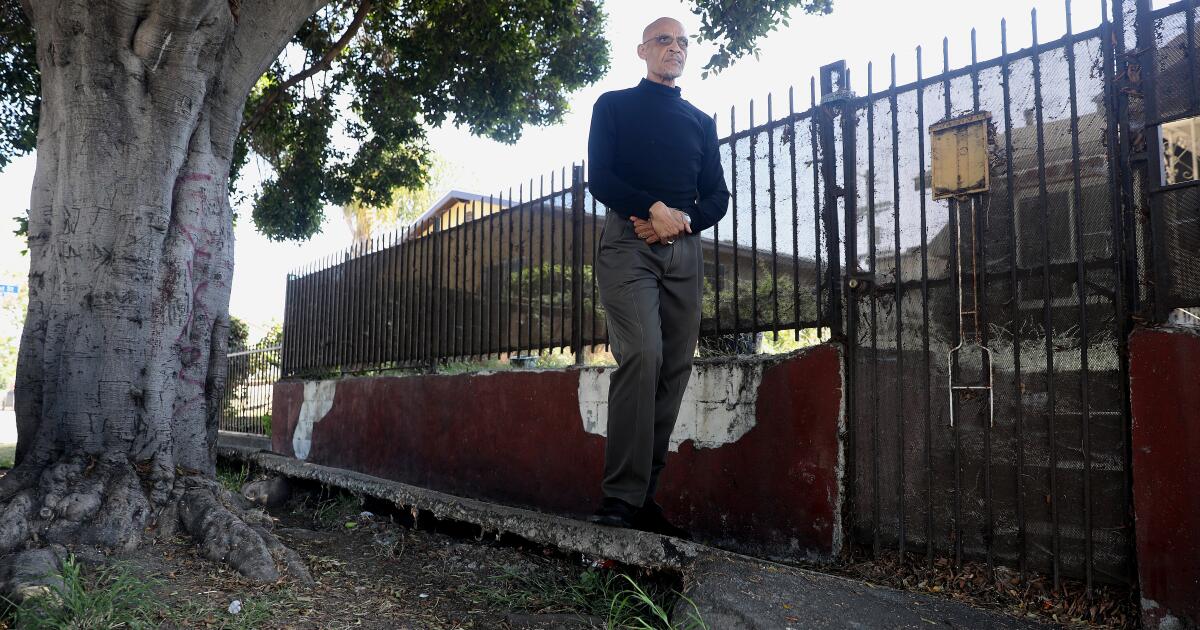
A few days ago, I met with Earl Ofari Hutchinson of the Los Angeles Urban Policy Roundtable. Hutchinson is a longtime community activist and commentator, and he had just launched a torpedo in the direction of City Hall.
“There are hundreds of busted, dangerous sidewalks in South L A that have gone unrepaired for years,” he wrote to his network of followers. “They cause hundreds of injuries, and have resulted in massive numbers of claims and payouts in settlements. LA City Officials must act now to jumpstart a crash program to fix these sidewalks.”
On my way to meet Hutchinson, I traveled west along Florence Avenue and saw dozens of typical rough patches on the street and sidewalks. But if there were a contest to identify the all-time worst sidewalks in Los Angeles, Hutchinson’s discovery of the one at 71st Street and 11th Avenue would be a Hall of Fame contender.
For starters, it’s got the classic uplift, and the villain is the usual suspect — ficus tree roots. A 20-foot slab of sidewalk is pitched sharply, as if designed by trip-and-fall lawsuit lawyers. Way back in 2014, in my early days on sidewalk patrol, I was able to crawl under a similarly ruptured sidewalk in West L.A., and I could’ve done the same at 71st and 11th.
But I thought better of it after Hutchinson peered into the opening and said it looked like a comfy home for rats and other vermin.
The homeowner, Sharon Kelly, can’t use her front gate because of the lopsided sidewalk. She let me borrow her tape measure, which revealed a 16-inch rise in the pavement.
“It keeps rising,” Kelly said. “But it was already lifted when we came here.”
That was in 1997. I asked if she’s called the city for help.
“Several times,” she said, and the only response was a slapdash temporary asphalt patch.
Hutchinson said residents have responded in force to his call for emergency sidewalks repairs, just as they did when he crusaded for a crackdown on widespread illegal dumping.
“Dozens of residents have come out of the woodwork, and here’s what they all say: ‘We have called our city council person and various city departments repeatedly, over and over again.’”
And the response?
“Nothing,” Hutchinson said.
While we were talking, two people with walkers steered clear of the worst spot near Kelly’s property. Charles McQuarn, 77, said traversing the neighborhood means zigzagging around all the hazards.
“I gotta come out into the streets, too,” he said.
When he was a teenager, McQuarn said, he worked for a community group that fixed sidewalks. I mentioned that Councilmember Monica Rodriguez has been using Conservation Corps youths to do the same, but it’s time to scale up that program and come up with other remedies to speed the process.
The city is fixing about 600 sidewalks each year, the backlog of requested repairs stands at about 30,000 and if you get onto the waiting list, you’re looking at about 10 years before help arrives.
When we were done on 71st Street, Hutchinson led me over to a nearby stretch of Florence where, for blocks and blocks, it appears as if there have been volcanic eruptions around the trees. Large chunks of cracked sidewalk form mounds, one after another. The Hutchinson Himalayas are a site to behold — a mile-long museum of municipal neglect.
And it’s been like this, Hutchinson said, “for years.”
The question for Bass and Raman: What will you do to speed the repairs?
Homelessness:
Voters have been generous when it comes to repeatedly taxing themselves more, and more, to address homelessness. There’s been Measure H, Measure A, Measure ULA and Proposition HHH.
Yet although billions of dollars have been spent and tens of thousands of people have been helped and housed, more than 40,000 people are homeless in the city and roughly 70,000 in the county. In her primary victory speech, Bass said families shouldn’t have to step around encampments, and Raman has said greater urgency is needed.
Questions for Bass and Raman: Why haven’t taxpayers gotten more for their money with the two of you at the helm, what are you going to do to speed progress and create more accountability, and what distinguishes you from each other?
The City Council is about to consider a motion to increase park funding through charter reform (with dozens of community groups in support), and progress is ridiculously slow on an agreement to use schools as after-hours playgrounds.
Question for Bass and Raman: Do you support the charter reform, and what else are you going to do to address the sad state of the city’s parks?
Trash and blight:
In downtown L.A., vandalism, shuttered storefronts and post-COVID abandonment have crippled what was a vibrant, revenue-generating economy that benefited the whole city.
In Hollywood, a resident hired her housekeeper to help report illegal dumping of goods that are often used to construct more homeless encampments, leading to all sorts of problems.
On the south lawn of City Hall, a graffiti-tagged monument and fountain have been out of commission for most of the last six decades.
Question for Bass and Raman: At the very least, can you fix the fountain?
Focus:
Like any big city with great assets and unlimited challenges, many residents have a love-hate relationship with L.A. But years ago, someone told me he loves Los Angeles because it’s a messy, multi-cultural work in progress, set on a dramatic landscape between mountain and sea, trying to figure out what it wants to be.
Question for Bass and Raman: Whether in the realm of basic services or grand visions, what three or four primary objectives do you have over the next four years?
First Assistant U.S. Atty. Bill Essayli — President Trump’s loyalist federal prosecutor in Los Angeles — has not been shy in recent days about his intention to ferret out voter fraud in California’s primary election and criminally charge those responsible.
He has announced that his office “has multiple election fraud investigations underway” in coordination with the FBI, urged Californians on social media to submit evidence of “potential election fraud” directly to his office, and said flatly he “will be charging some people” with election fraud — just as soon as California certifies its vote count and his office “can prove some of the allegations.”
Essayli’s public callouts and promises are highly unusual and in direct conflict with Justice Department guidance on ballot fraud investigations at the federal level, which states federal prosecutors should not publicly pursue such claims amid of vote counting.
The Justice Manual — which regulates the actions of federal prosecutors nationwide — says the department “should not engage in overt criminal investigative measures in matters involving alleged ballot fraud until the election in question has been concluded, its results certified, and all recounts and election contests concluded,” in part because doing so “runs the risk of chilling legitimate voting and campaign activities and of interjecting the investigation itself into ongoing campaigns and the adjudication of any ensuing election contest.”
Ciaran McEvoy, a spokesman for Essayli’s office, said neither Essayli nor the office had any comment.
Essayli has repeatedly acknowledged in other interviews that he has no evidence of widespread fraud that could sway the results of races, and he even shot down one prominent online conspiracy that falsely alleged Democratic cheating in the Los Angeles mayoral race.
But he has also pointed to more isolated instances of fraud as potentially indicative of bigger problems. He added that there’s no proof such rampant fraud isn’t occurring, partly because of resistance from California to a federal audit of its voter rolls.
Essayli’s remarks are part of a much wider battle to frame fraud in California as pivotal or not, in which Republicans cite individual instances of alleged fraud as evidence of some grand scheme by Democrats to steal the election from them, and Democrats — along with many elections experts — say there is no evidence that isolated crimes reflect fraud on a scale large enough to impact election outcomes.
His remarks have added fuel to baseless claims from Trump and other influential conservative voices that California’s elections have been poorly compromised by coordinated Democratic “cheating.” They have made Essayli one of the most prominent Trump administration figures in the nationwide debate around election integrity — which election experts expect to intensify ahead of November’s midterms.
A public campaign
Essayli has made his case in recent days on various alternative and right-wing news programs and podcasts, arguing that California’s slow process for counting votes had undermined public trust and needs to be audited.
On One America News Network, Essayli said his office has been “sounding the alarm on California’s election system” because it’s ripe for fraud.
“We believe that it has major vulnerabilities. We believe California does not have sufficient safeguards to make sure only eligible U.S. citizens are voting in elections in California, and that is why we’ve been demanding an audit of the California voter rolls,” he said.
On NewsNation with Chris Cuomo, Essayli said he doesn’t “care what the outcome of the election is,” but wants voters “to have confidence in the systems, and that the laws are being followed.”
“I guarantee you, when we do bring cases, we will have plenty of evidence to prove beyond a reasonable doubt, in a court of law — that is how we work,” he said.
On the podcast of conservative commentator Glenn Beck, Essayli said he was “prohibited from discussing ongoing investigations,” but that “election fraud is not a theory” but “a real thing” — noting his office recently secured a guilty plea from a woman who paid homeless people to register to vote.
He said California is “a fraudster’s paradise,” accused the state Legislature of “going out of their way to make it as easy as possible for people to commit fraud,” and repeated oft-cited complaints about California’s voter ID policies being lax, its universal mail ballot policies sending ballots to the wrong places, its ballot collection policies allowing “harvesting” and its voter rolls being “dirty,” or filled with ineligible voters.
Essayli said all of that makes his job “incredibly difficult,” because “California has removed the paper trail, they’ve removed the chain of custody, they’ve removed any meaningful way for us to basically have a forensic audit of where a ballot came from,” but that he will nonetheless be bringing election fraud charges in the next “one to two months.”
State and local elections officials in California have defended the state’s policies as facilitating voting by as many eligible voters as possible, which they say is more important than a quick count. They’ve said there are robust procedures in place to ensure ballots are cast fairly and counted accurately, and to identify any problems and audit the results.
Elections experts say instances of fraud do exist, both in California and everywhere else in the country, but that robust efforts in past years to investigate and identify widespread fraud that could sway an election — including by Trump and his lawyers but also outside organizations — have always failed.
Essayli’s efforts have drawn sharp criticism from elections experts, leading Democrats and former prosecutors in the office.
Justin Levitt, a Loyola Law School professor who studies elections and was a senior policy adviser on democracy and voting rights in the Biden White House, said what Essayli is doing — throwing out unspecified claims of fraud amid an ongoing election and before he has built a case — is “absolutely nuts” and “not a thing that real prosecutors do.”
Before the current administration, the “mantra” of federal prosecutors, he said, was that “you only hold a press conference about a not-yet-concluded investigation when the public is already aware of a large crime,” such as a mass shooting. “Absent that, you wait for the facts to come in, and you see whether there has been a legal violation, and then and only then do you issue a press release — usually hand in hand with an indictment or a conviction.”
In an election, Levitt said the standard is even higher, and “the ethos of a federal prosecutor should be to never become the story, and to never make the prosecutorial job itself an impact in the election you are investigating.”
In an MS NOW interview, Sen. Adam Schiff (D-Calif.), a former federal prosecutor in the L.A. office, blasted Essayli as wildly searching for fraud to please Trump — despite it and other efforts to please Trump, including on immigration, causing an exodus of experienced career prosecutors from the office.
Schiff said Essayli was “basically making a plea to the public: ‘Please send me evidence. I’m asserting there’s fraud. We don’t have evidence of it, but please send me something. I need to make the boss happy.’”
Another former prosecutor in the office, who requested anonymity to avoid retaliation, said Essayli is pursuing alleged election fraud cases as hard as he is only because “Trump told him to,” and he’s “constantly auditioning for a bigger D.C. job in case he gets kicked out of his current one.”
Essayli is not the U.S. attorney for Los Angeles — only the “first assistant” — because he has been unable to win confirmation from the U.S. Senate and has only remained in charge through a legal loophole.
Investigations in the works
It’s unclear what specific issues or incidents Essayli’s office is investigating.
Essayli has said his investigations so far lean toward individuals rather than networks, and he told the California Post that he would be investigating a report that thousands of people were registered to vote at homeless shelters with far fewer beds.
His office also looked into false claims that an election night ballot update in Los Angeles County include no votes for Spencer Pratt, the Republican candidate. He said his office “reviewed official county records” and determined the claim was false.
“My office will continue monitoring the election counting process and will follow the evidence wherever it leads,” he said.
One person involved in investigating the latter case was Assistant U.S. Atty. Robert Renner, who joined the office in March after previously serving as deputy general counsel for the Center for Individual Rights, a nonprofit Washington, D.C., law firm where he worked on lawsuits focused on conservative free-speech issues, according to his LinkedIn page.
A worker carries ballots at the Los Angeles County Ballot Processing Center.
(Eric Thayer / Los Angeles Times)
Renner, who referred questions to the office spokesperson, visited an L.A. County ballot processing center as part of the investigation, where he questioned election officials about the ballot update, according to a law enforcement source with knowledge of the situation who spoke on the condition of anonymity for fear of retaliation.
Election officials have said their numbers were always correct and that the discrepancy was based on a one-minute lag in vote updates for Pratt by The Associated Press, which also confirmed the lag.
Renner also grilled election officials about whether or not post office officials had backdated postmarks on mail ballots sent after election day so they could still be counted, the source said.
Essayli’s elevation to the top prosecutor position in L.A. was part of a broader push by the Trump administration to fill key Justice Department roles with people loyal to the president and open to his election skepticism. Earlier this year, a Times investigation detailed how disgraced ex-L.A. County prosecutor Eric Neff was named “acting chief” of the Justice Department’s voting section.
Neff led a bungled election integrity case at the L.A. County district attorney’s office that was thrown out after an internal review revealed it hinged on the word of “Stop The Steal” activists who had pushed Trump’s discredited theory that the 2020 presidential election was “rigged.”
It was one of two election integrity cases Neff tried in his entire career before being elevated to the voting chief post by Asst. Atty. Gen. Harmeet Dhillon, another proud Trump loyalist from California.
Michael Sanchez, a spokesperson for Dean Logan, head of the Los Angeles County Registrar-Recorder/County Clerk, said the office has not received any formal document requests or investigation notices from Essayli’s office, only “routine questions about operations.”
What will come of Essayli’s investigations is also unclear. He will have to prove whatever allegations he makes in court — which he has repeatedly appeared to begrudge in recent interviews.
“Instead of putting the burden on the system to reassure the people [that] only legal citizens are voting, one person one vote is the law of the land, and the burden on the system to assure us that there’s integrity and we can believe in it,” he complained to Beck, “they’ve flipped it and now it’s on us to prove every allegation of fraud.”
With families struggling to find affordable summer breaks a savings platform has explained how healthcare workers can stack discounts to save up to £200 on peak-season TUI trips. The demand for budget holidays is rising as shoppers search for cheaper ways to get away.
With TikTok searches for ‘money saving tips’ up 45% and the cost-of-living crisis still impacting budgets, families are feeling the pressure. Health Service Discounts has partnered with TUI to provide healthcare professionals with a ‘Holidays for Heroes’ access code for up to an extra £100 off.
The exclusive NHS discount can be stacked on top of all TUI & First Choice package holiday deals, allowing key workers to claim TUI’s current deals plus their extra NHS discount on top. That includes family-friendly resorts with ‘Kids Go Free’ deals, last-minute Marella Cruises from £729 per person and budget hotel stays from just £30 per person.
How to access the deal:
The offer is available for NHS staff, retired healthcare staff, students in healthcare, dental practice staff, pharmacy staff, GP staff, private healthcare staff, members of a foundation trust, hospice staff, healthcare volunteers and healthcare charity staff.
Migration has been a central theme throughout Pope Leo’s weeklong tour of Spain.
Published On 12 Jun 202612 Jun 2026
Pope Leo has warned human traffickers that they will face God’s wrath if they continue to exploit desperate African people trying to reach Europe via Spain’s Canary Islands.
On Friday, his second day in the Canary Islands, the pontiff said that he wanted to directly address those who “take advantage of people’s desperation [or] organise death routes”.
Recommended Stories
list of 3 itemsend of list
Throughout his weeklong tour of Spain, the American pope has insisted on the inherent dignity and rights of migrants, urging global leaders to welcome and integrate them into society.
“Stop. Repent,” said Pope Leo. “For every life lost, every family deceived … you will have to appear before divine justice.”
“Repent while there is still time,” he said, invoking the Catholic belief that someone who committed evil acts in life can confess their sins and make amends or be sent to hell upon their death.
Leo was visiting the Canary Islands, a Spanish archipelago off the western coast of Africa, as the culmination of a three-stop tour of Spain.
The islands are one of the main gateways into Europe for migrants, who risk a deadly journey across the waters of the Atlantic Ocean, often in improvised and overcrowded small craft.
Earlier, the first man from the United States to lead the Roman Catholic Church, warned world leaders that history would condemn those who allowed people fleeing war or poverty to suffer.
Located more than 1,000km (620 miles) from mainland Spain, the Canaries saw migration peak in 2024, when the islands received 46,843 migrants, compared with fewer than 1,000 in 2015, according to official data.
More than 3,000 people died last year trying to reach the islands, according to the NGO Caminando Fronteras.
The pope also visited an interim housing centre in Tenerife, the largest of the Canary Islands, to hear testimonies from migrants. The facility has received some 70,000 people since it opened in 2021.
One woman, Bousso Diouf, told Pope Leo that migrants did not want special privileges but “respect, humanity and the opportunity to live with dignity.”
A travel and food content creator called George Kimm has shared his experience of taking an overnight sleeper train from London to Cornwall – but the price left people shocked
15:46, 12 Jun 2026Updated 15:46, 12 Jun 2026
A man shared his experience travelling on an overnight sleeper train from London to Cornwall (stock photo)(Image: Greg Martin / Cornwall Live)
Cornwall is widely regarded as one of the most breathtaking counties in the UK, boasting golden sandy beaches, a spectacular sweeping coastline, world-class surfing spots and jaw-dropping clifftop scenery. And it’s not just locals who are smitten with this South West gem — visitors from across the country regularly make the journey down.
One such traveller is George Kimm, a UK-based travel and food content creator. George made the trip from London to Cornwall aboard an overnight sleeper train, documenting his experience on Instagram. He hopped on the Great Western Railway (GWR) Night Riviera, which departs from London Paddington and pulls into Penzance the following morning, with the entire journey clocking in at just over eight hours.
The travel enthusiast gave his candid verdict on the experience, though one particular detail caught his Instagram followers off guard — the price. George booked a “very cosy” solo cabin, which came equipped with a single bed, a table that doubled up as a sink, a wardrobe and handy storage space beneath the bed, which he described as “very useful”. GWR also provided a selection of amenities, including soap.
George did point out that the toilets are located outside the cabins. However, aside from that, the train operator “really had thought of everything else”.
The London-based creator went on to say: “Before we left London Paddington I had a look in the onboard bar where you can sit down, relax. They also provide free tea and coffee with biscuits and when it comes to going to sleep, I actually had a really good experience.”
After getting settled and having a look around, George watched the train depart the station before heading off to bed. He revealed that he relished the sounds and motion of the train, as they lulled him off to sleep.
When George stirred the following morning, he tucked into breakfast, which came as part of his cabin fare. He opted for a cup of tea and a sausage bap, noting that it was “very delicious”.
The travel enthusiast added: “And it was so lovely to have my breakfast whilst watching the countryside whizz by.”
He wrapped up his Instagram reel by revealing what his trip and cabin had set him back, saying: “My ticket cost £119 and an additional £149 for the cabin.” George reckoned it was “such a cool experience” nodding off in London and coming round in Cornwall. He believed it was “honestly so worth it” and something he’d gladly repeat.
One commenter observed: “£75 return to Paris, just saying.” George responded: “Totally get it. This was a bucket list trip.” Another remarked: “Looks fun but the price is insane.”
Content cannot be displayed without consent
A third astonished viewer queried: “Omg… how much?” Someone else went as far as branding the price “criminal.”
Despite the hefty price tag, some viewers still managed to see the bright side, with one commenting: “This looks like a great experience but it’s very costly for a return journey. I guess the benefit is both journeys are during the night so you aren’t losing out on any holiday time.”
A second chimed in: “Would love to do this!! Honestly would see the cost as part of the holiday, so special.”
For those travelling with Great Western Railway’s Night Riviera service, an airline-style seat is available at no additional cost when booking a ticket, with prices for a private cabin starting from £49 per person.
WASHINGTON — A year after the Trump administration kicked off its aggressive immigration enforcement tour with military-style raids across greater Los Angeles, federal officials have veered toward a less flashy but broader strategy: making immigrants’ lives harder so they will leave.
The changes range in scale and scope, from disqualifying immigrants from certain jobs to indefinitely pausing the processing of visa applications. They target those lawfully present as well as the undocumented.
Since President Trump’s second term began, the administration has used executive orders and federal regulations to chip away at services or benefits, such as work permits and small business loans, that immigrants could obtain in the past.
Now, immigrants are finding that freedoms — the ones that once made the U.S. a desirable place to start over — are disappearing. Many are retreating back into the shadows as they fear previously routine tasks, such as traveling across states, filing taxes and seeking medical care.
“The priority is to force people to leave the country or not come, regardless of legal status or really any other criteria,” said David Bier, immigration studies director at the Libertarian think tank the Cato Institute. “They’re taking a sledgehammer to the system.”
Trump won the White House in part on his promise to clamp down on illegal immigration, but recent polling shows support for his agenda has waned, especially after immigration agents shot and killed two U.S. citizens in Minneapolis.
In a statement, White House spokesperson Abigail Jackson said Trump’s highest priority has always been the deportation of immigrants with criminal records. The Department of Homeland Security said Trump also prioritizes immigration that strengthens the country financially, socially and culturally.
President Trump displays the signed “Secure America Act” during a ceremony in the Oval Office on Wednesday. The act provides $70 billion for immigration enforcement and border-security agencies.
(Aaron Schwartz / CNP, Bloomberg)
The number of arrests by ICE agents has declined. On average, ICE arrested about 1,000 immigrants per day in early March, down from a peak average of just under 1,400 in mid-January, agency data show. And there are fewer detained immigrants — facilities across the country held about 60,000 detainees in April, compared to more than 70,000 in late January.
The downturns prompted some Trump loyalists to say the administration is failing to fulfill his signature promise, which is an assertion the administration rejects.
“ICE is NOT slowing down,” said Homeland Security spokesperson Lauren Bis. “Since Day One, DHS law enforcement has been delivering on President Trump’s promise to the American people to arrest and deport criminal illegal aliens.”
At a border security conference last month, Tom Homan, who leads border policy for the White House, suggested immigration agents would return to more muscular enforcement tactics.
“You ain’t seen s— yet,” he told the audience.
But along with focusing on deportations, the administration is deploying other tactics to deter illegal — and legal —immigration.
ICE agents confront protesters on June 8 as they gather outside the federal immigration center at Delaney Hall in Newark, New Jersey, where ICE is housing detained immigrants.
(Spencer Platt / Getty Images)
Curtailing visas
Last month, the Department of Homeland Security announced that “except in extraordinary circumstances,” immigrants seeking lawful permanent residency must leave the U.S. to complete the process. After a backlash, the administration defended the policy, saying it won’t prevent anyone who qualifies for a green card from getting one.
U.S. Citizenship and Immigration Services, the agency in charge of processing immigration benefits, has upped security screening since Trump took office. The agency says that’s to root out fraud, but critics say all it does is unnecessarily slow down a system that already vets applicants vigorously.
The administration indefinitely banned people from 75 countries from receiving immigrant visas, which allow people to move permanently to the U.S.
In a similar move, the government halted the processing of immigration applications for people from 39 countries and who are already in the U.S. On June 5, a federal judge struck down the policy in a scathing ruling that said the administration “justifies its actions with pretextual concerns of ‘national security’ that mask anti-immigrant sentiments.”
Children of Guatemalan origin, from left, Areimy, Mariela and Enrique, arrive at Miami International Airport on Dec. 4, 2025, as they prepare to leave the United States to reunite with their recently deported parents in Guatemala.
(Chandan Khanna / AFP via Getty Images)
The judge’s ruling may offer relief, but for many immigrants, the effects of the policy are devastating. Armin, a 42-year-old from Iran, said he has racked up more than $15,000 in debt since the pause took effect in December. Armin asked The Times not to fully identify for fear of jeopardizing his immigration case.
The nutritional scientist came to the U.S. in 2019 on a student visa and has a pending green card application under a provision that allows certain highly skilled immigrants to apply for permanent residency without needing an employer to sponsor them.
After receiving his PhD and completing a postdoctoral program, Armin was in between jobs when he received a research grant in November. But with the processing of his work authorization halted, the university that issued the grant said it couldn’t hire him as a research associate. In February, he was turned down for another job.
Armin said he is confused about why the administration won’t differentiate between legal immigrants and those who should be deported.
“I can’t believe it,” he said. “I’m doing research and my research has national interest benefits. You expect support from the government. Unfortunately they don’t differentiate. They don’t care about your resume.”
Bier said the visa policies affect half of all legal immigrants coming from abroad. He published a report in April about how Trump has cut legal immigration far more than illegal immigration, noting that the administration’s policies have led to big drops in visas for international students, high-skilled workers and refugees.
“The legal immigration system is being used as a means to carry out the mass deportation agenda,” he said.
Alessandro Negrete, who lived most of his life in the U.S. undocumented, crosses into Mexico after deciding to leave.
(Robert Gauthier / Los Angeles Times)
Encouraging self-deportation
More than 90,000 immigrants have been granted voluntary departure since the start of the Trump administration, according to federal immigration court data through April that was analyzed by TRAC, a data research organization. Voluntary departure avoids official deportation and can leave open the possibility of an immigrant returning to the U.S. legally.
Homan, who declined to be interviewed for this story, has said self-deportations were part of the administration’s immigration plan all along.
“We knew if we surged unlimited ICE resources in the interior, and we do these operations, that that will force those that are here illegally to leave on their own,” he recently told the Washington Examiner.
Halting work permits
In the past, asylum seekers and others with deportation protections have had the ability to seek permits to work legally in the U.S. But work is now an administration target.
One proposed regulation would prevent asylum seekers from working legally in the U.S. Another proposal, published Friday, would further restrict access to work permits for other immigrants.
Under a rule that took effect last month, asylum seekers pay an annual $102 fee within 30 days of receiving a notice from U.S. Citizenship and Immigration Services. If the deadline is missed, their applications will be rejected — with no opportunity to appeal — and they could be placed in deportation proceedings. Those who apply for asylum with the agency have entered the U.S. legally, such as on a visa, and are not undocumented.
Asylum seekers rest at a Tijuana migrant shelter a day after President Trump began his second term in the White House.
(Robert Gauthier/Los Angeles Times)
Conchita Cruz, co-executive director of the Asylum Seeker Advocacy Project, said many asylum applicants have not received notice that the fee is due.
Cruz said she believes the Trump administration is using these changes as an excuse to dismiss people’s asylum claims. While the president has the power to decide whether to offer or rescind humanitarian programs, such as Temporary Protected Status, the right to seek asylum is enshrined in law.
“We’re worried this is a pretext for people to fall out of the asylum system and fall out of the workforce,” she said.
The processing of work permits has already been slowed, leaving many immigrants who still qualify for employment authorization unable to work.
During a House Homeland Security Committee hearing last week, Rep. Lou Correa (D-Santa Ana) asked Homeland Security Secretary Markwayne Mullin to help him speed up the work permit renewals for two police officers who were recently fired by agencies in his district because their DACA status expired.
Mullin said he would help but that Congress ultimately must pass a permanent solution for DACA recipients.
“These are police officers on Main Street, sir,” Correa responded.
“Not all of them are,” Mullin said. “I’m not just going to wave a magic wand and fix them all.”
“You have that magic wand — that’s your job,” Correa said.
It wasn’t just Democrats complaining about slow processing. Rep. Gabe Evans (R-Colo.) similarly asked Mullin for help because many of his constituents — “farm workers, youth ministers, nurses, grocery store business managers” — who have lived and worked in the U.S. legally for decades are now having trouble renewing their visas.
Secretary of Homeland Security Markwayne Mullin, left, and President Trump, center, walk to the motorcade after exiting Air Force One at Joint Base Andrews, Maryland, on May 20.
(Kent Nishimura / AFP via Getty Images)
Calls for mass deportations
Mullin, who took the reins in March after Trump fired his predecessor, Kristi Noem, rolled back some of Noem’s policies, including telling agents to stop entering homes without judicial warrants and canceling some contracts she had initiated.
But the changes and the downturn in arrests have drawn criticism from some fervent Trump supporters.
“Trump’s legacy is tied up in this,” said Mike Howell, a former DHS attorney who founded a group called the Mass Deportation Coalition. “It’s going to be hard to tell a younger voter to get excited to show up when one of their top issues is mass deportation and, a year and a half in, it doesn’t appear it’s going full-steam ahead.”
Howell said enforcement at work sites is critical to scaling up arrests and deportations. That more such operations haven’t happened, he said, is a political decision to appease wealthy donors and special interest groups who don’t want to see their workers deported.
The architect of Trump’s immigration agenda is Stephen Miller, a top White House aid who has called for a “moratorium on immigration from third-world countries,” demanded 3,000 arrests per day and said that immigrants and their descendants “recreate the conditions, and the terrors, of their broken homelands.”
Royce Bernstein Murray, a former Homeland Security official who worked on immigration policy under the Biden administration, said the winding down of flashy enforcement surges has given the administration more time to “focus on tearing down the legal immigration system.”
“This is Stephen Miller’s sweet spot,” she said. “He was never in enforcement — he’s a policy guy. This is really an opportunity for him to make good on all he has planned for years.”
While ICE has, in recent months, returned to its more conventional targeted enforcement tactics, Homan has sought to make clear that mass deportations are still a goal.
“For the people out there saying ‘President Trump’s getting weak on mass deportation,’ you don’t know what the hell you’re talking about,” Homan said at the border expo.
On Monday, Homan told Fox News that he had just reviewed plans for an ICE operation that would surge agents to New York City.
In many ways, the most ambitious World Cup in history — which kicked off Thursday in Mexico City — has inspired more angst than anticipation, more fear than fervor.
The competition, returning to North America for the first time in more than three decades, has expanded to 48 teams and 104 matches, to be played over 39 days in 16 cities in the U.S., Mexico and Canada. The complex planning was eight years in the making.
Yet even before the competition opened with Mexico facing South Africa at the iconic Estadio Azteca, it has been marred by a number of controversies that threaten to overshadow the soccer and cloud the tournament’s legacy.
“I view this World Cup as the most politically combustible World Cup in recent history. And that’s saying something,” said Jules Boykoff, a political science professor at the University of Portland and author of eight books on the politics of international sport.
“We’re in uncharted territory in many ways.”
Relations between the host countries, once strong, have been strained by the Trump administration’s tariff policies and disagreements over border security. Travel bans have barred potential World Cup visitors — and even support staff and match officials — from entering the U.S. and others are fearful of making the trip, worried about ICE raids and immigration roundups.
The U.S. is at war with a tournament qualifier, Iran. And Iran has fired missiles and drones on Jordan, Qatar and Saudi Arabia, nations that also are World Cup participants.
The International Sports Press Assn. said Iranian and African journalists have been denied visas to cover games in the U.S., and Iran protested after more than a dozen members of its support staff had their requests to enter the U.S. rejected. The Iranians, who were forced to move their training base from Tucson to Tijuana, will spend limited time in the U.S. during group-play games that will take place in Inglewood and Seattle.
Players and journalists from Senegal, Uzbekistan and Iraq have been detained at U.S. airports for up to seven hours by immigration officials. Then on Monday, Omar Artan, a decorated referee and the first Somali official selected to work a World Cup, was turned away at Miami International Airport.
In addition, ticket prices have been so high and the lottery process for obtaining them so opaque, the attorneys general of New York and New Jersey have begun formal investigations into FIFA practices. Other states, including California, hosting tournament matches have begun asking questions as well.
All that has conspired to produce a World Cup that is struggling to catch on with the public. According to a recent poll by Yougov.com, a majority of Americans — 54% — say they are not at all interested in the tournament and nearly six in 10 say they will not watch any matches.
“People are just in a bad mood,” Boykoff said. “It’s a tough time.”
FIFA president Gianni Infantino remains optimistic, promising this will be “the biggest, the most inclusive, the greatest FIFA World Cup ever.” He made the same claim about the 2022 World Cup in Qatar and the 2018 tournament in Russia.
FIFA president Gianni Infantino speaks during a news conference on Wednesday before the start of the World Cup.
(Carl Recine / Getty Images)
“The World Cup should be understood as both a global sporting celebration and a major commercial enterprise, with these two dimensions being mutually enforcing rather than contradictory,” said Steve Georgakis, a lecturer on sports studies at the University of Sydney and a frequent author on soccer.
This year’s tournament is projected to swell FIFA’s coffers by nearly $9 billion and the TV ratings, it says, will be massive.
“Its universal appeal combined with the participation of 48 nations ensures that it remains a genuinely global sporting event,” Georgakis said.
Boykoff has his doubts.
“In this particular political moment, with the Trump administration being erratic and impulsive and needing a win from this tournament and the fact there’s so many moving parts geopolitically, I don’t have confidence that it’s just going to end up being a soccer-focused next five weeks,” he said.
This is not the first World Cup to kick off under some kind of black cloud.
The 1974 tournament in West Germany was tarred by the geopolitical fallout of the 1973 Yom Kippur War. Four years later Argentina’s military dictatorship used the World Cup to sportswash a “Dirty War” in which as many as 30,000 people were tortured, murdered and disappeared.
The 2010 and 2014 World Cups were troubled by cost overruns and delays in the construction of stadiums and other infrastructure and the threat of labor unrest while global outrage over human rights violations and discrimination against women and LGBTQ people hung over the last two tournaments.
Those issues never fully disappeared but were overshadowed by the brilliance of the soccer. Jonathan Wilson, a columnist with the Guardian and author of “The Power and the Glory: The History of the World Cup,” expects the same this summer.
“The other stuff will still be there in the background,” he said, “but fundamentally the football will, for the vast majority of people, take over. It’s just sort of a natural cycle.”
Argentina star Lionel Messi controls the ball during an international friendly against Iceland on Tuesday.
(Butch Dill / Associated Press)
And as with every World Cup, there undoubtedly will be unforgettable moments.
Argentina’s Lionel Messi and Portugal’s Cristiano Ronaldo, the top scorers in soccer history, will be playing in their sixth and final World Cups — Messi chasing a second straight title and Ronaldo pursuing the only prize that has eluded him.
Kylian Mbabbe will be trying to take France to a third consecutive final while young superstars like Erling Haaland of Norway and Lamine Yamal of Spain will be looking to put their mark on their first World Cups.
Four teams — Jordan, Curacao, Cape Verde and Uzbekistan — have qualified for the tournament for the first time.
And there will be other storylines no one saw coming, all of which will contribute to the narrative of this World Cup.
“Major sporting events have a way of capturing public attention and shifting the conversation toward what is happening on the field rather than off it,” Georgakis said.
How much the actions of the Trump administration affect that calculation remains to be seen.
There are travel restrictions in place that fully or partially bar citizens from 39 countries — including a number of World Cup participants — from entering the U.S. And the administration has said ICE and Homeland Security personnel will have a visible presence at World Cup venues, including SoFi Stadium in Inglewood, where the American team will begin play Friday.
“There will be federal agents,” confirmed L.A. County Sheriff Robert Luna, who added that he could not guarantee immigration sweeps would not take place. “ They told us that specifically would not be occurring,” he said. “Any of that’s subject to change.”
Mexico fans celebrate during a watch party at Plaza Mexico in Lynwood on Thursday.
(Kayla Bartkowski / Los Angeles Times)
The difficulty in obtaining visas and the fear of being rounded up by immigration agents are being blamed, in part, for less-than-expected tourist traffic. Hotel operators in all 11 World Cup host cities say bookings for the tournament are well below projections. Several countries have issued warnings about travel to the U.S.
Then there are the own goals from FIFA over tickets and parking prices as high as $900 at some stadiums, weather issues and a short-lived ban on water bottles.
FIFA has defended its policies on ticket prices by arguing that premiums are necessary to maximize revenue, which it will invest in global soccer development. Variable, market-based pricing, it said, simply reflects standard entertainment practices in North America. The organization did, however, reverse its ban on fans bringing bottles into games. Spectators are now allowed to enter stadiums with one soft, plastic 20-ounce water bottle.
And despite a warning from climate scientists that one in four World Cup games could be played in dangerously hot conditions, FIFA will start 40 of them at 3 p.m. or earlier local time, the warmest time of day, to accommodate European TV viewers.
Georgakis said the play on the field will have to overcome all those issues if this World Cup is to earn a favorable place in history.
“Ultimately the success of the World Cup will be judged by what happens on the field,” he said. “If the football is compelling, dramatic and memorable, the tournament will likely be remembered as a great World Cup. If the play falls short, then the off-field issues such as ticket prices, extreme heat, ICE enforcement activities, the Trump administration will receive great attention and could shape perceptions of the event.”
Shrek’s abs are more defined than some might expect. Or is it that the shade of his green skin makes them appear more chiseled under bright lights? Maybe it’s just disorienting because no one anticipated gawking at his torso inside the historic downtown Los Angeles venue founded by Hollywood legends Charlie Chaplin, Mary Pickford, Douglas Fairbanks and D.W. Griffith.
These are thoughts that swirl in one’s head while attending this year’s Las Culturistas Culture Awards ceremony, held on a recent Saturday night at the United Theater. An offshoot of the popular podcast that actor-comedians Matt Rogers and Bowen Yang have hosted since 2016, the award show aims to celebrate the year’s biggest pop culture moments and plays like a fever dream more dazzling and deliciously random than a late-night scroll session on TikTok.
After launching in 2022 as a live event outdoors at Lincoln Center, the guerrilla awards show reached TV screens for the first time last year. This year’s ceremony, which will air June 17 on Bravo and stream on Peacock, coincides with the podcast’s 10th anniversary and features a kaleidoscopic array of attendees, including screen veterans like Lisa Kudrow and Will Ferrell, reality TV favorites like “Summer House’s” Ciara Miller and “The Real Housewives of Dubai’s” Chanel Ayan, and anthropomorphic icons like Miss Piggy and a certain green ogre. And the prizes? It’s the only place you can find categories like “Real Housewives Award for Best Way to Start a Confrontation,” “Pornhub Category We Would Never Click On” and “Hilary Duff Award for Millennial Excellence.”
Over lunch at the NBCUniversal lot in Universal City, Rogers and Yang discussed the show’s evolution. These are edited excerpts from the conversation.
Matt Rogers, left foreground, and Bowen Yang perform a musical number inspired by “Heated Rivalry” during this year’s Las Culturistas Culture Awards.
(Monty Brinton / Bravo)
I will probably regret starting our conversation this way, but we all have our blind spots and, to thoroughly prepare for this interview, I watched “Shrek” for the first time last night.
Yang: Oh great! The first one?
Rogers: How’d you feel?
I get it now.
Rogers: Get what, that he is attractive or …?
I’m not quite there yet. You guys reference the film a lot on your podcast and Shrek has also been a figure on the awards show, including this year. I was hoping you’d explain Shrek as a heartthrob to me as if we’re in a pop culture class. When did this idea really take shape?
Yang: Over at least a couple years, to my knowledge, there’s been this online meme culture around Shrek, where it’s like, “Oh my God, Shrek is like a sex king,” but now it’s even spilled over into like dating life. I don’t know if you’ve heard of this, but there’s a verb called Shreking in dating, where it has to do with women dating a guy that’s below their league because he will be nice to them; he will be a Shrek to their Fiona. That’s an interesting thing — you date someone slightly in another zone than you, so that you can be like, “Well, that’s my Shrek,” but meanwhile, there’s the tension between that and Shrek being someone that people are actually attracted to. This just speaks to the enduring power of Shrek as a pop culture icon.
Rogers: I think what it is, is he has an amazing accent. It’s a very powerful thing. He’s independent, he’s self-sufficient, he’s a movie star.
Yang: He said it at the awards. I mean, he’s a rich celebrity.
Rogers: We saw the real Shrek at the awards and he looks pretty f—ing good to me.
Yang: He looked good to me. I don’t know what these Gen Zers are talking about with this Shrek being below your league.
What are the calls with publicists like now to get their clients to participate?
Yang: Last year was a communication puzzle to solve. We were like, “OK, we have to really convey this the right way.” We thought, perhaps naively, now that we’ve done it, now that there’s a proof of concept, it’s going to be much clearer. I think it was clearer, but there was still that degree of, “oh, this is …” — not to like give ourselves too much credit, but this is a concentric circle outside of what is very established in the form of an award show. You’ve got publicists who are like, “Well, we would love for our client to win an award.” And you’re like, “No, that’s not really the point.”
Rogers: Presenting is just as good as winning, just as good as performing. But I think it’s weird that we have been so late to stumble on what the show really is, which is it’s a variety show. And, so, in wrapping your head around it that way, it’s actually pretty easy to get across. It just has the drag of an award show, and that’s our way in.
But I do understand the publicist hesitation because I will say, in a world where it’s your job to protect your client, you’re putting them in a situation that is like, “OK, they’re going to an award show — that’s something this town takes very seriously.” So, it’s an ask to be like, “Hey, can you come take the piss out of this concept that you’re then probably gonna spend eight months of the year trying to actually achieve?” I would be lying if I said that we didn’t want one day to win one of those awards. It’s an acknowledgment of your work, but in that, Bowen and I think the No. 1 thing that’s the funniest thing in the world is people who take themselves that seriously. It’s a healthy mix of appreciation for this thing that was actually a big element of the culture that made us say culture was for us, which was watching award shows when we were kids, and also the reality that we now know as people that are in the industry of what they really are, which is they’re just shows. We’re not condemning them, we’re having fun with it.
1
2
1.Scenes from the 2025 Las Culturistas Culture Awards: Jeff Goldblum, left, accepting the award for Most Amazing Impact in Film for his appearance in “Jurassic Park,” alongside presenter Patti Harrison. (Griffin Nagel / Bravo)2.Allison Janney was a guest of honor, receiving the Lifetime of Culture award.(Jordan Strauss / Bravo)
Have you been asked to tweak the name of a category or punch it up even more?
Yang: Last week was the window when our producers could be very honest with us and say if something may not be working. Back to the Shrek [bit in this year’s show], actually, that ended up being much dirtier and bluer than it was on stage.
Really? I already knew I wouldn’t be able to include the award category because of Times standards. So the actual bit was raunchier?
Yang: It was even raunchier. It went for it.
Rogers: But it’s also a testament to how much freedom they give us to make our show. If they were concerned at all about us desecrating the image of Shrek, we certainly did not feel that way. I am really shocked and grateful that we get to do something that it feels like we’re getting away with something.
Take me back in time with young Bowen and young Matt. What do you remember about your enthusiasm for award shows growing up?
Yang: It was watching Billy Crystal at the Oscars do song and dance numbers, zing these things in for a laugh that we’re referencing the year, being in these video packages where he was in the movies. That it was live television and just this pageantry of people congratulating themselves, congratulating each other. I would tune in live every single year to all the award shows and I would follow the host changes. I remember Whoopi’s first year [hosting the Oscars]; I remember Ellen’s first year. I was really obsessive. It opened the door for all these things that I currently love, and that I’ve somehow had a fortunate experience in, which is live television, song and dance numbers — everything that Billy Crystal was doing. It keyed me in on how show business works, down to production elements and how filmmaking comes together.
Rogers: I just remember, I looked at the screen and I was like, “Oh, that’s where I belong. I belong with them. I don’t belong out here.” I was one of those Gold Derby kids — I would be on the forums; I still sometimes look at the odds and rankings and stuff. It was like gay sports, particularly with the best actress and best supporting actress races. And then obviously the Grammys, and all of that. One year I was watching, I think it was the People’s Choice Awards or the American Music Awards or something, and Shania Twain lost to LeAnn Rimes, and I cried for a day. I took it so seriously and my mother turned to me and said, “You need to stop.” But you couldn’t tell me it didn’t matter at the time. [Reporter’s note: Twain lost the favorite country new artist award to Rimes at the 1997 American Music Awards.]
As the profile of Bowen Yang and Matt Rogers’ variety-style award show has risen, getting stars on board is an interesting puzzle: “You’ve got publicists who are like, ‘Well, we would love for our client to win an award,’” Yang says. “And you’re like, ‘No, that’s not really the point.’”
(Jason Armond / Los Angeles Times)
What do you remember about your first experience at a major awards show?
Rogers: He was nominated as writer for “SNL” and took me as his date. We were sitting there — the “Queer Eye” guys were sitting like three rows behind us.
Yang: We watched Phoebe Waller-Bridge sweep with “Fleabag.”
Rogers: We watched Michelle Williams win for “Fosse/Verdon.” It was funny because we had gone to the bar and were double-fisting drinks back to the seats and I said to Bowen, “Oh my God, I’m like the Busy Philipps to your Michelle Williams.”
Yang: And who shows up behind us?
Rogers: Busy Philipps taps on our shoulders and goes, “You guys are killing it with those drinks.” And I’m like, she doesn’t even know I’m her. Cut to minutes later, Michelle walking up and giving a banger of a speech.
Yang: That was like our first brush with it. Even now we go to these, and we’re like, this is really something; it’s incredible. We were at the Oscars last year, front row, witnessing all of it go down, witnessing the moment where upsets would happen, feeling the vibe in the room shift. The benefit of our show is that the vibe is pretty high throughout; it does not decline as soon as there are losers in the room.
Las Culturistas Culture Awards took place in late May and is being telecast roughly two weeks later. Do you see it ever going the live route?
Yang: We don’t know. That is my not so secret dream, is to do it live one day. There’s just something about doing it live — and it occurs to me now that I’ve been very lucky and fortunate to have have my reps in. There’s just something so wonderful about it being this event where everyone is tuning in, enjoying it the same time you are. That is really something special.
Rogers: If he’s down, I’m down.
I’m sure this changes each year, but who’s your dream person to snag for an appearance?
Rogers: I would say the people that make it very apparent that they have sketch comedy and impression skills, and maybe you wouldn’t necessarily know that they do until they show that.
Yang: Ariana Grande.
Rogers: Our dream was for Ariana to come do an original character. We actually floated to her the idea — there was going to be like a Banksy reveal of MsMojo, and it was going to be revealed that it was Ariana Grande was MsMojo. But she actually was in rehearsals for the Eternal Sunshine World Tour. Little did we know she also was recording “Petal.” She was a bit too busy to play MsMojo, I guess, this time.
Yang: These two are forever paired in my head, but it’s because she’s another sketch performer: Cher. And sometimes the dream guests are not big names, it’s the people that we came up with in comedy. And actually one of the consumer research reports that we got back before we started writing this year’s show was that the thing that people loved about the Culture Awards was this crossover of reality talent, A-listers and Oscar winners, and comedy people — that mix, those three [types of] people mingling together is what the viewers want.
Rogers: I’m just so proud in every single way of the diverse array of talent that we were able to bring together. I looked out in the audience and it was just a party of so many friends and people we’ve met in the business — people that I didn’t even get to meet that night, but I was just gagged they’re there, especially in the edit, which you’ll see. This is Bowen’s first year in the edit, he had to miss it last year, but that’s what’s so cool about going through the footage, is you’re like, “Oh my God, there’s someone I’ve loved my entire life next to my cousin.” We were saying to each other that it ended up being like a weird love letter to our younger selves, having Mandy Moore and singing “Only Hope” with her and doing the “Pokémon” theme song and getting to hang out with Pikachu.
Do you worry about it ever getting too big?
Rogers: If it ever gets to a point where it couldn’t be funny, that wouldn’t work. We want it to always stay true to what it is, which is it’s our comedy special together. As long as it doesn’t feel like it’s selling out — and I can understand people watching it and being like, “Oh, they obviously had to have Nintendo characters because it’s NBCUniversal or obviously they had to include “Summer House” — none of that is true.
Yang: There’s no mandate.
Rogers: This is genuinely what we would want the show to be, and so as long as it’s that, we’re good.
So what’s your “I don’t think so, honey” on awards shows?
Rogers: I don’t think so, honey — 10 nominees for best picture at the Oscars. Why?
Yang: Totally. Tea.
Rogers: I actually think it helps things that are weirder win because it’s too many. And the way that they ranked choices. I’m a popular-vote person anyway.
Yang: I need us to really get on the same page about play-off music. Sometimes people are encouraged to go on, sometimes we turn against that. Let’s stop innovating, let’s stop trying to break the mold on them. Let’s just respect that as much as we can, unless it’s egregious.
And it’s always a bit within the show.
Yang: This is what I was about to get to. The hosts now are always trying to bitify that; it’s more of a practical thing to keep the show moving. Don’t try to put a hat on top of a hat by making it a comedic moment too. We’ve never really played with that trope, even though we could, and maybe should. For now, my attitude towards play-off music is, these people might not ever be on this stage again.
How soon do you start planning the next one?
Rogers: Hopefully, they give us the green light.
Ana Gasteyer, left, Jamie Lee Curtis and Patti Harrison at the 2025 Las Culturistas Culture Awards.
(Jordan Strauss / Bravo)
How did you go about deciding which categories would return this year and which you invent along the way?
Yang: We did an audit this year of all the categories from the last few years of doing this.
Rogers: Less made it back last year.
Yang: I think maybe about 30 max previous categories [returned] — that’s a decent ratio, 70-30 is nice. From there, we just kind of molded the clay on the table a little bit. We have the benefit of making this a recursive reinvented show every year; the categories itself are the premise, it’s the micro-premise within the segment or the element. The jokes are the nominees. Why not create new opportunities at every turn.
“Las Culturistas” expanded into a video podcast last year. How do you feel about this evolution we’re seeing to the format?
Rogers: It’s not that when I’m on camera with Bowen doing the podcast, like, “Oh, I wish I could be more relaxed,” I just wish the whole industry hadn’t gone this way because I feel like when you’re on camera, you can’t help but be a little bit more self-conscious, and that is going to come through in the podcast product. If I had my druthers, none of them would be on film. I can understand that it helps a lot and I can note a marked difference in the amount of times I get recognized now that we are on social media. It absolutely “helped” our podcast get bigger. That being said, I don’t think it was a good thing for podcasting that they all became TV shows.
Yang: It changes the register and the tone by nature. You cannot help but be motivated by different things, by the appearance of it, by the presentation of it, beyond what it was, which is just radio, which is a really important American form.
As two people who grew up being connoisseurs of pop culture, what is it like to be on the other side of it, to feel the intensity of it — I’m talking about what happened with the Jasmine Crockett comments — to become part of the conversation? What lesson came from that?
Yang: We are experiencing something in an acute way that I think everyone is experiencing, which is we are seeing ourselves in the third person. Everyone is kind of modulating their behavior based on how they are appearing out of body. It’s the way we all move through the world now, which can be snapshot and projected very widely out into the world for whatever reason.
Rogers: When you’re talking candidly, you can never know what piece of what you’re saying is going to be the piece that gets scrutinized again and again and again and again by what feels like the entire internet. And if you did, you would, of course, be more specific, and you would be able to really clearly say why you are saying what you are saying. We have had learning experiences with that, and so what we can do going forward is be more clear about the things that we do believe and stand by. That is something that even 10 years in the game we are learning how to do.
Yang: And I think on a very large scale, what is going to happen is that we are all going to adjust for the fact that we have behaviorally changed because of this idea that we’re seeing ourselves in the third person constantly. For me, personally, I’ve had to wrestle with this idea after being on “SNL” for seven years and having to evaluate myself and having an audience evaluate me every week. I’ve changed behaviorally; I need to get over this fear of being seen. I need to get better about listening to my own voice.
Rogers: The internet is a very weird place and the thing is, it deliberately ignores nuance. It willfully tries to make something seem lowest common denominator, so that there can be a community based around that thing. And that is not good for the world. It’s not good for discourse. It’s not good for our politics. It’s really bad for our politics. Until we can all get on the same page about the ways in which we are willfully misunderstanding each other and calling it discourse, it won’t get better.
Yang: The misunderstandings are about people’s tones, and not necessarily about the things that people are pointing toward.
When Republican Spencer Pratt burst into Los Angeles politics, venting a torrent of online fury against Mayor Karen Bass’ handling of the Palisades fire, he pitched his mayoral campaign as a full-bore challenge to L.A.’s political status quo.
The former reality TV star, who lost his home in the blaze, started as a long shot but emerged as a national story, with the ability to harvest social media attention, rally a base and dominate the news cycle.
But in a city overwhelmingly Democratic, where Republicans make up just 15% of registered voters, even some of his supporters wondered how far he could rise. In the end, voters selected Bass, a Democratic centrist, and democratic socialist City Councilmember Nithya Raman, who ran to Bass’ left, to face off in the runoff.
Still, for many of the 200,000 Angelenos who voted for Pratt, his brash, social media-fueled campaign was not just a long exercise in trolling. Pratt gave voice to their discontent with the system of one-party rule and said things they too often felt uncomfortable saying.
And now, they face a difficult choice of who to support in November.
“I know a lot of people who are disappointed,” said Meghan Daum, an L.A. writer and podcaster and former Los Angeles Times columnist who endorsed Pratt. “They are saying, ‘OK, now what? What can we do?”’
While Pratt did not make the runoff, political experts said his candidacy tapped into Angelenos’ dissatisfaction with the Democratic establishment and resonated with a sizable number of Angelenos who are rarely represented in L.A. politics.
“He identified a previously invisible level of anger and frustration,” said Dan Schnur, a longtime politics professor at USC, UC Berkeley and Pepperdine University, of Pratt. “The question going forward is whether he, or someone else, can shape that raw emotion into a movement.”
Pratt has yet to put out a statement conceding the race or contesting the results. As a stream of Republicans, including President Trump, made unfounded allegations of election fraud in California, the campaign’s most online candidate was conspicuously absent on X and Instagram.
Some Democrats in L.A. urged Pratt to make good on his promise to leave the city if Bass or Raman were elected. Late night TV host Jimmy Kimmel, a prominent Democrat, told Pratt he had rented him a U-Haul.
Despite the snark from Democrats, political observers say Pratt changed the terms of L.A.’s mayoral debate.
“He forced the more conventional candidates to talk about the issues in a way that would not have been the case if he weren’t in the race,” Schnur said.
“For the first time in years, there is a critical mass of citizens who are done pretending that what they see before their eyes isn’t really there,” Daum wrote on her Substack. “The people in charge will have to answer to those citizens.”
In the final weeks of the campaign, Pratt became ubiquitous in the national media. There were profiles in high-end publications, podcast interviews and regular reports from Fox News. But the results show he fell short of persuading enough Angelenos to make the runoff.
“It doesn’t appear that he’s impacted the political underpinnings of a deep blue city like Los Angeles,” Schnur said. “His impact was less ideological than attitudinal. He wasn’t convincing the voters to become more conservative, he was convincing them that it was OK for them to vent their anger in an unconventional way.”
Dissatisfaction is building in L.A. as the city’s cost of living mounts and a new generation of young Angelenos are unable to buy homes. Many are concerned about the lack of visible progress on street homelessness. Some are angry at what they see as city leaders’ poor preparation and response to the Palisades fire.
Ultimately, the momentum for change in Los Angeles was divided. As Pratt challenged Bass from the right, Raman tacked to the left of Bass on homelessness and policing and made affordability a key plank of her campaign.
Whatever their concerns about the status quo in L.A., many Angelenos were unwilling to vote for a Republican.
During the course of the campaign, Daum said she had numerous conversations with Angelenos who said: “I can’t associate with anybody who voted for Trump. I can’t have them in my house. I can’t have a conversation with them. I want nothing to do with them.”
A 42-year-old millennial who became famous on “The Hills” and owns a business selling “healing” crystals, Pratt had no political experience when he entered the mayoral race. He didn’t even appear to have a campaign manager.
“The system in Los Angeles isn’t struggling, it’s fundamentally broken,” Pratt said as he launched his campaign on Jan. 7, the anniversary of the fire. “It is a machine designed to protect the people at the top and the friends they exchange favors with while the rest of us drown in toxic smoke and ash.”
As Pratt talked about homelessness, his message resonated with Marissa Comstock, 36, a stay-at-home mom and former software engineer in Eagle Rock.
“It’s totally obvious to me,” she said. “We need to get these people off the street.”
Last year, Comstock said she and her husband had a negative encounter at Griffith Park as they pushed their daughters around in strollers. Just a few minutes into their hike, she said, they were accosted by an unhoused person who screamed at them and threatened to cut off their daughters’ legs.
Since that incident, Comstock said, she takes her daughters only to places like the Huntington or Descanso Gardens that require membership to be admitted.
“I don’t feel comfortable even being on regular streets,” she said. “If there’s some crazy homeless person, what am I supposed to do?”
Pratt did extraordinarily well in capturing attention and developing a message, said Paul Mitchell, vice president of the Sacramento-based bipartisan firm Political Data Inc. Many Angelenos, he noted, had a better sense of Pratt’s viewpoint than they did of much more deeply funded California gubernatorial candidates, like Matt Mahan or Xavier Becerra.
During his campaign, Pratt did not express support for Trump or the Make America Great Again movement. He insisted he was a nonpartisan candidate running on local issues.
“I’m going to show everybody that I’m their mayor,” Pratt said on election night.
But even if Pratt was not explicitly MAGA, his reality TV theatrics mixed with antiestablishment populism were so MAGA-coded that he struggled to persuade disaffected liberal Angelenos. He referred to the homeless as “fentanyl zombies.” He railed against California’s “socialism.” He called Bass “Basura,” Spanish for trash.
When Trump spoke of Pratt, telling reporters “I heard he’s a big MAGA person,” Raman was quick to share Trump’s remarks on social media, warning Angelenos that Pratt was wildly out of step with their views.
While Pratt impressed some political observers with his performance in a May 6 televised debate with Bass and Raman, others said he alienated a significant portion of Angelenos with some of his social media antics.
“He could have talked about the drug use and the risks and the filth and the fire risks and all that,” said Rob Stutzman, a GOP political strategist, of Pratt’s zombie rhetoric, “but then paired that with, ‘My God, these liberals are leaving these people out here to die,’ and expressed some humanity towards the population that’s on the streets.”
Ultimately, Daum said Pratt was a “terrible candidate.”
“He did a million things wrong,” she said. “The whole time, I was yelling on Twitter about how he’s got to stop it: the AI videos are gonna hurt him, the Basura stuff, the zombie stuff. Like, stop it! Stop it!”
As Pratt’s campaign came to an end, Stutzman said, it is not clear that he represents any kind of lasting political movement.
“The question remains: Did he create a political movement or did he exploit the opportunity to run for mayor to restoke his diminishing fame?” Stutzman said. “He’s in the mold of a Kardashian: He’s just found ways to be famous without ever really doing anything important. I suspect that this was more about him acting out as to what he is as a reality celebrity versus becoming a leader of a political movement in L.A. We’ll see.”
When Angelenos go to the polls in November, there are several paths for Pratt voters.
Some, Mitchell said, will probably sit the election out entirely.
“You’ll get some Republicans who vote for Raman because they’re like, ‘Well, she’s a socialist and I can’t stand her, but I’m just voting no on Bass.’ And then you’ll have a lot of Republicans who are like, ‘OK, Raman’s a socialist.’”
After Raman made it to the runoff, Bass’ campaign slammed the city council member for voting against hiring more police and blocking efforts to keep homeless encampments away from schools. Meanwhile, Raman positioned herself as the anti-status quo candidate.
In a statement celebrating her advance to the general election, Raman did not mention Pratt or his supporters, but railed against “powerful interests” in City Hall.
“Working people pay the price in higher rents, depleted services, and a city that has stopped working for them,” she said. “If you’re as frustrated by the broken status quo as I am, I hope you’ll join our movement to build a city that works for everyone.”
Even as Daum felt depressed that Pratt’s campaign was not continuing, she said she felt more engaged in L.A. politics than she had ever been. She planned to vote in November and would be watching both Bass and Raman to see how they responded to Angelenos’ concerns about street homelessness.
“If Karen Bass said, ‘OK, I get it, “housing first” is not the panacea that I’ve been thinking it is. Seriously, I’m gonna put together a task force of people who are going to actually think this through.’ … I would be following that. I would be very curious,” Daum said. “Same if Nithya said that, too. I’m open to either of them, I guess.”
Comstock said she would probably vote for Bass in the runoff.
“Nithya Raman is just way too far on the socialist scale for me and will likely do more damage, rather than Karen Bass’ ineffectualness,” she said. “I don’t want to go any farther left.”
Anticipation. Rumors. Anxiously scanning the horizon, hoping that a brilliant force will leave the masses forever changed. Yes, a new Steven Spielberg movie about close encounters with extraterrestrials is landing — and misses the mark.
“Disclosure Day” is a story of truth and feared consequences. A personality-free cybersecurity expert, Daniel (Josh O’Connor), is on the run with evidence of little gray men arriving on our planet to a rude reception. The aliens are kind. Our species is barbaric. Wittily bruising us with that fact, Spielberg opens with a POV of a wrestler kicking the audience in the face. Welcome to Earth.
Elsewhere in America, a weathergirl named Margaret (Emily Blunt) breezes into her Kansas City studio, babbling up until the minute the news camera turns on, a bravura sequence that channels her restlessness, the station’s tempo and the film’s alarm that this ditz has just this morning been stricken with preternatural powers. (The cinematography and editing are by Janusz Kaminski and Sarah Broshar.) Locally, Margaret is known for announcing hailstorms with a sexy shimmy. Suddenly, she’s fluent in Russian, Korean and telepathy. Although she and her boyfriend, Jackson (Wyatt Russell), are a bad match, she’s giving everyone else life advice like an intergalactic Dear Abby.
When Margaret starts spouting alien-ese — spasms of gutteral clicks — on live TV, she and Jackson rush to the hospital for a brain scan followed by several suspicious men who claim to be with the FBI. Russell’s befuddled Jackson is as useless as a traffic cone but Blunt’s Margaret is a gas before the movie makes her go all glassy-eyed and solemn. Yet, the movie is less inspired by why she was chosen or how she feels about it than in dragging us back in time to the moment when it happened, which isn’t that interesting except for its resemblance to a Disney princess having a psychotic break. The CG animals and aliens look stiff, other than a nifty close-up of an eyeball. (Later, I did like how one alien appears to be wearing sportswear.)
Chasing both Daniel and Margaret around the Midwest is a deep-state company called Wardex that wants to steal back the proof in Daniel’s backpack, a heap of hard drives with footage of 70-plus years of extraterrestrial visitations. It’s a treat to see Spielberg enjoying staging this conspiratorial gossip in different film stocks, from the black-and-white noir of 1947 Roswell to the clinical security-camera look of today. Whatever Wardex does on a day-to-day basis is unclear (we just see video screens and lab equipment). But it acts all-powerful, seeming to know more about outer-space tech than its overseers at the Department of Defense.
The script is by David Koepp of the paranoid thriller “Black Bag” and Spielberg’s 2005 version of “War of the Worlds,” yet, this plot strand about private enterprise isn’t science fiction. Last year, in the unrelated UFO documentary “The Age of Disclosure,” current Secretary of State Marco Rubio admitted that companies have a stronger institutional memory of “exotic materials” than any presidential administration: “The people in government who know where it came from originally — they’re long gone and their successors have no idea that it was there at all.” To add nationalistic insult to injury, the head of Wardex isn’t even American. He’s a Brit played by Colin Firth.
If anything, “Disclosure Day” isn’t paranoid enough. Clutching a mysterious tool the shape of a mouse coffin, Firth’s villain tracks Daniel’s location by mentally transplanting himself into another person’s body, changing the color of their pupils to his own icy blue. His gadget also makes his targets super sweaty. This laborious alien tactic leads to a few fun scenes but frankly feels old-fashioned when the omnipresent surveillance that Spielberg himself warned about nearly 25 years ago in “Minority Report” is now here with recording devices constantly tracking our faces, voices and movements just so we don’t have to dial phones, fetch sandwiches or talk to human drivers. Although his movie urged us against this 24/7 spyware future, we have since embraced the convenience.
I bring this up because “Disclosure Day’s” driving question is how humanity will react to life-altering information. (Not that the plot has much momentum — too many scenes end with the belief that ducking 10 feet out of view makes you invisible, with an antagonist simply giving up.) Daniel insists on total honesty: “People have a right to know the truth,” he says. His girlfriend Jane (Eve Hewson) doubts 8 billion people can handle his alien revelations. A Catholic, she’s alarmed that extraterrestrial intelligence could replace the concept of God, naively claiming that “religion holds society together.” Since when?
There’s some wan comedy in an early scene where these new-ish lovers debate the ethics of secrecy while revealing the skeletons they’ve been hiding from each other. Both have pasts you wouldn’t put on a Tinder profile. The script is glancingly empathetic to Jane’s moral turmoil but like Daniel, the film has made up its mind before the movie started. Narratively and logistically, Daniel’s whistleblowing escape limps along with a lack of suspense. Wardex doesn’t even bother to preemptively discredit Daniel in the public’s eye, which, given the two sentences of backstory we know about his character, would be easy.
Nattering in the background are broadcasts about the impending threat of global war at the hands of the United States, Russia and North Korea. Given that scary possibility, the risk that Daniel’s reveal could tip over the world order doesn’t seem that bad. Honestly, I’m dubious of the film’s certainty that folks even have the bandwidth to care about such news, let alone agree on what they’re seeing. The serious journalism Margaret aspires to do is splintering under our distrust of who controls the megaphones. Last month’s infodump of an Armed Forces report listing 209 sightings of unidentified objects was announced with a presidential tweet that “the people can decide for themselves.” I didn’t bother to click. Did you?
Getting information about these space invaders out leaves no time for taking the marvel of their existence in. Decades after Spielberg unveiled his signature shot — a face amazed at wonders we can’t see — he seems wearied by his awareness that today’s moment of revelation would look like a person staring down at their phone. When lens flares continually beam right at the screen, the whole movie feels like enlightenment under duress.
Where are the aliens from and why are they here? Who knows. “Disclosure Day” speeds around frantically, talking constantly and explaining little. Back in 1977, Spielberg’s “Close Encounters of the Third Kind” was a popcorn masterpiece of withheld information. Its quiet assurance that experts had a handle on flying saucers and a plan to meet them felt comforting. Here, Colman Domingo’s renegade intelligence operative also refuses to tell anyone anything, but all the unspoken beats just feel like plot holes. Mostly, his character builds what looks like a Hollywood set to reveal a truth he already suspects. That’s what Spielberg is doing too, but a film needs a sense of curiosity.
Instead, the wows come from good stagings of ordinary action: a car crash, a gripped crucifix, a hideout crowded with jostling, thrumming musical instruments. There’s a great train-track crossing sequence that’s also a vicious callback to Richard Dreyfuss’ epiphany in “Close Encounters.” Yet, I wanted to see more of the old Spielberg, the one who expressed awe in moments of silence rather than relentless motion.
That Spielberg has come full circle to his lifelong obsession with the sky had me convinced that this might be a secret sequel to “Close Encounters” beyond the droll joke that both Dreyfuss’ Roy and Blunt’s Margaret are shacked up with unsupportive blonds. They do share a universe; you’ll see a glimpse of what could pass for an outtake from Devils Tower, a.k.a. Mashed Potato Mountain, on one of Daniel’s hard drives. Still, I left underwhelmed. I didn’t need Dreyfuss to step off a spaceship gangplank and say, “I’m back.” I just needed “Disclosure Day” to have the same spark of intelligent life.
‘Disclosure Day’
Rated: PG-13, for action/violence, some bloody images and strong language
MoneySavingExpert has shared important safety advice for holidaymakers
Millions of holidaymakers could be affected (stock photo)(Image: ITV)
MoneySavingExpert (MSE) has issued a travel warning to millions of people. Founded by journalist and broadcaster Martin Lewis, MSE regularly posts consumer advice for Brits. In the latest Money Tips Email, the experts offered advice for anyone booking holidays.
In the email, the team told readers: “Summer is coming, and if you’re booked to go away and haven’t got your insurance yet, you need to do it NOW, today, straight away!” As the experts pointed out, booking travel insurance as soon as you book your holiday offers the maximum protection, including cover if something happens that prevents you from travelling.
Before setting off, it’s also advised to get a Global Health Insurance Card if you’re travelling to Europe. In the alert, MSE revealed that over two million cards are expected to expire this year. As a result, millions could miss out on the benefits if they don’t renew ahead of upcoming holidays.
The UK Global Health Insurance Card enables holidaymakers to access healthcare without paying more than a local resident would while travelling in the European Economic Area.
The NHS explains: “The UK Global Health Insurance Card (GHIC) lets you get necessary state healthcare in the European Economic Area (EEA), and some other countries, on the same basis as a resident of that country. This may be free or it may require a payment equivalent to that which a local resident would pay.
“The UK GHIC has replaced the existing European Health Insurance Card (EHIC). If you have an existing EHIC you can continue to use it until the expiry date on the card. Once it expires, you’ll need to apply for a UK GHIC to replace it.”
While people are advised they should also take out travel insurance, it could help you avoid paying the excess if you need medical treatment during your trip. MSE said: “Going to the EU? Ensure you’ve a valid (free) GHIC/EHIC – over 2m expire this year.
“The ‘Global Health Insurance Card’ (GHIC) and its predecessor, the EHIC, give access to state-run hospitals or GPs, mainly in European countries, for the same price as a local. So if they don’t pay, you don’t either. Over two million expire this year, check yours.”
A UK GHIC is free, and you can apply through the NHS website. The NHS advises avoiding unofficial websites, which may charge an application fee. People can apply for a new card up to nine months before their current card expires.
The NHS says: “You can apply for a UK GHIC if you’re a resident in the UK. You can also add your family members to your application when you apply.”
Mum-of-one, Melanie is taking the plunge to leave the UK as she claims she feels stuck in an infinite cycle of ‘rise and repeat’ with the country sucking the soul out of her
A mum is fleeing the UK to travel the world with her son as the country just makes her ‘miserable’ (Image: Kennedy News/meltheastrologer)
A mum is selling all of her possessions in the UK to travel the world with her five-year-old son, as she said the country makes her “miserable”, claiming: “There is something about England energy-wise that is just so off.”
This isn’t the first time Melanie Bentley-Moore, 33, has decided to leave the UK for Asia, as she first left in 2017 with the intention of a brief trip.
“I used to live in Asia for two years so I’m very familiar with that area of the world,” she said. “I was only meant to go for three months but I ended up staying out there for a couple of years travelling around Asia.”
The mum-of-one spent two years in Asia with Vietnam being her main base. But, her long-extended trip came to a halt as she missed a British staple – a local chippy. She added: “My main base was Vietnam, I did some English teaching out there and came back home because, it’s something random, I really wanted chippy and Nando’s.”
She then decided to settle in the UK, after having her son, Antares Moore, in 2023. But the desire to go back has never left Melanie. She says the UK made her miserable and believed that it’s not an isolated feeling.
“The energy just feels heavy, it’s dark – there’s no room to grow, [the] majority of people are miserable because of all the [stuff] that’s going on, the cost of living, everything’s rising,” she said, “I just don’t feel alive here and I think that’s not just a ‘me’ problem either, everyone that I’m speaking to just feels soulless.”
In April 2026, Melanie’s landlord said he was selling her flat, which prompted the mum-of-one to take the same risk she took all those years ago, and leave the UK.
Melanie told her TikTok followers: “Just hearing everyone else complain, that weakens my spirit. Most people are miserable and they’re always complaining, it seeps into everything.”
“It’s like an infinite cycle of ‘rinse and repeat’ complaining. It’s just a feeling, I just don’t feel alive. It sucks the soul out of me.”
Ahead of her relocation, Melanie took her son out of school as she admired the Scandinavian education system which saw children beginning compulsory school between the ages of 6 and 7. In the UK, children start school from the age of 4.
“In Scandinavia there’s a reason why their children are the happiest and more successful because they don’t start school till they’re seven.”
Melanie hoped to show her son ‘real life’ as she preferred the values of life in Asia.
She said: “I’m going to go to Indonesia and then probably back to Vietnam, it just depends on the weather. See where life takes us, I’m very ‘flowy’.
“With the values and stuff, life’s just better over there. It’s slower, it’s sunny, the scenes are beautiful and you realise there is so much more to life than what I’m used to.”
By speaking up, Melanie hoped to inspire others to follow their dreams and see “there’s more to life”.
“I’m here to inspire people to follow their heart, go after what they want and that there’s more to life,” she said, “It’s no good talking, there’s a lot of talkers out there – I ‘do’.”
“I want to show my son real life as well. I’m going to do some charity work and volunteering with him. There is no better learning than real life.”
Ana Cruz was 13 when she arrived to the U.S. from Mexico with her family. But after 23 years of living in Los Angeles, raising two children and working as a community organizer, she has never been able to vote in any elections because of her status as a Deferred Action for Childhood Arrivals recipient, which doesn’t offer a pathway to citizenship.
She’s now among those backing a proposal from Los Angeles City Councilmember Hugo Soto-Martínez that would allow noncitizens to cast ballots in city and Los Angeles Unified School District elections.
“For me, it will be the first time I will have a chance to vote and help decide who represents me,” Cruz said during a press conference in support of the measure at City Hall Tuesday. “Without a doubt, this strengthens our democracy.”
Soto-Martínez is seeking council support to include the measure in a package of City Charter reforms that will go to voters for approval in the Nov. 3 general election. The council is scheduled to discuss this and other proposed charter changes Friday.
The expanded voting eligibility would only apply to Los Angeles city and Los Angeles Unified School District elections, and not county, state or federal contests.
Other cities and states, including Maryland, Vermont and San Francisco, have adopted similar measures.
“People have spent many years here, and in many cases, decades, contributing to the city of Los Angeles,” Soto-Martinez said. “This is about local representation and local democracy.”
The proposal has already faced push back.
Ira Mehlman, spokesperson for the Federation for American Immigration Reform, said Tuesday that noncitizens who pay taxes benefit from public services, and temporary status serves as a probationary period until people take an oath to become citizens.
“Citizenship does mean something, it means you are a fully participating member of society,” he said. “It doesn’t seem unreasonable to say you’ve got to do some time here and demonstrate that you’re somebody that we want as a citizen.”
If placed on the ballot and approved by voters, the City Council would then need to pass an ordinance creating a residential voting program and establishing eligibility requirements.
While those requirements have yet to be determined, advocates have discussed possible options might include extending voting to lawful permanent residents, or green card holders, DACA recipients and others who live, work and pay taxes Los Angeles, according to the council member’s office.
Soto-Martínez first pitched the idea in April, with the support of councilmember Ysabel Jurado, who also signed the motion.
Soto-Martínez represents District 13, which includes many immigrant and mixed-status communities living in Echo Park, Hollywood and Filipinotown. He said the Trump administration has terrorized communities by conducting mass immigration raids and breaking up families, and that his measure is aimed at underscoring the city’s values.
“We say L.A. is for everyone, and that means no exceptions,” he said.
Among those who could benefit are Grace McManus, a Filipina mother, caregiver and resident of L.A. for 24 years. With permanent resident status, she said she has no say in electing officials who shape her everyday life, despite contributing taxes and caring for the elderly.
“I am too familiar with the feeling of working and taking on low-wage work while feeling invisible because my voice is disregarded just because of our broken immigration system,” McManus said.
Public speakers at Tuesday’s City Council meeting also urged approval.
“Trump and MAGA want to limit voting. We need to fight to expand it, so all of our neighbors have the same rights as us,” said Julie Van Winkle, vice president of the United Teachers Los Angeles, during public comment.
Martha Arévalo, executive director of the Central American Resource Center, stood alongside Soto-Martínez as he rallied for support.
“We know that immigrant communities uphold the economy in this nation, and I think that people who contribute to their community, that call this home, should have a say in their local government,” Arévalo said.
Earth Wind & Fire’s “September,” with its nonsensical phrase “ba-dee-ya,” has been streamed more than 2.3 billion times on Spotify, more than the band’s next five songs combined (including “Let’s Groove,” “Boogie Wonderland” and “Shining Star”).
With networks and streamers seeking to create compelling content, many have found the answer in true stories. But with the surge in documentaries, it can be hard to sift through what’s worth your time. Each month, we provide an inside look at a documentary and others you should add to your queue.
But he also explores, in depth, the complexities of the band’s central figure, Maurice White. A self-affirming visionary who wanted to bring hope to people, White mixed journaling with talk of spaceships and metaphysics. However, he was also traumatized by a childhood in which his mother moved to Chicago for more opportunities, leaving White in Memphis, where he was once brutally beaten by white policemen. Those scars created a man who was a distant father and equally remote with his band members at the peak, mistreating them with casual disdain until everything fell apart.
Questlove recently spoke by video call about the film, now streaming on HBO Max, which features interviews with family, surviving band members, childhood friend Booker T. Jones and a couple of fans named Barack and Michelle Obama. This interview has been edited for length and clarity.
What drew you to this story?
In 2020, I was DJing on the internet, live streaming and I was DJing to calm people down from thinking they’re going to die in the apocalypse. One day I did an Earth, Wind & Fire set and when I got to the fourth hour, I thought, “Yo, is this one of the most relentlessly positive groups of all time?”
I started researching the lyrics and realized this band tricked us into positivity, like getting us to eat our vegetables. I started wondering how a band like that got past the velvet rope and realized that none of it was by accident, it was all by design. Their music was so good and you start singing the lyrics and there’s an osmosis effect of positivity that gets you.
When I started this in 2023, I had a spooky feeling that the turmoil of 2020 was going to visit us again, so I thought people would want something to watch that will help them plant seeds of what to do.
Maurice White, the band’s central figure.
(Henry Diltz / HBO)
You save “September” to the end. Was it so people would see the band was more than their biggest hit or to send audiences off humming and happy?
It’s an unlikely legacy song. They have so many meaningful songs like “Shining Star,” while “September” is a leftover that was a filler song from a greatest hits album that became a career-defining song.
Initially, I was coming out the gate with “September,” just, “Let’s get this out the way.”
It took a while. Early on the Obamas weren’t part of the project. I interviewed them the morning after the 2024 elections; they were so professional and so in the moment and also helped us process the day.
We’d never gotten to see them sit next to each other and be playful and dance. And I didn’t say, “OK, let’s see how you move, dance for 12 seconds,” I was just playing something and they started dancing and the camera happened to be running.
But they put the song in context. In 2009, they said, “What’s the statement we want to make to America to show this is a new era at the White House?” And Earth, Wind & Fire was chosen to be one of the bands at the inauguration and it was that song. So my producer said, “Now we can treat ‘September’ like an encore.” We used that story to show how that song grew on its own organically.
White is a complicated guy. Was it challenging to balance everything in your narrative?
Oftentimes Black artists are seen as caricatures or one-dimensional. It’s easy to do the gotcha of “You’re so positive and metaphysical, what about this or that?” My goal is always to find a human element that you see yourself in. In Maurice’s case with his career, he did drink the Kool-Aid. But his personal life stemmed from not ever forgiving his mother for leaving him behind when he was little. When we hold anger and other emotions in, when we refuse to talk to our partners or friends — and you want people to read your minds — that’s when it becomes a problem. But I wanted to show that in a way where I don’t spell it all out. Hopefully people will make the connection of the importance of dreaming and planning and affirmations but also the importance of letting things go, like forgiving people.
The money-saving experts shared a tip for people booking expensive holiday destinations
The tip could help holidaymakers save money (stock photo)(Image: Getty)
A savvy travel tip could help holidaymakers save money on trips to expensive destinations. MoneySavingExpert (MSE), founded by journalist and broadcaster Martin Lewis, often shares money-saving tips for the public. According to a previous blog post from the MSE team, some travellers could save money by booking a hotel they don’t need.
The experts explained that package holidays can sometimes offer better deals than scheduled flights for certain destinations. So travellers could save money by booking their flight as part of a package deal, then booking their preferred accommodation, assuming they’re not keen on the hotel included with the package.
MSE said: “Scheduled flights to some destinations, such as Orlando and Sri Lanka, can be silly money, yet packages there can sometimes come in much cheaper. If you only need the flight, check if there’s a cheaper package holiday, then grab it but DON’T stay in the hotel.”
The guidance added that Martin has previously had success with the trick, helping a friend book a holiday to Sri Lanka. MSE said the passenger paid £300 for the holiday to cover their flights, when the cheapest scheduled deal was over £1,000.”
In another blog post dedicated to cheap package holidays, MSE reiterates the advice. The experts explained: “If you’re going away specifically for seven, 10 or 14 days to a traditional holiday destination, package holidays are often best. They can sometimes be much cheaper than booking a scheduled flight… even if you DON’T want to use the hotel.
“For example, we found flights for a seven-day trip to Florida for £689 per person – a package holiday for the same dates was just £662 per person. It won’t always work, but it’s worth a try.”
When checking flight prices, passengers may wish to compare prices on sites such as Skyscanner. Booking on different days could help customers find the best deals.
Skyscanner says: “Flight pricing changes constantly based on demand, season and route. There’s no fixed ‘cheapest day’ to book but with the right tools, you can stay informed.
“Historically, Skyscanner pricing trends have shown that some airlines release deals late on Mondays, which may lead to lower fares early in the week. Prices tend to rise again as the week progresses and demand increases.”
Some holidaymakers wait until the last minute for deals. Skyscanner explains: “On quieter routes or off-peak travel days, prices may drop as the departure date approaches. But on popular routes or peak dates, fares often increase as the flight fills up.”
As soccer fans await the FIFA World Cup kickoff Thursday — and as criticism of the organization’s ticketing practices and social impact on local communities circulates across North America, where the games will be held — longtime aficionados want to remind the sports community of the real beauty beneath the game.
Last Friday at Espacio 1839 in Boyle Heights, visitors were greeted by the thumping bass of cumbia sonideras, earthy scent of leather trinkets and clothing racks featuring silky screen-printed soccer jerseys. The Latino-centric gift shop reached maximum capacity with a new pop-up art exhibit titled “El Fútbol Es del Pueblo,” featuring over 30 artworks that provide commentary on the global sport.
“It’s reclaiming the sport again, reminding folks that the essence of the game belongs to the people,” said Nico Aviña, owner of Espacio 1839. “With everything that’s going on with the World Cup, everybody’s giving FIFA credit, but I think that we need to reclaim that power. This is a people’s sport and it belongs to us.”
Nico Avina gets ready to start a soccer match at Mariachi Plaza at “El Futbol es del Pueblo,” a community soccer event hosted by Espacio 1839.
(Jill Connelly/For De Los)
Every four years, soccer fans around the globe go berserk over the World Cup, but in host cities like Los Angeles, the worldwide spectacle feels bittersweet and financially out of reach. Fans have paid thousands of dollars for non-premium seating at SoFi Stadium; this does not include parking, which is estimated to be about $250 near the venue.
“ I’m not interested in going into those games or paying these ridiculous amounts,” said Aviña. “It’s more about greed. It’s more about wealth extraction than anything else.”
That sentiment resonated with 42-year-old Antonio Rivera, a Bay Area local who recalled the excitement he felt as a child in Jalisco watching the 1986 World Cup, which Mexico hosted. He remembers his little toy bank shaped like Pique, the anthropomorphic jalapeño pepper that was Mexico’s tournament mascot.
“You hear stories of people going to the World Cup with their whole family. Now you can’t even get a ticket,” he said. “ It’s an important opportunity for people to talk about some of the discomforts that they may have with an organization like FIFA.”
Rivera was at Espacio 1839 on Friday accompanying his son, Marc Rivera, one of the youngest exhibitors, alongside his classmate Miguel Yanez. The tweens came down from Napa, Calif., to showcase their acrylic comic-strip painting featuring Mexican soccer player Alexis Vega, who channels his Mesoamerican ancestors when scoring the victory goal.
Marc Rivera explains the meaning behind his painting on display at “El Futbol es del Pueblo.”
(Jill Connelly/For De Los)
“It’s important to expose our next generation and give them an opportunity to express themselves a little bit,” Antonio Rivera said.
Tijuana artist Vianney Harelly’s piece was hard to miss on the wall. It featured a bloody cross with the Spanish words for “soccer comes with blood and tears.” It also included headlines from articles regarding the Naupan artisans who were allegedly underpaid by Adidas and social-impact brand Someone Somewhere, during its work on the latest embroidered Mexican soccer kit.
“I wanted it to be a piece showing kind of the dark side of the World Cup, because there’s so many things that are buried underneath the whole spectacle,” Harelly said.
The 30-year-old said they are not interested in tuning into the World Cup activities because of the close relationship between FIFA President Gianni Infantino and President Trump. Human rights organizations have called on the FIFA leader to request that the Trump administration declare a moratorium on ICE raids during the soccer tournament; SoFi stadium workers threatened to strike if agents aren’t kept out of the venue.
Artwork on display at “El Futbol es del Pueblo.”
(Jill Connelly/For De Los)
“I know people want to be seen and celebrated and they wanna feel love,” Harelly said. “But I don’t want them to settle and think that the only option for them to feel love and be seen is through corporations that hate us.”
Gerardo Gómez looked mesmerized as he glanced at the wall. Some of his favorite pieces included a scarf that read “Siempre Antifascista” and a banner that featured a masked Indigenous soccer player with the words “Futbol Libertad.”
“I think a lot of us here love the sport, but we are against FIFA,” Gómez said. “What you’re seeing here is a representation of the people’s struggle that comes with the sport.”
The 46-year-old said the soccer organization, as well as the Olympic Games, have a history of displacing marginalized communities; for example, ahead of the 2014 World Cup and 2016 Olympic Games in Brazil, at least 19,000 families were displaced to make way for sporting infrastructure.
That’s why he’d rather put his focus on the Homeless World Cup, an annual international street football tournament that advocates an end to homelessness globally. Players are individuals who have experienced some form of homelessness or social exclusion in their life.
“People that came together [for the Homeless World Cup] recognized that soccer brings people together,” said Gómez. “And it’s the most beautiful thing I have experienced.”
A soccer match at Mariachi Plaza on June 5, 2026.
(Jill Connelly/For De Los)
As the sun went down, the crowd shifted over a block to Mariachi Plaza where a 3-vs.-3 cascarita, or scrimmage, began on the pavement. Onlookers gathered around the makeshift field, which had no clear outer bounds, as the pulsating drumming and anti-ICE chants led by Lxs Tigres del NorthEnd (an independent LAFC supporter group) filled the air.
“It’s very bittersweet,” said 30-year-old Claudia Llontop. “With families being deported.”
Llontop, who grew up watching the World Cup, arrived at the pick-up match with her two children — and even documented her journey getting there on TikTok to her more than 50,000 followers. She had been trying to find ways to kick a ball around when she heard about “El Fútbol Es del Pueblo,” which allowed her to put on a red mesh jersey and run like the wind.
“This is for single moms, this is for kids, this is for high schoolers,” said Llontop. “ I think this alone is a lot more powerful than FIFA, because this is us.”
WASHINGTON — A Treasury inspector general report raises concerns about Immigration and Customs Enforcement’s ability to safeguard taxpayer information after ICE and the Internal Revenue Service agreed in 2025 to share taxpayer data for the purpose of immigration investigations.
The recently released report provides the first official accounting of the scale of the IRS-ICE information transfer and documents security concerns surrounding an arrangement that has been the subject of multiple lawsuits and significant controversy inside both agencies.
The Treasury Inspector General for Tax Administration found that the 2025 data-sharing agreement between ICE and the Treasury Department — which allowed ICE to submit names and addresses of immigrants in the U.S. illegally to the IRS for cross-verification against tax records — resulted in inconsistent formatting in ICE’s data and the IRS’ matching criteria, which led to errors.
The deal led the then-acting commissioner of the IRS to resign.
The report says that after the agreement was signed, ICE requested address information on more than 1.2 million people, and that the IRS ultimately provided last-known addresses for about 47,000 people.
The inspector general concluded that the IRS’ automated matching process was flawed. Inconsistent formatting in ICE’s data led to questionable matches, including in cases in which incomplete or inaccurate addresses were labeled as valid, the report says.
Representatives from the Treasury Department and the IRS did not respond to a request for comment.
The plan to cross-verify tax and immigration data is part of President Trump’s agenda to secure U.S. borders and his nationwide immigration crackdown, which has resulted in deportations, workplace raids and the use of an 18th century wartime law to deport Venezuelan migrants.
However, this is not the first time it’s been revealed that tens of thousands of taxpayers’ information was revealed to ICE.
In February, a federal judge said the IRS broke the law by disclosing confidential taxpayer information to ICE, referring to the same 47,000 disclosures that the inspector general points out.
U.S. District Judge Colleen Kollar-Kotelly found that the IRS had erroneously shared the taxpayer information of thousands of people with the Department of Homeland Security as part of the 2025 agreement.
No recommendations were made in the new inspector general report, according to a letter by Nancy A. LaManna, deputy inspector general for inspections and evaluations.
“However, we plan to share some concerns we identified during our review with the DHS Office of Inspector General,” her letter says.
WASHINGTON — A relentless push by President Trump to reshape Washington‘s cityscape is facing mounting resistance, threatening a slate of transformative monuments intended to cement his legacy in the nation’s capital.
Eager to see his projects completed before leaving office, Trump has responded to growing legal and political obstacles by pushing ahead, attempting to force approvals through faster than opponents can challenge them. But the scramble to fast-track construction has inflated their costs for taxpayers, imperiling his plans and amplifying his political risks as the midterm elections approach.
Urban design has become a preoccupation for Trump since the start of his second term. Cranes dot the skyline of the city, and construction fences block access to many of its most cherished parks and venues less than a month before the nation celebrates 250 years since its founding on July 4.
Cranes from the White House East Wing ballroom construction project rise from behind the U.S. Treasury Department building on Thursday in Washington, D.C.
(Kevin Carter/Getty Images)
Government lawyers are defending the president’s use of the wrecking ball, arguing in court that he has unfettered power to build and destroy. Should he ever choose to tear down the Statue of Liberty, the Justice Department told a judge Friday, no one could stop him.
Yet a recent series of legal setbacks, as well as increasing Republican opposition on Capitol Hill, have cast doubt on the fate of his most lavish designs, including the construction of an imposing ballroom at the White House and the erection of a massive triumphal arch on the sightline of the National Mall.
It’s become a race against time for the president, who could soon confront a Democratic-controlled Congress armed with renewed oversight authority and subpoena power, further gumming the works of elaborate construction projects, which could stymie their completion before he leaves office.
“This is very much on the committee’s radar,” said one Democratic source with the House Oversight Committee, citing “serious concerns surrounding corruption.”
Visitors at the Mall gather in front of the Lincoln Memorial and near the Reflecting Pool, which is under renovation on Friday in Washington, D.C. President Trump dismissed criticism of the recent Lincoln Memorial Reflecting Pool renovations, rejecting claims the project amounted to merely a “paint job.”
(Roberto Schmidt / Getty Images)
Trump as ‘builder-in-chief’
Several of Trump’s more modest initiatives, referred to by the administration as beautification projects, are complete or well underway.
At the White House, a historic rose garden conceived by Jacqueline Kennedy was paved over, and its adjoining colonnade refurbished with black granite and gilded presidential portraits. The Palm Room foyer was decked in marble and chandeliers. New flagpoles fly supersized American flags on the North and South lawns.
The en suite bath of the Lincoln Bedroom in the residence has been gutted and renovated. And the Oval Office now practically drips in gold, while an adjoining study, once used by Franklin Roosevelt to scrutinize war maps and Lyndon Johnson to monitor the space race, was converted into the president’s personal swag shop.
A temporary Ultimate Fighting Championship arena constructed on the White House South Lawn is another example of how Trump is leaving a visual mark on the presidential residence. The structure, which towers over the White House, was paid for by the UFC, which is scheduled to host a series of fights on the premises.
Outside the White House complex, fountains across the city are coming back to life after decades of neglect, from DuPont Circle to Freedom Plaza and Union Station. The idyllic Logan Circle, surrounded by historic mansions, is being revitalized by the National Park Service, as is Lafayette Square, the site of an infamous clash between Trump and protesters shortly after George Floyd’s murder in 2020.
1
2
1.National Park Service Conservator for the National Mall and Memorial Parks Ali Cavicchio puts a clear coat over the recently repainted “I Have a Dream” marker at the Lincoln Memorial on June 05, 2026 in Washington, DC. The marker’s letters are carved into stairs of the Lincoln Memorial where Dr. Martin Luther King Jr. stood and delivered his “I Have A Dream” speech in 1963.(Chip Somodevilla / Getty Images)2.Members of the West Branch Area School District in Morrisdale, Pennsylvania, student marching band perform at the Lincoln Memorial on the National Mall on June 05, 2026 in Washington, DC.(Chip Somodevilla / Getty Images)
In some parks, even the turf is getting a makeover.
“People are all thanking me because Washington is beautiful again,” Trump told reporters last week. “The parks are open, we changed the grass. You know, grass has a life, also. Like people, grass has a life, and that grass hasn’t changed in 70 or 80 years.”
On Friday morning, several people sat by the restored cascading fountain at Meridian Hill Park. They walked their dogs, read books and exercised by the water.
Jean Luc, 33, was one of them. As he took a stroll with his 2-month-old daughter, Juno, he said it had been nice to see the government fix up the park, which he says he tries to enjoy with his daughter daily.
“It’s been nice to see the whole process,” he said. “I love it.”
President Trump displays a chart titled “Our Pool is Bigger than Skyscrapers” while discussing his renovations to the Lincoln Memorial Reflecting Pool on Wednesday in the Oval Office.
(Kevin Dietsch / Getty Images)
The Lincoln Memorial Reflecting Pool has been painted over in “American Flag Blue” by a firm that Trump said had worked on the swimming pool at his golf club in Virginia. Millions will be spent to regild the hulking Art Deco statues that buttress Arlington Memorial Bridge. And Trump has plans to connect the Lincoln Memorial to the Potomac River by building a promenade, one of many projects he has said may be named after himself.
Federal contracting data show that the Virginia firm Terra Site Constructors has been awarded roughly $60 million in contracts from the National Park Service to complete work on the various fountain rehabilitation projects across the city.
Another Virginia firm, Atlantic Industrial Coatings, holds a contract for $14.2 million to paint the reflecting pool.
The funding for both contracts comes from the entrance fees paid by national park visitors.
“How fortunate are we to have the builder in chief?” Interior Secretary Doug Burgum said Thursday in the Oval Office. “Someone who both has the vision and the understanding of how to get projects done that would make our city safe and beautiful.”
Construction continues on the White House East Wing ballroom on May 29, 2026.
(Kevin Carter / Getty Images)
‘The finest ballroom anywhere in the world’
Yet other, more controversial projects, exacting irreversible change to capital institutions, are facing greater opposition.
On Thursday, the Kennedy Center for the Performing Arts directed its staff to begin removing Trump’s name from its facade after a judge ruled that the attempted name change, and his effort to close the venue for two years of dramatic renovations, were illegal.
Angered by the court’s decision, Trump directed the Commerce Department to make arrangements to transfer control of the Kennedy Center to Congress. The move would give lawmakers power over the center’s operations, maintenance and management. It was originally an act of Congress that gave the Kennedy Center its name and mandate.
In other areas of the city, preservationists have successfully delayed the president’s bid to paint over the natural gray granite of the Eisenhower Executive Office Building. And Republican lawmakers have refused to vote to fund the construction of a ballroom at the White House that has already laid waste to the East Wing and, if completed, would dwarf the landmark residence.
Construction crews began tearing down the East Wing in October to make way for the 90,000-square-foot facility. Trump, who built a career as a real estate developer, has frequently touted the project, gushing over the sounds of jackhammers and excavation trucks.
Construction continues on the White House South Lawn on June 1, 2026, for an upcoming UFC match. President Trump is hosting a UFC match on the White House grounds to mark the nation’s 250th birthday.
(Kevin Carter / Getty Images)
“Oh, that’s music to my ears. I love that sound,” Trump told Republican senators at a White House event last fall. “A lot of people don’t like it. When I hear that sound, it reminds me of money.”
The ballroom project was initially expected to cost $200 million, a price that has since doubled. It is being financed by private donors and Trump, who has called it a “gift to the United States.”
“We are building what will be the finest ballroom anywhere in the world,” the president said last month.
More than half of the publicly identified donors of the ballroom projects — 14 of the 27 known corporate contributors — have won new or bigger federal contracts worth more than $50 billion in the six months since construction began, according to a report released by Public Citizen, a watchdog group.
“These giant corporations aren’t funding the Trump ballroom fiasco out of the goodness of their hearts,” said Jon Golinger, a public policy advocate at Public Citizen and author of the report. “They have massive interests before the federal government and they hope to curry favor with, and receive favorable treatment, from the Trump administration.”
White House military aides stand next to the giant mirror that hangs along the Rose Garden Colonnade at the White House on May 21, 2026.
(Chip Somodevilla / Getty Images)
The White House has challenged the report’s assertions, saying critics of how the project is being funded are “only people who suffer from a severe and incurable disease known as Trump Derangement Syndrome.”
“President Trump is making the White House beautiful and giving it the glory it deserves at no cost to taxpayers — something everyone should celebrate,” White House spokesman Davis Ingle said in a statement.
The report came out as the ballroom project has faced persistent hurdles in court and Congress.
The National Trust for Historic Preservation sued to stop construction, arguing the administration had not followed the legally required review process and had not secured congressional approval. In March, a federal judge halted aboveground construction, but an appeals court quickly allowed work to resume through June while the case proceeds.
On Friday, the panel heard the case and expressed skepticism about Trump’s push to build the ballroom without congressional approval.
On Capitol Hill, Senate Republicans dropped a proposal to set aside $1 billion in security funding for the ballroom after several GOP senators said it lacked the votes to pass.
Trump has insisted the funding is not necessary to complete the project, though he said it would help secure the complex. Without it, he told reporters last month, “the White House won’t be a very secure place.”
(Los Angeles Times photo illustration; Photo by Kevin Dietsch / Getty Images)
Arc de Trump
The president is also seeking to build a 250-foot-tall “triumphal arch” near Arlington National Cemetery, across the Potomac River at the foot of Memorial Bridge.
Renderings show the arch would be twice the height of the Lincoln Memorial, crowned by a golden statue of Lady Liberty sporting outstretched wings. An observation deck on its roof would offer sweeping views of the city.
Preservationists have criticized the plan as disrupting a sacred sightline between the memorials to Abraham Lincoln and Robert E. Lee, designed as a statement of unity after the Civil War. Even advocates of adding an arch in Washington have criticized the size of Trump’s proposed structure as overbearing. And a group of Vietnam War veterans has sued to try to stop its construction, arguing the project lacks congressional approval and would “dishonor their military and foreign service” because it would block the view of the cemetery.
Commission of Fine Arts member Pamela Hughes Patenaude, left, hands colleague Matthew Taylor a model of President Trump’s proposed triumphal arch to commemorate the country’s 250th anniversary during the commission’s public meeting at the National Building Museum in Washington on April 16, 2026.
(Andrew Harnik / Getty Images)
Despite public opposition, the National Capital Planning Commission last week advanced the project in its review process.
Trump praised the planning commission’s support, saying that “when completed, it will be, without question, the Greatest Arch of them all!”
The president has yet more plans to leave his mark — in some cases with his name, in others with his face.
Transportation Secretary Sean Duffy has proposed a $22-billion overhaul of Dulles International Airport outside the capital that would include a new terminal brandishing Trump’s name. Limited-edition U.S. passports will feature his portrait. And the Treasury has plans to mint a $250 bill featuring Trump’s mugshot from his 2023 Fulton County arrest, pending congressional approval — an unlikely prospect.
A walkway with the numbers “45” and “47” leading to construction on the new ballroom extension of the White House in Washington, D.C., on May 19. President Trump said a military hospital and research facilities will be built on the site of his planned White House ballroom, offering more details about the scope of the sprawling, controversial project.
(Samuel Corum/Bloomberg via Getty Images)
In a moment that went viral on social media, Sen. Jon Ossoff (D-Ga.), who is generating buzz over a potential run for the Democratic presidential nomination in 2028, offered a theory on what’s driving the president.
“He’s trying to put his face on the money. He’s building a monument to himself,” Ossoff told a crowd of supporters.
“But see, Atlanta, he’s doing these things now because no one will honor him when he’s gone,” he added, “because he’s a failed president and a national disgrace.”
Wilner reported from Los Angeles and Ceballos from Washington. Times staff writer Ben Wieder contributed to this report.