Perhaps no one genre of music screams “Mexican” more than mariachi music.
Yet a close second is probably the melodic sound of British rock band the Smiths.
Many have pondered why Mexicans and Mexican Americans have such an affinity for those blokes from across the pond. Maybe it’s that lead singer Morrissey’s outsider mentality and melancholic words resonate with the demographic — or there’s something acutely relatable about the melodramatic musings of a romantic yearner.
He noted that Morrissey’s malaise mirrors the sentiment of many ranchera songs, also citing that his effeminate onstage persona is a perfect subversion of Mexican machismo. These elements make the singer an anglophone mash-up of Pedro Infante and Juan Gabriel, Arellano added.
Both the Smiths and mariachi music can drive even the most macho Mexican man to tears with their poetic lyrics and layered instrumentals.
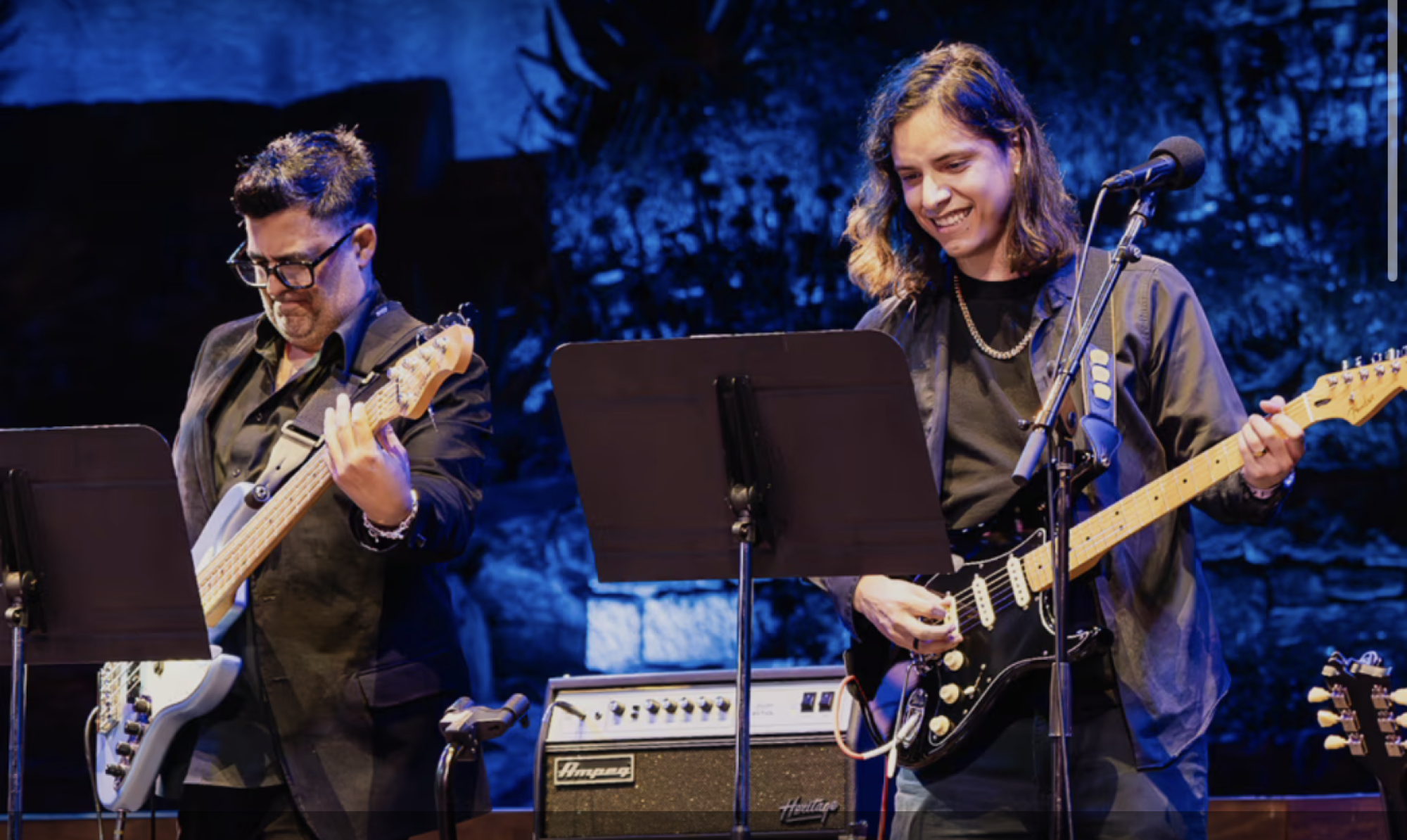
To celebrate the special choke hold these musical stylings have on Mexican Americans in Southern California, the L.A.-based group Mariachi Tierra Mia is putting on a “Mariachi Meets the Smiths” show at the Ford amphitheater on Sunday. The show will merge not only the cultural resonance of the two in Mexican American culture, but also unite the sounds.
The idea to incorporate elements of mariachi music into a cover of a Smiths tune happened by happenstance in December 2024.
Members of Mariachi Tierra Mia were performing at a Christmas party when an attendee requested that the group perform the 1984 Smiths track “Heaven Knows I’m Miserable Now.”
Members of rock band The Last Line of Defense who will perform at The Ford as part of “Mariachi Meets The Smiths.”
(Mariachi Tierra Mia)
The ensemble’s leader, Maira Solis, didn’t know the song — but her husband and fellow bandmate Ivan Peña signaled that he did. Later on in the night, he performed the song alongside two dancing, masked luchadors.
The video of Peña belting out the song while outfitted in his mariachi regalia struck a chord with audiences online after the group posted it on social media.
“The relationship between Mexicanos and the Smiths needs to be studied,” Peña told The Times. “[The video] seemed like a very innocuous thing, but days later, it had 3 million views. That was the first time that ever happened to us, and to me, personally.”
The overwhelmingly positive response to Peña’s rendition of the Morrissey-penned tune let him know that people had an appetite to see the Smiths and mariachi blended together.
Born in 1991, Peña was born years after the Smiths broke up, but was introduced to the group’s catalog at age 5, while his uncle drove him around in a lowrider. The first tracks he heard from the band were “Heaven Knows I’m Miserable Now” and “Ask.”
“I don’t think the music has aged a wink. It’s just gotten better with time,” he said. “It’s clearly resonated across generations. Now you even see Gen Z getting in on it too and realizing music of the past is so substantial.”
But the fandom surrounding the Smiths, and more specifically Morrissey, has entered more complex territory in light of the Smiths frontman’s past political commentary.
“I get that he’s a polarizing guy. I know he’s notorious,” Peña said. “I [say], separate the art from the people behind it … because the piece itself is not at fault for the shortcomings or views of the people who made it.”
Sunday night’s concert will be split in two acts, with the first being a bilingual mariachi set by Mariachi Tierra Mia composed of genre standards and more modern covers. For the second act, Peña’s rock group the Last Line of Defense will perform songs by the Smiths and be joined by the mariachi group to merge the sounds.
Incorporating the mariachi to create straightforward covers of the Smiths’ material proved challenging as Peña did not want to put a spin on the songs’ composition — no added notes and no new harmonies were allowed.
“You could task a mariachi band with doing a one-for-one adaptation of the Smiths’ songs, [but] most of the tracks do not work on the mariachi setting,” he said. “Whereas the guitar is leading the charge in a rock band. The guitar and the vihuela are essentially the rhythm section, so you have to translate guitar riffs to the melody section of the mariachi, [which is the] trumpets and violins.”
According to the 34-year-old musician, very few of the English band’s song fit into that mold.
He knows that fans love the original material and he wants to respect the essence of the time-tested songs. Out of that reverence for the group’s music, Peña noted that all the Smiths covers will be performed only in English.
Peña’s final take on why Mexicans are so infatuated with the Smiths?
“Mexicans love catchy music,” he said. “It’s all of the feels. It’s the good, the bad, and a bit of longing. The lyrics aren’t lying to you. [We can all relate to] Morrissey’s angst, his rebellion, his malaise, and, on the other side of that, his optimism.”
Americans have demonized us as criminals, buffoons, lechers, invaders, criminals and job stealers since the fall of the Alamo. Latino culture typecasts hombres as eternal machos always a few drinks away from brawling or bawling. Educators view us as underachievers. The political class long stereotyped Latino men as a sleeping giant who could change the country, if only we showed up to vote with the same enthusiasm as attending a Raiders game or lining up for a sneaker drop.
The blame game continues. A study released this month by UCLA’s Latino Policy & Politics Institute basically paints Latino men as little better than MAGA minions, trumpeting a gender gap on standing up to this administration’s deportation deluge, defending democracy and “fighting the Trump agenda.” To the media and to outraged internet commentators, it didn’t matter that two-thirds of Latino men had responded that each of those three issues was “very important” or “somewhat important.”
We just aren’t anti-Trump enough, which marks us as alien to the president’s critics. The UCLA paper’s cover page even features a red man and a blue woman conversing in what look like Aztec speaking glyphs — as if the sexes can’t understand each other and probably never will.
To explain the Latina-Latino political chasm, UCLA offers hypotheses straight out of “Men Are From Mars, Women Are From Venus.” The women supposedly work more in caretaker jobs like teaching and healthcare, softening their views toward the least of us. The men are in blue-collar sectors with a Darwinian outlook. But it doesn’t take a fancy academic paper to come to that conclusion — all you need to do is, you know, talk to Latino men.
When Trump descended that damned escalator in 2015 to announce his first presidential run by sliming Mexican immigrants as rapists and drug dealers, I knew that this racist excuse for a leader — the most anti-Latino politician in our nation’s history — would nevertheless appeal to many Latino men.
The reasons were evident: Trump’s fame. His strongman persona. His riches. His default setting of, as we Mexicans say, me vale madre — I don’t give a damn what people think. Yet three successive Democratic presidential campaigns willfully ignored these flashing sirens, instead insisting that Green New Deals and diversity, equity and inclusion programs would appeal to working-class Latino men.
Pundits thought we were still motivated by the radical politics of the Chicano movement, as previous generations were. What they didn’t realize was that assimilation had transformed Latino men into the modern equivalent of President Nixon’s silent majority.
A “Latino Americans for Trump” office in Reading, Pa., during the 2024 elections.
(Joe Lamberti / Associated Press)
I’ve always thought Latino male Trumpers were deluded — but I’ve always understood where they’re coming from. They’re believers in rancho libertarianism, my neologism for the individualistic politics exemplified by the Mexican men who raised me and who I grew up with.
Rancho libertarians, like their Scotch-Irish cousins from another mother, are forever skeptical of government, respect insurgents who want to take on the establishment, love their people and subscribe to a bootstraps approach to life. Not as praiseworthy is a tendency to dislike being told what to do, and in proving a point, to not only cut off their nose to spite their face but to lop off their heads as well.
No wonder so many Latino men went for Trump. To quote another Mexican saying, por eso estamos como estamos. That’s why we’re the way we are.
And look at what it’s earned us.
MAGA has been a miasma on this land, but especially for the blue-collar Latinos whom Trump increasingly courted with each election cycle. Immigration agents have arrested U.S.-born Trump supporters and thrown their friends and family members into squalid detention centers to await certain deportation. Diesel and gas prices are outrageously high, after Trump started a war with Iran that seems to have no end.
Nothing has degraded more for Latino men, however, than the simple pleasures of life.
When my dad and my brother had a pool party for some cousins and their children last month at our Anaheim home — no more than 15 people — the cost of carne asada, chicken, chorizo and tortillas from a local carnicería was more than $200. That side of the family never supported Trump while not exactly being wokosos, either. As Spotify blasted Antonio Aguilar and Banda El Recodo, they complained about the economy and the Republicans who have rubber-stamped the Trump agenda, when we should have been talking about the Dodgers and vacations back to our ancestral Mexico state of Zacatecas.
If my Arellano cousins are ready to stick it to Trump on election day, so should the Latino men who supported him two years ago.
In 2024, Latinos were the pivotal vote that delivered swing states to Trump. In this year’s midterms, Latino men are the swing vote within that constituency, from congressional races once considered safely red in Texas and Florida to local elections across the country. It’s gotten so dire for Republicans that Florida Rep. Maria Elvira Salazar put out a television ad warning Trump that “the same Hispanics who brought you to the White House … feel betrayed today.”
Honor remains big among rancho libertarians, and no politician has insulted the Latino way of life more than Trump. Helping to flip the House and Senate to the Democrats wouldn’t end his influence, but it sure would help. Plus, it would be a perfect rebuke to a pendejo who fooled too many good Latino men.
American society, whether the left or the right wing, will never fully accept us. We’ll always be thought of as too conservative, too dumb, too reactionary, too violent by too many.
Well, if we’re going to be loathed, we might as well stand on the right side of history. It’s time for Latino men to stand up and hit Trump with another Mexican saying:
WASHINGTON — President Trump is canceling nearly $1 billion in spending approved by Congress, the White House announced Friday, using a rare and contested power to axe funding for immigrant services and diversity-focused initiatives.
Trump’s Office of Management and Budget described the funding cut as focused on “the most harmful government spending.”
Most of the cuts are focused on Health and Human Services programs that serve refugees and unaccompanied minors accused of being in the country illegally. The administration says the funds are no longer necessary because illegal border crossings have diminished considerably.
Also targeted for cuts were a Department of Education program for migrant students, a Department of Justice office focused on reducing racial tensions, a business development initiative for minority entrepreneurs, housing counseling services from the Housing and Urban Development Department and a series of grants from the Health and Human Services Department that the administration called “outright harmful and blatantly ideological.”
A White House news release announcing the funding rescission notes that some of the organizations are led by people who worked in the Obama administration.
Trump’s move was condemned by Sen. Susan Collins of Maine, a Republican in a tough reelection campaign and chair of the Senate Appropriations Committee.
Collins said in a statement that the action came without warning or consultation. She also said she would work to address with colleagues “these illegal actions.”
“Not only is the delay itself an impoundment that was not reported to Congress, but also it is a usurpation of Congress’s appropriations powers,” Collins said. “OMB is an agency of the executive branch. It does not get to decide which programs are worth funding.”
Under federal law, Congress has 45 days to review the president’s proposed spending cuts before they take effect. But Trump made that all but impossible by announcing them with just five days left in the federal fiscal year and the House out of session through the November election. The Government Accountability Office, which is an arm of Congress, says the maneuver known as a “pocket rescission” is illegal.
Collins called it the latest attempt by OMB to “undermine Congress’s Constitutional power of the purse.”
A year ago, Trump issued a pocket rescission for the first time in nearly 50 years by blocking $4.9 billion in congressionally approved foreign aid. The U.S. Supreme Court declined to block that rescission, saying that Trump’s authority over foreign affairs weighed heavily in its decision. This year, Trump is targeting domestic spending.
The use of a pocket rescission fits into a broader pattern by the Trump administration to exert greater control over the U.S. government, eroding Congress’ power.
What was essentially the last pocket rescission occurred in 1977 when President Carter rescinded it, and the Trump administration argues it’s a legally permissible tool, despite some murkiness, since Carter had initially proposed the claw-back well ahead of the 45-day deadline.
The administration has also fired federal workers, imposed a historic increase in tariffs, and started the war in Iran without going through Congress, putting the burden on the judicial branch to determine the limits of presidential power.
Sen. Patty Murray of Washington, the lead Democrat on the Senate Appropriations Committee, described the White House action as “theft from the American people, plain and simple.”
“These are funds Congress has delivered on a bipartisan basis and should be helping people — not cut off by a president more focused on building a ballroom than investing in families,” Murray said.
Murray said that in recent spending negotiations, Democrats fought to include language to prevent the administration from usurping Congress’ power on spending decisions, but Republicans have declined to go along.
“While Trump spends tax dollars on ads promoting himself” — a reference to a taxpayer-paid TV spot that has drawn bipartisan rebuke — “Congress needs to reassert its powers to help people, and it’s past time Republicans join us in that fight,” she said.
In addition to immigrant services, the White House said it was rescinding $70 million for what it called “woke” international education programs, $28 million in grant funding for Health and Human Services research programs, and $9 million in debt relief for foreign countries that fund climate change policies. An additional $10 million was being withheld from a minority business development program.
Freking and Cooper write for the Associated Press.
Political polls are like weather forecasts. They’re worth passing consideration, maybe, but you’d have to be a fool to bet your house on their accuracy.
And yet there’s something that rings true about the recent poll suggesting that L.A. Mayor Karen Bass is in deep trouble among likely voters as she tries to hold on to a job that Councilmember Nithya Raman is trying to snatch away from her.
Here are the numbers, as compiled by the UC Berkeley Institute of Governmental Studies and co-sponsored by The Times:
Raman: 39%.
Bass: 28%.
Undecided: 33%.
Bass has naturally tried to debunk the poll. What else could she do, when her supporters are outnumbered by people who can’t make up their minds? Bass would need to dominate the undecided vote to have a chance, but given her high unfavorability rating, that’ll be hard to do.
On the other hand, Raman certainly hasn’t put things out of reach, despite the fact that Bass carries the baggage of the Palisades fire and has made only minimal progress on her signature issue — homelessness. Election day is less than two months away, and Raman has failed to convince anywhere near a majority that she’s the answer.
So what do Raman and Bass need to do between now and Nov. 3?
We need both candidates to be bolder, more creative, more convincing, and to tell us things we haven’t heard before.
All the recent L.A. mayors I’ve known had their faults and failures, whether the task was filling potholes, building out transit or addressing the high cost of housing. But among their best qualities, Dick Riordan was arrogantly confident, Jim Hahn had a steady hand on the tiller, Antonio Villaraigosa was tireless and passionate, Eric Garcetti was a long-range thinker on earthquakes, water and energy.
L.A. needs a mayor with all of those qualities. A cheerleader. A task master. A ball buster.
Running the second-largest city in the country is no easy task, because many of the problems at street level begin well beyond local control, related in part to an economy that leaves too many people behind.
But if you want to lead a world-class city, you need to have world-class answers on the big stuff like housing and homelessness and on the basics, too, like fractured sidewalks and neglected parks. Most voters don’t give a hoot about which candidate is more of a socialist or a moderate. City Hall is broken, and they want to know who can fix it.
On Wednesday, I checked the same sadly neglected area around City Hall that I wrote about in April and found only minimal improvements. Graffiti has been washed from the Frank Putnam Flint fountain, but it remains a broken-down monument to neglect, as it has for most of the past 60 years. And all around it, most of the little placards identifying native plants are broken or missing.
People rest on the Frank Putnam Flint fountain outside City Hall, a sadly neglected area.
(Allen J. Schaben / Los Angeles Times)
The L.A. Mall is still a largely abandoned wreck, with broken planter boxes and weeds at street level. A woman with two shopping carts told me she’s been homeless for 5½ years. The restaurant next to the nearby police department is shuttered; the restaurant across the street from it is long dead, and the once-vibrant downtown — which generated revenue that benefited every neighborhood of the city — is gasping.
I drove down Hope Street, south of 12th Street, because a reader who lives in that area and has told me about repeated fires at abandoned properties. A tractor was clearing debris from a recent blaze.
I drove west on Olympic toward Alvarado, an area I visit regularly to see a friend. Streets are strewn with trash. They’re always strewn with trash. At Olympic and South Lake, where encampments line the street and a fire once spread into a church parking lot, destroying vehicles, there’s a concrete triangle that was heaped with trash. It’s always heaped with trash, like a municipal dump on a busy thoroughfare.
Next I headed west on Wilshire to the RFK Memorial I wrote about 10 months ago, near the site of the 1968 Bobby Kennedy assassination. It remainsfenced-off, with trash and graffitiand with overgrown vines covering tributes to Kennedy. The city was going to help the school district clean things up. Then the school district took on the task.
It’s still a mess. Actually, it’s more than that. It’s an indictment. And so is the fact that in Studio City, where frustrated neighbors complained for five years that an abandoned property had been taken over by squatters, it took a recent fire to get City Hall’s attention.
The property, since cleared, is in Raman’s district, and she and Bass traded accusations about who had dropped the ball.
“As far as homelessness goes, I don’t see either candidate really showing a clear vision to solve this,” said Kayt Miranda, whose home was damaged by the fire at the abandoned property. “I mean, it’s a tall order, and I wouldn’t want to be in charge of that. But I’m not hearing anything from either of them that sounds like it will work or hasn’t been tried already.”
To be fair, Bass and Raman have each had lots of success on homelessness, with thousands of people being brought indoors. That job is not easy, especially given the number of people with mental illness and addiction issues. I know this from personal experience, having spent a year trying to steer a friend in from homelessness.
But the pace is too slow and the cost too high. As my colleague David Zahniser reported earlier this year, $300 million had been spent on the mayor’s Inside Safe program since December 2022, and as of last December, 40% of the 5,800 people who had been housed were back on the street.
And that was with an estimated annual cost per person of $82,000. Raman, who had supported the program, became a critic of it and touted a less expensive strategy that itself has been criticized for its slow pace, as Times City Hall reporter Noah Goldberg wrote in August.
Not long ago, a homelessness policy expert suggested to me that if we could figure out a way to double the nearly $1,000 Social Security Disability subsidy many homeless people get, it would open some doors in a housing market they’re now priced out of. Too expensive? It’s cheaper than what we’re doing.
I’d like to hear the candidates rethink the playbook like that, double down on what works and drop what doesn’t.
I’d like to hear from a candidate with a realistic plan to get L.A. out of the cellar in park rankings nationally, to break up the 10-year logjam for a sidewalk repair and the two-year wait to fix a street light.
All those undecided voters know exactly what they want.
A mayor who says fix the busted fountain by the end of the week, or else.
Growing up, Alejandra Villarreal was accustomed to the dry Mexican heat, trapped inside the small historic venues where she and her sisters would perform as kids. But as temperatures hit 103 degrees outside the Fonda Theatre in Hollywood, she couldn’t help but shout.
“¡Ay, qué calor!” she said, swinging her bass guitar.
Inside the nearly 100-year-old theater, Alejandra was onstage for a sound check. She ran through distorted, metal-influenced riffs as her sisters — drummer Paulina Villarreal and lead vocalist-guitarist Daniela Villarreal — prepared for the second of three sold-out shows at the Fonda, as the rapidly rising rock band the Warning.
The Warning has been shaking the walls of L.A. theaters since the group first landed in the city eight years ago — but this year feels especially monumental for the sisters.
Released in August, the band’s most recent album, “Everything’s Falling,” is a snarling, noisy and melodic rock joyride that rarely, if ever, slows down.
Written between L.A. and their hometown of Monterrey, the straight-to-the point lyricism documents the Villarreal sisters’ frustrations, anger and failures — most fiercely on “Kerosene,” which lambasts a jealous critic who “falls asleep with me on your screen,” so sings Daniela.
“Kerosene” recently shot up to the No.1 spot on the Billboard Mainstream Rock Airplay chart, which made the Warning the first Mexican and first all-female band to make the spot. Another single, their Spanish-language anthem “Ego,” was nominated for rock song at the 2026 Latin Grammys.
Members of the Warning hold up Billboard No. 1 awards after performing at the Fonda Theatre.
(Kayla Bartkowski / Los Angeles Times)
The legend of the Warning began in 2014, when Alejandra was just 9 years old and Paulina and Daniela were 12 and 14, respectively. The sisters came home from a Sunday carne asada with their family — and recorded a righteous cover of Metallica’s “Enter Sandman.”
Dressed in floral blouses and white capris, the girls thundered through the song with a focus and technical ability that sparked the interest of audiences worldwide — earning them a current total of 27 million views, not to mention praise from Metallica guitarist Kirk Hammett.
“We were wearing our sandalias, our church clothes,” Paulina said. “It’s just pretty crazy to think that one random Sunday afternoon we recorded that and it jump-started our whole career.”
The idea for the group came from playing the video game “Rock Band,” which led the sisters to performing at local “Battle of the Bands” competitions and posting cover songs to YouTube.
But the success of the “Enter Sandman” cover changed the course of their lives, taking them from local venues like Cafe Iguana — or, as Paulina calls it, “Monterrey’s Whisky a Go Go” — to appearing on the Ellen DeGeneres Show and various international music festivals.
“We started having adult responsibilities way early in our lives,” Paulina said. “We didn’t have that [average] teenage experience at all.”
“We didn’t go to normal school, we didn’t go and hang out with other teenagers,” she continued. “We were mostly hanging out with adults like our parents, [or] on tour and working. So there was this huge disparity between what our friends were living through and what we were going through.”
Over the course of its 13-year career, the Warning has opened for acts ranging from the Foo Fighters to Yungblud, writing and recording tirelessly in between. Now that the bandmates are all in their 20s, they say they “wouldn’t change it for anything.”
“When I was 10, I was like, ‘This is what I’m going to do for the rest of my life,’” Alejandra said. “I guess I did miss out on high school and ‘the norm.’ But honestly, I’m very grateful that we did this.”
In “Everything’s Falling,” the Warning contends with self-imposed songwriting limits that boxed them in as children — and tear down old personas to reveal their continuous, however imperfect, process of growth.
“All of our lives, we felt like we needed to sound a certain way,” said Alejandra. “English is not our first language, so we always found ourselves using really complex words — so that people would say, ‘They know the language.’ The lyrics of this album are very straightforward. We don’t have anything to prove anymore. It was a very liberating album to make.”
1/4
(Kayla Bartkowski / Los Angeles Times)
2/4
(Kayla Bartkowski / Los Angeles Times)
3/4
(Kayla Bartkowski / Los Angeles Times)
4/4
(Kayla Bartkowski / Los Angeles Times)
The group’s highly technical progressive rock style, influenced early on by bands like Muse, Metallica and Paramore, brought it a legion of Gen X fans who admired the sisters’ dedication to shredding, mathematical guitar solos and classical training base.
On their latest album, the sisters introduce new levels of fuzz and overdrive that blur their usually crisp instrumentals, plus verses that “lean into femininity” and take inspiration from a source that may surprise some: K-pop.
The rising global genre, known for its catchy harmonies and bouncing performance style, inspired the sisters to bring pop elements to their recording sessions.
“We love getting inspired outside of our genre,” Paulina said. “I think what happens a lot in rock is that, it’s very purista [purist]. Especially as women, whatever you do is very scrutinized. So if you ever step out of those confines it’s like, ‘Well [if] you’re not rock, you shouldn’t even be participating.’”
The sisters’ desire to defy expectations is most apparent in their jam-packed touring schedule.
(Kayla Bartkowski / Los Angeles Times)
“I fainted onstage [in July], and it was very dramatic,” recalled Paulina. “More than it being scary, I think people for the first time realized how hard we work. People were like, ‘Oh, your team is pushing you too hard.’”
“Nobody’s forcing us to be here,” she added, resolutely. “We’re grown women. We know what we’re doing and we know how much we can take.”
Daniela, the lead vocalist, had come down with a cold during the group’s L.A. shows, which required her to step back from interviews to rest her voice. The first night, she sang through the entire setlist, screaming and all — but by the third, she could only perform a few songs. Rather than cancel the concert, the Warning insisted that the show go on.
A la Karen Carpenter, Paulina sang lead vocals from behind the drum kit, calling on the crowd to clap and sing along to the music. They also brought out fans and collaborators to help them perform, including songwriter Annie Schindel, as well as rock acts Holy Wars and Dead Poet Society.
“We push forward through a lot of bad experiences,” Alejandra said. “One time I felt like I was dying — and that was the one of the few times we canceled a show. We only do it in extreme measures, because we know how much planning a show takes.”
One could blame it on the “Mexican work ethic,” they said.
Before taking on Hollywood, the sisters joined regional Mexican artist Carín León on the first night of his sold-out weekend at the Sphere in Las Vegas: the first time a Latin artist had ever headlined the venue. The band released the bluesy rock single “Love to be Loved” earlier this year with the Sonora native, recalling the first time they played it together “a highlight of our lives.”
“[Even if] we do our own thing in a different genre, we still shared that pride because of where we come from,” Paulina said. “Everything about that show was so Mexican … The unity, the community that we have outside of our country. Hopefully the people that went there felt how special it was.”
“I cried,” Alejandra added. “[Watching Carín perform], it was emotional.”
(Kayla Bartkowski / Los Angeles Times)
A week later, at the Fonda, they smiled as fans launched into chants like “Olé, Olé, Olé” and “Viva Mexico.” The line had been forming since 3 p.m., and once the show had begun, the Warning transformed from jovial 20-somethings to well-seasoned professionals.
“I feel like there will be a very clear change in what we do, ‘Everything’s Falling’-forward,” Paulina said. “I feel like we really allowed ourselves to be more emotional in the music and these shows, and that feels really powerful.”
Mayor Karen Bass called the training that LAPD officers receive for handling mental health calls “woefully inadequate” and ordered an outside review of the department’s policies Thursday, saying recent shootings highlight continued shortcomings in how police deal with people in crisis.
Bass is particularly concerned by the relative lack of specialized intervention training for patrol officers who respond to the vast majority of service calls. While the SWAT team and other units receive such training, it is not standard across the Los Angeles Police Department.
“After the academy, they have spot training that is essentially videos that are played at roll calls,” Bass said in an interview week with The Times.
The mayor’s directive comes as she’s locked in a reelection fight with progressive challenger Nithya Raman, who, like Bass, has criticized the LAPD over shootings of mentally ill people.
“The ability of the city to respond to someone’s pleas for help is incredibly important in ensuring that we maintain the trust of the public,” Raman recently told The Times. “And right now, there is no alternative system besides LAPD to respond to many of the calls that are coming into 911 besides, of course, Fire Department calls.”
Polling by the UC Berkeley Institute of Governmental Studies, co-sponsored by The Times, shows Raman is favored by 39% of likely L.A. voters, compared to 28% support for Bass — with 33% still undecided.
LAPD officers have fired their weapons at people 16 times this year — down from 34 shootings in 2025, but recent incidents have highlighted how officers continue to turn to their guns when confronting individuals with mental illnesses. In years past, department statistics showed at least a third of all police shootings involved someone with obvious signs of emotional distress.
Bass was particularly disturbed by a July 29 incident in the Olympic patrol area in which police fatally shot a man who approached them with an aluminum bat.
Body-camera video captured officers approaching 33-year-old Alejandro Garcia as he was walking through traffic on Normandie Avenue underneath the 10 Freeway overpass. Officers ordered him to drop the bat, although it’s unclear whether he heard them. While Garcia could be seen holding the bat with both hands, the footage appeared to contradict an early LAPD account suggesting he swung at them.
The shooting could have been avoided if “the officers were trained differently or better,” Bass said, noting that one of the officers had been on the job for roughly five months.
The LAPD has yet to identify the officer or officers who opened fire.
Bass said it would have been appropriate for the department to deploy a unit that sends a social worker out with officers when responding to calls involving a person in crisis.
“You knew before that he had a bat and he was going around smashing cars,” she said.
About a week later, two officers shot and killed Canas Zimran, 44, in Boyle Heights after, department officials say, he approached officers with what was later determined to be a tree trimmer.
The shootings occurred despite policies that prioritize deescalation techniques and the use of “less-lethal” alternatives, such as bean bag rounds meant to subdue people without resorting to firearms.
Bass said the killings reflect, in part, a broader failure of the mental health system to get people the care they need. Also of concern, the mayor said, was the lack of training for officers on how to distinguish between symptoms caused by mental illness, physical and cognitive disabilities and drugs such as phencyclidine, or PCP, which seems to be having a resurgence on city streets.
Bass said her review would be a top-down evaluation that also scrutinizes the roles of dispatchers, supervisors and others involved in responding to reports of people behaving erratically.
She said the audit will examine calls from the last five years involving people with “with known histories of mental or behavioral health conditions” in which police officers avoided using force. The goal, Bass said, is to “identify common themes or best practices that successfully de-escalated the incident or allowed officers to gain compliance.”
Bass added that it’s also important to consider the needs of LAPD officers and ensure they “receive appropriate assistance” to cope with stress. She was struck by the willingness of younger officers to openly talk about the mental toll of the job, recalling a recent visit to a roll call in which an officer described feeling a lack of support after being involved in an on-duty shooting.
LAPD officials have said the department has made numerous changes in recent years to curb police shootings, including adopting deescalation training focused on slowing down volatile situations, particularly those involving people who may be mentally ill. Still, the agency’s critics pack police commission meetings each week to argue for removing police from such calls, saying that officers are too quick to fire on people — particularly those wielding knives.
Although the city has experimented with programs that send specialists to help deescalate such encounters, LAPD policy still requires armed patrol officers to clear a scene of any potential threats beforehand.
Bass said she always has been a proponent of approaches that don’t involve police, some of which are employed by her Office of Community Safety. But she said stabbings and other incidents that pose an immediate danger to the public still require a police response.
Beyond looking at how to avoid police shootings, Bass’ directive calls for further assessment of the department’s training for handling people who’ve been booked into jails and detention facilities, including how they are restrained and transferred to medical facilities.
Bass wanted to ensure the review was done by an outside body, hinting at her frustration with the inaction of department leaders and the police commission on addressing the issue.
Actor D’Arcy Carden stopped by early, beating the cadre of guests crowding the main plaza beneath the now-famous oculus of the 300,000-square-foot Ma Yansong-designed building. A Stormtrooper drove by on a flatbed truck, shortly before R2-D2 greeted visitors in the courtyard, wearing an official staff badge. (The line for a selfie with the droll droid stretched as far as the eye could see.) Museum leaders have long said that “Star Wars” artifacts account for about 7% of the 100,000 square feet of gallery space, but one worker quipped 90% of opening-day attendees likely had a vested interest in the franchise.
This proved true, for the most part: Many visitors clearly knew and loved “Star Wars,” and Princess Leia buns and Yoda ears abounded. (Two Padmé Amidalas ran into each other, and according to a restaurant worker, one brave soul showed up in “Star Trek” gear.)
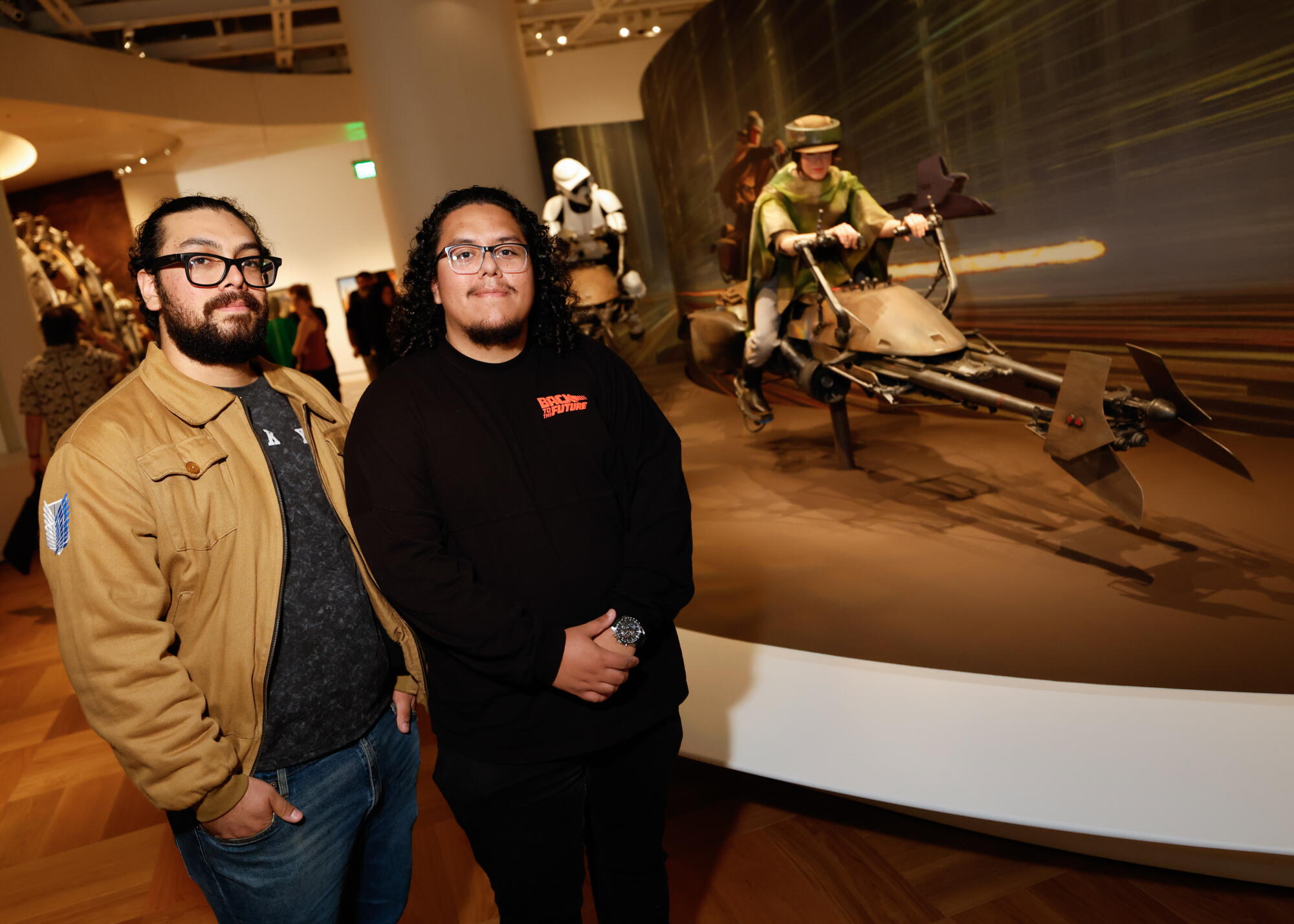
David Perez, 27, (right) donned his “Back to the Future” gear, hoping to see art from the movie. But he and his brother Carlos Perez, 28, (left) were quite pleased with the “Star Wars” artifacts in the Cinema section.
(Carlin Stiehl / For The Times)
Still, the museum, as its famous co-founder George Lucas has repeatedly said, is about more than just one story, however beloved. That sentiment cropped up repeatedly in interviews, too: Early guests seemed to believe the museum’s brochure, which notes that the galleries are about the “narrative art” of illustrating stories.
Co-founders Lucas and businesswoman Mellody Hobson (also Lucas’ wife) gave remarks early Tuesday to the first 100 visitors, consisting of students from USC, Los Angeles Technology Center, Otis College of Art and Design and Los Angeles City College, who were all handed free tickets.
A yellow Naboo N-1 Starfighter hangs above the education lobby, across from the main plaza, guarding the research library.
(Carlin Stiehl / For The Times)
“I’ve spent more than 50 years collecting the work of artists who don’t always get their due — illustrators, cartoonists, muralists, painters — because I believe their images are as vital as any other art form,” Lucas said. “They deserve to be in a museum.”
“This is a museum of the ‘people’s art’ — the images are illustrations of the beliefs we live with every day,” said Hobson, “and for that reason, this art belongs to everyone.”
Later that day, The Times asked visitors to share their impressions of a museum that, until now, has lived largely in the imaginations of fans and in abundant social media posts online. The museum has drawn loads of applause but also plenty of criticism, mostly for its lack of context via wall text, and for displaying art that not everyone agrees should be elevated.
Do the people love the “people’s art”?
Responses have been edited for length and clarity.
Alden Chang and his wife flew 6,800 miles from Taiwan to thank George Lucas for creating the “Star Wars” films and franchise. Chang told The Times that he also wrote an academic paper examining “Star Wars” fan culture in Taiwan.
(Carlin Stiehl / For The Times)
Alden Chang, 32, green product engineer from Taiwan
You flew all the way from Taiwan, just for this?
Chang: Yeah, halfway across the world to meet George Lucas and Miss [Mellody] Hobson.
Did you get to meet them?
Chang: Yeah, I just shook hands with them this morning. It’s like a dream come true.
How long ago did you and your wife get here,and how long are you staying?
Chang: For eight days. We came here on Sept. 18.
Is this the highlight of the trip?
Chang: Sure. [Laughs.] It’s my main mission and my main goal.
(Later, in an email, Chang told The Times that he also wrote an academic paper examining “Star Wars” fan culture in Taiwan.)
Friends Robert Meier, left, and Marc Downing used to work as ushers at the Music Center together. Growing up, Marc rode his bike where the Lucas Museum now stands.
(Carlin Stiehl / For The Times)
Marc Downing, 71, retired, from Exposition Park and Robert Meier, 70, educator, from Highland Park
Downing: I go to all the museums. This was the newest museum, so I had to come and see this.
How does this compare to the other L.A. museums?
Downing: This is ultra modern, ultra space-future. I’m glad the museum is here; highly recommend it. And I’m proud that it’s in my city, and I’m glad that it’s in the neighborhood that I grew up with.
What made you want to be a member of the museum, Robert?
Meier: It’s giving to the neighborhood. I’ve admired George Lucas — I used to have a relative in Marin County, and growing up, we’d go to lunch, and I’d see George Lucas and his family. We’d be at the same restaurant together.
Downing: Well, speaking of this neighborhood: This used to be a parking lot. I remember it very well. And I used to come here and ride my bike in this neighborhood as a kid.
C.S. Lee sits on a bench at the south viewpoint of the museum, gazing out onto the sculpture garden below. “This is why you live in Southern California. This is why you live in L.A.: for days like these.”
(Carlin Stiehl / For The Times)
C.S. Lee, 54, actor, from Koreatown
Lee: “Star Wars” was the very first movie I ever saw in my life as a 4-year-old when I immigrated here from Korea. We landed in Hawaii, in Waikiki Beach. Our family friends took us to a drive-in movie cinema place, and they said, “You want to come see a movie?” And it was “Star Wars” and “King Kong,” double billing. And my mom said when I saw the screen, my eyes popped out of my head because I’d never seen a movie before.
How do you think “Star Wars” impacted how you saw narrative and story?
Lee: I think I carried that all through my life: the story of “Star Wars.” I was like, “Oh, the good guys won!” And it was such an uplifting thing for me to hold on [to] all these years.
What did you think about the rest of the museum?
Lee: It’s so beautifully done: all the curves, all the light. You got the wind coming through the trees that they planted. I mean, honestly, I was just looking out, thinking to myself, “Wow, this is why you live in Southern California. This is why you live in L.A.: for days like these.”
The view of the sculpture garden and grounds beyond that C.S. Lee was contemplating from the south viewpoint.
(Carlin Stiehl / For The Times)
What about the building itself?
Lee: We rarely get to see architecture like this. But I think it’s good for people to see the artistry and the imagination of what people can build.
Janet Jacobs, 62, architect and Hanjin Jacobs, 25, audio equipment manufacturer technician, mother and son on a family trip from Portland (pictured at the top of the story)
I see you’re wearing a “Star Wars” T-shirt.
Janet: Yes, I am — actually from 1977.
Wow, really?
Janet: Yeah, I’ve had it for that long [laughs].
What was your overall takeaway from the museum?
Janet: I know George Lucas wanted to create this museum in a different way, like he didn’t have a sequence of events or a roadmap, he just wanted people to experience it the way they wanted to, so that’s all great. We do wish some of the things were explained a little more. Like, I know who Ralph McQuarrie is; [my kids] do not. So that would’ve been nice. Like in a typical museum, you do have a little blurb.
[My son] brought up a really good point: how ironic it is that it’s about storytelling, but yet there seems to be no storyline.
Andrew Liu, left, and Matthew Haak hang loose in front of a KAWS sculpture. They actually didn’t know it was opening day, but were happy to be there anyway.
(Carlin Stiehl / For The Times)
Matthew Haak, 26, architectural designer, and Andrew Liu, 26, behavioral therapy assistant, both from University Park
Haak: We are not “Star Wars” fans. I haven’t watched a single “Star Wars” movie. I’ve somehow evaded them my entire life.
So, if not for “Star Wars,” why did you come out today?
Haak: I’ve been watching this building being constructed for the past two years. I’m just geeking out over the organic curvilinear forms. Not a single hallway has been straight. And they even have real expensive details, like light coves on the base [of the wall]. All of these things really stand out to me. Also, curved walls like this are so expensive; architects never get a budget to do stuff like that.
I was just surprised: It’s not just “Star Wars” stuff. There’s so much art; it’s so cool.
Nicole Garcia — dressed as Padmé Amidala in her lakeside gown — poses in front of a statue of Princess Leia.
(Carlin Stiehl / For The Times)
Nicole Garcia, 24, cosplayer/costumer from Corona and Veronica Antonucci, 40, administrative assistant from Orange County
So, this might be an obvious question [given their fun outfits], but what brought you guys out today?
Antonucci: This little thing called “Star Wars”!
Garcia: Growing up with “Star Wars,” I always loved all the pieces, knowing that, for example, there’s miniature pieces that look just huge on-screen, and seeing them in-person is just, like, I want to shrink myself down and just be there.
Antonucci: It’s also amazing that it’s not just “Star Wars,” and it’s also so much more that everyone should come out and see.
Is there anything else you were particularly excited to see?
Antonucci: I was really excited to see the Frida [Kahlo]. I didn’t know she was gonna be here, so I think when I saw her, I gasped.
Is there anything else you’d like to add?
Garcia: I just hope the future generations of kids come back to see this, growing up with museums more often, and just learning how to make art — like, physically make art — and be inspired.
Antonucci: Actually, we talked about feeling jealous of all the kids who are going to be here on their school field trips, because we didn’t get to experience this.
Nikki Foster, left, loves a good field trip. She texted her group chat to visit the museum, and her bestie, Shalonda Dean, responded, so they both cleared their calendars for the visit.
(Carlin Stiehl/For The Times)
Shalonda Dean, 47, consulting business founder and president, and Nikki Foster, 45, live event production executive, both from Beverly Hills
Dean: Being a Black woman, I can identify with this little Black girl. Even in 2026, I think this painting depicts a lot of what Black women are going through today, whether it be in the workplace, navigating motherhood, navigating life. And I think this is an example of the barriers that we’re constantly breaking through every day, even today.
Foster: I’ve never seen it in person until now. So when we saw it, we were like, “It’s here, it’s here!” Just to be able to lay our eyes on it, and not have to go to another country, another state — here in Los Angeles. This is divine. It’s a divine day.
“I love meeting people,” Vincent Zabierowski said. “People are my main inspiration. I’m very lucky I get to be in a place where people want to be, and people want to soak up all that creative energy and just experience art.”
(Carlin Stiehl / For The Times)
Vincent Zabierowski, 23, host at the Skywalker Grill and freelance illustrator, lives near Downtown L.A.
As an artist yourself, what are your favorite pieces in the museum?
Zabierowski: I love a lot of the things that are in the graphic novel collection, like the Jack Kirby, the Garfields. My favorite is the Art Nouveau artist Alphonse Mucha. The Diego Rivera mural, that one was really amazing — and just the history here, having it be in L.A.
How does your work as an illustrator inform how you see these pieces?
Zabierowski: When I was going through it with some of my co-workers, I would [ask] “Do you know why they use a blue pencil?” And it’s because, when you take a photograph or a scan, that blue pencil disappears. So it was just really cool to see the behind-the-scenes and understand.
So seeing those blue pencil marks tells you that a piece is real?
Zabierowski: A person made it! I feel like a lot of people see artwork in textbooks, or they see artwork on their phones, or they see artworks on posters, and it takes a lot of skill and intelligence and training to be able to do those pieces of artwork.
Armed men open fire at a house party in a Durban township, killing a pregnant woman and 10 others.
Published On 23 Sep 202623 Sep 2026
At least 11 people, including a pregnant woman, have been killed after armed men stormed a house in a township in the South African city of Durban.
The attack took place late on Tuesday, according to Thamsanqa Ntuli, the premier of KwaZulu-Natal province, of which Durban is the main city. Assailants entered the home shortly before 11pm (21:00 GMT) while the victims were gathered at a house party.
Recommended Stories
list of 3 itemsend of list
Two people survived the attack, Ntuli said, adding the motive behind the killings was not immediately clear.
“The incident has left the community in profound shock and grief,” he said.
Local broadcaster eNCA reported that the attackers forced everyone into a single room before opening fire. They also set fire to a car belonging to one of the victims.
“It’s shocking and sad. These are guys I grew up with. I can’t believe it. It’s like a movie,” a resident told the broadcaster.
“I’ve been staying here all my life, and I’ve never seen anything like this,” he added.
According to a police statement cited by eNCA, preliminary investigations indicated that some of those killed were on South Africa’s Crime Intelligence radar over suspected illegal activities, though the statement did not elaborate further.
“Although the motive for the shooting has not yet been confirmed, a feud between rival groupings cannot be ruled out,” the police said.
South Africa has one of the world’s highest murder rates, with an average of about 60 people killed daily in a population of roughly 62 million.
In March, soldiers were deployed alongside national police to violent hotspots to tackle rampant crime, an issue President Cyril Ramaphosa has described as one of the country’s biggest threats.
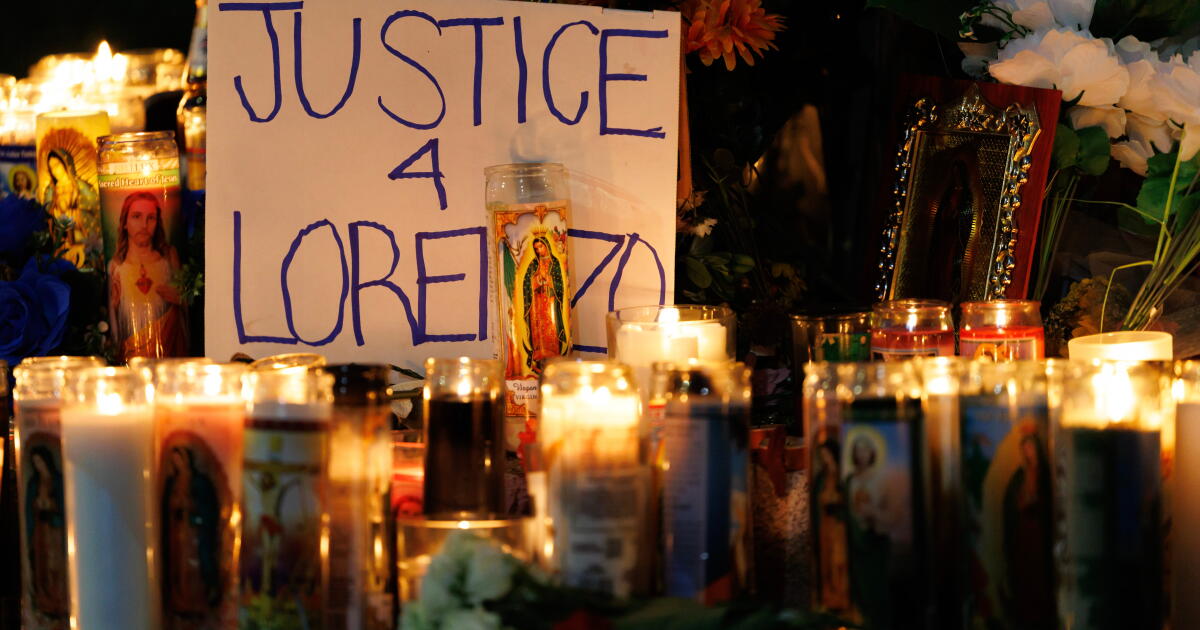
WASHINGTON — Lorenzo Salgado Araujo’s wife used to spend her evenings cooking a big meal for her husband and waiting for him to return home from his job as a home builder. Now, his son told members of Congress, Salgado Araujo’s wife spends those evenings visiting her husband’s grave at the cemetery.
In a packed Senate hearing room, a rapt audience of dozens listened to the sons of Salgado Araujo, the mothers of Ruben Ray Martinez and Renee Good, as well as the woman who video-recorded the death of Alex Pretti and the lawyer for the family of Johan Sebastián Durán Guerrero.
Salgado Araujo, Martinez, Good, Pretti and Durán Guerrero were shot and killed by federal agents since the start of the Trump administration’s crackdown on immigrants. Some were U.S. citizens; others were immigrants.
“We still have so many questions,” said Lorenzo Salgado, one of Salgado Araujo’s sons. “What are the names of the ICE agents who killed our dad? Why do they get to be protected behind anonymity, while my brother and I stand before cameras, showing our faces, proudly saying our first and last name?”
The forum on Tuesday was led by Rep. Robert Garcia (D-Long Beach) and Sen. Richard Blumenthal (D-Conn.). It was the fifth such event that the two lawmakers have hosted since December, forums aimed at shedding light on what the lawmakers call the “lawless and abusive tactics” by immigration agents.
The forums are not official hearings because they have been organized without Republican support. Nothing has changed since the first forum, the lawmakers said, accusing the Department of Homeland Security of failing to fully investigate the deaths and prevent further ones.
Blumenthal noted that two days prior in Austin, Texas, another man was shot by ICE agents. Wilber Rafael Garces Perez, a Venezuelan who was making a DoorDash delivery when ICE agents sideswiped his car, was seriously injured and placed in ICE custody with a bullet still lodged in his back.
Garcia said that, as of this month, Democrats on the House Oversight Committee have verified more than 1,000 instances of abuse by immigration agents under this administration.
“Every community in America should be asking itself: How long will it be until ICE is in our city?” Blumenthal said. “How long will it be until we have a grieving family, until another loss of life?”
Rachel Reyes sobbed as she recounted the moments leading up to the death of her son, Martinez. She said his death came nearly a year before Good’s and Pretti’s “yet far fewer people know his name” because the family was denied access to investigative reports and video evidence showing he had been shot by an immigration officer.
“It’s deeply distressing to know that Ruben’s final moments were consumed by confusion, fear, pain and disregard for his life,” she said. “Though the circumstances surrounding his death and these other victims are distinctly different, the pattern is the same: lives cut short by the same agency, agents without body cameras, no warnings, no attempt to de-escalate, excessive force followed by deflection, and a lack of accountability after the fact.”
Donna Ganger, the mother of Good, said her daughter should still be alive. Ganger described herself as a Republican and a Christian. While Jesus teaches forgiveness, she said, she deserves accountability too.
“I voted for President Trump under the impression that these agents were here to protect the citizens of the United States,” she said.
“This is madness,” Ganger added.
Stella Carlson said that when she saw Pretti, she decided to become “his backup.” Instead, she watched him die and then watched the agents who shot him flee. Two masked agents returned “and began to manipulate his dead body, ripping open his clothes as if to provide aid, but instead moving him around like a rag doll.”
Later, Carlson said, she witnessed top government officials lie about Pretti, calling him a domestic terrorist who wanted to “massacre law enforcement.”
“I am just a regular person, but I care deeply about my community, my state and my country,” she said. “I believe there is power in ordinary people speaking the truth.”
Good and Pretti were killed within weeks of each other in January during a period of increased immigration enforcement in Minneapolis.
Sean Murphy, who represents the family of Durán Guerrero, said he and Durán Guerrero’s widow recently attended a meeting with representatives of the Maine attorney general’s office to retrieve some of his property that isn’t considered evidence.
One item that wasn’t returned was his 3-year-old daughter’s car seat, which had been pierced by a bullet.
Sen. Alex Padilla (D-Calif.) asked each speaker what they think justice would look like.
Reyes said an independent investigation. Brent Ganger said that true justice isn’t possible because his sister can’t come back, but that accountability is possible if federal agents are held to the same accountability standards as local law enforcement.
To Carlson, justice would mean getting ICE off the streets and letting detainees return home. Murphy called for prosecution for the agent who killed Durán Guerrero.
For Lorenzo Salgado, justice would take another form: getting to see his mom heal and finally getting a full eight hours of sleep.
The forum came as congressional Democrats are seeking to edge out Republicans in the Nov. 3 election, and at times the Democrats seized it as a way to criticize the other party.
Rep. Jasmine Crockett (D-Texas) asked members of the audience to stand up if they’ve been affected detrimentally by ICE. Ronaldo Salgado looked around the room as about a dozen people stood.
“The reality is that there are so many more stories. There are so many more names that you will never hear,” she said. Later, referring to Republicans, she added, “It’s time to vote them out.”
Rep. Suhas Subramanyam (D-Va.) noted that Reyes voted for Trump and asked her to say anything she would want him to hear now. Reyes said that, like many Latinos, she deeply regrets her vote.
“I haven’t heard anything from any Republican whatsoever,” she said. “I’m very disappointed, and he lied.”
Good’s brother Brent Ganger said his family has waited long enough for accountability for the damage caused by ICE. As a moderate, he said, he hoped that all members of Congress — even those not in attendance — were listening.
“We will not be quiet, and we will not go away,” he said.
Fifteen people have been convicted over Sri Lanka’s 2019 Easter Sunday bombings, which killed 279 people at churches and luxury hotels. The verdict comes amid continued scrutiny over intelligence warnings received before the attacks and whether officials failed to act.
Podcaster and mental health activist Jennifer Eckhart, who sued ex-Fox News anchor Ed Henry for sexual assault in 2020, died by suicide on Saturday, according to authorities.
Eckhart was found in her Florida home on Saturday morning, according to an incident report issued by Martin County Sheriff’s Office, People reported. Her mother discovered her body inside a bathtub with a knife nearby, according to TMZ.
“This death has been ruled a suicide,” Christine Christofek, a spokesperson for the sheriff’s office, said in a statement to People.
Eckhart worked as an associate producer on Fox News Media’s Fox Business Network from 2013 to 2020. She sued Henry for sexual assault in 2020, and Fox News was named in the suit, accused of failing to take action against Henry for harassing women. The news division was later removed from the suit in March 2025.
“Fox News can … be held liable for Henry’s actions only if its management or supervisors knew or should have known about that purported misconduct yet failed to prevent Henry from harming Eckhart,” Judge Ronnie Abrams said in her March 2025 ruling. “On this record, the Court agrees that no reasonable jury could make that finding.”
Eckhart revealed that her lawyers were appealing Abrams’ decision in an October 2025 Instagram post.
“This case was never just about me,” she wrote. “It has always been about accountability and forcing corporations to answer for the cultures of abuse they protect, enable, and excuse behind power, money, and silence. For more than five years, my former employer Fox News has spent millions resisting accountability in my [rape] lawsuit. But what’s at stake is far bigger than me, one woman, one man or one company.”
The appellate court upheld Abrams’ decision, Eckhart’s lawyer Michael J. Willemin, a partner at Wigdor law firm, said.
“We were deeply saddened to learn of Ms. Eckhart’s passing, and our thoughts are with her family at this time,” Willemin told The Times.
Eckhart filed the harassment complaint against Henry after Fox News fired her in 2020. Following a subsequent sexual misconduct investigation, Fox News fired Henry that same year. The anchor, who now works at Newsmax, had previously taken time off in 2016 after a woman who claimed they had been having an affair while he was married released embarrassing correspondence between them, per People.
Suicide prevention and crisis counseling resources
If you or someone you know is struggling with suicidal thoughts, seek help from a professional or call 988. The nationwide three-digit mental health crisis hotline will connect callers with trained mental health counselors. Or text “HOME” to 741741 in the U.S. and Canada to reach the Crisis Text Line.
Born in Miami, Eckhart graduated from the University of Florida with a bachelor of science degree in telecommunications-news, according to her biography. She previously served as an ESPN Radio correspondent and an anchor for Gainesville, Fla., PBS affiliate WUFT-TV. In addition to her news and podcast experience, Eckhart also founded the Reinvented Project, which provided “support for trauma survivors through animal-assisted healing.”
Despite adversity, Eckhart was determined in her October 2025 post.
“I know the risks of speaking when silence would have been the safer, easier option. But I also know this: regardless of the outcome, history will not remember me as a woman who kept her mouth shut,” she wrote. “And I am completely at peace with that.”
NEW YORK — Earlier in the month, President Trump warned voters that democratic socialists — extreme, crazed, lunatics, he called them — were threatening to transform America into “a communist country.”
This week, a smiling Trump patted on the shoulder one of the nation’s best known democratic socialists, shook his hand, and said he was “off to a start” to being a great mayor of the country’s largest city.
Trump’s cozy relationship with New York City Mayor Zohran Mamdani, which began last year, has confounded people across the political spectrum. But with the midterms approaching, Republicans are increasingly frustrated by the unexpected bromance, which threatens the party’s message about Democratic radicalism.
“You’re trying to say, ‘Here’s how extreme they are,’ and the president’s saying, ’I love this guy,’” said veteran Republican strategist Doug Heye. “It doesn’t help.”
It’s hard to overstate the extent to which Republicans are focused on the rise of democratic socialism in the midterm season. At a moment when the party is saddled with Trump’s weak approval ratings on virtually every major issue — the economy and the war in Iran chief among them — Republicans from Georgia and Texas to New York and Michigan are working to scare voters away from Democratic candidates by warning that the party is controlled by far-left extremists.
At Trump’s unusual midterm convention in Texas earlier in the month, Mamdani’s name was evoked over and over again.
Texas Sen. Ted Cruz called the New York Mayor “Comrade Mamdani.” Rep. Tom Emmer, the No. 3 House Republican, called him “Mamdani the commie.”
Trump sent a similar message although he didn’t mention Mamdani.
“They call themselves democrat socialists, but actually they’re communists,” he said in his keynote address. “They’re crazy.”
In all, the words socialist or socialism were referenced dozens of times during the convention.
Trump did not mention those words while standing alongside Mamdani in New York on Monday, however. The president was in town for the United Nations General Assembly and made time to swing by Gracie Mansion.
Instead, the president highlighted efforts underway to work together, noting that he’s worked with numerous mayors over the years — “some great ones and some not so great ones.”
“Hopefully you’re going to be a great one,” Trump said while looking at Mamdani. “I’ll be able to say you’re going to be a great one. And you’re off to a start.”
Trump grew up in Queens, which Mamdani represented in the New York Assembly before running for mayor and winning a startling upset. He has since expanded his political power in the city, helping to push three candidates to victory in Democratic congressional primaries earlier this year.
It’s possible that Trump’s tone on Mamdani will shift again. After they had two surprisingly convivial meetings in the Oval Office, Trump started criticizing the mayor again.
“Sadly, Mayor Mamdani is DESTROYING New York! It has no chance!,” Trump wrote on social media in April in apparent response to a plan to create a new tax on luxury second homes in the city. “The United States of America should not contribute to its failure. It will only get WORSE. The TAX, TAX, TAX Policies are SO WRONG.”
Republicans in New York were quick to downplay the latest example of Trump’s friendliness with Mamdani.
David Laska, a spokesperson for the New York Republican Party, said, “President Trump is the greatest dealmaker in history, and he has proven repeatedly that he can deal from a position of strength with America’s enemies, be they foreign dictators or the mayor of New York City.”
Mamdani faced his own questions about why he was playing nice with a president that he’s previously described as a fascist.
“The president and I have both been very frank about the many disagreements that we have,” he said Monday. “I will continue to have conversations with the president, and frankly, anyone who can deliver relief to the people of this city.”
Peoples and Izaguirre write for the Associated Press.
WASHINGTON — Vice President JD Vance and other Trump administration officials said Tuesday they plan to remove 760,000 Affordable Care Act enrollees from public healthcare exchanges, alleging that the individuals were fraudulently enrolled in the program, or simply do not exist.
Vance said the discovery and canceled subsidy payments for hundreds of thousands of people from the exchanges would result in $2.2 billion in cost savings.
“We’re actually making sure that the people receiving Obamacare subsidies are actually entitled to receive them,” Vance, who leads a government-wide task force to eliminate fraud, said in a public address at the White House, Tuesday. He was flanked by Dr. Mehmet Oz, the administrator for the Centers for Medicare and Medicaid Services, and other administration officials.
The Trump administration also announced a six-month suspension on new brokers who sign up enrollees for healthcare coverage, who officials say commit a disproportionate amount of the fraud they uncovered.
Tuesday’s announcement is the latest in an administration-wide initiative to address fraud around the country, including in federal healthcare programs, which officials say is needed to rein in runaway spending and protect taxpayers.
The announcement comes as inflation and rising healthcare costs pressure the Trump administration to come up with a plan to bring down costs for Americans heading into the midterms.
The price of ACA insurance has skyrocketed for many Americans during Trump’s second term, after Republicans opposed extending COVID-era subsidies that had helped offset the costs of health insurance for most enrollees during Biden’s term.
Premiums doubled or tripled for many enrollees, prompting millions to downgrade their plans or exit the program entirely after the Republican-led Congress allowed the subsidies to expire this year.
Roughly 19.2 million Americans are actively enrolled in ACA marketplace health plans as of early 2026, according to the HHS website.
The White House referred The Associated Press to the Vice President’s team for additional comment on bigger plans to address healthcare affordability.
The Wall Street Journal first reported the news of the Trump administration’s plan to remove ACA enrollees from public exchanges.
Hussein writes for the Associated Press. AP writer Michelle Price contributed to this report.
Filming a broadcast television show can leave even the most seasoned actors feeling like they’ve lost sense of time. But by afternoon on a recent weekday, Josh Charles actually looks like he teleported to the past as he collapses into a seat inside his production trailer in upstate New York.
He’s in the throes of filming Season 2 of “Best Medicine,” the Fox dramedy he headlines that’s set in a small fishing village in Maine, and the reason he’s shed his character’s usual suit and tie for gaitered trousers and a navy coat with red facings eventually reveals itself: Port Wenn, the show’s fictional town, is putting on a Revolutionary War reenactment. And if you’re familiar with Martin Best, the curmudgeonly doctor with an almost permanently furrowed brow portrayed by Charles, the character’s willingness to don such a getup likely took some coaxing.
That’s the fun of it all for Charles.
He’s been a working actor since childhood — making his debut at 15 in John Waters’ cult classic “Hairspray,” followed soon after by his turn as Knox Overstreet in “Dead Poets Society” — and a fixture in TV and film ever since.
While best known for dramatic roles like high-powered lawyer Will Gardner in “The Good Wife,” Charles easily pivots to comedy — like the time he memorably played the triple-collared, snobby camp ringleader in “Wet Hot American Summer: First Day of Camp.” Now, “Best Medicine” lets Charles leans into the push and pull of the comedy and drama within his tightly wound alter ego.
Josh Charles as Martin Best in Fox’s “Best Medicine.”
(Francisco Roman / Fox)
Created by Liz Tuccillo (“How to Be Single,” “Sex and the City”), the series follows a brilliant but cranky heart surgeon who, after developing a crippling blood phobia spurred by a traumatic medical case, abandons his thriving career in Boston to become a general practitioner in the town where he spent summers as a child. Martin Best is a doc whose bedside manner could use some TLC, but he came to town hoping he can still practice medicine — that is, if the townspeople would actually do as he says.
“I have been really wanting to do more comedy lately and looking — especially if I was going to call a place home for a particular period of time, like you do in a television show — for something that was a little more lighter air than I had been networking in of late,” says Charles, whose recent credits include dystopian drama “The Handmaid’s Tale” and spy thriller “The Veil.”
The series is based on the beloved British dramedy “Doc Martin,” which starred Martin Clunes as a doctor with a similar storyline, that aired between 2004 and 2022. Tuccillo says Charles brought an elegance and depth to the fish-out-of-water dynamic his character navigates in the quirky town.
“He never hits a false note,” she says in a separate video call. “I knew the material would be in great hands in that he would always elevate it just by his artistry and being. I knew he was going to be able to play the gruffness, but any time that you’re doing a show, there is a question mark on so many things. To be honest, we were like, ‘But is he going to be super funny? Is he going to want to do pratfalls? Is he going to be game for the comedy part of it?’ When we started working, it was clear he was game for all the shenanigans … he likes to laugh. So I try to devise things that I think will amuse him.”
A special advance preview of the Season 2 premiere aired Sunday, but the show will move into its regular time slot Tuesday. Here are edited excerpts from the conversation with Charles.
Josh Charles poses for photos on the “Best Medicine” set in upstate New York. He says he was drawn to the Fox dramedy because it was “a little more lighter air” than the other work he had done recently.
(Ebru Yildiz / For The Times)
“Best Medicine” hit Netflix after its first season aired. Building an audience outside the traditional linear viewing has become such a key component of television today. How do you feel about it?
One of my dad’s best friends told me, “I’m watching the show on Netflix!” He’s like, “I just can’t watch shows with commercials anymore” — as people are programmed now. That is the new shift. You go into these platforms for periods of time, build your audience in a different way and hopefully keep growing that audience. [Television] keeps evolving and growing in a way that I don’t fully understand, but I do know that it’s a different world right now. Netflix has a great reach, and it’s great that we’re on there and that people are discovering it. And apparently we did very well.
Season 2 opens with Martin on probation and under review by the medical board. What is Martin in for this season?
When it starts off, he’s really in it. Eden [Martin’s ex-girlfriend played by Eliza Coupe] is now back in the picture. She’s coming from Boston every weekend, and she’s rubbed a lot of people in town the wrong way. And the progress that Martin made, we see him maybe take a few steps back in the way that he interacts with people. He’s with her and I think there’s feelings there, but I think their relationship feels very — I don’t know, it’s interesting. It doesn’t have the fire. But she doesn’t make him feel bad about himself. She respects him, and I think those things are important. And he’s around in this town where nobody’s listening to him half the time. People are just always mad at him about something, and she’s not. She puts him a little bit on a pedestal, and I think he really needs that.
All that presents an obstacle for the show’s slow burn: Martin and Louisa (Abigail Spencer). There’s been some discourse about the art of the slow burn and how the pacing has changed in an era of short episode orders and unpredictable renewals. You have experience in this department with “The Good Wife.”
Liz and I have talked about it a little bit. You don’t want to muck bait it and drag it out for the sake of dragging it out. I think they’ve done a good job of putting the obstacles in a way that still feels organic and genuine and not yet a reach. In the British show, things accelerated so much faster. They only made eight [episodes] a year. We want to also have it feel like it’s plausible. It is really fun to have Eliza Coupe here. It’s fun to play scenes with her and [see] the different side that brought out in Martin. That is the challenge because I don’t think we’re as interested in doing it quite that fast [as the British show]. I have faith in them that we’ll land it in a good way.
Ellen Soraya Nikbakht as a peculiar patient and Josh Charles as Martin Best in the Season 2 premiere of “Best Medicine.”
(Danielle Mathias / Fox)
You’ve played in comedy and drama in your career. It’s fun to watch you straddle both sides with this character. How has it been finding the rhythm or tone with him?
A lot of the comedy I’ve done, I’ve done some stuff that’s more silly and kind of over the top. I love playing the fool. What’s really fun [here], to me, are the circumstances they put Martin in where things are blowing up in front of him and he’s just trying to deal. I’ve enjoyed doing a lot of the physical comedy on the show.
I [also] found it really interesting to have a character who doesn’t want to be around people, but he actually does. He just doesn’t really know how to do it, and he’s never really had any kind of practice at it in his life. And he’s gone through a lot of trauma in his life. He’s a really specific kind of workaholic. For him to grow up with what he did, and losing his sister really young in his life — I did research on that and what that does to people and how that can sort of frame your life. I imagine he went to private school, maybe a boarding school, then he goes on the track of going to college and medical school — we know how hard that is, the kind of hours they put in; then to be really successful at it, you put everything you have into your work. There’s this other side of his life that is completely empty. This town kind of just softens off the edges of him a little bit and helps him become a little more authentic version of who he was maybe meant to be. That gives me some place to build off of and to go with the character, other than it feeling kind of just very one-note.
Matthew Goode, left, as Finn Polmar and Josh Charles as Will Gardner in a scene from Season 5 of “The Good Wife.”
(CBS)
This series marks your return to broadcast television after leaving “The Good Wife” in its fifth season. You’ve done TV since then, of course. But a big reason you left broadcast was because of the grind of a 20-plus episode season. With “Best Medicine,” you’re the lead and the second season will have 14 episodes. Does that feel like the sweet spot?
If “The Good Wife” was “The Good Fight,” I would have done that until the wheels come off. I would have never wanted to leave that because I would have had a life. I could have been able to go do a play, travel with my family, see my kids. At the time of “The Good Wife,” I didn’t have kids, but we were about to get married and wanted to have children. I was only going to do 18 [episodes] at most with this show, if they wanted it. And then I asked them this year, “Well, we’re just at 14. What was the decision [there]?” And I’m happy about it. They also agree. This just feels like where the show wants to live creatively. You work really hard for four or five months, and then you get to go explore other projects and travel and live your life.
Your departure from “The Good Wife,” with your character Will Gardner dying, felt like an out–of–body viewing experience as it happened. The fact that it was kept under wraps —
I can’t believe we did it, honestly. There was one journalist who obviously had a source somewhere and did find out. Part of being able to keep that silent until the moment was an agreement that they would come to set and be there as long as it was [kept secret]. I remember like when the episode aired, I was in the editing bay with the editors in L.A. [for an episode I directed]. I’m seeing things come in and I was like, “Oh my God!” I thought it was going to get ruined for people on the West Coast. These days, you know how they make something, how much this cost, how they did this scene … we used to be surprised by things. To be able to truly shock people you know like in an Orson Welles-style “War of the Worlds” way. I felt like in our own sort of network TV way, this was the equivalent of that. We really got to narratively pack a punch. That season was one of the great treats of my career. I just felt the writing on that show that season was at another level.
NEWBERRY SPRINGS, Calif. — Four decades ago, the cult hit “Bagdad Cafe” was filmed at a ramshackle diner in the Mojave Desert.
The tale of two women in the lonely landscape — a hardworking, rifle-wielding cafe owner and a stranded German tourist with a suitcase full of lederhosen — captivated viewers, particularly in Europe and Japan.
Busloads of international tourists rolled up to the actual Bagdad Cafe on a cracked, sunbaked stretch of Route 66.
Real-life proprietor Andrea Pruett, a sweet but steely Southerner who kept her own gun behind the counter, greeted them in French and German, then fed them buffalo burgers and omelets.
A memorial announcement for owner Andrea Pruett is seen at the Bagdad Cafe on Route 66 in the Mojave Desert.
As Pruett aged, her grip on reality loosened. But she refused to leave.
Now, the Bagdad Cafe is in limbo. Though T-shirts and tchotchkes are still for sale, the kitchen is closed. And Pruett’s family is figuring out what comes next.
Buses full of Europeans still come. So, too, do the roadtrippers celebrating Route 66, which turns 100 this year.
“We don’t get any locals, and we don’t cook any food right now,” said Mark Bradley, the cafe’s gruff but genial manager. “But we’re definitely on the map to see … it’s magic that takes place here.”
The cafe is a cacophony of color in an expanse of desert brown. Flags from all over — France, Brazil, Japan, New Zealand, Canada — hang from low ceilings. The walls are covered floor to ceiling by visitors’ passport photos and dollar bills with Sharpie signatures. “We’ve been here three times!” an Italian visitor raved in a guest book.
Pruett is still there, too. An urn holding her ashes sits by the front door.
A drone image shows the remote Bagdad Cafe on Route 66 in Newberry Springs.
In 1995, eight years after the movie’s European premiere, Pruett and her husband, Harold, stopped for burgers at what was then called the Sidewinder Cafe in Newberry Springs, 20 miles east of Barstow. They had just bought 640 acres for an ostrich ranch, which ultimately didn’t work out, though they kept some of the birds as pets.
The owner told them the A-frame, wood-shingled diner was for sale. “My husband looked at me and I said, ‘Don’t even think about it,’ ” Pruett told The Times in 2003.
But their son, actor Harold P. Pruett II — who was 26 and starring that year in a campy erotic horror flick called “Embrace of the Vampire” — declared the cafe “cool,” and that was that.
The Pruetts promptly rechristened it Bagdad Cafe, following German filmmaker Percy Adlon’s lead.
The exterior of the Bagdad Cafe.
Nearby Bagdad was a railroad town named in the 1880s by Southern Pacific Railroad officials after the Middle Eastern metropolis — without the H — because of the desert terrain.
Bagdad became a stop for steam-powered trains whose engines needed more water every eight miles or so in the desert climate, said Scott Piotrowski, past president of the California Historic Route 66 Assn.
The bustling little town was also a hub for gold, silver and copper mining camps.
Mining eventually faded, but cars on Route 66 overheated easily and often limped into town for water. A restaurant named, naturally, Bagdad Cafe, owned by a woman named Alice Lawrence, was the only place for miles with a dance floor and jukebox.
When Interstate 40 opened in 1972 about 10 miles north — taking most traffic and tourists away from Route 66 — it was the death knell for Bagdad, where all that remains today is a single scruffy cedar tree.
Thierry Farion, left, from France, and Aziz Khechine, right, from Tunisia, look at memorabilia inside the Bagdad Cafe.
At Pruett’s Bagdad Cafe, she embraced the movie. The two female characters, initially wary of each other, are both on a hiatus from their husbands, and the German tourist eventually draws big crowds by performing magic tricks.
“When people came in, it was like a director saying, ‘Action!’ ” said Pruett’s grandson, Greg Landers, 47, of Glassell Park. “She would just go right into welcoming people and telling them to sit down, answering their questions.”
A petite bottle-blonde who spoke with the laid-back drawl of her native Arkansas, Pruett showed off memorabilia signed by the “Bagdad Cafe” director. She got a yellow thermos like the one in the film, which, miraculously, never seems to run out of java, even when the coffee pot is busted.
A guest book displays messages at the Bagdad Cafe.
A desert road from Vegas to nowhere Some place better than where you’ve been A coffee machine that needs some fixing In a little café just around the bend
Pruett’s place drew desert eccentrics, including a gravelly-voiced man dubbed General Bob who sniped at customers who doubted his claims that he designed the Pentagon, built the Golden Gate Bridge, was a brain surgeon and was 109. (“Actually, he’s 83 years old, and if he wants to be older, I let him,” Pruett told NPR in 2003.)
Monaco’s Prince Albert II stopped in once. So did actress Renée Zellweger, who told Jay Leno on “The Tonight Show” that there was a “little old guy, he’s been sitting there for, I think, maybe 45 years on the same barstool. We had chicken fried steak together.”
When Huell Howser popped in unannounced for a 2001 episode of his California road trip show, General Bob, perched at the bar with a fedora atop his long silver hair, proclaimed he was 98 years old and “a real general, not a f—up.”
Marian Box, left, works the counter and talks to visitor Jaelene Kleckner.
For all the joy, desert life brought plenty of hardship.
One night in the 1990s, not long after Pruett bought the place, she was closing out the cash register when a man walked in, slammed a wooden 2-by-4 on the counter and ordered her to put all the money in a bag.
“She actually had a shotgun under the counter, and she pulled it out and said, ‘Stop,’ and cocked it,” said Landers, her grandson.
The man threw his hands up and said his family was in the car. They had been traveling and ran out of money. Pruett ushered them inside, fed them and sent them away with some cash — after making them wash their own dishes.
Pruett, who gave birth to Landers’ father, Corky, at 15, had a tough and impoverished youth. But she was “kind almost to a fault,” said Landers, a contractor who lived with her for a spell in his 20s and worked in the cafe. People who just about everyone else had given up on — she’d give them a place to stay and work to do.
In February 2002, the younger of Pruett’s two sons, Harold the actor, died of an accidental drug overdose. Her husband died two months later.
Pruett’s love for her customers kept her going, said Bradley, who has been around the cafe for 26 years as a frequent visitor and employee.
“She would have them crying as they left, but happy crying,” he said. “She could do that to people by giving them a hug and in just the few minutes that they were here. She had a magic to her.”
In 2016, Sarah Jane Woodall — a former nude model who posts popular desert travelogues on YouTube under the moniker Wonderhussy — stopped for breakfast and shot a video.
The cafe was quiet and grimy. She loved it.
“It was just, like, a lovable hot mess,” said Woodall, an Army kid who lived for a time in Germany, where people were obsessed with the movie.
The COVID-19 pandemic lockdowns devastated the Bagdad Cafe — and Pruett, who turned 80 in the summer of 2020.
The Europeans disappeared. Vandals busted the windows. Pruett let go of her waiters. Her kitchen closed and never reopened.
A sign for a former motel next to the Bagdad Cafe on Route 66 in Newberry Springs.
In 2021, her house burned down. She slept in the cafe, her thin frame curled up in a red vinyl booth.
That summer, Léa De Carmo, an aspiring actress, was driving back to Los Angeles from Las Vegas with a friend and, after a night of partying, craved a cup of coffee. They pulled into the Bagdad Cafe, where — as in the movie — the coffee pot was broken.
De Carmo, a native of Paris who had never seen the film, was stunned when she opened the door and “saw French flags and soccer team stuff everywhere.”
“It seems like all the French are led there for one reason or another,” said De Carmo, 29, who talked to Pruett that day for over two hours.
“She had essentially lost everything — her business, her house — but she just had this incredible energy and warmth and humor,” De Carmo said. “There was also this very deep loneliness.”
For the next four years, De Carmo drove from L.A. to Newberry Springs dozens of times, filming Pruett for a just-finished documentary called “The Keeper of Bagdad Cafe,” about her final years in the crumbling diner.
In the film, friends help Pruett move into an RV in the parking lot. As a woman gently washes her white hair with bottled water behind the cafe counter, Pruett says she can’t remember where she’s from.
“One thing she never forgot was the cafe,” De Carmo said. “She always knew where she was and that it was the place she wanted to be.”
Landers said his father, who died in 2022, asked her to move in with him in L.A., but she didn’t want to leave the Bagdad.
“It was just hard,” said Landers, who added that she might have fared better, physically, at least, in a dementia care facility. But she repeatedly said, “No, this is my place. This is where I want to be.”
Pruett’s friends in the desert stepped up. Bradley took care of her and the cafe, opening it each day for tourists to come in and take photos.
Woodall returned at the cafe’s request, filming the stained, decaying ceiling and the water-catching buckets and coffee pots on the floor. The YouTuber’s fans raised more than $25,000 — enough for a new roof.
In the video, Pruett stood by, smiling, quiet, a little confused.
For the next three years, she stayed at the Bagdad, even as her memory continued to fade. She died this January at 85.
On a Friday morning this summer, with the outside temperature already 115 degrees, Matt Parker stood behind the worn green Formica counter, setting a smart TV to the movie and preparing to make Nescafé instant coffee — a favorite of Europeans.
On a good day, they get three tour buses, he said.
Parker, 53, moved from L.A. County to Newberry Springs — where he used to camp with his dad and ride dirt bikes as a kid — a few years ago and fell in love with the cafe.
“You can’t recreate this,” he said. “We’re just caretakers of it. It’s a museum and church, in a sense, with all this stuff. Mrs. Pruett really focused on protecting it, protecting these people’s stuff — their mark.”
Andrea Pruett’s urn near the entrance of the Bagdad Cafe, which she ran for three decades.She died in January.
Landers said that, while the family figures out what to do with the cafe, he asked Bradley to keep it open like his grandma did.
Though her urn remains in the place she loved most, Landers hopes, someday, to bury her ashes in the Hollywood Forever Cemetery next to her youngest son.
Since her death, he can’t help but think of a scene from the movie. The German woman — forced to leave after her tourist visa expires — is gone and the bustling restaurant quiet again. A customer walks in and asks where the magic shows went.
A snoozing employee sits up and says: “The magic? It’s gone.”
In the end, the German returns to the Bagdad Cafe. And so do the crowds.
What happened to the future we were promised? The vision that grew out of the 1990s techno-utopianism, when the internet was still a place of freedom and experimentation. Where are the infinite possibilities the early years of the millennium afforded, when social media meant AOL Instant Messenger and GeoCities, when our cellphones were not yet smart, and when personal tech evoked whimsy and excitement rather than anxiety and dread?
On a recent night in L.A., that digital optimism still existed. Here, at a clothing store on La Brea Avenue in the Fairfax District, something that felt lost was rediscovered. People were huddling around to play 1999’s “Crazy Taxi” on a Sega Dreamcast, or 2005’s “Tekken 5” on a PlayStation 2. They were surfing a perfectly re-created Y2K-era internet, and navigating an early version of Apple’s Photo Booth to snap selfies with a first-generation iSight webcam.
Paizley Lee created Dead Internet Theory to bring guests back to an era when tech evoked excitement rather than dread.
(Jason Armond / Los Angeles Times)
Yes, almost everyone was staring at screens, but almost no one was looking at their phone. Instead, the room felt alive and buzzing with energy. Technology was creating human connection rather than isolation.
Welcome to Dead Internet Theory, an event hosted by game designer Paizley Lee that’s both a celebration of vintage tech and a place to build community. The name is a tongue-in-cheek reference to the theory that the internet today is mostly bots, AI slop and corporate algorithms, while the human element is quickly disappearing from the web.
Lee started the event earlier this year after seeing how her friends reveled in hacking old hardware but had nowhere to show off their reimagined contraptions. She said Dead Internet Theory is a space to highlight “artists who don’t see the light of day,” a cyberpunk show-and-tell of sorts. “There’s a world of knowledge that comes from that person that can share and collaborate with another artist, and that’s really the future that we were promised, right then and there,” Lee said. “It’s the ‘Hey, look at what I made, look at what I’m interested in, and let’s share that.’ ”
Benjamin Palmer shows his project called Pan and Scan.
(Jason Armond / Los Angeles Times)
One of those artists sharing his work was Dan Ruth. Atop a low credenza, he displayed a black, leather suitcase that housed inside of it an old laptop attached to an external zip drive. On the laptop’s screen was a menu of various banned books — the Unabomber’s manifesto and “The Anarchist Cookbook” among them. Ruth had recently bought the trademark rights to the digital storage systems iOmega, Zip and Jaz. “They were what we all used in the ‘90s to transfer larger files,” he explained of the era before online storage and transfer infrastructure like Google Drive.
With his setup at the event, participants could choose whatever banned book they wanted and write it to a physical Zip disk (about the size of a saltine cracker) to keep forever. If Ruth’s installation is a bit provocative, his message is less controversial. At a time when servers are being shut down, physical media is being digitized out of existence, and the subscription model is supplanting personal ownership, Ruth believes this is a way to have data autonomy.
Guests play retro video games.
(Jason Armond / Los Angeles Times)
Lee’s own contribution to the evening is the full rainbow of Apple’s iMac G3 computers — those bubbly, teardrop-shaped desktops that debuted in 1998 to the famous “iCandy” ads displaying their colorful shells, and TV commercials scored to the Rolling Stones’ “She’s Like a Rainbow.” Over several months and multiple trips, Lee drove across the country collecting the G3s in their core five colors. And it wasn’t easy. She recalled sleeping in her car in the parking lot of a Cracker Barrel for a few nights because she had spent all her money on acquiring the computers.
It was the people Lee met in the months of gathering the G3s, however, that made it worth it: a single dad who collected vintage iMacs to bond with his son, an elementary school teacher who held onto the old computers because the school was going to destroy them.
“I met these really witchy, cool, queer programmers from MIT in Medford, Massachusetts, who invited me back for MIT Swap Fest, where I found Indigo,” said Lee, referring to another G3 color not part of the core five. “I met a guy who used to work in broadcast, and his wife just died of cancer. His mom moved in, and she has been trying to support him in getting rid of old things and not holding on to them too much.” Human moments made possible almost by the accident of holding onto a computer longer than most.
Lee’s pursuit of old tech hardware has always been, at its root, a means to meeting new people, hearing their stories and creating a relationship with them. “I care about people a lot,” she said. “I think every single person that touches any of my projects knows that I really care about people feeling good.”
Paizley Lee spent months collecting the full rainbow of iMac G3s.
(Jason Armond / Los Angeles Times)
With a mouse, Jaimie Wan clicks into the past.
(Jason Armond / Los Angeles Times)
When Lee finally acquired all five original colors (blueberry, strawberry, lime, tangerine and grape), plus all the additional colors (ruby, indigo, snow, graphite, sage and three limited edition colors), she began booting up the G3s computers to make sure they still worked. In the process, she discovered the forgotten digital detritus left on their hard drives: old resumes, photo albums, Word documents.
“It’s somebody’s life,” she said. “It feels weird to do anything with it, but it also feels weird to alter it.” In the end, she kept the old files and built a replica of the early ‘00s internet to live beside them on the computers. At Dead Internet Theory events, participants are given free reign to the G3s and slowly find clues Lee has left on their desktops that lead into a mystery game she created.
Back at the event, people flocked to the bank of iMac G3 computers. They clicked around, laughing, their eyes lighted up. “It’s really a trip seeing the old MacBooks,” said Shannon Stack after navigating one of the relics. “I remember having those in my elementary school classroom. Now, these are archival pieces. It’s freaky!”
Lee herself hovered around the computer bank, watching people interact with them and discovering the random documents left behind or playing one of Apple’s preset games. She asked a couple who had been tinkering around for over half-an-hour if they wanted a hint to her mystery. “No!” they respond excitedly.
While Dead Internet Theory has only been held in Los Angeles, Lee’s dream is to take it on the road. “I’ve got kids in Seattle, in Nashville, in Dallas that are emailing me and going, please bring it here,” she explained. The only thing stopping her was money, but that changed recently. A few weeks after the event on La Brea, she was approached by a sponsor. Now she’s making a tour happen, first with a pop-up event in New York City on Wednesday.
The event has become a place to gather and build community.
(Jason Armond / Los Angeles Times)
Recently, as Lee began driving across the country to set up, she stopped at a bed and breakfast near Red Lodge, Mont. When she learned the innkeeper had an old blueberry iMac G3 in her basement, she asked to take a look.
“I spent an hour getting her back on,” Lee said of rebooting the machine to give the innkeeper access. “And the face she made when it came back to life — literally priceless.”
The woman browsed through old photos of her daughters, their old school projects and other files forgotten over time. Afterward, the innkeeper gave Lee the computer, telling her it deserves a second life.
Some graduates are paying thousands just to look employed. And parents are spending up to $50,000 on career coaches. Why is the entry level job market so broken? Al Jazeera’s Yasmeen ElTahan explains.
U.S. Immigration and Customs Enforcement has stopped publicly revealing where it is holding thousands of detainees who are subject to final deportation orders, an unannounced move that has made it far more difficult for lawyers and relatives to find them, according to current and former officials familiar with the practice.
ICE removed those detainees from its online detainee locator system on Sept. 15, according to three current and former ICE officials who spoke on condition of anonymity because they were not authorized to discuss the change. Several lawyers contacted by The Associated Press confirmed their clients vanished from the system this week, and the American Immigration Lawyers Association warned its members about the situation Friday.
The move represents a stark departure from previous practice and highlights the hardline nature of President Trump’s immigration crackdown, leaving thousands of detainees exceedingly hard to trace and potentially unable to exercise all of their legal options.
The practice, which applies to detainees who have received final orders of removal from an immigration court, could speed deportations by making last-minute legal challenges harder to pursue, immigration lawyers said. Nearly 16,000 people who were arrested and booked into ICE detention in July were subject to final removal orders, more than a third of the overall bookings, according to ICE data obtained by the Deportation Data Project based at U.C. Berkeley and UCLA.
The practice does not apply to detainees held at a detention facility in Adelanto, California or at temporary holding facilities in Minneapolis, New York City or suburban Chicago, the sources said. Judges have ordered ICE to list detainees in those facilities in the online locator promptly upon their arrival, as part of litigation over their detention practices.
Lawyers and relatives distressed by lack of information on detainees
The effort to hide their locations adds to the ways in which the Trump administration has made life harder for detainees and their families as it has increased pressure on them to waive appeals and agree to deportation.
ICE did not publicize the move and in a statement issued to the AP, the agency did not confirm or deny it. The statement said detainees with final removal orders were being prioritized for deportation, even as ICE faces a “historic number of injunctions” from courts stopping individual removals.
As a result of the change, lawyers and relatives lost track of their clients and loved ones without explanation, which is especially concerning because detainees are frequently moved to new facilities before deportation, said Greg Chen, senior director of government relations at the American Immigration Lawyers Association.
“Families are freaking out because they think the person has been deported and they don’t know where the person might be,” he said. “On the attorney side, this has serious implications for the ability to contact their client. It certainly has implications about how it will interfere with the attorney-client relationship.”
The Department of Homeland Security, ICE’s parent agency, has argued that people who are subject to final removal orders have received due process. That usually means an immigration judge has ordered their removal after a hearing, including cases when immigrants fail to show up, and the decision was affirmed on appeal or not appealed.
Detainees with final removal orders still have options to appeal
Still, those detainees have options to challenge their detention and removal, including seeking to reopen the case or by bringing what’s known as a habeas petition asking a judge to release them on constitutional grounds. Federal judges have granted thousands of rulings ordering that detainees be released or granted bond hearings.
ICE detention facilities held more than 65,000 people as of early July, the most recent available data. Around 30% of them likely have final removal orders, said Michelle Mendez, legal director at the National Immigration Project.
More people have been issued final removal orders after failing to show up for hearings in recent months because the administration’s immigration courts have taken steps to make it harder to participate and to reopen such cases, she said.
“To me, it’s just another iteration of disappearing people,” she said. “Why would we do that in the United States of America? It’s something we’d hear about in another country and be concerned about individual rights and due process.”
Some with final removal orders also have legal protections against deportation to their countries of origin based on the likelihood they would be tortured or persecuted. Many of them are facing removal to third-party countries where they have no ties and their disappearance in ICE’s system will make legal challenges harder, lawyers said.
Lawyers say clients have vanished from ICE locator system
ICE initiated the online detainee locator system in 2010 to allow relatives, lawyers and the public to search for people in custody. Previously they had to call ICE regional offices or individual facilities to try to track them down.
Many advocates and lawmakers have complained that the system updates too slowly and contains too much inaccurate or missing information, allowing ICE to shield the locations of detainees for days or weeks. Minors, people who have been held by U.S. Customs and Border Protection for less than 48 hours, and detainees who are being transported are not in the system, among others.
But the exclusion of detainees with final removal orders has no apparent parallel, several immigration lawyers said. Atenas Burrola Estrada, a deputy program director with the Amica Center for Immigrant Rights, said that “every single one of our clients who has a final order has disappeared from the locator,” including 17 in all as of Monday.
Among those disappeared from the locator system are eight Somali men being detained at the U.S. military base in Guantanamo Bay, Cuba, according to one of their attorneys, My Khanh Ngo, of the American Civil Liberties Union. She said the change could make it “nearly impossible” for people to challenge their removals in some cases.
“If you can’t find your client, don’t know what’s happening to your client, you can’t get that information to the court to stop their removal,” she said.
Within hours of a Feb. 28 missile attack that hit an Iranian school, some Pentagon personnel knew the U.S. was responsible, according to officials involved in an internal investigation of the incident. That probe found what the officials now describe as a cascade of preventable failures.
Two Tomahawk missiles struck the building and its grounds that Saturday, killing more than 150 people, including at least 123 children. The strikes devastated the two-story school, which was built on land that was part of a military compound in the southern Iranian town of Minab. In terms of child casualties, it’s the deadliest American military targeting error of the 21st century.
United Nations investigators said Thursday that there were reasonable grounds to conclude that the strike on Minab and another U.S. attack that took place on the same day amounted to war crimes. The U.S. has yet to publicly accept responsibility for the school strike, and President Trump has previously suggested it was Tehran’s fault. As recently as July 14, he told Fox News, “I don’t think anybody’s going to ever be able to say what happened there.”
But in interviews, officials with direct involvement in the Pentagon’s internal investigation have offered some of the first accounts of the probe. The strike didn’t result from a single catastrophic decision but an accumulation of smaller ones, they said, and their review has identified a series of missed opportunities to prevent the disaster. The officials, like more than two dozen others who provided descriptions of targeting procedures or background information for this story, asked not to be named to discuss sensitive matters.
In the final days of February, the Trump administration demanded an overwhelming aerial assault. More than 1,000 Iranian targets were hit within the first 24 hours alone. That order compressed the time frame for finalizing targets, the officials said, instilling an urgency that — combined with gaps in underlying information about the site, cuts in civilian protection personnel and an overreliance on artificial intelligence technology — set the stage for the deadly error.
Full details from the investigation remain tightly held. Officials who described it said they faced constraints on the amount of information they could share. Previous news reports have indicated that by early March, a preliminary internal review determined the U.S. was likely responsible for the Minab strike.
A report on the full Pentagon investigation, which commenced in March, hasn’t been released — though the officials said it has been all but complete for several months.
Adm. Brad Cooper, who heads U.S. Central Command and ordered the investigation, told members of Congress in May that he’s committed to providing transparency. Yet it’s not clear how much detail will be included, nor how much of the report ultimately will be released to the general public.
A child runs past a banner strung across the rubble of Shajarah Tayyebeh Elementary School showing portraits of the children and teachers killed there by a U.S. missile strike.
(Vahid Salemi / Associated Press)
A Pentagon spokesperson said the incident remains under investigation and declined to comment further.
In response to questions, including about when the White House was informed that the strike was a mistake, a senior administration official also cited the ongoing probe and added: “The United States does not target civilians.”
Last week, a report from the United Nations’ Independent International Fact-Finding Mission on Iran said that the U.S. had “failed in its obligation to do everything feasible to verify” that the school was a military target and that the failure “went beyond negligence.” The U.S. Department of Defense has declined to comment on the report.
U.S. officials have said that outdated intelligence was a problem. Although the site in Minab had been identified years earlier as a military compound, there was clear evidence that it had been modified and undergone a change of purpose, the officials said. Physical changes reflecting new construction — visible on satellite imagery — dated back almost a decade, they said, and the site operated openly as a school.
Analysis of commercially available satellite images shows construction of walls and entrances that separate the school site from the military base, work that appears to have been completed by 2017. An image from 2018 shows brightly painted walls alongside a soccer pitch, assembly rows and play markings on the ground.
Some U.S. intelligence analysts took notice, the officials said. Bloomberg reported in June that one analyst detected changes to the site as early as 2019, and logged remarks about the modifications in a system that wasn’t connected to the primary military intelligence database, which informs targeting.
Inside Centcom, which conducted the U.S. attack, some personnel relied too much on the artificial intelligence embedded in Maven Smart System, the officials said. Maven, which is made by Palantir Technologies Inc., allows users to view and coordinate complex military operations — from targeting to command and control — using AI-enabled software that fuses more than 150 different data inputs into a coherent set of information to inform commanders’ decisions.
In the past year, the Defense Department has rapidly made Maven a cornerstone of the U.S. military apparatus. Several former senior U.S. military officials now work for Palantir, including some with high-level security clearances in Centcom’s Tampa headquarters. Their role is to keep the software functioning inside secure military environments.
Some Centcom personnel expected Maven to flag stale information or inconsistencies in the underlying intelligence assembled for potential targets, the officials said. It’s not clear why they had such expectations.
A Palantir spokesperson said that the company “is not responsible for the underlying data nor identifying intelligence deficiencies” and that there’s no evidence that its software was at fault in the Minab strike.
Two people familiar with the firm’s Pentagon contracts said the government retains primary responsibility for the quality of the information that’s fed into Maven. But they said it’s not uncommon for personnel who use tools such as Maven to develop operational understandings that differ from contractual terms.
After the Minab strike, Palantir built new capabilities into Maven that “re-review underlying intelligence to identify factors that would disqualify a target and flag inconsistencies and inaccuracies that human review may have missed,” according to a person familiar with the matter. That work has already caught some anomalies, the person said.
The ‘kill chain’
As Feb. 28 approached, Pentagon officials were tasked with identifying strikes they thought would paralyze Iran’s military before Tehran had a chance to respond, the officials said.
High on Centcom’s list: the naval division of the Islamic Revolutionary Guard Corps, the most powerful force across the country’s military, economy and politics. It’s tasked with defending — and at times, disrupting — the Persian Gulf and the Strait of Hormuz. The Minab school site — with its uncorrected classification as a Revolutionary Guard facility — was fed into Maven along with other potential targets. It ultimately emerged as one of the recommended Day 1 targets, people involved in the investigation said.
As all targets do, the Minab site moved through a multi-stage assessment process known by the military as the “kill chain.” Steps in that process have traditionally involved intelligence analysts, imagery specialists, targeteers, lawyers, operational commanders and launch crews, according to U.S. military doctrine and interviews with current and former Defense officials. Today, Maven sits at the heart of those operations — between the initial intelligence inputs and the latter review stages, officials said.
In past conflicts, preparing lists of proposed targets — work that includes assessing how they align with an operation’s objectives — had taken hours for staffers to complete. Ahead of the U.S. attack on Iran, much of that work was condensed into several minutes via Maven, people involved in the Pentagon’s internal review said.
Officials involved in the investigation pointed to gaps that they said were left after Defense Secretary Pete Hegseth dismantled most of the Pentagon’s civilian harm mitigation, or CHM, units — cutting headcount across a number of teams by roughly 90% to fewer than 20 staff members, people with direct knowledge of the matter said. Centcom’s team was reduced from 10 to 1.
No CHM team member reviewed the Minab site before the strike, according to officials involved in the internal investigation. That was a consequence of the cuts in staffing but also a decision not to involve the group in planning and operations, the officials said. While not mandatory, that sort of review had become routine in recent years, they added. It’s unclear whether such checks, which include mapping the civilian environment, assessing noncombatant presence and developing lower-risk strike options, would have been enough to raise questions about the Minab site.
The Biden administration had built up civilian-harm-prevention capabilities within the Pentagon after an August 2021 drone strike in Kabul killed 10 civilians — based on the misidentification of an aid worker as a threat. Hegseth has characterized his subsequent cuts to those efforts as a shift away from “Biden-era, non-lethal programs.”
“America, regardless of what so-called international institutions say, is unleashing the most lethal and precise air power campaign in history,” Hegseth said at a news conference March 2, days after the Minab attack. “All on our terms with maximum authorities. No stupid rules of engagement, no nation-building quagmire, no democracy-building exercise, no politically correct wars.”
Under Hegseth’s leadership, the U.S. military has prioritized speed of delivery. People involved in the Pentagon probe said a rush to finalize targets shortly ahead of Feb. 28 contributed to the tragedy.
“Haste can lead to errors,” said Laurie Blank, who was appointed a special counsel at the Pentagon’s general counsel during the Biden administration from 2022 to 2024. She drew a distinction between planned targets and those that arise in the heat of battle. “A rush to hit pre-planned targets just isn’t the same thing,” she said, “especially when the operations are launched by choice and not in response to an attack where you are responding without time to plan.”
Why Minab?
A little more than 800 miles south of Tehran, the city of Minab sits on the critical Strait of Hormuz, at the crossroads of centuries-old trade routes and the nation’s modern military might. As the U.S. attack on Iran began, it was deemed a high-value target, according to people involved in the investigation.
As the strait’s significance grew in the 1980s, so did the number of military assets devoted to protecting it and projecting power into the Persian Gulf. The Revolutionary Guard’s missile units, naval facilities and logistics compounds operate alongside neighborhoods where fishermen, teachers and civil servants have lived for generations in the city of 76,000.
Shajarah Tayyebeh Elementary School was built almost a decade ago on land originally occupied by a Revolutionary Guard naval unit. The Pentagon had cataloged the site as a military base several years earlier — a determination that wasn’t updated before the February attack. The New York Times reported in June that targeting officials used satellite imagery that hadn’t been updated in seven years and that did not show a school at the site. Investigators have focused on the Defense Intelligence Agency’s failure to reclassify the location, officials involved in the inquiry said.
On Feb. 28, Minab awoke to clear skies. Shopkeepers unlocked their storefronts. Fishing crews unloaded ice chests along the docks. Children in green-plaid uniforms walked through the gates of the 260-student school, before heading into classrooms.
Firsthand descriptions of the events that took place in and around the school that day have been gathered by a group of human rights advocates, lawyers and digital forensics experts who’ve spent months reconstructing the attack. Members of the informal consortium — including some based in the U.S. and Europe — asked not to be named given the sensitivity of their outreach efforts with victims’ families. Their work and an assessment by the U.K.-based watchdog group Airwars — viewed as a highly reliable source by some Pentagon officials — provides the following account:
After the first reports of attacks on Iran emerged that Saturday morning, teachers called parents and asked them to collect their children, saying the school planned to close early. Shortly after 11 a.m., a first missile hit part of the school, triggering an explosion that reverberated across the neighborhood. Panicked shrieks filled the air. Teachers ushered children from the playground back inside to take cover in a prayer room.
Within minutes, a second missile struck, sending metal fragments across the school. Part of the roof collapsed. Only a few children inside the prayer room survived, buried beneath the rubble.
Rescue vehicles rushed to the scene while passersby helped the wounded. Some injured children were pulled from the rubble while dozens more, deceased, were slowly identified. One rescue crew member stumbled upon a child’s hand, detached and laying on the ground. He wept as colleagues continued to hunt through the debris alongside him.
Some parents were left to identify their dead children by fragments of clothing or belongings — a pencil case, bracelet or shoe — as many faces were no longer distinguishable. The father of Arash Gol-Azin didn’t learn the fate of his 7-year-old son until reaching the morgue. Only then did he spot him by identifying his sock.
Payam Akhavan, a Toronto-based lawyer who has practiced before the International Criminal Court and is an expert on civilian protection, said it’s important for investigators to determine what efforts U.S. officials made to try to ensure they were targeting a military installation.
“The Geneva Convention says you must take all feasible measures to determine that this is, in fact, a military objective,” said Akhavan, who spoke before Thursday’s U.N. report was published. “This does not mean that every mistake is a war crime, because mistakes will be made, even if you take all feasible measures.
“But if all feasible measures were not taken,” he added, “then that raises a question of criminal responsibility.”
At least 1,701 civilians were killed in the opening 39 days of the war, according to data compiled by the U.S.-based group Human Rights Activists in Iran. That’s an average of 43 people a day, and the group — viewed by some in the Pentagon as an authoritative source for Iranian casualty figures — said it’s a low estimate.
“We should be asking how so many civilians were killed amid an unprecedented tempo of strikes over just a matter of weeks,” said Skylar Thompson, the group’s deputy director.
More recently, Iranian officials and a United Nations body said the U.S. was responsible for a Sept. 1 strike on Kuhestak — some 20 miles south of Minab — that hit a residential area where a wedding party was underway and killed at least five people with dozens more injured. The U.S. is investigating the incident, Vice President JD Vance said earlier this month.
Target libraries
For decades, American military planners had maintained extensive target libraries in anticipation of potential conflict with Iran, encompassing everything from limited strikes to maritime war and major air campaigns. The list stretched into the thousands and included air bases, missile factories, nuclear facilities and ports, according to current and former U.S. officials familiar with the plans.
Some potential targets had remained on the books for years, accumulating layers of satellite imagery, intelligence reports and legal reviews.
But these catalogs can age quickly, according to people who’ve dealt with them. Buildings appear and disappear. Headquarters switch locations. Where a military barracks once stood, schools, hospitals and mosques may now exist. So the libraries’ contents require close and continual review well before any particular building or site winds up on a target list.
Maintaining the lists is critical but labor-intensive. Officials involved in the internal investigation of the Minab incident described gaps in vetting — or checking whether the underlying information is accurate, reliable and timely — that came well before the school site was selected.
Some of the most sensitive sites, such as Iran’s nuclear facilities — attacked by Israel in its 12-day war with Tehran in June 2025 — faced relentless attention from U.S. intelligence analysts ahead of the 2026 war, according to officials with direct knowledge of the matter. Less prominent locations, such as Minab, went months without receiving another close look, the officials added.
War planners start to think they’ll have time to revisit the less urgent sites, current and former Pentagon officials said.
That assumption evaporated during the final days of February as diplomatic talks between U.S. and Iranian officials in Geneva faltered and then collapsed on Feb. 26.
Work that had unfolded in previous conflicts over weeks or months — matching sites from the library, such as buildings, airfields or bases — was completed in a matter of days, according to officials involved in the inquiry. More than a thousand potential targets had to be reassessed and approved.
By the time the first Tomahawk missile bound for the Minab site left its launcher on a ship operating in the Arabian Sea, roughly three dozen people were involved along the kill chain, the officials said.
Most sat in secure facilities more than 7,000 miles away in Tampa, Fla., studying maps, imagery and databases in preparation for a war that, until 48 hours before the Minab attack, many officials had believed for decades wouldn’t occur.
Typically, part of their work entails refining a list based on satellite imagery and on-the-ground intelligence that’s used to create a pattern-of-life analysis reflecting human movements on the site and changes over time. In Iran, a bitter U.S. adversary for almost half a century, such intelligence was limited, especially in the south of the country, people involved in the probe said.
Additional steps in the kill chain address other types of issues. Lawyers assess whether each proposed target is a lawful military objective. Specialists estimate potential collateral damage. Weapons experts debate not only which missiles to fire but when.
Every stage leaves a record. Analysts sign off on each piece of the chain. They’re told to report any inconsistencies to superiors.
Then a series of questions is asked by the senior commander: Is the target lawful? Is there sufficient intelligence? And have reasonable precautions been taken to minimize civilian harm? In the early hours of Feb. 28, the answer to each question about the Minab site was yes, according to the officials involved in the probe.
The Pentagon’s internal investigators, who examined the satellite imagery, intelligence databases, targeting materials, operational chat logs and computer records that analysts used, concluded that there was high confidence throughout the kill chain that the Minab site was a Revolutionary Guard facility, according to people involved in the probe.
“Insufficient intel wasn’t really viewed as a concern before the war,” said one Pentagon official involved in the internal probe. “We were confident in our intel. Minab proved you should never be too confident.”
Political pawns
Government researchers and auditors have noted deficiencies in the primary intelligence database that’s used to develop strike targets, and the Pentagon is working to replace it with one that will introduce more automation. And Minab isn’t the first time that flawed intelligence has directed U.S. precision weapons toward the wrong target.
The accidental bombing of the Chinese Embassy in the Serbian capital Belgrade in 1999 killed three people and injured 27 others. A mistaken 2015 airstrike on a Doctors Without Borders hospital in Kunduz in Afghanistan killed 42 people. More recently, soon after the Pentagon’s civilian-harm-mitigation teams were disbanded, a strike on the Ras Ina port in Yemen in April 2025 resulted in at least 80 civilian deaths.
In the months since the attack, the children of Shajarah Tayyebeh Elementary have become symbols. Their faces were plastered on the backs of the seats of Iranian planes ferrying diplomats to Islamabad for talks with the U.S. in April. They adorn memorials on the streets of Minab. Some families have complained that their injured children haven’t received the treatment they need. Critics accuse Iranian officials of leveraging the school attack to their political advantage.
In the U.S., the disaster has become a different sort of political touchstone. Democratic lawmakers, who are seeking to take control of the Congress in the November election, are asking how the attack could have happened.
Sen. Jack Reed of Rhode Island, the ranking member on the Senate Armed Services Committee, accused the Pentagon of deliberately withholding the results of the investigation, and his Republican counterpart, Thom Tillis of North Carolina, called for congressional briefings on what went wrong.
That call is echoed by Sen. Richard Blumenthal, who also sits on the committee, which helps set spending caps for the Pentagon’s roughly $1-trillion annual budget.
“The administration should have been forthcoming within hours or days, and here we are months later and nothing has been provided,” Blumenthal said.
Every so often, an aspiring screenwriter wanders into the dim red glow of Jumbo’s Clown Room hoping to interview one of the dancers. “They’re like: ‘I’m writing a screenplay. Can I interview you?” says Cecilia Fairchild, one of the longtime dancers at the renowned East Hollywood bikini bar.
Her response is usually some version of this: “I’m like, ‘Why are you writing about that? Don’t you know we are all writing that too? Leave us alone,’” Fairchild says with a mischievous laugh. What bothers Fairchild is the assumption behind it — that the dancers are voiceless and helpless. Worst of all, they’re presumed to have stories worth mining but not the ability to produce literature themselves.
Jumbo’s has a longstanding reputation of being part of L.A.’s literary lore.
In the 1970s and 1980s, Charles Bukowski — L.A. nightlife’s debaucherous poet laureate — was rumored to haunt the bikini bar in its early days. David Lynch wrote his classic screenplay “Blue Velvet” at the bar. (According to local legends, the iconic opening shot of “Blue Velvet” came to Lynch when he spotted a dancer with only one ear.) Writer and director Quentin Tarantino reputedly wrote at the bar. But while Jumbo’s has garnered a mythology as a magnet for filmmakers, writers and musicians who collect impressions, the dive’s dancers have shifted from being the subject to the artists.
Many of Jumbo’s dancers write fiction and memoir, host literary salons across Los Angeles and find ways to tell their own stories rather than serve as muses. “It’s funny because I wish that male auteurs would tell the story of customers. I want a sniffer’s memoir. I think that’s a real point of view,” Fairchild says. (Speaking of alienation and horniness, the dancer has been meaning to crack the Marcel Proust canon.)
Honey Ryder (Claudia Musikul) types on the bar inside Jumbo’s Clown Room.(Carlin Stiehl / For The Times)
Fairchild is a playwright, poet and memoirist. Her recently completed memoir, “The Poison + The Spit,” traces a life of tumultuous love affairs and a stint dancing in New Orleans, rendered in prose that is whimsical, surreal and deeply emotional. The dancer also hosts the Downpour, a popular monthly literary salon at Bar Covell, and recently directed “Fool in the Pool,” a play that premiered at El Condor in Silver Lake this summer.
Her writing style mirrors her dancing: kinetic, wild and unpredictable. She sometimes takes the stage in roller skates, dancing to David Bowie. Her memoir achieves that same sense of hypnotic motion. “The memoir is so heavy,” she says. “Everything was so sad that I needed some lens to look at it that was fun, zippy and crazy.”
For Fairchild, dancing and writing possess the same need to expose oneself. “Vulnerability is one of the most interesting things about dancing,” she says. “There really is the potential to look into people, and they look into you, and you wordlessly share something with them that is half sexual and half this other thing.”
Meanwhile, Danielle Henderson — another dancer and aspiring novelist at Jumbo’s who writes under the pen name D.M. Faulk — has been working on a science-fiction novel titled “Meridian.” The book imagines a dystopian American wasteland where pregnant women are surveilled and controlled. She has been a longtime science-fiction fan since she and her father watched “Jurassic Park” and “Planet of the Apes” when she was a child.
Long treated as passive muses by visiting writers, Jumbo’s dancers — from left, Caroline Blaike (Caroline Moyer), Honey Ryder (Claudia Musikul), and Cecilia Fairchild — are reclaiming the narrative as active poets, memoirists and screenwriters.
(Carlin Stiehl / For The Times)
Unexpectedly, the Jumbo’s comically tiny dressing room became the inspiration for her novel. In 2022, when Roe v. Wade was overturned, conversations between dancers about reproductive rights ignited in the dressing room, which in turn informed her novel.
“A lot of those conversations happen in the dressing room. I’m incredibly inspired by the women I’m with who are incredibly sex positive and strong.” That ethos informed Henderson’s protagonist, Zayla.
In recent years, the bar has become a local author hangout. Allie Rowbottom, the author of the recent buzzy adult film novel “Lovers XXX,” discovered the bar in 2011 on the occasion of writer Elizabeth Hall’s birthday party. “I recall sitting front row on novelist Jon Lindsey’s lap, raining dollar bills on dancers performing intricate, beautiful athletic feats,” Rowbottom says. “I spent more than I could afford that night and have been back often since.”
Increasingly, Jumbo’s has cemented itself as a watering hole to the local writing scene. “Two years ago, I rented out a few tables for Jon Lindsey’s birthday, attended by Los Angeles literati like Tea Hacic-Vlahovic, Sammy Loren, Morgan Krantz, Tex Gresham and Nada Alic,” she adds.
According to Rowbottom, Jumbo’s is rife for literary inspiration. “To me, Jumbo’s feels uniquely dedicated, as a venue, to intersecting sex and art, despite the obvious dissonance of selling either,” she says. “I suspect such is what has historically made it a rich spot for writers, dissonance and tension being of utmost importance to good literary work.”
From left, Caroline Blaike (Caroline Moyer), Honey Ryder (Claudia Musikul), Cecilia Fairchild and Stephen (Aaron Laughton) inside Jumbo’s Clown Room.
(Carlin Stiehl / For The Times)
A charged scene in L.A. writer Aiden Arata’s critically-acclaimed 2025 essay collection, “You Have a New Memory,” features a night out at Jumbo’s Clown Room. “The dancers are starlets, athletes, artists; the theme is clown, and also longing — longing is a high form of physical comedy,” says Arata. “It possesses that heady mix of scuzz and glamour that can trick you into thinking your life is about to change.”
Jumbo’s burgeoning literary interest revives a hotly debated question: Who gets to tell the stories of sex work? For decades, the club has inspired celebrated writers and filmmakers, but Claudia Musikul — a dancer at Jumbo’s and a screenwriter herself — hopes its literary legacy will increasingly belong to the people at its core: the dancers.
“I hope that everybody can actually get their work out there because I feel it’s much deserved,” says Musikul. “You’ve probably heard about Bukowski, David Lynch doing ‘Blue Velvet’, or Anthony Bourdain. That’s all really cool, but in a way, it’s the actual dancers’ turn to have that kind of recognition.”
Musikul primarily writes screenplays about strippers, a subject she believes is seldom represented authentically. She has been in writing partnerships and workshops while developing scripts centered on dancers. In a sea of films depicting sex work, she cites Paul Verhoeven’s “Showgirls” as a film that resonates with her experience.
“‘Showgirls’ is my very favorite movie,” she says. “It’s my very special place in my heart movie.”
For Caroline Blaike, a poet and dancer at Jumbo’s, the connection between dancing and writing lies in observation. Years of performing have made her acutely attentive to the people who pass through the club, a voyeuristic habit that carries over into her poetry.
“When you’re a dancer, you’re very observant. You watch every person that walks in,” she says. “I feel like the way dancing makes you observe people helps you write from a perspective that other people can then relate to.”
Blaike has been working on a poetry collection that explores love, queerness, desire and personhood. “It’s gotten a little sexier over time, which is kind of fun,” she says. “I also just write about love, being gay, just existing. It can be a little aggressive, but people seem to like it, so that’s good.” She writes these poems from her prized typewriter — a “1951 Olympia typewriter that is my child.”
Among Blaike’s earliest literary touchstones was Maya Angelou. She still remembers encountering Angelou’s line in her poem “Still I Rise,” “I dance like I have diamonds at the meeting of my thighs,” and being stunned by it.
“I was like, ‘Oh, you can write that? That’s amazing,’” she says.
The literary ambitions at Jumbo’s extend well beyond the stage. Stephen Laughton, one of the club’s security guards, jokes that he leads a double life. By night, he keeps watch at the door; by day, he is an award-winning playwright. He’s recently been named the new associate artistic director of the Echo Theater in Atwater Village, and Laughton’s served as the writer-in-residence in the astrophysics department at the Natural History Museum in New York. Last November, his latest play became the first in the world to be staged in a planetarium.
“It’s this crazy, beautiful science play about two guys who meet in a club that explores mental health in the LGBT community, human interaction, time and astrophysics,” Laughton says.
Like many of his co-workers, Laughton has found himself turning Jumbo’s into copy. The club, he suggests, has a way of compelling everyone who works there to write about it.
“I think that probably what we’re all going to realize is that we’re all writing a version of the exact same story,” Laughton jokes.
Blaike argues that the dancers’ diverse talents are a key reason why Jumbo’s Clown Room has become such a beloved institution in the city. “It attracts confident, creative women who work there,” says Blaike. “Our community of women is supportive of each other and each other’s endeavors. … It really does facilitate that.”