news

Trump seeks ‘resolution’ of his $10bn lawsuit against IRS, spurring concern | Donald Trump News

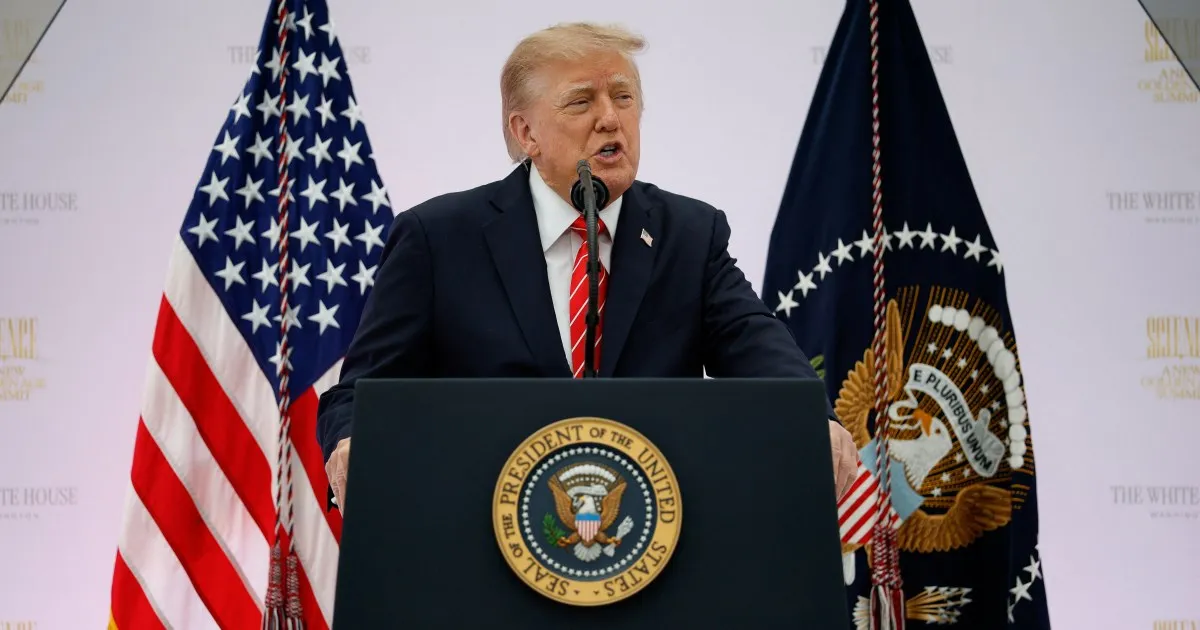
Court filings have indicated that lawyers for President Donald Trump are seeking a resolution with the Department of Justice over a $10bn lawsuit he filed against the Internal Revenue Service (IRS).

But the trouble, critics say, is that such a settlement would leave Trump essentially negotiating with an executive branch under his control.

Recommended Stories

list of 3 itemsend of list

Friday’s court filing, however, emphasises the efficiency of seeking a settlement.

In the document, Trump’s lawyers call for the case to be paused for 90 days to allow a resolution to be hammered out.

“This limited pause will neither prejudice the parties nor delay ultimate resolution,” the filing says. “Rather, the extension will promote judicial economy and allow the Parties to explore avenues that could narrow or resolve the issues efficiently.”

How did the case start?

The case stems from an incident that began in 2017, when a worker named Charles “Chaz” Littlejohn was re-hired as a contractor through the government consulting firm Booz Allen.

While working on IRS files, Littlejohn stole copies of Trump’s tax returns, which had been the source of prolonged public scrutiny.

Until Trump, every president since Richard Nixon had released their tax returns as a gesture of transparency. Trump, however, claimed he could not, citing ongoing audits.

The tax returns Littlejohn stole were ultimately released to the media, and in 2020, The New York Times released a series of articles that showed Trump paid no income taxes in 10 of the 15 preceding years.

Other years, he paid relatively small sums, like $750, because he reported more losses than gains. ProPublica also ran stories based on the leaked tax returns, highlighting inconsistencies and Trump’s low tax payments.

Privacy law protects taxpayer information from being released by the IRS without explicit permission. Littlejohn was sentenced to five years in prison in 2024.

But in late January of this year, Trump filed a lawsuit arguing that he, his businesses and his sons Eric and Donald Jr had suffered “significant and irreparable harm” from the leaks.

The defendants in the lawsuit were the IRS and its overseeing body, the Treasury Department, both of which are part of the executive branch.

“Defendants have caused Plaintiffs reputational and financial harm, public embarrassment, unfairly tarnished their business reputations, portrayed them in a false light, and negatively affected President Trump and the other Plaintiffs’ public standing,” the lawsuit reads.

Questions of ethics and legality

But experts have warned that the lawsuit contains flaws that would normally prompt the Justice Department, also under Trump’s control, to seek dismissal.

The lawsuit, for instance, arrives at its whopping $10bn sum by supposedly tallying up media references to Trump’s leaked tax returns.

However, experts say the formula for damages is calculated by the number of unauthorised disclosures by a government employee, not by media re-printings.

Then there is the question of Littlejohn’s employment status. He was an outside contractor, not a government employee.

Trump also has to contend with the two-year statute of limitations in the case. The lawsuit contends that “President Trump did not discover the numerous violations” of his tax returns until January 29, 2024.

But critics point out he had posted on social media about his tax information being “illegally obtained” as far back as 2020, when The New York Times published its series.

Opponents say the lawsuit should be dismissed or at least delayed until Trump is no longer president. Otherwise, they argue it represents a conflict of interest, with Trump fundamentally negotiating with his own administration for a payout.

Controlling ‘both sides of the litigation’

Trump himself has acknowledged that such a payment would “never look good”. But he has justified the sum by saying it would be donated to charity.

“Nobody would care because it’s going to go to numerous very good charities,” he said in February.

Even that, legal experts argue, could run afoul of the Emoluments Clause in the US Constitution, which prohibits the president from profiting off his position, apart from his salary.

Government watchdogs have attempted to stop a settlement from unfolding. On February 5, for instance, the group Democracy Forward filed an amicus brief arguing the court should act to prevent an abuse of power.

“This case is extraordinary because the President controls both sides of the litigation, which raises the prospect of collusive litigation tactics,” the brief explains.

“To treat this case like business as usual would threaten the integrity of the justice system and the important taxpayer and privacy protections at the heart of this case.”

But the $10bn IRS lawsuit is not the only case Trump is seeking to settle with his own government. In 2023 and 2024, Trump filed administrative complaints seeking compensation for federal investigations he considered to be unfair.

One complaint concerns an FBI investigation into alleged Russian interference in the 2016 election, and the other is about the FBI’s raid of Trump’s Mar-a-Lago estate after he refused a subpoena to return classified documents.

For those complaints, Trump is reportedly seeking additional damages to the tune of $230m.

Source link

Lebanese man removes Israeli flag from castle in southern Lebanon | Newsfeed

NewsFeed

A Lebanese man who returned to his village in southern Lebanon after the temporary ceasefire was announced removes the Israeli flag from Beaufort Castle (Qalaat al-Shaqif). The castle which dates back to the 12th century is in the Nabatiyeh Governorate.

Source link

US judge blocks Justice Department bid to seize voter data in Rhode Island | Donald Trump News

Ruling is latest loss for Trump administration, which has sought access to state voter data ahead of the US midterms.

A federal judge in the United States has dismissed a Department of Justice lawsuit seeking to access voter data from Rhode Island.

The decision on Friday was the latest loss for the administration of President Donald Trump, which has sought to access voter data in dozens of states across the country.

Recommended Stories

list of 3 itemsend of list

In the ruling, US District Court Judge Mary McElroy sided with election officials and civil rights groups, writing that the Justice Department does not have the authority “to conduct the kind of fishing expedition it seeks here”.

Rhode Island Secretary of State Gregg Amore praised the ruling in a statement afterwards.

“The executive branch seems to have no problem taking actions that are clear Constitutional overreaches, regularly meddling in responsibilities that are the rights of the states,” Amore wrote.

“But the power of our democratic republic, built on three, coequal branches of government, is clearer than ever before.”

The Justice Department has sued at least 30 states for their voter information, maintaining it needs the information to secure election security. State officials have said that turning over the data raises an array of privacy concerns.

Under the US Constitution, state officials administer elections. Only Congress can pass laws related to how states oversee voting.

But Trump has sought to transform election administration, claiming that voting has been marred by widespread fraud.

In particular, Trump has continued to maintain that the 2020 election, in which he lost to former President Joe Biden, was “stolen”.

No evidence has ever been put forward to support the claims.

Federal judges have rejected attempts in California, Massachusetts, Michigan and Oregon to force the states to hand over voter files to the federal government. At least 12 states, however, have willingly provided or pledged to provide voter information to the Trump administration.

The push for voter information is one of several actions that have raised concerns over how the Trump administration will approach the midterm elections in November, which will decide the makeup of the US Congress.

He is currently calling on Republicans to pass the so-called SAVE America Act, a bill that would create higher documentation standards for voters to prove their citizenship when registering to vote and casting ballots.

The majority of Republican lawmakers have embraced Trump’s claim that the law is needed to prevent non-citizens from registering to vote, despite studies showing that instances of voter fraud are glancingly rare.

Critics say the measure would risk disenfranchising millions of voters, particularly those who have legally changed their names, which is a common practice in US marriages.

Source link

Bunker Talk: Let’s Talk About All The Things We Did And Didn’t Cover This Week

Welcome to Bunker Talk. This is a weekend open discussion post for the best commenting crew on the net, in which we can chat about all the stuff that went on this week that we didn’t cover. We can also talk about the stuff we did or whatever else grabs your interest. In other words, it’s an off-topic thread.

This week’s caption reads:

The Volcano Lair was the underground headquarters of the terrorist syndicate SPECTRE during the Bond film You Only Live Twice from 1967. 

Also, a reminder:

Prime Directives!

  • If you want to talk politics, do so respectfully and know that there’s always somebody that isn’t going to agree with you. 
  • If you have political differences, hash it out respectfully, stick to the facts, and no childish name-calling or personal attacks of any kind. If you can’t handle yourself in that manner, then please, discuss virtually anything else.
  • No drive-by garbage political memes. No conspiracy theory rants. Links to crackpot sites will be axed, too. Trolling and shitposting will not be tolerated. No obsessive behavior about other users. Just don’t interact with folks you don’t like. 
  • Do not be a sucker and feed trolls! That’s as much on you as on them. Use the mute button if you don’t like what you see.  
  • So unless you have something of quality to say, know how to treat people with respect, understand that everyone isn’t going to subscribe to your exact same worldview, and have come to terms with the reality that there is no perfect solution when it comes to moderation of a community like this, it’s probably best to just move on. 
  • Finally, as always, report offenders, please. This doesn’t mean reporting people who don’t share your political views, but we really need your help in this regard.

Tyler’s passion is the study of military technology, strategy, and foreign policy and he has fostered a dominant voice on those topics in the defense media space. He was the creator of the hugely popular defense site Foxtrot Alpha before developing The War Zone.


Source link

Pressure mounts on Peru’s election authorities amid presidential race delay | Elections News

The vote count continues to determine who will join conservative Keiko Fujimori in Peru’s presidential run-off in June.

Calls to remove the head of Peru’s electoral authority have intensified as delays and alleged irregularities clouded the presidential vote count.

As of Friday, no clear challenger has emerged to face conservative frontrunner Keiko Fujimori in the June 7 run-off.

Recommended Stories

list of 3 itemsend of list

The general election was held on Sunday, but an extension was granted to accommodate for the difficulties in ballot distribution.

Pressure has mounted against the head of Peru’s National Office of Electoral Processes (ONPE), Piero Corvetto. Complaints over errors and logistical problems during Sunday’s election have been compounded by a slow tally that has rattled investor confidence and heightened uncertainty.

According to the ONPE, leftist Roberto Sanchez and ultraconservative former Lima Mayor Rafael Lopez Aliaga remain locked in a close battle for second place, separated by about 13,000 votes as of Friday.

With 93.3 percent of the ballots counted, Sanchez held 12.0 percent of the vote and Lopez Aliaga 11.9 percent.

Fujimori, meanwhile, remained firmly in first place with 17 percent, positioning her for the run-off. Final results could take up to two weeks, according to local election-monitoring group Transparencia.

The vote counting has been further delayed by the roughly 5 percent of ballots that were identified for review due to missing information or errors in polling station records, according to ONPE data. Those ballots will be reviewed by a special electoral jury before being included in the final count, officials said.

Business leaders and lawmakers from across the political spectrum have called on Corvetto to step down, arguing that a replacement should oversee the second round.

“Errors this serious have consequences,” Jorge Zapata, head of business chamber CONFIEP, told local radio station RPP.

Earlier this week, Corvetto acknowledged that there had been some logistical delays that forced voting to be extended by a day, mainly in Lima. Those delays triggered fraud allegations, notably from Lopez Aliaga, who has called for counting to be suspended. Corvetto has denied that any irregularities took place.

Even so, Peru’s top electoral court, the National Jury of Elections, filed a criminal complaint with prosecutors against Corvetto, citing alleged offences, including violations of voting rights. Representatives for Corvetto did not immediately respond to a Reuters request for comment.

An investigation is also under way after materials from four polling stations were found on a public road in Lima on Thursday, the police said. ONPE said on the social media platform X that the votes from those stations had already been recorded for counting.

European Union election observers said this week that they found no evidence of fraud.

Source link

Starmer Faces Renewed Pressure Over Mandelson Vetting Scandal as Leadership Questions Mount

Keir Starmer is facing renewed calls for resignation after fresh revelations surrounding the appointment and vetting of former UK ambassador to the United States Peter Mandelson. The controversy has reignited scrutiny over governance standards inside the Labour government, coming at a politically sensitive time just months after Labour’s landslide election victory in 2024.

The Vetting Controversy:
The core of the scandal centres on reports that Mandelson did not properly pass security vetting before being appointed as ambassador. Despite this, official communications suggested that clearance had been confirmed. Downing Street has since dismissed a senior Foreign Office official, intensifying questions about how the appointment was handled and who within government was aware of the vetting status.

Political Fallout Inside Government:
The issue has exposed tensions within the Labour Party, with some lawmakers expressing concern over administrative failures while others defend the Prime Minister. Senior minister Darren Jones said Starmer was “furious” about not being informed of the vetting issues, while acknowledging serious breakdowns in communication between departments.

Opposition Pressure and Leadership Questions:
Opposition figures, including Conservative leader Kemi Badenoch, have accused Starmer of misleading Parliament and questioned his credibility. The central allegation is whether the Prime Minister knowingly misrepresented the status of Mandelson’s clearance when defending the appointment. These accusations have intensified calls for resignation from political rivals.

Wider Political Context:
The controversy comes at a politically sensitive moment for Starmer, as Labour prepares for key local elections across England, Scotland, and Wales. The government is also managing broader foreign policy challenges, including Britain’s positioning in global conflicts involving the United States and Middle East tensions, adding further pressure on leadership stability.

Institutional and Governance Concerns:
Beyond individual accountability, the scandal has raised broader concerns about administrative competence within the Foreign Office and Downing Street. The dismissal of senior officials has highlighted breakdowns in communication and vetting procedures, raising questions about how high-level diplomatic appointments are approved and overseen.

Analysis:
The Mandelson vetting scandal has evolved from a procedural controversy into a wider test of political authority and administrative control for Starmer. While there is no clear evidence yet that the Prime Minister deliberately misled Parliament, the perception of mismanagement and lack of oversight has created significant political vulnerability.

At its core, the issue reflects a deeper challenge of governance: maintaining institutional trust while managing complex bureaucratic systems. Even if the government survives immediate calls for resignation, the damage is likely to linger, particularly if further inconsistencies emerge. With elections approaching and internal party tensions rising, Starmer’s ability to project control and competence will be central to whether this episode becomes a temporary setback or a longer-term political liability.

Source link

Lebanon president says country is no longer a pawn amid Israel ceasefire | News

President Joseph Aoun promised to work to preserve Lebanon’s sovereignty and freedom.

Lebanese President Joseph Aoun has said that the country would no longer be an “arena for anyone’s wars”, and that the ceasefire with Israel should lead to work on permanent agreements.

In a televised address to the Lebanese public on Friday, he said that Lebanon was no longer “a pawn in anyone’s game, nor an arena for anyone’s wars, and we never will be again”.

Recommended Stories

list of 3 itemsend of list

His speech comes a day after a 10-day ceasefire was announced between Lebanon and Israel, bringing respite from Israeli attacks that began on March 2, after Hezbollah fired at Israel, and have left more than 2,200 dead and more than a million displaced.

Aoun said that they were entering a phase of “transition from working on a ceasefire to working on permanent agreements that preserve the rights of our people, the unity of our land, and the sovereignty of our nation.”

He expressed gratitude to those who he said helped end the hostilities, naming United States President Donald Trump and “all our Arab brothers, foremost among them the Kingdom of Saudi Arabia”.

Aoun promised that any agreement reached would not infringe on the country’s rights or relinquish any of its land, and that the negotiations were not a weakness or a concession.

The ceasefire was announced days after Lebanon and Israel held their first direct talks in decades in Washington, which prompted criticism from the Lebanese population.

“Our objective is clear and declared: to stop Israeli aggression against our land and our people, to obtain Israeli withdrawal, to extend state authority over all its land by its own forces, to ensure the return of prisoners, and to enable our families to return to their homes and villages, in safety, freedom and dignity,” the president said.

Israel continues to occupy areas of southern Lebanon despite the truce, with Israeli Prime Minister Benjamin Netanyahu saying troops would not withdraw during the ceasefire.

Source link

Chinese response to Israel’s implementation of the Gaza playbook to wipe out towns in southern Lebanon

China has taken a firm stance against the Israeli escalation in Lebanon, strongly warning against the region becoming a second Gaza and considering the events a blatant violation of Lebanese sovereignty and international law. The most prominent features of the Chinese response up to April 2026 to this Israeli military escalation in southern Lebanon included condemning the targeting of civilians and emphasizing the protection of Lebanese sovereignty while rejecting Israeli violations aimed at destroying the infrastructure of southern Lebanon. The Chinese Foreign Ministry condemned the extensive Israeli raids targeting towns in southern Lebanon, stressing that Lebanon’s sovereignty and security are a red line that must not be crossed. China also emphasized the protection of Lebanese civilians, with Beijing unequivocally affirming that the protection of civilians and civilian objects in armed conflicts is a legal obligation and expressing its shock at the scale of casualties and destruction inflicted on southern villages and towns.

China’s position is based on a comprehensive vision linking the stability of southern Lebanon to a ceasefire in the Gaza Strip. Beijing believes that addressing the root causes of the conflict is the only way to prevent its spread throughout the Middle East. While condemning the destruction of Lebanese infrastructure and civilian areas, China’s Foreign Ministry denounced the Israeli airstrikes that killed hundreds of civilians and destroyed civilian infrastructure and property. Beijing categorically rejects any actions that lead to the destruction of infrastructure, considering them a violation of international law. China has consistently emphasized that Lebanon’s sovereignty, security, and territorial integrity are a red line that must not be crossed. Beijing has also declared its opposition to the Israeli ground incursion into southern Lebanon, warning that such actions exacerbate regional tensions. China has called for diplomatic solutions, urging all parties, especially Israel, to exercise maximum restraint and return to the path of political and diplomatic settlement, asserting that continued violence will not bring security to any party. China condemned the attacks targeting UNIFIL peacekeeping forces in southern Lebanon, stressing the need to ensure the safety of UN peacekeepers.

In this context, China deliberately directed veiled criticism at Washington regarding Israeli violations in southern Lebanon. China believes that the failure to contain the escalation in southern Lebanon is partly due to the military and political support provided to Israel by external powers, a clear reference to the United States, which hinders efforts to de-escalate the situation. Simultaneously, China warned of a second Gaza in southern Lebanon. Chinese Foreign Minister Wang Yi explicitly cautioned against a repeat of the Gaza tragedy in Lebanon, emphasizing that violence cannot replace right and justice. China is pressing in international forums, particularly the Security Council, for an immediate and permanent cessation of Israeli hostilities, warning against the region sliding into a full-scale war. This stance reflects China’s desire to bolster its role as a peacemaker in the Middle East and to rival American influence by adhering to political solutions and international law.

Here, China sharply criticized the American role in the Israeli war against southern Lebanon and its recent escalation in April 2026, arguing that Washington contributes to undermining regional stability through its military and political support for Israel. Beijing considered the military operations supported or participated in by the United States to be a flagrant violation of international law and the principles of national sovereignty. While warning against the militarization of the region, China criticized the expansion of the American military presence, describing it as irresponsible and warning that such steps exacerbate tensions rather than de-escalate them. Beijing believes that Washington’s approach to the international order reflects the values ​​of the law of the jungle and fuels chaos and instability in the Middle East. While criticizing the US for its double standards, China, through its Foreign Ministry spokesperson Mao Ning, condemned the continued Israeli strikes on towns and villages in southern Lebanon despite ongoing efforts to de-escalate the situation. She emphasized that Lebanon’s sovereignty and security must not be violated.

China called on Israel to immediately withdraw from southern Lebanon, warning against a repeat of the Gaza scenario. Chinese President Xi Jinping issued direct warnings demanding the immediate withdrawal of Israeli forces from southern Lebanon, cautioning that continued military operations could lead to a humanitarian catastrophe similar to what occurred in the Gaza Strip. He also called for an end to the Israeli escalation in southern Lebanon. China maintains that violence does not solve problems but rather exacerbates crises, urging maximum restraint to de-escalate the volatile regional situation. Chinese President Xi Jinping called for the immediate withdrawal of Israeli forces from Lebanese territory, asserting that their current military presence violates Lebanon’s sovereignty and territorial integrity. President Xi explicitly warned against allowing southern Lebanon to become another Gaza, pointing to the risk of a widespread humanitarian catastrophe and the destruction of civilian infrastructure.

To halt the cycle of violence and armed conflict in southern Lebanon, Chinese President Xi Jinping proposed a four-point peace initiative to bolster stability in the Middle East. This initiative includes a call for a multilateral peace conference under the auspices of the United Nations, the re-establishment of the border along the Blue Line between southern Lebanon and Israel, and a reaffirmation of China’s rejection of any violation of Lebanese sovereignty. The Chinese Foreign Ministry has repeatedly emphasized, most notably on April 9, 2026, that Lebanon’s sovereignty and security are a (red line) that must not be crossed. These Chinese moves position Beijing as an active diplomatic alternative in the region at a time of escalating international tensions between major powers and ongoing regional conflicts. China has begun diplomatic efforts by proposing several peace initiatives to halt the cycle of armed conflict in southern Lebanon. The most prominent of these is the call for a multilateral peace conference. Beijing proposed hosting an international peace conference aimed at stabilizing the region and reinforcing the border along the Blue Line separating Israel and Lebanon, under the auspices of the United Nations. China holds Israel fully responsible, considering the ongoing fighting in Gaza to be the root cause of the instability in the Middle East. Therefore, China called on the international community, particularly the major powers, to play a constructive role in achieving a comprehensive and lasting ceasefire in southern Lebanon and the Gaza Strip. China has also supported the UNIFIL peacekeeping force in southern Lebanon, strongly condemning any attacks on UNIFIL forces as violations of UN Security Council Resolution 1701. Here, China used its influence in the UN Security Council and international forums to emphasize that any military operations outside the framework of the United Nations violate its Charter. It described the Israeli strikes on towns and villages in southern Lebanon as unauthorized actions.

Based on the preceding analysis, we understand the accuracy of China’s linking of the tensions in southern Lebanon to the war in Gaza. China called for restraint to prevent the conflict from spreading regionally, based on its principles of supporting sovereign states like Lebanon and non-interference in the internal affairs of other countries. China also called for a return to the diplomatic track to halt the cycle of violent armed conflict in southern Lebanon perpetrated by Israel. China condemned the extensive Israeli strikes, stressing that Lebanon’s sovereignty and security must not be violated. It emphasized the need to protect Lebanese civilians and civilian infrastructure during Israeli military operations and called for de-escalation and immediate steps to calm the situation and prevent further escalation of the conflict in southern Lebanon.

Source link

World reacts to Strait of Hormuz reopening amid US-Iran conflict | US-Israel war on Iran News

Iran’s Foreign Minister Abbas Araghchi and United States President Donald Trump have said that the Strait of Hormuz is open to commercial vessels.

Araghchi declared on Friday that the strategic waterwat was “completely open” in line with the ceasefire between Israel and Lebanon that took effect the previous day.

Recommended Stories

list of 3 itemsend of list

Trump affirmed on social media that the strait was open, later claiming that Iran had agreed to “never close the Strait of Hormuz again”. However, he also posted that the US naval blockade on Iranian ports would “remain in full force”.

In parallel, France and the United Kingdom hosted a meeting in Paris involving about 40 countries, which agreed to play a role in restoring freedom of navigation in the Strait of Hormuz once the US-Israeli war on Iran stops.

The blocking of tankers from using the strait, through which about 20 percent of the world’s crude flows on a typical day, has led to a global surge in fuel prices.

World leaders have welcomed the news with cautious optimism amid mixed messages from the US and Iran:

United States

“The Strait of Hormuz is completely open and ready for business and full passage, but the naval blockade will remain in full force and effect as it pertains to Iran, only, until such time as our transaction with Iran is 100% complete,” Trump wrote on Truth Social.

Minutes later, he issued another post saying the US Navy’s blockade on Iranian ships and ports “will remain in full force” until Tehran reaches a deal with the US, including on its nuclear programme.

Later, Trump told the news agency AFP that a deal to end the war on Iran was “close”, saying there were “no sticking points” left between Washington and Tehran.

Iran

Foreign Minister Abbas Araghchi posted on X that the strait was “declared completely open” and would remain open for the remaining period of the 10-day Israel-Lebanon ceasefire, which took effect overnight Thursday into Friday.

Some Iranian state media reports later appeared to contradict Araghchi’s announcement, with a senior military official telling state media that only nonmilitary vessels would be allowed to transit with permission from the Iranian Islamic Revolutionary Guard Corps (IRGC) Navy.

The Fars news agency, which is close to the IRGC, noted a “strange silence from the Supreme National Security Council”, the de facto top decision-making body in the country, as the status of the new supreme leader, Mojtaba Khamenei, remains unknown.

United Kingdom

UK Prime Minister Keir Starmer cohosted a summit on a potential military mission to secure the Hormuz Strait with French President Emmanuel Macron in Paris on Friday, with about 30 to 40 countries participating in person or by video conference.

On the sidelines, Starmer cautiously welcomed news of the strait’s reopening but said it must become “both lasting and a workable proposal”.

He said the UK and France would lead a “strictly peaceful and defensive” multinational mission to protect freedom of navigation as soon as conditions allow.

France

Speaking after the gathering, Macron said, “We all demand the full, immediate and unconditional reopening of the Strait of Hormuz by all parties.”

“We all oppose any restrictions or system of agreements that would, in effect, amount to an attempt to ⁠privatise the strait – and, of course, any toll system,” he added.

Macron’s office said roles for members of the international coalition working to reopen the strait could include “intelligence, mine-clearing capabilities, military escorts [and] communication procedures with coastal states”.

Germany

Chancellor Friedrich Merz said Germany could contribute mine clearance and intelligence capabilities to the international mission, but would need parliamentary support and a ″secure legal basis″ such as a UN Security Council resolution.

He said he wanted US involvement in the international mission to secure shipping through the Strait of Hormuz. “We believe this would be desirable,″ he said.

Trump later appeared to rebuff his overtures, saying on social media that he had received a call from NATO, but declined its assistance in no uncertain terms.

Finland

Finnish President Alexander Stubb, who participated in the Paris summit, said on X, “We welcome Iran’s announcement on opening the Strait. Lasting solutions require diplomacy,”

United Nations

United Nations Secretary-General Antonio ⁠Guterres on ⁠Friday welcomed the opening ‌of Strait of Hormuz by Iran ⁠and said ⁠it was “a ⁠step in the ⁠right ⁠direction”.

International Maritime Organisation

Arsenio Dominguez, secretary-general of the UN shipping agency said, “We are currently verifying the recent announcement related to the reopening of the Strait of Hormuz, in terms of its compliance with freedom of navigation for all merchant vessels and secure ‌passage.”

Shipping companies

The Norwegian Shipowners’ Association said several things had to be clarified before any ships can transit the strait, including the presence of mines, Iranian conditions and practical implementation.

“If this represents a step towards an opening, it is a welcome development,” said Knut Arild Hareide, CEO of the association, which represents 130 companies with some 1,500 vessels.

A spokesperson for Germany’s Hapag-Lloyd Shipping Company said, “We are now beginning to assess the new situation and the risks involved … For the time being, therefore, we are still refraining from passing through the strait.”

In a statement, Denmark’s Maersk said: “We have noted the announcement. The safety of our crew, vessels and customers’ cargo remains our priority. Since the outbreak of the conflict, we have followed the guidance of our security partners in the region, and the recommendation so far has been to avoid transiting the Strait of Hormuz.

“Any decision to transit the strait will be based on risk assessments and close monitoring of the security situation, with the latest developments also included in the ongoing assessments.”

Markets

Oil prices plunged after Iran’s announcement that passage for commercial vessels would remain “completely open” for the duration of a 10-day ceasefire in Lebanon.

“This news is having an immediate impact on markets,” said Kathleen Brooks, research director at XTB. “This is the biggest development so far during the ceasefire, and it gives hope that the war will end soon, and supply chains will return to some normality.”


Source link

US Congress extends controversial surveillance power under FISA for 10 days | Privacy News

The measure has long been criticised for allowing US intelligence agencies to collect citizen data without a warrant.

The United States Congress has temporarily extended a controversial surveillance law which allows federal intelligence agencies to collect the data of foreigners, including their contacts with US citizens.

The move allows a provision of the Foreign Intelligence Surveillance Act (FISA) to continue until April 30. The short-term extension was passed by the House of Representatives and approved by the Senate on Friday.

Recommended Stories

list of 3 itemsend of list

The patch comes after President Donald Trump’s efforts to secure a more lasting extension broke down.

Section 702 of FISA allows the National Security Agency (NSA) and other intelligence services to collect data from foreigners outside of the country.

That could include their interactions with US citizens, a prospect that has alarmed rights advocates.

Collecting such data, which can include correspondence on email and telecommunications platforms, typically requires a warrant approved by a court.

The process has been described by critics as a “backdoor search” that circumvents existing privacy laws.

Speaking after Friday’s vote, Senate Majority Leader John Thune said there was still some openness to reforming the law.

“We’ve got to pivot and figure out what can pass, and we’re in the process ⁠of figuring out how to do that here,” he told reporters.

Supporters of reform, who stretch across party lines, have long sought to repeal or amend Section 702.

While FISA was initially passed in 1978, Section 702 was added as an amendment in 2008.

The addition came amid the US’s “global war on terror”. But during its approval, revelations emerged that the administration of former US President George W Bush had already used the tactics Section 702 legalised.

Supporters, including Trump, maintain that reforming the provision would lead to a lapse in national security.

“I have spoken with many in our Military who say FISA is necessary in order to protect our Troops overseas, as well as our people here at home, from the threat of Foreign Terror Attacks,” Trump wrote in a Truth Social post on Wednesday.

He has pushed for the law to be extended for 18 months without changes. That effort initially appeared on track in the House but was ultimately scuttled by pushback from within Trump’s own Republican Party.

Among the detractors was Republican Congressman Thomas Massie, who has been a regular critic of Trump.

“I will be voting NO on final passage of the FISA 702 Reauthorization Bill if it does not include a warrant provision and other reforms to protect US citizens’ right to privacy,” he wrote ahead of the House vote.

Source link

Shipping firms seek clarifications before crossing Hormuz | US-Israel war on Iran News

Shipping companies said several things had to be clarified, including the presence of mines, Iranian conditions, practical implementations.

Shipping companies have cautiously welcomed Iran’s announcement that the Strait of Hormuz is open but said they would require clarifications, including about the risk of mines, before vessels move through the entry point to the Gulf.

Iran’s Foreign Minister Abbas Araghchi said on Friday that the Strait of Hormuz was open to all commercial vessels during a 10-day Lebanon ceasefire accord, prompting a fall in oil and other commodity prices while stock markets rose.

Recommended Stories

list of 4 itemsend of list

All commercial ships, including United States vessels, can sail through the strait, although their plans need to be coordinated with Iran’s Islamic Revolutionary Guard Corps, a senior Iranian official told the Reuters news agency.

Transit would be restricted to lanes which Iran deemed safe, adding that military vessels were still prohibited, the official said.

“We are currently verifying the recent announcement related to the reopening of the Strait of Hormuz, in terms of its compliance with freedom of navigation for all merchant vessels and secure passage,” said Arsenio Dominguez, secretary-general of the United Nations shipping agency, the International Maritime Organization.

The Norwegian Shipowners’ Association said several things had to be clarified before any ships could transit the strait, including the presence of mines, Iranian conditions and practical implementation.

“If this represents a step towards an opening, it is a welcome development,” said Knut Arild Hareide, CEO of the association which represents 130 companies with some 1,500 vessels.

Shipping association BIMCO cautioned members on returning to the strait.

“The status of mine threats… is unclear and BIMCO believes shipping companies should consider avoiding the area,” said Jakob Larsen, BIMCO’s chief safety and security officer.

The threat posed by mines in parts of the strait is not fully understood, and avoidance of the area by ships should be considered, a US Navy advisory on Friday, seen by Reuters, also said.

German shipping group Hapag-Lloyd on Friday said it was working for its ships to sail through the strait “as soon as possible”, but added that several questions remained.

“Our crisis committee is in session and will try to resolve all open items with the relevant parties within the next 24-36 hours,” it added.

Its Danish peer Maersk said it was closely monitoring the security situation and would act based on its risk assessment.

France’s CMA CGM and Norwegian oil tanker group Frontline declined to comment.

A recent route imposed by Tehran through its territorial waters near Larak Island would present navigational challenges even if vessels were not required to pay a toll, and would raise questions regarding compliance and insurance, said Matt Wright, lead freight analyst at data intelligence firm Kpler.

US President Donald Trump on Friday said Iran had agreed to never close the strait again, and that it was removing sea mines from it.

One of the world’s most important maritime chokepoints, disruption in the strait has forced shipping companies to suspend sailings, reroute cargo and rely on costly workarounds to keep goods moving in and out of the Gulf.

Source link

Venezuelan Gov’t Resumes IMF, World Bank Ties, Appoints New Central Bank President

Former Venezuelan President Hugo Chávez denounced the IMF and the World Bank as “weapons of US imperialism.” (AFP)

Caracas, April 17, 2026 (venezuelanalysis.com) – Venezuela has reestablished ties with the International Monetary Fund (IMF) after a seven-year hiatus.

Acting President Delcy Rodríguez confirmed the news on Thursday night, calling it a “great achievement of Venezuelan diplomacy” and a “very important step” for the Venezuelan economy.

“This is the result of months-long negotiations that the Venezuelan far-right unsuccessfully tried to sabotage,” she stated in a televised broadcast. “Good has triumphed.”

The IMF announced the “resumption of dealings” with Venezuela in a statement on Thursday, stating that the decision was “guided by the views of IMF members representing a majority of the total voting power.”

Managing Director Kristalina Georgieva stated earlier this week that the IMF had been approached by Venezuelan authorities at a technical level and that the Caribbean nation “desperately needs help.”

The World Bank likewise issued a statement disclosing the resumption of dealings with the acting Rodríguez government. Venezuela’s last loan with the institution concluded in 2005.

Venezuela had its relationship with the IMF suspended in 2019 after the first Trump administration and allies recognized the self-proclaimed “interim government” led by Juan Guaidó as the Caribbean nation’s legitimate authority.

In March, the White House recognized Rodríguez as Venezuela’s “sole leader” and later withdrew sanctions against her, while US officials spoke of efforts to reincorporate Caracas into the IMF fold.

Though relations were officially frozen in 2019, Venezuela had sought to distance itself from the Washington-based institution more than a decade prior. In 2007, former President Hugo Chávez formally withdrew Venezuela from the IMF and the World Bank, calling them “weapons of US imperialism.”

Chávez repeatedly denounced the US-controlled multilateral institutions’ role in promoting debt and underdevelopment in Global South countries and pushed for the creation of lending institutions as part of Latin American integration efforts. Under Chávez’s predecessors, Venezuela implemented draconian IMF-conditioned structural adjustment policies that saw over half of Venezuelans living in poverty by 1998.

Last year, President Nicolás Maduro stated that Venezuela had “broken the shackles” of the World Bank and the IMF and was instead building its own “self-sustainable model and relations with a new world.”

Venezuela’s priority will be accessing US $5.1 billion in Special Drawing Rights (SDR) that it is entitled to as an IMF member. In 2021, the lending institution issued $650 billion amid the Covid-19 pandemic as an effort to help countries boost reserves and address fiscal needs. 

However, Venezuela was blocked from accessing the funds as the IMF refused to rule on the country’s legitimate authorities.

Caracas’ reengagement with the IMF and the World Bank also comes amid growing speculation about the fate of Venezuela’s sizable foreign debt. The Caribbean nation owes as much as $170 billion from a combination of defaulted bonds, unpaid loans, and international arbitration awards that have accrued interest for years as US sanctions battered Venezuela’s economy and cut it off from credit markets.  

Venezuelan bonds have been rallying in recent weeks following Washington’s rapprochement with Caracas as creditors bet on a debt restructuring deal that can bring significant windfalls.

Since the January 3 US military strikes and kidnapping of President Nicolás Maduro, the Rodríguez administration has fast-tracked a number of pro-business reforms, including in the hydrocarbons and mining sectors. Upon enacting the Mining Law on Thursday, the acting president thanked Trump, Rubio, and other administration officials for their “good disposition” in establishing “cooperation.”

Rodríguez recently announced further plans to overhaul the South American country’s labor, pension, and tax legislation, while also identifying state assets that are “not strategic.” The Cisneros Group, one of Venezuela’s largest business conglomerates, recently announced the raising of funds ahead of expectations of a “wave of privatizations.”

Since January, the Trump administration has imposed control over Venezuelan oil revenues, mandating that royalties, taxes, and dividends be deposited in US Treasury accounts. In a congressional hearing on Thursday, Assistant State Secretary Michael Kozak stated that “around $3 billion” have moved through the dedicated accounts. 

He did not specify what portion of the revenues has been returned to Caracas, only that the funds had been used to pay public sector incomes and import oil industry inputs, while blocking any transactions with China, Cuba, and Iran.

Earlier this week, the Treasury’s Office of Foreign Assets Control (OFAC) issued new restricted licenses allowing transactions with the Venezuelan Central Bank and public banks that are expected to facilitate the partial return of seized Venezuelan export revenues.

On Thursday, Venezuelan authorities additionally announced a change in the Central Bank leadership, with Luis Pérez replacing Laura Guerra as president of the institution. Guerra had been appointed to the post in April 2025 by Maduro.

Pérez is an economist who had served on the BCV board of directors since 2018. In his social media profile, he describes himself as a cryptocurrency enthusiast.

Edited by Lucas Koerner in Fusagasugá, Colombia.


Source link

Arsenal to embrace ‘privilege’ not pressure of Man City Premier League tilt | Football News

Arsenal travel to Manchester City knowing their Premier League could be eradicated by next Wednesday.

Mikel Arteta has urged spluttering Arsenal to embrace the “huge privilege” of facing Manchester City in a potentially decisive showdown in the Premier League title race.

Arteta’s side are six points clear of second-placed City ahead of their blockbuster clash at the Etihad Stadium on Sunday.

Recommended Stories

list of 4 itemsend of list

But City have a game in hand on the Gunners and a victory for Pep Guardiola’s men would tilt the balance of power in their favour heading into the final weeks of the season.

Adding to the drama of the do-or-die battle, Arsenal are enduring an untimely loss of form after losing three of their last five games in all competitions.

They were beaten by City in the League Cup final, suffered a shock FA Cup quarterfinal exit at second-tier Southampton and slumped to a home league defeat against Bournemouth.

The Gunners were well below their best once again on Wednesday when they edged past Sporting Lisbon, drawing 0-0 to secure a 1-0 aggregate victory in the Champions League quarterfinals.

But, despite criticism of Arsenal’s perceived mental weakness under pressure, Arteta is convinced his players have the right character to take a huge step towards winning the Premier League.

“We have earned the right to be in this position and to be challenging, with an opportunity to win against arguably the best team and best manager this league has ever seen,” Arteta told reporters on Friday.

“That is a huge privilege. We see this as a big opportunity for us. Who is more privileged to be in this position?

“I don’t know how Pep and Man City are feeling, but I feel very privileged to have earned the right to be in this position to play such a big and great game.”

Arsenal are chasing a first English title since 2004 after finishing as runners-up for the last three seasons.

In 2023 and 2024, they squandered substantial leads that allowed City to pip them to the title.

But Arteta knows that beating City this weekend would put Arsenal in a virtually unassailable position of strength.

“Winning at this stage, then you are a bit closer,” he said.

“There are six games to go. Obviously, it is a really important one for both teams.

“It will incline the balance a little bit, but winning a game in the Premier League is so tough for everybody.”

Arsenal ‘prepare to win’ against Man City

Arteta has challenged Arsenal to learn from the pain of their League Cup loss to City in a rematch with even higher stakes.

“The pain we felt afterwards, [we need] to use that the right way on Sunday,” he said. “To learn from that game and the things that we want to change for the next one.”

Arteta refused to deny a report that a fire was lit at the club’s training ground this week in a motivational ploy after he told his team to play with “pure fire” against Sporting.

“Every game we use different themes to try and prepare for the game in the best possible way, and that depends on what we do,” he said.

“The best ones are the players’ initiative; those are the ones I love the most.”

Arsenal have failed to win any of their past 10 league games at the Etihad Stadium, losing seven of those meetings, in a barren run stretching back to 2015.

Arteta dismissed suggestions that he could tell Arsenal to play for a draw to maintain their six-point lead over City.

“We prepare every game to win, that is why we are where we are, and we are going to continue to do the same,” he said.

Source link

Pope Leo Emerges as a Forceful Global Voice, Clashing with Trump

Pope Leo XIV has stepped into a more assertive global role, adopting a sharper and more direct tone on international issues during his recent Africa tour. After maintaining a relatively cautious profile in the early months of his papacy, Leo has begun openly criticising war, inequality, and global power imbalances. His remarks have drawn repeated criticism from Donald Trump, particularly over his condemnation of the U.S.-Israeli war involving Iran.

Shift in Tone and Leadership Style:
Leo’s recent speeches mark a clear departure from traditional Vatican restraint. Speaking in African देशों such as Cameroon and Algeria, he has issued strong warnings about global injustice, accusing powerful actors of undermining peace and violating international norms. This more confrontational approach reflects a deliberate effort to position the papacy as an active moral voice in global affairs.

Clash with Political Power:
The pope’s remarks have brought him into direct conflict with Trump, who has publicly criticised Leo’s views on foreign policy. This exchange underscores a broader tension between moral authority and political leadership, particularly as the pope challenges the conduct of powerful nations in ongoing conflicts.

Moral Authority on the Global Stage:
Observers suggest Leo is consciously embracing a more visible and influential role, using his platform to highlight the human cost of war and inequality. His decision to deliver strong messages while visiting regions affected by poverty and conflict adds weight and immediacy to his statements, reinforcing his image as a global moral leader.

Breaking with Vatican Convention:
Traditionally, the Vatican has balanced moral advocacy with diplomatic neutrality to preserve its role as a mediator. Leo’s more direct criticism signals a shift in that balance, prioritising clarity and urgency over cautious diplomacy. This approach echoes, but may exceed, the tone of predecessors such as Pope Francis, who also spoke out on global injustices but often with more measured language.

Personal Experience and Perspective:
Before becoming pope, Leo formerly Robert Prevost spent decades in Peru, where he witnessed conflict, poverty, and political instability firsthand. These experiences appear to inform his willingness to speak bluntly about violence, corruption, and the failures of global leadership.

Analysis:
Pope Leo’s emergence as a more forceful voice reflects a strategic and moral recalibration of the papacy’s role in global politics. By speaking more directly, he aims to assert the Church’s relevance in an increasingly volatile world, particularly at a time when traditional diplomatic mechanisms appear strained.

However, this approach carries risks. Greater outspokenness may enhance moral clarity but could also limit the Vatican’s ability to act as a neutral mediator in conflicts. The public clash with Trump highlights how easily moral interventions can become entangled in political disputes.

Ultimately, Leo’s leadership signals a shift toward a more activist papacy, one that prioritises direct engagement with global crises over cautious neutrality. Whether this strengthens the Church’s influence or complicates its diplomatic role will depend on how effectively he balances moral authority with geopolitical realities.

With information from Reuters.

Source link

Production Of AH-64 Apache’s New Counter-Drone Cannon Shell Ammunition Ramping-Up

  • Army boosts Apache’s counter-drone capabilities. The Army is accelerating procurement of XM1225 APEX rounds for AH-64 Apaches to enhance their role as counter-drone platforms.
  • Northrop Grumman ramps up production. The company produced 1,000 rounds this month and plans to increase production fivefold to meet Army demands.
  • APEX rounds offer versatile engagement options. These proximity-detonating rounds can target drones, personnel, vehicles, and small boats, providing unique area effects.
  • Successful live-fire tests at Yuma Proving Ground. In December 2025, Apaches demonstrated effective air-to-air engagement using APEX rounds against unmanned aircraft systems.
  • Minimal training required for Apache crews. The ballistic properties of APEX rounds are similar to existing M789 rounds, requiring little additional training.

Bottom line: The U.S. Army is significantly increasing production of XM1225 APEX rounds for AH-64 Apaches to enhance their counter-drone capabilities. These versatile rounds have proven effective in tests and require minimal additional training for crews, marking a tactical advancement in battlefield capability.

The Army is accelerating procurement of 30x113mm XM1225 Aviation Proximity Explosive (APEX) rounds for its fleet of AH-64 Apache attack helicopters. The move comes as the service is looking to enhance the aircraft’s burgeoning role as a counter-drone platform, something The War Zone has covered frequently. These shells, fired by the Apache’s chin-mounted M230 cannon, will add to its drone-killing arsenal, giving it a cheaper and more plentiful engagement option than some of the alternatives. You can read all about the XM1225 APEX round in our previous coverage here.

Seeing a growing need for these rounds, the Army went to Northrop Grumman, which makes them, and asked them to boost production, said Maj. Gen. Clair A. Gill, commander of the U.S. Army Aviation Center of Excellence at Fort Rucker, Alabama. He was speaking during the Army Aviation Association of America’s Army Aviation Warfighting Summit in Nashville, Tennessee, which TWZ was in attendance.

A U.S. Army AH-64 Apache helicopter assigned to the 5-17 Air Cavalry Squadron, 2nd Infantry Division, fires the M230 Bushmaster chain gun during live-fire aerial gunnery training at Rodriguez Live Fire Complex, Republic of Korea, on March 6, 2025. The exercise certified aircrews, sharpened weapons proficiency, and enhanced overall force readiness. (U.S. Army photo by Staff Sgt. Neil McLean)
A U.S. Army AH-64 Apache helicopter fires the M230 Bushmaster chain gun during live-fire aerial gunnery training at Rodriguez Live Fire Complex, Republic of Korea, on March 6, 2025. (U.S. Army photo by Staff Sgt. Neil McLean) Staff Sgt. Cornelius McLean

“We had had 600 rounds total,” Gill explained. “They produced 1,000 already this month and can produce another 1,000 and will ramp their rate up to probably five times that.”

The company could not immediately comment about this effort.

The specialized APEX ammunition works by detonating only when it is close to an object, then it explodes in a spray of shrapnel. This is critical to shooting down drones, which are small, independently moving targets. These rounds could also be used against surface targets like personnel, soft-skinned vehicles, and small boats, where they would provide unique area effects compared to the Apache’s standard impact-detonating, high-explosive ammunition.

30x113mm XM1225 Aviation Proximity Explosive (APEX) shells. (U.S. Army)

Earlier this year, we reported that Apaches live-fire tested the ammo last December at the service’s sprawling Yuma Proving Ground (YPG) in southern Arizona. 

“The Apache Attack Helicopter AH-64 has reached a new milestone in battlefield capability with the successful live fire test” of the APEX ammunition, the Army said in a February news release. “In December 2025, the Apache demonstrated its first-ever air-to-air engagement using 30mm proximity ammunition against unmanned aircraft systems targets at various ranges, showcasing the precision, versatility, and lethality of this advanced ammunition.”

Yuma Test Center at U.S. Army Yuma Proving Ground recently tested a new 30-mm Aviation Proximity Explosive (APEX) round. “The APEX round was developed to be a frag round that would prox in front of the UAS [unmanned aerial system] and make a frag pattern that would take out a UAS,” explained Test Officer Walter McCormick who led the test.
Yuma Test Center at U.S. Army Yuma Proving Ground recently tested a new 30-mm Aviation Proximity Explosive (APEX) round. “The APEX round was developed to be a frag round that would prox in front of the UAS [unmanned aerial system] and make a frag pattern that would take out a UAS,” explained Test Officer Walter McCormick who led the test. Ana Henderson

The Army added that the Apex cartridge “is designed to counter modern threats, including UAS, exposed personnel and small boats, without requiring modifications to the Apache’s M230 Area Weapon System or fire control system.”

The M230LF Bushmaster Chain Gun | XM914 thumbnail

The M230LF Bushmaster Chain Gun | XM914


As we have pointed out in the past, these rounds require little additional training for Apache crews, because their ballistic properties are nearly identical to the M789 high-explosive dual-purpose (HEDP) rounds already fielded, which use an impact/grazing fuze to command detonation.

An additional benefit is that self-destructing proximity fuzed rounds mitigate some of the dangers of attacking drones with ammunition that will keep traveling for long distances if it doesn’t hit a target. This is a frequent occurrence with standard high-explosive or incendiary cannon rounds.

While the Israeli Air Force pioneered the counter-drone role for the AH-64 for years, the U.S. Army has formally codified it and added new capabilities in the process. A five-fold boost in procurement is a strong indication that the Army sees the value of the APEX rounds for these missions.

Contact the author: howard@thewarzone.com.

Howard is a Senior Staff Writer for The War Zone, and a former Senior Managing Editor for Military Times. Prior to this, he covered military affairs for the Tampa Bay Times as a Senior Writer. Howard’s work has appeared in various publications including Yahoo News, RealClearDefense, and Air Force Times.


Source link

World Cup 2026: Saudi Arabia sack coach Herve Renard | Football News

Frenchman Herve Renard, who won AFCON with Zambia and Ivory Coast, departs Saudi role despite World Cup qualification.

Frenchman Herve Renard has been relieved of his duties as Saudi Arabia coach, less than two months before the start of the FIFA World Cup 2026 in North America.

The 57-year-old had returned for a second spell as Saudi coach at the end of 2024, having led them at the last World Cup four years ago in Qatar.

Recommended Stories

list of 4 itemsend of list

“That’s football … Saudi Arabia have qualified for the World Cup seven times, including twice with me,” Renard told the news agency AFP on Friday.

“And there’s only one coach who has led them through both the qualifiers and the World Cup; that’s me, in 2022. At least there will be that sense of pride.”

Saudi Arabia players celebrate with French coach Herve Renard during the FIFA World Cup 2026 Asian qualifier football match between Saudi Arabia and Iraq at King Abdullah Sports City in Jeddah on October 14, 2025. (Photo by Abdel Ghani BASHIR / AFP)
Saudi Arabia players celebrate with French coach Herve Renard after securing World Cup qualification [File: Abdel Ghani Bashir/AFP]

Renard, a two-time Africa Cup of Nations (AFCON) winner with Zambia and the Ivory Coast, was in charge of Saudi Arabia from 2019 to 2023 before being replaced by Italian coach Roberto Mancini.

From 2023 to 2024, he served as coach of the France women’s team and reached the quarterfinals of both the 2023 Women’s World Cup and the 2024 Paris Olympics.

Ex-Morocco coach Renard was later brought back by Saudi Arabia to succeed Mancini, as the Italian left his role after an underwhelming 14-month stint.

Former Greece international Georgios Donis is reportedly being lined up as the man to take over from Renard. A source close to the negotiations told AFP that talks are under way between the federation and Saudi club Al Khaleej, where Donis has been in charge since 2024.

Saudi Arabia's French head coach Herve Renard (C) and members of Saudi Arabia's delegation pose on the red carpet upon arrival to attend the draw for the 2026 FIFA Football World Cup taking place in the US, Canada and Mexico, at the Kennedy Center, in Washington, DC, on December 5, 2025. (Photo by Roberto SCHMIDT / AFP)
Saudi Arabia’s French head coach Herve Renard, centre, and members of Saudi Arabia’s delegation at the 2026 FIFA Football World Cup draw [Roberto Schimdt/AFP]

Saudi Arabia are in Group H at the 2026 World Cup, alongside two former champions, Spain and Uruguay, and debutants Cape Verde. All their group games are scheduled to be played across the United States.

The Arab nation has made six World Cup appearances, with a round of 16 finish in 1994 in the US their best result thus far.

The Saudi team suffered a group-stage exit in the last World Cup in 2022, but made headlines worldwide with a shock 2-1 group win over eventual champions Argentina.

Saudi Arabia is also due to host the 2034 World Cup.

Source link