Negotiators aim to present a proposal to Russia in the coming weeks, meanwhile Putin says resumption of talks unlikely.
Published On 10 Oct 202610 Oct 2026
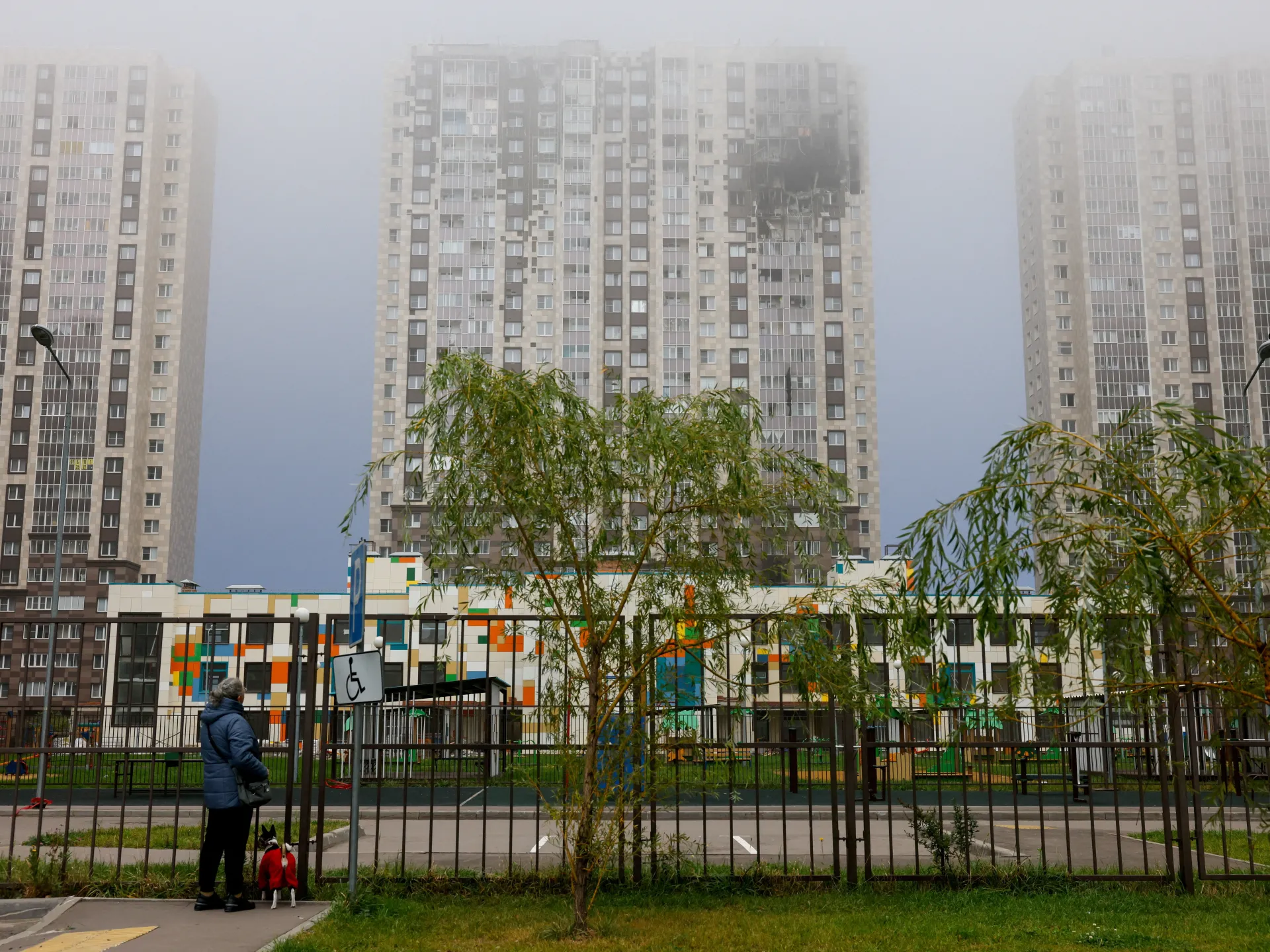
Russian President Vladimir Putin has said an immediate resumption of peace talks with Ukraine is unlikely, citing drone attacks on Moscow during parliamentary elections last month.
In a phone call with US President Donald Trump on Friday, Putin said Moscow was ready to resume negotiations with Kyiv after the parliamentary elections. However, the drone attacks on the capital made the resumption of trilateral peace talks between Russia, Ukraine and the US unlikely.
Recommended Stories
list of 3 itemsend of list
“By launching a large-scale drone attack on Moscow, other cities and polling stations on the most important day of the elections, and by targeting some people involved in organising the elections, the Kyiv regime has, in reality, interrupted the possibility of an immediate resumption of the negotiation process,” said Kremlin foreign policy aide Yuri Ushakov about the call with Trump.
“As the president said, we will now assess when these negotiations can resume,” he added regarding the trilateral talks.
US Secretary of State Marco Rubio said on Thursday that Russia’s war in Ukraine is at a dangerous stalemate and the United States will keep working towards a deal to end the war.
Ukrainian President Volodymyr Zelenskyy said earlier this week that the country was ready to hold trilateral talks with the United States and Russia this month.
US-Russia diesel deal
Earlier on Friday, Donald Trump announced after the call with Putin that Russia agreed to deliver more than 300,000 tonnes of diesel to American and global markets.
The deal was criticised by US lawmakers, Zelenskyy and European allies.
Zelenskyy called the agreement a “gift to Putin”.
“All that money goes toward the war against people, against Ukraine, against all of us. I believe our team is simply being used as a smokescreen. And that is certainly not fair,” he said in a statement.
In response to the US-Russia diesel deal, a government spokesperson said the United Kingdom would continue to “maintain pressure on Russia through the toughest sanctions regime ever imposed by the UK.”
Iran’s IRGC says it struck a “giant LPG gas carrier named NV Sunshine” that was “attempting to pass through the illegal route” south of the Strait of Hormuz.
Five Syrians and one Lebanese wounded in latest Israeli attack, officials say.
Published On 10 Oct 202610 Oct 2026
An Israeli drone attack has wounded six people in Lebanon’s Hermel district, close to the Syrian border, according to the Lebanese health ministry.
The ministry said on Friday that the six wounded included five Syrian nationals, two of them women, and one Lebanese.
Recommended Stories
list of 3 itemsend of list
Lebanon’s state-run National News Agency (NNA) reported that the drone attack targeted a car.
It added the area has largely been spared such attacks since an Israel-Hezbollah ceasefire was agreed in June.
Israel’s military claimed it struck “a Syrian terrorist” who “operated under the direction of the Iranian regime”, alleging that the man “planned and advanced attacks” against Israeli forces in Syria’s southern territory.
Since the ouster of longtime Syrian ruler Bashar al-Assad in December 2024, Israel has carried out hundreds of strikes against Syria. It has sent troops into a UN-patrolled buffer zone that had separated Israeli and Syrian forces in the Golan since 1974, and has carried out repeated incursions deeper into Syrian territory, sometimes seizing residents.
Israel has also continued to attack Lebanon since a ceasefire with Hezbollah was agreed in June.
It has vowed to keep troops in so-called security zones along its border in both Syria and Lebanon.
Syria’s President Ahmed al-Sharaa told the UN General Assembly last month: “We reject Israeli attempts to impose a fait accompli. We reject their aggressions, which undermine peace and security.”
He said Israel had carried out “500 air strikes, more than 1,200 incursions and 300 detentions” in Syria.
He also called for Israeli withdrawal from Syrian territory and for the international community to commit to a 1974 agreement that created a UN-supervised separation zone between Israeli and Syrian forces.
Government security forces regain control of Rumbek town after outsiders attempted to take control of the area.
Published On 10 Oct 202610 Oct 2026
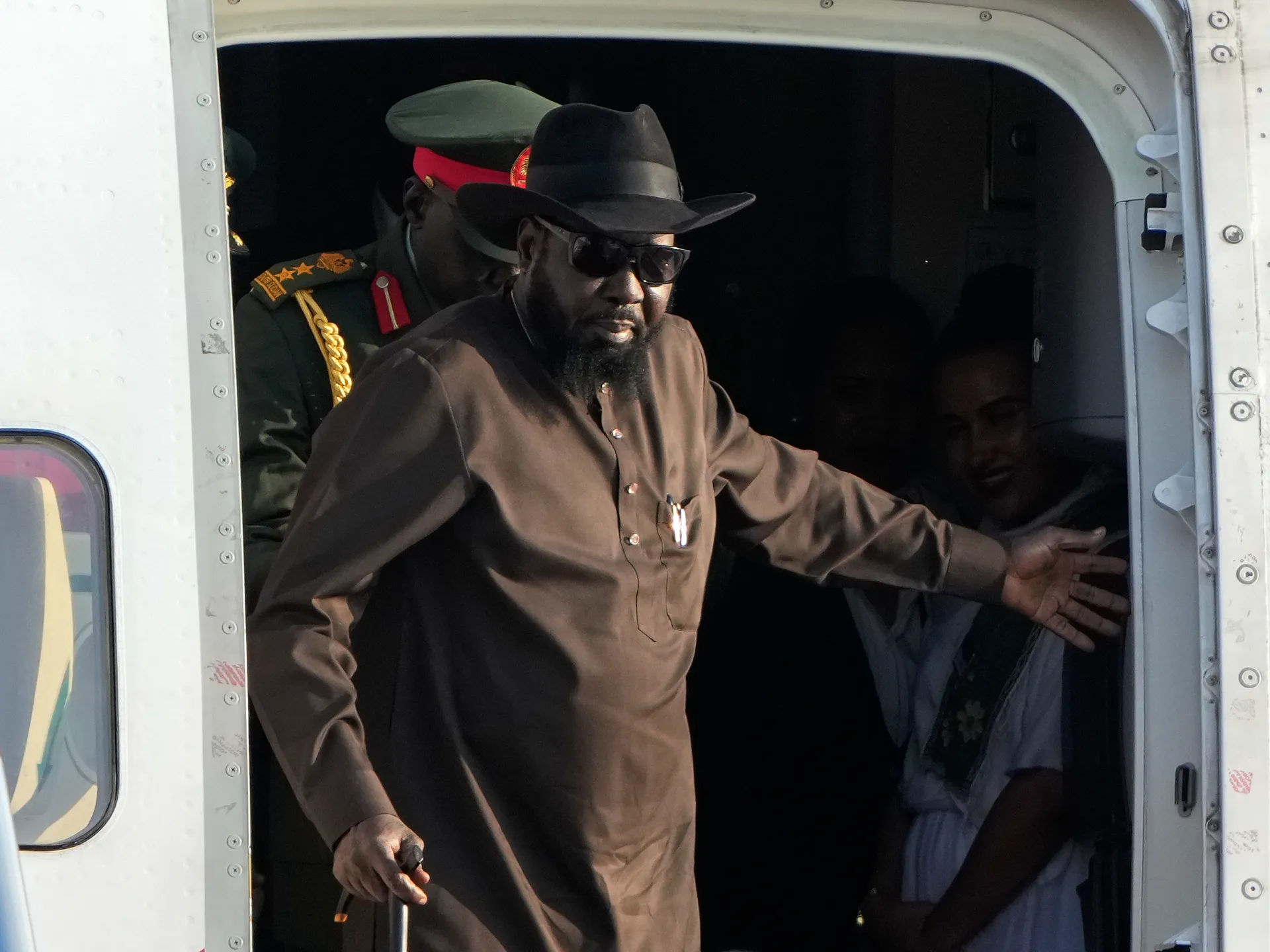
Intercommunal clashes have killed 71 people in South Sudan’s town of Rumbek, in Lakes State, the caretaker government said in a statement.
“According to initial security reports, approximately 71 people were reportedly killed,” including four soldiers, the South Sudanese interim Ministry of Information said in a statement on Friday. The exact number of fatalities has yet to be verified.
Recommended Stories
list of 3 itemsend of list
According to AFP, witnesses said a group of people from outside Rumbek tried to take control of the town and briefly succeeded. The attackers withdrew when police and military reinforcements arrived. Two witnesses said the fighting moved outside the city limits.
The government statement said, “Rumbek town is currently under the control of Government security forces, and efforts are ongoing to restore normalcy”.
The caretaker government strongly condemned the violence and urged all communities to “exercise maximum restraint and refrain from acts of retaliation that could further escalate tensions”.
Interim government
On September 22, South Sudan’s President Salva Kiir dissolved the transitional government, three months before the country’s first election since its independence in 2011. Kiir appointed a caretaker administration as the country prepares for its first-ever national elections.
His decree ended a power-sharing arrangement set up under a 2018 peace deal that halted a five-year civil war in which about 400,000 people were killed.
Intercommunal conflict has continued across South Sudan, resulting in multiple deadly clashes.
On September 17, 26 people were killed, and 82 were injured during days of fighting in a disputed region on the border between South Sudan and Sudan.
In early March, intercommunal violence left at least 169 people dead after dozens of armed men attacked a town.
CAF had declared the Africa Cup of Nations would be held every four years, but may reverse that decision.
Published On 9 Oct 20269 Oct 2026
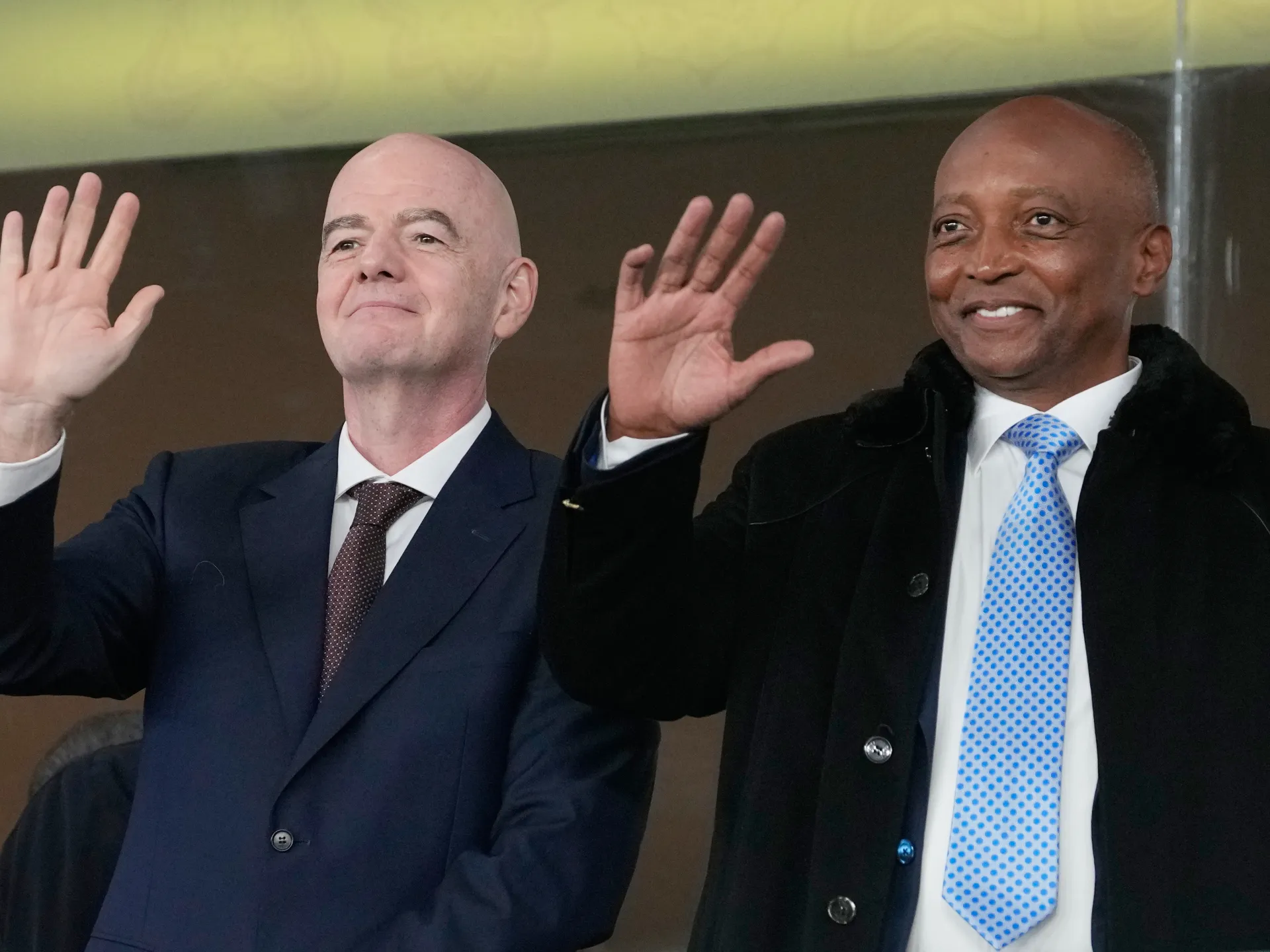
The Confederation of African Football (CAF) is reappraising its decision to hold the Africa Cup of Nations (AFCON) every four years, CAF president Patrice Motsepe declared on Friday, while insisting his organisation did not take orders from FIFA or UEFA.
Motsepe, who last December announced the biennial AFCON would switch to a four-year cycle from 2028, said on Friday that it was “nonsense, absolute rubbish” that CAF was being dictated to by either the world or European governing body.
Recommended Stories
list of 4 itemsend of list
The decision at the time, bringing the competition to a schedule that aligned with FIFA’s international calendar, rankled many at the 2025 AFCON in Morocco, with some saying it was made with European wishes at heart to the detriment of African interests.
Motsepe, a South African billionaire who is also a vice-president of FIFA, appeared stung by the criticism.
“My No. 1 job, my No. 1 duty is to protect, promote, and advance the interests of Africa,” he said. “And there are times when I have to stand firm and say, ‘Listen, we’re going to fight on this issue.’ And there are times when I have to say, ‘No.’
“The AFCON — because this is one of the issues we’re talking about — we took a decision as Africa because there were lots of issues, but I can guarantee you we have discussed it over the last few days to say we are looking at everything, including having the AFCON coming back every two years,” Motsepe said. “We’re very clear.”
He was speaking at the final day of CAF’s three-day strategy conference in Cape Verde. On Thursday, he reiterated the 54-member body’s “unanimous” support for FIFA’s under-fire president Gianni Infantino, and Infantino reminded his potential election voters of investments FIFA has made for African football since gaining the job 10 years ago.
Motsepe reaffirmed the 2027 Africa Cup will go ahead as planned in Kenya, Tanzania and Uganda next year, despite recent media reports from France saying construction projects were not going to schedule and some CAF members were pushing to have the tournament moved.
“You have to believe in Africa. There will be problems, there will be failures, fine, but we will be there. That’s what Mandela taught us,” Motsepe said.
A federal judge ruled against the Justice Department’s use of voter data to cross-reference an immigration database.
Published On 9 Oct 20269 Oct 2026
A United States judge has ruled that the Justice Department unlawfully sought state voter rolls to cross-check against a federal immigration database and identify voters it considered ineligible.
US District Judge Sparkle Sooknanan’s decision on Friday marks another setback for President Donald Trump’s efforts to expand federal oversight of elections ahead of the midterms, as Republicans seek to retain control of Congress.
Recommended Stories
list of 3 itemsend of list
In a 78-page ruling siding with watchdog group Common Cause, Sooknanan said the administration had understated the risk of wrongly removing eligible citizens from voter rolls because of inaccuracies in the Systematic Alien Verification for Entitlements (SAVE) database.
“The challenged policy represents the federal government’s attempt to decide who gets to vote,” Sooknanan wrote, adding that Congress had left that authority to the states.
The Justice Department said it was reviewing the ruling.
Ming Cheung, a senior staff attorney with the American Civil Liberties Union’s Voting Rights Project, said the ruling made clear that the administration could not use the federal government to disrupt elections or put voters’ rights at risk.
“The Trump administration has repeatedly taken extreme measures to interfere with how elections are run, undermine confidence in the results, and create confusion,” Cheung said in a statement.
Last year, Trump directed the department to crack down on voting by ineligible people, despite research showing voter fraud is rare. The department subsequently demanded unredacted voter rolls from nearly all 50 states, including sensitive personal information.
Eighteen states, mostly Republican-led, complied. The department cross-checked their data against SAVE and flagged people identified as noncitizens for potential removal from voter rolls.
Sooknanan said the database could contain outdated citizenship records, potentially misidentifying naturalised US citizens.
The department has also sued 30 states and Washington, DC, over their refusal to provide voter data. Twenty-six cases have been dismissed.
In a separate case in June, Sooknanan blocked the expanded use of the SAVE database for voter roll checks, an order the US Supreme Court temporarily paused last month.
Federal law bars systematic voter roll purges in the 90 days before a federal election, which could limit the ruling’s practical effect before the November 3 vote.
Northern Ireland Secretary Sir Chris Bryant has said he will ban the contentious Orange Order parade at Drumcree.
The dispute has led to a stand-off between Orangemen and nationalist residents of the Garvaghy Road in Portadown lasting almost two weeks.
Sir Chris said the chief constable advised him “it would not be possible to enable the procession to happen without a major intervention which would carry an unacceptable risk of serious injury, disorder and a wider contagion effect across Northern Ireland”.
His decision has been welcomed by Sinn Féin and the SDLP, but DUP leader Gavin Robinson said he now needs to “explain what his government intends to do to restore confidence in the rule of law”.
The move comes on the 13th day of deadlock between residents and the local district lodge of the Orange Order.
The Parades Commission had ruled that the march, on Sunday 27 September, could go ahead with restrictions in place.
But the parade, from Drumcree Church into Portadown, did not happen due to a large protest on the Garvaghy Road.
Under legislation, a secretary of state can overturn a Parades Commission determination, especially following some form of input from the police.
Sir Chris had been coming under increasing pressure from Sinn Féin and the SDLP to stop the parade.
On Friday night, Sir Chris said: “The Parades Commission have advised me that while ultimately a matter for the courts to determine, the commission is of the view that, in light of this current assessment by the chief constable, the original determination does not now have enduring legal effect.
“Consequently, and in the interests of wider public interest and safety, I’ve come to the conclusion that the circumstances under which that decision was made have now changed considerably.
“As a result, the procession cannot go ahead as it was determined.”
In a statement on Friday night, Boutcher said his “current assessment was that all available, lawful and proportionate options to facilitate completion of the procession had been exhausted”.
“Any remaining options would have required a substantial public order intervention,” he said.
He added: “Further to this, such an operation would in my view have had not only catastrophic long-term consequences for trust and confidence in policing, but for the Northern Ireland Executive and the peace process.”
Earlier, First Minister Michelle O’Neill confirmed she had received a letter from police investigating protests over the Drumcree parading dispute.
On Thursday, the police said they had begun issuing letters inviting people “reasonably suspected” of committing offences linked to the protests to interview.
Snap vote called after Parliament rejects measures to protect tenants and freeze rents.
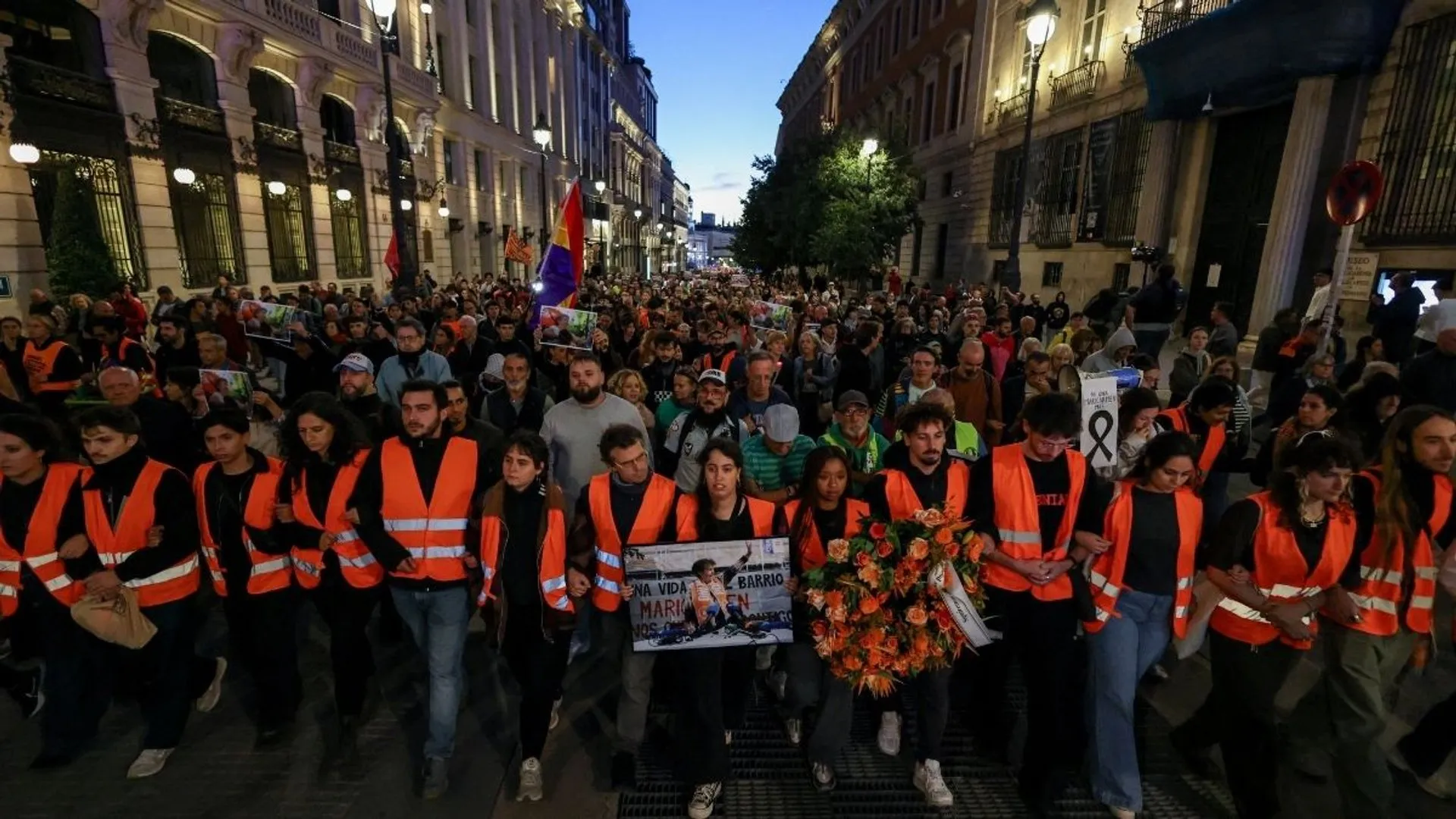
Rising frustration about housing shortages and surging rents in Spain has led to mass protests.
The demonstrations started last month after the eviction of Maricarmen Abascal, who died at age 87 this week.
The Socialist-led government tried to introduce measures to protect tenants and freeze rents, but Parliament rejected them. The conservative opposition says the solution is to ease regulations and build more homes.
Prime Minister Pedro Sanchez has since announced early elections. Analysts say he wants to galvanise support, as he faces pressure on immigration and corruption investigations into his party.
Two recent polls indicate the right-wing People’s Party and far-right Vox are on track for a combined majority.
Can demonstrations against the housing crisis reverse Sanchez’s political fortunes?
Presenter: Sami Zeidan
Guests:
Hana Jalloul – Secretary of international politics and cooperation for the Spanish Socialist Workers’ Party and a member of the European Parliament
Daniel Lacalle – Chief economist at Tressis and professor at the IE Business School
Pablo Calderon Martinez – Associate professor in politics and international relations at Northeastern University
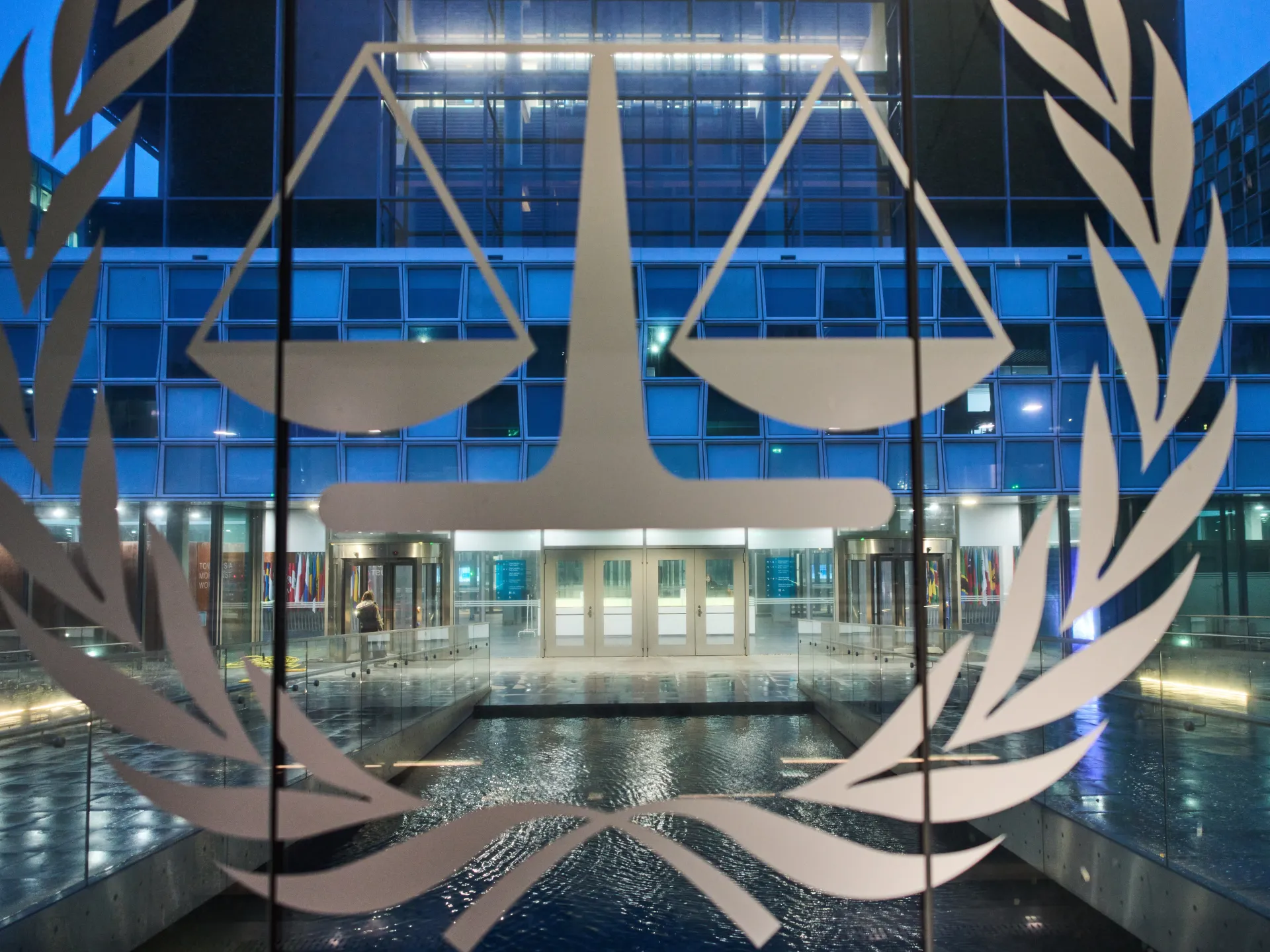
The United States has imposed a new set of sanctions against the International Criminal Court (ICC), prompting several countries – including US allies – to condemn the move and reiterate their support for the world’s war crimes tribunal.
On Friday, US Secretary of State Marco Rubio announced that Washington would be banning transactions with the “rogue court, cutting off their resources and crippling its ability to operate”, adding that President Donald Trump would “never allow” the Hague to prosecute Americans.
Recommended Stories
list of 3 itemsend of list
The ICC was created in 2002 to prosecute individuals accused of genocide, war crimes and crimes against humanity when national authorities are unable or unwilling to do so.
The US Treasury Department announced the penalties with a six-month initial grace period and other exemptions that would allow some transactions for telecommunications, software, pension payments and transactions related to detainees.
Rubio said the sanctions would give the court and its member states an opportunity to address US concerns and would be adjusted if they did not meet those demands.
The Trump administration says the court has exceeded its authority by pursuing officials from countries that are not ICC members, such as Israel. The United States and Israel have never joined the court.
In response to the sanctions, the ICC said that the move was an “assault on the rule of law and on the very foundations of the international legal order”. It called on its 125 member states to defend the institution.
“The Court cannot stand alone. Its fate now rests also in the hands of the states that created it,” the ICC said in a statement. “This is not just about defending a single institution, but about safeguarding the international order grounded upon the rule of law. History will judge this moment.”
Soon after the US announcement, top United Nations officials condemned the move.
UN Secretary-General Antonio Guterres was “deeply alarmed” by the expected impact of the sanctions on the court as a whole, particularly its ability to carry out its mandate, a statement from his spokesperson Stephane Dujarric said.
“Today’s decision marks a serious blow to our collective pursuit of international criminal justice, of which the ICC is a key pillar,” the statement added.
UN Human Rights chief Volker Turk called for immediate measures to protect the ICC. “These sanctions – the latest in a series of retaliatory steps against the ICC and its personnel for the work they do every day to advance accountability for the very worst violations of human rights – are unacceptable,” he said.
ICC member states that are US allies also expressed dismay at the decision.
Dutch Foreign Minister Tom Berendsen, whose country hosts the ICC, said the US’s decision was “deeply regrettable”.
“We will stand firm in defence of the court. At the same time, it’s important to note that the sanctions will not take effect immediately and that service providers can continue to work for the ICC. The six-month period before the sanctions take effect creates scope for dialogue,” he said.
In a joint statement, the foreign ministers of Britain, Denmark, France, Germany, Italy, the Netherlands, Canada and Japan said they “regret and strongly disagree” with the sanctions.
“If put into effect, these sanctions will have a significant impact on the Court’s work, its dedicated staff and their families … We remain both united in our support for the ICC and committed to engaging in constructive and inclusive dialogue with non-States Parties,” they said.
Belgian Foreign Minister Maxime Prevot also said Brussels would discuss support for the ICC with European Union foreign affairs colleagues on Monday and at the upcoming European Council.
“We will press for concrete protection. The court’s independence cannot depend on whom it investigates. Europe must act. Belgium is calling for the activation of the EU Blocking Statute to protect the court,” Prevot said.
US aims to ‘ultimately destroy’ ICC
Similarly, organisations and rights groups sounded the alarm over the implications of the US decision.
Philippe Bolopion, executive director of US-based Human Rights Watch, said the Trump administration had made clear its aim to “destroy” the ICC and “shield US and Israeli officials from facing charges before the court”.
“The ICC was created to ensure that no one, no matter how powerful, is above the law. Governments that value human rights and accountability should condemn this outrageous move and take swift action to protect the ICC, its staff, and all those who cooperate with it, starting with the European Union using its laws to mitigate the sanctions’ impact in the region,” he said.
The Executive Director of the Open Society Justice Initiative, James Goldston, said the sanctions were a “calculated attack on the rule of law and the principles of judicial independence and equality that underpin it.”
“This is the latest move in a campaign of coercion intended to destroy the system of international justice,” he said.
Amnesty International called on countries to “resist”. Trump’s “sanctions are designed to isolate and ultimately destroy the International Criminal Court”, Erika Guevara Rosas, Amnesty’s senior director for research, policy, advocacy and campaigns, said in a statement. “This existential attack must fail. States must take concrete action to resist the imposition of these measures.”
Amid widespread criticism, Israel commended the US move.
Prime Minister Benjamin Netanyahu hailed the sanctions and praised Trump and Rubio for taking this “critical decision”.
“The ICC is not a court. It is a political body that poses a mortal threat to law-abiding democracies worldwide and to the very idea of national sovereignty,” Netanyahu wrote on X.
In 2024 the ICC issued an arrest warrant for Netanyahu on war crimes and crimes against humanity charges for the war on Gaza.
Russia to supply 300,000 tonnes of diesel immediately, followed by 1.5 million more, as prices soar amid the Iran war.
Published On 9 Oct 20269 Oct 2026
United States President Donald Trump said that Russia has agreed to supply 300,000 tonnes of diesel fuel to global markets amid discussions with Russian President Vladimir Putin.
“I have just concluded a highly successful discussion with President Vladimir Putin, of Russia, wherein it was agreed that Russia will immediately supply over 300,000 Tons of Diesel Fuel to the American and Global Marketplace, another 500,000 Tons during the month of November, and 1,000,000 Tons immediately thereafter,” Trump said in a post on his Truth Social platform.
Recommended Stories
list of 4 itemsend of list
The president added that Russia would deliver an additional 3 million tonnes of fuel “within a short period of time”. He said that the country would supply 500,000 tonnes in November.
An envoy for Russian President Vladimir Putin, Kirill Dmitriev, praised cooperation between Russia and the United States on diesel and energy in a post on X shortly after.
“Russia-US cooperation on diesel and energy will benefit the world,” Dmitriev wrote on X.
Petrol price pressures
The deal comes despite Ukrainian air strikes, which have taken more than half of the country’s oil refining capacity offline, according to claims made by Ukraine’s Ministry of Defence on Sunday.
The move also comes as prices of diesel, used in agriculture, heating homes and trucking goods, are near record highs ahead of the November 3 congressional elections that will determine control of Congress.
Diesel prices have been elevated in recent months but have started to decline. The average price for a gallon is $6.27 ($1.66 per litre), according to the American Automobile Association (AAA), which tracks daily petrol prices. That’s down $0.10 from this time last week, but up $5.94 from this time one month ago.
Diesel prices, which can drive inflation, are up 70 percent since the US and Israel’s war on Iran began this year, despite two high-profile recent moves by Trump to boost supplies of the fuel: pressuring allies to release emergency reserves and expanding access to tax-exempt red-dyed diesel, which is normally used for farm equipment.
The wars in Iran and Ukraine have triggered an unprecedented global fuel supply crunch.
A young orangutan has been rescued from wildfires on Borneo Island in Indonesia. She suffered burns to her hands and feet and is now being treated in an animal hospital. Dozens of orangutans have been rescued from fires that have caused massive habitat destruction.
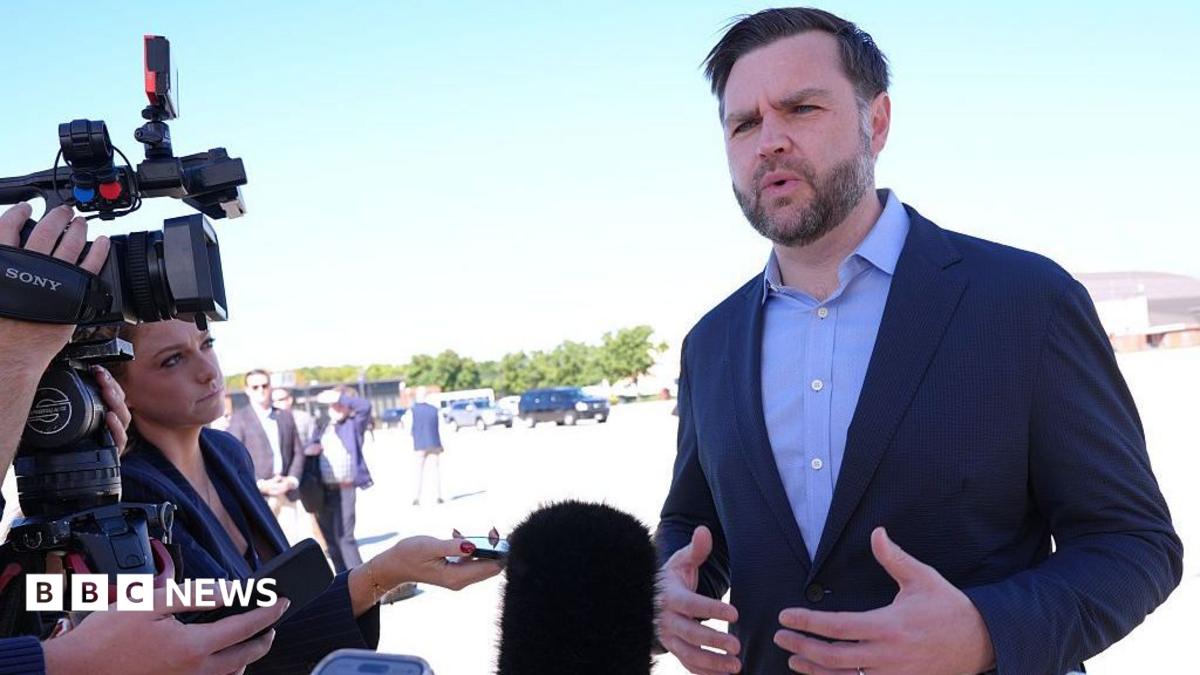
US Vice President JD Vance has cast doubt on the Pentagon’s plans to livestream a firing squad execution of the Fort Hood shooter.
Talking with reporters, Vance expressed doubt that it would happen as planned, saying: “I don’t know that that’s actually going to happen”.
He added, that “if it’s through live stream, I’m not going to be watching it”. Vance described the actions by former US Army major Nidal Hasan as “the worst terrorist attack on American soil outside of 9/11”.
Hasan fatally shot 13 unarmed US soldiers at Fort Hood in 2009, injuring another 32. His execution by firing squad would be the first military execution in more than 60 years.
The shooting prompted protests in New York City as officials defended ICE and Mayor Zohran Mamdani condemned the incident.
Published On 9 Oct 20269 Oct 2026
The United States Department of Homeland Security has defended Immigration and Customs Enforcement’s (ICE) shooting of a man in New York City while his child was present. Federal officials used the incident to criticise sanctuary-city policies that limit cooperation with federal immigration authorities.
New York officials have condemned the shooting and have called for ICE to end its operations in the city.
Recommended Stories
list of 3 itemsend of list
The shooting took place on Thursday afternoon when ICE officers attempted to arrest a man identified by New York City police as Oscar Belgal.
Homeland Security officials gave their account of the incident on Friday during a news conference, saying that Belgal refused to exit his car when approached by officers and then accelerated, striking two ICE vehicles.
They said officers then opened fire, grazing Belgal’s neck while his five-year-old child was in the back seat.
According to Homeland Security officials, Belgal received first aid and was taken to hospital before being transferred to a secure detention facility outside New York state. They did not disclose where Belgal is being held.
Department of Homeland Security (DHS) Secretary Markwayne Mullin said that the agents did not know the child was inside the vehicle when they fired.
ICE senior official Marcos Charles said agents had attempted to arrest Belgal as part of an investigation into suspected gang involvement in an earlier shooting of a US Customs and Border Protection officer.
According to US officials, Belgal is an undocumented migrant from the Dominican Republic who had previously evaded arrest and received a five-year sentence for grand larceny in April 2025.
“[Belgal] was a thug,” Mullin said at the Friday news conference. “The absolute worst of the worst.”
Mullin confirmed that officers were wearing body cameras but the footage has not been made public. New York City police released bodycam footage on Friday of police officers on the scene who had responded to a 911 call about the incident.
In other violent incidents involving federal immigration officers, video evidence has contradicted initial accounts from ICE and Homeland Security officials, including in Minneapolis, where footage of the fatal shootings of Alex Pretti and Renee Good challenged federal officials’ descriptions of the encounters.
The latest shooting prompted protests on Thursday night in the Bronx, where the shooting took place, with demonstrators condemning ICE and calling for the agency to be abolished. Tensions rose after NYPD officers clashed with some of the protesters.
New York City Mayor Zohran Mamdani condemned the shooting and said he had called US President Donald Trump to demand an end to ICE enforcement in the city.
Speaking to reporters late on Thursday at the scene of the shooting, Mamdani said he had tried unsuccessfully to secure Belgal’s release in phone calls with Trump and Mullin.
“These actions are making the city less safe,” Mamdani said. “ICE is rotten to its core.”
Mullin accused Mamdani of prioritising politics over public safety and said Trump had offered to transfer Belgal to New York police custody if they pursued charges. Mullin said Mamdani refused this offer.
New York City mayor Zohran Mamdani gives an update about the Immigration and Customs Enforcement (ICE) shooting in the Bronx borough of New York, October 8, 2026 [AFP]
Belgian police respond to ‘troublemakers’ on sidelines of main rally with tear gas, water cannon and baton charges.
Published On 9 Oct 20269 Oct 2026
Clashes have erupted near Brussels Central station on the sidelines of a demonstration organised by the country’s socialist trade union against the federal government’s austerity plans.
As thousands of protesters gathered at the station on Friday, a smaller group clashed with the police and threw wooden beams, glass bottles and rubbish bins, The Belgian Times reported.
Recommended Stories
list of 3 itemsend of list
Police were deployed in large numbers around the stations as officers checked groups of young people not wearing trade union colours.
Police said the main trade union rally went ahead peacefully but “groups of troublemakers were responsible for serious incidents before and after the march.”
Riot police responded to those protesters with tear gas, water cannon and baton charges. Police said those who “cause the problems of public order are not linked” to the rally.
Reporting from Brussels, Al Jazeera’s Rosie Birchard said damage was caused during Friday morning’s protests with an “acrid smell of burning in the air”, due to fires that were set and the tear gas.
“Police [and] emergency services have been arriving, starting to disperse or clean up and then the protests flare up again. So the day is still early; often these things get worse in the evening in terms of the street violence,” Birchard explained.
“There were some young people who came out, they say they were inspired by what they had seen in France in terms of school protests, and they also wanted to talk about the education environment they’re learning in,” she said, adding that the students felt that they were “not being listened to”.
A protester gestures next to burning shared bikes during a labour union-based demonstration against the federal government’s budgetary measures near the Brussels South railway station in Brussels [AFP]
The clashes came after a week of tension in the city of Liege after authorities banned gatherings as students clashed with police and vandalised shops. More than 200 people were arrested in Liege, and dozens of police were injured.
The ABVV trade union and the Christian ACV, the country’s two biggest unions, organised protests on Friday morning, with protesters marching from Brussels Central station to Brussels South Station under the slogan “stay out of our pockets”.
Police said about 30,000 people attended the demonstrations, while ABVV had earlier estimated attendance at 50,000.
The anger stems from the government’s austerity measures, as officials consider a new budget that opposes potential measures that affect purchasing power, the wage indexation system and value-added tax (VAT), as well as plans to introduce annualised working time.
At the same time, the ACV organised a separate protest involving hundreds of activists at the capital’s headquarters of the governing coalition parties.
Israeli settlers have carried out attacks and pogroms disrupting the Palestinian olive harvest in the West Bank, while Israeli forces separately detained several Palestinians across the occupied territory.
At least 19 settler attacks were recorded on Friday by the Palestinian Colonization and Wall Resistance Commission, a Palestinian government body operating under the Palestine Liberation Organization (PLO).
Recommended Stories
list of 3 itemsend of list
The commission said the incidents included attacks on Palestinian olive harvesters, the burning and uprooting of olive trees, and the theft of crops and livestock. Other Palestinians and their vehicles were also targeted.
Settlers set fire to Palestinian-owned groves and stole olives in what is considered the most important season for harvesting the single-seeded stone fruit.
More than 50 olive trees were uprooted by settlers in Qusra, the commission said.
Settlers also assaulted and injured Palestinian farmers involved in the harvest in the Tal, where a Palestinian-owned vehicle was set on fire, it added.
Additionally, olive harvesters were attacked in Jorish, Beita, Naqoura, Birzeit, Deir Bzeih and Farata.
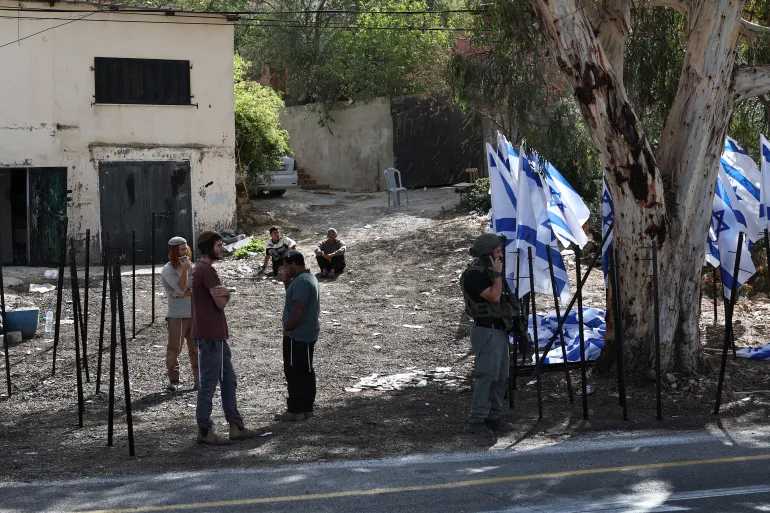
An Israeli security personnel member and Israeli settlers stand near Mou’ayad Mahmoud’s shop in al-Lubban Asharqiya, near Nablus in the West Bank, October 8, 2026 [Atef Safadi/EPA]
A farmer was injured in reported gunfire in Kafr ad-Dik, and the use of live ammunition was reported during a settler pogrom, backed by Israeli forces, in Deir Ballut.
Elsewhere, an elderly Palestinian woman in Berin, east of Hebron, was injured after settlers set their dogs on farmers while sheep were stolen in Ein Qinya.
A Palestinian man and his child were attacked and their vehicle stolen by settlers in Yabrud. Settler attacks on Palestinian-owned vehicles were also reported in the towns of Sarda and al-Rihan.
Brazen attacks against Palestinians
Al Jazeera’s Nida Ibrahim reporting from Ramallah in the occupied West Bank said settlers, backed Israeli forces, have grown more brazen in their attacks against Palestinians during the olive harvest despite the presence of foreign activists and observers.
“Palestinians have to go about the harvest in large groups, that include international solidarity activists, to try to stop settler intimidation and attacks,” Ibrahim said, adding that the settlers wait for the groups to start leaving at the end of the harvest, before springing into action.
“It has become a very difficult journey, as the Palestinians try to leave the harvesting areas, Israeli settlers continue to intimidate them under the protection of the Israeli army,” she said.
As Ibrahim reported, a Palestinian family was under attack by Israeli settlers who recently started building an illegal settlement outpost near Ramallah, “using it as a base to attack Palestinians”, she said.
“No one is being spared,” said Ibrahim.
For Palestinians, the olive harvest is supposed to be a joyous season, but instead, they fear settler attacks and intimidation backed by the Israeli forces.
Sixteen Palestinians arrested
As settler attacks and pogroms continue, the Israeli army arrested 16 Palestinians in raids across the occupied West Bank on Friday, according to the Palestinian Wafa news agency and local sources speaking to the Anadolu news agency.
In Hebron, southern West Bank, Israeli forces arrested nine Palestinians after raiding and searching their homes, including Ibrahimi Mosque Director Moataz Abu Sneineh and Hammam Abu Markhiya, an official responsible for the mosque’s custodians, Wafa reported.
In the city of Qalqilya, Israeli forces arrested five Palestinians during a raid, local sources said.
Two other Palestinians were arrested after Israeli forces raided and searched several homes in Beita, south of Nablus, the sources said.
After Manchester City were found guilty of Premier League breaches, rival managers give their reaction as games resume.
Published On 9 Oct 20269 Oct 2026
The Premier League returns to action this weekend following the international football break, and since a ball was last kicked domestically in the English top flight, a seismic shock was sent around the world by the guilty verdict faced by Manchester City.
An independent commission found the team guilty of more than 100 breaches of the Premier League’s financial rules between 2009 and 2018.
Recommended Stories
list of 4 itemsend of list
City have continued to protest their innocence and have lodged an appeal, but if the decision is upheld, then points deductions, fines, transfer embargoes and relegation are all possible punishments for the club.
City manager Enzo Maresca has said he believes the appeal will be won, and none of the trophies claimed since the period the charges began are tainted.
Al Jazeera Sport has collated the reaction of some of the managers, who were all speaking publicly for the first time since the verdict, starting with the club City face next when they travel to Liverpool on Sunday.
Liverpool manager – Andoni Iraola
“I think uncertainty is not good for anyone, and anyone involved, but the process is ongoing, and we have to be patient like everyone else and see what happens at the end,” Iraola said.
Manchester United manager – Michael Carrick
“I’ve got my own questions about it; it’s affected me personally in different ways over a period of time,” said the former United midfielder, who finished second to City as both a player and assistant manager since the 2008 Abu Dhabi takeover.
“What I will say, the sooner it gets sorted for everyone’s benefit is essential.
“There’s so many angles to look at, from so many different perspectives, but really speed is essential for everyone to be clear, to be able to deal with it, to be able to move on whatever happens.
“It’s unprecedented, a unique situation to be in, at this level with such a huge impact in so many ways.”
Arsenal manager – Mikel Arteta
“It is very important that we respect the process and the timelines; it is still an ongoing process because it has been appealed,” said the Spaniard, who was assistant manager to Pep Guardiola at City from 2015-2019.
“My position, and I think the club’s position, is to not make any comment until the appeal is fully resolved.
“In our hands is the way we have prepared since the international break to set the club up to win.”
Everton manager – David Moyes
“It looks terrible that Everton have been docked points and had to pay fines, and this was not so long ago, but there are other things going on that were more than 10 years ago and have not been dealt, which I find really difficult,” Moyes said in relation to the sanctions Everton faced, including being docked 10 points. Their charges related to breaches of financial sustainability rules between 2019 and 2022.
“I hope it is not just Everton that are being picked on. Manchester City have helped raise the level of the Premier League by the football they have played, their manager and the players they have had.
“We all had to park the bus, because they were that good and everybody used to say: ‘Why are you not having a go?’ – it was tough.
“But they were such a good side, and it was great times to play against Pep’s teams because they had so many good players.”
Chelsea manager – Xavi Alonso
“We need to be patient and wait until the final sanctions from the panel; they are independent enough to assess the situation,” Alonso said.
“Whatever I say and whatever opinion we have, they are the ones to take it, and we need to respect it.
“It is not in our hands; let’s see what happens, and then we need to respect it.”
Eritrea denies backing TPLF as Ethiopia alleges collusion, further straining their already volatile relationship.
Published On 9 Oct 20269 Oct 2026
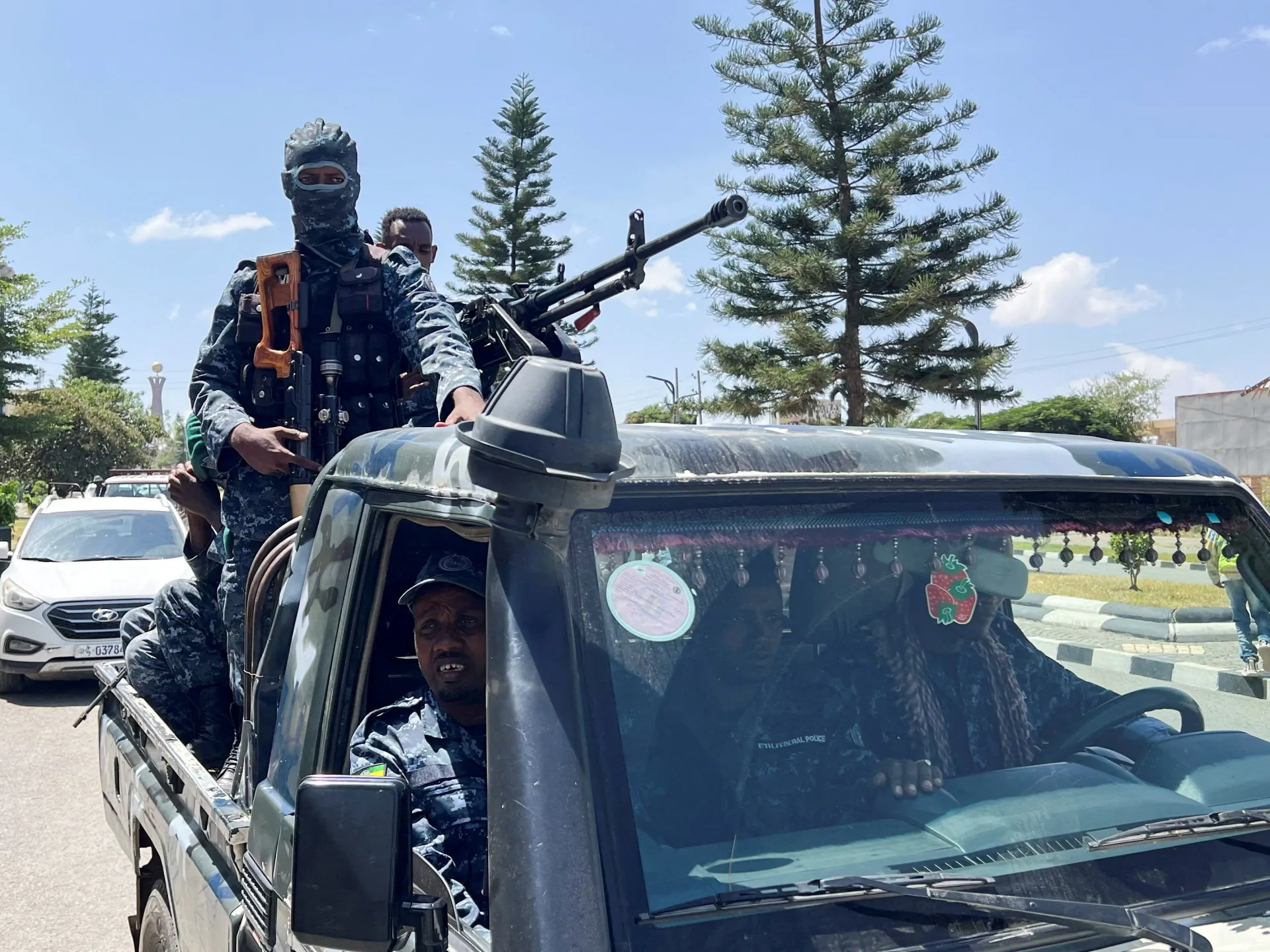
Ethiopia has accused Eritrea of an “all-out invasion” in a message to the United Nations Security Council, while Eritrea says it is facing a “war of aggression” from its neighbour.
“The all-out invasion of parts of northern Ethiopia by Eritrea is a matter of public record,” said a letter by Ethiopia’s Minister of Foreign Affairs Gedion Timothewos, which was shared with news agencies on Friday.
Recommended Stories
list of 3 itemsend of list
“It is a blatant act of aggression that engages Ethiopia’s inherent right to self-defence,” added the letter dated Thursday and addressed to French Foreign Minister Jean-Noel Barrot.
Gedion said that Eritrean troops had advanced up to 60 kilometres (37 miles) into Ethiopia’s northern Tigray region and demanded their withdrawal, just days after the two nations cut diplomatic ties.
Eritrea’s Minister of Information Yemane Gebremeskel rejected Ethiopia’s claims.
“The Ethiopian regime has been pursuing, in effect, an unprovoked war of aggression against Eritrea for more than three years now,” he said on X.
Yemane said Asmara had shown restraint since landlocked Ethiopia had essentially declared a war against Eritrea when it stated in 2023 that it would gain access to the sea.
Citing statements made by Ethiopian officials, Yemane accused Addis Ababa of using the current conflict to take Assab, an Eritrean port, in order to restore access to the Red Sea.
Eritrea also denied Ethiopia’s claim that it is backing the Tigray People’s Liberation Front (TPLF), which is part of an alliance of seven armed groups that has been attempting to overthrow Prime Minister Abiy Ahmed’s government since September.
Over the past week, Ethiopia’s army has pushed back the TPLF and seized the Tigrayan capital, Mekelle.
Witnesses also told the AFP news agency that rebels had lost the Tigrayan cities of Shire and Adigrat. Eritrean troops were reportedly seen in Adigrat before Ethiopian drone strikes hit them, according to several witnesses.
Tumultuous history
Ethiopia and Eritrea have traded accusations since the reported incursions by Eritrean troops this week raised fears of outright war in the region, where the two nations have fought previous conflicts.
The stakes have been raised this time around by conflicts in the Horn of Africa region and tensions across the Red Sea.
Diplomatic ties between the two have collapsed amid the escalation: Ethiopia closed its embassy in Asmara and ordered 10 Eritrean diplomats to leave the country last week. In response, Eritrea announced it was severing ties.
The neighbours have a tumultuous history, as Eritrea won independence from Ethiopia in 1993 and they fought a border war for two years in 1998.
Relations improved slightly in 2018 when Abiy took power in Addis Ababa, and Eritrea fought alongside Ethiopia against the TPLF in a civil war from 2020 to 2022.
Eritrea, however, was not part of the peace deal that ended the war, which soured ties soon afterwards.
Tensions are also fuelled by Abiy’s repeated claim that landlocked Ethiopia – which lost its access to the coast when Eritrea secured independence – has a right to sea access, which Eritrea sees as a threat to seize its Red Sea port of Assab.
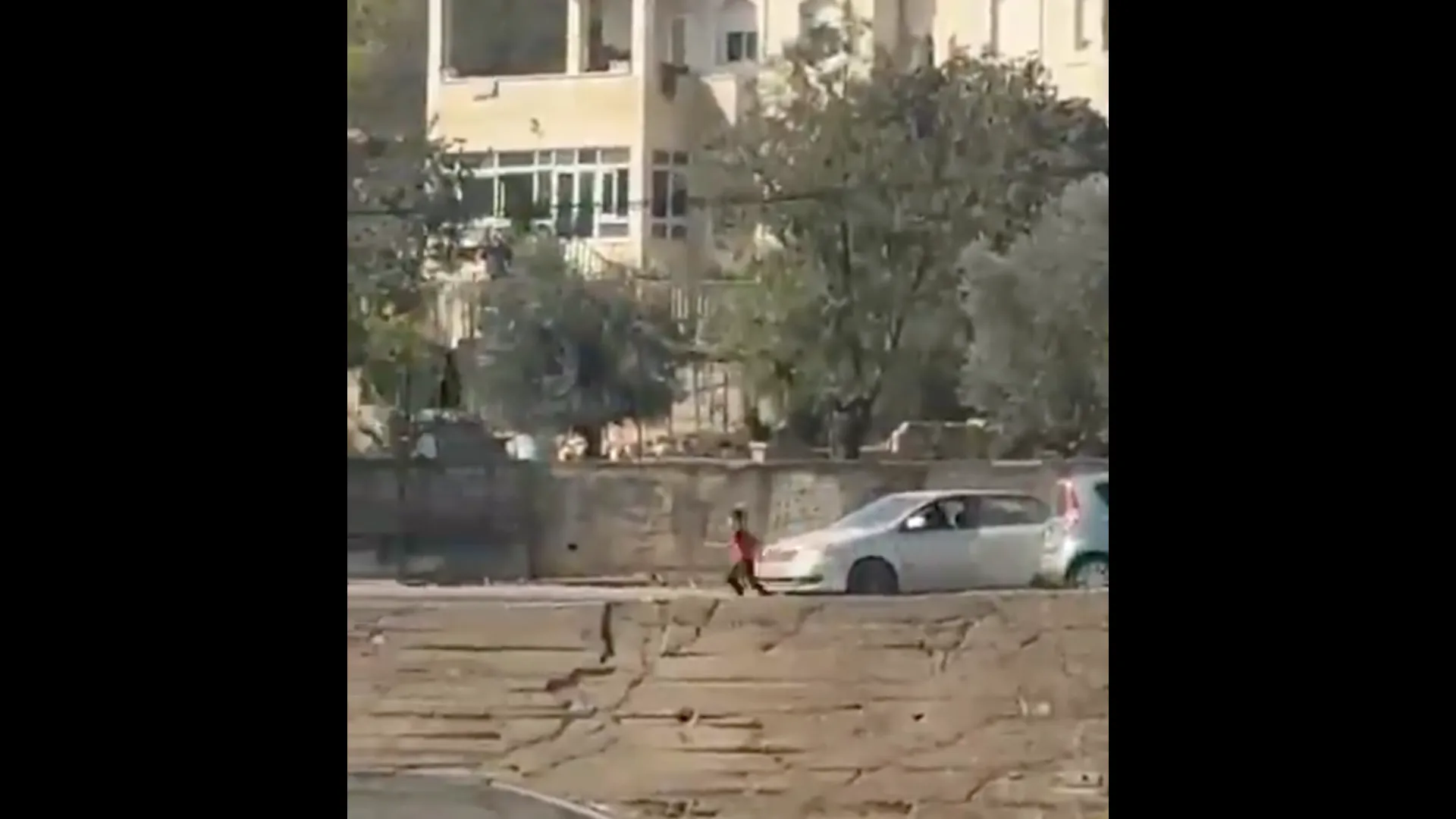
A Palestinian boy was seen fleeing after Israeli settlers attacked his father and stole their car in Ramallah. At least 19 pogroms by Israeli forces and settlers were reported across the occupied West Bank on Friday morning.
Russian forces continue to retreat in Ukraine’s eastern Donetsk region.
The Kremlin-aligned channel Rybar, on Telegram, said on October 7 that Moscow’s forces were losing villages south of Lyman, a town they have tried to capture as a springboard to mount a full-scale offensive on the “fortress belt” cities of Sloviansk and Kramatorsk.
Recommended Stories
list of 4 itemsend of list
A Ukrainian counteroffensive named “Operation Vivaldi” this year has reclaimed 175 square kilometres (67 square miles) of previously occupied land around Lyman.
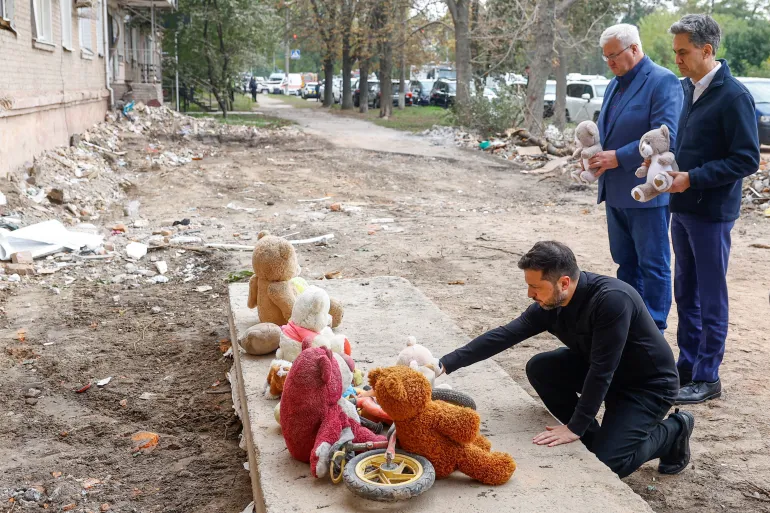
British Foreign Secretary Ed Miliband, Ukraine’s President Volodymyr Zelenskyy and Foreign Minister Andrii Sybiha visit a makeshift memorial at the site of an apartment building where 22 residents were killed the day before by a Russian missile strike in the town of Pryluky in the Chernihiv region, Ukraine, October 8, 2026 [Valentyn Ogirenko/Reuters]
“The enemy is using successes in the Lyman direction to develop attacks [east of Sloviansk], where Russian troops are forced to defend previously occupied positions and expend resources on restoring control, instead of launching their own offensive,” wrote Rybar.
“It is becoming increasingly clear that the possibility of storming the urban area [of Sloviansk] is receding into the more distant future.”
A key battle seems to be building for the village of Kryva Luka east of Sloviansk, which sits on high ground on the Russian-held right bank of the Siversky-Donets River, and which could serve as a base to launch counterattacks further east.
Ukrainian President Volodymyr Zelenskyy told the Reuters news agency that Operation Vivaldi was successful but incomplete.
To get as far as Kryva Luka, Russian sources acknowledged that Ukraine has recaptured settlements west of it. They blamed the Russian communications strategy of claiming settlements that have not been captured, giving away the plan of attack.
“Premature statements” aided Ukraine, said Rybar. “Some villages were declared liberated even before Russian units arrived, which allowed the enemy to accumulate forces there and launch counterattacks.”
A dog looks on while women hold posters as they participate in a rally demanding the establishment of a humanitarian corridor to evacuate Ukrainian civilians from the town of Oleshky in Kherson region, Kyiv, Ukraine, October 6, 2026 [Alina Smutko/Reuters]
Ukraine built up reserves in the Lyman area before unfolding its counteroffensive. That preparation seems to be yielding results.
Ukraine’s Ministry of Defence said its campaign to disrupt the flow of Russian ammunition and fuel to the front struck a record number of air defence assets and targets more than 50km (30 miles) away in September.
Russian President Vladimir Putin claimed Russia had captured 1,300sq km (500sq miles) of Ukraine in September, echoing claims by his generals.
People carry a casualty as emergency services work to rescue residents from the debris at the site of an apartment building which was hit by a Russian missile in the town of Pryluky in the Chernihiv region, Ukraine, October 7, 2026 [Valentyn Ogirenko/Reuters]
The Institute for the Study of War, which monitors territorial advances using geolocated, open-source data, said Russia actually lost 80sq km (30sq miles) during that month.
The Russian casualty rate rose to a record for 2026 of 46,230 in September, according to Ukraine’s military.
Of these, 33,087 – more than 70 percent – were confirmed kills, said Ukraine.
The commander of Ukraine’s Unmanned Systems Forces, Robert Brovdi, said enemy casualties were up by 40 percent in the first five days of October, compared with the same period in September.
The Ukrainian military on October 7 counted 1,545,950 Russian dead and wounded for the entire full-scale invasion since 2022.
A Russian jet-powered drone hits one of Kyiv’s bridges in Kyiv, Ukraine, October 2, 2026 [Valentyn Ogirenko/Reuters]
Putin’s response
Putin’s response has been to intensify bombing, causing civilian suffering.
Twenty-two people, five of them children, were killed in the city of Pryluky, in the northern Chernihiv region, when a Russian cruise missile demolished a five-storey apartment building on October 7, Putin’s birthday.
“Today, for Putin’s birthday, the Russian army ‘gifted’ the destruction of a residential building in Pryluky,” said Zelenskyy.
Ukraine’s Air Force said Russia unleashed 130 drones and 48 cruise missiles across 12 regions that day, as well as ballistics. At least two more people died in Kyiv and two in Oleksandria.
At least 30 people died in Kramatorsk on October 8, when a Russian bomb struck two city buses. Video of the emergency response showed bodies strewn across an avenue and in a park.
Ihor Malchevsky, 69, a deputy department head at Ukraine’s National Academy of Sciences, uses a ladder as flames rise from an administrative building hit by a Russian jet-powered drone attack, in Kyiv, Ukraine, September 28, 2026 [Valentyn Ogirenko/Reuters]
Recent analysis of the Geran-4 and Geran-5 jet-powered drones Russia increasingly uses for many of its attacks makes it unlikely that these attacks on nonmilitary targets are accidental.
Ukraine’s military intelligence said the attacks use satellite and sophisticated inertial navigation systems, as well as a camera that reads landmark features and checks them against an on-board database – all three systems working in concert to ensure accurate navigation.
Ukraine has responded to the jet-powered drones by speeding up delivery of F-16 fighters from its allies, which are proving an effective first line of defence.
“Currently, F-16s are destroying between 50 percent and 60 percent of the drone attacks,” said Zelenskyy.
Ukraine is also testing five new types of interceptor drones, the most successful of which is 30 percent effective, and experimenting with small-scale missiles, Zelenskyy said.
A dozen AI-driven heavy machine-gun turrets have been placed around Kyiv as a last line of defence, with dozens more planned around the country.
These are a “facility-level” defence, said Serhiy Beskrestnov, a senior Defence Ministry adviser. “It can protect a warehouse, factory, bridge, or power substation.”
Russia has begun hitting bridges across the Dnipro River, striking Kyiv’s southern and northern bridges seven times in the first four days of October. It has previously struck the building where Ukraine’s cabinet met, as well as energy facilities feeding the city, in an effort to cause a blackout.
Russia’s jet-powered drones travel at more than 500km (310 miles) per hour and are more difficult to intercept than its propeller-driven Shahed drones.
Despite this, during the October 7 strike, Ukraine’s Air Force said it intercepted 80 percent of the jet-powered drones, 95 percent of the propeller-driven drones and 80 percent of cruise missiles.
On October 7, German Chancellor Friedrich Merz visited Kyiv to announce a 1.3-billion-euro ($1.46bn) military aid package, and to sign agreements worth 8.5 billion euros ($9.5bn) to jointly develop drone defences and other weapons with Ukraine.
Merz’s visit was an important political gesture following recent elections in two German states where the pro-Russian AfD trounced his governing CDU party.
Ukraine continued long-range strikes inside Russia.
These struck refineries in Volgograd on October 2 and Bashkortostan on October 8, as part of a strategy to starve the Russian economy and military of fuel.
“Over 51 percent of the enemy’s oil refining capacity has been disabled,” said Ukraine’s military.
Ukraine also hit the Samara linear production and dispatch station, which its General Staff described as “a major hub for receiving, storing, and blending oil”.
The staff said eleven 20,000-tonne storage tanks and three 50,000-tonne storage tanks had been destroyed.
“The facility blends high- and low-sulfur oil from various fields to produce the export grade of oil known as Urals, which accounts for up to 50 percent of the total volume of Russian oil exports,” the military said.
Smoke rises in the city during a Russian missile attack in Kyiv, Ukraine, October 7, 2026 [Gleb Garanich/Reuters]
Ukraine also struck military targets. On October 7, it struck the Astrakhan Gas Processing Plant, which extracts gaseous sulphur for use in explosives.
On October 4, it destroyed a Sukhoi Su-35 multi-role fighter and a Sukhoi Su-34 fighter-bomber on the Adygea airfield, and also hit the Seshcha airfield in Bryansk.
Its campaign of mid-range strikes to destroy Russian power supply in occupied areas had reached 456 between July 6 and October 3.
New Delhi, India – Stand-up comic Brijesh Jha posted a parody video on Instagram last week to protest the removal of his name, along with his father’s and sister’s, from a voter list in the eastern Indian state of West Bengal.
The video, which alleged that India’s Chief Election Commissioner Gyanesh Kumar had disenfranchised millions of voters at the behest of Prime Minister Narendra Modi’s Bharatiya Janata Party (BJP), garnered 1.7 million views after it was posted on September 29.
Recommended Stories
list of 4 itemsend of list
Two days later, Meta, the United States-based company that owns Instagram, took the video down, citing “local laws” without giving further explanation.
“I felt very helpless that day. I have only one thing in this country – that I can vote. If you take that away from me, then I have nothing left. So I didn’t know what to do. As an artist, I can just make art, or I can protest,” the Mumbai-based artist told Al Jazeera.
Jha said his parody song was removed because the Modi government is “scared” after an investigation by the Indian Express newspaper last month revealed that two of the election commission’s three members had raised serious concerns over a controversial revision of voter rolls being conducted by the poll panel across the country.
The exercise, known as the Special Intensive Revision (SIR), was launched in June last year to identify deceased, duplicate or dubious voters and remove them from the rolls. So far, the process has deleted more than 130 million voters – nearly 14 percent of India’s total voters, an overwhelming number of them Muslims who do not usually vote for Modi’s Hindu nationalist party.
The Indian Express investigation found that two of Kumar’s fellow election commissioners had formally objected at least 14 times to key decisions linked to the SIR exercise taken by their chief.
Opposition politicians and critics accused Kumar, a Modi government appointee, of acting at the behest of the BJP and demanded an independent inquiry into the decisions taken by the election commission during his tenure.
The revelations have led to street protests across India, demanding Kumar’s resignation.
On Tuesday, police in the capital New Delhi briefly detained the main opposition leader, Rahul Gandhi, and other leaders of his Congress party as they tried to march to the election commission office.
“The country has been hijacked by Narendra Modi through vote theft,” Gandhi told reporters. “What has been done to our country is called treason. Nobody is going to escape.”
In response, the BJP accused the opposition parties of “making a concerted effort to change the government”.
“They are deliberately attacking India’s democracy and constitutional institutions,” a BJP spokesman told reporters on Tuesday.
The Congress protesters and their political allies were back on the streets on Wednesday. Their demonstrations followed a series of protests by the satirical Cockroach Janta Party (CJP) and a group of left-wing students in Mumbai and New Delhi since October 2. The CJP has planned another demonstration in New Delhi on October 10 if Kumar does not resign by then.
‘Question the people in power’
What stood out in these protests was an increasingly inventive language of dissent, driven by humour, art and music, with much of it existing online alongside the demonstrations on the streets.
But a crackdown on such memes and jokes has also been simultaneous.
According to the Indian Express newspaper, the government issued nearly 195,000 content-blocking orders to Instagram, Facebook and YouTube between March and July this year – an average of one blocking order every 68 seconds.
Rejecting the newspaper report, the government said in a statement, “With 600 million users in India posting up to 78,703 items every 68 seconds, it is reasonable to expect that on average, one of these items may not be lawful.”
The crackdown came after the Modi government tightened rules governing online content in February. According to the new rules, social media platforms must remove content that a government authority or court has declared “unlawful” within three hours of receiving the order, down from 36 hours previously.
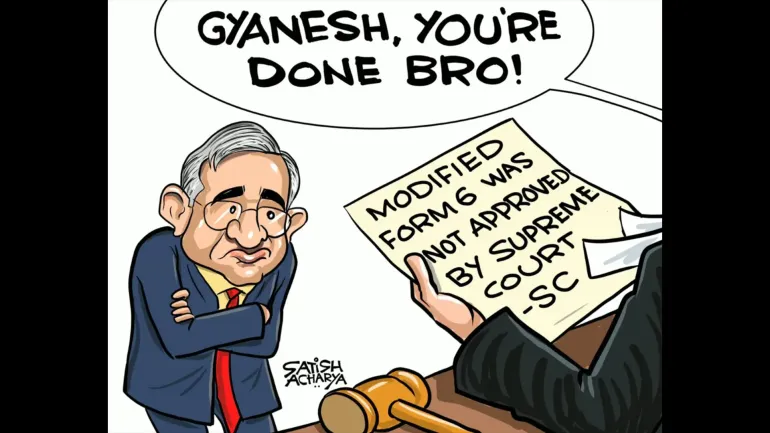
Among those whose works were taken down was political cartoonist Satish Acharya.
One of Satish Acharya’s cartoons taken down by the social media companies [File: Al Jazeera]
Several of Acharya’s cartoons, some up to three years old, were removed and his Instagram account was blocked in India from September 28 until late on October 5, he told Al Jazeera.
“At different phases of history, people used cartoons as a tool to express their protest and question the people in power. With the advanced use of social media, cartoons appear in different forms now, sometimes memes and reels,” the 55-year-old said.
“I have a lot of hope in Gen Z. They are fearless, they are creative and they care for the country. Our politicians can learn a lot from them.”
Stand-up comic Jha, who attended the CJP’s protest in Mumbai, agrees. “The more cruel the power is, the softer, more humorous and more artistic the protest becomes,” he told Al Jazeera.
But Jha has refused to apply for a reinstatement of his name in the voters’ list.
“I think they will see this interview and probably I will be in some detention centre. I just want to see what will happen. I’ll not register my name again,” he said.
However, he had a satirical message for Modi as he urged the Indian leader to stop the crackdown on online content.
“Please give back my right to vote. You are a great leader with a 56-inch chest. You shouldn’t be scared of one video,” he said, invoking a long-held right-wing boast about Modi’s famous bust.
India’s Cockroach Janta Party says its members have been subjected to mass arrests across India ahead of Saturday’s protest in New Delhi. Protesters are demanding the election panel chief’s resignation over alleged irregularities in voter-list revisions that critics say benefited Modi’s BJP.