midterms

Trump’s team is in chaos as midterms enter final stretch

President Trump bypassed his White House chief of staff last week in selecting Katie Zacharia as his press secretary and chief messenger, triggering days of scathing headlines about her credentials and abilities before her ignominious resignation on Friday.

Susie Wiles, that senior-most aide ostensibly in charge of the president’s team, is facing his scrutiny over a different set of problems: widespread public anxiety over corruption in government under the Trump administration. The issue has surpassed the economy as the top concern of voters entering next month’s election, according a Fox News poll released this week.

Marco Rubio, the president’s secretary of State and national security advisor, has been silent on Trump’s decision to cut a deal with Moscow on diesel sales that could fuel Russia’s war against Ukraine. The president’s poll numbers have been below water across the board, but especially so on foreign policy, where over two-thirds of Americans disapprove of his job performance and support Kyiv’s fight for freedom.

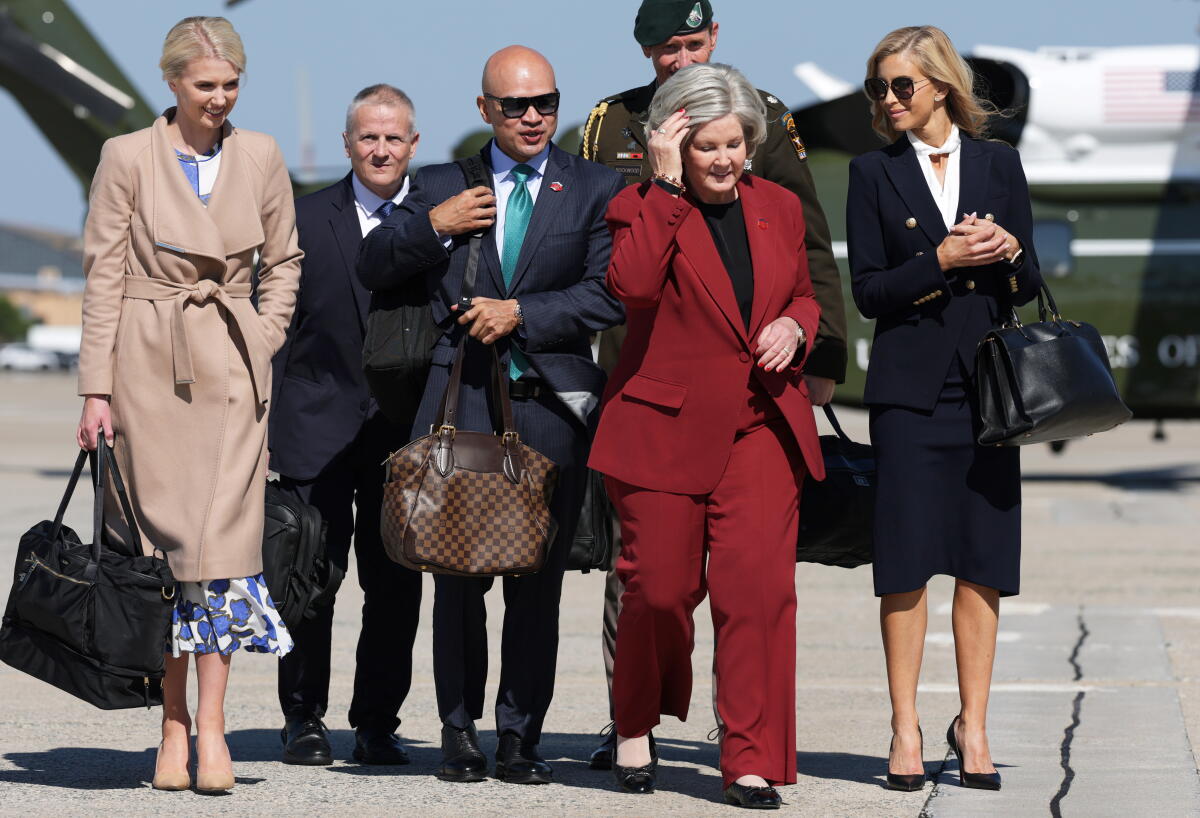
President Trump's senior aides walk to board Air Force One

Trump aides walk to board Air Force One on Tuesday: Natalie Harp, Trump’s executive assistant, left; Walt Nauta, director of Oval Office operations (in sunglasses); Chief of Staff Susie Wiles; and then-Press Secretary Katie Zacharia.

(Alex Wong / Getty Images)

And on Thursday, the president was forced to reverse a course set out by Defense Secretary Pete Hegseth and the Pentagon to live-stream the execution of a convicted mass shooter by firing squad.

In the final stretch of the 2026 midterms, nearly two weeks out from election day, a White House that has enjoyed relative stability over the past two years has returned to the state of disarray that characterized much of Trump’s early political career, anticipating sweeping losses to Democrats in the House and Senate.

Staff upheaval is expected as officials brace for a blame game over Republican performance, with some distancing themselves from what they see as a fading political movement.

Polls suggest that Republicans are likely to lose control of the House, setting up two years of relentless congressional probes through the twilight of the Trump era, and that Democrats could even flip the Senate, winning in ruby red states from Ohio to Alaska.

It is historically a time for closing arguments, when politicians deliver their final pitches to voters in neat, disciplined packages.

Yet Trump’s campaign blitz across the country in recent weeks has generated a muddled message, dismissing the importance of the election itself at the risk of depressing Republican votes, overshadowing local candidates seeking distance from his record and touting an economy unrecognizable to most Americans.

President Trump is followed by White House Press Secretary Katie Zacharia

President Trump walks ahead of Katie Zacharia at the White House.

(Win McNamee / Getty Images)

The president’s selection of Zacharia, who lasted just five days on the job, raised fresh questions about his message discipline in the final stretch.

And infighting within the White House has reinforced a narrative among political pundits that Democratic gains are a fait accompli, despite Zacharia, in her first and only press briefing, foretelling of Republican energy and excitement “never seen before in the history of midterms thanks to President Trump.”

Election officials across the country fear that, anticipating inevitable losses, Trump may be laying the ground to challenge the authenticity of the election results themselves.

“You know, this is the only guy that — it’s ‘promises made, promises kept,’ but he did more things than he promised,” Trump said Thursday, referring to himself in the third person. “I think we did. We did much more than we promised.”

The extent of the coming West Wing shakeup could be extensive, reaching into a Cabinet that has had far less turnover than Trump experienced in his first term.

Zacharia is the second senior official forced out by Trump in just three days, after Kimberly Guilfoyle, the former fiancée of one of Trump’s sons who served as U.S. ambassador to Greece, was revealed by the Wall Street Journal to have asked a Trump donor to pay off her $100,000 credit card bill.

Now, the president has begun asking political allies and donors about Wiles’ job performance, according to a recent Politico report, and several top administration officials are vying for her role, anticipating her resignation after the elections next month.

The conclusion of the midterms will also kick off the start of the 2028 presidential election season, when Republican hopefuls — including many from Trump’s Cabinet — are expected to launch exploratory committees.

British Defense Secretary Wes Streeting stands next to a saluting Defense Secretary Pete Hegseth.

British Defense Secretary Wes Streeting and U.S. Defense Secretary Pete Hegseth stand for anthems at the Pentagon on Thursday.

(Finn Gomez / Getty Images)

“We have to get through the midterms first,” Trump said at the end of August, asked about Hegseth reportedly considering a run. “I bet there’s a lot of people considering it that you don’t know about. You have a lot of people.”

The party of incumbent presidents regularly loses seats in midterm elections, and it is common for presidents to shake up their staffs halfway through a term.

But the last time a term-limited Republican president faced voters in midterm elections, in 2006, Democrats swept into power in both houses of Congress — and President George W. Bush’s political capital never recovered.

That year, 37% of voters said they approved of Bush’s job performance. Polls published this month by AP and Reuters have found Trump already below that threshold.

In the GOP presidential primaries that followed, candidates jockeying to replace Bush distanced themselves from his legacy. He ultimately left office with an approval rating of 25%.

Source link

Trump wants the midterms to be all about himself. Judging by the ads, Democrats are happy to oblige

President Trump says he wants voters to pretend that he’s on the ballot in this year’s midterm elections.

His rivals are doing their best to help his case.

Democratic candidates and their allies have spent more than $163 million since Sept. 1 on television advertising that mentions the Republican president, according to an Associated Press analysis of data from AdImpact, which charts media spending.

That includes airing ads that reference Trump on broadcast, cable and streaming nearly 180,000 times, the data shows. Republicans, meanwhile, have run ads that talk about the president just 16,000 times, at an estimated cost of $11 million, over the same period.

It’s a noticeable silence about the party’s dominant yet unpopular leader.

Many of the Democrats’ ads accuse Republican opponents of siding with the president over voters, particularly on issues like tariffs and the Iran war, which they blame for jacking up costs.

The ads include one from the campaign of Georgia Sen. Jon Ossoff, who is running for reelection and has spent nearly $3 million on a Trump-focused ad attacking his rival, Rep. Mike Collins, for his close relationship with the president.

“Mike Collins voted for Trump’s war in Iran, sending gas prices through the roof. He voted for Trump’s tariffs, sending grocery prices soaring. And Mike Collins voted with Trump to double health insurance premiums for more than a million Georgians,” it says. “Mike Collins sides with Donald Trump and makes you pay more.”

Republican National Committee spokesperson Natalie Baldassarre said Democratic messaging reflected the party’s hollowness instead of its strength.

“Democrats are lighting money on fire talking about President Trump because they have no agenda other than investigation, obstruction and impeachment,” she said. “Trump Derangement Syndrome isn’t a policy platform, it’s a $160 million way of saying you have nothing to offer to the American people.”

Another ad from the House Majority PAC, a super PAC dedicated to electing Democrats to the House, opens with a middle-aged woman standing over her kitchen stove and talking about how her family is “barely getting by” before she expresses her disappointment in Pennsylvania Rep. Brian Fitzpatrick, who is one of Republicans’ vulnerable incumbents.

“He used to be independent. But now it seems like he’s in lockstep with Donald Trump. It really bothers me,” she says, adding, “Congressman Fitzpatrick is not for us anymore.”

Indeed, all the Democratic ads that have aired in Pennsylvania’s tightly contested 1st Congressional District since Sept. 1 have mentioned Trump, even though Fitzpatrick voted against Trump’s tariffs and his power to wage war against Iran without congressional approval.

All four of the ads talking about Trump have aired a combined 2,000 times in that period, the AdImpact data shows. Fitzpatrick is being challenged by Democrat Bob Harvie, a county commissioner who is a former social studies teacher.

Democratic strategists say the messaging reflects the sentiment of voters.

“Every single poll and every single focus group shows affordability to be voters’ number one issue, and they specifically point to corrupt politicians as being responsible for driving up prices,” said House Majority PAC spokesperson Katarina Flicker.

Republican ads back away from the president

Out of dozens of issue categories tracked by AdImpact, the analysis found that Trump was the fourth most common issue mentioned by Democrats in House and Senate races’ final stretch. It was topped only by healthcare, taxes and accusations about opponents being beholden to special interests.

For Republicans in the same races, Trump-themed ads clocked in at number 33, by comparison. The top issues in their ads were taxes and crime.

Idaho Republican Senator Jim Risch tells viewers he “fought alongside President Trump to pass the biggest tax cuts for working families in American history.”

Overall in the race’s final stretch since Sept. 1, Democrats have spent or plan to spend $1.8 billion in ads across all federal, state and local elections. Republicans have spent or reserved $2.2 billion nationwide.

Republican strategist Alex Conant said Democrats are banking on Trump motivating their base to vote, an approach they’ve routinely used over the last decade.

“Democrats want this election to be a referendum on Trump. They want to equate a vote for a Republican candidate to a vote for Trump,” he said.

For Conant’s party, it’s a different calculus.

“We have a ton of money and we’re throwing every kind of message on the wall to see what sticks,” he said. “There’s not a cookie-cutter Republican ad this year. Whereas the Democratic ads are pretty obvious.”

Colvin and Kessler write for the Associated Press.

Source link

Watch: Will disenchanted Iowa Republicans reject Trump in the midterms?

There are just weeks to go until the US midterm elections that will decide control of Congress, with campaigning in full swing around the country and voters weighing who to back at the ballot box.

The elections will have a potentially major impact on the remainder of President Donald Trump’s time in office. He is facing challenging political headwinds with concerns over rising costs and the war in Iran high on the minds of voters.

Ahead of the elections, the BBC’s Sarah Smith travelled across Iowa to speak to voters in the predominately Republican state.

Produced by Cai Pigliucci, filmed by John Landy and edited by Blanca Estrada

Source link

Ahead of US midterms, voters are frustrated with Trump, want change: Poll | US Midterm Elections 2026 News

Widespread voter disillusionment and pocketbook anxieties set a volatile stage for the GOP weeks before election night.

Voter sentiment across the United States is increasingly negative towards US President Donald Trump’s domestic and foreign policies, according to a new Associated Press-NORC Center for Public Affairs Research poll.

In the closing weeks before the November 3 US congressional midterm elections, 80 percent of Americans polled said the country needs substantial change or “complete and total upheaval” in how it is run, according to the survey of over 1,100 US adults released on Thursday.

Democrats and independents are much more likely than Republicans to want a total overhaul of the country’s direction, the survey found, but even Republican voters are still looking for some change. Slightly fewer than half, 45 percent, want substantial change, while 13 percent are seeking upheaval.

The results point to a pervasive appetite for legislative realignment that poses a risk to the Republican Party’s power as it looks to keep control of both houses of the US Congress.

Fuelled by soaring living costs, everyday economics is driving a majority of the electorate, with 85 percent of respondents saying the economy is one of the most significant issues in weighing their vote in the upcoming election. About eight in 10 registered voters disapprove of how Trump is handling the cost of living, and about three-quarters disapprove of his performance on the economy.

Only about one-third of registered voters overall have a “very” or “somewhat” favourable view of the Republican president, and a similar share approve of his performance as president.

More voters want Democrats to win control of Congress and have a more negative view of Republicans.

Immigration and crime rates are also top concerns for some voters, according to the survey results, with 45 percent of voters identifying them as top priorities, though the two issues are prioritised disproportionately by Republican voters who reference them more frequently than Democrats. Conversely, Democratic voters are more prone to name healthcare as their top priority.

Emerging cultural and technological concerns drew less immediate alarm across the board: 35 percent of voters ranked artificial intelligence as a substantial issue, while transgender issues sit significantly lower at 12 percent.

Healthcare is also considered a top issue for 69 percent of voters, while 64 percent cite the war on Iran as top-of-mind.

Despite their grievances, a majority of voters across both major American parties still value civic engagement.

About two-thirds of registered voters in the survey say it’s “extremely” important to vote in the upcoming election, while about two in 10 say it’s “very” important. Seventy-five percent of Democratic voters view it as “extremely” important, compared to roughly 60 percent of Republican respondents.

Source link

Argentina’s Milei backs Trump for US midterms, calls vote crucial for West | Donald Trump News

The President’s ally says conservatives “cannot give an inch” in Latin America as he accepts an award in Washington.

Argentine President Javier Milei has urged his ally, US President Donald Trump, to come out of the United States midterm elections in a stronger position, calling the vote important for the West as a whole.

Milei made the appeal on Wednesday at a Hispanic Heritage gala in Washington, where a Hispanic association gave him an award, ahead of November’s vote.

Recommended Stories

list of 2 itemsend of list

Conservatives, he said, “cannot give an inch in our reconquest of the hemisphere”, according to Agence France-Presse (AFP).

Milei flew into the US capital on Wednesday for meetings with investors and the gala. He is due to address the US Chamber of Commerce on Thursday.

Argentina’s President Javier Milei attends the Hispanic Heritage Gala in Washington, DC, on October 14, 2026
Argentina’s President Javier Milei attends the Hispanic Heritage Gala in Washington, DC, on October 14, 2026 [Alex Wroblewski/AFP]

Milei’s lifeline

Trump firmly backed Milei a year ago, when his government also faced crucial legislative elections. He has called Milei his “favorite president”.

That backing, together with a currency swap agreement with the US Treasury, helped Milei to success in those polls, analysts have argued.

The centrepiece of the package, announced by Treasury Secretary Scott Bessent, was a $20bn swap with Argentina’s central bank, in which the US exchanged dollars for pesos. The swap came shortly after Milei’s party lost a key provincial election.

Trump made clear at the time that the support hinged on a Milei victory. “I’m with this man because his philosophy is correct,” he said ahead of a White House lunch with the Argentine leader. “If he wins, we’re staying with him. And if he doesn’t win, we’re gone.”

Trump also warned that the US would not be “generous” if Milei lost. The remarks unsettled Argentine markets, with the main stock index giving up earlier gains and falling about 2 percent, The Associated Press reported.

The package drew criticism in the US. Democratic lawmakers accused Trump of prioritising a foreign bailout while the US government was shut down.

Source link

Chuck Schumer has broad support from his caucus, but midterms could decide his future as leader

Chuck Schumer has won and lost Senate majorities since becoming Democratic leader a decade ago. But this year’s midterm elections could be his most important yet, with some in the party having said he needs to step down and make way for a new generation.

Schumer, who has directly or indirectly overseen his party’s Senate campaign arm in almost every election cycle over the last 20 years, has regained trust within his caucus, for now, as Democrats are hopeful of making gains in the midterm elections despite a difficult map that favors Republicans.

Allies of the New York Democrat say it’s a significant turnaround from last year, when the party was still reeling from major election losses. A low point came in the spring of 2025, when the party’s base erupted at Schumer for voting to keep President Trump’s government open.

Interviews with more than a dozen Democratic senators in recent weeks indicate that Schumer has recovered his political standing with many in his caucus. If Democrats gain seats in the election, colleagues expect him to easily win enough support in the closed-door leadership election, likely the week after Election Day.

Should they win a majority, a feat once seen as improbable, another term as leader would be nearly assured, many said. Both parties pick their Senate leaders by secret ballot, so no senator has to reveal their vote.

Still, nothing is guaranteed. While no Democrat has stepped up to challenge Schumer, that could quickly change if his party suffers an unexpected level of losses. And several Democratic candidates around the country have said publicly that they won’t vote for Schumer or have remained noncommittal.

Interviewed by The Associated Press earlier this month, Schumer stated unequivocally that he’s running for another term as leader. He said he believes Democrats have won more favor with voters over the last year and have a shot at winning the majority after fighting Trump’s tariffs, forcing more than a dozen votes to end the war in Iran and focusing on affordability, corruption and healthcare.

“I think our caucus is strong, it’s united,” Schumer said. “A year ago, everyone said it was out of reach. Today, we have a broader map, strong candidates, a clear contrast.”

Sen. Sheldon Whitehouse, D-R.I., said that “Senate seats in some ruby red states seem to be in play” because of candidates Schumer recruited.

Oregon Sen. Ron Wyden, a Democrat who has served with Schumer for almost 30 years, said that “if you had told us in 2025 that we’d be in the home stretch with a really good shot of taking the majority, it would have been like, ‘You’ve got to be kidding me.’ You can’t argue with results.”

And if Democrats don’t win additional seats? “I’m not thinking about that,” Wyden said.

Some senators won’t commit to supporting Schumer

While Schumer appears to be in a good position at the moment, many Democratic senators won’t say publicly whether they will support him — particularly those in the most progressive wing of the party.

“It’s a little bit too early to speculate on that right now,” said Sen. Bernie Sanders, a Vermont independent who caucuses with Democrats.

Massachusetts Sen. Elizabeth Warren said she is focused on November’s elections. “We’ll know a lot more after the midterms,” she said.

Freshman Sen. Elissa Slotkin of Michigan has called for a “new generation” of leaders across the party.

“It’s not a secret that Democrats still haven’t totally found their footing after Trump,” Slotkin said in a recent interview, adding that “we have to see what the results of the election are.”

It’s unclear if anyone else wants the job

Even if there are losses in Senate races, it’s unclear if any other Democrat wants the burden of being leader. Many are instead eyeing runs for the White House in 2028.

Speculation about a challenge to Schumer has centered on Sens. Chris Van Hollen of Maryland, Chris Murphy of Connecticut and Brian Schatz of Hawaii, who has already said he’s running for the No. 2 leadership spot to replace retiring Illinois Sen. Dick Durbin.

Asked about Schumer, Van Hollen said he doesn’t want to discuss it yet.

“Look, I think everybody wants to get through this election, and then we’ll go from there,” Van Hollen said in an interview before the Senate left Washington to campaign.

Several Senate candidates around the country have either said they won’t vote for Schumer if they are elected or remained noncommittal, including Troy Jackson in Maine, Adam Hamilton in Kansas and Abdul El-Sayed in Michigan.

At the same time, the Senate Majority PAC, which is closely aligned with Schumer, has put millions of dollars into those campaigns and others. Schumer backed El-Sayed’s primary opponent, but the two met in Washington last month.

El-Sayed said after the meeting that the party is united and “we’re having really productive conversations about what it takes to win.”

Schumer has kept his caucus close

Several of the Democratic senators who insisted on anonymity to share their views agreed that Schumer is likely to win another term as leader. There have been very few discussions about a change, said one, partially because Schumer has stayed close to almost everyone in his caucus, keeping them on speed dial in his famous flip phone. Another senator said that they aren’t aware of Schumer asking for any commitments just yet.

At the same time, some said they would like to see Schumer, who is up for reelection in 2028, announce that this is his last term as leader and commit to helping transition to a successor. A commitment like that could end the conversation, one senator said.

Another senator said that a commitment from Schumer about the future isn’t as important — what will matter is if they win in November.

All of the senators agreed that there are no obvious contenders right now to challenge him, but that could change quickly if Democrats lose Senate seats in November.

Schumer has turned the tables since 2025

Attitudes within the Democratic caucus have improved since last year, when the base revolted against Schumer for the March vote to keep the Republican president’s government open. Progressive groups like MoveOn called for him to step down, arguing that Democrats needed to fight harder against Trump and Republicans.

Schumer regained some favor with Democrats inside and outside the Capitol during a prolonged government shutdown a year ago and as he has repeatedly blocked Trump’s nominees and Republican legislation.

But while the calls to resign or step aside have waned, many are still agitating for change.

“Our priority right now is organizing and making sure we elect a new generation laser-focused on affordability and fighting corruption,” said Joel Payne, a national spokesman for MoveOn.

Referring to the 2025 calls for Schumer to step aside, Payne said the group’s members have “already rendered a judgment on Schumer’s tenure and made clear they’re eager for new leadership that energizes the party base.”

It’s unclear, though, whether calls from the progressive wing of the party will influence the secret ballot vote, in which Schumer needs only a majority to win.

Sen. Ben Ray Lujan, D-N.M., dismissed the talk about Schumer’s future.

“It’s hard to lose if no one else is challenging you,” he said.

Jalonick writes for the Associated Press. AP writers Steven Sloan, Seung Min Kim and Joey Cappelletti contributed to this report.

Source link

Is Trump signalling a return to war with Iran after the midterms? | US-Israel war on Iran News

United States President Donald Trump has said that he does not intend to bomb Iran again until the November midterm elections, even though several US media outlets have reported that the Pentagon has drawn up plans to relaunch attacks before that vote.

Trump has been accused of misdirection on the issue in the past. The US launched its initial attacks on Iran on February 28, as talks with Iran were ongoing and despite Trump saying just the day before that he had not made any decision. One year previously, the US struck Iran towards the end of Israel’s June 2025 12-day war, despite Trump saying he would announce a decision about attacks “in two weeks”.

Recommended Stories

list of 4 itemsend of list

Still, striking Iran ahead of the midterm elections would be risky for the administration as the war remains deeply unpopular with Americans.

Resuming the war afterwards may have less of a negative impact on Trump, who is not eligible to run for another term as US president anyway.

Here’s what we know about Trump’s plans.

In the past two days, The New York Times, The Wall Street Journal and other publications have reported claims by unnamed officials that the Pentagon has drawn up plans to attack Iran before the midterms, if authorised to do so.

On Wednesday, US publication Axios cited US and Israeli officials saying the Pentagon has instructed US Central Command (CENTCOM) to prepare for imminent major combat operations. The Atlantic also reported along similar lines.

What has Trump said?

On Thursday, Trump posted on his Truth Social media platform that he will not order a resumption of strikes on Iran before November 3, when the US midterm elections will be held.

“I want to make it clear to everybody that, while Iran is in very bad condition…we will not be attacking Iran at any time prior to the Midterm Elections to be held in the United States on November 3rd,” he said.

The president added that the US is presently “having productive discussions” with the Iranian side. However, that was also the case on February 28, the day the US and Israel first struck Iran, triggering the war.

Trump did not make any reference to preparing for potential military operations, nor did he provide more details on the state of talks.

Why might Trump be hesitant about resuming bombing before the midterms?

Trump and Republicans are worried about a voter backlash against the war at the polls. The US war on Iran is intensely unpopular domestically as Americans have had to grapple with surging prices of gas, food and other basic commodities because of the crisis in the Middle East.

Since the start of the war, surveys have shown that large numbers of Americans did not approve of striking Iran.

Now, about 65 percent of Americans say they “disapprove” of the way in which Trump has handled the Iran war overall, according to a Pew Research Center poll released on Thursday. Trump stated at the start of the war that it would go on for just a few weeks, however, it is now into its eighth month.

According to Pew, most Americans now believe the war will continue for at least another year. Even Republican or more conservative-leaning voters are growing more negative about the war, its poll found.

The conflict has also severely affected Trump’s personal ratings and eroded support for Republicans. A Reuters/Ipsos poll on Thursday found that only 30 percent of his supporters were enthusiastic about voting in the midterms, compared with 48 percent of Democratic voters.

About 13 percent of those who voted for Trump in 2024 say they are not sure who to vote for in the congressional elections.

Delaying attacks until after the elections could potentially shield Republican candidates from voter backlash, analysts say.

While analysts say Trump will see a good performance at the polls as approval for renewed strikes, a Republican defeat at the polls could equally further incentivise him to hit Iran again as he will calculate that he has little to lose at that point.

While that could further affect Trump’s ratings, the president is not eligible to run in the next presidential election in any case.

Will the US restart the war after the midterms?

In recent weeks, the US president has threatened to “end” the war with force after the elections as talks with Iran have dragged on.

At a Republican convention in September, he accused Iran of trying to affect the outcome of the midterms and said that conflict “is going to end immediately after the elections”.

In an interview with Time magazine two weeks ago, he also said it would be “possible” to ramp up bombing in Iran after the elections, but declined to elaborate. Analysts say his comments were designed to calm voters, while at the same time warning Iran of potential aggression after the vote.

Last week, the US military dispatched about 7,000 sailors and 2,000 Marines aboard several ships now sailing to the Middle East amid threats of new attacks from Trump. The vessel formation included the USS Theodore Roosevelt carrier strike group.

The deployment increases the number of US troops in the region to 20,000, alongside hundreds of aircraft and at least three carrier strike groups.

In the past, US troop build-up in the Middle East and the Caribbean has subsequently resulted in military action.

In June, Washington and Iran signed a ceasefire agreement that quickly broke down over control of the Strait of Hormuz.

Trump has repeatedly said that the US has the upper hand in the strait, citing more oil exports and Iran’s weakened economy. He has also voiced aversion to a deal with Tehran over management of Hormuz, but said he might consider it because “they’re willing to offer us anything to stop”.

Washington rejected a recent proposal from Iran to reopen the strait based on certain conditions it wants the US to meet, including the lifting of sanctions, unfreezing Iranian assets and guaranteeing an end to attacks. Last week, Foreign Minister Abbas Araghchi said Iran was considering a counterproposal from the US.

Source link

Can $1 billion power Republicans to victory in the midterms?

Republicans are entering the final month of the midterm campaign increasingly anxious that the $1 billion at their disposal may not be enough to fend off sweeping losses as the party reckons with President Trump’s unpopularity, persistent cost concerns and the fallout from the war in Iran.

The cash advantage, spread out across a half-dozen groups, is driven largely by the Trump-aligned MAGA Inc., which had nearly $416 million in cash on hand at the end of August and began stepping up its spending on critical races in September.

But that money may have come too late, forcing the president’s group to pay much higher rates because of the shrinking availability of air time. Four Republican Senate campaign officials said groups that reserved advertising time last spring paid much lower rates than MAGA Inc. and its affiliated groups.

Instead, by waiting until September, Trump-connected organizations are sometimes paying more than five times what they would have spent if they acted earlier.

A representative of MAGA Inc. familiar with the group’s strategy said its spending has allowed Republicans to keep races more competitive than they would have been otherwise. In some cases, the group has been the only one on the air criticizing Democratic candidates.

The MAGA Inc. representative and the Republican Senate campaign officials spoke on condition of anonymity to discuss internal strategy.

The challenge is acute in places like Texas, where Trump will travel on Wednesday for the second time in a week to stump for Republican Ken Paxton’s Senate campaign. The state hasn’t elected a Democratic senator since 1988, yet MAGA Inc. has spent more than $22 million in the past month, according to the ad tracking firm AdImpact.

Another group, Texas PAC, which is aligned with Senate Majority Leader John Thune, has spent more than $83 million on advertising in the past month, an extraordinary amount to protect what’s normally a safe Republican seat.

One of those advertisements, which featured Paxton’s estranged wife saying she’s supporting the full Republican ticket, aired across the United States last weekend during a football game between the Dallas Cowboys and the Houston Texans.

Candidates are charged a lower advertising rate than outside groups, so the late infusion of super PAC cash has come at a steep price.

MAGA Inc., which is running ads primarily on streaming services, has been charged roughly $894 per airing, according to AdImpact, while Texas PAC has been charged roughly $809 for a mix of broadcast and streaming. That compares with about $290 for Democratic nominee James Talarico’s campaign, also on broadcast and streaming.

Those averages mask some of the more glaring disparities. For example, during a football game last month, Texas PAC was charged $450,000 to air a single spot in the Austin market. Talarico’s campaign paid $50,000 for a spot during the same game in the same market, according to AdImpact.

Elections are a referendum on the power of money

The 2026 campaign is shaping up as a referendum on the power of money in American politics. Democrats freely acknowledge their disadvantage, relying instead on anti-Trump sentiment among voters and targeted messaging on issues like corruption. Some Republicans, meanwhile, are open about the challenge of trying to spend their way out of a tough campaign at this late stage.

Neil Newhouse, a longtime Republican pollster, echoed concerns that his party was deploying its cash too late.

“After the votes are counted, I think we’re going to find the most effective advertising in terms of communicating message and moving voters and poll numbers, the most effective time was advertising that happened well before Labor Day, not after it,” he said. “A million dollars of advertising in October is a drop in the bucket.”

Thune’s group began pulling back in North Carolina last week, a sign of the party’s challenge in the Senate race there. The state’s outgoing Sen. Thom Tillis has been increasingly vocal about his party’s vulnerabilities and recently said that, even with a strong cash advantage, “in the last month, you pretty much have to place your bets.”

“If we have endless resources, then we should spend endlessly in every state,” he said. “Absent endless resources, you’ve got to make data-driven decisions about where you can win.”

The midterms mark the first national election since the Supreme Court in June erased limits on how much political parties can spend in coordination with candidates for Congress and president, injecting even more money into a political system already awash in cash.

Money alone doesn’t translate into victory

There’s plenty of evidence that money alone doesn’t translate into victory.

Democrat Kamala Harris entered the final stretch of the 2024 campaign with significantly more money than Trump but went on to lose every critical swing state and the White House. Elon Musk’s $25 million didn’t lift his preferred candidate to a Wisconsin Supreme Court seat last year. And Tom Steyer didn’t advance to the general election in the California governor’s race despite pumping $216 million of his own money into the campaign.

The $1 billion that Republicans have amassed compares with roughly $579 million held by a comparable collection of major Democratic groups.

Senate Democratic leader Chuck Schumer said his party is facing an “obscene” amount of spending that could swamp them in the midterms.

“We’re never going to have as much money as them,” he said in an interview. “I sum up the election in this sentence: Can a massive Republican advantage in money beat a massive Democratic advantage in better candidates and political climate? I bet it can’t.”

In addition to Texas, Democrats have mounted competitive Senate campaigns in states like Ohio, Maine, Iowa and Michigan. A similar dynamic has emerged in governors’ races from Florida and Georgia to Wisconsin, Ohio and Nevada.

Former President Barack Obama is stepping up his involvement in the midterms and will headline a fundraiser for Senate candidates on Wednesday.

In the House, Democrats are growing so confident they can retake the majority that they’re expanding their targets deeper into traditionally Republican districts in Arkansas and Tennessee. But a lack of money could limit their gains.

“We absolutely need to spend enough to get our message out,” said Rep. Suzan DelBene of Washington, who chairs the Democratic Congressional Campaign Committee. “And district by district, we are.”

Trump turns to his bond with supporters

From his earliest days as an unlikely political figure, Trump has consistently overcome expectations. Facing daunting prospects heading into the final weeks of his last midterm, he’s betting he can again outwit political gravity, relying in large part on the deep bond he’s built with supporters.

He has stepped up his campaign rallies in recent weeks, traveling to deep red territory to galvanize the party faithful. At events like the one this past weekend in Vandalia, Ohio, the crowd was enthusiastic and cheered at the lines that have become Trump staples over the years, particularly when he dips into profanity. The high school gymnasium that held the event was packed, though crowds began emptying out about halfway through the 90-minute rally.

In the closing minutes of a speech Monday in Grand Island, Nebraska, the president revived his plea that supporters who have stood so fervently by him pretend as if he is on the ballot one more time.

“In a true way, I am running,” he said. “We have to keep it going.”

Sloan and Beaumont write for the Associated Press. Beaumont reported from Des Moines, Iowa. AP writers Seung Min Kim in Vandalia, Ohio, and Mary Clare Jalonick in Washington contributed to this report.

Source link

Trump’s approval hits new low among Hispanic voters ahead of midterms | Donald Trump News

Hispanic voters are twice as likely to favour Democratic Party over Trump’s Republican Party in the November elections.

A new poll from the news agency Reuters and the research firm Ipsos has found that United States President Donald Trump’s approval rating remains at a record low as the midterm elections approach in November.

The six-day survey, completed on Monday, found that just 32 percent of US voters approve of the job Trump is doing as president.

Recommended Stories

list of 3 itemsend of list

While that low rate has held steady since September, the latest Reuters-Ipsos poll suggests his support among Latino voters is continuing to slide.

Trump’s approval rating shrunk this month to 24 percent among Hispanic voters, its lowest point in either of his two terms in office.

The Republican leader had previously made substantial inroads with that constituency.

The Pew Research Center estimated that Trump and his Democratic rival, Kamala Harris, were within three percentage points of each other in the 2024 presidential race, earning 48 percent and 51 percent of the Hispanic vote, respectively.

That rate marked a significant jump for Trump over the 2020 election, when he only earned 36 percent of the Hispanic vote.

Experts have credited the boost in Hispanic support with helping Trump win the 2024 race. His 2020 bid, by contrast, ended in defeat to Democrat Joe Biden.

The Monday poll found that Trump’s gains among Hispanics have largely evaporated.

About 52 percent plan to vote for the Democrats in the November midterms, compared to 26 percent for Republicans.

The upcoming midterm is largely viewed as a referendum on Trump’s second term and will decide whether the Republicans maintain their majorities in the US House of Representatives and the Senate.

Democrats have seized on Trump’s low approval ratings, hoping to translate frustration with the president into voter momentum for their party.

A Democratic majority in one or both houses of Congress would place substantial constraints on Trump’s agenda for the remainder of his time in office.

But Trump has also faced rumblings from within his Republican Party as the November 3 midterms approach.

One Republican incumbent, Representative Maria Elvira Salazar of Florida, released a campaign advertisement last month that addressed Trump directly, saying, “The same Hispanics who helped you get to the White House in 2024 feel betrayed today.”

She cited Trump’s hardline immigration crackdown as a source of tension. “Some of your immigration enforcement efforts have gone too far,” she said, pointing to the detention and deportation of immigrants with no criminal record.

Experts have also warned that the president’s shrinking popularity, driven in part by concerns about the cost of living and his decision to launch a war on Iran, could weigh down Republican candidates in key races across the country.

Still, Trump has continued to express confidence about the prospects of his Republican Party in the upcoming midterms.

He has also defended his decision to place himself at the centre of the Republican election campaign strategy. Trump recently launched a 32-day blitz of cross-country rallies ahead of the November 3 midterms.

“Just so you understand, they all want me to go,” Trump said, denying that some Republicans would prefer he keep his distance. “They all want me to go campaign.”

Source link