midterms

Analysis: Trump loomed over midterms and GOP suffered for it

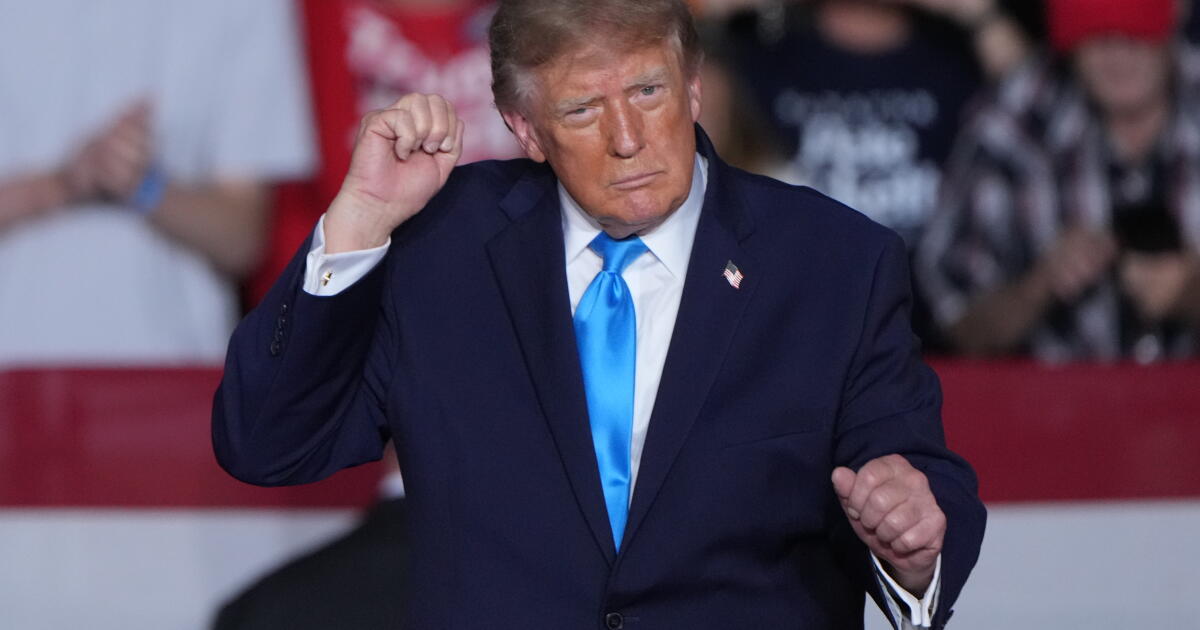
The protracted uncertainty over control of Congress reverberated through both major political parties on Wednesday, as Democrats basked in the relief of the red wave that wasn’t and Republicans became increasingly clear-eyed that the lingering influence of former President Trump had hamstrung their party.

President Biden’s emphasis during the campaign season on the extremism of “MAGA Republicans” had been greeted skeptically by many. In the Democratic Party’s better-than-expected showing, though, he saw vindication of his appeals for civility and normalcy.

“This election season, American people made it clear: They don’t want every day going forward to be a constant political battle,” Biden said at a White House news conference. “The future of America is too promising to be trapped in endless political warfare.”

Amid high inflation and Biden’s lackluster approval numbers, Democrats’ hopes had hinged on voters being more put off by Trump’s imprint on the Republican Party — be it the divisive candidates he endorsed, the political violence that festered from his lies about election fraud, or the reversal of federal abortion protections made possible by justices he appointed to the Supreme Court.

“We knew going into the cycle that there was going to be an opportunity to rally a moral majority that is an anti-MAGA coalition,” said Tory Gavito, president of Way to Win, a progressive donor network. “When I say that, I include everyone from [GOP Rep.] Liz Cheney to [democratic socialist Sen.] Bernie Sanders. Think about that spectrum of the middle to the left coming together to say Republicans are just too damn extreme.”

If recent history is any guide, Trump’s not going anywhere. The once and likely future presidential candidate is unpopular, but he continues to exercise outsized sway over the Republican base, and could hobble the party for the next two years and beyond.

“While in certain ways yesterday’s election was somewhat disappointing, from my personal standpoint it was a very big victory,” Trump said on his conservative social media network, Truth Social, pointing to the record of candidates he endorsed. “219 WINS and 16 Losses in the General – Who has ever done better than that?”

The specter of the former president hampered the GOP’s ability to frame the midterm as a referendum on Biden, said Ken Spain, a GOP strategist and former spokesman for the party’s House campaign arm.

“Trump was always a looming shadow over this election, more than Republicans probably wanted to admit,” he said. “This essentially became a choice election between an unpopular president and an even more unpopular Trump.”

There were signs that patience was running thin among Republican power brokers. Notably, Trump’s much-beloved New York Post, the tabloid owned by conservative media magnate Rupert Murdoch, featured Florida Gov. Ron DeSantis on its cover Wednesday with the headline “DeFuture.” DeSantis is widely considered Trump’s biggest threat for the 2024 GOP presidential nomination.

Republicans still had a chance of winning both chambers of Congress as vote-counting continued Wednesday. House Minority Leader Kevin McCarthy (R-Bakersfield) projected confidence that his party would win the five additional seats necessary to take the majority there, and announced his intention to run for speaker of the House.

Whether he secures a majority may come down to his home state. California’s 11 competitive races remained unsettled as of Wednesday evening, with results trickling in slowly, as is common with the state’s methodical ballot-counting procedures.

Republicans had targeted incumbent Democratic Reps. Katie Porter and Mike Levin in Orange County, as well as an open seat in the Central Valley, as possible pick-ups. But Democrats were also watching the returns for the potential to oust vulnerable GOP Reps. David Valadao of Hanford and Ken Calvert of Corona.

Republican Sen. Ron Johnson of Wisconsin notched a close win over Democratic challenger Mandela Barnes, giving Republicans a 49-48 advantage in the Senate, with races in Georgia, Arizona and Nevada yet to be decided.

With neither candidate in Georgia winning more than 50% of the vote, the race will go to a Dec. 6 runoff, like the one that decided Senate control in 2020. A 50-50 split in the Senate would let Democrats maintain control with Vice President Kamala Harris’ tiebreaking vote.

Republicans made some successful pushes into blue territory; in New York, for example, they appeared likely to win four Democratic-held House seats. Rep. Sean Patrick Maloney, a New York Democrat who led his party’s efforts to keep the House, conceded his own race Wednesday morning to Mike Lawler, a Republican state assemblyman.

Still, the night was distinctly underwhelming for a party that contemplated a blowout win in the House and an assured majority in the Senate.

“Definitely not a Republican wave, that’s for darn sure,” Sen. Lindsey Graham (R-S.C.) said Tuesday night on NBC as he predicted a narrow win for Republicans in the Senate.

Paradoxically, a small Republican majority in the House would likely give Trump more leverage there, as McCarthy would have to depend on continued support from acolytes of the former president, such as Rep. Marjorie Taylor Greene, to exercise the GOP’s majority power.

Biden, speaking at the White House on Wednesday, said he had not had much occasion to interact with McCarthy but planned to talk with him later in the day. The president promised to work with Republicans in Congress, but noted pointedly that the American people had also sent the message that they wanted the GOP to show similar cooperation.

The president was happy to point out that his party had defied expectations, noting that “while the press and the pundits [were] predicting a giant red wave, it didn’t happen.”

National exit polls gave a glimpse into why Republicans fizzled. The surveys showed inflation was a top concern among voters. But abortion ranked second. That, and the relative weakness of Trump-backed candidates, helped Democrats stay in the fight.

Many voters appeared willing to swallow their disappointment with Biden. An NBC exit poll showed Democrats narrowly winning — 49% to 45% — among voters who “somewhat disapprove” of Biden’s performance.

Results in Michigan underscored the extent of the Republican Party’s disappointments. Democratic Gov. Gretchen Whitmer, whom Trump had attacked relentlessly, defeated his endorsed candidate, Tudor Dixon, and Democratic incumbents held on to the state’s attorney general and secretary of state posts and gained control of the Legislature as well.

The GOP failed to oust Rep. Elissa Slotkin, a vulnerable Democrat in a Michigan swing district that barely backed Biden two years ago. Elsewhere in the state, a Trump-backed candidate — who in the primary beat Rep. Peter Meijer, a Republican who had voted to impeach the former president — lost in the general election, costing Republicans a seat in the surprisingly tight battle for control of the House.

Michigan voters also approved a ballot measure striking down a 1931 ban on abortion, and voters in Kentucky rejected an initiative that would have amended the state constitution to make clear it did not protect abortion rights.

The Republicans’ loss of a Senate seat in Pennsylvania could prove the most consequential if Democrats keep the chamber. Lt. Gov. John Fetterman defeated Mehmet Oz, a television doctor and first-time candidate backed by Trump. Fetterman, still recovering from a stroke, painted the untested Oz as an elite carpetbagger.

Many of the gubernatorial candidates Trump backed also lost or were in danger of losing as of Wednesday afternoon. DeSantis’ double-digit win in Florida, as well as his strong coattails for Republicans in the House, served as a stark contrast. But Trump has said he will run again even if party leaders prefer DeSantis. Opinion polls, at least for now, show the former president as the prohibitive favorite to capture the party’s nomination.

Jason Miller, an advisor to Trump, told the BBC on Wednesday morning that he was urging Trump to postpone an announcement that he will run again from next week — as he has been teasing — to December, to avoid distracting from a potential Senate runoff in Georgia. But Miller said he remained 100% certain that Trump would run.

“Many of the people who are championing Ron DeSantis for president are the same people who were skeptical of President Trump ever since he came down the escalator in 2015,” Miller said, recalling Trump’s improbable announcement for the 2016 race.

Miller predicted that Trump would “have his hands full” but would ultimately win the nomination again.

Mason reported from Los Angeles and Bierman from Washington. Times staff writer Erin B. Logan contributed to this report from Washington.


Source link

‘We got our butts kicked’: Republicans reckon with Democratic success ahead of the midterms

The bluntest assessment of Republican failures during this week’s elections in Wisconsin came from one of their own.

“We got our butts kicked,” said U.S. Rep. Tom Tiffany, who is running for governor.

He was referring to Democratic victories in campaigns for the Wisconsin Supreme Court and the mayor’s office in Waukesha, a conservative suburb outside Milwaukee. But some Republicans were also rattled by a special election in Georgia, where their candidate to replace Marjorie Taylor Greene in Congress won by a much slimmer margin than the party enjoyed in the past.

Taken together, the swings from red to blue added more data points to an increasingly clear picture of Democratic momentum heading into the November midterms, when control of the U.S. House, the U.S. Senate and state governments around the country are up for grabs.

“In rural, urban, red, blue, Democrats have overperformed everywhere,” said Jared Leopold, a Democratic consultant whose clients include Keisha Lance Bottoms, a candidate for Georgia governor. “That is a significant canary in the coal mine about what November of ’26 is going to look like.”

Some Republicans insisted there was no need to panic, and their fundraising remains stronger than Democrats’. Stephen Lawson, a Georgia strategist, said “the sky is not falling.”

But he also said his party is running behind where it has been in the past, and Republicans need to be “looking at these results carefully.”

‘A red alarm for Republicans’

Special elections can be notoriously unreliable as political benchmarks, but Democrats have consistently demonstrated surprising strength. They flipped a Texas state Senate district. They won a Florida state House seat in a district that includes President Trump’s Mar-a-Lago resort in Palm Beach.

Then they gained ground on Tuesday in the race to replace Greene, who resigned from Congress in January after a falling out with Trump.

Clay Fuller, the Republican candidate, prevailed by 12 percentage points. Two years ago, Greene won by 29 percentage points and Trump carried the district by almost 37 percentage points.

“That’s a red alarm for Republicans,” said Democratic strategist Meredith Brasher.

Fuller defeated Shawn Harris, who plans to challenge him again in November.

Jackie Harling, the district’s Republican chairwoman, said she believed that Greene’s resignation energized Democrats while her party is suffering from “election fatigue.”

“Marjorie Taylor Greene was like a freight train that you couldn’t stop, and when she pulled out, it gave Democrats hope and it gave them a shot at winning something they believed was unwinnable,” Harling said.

‘Slightly bluer side of purple’

Georgia has key races this year, including an open contest for the governor’s office. Sen. Jon Ossoff, a Democrat, is trying to defend his seat as well.

There’s reason to think that simmering discontent could boomerang on Republicans just two years after Trump harnessed voters’ anger with his comeback presidential campaign.

In November, Democrats defeated two Republican incumbents in statewide races for seats on the Public Service Commission, which regulates utilities. Rising electricity rates have been a fault line in recent campaigns, especially as enormous data centers are built to power artificial intelligence.

But Georgia Democratic Party Chair Charlie Bailey is trying to maintain modest expectations.

“We could cement ourselves, put ourselves, on the slightly bluer side of purple,” he said. ”We’re not going to overnight turn into Colorado.”

‘A very clear sign of momentum’

Wisconsin holds statewide elections for Supreme Court seats, and liberals expanded their majority with a 20-percentage-point blowout victory on Tuesday.

Democrats saw gains in red, blue and purple counties when compared with another judicial race last year, which was also won by the liberal candidate.

“This to me was a very clear sign of momentum and enthusiasm for Democrats in the fall,” said Wisconsin Democratic Party Chairman Devin Remiker.

The state has its own open race for governor this year, and Democrats are hoping to take control of the state Legislature and oust Republican U.S. Rep. Derrick Van Orden.

“It’s time for us to put this thing in overdrive,” said Mandela Barnes, a Democratic former lieutenant governor who is running for governor.

Milwaukee County Executive David Crowley, another Democratic candidate for governor, said it’s clear that “people are really upset with the Republican Party and their brand right now.”

“But that doesn’t mean that they’re automatically going to come over to the Democrats,” Crowley said. “And that’s why we have to continue to focus on the issues and speak to the values of all the voters here in the state of Wisconsin.”

‘A lot of anxiety’

Tiffany, the Republican candidate for governor in Wisconsin, cautioned against reading too much into Tuesday’s results.

He said “every election is unique,” and he wasn’t making any changes to his campaign. He said the key to winning will be to “paint that clear contrast of how we are going to help everyday Wisconsinites.”

But Democrats seemed to be making inroads, including in Waukesha. The city is located outside of Milwaukee in the Republican stronghold of Waukesha County.

Democrat Alicia Halvensleben, president of the city’s Common Council, defeated Republican Scott Allen, one of the most conservative members of the state Assembly.

She said Trump came up “a lot” when she was campaigning, although she thinks her victory came down to local issues and how the state legislature wasn’t addressing them.

“There’s so much uncertainty at the national level,” Halvensleben said. “I think that level of uncertainty is causing people a lot of anxiety, all the way down to the local level.”

Bauer, Amy and Cooper write for the Associated Press. Amy reported from Atlanta, and Cooper from Phoenix.

Source link

Trump’s Iran war leaves Republicans adrift ahead of midterms

This is not the run up to the midterm elections that Republicans wanted.

A year and a half after winning the White House by promising to lower costs and end wars, Donald Trump is a wartime president overseeing surging energy costs and an escalating overseas conflict that many in his own party do not like.

He offered little clarity to a nation eager for answers this week during a prime-time address from the White House, his first since the U.S. and Israel attacked Iran more than a month ago, simultaneously suggesting that the war was ending and expanding.

“Thanks to the progress we’ve made, I can say tonight that we are on track to complete all of America’s military objectives shortly, very shortly,” Trump said. “We’re going to hit them extremely hard over the next two to three weeks.”

Trump’s comments come roughly six months before voters across the nation begin to cast ballots in elections that will decide control of Congress and key governorships for Trump’s final two years in office. For now, Republicans, who control all branches of government in Washington, are bracing for a painful political backlash.

“You’re looking at an ugly November,” warned veteran Republican pollster Neil Newhouse. “At a point in time when we need every break possible to hold the House and Senate, our edge is being chipped away.”

Republicans confront evolving political landscape

It’s hard to overstate how dramatically the political landscape has shifted.

At this time last year, many Republican leaders believed there was a path to preserve their narrow House majority and easily hold the Senate. Now they privately concede that the House is all but lost and Democrats have a realistic shot at taking the Senate.

Republicans are also struggling to coalesce around a clear midterm message on Iran.

The Republican National Committee has largely avoided the war in talking points issued to surrogates over the last month. The leaders of the party’s campaign committees responsible for the House and Senate declined interview requests. Many vulnerable Republican candidates sidestep the issue, unwilling to defend or challenge Trump publicly.

The president remains deeply popular with Republican voters, and he has vocal supporters like Sen. Lindsey Graham of South Carolina.

“That was the best speech I could’ve hoped for,” he wrote on social media after Trump’s address on Wednesday evening. Graham said Trump “gave the American people a clear and coherent pathway forward.”

Trump made little effort to sell the conflict to Americans before the initial attack. Five weeks later, at least 13 U.S. service members have been killed and hundreds more injured. Thousands more troops have converged on the region, and the Pentagon requested $200 billion in new funding.

The Strait of Hormuz, a key passage for a fifth of the world’s oil, remains closed. The average price for a gallon of gasoline in the U.S. was $4.08 on Thursday, according to AAA, almost a full dollar higher than on President Joe Biden’s last day in office.

On Wednesday, Trump insisted that gas prices would fall quickly once the war concluded but offered no solution for reopening the Strait of Hormuz. Instead, he invited skeptical U.S. allies to do it themselves.

He insisted that the war would be worth it.

“This is a true investment in your grandchildren and your grandchildren’s future,” Trump said. “When it’s all over, the United States will be safer, stronger, more prosperous and greater than it has ever been before.”

Former Rep. Marjorie Taylor Greene, a Georgia Republican who was once among Trump’s most vocal allies in Congress, lashed out against his Iran policy.

“I wanted so much for President Trump to put America First. That’s what I believed he would do. All I heard from his speech tonight was WAR WAR WAR,” she wrote on social media. “Nothing to lower the cost of living for Americans.”

Time is not on Trump’s side

About 6 in 10 U.S. adults say the U.S. military action in Iran has “gone too far,” according to AP-NORC polling from March. Roughly a third approve of how he’s handling Iran overall.

The possibility of sending U.S. forces into Iran also appears politically unpalatable.

About 6 in 10 adults are “strongly” or “somewhat” opposed to deploying U.S. troops on the ground to fight Iran. That includes about half of Republicans. Only about 1 in 10 favor deploying troops.

At the same time, Trump’s approval ratings have remained consistently weak. About 4 in 10 Americans approve of how he’s handling the presidency, roughly in line with how it’s been throughout his second term.

Republican strategist Ari Fleischer, a senior aide in former President George W. Bush’s administration, acknowledged that Trump has not received the polling bump in this war that Bush got after invading Iraq.

Bush, of course, worked to build public backing for the Iraq War before going in. Immediately after the 2003 invasion, Bush’s popularity soared, as did the stock market.

Public sentiment and the economy soured only after the conflict stretched on. It ultimately spanned more than eight years, spawning a generation of anti-war Republicans — and sowing the seeds of Trump’s “America First” foreign policy.

“My hope is that the Trump experience is the exact opposite of the Bush experience,” Fleischer said.

He said Trump must win the war decisively and quickly to avoid a further backlash, saying there could be a “very significant political upside if things end well, oil comes down and markets rally.”

Fleischer added that Trump’s actions will matter much more than his words.

“Ultimately, he is not going to get judged on his persuasion or his explanations or his assertions, he’s going to get judged on results,” he said.

Peoples writes for the Associated Press. AP writer Linley Sanders in Washington contributed to this report.

Source link

Trump’s approval ratings just hit a new low. A Latino voter shift could reshape the midterms

With the Iran war in its fifth week, support for President Trump is at its lowest point ever, with a growing body of recent polling showing him losing ground with key voting blocs that helped power his 2024 victory.

While public dissatisfaction is evident among many groups surveyed, the decline in support for the president has been most pronounced among Latino voters.

A Reuters/Ipsos poll released March 24 found 36% of voters approve of the president’s job performance, the lowest it has been during his second term. The poll found 62% disapproved.

Other polls, such as the AP-NORC poll, placed the figure at 38%.

In all, the president is underwater on almost every single public policy issue. With the exception of crime, which sits around 47% approval, he has recorded no gains in any polled category, according to experts.

On immigration, the president’s marquee issue, approval fell from roughly 45% in late 2025 to 39% in February, according to Reuters.

About 1 in 4 respondents approved of Trump’s handling of the economy, Reuters found, as domestic gas prices surged by more than $1 per gallon after fighting commenced last month. The share of Republicans who disapprove of his handling of cost-of-living issues rose 7 points in one week to 34%.

The shift comes amid growing economic unease and amplified backlash over the war in Iran. About 1 in 3 Americans approve of the military operation, according to a Reuters survey.

And a growing divide among prominent conservatives has emerged over the U.S. involvement in the Middle East.

The clashes have played out in public and are exposing tensions within the Republican Party, with conservative commentators such as Megyn Kelly openly questioning whether the war is in America’s best interest.

“This is not a foreign policy that makes sense and it is not what Trump ran on. It is, in many ways, a betrayal of his campaign promises, what he sold himself as and of his MAGA base,” Kelly said earlier this month.

Other conservative pundits, including Candace Owens, Tucker Carlson and Nick Fuentes, are also opposed.

But the real damage is showing up in the one place Trump can’t afford to lose: his base.

Trump entered his second term buoyed by historic gains with Latino voters. Exit polls indicated he improved his standing with them by more than 20 percentage points in 2024 compared with his 2016 victory, fueling widespread narratives that the demographic was undergoing a durable shift toward Republicans. In all, 48% of Latinos gave him their support in the last election.

Since then, his approval among Latino voters has plummeted to 22%, according to a March 2026 analysis by the Economist.

In a bipartisan poll by UnidosUS released in November, 14% of Latino voters said their lives were better after Trump took office, while 39% said they had gotten worse.

The president’s rapport with Latinos reflects a deep dissatisfaction with economic conditions, according to Mike Madrid, a veteran California Republican political consultant and expert on Latino voting trends.

“Overwhelmingly, this is a function of the economy and affordability,” he said. “Latino voters moved away from Biden-Harris for the exact same reasons that they’re moving away from Donald Trump right now.”

Research and polling suggests Latino voters prioritize cost-of-living issues — such as housing, wages and inflation — over immigration, a topic often emphasized in national messaging.

“It’s not even close,” Madrid said. “Immigration is not even a top 5 issue for Latino voters.”

Madrid suggested the demographic rallying is less a “reversion” and more a reflection of a rapidly changing electorate.

“Latinos have emerged as the only true swing vote in America,” he said. “And they’re rejecting whichever party is in power.”

These volatile, double-digit voting shifts directly contrast more stable voting patterns among other major demographic groups, including the Black and white electorates, where shifts from cycle to cycle tend to be just a few points.

The reason: dramatic turnout fluctuations. Who decides to show out or stay home on election day tends to change by the year. It’s compounded by the fact that there are far more first-time Latino voters than in any other category.

Polling this month suggests Trump is also losing ground among young voters, another group that contributed to his 2024 gains.

More than half of men under the age of 30 supported Trump in that election, helping him turn several swing states.

In just a year, that demographic has cratered by 20 points.

“Trump won in 2024 because of men. They are abandoning him right now,” CNN senior data analyst Harry Enten said Tuesday.

The reversals could have massive implications for the November midterm elections, particularly in competitive congressional districts where small swings could determine control of the House.

Republicans have warned that if they lose hold of their narrow congressional majority, Trump is likely to face a third impeachment.

UCLA political scientist Matt Barreto said movement away from Republicans is already visible in real-world election outcomes, not just polling.

“We’ve already seen in the Virginia and New Jersey legislative and gubernatorial elections really large shifts in the Latino vote, 25 points back to the Democratic Party,” Barreto said. He added that similar patterns have emerged in places such as Miami and Texas, where Democratic candidates have outperformed expectations with strong Latino support.

Latino Democrats who sat out the 2024 election are returning to the electorate, while some Latino Republicans are disengaging, he said.

That dynamic could prove decisive in November. There are more than 40 congressional districts where the number of registered Latino voters exceeds the margin of victory in 2024, Barreto said. Many of them are closely divided between the parties.

“At the district level, the Latino vote is going to make a huge impact,” he said.

Source link