Middle East

What to know about Israeli President Herzog’s trip to Central America? | Israel-Palestine conflict News

As Israel faces growing international isolation over its regional wars, President Isaac Herzog is set to visit two countries in Central America – Panama and Costa Rica – to boost ties.

“President Herzog’s visit to Panama and Costa Rica reflects the importance of Israel’s ties with countries across Latin America and the renewed momentum in Israel’s relations with Central and South American nations,” a statement from the Israeli Foreign Ministry reads.

Recommended Stories

list of 3 itemsend of list

Israel’s genocidal war on Gaza, which has prompted an International Criminal Court arrest warrant for Prime Minister Benjamin Netanyahu over alleged war crimes, has made it a source of growing opprobrium around the world.

But a handful of countries, most of them led by allies of United States President Donald Trump, have continued to tout their strong ties with Israel, which has sought to maintain those relationships via diplomatic outreach.

What will Herzog’s visit consist of, what will it seek to accomplish, and what can it tell us about Israel’s diplomatic goals in Latin America?

When will the trip take place?

The Israeli Foreign Ministry has said that President Herzog will depart Israel on May 6 for a four-day official visit to Panama and Costa Rica.

Where will Herzog visit, and who will he meet?

The Israeli president will visit Panama first, meeting with President Jose Raul Mulino and government officials before continuing to Costa Rica to attend the inauguration of President-elect Laura Fernandez Delgado.

Herzog was invited to attend the ceremony by the outgoing pro-Israel President Rodrigo Chaves Robles and will also attend a dinner for heads of state. He will also meet with members of the Jewish community in both countries.

What is the significance of a visit by an Israeli president to Panama?

The Israeli Foreign Ministry has said that the Israeli president’s visit to Panama is the “first in history” and will help bolster ties with a country that it calls a “true friend of Israel and a current member of the UN Security Council”.

The meeting between Herzog and Mulino will follow up on discussions on bilateral ties held by the two leaders at the World Economic Forum in Davos in January.

PANAMA CITY, PANAMA - JUNE 24: President of Panama Jose Raul Mulino participates in a bilateral meeting with U.S. Homeland Security Secretary Kristi Noem at the Palacio de las Garzas on June 24, 2025 in Panama City, Panama. Noem is traveling to several Central American countries where she will meet with political leaders and learn about immigration programs and facilities backed by the U.S. Department of Homeland Security in the region. (Photo by Anna Moneymaker/Getty Images)
President of Panama Jose Raul Mulino participates in a bilateral meeting with US Homeland Security Secretary Kristi Noem at the Palacio de las Garzas on June 24, 2025, in Panama City, Panama [Anna Moneymaker/Getty Images]

Is the trip connected to Panama’s status at the UN?

As Israel faces growing isolation on the world stage, it has sought dependable allies at international fora such as the United Nations, and the Israeli Foreign Ministry’s statement notes Panama’s current two-year term as a non-permanent member of the UN Security Council.

While votes in the UN General Assembly have often gone overwhelmingly against Israel in recent years, Panama and Costa Rica have been among those who have joined with Israel and the US or abstained from voting.

Panama and Costa Rica both abstained from a 2024 United Nations resolution calling on Israel to end its illegal occupation of Palestinian territory, and Panama was one of just 12 countries to abstain from a September vote in support of a two-state solution.

Herzog’s visit may be an effort to ensure that Panama remains an ally of Israel during its time on the UNSC.

What is Israel’s endgame for this regional tour?

While the United States is, by far, Israel’s most important ally, it has also celebrated partnerships with countries such as the United Arab Emirates in the Middle East and Argentinian President Javier Milei in South America.

Many of Israel’s allies are also close partners of the US, and some countries in Central America — many of them small states that depend on US support and trade — may see a closer partnership with Israel as a means of signalling their alignment with US interests.

Herzog’s visit will seek to strengthen those relationships, with the Foreign Ministry stating that the trip will bolster “strategic partnership between Israel and the countries and peoples of the region” and underscore the status of those countries as important allies.

Israel has celebrated previous steps deepening relations with countries in the region, including a free trade agreement it signed with Costa Rica in December, along with the opening of a trade office in Jerusalem, which Israel claims as its capital but is considered illegally occupied under international law.

The US Department of State expressed support for those agreements, stating that they would “deepen cooperation between Israel and Latin America, grounded in shared interests and real potential for prosperity”.

Is Israel trying to curtail the growing support for the Palestinian cause in Latin America?

Herzog’s trip may also seek to counter outspoken support for Palestine in Latin America, where leaders on the political left, such as Colombian President Gustavo Petro and Brazilian President Luiz Inacio Lula da Silva, have emerged as vocal critics of Israel.

President Lula recently condemned Israel’s seizure and detention of participants in a humanitarian aid flotilla bound for Gaza that included Brazilian national Thiago Avila, calling it an “unjustifiable action” that should be roundly condemned.

“The detention of the flotilla activists in international waters had already represented a serious affront to international law,” Lula said.

Source link

Iran’s Araghchi holds talks with China’s Wang Yi in Beijing | US-Israel war on Iran News

Iran’s foreign minister meets his Chinese counterpart one week before President Donald Trump’s visit to Beijing.

Iran’s Foreign Minister Abbas Araghchi is holding talks with his Chinese counterpart, Wang Yi, in Beijing amid tensions with the United States in the Strait of Hormuz.

Araghchi’s one-day trip on Wednesday comes a week before US President Donald Trump’s scheduled ⁠visit to Beijing for a summit with President Xi Jinping on May 14 and 15.

Recommended Stories

list of 4 itemsend of list

China’s official Xinhua news agency reported the meeting between Araghchi and Wang had begun, without providing further details.

Araghchi’s visit to Beijing marks the first time he has travelled to China, a close ally of Tehran, since the US-Israeli war on Iran began on February 28. Araghchi had spoken with Wang by telephone at least three times following the start of the war.

Earlier in Washington, DC, US Secretary of State Marco Rubio expressed hope that Beijing would reiterate to Tehran the need to release its chokehold on the Strait of Hormuz.

Iran effectively closed the strait, through which major oil and gas supplies passed, after the war began, sending prices of fuel and fertiliser skyrocketing and rattling the global economy.

Following a ceasefire in April, the US imposed its own blockade on Iranian ports in a bid to compel Tehran to agree to Washington’s terms in peace talks.

Al Jazeera’s Katrina Yu, reporting from Beijing, said two things will be front and centre on the agenda of Araghchi and Wang’s meeting – maintaining the ceasefire and reopening the Strait of Hormuz.

“We know that China has been very critical of the US’s naval blockade on Iranian ports, calling it dangerous. But increasingly, Beijing has also been critical of Iran’s decision to continually close that vital chokepoint,” Yu said.

Wang is expected to speak to Araghchi about what kind of support China can continue to offer Iran if it continues to close the strait.

“Iran will need Chinese backing, for example, at the United Nations, to continue to block any action that would put any additional sanctions on Iran because of its closure of the strait,” Yu said.

“Reportedly, the Iranian foreign minister is looking for clarity from Beijing as to what it will put on the table when Xi meets with Trump, and whether Beijing will be making any concessions to Washington that could make Tehran nervous.”

China, in return, “wants its own assurances that Iran won’t act in any escalatory way or any dramatic fashion in the lead up to that very important meeting”, she added.

Araghchi and Wang’s meeting came as Trump announced a pause on a US military operation to escort stranded ships out of the Strait of Hormuz.

The effort, which began on Monday, ratcheted up tensions, with the US military claiming it sank several Iranian boats that attempted to interfere in the operation. The United Arab Emirates also reported coming under missile and drone attacks from Iran, with one assault sparking a fire at an oil refinery. Tehran denies the launching the attacks.

Trump said on Truth Social the pause was based “on the request of Pakistan and other Countries” and because “Great Progress has been made toward a Complete and Final Agreement with Representatives of Iran”.

Pakistan has been leading efforts for a peace deal between Iran and the US.

The two sides held direct talks in Islamabad on April 11 and 12, but the negotiations ended without an agreement. Key sticking points include US demands for Iran to halt all nuclear enrichment and Tehran’s wish to continue to exercise control over the Strait of Hormuz.

Source link

US pauses plan to guide ships through the Strait of Hormuz | US-Israel war on Iran

NewsFeed

US president Donald Trump has said that the US military operation “Project Freedom” guiding ships through the Strait of Hormuz will be paused for a short period. He cited a request from Pakistan and progress towards a final deal with Iran.

Source link

US Army says ‘Project Freedom’ in blockaded Hormuz has ‘just begun’ | US-Israel war on Iran News

A military operation titled “Project Freedom” has been launched by the US Navy to secure a safe passage of commercial vessels through the blocked Strait of Hormuz, a spokesperson for the United States military’s Central Command (CENTCOM) told Al Jazeera on Tuesday.

The Strait of Hormuz has been at the centre of the US-Israeli war on Iran that began on February 28, triggering disruptions that have pushed up commodity prices around the world.

Recommended Stories

list of 4 itemsend of list

Iran has effectively sealed off the strait by threatening to deploy mines, drones, missiles and fast-attack craft. The US has countered by blockading Iranian ports and mounting escorted transits for commercial vessels.

The US military spokesperson said that ship owners and insurance companies have responded positively to the operation, which has “just begun” and is aimed at ensuring commercial ships can pass through the strait safely to benefit global and regional economies.

Later on Tuesday, US Secretary of State Marco Rubio said at a news conference in Washington, DC, that 10 civilian sailors have died due to the ongoing conflict in the Strait of Hormuz, adding that the US Navy has destroyed seven Iranian fast boats in the waterway.

Rubio said the US will continue to clear a passageway through the strait to restore freedom of navigation.

Operation ‘defensive in nature’

US Defense Secretary Pete Hegseth said the operation has the goal of reopening the strait and allowing the passage of thousands of stranded commercial vessels.

“Project Freedom is defensive in nature, focused in scope, temporary in duration [and] with one mission: protecting innocent commercial shipping from Iranian aggression,” Hegseth said during a briefing on Tuesday at the Pentagon.

He said that as part of Project Freedom, US forces would not need to enter Iranian waters or airspace, adding that Iran can no longer be allowed to prevent international commerce.

“Iran … cannot be allowed to block innocent countries and their goods from an international waterway,” Hegseth said, and added that two US commercial vessels, along with the country’s warships, have already traversed the strait.

“They said they control the strait – they do not,” the secretary said.

Iran denied any crossings had taken place, though shipping company Maersk said the Alliance Fairfax, a US-flagged ship, exited the Gulf under a US military escort on Monday.

Several merchant ships in the Gulf reported explosions or fires on Monday, and the United Arab Emirates (UAE) claimed to have come under an Iranian attack, with an oil port targeted on Monday. On Tuesday, Iran’s army denied any attack on the UAE in recent days.

Iran did confirm firing warning shots at a US warship approaching the strait, forcing it to turn back.

Alexandru Hudisteanu, a military and diplomatic analyst, has told Al Jazeera that the US operation to force open the Strait of Hormuz considerably increased the risk of miscalculation from both sides, especially Iran.

He said that by pushing two ships through the strait yesterday, the US “trapped Iran in an escalation situation”.

After issuing a new map of the Strait of Hormuz with an expanded Iranian area of control, Iran’s Islamic Revolutionary Guard Corps (IRGC) warned vessels on Tuesday to stick to the corridors it had set or face a “decisive response”.

US President Donald Trump said Iran’s military had been reduced to firing “peashooters” and Tehran wanted peace, despite public sabre-rattling.

“They play games, but let me just tell you, they want to make a deal,” the US president told reporters in the Oval Office.

On Tuesday, Air Force General Dan Caine, chairman of the US Joint Chiefs of Staff, said that there are more than 1,500 vessels with about 22,500 crew trapped inside the Gulf, but that Iranian attacks against US forces fell “below the threshold of restarting major combat operations at this point”.

Asked what Iran would need to do to violate the ceasefire, Trump said: “They know what not to do.”

Source link

Trump pauses US operation in Strait of Hormuz in push for deal with Iran | US-Israel war on Iran News

United States President Donald Trump has said that the US military operation to move stranded ships out of the Strait of Hormuz has been paused temporarily.

Trump made the announcement on his Truth Social platform on Tuesday.

Recommended Stories

list of 4 itemsend of list

He said the decision was made “based on the request” of Pakistan and other countries and the “fact that Great Progress has been made toward a Complete and Final Agreement” with representatives of Iran.

“We have mutually agreed that, while the Blockade will remain in full force and effect, Project Freedom (The Movement of Ships through the Strait of Hormuz) will be paused for a short period of time to see whether or not the Agreement can be finalized and signed,” he wrote.

There was no immediate comment from Iran.

Trump’s announcement came as tensions escalated in the Gulf, with the US military saying it destroyed several Iranian boats in the Strait of Hormuz, as well as cruise missiles and drones. The United Arab Emirates said its air defences dealt with missile and drone attacks from Iran for a second day, while another commercial ship in the Strait of Hormuz reported being hit by an “unknown projectile”.

For its part, Iran’s Islamic Revolutionary Guard Corps (IRGC) issued a new map of the strait, with an expanded area of Iranian control, and warned vessels on Tuesday to stick to the corridors it has set or face a “decisive response”.

In Washington, DC, Secretary of State Marco Rubio told reporters that the US has completed its offensive operations against Iran, dubbed “Operation Epic Fury”, and “there’s no shooting unless we’re shot at first”.

But Iran must “pay a price” for its efforts to control the strait, he said.

“The Straits of Hormuz do not belong to Iran. They don’t have a right to shut it down and blow up ships and lay mines,” Rubio said.

“Under no circumstances can we live in a world where we accept, ‘OK, this is normal – you have to coordinate with Iran. You have to pay them a toll in order to go through the Straits of Hormuz’. Not only is that unacceptable in the straits, you’re creating a precedent that could be repeated in multiple other places around the world.”

The maritime chokepoint, through which roughly one-fifth of the world’s energy supplies normally pass, has been effectively sealed by Iran since the US and Israel launched their war on the country on February 28.

Following a ceasefire in April, the US imposed its own blockade on Iranian ports in a bid to compel Tehran to agree to Washington’s terms in peace talks mediated by Pakistan, including reopening the key waterway and halting all nuclear enrichment.

The closure of the strait has disrupted global trade, causing oil and fertiliser prices to soar and prompting fears of a global recession and a food emergency.

Earlier on Tuesday, Trump told reporters at the White House that the US’s military and economic action was forcing Tehran to the negotiating table despite its defiant public stance.

“Iran wants to make a deal. What I don’t like about Iran is they’ll talk to me with such great respect, and then they’ll go on television. They’ll say, ‘We did not speak to the president’,” he said. “So they play games. But let me just tell you, they want to make a deal. And who wouldn’t? When your military is totally gone, we could do anything we want to them.”

Trump, who is facing mounting pressure at home as petrol prices rise ahead of crucial midterm elections, went on to say that Iran’s military had ‌been reduced to firing “peashooters”.

When asked what Iran would need to do to violate the ceasefire, Trump said: “They know what not ⁠to do.”

US Secretary of Defense Pete Hegseth, meanwhile, said that the renewed violence in the Strait of Hormuz does not constitute a breach of the four-week-old truce.

“American forces won’t need to enter Iranian waters. It’s not necessary. We’re not looking for a fight. But Iran cannot be allowed to block innocent countries and their goods from international waterways,” he said at the Pentagon.

“Right now, the ceasefire certainly holds, but we’re going to be watching very, very closely,” he added.

Source link

Israel kills one boy, injures officers in strike on Gaza police station | Newsfeed

NewsFeed

A 15-year-old boy, Mahmoud Sahweil, was killed when Israel struck a Gaza police station.

His aunt says he was out selling bread to support his 15-member family. Israel has killed at least 830 Palestinians in Gaza since the October 2025 “ceasefire”.

Source link

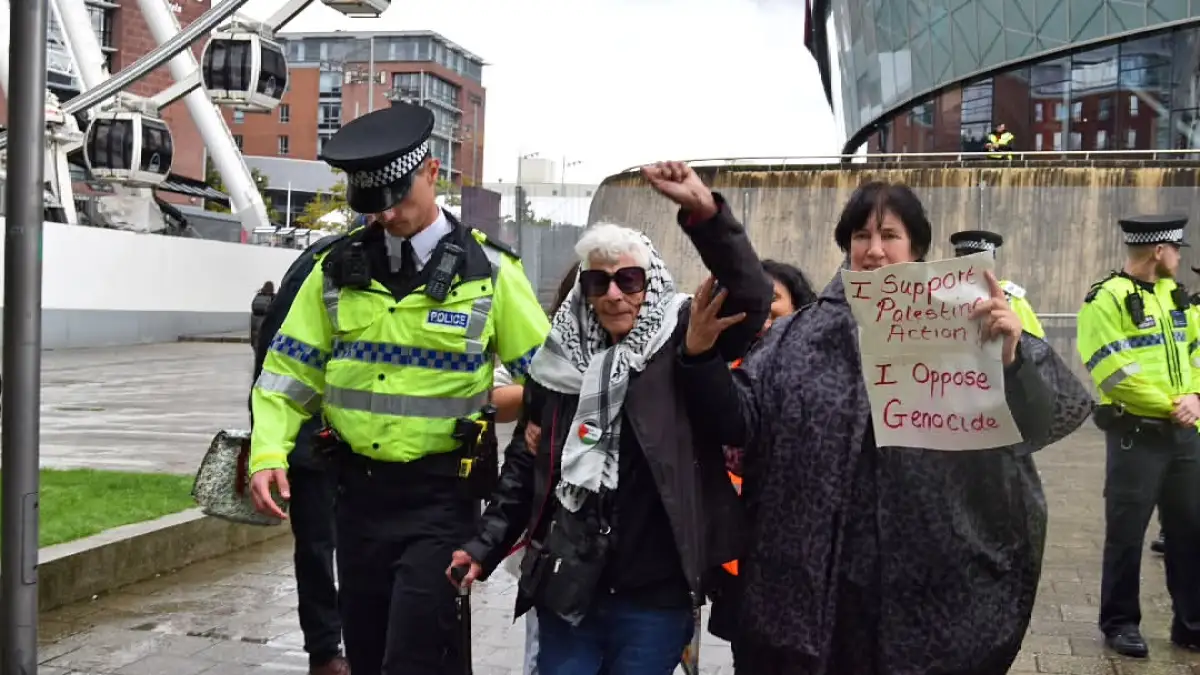
UK convicts four Palestine Action activists over break-in at Israeli firm | News

Members of the now-banned Palestine Action group raided Elbit Systems’ facility in Bristol 10 months into Israel’s genocidal war on Gaza.

Four of six British pro-Palestinian activists have been convicted of criminal damage relating to a 2024 raid on a factory operated by Israeli defence firm Elbit, with one of the defendants found guilty of striking a police officer with a sledgehammer.

London’s Woolwich Crown Court on Tuesday found Charlotte Head, 30, Samuel Corner, 23, Leona Kamio, 30, Fatema Zainab Rajwani, 21, guilty. Zoe Rogers, 22, and Jordan Devlin, 31, were found not guilty.

Recommended Stories

list of 4 itemsend of list

Prosecutors said that the six defendants were members of the banned group Palestine Action, which organised the assault on the Elbit Systems UK facility in Bristol, southwest England, in August 2024.

The raid, which prosecutors said caused about one million pounds ($1.36m) of damage, took place about 10 months into Israel’s genocidal war on Gaza that began in October 2023.

Palestine Action was later proscribed under “terrorism” law, a decision which was ruled unlawful by London’s High Court, though the group remains banned pending the government’s appeal, which was heard last week.

Acquitted of aggravated burglary

Corner, who prosecutors said struck a police officer with a sledgehammer, was convicted of inflicting grievous bodily harm.

Each of the defendants gave evidence in front of the jury, admitting that they damaged Israeli military drones and equipment inside Elbit’s research and development facility in Filton, Bristol – in order to “save lives in Palestine”, according to a statement by their lawyers.

The defence team of the defendants said in a statement: “The defendants already defeated the most serious charges” and “they went into this trial with their heads held high and with the knowledge that no matter the verdict, by destroying Israeli military drones, their action likely saved lives in Palestine”.

Tuesday’s verdicts follow an earlier trial, after which all six defendants were acquitted of aggravated burglary, and the previous jury could not reach verdicts on the criminal damage charges.

Prosecutors later dropped charges of violent disorder against all six defendants.

The UK government proscribed Palestine Action in July, days after its activists sneaked into an air force base in southern England.

Elbit Systems is a defence technology company with about 20,000 staff and revenues of $2bn, according to the firm’s website.

Source link

Iran’s judiciary vows action against ‘enemy’s mercenaries’ amid executions | US-Israel war on Iran News

Tehran, Iran – Iran’s judiciary has promised to continue taking “decisive” action against people it accuses of working for foreign interests as it reports more executions and asset seizures.

Judiciary and security authorities said they will “act decisively against the enemies’ mercenaries without leniency until the very last one”, according to a state television report aired late on Monday.

Recommended Stories

list of 3 itemsend of list

The report came hours after judicial authorities executed three men who were arrested in the northeastern city of Mashhad during nationwide protests in January, which top officials have called a “coup” attempt led by the United States and Israel.

State media aired what it presented as confessions by the men, who were labelled “agents” of the Israeli intelligence service Mossad and “leaders of riots” by the authorities. The report said the men acted against the government by using knives and swords against paramilitary Basij forces and damaging public property.

An increasing number of prisoners have been hanged over recent weeks, particularly since the start of the US-Israel war on Iran on February 28. The executions are connected to the antiestablishment protests, during which thousands of people were killed amid a state-imposed internet shutdown.

In Isfahan last week, 21-year-old Sasan Azadvar was executed for “cooperation with the enemy” for acts that included, according to the judiciary, “attacking a minibus carrying security forces with stones and a club and breaking windows of public buses and private vehicles”.

The authorities maintained that while the judicial process has been significantly speeded up for those arrested in connection with the protests, the proceedings remain legal and executions are carried out after being greenlit by Supreme Court judges.

Foreign-based human rights organisations and opponents of Iran’s government have said prisoners are not given fair trials and their families are pressured into remaining silent about arrests and executions, charges Iranian authorities reject.

A number of prisoners have also been executed after being convicted of espionage for Israel and other national security charges. Security offences can lead to a conviction of moharebeh, or “waging war against God”, and other sentences that carry the death penalty.

Earlier this week, two men were hanged for allegedly sending images of military facilities to the Mossad, trying to recruit others for sabotage activities and calling security authorities with fabricated leads to divert them.

Multiple members of the Mojahedin-e Khalq (MEK), a foreign-based group considered a “terrorist” outfit by Iranian authorities, have also been executed over recent weeks.

Foreign-based human rights organisations reported that Iranian authorities have in 2025 and 2026 carried out the largest number of hangings since 1989 when political dissidents and MEK members received death sentences in large numbers.

A report by Iran Human Rights and Together Against the Death Penalty last month said at least 1,639 executions were recorded in 2025, which was 68 percent higher than the year before.

The United Nations confirmed at the end of April that since the start of this year’s war, at least 21 people have been executed and more than 4,000 arrested on national security-related charges. Iranian authorities have not commented on the figures.

Economic measures

Iranian authorities have also confiscated the private assets of Iranians inside and outside the country in response to perceived antiestablishment activities.

The latest such move was announced on Tuesday morning when the judiciary announced that authorities in Semnan province, located east of Tehran, had seized the assets of 22 “traitors to the nation and people who are linked with the Zionist regime [Israel] and hostile countries”.

During the naval blockade imposed by the US, which has exacerbated the already dire economic conditions in Iran, authorities have also warned that they will act against any disruptive measures, such as hoarding goods, and have threatened prison time of up to 20 years, lashings and fines for anyone convicted.

Judiciary chief Gholam-Hossein Mohseni-Ejei also warned that those hoarding, price gouging or selling expired goods will be met with “decisive” legal action.

Prices surged this week across the country, especially for food, medicine, cars and electronic devices. And there are potentially challenging times ahead with little sign of a lasting resolution to the conflict with the US and Israel despite an ongoing ceasefire.

“The current price levels are unacceptable. The price increases are due to the war tumult and sanctions,” Central Bank of Iran chief Abdolnasser Hemmati said on Tuesday. “But the people should not be worried because their resistance is working and, God willing, victory will be achieved soon.”

Source link

Families must ‘pay for plane seats’ or face being split as fuel crisis threatens holidays

As airlines have been granted a green light to consolidate or cancel flights with just two weeks’ notice, experts have warned of inevitable chaos this peak holiday season

Summer is well and truly in the air, but Brits looking ahead to their well-deserved week in the sun have been warned to take extra caution.

As the price of jet fuel has risen by 120 per cent since the start of the conflict in the Middle East, there are concerns of shortages in the coming months. Airlines have already hiked ticket prices, but further disruption is expected unless the Strait of Hormuz reopens soon.

Before the conflict, Europe as a whole had about 37 days’ supply of available. Now, this is likely to have dropped to 30 days, with the International Energy Agency (IEA) warning that 23 days is the critical point at which some airports would run out of fuel.

Now after airlines were granted a green light to consolidate or cancel flights with just two weeks’ notice, experts have warned that the traditional protections for those with additional needs are under threat. Crucially, the European Commission has signalled that disruptions caused by the ongoing Middle East fuel crisis will be filed under “exceptional circumstances,” meaning holidaymakers may be unable to claim any financial compensation if their flights are changed.

READ MORE: RAC issues ‘ominous’ UK petrol and diesel price warning for May 2026

Travel expert Declan Somers, CEO of Mobal, warns that the biggest risk this summer isn’t just chaos at airports, but how passengers might be split. As airlines merge flights to conserve fuel, families who booked together may find themselves rebooked onto replacement aircraft where they are scattered across the cabin.

Notably, there is no UK law that requires children to be seated with their parents on a plane. Airlines can legally separate even those under five from their parents, although this would be against Civil Aviation Authority (CAA) guidelines. The CAA says: ‘Young children and infants who are accompanied by adults should ideally be seated in the same seat row as the adult. Where this is not possible, children should be separated by no more than one seat row from accompanying adults. This is because the speed of an emergency evacuation may be affected by adults trying to reach their children.” “

If airlines start consolidating flights, a family of four ‘may be rebooked onto the same replacement flight but not necessarily seated together,” Somers cautioned.

While UK guidance suggests airlines should aim to seat children near parents, there is no absolute guarantee. To mitigate this, Somers urges parents not to treat seat selection as optional: “Book directly with the airline, pay for seat selection, and call immediately to have assistance notes attached to the PNR (Passenger Name Record).”

The situation is even more precarious for those with disabilities or complex medical requirements. Travel expert Alexandra Dubakova warns that emergency rebookings often fail to account for specialised needs, such as extra legroom for mobility or specific seating for medical equipment. “There might be cases of passengers being de-boarded or rebooked again because the replacement aircraft lacks the specific configurations they originally paid for,” Dubakova explained.

She warns of a significant “erosion of consumer rights,” noting that under “exceptional circumstances,” airlines are under less financial pressure to provide their usual level of care. For those requiring special assistance – such as storage for crutches or priority boarding – Scope guidance mandates booking at least 48 hours in advance. However, with last-minute aircraft swaps expected, these pre-arranged protections are no longer a certainty.

The disruption is expected to hit hardest at smaller regional airports, which lack the on-site fuel storage of major hubs like Heathrow. Dubakova describes these smaller airports as the “canary” in the coal mine. For families and disabled travelers, the advice is to “build in a buffer.”

Experts suggest choosing the first flight of the day, flying from larger hubs where possible, and ensuring all medication is planned at least four weeks in advance. UK airlines have previously insisted that they are not currently facing supply issues, while the Government will also work with the sector to act quickly if needed.

Europe’s leading budget airlines remain confident they will be able to keep flights running as usual throughout the peak holiday season ahead. Jet2, easyJet and TUI have all committed not to impose any additional charges on passengers due to fuel price increases.

Transport Secretary Heidi Alexander said: “There are no immediate supply issues, but we’re preparing now to give families long-term certainty and avoid unnecessary disruption at the departure gate this summer. This legislation will give airlines the tools to adjust flights in good time if they need to, which helps protect passengers and businesses. We will do everything we can to insulate our country from the impact of the situation in the Middle East.”

It’s understood that British Airlines would not allow to children sit alone away from their parent, with the team pre-seating families on the same Passenger Name Record (PNR) to ensure all those under 12 years old are seated with at least one adult on the same record. As per the BA website: “If you don’t choose your seats in advance, we always do our best to seat your family together based on flight seat availability. This may mean that you’ll be seated in adjacent rows or across the aisle. All children under 12 will be seated with an accompanying adult.” Tui and Virgin Atlantic also offer similar reassurances on their websites.

Meanwhile, as per the Ryanair’s Family Seating Policy, detailed on the company website: “For family bookings, children (aged 2 to 11 years) receive free reserved seating so they can sit beside a parent. When an adult purchases a reserved seat they can select up to 4 children’s seats beside them free of charge. If an adult selects a reserved seat outside of specific rows (depending on aircraft) they must pay the price difference. Similarly, if a seat is selected for a child outside of these rows, they will be charged the full reserved seat price of these seats.”

The easyJet website warns families who leave check in until the last minute may not be guaranteed sears next to each other, however, staff will “still make sure each child under 12 is seated close to an adult on your booking” An easyJet spokesperson told the Mirror: “easyJet is not seeing any disruption to fuel supply. We continue to operate our flights and package holidays as normal and are not making changes or cancellations. We remain in close contact with suppliers who continue to provide uninterrupted supply and are diversifying exporting from additional countries globally to bolster supplies going forward.”

Kenton Jarvis, CEO of easyJet, said: “I want our customers to book with confidence this summer. We are operating as normal and are not making changes or cancellations and we are looking forward to taking millions of people on their well-deserved holidays this summer.”

Do you have a story to share? Email me at julia.banim@reachplc.com

READ MORE: ‘Unbeatable’ headphones with 70 hours playback on 1 charge slashed in sale

Source link

Iran’s football team shows World Cup readiness with social media posts | World Cup 2026 News

Videos from a tournament kit reveal photo shoot and images from training sessions highlighting Team Melli’s preparations.

Iran’s preparations for the FIFA World Cup appear to be on track, as social media posts from the team’s official account hint at an upcoming tournament kit reveal and show the squad training at an undisclosed location.

Videos posted by Team Melli’s Instagram account on Monday showed players taking part in a photo shoot for what appears to be Iran’s home kit for the World Cup.

Iran are in Group G of the World Cup and will play all their games in the United States, which is cohosting the tournament with Canada and Mexico.

Several members of Iran’s squad, including first-choice goalkeeper Alireza Safar Beiranvand and winger Milad Mohammadi, were shown wearing a new kit in a series of social media posts.

The Team Melli account also posted photos from training sessions, which have been held in Iran before the squad travels to Turkiye for three friendly matches before the World Cup.

The Asian giants’ participation in the tournament became uncertain after the US and Israel launched a war on Iran on February 28, with Iranian officials questioning the US’s role as host and President Donald Trump suggesting Team Melli’s players may not be safe if they travel to his country for the championship.

However, recent statements by FIFA president Gianni Infantino and Iranian football officials have reaffirmed the country’s participation in the World Cup.

Infantino confirmed that Iran will play its games in the US in his opening remarks at the FIFA ⁠⁠Congress in Canada on Thursday.

“Let me start at the outset. Of course, Iran will be participating at the FIFA ⁠⁠World Cup 2026. And of course Iran will play in the United States of America,” Infantino said.

Trump later said he was “OK” with Iran playing in the country.

“If Gianni said it, I’m OK,” Trump told reporters ‌‌at the White House. “You know what? Let ‌‌them ‌‌play.”

Football officials in Iran have outlined the team’s training and preparations for the tournament, which include camps at home and in neighbouring Turkiye before travelling to the US.

“The first phase of the preparation period will end with an intra-team game on Wednesday,” assistant coach Saeed Alhoei told Iranian sport news outlet Varzesh3.

The game will be held at a stadium, and the players will wear official match kits, with an international referee and video assistant referee technology (VAR) to simulate tournament-like conditions.

Alhoei said the squad will depart for Turkiye on Monday for their final leg of preparations before travelling to the US in June.

Team Melli will kick off their ‌‌campaign ‌‌against New Zealand in Los Angeles on June 15 before taking on Belgium at the same stadium on June 21.

“We will have three friendly matches, two of which will probably be against [local] club teams and behind closed doors, and the third against an African team,” Alhoei said. “It is a quality team that can be a good simulation for playing against African teams.”

Iran will face Egypt in their final group match in Seattle on June 26.

On Monday, Iran suffered a significant ⁠⁠blow after it was confirmed that winger Ali Gholizadeh had suffered a season-ending knee injury while playing for his club Lech Poznan in Poland.

Gholizadeh, who would have started on the right ⁠⁠wing at the World Cup, was stretchered off the pitch against Motor Lublin last Saturday, and tests later confirmed he had torn the anterior cruciate ligament in his left knee.

“Gholizadeh will face surgery ⁠⁠in the coming days, followed by several months of rehabilitation,” the club said in a statement.

Source link

How a Dodgers prospect became an advisor to four U.S. presidents

The ninth in an occasional series of profiles on Southern California athletes who have flourished in their post-playing careers.

When the Dodgers drafted David Lesch in January 1980, they had visions of his fastball lighting up radar guns at Dodger Stadium.

He never made it that far.

Lesch never climbed above the lowest rung on the minor league ladder, where he pitched just 10 innings and gave up more runs, hits and walks than he got outs. Less than 18 months after he was drafted, Lesch, wracked by a rotator cuff injury, was released, his major league dream over before he was old enough to legally buy a beer.

“I went to Disney World after that,” he said.

But that wasn’t the only decision the Dodgers made that changed Lesch’s life. When he was drafted, the team gave him just a small bonus, but sweetened the deal by offering to pay for college if he ever went back to school. For the team, it seemed a safe bet.

“They probably have this algorithm saying ‘this is the No. 1 draft pick. If he doesn’t make it, he’s not going back to college. He’ll be assistant baseball coach of his high school or something,’” Lesch said.

Oops.

Lesch not only went back to college, but he also wound up getting three degrees, including a master’s and a PhD from Harvard. It was arguably the most important investment in humanity the Dodgers made since signing Jackie Robinson, because Lesch went on to become one of the world’s top experts on the Middle East, writing 18 books and more than 140 other publications while advising four presidents and a cadre of United Nations diplomats.

David Lesch interacts with students in his history class at Trinity University in San Antonio.

David Lesch interacts with students in his history class at Trinity University in San Antonio.

(Lucero Salinas / Trinity University)

“That was the best deal,” Lesch, 65, said by phone from San Antonio, where he is the Ewing Halsell Distinguished Professor of History at Trinity University.

“Without that I probably could not have said yes to Harvard because of the price. The Dodgers committed to paying.”

And by doing so, the Dodgers may have altered history just a bit.

Lesch’s regular meetings with Syrian president Bashar al-Assad, which ended with Lesch facilitating an important if temporary breakthrough in U.S.-Syrian relations? The diplomatic and conflict-resolution work in Syria and the wider U.N. initiatives on regional issues throughout the Middle East? The thousands of students Lesch inspired to go on to perform important diplomatic and public-service roles of their own?

None of that happens if Lesch’s shoulder had held on or if the Dodgers had reneged on their deal.

“It was very fortunate that he hurt his rotator cuff. Baseball’s loss is academia’s gain,” said Robert Freedman, a scholar and expert on Russian and Middle Eastern politics who taught Lesch at the University of Maryland Baltimore County.

“I’ve been teaching for, I guess, 60 years now and I can tell when a student can see a complex problem and can penetrate right to the heart of the problem very quickly. He was one of those students.”

Still, it took a slightly offhand comment from Freedman, who now teaches at Johns Hopkins, to launch Lesch on his post-baseball career.

“We were having lunch and he was looking for a project and I mentioned to him ‘you know, there hasn’t been a good American scholar doing work on Syria for many, many years,’” he said.

“That struck his interest.”

Playing a child’s game and managing life-and-death Middle East politics share very little in common. But Lesch made the transition seamlessly.

“It is like he’s several different people, or has been,” said journalist and author Catherine Nixon Cooke, whose book “Dodgers to Damascus: David Lesch’s Journey from Baseball to the Middle East” traces those parallel lives.

“I’m wondering if, in a sense, it all worked out the way it was supposed to,” Cooke continued. “Even though his dream was to be a major leaguer, David certainly has reinvented himself to this really remarkable man following a completely different path.

“It was the Dodgers who paid for him to go to Harvard and so it’s kind of a weird thing. Baseball took away his dream because he got hurt, but baseball also gave him his backup plan.”

Lesch was still a teenager when, 20 minutes into his first spring training camp in Vero Beach, Fla., Dodgers manager Tommy Lasorda plucked him off a minor league practice field to pitch batting practice in the main stadium.

Waiting for him were Ron Cey, Bill Russell, Steve Garvey, Davey Lopes and Reggie Smith, the heart of a lineup that would win a World Series a season later.

It was the first time — and nearly the last — that Lesch faced big-league hitters. And it didn’t start well.

Batting practice pitchers throw from behind an L-shaped screen that protects them from comebackers and Lesch had never used one. That, combined with his understandable nervousness, caused him to short-arm his first fastball, which sailed at Cey’s head, sending him sprawling into the dirt.

“He got up and gave me this mean look,” Lesch said. “I remember it so vividly right now. I really thought I was going to be released that day.”

Instead, he gathered himself and finished the session, earning pats on the back from both Garvey and Lasorda. The incident, he said, has colored the rest of his life.

“I’ve met with presidents, prime ministers, been in war zones, all sorts of things,” Lesch said. “Anytime I say ‘well, you know, this should make me nervous,’ I think about that episode and the fact that I made it through and did OK.”

In high school, Lesch had focused on basketball and baseball. Academics? Not so much. So after spending his freshman year of college at Western Maryland College, he transferred to Central Arizona, a junior college, so he would be eligible for the January 1980 draft, allowing him to trade his books in for a baseball.

The so-called secondary draft, which was discontinued six years later, was specifically targeted toward winter high school graduates, junior college players, college dropouts and amateurs who had been previously drafted but did not sign. As a result, the bonuses teams offered winter draft picks were just a fraction of what players taken in the June draft received.

Lesch’s was so low, he can’t even remember what it was.

“I want to say $10,000 to $15,000,” he said. “No more than $20,000.”

When it became clear the Dodgers weren’t going to budge on the money, Lesch’s father, Warren, a family physician in suburban Baltimore, pulled out the Harford County phone book and looked up the number for Baltimore Orioles coach Cal Ripken Sr. Lesch played high school ball against Ripken’s son Cal Jr., who had been a second-round draft pick of the Orioles two years earlier. So his father thought the Ripkens might have some advice on what to ask of the Dodgers.

David Lesch, a former Dodgers draft pick, stands on the baseball diamond at Trinity University in San Antonio.

David Lesch, a former Dodgers draft pick, stands on the baseball diamond at Trinity University in San Antonio.

(Lucero Salinas / Trinity University)

“Ripken goes ‘does your son like school and is he smart?’” Lesch’s older brother Bob remembers. “So Ripken suggested if they offer you XYZ bonus money, take less and say ‘I’ll take this amount, but you have to cover education if he doesn’t make it.’”

Neither side thought that clause would ever be triggered; Lesch, a big, intimidating right-hander who threw bullets from behind Coke-bottle eyeglasses, wasn’t headed to a classroom, he was going to Dodger Stadium.

Until he wasn’t.

Lesch missed a couple of weeks with a back injury. By overcompensating for the sore back, he developed paralysis in the ulnar nerve in his right arm, limiting him to five appearances in his first minor league season.

He arrived healthy for his second spring in Vero Beach and threw three no-hit innings in his first outing against double-A and triple-A players, creating such a buzz that Ron Perranoski, the Dodgers’ major league pitching coach, showed up to watch his second game. By then the shoulder and back stiffness that shortened his first season had returned, and Lesch was rocked. Perranoski left early and unimpressed.

Lesch’s delivery had one major flaw: He threw directly overhand, as opposed to three-quarters or even sidearm, which can increase velocity but also places additional strain on the shoulder and elbow. As a result, his fastball could top out in the mid-90s one day, but when the stiffness and pain returned, it left him throwing in the low 80s.

The inconsistency continued to plague Lesch, and eventually the Dodgers decided they’d seen enough and released him. When he got back to Maryland, Lesch’s father sent him to see an orthopedic surgeon, who found the problem wasn’t in his back or elbow but rather the rotator cuff.

“We didn’t live in the era of pitch counts. So he just pitched,” said David Souter, a high school and college teammate who went on to develop big-league pitchers.

“He had the ability if he was developed and stayed healthy. I think he probably overthrew and tore his rotator cuff and nobody knew it.”

If Lesch had come along 10 years later, when rotator cuff surgeries were common, he might have returned to the mound. But in 1981, a rotator cuff injury was a death sentence for a pitcher.

“It’s just a crapshoot based on physiology,” Lesch said. “I probably was destined. Something would have happened.”

If he could do it over again, Lesch said he would change one thing.

“I’d throw sidearm,” he said. “It’s much less stress.”

He threw to big league hitters just one more time. Following the strike that interrupted the 1981 season, Ripken Sr. phoned Lesch back and asked him to throw batting practice at Memorial Stadium to help the Orioles prepare for the resumption of play. As a reward, the Orioles let Lesch hit — he never had batted in the minors — and he drove a pitch over the left-field wall, then dropped the bat and walked away.

He never stepped on a major league field again.

The Dodgers’ investment in Lesch’s education appeared manageable when he enrolled at a satellite campus of the University of Maryland, in part because his brother Bob was the school’s sports information director.

But it was 1981 and the Middle East was at the forefront of geopolitics. Lesch became convinced the Middle East would be central to world affairs for decades to come. Inspired and encouraged by Freedman and another professor, Lou Cantori, he applied to graduate school at Harvard, Georgetown, Johns Hopkins and the University of Chicago, knowing he couldn’t afford any of those schools on his own.

“I probably could not have said yes to Harvard when they accepted me because of the price,” Lesch said. “The Dodgers had committed to paying and whatever it was, it was a lot more collectively — my undergraduate MA and PhD — than I had gotten in the bonus.”

That wasn’t the only time his baseball background worked in his favor. Years after starting at Harvard, Lesch stumbled upon written evaluations of his application and learned that his grade-point average and other factors were similar to those of other applicants, but it was his athletic career that had swung enough votes in his favor to get him accepted.

“Failure is at the core of sports. And so you have to have this resiliency,” Lesch said. “What a lot of the top colleges have found is that these young kids out of high school who somehow get a 4.6 GPA, they come in — and I’ve seen this as a professor — they get their first C and they’re distraught.

“Athletes stick with it. They say ‘how can I turn this around? How can I get better?’ Admissions departments across the board have looked at athletes much differently.”

The struggles Lesch experienced on the diamond did not follow him into academia. Yet becoming an expert on the Middle East definitely was a backup plan.

“His first passion was clearly baseball and basketball,” said Souter, the former teammate. “Every kid dreamed … that.”

If the shoulder injury wasn’t a strong enough sign that that dream was over, the fire that destroyed Lesch’s childhood home a few years later was. The flames, which severely burned both his parents, also erased his baseball career, consuming all the photos and memorabilia he had collected, save for the championship ring from his one minor league season, which he found buried in the embers. It was the only thing to survive the blaze intact.

David Lesch's championship ring from his one minor league season with the Dodgers.

David Lesch’s championship ring from his one minor league season, the only surviving keepsake of his professional career after a his family’s home was destroyed in a fire.

(Courtesy of David Lesch)

A post-graduate trip to Syria, the first of more than 30 visits he has made to the country, sealed the deal a few years later. The love he once had for baseball he now felt for a strange and mysterious place that was as old as history itself yet as secretive as the classical ciphers.

Soon Lesch was helping arrange high-level meetings between Syrian president Hafez al-Assad and President George H.W. Bush, a baseball fan who seemed as interested in Lesch’s Dodgers days as his Middle Eastern expertise. But his big break came during the first presidential term of Bush’s son George W. Bush, when Bashar al-Assad, who succeeded his father as Syria’s president, welcomed Lesch for the first of many interviews that informed his book, “The New Lion of Damascus: Bashar al-Assad and Modern Syria.”

“His forte is listening,” Cooke, the biographer, said of Lesch, whose polite, unassuming manner reflects an adult life spent mostly in San Antonio. “When he goes in to try to mediate something, he is a big listener. There is a side of David that doesn’t talk much. But he’s listening.”

The book humanized al-Assad and opened, for a time, the possibility of normalized relations between Syria and the West, with Lesch serving as an unofficial liaison between Damascus and Washington, as well as other Western capitals.

“He’s absolutely a critical player in what we would call two-track diplomacy,” Freedman said. “If the government wants to reach out but doesn’t want to take the political consequences, they send somebody to sound out the situation.

“It’s absolutely critical that we have people like that who can speak the language and understand the overall context, which sadly is lacking in the current administration.”

David Lesch teaches students in his history class at Trinity University in San Antonio.

David Lesch teaches students in his history class at Trinity University in San Antonio.

(Lucero Salinas / Trinity University)

But that opening closed as quickly as it opened. Lesch’s close contacts with al-Assad raised suspicions among some in Syria, and Lesch was poisoned twice. His relationship with al-Assad was severed completely shortly afterward when he criticized al-Assad for failing to implement promised reforms and becoming a “bloodthirsty tyrant.” The Syrian civil war took nearly 700,000 lives and displace another 6.7 million people before al-Assad and his family fled into exile in Russia in 2024.

“Many governments think that they can reduce war to a calculation,” Lesch said. “What we cannot measure accurately or fully appreciate is the human element. We cannot assess a people’s sense of grievance, passion, revenge, ideological commitment and historical circumstances that shaped the nature of their response and staying power.

“This is where academics can make a contribution to policy, giving it the depth and insight gleaned from years of study and learning the culture and the people.”

Baseball’s loss wasn’t just academia’s gain. It may prove to be humanity’s as well.

“I don’t really have any regrets,” Lesch said. “My career turned out great. I could not think of doing anything else at this point and, in fact, in a way I’m glad [baseball] didn’t work out.”

Source link

Iran says US military killed five civilians in attacks on passenger boats | US-Israel war on Iran News

Iranian commander says US military attacked two passenger boats, not IRGC vessels, in the Strait of Hormuz on Monday.

Iran has accused the United States of killing five civilians in the Strait of Hormuz, saying its forces attacked passenger vessels in the waterway rather than boats belonging to the Islamic Revolutionary Guard Corps (IRGC) as claimed.

The claim on Tuesday contradicted a statement by US Admiral Brad Cooper, who said Central Command forces had sunk six IRGC vessels that had attempted to interfere with a US mission to escort stranded ships out of the Strait of Hormuz.

Recommended Stories

list of 4 itemsend of list

US President Donald Trump later put the number at seven boats.

The US operation, dubbed “Project Freedom”, has shaken a fragile ceasefire reached between Iran and the US on April 8 and renewed fears of a return to war.

Iran’s state broadcaster IRIB quoted an unnamed Iranian military commander as saying that Tehran launched an investigation following the US claim of attacks on IRGC vessels.

It said while none of the IRGC vessels was hit, the investigation found that US forces had “attacked two small boats carrying people on their way from Khasab on the coast of Oman to the coast of Iran on Monday”.

The attacks destroyed the boats and killed five civilian passengers, the commander said. The US “must be held accountable for their crime”, the commander added.

There was no immediate comment from the US military.

The violence comes as Trump seeks to reopen the Strait of Hormuz, which Iran has effectively blockaded following the US and Israeli attacks on the country on February 28.

The closure of the vital maritime corridor – through which roughly one-fifth of the world’s energy supplies flow – has sent oil and fertiliser prices surging around the world and prompted fears of a global recession and food emergency.

Iran is now insisting on maintaining control over the Strait of Hormuz and collecting transit fees as reparations for the destruction caused by the US and Israel.

Attacks on UAE, ships in Hormuz

The Iranian military on Monday warned commercial vessels they would “jeopardise their safety” if they attempted to cross the waterway without permission. The military also warned US forces would face attacks if they approached or entered the chokepoint.

Amid the tensions, the United Arab Emirates said Iran launched a drone attack on one of its oil tankers that attempted to transit the strait and said Iranian forces launched 15 ballistic missiles and four drones at its territory.

UAE authorities said the attacks set off a large fire at a major oil refinery in the eastern emirate of Fujairah and wounded three Indian nationals.

A South Korean vessel in the Strait of Hormuz, the HMM Namu, also reported an attack, saying an explosion had caused a fire in its engine room.

Nonetheless, the US military said two US-flagged ships made it through the strait on Monday with the support of navy guided-missile destroyers.

The IRGC denied the claim as “baseless and completely false”, but the global shipping firm Maersk said the US-flagged Alliance Fairfax exited the Gulf via the Strait of Hormuz accompanied by the US military on Monday.

Iran’s Foreign Minister Abbas Araghchi said the events in Hormuz on Monday “make clear there’s no military solution to a political crisis”.

He said in a post on X that peace talks with the US were “making progress” with Pakistan’s mediation and that Washington “should be wary of being dragged back into quagmire by ill-wishers”.

“So should the UAE,” he added. “Project Freedom is Project Deadlock.”

Meanwhile, Trump has renewed his threats against Iran.

He told Fox News Iran would be “blown off the face of the Earth” if they attacked US vessels carrying out Project Freedom.

“We have more weapons and ammunition at a much higher grade than we had before,” he said.

“We have the best equipment. We have stuff all over the world. We have these bases worldwide. They’re all stocked up with equipment. We can use all of that stuff, and we will, if we need it.”

Source link

For Christians in Israel and Jerusalem, intolerance is becoming normal | Religion News

At first sight, last week’s unprovoked attack on a French nun walking along a street in occupied East Jerusalem came without warning. However, for the roughly 180,000 Christians living in Israel – and the 10,000 or so Christians living in East Jerusalem – the attack is the latest in a growing number of incidents of abuse, assault, and intimidation that the community says has increased in tandem with Israel’s turn towards far-right nationalism.

While incidents of violence and arson grab the attention, low-level incidents of spitting, insults, and disparaging graffiti have become a daily experience for many Christians in the area – the majority of them Palestinian – contributing to the desire on the part of nearly half of all the religious community under 30 to leave.

Recommended Stories

list of 4 itemsend of list

Israeli officials have been quick to condemn the attack on the nun, calling it “despicable” and with “no place” in Israeli society. A man has also been arrested, after the arrest of Israeli soldiers blamed for smashing a Christian statue in southern Lebanon last month.

But ultimately, trust in the Israeli state is thin on the ground, with many of the incidents going unreported, analysts say.

Christians in Israel and East Jerusalem have been present in the area for more than 2,000 years. But they now find themselves attacked by Israelis, just for practicing their faith.

According to the volunteer-run Religious Freedom Data Center (RFDC), in the first three months of this year, Christians reported 31 incidents of harassment, most involving spitting or defacing church property. Last year, analysts with the interreligious Rossing Center for Education and Dialogue tracked 113 known attacks on individuals and church property in Israel and occupied East Jerusalem, including 61 physical assaults mainly targeting visible members of the clergy, such as monks, nuns, friars, and priests.

‘It’s definitely increased in the last three years,” said Hana Bendcowsky, programme director at the Jerusalem Center for Jewish-Christian Relations. “Resentment toward Christianity existed in the past as well, but people did not dare express it openly.”

“Over the past three years, the political atmosphere in Israel – where there is less concern about how the world perceives us – has led people to feel more comfortable harassing Christians,” Bendcowsky added. “This broader sense of Israeli isolation, and the reduced concern about international reactions, is also reflected in the way the State of Israel has acted regarding what has taken place in Gaza and southern Lebanon.”

Rising nationalism

Israel’s shift towards ultranationalism, particularly when it comes to policies towards Palestinians, has intensified under the current government of Prime Minister Benjamin Netanyahu. Under his administration, far-right voices that were once at the fringes of Israeli society have become incorporated into its heart, and now play defining roles in government.

Fuelled by a not entirely unfounded sense of impunity, a survey by the Rossing Center for Education and Dialogue last year found it was largely ultra-Orthodox and ultra-nationalistic Israelis who were responsible for the majority of attacks on Christians.

“The hate and attempt to harass non-Jews by some of the elements, particularly settler elements, knows no bounds,” Rabbi Arik Ascherman, an Israeli peace activist, told Al Jazeera. “Therefore, anything from spitting, harassing, and desecrating, to government actions to prevent churches from bringing in staff and clergy from abroad…  is simply part of the reality here.”

Bendcowsky noted that “the complexity of Jewish–Christian relations goes back to the early centuries.”

“While some churches have undergone processes of rethinking their attitudes towards Jews and Judaism and have begun a path of healing, this has not yet taken place within Israeli Jewish society,” she said. “In education, the focus is on Jewish victimhood, so the lack of familiarity with Christians, together with the historical memory of Christianity, tends to be negative. In the current political climate, there are those who exploit this as a chance to strike back.”

Incidents are rarely reported, researchers say, with concern over foreign visas, or not wanting to draw attention to the issue, mixing with a profound absence of confidence in the state to take action.

‘There’s an absolute lack of confidence in the police, and I think that’s leading to many of the attacks going unreported,” Bendcowsky said. “Unfortunately, that’s often borne out by the evidence. Unless an incident gains international attention, particularly in the US, it often goes uninvestigated, or investigations are closed without any official conclusion.”

Losing support

High-level international objections to attacks on Christians and Christianity, especially those coming from Israel’s principal backers in the United States, have typically elicited swift responses from the Israeli government.

After viral footage of Israeli soldiers destroying a Christian statue in southern Lebanon sparked international outrage, the Israeli prime minister’s office was swift to publish its own condemnation. And in March, following a backlash from many world leaders, including avowedly pro-Zionist US Ambassador to Israel Mike Huckabee, after Israeli police prevented Latin Patriarch of Jerusalem Pierbattista Pizzaballa from reaching the Church of the Holy Sepulchre, official apologies and “clarifications” were quick in coming. But Israeli military attacks on Christian churches in Gaza and Lebanon have only been acknowledged when international and specifically US sympathy for Israel risks being undermined.

In Israel, Christianity is often associated with the Palestinians – and it is therefore perhaps inevitable that as Israel becomes increasingly unrepentant in its killing of Palestinians and seizure of their land, Palestinian Christians and other Christians in the area will not find themselves spared.

Shaiel Ben-Ephraim, an Israeli analyst with Atlas Global Strategies, said that he has noticed intolerance towards Christians increasing. He noted that along with Israel’s violence in Gaza and the wider region, this is contributing towards Israel’s increasing unpopularity worldwide and in the US, and making it more difficult for Christian supporters of Israel to square their support for the country with its treatment of their co-religionists on the ground, a plight they have ignored for decades.

‘In the long term, these attacks on Christians are massive,’ Ben-Ephraim told Al Jazeera.

“Older evangelicals may be forgiving, but the young are already turning against Israel,” he said. “This erodes the little support [Israel has] left. So, while current-day leaders like [US President Donald] Trump and Huckabee will pretend this isn’t happening, this will shape an entire generation of religious Christians in a way that Israel does not even begin to imagine.”

Source link

Iran-US clash over alleged warship attack in Strait of Hormuz | US-Israel war on Iran

NewsFeed

Iran claims its navy forced a US warship to turn back from the Strait of Hormuz as Washington denies any clash, amid rising tensions in the key waterway. The rival narratives come after US President Donald Trump announced Project Freedom, a mission he framed as a humanitarian effort to “free” stranded ships.

Source link

Captain warns ‘no ship will be a hero’ by risking Hormuz transit | US-Israel war on Iran News

NewsFeed

Raman Kapoor, an Indian oil tanker captain stranded in the Gulf, says no vessel will attempt to exit the Strait of Hormuz without assurance of safety, despite the announcement of a US evacuation plan for ships stranded by the war.

Source link

US releases Touska container ship crew: Why it matters | US-Israel war on Iran News

The United States has transferred 22 crew members from the Iranian container ship, the Touska, to Pakistan, in what Islamabad describes as a “confidence-building measure” during tension in the Strait of Hormuz.

US Central Command (CENTCOM) spokesman, Captain Tim Hawkins, said the crew had been handed over for repatriation. Pakistan’s foreign ministry confirmed the transfer, saying the sailors would be returned to Iranian authorities.

Recommended Stories

list of 4 itemsend of list

The Touska was seized by US forces in the Gulf of Oman in the early hours of April 20, in what Tehran described as an act of “piracy”, after the US declared a naval blockade of Iranian ports. Iran had effectively closed the Strait of Hormuz following the start of the US-Israeli war on Iran.

On Monday, tensions continued to escalate in and around the Strait of Hormuz.

First, US President Donald Trump announced that US naval ships would help guide stranded vessels through the strait in an operation he dubbed “Project Freedom”.

Iran issued a new map of the strait with new boundaries further to the east, and warned shipping not to attempt to pass without coordinating with the Islamic Revolutionary Guard Corps (IRGC).

Then, state media reported that two Iranian missiles struck a US naval vessel near Jask Island in the strait after ignoring warnings from the IRGC to turn back. Washington denied any attack.

Amid continued interceptions and seizures of vessels by both sides, questions remain over whether the two countries can de-escalate and reach a broader peace agreement. Pakistan has been central to these efforts, seeking to keep diplomatic channels open, but talks hosted in Islamabad last month ended without a breakthrough.

Iran’s foreign ministry says it is reviewing Washington’s response to its 14-point proposal aimed at ending the conflict sent via Pakistan on Friday. As Pakistan continues to mediate, Trump previously described Tehran’s offer as “unacceptable”.

What happened to the Touska?

The Iran-flagged Touska was seized by US forces in the Gulf of Oman, close to the Strait of Hormuz, on April 20 after Washington accused the crew of failing to comply with the US naval blockade on Iranian ports. Shortly after midnight local time in Iran, CENTCOM said the USS Spruance fired its 5-inch (127mm) deck gun at the vessel’s engine room, disabling it.

According to the US military, the ship was attempting to transit the Strait of Hormuz en route to Iran’s main commercial port, Bandar Abbas.

The Touska, a small container ship operated by the sanctioned Islamic Republic of Iran Shipping Lines (IRISL), was boarded near Iran’s Chabahar port. US Marines from the 31st Marine Expeditionary Unit captured the vessel after what CENTCOM said were repeated warnings over six hours.

Video released by the US military showed Marines descending from helicopters launched from the USS Tripoli and securing the Tusk.

Iran condemned the capture as a violation of international law and an act of “piracy“, before demanding the immediate release of the vessel and its crew.

What does the release of the Touska’s crew mean, diplomatically?

Pakistan has positioned itself as a mediator between Washington and Tehran, and is now framing the transfer of the Touska crew as a step towards de-escalation of tensions. In a statement, the Pakistani foreign ministry said the move reflected a “confidence-building measure” and reaffirmed its commitment to facilitating dialogue.

US and Iranian delegations met in Islamabad last month for their first talks since 1979. Although negotiations ended without a deal, they marked a rare moment of direct engagement.

Pakistan has since coordinated with regional powers, including Saudi Arabia, Turkiye, Qatar and Egypt, while maintaining close communications with China, in an effort to build broader support for de-escalation.

In a call with Iran’s Foreign Minister, Seyed Abbas Araghchi, on Monday, Pakistan’s Deputy Prime Minister, Ishaq Dar, reiterated that diplomacy remains the only viable path to stability. Tehran, in turn, acknowledged Islamabad’s mediation efforts.

INTERACTIVE - Strait of Hormuz - March 2, 2026-1772714221
(Al Jazeera)

Will this de-escalate tensions in the Strait of Hormuz?

There are not many signs that it will.

Indeed, tensions in the Strait of Hormuz have continued to increase despite the release of the crew members.

Most notably, Iran’s Revolutionary Guard published a new map on Monday outlining what it claims is an expanded zone of control in the waterway, stretching from Iranian and Omani territory to include the territorial waters of the United Arab Emirates as well.

Analysts say this new claim exceeds internationally recognised boundaries. The UAE has accused Iran of launching drones at an oil tanker linked to Abu Dhabi’s national energy company, while Washington has dismissed Iranian reports of an attack on a US warship as false.

Military analyst Alexandru Hudisteanu, a maritime security expert who served 13 years in the Romanian navy, told Al Jazeera on Monday that the conflicting claims reflect a broader test of resolve. “Any attempt to open the strait will likely be met with resistance from Iran,” he said, adding that Tehran views control of Hormuz as its primary leverage in negotiations.

Hudisteanu warned that the situation carries a high risk of miscalculation, with both sides continuing to operate in close proximity. For Iran, the Strait of Hormuz is the “only leverage” it has for peace negotiations, Hudisteanu said.

Iranian analyst Foad Izadi argued that the ceasefire effectively collapsed when the US imposed its blockade, which he described as “an act of war”. He added that the targeting and seizure of ships along the Strait of Hormuz further undermined any notion of a truce.

“Attacking an Iranian ship’s engine is an act of war as well,” he added, despite the release of the Touska’s crew signalling some short-term goodwill between the US and Iran.

Source link

Does Trump hold ‘all the cards’ against Iran in the Strait of Hormuz? | US-Israel war on Iran News

“I have all the cards,” posted the White House on its X account on Sunday, alongside an image of President Donald Trump holding playing cards from the Uno game, in a message appearing to signal Washington’s confidence in its ongoing war on Iran.

Uno is a card game in which the winner is the first to get rid of all their cards.

Recommended Stories

list of 4 itemsend of list

The post came after Trump announced on his Truth Social platform that the US military would begin guiding ships stranded around the Strait of Hormuz by the war on Monday, in a sign that the conflict could further escalate, despite the near-month-long fragile ceasefire. Tehran has been effectively blocking nearly all shipping from the Gulf for more than two months, after the US and Israel attacked Iran two months ago, disrupting global energy supplies.

“We have told these countries that we will guide their ships safely out of these restricted waterways, so that they can freely and ably get on with their business,” Trump said, dubbing the campaign “Project Freedom”. “They are merely neutral and innocent bystanders!”

The president added that US negotiators were engaged in “very positive discussions” with Tehran, which could lead to “something very positive” without further elaboration.

Iran, however, reacted by insisting that the security of the waterway was in the hands of its armed forces, and warned that “any safe passage and navigation in any situation” should be “carried out in coordination with the armed forces”.

On Monday, the Iranian Fars news agency reported that a US warship had been hit by two Iranian drones, the claim was denied by US Central Command.

So what leverage do the US and Iran hold over each other, and what happens next?

In response to Trump’s “I have all the cards” social media post, Iran’s Consulate General in Hyderabad, India, posted its own image on X.

“Yes, we have less cards,” Iran’s consulate in the Indian city of Hyderabad wrote on X, together with a photo of an Iranian military spokesperson holding four Uno cards compared to Trump’s five, pointing out that usually holding all the cards means you are losing, not winning, in the game of Uno.

In response to Trump’s “Project Freedom” declaration, Iran’s Islamic Revolutionary Guard Corps (IRGC) warned that ships deemed to be in breach of its rules in the Strait of Hormuz “will be stopped by force”, while insisting there has been no change in how it manages traffic through the strategic waterway.

On Monday, it issued a new map of the Strait of Hormuz with boundaries extending further to the east than its previous one, and said any ship travelling between the two sides must coordinate with the IRGC first.

“There has been no change in the management process of the Strait of Hormuz,” spokesperson Sardar Mohebbi said, adding that vessels that comply with the “transit protocols issued by the IRGC Navy” will be “safe and secure”.

“Other maritime movements that are contrary to the declared principles of the IRGC Navy will face serious risks. Violating vessels will be stopped by force,” he said.

What leverage does the US have over Iran?

Sanctions

The United States’ most enduring source of leverage over Iran remains its sanctions regime, which was launched in 1979 when Ayatollah Ruhollah Khomeini declared Iran an Islamic Republic.

Successive US administrations over the past 47 years have hit Tehran with a series of financial restrictions targeting Iran’s banking, oil exports and access to international markets – the US says the sanctions are a response to Iran’s nuclear programme.

Sanctions have significantly constrained Iran’s economy, limiting government revenue and contributing to inflation and currency depreciation. Measures enforced through the US Treasury also deter other countries and companies from engaging with Iran, further strangling its economy.

The economic pressure has been central to US strategy towards Iran, particularly during its attempts to force Tehran back to negotiations over its nuclear programme, under both Democratic and Republican administrations.

Military power

Beyond economics, the US maintains overwhelming military superiority, especially air power. Aircraft carriers, long-range bombers and precision strike capabilities give Washington the ability to target Iranian infrastructure with relatively low risk to its own forces.

US bases across the Gulf, as well as military partnerships with regional allies – most notably Israel – reinforce this advantage.

American forces, together with the Israeli army, have killed more than 3,000 people, and struck thousands of sites across Iran in the current war, including Iran’s energy and nuclear sites.

Naval blockade

Since mid-April, the United States has enforced a widespread naval blockade of Iranian ports and ships. The operation began on April 13 after talks between Washington and Tehran collapsed, with US forces ordered to stop or divert vessels entering or leaving Iranian ports.

US forces have since intercepted or turned back dozens of ships, and seized a container ship, the Touska. On Monday, the US announced that its crew had been repatriated to Iran from Pakistan, where they were taken after their ship was captured in the Gulf of Oman last month.

According to Trump, the blockade is designed to choke Iran’s oil exports, its main revenue source.

US officials say the measures have severely disrupted Iran’s trade, which relies heavily on sea routes.

What leverage does Iran have?

Strait of Hormuz

The vital waterway is Iran’s most significant strategic asset, the narrow passage ships one-fifth of the world’s oil and liquefied natural gas (LNG) supplies in peacetime.

Tehran has effectively closed the strait since the war began on February 28, sending global oil and gas prices soaring and energy markets into turmoil. Iran has repeatedly demonstrated its ability to target shipping, seize vessels, or conduct military exercises, demonstrating its ability to close or restrict the strait.

The result is soaring energy prices globally, forcing many countries to implement severe austerity measures to soften the blow.

Last week in the US, the average price of a gallon (3.8 litres) of gasoline (petrol) rose to $4.30, according to the American Automobile Association (AAA), up from less than $3 before the war.

Surging energy costs have driven up inflation and deepened economic uncertainty in the US, compounding Trump’s political troubles amid overwhelming disapproval for the war amongst Americans.

Even if the US does begin escorting ships through safely – the threat from mines or Iranian strikes may be enough to prevent tankers from attempting to sail, experts say. Insurance companies are also unlikely to underwrite voyages.

Regional allies

Iran’s network of allied groups across the Middle East is another asset that Tehran relies on heavily. These include armed groups in Iraq and Syria, as well as Hezbollah in Lebanon and the Houthis in Yemen

Through these groups, Iran has exerted pressure indirectly, targeting US interests and allies without engaging in direct confrontation.

One critical threat Iran has previously made is for the Houthis to disrupt shipping in the Bab al-Mandeb, another vital maritime chokepoint linking the Red Sea to the Gulf of Aden.

INTERACTIVE - Bab al-Mandeb strait red sea map route shipping map-1774773769

The Houthis, an Iran-aligned group in Yemen, have previously targeted shipping in this area, most notably during Israel’s genocidal war on Gaza, further raising concerns about the security of global trade routes.

Roughly 4.2 billion barrels of crude oil and refined petroleum liquids flowed through the strait in 2014, accounting for about five percent of global supply.

Cheap drones and cluster bombs

While nowhere near the military capabilities of the US, Iran’s investment in missile and drone programmes has proven to be an effective means of deterrence. That is particularly through its ability to threaten regional US bases and impose significant costs on regional countries hosting American assets involved in military operations against Tehran.

While the US undoubtedly has a more sophisticated and powerful arsenal at its disposal, the interceptors it uses to combat Iranian drones cost around $4 million each, while Iran’s Shahed drones can be mass-produced at $20-50,000 each.

Furthermore, Iran’s ballistic missiles have proved capable of breaching Israel’s much-lauded “Iron Dome” defence system on several occasions. Iran has also dropped cluster bombs, which divide before they can be intercepted, making them much harder to stop.

So does the US really hold the most cards?

Michael Clarke, visiting professor at the Department of War Studies, King’s College London, said Trump’s overwhelming conventional military strength has failed to translate into strategic leverage on the ground.

“President Trump thinks he is a great poker player,” Clarke told Al Jazeera. “He thought America’s sheer destructive potential put all the ‘cards’ in his hand” when starting the war on Iran.

But Iranian forces have consistently disrupted US expectations through asymmetric tactics, he said.

“At every turn, the Iranians have come up with asymmetric tactics – vicious, reckless tactics – that have negated everything the Americans have tried to do,” Clarke noted, describing a pattern in which traditional US military superiority has been blunted by unconventional responses.

Despite significant American forces and assets in the region – including “no fewer than three US Carrier Strike Groups, two Marine Expeditionary Units, hundreds of combat aircraft and thousands of troops”, Clarke argued that Washington has struggled to find an effective use for its multi-billion-dollar resources at its disposal.

Moreover, he said, domestic pressure on Trump is growing. Trump “can’t find a way to use them [US forces] that will make any real difference to the current stalemate in the limited time he has before his own MAGA base concludes he has lost the game”.

Clarke also highlighted the willingness of Iran’s IRGC to escalate tensions. “Whatever this war might do to Iranian society, the IRGC is prepared to gamble with its own existence in the fight,” he added.

Source link

‘I quit UK for Australia but now I’ve returned after realising reality’

Katie Strick swapped London for Australia, only to find herself returning to the United Kingdom after just 18 months after discovering what life was really like Down Under

A woman who quit the United Kingdom for a sunny life in Australia has decided to move back after realising what life Down Under is truly like. Katie Strick and her partner spent 18 months in Australia before making the decision to move back home.

Katie says she made the decision to swap south London for Sydney after striking up a long-distance relationship with a former university friend. Writing in The Times, she admits the chance to join him in his beachside flat “wasn’t a hard sell”.

With the extension to the age bracket for the working holiday visa being moved from 30 to 35, Katie admits she felt the time was right. She found herself surrounded by “young, free twenty and thirtysomethings” in the Manly area.

But after a year-and-a-half, Katie found herself heading back to London. Her first struggle, she says, was the rental market in Sydney.

She found the cost of a flat is around the same in Australia as London. She also admits “friends and family naturally rank highly when I list the reasons for coming back”.

Katie however says the reasons for the move were much more than that. She wrote: “The reasons are rarely sexy: green space, quality of the press, a low risk of shark attacks and being a short train ride from my parents’ home town don’t quite have the same ring as living next to the beach when you shout them across a pub — but they mattered more than I expected.”

She acknowledges that Australia has “more sunshine” as well as “happier, healthier, more outdoorsy people,” but found herself missing the cobbled streets, country pubs, and British humour. She concedes it’s “hard not to miss those things” when you are “a 24-hour flight away”.

She says the Middle East conflict has also led to a “sense of uncertainty” for Brits flying from Australia. Dubai, once a popular layover, became embroiled in the conflict in March when it was struck by Iran.

Katie expected some “pushback” from her friends in Australia, but admits she was taken aback by the level of confusion from people back home too. She says many joked she would regret it when her boyfriend is “conscripted” or would be making another U-turn soon enough.

While she says it can seem difficult to say “exactly what you feel far away from,” she says “you do”. She accepts she has a “sense of day-to-day belonging” from visiting grandparents or meeting a friend’s baby, things that can’t be replicated through FaceTime.

Having moved back to London, Katie has however found herself wondering if she made a mistake. She recalls one moment she was catcalled by a drunk man at Clapham Junction, and dodging crowds in Soho.

On the other hand, she says there have been “moments of pure nostalgia” as she strolled through her favourite London park on a spring evening, or the appreciation she has for the NHS and architecture of the UK. She says her partner will soon land back in the UK, meaning that she gets to experience the “rollercoaster of emotions” from her return all over again.

Katie isn’t the only Brit who has quit the UK for Australia and found themselves moving back. Manchester-born Jessica McMaster recently made the same move after finding “four problems” with life Down Under.

Jessica cited the cost of living, distance from loved ones, visa and work restrictions, and weather as reasons for her move. Jessica, who lived in Melbourne, said: “Sometimes it would rain for days and be really cold and dark.

“Summer lasted about six months, which was amazing, long, bright days, great cafés, runs by the beach, but people think it’s always 30-degree heat. Melbourne can have four seasons in one day. In winter it was cold and rainy, so at times it felt like being back in Manchester, but without your family and friends.”

Source link

Iran says it fired missiles at US warship to prevent it entering Hormuz | US-Israel war on Iran

NewsFeed

Iranian state media says two missiles have struck a US navy destroyer to prevent it entering the Strait of Hormuz after the warship ignored warnings to halt. The attack comes after US President Donald Trump announced a naval mission to ‘guide’ stranded ships through the strait.

Source link