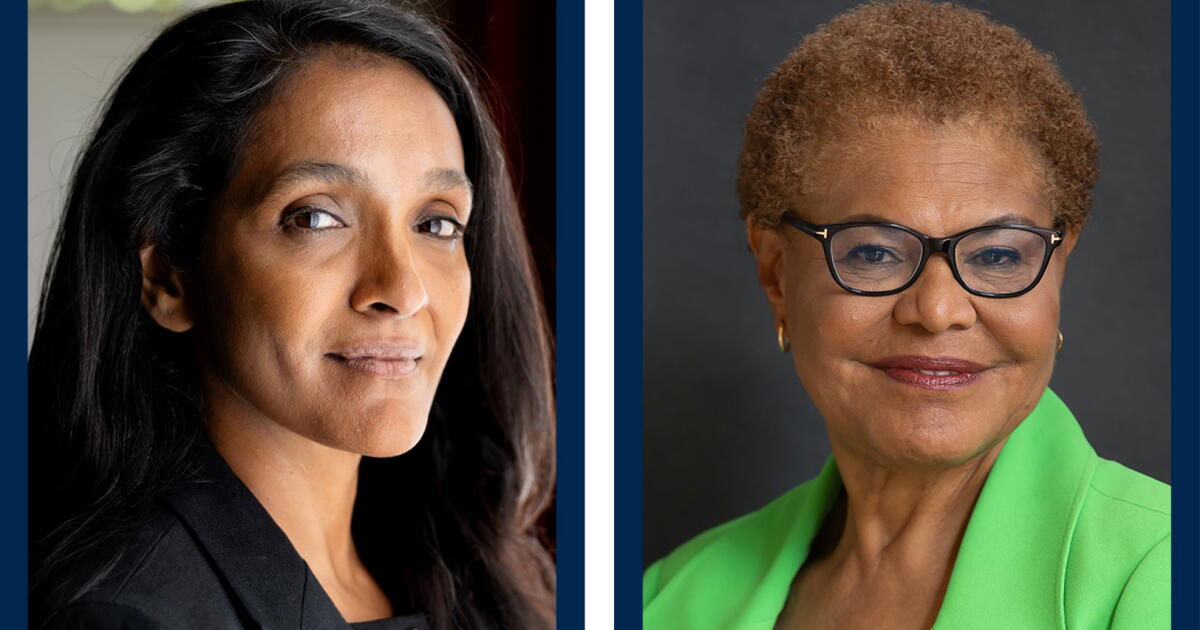
Los Angeles Mayor Karen Bass is in the fight of her political life, facing a vigorous challenge from City Councilmember Nithya Raman, a savvy campaigner who was until recently a close ally.
Raman publicly endorsed Bass at the start of the year, then launched her own mayoral bid weeks later, saying the city “can’t seem to manage the basics.” She came in second behind Bass in the June 2 primary election, edging out the flashier and more attention-grabbing Spencer Pratt, a onetime reality television star.
Now, Raman and Bass — both Democrats — are heading toward a generational showdown.
Bass, 72, is a veteran lawmaker who served in Sacramento and Washington D.C., before coming to City Hall. She’s drawn support from more traditional corners of the city’s political establishment, including Los Angeles County’s Democratic Party and its Federation of Labor, which represents hundreds of thousands of workers.
Raman, 45, arrived in L.A. in 2013 and launched a City Council bid six years later. She’s been endorsed by the Democratic Socialists of America and other groups that are newer to city politics, including Streets For All, which seeks to expand the city’s bus and bike lane network.
Bass has been dogged by high unfavorable ratings since the Palisades fire, which broke out in January 2025 while she was out of the country, destroying thousands of homes and leaving 12 dead. She has faced criticism over her handling of the wildfire response and recovery work.
Since the primary, the mayor’s political challenges have intensified.
The Lineage cold-storage warehouse fire broke out in June, causing communities on L.A.’s Eastside to cope with the stench of rotting meat for two months. The latest homeless count showed an increase in the number of people living on the street, dealing a setback to a mayor who staked her reputation on the issue.
Raman contends that Bass is simply a bad manager, pointing to those crises and other problems facing the city.
“I respect very much her long career of public service,” Raman said. “But the election has to be about results.”
The mayor isn’t backing down.
She says Raman has little to show for her three years running the council’s powerful housing and homeless committee. She contends that Raman is on the wrong side of the issues — particularly public safety — and does not work well with others.
“It says something that you do not have strong working relationships with any of your colleagues. Not one,” Bass said. “Each council member had a story to tell about how difficult she was to work with.”
Measure G, propelled by Horvath, will result in expanding the Board of Supervisors from five to nine members in 2032 and create a new county chief executive position, with an election in 2028. It passed narrowly, with 51.6%.
It also called for creating a county ethics commission and an ethics compliance office. Other branches of government already have this, including the city of Los Angeles, where the commission’s duties include overseeing campaign finance, such as the matching funds program for political candidates. The commission also regulates lobbying and can issue penalties for fundraising and other infractions.
The Measure G governance reform task force is setting everything up, but officials realized that for true independence, the seven-member commission and the compliance office must be permanently enshrined in the county charter. That requires the approval of voters.
Establishing the commission and the compliance office, Horvath said in a statement in May, “delivers on the will of the voters and marks a monumental step toward greater transparency and accountability in County government.”
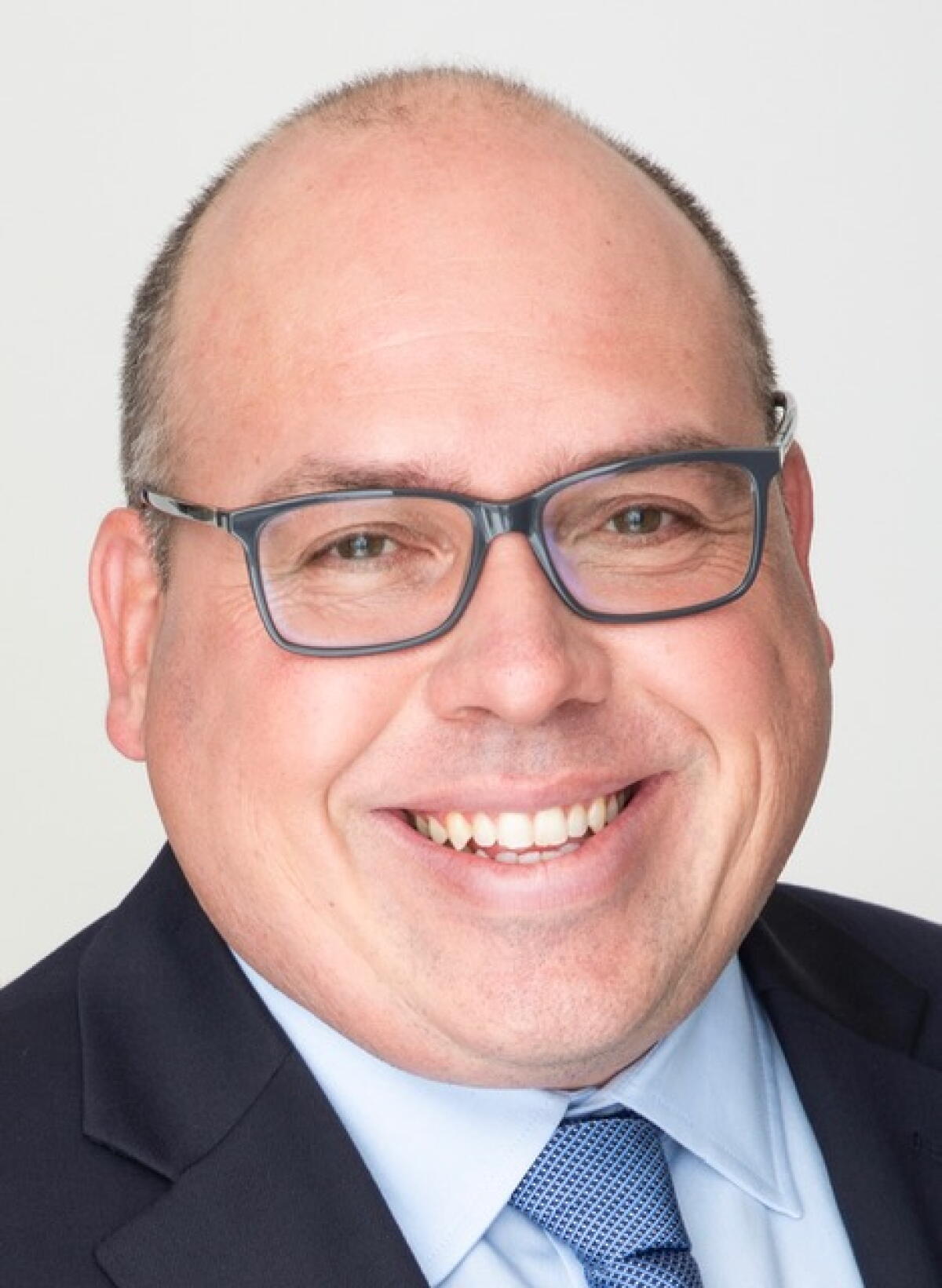
Gaspar founded Gaspar Insurance in 2008 and sold it in 2021 after he built it into one of the largest independent insurance companies in the Valley, and worked with several nonprofit and community groups: Discovery Cube Los Angeles, YMCA of Metropolitan Los Angeles, Viewpoint School‘s board of trustees and the West Valley/Warner Center Chamber of Commerce.
He would bring a pro-business perspective to City Council and help it make decisions that support business owners and residents alike.
Gaspar came in first during the primary election with 46.1% of the vote. He is running with support from groups including the Valley Industry & Commerce Assn. and the Los Angeles Police Protective League, a union representing LAPD officers. He’s also been endorsed by Blumenfield, L.A. County Supervisor Kathryn Barger, real estate developer Rick Caruso and former Democratic state Assemblymember Bob Hertzberg, Worth Girvan’s former boss.
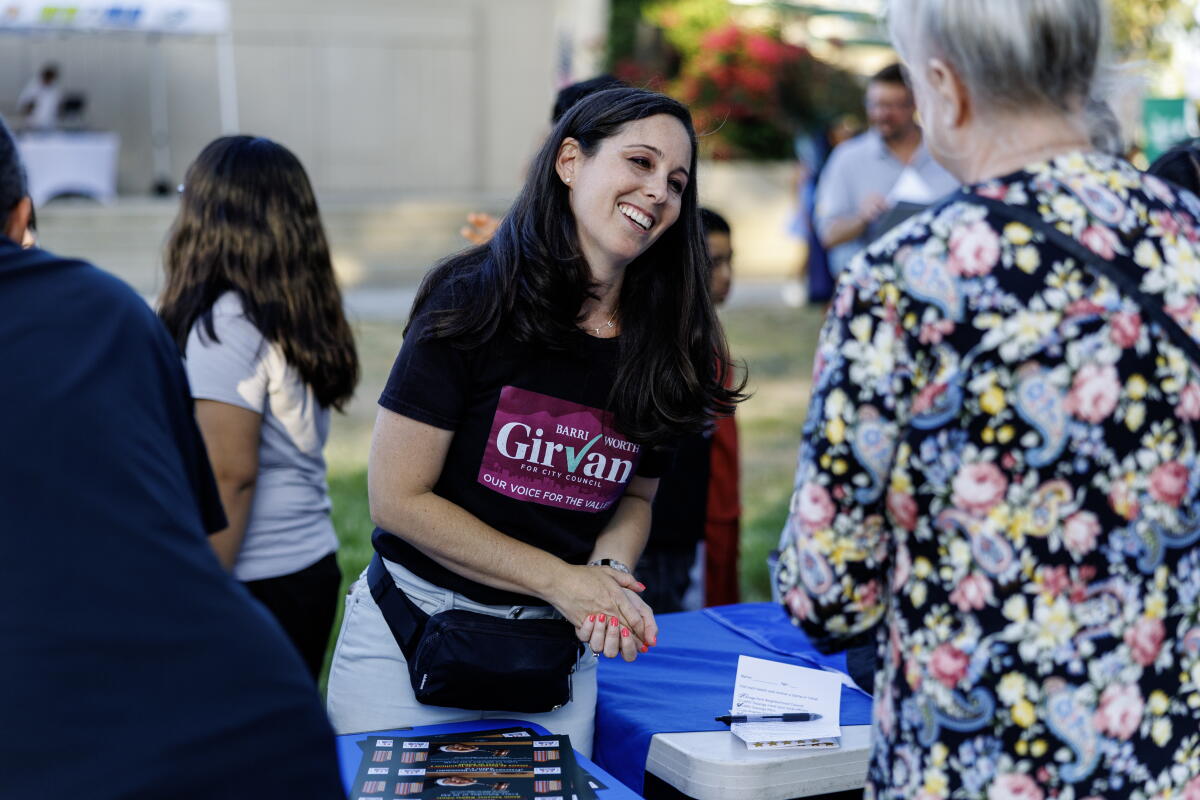
Worth Girvan meets voters during a neighborhood event in Canoga Park’s Lanark Park.
(Gina Ferazzi/Los Angeles Times)
Worth Girvan is a longtime city and county employee, with nearly 20 years working in public service. Prior to running, she was L.A. County Supervisor Lindsey Horvath’s district director for three years, handling constituent services on the Westside and in the Valley.
Before that, she spent eight years as an aide to Hertzberg, who failed to take Horvath’s seat in 2022.
Worth Girvan secured 42.5% of the vote in the primary, only 4% shy of her opponent.
Worth Girvan said her two decades of experience at the city and county levels have helped her build relationships and gain deep knowledge of the communities she works with.
“It allows me to be able to make a phone call and to be able to know how to bring about the change that we need,” she said.
She’s been endorsed by the L.A. County Democratic Party and labor unions including the local chapters of the International Brotherhood of Electrical Workers and the Service Employees International Union. She’s also been endorsed by Horvath and former L.A. Mayor Antonio Villaraigosa.
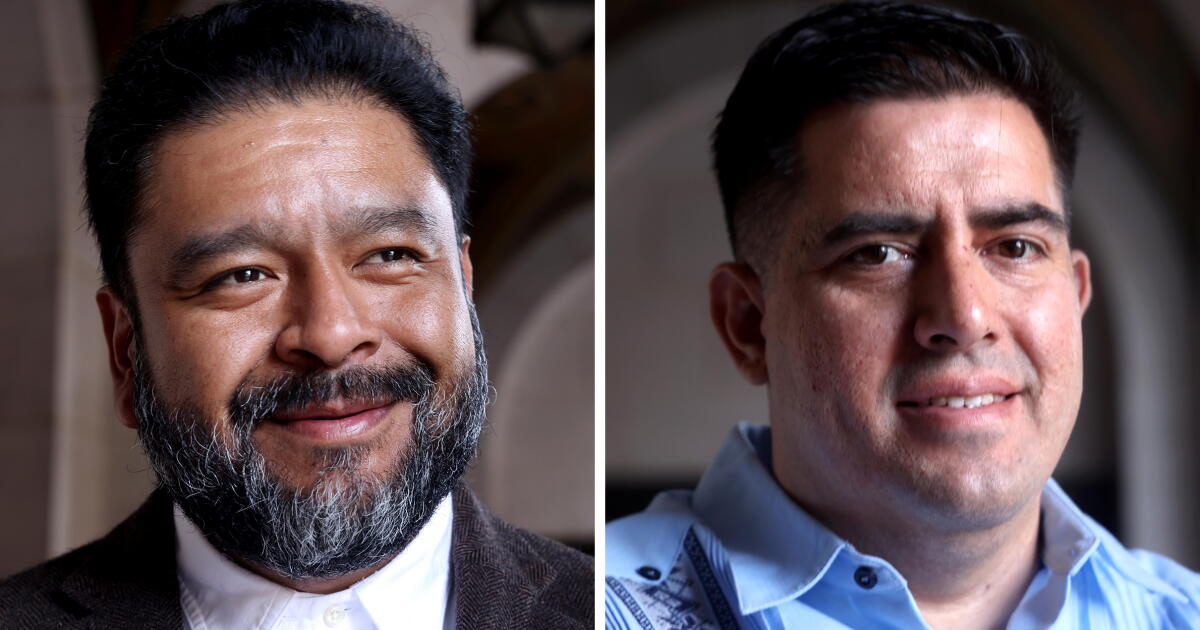
The multidisciplinary artist rafa esparza was maybe 19 and in the break room of the now-defunct Orchard Supply Hardware in Pasadena when he first found out about the revolutionary art group Asco. It was the early 2000s, and he was working full-time while going to school part-time at East Los Angeles College. He’d bring his homework to his job, and an older colleague, Ignacio, took interest in the books he was reading — mostly about Chicana/o studies and art.
Ignacio grew up in East L.A., and showed esparza a big manila envelope stuffed with incredible sketches and drawings by Glugio “Gronk” Nicandro. Gronk, a friend of Ignacio, was one of the founding members of Asco, which roared to life as an unapologetically Chicano organization in the early 1970s and was made up of East L.A. natives including Patssi Valdez, Harry Gamboa Jr. and Willie Herrón.
Esparza is now among two generations of L.A. Chicano and Mexican artists who have passed the torch that Asco used to blaze its groundbreaking trail. The story of the art group and its descendants, also including Maria Maea and San Cha, is featured in the new documentary, “Asco: Without Permission.” Executive produced by Gael García Bernal and Diego Luna, the film premiered last year at SXSW and arrives on TV for the first time at 7 p.m. Friday as part of PBS SoCal’s “Voces” series (plus PBS.org and the PBS app).
The beginning of a movement
When Asco first coalesced, Gamboa Jr. went to Los Angeles County Museum of Art and noticed a striking absence of Chicano pieces. In the film, he recounts how, after his concerns were dismissed by a higher-up at LACMA, Asco decided to take matters into its own hands. The group came back later that evening and tagged the building with their names (“Spray Paint LACMA,” 1972), effectively reclaiming the entire museum as a work of Chicano art.
1/7
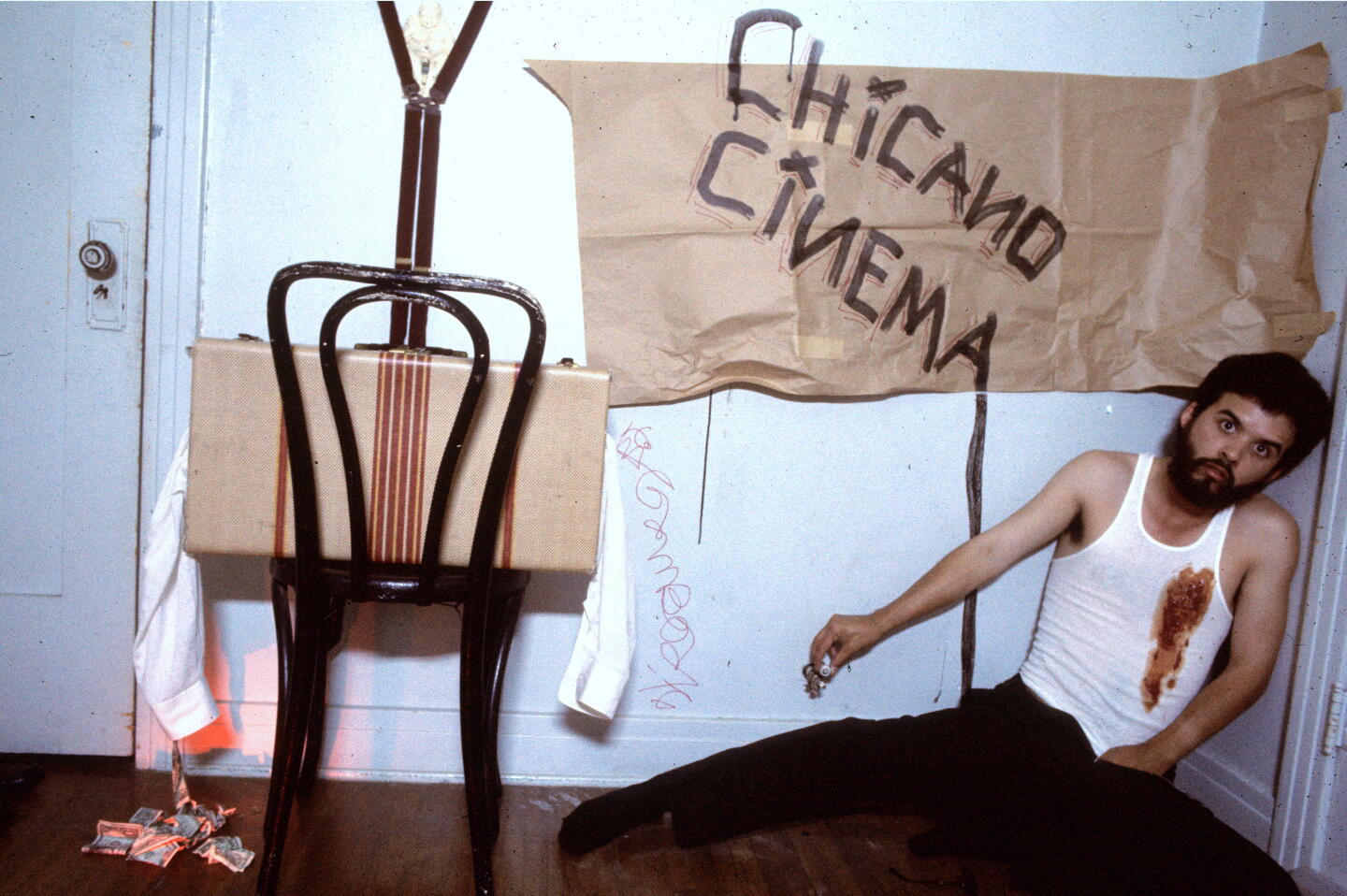
The No-Movie “Chicano Cinema,” starring Harry Gamboa Jr. (Asa Nisi Masa Films / PBS)
2/7
A group shot of the art group Asco. From left to right: Willie Herrón, Gronk, Patssi Valdez and Harry Gamboa Jr. (Asa Nisi Masa Films / PBS)
3/7
Members of the art group Asco pose in Malibu. From left to right: Gronk, Patssi Valdez, Willie Herón and Harry Gamboa Jr. (Asa Nisi Masa Films / PBS)
4/7
Patssi Valdez poses with her golden No-Movie Award, a parody of the Academy Awards, protesting the lack of Latino representation in Hollywood. (Asa Nisi Masa Films / PBS)
5/7
The Asco No-Movie “The Gores (Whittier Blvd + Ax)” (1974). (Asa Nisi Masa Films / PBS)
6/7
The Asco No-Movie “Star” (1980), starring Patssi Valdez. (Asa Nisi Masa Films / PBS)
7/7
A still photo of the Asco performance piece “Birds Wave Goodbye,” from 1972. (Asa Nisi Masa Films / PBS)
Asco’s work remained in relative obscurity — living in local mythology through storytellers like Ignacio — for decades. Then, in 2011, LACMA‘s views evolved and the museum gave Asco its first major retrospective, “Elite of the Obscure.” Documentary writer and director Travis Gutiérrez Senger came across press coverage of the retrospective and felt immediately drawn to the group, connected “on almost a cellular level.”
But it wasn’t until Trump’s first run for presidency and subsequent election, when his language around Latinos and immigrants dangerously sharpened, that Gutiérrez Senger knew in his gut that he needed to make this film now.
What set Asco apart was the fact that it was an art group, not a singular artist, working in tandem to react to social and political realities, including the 1968 East L.A. walkouts, the 1970 Chicano Moratorium, the Vietnam War, police brutality and gang violence.
“I would have never done the film if it wasn’t a collective,” Gutiérrez Senger said. “The thing about art history — and in literature and film — we often canonize individuals. When I saw Asco and it was a group, and they’re [on] the cover of Artforum or at the Whitney … that to me was really, really captivating. And, I thought, also very constructive.
“This isn’t just a group; this is a metaphor for how we mobilize and change,” Gutiérrez Senger remembers thinking.
Art as action
Asco was a fecund ecosystem, as is the close-knit community of contemporary artists following in its footsteps. The documentary recounts the history of the original group while heeding its call to action by collaborating with next-gen artists to carry the tradition forward. In 2023, Gutiérrez Senger curated a pop-up exhibition — featured in the film — alongside Pilar Tompkins Rivas, called “Asco and the Next Gen: An Inter-Generational Celebration of Latinx Art.” “Asco and the Next Gen” included esparza, Maria Maea, San Cha, Ruben Ulises Rodriguez Montoya, Guadalupe Rosales, Gabriela Ruiz and Dorian Wood.
“When you’re deeply collaborating with folks, and you’re in each other’s mediums and you’re sharing thoughts, and you’re thinking together, conceptualizing together, birthing a project together from scratch, you really have to step beside yourself, and understand that this is something that you’re co-creating,” esparza said. “Versus, I think art teaches us to center the single voice, the singular author of an artwork. And my experience of life, of art-making, has been the complete opposite: I think that we’re constantly reflecting each other.”
Esparza’s contribution to that 2023 pop-up was called “Corpo RanfLA: Terra Cruiser” and was originally staged outside the fairgrounds of Art Basel Miami a year prior. The L.A. version took place in the parking lot of an Arts District strip mall. Esparza bounced. He lay in a prone position, arms extended, body ensconced in gold and green lowrider armature, adhered to a blue bike frame, rocking on a 25-cent mechanical ride mechanism. The early connections esparza had with Asco resonated deeply in his relationship to art-making.
“They’re guerrilla, not asking for permission, just doing what they wanted to do with the help of their collective efforts,” esparza said. “That’s an ethos that’s very present in my own performance work, and it’s something that I hold very dear to me. It’s something that I always want to protect, in terms of how the art industry so powerfully commodifies everything you make as artists. I feel like performance still holds this power to really resist that, depending on how we will it into being.”
The interdisciplinary artist Maria Maea (left) and the filmmaker Travis Gutierrez Senger (right), writer and director of “Asco: Without Permission,” pose at Barker Block. Maea is featured in the film, in which she and Gutierrez Senger collaborated on a new “No-Movie,” titled “Pasado/Futuro.”
(Carlin Stiehl / For The Times)
Moving pictures are part of the revolt
Asco also had an interest in film. The art group members didn’t see themselves — or Chicanos or Latinos — represented in Hollywood, so they did it themselves, subverting a movie into a single still photograph that became its own story; an implied narrative. These, featured in the documentary, were called No-Movies.
In addition to the “Asco and the Next Gen” pop-up exhibition, Gutiérrez Senger and the filmmaking team invited multidisciplinary artist Maria Maea, San Cha, musician Fabi Reyna and Mexico City-based Ruben Ulises Rodriguez Montoya to create new No-Movies, also featured in the film, in response to Asco’s original No-Movies.
Maea first learned about Asco through esparza, too. He’s a mentor of sorts to her (they’re part of the same “interlocked brown community,” she says), and they were making adobe bricks together on the banks of the L.A. River for esparza’s 2017 Whitney Biennial installation when he told her the story about the hardware store and the manila envelope.
“They had a finite amount of resources, and they took this cinematic film lens or film camera film and shot these stills,” Maea said. “I think for me, it was so beautiful to see the infinity that could happen in front of it, the story that could happen behind it. It felt like we were just seeing this snapshot of a beautiful cinematic moment.”
The documentary’s new No-Movies are slightly longer, but still snippets of less than five minutes. The main character of Maea’s “Pasado/Futuro” No-Movie, the Being, sprang from the show “L.A. Fonts,” in the artist Alfonso Gonzalez Jr.’s backyard. (“Pasado/Futuro” also includes a group of kids working in a garage, meant to emulate Asco’s own garage origins — and to represent the next next gen. Its cast includes Maea’s younger sister, Ariel-Evelia Tuilaepa Diaz.) The Being is alien, mystical and magical, a migrant finding her way in a new world. (Maea often works with palm weaving, incorporated here, and palms have their own migration story to L.A.)
A still from “Pasado/Futuro,” one of the contemporary No-Movies in the film, featuring Maria Maea as The Being.
(Asa Nisi Masa Films / PBS)
“Something that really intrigued me was their sci-fi aspect of this film,” Maea said of Asco. “Like, they lived in a real world where they were experiencing the Chicano Moratorium, they’re experiencing violence in the streets, and they were also experiencing … the news projected back at them, that they were the issue,” stranger-than-fiction scenarios they synthesized into sometimes-futuristic or dystopian work.
Composer and performer San Cha’s No-Movie, “Luna,” made together with the musician Fabi Reyna, began as a song San Cha had written for a friend who had died; she had had a dream of him on the moon. In collaboration with Gutiérrez Senger, the No-Movie evolved into a piece about a lover, played by Reyna. Now, “Luna” is tender and otherworldly, drenched in the high drama and glamour that San Cha so loves.
San Cha was born in San José, then moved to San Francisco, where she was taken in by the Bay Area drag scene — specifically by her drag mother Per Sia, who’s still there. (San Cha recently relocated to Amsterdam.)
“She is from South-Central, but she studied art, visual art,” San Cha said. “She was a photographer, and she really got into the drag scene, and she was super familiar with Asco. We would do these processions in the Mission, from the Mission to the Castro … and she would always mention Asco in these moments.”
That’s likely because Asco’s early performances, as the art historian and curator C. Ondine Chavoya points out in the film, emphasized procession, mobility, mobilization and occupation, marking sites of political violence. Once San Cha moved to L.A., she found community quickly, too. She met Maea — with whom she made a video, “Coatlicue,” for the Music Center’s For the Love of L.A. program — and later lived with esparza.
“We can’t really perform in a vacuum,” San Cha said. “I can’t imagine doing this by myself, ever.… When I moved to L.A., there’s someone for everything.… And that way I didn’t feel the need to do everything alone. And even though in L.A. it was a little more professional, there’s so many people that are just like family.”
A still from “Luna,” one of the contemporary No-Movies in the film, featuring Fabi Reyna (left) and San Cha (right).
(Asa Nisi Masa Films)
When Gutiérrez Singer first started making this film, he thought that it — and Asco itself — was about saying “f— you” to the systems and institutions and racism that give us asco. (“Asco” means nausea or disgust in Spanish.)
“But at the end of the project, I started looking at the work and myself and the artists I had made the film with, and just seeing this incredible beauty and love,” he said. “And I realized that the power of Asco’s work is ultimately about self-love, and that when you feel that — and you can feel almost a collective sense of self-love as brown people — it gives you incredible potential and strength.”
The amendment aims to clarify campaign finance rules for candidates running for a seat on the board of education, which overseas LAUSD and its approximately 350,000 students.
Repetitive language in the Los Angeles City Charter would be deleted and would make clear the same campaign finance rules apply to both mayoral candidates and board of education candidates, except in certain instances, the measure says.
Among those requirements are rules governing campaign contribution limits, filing deadlines, public disclosures and fundraising windows.
Justin Allen Clayton, L.A. County deputy public defender
Bar rating: Qualified
Clayton is a Los Angeles native who attended public schools, earned a bachelor’s degree in criminology and passed the bar in 2012. He joined the public defender’s office two years later and since 2023 has served as deputy in charge of the Inglewood branch.
Clayton describes himself as a “working supervisor” who conducts arraignments and represents clients at preliminary and other hearings. He has completed dozens of trials, including three with life sentences, according to his website.
The position involves overseeing and training attorneys, as well as law clerks and summer interns, on misdemeanor and felony case preparation and trial strategy.
Clayton said a priority is improving court efficiency through pretrial preparation and “firm but fair enforcement of deadlines.”
Time as a candidate, he said, has shown him the importance of effective communication within the court system in bridging language and cultural differences. He called that a guiding principle, particularly for clients who lack counsel.
“Sometimes, one additional question, or one additional statement, can make all the difference in resolving an issue,” he said.
Clayton said running a public defender branch office, which brings him in contact with judges, sheriffs, court clerks, interpreters and others, combined with 14 years as a trial attorney, gives him a “comprehensive understanding” of the courtroom.
“That combination of courtroom experience, leadership and daily interaction with the many people who make our justice system work has uniquely prepared me to serve as a Superior Court judge,” he said.
Anna Slotky Reitano, L.A. County deputy county counsel
Bar rating: Qualified
Reitano spent the early part of her career in criminal defense, contract law and other sectors. In 2014, she joined the L.A. County public defender’s office. A decade there included three years in juvenile court, where she primarily handled felony cases, and five years at the San Fernando Courthouse, where she represented indigent clients facing felony charges.
Reitano focused on mental health diversion and treatment, aiming to support rehabilitation when possible. Having a brother with schizophrenia and witnessing how families navigate the legal system when dealing with mental illness has informed her approach.
“This has given me a deeper understanding of both the challenges individuals and families face and the ways in which the system can fall short in addressing those needs,” she said.
This is not her first bid for office. She lost a campaign for a judgeship in 2022 and two years later assumed her position in the county counsel’s justice and safety division, where she supervises litigation and advises county departments.
Reitano, a former child actor, volunteers with local schools and, according to her website, mentors “future lawyers” through moot court competitions.
Campaigning, Reitano said, has shown her that constituents, no matter how different, uniformly want “a judge who is experienced, prepared, fair and willing to listen.”
“My experience across criminal, juvenile, civil, administrative and government law has uniquely prepared me to serve wherever the court needs me,” she said.
Actor Wilmer Valderrama, who plays Special Agent Nick Torres on CBS’ long-running procedural “NCIS,” has chased bad guys all across Los Angeles. While he appreciates the geographic diversity of the region, Valderrama says his love for the city is actually tied to “the gift of being an immigrant.”
Valderrama moved to L.A. in 1994 from Venezuela with his family. He remembers how scary it was to come to the City of Angels, not knowing how to speak English. The family arrived “right before the Northridge earthquake, so that was our welcome to L.A.,” he says, adding that his family was living nearby in Van Nuys.
In Sunday Funday, L.A. people give us a play-by-play of their ideal Sunday around town. Find ideas and inspiration on where to go, what to eat and how to enjoy life on the weekends.
But growing up in Los Angeles, he found a sense of belonging in a multicultural community that gave him an appreciation for different cultures, cuisines and music. “There are so many different cities and ZIP codes here that make for a multifaceted and multi-heartbeat city,” he says.
Valderrama, who starts his 10th season on “NCIS” on Tuesday, founded the production company WV Entertainment, which released the documentary “Suárez,” about the first Mexican-born driver to win a NASCAR Cup Series race, in September on FS1. He also launched WV Sound, to help curate iHeartMedia’s slate of Latin-focused podcasts, and is active in numerous philanthropies, such as co-founding Harness with America Ferrera and Ryan Piers Williams to amplify the voices of underrepresented communities.
Today, Valderrama lives in Tarzana with his wife, model and PADI divemaster Amanda Pacheco, and their two children, Nakano Oceana, 5, and Wolf Monte, 1. He was finishing “That ‘70s Show” in 2006, when he noticed that Chuck Norris was selling his house in Tarzana. “I was 26 years old and realized I didn’t know if I was ever going to work as an actor again,” Valderrama says. “I bought this little house and the kids were born here. So it’s been kind of a dream to be here long enough to see that happen.”
Here’s a look at the actor’s ideal Sunday with family.
This interview has been lightly edited and condensed for length and clarity.
7 a.m.: Wake up and go for a walk
My son wakes up and Nakano starts asking for mac and cheese. Instead of mac and cheese, we go for a walk to our favorite coffee shop, Laidrey Coffee Roasters in Tarzana. They roast their own coffee beans and have an amazing pastry selection. Everybody’s in their sweats and pajamas, we hang out with some of our local baristas, and have a good time. I’m obsessed with coffee. My grandfather was a coffee farmer in Pereira, Colombia. I grew up with a level of appreciation for coffee that was just insane. For me, coffee is as good as tasting different types of wines. I love going to places that put a lot of emphasis on the curation of their coffee beans and the essence and the blends. How they serve their cappuccino is really important to me. I think it’s a perfect blend of broth and roast. And if the barista wants to add an artistic element, then they have successfully elevated my cappuccino experience. A kiss of hazelnut as a finishing touch too.
9 a.m.: Naps and playtime at the playground
As soon as it hits 9ish, my son needs a nap, so while he sleeps, Nakano and I go to a little playground, and I just let her run off some of her morning energy.
11 a.m.: Brunch at the beach
Then, we’ll go to the Malibu Farm Pier Cafe, and have a really great brunch. I like their chorizo burrito, and I add bacon and avocado to it. Their hot sauce is ridiculous. Nakano gets the Swedish mini pancakes, and Amanda loves the Surfer’s Rancheros.
1 p.m.: Paddleboarding in the Pacific
At this point, we just walk the beach, and maybe paddleboard around the pier. The waters are pretty calm around that time. My wife is a mermaid. She’s a divemaster, so the ocean is something that’s very important to her. So we’ll always try to find ourselves at the beach. We have our own paddleboards, but there are tons of shops where you can rent boards on PCH.
3 p.m.: Time for a snack
Around that time, I’ll get hungry again, and everyone’s like, how can you be hungry? We just ate. We’ll go to Neptune’s Net, which is a nice little coastal drive north on PCH. Neptune’s was famous for being in “The Fast and the Furious.” It’s a really great spot for burgers, fish and steaks, so we’ll just go there for a little snack, and I’ll be the only one eating, because everyone’s still full. I get the fried fish and chips.
4 p.m.: Fun on the Santa Monica Pier
We’ll go for a little drive after that. Sometimes, we’ll take Nakano to the Santa Monica Pier. She loves playing the games, and doing the roller coaster stuff. It tends to be pretty fun and lively.
5 p.m.: Slow drive back to the Valley
Then we slowly snail pace across PCH, and go over Topanga Canyon to get back into the Valley. At that point, the kids are taking a major nap in the car. By the time we get back to the Valley, I’ll probably pitch what dinner is. And they’re like, how can you still be thinking about food?
6 p.m.: Early dinner means Korean barbecue or sushi
We usually end up at this Korean barbecue place called the House of Galbi in Encino. It’s my favorite. They have a great all-you-can-eat menu with really great meats and an assortment of sauces and condiments. They have a prime rib that is phenomenal. Ask for the house hot sauce. It’s probably one of the best things to go with any piece of meat and seafood there. On a Sunday, normally there’s certain games, and they have big TVs in there, so you can watch the game while you’re having family time. I completely overeat on a Sunday.
If not there, we’ll go to Okumura in Encino. A young Japanese man trained these amazing Mexican guys to be incredible sushi chefs. The place is wonderful. It’s been my sushi place for a very long time. There’s a lot of fancy sushi places, but these little hole-in-the-walls are the ones you kind of hang on to, right? They know your usual dishes. They know how to make something up, right? They do this blue crab hand roll and they add some jalapeno and give you a ponzu sauce to dip it in. It’s really special.
8 p.m.: Head home and relax
We get back to the house, and by then, my daughter’s like a bobblehead, trying not to fall asleep. My son is out, so we just take the kids in and put them down. We’ll have a little us time, so we’ll just sit together and chat, talk about the week ahead. We try to watch something together and have movie night as much as we can on Sunday. Sometimes we’ll just pass out on the couch because we’re so tired. We’ll wake up at 2 in the morning and zombie our way to bed, you know?
The measure is backed by four of the five supervisors. During the February meeting, Horvath, who authored the initial motion, said that binding arbitration would promote transparency and push the sides to reach a deal. She said that 21 California jurisdictions, including Sacramento and San Francisco counties, have implemented binding arbitration.
Supervisor Hilda Solis called this “another tool in the toolbox.”
A battery of labor unions representing county workers are on board, including the International Assn. of Firefighters Local 1014, the Assn. for Los Angeles Deputy Sheriffs and the Los Angeles County Lifeguard Assn.
Dave Gillotte, president of IAFF Local 1014, which represents more than 3,000 L.A. County Fire Department employees, said contract negotiations with the county generally are intense and lengthy. He said the goal is never having to resort to binding arbitration, but that if required, this would allow a “neutral third party” to make the final decision.
“Binding arbitration really brings about leverage to move both parties to work hard to get a contract done, where we don’t have that now,” Gillotte told the Times.
Steven Veres, 46, is vying to maintain his seat on the Los Angeles Community College District Board of Trustees.
(Courtesy of Steven Veres)
Name: Steven F. Veres
Age: 50
Website: www.steveveres.com
Occupation that appears on the ballot: Los Angeles Community College District, member of the board of trustees
Experience: Veres cited his role as trustee and previous work as a teacher as key experience for another four-year term. Veres also has worked as a state politics adviser, including for Sen. María Elena Durazo. As trustee, he said his work has included strengthening job training programs, improving graduation rates and addressing basic student needs.
“Successful colleges depend on students, faculty, and staff having a meaningful voice in decisions” while the board should “listen, set clear priorities, protect public resources, and give our colleges the support necessary to help students succeed,” he said.
District challenges: The district’s greatest challenge is helping students finish their education, given how many are forced to juggle school with “jobs, housing costs, food insecurity, transportation, and family responsibilities … We need to remove those barriers while making the academic experience easier to navigate,” he said.
Priorities: “First, make college truly affordable. Tuition is only part of the cost. Housing, food, transportation, textbooks and childcare can determine whether a student stays enrolled.
“Second, improve completion and transfer rates. Students deserve clear academic pathways, accessible counseling and course schedules that allow them to earn a degree, certificate or transfer without unnecessary delays. Third, connect education to careers. I want to dramatically expand paid internships, apprenticeships and partnerships with employers and organized labor.
“These priorities reinforce each other: Students are more likely to finish when college is affordable, the path to completion is clear, and they can see the economic value of their education.”
Budget: “Our first responsibility is to use taxpayer dollars efficiently while protecting instruction and student services,” he said. In addition, Veres said that because state funding is based on enrollment, boosting it can be a path to financial stability, along with eliminating unnecessary, duplicative spending across the nine colleges and investing in energy efficiency to cut costs.
“Fiscal responsibility is not simply cutting spending,” he said. “It means directing limited resources toward what produces the greatest value for students and taxpayers.”
Student success: Veres would address barriers to student success and enrollment by pushing to make the application process easier and providing more flexible class schedules — including more evening, weekend, online and hybrid options — for working adults, parents and others. “Our job should not end when a student enrolls. It ends when that student reaches their educational goal,” he said.
Robert Payne is running for Los Angeles Community College Board of Trustees Seat 2.
Occupation that appears on the ballot: researcher/writer/environmentalist
Experience: Payne said he has taught at L.A. Mission College. His education at L.A. Valley College and Cal State Northridge helped prepare him for a career as a writer. He said he has worked on movie crews and ran an import business, among other jobs. Growing up in Pacoima helped him understand the needs of immigrants and “those of diverse backgrounds with limited resources.”
“I went through the [community college] system,” he said. “I know the difficulties. All my ideas come from my direct experience.”
District challenges: Payne cited low enrollment growth as the main challenge. Students also need to see a quicker return on their investment. “Life costs money,” he said. “If students could see immediate advantages to college, the colleges would attract more enrollments.”
He reflected on his own experience when discussing the importance of a quick payback. “I graduated from Cal State Northridge. Nothing I learned at L.A. Valley or Cal State paid off immediately,” he said. “I worked as a janitor, security guard, construction site cleaner. I lucked into a union tech job and I earned my way through graduate school. Years later, the master’s degree finally helped me get work as a ‘professor.’ ”
Priorities: Payne wants to make community colleges “cheaper, faster, better” in part by offering students more training for specific jobs and less expensive online textbooks. He also would support ending student debt.
Budget: He does not support cutting “student opportunities” and said if “the colleges can demonstrate success for the students, enrollment will justify the expense of maintaining the expense of the faculty, the staff, the facilities.”
Student success: Payne wants college to do more to offer “immediate perceived value,” including teaching résumé building, interview skills and how to apply to jobs. He said hiring adjuncts with industry experience could enhance student success.
Kristina Irwin is running for Los Angeles Community College Board of Trustees Seat 6.
Occupation that appears on the ballot: parent/business owner.
Experience: As a former community college student, Irwin has firsthand knowledge of the L.A. community college student experience.
She serves on the general advisory board at Santa Monica College and said she also served on the board of trustees at her children’s school, Palisades Charter High School, during the Palisades fire. She said she holds a Public Engagement & Civic Leadership Certificate from the Davenport Institute at Pepperdine School of Public Policy.
District challenges: Irwin said the main challenge is preparing young people to advance in college when their earlier schooling failed to give them the tools to succeed.
Priorities: Irwin wants to establish “preentry” programs in every local high school that would prepare students for community college and do more to give educators the resources they need to craft classes that “fit the needs and life limitations of the students.”
Budget: Irwin said alternative streams could be identified to fund “classroom student resources.” She said that as “responsible stewards” of district resources, trustee actions “are often under scrutiny either formally or informally.”
Student success: Irwin wants to address barriers to student success and enrollment by doing more to demonstrate how a community college education can give them the tools necessary to succeed in their chosen career.
Name: Roy Payan
Payan told the Times he suspended his campaign.
Adriana Cabrera is running for Los Angeles Community College Board of Trustees Seat 2.
Experience: Cabrera said she attended community college and went on to earn bachelor’s degrees in Chicana/o studies and political science and a master’s in education from Cal State Northridge. She said she also served as president of the Central Alameda Neighborhood Council and co-founded Empowering Youth in South Central, a “grassroots collective of students and educators” that “has supported thousands of first-generation students with college, career, financial-aid, and leadership support.”
“I am not coming into this role to learn higher education after I am elected,” she said. “I have studied it, worked in it, navigated it as a student, built programs within it, worked inside public institutions, and organized communities around it.”
District challenges: Cabrera said student services are too difficult to navigate, too many students struggle to afford basic needs such as housing, and clearer pathways are needed to economic mobility, She said budget decisions also can feel “disconnected” from the staff and students those decisions effect.
Priorities: “My first priority is invest in students first,” she said. Cabrera would do that by making student services easier to navigate and strengthening financial aid and other support, including for food, housing, child care and mental health.
Secondly, Cabrera wants to better connect education to economic mobility through good paying jobs. Lastly, Cabrera would give students, faculty, staff, labor organizations and community members “a meaningful voice before major budget priorities are finalized.”
Budget: Cabrera would review the district’s spending “to make sure existing dollars are being used efficiently” and “identify responsible ways to generate additional revenue without shifting costs onto students.” For instance, renting out underutilized facilities.
Student success: Cabrera would take steps to ensure student services are more readily available and the public has better visibility and say in trustee decisions. “The overall standard I would bring to the board is simple,” she said. “Can students enter LACCD, understand their options, find the support they need, complete their goal, and leave with more opportunity than when they arrived?”
Arguably the biggest change is to Area Planning Commissions, a group of seven volunteer-led boards that hear cases from homeowners, developers and businesses and make rulings on liquor licenses, hillside developments and more.
The amendment would consolidate those seven commissions into a single unified Neighborhood Appeals Commission.
The goal is efficiency. State laws passed in recent years have changed the appeals process, leading to lower caseloads for the seven boards. It’s also a financial drain on the city to train and take on so many volunteer commissioners while also paying overtime for staffers to host evening meetings for seven bodies — think audio-visual specialists, tech support, etc.
Under the amendment, the total number of commissioners would shrink from 35 to as few as seven, and the staff required to host meetings also would shrink significantly.
A unified board would eliminate the risk of commissions issuing different rulings. Picture a developer trying to build a hillside home; a commission that’s wary of such projects could reject it, while another commission that leans more pro-housing could approve it. Having a single board means that all appeals and applications would be governed by the same logic.
Pave the way for super-skyscrapers
Could an L.A. skyscraper rise higher than those in New York City or Chicago? Could downtown L.A. claim not just the tallest building west of the Mississippi River but also in the entire country?
If so, it would start here.
This amendment allows the City Council to change the existing floor area ratio (FAR) restrictions, which cap the height of certain buildings. FAR ratios vary by neighborhood and height districts, but the highest ratio is currently 13x, meaning a building’s total square footage never can be more than 13 times the size of the parcel of land that it sits on. For reference, L.A.’s tallest building, the Wilshire Grand Center, has a ratio of roughly 10.5, depending on how you calculate the square footage and acreage.
These limits were set in the 1950s, when L.A.’s population was roughly half of what it is now. This amendment would give City Council the flexibility to set higher limits to add density in order to adapt to a growing population.
Individual projects still would require zoning reviews, so no need to worry about skyscrapers coming to Silver Lake.
Set deadlines
You just opened a taco shop and you want to serve margaritas. The City Council said it’s fine, but you’re waiting to hear back from the City Planning Commission. They’re taking too long, and your patrons are drinking water while you wait for a liquor license.
Under current rules, decisions from either the City Council or Planning Department can get kicked back and forth indefinitely. This amendment sets deadlines for both sides to speed up rulings: Planning boards have 30 days to concur or dissent with City Council decisions, and City Council gets 21 days to hold a final vote on Planning decisions — or else the Planning decision becomes final.
Ensure passed amendments actually pass
Here’s how it would work. Say there’s an amendment to the city’s General Plan, which guides land use decisions, or a tweak to one of the neighborhood community plans that oversee development in areas like Hollywood or Boyle Heights. The mayor has signed off on it. The City Planning Commission approves too. But the City Council just hasn’t quite gotten to it yet.
Under current rules, if the City Council doesn’t vote on an amendment within 75 days of the mayor and Planning Commission approvals, it’s automatically denied. This amendment reverses that; if the City Council doesn’t get to an amendment within 75 days, it’s automatically approved.
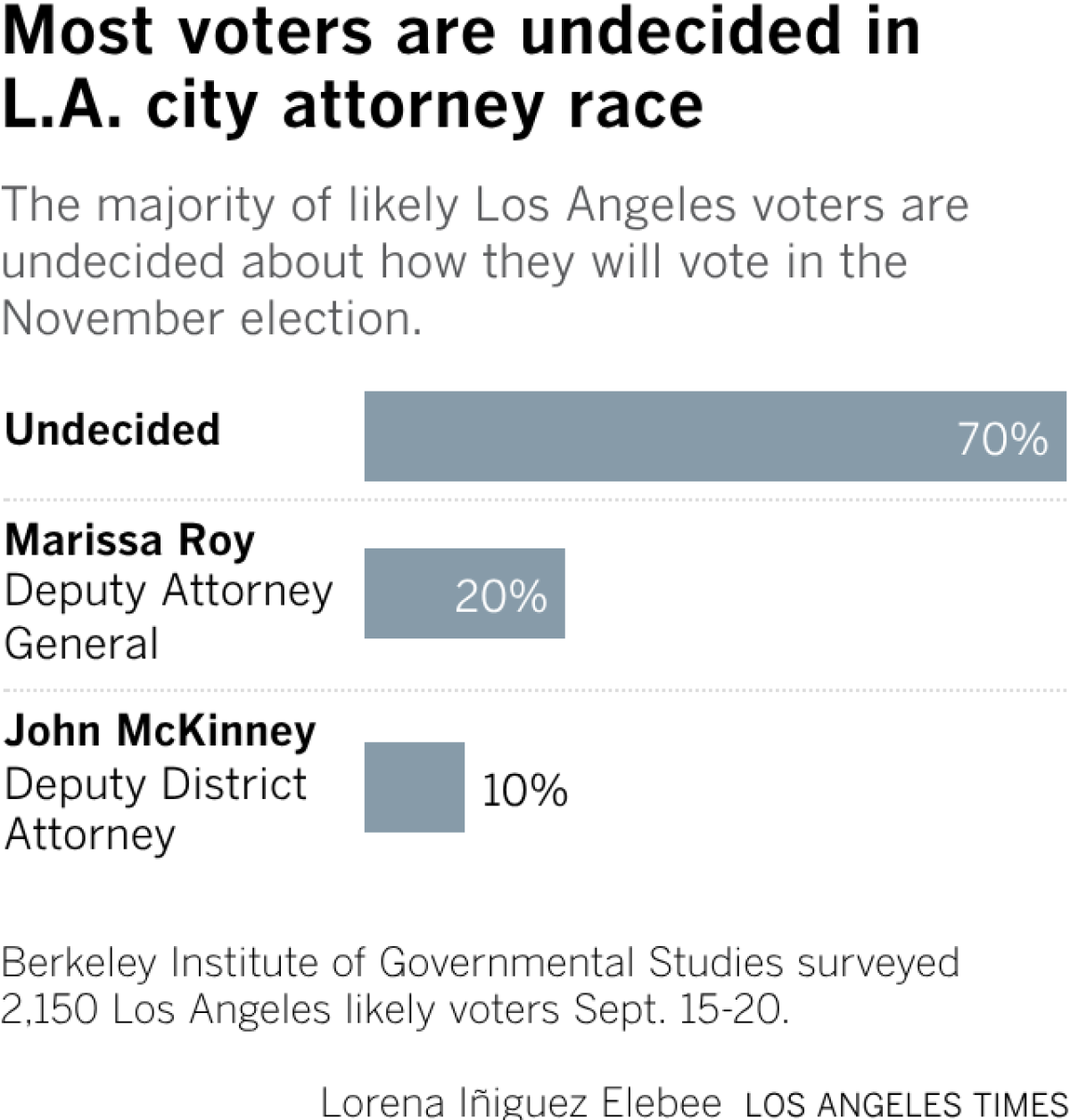
McKinney has been endorsed by Hochman, the union that represents rank-and-file L.A. police officers and City Councilmembers Traci Park, John Lee, Tim McOsker and Monica Rodriguez. While McKinney has raised half a million dollars, independent expenditures have spent more than $3 million to support the veteran prosecutor.
More than $2 million of those funds have come from a political action committee run by Airbnb. The rental giant was sued by Feldstein Soto for price gouging after the destructive Palisades fire, but McKinney has dismissed criticism that he’s receiving massive financial support from a corporation that if elected, he’d be involved in litigation against.
“Airbnb is going to benefit from a safer L.A., because it’s going to boost tourism to the extent that they have properties and interests here,” he told The Times in May. “When they look at the current city attorney and they look at Marissa Roy, maybe they decided this guy is going to do a better job.”
Roy has the support of the L.A. County Democratic Party, the Democratic Socialists of America’s Los Angeles chapter, California Atty. Gen. Rob Bonta, U.S. Sen. Bernie Sanders (I-Vt.), City Councilmembers Ysabel Jurado and Eunisses Hernandez, L.A. City Controller Kenneth Mejia, L.A. County Supervisors Hilda Solis and Lindsay Horvath, the city attorneys of San Francisco and San Diego, the L.A. County Federation of Labor and a host of other labor unions and Democratic groups.
Mayor Karen Bass endorsed Feldstein Soto in the primary. She has yet to weigh in on the runoff.
Former Long Beach Police chief Robert Luna came out of retirement to run for sheriff in 2022, promising to turn around a department that had veered off course.
As someone who didn’t have the wide name recognition or countywide political experience of some of his challengers, Luna’s second-place finish to Villanueva in the primary was far from guaranteed, but he ultimately cleared the rest of the field by a wide margin.
Fast-forward four years to June, and Luna received 44.2% of the vote in this primary — less than six points short of winning the race outright — versus Villanueva’s 21.7%. And Luna’s been a more effective fundraiser, bringing in $366,000 since Jan. 1, more than three times the nearly $109,000 Villanueva had raised by June 30, according to their most recent campaign filings. Luna had $352,000 in the war chest as of June 30, and Villanueva had about $56,000.
But Villanueva has wide name recognition in L.A. County. And he pulled off a historic political upset of his own in 2018 when he beat Sheriff Jim McDonnell, who is now the Los Angeles police chief. It was the first time an incumbent L.A. County sheriff lost a reelection campaign in more than a century. It was also the first time in 100 years that a Democrat had been elected to the nonpartisan sheriff’s job.
After running on a progressive platform and pitching himself as a criminal justice reformer, Villanueva tacked hard to the right. Within two years he was a favorite of conservative media, including Fox News, where he appeared repeatedly to vilify “woke” culture and criticize Democrats. He ultimately switched his party registration to Republican in a move that solidified a new base of law-and-order supporters while alienating many who supported him in 2018.
Villanueva’s tenure was marked by controversy and scandal. He launched, then walked back a criminal leak investigation of a Los Angeles Times reporter and was ordered to testify after sheriff’s deputies took and shared pictures at the site of Kobe Bryant’s helicopter crash. Villanueva defied subpoenas over so-called deputy gangs.
Now, Luna is the one defending his record as sheriff over the last four years. He’s presided over declines in homicides and violent crime and established a period of relative calm after the stormy Villanueva years. But Luna’s department has come under scrutiny in the wake of a July 2025 incident in which a grenade exploded accidentally in a department parking lot, killing three deputies. The state has fined the department more than $350,000 after identifying a series of safety violations leading up to the blast.
And the Civilian Oversight Commission filed suit against the department in June for declining to provide certain records related to three cases of use of force the commission issued subpoenas for in February 2025. Luna has said the county’s attorneys maintain that the unredacted records can’t be released until it completes a “meet and confer” process with the Sheriff’s Department union, a claim that watchdogs have disputed.
Proponents of the measure say Los Angeles is falling short in providing basic services, including street and sidewalk maintenance, upkeep of streetlights and trees and other services administered by the Department of Public Works.
The measure is intended to streamline public works decision-making to improve city services and add new sources of revenue by leveraging existing resources such as underutilized city land.
Measure LA’s perhaps most controversial element is the proposal to increase the power of the director of public works while reducing the sway of the Board of Public Works or potentially eliminating it.
The director would be able to manage public works projects, including construction, buying or leasing property, exercising eminent domain with City Council approval, granting street permits, regulating parking and recommending budgets for the department.
An opponent of the measure, Rodriguez said the Board of Public Works was established to provide independent review of city contracting, with commissioners’ decisions made in public meetings.
“Removing this important check and balance would reduce public scrutiny and weaken accountability over billions of taxpayer dollars for public projects,” Rodriguez said in her ballot argument against the measure.
Commissioners are appointed by the mayor. They work full-time on the board for five-year terms administering the Public Works Department while assisted by several bureau heads and the director of public works.
Proponents of the measure say the current system of overseeing public works is ineffective because responsibility is spread among multiple officials, commissions, agencies and bureaus.
“Angelenos see the results in crumbling streets, buckled sidewalks and streetlights that stay dark,” proponents said in their ballot argument.
Another key element of the measure is establishing a two-year budget cycle for the city, which currently adopts its budget annually. Under Measure LA, the mayor would be required to submit a proposed two-year budget to the City Council by April 1. A two-year budget would enhance planning for infrastructure improvements under another new requirement that the city adopt a Capital Infrastructure Plan.
Most major U.S. cities rely on multiyear capital improvement plans to schedule spending on roads, bridges, parks and buildings.
A long-term infrastructure plan administered with two-year budgeting “sets clear priorities, identifies the projects that need to get done, and plans how to fund them over time,” proponents said.
Currently, the charter prohibits the city from mortgaging city-owned property and prevents it from operating purely commercial or industrial businesses. The measure would remove these restrictions to raise new revenue.
Easing restrictions on operating a business also would allow the city to use its intellectual property to sell merchandise with city logos, as is done in other cities including New York, Yaroslavsky said.
Ugarte, who once collected signatures for Measure ULA, also known as the “mansion tax,” says it’s not working as intended and is keeping developers away from the city. The measure levies a tax on property sales above $5.3 million and funnels the money to affordable housing programs and homeless prevention.
“If developers are running away from the city of L.A., we gotta know why. We gotta go back to the drawing board. We gotta accept when we make mistakes, including myself,” Ugarte said.
He supports amending the measure to exempt affordable housing developers. He also wants to raise the threshold for properties subject to the tax to $10 million, to account for the increasing costs of construction.
Ugarte supports State Bill 79, a law mandating that cities increase housing density around public transportation hubs. But more transportation, Ugarte said, needs to come before more housing.
Making L.A. more transit-friendly will lower costs for housing, insurance and parking, Ugarte said, giving residents relief from the city’s high cost of living.
Mazariegos said homeless prevention starts with enforcing a “huge list” of the city’s tenant rights laws, including rent control and prohibitions against landlords harassing tenants.
Building affordable housing, along with enforcing those laws, will keep more people housed, he said.
Mazariegos wants to use public land to build social housing, which is publicly subsidized housing separate from the rental market.
He also would push to extend the travel industry’s upcoming $30 minimum wage to all workers and to tie the minimum wage to the consumer price index.
“A combination of those things will reduce and stop the bleeding of folks going into the street, going homeless, and will start giving us a chance as a city to work our way out of this crisis,” Mazariegos said.
Halloween season is arguably the most festive time of year in Los Angeles. Is it any wonder that a city that favors make-believe would take to a holiday that inspires elaborate set dressings and creative costumes, the latter a chance to take on a role other than ourselves?
Likely not, and whether you lean spooky or playful, the days and weeks leading up to Oct. 31 are filled with events, often with no costume necessary. Consider October an excuse to throw a massive, fall-related bash.
This season there are returning staples, such as “Carved” at Descanso Gardens and Universal Studios Hollywood’s Halloween Horror Nights, but also opportunities to explore Halloween’s campier side. Our penchant for the theatrical is well represented, and even newer Los Angeles institutions such as the Academy Museum are getting in on the autumnal fun.
Whether you’re seeking an event to charm or to inspire frights, there’s plenty our region has to offer.
I asked myself this question and then one second later I asked Google, because my phone was in my hand as it is 50% of the time, and 75% of the time when I’m not being social. I spend a lot of time alone, writing books that I hope will end up in libraries.
I knew there were many public libraries in L.A., and that walking to all of them would probably result in a trail that looked like a snarled nest. This turned out to be correct. The city of Los Angeles has 73 libraries. The county has 86. And Santa Monica has five.
So, I decided to simplify. I would walk about 15 miles from the Central Library in downtown L.A. to the Ocean Park Library in Santa Monica, and, since every trail needs a name, I would call it … the phrase “booking it” arrived in my mind. I crossed that out, and then I crossed out some other bad options, and then I decided to let it go and name the trail after I was done, which is often what I do when writing a novel, because you don’t really know what a thing is until it exists. With books, and with trails, and with life, the only thing we can ever be sure of is that our plans will always turn out to be wrong.
An illustrated map of the 15-mile trek from the Central Library in downtown L.A. to Ocean Park Library in Santa Monica.
Case in point: The day before the trail, I planned to draw some lettuce on my sun hat with fabric pens. I envisioned that on one side, the lettuce would be beautiful and perfect, and on the other side, it would be goopy and rotting. What ended up happening was that I drew two lovely romaine leaves, and I liked them so much that I stopped there.
As I said, I spend a lot of time by myself, and I imagined that walking this trail would be a solitary adventure. I’m currently in the process of writing a new novel, and since walking is so conducive to writing, I thought the trail would give me a nice big swath of time to ponder the fictional world I’ve created.
I was told that a photographer named Scott Strazzante would meet me at the Central Library at 7 a.m. I assumed he’d take some shots and maybe walk with me for a little while, and then we’d part ways. What actually happened was that Scott stayed with me the entire time. This caused me to see the two romaine lettuce leaves on my hat as a foreshadowing. I was one leaf, and Scott was the other.
1
2
1. L.A. Central Library. 2.The Lodrick M. Cook Rotunda inside the library. (Scott Strazzante / For The Times)
But back to the Central Library. It’s a masterpiece. Maybe you already know that. In case you don’t, I recommend a visit. Scott and I ended up in the rotunda, surrounded by murals, and it felt like taking a quick trip to Italy. Although really, it was a trip through California’s history. That’s what the murals depict.
An important part of the library’s history is that people (or one person?) tried to burn it down. Twice. In 1986, there were two arson attacks, spaced a few months apart. Who would want to burn down a library? It’s still unclear, although the main suspect for the first attempt was an out-of-work actor named Harry Peak.
The route from the Central Library to the Ocean Park Library is so easy that you could do it without your phone. You walk down four blocks to Olympic Boulevard, then head west. At some point, switch over to Pico Boulevard and keep heading west. Eventually, you’ll veer off at Gateway Boulevard, which turns into Ocean Park Boulevard, and boom! You’re there!
If you do this trail, I suggest you bring sunscreen, a hat and an external battery to charge your phone. I would also bring water and snacks, although, of course, there are many places to get those things along the way.
As Scott and I walked down Olympic, I said hi to a few people we passed, and Scott did too. After one of these interactions, Scott said, “People must think we’re missionaries or something, saying hi like that.”
A woman holds a religious sign at Olympic Boulevard and Alvarado Street.
I didn’t respond. But as we kept walking, I wondered about the implication of Scott’s statement, which is that if you’re going to be nice to a stranger, then it must be because you want something from them.
Scott and I stopped for beverages at Rok Coffee & Tea at Olympic and Ardmore Avenue, which I highly recommend. They have a free photo booth! Without the booth! It’s a modern, open-air version. Scott and I took a selfie. The people behind the counter were exceptionally friendly. When we walked out, Scott made a comment about it. “They were so nice,” he said, kind of in awe.
The arc of this story, I would say, is that Scott’s heart melted more and more as we walked, and so did mine.
At the start of the trail, Scott kept stopping to take photos. Which, you know, was his job. But I was annoyed about it. I was thinking, Damn, I was planning to dream about my novel and maybe call my sister and now I have to wait for this dawdling photographer?
Internally, I had a quick chat with myself. I could either choose to be irritated, or I could choose to love Scott. By the time we took the selfie at Rok, I loved Scott. Then he told me about his life and I loved him more. Scott’s new to L.A. He moved down here from Marin County, but he’s originally from Chicago. He hates shopping. When I complimented his shirt ( which said “Lucky Brand” on it) he said, “I didn’t even see that.” I noticed he was especially interested in signs about lost animals, which I thought was sweet. “Somebody lost a cockatiel!” he said, jogging to catch up, because I hadn’t waited for him.
Scott ended up jogging a fair amount. “We’re making this light!” I shouted a few times, and he sprang into action. He was a good sport about it. Running uses different leg muscles than walking, he pointed out, and his walking muscles were tired.
1
2
3
1.A Chevrolet van parked on Sherbourne Drive.2.Writer Swan Huntley walks along Olympic Boulevard.3.A jogger passes Love Psychic on Olympic Boulevard and Citrus Avenue.(Scott Strazzante / For The Times)
In other moments, Scott took the lead. He wanted to cross the street to take a picture of the Koreatown sign, so we did that. He stopped to ask people if he could photograph them, which meant that we had more conversations with strangers than I would have had alone. Scott made my solo journey into a social one, and by the time we cut down to Pico, I couldn’t believe there had ever been a moment when I didn’t want this awesome man to walk with me.
Here’s another equation:
Being alone + reading news headlines = I think the world is bad.
When I’m by myself for too long, scrolling through articles about the worst things that have happened recently, I inevitably start to think that strangers suck and that kindness is an outlier. When Scott said that us chirpily saying hi to strangers must have made them think we were missionaries, I thought that was sad. As the day went on, I realized I spend more of my life than I want in that sad place.
Near the intersection of Pico and Robertson, Scott and I met a guy whose job it is to change out the batteries on Coco delivery bots. He told us that Cocos are not autonomous. They’re operated by people overseas, who might never come to Los Angeles. After our conversation with this guy, I said to Scott, “He was so nice!” Scott said, “I know!”
So, you can see how our hearts were totally melted. Strangers, as it turns out, often don’t suck.
By the time we got to the Ocean Park Library, my legs were noodles and Scott’s T-shirt was soaked in sweat. There were five people inside. One was on a computer, one was sitting at a table, one was napping in a small chair and two were in larger chairs, charging their phones, with a bunch of bags laid out by their feet.
Inside the community-centered Ocean Park Branch of Santa Monica Public Library.
Thomas Alexander, one of the librarians, told me that people come to the library for all sorts of reasons. Sometimes it’s for books. Sometimes it’s for events, like the zine workshop they put on recently in the basement, which was very well-attended. And sometimes it’s to charge a phone or use a computer or just be quiet for a little while.
I asked Thomas why he became a librarian. He said, “I like working with the community.”
On some other day, this statement might not have made that much of an impact on me. But on that day, it did. Scott and I had spent the last six hours communing with each other and with all the people we met along the trail. I thought about Harry, the out-of-work actor who had possibly lighted the Central Library on fire in 1986. I don’t know anything about him, but my guess is that he was someone who had forgotten that he was part of a community. I wish that Harry could have met Thomas, who has a calm, sincere demeanor and big, brown inviting eyes that seem to say, Hi, I just want to hang out.
Or I’m projecting. By the end of this walk, that’s what I was thinking. I’d gone from being a one-woman show to: Hi, I just want to hang out.
Swan Huntley arrives at Ocean Park Branch of Santa Monica Public Library.
So, my plans were wrong, as they always are, and I’m glad. The original goal of inventing (discovering?) the Scott Romaine Library Trail was to inspire you to care about books. I ended up inspiring myself to care about what libraries are actually about: community.
An interactive, floor-to-ceiling walk-through “Dune” attraction is coming to Los Angeles in November, and it promises spectacle, as well as a bit of mystery. Step around, and potentially inside, awe-inspiring vehicles from the film, or come face-to-face with the Bene Gesserit, a group of priestesses who possess, among other things, the ability to bend the will of others.
In one centerpiece of the exhibit, guests will be asked to take their so-called “test of humanity,” an opportunity to place one’s hand in a box and, in the lore of the “Dune” franchise, experience a none-too-pleasant sensation. It’s a battle of will, and intellect, and at “Dune: The Experience,” the hope is it will be fun.
“Dune: The Experience” is an immersive, walk-through exhibit coming to downtown Los Angeles.
(Fever / Legendary Entertainment )
“I don’t want to spoil exactly what happens when you put your hand in the box, but it is intended to be somewhat shocking, participatory and to put people on edge,” says Rob Shalhoub, a team lead at Fever, which is producing the event in partnership with Legendary Entertainment. “It really immerses you into the intensity of these films, where you’re up close and personal with these characters.”
“Dune: The Experience” is planned to launch in November in support of the theatrical release of Denis Villeneuve’s “Dune: Part Three,” which is out on Dec. 18. The event doesn’t have an opening date or an end date yet, but it is intended to tour. It will be in Los Angeles at a location in downtown’s Art’s District at least through the end of December. Expect costumes, props and life-size vehicles from the film, as well as projection-based rooms designed to immerse guests in the desert planet of Arrakis.
There will be about a dozen rooms to explore, says Shalhoub, each designed for guests to spend around five minutes in. Some will feature hidden messages within ancient carvings, while others will emphasize photo opportunities with Paul Atreides’ throne, allowing guests to attempt their best Timothée Chalamet impression. “Dune: The Experience” is also built for attendees to linger, as it will feature an area with themed food and cocktails.
“It will reward your curiosity,” says Amado Trevino, director of interactive media and experiences for Legendary Entertainment. “Walls will begin to whisper throughout. You get to take Paul’s throne and see the desert come alive around you. Guests may even find out if they have what it takes to ride a sandworm.”
Different rooms are said to explore contrasting sensations, with some emphasizing touch, sound or visuals.
“We have this amazing projection room where you’re going to get to experience what it’s like in the desert in Arrakis, to really feel the scale of the desert and some of the dangers that lurk within the desert, namely sandworms,” Shalhoub says. “We’ve re-created these environments in a very interactive and immersive way.”
Adds Trevino, “There are things to see, there are things to hear, there are things to do, and there are things to feel. We’re showing beautiful artifacts from the productions, but you’re doing it from within the world of ‘Dune.’ ”
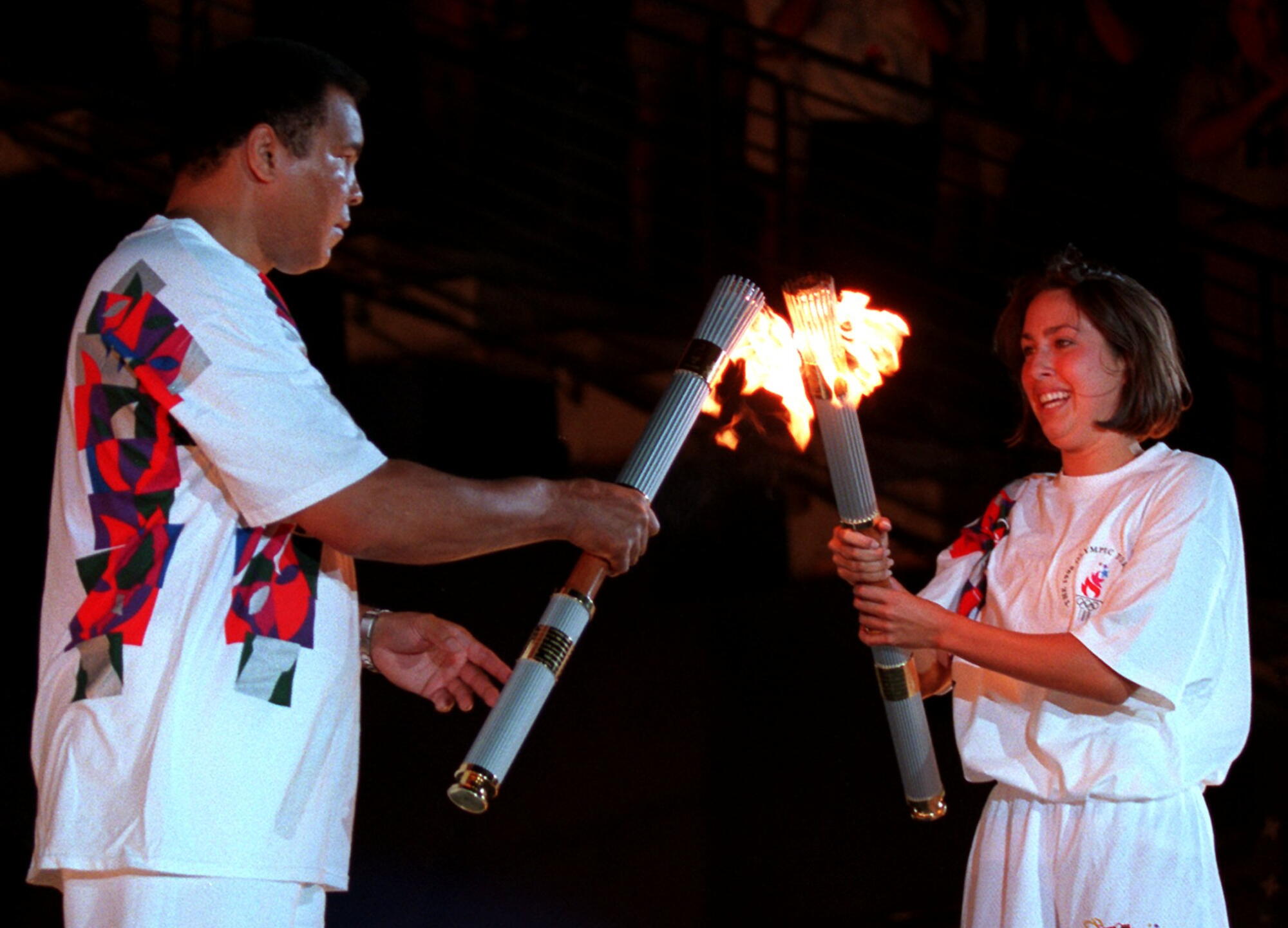
LA28 announced Tuesday it will begin the U.S. portion of the 2028 Olympic torch relay in Atlanta in a return to the city that hosted the United States’ last Summer Games and provided the Olympic movement with one of its most iconic torch relay moments. The city where Evans passed the Olympic flame to Muhammad Ali changed the swimming champion’s view on the Games and fueled her desire to bring the torch back as LA28 hopes to write an equally influential chapter of Olympic history.
“I realized when I carried that torch that the flame represents so much more than medals,” said Evans, now LA28’s chief athlete officer. “It certainly represents victory and all those attributes about the Olympics. But it also brings people together, and it’s a symbol of hope and what the Olympic movement really does for everyone.”
The torch relay, which begins in Olympia, Greece, will come to the United States in spring 2028, pass through all 50 states and culminate on July 14, 2028, with the lighting of the Olympic cauldron at the opening ceremony in L.A.
Three decades ago, the relay legs were reversed. Atlanta’s U.S. torch relay started in L.A., where Evans was one of the first people to run with it in 1996. She never thought she would carry it again during the opening ceremony.
Swimmers never attend opening ceremonies, Evans retorted when Billy Payne, president and chief executive of the Atlanta Committee for the Olympic Games, asked her to run the penultimate leg of the torch relay. She would be competing the next day and needed to rest her legs ahead of her final Olympic races. She didn’t believe him when he promised that carrying the torch in the opening ceremony would surpass any Olympic medal she could win.
Running past her fellow Olympians in Centennial Olympic Stadium made Evans finally understand. At the top of a large ramp, Ali emerged out of the dark night. Evans felt a deep rumble as the boxing champion came into view. The stadium felt like it would collapse.
Ali, trembling from the effects of Parkinson’s disease but with strength still evident, held the flaming torch aloft.
Payne was “worried to death” that Ali could drop the torch, he said, 30 years later. Payne instructed Evans that if that happened, she was to grab his arm, pick up the specially engineered torch that would never extinguish and light the fuse ball together.
Janet Evans passes the Olympic flame to Muhammad Ali during the 1996 Summer Olympic Games Opening Ceremony on July 19, 1996.
(Associated Press)
When Evans faced Ali to pass the flame, she knew she wouldn’t need to resort to Plan B.
“I saw it in his eyes,” Evans said. “I still talk to people that were in the stadium, and they say it changed me. It made me realize that I can do great things just like him.”
The torch and the flame endure in an ever-changing Olympic movement. The Games are no longer just a sports competition. They’re the biggest sporting event in the world. They’re seen as a symbol of unity. For host cities, they can also be seen as a high-stakes burden that must bring economic, commercial and civic success. Anything short of perfection feels like disaster on the world stage.
Now less than two years until the Games open, LA28 chairman Casey Wasserman acknowledged there can be some “angst” around the process that is kicking into the delivery phase.
LA28 is still trying to secure millions of dollars in funding to ensure smooth transportation during the Olympics and Paralympics. The nightmare scenario of running over budget and saddling local taxpayers with debt hangs over the organizing committee.
With no permanent venues to build in advance, much of LA28’s spending will take place in the final stages. It’s almost that time to spend, Wasserman acknowledged. Getting to finalize major touchpoints such as the torch relay, the mascot and the medal designs while preparing to makeover existing venues signal excitement and confidence in the organization’s process.
“The part now [that] we are in is making sure all of our plans are clear, all of our difficult decisions are being made, so that when we go, we have as few changes and as few course corrections as possible,” Wasserman said. “Not that there won’t be any, but to limit those as much as possible, so that we operate towards the start line with as much certainty as possible, which is the only way to deliver a project of this scale.”
LA28 will announce the full torch relay route in 2027. The private organizing committee has a rough sketch of the path that will snake through all 50 states. The nationwide tour was one of Wasserman’s earliest plans for the relay. While he was intent to bring the Olympics back to L.A. for the third time, he has always wanted these to be “America’s Games.”
Payne is jealous that LA28’s torch relay will reach every corner of the United States when Atlanta only managed 42 states. LA28’s route promises to pass through iconic cities and landmarks, but Wasserman is most keen on carrying the torch through small towns, per advice he received from Payne.
“If you want to see the power and the impact of what you’re doing, that’s where you will feel it,” Wasserman said his Atlanta counterpart told him. “Because that city, that community, it will be the biggest thing in that town. That is the power of the Olympic movement.”
Payne calls it “the burden and the joy” of the torch. During his Olympic planning process, he was never more nervous than when he carried the flame through the University of Georgia’s Sanford Stadium, where he met his wife, Martha, and played for legendary football coach Vince Dooley. Hampered by a hip injury, Payne limped through only a third of his allotted distance. He still cherished every painful step.
“The sense of the entire history of the Olympic world, the hopes and dreams of all the athletes, indeed, all the people of my community, my city, my country, they were all supporting us,” Payne said. “It was an amazing emotional time, and one I think [of] every single time we do the Olympic torch relay. It impacts people very similarly.”
The flame is lit during a ceremony at Olympia, the birthplace of the ancient Olympic Games, using a mirror and light from the sun. It will run through Greece before being transferred to the United States. Since the modern torch relay tradition began in 1936, the flame has burned underwater (Sydney 2000) and in space (Atlanta 1996) and traveled by plane, train, automobile, boat, pony and even camel.
To continue the tradition, LA28 will call upon thousands of torchbearers. LA28 will announce information on the torchbearer nomination process in the coming months.
The Olympic flame is passed to a torch during a ceremony in Olympia, Greece, in November 2025 prior to the Milan-Cortina Winter Olympic Games in Italy.
(Milos Bicanski / Getty Images)
Once it gets to the final 25 to 30 torchbearers, Wasserman said, each runner has to be “fundamentally important, connected and relevant to what we’re doing.” Runners could honor the Olympic movement’s past or future while celebrating L.A. and sports before passing the flame to the final torchbearer to light the cauldron.
The ultimate honor is typically reserved for sporting heroes from the host country, often with Olympic excellence on their resume. Since 1980, only two Summer Games have featured a cauldron lit by a non-Olympic or Paralympic athlete. Ali’s iconic moment set a high bar for the LA28 Games, but with 22 months left before the opening ceremony, the question of who will light L.A.’s cauldron remains a fun parlor game, Wasserman said.
He can make only one promise, which he first told Rafer Johnson. The legendary decathlete who climbed 99 steps to light the cauldron at the Coliseum in 1984 just begged Wasserman not to repeat the punishing path.
“Who lights it and how they get there, I don’t know,” Wasserman said, “but there won’t be however many stairs he ran up to get up to the bottom of the peristyle.”
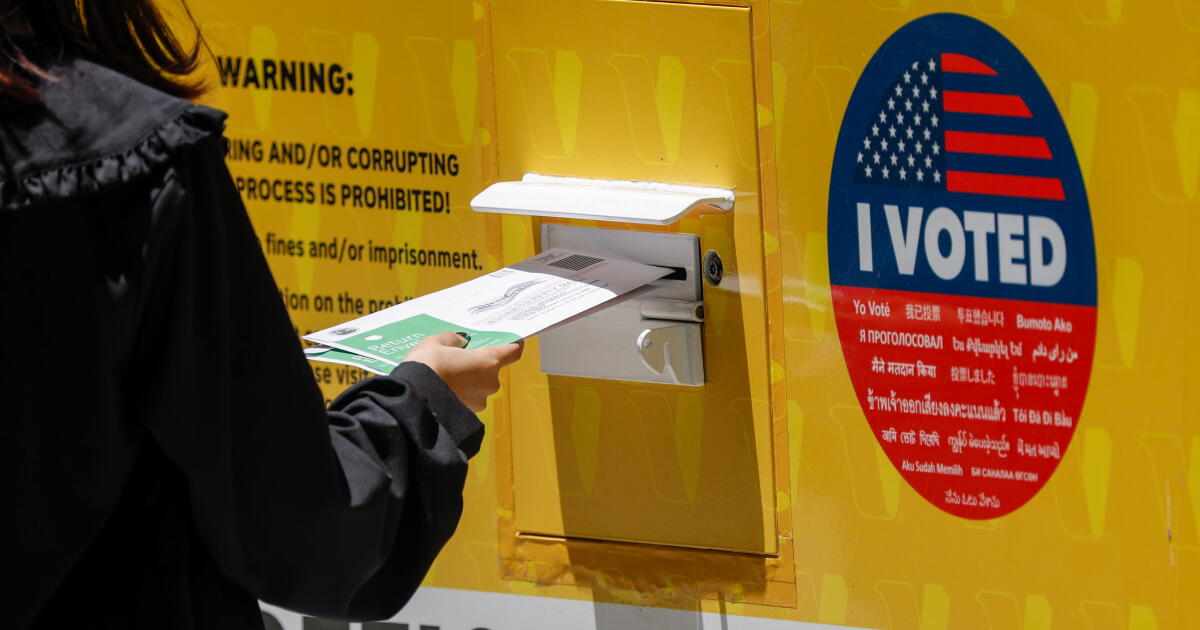
Federal investigators have sent Los Angeles County elections officials at least five grand jury subpoenas for individual voter records as part of a criminal investigation into illegal voting, according to partially redacted records reviewed by The Times.
The subpoenas — released in response to a public records request — appear related to a nationwide effort by the Trump administration to identify noncitizens who have illegally cast ballots in U.S. elections.
The subpoenas were issued in the U.S. District Court for the Central District of California. They were sent to L.A. County Registrar-Recorder/County Clerk Dean Logan’s office at the request of prosecutors in the office of First Assistant U.S. Atty. Bill Essayli.
“The enclosed subpoena has been issued in connection with an official criminal investigation being conducted by the Department of Homeland Security, Homeland Security Investigations,” Assistant. U.S. Atty. Michael Wheat — based out of the district’s Orange County office — wrote in a letter accompanying a Sept. 10 subpoena.
Wheat wrote that a custodian of records from Logan’s office must either appear before the grand jury to present the records or deliver the materials to a special agent from Homeland Security Investigations.
Four of the subpoenas — one issued on July 13 and three on Sept. 10 — request “any and all original and non-redacted voter records” from Jan. 1, 2020, to the present for a list of individual voters stretching across two pages. The lists were redacted by Los Angeles County officials, and it is unclear how many individuals each list contained.
Each of those subpoenas notes that records to be produced include information on individual voters, such as their “registration file” and “addresses listed, history and method of voting, [and] any and all attestation regarding citizenship status.”
A fifth subpoena, issued July 31, appears to request similar information for a single voter, and notes that the voter’s “ballot content or vote selections” should not be included.
Ciaran McEvoy, a spokesman for Essayli’s office, declined to comment on the investigations Monday.
The Times first reported the existence of the subpoenas, but not details from the records themselves, last week, after Logan confirmed that his office was complying with the federal inquiry despite having concerns that investigators may be using incorrect or outdated information to produce their lists of voters to investigate.
“We’re responding appropriately as directed through a subpoena, but that doesn’t afford the dialogue for us to get the background on what they’re looking for and how they came up with the names that they did,” Logan said. “There’s really no information being provided to us on that.”
President Trump has alleged for years that illegal voting by noncitizens is widespread, though experts say the problem — which they acknowledge occurs — is exceedingly rare. Homeland Security officials have been leading a campaign in recent months to identify such fraud nationwide, and the subpoenas received by L.A. County appear to match others received by elections officials elsewhere in the country.
Essayli — a Trump loyalist who has not been confirmed to lead the Los Angeles prosecutor’s office by the U.S. Senate and whose de facto leadership has been contested in court — has been vocal about his office’s pursuit of voter fraud, including by noncitizens.
His office has announced two voter fraud cases in recent weeks, including one involving the arrest of 30-year-old Honduran national on two felony charges of falsely claiming U.S. citizenship and fraudulently registering to vote. That man, Darwin Jonathan Rivera-Flores, has pleaded not guilty and is out on bond pending trial.
Rivera-Flores and his attorney declined to comment.
The Justice Department also recently announced it had charged 16 noncitizens in six other states with illegal voting and other election-related crimes.
Homeland Security Secretary Markwayne Mullin publicly claimed in July — without providing evidence — that there may be more than 190,000 such voters on California rolls, a claim California officials dismissed as baseless.
Three of the five subpoenas received by Logan’s office ask that the voter information be shared with Al Rossi, the acting assistant head of Homeland Security Investigations in Los Angeles.
Reached by phone, Rossi referred questions to an agency spokesperson, who did not respond to a request for comment.
Wheat had asked that the subpoenas be kept secret, so as not to impede an open investigation. Logan’s office released the records in accordance with California public records law, but redacted the names of voters on the grounds that doing so “protects those individuals from undue attention, harassment, intimidation, or possible harm” and “protects the integrity” of the investigation.
The U.S. Supreme Court on Friday upheld Trump’s expanded use of government data to search for noncitizens who are registered to vote. A lower court order had blocked use of the data over concerns — shared by the Supreme Court’s liberal wing — that the data are error-prone.
Voting rights experts have expressed concern that misuse of the data could lead to legitimate voters being purged from rolls.
States across the country, including California, have successfully fought off lawsuits from the Trump administration demanding the states’ complete voter rolls.
It is unclear why a subpoena for a single voter’s information would come between subpoenas for information on longer lists of voters. But it lines up with the case against Rivera-Flores.
In an affidavit filed with a criminal complaint against Rivera-Flores, Special Agent Christopher Kuzma — the same agent listed on the July 31 subpoena requesting a single voter’s information — said he received a series of texts he believed were from Rivera-Flores, who had previously been issued a misdemeanor citation on suspicion of disrupting immigration law enforcement operations at the federal building in Camarillo.
One text sent in April 2026 stated, “Your not the good guy I can’t wait until the mid terms you dont have qualified immunity then we can start and indict all you guys one bye one.”
Kuzma said in his affidavit that he took the message to mean Rivera-Flores “has both an interest in the voting process and an intent to participate in the election process.”
According to the affidavit, Kuzma said he conducted several record checks through public databases, including on the California secretary of state’s website, which “disclosed an online voter registration record” for a “Darwin Rivera” at Rivera-Flores’ address.
In July 2026, Kuzma said in the affidavit, he reviewed records from California Secretary of State Shirley Weber’s office for “Darwin J Rivera,” which showed the applicant had checked a box stating he was a U.S. citizen.
Kuzma’s affidavit said in August 2026 he received certified voter registration records from Los Angeles County.
The spokesman for the U.S. attorney’s office did not respond to a question about whether Kuzma’s July 31 subpoena was specific to Rivera-Flores, but the office has previously said Wheat is prosecuting the case.
When Rivera-Flores’ arrest was announced, Essayli said it was “the first of many to come.”
And that won’t be the only difference from last season because Laviolette, the winningest American-born coach in NHL history, has inherited an aging team in transition, one he and his new staff have immediately tried to put their stamp on.
“The coaching changes brought a lot of excitement,” goaltender Darcy Kuemper said. “It’s new drills, new systems, so it kind of makes everyone turn on their brain and challenge themselves, which is fun for guys at this level.”
Not all of the changes are positive, however.
Kings coach Peter Laviolette stands in the team’s locker room at their practice facility in El Segundo in June.
(Eric Thayer / Los Angeles Times)
For the first time in 20 years, the Kings are starting a season without Anze Kopitar, the franchise leader in games, assists and points and a two-time Stanley Cup champion. That has left a big hole on the ice and in the locker room, where Kopitar’s leadership was invaluable.
Also gone are wingers Andrei Kuzmenko and Jeff Malott, who left as free agents, and center Trevor Lewis, who retired. High-scoring winger Kevin Fiala, meanwhile, will miss the first couple of months, at least, after experiencing a setback in his return from a gruesome leg injury sustained at the Milan-Cortina Olympics.
That could hurt Laviolette’s effort to transform the Kings from the defense-first system they’ve been for years into a quicker, more aggressive offensive-style team. The Kings, whose scoring has declined in each of the last four seasons, had just 225 goals in 2025-26, fourth-fewest in the NHL, while the power play converted fewer than 18% of its chances, fifth-lowest in the league.
Two of the key pieces in turning that around will be forwards Adrian Kempe, who led the team in scoring the last three seasons, and Artemi Panarin, who had his best offensive season under Laviolette with the New York Rangers, scoring 49 goals and 120 points in 2023-24. The Kings are also counting on young forwards Quinton Byfield and Alex Laferriere, both 24, to take the next step in their development.
For Laferriere, change has been the main constant in his time in Los Angeles.
Kings right wing Alex Laferriere shoots in front of Philadelphia right wing Travis Konecny on March 19.
(Jessie Alcheh / Associated Press)
“This is going to be my fourth year with my fourth different coach,” said Laferriere, who had career highs in goals (21), points (44) and average TOI (18:18) last season. “It kind of reminds me a little bit of my rookie year. It kind of gives me that fresh slate, just trying to prove myself and try to gain the coach’s belief.”
In the dressing room, the Kings have given Kopitar’s crown to defenseman Drew Doughty, who will take over as captain in his 19th NHL season. At 36, he’s the third-oldest player on one of the NHL’s oldest teams and the last holdover from the 2014 Stanley Cup team.
“I’m not changing anything about myself when it comes to leadership,” he said. “I’ve been a leader on this team for a long, long time and been the loudest voice in the locker room and the guy that people come up to.
“One thing I will change: I always had Kopi as kind of the even-keel guy, where my emotions kind of go up and down. I’m going to be more aware of that and try to keep more of an even-keel.”
Whether a new coach, a new system and a new leader will be enough to get the Kings to the playoffs for a sixth straight season remains to be seen.
Laviolette, a Stanley Cup winner with Carolina two decades ago, has missed the postseason just three times when he’s been behind the bench the whole season. But the makeover he faces with the Kings is shaping up as one of the most challenging of his career, and most of the preseason prognostications have the Kings failing to make the cut.
If Fiala comes back early and healthy and if the team adapts quickly to the change in style, those predictions may prove overly dire. If not, the transition to the Laviolette Era could be more difficult than expected.
California Deputy Atty. Gen. Marissa Roy has a lead in the race to replace Los Angeles City Atty. Hydee Feldstein Soto, who lost her seat in a historic primary rout this spring, new polling shows.
Among likely Los Angeles voters, Roy leads by 10 percentage points over her rival, Los Angeles County Deputy Dist. Atty. John McKinney, following the pair’s shocking electoral upset in June, according to a poll released last week by UC Berkeley’s Institute of Governmental Studies and co-sponsored by The Times.
The spread closely mirrors City Councilmember Nithya Raman’s breakaway lead in her bitter fight to unseat Mayor Karen Bass, who has outraised her for months.
But that’s where the similarities end.
The mayor’s contest has been called a “knife fight” for its no-holds-barred campaigning. It has also drawn sustained — and occasionally sensational — national attention since Raman’s buzzer-beating entrance in February.
By contrast, the city attorney’s race remains all but unknown: More than two-thirds of likely voters are still undecided, versus about a third who remain uncommitted in the mayor’s contest, polling showed.
L.A.’s top litigator commands a budget of nearly $200 million, plays a role in shaping city ordinances, and wages court battles on behalf of the public. The city attorney also prosecutes misdemeanors — a job most other cities keep separate. Each year, the office weighs some 120,000 violations, deciding whether to file charges and how to pursue them.
More recently, city attorneys across the country have championed activist litigation, spearheading suits against the Trump administration, among others.
Yet, few local voters know the job exists, and fewer still know the candidates by name.
Seventy percent of likely voters said they had no opinion of either McKinney or Roy — a fairly typical result for a down-ballot race, experts note.
Still, new data about voter priorities could signal how those undecideds might shake up the race in its final weeks.
Roughly a third of L.A. voters rank “moving homeless people indoors” and “crime and public safety” as top priorities, respectively; just slightly less say “fixing streets, sidewalks, streetlights and other city infrastructure” is essential.
McKinney, 58, pitches himself as a law-and-order moderate with plans to use the city attorney’s prosecutorial power to reduce disorder and move unhoused people off the streets. He manages more than 300 people at the district attorney’s office and spent decades in the courtroom securing high-profile convictions — advantages that he contends outweigh his lack of civil litigation experience.
Roy, 34, campaigns with an aura of sunny progressive pragmatism, arguing that the city can rein in ballooning liability in part by tackling its vexing infrastructure issues. She nods to the recent $17-billion settlement with Meta — a case her team at the attorney general’s office led — as evidence of the kind of ambitious, public interest litigation a large municipal attorney’s office could join.
Those disparate visions — along with crucial endorsements and influxes of cash — helped the pair define clear brands and constituencies going into the primary.
Both also got a boost from nationwide anti-incumbent fervor, staking sides across a mutual opponent whose name recognition had turned sour while rarely taking aim at each other.
But the general election is a different animal.
Although the Los Angeles electorate has been moving leftward for years, primary voters typically skew older and more conservative than those who show up for the general election, experts said.
Polls suggest that fact could create an uphill battle for McKinney, whose sway is biggest among conservatives, about 19% of the city’s electorate.
Some 21% of Republicans and nearly 30% of self-identified MAGA voters favored McKinney in the most recent poll, while Roy is favored by 25% of Democrats and by 3 in 10 voters who identify as progressive or democratic socialists.
By contrast, about a quarter of Republican voters now say they favor Bass for mayor, while Raman has a 14-point lead among Democrats. (Both are about equally underwater with MAGA voters.)
Like Raman, Roy has deep ties to the city’s insurgent democratic socialist political machine and hard-won endorsements from its progressive clubs. She has also successfully courted L.A.‘s influential unions and got an early boost from the L.A. County Democratic Party when it endorsed her this spring.
McKinney is endorsed by the city’s powerful police union and championed by L.A. County Dist. Atty. Nathan Hochman.