“I wanna rob.” Hip cocked, midriff bared, cigarette pressed between her lips, Emma Watson’s indelible plea to “visit” Paris (as in Hilton) encapsulates the perfect inside-baseball deadpan of Sofia Coppola’s crime saga — not least because Hilton opened up her Mulholland Estates home for scenes of the Bling Ring burglarizing it. No film crystallizes the shallow, amoral bluff of Hollywood’s high-tabloid era with such icy precision, from the flat affect of the teenage protagonists to the late Harris Savides’ minimalist digital photography. Largely misunderstood upon its release, “The Bling Ring” now registers as an incisive comedy of manners for a society of influencers just then being born.
You’re reading the Essential California newsletter
L.A. Times reporters guide you through the most important news, features and recommendations of the morning.
By continuing, you agree to our Terms of Service, which include arbitration and a class action waiver. You agree that we and our third-party vendors may collect and use your information, including through cookies, pixels and similar technologies, for the purposes set forth in our Privacy Policy such as personalizing your experience and ads.
Sunday morning, Oct. 9, 2022, around 8 a.m., I was about to take a shower when I decided to check my cellphone one more time. Thank God I did: If I hadn’t, I would’ve been half an hour late on assisting in one of the most explosive stories ever to hit L.A. politics.
Via Slack, Times assistant managing editor Steve Clow asked if I could serve as a second set of ears on audio that my colleagues had unearthed involving four of the most powerful L.A. políticos at the time: City Council President Nury Martinez, Councilmembers Gil Cedillo and Kevin de León, and L.A. County Federation of Labor President Ron Herrera. I was still in my birthday suit (sorry for the visual, gentle readers, but I’m sworn to report the facts on this job) when I played the snippet Clow shared: Martinez describing the Black son of then-Councilmember Mike Bonin as “su negrito” — his darky.
I put on my shorts and told my wife I wouldn’t be helping at her restaurant that day.
Clow sent me more clips over the next hour, each crasser than the other — I remember gasping audibly at the part when the four were laughing as Martinez referred to Oaxacans as “ugly.” That morning, my colleagues Benjamin Oreskes, Dakota Smith, Julia Wick and David Zahniser published their first story on the fiasco, which turned out to be a secretly recorded conversation from a year earlier that someone had posted on Reddit just the day before.
The scandal quickly became a national sensation, with even then-President Joe Biden weighing in. L.A. wretched in collective disgust and demanded action, which definitely came: Martinez and Herrera quickly resigned, while Cedillo — who had already lost his reelection bid — would stay on until his bitter end, and De León wouldn’t leave until challenger Ysabel Jurado destroyed him in his 2024 reelection bid. The electoral repercussions of the audio leak can still be felt four years later in this election, as Nithya Raman stages a strong challenge against incumbent Karen Bass — a sentence no one would’ve believed in the fall of 2022, when Bass was on the cusp of winning her first term, and Raman was the lone democratic socialist on the council.
I would’ve figured the anniversary of something as titanic as all of the above would’ve sparked more commemorations than just my columna this week. Nope! L.A. has moved on to the point that Cedillo wasn’t booted from a group photo that included current District 9 council candidate Jose Ugarte, former Assemblymember Wendy Carrillo, former Mayor Antonio Villaraigosa and current Assemblymember Mark Gonzalez — because even Chicanosauruses can survive a political asteroid, I guess?
Having political leaders spew racist, homophobic nonsense now seems like the good ol’ days in an era where infernos destroy or stink up swaths of L.A., immigration agents terrorize immigrants from Westwood to the Eastside, and a spokesperson for a sitting American president denies that the commander in chief suggested Iran bomb the City of Angels, even though he said it during a campaign rally.
I shouldn’t really be surprised, I guess: L.A. infamously loves to forget its own history. But I would urge all you readers to read the great, Pulitzer Prize-winning coverage my colleagues did in the aftermath of the audio leak scandal, because it captured the city at its worst — but also its finest as residents fought back and demanded politicians do better.
Four years later, we can only hope this upcoming election shows more of the same.
The week’s biggest stories
Domenic Hix looks back as a large wave crashes on the shoreline in Laguna Beach on Friday.
(Allen J. Schaben / Los Angeles Times)
Tropical Storm Rachel in SoCal
California real estate
California crime
In memoriam
More news
Editor’s pick
More picks
Things to do
(Illustrations by Lindsey Made This; photograph by Charles Phoenix)
Today’s recipe
(Rebecca Peloquin / For The Times)
This recipe makes apple butter that is less sweet than most; use more sugar if you like, but don’t use less or there won’t be enough to properly preserve the pureed apples.
Have a great day, from the Essential California team
Jack Dolan, investigative reporter Hugo Martín, assistant editor, fast break desk Kevinisha Walker, multiplatform editor Andrew Campa, weekend writer Karim Doumar, head of newsletters
Textile artist Jane Jauregui is expanding the boundaries of what plush figures can be, thinking beyond that pile of mass-produced, branded stuffies huddled atop a twin bed, crammed inside a toy chest, or dangling from a backpack strap.
True, in the nearly two decades that she’s been creating plush figures, she’s produced charmingly minimalistic foxes, cats and buffalo fit for a nursery. However, her latest work has been anything but child’s play.
A plush fried chicken bucket is one of Jane Jauregui’s textile takes on beloved dishes.
She launched her “soft sculpture” company, STFD, in 2024 with the intention of transforming her inner thoughts into plush form — no matter how outside the box those ideas may be. After all, why bring yet another teddy bear into the world when you can dream up a stuffed paintbrush trailing a splash of brightly colored felt “paint,” or a striped bucket filled with faux fried chicken?
In this series, we highlight independent makers and artists, from glassblowers to fiber artists, who are creating original products in and around Los Angeles.
“It stands for Stuff That Feeds Delight,” Jauregui said of the brand’s acronymic name. “The newer things I’m working on are more like display items, but you can absolutely touch them,” she explained. “I just started playing more with the idea of decor, aging it up a little bit more, and playing with the idea of how we can really elevate it.”
Take, for example, a plate of longsilog, the traditional breakfast meal her Filipina grandmother used to make for her. Inside the converted garage of the same Van Nuys house where she was raised, Jauregui whipped up a playful sausage-riceball-fried egg combo using a sewing needle, felt, embroidery floss and sherpa fleece, rather than pots and pans.
Moved by memories of her grandfathers, she created a collection of stuffed felt cigarette butts, complete with simulated ash made by zigzagging stitches.
“My Thai and Filipino grandpas were chain-smokers,” she said. “They passed away, and I just started thinking a lot about what would represent them. Cigarettes immediately came to mind.”
Jane Jauregui’s home studio inside the converted garage of her childhood home.
Though she takes inspiration from her personal experiences, many of her plush figures strike a universal note. Most anyone born in the 20th century would take one look at her plush retro alarm clock radio and instinctively feel the urge to whack its elongated vinyl “snooze” button. The trompe l’oeil wood paneling (which she made by printing a wood-grain design directly onto dark brown fabric) and the red-tinted digital readout screen (the numbers are iron-on transfers) make it a dead ringer for those once-commonplace nightstand devices that predated smartphone alarms.
She first tried her hand at the craft about 18 years ago, after she and her husband, Sergio, couldn’t find the right gift for his newborn niece at famed New York City toy emporium FAO Schwarz.
“Everything was licensed, and I didn’t want any kind of IP [intellectual property],” she recalled. “I went home and said, ‘Well, I’m just going to sew something for her.’ Sergio was like, ‘But you don’t know how to sew, so that’s a little crazy.’ I said, ‘That’s OK, I’ll figure it out!’”
1
2
1.A plush hot dog.2.An ashtray full of plush cigarettes, inspired by Jane Jauregui’s grandparents.
Fortunately, she had a leg up when it came to picking up the new skill. Her father, a retired clothing designer and patternmaker, had introduced her to the inner workings of the garment industry from a young age.
“My dad would have full-time work five days a week, so there wasn’t a lot of time for him to teach me,” she said. “But when he would take freelance work home, I would sit in this garage with him. He had a big table, and I would sit there and watch him sew. It was just really how we spent time together.
“When I decided to start making plush, I remembered little things he would do, like how to walk a pattern — which is making sure the pattern pieces are matching — or how he would move the ruler. I would remember all of those things and put my own spin on it.”
Artist Jane Jauregui eschews watercolors and acrylics, preferring to “paint with plush.”
She started by making simple shapes like a stuffed orange, pear and an eggplant, working her way up to the finalized baby gift: a stuffed whale. By 2009, she’d completed enough plush produce to start selling at local pop-up markets under the business name Janie XY. Sergio, an artist in his own right, even constructed her first booth to resemble a fruit stand. Her first hit item was a baby rattle shaped like a chicken drumstick that was sold wrapped in cellophane, much like a meat-counter purchase. This time, her muse was her own infant niece.
For the record:
11:27 a.m. Oct. 7, 2026An earlier version of this article said Jane Jauregui’s daughter is 4 years old. She is 5.
All the while, she was holding down a full-time job creating window displays for Forever 21. She continued to build her squeezable empire in her off-hours, even as she transferred to corporate jobs at Mattel and Disney (for which she’s now a consumer products design manager), and became a mother. Taking a page from her father, she’s made her at-home workspace accessible to her 5-year-old daughter.
“She’s in here all the time,” she said. “I let her touch everything. What’s fun about the medium is you can’t break it. You can get it dirty, but she knows what to do. She’s really mature about it. She loves to clean the sewing machine — she’ll go in with a pin and pick out all the lint, and she’ll think that was a good day’s work. We want her to feel like part of the work because she is a part of it.”
Jane Jauregui’s sewing machine, which her daughter likes to clean, in her home studio.
That said, Jauregui’s STFD creations aren’t necessarily made with the wee ones in mind. Consider her new pieces celebrating liquor stores, for which she converted items like lottery tickets and frothing beer cans into plush form.
“It’s something that we all take for granted,” she said of the ubiquitous neighborhood corner store. “You tend to turn your nose up at it, but it’s there for you all the time.”
She and her husband also pay homage to these unsung cultural hubs in the latest edition of their fledgling zine, which they’ve dubbed “a gallery you can hold.” Inside, photographs of the stuffed figures fill the pages, accompanied by written musings. (The one-of-a-kind featured items will also be available for purchase.) The series is the couple’s prescribed antidote to the social media doomscrolling they call “internet indigestion.”
Jane Jauregui’s goal for the plush items she makes in her studio? Delight.
She’s also planning to explore plush Thai food in honor of Grandma’s Thai Kitchen, the Van Nuys restaurant her mother owned and operated for years. After treks to downtown L.A.’s Fashion District to find just the right materials, she’ll mock up clever riffs on julienned ginger and cilantro leaves. For her, there’s ample delight in those little details.
“STFD is really about giving myself permission to just do things that make me happy,” she said.
Brandon Flowers stands onstage at the Ford Theatre wearing a sharp black suit and a bejeweled bolo tie and tells the audience about his cousin Bobby’s job parking cars in the 110-degree heat of the Las Vegas Strip.
“That was gonna be me in another life, only my big plan was to work at the Bellagio,” he adds. “Nicer place, more tips.”
As the frontman of the Killers, Flowers, 45, has spent more than two decades singing about the struggles and the temptations at the heart of the American dream. But on his new solo album, “Thrasher,” he trades the Killers’ gleaming, synth-laced rock for the crackling sound of hand-played country music.
He cut the LP at Nashville’s historic RCA Studio A, where country giants like Dolly Parton and Waylon Jennings once worked; not only that, but to accompany him he recruited veteran session players including David Rawlings, Bruce Bouton and 85-year-old Charlie McCoy, who played harmonica on George Jones’ immortal “He Stopped Loving Her Today.”
Yet for all its old-school country cred, “Thrasher” also emphasizes Flowers’ roots as a Vegas showman — his tremulous croon, his go-for-broke emotion, his almost preacherly understanding of how to take a crowd up (and up) and how to take it back down. Think Glen Campbell or Donny Osmond.
“Or Wayne Newton,” says Rawlings with admiration. The guitarist, known for his long collaboration with Gillian Welch, performed with Flowers at July’s Newport Folk Festival. “It’s really thrilling to see the way he inhabits this stuff onstage,” he adds. “I have such incredible respect for anybody who knows how to entertain at that level because it’s an absolute gift — and it’s really hard work.”
Flowers, who grew up in Las Vegas and Utah and who shares three sons with his wife, spoke about the album in his dressing room last month a few hours before the Ford show. A sequel to “Thrasher,” recorded during the same sessions, is due out next year.
The Nashville OGs who played on these records — do you think they were impressed by you? I think they were refreshed. I think they didn’t quite know what they were getting into and were pleasantly surprised.
For you, it was a different way of working, right? These players are artists. But it’s also just another day on the job. You feel that: “Charlie’s got to leave at 4 to go to the Opry.” He still gets his licks in.
I wonder what it would’ve sounded like to cut 10 Killers classics with this band. Probably like the Traveling Wilburys or something. The second album has some of that DNA. This one was more of a narrative album — a lot of stories. The other one, it’s more in the romantic realm. I’m excited to get it out. I have another one cooking.
A third album? Well, because they’re so efficient. It’s opened up a door for me that I feel like I’ll always be able to explore. If I have 10 songs, I can go to Nashville for five days and cut the whole thing. We do two songs a day, no problem.
You’ve said there’s this idea in rock music that making an album needs to feel like climbing a mountain. I blame it on U2. You don’t feel like you’re doing it right if you’re not doing that. We really went into that on “Sam’s Town” — we climbed Everest, man. When we finished “Sam’s Town,” I remember the last day — it was like 6 in the morning, the sun was up and we were finally done. What a relief it was.
Now the veil has been lifted. It doesn’t have to be like that.
Did you get a feel for Nashville as a town while you were there? I got a breakfast spot: Cafe Roze. I don’t want to blow it up too much because I want to be able to get in. But you know Cafe Stella in Silver Lake? They used to have my favorite breakfast in the world: sourdough, soft scramble, prosciutto and Parmesan. And they have that exact thing at Cafe Roze — it’s like I’m transported back. I could eat it every day with a side of avocado.
“Thrasher” follows a number of country excursions by rappers and pop stars. Do you have any anxiety about being seen as a carpetbagger? No, because I’m not trying to bulldoze my way into the world and open a bar in Nashville. This is an authentic part of myself — I have an education in this music. People have a lot of preconceptions about country music, especially lately. Everyone says the same thing: cold beer, dirt road, Friday night. But there’s such an art to the tradition — it’s a soulful artistic endeavor. I’m trying to come at it from that angle.
What’s your relationship with modern country music — Morgan Wallen and Miranda Lambert and the like? I don’t have one. It’s more people that are on the fringes, I guess — Jason Isbell or Sturgill Simpson. I got Sturgill’s guitar player because I was a fan of that stuff.
Before I heard “Thrasher,” I expected kind of a stripped-down Isbell vibe. I could see him doing “In a Heartbeat” or “Miss America.” But once we got to Nashville and got the guys in the room, it just got a little more pep in its step.
Does being embraced by the Nashville industry feel like a reasonable goal? That’s a whole other nut to crack. You hear stories about Dwight Yoakam having a tough time — and he brought some heat. Or John Prine just because he was from Illinois and not from further south. I’m not gonna go on a campaign to prove how worthy I am.
You’ve been dinged by people who think you’re putting on an accent on this record. I feel like this is more how I speak than maybe they’re accustomed to. I don’t know, I might’ve leaned in a couple times. There is a Utah accent — it was something I was embarrassed by when I was younger. But now I’ve lived there 16 years of my life total, so it just starts feeding its way back in.
Is your vocal approach different for country than for rock? There’s more quiet in these songs — more room for the story to be told. In the rock band, I’m competing — everybody wants to be heard — whereas this one, there’s this beautiful thing where the guys don’t mind being in the background. They want to frame the picture, and I’m the picture.
Did you find yourself making more of an effort to enunciate? I’ve always been cognizant of that. Just today, there was a band — I won’t say who it was — but I was interested in hearing their new thing, and I didn’t understand a word until the chorus. I was rooting for the guy the whole time, but it’s like: How can I fall in love with this if I don’t know what’s happening?
Brandon Flowers performs last month at the Ford Theatre.
(Rob Loud)
Got some questions about specific songs. “One of Us” is about your brother-in-law, which made me realize how few people write songs about their in-laws. He passed away unexpectedly a few years ago. You know, I’m the youngest of six, and he married my oldest sister. She’s 17 years my senior, so when they got married, I was a kid — he became my big brother and was a masculine figure in my life and all that. There’s your family and then there’s your found family, and he’s part of my found family. I wanted to honor him, and this is my way of doing it.
I assume your sister’s heard the song. Oh yeah. A lot of those moments happen on this record where I had to play the song for the person, and you just can’t help but be brought closer together. You’re taking part in their grief but we’re also celebrating him. It was beautiful.
“Miss America” is about another one of your sisters. The one next in line.
She’s addressing an abusive ex, and you sing it from her point of view — from a woman’s perspective. It just started like that. I don’t remember a moment of thinking: Am I gonna do this from the outside or am I gonna step into her shoes? Maybe it’s something to do with that Tom Waits song [“Christmas Card from a Hooker in Minneapolis”] — something about that maybe gave me permission.
Did you play “Miss America” for that sister? It felt like the gentlemanly thing to do. If she’d said no, I would’ve been heartbroken because I think “Miss America” is gorgeous — I’m really proud to be part of it. But I would’ve honored her wishes.
In “An American Dream,” the point of view seems to keep shifting. At one point I think the narrator becomes Elvis Presley? Chorus 1, I’m singing with this man that used to give me cigars and tobacco when I was a kid — we’re singing it together. Giving a 13-year-old Red Man tobacco — there was nothing shady about it, or nothing too shady — but it was still a wild move. Then Chorus 2, Elvis and I are both singing — I see it that way.
Which era of Elvis are you envisioning? Whenever I think of him, I think of him in ’68. Nobody’s ever looked that good — it’s not fair.
You’re known for your flights of lyrical fancy: “Burning down the highway skyline in the back of a hurricane,” for instance, from the Killers’ “When You Were Young.” Did country music allow for those flourishes? Verse 2 of “Does It Ever Cross Your Mind?” is a great example: “I could’ve been born in Bangladesh but I wasn’t / I was born here with just enough jelly beans in my basket to ask you to go wishing on a star.” That’s fun.
In “An American Dream” you say, “We blew through starlight on bricklayers’ knees.” We’re performers, and we’re here to entertain you. But we’re working-class men, me and Elvis.
Some of these lines get at this crucial point that I think your music makes, which is that pageantry and sincerity can coexist. I think people get confused a lot — they might look at a line like the one you just talked about and think it’s total bulls—. It’s annoying to me to read a review and see where they just don’t get it — and they think they’re the smart one. I saw someone talking about my tropes, and they brought up the Bangladesh line. I thought: What are you talking about? That’s the most left-field line.
You’re challenging the listener to accept that over the top doesn’t necessarily mean phony. It’s so American to be over the top and to still have substance. That’s the chorus of “An American Dream”: “Gold and silver / God and glitter.” I guess I’m trying to spoon-feed it there a little bit.
Plenty of Killers songs involve people making bad decisions. How do you think about the degenerate’s place in country music? It’s funny how people aren’t quite familiar with how wild it was. The same person in me that was excited about old Depeche Mode stories still gets excited about old George Jones stories. And a part of me yearns for that. But I keep it under wraps.
Your oldest son is 19, which means you became a dad at a fairly young age. It was just par for the course. I grew up in an LDS family — my sisters were having kids when they were 17 and 18. So having Ammon at 26 — that was the oldest anyone had had their first child in my family. They were like, “Brandon might be gay.”
How did you reconcile the rock star and new dad halves of your life? It sort of gave me a direction early on because I was a little bit teetering in those days. Who’s ready to have this wild fame brought on them at such a young age? We weren’t the Beatles, but “Hot Fuss” and “Sam’s Town” were really successful records — we went straight to arenas. It was tough to navigate, and family gave me an anchor.
Do you hear before parenthood and after parenthood in your music? There’s a song called “Be Still” on the fourth record — a song to the kids. But I don’t know if the writing changed that much. Everybody was getting older in the band, so whatever happened, you can’t place the blame just on me.
Los Angeles Mayor Karen Bass and challenger Nithya Raman will be on the same stage Tuesday night for their final debate before the Nov. 3 election, but the two mayoral candidates are expected to come in with starkly different game plans.
With recent polls showing Raman in the lead, the councilmember will likely try to avoid making any kind of flub during the in-studio debate hosted by NBC4 and Telemundo52 in Universal City.
“A successful debate for Raman is one in which not very much happens,” said Dan Schnur, a professor of politics at USC, UC Berkeley and Pepperdine.
Raman floundered at the last NBC4/Telemundo debate during the mayoral primary, when Spencer Pratt was also on stage. She got better marks after a debate with Bass before the Sherman Oaks Homeowners Assn. in August.
Along with avoiding mistakes, Raman will need to paint a positive view of the city she hopes to lead, said Sara Sadhwani, a professor of politics at Pomona College.
“She needs to able to spell out a vision for the city of Los Angeles and inspire confidence that she would be able to deliver on such a vision,” she said.
For Bass, it’s a different task entirely. The mayor was the top vote-getter in the June 2 primary, but numerous several polls now show her trailing. The Berkeley IGS / L.A. Times poll, conducted Sept. 15-20, showed Raman with an 11-point lead over the incumbent.
To gain ground, Bass needs to go on the attack and convince voters that Raman isn’t fit to lead, Schnur said.
“Bass needs to explain to voters why voting for a relatively unproven candidate would be a dangerous risk to take,” he said. “I’m curious if it will go down the road of the nasty,” Sadhwani said. The debate, being conducted in partnership with Loyola Marymount University, will run from 7 p.m. to 8 p.m. and will be moderated by NBC4 news anchor Colleen Williams, NBC4 chief political reporter Conan Nolan and Telemundo 52 news anchor Alejandra Ortiz.
The Times will have live coverage.
You’re reading the L.A. on the Record newsletter
Sign up to make sense of the often unexplained world of L.A. politics.
By continuing, you agree to our Terms of Service, which include arbitration and a class action waiver. You agree that we and our third-party vendors may collect and use your information, including through cookies, pixels and similar technologies, for the purposes set forth in our Privacy Policy such as personalizing your experience and ads.
An influencer digs in on Bass
Social media creator Ed Choi made headlines this week, posting and then removing an Instagram video showing him and Raman declaring in unison: “Only you can stop fascist liars.”
The pair used that phrase as an image of Bass appeared on the video. Raman, facing criticism for her words, said she was referring to Trump and Immigration and Customs Enforcement raids, not the mayor or Los Angeles Police Chief Jim McDonnell, and had asked for the video to be taken down.
Choi defended his messaging, saying in a subsequent Instagram video that Bass is in fact a fascist, pointing to to Bass’ decision to appoint McDonnell, a former L.A. County sheriff. He also cited the Los Angeles Police Department’s treatment of anti-ICE demonstrators as evidence that the city is “descending into fascism.
Raman voted in 2024 to support Bass’ selection of McDonnell, even as her fellow Democratic Socialists of America colleagues on the council cast opposed his appointment. On the campaign trail, she has repeatedly criticized McDonnell, saying the LAPD should not have used tear gas on anti-ICE protesters exercising their First Amendment rights.
Choi also claims in his video that Raman is committed to defunding the police. But Raman no longer supports that idea, saying in February that LAPD staffing should not get any smaller.
Banned word lawsuit
When the Los Angeles City Council considered banning the use of the N-word and C-word at its meetings last year, Stacey Segarra-Bohlinger was in attendance to give the politicians a piece of her mind.
“This is going to bring lawsuits,” said Segarra-Bohlinger, who often sings parody songs at council meetings and has been a member of the Sherman Oaks Neighborhood Council.
Segarra-Bohlinger filed suit Tuesday, represented by lawyers with the Foundation for Individual Rights and Expression. The group contends that word bans — which can lead to people who use those words getting kicked out of meetings and potentially barred from future ones — violate First Amendment protections of free speech.
“The Council has weaponized the Word Ban and Meeting Ban to silence, remove, and prospectively exclude its critics,” asserts Segarra-Bohlinger’s lawsuit, filed in U.S. District Court in Los Angeles.
Segarra-Bohlinger filed the suit after her repeated use of the C-word at two council meetings last year, once while singing a parody song of the Ghostbusters theme song in which she repeated the line “Council is afraid of the word c—” four times.
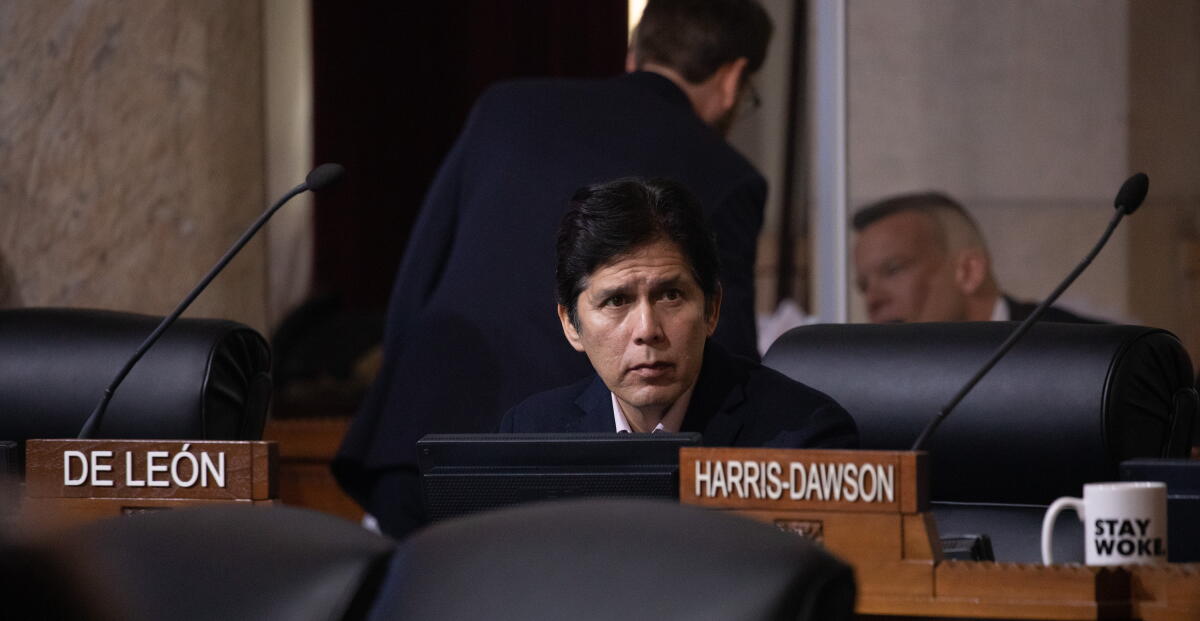
Council President Marqueece Harris-Dawson is standing by the ban.
“In a moment of very serious attacks on our basic rights in this country, it’s especially absurd that some individuals would waste the court’s time defending the right of racists and misogynists to hurl invectives at the public simply to hear their own profanity,” he said in a statement to The Times.
State of play
—MONEY, MONEY, MONEY: Hedge fund manager Aaron Sosnick dropped another $3 million into Estamos Con Nithya, the pro-Raman independent expenditure committee sponsored by Western States Regional Council of Carpenters. Sosnick, who has been pushing for an expansion of the city’s bike lane network, has now put $6 million into the committee.
— UNION KERFUFFLE: The LAPD’s officer union said Tuesday it will oppose Measure FD, the half-cent sales tax measure on the Nov. 3 ballot pushed by the city firefighters’ union — setting up a bitter and expensive clash between two of the city’s most powerful unions.
— LEFT UNREAD: Citing lingering concerns about the potential misuse of police license plate readers, the Los Angeles City Council voted Tuesday to delay an agreement that would enable the deployment of hundreds of the controversial devices until officials are satisfied that the technology will be wielded responsibly.
— LAUSD WOES: The state’s school Fiscal Crisis and Management Assistance Team concluded that the Los Angeles Unified School District is at “high risk” of insolvency — and needs to move quickly to avoid losing control over budget decisions.
— HIT THE SKIDS: Federal authorities along with local partners like LAPD made more than a dozen arrests on Skid Row during a massive drug trafficking crackdown in the troubled Downtown neighborhood.
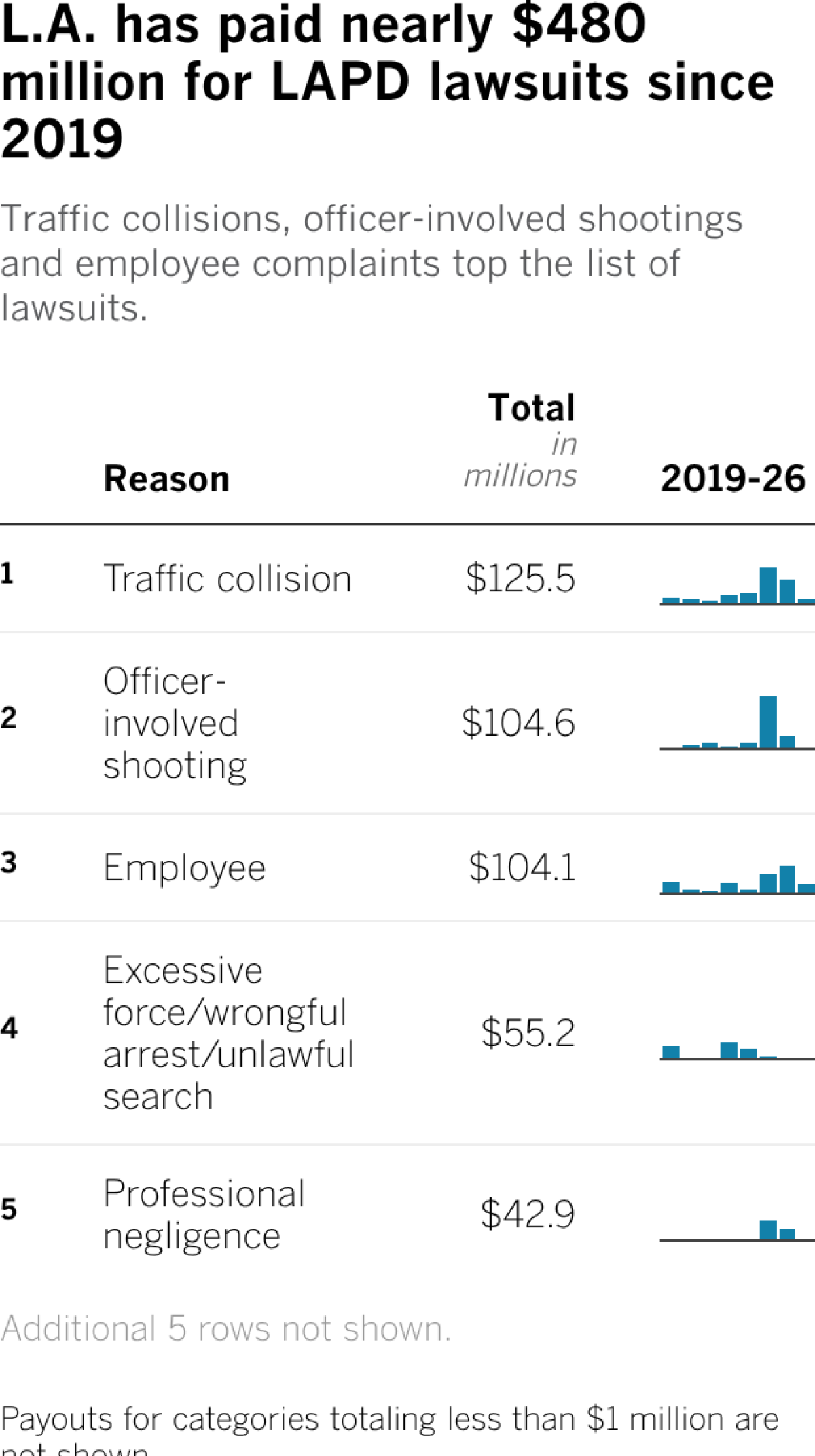
— LAPD’S LEGAL BILLS: The city of Los Angeles has shelled out nearly $480 million over the last five and a half years to end legal disputes involving the Police Department, including claims of excessive force, litigation over traffic accidents and cases filed by employees who allegedly faced retaliation after reporting misconduct.
— POLLING UPDATE: New polling from the pro-Nithya Raman independent expenditure group that was conducted between Oct. 2 and Oct. 7 found that Raman is leading the mayor 43% to 33% with 23% undecided. The poll’s margin of error is 3.5%.
— A separate poll sponsored by the United Firefighters of Los Angeles City, Local 112 and conducted between Sept. 25 and Oct. 5 found a tighter race, within the margin of error, with Raman leading 35% to 33% with 19% undecided. That poll’s margin of error was 4%.
— A third poll conducted for the Bass independent expenditure group Unidos con Bass of 602 likely Latino voters found the incumbent ahead by 12 points, 40% to 28% for Raman. The poll, conducted between Oct. 1 and Oct. 8, has a margin of error was 4%. That’s a 36-point swing from a UC Berkeley IGS/L.A. Times poll from September that found Raman ahead with Latinos by 24 points, 45% to 21%.
QUICK HITS
Where is Inside Safe? The mayor’s signature program went to Councilmember Ysabel Jurado‘s district on Santa Fe Avenue and 23rd Street and moved 35 people indoors.
On the docket next week: Bass and Raman will square off in a debate Tuesday night at 7:00 p.m. on NBC4/KNBC and Telemundo 52/KVEA.
Stay in touch
That’s it for this week! Send your questions, comments and gossip to LAontheRecord@latimes.com. Did a friend forward you this email? Sign up here to get it in your inbox every Saturday morning.
It was only Adéla’s second headlining show in Los Angeles — and she was only about 20 minutes into it — but the ascendant pop star already had an apology she needed to get off her chest.
“The next song that I’m gonna sing is a little bit awkward,” she said Thursday night at the Fonda Theatre. “So I’m gonna need y’all to bear with me as I explain why I made a song called ‘The Baddest Bitches Ain’t in L.A.,’ OK?”
Added Adéla: “Please don’t boo.”
To be precise, the song in question is titled “Ain’t in L.A.” — a woozy banger from the 22-year-old’s buzzy debut album, “Prima.” But you took her point: Here she was in front of a hyped-up crowd that included Chappell Roan and members of the girl group Katseye, and what she was about to tell us is that true coolness lies elsewhere.
Based on her assertion that the Hollywood dream machine is “all a lie,” “Ain’t in L.A.” looks back with scorn at Adéla’s experience as a first-round flameout on “Dream Academy,” the build-a-band reality series that documented Katseye’s creation under the watchful eye of the K-pop kingpin Bang Si-hyuk. At the Fonda, Adéla recounted moving here from her native Slovakia and working alongside the show’s other contestants to “try to become pop stars together,” she said.
“And guess what? That didn’t work out for me. But it did for them.” She peered up at the venue’s balcony. “Shout out to y’all,” she said.
Except now it’s working out for Adéla too: Thursday’s show was the first of two at the Fonda behind last month’s release of “Prima,” whose title nods to the singer’s background as a ballet dancer; in addition to “Ain’t in L.A.,” which has more than 190 million streams on Spotify, the album has spun off a second hit in “Nicole Kidman,” which reached No. 1 on that platform’s U.S. singles chart thanks in part to the enthusiastic embrace of the Hollywood meme queen herself.
This week, Kidman appeared in a viral TikTok video showing her, Kristen Wiig, Pedro Pascal and Dua Lipa lip syncing to “Nicole Kidman” at a Chanel fashion show in Paris.
Adéla’s breakthrough comes amid a broader surge by a generation of young pop singers — think of Slayyyter and think of Tinashe — finding success with music that plays up rather than sands down its rough edges; each is working in the wake of Charli XCX’s influential “Brat,” which offered new ways to think about how pop balances polish and filth, swagger and confession.
Adéla made “Prima” with the producers Dylan Brady (of the duo 100 gecs) and Blake Slatkin (who’s scored hits with Lizzo and Justin Bieber); together the three get an appealingly scuzzy sound that puts chirpy vocal hooks over serrated club beats à la “Blackout”-era Britney Spears. What I’m saying, basically, is that the indie-sleaze revival is real.
At the Fonda, Adéla brought her songs to life on a stage that was bare except for a ballet barre, which she and a small crew of dancers used to execute choreography that grew raunchier and more elaborate as the show progressed. Both she and a guy danced en pointe; Adéla never went long without whipping her long pink hair, which was one style choice widely replicated throughout the room.
Before she closed with “Nicole Kidman,” the singer sat down at the front of the stage with her journal and told the crowd she wanted to “take a second and manifest a little bit.” She asked the universe to give her a long career, and she asked that her fans, after having gotten home safe, remember this night forever. She also asked — again — that L.A. not be mad at her for writing “Ain’t in L.A.”
“I really do feel bad,” she said, and not a boo could be heard.
The city of Los Angeles has shelled out nearly $480 million over the last five and a half years to end legal disputes involving the Police Department, including claims of excessive force, litigation over traffic accidents and cases filed by employees who allegedly faced retaliation after reporting misconduct.
The soaring legal costs have come under greater scrutiny in recent years as Los Angeles’ financial problems have gotten worse. The city faced a $1-billion budget shortfall in 2025 but, after various cost-cutting measures, managed to set aside funding for the LAPD to hire more than 500 new officers in the coming year.
The LAPD’s annual lawsuit costs more than doubled from 2019 to 2025. The payouts peaked in 2024, when the city spent $178.6 million to resolve more than 300 police-related lawsuits and civil claims, before dropping to just over $100 million in 2025, according to a Times analysis of city attorney’s data.
The Times reviewed hundreds of pages of court documents and analyzed data from the city attorney’s office released through a public records request showing nearly 2,000 payouts dating to January 2019.
Through the first six months of this year, the city has paid out $20.3 million in legal settlements and court judgments involving LAPD officers. Several recentbig-dollarverdicts aren’t included in that tally because they hadn’t yet been approved by the City Council.
The surging cost of LAPD payouts depriving the cash-strapped city of money for pressing needs such as fixing roads and sidewalks, according to City Controller Kenneth Mejia.
“There’s a reason why your streetlights are out and they’re not fixed for a year, there’s a reason why your sidewalk won’t get fixed or your animal shelters are understaffed or underfunded,” said Mejia, whose office is conducting an audit of the city’s risk management strategies, the results of which will be released this year.
Experts are still untangling the reasons for the explosion of legal payouts involving police — which stretches far beyond L.A.
This year, a legal defense organization found that New York City has paid more than $796 million since 2019 to settle lawsuits involving accusations of police misconduct — including $117 million in 2025. In Chicago, the city is on track to blow past the $252 million spent last year to resolve police lawsuits, mostly involving plaintiffs who went to prison based on faulty evidence, according to local news reports.
In Los Angeles, the surge has come under the watch of City Atty. Hydee Feldstein Soto, who has blamed the rising costs on the way the office handled litigation of all kinds before her administration — as well as a national legal trend of so-called nuclear verdicts.
“The system is getting inflated in a way that is unhealthy and it creates, I think, incentives to sue and to do pie-in-the-sky settlements,” Feldstein Soto said in interview with The Times earlier this year. She said her office evaluates each claim case by case, deciding when it makes more sense to settle rather than go to trial, at which juries can issue decisions based on emotion or differing perceptions of what occurred. Feldstein Soto has lobbied for years to change state law to limit “non-economic” damages.
Feldstein Soto’s critics contend that she has pursued a hard-line approach in recent years, refusing to settle except in cases where it is clear the city is likely to lose in court.
That tough stance has led to mixed results. The city has lost some jury verdicts that could have been avoided if it had been willing to settle. It has also prevailed in several high-profile cases, including this year when a jury ruled that an officer was not liable for the 2021 death of a 14-year-old girl killed by a wayward bullet fired during a hasty confrontation with a suspect at a North Hollywood department store.
The city attorney’s office said in a statement to The Times that while it is proactively working to curb rising litigation costs “by every means possible,” it could not “control the number, timing or claimed damages of lawsuits filed against the City.”
“Nor does the Office have control over the alleged root causes of these liabilities: the City Attorney’s Office is not responsible for LAPD policies or personnel,” said the statement, adding that the number of lawsuits filed against the city has risen by roughly 20% in each of the last four budget years, straining the office’s resources.
Zachary Powell, an associate professor of criminal justice at Cal State San Bernardino, said that although data suggest that use of force by police has decreased since 2020, the public has become “much more aware of police abuses and conduct than they ever were before.”
“I think people also ask a lot more questions in a jury setting,” he said.
Other explanations, he says, are the passage of statewide police accountability measures and the fact that a backlog of cases from the pandemic years are finally coming due.
The Times’ analysis found that hundreds of legal battles involving officer-involved traffic incidents make up nearly a quarter of all payouts. Since 2019, the city has paid $125 million for the thousands of accident claims, just under a third of which stemmed from cases in which officers were found to have failed to stop or yield at crossings before crashing into another vehicle or a pedestrian. Pursuit-related claims and suits stemming from cases in which officers made improper left turns have also cost the city millions.
Other legal costs date back years — and in some cases decades.
The city is still paying $7,410 a month to Clarence Chance, who in the early 1990s was awarded a large payment over a wrongful arrest that led him to spend 17 years in prison for a murder he didn’t commit. Nearly $40 million has gone to people whose homes were damaged after the LAPD bomb squadbotched the detonation of seized fireworks and leveled part of a city block in 2021.
One of the biggest payout categories was $104.6 million spent since 2019 on claims related to police shootings — more than three-fourths of which involved people who were reported to be under the influence of a substance or in the midst of a mental health crisis, according to The Times’ analysis. Roughly $38.4 million was paid out after police shot someone wielding an edged weapon, such as a knife, the analysis found. Shootings involving gang officers cost the city nearly $4 million in that span.
Dozens of lawsuits remain pending, including claims related to the handling of mass pro-immigration protests since last year, likely putting taxpayers on the hook for more large payouts in the future. Police use of hard foam projectiles, house-mounted officers and other tactics against crowds have already cost the city at least $22 million in the last seven and a half years — just over half of which stemmed from the department’s response to the 2020 mass protests over the murder of George Floyd.
Such totals may not always include lawyer fees that are negotiated after a settlement is reached — or if a case is appealed.
Jonathan Evans, a civil rights attorney who has sued the department, thinks the big payouts show that greater public awareness of mental health issues is a factor. Recognizing this, he said, municipalities are agreeing to higher settlements than in years past.
“The decision to use lethal force is being more heavily scrutinized,” he said.
Tens of millions of city dollars have in recent years gone to disgruntled police officers who sued over workplace injustices such as sexual harassment, racial discrimination and retaliation. Since 2019, at least 27 LAPD employees have won million-dollar-plus jury verdicts or settlements from the city; many more have seen five- or six-figure paydays.
To clamp down on future legal costs, the department last year brought back a former senior official, Arif Alikhan — at a monthly salary of $20,000, paid for by a private donation — to study how to reduce the number of costly lawsuits. Alikhan did not respond to a call requesting comment.
The department maintains an early intervention system that flags officers based on risk factors, such as a relatively high volume of civilian complaints, frequent use force, and involvement in preventable traffic collisions or pursuits. The system is used to determine whether they need additional training or should be reassigned or placed on a performance improvement plan.
Within the LAPD, some officers and the Los Angeles Police Protective League, the rank-and-file union, argue that the city should fight back harder against claims with no credibility, instead of settling. They say officers who are most often sued tend to come from specialized units that do the type of proactive policing that the department and most of of the public wants: targeting gangs, drugs and guns.
Attorneys who represent officers that have sued the department over whistleblower retaliation dismiss the claim by Chief Jim McDonnell and others that some cops are exaggerating their claims in pursuit of a big payday. If anything, they contend, the continued large payouts are a product of entrenched racial and gender bias and inconsistent discipline — and the LAPD’s unwillingness to learn its lessons from past lawsuits.
Greg Yacoubian, a labor attorney, said there is little incentive for the current system to change because the costs of lawsuits are passed on to taxpayers — not the officers involved in misconduct and their bosses.
“The person responsible for the error never feels the pinch,” Yacoubian said.
Times staff writer James Queally contributed to this report.
If I ever need to humble myself — if my head inflates with grand visions of becoming the next Steve Lopez or Bill Plaschke — I pull up the transcript of the secret recording that upended Los Angeles politics after The Times broke the story exactly four years ago.
It’s like a modern-day version of “Ozymandias,” except far more vulgar, nowhere near as poetic and a better warning against hubris than anything Shelley could have penned.
“The thing for us is to exercise our power,” said then-City Councilmember Gil Cedillo, about halfway through an hourlong conversation he was having with three of the city’s most powerful political figures.
Oh, did they ever — and nowhere near the way they intended.
Nury Martinez and Ron Herrera, the president of the City Council and head of the Los Angeles County Federation of Labor, respectively, quickly resigned for their roles in the racist, homophobic drivel on the recording. Cedillo — who was finishing out his term — and Councilmember Kevin de León refused to step down, besmirching their well-earned reputations as progressive lions.
The L.A. they sought to create — where Latinos ascend at the expense of the Black community, and anyone who gets in the way is crushed — never came to be. And the recording that exposed their machinations ultimately destroyed the type of ethnic politicking that made the careers of too many self-serving power grabbers, including this quartet.
The transcript of their back-and-forth now reads as prophecy — and we’re far better for it.
Much of the discussion, which happened in October 2021 at the headquarters of the L.A. County Federation of Labor, was devoted to whining that L.A.’s Latino-majority council districts, and some cities elsewhere in the county, were represented by Black leaders instead of Latinos, even as Latino residents far outnumbered Black ones.
“F—, the way I see it, all of the seats are Latino,” said Herrera, who hailed the rise of a “little Latino caucus of our … own” that he felt should reign permanently.
He and the others predicted a future in which vengeful Black politicians would try to sabotage future Latino leaders on their way out of office, creating “poor Latino districts with nothing,” as Martinez put it.
She was referring to redistricting proposals that would chop off assets like the Coliseum and Exposition Park from South L.A.’s District 9 — the most Latino district in the city, represented by a Black council member, Curren Price.
“So they f— a future Latino for CD 9,” De León whined. “That’s how arrogant, just how arrogant it is.”
That’s not what ended up happening.
Los Angeles City Councilmember Kevin de León at a council meeting in December 2022 after a two-month absence following his role in that year’s audio leak scandal.
(Myung J. Chun / Los Angeles Times)
District 9 didn’t lose any assets. Black leaders saw the writing on the wall and didn’t run a serious Black candidate to replace the termed-out Price this year. That created space for two Latinos — Estuardo Mazariegos and Jose Ugarte — to make it to the general election. No matter which candidate wins in November, the City Council will have fewer than three Black members for the first time in 63 years.
Both Mazariegos and Ugarte say that the anti-Black scheming of the audio leak villains inspired them to run campaigns focusing on Black and Latino residents as one constituency, reflecting how life is actually lived in South L.A., not how Latinos from elsewhere in the city imagine it to be.
Mazariegos attended the first City Council meeting after The Times dropped the audio leak bombshell in October 2022. He remembers Cedillo peeking at the angry audience and temporarily returning to the council’s back room.
“No community should have to lose power for another to gain it,” said Mazariegos, who would become the first Central American immigrant to serve on the council if he were to win. “Our power grows when we build it together.”
Ugarte, formerly one of Price’s top aides, agreed. He argued that the best way to lead in South L.A. as a Latino council member is “with respect for those who came before us, the humility to listen to those doing the work today, and the understanding that District 9 is strongest when [Black and Latino residents] move forward together.”
Born in Oaxaca, Ugarte would become L.A.’s first Indigenous council member if he wins. That would be a rich coda to the audio leak, considering that Oaxacans received some of the nastiest insults. Martinez described them as “ little short dark people” who were feos — ugly. Cedillo joked that they were “little ones,” while Herrera cracked that they were “indios.”
Who’s laughing now?
The Feos Four also spent time kvetching about Nithya Raman, who was finishing her first year on the council. In 2020, she had upset an incumbent to become the first democratic socialist council member.
At the time of the recording, rivals were trying to diminish Raman’s power by drawing boundaries that would put her district “in the blender and chop [it] up, left and right,” as De León described it.
“She’s not our ally,” Cedillo said. “She’s not going to help us. Her district is not a district we can count on.”
Give credit to Cedillo and his pendejo pals: They were already seeing Raman and other democratic socialists as an emerging force, even while downplaying the DSA’s chances. De León said that Raman’s politics were “about just her as an individual.” Herrera dismissed Hugo Soto-Martínez, then a no-name union organizer aiming to unseat Councilmember Mitch O’Farrell, as a “kid.” Nury Martinez blithely mispronounced Eunisses Hernandez’s name while cackling about the first-time candidate’s challenge to Cedillo.
If Cedillo and De León weren’t so convinced of their own political immortality, they could have helped check the DSA’s rise that has so vexed L.A.’s liberal leaders. Instead, Hernandez beat Cedillo in a shocking upset in 2022, while Soto-Martínez won in the fall. And fellow democratic socialist Ysabel Jurado took out De León in 2024. Those triumphs paved the path for DSA-LA-backed candidate Marissa Roy to make a strong run for city attorney this year. Mazariegos is also endorsed by DSA-LA, which is backing Raman for mayor against incumbent Karen Bass.
Then-Councilmember Gil Cedillo at the Los Angeles City Council meeting on Oct. 11, 2022, two days after the release of explosive audio involving him led to protesters demanding his resignation.
(Gary Coronado / Los Angeles Times)
The group should send Cedillo and De León bouquets of red roses as gracias for assisting their ascendancy. All of us owe the foursome a thanks for hastening the demise of the old Latino political machines that birthed them and kept the city stuck in tribalism for too long.
Now, Latino politicians must run on their bona fides for all Angelenos, instead of just their latinidad. Soto-Martínez and Hernandez won reelection outright in the June primary because their constituents appreciated their sewer socialism approach, focusing on quality of life issues instead of ideological revolution. Meanwhile, Chicanosauruses are wheezing with diminished power as they urge Latinos to back Bass. The message doesn’t seem to be landing: A recent Berkeley IGS/Times poll found that 45% of Latino voters favored Raman to Bass’ 21%, with 34% undecided.
Gone are the days when Latino voters blindly believed Latino leaders. Why bother, after Martinez and her crew proved the folly of ethnic politics?
Near the start of the recording, Martinez complained that voters and the media always seemed to forgive Black politicians caught up in scandal, while Latinos didn’t get the same treatment.
“They’re never done,” she complained. “They never close a chapter on us.”
L.A. did close the chapter. Now, the Feos Four’s only legacy is “that colossal wreck” of their conversation, to quote the finale of “Ozymandias,” left to rot forever.
Midcentury pop culture expert Charles Phoenix thinks Long Beach gets a bad rap.
“It is very underrated in the grand scheme of all of Southern California, but there is a lot to see and do there,” says the Ontario native, who uses the word “time-honored” repeatedly when describing his favorite attractions in the seaside community. “I often refer to it — under my breath — as the New Jersey of Los Angeles. It doesn’t get much respect, yet it’s loaded with attractions.”
In Sunday Funday, L.A. people give us a play-by-play of their ideal Sunday around town. Find ideas and inspiration on where to go, what to eat and how to enjoy life on the weekends.
When he isn’t gushing over Long Beach, the humorist and author hosts nostalgic slideshows and double-decker open-air bus tours of Midcentury architecture during Modernism Week in Palm Springs. His next event, “LosAngelesland,” is a lively retro slideshow featuring vintage Kodachrome slides taken by Los Angeles locals and tourists in the 1950s and ’60s. The show is scheduled for Oct. 17 during Modernism Week’s October festival in Palm Springs and a Halloween-themed version on Oct. 24 at the Anaheim Fall Festival. Phoenix will also present “Disneyland: Live Retro Slide Show Celebrating the Original Magic Kingdom in the 1950s & ’60s!” at the Hilbert Museum in Orange on Oct. 18.
Phoenix lives in a Midcentury Modern home in Claremont, but he’s always happy to spend a day in Long Beach. His ideal Sunday includes eating clam chowder-topped biscuits at a floating restaurant, shopping for vintage treasures along 4th Street Retro Row, cruising around Naples in an electric Duffy boat and ending the day at a classic diner from 1939.
“There’s more to do in Long Beach,” he says. “I could keep going, but there’s only so much space in this column.”
This interview has been lightly edited and condensed for length and clarity.
8 a.m.: Wake up early and say thanks
When I wake up, I usually have nonfat yogurt, chopped walnuts and one or two types of fresh fruit. Then I walk through my house, and whatever room I walk in first — either the living room or the den and say, “I love you, house.” Those are the first words I speak out loud.
10 a.m.: Drive to the coast for lunch on a floating restaurant
We’re going to start at the only floating restaurant I know of in the Western United States, the Chowder Barge. It stands out on its own, although it’s a bit tricky to find, so it’s a good thing we have GPS or we might never get there. It’s a little bit tiki, a little bit pirate and a little bit seafarer. There’s always an old wizard-like man sitting in the corner with a long beard that reaches the floor. When you’re on the barge and a boat passes by, you can feel it. The best thing there is their fried clams and clam chowder, which you can eat in a bowl or use the chowder as gravy. For breakfast, you could have biscuits topped with clam chowder instead of gravy. It’s the best clam chowder ever. If you want fried clams on top of the biscuits, that’s incredibly delicious. They also have an open-faced hamburger covered with clam chowder and fried clams or just clam chowder.
The place has a deep soul, and everything there is unique and time-honored.
1 p.m.: Go vintage shopping on Retro Row
Next I would go shopping on 4th Street, a.k.a. Retro Row, which is absolutely, in no uncertain terms, the best vintage shopping street in the Western United States — probably the Eastern and Midwestern as well. There are three stores there that I concentrate heavily on. The first is Sneaky Tiki Boutique, which is the destination of all destinations for what I wear all spring and summer and fall — vintage Hawaiian shirts from the ’50s and ’60s. They’re not Hawaiian shirts unless they’re made in Hawaii. Nobody has a better supply than Sneaky Tiki. I mean nobody.
A couple of doors down is another world-class vintage store, Meow. Meow is an institution in the world of vintage clothing, shoes and accessories. And it’s absolutely a spectacular themed environmental extravaganza, as is Sneaky Tiki. There are all kinds of vintage in there. So it is a feast for the senses and your wardrobe and accessory needs.
And then for your Midcentury home decor needs, there’s Xcape Modern. They’ve been there for probably 30 years, and it’s a little mumbo jumbo as far as the way it’s all laid out. It’s a little messy, but they have incredible Midcentury furniture and home decor, including patio items. It’s a spectacular, well-curated collection.
3 p.m.: Explore Rancho Los Alamitos
After that, I’d take a quick late-afternoon scamper around Rancho Los Alamitos. It’s really special, and it’s free, F-R-E-E, free. It’s this gorgeous, time-honored place; basically, you’re walking back into time. The family started building it in 1790 and finished in 1834. I love to look around and walk through the layers of time. The house is beautiful. The barn is beautiful. There are animals there too. It reminds me a little bit of old-timey Knott’s Berry Berry Farm. Chickens walk around, and it just has, again, this deep soul, layers of time, mature garden. And it’s impeccably kept, impeccably groomed. You can spend 20 minutes walking around there or you could spend four hours. And of course, the garden is absolutely out of this world.
It’s its own little world. It doesn’t know the rest of the world exists, which is the kind of place that I really, really love — a place that’s true to itself, time-honored and lost in its own wonderland. You know, it’s just so special to be able to escape to such a rarefied environment.
5 p.m.: Go for a ride on a Duffy Boat in Naples
From there, get ready for my favorite thing to do in Southern California: taking a Duffy Boat ride around Naples. I always rent from Anchors Away. The boats remind me of the Jungle Cruise at Disneyland. Most are white and blue, but a couple of years ago, around the time of the Barbie movie, they added some bright pink ones. You can pay a little extra for the pink boats, but the blue and white ones are just as fun. The boats seat about eight to 10 people, and you rent them for two hours and just cruise around. The canals are much bigger than those in Venice. They give you a map and two hours to enjoy the water. I usually drive the boat while my friends bring drinks, cookies, snacks and whatever they want to drink. I had no experience before my first time, but it’s easy and relaxing. It’s never crowded, the homes are beautiful, and of course, I always wear a captain’s hat.
8 p.m.: Late–night snack at a 1939 diner
After that, even if we’ve already had plenty to eat and drink, we usually end up at one of my favorite diners, Harbor House Cafe, on Pacific Coast Highway in Sunset Beach. It’s been open since 1939. So we drive a couple of miles down PCH, pile into the Harbor House and finish the day with whatever we want — dessert, more dessert, onion rings or a milkshake. It’s our spot to unwind. The onion rings are especially good. It’s an easy, time-honored place, just like everywhere I love to go. I like to soak in the history. After we leave, everyone heads home, and I drive back up the 605 Freeway to Claremont.
WASHINGTON — President Trump told a crowd in Texas on Wednesday night that he would not allow Iran to attack San Diego or Los Angeles, a comment that came two days after he made off-the-cuff remarks suggesting the West Coast cities could be struck.
“You want to see a horror show? You want to see problems? Let them hit San Diego, let them hit Los Angeles,” Trump said at a rally. He then assured the crowd: “We are not going to let that happen. We protect our cities. We protect our country.”
The San Antonio crowd cheered the remarks.
Trump’s decision to return to the subject capped two days in which the White House had been on the defensive, and it appeared aimed at tamping down the fallout from remarks he made Monday night that quickly spread online.
Speaking to a crowd in Nebraska, Trump had said: “They can take out a city, let them take out Los Angeles, let them take out San Diego. This is a very small price to pay.”
The comments drew swift condemnation from California leaders, even as the White House communications director, Steven Cheung, insisted the president’s remarks had been taken out of context.
“The media freakout over President Trump’s comments is not rooted in reality,” Cheung wrote Tuesday. “He was clearly stating U.S. cities would have been threatened if a nuclear Iran hadn’t been stopped. America is safer because of the president. Iran has no nuclear, no navy, no air force, and no money.”
But the remarks were enough to rattle many in California and drew backlash from the state’s leaders, including Republican Jim Desmond, a Navy veteran running in a highly competitive U.S. House race.
“I vehemently disagree with President Trump’s comments,” Desmond wrote on social media. “America must stand up to Iran and defend our interests, but the first responsibility of our Commander in Chief is to protect the American people and our homeland.”
Gov. Gavin Newsom on Tuesday opened the state emergency operations center to assess potential threats following Trump’s remarks. San Diego Mayor Todd Gloria and Los Angeles Mayor Karen Bass also condemned the president for potentially compromising the safety of their cities.
“San Diego is not collateral damage,” Gloria posted on social media. “We are not expendable. And we are never a ‘small price to pay.’ Keep our city out of your reckless war talk.”
Los Angeles County Supervisor Lindsey Horvath presented a motion Tuesday calling for “bold action” to better protect victims of domestic violence and stalking, seeking to help them more effectively navigate the county’s restraining order system and obtain court-ordered protection.
Horvath cited recent Los Angeles Times reporting on the challenges victims face when obtaining and enforcing restraining orders as an inspiration for the Board of Supervisors motion, which was co-authored by board chair Hilda Solis. The supervisors are scheduled to consider the measure during the board’s Nov. 10 meeting.
“A recent story from the L.A. Times spoke to the process of domestic violence restraining orders and the work done and not being done across the county to support survivors in need of this critical support,” Horvath said.
The Times’ reporting identified at least 63 women killed in 2024 and 2025 in L.A. County whose cases involved a former partner or close relative arrested or charged with their murder. The deaths accounted for more than 40% of the 156 women killed during that period. At least 10 of those women had filed for restraining orders.
In July 2024, the county Department of Public Health’s Office of Violence Prevention issued a report with more than a dozen recommendations for reducing domestic violence homicides by improving access to restraining orders. Today, most of those recommendations have not yet been implemented.
The office said the delay was the result of insufficient funding and challenges with coordinating between the many agencies responsible for the county’s restraining order system.
If passed, the motion would mandate reports from the county’s chief executive, the Los Angeles County Sheriff’s Department, and the departments of Public Health, Mental Health, Consumer and Business Affairs, Public Social Services, and Homeless Services to assess current efforts, improvement plans and additional funding needs.
“We know that domestic violence restraining orders protect survivors and I believe the board must take every step possible to better support and protect our survivors,” she said. “The county,” she added, “must step up and lead in this space.”
The motion calls for allocating millions of dollars annually to fully fund nine county-run self-help legal centers that assist people navigating the restraining order process.
It would also officially identify “Gender-Based Violence and Intimate Partner Violence” as a priority for the Board of Supervisors, and require a presentation from the Sheriff’s Department on how the agency plans to improve its handling of restraining orders.
The Office of Violence Prevention would be required to develop a plan for a “peer navigator model” to guide survivors through the restraining order system.
The Department of Homeless Services and Housing would be asked for an assessment of what additional resources would be necessary to provide emergency beds for all people fleeing intimate partner violence.
WASHINGTON — As President Trump zigzags across the country in the final weeks before the midterm elections, he has made California his favorite foil as he tries to fire up his base.
On Monday, he blamed the Golden State for the rising cost of gas prices, claimed without evidence that its elections are rigged, and at a Nebraska rally suggested Iran could “take out” Los Angeles and San Diego.
“It’s a small price to pay for keeping the world safe, keeping our country safe,” Trump said. “They can take out a city, let them take out Los Angeles, let them take out San Diego. This is a very small price to pay.”
The president’s team on Tuesday said his remarks were misunderstood, arguing the president “clearly” stated that U.S. cities would have been threatened “if a nuclear Iran hadn’t been stopped.” Trump declined to clarify what he meant by his statements when asked by a reporter Tuesday.
But by then, Trump’s remarks had already drawn fierce condemnation from California leaders, including Republican Jim Desmond, a Navy veteran running in a highly competitive race that is key to helping Republicans retain control of the House.
“I vehemently disagree with President Trump’s comments,” Desmond wrote on social media. “America must stand up to Iran and defend our interests, but the first responsibility of our Commander in Chief is to protect the American people and our homeland.”
The backlash exposed the risk of Trump’s closing midterm strategy. Bashing California is a reliable applause line in red states like Nebraska, Alabama, Texas and Oklahoma, where the president has been holding rallies trying to ensure his supporters get out to vote. But in this modern era, an incendiary comment can travel fast online and leave Republicans running in competitive districts in awkward spots, trying to distance themselves from Trump.
Overall, political observers see the episode as an example of how the president’s political strategy can be unpredictable at a time when Republicans are trying to control the message the most.
“Whether you like Trump or not, he is good at getting his message out and coming up with a message that can resonate and catch fire,” said Mindy Romero, founder and director of the nonpartisan Center for Inclusive Democracy. “I think the question now is: Is he starting to fail himself when it comes to his messaging?”
California Democrats were quick to use Trump’s remarks as a line of attack against him. Gov. Gavin Newsom called him “deranged and dangerous” and opened the state emergency operations center to assess potential threats. San Diego Mayor Todd Gloria told Trump to “keep our city out of your reckless war talk.” And Los Angeles Mayor Karen Bass said his comments could “potentially compromise our safety.”
Trump’s remarks about the California cities on Monday were the most striking example yet of the president using California as a foil to rally a base in GOP strongholds.
In Nebraska and other red states in recent days, Trump has repeatedly cast California as a political boogeyman as a means to motivate voters to cast their ballots for the GOP candidates.
At an Oklahoma rally last week, Trump told the crowd that Republicans need to keep the party in control of Congress so that his administration can continue the work of combating fraud in blue states, like California. The administration’s efforts, led by Vice President JD Vance, have sometimes been overestimated or nebulous.
But Trump tells supporters that in places like California, the administration is seeing “billions and billions of dollars of fraud.”
In a social media post Monday, Trump began blaming the cost of fuel — a defining issue for voters this election cycle — on states like California.
“What’s driving up Gasoline is no longer the Strait of Hormuz,” Trump wrote. The issue, he said, is refineries being “closed up in Blue States, like California, by the Dumocrats.”
Hours later, while rallying in Nebraska, Trump seemed to contradict himself as he promised the crowd that fuel costs would go down once the war in Iran was over.
“That will end very quickly, one way or the other, very soon, maybe a little after the election, maybe a little before, but it is going to end very soon,” Trump said. “When that happens, the oil will come tumbling down.”
Trump’s messaging underscores how the war with Iran, which has gas prices topping $6 a gallon, has emerged as a potential liability for Republicans that the president is trying to address in subtle ways.
Polling on Trump’s handling of the economy has remained low, even among Republicans. A University of Massachusetts Amherst poll last month found that only 22% of Americans perceive the economy in a good or fair state.
The softening of Trump’s approval even among those who still support his performance could translate into lower GOP turnout in the state’s few competitive races, the poll’s director, Mark DiCamillo, said.
Trump’s strategy in the final stretch before the midterms has largely focused on rallying the base in hopes that they will turn out to vote. Part of that strategy includes using California as a punching bag.
One particular line of attack has been disparaging the state’s voting systems. He suggested Monday that Democrat-led cities are trying to cheat in November as he touted the fast count of ballots in foreign countries.
“In Detroit, Philadelphia, California and numerous other U.S. Cities and States, the results, with much smaller numbers, will often take weeks to Rig, I mean, calculate,” Trump wrote on Monday. “Voting in America is CORRUPT!!!”
In another social media post, he said: “California: Took 38 days with 16.1 million ballots in 2024.”’
Trump using California as a foil for any given issue could be a risky strategy, Romero said.
“He’s expanding the types of things that he’s blaming California for, like the gas crisis,” she said, arguing that such statements could “start to lose credibility with those people that he has credibility with.”
For Republican voters in California, the ploy may be even riskier, especially when Trump suggests Iran could “take out” their cities.
“I don’t think that message necessarily plays well here because Californians are Californians,” DiCamillo said. “There is a certain pride in being a Californian, certainly not held by everybody … but I would think that the mainstream would be defending the state.”
I went to bed at a decent hour Monday night and got a pretty good sleep.
I woke up refreshed Tuesday morning, only to see the news that President Trump seemed to have told a crowd in Nebraska that it wouldn’t be such a bad thing if Iran attacked Southern California.
“Let ’em take out Los Angeles. Let ’em take out San Diego,” he said in a typically meandering speech, perhaps trying to justify a war he has repeatedly claimed is keeping the U.S. safe, even as gas prices have spiked. “This is a very small price to pay.”
“San Diego is not collateral damage,” said San Diego Mayor Todd Gloria.
Such “dangerous” remarks could “potentially compromise our safety,” said L.A. Mayor Karen Bass.
“He is deranged and dangerous,” said Gov. Gavin Newsom.
President Trump throws a pen into the crowd after he signed an executive order during a campaign rally at Pinnacle Bank Expo Center in Grand Island, Neb., on Oct. 5, 2026.
(Kent Nishimura / AFP via Getty Images)
About 8 a.m., I took my dog Philly out for our morning walk. This is usually a lovely time for us. I clear my head. For Philly, a 3-year-old beagle, these are essentially business trips.
I got to thinking about the similarities in the daily routines of Philly and the president of the United States.
The thing is, I carry bags with me and clean up after Philly. The president to my knowledge has nobody on his staff doing this. We are at a point in American politics at which we must consider posting signs, everywhere Trump travels, that say, “Please Curb Your President.”
Not that it would be easy to clean Trump’s daily messes. You’d need the equivalent of those parade attendants in overalls who run along behind the horses with shovels.
The White House does not use poop bags. Instead, it uses denial and spin.
Critical reactions to Trump’s Nebraska comments were “not rooted in reality,” said White House Director of Communications Steven Cheung, who claimed Trump was misrepresented.
We’ve got to respect Cheung’s opinion. Does anyone in the world have more experience when it comes to analyzing comments not rooted in reality?
Some of you may know there are two topics I often revisit in my column. One is the effects, good and bad, of aging. The other is failure of leadership.
So I feel eminently qualified to psychoanalyze the president.
I don’t mean to generalize, but as people age, it’s not unusual for them to undergo behavioral changes. Some folks mellow, they abide, they lean into the ride. Others can become churlish, combative or grouchy.
Not only is Trump the poster boy for the latter group, but as things go wrong, he becomes more obstinate.
And things have definitely gone wrong.
The war in Iran is a disaster. The president is personally responsible for rising gas prices. He’s ruined the economy with his tariffs. He’s picked a fight with Canada. He may cost his party the House and the Senate because his almost daily outrages have pumped oxygen back into the blood of long-slumping Democrats.
A normal person would have the good sense to scale back or shrink away.
President Trump at the campaign rally at Pinnacle Bank Expo Center on the Nebraska State Fairgrounds on Oct. 5, 2026, in Grand Island, Neb.
(Win McNamee / Getty Images)
Trump keeps doubling down, wants to put his name on everything, and lashes out the way someone does when it’s not clear what’s bigger — their ego or their insecurity.
I’ve been to Nebraska, by the way. Nice place, met a lot of lovely people.
I enjoy corn, on or off the cob.
Popcorn. Caramel corn.
Not wild about “Children of the Corn,” the slasher movie based on Stephen King’s short story. But thank you very much, Nebraska, for Fred Astaire, Johnny Carson and Henry Fonda, who, by the way, was born in Grand Island, where Trump made his cracks Monday about California.
Did it occur to any of the shuckers who cheered Trump’s throwaway line about an attack on San Diego and L.A. that:
A: It wasn’t funny.
B: San Diego has one of the nation’s largest military installations, with thousands of personnel currently deployed to the Middle East because of the war in Iran.
C: Maybe we should expect more from someone serving as president and commander in chief.
In defending Trump, the White House said news outlets had misunderstood and misrepresented the president’s comments in what amounted to a “media freakout.” A White House media post singled out an L.A. Times post that said Trump suggested “letting Iran take out” L.A. and San Diego.
“No, he didn’t, you buffoons,” said the White House. “He was saying the U.S. is fighting to STOP Iran from having the ability to take out LA and San Diego with a nuclear weapon — which they would if they had the chance.”
Please.
This buffoon would like to point out that this is yet another case of Trump using California as a punching bag to prop up support for the war and nail down what’s left of his diminishing base. But even some of his longtime disciples know that he has said on dozens of occasions that the war had ended, was ending, or had been won, and not once were any of those words rooted in reality.
It’s not clear whether we’re any safer in the U.S. as a result of the war, although it is clear that we have paid with lives and higher costs.
So maybe a gratuitous and unfunny line about anyone taking out American cities is better left unsaid.
I’m fresh out of muzzles, but I do have extra poop bags.
Every fall, I teach a Latino History of Orange County course at Chapman University — from the Portola expedition all the way to Huntington Beach’s MAGA Latina councilmember, Gracey Van Der Mark. The lecture last week focused on how anti-Mexican politics have always worked in Orange County and usually go on to be copied nationwide.
I usually, sadly, have to update this lecture every year because the lowlights just keep coming. That’s why this time around, one of my PowerPoint slides ended with “2026: Anaheim?”.
Haven’t you heard? A lawsuit accuses Anaheim mayor Ashleigh Aitken of calling her chief of staff a “dirty Mexican.”
Stay classy, O.C.!
You’re reading the Essential California newsletter
L.A. Times reporters guide you through the most important news, features and recommendations of the morning.
By continuing, you agree to our Terms of Service, which include arbitration and a class action waiver. You agree that we and our third-party vendors may collect and use your information, including through cookies, pixels and similar technologies, for the purposes set forth in our Privacy Policy such as personalizing your experience and ads.
TimesOC writer (and my fellow Anaheimer) Gabriel San Román first reported on the allegation last month. He revealed that a lawyer for Aitken’s chief of staff Berenice Ballinas was seeking mediation from the city after his client suffered a “sustained pattern of harassment, discriminatory treatment and, most recently, retaliation” while doing her job. A legal claim filed soon after offered pages of alleged incidents detailing what Ballinas claimed she had to deal with when her boss supposedly had too much to drink while on city business.
It’s an ugly read, with incidents at Disneyland’s Club 33, Angel Stadium and other Anaheim landmarks. Yet no passage is more damning — yet more Orange County — than when Ballinas claimed Aitken once called her a “dirty Mexican” in front of then-city attorney Jim Vanderpool and said another time that the mayor didn’t want “a Mexican” like Ballinas to drive her car while Aitken was supposedly what the British satirical magazine Private Eye would call “tired and emotional.”
The mayor, a Democrat who’s running for reelection, has denied the explosive charge in an official statement and during a recent council meeting. And yet the allegation against her now enters Orange County’s long, sad spectrum of anti-Mexican political history.
Just part of the list: Proposition 187. Poll guards. Trying to give local police immigration-enforcement powers. When then-Orange County supervisor Ronald Caspers called a group of Mexican American county employees who demanded promotions “bandidos” during a 1972 supervisors meeting, then suggested the supes move the county seat away from Santa Ana because the city “does not have a normal ethnic balance” — in other words, it was too Mexican.
Or how about when a Newport Beach council member, Dick Nichols, opined during a 2003 council meeting that he opposed expanding the grassy areas of Corona del Mar State Beach because Mexicans “claim it as theirs, and it becomes their personal, private ground all day”? (Asked to apologize, Nichols doubled down by saying, “Where the hell am I in any way discriminating or being a bigot by making a statement that is blatantly true?”)
My hometown is not exempt from this sad parade. Anaheim’s schools, parks and swimming pool were segregated until the 1950s. In 1999, the Anaheim Union High School District board of trustees voted to sue Mexico for $50 million for educating the children of undocumented immigrants (The Times’ write-up was the first time I appeared in the paper, although the writer misspelled my last name).
Why all the O.C. anti-Mexican hate? You’ll have to enroll in my Chapman class for the full explanation. But the main reason is that Mexicans have long functioned as O.C.’s demonized minority. When millions of O.C. residents have grown up believing the powers that be that all Mexicans do is work low-paying jobs and underachieve in life, no wonder politicians bash them again and again — and no wonder many Anaheim residents aren’t giving Aitken the benefit of the doubt.
On Friday, the Anaheim City Council announced after a closed session that it would launch an independent investigation into Ballinas’ allegations. Aitken had an eventful Friday of her own. She admitted on Instagram that she has an “unhealthy relationship” with alcohol and sighed to CBS Los Angeles that Ballinas was “somebody who I thought was my right-hand person.” And while local activists have demanded she resign, O.C.’s ascending liberal machine isn’t asking for her head the way they would’ve if it were a Republican official: Mayor Anaheim gave the opening remarks at the Orange County Labor Federation’s annual Solidarity Awards gala on Friday night to cheers.
Stay classy, O.C.!
The week’s biggest stories
Republican gubernatorial candidate Steve Hilton visits patrons at Victorio’s Ristorante in North Hollywood, where a watch party was held for the CNN governor’s race debate Wednesday night.
(Jason Armond / Los Angeles Times)
California politics
A sexually suggestive ad from Republican gubernatorial candidate Steve Hilton has drawn millions of views — and condemnation from allies on the right and Democrats.
The poll’s findings contrast the results of the June 2 primary, in which Bass carried 35 Latino-majority neighborhoods compared with Raman’s seven.
Helicopter tragedy
Paramount-Warner Bros. merger
David Ellison said the merged Paramount and Warner Bros. Discovery will be called Skydance — the moniker he picked nearly two decades ago when he began building his Hollywood empire.
Although the name of the corporate parent will change, the two historic studios will continue to operate under their names.
As Ellison names his new empire, the message is clear: He owns Hollywood, writes news and culture critic Mary McNamara.
More news
Editor’s pick
More picks
Things to do
Retro candies, zombie-themed chips, ghost-branded coffee and large-scale movie characters can all be found at the Horror Boodega snack shop in Burbank.
(Stephanie Breijo / Los Angeles Times)
Today’s recipe
(Genaro Molina/Los Angeles Times)
For culinary content producer Owen Han, his nonna’s recipe for meatballs is as classic as they come. She does not brown the meatballs but instead poaches them in the copious tomato sauce (she called it salsa di pomodoro, or sugo, but you might know it as marinara) so they are extra tender.
Have a great day, from the Essential California team
Jack Dolan, investigative reporter Hugo Martín, assistant editor, fast break desk Kevinisha Walker, multiplatform editor Andrew Campa, weekend writer Karim Doumar, head of newsletters
SAN JOSÉ — Igor Chernyshov scored his second goal of the game with 1:42 remaining in overtime and the San José Sharks beat the Kings 5-4 on Saturday night for their second straight win to open the season.
The Kings rallied from two goals down in the third to tie the game and controlled play for most of the overtime. But San José came out on top when Chernyshov beat Anton Forsberg on a one-timer off a pass from Macklin Celebrini, who has five assists in two games.
After not getting a win in the first five games the past four seasons, the Sharks have back-to-back overtime wins to begin this season after beating Florida 4-3 in the opener Thursday night.
Tyler Toffoli, Kiefer Sherwood and Nolan Allan also scored for San José. Yaroslav Askarov made 31 saves.
Chernyshov gave San José a 4-2 lead early in the third when he scored on a breakaway but the Kings responded. Haula scored to make it a one-goal game and Panarin got the equalizer with 5:01 remaining after a poor clearing attempt by Allan.
The Kings struck first when Kempe scored on a one-timer off a pass from Panarin on the power play in the first. The Sharks took control with three goals in the second starting when Toffoli tapped in a perfect feed from rookie Ivar Stenberg on the power play. It was the first career point for the 19-year-old Stenberg.
The Kings got one back with 1.3 seconds left in the period when Byfield scored on the power play.
Up next for Kings: vs. Florida at Crypto.com Arena on Tuesday night.
In 2011, Joe Kay debuted Soulection as a college radio show at Cal State Long Beach, spinning rare B-sides, progressive beats, inventive flips of classic records and soulful underground tracks.
Fifteen years later, the niche local broadcast on K-Beach Radio has ballooned into a cultural movement that extends far behind his alma mater’s campus. Beyond its flagship on Apple Music with nearly 750 episodes (Grammy-winning producer Swizz Beatz was a recent guest DJ), Soulection is also an independent record label, live event and clothing brand. Operating under the banner “the Sound of Tomorrow,” the collective championed artists like Kaytranada, Brent Faiyaz, Bryson Tiller and Snoh Aalegra before they were household names.
Still, Kay remains hungry for more. “There’s so much more to do,” says Kay, who released his first project “If Not Now, Then When?” last year.
“We’re at this breaking point of not just being underground,” he adds. “It’s like we’ve been D-1. We’ve been to the playoffs. Now we’re like how do we get to the championship and not just show up to the championship, how do we win?”
On Saturday, Kay and his tight-knit crew are celebrating Soulection’s 15th anniversary with a festival at Reframe Studios Outdoors in Atwater Village. The lineup includes DJ sets from Kay, Grammy-winning producer and artist Kaytranada, Sango, Esta, DJ Miss Milan (who DJs for Doechii), Ayanna Heaven and surprise guests. (Kay doesn’t even know who all will show up.)
Ahead of the hallmark event, Kay spoke about how he continues to find emerging talent when everyone’s an artist or DJ these days, building long-term staying power, his new dance music concept and why he’s nowhere near done pushing the limits of what Soulection can do.
Joe Kay and his team are celebrating 15 years of Soulection on Saturday at Reframe Studios Outdoors in Atwater Village.
(Jason Armond / Los Angeles Times)
This weekend, you are celebrating the 15th anniversary of Soulection with several guests, including Kaytranda, who has been connected to the brand for years but has yet to be on an official Soulection lineup until now. What does this homecoming mean for you?
It’s special. Just having Kaytranada, it’s been long overdue but right on time, and to me that’s all that matters. About four years ago, we did a private party in L.A. in between Coachella, and it was him, Peggy Gou and myself, and it was a really cool party. So we played together, but in terms of a public, front-facing event, this is the first time he’s been on one of our lineups. What I appreciate about him is his work ethic. That man just doesn’t love to DJ, but this man works so hard. I work really hard, and then I see him and it makes me just want to go harder. This man is constantly on tour and he just finds a way to keep putting out music that people care about so much. I think that alignment between him, Esta and Sango is special. Even having Miss Milan, it’s one thing to be a DJ for someone like Doechii, but to also see what she does independently, I really admire that. There’s not a lot of women in the space who are moving like that and are recognized. She’s a boss on stage. Then, Ayanna Heaven is from New York, but she’s Jamaican and we’re lucky to have her.
What else can we expect at the show?
We’ll have a sunset set of Soulection and Friends, so special guests will pop out to do a couple songs. We’re not even sure who’s going to be popping out completely, but we have a handful of names and there’s some good people who I feel like have been part of the Soulection sound and Soulection radio. In London, people were like :We wanted a party. There were a lot of performances.” So now we’re giving people the party and we’re trying to move, but there will be a portion where everyone does a couple of songs. I love how we listen to feedback from one event and we make adjustments. I think that’s part of why we’re still around.
Soulection was pivotal in giving early platforms to artists like Brent Faiyaz, Bryson Tiller and Anderson .Paak before they became global superstars. What is your internal filter for spotting rising talent and has this changed over the years?
It’s a loaded question because talent and gifted people are everywhere. I find those people everyday. But in terms of who has the “it factor,” that one takes more layers. It’s not about “Does this person have to have that ‘factor’ for me to give them an opportunity or to be excited about them?” It’s more so an internal feeling. Nowadays, content is important so it’s the music and it’s mainly how they message themselves. How are they communicating their work, their vision and is it resonating with me? Then I scan their socials. I have no problem following anyone. I’m not one of those guys like “I have to have my following ratio at a certain amount and I’m too cool to follow you.” If I’m interested, I’m interested. I think today it takes a lot more to stand out. It’s a saturated [market], but I feel if you can break off and stand out now, it says a lot more than ever because everyone’s an artist and a DJ. Whereas 10 to 30-plus years ago, it was so much more of a rarity. It was a lot harder to be an artist so now that’s what makes it a bit more complicated.
It’s been over a year since you released your debut project “If Not Now, Then When?” You’ve talked about overcoming impostor syndrome to make it. What did you learn about yourself throughout the process?
It went by really quick. I’m really glad we dropped that project. It taught me a lot. When people ask, “So what do you do? Or can I find you on Apple or Spotify?” It’s nice to have something to direct people to outside of the radio show, there’s a body of work. I get emails every week of how many people are still discovering the music even though it might be old to us. Working on this project taught me a lot about accountability. I realized putting out a project as a label head and allowing artists to share their vision versus how I would do things are two different worlds even under Soulection. I’m so used to being on the executive or A&R side and letting people cook like “We’re here to help market it, but this is your work.” I honestly was proud of it because in my opinion “This is how I think you should do a rollout” and it was nice to show proof of concept. Also, working with all these great artists. I’m still in awe when I think about D-Mile being on two records. Bruno Mars is on tour right now, selling out SoFi Stadium. He’s doing like 8-10 times what we’re doing and D-Mile is a big part of his sound. To know we had him be a part of my project was a blessing and says a lot about the work that has been done.
Last year, you talked about potentially releasing an album this year. Are you still planning to do that?
It truly is extremely difficult to get a project done when you’re on tour and that’s why it didn’t get done. I did about 30 cities and when you’re going city to city, country to country, there’s really no time. When you’re putting together these projects, I feel like you have to literally be stationary for weeks at a time when you wake up and that’s all you think about. It’s very difficult when you’re stopping and going and nowadays. There’s a lot of chasing with the artists. Even if they are down, artists have their own projects, their own rollouts, their own tours. We’ve also been working on this 15-year celebration for the last year and a half, so I would say the album is the next focus.
You’ve been cooking up a new concept called Tempo. Can you tell us about that?
I’m very passionate about Tempo. If I could launch it today, I would. I’ve been using that word so much because I keep trying to tell people we’re trying to make people dance. If the women move and are having a good time, everyone’s moving. That’s why we love dancehall, Afrobeats, amapiano and now as we’ve seen in the last years, Afro House, and these other genres. It’s essentially dance music. I’m also very close to South Africa, specifically Cape Town and Johannesburg. That’s a place I’ve been going since 2015 and I’ve built a really good connection with people out there. As these new subgenres started to come out in like 2018, I’ve been very passionate and researching that music. A couple years ago, I was there and I curated these shows with some really great local artists and producers. I’m just very passionate about trying to push those artists to a higher scale. Imagine Brent [Faiyaz], Leon [Thomas], SiR or Snoh Aalegra or Kwn, hearing their vocals on an Afro House record or just the right tune that has that tempo. Now all of a sudden, you have Shimza, Keinemusik or Francis Mercier playing the records in front of 30,000 to 50,000 people. I feel like we have those relationships with the artists. They need to be told like, “This is who you need to work with. Trust me.” Then bringing them together and not feeling like we have to make it pop or saturate the music or make the drums lighter and more radio-friendly. I think we do it in an organic Soulection style. To me, that’s really the goal of Tempo. It’s not just an event, but it’s also like a sub label of Soulection that focuses on electronic music, a lot of Afro electronic music but not just that — just house music in general. There’s no boxes or boundaries to it. If it moves you, we’re going to put it out.
Joe Kay will be DJing alongside Kaytranda, Sango, Esta, DJ Miss Milan and Ayanna Heaven at the Soulection anniversary show on Saturday.
(Jason Armond / Los Angeles Times)
Looking back on the last 15 years, what are you most proud of what you’ve built with Soulection?
There’s a couple things. One, it’s nice to have my team who have been with us for over a decade. It’s a testament to what we’ve built, that people still want to be here. It makes me feel good that I have a loyal group of people who are my friends, who I’m grateful to call my family and who go up to bat for me and the team everyday. It’s not easy. Now that we’re older, I feel like, we choose to be here. Secondly, to think about all the artists and collectives that have been motivated by Soulection and have gone on to create their own businesses or have gone on to sign to agencies or get a manager. To know they were listening to Soulection at one point, that’s all it was meant to be — to inspire. It’s not about being on Soulection, it’s more of how do you take this motivation and create your own. It’s nice to be a part of that, but also they did the work.
That’s cool because it makes me think of how you were heavily inspired by labels like Stones Throw. You wanted to intern for them, but ended up creating your own thing and now Soulection is a blueprint for others.
I’m still inspired by Stones Throw. They literally just hit 30 years, so they’re literally two times what we’re doing. That had me thinking like, “Damn, what are we at year 30?” To see them still doing it, it’s very admirable. To be [a blueprint] is still great, but I don’t feel complacent. We just feel like there’s so much more to do. You asked, “How do I stay excited to show up to work everyday amongst all the craziness” and I think it’s my curiosity. I’m just grateful to provide for my family and for so many others for just doing something that I love everyday. Being about music, arts and highlighting people, that’s a blessing. I think we can take that for granted, but I don’t and I really do wake up everyday like, “How are we going to change someone’s life?” That’s the best part about it.
As Olivia Rodrigo kicked off the Unraveled Tour in support of her third album, “You Seem Pretty Sad for a Girl So in Love,” the internet had plenty to talk about—from her dissolving dress and flower-covered stage design to her custom-made, pink heart-shaped guitar.
The guitar was built by Luis Muñoz, a Mexican American guitar technician and luthier who operates out of a tiny repair shop in East L.A.
Originally from El Paso, Muñoz moved to Los Angeles in 2009 and took guitar repair classes in Hollywood, hoping to find his way into the music industry.
Music was always around Muñoz. He remembers discovering Slash after his family got cable television. Mesmerized by the Guns N’ Roses guitarist, who stole the spotlight with his top hat and searing guitar solos in videos for “Welcome to the Jungle” and “Sweet Child O’ Mine” on MTV’s Hot 100 music video countdown, Muñoz knew that was what he wanted to do.
He picked up his father’s old guitar and began learning to play, experimenting with the strings and teaching himself along the way.
His first opportunity came with singer-songwriter LP as a guitar technician. Muñoz admits he exaggerated his skill set to get his foot in the door, but he was determined to make the opportunity count.
“Once you’re in, you’re in,” he said.
Share via
Over the years, Muñoz has toured with artists including Smashing Pumpkins, Deftones, Bush, Anthrax, Fall Out Boy and his most recent touring job was with Rodrigo, after his wife, the pop star’s former bassist, told him she was looking for a new guitar tech.
Rodrigo’s heart-shaped guitar was another opportunity to put his craftsmanship on display.
“I’m sure Olivia has every guitar company in the world in her DMs, and she still trusted a small shop in East L.A.,” Muñoz wrote on Instagram, alongside photos of Rodrigo with the guitar.
“Five prototypes before I got the body right. It had to look cool, play easy, feel comfortable, and most of all, sound good. Built completely by hand, late nights after shop hours.”
Muñoz recalled the moment Rodrigo’s team reached out to request a custom-made guitar. He knew he had one shot to get it right: “In the back of my mind, I’m like, I only got one shot and it has to be made with love.”
The guitar took several months to complete and was built entirely by hand. He later hinted that it is currently one-of-one for now. After Rodrigo shared the guitar with her fans, Muñoz’s one-of-a-kind creation quickly became part of the visual identity of the tour — but for him, the significance went beyond the instrument itself.
Now retired from touring to spend more time with his family, including his 18-month-old daughter, Rosie, Muñoz says moments like seeing young fans in the crowd are what stay with him.
“One of my favorite things being on tour was seeing all the little girls lose their minds. The power of seeing that. Immediately in their head it’s like, ‘I can do that too.’ Imagine if I’m playing a tiny little role in that, yeah … all day.”
Hours before Nithya Raman took the stage at Jewish Federation L.A.’s mayoral forum this week, Mayor Karen Bass’ campaign blasted out a press release accusing the council member of skipping a City Council Jewish Heritage Month event to appear on Hasan Piker’s livestream.
The Raman camp’s response: “The Mayor is deliberately spreading misinformation that the public record directly contradicts,” said Liz Garcia, a campaign spokesperson.
Piker is a left-wing streamer on the platform Twitch and a fierce critic of Israel. Raman appeared on his stream on May 15, where he asked her if she thought Israel was committing genocide in Palestine. She said she did.
That same day, Raman missed a Jewish Heritage Month event at City Hall. Debbie Paperman, who is on the executive board of Democrats for Israel Los Angeles, said Raman told her that she had not been feeling well.
The Bass campaign, citing the fact that Raman appeared on Piker’s stream the same day, fired off an email to reporters claiming the councilmember had lied about her reasons for missing the Jewish heritage event.
The Raman campaign said that Raman was, in fact, ill.
Video from the May 15 council meeting shows Raman was present at the start of the meeting, but no longer at her seat during the heritage event, in which Councilmember Bob Blumenfield celebrated Jewish athletes. More than an hour later, Raman was back in council to make a speech and introduce other speakers for Hapa Day, celebrating people of mixed Asian and Pacific Island heritage, during which she said she wasn’t feeling well.
Raman’s team said she was still at City Hall during the Jewish Heritage Month event, but that she left council chambers due to her illness.
She felt better later that afternoon, the Raman camp said, allowing her to appear on Piker’s show.
Paperman said she wasn’t convinced. “It happened that you were sick for the multiple hours this was going on and you happened to get better to go on this psycho’s stream?” said Paperman. “I don’t believe that.”
Piker, meanwhile, shot back at the mayor for using his name to try to dissuade voters from supporting Raman.
“Karen Bass is deploying the same nasty tactic that Donald Trump used recently at a press conference, wondering out loud why any Jewish person would vote for Democrats, due to my presence in the big tent,” he told The Times in a text message.
Piker said he will vote for Raman, though he supported Bass against billionaire Rick Caruso in 2022.
“I was also a fan of [her] past work in Cuba,” he told The Times. “Karen Bass used to be quite the radical.”
Bass swings up in new poll
Bass will need to rely on undecided Republican and conservative voters to propel her to a mayoral victory, a new poll paid for by a group supporting her found.
The incumbent mayor is trailing Raman by 4 percentage points, 39% to 35%, with a quarter of the electorate still undecided, according to the initial results from an FM3 Research poll that was commissioned by the Central City Assn.’s PAC, an independent expenditure group supporting the mayor.
You’re reading the L.A. on the Record newsletter
Sign up to make sense of the often unexplained world of L.A. politics.
By continuing, you agree to our Terms of Service, which include arbitration and a class action waiver. You agree that we and our third-party vendors may collect and use your information, including through cookies, pixels and similar technologies, for the purposes set forth in our Privacy Policy such as personalizing your experience and ads.
When the pollsters gave likely voters additional, critical information about both candidates, Bass shot up by 5 points and took a narrow lead over Raman, 40% to 39%, with 21% undecided, according to FM3.
“The undecided voters — including many that say they will refuse to make a choice between Bass and Raman by Election Day — are disproportionately: Republicans, conservatives, 65+, homeowners, Democratic women over the age of 50 and those who do not hold a college degree,” wrote the research company in a polling memorandum.
The poll surveyed 809 likely L.A. voters from Sept. 21-28. It has a 3.5% margin of error.
“The mayoral race remains a statistical tie,” said Nella McOsker, the president of the Central City Assn. “Our poll demonstrates that some of the most reliable voting blocs swing to Bass once they fully learn both candidates’ records.”
A poll conducted between Sept. 15 and Sept. 20 by the UC Berkeley Institute of Governmental Studies, co-sponsored by The Times, found Raman was ahead 39% to 28%.
Raman allies engage in trash talk
A woman walks out of her home carrying a full garbage bag, then starts venting about the high cost of trash pickup.
“Karen Bass has nearly bankrupted L.A., so the city doubled my trash fees. Isn’t L.A. expensive enough?” the woman says angrily, before slamming the lid on a black trash bin.
That message is at the heart of a campaign video created by Streets For All, a transportation advocacy group now spending about $1.2 million to promote Raman and tear down Bass.
That ad is missing a key piece of information: Raman voted to hike those trash fees several times last year, even as two of her council colleagues spoke out against them.
“I was one of two no votes,” said City Councilmember Monica Rodriguez, who is supporting Bass’ reelection, in an interview. “She never once pushed back.”
Rodriguez called the ad misleading, saying it implies that Raman was an opponent of the fee hikes.
Michael Schneider, who runs the Streets For All campaign committee, defended the 14-second spot, saying council members hiked the trash fees to make up for bad budget decisions made by the mayor — including her support for a $2.6-billion upgrade of the Convention Center.
The council boosted the trash fee to $55.95 per month last year for small apartment buildings, up from $24.33. For single-family homes, the monthly fee was also hiked to $55.95, up from $36.32.
The city’s budget advisors said the increases were needed in large part because the monthly fees had not been increased in 17 years. As a result, L.A.’s residential trash customers were not being charged the full cost of garbage pickup, leaving the city budget to cover the difference.
“Kick it in the Park” gets Olympic makeover
L.A.’s summer of 2026 will be remembered for stifling heat, innumerable Dodgers injuries and, especially, World Cup watch parties.
Teams, corporate sponsors and the city of Los Angeles welcomed in the world, producing large crowds and kumbaya moments — with fans of opposing teams partying side-by-side in (relative) peace and harmony.
Mayor Karen Bass’ “Kick it in the Park” events drew a total of 45,000 fans over the length of the quadrennial soccer tournament. A survey of about 2,000 of them registered overwhelming support for the free shindigs.
Paul Krekorian, executive director of the mayor’s Office of Major Events, declared victory in a meeting with City Council members this week. He also said that substantial planning is already underway to bring the city even more viewing parties and “activations” during the 2028 Olympics.
While the city hosted a maximum of three viewing parties a day during the World Cup, it plans to stage as many as 15 a day when the Olympics come to town. A list has been drawn up of possible locations for the festivities — spread around every corner of the city and distant from Olympic venues to avoid overcrowding.
Among the possible viewing party locations: MacArthur Park, the Greek Theatre, Pan Pacific Park, Leimert Park Plaza, Koreatown, Penmar Recreation Center, Echo Park Lake, Angels Gate Park and the Watts Towers.
Given the welter of Olympic events, it will be a challenge to schedule the parties, whose centerpieces are usually big screen projections of the live events, with food and live performances often thrown in.
State of play
— SPLIT ON GAZA: Bass and Raman split on Tuesday over whether Israel has committed genocide in Gaza during the Israel Gaza war. The two candidates gave their opinions during a forum hosted by Jewish Federation Los Angeles. Raman said she agrees with the experts who use the term, while Bass said she would not use the term genocide to describe Israel’s counteroffensive in Gaza.
— WILDFIRE FAILURES: A long-awaited independent investigation commissioned by Gov. Gavin Newsom offered the most in-depth review of the Jan. 7, 2025, Palisades and Eaton fires, describing the chaos and poor communication that made firefighting, rescues and evacuations even more difficult. The 724-page report also cited the Los Angeles Fire Department’s failure to fully extinguish the Jan. 1 Lachman fire, which reignited days later, and Los Angeles County’s failure to provide timely evacuation alerts in Altadena.
— ESTAMOS CON WHOM?: Recent polling by the UC Berkeley Institute of Governmental Studies, co-sponsored by The Times, found that likely Latino voters favor Councilmember Raman over incumbent Bass by a wide margin — 45% to 21%, with 34% undecided. That’s an even bigger lead than Raman had over Bass with voters overall in the most recent Berkeley IGS/L.A. Times poll.
— VOTER GUIDES: The Times released its much-anticipated voter guides for the November election this week, including a mayoral guide and a guide to the Council District 9 race, among many others.
— OLYMPIC OBSCURA: The nonprofit organizer of the 2028 Summer Olympics, LA28, has provided less information in its annual reports than it agreed to in a 2021 contract with the city. The group has stopped reporting the contracts it signs over $1 million, leaving taxpayers with less information about the work going into the Games. LA28 says it has provided all necessary info.
The city also asked LA28 to take out a $650-million insurance policy, and agree to cover any potential losses above that amount, should the Games be canceled by a calamity.
— LAPD BLUES: Secret recordings documenting LAPD officers making racist comments have renewed questions about whether the force, which is now less than 50% white, has made forward progress on stamping out prejudice in its ranks.
— STORM’S BREWING: L.A.’s sanitation agency is bracing for the coming ‘Super’ El Niño, which could wreak havoc with the city’s Hyperion sewage treatment plant.
QUICK HITS
Where is Inside Safe? The mayor’s signature program went to East Hollywood in Hugo Soto-Martínez’s district on Tuesday, where they moved 61 people indoors near Beverly Boulevard and Madison Avenue. On Thursday, Inside Safe moved 27 people indoors near Louvre Street and Ralston Avenue in Pacoima in Rodriguez’s district.
On the docket next week: On Wednesday, the City Council’s transportation committee will be discussing an independent evaluation of the city’s Vision Zero Program.
Stay in touch
That’s it for this week! Send your questions, comments and gossip to LAontheRecord@latimes.com. Did a friend forward you this email? Sign up here to get it in your inbox every Saturday morning.
McOsker, who represents the Harbor Area and parts of South L.A., said he’d like to spend less time on the 110 Freeway getting downtown and more time serving his community directly. He called the frequent council meetings the “most nonproductive part of my week.”
Many cities, including Long Beach, San Diego and Sacramento, have councils that meet just once a week, McOsker noted, adding that the council still could meet more frequently if needed.
Fewer meetings also would make it more likely for the council to settle issues at one meeting, he said — a benefit to constituents who show up at meetings only to see a vote on their issue deferred to another day.
Fewer meetings also may encourage people to instead attend council committee hearings, McOsker said, which often discuss measures in more detail and allow for robust public comment.
Rob Quan, an organizer with the watchdog group Unrig LA, opposes the amendment but said he would support fewer meetings if the council made other changes to improve public access to city government, including releasing meeting agendas further in advance and scheduling committee meetings in the evenings when more people can attend.
But Quan expressed skepticism the council would make those changes.
Rodriguez noted that Measure EE also includes a measure to raise fines for city ethics violations, which she described as a cynical attempt to shift the focus away from the reduced requirement for meetings.
“My big problem with EE is that it’s a ruse of reform,” she said.
Referendum signatures increase
Amendment EE also would make it harder for voters to overturn City Council actions through the use of ballot referendums.
To qualify a referendum for the ballot, petitioners must collect a number of signatures equal to 10% of the votes cast in the last mayoral election. Amendment EE would increase this threshold to 15% of ballots cast.
For example, 929,000 votes were cast in the 2022 mayoral general election — meaning referendums need about 93,000 signatures to qualify for the ballot. With a 15% threshold, nearly 140,000 signatures would be needed.
McOsker said the change makes the number of signatures needed for referendums and voter initiatives consistent in the city charter. Both methods should have enough support from the public to make it to the ballot, he said.
“Measure EE seeks to make the ballot box powers equal to either overturn or to adopt legislation,” he said.
Quan took issue with that, noting that with ballot initiatives, organizers have four months to collect the required signatures. With a referendum, they have just 30 days.
“It is going to be functionally useless. There is going to be nobody that has the money to pull this off in 30 days,” he said.
The city’s most recent referendum effort came last year, when business groups sought to repeal the $30 minimum wage for tourism workers. The effort fell about 9,000 signatures short despite backing from Delta Air Lines, United Airlines, the American Hotel and Lodging Assn. and others.
More power to police and fire watchdogs
The L.A. Police Department inspector general and Fire Department independent assessor provide civilian oversight over their respective departments. Amendment EE would remove the ability for the police and fire commissions to stop an audit by their independent inspectors.
“As an independent entity, it is important for them to be able to proceed with the work that they deem appropriate,” McOsker said.
Quan said the reform is potentially helpful but said he knows of no instances in which commissions blocked an audit. Quan speculated that this was included — at the very top of the ballot measure — as a sweetener to help sell the less palatable provision to reduce the number of required council meetings. “It’s a really marginal reform,” he said.
Ethics commission changes
Amendment EE would increase civil fines — those imposed by a judge through the court system — to the same level as administrative fines levied by the ethics commission.
McOsker said the higher penalty should lead to fewer violations.
Quan said this was another marginal change, noting that under Charter Amendment ER, approved by voters in 2024, the ethics commission can impose fines of up to $15,000. Under EE, private citizens or others filing ethics suits in civil courts could seek fines of the same amount.
In addition, Amendment EE would ban ethics commissioners or the executive director from running for City Council or the LAUSD Board of Education for five years after they leave office.
McOsker acknowledged that there hasn’t been a precedent, but said “we need to anticipate the potential that someone could get on the commission and take a look at the seat they want and use their position to improve their chance of getting that office.”
A final change proposed by the amendment would clarify the definition of a “stakeholder” in the charter as it relates to who can sit on a neighborhood council, which makes recommendations to the City Council but lacks formal legislative power.
Stakeholders currently are defined as anyone who lives, works or owns real property within the neighborhood boundaries, or community organizations like chambers of commerce or nonprofits.
Kay Hartman, president of the Palms Neighborhood Council and chair of the L.A. Neighborhood Council Coalition’s subcommission on charter reform, said there was “no substantive change” to neighborhood councils in the amendment.
Experience: Buelna serves on the board. He also is an attorney and teaches history and political science at Cal State Northridge. He previously led Plaza Community Services, a nonprofit that provides education, health and other services to children and families.
“I bring an unusual combination of personal, professional and governing experience,” he said. “I understand higher education from several perspectives — as an educator, a policymaker and someone who has spent much of his career working with families facing economic and social barriers.”
District challenges: “Our biggest challenge is not simply getting students through the door. It is making sure they can afford to remain enrolled, complete their education and translate that education into economic opportunity.” Among the barriers Buelna cited were the high cost of housing, food insecurity and child care.
Buelna said the board also must conduct strong fiscal oversight of the billions in voter-approved bond funds. “The board has a responsibility to ensure those resources are spent transparently, responsibly and in ways that produce measurable benefits for students,” he said.
Priorities: Buelna said his priorities include addressing student affordability, better connecting education to economic opportunity and “removing barriers to access and completion.”
He said the district needs to “move aggressively to implement” its commitment of up to $500 million for affordable student and staff housing and “strengthening food assistance, mental-health services and other basic-needs programs.” Buelna said the district also needs to expand career technical education and paid internships, while “strengthening transfer pathways for students seeking four-year degrees.”
In addition, he wants to expand multilingual education and support for working adults and students with families while “protecting immigrant and undocumented students.”
Budget: Buelna would continue to advocate for state and federal funds as well as community partnerships that bring additional resources to the colleges. He said the district also must scrutinize its own spending, including ensuring “major construction and capital projects are completed responsibly.”
“LACCD must be both an advocate for greater investment in community colleges and a responsible steward of the resources taxpayers have already provided,” he said.
Student enrollment and success: “We need to design our colleges around the students we actually serve rather than expecting students to adapt to unnecessary institutional barriers,” he said.
“LACCD students include recent high school graduates, working adults, immigrants, parents, first-generation college students and people returning to school for new skills. Their barriers are different, so our solutions must be flexible.”
Tonia Arey is running for the Los Angeles Community College Board of Trustees Seat 6.
Experience: In June, Arey ran unsuccessfully to represent District 3 on the Los Angeles County Board of Supervisors, a campaign that allowed her to travel throughout the district to hear the concerns of constituents. “My experience in real estate, public advocacy and community engagement has taught me how to listen, solve problems, manage complex transactions, and hold people accountable,” she said. As a realtor, she said she handles contracts, budgets, negotiations, legal requirements and competing interests — helpful skills in a trustee role.
District challenges: “The biggest challenges facing the Los Angeles Community College District are campus safety, student success and career readiness, and accountability to students, employees, and taxpayers,” she said.
Arey would work to implement campus safety plans, support additional academic advising and career education and more “closely examine spending, contracts, program outcomes and administrative costs to ensure resources reach classrooms and directly support students.”
“Although LACCD is a four-year term, there are no term limits and current trustees can no longer be trusted,” she said.
Priorities: She cited campus safety, student success and career readiness, accountability and respect for employees.
Budget: Arey would review the district’s budget to “identify waste, duplication and spending that does not directly improve student outcomes” and said “cost reductions should begin with unnecessary administrative expenses, not classroom instruction, campus safety, counseling or essential student services.”
She‘d work to strengthen the competitive bidding process for contracts and work to ensure the district’s construction bond program is effectively managed. On the revenue side, she’d work to pursue government grants, raise money from donors and “explore responsible uses of underutilized district property.” She‘d also look at ways to boost enrollment, since state funding is tied to the number of students served.
Student enrollment and success: Arey would work to make “enrollment simpler, faster, and easier to navigate” and do more to help students who enter the classroom.
That includes flexible class offerings, basic needs assistance, robust counseling and the use of data to understand where students are falling through the cracks.
Randall Winston is running for Los Angeles Community College Board of Trustees Seat 6.
Experience: Winston, a licensed architect and attorney, serves as Los Angeles’ deputy mayor of infrastructure and climate resilience under Mayor Karen Bass. This fall he is teaching a class in public sector leadership skills at West Los Angeles College and said he’s also lectured at UCLA and mentored graduate students.
Under former Gov. Jerry Brown, Winston ran the California Strategic Growth Council, which helps fund sustainable development.
District challenges: Winston listed enrollment and the inability of students to afford basic needs as major challenges. Citing the district’s $5.3-billion bond-funded construction program he said: “Every dollar lost to delays, litigation or fraud is a dollar not reaching students and the faculty and staff who serve them.”
Priorities: Winston’s priorities for the district include ensuring colleges are a pathway to opportunity and good jobs, students can afford basic needs and people historically shut out of higher education are let in.
All colleges should partner with labor and employers to offer apprenticeships and “family-sustaining union careers,” he said, and the district should expand dual enrollment to allow more high school students to earn college credit. He also cited a need to provide more support to groups like veterans and first-generation students.
Budget: Winston said boosting enrollment to increase state funding is the “most direct” way to increase revenue. He‘d also pursue other government funding as well as employer and philanthropic partnerships. There also needs to be “rigorous” oversight of the district’s construction program, he said.
“What I won’t do is balance budgets on instruction or on the people who deliver it,” he said. “Classrooms, faculty and staff come first.”
Student enrollment and success: Winston said most barriers to enrollment and student success are “logistical, not academic.” He‘d push to “invest in simplified onboarding, proactive advising and better counselor ratios.”
“Students who connect with a counselor early are far more likely to finish, and our counselors are stretched too thin to reach everyone who needs them,” he said.
Name: Roberto David LaCarra
Occupation that appears on the ballot: community college professor
Occupation that appears on the ballot: environmentalist/anthropologist/educator
Experience: Pearlman says she served on the board of trustees from 2001 to 2017 and taught part-time at all nine colleges before and after her time on the board.
“I know the needs of part-time faculty, I know what staff wants, and I know what students want and need because I have been involved with the LACCD since I attended City College in 1968,” she said.
District challenges: Pearlman said low enrollment is the biggest challenge, followed by ensuring students are given the necessary support and resources to succeed. She also cited the need make sure faculty receive equal pay and that the district’s construction program remains environmentally sustainable and within budget.
Priorities: Her priorities would be addressing the challenges the district faces and “keeping the chancellor and presidents accountable and working for the community college district mission,” which she described as the main responsibility of the board.
Budget: “Excess spending must be stopped with analysis of how much administration makes versus faculty and staff,” she said. Pearlman supports campus efforts to create foundations for scholarships and lobbying Sacramento and Washington to keep funding, including student aid, at necessary levels.
Student success: Faculty members need to communicate with their students to determine what the student needs to pass their classes, whether it is additional tutoring, “advising them how to be a better student” or giving them textbooks, “which I did from my own pocket when they couldn’t afford them,” she said.
Darryn Harris is running for the Los Angeles Community College Board of Trustees Seat 4.
Occupation that appears on the ballot: community college educator.
Experience: Harris works as a government and community affairs officer for St. John’s Community Health and recently started teaching a class on student skills at Santa Monica College, which is not an LACCD campus. He also worked at UCLA and in the halls of Congress as an aide to U.S. Rep. Sydney Kamlager-Dove (D-Los Angeles) and Los Angeles Mayor Karen Bass, when she served in the House of Representatives.
“I’ve spent most of my career in public service,” Harris said. “I know how government works, how budgets and policy decisions get made, and how to bring people together when they don’t always agree.”
He wants to hear from students, faculty and staff before big decisions get made — not after. “One of the biggest things I’ve learned is to listen to the people closest to the work,” he said.
District challenges: The high cost of living in L.A. County makes it hard for students to stay in school and more needs to be done to “help more students finish and make sure their education leads somewhere,” he said.
Priorities: Harris wants to tackle the affordability crisis blocking student achievement by building more low-cost housing on district land and making it “easier for students to get help with food, transportation, child care, and other basic needs.” Harris also wants to boost student success through better counseling, transfer support and career training, including partnerships with employers and labor.
Budget: The district needs to “be aggressive” in securing additional partnerships and government funds that “can bring more resources into our colleges,” he said. Prior to cutting classes and student services, he would want to look for savings in “administrative costs, consultants, outside contracts, open positions, and construction spending.”
“We have to look at both sides,” he said. “I want to know what we are spending, why we are spending it, and whether students are actually benefiting from it.”
Student success: Harris would push to make the enrollment process easier and do more to help students finish, including through better counseling and basic needs support. “Then we need to pay attention when someone starts struggling … Reach out early with counseling, tutoring, mentoring, or whatever support they need,” he said.
Adam Bruno is running for the Los Angeles Community College Board of Trustees Seat 4.
(Adam Bruno)
Name: Adam Bruno
Age: 42
Occupation that appears on the ballot: No listing
Experience: Bruno said he attended community college and as a therapist has counseled children, adults and families. This experience gives him “valuable insight” to understand student needs.
“I know what it’s like to feel neglected by an overburdened system, and I know how difficult transitioning to adult life and seeking higher education can be,” he said. Often high school graduates with learning needs can “feel too intimidated and overwhelmed to apply for college” and others, including adults, “may be unaware that community college is even an option.”
District challenges: The primary challenge is overcoming low enrollment, which Bruno said stems from financial challenges facing students. “It is very hard to focus on school when you’re just trying to survive from one day to the next,” he said.
Priorities: “My top three priorities: increase enrollment, increase accessibility to education for students and help educators feel appropriately supported and compensated.” Bruno said he’d explore student stipends as a way to enable more people to attend community college successfully.
Budget: Bruno would look for additional funding sources through donations and other measures and attempt to use the extra revenue to address financial needs of students.
Student enrollment and success: Both can be improved through additional outreach, counseling and efforts to make college more affordable, he said, so that students can “focus on education rather than being overwhelmed with day-to-day survival.”
Elaine Alaniz is running for the Los Angeles Community College Board of Trustees Seat 4.
Occupation that appears on the ballot: healthcare workforce specialist
Experience: Alaniz has worked in a number of fields, including healthcare, workforce development, disaster recovery, public administration and film production. She said she received associates’ degrees in film production and fire technology from Los Angeles City College and Los Angeles Valley College and currently serves as a public affairs specialist with the U.S. Small Business Administration’s Office of Disaster Recovery and Resilience.
“Rather than following one narrow professional track, transferable skills have allowed me to adapt across industries and remain employable as circumstances and opportunities changed,” Alaniz said. “That is what I want our students to have.” She recalled that her college professors “who taught me technical and academic skills helped make my own career possible.”
District challenges: Alaniz cited the need to ensure classroom instruction “keeps pace with a rapidly changing workforce” in the age of artificial intelligence and other technologies. She said the district needs to teach those technologies and also give students “the technical, occupational, communication and human skills employers will continue to need.”
“I would expand programs that combine academics with industry-recognized credentials, apprenticeships and hands-on training in healthcare, skilled trades, technology, public safety, logistics, advanced manufacturing, media and other growing sectors … LACCD has an opportunity to become an even stronger bridge between education and employment.”
Priorities: Alaniz wants the district to do more to ensure students are ready for the workforce. Other priorities would be more flexible class schedules and online courses for working adults and parents, and “expanding digital access to required course materials and coursework at little or no additional cost to students wherever feasible.”
“Students who prefer physical textbooks should absolutely retain the option to purchase them, but students who cannot afford a printed book should have another way to access the materials they need to succeed,” she said.
Budget: Alaniz would examine district spending, including on administration and programs with weak enrollment, to identify what works and what does not. “Before asking students or taxpayers for more money, the district should demonstrate that existing resources are producing measurable results,” she said. At the same time, Alaniz said, “LACCD should aggressively pursue appropriate state and federal grants.”
Student enrollment and success: To help students, Alaniz said it’s important to recognize that LACCD serves a diversity of students, including recent high school grads, parents and people changing careers. “I do not believe students should always have to reorganize their entire lives around the institution,” she said. “Sometimes the institution needs to become more responsive to the student.”
The enrollment process needs to be examined, she said, to ensure students are not “being lost between application, financial aid, counseling, registration and their first day of class.”
Name: Isidro J. Armenta Occupation that appears on the ballot: Fire Department employee
Did not reply. .
Priscilla Umana is running for the Los Angeles Community College Board of Trustees Seat 4.
(Priscilla Umana)
Name: Priscilla Umana
Age: 43
Occupation that appears on the ballot: American Sign Language educational interpreter
Experience: Umana said her work as an “ASL interpreter in diverse educational environments has given me a firsthand understanding of how different circumstances affect students, faculty, and staff. Through this work, I have developed a deep passion for quality education and for the future of our students.”
District challenges: “One of the biggest challenges facing our community college district is the high percentage of students experiencing housing insecurity, homelessness, and food insecurity. These challenges not only affect students’ quality of life, but also their ability to succeed academically and complete their programs.”
Priorities: Umana said her top three priorities would be affordability, accessibility and community. She would work with the district to expand affordable housing, work-study opportunities and food aid and seek to remove language and disability barriers to make college more accessible. “Education cannot be separated from the basic needs that allow students to participate in it,” she said. “To help students enroll, persist, and graduate, we must provide the stability and support they need.”
She also wants to “build stronger connections between students, faculty and staff” and learn from them how to better foster community. “My goal is to help create community colleges where every student feels supported, included, and empowered to succeed,” she said.
Budget: Umana would review the district’s budget to identify “opportunities to reduce waste while improving services.” This would include examining courses with low enrollment and deciding whether participation can be increased or if money should be redirected to where it’s more needed. She’d also work to raise additional revenue by “partnering with local businesses, nonprofits and entertainment organizations to host campus events, build community partnerships and share proceeds.”
Student enrollment and success: She would work to prioritize “basic needs, accessibility, and clear educational pathways.” She’d do so in part by advocating for expanded financial aid and proactive check-ins with students. “Our goal should be simple: make success easier to navigate and support every step of the way,” she said.
Darryn Harris is running for the Los Angeles Community College Board of Trustees Seat 4.
Occupation that appears on the ballot: Business owner/journalist
Experience: Aula said he has worked as a political campaign consultant and has “nearly 10 years experience as a businessman in technology and small share ownerships” in tech firms that use mobile apps for deliveries and transportation, experience that “has given me an understanding of the world today that few have.” Aula also said he has worked with LACCD labor unions “through business” but did not elaborate.
District challenges: Aula alleged one of the biggest issues facing the district is “financial fraud,” and in his answers referenced cases in which fraudsters posed as community college students to steal financial aid. He proposed a moratorium on noncitizens attending LACCD.
Priorities: Aula wanted to address the basic needs of students “in the interests of U.S.A citizens.” He would “increase the diversity of curriculum” to “authentically represent the United States of America citizens and interests.” He would include “protecting athletics funding, football in particular, making new partnerships with Navy to serve the district’s needs, and growing the partnership with law enforcement.”
He also said he wants to “confront pandemic learning loss.”
Budget: Aula said he would make financial deals only “that are in the interests or benefits of U.S.A. citizens.”
Editor’s note: The Times declined to publish much of Aula’s written questionnaire responses, which contained comments, proposals and unsubstantiated accusations dealing with suspected terrorists, the Chinese Communist Party, the Palestinian militant group Hamas and cannibalism.
The ballot initiative was spearheaded by the United Firefighters of Los Angeles City Local 112, the union representing rank-and-file firefighters, which has long argued that the department is underfunded.
The president of the union has said that the tax would be the most important thing for the LAFD “really ever.”
“The most important thing for the citizens of L.A. is our response times; this ballot measure would help us get more firefighters, more paramedics, more fire stations and more apparatus, which would let us respond faster to citizens of L.A.,” said Doug Coates, the president of UFLAC.
“In the Palisades, this measure would have let us respond quicker, knock it down faster, protect more homes … We would have saved more homes if we had had more firefighters, period,” he said.
The sales tax would represent the biggest investment in the city’s fire department since 2000, when voters approved Proposition F, a ballot measure that authorized the issuance of a $532-million bond — more than half of which was allocated to build 19 neighborhood fire stations and a helicopter maintenance facility.
The initiative also has received support from Mayor Karen Bass as well as Councilmember Traci Park, who represents Pacific Palisades.