L.A

Leaked files, ‘nuclear verdicts’: Inside the L.A. city attorney race

The Los Angeles city attorney is often described as the most powerful elected official almost no one’s ever heard of.

The office prosecutes most misdemeanor crimes, defends the city against costly lawsuits and serves as the public’s chief lawyer at a time when L.A. faces frequent attacks from a hostile White House. Races for the office tend to be sleepy affairs, but this year’s contest has featured last-minute entrants, a whopping influx of cash and defections among the incumbent’s key supporters.

City Atty. Hydee Feldstein Soto’s first term was marked by an explosion in costly litigation against the city and allegations of misconduct and mistreatment of employees. She has denied wrongdoing and defended her record, but now two well-funded opponents are flanking her from different sides of the political spectrum.

The race began to heat up last month after a data breach that saw a massive trove of LAPD records leaked onto the internet. That spurred the city’s police union to withdraw its endorsement of Feldstein Soto and tell its members to vote instead for John McKinney, a Los Angeles County prosecutor who has received a massive influx of corporate cash to support his campaign in recent weeks.

The progressive challenger is Marissa Roy, a deputy attorney general in the California Department of Justice. Roy, 34, has said she would run the office as a sprawling “public interest law firm” that sues to fight wage theft and renter harassment, champions a care-first approach to homelessness and stands as a legal bulwark against the Trump administration.

Roy Behr, a veteran political consultant in the city, said Roy and McKinney have clear brands and target audiences, whereas Feldstein Soto may now be a candidate without a constituency.

“It wouldn’t surprise me at all if she didn’t make the runoff. What she’s facing are two people with pretty clear critiques from different directions,” he said of the incumbent. “All she’s left with is ‘I did an OK job in an office that people don’t really understand.’”

Feldstein Soto, 67, says she’s the steady hand the city needs as it faces a budget crisis and gears up to host the Olympics in two years. She scoffed at her opponents’ lack of experience in a recent interview, dismissing Roy’s campaign promises as “insane,” and noting that McKinney’s history as a felony trial prosecutor has little overlap with the city attorney’s job.

“This is not the time for on-the-job training,” she said.

A former corporate lawyer, Feldstein Soto squeaked through the primary before sailing to victory in her bid for the position in 2022. She has since taken heat for defending aggressive LAPD crowd control tactics, and also for her refusal to prosecute hundreds involved in 2024 campus protests against the war in Gaza.

Although Feldstein Soto has received endorsements from Mayor Karen Bass and Sen. Adam Schiff (D-Calif.), critics say frequent personality clashes have alienated her from the city’s Democratic kingmakers. McKinney called her a “bully” in a recent interview and said her behavior has demoralized her staff.

Feldstein Soto pushed back on those criticisms, touting steps she has taken to modernize the office and enhance public safety. She argued many of the allegations against her stem from a 2024 lawsuit filed by a disgruntled employee, who claimed they were subjected to a “barrage of retaliatory actions” after reporting issues within the office, including mishandling of grant funds, discriminatory treatment of co-workers and “inappropriate alcohol consumption” in the workplace. The case remains pending. Feldstein Soto said the employee was fired for having improper outside employment.

Los Angeles City Atty. Hydee Feldstein Soto

Los Angeles City Atty. Hydee Feldstein Soto hosts a May 12 news conference to discuss the recent prosecution and conviction of a UCLA early childhood teacher charged with sexual abuse.

(Carlin Stiehl / Los Angeles Times)

Explaining her decision to drop most charges in the campus protest cases, Feldstein Soto pointed out many lacked enough evidence for prosecution.

The city’s legal payouts have exploded under her watch — jumping from $64 million in the mid-2010s to $294 million in the last fiscal year. Feldstein Soto said the rising costs reflect an increase in “nuclear verdicts” in civil courts nationwide.

Feldstein Soto noted the city’s payouts were inflated by a “cascade of horrible” cases that were pending when she took office. She said she could only mitigate the damages, citing as examples cases that involved the city’s misuse of federal housing grants and a massive sewage spill.

“I’ve protected the city at every turn,” she said. “I’m the only candidate in my race who has the receipts to prove that I can do this.”

Roy said the biggest challenge may be convincing Angelenos to cast a vote at all in what has historically been a low-turnout, down-ballot contest.

“It’s where we always start, to be honest,” she said. “It is one of the most important, least understood positions.”

In a city where 60% of residents are renters and many feel under siege by the Trump administration, Roy has campaigned as a civil rights avenger ready to spar with landlords or the White House on behalf of working-class Angelenos.

She recently hit the streets sporting a crisp purple blazer, violet chrome manicure and a battered pair of black Rothy’s flats, evidence of the shoe-leather she and her army of volunteers have already invested in the race.

Roy typically starts her pitch by explaining what the city attorney actually does, then delivers her vision for the post.

“Of course it’s the lawyer for the city, but what people don’t realize is it’s also the lawyer for the people,” she said to one would-be voter in Silver Lake.

John McKinney speaks during a news conference.

John McKinney, a county prosecutor running for L.A. city attorney, speaks at a May 5 news conference where he received endorsements from Dist. Atty. Nathan Hochman and the Los Angeles Police Protective League, the union for rank-and-file LAPD officers.

(Kayla Bartkowski / Los Angeles Times)

McKinney, 58, said he wants more “aggressive” prosecutions for misdemeanor gun crimes, and believes the city attorney has the power to “leverage” homeless people into mental health or addiction treatment after they’ve been arrested.

Despite having no experience as a civil litigator, the deputy L.A. County district attorney also thinks he can help drive down lawsuit costs for the city.

McKinney told The Times he envisions himself as “a protector, as the local prosecutor, and a defender, as the general counsel of the city.”

“I think public safety is the number one priority, or should be, of all elected officials,” he said.

While Feldstein Soto and Roy have raised considerable war chests, McKinney has received just $72,000 in direct contributions, according to campaign finance records. But independent expenditures supporting his bid have supercharged his finances in the last two weeks, pouring $1.7 million into the race.

The vast majority of those funds have come from a political action committee backed by Airbnb, which Feldstein Soto sued last year for violating price-gouging laws in the wake of the wildfires. The city attorney has aggressively prosecuted and sued those seeking to profit off wildfire victims, winning a $1.2-million settlement against another rental company in a price-gouging suit this week.

Feldstein Soto said both of her challengers are financially beholden to special interests, pointing to McKinney’s Airbnb windfall money Roy has taken from a political action committee bankrolled by an organization whose attorneys often sue the city.

“They’re not investing millions of dollars for fun and for free because they think these candidates are going to be great city attorneys … they are expecting a return on investment,” Feldstein Soto said.

McKinney said Airbnb simply believes in his campaign to clean up the city, which would improve tourism and the company’s profits in the city.

Roy said she has received broad support from across the legal profession and is committed to reducing lawsuit payouts that have “spiraled out of control.”

Dan Schnur, a USC professor and former advisor to Republican politicians in California, said Feldstein Soto’s biggest obstacle might not be her opponents, but voters themselves fed up with elected officials citywide.

“The challenges she faces are very similar to what Bass is going on in the mayor’s race,” he said. “This is a very impatient and angry electorate that wants change now.”

Source link

How to have the best Sunday in L.A, according to Taylour Paige

For L.A. cool girl and actor Taylour Paige, the perfect Sunday involves lots of shopping — shopping for statement jewelry at Maxfield, minimalist yet playful clothing at Jacquemus and vintage home decor at Pierce & Ward.

“I really love fashion,” says the Inglewood native. “I appreciate fashion. I respect fashion.”

In Sunday Funday, L.A. people give us a play-by-play of their ideal Sunday around town. Find ideas and inspiration on where to go, what to eat and how to enjoy life on the weekends.

Paige’s latest project, “I Love Boosters,” is centered on fashion as well. Written and directed by Boots Riley, the maximalist film follows the Velvet Gang, a pack of small-time shoplifters (played by Paige, Keke Palmer and Naomi Ackie) as they attempt to take down a ruthless fashion mogul in the name of “fashion-forward filantrophy.” It hits theaters Friday.

Once she learned that Riley was behind the film, she knew she had to be a part of it.

“When I met Boots, he was like, ‘This is the smaller role of the three in the Velvet Gang,’ and I was like ‘I don’t care. I want to work with you,’” says Paige, who has also starred in the film “Zola” and HBO’s “It: Welcome to Derry.”

With her baby and husband by her side, here’s how the new mom would spend a Sunday in L.A.

This interview has been lightly edited and condensed for length and clarity.

7 a.m.: Take a little walk and grab a matcha

I’m a mother so I could wake up anytime between 6 to 8 a.m. When I breastfeed, he’ll actually go back to sleep but it really just depends on the night we had. I’ll have my morning matcha. There was a period where I was making my ceremonial-grade matcha at home and I would like to get back to that, but there’s something about walking to get my matcha that I just really enjoy. I like that it’s a little outing. I like the matcha at Erewhon, but only because I know that when I ask for almond milk, they’re giving me the Almond Malk [brand] which only contains almonds and Himalayan salt. I also like Community Goods, which my homie Pedro runs. My typical breakfast is eggs with Celtic salt and I’ll drizzle some olive oil on it. Maybe I’ll have some cottage cheese or shredded carrots as well.

10:30 a.m.: Stock up at the farmers market

Once we’re up, I have to go to the farmers market in Atwater Village. I need my organic eggs, my strawberries, my lemons, my lemongrass, my hummus and my ghee. Maybe I’ll get like some gorgeous Japanese sweet potato cause I try to eat a sweet potato daily. I eat it with the skin on because you gotta get beta carotene [laughs]. Also, my husband makes this beautiful lemongrass tea that I love at night. It’s kind of been my little postpartum treat that I look forward to. I feel so feminine when I drink it. I don’t know how to explain it, but we get a big bunch at the farmers market on Sundays. Going to the farmers market makes me feel ready for the week.

12:30 p.m.: A second matcha and a late breakfast

Then we’re going to have a late breakfast at All Time. I’m getting the salmon with the crispy rice, broccoli, onions and two big eggs on top. It’s got a little bit of a tart taste. It has a special sauce that you pour on top of it. Probably because I’m sleep-deprived, I’m getting another matcha and a hot water with lemon.

2:30 p.m. Time for some shopping

Then we’re gonna stroll into Pierce & Ward, which is just a couple stores down. It’s a home interior design store. The storefront is literally the color green. It’s just beautiful. I love beautiful things. They do upholstering, but they have a lot of cute little tchotchkes. They’ve got incense. They’ve got beautiful stools, striped upholstering, but they also have, you know, soaps and again incense, and just cute things. The people are so kind in there.

Then we’re going to head over to Melrose Place. We’re going to Margiela and Violet Grey. I’m going to pop into Maxfield. I’m going to try on jewelry. I recently tried on this beautiful Jennifer Meyer emerald gold necklace that I wanted and I was like “How much?” They were like “14” and I was like “Oh, $1,400,” and they were like, “No, $14,000.” I was like, “Oh, OK, cute. I’ll be back.” They have gorgeous Phoebe Philo [pieces], Miu Miu flats, Louise Trotter’s Bottega. I’m having a ball trying things on. Maybe we’re going to swing into Jacquemus because it’s so cute. It’s like a French dream. The girls who work there are so kind and so fly. They told me that he had the couches specifically designed to look like his mom’s couches in his childhood home. They’re bright yellow. It just feels really happy and like a breath of fresh air, and obviously the clothes are beautiful.

4 p.m.: Discover new beauty brands at Formula Fig

There’s this place called Formula Fig. I’m not going to spend too much time in there. Of course they have really beautiful, curated skin care, but they also have cute random things for your hands and feet. You know how we have social media, which is constantly feeding us with things we don’t need, but because someone is selling it to us, it impacts us psychologically. I like that Formula Fig is an experience where you go into the store and discover on your own.

If we have time, we’ll hop in the car and head over to Arcana [Books on the Art]. I can ask anyone who works there, but I’ll ask Lee about absolutely anything. Let’s just say I don’t know what I want, but I know what I’m feeling, or what I want to learn more of, they’re actually art historians in there and they deeply care about books and artists and people. It ends up opening other tabs of people, artists, photographers, writers, painters, watercolor and musicians that I’ve never heard of or I’ve always wanted to know more about.

5:30 p.m.: Sushi for dinner

We’re going to drive our ass to Burbank and we’re getting Sushi Yuzu. Life hack: If they’re too full, we’ll literally go a couple blocks west and hit Kabosu, which is their sister restaurant. I’ve been going here for 10 years. It’s the greatest sushi, so fresh. I love every chef there. We’re starting with the garlic edamame, obviously. Then I’m getting the lime roll, the albacore crispy onion, the garlic sashimi, and I’m going to keep ordering and ordering and be so happy. I’ve put so many people on. I should get equity in the restaurant or something.

7:30 p.m.: Sunset walk before bed

You want a fart walk right after your meal, right? [laughs] So we’re going to go for a nice sunset walk in our neighborhood. Then we’re heading home, giving the baby a bath, I’m taking a shower and we’re going to bed at like 9:30 p.m.


Source link

Best Puerto Rican restaurants in Los Angeles

When San Juan native Rafael Rodriguez opened Señor Big Ed in Cypress in the mid-90s, there were few Puerto Rican restaurants in Southern California.

“A lot of customers were driving long ways to come to eat at Señor Big Ed,” said restaurant manager Veronica Coronado. “They would get very emotional when they would eat the food, because it reminded them so much of their childhood.”
While cities like New York and Miami have come to be veritable hubs for Puerto Rican cuisine, the food community here in Los Angeles — more than 3,000 miles away from the island — still remains relatively small.

And yet, demand for Boricua cuisine is on the rise locally, due in part to a growing Puerto Rican population — about 47,000 residents, according to the Los Angeles Almanac — and rapper Bad Bunny’s recent Super Bowl halftime show that paid homage to his homeland and made history as the most-watched Super Bowl halftime performance of all time, with more than 4 billion views globally.

“His whole movement and everything that he’s been doing for the island … has really been this big boost for global awareness of the Puerto Rican identity and culture,” said Carmen DeLeon, the actor and chef behind Capicu, a Puerto Rican pop-up in L.A.

While longstanding restaurants like Señor Big Ed have anchored communities for decades, newer spots like Taínos in Woodland Hills and La Casa de Iris in Long Beach are expanding the Boricua food landscape in L.A.

“Everyone comes to look for this food because this is like gold,” said Edwin Torres, chef at Taínos in Woodland Hills.

In addition to traditional guisados, mofongo (mashed green plantains) and banana-leaf-wrapped pasteles, Taínos shares Puerto Rican dishes rarely seen outside of home kitchens. Soon, co-owner Odessa Rodriguez plans to add guanimes con bacalao, boiled flour dumplings with salted cod, a Taíno dish that traces back centuries.

“We’re not trying to reinvent the wheel. We are just trying to bring back essential plates that our ancestors ate,” Rodriguez said.

DeLeon, known as the Not Starving Artist on Instagram, started her pop-up in 2023 with her sister Anabel, serving small bites at bars, farmers markets and local events. The siblings grew up in Arizona cooking Puerto Rican food with their island-born parents, and DeLeon said she’s passionate about making the cuisine accessible to others.

“I want to attract people first, and then I can talk about where these dishes derive from and where the inspiration comes from,” she said.

The current menu features pizza empanadillas, vegan arroz con gandules (rice with pigeon peas), vegan tostones and gazpacho, and mini sandwiches with ham, cheese and sweet pimiento peppers.

DeLeon hopes more people will grow excited about Puerto Rican food as they discover the culture and meaning behind the cuisine.

“There’s so much history and structure and love behind this group of people, this environment, this culture, this food, this identity,” she said. “I hope that when people eat this food … I want your belly to feel full, I want you to feel as if you’re sitting at my house with my family.”

Similarly, Rodriguez hopes Taínos will become a cultural hub for Boricuas in L.A.

“It fulfills me to feel that I am providing a sense of comfort, nostalgia, home,” she said. “It’s bigger than food.”

Whether you’re craving nostalgic flavors from home or looking to experience L.A.’s small but growing Puerto Rican food scene, here are four restaurants serving up a taste of the Isla del Encanto. — Angela Osorio


Source link

Vote in our L.A. Sports Hall of Fame (NFL edition)

The Sports Report Hall of Fame, NFL edition

Those of you who read the Dodgers Dugout newsletter know that for the last few years, we have done a Dodgers Dugout Hall of Fame, asking readers to vote for former Dodgers who they believe should be in this more fan-oriented Hall of Fame. Clayton Kershaw was the most recent inductee, bringing the total to 17 Hall of Famers.

Go beyond the scoreboard

Get the latest on L.A.’s teams in the daily Sports Report newsletter.

Which got me thinking (always a dangerous thing), what if we had a Sports Report Hall of Fame, as selected by the readers?

The way it works: Each Thursday over the next few weeks, you will see a list of candidates. A different category each week.

This week, the category is L.A. Rams/Chargers/Raiders. You can vote for up to eight players. You don’t have to vote for eight, you can vote for any number up to and including eight. Your vote should depend on what the person did on and off the field only as a member of the L.A. Rams, Chargers or Raiders. The rest of his career doesn’t count. And remember this is a Los Angeles-based Hall of Fame, so there might be some people considerably worthy of being in the Sports Report Hall of Fame who fall short of the actual Hall of Fame for their sport.

Whoever is named on at least 75% of the ballots will be elected. The five people receiving the fewest votes will be dropped from future ballots for at least the next two years. A person must be retired to appear on the ballot. And since this is L.A. based, people who spent the majority of their career with the St. Louis Rams or San Diego Chargers or Oakland/Vegas Raiders aren’t eligible. Sorry, Kurt Warner.

How do you vote? For this week’s ballot, click here. Results will be announced soon after balloting in all caregories has concluded.

I’m sure there’s a person or two you think should have been on the ballot. Send that player’s name to me and they might be included in next year’s ballot.

So, without further ado, here is the ballot of the Rams/Chargers/Raiders category

Marcus Allen—We are only counting his time with the Raiders here. He will also appear on the USC ballot. A key member of the L.A. Raiders Super Bowl team and a great running back.

Al Davis—Former owner of the Raiders.

Eric Dickerson—Greatest running back in Rams history. Set the season rushing yards record.

Aaron Donald—One of the greatest defensive players in history, leading L.A. Rams to only Super Bowl win. Retired in his prime.

Tom Fears—Split end for the Rams from 1948-1956. First Mexican-born player to be selected in the NFL draft. Integral part of the Rams’ first NFL championship since moving to L.A. Once had the season receptions record for the NFL.

Tom Flores—Coached the L.A. Raiders to their only Super Bowl title. Was 56-32 with the L.A. Raiders.

Georgia Frontiere—One of the only female majority owners in NFL history. Moved the Rams to St. Louis.

Mike Haynes—One of the greatest cornerbacks of all time, starred in the L.A. Raiders’ Super Bowl victory with one interception, two pass breakups and one tackle.

Elroy “Crazylegs” Hirsch—Great receiver, set the then-NFL record with 1,495 receiving yards in 1951, when the Rams won the NFL title. Later was Rams GM and drafted Roman Gabriel, Deacon Jones and Merlin Olsen.

Deacon Jones—Greatest defensive player in NFL history? Finished with an unofficial 173.5 sacks which would still be third all-time.

Chuck Knox—Coached the Rams to five straight NFC West titles, but could never reach the Super Bowl. Resigned after the fifth straight division title season. Came back to coach again from 1992-94 but wasn’t as successful.

Howie Long—Was with the team during their entire tenure in L.A. Defensive end was a key member of L.A. Raiders’ Super Bowl title team.

Merlin Olsen—Don’t let his acting career as Jonathan Garvey and Father Murphy fool you, Olsen was a valued member of the “Fearsome Foursome.” Olsen played for the Rams from 1962 to 1976. He missed only two games in his 15-season career, was named the NFL’s Rookie of the Year in 1962 and was first-team All-Pro in 1964, and 1966 through 1970.

Jim Plunkett—In 1983, Plunkett went from backup to starting quarterback and led the Raiders to a Super Bowl victory. He and Eli Manning are the only eligible quarterbacks with two Super Bowl wins as a starter not to be inducted into the Pro Football Hall of Fame.

Carroll Rosenbloom—Longtime Rams owner. Team won seven straight NFL West titles while he was owner. Moved the team from L.A. to Anaheim, though the move didn’t happen until after his death in 1979.

Jackie Slater—Played his entire 20-season career with the Rams, 19 of those seasons in L.A. He was considered one of the most consistent members of the best offensive line in the NFL and was recognized for his “work ethic and leadership skills” when he was inducted to the Hall of Fame. Named offensive lineman of the year four times.

Norm Van Brocklin—Platooned at quarterback with Bob Waterfield in the early 1950s. The 1950 Rams averaged 38.8 per game, which is still a record. Van Brocklin and Waterfield finished 1–2 in passer rating as well. They were co-quarterback on the 1951 NFL title team as well. In the opening game of the 1951 season, Waterfield was injured, and Van Brocklin passed for an NFL record 554 yards, which is still the NFL record, 75 years later.

Bob Waterfield—You can read Van Brocklin’s note and apply it to Waterfield as well. Except, Waterfield also played defense and had 20 interceptions with the Rams. He also was a kicker, with 315 extra points and 60 field goals and averaged 42.4 yards as a punter. Other than that, he didn’t do much.

Jack Youngblood—Played in the Super Bowl with a broken leg. Holds Rams records for: most consecutive games played (201); most career sacks in the playoffs (8 1/2); most playoff starts (17); most career safeties (two); second in career sacks (151 1/2); second in most career blocked kicks (eight).

To vote, click here. You can vote for up to eight. Those named on at least 75% of ballots are elected.

I have reopened balloting for the other two categories we have presented so far.

To vote in the baseball ballot, click here.

To vote in the basketball ballot, click here.

Until next time…

That concludes today’s newsletter. If you have any feedback, ideas for improvement or things you’d like to see, email me at houston.mitchell@latimes.com. To get this newsletter in your inbox, click here.

Source link

Here’s what we know about Everything Is Terrible’s new Meow Wolf L.A. installation

When Meow Wolf’s Los Angeles location opens later this year, one of its biggest residents will be a 20-foot-tall, 1,000-pound amoeba-like creature named WoWoW.

Created by the L.A.-based multimedia collective Everything Is Terrible, WoWoW is alternately described as a “cosmic entity” and a “cartoony, root vegetable floating alien god.” The multi-eyed organism will serve as the centerpiece of “the N.E.S.T.,” an EIT-designed section of Meow Wolf’s new 26,000-square-foot immersive exhibition space.

A pyschedelic sculpture.

In-progress detail of Everything Is Terrible’s WoWoW sculpture for the forthcoming Meow Wolf Los Angeles, shown with multi-color eye lighting.

(Photo by Allyson Lupovich / Meow Wolf)

That acronym has yet to be explained, and is cloaked in Meow Wolf’s intentionally mysterious messaging about its latest incarnation, which is set in an old Cinemark movie theater in West L.A. and will tackle the ephemeral joys and hardships of Hollywood’s dream factory. The L.A. location will be the Santa Fe, N.M.-based immersive art and entertainment company’s fifth outpost after Denver, Las Vegas, Houston and the Dallas suburbs.

The L.A. space boasts 45 local collaborating artists including Gabriela Ruiz, David Altmejd and more. Each is building their own unique installation featuring a variety of sculptures, dioramas and new media.

Everything Is Terrible is one of Meow Wolf’s most prolific partners, creating a variety of psychedelic characters for various installations over the years. The collective dreamed up the N.E.S.T. about two years ago as a way of paying tribute to maximalist roadside attractions like Wisconsin’s House on the Rock or New Mexico’s Tinkertown Museum. It also tells the story of the Noothies, a made-up community of former below-the-line film workers who stumbled upon a god — and a hidden truth about the nature of reality.

The installation presents a paradox by being a Hollywood idea that is completely un-Hollywood. It may wink at the industry’s unseen heroes, but who can afford to make art for art’s sake in the entertainment industry anymore? That seeming contradiction makes it a very Everything Is Terrible idea.

Founded nearly 20 years ago by a group of friends who met at Ohio University, Everything Is Terrible was launched as a found-footage website that created wild and singular art pieces using thrifted VHS tapes. It found viral success with videos about cat massage, and a dancing dinosaur who warns kids about the dangers of pedophilia, as well as its lauded quest to amass as many VHS copies of “Jerry Maguireas humanly possible. (The group has about 45,000 at the moment, all stuffed in boxes and waiting to be unleashed on the world — perhaps as a pyramid in the desert or maybe featured in some sort of coffee table book.)

“I think our outlook on life has become, ‘look at the worlds that these people created,’” says EIT co-founder Dimitri Simakis. “No one asked them to do this. Someone just wanted to do a kids puppet show in some garage in North Carolina and now they’ve created a simulacra.”

That’s also what the collective is doing with its Meow Wolf exhibit, adds Nic Maier, another EIT member. “It’s what we’ve done for the last 20 years, really. We’re just a bunch of kooks who got together to obsessively make things in celebration of life and in appreciation of each other’s time.”

The marriage of Everything Is Terrible and Meow Wolf is a match made in heaven. The groups first met in 2009, bonded by a shared commitment to interactive art experiences that twist reality using an ornate handmade aesthetic.

A few years later, Maier was hired to work on what would become Meow Wolf’s first large-scale installation, Santa Fe’s “House of Eternal Return.” As he spent hours sculpting large, foam trees for the group, he says he fell in love.

A fantastical, psychedelic take on a forest at Meow Wolf's Santa Fe, N.M., exhibit.

A mystical, neon-colored forest in Meow Wolf’s Santa Fe, N.M., exhibition, “The House of Eternal Return.”

(Meow Wolf)

“We always joke that ever since then, EIT has been a barnacle on the side of the Meow Wolf ship, just hanging on but also occasionally hopping in to contribute,” Maier says.

When Meow Wolf announced it was opening two new spaces, in Las Vegas and Denver, it called on EIT for ideas. Simakis and Maier threw out a few pitches for Denver and one landed: a McDonald’s-like retro freak-out known as Pizza Pals Play Zone, which went on to become one of the attraction’s most talked about, photographed and beloved spaces.

“Pizza Pals Play Zone is super character dense,” says Han Sayles, Meow Wolf’s director of artist collaboration. “It’s just one of those spaces that feels like Meow Wolf. There’s hundreds of different pieces of media framed all around, featuring all of these different characters they created. They even made a bible … that had the narrative backstory of every single character and every deliverable they wanted for that room.”

An immersive art installation.

Pizza Pals Playzone, created by Everything Is Terrible, at Meow Wolf’s Convergence Station in Denver.

(Jess Gallo / Meow Wolf)

When Meow Wolf’s Los Angeles project became a possibility, Sayles says Everything Is Terrible was one of the first groups she pitched as a potential contributor. EIT ended up being offered a custom project, in which the group used Meow Wolf’s extensive production facilities and resources to create their vision for the space, weighing in on everything from the shape of their room to the merch it might inspire in the Meow Wolf gift shop.

“We had a super trusting relationship with them,” Sayles says. “We recruited them as partners and negotiated a deal without knowing what they were going to put in the room. Both Nic and Dimitri have such a beautiful, strong sense of the exact genre of whimsy that we go for and they always deliver super deeply, so we knew it would be amazing.”

Sayles says she also thought the group’s experience of Los Angeles would lend itself well to the overall theme of the venue. Shakti Howeth, a creative director at Meow Wolf, agrees, saying that while Meow Wolf attractions are typically pretty otherworldly, they’re always built around an overarching story.

Meow Wolf's "Omega Mart" starts with a twisted take on a grocery store, complete with fake produts.

At Meow Wolf’s “Omega Mart,” in Las Vegas, guests first enter a satiric take on a grocery store, where portals lead to otherworldly art exhibitions.

(Christopher DeVargas / Meow Wolf)

The N.E.S.T., Howeth teases, will relate to some of the L.A. attraction’s character groups and themes, as well as its overall story. How audiences first encounter WoWoW and the N.E.S.T. will depend on which door they use to enter the room. From there, the points of visual interest will compound upon each other.

“We’re just incorporating all the things we love,” says Maier, noting that includes roadside attractions, folk art and anything “outsider.”

“It involves everything from the importance of dirt and worms to video games to experimental film to worker uprisings to entering literal other dimensions where you can meet what might be God, all within a [553]-square-foot space,” Simakis adds. “There have been times when we’ve been in the N.E.S.T. and thought we crammed in too much … but then you realize it has to be like that, because we’re trying to tell the whole story of the universe in just that room.”

For example, Maier spent much of the last two years building 45 beautifully weird costumes for the attraction, only two of which will be physically in the N.E.S.T. The other 43, he explains, are there for “world-building” and to make the story feel lived in. Everything in the space will have been created by Everything Is Terrible and Meow Wolf, including what seems like real found footage.

Simakis calls the group’s vision for the space “unrelenting joy mixed with benevolent chaos,” as well as “a beautiful folk art museum that’s also a space rave.” He likens what the group is doing to “building a puzzle out of thousands of other puzzles, gluing it together to make a new thing.”

“It’s like we’re making a movie that’s not a movie,” Simakis adds. “It’s a video game. It’s a living space. It’s all of these things, but you get to walk around in it.”

If that’s confusing, it’s because it’s meant to be — at least a little. How each visitor absorbs or receives the space will be entirely up to them. And while that could be a bit terrifying for some artists, to pour everything into a piece only to have the public possibly misinterpret or even ignore it, Maier and Simakis say they’re open to whatever comes.

“Millions of people are going to potentially walk through our space, so it has to be really special,” Simakis says. “We’ve also thought about all the different ways people could enjoy it, whether they’re a baby or a stoner or someone who’s just really into immersive entertainment or escape rooms. Even if you just go to take selfies, great. We’re pro-that. But also, if you want to keep going back or you want to spend hours there, I promise we’ve made it worth your while.”

Meow Wolf L.A. opens later this year. You can catch both Meow Wolf and Everything Is Terrible in the Los Angeles County Museum of Art’s Art Parade on June 20, marching in some of Maier’s 45 costumes from the N.E.S.T.

Source link

In deal with business leaders, $30 minimum wage for L.A. hotel and airport workers will be delayed

A $30 minimum wage for hotel and airport workers will be delayed after Los Angeles elected officials persuaded a group of business leaders to drop a ballot measure that would have devastated the city budget.

On Tuesday, the City Council approved the 18-month delay, which will postpone the wage increase until after the 2028 Olympics and fend off the business-backed initiative to eliminate the gross receipts tax, which is the city’s second-largest revenue stream.

The minimum wage will still increase to $25 in July and continue in increments until reaching $30 in January 2030.

Because the 11 to 4 vote was not unanimous, the new pay schedule will head to a second vote next week. Councilmembers Eunisses Hernandez, Ysabel Jurado, Nithya Raman and Hugo Soto-Martínez cast the “no” votes.

In May 2025, the council approved a proposal that would have increased the minimum wage to $30 in July 2028 and also raised an hourly payment for healthcare coverage.

In response, a coalition of airline and hotel businesses gathered enough signatures to place a measure on the Nov. 3 ballot that took aim at the city’s gross receipts tax, which is imposed on a vast array of businesses, including entertainment companies, child-care providers, law firms, accountants, healthcare businesses, nightclubs and many others.

If approved by voters, the measure would have stripped $740 million from the city’s general fund over the first year, according to city officials, and over five years would have amounted to a $860 million loss annually on average.

City officials, hotel and airport businesses and labor unions had been in continuous negotiations since last Wednesday, when the council narrowly approved an initial postponement of the wage increase to allow time to reach an agreement. The business coalition agreed to withdraw the measure if the council permanently approved the delay.

In addition to delaying the $30 minimum wage, the council on Tuesday pushed back the hourly healthcare payment to start at $8.15 an hour for airport workers in July 2027 and $4.25 for hotel workers July 1 of this year.

The council also voted to set up a committee to study possible changes to the business tax structure.

“Imposing wages and benefits without bringing business to the table is not reasonable,” said Nella McOsker, president and CEO of the downtown business group Central City Assn., at the council meeting. “It is reasonable to ask us to partner together to be on the other side of the table and negotiate, but it is not OK to do so without that process.”

Kurt Petersen, president of Unite Here Local 11, which represents the hotel workers, accused city officials of giving “into blackmail.”

“They now have a playbook. The next time workers win something, they’ll threaten to blow up the city,” Petersen said of the business coalition. “It’s a bad day for workers.”

Council President Marqueece Harris-Dawson described the process as painful but nearing a conclusion.

“I think we walked away from the negotiating table, like many negotiating tables, where no one was happy about the outcome, but everybody came away better than when we started off,” he said.

Shortly before the council vote, Mayor Karen Bass issued a statement that said she was called in by both business and labor leaders to close the deal.

She called the proposed repeal of the gross receipts tax “an existential threat to the city budget and the services it supports,” including street repairs, public safety and efforts to clean the city.

“This agreement ensures workers are paid fairly and that businesses that create jobs can continue serving LA and hiring Angelenos,” Bass said.

On Tuesday, the council chamber was filled with union workers in red, purple and yellow shirts.

Laura Esquivel, a janitor at Los Angeles International Airport, expressed frustration that council members were not standing by their earlier commitment.

“We’re sick and tired of being exploited. Some members of the council that are here, now we know, do not stand with workers,” Esquivel said. “We are not giving up, we will continue to fight and we’ll be back here in 2028.”

Before voting against the delay, Soto-Martínez, a former Unite Here organizer, called it sad and enraging.

“I cannot support anything that is going to take away money from workers,” he said.

Councilmember Imelda Padilla, who spoke in Spanish, was critical of the way the negotiations unfolded.

“If this thing about the gross tax receipts passes, we don’t have a city,” Padilla said. “The business community has us by our necks.”

She said workers deserve the wage increase, though she voted for the delay.

“Next time, let’s negotiate, and let’s negotiate well,” she said.

Times staff writer Suhauna Hussain contributed to this report.

Source link

Dudamel on his life as he prepares to leave L.A. Phil for New York

On the second weekend of May, Gustavo Dudamel gave the New York Philharmonic a salsa shock. He gleefully brought the startled players together with the Spanish Harlem Orchestra, an uptown salsa and jazz band, for concerts at Lincoln Center and Washington Heights. The city‘s classical music fans treated it as a cultural breakthrough; Dudamel is expected to transform the orchestra as a cultural institution when he returns in the fall as its music and artistic director.

A day later he was back in Los Angeles to begin rehearsals at a Walt Disney Concert Hall that had been fantastically transformed by Frank Gehry for the Los Angeles Philharmonic’s staging of “Die Walküre.” Transformation — be it cultural, orchestral, personal — has marked Dudamel’s 17 years as music (and more recently artistic) director of the L.A. Phil, which is now coming to an end with his three weeks of concerts in Disney to close the season June 7, followed by a celebratory weekend at the Hollywood Bowl in late August.

But meeting with Dudamel in his dressing room after a “Walküre” rehearsal (the opera begins Tuesday night at Disney and runs for six nights, an act a night, the full opera performed twice) , he says as he has said before, he does not think of this as a culmination, merely the beginning of a new adventure. He’s apartment shopping in New York. But he is keeping his house in Los Angeles.

He’s also departing with two very long new titles as “Die Walküre” premieres: the Diane and M. David Paul Artistic Cultural Laureate of the L.A. Phil and Jane and Michael Eisner Founding Director and Conductor Laureate of Youth Orchestra Los Angeles (YOLA).

Gustavo Dudamel stands on stage with the L.A. Philharmonic orchestra.

Gustavo Dudamel conducts the Los Angeles Philharmonic in a performance of Beethoven’s Missa Solemnis at the Walt Disney Concert Hall on Feb. 22.

(David Butow / For The Times)

“We are talking about projects,” he says. “Look, I’m coming back for two weeks in December,” when he will lead Beethoven programs. He returns in the spring. The Bowl will always be a second home.

“I’m living here and I’m not living here,” he explains. “The connection will always be here.”

The energy in New York is, he continues, “super exciting.” And what excites him the most is how comfortable he feels with the very real differences between L.A. and New York.

“As a Latino from Venezuela,” he says, “I have an immediate connection with the New York that is home of salsa. When I was in the womb I was hearing salsa.” His father, Oscar Dudamel, is a trombonist and salsa musician.

But he adds that mariachi, ubiquitous in Mexico and L.A., is also an integral part of Venezuelan culture. “What I have to say is that I am blessed. I’m blessed that both cities are now part of my life.”

Bringing ‘crazy’ ideas to Los Angeles

L.A., of course, has been the major part of his adult life. At 24, an unknown, he made his dazzling U.S. debut in 2005 leading the L.A. Phil at the Hollywood Bowl. Four years later, he became the orchestra’s music director and caught the world’s attention.

There is no doubt that Dudamel’s extraordinary talents would have meant a major career wherever he landed. But, here, he inherited the world’s most culturally open major orchestra, where fresh thinking and new music thrive. Disney Hall allowed him the extraordinary freedom to dream. Being back at Disney, Dudamel admits, is very emotional, especially conducting “Walküre” with Gehry’s sets of billowy, sumptuous clouds and fanciful white papery horses.

“Frank is here with us,” Dudamel exclaims about the architect, who died in December and with whom he had become close. Conducting Wagner’s opera, in many ways, sums up Dudamel’s ambitions, the way he has connected with more sides of L.A.’s cultural landscape than possibly any other artist.

In L.A., Dudamel grew as an artist and a person, he says, through his relationship with an orchestra that is uniquely flexible and a welcoming community. This allowed Dudamel to be what he likes to call “crazy.”

“I remember the first time I came here. I didn’t have a chance to do or see anything,” he says of his Bowl debut. “So, I remember driving from the airport to Sunset Boulevard, where my hotel was, and I didn’t understand anything. But immediately it was the connection with the orchestra.”

Singers stand on a golden lighted stage with screens behind them and a full orchestra below.

Frank Gehry designed the sets for a Jan. 18, 2024, performance of Wagner’s opera, “Das Rheingold,” with Gustavo Dudamel leading the Los Angeles Philharmonic at Walt Disney Concert Hall.

(Allen J. Schaben / Los Angeles Times)

Flash forward 20 years from 2005 to 2025. In what seemed like a truly crazy idea, he brought the L.A. Phil to the Coachella Valley Music and Arts Festival, where he led a varied set of classical favorites and appearances with pop stars, for 150,000 people shouting “L.A. Phil! L.A Phil.” Among the highlights was “Ride of the Valkyries,” the English title of “Walküre.”

The symbolism of doing “Walküre” is, for Dudamel, unmistakable. Wagner’s four-part “Ring” cycle, of which “Die Walküre” is the second opera, strongly influenced the “Star Wars” films Dudamel grew up with. The saga’s composer John Williams is another L.A. legend who became for Dudamel like family. Williams has, in fact, written a fanfare, “Bravo Gustavo!” that Dudamel will premiere on June 4 in a concert in which he celebrates the musicians of the L.A. Phil.

The “Walküre” production, moreover, further expresses his desire to remain connected with L.A. When asked whether he still plans to complete the “Ring” cycle with the L.A. Phil, which he began two seasons ago with “Das Rheingold,” he says, “completely.”

It’s a radical notion, to say nothing of an extraordinarily expensive and time-consuming challenge for any orchestra given to a former music director, but Dudamel has never been one to take no for an answer. “At my last conversation with Frank,” he recalls, “I said I was coming to talk about ‘Siegfried’ [the next opera in the cycle], and he said, ‘You are crazy.’”

“That was Frank. He freaked out about the operas every time I talked to him about them. And then he came up with fabulous ideas.

“You know I never dreamed about coming to the L.A. Phil. I was happy in Venezuela and guest conducting elsewhere. But when I met Frank and John [Williams], I knew I had come to the right place.”

One reason Dudamel was happy in Venezuela was his position as music director of the Simón Bolívar Youth Orchestra, part of El Sistema, the country’s famed music education program. He brought a version of that to Los Angeles with YOLA, which offers free musical education to students. Bringing young people together to learn — and not just to play music but to listen to each other — has grown increasingly essential to him.

Gustavo Dudamel and John Williams hold lightsabers on stage at the Hollywood Bowl.

Gustavo Dudamel has fun with John Williams at the Hollywood Bowl as he conducts the L.A. Phil during “Maestro of the Movies: John Williams with the LA Phil” on July 9, 2023.

(Emil Ravelo / For The Times)

On Thursday evening, USC awarded Dudamel an honorary doctorate during its graduation ceremonies at the Coliseum, where Dudamel also gave the commencement speech.

“I will never tire of repeating this: music, art and beauty are universal rights,” he told the graduates, urging them to go out into the world listening to others, seeing others, paying attention to everything. These are the practices he has long championed as the essential need for youth orchestras.

This was, in fact, almost precisely what he said when he first arrived in L.A. “I was very young, but I grew up with these ideas,” he told me.

“You have to say to the students, ‘Stop! Let’s pause. Just listen.’”

“It’s a way to really connect with what surrounds you, but also connect with yourself. That’s the beauty of all the layers of listening we do as musicians. I now think that is our main tool. In the end it’s not listening only to sounds. It’s listening as connecting with others.”

Practicing what he preaches

As Dudamel plans for his next chapter, he indicates that the advice he gives students is what he is also saying to himself.

Children, wearing blue YOLA shirts, play instruments in an orchestra.

YOLA students perform on stage during a “Gracias Gustavo Community Block Party” at the Judith and Thomas L. Beckmen YOLA Center in Inglewood on Oct. 11, 2025.

(Etienne Laurent / For The Times)

What L.A. gave him, he concludes, is a greater depth of his own listening. There was the guidance of Deborah Borda, who, as the orchestra’s president and CEO, hired and mentored him. There were the opera productions with Peter Sellars, who made him look deeply inside himself. There were the communities to discover and with which to collaborate.

New York, he insists, will be a further continuation of this process. “There are a lot of things to do. As I did here, that will be not only conducting but spending a big amount of time doing other things. I will have to listen to the community. Every place is different.”

And every place needs to be, for Dudamel, connected. He began his last season in Disney in the fall with the world premiere of Ellen Reid’s “Earth Between Oceans,” a bicoastal co-commission between the L.A. Phil and the New York Philharmonic, sonically evoking the environmental difference between L.A. and New York. He recently repeated it with his new orchestra in David Geffen Hall in New York.

In L.A., Reid’s score felt like a vast, moving, spiritual soundscape of our fires’ fury as well as our coastal fancy. At Geffen, it became a gripping showpiece, like attempting to zoom in a Ferrari through Manhattan streets, were they ever empty — the thrill of taking it all in.

Dudamel says his favorite place in New York so far is the orchestra’s archives. Becoming absorbed in the history of America’s oldest orchestra gives him new ideas. He wants simultaneously the old, the new and the many.

He also insists on ever more connections. ”We are making, many, many projects together,” he says of the L.A. Phil and the New York Philharmonic. That includes bringing the two orchestras together in a further experiment in listening.

“That‘s very important to me, one of my dreams. And it’s not difficult,” he says. “We have plans and it’s beautiful. We have to do that.”

Source link

Spencer Pratt’s Make L.A. Great Again acolytes and their dark vision of the city

If anyone needs the axiom “Tell me who you’re with, and I’ll tell you who you are” whispered to them every morning as a reminder to do better, it’s Spencer Pratt.

Can someone do that ASAP, por favor?

Instead of holding events around Los Angeles to convince skeptics that his mayoral campaign is for everyone, the former reality television bad boy has bunkered himself inside an echo chamber of sycophants, friendly podcasters and milquetoast media outlets.

Instead of offering an on-ramp to join his pissed-off posse, he calls Mayor Karen Bass “Basura” — trash — and her supporters “Bassholes,” insults that his followers share and like on social media by the thousands.

Instead of enlisting surrogates to push an uplifting vision for L.A.’s future, Pratt elevates those who speak of the city as a West Coast Chernobyl.

He’s running on a message of righteous fury as a survivor of the Palisades fire, in an era when many Angelenos feel pessimistic about what’s next. In recent months, he’s raised funds at a faster pace than Bass and City Councilmember Nithya Raman and delivered a decent debate performance, while holding strong in the polls with two weeks left before the June 2 primary.

Now that Pratt has shown his electoral quest isn’t a farce, it’s time he shows all Angelenos that they can rely on a Republican entertainer with no political experience to head a largely progressive, multicultural metropolis.

Instead, he continues to double down on his doomsday message, exciting the type of people who have been whining that L.A. is a “Lost Cause” since the days of the Watts riots.

They’re the ones depicting Pratt in AI-generated videos as a superhero — Batman, Luke Skywalker and a gladiator, among others — battling Bass, cast as a clown, Darth Vader, the Joker or as herself handing out needles to half-crazed homeless people.

They hound anyone who points out that L.A. is nowhere near as apocalyptic as they make it out to be, when homicides are at their lowest since the 1960s, burglaries are down 30% from last year and unsheltered homelessness has dropped two years in a row. They follow Pratt’s example and call unhoused people with drug problems “zombies” and “bums” while depicting the L.A. of the past as a problem-free playground out of “The Wonderful World of Disney” that derailed once Democrats took over.

Not all of Pratt’s supporters are this obnoxious. But he repeatedly platforms the worst of them and shows no signs of stopping. That nihilism might sell books and gain followers — but it’s no way to prove to Angelenos he’s serious about fixing anything other than his reputation.

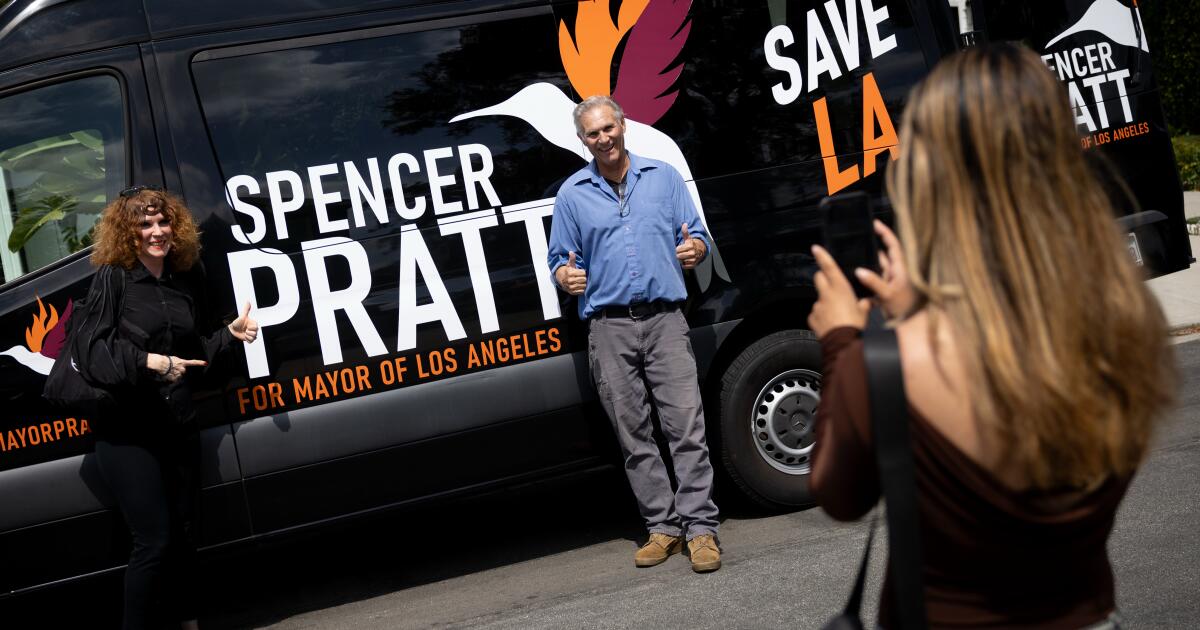
Mayoral candidate Spencer Pratt, left, poses with a supporter

Mayoral candidate Spencer Pratt, left, poses with a supporter during a campaign event in Sherman Oaks.

(Etienne Laurent / For The Times)

Anyone who truly loves the city complains about it even on its best days. They realize L.A. can never be perfect, and that’s what makes it so wonderful. When people try to better their part of paradise, everyone benefits.

But Pratt needs to realize that Angelenos don’t want the city to be torn down, as dissatisfied as they may be. Criticizing the status quo is necessary — but waging a campaign of humiliation, a la Donald Trump, isn’t how to heal L.A. It won’t get large swaths of the city on your side, and it can’t spark the true change City Hall so desperately needs.

Instead, we get people like former Times contributor Meghan Daum — who now calls herself the “official Liberal Elite for Pratt” — gushing in the Atlantic about how her man is the “factory-reset option” to Make L.A. Great Again.

Resetting to when, Meghan? The 2000s of the Great Recession? The 1990s of anti-immigrant policies, the Northridge earthquake and the riots? The 1980s and its out-of-control gangs? The white flight of the 1960s? The 1950s of legal segregation and hideous smog?

Or just to the days when the problems that have long racked L.A. didn’t lap up to the denizens of Prattland — until they did?

These are the people who stayed largely silent as Trump unleashed ICE goons across Los Angeles last summer. They said nothing about housing affordability and violent crime in the years when those issues primarily afflicted South L.A. and the Eastside. They didn’t have a fit about homelessness until encampments spread beyond Skid Row.

Pratt’s loudest fans fundamentally loathe modern-day L.A., and that should chill all other Angelenos. These haters would be his primary constituents and populate his brain trust if he does beat Bass — and if he lets them take over, heaven help the City of Angels.

I’m not discounting Pratt’s chances of winning — he’s too savvy a media pro to fully flop. I knew Bass and Raman would misjudge the anger of Angelenos, fail to capitalize on that rage and find themselves on the defensive against Pratt’s populist push. I also figured he would eschew politeness for the demonizing that has tainted past L.A. elections, from Yorty’s mayoral campaigns of the 1960s to the San Fernando Valley secession movement a generation ago to the continued charges of communism thrown at the democratic socialist wing of the City Council.

I don’t blame Pratt for jumping into the race after his life was upended. And I sure don’t underestimate L.A.’s middle-class malaise, long a reactionary force in city politics with a winning track record that spans decades. But I can’t trust the guy and his crew for just now beginning to say they care about reforming L.A., when all he has fought for is his dark idea of the city.

And if you think L.A. needs a complete makeover, then you probably never really loved it in the first place.

On a recent podcast with Adam Carolla — who has long railed against L.A.’s liberal, multicultural ways and is planning to move to Nevada after his children graduate high school — Pratt huffed that he will “be done with trying to live” in the city if he doesn’t become mayor.

“I’ll go find somewhere that my kids will not have to see naked zombies,” he said, in a comment that was cheered on and seconded by his online army.

Do Angelenos really want to entrust their city to someone who might pick up his ball and quit on a place he professes to love, if he doesn’t get his way?

Source link

AI has invaded the L.A. mayor’s race. Some fear it’s just the beginning

The Hollywood sign is ablaze as Spencer Pratt, the reality TV star now running for mayor of Los Angeles, suits up as Batman, enters City Hall and leads the people to overthrow a cabal of corrupt, out-of-touch progressives intent on destroying the city.

Then he is Luke Skywalker. Dressed in a Jedi robe, he swoops through the city on an Imperial speeder bike, as California Gov. Gavin Newsom (Emperor Palpatine) rebukes incumbent Mayor Karen Bass (Darth Vader) for not burning the city down to the ground in her first term.

“Make sure you finish the job in your second,” Newsom tells Bass with a tilt of the head and a smirk.

“The only thing that can stop us is someone telling the truth,” Bass replies. “As long as they don’t have any hope, the city’s ours.”

Pratt’s fan-generated AI election campaign videos have been praised and mocked, but heavily shared. And some see them as a harbinger of how artificial intelligence could reshape political messaging across the country.

His supporters are far from the first to create AI-generated ads. But political experts say it’s remarkable the degree to which they have used new technology to churn out a stream of outlandish, hyper-cinematic memes, creating buzz around his campaign and his message.

Some warn, however, that as the technology becomes more sophisticated, it will become harder for many people to distinguish between AI and real videos.

“When you’re creating content that is not based in reality, and then platforms are amplifying it in order to attract more eyeballs, you are putting a burden on the public for figuring out what is real and what is factual, and what is fake and misleading,” said Mark Jablonowski, the chief executive of DSPolitical, a progressive advertising firm.

Pratt’s campaign did not create the viral AI videos depicting him as a superhero taking on a cast of California Democratic villains. But he has shared the ads crafted by AI filmmaker Charlie Curran, founder of L.A.’s Menace Studio.

Supercharged and Hollywood inspired, the videos represent a brazen new era of fan-generated AI in political campaign advertising. Deploying generative AI tools to clone human voices and images, they bolster a hyperbolic and ultra-conspiratorial political narrative that depicts L.A. under Democratic rule as a hellscape in which Newsom and Bass deliberately conspire to harm the people.

Bass has condemned the ads, describing them as “very scary” and “absolutely 150% fiction.”

“His social media is now taking on a violent turn,” Bass told CNN, citing the Batman ad that depicts Angelenos pelting her with tomatoes.

Some political experts dismiss such fears of AI campaign ads as overblown. Most AI videos shared by political campaigns and their fans, they note, are more comedic than deliberately misleading.

“Spencer Pratt is using AI the way it should be used, which is to sharpen reality,” said Matt Klink, an L.A.-based Republican political consultant. “His whole shtick is that Los Angeles is broken, the insiders have failed, and the political class wants to explain away what voters are seeing with their own eyes.”

“Obviously, you don’t run an AI ad where you have someone saying something that they didn’t say, and you should disclose that they’re generated by AI,” Klink noted. But when it comes to ads that depict Pratt as Batman or Luke Skywalker, he said, “if you don’t know that they’re AI generated, you’re pretty clueless to begin with.”

For as long as political candidates and their supporters have experimented with new technology — from the pamphlets of the 1600s to the memes of the 21st century — they have faced complaints that they mislead the public.

As large language models ushered in a new era of AI, Sen. Richard Blumenthal (D-Conn.) warned in 2024 that “a deluge of deception, disinformation and deepfakes are about to descend on the American public.”

The term “deepfake” was first coined in 2017 by a Reddit user who used open-source face-swapping technology to splice celebrity faces onto porn performers’ bodies. Within months, it entered the mainstream lexicon as a way to describe any AI-generated synthetic media that realistically clones a person’s image or voice.

Blumenthal cited a “chilling example.” In January 2024, Republicans placed robo calls using an AI “deepfake” voice mimicking President Biden to New Hampshire residents to discourage Democrats from voting in the presidential primaries.

New Hampshire authorities said the message violated the state’s voter suppression laws. A month later, the Federal Communications Commission outlawed robocalls that use voices generated by AI. The company that sent the messages agreed to pay a $1-million fine.

But others kept pushing the boundaries of AI — mostly as overt parody or satire, an arena that offers greater 1st Amendment protection.

In July 2024, an AI content creator created a mock campaign ad of Democratic presidential candidate Kamala Harris with a computer-generated voiceover to make it seem she was describing herself as the ultimate “diversity hire” and “deep state puppet.” The post was titled ‘Kamala Harris Campaign Ad PARODY.’

Newsom slammed the post, saying on X, “Manipulating a voice in an ‘ad’ like this one should be illegal.” Two months later, he signed into law a series of bills that clamped down on AI in politics.

But a federal judge blocked one of the new laws that regulated election-related content that is “materially deceptive,” saying it probably violated the 1st Amendment.

No comprehensive federal rules govern the use of AI content in political ads or messaging. According to the National Conference of State Legislatures, 29 states have passed laws restricting the use of deepfakes in political campaigns: Some states, such as Texas and Minnesota, prohibit the use of deepfakes  a certain number of days before an election; the other 27 states require a media disclosure if content contains a deepfake.

Some political advertising experts call for more federal regulation. The state-by-state patchwork of regulations, they argue, makes it very difficult for social media platforms to be compliant.

“At the end of the day, we really need to see platforms being more responsible with the content that they’re sharing,” Jablonowski said. “We need to have clear guidelines and a level playing field across the country, so we’re not in a position where what’s OK in one state is not OK in another.”

Pratt’s embrace of AI is part of a larger 2026 political trend.

In January, Texas Atty. Gen. Ken Paxton released an ad depicting two of his opponents for a Senate seat — Republican Sen. John Cornyn and Democratic Rep. Jasmine Crockett — waltzing and swinging. A few months later, the National Republican Senatorial Committee shared a video that used a manipulated image of James Talarico, the Democratic nominee for the Texas Senate seat, mouthing his own tweets.

But Pratt has been particularly successful in using fan-based AI to help garner attention, pulling in a number of content creators to craft AI videos for his campaign.

One posted a video parody of the 2004 Downfall film, portraying Bass as Hitler. Another created an animated video, geared to a Latino audience, showing Angelenos lining the streets to cheer as Pratt wheels a garbage can piled with trash and the incumbent mayor. The slogan “SPENCER, SACA LA BASSURA” [Spencer, take out the trash] flashes atop the screen.

A recent survey from the American Assn. of Political Consultants shows that AI adoption is growing rapidly among political consultants — and Republicans are more likely to use it than Democrats.

But political observers in L.A. note that leading Democrats in the mayoral race are unlikely to follow Pratt in using AI. Bass, they note, is a more cautious political figure than Pratt, a brash online influencer who relished playing the role of villain on MTV’s “The Hills.”

While Pratt’s user-generated AI ads have inspired giddy delight from out-of-state Republicans — conservative radio host Buck Sexton praised the Batman video for ushering in “a new era of online persuasion” — it’s still not clear if they will convince Angelenos to vote for him.

Certainly, the ads have helped Pratt gain recognition. They have also given voice to a groundswell of frustration with L.A.’s Democratic establishment and created space for more pressing debate on the future direction of the city.

But there is little evidence that the AI ads, in themselves, are persuading new voters.

So far, none of the AI ads that Pratt has shared have received as many views on his X account as a non-AI ad his campaign produced that has racked up more than 14 million views.

In it, Pratt stands outside Bass’ city-owned Hancock Park mansion and Nithya Raman’s home in leafy Silver Lake, then pans to an Airstream on the charred ruins of his own home, which burnt down during the Palisades fire.

“They don’t have to live in the mess they’ve created,” Pratt says as he walks down an L.A. street littered with homeless tents.

Meghan Daum, a former Los Angeles Times columnist who has endorsed Pratt and dubs herself a self-appointed “liberal elite whisperer for Pratt,” said she thought Pratt’s Airstream ad was more effective than the AI superhero ads. She voiced concern his sharing of AI videos could actively undermine his campaign.

“They will be repellent to the undecided voters Pratt needs to catch, most of whom will think they’re coming directly from the campaign,” she said on X. “Get smarter, guys.”

Using AI, she told The Times, could turn off voters in a town where so many film workers have lost jobs to AI. She also worried about the legality of ads — such as one video purporting to be a Bass campaign ad — that put words in the mouth of computer-generated politicians.

But Daum noted that others told her this was the aesthetic of the new world and a way of getting people who have not voted in the past excited about something.

“That may be true,” she said.

So far, there is little evidence that AI in U.S. political campaigns has affected elections.

“There’s a lot more fear about the effects of AI in politics than evidence of the effects of AI in politics,” said Brendan Nyhan, a political scientist at Dartmouth College who co-authored a recent report on AI and persuasion.

During the 2024 election, Nyhan noted, AI was frequently used to create “obviously false” images of attention-grabbing, funny or raging content. “It seems to be more of a mechanism for reaching your base,” he said, “rather than persuading voters who haven’t made up their mind or might stay home.”

Ultimately, Pratt’s personal story of loss — and more specific complaints about L.A.’s systemic failures in preparedness and emergency response during the 2025 firestorms and spending on unsuccessful programs to house the homeless — may resonate more than simplistic AI stories of evil Democrats hellbent on razing their city.

Some L.A. political observers admit they were surprised by Pratt’s performance in a May 6 televised debate with Bass and Raman.

”Spencer Pratt was kind of a laughingstock when he first announced that he was going to run, and he has dramatically exceeded expectations,” said Klink, the GOP strategist. “I think that he surprised people in his ability to come up with solutions. … That’s what’s going to convince people to vote, not the Batman or Star Wars ad.”

As millions of people click on Pratt videos — in some cases more than the 3.8 million people living in L.A. — Klick said there was one question Pratt needs to be asking: “Do views of his ads translate into votes?”

Source link

Best L.A. bakeries to buy a celebration cake

Where are the best bakeries to buy celebration cakes? I want to get a cake for one of my college friends — we’ve been friends for 40 years — who is retiring from teaching kindergarten. I’m having a small brunch party for her at a restaurant in Long Beach. It’d be great if the bakery is in Pasadena or on the East Side, but I will travel for awesome cake! She loves chocolate and espresso martinis. — Roberta Tragarz

Looking for things to do in L.A.? Ask us your questions and our expert guides will share highly specific recommendations.

Here’s what we suggest:

Roberta, I think it’s so sweet that you are throwing a retirement party for your longtime friend. In my opinion, no celebration is complete without a good cake and I, too, will drive just about anywhere for one that I think the recipient would love. Here are some bakeshops that might just have “the one.”

With Pasadena being convenient for you, you’re in luck. Times restaurant critic Jenn Harris calls the city a “pastry and dessert destination.” She writes about six stellar new bakeries that have opened within a one-mile radius, including Salted Butter Company, which offers a gorgeous round cake topped with seasonal florals, and Sweet Red Peach, which can create just about any custom cake you can dream up.

Given that your friend loves chocolate, consider buying a cake from Proof Bakery in Atwater Village. The worker-owned cooperative shop used to sell a chocolate espresso cake, which would’ve been perfect because your friend loves espresso martinis. However, they swapped it out for a chocolate blueberry cake with chocolate mascarpone mousse and blueberry compote. Thankfully, it looks just as delicious. And you can still make Proof’s chocolate espresso cake at home.

No L.A. bakeshop has been recommended to me more than SusieCakes. With multiple locations spread across the county including one in Pasadena, the classic bakery makes an array of delightful desserts: old-fashioned chocolate cakes, flourless chocolate cakes, rainbow sprinkle cakes and even a cake flight so you can try all of their signature slices. Former Times food editor Amy Scattergood wrote about SusieCakes, “You can pick the flavor of cake and color of buttercream frosting, get stuff written on top, even order a pretty impressive Barbie cake (they provide the doll; the cake is the dome of her massive skirt).” A “Teacher Barbie” that looks like your friend would be adorable.

Now, this isn’t a traditional cake but hear me out. My good friend Tori Johnson had a cinnamon roll cake at her recent birthday party and I haven’t been able to stop thinking about it since. It was gooey, soft and slathered in a classic tangy cream cheese frosting. Her boyfriend got it from BadAsh Bakes, the viral bakery based in Pasadena best known for its cinnamon rolls, cookies, brownies and layer cakes. You can preorder the cinnamon roll cake, which comes in a classic, red velvet or matcha flavor.

For an eye-catching, avant-garde cake that you won’t find at a traditional bakery or grocery store, consider ordering a custom dessert from Celeste Perkins, the L.A.-born baker who makes “cakes with big personalities, for big personalities,” as Times contributor Tasbeeh Herwees writes in Image. Perkins, who works out of her home kitchen, got her start baking cakes for friends and has since made them for an array of celebrity clients including Tunde Adebimpe (frontman for the band TV on the Radio), Japanese American singer Mitski and British singer Suki Waterhouse. Not only are the cakes yummy, they are photo-worthy.

Now for some rapid-fire picks across L.A.: My colleague Jason Lew recommends Phoenix Bakery in Chinatown, specifically the strawberry cake with sliced almonds. Times Features reporter Lisa Boone also suggests Valerie Confections in Glendale. “I’ve ordered cake from Valerie several times for different occasions and they’re always really special, pretty and so good,” she says. Her favorite is the fallen fruit cake, but the bakery also sells a flourless chocolate almond cake and German chocolate cake. There’s also République, the French-inspired bakery and cafe known for its salted caramel chocolate cake. Finally, you can never go wrong with Porto’s, which sells an array of cakes including chocolate raspberry, Parisian chocolate, mango mousse, strawberry cheesecake and more.

Retiring is such a big deal, so I love to hear that you are celebrating it as such. I hope that these recommendations help you find the perfect cake for your friend. Be sure to send us a photo of the one that you choose. Have a wonderful time!


Source link

How Hollywood’s production crisis became a key issue in the L.A. mayor’s race

Los Angeles City Councilmember Nithya Raman, who serves the 4th District, makes her way across an empty, unnamed backlot, presenting her case to be the city’s next mayor.

“Studio lots like this one used to be filled with people, costumers, electricians, set medics, caterers, thousands of Angelenos making a living,” she says in the video posted on social media. “Now these lots are quiet. Since 2018, shooting days in the city have fallen by half.”

After telling voters this issue is “personal” (her husband is a TV writer and producer), criticizing Mayor Karen Bass’ leadership on the matter and outlining her own plans, Raman proclaims, “I’m running for mayor to make sure Los Angeles stays the film and TV capital of the world.”

Placing the concerns of the entertainment industry at the center of the city’s mayoral race would have been unthinkable even in the last election cycle. But the production crisis, which has rocked Hollywood and pummeled its workforce, has reached a critical juncture. The state of L.A.’s signature industry is now a political flashpoint alongside affordability, crime and homelessness in the upcoming election.

A person films an interaction with mayoral candidate Spencer Pratt

A person films an interaction between mayoral candidate Spencer Pratt and another person on his cellphone during a “Community Meet and Greet” event out of a house for sale on Long Ridge Avenue in a residential neighborhood of Sherman Oaks on Saturday.

(Etienne Laurent/For The Times)

In campaign ads, interviews and the recent televised debate, the top three contenders: incumbent Mayor Bass, former reality TV villain Spencer Pratt and Raman, have made the ongoing production slump a pivotal topic, highlighting their plans to revitalize the industry while deploying the issue to undercut one another.

For decades, elected officials have not had to focus on the film and TV business, let alone turn it into a campaign issue. It was simply a given that local production would continue to play a dominant role in the city’s economy as it has for more than a century.

But the cumulative effects of consolidation, runaway production to tax-friendly states and countries and the end of the streaming boom has caused Los Angeles to lose billions in economic activity, shed some 57,000 jobs over the last four years and led to the closing of more than 80 film and television production service businesses across the city since 2022.

“For us, ‘save Hollywood’ is more than a slogan and more than headline. It is what needs to be done,” said Pamala Buzick Kim, one of the co-founders of Stay in LA, a grassroots campaign aimed at increasing film and television production in Los Angeles.

To be sure, the biggest driver of where studios and producers film are state and federal tax credits, over which the city has no control.

But Buzick Kim and others argue that “there is lots the mayor can do, hand-in-hand with the City Council.”

Mayor Karen Bass walks with Nilza Serrano during Avance's politics and tacos event

Mayor Karen Bass, center, walks with Avance Democratic Club President Nilza Serrano, to the right of Bass, during Avance’s politics and tacos event at Ernest E. Debs Regional Park in Los Angeles on Saturday.

(Christina House/Los Angeles Times)

For starters, say filmmakers and advocates, much can be done to tackle the city’s sclerotic bureaucracy, onerous regulations and a slow and costly permitting process that has pushed filmmakers to flee to friendlier and cheaper locales.

While steps have been put in place recently, including a pilot program offering reduced-cost filming permits for shoots that demonstrate a “low impact” to the surrounding community, many complain such steps have come too little and too late.

A man examines woodwork in a shop

Scott Niner, president and owner of Dangling Carrot Creative, checks on woodwork being produced at his shop in North Hollywood.

(Jason Armond/Los Angeles Times)

“The industry is in collapse and people have been talking about fixing things for years, but all we get are incremental little changes,” said Ed Lippman, a location manager of 34 years who lives in Sherman Oaks and has worked on such shows as “ER” and “The X-Files” and movies including “Galaxy Quest.” “And if the city is not being business-friendly, the business will go elsewhere.”

Compounding the problem, the Los Angeles area has more than 100 jurisdictions, many of which have their own set of rules and regulations regarding filming.

“There needs to be universal standards,” said Travis Beck, a location manager for commercials, small films and music videos. “Burbank is different from Glendale, which is different from Pasadena.”

The recent kerfuffle over filming “Baywatch,” the lifeguard reboot at Venice Beach, underscored both the efforts to bring production back to L.A. — enticed by a $21-million tax credit — and the complex, baffling red tape required to film here.

When shooting began in March, the production encountered a number of hiccups, including that it needed nearly double the parking space it had received a permit for, which was not part of the original approvals.

An anonymous crew member claimed on Facebook that government restrictions had forced production to relocate from Venice Beach. Production staff denied they had relocated. However, the incident prompted a backlash, becoming a rallying cry over L.A.’s burdensome filming bureaucracy.

The “Baywatch” team quickly met with city and county officials and resolved the issue, securing an agreement for a 20% parking discount from the city, and the mayoral candidates used it as an opportunity to score political points.

Pratt slammed the city’s permitting problems.

“LA turned its back on Hollywood — now the golden goose needs CPR,” he wrote on his Substack.

Bass highlighted her administration’s leadership on the matter.

“The City of Los Angeles will always clear bureaucratic barriers, making it easier and more affordable to film in the entertainment capital of the world,” she wrote on X last month.

On April 21, the mayor unveiled programs to offer productions 20% discounts on city-owned parking lots and other equipment, reduced filming fees at places like the Griffith Observatory and reopened the Central Library for filming. Last August, she appointed Steve Kang, president of the Los Angeles Board of Public Works, as the city’s film liaison.

Raman has pledged her support for expanding the state’s $750-million tax incentive program, streamlining permitting and lowering fees and eliminating those for small productions. She has also said she will establish a dedicated city film office with a liaison who understands production.

Nithya Raman speaks to a crowd outdoors behind Nithya for Mayor chalk message on ground

Councilmember and mayoral candidate Nithya Raman speaks to a crowd at the “Families for Nithya” event at Vineyard Recreation Center in Los Angeles on Saturday.

(Myung J. Chun/Los Angeles Times)

“Los Angeles is losing Hollywood,” Raman said in a statement. “Not because productions want to leave, but because we’ve made it too hard for them to stay.”

On his Substack and various podcast interviews, Pratt has promised to slash location fees in half, speed up permit approvals, reduce on-set city staff for the majority of productions and waive all fees for shoots with budgets under $2 million.

All three candidates have attacked one another over their approach to Hollywood.

Pratt and Raman have said Bass moved too slowly to address spiraling production and retain film jobs, saying she enacted measures only recently as the mayoral race was heating up.

Speaking on the Monks & Merrill podcast, Pratt criticized Bass’ moves to cut costs to film at the Griffith Observatory, saying, “Who needs that shot right now with the homeless poop all around it?”

The incumbent mayor has defended her administration’s record with the entertainment industry.

Bass and Pratt have taken Raman to task, calling her out for what they say is her lack of advocacy during her time on the City Council.

“She feels very strongly about it. But never offered one motion on the industry, and when motions came up on the industry she either recused herself, or got up and walked out,” said Bass during a debate this month.

Citing a potential conflict of interest over her husband’s work in television, Raman refrained from voting on several motions related to Hollywood.

Many working in the industry would like to see full-throttled support coming from the mayor’s office that will get results. They note how New York City has successfully promoted itself as a leading film destination over the years. (Kang, the city’s chief film liaison, said the city is working on a similar marketing campaign to promote filming that will launch by early fall.)

“For all the talk about, ‘We need to support and bring back filming,’ if they just did basics like lowering the fees and simplifying the process … that would actually help people and get things produced,” said Chris Fuentes, 66, who worked for 30 years as a location manager until he retired last year.

“We’ve heard a lot of great things, but not all things are possible in the mayor’s remit,” said Buzick Kim, noting that tax incentives are a state and federal issue.

Still, she said, “the mayor must understand that Hollywood needs to be made a priority and to find and create inspired thinking to make things easier and cheaper.”

Kang agrees, but says there are limits to what the mayor can achieve.

“We definitely can do a lot to really open up the entertainment industry, but at the same time, we recognize the larger impact needs to come from Sacramento and Washington, D.C., because L.A. just does not have the resources to compete with other jurisdictions in providing millions of dollars in tax incentives,” he said.

For most working in the industry, they just want city leadership that will execute on more than just talking points.

“This is the birthplace of cinema,” Beck said. “It shouldn’t be so hard to film here.”

Source link

Mayoral hopeful Spencer Pratt woos Valley voters in a rival’s district

Lake Balboa resident Jose Meraz is looking for a mayor who will turn L.A. around, cleaning up streets that he says are “filled with garbage.”

Schoolteacher Tracey Schroeder, a Republican candidate for state Assembly, is unhappy about crime, open-air drug use and the slow rebuilding effort in the wake of the Palisades fire, which destroyed thousands of homes.

Greg Whitley, a resident of Reseda, said he’s frustrated with homelessness and the influx of what he called “criminal illegal aliens.”

“I live with the Spanish community. Great people,” he said. “But these illegals that come here for criminal reasons, they’re making them look bad, and they don’t like it.”

All three showed up outside a five-bedroom home in Sherman Oaks on Saturday, looking to speak with reality TV personality Spencer Pratt, now waging an insurgent campaign for Los Angeles mayor in the June 2 election.

Mayoral candidate Spencer Pratt, left, poses with a supporter

Mayoral candidate Spencer Pratt, left, poses with a supporter during a community meet-and-greet event Saturday at a home on Longridge Avenue in a residential neighborhood of Sherman Oaks.

(Etienne Laurent/For The Times)

Standing in the entry to the home’s two-car garage, the onetime star of “The Hills” spent more than two hours shaking hands, giving hugs and posing for photos with his admirers, who waited in line under punishing San Fernando Valley sunshine.

Pratt used social media to invite the public to the campaign event, which took place in the district represented by one of his mayoral opponents, City Councilmember Nithya Raman.

He did not deliver any speeches outside the property, which is listed for rent on Zillow for $15,950 per month. He and a member of his security personnel said he was not taking interviews.

Pratt has been running in voter surveys behind Mayor Karen Bass, who is running for reelection, sometimes swapping places with Raman for second and third. He turned in a strong debate performance this month and has been outpacing his rivals in fundraising, according to the most recent disclosure reports.

While running for office, Pratt has blamed Bass for the 2025 wildfire that destroyed much of Pacific Palisades, including his home. He has railed against the city’s handling of homelessness, saying he would pursue a “treatment first” approach toward people with drug addiction who are living on the street.

Mayoral candidate Spencer Pratt, back to the camera, speaks with supporters

Mayoral candidate Spencer Pratt, back to the camera, speaks with supporters Saturday during a community meet-and-greet event.

(Etienne Laurent/For The Times)

Pratt said recently that he wants to increase Los Angeles Police Department staffing to 12,500 officers over the next decade, up from about 8,600. Speaking with one supporter on Saturday, he said the city needs to “make sure all the laws are being enforced.”

“Plenty of functioning cities enforce their laws,” he said.

That message resonated with many of the people in line.

“He is advocating for the safety and security of our families — specifically, for mothers to be able to walk their kids to school,” said Saba Lahar, a resident of Sherman Oaks, moments after talking to the candidate.

Pratt fans dropped off ballots, picked up lawn signs and stopped to pick up coffee drinks from the Hustle N Dough doughnut truck parked out front.

Some showed up even though they cannot cast ballots in L.A.

A man photographs his father holding a "Pratt for L.A. Mayor" sign in the street

Ruben Jr., no last name given takes a picture of his father during mayoral candidate Spencer Pratt’s community meet-and-greet Saturday in Sherman Oaks.

(Etienne Laurent/For The Times)

Brian Rodda, who runs a walking food tour company, described himself as “an unsatisfied Angeleno” even though he lives in West Hollywood, which is not part of the city of L.A.

“Sadly, because I do live in West Hollywood, I cannot vote for him,” he said. “But I certainly think we need a change.”

Source link

L.A. police union targets leftist mayoral candidate Rae Huang, who’s running in fifth

Good morning, and welcome to L.A. on the Record — our City Hall newsletter. It’s David Zahniser, with an assist from Connor Sheets and Sandra McDonald, giving you the latest on city and county government.

We’ve reached the point in L.A.’s city election season where a juicy piece of news is popping off every day.

With a little over two weeks until the June 2 election, the campaigns’ remarks are getting more scathing, the spending more expensive and the scramble by supporters to get their chosen candidates into the top two more intense.

Like everyone else, we’re struggling to keep track of it all. In the meantime, here are a few of the more unusual moments from the past week:

The police union targets fifth-place candidate Rae Huang

You’ve probably heard about the digital attack ads put out by the Los Angeles County Federation of Labor warning voters that reality TV personality Spencer Pratt is “the LAST thing Los Angeles needs.”

Savvy political players said it wasn’t an attack ad at all, but rather a thinly veiled bid by the County Fed, a group that supports Mayor Karen Bass, to boost Pratt’s chances of making the Nov. 3 runoff election. Those observers say the mayor and her allies would rather run against Pratt, a Republican in a heavily Democratic city, than Raman during the campaign’s second round.

Now, another ad is up. But this time it’s from the Los Angeles Police Protective League, another union that is backing Bass’ reelection.

The league reported Wednesday that it’s spending about $100,000 on digital ads against mayoral candiate Rae Huang, who has been polling in the single digits.

Like the County Fed ad focused on Pratt, it’s not so much a lacerating attack as it is a list of the candidate’s beliefs.

“She supports the anti-business Green New Deal to increase taxes on corporations to provide free public transportation,” the digital ad says.

Once again, political sophisticates see a ruse, saying the police union is trying to lift Huang’s profile among voters, helping her pull support away from one of Bass’ top rivals, Councilmember Nithya Raman. Such a scheme, if successful, would ensure that Pratt ends up in the top two.

Asked about its new ad, league spokesperson Tom Saggau said the union is alerting voters that Huang “hates cops, corporations and real estate developers and voters should be aware.”

“It’s extremely important for voters to know about Rae Huang’s reckless plans to dismantle the police department and blow the city budget with free public transportation and other giveaways,” he said.

Huang said on social media that the police union is going after her because “they know change is possible.” At the same time, she acknowledged the ads were somewhat flattering.

“I think LAPD’s a little scared of me because they just spent over $100,000 in attack ads against me,” she said in a campaign video. “But they’re making me look good, so … thank you!”

Rob Quan, who is part of the advocacy group Unrig LA, replied to Huang at one point on X.

“They aren’t trying to stop you they are trying to boost you,” he wrote.

Raman backers really want Huang to drop out

With the primary campaign nearly over, impatient Raman supporters have been taking matters into their own hands, calling on Huang to drop out and ensure that Bass faces an opponent to her left.

Evan Goodrich, a Raman voter who lives in Echo Park, said he wants Raman in the top two. Voters shouldn’t squander their chance at getting a progressive mayor and creating change at City Hall, he told The Times.

Goodrich, 31, was more blunt on social media.

“Your campaign is broke, you have a snowball’s chance in hell of winning, and you’re costing us the most progressive viable candidate we have. It’s time to drop out!!!” he wrote, in a response to a Huang post.

Huang, a member of the Democratic Socialists of America, said she’s not going anywhere.

During a Q-and-A posted on Reddit, she pushed back at the idea that her campaign is splintering the progressive vote, arguing that she views Raman as “neoliberal,” not progressive.

Raman has shifted her positions on police hiring, anti-encampment laws and Measure ULA, the tax on high-end real estate sales, Huang’s campaign said.

“I would not consider Nithya to be a progressive candidate, full stop. I do see her as being continuing to be a part of the establishment,” Huang said.

Huang did acknowledge that she sees Raman as being to the left of Bass.

Raman accuses Bass of ‘pay-to-play’ politics

As she battles to get into the top two, Raman launched a broadside against Bass this week, accusing her of engaging in multiple “pay-to-play” deals.

In a burst of social media posts, she accused Bass of negotiating “a sweetheart LAPD Union contract that bankrupted the city and a convention center expansion that will cost us over $4 billion after debt payments.” Special interests that supported those deals are now reciprocating, Raman said, by campaigning for the mayor.

Raman offered what she said is a fresh example of pay-to-play politics: the mayor’s push to allow owners of second homes to rent those places out on Airbnb or other short-term platforms, a practice currently prohibited by city law.

The Central City Assn., which supports the move, announced plans this week to spend $1 million on a campaign supporting Bass. A large part of its funding is coming from Airbnb, which also favors the idea. The downtown-based business group also supported Bass on the Convention Center.

“This is what pay-to-play politics looks like,” Raman said.

Bass has been defending her policy moves, saying the police raises were needed to keep officers from taking more lucrative jobs in other cities. The Convention Center expansion will boost tourism and a struggling downtown, Bass said.

The mayor also reiterated her support for the vacation rental policy, saying it would only be temporary, generating additional taxes for the city while ensuring more beds are available for the 2028 Olympic Games.

You’re reading the L.A. on the Record newsletter

Sign up to make sense of the often unexplained world of L.A. politics.

Bass campaign spokesperson Alex Stack called the allegations “another conspiracy theory from a failing candidate who is grasping at straws after her debate disasters and polling showing she won’t make the runoff.”

“The City should absolutely be exploring every way to maximize the economic benefit from the Olympics and to generate revenues paid by visitors, not Angelenos,” he said in a statement.

Nella McOsker, who heads the CCA, struck a similar note, praising Bass for supporting pro-business policies and calling Raman’s assertions “ridiculous.”

Wait, there’s a sheriff’s race?

If the mayor’s race has been blowing up, the contest for Los Angeles County Sheriff has been downright sleepy.

Sheriff Robert Luna, now seeking a second 4-year term, holds a substantial financial edge over the rest of the field, according to the most recent batch of fundraising reports.

In mid-April, Luna had more than $738,000 cash on hand, compared to about $114,000 for former Sheriff Alex Villanueva, who is attempting a comeback. Each of the other challengers had less than $50,000, spending reports show.

Sheriff’s Capt. Mike Bornman, one of the eight candidates running to unseat Luna, said the campaign had a single candidate forum in Compton, and that neither Luna nor Villanueva took part.

State of play

— BERN NOTICE: U.S. Sen. Bernie Sanders announced Friday he is endorsing a handful of council candidates: Eunisses Hernandez on the Eastside, Hugo SotoMartínez in Hollywood, Faizah Malik on the Westside and Estuardo Mazariegos in South L.A. Sanders is also backing Deputy Atty. Gen. Marissa Roy in her bid for city attorney.

— HITTING THE MOTHERLODE: You can’t put a price on a mother’s love. Or can you? The independent expenditure committee working to elect city controller candidate Zach Sokoloff, bankrolled by his mother Sheryl Sokoloff, continued its campaign spending spree this week, reporting it had paid out nearly $4.8 million by Thursday. The latest tranche of money went toward attack ads against City Controller Kenneth Mejia.

— WAGE WARS: The City Council took the first step Wednesday toward scaling back a planned $30 hourly minimum wage for hotel and airport workers, in the hope of persuading business leaders to drop a planned ballot measure to repeal the city’s business tax. Under the plan, the hourly wage would reach $30 in 2030, instead of summer 2028. The move is not final and more deliberations are planned next week.

— OLYMPIC ANGST: State lawmakers pressed organizers of the 2028 Olympic Games about the effort to secure federal funding, pointing to Trump’s animosity toward California. Joey Freeman, vice president of state affairs for the LA28 Organizing Committee, assured legislators that his committee has a “wonderful working relationship” with the Trump administration. L.A. is on the hook for hundreds of millions of dollars if the games lose serious money.

— POLL POSITION: A new voter survey showed Bass continuing to lead the pack of candidates in the mayor’s race, with Pratt in second and Raman third. Paul Mitchell, vice president of voter data firm Political Data Inc., questioned the poll’s accuracy, saying it oversampled Latinos and undersampled people over 50.

— DUMPING THE DEBATE: The FOX11 mayoral debate that had been planned for this week was canceled after Bass and Raman pulled out. Pratt had already declined to attend the event.

— TARGETING TAXES: L.A. County voters historically have been generous about sales tax hikes, signing off on increases to pay for public transit and homeless servcies. But with the public reeling from soaring gas prices and other rising costs, some are wondering if they will get behind Measure ER, a half-cent sales tax hike to pay for healthcare programs.

— DIGITAL FIRST: TV ads used to dominate in L.A. mayoral campaigns. But this year, candidates have been relying heavily on social media, posting snappy, off-the-cuff videos in the hope of going viral.

— REALITY, STARS: Songwriter/producer David Foster and his wife Katharine McPhee held a star-studded fundraiser for Pratt at their home, one that featured McPhee singing a parodied version of Tina Turner’s “The Best,” according to a video posted on X. Pratt has been scooping up donations from a number of Hollywood players, including Universal Music Group chief executive Lucian Grainge and Sandra Rebish, also known as TLC’s Dr. Pimple Popper.

QUICK HITS

  • Where is Inside Safe? The mayor’s signature program to combat homelessness went to Boyle Heights this week, tackling encampments at Hollenbeck Park and at the entry to the Sixth Street Bridge. The area is represented by Councilmember Ysabel Jurado.
  • On the docket next week: The council meets Tuesday to take another stab at renegotiating the terms of the $30-per-hour wage hike for airport and hotel workers.

Stay in touch

That’s it for this week! Send your questions, comments and gossip to LAontheRecord@latimes.com. Did a friend forward you this email? Sign up here to get it in your inbox every Saturday morning.

Source link

Cracked L.A. sidewalks are a symptom of a bigger breakdown

When I wrote last week about one of my favorite mountain ranges — L.A.‘s sidewalks — I immediately began fielding questions.

People wanted to know about the scoring system that awarded just 15 points, out of 45, to John Coanda and his wife, Barbara, who uses a wheelchair because of ALS. The Mar Vista couple had applied to the city’s Safe Sidewalks program to have some busted-up sidewalk in front of their home repaired.

With several sidewalk hazards on both sides of their block, Barbara can’t safely make it down her street. So how is it possible that under L.A.’s “Sidewalk Repair Program Prioritization and Scoring System,” their meager 15 points means they could be waiting “in excess of 10 years” for help?

I have the answers.

The Coandas got 15 points for being in a residential zone. But they didn’t meet the requirements for getting two additional awards of 15 points. They do not live within 500 feet of a bus or transit stop. And they had not been in the sidewalk repair backlog queue for more than 120 days.

It is not clear, however, that moving up to a score of 30 will bring out city work crews in less than 10 years. Knowing what I know, I wouldn’t bet on it.

The scoring system exists because in a lawsuit settlement 10 years ago, the city agreed to spend $1.4 billion over 30 years to repair damaged sidewalks and other infrastructure failures that impede the mobility of people with disabilities.

But there’s a backlog. A huge backlog, in the thousands. At my request, the city disclosed on Friday that it’s receiving about twice as many new disability-access repair requests each year as it’s addressing. In addition, the backlog for disability access requests and from residents applying for a sidewalk repair rebate program stands at roughly 30,000, with about 600 repairs being made each year.

As I said in a previous column, L.A. might indeed be all buttoned up by the ‘28 Olympics, but that would be 3028, not 2028.

Cracked sidewalks, to be clear, are but a symptom of a deeper, decades-long breakdown at City Hall. Basic services have been sacrificed to pay for employee compensation and pension costs the city can’t afford, with homeless services adding to the budget crisis.

By the way, I heard from one reader in response to my suggestion last week that if you can’t wait 10 years or more for the city to fix a broken sidewalk, you can apply to the rebate program, which will cover a portion of repairs. Don’t bother, said Lori Lerner Gray, who owns a house in Silver Lake and applied two years ago, but finally gave up.

“There is a massive waiting list and it’s a very complicated procedure just to try to get on it, let alone speak with anyone to help,” Gray said. “Once you finally get into the program, it’s impossible to proceed because of permits, engineering reports and finally you are required to bring the entire area to ADA compliance on your own dime.”

She said she was told she’d have to pay to relocate a utility pole.

And sidewalks aren’t the only infrastructure problem, as other readers noted. The city is way behind on filling potholes, repaving streets, installing curb ramps, making park improvements and replacing broken lights. I recently wrote about all the blight around City Hall, including the graffiti-tagged monument and fountain that has been inoperable for most of the last 60 years.

Oren Hadar, a Mid-City resident who writes about housing and transportation on his The Future Is L.A. website, reported last year in a Times op-ed that city streets were falling apart because the city had switched from repaving entire roads to doing what it called “large asphalt repair.”

With the switch, the city avoided federal requirements to upgrade curb ramps on repaved streets, Hadar said. He told me that when he travels to other cities near or far, “I’m always jealous of everything. Sidewalks are in better shape or there are better bike lanes. … You could go to even Santa Monica or Culver City. You don’t have to go far to see infrastructure that’s better.”

Other major cities have had formal infrastructure plans for years, while L.A. has ducked and dithered. Finally, earlier this month, Mayor Karen Bass introduced the city’s long-awaited CIP (capital infrastructure program), and offered a brutal assessment of what went wrong.

“For too long,” she said in the executive summary, “information has been scattered across departments, buried in lengthy reports and budgets, and difficult to fully understand. These challenges have had real consequences, contributing to decades of underinvestment in our built environment.”

The summary reads like an indictment of City Hall leadership and the manner in which public spaces have deteriorated. With Bass running for reelection, voters have to decide whether her role in those failures is grounds for dismissal, or her campaign-season pitch for a new day should help earn her a second term.

The report, with backing by members of the City Council, cited “fragmented systems and data silos,” “no shared vision across city departments,” “growing maintenance deferrals,” “slow, inefficient capital planning,” no “project intake standards,” “highly decentralized and uncoordinated grants,” “resource planning and staffing misalignment,” and “opaque capital planning process.”

Way to go, team.

You could take many of those same critiques and apply them to the haphazard way in which city and county leaders have addressed homelessness.

However, the city’s infrastructure plan does offer a framework for assessing the damage and prioritizing projects, and using charter reform to create a public works director position with greater authority. None of this will happen quickly, and given the budget crunch, you might be wondering how any of this would be paid for.

The suggestions in the report include bonds, a parcel tax, grants, fees on tickets to concerts and sporting events, fees on taxi and rideshare trips, and much, much more. None of this will be popular, especially if the public is unconvinced that city leaders can be trusted with more money.

Urban planner Deborah Murphy, chair of the city’s pedestrian advisory committee, noted that L.A. has gotten grants or state funding in the past for specific projects and then, because of staffing shortages or other stumbles, failed to hold up its end of the deal.

“It kind of ruins our reputation for getting future money,” Murphy said.

Jessica Meaney, executive director of Investing in Place and a longtime advocate for the infrastructure plan, is thrilled that the city has finally taken this step.

“But the key question is: who is actually in charge of making it happen?” she asked.

It’s critical, Meaney suggested, for city leaders to push for charter reform that puts infrastructure authority under a newly empowered public works director. If the city gets this right, she said, implementation of the infrastructure plan “could finally show Angelenos the true scale of deferred maintenance, make trade-offs visible, and create a road map for better sidewalks, streets, parks, and accessibility.”

If the current fragmented authority remains in place, Meaney said, the headline would be:

“No one is in charge of your sidewalk and City Hall is determined to keep it that way.”

steve.lopez@latimes.com

Source link

Was the mayor a spy? L.A. suburb wonders about depth of Chinese plot

As Eileen Wang and her supporters tell it, the former Arcadia mayor was led astray by a man she trusted and loved.

After chasing her political ambitions in the San Gabriel Valley suburb, Wang, 58, won a City Council seat in 2022 with the help of a campaign advisor who was also her romantic partner. Two years later, he was charged by federal authorities with secretly working on behalf of the Chinese government.

Wang, a naturalized U.S. citizen, distanced herself from her ex and remained in office, becoming mayor earlier this year. The scandal had mostly quieted — until Monday, on the eve of President Trump’s planned trip to Beijing, when a plea deal was unsealed revealing Wang’s own murky role as an agent for China.

A man walks past an empty space where a photograph of former Arcadia Mayor Eileen Wang hung between other photos on a wall.

A man walks past an empty space where a photograph of former Mayor Eileen Wang was removed in the lobby of Arcadia City Hall.

(Genaro Molina/Los Angeles Times)

Now, Wang has become a national political talking point, with critics painting her as a calculating foreign agent who sought to infiltrate the American government and undermine democracy.

Katie Miller, wife of top Trump advisor Stephen Miller, blasted Wang on social media site X as a “spy.”

“This is pure China trying to influence U.S. politics and U.S. elections,” Katie Miller said on Fox News.

Back home, some of Wang’s former colleagues in local government say they repeatedly tried to raise alarms about her.

“There were red flags everywhere,” said Sharon Kwan, an Arcadia city council member and former mayor.

Wang admitted in her plea agreement to posting and editing web content at the request of the Chinese government — without disclosing her ties to U.S. authorities, as the law requires. She ran afoul of the Foreign Agents Registration Act, or FARA, a federal statute that experts said has seen ramped up enforcement over the last decade, particularly in cases involving China.

But those familiar with the law — and international espionage — said it does not appear that Wang was engaged in spycraft as it is commonly understood.

Dennis Wilder, a former senior U.S. intelligence official and professor at Georgetown University, said that, in the CIA, Wang would be referred to as “an agent of influence.”

“She’s not a spy in the Jason Bourne sense,” Wilder said, referring to the fictional American agent. “She’s not out there recruiting sources and that sort of thing. That’s not the role that they want for her. But they see this other role as extremely important.”

A man exits Arcadia City Hall

A man exits Arcadia City Hall on Tuesday.

(Christina House/Los Angeles Times)

A run for city council

Wang moved to the U.S. around 30 years ago, in part, she told The Times in 2024, because she wanted “freedom for speech, freedom [for] thinking.”

Her mother was a Chinese medicine and acupuncture doctor and her father was a physician in Sichuan province before working at USC, she said. Authorities have not detailed how she immigrated or her path to citizenship. She landed in Arcadia, she said, lured by what the school district in the affluent city of 54,000 could offer her two young boys.

She ran an after-school program and was involved in some community organizations, but said she did not move in political circles until shortly before her 2022 run for city council. She switched her party affiliation from Republican to Democrat, which, she said, spoke more to the needs of voters in her district, where many share her Chinese roots.

“I walk about 140 days,” she said of her campaign, adding that she hit every door in her district five times. “I never stop.”

Yaoning “Mike” Sun, Wang’s former fiance, managed her campaign.

Arcadia City Councilmember Sharon Kwan

Arcadia City Councilmember Sharon Kwan stands outside the front entrance of the San Gabriel Valley suburb’s City Hall. “This is not something where we can just dismiss and pretend nothing happened,” said Kwan regarding the case against ex-mayor Eileen Wang.

(Genaro Molina/Los Angeles Times)

Kwan, who was elected to the city council at the same time, recalled Sun as a constant presence at city meetings and events, “always with the camera.”

“Always recording, always promoting her,” Kwan said. “She was like a celebrity to him.”

Two years after Wang took office, in December 2024, federal authorities arrested Sun on suspicion of acting as an illegal agent of China.

Prosecutors accused Sun in a criminal complaint of working with another man to cultivate Wang as a political asset for the People’s Republic of China or PRC. Federal prosecutors in Los Angeles identified the other man as John Chen, describing him in a sentencing memorandum as “a high-level member of the PRC intelligence apparatus,” who had “met personally” with Chinese President Xi Jinping.

Chen instructed Sun to submit reports on Wang, referred to throughout the complaint as “Individual 1,” to Chinese officials, including one the federal complaint said they referred to as the “Big Boss.” A draft of the report allegedly included a request for $80,000 to “support pro-PRC activities in the United States.” Sun was also told to tout Wang’s relationship with an unnamed U.S. congressperson, the complaint said.

Both men eventually pleaded guilty to working as unregistered agents of China, with Sun sentenced this year to four years in prison. Chen was sentenced to 20 months.

Wang spoke with Chen on the day she was elected and three more times over the next few months, according to the complaint in Sun’s case.

“You are doing a good job, I hope you can continue the good work, make Chinese people proud,” Chen told Wang, in a conversation on Jan. 23, 2023, according to the complaint in Sun’s case.

Chen and Sun also coordinated a trip to China in 2023 for Wang to meet with “leadership,” which would include stops in six different places, according to the complaint. It’s unclear whom Wang met with on the trip.

The fallout

After Sun’s arrest, Wang denied to several people that they had been engaged to marry. She said during a council meeting that their relationship ended in spring 2024.

Jolene Cadenbach, a pastor in Arcadia, said Wang confided in her that “she had been lied to” by Sun.

“I think he did a con job on her,” Cadenbach said.

The recent plea agreement gave the wrong impression about Wang, the pastor said.

“It made her sound like she was some kind of spy and it wasn’t like that at all,” she said. Wang was only following Sun’s orders, she added: “He told her to put up this site, she did it. She didn’t really investigate it.”

In a statement, Wang’s lawyers said she “apologizes and is sorry for the mistakes she has made in her personal life.” They said “she genuinely loves this city and is devoted to the people and the community within it,” but “her trust and love for apparently the wrong person… ultimately led her astray.”

Longtime Arcadia resident Sonia Martin sits on the porch of her home.

Arcadia resident Sonia Martin sits on the porch of her home. Martin said she had long expressed concerns about the city’s former mayor, Eileen Wang.

(Genaro Molina/Los Angeles Times)

After Sun was charged in 2024, Sonia Martin and other Arcadia residents showed up at council meetings carrying protest signs. Martin said she expected Wang to be pushed out. Instead, she said, most council members appeared to unite behind Wang.

“They wanted to have this feeling of, like, everything’s great here. We’re all warm. Look at us, it’s kumbaya,” Martin said.

Kwan said she repeatedly tried to bring up the concerns of constituents to her fellow council members but was brushed off.

“Everybody was just so silent,” Kwan said. “This is not something where we can just dismiss and pretend nothing happened.”

The job of mayor rotates among Arcadia City Council members, and when it was Kwan’s turn last April, she warned during her swearing-in speech that constituents “must remain vigilant against influence of foreign governments, including efforts by the Chinese Communist Party, that may seek to shape local policy for the interests that do not align with our residents.”

Since Wang’s plea agreement became public, some have scoffed at the notion that Chinese spies would establish an outpost in Arcadia, or that the web posts she made before becoming mayor amounted to any sort of meaningful propaganda campaign.

But according to Sun’s plea agreement, local office was just the start. Prosecutors said Sun’s 2023 report for Chinese officials boasted that “during the 2022 U.S. midterm elections, I orchestrated and organized my team to win the election for city council.” He called Wang a “new political star.”

Wilder, the former U.S. intelligence official, said that sounded like a familiar strategy.

“Maybe she would end up in Congress some day or at the state government level. They invest in these folks hoping they move up the political food chain,” the Georgetown professor said. “That is part of the Chinese long game.”

‘San Gabriel Valley deserves better’

In her plea agreement, Wang admitted that from late 2020 through at least 2022, she worked with Sun to run a website called U.S. News Center that branded itself as a news source for Chinese Americans.

Wang and Sun “executed directives” from Chinese government officials, posting requested articles and reporting back with screenshots showing how many people viewed the stories, the agreement says.

Prosecutors also say Wang edited articles at the request of officials and shared information showing the reach of the posts.

“Thank you leader,” she wrote on Aug. 20, 2021, after being complimented for a post that was viewed more than 15,000 times, according to the plea agreement.

Wang never disclosed that the Chinese government had directed her to post the content, according to court documents.

That sort of low-level violation of the law is not supposed to trigger federal charges unless, according to a February 2025 memo by then-Atty. Gen. Pam Bondi to Justice Department prosecutors, the case involved “conduct similar to more traditional espionage.” The Trump administration has pursued other high-profile foreign agent cases recently, with prosecutors winning a conviction Wednesday of a man charged with running a covert police station in Manhattan and keeping tabs on political dissidents.

When news broke of the charges and plea deal involving Wang, current and former city officials said they were not surprised.

A wall of photographs of former Arcadia mayors inside Arcadia City Hall.

A wall of photographs of former Arcadia mayors hang inside Arcadia City Hall. Eileen Wang is shown second from left on the bottom row. Wang admitted in court filings this week to working as an unregistered agent for China.

(Genaro Molina/Los Angeles Times)

“The warning signs around Eileen Wang were public for more than a year before this plea, agreement, and too many people in positions of influence defended and supported her,” April Verlato, a former mayor of Arcadia, said in a statement. “Our electeds should have represented what was best for the community and held her accountable. The San Gabriel Valley deserves better.”

Paul Cheng, mayor pro tem of Arcadia, said the council didn’t move earlier to oust Wang because a majority of its members wanted to let the federal investigation run its course.

“The public always says, ‘Why didn’t you investigate her when her boyfriend was arrested? Why didn’t you do something?’” he said.

Pedestrians walk along a sidewalk

Pedestrians walk along a sidewalk next to Huntington Drive in downtown Arcadia on Wednesday.

(Genaro Molina/Los Angeles Times)

But, he emphasized, “council members are not federal investigators.”

“We are not supposed to get involved,” said Cheng, an attorney. “It would make the situation 10 times worse.”

Cheng spoke highly of Wang, painting her as a committed civil servant with a passion for veterans, first responders and diversifying the businesses on Baldwin Avenue, the city’s main corridor.

“She probably attended the most events compared to all of us,” he said. “People have tried getting me to say she’s a horrible person, but I can only say what I saw, which was I thought she did a good job on council.”

Source link

How to have the best Sunday in L.A, according to Vivica A. Fox

Vivica A. Fox dreamed of being a model, but in order to receive her mother’s blessing to move to Southern California, where the jobs were, she had to promise her one thing: She’d go to college.

So that’s what she did. At 18, Fox left her hometown of Indianapolis for Huntington Beach, where she attended Golden West College and got an associate’s degree in social sciences. On weekends, she’d drive up to L.A. for auditions, getting her first taste of show business while dancing on Don Cornelius’ iconic television series “Soul Train” and later nabbing her first acting gig as Dr. Stephanie Simmons on “Young and the Restless,” a role she recently reprised after more than 30 years.

In Sunday Funday, L.A. people give us a play-by-play of their ideal Sunday around town. Find ideas and inspiration on where to go, what to eat and how to enjoy life on the weekends.

“The rest is kind of history,” says Fox, who went on to star in other hit films including “Kill Bill: Vol. 1,” “Two Can Play That Game,” “Soul Food” and “Set It Off,” which celebrates its 30th anniversary this year.

Her latest project, “Is God Is,” hits theaters Friday. Directed by Aleshea Harris, who wrote the award-winning play of the same name, the film follows twin sisters as they embark on a vengeful quest to find their abusive father, who left them for dead. Fox plays God, the twins’ mother, a burn victim and domestic abuse survivor who gives her daughters a simple yet chilling instruction: “Make your daddy dead. Real dead.” Harris handpicked Fox for the role.

“I just was so honored,” Fox says. “Then when I got the script and dove into it a little bit more, I was like ‘Ooh, this is a way no one has ever seen me. This is going to be challenging.”

She adds, “I was like, ‘Wow. We don’t get things like this,’ so it was honestly, for me, a no-brainer.”

Sundays are the one day of the week where Fox can “do me,” she says. Here’s how she’d spend it in L.A.

This interview has been lightly edited and condensed for length and clarity.

6:30 a.m.: Quick coffee run

I’m usually up by 6:30 or 7 a.m. I’m an early bird because I’m so used to either having to be on set or when my publicist, B.J., was living on the East Coast and I’d have to respond to answer his emails in a timely manner. Once I’m awake and settled, I’d get some Starbucks. I’d order a venti white chocolate mocha with an extra shot of espresso, no whipped cream. I used to order kale bites, which I’d eat with the meat from the sausage and egg sandwich, but they discontinued them so now I just get the sandwich.

8 a.m.: Float in hot springs

I’d head to the Beverly Hot Springs. I would get a body care treatment. It’s awesome because they rub you from head to toe with body oil, then they wash your hair and give you a cucumber and yogurt mask. After that, I would get a facial and float in the water. It is one of the only spas with natural, alkaline hot springs in L.A., so the water is just heavenly.

2 p.m.: Margarita and caviar fries with a view

After that, I would meet with a friend, more than likely B.J., at the rooftop restaurant at Waldorf Astoria. The reason why I love going there is because of the view. On a beautiful, clear day, you can see all of Los Angeles. It has a 360 view that is absolutely incredible. I would start off with the caviar fries and a spicy margarita with a tajin rim. Then I would do either the salmon with spinach or if it was a super cheat day, I’d have a cheeseburger.

4 p.m.: A Broadway show or a sports game

I’d probably go home and take a short nap. But if my godson, Quentin Blanton Junior, is in town, I’d go see him perform at the Hollywood Pantages Theatre. He’s playing little Michael in “MJ: The Musical” at the Pantages Theatre. [Editor’s note: We interviewed Fox before the show ended earlier this month]. I’m so proud of him. But if he’s not performing, I’d go to a Chargers or Lakers game. I’m a sports junkie. I’m from Indiana. We grow up on football and basketball. I’ve always loved the Lakers. I remember going to the games back in the day in Inglewood because I used to live there. I used to walk to the games. That was the golden era of Magic and all those guys, then Kobe and them moved up to Staples, which is now Crypto.

9 p.m.: Nightcap before bed

I’d end my Sunday with a night cap at the Delta Club at the Lakers game. I’d have a glass of wine before heading home, then I’d drink a Lacroix to hydrate. I try to be in the bed definitely before midnight.

Source link

Concerns over federal funding for L.A. Olympics raised by state lawmakers

As Los Angeles prepares to host the 2028 Olympics, state lawmakers are raising concerns that potential clashes with President Trump could cause chaos.

State Sen. Susan Rubio (D-Baldwin Park), speaking at a legislative hearing this week on the 2028 Games, expressed concern about Trump’s animosity toward California and questioned whether that could affect the federal financial support that is essential to the Olympics.

“I know we rely a lot on the federal funding,” Rubio said. “Can you assure me that we’re not going to be left in the middle of the planning carrying the bag?”

Rubio was addressing Joey Freeman, the vice president of state affairs for the LA28 Organizing Committee, who testified before lawmakers.

Freeman assured legislators that the organizing committee had a “wonderful working relationship” with the Trump administration. He said the committee successfully advocated for $1 billion in federal funds for state and local law enforcement, and $94 million to boost transportation planning.

LA28 leaders previously projected that the Games will cost more than $7.1 billion. They’ve said the money will come from a mix of sources, including corporate sponsors, ticket sales, merchandise, the federal government and the International Olympic Committee.

Rubio, however, said she remained worried that the federal dollars could fall through.

“As a state, our funding is also stretched thin, and at the end of the day we don’t want to have to step in to save the Olympics,” Rubio said.

Several other concerns were raised during the roughly three-hour hearing, including questions about how to best protect visitors and participants from federal immigration raids. The Trump administration’s increased enforcement actions by Immigration and Customs Enforcement and U.S. Border Patrol last year in the Los Angeles area led to clashes with protesters and widespread concerns about immigrant rights.

Sen. Lena Gonzalez (D-Long Beach) said legislators were working on a package of bills to help rein in ICE during the event.

“Immigration is still front and center,” she said. “People are feeling even more worried that they’ll continue to be deported and kidnapped.”

Other lawmakers grilled Freeman for more information about ticket sales. LA28 previously advertised tickets as being affordable for locals, but many shoppers last month were dismayed to find prices in the thousands.

Freeman said he did not have specifics on the community ticketing program, which earned a rebuke from Sen. Laura Richardson (D-San Pedro).

“You’re in an official state hearing and I think you know there was a problem because it was well-publicized in the news,” she said. “The fact that we came to this committee and you don’t know how many tickets were issued, you don’t know how many of those were under $100 — you don’t have the information that we need.”

Paul Krekorian, executive director of the Los Angeles Office of Major Events, chalked up many of the concerns surrounding the games to political negativity. He pointed to the success of the Olympics in Los Angeles in 1932 and 1984.

“You hear the tickets are too expensive, there aren’t going to be enough opportunities, it’s going to be a big disruption, there’s going to be a lot of traffic, the city just went through these horrible fires, how are we going to pull this off?” he said. “I just want to remind all of us — L.A. knows how to do this.”

Source link

Hike this stunning 9.8-mile portion of the Backbone Trail near L.A.

The 67-mile Backbone Trail through the Santa Monica Mountains is a bucket-list trip for many Southern California hikers.

Often, though, it’s hard to carve out time to tackle the whole thing at once. There are limited backcountry camping options, and water can be sparse on the trail. That’s why hikers, myself included, often complete it in sections, similarly to how people will hike the Pacific Crest Trail or Appalachian Trail in segments.

Last week, I ticked off a segment that runs through Latigo, Solstice and Corral canyons that my friends who frequently hike the Santa Monica Mountains have told me is a “must” to try out. I can now see why!

I am eager to share my experience with you and how this hike offers essentially everything there is to love about hiking in the Santa Monicas: incredible ocean views, massive rock formations, native wildflowers and diverse wildlife experiences — all within a short drive from L.A. How lucky are we?

You are reading The Wild newsletter

Sign up to get expert tips on the best of Southern California’s beaches, trails, parks, deserts, forests and mountains in your inbox every Thursday

I often hike alone on the weekdays, and I have come to enjoy the solitude. But last week, I hiked a 9.8-mile segment of the Backbone Trail alongside almost 30 other hikers.

The group was hiking the entire Backbone Trail over a week, starting on May 2 at La Jolla Canyon Group Campground in Point Mugu State Park and ending at Marvin Braude Mulholland Gateway Park.

People donning backpacks and hats walk through dense flowers and shrubs on a dirt path.

Hikers from the Santa Monica Mountains Trails Council’s annual Backbone Trek trudge along the trail.

(Jaclyn Cosgrove / Los Angeles Times)

It is an annual trip organized by the Santa Monica Mountains Trails Council, a volunteer-run group that maintains trails throughout the Santa Monica Mountains and nearby public lands. (The council has regular volunteer opportunities, including three trail workdays this month; RSVP required.)

This was its 21st year to offer the trip at a cost of $625 per person. Trail council volunteers set the route, provide daily hike leaders, set up camp for the group and lug most of the equipment — outside of daypacks, water and snacks — to the group’s next campsite.

The trip usually ends at the eastern terminus of the Backbone Trail in Will Rogers State Park. That area remains closed after the Palisades fire damaged the trail, destroying the Chicken Ridge Bridge. The bridge “is an important link on the [Backbone Trail] and will be the biggest single reconstruction effort for State Parks,” Rachel Glegg of the Sierra Club’s Santa Monica Mountains Task Force wrote last year.

Short trees and green shrubs line the canyon walls with pops of yellow and white colors from native plants.

A view from the Backbone Trail around the Newton Canyon area of the Santa Monica Mountains.

(Jaclyn Cosgrove / Los Angeles Times)

I joined the trail council‘s Backbone Trek last Wednesday as an enthusiastic interloper. I showed up late because of horrendous traffic on the 101 Freeway, earning me the trail nickname “Late Edition,” in honor of my punctuality and newspaper job. I felt immediately welcome (and forgiven).

We took a bus from Malibu Creek State Park’s lush group campsite over to the Latigo Canyon trailhead. There is a dirt parking lot there, making it an easy starting point for a day hike.

Our goal was to trek four miles east to the Corral Canyon area, where we’d have lunch among giant rock formations. Shaded by laurel sumac, oak trees and other native plants, we began our journey through the canyons. We were immediately greeted by a resplendence of wildflowers, including purple-pink woolly bluecurls, bright orange southern bush monkey flower, red bursts of cardinal catchfly and at least one Catalina Mariposa lily.

Southern bush monkey flower, Catalina Mariposa lily, keckiella corymbosa, San Bernardino larkspur and variable checkerspot.

Clockwise from top left: Southern bush monkey flower, Catalina Mariposa lily, keckiella corymbosa and San Bernardino larkspur. Center: Variable checkerspot.

(Jaclyn Cosgrove / Los Angeles Times)

Because I love to dillydally, photographing flowers and taking in the views, I became fast friends with Denise Pomonik, a trail council leader who served as the day’s sweeper, making sure no one got left behind.

Pomonik, who lives in the San Fernando Valley north of the mountains, started volunteering with the council in early 2019 after seeing the 2018 Woolsey fire rip through the Santa Monica Mountains. “The more you hike an area or mountain-bike it, the more personal it gets,” Pomonik said. “I couldn’t control the fire, but I could control what I could do afterward.”

A massive hunk of angular white, gray and brown rock with small trees growing within its cracks.

Denise Pomonik of the Santa Monica Mountains Trails Council waves from a large rock formation where the Backbone Trek group had lunch.

(Jaclyn Cosgrove / Los Angeles Times)

The council organizes the annual Backbone Trek not as a fundraiser but instead as a means of creating new land stewards who they hope will fall in love enough with the landscape to want to help protect it, either by donations, volunteerism or activism.

“The more people who fall in love with this mountain range, the more it will be protected,” said Pomonik, who works in the entertainment industry and had no prior trail work experience.

I did not anticipate how expansive the views would be, both of the Pacific Ocean to the south and the nearby peaks, hillsides and valleys to our north. I felt grateful and small.

Chatting with several of the hikers on the trip, I found they had signed up for two main reasons: adventure and healing.

One person poses for a photo along a narrow trail among large rocks and short trees as another person takes their photo.

A hiker on the Backbone Trek takes a photo of another as they trek along large boulders and ancient rock formations.

(Jaclyn Cosgrove / Los Angeles Times)

Vidya Oftedal, of Soldotna, Alaska, heard about the trip from a friend who serves on the trails council. Having someone else set up and haul all the gear was the biggest draw for her, she said, because then she could just simply focus on the hiking.

Oftedal, 71, said she loved pushing herself every day on the trip, finding a balance between knowing her limits and learning more about what her body can do.

“I’ve always loved the outdoors,” Oftedal said. “It speaks to me. I feel oneness with nature. Everybody is such an inspiration here. A lot of the women have done solo [trips] … and they’re all seniors like me. It’s like, ‘Wow, maybe I can pick up some courage and do things like that.’”

The camaraderie among the group was easy to see. Although many of them had been strangers just a few days prior, the hikers checked on each other and cheered one another on. After especially steep stretches, we’d pause to catch our breath, and someone would undoubtedly offer snacks to their fellow group members, including roasted fox nuts, or makhana, which the group had become especially taken with.

Semi-oblong rock resembling the upper bridge of an eye bone with an almond-shaped hole in the rock.

A raven flies over the rock formation that hikers along the Backbone Trail often say resembles an elephant’s eye.

(Jaclyn Cosgrove / Los Angeles Times)

At lunch, we sat in an area full of large, dramatic rock formations, including one that resembled an elephant’s eye. A few group members perched into small shady alcoves within the boulders. I commented that people had probably been sharing meals together in this area for thousands of years.

I was surprised by how many hikers on the trip were from Southern California but had never visited the Backbone Trail.

I spoke to Bill Edmonds, who told me he’d wanted to tackle the Backbone Trail for years. He grew up in Culver City and around the San Fernando Valley.

Edmonds said he led an active lifestyle, regularly running and skiing, and hiking with his wife, Kathy, who died last June after 51 years of marriage together.

“This has been special,” Edmonds said. “It helped me think about how much she would have enjoyed this.”

The blue ocean sits beyond the rolling tree-covered hillsides.

A view of the Pacific Ocean from a high point along the Backbone Trail.

(Jaclyn Cosgrove / Los Angeles Times)

We ended our day’s hike at a Backbone Trail access point off Malibu Canyon Road and then took the Tapia Spur Trail back to the campground.

I headed out as the group grabbed showers and prepared their taco dinner. I got into my car with a deeper appreciation for what the Santa Monica Mountains can provide us all, along with a few new friends — and a new trail nickname.

A wiggly line break

3 things to do

Three people wearing athletic clothing posed around a few bicycles with glowing red, purple and yellow lights.

Cyclists on a previous Glow Ride hosted by People for Mobility Justice.

(People for Mobility Justice)

1. Illuminate the streets of Florence-Firestone
People for Mobility Justice, an L.A.-based transportation equity collective, will host a bike ride from 6:30 to 8:30 p.m. Wednesday starting at Ted Watkins Memorial Park. Riders are encouraged to decorate their bikes with colorful and creative lights for this free Glow Ride through the streets of the Florence-Firestone neighborhood. Register at eventbrite.com.

2. Ascend to new heights in L.A.
The Saturday Hike Crew will host a trek at 8:30 a.m. Saturday through Ascot Hills Park. Hikers will ascend steep hillsides to lookout points with sweeping views of L.A. Sturdy shoes are recommended. Register at eventbrite.com.

3. Pack out trash in Fullerton
Friends of Coyote Hills needs volunteers at 9 a.m. Saturday to clean up a trail in Fullerton. Participants are encouraged to bring their own gloves and water. You can also bring a trash grabber if you own one. Volunteers should wear sun protection and comfortable sneakers or boots. Register at eventbrite.com.

A wiggly line break

The must-read

A sign is posted on a charred eucalyptus tree base stating, "Stop killing our trees."

A sign is posted on a eucalyptus tree stating, “Stop killing our trees,” on Glenrose Avenue, where the trees were previously cut down.

(Carlin Stiehl / Los Angeles Times)

Trees in and around the Palisades and Eaton fire burn scars are dying — or being inappropriately removed — at an alarming rate, Times staff writer Noah Haggerty wrote. After a fire, surviving trees in a burn scar often need support, including watering, to survive. Neither city nor county officials prioritized such efforts in the Palisades or Eaton fire scars. Additionally, contractors have removed trees that they were authorized to take down. Builders have also pressured homeowners to cut down trees that they claimed would die anyway, although advocates say native oaks incorrectly identified as dead could have recovered.

It makes me wonder about the fates of trees along hiking trails in the burn scars.

Happy adventuring,

Jaclyn Cosgrove's signature

P.S.

Angeles National Forest is home to at least three new ursine residents. Wildlife photographer Robert Martinez documented three cubs following their mom through the forest in late April. Interestingly, the Chaney Trail Corridor Project documented a mama bear and three cubs walking through the foothills of the San Gabriel Mountains near Altadena in early May. I asked them: Could it be the same family? “In theory possible, but unlikely as the locations are more than 20 miles apart,” a volunteer from the Chaney Trail Corridor Project told me via Instagram. “Black bears with young cubs usually keep a smaller home range of just a few square miles. Both families are equally adorable though and about the same size and age!” If this news gives you a bit of the heebie-jeebies, then head over to my article where I explain how to best protect yourself if you encounter a bear while hiking. Be safe out there!

For more insider tips on Southern California’s beaches, trails and parks, check out past editions of The Wild. And to view this newsletter in your browser, click here.


Source link

Your guide to L.A.’s best outdoor movie events for summer 2026

Tucked inside the downtown skyline, four floors and 50 feet above Olive Street, the Rooftop Cinema Club is hosting daily summer showings of cult classics, blockbusters and an occasional art-house piece. Each ticket holder is provided a pair of wireless headphones, and sunglasses are recommended for earlier showtimes.

Cost: $21 to $27 for patio chairs. $32 to $36 for cushioned loveseat. Parking rates below the building range from $10 to $12.

Next film: “Saved!” on May 14, 8:15 p.m.

Other films: “Twilight,” “Josie and the Pussycats,” “Past Lives,” “10 Things I Hate About You.”

Food options: Outside food and drinks are not allowed. Concession stands carry popcorn, nachos, pretzels and other snacks. Full bar with cocktails, beer and wine.

Dog-friendly? Pets not allowed.

Things to note: Bring-your-own-blanket policy for cold nights. Age requirements vary; most showings are 16+, but select films are 18+ and 21+. If weather conditions become too extreme, showings may be canceled.

Source link

Another sales tax hike? Costs a factor in L.A. in healthcare measure

It’s been years since Los Angeles County voters met a sales tax they didn’t like.

They agreed to pay half a cent more at the cash register to fund buses, trains and pothole fillings in 2016. The next year, they gave a quarter-cent more to fund homeless services. In 2024, voters bumped it up to a halfcent.

But with the electorate in a dour mood and reeling from rocketing gas prices, some speculate voters’ willingness to tax themselves may be dwindling as ballots arrive for the June 2 primary election.

“This is going to be a tougher year for taxes than prior years,” said former supervisor Zev Yaroslavsky, who pushed through a property tax ballot measure in 2002 to fund the county’s trauma care network. “There’s a limit to the tolerance people have for increasing their own taxes.”

Los Angeles County voters will soon decide whether they want to pay a temporary half-cent sales tax to shore up the region’s public healthcare system, which is facing dramatic federal funding cuts. Officials estimate the county will lose more than $2 billion in healthcare funding over the next three years.

The county currently has a base sales tax rate of 9.75%, and cities impose additional local taxes on top of that. If approved, the tax would take effect Oct. 1 and last for five years. The exact tax rate would vary depending on the city.

Voters haven’t said no to a sales tax hike since 2012, when a transportation measure fell just short with 66.1% support. It needed 66.7% to pass.

The healthcare sales tax has a lower bar to clear. The supervisors voted to put the measure on the ballot as a general tax, which gives them more leeway with how the money is spent and only requires a simple majority to pass.

But even that threshold may prove difficult. Polling from March suggested the measure was losing among L.A. city voters, who are often more generous than county voters at large. Angelenos will also find their ballot crowded with other tax hike proposals, which may leave some voters feeling picky.

“People have a very discerning instinct,” said Yaroslavsky. “They will pick and choose what they think is important.”

Despite no organized opposition, a flurry of cities, as well as the editorial board of the Los Angeles Daily News, have loudly spurned the idea, arguing it will make the region even less affordable.

“It’s just terrible timing,” said Paul Little, the head of the Pasadena Chamber of Commerce. “Costs are going through the roof for everything.”

With weeks to go until election day, healthcare workers and advocates supporting the measure have gone full steam ahead with mailers, marches and a social media campaign depicting a wallowing penny finding its lost sense of purpose with the measure. The campaign’s top funders are St. John’s Community Health and SEIU, who frame the measure as life or death for thousands of uninsured residents.

“Think about that person you know in your family who is asthmatic and relies on that inhaler, who has rheumatoid arthritis, who is diabetic,” said Supervisor Holly Mitchell at a recent town hall held in support of the measure. “And think about whether or not you’re willing to spend a half a penny — 50 cents on every hundred dollars — to make sure that that family, friend or neighbor gets what they need to be healthy.”

The supervisors voted 4-1 to put the sales tax on the ballot. Supervisor Kathryn Barger was the lone no vote.

Supporters say the One Big Beautiful Bill Act, signed by President Trump last July, is an existential threat to the public health system, leaving the county without reimbursement for the medical care of many Californians who are losing Medi-Cal coverage. The looming multibillion-dollar hole in the budget raises the prospect of hospital cutbacks, staff layoffs and possible emergency room closures, they say.

Source link

Firefighter injured in blaze at downtown L.A. office supplies store

Firefighters battled a fire Sunday that erupted in the early morning and remained active well into the afternoon at a downtown L.A. office supplies store.

Roughly 120 firefighters were called about 4 a.m. to the two-story building with a mezzanine at 1225 S. Hope St. near West Pico Boulevard. Upon arrival, firefighters encountered heavy smoke and flames. One firefighter suffered minor injuries in the battle and was hospitalized.

Firefighters transitioned from offensive to defensive mode and used a remote-suppression robot to enter the building, LAFD spokesperson Jennifer Middleton said. Arson and emergency air units also were requested.

1

6: Los Angeles fire department firefighter looks on as the crew attempts to empty out a commercial building

2

Los Angeles fire department firefighters look inside while a commercial building fire burns inside

3

Firefighters battled a fire Sunday that erupted in the early morning and remained active well into the afternoon at a downtown L.A. office supplies store.

1. Firefighters battled a fire Sunday that erupted in the early morning and remained active well into the afternoon at a downtown L.A. office supplies store. (Kayla Bartkowski/Los Angeles Times)

The blaze was initially contained by 5:52 a.m., but the building’s contents rekindled, said LAFD Battalion Chief Peter Hsiao.

About 10 a.m., firefighters were “trying to remove paper from the building to stop it from catching on fire,” Hsiao said.

By 10:30 a.m., the building’s roof had collapsed, according to Times photographer Kayla Bartkowski, who was at the scene. Thirty minutes later, the building was again engulfed in flames.

At 1:30 p.m., firefighters were trying to contain the blaze by using a forklift and heavy machinery to pull boxes of office supplies and pallets of paper out of the building, then spraying it all down with water.

Firefighters on the roof also were spraying the fire to prevent it from spreading, she added.

Los Angeles fire department firefighters battle a commercial building fire.

A blaze was reported at about 4 a.m. in downtown L.A. at 1225 South Hope St.

(Kayla Bartkowski / Los Angeles Times)

The address is associated with Bluebird Office Supplies. A voicemail left for a number listed for the business owner was not immediately returned.

No one was inside the building at the time of the blaze, Middleton said.

The cause of the fire is under investigation.

Source link

Why family businesses that built Hollywood are closing

For Vince Gervasi, chief executive of Triscenic Production Services, it was yet another body blow.

His company, a leading supplier of set and scenery storage and transportation for the film industry, was poised for a turnaround after nearly three years of losing money.

Then, last week, he said a line producer on “Shark Tank,” one of his long-standing clients, called him to say the hit ABC reality show was relocating production from the Sony Pictures Studios lot in Culver City to Atlanta.

“They said it was too expensive here to do anything,” Gervasi recalled being told. “I said, ‘Are you kidding me?’ This show has money.’”

For the last six years, Triscenic had dedicated a 70,000-square-foot warehouse at its Santa Clarita facility to store the show’s items, transporting them in 30 custom made semitrucks between seasons.

Battered by the pandemic, the dual labor strikes, economic downturns and consolidations, Gervasi told The Times in 2024 that he had laid off 78 of his 85 employees and winnowed down his once-buzzing operations that housed sets and scenery across 2 million square feet in 41 buildings to half that, with the expectation that things would bounce back.

Like many other local film industry veterans, he is still waiting.

A man in a sweatshirt smiling and posing next to a golf cart on a soundstage

Vince Gervasi, at Triscenic Production Services, in Santa Clarita.

(Bob Doyle)

“I’ve been doing this for 41 years. I’ve seen the good and the bad — this is a complete decimation. It’s unprecedented.”

From florists to prop rentals to catering and beyond, production services and craft businesses are the hub and spoke of L.A.’s film and TV industry. But many of these businesses — some of which have been family-operated for generations — are struggling to weather a post-pandemic slump in film activity deepened by runaway production, media consolidation and the end of the streaming boom.

Film shoot days in the Los Angeles region have fallen nearly 50% since 2019, according to FilmLA data reviewed by The Times. Employment in Los Angeles County’s motion picture and sound recording industry has similarly plummeted, with a loss of some 57,000 jobs in the last four years, federal labor data show.

The slowdown has become a major issue in the L.A. mayoral race as evidence mounts of the economic toll on the city.

Just last month major industry vendor Quixote — whose Star Waggons trailers were once ubiquitous on the streets of L.A. — announced that it was winding down most of its sound stage business in Los Angeles, closing its operations in Atlanta and laying off 70 employees.

In a note to its clients and partners, Hudson Pacific Properties Inc., Quixote’s parent company, said that “we have persisted through the prolonged and ongoing slowdown in commercial, television and film production. But ultimately, industry conditions have forced difficult decisions.”

Between 2022 and 2025, more than 80 such businesses across Los Angeles have closed down, according to a list compiled by the ACME Directory, a production resource that connects TV and film professionals with specialized products and services.

“It’s, in many ways, a much bigger reflection of the contraction we’re seeing in the industry right now,” said Kevin Klowden, a senior fellow at the Milken Institute, focused on entertainment and technology. “The surge in demand for streaming and the consequential demand to catch up on content hid the fact that the industry was shrinking.”

Last October, the family-run Costume Rentals Corp. began liquidating its inventory after dressing film and television characters for 50 years. The North Hollywood firm provided costumes for “Forrest Gump,” “Apocalypse Now,” “Fast and Furious” and, more recently, the 2024 Bob Dylan biopic, “A Complete Unknown.”

A year earlier, Valentino’s Costume Group closed its doors after two decades in business and sold off its 400,000 items. At the time, Shon LeBlanc, the North Hollywood shop’s last owner standing, said he had endured a “perfect storm” of calamities and was drowning in debt following the cancellation of 15 shows in a single week.

Even the legendary Western Costume, which has been in business since 1912, has been hurt by the slowdown. During the 2023 strikes by writers and actors, Western Costume furloughed 43 employees, or about two-thirds of its staff. Recently, the North Hollywood costume mecca, which has supplied such classic films as “Gone with the Wind,” “The Wizard of Oz,” “The Sound of Music” and the TV series “Mad Men,” furloughed an unspecified number of its workers, said two people familiar with the matter who were not authorized to speak publicly.

A representative of Western Costume did not respond to a request for comment.

Marc Meyer, the owner of Faux Library Studio Props, had strained to stay in business through the pandemic shutdown and the 2023 labor strikes — laying off 11 of his 13 employees.

By the start of 2024, Meyer, a set decorator who was credited with inventing the fake movie book, was drastically behind on rent, owing $500,000, he said.

Marc Meyer, owner of Faux Library Studio Props in North Hollywood is photographed inside his prop house in October 2023

Marc Meyer, closed the doors on Faux Library Studio Props in North Hollywood after almost 25 years in business.

(Mel Melcon/Los Angeles Times)

Meyer’s landlord had given him a week to come up with more than $100,000 in unpaid rent or vacate the 89,000-square-foot warehouse in North Hollywood filled with props, books, antique furniture and other items that have decorated such film and TV sets as “Angels & Demons” and “The X-Files” for almost a quarter-century.

Meyer came up with $45,000 to mollify his landlord, garnering a month’s reprieve. A GoFundMe was set up during the strikes and a host of industry colleagues such as “Top Gun: Maverick” set decorator Jan Pascale stepped up, buying props to help fill his coffers.

A year later, Meyer was out of business, selling off Faux Library for parts in a massive auction. He died last July at 77.

“The change in our city is palpable,” said writer and director Sarah Adina Smith, a co-founder of Stay in LA’s, a grassroots campaign aimed at increasing film and television production in Los Angeles. “It’s not just that so many crafts and artists are out of work, but you see small businesses, too. In L.A., we’re an ecosystem fed in large part by creative jobs, and that is quickly vanishing.”

Marlon Gilbert still waxes nostalgic about the days his Commerce-based company, Gilbert Production Service, stored and transported scenery and props for TV shows including “Dancing with the Stars” and feature films like “Batman.” At one time, he said, he was handling seven active TV shows in a single season.

“When it was still on Fox, the ‘American Idol’ finale, we had like 20 semitrucks going in and out. Money was flowing like crazy,” he said. “But eventually times got hard for them, and they cut back on their production stuff.”

By last year, Gilbert was down to just three clients. “It wasn’t sustainable,” he said.

In December, after three decades, the family-owned business filed for Chapter 11 bankruptcy and shut down too.

“I couldn’t pay rent on our warehouse lease, I blew through my savings and my 401(k),” he said. After his wife was hospitalized following multiple strokes in 2023, he said, “I didn’t have the energy to beat the bush for new business.”

“I would’ve liked to have gone out with more panache and made a big splash and money selling the business. But there was nothing left to sell.”

A man checks on a robotic machine as it fabricates at his shop.

Scott Niner, president and owner of Dangling Carrot Creative, checks on a robotic machine as it fabricates at his shop in North Hollywood.

(Jason Armond/Los Angeles Times)

Scott Niner, president and owner of Dangling Carrot Creative, offers a case study in how production service businesses have navigated the tidal wave of upheavals.

After 18 years in business creating graphic signage, custom flooring and wallpaper to make sets look exactly as art directors dreamed up, the company filed for Chapter 11 bankruptcy last April.

Before the pandemic, Niner’s Valencia-based business was thriving.

In 2014, he opened a Georgia satellite office to service the film and TV productions that had migrated to take advantage of the state’s generous tax credits. He steadily expanded his workforce to 32 employees in L.A. and Georgia.

Production was so plentiful that he even branched into the bakery business in 2018, delivering graphics and cupcakes in the same order. At its peak, Dangling Carrot generated $800,000 a month.

When the pandemic shutdown hit, Niner’s monthly revenue dropped to $50,000, he said. He kept his workers employed by making face shields that he donated to hospitals.

“I hung in there, and it was painful,” said Niner, who received some government assistance.

During the strikes in 2023, he drained his 401(k) and his union pension to keep his shop open and his workers employed.

Niner said he deployed a strategy of “pivoting and praying.” He shifted his business to focus more on fabrication, making giant 3-D-printed items for movie premieres, 25-foot-long, 8-foot-tall and 8-foot-deep ammo chests for a “Call of Duty” promotion and even graphics at airports.

Last last month, Niner sold off his Georgia business as filming in that state shifted to the U.K. He downsized his home and moved his business from Valencia to a much smaller building in North Hollywood. He is now down to 11 employees.

“I have a very bright outlook on the future, especially because we’re getting phone calls from people who never would have called us because all the other guys are out of business,” he said. “There’s something to be said about the last man standing. But I’m the last man standing on $2 million in debt. I’m more like lying down.”

The industry got a reprieve last week when CBS announced that it was relocating its hit drama “Tracker” to Los Angeles from Vancouver, Canada, after receiving a $48-million tax credit. Many view such moves, however, as small wins over comprehensive ones.

“There’s been a fundamental change happening here over the past five years,” said Cale Thomas, a makeup artist who has worked on “Guardians of the Galaxy 3” and the recent biopic “Michael.”

Thomas, who is a member of Stay in LA, acknowledges that California’s step last year to double its tax incentives has helped to spur an uptick in local production, but that has not stopped the outflow of productions or resolved a host of restrictions and costs that have hampered the industry.

He worked on “The Mandalorian” and other Lucasfilm series that stream on Disney+ for five years. “We shot in Manhattan Beach Studios,” he said, but noted that Lucasfilm has since moved one show to the U.K. and produced two others there.

“This has been devastating for our industry,” he said. “Hundreds of generational family businesses aren’t being used anymore.”

The pain points are not confined to Hollywood.

Last year, Marvel Studios — which had made Georgia, known as Hollywood of the South, its primary filming center for such major franchises as “Avengers: Infinity War” — relocated much of its production to the U.K.

The impact has meant even fewer domestic productions causing an even bigger ripple effect.

Among the high-profile casualties was Hackman Capital Partners, which aggressively snapped up studios, acquiring $10 billion in assets under management before production activity plummeted nationwide.

In January, the company defaulted on its $1.1-billion mortgage on Radford Studio Center, the historic lot where “Seinfeld” and “Gunsmoke” were filmed and which gave Studio City its name.

Radford Studios in Studio City

Earlier this year, Hackman Capital Partners defaulted on its $1.1-billion mortgage on Radford Studio Center, the historic lot where “Seinfeld” and “Gunsmoke” were filmed.

(Gary Coronado/Los Angeles Times)

Three months later, lender Deutsche Bank filed a foreclosure complaint on the also-historic Kaufman Astoria Studios in Queens, N.Y., home to “Sesame Street” and “Succession.”

Kaufman, also owned by Hackman Capital Partners, defaulted on an outstanding loan balance of $359 million that was due to be paid last fall, according to CRE Daily.

Gregg Bilson sold ISS Props, the Sunland-based company his father founded in 1977, to Manhattan Beach Studios, part of Hackman Capital Partners, five years ago, staying on as CEO to help run and expand the company.

After 40 years in the business, he retired last August with a little more than a year and a half left on his contract.

Bilson now sees himself as a Hollywood relic.

“Many of my contemporaries and I have had conversations where we say we saw the best of the film and TV industry when it was an art form,” Bilson said. “It will never be the same.”

Source link