The once simple message, “Get out the vote,” now has a corollary: “Protect the vote.”
That message was hammered home Saturday for dozens of voting rights groups, community organizations and unions attending a rally to recruit and train poll watchers for the November election.
Organizers for several groups brought together under the banner of Love Powers L.A. offered scenarios of the threats that could materialize on Nov. 3 — from ICE raids to intimidation by the Proud Boys — and detailed strategies to counter them.
Their goal was to raise a cadre of volunteers for a Neighborhood Vote Protection Program to observe 650 polling places throughout the 11 days of voting and to turn fear and confusion sought by election deniers into a celebration of the right to vote.
“We want to make it a season of excitement,” said Jeremy Payne of the social justice group Catalyst California.
1
2
1.David Gutierrez right, of Inner City Struggle, signs up Jocelyn Elizalde, 22, and Manuel Becerra, 19, from left, to help with outreach, during an event held by Love Powers LA, representing dozens of community groups and labor unions, provide education and training to Angelenos on how to protect their vote and respond to threats of election interference at East Los Angeles College on Saturday, September 26, 2026. (Christina House/Los Angeles Times)2.Participants including Evelyn Gonzalez, right, attend a workshop for activist dance and street activation during an event by Love Powers LA, representing dozens of community groups and labor unions, providing education and training to Angelenos on how to protect their vote and respond to threats of election interference, at East Los Angeles College on Saturday, September 26, 2026. (Christina House/Los Angeles Times)
The event kicked off with multicultural music by Native American, Korean and West African drum ensembles.
“L.A. is a target for retribution and spectacle,” said John Lee, also of Catalyst California. “When they try to steal an election, it is a sign they know they are losing.”
Godfrey Plata of L.A. Forward, left, and Jung Hee Choi of We Are California present skits on how to talk to neighbors about voting during the event Saturday.
(Christina House / Los Angeles Times)
The event, involving numerous nonprofit organizations, stayed away from endorsements or political messages aimed at the coming election. But speakers didn’t hold back on their views of President Trump.
“Trump is a chicken and a loser,” said Jung Hee Choi, of the umbrella group We Are California.
Choi described two personality types, skeptics and frozen, that the group is targeting.
She urged volunteers to hold ballot parties in their homes to move skeptics “from the couch to the poll” and routine voters from the “frozen mode to the fight mode.”
“We need people out at the polls,” she said. “You are the greatest tool to fight back and grow our movement.”
The groups held their event just a day after Trump’s latest move in his attempt to reshape voting in America.
The Supreme Court upheld Trump’s expanded use of government data to search for noncitizens who are registered to vote. The impact of the decision is likely to be limited, other than to highlight Trump’s distrust of elections and his unproven claims that a large number of illegal voters are casting ballots.
Love Powers L.A., representing dozens of community groups and labor unions, provides education and training to Angelenos including Azenith Morales, Marise Roxas, and Liezl Japona, from left, of the Filipino Workers Center, on how to protect their vote and respond to threats of election interference.
(Christina House/Los Angeles Times)
Breakout sessions covered how to plan a ballot party, activist dances and street activations.
Attendee Joe Pugh, who works for the community services organization ATAP, said she planned to host a block party to push the importance of voting in South-Central.
“They’re always talking about ‘my vote doesn’t count,’” she said.
During the poll monitoring session, Emma Olson Sharkey, a partner at the Political Law Group, outlined what poll watchers should look for and what they should do about it.
Their role, she said, is not to engage. They will observe and report any attempt to intimidate voters or poll workers.
The organization provides an online report form to report incidents.
“We hope it is boring,” Payne said. “In most cases, nothing will happen.”
Good morning, and welcome to L.A. on the Record — our City Hall newsletter. It’s David Zahniser and Noah Goldberg, giving you the latest on city and county government.
It’s one of the most exacting tasks to face a left-leaning candidate running for office in L.A.: filling out the Democratic Socialists of America’s questionnaire.
During the candidate endorsement process, the DSA’s L.A. chapter issues a lengthy form that ends with a spate of yes or no questions, mainly around hot-button topics: Do you support Medicare for All? Do you favor the policies of the Green New Deal? Would you put a halt to police exchange programs with Israel?
When filling out the form, mayoral candidate Nithya Raman voiced support for all three. But unlike some DSA-endorsed candidates, the council member declined to give a yes or no answer on an assortment of other topics, opting for longer explanations.
You’re reading the L.A. on the Record newsletter
Sign up to make sense of the often unexplained world of L.A. politics.
By continuing, you agree to our Terms of Service, which include arbitration and a class action waiver. You agree that we and our third-party vendors may collect and use your information, including through cookies, pixels and similar technologies, for the purposes set forth in our Privacy Policy such as personalizing your experience and ads.
Raman, a DSA member, declined to check either box when asked if she would work as mayor to repeal a law prohibiting homeless encampments near schools. She did the same on whether to divert funds from law enforcement into other public services.
She also declined to say yes or no on removing police from K-12 schools, and on banning the use of facial recognition and other surveillance technologies.
The answers offer the latest sign that Raman has been proceeding with caution on some of the DSA’s litmus test issues. Raman, who tweeted “defund the police” six years ago, said in February that the ranks of the Los Angeles Police Department should not get any smaller.
Appearing Wednesday in Pico-Union, she said she was proud to have the DSA as part of her coalition but also described herself as politically independent.
“I’ve made sure that the decisions that I’m making, the votes that I’m taking, are ones that are based on an understanding of how these policies are actually going to improve the lives of Angelenos,” said Raman, who received the DSA endorsement earlier this month.
Mayor Karen Bass, Raman’s opponent, did not seek the endorsement, saying she was not aligned with some of the group’s positions.
Raman’s questionnaire stands in contrast with those of some of her DSA colleagues.
HugoSoto-Martínez answered nearly every yes-no question posed by the DSA during his first run for City Council in 2022. Ysabel Jurado did the same during her successful council campaign two years later.
So what were Raman’s longer answers? On homeless encampments, she wrote that she has repeatedly voted against increasing the number of locations where tents are prohibited — and doesn’t want to saddle homeless people with criminal records that could stifle their ability to find permanent housing.
Regarding cuts to the LAPD, Raman said she would expand the city’s network of unarmed crisis response teams, ensuring that “trained professionals” — not police officers — respond to mental health and substance use calls.
On campus police, Raman said schools “should never default to armed officers for discipline or student well being.” And on facial recognition software, Raman said she would prohibit surveillance technologies that lack “clear evidence of need and completely enforceable safeguards for civil rights and privacy.”
“I will also require real oversight and consent before the city deploys any of it,” she wrote.
Raman even declined to say yes or no when asked if she wants noncitizens to vote in local elections. But she explained in writing that she voted earlier this year to put a proposal from Soto-Martínez on the ballot that would give the council the ability to enact noncitizen voting for city and school board elections.
Raman and Bass weighed in recently on the deal struck by California Atty. Gen. Rob Bonta and Paramount Skydance Chief Executive David Ellison on the studio’s merger with Warner Bros. Discovery.
Both mayoral candidates said Paramount should be held accountable for the promises contained in the settlement, which requires the company to distribute 30 films per year in theaters for the first two years after the merger, then 32 films per year for the next three years.
Of the two, Raman sounded more dismayed by the deal.
“There was a better outcome than this,” Raman told reporters at a recent news conference. “But this is the outcome that we have, and now it’s incumbent upon us to fight for the best results for workers here.”
For much of this year, Bass and Raman voiced concern that the merger would trigger mass layoffs within the film and television industries. But last month, Bass began calling for the two parties to engage with each other in good faith, saying too many productions had come to a standstill, putting people out of work.
“The prolonged uncertainty around this decision has already led to job losses and left workers wondering what it would mean for their futures,” Bass said in a statement this week.
The settlement alleviated the anxiety felt by some at City Hall that Paramount might follow through on its threat to leave California.
Bass’ stance aligned her more with IATSE, the International Alliance of Theatrical Stage Employees, whose leaders voiced their own concerns about uncertainty while appearing with the mayor at City Hall last month.
Raman was more in sync with Writers Guild of America West, which denounced Bass for pressing Bonta to seek a resolution, saying “industry workers deserve a mayor who believes in upholding the law.”
Bass’ campaign is supported by IATSE Local 33 and the California IATSE Council, which said earlier this year that the mayor has “done more to bring our jobs back to Los Angeles than anyone in city government.”
On Thursday, the Writers Guild endorsed Raman, saying she is a “true pro-labor candidate who walks the walk.”
State of play
— POLLING PRESSURE: A new poll put Raman decisively in the lead in the mayor’s race, showing her with a double-digit advantage over Bass. The findings will ramp up the pressure on Bass and her allies to go sharply negative against Raman while courting the huge number of voters who say they are still undecided.
— MAKING THEIR CASE: Bass and Raman sat down with The Times for two separate, wide-ranging interviews, discussing issues like homelessness, the Palisades fire and the biggest mistakes they’ve made in office.
— PEOPLE MOVER POSTPONED: The opening date of the People Mover train being built at Los Angeles International Airport has been delayed yet again, with contractors now aiming for early January. The 2.25-mile automated train, which has been over budget for years, was originally supposed to open three years ago.
— EXECUTIVE ORDER: Bass ordered a review of the LAPD’s dealings with mentally ill people this week, saying the training that police officers are receiving is “woefully inadequate.” The mayor said she was particularly troubled by a July 29 incident in which police fatally shot a man who approached them with an aluminum bat.
— HURDLES TO HOUSING: Why has housing production been lagging in L.A.? Real estate developers pointed to a list of reasons, including high interest rates, pandemic-era policies like rent freezes and Measure ULA, the voter-approved tax on high-end property sales.
— TRUMP REBUFFED: An appeals court blocked the Trump administration from stopping the Los Angeles Homeless Services Authority from applying for millions of dollars in federal funding. The agency had applied on behalf of homeless service organizations from across the county.
QUICK HITS
Where is Inside Safe? The mayor’s signature program to address homelessness went to the area around 11th and Irolo streets, a location represented by Councilmember Heather Hutt.
On the docket next week: Bass and Raman are slated to appear Tuesday at the Skirball Cultural Center for the 2026 Jewish Los Angeles Mayoral Forum. The event is hosted by the Jewish Federation Los Angeles, the Skirball Cultural Center, ADL Los Angeles and other groups.
Stay in touch
That’s it for this week! Send your questions, comments and gossip to LAontheRecord@latimes.com. Did a friend forward you this email? Sign up here to get it in your inbox every Saturday morning.
In an otherwise empty compartment of a regional train on its way to a small town in Germany last month, a friendly passenger asked if I was headed to Halberstadt for “the note change.” He was an Australian law professor based in Hong Kong who was traveling with his Swiss mother for the irregular ritual every few years of a new note being sounded on a decommissioned old church’s diminutive modern pipe organ in what feels like the middle of nowhere.
He was hardly alone. The audience the next day in the packed late-Romanesque St. Burchardi “John Cage Organ” Church had come from seemingly everywhere, along with international media, to witness a barely distinguishable new note added to a sustained chord in Cage’s “Organ2/ASLSP.”
“ASLSP” stands for as “As Slow(ly) and Soft(ly) as Possible,” adapted from the opening line of the final paragraph in James Joyce’s “Finnegans Wake”: “Soft morning City! Lsp.” Cage had meant his organ piece to enjoy the indeterminacy of neither the performer nor the audience knowing how long the score, in eight parts, would last. In Halberstadt, they are stretching it out 639 years! The performance began in 2001 with the intent that each note change would be a great event.
Four years ago, Times columnist Nicolas Goldberg wrote an opinion piece about his fascination with what to him sounded like a profound project about the meaning of time. I tried to talk him out of what I believed to be a gimmicky violation of the being-in-the-moment spirit of Cage. But what mattered to Nick was the idea, not the intent, and he used me in his column as a foil. Still, Cage has been central to my practicing what some people (not me) call music criticism, and I contended wild horses couldn’t drag me to Halberstadt.
Nevertheless, early August’s “From 7 to 8,” as the note change was advertised, occurred almost exactly to the day, as when, 50 years earlier, I filed my first music review in the Los Angeles Herald Examiner. This was also to be my last summer and 121st season on staff of the Los Angeles Times. I step down as music critic Friday. (I still plan to contribute to The Times on an irregular basis.)
I happened to be visiting the Salzburg Festival in August and, in a spirit of endgame, hopped on a train to Halberstadt. On the seven-hour ride, my half-century Cage-suffused career passed through my mind.
I thought about how Cage had once told me that when he was a boy in Los Angeles, he loved Grieg with no need to know why. When he studied music, reason replaced love. It was only regaining the ability to hear music as music that he could compose.
Cage described this as an example of the celebrated Zen koan about reality: First there is a mountain, then there is no mountain, then there is.
When I accidentally stumbled into music criticism with an academic penchant for music analysis, my crutches for writing about music were technical and of little use in a newspaper. I had to find a way to simply listen. It gave me new ears, and I was hooked.
Cage solved my next problem by insisting that the way to discover new things is to overcome our dependence on our likes and dislikes, those supposed pillars of criticism. College taught me to investigate the “great” composers who mattered and disdain those of no value. Consequently, I had never paid attention to the likes of Rachmaninoff and Shostakovich but discovered that they moved listeners deeply. Again, for me, so-called criticism proved a pathway to opening the mind, and writing about discovery is an ancient pleasure. Cage put it this way: “It’s not what I don’t know that scares me, it’s what I do know.”
The great enticement to return to L.A. after spending nine years in New York (and periodically reporting on Cage from the East Coast and Europe for The Times) was the prospect of Walt Disney Concert Hall. Construction hadn’t yet begun and fundraising was iffy; the community was scared about what it didn’t know. I came armed with another Cage-ism: Every seat is the best seat in the house.
I tried to get the Music Center to make that the motto of the hall. After all, Cage was born at Good Samaritan Hospital about a mile from Disney. That didn’t fly. Still, thanks to Frank Gehry, every seat meant every view inside and out was the best. Every way of seeing also meant every way of hearing. Disney taught L.A. the joy of architecture in a way many of us had never known in this haphazardly built town. Once it was built, there was no choice but to embark on an ongoing love letter to L.A.
Such thoughts on the Cage train poorly suited arriving in the heart of the state of Saxony-Anhalt. One of the first things to catch my eye was a campaign billboard for a far-right Alternative for Germany candidate. A month later AfD would win a landslide victory, dividing Germany and alarming much of Europe.
The streets were mostly deserted. There wasn’t much open, giving the handsome and well-preserved Halberstadt a “Twilight Zone” aura.
In the St. Burchardi Church in Halberstadt, Germany, “The Cage Organ Project” is to be played for 639 years.
(Mark Swed/Los Angeles Times)
Dawn, though, attracted life. “The Cage Organ Project” proved marvelous, to use one of Cage’s favorite words. Whether they were 200-euro ticket holders who had journeyed long and far to be in the church for the note change or the hundreds on complimentary folding chairs outside on the lawn, unshaded in the hot sun watching on large video screens and listening with the assist of a fine amplification system, the aura was now calmness, grace and gratitude.
Nick had been right all along. Time became grounded. The note change is a marker, but the organ, in which air is electronically blown through the pipes day and night for all to hear, has become an endearing sound that connects you to your being. Here and now and hear and now are the same.
ASLSP, moreover, reflects the magical unhurriedness the world craves, be it the slowing down of AI or turning down the volume on social media and politicians’ bully pulpits. None of this may have been on Cage’s mind when “Organ2/ASLSP” had its premiere in Metz, France, in 1987, five years before Cage’s death. That performance lasted a half hour. But Cage is no longer with us, and “Organ2/ASLSP” now has a marvelous life of its own.
One of my most memorable interviews at The Times was with the Dalai Lama in 1999. He had never given one about music and appeared at first sorry he had agreed to. Every question about music got a negative response. The only need he expressed for it was as a fundraising tool for his Tibetan government in exile.
Noting my distress, he explained the problem with music is how easily we get attached to it, and at the heart of Buddhism is nonattachment. Then, breaking the tension with his trademark belly laugh, he admitted his problem was attachment to Buddhism.
At Halberstadt, I may have found my way of letting go. But I also leave The Times with the gratitude not only for the freedom it allowed me to champion causes but also to be part of a very long, quirky process that makes this newspaper unique.
Going back to 1925, there have only been four Times classical music critics in 101 years, and arriving here in 1996, I immediately discovered my roots in Isabel Morse Jones. A violinist who covered music from 1925 to 1947, she was a modernist with her finger on the pulse of the times and stood in refreshing contrast to the fussy East Coast male critics.
She was said to have provided an intellectual awakening of music on the West Coast. She put the Hollywood Bowl on the map. She championed new music and not just the stellar locals, Stravinsky and Schoenberg, but also the avant-garde and world music no one else gave the time of day. After leaving The Times, Jones founded the Music Academy of the West in Santa Barbara originally modeled after the Salzburg Festival.
She threw her lot in with the society page editor, who covered women’s clubs. Together they became a power duo who campaigned to build a home for the Los Angeles Philharmonic, which three decades later led to the Music Center. That society editor — who chronicled and illuminated the social, political and artistic issues in L.A. in the 1930s from the women’s perspective — was Crete Cage. John Cage’s mother was a must-read for all women in L.A.
We cannot hold on to Cage, but we can’t escape him either. Times look bad. L.A. feels in the dumps. It was like that, as well, when I arrived at The Times in 1996. The city was still recovering from the 1992 riots — the beating of Rodney King had caused a profound social reckoning — and the 1994 earthquake. There was a recession. The L.A. Phil, now the model arts institution in the country if not the world, was millions of dollars in the hole.
Today, catastrophe is wherever you look. The Olympics, the environment, the damn developers, self-driving cars, LAX. The news business isn’t so hot either.
But let history — and John Cage — remind us that opening our ears can be the conduit to opening our minds. We have a wealth of new artistic leadership on the way at the L.A. Phil, L.A. Opera, L.A. Chamber orchestra and Pacific Symphony; new management at the L.A. Master Chorale and the Wallis and Long Beach Opera. And new ideas all around us.
Just as Disney Hall spread joy when we needed it most, one of Gehry’s final masterpieces is taking shape, the Colburn Center on 2nd Street a block from Disney. I took a hard-hat tour after returning home from Halberstadt and experienced the same combination of awe and promise. When it opens next year, it will be a game changer.
And even here, Cage the connector can’t keep out. At the press opening of Peter Zumthor’s new LACMA building, I buttonholed the architect, telling him I see John Cage all over the place. He looked startled for a moment and then with an uncharacteristic grin replied that he considered that a welcome compliment. Chance, he said, is very important.
Across town, one of MOCA’s most successful exhibitions was its 1993 Cage celebration, “Rolywholyover A Circus.” Cage asked for natural light, so that paintings would always look different whenever you saw them. He wanted the surprise of artwork hung in an unpredictable fashion. He wanted to let the outdoors in and the indoors out.
It is no coincidence that this describes aspects of the new LACMA. “Rolywholyover” traveled to the Guggenheim in New York’s SoHo district the next year, and the young curator in charge was Michael Govan, LACMA’s visionary head behind the Zumthor galleries.
Along with the new LACMA building we have a new Metro D Line stop nearby. Now a direct connector between LACMA and the Colburn Center passes almost directly under Good Samaritan Hospital.
Let me make my last suggestion as “music critic.” How about naming the new D Line connection between LACMA and the Colburn Center the John Cage Express?
Political polls are like weather forecasts. They’re worth passing consideration, maybe, but you’d have to be a fool to bet your house on their accuracy.
And yet there’s something that rings true about the recent poll suggesting that L.A. Mayor Karen Bass is in deep trouble among likely voters as she tries to hold on to a job that Councilmember Nithya Raman is trying to snatch away from her.
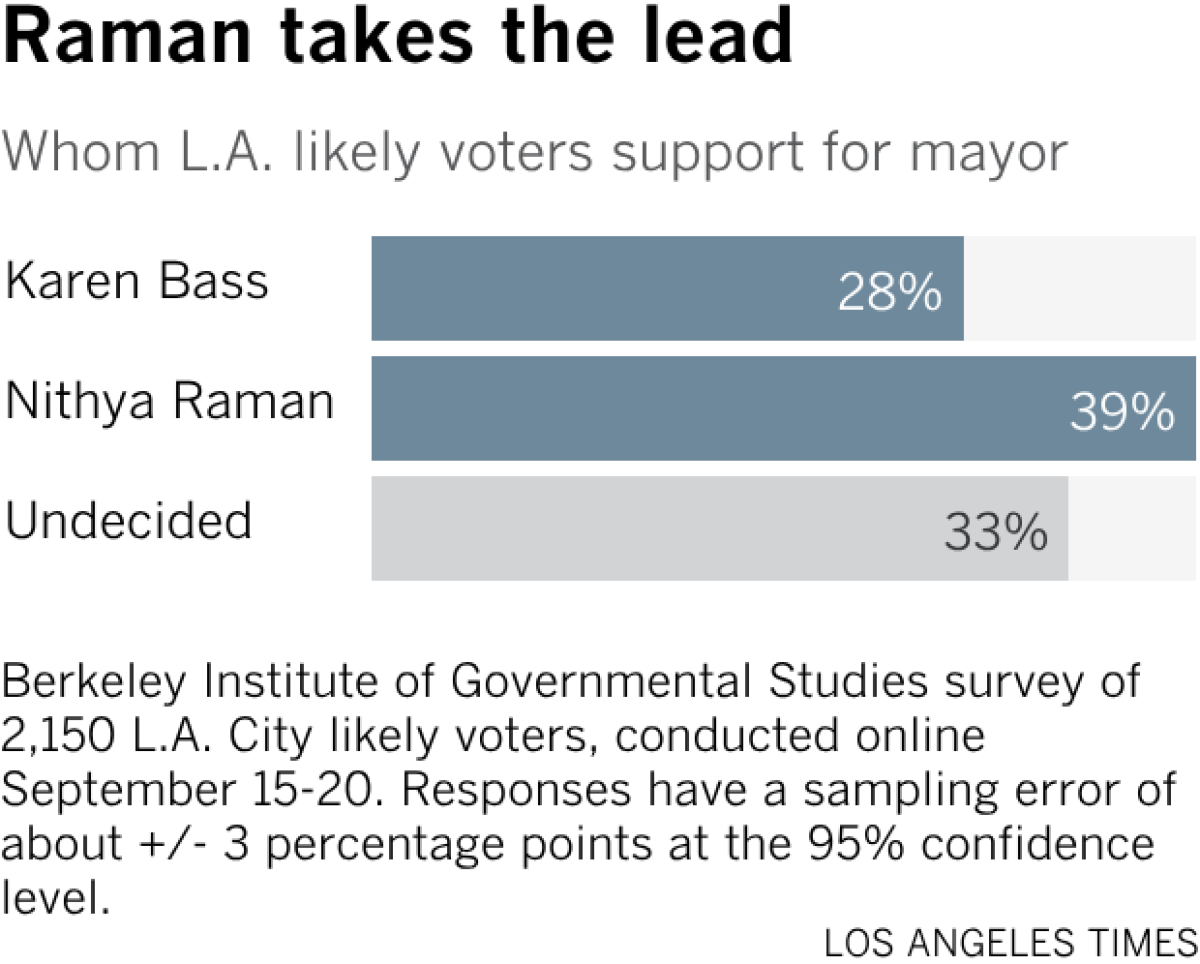
Here are the numbers, as compiled by the UC Berkeley Institute of Governmental Studies and co-sponsored by The Times:
Raman: 39%.
Bass: 28%.
Undecided: 33%.
Bass has naturally tried to debunk the poll. What else could she do, when her supporters are outnumbered by people who can’t make up their minds? Bass would need to dominate the undecided vote to have a chance, but given her high unfavorability rating, that’ll be hard to do.
On the other hand, Raman certainly hasn’t put things out of reach, despite the fact that Bass carries the baggage of the Palisades fire and has made only minimal progress on her signature issue — homelessness. Election day is less than two months away, and Raman has failed to convince anywhere near a majority that she’s the answer.
So what do Raman and Bass need to do between now and Nov. 3?
We need both candidates to be bolder, more creative, more convincing, and to tell us things we haven’t heard before.
All the recent L.A. mayors I’ve known had their faults and failures, whether the task was filling potholes, building out transit or addressing the high cost of housing. But among their best qualities, Dick Riordan was arrogantly confident, Jim Hahn had a steady hand on the tiller, Antonio Villaraigosa was tireless and passionate, Eric Garcetti was a long-range thinker on earthquakes, water and energy.
L.A. needs a mayor with all of those qualities. A cheerleader. A task master. A ball buster.
Running the second-largest city in the country is no easy task, because many of the problems at street level begin well beyond local control, related in part to an economy that leaves too many people behind.
But if you want to lead a world-class city, you need to have world-class answers on the big stuff like housing and homelessness and on the basics, too, like fractured sidewalks and neglected parks. Most voters don’t give a hoot about which candidate is more of a socialist or a moderate. City Hall is broken, and they want to know who can fix it.
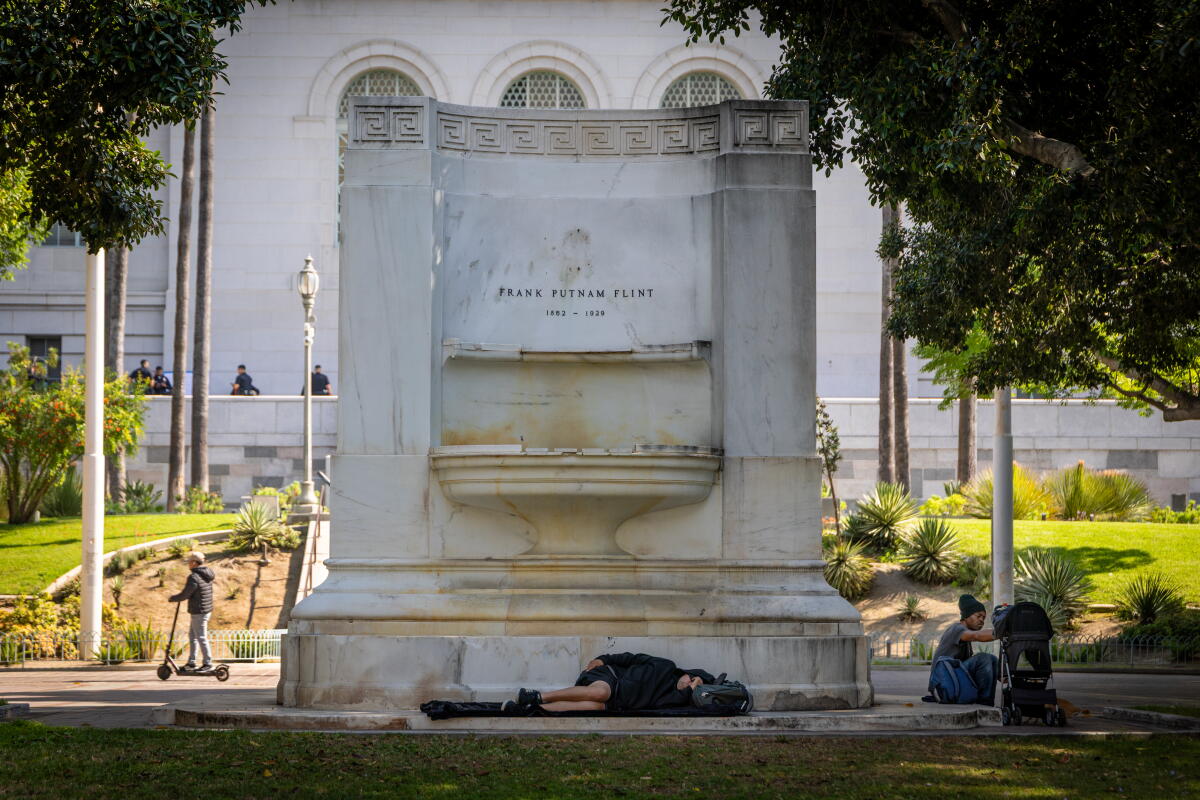
On Wednesday, I checked the same sadly neglected area around City Hall that I wrote about in April and found only minimal improvements. Graffiti has been washed from the Frank Putnam Flint fountain, but it remains a broken-down monument to neglect, as it has for most of the past 60 years. And all around it, most of the little placards identifying native plants are broken or missing.
People rest on the Frank Putnam Flint fountain outside City Hall, a sadly neglected area.
(Allen J. Schaben / Los Angeles Times)
The L.A. Mall is still a largely abandoned wreck, with broken planter boxes and weeds at street level. A woman with two shopping carts told me she’s been homeless for 5½ years. The restaurant next to the nearby police department is shuttered; the restaurant across the street from it is long dead, and the once-vibrant downtown — which generated revenue that benefited every neighborhood of the city — is gasping.
I drove down Hope Street, south of 12th Street, because a reader who lives in that area and has told me about repeated fires at abandoned properties. A tractor was clearing debris from a recent blaze.
I drove west on Olympic toward Alvarado, an area I visit regularly to see a friend. Streets are strewn with trash. They’re always strewn with trash. At Olympic and South Lake, where encampments line the street and a fire once spread into a church parking lot, destroying vehicles, there’s a concrete triangle that was heaped with trash. It’s always heaped with trash, like a municipal dump on a busy thoroughfare.
Next I headed west on Wilshire to the RFK Memorial I wrote about 10 months ago, near the site of the 1968 Bobby Kennedy assassination. It remainsfenced-off, with trash and graffitiand with overgrown vines covering tributes to Kennedy. The city was going to help the school district clean things up. Then the school district took on the task.
It’s still a mess. Actually, it’s more than that. It’s an indictment. And so is the fact that in Studio City, where frustrated neighbors complained for five years that an abandoned property had been taken over by squatters, it took a recent fire to get City Hall’s attention.
The property, since cleared, is in Raman’s district, and she and Bass traded accusations about who had dropped the ball.
“As far as homelessness goes, I don’t see either candidate really showing a clear vision to solve this,” said Kayt Miranda, whose home was damaged by the fire at the abandoned property. “I mean, it’s a tall order, and I wouldn’t want to be in charge of that. But I’m not hearing anything from either of them that sounds like it will work or hasn’t been tried already.”
To be fair, Bass and Raman have each had lots of success on homelessness, with thousands of people being brought indoors. That job is not easy, especially given the number of people with mental illness and addiction issues. I know this from personal experience, having spent a year trying to steer a friend in from homelessness.
But the pace is too slow and the cost too high. As my colleague David Zahniser reported earlier this year, $300 million had been spent on the mayor’s Inside Safe program since December 2022, and as of last December, 40% of the 5,800 people who had been housed were back on the street.
And that was with an estimated annual cost per person of $82,000. Raman, who had supported the program, became a critic of it and touted a less expensive strategy that itself has been criticized for its slow pace, as Times City Hall reporter Noah Goldberg wrote in August.
Not long ago, a homelessness policy expert suggested to me that if we could figure out a way to double the nearly $1,000 Social Security Disability subsidy many homeless people get, it would open some doors in a housing market they’re now priced out of. Too expensive? It’s cheaper than what we’re doing.
I’d like to hear the candidates rethink the playbook like that, double down on what works and drop what doesn’t.
I’d like to hear from a candidate with a realistic plan to get L.A. out of the cellar in park rankings nationally, to break up the 10-year logjam for a sidewalk repair and the two-year wait to fix a street light.
All those undecided voters know exactly what they want.
A mayor who says fix the busted fountain by the end of the week, or else.
Leslie Jones was 14 when her father broke the news to her: “We’re moving to Los Angeles.”
For the actor and former “SNL” cast member, leaving her Memphis hometown felt like the end of the world. “I lost every bit of my s—,” she recalls. “I cried and begged him, like, ‘Please don’t take me away now.’” She’d just become friends with the popular kids at her high school. Plus, she was in the marching band — a rifle twirler — which in the South basically means “you’re a jock, you’re a star,” she says, laughing.
In Sunday Funday, L.A. people give us a play-by-play of their ideal Sunday around town. Find ideas and inspiration on where to go, what to eat and how to enjoy life on the weekends.
Despite her resistance, Jones’ father stood firm: “He was like ‘I can’t let you stay here in Memphis. You’re not going to do what you need to do with your life,’” Jones says.
Though she hated L.A. at first, she eventually found her footing and joined the basketball team at Lynwood High School. She grew to love the city and now splits time between L.A. and New York.
“[My dad] was really strategic and smart and I’m really glad he did it,” she says.
Jones’ latest project is hosting HGTV’s “Roast My Rental,” a reality show in which she visits some of America’s worst-rated short-term vacation rentals and attempts to transform them within 72 hours, alongside designer Jasmine Roth.
One of her Airbnb pet peeves: when owners put out items that are too personal. “Sometimes they want to put their personal linens in there. They’ve got pictures in there. Like why are your pictures in my room? I don’t want to know who’s renting to me,” she jokes.
Jones, who is also in the middle of a comedy tour, shared what her Sunday Funday in L.A. entails.
This interview has been lightly edited and condensed for length and clarity.
1 p.m.: Sleep in ’til the afternoon then make a big cup of tea
Sunday is the day I know that I can sleep in. I don’t schedule anything on Sundays and Mondays. I’ll probably get up around 1 or 2 p.m. because I stay up until about 3 or 4 a.m. I’m a comedian so we have late hours. Then I’ll come out my room, which is a freezer — it’s literally 59 degrees because I gotta sleep in the cold — to warm up.
I’ll make me a big cup of tea. I’ve got those big “Friends” cups. My favorite is ginger tea. I’ll pick a lemon off my tree to add to it. Then I’d lay on the couch and figure out if I’m going to watch something on TV or play a video game. I play the dumbest games. What has me in a choke hold right now is “Brilliant Sort.” It’s almost like jigsaw puzzle, but it’s electronic. It’s so f— relaxing and I play it for hours. It’s bad now because I’ve been spending money on it and my accountant was like “Hey, you’re spending a lot of money on a video game.” I said “Well, it’s not crack” and they were like “What?” [laughs]. I might have end up deleting this f— game.
3 p.m.: Brunch at the Waffle
About an hour later, I’d figure out what I want to eat. Sunday is the day I eat anything I want. I don’t like to call it a cheat day. I always order from this place called the Waffle in Hollywood because they’ve got this biscuit sandwich with a whiskey glaze and bacon. It’s good as f— and then I get my egg over medium. I always order it with a blood orange-flavored Pellegrino over some ice. Wooooo.
5 p.m.: Watch an action movie
On Sundays, I really like to watch movies. I’ll go on Apple TV or another streamer to find something to watch. If not, I’ll watch “SVU” all day. Some days I can watch serious stuff, but I really like a good action movie like all of the “Fast & Furious” films. I know people talk about them but I f— love “Fast & Furious.” I love “Mission: Impossible.” I love all of the Marvel movies.
7 p.m.: Order dinner from all my favorite spots
Usually I order food from my cook when I’m at home and she’ll make like a week’s worth of food. But if I don’t, I’ll order in. If I want a really good steak, I’ll go to the Nice Guy. I spoil myself on Sundays because I might get a steak from there, a salad from Tender Greens and a lemonade from Cheesecake Factory. The key is getting one driver and telling them, “I’m going to order something else, do you want to go get it?” because then you can give them a big tip. I might not eat until like 10 or 11 p.m. though.
11 p.m.: Catch a second wind
During the day, I probably took a nap so my brain is activated around 11 p.m. to midnight. If my friends call me and say they want to go out, I might go to this karaoke night hosted by Project Studio that my friend Neff took me to. There’s good drinks and a good DJ. I like to go see live music too. I recently saw Olivia Dean [at the Crypto.com Arena]. If there’s a Sparks game on a Sunday, I will go. If not, I’ll stay home and I’ll be up until maybe 4 or 5 a.m. just watching TV, playing my game, doing nothing [laughs].
A stunning new poll showing Los Angeles City Councilmember Nithya Raman gaining a double-digit lead over incumbent Karen Bass in the mayor’s race is increasing pressure on Bass and her allies to go sharply negative against her opponent and to seek support from conservative and undecided voters to narrow the gap.
The poll, conducted by the UC Berkeley Institute of Governmental Studies and co-sponsored by The Times, showed Bass trailing Raman by 11 percentage points — with 28% of likely voters saying they supported the mayor while 39% said they would vote for Raman. The remaining 33% were undecided, an unusually high number this close to the Nov. 3 election.
“The bottom line is this is a huge shot in the arm politically for Raman — and it’s not a good day for the mayor,” said Zev Yaroslavsky, a former L.A. City Council member who now runs the Los Angeles Initiative at the UCLA Luskin School of Public Affairs.
Dan Schnur, a former Republican political consultant, said the poll could have instant negative effects for the mayor’s fundraising ability as potential supporters might now view Raman as the favorite in the race.
“The most immediate tangible result of a poll like this is that Bass’ greatest advantage was her fundraising and it now becomes much more challenging to raise money,” he said.
Bass, appearing Wednesday at a news conference in Hollywood, said she’s seen multiple polls that show a tight race. She said that Raman is “absolutely not” the front-runner in the race.
Mayor Karen Bass speaks at Vermont/Santa Monica Metro Center on Wednesday, touting progress on construction of affordable housing.
(Kayla Bartkowski / Los Angeles Times)
The mayor said she is working to highlight the city’s progress in making rent more affordable, pointing to newly released numbers that show that more than 10,000 units of housing with restricted rents have been built since she took office in December 2022.
“The No. 1 issue to Angelenos continues to be lack of affordability, and our primary way of addressing that from the city is housing,” she said. “So we are absolutely addressing affordability.”
Others in the Bass camp seemed more anxious about the poll results.
“It put a pit in stomachs,” said one supporter close to the Bass campaign who requested anonymity to speak candidly about the poll. “But there is still an outside chance for Bass. It’s not total doomsday.”
The supporter said that the Bass campaign truly doesn’t believe Raman’s lead is that big, but that the poll was still “not good news,” especially for fundraising.
Mike Bonin, a progressive former L.A. City Council member who now runs the Pat Brown Institute at Cal State Los Angeles, said Bass needs to focus on winning over voters who chose former reality television personality Spencer Pratt in the primary election in June. Many of those voters are now on the fence.
Pratt received 26% of the vote in the primary, and most of the voters who cast ballots for him — 63% — say they still haven’t decided whom to vote for in the runoff, the poll found. Among the Pratt voters who have decided, 22% favored Bass compared with 16% for Raman.
Bonin said he expects Bass and her allies to attack Raman’s progressive views in order to reach Pratt voters. Raman is a member of the Democratic Socialists of America and opposed raises for Los Angeles Police Department officers that had been championed by Bass.
“The nature of the attacks will try to reach the Pratt voters particularly since they are the largest bloc of undecideds and they skew conservative,” Bonin said.
The Los Angeles Police Protective League, the union representing LAPD officers, is already airing campaign ads critical of Raman over her opposition to a law barring homeless encampments next to schools. In the coming days, the group will also roll out commercials highlighting Raman’s ties to the DSA, which has endorsed her mayoral bid, said union spokesman Tom Saggau.
“Our own poll told us that the Pratt folks were very much undecided, and that when they heard more about Nithya’s record, and her co-governing with DSA, they moved off of her,” he said, adding that his group still views the race as a dead heat.
Raman, not surprisingly, cheered the poll results.
“This poll reflects the momentum we’re seeing on the ground. Angelenos are ready for change and want to see a City That Works,” Raman said in a post on Instagram.
Raman campaign officials said the poll probably will help their fundraising efforts, which they said had already been gaining momentum over the last few weeks. And Schnur, the former GOP political consultant, said the wide lead allows Raman to spend more time touting her own credentials instead of disparaging Bass.
“For the most part Raman has the front-runner’s luxury of putting out a positive message and reinforcing her own credentials,” Schnur said.
Estevan Montemayor, who is running the pro-Raman Estamos con Nithya independent expenditure group, said his group’s role will be to inform voters about Raman’s positives while the Bass campaign attacks.
“They’re gonna come after Nithya and we’re gonna be here to tell her success story,” he said.
Bass supporter Stuart Waldman, chief executive of the Los Angeles County Business Federation, said the large number of undecided voters this close to the Nov. 3 election is worrying but also leaves an opening for Bass to gain ground.
“Any swing in any direction could make a big change,” Waldman said. “We have no idea who’s going to vote. … Usually by this point in time, everything has tightened up.”
Councilmember Nithya Raman, lower right, campaigns at a Latinos Con Raman rally at La Cita Bar in downtown Los Angeles.
(Genaro Molina / Los Angeles Times)
In courting those undecided voters, however, Bass is burdened by high unfavorability numbers, according to the Berkeley IGS/L.A. Times poll.
The mayor had 63% unfavorable ratings, the poll found, with 28% favorable and 9% having no opinion. By comparison, 40% had a favorable view of Raman, according to the poll, while 39% said they had an unfavorable view of her and 21% had no opinion.
Mike Murphy, a Republican political consultant, said that Bass needs to accept responsibility on core issues upsetting Angelenos about her tenure, such as homelessness and the 2025 Palisades fire, which killed 12 people and destroyed thousands of homes. In a recent interview with The Times, Bass said her biggest mistake as mayor was being in Ghana when the fire began amid high wind warnings.
“You have to say, ‘I hear you,’” he said. “Voters don’t think Karen gets that they are mad about things that happened during her term.”
Then, Murphy said, he believes Bass needs to attack Raman as being more establishment than Bass.
Murphy noted that Bass has frequently attacked Raman for being “at City Hall longer than I have,” which he called a powerful message to voters who are considering Raman because they want change. Raman was elected in 2020 and Bass in 2022.
Other polls taken in the campaign have shown a closer race than the Berkeley IGS/L.A. Times poll.
In an early August poll commissioned by an independent expenditure group supporting Bass, the mayor had the edge, 41% to 35%, with 24% undecided.
Mayor Karen Bass greets community members after speaking at Vermont/Santa Monica Metro Center.
(Kayla Bartkowski / Los Angeles Times)
The Bass campaign cited some of those polls when responding to the Berkeley IGS/L.A. Times poll Wednesday, calling it an “outlier poll” and accusing the pollsters of getting it wrong.
“In the primary … they got it wrong and undercounted Karen Bass’ support,” campaign spokesperson Alex Stack said in a news release.
Stack added that polls conducted online, like the Berkeley IGS/L.A. Times poll, “systematically [undercount] working-class families, seniors, and non-English speaking communities who regularly turn out on Election Day.”
Mark DiCamillo, the director of the Berkeley IGS Poll, defended the methodology, saying he has spent 45 years polling in California and eight years running the Berkeley IGS Poll.
“What would you expect from a campaign down by double digits? They attack the poll,” he said.
Next year, the Los Angeles Chamber Orchestra — an intimate, 42-player group compared with the more than 100-member Los Angeles Philharmonic — will warm its new home, the highly anticipated, Frank Gehry-designed Terri and Jerry Kohl Hall. And it will do so with the help of a little light music: fanfares commissioned from half a dozen preeminent film composers — John Williams, Ludwig Göransson, Joel McNeely, Thomas Newman, James Newton Howard and John Powell — curated by none other than Seth MacFarlane (best known as the creator and star of “Family Guy”).
The buzzwords are lighting up, but this is far from a game of performing arts Mad Libs; it’s actually quite intentional. “We really thought about … ‘What statement can we make to Los Angeles and to the performing arts world that really shows who we are?’” said LACO Executive Director Ben Cadwallader. “Who is the Los Angeles Chamber Orchestra, specifically? And it really was this tie to Hollywood, to Los Angeles, to our musicians themselves.”
MacFarlane was a natural fit.
“I loved movies and I loved movie music,” MacFarlane said of his childhood in a recent interview. “I would go to the record store and buy the latest John Williams soundtrack, which was usually out before the movie was released. I remember buying the ‘Jurassic Park’ soundtrack not having seen the movie, and it didn’t matter. It was just great music. It was just great, symphonic music.”
LACO was founded by an assemblage of musicians and civic leaders in 1968, including the cellist James Arkatov. After emigrating from Russia as a child, Arkatov became the principal cellist at the Pittsburgh and San Francisco symphonies before landing in L.A. He arrived as a Hollywood studio musician, played on movie soundtracks and did backing for Ella Fitzgerald.
From the beginning, LACO served as “the artistic outlet of studio players … these incredibly gifted musicians who bring our movies and TV shows to life,” said Cadwallader, a situation that remains true to this day. LACO’s musicians know it’s “a place where they can play … Bach and Mozart, and make music at a really high level in a performance environment, not a studio environment.”
This is why the christening of LACO’s new home is also a homage to its roots: film composers. These giants of their fields will each write a spry, five- to seven-minute-long fanfare as openers for select LACO concerts throughout the season. (The works will also be performed at the Wallis Annenberg Center for the Performing Arts, with John Williams’ piece arriving first, in fall 2027.)
MacFarlane knew just what to do, thanks to his long history with music. The actor, animator, filmmaker and comedian has released 10 studio albums, received five Grammy Award nominations and performed as a vocalist at the Hollywood Bowl and Carnegie Hall. (He also just released a 14-track album called “Seth MacFarlane Sings the Muppets.”) Plus, his parents raised him steeped in music.
Nothing has changed here — throughout his career, MacFarlane has been relentlessly committed to including live music in his projects. The musical numbers on “Family Guy” simply couldn’t (and wouldn’t) exist without an orchestra.
“It would somehow feel thin and hollow, and people may not know why their attention is drifting, but it would drift,” MacFarlane said. “I really think you need the muscular sound of 60 musicians in a room, and in the case of ‘The Orville,’ sometimes 90. … Hollywood has been doing it since pictures went to sound, and I hope they continue to do it for as long as we make film and television.”
MacFarlane noted that the only time many people actually hear a live orchestra is in film or television.
“I don’t know how many people go to the symphony,” MacFarlane said. “So that’s certainly a component. When I was a kid, even the syndicated afternoon cartoon shows used a live orchestra, and when you go back and you listen to them, oftentimes it’s pretty legit composing. And I think that was important to have heard. I think it’s just good for the brain to hear complex symphonic music.”
Composer, conductor and longtime MacFarlane collaborator Joel McNeely (whose wife, Margaret Batjer, is LACO’s concertmaster) got MacFarlane involved in this commissioning initiative. Then MacFarlane selected the participating composers (and supported the initiative financially). One final Mad Lib to solve: What exactly, you may be wondering, is a fanfare?
“The perfect example … is the beginning of ‘Star Wars,’” Cadwallader said, then hummed the intro. “There’s big, loud brass. You cannot help but pay attention. … It puts a smile on your face. It maybe gets your heart racing a little bit. It’s usually very rhythmic, very bright. It’s like a big warm smile, or like a popping of a Champagne cork, to start a concert. … A bursting, effervescent moment of music to get things started. An amuse-bouche, if you like.”
Los Angeles County officials aim to break ground on the new Eaton Canyon Nature Center before 2028, with plans to construct a facility that can withstand the region’s changing climate and future disasters.
The previous nature center, which replaced the original Robert M. McCurdy Nature Center that burned down in 1993, was destroyed in the Eaton fire last January. The fire not only destroyed the structure but also a large library and several decades’ worth of archives, and it also killed the reptiles that lived inside the center.
It took about five years to rebuild and open the last nature center. L.A. County Parks Director Norma Edith García-Gonzalez said after the design phase is completed, which could be soon, the county and the architect firm hired for the project will plan out the construction phase.
“We modeled 100-year patterns of wind, fire and flood so that when we build back, we are building back with resistance, and that is able to guide how we plant [and] what type of plants, and how we build, [including] how we build back trails,” García-Gonzalez said.
Norma Edith García-Gonzalez, director of L.A. County Department of Parks and Recreation, speaks during an Eaton Canyon design meeting in mid-September.
(Kayla Bartkowski / Los Angeles Times)
The biggest impediment to rebuilding, though, is funding. The county has about $16.2 million in state money, about half of what county officials think is needed to build a new nature center, she said. García-Gonzalez said she hopes the philanthropic community will step up to fill the gaps, but county leaders have noticed that “philanthropy goes from one hot issue to another,” and interest to donate to fire recovery is cooling.
In this week’s edition of The Wild, our weekly outdoors newsletter, I will provide an update on the design plans for the new nature center and when we can expect to hike again in Eaton Canyon — and how you can help with the canyon’s restoration too.
You are reading The Wild newsletter
Sign up to get expert tips on the best of Southern California’s beaches, trails, parks, deserts, forests and mountains in your inbox every Thursday.
By continuing, you agree to our Terms of Service, which include arbitration and a class action waiver. You agree that we and our third-party vendors may collect and use your information, including through cookies, pixels and similar technologies, for the purposes set forth in our Privacy Policy such as personalizing your experience and ads.
First, let’s discuss a little bit of the history of the area.
The Eaton Canyon Natural Area, managed by L.A. County Parks and Recreation, is a 190(ish)-acre swath of land at the foothills of the San Gabriel Mountains near Altadena.
“Originally called ‘El Precipicio’ by the Spanish settlers because of its steep gorges, it is now named after Judge Benjamin Eaton, who built the first Fair Oaks Ranch House in 1865 not far from Eaton Creek,” according to the Eaton Canyon Nature Center Associates, a volunteer-run education and stewardship group. “Judge Eaton was the first to use irrigation from the creek to grow grapes on the slopes.”
The canyon has long been a fascination of adventuresome L.A. residents.
The hike to Eaton Canyon Falls in the San Gabriel Mountains before the Eaton fire last January.
(Myung J. Chun / Los Angeles Times)
In 1921, writer Frances Mathilda Purdy wrote for The Times that few people knew of the “hidden, but very easily accessible waterfall” in Eaton Canyon. Purdy outlined a few ways to access the canyon and reach the falls, including a shorter route where visitors “after alighting from motor, or stage,” could take a small flight of stone steps near the Mt. Wilson Toll Road bridge.
I chuckled when I read Purdy’s suggestion that this particular route was “perfectly comfortable for those who have arrived on the scene in city garb.” Apparently, underprepared hikers have been coming to Eaton Canyon for more than 100 years. What do you think was the 1920s version of hiking in flip-flops?
For the more rugged adventurer, Purdy laid out a “serpentine trail” that leads to “such lovely possibilities for the pleasure-seeking jaded worker, who, from only one afternoon spent in this quietly entrancing corner of the great outdoors, will return, refreshed and invigorated to meet the daily grind with a mind stored full of the charm of Lower Eaton Canyon.”
Architect Anne Mooney of Sparano + Mooney Architecture speaks about a site plan for the next Eaton Canyon Nature Center.
(Kayla Bartkowski / Los Angeles Times)
It wasn’t until 1930 that Pasadena set aside property that the city owned for a bird and game sanctuary in Eaton Canyon and Eaton Wash, preserving the land from development, according to a historical record compiled by the nature center associates.
There was interest in doing more.
Pasadena Park Superintendent Gilbert Skutt, who served from 1923 to 1936, wanted to see a large scenic public park in Eaton Canyon similar to what the city had built along the Arroyo Seco, according to city records. “He sought to correct the imbalance in the distribution of park space in Pasadena, which favored the west side of town,” according to a historical document. “During the Depression, however, the city could not afford to purchase the land.”
Over time, the city started working with county officials on Eaton Canyon Regional Park, eventually giving the entire project to the county.
In 1931, the L.A. County Board of Supervisors considered financing a 1,000-acre “gigantic regional park system” for the area, according to The Times’ archives, but that idea apparently never fully came to fruition.
Thankfully, in 1950, landowner Mary Beatrice Fox sold the canyon portion of her property to L.A. County to use for a park, “with a provision that mammals are not to be kept in cages,” according to a park history compiled by the Eaton Canyon Nature Center Associates.
A hiker slips in a creek in Eaton Canyon after a 2023 storm.
(Wally Skalij / Los Angeles Times)
Then, in 1958, naturalist Louise A. Luckan moved her “nature appreciation operation from the Eaton Canyon Golf Course to Eaton Canyon Park,” according to the organization’s history.
Soon, L.A. County officials set aside $154,797 — about $1.7 million in today’s dollars — for the Robert M. McCurdy Nature Center. They had big plans for the facility, which was to include two classrooms, an office, museum, library, display area, gift shop, laboratory and an auditorium that could seat 200.
“This park will be an outstanding facility — the only one of its kind in magnitude this side of Chicago,” Supervisor Warren Dorn said in a 1962 Times story.
The nature center opened in 1963, and became popular among scouting and school groups, to whom naturalists taught about the local flora and fauna. By the early 1970s, more than 2,000 school children were regularly attending lectures at the nature center, according to Times archives. The students wrote thank-you notes to the park staff, including one that read, “I think it was nice of you to buy this park instead of someone buying it for houses and factories. Because if they did, it would ruin this beautiful land.”
L.A. County sustainability policy director Rebecca Ferdman talks with community stewards about how to educate and engage the public about the goldspotted oak borer, a pernicious invasive beetle that destroys oak trees, during a meeting at Eaton Canyon Nature Center in 2024.
(Brian van der Brug / Los Angeles Times)
But, in 1993, the canyon’s first nature center was destroyed by the Kinneloa fire. The next nature center didn’t reopen until 1998.
Karen Mateer, vice president of the Eaton Canyon Nature Center Associates, said for more than 25 years, that nature center served as a meeting place and an educational hub for the millions who visited the canyon over the years.
Mateer, who started volunteering in 1998, said many local schoolchildren first experienced the concept of “nature” at Eaton Canyon on field trips. Volunteers would regularly hear from adults, who pursued recreation- or nature-focused careers, that the first place they ever hiked or learned about their natural habitat was at Eaton Canyon.
“Eaton Canyon also, for the community, for those of us up here who lost so much, it is familiar and is a place you often go for recreation, for solace,” Mateer said. “It means a lot.”
At a presentation last week, architect Anne Mooney said her firm analyzed where to best place the new nature center, and not wanting to destroy any existing habitat or take down any of the area’s oaks or other trees, recommended the new building be placed east of the previous site.
It was easy for visitors to miss the previous nature center, because it was situated in a thick stand of oaks, and the new location will allow the nature center to serve as a gateway to the park, as it will be near the canyon’s trailhead.
“The nature center has always been more than just a building,” Mooney said. “It’s really been a gateway to an experience of learning about nature, experiencing a connection to the wildlands and developing stewardship of the canyon. We want to continue that tradition.”
A diagram of the wind analysis conducted by architects as they assessed where to place Eaton Canyon’s new nature center.
(Kayla Bartkowski / Los Angeles Times)
The new nature center, as shown in the current design plan, is horseshoe-shaped with a covered entryway. It will be constructed using durable, fire-resistant materials, including stone and steel. Builders would also construct curved walls to serve as windbreaks, which would not only slow gusts but also divert airborne embers during a fire.
The proposed designs also include roof and eave sprinklers that could pre-wet the building and nearby surrounding area with a specialized firefighting foam during a wildfire.
“We recognize that the fire is a recurring part of the ecology, and we will have another fire,” Mooney said. “We’re working to design something that allows us to be more prepared in the future.”
The Eaton Canyon Nature Center, a 7,600-square-foot building, was destroyed in the Eaton fire. It housed live animals, exhibits, classrooms, a gift shop and more.
(Jaclyn Cosgrove / Los Angeles Times)
The design also includes a research lab, a learning lab or classroom, a large multipurpose space that can fit an estimated 150 people when seated (or 300 people when standing), an exhibit space, a gift shop and a large courtyard in the center with shade, seating and live animal enclosures.
Officials stressed that the design is preliminary and dependent on funding. Anyone who wants to see the design for themselves and provide their feedback can attend the next public meeting, From Ashes to Action: Reimagining Eaton Canyon, from 5 to 7 p.m. Oct. 7 at the L.A. County Arboretum.
Kevin Singleton, center, points to the Eaton Canyon Nature Center design during a recent county event where officials discussed the future of Eaton Canyon.
(Kayla Bartkowski / Los Angeles Times)
In terms of when hikers will return to the canyon’s trails, García-Gonzalez said the county needs an estimated $8 million to reestablish the trail system. The county has fundraised and received only $900,000 of that.
“We already put that money to work,” García-Gonzalez said, partnering with L.A. Conservation Corps to start rebuilding trails. “But there are some [trails] that really need significant and heavy engineering.”
The county also has to plan its work around the strong winter storms forecasted as a result of El Niño, she said. “We are bracing ourselves for even more damage,” García-Gonzalez said.
A map of the proposed courtyard of the new Eaton Canyon Nature Center.
(Kayla Bartkowski / Los Angeles Times)
Since the fire, volunteers have donated hundreds of hours to work on restoring the canyon’s habitat.
You can join them. Volunteers meet from 8 to 11:30 a.m. every Friday and the second and fourth Saturday of every month. Participants remove invasive plants that zap up resources for native plants trying to reestablish themselves. Training and tools are provided. You can sign up by visiting signupgenius.com.
“The love, the care, the stewardship, the commitment, the hope, the inspiration of the volunteers is unparalleled,” García-Gonzalez said. “They’re driving us to build back because they’re so committed. They’re all in.”
3 things to do
“MASH,” a military dramedy that aired on CBS from 1972 to 1983, is one of several Hollywood productions filmed at Malibu Creek State Park.
(Courtesy of California State Parks, 2026.)
1. Celebrate 50 years of public land in Calabasas Malibu Creek State Park will celebrate its past 50 years from 4:30 p.m. to 10 p.m. Saturday at 1925 Las Virgenes Road in Calabasas. Attendees can touch fossils, explore the park‘s trees and make art, all while listening to music and eating from local food trucks. At Stories Under the Stars at 6:30 p.m., a diverse cast of storytellers will teach visitors about the park’s history, culture and science. The L.A. Astronomical Society will host a star party at 8 p.m. Guests are encouraged to carpool or use the free shuttle from Juan Bautista de Anza Park to the park. The event is free, but parking is not. Register at eventbrite.com.
2. Repair the river near Azusa Volunteers are needed from 8 a.m. to noon Saturday, which is National Public Lands Day, at the Oaks Picnic Area near the San Gabriel River for a cleanup effort. Organized by five community conservation corps groups, including San Gabriel Valley Conservation Corps, volunteers will pick up trash and help clean the river. Register at docs.google.com.
3. Cast a line under a full moon in Castaic Friends of Castaic Lake will host the organization’s final Moonlight Madness event of the year from 6 p.m. to 12:30 a.m. Saturday at Castaic Lake. Guests can fish from the shore, from a boat or not fish at all as they enjoy an evening in the outdoors. Tickets start at $23. Glow sticks required for each participant. Register at givebutter.com.
The must-read
Jim Crouch stands in a field with Englemann oaks at the Santa Ysabel Open Space Preserve.
(Sandy Huffaker / For The Times)
Jim Crouch, a retired science teacher near San Diego, noticed how the oak trees around him were disappearing, succumbing to disease, drought and development. Times contributor Jessie Schiewe wrote that Crouch, moved to action, collected acorns and gave away the resulting potted seedlings to others. Now, after planting 10,000 acorns, he dreams of the day he completes his 20,000th seedling. “I’ve never been so ambitious,” he says, “and I’ve never done a project with as much love in it and as little ego.”
Happy adventuring,
P.S.
Torrey Pines State Natural Reserve will be closed until March as construction workers upgrade gas, water, wastewater and communication lines. They also will install new accessible parking stalls and an accessible pedestrian path from the upper parking lot to the restroom and park’s lodge. Times staff writer Christopher Reynolds wrote that the park’s 1,750-acre Torrey Pines reserve attracts about 4 million visitors each year (about the same number as visit Yosemite National Park). Torrey Pines State Beach will remain open through the closure. If you’d hoped to visit this particular park in the fall, consider instead one of 13 places in California that Reynolds recently wrote are ideal to check out in autumn. Warning: As I read the piece, I felt the immediate urge to book campsites at several spots around our state! I am so ready for cozy season.
For more insider tips on Southern California’s beaches, trails and parks, check out past editions of The Wild. And to view this newsletter in your browser, click here.
HOME Improvement star Jonathan Taylor Thomas has been arrested and jailed in Los Angeles, The U.S. Sun can confirm.
A spokesperson for the Malibu/Lost Hills Sheriff’s Station told The U.S. Sun that the former actor, 45, was a passenger in a vehicle that was pulled over by police on September 21 around 12:30 am.
Jonathan Taylor Thomas, here in 2013, rose to fame as a child star in the 1990s on sitcom Home ImprovementCredit: FilmMagicJonathan stepped out in 1995, when he was a household name in the U.S.Credit: Getty Images
According to the police spokesperson, a DUI investigation was conducted.
“During the investigation, [Jonathan] stepped out of the vehicle and became uncooperative and resistant, and was subsequently arrested for [being] drunk in public,” the spokesperson said.
Sign up for the Showbiz newsletter
Thank you!
He was charged with being drunk in public and resisting or deterring an executive officer.
Jonathan has not yet spoken out about the incident.
Jonathan rose to fame in the 90s as a main cast member on Home Improvement opposite superstar Tim Allen.
He played middle son Randy for eight seasons, and soon jumped to bigger Hollywood projects.
He took on the role of Tom Sawyer in Tom and Huck in 1995, and voiced a young Simba in The Lion King in 1994.
Most read in Entertainment
Jonathan reunited with Home Improvement mom Patricia Richardson and brother Taran Noah Smith in July 2026Credit: Instagram/prichardsonlaJonathan played middle brother Randy on Home Improvement. He posed with the cast in 1992Credit: Getty
Los Angeles Councilmember Nithya Raman has taken a wide lead over incumbent Karen Bass in the L.A. mayor’s race, according to a new poll released Wednesday, although a high percentage of voters remain undecided less than two weeks before mail-in ballots are sent out for the Nov. 3 election.
Raman is favored by 39% of likely L.A. voters, compared with 28% for Bass, according to the poll by the UC Berkeley Institute of Governmental Studies, which was co-sponsored by The Times. The poll found that 33% of voters were undecided.
“Raman clearly has the advantage. Her task is a little less onerous than Bass’,” said Mark DiCamillo, the director of the Berkeley IGS Poll.
Adding to Bass’ low poll numbers are high unfavorability ratings.
The mayor had 63% unfavorable ratings, the poll found, with 28% favorable and 9% having no opinion. By comparison, 40% had a favorable view of Raman, according to the poll, while 39% said they had an unfavorable view of her and 21% had no opinion.
The survey released Wednesday was conducted online with a sample of 2,150 likely city voters between Sept. 15 and Sept. 20. It has a margin of error of about 3 percentage points.
The poll represented the strongest showing yet for Raman, who trailed Bass in almost every poll during the primary campaign and who came in second to Bass in the primary election, with 29% of the vote compared with Bass’ 34%.
Mayoral candidate and Councilmember Nithya Raman, center, enjoys a light moment with Alliance of Californians for Community Empowerment (ACCE) Action members at La Cita Bar in downtown Los Angeles.
(Genaro Molina / Los Angeles Times)
Even so, DiCamillo said the large number of undecided voters means the race is far from over.
“It’s extraordinarily unusual to see this many undecided voters at this point in the race,” he said. Mail-in ballots will be sent out beginning Oct. 1, local elections officials say.
The large number of undecided voters can be linked to the elimination of mayoral candidate Spencer Pratt in the June 2 primary, according to DiCamillo. The former reality TV star received 26% of the vote in the primary, and most of the voters who cast ballots for him — 63% — say they haven’t decided whom to vote for in the runoff, the poll found.
Among those Pratt voters who have decided, 22% favored Bass compared with 16% for Raman.
One of the most significant findings in the poll was a massive “generational divide” among L.A. voters, DiCamillo said.
Raman, 45, dominated the 72-year-old Bass among younger voters, with 66% of likely voters ages 18 to 29 choosing the council member while just 4% chose Bass, according to the poll.
Raman also had 64% of likely voters ages 30 to 39 compared with Bass’ 12%, and the council member had 50% of likely voters ages 40 to 49 compared with Bass’ 18%. Raman also was leading among voters 50 to 64 years old by a slim margin of 35% to 33%.
Bass, meanwhile, led among the oldest set of voters — those 65 and up — but not by the same margins. Bass had 41% of likely voters in that group compared with Raman’s 21%.
According to the poll, 56% of likely voters thought Bass did a poor or very poor job responding to the disaster, which killed 12 people and destroyed more than 4,000 homes, including Pratt’s.
Fourteen percent of the likely voters thought Bass had done either an excellent or a good job and 17% thought she had done a fair job.
Mayor Karen Bass campaigns at Ernest E. Debs Regional Park on Sunday.
(Kayla Bartkowski / Los Angeles Times)
The most important issues to likely voters were fixing city infrastructure, moving homeless people indoors, crime and public safety, and building more affordable housing, the poll found.
The poll shows Raman leading in nearly every geographic area of the city. Bass was leading in South Los Angeles and the Harbor region, 37% to 34%, but central Los Angeles as well as northeast and the east side of Los Angeles broke strongly for Raman.
The San Fernando Valley went 34% to Raman and 26% to Bass with 40% still undecided. The Westside favored Raman by a single percentage point, at 35% to 34%.
Raman has led in other polls recently, though none by as wide a margin as in the Berkeley IGS/L.A. Times poll. Shortly before the primary, a separate Berkeley IGS/L.A. Times poll showed Raman leading Bass in a potential head-to-head matchup by just four percentage points, with 32% support compared with the mayor’s 28%.
On the negative side, Raman was booted from her position in the council as chair of the Housing and Homelessness Committee, a move she said was politically motivated.
Normally when a telephone rings inside a bar, it’s the duty of the staff to pick it up. But when an old-timey rotary dial phone suddenly springs to life at the Last Canteen, it’s up to guests to decide what to do next.
Answer it — or attempt to make a call from it — and you’ll encounter one of dozens of pre-recorded messages. They’re calls from an imagined future, one when a war-torn America is on the mend from some sort of apocalyptic catastrophe. They’re messages, perhaps, for the bar’s fictional founder, a shotgun-carrying mysterious woman known for her mean bartering skills, or maybe if you’re lucky, you will dial into what sounds like an early 20th century party line and hear from those looking for a date in the Valley, now a neutral zone among warring factions.
You’re reading Mr. Todd’s Wild Ride newsletter
Todd Martens’ newsletter delivers news and commentary on the past, present and future of theme parks, right from the theme park capital of the world — Southern California.
By continuing, you agree to our Terms of Service, which include arbitration and a class action waiver. You agree that we and our third-party vendors may collect and use your information, including through cookies, pixels and similar technologies, for the purposes set forth in our Privacy Policy such as personalizing your experience and ads.
The Last Canteen, situated on a stretch of Ventura Boulevard that’s just a short walk from the Universal City metro and minutes from Universal Studios Hollywood, is a new restaurant and bar that looks lifted from a theme park. It also feels like a throwback to an earlier time, when Los Angeles was an epicenter of the themed restaurant.
Southern California has a storied history when it comes to themed establishments. There’s our penchant for food-shaped eateries, of course — see our giant doughnuts or the Tail o’ the Pup — but dinner with a side of story is a Los Angeles-area staple that predates any corporate chains such as Rainforest Cafe or Chuck E. Cheese. From the long-forgotten Jail Cafe in the 1920s to our region’s birth of the tiki bar to the themed restaurant explosion of the ‘80s and ‘90s, when even Steven Spielberg got into the action with the submarine-focused DIVE! in Century City, the themed restaurant has long found a receptive audience in Southern California.
And the Last Canteen feels especially built for our moment.
The Last Canteen’s three founders were going for a lived-in feel.
(Eric Thayer / Los Angeles Times)
Taking influence from the likes of “Mad Max,” “Fallout” and a host of other dystopian, postapocalyptic media, the Last Canteen is a bar for an era — and a city — when the future seems especially uncertain. Whether it’s AI, corporate consolidation, inflation or the struggles of Hollywood that’s got you down, the Last Canteen wants to be your “Cheers” of sorts.
“It’s not the brightest of times, I would say for most of the world, but certainly younger generations are feeling like we got the rug pulled over us — the state of the economy and corporate overreach,” says Jimmy Clements, 32, who founded the Last Canteen with two other friends from the hospitality industry.
“We always joke that the world is ending, but there’s some charm in fully embodying what that would mean, and realizing there’s something on the other side,” he adds. “That’s what attracts me to the genre. OK, the worst thing possible happened, but there’s still people on the other side. We still need community and a place to eat and drink.”
A grenade fashioned out of a baseball is one of the items hidden in the Last Canteen.
(Eric Thayer / Los Angeles Times)
Or as Clements’ partner TJ Lewis says, “Who doesn’t watch ‘Mad Max’ and dream of riding on top of a crazy car with a spike in your hand?”
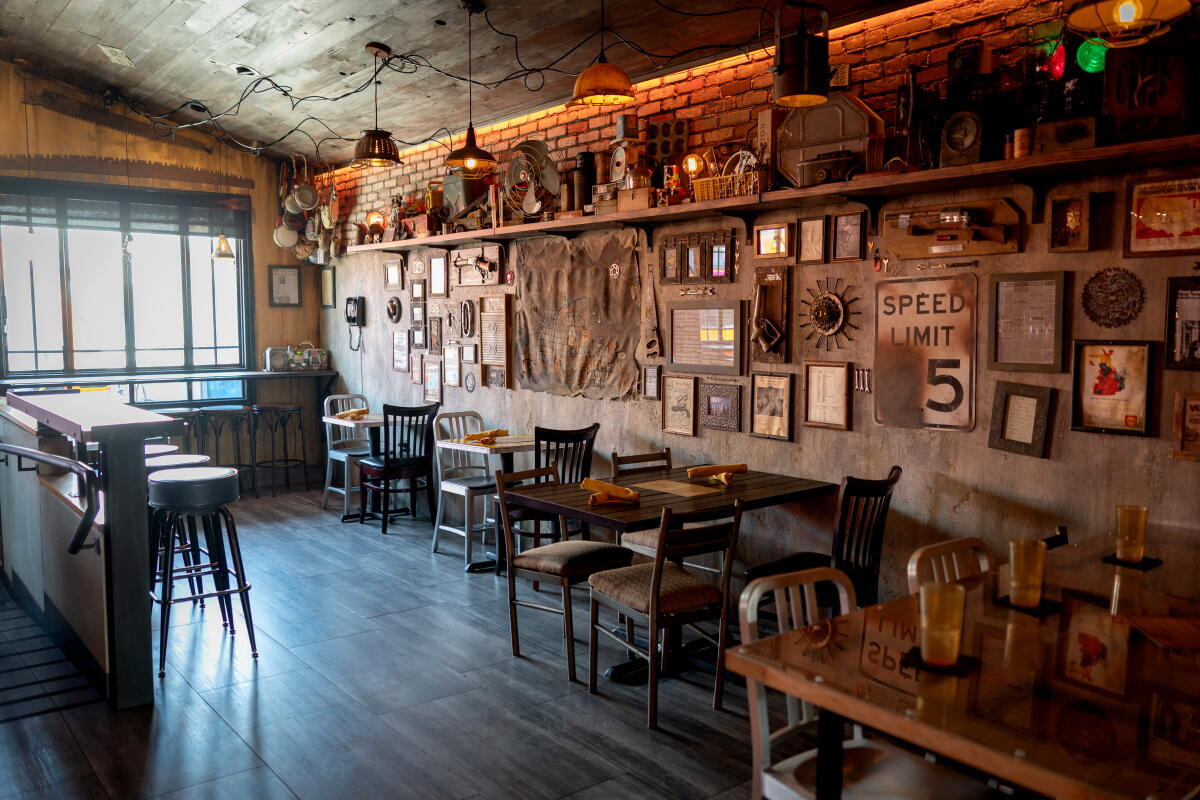
Despite a potentially bleak concept, the Last Canteen is open and welcoming. The color palette is soft, leaning heavily on dust-like sandy vibes, the cocktail menu takes influence from the fruity, complex world of tiki bars, and a sense of humor permeates the main dining room.
Yes, a demolition bomb, which is actually a movie prop from Angelina Jolie’s “Unbroken,” hangs from the ceiling, but take a moment to explore the venue and you’ll find grenades colorfully fashioned out of baseballs, or rewritten maps of the Valley in its new “Wasteland” era. Universal Studios’ famed minion still stands, but the Ikea is now a “hall of justice.”
Newspapers dot the walls. They’re filled with fiction that tell of the bar’s new reality, giving the place a sense of history and lore. One article, for instance, speaks of a battle that broke out near the remnants of US-101 next to the old “sidewalk stars site.” Another tells of how the bar’s founder took over the land where the establishment now stands. By force, of course. And don’t miss the beer taps, fashioned out of bullets, guns and baseball bats.
The Last Canteen is a themed bar that feels ripe for our era, one in which the future is filled with uncertainty.
(Eric Thayer / Los Angeles Times)
“It’s the difference for us between immersive and themed,” says Lewis. “Like the Hard Rock Cafe is themed. It’s got music on the wall, but you don’t feel like you’re at a concert when you’re there. It’s not immersive. What we were really going for is a lived-in space. We didn’t cover this in ‘Max Max’ posters. It is in the world of. It’s really open-ended. All the details on the wall help paint a picture.”
Of course there were limits. The team jokes that if they really wanted to exploit the dystopian theme, then drinks should likely be served in red plastic cups. Instead, the Last Canteen has proper drinkware, but each type of glass does come from a different set, as the owners wanted to give it a found materials vibe. The menu doesn’t stray too heavily from bar fare, and there are bowls of bison chili ($18), a burger ($18), a charcuterie plate ($21) and, of course, a “Last Meal,” which is a half grilled cheese, a cup of chili and a glass of sarsaparilla ($25).
The cocktail program, however, is extensive. The blackberry-infused Blackthumb or the spiced A Torch or Rosemary feel like darker twists on brighter, lively tiki fare. For those craving the latter, there is currently a frozen version of a Zombie. Bar founders Clements, Lewis and Drew Aloe say the menu, both cocktails and food, will change seasonally.
The Last Canteen founders Jimmy Clements, from left, TJ Lewis and Drew Aloe.
(Eric Thayer / Los Angeles Times)
And the tiki influence is no accident. The three cite the Disneyland Hotel’s Trader Sam’s as the Last Canteen’s primary influence. Also an inspiration? Oga’s Cantina at Disneyland’s Star Wars: Galaxy’s Edge. Theme parks were on their mind as much as the apocalypse.
“What they do so well is they feel really lived in,” Clements says of Trader Sam’s and Oga’s. “It doesn’t feel like a cute homage. You walk in the door and you’re somewhere else.”
And guests are noticing.
“We had someone opening weekend tell me that this feels like an end-of-the-world Trader Sam’s. Thank you. That’s all we want,” Lewis says.
This week in SoCal theme parks
Fast & Furious: Hollywood Drift is now in daily operations at Universal Studios Hollywood.
(Ronaldo Bolaños / Los Angeles Times)
New coaster. New accolades. New noise complaints. Universal Studios Hollywood officially opened its Fast & Furious: Hollywood Drift last week after months of running the thrill ride in a soft open phase. Fans were happy, with some even calling it the “best” coaster in SoCal. But nearby neighbors in Toluca Lake still want change, arguing that the sound of rider screams from the coaster is disrupting their lives.
Calling all Disney film buffs. Starting this Sunday, Santa Ana’s Frida Cinema will begin hosting a weekly “Walt Disney Studios” film series hosted by historian/educator Jeff Kurtti. First up is “20,000 Leagues Under the Sea,” which will also feature a presentation from artist/designer Kevin Kidney, who over the years has contributed to many a Disney parks project. Other Sunday screenings will include “Alice in Wonderland,” “Disneyland Handcrafted,” “Swiss Family Robinson” and more. Check out the full series here.
And speaking of “Disneyland Handcrafted.” It’s the last call for tickets to a stellar Disneyland history and charity event at Santa Ana’s Bowers Museum, which on Sunday will screen the Leslie Iwerks documentary as well as host a reception and panel. Historian and author Tim O’Day will moderate a talk that includes the film’s producer, Mark Catalena, former Imagineer-turned-historian Tom Morris and current Imagineer Emily “Emo” O’Brien, who oversees creative at Disneyland and is leading the team behind the just-announced makeover of Tomorrowland. Tickets start at $125 and are on sale now.
Ride report
The concluding, trippy scene in Inked, a new maze from Knott’s Scary Farm.
(Todd Martens / Los Angeles Times)
As we get deeper into Halloween season, I wanted to highlight another haunted maze, this one being the best one at this year’s Knott’s Scary Farm event. Inked is the maze, and it’s set in a 1930s cartoon studio. While of course having the requisite number of scare actors who will pounce on guests after they turn any corner, the maze also charms as it features original animation in the style of Disney’s classic “Silly Symphony” cartoons. Nearly every room in the haunted house boasts a cartoon scene starring a cutesy ghost, a little cat and an often sad pumpkin man.
The story is the drawn figures have come to life and are now murderous, but you’ll wish you could stop and watch a graveyard short or hang with a jazzy skeleton band. Giant pumpkin heads are animated with cartoon eyes and a mirror-heavy psychedelic scene, pictured above, brings the maze to a fiery conclusion. Knott’s is perhaps relying too heavily on returning mazes of late, but Inked is a winner.
Tell us your stories. Ask us your questions.
Have a theme park tale to share? Whether it was a good day or less-than-perfect day, I would love to hear about it. Have a question? A tip? A fun photo from the parks to share? Email me at todd.martens@latimes.com. I may feature your note in an upcoming newsletter.
Ride on,
Todd Martens
P.S.
Magic Mountain’s currently shuttered X2 coaster has been in the news of late.
The X2 ride has for years been the Valencia park’s crown jewel, the first roller coaster in the world that spun riders 360 degrees in their seats. It even topped my ranking of thrill rides at the park. I wrote that it was a risky choice, as the coaster is not for the faint of heart. Its seats extend off the track, giving you a sensation of flight at its most chaotic, with an assortment of loops that suddenly shift direction and segue into drops. Due to the constantly changing direction of its seats, the path of the track can be hard to discern.
But X2 has come under close inspection after several lawsuits allege people were injured on the ride. Six Flags shut down X2 in July amid a state investigation into the coaster. The Times’ Fedor Zarkhin has the story.