Iran

CENTCOM Commander Dismisses Reports That Iran Retains Most Of Its Missile And Drone Arsenal (Updated)

Testifying before the Senate Armed Services Committee on Thursday, the admiral in charge of U.S. military operations in the Middle East pushed back against claims that Iran still possesses a large number of missiles and launchers. He spoke as the White House said U.S. President Donald Trump and his Chinese counterpart Xi Jinping discussed the ongoing Iranian closure of the Strait of Hormuz and hours after Iran seized another ship. 

Iran can “no longer threaten regional partners, or the United States, in ways that they were able to do before, across every domain,” the commander of U.S. Central Command, Admiral Brad Cooper, explained.

On Wednesday, The New York Times reported that the “Trump administration’s public portrayal of a shattered Iranian military is sharply at odds with what U.S. intelligence agencies are telling policymakers behind closed doors.”

The newspaper cited “classified assessments from early this month that show Iran has regained access to most of its missile sites, launchers and underground facilities.”

“Most alarming to some senior officials is evidence that Iran has restored operational access to 30 of the 33 missile sites it maintains along the Strait of Hormuz, which could threaten American warships and oil tankers transiting the narrow waterway,” the Times added. “Iran still fields about 70 percent of its mobile launchers across the country and has retained roughly 70 percent of its prewar missile stockpile, according to the assessments. That stockpile encompasses both ballistic missiles, which can target other nations in the region, and a smaller supply of cruise missiles, which can be used against shorter-range targets on land or at sea.”

The Washington Post offered a similar assessment last week.

WaPo last week: “Iran retains about 75 percent of its prewar inventories of mobile launchers and about 70 percent of its prewar stockpiles of missiles” https://t.co/FpAhZQKPlG

— John Hudson (@John_Hudson) May 12, 2026

Cooper took issue with those figures when asked about them.

“I think it’s appropriate in this forum not to discuss specific intelligence assessments,” he responded. “What I would say, from my perspective, is the numbers that I’ve seen in open source are not accurate. I think what also is not taken into consideration, it’s more than just the numbers. It’s the command and control that’s been shattered. It’s a significant degradation and capability, and it’s the lack of any ability to then produce any missiles…on the back end.”

Cooper was further pressed on Iran’s ability to threaten shipping in the Strait of Hormuz because it still has missiles and fast boats and other assets.

“In each of those cases, their capabilities have been significantly degraded,” the admiral posited. “If I just use my own professional experience and 100 transits through the Strait of Hormuz, you would typically see 20 to 40 fast boats, and lately we’ve seen two or three. So the degradation means it’s been significant, but some residual capability does exist with respect to the threat that remains.”

CENTCOM forces recently sank about a half-dozen Iranian fast boats threatening ships in the Strait.

.@CENTCOM Commander Adm. Brad Cooper: “[Iran’s] capability has been significantly degraded. If I just use my own professional experience, in 100 transits through the Strait of Hormuz, you would typically see 20-40 fast-boats; lately, we’ve seen two or three.” @centcomcdr pic.twitter.com/8pWaMFpKQ9

— Rapid Response 47 (@RapidResponse47) May 14, 2026

Though Cooper downplayed Iran’s current capabilities, he said Tehran posed significant new threats with its modern drones.

“The days of $35,000 drones that we saw in the last couple of years, particularly in the fight against the Houthis in Yemen, those days are behind us,” Cooper proffered. “Today we face an increased threat from drones that are highly sophisticated. They’re jet-powered. They have high-end sensors. They have electronic warfare…signals intelligence. So those days of using high value defenses to shoot down cheap targets are behind us.”

“Quite the contrary, what we have been doing lately is using our own low-cost one way attack drones, [to attack] Iran, making them use higher and more expensive weapons. So I can confidently tell you, we have flipped the cost curve in many ways. Always work to be done, but I like where we are in this regard.”

CENTCOM commander Adm. Brad Cooper says the U.S. has “flipped the cost curve” in drone warfare against Iran.

“The days of using high-value defenses to shoot down cheap targets are behind us.” pic.twitter.com/7iK4JKpL9N

— Kassy Akiva (@KassyAkiva) May 14, 2026

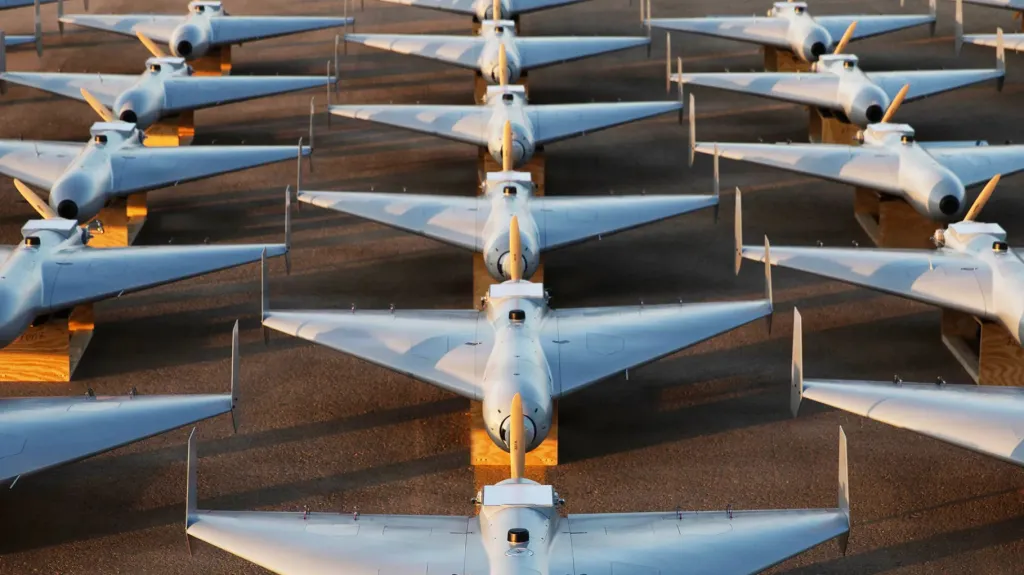
Cooper didn’t elaborate, but earlier in his testimony, he talked about the Low-Cost Uncrewed Combat Attack System (LUCAS) kamikaze drones that TWZ has written frequently about. CENTCOM first began using these weapons, reverse-engineered from Iranian Shahed-136 drones, to strike targets in Iran.

The War Zone has advocated for the procurement of this exact class of drone by the American military and today, Cooper once again backed up that assessment.

The LUCAS drones are “an additional capability that we’ve now employed against an adversary very effectively,” Cooper commented. He declined to provide further details. 

“Vis a vis Iran, I think I would just like to keep that in the classified setting,” he noted.

LUCAS kamikaze drones. (CENTCOM)

Cooper provided additional statistics about Epic Fury to the committee.

  • “We destroyed or buried much of Iran’s ballistic missiles, launcher vehicles, and long-range attack drones with more than 450 strikes on ballistic missile storage and systems and roughly 800 strikes on Iran’s drone-launching units and storage. In the air domain, Iran’s air and air defense forces are functionally and operationally irrelevant.” 
  • “Before OEF, the Iranian Air Force flew between 30 and 100 sorties each day. Today that number is zero. We destroyed or rendered non-mission-capable Iran’s fixed-wing airfields, hangars, fuel storage, and munitions stockpiles, and we knocked out 82 percent of its air defense missile systems along with the radar and command architecture that tied them together.”
  • “At sea, we destroyed 161 vessels in total across 16 classes of warships, effectively crippling the regime’s ability to operate.”

SASC @CENTCOM Posture Hearing

Admiral Cooper:
“At sea, we destroyed 161 vessels in total across 16 classes of warships, effectively crippling the regime’s ability to operate. We eliminated more than 90 percent of Iran’s once-massive inventory of over 8,000 naval mines, with more… pic.twitter.com/VmBwR8KIlM

— Charlie B (@supbrow) May 14, 2026

  • “We eliminated more than 90 percent of Iran’s once-massive inventory of over 8,000 naval mines, with more than 700 airstrikes on Iranian naval mine targets. In sum, Iran’s navy can no longer claim to be a maritime power, and it cannot project into the Gulf of Oman or the Indian Ocean. Iran retains nuisance capability – harassment, low-end drone and rocket attacks, and residual proxy support – but it no longer possesses the means to threaten major regional operations or to deter U.S. freedom of action in the air or maritime domains.”
  • “The second-order effects of OEF are significant. More than 2,000 strikes against Iran’s command-and-control structures created leadership vacuums, paralysis, and internal confusion.” 
  • “We have seen reporting of desertions, personnel shortages, and signs of regime desperation in their attempts to compel discipline through arrest and execution. Most importantly for the region’s future: Iran will be highly challenged to proliferate advanced weapons to Lebanese Hezbollah, the Houthis, Hamas, or the Iraqi militia groups. The supply chain from Tehran to the proxies has been broken.”

While Iran has clearly been battered by attacks from the U.S. and Israel, recent events show it can still inflict damage on its neighbors and shipping. As we previously reported, Tehran has repeatedly struck the United Arab Emirates (UAE) before and after the April 7 ceasefire. In previous coverage, we have pointed out how Iran has also attacked U.S. warships and commercial vessels they were helping guide through the Strait of Hormuz during the short-lived Project Freedom operation.

Hours before Cooper testified, “the Islamic Revolutionary Guard Corps (IRGC) Navy seized the Honduras-flagged fishery research vessel Hui Chuan,” a maritime security official told us. “The Company Security Officer (CSO) reported that the vessel was taken by Iranian personnel while at anchor approximately 38nm northeast of Fujairah, UAE, at 05:45 UTC.”

The Hui Chuan was operating as a “floating armory” storing weapons for Chinese security firms who protect ships at sea from attack by pirates, the official told us. The ship is now “bound for Iranian territorial waters,” the UK’s Maritime Trade Operations (UKMTO) organization said.

The Honduras-flagged fishing research vessel Hui Chuan (IMO: 8316895), anchored off the UAE’s east coast, is believed to have been seized by the IRGC Navy.

The ship is reportedly operated by the Chinese private security company Sinoguards as a floating armory. pic.twitter.com/VlHpmkqFYw

— Egypt’s Intel Observer (@EGYOSINT) May 14, 2026

UPDATE: 8:06 PM EDT –

During an interview with NBC News, Rubio was asked what Trump asked Xi when it comes to Iran.

“He didn’t ask him for anything,” the secretary noted. “We’re not asking for China’s help. We don’t need their help… Our position is very clear: Iran cannot have a nuclear weapon.”

NBC: “What exactly did President Trump ask President Xi for when it comes to Iran?”@SecRubio: “He didn’t ask him for anything. We’re not asking for China’s help. We don’t need their help… Our position is very clear: Iran cannot have a nuclear weapon.” pic.twitter.com/Hn7f3aqiUp

— Rapid Response 47 (@RapidResponse47) May 14, 2026

In a post on his social media platform responding to Xi’s remarks that the U.S. is essentially a declining power, Trump responded that the Chinese leader was referring to America under Biden and that things are much better now.

More interesting, however, is a hint Trump dropped about the future with Iran.

Among the accomplishments he claimed on Truth Social was “the military decimation of Iran (to be continued!).” 

The House voted for a third time against acting as a check on President Trump’s military powers in Iran, even as a growing number of Republicans express concern about the prolonged conflict, CBS News reported

Thursday’s vote on a Democratic resolution to rein in Trump’s authority was 212-212, falling just short of a majority. Originally introduced on March 4, the measure as written would have directed the president to remove U.S. forces from hostilities within 30 days of the start of the war, which began on Feb. 28.

The U.S. House voted 212-212 on a War Powers Resolution to restrict military action against Iran. The measure failed, needing a majority to pass. pic.twitter.com/NcRDvUIFyA

— Open Source Intel (@Osint613) May 14, 2026

UPDATES

In a readout of the meeting in Beijing between Trump and Xi, the White House noted that the topic of the Strait of Hormuz came up in discussions between the two leaders.

“The two sides agreed that the Strait of Hormuz must remain open to support the free flow of energy,” the White House posted on X. “President Xi also made clear China’s opposition to militarization of the Strait and any effort to charge a toll for its use, and he expressed interest in purchasing more American oil to reduce China’s reliance on the Strait in the future.”

U.S. Secretary of State Marco Rubio, who was among those accompanying Trump, highlighted Xi’s opposition to allowing Iran to impose tolls on ships transiting the Strait. 

“President Trump raised the issue of Iran with China and it was important,” said Rubio. “The Chinese side said they are not in favor of militarizing the Strait of Hormuz and are not in favor of a tolling system, and that’s our position.”

SECRETARY RUBIO: President Trump raised the issue of Iran with China and it was important.

The Chinese side said they are not in favor of militarizing the Strait of Hormuz and are not in favor of a tolling system, and that’s our position. pic.twitter.com/9JYpbvztd8

— Department of State (@StateDept) May 14, 2026

The much-longer Chinese readout of the meeting mentioned improving trade and a warning that the U.S. “must exercise the utmost prudence in handling the Taiwan question.”

However, there was no mention of Iran or the Strait of Hormuz.

While that doesn’t mean these issues weren’t discussed, readouts are messaging and this reflected the emphasis Beijing places on the paused war and its aftermath.

“The two heads of state exchanged views on major international and regional issues, including the situation in the Middle East, the Ukraine crisis, and the Korean Peninsula,” was about as close as the statement from the Chinese Foreign Ministry came to addressing Iran.

Despite the Trump administration’s stance that China opposes allowing Iran to impose tolls on shipping, Beijing is paying for transits, the Guardian claims.

Tehran “says it has reached a deal with China that has already allowed a large number of oil tankers bound for China to go through the strait of Hormuz since Wednesday night, and this has been made possible by China agreeing to limited charging, undercutting US opposition to such moves,” the outlet reported. “The development suggests China has accepted Iran’s assertion that the shipping rules in the strait have changed, with reports suggesting the cost will be in the region of $1 per barrel.”

We cannot independently verify that and have reached out to the White House for details.

🇮🇷 🇨🇳 Iranian media reported on Thursday that naval forces had allowed a group of Chinese ships to pass through the strategic Strait of Hormuz since the night before. Iran has largely blocked shipping through the strait since the outbreak of war with the US and Israel ➡️… pic.twitter.com/PVjGJ0TY7t

— AFP News Agency (@AFP) May 14, 2026

Trump pushed back on claims that China is working to arm Iran.

“We discussed it,” he told Fox News host Sean Hannity. “I mean, when you say ‘support,’ they’re not fighting a war with us or anything. He said he’s not gonna give military equipment. That’s a big statement. He said that strongly. But at the same time he said they buy a lot of their oil there, and they’d like to keep doing that.”

HANNITY: Did you discuss China’s support for Iran with Xi?

TRUMP: We discussed it. Uhhhh. I mean, when you say ‘support,’ they’re not fighting a war with us or anything. He said he’s not gonna give military equipment. That’s a big statement. But at the same time he said they buy… pic.twitter.com/Lq677uoCfG

— Aaron Rupar (@atrupar) May 14, 2026

Trump’s claim that China told him it won’t give weapons to Iran followed The New York Times report that Beijing was working to ship arms to Tehran.

“Chinese companies have been discussing arms sales with Iran, plotting to send the weapons through other countries to mask the origins of the military aid,” the publication stated, citing U.S. officials.

The United States “has gathered intelligence that Chinese companies and Iranian officials have discussed the arms transfers,” the newspaper added. “It is not clear how many, if any, arms have been shipped or to what degree Chinese officials have approved the sales.”

Officials briefed on the intelligence “have reached different conclusions on whether the arms have already been sent to the third countries,” according to the Times. “But no Chinese weapons appear to have been used on the battlefield against U.S. or Israeli forces since they began their war against Iran in late February.”

The newspaper reported last month that U.S. intelligence agencies had obtained information showing that China may have transferred shoulder-fired man portable air defense systems (MANPADS) to Iran. Intelligence also showed that China was considering other shipments of the weaponry.

The United Arab Emirates (UAE) on Wednesday pushed back on claims that Israeli Prime Minister Benjamin Netanyahu and the heads of Mossad and Shin Bet visited the country during the now-paused war with Iran. The denial is a strong public rebuke amid a growing relationship between the two nations that has seen Israel supply the UAE with Iron Dome air defense batteries to protect against Iranian attacks.

“The United Arab Emirates denies reports circulating regarding an alleged visit by Israeli Prime Minister Benjamin Netanyahu to the UAE or receiving any Israeli military delegations in the country,” the UAE Foreign Affairs Ministry posted on X Wednesday afternoon EDT. “The UAE reaffirms that its relations with Israel are public and conducted within the framework of the well-known and officially declared Abraham Accords, and are not based on non-transparent or unofficial arrangements. Accordingly, any claims regarding unannounced visits or undisclosed arrangements are entirely unfounded unless officially announced by the relevant authorities in the UAE.”

The ministry added that the “UAE calls on media outlets to exercise accuracy and professionalism, and to refrain from circulating unverified information or promoting misleading political narratives.”

UAE Denies Reports Regarding Visit by Israeli Prime Minister or Receiving Any Israeli Military Delegation pic.twitter.com/TRX9y5ZoVN

— MoFA وزارة الخارجية (@mofauae) May 13, 2026

Hours before the UAE announcement, Netanyahu’s office claimed the Israeli leader did travel to the Gulf Arab nation, confirming a CBS News report about the visit.

“In the midst of Operation ‘Roar of the Lion,’ Prime Minister Benjamin Netanyahu made a secret visit to the United Arab Emirates and met with the President of the United Arab Emirates, Sheikh Mohammed bin Zayed,” the office posted on X. “This visit led to a historic breakthrough in relations between Israel and the United Arab Emirates.”

לשכת ראש הממשלה מאשרת כעת:

בעיצומו של מבצע ״שאגת הארי״, ראש הממשלה בנימין נתניהו ביקר בחשאי באיחוד האמירויות ונפגש עם נשיא איחוד האמירויות, השייח׳ מוחמד בן זאיד.

ביקור זה הביא לפריצת דרך היסטורית ביחסים בין ישראל לאיחוד האמירויות.

— ראש ממשלת ישראל (@IsraeliPM_heb) May 13, 2026

Israel’s N12 News chief political correspondent Amit Segal noted a “few striking details regarding the news of Netanyahu’s visit to the UAE.”

“A covert flight reportedly took place while Israeli airspace was fully shut—without leaks or detection,” he noted on X. “Sources suggest a deal was reached on an Iron Dome shipment” and “UAE President Mohammed bin Zayed Al Nahyan has publicly hosted Israeli leaders like Naftali Bennett and Yair Lapid—but not Benjamin Netanyahu. Until now, their contacts stayed behind closed doors.”

Bennet and Lapid visited the UAE in 2021, as Prime Minister and Foreign Minister respectively.

A few striking details regarding the new of Netanyahu’s visit to the UAE:

1. A covert flight reportedly took place while Israeli airspace was fully shut—without leaks or detection.

2. Sources suggest a deal was reached on an Iron Dome shipment.

3. UAE President Mohammed bin… https://t.co/An2kbqJrNC

— Amit Segal (@AmitSegal) May 13, 2026

The announcement from Netanyahu’s office followed media reports on Tuesday about the visit to the UAE of two other high-level Israeli officials.

The Wall Street Journal reported that Mossad chief David Barnea visited the UAE at least twice during Operation Roaring Lion to coordinate war efforts. Barnea reportedly flew to the UAE in March and April. In addition, Israeli media reported that Shin Bet chief David Zini also visited the UAE to coordinate security efforts.

Certainly not surprising given the Abraham Accords and the more recent Iron Dome battery and miltary deployment to UAE by Israel. But 2 back to back visits by a Mossad chief amid a war speaks volumes. Important read by @AnatPeled1 & @summer_said in @WSJ.https://t.co/i9BmyHNZ3p

— Behnam Ben Taleblu بهنام بن طالب لو (@therealBehnamBT) May 13, 2026

The back and forth over the potentially unprecedented wartime visit by three top Israeli officials to the UAE comes a day after U.S. Ambassador to Israel Mike Huckabee publicly confirmed that Israel sent the UAE an unspecified number of Iron Dome air defense batteries and troops to operate them. News of the deployment was first reported by Axios last month. Such an acknowledgement of direct Israeli military aid to an Arab nation is unusual in its own right.

🚨 WATCH: US Ambassador to Israel Mike Huckabee officially confirms: Israel sent the United Arab Emirates an Iron Dome system and a team to operate it. This happened because there are exceptional relations between Israel and the United Arab Emirates, based on the Abraham Accords. pic.twitter.com/BgCkESt4Yl

— Raylan Givens (@JewishWarrior13) May 12, 2026

TWZ cannot independently verify any of the travel claims. However, Israel has historically been viewed as an enemy by the Arab world and direct cooperation in the form of a visit by its head of state could be considered controversial to say the least. At the same time, things have changed dramatically in the region over the last decade or so, with Arab countries warming to relations with Israel. This has been spurred by the major economic development the region has seen as well as, at least to a degree, a common foe — Iran.

Perhaps the UAE is trying to appeal to a domestic audience or, as Israel’s I24 News senior Middle East correspondent Ariel Oseran suggested on X, UAE is trying to distance itself from Netanyahu and his coalition, not Israel writ large. Maybe Netanyahu, for his own reasons, is trying to claim a level of relationship that doesn’t exist, however that seems unlikely.

We may never find out for sure.

It is highly unlikely that Israel’s PMO would issue a fake statement regarding Netanyahu visiting the UAE at such a sensitive time.

What is more likely is that Abu Dhabi is trying to publicly distance itself from Netanyahu on a personal level, a sentiment that I have personally… https://t.co/8laUSjOAc7

— Ariel Oseran أريئل أوسيران (@ariel_oseran) May 13, 2026

The Senate on Wednesday blocked the seventh Democratic attempt to prevent Trump from waging war on Iran. However, it was by the slimmest margin yet, indicating a growing unease in the legislature about the now-paused conflict.

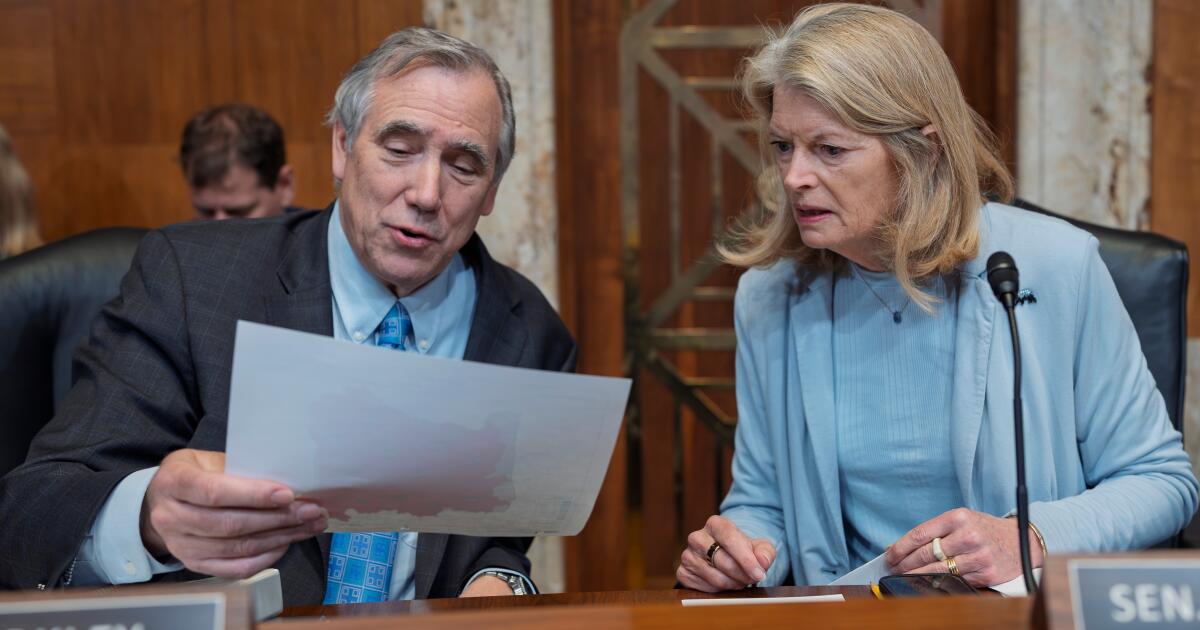
The vote failed by a 49-50 margin, with all Democrats but John Fetterman of Pennsylvania supporting the measure. For the first time, Senator Lisa Murkowski of Alaska joined fellow Republican Senators Susan Collins of Maine and Rand Paul of Kentucky in breaking with Trump and voting with Democrats. 

This was the first vote on the War Powers Resolution since Trump bypassed the 60-day deadline to seek congressional authorization for Operation Epic Fury last month. You can read more about that effort in our story about it here.

Meanwhile, as we noted yesterday, NBC News reported that the administration is considering changing the name of the operation to Sledgehammer should hostilities resume.

Contact the author: howard@twz.com
Howard is a Senior Staff Writer for The War Zone, and a former Senior Managing Editor for Military Times. Prior to this, he covered military affairs for the Tampa Bay Times as a Senior Writer. Howard’s work has appeared in various publications including Yahoo News, RealClearDefense, and Air Force Times.


Source link

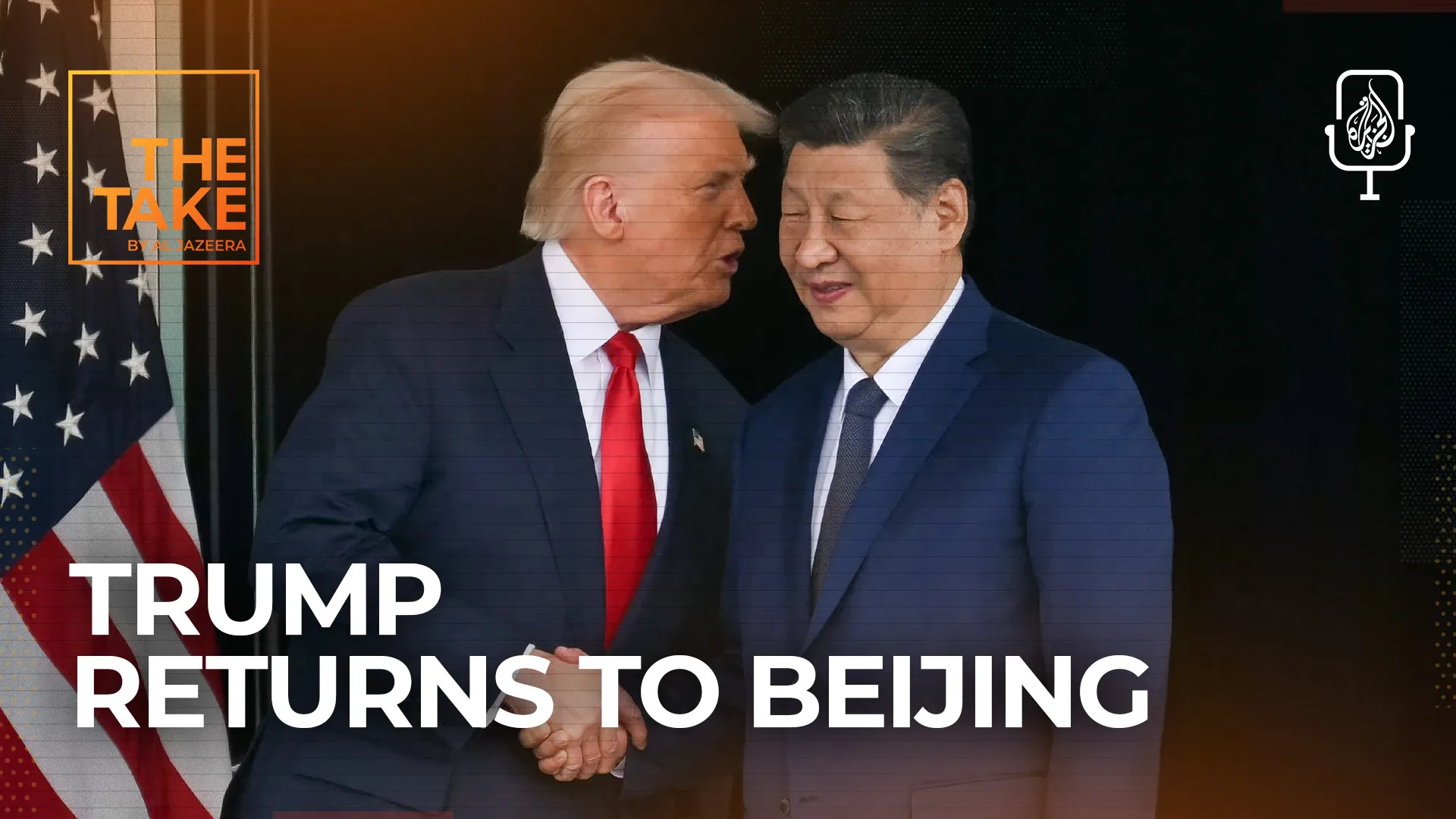
Iran, Taiwan, and trade: Trump’s high‑stakes return to Beijing | News

As Trump meets Xi in Beijing for the first time in nine years, can trade war, Taiwan and Iran tensions be contained?

US President Donald Trump returns to Beijing after nine years to meet Chinese President Xi Jinping. The trade war, conflict in Iran, and rising fears over Taiwan shape the talks. With global tensions mounting, can the two leaders find common ground, or will rivalry push the world further into crisis?

In this episode: 

Episode credits:

This episode was produced by Marcos Bartolomé and Sarí el-Khalili with Spencer Cline, Catherine Nouhan, Tuleen Barakat, Alexandra Locke, and our guest host, Kevin Hirten. It was edited by Tamara Khandaker. 

Our sound designer is Alex Roldan. Our video editors are Hisham Abu Salah and Mohannad al-Melhem. Alexandra Locke is The Take’s executive producer. 

Connect with us:

@AJEPodcasts on XInstagramFacebook, and YouTube


Source link

UKMTO says Honduran-flagged vessel seized by Iran near UAE

A container ship sails on the Strait of Hormuz, as seen from Ras Al Khaimah, United Arab Emirates, in June 2025. The UK’s Maritime Trade Operations said Thursday that a Honduran-flagged vessel was seized by Iran northeast of Fujairah, United Arab Emirates. File Photo by Ali Haider/EPA-EFE

May 14 (UPI) — The U.K.’s Maritime Trade Operations said Thursday that a Honduran-flagged vessel was seized by Iran northeast of Fujairah, United Arab Emirates.

The Hui Chuan, described by UKMTO as a “floating armoury,” was in the Gulf of Oman when it was seized by Iranian forces. The vessel is moving toward Iranian waters.

UKMTO said in a statement that the seizure was reported about 38 nautical miles northeast of Fujairah.

“The CSO has reported that the vessel has been taken by unauthorized personnel [whilst] at anchor and is now bound for Iranian Territorial Waters,” UKMTO said in its report. “UKMTO continue to investigate.”

The vessel had been anchored in the Gulf of Oman for about a month. Its operators said it was storing weapons used to protect ships from pirate attacks.

The Hui Chuan is at least the second vessel to be attacked on the Gulf of Oman in as many days. On Wednesday, the Indian-flagged vessel Haji Ali sank off the coast of Oman after an explosion.

Security firm Vanguard said the explosion was believed to have been caused by a “drone or missile.”

Tensions in the Persian Gulf remain high during an uneasy ceasefire between the United States and Iran. The United States has imposed a naval blockade on the Strait of Hormuz, pursuing any vessels using Iranian ports. Iran has meanwhile threatened vessels traversing the strait since the United States and Israel launched strikes on Iran on Feb. 28.

Wreathes are seen amongst the statues at the Korean War Veterans Memorial during Memorial Day weekend in Washington on May 27, 2023. Memorial Day, which honors U.S. military personnel who died while in service, is held on the last Monday of May. Photo by Bonnie Cash/UPI | License Photo

Source link

Column: Trump surrendered to China before he even landed there

Ahead of President Trump’s arrival in Beijing on Wednesday for his summit with Chinese President Xi Jinping, longtime China expert Kurt M. Campbell offered a novel way of watching the two leaders’ high-stakes faceoff. Think of it not as nation-versus-nation or army-versus-army, but as the sort of “single combat” celebrated in ancient literature, along the lines of David and Goliath in the Bible or Achilles and Hector in “The Iliad.”

“This one has the feel of a geopolitical heavyweight matchup,” Campbell, chairman of the Asia Group strategic consulting firm, wrote in Foreign Affairs this week.

Unlike in their initial get-together early in Trump’s first term, both men now are seasoned leaders in their separate ways — Xi an unchallenged dictator, and an envious Trump seeking to be. Both act with few immediate checks on their power, though Xi acts strategically and Trump impulsively and transactionally. And both, as leaders of super-powers, have the capability to shape the economic and security fates of a wary world.

That world, Campbell concluded in his essay, is “eager to see whether the two leaders emerge driving together in the chariot, or with one dragging the other behind,” as Achilles did the vanquished Hector.

However the Trump-Xi meeting ends, Trump is no Achilles going into this match. In fact, in the six decades of U.S.-China relations, perhaps no American president has entered the summit arena in a weaker position than Trump, the would-be strongman and artiste of the deal. Worse, his weakness — and by extension his country’s — is mostly self-inflicted.

Trump had postponed what was intended as an early April meeting in hopes of striding triumphantly into Beijing as the conqueror of Iran, a China ally. Instead China is receiving him as a “giant with a limp,” in the phrase of its Communist Party-controlled Global Times newspaper.

Trump’s Mideast war, the sort he’d promised never to start, lingers for a third month in a costly stalemate — $29 billion and counting — that has humiliated the president in the public words of Germany’s chancellor and the private thoughts of many more global leaders, Xi likely among them. Trump can’t “project the same arrogance” as he did visiting China in 2017, a former Chinese army officer, Yue Gang, told the New York Times.

At home, the conflict has caused gasoline prices and inflation to spike while tanking Trump’s already depressed polls. A newly released CNN poll conducted April 30 to May 4 had 65% of Americans disapproving of his overall job performance and a whopping 70% against his handling of the economy — the issue that arguably got him elected. With experience, American consumers and soybean farmers now know that they, not the Chinese, have paid for Trump’s beloved tariffs.

The president’s standing at home could hardly have been helped by his parting words to reporters at the White House. Asked “to what extent are Americans’ financial situation motivating you to make a deal” with Iran, Trump blithely replied, “Not even a little bit.” He added, in the sort of political gaffe that journalist Michael Kinsley defined as telling the truth: “I don’t think about Americans’ financial situation. I don’t think about anybody.”

He’s already a loser in the negotiations with Xi. For weeks the Trump administration has unsuccessfully urged China to use its leverage to goad Iran to accept a peace on Americans’ terms or, at a minimum, to reopen the Strait of Hormuz, given China’s self-interest as Iran’s biggest oil customer by far. As China scholar Henrietta Levin of the Center for Strategic and International Studies told the Associated Press, “I don’t think China has any interest in solving the problems the U.S. has created for itself in the Middle East.”

Not least, perhaps, because China has seen that, by the Pentagon’s own reckoning, the war has depleted U.S. stockpiles of weaponry after thousands upon thousands of strikes against Iran. And that has further raised questions in China and beyond about whether Trump would have the United States come to the defense of Taiwan, the self-governing, U.S.-armed island that China claims as its own.

After all, the thinking goes, if the United States can’t bring a lesser power like Iran quickly to heel, how might it fare against a near-peer such as China, especially with a diminished U.S. arsenal and Mideast distractions?

It’s mostly a mystery what the leaders’ talks might yield. In a break with diplomatic tradition, though not with Trump’s seat-of-the-pants style, apparently little planning went into this super-power summit — another reflection of a distracted U.S. side. Still, with a number of tech, agribusiness, finance and aerospace chieftains in tow, Trump and his team are hoping for a few politically appealing deliverables, such as sales of U.S. soybeans and Boeing aircraft, to give the president a lift back home.

But don’t look for progress on the longstanding issues dividing the United States and China over trade and military dominance in the Pacific region. And as for another of those perennial issues — climate change and clean-energy technology — the U.S. under Trump has willfully surrendered global preeminence to China, ceding markets for solar, wind energy, electric vehicles, grid storage and more in his backward-looking, ostrich-like obsession with drilling oil and mining coal.

Whatever hyperbolic claims Trump makes for his China trip, the outcome of the summit (on top of his quagmire in Iran) should at least be this: retiring the myth of Trump the deal-maker and savvy businessman.

If he were such a visionary, Trump would be prodding the nation to global leadership in technology and clean-energy investments, not reversing past progress and paying companies billions of taxpayers’ dollars to stop clean-energy projects. In markets worldwide, the future is now and America is forfeiting the game to China.

In this contest, Trump is letting Xi drive the chariot. Unfortunately, average Americans are the ones being dragged through the dust as China rides into the 21st century.

Bluesky: @jackiecalmes
Threads: @jkcalmes
X: @jackiekcalmes

Source link

Could Iran war trigger a hunger crisis? | US-Israel war on Iran

The UN warns disruptions in the Strait of Hormuz could drive up food and fertiliser costs, and worsen global hunger.

The next global food crisis is unfolding in a narrow stretch of water.

The United Nations warns that if fertilisers cannot pass through the Strait of Hormuz within just a few weeks, the world could face mass starvation.

It says the consequences could be severe if shipping disruptions linked to the Iran conflict drag on.

Food prices are already at a three-year high, while fertiliser costs critical for agriculture have rocketed.

Aid agencies fear a prolonged disruption could push tens of millions more people into hunger.

For vulnerable economies already struggling with debt and high import costs, the risks are growing fast.

Source link

Republican resistance to Iran war grows in the Senate as Murkowski flips

Senate Republicans on Wednesday again blocked Democratic legislation that would halt President Trump’s war with Iran, but the number of GOP senators voting against the war grew.

Republican Sen. Lisa Murkowski of Alaska voted against the war for the first time since it began at the end of February. Two other Republicans, Sens. Susan Collins of Maine and Rand Paul of Kentucky, also voted against the war, as they had done previously.

The war powers legislation ultimately failed to advance 49-50, with Sen. John Fetterman of Pennsylvania the only Democrat to oppose it, yet the close tally reflected growing unease with Trump’s war. Several other Republican senators have signaled they want Congress to weigh in on the direction of the conflict.

“There will be a day — and it might be soon, I believe — where this Senate will say to the president, ‘Stop this war,’” Democratic Sen. Tim Kaine of Virginia, who has spearheaded his party’s tactic of forcing repeated votes on the war, said before the vote.

Even if it passes the Senate, a war powers resolution would have a slim chance of passing the House and would also certainly be vetoed by Trump. But Democrats say the votes are about building political pressure on the president either to withdraw from the conflict or seek congressional authorization to wage the war.

Trump officials downplay role for Congress

The White House, meanwhile, has asserted that it does not need congressional authorization for the war and has circumvented legal requirements to gain approval from Congress to continue the military campaign. It claims that it has “terminated” hostilities with Iran because the U.S. has entered a ceasefire.

That posture has created tension between the Republican-controlled Congress and the White House because presidents under the War Powers Resolution of 1973 are required to obtain authorization from Congress after 60 days of engaging in a conflict.

Defense Secretary Pete Hegseth told lawmakers this week that the U.S. could start attacking Iran again without the White House seeking congressional approval. He told Murkowski during a hearing on Tuesday that the Trump administration believes it has “all the authorities necessary.”

Murkowski voiced skepticism about that argument. She pointed to the troops and war ships deployed to the region, saying, “It doesn’t appear that hostilities have ended.”

GOP leaders back the war, but unease grows

Republican leadership has continued to back the war with Iran, arguing that the stalemate in the Strait of Hormuz that has blocked most commercial shipping puts more economic pressure on Iran than it does on the U.S.

“Iran’s economy is on life support. Its leadership is eliminated,” said Sen. John Barrasso, the No. 2 Republican in leadership, during a floor speech Wednesday.

He also argued that the Democratic effort on the war is all about undermining Trump. Forcing the issue just as he arrived in China for a summit would “pull out the rug from under him,” Barrasso said.

Still, Republicans are also growing uneasy about the high gas prices, especially as the November elections draw near.

Sen. Mike Rounds, a Republican from South Dakota, said Wednesday he’d prefer that the two branches of government work out the constitutional issues instead of a congressional war powers vote or a potential challenge in court.

The two sides should sit down together and say “we have shared constitutional responsibilities,” Rounds said.

Democrats plan to keep forcing weekly votes on war powers resolutions and are looking ahead to put limitations on Trump during the debate over annual legislation that authorizes and funds the military.

Sen. Jeff Merkley, an Oregon Democrat who sponsored Wednesday’s resolution, told reporters that he believes there is an “erosion of support, erosion of enthusiasm, an increase in skepticism” about the war from Republicans.

Groves writes for the Associated Press.

Source link

Iran’s US-bound World Cup squad given public sendoff in Tehran | World Cup 2026 News

Thousands of people cheered Team Melli as Iran’s World Cup kit was unveiled before the team’s training camp in Turkiye.

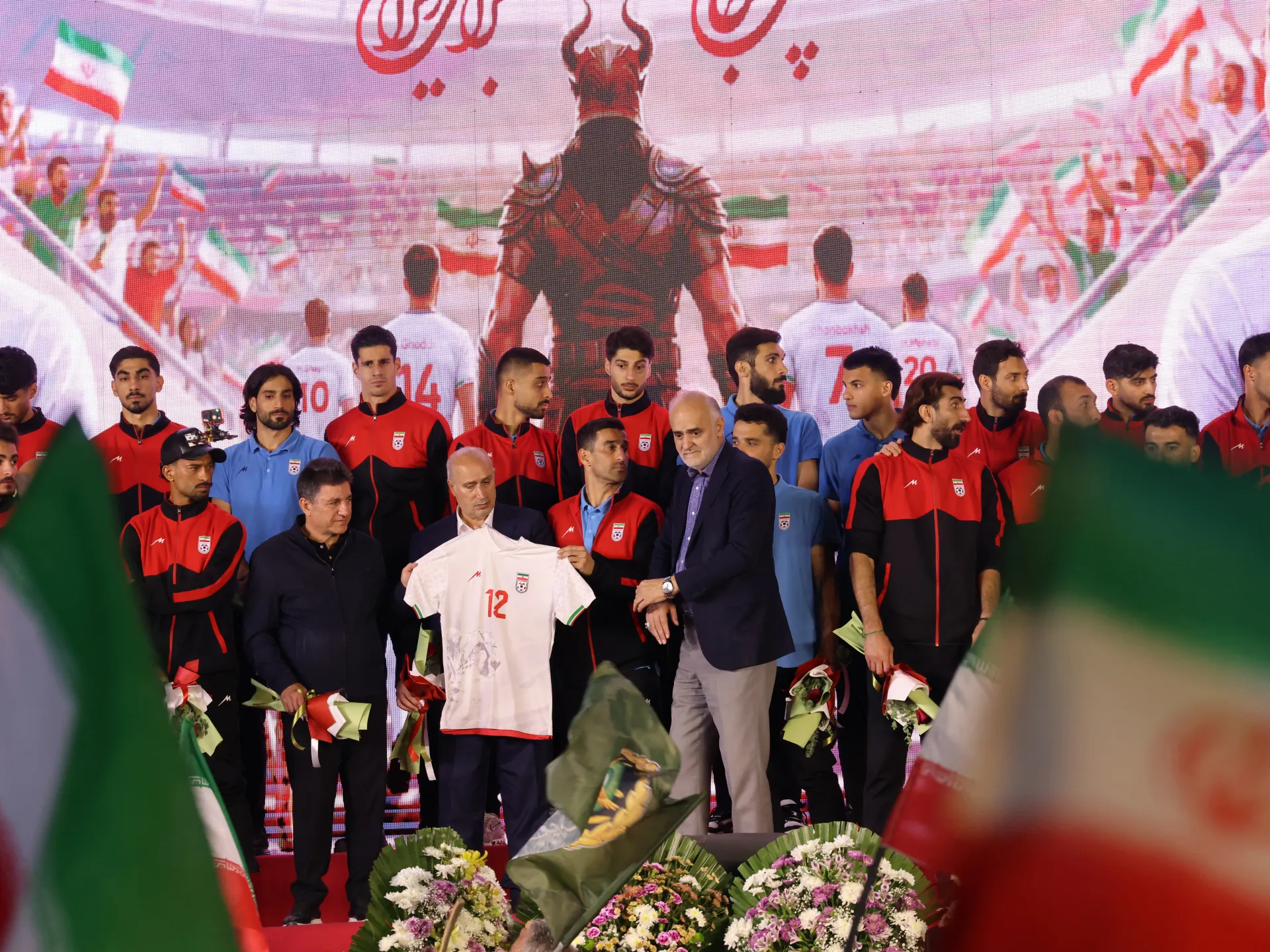
Iran hosted a departure rally for its FIFA World Cup squad, witnessed by thousands of fans in Tehran’s Enqelab Square, amid concerns about ⁠the team travelling to the United States to compete.

The players were cheered ⁠by the crowd as they made patriotic statements from a stage on Wednesday.

Iran’s World Cup 2026 kit was also unveiled at the event, following which the team will travel to Turkiye to continue their preparations at a training camp.

“This is the best sendoff in the ⁠last four World Cup campaigns,” Mehdi Taj, president of the Football Federation Islamic Republic of Iran (FFIRI), told state TV.

“The players are with the people, and the crowd stands with the country’s dignity, honour, and strength. Whatever the result, may Iran’s flag be raised there and defended.”

Iran’s participation in the World Cup has been in question since the US and ‌Israel attacked Iran, starting a regional war on February 28.

People gather to attend the farewell ceremony of Iran's national football team ahead of their departure for the 2026 FIFA World Cup, in Tehran on May 13, 2026. The president of the Iranian Football Federation said late May 9 that if Iran dropped out of the World Cup, it would deprive the country of a "major diplomatic asset". World football's governing body FIFA has insisted for weeks that Iran will take part. Iran, who are due to be based in Tucson, Arizona, during the World Cup, face New Zealand, Belgium and Egypt in Group G. The Iranians open their World Cup campaign against New Zealand in Los Angeles on June 15. (Photo by ATTA KENARE / AFP) /
People gather to attend the farewell ceremony of Iran’s national team in Tehran [Atta Kenare/AFP]

An FFIRI delegation, led by Taj, turned back at Toronto’s main airport, citing their treatment by Canadian immigration, and missed a pre-World Cup FIFA gathering in Vancouver. They alleged “unacceptable behaviour of immigration officials” despite holding valid visas.

In 2024, Canada listed Iran’s Islamic Revolutionary Guard Corps as a terrorist organisation, and statements from the Canadian government indicated that Taj was denied entry due to his alleged ties with the IRGC.

The incident triggered fears there may be issues for some of the Iranian delegation getting into the US.

As in Canada, the IRGC is classified as a “terrorist entity” in the US, and Secretary of State Marco Rubio has said no one with ties to ⁠the organisation would be admitted to the country.

Iran has placed responsibility for ⁠getting the players and team officials into the US, where Team Melli are scheduled to play all three World Cup group matches, firmly in the hands of FIFA.

“Nothing has arrived yet regarding the visas. We hope it will definitely ⁠be handled within this timeframe,” Hedayat Mombeini, FFIRI secretary-general, told state TV at the rally.

“FIFA has made promises, and hopefully those promises ⁠will lead to results, and the players will receive their ⁠visas on time.”

Iran ‌will play The Gambia in a World Cup warm-up in Antalya on May 29. Mombeini said the FFIRI was in the process of arranging another friendly for the training camp in Turkiye.

Source link

Trump marvels at Chinese power as summit kicks off

An extraordinary display of power and precision along Tiananmen Square greeted President Trump in Beijing on Thursday, kicking off a two-day summit with particularly high stakes for the Americans.

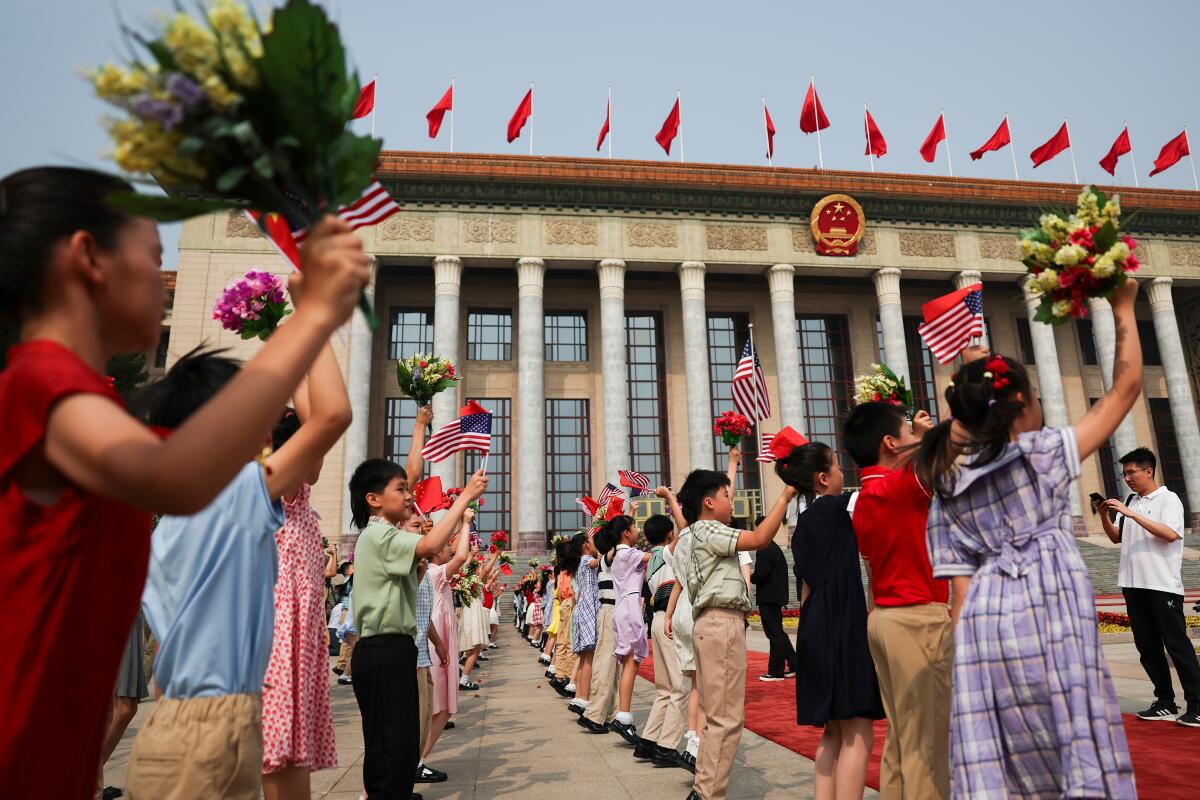
Trump’s meetings with his Chinese counterpart, Xi Jinping, began at the Great Hall of the People moments after a welcome ceremony that seemed to impress the president, featuring a Chinese military honor guard and a greeting from excited school children. American flags waved as “The Star Spangled Banner” rang out on a smoggy day in the heart of the capital.

Children holding Chinese and U.S. flags rehearse before the welcome ceremony for President Trump.

Children holding Chinese and U.S. flags rehearse before the welcome ceremony for President Trump.

(Maxim Shemetov / Associated Press)

Trump reflected on the stakes of his visit at the top of the meeting, telling Xi that the ceremony was an honor “like few I’ve seen before.”

“There are those who say it may be the biggest summit ever,” he said. “I have such respect for China, the job you’ve done.”

Both men struck a conciliatory tone, despite the agenda for the summit featuring some of the thorniest issues facing the two superpowers today, from the U.S. war in Iran to trade relations and the future of Taiwan.

“We’ve gotten along — when there have been difficulties, we’ve worked it out,” Trump added. “We’re going to have a fantastic future together.”

Trump is expected to ask Xi for help reopening the Strait of Hormuz, a vital commercial waterway disrupted by Iran since the start of the war, and for the extension of a truce in the trade war he started at the beginning of his second term.

China, in turn, will ask the Trump administration not to proceed with arms sales to Taiwan, despite their approval by Congress, and for a declaration of opposition to Taiwanese independence. Beijing also seeks access to top-end chips made by American manufacturers.

Chinese President Xi Jinping and President Trump shake hands at the Great Hall of the People.

Chinese President Xi Jinping and President Trump shake hands at the Great Hall of the People.

(Kenny Holston / Associated Press)

The agenda exposes the mutual dependence of the two rival superpowers, marked by distrust but driven by a quest for cooperation and stability.

The welcome ceremony outside of the Great Hall kicked off with Xi shaking the hands of Trump’s delegation, including figures such as his political advisor, James Blair, his communications director, Steven Cheung, and his daughter-in-law, Lara Trump.

They were just a few members of a U.S. delegation accompanying Trump filled with curiosities.

Chinese officials were surprised to learn that Pete Hegseth was joining Trump in Beijing this week, marking the first time a president has brought his secretary of defense on an official state visit. It wasn’t immediately clear to the Chinese what his inclusion was meant to convey.

Eric Trump, the president’s son, is here, seeking to leverage the family name for lucrative business deals as Beijing aggressively campaigns against government corruption at home. And First Lady Melania Trump decided to stay at home, an unusual snub of such a high-level event.

A contingent of U.S. business leaders was given little notice to prepare for the trip, including the CEO of Nvidia, who raced to join Trump aboard Air Force One at a refueling stop in Alaksa.

The diplomatic faux pas follow weeks of Chinese frustration over what they see as the Trump administration’s lack of preparation — a perceived display of incompetence that boosts their confidence heading into the negotiations.

Over the course of the visit, Trump is expected to visit the Temple of Heaven, a monument to imperial China and Confucian thought in the center of Beijing. Ahead of Trump’s arrival, an area roughly the size of 400 American football fields was closed in preparation for a stop here.

On Thursday night, local time, Trump will return to the Great Hall of the People for a banquet dinner. Additional meetings are scheduled for Friday morning before Trump departs midday for home.

Source link

Crowds gather in Tehran to send off Iran’s World Cup team | World Cup 2026

NewsFeed

Huge crowds gathered in Tehran’s Revolution Square to celebrate and send off Iran’s national football team ahead of the 2026 World Cup. The new jersey of the Iranian national team, which will be worn in the World Cup competitions, was unveiled at the event.

Source link

Trump arrives in Beijing for talks with China’s Xi on Iran war, trade and U.S. arms sales to Taiwan

President Trump arrived in Beijing on Wednesday for his hotly anticipated talks with Chinese President Xi Jinping on the Iran war, trade and U.S. arms sales to Taiwan.

The meat of the summit doesn’t start until Thursday, when the leaders hold bilateral talks, visit the Temple of Heaven, where Chinese emperors once prayed for bumper crops, and take part in a formal banquet. But the Chinese offered Trump a pomp-filled welcome, literally rolling out the red carpet for him after Air Force One landed in the Chinese capital.

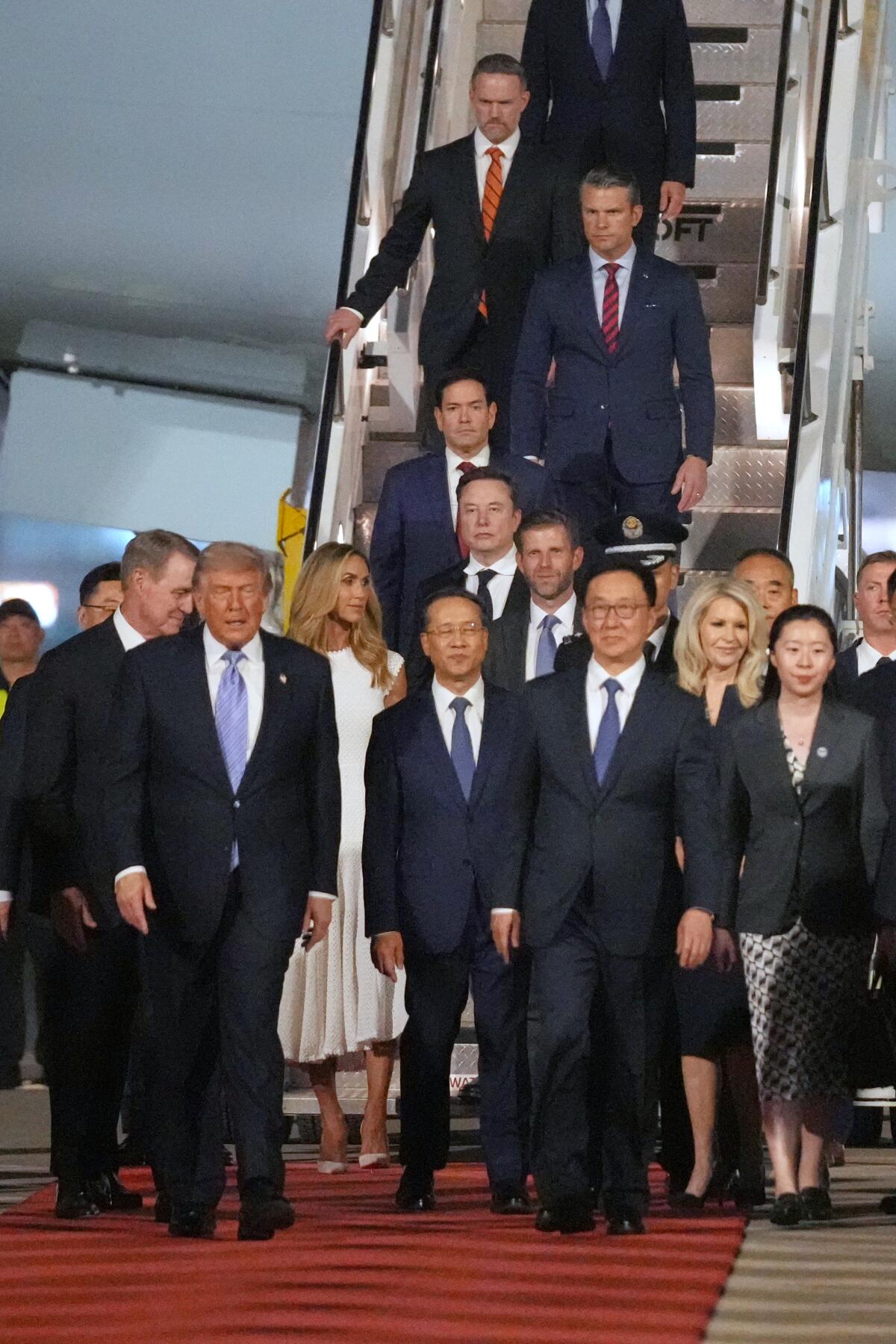
The president was greeted by Chinese Vice President Han Zheng; Xie Feng, China’s ambassador to Washington; Ma Zhaoxu, executive vice minister of foreign affairs; and the U.S. envoy to Beijing, David Perdue.

The welcoming ceremony included a military honor guard, a military band and some 300 Chinese youths waving Chinese and American flags and chanting, “Welcome, welcome! Warm welcome!” as Trump made his way to his waiting limousine. The youth greeters were decked out in white and robin’s egg blue outfits that matched the paint job of the iconic presidential plane.

President Trump walks with China's Vice President Han Zheng during an arrival ceremony

President Trump walks with China’s Vice President Han Zheng during an arrival ceremony Wednesday at Beijing Capital International Airport, as Eric and Lara Trump, Elon Musk, Secretary of State Marco Rubio, Defense Secretary Pete Hegseth and U.S. Trade Representative Jamieson Greer follow.

(Mark Schiefelbein / Associated Press)

“We’re the two superpowers,” Trump told reporters as he departed the White House on Tuesday for the long flight to Beijing. “We’re the strongest nation on Earth in terms of military. China’s considered second.”

While Trump likes to project a sense of strength, the visit occurs at a delicate moment for his presidency as his popularity at home has been weighed down by the U.S. and Israel’s war with Iran and rising inflation as a consequence of that conflict. The Republican president is seeking a win by signing deals with China to buy more American soybeans, beef and aircraft, saying he’ll be talking with Xi about trade “more than anything else.”

The Trump administration hopes to begin establishing a Board of Trade with China to address differences between the countries. The board could help prevent the trade war ignited last year after Trump’s tariff hikes, an action China countered through its control of rare earth minerals. That led to a one-year truce last October.

But Trump is visiting Beijing when Iran continues to dominate his domestic agenda. The war has led to the effective closure of the Strait of Hormuz, stranding oil and natural gas tankers and causing energy prices to spike to levels that could sabotage global economic growth. The U.S. president declared that Xi didn’t need to assist in resolving the conflict, even though Iran’s Foreign Minister Abbas Araghchi was in Beijing last week.

Fellow rescuers carry the coffins of two members of the civil defense who were reportedly killed in Israeli airstrikes

Fellow rescuers carry the coffins of two members of the civil defense who were reportedly killed in Israeli airstrikes in Nabatieh the previous day, during their funeral in the southern city of Sidon on May 13, 2026. Israel hammered south Lebanon with strikes on May 12 ahead of talks between the two countries in Washington, as Beirut reported 380 people killed in Israeli attacks since an April 17 ceasefire took effect.

(Mahmoud Zayyat/AFP via Getty Images)

“We have a lot of things to discuss. I wouldn’t say Iran is one of them, to be honest with you, because we have Iran very much under control,” Trump told reporters Tuesday.

Taiwan high on the agenda

The status of Taiwan also will be a major topic as China is displeased with U.S. plans to sell weapons to the self-governing island, which the Chinese government claims as part of its own territory.

Trump told reporters on Monday that he would be discussing with Xi an $11 billion weapons package for Taiwan that the U.S. administration authorized in December but has not yet begun fulfilling. The arms package is the largest ever approved for Taiwan.

But Trump has demonstrated greater ambivalence toward Taiwan, an approach that’s raising questions about whether the U.S. leader could be open to dialing back support for the island democracy.

The Taiwanese flag at Democracy Boulevard is lowered at the Chiang Kai-shek Memorial Hall

The Taiwanese flag at Democracy Boulevard is lowered at the end of the day as the Chiang Kai-shek Memorial Hall is seen in the background in Taipei on May 13, 2026.

(I-Hwa Cheng/AFP via Getty Images)

At the same time, Taiwan — as the world’s leading chipmaker — has become essential for the development of artificial intelligence, with the U.S. importing more goods so far this year from Taiwan than China. Trump has sought to use Biden-era programs and his own deals to bring more chipmaking to America.

The Chinese Communist Party’s news outlet, People’s Daily, published a strongly worded editorial ahead of Trump’s arrival underscoring that Taiwan is “the first red line that cannot be crossed in China-U.S. relations” and is “the biggest point of risk” between the two nations.

Trump was already portraying the trip as a success before he even left White House grounds. He openly mused about Xi’s planned reciprocal visit to the U.S. later this year, lamenting that the White House ballroom under construction would not be completed in time to properly fete the Chinese leader.

“We’re going to have a great relationship for many, many decades to come,” Trump said of the U.S. and China.

Counter snipers and other security forces watch over Air Force One while refueling at Joint Base Elmendorf

Counter snipers and other security forces watch over Air Force One while refueling at Joint Base Elmendorf during a trip with US President Donald J. Trump in Anchorage, Alaska, on May 12, 2026. Donald Trump was due in Beijing on May 13, 2026 on the first visit to China by a US president in nearly a decade, as he seeks to ramp up trade despite potential friction over Taiwan and Iran.

(Brendan Smialowski/AFP via Getty Images)

Trump embarked on Air Force One for the big meeting with a coterie of aides, family members and business world titans, including Nvidia’s Jensen Huang and Tesla and SpaceX’s Elon Musk. While en route to Beijing, he posted on social media that his “first request” to Xi during the visit will be to ask the Chinese leader to bolster the presence of U.S. firms in China.

“I will be asking President Xi, a Leader of extraordinary distinction, to ‘open up’ China so that these brilliant people can work their magic, and help bring the People’s Republic to an even higher level!” Trump wrote.

Tajikistan's President Emomali Rahmon and China's President Xi Jinping attend a welcoming ceremony

Tajikistan’s President Emomali Rahmon and China’s President Xi Jinping attend a welcoming ceremony at the Great Hall of the People on Tuesday, in Beijing.

(Maxim Shemetov—Pool / Getty Images)

Despite Trump’s outward confidence, China appears to be entering the meeting from “a much stronger place,” said Scott Kennedy, a senior adviser on Chinese business and economics at the Center for Strategic and International Studies, a Washington think tank.

China would like to reduce tech restrictions on accessing computer chips and find ways to reduce tariffs, among other goals.

“But even if they don’t get much on any of those things, as long as there’s not a blow-up in the meeting and President Trump doesn’t go away and look to re-escalate, China basically comes out stronger,” Kennedy said.

U.S. Treasury Secretary Scott Bessent and Chinese Vice Premier He Lifeng met on Wednesday to discuss economic and trade issues at Incheon International Airport, just west of the South Korean capital of Seoul, according to the Chinese state run Xinhua News Agency.

Bystanders are kept back by police tape as they film the motorcade of President Donald Trump as he arrives

Bystanders are kept back by police tape as they film the motorcade of President Donald Trump as he arrives at the Four Seasons Hotel on Wednesday in Beijing.

(Kevin Frayer / Getty Images)

Trump wants 3-way nuclear arms deal

Trump also intends to raise the idea of the U.S., China and Russia signing a pact that would set limits on the nuclear weapons each nation keeps in its arsenal, according to a senior Trump administration official who briefed reporters ahead of the trip. The official spoke on the condition of anonymity under ground rules set by the White House.

China has previously been cool to entering such a pact. Beijing’s arsenal, according to Pentagon estimates, exceeds more than 600 operational nuclear warheads and is far from parity with the U.S. and Russia, which each are estimated to have more than 5,000 nuclear warheads.

The last nuclear arms pact, known as the New START treaty, between Russia and the United States expired in February, removing any caps on the two largest atomic arsenals for the first time in more than a half-century. As the treaty was set to expire, Trump rejected a call by Russia to extend the two-country deal for another year and called for “a new, improved, and modernized” deal that includes China.

The Pentagon estimates China will have more than 1,000 operational nuclear warheads by 2030.

Madhani, Weissert and Boak write for the Associated Press. Boak reported from Washington. AP writers Darlene Superville in Washington, Huizhong Wu in Bangkok, Hyung-jin Kim in Seoul, South Korea, and Kanis Leung in Hong Kong contributed to this report.

Source link

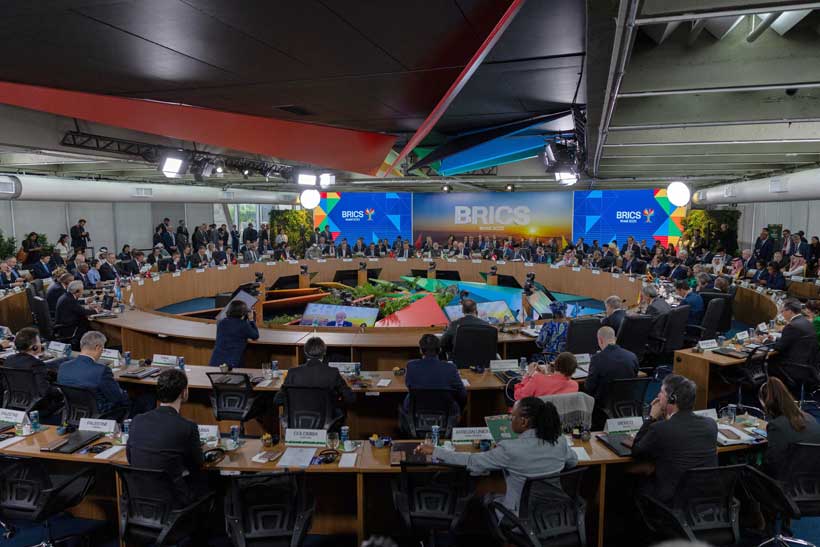
Iran Conflict Tests BRICS Unity at Delhi Foreign Ministers Meeting

The ongoing Iran conflict is expected to dominate discussions at the BRICS foreign ministers meeting in New Delhi, placing pressure on the expanded bloc to find common ground on one of the world’s most divisive geopolitical crises.

The two day meeting brings together foreign ministers and representatives from BRICS member states, including Brazil, Russia, India, China, South Africa, Iran, Egypt, Ethiopia, Indonesia, and the United Arab Emirates.

India, which holds the BRICS chairmanship for 2026, faces the difficult task of balancing competing interests within the group while attempting to secure a joint statement.

Iran Pushes for Stronger BRICS Position

Iran has urged BRICS members to condemn the actions of the United States and Israel in the Gulf conflict through a unified statement.

Iranian Foreign Minister Abbas Araqchi is expected to participate in the meeting as Tehran seeks diplomatic support from emerging economies and Global South nations.

The conflict has become a major test of BRICS cohesion because member states hold differing positions on the war and regional security issues.

Divisions Emerge Within the Bloc

The sharpest disagreements are reportedly between Iran and the United Arab Emirates, which are aligned on opposing sides of the regional conflict.

Tensions have increased following reports of military strikes involving Gulf states and Iran, complicating efforts to draft a consensus statement acceptable to all members.

Indian officials previously acknowledged the difficulty of forging unity within BRICS because some member states are directly involved in the conflict.

Despite the divisions, India remains hopeful that ministers can still agree on a joint declaration after negotiations during the meeting.

Russia and China Maintain Key Roles

Russian Foreign Minister Sergey Lavrov is expected to attend the gathering, reinforcing Moscow’s active role within BRICS diplomacy.

China, however, will not send Foreign Minister Wang Yi because of scheduling conflicts linked to U.S. President Donald Trump visiting Beijing this week.

Instead, China will be represented by Ambassador Xu Feihong.

Beijing has largely maintained a neutral public position on the Iran conflict while preserving close ties with both Iran and Gulf Arab states.

Energy Prices Add Economic Pressure

The war’s impact on global energy markets has become a major concern for BRICS economies, many of which are heavily dependent on imported oil and vulnerable to rising inflation.

Several BRICS nations, including India, have introduced emergency economic measures to shield consumers and industries from soaring fuel costs caused by the conflict.

The economic fallout is likely to strengthen calls within BRICS for diplomatic solutions and greater coordination among emerging economies.

India Attempts Diplomatic Balancing

India is seeking to use the BRICS platform to strengthen its leadership role among developing nations while avoiding direct alignment with any side in the conflict.

Analysts say New Delhi’s challenge lies in preserving BRICS unity despite deep geopolitical differences among member states.

Former Indian diplomat Manjeev Singh Puri described the participation of nearly all BRICS foreign ministers as a positive sign for dialogue and coalition building among emerging economies.

Analysis

The BRICS meeting in New Delhi highlights the growing difficulty of maintaining unity within an expanded bloc that now includes countries with competing regional interests and conflicting geopolitical priorities.

The Iran conflict has exposed the limits of BRICS as a coordinated political platform. While the group shares common interests in promoting a multipolar world order and strengthening the Global South, its members remain divided on security issues and regional conflicts.

India’s role as chair becomes especially sensitive because it must balance relations with Iran, Gulf Arab states, Russia, China, and Western powers simultaneously.

The absence of a strong unified Chinese diplomatic presence may also reduce the likelihood of a major breakthrough or coordinated BRICS response.

At the same time, the meeting demonstrates that BRICS is evolving beyond an economic grouping into a broader geopolitical forum where emerging powers increasingly debate global security and diplomatic issues.

Whether the bloc can produce a joint statement on the Iran war may become an important indicator of its future credibility and effectiveness as an alternative voice in global governance.

With information from Reuters.

Source link

In war with Iran, China sees a familiar pattern of U.S. mistakes

The Trump administration has repeatedly framed the war in Iran as a quick, winnable fight, vowing to defeat the Islamic Republic “totally and decisively” — incomparable to the “dumb” wars in Iraq and Afghanistan.

But from China’s perspective, the parallels are clear.

“You can blow everything up — destroy it all,” one Chinese official told The Times, describing the Americans, “but you don’t have a strategy.”

President Trump arrives in Beijing this week for talks with a Chinese government that is confident as ever in its ascendance on the world stage, taking stock of its leverage and still baffled the U.S. administration chose yet another costly war in the Middle East.

China has watched as the United States, over seven weeks of fighting an outmatched enemy, has depleted nearly half of its stockpiles of high-end munitions — including its THAAD and Patriot batteries — and fired its Army chief of staff, among other Pentagon leaders, who had warned of critical shortages.

Marco Rubio, Trump’s national security advisor and secretary of State, has said the military operation that started the war known as Operation Epic Fury “is over.”

But the Strait of Hormuz, one of the world’s most vital commercial waterways, remains effectively shuttered. Iranian attacks in the region continue. And talks between Washington and Tehran have failed to reach a diplomatic agreement to bring a definitive end to the conflict.

“The Chinese have high regard for the operational proficiency of U.S. forces, but they recognize that, thus far at least, the Trump administration has not achieved its core objectives in going to war with Iran,” said David Ochmanek, a former deputy assistant secretary of Defense now with the Rand Corp.

The war has given Beijing an opportunity, Ochmanek said, “to double down on the claim they have made for the past year and a half that the [People’s Republic of China], not the U.S., is a force for global stability.”

The war has allowed China to demonstrate some diplomatic prowess. An initial ceasefire reached between the United States and Iran last month was only clinched after Beijing pressured Tehran to agree. And China’s advocacy for an open strait — rejecting Iranian attempts to impose a toll system — while opposing the U.S. war itself has allowed Beijing to maintain leverage with both sides.

It has also inflicted costs. Allies of Beijing noticed when the government did not leap to the defense of Tehran at the start of the war. And China has its own vested interest in a free and open waterway, where nearly 50% of the country’s crude oil imports pass through each day.

Building up to the start of the war and throughout its initial weeks, Washington diverted significant military assets from Asia — where Trump’s own national security strategy says they are needed most — to the Middle East.

The USS Abraham Lincoln was redirected from the South China Sea, along with scores of advanced missile interceptors from South Korea and Japan and nearly the entire U.S. inventory of long-range air-to-surface missiles in the Pacific.

Policy experts at the Pentagon were brought in to discuss a potential invasion of Kharg Island, the jewel of Iran’s oil industry, to draw lessons from planning a defense of Taiwan, according to a Defense official, who was granted anonymity to speak candidly. A Marine expeditionary unit was sent from Okinawa to the region for the potential operation.

Chinese officials and analysts have been candid in their assessments of U.S. hard power, impressed by a military they acknowledge remains the best in the world.

But Beijing sees a persistent flaw in U.S. strategy: the belief that military strength alone can reshape political realities, a view further weakened by the pressures on a democratic government whose public grows impatient with wars that drag on beyond days or weeks.

China’s autocracy is free from accountability to the public — and anyway has confidence that Chinese public opinion would be on its side if it were to launch a major military operation against its main target, Taiwan.

But there are lessons of caution to be learned from the Americans, as well.

Over the last year, the Taiwanese Navy has been practicing the rapid deployment of cheap and domestically produced smart mines for the sea — a potential bulwark against enemy blockades of ports and hostile invasion forces.

It is the type of asymmetric warfare that has so far frustrated the U.S. military in the Strait of Hormuz, protracting a war that Trump vowed would last a month or less.

Taiwan, too, would confront Beijing with political realities that military force cannot erase. Nearly 90% of the Taiwanese people oppose a Chinese takeover, and about 60% say they would resist it at all costs.

“Chinese analysts see two things at once,” said Craig Singleton, senior director of the China program at the Foundation for Defense of Democracies. “They are impressed by U.S. military reach, precision and operational capability, but they also see a familiar pattern of American power struggling to translate battlefield success into a durable political outcome.”

That matters for Taiwan, Singleton said, “because China’s own military modernization has borrowed heavily from the American model, relying heavily on joint operations, high-tech precision strikes, decapitation concepts and information dominance.

“If the world’s most experienced military can still struggle to convert military pressure into political success,” he added, “Beijing has to ask whether the [People’s Liberation Army] could do better in a far more complex Taiwan scenario.”

Source link

Trump-Xi talks in Beijing: What’s at stake

President Trump’s first visit to China in nine years is a high-stakes trip reflecting the rivalry and mutual dependence of two superpowers hoping to avoid a collision course — even if Trump cast it more as a meeting between close friends and business partners.

Speaking to reporters before departing Washington on Tuesday, Trump downplayed tensions between the two countries, including on trade, calling Chinese President Xi Jinping a “wonderful guy” and a friend and saying the working relationship between the two countries is “very good.”

Trump acknowledged China’s might — saying that the Asian nation and the United States are clearly the world’s two superpowers — and that the focus of the meeting “more than anything else will be trade.”

“We’re gonna have a great relationship for many, many decades to come,” Trump said. “My relationship with President Xi is a fantastic one. We’ve always gotten along, and we’re doing very well with China, and working with China’s been very good — so we look forward to it.”

Trump also downplayed the importance of the meeting for the war in Iran. He said Xi might be able to help the United States reach a deal to end the war, but that he doesn’t need it, “because we have Iran very much under control.”

The state visit marks the first by an American president to China since Trump’s trip here in 2017, only months into his first term. President Biden never came, becoming the first to not do so since diplomatic ties were normalized, an absence that underscored simmering distrust and animosity between Washington and Beijing that has only worsened since.

  • Share via

In the capital, security forces sealed off an area around the Temple of Heaven roughly the size of 400 football fields ahead of the U.S. president’s visit, anticipating a stop at the monument to imperial China and Confucian thought.

On his previous trip, Trump received the rare honor of a state banquet inside the Forbidden City. This time he is expected to dine at the Great Hall of the People, an imposing structure off Tiananmen Square that hosts high-level gatherings of the Chinese Communist Party.

Trump’s positive spin on Tuesday aside, his agenda for meetings beginning Thursday with Xi highlights the vast array of American interests that depend on — and often clash with — Beijing’s policies.

After launching a trade war against China at the beginning of his second term, Trump now comes hat in hand requesting an extension of a tariff truce, fearful Xi might follow through on his threats to halt the export of rare earth minerals to the United States that are vital to the manufacturing of American goods, including everyday consumer equipment and advanced defense technologies.

His visit comes as a ceasefire in the war with Iran, brokered with help from Beijing, is on “massive life support,” according to the president. Trump is expected to appeal to Xi for assistance in getting Tehran to restore free and open passage through the Strait of Hormuz.

And in a dramatic reversal, the Trump administration has begun discussions with the Chinese about establishing a channel of communication on artificial intelligence, alarmed that recent technological leaps could pose global risks.

All of these requests are expected to come at a cost.

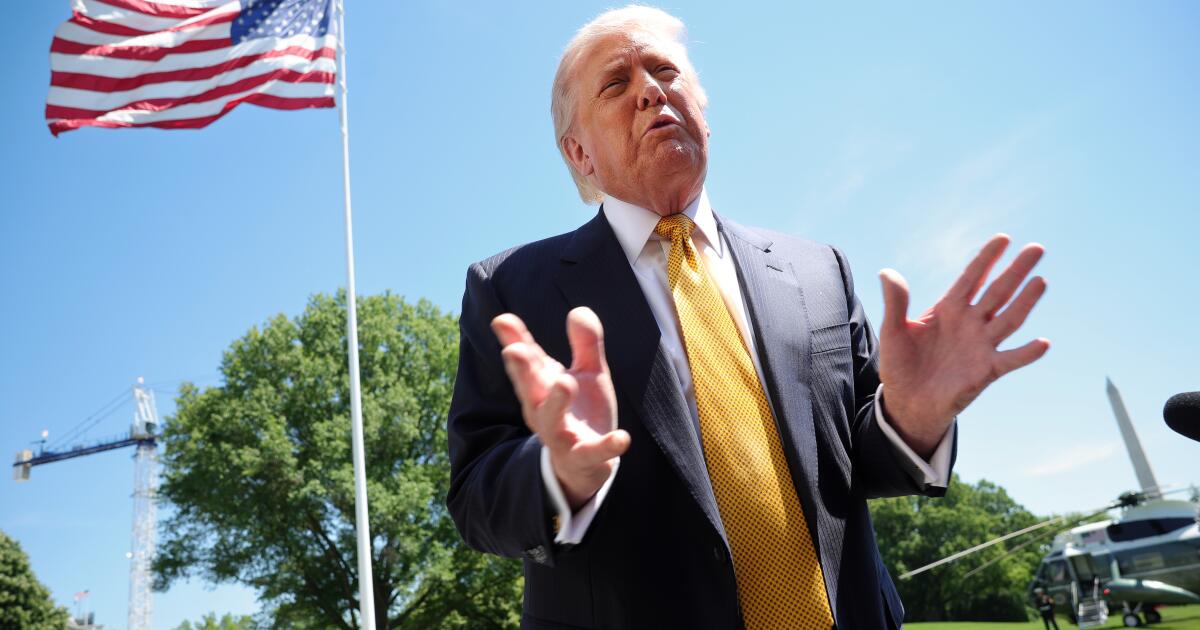
A man in a dark suit and wind-blown gold-colored tie

President Trump departs the White House on May 12, 2026, for his second state visit to China.

(Kevin Dietsch / Getty Images)

In earlier remarks before the trip, Trump said he expected U.S. arms sale to Taiwan — including one already approved by Congress — to become a chip in the negotiations.

“I’m going to have that discussion with President Xi,” Trump said. “President Xi would like us not to, and I’ll have that discussion. That’s one of the many things I’ll be talking about.”

The notion that U.S. support for Taiwan is a negotiable matter is sure to rattle America’s allies throughout the region, from Japan to the Philippines, which are reliant on U.S. security guarantees amid China’s Indo-Pacific military aggression.

Despite geopolitical tensions, both sides are expected to announce business and investment agreements, underscoring how deeply intertwined the world’s two largest economies remain.

China plans on making a significant purchase of Boeing aircraft, and the president has brought 17 American corporate leaders with him on the trip to discuss additional opportunities, including Apple’s Tim Cook, BlackRock’s Larry Fink, Meta’s Dina Powell McCormick and Tesla’s Elon Musk.

The two leaders are expected to have other opportunities to talk in person throughout the coming year, including potential meetings at the Group of 20 summit in Florida, the APEC summit in Shenzhen, China, and a state visit in Washington that Trump said he will host for Xi at some point in the coming months.

Trump on Tuesday said Xi’s visit will be “toward the end of the year” and “exciting.” He also lamented that the ballroom he is building on the White House grounds — on the site of the historic East Wing he demolished — won’t be ready in time.

Jennifer Hong, senior director at the Institute for Indo-Pacific Security, said her concern is that the state visit becomes part of a “tyranny of calendaring,” where the Chinese agree to schedule more high-level meetings sought by Trump that put off vital U.S. decision-making.

“I do think this trip is necessary for the U.S. government — I think that there are things that are on hold because he doesn’t want to rock the boat,” Hong said, noting the Trump administration’s delay in arms sales to Taiwan, despite the packages already having received congressional approval.

“I’m just worried this will be a stringing along of promises, or maybe some reprieve for a year or so,” she added, “as we continue to handicap ourselves on national security matters for the sake of more meetings.”

Trump on Tuesday repeatedly dismissed China’s potential help in resolving the war in Iran, which has driven up prices domestically and around the world as oil shipments through the strategic Strait of Hormuz have been badly disrupted and U.S. efforts to fully reopen the channel have so far been unsuccessful.

“I don’t think we need any help with Iran, to be honest with you,” Trump said. “They’re defeated militarily.”

Trump also said the financial pain many Americans are feeling from the war, including at the gas pump, simply isn’t a factor — “not even a little bit,” he said — in his ongoing negotiations with Iran.

“The only thing that matters when I’m talking about Iran [is that] they can’t have a nuclear weapon,” he said. “I don’t think about Americans’ financial situation. I don’t think about anybody.”

Source link

Trump backs Pakistan as Iran mediator after criticism from Lindsey Graham | US-Israel war on Iran News

US president lauds Islamabad, but his Republican ally says he does not trust Pakistan to facilitate Iran diplomacy.

Donald Trump has reasserted his support for Pakistan to serve as a mediator between Iran and the United States after Senator Lindsey Graham, a close ally of the US president, disparaged Islamabad’s diplomacy.

In remarks on Tuesday, the US president lauded Pakistan’s Prime Minister Shehbaz Sharif and its army chief Asim Munir, who helped negotiate a fragile ceasefire in Iran that came into effect last month.

Recommended Stories

list of 3 itemsend of list

Trump added he is not reconsidering Pakistan as a mediator.

“They’re great. I think the Pakistanis have been great. The field marshal and the prime minister of Pakistan have been absolutely great,” Trump told reporters.

Hours earlier, Graham had pressed Pentagon chief Pete Hegseth and top US general Dan Caine about a CBS News report claiming that Pakistan is allowing Iran to park military assets on its airfields, in order to shield them from potential US and Israeli attacks.

Both officials declined to comment on the veracity of the report, citing the sensitive nature of the talks between the US and Iran.

Asked by Graham whether it would be “consistent” for Pakistan to act as a fair mediator if the CBS report is confirmed, Hegseth said, “I wouldn’t want to get into the middle of these negotiations.”

The Republican senator quickly interrupted the defence secretary.

“I do. I want to get in the middle of those negotiations,” Graham said.

“I don’t trust Pakistan as far as I can throw them. If they actually have Iranian aircraft parked in Pakistan bases to protect Iranian military assets, that tells me maybe we should be looking for somebody else to mediate. No wonder this damn thing is going nowhere.”

The senator — an outspoken foreign policy hawk who has been calling for regime change in Iran — is seen as one of the most influential figures in Trump’s circle.

Graham has also been one of the most vocal supporters of the war with Iran, repeatedly cautioning Trump against agreeing to a deal that would include concessions to Tehran.

Weeks before the war broke out on February 28, Graham met the US president in Florida, where he handed Trump a hat that says, “Make Iran Great Again.”

Pakistan has been pushing to revive the stalled diplomacy between Iran and the US, following the April 8 ceasefire agreement.

On Sunday, Trump said Tehran’s latest proposal to end the war was “unacceptable”.

In late April, the US president announced he was sending his envoys to Pakistan to meet Iranian officials, but he called off the trip after Iran pushed the US to lift the naval blockade against its ports as a condition for resuming the talks.

Source link

Trump’s proposed ‘Golden Dome’ estimated to cost $1.2 trillion, far more than he initially said

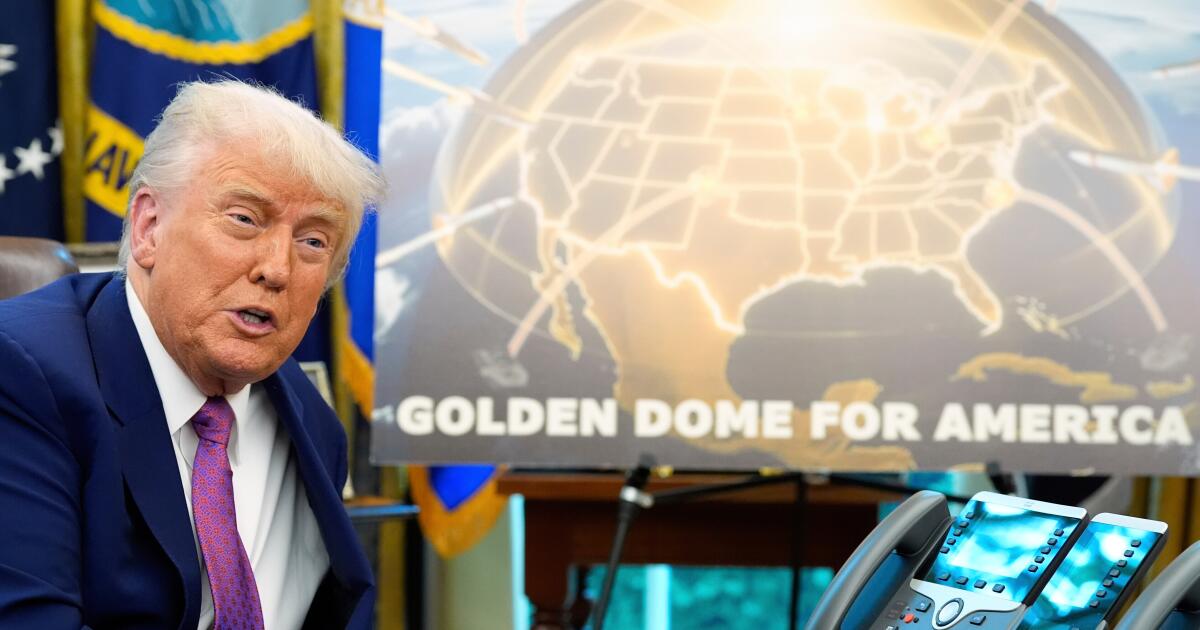
President Trump’s plan to put weapons in space — pitched as a “Golden Dome for America” missile defense program — is estimated to cost $1.2 trillion over a 20 year period, according to a new analysis from the Congressional Budget Office, a far heftier sum than the initial $175 billion price tag he gave last year.

The nonpartisan CBO report, published Tuesday, is described as an analysis that reflects “one illustrative approach rather than an estimate of a specific Administration proposal.”

The futuristic system was ordered by Trump in an executive order during his first week in office. He said then that he expected the system to be “fully operational before the end of my term,” which wraps up in January 2029.

“Over the past 40 years, rather than lessening, the threat from next-generation strategic weapons has become more intense and complex with the development by peer and near-peer adversaries of next-generation delivery systems,” Trump said in his executive order, justifying the need for the missile defense system.

The CBO’s estimates are in part based on a lack of details from the Defense Department about what and how many systems will be deployed, “making it impossible to estimate the long term cost” of the Golden Dome system, the report says.

The concept for the missile system is at least partly inspired by Israel’s multitiered defenses, often collectively referred to as the “Iron Dome,” which played a key role in defending it from rocket and missile fire from Iran and allied militant groups as it prosecutes the war on Iran alongside the U.S.

The U.S. Golden Dome is envisioned to include ground and space-based capabilities able to detect, intercept and stop missiles at all major stages of a potential attack.

Congress has already approved roughly $24 billion for the missile defense initiative through Republicans’ massive tax and spending measure signed into law last summer.

Sen. Jeff Merkley, D-OR, who requested the estimate from the CBO, said in response to the report that the missile defense project is “nothing more than a massive giveaway to defense contractors paid for entirely by working Americans.”

Last May, the president said the Golden Dome would cost $175 billion. The CBO last year estimated that just the space-based components of the Golden Dome could cost as much as $542 billion over the next 20 years.

Hussein writes for the Associated Press.

Source link

Control of the Strait of Hormuz May Define the Next Phase of the Iran Conflict

The Strait of Hormuz has become the central strategic battleground in the ongoing confrontation involving Iran, the United States, and regional Gulf powers. What initially appeared to be a military conflict is increasingly evolving into a struggle over maritime control, energy security, and geopolitical influence.

Since the outbreak of hostilities following the joint United States and Israeli strikes on Iran in February, Tehran’s near closure of the Strait of Hormuz and Washington’s retaliatory naval blockade have severely disrupted global energy markets. The conflict has reduced the movement of oil and liquefied natural gas through one of the world’s most critical maritime chokepoints, creating economic instability far beyond the Middle East.

Recent tanker movements coordinated through informal understandings with Tehran suggest that Iran may now be shifting from blocking Hormuz entirely to selectively controlling access. This emerging dynamic could fundamentally reshape Gulf security and international energy politics.

Hormuz Is No Longer Just a Trade Route

The Strait of Hormuz is one of the most strategically important waterways in the global economy. Before the conflict, roughly one fifth of global oil and liquefied natural gas shipments passed through the narrow corridor each day.

Its disruption has exposed the vulnerability of global energy markets to geopolitical conflict. Asian economies have been particularly affected because of their heavy dependence on Gulf energy exports. Oil supply disruptions and rising transportation risks have intensified inflationary pressure, energy insecurity, and market volatility across multiple regions.

The recent passage of a limited number of oil and gas tankers with apparent Iranian approval demonstrates that Tehran may now be exercising selective authority over maritime transit rather than enforcing a complete blockade.

This distinction is critical because it suggests Iran is attempting to transform military leverage into long term political and economic influence.

Iran’s Emerging Strategy of Selective Access

The limited reopening of shipping lanes indicates that Tehran may be developing a new model of strategic control. Rather than permanently shutting down the strait, Iran appears to be determining which countries, companies, or shipments can safely transit through the waterway.

This selective access system gives Tehran several advantages.

First, it allows Iran to maintain pressure on global energy markets without fully halting trade flows that could trigger overwhelming international military intervention.

Second, it creates potential economic benefits through informal transit arrangements, leverage over energy dependent states, and indirect influence on oil pricing.

Third, it positions Iran as a gatekeeper within one of the world’s most important strategic corridors, expanding its geopolitical relevance despite sanctions and military pressure.

The reported coordination involving Pakistan and Qatar also demonstrates how regional diplomacy is becoming intertwined with energy security and conflict management.

Gulf States and the United States Face Strategic Risks

For Gulf Arab states such as Saudi Arabia, United Arab Emirates, and Qatar, any arrangement that allows Iran to regulate maritime access poses a direct strategic threat.

Their economies depend heavily on uninterrupted hydrocarbon exports, and Iranian control over transit patterns would increase Tehran’s regional influence at their expense.

Asian importers are equally vulnerable because selective access introduces political uncertainty into global energy supply chains. Countries dependent on Gulf oil and gas would become increasingly exposed to Iranian political calculations.

For the United States, accepting Iranian dominance over Hormuz would undermine Washington’s broader strategic objectives in the region. The Trump administration has repeatedly emphasized restoring unrestricted freedom of navigation as a core war aim.

Allowing Iran to effectively manage maritime access would signal a major geopolitical shift and weaken perceptions of American regional dominance.

Why the Current Situation May Become More Dangerous

The most concerning aspect of the emerging situation is that temporary wartime arrangements could solidify into a long term strategic reality. Even if a ceasefire is eventually reached, Iran may resist fully restoring unrestricted navigation because Hormuz now represents its strongest source of leverage against the United States and regional rivals.

This creates the conditions for a prolonged state of instability rather than genuine conflict resolution.

A system based on selective transit rights would likely produce repeated confrontations as regional powers, Western navies, shipping companies, and energy importers challenge or negotiate the limits of Iranian control.

Such a situation would institutionalize uncertainty in global energy markets and increase the likelihood of future military escalation.

Analysis

The battle over the Strait of Hormuz reflects a broader transformation in modern geopolitical conflict where control over trade routes and economic chokepoints can become more strategically valuable than territorial conquest.

Iran appears to recognize that its greatest strength lies not in conventional military superiority but in its ability to disrupt the global economy through maritime leverage. By controlling the flow of energy through Hormuz, Tehran can influence oil prices, inflation, international diplomacy, and political stability in rival states.

This gives Iran asymmetric power against economically stronger adversaries.

The United States faces a difficult strategic dilemma. Military escalation aimed at fully reopening Hormuz could deepen regional conflict and further destabilize global markets. However, tolerating selective Iranian control risks weakening American credibility and altering the regional balance of power in Tehran’s favor.

The current situation also exposes the limits of military power in resolving structural geopolitical disputes. Even if active fighting declines, the underlying contest over maritime control, energy security, and regional influence will likely persist.

Ultimately, the future of the Gulf may increasingly depend not on battlefield victories, but on who shapes the rules governing the movement of energy through the Strait of Hormuz. If selective Iranian control becomes normalized, the region could enter a prolonged era of economic coercion, strategic competition, and recurring confrontation.

With information from Reuters.

Source link

Hegseth faces bipartisan grilling about weapons drawdown during the Iran war

Defense Secretary Pete Hegseth faced tough questions Tuesday from Republican and Democratic lawmakers about the Trump administration’s end game for the Iran war, the cost of the conflict and its impact on diminishing U.S. weapons stockpiles.

For his part, the Pentagon chief softened his tone from hearings before Congress nearly two weeks ago, notably avoiding the same pointed criticism of lawmakers in his opening remarks as he outlined the Trump administration’s efforts to ramp up production of weapons and other military capabilities.

Even so, Hegseth insisted that the military has plenty of missile defense systems and other munitions for the Iran war or future conflicts as both Republicans and Democrats hammered him with those concerns.

“I take issue with the characterization that munitions are depleted in a public forum,” Hegseth said. “That’s not true.”

The cost of the Iran war has risen to about $29 billion, the vast bulk of which — $24 billion — is related to replacing and repairing munitions but also includes operational costs to keep forces deployed, Pentagon comptroller Jay Hurst said. That’s up from $25 billion that he told lawmakers nearly two weeks ago.

The powerful House and Senate Appropriations subcommittees that oversee defense spending are holding back-to-back hearings to review the Trump administration’s 2027 military budget proposal, which calls for a historic allocation of $1.5 trillion. The discussions in the House quickly veered into the handling of a war that appears locked in a stalemate as higher fuel prices pose political problems for Republicans in the midterm congressional elections.

Hegseth and Caine face bipartisan pushback on munitions stockpiles

Rep. Rosa DeLauro, the ranking Democrat on the House Appropriations Committee, told Hegseth that the “question must be answered at the end of this crisis: What have we accomplished and at what cost?”

“This administration has not presented Congress with any kind of clear or coherent strategy week to week, day to day, hour to hour,” DeLauro said. “The rationale shifts, the objectives change. The end game is ill-defined when it is defined at all.”

California Republican Rep. Ken Calvert, the House subcommittee’s chair, also asked about the impact of the Iran war on military funding as well as the U.S. military’s weapons stockpiles.

“Questions persist about whether we are building the depth and reliance required for a high-end conflict,” Calvert said.

Minnesota Rep. Betty McCollum, the defense subcommittee’s ranking Democrat, pressed Hegseth on whether the military has a plan to draw down troops in the Middle East if Congress passes so-far-unsuccessful efforts to end the Iran war.

“We have a plan to escalate if necessary,” Hegseth said. “We have a plan to retrograde if necessary. We have a plan to shift assets.”

He said he would not reveal any next steps publicly. Noting repeated questions from lawmakers over the military’s weapons stockpiles, drawn down from the Iran war, Hegseth said the concerns have been “unhelpfully overstated” and that “we have plenty of what we need.”

He said the defense industry has been told to “build more and build faster,” blaming the military industrial base’s inadequate capacity on previous administrations and U.S. aid to Ukraine in its war with Russia.

Trump administration faces pressure from impact of the Iran war

President Trump is facing increasing pressure from the economic shocks of Iran effectively closing the Strait of Hormuz, a vital shipping corridor where 20% of the world’s oil normally flows. The U.S. military in turn has blockaded Iranian ports and the two sides have traded fire, with American forces thwarting attacks on their warships and disabling Tehran-linked oil tankers.

Trump said Monday that the ceasefire is on “massive life support” and criticized Iran for its latest proposal, pointing to his demands that Iran significantly limit its nuclear program.

“I would call it the weakest right now after reading that piece of garbage they sent us,” Trump said.

The Republican president also said he wanted to suspend the federal gas tax to help Americans shoulder surging fuel prices. He has previously said higher costs are worth it to prevent Iran from getting a nuclear weapon.

Tuesday’s hearings are giving a mostly new group of lawmakers the chance to grill or applaud Hegseth and Gen. Dan Caine, chair of the Joint Chiefs of Staff, on the planning and execution of the war.

The Senate hearing later Tuesday will include Sen. Susan Collins of Maine, a Republican whose reelection this year is far from guaranteed. She voted with Democrats on an effort to halt the conflict late last month, saying she wants to see a defined strategy for bringing the war to a close.

Alaska Sen. Lisa Murkowski, another Republican on the Senate Appropriations defense subcommittee, has voted against the string of unsuccessful war powers resolutions but spoken of the need for congressional authorization so Americans will know the war’s limits and objectives.

He also will face plenty of friendly Republicans, including the Senate subcommittee’s chair, Sen. Mitch McConnell of Kentucky, and perhaps the Iran war’s biggest booster in Congress, Sen. Lindsey Graham of South Carolina.

Finley, Toropin and Barrow write for the Associated Press. Barrow reported from Atlanta.

Source link

Africa’s richest man plans new Mombasa oil refinery: Why this matters | Business and Economy News

After successfully launching Nigeria’s only operational oil refinery in 2024, billionaire businessman Aliko Dangote has set his sights on East Africa as the next location for another mega refinery project, according to recent reports.

It comes as African countries are actively seeking ways to make energy more secure, following huge global disruptions amid the US and Israel’s war on Iran and Tehran’s subsequent closure of the Strait of Hormuz, through which about 20 percent of the world’s oil and natural gas is shipped.

Recommended Stories

list of 3 itemsend of list

Dangote, Africa’s richest man, appeared to be one of the winners from this fallout when his newly operational refinery, located in Nigeria’s commercial Lagos State, began selling large volumes of crude oil across the continent as the war on Iran escalated in March and global oil prices soared.

At present, West, South and East Africa rely primarily on importing refined petroleum products from the Middle East, meaning they are highly vulnerable to disruptions there.

Neighbours of Nigeria – Cameroon, Togo, Ghana and even Tanzania, further to the east – are among the countries that have turned to Nigeria as supplies from the Middle East dry up.

By the end of March, the refinery, which has the capacity to produce 650,000 barrels per day (bpd), reported it was also receiving orders from beyond the continent, especially for severely scarce jet fuel as hundreds of flights were cancelled across regions.

Supply from Dangote’s refinery has cushioned the impact of the war in terms of fuel supply for Nigeria and neighbouring countries, analysts say.

Nigeria is Africa’s largest oil producer, and the $19bn project in Lagos is currently the world’s largest single-train refinery, meaning it employs a single processing line rather than multiple units. But it hit full production capacity in February 2026, the same month the war with Iran started.

Nigeria has no functional state-owned refinery, so Dangote’s refinery is now positioning the country to be a net exporter of jet fuel and diesel.

Here’s why more refining capacity in Africa matters for the continent:

Dangote
Petroleum trucks line up at the gantry inside the Dangote Industries oil refinery and fertiliser plant site in the Ibeju Lekki district of Lagos, Nigeria, March 2, 2026 [Sodiq Adelakun/Reuters]

What is Dangote’s plan for an East Africa refinery?

In April, Kenya’s President William Ruto announced that East African countries were in talks to build a joint oil refinery at Tanzania’s Tanga port, which would have a similar capacity to Dangote’s Lagos operation.

“We do not want to be held hostage any more by the Strait of Hormuz,” Ruto said at a Nairobi business event in April, which Dangote was present at.

“We do not want to be held hostage by wars that are started by other people. We have our resources here, and we are saying we are going to use our African resources to industrialise our region.”

In an interview with the Financial Times on Sunday, however, Dangote said he would prefer to build the new operation in Kenya rather than Tanzania.

“I’m leaning more towards Mombasa because Mombasa has a much larger, deeper port,” the billionaire told the UK newspaper.

“Kenyans consume more. It’s a bigger economy,” he said, adding that “the ball is in the hands of President Ruto … Whatever President Ruto says is what I’ll do.”

He has projected construction costs of between $15bn and $17bn.

But venturing into East Africa, which has a very different commercial landscape from West Africa, could prove a challenge, analyst Dumebi Oluwole of Lagos-based intelligence firm Stears told Al Jazeera.

“Dangote has proven it [his operation] can build at scale,” she said. “The East African test will be whether it can also navigate the political and logistical landscape of a fragmented, multi-country market.”

Why aren’t African countries already producing more oil?

Despite having sizeable crude reserves, African countries only refine about 44 percent of the total oil consumed themselves, with imports making up the rest, according to a 2022 African Union report.

The top producers of refined oil are Algeria, Egypt and South Africa. There are about 21 refineries in North Africa.

Southern Africa has another seven, while West Africa has 14. However, most refineries in the two regions are either not operating or are producing below the capacity they are equipped to.

East Africa’s only existing refinery is in Mombasa, but it stopped operating in 2013 due to a combination of slow government policies and exiting investors, who deemed it commercially unviable as a result.

There is currently no refining capacity at all in East Africa, despite the region having about 4.7 billion barrels of crude reserves, according to the African Union, mainly in Uganda, South Sudan, Kenya and the Democratic Republic of the Congo.

Kenya imported 40 million barrels of petroleum in 2025. It regularly buys oil from the UAE, Saudi Arabia, India and Oman, all of which have been hampered by Iran’s closure of the Strait of Hormuz.

Nigeria itself is Africa’s biggest net crude producer with a 1.5 million to 1.6 million bpd capacity. The country has not refined meaningfully since 2019.

What difference will local refineries make for African countries?

Exporting most of its crude to then import refined products is expensive and puts Africa on the back foot, analyst Oluwole said.

More oil refined on the continent would mean lower petrol pump prices, lower transport costs, and more energy available for people and businesses, in theory. It would also mean greater access to by-products like fertilisers for farmers, for example, or petrochemicals for manufacturers.

“Dangote has demonstrated that a viable, scalable, intra-African energy supply option is possible – that proof of concept matters enormously,” said Oluwole.

“It reflects a growing continental conviction that Africa can provide for itself, and that this is no longer wishful thinking,” she added.

In Nigeria’s case, Dangote’s refinery is yet to ease pressures, though. Local airlines, for example, have complained about having to pay high prices for jet fuel even with improved local supplies. Analysts say that could be because Nigeria’s government removed fuel subsidies in 2023. Bureaucracy within the state oil company also forced Dangote’s refinery to import crude.

Still, the refinery is contributing to “a more transparent and competitive market”, Oluwole said, adding that results should eventually show.

Other countries are stepping up. Last week, Angola’s $470m Cabinda refinery began supplying domestic as well as foreign markets. The project is owned primarily by the United Kingdom’s Gemcorp Capital and has a capacity of 30,000bpd, with plans to double by the end of 2026.

Dangote’s planned refinery in Kenya, if completed, could also help to reduce East Africa’s reliance on the Middle East.

A separate, government-funded refinery project in Uganda’s Hoima region is also in the works. Authorities expect the project to be able to refine 60,000bpd when it starts operations in 2029. It will be fed by the joint Uganda-Tanzania East African Crude Oil Pipeline (EACOP), an ongoing project which will transport crude from Uganda’s Lake Albert to Tanzania’s Tanga Port.

Uganda also plans to produce diesel, jet fuel, kerosene and Liquefied Petroleum Gas (LPG).

With big plans in place, Oluwole says it’s now left to African governments to create enabling business environments for the private sector.

“Dangote has opened the door,” she said. “The question now is whether African institutions and governments will walk through it.”

Source link

Iran war video games placed at DC War Memorial by Secret Handshake

Secret Handshake, the anonymous arts and activism group behind an ongoing series of satirical public sculptures — mostly about President Trump’s alleged ties to convicted sex trafficker Jeffrey Epstein — has channeled its black comedy into a new video game about the Iran war called “Operation Epic Furious: Strait to Hell.”

“The game features furious tweet battles against Iranian schoolgirls, low-flow shower heads and other threats to American freedom like DEI and the Pope. And just to save you time, the only way you can lose is by trying to hold Melania’s hand. But it’s the Middle East, so you also can’t win either,” Secret Handshake wrote in an email to The Times.

The group placed three old-school arcade-style games inside the Neoclassical DC War Memorial, which is located near the Reflecting Pool in Ash Woods and resembles a domed, open-air bandstand. The pivot from sculpture to video games was necessitated by current events, said a member of the group.

A plaque that reads "Operation Epic Furious: Strait to Hell."

A plaque beside three video games placed in the DC War Memorial by the satirical arts and activism group Secret Handshake.

(Secret Handshake)

“We didn’t sit down and say, let’s make a video game. The video game was the answer because that’s what was happening to us. It was about watching the actions take place in Iran and some truly, truly horrible things, and how that was being spun into something cool and hip and edgy through the actual administration, through the use of video games,” the man said. “They were literally cutting in ‘Call of Duty’ and ‘Grand Theft Auto’ and others as well into these hype videos for the war, almost as if it was before a concert or a wrestling match.”

The game, which is also available to play online, begins with a shot of the White House. “Another big, beautiful day as the best President ever,” a caption reads. The game moves into the Oval Office where Trump sits at the Resolute Desk under the words, “Uh-oh another one of your executive orders was halted by the courts.” Players can then choose whether to order a Diet Coke or bomb Iran — if you choose to do the latter, Secretary of Defense Pete Hegseth enters the room and says, “Hey boss! Just saw on Truth Social you declared war on Iran. Hell yeah!”

“Some call it a war, I call it renovating my Middle East ballroom,” Trump says.

“My delts are ready, let’s liberate some oil,” Hegseth yells.

A satirical video game featuring Kash Patel.

FBI Director Kash Patel is featured in the satirical video game made by Secret Handshake.

(Secret Handshake)

A representative for Secret Handshake says if you choose to order six Diet Cokes something special happens. I tried. You unlock an achievement and are told your health is perfect.

Secret Handshake has been erecting satirical Trump sculptures on the National Mall for more than a year, making headlines in September when the park service toppled one of its pieces, titled “Best Friends Forever,” featuring Trump and Epstein gleefully holding hands. The statue, bruised and battered by its fall, ultimately went back up.

Secret Handshake is meticulous about getting the necessary permits to display its protest art, which is why the pieces have lately remained in their designated spots for up to a week. The “Operation Epic Furious” video games are scheduled to stay up for at least the next few days, the rep said.

The goal is to get people to think, not to mock or glorify violence in any way, the Secret Handshake rep said.

A satirical video game.

The video game “Operation Epic Furious” by Secret Handshake begins with a choice: Order a Diet Coke or bomb Iran.

(Secret Handshake)

“There is no violence in the game,” the rep said. “The damage that is done is political damage and the weapons are things like gas prices and Catholic guilt.”

It’s also important to the group to be mindful of various political viewpoints.

“I would say that everything we’ve done, we’ve tried to do with respect to the other side and to not make it cruel,” the rep said. “And also we’ve done it with permission.”

Protest art, yes. But the kind that is, hopefully, built to last.

Source link

US moves to release more oil stockpiles under IEA agreement | US-Israel war on Iran News

US Department of Energy moves to transfer 53.3 million barrels amid rising oil prices.

The United States has announced its latest release of emergency oil stockpiles in coordination with the International Energy Agency (IEA).

The US Department of Energy said on Monday that it had begun transferring 53.3 million barrels from the strategic petroleum reserve after awarding contracts to nine companies under its emergency exchange programme.

Recommended Stories

list of 4 itemsend of list

Trafigura Trading LLC, a Texas-based commodities trading company, was granted the biggest haul of nearly 13 million barrels, with Marathon Petroleum Corporation and ExxonMobil set to receive 12.4 million barrels and 11.4 million barrels, respectively.

Macquarie Commodities Trading US, Atlantic Trading & Marketing, BP Products North America, Energy Transfer Crude Marketing, Mercuria Energy America and Phillips 66 will receive between 1.05 million and 6.55 million barrels each, according to the Energy Department.

Under the department’s exchange scheme, participating firms are required to replenish the stockpile with new barrels at a later date.

“These actions continue to move oil swiftly into the market, address near-term supply needs, and ensure that the Strategic Petroleum Reserve remains strong through the return of premium barrels,” Kyle Haustveit, the head of the department’s Hydrocarbons and Geothermal Energy Office, said in a statement.

The transfer comes after US President Donald Trump’s administration agreed in March to release 172 million barrels of crude as part of the IEA’s coordination of the largest unloading of global stockpiles in history.

Oil prices have surged since the US and Israel launched their war on Iran in late February, with Tehran’s retaliatory blockade of the Strait of Hormuz paralysing one of the world’s most important trade routes.

Maritime traffic in the strait has ground to a halt amid Iranian threats against commercial shipping, disrupting about one-fifth of the global oil trade.

Oil prices continued to edge higher on Monday after Trump dismissed Iran’s latest peace proposal and warned that the ceasefire between the sides was “on life support”, dampening hopes for a quick resolution to the conflict.

Facing growing public discontent over rising fuel prices, Trump on Monday also pledged to waive the 18.4 cents-per-gallon federal tax on petrol, though taxation is the purview of the US Congress.

Futures for Brent crude, the international benchmark, were up about 1 percent in Asia on Tuesday morning, topping $105 a barrel.

Source link