Iran

Trump Claims He Called Off Imminent Iran Bombing Campaign At Behest Of Allies (Updated)

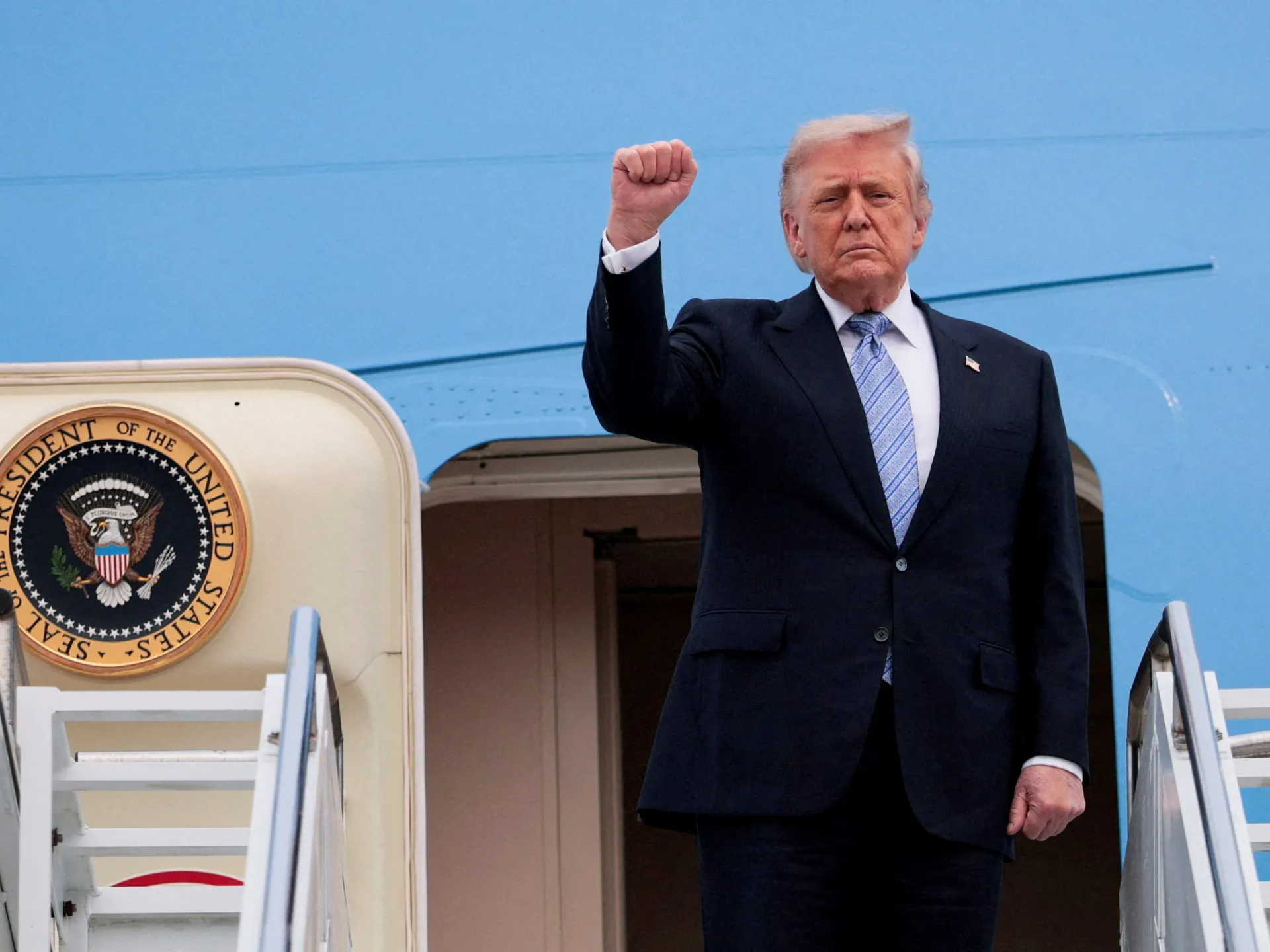
President Donald Trump on Monday said he called off a new round of airstrikes he claimed were set for tomorrow. In a post on his social media outlet, Trump said he made the decision at the best of Gulf Arab allies because of improving efforts to end the war

“I have been asked by the Emir of Qatar, Tamim bin Hamad Al Thani, the Crown Prince of Saudi Arabia, Mohammed bin Salman Al Saud, and the President of the United Arab Emirates, Mohamed bin Zayed Al Nahyan, to hold off on our planned Military attack of the Islamic Republic of Iran, which was scheduled for tomorrow, in that serious negotiations are now taking place,” Trump proclaimed on Truth Social, adding that, “in their opinion, as Great Leaders and Allies, a Deal will be made, which will be very acceptable to the United States of America, as well as all Countries in the Middle East, and beyond.”

“This Deal will include, importantly, NO NUCLEAR WEAPONS FOR IRAN!” the president emphasized. “Based on my respect for the above mentioned Leaders, I have instructed Secretary of War, Pete Hegseth, The Chairman of The Joint Chiefs of Staff, General Daniel Caine, and The United States Military, that we will NOT be doing the scheduled attack of Iran tomorrow, but have further instructed them to be prepared to go forward with a full, large scale assault of Iran, on a moment’s notice, in the event that an acceptable Deal is not reached.”

US President Trump says he called off a new military attack on Iran, which “was scheduled for tomorrow,” because “serious negotiations are now taking place […] and a Deal will be made, which will be very acceptable” for the US https://t.co/sXNJHuuj8B

— Javier Blas (@JavierBlas) May 18, 2026

However, as Axios reporter Barak Ravid noted, “Trump has extended deadlines and postponed planned attacks on Iran at least half a dozen times since the war began.”

So it remains to be seen whether this latest statement has any merit or if it is another effort to kick the can down the road.

Why it matters: Trump has extended deadlines and postponed planned attacks on Iran at least half a dozen times since the war began https://t.co/2wehNVefHg

— Barak Ravid (@BarakRavid) May 18, 2026

Trump’s latest claim about the war highlights the ever-changing narrative of events. Earlier in the day, Axios reported that Iran had given an updated proposal for a deal to end the war, “but the White House believes it is not a meaningful improvement and is insufficient for a deal,” citing a senior U.S. official and a source briefed on the situation.

At issue is the future of Iran’s nuclear ambitions and specifically their stockpile of enriched uranium. Trump’s bottom line is that Iran needs to give up any and all future nuclear ambitions, and the enriched uranium it already has, while the Iranians maintain they have the right to enrich uranium and will not hand over any of their existing material. Tehran’s control of the Strait, its ballistic missile and drone arsenal, and support for proxies are other sticking points.

U.S. officials say Trump wants a deal to end the war, but is considering resuming it “due to Iran’s rejection of many of his demands and refusal to make meaningful concessions on its nuclear program,” Axios added. “Trump is expected to convene his top national security team in the Situation Room on Tuesday to discuss military options, two U.S. officials said.”

Axios stated that the senior U.S. official said if Iran won’t shift its position, the U.S. will have to continue the negotiations “through bombs.”

🚨בכיר אמריקני: “לא השגנו הרבה התקדמות. אנחנו נמצאים היום בנקודה מאוד רצינית. הלחץ הוא על איראן. היא צריכה להגיב בצורה הנכונה. הגיע הזמן שהאיראנים יזרקו כמה סוכריות על השולחן. אנחנו צריכים שיחה אמיתית, רצינית ומפורטת [בנוגע לתוכנית הגרעין]. אם זה לא יקרה, ננהל את השיחה באמצעות… https://t.co/1bHnnUuyAZ

— Barak Ravid (@BarakRavid) May 18, 2026

In contrast, Iranian Foreign Ministry spokesman Esmaeil Baghaei on Monday told reporters that his country’s “nuclear enrichment is a right that ‘already exists,’” an indication that Tehran isn’t budging on its stance. Still, Baghaei also described how negotiations with the United States are still continuing through Pakistani mediation.

Iran’s nuclear enrichment is a right that ‘already exists’, foreign ministry spokesman Esmaeil Baghaei said in a media briefing.

Baghaei described how negotiations with the United States are still continuing through Pakistani mediation. pic.twitter.com/SOJAKm1dOq

— Al Jazeera Breaking News (@AJENews) May 18, 2026

All this comes against the backdrop of reports that the U.S. and Israel have been carrying out their most intense preparations yet to renew attacks on Iran, possibly as soon as this week, two Middle Eastern officials told The New York Times on Friday.

Monday’s back and forth comes a day after Trump issued a new warning to Tehran, saying “For Iran, the Clock is Ticking, and they better get moving, FAST, or there won’t be anything left of them. TIME IS OF THE ESSENCE!”

“For Iran, the Clock is Ticking, and they better get moving, FAST, or there won’t be anything left of them. TIME IS OF THE ESSENCE!” – President Donald J. Trump pic.twitter.com/33gyF0c0O5

— The White House (@WhiteHouse) May 17, 2026

In the wake of renewed threats from Trump, Iran claims it is prepared to defend against the U.S. and Israel if needed.

“In case of aggression against Iran again, Iran’s armed forces have new #surprises for the enemy,” Iranian Foreign Ministry spokesman Esmail Baghaei warned, according to a post on X by the official Iranian IRIB media outlet. “Contradictory behaviors and threats of the enemy do not confuse or scare us.”

🚨Spokesperson of Iran’s FM:
– In case of aggression against Iran again, Iran’s armed forces have new #surprises for the enemy.
– Contradictory behaviors and threats of the enemy do not confuse or scare us. pic.twitter.com/Zgln9KrFVZ

— IRIB (Islamic Republic of Iran Broadcasting) (@iribnews_irib) May 18, 2026

The tough talk between the U.S. and Iran clearly also includes some amount of bluster as the two sides seek a way forward without appearing to have caved to the other’s demands. Trump’s claim about holding off on an attack due to improving negotiations may be another example of that. But eventually time on this kind of posturing will run out and this week could be that inflection point.

UPDATE: 5:53 PM EDT –

New satellite imagery shows damage to three Iranian ships caused by the U.S-Israeli  bombing campaign against Iran’s Navy.

Satellite imagery dated May 17 from Shahid Bahonar Port appears to show the IRIS Makran, a forward base ship of the Islamic Republic of Iran Navy, with a large hole in the deck alongside other heavy damage.

Satellite imagery dated May 17, 2026 from Shahid Bahonar Port (https://t.co/Sx4P4ZrWUK) shows the IRIS Makran, a forward base ship of the Islamic Republic of Iran Navy, with a ~30 m × 30 m hole in the deck alongside other heavy damage due to U.S.-Israeli strikes. pic.twitter.com/Sol8PBKX8N

— Aryan (@GEOIMINT) May 17, 2026

Imagery shows the IRGC Navy’s expeditionary base ship IRIS SHAHID MAHDAVI apparently sunk.

That´s Iran IRGC Navy’s expeditionary base ship IRIS SHAHID MAHDAVI 🇮🇷 👇. She was struck and destroyed by US 🇺🇸 airstrikes in early March 2026.

Visible anchor cable and stern looks to be sitting on the bottom. NOT iddling but SUNK.

Thanks @GEOIMINT for IDing. https://t.co/EXOPSElUkd pic.twitter.com/IesYcZESPi

— Tom Bike (@tom_bike) May 18, 2026

Satellite imagery dated May 12 also shows the Iranian IRIS Kordestan, an Iranian Navy forward base ship in the Persian Gulf with light to moderate damage due to the airstrikes.

Dozens of U.S. Air Force refueling jets now deployed to Ben Gurion Airport are expected to stay in Israel at least until the end of this year, Israel’s N12 News reported on X.

“The presence of the aircraft—not the U.S. military—is causing significant operational difficulties at Ben Gurion Airport, as they are parked almost everywhere possible at the port,” the outlet added.

בישראל התקבלו מסרים מהאמריקנים שלפיהם עשרות מטוסי התדלוק המוצבים בנמל התעופה בן גוריון צפויים להישאר בארץ לפחות עד סוף השנה האזרחית. נוכחות המטוסים שלא הצבא האמריקני מעוררת קשיים משמעותיים בתפעולו של נתב”ג, שכן הם חונים כמעט בכל מקום אפשרי בנמל@Dean_Fisher_

— החדשות – N12 (@N12News) May 18, 2026

UPDATES

On Monday, the country’s Supreme National Security Council said a newly formed Iranian agency, called the Persian Gulf Strait Authority (PGSA), would provide “real-time updates” on operations and the latest developments in the Strait, a crucial chokepoint through which about 20 percent of the world’s oil and gas pass in peacetime.

The announcement about the PGSA follows news that Iran “started a Bitcoin-backed insurance service for shipping companies that want to transit the Strait of Hormuz,” Bloomberg News reported, citing the semi-official Fars news agency reported, which claimed it has documents obtained from Iran’s Ministry of Economy and Financial Affairs.

Dubbed Hormuz Safe, “the Iranian government says it could generate more than $10 billion in revenue for the Islamic Republic,” Bloomberg noted, adding that Fars provided no time frame or a breakdown of how the service would work.

Iran has started a Bitcoin-backed insurance service for shipping companies that want to transit the Strait of Hormuz, the semi-official Fars news agency reported https://t.co/0L0nyM3eAT

— Bloomberg (@business) May 18, 2026

The effort is widely seen as a way for Iran to get around calling any fee for crossing the Strait a toll.

“The Iranian regime is introducing a formalized toll system under the guise of maritime insurance policies and continuing to deploy incentives and threats to vessels in the Persian Gulf as part of their efforts to normalize and solidify Iranian control over the Strait,” the Institute for the Study of War posited. “This system appears designed to be more palatable than an outright ‘toll’ by framing it as a ‘maritime insurance policy.’ The insurance presumably insures the vessel against an Iranian attack.”

“As the President stated, the Strait is international water, and we are not going to let Iran toll the Strait or normalize an illegal regime where they attempt to control traffic through the Strait.,” a White House official told us.

Coinciding with its growing efforts in the Strait, PGSA unveiled an account on X on Monday.

“The Persian Gulf Strait Authority (PGSA) is the legal entity and representative authority of the Islamic Republic of Iran for managing the passage and transit through the Strait of Hormuz,” PGSA asserted. “Navigation within the introduced boundaries of the Strait of Hormuz, which were previously determined by the Armed Forces and authorities of the Islamic Republic of Iran, is contingent upon full coordination with these entities, and passage without permission will be considered illegal.”

2/
دریانوردی در حریم معرفی شدهٔ تنگه هرمز، که حدود آن پیش از این از سوی نیروهای مسلح و مقامات جمهوری اسلامی ایران تعیین شده، منوط به هماهنگی کامل با این نهاد است و عبور بدون مجوز، غیرقانونی تلقی خواهد شد.

— PGSA | نهاد مدیریت آبراه خلیج فارس (@PGSA_IRAN) May 18, 2026

Iran has divided its operational control over the Strait of  Hormuz area between the Iranian Navy and the Islamic Revolutionary Guard Corp (IRGC) Navy.

“From the shores of Makran to the Strait of Hormuz, it is managed by the Iranian Navy, and the Strait of Hormuz and the Persian Gulf are managed by the IRGC Navy,” the official Iranian IRIB news outlet announced on X.

🚨A division of duties has been carried out among the Iranian armed forces.

From the shores of Makran to the Strait of Hormuz, it is managed by the Iranian Navy,
and the Strait of Hormuz and the Persian Gulf are managed by the IRGC Navy. pic.twitter.com/PU2Md8eOim

— IRIB (Islamic Republic of Iran Broadcasting) (@iribnews_irib) May 18, 2026

Despite the ongoing U.S. blockade of its ports, Iran is still loading crude into tankers, “although (not right now) in Kharg Island,” Bloomberg commodities and energy columnist Javier Blas reported on X. “Instead, it’s loading a tanker at Jask, an alternative terminal outside the Strait of Hormuz (but inside the US Navy blockade line).”

Iran is still loading crude into tankers — although (not right now) in Kharg Island. Instead, it’s loading a tanker at Jask, an alternative terminal outside the Strait of Hormuz (but inside the US Navy blockade line).

Left May 17 🛰️Sentinel-2; right, May 18 🛰️Sentinel-1 pic.twitter.com/iU2o6YXAmD

— Javier Blas (@JavierBlas) May 18, 2026

In a post on X, TankerTrackers.com stated that there “are actually plenty of able, cargo-empty tankers within the US Navy blockade perimeter but Iran has already lowered its oil production to match consumption and some storage buildup on land. The storage situation does not appear to be dire for the time being.”

As we have previously reported, a major goal of the blockade is to hurt Iran economically, including by threatening its ability to store oil.

Incorrect. There are actually plenty of able, cargo-empty tankers within the US Navy blockade perimeter but Iran has already lowered its oil production to match consumption and some storage buildup on land. The storage situation does not appear to be dire for the time being. https://t.co/mmlpHIr9ZI

— TankerTrackers.com, Inc. (@TankerTrackers) May 18, 2026

Pakistan has reportedly deployed thousands of troops, jets and air defense systems to Saudi Arabia to help defend the kingdom amid a shaky ceasefire.

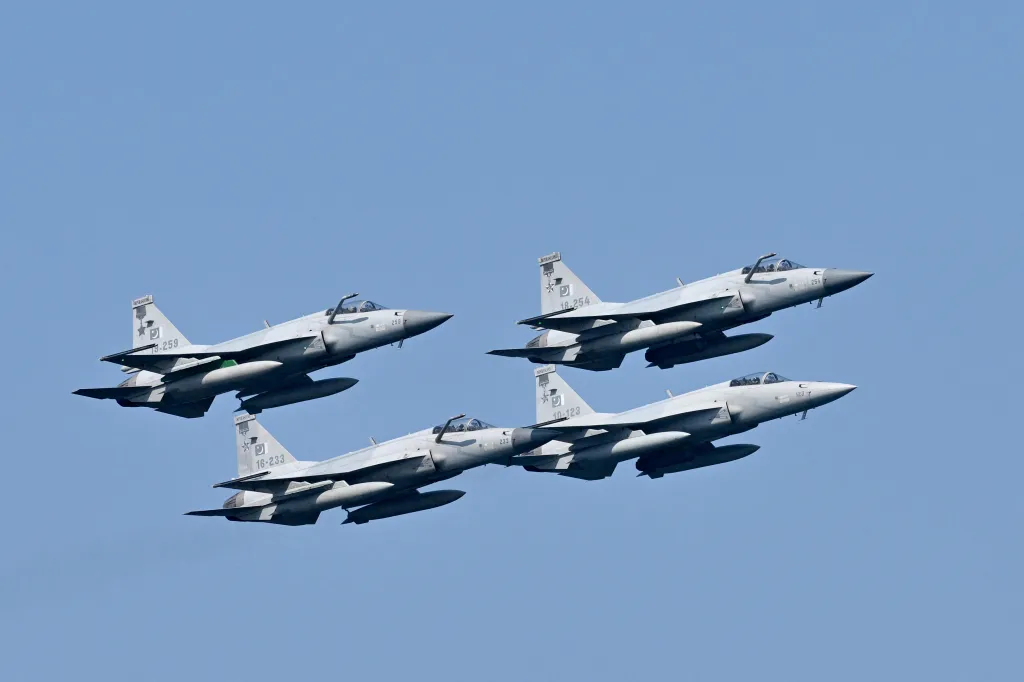
Pakistan’s contribution to the mutual aid pact includes Chinese weapons, Reuters explained. It “has deployed a full squadron of around 16 aircraft,” mostly JF-17 Thunder fighters, which were ​sent to Saudi Arabia in early April. Pakistan had also sent “two squadrons of drones,” Reuters reported, adding that Islamabad could also send more troops, plus a Chinese-made HQ-9 long-range surface-to-air missile system.

The equipment is operated by Pakistani personnel and financed by Saudi Arabia, the news outlet pointed out. It remains unclear exactly what this means, if it pertains to the deployment or to the hardware itself.

Earlier this year, we reported that talks about the jets were underway, potentially to be paid for by converting some of the billions of dollars of Saudi loans taken out by Islamabad. However, at the time, shortly before the war broke out, it remained unclear if the Saudis even would want a light fighter like the Thunder at all, especially considering it could cause a rift with the U.S. at a critical time. In the past months, the kingdom had been offered the U.S.-made F-35, as you can read about here, and operates advanced fighters like the F-15SA and Typhoon.

The JF-17 was developed jointly by China’s Chengdu and the Pakistan Aeronautical Complex (PAC), and the first prototype took to the air in 2003. The aircraft is powered by a single Russian-designed RD-93 turbofan engine, an improved version of the RD-33 that is found in the twin-engined MiG-29 Fulcrum. Presumably, the JF-17s will help defend Saudi skies from drone and cruise missile attacks, although that too isn’t perfectly clear at this time.

Pakistan's Air Force fighter JF-17 fighter jets fly past during the multinational naval exercise AMAN-25 in the Arabian Sea near Pakistan's port city of Karachi on February 10, 2025, as more than 50 countries participating with ships and observers. (Photo by Asif HASSAN / AFP) (Photo by ASIF HASSAN/AFP via Getty Images)
Pakistan’s Air Force fighter JF-17 fighter jets fly past during the multinational naval exercise AMAN-25 in the Arabian Sea near Pakistan’s port city of Karachi on February 10, 2025. (Photo by Asif HASSAN / AFP) ASIF HASSAN

It is possible that amid the shaky ceasefire, Iran’s proxies may be carrying out attacks on Arab Gulf nations. On Sunday, both the United Arab Emirates (UAE) and Saudi Arabia said they were attacked by drones. UAE officials said the attacks were carried out by Iran or its proxies while Saudi said it was struck by drones launched from Iraq.

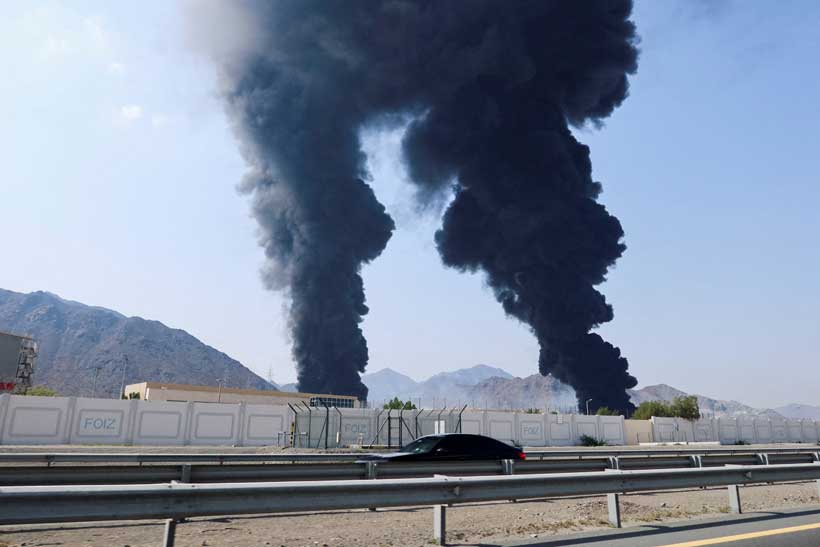
The UAE Defense Ministry said an electrical generator outside the inner perimeter of the Barakah Nuclear Energy Plant was struck by one of three drones launched at the country. Two other drones were successfully intercepted, it said.

In its initial statement on X, the MoD said that the drones “entered the country from the western border direction,” without assigning blame. UAE officials later updated that to say the drone was “launched by Iran or one of its proxies” in what officials called a “dangerous escalation.”

The officials did not get more specific. The Houthi rebels of Yemen operate southwest of the UAE while several Iranian-backed militias operate in Iraq, northwest of the country.

The Emirate MoD “affirmed that it remains fully prepared and ready to address any threats and will firmly confront any attempts to undermine the country’s security, in a manner that safeguards its sovereignty, security and stability, and protects its national interests and gains.”

UAE air defences intercept 3 UAVs.

The Ministry of Defence announced that on 17th May 2026, UAE air defence systems intercepted three UAVs that entered the country from the western border direction.

The ministry said that two of the UAVs were successfully intercepted, while the… pic.twitter.com/Ca6JRwc8w8

— وزارة الدفاع |MOD UAE (@modgovae) May 17, 2026

In a post on X, the IAEA expressed “grave concern” about the incident and said military activity that threatens nuclear safety is unacceptable. The [director general] reiterates call for maximum military restraint near any NPP to avoid the danger of a nuclear accident.”

The IAEA has been informed by the UAE that radiation levels at the Barakah NPP remain normal and no injuries were reported after a drone strike this morning caused a fire in an electrical generator located outside the inner site perimeter of the NPP. Emergency diesel generators… pic.twitter.com/km2rg08Gvd

— IAEA – International Atomic Energy Agency ⚛️ (@iaeaorg) May 17, 2026

Pakistan on Monday “strongly condemned” the drone attack on the UAE’s nuclear power plant.

“Any deliberate targeting of nuclear facilities constitutes a grave violation of international law, including international humanitarian law, the United Nations Charter, and the fundamental principles of nuclear safety and security enshrined in the Statute and resolutions of the International Atomic Energy Agency,” Pakistan’s Foreign Ministry said in an X post. “Nuclear installations must never be targeted under any circumstances. Such reckless actions carry potentially catastrophic and irreversible consequences for human life, the environment and regional, as well as global peace and security.”

Pakistan’s condemnation comes as it is trying to keep a flagging peace process going amid an increasingly tenuous ceasefire.

🔊 PR No.1️⃣1️⃣8️⃣/2️⃣0️⃣2️⃣6️⃣

Pakistan Strongly Condemns the Drone Attack on the Barakah Nuclear Energy Plant of the United Arab Emirates

🔗⬇️https://t.co/7J7r1j6ZCH pic.twitter.com/DyMIR7bmoQ

— Ministry of Foreign Affairs – Pakistan (@ForeignOfficePk) May 18, 2026

Saudi Arabia said it too was attacked by drones on Sunday, but did not say who launched them.

The official spokesperson for the Ministry of Defense (MoD), Major General Turki Al-Maliki, “stated that on the morning of Sunday…three drones were intercepted and destroyed after entering the Kingdom’s airspace coming from Iraqi airspace,” the Saudi MoD stated on X. Al-Maliki “affirmed that the Ministry of Defense reserves the right to respond at the appropriate time and place, and will take and implement all necessary operational measures to respond to any attempt to infringe on the Kingdom’s sovereignty, security, and the safety of its citizens and residents on its territory.”

There are several Iranian-linked proxy groups in Iraq that have been attacking U.S. and allied facilities in that country.

صرح المتحدث الرسمي باسم وزارة الدفاع اللواء الركن تركي المالكي أنه في صباح يوم الأحد الموافق (17 مايو 2026م) تم اعتراض وتدمير 3 مسيّرات بعد دخولها المجال الجوي للمملكة قادمة من الأجواء العراقية.

وأكد اللواء المالكي على أن وزارة الدفاع تحتفظ بحق الرد في الزمان والمكان المناسبين،… pic.twitter.com/80hZw8z7BU

— وزارة الدفاع (@modgovksa) May 17, 2026

On Monday Iran’s Foreign Minister Abbas Araghchi held a phone call with his Saudi counterpart Faisal bin Farhan. According to the Iranian Foreign Ministry, the two discussed issues related to the ongoing diplomatic process and the latest regional developments, in their seventh call since the ceasefire began.

Iran’s Foreign Minister Abbas Araghchi held a phone call with his Saudi counterpart Faisal bin Farhan, a day after Riyadh said it was attacked by three drones originating from Iraq.

According to the Iranian Foreign Ministry, the two discussed issues related to the ongoing… pic.twitter.com/UiuEZ8RMno

— Ariel Oseran أريئل أوسيران (@ariel_oseran) May 18, 2026

The New York Times is reporting that Israel established at least a second base in Iraq to aid its air campaigns against Iran. As we previously noted, the presence of the first one was reported by The Wall Street Journal.

In its story, the Times stated the base it was writing about pre-dated the current conflict and was used during last year’s 12-Day War between Israel and Iran. The newspaper also said a Bedouin shepherd was killed by helicopter fire after stumbling on the base in an effort to keep it secret.

The Times story lines up with our earlier reporting that Israel likely created facilities in Iraq during the 12-Day War. We also predicted at the time that it would likely happen again in the future.

As we noted in the past, Israel used the base reported on by the Journal to stage troops and equipment and provide combat search and rescue service if needed for downed pilots during the current conflict. 

Israel spent over a year preparing a covert site in Iraq for its operations against Iran, regional officials say. Iraqi officials later confirmed the existence of a second base.
By @ErikaSolomon & Falih Hassanhttps://t.co/l6fIJdfTFx

— Malachy Browne (@malachybrowne) May 17, 2026

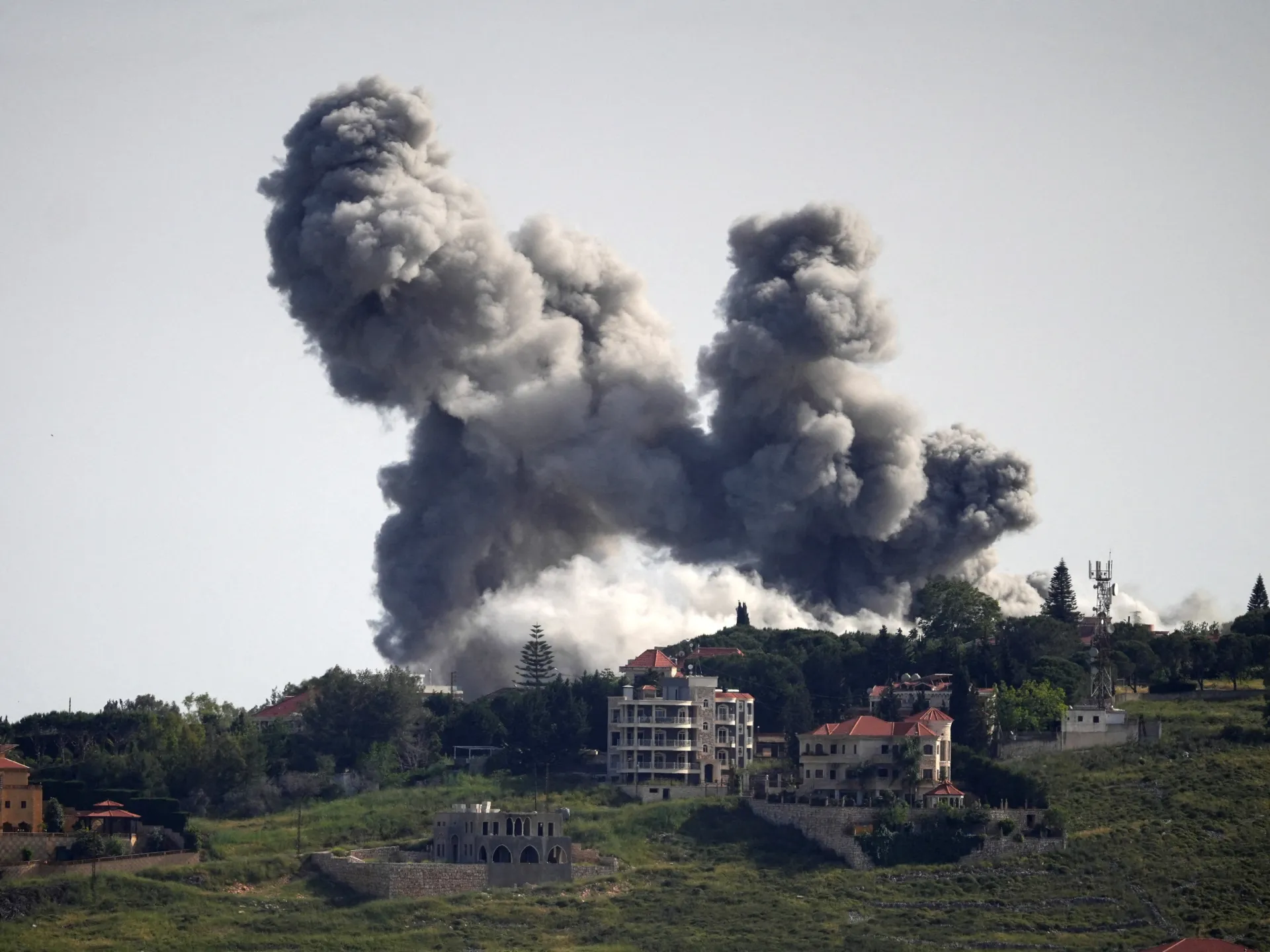
Amid its own ceasefire agreement with the Lebanese government, Israel is continuing to hit Hezbollah targets in the southern part of that country where it has a growing military presence.

חיל-האוויר וכוחות חטיבה 769 בפיקוד אוגדה 91 השמידו בסגירת מעגל מהירה מחסן נ״ט ששימש את ארגון הטרור חיזבאללה נגד הכוחות הפועלים במרחב. pic.twitter.com/WmBpY0gbdM

— Israeli Air Force (@IAFsite) May 18, 2026

Contact the author: howard@twz.com

Howard is a Senior Staff Writer for The War Zone, and a former Senior Managing Editor for Military Times. Prior to this, he covered military affairs for the Tampa Bay Times as a Senior Writer. Howard’s work has appeared in various publications including Yahoo News, RealClearDefense, and Air Force Times.


Source link

Iran’s World Cup team arrives in Turkiye amid US visa uncertainty | US-Israel war on Iran

NewsFeed

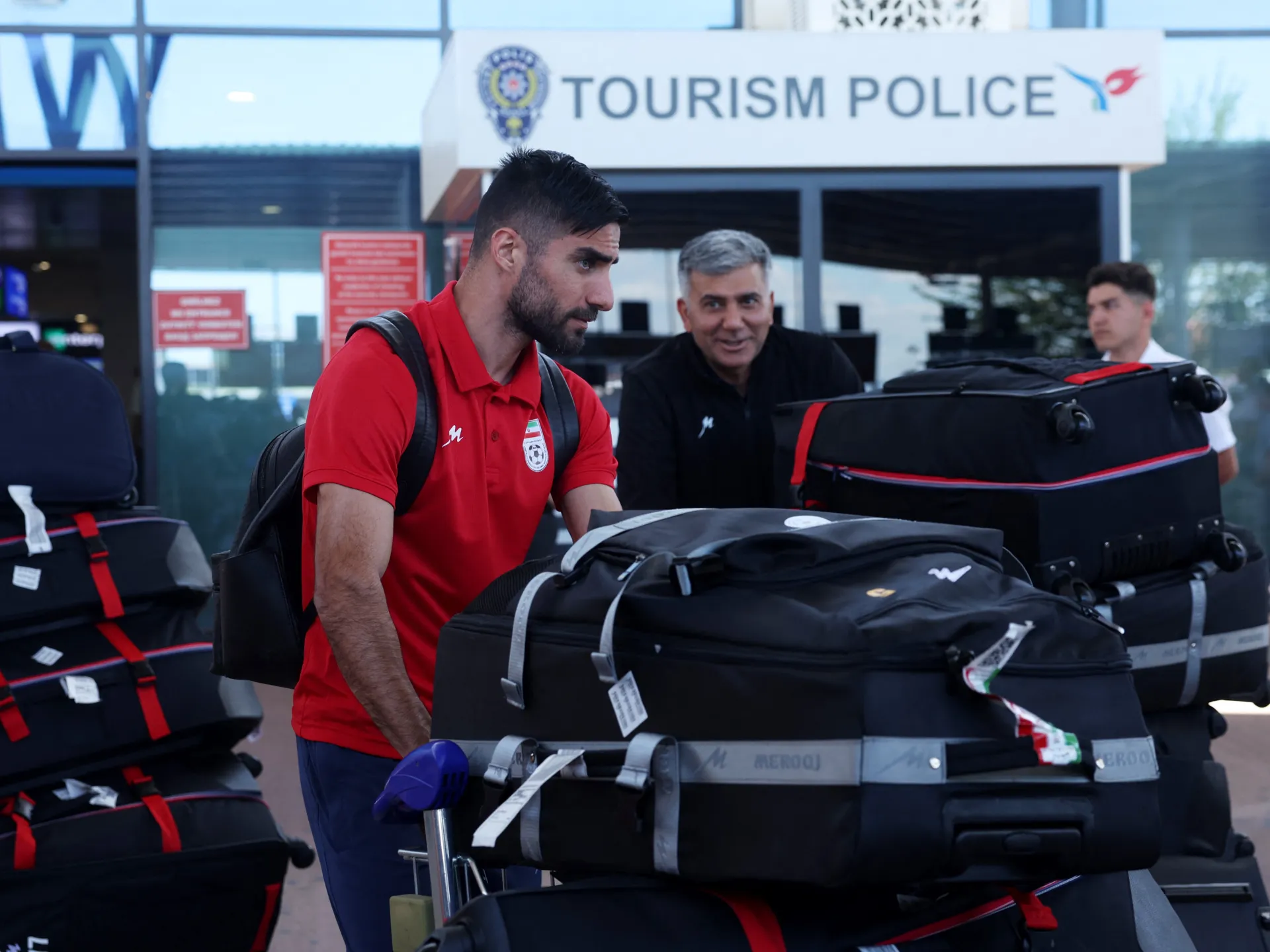
Iran’s national football team has arrived in Turkiye for a pre-World Cup training camp, but players are yet to receive visas for entry into the US. FIFA says it is confident Iran will be able to play in next month’s tournament despite the uncertainty.

Source link

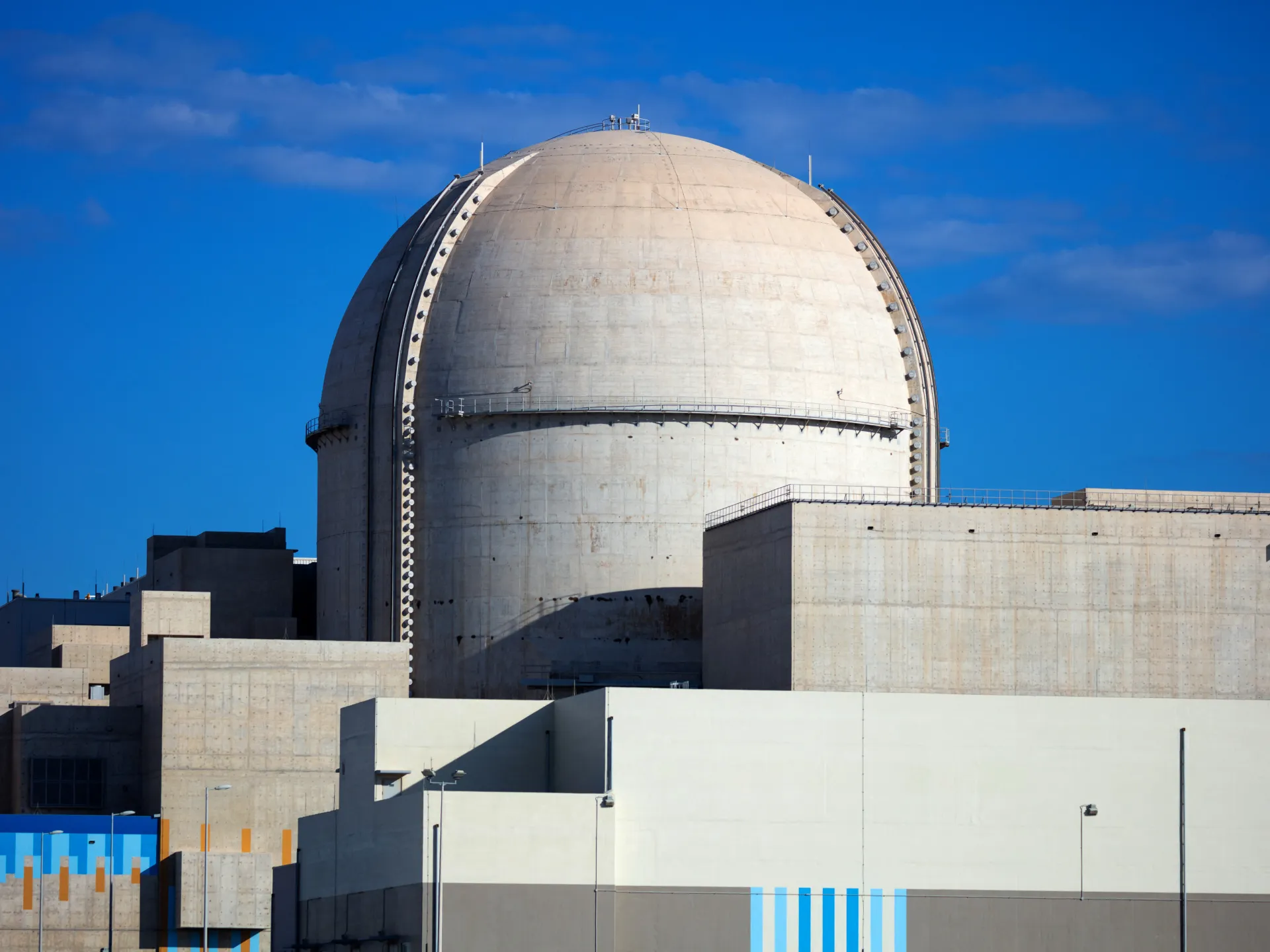
What is the UAE’s Barakah nuclear plant, nearly hit by a drone? | Conflict News

A drone attack that caused a fire close to the Barakah Nuclear Energy Plant in the United Arab Emirates has raised further concerns about nuclear security and military escalation in the Gulf as discussions of peace between Iran and the United States hang in the balance.

Barakah was the first nuclear power station to be built on the Arabian Peninsula. Here is what we know about it:

What is the Barakah Nuclear Energy Plant?

Barakah is a nuclear energy plant located in Al Dhafra, the largest municipal region of the emirate of Abu Dhabi. It is the UAE’s only nuclear power plant.

Construction of the plant began in 2012, and its first reactor became commercially operational in 2021.

The plant is located close to the border with Saudi Arabia, about 225km (140 miles) west of the UAE’s capital city, Abu Dhabi.

The facility features four pressurised water reactors, the most common type of nuclear power reactor. The model used here is the advanced power reactor 1400, a pressurised water reactor design developed in South Korea. Each reactor of this type has the capacity to produce 1,400 megawatts (MW), which is enough to power roughly 1 million homes.

According to the Emirates Nuclear Energy Corporation (ENEC), the plant’s reactors produce 40 terawatt-hours (TWh) each year, which is equivalent to about 25 percent of the UAE’s electricity needs. The website for the London-based World Nuclear Association also confirmed that Barakah, when fully operational, meets 25 percent of the UAE’s electricity needs.

According to a September report by the Abu Dhabi media office, Barakah had produced 40TWh of clean energy over “the past 12 months”.

Since nuclear power plants produce a lower amount of carbon dioxide emissions than conventional power plants, the ENEC said Barakah saves up to 22.4 million tonnes of carbon emissions each year, equivalent to removing 4.8 million cars from the roads.

What happened in the attack on Sunday, and how has the UAE responded?

Authorities in Abu Dhabi said a single drone strike caused a blaze to break out at an electrical generator outside the Barakah plant’s inner perimeter in the Al Dhafra region on Sunday. No injuries were reported, and officials said radiation levels remained normal.

The UAE’s nuclear regulator said operations at the Barakah facility had not been affected. “All units are operating as normal,” it said in a social media post.

In a statement, the UAE’s Ministry of Defence said two more drones had been “successfully” intercepted and the drones had been launched from the “western border”. It did not give more details.

The UAE’s Ministry of Foreign Affairs posted a statement on X on Sunday saying the country condemned “the unprovoked terrorist attack” in “the strongest terms”.

The statement added: “The UAE emphasised that it will not tolerate any threat to its security and sovereignty under any circumstances, and that it reserves its full, sovereign, legitimate, diplomatic, and military rights to respond to any threats, allegations, or hostilities in a manner that ensures the protection of its sovereignty, national security, territorial integrity, and the safety of its citizens, residents, and visitors, in accordance with international law.”

There was no immediate claim of responsibility, and the statements by the ministries did not publicly blame any country.

But Anwar Gargash, an adviser to the UAE’s president, wrote in an X post on Sunday: “The terrorist targeting of the Barakah clean nuclear power plant, whether carried out by the principal perpetrator or through one of its agents, represents a dangerous escalation and a dark scene that violates all international laws and norms, in criminal disregard for the lives of civilians in the UAE and its surroundings.”

Gargash’s post appeared to blame Iran and its proxy network of allied armed groups in the region, which Tehran calls the “axis of resistance”.

The launch point of the drones remained unclear, but on Sunday, Saudi Arabia also reported it had intercepted three drones that had been launched from Iraq, where some Iran-allied groups operate. If Iranian Shahed-136 drones, which have an estimated range of 2,000km to 2,500km (1,240 to 1,550 miles), were fired from Iraqi territory, both Saudi Arabia and the UAE would fall well within their reach.

Other reactions

Neighbouring Gulf states Saudi Arabia and Qatar condemned the attack on the Barakah plant.

The Ministry of Foreign Affairs of Kuwait also issued a statement denouncing the attack, which it called “heinous”.

The Indian Ministry of External Affairs condemned the attack, calling it “unacceptable”, saying it represented “a dangerous escalation” and urging a return to diplomacy.

Has Iran responded to the incident?

Iran has not claimed responsibility for the drone attacks, and there has been no public statement from Iran about the incident at Barakah.

However, in the aftermath of the drone attacks, United States President Donald Trump wrote in a Truth Social post: “For Iran, the Clock is Ticking, and they better get moving, FAST, or there won’t be anything left of them. TIME IS OF THE ESSENCE!”

Iranian Ministry of Defence spokesperson Reza Talaei-Nik said on Sunday that the military is “fully prepared” to confront any new aggression from the US and Israel.

Iran has previously warned that countries where US military assets are deployed or Israeli-linked interests are located are viewed as legitimate targets.

Iran has also accused the UAE of strengthening ties with Israel while reports have emerged that Israeli Prime Minister Benjamin Netanyahu made a “secret” visit to the Gulf state during the US-Israel war on Iran. The UAE has denied this.

US Ambassador to Israel Mike Huckabee also said last week that Israel had deployed Iron Dome air defence systems and personnel to the UAE to help defend against possible Iranian attacks.

What has the IAEA said?

The International Atomic Energy Agency (IAEA), the global nuclear watchdog, said Sunday’s incident in the UAE had forced one reactor to rely temporarily on emergency diesel generators.

IAEA chief Rafael Grossi expressed “grave concern” and warned that military activity threatening nuclear facilities was “unacceptable”.

How serious could a strike on a nuclear facility be?

Attacks on nuclear power plants are especially worrying because they can risk damaging critical safety systems or reactors, which could release radioactive material into the atmosphere, not only over the country targeted but also across neighbouring states. Radiological material, specifically the hazardous isotope Caesium-137, could be released into the atmosphere.

The release of radioactive material could result in environmental contamination and poses major risks to public health. Water, if contaminated, becomes undrinkable while farmland and fisheries could become unsafe for decades, depending on the isotope released.

Short-term, acute exposure to radioactivity can cause burns and acute radiation sickness, which can be life-threatening.

Prolonged exposure, even to smaller doses, can increase the risk of illnesses such as cancer, especially thyroid cancer and leukaemia. Children and pregnant women are especially vulnerable.

Over the course of the US-Israel war on Iran, energy infrastructure has become a target.

Iran’s only functioning nuclear plant, the Bushehr power plant, has come under repeated attacks in the war. There are fears that damage at Bushehr could contaminate water across the entire Gulf region, most of which lacks groundwater and relies heavily on the desalination of seawater. Desalination plants are not specifically built to filter radioactive material, and not all plants currently are fitted with the technologies required to do so.

Source link

Trump warns Iran ‘clock is ticking’ amid negotiation stalemate

May 18 (UPI) — President Donald Trump has renewed his threats of mass violence against Iran, warning Tehran that “the Clock is Ticking” as the stalemate in talks to end the war shows no signs of ending.

In a statement on his Truth Social platform on Sunday night, Trump wrote: “For Iran, the Clock is Ticking, and they better get moving, FAST, or there won’t be anything left of them.”

“TIME IS OF THE ESSENCE!”

The two-sentence statement echoed the scale of violence he threatened April 7, shortly before the cease-fire was announced, when he warned Iran to make an agreement to end the war or “A whole civilization will die tonight, never to be brought back again.”

Trump has been seeking an agreement with Iran to end the war since the conflict was halted April 8 with a cease-fire to permit negotiations.

Those negotiations have progressed little if at all since talks broke down in Islamabad in mid-April.

An Iranian proposal recently sent to the United States was rejected by Trump, who told reporters aboard Air Force One on Friday en route to Washington from China that he looked at it and found the first sentence unacceptable.

“Well, I looked at it, and if I don’t like the first sentence, I just throw it away,” Trump said.

Asked what the first sentence was, Trump replied, “An unacceptable sentence.”

Trump said he is seeking a lengthy suspension of Iran’s nuclear program, stating that two decades may comply with his demands but “it’s got to be a real 20 years.”

According to Iranian state media Press TV, Iran’s proposal calls for a comprehensive end to the war, full compensation from the United States for damages, the removal of sanctions, the release of frozen Iranian assets and recognition of Iran’s sovereignty over the Strait of Hormuz.

Iran’s semi-official Fars news agency reported the United States responded with five demands: no compensation, no unfreezing of assets, the handover of 881.8 pounds of uranium to the United States, only one nuclear facility remaining active and making a halt to the war on all fronts conditional on negotiations.

In response to Trump’s threat on Sunday, Brig. Gen. Abolfazl Shekarchi, senior spokesman for Iran’s Armed Forces, called Trump “delusional,” the Islamic Republic News Agency reported.

“Repeating any foolishness to compensate for America’s disgrace in the third imposed war against Iran will bring no consequence other than receiving more crushing and severe blows for that country,” Shekarchi said.

He warned Trump if the United States resumed its attacks, “the assets and decayed army of that country will face new, offensive, surprising and stormy scenarios.”

Source link

Israel built two military bases in Iraq before war on Iran: New York Times | Military News

Israeli forces had been preparing the makeshift sites in western Iraq since late 2024, the US newspaper reported.

Israel built two covert military outposts in Iraq’s western desert in advance of the US-Israel war on Iran, The New York Times has reported.

The daily reported on Sunday that Iraqi officials had identified two covert Israeli-operated base in Iraq’s western desert, citing an Iraqi official and a lawmaker. It said Israeli forces had been preparing to build one of the makeshift sites since late 2024, citing a regional official.

Recommended Stories

list of 4 itemsend of list

Last week, The Wall Street Journal reported that one base was established shortly before the war began and operated with the knowledge of the United States. It said the installation housed Israeli special forces and served as a logistical hub for their air operations. It also reportedly included search-and-rescue capabilities for downed pilots.

According to the newspaper, Israeli forces launched attacks from the base against Iraqi units that came close to discovering the site in early March. Open-source analysts cited by the report identified the suspected location using satellite imagery near Iraq’s border with Saudi Arabia.

The reports have added to months of conflicting accounts over alleged Israeli activity inside Iraq. On Thursday, Lieutenant-General Qais al-Muhammadawi, Iraq’s deputy commander of joint operations, said authorities had received reports of “individuals or movement” in the Najaf desert near Karbala, about 100km (62 miles) southwest of Baghdad, according to the state-run Iraqi News Agency.

The WSJ also referenced comments made in March by Israel’s former air force chief, Major-General Tomer Bar, who said Israeli special forces had carried out “extraordinary” operations during the conflict with Iran, though he did not specify where.

Iraqi officials have publicly denied authorising any foreign military presence in the area. “There is no agreement or consent for any force to be present in this location,” al-Muhammadawi said last week, before the details of the alleged Israeli outpost were reported.

However, the WSJ report said Baghdad privately lodged a protest with Washington in late March over suspected covert military activity, calling it a violation of Iraqi sovereignty.

US officials quoted by the newspaper said Washington was not involved in the operation. On Sunday, a senior Iraqi security official again denied reports that Israel had established a military base in the desert, speaking to Turkiye’s Anadolu news agency.

On Tuesday, the commander of Iraq’s Karbala operations told Al Jazeera that an Israeli military group had been detected in the Najaf desert in March, although he said it had remained in the area for less than 48 hours.

The reports come as Iraq faces growing pressure amid escalating tensions between the US, Israel and Iran.

Washington has repeatedly urged Baghdad to curb the influence of Iran-backed armed groups operating in Iraq. In March, US forces carried out strikes against the Popular Mobilisation Forces after attacks on a US diplomatic and logistics facility near Baghdad airport.

Iran has also raised concerns over the allegations. Iranian Ministry of Foreign Affairs spokesperson Esmaeil Baghaei said on Monday that Tehran would raise the issue with Iraqi authorities. He accused Israel of seeking to destabilise the region.

“Israel’s behaviour in the region shows that they do not respect any limits or red lines,” Baghaei said.

Source link

Iran war day 80: Trump issues warning; Tehran ready to confront aggression | US-Israel war on Iran News

The fear of renewed US strikes in Iran looms while Israeli attacks continue in Lebanon despite extended ‘ceasefire’.

United States President Donald Trump has warned Iran that the “clock is ticking” to clinch a deal to end the war as reports have emerged that Washington and Israel might be planning to carry out air strikes on Iranian energy infrastructure.

“For Iran, the Clock is Ticking, and they better get moving, FAST, or there won’t be anything left of them,” Trump wrote on his Truth Social platform. “TIME IS OF THE ESSENCE!”

Iranian Ministry of Defence spokesperson Reza Talaei-Nik said on Sunday that the military is “fully prepared” to confront any new aggression from the US and Israel.

Saudi Arabia on Monday said it intercepted three drones, a day after a drone strike hit the Barakah Nuclear Energy Plant in the United Arab Emirates.

Meanwhile, Israel has continued its bombardment of Lebanon despite another “ceasefire” extension.

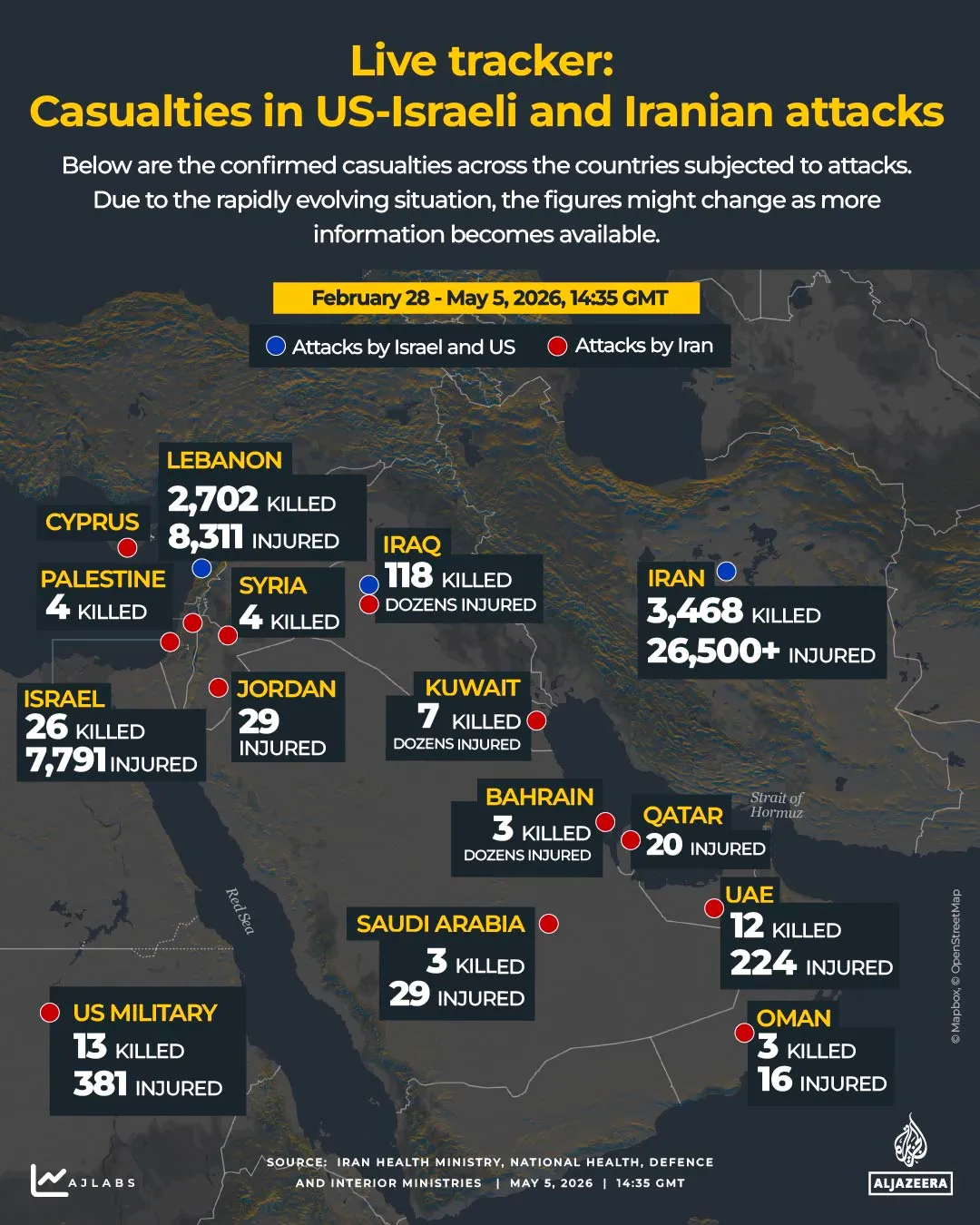
As the US-Israeli war on Iran continues for its 80th day, here is what we know:INTERACTIVE_LIVETRACKER_IRAN_US_ISRAEL_MIDDLEEAST_ATTACKS_MAY5_2026_GMT1435-1777992258

In Iran

  • Mohsen Rezaei, a member of Tehran’s Expediency Council and former Islamic Revolutionary Guard Corps commander, issued a warning to the US to lift its blockade of Iranian ports, saying the Iranian military is ready for further confrontation. Rezaei made this warning while speaking to state television.
  • Talaei-Nik said the Iranian armed forces are “fully prepared to confront any new potential attack by the US and the Israeli regime against the country”.

War diplomacy

  • Mikhail Ulyanov, Russia’s envoy to international organisations in Vienna, suggested in an X post that Iran appoint a special envoy to Moscow, similar to Tehran’s arrangement with China.
  • In an X post, Jean-Luc Melenchon, the leading figure of France’s left-wing La France Insoumise party, condemned “European complicity” in the US-Israeli strikes on Iran, which have triggered a wider regional war.

In the Gulf

  • The New York Times reported that the Israeli military has operated two “covert” outposts in Iraq’s western desert and killed a shepherd and a soldier in a bid to hide one of the sites near the town of al-Nukhaib.
  • After the drone attack on the nuclear facility caused a fire, the UAE Ministry of Defence said two other drones had been “successfully” dealt with after they were launched from the “western border”. It did not elaborate.
  • The drone that got through the UAE’s defences hit an electrical generator outside the inner perimeter of the Barakah Nuclear Energy Plant, the Abu Dhabi Media Office said. Radiological safety levels were unaffected, and there were no injuries, it said. The UAE’s Federal Authority for Nuclear Regulation later confirmed that the plant remained safe with no radioactive material released from the strike.
  • Saudi Arabia said the three drones it intercepted entered from Iraqi airspace and warned that it would take the necessary operational measures to respond to any attempt to violate its sovereignty and security.

In the US

  • Marjorie Taylor Greene, a former US congresswoman and a once-close ally of Trump, has warned in a post on X that any attempt to send US troops into Iran would trigger what she described as a “political revolution”.
  • Republican Senator Lindsey Graham, speaking to the NBC broadcaster, urged Trump to “hurt” Iran, including launching attacks on its energy sites, until it agrees to US terms on its nuclear programme. The US and Israel have hit civilian targets multiple times during the war on Iran. Attacks on civilian facilities are considered war crimes under international law.

In Israel

  • Israel’s Channel 13 reported that dozens of US cargo planes carrying ammunition from bases in Germany have landed in Tel Aviv.
  • Israeli media reported that the military is preparing for renewed hostilities with Iran. The public broadcaster Kan quoted an unnamed security official as saying that Israel would join any new US strikes and target Iranian energy infrastructure.

In Lebanon

  • Israeli strikes have continued in southern Lebanon, where Israel issued evacuation orders for four towns and villages and then struck two of those locations.
  • Strikes were also reported in Az-Zrariyah on a moving vehicle while another raid in Tayr Debba resulted in some significant casualty numbers, Al Jazeera’s Obaida Hitto reported from Tyre, Lebanon.

Global markets

  • Stalled peace efforts between Iran and the US caused oil prices to rise again on Monday. This pushed the price of the global benchmark Brent crude up to about $111 per barrel, close to its highest level in weeks.

Source link

‘Won’t be anything left’: Trump issues threat to Iran amid stalled talks | Government News

United States President Donald Trump has reiterated his threats against Iran, as negotiations to end the conflict between the two countries continue to flounder.

In a Sunday morning post on his platform Truth Social, Trump warned that time was running short before a fresh wave of US military action might be launched.

Recommended Stories

list of 3 itemsend of list

“For Iran, the Clock is Ticking, and they better get moving, FAST, or there won’t be anything left of them,” Trump wrote in the short, two-sentence message. “TIME IS OF THE ESSENCE!”

The post was the latest example of Trump using violent rhetoric against Iran as his administration struggles to achieve its goals in the war.

Just a day earlier, Trump had posted an AI-generated image of himself atop a military ship, labelled, “It was the calm before the storm.”

The conflict began on February 28, when Israel and the US jointly attacked Iran.

Since then, Trump has put forward a range of objectives for the resulting war, including dismantling Iran’s missile arsenal, severing its relations with regional allies, and ending its nuclear enrichment programme.

On April 7, Trump coupled those demands with a social media post suggesting wholesale destruction in Iran. Critics have likened the post to a call for genocide.

“A whole civilization will die tonight, never to be brought back again. I don’t want that to happen, but it probably will,” Trump wrote.

Within hours of the post, the US and Iran agreed to a ceasefire that has been in place ever since, though both sides have accused each other of violations.

The US president had previously threatened to attack the country’s civilian infrastructure, including its power plants and bridges, which legal experts warn could amount to a violation of the Geneva Convention.

Separately, in a May interview with Fox News, Trump said Iranian officials will “be blown off the face of the earth” if they attack US vessels.

Iran has denounced such rhetoric and rejected Trump’s demands as excessive.

Mehr, a news agency sponsored by the Iranian government, issued a statement on Sunday saying that the US has offered “no tangible concessions” in its latest proposals.

It also accused the US of seeking to “obtain concessions that it failed to obtain during the war”, a strategy that “will lead to an impasse in the negotiations”.

Separately, a spokesperson for Iran’s armed forces, Abolfazl Shakarchi, was quoted as warning the US against further threats.

“Repeating any folly to compensate for America’s disgrace in the Third Imposed War against Iran will result in nothing but receiving more crushing and severe blows,” he told Mehr.

Reporting from Tehran, Al Jazeera correspondent Almigdad Alruhaid said that the Iranian government has indicated that violent rhetoric from the US will not be tolerated.

“From what we understand, this kind of language is not acceptable here in Tehran. They are projecting defiance rather than [giving] an immediate response to this kind of rhetoric,” Alruhaid said.

He added that the increasingly hostile remarks from both sides signal that the ceasefire could be at imminent risk of shattering.

“Behind all of this rhetoric, there is awareness that the diplomatic window right now is narrowing,” Alruhaid said.

“We do know that there is hard language, hard messaging from both sides — that the finger’s on the trigger on both sides.”

But Adam Clements, a foreign policy analyst, told Al Jazeera there could be a “domestic element” to Trump’s hardline rhetoric, including his latest flurry of messages.

“Of course, Iran would have to take it seriously,” Clements said of Sunday’s post.

“At the same time as well, President Trump is known for his bombastic tweets, his bombastic statements, perhaps for domestic audiences.”

Clements added that it will be critical to watch whether Trump’s statements are echoed by his officials in the coming days, and whether they are also matched by increased military activity.

“ The White House press office has been known to post these type of strange memes, or AI-generated memes and cartoons in the past,” he explained.

“So I think it’s necessary here to sometimes look past some of the political noise, some of the things for show, and really try to pay attention to these clear signals.”

Source link

After the Iran War: Seven Dynamics That Will Define the New Middle East

Every major war in the Middle East has left the region permanently altered in ways that nobody fully anticipated at the time. The 1948 Arab-Israeli war created a refugee crisis whose consequences are still being negotiated seventy-eight years later. The 1979 Islamic Revolution in Iran reorganized the entire regional security architecture around a new fault line that nobody had planned for. The 2003 US invasion of Iraq created a vacuum that Iran filled faster and more effectively than anyone in Washington had anticipated, reshaping the balance of power across the Levant in ways that took a decade to fully understand.

The 2026 Iran war belongs in that category. Not because the outcome is clear, it is not, and the ceasefire that is currently holding is fragile enough that anyone claiming certainty about what comes next is not paying close enough attention. But because the war has already crossed several thresholds that cannot be uncrossed, set several precedents that will shape behavior for years, and broken several assumptions that the regional order was quietly depending on without anyone fully acknowledging it.

Here are seven dynamics that will define the Middle East that emerges from this war, whenever the shooting finally stops for good.

1.      Iran Survives, But the Rules It Played By Are Gone

The Tehran regime is still standing. That matters, and it is worth saying plainly before anything else, because a significant part of the war’s logic, the publicly unstated part, was the hope that Operation Epic Fury would produce regime collapse or at minimum regime change. It did not. The Islamic Republic absorbed the largest US-Israeli military campaign in the region’s modern history, lost its Supreme Leader, saw its nuclear facilities damaged and its military degraded, and is still there.

What has changed is the calculation the regime makes about its own survival. Iran’s leadership watched the same sequence of events that every other government in the region watched: a country that was in active nuclear negotiations got bombed twice during those negotiations. The deterrence lesson available from that sequence is not subtle. Iran’s longstanding policy of maintaining a threshold nuclear capability, staying close to the bomb without building one, using ambiguity as leverage has been tested and found insufficient. The regime that emerges from this war is going to look at that record and draw conclusions about what kind of deterrence actually works. North Korea tested a weapon and got personal summits with an American president. Iran negotiated in good faith and got bombed. Those two data points are now sitting side by side in every serious strategic conversation happening in Tehran.

The regime will also be more paranoid domestically. The war followed the January 2026 protests in which security forces killed at least 30,000 people. A weakened regime with depleted military resources and a traumatized population is not a stable combination. The survival instinct will dominate everything else in the near term, including any serious diplomatic engagement, which is part of why the Islamabad nuclear talks failed and why any future negotiations will start from an even lower baseline of trust than the ones that preceded the war.

2.      The Gulf Has Been Permanently Unsettled

The Gulf Cooperation Council states did not start this war. They absorbed it anyway. Bahrain depleted 87% of its Patriot interceptor stocks. Kuwait and the UAE spent roughly 75% of theirs. Saudi Arabia’s critical east-west pipeline was struck directly. Abu Dhabi’s main gas complex caught fire. Fujairah’s oil refinery burned. More than 60 combined drone and missile attacks hit Kuwait and the UAE in a single day during the Project Freedom escalation. The Gulf’s carefully constructed image as a zone of stability, safety, and economic transformation, the image that had attracted trillions in foreign investment and tens of millions of expatriate workers, was shattered in a way that will take years to rebuild, if it can be rebuilt at all.

The Middle East Council on Global Affairs described the war as having “irreversibly shaken” the region’s image, exposing deep-seated fragility beneath the facade of the Gulf’s rapid economic transformation. The word “irreversibly” is doing real work in that sentence. Previous crises, the 1990 Iraqi invasion of Kuwait, the 2019 Aramco attacks, were absorbed and the narrative of Gulf stability recovered relatively quickly. This war lasted over seventy days, struck civilian infrastructure repeatedly, disrupted food supplies across countries that import the vast majority of their calories, and demonstrated that the bilateral security relationships with Washington that Gulf states had invested so heavily in did not prevent them from becoming targets.

The UAE’s decision to leave OPEC on May 1 is one visible expression of the strategic rethink underway. The Gulf states are going to emerge from this war less willing to subordinate their security architecture to any single patron and more interested in building the kind of integrated regional defense capacity that would give them options Washington cannot or will not provide. The differences among the six GCC states will make a NATO-style collective defense treaty unlikely, but closer integration is no longer aspirational. It is a necessity that the war has made impossible to defer.

3.      The Normalization Project Is Frozen

Before February 28, the Abraham Accords logic seemed to be holding. The UAE, Bahrain, Sudan, and Morocco had normalized relations with Israel. Saudi Arabia was the prize, and the conversations about a potential Saudi-Israeli normalization — in exchange for a US defense pact and civilian nuclear cooperation — were genuinely advanced. The underlying premise was that Arab publics had moved far enough past the Palestinian cause that their governments could afford to formalize what was already functionally a security alignment.

The Iran war destroyed that premise in full view of everyone. Arab public opinion, which was already running at 87% opposition to normalization in the Arab Opinion Index before the war, has hardened further after watching Israel conduct sustained bombing campaigns across Lebanon, Gaza, and Iran simultaneously over more than seventy days. For many Arab observers, the war is not an isolated conflict. It is the latest chapter in a broader Israeli military dominance project that encompasses Gaza, the West Bank, Lebanon, and now Iran, enabled throughout by American military and diplomatic support.

Any Arab leader who signs a normalization deal with Israel in the current environment faces a domestic political cost that no US security guarantee or economic package can fully offset. The Saudi normalization conversation is not dead permanently, the strategic logic that made it attractive for Riyadh has not entirely disappeared but it is frozen for long enough that the entire US regional architecture that depended on it as a centerpiece needs to be rethought. Washington’s ability to build a US-Israel-Gulf security framework against Iran was the strategic bet the war was supposed to vindicate. The war has made that framework harder to assemble, not easier.

4.      The US-Israel Relationship Has a New Fracture

American support for Israel has been the most durable constant in US Middle East policy across administrations since 1948. It has survived Israeli settlement expansion, military operations in Gaza that generated international condemnation, and political disputes that have occasionally grown heated. The 2026 Iran war has introduced a new variable into that relationship that previous strains did not: the growing belief among a significant portion of the American public that Israel drew the United States into a war it did not want and cannot easily end.

More than 60% of Americans disapprove of the Iran war. Trump’s approval ratings sank to record lows partly on the back of rising energy prices and cost of living impacts that are directly attributable to the Hormuz closure. The war’s unpopularity has given political traction to positions that were previously confined to the progressive wing of the Democratic Party: conditioning military assistance on specific Israeli behavior, demanding accountability for civilian casualties in Lebanon and Iran, and subjecting the strategic value of the bilateral relationship to the kind of cost-benefit scrutiny it has historically been shielded from.

None of this means the alliance is breaking. It is not. But the domestic political foundation that made unconditional US support for Israel possible regardless of what Israel did has developed a crack that the Iran war has widened. Future US administrations will face a political environment in which the Israel relationship is a genuine electoral liability in ways it simply was not before, and Israeli policymakers who have operated on the assumption that US support is structurally guaranteed regardless of circumstances will need to update that assumption.

5.      China Emerged as the Indispensable Power

Beijing did not fire a shot. It did not spend significant diplomatic capital publicly. It did not take on any formal mediation role. What it did was position itself, with considerable patience and skill, as the actor that both Washington and Tehran needed more than either wanted to admit, and then collect the diplomatic credit when the ceasefire materialized.

China helped bring Iran to the Islamabad table, according to Trump’s own public statements. Wang Yi hosted Iranian Foreign Minister Araghchi in Beijing days before the Trump-Xi summit, called for Hormuz to reopen, and generated the impression of Chinese diplomatic activism at exactly the moment when Washington needed Beijing’s cooperation and was prepared to pay for it. China invoked its blocking rule against US sanctions on Chinese refiners buying Iranian crude — the first time that tool had ever been used — demonstrating that it had economic instruments available to defend its interests that it had not previously deployed. And it arrived at the Beijing summit as the power that had something Trump badly needed, which is a considerably stronger negotiating position than the one it occupied at Busan in October.

The 2023 Saudi-Iran normalization deal established China as a capable Middle East diplomatic actor. The 2026 Iran war established it as an indispensable one. The distinction matters. Capable means you can play a role when conditions are right. Indispensable means the outcome changes if you are not involved. Beijing has crossed that threshold, and it has done so without making any of the military commitments, incurring any of the costs, or absorbing any of the domestic political blowback that Washington’s Middle East involvement routinely generates.

6.      The Nuclear Domino Is Now Spinning

Iran was bombed twice during active nuclear negotiations. That sequence of events is now permanently part of the strategic record, and every government that has been quietly calculating its own nuclear options has updated its spreadsheet accordingly.

Saudi Arabia has been the most explicit. Mohammed bin Salman said before the war that if Iran developed a nuclear weapon, Saudi Arabia would pursue one too. The war has moved that conversation from hypothetical to urgent. Riyadh has been building civilian nuclear infrastructure with American assistance and insisting on retaining enrichment rights in any cooperation agreement. The Islamabad talks’ collapse on the nuclear issue, Iran refusing to permanently renounce enrichment in exchange for promises from a government that had bombed it twice during negotiations, has removed any expectation that a clean nonproliferation settlement is achievable in the near term.

Turkey, South Korea, and Japan are all running versions of the same calculation at different registers. The Iran war gave each of them new data points. US Pacific munitions were depleted to feed the Iran campaign. THAAD components were pulled from South Korea. US allies in Asia were publicly rebuked for declining to join the coalition. The message received in Seoul, Tokyo, and Ankara was not the one Washington intended to send, and the conclusions being drawn in those capitals about the reliability of American security guarantees will shape nuclear policy decisions that play out over the next decade.

The nonproliferation architecture was already under serious strain before February 28. The Iran war has accelerated the deterioration of a regime that depended on the belief that non-nuclear states were better off without weapons than with them. That belief is harder to sustain after a country was bombed during the negotiations designed to preserve it.

7.      The Gulf’s Self-Image Is Broken, and Rebuilding It Will Take a Generation

There is a dimension of what the Iran war changed that resists purely strategic analysis, and it is worth naming directly. The Gulf states spent the past two decades building a narrative about themselves: modern, open, economically dynamic, safely removed from the instability that characterized other parts of the Middle East. Dubai and Abu Dhabi positioned themselves as global hubs. Riyadh launched Vision 2030. Doha hosted the World Cup. The region was selling itself as a destination, not a danger zone.

The war shattered that narrative in ways that will outlast the ceasefire. The conflict was described by one analyst as marking the “end of the narrative” that the Gulf is a permanently safe destination for expatriates, immigrants, and tourists. The psychological impact on the tens of millions of people who live and work in the Gulf, who sheltered from missile alerts, watched refineries burn, and scrambled to find formula and medicine during the food import disruption, is not something that press releases about ceasefire agreements can quickly undo.

Foreign investment into Gulf real estate and infrastructure had been tracking the region’s stability narrative for years. That narrative is now complicated by the demonstrated reality that the Gulf can be struck repeatedly during a regional conflict in ways that its air defenses cannot fully absorb. Rebuilding the confidence that underwrites that investment will require not just a ceasefire but a durable regional security architecture that the current situation is nowhere near producing.

The Middle East that emerges from the 2026 Iran war will be defined by the space between what was promised and what was delivered; by US security guarantees that did not prevent the Gulf from being struck, by Israeli military operations whose strategic gains remain unclear, by an Iranian regime that survived when the operational logic suggested it might not, by a ceasefire that is holding without resolving anything, and by a regional order that has been disrupted deeply enough that the shape of what replaces it is genuinely unknown.

That uncertainty is not a failure of analysis, but it is the honest description of where the region actually is.

Source link

Trump’s Iran Brinkmanship Hits a Wall as Conflict Stalemate Deepens

During his first year, U. S. President Donald Trump’s aggressive negotiating style led to some gains with other countries, but when it comes to Iran, this approach seems to be failing. Instead of softening his stance, Trump has shown increasing frustration over the ongoing crisis, which has lasted for 11 weeks, and his tough tactics might hinder efforts to end the conflict that is impacting the global economy.

Analysts believe that one key issue is the Iranian leaders’ need to maintain their image at home, complicating any negotiations. Despite the U. S. and Israeli strikes weakening Iran’s military, Iran still controls the important Strait of Hormuz, allowing it to exert significant influence. Trump’s strategy has been marked by extreme demands and mixed messages, which may not lead to a quick resolution. His desire to frame any outcome as a U. S. victory, while expecting total defeat for Iran, poses further challenges, as no government, including Iran’s, can afford to be seen as surrendering.

The deadlock with Iran happens as Trump faces domestic pressures, including rising gasoline prices and low approval ratings due to an unpopular war ahead of the midterm elections. White House spokesperson Olivia Wales defended Trump’s tactics, claiming that he is a skilled negotiator and suggesting that Iran is becoming more desperate for a resolution.

In a notable threat, Trump warned on social media of destroying Iran’s civilization if a deal is not reached. He later backed down but has repeated his threats to damaging Iranian infrastructure. Trump’s harsh language towards Iranian leaders has continued, and while he claims Iran is on the verge of collapse, the Iranian response has been to portray their endurance as a victory.

Inside the White House, there has been no effort to moderate Trump’s messaging. Polls show his core supporters remain behind him, but some former allies now criticize his extreme threats and the ongoing conflict.

Some of Trump’s strongest statements on his Truth Social platform have come at crucial moments, like when he announced a blockade of Iran’s ports, which led to Iranian retaliation and threatened a fragile ceasefire. He recently rejected a peace proposal from Iran, calling it a “piece of garbage. ” Analysts like Dennis Ross said Trump’s lack of consistency in messaging undermines his intentions. During a visit to Beijing, Trump avoided harsh comments on Iran, focusing instead on relations with China, an ally of Iran.

Some experts believe it would be beneficial for Trump to lower his rhetoric if he truly wants to resolve the conflict. Iran’s Deputy Foreign Minister, Saeed Khatibzadeh, criticized Trump for talking too much. Trump claims that his unpredictability is a negotiation tactic, which has sometimes worked in trade discussions. However, in situations like the military actions in Venezuela and the Gaza ceasefire talks, his pressure tactics had positive outcomes.

Despite his desire to seem dangerous in negotiations over Iran’s nuclear program, analysts say this strategy is unlikely to succeed, given the entrenched nature of Iran’s leadership and their pride. Trump’s threats may have strengthened Iran’s current hardline rulers, who trust him even less after U. S. attacks during negotiations. Nate Swanson, a former State Department official, noted that the expectation of Iran capitulating under pressure is a misconception.

Barbara Leaf pointed out that Trump’s approach has been based on a misunderstanding of Iran’s resilience. Some experts warn that his tactics could backfire, making Iran more determined to develop nuclear capabilities for self-protection. There is a mismatch in timelines, as Trump prefers quick deals while Iran often prolongs negotiations. Academic Abdulkhaleq Abdullah suggested that Iran’s inflexibility is a bigger issue than Trump’s statements. Trita Parsi argued that Iranian leaders might see Trump’s unpredictable behavior as a sign of desperation, leading them to wait him out.

With information from Reuters

Source link

BRICS Fails to Reach Joint Statement as Iran War Exposes Internal Divisions

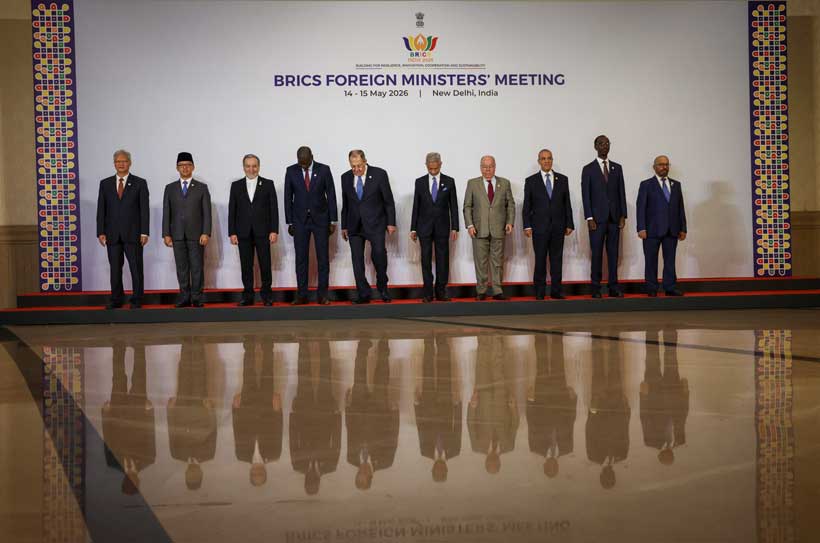
Foreign ministers from the BRICS nations ended a two day meeting in New Delhi without issuing a joint statement, highlighting deep divisions within the bloc over the ongoing conflict involving Iran, the United States, and Israel.

The diplomatic gathering brought together representatives from an increasingly diverse and politically complex alliance that now includes both Iran and the United Arab Emirates, two regional rivals currently on opposite sides of the escalating Middle East crisis.

Because member states could not agree on language regarding the war, host country India released only a chair’s statement summarizing discussions rather than a unified declaration endorsed by all participants.

Iran Pushes for Stronger Condemnation

Iran reportedly sought a stronger collective position condemning the United States and Israel for military operations against it.

Tehran also accused the UAE, a close American partner in the Gulf region, of involvement in military activities linked to the conflict.

Iranian Foreign Minister Abbas Araqchi stated that one BRICS member blocked sections of the proposed statement, although he did not directly name the UAE.

Araqchi attempted to soften tensions publicly by emphasizing that Iran did not view the UAE itself as a direct target in the conflict. He argued that Iranian strikes had focused only on American military facilities located on Emirati territory.

At the same time, he expressed hope that relations inside BRICS could improve before the leaders’ summit later this year.

India’s Carefully Balanced Position

India’s final chair statement revealed the difficulty of managing competing geopolitical interests within the expanded BRICS bloc.

The document acknowledged that member countries held different perspectives regarding the Middle East crisis. According to the statement, discussions included calls for diplomacy, respect for sovereignty, protection of civilian lives, and the importance of maintaining secure maritime trade routes.

However, the absence of a formal joint declaration demonstrated that BRICS members remain divided on critical geopolitical questions.

India’s approach reflected its broader diplomatic strategy of balancing relations with multiple global powers simultaneously. New Delhi maintains close ties with the United States and Gulf countries while also preserving strategic partnerships with Russia, Iran, and China.

Gaza and Palestine Also Cause Disagreement

Divisions were not limited to the Iran conflict.

The chair statement noted that BRICS ministers reaffirmed support for Palestinian self determination and described Gaza as an inseparable part of the occupied Palestinian territories.

The document also supported efforts to unify Gaza and the West Bank under the Palestinian Authority and backed the establishment of an independent Palestinian state.

However, the statement acknowledged that one unnamed member state held reservations regarding aspects of the Gaza section as well.

This further illustrated the challenge of building unified foreign policy positions within a grouping that includes countries with vastly different regional interests and diplomatic alignments.

BRICS and the Global South Narrative

Despite internal disagreements, BRICS members emphasized the importance of cooperation among developing nations.

India’s statement described the Global South as an important force for positive international change during a period marked by rising geopolitical tensions, economic uncertainty, technological disruption, protectionism, and migration pressures.

The expanded BRICS bloc now includes:

  • Brazil
  • Russia
  • India
  • China
  • South Africa
  • Ethiopia
  • Egypt
  • Iran
  • UAE

The expansion of the bloc has increased its global economic and political weight but has also introduced more ideological and strategic divisions.

The Economic Impact on India

The Middle East conflict has had serious economic implications for India.

As one of the world’s largest oil importers, India depends heavily on energy shipments passing through the Strait of Hormuz. The disruption of maritime traffic in the region has increased energy costs and raised concerns about inflation and supply stability.

Indian personnel have reportedly been killed in incidents linked to the regional conflict, while an India flagged vessel was sunk during the recent escalation.

Against this backdrop, Indian Prime Minister Narendra Modi visited the UAE and publicly condemned attacks targeting the Gulf nation.

Modi praised the UAE’s restraint and described attacks against it as unacceptable, signaling India’s effort to maintain strong ties with key Gulf partners despite its participation alongside Iran in BRICS.

Analysis

The failure of BRICS foreign ministers to produce a joint statement highlights the growing contradictions inside the expanded organization.

Originally conceived as an economic coalition of major emerging powers, BRICS increasingly aspires to become a broader geopolitical platform representing the Global South. However, the inclusion of regional rivals and states with conflicting strategic interests makes unified diplomacy increasingly difficult.

The Iran conflict exposed these tensions clearly. Iran sought solidarity against the United States and Israel, while Gulf states inside the bloc maintain close security relationships with Washington and face direct security threats from Tehran.

India’s cautious wording reflected the reality that BRICS currently functions more as a flexible diplomatic forum than a cohesive political alliance.

The episode also demonstrates a larger shift in global politics. As Western led institutions face criticism from many developing nations, alternative groupings like BRICS are gaining visibility. Yet these organizations must still overcome major internal disagreements if they hope to shape global governance effectively.

For India, the situation illustrates the complexity of its foreign policy position. New Delhi seeks leadership within the Global South while simultaneously maintaining relations with competing regional and global powers.

Ultimately, the Delhi meeting showed both the growing importance and the structural limitations of BRICS. The bloc may continue expanding economically and politically, but achieving consensus on major international crises will remain a significant challenge as geopolitical rivalries deepen across the world.

With information from Reuters.

Source link

Best Crypto to Buy Now: Trump-Xi Iran Agreement Boosts Sentiment

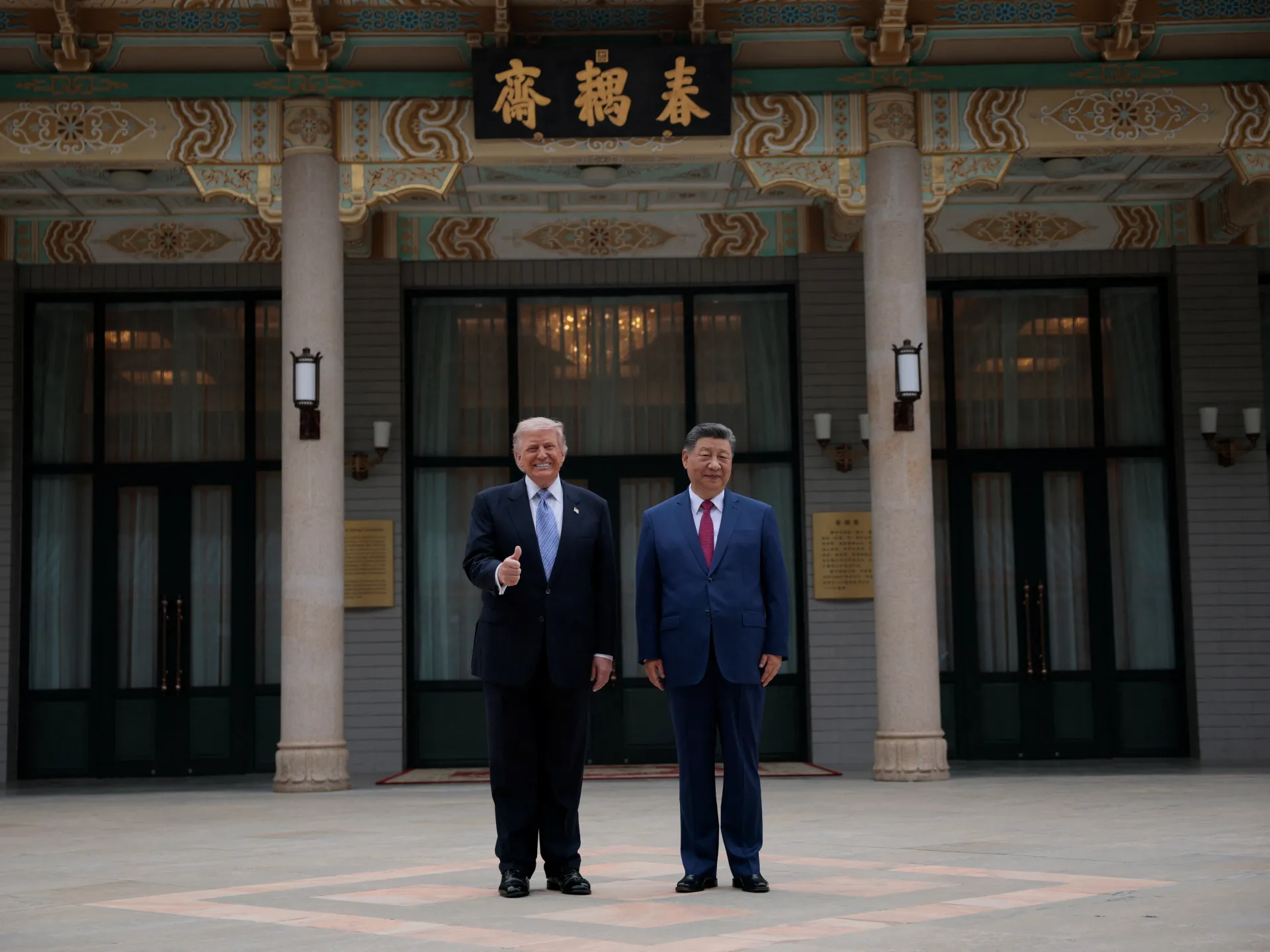
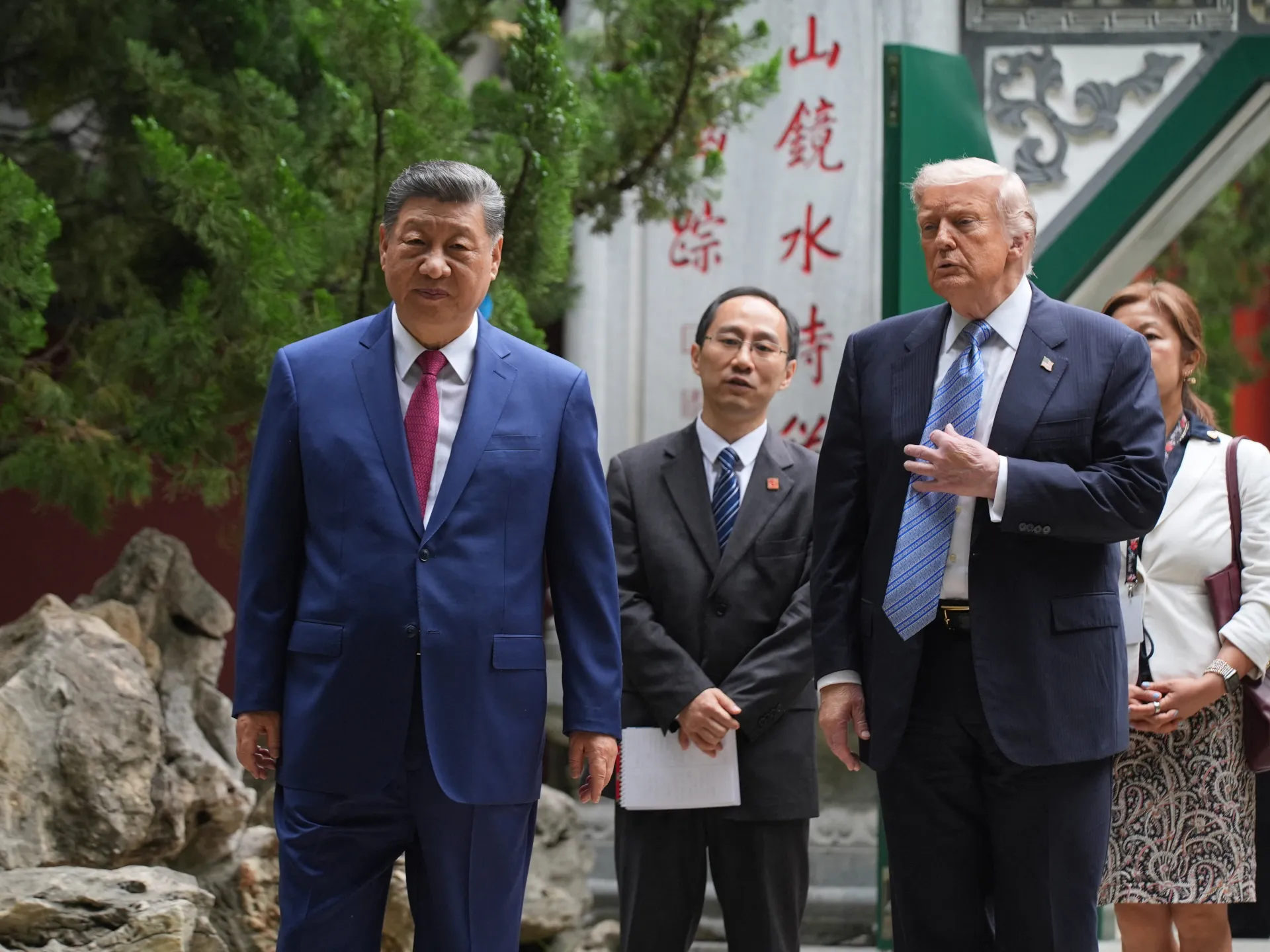
After months of tension over the Iran war, markets finally got something to feel good about. President Trump and Chinese President Xi Jinping met in Beijing on May 14 and agreed the Strait of Hormuz “must remain open,” along with a shared stance that Iran “can never have a nuclear weapon.” Easing tensions in the Middle East usually means one thing for crypto: risk-on sentiment comes back.

That’s why the search for the best crypto to buy now is heating up again. This article looks at three picks worth a closer look while the mood is shifting: Poly Truth ($PTRUE), Meme Punch ($MEPU), and Bittensor (TAO).

Why the Trump-Xi Meeting Matters for Crypto

Crypto pays close attention to global news, and this one is a big deal.

Approximately one-fifth of all oil shipments worldwide pass through the Strait of Hormuz. When it’s in danger, markets become anxious, oil prices increase, and inflation pressure increases. The opposite happens when it’s safe. Money often returns to more volatile investments, such as cryptocurrency.

That is the change that is currently beginning to take shape. The direction has shifted, but the war is still ongoing and the ceasefire is still unstable. Generally speaking, markets are more interested in future trends than current conditions.

Therefore, it makes sense that more buyers are considering cryptocurrency once more. Also, smaller picks usually move first when the mood improves.

Best Crypto to Buy Now in 2026

While sentiment is changing, these three choices are worth a closer look. One is a well-known AI infrastructure project. The other two, which have more potential for growth and lower entry costs, are still in presale.

1. Poly Truth ($PTRUE)

Prediction markets are growing fast, but most people still bet on instinct. Poly Truth steps in with a research tool that does the heavy lifting.

Drop in a prediction event, anything from a presidential race to a Champions League final, and the platform scans news, market data, historical records, and social signals. An AI layer checks everything, weighs the patterns, and returns a probability score for each outcome along with the reasoning behind it.

$PTRUE is the access token. Holders get tiered access to the tool, plus staking rewards and a vote on future updates.

The token is in Stage 1 of its presale at $0.001190, with the next price step at $0.001216. Audits are done with SolidProof and Coinsult, team tokens are locked, and 40% of supply goes to presale buyers.

Check polytruth.io for live numbers.

2. Meme Punch ($MEPU)

The majority of meme coins do nothing more than sit in your wallet and wait for a pump. That is changed by Meme Punch. In this play-to-earn battle game, you take action.

Five iconic meme characters, Pepe, Doge, Floki, Brett, and Pudgy Penguin, are dressed in medieval armor and spawned into a PvP arena. Pick your knight, fight other players, climb the leaderboard, and earn $MEPU as rewards. The token also unlocks weapons, skins, and special powers inside the game.

$MEPU runs on Ethereum, with a total supply of 10 billion. The presale takes 40%, with another 14.5% set aside for staking and 9.5% for in-game rewards. Payment options are ETH, BNB, SOL, USDT, USDC, and card.

Check memepunch.io for the current presale price and staking APY.

3. Bittensor (TAO)

Bittensor runs a decentralized network where machine learning models compete to provide AI services, with TAO tokens rewarding the best performers. The network is split into subnets, each one a marketplace for a specific type of AI task.

The price action tells a useful story. TAO spent most of April trading sideways between $240 and $255 while markets digested the Iran war and the fragile ceasefire. Then, in early May, the breakout came. TAO climbed to around $326 on May 10 and now sits near $306, up over 20% in a month.

It’s a clear example of what happens when tensions decrease. Capital flows back into infrastructure plays, and AI is one of the strongest narratives going.

What to Watch Next

The mood can shift fast, so a few things are worth keeping an eye on:

  • The Israel-Lebanon talks: New peace talks kicked off in Washington this week. A real deal would push sentiment further into risk-on territory.
  • The ceasefire holding: The Iran ceasefire has been in place since April 8, but it’s fragile. Any breakdown would pull money back to safety fast.
  • US-China follow-through: The Trump-Xi meeting was a positive signal, but the real test is what gets done in the weeks after.
  • ETF flows: Spot ETFs for AI tokens like TAO are pending. Approvals or strong inflows would add fuel to the AI narrative.

Conclusion

When sentiment shifts, crypto usually feels it first. The Trump-Xi meeting isn’t a fix for everything happening in the region, but it’s the kind of news that turns the mood around, and the market’s already starting to react.

If you’re looking at the best crypto to buy now, the three picks above cover different angles. Poly Truth ($PTRUE) for the AI tool with a real use case. Meme Punch ($MEPU) for the meme coin you can actually play. Bittensor (TAO) for the established AI infrastructure pick is already moving on the news.

Take a look, read up on each, and only put in what you’re okay risking.

FAQ’s

Which cryptocurrency is best to invest now?

It depends on your risk appetite. Bittensor (TAO) is the safer AI pick, while presales like Poly Truth ($PTRUE) and Meme Punch ($MEPU) offer more upside for those willing to take on early-stage risk.

What is the best buy in crypto right now?

Sentiment is shifting back to risk-on after the Trump-Xi meeting, which usually helps small-cap tokens move first. $PTRUE and $MEPU are two presales catching attention while TAO leads on the AI side.

What crypto under $1 will explode?

No one can guarantee explosions, but presale tokens priced well under a cent, like $PTRUE and $MEPU, have the most room to run if the market keeps warming up.

Which crypto has 1000x potential?

1000x runs almost always come from tiny market caps with a real product behind them, which is why presales like $PTRUE are where most of those bets land, while TAO offers steadier exposure to the same AI story.

Disclaimer: This article is for informational purposes only and does not constitute financial or investment advice. ModernDiplomacy.eu is not a licensed crypto-asset service provider under EU regulation (MiCA). Cryptocurrencies are highly volatile and involve significant risk. Always conduct your own research and consult a licensed advisor before making any investment decisions.

Source link

FBI: $200k reward for American spy who defected to Iran in 2013

May 15 (UPI) — The FBI is offering a reward for information leading to the arrest of a former Air Force counterintelligence specialist who defected to Iran in 2013.

Monica Elfriede Witt, 47, of El Paso, Texas, is accused of spying for Iran. She was indicted in February 2019 by a federal grand jury in Washington, D.C., on espionage charges. The charges allege she transmitted classified defense information to Iran.

Witt served in the military between 1997 and 2008 before working as a U.S. government contractor until 2010. She had access to top secret information, including the true names of Americans working undercover, an FBI press release said.

She “allegedly betrayed her oath to the Constitution” by “defecting to Iran and providing the Iranian regime National Defense Information and likely continues to support their nefarious activities,” said Daniel Wierzbicki, special agent in charge of the FBI Washington Field Office’s Counterintelligence and Cyber Division.

“The FBI has not forgotten and believes that during this critical moment in Iran’s history, there is someone who knows something about her whereabouts,” he added.

The press release said that “Witt allegedly intentionally provided information endangering U.S. personnel and their families stationed abroad. She also allegedly conducted research on behalf of the Iranian regime to allow them to target her former colleagues in the U.S. government.”

Source link

Trump: Proposal is ‘unacceptable,’ but Iran signals openness to peace talks

Iran’s Foreign Minister Abbas Araghchi speaks at a press conference after attending the BRICS Foreign Ministers’ Meeting at the Embassy of the Islamic Republic of Iran in New Delhi, India, Friday. Araghchi signaled a willingness to negotiate with the United States. Photo by Rajat Gupta/EPA

May 15 (UPI) — President Donald Trump told reporters Friday that the first sentence of Iran’s peace proposal was “unacceptable” and accused the country of backtracking on its nuclear policy, but Iran signaled it’s still ready to negotiate.

Trump said the first sentence was an “unacceptable sentence, because they have fully agreed no nuclear, and if they have any nuclear of any form, I don’t read the rest,” CNN reported he said. He added that he is unsatisfied with the “level of guarantee from them.”

Trump said Iran had agreed to give up its enriched uranium, which he calls “nuclear dust.” But “then they took it back,” he said.

But Iranian Foreign Minister Abbas Araghchi said Friday that discussion about uranium enrichment “is currently not on the agenda of discussions or negotiations,” but the country is willing to talk about it later in negotiations, according to Iran’s news agency Tasnim.

Iran has said it doesn’t plan to build a nuclear weapon but has refused to give up its uranium.

Trump’s comments were on his trip from Beijing after meeting with Chinese President Xi Jinping.

When reporters asked if Xi had agreed to pressure Iran to reopen the Strait of Hormuz, the president replied, “We don’t need favors,” but that “we may have to do a little cleanup work,” without clarifying what he meant.

“We had a little monthlong cease-fire, I guess you’d call it, but we have a blockade that’s so effective, that’s why we did the cease-fire.”

China appears hesitant to get involved in the conflict, Al Jazeera reported.

Trump said the United States and China agree that the strait must be opened and the war must end. About half of China’s crude oil comes through the strait.

Araghchi said Iran would welcome Chinese diplomacy to help defuse the war with the United States.

“Any effort made by the Chinese to support diplomacy will be welcomed by the Islamic Republic of Iran,” he said at a press conference in New Delhi, India. He was attending the BRICS foreign ministers’ meeting.

But he also said that Iran considers itself as the protector of the strait.

Araghchi said on X that with Indian Foreign Minister Subrahmanyam Jaishankar, he “clarified that Iran will always carry out [its] historical duty as protector of security” in the Strait of Hormuz.

He added that “all friendly nations” can “rely on safety of commerce.”

Following his visit with Xi, Trump also said he is considering removing sanctions on Chinese companies that have been buying Iranian oil as the war and high gas prices linger.

“I’m going to make a decision over the next few days. We did talk about that,” Trump said on Friday.

U.S. Energy Secretary Chris Wright told CNBC Friday that China will likely buy more oil from the United States.

“I suspect we’ll see a growth in their oil imports from the United States,” Wright said.

“But ultimately, the world needs to get the Persian Gulf open. Iran’s attempt to hold the whole world hostage, people know it’s temporary.

“One way or the other, we will see an end to the Iranian nuclear program and we will see free flow of traffic through the Strait of Hormuz. That can happen relatively rapidly with an agreement with Iran,” he said.

A missile identified as “Khorramshahr-4” was on display during a public rally in Tehran’s Enghelab Square on April 21, 2026. Photo by Behnam Tofighi/UPI | License Photo

Source link

Trump and Xi Focus on Trade Stability While China Raises Iran and Taiwan Concerns

United States President Donald Trump concluded his final round of discussions with Chinese President Xi Jinping in Beijing while attempting to present the visit as a major economic success. The summit came at a sensitive moment for both countries as tensions over trade, Taiwan, artificial intelligence technology, and the Iran conflict continue to shape relations between the world’s two largest economies.

Trump emphasized trade agreements and commercial cooperation during the visit, hoping to strengthen his political standing ahead of important midterm elections in the United States. China, however, used the occasion to deliver clear warnings regarding Taiwan and to criticize the ongoing Iran conflict, signaling that major strategic disagreements remain unresolved despite the positive diplomatic atmosphere.

Trump Highlights Economic Progress

During meetings at the Zhongnanhai leadership compound in Beijing, Trump promoted what he described as successful trade negotiations between Washington and Beijing. He stated that both sides had reached agreements that would benefit their economies and help stabilize commercial relations after years of tariff disputes and economic uncertainty.

The United States announced several proposed agreements involving agricultural exports, beef, and energy sales to China. Officials also discussed mechanisms to manage future trade disputes and identified billions of dollars in potential goods trade between the two countries.

One of the most closely watched announcements involved aircraft manufacturer Boeing. Trump claimed China had agreed to purchase 200 Boeing aircraft, marking China’s first major order of American commercial planes in nearly ten years. However, investors reacted negatively because markets had anticipated a significantly larger agreement. Boeing shares declined after the announcement, reflecting disappointment over the scale of the deal.

The summit also failed to produce a breakthrough regarding advanced artificial intelligence technology exports. Expectations had been growing that restrictions on the sale of advanced AI chips from NVIDIA to China might ease, especially after company chief executive Jensen Huang joined the trip. No major agreement emerged on that issue.

China Pushes Back on Iran Conflict

While Trump focused publicly on economic achievements, China used the summit to voice frustration over the war involving Iran. Beijing stated that the conflict should never have started and called for diplomatic efforts to restore peace.

The Iran crisis has become a major international concern because of its impact on global energy markets. Rising instability in the Middle East has pushed oil prices upward and increased fears about disruptions to energy supplies traveling through the Strait of Hormuz, one of the world’s most critical shipping routes.

China’s position reflects both economic and strategic interests. Beijing relies heavily on stable energy imports and also views Iran as an important geopolitical partner that can balance American influence in the Middle East. Analysts believe China is unlikely to pressure Tehran aggressively because maintaining strong relations with Iran supports Beijing’s broader strategic goals.

Although Trump stated that he and Xi shared similar views on Iran, Chinese officials avoided publicly endorsing Washington’s approach. This difference highlighted the continuing gap between the two powers on international security issues.

Taiwan Remains the Most Sensitive Issue

Despite the friendly diplomatic setting, Taiwan emerged as one of the summit’s most serious areas of tension. Xi warned that mishandling the Taiwan issue could lead to conflict, reinforcing Beijing’s longstanding position that the island is part of China.

Taiwan remains one of the most dangerous flashpoints in global politics. China has repeatedly stated that it does not rule out the use of military force to bring Taiwan under its control, while the United States continues to support Taiwan’s defensive capabilities under American law.

American officials maintained that United States policy toward Taiwan had not changed. Secretary of State Marco Rubio emphasized that Washington continues to support regional stability while maintaining its established position on Taiwan.

The issue remains highly sensitive because any military escalation involving Taiwan could severely disrupt global trade, semiconductor production, and international security across the Indo Pacific region.

A Fragile Trade Truce Continues

One of the summit’s most important outcomes may simply be the continuation of the fragile trade truce reached during earlier talks between the two leaders. Previous negotiations had temporarily paused extremely high tariffs and reduced tensions over rare earth mineral exports that are essential for modern technology manufacturing.

However, uncertainty remains about whether the current trade arrangements will continue beyond the end of the year. American officials indicated that no final decision had been made regarding the future of tariff suspensions and broader economic cooperation.

This uncertainty reflects the deeper structural rivalry between the United States and China. While both countries benefit economically from stable trade relations, they remain competitors in technology, military influence, and geopolitical leadership.

Human Rights Concerns Surface

Human rights issues also appeared during the summit. Trump reportedly raised the case of Hong Kong media businessman and democracy advocate Jimmy Lai, who was sentenced to prison under Hong Kong’s national security law.

American officials expressed hope that Lai could eventually be released, while China maintained that Hong Kong affairs are internal matters and rejected foreign criticism.

The discussion demonstrated that human rights disputes continue to complicate relations between Washington and Beijing even during periods of economic cooperation.

Analysis

The Trump Xi summit demonstrated the increasingly complex nature of United States China relations. Both sides attempted to project stability and cooperation, particularly on trade and economic matters, yet major disagreements remained visible beneath the surface.

Trump sought to frame the visit as proof of economic leadership and diplomatic success. However, the relatively modest scale of announced agreements and the lack of major breakthroughs on technology exports limited market enthusiasm.

China, meanwhile, used the summit to reinforce its strategic priorities. Beijing signaled that Taiwan remains a non negotiable issue, defended its relationship with Iran, and resisted external pressure on human rights matters.

The summit ultimately reflected a broader reality in global politics. The United States and China are deeply interconnected economically, but they are also strategic rivals competing for influence across multiple regions and industries. Cooperation may continue in trade and commerce, but tensions over security, technology, and global power are unlikely to disappear soon.

With information from Reuters.

Source link

For Trump in China, a tonal shift yields few results

A conciliatory President Trump on Friday hailed success in his state visit to China, claiming a tonal reset with Xi Jinping despite departing Beijing with few concrete achievements.

The visual spectacle around Trump’s visit was itself considered a breakthrough by the two sides, who expressed an eagerness entering the talks to move on from a yearslong stretch of deteriorating relations.

But Trump’s homage and deference to Xi were a striking display of an often commanding president adapting to a new power dynamic, understanding China’s rise and its emerging role in the world.

Trump deployed a charm offensive throughout his stay here, confident in the impact of his personal touch on world leaders, often seen patting Xi on the back and repeatedly calling him his friend.

Yet in private, tensions gripped negotiations that touched nearly every major issue on Trump’s agenda, from trade relations to the U.S. war in Iran.

“He’s all business,” Trump said from Beijing in an interview with Fox.

China agreed to buy 200 Boeing jets and spend billions on American agricultural products, U.S. officials said — modest deals that fall short of restoring Chinese investment levels to their pre–2025 highs, before Trump launched a trade war that aggressively targeted Beijing.

Nevertheless, Trump referred to the trade agreements as “fantastic,” and said Xi had also pledged to purchase U.S. energy going forward. Beijing did not confirm any such agreement.

Nor did the Chinese Foreign Ministry comment on any commitment to help the United States reopen the Strait of Hormuz, effectively shuttered by Iran since the Trump administration launched a war against the Islamic Republic earlier this year.

Chinese President Xi Jinping and President Trump participate in a friendship walk through Zhongnanhai Garden.

Chinese President Xi Jinping and President Trump participate in a friendship walk through Zhongnanhai Garden Fridah in Beijing.

(Evan Vucci / Pool / Reuters via Associated Press)

“We feel very similar on Iran, we want that to end,” Trump said Friday. “We don’t want them to have a nuclear weapon. We want the straits opened, and we want them to get it ended, because it’s a crazy thing — they’re a little bit crazy.”

At the beginning of the summit, Xi warned the Trump administration that the longstanding U.S. position of strategic ambiguity on Taiwan had set the two nations on a collision course, Chinese state media reported. But departing Beijing, Marco Rubio, the president’s national security advisor and secretary of state, said that Washington’s position on Taiwan remained “unchanged.”

Their second day of meetings was held at Zhongnanhai, an imperial garden and lake district that has served as the secretive seat of power for the Chinese Communist Party since the revolution of 1949.

The two men strolled quiet pathways dotted with Chinese roses and ornamental archways before taking tea and lunch in Xi’s private quarters. Trump was offered rose seeds to bring home for the White House Rose Garden, the Chinese said.

“This has been an incredible visit,” Trump told reporters at the compound. “A lot of good has come of it.”

It was not the first time that Xi has hosted a president at the historic compound. In 2014, the Chinese leader, still relatively new to the presidency, hosted President Obama overnight at Zhongnanhai, where the two met in private over dinner.

President Trump and Chinese President Xi Jinping tour Zhongnanhai Garden.

President Trump and Chinese President Xi Jinping tour Zhongnanhai Garden.

(Evan Vucci / Pool / Getty Images)

It was another smoggy day for Trump in the Chinese capital, although cooler than Thursday, when Xi greeted Trump at the footsteps of Tiananmen Square with a lavish state welcome. There, Xi hosted Trump and his delegation at the Great Hall of the People for a day of meetings and a banquet dinner of Peking duck and pan-fried pork buns.

The two men will have future opportunities to meet, with Trump inviting Xi to Washington for a state visit at the White House in September.

“He’s a man I respect greatly,” Trump said.

Source link

Iran war day 77: Trump, Xi discuss Hormuz as Tehran rallies BRICS | US-Israel war on Iran News

The US and Chinese leaders agreed during talks in Beijing that the Strait of Hormuz should remain open to ensure global energy supplies.

United States President Donald Trump and Chinese President Xi Jinping discussed the Strait of Hormuz during talks in Beijing, with the White House saying Xi agreed the strategic waterway “must remain open to support the free flow of energy” as tensions over the Iran war continue to roil global markets.

Meanwhile, Iran’s Foreign Minister Abbas Araghchi urged fellow BRICS nations at a meeting in New Delhi, India, to condemn the US-Israel war on Iran as a violation of international law, insisting Tehran would “never bow to any pressure”.

At the same time, a third round of direct talks between Lebanese and Israeli negotiators is under way in Washington, DC, aimed at ending hostilities, even as Israeli attacks continue across towns and villages in southern Lebanon.

Here is what we know:

In Iran

  • Iran urges BRICS to condemn US and Israel: Araghchi told the BRICS+ bloc that Iran was a “victim of illegal expansionism and warmongering” and called on member states to oppose “Western hegemony” by condemning the actions of the US and Israel.
  • Iran accuses UAE over war: Araghchi also accused the United Arab Emirates of playing an active role in the war against Iran, saying during the BRICS summit in India that the UAE was “directly involved in the aggression against my country”.
  • Iran signals new Hormuz strategy: Iranian media reported that more than 30 ships, including some linked to Chinese companies, were allowed to transit the Strait of Hormuz overnight as Tehran signalled the waterway was “open to all commercial ships” that cooperate with Iranian naval forces.

War diplomacy

  • Xi offers help on Hormuz: Trump said Xi Jinping had offered China’s help to open the Strait of Hormuz and pledged not to send military equipment to aid Iran in its war against the US and Israel.
  • Trump-Xi summit held amid ‘promise fatigue’: Analyst Drew Thompson said Washington and Beijing remain deeply distrustful after years of unmet expectations, with both sides accusing the other of breaking promises. He described the summit as “carefully managed” and focused on preventing further deterioration in ties.
  • US says Israel-Lebanon talks ‘positive’: A US official said talks in Washington on Thursday between Israel and Lebanon about an expiring ceasefire were “positive” and will take place as planned for a second day.

In the US

  • Trump wants Iran’s uranium for ‘public relations’: The US president suggested that hunting down Iran’s enriched uranium was primarily for political optics, after Israel demanded it as a goal in the war. “I just feel better if I got it, actually, but it’s – I think, it’s more for public relations than it is for anything else,” Trump told Fox News.
  • Trump says Iran must make deal: In the same interview, Trump told Sean Hannity he was running out of patience to reach a truce with Iran as peace talks have stalled. “I’m not going to be much more patient… They should make a deal. Any sane person would make a deal, but they might be crazy,” Trump said.

In Israel

  • NYT lawsuit: Israel says it will sue The New York Times after the newspaper published an article by columnist Nicholas Kristof detailing rape allegations by Palestinian detainees against Israeli forces. The Israeli Prime Minister’s Office announced the legal move three days after the report, which was based on accounts from 14 male and female Palestinian victims.

In Lebanon and Syria

  • Hezbollah claims attacks on Israeli forces: The group said it launched rockets, drones and artillery attacks on Israeli troops and military vehicles in southern Lebanon, and claimed to have downed Israeli drones.
  • Israel-Lebanon talks face uncertainty: According to Al Jazeera’s Manuel Rapalo, Israel is seeking stronger security guarantees and Hezbollah’s disarmament, while Lebanon wants a permanent ceasefire and Israeli troop withdrawal from the south. Rapalo says Hezbollah’s refusal to commit to any future agreement adds significant uncertainty, although diplomats still view the talks as a breakthrough.
  • Amnesty urges Israel to conduct Syria war crimes probe: The rights group called for investigations into Israeli raids and shelling in southern Syria, which residents say have destroyed homes and farmland and led to detentions. Israel has also seized additional territory beyond the occupied Golan Heights, in violation of the 1974 disengagement agreement.

Source link