Iran

‘Not again’: Gaza rushes to stockpile amid Iran war, crossing closures | Israel-Palestine conflict

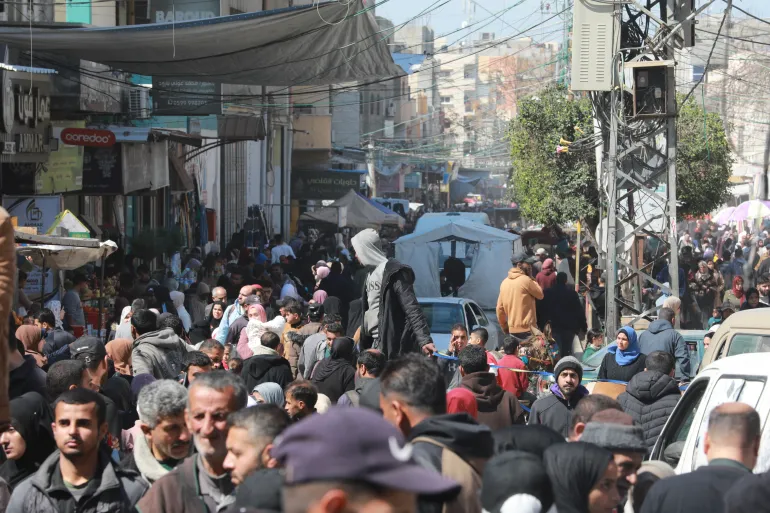
Deir el-Balah/Gaza City – When Hani Abu Issa headed to the Deir el-Balah market on Saturday morning, he was not carrying a long shopping list. He had only intended to buy ingredients for his family’s Ramadan iftar meal, nothing more.

But the sight of crowds gathered in front of grocery shops caught him by surprise and prompted him to ask what was happening.

Recommended Stories

list of 4 itemsend of list

A passer-by told him that Israel had struck Iran and war had broken out.

Hani was shocked as he watched people around him leaving one after another, carrying sacks of flour on their shoulders, and buying whatever food supplies and goods they could manage.

That was how the first hours of the military confrontation between Israel, joined by the United States, and Iran unfolded in Gaza.

The scene in the enclave changed completely as people everywhere rushed to the market to buy sugar, flour, cooking oil and yeast.

Shelves began to empty, and the price of essential goods increased.

A father of five children, 51-year-old Hani told Al Jazeera that he believes the Israel-US war with Iran “will not directly affect Gaza”. But he admits that people in Gaza are no longer able to react calmly to any military development in the region.

“People have become afraid of everything. Since the morning, everyone rushed to the markets to stockpile, and that led to shortages of many goods and rising prices,” he said, while standing in front of food stalls in the Deir el-Balah market, in central Gaza.

Anxiety among residents intensified after COGAT, the Israeli body managing the Palestinian territory, released a statement on its Facebook page on Saturday evening announcing the closure of crossings leading to Gaza and the occupied West Bank “until further notice”, in light of security developments related to the war with Iran.

Hani said the possibility of crossings remaining closed deeply worried him.

“Flour, sugar, cooking oil, and yeast… those were the first things to disappear from the market because of the heavy demand,” he said.

“I lived through famine [during Israel’s genocidal war on Gaza] like everyone else. The worst days were when I had to buy a sack of flour for more than 1,000 shekels [$319]. I don’t want to relive that experience.”

He said that stockpiling while the crossings remained closed was not a viable solution.

“Goods run out quickly, and the conditions we live in may spoil whatever we store. All we need is for someone to reassure us that the closure of the crossings will not last.

“For someone to tell us that we will not be affected.”

Crowds filled Gaza’s markets as residents rushed to stockpile food after news of the Iran war and the closure of Gaza and West Bank crossings [Abdelhakim Abu Riash/ Al Jazeera]
Crowds filled Gaza’s markets as residents rushed to stockpile food after news of the war with Iran and the closure of Gaza and West Bank crossings [Abdelhakim Abu Riash/ Al Jazeera]

Local sources reported that the crossing closures were linked to the Jewish holiday of Purim, which created confusion over how long they would last.

“We cannot be certain or confirm anything. Israel’s word cannot be relied upon, and no specific duration was given,” Hani added in frustration.

“Gaza has not recovered from two years of war and famine. All I think about now is traveling and leaving with my two daughters to live in another country. That is enough.”

At around the same time last year, during Ramadan last March, Palestinians in Gaza endured one of the harshest phases of the war after crossings were closed and goods were prevented from entering for extended periods, leading to shortages of food supplies and price hikes that resulted in the spread of famine.

Israel’s policy of starvation at the time faced widespread condemnation. Markets turned into empty spaces, flour prices soared to record highs, and people died due to severe malnutrition.

Omar Al-Ghazali sells groceries from his food stall in Nuseirat market in central Gaza [Abdelhakim Abu Riash/ Al Jazeera]
Omar Al-Ghazali sells groceries at his food stall in the Nuseirat market in central Gaza [Abdelhakim Abu Riash/ Al Jazeera]

Justified fear

In the Nuseirat market, where people are still frantically buying groceries, 28-year-old seller Omar Al-Ghazali told Al Jazeera that the famine experience has left a deep psychological impact.

“People’s fear is completely justified. They were shocked and frightened and want to secure themselves. They learned from the previous famine experience and from fears of trader hoarding,” the father of four said.

“Today, although the war is not taking place on Gaza’s land, the fear of repeating the famine scenario appears stronger than any logical analysis of the regional situation,” he added.

“We cannot tell people not to buy. What they went through was extremely difficult. We try to convince ourselves that things are fine and that no one will be affected, but fear is stronger.”

‘Where would we even store it?’

Not everyone can afford to stockpile.

Asmaa Abu Al-Khair, 38, was wandering through the Gaza City market on Sunday,  visibly confused. A mother of eight, she wants to stock up, but lacks both the financial ability and the space.

“Where would we store it? And what would I even store? We need everything, and we can barely provide our daily food during Ramadan,” she told Al Jazeera as she walked empty-handed through the market.

“I feel great anxiety. Everyone is talking about it – about Iran’s strike and the closure of the crossings – and I cannot afford to buy what I need, while at the same time, I am afraid of famine returning. I have young children,” she said sorrowfully.

Asmaa said many displaced families living in nearby tents were facing the same reality as they “do not have the money to buy supplies, nor the space to store them inside the tents”.

“We endured so much hardship during the war, and it barely ended with the announcement of a ceasefire. So why close the crossing now? What do we have to do with what is happening? Is what we witnessed not enough? Why play with people’s nerves?”

Until yesterday evening, Asmaa had hoped the crossings would not be closed and that things would continue as they were. Then, the announcement came.

“It felt like a stab in my heart. I went to sleep with deep frustration,” she said bitterly.

Mohammed Daher chose not to stockpile, saying he is exhausted by the repeated Israeli crossing closures, particularly those that coincided with Ramadan last year [Abdelhakim Abu Riash/ Al Jazeera]

Mohammed Daher, 46, from Jabalia, who is now displaced and living in Deir el-Balah, said he had been living the spirit of Ramadan “calmly and peacefully”, without war or gunfire for the first time in two years, until the news of war with Iran.

“I found myself lost again. But I decided not to stockpile anything,” he told Al Jazeera while looking around the market.

“We are exhausted. I reached a point where I have grown used to all scenarios,” he said despairingly. “Israel is looking for any pretext to starve Gaza’s residents again and deepen their humanitarian crisis.”

Daher said he had spent most of his money during the previous famine buying basic food items at inflated prices.

“Everything was priced like gold… if you could even find it. Today, I have no energy left to endure that torment again. Let whatever happens, happen.”

Deepening Gaza’s humanitarian crisis

There were widespread reactions to the Israeli closure decision on social media, as Palestinians questioned whether they were on the brink of an even harsher phase of Israel’s treatment. Many people accused Israel of closing the crossings to push Palestinians towards further starvation and collective suffering.

Some wondered whether Israel was using the moment to create more suffering for Palestinians in Gaza while the world was distracted by the war with Iran.

Ali al-Hayek, a member of the Palestinian Businessmen Association in Gaza, warned that closing the crossings could halt aid distribution to struggling families and put a pause on charitable kitchens. It would also obstruct urgent medical travel abroad, particularly for those who are wounded, in critical condition or living with chronic diseases, such as cancer.

He pointed out that Gaza’s economy has already contracted by more than 85 percent because of Israel’s genocidal war, with the majority of the population pushed below the poverty line, unemployment reaching nearly 80 percent, and more than 97 percent of industrial facilities ceasing operations.

Al-Hayek called on the international community to intervene immediately and pressure the Israeli side to reopen the crossings and restore their normal operations, while ensuring freedom of movement for individuals and goods.

But he also said it is important that traders not use the shortage to increase prices. It’s Ramadan time, he emphasised, and Palestinians should demonstrate solidarity now more than ever.

Source link

Blasts shake Qatar, UAE, Kuwait as Iran’s retaliatory strikes continue | News

Tehran’s retaliatory attacks on US assets in the Gulf region continue for a third day as fears of a prolonged conflict rise.

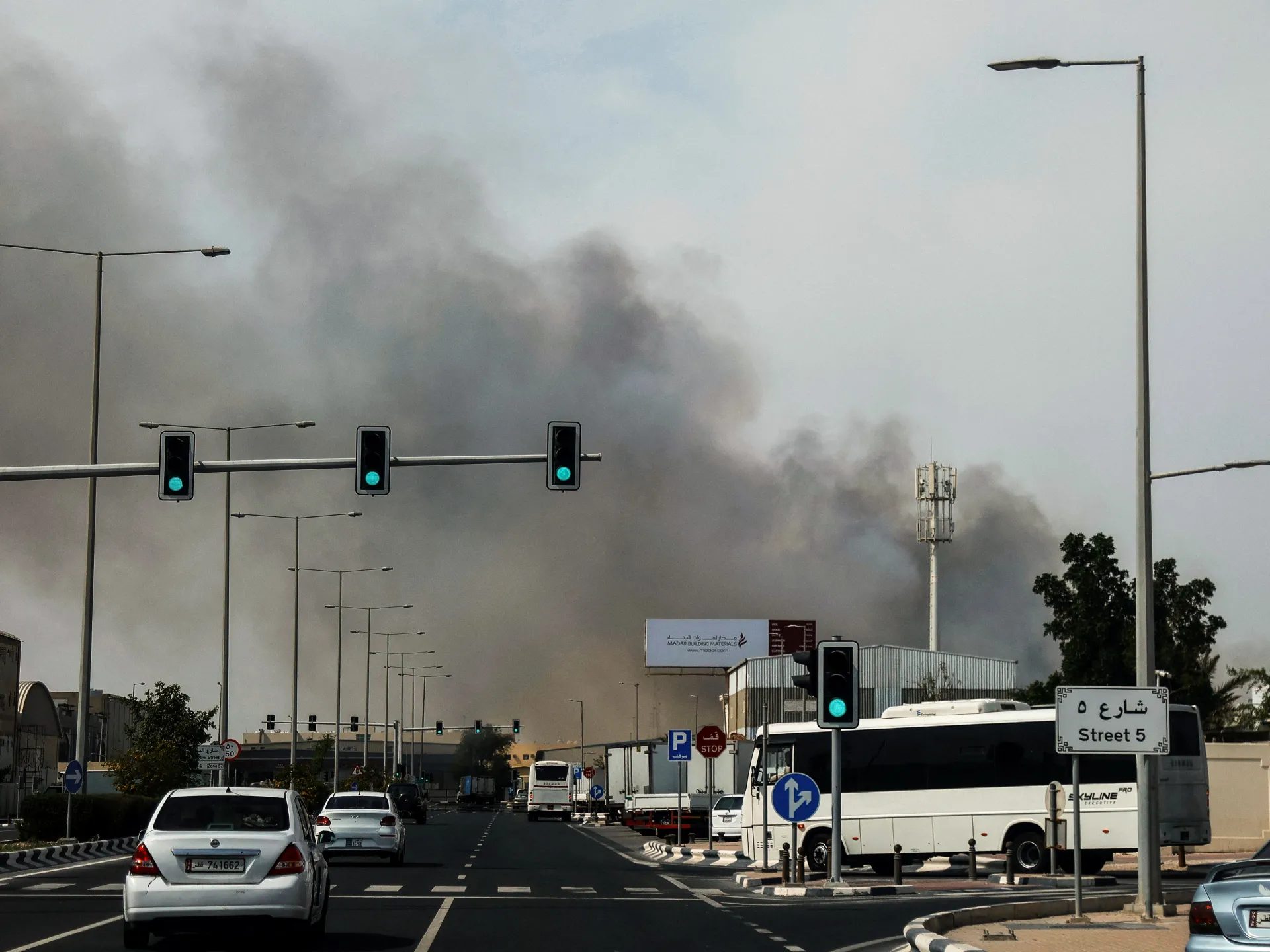
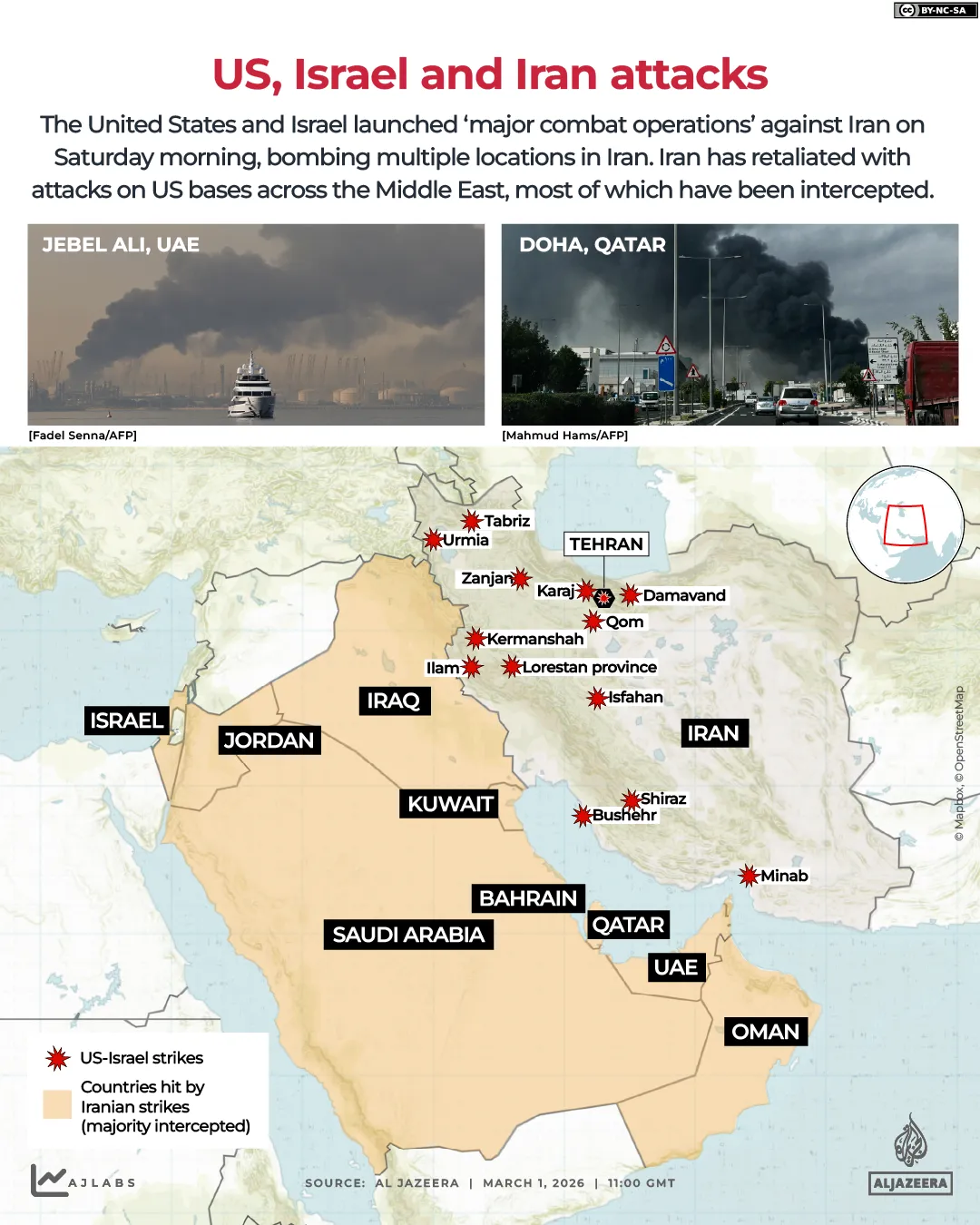
Loud explosions were heard in Dubai in the United Arab Emirates and the Qatari capital ‌of Doha for a third consecutive day of ⁠Iranian retaliatory strikes on neighbouring Gulf states in response to ongoing attacks by the United States and ⁠Israel on Iran.

Loud bangs and sirens were also heard in Kuwait early on Monday morning, with a witness quoted by Reuters news agency saying smoke was seen rising from near the US embassy.

Recommended Stories

list of 4 itemsend of list

Kuwaiti air defences intercepted the majority of the ⁠drones near Rumaithiya and ⁠Salwa neighbourhoods, the state-run Kuwait News Agency reported, quoting the director general of civil defence.

Tehran said it ⁠would target US military assets in the region after the ⁠US-Israeli ⁠strikes on Iran continued for the third day on Monday.

Iran has hit a range of civilian and commercial areas across ‌Gulf cities, widening the conflict’s impact on key regional aviation and trade hubs.

Meanwhile, Bahrain’s Ministry of Interior said it activated air raid alerts and urged residents to head to the nearest safe place.

It said the Shaikh Khalifa bin Salman Bridge linking the capital, Manama, to nearby towns was closed and urged “residents to use main roads only when necessary”.

At least one person has been killed in Kuwait, three have been killed in the UAE, and 16 people have been injured in Qatar.

Meanwhile, at least 201 people have been killed in Iran in US-Israeli attacks, with 747 wounded, while at least nine have been killed and 121 wounded in Israel.

Iran ‘attacking American targets’

The US, Bahrain, Jordan, Kuwait, Qatar, Saudi Arabia and the UAE issued a joint statement on Sunday condemning Iranian attacks across the region and affirming their right to self-defence.

Gulf countries “will take all necessary measures to defend their security and stability and to protect their territories, citizens, and residents, including the option of responding to the aggression”, the statement released after a meeting said.

However, Iranian Foreign Minister Abbas Araghchi on Sunday stressed that Tehran is not seeking confrontation with its Gulf neighbours, telling Al Jazeera that Tehran has “no problem with the countries on the other side of the Persian Gulf”, referring to the Gulf, which is also known as the Arabian Gulf.

Iran maintains “friendly and good neighbourly relations with all of them”, which it is determined to continue, he added.

“What we are doing is in fact an act of self-defence and retaliation to the American aggression against us,” Araghchi said.

“We are not attacking our brothers in the Persian Gulf, we are not attacking our neighbours, but we are attacking American targets,” he added.

Source link

Analysis: Khamenei’s killing leaves Iran’s ‘axis’ in disarray | Hezbollah

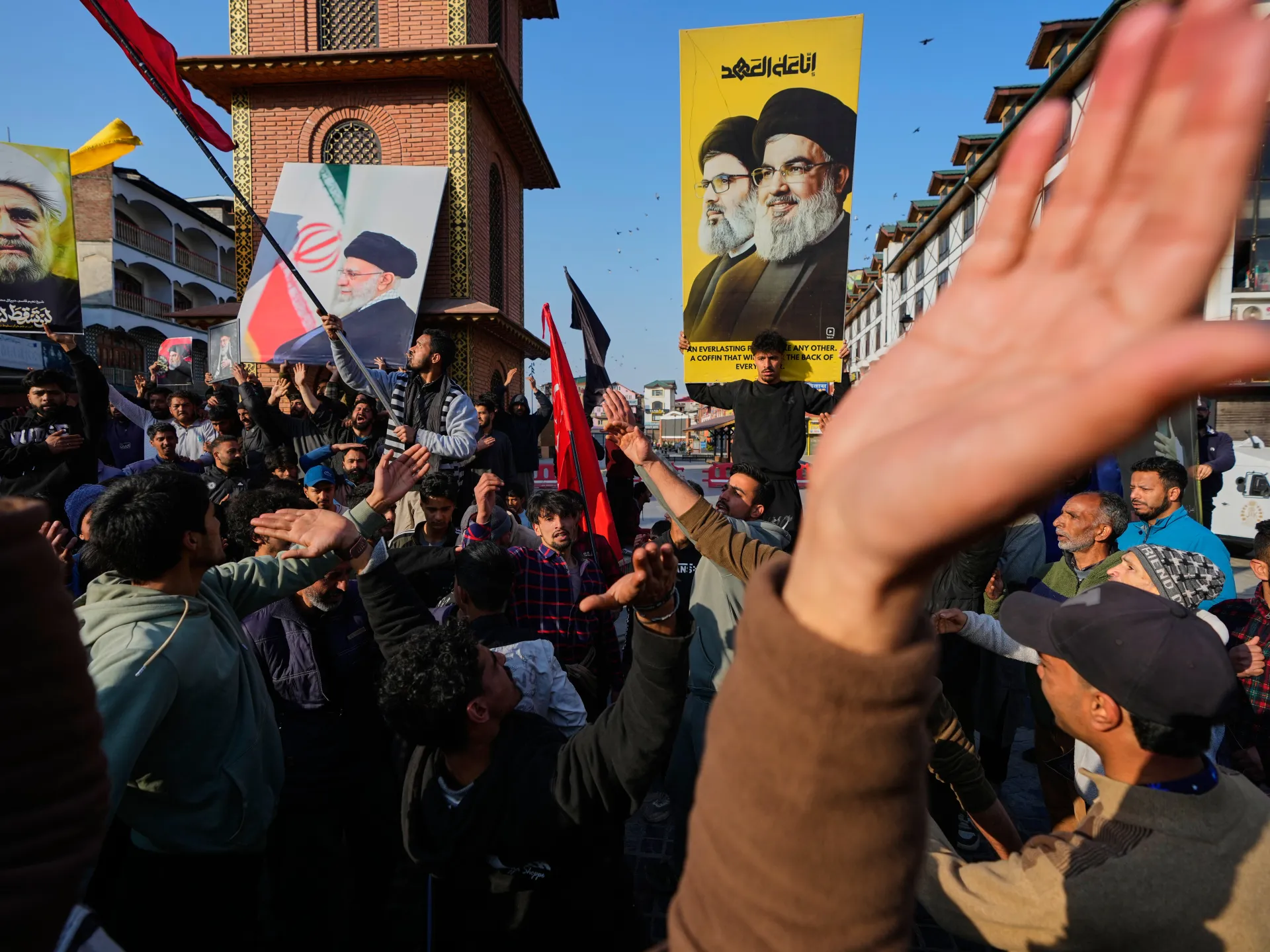
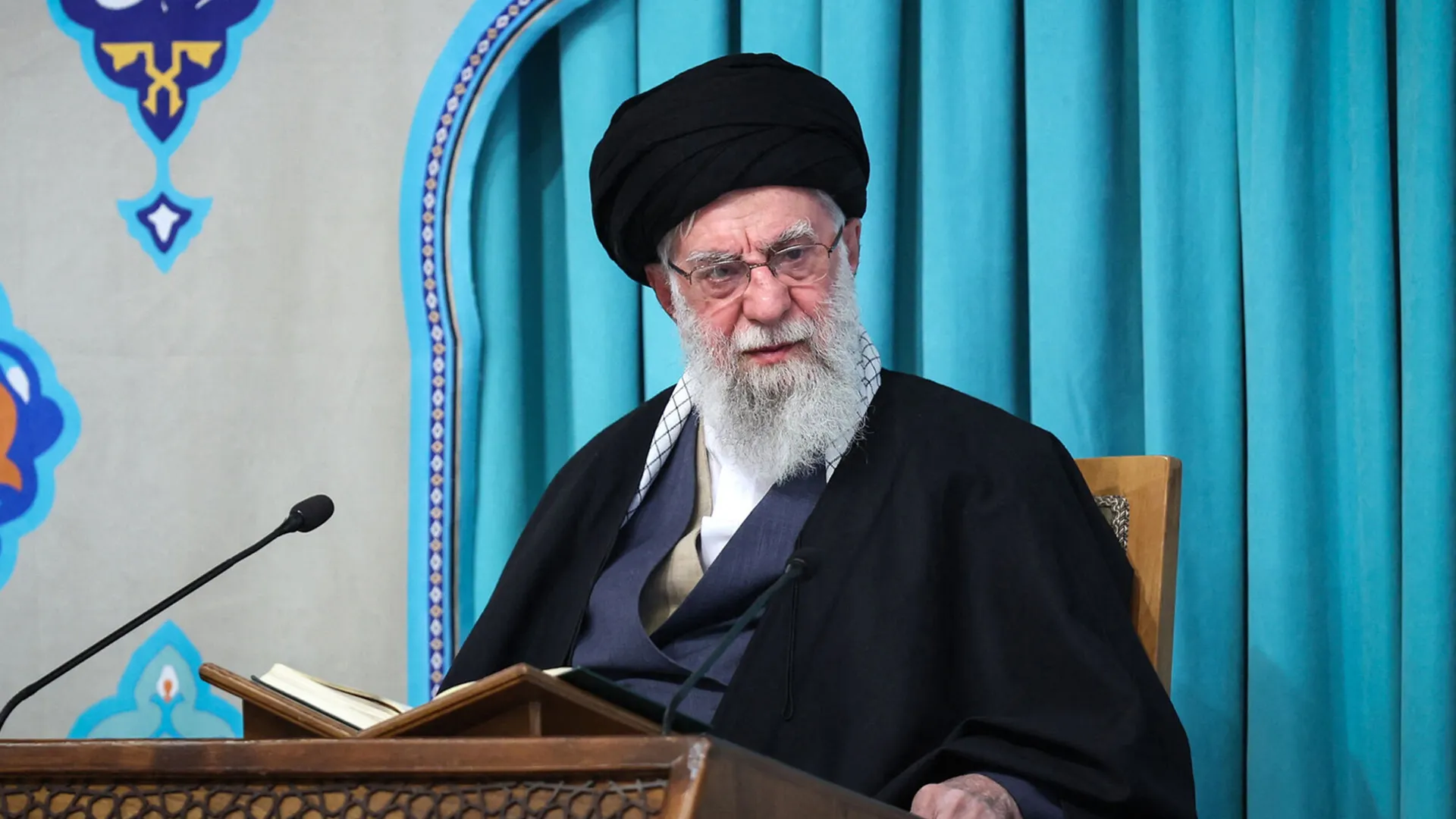
The killing of Iranian Supreme Leader Ali Khamenei in a United States-Israeli air campaign has sent shockwaves through the Middle East, decapitating the leadership of the “axis of resistance” at its most critical moment.

For decades, this network of groups allied with Iran was Tehran’s forward line of defence. But today, with its commander-in-chief dead and its logistical arteries cut, the alliance looks less like a unified war machine and more like a series of isolated islands.

Recommended Stories

list of 4 itemsend of list

Hassan Ahmadian, a professor at the University of Tehran, warned that the era of strategic patience is over and the Iranian government is now prepared to “burn everything” in response to the attacks.

While Tehran promised to retaliate against the US and Israel “with a force they have never experienced before”, the reaction from its key proxies in Lebanon, Yemen and Iraq revealed a deep hesitation driven by local existential threats that may outweigh their ideological loyalty to a fallen leader.

Hezbollah: Walking between raindrops

In Beirut, the response from Hezbollah, long considered the crown jewel among Iran’s regional allies, has been cautiously calibrated.

After Sunday’s announcement of Khamenei’s death, the group issued a statement condemning the attack as the “height of criminality”. However, Al Jazeera correspondent in Beirut Mazen Ibrahim noted that the language used was defensive, not offensive.

“If one dismantles the linguistic structure of the statement, the complexity of Hezbollah’s position becomes clear,” Ibrahim said. “The secretary-general spoke of ‘confronting aggression’, which refers to a defensive posture. … He did not explicitly threaten to attack Israel or launch revenge operations.”

This caution is rooted in a new strategic reality. Since the collapse of Bashar al-Assad’s government in Syria in late 2024, the “land bridge” that supplied Hezbollah has been severed. Ali Akbar Dareini, a Tehran-based researcher, noted that this loss “cut the ground link with Lebanon”, leaving the group physically isolated.

Now with top leaders of Iran’s Islamic Revolutionary Guard Corps (IRGC) killed alongside Khamenei, Hezbollah appears paralysed – caught between a battered domestic front in Lebanon and a vacuum of orders from Tehran.

The Houthis: Solidarity meets survival

In Yemen, the Houthis face an even more volatile calculus.

In his first televised address after the strikes on Iran began on Saturday, the group’s leader, Abdel-Malik al-Houthi, declared his forces “fully prepared for any developments”. Yet his rhetoric notably emphasised that “Iran is strong” and “its response will be decisive,” a phrasing that analysts interpreted as an attempt to deflect the immediate burden of war away from the Houthis.

The Houthis are under immense pressure. While they have successfully disrupted Red Sea shipping and fired missiles at Tel Aviv, they now face a renewed threat at home.

The internationally recognised Yemeni government, having won a power struggle against southern separatists, has sensed a shift in momentum. Defence Minister Taher al-Aqili recently declared: “The index of operations is heading towards the capital, Sanaa,” which the Houthis control. The statement signalled a potential ground offensive to retake Houthi territory.

This places the Houthis in a bind. While Houthi negotiator Mohammed Abdulsalam recently met with Iranian official Ali Larijani in Muscat, Oman, to discuss “unity of the arenas”, the reality on the ground is different. Engaging in a war for Iran could leave the Houthis’ home front exposed to government forces backed by regional rivals.

“Expanding the circle of targeting will only result in expanding the circle of confrontation,” the Houthi-affiliated Supreme Political Council warned in a statement that threatened escalation but also implicitly acknowledged the high cost of a wider war.

Iraq: The internal time bomb

Perhaps nowhere is the dilemma more acute than in Iraq, where the lines between the state and the “resistance” are dangerously blurred.

Iran-aligned militias, many of which operate under the state-sanctioned Popular Mobilisation Forces, are now caught in a direct standoff with the US. Tensions have simmered since late 2024 when Ibrahim Al-Sumaidaie, an adviser to Iraq’s prime minister, revealed that Washington had threatened to dismantle these groups by force, a warning that led to his resignation under pressure from militia leaders.

Today, that threat looms larger than ever. Unlike Hezbollah or the Houthis, these groups are technically part of the Iraqi security apparatus. A retaliation from Iraqi soil would not just risk a militia war but also a direct conflict between the US and the Iraqi state.

With the IRGC commanders who once mediated these tensions now dead, the “restraining hand” is gone. Isolated militia leaders may now decide to strike US bases of their own accord, dragging Baghdad into a war the government has desperately tried to avoid.

Resistance without a head

Khamenei’s assassination has essentially shattered the command-and-control structure of the “axis of resistance”.

The network was built on three pillars: the ideological authority of the supreme leader, the logistical coordination of the IRGC and the geographic connection through Syria. Today, all three are broken.

“The most important damage to Iran’s security interests is the severing of the ground link,” Dareini said. With Khamenei gone, the “spiritual link” is also severed.

What remains is a fragmented landscape. In Lebanon, Hezbollah is too exhausted to open a northern front. In Yemen, the Houthis face a potential domestic offensive. In Iraq, militias risk collapsing the state they live in.

When the dust settles in Tehran, the region will face a dangerous unpredictability. The “axis of resistance” is no longer a coordinated army. It is a collection of angry, heavily armed militias, each calculating its own survival in a world where the orders from Tehran have suddenly stopped coming.

Source link

Oil prices rise as escalating Iran conflict spurs energy supply concerns

Published on

Oil prices climbed on Monday morning as investors assessed the economic impact of US and Israeli attacks on Iran, which triggered swift retaliation from Tehran targeting assets in multiple Middle Eastern countries.


ADVERTISEMENT


ADVERTISEMENT

In early trade, the price of a barrel of US benchmark crude initially surged by about 8%. It later traded 5.9% higher at $71.00 per barrel. Brent crude rose 6.2% to $77.38 per barrel.

Traders were betting that oil supplies from Iran and elsewhere in the Middle East could slow or grind to a halt. Attacks across the region, including on two vessels travelling through the Strait of Hormuz — the narrow mouth of the Persian Gulf — have restricted countries’ ability to export oil to the rest of the world.

“Roughly one-fifth of global oil and LNG (liquefied natural gas) flows squeeze through the Strait of Hormuz. This is not an obscure canal. It is the aorta of the global energy system,” Stephen Innes of SPI Asset Management said in a commentary note.

A prolonged war would likely result in higher prices for other fuels and petrol, and could ripple through the global economy, adding to overall production costs.

Likewise, prolonged interruptions to oil flows through the Middle East would have “huge implications for oil and LNG and every market everywhere if it occurs. Energy is an input to all production,” RaboResearch Global Economics & Markets said in a report.

Iran exports roughly 1.6 million barrels of oil a day, mostly to China. Beijing may need to look elsewhere for supply if Iran’s exports are disrupted — another factor that could push energy prices higher.

However, China has ample oil reserves of up to 1.5 billion barrels and could offset a decline in Iranian oil by increasing imports from Russia, said Michael Langham of Aberdeen Investments.

The attacks had been anticipated, following a significant build-up of US forces in the Middle East, so traders had already adjusted their positions to account for that risk.

In other early trading on Monday, the price of gold — usually viewed as a safe haven in times of uncertainty — rose 2.4% to about $5,371 per ounce.

Elsewhere, futures for the S&P 500 and the Dow Jones Industrial Average were down about 0.8% by mid-morning in Bangkok.

Asian shares also opened lower. Japan’s Nikkei 225 initially fell more than 2%. In Hong Kong, the Hang Seng lost 1.6% to 26,215.91, while the Shanghai Composite was flat at 4,163.01.

Taiwan’s benchmark index fell 0.6% and Singapore’s dropped 1.9%. In Bangkok, the SET declined 2.1%, while Australia’s S&P/ASX 200 shed 0.3% to 9,173.50.

Source link

Poll suggests only a quarter of Americans support attacks on Iran | Donald Trump News

A poll conducted in the hours after the United States and Israel launched a major military operation against Iran, sparking regional retaliation, shows dismal approval for the strikes from the US public.

The Reuters Ipsos poll was conducted beginning on Saturday and closing on Sunday, before the administration of President Donald Trump announced that the first US troops had been killed in the conflict. Only one in four respondents approved of the US-Israeli attacks.

Recommended Stories

list of 3 itemsend of list

The early findings could have a significant effect on how the Trump administration moves forward in the days ahead and on how lawmakers respond to the attacks, particularly as they look to a punishing midterm election season.

Trump on Sunday promised to continue what he described as a “righteous mission” until “all objectives are achieved”. Referencing the three US military members announced killed on Sunday, Trump said that “there will likely be more before it ends”.

After a US-Israeli strike killed Iranian Supreme Leader Ayatollah Ali Khamenei, Trump again framed Iran as an existential threat to the US, claiming that the country’s leaders “have waged war against civilization itself”.

The Reuters-Ipsos poll suggested that the US public does not share that view, with 43 percent of respondents saying they disapproved of the war and another 29 percent saying they were unsure.

Approval among Republicans was stronger, but not resounding, with 55 percent saying they approved of the strikes, 13 percent disapproving and 32 percent unsure.

Perhaps most significantly, about 42 percent of Republicans said they would be less likely to support the operation if it led to “US troops in the Middle East being killed or injured”.

About 74 percent of Democrats disapproved of the strike, with 7 percent approving and 19 percent unsure.

Midterms loom

The poll released on Sunday comes as Republican lawmakers have largely coalesced around Trump’s message on Iran, even as its contradiction to Trump’s campaign promises risks alienating his Make America Great Again (MAGA) base.

Trump had run on a pledge to cease “endless wars” and halt US interventionism abroad in an “America First” pivot.

While Trump has shown a unique ability to shape the views of his staunchest supporters in his likeness, some conservative commentators have warned that he is playing with fire.

“If this war is a swift, easy, and decisive victory, most of them will get over it,” Blake Neff, a former producer for late conservative activist Charlie Kirk, wrote on X on Saturday.

“But if the war is anything else, there will be a lot of anger.”

He added that “success can override bad explanations. So we must pray for success.”

Speaking to Al Jazeera, Doug Bandow, a senior fellow at the Cato Institute, a libertarian think tank, said the confirmation that US soldiers had been killed “brings home the cost of the war”.

“Americans, by a very large margin, don’t want to be tied up in an ongoing conflict in the Middle East,” he said during a television interview. “The fact that Americans have died suddenly shows this is not just a video game from the standpoint of America.”

Beyond the three US military personnel killed, at least 201 people have been killed in Iran, nine in Israel, two in Iraq, three in the United Arab Emirates and one in Kuwait.

Meanwhile, 45 percent of respondents to the Reuters-Ipsos poll, including 34 percent of Republicans and 44 percent of independents, said they would be less likely to support the campaign against Iran if gas or oil prices increased in the US.

The conflict has threatened arterial trade routes, with several companies suspending shipments in the area.

Democrats will also be keeping a close eye on public sentiment on the war, which will surely hang over the campaign season ahead of the midterm elections in November.

The party has made affordability a key issue, with incumbents and upstart challengers alike portraying Trump’s military adventurism, which has also included the US abduction of Venezuelan leader Nicolas Maduro, as out of touch with his messaging.

Elected Democrats, meanwhile, have given a range of responses to the US operation against Iran, with at least one Democratic senator praising Trump’s strikes. Others celebrated Khamenei’s killing, but remained more circumspect on Trump’s justification for the attacks, while several others were forthright in condemning the strikes.

Several Democrats on Sunday said the killing of US soldiers underscored the urgency of passing a war powers resolution, which would require approval from Congress before further military action is taken.

“I’m thinking of the brave American soldiers killed today,” Senator Chris Van Hollen, a proponent of the resolution, posted on X on Sunday. “They should still be with us.”

“Trump said he would keep us out of war. This is his war of choice.”

A vote on the resolution is expected early this week.

Source link

Netanyahu vows increasing strikes on Tehran | Israel-Iran conflict

NewsFeed

Israel’s prime minister says strikes on Tehran will increase in the coming days, with US support, to do what Benjamin Netanyahu says he’s ‘hoped to do for 40 years’. Israel and the US killed Iran’s Supreme Leader on Saturday in a renewed war on Iran.

Source link

B-2 Spirits Join Iran Air War, Pummel Underground Missile Caves (Updated)

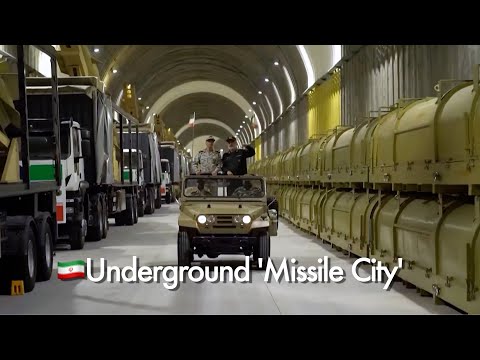
Just as we expected, B-2 Spirits have entered the air campaign against Iran last night. Flying global airpower missions from their home base in Whiteman, Missouri, America’s stealth bombers arrived over Iranian airspace in the early morning hours and targeted Iran’s missile caves. These facilities are built deep under mountains and are primarily used for storage, but some of them actually have the ability to launch ballistic missiles through fissures in their ceilings.

Yesterday, I wrote on X what was to come for the B-2 and the air war, stating:

B-2s will likely show up tonight, making direct attacks on key targets in a way no other platform can. Yes this could include MOPs, but also lots of JDAMs against less fortified targets. They can achieve massive effects in a single sortie. One B-2 can carry 80 500lb JDAMs. Entire airfield’s infrastructure gone on a single pass. They would not be employed until the night and they now have the benefit of highly degraded air defenses and disrupted command and control. This is when the air campaign will change.

B-2s will likely show up tonight, making direct attacks on key targets in a way no other platform can. Yes this could include MOPs, but also lots of JDAMs against less fortified targets. They can achieve massive effects in a single sortie. One B-2 can carry 80 500lb JDAMs. Entire… pic.twitter.com/d0ztfmHYVN

— Tyler Rogoway (@Aviation_Intel) February 28, 2026

There were some indications that B-2 movements were underway, including tanker sorties from the Azores that didn’t have a visible ‘customer.’

Prioritizing missile cave complexes as a target for America’s ‘silver bullet’ stealth bomber force is an obvious decision. As we have stated for years, destroying these complexes is challenging. They are made up of different chambers that can be sealed off from one another. So very complex weaponeering and a large quantity of specialized munitions would be needed to even attempt destroying them completely.

Iran is responding to external threats by releasing a new video showcasing one of its underground missile tunnel systems, packed with missile engines, mobile launchers, and a range of advanced weaponry. The footage prominently features the Paveh cruise missile, the Ghadr-380… pic.twitter.com/ILsdlrPtQy

— Basha باشا (@BashaReport) March 25, 2025

Iran military shows footage giving tour of underground ‘missile city’


On the other hand, these facilities have a massive vulnerability. You don’t need to destroy them to put the missiles and launchers stored inside totally out of action. You just need to seal them off and keep them sealed off during a conflict. This can be done by striking near the entrances to the fortified caverns. By keeping an eye on these openings using remote sensing after initial strikes, deciding if and when further strikes are needed can be done with high confidence, as efforts to open the entrances back up can be seen and responded to.

So, just by bottling these facilities up, you make the arsenals held within them useless. In addition, some of the entrances have rock formations that climb more gradually above them, meaning penetrators can actually burrow to a depth where the tunnels themselves exist, not just entrance areas. Striking here makes reopening the caverns even more challenging.

There is one complicating factor when trying to put these facilities out of action — some of them have apertures in their ceilings that allows ballistic missiles to be launched without them leaving the facility. Some even have automated rapid-loading systems to fire the missiles off quickly. This means that missiles can still be fired from them even if the entrances are temporarily sealed. The good news is that the overhead doors that protect the launch bays can be penetrated, and the bays themselves destroyed. This would specifically be a good job for the B-2.

⚠️ 𝐁𝐫𝐞𝐚𝐤𝐢𝐧𝐠 𝐍𝐞𝐰𝐬 ⚠️

🇮🇷 | 𝗜𝗿𝗮𝗻 𝗿𝗲𝘃𝗲𝗮𝗹𝘀 𝗶𝘁’𝘀 “𝗺𝗶𝘀𝘀𝗶𝗹𝗲 𝗰𝗶𝘁𝘆” 𝗶𝗻 𝗮 𝗺𝗲𝘀𝘀𝗮𝗴𝗲 𝘁𝗼 𝗲𝗻𝗲𝗺𝗶𝗲𝘀…

Iran’s Space Command has released a video of one of hundreds of these underground missile cities.

𝗧𝗵𝗲𝘀𝗲 𝗺𝗶𝘀𝘀𝗶𝗹𝗲 𝗰𝗶𝘁𝗶𝗲𝘀… pic.twitter.com/7a93vWUBmB

— Iran Spectator (@IranSpec) August 5, 2024

Iran has even experimented with automated loading systems for the aperture launch concept, as seen above. (Iranian State Media)

By going after these cave complexes, scores of launchers and missiles can be taken off the table. That means fewer missiles to hunt for in the open, which is a very challenging and resource-consuming kind of interdiction mission, to say the least. As such, these installations would be among the highest priority of targets, along with Iranian command and control capabilities. There is currently a race on when it comes to the supply of missiles and counter-missile capabilities. As we have discussed at length, interceptor stocks are not in a good place. For every missile kept out of the fight, that is one (or more) less interceptors that does not need to be expended.

תיעוד נוסף ממבצע “שאגת הארי”

צה”ל פועל בריכוז מאמץ לסיכול איומים לעבר עורף מדינת ישראל וכן סיכל משגרים רבים שהיו מוכנים לשיגור מיידי לעבר אזרחי מדינת ישראל.

במסגרת תקיפות חיל האוויר במערב איראן, זוהו פעילים מיחידת טילי הקרקע-קרקע של משטר הטרור האיראני מחמשים משגר במערב איראן… pic.twitter.com/X3HUAxcFYH

— Israeli Air Force (@IAFsite) February 28, 2026

The B-2 has unique conventional weapons capabilities that have become famous. A single Spirit can carry 80 500-pound JDAMs that can all fly miles from their launch point and hit individual targets with exacting precision. A single pass from one B-2 over an airfield can destroy all of the base’s non-hardened infrastructure, for instance. But it’s the B-2’s bunker-busting capabilities that get the most attention.

The Massive Ordnance Penetrators (MOP) used to attack Fordow in June are the ultimate non-nuclear bunker buster. But these 30,000-pound weapons are very few in number, and only two can be carried by each B-2. Because of the compartmentalized nature of some of the missile caves, just how effective they would be at destroying the complexes is questionable. If intelligence existed that would allow for perfect weapons placement, it’s possible they would have been used.

B-2 drops a MOP during testing. (USAF)

More likely, the B-2s would have used more common bunker busters for this kind of mission. These include 2,000-pound-class BLU-109-warhead equipped GBU-31 Joint Direct Attack Munitions (JDAM). The BLU-109-equipped JDAMs are common across American combat aircraft, but the B-2 can carry 16 of them, not a couple like a fighter would, on a typical mission. The B-2’s arsenal may also now include new GBU-72 5,000-pound-class bunker busters, a bomb developed to bridge some of the gap between the BLU-109 and the MOP. A mix of these weapons can be carried in order to tailor the damage to different areas of a missile cave complex.

The smaller weapons would likely have been capable of collapsing runner entrances and destroying the missile launch apertures at the limited number of sites equipped with them.

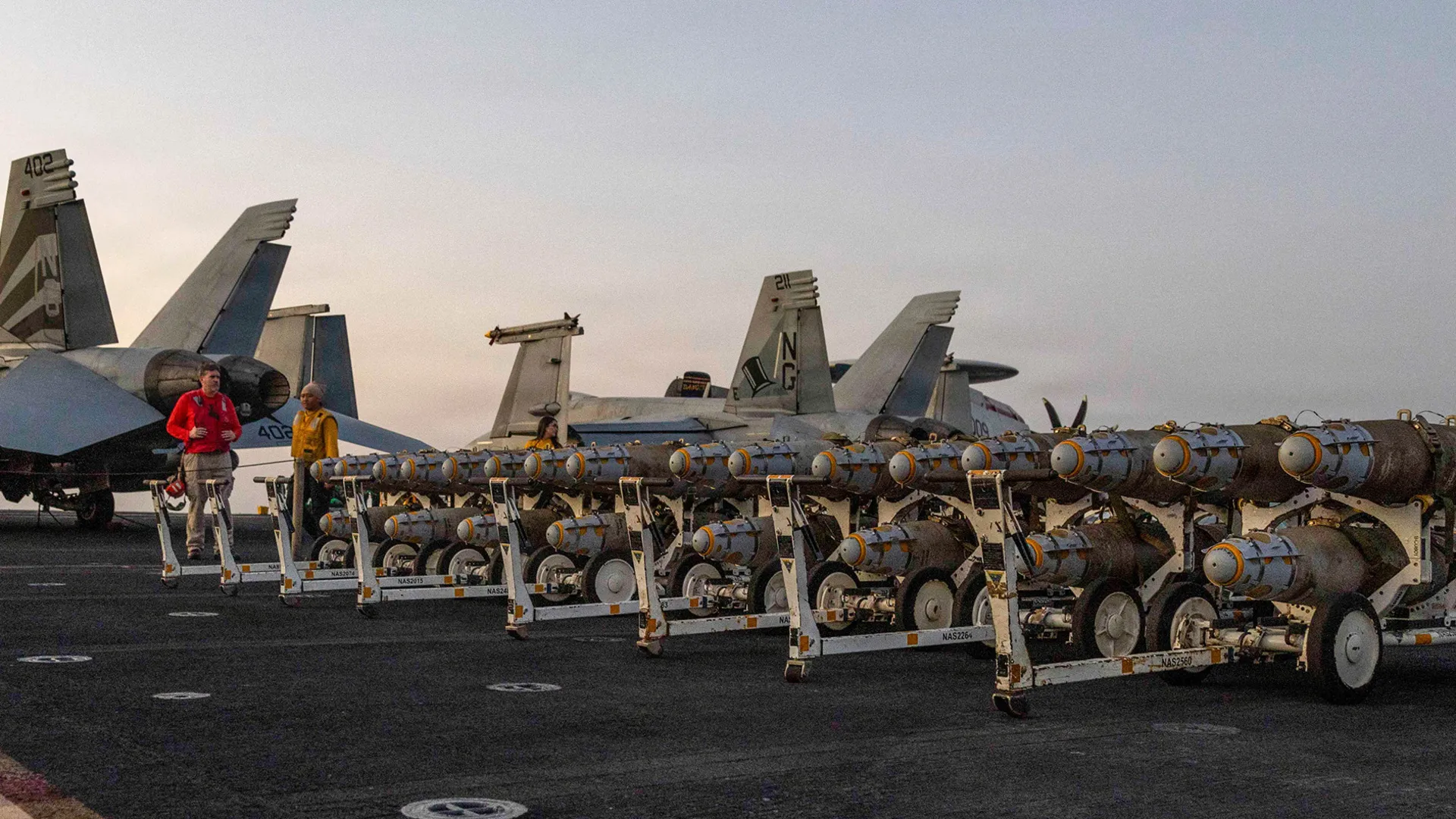
Airmen assigned to the 7th Munitions Squadron prep inert BLU-109 penetrator bombs during the Bomber Agile Combat Employment exercise at Dyess Air Force Base, Texas, Dec. 11, 2019. The exercise helps in practicing Dyess AFB’s ability to leverage logistics in order to quickly deploy and sustain the force when called upon to do so. (U.S. Air Force photo by Senior Airman Mercedes Porter)
Airmen assigned to the 7th Munitions Squadron prep inert BLU-109 penetrator bombs during the Bomber Agile Combat Employment exercise at Dyess Air Force Base, Texas, Dec. 11, 2019. (U.S. Air Force photo by Senior Airman Mercedes Porter) Staff Sgt. Mercedes Bizzotto

Then there is another question some are bound to ask, why use a B-2? Why not a B-52 or B-1? The answer there is multi-fold, but the biggest driver in this regard is the B-2’s stealth capabilities. The airspace over Iran is not fully secured. There are still threats, some of which are novel to Iran, and others are road mobile and can pop up at any time. Taking every advantage — careful mission planning based on the latest intelligence, electronic warfare, and cyber support, and escorts that can take out counter-air threats in real time — is still a necessity. Also, the B-2 crews train for just this type of mission and likely have familiarity with the target sets in mind. So they will be used for direct bomber attacks for the foreseeable future.

A U.S. Air Force B-2 Spirit aircraft departs Whiteman Air Force Base, Missouri, Oct. 2, 2025. The B-2 is capable of penetrating heavily defended air spaces and delivering conventional and nuclear munitions anywhere on the globe. (U.S. Air Force photo by Staff Sgt. Joshua Hastings)
A U.S. Air Force B-2 Spirit aircraft departs Whiteman Air Force Base, Missouri, Oct. 2, 2025. The B-2 is capable of penetrating heavily defended air spaces and delivering conventional and nuclear munitions anywhere on the globe. (U.S. Air Force photo by Staff Sgt. Joshua Hastings) Staff Sgt. Joshua Hastings

As to why the B-2s flew such a long mission instead of operating from a forward location, the answer there is relatively clear. As we reported last week, the United Kingdom has not allowed the U.S. to launch strikes from its bases against Iran. This includes two locations that are fully equipped to sustain bomber operations and are relevant in proximity to the Iranian mission — RAF Fairford in the United Kingdom and Diego Garcia in the Indian Ocean. While the B-2 community has been training to launch limited operations from other forward locations in recent years, these locales are not equipped to sustain sorties. So, flying from home, at least at this point, was clearly the best option.

We will likely be seeing more of the B-2s in the coming days, especially as the air war moves from targeting immediate threats and focuses on destroying Iran’s nuclear infrastructure and its military industrial complex — especially the parts of it that develop and construct ballistic missiles and other standoff weaponry that threaten Israel and Iran’s neighbors.

UPDATE: 4:47 Eastern –

The U.K. government has more details about the revised level of support it is willing to provide the United States in its campaign directed against Iran. The United Kingdom is now offering the U.S. military use of its bases for strikes targeting Iranian missile sites. You can read more about why this became an issue in our story about the controversy here.

In a video shared on social media Sunday, British Prime Minister Keir Starmer said: “Our partners in the Gulf have asked us to do more to defend them, and it’s my duty to protect British lives.

“We have British jets in the air as part of coordinated defensive operations which have already successfully intercepted Iranian strikes.

“But the only way to stop the threat is to destroy the missiles at source — in their storage depots or the launchers which used to fire the missiles. The United States has requested permission to use British bases for that specific and limited defensive purpose.

“We have taken the decision to accept this request — to prevent Iran firing missiles across the region, killing innocent civilians, putting British lives at risk and hitting countries that have not been involved.”

Given Starmer’s new stance, it is possible we could see movements of B-2s and other bombers to either or both of the bases at the center of the controversy. As we have already noted, the U.S. has beefed up Diego Garcia with F-16 Fighting Falcons.

However, we don’t know the timeline for Operation Epic Fury. If it only lasts a few days, it is possible that the B-2s and other bombers could continue to fly from bases in the U.S. We just don’t know yet. 

UK’s Keir Starmer:

The only way to stop the threat is to destroy Iranian missiles at source, in their storage depots or the launchers which are used to fire the missiles.

The United States has requested permission to use British bases for that specific and limited defensive… pic.twitter.com/iUFRlFALZz

— Clash Report (@clashreport) March 1, 2026

A flight of four B-2 Spirit stealth bombers returning to Whiteman Air Force Base in Missouri after bombing Iran had to divert to Dyess Air Force Base in Texas. The aircraft — PETRO41, PETRO42, PETRO43 and PETRO44 — reportedly altered their course due to weather issues at Whiteman.

You can see some of the jets landing in the following video.

The Pentagon has confirmed that the B-2s used 2,000lb bunker busters on their missions. Also, bomb damage imagery collected by commercial satellites shows the entrances to some of the missile caves have been collapsed over night.

Last night, U.S. B-2 stealth bombers, armed with 2,000 lb. bombs, struck Iran’s hardened ballistic missile facilities. No nation should ever doubt America’s resolve. pic.twitter.com/6JpG73lHYW

— U.S. Central Command (@CENTCOM) March 1, 2026

Contact the author: Tyler@twz.com

Tyler’s passion is the study of military technology, strategy, and foreign policy and he has fostered a dominant voice on those topics in the defense media space. He was the creator of the hugely popular defense site Foxtrot Alpha before developing The War Zone.


Source link

Trump vows to continue attacks on Iran, says more US troops ‘likely’ to die | Donald Trump News

United States President Donald Trump has pledged to continue the “righteous mission” against Iran, until “all objectives are achieved”, adding there will likely be more US troop deaths in the process.

Speaking in a video posted to his Truth Social account on Sunday, Trump again framed the war against Iran as a response to an existential threat to the US, saying that “an Iranian regime armed with long-range missiles and nuclear weapons would be a dire threat to every American”.

Recommended Stories

list of 3 itemsend of list

Trump and his top officials had repeatedly made similar statements in the run-up to Saturday’s attacks, which killed Iranian Supreme Leader Ayatollah Ali Khamenei and several high-ranking members of the country’s leadership.

However, they have to date presented no evidence to support that Iran was developing a long-range missile capable of hitting the US or was anywhere close to developing a nuclear weapon.

Tehran has long denied seeking such a weapon, with experts assessing that if it did seek nuclear weapons, the development would still be several years off. The US launched its attacks alongside Israel in the middle of ongoing US-Iran talks on its nuclear programme.

Trump also referenced the three US military personnel confirmed killed on Sunday amid Iran’s regional retaliation.

“As one nation, we grieve for the true American patriots who have made the ultimate sacrifice for our nation, even as we continue the righteous mission for which they gave their lives,” Trump said.

“And sadly, there will likely be more before it ends,” he said. “That’s the way it is – likely be more, but we’ll do everything possible where that won’t be the case.”

He added: “But America will avenge their deaths, and deliver the most punishing blow to the terrorists who have waged war against, basically, civilisation”.

No mention of diplomacy

The speech marked a stark contrast to several interviews Trump had given throughout the day, in which he appeared to float diplomatic off-ramps.

“They want to talk, and I have agreed to talk, so I will be talking to them,” Trump told the Atlantic magazine, referring to what the publication described as Iran’s “new leadership”.

“They should have given what was very practical and easy to do sooner. They waited too long,” he said.

A White House official confirmed to Al Jazeera that Trump was willing to engage with Iran’s new leaders.

Earlier on Sunday, Iran announced a three-member interim leadership council to run the government in the wake of Khamenei’s killing. It includes: President Masoud Pezeshkian; the chief justice of the Supreme Court, Gholam-Hossein Mohseni-Ejei; and a member of the Guardian Council, Ayatollah Alireza Arafi.

Trump acknowledged that some of the negotiators involved in the talks with the US had since been killed.

Some analysts have argued that Iran’s new leadership will likely be wary of engaging with the Trump administration, given its track record. The US also launched attacks alongside Israel during US-Iran negotiations in June last year.

The new leadership could instead pursue a protracted conflict that could be politically damaging for Trump, some experts have said.

“Most of those people are gone,” Trump told The Atlantic. “Some of the people we were dealing with are gone, because that was a big – that was a big hit.”

Attacks continue

In his speech on Sunday, Trump did not reference any diplomatic overtures, instead calling for regime change in Iran.

He again offered amnesty to Iranian Revolutionary Guard Corps (IRGC) members, the Iranian military and police who “lay down” their arms. If they do not, they will face “certain death”, he said.

He also again called on “Iranian patriots who yearn for freedom to seize this moment to be brave, be bold, be heroic, and take back your country”.

He appeared to reference his threats in January to strike Iran in response to the government’s crackdown on protesters.

“I made a promise to you, and I fulfilled that promise,” Trump said. “The rest will be up to you. We’ll be there to help”.

Trump spoke as fighting continued across the region.

The US command that oversees the Middle East (CENTCOM) announced the killing of the three members of the US military earlier on Sunday, but did not provide further details. It said five others were “seriously wounded” in the operation.

The US media has reported that those killed in Iranian strikes were based in Kuwait. Iran has also launched a barrage of attacks against Qatar, the United Arab Emirates, Saudi Arabia, Jordan, Bahrain, and Oman.

Meanwhile, at least 201 people have been killed in Iran, with 747 wounded, while at least nine have been killed and 121 wounded in Israel.

At least one person has been killed in Kuwait, three have been killed in the UAE, and two have been killed in Iraq since the escalation began.

Iran’s IRGC said earlier on Sunday that it had targeted the USS Abraham Lincoln aircraft carrier with four ballistic missiles, but a US official told Al Jazeera that no damage was caused.

Speaking in a separate Fox News interview on Sunday, Trump said that 48 “leaders” had been killed in Iran, although a full list of those killed has not been released. In a post on Truth Social, the US president said the US had “destroyed and sunk 9 Iranian Naval Ships, some of them relatively large and important”.

“In a different attack, we largely destroyed their Naval Headquarters,” he said.

In a post on X, CENTCOM said the IRGC “no longer has a headquarters”.

Iranian Minister of Foreign Affairs Abbas Araghchi, meanwhile, said Iran’s military command had been interrupted, with units acting in an “independent and somewhat isolated” way. He said they were operating “based on general instructions given to them in advance”.

Still, Araghchi told ABC News, “We see no limit for ourselves to defend our people, to protect our people.”

Source link

US confirms three soldiers killed in Iran attacks | Conflict

NewsFeed

The US military has confirmed at least three of its soldiers have been killed and five others injured in its war with Iran. US media reports the three were killed in Kuwait, but Al Jazeera’s Alan Fisher says the military will be hesitant to give more details.

Source link

‘Imminent threat’ or ‘war of choice’? Trump justifies Iran attack as Democrats raise doubt

According to President Trump, the United States attacked Iran because the Iranian regime posed “imminent threats” to the U.S. and its allies, including through its use of terrorist proxies and continued pursuit of nuclear weapons.

“Its menacing activities directly endanger the United States, our troops, our bases overseas and our allies throughout the world,” he said in a recorded statement Saturday.

According to leading Democrats in Congress, Trump’s justification is questionable, especially given his claims of having “completely obliterated” Iran’s nuclear capabilities in separate U.S. bombings last year.

“Everything I have heard from the administration before and after these strikes on Iran confirms this is a war of choice with no strategic endgame,” said Rep. Jim Himes (D-Conn.), ranking Democrat on the House Intelligence Committee and part of a small group of congressional leaders — the Gang of Eight — who were briefed on the operation by Secretary of State Marco Rubio.

That divide is bound to remain an issue politically heading into this year’s midterm elections, and could be a liability for Republicans — especially considering that some in the “America First” wing of the MAGA base were raising their own objections, citing Trump’s 2024 campaign pledges to extricate the U.S. from foreign wars, not start new ones.

The debate echoed a similar if less immediate one around President George W. Bush’s decision to go to war in Iraq following the Sept. 11, 2001, attacks, also based on claims that “weapons of mass destruction” posed an immediate threat. Those claims were later disproved by multiple findings that Iraq had no such arsenal, fueling recriminations from both political parties for years.

The latest divide also intensified unease over Congress ceding its wartime powers to the White House, which for years has assumed sweeping authority to attack foreign adversaries without direct congressional input in the name of addressing terrorism or preventing immediate harm to the nation or its troops.

Even prior to the weekend bombings, Democrats including Sen. Adam Schiff of California were pushing Congress to pass a resolution barring the Trump administration from attacking Iran without explicit congressional authorization.

“President Trump must come to Congress before using military force unless absolutely necessary to defend the United States from an imminent attack,” Sen. Tim Kaine (D-Va.), a member of the armed services and foreign relations committees, said in a statement Thursday.

In justifying the daylight strikes that killed Supreme Leader Ayatollah Ali Khamenei just two days later, Trump accused the Iranian government of having “waged an unending campaign of bloodshed and mass murder” for nearly half a century — including through attacks on U.S. military assets and commercial shipping vessels abroad — and of having “armed, trained and funded terrorist militias” in multiple countries, including Hezbollah and Hamas.

Trump said that after the U.S. bombed Iran last summer, it had warned Tehran “never to resume” its pursuit of nuclear weapons. “Instead, they attempted to rebuild their nuclear program and to continue developing long-range missiles that can now threaten our very good friends and allies in Europe, our troops stationed overseas, and could soon reach the American homeland,” he said.

Other Republican leaders largely backed the president.

“The United States did not start this conflict, but we will finish it. If you kill or threaten Americans anywhere in the world — as Iran has — then we will hunt you down, and we will kill you,” said Defense Secretary Pete Hegseth.

“Every president has talked about the threat posed by the Iranian regime. President Trump is the one with the courage to take bold, decisive action,” said Atty. Gen. Pam Bondi.

While Iran’s coordination with and sponsorship of groups such as Hezbollah and Hamas are well known, Trump’s claims about its ongoing development of nuclear weapons systems are less established — and the administration has provided little evidence to back them up.

Democrats seized on that lack of fresh intelligence in their responses to the attacks, contrasting Trump’s latest claims about imminent threats with his assertion after the separate summer bombings that the U.S. had all but eliminated Iran’s nuclear aspirations.

“Let’s be clear: The Iranian regime is horrible. But I have seen no imminent threat to the United States that would justify putting American troops in harm’s way,” said Sen. Mark Warner (D-Va.), vice chairman of the Senate Intelligence Committee and a member of the Gang of Eight. “What is the motivation here? Is it Iran’s nuclear program? Their missiles? Regime change?”

Senate Minority Leader Chuck Schumer (D-N.Y.) said in a statement that the Trump administration “has not provided Congress and the American people with critical details about the scope and immediacy of the threat,” and must do so.

House Minority Leader Hakeem Jeffries (D-N.Y.) said the Trump administration needs congressional authority to wage such attacks barring “exigent circumstances,” and didn’t have it.

“The Trump administration must explain itself to the American people and Congress immediately, provide an ironclad justification for this act of war, clearly define the national security objective and articulate a plan to avoid another costly, prolonged military quagmire in the Middle East,” he said.

After the U.S. military announced Sunday that three U.S. service personnel were killed and five others seriously wounded in the attacks, the demands for a clearer justification and new constraints on Trump only increased.

Rep. Ro Khanna (D-Fremont) said Sunday he is optimistic that Democrats will be unified in trying to pass the war powers resolution, and also that some Republicans will join them, given that the strikes have been unpopular among a portion of the MAGA base.

Rep. Thomas Massie (R-Ky.), who partnered with Khanna to force the release of the Epstein files, has said he will work with him again to push a congressional vote on war with Iran, which he said was “not ‘America First.’”

Benjamin Radd, a political scientist and senior fellow at the UCLA Burkle Center for International Relations, said that whether or not Iran represented an “imminent” threat to the U.S. depends not just on its nuclear capabilities, but on its broader desire and ability to inflict pain on the U.S. and its allies — as was made clear to both the U.S. and Israel after the Hamas attacks on Israel on Oct. 7, 2023, which Iran praised.

“If you are Israel or the United States, that’s imminent,” he said.

What happens next, Radd said, will largely depend on whether remaining Iranian leaders stick to Khamenei’s hard-line policies, or decide to negotiate anew with the U.S. He expects they might do the latter, because “it’s a fundamentalist regime, it’s not a suicidal regime,” and it’s now clear that the U.S. and Israel have the capabilities to take out Iranian leaders, Iran has little ability to defend itself, and China and Russia are not rushing to its aid.

How the strikes are viewed moving forward may also depend on what those leaders decide to do next, said Kevan Harris, an associate professor of sociology who teaches courses on Iran and Middle East politics at the UCLA International Institute.

If the conflict remains relatively contained, it could become a political win for Trump, with questions about the justification falling away. But if it spirals out of control, such questions are only likely to grow, as occurred in Iraq when things started to deteriorate there, he said.

Israel and the U.S. are currently betting that the conflict will remain manageable, which could turn out to be true, Harris said, but “the problem with war is you never really know what might happen.”

On Sunday, Iran launched retaliatory attacks on Israel and the wider Gulf region. Trump said the campaign against Iran continued “unabated,” though he may be willing to negotiate with the nation’s new leaders. It was unclear when Congress might take up the war powers measure.

Source link

Iran soccer federation says participation in World Cup in doubt

The president of Iran’s soccer federation says he does not know if the national team can play World Cup matches in the United States following the surprise U.S. and Israeli bombardment of his country.

“What is certain is that after this attack, we cannot be expected to look forward to the World Cup with hope,” Mehdi Taj told sports portal Varzesh3 as Iran traded strikes with Israel as part of a widening war prompted by the bombardment.

The U.S.-Israeli strikes on Iran continued for a second day on Sunday after the killing of Iranian Supreme Leader Ayatollah Ali Khamenei threw the future of the Islamic Republic into uncertainty and raised the risk of regional instability.

Iran has been drawn in Group G at the World Cup and is scheduled to play in Los Angeles — where it faces New Zealand and Belgium on June 15 and 21, respectively at SoFi Stadium — before it plays Egypt in Seattle on June 26.

The United States is hosting the tournament with Canada and Mexico from June 11-July 19.

Fans from Iran were already banned from entering the U.S. in the first iteration of the travel ban announced by the Trump administration.

FIFA did not immediately reply to an email from The Associated Press over the current situation regarding Iran’s participation in the World Cup.

Source link

U.S.-Israeli War With Iran Enters Day Two (Updated)

The joint U.S.-Israeli operation against Iran has entered its second day. The Iranians, as well as their regional proxies, continue to retaliate in kind against multiple countries in the region.

Readers can catch up first on the events of the first day of the war with our initial rolling coverage here.

The death of Supreme Leader Ayatollah Ali Khamenei, now confirmed by Iranian authorities, has created a new dimension to the conflict. The regime in Tehran has pledged to avenge Khamenei, and has also announced 40 days of public mourning.

The Islamic Revolutionary Guard Corps issued a statement mourning the death of Ali Khamenei.

The IRGC framed his death as a sign of divine acceptance and victory, vowing severe and decisive revenge against those responsible.

It pledged that the Guards, Iran’s armed forces, and…

— Joe Truzman (@JoeTruzman) March 1, 2026

Public Relations of the Islamic Revolutionary Guard Corps:

• The heaviest offensive operation in the history of the Armed Forces of the Islamic Republic of Iran will begin in moments towards the occupied territories and the bases of the American terrorists.

— NoctuMind (@noctu_mind) March 1, 2026

40 DAYS OF PUBLIC MOURNING ANNOUNCED IN IRAN AFTER KHAMENEI’S DEATH – STATE MEDIA

— Phil Stewart (@phildstewart) March 1, 2026

Israel’s Channel 12 has reported that 30 munitions were dropped on the Supreme Leader’s compound.

BREAKING: 30 missiles were dropped on the Iranian Supreme Leader’s compound and Khamenei is ‘almost certainly’ dead, according to Israel’s Channel 12.

— The Spectator Index (@spectatorindex) February 28, 2026

Speaking with CBS News‘ Robert Costa by phone earlier tonight, President Donald Trump suggested that a new diplomatic resolution to the conflict may now be within reach. It is “much easier now than it was a day ago, obviously, because they [the Iranians] are getting beat up badly,” he said.

“Yes, I think so. There are some good candidates,” Trump added when asked if he had someone he would like to see lead Iran now. He also said he knew who was running Iran following Khamenei’s death, “but I can’t tell you.”

“It’s what we expected. Less than we thought, actually. We thought it’d be double,” the President also said about Iran’s retaliatory attacks so far.

Asked by @costareports who is calling the shots in Iran now following Ayatollah Khamenei’s death, Trump said, “I know exactly who, but I can’t tell you.”

On whether there’s someone he wants to see lead Iran now, Trump said, “Yes, I think so. There are some good candidates.”

— Sara Cook (@saraecook) March 1, 2026

As for Iran’s retaliatory attacks on Israel and U.S. assets and allies in the region, Trump told @costareports, “It’s what we expected. Less than we thought, actually. We thought it’d be double.”Though he said he is keeping watch and the situation remains fluid. @CBSNews

— Sara Cook (@saraecook) March 1, 2026

The rest of our new rolling coverage continues below, with the most recent updates at the top.

UPDATE: 11:06 AM EST—

U.S. Central Command (CENTCOM) has confirmed the first U.S. casualties of the conflict.

“Three U.S. service members have been killed in action and five are seriously wounded as part of Operation Epic Fury,” according to an official statement. “Several others sustained minor shrapnel injuries and concussions — and are in the process of being returned to duty. Major combat operations continue and our response effort is ongoing.”

The statement does not say where these casualties occurred.

CENTCOM Update

TAMPA, Fla. – As of 9:30 am ET, March 1, three U.S. service members have been killed in action and five are seriously wounded as part of Operation Epic Fury.

Several others sustained minor shrapnel injuries and concussions — and are in the process of being…

— U.S. Central Command (@CENTCOM) March 1, 2026

CENTCOM has also confirmed that Iran targeted the U.S. Navy’s supercarrier USS Abraham Lincoln, but says that the missiles “didn’t even come close” to the ship.

🚫Iran’s IRGC claims to have struck USS Abraham Lincoln with ballistic missiles. LIE.
✅The Lincoln was not hit. The missiles launched didn’t even come close. The Lincoln continues to launch aircraft in support of CENTCOM’s relentless campaign to defend the American people by… pic.twitter.com/AjaeHMemtA

— U.S. Central Command (@CENTCOM) March 1, 2026

Reports are now emerging about U.S. Air Force B-2s having struck targets in Iran sometime overnight. Flight trackers and others had already been pointing to growing signs that a flight of the bombers had flown sorties in support of Operation Epic Fury.

The B-2s are on their way back to Whiteman AFB as PETRO41 flight. They checked in earlier this morning with SEVILLE CONTROL over the Straight of Gibraltar just like Op Midnight Hammer. I love how the Spanish controller say’s to them, “Adios” 😎🇺🇸💪 pic.twitter.com/IuiTAxkrf5

— Thenewarea51 (@thenewarea51) March 1, 2026

#OperationEpicFury #FreeIran
“OPERATION EPIC FURY” BOMBER MISSION
At last, I can confirm that overnight a flight of 4 B-2A “Spirit” bombers flew non-stop from the United States to Iran to attack targets belonging to the regime.

I am releasing this information now as the bombers… pic.twitter.com/5mmiU4QXl4

— DefenceGeek 🇬🇧 (@DefenceGeek) March 1, 2026

Fox News is also reporting that the bombers dropped 2,000 bombs rather than the 30,000-pound Massive Ordnance Penetrator (MOP bunker busters employed during Operation Midnight Hammer strikes on Iran last year. TWZ has previously noted that B-2s were likely to make an appearance in Operation Epic Fury last night, but also highlighted that the bombers could bring immense conventional firepower to bear even without carrying MOPs.

NEW: 4 B2 bombers flew round trip from the US- dropped dozens of 2000 lb bombs on underground ballistic missile sites in Iran: US defense official tells me.

— Jennifer Griffin (@JenGriffinFNC) March 1, 2026

B-2s will likely show up tonight, making direct attacks on key targets in a way no other platform can. Yes this could include MOPs, but also lots of JDAMs against less fortified targets. They can achieve massive effects in a single sortie. One B-2 can carry 80 500lb JDAMs. Entire… pic.twitter.com/d0ztfmHYVN

— Tyler Rogoway (@Aviation_Intel) February 28, 2026

NPR has obtained satellite imagery from Planet Labs that looks to show no damage to an AN/FPS-132 early warning radar in Qatar that Iran reportedly targeted yesterday.

The IDF is now saying that it destroyed the General Staff headquarters of Iran’s Internal Security Forces, as well as the command center responsible for coordinating the defense of Tehran.

IDF:

The “Tharallah” headquarters, which served as the command responsible for defending Tehran against military threats, was destroyed. pic.twitter.com/fwjO3N67Yn

— Clash Report (@clashreport) March 1, 2026

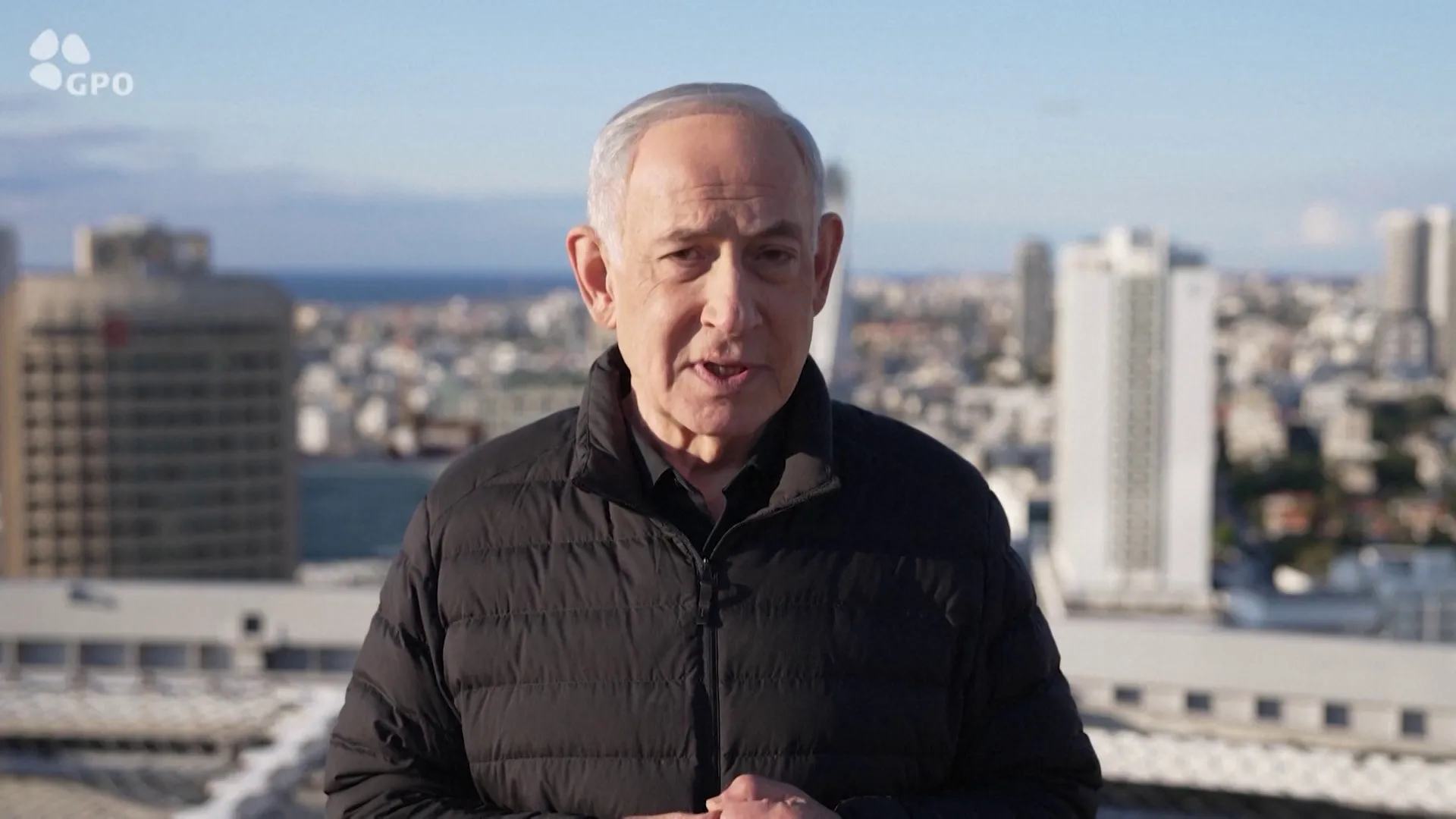
“We have eliminated the tyrant Khamenei and dozens of senior figures from the oppressive regime, and our forces are now hitting the heart of Tehran with growing intensity, a campaign that will only ramp up in the coming days,” Israeli Prime Minister Benjamin Netanyahu has said in a new video statement.

Prime Minister Netanyahu, speaking from the roof of the Kirya in Tel Aviv, said that “we have eliminated the tyrant Khamenei and dozens of senior figures from the oppressive regime, and our forces are now hitting the heart of Tehran with growing intensity, a campaign that will… pic.twitter.com/jea6COl1tx

— Faytuks Network (@FaytuksNetwork) March 1, 2026

U.S. President Donald Trump has told CBNC that operations against Iran are currently proceeding “ahead of schedule.”

TRUMP TELLS CNBC THAT IRAN MILITARY OPERATIONS ARE ‘AHEAD OF SCHEDULE’

— Phil Stewart (@phildstewart) March 1, 2026

An image is circulating online that is said to show an Iranian attack on an oil platform off the coast of the United Arab Emirates.

Reports coming in that Iranian fire has hit an Emirati offshore oil platform in the Gulf.

Would be a direct attack on the Gulf’s energy infrastructure. pic.twitter.com/0PUeEAHQ58

— Thomas van Linge (@ThomasVLinge) March 1, 2026

Multiple outlets have also now reported that the U.S. Central Intelligence Agency provided key intelligence that enabled Israel’s strike on Supreme Leader Khamenei’s compound.

UPDATE: 9:50 AM EST—

U.S. Central Command has now issued a formal statement regarding the targeting of what it calls an Iranian “Jamaran class corvette.” This is how the U.S. military refers to Iran’s Moudge class warships, which are also often described as frigates. Satellite imagery provider Vantor had initially assessed the ship that was struck to be an Alvand class warship, from which the Moudge class is derived. You can read more about this in TWZ‘s previous reporting here.

An Iranian Jamaran-class corvette was struck by U.S. forces during the start of Operation Epic Fury. The ship is currently sinking to the bottom of the Gulf of Oman at a Chah Bahar pier. As the President said, members of Iran’s armed forces, IRGC and police “must lay down your… pic.twitter.com/NzsR3dI2Hs

— U.S. Central Command (@CENTCOM) March 1, 2026

Imagery circulating points to Iranian attacks in the vicinity of France’s naval base in Abu Dhabi in the United Arab Emirates.

There are reports that another ship has been struck, this time off the United Arab Emirates on the Persian Gulf side of the Strait of Hormuz. The crew of the vessel was reportedly able to extinguish the resulting fire and are continuing their voyage.

Iranian Foreign Minister Araghchi has told Al Jazeera that the country’s Assembly of Experts could elect a new Supreme Leader to succeed Ayatollah Ali Khamenei in the next few days. A U.S. official has also told that outlet that it is still unclear how Khamenei may impact Iran’s actions going forward.

Iranian Foreign Minister Araghchi:

Maybe in one or two days, the Assembly of Experts will elect a new leader for the country. pic.twitter.com/6PU0fJrK86

— Clash Report (@clashreport) March 1, 2026

U.S. official to Al Jazeera:

It is not yet clear how Khamenei’s death will affect Iran’s military capabilities or its response.

— Clash Report (@clashreport) March 1, 2026

“My message to the remaining officials of this republic of terror is this: surrender to the Iranian nation. Declare your loyalty to my plan and our transition framework, and hand over power without further bloodshed,” Reza Pahlavi, the eldest son of Mohammad Reza Pahlavi, the last Shah of Iran, and now an opposition figure to the regime in Tehran living in exile, has written in a post on X. “Any attempt by the remnants of the regime to appoint a successor to Khamenei is doomed to failure in advance. Whoever they place in his position will not only lack legitimacy, but will also be a partner in the crimes of this regime.”

“To the military, law enforcement, and security forces, I say: your weapons must be used to defend the great nation of Iran, not the republic of crime, thuggery, and its anti-Iranian criminals. Join the people of Iran and the Lion and Sun Revolution,” he added. “Use your arms to protect Iranians against the mercenaries of the Islamic Republic so that this 47-year nightmare may end more swiftly.”

My compatriots,

Ali Khamenei, the Zahhak of our time — the demon who, only weeks ago, issued the order for the massacre of tens of thousands of Iran’s finest sons and daughters — is gone.

With his disgraceful death, and that of many of his appointees and affiliates, the Islamic… https://t.co/dFxweIJIjF pic.twitter.com/IzGDbIs6Jt

— Reza Pahlavi (@PahlaviReza) March 1, 2026

Pakistani authorities have confirmed the violent clashes around the U.S. Consulate in Karachi, sparked by the war on Iran, have left several dead and dozens wounded.

The ongoing conflict continues to cause major disruptions in general air traffic through the region, with the airspace over multiple countries restricted or closed entirely.

UPDATE: 8:44 AM EST—

U.S. Central Command (CENTCOM) has released additional imagery of ongoing activities as part of Operation Epic Fury.

First 24 hours of Operation Epic Fury:

“The President ordered bold action, and our brave Soldiers, Sailors, Airmen, Marines, Guardians, and Coast Guardsmen are answering the call,” – Adm. Brad Cooper, CENTCOM Commander pic.twitter.com/McrC7xeM0A

— U.S. Central Command (@CENTCOM) March 1, 2026

The IDF has released a video showing Iranian F-4 and F-5 combat jets being targeted on the ground in Tarbiz.

🎯STRUCK: Two F5 and F4 fighter jets at the airport of Tabriz in western Iran, as the jets were prepared for takeoff

The strike was conducted to degrade the Iranian Air Force’s activities and to further expand the degradation of their aerial defense. pic.twitter.com/lEvpyiPI5M

— Israel Defense Forces (@IDF) March 1, 2026

“For the first time in Operation Roaring Lion, air force aircraft are operating in ‘stand-in’ over the skies of Tehran in a powerful strike against regime and repression targets.” Defense Minister Israel Katz has said. There will be “continuous powerful strikes” on targets in the Iranian capital, he added. The IDF has also released a new video outlining the phases of its operation that it says has now given it total air superiority over Tehran

Defense Minister Israel Katz says the Israeli Air Force is striking Tehran with “stand-in” munitions, meaning those dropped directly over their targets.

“For the first time in Operation Roaring Lion, air force aircraft are operating in ‘stand-in’ over the skies of Tehran in a…

— Emanuel (Mannie) Fabian (@manniefabian) March 1, 2026

‼️ The video outlines the phases of the operation: targeting air defense systems and missile launchers in western Iran, then paving the way toward Tehran and establishing aerial superiority over the capital. pic.twitter.com/STDYyyZvG3

— LTC Nadav Shoshani (@LTC_Shoshani) March 1, 2026

‼️WATCH: For the first time since the start of Operation ‘Roaring Lion’, the IAF is striking targets belonging to the Iranian terror regime in the heart of Tehran.

Over the past day, the IAF conducted large-scale strikes to establish aerial superiority and pave the path to… pic.twitter.com/DN2MkGCfWc

— Israel Defense Forces (@IDF) March 1, 2026

The IDF says its strikes have killed the Chief of Staff of Iran’s armed forces, Abdolrahim Mousavi, as well as dozens of other senior officials.

🔴ELIMINATED: Abdolrahim Mousavi, the Iranian Chief of Staff of the armed forces.

Additionally, the IDF struck & eliminated 7 members of the top Iranian security leadership in Tehran and 40 senior commanders. pic.twitter.com/0a4wf3dk9N

— Israel Defense Forces (@IDF) March 1, 2026

The IDF is also continuing to target Iranian ballistic missiles, as well as air defenses and drone capabilities. Israeli authorities assess that Iran still has approximately 2,500 ballistic missiles of all types, which “constitutes an existential threat,” according to The Times of Israel.

The IDF publishes a new batch of footage showing strikes against Iranian ballistic missile launchers, air defenses, and drones pic.twitter.com/dUNmmbapXS

— Emanuel (Mannie) Fabian (@manniefabian) March 1, 2026

The Israeli military assesses that Iran currently possesses some 2,500 ballistic missiles.

Ahead of June 2025’s war, the IDF said it identified efforts by Iran to significantly accelerate the production rate of ballistic missiles and increase its stockpile from around 3,000 to…

— Emanuel (Mannie) Fabian (@manniefabian) March 1, 2026

IDF jets have already dropped more than 1,200 munitions on targets in Iran. Israeli Defense Minister Katz has also said strikes on Iran “will continue for as long as necessary” and until “the objectives are achieved.”

Israeli Air Force fighter jets dropped over 1,200 munitions during strikes in Iran over the past day, the military says. pic.twitter.com/jSnZNwJK6u

— Emanuel (Mannie) Fabian (@manniefabian) March 1, 2026

Defense Minister Israel Katz says the strikes on Iran “will continue for as long as necessary” and will not stop “before the objectives are achieved.”

“The elimination of Khamenei is a turning point. We all hope that the activity will also lead to the outcome we want, that the… pic.twitter.com/yei2lnwqUz

— Emanuel (Mannie) Fabian (@manniefabian) March 1, 2026

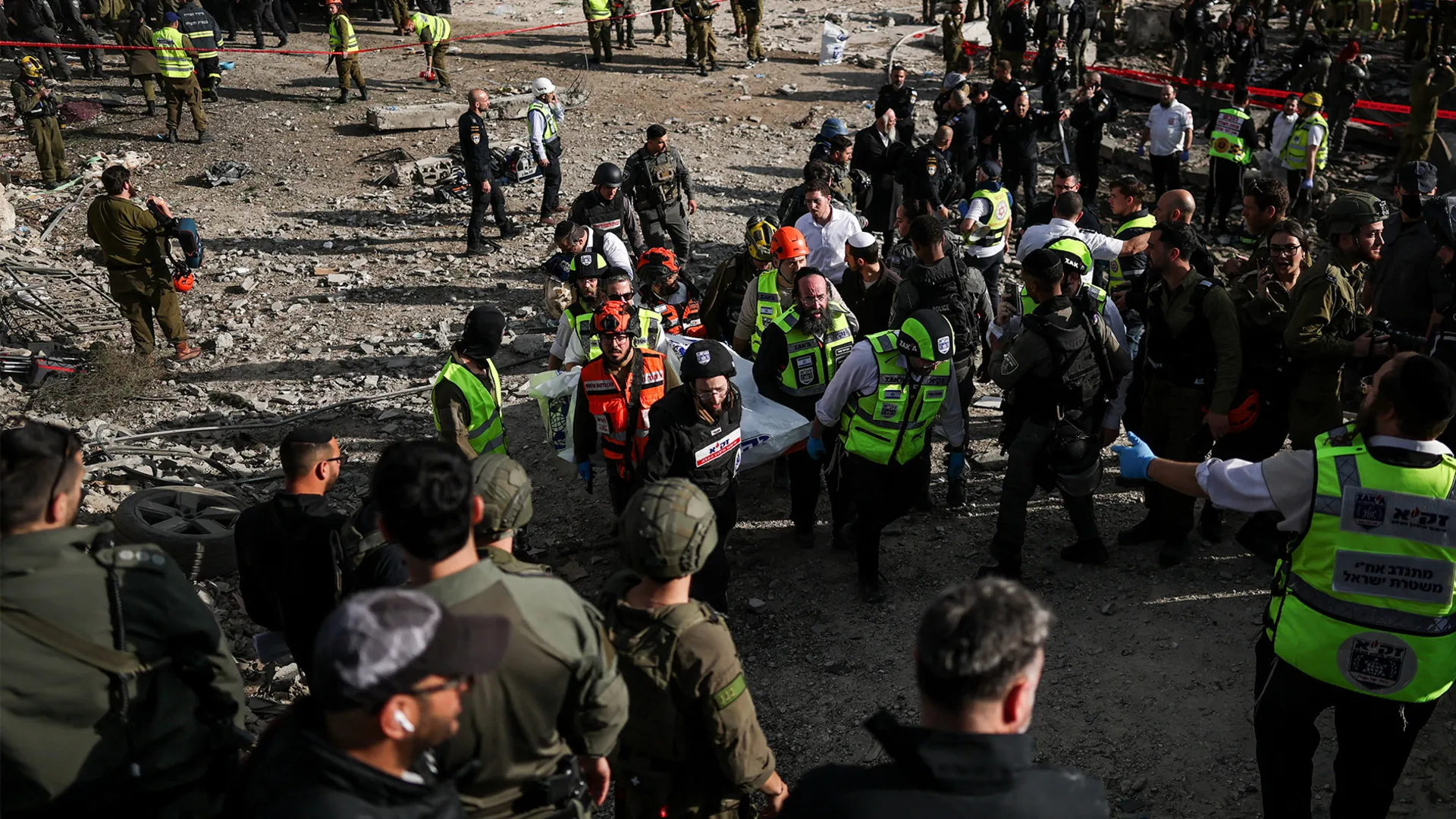
Iranian missiles have struck Beit Shemesh in Israel, causing casualties.

The Iranian Regime directly fired missiles toward the civilian neighborhood of Beit Shemesh, killing innocent civilians.

The Iranian regime purposely targets civilian targets while we precisely target terror targets. This is who we’re operating against—a regime who uses… pic.twitter.com/9W8Fp4T2tH

— Israel Defense Forces (@IDF) March 1, 2026

פגיעה ישירה במבנה בבית שמש – נקבע מותם של חמישה בני אדם, פונו 18 פצועים בדרגות שונות

מפקד מחוז ירושלים הגיב לזירה ומקיים הערכת מצב עם כלל גופי החירום וההצלה, להמשך פעולות מצילות חיים.

שוטרי מחוז ירושלים ולוחמי מג”ב פועלים בזירה ומסייעים לגופי החירום וההצלה בסריקה אחר לכודים,… pic.twitter.com/wcAQ2plSla

— משטרת ישראל (@IL_police) March 1, 2026

Footage shows the aftermath of the Iranian ballistic missile impact in Beit Shemesh which killed at least six and wounded over 20.

The video shows that the missile caused extensive damage to a bomb shelter.

The Home Front Command is set to investigate the circumstances of the… pic.twitter.com/bVj7QIvodO

— Emanuel (Mannie) Fabian (@manniefabian) March 1, 2026

Some 20 people were injured, including four in serious and critical conditions, by the Iranian ballistic missile impact in Beit Shemesh, medics say.

The Magen David Adom ambulance service says it is taking 17 victims to hospitals, including two in serious condition, one person… pic.twitter.com/Vzz6yxhFgw

— Emanuel (Mannie) Fabian (@manniefabian) March 1, 2026

Skylight, a small Palau-flagged oil tanker, has reportedly been struck in the Gulf of Oman, resulting in injuries to members of its 20-person crew (said to include 15 Indian and 5 Iranian nationals). This tanker has been under U.S. sanctions for links to Iran’s Ministry of Defense since December. There are no indications that it was attempting to sail through the Strait of Hormuz, but the exact circumstances surrounding the attack are unclear.

SKYLIGHT (9330020) wasn’t passing through the Strait of Hormuz. She’s been anchored in the Musandam governorate of Oman (north of UAE at 26.288021, 56.266388) since 2026-02-22. This small 11K DWT tanker, mostly used for fueling other tankers, has been blacklisted by the US since… https://t.co/pDLmmXVnwO

— TankerTrackers.com, Inc. (@TankerTrackers) March 1, 2026

UPDATE: Note this small oil tanker is known as part of the Iranian oil refined products smuggling operation, and was put under US sanctions in December (US Treasury linked it to the Iranian Ministry of Defense). So the reported “hit” may not be what it looks at first glance. https://t.co/JB0SbpVLUl

— Javier Blas (@JavierBlas) March 1, 2026

يُعلن مركز الأمن البحري عن تعرض ناقلة النفط (SKYLIGHT) وتحمل علم جمهورية (بالاو) للاستهداف، على بعد (٥) أميال بحرية شمال ميناء خصب بمحافظة مسندم، وتم إخلاء جميع طاقم الناقلة المكون من (۲۰) شخصا، بينهم (١٥) شخصا يحملون الجنسية الهندية، و(٥) أشخاص من الجنسية الإيرانية.

كما تفيد… pic.twitter.com/LD9s94LEVR

— مركز الأمن البحري| MARITIME SECURITY CENTRE (@OMAN_MSC) March 1, 2026

At least three people were killed and dozens wounded in another round of Iranian attacks on the United Arab Emirates (UAE), according to that country’s Ministry of Defense. UAE authorities have previously said that some injuries sustained as a result of Iranian attacks have come from falling debris as a result of interceptions of incoming threats.

NEW: UAE Ministry of Defense says 3 people were killed and 58 suffered minor injuries in the Iranian attack, including Emirati citizens and several foreign nationals.

— Faytuks Network (@FaytuksNetwork) March 1, 2026

Authorities confirmed that debris from drones intercepted by air defences fell in the courtyards of two homes in Dubai, resulting in two injuries. The injured have received the necessary medical care. Authorities also clarified that the sounds heard across the emirate were the…

— Dubai Media Office (@DXBMediaOffice) March 1, 2026

“The Ministry of Defence has announced that the UAE air force and air defence forces have so far dealt with 165 ballistic missiles, two cruise missiles and 541 Iranian drones since the start of the Iranian attack,” according to an official statement. “The ministry said that on the morning of the second day of the attack, UAE air force and air defence forces destroyed 20 ballistic missiles, while eight missiles fell into the sea. They also destroyed two cruise missiles and 311 drones. However, 21 drones struck civilian targets. The ministry affirmed the capability of the UAE air force and air defence to address various threats.”

The Ministry of Defence has announced that the UAE air force and air defence forces have so far dealt with 165 ballistic missiles, two cruise missiles and 541 Iranian drones since the start of the Iranian attack.

The ministry said that on the morning of the second day of the… pic.twitter.com/rj8e5iXrQ5

— وزارة الدفاع |MOD UAE (@modgovae) March 1, 2026

Kuwaiti authorities now say intercepted 97 and 283 drones launched from Iran.

The Kuwaiti Army says its air defenses have intercepted 97 Iranian missiles and 283 drones since the start of what it describes as Iranian aggression.

— Faytuks Network (@FaytuksNetwork) March 1, 2026

British authorities say that missiles that Iran has fired missiles in the direction of Cyprus in the Eastern Mediterranean. U.K. Defense Minister John Healey says he does not believe the launches were directly aimed at British forces on the island, but that “it shows how indiscriminate” Iran’s retaliatory attacks have been. Authorities in Cyprus have pushed back on this, saying there are no indications the country was ever under threat.

BREAKING: Britain reveals: Iran launched two missiles at Cyprus

British Defense Secretary: Two missiles launched from Iran were fired towards Cyprus, where the kingdom maintains strategic military bases. He clarified that London believes the missiles were not aimed directly at…

— Iris (@streetwize) March 1, 2026

Statement by the Government Spokesperson @SpokespersonCY @letymbiotis

In relation to statements and media reports referring to the launch of missiles towards the direction of Cyprus, it is clarified that this is not the case and there is no indication whatsoever that the… pic.twitter.com/4ylQKyWsRf

— Προεδρία της ΚΔ (@CYpresidency) March 1, 2026

UPDATE: 3:44AM EST—

Israel is pounding a number of targets in Tehran with heavy munitions. The strikes appear to be focused on regime targets. The IDF also says the strikes are aimed on securing air superiority and creating a clear route to Tehran. This is likely in reference to manned fighter getting the ability to make direct attacks en masse with minimal risk. This would open up the skies to larger scale bombardment of the capital by relying less on standoff munitions.

The Israeli Air Force is carrying out an extensive wave of airstrikes against “targets of the Iranian terror regime in the heart of Tehran,” the military says.

The military says the IAF carried out extensive strikes in the past day “to establish air superiority and open the way…

— Emanuel (Mannie) Fabian (@manniefabian) March 1, 2026

Iran has hit Oman for the first time in the conflict, striking the port of Duqm on the Arabian Sea, facing the Indian Ocean. Apparently, long-range kamikaze drones were used. This is something of a surprise as Oman has provided diplomatic facilitation between the U.S. and Iran.

Iran has struck Oman for the first time, with at least two Iranian attack drones hitting the port of Duqm, wounding one worker.

Oman had been acting as a mediator between the U.S. and Iran. pic.twitter.com/2PhNHkjgJ7

— OSINTtechnical (@Osinttechnical) March 1, 2026

40 buildings have been damaged by Iranian strikes in Tel Aviv.

The Tel Aviv-Yafo Municipality reports that 40 buildings were damaged by the Iranian missile strike overnight, and more than 200 residents have been evacuated to hotels. pic.twitter.com/5M4xE5qqAE

— Clash Report (@clashreport) March 1, 2026

At least six people were killed in the violent protest at the U.S. consulate in Pakistan that we previously mentioned.

Police say at least 6 people have been killed in clashes as hundreds of protesters stormed the U.S. Consulate in Pakistan following the killing of Iran’s supreme leader. https://t.co/ghGtH9K8Dv

— The Associated Press (@AP) March 1, 2026

Iran’s internet outage continues, which has limited visibility into the country to some degree during the crisis.

⚠️ Update: #Iran‘s internet blackout has now passed the 24-hour mark with national connectivity flatlining at 1% of ordinary levels.

The measure limits civic engagement at a key moment for the country’s future after the killing of Ayatollah Khamenei in US and Israeli airstrikes. pic.twitter.com/W4jDgds1Ty

— NetBlocks (@netblocks) March 1, 2026

UPDATE: 2AM EST—

An Iranian National Security Council member says a temporary leadership council will be established today. Another official said there were plans in place for exactly this scenario.

The power vacuum that exists in the country is clearly one of the key pressure points the U.S. and Israel would hope to exploit, although what comes next could end up with a negative outcome. Trump has stated that he has an idea who will take over in Iran that will be a positive for the U.S., but he did not elaborate.

Iranian National Security Council Secretary Ali Larijani:

The temporary Leadership Council will be formed today.

Preparations for establishing the Leadership Council have been completed. pic.twitter.com/jOxCFeSoYg

— Clash Report (@clashreport) March 1, 2026

Iranian Parliament Speaker Mohammad Bagher Ghalibaf:

We have prepared ourselves for all scenarios, and plans have even been made for after the martyrdom of Imam Khamenei.

You will see that with the formation of a Leadership Council, authority will take shape among the people…

— Clash Report (@clashreport) March 1, 2026

UPDATE: 1:20AM EST —

President Trump has just posted that the threat from the IRGC that it will be executing an unprecedented reprisal operation will be met with an even larger amount of force.

🚨🚨Trump on Truth Social: Iran just stated that they are going to hit very hard today, harder than they have ever been hit before. THEY BETTER NOT DO THAT, HOWEVER, BECAUSE IF THEY DO, WE WILL HIT THEM WITH A FORCE THAT HAS NEVER BEEN SEEN BEFORE! Thank you for your attention to…

— Barak Ravid (@BarakRavid) March 1, 2026

President Trump just posted a new threat targeting Iran:

“WE WILL HIT THEM WITH A FORCE THAT HAS NEVER BEEN SEEN BEFORE!” pic.twitter.com/ZJol0SmVg3

— OSINTtechnical (@Osinttechnical) March 1, 2026

It is clear that Iran’s playbook is to target civilian areas as well as U.S.-related military areas in Arab gulf states. Doing so puts pressure on the governments that the U.S. is clearly trying to assuage. At the same time, some of these areas are less defended than those near U.S. installations, which makes scoring hits more probable. How long defenses in these areas can hold out is an increasingly important question.

An Iranian missile hit Dubai International Airport this morning, with smoke seen rising near the north end of the airfield. pic.twitter.com/keBhRAsuAf

— OSINTtechnical (@Osinttechnical) March 1, 2026

After a night of many celebrating the death of the Supreme Leader, there are now demonstrations in Iran vowing revenge.

We are also beginning to activity emerge at U.S. embassies and consulates, such as in Pakistan:

UPDATE: 1AM EST—

The IDF says it has struck more than 30 new targets in Iran as part of continuing operations, “including aerial defense systems, missile launchers, regime targets and military command centers.”

🎯 ONGOING STRIKE: 30+ targets so far, in western and central Iran, including aerial defense systems, missile launchers, regime targets and military command centers.

The IDF will continue to degrade the Iranian terror regime’s capabilities until they can no longer threaten our… pic.twitter.com/hygz4sgUlM

— Israel Defense Forces (@IDF) March 1, 2026

A video U.S. Central Command (CENTCOM) released earlier today looks to show a strike targeting some of Iran’s Russian-made MiG-29 fighters. The full video shows U.S. forces striking drones, air defense sites, shore defense radar installations, and more.

As the President stated, our objective is to defend the American people by eliminating imminent threats from the Iranian regime.

The President ordered bold action. CENTCOM forces are delivering an overwhelming and unrelenting blow. pic.twitter.com/B0k5gV4YnU

— U.S. Central Command (@CENTCOM) February 28, 2026

CENTCOM has also now released a video indicating the employment of ground-launched Army Tactical Missile System (ATACM) short-range ballistic missiles as part of ongoing strikes on Iran.

CENTCOM has also denied various claims that had been circulating earlier in the day, including about U.S. casualties, an attack on a U.S. naval vessel, and the severity of damage to U.S. facilities in the region.

🚫The Iranian regime claims to have killed 50 U.S. service members. LIE.
✅There have been no reported U.S. casualties.

🚫The IRGC claims that a U.S. Navy ship was struck by missiles. LIE.
✅No U.S. Navy ship has been struck. The Armada is fully operational.

🚫The Iranian… pic.twitter.com/qGsZ45EmzD

— U.S. Central Command (@CENTCOM) February 28, 2026

The IDF says that there have been at least 20 waves of Iranian missiles in the past 24 hours. The IDF has also assessed that Iran has launched at least 150 ballistic missiles at Israel since the start of the new conflict, according to The Times of Israel. This would be just slightly less than the number of missiles the Iranians fired at Israeli targets on the first night of the 12 Day War. Experts have also highlighted a notable difference in the size and coordination of individual Iranian barrages in the current conflict. While clearly, Iran’s command and control is disrupted, this could also be attributed, at least partially, to different tactics and decentralizing the command and control process in preparation for major disruptions that this conflict would bring.

🚨For the 20th time in the last 24 hours, millions of Israelis run to shelter across Israel under Iranian missile fire🚨

— Israel Defense Forces (@IDF) March 1, 2026

That MIGHT be a function of changes the IRGC made to its command structure post 12 Day War to prevent the paralysis that seemed to grip them at the time.

— Decker Eveleth (@dex_eve) February 28, 2026

So far that campaign seems to be having the precise opposite effect, but that may change if this really does last weeks.

— Decker Eveleth (@dex_eve) February 28, 2026

Imagery has emerged showing the U.S. Fifth Fleet headquarters in Bahrain being subjected to additional Iranian attacks. Civilian sites in Bahrain also continue to be hit. Authorities in Bahrain say they have intercepted at least 45 missiles and nine drones launched from Iran.

Satellite imagery circulating online, attributed to Chinese firm MizarVision, shows plumes of black smoke rising from at least two separate locations at Ali Al Salem Air Base in Kuwait. At least one of these areas appears to be a fuel storage facility. TWZ has not yet been able to independently confirm any damage to the base.

🔴 High-resolution Chinese satellite imagery shows that Ali Al Salem air base in Kuwait was attacked by Iran, with thick smoke rising. pic.twitter.com/XpvxCOPcBm

— NoctuMind (@noctu_mind) March 1, 2026

The video below is said to show Patriot surface-to-air missiles being fired at Iranian missiles targeting Qatar’s Al Udeid Air Base.

Another footage of interceptors launched from Patriot air defence batteries defending Qatar’s Al Udeid Air Base against Iranian missiles.

One interceptor missile appears to have failed. pic.twitter.com/tCWwlawaaT

— Clash Report (@clashreport) February 28, 2026

The port of Jebel Ali in the United Arab Emirates (UAE) was the target of another Iranian strike.

Iranian-backed militants in Iraq have claimed responsibility for an attack on the airport in Erbil, the capital of that country’s northern autonomous Kurdish region. Pro-Iran protesters have also reportedly been trying to force their way to the U.S. Embassy inside Green Zone in Baghdad.

Chaos in Baghdad this morning as pro-Iran regime protestors attempted to breach the Green Zone, reportedly trying to get to the U.S. embassy. pic.twitter.com/OpZPZUL3Oq

— OSINTtechnical (@Osinttechnical) March 1, 2026

The U.S. Airbase at Erbil International Airport in Iraq is burning this morning after an Iranian drone/missile attack. pic.twitter.com/lUGFbg8r0X

— OSINTtechnical (@Osinttechnical) March 1, 2026

“The [UAE’s] Ministry of Defense announced that the Air Force and Air Defense forces of the United Arab Emirates have succeeded, since the start of the Iranian attack, in intercepting and destroying 137 ballistic missiles and 209 drones launched toward the country’s territories, confirming the high readiness of air defense systems and their capability to handle various threats,” according to a machine translation of official statement. “The Ministry clarified that since the start of the attack, 137 Iranian ballistic missiles were detected and launched toward the country, with 132 of them destroyed, while 5 fell into the sea. Additionally, 209 Iranian drones were detected, 195 of which were intercepted, while 14 fell within the country’s territories and waters, causing some collateral damage.”

الدفاعات الجوية الإماراتية تتعامل مع 137 صاروخاً و209 طائرة مسيرة

أعلنت وزارة الدفاع أن القوات الجوية والدفاع الجوي لدولة الإمارات العربية المتحدة نجحت منذ بدء الهجوم الإيراني، في التعامل مع وتدمير 137 صاروخاً باليستياً و209 طائرة مسيّرة أُطلقت باتجاه أراضي الدولة، مؤكدةً… pic.twitter.com/93XmWy7AgE

— وزارة الدفاع |MOD UAE (@modgovae) February 28, 2026

Joe Kent, the Director of the National Counterterrorism Center, has put out a statement about monitoring for potential threats to the homeland. The Department of Homeland Security is reportedly concerned about the potential for cyberattacks from “Iranian-aligned” actors, according to CBS News.

As the Iran conflict continues to unfold, @ODNIGov’s National Counterterrorism Center is engaged and operating at full capacity, 24/7. We are tracking developments in real time, assessing any potential risks to the homeland, identifying emerging threats, and providing timely,…

— NCTC Director Joe Kent (@NCTCKent) February 28, 2026

DHS says in notice it is “most concerned” in the short-term about cyberattacks from “Iran-aligned hacktivists” on U.S. digital infrastructure. – CBS

— Apex (@Apex_WW) March 1, 2026

Questions remain about the real state of progress in Omani-mediated talks between the United States and Iran over the latter’s nuclear program in the weeks leading up to the conflict.

They took as suspicious proposals that Iran saw as concessionary.

— Laura Rozen (@lrozen) February 28, 2026

Am not saying what Iran proposed would have been enough, I dont know, but it seems US negotiators did not have the expert guidance to understand it correctly

— Laura Rozen (@lrozen) February 28, 2026

Contact the author: joe@twz.com

Joseph has been a member of The War Zone team since early 2017. Prior to that, he was an Associate Editor at War Is Boring, and his byline has appeared in other publications, including Small Arms Review, Small Arms Defense Journal, Reuters, We Are the Mighty, and Task & Purpose.


Tyler’s passion is the study of military technology, strategy, and foreign policy and he has fostered a dominant voice on those topics in the defense media space. He was the creator of the hugely popular defense site Foxtrot Alpha before developing The War Zone.


Source link

Who are the council members temporarily in charge of Iran? | Explainer News

Until Khamenei’s successor is picked, the three-member leadership council, including Ayatollah Alireza Arafi, will lead Iran.

Iranian authorities have announced a three-member interim leadership council to run the government after the killing of Supreme Leader Ali Khamenei in Israeli-United States strikes.

Iran’s government pledged to avenge the killing on Saturday of Khamenei, who had been in power for nearly four decades. Tehran has since targeted Israeli and US assets located across Gulf countries in retaliatory strikes.

Recommended Stories

list of 4 itemsend of list

While US President Donald Trump has said he wants a change in Iran’s government, the religious leaders of Iran moved on Sunday to start the process of choosing Khamenei’s successor.

Iran
Plumes of smoke rise over residential areas of Tehran from US-Israeli air strikes on March 1, 2026 [Fatemeh Bahrami/Anadolu]

What is the interim leadership council?

Article 111 of Iran’s Constitution authorises a temporary leadership council to assume the supreme leader’s duties until a successor is elected.

That council will consist of President Masoud Pezeshkian; the chief justice of the Supreme Court, Gholam-Hossein Mohseni-Ejei; and a member of the Guardian Council, Ayatollah Alireza Arafi.

So who are these three figures who will temporarily run Iran as it reels from war?

arafi
Pope Francis greets Ayatollah Alireza Arafi, president of the Islamic Seminaries of Iran, during a private audience at the Vatican on May 30, 2022 [Handout/Vatican Media via Reuters]

Ayatollah Alireza Arafi

Arafi has been a member of the Guardian Council since 2019. Its members are appointed by the supreme leader. It is an Islamic legal authority that vets Iran’s laws and policies to make sure they conform to Islamic principles. It approves election candidates, has veto power over legislation passed by parliament and supervises elections.

Arafi also serves as the deputy chairman of the Assembly of Experts, the body responsible for overseeing the selection of the supreme leader. He leads Friday prayers in Qom, Iran’s most important religious centre, and heads the seminary system, overseeing education for religious leaders nationwide.

FILE - Masoud Pezeshkian, the President of Iran, attends the United Nations General Assembly at United Nations headquarters, on Sept. 25, 2025. (AP Photo/Angelina Katsanis, File)
Masoud Pezeshkian, the president of Iran, attends the United Nations General Assembly in New York [File:Angelina Katsanis/AP]

Masoud Pezeshkian

Pezeshkian, 71, is a reformist politician and heart surgeon who served in the army during the Iran-Iraq War. He was elected president in the 2024 elections.

He previously served as health minister under President Mohammad Khatami and, after 2005, as a member of parliament representing the northwestern city of Tabriz.

Pezeshkian ran unsuccessfully for president earlier but in 2024 won on a reform-oriented platform and has since navigated economic pressures and regional tensions.

He earlier campaigned on economic stabilisation, easing social restrictions and pursuing constructive engagement abroad while affirming loyalty to the Islamic Republic’s constitutional framework.

Reacting to Khamenei’s assassination, Pezeshkian said in a statement that Iran now considers “it its legitimate duty and right to avenge the perpetrators and masterminds of this historic crime”.

Gholamhossein Mohseni Ejei was put on US and EU sanctions blacklists 10 years ago for his role in a crackdown on a popular uprising [File: AFP]
Gholam-Hossein Mohseni-Ejei [File: AFP]

Gholam-Hossein Mohseni-Ejei

Mohseni-Ejei is a senior religious leader and has headed the judiciary since Khamenei appointed him to the post in July 2021.

He previously served as intelligence minister from 2005 to 2009 and later as prosecutor-general and first deputy chief justice. He is regarded as a hardline figure aligned with the conservative wing of the government.

In January, when the collapsing rial triggered protests across Iran, Mohseni-Ejei promised “no leniency” towards what he called “rioters”.

Mohseni-Ejei said the US and Israel “openly and explicitly supported the unrest” in the country after Trump called on Iranians to take to the streets.

After Khamenei’s killing, Trump again addressed the Iranian public on Saturday, calling for them to topple the government. “This will probably be your only chance for generations,” he said on Saturday after the US and Israeli attacks on Iran began.

Source link

US-Israel attacks on Iran: Death toll and injuries live tracker | Conflict News

Explosions are being heard in Iran, Israel and across several Middle Eastern states after the United States and Israel began attacking Iran on Saturday.

Tehran has responded by launching waves of missiles and drones at Israel and towards several military bases in the Middle East where US forces operate.

Iran had previously warned that if it were attacked, it would respond by targeting US military facilities across the region, which it considers legitimate targets.

Which countries have been attacked?

Israel’s air force says it dropped more than 1,200 munitions across 24 of Iran’s 31 provinces over the past day in its joint attack with the US.

Iran’s Islamic Revolutionary Guard Corps (IRGC) says it has launched attacks on 27 bases in the Middle East where US troops are deployed as well as Israeli military facilities in Tel Aviv and other parts of Israel.

So far, Iran has launched strikes across eight countries in the region: Bahrain, Iraq, Jordan, Kuwait, Oman, Qatar, Saudi Arabia and the United Arab Emirates.

Most of these attacks have been intercepted.

Interactive_Iran_US_Israel_March1_2026-01-1772368294
(Al Jazeera)

US military presence in the Middle East

The US has operated military bases in the Middle East for decades.

According to the Council on Foreign Relations, the US operates a broad network of military sites, both permanent and temporary, across at least 19 locations in the region.

Of these, eight are permanent bases in Bahrain, Egypt, Iraq, Jordan, Kuwait, Qatar, Saudi Arabia and the UAE.

As of mid-2025, there are about 40,000 to 50,000 US soldiers in the Middle East stationed in both large, permanent bases and smaller forward sites.

The countries with the most US soldiers are Qatar, Bahrain, Kuwait, the UAE and Saudi Arabia. These installations serve as critical hubs for US air and naval operations, regional logistics, intelligence gathering and force projection.

INTERACTIVE - US Military presence in the Middle East June 2026 - FEB24, 2026-1772272732
(Al Jazeera)

How many people have been killed or injured?

Below are the confirmed casualties across the 10 countries that have been subject to attacks as of Sunday at 13:40 GMT.

Due to the rapidly evolving situation, all figures may change as more information becomes available.

Iran – killed: 201, injured: 747

As of Sunday morning, the Iranian Red Crescent Society and official state-linked media have reported preliminary casualty figures of 201 people killed and at least 747 injured as rescue operations continue.

Since then, explosions continue to be heard across Iran with Israel saying it has carried out a large aerial attack on the “heart of the capital”.

The deadliest single incident occurred in the city of Minab in southeastern Iran, where a strike on an elementary girls school reportedly killed at least 148 people and injured 95. The attack occurred on Saturday, and the death toll has been climbing since.

Israel – killed: 9, injured: 121

On Sunday afternoon, an Iranian ballistic missile strike on central Israel’s Beit Shemesh killed eight people and injured about 20. Rescue workers are still combing through the rubble.

Late on Saturday, one woman in the Tel Aviv area was confirmed killed after being struck by falling shrapnel.

At least 121 others have been reported injured, at least one seriously.

At least 40 buildings in Tel Aviv were damaged in Iranian strikes on Saturday, the Israeli newspaper Haaretz reported, citing the city government.

An explosion caused by a projectile impact after Iran launched missiles into Israel following Israel and the U.S. launched strikes on Iran, in Tel Aviv, Israel, February 28, 2026. REUTERS/Gideon Markowicz ISRAEL OUT. NO COMMERCIAL OR EDITORIAL SALES IN ISRAEL
An explosion occurs in Tel Aviv on February 28, 2026, after Iran launched missiles into Israel [Gideon Markowicz/Reuters]

Bahrain – killed: 0, injured: 4

Iranian missiles targeted the headquarters of the US Navy’s 5th Fleet in Bahrain’s Juffair area.

Bahrain’s Ministry of Interior also confirmed that the country’s international airport was targeted with a drone, “resulting in material damage without loss of life”.

On Saturday night, several residential buildings in the capital, Manama, were struck by Iranian drones.

Government hospitals said four people were receiving treatment for shrapnel-related injuries.

A building that was damaged by an Iranian drone attack, after Israel and the U.S. launched strikes on Iran, in Seef, Manama, Bahrain, March 1, 2026. REUTERS/Hamad I Mohammed
A building was damaged in the Seef commercial district of Manama, Bahrain, on March 1, 2026, in an Iranian drone attack [Hamad Mohammed/Reuters]

Iraq – killed: 2, injured: 5

The US and Israel also targeted the Jurf al-Sakher base, also known as Jurf al-Nasr, in southern Iraq, which houses the Popular Mobilisation Forces, made up of mostly Shia fighters, and the Iran-supported Iraqi paramilitary group Kataib Hezbollah.

Iraqi state media and sources within Kataib Hezbollah confirmed that two fighters were killed in the strikes and five were wounded.

In northern Iraq‘s semiautonomous Kurdish region, where the US is reported to still have troops, several powerful explosions were reported near the US consulate and international airport in Erbil.

Air defences intercepted the drone attacks on Saturday, according to reports.

A plume of smoke rises near Erbil International Airport in Erbil on March 1, 2026. Loud explosions were heard early on March 1 near Erbil airport, which hosts US-led coalition troops in Iraq's autonomous Kurdistan region, an AFP journalist said. (Photo by Shvan HARKI / AFP)
A plume of smoke rises near Erbil International Airport in Erbil, Iraq, on March 1, 2026 [Shvan Harki/AFP]

Jordan – killed: 0, injured: 0

The Jordanian armed forces reported intercepting 49 drones and ballistic missiles that entered Jordanian airspace. While their fragments caused localised property damage, there have been no deaths or injuries within the kingdom.

Kuwait – killed: 1, injured: 32

Kuwait’s Ministry of Defence says Ali al-Salem Air Base came under attack by a number of ballistic missiles, all of which were intercepted by Kuwaiti air defence systems.

A drone targeted Kuwait International Airport on Saturday, resulting in minor injuries to a number of employees and limited damage to the passenger building.

On Sunday, Kuwait’s Ministry of Health said one person had been killed and 32 wounded.

Kuwait City, in the aftermath of strikes
Kuwait City in the aftermath of strikes by Israel and the US on Iran [Stephanie McGehee /Reuters]

Oman – killed: 0, injured: 5

On Sunday morning, the Oman News Agency, quoting a security source, said two drones had targeted the Duqm port, injuring one foreign worker.

Later, Oman’s Maritime Security Centre said a Palau-flagged oil tanker was ‌attacked about 5 nautical miles (9km) off Oman’s Musandam governorate, injuring four people.

Qatar – killed: 0, injured: 16

As of Sunday morning, the Qatari Ministry of Interior confirmed that the number of injured was at 16 people. Most injuries were reported to be from falling shrapnel and debris with one person seriously hurt.

The Qatari Ministry of Defence confirmed that two ballistic missiles struck the Al Udeid military base, where US forces are stationed, while a drone targeted an early warning radar installation.

Qatari air defence systems, in coordination with regional partners, successfully intercepted about 65 missiles and 12 drones over Qatari airspace, it said.

The Qatar Civil Aviation Authority suspended all air navigation indefinitely. Qatar Airways grounded all flights and advised passengers that updates will be provided on Monday by 9am (06:00 GMT).

All schools have moved to remote learning, and public gatherings for Ramadan have been suspended until further notice to ensure public safety.

Saudi Arabia – killed: 0, injured: 0

The Saudi Ministry of Foreign Affairs confirmed that Iranian attacks targeted both the capital, Riyadh, and Eastern Province, home to major oil infrastructure and the King Abdulaziz Air Base.

The kingdom has officially reported no casualties as of Sunday afternoon.

United Arab Emirates – killed: 3, injured: 58

As of Sunday afternoon, at least three people in the UAE were confirmed killed and 58 others wounded.

A Pakistani national was killed and seven people were injured when debris from intercepted missiles and drones fell on a residential area near Zayed International Airport in Abu Dhabi.

The Ministry of Defence confirmed that another individual, identified as an Asian national, was killed by falling shrapnel in a residential district of the capital.

Additionally, four airport staff at Dubai International Airport sustained injuries, and four people were injured at Palm Jumeirah after a fire in a building caused by falling debris.

As of Sunday afternoon, The UAE’s Defence Ministry says it detected 165 ballistic missiles, destroying 152, and intercepted two cruise missiles.


Source link

All the destinations affected after air strikes in Iran – not just Dubai

Multiple airlines have made the decision to suspend services across the Middle East, which is also affecting other routes.

Airlines from across the world have continued to cancel flights across the Middle East after the US and Israel launched “major combat operations” across Iran. It prompted retaliatory strikes across the Middle East – hitting Dubai, Doha, Bahrain and Kuwait, all home to US bases, as well as Israel.

Airspace across the countries has remained virtually empty. Major Middle Eastern airports, including Dubai, Abu Dhabi and Doha have been shut or severely restricted as a result.

Many Brits enjoy holidaying in the likes of Dubai and have faced delays to their scheduled plans. The UK Foreign Office has told Brits not to travel to Israel or Palestine, and is advising people already in destinations such as Dubai, Bahrain and Kuwait to seek shelter.

In a statement on its website the Foreign Office said: “Due to the threat posed by escalation in the region, we recommend against all travel to Israel and Palestine. On 28 February 2026, the US and Israel commenced joint military action in Iran, Israeli airspace has now closed.”

The Foreign Office has also updated its advice for British citizens currently in destinations including Dubai, Bahrain and Kuwait. It said: “Remain indoors in a secure location, avoid all travel and follow instructions from the local authorities.”

The situation is quickly changing, so anyone due to fly in the coming days should also seek advise from their flight operator.

Ensure our latest stories always appear at the top of your Google Search by making us a Preferred Source. Click here to activate or add us as your Preferred Source in your Google search settings.

Cancelled flights to the Middle East

Aegean Airlines – Greece’s largest airline has suspended flights to Tel Aviv in Israel, Beirut in Lebanon and Erbil in Iraq until March 2.

Air Astana – All flights to the Middle East have been cancelled until March 3.

Air Canada – All flights from Canada to Israel have been cancelled until March 8. All flights to Dubai have been cancelled until March 3.

Air Europa – The Spanish airline has cancelled flights to Tel Aviv and is monitoring the situation to assess operations on Tuesday.

Air France KLM – All flights to and from Tel Aviv and Beirut cancelled for Saturday. Dutch KLM weekend flights to and from Dubai, Dammam and Riyadh have been cancelled.

Azerbaijan Airlines – All flights to and from Dubai, Doha, Jeddah and Tel Aviv suspended.

British Airways – Flights to Tel Aviv and Bahrain cancelled until March 3.

Cathay Pacific – Flights to and from Dubai and Riyadh suspended.

Emirates – All flights to and from Dubai suspended until March 2.

Etihad – Flights from Abu Dhabi suspended until 2pm local time on Sunday.

FlyDubai – All flights to and from Dubai suspended until 3pm local time on Sunday.

ITA Airways – Flights to and from Tel Aviv and not using airspace of Israel, Lebanon, Jordan, Iraq and Iran until March 7.

Lot Polish Airlines – Flights to Tel Aviv suspended until March 15. Flights to Dubai and Riyadh cancelled until March 2.

Lufthansa – Flights to and from Tel Aviv in Israel, Beirut in Lebanon and Oman suspended until March 7. Flights to and from Dubai on Saturday and Sunday suspended.

Norwegian Air – All flights to and from Dubai suspended until March 4.

Pegasus Airlines – Flights to Iran, Iraq, Jordan and Lebanon were cancelled up to and including March 2.

Qatar Airways – Flights suspended due to closure of Quatari airspace. Update coming by 9am local time on Monday.

Turkish Airlines – Flights to Qatar, Kuwait, Bahrain, the United Arab Emirates and Oman cancelled on Saturday. Flights to Lebanon, Syria, Iraq, Iran and Jordan cancelled until March 2.

Wizz Air – Flights to and from Israel, Dubai, Abu Dhabi and Amman halted with immediate effect until March 7.

Knock-on effect

Air India – Flights from Delhi, Mumbai and Amritsar to London, New York, Chicago, Toronto, Frankfurt and Paris on Sunday have been cancelled. More flights to London, Birmingham, Amsterdam, Zurich, Milan, Vienna, Copenhagen and Frankfurt had been cancelled.

IndiGo – Temporary suspension of international flights using Middle Eastern airspace until Monday.

Japan Airlines – Cancelled flight on Saturday from Tokyo Haneda to Doha and return flight on March 1.

Lufthansa – Will not fly through Israeli, Lebanese, Jordanian, Iraqi and Iranian airspace until March 7.

Virgin Atlantic – Will avoid Iraqi airspace, resulting in some pre-planned rerouting of flights.

Source link

Who could succeed Ayatollah Ali Khamenei to lead Iran? | Explainer News

The assassination of Iran’s Supreme Leader Ayatollah Ali Khamenei, 86, in the US-Israeli air attacks has thrust Tehran to a pivotal crossroads as the clergy looks to pick the late ayatollah’s successor.

With Iran on a war footing, several senior leaders close to Khamenei were killed in the attack as well, including his top security adviser Ali Shamkani and Islamic Revolutionary Guard Corps (IRGC) commander-in-chief Mohammad Pakpour.

Tehran has vowed to avenge the killing of Khamenei. The US President Donald Trump warned against the retaliatory attacks and suggested that the strikes on Iran would continue.

The US-Israeli attacks hit Iran on Saturday, when Tehran’s top diplomats were waiting for the next round of talks on upcoming Monday to lock a deal with Trump, including laying down nuclear ambitions, and avoiding an armed conflict.

After 36 years in power, the late ayatollah’s killing has left Iran’s top clerics to prepare for the transfer of power to the next Supreme Leader. That’s something that they have only done once before, four decades ago.

So, who will be the next Supreme Leader of Iran? And how will he be chosen?

TEHRAN, IRAN - MARCH 1: A woman wails and holds a poster as thousands of people gather in Enghelab Square for a pro-government demonstration after Iranian state media confirmed the death of Ayatollah Ali Khamenei on March 1, 2026 in Tehran, Iran. Iran's Supreme Leader, Ayatollah Ali Khamenei, was confirmed killed after the United States and Israel launched a joint attack on Iran on February 28. Iran retaliated by firing waves of missiles and drones at Israel, and targeting U.S. allies in the region. (Photo by Majid Saeedi/Getty Images)
A woman wails and holds a poster as thousands of people gather in Enghelab Square for a pro-government demonstration after Iranian state media confirmed the death of Ayatollah Ali Khamenei on March 1, 2026 in Tehran, Iran. (Photo by Majid Saeedi/Getty Images) (Getty)

How is the Supreme Leader selected?

Iran’s Supreme Leader is selected by the Assembly of Experts, an 88-member clerical body elected by the public every eight years.

Candidates who run for the Assembly must first be vetted and approved by the Guardian Council, a powerful oversight body whose members are partly appointed by the Supreme Leader himself.

When the position becomes vacant, due to death or resignation, the Assembly of Experts convenes to choose a successor. A simple majority is sufficient to appoint the new Supreme Leader.

As per Iran’s constitution, the candidate must be a senior jurist with deep knowledge of Shi’a jurisprudence, as well as qualities such as political judgment, courage, and administrative capability.

Earlier, there had been only one other transfer of power in the office of the Supreme Leader of Iran, when Grand Ayatollah Ruhollah Khomeini, the leader of the Islamic Revolution, died at age 86 in 1989.

Iran
Emergency personnel stand at the site of an Iranian missile strike on a residential building, after Iran launched missile barrages following attacks by the U.S. and Israel on Saturday, in Tel Aviv, Israel March 1, 2026. REUTERS/Ronen Zvulun (Reuters)

What happens in Iran during a leadership vacuum?

Article 111 of Iran’s constitution mandates that a temporary council handle duties until a new supreme leader is elected.

That council will have: President Masoud Pezeshkian, Supreme Court Chief Justice Gholam-Hossein Mohseni-Ejei, and a cleric from the Guardian Council, according to Iranian media.

They will lead the country until the assembly formally picks the new supreme leader.

Iran’s security chief and a close confidante of the late Khamenei, Ali Larijani, said on Sunday that the transition process is underway.

Luciano Zaccara, a research associate professor in Gulf Politics at Qatar University, told Al Jazeera that Iran’s political system has been prepared for the current situation, knowing that Khamenei’s assassination was a real possibility.

“Trump wants to get the best deal possible, but the method he’s using to get that deal is to annihilate or destroy as much as he can,” Zaccara said. “This is the way to impose conditions, not to negotiate anything. Trump wants a surrender of the regime, not a change.”

The late Ayatollah made sure to put in a structure, he added, to avoid a vacuum of power and kept replacements for all the officials eliminated in the last few months ready. “The structures remain, the line of power [and] the line of command remain in place,” Zaccara told Al Jazeera.

INTERACTIVE-Iran’s government structure-jan 12, 2026 2-EDIT-1768237547
(Al Jazeera)

What is the Supreme Leader of Iran?

The Supreme Leader is the top position in the Islamic Republic’s political and religious hierarchy.

He is essentially the commander-in-chief of the armed forces and the final word in the country – and appoints key judicial, military, and media officials.

He also leads the mighty Revolutionary Guard, a paramilitary force that leads the so-called Axis of Resistance.

Here are the contenders for the top job in Tehran

iran
Mojtaba Khamenei, the second son of Iran’s Supreme Leader Ayatollah Ali Khamenei, visits Hezbollah’s office in Tehran, Iran, October 1, 2024. Office of the Iranian Supreme Leader/WANA (West Asia News Agency)/Handout via REUTERS ATTENTION EDITORS – THIS PICTURE WAS PROVIDED BY A THIRD PARTY.

Mojtaba Khamenei

Khamenei’s second son, Mojtaba Khamenei, is among the top contenders to succeed his father in Iran.

He is known to wield significant influence among the administrators and the Islamic Revolutionary Guard Corps (IRGC), the most powerful military body.

However, Khamenei’s lineage is also among the biggest barriers he faces.

Khamenei was reportedly opposed to the father-to-son succession. It is frowned upon in Iran, particularly after the US-backed Shah Mohammad Reza Pahlavi monarchy was toppled in 1979.

Iran
Pope Francis is shown a gift as he receives Ayatollah Alireza Arafi, president of Islamic Seminaries of Iran, and entourage in a private audience at the Vatican May 30, 2022. Vatican Media/Handout via REUTERS

Alireza Arafi

Arafi, a 67-year-old cleric, is an influential figure in the Islamic Republic’s religious establishment, but not a widely accepted political actor.

He serves as the deputy chairman of the Assembly of Experts, the body responsible for overseeing the selection of the Supreme Leader, and has been a member of the Guardian Council, which vets election candidates and laws passed by parliament.

Arafi was appointed as ⁠the jurist member of ⁠Iran’s Leadership Council, the body tasked with fulfilling the ‌Supreme Leader’s role until the Assembly of Experts elects a new leader, Iran’s state media reported on Sunday.

Arafi is also the Friday prayer leader of Qom — Iran’s most important religious center — and heads the country’s seminary system, overseeing clerical education nationwide.

Mohammad Mehdi Mirbagheri

Mirbagheri is an ultra-hardline clerical voice in the establishment and a member of the Assembly of Experts.

He is widely known for his unrelenting anti-Western worldview — and currently heads the Islamic Sciences Academy in the northern city of Qom.

Gholam-Hossein Mohseni-Ejei

Mohseni-Ejei is a senior Iranian cleric and currently heads the judiciary of the Islamic Republic, appointed to the role in July 2021 by the late Khamenei.

He previously served as Minister of Intelligence from 2005 to 2009 and later as Prosecutor-General and First Deputy Chief Justice. He is regarded as a hardline figure aligned with the conservative wing of the regime.

Iran
Ayatollah Ruhollah Khomeini’s grandson, Hassan Khomeini stands next to Iran’s Supreme Leader Ayatollah Ali Khamenei during the 36th anniversary of the death of the leader of Iran’s 1979 Islamic Revolution, Ayatollah Ruhollah Khomeini, at Khomeini’s shrine in southern Tehran, Iran June 4, 2025. Office of the Iranian Supreme Leader/WANA (West Asia News Agency)/Handout via REUTERS

Hassan Khomeini

Khomeini, 54, is among the most discussed names in succession talks for the next Supreme Leader.

He is the grandson of Ayatollah Ruhollah Khomeini, the founder of the Islamic Republic, and also the custodian of his grandfather’s mausoleum in Tehran.

While he has not held a public office, Khomeini is a reformist figure known for his rather moderate views on public life and policy. He attempted to run for the Assembly of Experts in 2016, but the vetting council disqualified him.

Source link