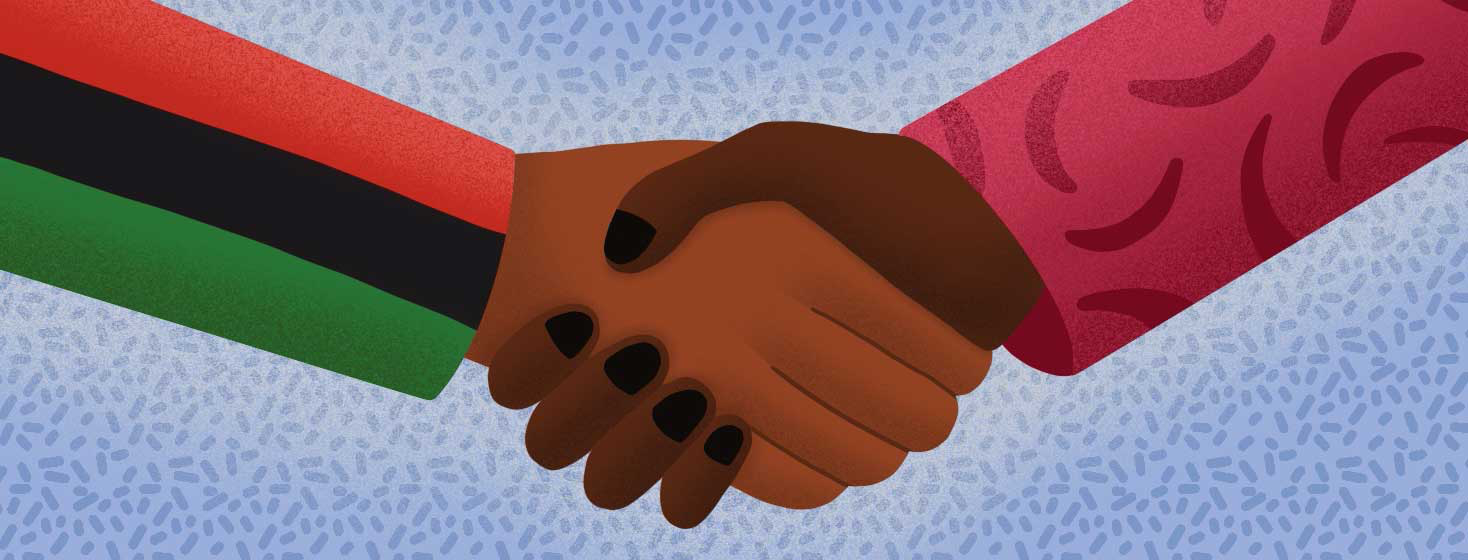
On January 1st 1863, Abraham Lincoln declared the end of slavery with the Emancipation Proclamation. Two and half years later, and two months after the end of the Civil War, Union troops arrived in Galveston on June 19th 1865 to find that news of the proclamation had not yet reached Galveston and that people were still being held as slaves in Texas.
The leader of the Union Troops, General Gordon Granger then formally announced the emancipation from the balcony of the former Confederate Army headquarters.
Granger’s order was based loosely on Abraham Lincoln’s Emancipation Proclamation. (The Thirteenth Amendment, which made slavery unconstitutional, wasn’t ratified until December 6, 1865.) The order first declared that the formerly enslaved were free based on “absolute equality of personal rights and rights of property” between Black people and those who had presumed legal ownership of them.
The reason why the news about the emancipation took so long to reach Texas is subject to speculation. One theory is that the messenger who was originally sent with the news had been killed before he reached Texas. A more likely scenario is that the local slave owners simply held onto the information, ignoring the emancipation order.
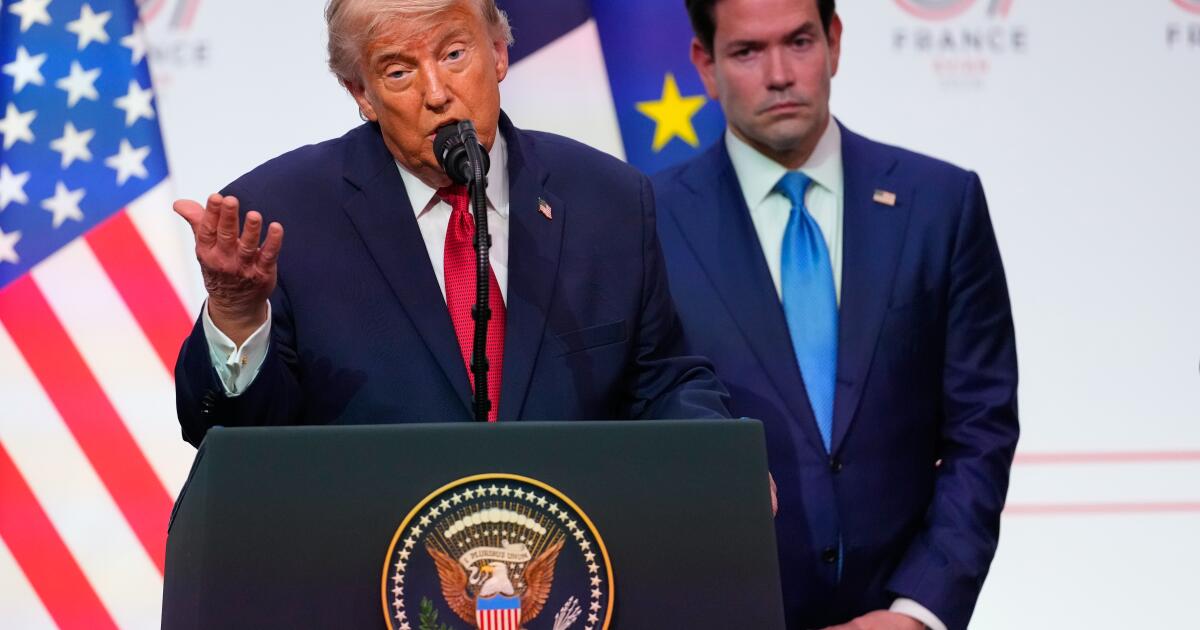
WASHINGTON — Secretary of State Marco Rubio stood silent and stone-faced behind Donald Trump on Wednesday as the president joked of passing the buck if his deal with Iran, under increasingly withering criticism and scrutiny, ultimately falls apart.
The blame, Trump said, would likely fall on his vice president, JD Vance, who led the negotiations toward a memorandum of understanding with Iran and will sign the agreement this week in Switzerland — a ceremony that will generate indelible images for a politician openly considering a run for the White House.
The controversial diplomatic breakthrough poses a quandary for Vance, whose aides see Rubio as his most viable challenger for the Republican presidential nomination should the secretary choose to run.
“If it works out, I’m going to take the credit,” Trump said of the Iran deal, with Rubio by his side.
“If it doesn’t work out, I’m blaming JD,” he joked. “You better be careful, JD!”
Silent secretary
Rubio, who also serves as the president’s national security advisor, has remained effectively mum since news of a preliminary peace deal was announced by the administration on Sunday.
His absence has drawn notice across foreign policy circles — not only because Rubio has served as chief architect of the administration’s global strategy thus far, but also because he has become one of the president’s most effective communicators, both at home and abroad.
By contrast, Vance, on a scheduled press tour promoting his new book, has emerged as the face of an agreement that appears to be fracturing a Republican Party already divided over America’s role in the world.
The administration’s internal divide over Iran extends beyond the war to broader U.S. support for its historic allies, including Israel in the Middle East, Canada and Mexico in this hemisphere, and Ukraine and Europe against a revanchist Russia.
“Rubio has always been a hawk on Iran, and Vance has always been an appeaser,” said Danielle Pletka, a senior fellow at the American Enterprise Institute, describing the vice president as positioning himself “as Trump without the flaws.”
“Rubio has a harder job because he’s more of a traditional Republican,” she said, adding that a competitive presidential run by the secretary might require him to pitch “a return to normalcy.”
No guarantee of success
Behind closed doors, Rubio advocated against the deal in its current form, citing intelligence reports that found it highly unlikely Tehran would give up its nuclear ambitions, according to two sources familiar with the matter. Rubio’s internal skepticism was first reported by Axios.
The deal kicks down the road highly technical discussions over the mechanics of unwinding Iran’s nuclear program — with no guarantee of success — while granting Tehran immediate relief, lifting a U.S. naval blockade of Iranian ports that will allow Iranian imports and exports to resume.
In exchange, Iran has only agreed in principle not to pursue nuclear weapons — a vow it has made multiple times before — and to do its “best” to return commercial shipping traffic through the Strait of Hormuz back to prewar levels. It commits in the deal to refrain from implementing a toll system in the strait, according to U.S. officials, for a mere 60-day period.
“This agreement is a road map for Iran to become a rising, stronger power in the [Persian] Gulf — stronger than it is even today,” said Robert Pape, a political science professor at the University of Chicago.
“That is going to be an issue for the balance of power with Israel, which before the Iran war was the rising power. Now it’s lost that paradigm,” Pape said. “And this is going to be an issue with the future disposition of American forces in the region, because the [memorandum of understanding] states quite clearly that Iran is expecting those forces to withdraw.”
Positioning by the vice president
Despite mounting skepticism, Vance has embraced his role in ending a war that a powerful faction of Trump’s base aggressively opposed from the start.
“I think there are some people who just want the bombing to continue, regardless of whether it accomplishes anything for Americans,” Vance told CBS News on Wednesday.
“I do think there are people,” he added, “who sometimes confuse the ends with the means.”
Because the preliminary Iran deal leaves key details unresolved, further negotiations virtually ensure the agreement remains in flux through the election season — potentially thrusting the talks into the center of the presidential primary campaign.
“Given the distance between the parties on the core nuclear issues, as well as the Trump administration’s poor track record with coercive diplomacy, I fully expect the 60-day window for talks to be extended, as the [memorandum of understanding] text permits, taking this issue to the heart of the midterms and beyond,” said Reid Pauly, a professor of nuclear security and policy at Brown University.
“There will be a lot of incentive in the administration,” Pauly added, “to distance oneself from this fiasco.”
As a guest on Megyn Kelly’s podcast this week, Vance acknowledged the political realities of Trump’s base splintering over the Iran war, noting that a coalition of isolationists — as well as those advocating what he called a more “aggressive” foreign policy — had together swept Trump back into office.
The war may be breaking that coalition apart, he said.
“We have a constituency right now that is saying, we’re going to send boots on the ground — they want Donald Trump to send hundreds of thousands of ground troops into Iran,” Vance told the former Fox News host.
“Those are Republicans,” Kelly said.
“We need people to be pushing back from inside the tent,” Vance replied.
This day is a public holiday in most Islamic countries and this year’s date for New Year in each country along with the name of the day in that country is shown in the table of countries to the right.
Islamic New Year represents the starting point of the Muslim era as it coincides with the Hijrah, the Prophet’s journey from Mecca to Medina on the first of Muharram in 622 CE.
Prophet Mohammed needed to relocate because somebody had intentions to execute him. Consequently, the Prophet chose to go to a town known as Yathrib, some 320 km north of Mecca. Yathrib is known today as Medina, in modern-day Saudi Arabia, which translates to ‘the city’.
Hijrah gave freedom from suffering for the Muslims in Mecca. When the Prophet emigrated to Medina, Muslims there were indirectly saved from further persecution by the Meccan pagans.
After the Hijrah, it was then declared by the Prophet in the Constitution of Medina that Muslims are a universal brotherhood with a unique identity in faith and ideology.
Umar ibn Al-Khattab, a close companion of Prophet Muhammad and the second caliph, subsequently adopted Hijrah as the reference point for the Islamic calendar, either in 638 CE or 639 CE.
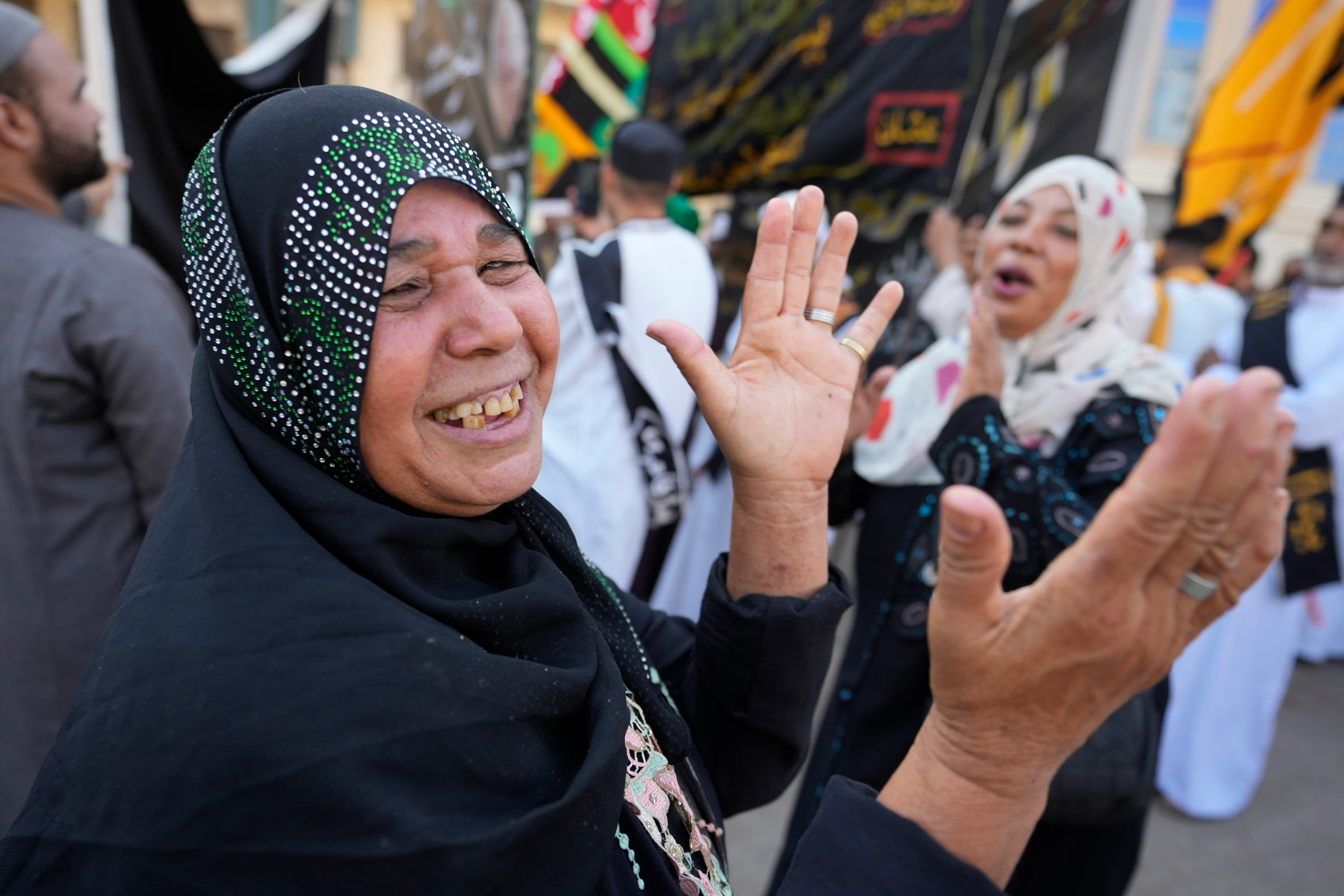
The customs of Awal Muharram vary from country to country, though they generally involve attending various religious activities, spiritual singing and religious meetings. The traditions and customs for Muharram also vary between Shia and Sunni Muslims.
For both, the marking of the beginning of the new year is usually quiet, unlike New Year’s celebrations associated with other calendars. It is a time for Muslims to reflect on the passing of time and their own mortality.
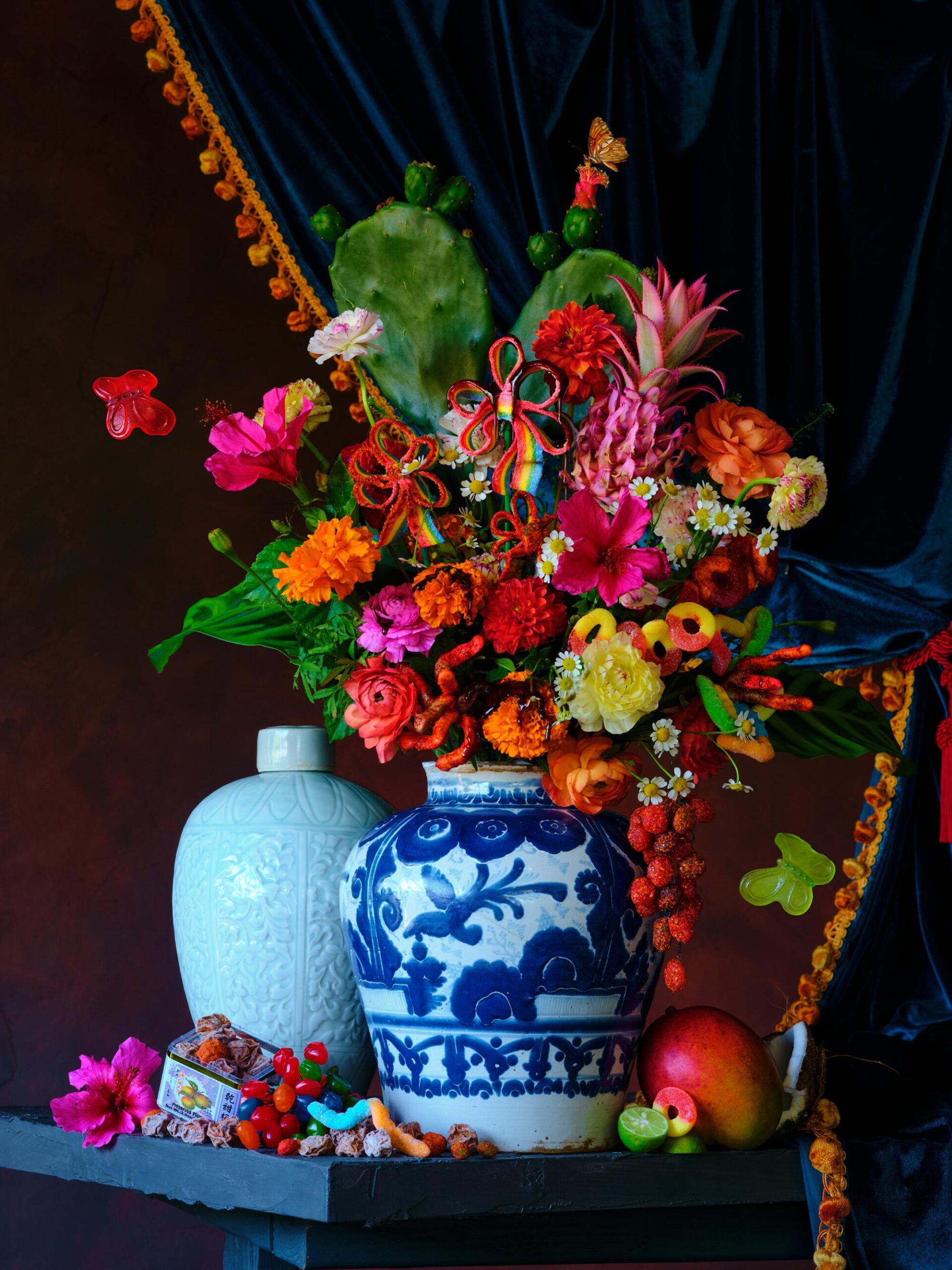
Stephanie Shih, “梅國 (Still life with chamoy and Dirty T Tamarindo),” 2025/2026. Archival pigment print on wood panel, varnish, glue, acrylic, frame. 38.25×48.25×3.75.
(From the artist)
Much has been written about the experience of aimlessness in the new David Geffen Galleries at LACMA, but it is another thing to experience it firsthand. The meandering floor plan, with its rooms of various sizes and orientations alongside their resulting passageways and corners, demands that you wander, not map, your perusal of the galleries. As a result, a visitor can easily feel disoriented, or in my case, a touch deconstructed. A little depersonalized, if you will.
Fortuitously, I was there to meet with multidisciplinary artist Stephanie Shih, whose photo-based compositions have the opposite effect, grounding the viewer in their personhood and experience. Her still lifes are made both beautiful and meaningful through their intentional arrangement of specific food, florals and ephemera, touching on diasporic understandings of self, Western and European appropriations of the “exotic” and the juxtaposition of the natural with the fabricated. In other words, to view a Shih piece is to collaborate with the artist on reconstructing or, in some cases, reclaiming an understanding of place and self.
We were talking about, and in front of, Shih’s new piece, “梅國 (Still life with chamoy and Dirty T Tamarindo),” which was not only commissioned by LACMA, but created in a temporary studio Shih constructed within the gallery itself over the course of two weeks late last year. The image features two ceramic vessels, one slightly in front of the other, within a traditional still life scene. The background jar stands alone, while the piece in the foreground overflows with a rainbow of plants, flowers, fruit, chamoy candies, gummies and a single real butterfly. To get to the small but sunny corridor that houses the work, one might make a few indirect turns and cross the gallery containing Andreas Gursky’s “Ocean” series. Flanked by four wall-size photographs of vast, overhead perspectives of the deep blue Indian Ocean, it’s easy to feel small among the giant panels. Luckily, when I met Shih at LACMA, she intercepted me outside and led us confidently up the Geffen’s dramatic exterior staircase and to “The Global Appeal of Blue-and-White Ceramics” installation — no crossing of oceans necessary.
After our conversation, I stayed to wander the galleries for a few more hours. I am a completist and I wanted, no, needed to see everything. Without the prescribed navigation I was accustomed to in a museum, this became a fool’s errand. I got physically lost and a bit lost to myself. Had I already seen that statue or did it just look like another visage also rendered in marble a few galleries back? I was pretty sure I had already taken these two rights and then a left before, but what if I hadn’t and would then miss a whole other room? The 360-degree curved glass walls encasing the galleries offered many glimpses of a face that belonged to me but somehow wasn’t mine. Who was I? I felt like I would never see everything on display, but also maybe never again exist beyond the funhouse of the Geffen Galleries. In my confusion, I passed by “梅國 (Still life with chamoy and Dirty T Tamarindo)” more than once and was reminded of Shih’s ability to articulate complex reconstructions of self through her exquisite, serene compositions. It was enough to reassure me that I could find myself again, if only I slowed down and considered my context with curiosity instead of fear.
This curiosity led me to “Shaping Dutch Identity: The Mr. and Mrs. Edward Carter Collection.” It was a serendipitous encounter for two reasons: One, the visual and symbolic correlation between Shih’s painterly use of shadow in her food- and floral-centered compositions, and the still life masterpieces of the 17th century Dutch. And two, because much like her work itself, our interview included layered discussion of constructing and shaping identities. Take the new Peter Zumthor-designed building in which we found (and in my case, lost) ourselves, which builds upon the existing galleries of LACMA while redefining the museum’s identity. Or Shih’s in-situ studio, which was created for creation’s sake, then taken down with only a photo of its contents remaining — contents which were constructed by the artist, too.
There was also the progression across cultures and continents of blue-and-white ceramics, which mirrors the evolution of chamoy, a pickled fruit condiment in Mexican cuisine that, along with a blue-and-white Talavera jar, is at the center of Shih’s piece. Both the ceramic and the chamoy traditions symbolize layers of culture as shaped by globalism and localism.
At one point in our conversation, I was momentarily embarrassed when I couldn’t recall the Filipino term for dried sour plums (kiamoy), a precursor to Mexico’s chamoy. It was an aspect of my identity as a third-generation Filipina that was also irretrievable to me that day. Shih was understanding and gracious in her response: “One of the really fun parts of the work I get to do is learning a lot of these histories that get hidden from us.” Given Shih’s academic background — she holds a PhD from Stanford University in linguistics — it makes sense that she brings deep research to her practice. Her art is rich with symbolism and history. But Shih’s work is also playful and, much like her response to me, generous in the invitation it extends to viewers to bring their own identities to her pieces in order to construct meaning for themselves. I may have felt unmoored among the Geffen’s myriad corners and paths, but never when I was standing in front of Shih’s piece.
Installation view of the inaugural presentation in the David Geffen Galleries, April 2026, featuring (top) Stephanie Shih’s 梅國 (Still life with chamoy and Dirty T Tamarindo) (2025- 26) and (bottom) Jar (c. 1700-50).
(Museum Associates / LACMA)
Claire Salinda: Your composition captures flowers, chamoy and other candies and fruit sumptuously arranged in and around a ceramic jar from LACMA’s permanent collection. How did you decide on chamoy as a subject? And how is it contextualized within the new David Geffen Galleries?
Stephanie Shih: “梅國 (Still life with chamoy and Dirty T Tamarindo)” is on display in “The Global Appeal of Blue-and-White Ceramics.” The gallery presents a condensed history of blue-and-white ceramics globally in dishes, starting in the Middle East with a 9th century Iraqi piece. From the Middle East we really got the use of cobalt in designs, and that married with the introduction of porcelain from China. We also have the Iznik kilns in Turkey, which are still operating today, and influences into Southeast Asia, and so on. Later on, the influence spread farther afield into Japan and France, where they started adding even more to it. The blue-and-white tradition has really spread globally, so this gallery is a nice microcosmic story of the effects of globalism before modern globalism.
For a long time I’ve been wanting to make a piece about chamoy and was just waiting for the opportunity to do so. The story of chamoy really parallels this journey of blue-and-white ceramics, which got to Mexico because of Spanish colonialism and then was adopted by local artisans. They really made it their own in the Talavera tradition. Chamoy similarly comes from Asia through pickled plums, particularly China via the Philippines. Filipino laborers came to Mexico via colonialism, and adapted and adopted champoy with spices and chilies from Mexico to become chamoy.
The curator, Susie Ferrell, gave me a whole list of blue-and-white surveys that they were looking at. We went to storage and to the conservation labs to look at all the pieces and we ended up choosing two pieces to work with. The one in “梅國 (Still life with chamoy and Dirty T Tamarindo)” is a Mexican Talavera jar from the 1700s. It’s the first non-Asian origin institutional ceramic I’ve gotten to work with in my career, which is the reason that I gravitated toward it.
Chamoy has been used by a lot of modern day food makers and chefs with American nostalgic candies, like peach rings and gummy worms, and my personal favorite, Gushers. One of these food makers, Alana Solis, who’s based in Tucson, runs Dirty T Tamarindo, a chamoy candy business she started during the pandemic. It was from her that I learned the history of chamoy, and so I wanted to do a piece with her candies for a long time. And this is just a really perfect opportunity with the Talavera jar.
I had pitched to Susie that it might be nice to have a second ceramic in the piece, a companion that demonstrates the origins and precursors of the blue-and-white ceramics in Mexico, a Chinese piece or something. She actually picked the one pictured here, which is also from the LACMA collection. It’s a 12th century Qingbai ware prunus vase, a meiping jar. When Susie pitched it to me, I didn’t even realize how perfect it was: A prunus vase is usually what they put plum blossoms in, and meiping means beautiful plum vase. It just ended up being a really, really good pick from her.
CS: You built a studio space within the gallery to create the piece. I’m curious about the constraints and what was surprising for you.
Artist Stephanie Shih’s makeshift set in the Los Angeles County Museum of Art (LACMA) David Geffen Galleries for her two-week commission project residency; Light test detail.
(Stephanie Shih)
SS: I was here for two weeks. I had a friend build a wall, we painted it downstairs and then brought it in and had it in the gallery with the light coming in through the windows. They gave me a refrigerator to store all the food, because I wasn’t supposed to have it out in the gallery space. We built out work tables too … it’s hard to kind of imagine with all the other stuff here now.
It was in December, and so the building was in several stages of installation with the art. There were just stacks of crates and boxes, which is amazing — it was very cool to just see statues half unpacked.
And actually, seeing everything get installed affected my thinking about the frame. Originally I wasn’t going to do a framed piece, it was just going to be on a panel. But then as I saw everything else go up, there was a weightiness to the way everything was framed and thought about. A lot of the frames are gold gilded, which are incredibly beautiful and historical. I wanted something that played off of that tradition, but using a red frame made it really obvious that it’s not 100% within tradition.
CS: How does this commission fit into your practice?
SS: My work started out really thinking about the artistic references we get as people working in food and still life. So many of the references are of this very Eurocentric art historical tradition. But if you look at that tradition, many things are taken from other cultures and used to symbolize the access and wealth and value that was assigned to these objects from the perspective of European imperialists, to put it nicely. It wasn’t until very recently that people were even thinking, “Well, where are these things from? What other artistic traditions does that mean that we’ve sort of borrowed from?” And so a lot of my work thinks about responding to that, but also taking back some of that tradition to tell stories of diaspora communities today here in the U.S.
From there, I’ve really started thinking a lot about the construction of identity and how we get to the things that symbolize who we are, and how we use symbols as we move through the world. As a cognitive scientist and linguist, a lot of my research training is about symbols and about the construction of identity in that way.
CS: Do you think that this piece could have been made anywhere else?
SS: No, I don’t think so. There’s something so special about the mission with the new building, how it’s so much more fluidly built and how LACMA is trying to think curatorially outside of the silos that have been set up by traditional art history. Thinking about that really, really influenced my approach to these pieces in terms of trying to collapse in each piece the timescales of historical influences and contemporary identity, but also the locality.
There’s stuff in “梅國 (Still life with chamoy and Dirty T Tamarindo)” that’s very global and far away, but also hyper local and here in L.A. For instance, the butterfly was found by my friend just a couple miles north in WeHo while I was working at LACMA. It’s native to California.
Do you know who Rachel Ruysch is? She was one of the big Dutch still life painters and in some of her later work, she was able to access flowers and plants from the American West, which was really rare at that time. She has a piece with prickly pear cactus as well as datura in it, which is crazy. We see those plants right here, but not in England and the Netherlands, where she was working at the time. Seeing that piece was part of the influence as well. In my piece, we have candy stripe ranunculus, which I was able to find for the candy. The cactus is from my backyard. There’s marigold and chamomile for their significance in Mexican culture, and the hibiscus flower, which has a long history across the Pacific Rim, tracing a lot of the places that ended up with chamoy and sour plums. I wanted a little nod to Hawaii with the pineapple because that’s where we also get salted plum culture.
Artist Stephanie Shih poses on set.
(From the artist)
CS: As we stand and chat in front of “梅國 (Still life with chamoy and Dirty T Tamarindo),” I can’t help but notice folks stopping to take it in. How is it being here and seeing people interact with the work?
SS: Oh, really fun!
CS: Do you ever want to interrupt them to answer a question you overhear?
SS: No. I think my favorite part of watching people interact with the pieces is what they bring to it. Some people see the chamoy immediately and they recognize their experiences in it, which is really lovely to see. Like, I can see someone’s been pointing at it, there’s a nice fingerprint mark. That’s funny. Some people recognize the candy in it. Kids often ask me, “How did the gummy butterflies fly?” and that’s really fun to answer. I appreciate that everyone brings their own experiences to it, and that sort of completes the piece for me.
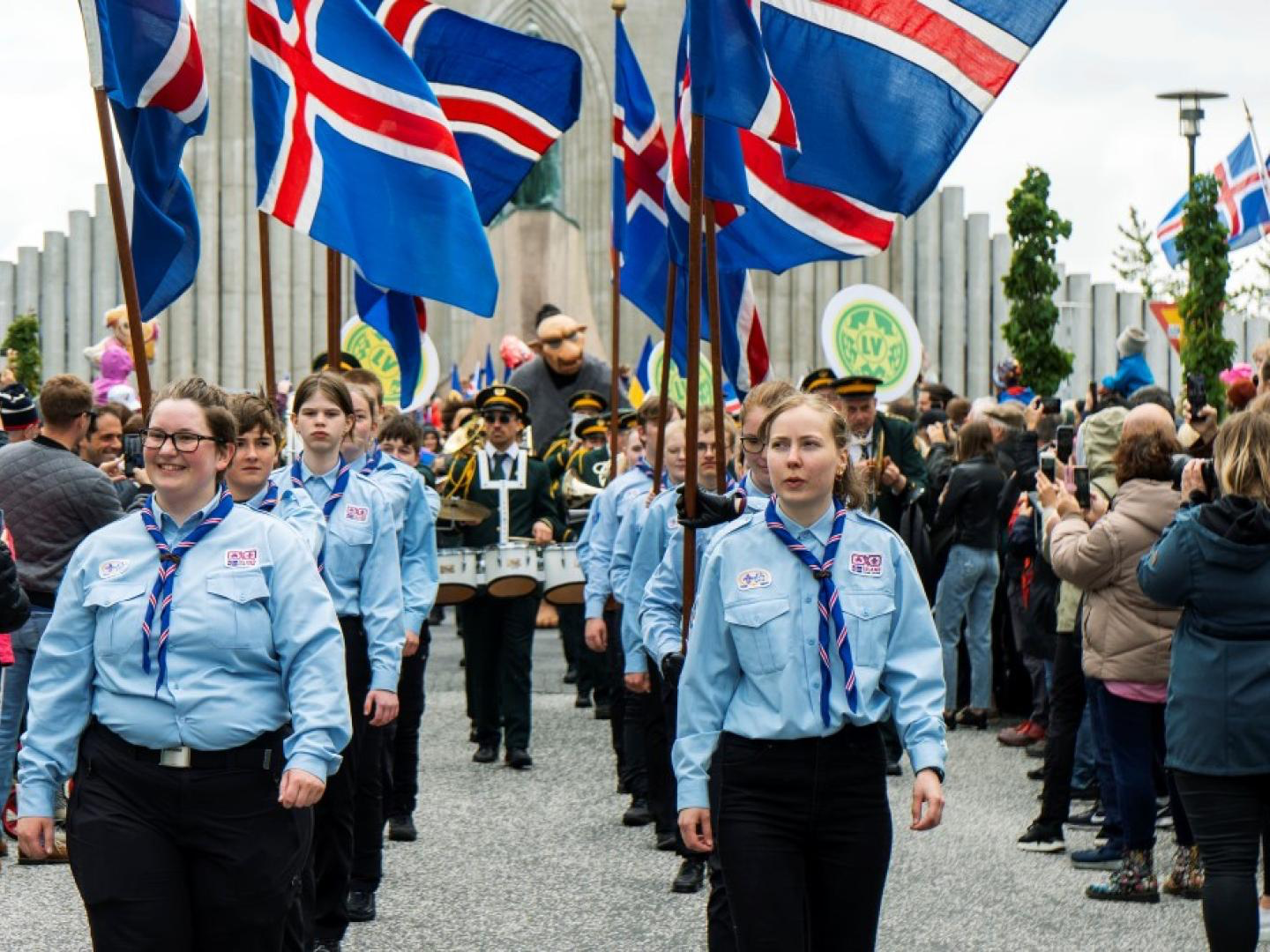
Iceland was proclaimed an independent republic on June 17th 1944.
Iceland actually gained independence from Denmark much earlier, on December 1st 1918 with the signing of the Act of Union with Denmark. The Act recognised Iceland as an independent state under the Danish crown.
The formation of the republic in 1944 was based on a clause in the 1918 Act which allowed for a change to the relationship between Iceland and Denmark in 1943.
Due to the German occupation of Denmark in 1943, a vote on the revision to the Act was delayed until after the Second World War finished.
The referendum was held in at the end of May 1944. Voters were asked whether the Union with Denmark should be abolished and whether to adopt a new republican constitution. Both measures were approved with more than 98% in favour and a voter turnout of 98.4%.
Although he would have preferred a different outcome in the referendum, King Christian X of Denmark sent a letter on June 17th 1944 congratulating Icelanders on forming their Republic.
The June 17th date was already a significant date in Iceland’s history as it is the birthday of Jón Sigurdsson who was the leader of the 19th century Icelandic independence movement which led to the 1918 Act of Union. Sigurdsson died in Copenhagen in 1879.
June 17th, was therefore chosen as Iceland’s National Holiday as a fitting date to mark the Independence from Denmark, the proclamation of the Icelandic republic and to recognize Jón Sigurdsson’s efforts toward Icelandic independence.
The day has been a legal public holiday since 1971, though it had been a tradition for most employers to give their workers a day off since 1945.
The number of confirmed cases in the country has increased to 837, including 196 deaths.
Published On 16 Jun 202616 Jun 2026
The current Ebola outbreak in the Democratic Republic of Congo (DRC) could become deadlier than the worst outbreak on record, which killed more than 11,000 people, says the head of Africa’s Centres for Disease Control and Prevention (Africa CDC).
The number of confirmed cases in the country has increased to 837, including 196 deaths, government data showed on Tuesday.
Recommended Stories
list of 3 itemsend of list
“If we don’t stop the outbreak very soon, it will be worse than what we had in West Africa and eastern DRC,” Africa CDC Director-General Jean Kaseya said during a virtual meeting of African leaders and international donors in Burundi on Tuesday.
Speaking to Al Jazeera, Kaseya said tens of thousands of people who may have been exposed to Ebola had not yet been traced or contacted.
“The contact tracing is a major indicator and a major issue. We are missing more than 26,000 people, and we don’t know where they are, and we don’t know if they are contaminating other people.”
A Red Cross official said that the epidemic had not yet peaked in the country.
“We are afraid that this could last one year to end this disease,” Bruno Michon, operations manager for the International Federation of Red Cross and Red Crescent Societies, said.
The response has been hampered by a lack of treatment centres and by community resistance to stringent hygiene measures. Health officials said that, more than a month since the outbreak was declared, the true scale was still unknown.
The bodies of Ebola victims are highly infectious after death, and unsafe traditional burials – in which family members handle the body without proper protective equipment – are a leading driver of transmission.
So far, the continent has raised less than a fifth of the $518 million it is seeking to bolster measures to contain the outbreak, according to Burundi’s President Evariste Ndayishimiye, who also chairs the African Union.
The shortfall has raised concern among authorities, who fear the consequences could be devastating if the virus is not brought under control quickly.
There is no approved treatment or vaccine for this strain of Ebola. The World Health Organization (WHO) says it could take up to nine months for a vaccine to be ready.
Neighbouring Uganda has recorded 19 cases, 14 of them among people who had travelled from the DRC. The country has also reported two deaths.
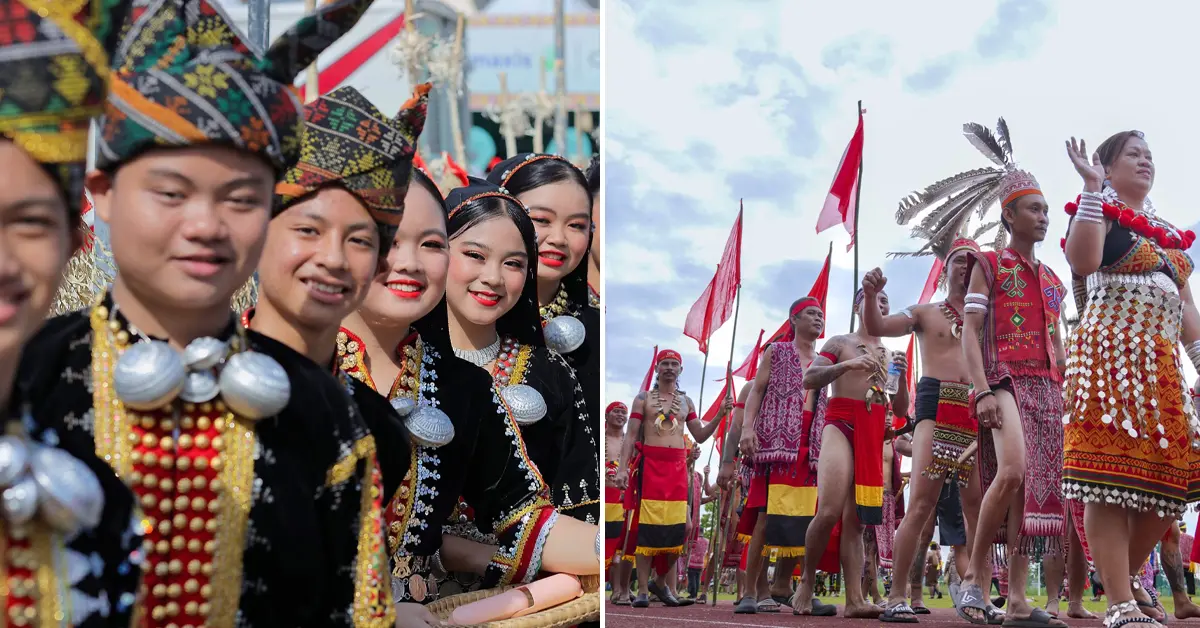
Awal Muharram, the beginning of the new Hijrah year, is a historic occasion for Muslims around the world.
While traditions for Awal Muharram will vary from country to country, it is a public holiday in most Islamic countries, including Malaysia.
Awal Muharram is also known as Maal Hijrah in Malaysia.
To mark Awal Muharram, Muslims attend various religious activities, spiritual singing, religious meetings throughout the country. They recite Koranic verses and hold special prayers and sermons at public halls and mosques.
A popular Awal Muharram treat is a sweet rice porridge, called Bubur Asyura, which is eaten at breakfast together with friends and relatives.
The Islamic New Year represents the starting point of the Muslim era when Prophet Muhammad left Mecca for Medina to escape persecution in 622 CE.
The essence of Prophet Muhammad’s emigration was a process to change one’s situation and as such, the focus of the festival is on reflection, remembrance and gratitude.
The arrival of the Hijrah year is seen as a time to make or renew resolutions. If the past year has been unproductive, Muslims must try to make this year constructive in every sense of the word. For those who led a meaningful life last year, then the aim this year is to be even better.
To mark the occasion, a ‘Tokoh Ma’al Hijrah’ is awarded to a Muslim personality to honour their contribution to Islam.
SACRAMENTO — If Gov. Gavin Newsom and the Legislature truly believe that slow vote counting is a horrible problem — which it’s not — right now is the time to fix it.
They’re crafting a new state budget. And they could choose to spend the money needed to help counties hire more temporary election workers, buy more sophisticated vote-counting machines and add space for all of it.
That’s the only way to significantly speed up vote counting and mute the MAGA drivel about California being a national “laughingstock.”
How much money?
“We’ve suggested $55.5 million,” says Kim Alexander, president of the nonpartisan California Voter Foundation, which pushes to improve the election process.
“That’s not a lot in the big scheme of the state budget.”
She’s right. It’s essentially pocket change in a proposed budget still being negotiated that tentatively totals $356 billion.
But don’t bet on much of it being allotted for swifter vote counting.
Regardless of all the potshots at California from cable news panelists about our “embarrassing” elections, faster vote tallying doesn’t seem to be a high priority for the Legislature.
Democrats are justifiably much more concerned about protecting poor people’s healthcare, in-home services for seniors and the unraveling safety net as the Trump administration and GOP Congress slash federal funding.
Federal cutbacks aside, the state for years has been spending more money than it takes in despite tax revenue exceeding expectations. Sacramento has a severe deficit spending problem that is projected to last for a while.
So, allocating more money to speed up vote counting by a few days isn’t very high on the governor’s and legislative leaders’ to-do lists.
“The reality is elections currently are underfunded,” says Assembly Elections Committee Chairwoman Gail Pellerin, a Democrat who was Santa Cruz County’s chief elections official for 27 years.
She also says, referring to demands for faster counting: “The media outlets want to call the races and be the first. And that’s what this is all about.”
I don’t disagree. By our nature, we journalists are anxious to report fresh news, including the outcomes of elections. And we become impatient when vote counts roll in seemingly at a snail’s pace.
But come on, it’s not a horrendous burden on the public to wait a few days for an accurate vote count.
It does, however, provide an excuse for President Trump and MAGA Republicans to regurgitate unfounded accusations that elections won by Democrats are “stolen” from the GOP.
“Look what’s happening in California … it’s a rigged election,” Trump bellowed in a June 7 interview on NBC’s “Meet the Press” with Kristen Welker. “They’re cheating on the election.”
When Welker challenged him for evidence, Trump heatedly replied: “They’re crooked just like you’re crooked. Your press is crooked. And ‘Meet the Press’ is crooked. … You’re either crooked, or you’re stupid.”
To put this in context, the Trump diatribe came immediately after he called police officers attacked by Jan. 6 Capitol invaders “a bunch of dirty cops” and “crooked cops.” The Trump-inspired rioters were trying to prevent Congress from certifying President Biden’s “rigged” election.
It’s constantly puzzling why millions of Americans take this unhinged man’s blatherings so seriously. But they do.
And when the president lies about ballot fraud, it erodes public confidence in the integrity of our election system and undermines democracy. Americans become even more cynical and polarized.
So, the governor, Legislature and counties would do everyone a favor by investing in a faster vote count.
“It’s a problem,” Alexander asserts. “The slow vote count has become the norm in California, but it’s not normal for a democracy. It opens the door for false fraud claims.”
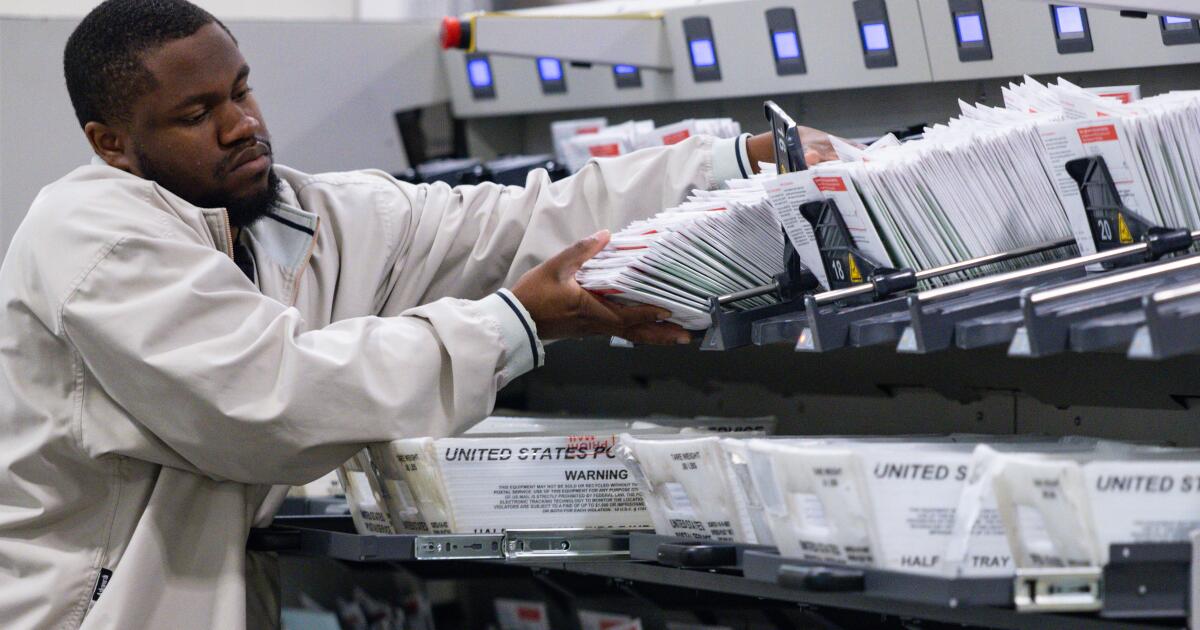
Much of the slow count results from tallying mail ballots, which amount to at least 80% of votes cast. They take longer to process, largely because each voter’s signature on the ballot’s envelope needs to be checked against one on file.
So, California could speed up counting by mailing out fewer ballots. Now, every registered voter gets one. We could go back to requiring voters to request an “absentee” ballot.
But forget that. We’re right to make it easy for people to participate in democracy — as long as safeguards are maintained to prevent fraud.
Some counties have taken advantage of a new law that allows a voter to drop off a filled-in mail ballot inside a voting center. There, it’s handled like an old-fashioned ballot that’s filled out at a booth. This significantly reduces processing time. But many counties say they need more state money to implement the program. I have no idea why.
Counting also is slow, of course, because lots of voters wait until election day — or near it — to cast their mail ballot. That clogs the system.
If the ballot is postmarked by election day, it’s allowed seven days to reach vote processors. Trump and fraud conspirators want to trash all ballots arriving after election day. That would speed up counting. But it’s un-American.
California election officials also try to pressure voters into mailing their ballots early. Rubbish.
Election day should mean something. It’s a day citizens are allowed to vote — whether they hand their ballot to a clerk at a voting center or drop it in the mail. They’ve got a right to take their sweet time in concluding what the wisest voting decisions are.
After all, the government allows us to drop our tax return in the mail on April 15 each year — and is very happy to receive our check a few days later. They process that check plenty fast.
“There’s nothing wrong with a slow count,” says Rick Hasen, a UCLA law professor who specializes in election law. “But it‘s a major problem because, unfortunately, it’s a manufactured crisis that can undermine public confidence. And it has gotten worse.”
So, Sacramento needs to undermine the demagogic manufacturers by stepping up vote counting while keeping elections virtually fraud-free.
You’re reading the L.A. Times Politics newsletter
George Skelton and Michael Wilner cover the insights, legislation, players and politics you need to know. In your inbox Monday and Thursday mornings.
By continuing, you agree to our Terms of Service, which include arbitration and a class action waiver. You agree that we and our third-party vendors may collect and use your information, including through cookies, pixels and similar technologies, for the purposes set forth in our Privacy Policy such as personalizing your experience and ads.
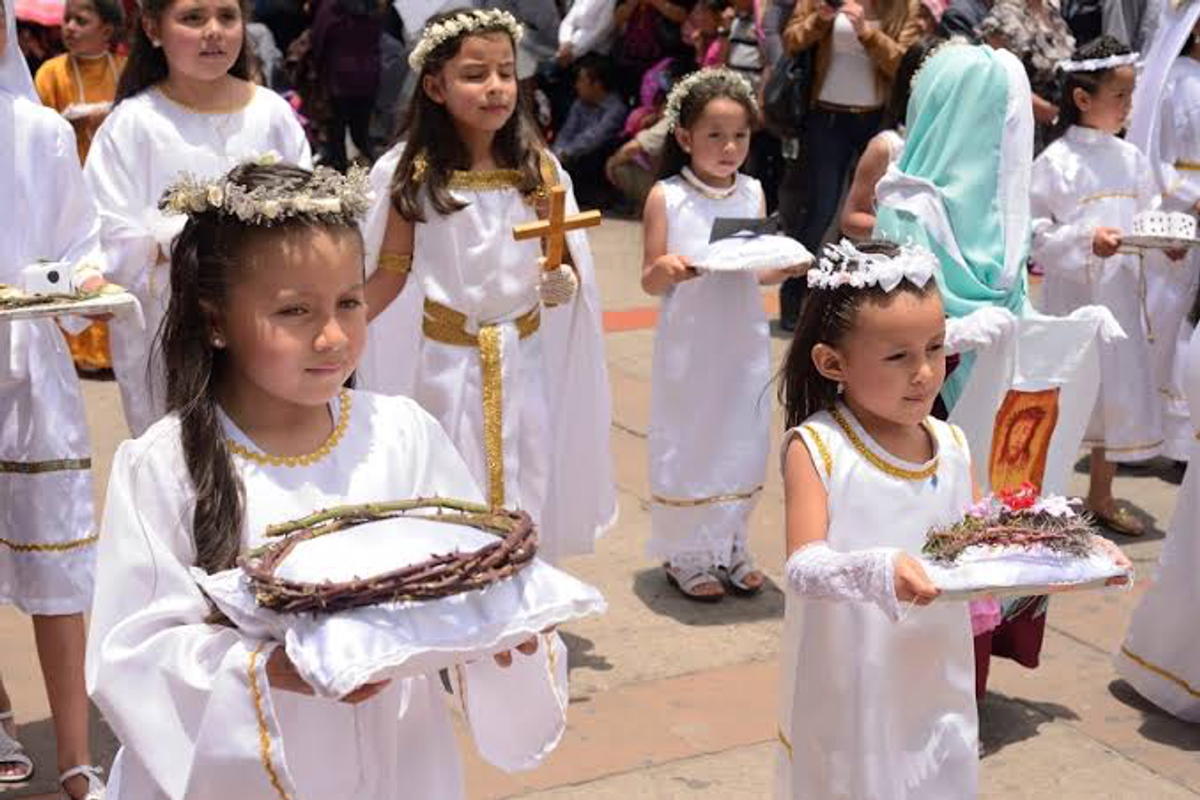
The full title of the holiday is ‘The Feast of the Sacred Heart of Jesus’. In Spanish, it is known as ‘El Sagrado Corazón de Jesús’.
In the calendar of the Roman Catholic Church it is a feast day 19 days after Pentecost and the second Friday after Corpus Christi. Like other holidays in Colombia that are based on a Catholic event, the holiday is celebrated on the Monday after the actual date.
The Feast of the Sacred Heart is devoted to the physical heart of Jesus as a symbol of his divine love for all humanity.
The devotion to the Sacred Heart developed in the middle ages out of worship to the scared wounds that Jesus received during his crucifixion. The devotion became more widespread in the seventeenth century when a French nun, Saint Margaret Mary Alacoque said she learnt of the devotion from Jesus during several apparitions. The devotion to the Sacred Heart then spread across Spain due to the work of the Jesuits. This meant that the Spanish brought this tradition to their colonisation of Latin America.
In 1902, Colombia was officially consecrated to the Sacred Heart of Jesus and this remained in the constitution until 1991.
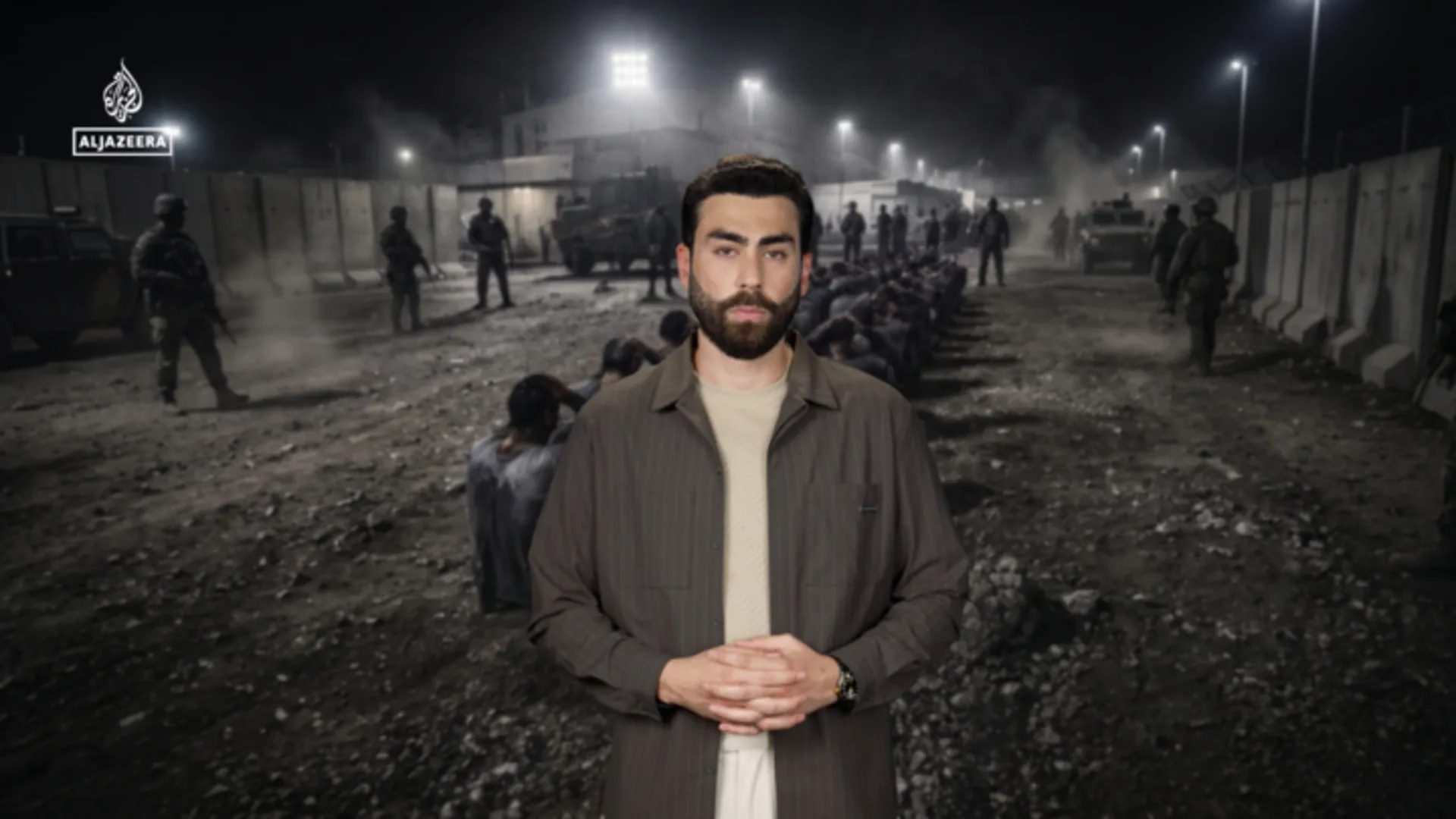
Al Jazeera’s Basel Ghazoghli traces the documented record from 1948 to the present. Sexual violence against Palestinians in Israeli custody is often framed as a post-October 7 issue. But historical records, academic research, and legal testimony suggest a much longer history.
On April 2nd 1982, Argentina invaded and occupied the Falkland Islands. Argentina asserted that the islands are Argentine territory.
Three days later, the British government dispatched a naval task force to engage the Argentine Navy and Air Force before making an amphibious assault on the islands.
The conflict lasted just over ten weeks and ended with an Argentine surrender on June 14th, returning the islands to British control.
In total, 649 Argentine military personnel, 255 British military personnel, and three Falkland Islanders died during the hostilities.
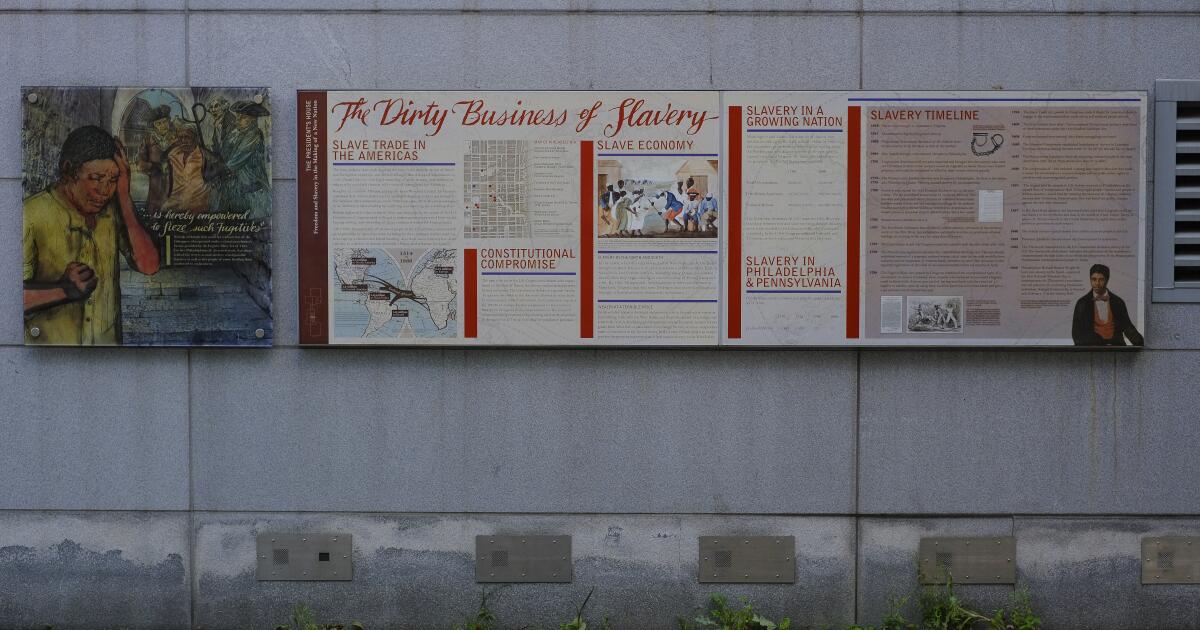
A federal judge has ordered the Trump administration to restore signs related to topics such as climate change, slavery and Indigenous and LGBTQ+ history that were removed under an executive order to purge language at national parks that allegedly cast America in a negative light.
The order has prompted the removal of mentions of President Washington’s slaves at Independence National Historical Park in Philadelphia, signs regarding climate threats at Fort Sumter in South Carolina and a pride flag at the Stonewall National Monument in New York City, according to the lawsuit challenging the action.
A preliminary injunction was issued Friday by U.S. District Judge Angel Kelley in Boston, who sided with a coalition of conservation and historical groups and ordered all language removed under the order to be reinstated before the Fourth of July. Earlier this year, another federal judge ordered the signage related to Washington’s slaves restored.
In Friday’s injunction, Kelley accused the Trump administration of seeking “to rewrite the Nation’s history with a white-out pen,” and said that national parks play an important role in telling the multifaceted history of America, including “the good, the bad, and the ugly.”
“Because Defendants deemed it important to strip the parks of these undeniable truths in anticipation of the 250th Anniversary of our great Nation,” she wrote, “it is equally important that our shared history be honestly told and fully restored by the 250th Anniversary to properly honor the remarkable achievements of the United States.”
A spokesperson for the U.S. Department of the Interior dismissed the ruling as the work of a “liberal activist judge.”
“The Department will look at our appeal options while we celebrate UFC Freedom 250 on the South Lawn of the White House this weekend in honor of our nation’s 250th with the greatest president in the history of our country — President Donald J. Trump,” the spokesperson said in a statement.
Trump initially signed the executive order in March 2025, arguing that a revisionist movement is seeking to undermine American history by replacing objective fact with a distorted, ideologically driven narrative.
“Under this historical revision, our Nation’s unparalleled legacy of advancing liberty, individual rights, and human happiness is reconstructed as inherently racist, sexist, oppressive, or otherwise irredeemably flawed,” the order stated.
Under the order, more than 430 sites under the purview of the National Park Service were told to review language on monuments, memorials, statues and markers to ensure they didn’t disparage Americans past or present, with a close eye on language added during former President Biden’s administration. QR codes were also added at sites encouraging visitors to report any signs they believed violated the order.
In February, a coalition including the National Parks Conservation Assn., American Assn. for State and Local History, Assn. of National Park Rangers and Union of Concerned Scientists filed a lawsuit in federal court in Boston alleging that the order was erasing American history and science.
“National parks serve as living classrooms for our country, where science and history come to life for visitors,” Alan Spears, senior director of cultural resources at the parks conservation association, said in a February statement. “As Americans, we deserve national parks that tell stories of our country’s triumphs and heartbreaks alike. We can handle the truth.”
The United States opened their World Cup campaign with a fine win – but not before a sequence of events that left everyone inside SoFi Stadium scratching their heads as the video assistant referee (VAR) made history.
The co-hosts were comfortably leading Paraguay 3-0 when confusion reigned in the Group D game.
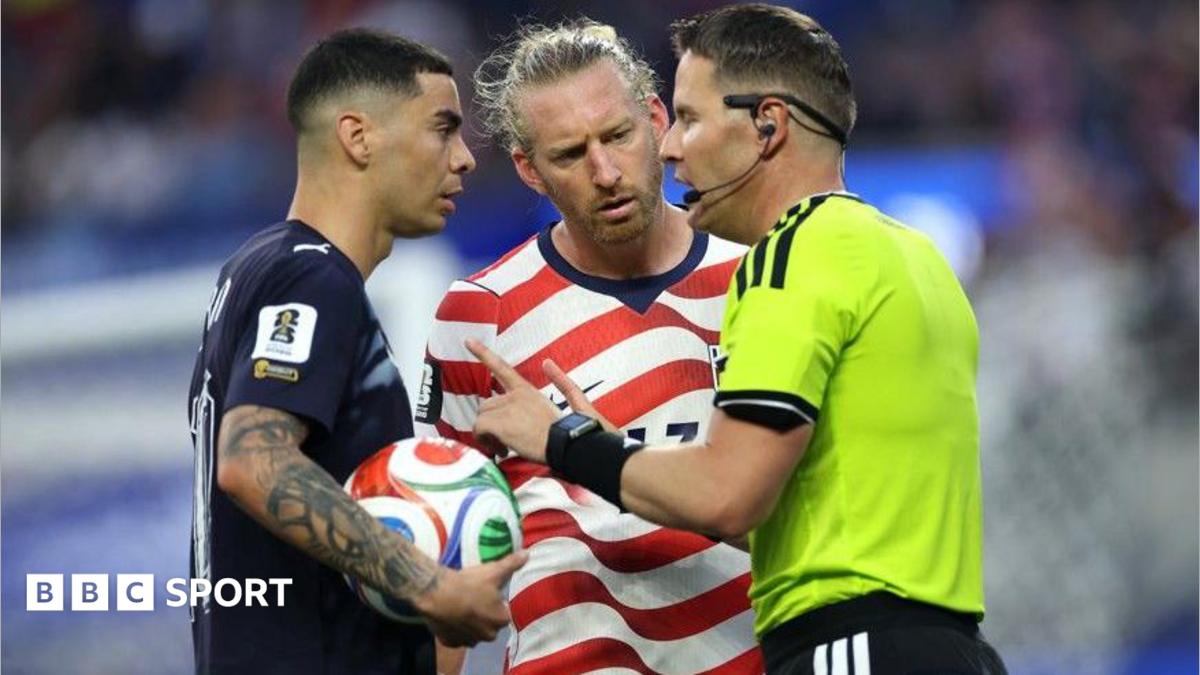
Veteran defender Tim Ream, 38, conceded a free-kick and was shown a yellow card for his ‘challenge’ on Miguel Almiron.
After the free-kick was taken, Dutch referee Danny Makkelie was sent to the screen by the VAR and overturned his decision – something officials have not previously been allowed to do.
After rescinding Ream’s caution, Makkelie instead booked former Newcastle United forward Almiron, who had clearly dived.
It is the first VAR intervention for mistaken identity at the World Cup, even if it perhaps was not used in the way most expected it to be.
Fifa has introduced of a number of rule changes for the tournament, with Pierluigi Collina, the head of referees, requesting one specifically for mistaken identity.
The rule states that if a player is booked or sent off – but the foul was actually committed by the opposition team – the decision can be changed.
Another new law is second yellow cards leading to a red card can be reviewed, but not first yellow cards. The only reason referee Makkelie was able to rescind the decision was by using the mistaken identity law.
The officials allowed the game to restart before stopping, which also confused fans as normally once the game resumes it cannot be pulled back.
Former Everton and Wales defender Ashley Williams, speaking to BBC Sport, added: “They let them take the free-kick, which was bizarre but clearly the right decision.
“It’s the first time we have seen it but fair play.”
Former England midfielder Danny Murphy, who was co-commentating for BBC Sport, added: “Any adaptation of the rules which means diving gets more punishment is good.”
The United States, managed by former Tottenham boss Mauricio Pochettino, won the match 4-1 to get their campaign off to a winning start in front of a jubilant home crowd.
Following an own goal by Damian Bobadilla, the US led 3-0 at half-time after Folarin Balogun scored twice.
In doing so he became just the second US player to score more than once in a World Cup match.
Paraguay pulled one back through Brazilian-born Mauricio before the goal of the night from substitute Giovanni Reyna, who curled a 20-yard shot home with the outside of his right foot with the final kick of the game.
Saint Anthony of Padua (August 15th 1195 – June 13th 1231) was a Portuguese Catholic priest and Franciscan friar who became a saint in 1232 and was made a Doctor of the Church in 1946.
Also known as Anthony of Lisbon, he is the patron saint of Portugal as well as the patron saint of people who lose things and of children.
St. Anthony of Padua was born in Lisbon, Portugal to a wealthy family; his father was a captain in the Royal army. He was ordained as a priest and became inspired after meeting five Franciscan friars who were on their way to Muslim Morocco to preach the Gospel. A few months later he discovered that the monks were martyred and he joined the Franciscan order to follow in their path, adopting the name of Anthony, after Anthony the Great, who was one of the first monks and noted for his travels in desert lands.
Anthony’s life was changed when he was almost accidentally forced into giving a sermon. This uncovered his great gift for making speeches which led to Saint Francis asking him to travel around Italy preaching the Gospel which he did. He converted many people and became famed for his sermons.
Many miracles are assigned to Saint Anthony and he is often referred to as the ‘The Saint of Miracles’ or ‘the Wonder Worker’.
He was canonized less than a year after his death by Pope Gregory IX on May 30th 1232. This is the second-fastest canonization ever.
The moment that Wall Street had anticipated all year arrived on Friday as SpaceX, the AI and aerospace company controlled by Elon Musk, began trading publicly on the Nasdaq in the largest initial public offering (IPO) in the history of financial markets.
ADVERTISEMENT
ADVERTISEMENT
In a speech before the New York session opened for trading, Musk stated that SpaceX’s goal is to “take the fiction out of science fiction.”
SPCX opened at $150, over 10% above its $135 IPO price, and it was already at more than $160 after the first few minutes of live trading.
The company confirmed on Thursday that it had priced 555.6 million Class A shares at $135 each, valuing the firm at roughly $1.78 trillion (€1.54trn) and targeting a raise of $75 billion (€64.5bn) that instantly eclipsed Saudi Aramco’s $29.4 billion (€25.4bn) listing, which had stood as the global record for almost seven years.
Only around 3% to 4% of SpaceX shares are currently available for public trading.
The company earmarked as much as 30% of its offering for retail investors, including 10% dedicated to European buyers, but the final amount was set at 20%. As for options contracts on SPCX, they are scheduled to begin trading next week.
The IPO has also brought Elon Musk closer to becoming the world’s first trillionaire.
Forbes valued his pre-IPO SpaceX stake, estimated at around 42% of the company, at about $500bn (€435bn). At the IPO valuation, those holdings are worth roughly $690bn (€600bn), adding nearly $190bn (€165bn) to his fortune and pushing his net worth closer to the $1tn (€870bn) milestone.
Along with Musk, thousands of SpaceX employees are benefitting from the IPO and becoming millionaires.
The listing will give millions of savers indirect exposure to SpaceX as the company is expected to qualify for major stock market indexes shortly after its debut, meaning its shares could be automatically purchased by index-tracking funds.
SpaceX is estimated to be fast-tracked into the Nasdaq-100 in less than a month, as opposed to a typical wait of as much as a year.
Nasdaq’s new fast-entry rule, introduced in May, now sees it evaluating newly listed stocks for potential entry by ranking their market capitalisation on the seventh trading day and assessing whether they would rank within the top 40 index members.
SpaceX is already in the top 10.
Among other changes announced, the rule that requires companies to float a minimum of 10% of their shares was also scrapped.
Analysts estimate that funds tracking the Nasdaq-100 will be required to purchase at least $7bn (€6bn) worth of SpaceX shares around the inclusion date, creating a wave of mechanical demand.
SpaceX has also already become eligible for inclusion in both the Russell US Equity Indexes and the FTSE Global Equity Index Series under the newly announced fast-entry rules from the index provider FTSE Russell.
The S&P 500, however, will not adopt a similar fast-track approach.
S&P Dow Jones Indices confirmed in early June that it would maintain its 12-month seasoning requirement and GAAP profitability test, meaning SpaceX will not join the index before mid-2027.
This is a developing story and will be updated as more information becomes available.
This article does not constitute financial advice, always do your own research and invest according to your specific circumstances.
In many ways, the most ambitious World Cup in history — which kicked off Thursday in Mexico City — has inspired more angst than anticipation, more fear than fervor.
The competition, returning to North America for the first time in more than three decades, has expanded to 48 teams and 104 matches, to be played over 39 days in 16 cities in the U.S., Mexico and Canada. The complex planning was eight years in the making.
Yet even before the competition opened with Mexico facing South Africa at the iconic Estadio Azteca, it has been marred by a number of controversies that threaten to overshadow the soccer and cloud the tournament’s legacy.
“I view this World Cup as the most politically combustible World Cup in recent history. And that’s saying something,” said Jules Boykoff, a political science professor at the University of Portland and author of eight books on the politics of international sport.
“We’re in uncharted territory in many ways.”
Relations between the host countries, once strong, have been strained by the Trump administration’s tariff policies and disagreements over border security. Travel bans have barred potential World Cup visitors — and even support staff and match officials — from entering the U.S. and others are fearful of making the trip, worried about ICE raids and immigration roundups.
The U.S. is at war with a tournament qualifier, Iran. And Iran has fired missiles and drones on Jordan, Qatar and Saudi Arabia, nations that also are World Cup participants.
The International Sports Press Assn. said Iranian and African journalists have been denied visas to cover games in the U.S., and Iran protested after more than a dozen members of its support staff had their requests to enter the U.S. rejected. The Iranians, who were forced to move their training base from Tucson to Tijuana, will spend limited time in the U.S. during group-play games that will take place in Inglewood and Seattle.
Players and journalists from Senegal, Uzbekistan and Iraq have been detained at U.S. airports for up to seven hours by immigration officials. Then on Monday, Omar Artan, a decorated referee and the first Somali official selected to work a World Cup, was turned away at Miami International Airport.
In addition, ticket prices have been so high and the lottery process for obtaining them so opaque, the attorneys general of New York and New Jersey have begun formal investigations into FIFA practices. Other states, including California, hosting tournament matches have begun asking questions as well.
All that has conspired to produce a World Cup that is struggling to catch on with the public. According to a recent poll by Yougov.com, a majority of Americans — 54% — say they are not at all interested in the tournament and nearly six in 10 say they will not watch any matches.
“People are just in a bad mood,” Boykoff said. “It’s a tough time.”
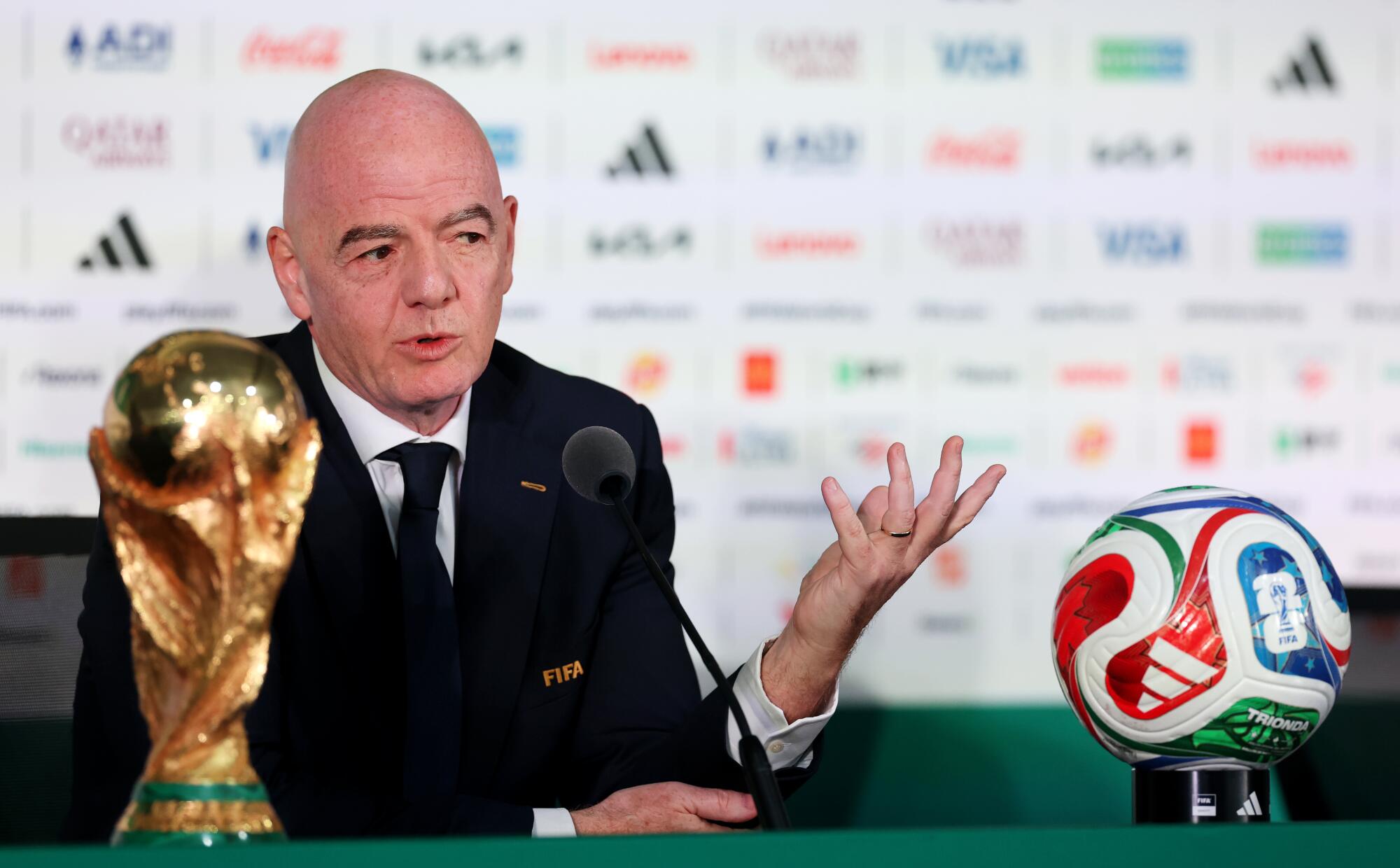
FIFA president Gianni Infantino remains optimistic, promising this will be “the biggest, the most inclusive, the greatest FIFA World Cup ever.” He made the same claim about the 2022 World Cup in Qatar and the 2018 tournament in Russia.
FIFA president Gianni Infantino speaks during a news conference on Wednesday before the start of the World Cup.
(Carl Recine / Getty Images)
“The World Cup should be understood as both a global sporting celebration and a major commercial enterprise, with these two dimensions being mutually enforcing rather than contradictory,” said Steve Georgakis, a lecturer on sports studies at the University of Sydney and a frequent author on soccer.
This year’s tournament is projected to swell FIFA’s coffers by nearly $9 billion and the TV ratings, it says, will be massive.
“Its universal appeal combined with the participation of 48 nations ensures that it remains a genuinely global sporting event,” Georgakis said.
Boykoff has his doubts.
“In this particular political moment, with the Trump administration being erratic and impulsive and needing a win from this tournament and the fact there’s so many moving parts geopolitically, I don’t have confidence that it’s just going to end up being a soccer-focused next five weeks,” he said.
This is not the first World Cup to kick off under some kind of black cloud.
The 1974 tournament in West Germany was tarred by the geopolitical fallout of the 1973 Yom Kippur War. Four years later Argentina’s military dictatorship used the World Cup to sportswash a “Dirty War” in which as many as 30,000 people were tortured, murdered and disappeared.
The 2010 and 2014 World Cups were troubled by cost overruns and delays in the construction of stadiums and other infrastructure and the threat of labor unrest while global outrage over human rights violations and discrimination against women and LGBTQ people hung over the last two tournaments.
Those issues never fully disappeared but were overshadowed by the brilliance of the soccer. Jonathan Wilson, a columnist with the Guardian and author of “The Power and the Glory: The History of the World Cup,” expects the same this summer.
“The other stuff will still be there in the background,” he said, “but fundamentally the football will, for the vast majority of people, take over. It’s just sort of a natural cycle.”
Argentina star Lionel Messi controls the ball during an international friendly against Iceland on Tuesday.
(Butch Dill / Associated Press)
And as with every World Cup, there undoubtedly will be unforgettable moments.
Argentina’s Lionel Messi and Portugal’s Cristiano Ronaldo, the top scorers in soccer history, will be playing in their sixth and final World Cups — Messi chasing a second straight title and Ronaldo pursuing the only prize that has eluded him.
Kylian Mbabbe will be trying to take France to a third consecutive final while young superstars like Erling Haaland of Norway and Lamine Yamal of Spain will be looking to put their mark on their first World Cups.
Four teams — Jordan, Curacao, Cape Verde and Uzbekistan — have qualified for the tournament for the first time.
And there will be other storylines no one saw coming, all of which will contribute to the narrative of this World Cup.
“Major sporting events have a way of capturing public attention and shifting the conversation toward what is happening on the field rather than off it,” Georgakis said.
How much the actions of the Trump administration affect that calculation remains to be seen.
There are travel restrictions in place that fully or partially bar citizens from 39 countries — including a number of World Cup participants — from entering the U.S. And the administration has said ICE and Homeland Security personnel will have a visible presence at World Cup venues, including SoFi Stadium in Inglewood, where the American team will begin play Friday.
“There will be federal agents,” confirmed L.A. County Sheriff Robert Luna, who added that he could not guarantee immigration sweeps would not take place. “ They told us that specifically would not be occurring,” he said. “Any of that’s subject to change.”
Mexico fans celebrate during a watch party at Plaza Mexico in Lynwood on Thursday.
(Kayla Bartkowski / Los Angeles Times)
The difficulty in obtaining visas and the fear of being rounded up by immigration agents are being blamed, in part, for less-than-expected tourist traffic. Hotel operators in all 11 World Cup host cities say bookings for the tournament are well below projections. Several countries have issued warnings about travel to the U.S.
Then there are the own goals from FIFA over tickets and parking prices as high as $900 at some stadiums, weather issues and a short-lived ban on water bottles.
FIFA has defended its policies on ticket prices by arguing that premiums are necessary to maximize revenue, which it will invest in global soccer development. Variable, market-based pricing, it said, simply reflects standard entertainment practices in North America. The organization did, however, reverse its ban on fans bringing bottles into games. Spectators are now allowed to enter stadiums with one soft, plastic 20-ounce water bottle.
And despite a warning from climate scientists that one in four World Cup games could be played in dangerously hot conditions, FIFA will start 40 of them at 3 p.m. or earlier local time, the warmest time of day, to accommodate European TV viewers.
Georgakis said the play on the field will have to overcome all those issues if this World Cup is to earn a favorable place in history.
“Ultimately the success of the World Cup will be judged by what happens on the field,” he said. “If the football is compelling, dramatic and memorable, the tournament will likely be remembered as a great World Cup. If the play falls short, then the off-field issues such as ticket prices, extreme heat, ICE enforcement activities, the Trump administration will receive great attention and could shape perceptions of the event.”
Hilton on Tuesday addressed the president’s unfounded but vociferous claims that Democrats have massively cheated in our recent election.
“We’ve got teams standing by, we’ve got lawyers standing by, very focused on that,” Hilton told reporters, including my colleague Seema Mehta, outside the L.A. elections headquarters. “We don’t want to let anyone down, we don’t want to let anything slip away, and we’ve seen nothing.”
We’ve. Seen. Nothing.
How refreshing to have a MAGA insider repudiate the lies.
“But we need a wide-scale audit of the California voter roll,” Essayli told Beck.
Voter rolls are a huge refrain in conspiracy theories and the subject of numerous (mostly unsucessful) lawsuits by Trump‘s Department of Justice. Trump is demanding that the federal government “audit” the voter rolls to ensure ballots go only to legal voters, which is one of those scary and ill-conceived ideas that sounds reasonable on the surface.
Trump’s lawyers, some of whom made careers out of civil lawsuits around voter conspiracy allegations before being appointed to office, claim untold thousands of ballots are sent out erroneously, then somehow, via Democrats, land in the hands of undocumented immigrants and others who use them to vote illegally.
It is nonsense, but also now government-backed nonsense.
“It certainly is a new level of danger that the people who spent unlimited amounts of time and money trying to prove that the 2020 election was stolen are now leading and staffing the Department of Justice,” Eileen O’Connor told me. She’s a senior counsel at the Brennan Center’s Voting Rights and Elections Program, a nonpartisan effort to protect democracy.
“There have just been people who have spent every waking moment of their lives, practically for decades now, searching for all of this voter fraud that they claim is happening and not finding it,” O’Connor said. “And they’re still failing to find it.”
So what’s the deal with voter rolls? Are they really the dark heart of a Democratic scam to rig elections? Or is the scam that Trump and MAGA are attempting to use the boring and bureaucratic nature of voting rolls to do the very thing they claim to be fighting — undermine of free and fair elections?
What the heck is a voter roll?
Voter rolls are the lists of eligible voters kept by each state.
States run elections, because, well, the Constitution. But that structure is also a good idea because states keep closer track of who is a legal resident and where they are than the federal government.
Those like O’Connor who care about democracy and fair elections point out federal meddling with an “audit” of these lists is vastly overstepping federal power — and likely will knock of numerous voters who have a right to cast a ballot.
Part of that is because voter rolls are “loose,” according to Chris Fowler, a professor of geography and demographics at Penn State who specializes in voting rights. Most states have laws that strive to be inclusive and are slow to remove people from the lists, precisely because we want as many people to vote as we can get.
Some people in California are added when they get a driver’s license. Some people move and ask the postal service to update their voter registration. Some people register once, move dozens of times and never think to tell their secretary of state.
Some people die. Some people get married and change their name. Some people don’t vote for 10 years, then do. You get the idea. Life happens, and updating voter registration is rarely our first thought.
And yes, there are cases of folks illegally getting onto voter rolls, such as one Essayli recently pointed to in which a signature gatherer was paying folks on Skid Row to register to vote. The key there being register, not actually vote.
One-off cases like this should be and are prosecuted, but the inclusive nature of the rolls is by design, not a flaw.
“They’re imperfect,” Fowler said.
Why not audit?
Fowler added, though, if someone wants to make a big stink about fraud without any actual evidence, that inaccuracy is the perfect sleight of hand. To the average person, it sounds bad that we can’t keep a clean list of eligible voters.
But here’s what the conspiracy folks leave out: Being on the voter roll doesn’t automatically mean a vote will be counted or even that a ballot will be sent. It’s just the starting point of everyone who might be invited to the party.
There are numerous safeguards, such as signature verification, that cast ballots go through before the vote is considered legitimate. When there is doubt, the vote is “cured,” which is an unnecessarily convoluted way of saying local election officials may go as far as tracking down the actual voter and making sure they are legit. Yes, if there is a question, actual people contact an actual voter. If they can’t get in contact, the vote is usually set aside.
The MAGA demand to audit voter rolls ignores all this reality and is instead based on the false idea that voter rolls translate directly into counted votes.
The game MAGA is running with voter roll audits is that it was never about election integrity. It’s about suppressing the vote of Black people, brown people, young people and others who tend to vote Democratic and also tend to have more unsettled lives that would lead them to have inaccurate information, such as conflicting addresses, on the voter rolls.
Federal audits would, instead of protecting elections, allow a conspiracy theory to be weaponized into a way to keep legal voters from casting their ballot. Call it the new Jim Crow — a disingenuous way to suppress certain votes all gussied up as safety.
But the effort creates a win-win for Trump. If his Department of Justice is successful in getting state voter rolls — which it has been in more than a dozen states that have voluntarily turned them over — they can demand as many names as they want be removed.
The federal government has not said what criteria it will use to “clean” these rolls, who will be in charge, how the information will be used or kept, or how people will even know they’ve been knocked off until they try to vote. There is even concern the information gathered from audits will be used for other purposes, such as immigration enforcement or surveillance activities.
And for the many states such as California who are fighting the demand in courts — the DOJ lost its California case and has appealed to the 9th U.S. Circuit Court of Appeals — MAGA is simply screaming that the mere fact of protecting these lists from federal interference is proof that we’re covering up this vast conspiracy.
“It is part of laying the groundwork to just be able to say either we have all these voter rolls and we’ve analyzed them and they’re full of errors, or to be able to say, ‘Oh, you didn’t hand over the voter rolls. What are you hiding?’ O’Connor said.
None of that is actually good for elections, or democracy. That’s the real scam with voter roll audits.
They are a Trumped-up attempt to make us doubt a system that is working just as designed, imperfectly and inclusively, protecting democracy while encouraging legal voters to participate.
Since 1991, this holiday in the world’s largest country has changed its name twice. It was originally called ‘Independence Day’, though it was not a national holiday.
According to some surveys, many Russians still think that this holiday is Russia’s Independence Day, but the holiday has never had such a name in official documents. According to the survey of Levada Center in May 2003, 65% of the respondents named the holiday the Independence Day of Russia.
In 1994 Boris Yeltsin declared it a national holiday. The day was renamed to the catchy ‘Day of the adoption of the Declaration of Sovereignty of the Russian Federation’ with the intention of commemorating the renewed independence of the country, the creation of the post of President, the adoption of the historical national flag, and a new national anthem
On February 1st 2002, it was officially renamed to Russia Day.
WASHINGTON — As Bill Clinton struggles with his draft history and President Bush his tax promises, they might look back wistfully at something that happened 40 years ago last week. Richard M. Nixon, in much worse trouble, talked his way out with a single TV appearance that became famous as the “Checkers” speech.
On Sept. 23, 1952, the newly minted vice presidential candidate of the Republican Party faced allegations that threatened to force him off the ballot and end his political career–the disclosure of an $18,000 fund set up for him by rich businessmen.
Nixon, a first-term senator from California, dealt with the crisis dramatically, gambling everything that the public could be won over to his side with a mixture of pathos and candor in a single speech.
He denied any impropriety in using the private fund. But that part is hardly remembered.
“One other thing I probably should tell you, because if I don’t, they will probably be saying this about me, too,” Nixon told a television audience of 60 million. “We did get something, a gift, after the nomination.”
He explained it was a black-and-white cocker spaniel that 6-year-old Tricia Nixon had named Checkers. “I just want to say this, right now,” said Nixon, in a fight to stay on the ticket with Dwight D. Eisenhower, “regardless of what they say about it, we are going to keep it.”
The “Checkers” speech also included Nixon’s famous reference to wife Pat’s “Republican cloth coat” to point out that she didn’t wear mink. He ended it with a defiant vow not to quit. He urged listeners to tell the Republican National Committee “whether you think I should stay on or whether I should get off.”
The outpouring of sympathetic support cemented his spot on the ticket.
The fund had been set up by Dana Smith, a Los Angeles lawyer who had been finance chairman for Nixon’s successful 1950 race for the Senate. Smith intended it to pay for Nixon’s political travel, printing and mailing of speeches and clerical help, which would not be reimbursed by the Senate.
Once the existence of “the millionaire’s club” exploded in headlines, it ballooned and overshadowed everything else in the 1952 campaign. Eisenhower’s advisers urged the general to dump Nixon and find himself a new running mate.
Nixon got scant comfort from Eisenhower, who told him: “I have come to the conclusion that you are the one who has to decide what to do,” Nixon recalled, in his book “Six Crises.” “I think you ought to go on a nationwide television program and tell them everything there is to tell, everything you can remember since the day you entered public life. Tell them about any money you have received.”
To others, Eisenhower insisted that Nixon prove himself “clean as a hound’s tooth.”
The GOP and the Senatorial Congressional Campaign Committee pledged the $75,000 to buy a half-hour in prime time for Nixon’s speech, which was broadcast from the 750-seat El Capitan Theater in Los Angeles–the same hall where the “Colgate Comedy Hour” and “This Is Your Life” originated.
An hour before he left for the theater, came a call from Thomas E. Dewey, a two-time losing candidate for president and then a member of Eisenhower’s inner circle. He insisted that Nixon end his broadcast with his resignation–and even resignation from the Senate.
“If they want to find out they’d better listen to the broadcast,” Nixon shouted at Dewey. “and tell them I know something about politics too.”
Nixon went on the air in the empty theater. “Not one cent of the $18,000 or any other money of that type ever went to my personal use,” he said. “Every penny of it was used to pay for political expenses that I did not think should be charged to the taxpayers of the United States.”
He listed his assets and his debts, in detail, then said of his wife, “Pat doesn’t have a mink coat. But she does have a respectable cloth coat. And I always tell her that she’d look good in anything.”
The next day, Nixon flew to Wheeling, W.Va., to meet with Eisenhower. Just as he was about to leave the plane, Eisenhower came up the steps.
“You didn’t have to come down here to meet me,” said Nixon.
“You’re my boy,” said the general. And Nixon wept.
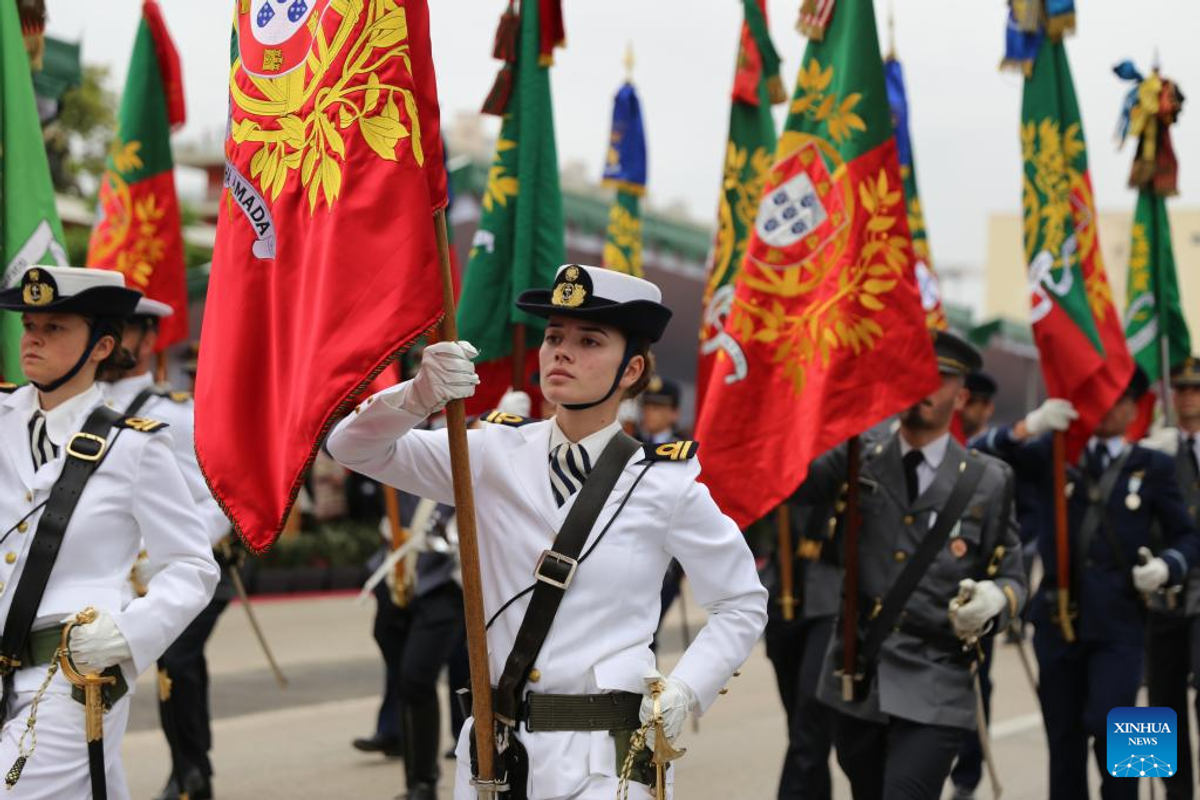
Camões wrote Os Lusíadas (The Lusiads), Portugal’s national epic celebrating the country’s history and achievements. While it is only officially celebrated in Portugal, Portuguese descendants across the world may also celebrate the holiday.
The Lusiads focuses on the Portuguese explorations in the 16th century, which greatly expanded the influence of Portugal. The poem is considered to be the most important piece of Portuguese literature and has become a symbol for the glory of the Portuguese nation.
Camões was a colourful character. He lost one eye fighting and was shipwrecked off the coast of present-day Vietnam. According to legend, during the shipwrecking, he kept his epic poem dry by swimming with one arm and keeping the other arm above water.
In the year that Camões died, Portugal lost its independence to Spain and began a period of rule by three generations of Spanish kings. It was over 60 years before the country regained its independence.
For such national days, it is common practice to use a date of birth to mark the national day, but since Camões’ date of birth was not known, the date of his death is celebrated instead.
Portugal Day began to be celebrated in 1880, decreed by King Luís I, who announced a national festival in honour of the 300th anniversary of the death of Luís de Camões.
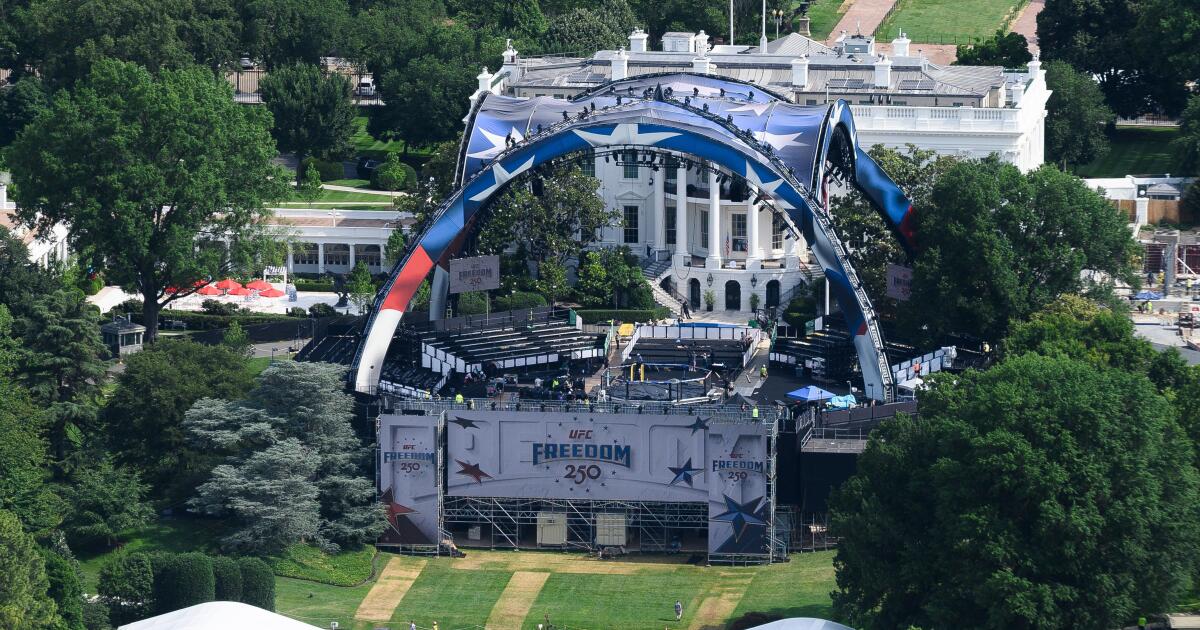
A UFC fight card scheduled for Sunday on the White House South Lawn is facing legal challenges in federal court.
The watchdog group Public Integrity Project filed a lawsuit last weekend on behalf of two Virginia residents aiming to shut down the Mixed Martial Arts event, which has been billed as part of a celebration of the nation’s 250th anniversary. The event is scheduled to take place on President Trump‘s 80th birthday.
The lawsuit refers to the plan for UFC Freedom 250 as “illegal,” stating that proper authorization was not obtained to hold the event and to build structures on federal parklands, and “corrupt,” in that the president and others allegedly stand to benefit financially from the “private, for-profit sports event.”
“This is a profoundly corrupt scheme to enrich the President and his friends,” Public Integrity Project founder Brendan Ballou said in a statement on the group’s website. “If this fight is allowed to proceed, it will be only the beginning, and our national monuments will become little more than branding opportunities for the rich and well-connected. We plan to stop that.”
The group also filed for a temporary restraining order to stop the construction and prevent further planning for the event.
The National Park Service and Department of the Interior, as well as executives from each department, are named as defendants.
“This is an obstructionist, baseless, and dilatory lawsuit brought simply to prevent President Trump from hosting what will undoubtedly go down as one of the most historic sporting events in our Nation’s history during our semiquincentennial celebration,” a Trump administration official said in a statement emailed to The Times.
“This iconic event is no different than the various other White House-hosted events on the South Lawn and properly permitted events on the Ellipse and National Mall throughout the year.”
According to the lawsuit, UFC Freedom 250 violates NPS policy that prohibits sporting events on the South Lawn. In addition, it states that the plans for the event did not receive approval from Congress to construct a massive structure on the lawn and did not undergo a required environmental review before construction.
Last year, the NPS established a temporary rule that allows “special events planned, organized, and executed by executive departments and agencies or the Semiquincentennial Commission for the celebration of the 250th anniversary of American Independence” on Washington’s monumental grounds.
The lawsuit states, however, that the rule does not apply to Sunday’s MMA event.
“UFC Freedom 250 is a private, for-profit sporting event being ‘planned, organized, and executed’ by the UFC, its broadcast partners, and its advertisers, not by the federal government,” the filing states.
“And it is not in any material sense a ‘celebration of the 250th anniversary of American Independence’ — it is, instead, a celebration of the UFC’s brand and the 80th anniversary of Donald Trump’s birth.”
UFC and parent company TKO are said to be footing the bill for the reported $60 million event. Still, it’s a massive platform for UFC, which longtime Trump friend and supporter Dana White runs. The president reportedly bought between $15,000 and $50,000 of TKO stock earlier this year.
No tickets are being sold to the general public. Most of the 5,000 seats next to the White House will be given to military members, while thousands of others will be able to watch on big screens in nearby parks. The event also will stream live exclusively on Paramount+, which is controlled by Trump allies Larry and David Ellison.
“This will be one of the greatest and most historic sports events in history, and President Trump hosting it at the White House is a testament to his vision to celebrate America’s monumental 250th anniversary,” White House spokesperson Davis Ingle said in a statement. “Anyone who finds a problem with that clearly suffers from a severe and incurable disease known as Trump Derangement Syndrome.”
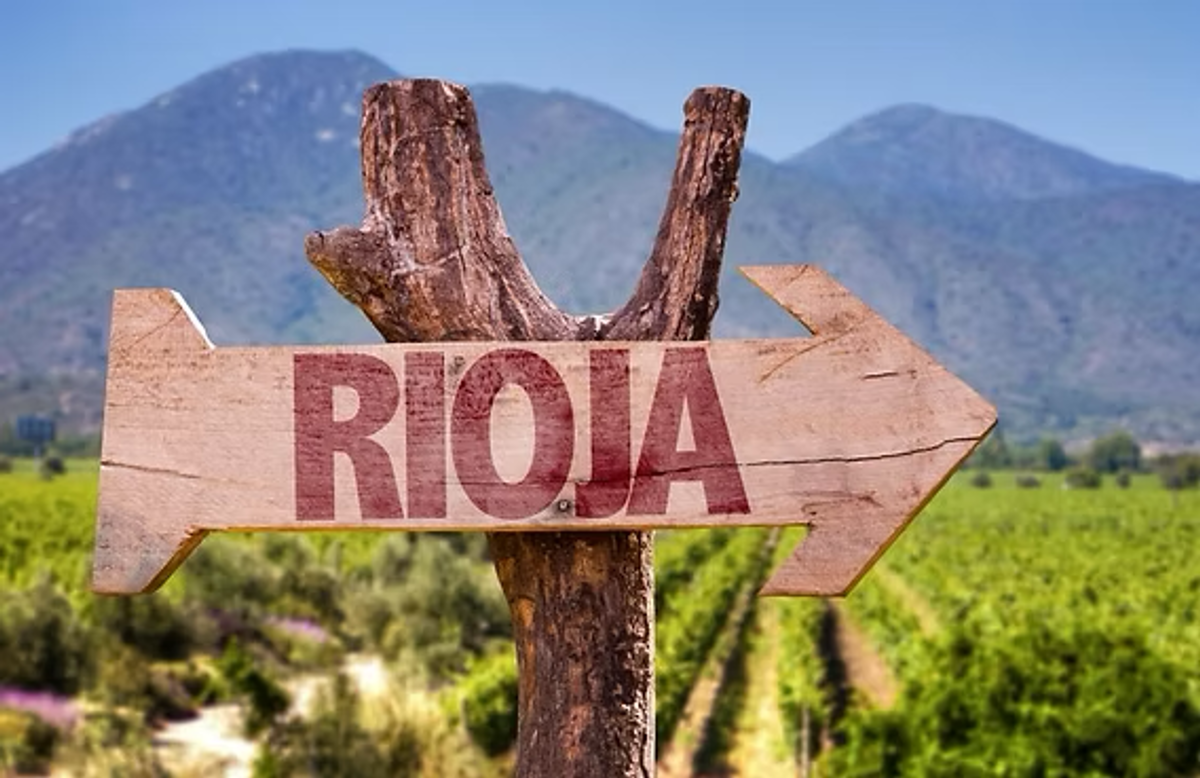
This holiday marks the anniversary of the autonomous community of La Rioja’s statute being approved on June 9th 1982.
The Spanish autonomous community of La Rioja in northeast Spain is the least populated region of Spain. Historically it formed part of different provinces in the area. It became its own province in 1833, named the Province of Logroño, after the capital town. The province was renamed as La Rioja in 1980.
The region is well known for its red wine, and the region can boast over 500 wineries.
Various events are organised to mark the Day of La Rioja. These include exhibitions of the work of local artists, concerts of modern and traditional music, tastings of traditional dishes and wines (of course), and sports events.
Many people display the flag of their autonomous community during events and on public buildings and private homes. Some people also wear clothes or paint their faces based on the flag’s colours