When it comes to fear of heights, Maddi Haferling was born with the opposite gene — loving heights.
The Woodbridge High senior started climbing a door at home at age 4 trying to reach a pull-up bar. By 10, she was signed up for a climbing academy. At 17, she won a gold medal in speed climbing last week at the USU19 National Championship in Salt Lake City.
On Thursday, she leaves for Arco, Italy, to compete at the Youth World Championships.
“It’s pretty cool,” she said.
At 5 feet tall, her challenge is climbing a standardized 15-meter wall course and finishing with the fastest time going against an opponent climbing an identical course. She’s attached to a safety rope in case there’s a fall.
Maddi Haferling of Woodbridge won a gold medal in speed climbing.
(Haferling family)
Being a climber, I have a lot of strength that oust don’t have,” Haferling said. “I can do 25 pull-ups that can impress you.”
So what happens if a Woodbridge football player challenges her to a pull-up contest?
“I think they know they’d lose,” she said.
She trains five days a week, three hours a day at a Santa Ana climbing facility lifting weights and practicing speed climbing techniques with other team members.
“It’s nice I can push myself in a sport and commit to something,” she said. “Being on a team is amazing.”
My dinner course is served. It is a Campbell’s-inspired soup can, lightly angled so strands of broccoli are peeking out. I lift the can to uncover a slow-braised short rib and mashed potatoes. An American dish to represent an American artist, here Andy Warhol.
The room is overtaken with projections, scenes of bustling New York traffic paired with bachelor-pad-like guitar riffs. Shown on a wall above a dinner table is a selection of Warhol silkscreens. It’s a Friday night in West Hollywood, and I’m surrounded by a mix of out-of-towners and those celebrating an anniversary. And while this is a special occasion, we’re urged to get a little messy with our food — to use our hands, to paint with a salad, to draw on a cookie.
The main course: A tomato soup can? “7 Paintings” is an immersive event that occasionally hides dishes in artist-inspired presentations.
(Christina House / Los Angeles Times)
Play is the primary side dish at “7 Paintings,” a tech-infused dinner theater that aims to be a crash course in fine art. That selection of veggies paired with multiple mini cups of colorful dressings? Guests are encouraged to mix and match the vinaigrettes into a mess of hues, a nod to abstractionist Jackson Pollock. And yellowfin tuna with dashes of avocado and taro chips? That’s an edible tribute to Banksy, of course. What does raw fish have to do with stenciled street art? It’s bold, heavily angled and has a short shelf life? Maybe? Perhaps don’t overthink it.
Even the paper is edible.
(Christina House / Los Angeles Times)
“Have you ever eaten a painting before?” says Nadine Beshir, the Dubai-based creator of “7 Paintings.” “We try to get people out of their comfort zones and eating paper. I want to bring out the child in them.”
“7 Paintings,” held at Sunset House L.A. through the end of August, is the latest example of immersive dining to arrive in this city. These experiences often involve guest participation and are accentuated with advanced multimedia technology and sometimes theatrical elements.
Worldwide, there have been standouts. For instance, Eatrenalin at Germany’s Europa-Park, a dining room-meets-ride where participants are whisked around the space on trackless “floating chairs,” has just received a coveted Michelin star. Ibiza’s Sublimotion has similar haute ambitions, pairing 12 diners together in a room that will come alive with otherworldly projections and performers. At times, diners will win don virtual reality headgear.
“7 Paintings” pairs food with art and music. It’s “fun dining, not fine dining,” says its founder.
(Christina House / Los Angeles Times)
Bartender Luca Famulari shakes a cocktail at the immersive dining event.
(Christina House / Los Angeles Times)
“The economics of a restaurant are not the same as the economics of theater and the challenge of combining the two lies in thinking outside the box with respect to pricing and cost structure, such that the customer perceives high value from both the food and the experience,” says the Gallery co-founder Daren Ulmer.
Entrepreneurs keep aiming for that careful balance. “Le Petit Chef and Friends” is currently running at Tangier at downtown’s Hotel Figueroa, an event in which a fully animated film is projected on our plates and tables. Long-running pop-up event Fork N’ Film leans more dinner and movie, pairing dishes directly inspired by what is happening on screen. Upcoming films include “Ratatouille” and “Lilo and Stitch.”
The field comes with challenges. “The costs are very high,” says Joanna Garner, an immersive designer and former creative director with experiential art firm Meow Wolf. Garner has been experimenting herself with communal, immersive dinner events, and her next, the flirtatious “Please Open Your Mouth,” is set for July 11. (No tech there, as Garner is after a more sensual, adult-focused gathering.) Tickets for her event are $150 and a spot in the “7 Paintings” dining room runs $175, priced on par with a number of city’s most acclaimed restaurants.
There is also the reality that all public dining is in some fashion immersive, usually requiring varying combinations of engagement, communication and presentation. And then, are all these added elements distracting?
An animated Mona Lisa sits on the wall as guests enjoy their meals. Throughout the dinner, the painting provides factoids on various artists.
(Christina House / Los Angeles Times)
Throughout “7 Paintings,” for instance, an animated Mona Lisa, situated on the wall next to the main dinner table, will provide brief biographical details of each artist represented.
“Being able to nail the food, and nail the story, those are two very difficult threads to weave,” Garner says. “I do think, ultimately, people come to a dinner table to talk to the people at the table and to have intimate experiences. To have an experience where you’re constantly being taken away from the food, I’m not so sure if that’s what people are looking for.”
Food is framed as a star of “7 Paintings” but tasting it is just one component. At one point, we must uncover a cheese course in a tiny treasure chest, the code for the lock hidden in the projections (don’t stress, it’s not a hard puzzle). Beshir highlights the Pollock-inspired salad course, which is accentuated with a jazz soundtrack, as the thesis of the evening.
1
2
1.A guest uses a silicon brush to apply sauces onto an entree, a nod to abstractionist Jackson Pollock.2.Projections fill up the dining table during meals.
“This course is really about getting people to free their minds from preconceived ideas,” Beshir says. “Like, you have to eat with a fork and knife, or the salad comes and then the dressing. No, the dressing comes and then the salad, and it’s trying with big brushes to paint the way he did. A lot of people do not understand Abstract Expressionism, and they think it’s people just splashing colors around. But when you understand the link between the rhythm of the music and painting, you live it. We give you time to paint with your salad dressing.”
In L.A., Beshir has partnered with nightlife impresario Kim Kelly, who is plotting a “Sleep No More”-inspired walk-around theatrical show for the Sunset House venue later this year. “7 Paintings,” however, is fully seated, and purposefully a little silly. Beshir and Kelly have been evolving it during its L.A. run, recently adding a stronger painting component by giving guests their own canvas to work on throughout the evening. Each night crowns a winner.
“Everyone comes over to look at their art,” Kelly says. “It just kind of changed the whole thing, to be honest. People are now being creative throughout the entire evening. Instead of just watching and occasionally painting, you’re now painting the whole time.”
As for what, perhaps, soba noodles with edamame and mushrooms have to do with Pablo Picasso, or why Salvador Dali gets an unexpected dessert course of a white chocolate potato souffle, Beshir clarifies the goal of the evening. While the animated Mona Lisa will provide backstories on each painter, this isn’t an educational night. “It’s fun dining, not fine dining,” Beshir says.
And by the end of my night, strangers were socializing, showing off their painted cookie creations, sharing Banksy tidbits and asking for recommendations on various vinaigrette combinations. Ultimately, it’s an evening of discovery, packed with surprises like finding an entire course hidden under a canvas.
Darryl Mayes of Charlotte, N.C., left, and Taylor Smith of North Hollywood, right, uncover their course.
(Christina House / Los Angeles Times)
“We try not to have too much sophistication, like fried ants or something. I’m personally very adventurous in how I eat, but if I want to have this in 100 cities around the world, I cannot be too meticulous.”
And Beshir has big goals.
“I want this be your movie and dinner thing,” Beshir says. “I want people to be waiting for our next show, and to be able to afford to come every couple months.”
And to come home not with leftovers, but perhaps a painting of their own.
WASHINGTON — While President Bush floats above the fray, White House strategists are laying the groundwork for his reelection effort, targeting key states and working to undermine the Democrats hoping to run against him in 2004.
The hub of activity is the Republican National Committee headquarters on Capitol Hill, stocked with key members of the Bush team and fashioned to serve as the president’s reelection operation in all but name. The idea, say those familiar with the arrangement, is to distance Bush and the White House from overt politicking as long as possible, without ceding ground in a race expected to be hard-fought and probably close.
The war in Iraq and the Sept. 11 terrorist attacks “changed Bush’s presidency … and made him a commander in chief,” said Scott Reed, a Republican consultant and former top staffer at GOP headquarters. “That gives Bush a huge advantage over his Democratic opponents, and this White House will work to keep him in that seat as long as possible.”
“By becoming ‘candidate’ Bush, you put yourself on the same level as ‘candidate’ Kerry,” Reed added, referring to Massachusetts Sen. John F. Kerry, one of the nine Democrats competing for the party’s nomination. “Evolving from a candidate to president is a big step, and you never want to go backward.”
Bush’s top political aides declined to be interviewed for this article, and the White House has actively discouraged other Republican operatives from talking about the president’s reelection plans; most of those willing to discuss Bush’s strategy and the planning quietly underway would not do so for attribution.
“There is no campaign,” said Jim Dyke, chief spokesman for the Republican National Committee, where all major decisions flow from the White House and the president’s chief political aide, Karl Rove.
But others suggest that the Bush campaign never let up after the 2000 election, despite efforts to portray the White House as paying little attention to politics. “It’s the campaign that never turns off,” said a Western GOP operative, who participates in one of several weekly strategy calls that originate at party headquarters and tie in dozens of GOP operatives across the country. “They’ve been at it ever since they’ve been inaugurated.”
Tom Rath, a veteran New Hampshire GOP strategist and leading Bush hand in that key state, said he had breakfast with Rove within 10 days of Bush’s swearing-in and has regularly talked strategy with him since.
The reelection effort has picked up even more in recent weeks after Bush told aides to proceed with planning for 2004 — provided they don’t expect his active involvement soon.
But even before that signal came from the top, Rove — a lover of history — and others in the White House began plotting the 2004 strategy, starting with research into past reelection campaigns. Special care was given to study the failed effort of Bush’s father, down to his day-to-day schedule in 1992 and the timing of campaign media statements, according to one Republican. But the working model for this Bush’s reelection bid has been adapted from the last two presidents to win second terms: Republican Ronald Reagan and Democrat Bill Clinton.
Reagan, who was personally popular in the way Bush is today, stayed out of the political mix until well into his reelection year. Clinton, in turn, amassed a huge financial advantage over his opponent and used that to begin a springtime advertising campaign that pounded the GOP nominee, former Kansas Sen. Bob Dole, before Dole had the means to adequately respond.
Bush is expected to enjoy a similar financial edge and emulate Reagan and Clinton by standing aside while aides launch an aggressive assault on whomever the Democrats nominate. That candidate should emerge sometime around March; the White House hope is that he or she too will lack the financial resources to effectively respond until the Democratic National Convention in July — by which time it may be too late.
A consultant who has worked closely alongside Rove described his operating style this way: “In your face. Offense, offense, offense. Attack, attack, attack.
“They want to do whatever they can to put banana peels under every single Democrat running” even before it is clear which of them Bush will face, the GOP strategist said. “Whoever [the Democrats] nominate, they want him weakened by the time he gets through the process.”
Many of those who served with Rove in Bush’s first presidential campaign are expected to reprise their roles, including pollster Matthew Dowd, media advisor Mark McKinnon and finance director Jack Oliver, who now serves as deputy chairman and day-to-day overseer of the Republican National Committee. Ken Mehlman, the White House political director, is likely to serve as campaign manager, and Karen Hughes, Bush’s closest advisor-without-portfolio, will also play a key role, perhaps out of a satellite campaign office in Austin, Texas. Marc Racicot, chairman of the RNC, may assume the same role and title at Bush’s reelection committee.
Along with deciding those personnel matters, White House strategists have conducted a painstaking review of the electoral college map, with an eye toward tailoring Bush’s travels to states that would allow him to shore up his skimpy 2000 electoral college margin. At the top of the list of states Bush lost and now plans to target are Pennsylvania and Michigan, according to party insiders.
As for the campaign’s treasury, in 2000, Bush raised more than $100 million, a record, to capture the GOP nomination in a crowded field. With the ceiling for individual contributions now doubled, to $2,000, and Bush enjoying the advantages of incumbency, he could easily top that amount in 2004. However, it is unclear how much Bush intends to raise; a White House strategist dismissed reports of a $200-million to $250-million budget as wildly speculative, but declined to offer another figure. Regardless, the president is expected to easily raise whatever sum he needs, allowing him to put off fund-raising for at least a few more months, as he would like.
A delay also fits into the White House strategy of keeping Bush out of the political back-and-forth as long as possible by taking trips that are billed as presidential in nature even though they carry political weight too — trips like the ones he has recently taken to Missouri, Ohio and Michigan, states vital to his reelection. (It also means that taxpayers pick up the tab instead of Bush’s reelection committee.) Even when Bush starts campaign travel closer to the end of the year, it will be limited largely to a handful of select states, such as early-voting Iowa and New Hampshire, and will be tailored to appear “presidential” rather than blatantly political in nature, a White House advisor said.
That leaves the RNC to function, for now, as the reelection campaign in absentia, building support in key states, tending to the party’s big donors as well as grass-roots activists and, perhaps most important, harrying the nine Democratic candidates.
To that end, RNC researchers have compiled dossiers on all the party’s hopefuls and distributed them to reporters under such provocative headlines as, “Who is John Edwards? An unaccomplished liberal in moderate clothing and a friend to his fellow personal injury trial lawyers.”
The purpose, explained one party communications strategist, “is to get journalists to run a whole series of stories that build upon each other” until finally a negative image “takes root” — the way former Vice President Al Gore came to be depicted in the 2000 campaign as a serial exaggerator.
Democrats have a similar research and message-dissemination operation at their headquarters just a few blocks away from the Republicans. But even party insiders acknowledge that the Democrats lack the resources and discipline that make GOP efforts so effective.
“Republicans have, since the 1960s, been building and using the RNC to make it an active and aggressive campaign tool with investments in databases, in direct mail, in phone banks, in Internet technology,” said Jenny Backus, a recently departed Democratic Party spokeswoman in Washington. Although Democrats have made significant strides over the last two years, she said, they haven’t caught up.
Also, Democrats lack the powerful echo chamber created by a wealth of sympathetic media outlets that can turn a set of “talking points” sent from GOP headquarters into a story that dominates the political news for days. “You put a message out and if the traditional media don’t cover it, talk radio and the cable [television] people will,” said Don Fierce, who helped run the RNC through the mid-1990s. “There’s much more amplification than there used to be.”
A good illustration is the recent flap over Kerry’s quip calling for “regime change” in the 2004 election. Within 24 hours, a media account of Kerry’s remark had been dispatched as part of the RNC’s regular Thursday e-mail briefing to 350,000 party activists. The party’s congressional leaders condemned Kerry, the story made national headlines and the Massachusetts senator was forced to repeatedly respond to reporters’ questions about his comment.
Then, for good measure, Kerry was assailed by military veterans in each of the next several states he visited; their quotes were corralled by GOP leaders and passed on to reporters in Arizona, South Carolina and California, keeping the story alive and helping shape local news coverage.
“Message repetition is pretty fundamental,” said a California GOP strategist who has worked closely with the White House . “It’s basic stuff that doesn’t always get done right. And this group is very, very good at it.”
Continuing my summer observations looking back at memorable moments in covering high school sports since 1976, you can’t find a better, more beloved action-packed night than Feb. 24, 2017, at USC’s Galen Center when you got to see two great high school basketball games for the price of one in the Southern Section Open Division semifinals.
Anyone who was there remembers the long lines to get in, the sold-out crowd and drama involving Sierra Canyon against Bishop Montgomery and Mater Dei against Chino Hills.
As World Cup spending surges, BofA’s year-long merchant preparation is paying off.
Exorbitant ticket prices be damned. Die-hard soccer fans are flocking to host cities across the U.S., Canada, and Mexico for the first tri-nation tournament in FIFA history. And they are proving to be exceptionally big spenders.
The Bank of America Institute — the firm’s research arm — mined its credit and debit card data and learned that the 2026 FIFA World Cup is delivering a massive economic win for host cities, driven overwhelmingly by these hefty-spending, out-of-town visitors.
During the tournament’s opening days from June 10–21, overall consumer spending in host markets jumped 6.3% year over year. “Non-local” cardholders — a category tracking both international tourists and U.S. residents traveling out of state for matches — fueled the lift. Their spending, according to data shared with Global Finance, climbed 16.7% year over year.
Bank of America’s data also highlighted a lucrative trend for local merchants: visiting fans are out-purchasing non-fans by a nearly 3-to-1 margin.
Pre-Tournament Warmup
“We’re really only halfway through, as you know, so no surprise that the majority of that spend has been driven from non-local residents coming in,” said Sara Walsh, a Bank of America managing director who oversees the bank’s relationships with vendors and networks in payments and has spent more than a year preparing merchants for the tournament. “Restaurants, bars, hotels, of course, make up the majority of that.”
The data tracks with results from last year’s FIFA Club World Cup, a smaller-scale tournament that Bank of America Institute found drove a 7% year-over-year rise in consumer spending in host zip codes. Walsh told Global Finance in a phone interview that the event effectively served as a dry run for the numbers the bank is now seeing at scale.
“The Club World Cup gave us a nice little pilot into what the stats would look like, and they were very consistent with what we’re seeing here,” Walsh said.
Soccer fans, meanwhile, are proving to be especially heavy spenders. A study Bank of America conducted with Visa found that soccer fans spend on average 2.8 times more than non-fans, according to the Institute. Walsh said the bank analyzed customers making purchases tied to FIFA and MLS tickets to reach that conclusion.
The scale of the opportunity is significant. The tournament’s 16 U.S., Mexican and Canadian host cities together represent:
$11 trillion in gross domestic product (GDP)
Roughly 130 million people, and
An expected draw of 33 million international visitors annually.
Historically, host nations have seen an average 0.4 percentage-point lift in GDP growth in the year following the tournament, the Institute found.
A Year of Preparation
Sara Walsh, Bank of America
Bank of America began preparing merchants for the World Cup surge more than a year ago. It drew on its position spanning treasury, card-issuing and merchant-services clients. The prep work centered on three areas: building tools for merchants to capture customer data and loyalty even after fans leave the U.S.; speeding up checkout through contactless and pay-at-table technology; and ensuring cards from international networks, such as Japan’s JCB, are accepted without triggering declines.
“Merchants can either survive the World Cup or prosper from the World Cup,” Walsh said, citing a colleague’s framing of the stakes.
Restaurants and bars needed the most hand-holding, Walsh said, particularly around pay-at-table functionality that’s common internationally but was slower to catch on in the U.S. The bank also coached retailers on when to use 3D Secure authentication — the phone-based verification step common in Europe — given the risk of transaction friction in crowded, high-traffic settings with spotty connectivity.
“We did not want to have customers who are standing in line, they’ve come all this way, get ready to purchase, and have their cards decline,” Walsh said. So far, she said, cross-border approval rates have held up as fans travel from city to city.
Spillover Into Other Events
One surprise for the bank has been spending spillover into unrelated events and sectors. Walsh said Bank of America has seen international visitors attending Major League Baseball games and concerts during their trips, alongside a pickup in merchandise sales tied to breakout national teams.
“You’re going to have people who are purchasing things from some of these teams that maybe a month ago no one had ever even heard of these countries, and all of a sudden they’re winning,” Walsh said, adding that merchandise sales represent a “fun kickback” opportunity for merchants tied to Cinderella-story squads.
Cape Verde’s inspiring World Cup run, for example, captivated fans. The team, representing an island nation of just 535,000, reached the knockout stage unbeaten and pushed Argentina, the reigning champs, to a hard-fought 3-2 extra-time loss.
Bank of America worked with Visa and FIFA, along with industry forums including Money20/20, the Electronic Transactions Association, and the Merchant Advisory Group, to prepare merchants of all sizes through its Merchant Engagement Program, Walsh said.
Looking ahead, Walsh said that the bank plans to apply lessons from the World Cup to future events on U.S. soil. That includes the 2028 Summer Olympics in Los Angeles and the 2031 FIFA Women’s World Cup, which the U.S. will jointly host with Mexico, Costa Rica, and Jamaica.
“We will definitely continue to use these events for learning opportunities to improve where we need to and get ready for those events as well,” she added.
Anthony Noto covers corporate finance and private credit. Contact him at anoto@gfmag.com
Hi, and welcome to another edition of Prep Rally. I’m Eric Sondheimer. It’s time to begin a weekly look at players to watch by position in Southern California high school football. First up is quarterback.
Get our high school sports newsletter
Prep Rally is devoted to the SoCal high school sports experience, bringing you scores, stories and a behind-the-scenes look at what makes prep sports so popular.
By continuing, you agree to our Terms of Service, which include arbitration and a class action waiver. You agree that we and our third-party vendors may collect and use your information, including through cookies, pixels and similar technologies, for the purposes set forth in our Privacy Policy such as personalizing your experience and ads.
QBs to watch
Junior quarterback Chase Curren of Crespi.
(Eric Sondheimer / Los Angeles Times)
The Class of 2029 might be the best class to get excited about for this coming season, though there’s plenty of quarterbacks from every class to single out.
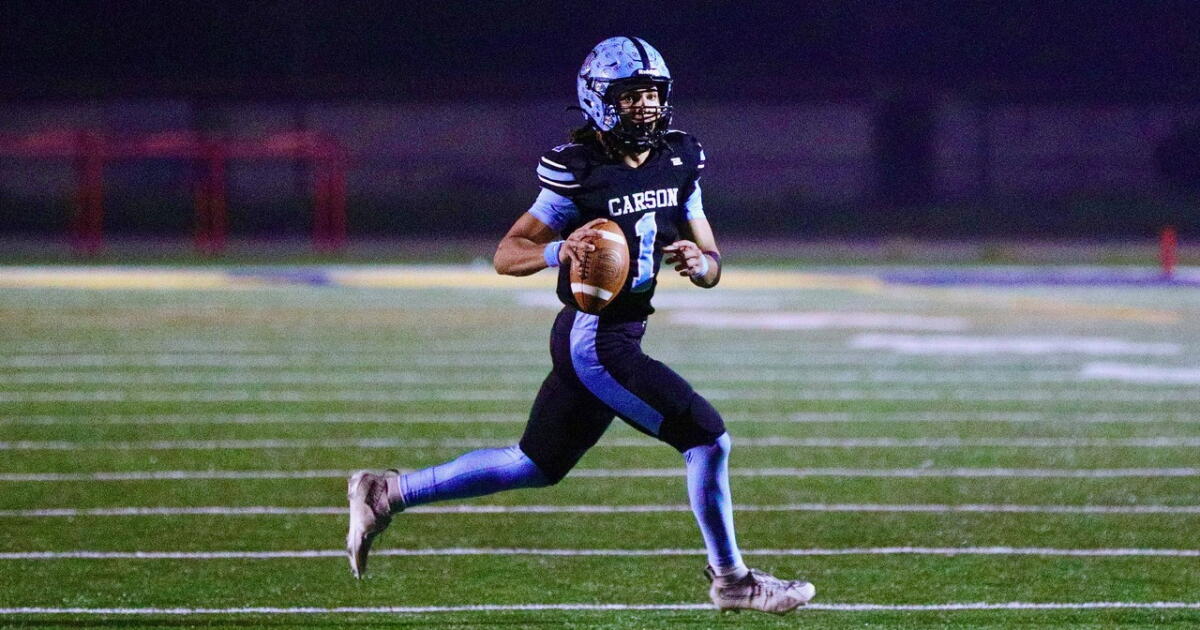
Seniors already committed include Huntington Beach’s Brady Edmunds (Ohio State), Corona Centennial’s Jaden Jefferson (Hawaii), Palos Verdes’ Ryan Rakowski (Nevada), Oxnard Pacifica’s Taylor Lee (Portland State), Chaparral’s Dane Weber (Cal) and Carson’s Chris Fields III (Georgetown). Laguna Beach’s Jack Hurst is coming off a season in which he threw for 45 touchdowns. Matthew Smith transferred from Villa Park to Santa Margarita and is committed to Vanderbilt. Caden Jones of Crean Lutheran is committed to Arizona.
DJ Mitchell from La Habra is a dual threat quarterback. Michael Gonzalez of South Gate passed for 3,842 yards and 41 touchdowns last season.
Among the juniors with great resumes are St. John Bosco’s Koa Malau’ulu, Mater Dei’s Russell Sekona, a transfer from Leuzinger, Crespi’s Chase Curren, St. Bonaventure’s Jaxson Carper, Star Thomas of Orange, Ayden Edwards of Tustin and Vista del Lago’s Josiah Dupree-Boyd. Talon Spencer of Capistrano Valley had 21 touchdown passes and 11 touchdown runs as a sophomore. Treyvone Towns of Rancho Cucamoga gets a restart after leaving Oaks Christian last season.
Quarterback Evan McCalister of Valencia is part of an outstanding class of 2029 quarterbacks.
(Craig Weston / For The Times)
Then there’s the sophomores who made memorable first impressions as freshmen. Let’s see how much they develop. The group is led by Thaddeus Breaux of Hamilton, Ford Green of Westlake, Marcus Washington of Cajon, Ezrah Brown of Orange Lutheran, Steven Moore of La Sierra, Levi Dean of Vista Murrieta, Jonah Tuaniga of Long Beach Millikan, Evan McCalister of Valencia and Jeremy Melialieu of Chaminade.
Edison passing tournament
Schedule for Edison passing tournament on July 11. My official start to high school football season. It’s that entertaining. pic.twitter.com/RsoSfcoCCy
The Edison Battle at the Beach passing tournament is set for Saturday at Edison High. It’s like a who’s who of top players and teams. Five of the six Trinity League teams are participating, with only Mater Dei not entered.
Also competing is Cathedral Catholic, which might be the best team in San Diego.
The All-Star Futures game is set for Sunday at Citizens Bank Park in Philadelphia, and Corona High fans will get to see pitcher Seth Hernandez represent the Pirates.
Seth Hernandez will represent the Pirates in the 2026 All-Star Futures Game👀
He has been ELITE to start his career🔥 14 Starts (6-1) 2.02 ERA 100 SO (in 62.1 IP) 0.99 WHIP pic.twitter.com/IjmikYf5vj
Also selected were Ralphy Velazquez from Huntington Beach, Mason McGwire from Capistrano Valley, Josiah Hartshorn from Orange Lutheran, Anthony Eyanson from Lakewood. Here’s the complete roster.
Pete Crow-Armstrong (Harvard-Westlake), Freddie Freeman (El Modena) and Paul Skenes (El Toro) were chosen for the MLB All-Star game.
Notes . . .
Tim Cunningham, a character actor from the 1980s hit TV series “Cheers,” still makes them laugh coaching baseball at Sherman Oaks Notre Dame.
(Eric Sondheimer / Los Angeles Times)
Tim Cunningham, a much beloved former Sherman Oaks Notre Dame assistant baseball coach who spent 11 years acting as a bar patron on the 1980s hit sitcom “Cheers,” died Friday in South Carolina. He was 80. He had humor, loved to read and loved baseball. His earliest coaching was serving as an assistant for the Northridge Little League team that included son Matt and finished second at the 1994 World Series.
Had coffee this morning with former SO Notre Dame assistant baseball coach Tim Cunningham, who had a long run as extra on “Cheers” and is moving to South Carolina. They asked for his name to call out when coffee was ready. “James Bond,” Cunningham said. One of a kind. pic.twitter.com/zLndtL3mHO
In 2003, as head coach at Harvard-Westlake, he was The Times’ coach of the year, guiding his team to runner-up in Division 3. The Wolverines lost to Crespi 1-0. Future major leaguer Trevor Plouffe pitched for Crespi. Harvad-Westlake had a pitcher, Jason Gluson, who barely hit 80 mph. Glushon went on to become a sports agent.
Notre Dame will hold a celebration of his life at a later date, coach Tom Dill said. He is survived by his wife, Pat, son Matt, daughter Elizabeth and several grandchildren.
Former Dodgers pitcher Joe Kelly has joined the coaching staff at Corona High. Here’s the report.…
Orange Lutheran grad CJ Weinstein, a standout second baseman, has changed his commitment from LSU to UCLA….
Jardiel Ochoa is the new baseball coach at Sun Valley Poly….
Defensive lineman Marcus Fakatou of Sierra Canyon has committed to Ohio State….
Former San Juan Hills linebacker Weston Port has committed to Michigan. He previously was committed to UCLA, went on his two-year Mormon Mission and will return next year to enroll at Michigan….
Receiver Eli Woodard of Chaparral has committed to Miami….
Defensive back Myles Baker of Sierra Canyon has changed his commitment from Cal to UCLA….
DeAnthony Wiley has resigned as girls basketball coach at Buena Park….
The new baseball coach at UC Riverside is Greg Wallis, a Chatsworth High graduate….
Brandon Granger of St. Bernard has committed to UC San Diego for basketball….
Vince Nolasco is returning to Salesian as athletic director. He previously was at St. Anthony….
RJ Ball, a junior guard, has transferred from Beverly Hills to Brentwood. Julian Cunningham (Palisades) and Hunter Caplan (Crean Lutheran) have left for SoCal Academy, a non-CIF school.
Kurt Stillwell was the No. 2 player taken in the 1983 MLB amateur draft out of Thousand Oaks High by the Cincinnati Reds as a shortstop. His father, Ron, was Thousand Oaks’ head coach. Kurt had a nine-year MLB career.
Now he works for agent Scott Boras, who was his agent in 1983 when he signed for $135,000, tops in the draft. Roger Clemens was taken No. 4 by the Red Sox and signed for $121,000. After his playing days, Stillwell became a fishing guide before joining the Boras Corporation.
I’m going to have some fun this summer looking back on some memorable moments over nearly 50 years of covering high school sports in Southern California. Here is my most unique experience _ flying in an F-16 flown by former Crespi QB Randy Redell. pic.twitter.com/KZLPZtSSgr
Two basketball teams on the rise are Etiwanda and Heritage Christian. Heritage Christian has a trio of standout juniors in 6-6 Eli Simmons, 6-5 Houston Rolle and 6-7 Tyler Jackson. Etiwanda is filled with top guards.
In honor of Pete Crow-Armstrong making the All-Star game, let’s look back to the COVID year. The high school season had been halted in his senior year in 2020. He wasn’t going to stop working hard.https://t.co/BTwwssdvIE
Have a question, comment or something you’d like to see in a future Prep Rally newsletter? Email me at eric.sondheimer@latimes.com, and follow me on Twitter at @latsondheimer.
Did you get this newsletter forwarded to you? To sign up and get it in your inbox, click here.
This town’s market is over 900 years old and has a breath-taking high street filled with historic buildings, family-run businesses and lots of independent shops you cannot get anywhere else.
13:44, 06 Jul 2026Updated 13:48, 06 Jul 2026
Ludlow is known for having lots of quirky independent shops(Image: Getty)
While many people splash out on pricey holidays this summer, you can have an equally magical experience right here in the UK. With a wealth of stunning destinations to discover, there are countless charming towns ideal for a short break but this gem, nestled in the West Midlands, deserves to be at the very top of your list.
This historic market town is brimming with character and as you stroll through its centre you’ll uncover a breath-taking blend of medieval, Tudor and Georgian architecture. It has been named by The Guardian among Britain’s 10 “best independent high streets”, not for its looks alone, but for being “full of cool independents rather than the usual chains”.
They said: “Ludlow has long been known as a gastro-hub, with specialist producers dotted along the high street and market place. Visit the Mousetrap Cheese Shop, Harp Lane Deli and the Chocolate Gourmet for festive eats, or browse around Bodenhams, which sells clothes in a quirky, 600-year-old building.”
Why visit Ludlow?
There are so many one-of-a-kind businesses to explore when you arrive in Ludlow, but your first port of call should be the traditional marketplace sitting right at the heart of the town square.
Having been trading for over 900 years, it boasts all manner of stalls ranging from flea markets to artisan crafts, ensuring there is something to suit every pocket.
Ludlow Market is a treasure trove of finds, and is also well regarded for its monthly specialist events, including the Food and Craft Market, the Local to Ludlow Producers’ Market, and an Antique Market.
Once you’ve had a good rummage through the local shops, your suitcase will be packed to the brim with gifts to take home, thanks to a wealth of family-run businesses such as Bensons, which stocks jewellery, and Florabunda, a florist.
If you work up an appetite, head to the Ludlow Farmshop, selling locally sourced meats, cheeses, baked goods and other regional delicacies you won’t find anywhere else.
What else is there to do in Ludlow?
Ludlow has built a reputation for championing independent businesses, but should you tire of shopping and eating, there is plenty more to discover. Perhaps the most unmissable attraction is Ludlow Castle, a stunning 11th-century ruin built by the Normans that boasts breathtaking views across the surrounding countryside.
It is also well worth taking a leisurely stroll along the River Teme to admire Ludford Bridge, which not only looks spectacular but also dates back to medieval times.
Just a short drive away lies Mortimer Forest, offering miles of gorgeous scenery, whether you fancy a gentle woodland walk or fancy tackling the climb up to High Vinnalls, the loftiest point within the forest.
Ludlow ticks every box for those seeking a quintessential English town getaway, boasting historic streets, charming independent shops, mouth-watering local cuisine and stunning countryside right on its doorstep — making it an ideal destination for anyone in search of a laid-back summer staycation.
‘We are over 100 businesses strong’
Jodie Deakin, who owns local independent business, Eclectica, and is chair of Ludlow Chamber of Trade and Commerce, which members pay £50 a year to join, told a visiting journalist earlier this year: “We are over 100 businesses strong and have everything from retail businesses like mine to professional services like solicitors.”
Of the market, she said: “These are permanent market stores, so they’re here seven days a week. It’s owned by our town council, so it’s the revenue stream for them and they run the market most days, but also lease it. Ludlow Local Produce Market is one of the leased markets. To be a vendor, you have to produce everything within a 30-mile radius.”
Manager Tish Dockerty said of Ludlow Local Produce Market at the same time: “Everything that’s sold is either made by the person on the stall or the person that’s selling it, so they can tell you how it’s made.”
On a recent summer day at Crossroads School for Arts & Sciences, students ambled through yawns, braces and acne into their creative writing class. The day’s lesson tackled “style,” that elusive, ultra-subjective choice of expression.
“Who was the first author you encountered to do something different on the page?” asked the teacher, Clarke E. Andros.
They named Dr. Seuss, Shel Silverstein and Lemony Snicket before moving on to a précis of Joy Williams’ flash fiction. “These stories are weird — she’s weird,” Andros warned.
In some ways, high school looks much the same as it did 20, even 100 years ago: sleepy eyes either light up or glaze over when a teacher poses a Socratic question. Nervous laughs and unexpected insights emerge as young people use stories to make sense of themselves and the world around them.

(Fingerprint; Penguin Classics; Pantheon)
The idea of the “Great American Novel” took shape in the aftermath of the Civil War, when a fractured nation looked to literature to define itself. As classrooms evolved, so did the canon that reflected America’s changing identity.

But the syllabus today is at a tipping point. Forces — some visible, some harder to see — are upending literature and education itself. American students are in a decade-long reading recession, while fewer students are reading for pleasure than in previous generations.
Reading scores among high school seniors are at their lowest in decades, according to federal testing data, while schools across the country are grappling with how to respond to waning attention spans and artificial intelligence. The Los Angeles Unified School District has begun a course correction, voting to limit student use of laptops and tablets during class — the first major American school system to do so.
We spoke with five high school English teachers across the city — three from LAUSD, one from a charter and one from a private school — to find out what literature belongs in today’s classroom, and which stories can help us understand America, past and present.
Interviews have been edited and condensed for clarity.
Raquel Olvera, Roosevelt High School, Boyle Heights
What books in the American literary canon are you teaching (old and new)?
In 11th-grade American Literature, as part of the LAUSD-approved Odell curriculum, we read four book options: “Friday Night Lights,” “Beloved,” “The Great Gatsby” and “The Warmth of Other Suns.” For my 10th-grade World Literature course, I like “Antigone” and “Things Fall Apart.” I also teach “In Cold Blood,” using it to explore Americans’ fascination with true crime and what the genre reveals about race, gender, class and the justice system.
(Simon & Schuster; Sky Publishing; Vintage)
What’s one work from the canon adults should revisit today?
“The Great Gatsby.” When I read it in high school, I wasn’t engaging with its undercurrents of racism, xenophobia, antisemitism, gender or sexuality in the way I do now. Its themes of power, wealth, consumerism and American identity remain as relevant as ever.
What are English teachers up against in the classroom in 2026?
Besides large class sizes and underfunding, I think public educators are largely battling apathy. Students and young people aren’t engaging with books like they used to. A side effect of that is a lack of empathy and curiosity. At the very least, you can model what it means to be a reader and a writer, and hope that years later, students remember that one nerd English teacher who showed them what humanity can look like.
Schehrezade Lodhy, Da Vinci Schools, El Segundo
What books in the American literary canon are you teaching (old and new)?
Students really enjoy Arthur Miller’s “The Crucible” — it’s all about the human condition and cancel culture, forbidden love and lies and deceit, with witches in the forest. In poetry, we explore a range of American voices, from Walt Whitman and Langston Hughes to Amanda Gorman, and sometimes even song lyrics. I also use “The Moth: Storytelling” podcast when students are working on personal essays. The goal is to make literature, poetry and storytelling as accessible as possible. At a charter school, we have quite a bit of autonomy with what we teach.
What’s one work from the canon adults should revisit today?
James Baldwin’s “Giovanni’s Room” and “Go Tell It on the Mountain.” I read Baldwin a few summers ago, and that was quite an education for me. Unfortunately, some of the content is a bit too mature for high school, but I do talk about Baldwin a bit in my classes when we cover African American authors.
(Reader’s Library Classics; W. W. Norton & Company; Simon & Schuster)
What are English teachers up against in the classroom in 2026?
Artificial intelligence, big time. I really pared back technology in my class, and we’ve pivoted back to paper and pencil. Going into my 18th year of teaching, my biggest goal is re-creating that experience of thinking critically for oneself and studying literature through a critical lens. We’re in this era of going back to the basics. With decreased attention spans, teachers are being forced to become even more creative. It feels like we’re reinventing ourselves every year.
Aiden Brown, John F. Kennedy High School, Granada Hills
What books in the American literary canon are you teaching (old and new)?
From an educationally traditional background, I still believe in canon disruption — mixing the new and old. In American Lit, I’ve taught “Their Eyes Were Watching God” 11 times now. It’s a hard one to get on the first try because the vernacular is so particular, but when we read it physically while also listening to the audiobook, it’s such a great novel to hear. I pair it with bell hooks’ “All About Love.” I teach “Macbeth” from a performance-based lens, making it less intimidating. My favorite book is “Frankenstein,” written by a teenage girl who invented science fiction. My ninth-graders’ favorites were “Fahrenheit 451,” “The Odyssey” (Emily Wilson translation) and “Persepolis,” a graphic novel about a girl discovering punk rock and rebelling against the established order.
What’s one work from the canon adults should revisit today?
All of the lonely young men need to reread “The Great Gatsby,” and anyone freaked out by the state of the world should read “Parable of the Sower.” One quote from the book hangs on a poster board in my classroom: “A community’s first responsibility is to protect its children — the ones we have now and the ones we will have.”
What are English teachers up against in the classroom?
Teenagers are still the funniest people on the planet. As the world around them becomes more atomized, I find that they’re increasingly interested in connection. In the classroom, we are seeing skill loss and a decreased ability to focus on a task. I don’t think that’s just because of AI or the pandemic — it’s also phones, screens and the world kids are growing up in. One thing teachers seem to agree on is a return to pen and paper.
Clarke E. Andros, Crossroads School, Santa Monica
What books in the American literary canon are you teaching (old and new)?
A newer addition I would recommend is “Hunger: A Novella and Stories” by Lan Samantha Chang. Especially in California, we have a lot of great Asian American literature, including works by Amy Tan, but I enjoy the writing level in Lan’s — it’s accessible to students but pushes them, all about intersectional identity and the first-gen experience. A lot of the Latino students I’ve taught in Los Angeles also connect with that book.
(Penguin Classics; Grand Central Publishing; Mariner Books Classics)
What’s one work from the canon adults should revisit today?
“Of Mice and Men.” Revisiting it today opens up deeper conversations about labor, social conciousness and power. Steinbeck creates a microcosm of American society, where disability, gender, race and class are all represented and shaped by an economic hierarchy. The characters are left navigating a world where people often turn on each other rather than challenge the systems around them. It’s novella-length, so you could read it in a Sunday morning.
What are English teachers up against in the classroom in 2026?
We’re up against systems that often prioritize ed-tech and third-party vendors over smaller class sizes and more teachers. When I was at LAUSD, it was clear from our superintendent — who just stepped down over his fraud investigation — was just in bed with tech. It’s hard for me to imagine the folks in power didn’t look at [the failed AI chatbot venture] and see it as a grift.
On the flip side, at hyper-competitive, elite schools like this, students are approaching high school with college in mind rather than with high school in mind. When students understand the value of the process, they’re less likely to look for an easy shortcut like AI.
Adam Tan, Los Angeles Center for Enriched Studies, Mid-City
What books in the American literary canon are you teaching (old and new)?
With independent reading, memoirs are big, like “Crying in H Mart” and Sylvia Plath’s fictionalized “The Bell Jar.” Younger kids gravitate to “Musashi,” a celebrated epic based on a famous samurai. We have a lot of Korean American students here, so they like “Pachinko,” dealing with racism and the Korean population in post-World War II Japan. I’ll also throw in “The Bluest Eye.”
In ninth grade, we read “Slaughterhouse-Five,” “Of Mice and Men,” “The Thief and the Dogs” and “Romeo and Juliet,” with the film adaptations to use media literacy. In American Literature, the major texts are “The Great Gatsby,” “The Things They Carried” and “The Crucible.” We also read nonfiction articles, including pieces on AI and robots, while focusing on rhetorical devices.
(Blackstone Publishing; Knopf; Little, Brown and Company)
What’s one work from the canon adults should revisit today?
“The Catcher in the Rye” benefits from the distance of adulthood. It’s a novel about disillusionment and the search for identity, but when you revisit it, you also see that it’s very much a love story. I often encourage students to look for forms of love beyond romance — love for family, friends and fellow human beings. Even today, students can tell you that the biggest phony in the book is Holden himself. The novel reminds us that while literature may not have answers to the world’s problems, it can help us examine our wounds and find solace in art.
What are English teachers up against in the classroom in 2026?
A lack of accountability in the modern world. In general, we have a school district focused on 100% graduation rates, no F’s. [LAUSD] wanted everything on computer, and now they want less computer time, which is great, but not everyone at top management is on the same page. Teachers are often trying to balance what the district wants with what we know our students need.
What I try to instill instead is an intrinsic desire to grow as a thinker. How do you make sure students are reading without taking the joy out of it? A lot of us are going back to pen and paper. Despite all the concerns about AI, I still think the soul and spirit of young people is as strong as ever. The core is not rotting.
CARRY On actor Leslie Phillips’ family is set for a High Court ding-dong over his will, The Sun can reveal.
The late star‘s estate is suing his wife, Zara, at the High Court, after she refused to move out of their £4.4million marital home.
Sign up for the Showbiz newsletter
Thank you!
Leslie Phillips with his third wife Zara after getting married at Mayfair registry officeCredit: Louis Hollingsbee – The SunZara, widow of the late Leslie Phillips, in the £4.4m home at Maida Vale, LondonCredit: Jon BondLeslie’s appearances in the Carry On films made him a much-loved household name, seen here in Carry on Constable with Kenneth Connor and Kenneth WilliamsCredit: AlamyLeslie often played lothario-style characters to great comic effect, seen here in Some Will, Some Won’t with Barbara Murray in 1970Credit: Alamy
The long-running spat is said to have strained the relationship between Zara, 68, and Harry Potter actor Leslie’s children, who say they are entitled to the proceeds of the Edwardian mansion’s sale.
Leslie, who died in November 2022 at age 98 after an eight-decade showbiz career, left his family a huge £5.3million fortune and dictated exactly how his belongings should be shared.
He gave his OBE and CBE medals to his grandchildren and a Buddha statue to his third wife, Zara Phillips.
But the actor, known for his “Ding Dong,” “Well, Hello” and “I Say” trademark lines, also stipulated his posh West London house should be sold exactly two years and nine months after his death.
The Carry On star outside his London home in 1992Credit: News Group Newspapers LtdLeslie Phillips at his home in Maida Vale in 1992Credit: News Group Newspapers LtdZara says Leslie told her she could stay in the house for the rest of her lifeCredit: Jon BondLeslie Phillips marries Angela Scoular, his second wife, at the Queen’s Chapel of the Savoy in 1982Credit: Getty
But Zara has repeatedly insisted Leslie, whom she wed in 2013, had promised she could stay there for the rest of her life.
She even claims his will was changed without her knowledge to force the sale of the property and hand more cash to his kids.
At the four-storey Edwardian house, filled with pictures of Leslie, Zara previously told The Sun: “This is my marital home.
“I want to live here for the rest of my life, not to move out.
“Leslie always promised me I could stay here.
The will, seen by The Sun, says the £4.4million house is to be sold two years and nine months after his death, with the proceeds going into a trust.
It means the deadline for the sale passed in August 2025, but Turkish social worker Zara has not moved and is determined to stay put.
The sale trust would have been split between Phillips’ four children from his first marriage, Caroline, Claudia, Andrew, and Roger, as well as Zara.
Phillips’ two sons and two daughters were each left £50,000 in the will, while his 15 grandchildren were each awarded £5,000.
Zara was left £155,000, along with ten of Phillips’ belongings, each worth as much as £1,500, and more than 25 per cent of the shares in the trust fund.
The house spat will now be decided at London’s High Court, though Zara insists she has not been told about the case.
A case filed this week names the Estate of Leslie Samuel Phillips CBE as the claimant, and Zara Phillips as the defendant.
It is listed as a Part Eight claim, meaning the parties do not agree on the facts, and is said to be a case about “provision for family/dependants”.
Speaking outside her home yesterday, Zara told The Sun: “I am very surprised. I had no idea about any of this.
“Leslie’s children have not been in touch with me at all.
“If they want me to come to court, I will do.
“I will come to court and fight it if I must.
“I am planning to stay put. I have no plans to move out – this is my home.
“I will have to speak to my lawyers.”
Zara met Leslie in 1995, but the couple were friends for 18 years before they married.
Leslie was walking near his home when he saw Zara, then a 39-year-old widow, who insisted she did not know the star was world-famous.
At the time, Leslie was married to his second wife, Bond actress Angela Scoular, who took her own life after her cancer returned in 2011.
The executor of Leslie Phillips’ estate, solicitor Martin Terrell, said he could not comment on an ongoing case.
Corona High baseball coach Andy Wise has pulled off the most intriguing acquisition of the summer season.
Former Dodgers relief pitcher Joe Kelly, a Corona graduate, is joining the program as an assistant coach to help guide pitchers.
Known for his quirky personality and ability to thrive under pressure, Kelly has followed the program in recent years after retiring as a player and jumped at the chance to help the pitchers, Wise said.
“My conversations with him over the years have been incredible,” Wise said. “What an asset for the pitching staff and the whole program. He’s got the time and he’s got a lot of kids. He’s not going to be here six days a week. He’s excited.”
The plan came together after Wise went up to Northern California to speak with a group of players with Kelly.
“No stress, no pressure, anything you might help us with would be awesome,” Wise said he told him.
Wise said Kelly has been following the team in person and on GameChanger and offering ideas.
Just having around a 13-year former MLB pitcher should be inspiring to players next season.
“Joe is Joe and I expect him to be Joe,” Wise said.
Immigrants detained at two federal facilities in California have launched a boycott in protest of increasing and, in their view, burdensome prices at the facilities’ commissaries for items including tampons, coffee and soup.
The Times reviewed a grievance letter and spoke with three detainees who are involved in the boycott at the California City Detention Facility, about 80 miles east of Bakersfield, and at the Golden State Annex in McFarland.
More than 300 detainees are estimated to have signed grievance letters sent recently to facility administrators, according to advocates with the California Collaborative for Immigrant Justice.
Both facilities are operated by private prison corporations — the California City facility by Tennessee-based CoreCivic and the Golden State Annex by Florida-based GEO Group.
The Times has reached out to the Department of Homeland Security, GEO Group and CoreCivic for comment.
Detainees are provided certain essentials, such as food and soap, free of charge, but many also purchase items at commissary stores that are of better quality or otherwise unavailable. Detainees said shampoo and other hygiene items sometimes run out for days and that meals are small or exacerbate diabetes and other health issues.
“The three daily meals that CoreCivic provides at California City Detention Facility are the bare minimum to keep a person alive,” they wrote. “Because of this, charging inflated prices on necessities is considered price gouging and profiteering against vulnerable incarcerated population who have no ability to refuse or shop elsewhere.”
The detainees said an 8 oz. jar of Folgers instant coffee costs $18 at the California City facility, a single instant ramen soup is 75 cents and a box of 40 tampons costs nearly $21.
At Walmart, the same Folgers coffee costs $8.97, Maruchan chicken ramen soup is 50 cents and 40 Tampax tampons are $12.19.
U.S. Immigration and Customs Enforcement detains immigrants for civil purposes. Detention is meant to facilitate removal proceedings but is not meant to be punitive.
Detainees are paid $1 per day under a voluntary work program for cleaning or cooking. Many detainees rely on money from family and friends.
In their grievance letter, the detainees called the markups an unacceptable business practice with no apparent limit. They said they view the situation as an example of captive market exploitation and economic coercion.
The detainees requested a review of commissary pricing by facility leaders, a comparison of prices with prison industry standards, an immediate reduction in prices of essential items and the implementation of reasonable price caps. They also requested an increase in the portions of daily meals, including for meals meeting religious requirements, which they said are particularly small.
In May, the California State Senate passed a bill that would prohibit the excessive markup of products sold at private detention centers, limiting prices to 35% above the vendor cost. Existing California law already limits such markups in state prisons. The bill is now in the Assembly.
Priya Patel, an attorney at the California Collaborative for Immigrant Justice, represents people who have been detained at both facilities. She said that during legal service consultations, commissary pricing frequently comes up.
“The higher the prices get, the higher of an impact the conditions have on people and the more difficult it becomes to fight their cases,” Patel said.
The collaborative is one of the organizations that brought a lawsuit last year alleging inadequate medical care, as well as insufficient clothing, food, water and outdoor recreation time at the California City facility, which can hold more than 2,500 people. The lawsuit remains ongoing; in March, a U.S. district judge in San Francisco appointed an external monitor to ensure the facility provides “constitutionally adequate health care.”
The lawsuit describes multiple commissary-related issues. For example, it says the facility doesn’t provide headphones for tablets, making private phone calls — including privileged calls with attorneys — impossible unless the detainee can afford to purchase headphones from the commissary.
“One detained person has difficulty walking and standing for extended periods of time without shoes that provide arch support,” the complaint says. “He arrived at California City with appropriate shoes to accommodate his mobility disability, which were approved as an accommodation at a prior ICE facility. California City staff confiscated those shoes and instead provided him with plastic, orange sandals.”
“Several weeks after staff confiscated his shoes, he had an appointment with a doctor at California City,” it continues. “The doctor told the him … to buy different shoes from commissary to accommodate his foot condition.”
A contract between CoreCivic and ICE for the California City facility, dated April 1, 2025, says the contractor must provide notice of any price increases and that “any revenues earned in excess of what is required for commissary operations shall be used solely to benefit aliens at the facility.”
Alfredo Parada Calderon, 52, has been detained at the California City facility since September. He said commissary prices were already high before they increased around mid-June.
Parada Calderon said he asked an ICE officer why the prices had increased so much. The officer said he wasn’t aware of the change but that the vendor is Keefe Group, which supplies commissaries at prisons and immigrant detention centers across the country.
Detainees in his dormitory submitted a grievance about commissary prices, Parada Calderon said. The answer was vague.
“They’re blaming it on inflation,” he said.
Parada Calderon said his family sends him about $100 per month to spend on commissary items, which he spends on packets of crackers, coffee, soups, soap, shampoo, deodorant and chips.
“Enough is enough,” he said. “It’s a horrible enough place to be in and you guys are making it even more horrible, not just for me but for my family. The detainees want to be heard and this is the only option we actually have — a peaceful protest.”
Tommaso Bardelli, a researcher at New York University who studies mass incarceration, said the families of most people in prison are working class and may sacrifice their electricity bill or credit card payment to send money to their incarcerated relatives. The money they send no longer pays for small luxuries, he said, because prisons have over the years reduced how much they spend per person on necessities such as food.
Bardelli published a research article in 2022 about inequality within prison commissary stores. Commissary is often now the difference between starving and a semi-normal diet, he said.
Since its opening in 1967, Pirates of the Caribbean has stood as an anchor at Disneyland, a statement piece that has defined the direction of the park.
And that remained true last week when Walt Disney Imagineering unveiled a new audio-animatronic pirate. It’s wow-inducing. It’s also narrative-wrecking. And it fundamentally shifts the vibe of the attraction’s early scenes.
The high-tech pirate, we can bet, is just a small preview of the park’s next-gen toys. Because when changes come to Disneyland, they often hit Pirates of the Caribbean first. Over a half-century ago, the robotic figures of Pirates were a symbol of Disneyland’s technological ambitions, dazzling audiences with characterized but lifelike movements. With the ride, Disneyland made it clear that as the world advances, so, too, would the park.
You’re reading Mr. Todd’s Wild Ride newsletter
Todd Martens’ newsletter delivers news and commentary on the past, present and future of theme parks, right from the theme park capital of the world — Southern California.
By continuing, you agree to our Terms of Service, which include arbitration and a class action waiver. You agree that we and our third-party vendors may collect and use your information, including through cookies, pixels and similar technologies, for the purposes set forth in our Privacy Policy such as personalizing your experience and ads.
As culture shifted and the lecherous buccaneers of the ride began to look more like symbols of sexual harassment, they would be forced to undergo some welcome personality adjustments. A redheaded victim of sex trafficking would transform into one of the ride’s most striking characters, and a number of rides from the Jungle Cruise to Splash Mountain would eventually undergo similar reassessment.
For Pirates of the Caribbean, after all, is the attraction that defined the Disneyland template. Its mastery is that it is a series of larger-than-life dioramas constructed around an abstracted narrative where themes of greed, lust and intemperance take precedence over a plot with a firm beginning, middle and end. And thus it made sense for Imagineering, the outfit of the company responsible for theme park experiences, to unveil its latest tech-driven master work on the ride.
A new animated pirate on Disneyland’s Pirates of the Caribbean shifts from living to dead using projection technology.
(Todd Martens / Los Angeles Times)
Reaction, however, has been less than enthused. Disneyland’s own social media accounts are flooded with pointed critiques, but even if we consider that social media tends to lead with gripes, some of the park’s most ardent fan sites have referred to the reimagined scene as a gutting. Why so much hullabaloo over a single robot? If we allow that Disneyland is a place that generations make pilgrimages to, then Pirates of the Caribbean is its most sacred temple. Handle with care.
Where once was a foreboding skeleton frozen in time atop a treasure and swords, there is now an animated figurine built with the latest in projection technology. The latter transitions from living to dead, caught in a perpetual loop with each glimpse of the cavern’s “cursed treasure,” which it continually lifts and drops. The pirate is placed after the ride’s two dips in a gold-filled room among the winding, mysterious underground chambers that help set its tone.
Dead pirates fill the caverns of Disneyland’s Pirates of the Caribbean.
(Todd Martens / Los Angeles Times)
Since the attraction’s opening, the only living beings in this portion were a lone seagull and maybe a stray sea critter or two. It is here where the mystique of Pirates of the Caribbean is set, and guests are placed in the active role of piecing together the time-shifting narrative. Story is hinted at rather than fed to us. We hear tales of the hexed fortunes found in the caves via ghostly narration, but see only its after-effects — skeletons locked in a chess battle or standing behind the wheel of a crumbling ship.
The centerpiece treasure room, where our new pirate is found, has long been a breathtaking scene. Previously, a now decayed body sat atop a mountain of wealth, an empty, soulless figure done in by selfish pride. It was disquieting, and a bit ghoulish. Stray, soft musical notes underscored the tragedy. Further on, a trapped pirate quietly transitions from living to dead via an old theatrical mirror illusion, and the boats float into a city filled with battles and buffoonery.
Gone is the subtlety. A somber tableau is now relatively loud, as our eyes no longer take in the full set but zero in on a bright and at times lively figurine. I cannot deny that it is an impressive piece of technology. On the multiple rides that I took Monday morning, I overheard two teens describe it as “pretty cool” and watched as a young child excitedly shouted to his mom and dad that the figure’s face was changing.
The caverns of Pirates of the Caribbean set a foreboding tone.
(Todd Martens / Los Angeles Times)
Such reactions are no doubt what Imagineering is hoping for. Part of the job of stewarding a classic attraction, after all, is ensuring it maintains an appeal to future generations. But I believe two things can be true. The new pirate may captivate some audiences and it can also stylistically and tonally clash with the attraction. This is the right tech, perhaps, for a more animated experience, one such as the in-development “Coco” ride coming to Disney California Adventure. Unfortunately, in Pirates it’s misplaced. Worse, it’s distracting, as we’re immediately drawn to its movement, grunts and quick-transitioning face.
I lament losing what was there. Projected figures, even the best of them, such as this one, are still media and can still gleam with light. And while the original Pirates of the Caribbean designs by Marc Davis were exaggerated, they were brought back to reality by Blaine Gibson, who sculpted them with bold, hardened features that made them at once heightened but believable. They may have been cartoonish, but they weren’t actual cartoons, and this figure is too much of a contrast, its comic-like excess feeling less relatable, less human. And that says nothing of its snort-like laughs, which reminded me too much of the huffs and puffs of the ride’s donkeys.
It also raises more story questions than it answers. Why, for instance, aren’t the other skeletons caught in a loop? Sometimes more is said by saying less, and this feller leans silly in a portion of the ride that calls for spooky. Ultimately, it just feels unnecessary, a symptom of our often exhausting, tech-obsessed, digital-drenched age where new, needless tools are shoved in our faces daily.
Thankfully, the rest of the attraction serves as a reminder that no computer wizardry can out-class old-school theater. Theme parks should evolve with the times, but sometimes it takes artful restraint to not mess with what’s already timeless.
This week in SoCal theme parks
Disney California Adventure turns Soarin’ Over California into Soarin’ Across America. The makeover will be unveiled July 2, just in time for the Fourth of July holiday and the celebration of America’s semiquincentennial. While Soarin’ Across America is already open at Florida’s Walt Disney World and I’ve written about the patriotic re-imagining, I’ve waited to see it in the flesh and will have impressions next week.
Fireworks! If you’re looking for them this weekend, our theme parks have got you covered. Disneyland, of course, has an annual Fourth of July show with patriotic music, and the park will be running “Disney’s Celebrate America! — A Fourth of July Concert in the Sky” Friday through Sunday. If you’re heading to Knott’s, be sure to check out the park’s free-to-visit Independence Hall, a replica of the Philadelphia landmark that will be offering guided tours Friday and Saturday, while Six Flags will feature fireworks Friday through Sunday. Universal Studios Hollywood will on Friday and Saturday debut a new Fourth of July-themed fireworks show.
Shattered glass on Fast & Furious: Hollywood Drift. Fans are eagerly awaiting the opening of Universal Studios Hollywood’s new “Fast & Furious”-inspired coaster, and word spread via social media recently that a panel of glass on one of the ride’s sound barriers had shattered. Universal declined to comment, but sources familiar with the ride characterized it as an “installation error” that shouldn’t delay the public launch of the ride, which is expected by mid-summer. I reached out to California’s Division of Occupational Safety and Health’s Amusement Ride & Tramway Unit (Cal/OSHA), which monitors the state’s theme park attractions. A spokesperson said the situation was looked into but did not warrant further evaluation.
Have a theme park tale to share? Whether it was a good day or less-than-perfect day, I would love to hear about it. Have a question? A tip? A fun photo from the parks to share? Email me at todd.martens@latimes.com. I may feature your note in an upcoming newsletter.
Ride on,
Todd Martens
P.S.
Visitors tie paper tags bearing wishes onto trees in the courtyard of the Broad as part of an exhibition dedicated to Yoko Ono.
(Kayla Bartkowski / Los Angeles Times)
Theme parks often are about the power of imagination, allowing us to play pretend in heightened, alternate worlds. And I had theme parks on my mind while I traversed the Broad’s excellent current exhibit dedicated to Yoko Ono.
What, perhaps you wonder, does Ono have to do with theme parks? “Yoko Ono: Music of the Mind” documents the entirety of the artist’s career, and much of her early work centers on play. Real, philosophical play, essentially the idea that through creativity, fantasy and a bit of silliness, we can all see the world differently.
Whether it was communicating with her audience while in a bag (1964’s “Bag Piece”), an antecedent to Meow Wolf’s “Experience Tube,” or offering instructions to count stars, tally our wrinkles, drop off peas on a morning walk, attach wishes to a tree or create fictional maps of our neighborhoods, much of Ono’s career was dedicated toward building community and connections through playfulness and imagination.
It’s freeing work, and a reminder that a little frivolity via participatory art — and that’s really what theme parks and so-called immersive entertainment provide — is a necessary ingredient for happiness.
There’s more than meets the eye with this picture-perfect market town, jam packed with independent shops and an idyllic river meandering through, as rowing boats pass by
Many are opting to move out of the city to this picture-perfect town (Image: Getty)
Away from the hustle and bustle of London life, just a little further down the Thames, is a much quieter tow where people are flocking for an escape into independent shops and riverside walks.
With a real sense of vibrancy about it, this Buckinghamshire town is being put on the map as it continues to evolve into a cool and quirky hotspot for the capital’s commuters. Not just that, but for people wanting a day trip that feels a lot more wholesome and doesn’t cost quite as much.
Marlow is one to watch, especially for those looking to relocate out of the city. Its location along the River Thames makes for a peaceful spot, which could compare to the likes of Richmond or Cambridge, where people can hire both rowing boats and self-driving boats to explore the town from the water.
What makes it most recognisable to passers-by or those travelling through is its eye-catching suspension bridge which spans the River Thames, joining Buckinghamshire with Berkshire. It first opened in 1832 and has been somewhat of a landmark for the area ever since, as a distinctive feature that helped the town to grow as an inland port.
High Street
The charming town is made up of historic streets with listed buildings and an abundance of independent boutiques, cafes and bistros, adding to the atmosphere of the place. But above all, it’s Marlow’s High Street that has received the most considerable amount of attention. Recently, when it was dubbed the best in the UK.
Estate agent Knight Frank named the UK’s best high streets after the property experts took a look at some of the streets that offer the most charm, and this was their favourite. Their focus was on the areas that home buyers were flocking to, and Marlow came out as a seriously desirable spot that they described as both “charming and lively”.
Matt Davies, partner at Knight Frank, said: “We tend to see a slightly younger buyer base in Marlow, driven in large part by its outstanding educational institutions, including grammar schools such as Sir William Borlase’s.”
There’s an endless amount of unique little shops selling clothing, gifts, homeware, stationery and more. Some of the standout stalls include the gift shop Twenty Three Living, The Marlow Bookshop, URU Home and Saddle Safari, all joined by an array of local pubs, cafes, galleries and salons.
Marlow has also made a name for itself in the realm of food, with high-end chefs operating out of the area and it being home to Michelin-star cuisine. Celeb chef Tom Kerridge runs a pub in the heart of the town named The Hand of Flowers, a short walk off of the high street, which stands as the only UK pub to hold an impressive two Michelin stars.
A customer described their experience at the highly acclaimed pub on TripAdvisor. They said: “Service was excellent from the minute we arrived, and the atmosphere in the restaurant was great. We’d highly recommend!”
And of course, like any higher-end high street, it’s home to The Ivy and other high street chains such as Zizi, as well as having smaller bistros and traditional pubs to choose from.
Paul Schilling has taken over as football coach at Crescenta Valley High, and one of his first decisions was turning running back Julian Savery into a quarterback.
It’s not as if Savery, a 5-foot-11, 200-pound senior, was giving hints he wanted to play quarterback last season. In fact, he missed all of 2025 because of a torn anterior cruciate ligament injury suffered when he went up for a rebound and had his knee collapse playing pickup basketball at the YMCA on Valentine’s Day.
“I should have had a date,” Savery said.
Savery has always enjoyed using his size to run over tacklers. He last played quarterback in eighth grade for flag football and decided to help himself recover faster from his knee injury by practicing throwing a football when he couldn’t run. Schilling liked what he saw and gave him a chance in the spring. The Falcons are thrilled with his progress. He’s got speed and a good arm.
Savery declared his basketball career is over.
“Never again,” he said.
Birmingham looks for balance
City Section football will be all about whether any team can improve enough to challenge defending champion Carson.
Freshman quarterback Exavier Johnson of Birmingham High is the son of a former City Section passing standout.
(Birmingham HS)
Birmingham once relied on offensive balance to be the City Section’s top football team. Carson has surpassed the Patriots, but Birmingham is hoping to fix its passing game this season.
The Patriots certainly have one of their best group of receivers, led by Paul Turner, who has speed and big-play ability. He averaged 24.5 yards per catch as a junior. Hayden Schuler has transferred from Sierra Canyon. He ran the 100 meters in 10.93 seconds as a freshman. Nathan Chandler made lots of progress as a freshman.
The Patriots played in the Saugus passing tournament last weekend, and coach Jim Rose said, “The passing attack already looks better than last season.”
Five former head coaches on Simi Valley staff
Former Thousand Oaks coach Bob Richards turns 84 in August and serves as an assistant at Simi Valley.
(Eric Sondheimer / Los Angeles Times)
Bob Richards turns 84 in August. He has nine grandchildren and continues to help out as an assistant coach at Simi Valley. He coached for 28 years at Thousand Oaks, including 12 as head coach until his “retirement” in 1995.
Simi Valley coach Jim Benkert has surrounded himself with five former head coaches on his staff — Richards, Dion Lambert (Granada Hills Kennedy), Richard Fong (L.A. Baptist), Justin Berenson (Buena) and Jason Sabolic (El Camino Real).
“It’s so much fun,” Sabolic said.
Run stopper
Gabe Degl’Innocenti of Hart High is a nose tackle who has completed a 640-pound squat in the weight room.
(Eric Sondheimer / Los Angeles Times)
If teams want to run on Hart this season, they’ll have to get past 5-11, 260-pound Gabe Degl’Innocenti.
“He’s full of athleticism and is as strong as an ox,” coach Jake Goossen-Brown said.
He can squat 640 pounds, which puts him on another level in the weight room.
Sierra Canyon will play its first girls’ flag football game this fall in the fourth year of the CIF-sanctioned sport. The Trailblazers are already armed with the best two returning players from Orange County transferring to the school.
Ava Irwin (2) celebrates with her teammates after catching two touchdown passes in JSerra’s 25-20 victory over Orange Lutheran for the Southern Section Division 1 flag football title on Nov. 8, 2025. (Steve Galluzzo / For The Times)
(Steve Galluzzo)
Receiver Ava Irwin, the Southern Section Division 1 player of the year last season for Division 1 champion JSerra, and quarterback Makena Cook from runner-up Orange Lutheran have enrolled at Sierra Canyon, which hired Camarillo’s Michaeltore Smith as its first flag football coach.
Notes
Sherman Oaks Notre Dame has been able to convince standout safety and top athlete Tahj Skinner to play quarterback this season. He was running plays on Saturday at the Simi Valley tournament. …
The Westlake receiving duo of Charles Davis and Demare Dezeurn, both committed to California, will be difficult to stop because you can’t double team both. …
Put it down on your calendar. July 11. Edison’s Battle at the Beach seven on seven passing tournament. Great lineup of teams as always. pic.twitter.com/wV1tZATIQV
The Edison Battle at the Beach seven-on-seven passing tournament is scheduled for July 11 and has the best collection of top teams of any summer event, including St. John Bosco, Santa Margarita, Mission Viejo, Corona Centennial, Servite and Palos Verdes. There is no entry fee but parking costs $20. In other words, find a parking spot on the street. …
Paraclete quarterback Shawn Sanders, a transfer from St. Francis, is also a top kicker with range beyond 50 yards. He suffered two broken collarbones last season. Call him the “Bionic Man” because that collarbone is so strong right now without the aid of surgery. …
There were two promising freshmen quarterbacks debuting at the Simi Valley tournament in backup roles — Hendrix Tucker of Westlake and West Dunton of Sherman Oaks Notre Dame.
Turkey come out on top in the last minute of an end-to-end 3-2 win over a second string USA side, in their final Group D match at SoFi Stadium in Los Angeles.
June 24 (UPI) — Global aquaculture production reached a record high, while Chile maintained its position as the leading supplier of salmon to the United States and one of the sector’s top exporting powers, according to a report by the Food and Agriculture Organization of the United Nations.
According to the report The State of World Fisheries and Aquaculture, global fisheries and aquaculture production reached 235 million tons in 2024. For the first time, aquaculture production surpassed 100 million tons of aquatic animals, 89% of which is destined for human consumption and provides at least one-fifth of the animal protein consumed by 3.1 billion people.
The Food and Agriculture Organization of the United Nations said Latin America and the Caribbean account for 15% of global aquatic product exports despite representing 9% of worldwide production, with a total of 13 million tons.
The region exported $27 billion worth of aquatic products, driven mainly by Chilean salmon, anchoveta from Peru and Chile, and Ecuadorian shrimp.
In this context, Chile ranks first in aquaculture production in Latin America, is the largest supplier of salmon to the United States and the world’s fifth-largest exporter of aquatic animal products.
Together with Norway, Chile accounts for nearly half of the value of global salmon and trout exports.
“The growth aquaculture has experienced in recent decades has not been accidental. Behind this progress lies significant work in research, innovation and technological development,” Valeska San Martín, an academic at the Coastal Research Center of the University of Atacama and a researcher at the Millennium Institute in Coastal Socio-Ecology, told UPI.
She said these advances have enabled the development of better feed for farmed species, more efficient genetic selection programs, increasingly precise environmental monitoring systems and automated tools that optimize feeding and health management.
“All of this has helped increase productivity and improve the efficient use of resources while at the same time reducing part of the costs associated with production,” she said.
San Martín added that Chile has been one of the most important players in global aquaculture development and is recognized by the Food and Agriculture Organization of the United Nations as one of the world’s 10 leading aquaculture producers.
“In 2024, it led global exports of frozen salmon and trout fillets, processed mussels, fishmeal and various algae-derived products, reaching more than 100 international markets, particularly the United States, Japan, Brazil, China and Europe,” she said.
Growth prospects remain positive, according to SalmonChile, the industry association representing salmon producers.
“Chilean salmon exports maintained a positive trend in 2026. During the first quarter, they reached $1.991 billion, representing growth of 8% in value and 19% in volume compared with the same period a year earlier,” the organization told UPI.
SalmonChile added that the record achieved by global aquaculture in 2024 confirms the growing prominence of aquaculture products in international trade and consolidates Chile’s position as one of the world’s leading salmon-producing powers.
For forward Folarin Balogun, things couldn’t be going any better.
“You know, if someone said before the tournament, two games and you’d be through to the knockouts, I think we all would have taken it,” he said. “We’re delighted.”
On Monday, the U.S. got more good news when Christian Pulisic, its talisman, returned to training after missing 10 days because of a calf injury. So Balogun said the last thing the team wants to do is take its foot off the gas for Thursday’s group-play finale with Turkey.
U.S. forward Folarin Balogun celebrates after scoring against Paraguay during the teams’ opening World Cup match at SoFi Stadium on June 12.
(Robert Gauthier/Los Angeles Times)
“The object and the aim is to go out there and win,” he said before Monday’s practice at the Orange County Great Park in Irvine. “Three wins, three games. We can create history.”
He is unlikely to be part of that effort, however. Balogun, Tyler Adams, Chris Richards and Antonee Robinson all picked up yellow cards in the first two U.S. games, and a second booking against Turkey would leave them ineligible to play in the round of 32 match.
There’s no need to risk that in a game that will change neither team’s World Cup fate — the U.S. already won the group while Turkey has been eliminated and will fly home after the match. But protecting their momentum is important for the Americans, who last won their group in 1930 and have won a World Cup knockout-stage game just once.
“Game to game, even minute to minute, half to half, it ebbs and flows,” captain Tim Ream said of momentum. “You can wrestle momentum away from teams and create your own. Every goal, every block, every set play — everything that we’re doing is together. That’s how we create the momentum.”
U.S. defender Chris Richards kicks the ball in front of Paraguay forward Julio Enciso while midfielder Tyler Adams looks on.
(Kelvin Kuo/Los Angeles Times)
“Momentum is everything,” defender Richards added. “Going into the last game with the group stage with two wins, hopefully we can finish with the third.”
With decisive victories over Paraguay and Australia, the U.S. has consecutive wins in a World Cup for the first time in 96 years. It has never won more than twice in a tournament, so beating Turkey would make history — and a bold statement.
“The belief’s always been there,” forward Alejandro Zendejas said. “Not just now, but in the past FIFA windows. We’ve been playing against good national teams, respected national teams, and we’ve been coming out with a positive result. So just keep on believing in this group.”
Zendejas said one reason the team is playing so well is because the players genuinely like being around one another. And unlike other national team camps, which rarely last more than 10 days, these 26 players have been together nearly a month, which has helped bond a roster that was already tight.
“The vibes are high, the team is having fun,” he said. “Training is intense, but in a good way. That’s since the beginning of this whole camp.
“It’s fun being around these guys. There’s a bunch of jokes. But when it comes to work and training and games, we get serious. And we’ve been showing that.”
With coach Mauricio Pochettino likely to rotate his squad against Turkey to protect the players with yellow cards, Zendejas is among those who figure to see the field for the first time in the tournament. Midfielder Cristian Roldan, who is in his second World Cup but has yet to play, was in line to get some minutes as well, but he was held out of training Monday with what was vaguely described as a muscle strain. His status is listed as day to day.
Pulisic’s role in Thursday’s game could be Pochettino’s toughest decision. The team’s best player, Pulisic was electric in the first half of the opener with Paraguay, setting up two goals. But he hasn’t played since, and his absence was noticeable against Australia.
So while getting him back on the field would be a positive, an additional week’s rest and recovery also would be valuable since there will be no room for error in the knockout stages.
Four of Britain’s five scheduled horse racing meetings on Wednesday have been abandoned following a forecast of extreme heat in parts of the UK.
The Met Office has issued a rare red warning from 09:00 BST on Wednesday to 21:00 Thursday for parts of England and Wales, with temperatures possibly reaching 38 or 39C.
The British Horseracing Authority’s hot weather policy states that where racecourses fall within a red warning zone, the fixture will be abandoned.
In addition, horses must not be transported from or through areas that have red warnings in place.
Worcester’s National Hunt fixture and the Flat meetings at Salisbury and Kempton are all in the affected zone and while Ffos Las, which was also due to host a jumps card, is just outside, it would require participants to travel through the high-risk area to reach the course.
Carlisle’s meeting in Cumbria is still scheduled to take place, featuring the historic Carlisle Bell and Cumberland Plate.
The BHA say they will continue to liaise with racecourses hosting fixtures in amber warning zones this week to consider any further procedures that may be needed.
Elon Musk’s space and AI firm secured first-time ratings from Moody’s, Fitch and S&P Global on Thursday, a milestone that places its debt firmly in investment-grade territory and could allow it to borrow more cheaply as it funds a vast expansion.
ADVERTISEMENT
ADVERTISEMENT
The endorsements arrive less than a week after the company’s record IPO, which raised around $85.7 billion (€73.8bn) in the largest initial public offering in history.
Moody’s assigned SpaceX a Baa1 long-term issuer rating with a stable outlook. In its report, the agency pointed to the firm’s “exceptional franchise strength” as the world’s leading orbital launch provider and operator of Starlink, the largest low Earth orbit satellite broadband network.
The rating is also slightly higher than Tesla’s Baa3. Reacting to the news in a reply on social media, Elon Musk wrote: “Tesla’s credit rating is ridiculously low to be honest.”
According to Moody’s, Starlink has become SpaceX’s primary cash flow generator, underpinning improving scale, wider margins and a gradual shift away from more cyclical launch revenue.
Moody’s also set out the risks. It said the rating was constrained by the heavy execution and financial demands of SpaceX’s large-scale AI buildout, marked by high capital intensity, sustained negative free cash flow and an uncertain range of returns.
The agency highlighted the company’s dependence on the next-generation Starship V3 vehicle, warning that technical setbacks or delays could pressure long-term growth.
It further pointed to elevated governance risks tied to SpaceX’s controlled structure and concentrated voting power, which it said limit independent board oversight and leave the firm heavily reliant on a single individual, Elon Musk.
However, Moody’s still projects strong revenue and earnings growth through 2028, driven chiefly by Starlink, which counted 12 million subscribers as of early June, alongside an expected turning point in the AI division.
The agency cited recent third-party compute deals with Anthropic and Google worth a combined $75 billion (€65bn) as evidence of that potential.
As for the other credit agencies, Fitch issued a BBB+ long-term issuer default rating, also with a stable outlook, citing the company’s commanding lead in commercial launch, where it has delivered more than 80% of global mass to orbit since 2023.
Meanwhile, S&P Global assigned a BBB rating with a stable outlook, weighing the strength of the launch and connectivity businesses against the risks of the nascent AI segment and the company’s substantial capital needs.
Shares slide from their peak
The ratings did little to steady the stock on Thursday.
SpaceX closed at $185, down more than 18% from the high of $225.6 it reached on Tuesday, when its valuation briefly topped $3 trillion (€2.6tn).
The shares fell as low as $172 during the session before paring losses, as investors weighed whether the company’s lofty valuation had run too far.
The retreat has reshuffled SpaceX’s standing among the world’s corporate giants. The company now ranks once again as the sixth most valuable listed firm by market capitalisation, having given back some of the ground it gained earlier in the week.
On Tuesday, it had overtaken Amazon to claim fifth place, and at its intraday peak, it briefly leapfrogged Microsoft into fourth before this week’s slide pushed it back down.
Even after surrendering some of those gains, SpaceX sits among the most valuable companies on the planet just a week into its life as a public firm, and the investment-grade verdict from all three major agencies marks a notable shift in how financial markets judge a business that spent years operating as a privately funded rocket maker.
The value of Iran’s currency has risen by more than 15 percent against the US dollar, and its stock market has shattered records in the wake of the memorandum of understanding agreed between the United States and Iran on Sunday.
However, Iranians suffering for years from extremely high inflation and a plunging rial have found little economic relief as the prices of basic goods, such as food, remain high despite the diplomatic breakthrough.
Recommended Stories
list of 4 itemsend of list
The Iranian economy has suffered due to decades of US sanctions. The economic crisis was exacerbated after the US and Israel launched a war against Iran on February 28. As subsequent US naval blockade on Iranian ports further added to the misery of Iranians.
In Ferdowsi Street, the beating heart of Tehran’s foreign exchange market, the scene on Thursday was a stark departure from the panic of recent months. Exchange office boards flashed rapidly changing numbers as foreign currencies, led by the dollar, took a sharp dive.
“We closed our doors just hours before the official announcement of the US-Iran understanding at a rate of 1.8 million rials to the dollar,” Amir, a 35-year-old exchange office worker who asked to remain anonymous, told Al Jazeera. “Now it has fallen to 1.54 million rials, and we expect further declines.”
Amir noted a significant increase in sales volumes although buyers remained scarce as many anticipated the rial would strengthen further, potentially dropping to 1.4 million to the dollar or lower.
The recent gains mark a sharp turnaround. After the outbreak of the war, the exchange rate jumped to a historic peak of 1.9 million rials (190,000 tomans) to the dollar in March before settling at about 1.685 million just before recent attacks carried out despite a ceasefire.
A disconnect in the grocery aisles
Despite the rial’s recovery, a walk through Tehran’s grocery stores reveals a starkly different reality. For Iranians grappling with the economic fallout of crippling sanctions and the US naval blockade, the diplomatic thaw has yet to lower the cost of living.
Shoppers browse for fresh produce at a market in Tehran. Consumers report that despite the rial’s recovery, prices for basic food items and other necessities remain stubbornly high [Rasol Alhaei/Al Jazeera]
Reza, a 42-year-old Tehran resident, told Al Jazeera that prices for daily staples like milk, cheese, cooking oil and flour remain unchanged. “They say the dollar dropped, but my shopping basket costs the same as last week,” he said. “This means the agreement hasn’t reached our pockets yet.”
From behind the cash register, 55-year-old shop owner Ramin echoed his customer’s frustration. He explained that while the government continues to distribute subsidised goods like bread, the fluctuations of the free-market dollar do not immediately impact basic food prices.
The value of the dollar on the free market varies from the official exchange rate.
Pointing to a shelf of imported goods, another shopkeeper named Karim noted that items like shampoo, toothpaste and laundry detergent are still locked at inflated prices.
“Distributors say they bought these goods two months ago at the old dollar rates,” Karim explained. “Prices will remain high until the old stock runs out and new goods enter at the lower exchange rates.” He estimated it would take at least two weeks for the market to adjust, meaning Iranians will continue to face compounding inflation in the interim.
Euphoria on the trading floor
While Main Street struggles, Tehran’s stock market is experiencing an unprecedented boom amid expectations of improved economic conditions. The trading floor has been awash in green since the initial leaks of the Washington-Tehran agreement emerged.
On Monday, the main index jumped by a record-breaking 161,000 points in a single session, marking the highest-ever influx of cash from individual investors.
By Tuesday, the market continued its staggering ascent, climbing another 112,000 points to cross the psychological barrier of 5 million, ultimately settling at a historic high of 5.1 million.
A screen displays a sea of green on the Tehran Stock Exchange. The market shattered records, crossing the 5 million mark after the announcement of the US-Iran deal [Rasol Alhaei/Al Jazeera]
Saeed, a 40-year-old investor, called it a “historic day”. He noted that investors are rushing to buy shares in the energy and petrochemical sectors, betting heavily on the resumption of exports and the reopening of global markets.
However, Saeed remained cautiously optimistic. “The stock market is often driven by rumours,” he warned. “I don’t want to repeat the experience of the 2015 nuclear deal when the market soared and then collapsed after the US withdrawal.”
He was referring to US President Donald Trump’s 2018 withdrawal from the agreement, under which Iran agreed to restrictions on its nuclear programme in exchange for sanctions relief.
Stagnation in real estate and electronics
The wait-and-see approach in effect has paralysed other sectors of the economy. In central Tehran’s electronics hubs, 38-year-old shop owner Reza reported that while the prices of imported appliances have dropped in tandem with the dollar, sales have stalled because customers are holding out for steeper discounts.
A similar freeze has gripped the housing market. Nasrin, a 36-year-old real estate agent in northern Tehran, observed that a recent price surge that accompanied the initial truce has now given way to stagnation. Many property owners are clinging to inflated prices, seemingly unaware that the market dynamics have shifted, bringing property transactions to a virtual standstill.
‘Not a magic wand’
For macroeconomic experts, the mixed market signals are entirely expected. Hossein Selahvarzi, the former head of the Iran Chamber of Commerce, Industries, Mines and Agriculture, cautioned that the new agreement is “not a magic wand” capable of instantly fixing years of structural issues in the economy.
While the war severely damaged Iran’s infrastructure, Selahvarzi emphasised that the roots of the country’s economic malaise were firmly planted well before the bombing began.
“War is the enemy of investment, production, trade and public welfare,” Selahvarzi told Al Jazeera. He warned against the analytical mistake of believing that a peace memorandum alone would revive the economy.
“Ending the military confrontation does not necessarily mean the beginning of economic prosperity,” he said, stressing that restoring stability to the business environment remains the country’s most urgent priority.
“What we have before us is a limited and fragile opportunity to correct course and rebuild the economy, and this opportunity could be lost quickly if not managed correctly.”
The central bank’s increase in the uncollateralised overnight rate, by a quarter of a percentage point from 0.75%, puts it at a three-decade high.
ADVERTISEMENT
ADVERTISEMENT
The Bank of Japan has been trying to normalise monetary policy lately after decades of keeping interest rates near or below zero. It adopted ultralow rates to try to encourage more borrowing and spending to counter deflation and pull the economy out of the doldrums.
Inflationary pressures because of the war in Iran, which has sent oil prices soaring in recent months, have hit Japan hard since it imports almost all its oil and gas.
Low interest rates had added to pressures on the Japanese yen, which has fallen lately to about 160 yen to the US dollar.
BOJ Gov. Kazuo Ueda, who has been hospitalised recently, did not attend Tuesday’s policy board meeting. Deputy Gov. Shinichi Uchida was expected to take his place at the news conference set for later in the day.
Before the BOJ decision, Tokyo’s benchmark Nikkei 225 index briefly topped 70,000 early Tuesday before giving up some of those early gains.