NEW YORK — More than half of the WNBA ‘s 180 players didn’t submit their ballots for All-Star starters ahead of this month’s game in Chicago, a person familiar with the balloting told the Associated Press on Friday.
The person spoke on condition of anonymity because of the sensitive nature of the voting. It’s unclear why so many players didn’t cast their votes. However, the Sparks were one of the teams that didn’t have all of its players vote due to some operational errors.
“Players were sent ballots via email,” the Sparks said in a statement. “Some players indicated that they didn’t receive the email or weren’t aware of it until after the voting period had closed. That’s something we take responsibility for as an organization, and we’ll have a more robust process going forward.”
Fan vote accounts for 50% of the overall vote while players and a media panel each are 25%. It’s been that way since 2017.
New York Liberty guard Sabrina Ionescu said her team has never had an issue getting players to submit their ballots.
“We always vote. But I do think especially if they’re weighed as much as they are, like teams should be making sure that their players are voting like it is important. There should never just be a team that like, doesn’t get the ballot. …That’s something that every player should be getting the opportunity. And if the player doesn’t want to vote, then that’s on them.”
The league announced the All-Star starters on Thursday.
ESPN was the first to report the lack of ballots.
Like the media, each player is given a link to a voting site as well as an individual username and password. Those are supplied by the league to the teams who distribute them to the players.
Sparks guard Kelsey Plum was lower in the player balloting than she was from the media and fans. She is second in the WNBA in scoring, but has only played in a dozen games because of injuries. She was 12th among players votes after ranking sixth by the fans and fifth by media.
She finished seventh in the voting overall for the guards. Even if the Sparks had all voted, it wouldn’t have been a guarantee that Plum moved up to the top four spots. In the past, players have said that they have either voted for their entire team on the ballot or for friends or college teammates, which has led to some skewed results. Some do take it seriously and pick who they think are the best players.
Fever star Caitlin Clark finished 11th in player balloting. She was named an All-Star starter because she placed second in the fan vote and third in the media rankings.
Diogo Jota was with Portugal in spirit on the eve of the one-year anniversary of his death.
After the team’s dramatic 2-1 win over Croatia on Thursday in a World Cup knockout game, Portugal’s players posed for a group photo in the middle of the field at Toronto Stadium. Team captain Cristiano Ronaldo stood front and center, looking serious amid many beaming teammates and holding up a red No. 21 jersey in Jota’s honor.
Ronaldo then put on the shirt and became emotional as he slowly walked across the field acknowledging the cheers from the crowd.
Cristiano Ronaldo puts on a Diogo Jota shirt to honor his late Portugal teammate ❤️
“It’s a special day, for our Jota, who is up there illuminating us,” Ronaldo later told Portugal’s Sport TV. “We know he’s present with us and it only made sense to win today to honor him in the best way.”
Ronaldo posted the team photo on X and wrote: “We won for ourselves, for Diogo, and for Portugal!!! LET’S GO!!!!”
The 41-year-old superstar tied the game at 1-1 on a penalty kick in the 68th minute, and teammate Goncalo Ramos headed in the eventual game-winner during stoppage time More drama was to follow, however, as an apparent Croatian goal disallowed for offside just before the final whistle.
After the intense finish, Ramos spoke of his late teammate.
“We think about him every day,” Ramos told Fox Sports of Jota. “It’s even more special to win this game in this day. And he gives us strength every day and for every game.”
Jota’s image was shown on the big screen during the playing of Portugal’s national anthem before the game.
Cristiano Ronaldo, left, celebrates with Portugal teammate Diogo Jota during a Euro 2020 qualifying match in Luxembourg in November 2019.
(Francisco Seco / Associated Press)
Some Portugal fans rose to their feet during the 21st minute (in honor of Jota’s jersey number), unveiling a banner featuring the beloved player’s image and releasing balloons that featured his jersey number.
Just after midnight July 3, 2025, Jota and his brother, André Silva, died in a single-car crash, near Zamora, Spain. Jota was 28, and Silva was 25. A player known as a clinical finisher, Jota played nearly 50 games for Portugal. He made the 2022 World Cup squad but was unable to play because of injury.
Jota also played for Liverpool FC, scoring 65 goals in 182 games for the Reds. On Wednesday, the team unveiled a memorial dedicated to “Jota and Silva at its Anfield Stadium. The monument, designed by sculptor Emma Rodgers, is named “Forever 20,” in honor of Jota’s Liverpool jersey number.
“Today, as every day, we remember Diogo Jota and André Silva, who tragically passed away one year ago,” the team wrote Friday on X. “Through immeasurable loss and incalculable pain, the impact they made and the legacies they left behind — not only within the footballing world, but in the hearts and minds of so many around the world — has shone through over the last 12 months.
“All of our love, support, thoughts and prayers continue to be with Diogo and André’s families, friends and all those whose lives were touched by them. Forever in our hearts, forever our number 20.”
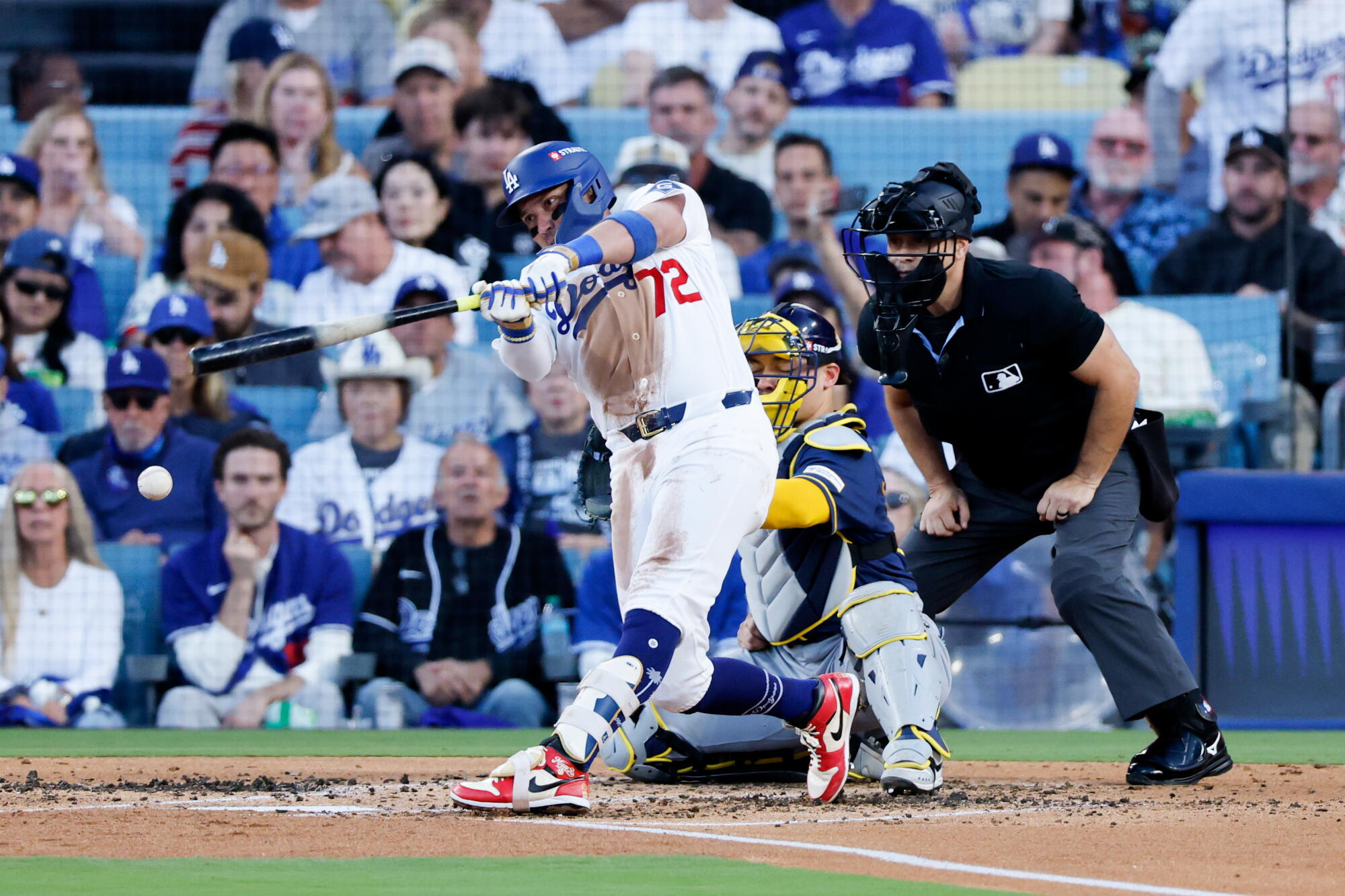
As Dodgers third baseman Max Muncy moved fluidly through a chopper at the edge of Camelback Ranch’s infield grass and made a running throw to first, his offseason work started to snap into place.
He wasn’t thinking about the angle he took to the ball, or how to get into the right position to throw — or anything, really. He was just moving instinctively.
“That’s how I like to field it in my work, is not necessarily traditionally,” Muncy told The Times on Thursday. “I like to field it one-handed, sometimes off the wrong foot, sometimes off balance, and that’s what works for me really, really well. I just couldn’t get that into the game. And finally getting those first couple of balls [this spring] to go that way just made everything click in my head and gave me the freedom to know that I can do it when it matters.”
Muncy has put together an impressive all-around first half. His .871 OPS through Thursday leads NL third basemen. He’s on pace for his highest slugging percentage (.513) in five years. But he’s most proud of the work he’s put in on the defensive side.
“I felt like I would show flashes of this, but never the consistency,” Muncy said. “And so to be able to just do it on the consistent daily basis that I’ve been doing this year, that’s easily what I’m most proud of.”
Now, with that well-rounded body of work, he’s in position to claim the third All-Star selection of his career and first since 2021.
Muncy entered Stage 2 of All-Star fan voting this week as the favorite to claim the starting nod at third base, up against fellow finalist Alec Bohm. But voting totals reset, adding some unpredictability to the process. The All-Star starters are set to be revealed Saturday at 4:30 p.m. on Fox.
“In total, the player, the defense, the hitting, the slugging, I think this is the best version of Max,” manager Dave Roberts said. “I’m so happy that he’s leading the All-Star voting.”
Not only is this shaping up to be Muncy’s best offensive season since 2021, it’s the best defensive season of his career, regardless of position.
Entering this weekend’s series against the Padres, he had a fielding run value of plus-five runs, tied with the Giants’ Matt Chapman for the highest mark among third basemen, according to Statcast.
“He’s always been a hitter,” first-base/infield coach Chris Woodward told The Times. “And I think he took it upon himself to say, ‘I’m going to prove to everybody that I’m a really good defensive player,’ which he has been in his time here, but he’s just never had the opportunity to play one position.”
Though Muncy is in his 11th major-league season, and has played all around the infield for most of it, 2022 marked his first season making the majority of his appearances at third base. And 2023 was his first season moving there full time.
He was also limited by injuries in that span. For years, he still felt the effects of the elbow injury he suffered toward the end of 2021. And he strained his right oblique in each of the last two seasons.
“Third base was just a new position for me, and it just took time to learn it,” Muncy said. “And so just trying to get my work to translate into the game is a tough thing to do, and that’s kind of the secret to every aspect of baseball.”
Each infield position is unique, with its own quirks in footwork, angles and timing. Each has plays — like a slow-roller up the third baseline that requires a quick throw across the diamond — that no other position will encounter.
“When a righty gets around the ball, it comes off the bat a lot different than when a lefty gets around the ball,” Muncy said. “And it’s weird how that works, and it’s hard to explain, but that’s just the way it is.”
For much of Muncy’s baseball life he played on the right side of the infield, fielding pull-side contact from left-handed hitters and opposite-field contact from right-handed hitters. That was second nature.
“You have to completely flip that,” Muncy said of playing third base, “and understand which way it’s going to bounce, how it’s going to bounce, how it’s going to get to you. It just took years of experience to finally get to that point.”
Dodgers shortstop Mookie Betts, left, and third baseman Max Muncy congratulate each other coming off the field after a defensive play against the Baltimore Orioles on June 19.
(Gina Ferazzi/Los Angeles Times)
Woodward has always been impressed by Muncy’s agility, surprised when the Dodgers first promoted him in 2018 (as he returned to the big-leagues for the first time since being released by the A’s the previous spring) and by how he moved at second base, despite an atypical build for a middle infielder.
Now, after an offseason with a new diet and training program, he may have leveled up that part of his game — even at 35 years old.
“In the past it was a good first step, and he couldn’t sustain his speed,” Woodward said. “And this year I think he can sustain the speed through the ball.”
Said Muncy: “I’m still beating the age curve for now.”
Woodward also noted how good Muncy is at staying on top of the mental side of the game, knowing how specific pitches to different types of hitters should change his positioning. That, along with regular communication, are some of the details that make the Dodgers infield look like it’s moving as a unit — or, as Woodward put it, an “NFL defense” because of the way they swarm to the ball.
The Dodgers’ infield defense as a whole has improved even from last season (No. 6 in fielding run value) to sit in the No. 3 spot in the majors (plus-17 runs) a little past the halfway point of the season.
Muncy unlocking even more potential in the hot corner is a big part of the Dodgers raising their defensive ceiling. That’s helped the Dodgers, who own the best record in the majors, create separation in the standings. But it’ll be even more vital in the postseason, when the margin for error is at its thinnest.
In All-Star voting, defense won’t be the determining factor. Muncy’s increased power at the plate is the far flashier aspect of his case to start the Midsummer Classic. But a well-rounded resume doesn’t hurt.
Muncy can picture it: his three children — Sophie Kate, who turns 5 this month, Wyatt James, 3, and Macie Grace, who was born in January — taking in All-Star weekend in Philadelphia, watching their dad represent the National League.
“Being able to have my kids experience the whole ordeal with me would mean everything to me,” Muncy said. “My oldest is kind of old enough now to remember these types of things, and so I think it’d be really special to just share that moment with them.”
The round of 32 is nearly complete, with several teams already set to play in the round of 16, including tournament co-hosts U.S., Canada and Mexico.
Here’s everything you need to know about World Cup knockout stage matches being played Friday, Saturday and Sunday across the U.S., Mexico and Canada (all times Pacific).
Friday’s round of 32 matches
Australia vs. Egypt
Egypt’s Mohamed Salah celebrates after scoring against New Zealand on June 21.
The buzz: Australia finished second to the U.S. in its group but stumbled into the round of 32, going 195 minutes without a goal. It’s the first time since 1974 that Australia has gone scoreless in consecutive World Cup games. The Socceroos are playing in the knockout stage for the third time in 20 years but have yet to win an elimination game. Unbeaten Egypt also finished second in its group, on a goal-differential tiebreaker. Its five goals have come from five players. The Pharaohs, Africa’s oldest national team, will be playing in the second round for the first time.
Argentina vs. Cape Verde
Argentina’s Lionel Messi, left, and Jordan’s Noussair Mazraoui battle for the ball on June 27.
(Tony Gutierrez / Associated Press)
Where: Hard Rock Stadium, Miami Gardens, Fla. Time: 3 p.m. TV: Fox, Telemundo
The buzz: The last World Cup loss for Argentina came in its 2022 opener, making its nine-game unbeaten run the longest under one coach since 1986, the year it won its second championship. Speaking of streaks, when Lionel Messi came off the bench to score in the group finale, it gave him goals in a record seven consecutive World Cup games. He is tied with France’s Kylian Mbappé in the Golden Boot race, having scored six of Argentina’s eight goals. Unbeaten Cape Verde is playing in the World Cup for the first time, advancing to the knockout stages behind three straight draws, two of them clean sheets by Vozinha, the team’s 40-year-old keeper. It is the first debutant to go unbeaten in the group stage since Senegal in 2002. The smallest country ever to advance out of World Cup group play, Cape Verde had just seven shots on target in the group stage.
Colombia vs. Ghana
Colombia’s Gustavo Puerta reacts during a match against Portugal on June 27.
The buzz: Unbeaten Colombia won its group but scored just once in its final two games. It’s 59 shots tied for third in the group stage, but just four of those found the back of the net. Goalkeeper Camilo Vargas, on the other hand, has been called on to make just four saves. Ghana is back in the knockout stages for the first time since 2010, advancing as a third-place team.
Saturday’s round of 16 matches
Canada vs. Morocco
Canada’s Alphonso Davies plays against South Africa on June 28.
The buzz: Canada, the first World Cup host to play outside its borders, eliminated South Africa on a stoppage-time goal from LAFC midfielder Stephen Eustáquio at SoFi Stadium in the team’s first-ever elimination game. Playing again in the U.S., Canada could be even stronger and more confident with Alphonso Davies back from injury. Morocco, one of nine African teams to reach the knockout stages, got a stoppage-time goal from defender Issa Diop to send its round-of-32 game with the Netherlands to penalty kicks, then got a big save from keeper Yassine Bounou to knock off another major European power. Four years ago, Morocco eliminated Spain on penalties.
Paraguay vs. France
France’s Kylian Mbappé scores against Sweden on June 30.
(Frank Franklin II / Associated Press)
Where: Lincoln Financial Field, Philadelphia Time: 2 p.m. TV: Fox, Telemundo
The buzz: Paraguay, the third-place team from Group D, was dominated by Germany everywhere but on the scoreboard, stunning the four-time champion on penalties in the upset of the tournament. Germany had the ball 76% of the time and outshot Paraguay 21-7, but Paraguayan keeper Orlando Gill was phenomenal, especially in the shootout. France has been the dominant team of this World Cup, winning all four of its games while outsourcing opponents 13-2. Captain Kylian Mbappé has six of those goals.
Sunday’s round of 16 matches
Brazil vs. Norway
Norway’s Erling Haaland celebrates after a win over the Ivory Coast on June 30.
The buzz: Brazil rallied from a halftime deficit to eliminate Japan, 2-1, on a stoppage-time goal from second-half substitute Gabriel Martinelli. That kept alive a couple of streaks: Brazil has made it to the round of 16 in every World Cup since 1966, while Japan has yet to win an elimination game. Norway, playing in the tournament for the first time since Erling Haaland was born, has gotten five goals from its captain, including the winner in the 86th minute of his team’s round-of-32 victory over Ivory Coast, Norway’s first-ever win in the knockout rounds.
Mexico vs. England
England’s Harry Kane celebrates after scoring against the Democratic Republic of the Congo on July 1.
The buzz: Mexico rode a pair of first-half goals to a 2-0 win over Ecuador, its first victory in the knockout stages since 1986, the last time the World Cup was played in Mexico. El Tri is averaging two goals a game and has yet to concede one. A win here, in the smoggy and thin air of Azteca, would send Mexico to the quarterfinals, again for the first time since 1986. England, meanwhile, needed two goals from Harry Kane in the last 15 minutes to get past the Democratic Republic of the Congo. Kane has scored five of England’s eight goals.
Spain achieved its primary goal at SoFi Stadium on Thursday, defeating Austria 3-0 and advancing to the World Cup round of 16 in front of a pro-Spain announced crowd of 70,492.
The Spaniards extended their unbeaten match streak to 34 games and their win streak over European teams to 35 dating back to 2023. They have yet to concede a goal this tournament, tying the record for most consecutive men’s World Cup clean sheets with five.
By every metric, Spain controlled the match and won decisively in its best performance of the tournament.
But Spain coach Luis de la Fuente said his team still has room to improve and has yet to play its best soccer.
The team favored to win the World Cup before matches kicked off last month is still ramping up and working to championship standards.
While France’s fearsome foursome led by the electric Kylian Mbappé has bulldozed opponents, Norway’s Erling Haaland is scoring at a rapid pace and Lionel Messi is dancing his way to immortality, Spain superstar Lamine Yamal is still waiting to deliver a multi-goal dominant World Cup performance.
Yamal, an 18-year-old prodigy, showed flashes of his talent and set up his teammates well en route to winning man of the match honors that more than a few Spanish media members questioned. But his efficient teammates carried the scoring load Thursday, with Mikel Oyarzabal scoring two goals and Pedro Porro adding another for La Roja.
Spain has been managing Yamal’s minutes while he recovers from injury, but Thursday was supposed to be an opportunity to unleash his dominance.
“I think we need to keep improving our game, our intensity — everything — but obviously we know the quality we have, and we know we’re not afraid of any team,” Yamal said after the match. “We’re Spain, and we have to prove it on the field, but we believe in ourselves.”
Spain still advanced with ease and will face the winner of the Portugal-Croatia match to be played later Thursday. Their round of 16 match will be played Monday in Arlington, Texas. On July 10, the winner of that contest will face the winner of Monday’s U.S.-Belgium match at SoFi Stadium.
Austria coach Ralf Rangnick is convinced Spain, the European champions, easily could become World Cup champions.
“If you watched the game today, you would recognize it is really difficult to play against this opponent,” Rangnick said of Spain. “… I cannot remember any unforced error they made.”
Spain’s de la Fuente shook his head when he heard Rangnick’s praise, saying he was happy for his players and loves his team but saw many areas that could be improved.
“There’s much to do,” de la Fuente said, noting the competition will only grow tougher. “The defense can still be improved. There have been some situations when we lacked high pressure. … Prior to the first hydration break, the team was still trying to evolve.
”… You need to keep improving all the time.”
Spain forward Lamine Yamal falls after Austria midfielder Florian Grillitsch kicks the ball away from him during the second half Thursday.
(Kelvin Kuo / Los Angeles Times)
During its round of 32 match on Thursday, Spain handled Austria’s high press and attacked spaces behind the defense.
The Spanish team capitalized on its opponent’s defensive misalignments, found depth down the wings and consistently exposed the Austrians’ defensive weaknesses.
Austria came out quickly looking to pull off an upset, but it ran into a Spain team that was well-organized defensively. The counterattack ended with Yamal firing a shot straight at Austria goalkeeper Alex Schlager one minute into the game.
The Austrians tried to get behind the Spanish defense, but their attacking creativity was limited and they never managed to turn their promising opportunities into goals. One of Austria’s clearest chances came on a play by Marcel Sabitzer, who sent a cross from the left flank to forward Michael Gregoritsch, who wasn’t fast enough to put a head or foot on the well-placed ball before it sailed out of bounds.
The pace of the game favored Spain, as Austria took risks on the attack and left spaces open.
In the 29th minute, Yamal’s corner kick pinballed in the penalty area before falling to Marc Cucurella, who appeared to score. The goal was erased, however, because Spain tackled Austria’s goalkeeper before Cucurella took his shot.
Yamal was dynamic early and a run into the box nearly resulted in another clear scoring opportunity. Schlager barely had time to react and prevented another Spanish celebration in the 32nd minute.
Four minutes later, Cucurella sent a pass to Oyarzabal, who was left unmarked because David Alaba had left a large gap between himself and the forward. Oyarzabal connected with the cross and easily scored to give Spain a 1-0 lead.
Spain had two great chances to extend its lead during first-half stoppage time. The first was a long-range shot by Álex Baena that hit the crossbar; on the rebound, Yamal fired the ball straight into the Austria goalkeeper’s body.
In the second half, Yamal continued to pressure the Spanish defenders and set up Oyarzabal for a shot caught by the Austrian goalkeeper.
Rodri’s dribbling opened more space for Spain, allowing him to create a shooting opportunity that grazed the post in the 54th minute.
Austria was looking to attack more and brought on Sasa Kalajdzic, who responded quickly with a header that sailed over the crossbar.
Spain responded by scoring a few minutes later.
In the 66th minute, Baena won the ball back on the left and sent in a cross for Porro, who headed in his team’s second goal. It was Porro’s first goal for Spain during international competition.
In his final play before being replaced in the 85th minute, Yamal received a pass inside the penalty area and although he struck the ball well to beat the Austrian goalkeeper, another Austrian defender managed to block his shot.
When it seemed both teams were content with the result, Cucurella once again linked up with Oyarzabal off a deep pass into the center of the penalty area. Oyarzabal got behind two defenders and scored, sealing Spain’s 3-0 win.
“The game kind of tells you what you need — whether the team needs more on offense or more on defense,” Porro said. “It’s about staying more focused on that, and surely when you’re more confident in what you have to do, you perform better.”
Roki Sasaki’s abysmal appearance faded away in the Dodgers’ 12-7 win over the San Diego Padres after Los Angeles rose from a catatonic first inning. The Dodgers roared back from a 6-0 deficit as Andy Pages skirted a tying double down the left-field line, and Mookie Betts and Max Muncy each drove in runs to give them the lead in a four-run fourth inning. All of which sent the sellout crowd into jubilant celebrations, some jumping, others breaking out World Cup chants.
“I don’t know,” manager Dave Roberts said of the team’s ability to turn the game around. “Thankfully, it played out the way I didn’t expect, or the way it started.”
By the time the game ended, Sasaki’s three-inning start seemed like a murky nightmare the Dodgers awoke from in a sweat. Except the Dodgers weren’t dreaming, and the team hadn’t done much to assuage the concerns with Sasaki.
The problem with Sasaki isn’t his stuff. On his best nights, when the velocity and command combine, Sasaki blows past batters with a triple-digit fastball and cutting off-speed pitches. The problem has been how to tick the radar without making the strike zone look like a Jackson Pollock painting — and recently, it has.
Sasaki’s June swoon, impervious to the calendar change, continued into Thursday’s series opener against the Padres, in which the right-hander gave up three home runs and seven hits before Roberts called it quits going into the fourth inning.
“They were on everything,” Roberts said. “You could see it.”
One possible concern? Tipping pitches. While Roberts and catcher Dalton Rushing said the team would need to do some more research into Sasaki’s start, both left the door open to this answer.
“That would be a big explanation as to how they felt like they were on every pitch,” Rushing said.
As San Diego chugged through its lineup, Sasaki struggled to keep up. With his first pitch, he gave up a double to Fernando Tatis Jr., who scored on Manny Machado’s home run that left center fielder Pages staring at the ball’s path as it plopped down on the other side of the blue outfield fence.
The inning was only a preview of the Padres’ power. Each of the nine San Diego batters got his chance against Sasaki in the second, and the team quickly dug the Dodgers into a six-run hole. He surrendered two home runs in the second inning. First, Jackson Merrill blasted a ball to left-center field, and, two outs later, Jake Cronenworth drove in two runs with a shot to right-center.
Sasaki said through interpreter Kensuke Okubo that he felt like he needed work on his command to improve, but he felt like his fastball was good.
Roki Sasaki has his head down after giving up a solo homer to Jackson Merrill in the second inning.
(Gina Ferazzi / Los Angeles Times)
“I don’t think my stuff was bad today,” Sasaki said. “Overall, it wasn’t great but a lot of things evolved.”
Part of Sasaki’s issue lies with his approach. Roberts said he wants the second-year pitcher to be aggressive, to play the cat-and-mouse game required to beat batters in the box. But when given the opportunity, Sasaki has shrunken in recent outings, struggling with his command and his ability to pitch deep into games.
“We had a great May, so let’s just get back to competing and making pitches,” Roberts said.
When reliever Will Klein walked out to the mound in the fourth to the aggressive, rambunctious clamor of the Dropkick Murphys’ “I’m Shipping Up to Boston” and collected two scoreless, one-hit innings, the relief was immediate: The Dodgers took the lead.
The lineup already was revving, as Dalton Rushing homered in the second inning while Sasaki was still in the game, and both Kyle Tucker and Max Muncy drove in runs in the third, cutting the deficit to two. The Dodgers broke through against the Padres’ bullpen to score six runs in the fourth and fifth innings.
“The bullpen was fantastic tonight, and then the offense came up big,” Roberts said.
A late catch by Pages helped close out the game after he gloved a ball despite ramming into the padding of the center field wall. A combined effort by Paul Gervase and Tanner Scott shut down San Diego’s ninth-inning momentum after it pushed across a run.
“Turned back around, was able to find the ball and make a really good catch right there,” Tucker said. “That was a huge out.”
The Dodgers (57-31) beat their division rivals for the fifth time in seven games to open a 13-game lead over both San Diego and Arizona. The Padres, meanwhile, have given up 65 runs over the last six days, the most in such a span in franchise history.
But San Diego’s flaws don’t negate the Dodgers’ as they burned through six relievers in their win. So, while the Dodgers crawled out of the hole with a season-high 17 hits, the steep cost heightens the pressure on the rest of the rotation the rest of the series.
SANTA CLARA, Calif. — Mauricio Pochettino’s team continues to do things in this summer’s World Cup that no U.S. team has ever done before.
Its three wins are the most in a single tournament. So are the 10 goals in four games. It has the best goal differential ever and its two shutouts ties a record.
Yet all that means absolutely nothing to the players.
“They’re great milestones,” captain Tim Ream said. “But I don’t think anybody’s even once mentioned the different things that we’re doing. We’re focused on what we’re doing daily on the training ground, because that puts us in the best possible position to to put these performances.
“So yeah, not aware or even worried about records that we’re breaking.”
Well, except for maybe one.
With Wednesday’s gritty 2-0 over Bosnia and Herzegovina, a game the U.S. finished with just 10 men, the Americans won a game in the World Cup knockout stage for just the second time. That sends them on to a round-of-16 meeting with Belgium on Monday in Seattle where a win would be — you guessed it — historic.
“It’s cool and it’s great and it’s an accomplishment,” midfielder Weston McKennie said of the records. “But at the same time, we have high expectations for ourselves. That’s what we expect of ourselves, what we expect of our team.
“We just want to focus on Belgium now and continue to try to make history.”
That chore got a good deal more difficult because of an unwanted team record that was also set Wednesday. When Folarin Balogun scored a goal late in the first half then drew a red card early in the second, he became the first American — and third player ever — to get one of each in the same World Cup knockout game.
“Cool record,” defender Chris Richards said.
But while the goal, Balogun’s third of the tournament, proved to be all the U.S. needed to beat Bosnia, the red card — which cannot be appealed according to U.S. Soccer — means he’s suspended for the game with Belgium.
“It’s just so unfortunate, honestly,” Christian Pulisic said. “Looking back at it, it seems so harsh. I just told him he’s done so much for us, and now we’ve got his back.”
The red card came in the 64th minute with the U.S. protecting a 1-0 lead built on Balogun’s goal just before the intermission. The American striker was battling hulking Bosnia defender Tarik Muharemovic for a loose ball when he inadvertently raked Muharemovic’s right calf with his studs up, then landed on his ankle, twisting it awkwardly.
Brazilian referee Raphael Claus did not flash either card before stopping play at the behest of the video assistant referee. But after consulting a slow-motion reply, Claus gave Balogun a red card for a dangerous challenge.
“For me, never is this a red card,” said Pochettino, now the winningest U.S. coach in World Cup history. “Watching after on TV, never was [it his] intention to step up on the player. That was a normal action in football.”
Maybe. But Claus sent Balogun off just the same, leaving the U.S. to protect a one-goal advantage for the final 30 minutes while playing a man down. It was probably the sternest test the Americans have faced in the tournament.
“It would be easy to have an excuse if they did score,” McKennie said. “But that’s not the type of team we are.”
For Ream, the challenge was actually no challenge at all.
“Would it be weird if I downplayed this and said [I] wasn’t even fazed by it?” he said. “It didn’t feel like we were down a man. We were still able to carve out chances and we were still able to keep hold of the ball. Everybody knew their roles.
“It felt really calm and felt really, really easy and simple for us in that moment.”
And that allowed another hero to shrug off the pain of his own wounds and step up big.
Early in the second half a Bosnian player stomped on Malik Tillman, shredding his boot and cutting his right foot (but not drawing a red card). During the hydration break, Tillman was able to change shoes and in the 82nd minute, his white sock turning red with blood, he found himself standing over a free kick just outside the Bosnian penalty area.
“I’ve been dreaming about this game. I’ve been dreaming about, yeah, maybe taking a free kick and scoring,” said Tillman, who bent the ball off the gloved right hand of Bosnian keeper Nikola Vasilj and into the net for his first World Cup goal. “I trained for this in our practices and then it actually came true.”
So did the team’s dreams of reaching the round of 16, only now they’re arriving without their leading scorer, who will have to watch the Belgium game from the stands. Balogun’s absence, however, creates opportunity for others, with Haji Wright and Ricardo Pepi the most likely candidates to take his place.
And if this U.S. team has proven anything, it’s proven that it loves nothing more than embracing opportunities to prove people wrong.
“We’re going to miss him for the next game but we know that if it’s Pepi or Haji, whoever, is going to step up next and they’re going to do the job just as well as he did,” Richards said of Balogun. “One thing about this team is we’re really a big family and we’re shown it this whole tournament.
“Coming in, there was a lot of question marks about our whole team in general. Game by game we started to put ourselves right. Because we knew we had it the whole time.”
The Dodgers welcome their bitter rivals to Dodger Stadium on Thursday for what should be a big four-game series, but the San Diego Padres are a mess. They trail the Dodgers by 12 games in the National League West. Their best batter by WAR, according to Baseball Reference, is journeyman infielder Ty France.
However, standings and statistics be damned, the Dodgers are coming for the Padres, their closest pursers in the division even if “close” is relative. The Dodgers didn’t have to say anything out loud, but you could see it on the field Wednesday.
Shohei Ohtani was the scheduled starting pitcher, but the Dodgers pushed him back so he could face the Padres this weekend. The Padres will face Roki Sasaki on Thursday, Ohtani on Friday and Yoshinobu Yamamoto on Sunday.
And the Dodgers still won a series in Sacramento, behind Eric Lauer and Justin Wrobleski. Now comes a 10-game sprint to the All-Star break against division rivals, starting with the Padres.
“They’re all big for us,” Dodgers manager Dave Roberts said. “We try to take every series with the same importance, but obviously winning that series is the goal.”
For the final game of the Athletics series Wednesday, with Ohtani held back, the Dodgers used Jack Dreyer as a first-inning opener, then handed the ball to triple-A callup Charlie Barnes and told him to go as long as he could.
That did not go well and still went exactly according to plan.
In what was billed as a bullpen game, Barnes handled the final seven innings, leaving the varsity bullpen in fine shape for the Padres series.
“For him to be able to save everyone else puts us in a great position for the four games this weekend,” Roberts said.
The innings were not great. The first batter Barnes faced, Jonah Heim, deposited a 444-foot home run on the roof of the Dodgers’ clubhouse beyond the center-field fence.
The A’s bunched 11 hits over the first four innings against Barnes and his 90-mph fastball, and still the Dodgers gave Barnes the rest of the game, because a 12-game lead affords you the chance to sacrifice today in order to line up your pitching for your tomorrows.
In all, Barnes gave up seven runs and 12 hits, including three home runs. He did make a very reasonable 79 pitches over his seven innings.
Barnes, a 30-year-old still in search of his first major league victory, barely had a chance to take in the evening before Roberts told him immediately after the game that he would return to triple-A, with Paul Gervase coming up as a fresh arm.
“It’s tough for me to enjoy it when you give up seven,” Barnes said. “That’s part of the business. I did my job in providing length. Any time they need that or may want that, I’ll do my best to give it to them.”
This was not all on Barnes, to be sure. When Wrobleski won his 10th game in a 9-3 victory on Tuesday, he said the offense deserved a fair share of the credit for his success.
“We bang,” Wrobleski said, “so you can get a lot of wins if you go deep in games and go five innings. That’s more of a team thing than it is a performance thing for me, but it’s super cool.”
After collecting 17 hits here on Monday and 14 more on Tuesday, the Dodgers mustered five hits Wednesday, including a 431-foot home run from Freddie Freeman.
The Dodgers went hitless with runners in scoring position, leaving the bases loaded in the first inning, two men on in the third and two more in the eighth.
Will Smith out until after All-Star break
The first half of the season will conclude with Will Smith in the same place he has been for the last month: the injured list.
The Dodgers’ three-time All-Star catcher has been on the IL since June 8 because of what the Dodgers list as neck inflammation. Smith said he had been diagnosed with an inflamed disk.
Roberts said he “just can’t see any world” in which Smith would return before the All-Star break, which concludes July 16.
“It’s certainly longer, I know, than all of us expected,” Roberts said. “But I don’t think it’s anything real, kind of affecting-the-season type thing.”
Will Smith has been sidelined by an injured neck.
(Rick Scuteri / Associated Press)
Roberts said Smith has not been able to accelerate his rehabilitation to the point of doing baseball activities.
Dalton Rushing, who has taken over as the Dodgers’ primary catcher in Smith’s absence, is batting .210 with one home run and 20 strikeouts in 19 games while Smith has been on the injured list. The Dodgers gave Rushing most of the day off Wednesday, although he struck out as a late-game replacement.
The Dodgers were 14-6 with Smith on the IL entering play Wednesday.
Also Wednesday, the team scratched shortstop Mookie Betts from the starting lineup because of a sore right wrist. Roberts said he expected Betts to play Thursday.
SANTA CLARA — The U.S. cannot appeal Folarin Balogun’s red card and ensuing suspension for the Americans’ round of 16 match against Belgium, U.S. soccer officials confirmed.
FIFA rules governing the 2026 World Cup, first cited by the Athletic, state that “a sending-off automatically incurs suspension from the subsequent match. The FIFA judicial bodies may impose additional match suspensions and other disciplinary measures.”
The only instance in which the U.S. could appeal is if FIFA’s disciplinary committee decides to suspend Balogun for more than one game after reviewing the incident.
Broadcast commentators and fans immediately questioned the decision after Balogun was shown a red card during the U.S.‘s win over Bosnia-Herzegovina on Wednesday at Levi’s Stadium.
Balogun crashed into Bosnia’s Tarik Muharemović, landing his foot on top of Muharemović’s during the physical match. Muharemović hit the pitch, howling in pain, and was treated on the field. The referee used the video assistant referee to review the play and determined it merited a red card.
U.S. fans accustomed to appeals in the NBA and NFL suggested that an appeal include video of Lionel Messi receiving no discipline for stepping on an opponent’s calf earlier in the tournament.
The red card on the field, however, remains the final word barring any extra games added to Balogun’s suspension.
“The World Cup is ruining my life,” a neighbor recently said with a laugh. “I’m supposed to be working; instead I’m watching World Cup. I’m supposed to be doing chores; instead I am watching World Cup.”
I laughed in guilty recognition. We had met on the street by chance while I was walking the dog. Having just spent the last two hours watching, then celebrating Lionel Messi’s hat trick during Argentina’s first-game victory over Algeria, I had less than an hour to get back in time to watch Austria play Jordan.
That was on Day 6, and it’s only gotten worse. If I had to calculate my own ratio of work done to soccer watched … well, as I am not a sports reporter, I don’t think my editor would be thrilled. (Though I’m sure she appreciated the England/Congo updates I provided as I finished this piece.)
Like millions worldwide, my family and I have been deeply, and in our case, weirdly, engrossed in this year’s games. “Weirdly” because we do not follow men’s soccer. The World Cup is different, of course — going in, I figured I would check out the U.S., keep an eye on Messi, then tune into the final few games. Perhaps my husband would join (but only if he at least pretended to understand the offside rule), but with our two oldest children out of the house, it is, with the exception of the Super Bowl, unheard of for our family to concurrently view any sporting event in real time.
Until this World Cup. I’m not quite sure how it happened, but suddenly we’ve got game times written onto our calendar. Entire days have been spent in front of the TV with at least one child and the others watching from their homes, our family texts studded with “are you watching…?,” “did you just see that?” and, of course, “OMG MESSI!”
(I would attempt to calculate my recent ratio of chores done to Messi videos watched if I weren’t legitimately concerned that my family would have me committed.)
The fact that my son and his girlfriend live in Kansas City certainly helped spark our newfound fascination. Yes, Los Angeles is also a host city, but L.A. hosts so many things; inevitably we were mostly concerned about what it would do to the traffic. KC, on the other hand, is the smallest and most unlikely of the host cities, and over the last few years we have seen — on visits and through my son’s accounts — all the construction, effort and can-do spirit that has gone into preparing for the event.
We were thrilled when it was announced that Argentina, England, the Netherlands and Algeria would be based in or near KC. We wanted the city to shine, and it has — from nearby Lawrence’s enthusiastic adoption of Algeria to Messi’s historic hat trick at Kansas City Stadium.
Team USA defender Mark McKenzie, left, and Turkey midfielder Baris Alper Yilmaz in the World Cup match at Los Angeles Stadium on June 25.
(Robert Gauthier / Los Angeles Times)
But it’s more than vicarious Midwestern pride. When our older daughter began texting out missives from the earliest games and our son sent pictures of fans streaming into Kansas City Stadium, we started watching as a way to stay connected.
First, as a family, and then to our country and the rest of world.
The games have been inevitably exciting, especially as now that they’re in the knockout round, but the overall sensation was unexpected relief, a soul-soothing balm.
At a time when the news cycle seems to serve up nothing but conflict, crisis and woe, the World Cup offers shelter, a truly international event in which conflict is defined by long-term sports rivalries and questionable referee decisions.
We want our national or preferred teams to win, of course, but no matter the outcome, it’s impossible not to be thrilled by the sight of phenomenal play, underdog tenacity and so many adoring and enthusiastic fans.
Soccer is called the beautiful game for many reasons, and hours/days/weeks of sustained beauty is impossible to resist. Even social media has surrendered to spectacular highlights along with tales of Japan supporters cleaning up stadiums, fans of the victorious consoling fans of the defeated and Europeans discovering the glories of free refills and ranch dressing.
None of this changes the realities we face in America and the rest of the world. Grocery and gas prices remain catastrophically high; Iran continues to contradict U.S. claims of diplomatic resolution to an unpopular war. The unnecessarily revamped reflecting pool in Washington remains a swamp of algae and tourist arrests, as the semiquincentennial struggles under the weight of our president’s self-centered hubris.
But for a few blessed weeks, the World Cup offers inspiration, escape and cultural healing.
It has also, thus far, escaped President Trump’s so often internationally insulting social-media notice and more importantly, his presence. Historically, the leaders of host countries attend the opening match; Trump has, apparently, been too busy (including planning and attending the UFC Freedom 250 cage match recently held on the South Lawn.)
Given his tendency to suck the oxygen out of any room (like his recent reception at Game 3 of the NBA Finals in New York), it’s definitely for the best. If nothing else, the World Cup has given us a chance to take a break from politics and talk instead about Messi, France’s Kylian Mbappé, England’s Harry Kane and all the amazing goalkeepers, including Cape Verde’s now-iconic Vozinha.
Never before have I so understood the therapeutic power of sport.
Who wouldn’t want to at least take a break from rising measles cases, the latest federal or Supreme Court decisions and primary tea-leaf readings to lose themselves in a game where exquisitely patient passing suddenly bursts into spectacular feats of speed and footwork? Where a well-defended ball can suddenly become a goal with a nearly undetectable flick of a foot, or a perfectly placed shot blocked by a goalie’s incredible ability to launch into space? Where an outcome that seems assured can be overturned in the final minutes to the collective roar of an international cast of thousands?
Vozinha of Cape Verde makes a save during the World Cup match between Spain and Cape Verde at Atlanta Stadium on June 15.
(Justin Setterfield / Getty Images)
Like many Americans, I have been occasionally embarrassed by the World Cup’s exposure of my world-geography ignorance — I know where Bosnia and Herzegovina lies on a map, but until recently, I couldn’t place Cape Verde, Curacao or, if I’m being completely honest, Cote d’Ivoire.
Isn’t it wonderful, though, to have a reason to reacquaint yourself with a world map that isn’t related to war, natural or man-made disaster or economic and political tension? The current U.S. administration may seem to be at odds with just about everyone, but visiting World Cup fans are here to remind us of all we share, beneath our crazy wigs and face paint, our cheers, groans and chants.
And we, as hosts, have shown them that America is so much more than the sum of our current government’s policies and posturing.
Watching all this happen, in real time, has been magical, miraculous and magnetic.
Not every moment, of course. Various visa issues created unnecessary and embarrassing drama; high ticket prices and transportation issues were blamed for empty seats at some of the early games. Members of the Iranian team and its coaching staff criticized the way they were treated (though the team left a handwritten note in the dressing room of Los Angeles Stadium, thanking L.A. for its hospitality). The controversial hydration breaks, and the extra commercials they accommodate, can be irritating (though when it’s close to 100 degrees in many stadiums, quite necessary). And though it didn’t matter in terms of standing, watching the U.S. lose to Turkey wasn’t much fun for American fans (though the Turkish exuberance was pretty infectious).
Overall, the 2026 World Cup has done exactly what it was supposed to do: create, in this country, a stage for the finest teams and players in the world’s most popular sport and, more important, carve out five weeks in which we can all spend a few hours removed from the political and cultural divisiveness that threatens to define us.
It’s space in which we can cheer, gasp and leap out of seats along with our families, friends and all the millions we will never meet but to whom we are connected all the same.
Now if you’ll excuse me, the next game is about to start.
Indiana Fever head coach Stephanie White has denounced the racist hate and abuse directed at Alyssa Thomas since the Phoenix Mercury forward committed a flagrant foul against star guard Caitlin Clark.
“It’s absolutely unacceptable,” White told the media before the team’s practice on Wednesday. “I think as a league as a whole, there’s been so much more toxicity, racism, homophobia — straight-out hate nonsense. And it is absolutely unacceptable.”
White attributed most of the hateful comments to online agitators rather than true WNBA or Indiana Fever fans.
“I believe this is people who are using our league, using our players, to further divisive agendas,” White said, while acknowledging that certain criticisms and fan dynamics are part of the game. “But it’s not hard to not be a jerk. If you are one of these people that are online doing this, do not call yourself a WNBA fan.”
A former Indiana Miss Basketball honoree, White played in the WNBA from 1999 to 2003, including with the Fever, before transitioning to coaching. She was previously the head coach of the Connecticut Sun — where she coached Thomas — before being hired by the Fever.
“Our league is about inclusiveness,” she continued. “Our league is about competition. Our league is about elevating — elevating women, elevating marginalized communities, and being inclusive of all different walks of life. That is what our league has always been about from day one. That is what our league will continue to be about.”
Indiana Fever head coach Stephanie White has denounced the racist abuse directed to Alyssa Thomas.
(Erik Rank / Associated Press)
Thomas was suspended for a game after the WNBA reviewed a viral moment that occurred during the Mercury’s 111-109 win over the Fever last Wednesday. Thomas and Clark were scrambling for a loose ball at around the 6:52 mark during the second quarter and Thomas’ fist pressed into Clark’s throat after she landed on her. No fouls were called at that time, and screenshots and video from the incident quickly made their rounds on social media. Upon review after the game, the WNBA assessed Thomas a Flagrant 2 foul.
The 13-year veteran and six-time All Star told reporters Tuesday that she has received death threats and racist abuse in the aftermath.
“It’s unfortunate that it’s come to this over basketball,” Thomas, who had served her suspension Saturday, said. “A lot of us, myself included, didn’t even know the play took place until after the game. Now we’re being painted as thugs. There’s death threats out on us. It’s really unacceptable. It’s something that needs to change in this league and I’m just really sick and tired of it.”
She called out the WNBA and Commissioner Cathy Engelbert for not doing more to protect players off the court.
“We’re so concerned about the safety on the court, but time and time again, we’re having people threaten our lives,” Thomas said, explaining that her main concern was not the suspension itself. “Leaking addresses out there. Putting crazy pictures that have nothing to do with basketball. At some point, the league needs to [take] a stand … Time and time again, players are going through this and the league remains silent. I’m sick and tired of it. It’s time for them to step up and have our backs.”
Engelbert released a statement Tuesday night following Thomas’ comments.
“The WNBA vehemently condemns any and all forms of hate,” the widely reported statement read. “The safety and well-being of everyone in our community is always the league’s top priority. We are aware of Alyssa Thomas’ comments, and what she and her teammates have experienced is completely unacceptable and not representative of the WNBA community. The league and our security team have been in contact with the Phoenix Mercury organization and remain committed to protecting all players.”
This is not the first time Thomas has spoken out about racist abuse she and her teammates have received following a match-up against the Fever. During the 2024 playoffs, while a member of the Sun, Thomas said that she had never experienced the sort of “racial comments” or “been called the things that [she’s] been called on social media” by so-called Fever fans. The Sun eliminated the Fever that year.
Clark’s fame and popularity have often led to various talking heads, commentators and even politicians who may not regularly follow the WNBA to share their hot takes whenever a situation involves the former college phenom. The ensuing discourse and social media chatter are often divisive.
Thomas’ flagrant foul occurred two days after the teams’ chippy June 22 matchup, which saw Thomas and Clark receive technical fouls along with three other players for their involvement in a scuffle during the final frame of the Fever’s 86-77 win.
“There’s a difference between trolling, and there’s a difference between hatred,” Thomas said Tuesday of the racist slurs she and other players have received. “The hatred that we’re experiencing over a play that, honestly, was a complete accident, no one even knew it happened. It’s just unfortunate. The league has to do better in this instance.”
The Lakers secured their starting center of the future in a massive trade with Utah on Wednesday, agreeing to send two first-round picks (2031 and 2033) and two pick swaps (2028 and 2030) to the Jazz in exchange for 24-year-old Walker Kessler, sources not authorized to speak publicly on the matter confirmed Wednesday to The Times.
Kessler, who was limited to five games last season because of a shoulder injury, is expected to sign a four-year, $130-million contract with the Lakers, people with knowledge of the situation said.
The center was a restricted free agent, but the Lakers worked around difficult negotiating limitations by throwing in nearly every first-round asset they had in addition to digging into their $51 million in salary-cap space. If the Lakers had only presented an offer sheet to the Jazz to lure Kessler away instead of working on a trade, Utah would have had until July 7 to match the offer.
Kessler’s addition, a day after LeBron James told the Lakers that he’d return for an unprecedented 24th season elsewhere, highlighted a flurry of transactions that will help the Lakers remake their roster around Luka Doncic. Soon after the Kessler trade Wednesday, the Lakers agreed to terms with three free agents — center Sandro Mamukelashviki, guard Quentin Grimes and guard Collin Sexton.
Kessler is a much-needed defensive backstop. The 7-foot-2 center has averaged 2.4 blocks over his career. He was off to a strong start last season in Utah before a season-ending shoulder injury. The previous season, he averaged 11.1 points and 12.2 rebounds. His 4.6 offensive rebounds per game in 2024-25 led the league.
Mamukelashvili declined a $2.8-million player option with the Toronto Raptors and was rewarded with a four-year, $52-million deal with the Lakers, a person with knowledge of the situation confirmed to The Times. Primarily coming off the bench, the Georgian center averaged 11.2 points and 4.8 rebounds for the Raptors last season.
Toronto’s Sandro Mamukelashvili scores on a layup in front of Wizards forward Anthony Gill on Feb. 28 in Washington.
(Scott Taetsch / Getty Images)
His three-point shooting has improved in recent seasons; Mamushkelasvili shot 38.9% from three-point range last season on 3.7 attempts per game, improving from 37.3% on 2.6 attempts the previous season. The long-range shooting element would stand out in a revamped front line that includes the return Deandre Ayton, who was the Lakers’ major free agent signing last year. He exercised a $8.1-million player option after career lows in points (12.5), rebounds (eight) and minutes (27.2) per game.
Grimes, 26, averaged 13.4 points, 3.6 rebounds and 3.3 assists for the Philadelphia 76ers last season. He agreed to a four-year, $60-million contract, The Times confirmed.
Sexton agreed to a two-year, $19-million contract, The Times confirmed, after the guard played for the Charlotte Hornets and Chicago Bulls last year. The Lakers will be his fifth team in his eight-year career, which began in Cleveland, where he was named All-Rookie second team in 2019.
The round of 32 is in progress, with several teams already moving on the round of 16, including tournament co-hosts Canada and Mexico. The U.S. will be looking to do the same when it faces Bosnia-Herzegovina on Wednesday.
Here’s everything you need to know about World Cup knockout stage matches being played Wednesday, Thursday and Friday across the U.S., Mexico and Canada (all times Pacific).
Wednesday’s round of 32 matches
England vs. DR Congo
England’s Jude Bellingham celebrates with teammates after scoring against Panama on June 27.
(Steve Luciano / Associated Press)
Where: Mercedes-Benz Stadium, Atlanta Time: 9 a.m. TV: Fox, Telemundo
The buzz: England was unbeaten in group play, but it looked sluggish, failing to score in a goalless draw with Ghana then needing two second-half scores to beat Panama. Harry Kane and Jude Bellingham have combined for five of England’s six goals while Jordan Pickford hasn’t given up a goal since the opening half of the first game. The Democratic Republic of the Congo, playing in the World Cup for the first time since 1974, made it out of the group stage for the first time ever by beating Uzbekistan with three second-half goals.
Belgium vs. Senegal
Belgium’s Leandro Trossard celebrates after scoring against New Zealand on June 26.
The buzz: Unbeaten Belgium didn’t score a goal of its own until routing New Zealand 5-1 in its group-play finale. That allowed it to finish atop of its group and advance to the knockout stages, something it failed to do four years ago. Senegal started with consecutive losses, but routed Iraq 5-0, giving it the best goal differential of all third-place teams and allowing it to advance.
U.S. vs. Bosnia and Herzegovina
U.S. forward Christian Pulisic shoots during a loss to Turkey at the World Cup on June 25.
The buzz: The U.S. won its group, winning twice in the first round for the first time since 1930. But it has won just once beyond the group stage in its history and hasn’t beaten a European team in 12 tries dating to November 2022. Bosnia-Herzegovina beat Qatar in its group-stage finale to advance to the knockout rounds for the first time. Ermin Mahmic has two of the team’s five goals.
Thursday’s round of 32 matches
Spain vs. Austria
Austria’s Marko Arnautovic celebrates after a goal against Algeria on June 27 at the World Cup.
The buzz: Spain did not allow a goal in the group stage with keeper Unai Simón making just four saves in the three shutouts. But No. 3 Spain has struggled offensively; leave out its 4-0 rout of Saudi Arabia and it scored just once. Austria needed a goal deep in stoppage time to draw Algeria and finish second in its group, advancing to the second round for the first time since 1982. Marko Arnautovic has two of the team’s six goals.
Portugal vs. Croatia
Portugal star Cristiano Ronaldo attempts an overhead kick against Colombia at the World Cup on June 27.
(Robert Cianflone / Getty Images)
Where: BMO Field, Toronto Time: 4 p.m. TV: FS1, Telemundo
The buzz: Call this the Geritol Cup. Unbeaten Portugal finished second in its group with Cristiano Ronaldo, 41, becoming the second-oldest male to score in a World Cup and the only man to score in six consecutive tournaments while Croatia saw Luka Modric become the oldest player in history to record a World Cup assist. Croatia has reached the semifinals of the last two tournaments, but its golden generation is aging. Portugal, a quarterfinalist in 2022, is hoping to give Ronaldo the one title he’s missing.
Switzerland vs. Algeria
Switzerland’s Johan Manzambi heads the ball against Canada at the World Cup on June 24.
(Abbie Parr / Associated Press)
Where: BC Place, Vancouver Time: 8 p.m. TV: FS1, Telemundo
The buzz: Unbeaten Switzerland held off Canada in its last game to win its group for the first time since 2006. The Swiss have not won a knockout-round game since 1954. Midfielder Johan Manzambi, the team’s youngest player at 20, has three of Switzerland’s seven goals. Algeria drew Austria in its group-play final to advance as a third-place team. Riyad Mahrez, 35, had a brace in that game and leads Algeria with two goals.
Friday’s round of 32 matches
Australia vs. Egypt
Egypt’s Mohamed Salah celebrates after scoring against New Zealand at the World Cup on June 21.
The buzz: Australia finished second to the U.S. in its group but stumbled into the round of 32, going 195 minutes without a goal. It’s the first time since 1974 Australia has gone scoreless in consecutive World Cup games. The Socceroos are playing in the knockout stage for the third time in 20 years but have yet to win an elimination game. Unbeaten Egypt also finished second in its group, on a goal-differential tiebreaker. Its five goals have come from five different players. The Pharaohs, Africa’s oldest national team, will be playing in the second round of the World Cup for the first time.
Argentina vs. Cape Verde
Argentina’s Lionel Messi, left, and Jordan’s Noussair Mazraoui battle for the ball at the World Cup on June 27.
(Tony Gutierrez / Associated Press)
Where: Hard Rock Stadium, Miami Gardens, Fla. Time: 3 p.m. TV: Fox, Telemundo
The buzz: The last World Cup loss for Argentina came in its 2022 opener, making its nine-game unbeaten run the longest under one coach since 1986, the year it won its second championship. Speaking of streaks, when Lionel Messi came off the bench to score in the group finale, it gave him goals in a record seven consecutive World Cup games. He is tied with France’s Kylian Mbappé in the Golden Boot race, having scored six of Argentina’s eight goals. Unbeaten Cape Verde is playing in the World Cup for the first time, advancing to the knockout stages behind three straight draws, two of them clean sheets by Vozinha, the team’s 40-year-old keeper. It is the first debutant to go unbeaten in the group stage since Senegal in 2002. The smallest country ever to advance out of World Cup group play, Cape Verde had just seven shots on target in the group stage, according to FIFA.
Colombia vs. Ghana
Colombia’s Gustavo Puerta reacts during a match against Portugal at the World Cup on June 27.
The buzz: Unbeaten Colombia won its group but scored just once in its final two games. It’s 59 shots are tied for third in the tournament but just four of those found the back of the net. Goalkeeper Camilo Vargas, on the other hand, has been called on to make just five saves. Ghana is back in the knockout stages for the first time since 2010, advancing as a third-place team.
Some kids grow up with video games and summer camp. Sebastian Berhalter grew up with the World Cup.
He was 13 months old when his father, Gregg, played in the tournament for the first time and 5 when his dad was called back. And four years ago, when Sebastian was already a professional in his own right, he went to Qatar to watch his father coach the U.S. to the round of 16.
Yet none of that prepared the younger Berhalter for his own World Cup debut earlier this month.
“It’s ridiculous,” Sebastian said. “Before the game, I just kept chuckling to myself, like, ‘What the hell is going on?’ Literally I couldn’t believe it. Playing for my country, it’s the best feeling in the world.
“I just can’t believe that happened.”
Nor could he believe what happened next. Because after making appearances off the bench in the team’s first two group-play games — both of which ended in U.S. victories — Berhalter started the third game. And with a goal and an assist in a loss to Turkey, he already has more World Cup goals and assists than his dad.
In fact, he’s the only American with a goal and assist in the same World Cup game in the last 96 years. Not bad for your first start in the tournament.
His father still has bragging rights in one category, however, since the 2002 team he played for is still the only American team to win a knockout game in a World Cup. Sebastian can match that Wednesday in Santa Clara when the U.S. plays Bosnia and Herzegovina in the round of 32 of this summer’s expanded tournament.
“They’re a good team,” Sebastian said of the Bosnians. “It’s a round of 32, so do or die. I think you play every game like it’s a knockout game. For us it’s, it’s keep doing what we’ve been doing.”
If Gregg provided the inspiration and the road map that guided his son to the World Cup team, the younger Berhalter had to wait for Mauricio Pochettino before he could take his first steps on that road. That came in the spring of 2025, about 11 months after his dad had been sacked as coach, when Pochettino, the new manager, gave the younger Berhalter his first national team call-up.
He’s gone on to make 16 appearances for the U.S., including three in the World Cup. And that’s something Gregg is convinced couldn’t have happened as long as he was coach.
“I think about it all the time,” he recently told ESPN. “I never could have picked him.”
The scrutiny would have been too fierce, he feared, the whispers of nepotism too loud. Sure, Michael Bradley played more than 50 internationals games for his father Bob, including four in the 2010 World Cup. But he was already on the team when his father took over from Bruce Arena, who gave Michael his first call-up.
So, Sebastian had to wait. He had to play for three MLS teams, win an MLS Cup and three Canadian Championships and become too good to ignore in order to get his first shot with the national team — one which came from Pochettino, not his father.
Neither Berhalter has regrets.
“What I know,” Gregg, now coach and sporting director of the Chicago Fire, told ESPN, “is that everything is in the place it’s supposed to be. This is how life is. It’s his turn. It’s his time now.”
And he’s playing as if there’s no time to waste.
After making his international debut in a friendly with Switzerland last May, Sebastian played five full games in the Gold Cup last summer, then scored his first international goal in a friendly with Uruguay less than three weeks before leading the Vancouver Whitecaps into the MLS Cup against Inter Miami.
So, when the time came for Pochettino to name his World Cup roster last month, it was clear Sebastian, 25, had earned a spot.
“He’s a monster. He’s a monster, in the way of how professional he is,” the coach said. “He’s the type of player who’s going to train, going to train, going to train. I mean, sometimes I have to say [to him], ‘Go inside, no?’“
After stumbling in the group-play final, which Turkey won with a goal deep in stoppage time, the U.S. will have no room for error in its first elimination game. It’s a game in which history may — or may not — be on the Americans’ side.
On one side, the U.S. is winless in its last 13 games against European opponents. On the other, its last win over a UEFA team came in December 2021, in California, over Bosnia and Herzegovina, a team to which it has never lost.
There’s an omen in there somewhere.
“Our goal is to win the World Cup,” Sebastian said. “That’s what we want to do. It’s always been our mission and we’re still taking it one game at a time.”
There’s also the family record book to think about. One more victory and Sebastian will have more World Cup wins than his dad. Two more and he’ll be in the tournament quarterfinals, which is as far as his father went in his first World Cup.
In Qatar, Sebastian was the one in stands, cheering on his dad. In this tournament, the roles have been reversed. And Gregg told his son he couldn’t be happier about or prouder of how things have worked out.
“Four years ago, I was waiting for him to come up in the stands. Now, he was waiting for me to come up in the stands,” Sebastian said. “That was special.
“When you hear words that your dad is proud of you, that’s a cool moment.”
Dodgers manager Tommy Lasorda celebrates after the Dodgers beat the Montreal Expos to win the NL pennant in 1981.
(Associated Press)
Years as manager: 1976-1996
Record: 1,599-1,439, .526 win pct
After serving as the team’s third base coach for four seasons, Lasorda took over as manager late in the 1976 season when Alston announced his retirement. He led the Dodgers to the National League pennant in his first two full seasons, losing both times to the Yankees in the World Series. He won his first World Series in 1981, knocking off the Yankees, and rallied his team to a surprise title in 1988 in which the Dodgers beat the heavily favored Athletics. Lasorda was inducted into the Baseball Hall of Fame in 1997, his first year of eligibility.
A fiery and vibrant presence who spent 71 years with the Dodgers, Lasorda managed nine players who won the NL rookie of the year award. The Dodgers also opened the Japanese player pipeline on his watch. Hideo Nomo, the first Japanese big leaguer to permanently relocate to the U.S., joined the Dodgers in 1995. Three decades later, the team features Shohei Ohtani and Yoshinobu Yamamoto on its star-studded roster.
In need of three-point shooting, the Lakers lost the league’s best sharpshooter on the first day of free agency.
Guard Luke Kennard has agreed to a two-year, $13-million deal with the Phoenix Suns, The Times confirmed Tuesday.
Kennard was an unrestricted free agent after he was traded to the Lakers last February from the Atlanta Hawks. His arrival coincided with a dramatic offensive uptick for the Lakers, who went from 34.9% shooting from three in games before Kennard and 37.7% in games after. Kennard was on a one-year, $11-million contract last season, his ninth year in the NBA.
The former Duke star averaged nine points, 2.6 rebounds and 2.4 assists for the Lakers while shooting 44.8% from three-point range. He showed his influence beyond just shooting when he took on more ballhandling duties late in the season to fill in during injuries to Luka Doncic and Austin Reaves. In a starting role during the last six games of the regular season, Kennard averaged 6.4 assists.
The Lakers already lost LeBron James on the first day of free agency after the 22-time All-Star informed the team he intended to sign somewhere else for his NBA-record 24th season. Kennard could have provided a critical floor-spacing piece around Doncic, who thrives when surrounded by lob-catching centers, athletic wings and knockdown shooters.
LeBron James is continuing his record-setting NBA career, but he won’t do it with the Lakers.
The 41-year-old superstar has informed the Lakers he intends to sign with a different team as an unrestricted free agent, The Times confirmed Tuesday. After eight seasons, James felt it was best to part ways with the Lakers, according to people familiar with the situation not authorized to discuss it publicly.
James’ tenure with the Lakers was his longest continuous stint with any franchise during his illustrious career. He led the team to its 17th NBA championship in 2020, broke the NBA’s all-time scoring record while wearing the purple and gold and set the league record for seasons played, reaching 23 unprecedented years.
His record-extending 24th season will now be elsewhere.
The Golden State Warriors were reported as a potential option after Draymond Green opted out of his contract Monday, potentially freeing enough cap space to add James. He made $52.6 million last season but could sign for a pay cut to join fellow superstar Stephen Curry.
“LeBron James is one of the greatest athletes in history,” Lakers governor Jeanie Buss said in a statement posted on social media. “We will always be thankful for his eight years with the Lakers — including the title he led us to in 2020 under the toughest imaginable circumstances and the countless records he broke in purple and gold. We wish him all the best in the future, both on the court and off. He will always be a cherished part of the Lakers family.”
James averaged 20.9 points, 6.1 rebounds and 7.2 assists per game last season for the Lakers while claiming a slew of NBA records, including marks for games played, all-time wins and field goals made. Despite his age James was still considered one of the top free agents in a relatively pedestrian class.
James earned his record 22nd All-Star appearance last season, maintained his streak of averaging more than 20 points per game every season of his career and willed a shorthanded Lakers team past the Houston Rockets in the first round of the playoffs last season.
But he also gave up ground in his decades-long bout with Father Time.
James missed the first 14 games of the season while dealing with a right sciatic nerve problem, marking the first time in his career that he wasn’t ready to suit up for the season opener. His 15.3 field goal attempts per game was a career low, and he was ineligible for end-of-season awards because he missed 22 regular-season games, ending his streak of 21 years with All-NBA honors.
The Lakers needed James to reach the second round of the Western Conference playoffs last season — when the team was without star Luka Doncic for the entire postseason — but the NBA’s all-time leading scorer was set to take a supporting role within the franchise.
Doncic, 27, remains the top priority for the Lakers. Doncic signed a three-year, $165-million contract extension last summer. The Lakers also agreed to a four-year, $185-million max deal to keep Austin Reaves, who opted out of his contract to become a free agent.
Lakers stars LeBron James and Luka Doncic high-five after Doncic scored on a crucial three-point shot in overtime against the Knicks at Crypto.com Arena in March.
(Gina Ferazzi / Los Angeles Times)
With eight players from last year’s roster entering unrestricted free agency or holding player options, the Lakers were in position to completely remake their roster around Doncic two offseasons after the Slovenian superstar landed in the Lakers’ laps in a mind-blowing trade with the Dallas Mavericks for Anthony Davis.
President of basketball operations and general manager Rob Pelinka said after the season that the roster would be “retrofitted” around Doncic, meaning the Lakers wanted to target athletic, defensive-minded wings, knock-down shooters and a rim-running center.
SACRAMENTO — Teoscar Hernández was back from a hamstring injury, and a little bit humble. He was about to play his first game in a month for the Dodgers.
“I don’t think they really need me in the lineup,” he said, with a hint of a smile.
Hernández hit 58 home runs over his first two seasons with the Dodgers, each of which ended in a World Series championship, so of course they need him. But, in his absence, the Dodgers had more than doubled their National League West lead.
No matter: The Dodgers boosted their division lead to 11 games Monday, with a 9-4 victory over the Athletics. Shohei Ohtani, Max Muncy and Andy Pages homered to highlight a 17-hit attack.
The Dodgers are on pace to win the NL West by 21 games. They boast the best record in the major leagues at 55-30, and Ohtani and the Traveling All-Stars remain baseball’s best road show.
Before the game, a guy setting up one of the merchandise stands here pointed to all the Dodgers gear for sale. He wore a Dodgers cap. He said he wished he had more Dodgers stuff to sell, because the crowd would be overwhelmingly in favor of the Dodgers.
And so it was, one day after San Diego fans complained of all the Dodgers partisans at Petco Park. In Sacramento, where the wandering home team wears a Sacramento patch on one jersey sleeve and a Las Vegas patch on the other sleeve, there were loud cheers for Ohtani and Freddie Freeman and Mookie Betts, and loud chants of “Let’s go, Dodgers!”
Every Dodger in the starting lineup had two hits except for Betts, who had one.
Eric Lauer, imported to fortify a starting rotation without Glasnow and Snell, worked six innings to record the victory. He gave up three runs and four hits in the second inning, no runs and four hits over the other five.
Dodgers starting pitcher Eric Lauer worked six innings to record the victory. He gave up three runs and four hits in the second inning, no runs and four hits over the other five.
(Thearon W. Henderson / Getty Images)
He is 3-0 with 2.88 earned-run average in six starts for the Dodgers, the last three of them classified as quality starts.
Glasnow and Snell are weeks away from returning, and maybe more, but Dodgers manager Dave Roberts said they would not lose their job because of injury.
“Eric coming over here knew that this was the deal, right?” said Roberts, who posted his 999th career win. “Until they get back. We just don’t know when. He’s just got to stay focused on doing his job. Then when that time comes we’ll see what happens.”
In the top of the second, the Dodgers bunched four hits, all singles — the first by Hernández, beating out an infield single in his first at-bat since the hamstring injury — to take a 2-0 lead. In the bottom of the inning, the A’s also bunched four hits, including a Colby Thomas home run, to take a 3-2 lead.
The rest of the Dodgers’ scoring: a solo homer by Muncy and a two-run homer by Pages in the fourth, a three-run homer by Ohtani in the sixth, and an RBI single by Freeman in the eighth. The A’s scored the final run on a wild pitch in the ninth.
Miguel Rojas said the Dodgers have flourished in the wake of significant injuries because the organization places a priority on developing players and giving them a fair shot at playing time, citing Pages, infielder Alex Freeland and pitchers Justin Wrobleski and Emmet Sheehan, as well as wise trades for supplementary players, including infielder-outfielder Tommy Edman and outfielder Alex Call.
Shohei Ohtani tosses his bat after hitting a three-run home run for the Dodgers in the sixth inning against the Athletics on Monday night.
(Sara Nevis / Associated Press)
“It’s not living with the narrative of ‘We’re buying championships and spending money,’” Rojas said. “Yeah, we’re spending money to get good players. But we’re not really basing our success just on that.
“The front office does quality work on getting the right players and putting the puzzle together. I feel that’s the reason why we can afford losing a couple guys in the middle of the year, because we have a full team that is ready to step up.”
Still, Rojas conceded none of that would matter without Ohtani, Freeman, Betts and Yoshinobu Yamamoto. And, yes, Rojas said, the Dodgers do have an irreplaceable player.
“It’s going to be really hard if we lose Shohei,” Rojas said. “It’s going to be a little bit different than losing another player. Having Shohei at the top of the lineup every single day and doing both sides of the ball has been really helpful.”
Ohtani gave the Sacramento crowd what it wanted to see: a majestic 432-foot home run, with a supercharged, 112-mph exit velocity. On Wednesday, the last day of the Dodgers’ only scheduled visit here before the A’s move to Las Vegas in 2028, he’ll take the mound to give the people more of what they want to see.
Hi, and welcome to another edition of Dodgers Dugout. My name is Houston Mitchell. Today is one of those newsletters that we devote to only one topic.
Are you a true-blue fan?
Get our Dodgers Dugout newsletter for insights, news and much more.
By continuing, you agree to our Terms of Service, which include arbitration and a class action waiver. You agree that we and our third-party vendors may collect and use your information, including through cookies, pixels and similar technologies, for the purposes set forth in our Privacy Policy such as personalizing your experience and ads.
Do you remember where you were 36 years ago today?
Fernando Valenzuela was a great pitcher. I think he should be in the Hall of Fame for his on-field talents and the fact he brought thousands of new fans to the sport, all across the country.
But by 1990, he was no longer a great pitcher. He was an afterthought on the 1988 World Series title team. In 1989, he was basically a league average pitcher, going 10-13 with a 3.43 ERA. Going into his start against St. Louis on June 29, 1990, he was 5-6 with a 4.09 ERA, had given up 97 hits in 94.2 innings and had given up eight runs in 5.1 innings in his last start.
Pitching a no-hitter, which seemed possible earlier in his career, was off the table. And then, well, who better to take us through that final inning than Vin Scully?
Covering the Dodgers then for The Times was Bill Plaschke. The rest of this is his words as written that evening:
Thirty minutes before the Dodgers faced the St. Louis Cardinals Friday, Fernando Valenzuela noticed on a clubhouse television set that Oakland pitcher Dave Stewart had thrown a no-hitter in Toronto.
“Fernando turned to some teammates and he said, ‘That’s great, now maybe we’ll see another no-hitter,’ ” Dodger Manager Tom Lasorda said.
It was the first time in the modern baseball era that two no-hitters have been pitched on the same day. It was the Dodgers’ first no-hitter since Jerry Reuss had one against the San Francisco Giants on June 27, 1980.
“And it couldn’t have happened to a tougher, more competitive guy,” Lasorda said. “You look at Fernando and he has done everything in his career except a no-hitter. And now . . . this.”
With Willie McGee on first base and one out in the ninth inning, former Dodger Pedro Guerrero hit a grounder up the middle that seemed destined for the outfield. But Valenzuela stuck out his glove, the ball nicked the leather and rolled to Juan Samuel, who stepped on second base and threw to first baseman Eddie Murray, who made the catch that sent Dodgers running to the mound.
“Do you think if I don’t touch that ball, it goes through for a single?” Valenzuela asked afterward. “Whoooa. I think it does. I think I don’t touch it, I’m in trouble.
“I was just glad to see Scioscia running to the mound from the plate. Only then did I know it was over. Thank goodness Alfredo Griffin made the catch and the throw.”
When reminded that it was Samuel who made the final play, Valenzuela laughed.
“That shows you how excited I am,” he said after improving to 6-6 with a 3.73 earned-run average. “This is a great moment for me.”
But in the final three innings, he threw 49 pitches, and was obviously tired.
“But this was a different kind of tired,” Valenzuela said. “This kind of tired did not bother me. You think I feel anything during those last inning? No way.”
“This is a different pitcher than in previous seasons,” catcher Mike Scioscia said. “This guy is not as quick as the old Fernando, but this guy still knows how to win.”
When watching the final inning as called by Vin, I was struck by a tinge of sadness when Vin gave the day and time in case “Fernando wants to play this to his grandchildren one day.” Valenzuela died in 2024. He had seven grandchildren; let’s hope they all got to sit with him and hear it.
It was also amazing to hear Vin say that Fernando had thrown only 108 pitches through eight innings, so he has plenty of ammunition left. Now baseball managers and front office people are afraid a pitcher’s arm would fall off if they throw 108 pitches today.
Monday: Dodgers (*Eric Lauer, 3-5, 4.87 ERA [2-0, 2.54 ERA with the Dodgers]) at Athletics (*Gage Jump, 3-1, 2.04 ERA), 6:40 p.m., SportsNet LA, AM 570, KTNQ 1020
Tuesday: Dodgers (*Justin Wrobleski, 9-2, 2.71 ERA) at Athletics (*Jeffrey Springs, 3-7, 5.52 ERA), 6:40 p.m., SportsNet LA, AM 570, KTNQ 1020
Wednesday: Dodgers (Shohei Ohtani, 8-2, 1.58 ERA) at San Diego (J.T. Ginn, 6-4, 3.15 ERA), 6:40 p.m., SportsNet LA, AM 570, KTNQ 1020
Vin Scully and Fernando Valenzuela throw out the first pitch before Game 2 of the 2017 World Series. Watch and listen here.
Until next time …
Have a comment or something you’d like to see in a future Dodgers newsletter? Email me at houston.mitchell@latimes.com. To get this newsletter in your inbox, click here.
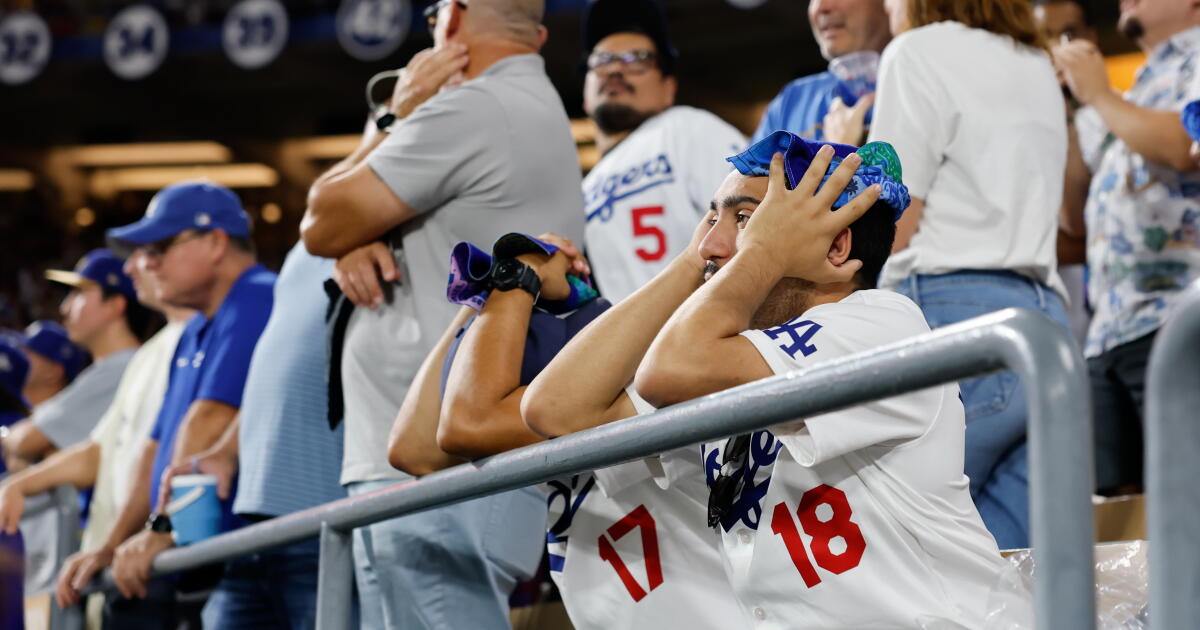
SAN DIEGO — The Dodgers claimed a series win against the San Diego Padres with a 4-2 victory Sunday, widening the gap between division rivals to 10 games.
The Dodgers (54-30), who have the best record in the majors, have won five of the first six games of a three-city trip that ends in Sacramento.
A bounce-back start from right-hander Emmet Sheehan made the Dodgers’ win Sunday possible. He held the Padres to one run, on Manny Machado’s fourth-inning homer, through five innings.
“Maybe being a little more comfortable in my mechanics,” Sheehan said after limiting the Padres to two hits. “But also just the focus in between starts of trying to get a little more execution instead of delivery thoughts. I had seven days, so I got to throw two bullpens this week, which is nice.”
It was the first time Sheehan held an opponent to a single run since May 8, when he threw 4⅔ innings against the Atlanta Braves.
“He just beared down and made pitches when he needed to,” manager Dave Roberts said, “versus feeling it with the mechanics or being uncertain.”
Mookie Betts stayed hot with his bases-loaded, two-run single off Padres starter Michael King to spearhead a three-run rally in the fifth. Betts also singled in the seventh.
Freddie Freeman had an RBI on a nine-pitch walk in the fifth, and Shohei Ohtani drove in the Dodgers’ first run with a single in the third.
“The last six weeks, Shohei’s been out of this world,” Roberts said. “Freddie’s been very consistent all year, and then now we got Mookie this last week on track. So it has been the better part of the season that we haven’t had all three of those guys. You can see it — when those three guys are threats, it just kind of takes a lot of pressure off everybody else.”
Over the three-game series, the Dodgers outscored the Padres 20-12. Here are offensive takeaways from the series:
Tucker ‘grinding’ through
Kyle Tucker hits a two-run home run against the San Diego Padres on Saturday in the Dodgers’ 15-3 win.
(Orlando Ramirez / Getty Images)
Dodgers right fielder Kyle Tucker never had been through a stretch like this. He entered Sunday with a .719 on-base-plus-slugging percentage, the lowest he’s had 77 games into a season in his career.
“I feel fine coming to the field and everything, it’s just not being as productive as I normally am, or as I want to be, kind of sucks,” Tucker said in a conversation with The Times a couple of weeks ago. “But I’ve just got to come back for the next at-bat, or the next day, and whatever, and just move on.”
Has battling this uncharacteristic slump taught him anything?
“I’d rather not suck,” he said. “But just try and grab through and just whenever anything works or clicks or whatever, just don’t let it go.”
Tucker has had moments this season when it looked like he was heading toward an offensive turnaround.
In mid-April, he homered twice in three games, including a three-hit performance. In early May, he went on a six-game hitting streak. He hit .303 over a nine-game stretch in mid-June. But none led to sustained success.
So, when Tucker logged three hits, including a home run, on Saturday as the Dodgers routed the Padres 15-3, he was cautious in his optimism. Tucker even nitpicked the nine-pitch at-bat that ended in the pull-side homer.
“There were some pitches I swung at earlier in the at-bat that I thought should’ve gotten the job done earlier, just didn’t put a great swing on it,” he said after the game.
Manager Dave Roberts was more enthusiastic about that at-bat.
“He’s handled it well,” Roberts said. “He’s frustrated, certainly. But he hasn’t run from the work. Even [Friday] night after the game, he was hitting in the cage. … You hear the word ‘grind’ a lot, but he’s grinding. It’s good to see him have some success. I just liked that one at-bat tonight where it was just compete. It wasn’t about mechanics. It was about competing and getting the job done.”
On Sunday, Tucker singled in four at-bats.
Edman’s consistency
Tommy Edman hits against the San Diego Padres on Friday.
(Derrick Tuskan / Associated Press)
There were times last year when utility player Tommy Edman could look at video of his swing and think, “OK, that doesn’t look like how I want it to look.” But there was only so much he could do in the middle of the season, while playing through nagging ankle issues.
“Part of it is kind of just breaking habits that I built last year,” said Edman, who underwent surgery on his right ankle in the offseason. “Was just getting into some bad movements with the lower body, probably just compensating for the ankle, and hips get out of whack, and that kind of stuff. So I’m hopeful that I’ll just be able to keep this up the rest of the year and just be consistent with it.”
Since returning from the injured list on June 16 to make his season debut, Edman is hitting .333 (11 for 33) with a .405 .on-base percentage. He hit his first triple and second double of the season in the Dodgers’ blowout win Saturday.
“I feel like this is kind of one of the rare times where both swings feel good, both from the right and left,” switch-hitting Edman said after that game. “It’s really tough to maintain both swings over the course of the season, so just happy that I feel that way.”
Betts is back
When Betts went three for four, a triple short of the cycle, in the Dodgers’ series finale in Minnesota last week, he couldn’t put his finger on a cue that had snapped his swing into shape over the last couple of weeks.
“Today, I was able to just find something,” he said then. “I don’t even know really what I found. After the home run the first at bat, I wasn’t sure what I did, but I just kind of stayed there. And I think that was the beauty of it. And not really fully knowing and just kind of going to play kind of let me know my training is paying off.”
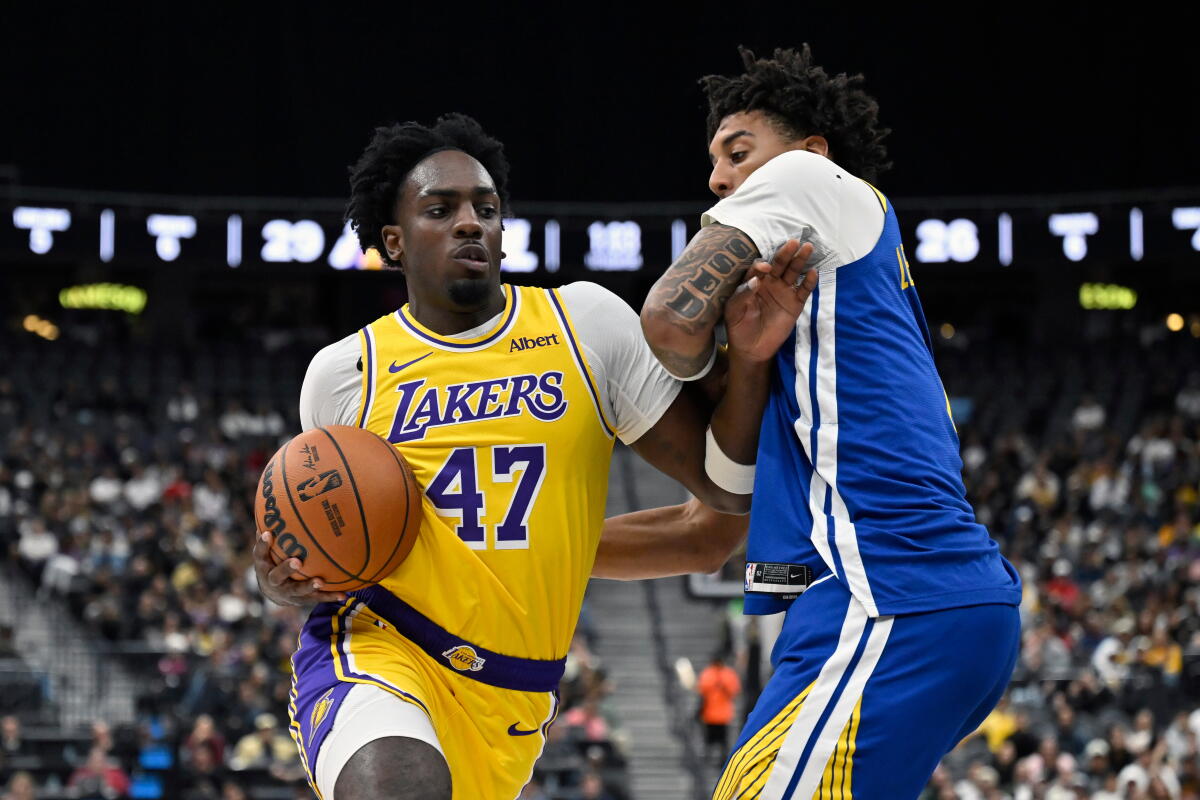
It continued playing off. That performance kicked off a three-game homer streak. And by the end of his two-week heater, Betts had raised his OPS from .591 to .737.
By Saturday night, Roberts was ready to declare that Betts was back.
“I say ‘back’ because I just think there’s more intent with him in the batter’s box and a lot less indecisiveness,” Roberts said. “So for me, if he can have that kind of proactive approach, aggressive approach, then everything else is going to take care of itself.”
Betts credited his resurgence to a shift in how he prepares for games. Instead of taking 100 swings in the cage with a specific cue, he’s building up from a blank slate every day.
“I used to have things I would think about that would produce a swing, and now I’m actually just training my body every day,” he said. “So kind of one in the same, but they’re just two completely different ways of going about it. And still trying to get fully used to it, but it’s working, so I’m not changing it.”
Remember when we were sure the World Cup would suffer from all the issues that had everyone seeing red before the first ball was kicked?
And remember when we were certain soccer could never catch on in this country?
Despite controversies over visas and ticket prices and transportation, and in spite of consternation over expansion and new rules, the game has, as usual, proved too good to fail.
And we, the American people, have become unusually engrossed in it.
We’ve been tuning in on TV in record numbers and, even at exorbitant prices, helping to sell out our 70,000-some-capacity stadiums. Before group play was even finished, this tournament — staged also in Mexico and Canada — already outdrew the 1994 World Cup, which was hosted by the United States and set an attendance record of nearly 3.6 million.
We’ve been loving the healthy cultural exchange, and we’re being reminded that cultural barriers of traditional sports fandom can be breached.
So now, to keep our interest from drying out like a pitch on a hot summer day, the goal should be to keep the market saturated with soccer. That will take Major League Soccer tearing down all the walls.
It’s already turned the page on its calendar, adopting a summer-to-spring season format that will better blend with the global game.
Now MLS needs to make its games easier to watch, and to do its part to make the sport easier to play.
Canada goalkeeper Maxime Crépeau, left, celebrates with teammate Jonathan David after a 1-0 win over South Africa at the World Cup on Sunday.
(Kelvin Kuo / Los Angeles Times)
While the proverbial iron is hot, it needs a strike like Stephen Eustáquio’s winning rocket in the 92nd minute of Canada’s 1-0 victory against South Africa on Sunday at SoFi Stadium.
Eleven players on the two teams were MLS representatives — including Eustáquio, who spent the last six months in LAFC’s midfield.
Goalkeeper Maxime Crépeau, who played two seasons with LAFC and now plays for Orlando City, stopped the only shot he saw for his second clean sheet this World Cup, which saw the Canadians succeed in their first knockout stage appearance.
There’s been no avoiding MLS players in this World Cup. The greatest of them is piling up goals for Argentina: Lionel Messi, the Inter Miami superstar, is now the all-time World Cup goal-scorer (with 19).
MLS has set an attendance record too, with 44 players participating. It ranks as the league with the second-most players apart from the top five European leagues. LAFC had three current players in the mix.
But wait. Record skip. Before you celebrate the MLS’s contributions to this soccer spectacle, check with the VAR. Yep, without the 13 MLS players representing nations that rank 40th or lower in FIFA’s world ranking, there actually would be fewer than the 37 MLS participants at the World Cup four years ago.
A baby’s first steps are for celebrating, but three decades after the league’s formation, MLS is still searching for a giant leap. It’s still having a mean time of trying to make “fetch” happen for real.
It would help to make its games more readily available — not to the already converted, but to fans who didn’t even know what they didn’t know about soccer until the World Cup began in their backyards.
MLS has already brought MLS from behind Apple’s season pass paywall. And the league and streaming service also reportedly have agreed to a revised media rights deal that will end at the end of the 2028-29 season, three and a half years earlier than expected.
But the hat trick would be to remove the need to subscribe to streaming service to watch MLS games altogether, and then get those matches onto the networks people know to tune into for their sports.
Normalize watching American soccer.
And stop gatekeeping. MLS’s developmental programs are too restrictive and exclusive — they’re not developing more soccer players, they’re curtailing who can play.
It’s in the league’s interests, and the sport’s in this country, to encourage as many players to play as much as they can — including for their high school teams, which MLS Next bars.
They’ve got people in the tent; the goal should be to make them want to stay.
To make them want to join the world’s circus, not to let it pack up and move on, out of sight and out of mind, until it swings back through years from now.