game

Dodgers Dugout: A look at the Dodgers’ previous trade deadline deals

Hi, and welcome to another edition of Dodgers Dugout. My name is Houston Mitchell. New ranking of the summer movies I’ve seen this year: 1. The Odyssey; 2. Supergirl; 3. Young Washington; 4. Disclosure Day; 5. Masters of the Universe; 6. The Devil Wears Prada 2

Are you a true-blue fan?

Get our Dodgers Dugout newsletter for insights, news and much more.

We are less than a week away from the trade deadline (Monday at 3 p.m. PT). The Dodgers have a commanding lead in the NL West and are going to make the postseason. Their current team is good enough to win the World Series, but there’s now a big question mark over Shohei Ohtani, whose knee is preventing him from pitching.

Ohtani’s last start was July 3. And, in the category of things that make you wonder, his batting stats since then: .250/.300/.500, 16 for 64, four doubles, four homers, five walks, 17 strikeouts. Could just be a down couple of weeks, which every batter goes through. But when paired with the sore knee, it makes you think.

The Dodgers are counting on getting Tyler Glasnow and Blake Snell back in August. That would give them a postseason rotation (if Ohtani can’t pitch again this year) of:

Yoshinobu Yamamoto
Snell
Glasnow
Justin Wrobleski

If Ohtani can pitch again, one of those guys drops off. But what if he can’t come back and Snell and/or Glasnow aren’t able to come back? Emmet Sheehan? Roki Sasaki? Bullpen game? Sasaki has pitched well his last couple of starts, but we’ve been down that road before.

Or do the Dodgers add a reliever? Another hitter? Stand pat?

And then add in the fact that getting someone, even someone like Tarik Skubal, guarantees nothing. The Dodgers have made big deals in the past and not won. They have made marginal deals and won it all.

What would you do? Assuming the trade is fair, which would you acquire first, a starting pitcher, reliever, batter or would you stand pat?

Click here to vote in our survey.

Maddie Lee offers her trade deadline take here.

In the meantime, here’s a look at some previous trade deadline deals by the Dodgers.

2017

—Acquired pitcher Yu Darvish from Texas for A.J. Alexy, Willie Calhoun and Brendon Davis.

—Acquired pitcher Tony Cingrani from Cincinnati for Scott Van Slyke and Hendrik Clementina.

—Acquired pitcher Tony Watson from Pittsburgh for Angel German and Oneil Cruz.

—Acquired outfielder Curtis Granderson from the New York Mets for Jacob Rhame.

Dodgers record before deadline: 74-31, .705

Record after deadline: 30-27, .526

2018

—Acquired shortstop Manny Machado from Baltimore for Rylan Bannon, Yusniel Diaz, Dean Kremer, Zach Pop and Breyvic Valera. (This trade was made July 18, but we will count it.)

—Acquired pitcher John Axford from Toronto for Corey Copping.

—Acquired second baseman Brian Dozier from Minnesota for Logan Forsythe, Luke Raley and Devin Smeltzer.

—Acquired infielder David Freese from Pittsburgh for Jesus Valdez.

Record before deadline: 59-49, .506

Record after deadline: 33-22, .600

2019

—Acquired pitcher Adam Kolarek from Tampa Bay for Niko Hulsizer.

—Acquired infielder Jedd Gyorko from St. Louis for Jeffry Abreu and Tony Cingrani.

Record before deadline: 71-39, .645

Record after deadline: 35-17, .673

2020

Nothing significant. This was the 60-game COVID season.

2021

—Acquired pitcher Max Scherzer and shortstop Trea Turner from Washington for Gerardo Carrillo, Donovan Casey, Josiah Gray and Keibert Ruiz.

—Acquired outfielder Billy McKinney from the New York Mets for Carlos Rincón.

—Acquired pitcher Danny Duffy from Kansas City for Zach Willeman.

Record before deadline: 63-43, .594

Record after deadline: 43-13, .768

2022

—Acquired pitcher Chris Martin from the Chicago Cubs for infielder-outfielder Zach McKinstry.

—Acquired left fielder Joey Gallo from the New York Yankees for Clayton Beeter.

Record before deadline: 68-33, .673

Record after deadline: 43-18, .705

2023

—Acquired Kiké Hernández from Boston for Justin Hagenman and Nick Robertson.

—Acquired pitchers Joe Kelly and Lance Lynn from the Chicago White Sox for Jordan Leasure, Nick Nastrini and Trayce Thompson.

—Acquired infielder Amed Rosario from Cleveland for Noah Syndergaard.

—Acquired pitcher Ryan Yarbrough from Kansas City for Derlin Figueroa and Devin Mann.

Record before deadline: 59-45, .567

Record after deadline: 41-17, .707

2024

—Acquired pitcher Jack Flaherty from Detroit for Thayron Liranzo and Trey Sweeney.

—As part of a three-team deal, acquired infielder/outfielder Tommy Edman from St. Louis and pitcher Michael Kopech from the Chicago White Sox for Alexander Albertus, Jeral Perez and Miguel Vargas.

—Traded pitcher Ryan Yarbrough to the Toronto Blue Jays for outfielder Kevin Kiermaier.

Record before deadline: 63-46, .578

Record after deadline: 35-18, .660

2025

Traded pitcher Dustin May to the Boston Red Sox. Received Zach Ehrhard and James Tibbs III.

Traded pitchers Paul Liñan and Eriq Swan to the Washington Nationals for outfielder Alex Call.

Traded catcher Hunter Feduccia to the Tampa Bay Rays for pitchers Adam Serwinowski and Paul Gervase and catcher Ben Rortvedt.

Traded outfielder James Outman to the Minnesota Twins for pitcher Brock Stewart.

Record before deadline: 63-46, .578

Record after deadline: 30-23, .566

See, last year, the most important acquisition was getting Rortvedt, and no one was exactly extolling his virtues when they got him. I remember when the Dodgers acquired Darvish, it seemed to guarantee the World Series title. And when they got Scherzer, that seemed like a slam dunk for the title. But you never know what’s going to happen.

And are there any trades up there that make you say, “Wow, that was a terrible deal?” No. Andrew Friedman has a great track record on trades, so, it will be interesting to see what the Dodgers do.

The postseason

Here’s a look at the NL. Remember, the three division winners plus the next three teams with the best record make the postseason. The two division winners with the best record get a first-round bye.

Division leaders
1. Dodgers, 67-39
2. Milwaukee, 66-40, 1 GB
3. Atlanta, 62-44, 5 GB

Wild-card standings
1. Chicago, 60-46
2. Philadelphia, 57-50
3. Pittsburgh, 55-52

4. Arizona, 55-52
5. Washington, 54-53, 1 GB
6. St. Louis, 53-53, 1.5 GB
7. San Diego, 53-53, 1.5 GB
8. Miami, 53-54, 2 GB
9. Cincinnati, 49-55, 4.5 GB

These names seem familiar

How notable players who were with the Dodgers the last couple of seasons are doing with their new teams (through Sunday). Click on the player’s name to be taken to their full stats page:

Anthony Banda, Twins: 2-0, 4.46 ERA, 2 saves, 34.1 IP, 31 hits, 15 walks, 33 K’s, 97 ERA+, out for the season

Cody Bellinger, Yankees: .259/.350/.420, 434 PA’s, 21 doubles, 3 triples, 11 homers, 53 RBIs, 113 OPS+, on the IL

Walker Buehler, Padres: 6-5, 5.12 ERA, 100 IP, 99 hits, 42 walks, 91 K’s, 80 ERA+

Mike Busch, Cubs: .247/.368/.405, 468 PA’s, 18 doubles, 2 triples, 13 homers, 56 RBIs, 117 OPS+

Michael Conforto, Cubs: .237/.326/.481, 178 PA’s, 11 doubles, 9 homers, 24 RBIs, 122 OPS+

Justin Dean, Cubs: .286/.444/.571, 9 PA’s, 1 triple, 3 RBIs, 1829 OPS+

Caleb Ferguson, Reds: 1-0, 3.86 ERA, 1 save, 21 IP, 23 hits, 10 walks, 20 K’s, 115 ERA+

Jack Flaherty, Tigers: 3-8, 4.59 ERA, 86.1 IP, 80 hits, 42 walks, 102 K’s, 93 ERA+, on the IL

Kenley Jansen, Tigers: 2-4, 3.90 ERA, 12 saves, 27.2 IP, 17 hits, 17 walks, 31 K’s, 111 ERA+

Craig Kimbrel, Rays: 0-2, 4.35 ERA, 31 IP, 26 hits, 12 walks, 29 K’s, 99 ERA+

Gavin Lux, Rays: on the IL

Dustin May, Cardinals: 5-7, 4.59 ERA, 104 IP, 104 hits, 33 walks, 103 K’s, 87 ERA+

Zach McKinstry, Tigers: .200/.277/.298, 277 PA’s, 8 doubles, 2 triples, 4 homers, 20 RBIs, 61 OPS+

James Outman, Tigers: .161/.219/.295, 160 PA’s, 4 doubles, 2 triples, 4 homers, 16 RBIs, 42 OPS+

Joc Pederson, Rangers: .251/.341/.491, 318 PA’s, 11 doubles, 2 triples, 17 homers, 36 RBIs, 140 OPS+

Luke Raley, Mariners: .230/.284/.447, 280 PA’s, 9 doubles, 1 triple, 15 homers, 39 RBIs, 107 OPS+

Ben Rortvedt, Mets: in the minors

Corey Seager, Rangers: .182/.292/.374, 219 PA’s, 6 doubles, 10 homers, 25 RBIs, 94 OPS+, on the IL

Justin Turner, Tijuana (Mexican League): .292/.394/.472, 254 PA’s, 21 doubles, 6 homers, 28 RBIs

Trea Turner, Phillies: .244/.295/.391, 455 PA’s, 18 doubles, 1 triple, 14 homers, 41 RBIs, 82 OPS+

Miguel Vargas, White Sox: .242/.348/.484, 449 PA’s, 24 doubles, 1 triple, 22 homers, 63 RBIs, 131 OPS+

Kirby Yates, Angels: 0-5, 3.65 ERA, 3 saves, 24.2 IP, 16 hits, 11 walks, 30 K’s, 114 ERA+

Up next

Tuesday: Seattle (Luis Castillo, 3-9, 4.85 ERA) at Dodgers (TBD), 7:10 p.m., SportsNet LA, AM 570, KTNQ 1020

Wednesday: Seattle (Emerson Hancock, 6-4, 3.16 ERA) at Dodgers (TBD), 7:10 p.m., SportsNet LA, AM 570, KTNQ 1020

Thursday: Seattle (Bryce Miller, 4-5, 2.75) at Dodgers (TBD), 7:10 p.m., SportsNet LA, AM 570, KTNQ 1020

All times Pacific

*-left-handed

In case you missed it

Tarik Skubal blockbuster deal likely isn’t part of Dodgers’ trade-deadline plans

Swanson: Hall of Famer Joe Torre passionate about going to bat for kids at risk of family violence

Huntington Beach’s Jeff Kent credits his parents for helping fuel his Hall of Fame career

Shohei Ohtani suffers setback in his plans to return to Dodgers’ rotation

Jeff Kent starting to feel like a Hall of Famer this weekend

Miguel Rojas on decision to visit Capitol Hill, White House: ‘I’m representing the Dodgers’

Dodgers Debate: The White House and the trade deadline

Lopez: 5 reasons the Dodgers should not go back to the White House again next year

And finally

Vin Scully narrates a wacky play at Candlestick Park. Watch and listen here.

Until next time …

Have a comment or something you’d like to see in a future Dodgers newsletter? Email me at houston.mitchell@latimes.com. To get this newsletter in your inbox, click here.

Source link

Who cares about LeBron’s departure? Lakers are better without him

LeBron James has decided this time, he’s taking his talents to Philadelphia.

The Lakers couldn’t be happier.

By not extending his contract a summer ago, they made it clear: They were ready to move on. And they have. They found their way to a front-line center and got a whole lot younger. And get this: They got better. In the long run and probably in a sprint too.

Maybe it seems sacrilegious to suggest they’ve improved by parting ways with the greatest player of all time and trading for a fifth-year pro who missed all but five games last season with the Utah Jazz after suffering a torn labrum.

It’s not. Not when Walker Kessler was the missing piece for these Luka Doncic Lakers.

Maybe you’re finding it hard to get fired up about the new guy with no playoff experience. And you’re used to the Lakers collecting the biggest names — not guys whose games are unfamiliar. Giannis, say. Not … Walker.

But please, stop and consider the tankathon Utah has been running; the last thing the Jazz wanted was Kessler on the court winning games for them.

You also still might be experiencing sticker shock on the Lakers’ behalf. They’re getting Kessler on a $130-million, four-year deal after completing a sign-and-trade that sent out a 2031 first-rounder, 2033 first-rounder and first-round pick swaps in 2028 and 2030.

But position, position, position is to the NBA what location, location, location is to real estate — and if this fit proves as fun as Doncic seems to believe, then Kessler’s contract is going to feel like a real fair trade on the hot center market.

Because, defensively, the Lakers’ new 7-foot-2 center is a shot-blocking, space-eating deterrent in the post. That’s invaluable when you’re going with Doncic and Austin Reaves on the perimeter.

Offensively, Kessler has good hands and good handoff timing. You can call for him to screen all day. He has a radar for the rim, sixth in the NBA in dunks per game in 2024-25.

And Kessler is a blessing on the glass, the king of second chances. His 4.6 offensive rebounds per game in 2024-25 led the NBA.

Also: LeBron is going to turn 42 this season; Kessler is 25.

Walker Kessler was a big presence in the paint for the Jazz before he got hurt last season.

Walker Kessler was a big presence in the paint for the Jazz before he got hurt last season.

(Frank Franklin II / Associated Press)

Age and experience count for a lot in life. But increasingly, today’s NBA is proving a young man’s game — and check ball, the Lakers are now in it.

Out went Deandre Ayton (28 years old), Rui Hachimura (28), Luke Kennard (30) and Marcus Smart (32). Jaxson Hayes (26) too, the only departing rotation player younger than 28.

In come Quentin Grimes (26), Sandro Mamukelashvili (27), Collin Sexton (27), Ziaire Williams (24), Jaden Hardy (24) and rookie summer league sensation Cameron Carr (21). Also, Kevon Looney, who will be Kessler’s backup big, and Matisse Thybulle, a proven defender on the wing, who are 30 and 29, respectively, and the only additions not younger than Doncic (27) and Reaves (28).

Still, I get it. You’re not wowed by the incoming group.

Were you wowed when the Dodgers acquired Max Muncy, Justin Turner or Chris Taylor? Probably not. But those guys went on to help the club win World Series titles.

Were the Dallas Mavericks banking on lob threat Derrick Jones Jr. — on a minimum contract — being a catalyst for their run to the 2024 NBA Finals? Do Lakers fans remember Doncic’s 17 assists to guys like Dante Exum, Tim Hardaway Jr. and Grant Williams in a 2023 victory over LeBron and Anthony Davis?

Doncic is manning the Lakers’ elevator now; it’s his job to lift his teammates to new heights. He can do it. He better do it.

Because the margins can be major, but they don’t account for most of the Lakers’ offseason grade this summer.

So give them a B+.

Not an A. No, because not every assignment has been completed.

There’s the minor matter of a starting five. The Lakers don’t appear to have one of those just yet.

They might yet add Jonathan Kuminga at forward. Or perhaps someone already rostered — hello, 22-year-old, skyscraping Adou Thiero — is waiting to wow us all in that role?

Normally, not having an answer to the most basic of questions at this point in the summer would fail you.

But this year is different.

Filling the hole at center was weighted so heavily among the Lakers’ priorities — and landing Kessler earned them so much extra credit — it bumps their grade almost all the way up.

Of course, this was only the introductory course.

The real tests for this fresh new roster — down an all-time talent but so much more solid in the center — come when the season begins. Or, really, when the postseason does.

And expecting that opponents won’t have an easy time coming up with answers for Doncic and his new dominant defensive center, the Lakers are now set up to score well there too.

Source link

Tradition-rich UCLA softball has deep impact on AUSL

Natasha Watley grew up dreaming about playing for the Atlanta Braves.

Sharlize Palacios wanted to suit up for her hometown San Diego Padres.

Megan Grant and Maya Brady thought softball would end after graduation.

The 2003 Honda Award winner. A 2024 second-team All-American. The single-season NCAA home run record holder. And a freshman of the year honoree.

The Portland Cascade's Megan Grant fields the ball during a game against the Oklahoma City Spark.

The Portland Cascade’s Megan Grant fields the ball during a game against the Oklahoma City Spark on July 4 in Edmond, Okla.

(Courtesy of AUSL)

All of whom never dreamed of being a professional softball player. Not because their love for the sport dwindled. Nor because professional routes were not an option. Pro softball leagues have existed since 1976, but they have lacked the visibility and accessibility imperative to flourishing and gaining popularity.

“From my experience growing up, and it’s the same amongst a lot of athletes that are my age, we didn’t have a lot of role models to look up to,” said Chicago Bandits outfielder Jessica Clements, who spent her senior season at UCLA in 2025. “We had Jennie Finch, Natasha Watley, Monica Abbott, but the odds of playing professionally were slim. There wasn’t a lot of opportunity, and a lot of younger kids were unsure of what the environment would look like in many years.”

That’s changing with AUSL, the Athletes Unlimited Softball League.

The AUSL — which launched in 2025 and builds off previous iterations of professional softball — saw a 181% increase in average viewership across ESPN platforms in one year, including a record-high 404,000 viewers for a June 21 game between the Portland Cascade and Texas Volts.

Among the 96 active players in the AUSL, 13 are former UCLA softball players — omitting two general managers, a head coach and an assistant coach that are a part of the AUSL and hail from the Westwood program — making UCLA the most well-represented school in the league. That pipeline was on full display this weekend at Texas A&M’s Davis Diamond, where the Utah Talons — who boast a roster with five former Bruins, including UCLA softball associate head coach Lisa Fernandez as the general manager — clinched their second straight AUSL title over the Chicago Bandits on Sunday. UCLA alum Jadelyn Allchin was named the AUSL championship MVP.

And UCLA softball’s presence in all facets of AUSL is no coincidence.

The Bruins feature 12 NCAA championships and 119 All-American honorees, both of which rank first all time, and that’s not including an AIAW title and one All-American before the NCAA era. But while the program is known for its accolades, the influence UCLA and its players have made on the sport stretches far beyond any banners or trophies.

“When you look at the history of softball in the last 40 years, you can’t see a U.S. national team, any pro venture or excellence at any level of softball without having an influence of UCLA in it,” said Oklahoma City Sparks general manager Kirk Walker, who spent 24 years coaching as an assistant coach in Westwood.

There have been only three coaches — Sharron Backus, Sue Enquist and Kelly Inouye-Perez — in UCLA history, all of whom created unparalleled success and a program built on a standard of excellence and a familial culture. But no aspect of the UCLA culture may be more significant than the “Bruin Bubble” — a concept at the very heart of the program centered on alumni involvement.

“It comes from the women who were there from the beginning, paving the way for players like us and players that are to come,” said Sparks infielder Delanie Wisz, who competed at UCLA from 2020 to 2022. “The idea of the ‘Bruin Bubble’ and buying into something bigger than yourself, coach Sue Enquist, coach Sharron Backus and coach Inouye-Perez have done a really good job of keeping that at the forefront, and making sure that we’re playing for something much bigger than any individual award.”

While the childhood aspirations of the Bruins in the AUSL never reached the height of professional softball, a common goal connected them all — playing for their dream school in Westwood and learning from individuals who have achieved immeasurable success greater than any record or championship.

Utah Talons General Manager Lisa Fernandez shows off her 2025 AUSL championship ring in Salt Lake City, Utah.

Utah Talons General Manager Lisa Fernandez shows off her 2025 AUSL championship ring in Salt Lake City, Utah.

(Courtesy of AUSL)

Backus and Enquist set the foundation for what softball is today, paving the way for new opportunities by sacrificing for the greater good of softball’s future.

While the duo set the trail ablaze, they have passed the baton to a trio of coaches — Inouye-Perez, Walker and Fernandez, who have spent a combined 72 years in Westwood.

And the group has not stopped running since.

The Bruins are not only responsible for creating the next generation of pro softball players through the UCLA program, but also furthering the message and mission of Backus and Enquist.

“From when I was in college to now, there’s been a big shift in how things go,” said Rachel Garcia, two-time Honda Cup winner at UCLA and a Volts pitcher in the AUSL, “but at the end of the day, Lisa Fernandez, Kelly Inouye-Perez, Kirk Walker, that would be who I’d want to play for every single day, because I know that they are able to give the girls what they need in order to perform at the best that they can be.”

While Inouye-Perez continues to steer the Bruin ship, Walker and Fernandez serve in general manager roles for the Sparks and Talons, respectively.

The Utah Talons' Jordan Woolery fields the ball during a July 11 AUSL game against the Oklahoma City Spark.

The Utah Talons’ Jordan Woolery fields the ball during a July 11 AUSL game against the Oklahoma City Spark in Edmond, Okla.

(Morgan Givens / AUSL)

Grant emphasized that all three coaches could easily walk away because of the imprint they left and the resume they built. Yet, Inouye-Perez and Fernandez not only chose to stick around the game, but to reinvest their time in furthering the league and sport altogether.

“I accept the responsibility to help carry the torch and move it forward, and hand it off to the Jennie Finches and the Cat Ostermans,” Fernandez said. “They’re going to hand it off to the next generation that are going to continue to build this game and hopefully it’ll become something where little girls can go, ‘I’m going to be a professional softball player, and be a role model for those who have the opportunity to watch me.’ And at the end of the day that’s the true value.”

Integral to pushing the game forward is taking advantage of the traction and momentum gained by the 2028 Summer Olympics, where softball will return to the stage for the first time since 2021.

Fernandez highlighted that when softball was added to the Olympics in 1996, it was the pinnacle of the sport. But when it was removed following 2008 because the IOC didn’t see enough global competition for the gold medal, she felt that she failed. It was a setback that inspired her push to get the sport to a place where it did not have to rely on the host country to include it among Olympic events.

“A mission that’s close to my heart is the growth of the sport globally because it is so important for it to be in the Olympics, not just in 2028 but in 2032,” said Talons pitcher Megan Faraimo, who competed at UCLA from 2019 to 2023. “I don’t want to be the last generation to make it into the Olympics. I want to protect the future of everyone coming after me, and that means capitalizing on it being in L.A. We can use that to then push the sport into 2032 and hopefully get back on that Olympic rhythm.”

Source link

Inside Rams’ camp plan to limit Matthew Stafford, test Ty Simpson

Ty Simpson did not make any jaw-dropping plays.

He also did not make any major errors.

So call it a quiet, workmanlike beginning for the 13th player taken in the NFL draft, a quarterback the Rams ostensibly chose to become Matthew Stafford’s heir apparent.

On Sunday, in the Rams’ first training camp practice, Stafford was held out as part of the plan to limit his reps, putting all eyes on Simpson and fourth-year pro Stetson Bennett as they began their competition to back up the reigning NFL most valuable player.

With Stafford, 38, back for an 18th season, the Rams are favored to win the Super Bowl.

But with Jimmy Garoppolo enjoying retirement — probably until an NFL team in desperate need comes calling — the Rams require a capable backup should something befall Stafford, who remains the most important player on a star-studded team favored to win Super Bowl LXI at SoFi Stadium.

Nate Scheelhaase, the Rams’ first-year offensive coordinator, praised Bennett and Simpson.

“We require so much of those guys, from what we do with formations with motions, with adjustments that they’re going to make before the ball is even snapped,” Scheelhaase said. “And so, if you can’t get that right, it’s going to be hard to get anything right post snap.

“So that’s the starting point. That’s the foundation.”

Rams quarterback Ty Simpson prepares to take a snap in training camp at Loyola Marymount on Sunday.

Rams quarterback Ty Simpson prepares to take a snap in training camp at Loyola Marymount on Sunday.

(Robert Gauthier / Los Angeles Times)

Last season, with Stafford sidelined throughout camp because of a back issue, Bennett took second-team reps behind Garoppolo.

Bennett has never taken a regular-season snap for the Rams, who selected him in the fourth round of the 2023 draft after he led Georgia to two national titles.

“He competes,” Scheelhaase said. “And I think anybody enjoys playing with a quarterback who competes, who’s going to throw it all in there, and that’s the mentality he has. … That’s something that’s been kind of his calling card.”

Bennett completed several passes to receivers Puka Nacua and Davante Adams and running back Kyren Williams.

He also was on the wrong side of the play of the day.

Bennett’s deep pass for Adams along the left sideline was tipped by new cornerback Jaylen Watson and intercepted by safety Kamren Kinchens.

Rams quarterback Stetson Bennett, left, twirls a football in front of quarterback Ty Simpson at training camp on Sunday.

Rams quarterback Stetson Bennett, left, twirls a football in front of quarterback Ty Simpson at training camp on Sunday.

(Robert Gauthier / Los Angeles Times)

Simpson started only 15 games for Alabama, but the Rams apparently saw enough to determine he was worthy of using their highest pick since selecting quarterback Jared Goff No. 1 overall in 2016.

On Sunday, Simpson completed several short passes. His deepest attempt, for tight end Terrance Ferguson, was broken up by cornerback Cam Lampkin.

Bennett and Simpson will continue to compete during 10 more training camp workouts, preseason practices — including joint practices with the Dallas Cowboys and New Orleans Saints — and preseason games against the Kansas City Chiefs, the Saints and the Chargers.

On Monday, in keeping with coach Sean McVay’s stated plan to have Stafford practice in the second and fourth practices of each four-day block, the starting quarterback will practice for the first time.

Etc.

Offensive lineman Justin Dedich was placed on the non-football injury list. Dedich, a third-year pro who played at USC, started six games last season. … Second-year running back Jarquez Hunter broke off a run for a long gain.

Source link

Dodgers’ strong road trip finishes with bullpen meltdown vs. Mets

Dodgers reliever Will Klein had just induced the Mets’ Marcus Semien to whiff on a high fastball. So, he went there again, a little further inside. But Semien got a hold of it for a three-run home run that put the game thoroughly out of reach.

The Dodgers ended an impressive road trip on a sour note with the 8-3 loss to the New York Mets.

They went 6-3 on their East Coast swing and won series against the New York Yankees, Philadelphia Phillies and Mets.

“It’s great,” manager Dave Roberts said Saturday night. “It seems like we’ve been on the road a long time, but the travel has been nice as far as staying in this time zone. We’re finding ways to win. So that’s the main thing. That’s the object of the game.”

The Dodgers’ All-Stars, as well as Roberts and his coaching staff, left for Philadelphia two weeks ago. The rest of the team met them in New York for three games against the Yankees. Then they traveled to Philadelphia for a three-game set, took a detour to Washington to visit the White House before returning to New York.

“It’s been a long road trip — especially for the guys who went to Philly for the All-Star Game,” right fielder Kyle Tucker said. “Being able to come out of the break and play some really good teams and put together really competitive at-bats and great innings from our pitching staff is huge. Some of the guys are kind of grinding in terms of how long they’ve been away from L.A. It’s kind of part of it. You’ve got to come out and play regardless and they’ve done a great job of that.”

Even so, the Dodgers (67-39) played cleaner baseball on this extended road trip — a couple baserunning mistakes aside — than they did in the homestand before the break.

Maybe the Dodgers just needed time off to reset.

Against the Mets (44-62) on Sunday, the first couple innings didn’t look promising. After Shohei Ohtani led with a double and Max Muncy drew a two-out walk, both were left stranded.

A.J. Ewing’s lead-off double against Dodgers starter Emmet Sheehan, however, almost immediately led to a run. Francisco Lindor then sent a low changeup into shallow right field for an RBI single.

The Dodgers’ three-up, three-down second inning ended when Teoscar Hernández tried to stretch a single into a double and ran into an out. Then, Sheehan hit Tyrone Taylor with a pitch to start the bottom half of the inning.

Sheehan retired the next three batters as the Dodgers started to take control. They pulled into the lead with a two-run third inning, powered by doubles from Eliézer Alfonzo — his second double in as many appearances — and Freddie Freeman.

The Dodgers manufactured another run the next inning with a pair of singles, an error by Mets first baseman Jared Young, and a run-scoring double play.

As the Dodgers bullpen took over in the sixth, however, the game slipped away. Jack Dreyer walked two batters and recorded just one out in the sixth inning before Roberts replaced him with Evan Phillips.

In a 1-1 count, Phillips threw a sinker on the inside edge of the strike zone, and Taylor lifted it into the left-field stands for a go-ahead three-run homer. Phillips, who last week talked about rewiring his rehab mindset, has already surrendered four home runs in just seven outings.

A run-scoring passed ball from Dalton Rushing and Semien’s three-run blast in the seventh ultimately sealed the win for the Mets.

Source link

Jonquel Jones leads Team Spoon to win in WNBA All-Star Game

Jonquel Jones had 22 points, 13 rebounds and eight assists, helping Caitlin Clark and Team Spoon outlast Marina Mabrey and Team Coop 129-122 in the WNBA All-Star Game on Saturday night.

Dominique Malonga had a first-half dunk for Team Coop, but Team Spoon had eight players score in double figures in an All-Star Game that featured 127 three-point attempts and very little defense. Allisha Gray had 19 points for Team Spoon, and Clark finished with 17.

The WNBA celebrated its 30th season by holding its first All-Star Game in Chicago since 2022. This time, the marquee event was played in front of a record crowd of 19,783 at the United Center instead of the smaller Wintrust Arena in downtown Chicago, a sign of how much the league has grown.

Jones, a 32-year-old center for the New York Liberty, was named MVP. Nneka Ogwumike scored 11 points for Team Spoon while passing Maya Moore (119) for the most career points in All-Star Game history.

Kelsey Mitchell had 28 points for Team Coop, and Mabrey scored all of her 23 points during a red-hot first half. Malonga finished with 12 points and 13 rebounds.

WNBA greats Cynthia Cooper and Teresa Weatherspoon drafted the All-Star teams from players that were either voted as starters by fans, media and fellow players or chosen as reserves by the league’s coaches. Las Vegas’ Becky Hammon coached Cooper’s team, and Minnesota’s Cheryl Reeve was in charge of Weatherspoon’s squad.

Clark went 5 for 15 from beyond the arc and had five assists in her return to the All-Star game. The Indiana Fever guard missed last year’s event in Indianapolis because of a groin injury.

The 24-year-old Clark came out firing, connecting from 33 feet and 37 feet on her way to 11 points in the first 2 1/2 minutes. She buried another three early in the second quarter off a slick no-look pass from Minnesota Lynx guard Olivia Miles, the only rookie selected for the game.

Clark and Mabrey each put on an offensive show, but Malonga got the biggest cheer of the night. The 6-foot-6 center from the Seattle Storm ran down the lane, got a pass from Angel Reese and threw down a right-handed jam with 6:24 left in the first half.

Reese jumped up and down as Malonga finished the play, and the two exchanged a mid-air chest bump on their way back down the court.

It was the first dunk in a WNBA All-Star Game since Sylvia Fowles in 2022. Lisa Leslie (2005), Jones (2017), Brittney Griner (2019) also have accomplished the feat.

Leslie was on hand for the festivities, along with South Carolina coach and former WNBA guard Dawn Staley. Former NBA star Dwyane Wade also was courtside.

Cohen writes for the Associated Press.

Source link

Letters: Negatives outweigh positives in Dodgers’ White House visit

p]:text-cms-story-body-color-text”>

Dear Dave Roberts: I was totally disgusted to see you at the Dodgers’ White House ceremony pandering to Trump. As far as I was concerned, you made a complete fool of yourself. I’m sure many Dodgers fans were equally horrified with your behavior.

Susan Stann
Temecula


Today’s visit to the White House was baseball, not politics. It was a boost for MLB, not columnists who try to be political hacks with personal bias. If the hacks or detractors listened to the references it was all about achievement in what the team did to win. The Dodgers are part of the entertainment industry which annually draws maybe a billion fans or more and certainly billions of dollars. The hacks and detractors will not be convinced otherwise but if you line up any 50,000 fans at a game, you will see a positive vote for the privilege of going to the White House. Baseball wins, sports wins, the entertainment industry wins, and America wins. Boo the hacks and the ignorant detractors.

Bill Koury
La Cañada


Dave Roberts justifies his appearance with Donald Trump because it is a “baseball tradition” that should be honored.

I didn’t hear him protesting to uphold other baseball traditions such as banning Black players from baseball, not having designated hitters, or starting with a runner on second base in extra innings.

Traditions come and go. It seems Mr. Roberts traded his moral compass for a trip to the White House lawn.

David Griffin
Westwood


In my dreams Dave Roberts says, “Nope, not gonna go to the White House. If they want to fire me, let ‘em.” Dream on.

Jay James
Pico Rivera


I will suggest the nuclear option. The Dodgers should never again visit the White House. No matter who is president.

Dennis Doherty
West Los Angeles

Source link

Dodgers’ Miguel Rojas on why he decided to visit the White House

Miguel Rojas’ off day in Washington started early. Before visiting the White House, he and fellow World Series hero Will Klein and manager Dave Roberts met with members of Congress on Thursday morning.

“Other than going to the White House, there were a lot of people from California, senators from California that are not just people who work for the government, but they’re Dodgers fans as well,” Rojas said Friday before the Dodgers’ series opener against the Mets. “So it’s pretty cool to give people that watch games and support us throughout the year [an opportunity] to get to see us.”

Sen. Alex Padilla (D-Calif.) posted on X, “Think we can do this every year, @Dodgers?” with three photos — one of himself with their back-to-back World Series trophies, another posing with a World Series ring on his finger, and a group shot that included Rojas, Roberts, Klein and Dodgers president Stan Kasten.

Rep. Luz Rivas (D-North Hollywood), whose district includes several San Fernando Valley neighborhoods, posted on social media that she thanked Rojas for hitting his tying home run in Game 7of the World Series.

“Thank you to Miguel and the team for stopping by Capitol Hill,” she posted on X. “We can’t wait to welcome them back again next year (with a THIRD trophy, perhaps?…).”

The Dodgers’ visit to the White House on Thursday frustrated the portion of their fan base that wanted their team to stand up against the president’s anti-immigration policies.

Only two players on the active roster who were part of the 2025 World Series team did not attend: shortstop Mookie Betts, who told reporters he’d rather spend time with his family, and reliever Edgardo Henriquez, who declined to comment via Dodgers PR.

“This is something that I don’t really think about [being] political,” Rojas said of visiting Capitol Hill and the White House. “…I’m representing the Dodgers, and I’m going to these events just because I’m part of the Dodgers, and the Dodgers are deciding to go there. And I feel, as a professional, your job doesn’t just stop when the game is over. You have to do some things outside the field that sometimes are tied to success and to the things that you do on the field. So, for me, it’s a privilege to get the opportunity to go to a place where you will never be if you don’t have success in sports.”

Roberts, who has also talked about separating the visit from politics, kept his review brief.

“It was good,” he said. “It was an honor to be there.”

Ohtani update

Dodgers two-way star Shohei Ohtani is scheduled to throw a bullpen session Saturday, his second since receiving an injection in his left knee at the beginning of the All-Star break.

“That’s the beauty of where we’re at right now,” Roberts said. “We’re not going to push him. There’s constant conversation going on each day. But the main thing is with Shohei and this pitching thing is to remain nimble.”

Even if Ohtani’s bullpen goes well, Roberts said he probably won’t be ready to return to the rotation next week.

“That’s too early,” Roberts said. “I feel good that it won’t be next week.”

Source link

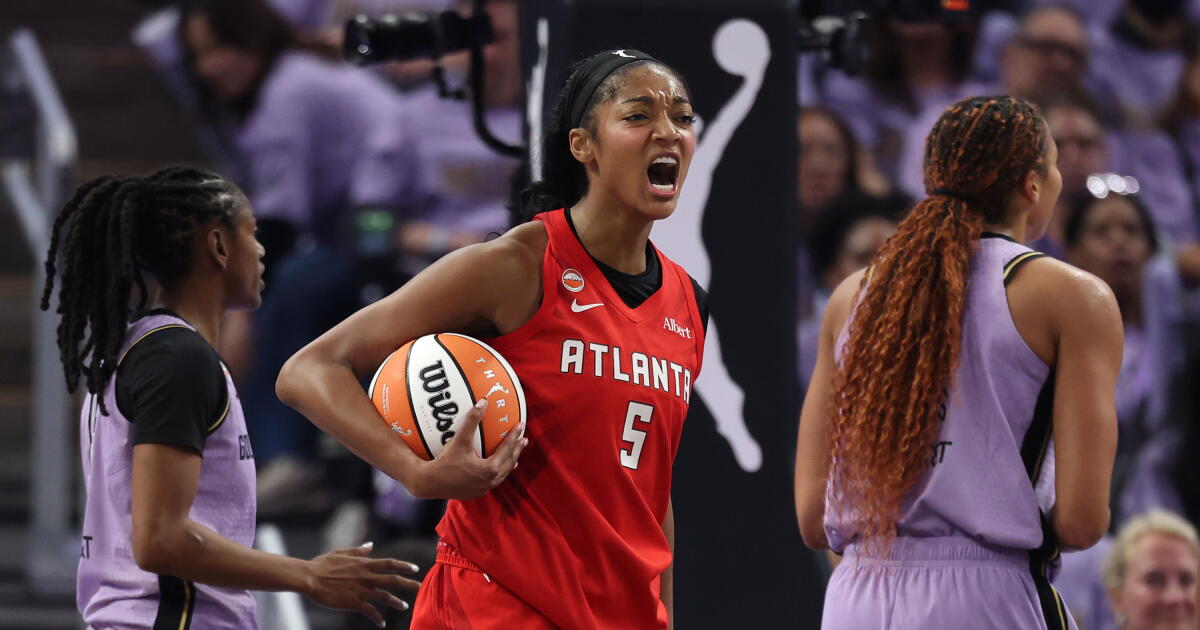
Angel Reese gets own Barbie in return to Chicago for All-Star Game

Bayou Barbie is back in Chicago. With her own Barbie, too.

Angel Reese is playing in her third WNBA All-Star Game on Saturday at the United Center. This time, she is representing Atlanta in her first season with the Dream after a messy split with the Chicago Sky.

“It’s so crazy, full circle,” Reese said, “I’m back here in Chicago, again, where it kind of all started. … Coming to Atlanta, I mean it’s been a dream come true, literally. It’s helped me in so many different ways.”

Reese, 24, is on “Team Coop” for this weekend’s showcase event, alongside Dallas Wings guard Paige Bueckers and New York Liberty forward Breanna Stewart. Indiana Fever guard Caitlin Clark and four-time MVP A’ja Wilson of the Las Vegas Aces headline “Team Spoon.”

WNBA greats Cynthia Cooper and Teresa Weatherspoon drafted the All-Star teams from players who were either voted as starters by fans, media and fellow players or chosen as reserves by the league’s coaches. Las Vegas’ Becky Hammon is coaching Cooper’s team, and Minnesota’s Cheryl Reeve is in charge of Weatherspoon’s squad.

“Honestly I’m just really happy to be here and be surrounded by so many amazing women and All-Stars and Hall of Famers and people that I’ve looked up to my entire life,” Bueckers said. “I never want to take these moments for granted and just really soak it up and enjoy building relationships with people.”

All-Stars Angel Reese, left, and Paige Buekers, right, joke around before practice at the Obama Presidential Center on Friday

All-Stars Angel Reese, left, and Paige Buekers, right, joke around before practice at the Obama Presidential Center in Chicago on Friday.

(Paul Beaty / Associated Press)

Minnesota guard Olivia Miles, part of “Team Spoon,” is the only rookie picked for the All-Star Game in the WNBA’s 30th season. The No. 2 pick in this year’s draft is averaging 19.3 points and 5.9 assists in 26 games for the Lynx.

“It’s definitely weird being the only rookie, but I know I belong and I’m happy to be here,” Miles said. “It’s an honor. Definitely grateful, and, yeah, just soaking it all in.”

Reese starred at LSU before she was selected by Chicago with the No. 7 pick in the 2024 draft. The 6-foot-4 forward earned the nickname “Bayou Barbie” while helping the Tigers win the 2023 national championship.

Fast forward to Friday, when Mattel unveiled a Reese Barbie doll with a pink Angel No. 5 jersey and special Reebok basketball shoes.

“I remember, I think it’s been three years now, since the Bayou Barbie came about when I was in Baton Rouge, and I used to put Barbie stuff on merch and stuff, and I wasn’t really supposed to,” Reese said. “So I told them I really wanted to have a Barbie doll one day, and to have Barbie is, like, you got to be iconic.”

Reese averaged 14.1 points and 12.9 rebounds over two seasons with Chicago. But the Sky won just 23 games in during that time.

Reese was critical of Chicago’s play at the end of last season. She apologized to the team for her comments and was suspended for the first half of a game against Las Vegas.

She was shipped off to her new home in April, traded to the Dream for two first-round draft picks.

“The double-doubles, they don’t matter unless we’re winning,” Reese said. “So I’m just really happy to be with Atlanta. They have welcomed me with open arms. It feels like a really safe place for me. It’s the safest I’ve ever felt, the most loved I’ve ever felt. And I’m really happy to be with them.”

Atlanta is 16-10 at the break, and Chicago has a 9-18 record. Reese is one of three All-Stars from the Dream, joining Rhyne Howard and Allisha Gray.

While Reese is suiting up for “Team Coop,” Howard and Gray are playing for “Team Spoon.” Weatherspoon coached Chicago during Reese’s rookie year.

“I love her. Like you see her, she’s so positive,” Reese said of Weatherspoon. “She comes in every day and just is always just happy. And you just want somebody in your life like that. And she’s a legend. She’s a legend of the game. She’s done a lot of amazing things that I want to do as well.”

Source link

Rams unveil new ‘Classic Sol’ and ‘Fearsome White’ uniforms

Entering a season in which they are favored to win the Super Bowl, the Rams have added uniforms that pay homage to past glory.

On Thursday night, during a fan event at the YouTube Theater in Inglewood, the Rams unveiled two alternate ensembles that commemorate their 1951 NFL championship team and their storied defensive front of the 1960s and ‘70s.

The “Classic Sol” uniform features a yellow jersey that honors the 75th anniversary of the Rams’ title. The “Fearsome White” uniform harks to the storied Fearsome Foursome defensive line that featured Deacon Jones, Merlin Olsen, Lamar Lundy and Rosey Grier.

Rams players Byron Young, Kobie Turner, Braden Fiske and Myles Garrett show off the Rams' new "Fearsome White" uniforms.

Rams defensive players (from left) Byron Young, Kobie Turner, Braden Fiske and Myles Garrett show off the Rams’ new “Fearsome White” uniforms.

(Los Angeles Rams)

Kathryn Kai-ling Frederick, the Rams’ chief marketing officer, said the uniforms have been in the works for two years and were “heavily requested” by fans.

SoFi Stadium will be the site of Super Bowl LXI, and the Rams made several blockbuster offseason moves to increase their chances of playing in it.

“Being able to not only inspire fans who’ve been asking for this, but also to educate modern L.A. Rams fans about era after era of championship DNA and success can only inspire us as we come back and host the Super Bowl,” Frederick said this week.

Rams defensive end Kobie Turner wears the Rams new "Classic Sol" uniform.

Rams defensive end Kobie Turner wears the Rams new “Classic Sol” uniform.

(Los Angeles Rams)

The Rams’ so-called closet now includes five uniforms, including two recently updated uniform combinations — one that was introduced in 2020, the other in 2021 — a black “Midnite Mode” rivalries uniform that debuted last season and the two new alternate uniforms.

The Rams will wear the “Classic Sol” uniform for the home opener against the New York Giants on “Monday Night Football” on Sept. 21, and for their Dec. 3 game against the Kansas City Chiefs on “Thursday Night Football.”

The Fearsome White uniform will be worn for the Nov. 25 “Thanksgiving Eve” game against the Green Bay Packers.

“The entire game experience is all going to be predicated around what we’re wearing on the field,” said Cory Befort, the Rams’ executive creative director, adding that the environment will be “an immersive world for fans to experience for each one of these uniform designations on the field.”

Along with the yellow jersey, the “Classic Sol” jersey includes era-specific number design and three blue shoulder stripes.

The “Fearsome White” uniform features a helmet that includes white horns and a white face mask.

Rams wide receiver Puka Nacua shows off the team's new "Classic Sol" uniform.

Rams wide receiver Puka Nacua shows off the team’s new “Classic Sol” uniform.

(Los Angeles Rams)

“To see the Los Angeles Rams uniforms that we wore 60 years ago on the playing field now, reminds me of the importance of being a team player,” Grier said in a statement released by the Rams. “We selflessly prioritized the team’s collective success over individual stats or personal glory.

“As strong teammates, we supported each other through the inevitable ups and downs of the NFL season. Whether we had those uniforms on or off, we were accountable teammates, trusting each other to do our job flawlessly.”

Rams offensive lineman Steve Avila wears the Rams' new "Fearsome White" uniform.

Rams offensive lineman Steve Avila wears the Rams’ new “Fearsome White” uniform.

(Los Angeles Rams)

Source link

Chad Tracy’s record Red Sox win streak mirrors dad Jim’s Rockies run

Winning streaks bring a life of their own to a clubhouse, each day presenting another opportunity to extend the joy and methodically build a feeling of invincibility.

Inevitably the streak ends and everyone sighs, reflects and returns to work. The Boston Red Sox lost the second game of a doubleheader Wednesday to end a win streak that tied an 80-year-old club record when it reached 15 in the opener.

Boston interim manager Chad Tracy stepped into the clubhouse to say a few words afterward but saw veteran players Willson Contreras and Sonny Gray speaking to the team and allowed them the moment.

“We just won 15 games in a row, and I think all of us knew it was going to end at some point,” Tracy said.

Call it the “Tracy Turnaround” redux.

Tracy had never managed, coached or played at the major league level before replacing Alex Cora on April 25, but he was well-versed in experiencing the glorious ride of a winning streak and its abrupt end. His father, Jim Tracy, managed the Dodgers, Pittsburgh Pirates and Colorado Rockies from 2001-2012.

Like his son, Jim Tracy was given an interim manager title when he replaced Clint Hurdle in May 2009 after Colorado’s poor start. It took only a few weeks before the Rockies won 11 games in a row, 17 of 18 and finished 74-42 to make the playoffs.

This year’s Red Sox can only hope their U-turn under Chad Tracy mirrors his dad’s. Boston was 32-46 before winning 20 of 23, including the 15-game win streak.

No surprise that father and son discussed the similarities. Chad was a double-A first baseman with the Texas Rangers in 2009 and closely followed his dad’s fortunes.

“I remember the [Rockies’] run,” Chad said. “You know, we talk very basically about just, he’s excited [about the Red Sox]. He’s a baseball fan. He’s watching constantly, and he’s fired up for it. So, like, we haven’t done a whole lot of comparing to that, but he’s just — he’s a Boston Red Sox fan.”

Jim was rewarded by becoming the second interim manager in MLB history to win the Manager of the Year award. Chad could be in the running to be the third, especially if the Red Sox make the playoffs.

They already are only the sixth father-son combo to manage in the major leagues, following Bob and Aaron Boone, George and Dick Sisler, Bob and Joel Skinner, Buddy and David Bell, and Felipe Alou and Luis Rojas.

The achievement isn’t lost on Jim Tracy, who became so emotional upon learning his son was named interim Red Sox manager he pulled his car to the side of the road. He attended Chad’s first game, a victory over the Baltimore Orioles, on the top step of the dugout.

“One thing that jumped out at me,” Jim Tracy said, “was that when he was presented to the media, his body language in the dugout…. he was not overwhelmed or fazed with anything that was going on. He was ready to do whatever was asked of him.”

That Chad replaced Cora, who led the Red Sox to the 2018 World Series title in his first season, elicited mixed feelings. Cora played with the Dodgers from 1998-2004, including four seasons under Jim.

“It’s a wonderful day, but in some respects, it’s bittersweet,” Jim said the day of Chad’s managerial debut. “I’m proud of [Chad], but the Tracy family loves and respects Alex Cora.

“You have to go back with some special years I had in Los Angeles and Alex was very much a part of that. Bittersweet is the right word because Alex was so good to my son and took such good care of him. But it was reciprocated.”

Source link

Asian baseball fan culture is coming to Irvine’s new minor league team

Would he get his own song?

Lars Nootbaar grew up in Southern California, playing for USC and attending games at Dodger Stadium. His mother is from Japan, so he played with Shohei Ohtani on Team Japan in the 2023 World Baseball Classic.

In Japan, fans come up with a song for each player and sing it happily and relentlessly. Nootbaar played in the major leagues, not in the Japanese league, so he was not sure he would get a song until he came up to bat.

“I don’t know how everybody in the stadium knew how to do it,” the St. Louis Cardinals outfielder said Wednesday at Angel Stadium. “Everybody was chanting it. It was pretty awesome.”

Japan's Lars Nootbaar, center, smiles as he attends a group photo session prior to a World Baseball Classic practice in Tokyo

Japan’s Lars Nootbaar, center, played for Team Japan in the 2023 World Baseball Classic.

(Eugene Hoshiko / Associated Press)

In Japan, baseball games are nine innings of songs and chants, drums and noise sticks. No excessively caffeinated in-game hosts. No scolding video commands to make some noise. The joyful sounds are organic, and they come from the fans.

Nootbaar attended Yoshinobu Yamamoto’s last game in Japan and absolutely raved about the energy in the stadium. Does he believe that kind of fan experience would translate to an American ballpark?

“I don’t see why not,” Nootbaar said. “It would probably have to start small, but it would be cool to integrate that.”

We’re starting small, and soon. A minor league team plans to launch in Irvine next year, and the entrepreneur behind it is pitching it as a way to provide fans with a taste of Asian baseball.

“We’re going to really lean into some of the innovation in fan experience that you’ve seen in Korea and Japan,” said Paul Freedman, co-founder of Innovation Baseball Partners.

“We’ll be the first, to our knowledge, to bring that as the fan experience of an American baseball team.”

The team would play in the Pioneer League, the independent league in which Freedman and his partners previously launched teams in Oakland and Long Beach. In Oakland, the ballpark is a pop-up. In Long Beach, the team plays at 70-year-old Blair Field.

Irvine hits the sweet spot: a glistening new community ballpark in as targeted a demographic as an Asian-themed team could want. In Irvine, which has about 320,000 residents, 44% of the population is Asian.

The defending champions of Korea’s league last year held spring training in Irvine. More Koreans live there than in any city in the United States besides New York or Los Angeles.

Asian food will be available at the games, as will hot dogs.

On Tuesday, the Irvine City Council is scheduled to consider a five-year contract with Innovation Baseball Partners, under which the team could sell naming rights to the Great Park stadium and would split the revenue with the city 50-50. The agreement also provides a framework for potential expansion of the stadium from 1,300 to 3,000 seats.

Don Wakamatsu, who runs baseball operations for Freedman’s teams, was the first Asian-American manager in major league history and managed Hall of Famer Ichiro Suzuki with the Seattle Mariners.

Ichiro won’t be playing in Irvine — the Pioneer League limits players to no more than two years of professional experience — but Wakamatsu plans to tap into his network to ensure the team has an Asian manager or coach and a nucleus of Asian players.

Wakamatsu described Freedman’s model of minor league teams as “somewhere between conventional baseball and the Savannah Bananas” and believes the Asian style could take hold in Irvine.

“If we can truly capture some of that excitement and fan interaction,” Wakamatsu said, “I think we’ll get a deeper connection with the players.”

To help launch the Irvine team, Freedman tapped two Korean-Americans: Martin Kim, a onetime interpreter to former Dodgers pitcher Hyun-jin Ryu and international business development executive with the Dodgers and Major League Baseball; and Yugina Yun, an Orange County-raised sports executive that said she “begged” to join the team as its operations director.

“The element that we’d really like to bring forth is the idea that fans in the stands can impact a team,” Yun said. “We want them to feel like they’re a part of the culture from the ground up.

“We’re not manufacturing the experience. They are.”

If you watched the World Baseball Classic, or for that matter the World Cup, you don’t have to be sold on this. On the night before the World Cup final, Argentinian fans took over Times Square, singing and chanting and waving banners.

A sign outside this year’s WBC finals in Miami listed 16 “permissible instruments” (bongos, cowbells and tambourines welcome) and eight “prohibited instruments” (no airhorns, please). In Tijuana, where Dodgers icon Justin Turner is playing this season, airhorns buzz constantly, and games feature skits between innings.

“I think there is a lot of attention to how different cultures have taken America’s pastime and created experiences around it that are different than we have here,” Freedman said. “We’re excited to bring some of that back home.”

Source link

‘Televising our revolution’: India’s Gen Z flips Modi’s social media game | Protests

New Delhi, India — She darted through a sprinting crowd, running from a cloud of tear gas just above her head. Her eyes stung so badly she could barely see, yet she filmed the chaos on her phone.

“I saw policemen brutally beating up unarmed girls and peaceful children,” said Avanshika Singh, who has been turning up for student protests that shut down the national capital, demanding the education minister’s resignation.

On her return home, the 18-year-old put together a rough cut from the chaos and captioned it on Instagram: “Today, we rang Parliament’s doorbell and ran.”

The march to the Indian parliament on July 20 against serial examination paper leaks brought the nation’s capital to a standstill as tens of thousands of protesters occupied central roads leading to the country’s corridors of power. More than 100 students were injured in a crackdown by police, operating under the direct instructions of Prime Minister Narendra Modi’s government.

But since then, Indian internet has turned into a relentless reel of police excesses: shaky smartphone footage, rapid-fire edits pulsing to hip-hop tracks, and a tidal wave of memes and expletives.

“This is the only thing anyone is talking about. If nothing, we are televising our revolution,” Singh, a teenager, told Al Jazeera, standing amid a sea of protesters choking Parliament Street on Wednesday. “The entire country today feels the sting of batons and tear gas with us.”

Twelve years ago, Modi rode to power and pioneered in many ways, leveraging social media platforms to reach the masses. Today, Gen Z is flipping his Hindu majoritarian party’s dominance on social platforms, weaponising against it the very tools the Bharatiya Janata Party has long relied on.

“Hating Modi is cool on the internet now, after years of criminalising dissent,” she said, before bursting into slogans: “Uncle Modi, go back, go back.”

A woman holds a sanitary pad with a slogan in solidarity with India’s Cockroach Janta Party protests held at Jantar Mantar in New Delhi, which demand the resignation of Education Minister Dharmendra Pradhan over exam paper leaks, in Kolkata, India, on July 22, 2026
A woman holds a sanitary pad with a slogan in solidarity with India’s Cockroach Janta Party protests held at Jantar Mantar in New Delhi, which demand the resignation of Education Minister Dharmendra Pradhan over exam paper leaks, in Kolkata, India, on July 22, 2026 [Sahiba Chawdhary/Reuters]

Evidence of police excess

After the July 20 demonstrations against the government’s handling of paper leaks, the police denied all the protesters’ allegations and media reports of excess force in the crackdown.

But by then, social media was flooded with evidence, recorded by the protesting students.

A New Delhi police officer thrusting a baton on a female protester’s back; usage — potentially by a paramilitary force that was deployed alongside the police — of lethal pellet guns, for the first time in the national capital; a mother crying and pleading with dozens of police officials; another officer slapping and chasing unarmed students; police officers wearing Meta glasses; law enforcement agents planting a damaged car outside a protest strip; and footage where an officer casually trips the students running from tear gas.

No sight escapes the cameras at the Jantar Mantar protest strip, where thousands of protesters keep recording round the clock. The visuals from July 20 have prompted protests across India, in cities like Mumbai, Bengaluru, Patna, Lucknow and Aizawl.

The Cockroach Janta Party, a political pressure group that has been leading the students’ protest, has said the demonstrations would continue “peacefully” until three demands are met. They want Dharmendra Pradhan, the education minister, to resign; for the Modi government to assure that no criminal cases would be pursued against protesters; and for compensation of about $105,000 for families of students who died by suicide due to exam paper leaks and cancellations.

Niharika Soni, a 19-year-old, stood among the thousands-strong crowd that occupied Parliament Street on Wednesday, distributing water bottles to protesters. She did not take part in the July 20 march and did not care much about it either.

Then, the visuals appeared on her feed.

“My mother and I cried for two hours, watching the videos together at home,” she said, adding that her mother has been a staunch supporter of PM Modi.

“We hugged each other and come here every day now,” she added, now holding her mother’s hands, as part of a human chain, ready to confront government forces if attacked.

A supporter of India’s Cockroach Janta Party (CJP) sits on the ground as he rests during ongoing protests, two days after thousands of protesters marched towards parliament demanding the resignation of Education Minister Dharmendra Pradhan over examination paper leaks, at Jantar Mantar in New Delhi, India, on July 22, 2026
A supporter of India’s Cockroach Janta Party (CJP) sits on the ground as he rests during ongoing protests, two days after thousands of protesters marched towards parliament demanding the resignation of Education Minister Dharmendra Pradhan over examination paper leaks, at Jantar Mantar in New Delhi, India, on July 22, 2026 [Anushree Fadnavis/Reuters]

‘Leaking any responsibility’

It is also a meme fest on the Indian internet.

Protesters pose, mock and tease police personnel stationed near the protest site. Some offer flowers to them while reminding them that the officers only offered baton hits.

A stroll through the protest site and nearby roads is like scrolling an Instagram feed: posters and graffiti now line central New Delhi.

Even when they speak, protesters use language riddled with smart one-liners and mockery of the government.

“This government is leaking any responsibility towards the youth of this country,” Ipshita Gulyari, a 20-year-old, told Al Jazeera. Modi, she said, had messed with the “wrong generation”.

“There is a lot of arrogance in him — and, you know, teenagers do not tolerate that, bro.”

Another duo carried the popular Japanese manga One Piece, a symbol adopted by Gen Z protest movements worldwide. A group of friends donned fictional superhero costumes from Marvel’s Avengers: Spider-Man, Iron Man and Hulk, sitting together on police barricades, looking onto Parliament Street.

“We, the Gen Z people, are born on and for the internet. We were using Instagram before I could read a clock,” said Gulyari.

Mainstream television news channels friendly to Modi have faced accusations of not covering the protests adequately. But young people like Gulyari rely increasingly on independent small publications, and, even more, on social media.

“Gen Z is taking it lightly, being funny about it, because humour is our coping mechanism,” said 18-year-old Yashvi Kumar, a friend of Gulyari at the protest.

“In the middle of all chaos, somewhere we decided that to rebel, we need to find a way that unites us. The memes are uniting us.”

On the other hand, social media posts put up by the BJP are spammed by thousands, calling for the minister to resign.

Supporters of India’s Cockroach Janta Party (CJP) take shelter at a protest site, two days after thousands of protesters marched towards parliament demanding the resignation of Education Minister Dharmendra Pradhan over examination paper leaks, at Jantar Mantar in New Delhi, India, on July 22, 2026
Supporters of India’s Cockroach Janta Party (CJP) take shelter at a protest site, two days after thousands of protesters marched towards parliament demanding the resignation of Education Minister Dharmendra Pradhan over examination paper leaks, at Jantar Mantar in New Delhi, India, on July 22, 2026 [Anushree Fadnavis/Reuters]

Flipping the game

In 2014, Modi was among the first world leaders to understand and leverage social media to take his narrative to the masses. The Congress party, now in opposition, was trounced by Modi’s BJP in national elections that year, and has long struggled to keep up with the BJP’s social media dominance.

But with years in power, as India slid in multiple democratic indices, Modi’s government faced mounting accusations that it was criminalising dissent, with several critics jailed for years without a trial.

Modi’s party also mobilised extensive resources in the last decade in its so-called IT Cell, where a bunch of anonymous accounts, or creators friendly to the government, dox, troll and delegitimise social media criticism.

It is fitting, therefore, analysts say, that the biggest challenge Modi has faced on the streets stems from an online joke. After India’s chief justice casually likened the youth to “cockroaches” and “parasites”, the resulting fury led to the formation of the Cockroach Janta Party.

Before the Cockroach movement, “there was an undercurrent of memes from anonymous accounts, masked people, mocking the government,” said Anurag Minus Verma, a cultural critic and author of The Great Indian Brain Rot.

“In a post-ironical world, anything said with irony travels faster — and irony becomes a central feature of the internet during this kind of protest,” he said. “The pent-up anger found a channel at Jantar Mantar, allowing youth to do their thing, speak in their language.”

The most remarkable turnaround for Verma, he said, has been the unmasking of critics at the protest, where demonstrators ridicule and mock Modi, erasing the fear.

Verma argued that the Modi government had crushed and criminalised protests by labelling them anti-nationals and breaking them into sections. “The Gen Z protesters already identify themselves ridiculously enough: they are cockroaches,” he said. “It becomes a single identity — and that becomes easier to penetrate the virality zone.”

“Some are recreating the popular memes from Nepal, Bangladesh and Hong Kong uprisings,” he told Al Jazeera. “The criticism and hate directed at Modi in the capital is not only acceptable now, but even cool.”

Modi, in a tacit acknowledgement of the power of the social media wave that’s against his government, on Thursday morning offered his first comments on the student protests — on X.

“Nothing is more important than the welfare and future of our youth!” he wrote, before mentioning that his government had set up fast-track courts to punish those behind the paper leaks.

But the CJP’s leader Abhijeet Dipke was quick with his riposte on X.

Playing on Modi’s own words, overlaid on a photo of Education Minister Pradhan, Dipke wrote: “Hi, my name is Nothing”.

Source link

Teen’s $3 thrift store Wilt Chamberlain Lakers jacket sold for $90,000

A Portland teenager found a random old Lakers jacket in a Goodwill bin in January.

He paid $3.07 for it.

Seven months later, the item sold at auction for $89,600.

Turns out the old jacket wasn’t so random after all.

Verified by Sotheby’s auction house, it was a warmup jacket worn by NBA legend Wilt Chamberlain at least three times. That includes during the 1972 NBA Finals in which the Lakers defeated the New York Knicks in five games and Chamberlain was named the series MVP.

“This is Truly a once in a lifetime find,” Quinn Brown wrote on Instagram in January. “I am so grateful this jacket has landed in my hands.”

Brown, 19, has been reselling his thrift-store clothing finds online for the past three years. When he saw someone toss the short-sleeved Lakers jacket with “Chamberlain” on the back into a bin of clothes outside Goodwill, Brown grabbed it for his online shop.

Then he did some research. Brown found an online photo of Chamberlain wearing a jacket that looked very similar. He also discovered that the four-time league MVP’s jersey measurements closely matched those of the jacket.

Images of front and back of yellow warmup jacket. Front has Lakers logo, back has the name 'Chamberlain'

This undated photo provided by Sotheby’s shows a warmup jacket worn by Wilt Chamberlain during the 1972 NBA Finals that was found in an Oregon thrift store.

(Sotheby’s via Associated Press)

After he posted a photo of the jacket online, Brown was contacted by Sotheby’s about consigning it for auction. He took the auction house up on the offer, and the jacket was whisked away in an armored vehicle.

Sotheby’s photomatched the jacket to three images: an undated photo from the 1972-73 season, a photo from a January 1973 game and a photo from a 1972 home game against the Knicks that was determined to be from either Game 1 or Game 2 of the NBA Finals.

Chamberlain had 12 points and 19 rebounds in Game 1, a 114-92 Lakers loss, and 23 points and 24 rebounds in Game 2, a 106-92 Lakers victory.

“I didn’t even think that finding something like this was possible,” Brown told the Associated Press. “I got very, very lucky.”

Sotheby’s estimated that the jacket could go for $150,000 to $250,000. While the final amount wasn’t quite that high, Brown told KIRO-FM (97.3) in Tacoma, Wash., that he’s “obviously happy” after making back 29,000-times his initial investment.

“$90,000 is pretty good,” he said. “I was hoping it would go higher. A little surprised, sitting there the last five minutes it didn’t really get any bids. So that was a little disappointing. But, still, a lot of money — especially since I only spent $3.”

The Associated Press contributed to this story.


Source link

LeBron James is taking his time team-hunting, but the Warriors as an option?

Take all the time you want, LeBron. It’s your life.

Yes, it’s annoying to have to hear about it every day, but it’s your decision when to tell us where you’re going to play your 24th season of pro ball.

So, go ahead, keep NBA schedule-makers on pins and needles. Savor having workers at my local Trader Joe’s discussing your future on a Monday in the middle of July. Enjoy your twilight limelight.

But don’t tell us, on podcasts and in public appearances, that the factors you’re prioritizing are A) whether a team is built to win now; B) the proximity to your home in L.A.; and C) not money, but overall happiness — and then signal it might be the Golden State Warriors.

The Cleveland Cavaliers? They check all the boxes. That’s “home” for real. And the Cavs are ready to win with a veteran difference-maker such as LeBron. Absolutely, it would be a happily-ever-after conclusion to the LeBron epic.

The Miami Heat and Philadelphia 76ers? Nowhere close to home, but they check a box too: They’re both set up to win — and in the Eastern Conference, where they won’t have to go through the San Antonio Spurs or Oklahoma City Thunder to reach an NBA Finals.

The Warriors, though?

They check no boxes. Not a one. Not in 2026.

That would be a … choice. But let no one act like this would be LeBron leaving the Lakers for a more competitive situation. It wouldn’t be LeBron landing in a more desirable locale.

Line up Cleveland, Philadelphia, Miami and Golden State and it’s like seeing three diamonds and a square on “Sesame Street.” A 3-year-old could tell that one of those is not like the others. But that’s the third-most likely destination, as of Tuesday morning, according to the DraftKings Sportsbook.

Sure, once upon a time, a starting lineup of Stephen Curry, Jimmy Butler, LeBron James, Draymond Green and Kristaps Porzingis would have beaten almost anybody. But even those guys — besides 30-year-old Porzingis, they’re all in their late-30s or early 40s, with a ton of NBA mileage — aren’t beating Father Time.

Remember when the Lakers put together a roster awash in washed-up stars in 2021, and how disastrous that was? Turns out pairing Carmelo Anthony, Trevor Ariza, Dwight Howard, Rajon Rondo, DeAndre Jordan and, yes, Russell Westbrook was a recipe for a truly awful 33-win team.

And the Warriors? They couldn’t get out of the play-in tournament last season, when Curry played only 43 games and Butler played only 38. Also, remember, for the first time in LeBron’s career, the now 41-year-old wasn’t available to start the season. He missed the first 14 games with sciatica.

Maybe Golden State could conjure up some magic in a playoff series — but over an 82-game regular-season marathon? No way, LBJ.

Lakers forward LeBron James, left, tries to score against Warriors forward Draymond Green, who pulls James' jersey.

Former Lakers star LeBron James (23) and former Warriors forward Draymond Green, who opted out of his contract this summer, could team up with Golden State. Or maybe not.

(Wally Skalij / Los Angeles Times)

It could be that winning isn’t everything for LeBron. The man’s legacy is locked. He’s won four NBA titles, three Olympic gold medals, 1,229 NBA games and counting. And he’s winning this summer’s engagement game too.

Perhaps it’s come to a point that he just wants to play with his friends, and after earning $53 million with the Lakers last season, he’s willing to sign a deal with Golden State for between $3.9 and $6 million — which is what the Warriors could pay him, according to ESPN cap expert Bobby Marks — to do that.

That’s lovely, but it doesn’t change the fact that LeBron wouldn’t be happy losing.

And losing when he’s the addition to Steph’s team — and make no mistake, the Warriors are Steph’s team — really wouldn’t be fun.

The superstar wars that will be fought between both players’ infamously, uh, passionate fandoms wouldn’t be fun.

The daily drumbeat of criticism from talking heads who tuned into all of those televised games — not fun.

But the commute! It’s only 380 miles or so from Brentwood to Chase Center, and that’s much closer than Cleveland or Philly or Miami.

That makes sense — if you forget there are two NBA teams in the very city where LeBron’s family lives. And on paper, they’re both better than the Warriors. And his son plays for one of them!

But one of those teams is the Clippers and the other has moved on from LeBron.

Oh, the irony.

The Lakers, if they weren’t the ex-team, would check all the boxes. They’re going to be competitive. They’re a group LeBron enjoyed playing with. They are home. And LeBron would check a pretty big box for them too, if money really isn’t a deciding factor.

But the Lakers have replaced LeBron with Walker Kessler, the 24-year-old defensive center who is the perfect complement to Luka Doncic. They’ve put in place the pillars for their future, though they do still happen to have a LeBron-sized hole at forward that isn’t going to be filled by LeBron.

And that’s OK. The next chapter will start eventually, and likely it will be set in a location where LeBron can compete and have a good time, and that he and his family can feel good about.

Or in San Francisco.

Source link

Angels rolls to win over Cardinals, extend their win streak

Walbert Ureña pitched six innings of one-run ball, Jorge Soler and Jo Adell each drove in two runs in a five-run first inning and the Angels extended their winning streak to three games with a 5-1 victory over the St. Louis Cardinals on Tuesday night.

The Angels banged out five of their 10 hits in the first inning. Soler hit a two-run double and Adell added a two-run homer for the Angels, who have their longest winning streak since a four-game run from June 9-13.

Ureña (6-7) allowed up six hits, struck out five and walked one while lowering his ERA to 2.78 for the season and 2.49 in 14 starts since May 1. Making his first start since the All-Star break, the rookie right-hander threw 16 pitches of 100 mph or more, including hitting a season-high 101.5-mph sinker to Jordan Walker, in the first. He had thrown 16 pitches of 100 mph or more — total — in 81 1/3 innings of his first 17 games.

St. Louis, which has lost 10 of its last 14 games, scored its only run on JJ Wetherholt’s RBI fielder’s-choice grounder in the fifth.

Angels reliever Mitch Farris struck out two in 1 1/3 innings. Chase Silseth got the final two outs in the eighth, and Ryan Zeferjahn struck out three of five batters in a scoreless ninth.

Angels leadoff man Zach Neto opened the bottom of the first with a single and was thrown out trying to take third on Mike Trout’s single to left.

Nolan Schanuel walked, and Soler hit a two-run double to left. Vaughn Grissom’s RBI single pushed the lead to 3-0, and Adell hit is 15th homer — a two-run shot — to make it 5-0.

St. Louis starter Matthew Liberatore (5-7) recovered from the rocky first and held the Angels to four hits over the next 4 1/3 innings.

Up next

Cardinals RHP Hunter Dobbins (11, 4.03 ERA) will oppose Angels LHP Reid Detmers (3-6, 4.16) on Wednesday.

Source link

Dodgers-Phillies game on Tuesday begins in rain delay

The Dodgers’ game against the Phillies on Tuesday began in a rain delay. First pitch would be pushed back to 5 p.m. PDT, the home team announced.

Inclement weather Tuesday afternoon included a flash flood warning in the area and rain in the forecast for much of the evening.

The Dodgers already had one rainout during this East Coast road trip. Their game Saturday against the Yankees was postponed by a day, setting up a doubleheader on Sunday.

Source link

Angels still haunted by Game 5 loss to Red Sox in 1986 ALCS

The deeper he wades into the conversation, the deeper Al Michaels is transported back in time, 35 years doing nothing to dull the memory of that warm Sunday afternoon in Anaheim, where the Angels and Boston Red Sox staged one of the most thrilling and head-spinning 75 minutes of October baseball ever.

“To this day, man, I can still feel everything,” Michaels, now 76, said in a recent phone interview. “That freaking game … I mean, the drama from the top of the ninth inning through the bottom of the 11th was just insane.”

One strike away from delivering the Angels to their first World Series, closer Donnie Moore gave up a crowd-silencing, two-run homer to Dave Henderson in Game 5 of the 1986 American League Championship Series, a dagger that capped a stunning, four-run ninth inning and gave the Red Sox a one-run lead.

Dave Henderson watches his ninth-inning homer.

Dave Henderson watches the flight of his ninth-inning homer that put Boston ahead of the Angels, 6-5 in Anaheim, Oct. 12, 1986.

(Jim Gerberich / Associated Press)

The Angels rallied to tie it in the bottom of the ninth and had the bases loaded with one out, needing only a sacrifice fly or well-placed grounder to restore the full-throated roar to an Anaheim Stadium crowd of 64,223. Two of their top hitters, Doug DeCinces and Bobby Grich, failed to bring home the winning run.

Boston left fielder Jim Rice made a game-saving catch of a Gary Pettis drive at the wall to end the 10th inning, and Henderson’s bases-loaded sacrifice fly in the 11th gave the Red Sox a 7-6 comeback victory.

The shellshocked Angels barely put up a fight in Games 6 and 7 losses in Fenway Park. Three-and-a-half decades later, however, it’s Game 5 that still eats at the left-hander who got the final out in the top of the 11th inning but had been bypassed for another southpaw for a key at-bat in the ninth.

“You can’t get any closer,” former Angels pitcher Chuck Finley said. “You almost feel like you can touch it. When you have something in your hands, it’s almost like you were pick-pocketed.”

Tuesday, Oct. 12, marks the 35th anniversary of the most devastating loss in Angels history, 3 hours and 54 minutes of twists and turns that played out like a Shakespearean tragedy.

This is a look back at Game 5 through the eyes of a 23-year-old rookie reliever on that team and a Hall-of-Fame broadcaster who ranks the game just behind the “Miracle on Ice,” the U.S. hockey team’s upset of the Soviet Union in the 1980 Winter Olympics, on his list of greatest sporting events he’s called.

PROLOGUE

The 1986 Angels, managed by 60-year-old Gene Mauch, were an eclectic mix of crusty veterans, eager youngsters and a sprinkling of players in their prime.

The lineup included designated hitter Reggie Jackson (40), catcher Bob Boone (38), second baseman Grich (37), third baseman DeCinces (35), outfielders George Hendrick (36) and Brian Downing (35) and infielder Rick Burleson (35).

The kids were first baseman Wally Joyner (24) and shortstop Dick Schofield (23).

Don Sutton (41) was the dean of a rotation that included 25-year-old right-handers Mike Witt and Kirk McCaskill. Terry Forster (34) was the elder in the bullpen. Finley was called up from Class-A Quad Cities in late May and saw a blend of personalities and temperaments that was borderline toxic.

 Chuck Finley pitches during a game in Anaheim/

Chuck Finley of the Angels pitches during a game circa 1988 in Anaheim, California.

(Rick Stewart/Getty Images)

“It was almost like a Desperate Housewives for Men the whole year,” said Finley, who lives in Newport Beach and does charity work for the team. “That clubhouse was a mess. Guys were just fighting all the time. There was so much pressure on Gene just to keep that team together.”

Finley recalled the team bus ride in which Moore, angered after being told Mauch had called a workout for an off day, hurled a piece of fruit at the skipper, only to have it splatter on the windshield of the bus. Players could be prickly with the media. And each other.

“It was a mixed bag of nuts,” Finley said. “It was like going to a bar and they give you that bowl. Some are a little sweet, some are a little sour, some are a little salty, but you just keep putting your hands in there and eating it, you know?”

“It was almost like a Desperate Housewives for Men. That clubhouse was a mess.”

— -Chuck Finley

The clubhouse tension, however, did not affect their performance. The Angels went 23-25 in April and May but caught fire in June, going 69-45 over the final four months to finish at 92-70. They sealed the division title with a 21-5 run from Aug. 24 through Sept. 22.

Joyner (.290, 22 homers, 100 RBIs), DeCinces (.256, 26, 96) and Downing (.267, 20, 95) paced the offense. Witt (18-10, 2.84 ERA, 208 strikeouts), McCaskill (17-10, 3.36, 202) and Sutton (15-11, 3.74) led the rotation.

Donnie Moore

Angels relief pitcher Donnie Moore.

(Charles Bernhardt / Allsport)

Moore fought through shoulder and rib-cage injuries to go 4-5 with a 2.97 ERA and 21 saves in 49 games, and Doug Corbett (4-2, 3.66 ERA in 46 games), Forster (4-1, 3.15 in 41 games) and left-hander Gary Lucas (4-1, 3.15 in 27 games) were reliable in relief.

“Man, once that national anthem was played, it was just true professionalism,” said Finley, who went 3-1 with a 3.30 ERA in 25 games after his summer call-up. “Those guys knew how to win.”

PENNANT FEVER

The Angels closed the season at Texas and flew to Boston to start the ALCS. Two sloppy, half-well-pitched games yielded two lopsided scores. Witt threw a complete game in an 8-1 Game 1 victory, and Red Sox left-hander Bruce Hurst threw one in Boston’s 9-2 Game 2 win.

The series shifted to Anaheim, where the Angels scored three seventh-inning runs in a 5-3 Game 3 victory and rallied in Game 4 for three ninth-inning runs off Roger Clemens, with DeCinces (homer) and Pettis (RBI double) providing the big blows, in a 4-3, 11-inning win.

The Angels were up 3-1 in the series.

A sense of anticipation filled Anaheim Stadium the next day when the teams met at high noon under sunny, 80-degree skies. The Angels started Witt, their best pitcher. Hurst started for the Red Sox on three days’ rest.

But across the 57 Freeway in a St. Joseph’s Hospital bed sat Joyner, the Angels’ rookie-of-the-year candidate who had a staph infection in his right shin and would watch the game on a 19-inch TV. (That was a fairly big size in those days, kids.)

Grich moved from second base to first, and Burleson started at second. The Red Sox took a 2-0 lead when Rich Gedman, their left-handed-hitting catcher, lined a two-run homer just inside the right-field foul pole in the second inning. Boone’s solo shot to left made it 2-1 in the third.

Grich followed DeCinces’ two-out double in the sixth with a drive to deep center, where Henderson, who had replaced injured starter Tony Armas in the fifth, nearly made a leaping catch on the warning track.

But Henderson’s momentum sent him smashing into the fence, and his left arm hit the top of the wall. The ball squirted out of his glove and over the fence for a two-run homer and a 3-2 Angels lead, which Anaheim increased to 5-2 in the seventh on Rob Wilfong’s pinch-hit RBI double and Downing’s sacrifice fly off reliever Bob Stanley.

Witt, meanwhile, was cruising. He took a six-hitter into the ninth with three of the hits — the second-inning homer, a fifth-inning double and seventh-inning single — coming off the bat of Gedman, who was due up fifth in the inning. With that in mind, Mauch had Lucas warming up alongside Moore as the inning began. Lucas had struck out Gedman twice during the season and again the night before.

An interview platform was constructed in the Angels clubhouse. Clear plastic wrapping was draped over each locker to protect against the anticipated fusillade of champagne. Officers on horseback gathered in the bullpen. California Highway Patrol officers manned the dugouts.

In a 1987 story about the game, former Times staff writer Mike Penner wrote that Jackson walked over to congratulate Mauch, who was on the verge of finally shedding his reputation as the best manager to never win a pennant. But Mauch kept staring ahead from the third-base dugout, watching Witt warm up for the ninth.

“It isn’t over yet,” Mauch said quietly.

“It had merely begun,” Penner wrote.

HEARTBREAK HILL

Bill Buckner opened the ninth with a ground-ball single to center, just beyond the reach of a diving Schofield. Dave Stapleton came on to pinch-run. Rice struck out looking.

Up stepped Don Baylor, the former Angels designated hitter who led the team to its first two playoff appearances in 1979 and 1982. Witt thought he struck out Baylor with a 2-and-2 curve on the inside corner, but umpire Rocky Roe called it a ball.

Witt’s full-count offering was another breaking ball, this one down and away, a pitch Witt later said he “would throw him 100 out of 100 times, and I guarantee you he wouldn’t hit a home run.” Baylor yanked it over the left-field fence for a two-run homer to cut the lead to 5-4.

Dwight Evans popped out to third for the second out. Pitching coach Marcel Lachemann went to the mound and raised his left arm to summon Lucas. The crowd groaned. So did a few Angels players.

“When they took Witt out, it was like, ‘Wow,’ ” Finley said. “He was dominating that game. I know Gedman had decent numbers against him, but I thought Witt was on a roll and he’d figure out a way to get through this.”

Lucas had not hit a batter in four seasons. His first pitch rode up and in and hit Gedman on the right hand.

Out came Lachemann again to summon Moore to face Henderson, who hit .196 with one homer and three RBIs in 36 games for Boston after an August trade from Seattle.

Henderson fouled off a pair of 2-and-2 pitches, a split-fingered pitch and fastball. Moore, whose shoulder was so sore he took a cortisone injection after the game, threw another splitter on the outer half, but this one tumbled instead of breaking sharply toward the dirt.

Henderson reached out and swatted a high fly to left. Four steps out of the box, he leaped high into the air. Finley, from the right-field bullpen, had a perfect view of the ball’s flight. He knew from the sound of the bat, the arc of the ball and the atmospheric conditions, this was not good.

“I watched it come off the bat and went, ‘Oh, sh–,’ because it was a day game and the ball flies,” Finley said. “Then I saw [Henderson] jump and went, ‘Uh-oh.’ We’re one strike away from going to the World Series and boom, that ball goes flying out, and that stadium went silent.”

“To this day, man, I can still feel everything,”

— -Al Michaels

Michaels called Henderson’s homer “unbelievable” and “astonishing” on the broadcast. Henderson floated around the bases and was greeted by jubilant teammates in the dugout.

Dave Henderson, left, and Rich Gedman of the Boston Red Sox cheer after Henderson's ninth-inning homer.

Dave Henderson, left, and Rich Gedman of the Red Sox cheer after Henderson’s ninth-inning homer gave Boston a one-run lead in Game 5 of the 1986 ALCS against the Angels.

(Reed Saxon / Associated Press)

“Anaheim Stadium was a strike away from turning into Fantasyland,” Michaels said on the air, “and now the Red Sox lead 6-5!”

Moore got Ed Romero to fly to right to end the inning. A stoic Mauch stood in the dugout, arms folded across his chest, a blank look on his face.

“He looked frozen in time,” Michaels said.

PUSH BACK

The Angels clawed back in the bottom of the ninth. Boone singled and was replaced by pinch-runner Ruppert Jones and was bunted to second by Pettis.

Red Sox manager John McNamara summoned left-hander Joe Sambito to face Wilfong, who singled sharply to right. Jones beat a one-hop throw from the strong-armed Evans with a head-first slide to the back of the plate to tie the score 6-6 and re-spark pandemonium in the stadium.

Rupert Jones scores in bottom of ninth inning.

Angels baserunner Rupert Jones slides safely into home plate under the eyes of Boston Red Sox catcher Rich Gedman in the ninth inning.

(Lennox McLendon / Associated Press)

Wilfong should have advanced on the throw home but froze at first. Right-hander Steve Crawford replaced Sambito and gave up a single to right to Schofield, moving Wilfong to third. Had Wilfong taken second on the play at the plate, he likely would have scored on Schofield’s hit.

Downing was intentionally walked to load the bases to set up a force play at home. That brought DeCinces to the plate. Crawford, who was making his first appearance of the series, was so nervous he couldn’t produce any saliva to spit.

“If there was a toilet on the mound,” Crawford said after the game, “I would have used it.”

Instead, the Angels flushed an opportunity down the drain. DeCinces swung at a first-pitch fastball and flied to shallow right, Wilfong holding at third. Grich hit a soft liner that Crawford snagged to end the inning.

“I got no place to sleep tonight,” Mauch quipped after the game. “I bet my house that DeCinces would get that run in from third.”

Moore escaped a first-and-third, one-out jam in the 10th by getting Rice to ground into a double play. Crawford walked Jerry Narron with two outs in the bottom of the 10th, and the switch-hitting Pettis, with Narron running on a full-count pitch, drove a pitch to deep left.

Pettis had hit a similar ball over Rice’s head during the big ninth-inning rally the previous night, so Rice took a few steps back for this Pettis at-bat. That allowed him to make a leaping, two-hand catch near the top of the wall to rob Pettis of a game-winning double.

“He had to look in his glove to make sure he caught it,” Michaels said. “Narron was running with the 3-2 pitch, and he scores easily if Rice doesn’t catch it.”

Michaels recalled the stadium becoming “eerily quiet” as the 11th inning started.

“If there was a toilet on the mound, I would have used it.”

— Red Sox reliever Steve Crawford

“I remember saying on the air that the crowd is wrung out,” Michaels said. “They had been screaming for 45 minutes and were just wrung out.”

Moore hit Baylor with a pitch to open the 11th. Evans singled to center. Gedman, the unsung hero of the game, popped up a sacrifice-bunt attempt that fell in front of DeCinces for a single to load the bases with no outs.

Henderson’s sacrifice fly to center scored Baylor to give Boston a 7-6 lead. Downing made a leaping catch of Romero’s drive before slamming face-first into the wall for the second out, saving a run, maybe two. Finley replaced Moore and got Wade Boggs to ground out to second to end the inning.

Red Sox closer Calvin Schiraldi struck out Wilfong and Schofield to open the bottom of the 11th, and Downing lofted a fly ball into foul territory near first.

“Popped up … here comes Stapleton,” Michaels said on the broadcast. “Next plane to Boston!”

POSTSCRIPT

The Angels’ team flight to Boston was funereal. “It was mute,” Finley said. “Everybody was staring out the windows going, ‘What happened?’ ”

Angels pitching coach Marcel Lachemann, right, consoles relief pitcher Donnie Moore.

Angels pitching coach Marcel Lachemann, right, consoles relief pitcher Donnie Moore in the locker room at Fenway Park on Oct. 15, 1986. The Angels lost to the Boston Red Sox in the final game of the ALCS.

(Bob Child / Associated Press)

Run-scoring doubles by Jackson and DeCinces in the first inning of Game 6 provided some hope, which was dashed when Boston scored twice in the bottom of the first and five runs in the third in an eventual 10-4 win.

The Red Sox steamrolled the Angels 8-1 in Game 7 to reach the World Series, where they suffered their own one-strike-away collapse against the New York Mets, when Mookie Wilson’s 10th-inning grounder in Game 6 famously rolled through Buckner’s legs to allow the winning run to score. The Mets won Game 7 two nights later.

The career of Moore, who had a history of alcohol abuse and domestic violence, spiraled in the wake of Game 5. He struggled in two more injury-marred seasons with the Angels and was released by the Royals in 1989.

In July 1989, Moore had an argument with his wife, Tonya, and shot her three times with a .45 pistol in their Anaheim Hills home. While the couple’s 17-year-old daughter drove Tonya to the hospital — she survived — Moore, with two younger sons in the house, put the gun to his head and committed suicide. He was 35.

“He was a great guy, he just had some demons he couldn’t tame,” Finley said of Moore. “It’s sad the way it ended up and the way Donnie’s life ended.”

Orange County Coroner's personnel remove the body of Donnie Moore from his home.

Orange County Coroner personnel remove the body of former Angels pitcher Donnie Moore from his home in Anaheim on July 18, 1989. Moore shot his wife several times, critically wounding her before turning the gun on himself.

(Alan Greth / Associated Press)

Finley can’t help but wonder if he could have ended Game 5 in the top of the ninth had he been summoned instead of fellow lefty Lucas.

“I think about it all the time,” Finley said. “I don’t know if I would have gotten Gedman out, but I’d like to have had the chance to try. Gary was kind of thumbing it. He was a finesse guy, and I was throwing pretty hard back then. But Gene wanted to go with veterans, so he made what he thought was the book move.”

Finley went on to have a stellar 17-year career, going 200-173 with a 3.85 ERA in 524 games and making five All-Star teams. But he left the Angels to sign with Cleveland in 2000, hoping for a chance to win a championship, two years before the Angels won their only World Series title in 2002.

Finley made seven playoff appearances for the Indians and St. Louis Cardinals in 2001-02 but never reached the World Series.

The closest he would come, it turned out, was with the Angels in 1986.

“I was 23, up from A-ball and one strike away from the World Series — you think it would happen every year,” Finley said. “Then you have a 17-year drought, you’re retired and you don’t have a ring … man, you get that close, it makes you appreciate how hard it is to win one.”

Source link

Despite some irritating flaws, 2026 World Cup a rousing success

The largest, longest and most complex World Cup in history came to a close Sunday, with Spain beating Argentina 1-0 in extra time. But FIFA president Gianni Infantino didn’t bother waiting for the final result before passing judgment on the tournament.

“By all means this World Cup has exceeded all expectations,” he said during a reception at Trump Tower two days before the final kicked off. “This has not just been the greatest FIFA World Cup of all time. It is the greatest human social and cultural event that mankind has ever witnessed.”

No, but it was pretty good, with FIFA emerging as the World Cup’s biggest winner, allowing Infantino to reportedly shore up support within the organization despite a number of norm-shattering decisions during the tournament.

Attendance topped 6.8 million, a World Cup record averaging more than 65,000 fans a game. FIFA estimated the cumulative global TV audience topped 5 billion people across linear television, digital streaming and social platforms while more than 1.8 billion people were expected to watch the final, according to the BusinessStats website, making it the most-viewed sporting event in history.

Argentina goalkeeper Emiliano Martínez reacts as Spain's Ferran Torres scores during the World Cup final.

Argentina goalkeeper Emiliano Martínez reacts as Spain’s Ferran Torres scores during the World Cup final in East Rutherford, N.J., on Sunday.

(Julio Cortez / Ap Photo/julio Cortez)

Exact figures won’t be known for a few days.

Revenue for the four-year World Cup cycle is anticipated to reach $13 billion, making it the first $10-billion sporting event in history — bolstering Infantino’s case for reelection as FIFA’s president next year.

The final was among the most expensive U.S. sporting events of all time, with the get-in asking price for a single ticket on the secondary market peaking at about $7,400 three hours before kickoff and the average purchase price topping $10,800. One seat sold for $32,502, which is either a good thing or a bad thing, depending on whether you’re buying the ticket or selling it.

Inglewood’s SoFi Stadium hosted eight games, including two of the U.S. team’s three group-stage games and Spain’s quarterfinal win over Belgium. The matches had a total attendance of 561,656 people, about 99.6% of capacity — that’s more than each of the first three World Cups drew for the entire tournaments.

U.S. and Paraguay oversized flags are featured on the pitch before a World Cup match at SoFi Stadium on June 12.

U.S. and Paraguay oversized flags are featured on the pitch before a World Cup group stage match at SoFi Stadium on June 12.

(Allen J. Schaben/Los Angeles Times)

Weather disrupted just a handful of matches, not the dozen or more that were feared, and the logistical nightmares of staging the 39-day tournament across three countries for the first time — the U.S. co-hosted the event with Mexico and Canada — never materialized. The expansion to 48 teams and 104 games, meanwhile, made room for a number of surprises that gave the tournament its life and sparkle.

Tiny Cape Verde, the second-smallest country to qualify for a World Cup, made a memorable debut, playing Spain to a scoreless draw in its opener, then taking Argentina to extra time before falling in the cruelest way possible, on an own goal, in the knockout rounds.

Norway, playing in the tournament for the first time this century, made it to the quarterfinals behind its hulking striker Erling Haaland, who quickly became a fan favorite while the team’s supporters saw their synchronized “Viking Row” celebration go viral.

Canada and Egypt both won World Cup games for the first time, advancing to the Round of 16, with Egypt becoming one of nine African teams to make it to the knockout rounds. Of FIFA’s six continental confederations, only UEFA, representing Europe, did better than Africa, sending 13 teams beyond the group stage.

Argentina’s Lionel Messi erased any doubt that he’s the greatest player in World Cup history — if not soccer history — by willing his team to the final and winning the Silver Ball, runner-up for the tournament’s most outstanding player. On Sunday, Messi was thwarted in his attempt to win a second straight World Cup and third Golden Ball, but he walked off the field at MetLife Stadium as only the second man to play in three World Cup finals.

And he finished his record-setting sixth tournament as the all-time leader in games (34), assists (12) and goal contributions (33), more than standing the test of time. Two of the players Spain started against Argentina in the final hadn’t even been born when Messi, 39, made his World Cup debut in 2006.

But if those were the highlights, there were also lowlights.

This was by far the most political World Cup in history and the first in which a host country, the U.S., was actively at war with a participating one, Iran.

Iran defender Ramin Rezaeian celebrates with teammates after scoring during a World Cup match against New Zealand.

Iran defender Ramin Rezaeian celebrates with teammates after scoring during a World Cup match against New Zealand at SoFi Stadium on June 15.

(Allen J. Schaben/Los Angeles Times)

That had all kinds of ramifications, starting with the State Department’s refusal to grant visas to more than a dozen members of Iran’s official delegation. Iran was also forced to move its base camp from Tucson to Tijuana, and though it played all its games in the U.S., it was denied permission to remain in the country after each match, an option granted to every other team.

Despite the harassment, Iran did not lose a game, playing to three draws despite having three goals — any of which would have sent it to the knockout rounds — erased by video reviews.

The State Department also denied entry to Omar Abdulkadir Artan, a decorated Somali referee, turning him away at Miami International Airport in June, citing “vetting concerns.” Artan, named Africa’s top referee last year, had a valid entry visa and was selected by FIFA to work the tournament last April.

Iran wasn’t the only team to have its World Cup ended early by technology. Although the video assistant referee (VAR) system was adopted primarily to alert the head official to potential clear and obvious errors or serious missed incidents, in this tournament it became intrusive, eliminating Croatia on evidence from a NASA-level ball sensor and costing Egypt what would have been a game-winning score for a perceived foul that took place nearly 100 yards from the goal.

Coaches and players are still allowed to make mistakes, but the technology now has referees making calls on things that are imperceptible to the naked eye, something critics say has removed any sense of judgment or nuance, robbing the game of much of its drama.

“Football is an art. That’s why we love it,” said Christina Unkel, a former FIFA referee and a rules of the game analyst for multiple TV networks. “When you do pursue black and white — objectivity is what they’re trying to get to, and I get it; they want to eliminate as much subjectivity as possible — what everyone is hating is this perfection thing.”

Then there was the official’s call that President Trump took credit for overruling from 2,800 miles away.

When striker Folarin Balogun, the U.S. team’s leading scorer, was given a red card in the second half of his team’s Round of 32 win over Bosnia-Herzegovina, he was immediately suspended from the Americans’ next elimination game with Belgium. But Trump admitted he phoned Infantino three times, lobbying for the suspension to be rescinded.

U.S. forward Folarin Balogun steps on Bosnia-Herzegovina defender Tarik Muharemovic's foot and received a red card.

U.S. forward Folarin Balogun stepped on Bosnia-Herzegovina defender Tarik Muharemovic’s foot during a World Cup match and received a red card at Levi’s Stadium on July 1.

(Robert Gauthier/Los Angeles Times)

Less than 30 hours before the Belgium game, the card penalty was suspended and Balogun was placed on one year’s probation by FIFA’s disciplinary committee, marking just the second time in World Cup history that a player who received a red card was allowed to play in his team’s next game. The international uproar that followed overwhelmed the U.S. team, which played its worst game of the tournament against Belgium.

“I could almost see within my teammates a bit of nerves,” Balogun said in an interview with CBS, “because it’s something that is so unique.”

Trump, who was booed as he saluted the national anthem Sunday from a luxury box before the game, was booed again by the crowd of 80,663 when he strode onto the pitch for the awards ceremony afterward.

UEFA, the FIFA confederation in which Belgium plays, protested the decision to let Balogun play, saying it had “crossed a red line.” It was far from the only bright red line Infantino crossed in this tournament. And some of that line crossing could set dangerous precedents.

Allowing the U.S. to turn away the Somali official and limit the Iranian team’s time in the country, for example, could embolden future World Cup hosts to do the same. What’s to stop Morocco, co-host of the 2030 tournament, from banning officials and players from Algeria over the two countries’ territorial dispute in the Western Sahara? And if a red card is handed to a player from Spain, another 2030 co-host, would the Spanish prime minister call Infantino to try to get it rescinded? Despite FIFA’s insistence that the disciplinary committee works independently, many believe Trump’s meddling worked.

But as always with FIFA, money speaks the loudest, so Infantino’s norm-shattering behavior over the last year doesn’t seem to have cost him much support. The Guardian reported last week that as the World Cup neared its successful conclusion, nearly 200 of FIFA’s 211 member associations are endorsing Infantino’s bid for reelection to a fourth term as president next March.

Which is why Spain wasn’t the only winner in this tournament.

Source link

Emmet Sheehan plagued by inconsistency in Dodgers’ loss to Phillies

Emmet Sheehan backpedaled down the mound, watching the ball fly just over the left-field wall.

His start Monday, much like his season, had its ups and downs. But just when it seemed he’d found a groove, he gave up a momentum-swinging solo home run to Philadelphia’s Brandon Marsh in the sixth inning of the Dodgers’ 10-7 loss to the Phillies.

It was Sheehan’s first start since the All-Star break, pushed back because of a rainout Saturday in New York. He gave up six runs in 5⅓ innings, raising concerns again over his inconsistency. While the Dodgers (63-38) weather the loss of Shohei Ohtani from the rotation, they need steadiness from the rest of their starters.

“Certainly, he’s getting a lot of opportunity,” manager Dave Roberts said of Sheehan. “It’s not the consistency that any of us like or want, Emmet included. Until there’s another alternative, we’re going to keep running him out there.”

One bad inning from Sheehan pushed the game into the Phillies’ favor. With one out in the second, he gave up three straight hits, a sacrifice fly and a two-run homer by Trea Turner to put the Dodgers behind 4-0.

Sheehan adjusted, navigating the next three innings efficiently without giving up a run.

“It’s just really trying to be convicted in his pitch-making before he touches the stove,” Roberts said. “When there’s damage or things have happened, then he locks in, raises his level of intensity a little bit more. But it’s just got to be that before, you know, things start happening.”

It was clear Sheehan’s delivery wasn’t fully in sync. His velocity steadily dropped, with his fastball averaging 94.7 mph in the first inning and 92.7 in the fifth. But he gave the Dodgers’ offense time to chip away at the Phillies’ lead.

“It’s just trying to keep myself from being frustrated and knowing that our offense is so good that we’re in every game,” Sheehan said.

The Dodgers scored in the fourth when Mookie Betts came home from third as Teoscar Hernández hit into a double play. They scored two more runs in the sixth, with Max Muncy delivering an RBI double after Cristopher Sánchez’s start ended after 99 pitches.

The tide really began to turn later in the inning with two outs and the bases loaded. Andy Pages chopped a slow bouncer up the middle, and Turner charged. The ball hit off the heel of the Phillies shortstop’s glove, and another run scored.

Boos poured down even as Turner was chasing the ball. It didn’t matter that he’d hit the second-inning homer; Phillies fans were going to make it clear how upset they were about his second defensive mistake of the night.

The Dodgers, however, didn’t ride the momentum for long.

Three pitches into the bottom of the sixth, Sheehan grooved a fastball to Marsh, and he hit it out for a 5-3 lead. A double to center — which bounced off Pages’ glove — and a strikeout later, Sheehan handed over the ball.

Mookie Betts celebrates after hitting a home run for the Dodgers in the seventh inning Monday.

Mookie Betts celebrates after hitting a home run for the Dodgers in the seventh inning Monday.

(Chris Szagola / Associated Press)

“I thought we had a pretty good handle on [my delivery] coming in,” Sheehan said. “The past few starts have been better with that, and then kind of a step back today, which is pretty frustrating.”

Alex Vesia then surrendered a walk and a three-run homer to Turner, who won back the fans (until another botched grounder in the ninth).

From there, the game became a slugfest. Betts, who went four for five, hit two home runs — a solo shot in the seventh and a two-run blast in the ninth.

The Phillies (56-45) hit two homers off Landon Knack to finish with five.

Ohtani update

Ohtani likely will throw off a mound late in the week, Roberts said. But it is still unclear when his next pitching start will be. Ohtani, who has continued to play as the designated hitter, went 0 for 4 on Monday.

Ohtani, who has missed his last two starts and received an Orthovisc injection to manage lingering discomfort in his left knee, has continued to throw on flat ground. He again played catch in left field at Citizens Bank Park on Monday.

Dodgers make trade

The Dodgers added bullpen depth with upside, acquiring right-hander Seth Halvorsen from Colorado. They sent two minor leaguers — right-hander Nick Frasso, who has a 4.74 ERA in triple A, and outfielder Landyn Vidourek, a 2025 third-round pick — to the Rockies.

Halvorsen, coming off a stint on the injured list because of right shoulder inflammation, is set to join triple-A Oklahoma City. He throws a 100-mph fastball but hasn’t found a way to control it. He has a 4.31 ERA and 13 saves in three seasons.

“Hopefully we can unlock some levers,” Roberts said. “But the arm talent’s there. Our guys are really excited about him.”

Source link

How the 2026 World Cup finally taught me to love soccer

I’m one of those rare Mexicans who never cared for soccer.

My family is from the north-central Mexico state of Zacatecas, where baseball is king and even volleyball was more popular in the ranchos of my parents than futbol. The childhood sports idols for my generation of cousins were Dodgers pitcher Fernando Valenzuela and boxing champion Julio César Chávez, not Mexican soccer legends Hugo Sánchez and Jorge Campos. Our dads bought us hats and bats to occupy our summer, not kits and cleats. I don’t even remember any of us ever owning a soccer ball — and I have nearly 100 cousins.

The first World Cup I remember was the 1994 edition hosted by the United States. I remember reading a huge Times special preview section on the affair and collected some of the commemorative pins that McDonald’s sold. But the matches were background noise in our living room during family parties as we splashed around in the swimming pool at our Anaheim home. When the tournament finale happened at the Rose Bowl, my favorite cousins and mutual best friend instead caught a baseball game at Angel Stadium and knew about Brazil’s victory over Italy only because the people above us in a private suite let us know.

As a sports fan, I paid enough attention to soccer as the decades passed to know who was who and what team was what and which sides kept winning — and that was mostly because I enjoyed EA Sports’ excellent video game version of it. What made playing soccer on consoles so fun — an exponential number of domestic leagues and international tournaments, the fact that every English-language match seemed to have a Scottish color commentator, the seeming aimlessness and formlessness on the pitch broken up by flairs of beauty — made it a slog when watching in real life.

As a reporter, I knew enough about soccer culture to file stories from watch parties across Southern California’s cornucopia of diasporas every World Cup. As a Mexican American, I cared enough about Mexico’s perpetually heartbreaking El Tri squad to watch their runs and sigh about how we’ll always have it harder than most. But I never bothered to tune in to other matches even as soccer leagues from across the globe have stormed network, cable and streaming channels in recent years.

I never hated the sport — it just never moved me. But when the final whistle blew on this year’s World Cup finale and three-quarters of the packed house at Chapter One: The Modern Bistro cheered wildly, I realized I was finally, truly a soccer fan.

Over 104 games, a bunch of questionable VAR calls, another heartbreaking downfall by Mexico, a bizarre Tom Cruise pregame monologue in the last match and the brilliant goal by Ferran Torres in extra time that let Spain squeak by Argentina 1-0, I slowly learned and felt why soccer is the world’s most popular sport, why a billion-plus people watched alongside me Sunday afternoon, and why this Cup kept setting viewership records in the United States and beyond until the end.

Who wouldn’t be moved by the heroic performances of underdog countries against the game’s traditional powers, such as tiny Cape Verde and ancient Egypt? Who couldn’t feel the thrill of seeing young stars meet the hype around them and exceed it — Erling Haaland of Norway, Lamine Yamal of Spain, Mexican midfielder Gilberto Mora, to name the most fabulous? Who didn’t want to interact with fan bases that distilled the best of their side’s cultures and traditions and showed it off to everyone and anyone — I’m doing Norway’s Viking Row even as I type.

Who can’t learn from the life lessons soccer offers — and I’m not talking about the obvious geopolitical metaphors? I knew some of them, yet I never really absorbed them until I decided to make Chapter One my gustatory church for the Cup and watch as many games there as possible. I caught so many that I effectively became a walking Manhattan cocktail for the summer, and while my liver won’t forgive me for a while, my heart and soul absolutely have.

The one thing I always admired about domestic leagues — well, except Major League Soccer — is the relegation system, where the bottom teams in one league swap places with the top teams in a lower-ranked league at the end of each season. For national tournaments, the corollary is how poorer countries always have to match up against richer ones for regional face-offs and qualifiers that culminate in the quadrennial dream that is the World Cup.

That makes soccer a beacon of hope and possibility that few other team sports can offer, especially in an era where top teams try everything possible to keep everyone else out of their riches (which is why relegation will probably never come to MLS). In a world where the haves are grinding down the have-nots, soccer is a reminder that anything truly is possible for anyone — you just have to keep at it.

The Chapter One gatherings quickly taught me how the long lulls broken up by spurts of passion that I once found a drag were actually as stirring as a religious experience. It’s impossible not to feel this watching even one game — but a succession of them have the effect of a full conversion.

Cheers and chants turned into prayers. Boos against opponents and bad referees and yells at your side to do better was the Spirit moving you to testify. Text threads among friends became daily missals. When your side scored, it was like the gift of life itself — I’ve never been in a louder environment than when Mexico scored against England, a roar that rivaled a jet engine.

When your side lost, like Mexico eventually, inevitably did, it was a reminder that we all must at some point — but that we shouldn’t dwell on defeat because while eternal glory isn’t guaranteed, it can happen. And that’s why soccer teaches we must continue no matter how bad our team performed, no matter how terrible things get or how hopeless life seems.

After every Mexico match, downtown Santa Ana became the most wonderful expression of happiness I’ve ever been lucky enough to join — fireworks, conga lines, street takeovers or just standing among thousands of strangers and soaking it all in. It was the revival of a people whom a year early were angrily protesting on those same city blocks if they weren’t sheltering in place because ICE was running roughshod over Southern California.

Only soccer could’ve caused such a joyous revolt. We should all channel some of that magic into our daily lives.

And in the middle of all this emotion, I actually watched what was going on. I saw talented teams such as South Korea collapse under pressure and my beloved Mexico valiantly fall against an English squad that was taller, faster and just better — for now. Haaland’s singularity was a testament to how humanity seeks heroes — but Spain’s ultimate triumph via crisp passes and selfless teamwork offered a stirring, convincing collective counterpoint.

Soccer probably won’t supplant my love for baseball, football, basketball and hockey — but I can now mention it in the same breath as them.

International and professional soccer is rife with corruption and avarice and increasingly embraces the worst tendencies of late-stage capitalism. And yet fans suspend their cynicism for a few hours — for a tournament, for a season — because they know that the communion that soccer offers is pure and holy.

It truly is the people’s game. And no amount of Gianni Infantino or mysteriously suspended red cards can ever take that away.

Now that the Cup is over, my mind is racing with what club teams I should start to follow and continue my World Cup experience. I already kind of like Bayern Munich because that was the side I chose in EA Sports FIFA 18 (to show how retrograde my soccer knowledge remains, I still think James Rodriguez, Thomas Müller and Robert Lewandowski play for them), but who will I root for in Premier League? I can’t do Arsenal even though Chapter One is the official Orange County home for Gooner fans because that would be too obvious. Maybe Crystal Palace, about which I know nothing other than that was also the name of the Bakersfield music hall owned by country legend Buck Owens?

Zacatecas has never had a successful club team — baseball still rules there, after all — so I think I’ll root for Pumas UNAM to honor all my Mexico City friends who urged me forever to give soccer a true chance. I don’t really know any La Liga squads besides Real Madrid, Atlético Madrid and FC Barcelona, so I have a lot of studying to do there. And between the Galaxy and LAFC? Well, time for me to catch a home-and-home El Tráfico and let their support groups court me.

One team I know I’ll now follow: Angel City, the L.A. women’s soccer side brilliant enough to rebrand itself “Immigrant City Football Club” last summer in the midst of President Trump’s deportation deluge while the city’s other professional sports teams stayed quiet. And I’m already counting down the months before Brazil hosts the Women’s World Cup a year from now and Chapter One becomes my Cheers anew.

Soccer: it’s been a long time coming between you and me. But here I am! Drop those hydration breaks, and you’ve got a fanático for life.

Source link

Argentina lost more than a World Cup final. It lost class and decorum

This summer’s World Cup will be remembered for a lot of things.

It was the first to be played in three countries, the first with 48 teams and the overall attendance nearly doubled the previous record. Norway’s Erling Haaland and Cape Verde’s Vozinha were captivating while Egypt and Canada both won World Cup games for the first time, advancing to the Round of 16.

And Spain, glorious Spain, gave up just one goal in eight games to dethrone the reigning champions and become the first nation in history to own both the men’s and women’s World Cup titles at the same time.

But the tournament will also be remembered for a classless and churlish Argentina, which forever stained itself with a thuggish performance in the game and an ungracious one afterward.

If La Albiceleste had simply kept its composure it would have secured a place next to Brazil and Germany, the only other countries to reach three finals in four World Cups, as one of the greatest teams of all time. Instead, some of its players turned the postgame handshakes into a brawl, with Argentine midfielder Leandro Paredes drawing a red card for grabbing Spain’s Eric Garcia by the throat and shoving him to the turf.

It was believed to be the only red card ever handed out after a World Cup final, and the ignominy it brought was well-deserved. But the childishness was just beginning. When Spain assembled on the podium to accept the World Cup trophy, which had been Argentina’s moments earlier, the South Americans turned their backs.

More than an hour later Lionel Messi, who has cemented his stature as the greatest player in World Cup history, soiled that status by leading the players out of the locker room and through a back exit to the team bus, avoiding the media many had been so eager to speak with during the team’s unbeaten run to the final.

Argentina's Nahuel Molina, top, reacts after Spain won the World Cup final between Spain and Argentina in East Rutherford, NJ

Argentina’s Nahuel Molina, top, reacts after Spain won the World Cup final between Spain and Argentina in East Rutherford, N.J.

(Pamela Smith / Associated Press)

It was an attack on class and decorum as well as violation of FIFA rules, which require players to leave the stadium through a “mixed zone” accessible to media. They are not required to stop or speak, but certainly someone owed some accountability to the tens of thousands of fans in Argentine jerseys who packed Times Square and MetLife Stadium over the weekend and the millions in Argentine who filled plazas and town squares to watch the team play.

“We’ve been great in victory and we need to be great in defeat,” Argentine coach Lionel Scaloni said moments after Paredes was booked for assault. “We have shown today that we know how to lose, too. We lost the game and we accept that.”

Scaloni, who did address the media, later broke down in tears.

“I already cried all the tears I had in the dressing room,” he said in Spanish.

Scaloni, 48, may be out of a job when his contract expires in December, but his message for the fans was don’t cry for me, Argentina.

“It is hard to ask people to enjoy this equally. It is very hard to convince people that this is a triumph,” said Scaloni, who has lost just twice in 15 World Cup games.

“When you win, not everything is good. When you lose, not everything is bad.”

But while Argentina was being petty and petulant, Spain was practically perfect in every way. Not only did it concede just one goal in the tournament, it held Argentina without a shot into extra time Sunday — the first time that’s ever happened in a World Cup final — and ran its unbeaten streak to a record 38 games overall.

The win, which came on substitute Ferran Torres’ goal moments into the second extra-time period — and less than 20 minutes after Argentina was reduced to 10 men when Enzo Fernández was given a second yellow card for a foolish tackle — not only made Spain the first country to be the men’s and women’s world champion at the same time, it also made it the first to be the men’s world, European and Olympic champion at the same time.

No country in history has dominated the sport as Spain is dominating it now. And since Spain is the second-youngest team to win the World Cup in 56 years, La Roja could be on top for some time.

“After the match, some of the players who have been with us the longest asked me ‘coach, what is left for us win? We’ve won everything,’” said Spain’s manager Luis de la Fuente. “I told them, well the next match in September.”

That’s a UEFA Nations League match with England, which finished third in this World Cup. A little further down the road is the 2030 World Cup, which Spain will co-host, making it the first country in history to defend its title at home.

“When you arrive at a moment like today and think about the journey we’ve taken, you realize the importance of that process,” said De la Fuente, a former youth national team coach who managed many of the players on the World Cup team — among them Dani Olmo, Mikel Merino, Mikel Oyarzabal, Unai Simón, the tournament’s top goalkeeper, and Rodri, tournament’s top player — to U-19 and U-21 European titles.

“We certainly wouldn’t be here today — we wouldn’t have achieved anything — without the journey we’ve shared with these players,” the coach continued. “We have that raw material, those wonderful Spanish footballers. And they way they compete, that is what brought us here.

“That goes back many years.”

De la Fuente, soft-spoken and professorial, is also scrupulously polite, an example many of his players follow. And while it is undoubtedly easier to display grace and dignity in victory than it is in defeat, the difference in the way Argentina and Spain exited the World Cup was far greater than the gap that separated them on the scoreboard, something De la Fuente unwittingly highlighted in speaking about his team late Sunday.

“It seems people were surprised that, alongside talent and brilliance, good people can also play the game,” he said. “This proves that it is possible; that good, supportive, generous people with strong values can form a genuine team.

“We played against the best national teams in the world, yet we were the best team. We demonstrated that a team built on good people — supportive people, people who hold values and principles that prioritize the common good over individual interests. Traveling with people like that makes for a better, safer journey.”

In Spain’s case, it also makes a World Cup champion.

Staff writers Eduard Cauich and Jad El Reda contributed to this story.

Source link