Food

Jet2 ‘back to normal’ update after major disruption for passengers on flights

Passengers were told to bring their own food and drinks on board after a fire caused a supply disruption

Jet2 has released a fresh update for passengers after many were informed that certain services would be unavailable on their flights. Earlier this week, it emerged that Jet2 had suspended food and drink services and in-flight retail for passengers on selected routes.

At the time, the airline stated it was dealing with an ‘operational issue’ that was ‘outside its control’. The disruption was reportedly triggered by a major supply chain disruption following a fire at Jet2‘s Retail Operations Centre in Middlewich.

The warehouse is reportedly responsible for stocking all catering carts. Consequently, the airline was forced to suspend all food, drink, and Jet2shop retail services on the affected flights.

This meant some passengers were unable to purchase snacks, soft drinks, alcohol, hot beverages, or duty-free items from the cabin trolley. Pre-booked meals were scrapped, and those who had paid in advance for a hot meal or snack deal did not receive their order.

In a fresh update, sent to the Liverpool Echo today (May 15), a Jet2 spokesperson said: “Due to an operational issue outside of our control, there was limited food and drink available to buy on board on Sunday, May 10. We are pleased to say that, since then, customers have been continuing to enjoy our award-winning flights and can choose from a wide selection of food and drink onboard.”

Content cannot be displayed without consent

They added: “Our full in-flight retail and food and drink offering will be completely back to normal in the coming days.” Jet2 has also confirmed it is automatically processing refunds for all pre-booked catering back to the original payment method.

While the problem persisted, travellers were advised to bring their own food, drinks and snacks on board, after clearing airport security. However, passengers are prohibited from bringing hot coffee, tea, or hot food from the airport terminal onto the plane. A statement on the Jet2 website states: “You can’t bring hot food or hot drinks onboard our planes for safety reasons.”

At the time, many people turned to social media to find out more about the ‘operational issue’ and to alert fellow passengers. On X, one passenger with the username @BigDogStaff wrote: “@Jet2tweets just had an email and a text message to say there will be no food or drinks available for our five hour flight.”

Jet2 responded: “Hi there, we sincerely apologise for any inconvenience caused by our food and drink services and in-flight retail by unavailable on your flight. Sadly, this is due to an operational issue outside our control. (1/2).”

The airline went on to say: “You are welcome to bring snacks and soft drinks purchased in the terminal onboard with you, but for safety reasons, hot drinks cannot be brought on board. If you have any further questions, feel free to let us know. ^Ellie (2/2).” On the Facebook group, Jet2.Com and Jet2holidays Customer Service and Support, a user asked: “What is happening with no food or drink on Jet2 planes? Just had an email about no food or drink on the planes tomorrow, any idea what happening?”

In the comments, one person wrote: “Been on lots of posts – supply issues due to a fire in a warehouse apparently- just get something in the airport to take on board with you.” Another added: “Just arrived in Greece via Jet2, we pre-ordered hot food but got an email saying it was limited. There was no food, drinks, snacks, and no duty-free trolley, all we got was water.”

A third commented: “Someone I know is flying tomorrow, and they were told this evening that there would be no food, including pre-booked. Maybe it depends on the airport or route.”

In a separate Facebook post, another user warned: “Just a heads up. A friend who is travelling from Leeds tonight has received this. So it may be the same on the return journey.” They shared a screenshot of what appears to be a text message from Jet2.

The message reads: “Due to an operational issue outside of our control, there will be no food, drink or Jet2shop available to buy on board your flight. Unfortunately, this also means that any pre-booked food or drink items will not be available, and we will automatically arrange any refunds for these.

“You are welcome to bring snacks and soft drinks purchased in the terminal (after security) on the flight with you, but for safety reasons, hot drinks cannot be brought on board. We are very sorry for any disappointment this may cause.”

A separate Facebook post by UK travel agency Camel Travel states: “Heads up for those flying with Jet2 at the moment. A fire at Jet2’s Retail Operations Centre in Middlewich on Wednesday has impacted the availability of food and drinks on some flights.”

What seems to be a screenshot of an email sent by Jet2 is also featured. It states: “We will process the refund right away to the payment card used when you booked – but like all refunds these days, it could take three to five working days for the funds to reach you. We’re sorry if you don’t receive any pre-booked items. Our friendly Cabin Crew are looking forward to welcoming you on board and will ensure you have a lovely flight.”

Source link

Historic UK city to turn abandoned leisure centre into ‘stunning’ new lido with splash pad & food stalls

A BRAND new lido could be coming to one of the UK’s most beautiful cities under new plans.

A formal bid has been made to transform an old leisure centre into a prime swim spot in the city of Winchester.

The lido could be built on the site of a former leisure centre Credit: Friends of River Park

Follow The Sun’s award-winning travel team on Instagram and Tiktok for top holiday tips and inspiration @thesuntravel.

Winchester’s River Park Leisure Centre, which closed in 2021, would instead have an outdoor swimming pool, as well as lido a splash pad and food and drink stands.

The lido designs have been created by Design Engine Architects, with previous projects including university campuses and private homes across the UK.

The bid has been put to Winchester City Council by Sea Lanes which runs the lido in nearby Brighton and Hilsea Lido in Portsmouth.

GRUBS UP

Best pubs, fish and chip shops and cafes in Sussex – by Sun readers & locals


GO SEA IT

£9.50 holiday spot with shipwrecks, seals offshore & horseshoe-shaped waterfalls

Harry Smith, director of Sea Lanes, said: “We submitted our bid as part of the consultation for the site. We worked with the (Winchester Lido) community group, which really supported the bid.

“We’re really excited to bring a lido to Winchester. I think the decision will be soon, if it’s still on track, and then we will be working with the city if we get the opportunity to pursue the project.

New renders have revealed the design for Winchester’s potential lido Credit: Design Engine Architects

“There’s huge community support for the lido. We have worked with the community group, which contacted us about the site. It is something that has been bubbling around for a while.”

The plan has been met with positivity from locals.

On a Facebook post announcing the news, one said: “Absolutely stunning! Can’t wait to hear more about it!”

Another wrote: “Hard to imagine how this would not be good for everyone in Winchester. Wonderful first visual.”

The site of the River Park Leisure Centre has been marked for the lido Credit: Alamy

A third added: “I swam in Hilsea Lido the other day – fantastic. This would be great.”

There was previously an open-air swimming lido in Winchester on Worthy Lane, which opened in the 1930s and closed in the late 1970s – since then, Winchester hasn’t had a lido.

Nearby Hilsea Lido had been closed since 2022 but reopened on May 2 after a £7.6million revamp.

New showers and toilets, including a Changing Places toilet, and a sauna were added as part of the upgrades.

Formerly a saltwater pool, the 220-foot lido now uses unheated chlorinated fresh water.

The lido served as a training centre for the Team GB diving team ahead of the 1936 and 1952 Olympics, and it also featured as a filming location for The Who’s 1975 film Tommy.


Source link

Airport sandwich rule could mean you are breaking the law

In some cases, people could be hit with hefty fines

A UK airport has issued a warning as travellers may be unaware they could be risking a £5,000 fine after taking sandwiches on board a flight. Many passengers purchase food at airports, or pack their own, and carry it onto planes without any trouble.

However, London Luton Airport has highlighted what the law actually states. And if you’re heading abroad anytime soon, it’s well worth taking note.

A post on X from the airport’s official account reads: “It is illegal to bring meats such as lamb, pork or beef or dairy products from the EU into GB in your luggage. This means items such as cheese, cured or raw meats, sandwiches and milk, including duty free purchases.”

The guidance applies to all airports across England, Scotland and Wales. Should you be caught carrying any prohibited items – including sandwiches containing meat or dairy – and fail to declare these to Border Force officers at customs, you could face prosecution, or a £5,000 fine (in England only).

Content cannot be displayed without consent

Rules around bringing in meat, dairy, fish and other animal products differ depending on the country of origin. If you are travelling back from the EU, Switzerland, Norway, Iceland, Liechtenstein, the Faroe Islands and Greenland, you are banned from bringing in any of the following:

  • cheese, milk and dairy products like butter and yoghurt
  • pork
  • beef
  • lamb
  • mutton
  • goat
  • venison
  • other products made from these meats, for example sausages

You can bring in the following for personal use:

  • fish
  • poultry, for example chicken, duck, goose and any other products made from these meats
  • other animal products, for example eggs and honey

You may also bring in up to 2kg per person of powdered infant milk, infant food, or special food required for medical purposes. This is only allowed if it does not require refrigeration before use, and is in branded, unopened packaging (unless currently in use).

If you are travelling from a country outside the EU, Switzerland, Norway, Iceland, Liechtenstein, the Faroe Islands and Greenland, you are prohibited from bringing any meat or meat products, or milk or milk-based products, with the exception of powdered infant milk, infant food or special food needed for medical reasons.

You are, however, permitted to bring in up to 2kg per person of:

  • honey
  • powdered infant milk, infant food, or special food (including pet food) needed for medical reasons – you can only bring it in if it does not need to be refrigerated before use, and is in branded, unopened packaging (unless in current use)
  • live mussels or oysters
  • snails – these must be preserved or shelled, cooked and prepared
  • frogs’ legs – these must be the back (hind) part of the frog with the skin and internal organs removed
  • insect protein

You may bring in up to 20kg per person in total of fish, including:

  • fresh fish – must be gutted
  • fish products
  • processed fish – must be dried, cooked, cured or smoked
  • lobsters
  • prawns

Source link

Europe’s cheapest summer getaway is ‘one of the safest’— just 3 hours from the UK

Europe’s cheapest destination for solo travellers is also rated one of the safest countries in the world according to the Global Peace Index

As flight prices soar amid the Middle Eastern conflict, holidaymakers face mounting challenges when booking their next getaway. Yet fresh research from Solo Female Travelers has uncovered more affordable destinations where the cost of living is significantly lower for a weekend break.

Researchers examined data from Numbeo covering 49 European destinations, excluding Russia, Belarus, and Ukraine due to the ongoing conflict and unreliable data. Crown Dependencies such as the Isle of Man, Jersey, Guernsey, Gibraltar, and the Faroe Islands were also omitted, as they are not sovereign states. The team then worked out a daily solo basket spanning six spending categories.

The six categories included – an inexpensive restaurant meal, coffee/cappuccino, bottled water (0.33L), local transport (return), a cinema ticket, and a one-bedroom city-centre flat (per night).

The study revealed that a solo traveller could enjoy a weekend in North Macedonia for just €52.38 (£45.33).

Skopje serves as the capital and largest city in North Macedonia, boasting a population exceeding 500,000. The landlocked Balkan nation shares borders with Greece to the south, Albania to the west, Bulgaria to the east, Kosovo to the northwest and Serbia to the north.

A meal at a budget-friendly restaurant in Skopje would set you back €6.51 (£5.63), a regular-sized cappuccino would cost €1.92 (£1.66), and a 0.33L bottle of water would cost €1.05 (£0.91).

Direct flights from London to Skopje are priced at roughly £90 for a weekend trip or approximately £49 if you’ve got flexibility with your dates. According to World Population Review, North Macedonia also ranks among the “safest countries in the world”, with a low risk level based on the Global Peace Index.

Coming in second was Bosnia and Herzegovina, where a solo weekend would run you €54.66 (£47.30). Meanwhile, a weekend in Moldova would cost slightly more at €54.93 (£47.53). Rounding out the top four is Serbia, where a weekend will set a solo traveller back €61.65 (£53.35).

Remarkably, the top four combined would nearly match the priciest destination for solo weekend travel.

Liechtenstein’s weekend cost is 4.25 times higher than the cheapest option, at €222.66 (£192.68). For a combined total of €223.62 (£193.51) – virtually identical to a single weekend in Liechtenstein – travellers could experience all four cheaper alternatives.

Liechtenstein narrowly edged out neighbouring Switzerland €221.70 (£191.85) by less than one euro. Liechtenstein’s daily basket of €74.22 stands as the highest in Europe, with dining expenses exceeding accommodation costs.

Dining in Liechtenstein runs 20% higher than Switzerland at €27.13 (£23.48) and more than double the European average of €14.98 (£12.96).

Mar Pages, co-founder of Solo Female Travelers, commented: “Liechtenstein may be small, but its costs are anything but. What’s interesting is that the premium isn’t driven by accommodation – it’s the everyday spending, from a simple meal to a coffee, that pushes it to the top.

“For solo travellers planning a European trip, this data is a powerful reminder that cost differences across the continent are enormous and the destination you choose makes all the difference.”

Source link

Trump FDA chief is leaving after angering pharma CEOs, vaping lobbyists and anti-abortion groups

The head of the Food and Drug Administration, Dr. Marty Makary, is resigning after a rocky tenure that drew months of complaints from health industry executives, anti-abortion activists, vaping lobbyists and other allies of President Trump.

He steps down after just over a year leading the powerful health regulatory agency, according to a White House official who was not authorized to speak before an announcement expected Tuesday and requested anonymity.

Kyle Diamantas, the agency’s chief for foods, will take over as acting commissioner, the official said. Diamantas is an attorney with personal ties to Donald Trump Jr.

A surgeon and health researcher, Makary came to prominence among Republicans as an outspoken critic of COVID-19 health measures during the pandemic when he frequently appeared on Fox News.

But he struggled to manage the FDA’s bureaucracy and failed to win the confidence of its staff after mass layoffs, leadership changes and a series of controversies in which the agency’s scientific principles appeared to be overridden by political interests, including those of Health Secretary Robert F. Kennedy Jr.

The FDA commissioner, as the leader of an agency that regulates billions of dollars in consumer goods and medicines, is often required to juggle competing priorities that straddle science and politics.

Makary faced a unique challenge in balancing calls by Trump and other Republicans to cut red tape at the FDA, while also tending to Kennedy’s interest in scrutinizing the safety of vaccines, drugs and food additives.

Virtually all of the FDA’s senior career officials resigned, retired or were forced out in the first year of the second-term Trump administration, leading to a steady stream of leaks and negative stories in the media cataloging low morale, dysfunction and frustration among staff.

Makary’s handpicked deputy, Dr. Vinay Prasad, was pushed out of the agency twice in less than a year for running afoul of specialty drugmakers and groups for patients with rare diseases. Makary appeared poised to weather the controversy, despite an ongoing pressure campaign calling on Trump to fire him.

Recent months brought fresh criticisms from other interest groups that the White House considers key to Republican chances in November elections.

Anti-abortion groups have criticized Makary for allegedly slow-walking an internal review of the abortion pill mifepristone, which has been on the market for 25 years but remains a target for conservative activists.

Vaping executives told Trump that Makary was blocking approval of their products, including new flavored e-cigarettes seen as crucial to the industry’s survival.

Last week, the agency abruptly changed course on vaping: authorizing the first fruit-flavored products and issuing guidelines that loosened marketing for major manufacturers. But it wasn’t enough to keep Makary in the job.

A permanent replacement for FDA commissioner will need to be nominated by Trump and confirmed by a majority vote in the Senate.

Faster drug reviews are overshadowed

As a former regular on Fox News, Makary was aggressive about promoting his accomplishments on cable television and podcasts and in online opinion pieces.

More than a half-dozen initiatives from Makary aimed to speed up or streamline FDA drug reviews, including dropping certain study requirements, incorporating artificial intelligence into drug evaluations and offering expedited reviews to medicines that support “national interests.”

But pharmaceutical executives rely on the predictability and consistency of FDA decisions, even more than speedy reviews. Makary’s efforts on drug reviews were overshadowed by internal conflicts and upheavals that created headaches for drugmakers, investors and patients.

A number of specialty drugmakers studying therapies for rare or hard-to-treat diseases said they received rejection letters or requests to run additional studies for drugs that previously had been given the go-ahead by FDA staff. Those drugs were primarily overseen by Prasad, who stepped down for a second time from his role as FDA’s vaccine and biotech chief in April.

Vaccine moves denounced

Prasad repeatedly overruled vaccine staffers to restrict eligibility for new COVID shots. In February, Prasad initially refused to even consider Moderna’s mRNA shot for flu. The FDA was forced to reverse itself after Moderna pledged to formally challenge the decision and called for intervention by the White House.

Some of Makary and Prasad’s most controversial vaccine proposals never came to fruition, despite stoking confusion and anxiety within the FDA and beyond.

In an internal memo in November, Prasad claimed — without publishing evidence — that the FDA had linked COVID shots to the deaths of 10 children. Prasad used that to justify a planned wholesale overhaul of the agency’s approach to approving and updating vaccines.

A dozen former FDA commissioners issued a scathing denunciation of the plan, warning that it would “undermine the public interest” and decimate vaccine development. The FDA has not released its analysis of the deaths or its plan for the vaccine overhaul.

FDA’s drug center had a revolving door

In the FDA’s drug center, which is the agency’s largest division, Makary oversaw a revolving door of leadership changes. Six people served as director over the course of one year.

Makary’s initial pick for the job, Dr. George Tidmarsh, was forced to resign after allegations that he used his FDA position to pursue a personal vendetta against a former business partner.

His replacement, longtime FDA cancer specialist Dr. Rick Pazdur, announced he would retire after just three weeks on the job, after clashing with Makary on multiple issues involving drug reviews.

With Makary’s departure, the fate of many fledgling initiatives is uncertain.

Most of the programs Makary introduced have not gone through federal rulemaking required to enshrine them in U.S. regulations and could easily be overturned by his successors.

Democrats in Congress have questioned the legality of some of those efforts, including a program that offers drugmakers expedited reviews for innovative medicines.

Perrone and Kim write for the Associated Press.

Source link

Food inflation hammers households in war-hit Iran | US-Israel war on Iran News

Tehran, Iran – Skyrocketing inflation is jeopardising food security among households in conflict-hit Iran, new figures show, as diplomatic efforts to end the war launched by the United States and Israel intensify.

“The people must realistically understand the conditions and restrictions of the country,” President Masoud Pezeshkian told a group of officials who gathered on Sunday to discuss rebuilding structures damaged or destroyed in US and Israeli attacks.

“It is natural that there are difficulties and problems in this path, but through people’s cooperation and reliance on national cohesion, problems can be solved,” he was quoted as saying by state media.

Pezeshkian’s comments came a day after the Statistical Center of Iran (SCI) said Farvardin, the first month of the Persian calendar year that ended on April 20, had an inflation rate of 73.5 percent compared to the same month of the previous year. The SCI also noted that inflation was five percent higher in Farvardin compared to the previous month.

The Central Bank of Iran, which reports figures based on a different method and with different data sets, reported a slightly lower inflation rate of 67 percent for Farvardin compared to a year earlier, and a seven percent monthly increase.

Although not matched, both figures indicate a considerably accelerating pace for general inflation, which has been among the highest in the world over recent years, and is continuously making Iranians poorer.

A Tehran resident told Al Jazeera she could no longer afford some of the items she could just last month.

“And it’s not just me – I think most people in society right now can’t afford many of the things they want,” she said.

Figures from the institutions also showed that food inflation is much higher than headline inflation, meaning that people are increasingly forced to pay an expanding share of their shrinking salaries on basic items.

The SCI reported a staggering 115 percent food inflation rate for the first month of the year, compared to the same period the year before, with several staple items more than tripling in price.

Solid vegetable oil had the highest increase at 375 percent, followed by liquid cooking oil at 308 percent; imported rice at 209 percent; Iranian rice at 173 percent; and chicken at 191 percent. The lowest price hikes were for butter, at 48 percent, followed by infant formula at 71 percent and pasta at 75 percent.

Majid, a young man who works at a liver kebab shop in the capital, said the eatery has increased prices three times in recent months.

“The price of liver has doubled. When we ask suppliers why, they either say there’s a shortage or that sheep are being exported. Honestly, there’s no real oversight,” he said.

The state-run Consumers and Producers Protection Organization said in a directive sent to 31 governors across Iran on Sunday that new price hikes for cooking oil are “illegal” and “must be returned to previous levels”, without saying how officials expected that to happen amid deteriorating economic conditions.

The country’s embattled currency, the rial, has also been registering new all-time lows over the past two weeks. On Sunday afternoon, it stood at about 1.77 million against the US dollar in Tehran’s open market after marginally recovering. The rate was about 830,000 per US dollar a year ago.

Subsidies and ‘enemy plots’

The response from the government has included offering subsidies and coupons, while trying to crack down on acts such as hoarding that are perceived to be contributing to price hikes.

But this has not been accompanied by a clear macroeconomic stabilisation package as the US presses on with a naval blockade of Iranian ports.

As Iranian media reported on Sunday that Tehran had sent an official response to the text for an agreement earlier proposed by the US through mediator Pakistan, Pezeshkian said, “If there is talk of negotiations, it does not mean surrender.”

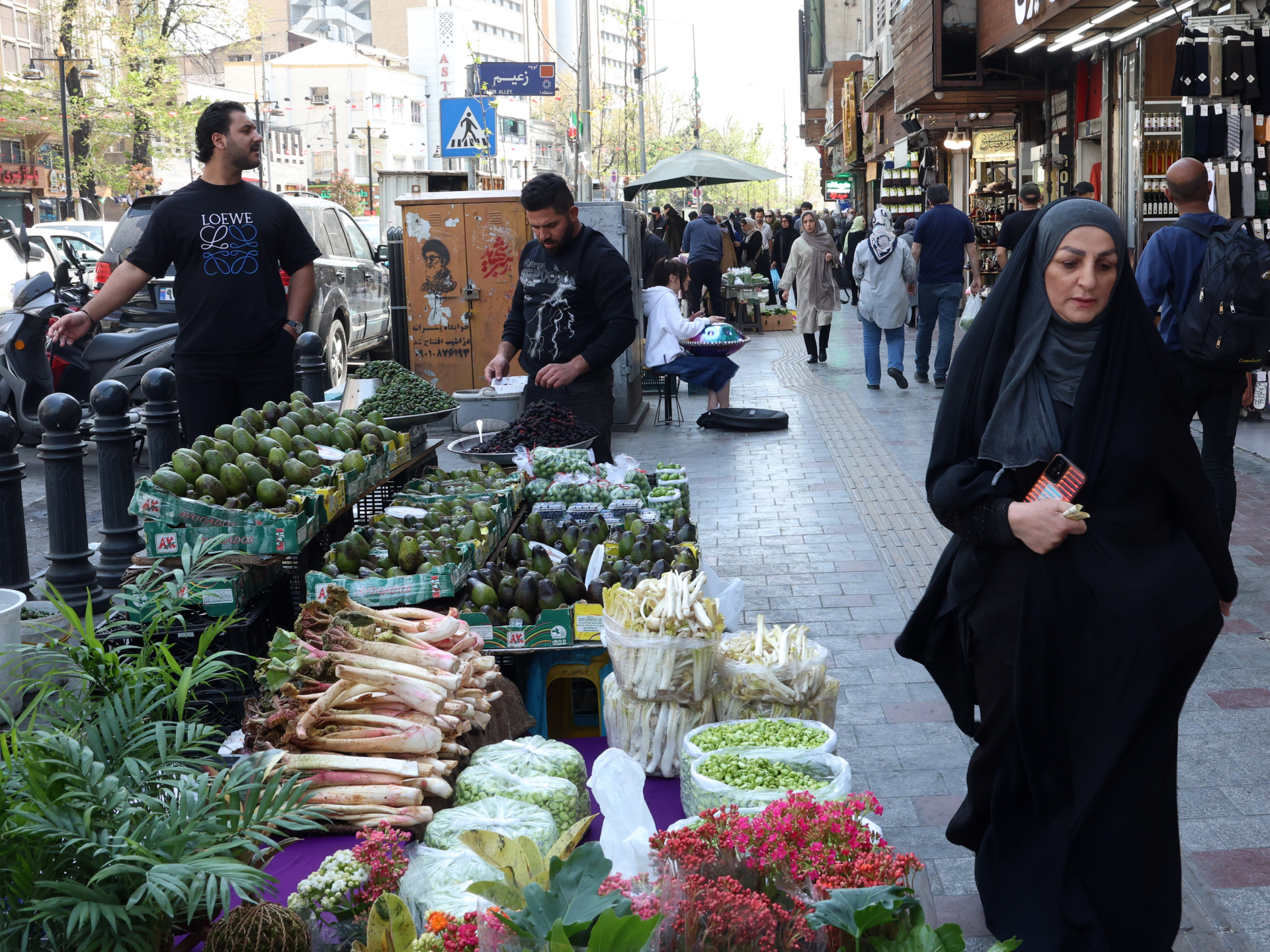
People walk in a local market in Tehran
People walk through a local market in Tehran [File: Majid Asgaripour/WANA via Reuters]

The government hands out monthly cash subsidies and electronic vouchers to buy essential goods at select stores, which together amount to less than $10 each month per person. Authorities are considering raising the amount, but a hefty budget crunch has made that more difficult.

Pezeshkian and Central Bank chief Abdolnasser Hemmati have said they are aware of the price increases, but have blamed the war that began in late February while coordinating with the judiciary to act against price gauging and hoarding.

A number of lawmakers in Iran’s hardline-dominated parliament, as well as state television hosts and outlets linked to the Islamic Revolutionary Guard Corps (IRGC), have said the price surges are suspicious. They have described the runaway prices as being part of an “economic revenge” campaign by enemies who suffered failures in the military arena.

“I want the people of Iran not to be fooled by the enemy-made price hikes,” a guest on state television’s Ofogh network said on Saturday. “Great things have happened, and great things are ahead. The economic achievements of the war are unrivalled by any other period.”

But some of the economic pain continues to be inflicted as a direct result of a near-total internet shutdown now being imposed by Iranian authorities for a 72nd day.

Numerous officials in the government, internet infrastructure firms, telecommunication companies and other state-linked organisations have emphasised that they are against a tiered internet system that is now being implemented. But they have said they bear no responsibility, since the blackout, which is expected to remain in place until the war ends, is ordered by the Supreme National Security Council.

In the meantime, the combined impact of local mismanagement, Western sanctions, blockade, war and the internet shutdown is squeezing people and businesses hard.

“The startup ecosystem of the country is dead, we are searching for a tombstone for it,” the Guild Association of Internet-based Businesses said in a statement on Saturday.

Source link

With food benefit cuts looming in the US, Californians eye billionaire tax | US Midterm Elections 2026

San Francisco, United States – Greer Dove’s days are packed with studying business and finance, as well as doing administrative work at college, along with caring for her eight-year-old daughter with special needs. But once a week, Dove, a single mother, makes sure to drop in at the food bank in California’s Marin County to pick up vegetables, fruit and other food. Along with the federal government’s food benefits, they keep her housing running.

“We need this so we can keep functioning at a high level,” she says. “She loves fruit, so I make sure to get it,” she says of her daughter.

Recommended Stories

list of 4 itemsend of list

Dove, who is also looking for a full-time job, has worked in restaurants, event management, retail, television shows, office administration and payroll over the years. But she has been on the federal government’s Supplemental Nutritional Assistance Program (SNAP) for six years, and with the food bank, for more than three years. Before she got food benefits, Dove fed her daughter all she had and skipped meals or looked around for snacks in the offices she worked at to get her through the day.

United States President Donald Trump’s One Big Beautiful Bill Act (OBBBA), passed in June, cut SNAP benefits by more than $186bn over the next 10 years to make up for extending cuts to income tax. This could lead to more than 3 million people nationwide, and 665,000 recipients in California, losing such food benefits, according to estimates.

“This will bring a series of cuts that collectively present an existential threat to food benefits,” says Andrew Cheyne, managing director of government relations and public affairs at the County Welfare Directors Association of California.

California’s proposed billionaire tax, which seeks to impose a one-time 5 percent tax on the assets of the state’s more than 200 billionaires to make up for the funding gap created by the OBBBA, got more than 1.5 million signatures in April. It is likely to be on the ballot for the November midterm election.

While most of the nearly $100bn expected to be raised through the tax will go towards filling the gap in health insurance created by the OBBBA, 10 percent will be used to make up for the retrenchment in food benefits.

In California, where more than 5.3 million people, more than any other state, receive food benefits, the impacts of the cuts began to be felt in April when 72,000 immigrants started losing benefits. June onwards, nearly 600,000 recipients will be screened for work eligibility. Recipients, including those who are homeless, seniors, foster youth and veterans, will have to work, study or volunteer to receive food benefits. Failing the screening to meet work requirements for three months will lead to their food benefits being cut.

Brian Galle, professor of law at the University of California at Berkeley and one of the tax measure’s authors, says that in California, the state that introduced gig work, “jobs are increasingly precarious. You may find enough work or not. You may get tips or not. But nutrition needs are steady.”

Making impossible choices

On a recent Friday morning, new members lined up to enrol at a whitewashed, bunting-festooned La Ofrenda food bank in San Francisco’s Mission district. The food bank doles out fresh vegetables, fruit and bread that have been donated by large grocery stores once those products neared expiration date.

Gladys Lee had taken a 45-minute train ride after a friend told her about it. Lee worked at downtown San Francisco’s Hyatt hotel as a room cleaner for three decades until a back injury meant she could not push the heavy cleaning carts any more and had to leave. After seven years of struggling to find work, food was getting scarce, and Lee found her way to La Ofrenda. She packed what she could into a carton and held it in her arms for the train ride back.

Food Bank in San Francisco, California
Volunteers gathered at the La Ofrenda food bank in San Francisco’s Mission District [Saumya Roy/Al Jazeera]

Food benefit rolls have shrunk by more than 3.3 million nationally in the six months from July 2025, when the OBBBA was enacted, to January 2026.

In California, the rolls of Calfresh, as food benefits are known in the state, shrank by 288,000 or 6 percent from July 2025 to February 2026, according to analysis by the Center for Budget and Policy Priorities, a Washington, DC-based think tank. This reduction in rolls happened even before the OBBBA cuts began.

Brooke Rollins, the agriculture secretary, wrote in a recent essay that the shrinking of SNAP rolls reflected an ebullient economy and buoyant job growth.

“The drop in SNAP recipients affirms that many Americans are moving from welfare to work,” she wrote. “It is no secret that Trump’s massive tax cuts and deregulation efforts are unleashing robust, private sector-led economic growth, which are fueling trillions in investments, booming wage growth”.

But unemployment remained stable at about 4.4 percent since July 2025, according to the Bureau of Labor Statistics data, while SNAP rolls shrank.

“This last time we saw such a steep, quick decline, other than during natural disasters, is three decades ago when welfare reform was enacted,” says Dottie Rosenbaum, senior fellow and director of  Federal SNAP Policy at the Center for Budget and Policy Priorities.

Nationally, SNAP rolls shrank by 8 percent, while in California, they shrank by 5.5 percent, in part because the work eligibility requirements were delayed until June, while some other states have already implemented them.

At La Ofrenda, Roberto Alfaro, executive director of the nonprofit Homey, says he started the food bank when food costs went up during the pandemic. They have stayed high, he says. Now he sees people doing day jobs and night jobs and coming for food when they have paid rent.

“People are making impossible choices,” says Keely O’Brien, a policy advocate at the Western Center for Law and Poverty.

While California is the world’s fourth-largest economy, growth has come with a soaring cost-of-living crisis.

“With rising housing and utility costs, few households can dedicate that much of their income towards food,” O’Brien says.

The OBBA has also shifted the administrative cost of meeting work eligibility requirements to states, and beginning next year, part of the cost of SNAP will also fall on states.

“To make requirements more stringent, you are creating more government, more bureaucratic logjam,” says Jaren Sorkow, state director for the Children’s Defence Fund.

This has already led to a 51 percent drop in SNAP rolls in Arizona, which has begun implementing the OBBBA cuts, according to data by the Center for Budget and Policy Priorities.

Food being given out at the La Ofrenda food bank in California, USA
Food being given out at the La Ofrenda food bank in San Francisco’s Mission District [Saumya Roy/Al Jazeera[

Making something from nothing

Several measures to counter the $100bn gap in funding for health insurance and food benefits created by the OBBBA have been floated in California. The biggest of these is the one-time 5 percent tax on those with assets of more than a billion dollars. The tax will raise $100bn, its authors estimate.

As it seems set to be voted on in the November election, it faces mounting opposition from the state’s tech entrepreneurs who have funded measures to undercut the tax.

Tech entrepreneurs have called it an economic 9/11, saying taxing their assets, including shareholding in startups, will lead to a flight of capital and innovation from the state. Sergey Brin, a cofounder of Google Inc, now spends a week in Nevada and a week in his Bay Area offices and has spent more than $57m on opposing the billionaire tax. He has backed two measures that undercut the billion tax, which have also received 1.4 million and 1.5 million signatures and are also set to be on the ballot for the November election.

One of these measures prohibits future taxes on personal property, including financial assets, savings and retirement accounts, as well as intellectual property. The other would increase audits of taxpayer-funded programmes, and includes language that would essentially invalidate the billionaire tax.

In a recent statement to The New York Times, Brin said, “I fled socialism with my family in 1979 and know the devastating, oppressive society it created in the Soviet Union. I don’t want California to end up in the same place.”

The coalition of unions backing the billionaire tax is bracing for the fight ahead. “We expect to be outspent,” says Kris Cuaresma-Primm, director of partnerships for the coalition that is backing the billionaire tax. “We will keep communicating to people that there is a tidal wave of pain coming from the cuts, and we want to reclaim the losses from the OBBBA.”

Giulia Varaschin, senior tax policy adviser at the International Tax Observatory, who recently coauthored a study on wealth taxes, says there is little academic evidence that such taxes cause the wealthy to leave at a notable scale. “There is only a marginal flight with very little, if any, economic impact,” she says.

The study, coauthored with the economist Gabriel Zucman, who supports the California billionaire tax, did find that wealth taxes had not raised as much revenue as estimated in several European countries and became less popular as a result.

Varaschin says this was because these taxes were levied on a larger set of the wealthy, which included homeowners or small businesses, rather than the ultra-rich or billionaires. The taxpayers could hardly afford to pay it, and the government made exemptions instead. These taxes also did not touch assets, where much of the wealth of the ultra-rich lies, Varaschin says.

The California tax remedies this by taxing only billionaires and taxing assets, including shares in companies.

Daniel Shaviro, Wayne Perry professor of taxation at New York University, says, “Traditionally, these taxes can be hard to enforce because tax administration don’t want to go after these people.”

Even if it passes, “The governor could just say this is not a high priority for him and not enforce it,” Shaviro says, referring to Governor Gavin Newsom, who has opposed the tax.

But Primm says, “The governor is out of touch with Californians on this”.

Newsom is in the last year of his last term as governor. However, nearly all the candidates running for the June 2 primary for governor, except billionaire Tom Steyer, who is running as a progressive Democrat, also oppose this measure. While some have said this will lead to a flight of capital, others say the spending plan does not include expenses for education, which was not cut in the OBBBA.

Greer Dove, who gets food through Calfresh and the San Francisco Marin Food Bank for herself and her daughter, says the looming food benefit cuts are worrying. “The anxiety of it all is adding up. I could be next.”

Source link

‘I got Sunday roast in Bangkok pub to see if it’s as good as British ones’

Traveller Sam Meaney wanted a traditional British Sunday roast on a trip in Thailand, so he decided to head to The Old English pub in Bangkok to try their one out

Many of us love to get away to visit other places and explore other cultures. However, it’s always nice to have a taste of home back too while we’re away in another country. That’s exactly what traveller Sam Meaney wanted while on a trip to Bangkok, Thailand. Sam admitted that he ‘hadn’t had a proper roast dinner in six months’, so he decided to head to The Old English pub in Bangkok to try one.

The pub, situated in Bangkok’s Thonglor area, features a traditional English aesthetic with dark wood panelling, a cosy indoor area, and an outdoor patio equipped with fans. The pub is a central hub for sports fans, broadcasting live events like the Premier League, UFC, and NBA on multiple HD screens. It also houses a regulation-size pool table.

The menu focuses on comfort food, including their famous Sunday roast, Fish & Chips with mushy peas, and the “Churchill Breakfast”. However, they also serve local favourites such as Pad Thai and Green Curry.

Going to try the Sunday roast, Sam said in an Instagram reel: “I haven’t had a proper roast dinner in six months, so this has got a lot to live up to. If this is bad, I’m going to be fuming.”

Sam ordered a pint of Leo beer while looking over the menu as he said the Guinness in the pub was quite expensive (£8).

“This menu looks really, really good,” he said.

Sam said he was going to get the chicken roast, which costs 375THB (£8.50), but ten really fancied roast beef which is 495THB (£11).

However, he said if he paid just 50 Thai Baht more, he could get the Sunday Special, which comes with a starter, roast and dessert.

He decided to go for the deal, ordering Leek soup as his starter and chocolate cake for desserts.

Admiring the pub, after ordering, Sam exclaimed: “This place has a proper old English pub feel,” as he gave viewers a look around the establishment which was covered in English and British flags.

Then it was time for Sam to sample the food, as he described the Leek soup as “banging”.

Content cannot be displayed without consent

The main Sunday roast then came, as he exclaimed: “Oh my God, look at this. That looks wonderful.”

Sam tasted the gravy, branding it as “good gravy”.

The traveller then sampled his medium rare beef and seemed to enjoy it, before moving onto the vegetables.

He admitted the broccoli was ‘probably out of a bag’ but said he ‘wasn’t going to complain’. However he said the carrots were “unbelievable” and enjoyed the red cabbage too.

Sam said he thought the roast potatoes ‘weren’t crispy’ before tasting them, but then took that back after sampling the roasties, saying that there was a ‘crisp to them’.

A Yorkshire pudding was also on his plate, which again, Sam seemed to enjoy.

Giving his verdict, Sam told viewers: “It’s not the most expensive roast in Bangkok, you get what you pay for, but it’s like a pub roast dinner back home. I’m a happy boy.”

Lastly, he tried his chocolate cake dessert, which came with vanilla ice cream. He described it was “sweet, chocolate-y and hot”.

Giving his conclusion, he added: “This is not the best roast dinner in the world, but it’s comfort, home food, like an English pub at home.

“If you’re looking for that in Bangkok, the Old English Pub is the way to go.”

People were loving the post, with it racking up more than 1,400 likes.

One person exclaimed: “That looked pretty banging to be fair, if you said you was at a pub for Sunday roast in UK I wouldn’t have challenged it.”

While another added: “Looks better then a lot of roasts in the UK.”

Someone else admired the “banging amount of meat” on the plate.

While another person who had been to the pub said: “I have had a few meals there, all top quality.”

Source link

Trump may fire FDA chief Marty Makary, reports say

May 8 (UPI) — President Donald Trump intends to fire Food and Drug Administration Commissioner Marty Makary because he is frustrated with the agency.

Trump signed off on the decision to replace Makary as he has clashed with Trump, officials in the Department of Health and Human Services and other officials in the administration, multiple reports said on Friday.

The reports — from NBC News, The New York Times, The Wall Street Journal and The Washington Post — all were attributed to Trump administration sources who requested anonymity because they were not authorized to comment on the issue.

Makary, a former surgeon at Johns Hopkins, was confirmed to run the FDA in March 2025 on a vote the included two Democratic members of the Senate voting yes.

His nomination carried some controversy because, like several other Trump cabinet members and nominees, is a former Fox News contributor who preferred that society develop natural immunity to the virus that causes COVID-19 instead of the CDC’s preferred method of using vaccine-induced immunity during the pandemic.

The reports suggest that Makary has struggled to run the FDA as long-time staff have left the agency and a range of healthcare, pharmaceutical and advocacy groups have been highly critical of its actions.

The Department of Health and Human Services and Makary have not commented on the reports, and sources for all four news organizations noted that the plan could change if Trump changes his mind.

President Donald Trump delivers remarks at an event he is hosting for a group that includes Gold Star Mothers and Angel Mothers in honor of Mother’s Day in the Rose Garden of the White House on Friday. Photo by Aaron Schwartz/UPI | License Photo

Source link

‘No reservations, no waiter, just great sea views, food and drink’: readers’ favourite beach bars in Europe | Beach holidays

Roll with the lobsters near Derek Jarman’s house in Dungeness, Kent

Dungeness is a place of wild beauty, a stretch of coast that knows fierce winds. Artist and gardener Derek Jarman’s cottage roof blew off at least once and the wind regularly wreaked havoc with his planting. Stubborn plants survive on this vast shingle beach and just as stubborn is the Snack Shack, with its opening times dependent on the weather, as its website says. On fair weather days it’s an ideal place to have lunch as you explore the peninsula. If you’re in luck they will not have run out of lobster rolls among other freshly caught seafood delights. Paying homage to Jarman and eating outdoors here replenishes the soul.
Charlotte

Profile

Readers’ tips: send a tip for a chance to win a £200 voucher for a Coolstays break

Show

Guardian Travel readers’ tips

Every week we ask our readers for recommendations from their travels. A selection of tips will be featured online and may appear in print. To enter the latest competition visit the readers’ tips homepage

Thank you for your feedback.

Captain’s tables on the Brittany coast

Captain Marée, a 30-minute cycle from Vannes in Brittany, is a collection of mismatched tables and chairs beside two shacks on a shellfish farm on the Gulf of Morbihan. Here, you’ll find a simple menu featuring fresh oysters and mussels, all served by welcoming staff. The place offers wonderful views of the gulf and if you are really into your seafood, few places could offer better quality or a friendlier atmosphere.
Kelvin Atkins

Watch for seals on the Isle of Arran

Cladach Beach House is tucked away at the end of the strand in Brodick, on Arran. Outdoor cocktails (with a large dinosaur sculpture) if its sunny, a cosy fire inside the shack by the big windows if the weather closes in. It’s an adorable mix of homemade and glamorous as you watch for seals.
Clara

Select your fish from the daily catch near Narbonne, France

La Perle Gruissanaise. Photograph: Gautier Stephane/Alamy

La Perle Gruissanaise lies at the end of the reclaimed wild end of Chalets beach not far from Narbonne in the south of France. Select your fish from the daily catch, and it’ll be expertly cooked by the chefs along with a selection of homemade sides. Then, grab a carafe of local chilled wine and take your seat on the wooden benches. There’s no table service and no reservations, just great food and drink – and uninterrupted views over the Mediterranean to the horizon. Alternatively, they’ll put together a fantastic platter to take away and enjoy at home or on the beach.
Doug

A thatched classic in County Sligo, Ireland

Beach Bar at Aughris head, Templeboy. Photograph: PR

The west of Ireland is a rugged place full of nooks and crannies. In one of them is the Beach Bar at Aughris head, Templeboy. Follow the handmade signs that direct you off the main N59 Sligo road. Eventually, the road peters out at the curving beach overlooked by the thatched Beach Bar. There you can enjoy a bowl of chowder, local seafood and meaty classics, alongside friendly locals. On a fine day, you can sit outside and take in the majestic view across the sea to Sligo and beyond.
Tony Moon

Watch the sunset over the Libyan Sea in Crete

Matala Beach at dusk. Photograph: Westend61 GmbH/Alamy

Perched above Matala’s legendary bay in southern Crete, Petra & Votsalo (on Facebook) is a gorgeous beachside taverna. Harris, the owner, greets everyone like family and sets an easy, unhurried tone. Two courses and a cold beer cost about €20. The terrace glows as the sun sets into the Libyan Sea. Order a starter of creamy, flaky tiropita cheese pastries followed by rich, tender stifado and an ice-cold Mythos. Finish with complimentary family-produced raki as waves roll in and light fades over the bay.
James Merriman

Cocktails in a medieval tower on the Adriatic in Croatia

Photograph: Matyas Rehak/Alamy

Massimo cocktail bar (on Instagram) is the place to experience sunset on Korčula, Croatia. Space is limited so get there early. And if you don’t like heights or struggle with steep ladders, give it a miss! Your drinks will arrive by pulley from the bar below and, as you sit at your table on top of the medieval tower, you can see for miles across the sea to the neighbouring islands. The margaritas are highly recommended but remember you have to get back down the same way, so best to stick to one or two.
Gill

A beach bar for all seasons near Lisbon

Photograph: Volodymyr Goinyk/Alamy

The Bar do Guincho in Cascais near Lisbon is that rare thing, a beach bar for all seasons. It’s perfectly positioned for stunning Atlantic views and combines a rustic, welcoming vibe with a lively atmosphere. I have enjoyed the sunshine and a cocktail on the terrace there after lazing on the beach, but I’ve also cozied up by its blazing log fire in autumn with a warming bowl of fish soup. It’s an easy day trip from Lisbon, too – there are trains every 30 minutes from Cais do Sodré and the journey takes 40 minutes. Then you get the regular No 15 bus or a taxi to beautiful Praia do Guincho, which takes about 20 minutes.
Nicoletta

Seafood shack on the Black Sea, Bulgaria

Where Bulgaria meets Turkey on the Black Sea, you’ll find the sleepy resort of Sinemorets. The place has an eccentric feel, but nowhere more so than the seafood shack Taliana (on Instagram), which sits right on the rugged coastline. Mussels are a must-try, but everything is as fresh as you’d expect from the location – and incredible value. After driving halfway across the country on a slightly ill-advised trek, we arrived a little desperate, bedraggled and starved so it was great to receive a warm welcome and probably the tastiest meal of our whole trip.
Tim Alderson

Winning tip: Puglia perfection, near Gallipoli, Italy

Lido Conchiglie. Photograph: Giuseppe Colasanto/Alamy

Visible from the wide sandy beach at Lido Conchiglie, near Gallipoli in Puglia, Scapricciatiello (on Facebook) perches on a rocky spur reaching out into the sea. With its plastic chairs and paper tablecloths (which double as menus), it could certainly never be accused of being all style over substance. Yet what it offers instead is hard to beat: delicious, fresh local seafood, enjoyed beside turquoise waters. Adventurous diners can follow local tradition and sample the cozze crude (raw mussels), while other choices include spaghetti with mussels or clams, followed by fritto misto or grilled swordfish.
Katharine


Source link

Aid cuts, drought and conflict leave Somalis desperate | Drought News

Maryam watched her goats starve and her crops fail. She buried two of her children before she finally gave up hope and sought help from international aid agencies in southern Somalia.

She left her village with her remaining six children, making the long journey along the Jubba River to one of a clutch of makeshift settlements on the outskirts of Kismayo, the capital of Somalia’s Jubbaland state.

Three consecutive seasons of failed rains have doubled Somalia’s malnutrition rate. Maryam, 46, is among more than 300,000 Somalis forced to leave their homes since January alone.

Several international organisations have stopped operations in the Kismayo camp for internally displaced people (IDPs), largely due to aid cuts ordered by United States President Donald Trump last year.

“We are hungry. We need care and help,” said Maryam.

Haunted by the memory of her dead children’s swollen bellies, she says she will not return to her village, which is under the control of the al-Qaeda-linked armed group al-Shabab. Fighters there have started seizing the limited food supplies available.

Somali internally displaced children
Children play near their makeshift shelters at an IDP camp in Ceel Cad, Kismayo town [Simon Maina/AFP]

But the camp is hardly better. In March alone, five children died of malnutrition, its manager says.

Since the early 1990s, Somalia has endured near-constant civil war, armed rebellions, floods and droughts. The war-torn country ranks among the world’s most vulnerable to climate change, which scientists say is leading to more frequent and more intense episodes of extreme weather such as droughts and floods.

Africa, which contributes the least to global warming, bears the brunt.

The recent cuts in foreign aid have not helped. They have had “a huge impact on our work”, said Mohamud Mohamed Hassan, Somalia director for NGO Save the Children.

More than 200 health centres and 400 schools have closed since last year.

Farmers, whose herds and crops have been decimated, describe one of the worst droughts ever recorded in a country where a third of the population already lacked regular meals. Even if the forthcoming rainy season is normal, it will take months for affected populations to recover.

“We cannot afford to actually address all the needs of these people,” said Ali Adan Ali, a Jubbaland official managing the displaced.

At a mobile health clinic supported by Save the Children, the only one still operating for multiple camps in the area around Kismayo, a woman named Khadija tried to feed a high-calorie solution to her severely malnourished one-year-old daughter.

She came to the camp after last year’s drought killed her livestock, but here also “we have nothing to eat”, the 45-year-old said.

A newly displaced Somali woman holds her severely malnourished baby in a stabilization centre for children suffering severe accute malnutrition in Kismayo,
A displaced woman holds her malnourished baby in a stabilisation centre for children suffering severe acute malnutrition in Kismayo [Simon Maina/AFP]

A hospital in Kismayo is the only facility in the region capable of treating the most severe cases of malnutrition. But it is turning patients away due to a lack of space and staff.

Every bed is occupied by starving babies, some on ventilators with intravenous drips in their fragile arms. Cases have tripled since last year, and things are only getting worse.

The US-Israel war on Iran has increased fuel prices, affecting food and water supplies.

Those in the camp seek work in construction or cleaning jobs in Kismayo or sell firewood, but the options are limited.

Meanwhile, the United Nations Office for the Coordination of Humanitarian Affairs (OCHA) has had to steadily reduce its Somalia programme from $2.6bn in 2023 to $852m this year, especially since Washington slashed its donations. So far, only 13 percent of this year’s target has been raised.

“It’s a toxic cocktail of factors … Things are really, really desperate,” Tom Fletcher, head of OCHA, told the AFP news agency in an interview last week.

“Often we’re having to choose which lives to save and which lives not to save.”

Source link

Al-Qaeda-linked fighters storm Mali prison, block food supplies to Bamako | Conflict News

Fighters attack ‘Africa’s Alcatraz’, which detains high-value prisoners, and disrupt crucial supply chains to the capital.

In a new wave of attacks in Mali, an al-Qaeda-linked group has stormed a main prison housing fighters from the armed group and set fire to trucks with food supplies heading to the capital Bamako.

Fighters from the Jama’at Nusrat al-Islam wal-Muslimin (JNIM) group stormed the Kenieroba Central Prison, a recently built complex dubbed “Africa’s Alcatraz”, located about 60km (37 miles) southwest of Bamako, Al Jazeera’s Nicolas Haque reported on Wednesday.

Recommended Stories

list of 4 itemsend of list

The detention centre houses 2,500 prisoners, including at least 72 inmates considered “high value” by the Malian state, Haque said, adding that Malian armed forces were repelling the attack.

Among the prisoners are JNIM fighters and a number of people arrested following large-scale attacks last month by the group’s fighters and Tuareg separatists, the Azawad Liberation Front (FLA).

The fighters attacked several military bases across multiple cities, including areas where senior government officials live, and took control of the northern city of Kidal in a coordinated offensive on April 25 and April 26, which struck at the heart of the West African country’s military government.

One of those attacks killed Malian Defence Minister Sadio Camara and his family in their home in Kati, a garrison town near the capital. On Monday, the leader of the country’s military government, Assimi Goita, took on the role of defence minister. At least 23 others were also killed in the attacks.

Since then, “there has been a wave of arrests of former and current military officers, members of civil society, lawyers, members of the political opposition – all accused of colluding with al-Qaeda fighters,” said Haque, who has been reporting for years on and in Mali. He added that fighters linked to the armed group were also arrested.

Security sources told AFP news agency that opposition figures Mountaga Tall, Youssouf Daba Diawara, and Moussa Djire are among those “abducted”.

According to family members and security sources who spoke to the agency, Tall, a lawyer, was taken on May 2 in Bamako by hooded men on charges of plotting with opposition figures in the Senegalese capital, Dakar, to overthrow the military government. Since his arrest, Tall has been questioned at least once for “attempted destabilisation”.

The security sources said Diawara and Djire were suspected of links with, respectively, the influential imam Mahmoud Dicko and Oumar Mariko, two opposition figures in exile. At least two other civilians who are close to Mariko were also arrested following the attacks, a judicial source told AFP, without giving further details.

The military prosecutor’s office said on May 1 that it had “solid evidence” of the “complicity” of certain military personnel, accusing them of helping with the “planning, coordination and execution” of the attacks.

In a report published on Tuesday, the Office of the United Nations High Commissioner for Human Rights (OHCHR) said there have also been “gravely concerning reports of extrajudicial killings and abductions, allegedly carried out by members of the security forces” following the attacks.

The violence has set off fighting across Mali’s vast desert north, raising the prospect of significant gains by armed groups that have shown an increasing willingness to strike neighbouring countries.

JNIM has called on Malians to rise up against the government and transition to Islamic law. The group has also pledged to besiege Bamako, and on Friday, it had reportedly set up checkpoints around the city of four million.

Haque said the blockade has the potential to cause a humanitarian disaster.

“These are al-Qaeda fighters that have pointed 12.7mm machine guns on their motorbikes, stopping any outgoing or incoming traffic,” the correspondent said. “We have seen on social media these fighters stopping food trucks trying to enter the area. This blockade is not just affecting people living in Bamako; it’s affecting people throughout Mali.”

On May 3, the mayor of Diafarabe village, in the Mopti region, called on the authorities to act before people started dying of hunger, as the village had run out of food.

Source link

Restaurant in Spain has new charge for people who throw up

The all-you-can-eat venue says it has had a problem with ‘many customers’

An all-you-can-eat restaurant in Spain is introducing a “vomit fee” for diners who eat until they are sick on the premises. Sushi Toro, located in Gelves near Sevilla, said it had experienced a growing number of incidents in recent months involving customers “eating until they burst” and then vomiting.

The restaurant said the problem had affected tables and bathrooms, creating difficulties for staff and raising concerns over hygiene and customer service. In a statement shared on social media, restaurant staff said: “We have had many customers who keep ordering non-stop and eat until they burst, until they vomit. We have had vomit on the tables and in the bathrooms.”

They added that “the only solution” was to start charging vomiting fees. The restaurant, which promotes a fusion of “tradition and innovation”, offers a buffet menu featuring dishes prepared using fresh ingredients and specialist techniques. Prices range from €16.90 (£14.40) to €23.90 (£20.30), depending on the day and time of dining.

Sushi Toro bosses said their staff “strive hard to get orders out on time and maintain good hygiene” throughout all service periods. They urged diners to “order what you can eat” and apologised for any inconvenience caused by the new policy.

Demand for sushi has been surging in Spain in recent years, with diners increasingly opting for Asian seafood dishes over traditional Spanish fish fare.

Source link

Airline with the best food named – not British Airways, Virgin or Emirates

This European carrier serves regionally inspired dishes at 35,000ft

A Greek airline boasting a fleet of 83 aircraft has been named the top carrier for in-flight dining, beating major rivals including Emirates, Virgin Atlantic, Qatar Airways, and British Airways. A study by Canstar Travel Insurance analysed passenger reviews and meals from the world’s top 100 airlines, concluding that Greek carrier AEGEAN serves up the finest food, earning an impressive score of 7.82 out of 10.

AEGEAN treats passengers to authentic Greek cuisine and regionally inspired dishes, while in business class, meals are lovingly prepared by acclaimed Greek chefs and sommeliers. The airline’s culinary philosophy is rooted in the concept of filema, which champions “love and kindness through food”. Other carriers delivering exceptional onboard dining include Qatar, Asiana Airlines and EVA Air.

On Tripadvisor, one traveller who recently flew with Aegean wrote: “Aegean Airlines is simply amazing! The level of service is very high, and it is incredibly easy to reach their call centre whenever you need help or extra information. On board, they offer food and drinks, and everything was delicious.”

A second passenger added: “I have used British, Virgin, easyJet, Ryanair… but no one is better, always on time and sometimes even earlier at the destination than Aegean Airlines.

“Although I’m Italian, I use it instead of Alitalia when I’m travelling to my country. Warm and delicious food and choices of wines and a particular menu for any kind of dietary or religious needs.”

Airlines with the best food

  1. AEGEAN Airlines
  2. Qatar Airways
  3. Asiana Airlines
  4. EVA Air
  5. Singapore Airlines
  6. Korean Air
  7. All Nippon Airways (ANA)
  8. Japan Airlines
  9. Kuwait Airways
  10. Garuda Indonesia

Source link