
When I moved into my Leimert Park apartment about two years ago, an older woman rushed downstairs to greet me.
“I’m so excited,” she said, introducing herself as Cassandra. She had lived in the tight-knit apartment building for more than 20 years and watched plenty of people come and go. “I was worried about getting a crazy neighbor, but you seem great,” she added, hugging me tightly and handing me a tray of sandwiches to share with my friends who were helping with the move.
Over the next few days, I met my other neighbors, including Miss Rosita and Mr. Art. After a few shared meals, long conversations and traded favors, all of them became more than just the people next door — they became family.
Share via
There’s a quiet comfort in knowing your neighbors, especially in a sprawling, sometimes lonely city like Los Angeles. That kind of connection is fading. A study by the Stanford Center on Longevity showed that the percentage of Americans who frequently interact with their neighbors — meaning they spend time with or talk to their neighbors more than once a week — declined among all age groups from 2017 to 2023.
We wanted to find people who are bucking the trend, so we asked readers to nominate the neighbors who make their corners of Southern California feel like home. The stories that folks shared are poignant, inspiring and might just make you want to walk over to the porch next door (or welcome mat across the hall) and introduce yourself immediately.
One of my favorite neighbors, Mr. Art, died last fall. He was a sweet retiree who’d tell me about his weekly fishing adventures and close my garage whenever I was in a hurry and would forget. Another neighbor called me the day he died, and we cried together, sharing our favorite memories of him. I’ll always be grateful to Mr. Art, who made my life better all because he once took the time to meet his new new neighbor.
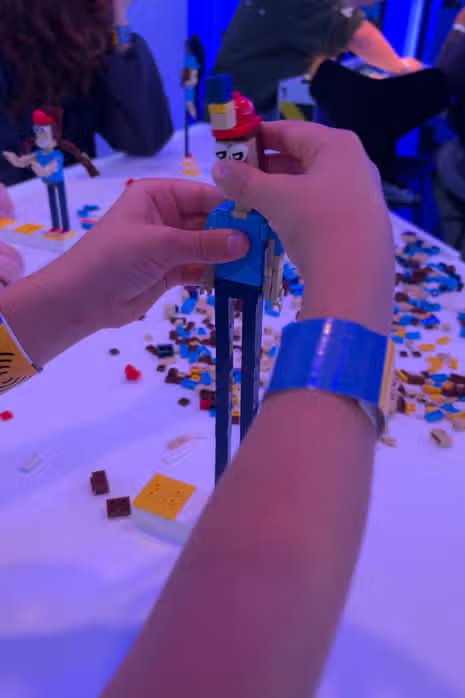
Here are some of our favorite reader responses, edited for length and clarity. Each of the neighbors featured in this story will receive an L.A.’s Most Neighborly Neighbor certificate, illustrated by Cristina Spanó, whose art is shown above. Do you have a neighbor who goes above and beyond? Download and print your own certificate (PDF) and share it as a token of your appreciation.
He’s saved us from many, many parking tickets. She hosts the sweetest front porch chats.
Bill and Linda Melber.
(Ronaldo Bolanos / Los Angeles Times)
Neighbor: Bill and Linda Melber
Nominated by: Corrinne Harol
When were you neighbors? 1994 to now
What neighborhood did you live in? Santa Monica
Share via
Corrinne, on how Bill and Linda show up as neighbors:
Linda and Bill are the most generous neighbors imaginable. Bill has taken out my trash bins for decades. It started when I was living in Canada for most of the year, but he still insists on doing it. He makes it his personal mission that no one gets a parking ticket for street cleaning on our block, going up and down the block twice a week to remind anyone who forgot. One time he called me about my car, but I was too far away to get back to move it. Bill had a key to my house, but the gate was locked. He climbed over the fence, got my car keys and moved my car for me! He also makes children’s toys that he distributes to any children on the block or that he encounters out and about.
His wife, Linda, is equally neighborly, hosting regular chat sessions on their lovely front porch and checking in on me whenever I have been ill, as she does to anyone in her orbit. They are truly a gift to the neighborhood.
He made me feel welcome when I was in culture shock
Tommy Bui and Hector Chavez.
(Tommy Bui)
Neighbor: Hector Chavez
Nominated by: Tommy Bui
When were you neighbors? 1996 to 2022
What neighborhood did you live in? Pacoima
Tommy, on how Hector has shown up as a neighbor: The greatest neighbor I ever had was my childhood friend, Hector. I’m the child of Vietnamese refugees, and when they claimed asylum in Los Angeles, we were plonked into the cultural collision that was Spanish-speaking Pacoima. I was seemingly the only Asian child in a five-mile radius. I certainly stood out among the perfectly creased khaki pants and palm combs and top-buttoned flannels contrasted with my clueless bowl haircut and Ninja Turtle suspenders.
Confounding the astronomical unlikeliness, we got along like two peas in a pod. I got a crash course on Angeleno aesthetics and the ins and outs of the rough and tumble San Fernando Valley hurly-burly. I was a regular staple at his welcoming household. Simpatico and simply siblings by circumstance. Sunday dinners and holidays and “Sandlot”-like weekend street shenanigans. My youth was alarmingly idyllic with the hopped fences, bicycle slaloms through traffic and occasional near-misdemeanor mischief. Shoulder to shoulder alongside Hector, I wouldn’t trade a single moment of it.
Though no longer neighbors, we’re still navigating life’s milestones in our own corners of Los Angeles. We’re both new fathers and hurtling toward middle age completely agog at how quickly the time gallops by.
She gave me a gold turtle to make me feel better after my breakup
Fatine Ait-Haddou and Raynette Syfu.
(Fatine Ait-Haddou)
Neighbor: Raynette Syfu
Nominated by: Fatine Ait-Haddou
When were you neighbors? Since 2021
What neighborhood did you live in? Historic Filipinotown
Fatine, on how Raynette has shown up as a neighbor:
I had just moved into my new apartment after breaking up with a long-term ex. I was sobbing every single day. During my first intro with Raynette, she gave me a little gold turtle and said it would bring me safety, luck and calmness. I named it Lucky and I still have it. Raynette brings me meals all the time and checks on me whenever she hasn’t seen me for a few days. She even gave me a huge bag of her vintage clothes. One of the most insane things she’s done for me is give me a fake baby, one that was heavy and realistic. She said that because I lived alone and didn’t live near family, it could be nice to have additional family. [Laughs] Honestly, it was a very “her” move. She’s truly amazing and looks out for me. I couldn’t be more grateful.
He taught me new chess strategies — and life lessons
Ali Ras and Jemimah Yamamoto.
(Jemimah Yamamoto)
Neighbor: Ali Ras (born Fitz Albert Thomas)
Nominated by: Jemimah Yamamoto
When were you neighbors? From 2021 until his death in 2025
What neighborhood did you live in? Arlington Heights
Jemimah, on how Ali showed up as a neighbor: I moved to Los Angeles in the summer of 2021. I was in my late 20s, and I was a bit unsure of my move. Even more so, I was unsure of the neighborhood I ended up in thanks to Facebook Marketplace. But as fate would have it, it revealed to me that I was destined to be there. I’d see an old man with his gray dreads and sing-songy voice as I would walk from parking my car on the street. One day, he introduced himself and over time we developed a relationship. Him, as my chess teacher, and me as his eager student. I’d bring over my chessboard and we’d play for hours on his porch. He’d always say I was too aggressive with my pawns and that I wasn’t afraid to lose them. He’d play slowly and deliberately. I never won a single game against him. I’d like to think that that itself was a lesson.
During my Saturn return, I was depressed and felt a bit lost. On days that felt the darkest, he would call. He would ask me how I was doing, and it would cut through all the facade of “I’m good.” It was the tone of his voice that made you want to be honest. His way of caring felt like a miracle because you don’t even have to explain anything to him, he would just know. At the time, his presence was exactly what I needed.
He was the only person I gladly let walk into my house unannounced
Eric Pendleton
(Kim Quitzon)
Neighbor: Eric Pendleton
Nominated by: Kim Quitzon
How long were you neighbors? More than 20 years
What neighborhood did you live in? San Fernando
Kim, on how Eric showed up as a neighbor: “Uncle Eric” was more than just a neighbor; he was family. Walking through the door unannounced yelling “Hi, family!” across the living room. “I came to check on the backyard.” Every week he would mow the yards after he lost his job and took pride in landscaping the grass, but that was just the surface of what he meant to us. On the popular street of Orange Grove in San Fernando where crowds line up during Halloween, Uncle Eric was our honorary neighborhood watch. Rolling up and down the street on a new bike every day, checking in on every neighbor that would give him the time of day.
From watching the dogs when we were away to helping set up family parties, he was one of us. He just happened to live three doors down. Unfortunately, Eric passed away from cancer last year. The whole block was devastated, and we all held a potluck in his honor. We will miss him, and he truly is the epitome of an amazing neighbor.
She sat with me after my mom died while I cried
Pamela Yeh and Hilah Johnson.
(Pamela Yeh)
Neighbor: Hilah Johnson
Nominated by: Pamela Yeh
When were you neighbors? From 2017 until mid-2020 when she and her family moved to Austin, Texas. Over the years, we’d become close friends, so I was gutted by their move. The most amazing thing happened, though. In 2022, they moved back to L.A., just a few blocks away from us. They live about 10 minutes away from us now, but we still see each other all the time.
What neighborhood did you live in? West L.A.
Pamela, on how Hilah has shown up as a neighbor: Hilah has shown up for me and my family in hundreds of ways over the years, but I want to tell you this one story. In September 2025, my mom, who had been living in an ADU we built in our backyard, died. She was my heart, and I was utterly crushed. I lived in a fog of grief and shock. Hilah came over and just sat with me while I cried and cried. She made the video montage of my mom for her memorial, which was extra difficult because a family member had all sorts of unreasonable demands. Eventually, she got me to go to a dance class, and we’re still dancing, one step at a time, at the wonderful local Flow Motion.
He’s the beloved ‘Fairy-Car-Father’ on our street
Rodrigo Mangrobang
(Leigh Ann Jackson)
Neighbor: Rodrigo Mangrobang
Nominated by: Leigh-Ann Jackson
How long have you been neighbors? Since I moved to Northeast L.A. 15 years ago
What neighborhood did you live in? Northeast L.A.
Leigh-Ann, on how Rodrigo has shown up as a neighbor: Rod, as most of the block calls him, is a retiree who lives with his wife across the street from me. He spends a lot of time outside gardening and working on his cars and can seemingly sense whenever a neighbor is having car trouble. He’ll stop what he’s doing, bring over his tools and get to work, no questions asked. He’s not very chatty, but he speaks auto fluently! He saw me pull out of my driveway once and flagged me down to tell me I was headed for a blowout soon. He then instructed me to pull back into the driveway and patched the tire for me on the spot. I even watched him go outside to help a stranger whose car had broken down in the middle of the road. He’s our street’s Fairy-Car-Father.
She had the best local recs. Yelp couldn’t come close.
Sofie Ringold and Eileen Ogle
(Sofie Ringold)
Neighbor: Eileen Ogle
Nominated by: Sofie Ringold
When were you neighbors? From 2020 to 2025
What neighborhood did you live in? Sherman Oaks
Sofie, on how Eileen showed up as a neighbor: When my husband and I bought our first home, the COVID vaccine hadn’t been released yet, and we didn’t meet any of our neighbors. A few days later, an older woman wearing a mask knocked at our door. She said that a package had been delivered and she didn’t want it to get stolen. The package had arrived only minutes earlier, so it was pretty clear she wanted to scope out her new neighbors, and during a time of social distancing, this was the perfect excuse. She introduced herself as Eileen. She lived next door with her partner, Judith. We exchanged numbers and said a friendly goodbye.
As the world slowly became more comfortable with social interaction, Eileen began introducing us to everyone on the block. Soon, while we were walking our dog around the neighborhood, people would stop us and ask if we were new. When we told them we lived next to Eileen and Judith, their eyes lit up. It was clear they were local legends. Like all first-time homeowners, we quickly ran into our share of problems. But who needs Yelp when you have neighbors who have already vetted every home service you could possibly need? Need a gardener? Call Eileen. HVAC needs maintenance? Call Eileen. Going away for the weekend and need someone to check on your cats? Call Eileen.
Sadly, Eileen passed away in December. A cloud hung over our street for weeks. Then on Christmas morning, the sun broke through and a rainbow appeared. My husband took it as a sign from Eileen.
He went from my flirty neighbor to my husband of 16 years
Brett Boyd and Sara Mortimer-Boyd.
(Sara Mortimer-Boyd)
Neighbor: Bretton Boyd
Nominated by: Sara Mortimer-Boyd
When were you neighbors? We became neighbors in 1996 until 1997, when we moved in together
What neighborhood did you live in? Silver Lake
Sara, on how Bretton has shown up as a neighbor: Bretton would come to my door asking for things (cigarettes, food, etc.) while trying to flirt. I was very intrigued by him, but I didn’t think he was “my type” at the time. It was confusing at first. One day, he invited me upstairs to his apartment for coffee and breakfast, which became a regular thing. He got me addicted to coffee and to his amazing cooking. He started coming over to my apartment more and we became really close friends before becoming romantic. I remember one time he left for a few weeks to visit his parents, and I realized in his absence that I loved him and wanted to spend every day with him. We moved in together in 1997, got engaged in 2002 and have been happily married with children for the last 16 years. He still cooks dinner for our family every night at our home in Highland Park.
He helped organize a food train when my son was diagnosed with leukemia
Scott Marshall-Miller
(Scott Marshall-Miller)
Neighbor: Scott Marshall-Miller
Nominated by: Mev Blount
When were you neighbors? From 2006 to 2017
What neighborhood did you live in? Studio City
Mev, on how Scott has shown up as a neighbor: My husband and I moved next to Scott and his husband when I was pregnant with our first child. Scott welcomed home his daughter nine months after mine was born, so we were new stay-at-home parents together. His husband is an incredible baker, and he and Scott were always bringing over plates of deliciousness. The chocolate croissant bread pudding is legendary! I was raised that you never return a plate empty so I’d bake something or add some homegrown veggies to the plate. That plate went back and forth through the hedges between our houses for years.
Both of our husbands traveled for work a lot, so Scott and I spent hours together, especially before bedtime and during the “witching hour” with our little ones. We’d sit on my front lawn, nursing half-glasses of Trader Joe’s finest Two Buck Chuck wine while his daughter and my two kiddos rolled around, wearing themselves out. Scott and I would knock on each other’s doors when the parenting was too much. He and I would always answer the door with an “Oh, it’s you. Come in. No one else can see me as a hot mess.”
When my youngest got leukemia at 7, Scott was part of my core group who ignored me when I said we didn’t need help. They organized a food train, and Scott was the one who set up a cooler on my front porch and insisted people drop food without knocking, knowing we were overwhelmed. He was always there when I needed to laugh or cry, and he made our L.A. suburb feel like the small Ohio town where I grew up. I still find glitter ground into our kitchen tiles from the Halloween when he made his daughter a purple witch costume. Sadly, Scott died suddenly in his sleep a few years ago. Tiny bits of glitter are embedded in our tiles, a bright reminder of Scott and the beauty and joy he brought to even the most mundane tasks. He made L.A. feel like home.
Perez Hilton is ‘able to communicate’ after he appeared to self-harm on a TikTok live streamCredit: GettyPolice vehicles and sheriff’s deputies seen outside the Miami neighborhood where Perez Hilton liveCredit: BackGrid
Police received multiple 911 calls from concerned fans who reported that the TV star was naked, covered in blood, with several marks on his body.
Hilton’s family have now provided an update on the blogger’s condition, while thanking well-wishers for their “compassionate humanity during this heartbreaking time”.
Sign up for the Showbiz newsletter
Thank you!
Their statement continued: “This has been incredibly difficult and emotional for us, made even harder because very little information has been made available to our family.
“While we continue to wait for further updates, we remain hopeful.
Emergency dispatch audio revealed the tense hours leading up to his rescue as police tried to negotiate with him.
Most read in Entertainment
Hilton shot to fame as a celebrity blogger in the 2000sCredit: GettyHe has shared various updates with fans about his recent physical and mental health battlesCredit: X/PerezHilton
In one dispatch recording, two men are heard discussing a “man down call” involving a “live streamer” who was broadcasting himself while in severe distress, which left viewers “upset.”
A second dispatch recording, obtained by The U.S. Sun and timestamped at around 10.41 pm, shows operators later classifying the incident as a reported “suicide attempt” as they requested additional assistance.
The audio captures the urgency of the response, with dispatchers sending multiple police units to the property and warning responding officers that it was an “active police scene.”
Other units were placed on standby as officers worked to safely resolve the crisis before Hilton was ultimately transported to hospital.
At around 11 pm, officers revealed they were entering the home and minutes later Hilton was transported to hospital.
A source close told Fox News Digital on Wednesday that Hilton was injured and was placed under a psychiatric hold under the Baker Act.
Officially known as the Florida Mental Health Act of 1971, it allows a person to be taken to a receiving facility for an evaluation of up to 72 hours.
Hilton entering the Celebrity Big Brother house in 2015Credit: Getty Images – GettyHilton at a party with Kris Jenner and Khloe Kardashian in 2013Credit: Getty
It does not mean the person has been arrested or charged with a crime.
Earlier this year, Hilton spent three weeks in hospitalas he battledsepsis, one of a series of health problems – including an ulcer and blood clot – apparently triggered by taking flu medication on an empty stomach.
Following his medical drama in March he said: “My stupidity landed me in hospital for 21 days.
“It was the worst and best thing that’s ever happened to me.”
But the star found religion while he was recovering, and even claimed God told him to sell his $4 million mansion in Las Vegas and move to Miami.
He started urging his army of social media followers to pray for him.
In one bizarre post he wrote: “I feel like I should be scared right now, but I’m not. I definitely am worried though. God, show me the way!
“Perez Hilton is GOING THROUGH IT right now. He asks for prayers and for Christ to intervene – sooner rather than later. Working on patience!”
He was known for his big, often controversial, opinions on the stars of the era.
This led to him rubbing shoulders with some of Hollywood’s top names such as the Kardashians as well as starring in several TV shows.
In 2007, he featured in several episodes of The View and created his own TV show over in the UK called Perez Hilton Superfan in 2012.
His success with the show in Britain also saw him land a spot as a contestant on Celebrity Big Brother in 2015.
Despite being the seventh celebrity evicted from the reality TV show, Hilton had several major moments throughout the season and is known as one of the show’s most memorable cast members.
If you or someone you know is affected by any of the issues raised in this story, call or text the 988 Suicide & Crisis Lifeline at 988, chat on988lifeline.org, or text Crisis Text Line at 741741.
Mental health helplines
MENTAL health issues don’t discriminate, touching the lives of people in every corner of society.
If you or someone you know is affected by any of the issues raised in this story, call or text the 988 Suicide & Crisis Lifeline at 988, chat on 988lifeline.org, or text Crisis Text Line at 741741.
Over in the UK, the following organisations provide support:
Comedian and podcaster Christina Pazsitzky just dropped the “divorce episode” of “Your Mom’s House” and addressed her split from Tom Segura after 20 years as a couple: “Mom’s drinkin’ and smokin’ on this episode.”
Pazsitzky told guest host Duncan Trussell that she wanted to formally address the news after word got out that the comedy power couple had separated this year. “Yes, Tom and I are divorcing, and it is extremely sad,” she said, beginning to cry.
“Sorry, I didn’t want to cry this soon. It is very sad. That being said, we have tried to work it out for several years for the sake of our children and our family, and we gave it all we could, but we just couldn’t work things out. We are no longer a couple.”
Pazsitzky said the former couple were trying to make their two children a priority as they navigated the split.
“Look, we had 20 amazing years together, and that’s a really good run, I think, in a marriage,” she said, noting that the two had built their comedy careers, podcasting empire and a family over the course of their relationship.
“I wanted to address the audience specifically because we’ve been through a lot together — for those of you that have listened to us since the very beginning — we’ve been through Tom and I getting married and living in Silver Lake and being two broke comics. We’ve been through births and deaths, tragic accidents, cancer, COVID, all the things, and I want you to know that I’m still your mom, and I’m still here, and we will survive.”
The comedian reassured listeners that she and Segura were amicable and that there was no need to take sides. “This is not an ugly divorce,” she continued. “Like, we’re cool, dude.”
The two became a couple in their 20s while working as stand-ups on the Los Angeles comedy scene. Pazsitzky said the two were “kids” and that people change over the course of multiple decades. She looked back on the “wild ride” of being poor together, living in Silver Lake and getting married with $200 between the two of them.
“Cancer couldn’t kill me, you think a dude’s gonna f— take me out?”
SAN DIEGO — High on the to-do list for the Chargers offense is juicing up the ground game, a pressing priority for a franchise whose last 1,000-yard rusher was Melvin Gordon in 2017.
Max McCaffrey is the team’s new running backs coach, and his last name should be familiar. His younger brother is Christian McCaffrey, All-Pro running back for the San Francisco 49ers and reigning comeback player of the year. Their father is longtime NFL receiver Ed McCaffrey, a favorite target of John Elway in Denver.
So Max knows his stuff about building a running attack, even though he was a receiver at Duke and had only fleeting stints with five NFL franchises, more often on the practice squads than the active rosters.
Chargers offensive coordinator Mike McDaniel noted with a half-smile that because Max is “definitely not the most athletic in his family,” his work ethic is “astronomically higher” than most.
Max , 32, chuckled Wednesday when informed of that wisecrack, conceding that he’s got some pretty stiff competition in his family. His dad has three Super Bowl rings — one with San Francisco, two with Denver — and mom, Lisa, was a standout soccer player at Stanford. In addition to Christian, 30, Max has brothers Dylan, 27, a former quarterback at Michigan and Northern Colorado; and Luke, a receiver and return specialist for the Washington Commanders.
They might not be quite as prominent as the Mannings or Kelces, but when it comes to football’s royal families, the McCaffreys are in the conversation.
Chargers running backs coach Max McCaffrey, left, works with running back Keaton Mitchell at training camp in El Segundo on Aug. 1.
(Los Angeles Chargers)
“I love my brothers,” Max said. “I’ll do anything for them, and I just want to see them succeed and chase what they’re passionate about.”
That certainly doesn’t quell his competitive nature, however, and he’ll have more than one chance in his current role to see brother Christian up close. The Chargers and 49ers will hold a joint practice at the Bolt on Aug. 18, and the teams will meet again in a Thursday night game on Dec. 17 at SoFi Stadium.
“My brother’s been my best friend and one of my biggest mentors my entire life,” Christian told The Times Wednesday. “We’re always bouncing ideas off each other. Obviously, he played receiver, but he has such a massive knowledge for football in general. He’s been a coordinator. He’s coached different position groups. Now that he’s got the running back job, it’s so fun just bouncing ideas off of each other.
“I never think I have it all figured out, so getting tips from him feels very familiar.”
Likewise, Max said that while Christian doesn’t share trade secrets with him, he does tap into the running back know-how of his younger brother, collecting tidbits on how best to train and prepare players for the rigorous job.
The eldest McCaffrey son called the 49ers star “the most intentional person I know.”
“He wakes up with a purpose,” Max said. “His day is planned from the second he wakes up to the minute he goes to sleep.”
That’s the kind of laser focus that can help a young running back such as Omarion Hampton, selected 22nd overall by the Chargers in the 2025 draft.
Ed McCaffrey was head coach at Northern Colorado from 2020-22 and had Max on his staff all three seasons, first as receivers coach, then as offensive coordinator for the final two seasons.
“I think it’s tremendous,” Ed said of his son’s play-calling experience. “It’s tremendous for the whole process because it allows you to set your vision as to how much you need to own at the NFL level running an offense.
“He got to really invest into the details across all positions, getting a firm, tangible example of what he needs from position coaches. So to be prepared to be a position coach, I think it directly helped him in that process.”
When McDaniel was head coach of the Miami Dolphins, he brought on Max as an offensive assistant from 2023-25. When McDaniel got the Chargers job, he brought Max with him, giving him a key position to oversee.
Chargers running backs coach Max McCaffrey, working with running back Kimani Vidal in offseason workouts in May, said, “I love my brothers. I’ll do anything for them, and I just want to see them succeed and chase what they’re passionate about.”
(Los Angeles Chargers)
Joked McDaniel: “For fantasy owners out there, if you’re not liking your output, you have Max to blame.”
Max got his name from a since-closed restaurant at the Stanford mall called Max’s Opera Cafe, where Ed and Lisa had their first date.
Since, he has worked hard to make a name for himself, and the spotlight is only growing.
Dory Funk Jr., a pro wrestling icon and one of three members of the Funk family to be inducted into the WWE Hall of Fame, has died at age 85.
Marti Funk, Funk’s wife of 40 years, told Florida’s Ocala Gazette that her husband died Tuesday while in hospice care. No further details were given.
Born on Feb. 3, 1941, in Hammond, Ind., Funk was the oldest of Dory and Dorothy Funk’s two sons. Spending most of his childhood in Amarillo, Texas, Funk grew up admiring his father, a professional wrestler and promoter who once wrestled in Canada as a heel named the Outlaw who hailed from the fictitious location Double Cross Ranch. As wrestlers, Funk and his brother, Terry, often were billed as being from there as well.
“As a kid, I used to dream I could do all the things my father could do,” Funk said during a 2007 interview for World Wrestling Entertainment. “I wanted to be just like him.”
Funk played offensive and defensive line on the West Texas State University football team (now West Texas A&M) from 1959 to 1962 — he was inducted into the university’s athletics Hall of Fame in 1990 — and went straight into professional wrestling. His 50-plus years in the business included stints in a number of associations across the U.S. and Japan.
He was the National Wrestling Alliance heavyweight champion for more than four years uninterrupted (February 1969 to May 24, 1973). In 1986, Funk and his brother joined WWE (then known as WWF) as a team and defeated Tito Santana and Junkyard Dog at WrestleMania 2.
Funk’s involvement in wrestling also expanded into promotion. In addition, he and Marti owned and operated the Funking Conservatory, a wrestling school where he trained a number of future WWE superstars including Kurt Angle, Christian, Edge, the Hardy Boyz, Mark Henry and Mickie James.
“He was such a good guy,” Marti told the Ocala Gazette, “such a good guy!”
The Funk brothers were inducted into the WWE Hall of Fame in 2009. Dory Funk Sr., who died in 1973 at age 54, was inducted posthumously to the hall’s Legacy Wing in 2025. Terry Funk died in 2023 at age 79.
WWE chief content officer Triple H announced Funk’s death Tuesday afternoon on social media.
“From the Double Cross Ranch to the @WWE Hall of Fame, Dory’s style inspired countless performers in our industry” Triple H wrote. “Whether it was at WrestleMania 2, WCW, ECW, or the dozens of NWA-affiliated promotions, his travels across North America and Asia were a part of the early blueprint that helped build this business into a global phenomena.
“A hard-nosed and fierce competitor, his rugged in-ring style was only eclipsed by the decades he spent training athletes to perform in the squared circle he loved so much. My thoughts and those of the entire @WWE Universe are with his loved ones during this difficult time.”
A funeral was held for the victims of last week’s US strike on Iran’s Qeshm Island, where a couple and their two-year-old child were killed. Iran’s chief negotiator and parliamentary speaker, Mohammad Bagher Ghalibaf, vowed the US would “pay the price” for their deaths.
Patti Scialfa’s cancer battle has taken a turn for the better. Take it from the Boss himself.
Bruce Springsteen announced the improvement in his wife and longtime E Street Band member’s health over the weekend in a video message for the Pan-Mass Challenge, a bike-a-thon fundraiser that benefits cancer research at Dana-Farber Cancer Institute. In the video, shared Tuesday on Facebook by Pan-Mass Challenge, the 76-year-old rocker praised the organization’s ongoing commitment to advancing cancer research and spoke about Scialfa’s battle with blood cancer.
“As you know, Patti’s been living with her multiple myeloma for over eight years but now thankfully she is in remission,” he said in his video message, which played during the PMC 2026 opening ceremony in Worcester. “Like millions of families facing cancer, we’ve learned what every patient learns: Hope has a face.”
Scialfa’s cancer battle became public in 2024 when she shared the health revelation in the world tour documentary “Road Diary: Bruce Springsteen and the E Street Band.” Scialfa, now 73, said in the film that she was diagnosed in 2018 with multiple myeloma, a condition that occurs when cancerous plasma cells build up in bone marrow and crowd out healthy blood cells, according to the Mayo Clinic.
In the film, Scialfa said touring with her husband and the E Street band was difficult because of her disease and she has had “to be careful what I choose to do and where I choose to go.” She has been part of the E Street Band since 1984 and is its only woman member.
Scialfa, who provides backing vocals and plays tambourine and guitar, married Springsteen in 1991.
Scialfa was absent from the video message, but Springsteen said her health journey offers a lesson he hopes “every American can understand.” “Medical research isn’t an idea. It isn’t politics,” he said, “it isn’t a line in a budget. It’s the reason why families find hope when hope seems hardest to find.”
Times staff writer Mark Olsen and former staff writer Nardine Saad contributed to this report.
Brazilian UFC flyweight Allan Nascimento has died after suffering an apparent heart attack in his sleep, the organization announced. He was 34.
Nascimento was found unresponsive Monday morning, according to the UFC, and was pronounced dead at the scene “despite the efforts of the responding medical team.”
He is said to be survived by his wife and two children.
“Our thoughts and deepest condolences are with Allan’s family, friends, teammates, and loved ones during this incredibly difficult time,” UFC wrote on social media.
At 5 foot 9 and 126 pounds, Nascimento built a reputation “as a skilled competitor and consummate professional,” according to a tribute posted on the UFC site, while compiling a 4-2 record in the Octagon and 22-7 overall (16 wins by submission).
Nascimento started training at the famed Chute Boxe Diego Lima academy in his hometown of Sao Paulo, Brazil, at age 15. It was there that he was given his nickname, Puro Osso, which is Portugese slang for “skin and bones.”
“When I joined my academy, I was extremely thin,” Nascimento told the website Sherdog in 2021. “I weighed nothing. As soon as people saw me, they called me ‘Puro Osso.’ The nickname stuck.”
Nascimento’s first MMA fight was in 2011, with his UFC debut coming 10 years later. His final bout was a split decision loss to Mitch Raposo at UFC Fight Night 279 in Las Vegas.
On Monday, former UFC lightweight champion Charles Oliveira posted several tributes to his close friend and Chute Boxe Diego Lima teammate on his Instagram Story.
“Today I lost a brother that fighting gave me,” Oliveira wrote in Portugese. “Thank you for always being there, for sharing the mat and the corner, and for your words. I’m just so grateful for having you by my side, brother, in training, in the corner and when hanging out. I love you, kid.”
Fellow Brazilian UFC fighter Caio Borralho commented on UFC’s Instagram post about Nascimento’s death: “He was one of the most kind fighters that’s I’ve ever met! Polite, good energy and always in good spirits! He will be missed.”
UFC Brazil reporter Evelyn Rodrigues wrote in the comments: “One of the kindest souls I’ve ever had the privilege of knowing through MMA. Rest in peace, Allan.”
THE summer holidays are in full swing and if you want a fun family day out that is completely free, look no further.
From open-air museums to galleries, attractions and incredible buildings with summer activities for kids – these places will keep everyone entertained and won’t cost a penny.
There are plenty of free museums and attractions in the UK – like RAF CosfordCredit: AlamyThe top-rated free museum in Which? is St Fagans National Museum of history in CardiffCredit: Getty
Which? has revealed the top best family days out and in top spot is St Fagans National Museum of History in Cardiff.
The museum has a reconstructed historic street showing what life was like in Wales many years ago.
Sign up for the Travel newsletter
Thank you!
It’s filled with historic buildings that have been relocated to the site including a medieval church, farmhouses and a school.
In the centre of it all is St Fagans Castle, which is a 16th century manor house that has been open to the public since 1948 and is set within pretty Italian gardens.
It’s considered ‘best [museum] of its kind in the world’ according toOn Magazine with one visitor on Tripadvisor calling it “unique and unforgettable”.
Inside are 100 locomotives, thousands of historical artifacts, royal carriages and well-known trains like the Mallard steam engine.
There’s also the art-deco Duchess of Hamilton, and a Japanese Shinkansen bullet train too.
Here’s the full list of the the top free museums and galleries from Which?…
St Fagans National Museum of History, Cardiff
National Railway Museum, York
Royal Air Force (RAF) Museum Cosford
National Museum of Scotland
Cardiff National Museum
Kelvingrove Art Gallery and Museum, Glasgow
Royal Air Force Museum, London
Walker Art Gallery, Liverpool
Oxford University Museum of Natural History
Scottish National Galleries
Throughout the summer there are events on every day like immersive storytelling and live shows, plus there are indoor and outdoor play areas for children.
It’s completely free to visit, but it’s encouraged to book tickets online to guarantee entry, especially during the summer holidays.
Also highly-rated as a free day out is the Royal Air Force (RAF) Museum Cosford.
It has a huge collection of military aircraft as well as interactive exhibits and even a plane-themed playground.
Then there’s the National Museum of Scotland which has galleries filled with treasures from the age of the dinosaurs to new technology.
Make sure to pop up to the roof terrace too where you’ll get a view of the Edinburgh skyline.
During the summer holiday there are drop-in activities throughout the day from exploring a dinosaur trail, to space missions and crafts.
Cathedrals like St David’s in Wales is completely freeCredit: AlamyThe Kelvingrove Art Gallery and Museum has everything from art to fighter jetsCredit: Alamy
Another top free day out from Which? is the Cardiff National Museum which is filled with world-class art work and natural history – it also has exhibitions and plenty of events.
Kelvingrove Art Gallery and Museum in Glasgow is another completely free destinations for a family day out.
It opened in 1901 and has 22 galleries filled with beautiful artwork and don’t miss the organ recital at 1pm from Monday to Saturday and 3pm on Sunday.
Families can pop into Durham Cathedral to see the incredible building for free.
Throughout the summer it holds kids’ workshops like creating your own stained glass,activitys backpacks whichares filled withchallengesr and a pair of binoculars.
The surrounding grounds can be explored for free too.
Other highly-rated historical attractions that are free including St David’s Cathedral and Chichester Cathedral.
On a regular visit to the Houses of Parliament you will need to buy a ticket, but there is a way to get a tour for free.
But Which? advises that if you’re keen to visit, any UK resident can contact their MP or a member of the House of Lords to request a free-5-minute guided tour.
A FAMILY has been left distraught after they missed their flight – but it wasn’t their fault.
A father along with his family including his severely disabled teenage daughter has claimed that they were abandoned by budget airline Ryanair.
The family was due to fly from Alicante to BournemouthCredit: WERNER WILMES/Wikipedia
Daniel Laws, from Bournemouth commented that Ryanair told them to make their own way home after waiting in the wrong airport for hours, adding that the treatment from the airline’s staff was “abominable”.
When at Alicante Airport, the special assistance bus took the family to the wrong plane and resulted in them missing their flight back to Bournemouth.
Sign up for the Travel newsletter
Thank you!
According to the Bournemouth Echo, Daniel said: “I said to them this is the wrong plane, this is a TUI plane.”
However, by the time the family were back at the terminal, their plane had left without them.
The family was then taken to the Ryanair help desk, where they were left “sitting on the floor for two hours”.
After waiting for a few hours, the family was then told they could be rebooked onto a flight that would head to Stansted Airport.
He added: “I responded would they also be able to help us get back to Bournemouth and they seemed to laugh at that and walk away from the window.”
After landing back in London, the family headed to the Ryanair desk at the airport to seek further assistance to travel back to Bournemouth.
After an hour of waiting passed, the staff hadn’t spoke to the family and when they eventually did, they told the family that “Ryanair believe it has nothing to do with them and we must organise our own way home”.
To make matters worse, the family hadn’t eaten since breakfast.
The family flew back to Stansted Airport and then had to get the train to BournemouthCredit: Getty
Daniel added: “We were abandoned in Stanstead and none of us had eaten.”
The family eventually travelled home via train, but have stated that they want a refund for the flights and all expenses incurred.
He added: “It was a life changing event for them [the children]….they were so worried about my eldest.”
A Ryanair spokesperson said: “Special assistance services at Alicante Airport (and all other airports) are provided by the airport but are paid for by Ryanair.
“We regret that Alicante Airport’s special assistance provider, Alyzia, failed to bring these passengers to the aircraft prior to this flight from Alicante to Bournemouth departing on 31 July.
“Following Alyzia’s error, Ryanair reaccommodated these passengers free of charge onto the next available flight from Alicante to Stansted, which departed later that the same day.
“We are working with Alicante Airport to ensure this does not recur.”
SAN DIEGO — Emanuel Lexius’ market in El Cajon is typically bustling.
Not lately.
Lexius is Haitian, and so are most of the shoppers at Miche Caribbean Market. They come to stock up on familiar Haitian staples — Ti Malice vegetable oil spread, long-grain heirloom rice, Cola Couronne soda.
“People don’t want to be out,” he said, and “no one wants to be exposed.”
A wave of fear swept Haitian American communities in San Diego County and nationwide last week after the Trump administration revoked protections for Haitian immigrants living in the U.S. under temporary protected status, or TPS. The program has allowed roughly 350,000 Haitians — including thousands in San Diego and Los Angeles — to live and work in the U.S. because their home country is unsafe.
A federal district judge temporarily blocked the action for nearly five months before the Supreme Court upheld the Trump order in June. The Department of Homeland Security officially moved to remove the protections last Monday.
That has left Haitians in Southern California in a state of anxiety over whether and when they could be deported. Community leaders say the repercussions could be widespread, with people now scared to leave their homes or go to work — or at risk of losing their jobs because they no longer have work authorization.
“People who applied for a program that the U.S. government laid in place … they came to the U.S. in search of safety and protection, only for that to be pulled from under them without any support,” said Guerline Jozef, the executive director of Haitian Bridge Alliance, a local nonprofit that provides legal and social services to Haitians and other immigrant groups.
Along with Haiti, the Trump administration has moved to roll back temporary protected status for people from 13 countries, all of them majority Black or brown.
“Temporary Protected Status is exactly that — temporary,” said a Department of Homeland Security spokesperson. “For too long, TPS has been allowed to function as a de facto amnesty program despite Congress never intending it to be permanent.”
TPS was established for Haiti in 2010, after a catastrophic earthquake killed more than 200,000 people and destabilized the country. The protection was extended in 2021 amid the civil chaos that unfolded after Haiti’s president was assassinated and again in 2024 due to ongoing safety concerns. Today, armed gangs control sections of the country, presidential elections haven’t been held in a decade, and millions of people struggle with daily needs, per a recent United Nations report.
Today, the Trump administration says conditions in Haiti have improved enough for Haitians to return. But Haiti remains under a “Do not travel” advisory from the U.S. State Department, and the country has been under a state of emergency since March 2024.
Since their deportation protections ended Monday, local Haitians say they can’t go back to Haiti, pointing to safety concerns for themselves and their families.
“I had no choice but to leave Haiti,” said Galencha, a Haitian TPS holder who works in San Diego and requested his last name be withheld for fear he might be deported.
The 42-year-old, who is married with two young daughters, has lived in San Diego for seven years. He said his mother and uncle were killed in Haiti; his older brother was shot. His father is still there, but his sisters and close friends have left.
A Homeland Security spokesperson declined to comment on plans for any enforcement operations targeting Haitians but said enforcement actions are happening every day.
“Whenever we go out, it makes me feel bad,” said a 43-year-old Haitian man who lives near El Cajon. He too just lost his temporary protected status.
He arrived in the U.S. two years ago, alone, leaving behind his family. He typically waits in a Home Depot parking lot with the hope of getting picked up for a job, but it hasn’t been easy to find steady work.
Now, he and other local Haitians say they have been keeping their head on a swivel for immigration enforcement.
Even with temporary protected status, immigrants face a host of challenges to find work in the first place, said Maria Chavez, immigration legal director at the Partnership for the Advancement of New Americans. The process to qualify for a work permit and a reauthorization can take over a year with delays, she noted.
Most Haitians who have settled in San Diego since 2010 have found work in the hospitality, healthcare and construction industries — though many arrive with an entrepreneurial mindset forged in their home country, explained Jozef, from the Haitian Bridge Alliance.
“Due to the lack of a formal job market, the majority of the people have to find ways to create small businesses in Haiti,” she said. “So they come with that mindset of creating businesses.”
Right now, Haitian Bridge Alliance is focused on helping former TPS holders create a family plan — including getting their financial documents in order and creating contingency plans in case they’re deported. It’s also helping get basic needs like food to Haitians who are scared to leave home and connecting them with legal representation.
Since going back to Haiti is not an option for many Haitians in the region, now is the time for former TPS holders to pursue alternatives such as asylum or seeing if they qualify to stay in the U.S. through marriage, Chavez said.
“None of these are fast options,” she noted.
PANA and Haitian Bridge Alliance are fighting in court against the Trump administration’s termination of temporary protected status for Somalia. But Chavez says that fighting the termination for Haiti is largely off the table, since the Supreme Court has already upheld that order.
In the meantime, the end of Haitians’ temporary protections has created heartbreak throughout the community.
Husband and wife Martha and Feret Milliem own Caribbean Pleasure, a Point Loma restaurant serving Haitian cuisine in a dining room hung with Haitian flags.
The couple have lived in San Diego for nearly half a century and aren’t personally affected by the end of TPS protections — but it’s been painful to watch their community grow fearful and lose their grip on the American lives they’ve worked to build.
The impact extends to families back in Haiti, too, they add, if relatives in the U.S. who suddenly lose their legal jobs are unable to send money back to them.
“Right now, the Haitians are living under hell,” Martha said.
“Today” show host Savannah Guthrie said Saturday on social media that her family was “desperate” and “begging for help” in the disappearance of her mother, a day after authorities released two ransom notes including one saying that she had died.
Authorities released an early note in the investigation into the disappearance of 84-year-old Nancy Guthrie, hoping that someone will recognize the writing style. A second note said Guthrie died shortly after she was kidnapped and “is buried in nature now.” Both notes initially were sent to a Tucson television station days after Guthrie went missing from her home outside Tucson on Feb. 1.
Desperate plea
“We are begging for help. We are desperate. We need someone to come forward. Someone knows something. Someone suspects something. Someone recognizes the writing in the ransom demand notes,” Guthrie wrote on her Instagram account, alongside a photo of her mother.
“Someone has noticed something different, strange, troubling or just unusual — perhaps with someone they deeply love,” she wrote. “Perhaps they are afraid to come forward. Perhaps they are conflicted. Perhaps they are angry or upset for being in this situation. There is a way out — to tell what you know.”
Guthrie went on to say she and her family “wanted to find out what happened to her, so that we can give her the dignity of a proper goodbye — a celebration of her remarkable life that she so deserves.”
Missing since February
Saturday is the six-month mark since Guthrie disappeared. No suspects have been arrested. The investigation has been dogged by unanswered questions, such as how many people are believed to have taken part in her abduction and whether she was taken by someone who knew her.
The FBI in Washington did not respond to questions about the ransom notes, including whether both messages sent to the Tucson station have been deemed legitimate.
In releasing the notes, the Pima County Sheriff’s Department said that “we believe these distinctive linguistic characteristics may be recognizable to someone who knows or has interacted with the notes’ writer.”
Ransom notes released
The first note, sent Feb. 2, said Guthrie was safe but scared and would be released unharmed once her captors received $4 million in cryptocurrency, with the ransom amount increasing if the first demand was not met. It said Guthrie would be released within 12 hours if the payment was received. It also included a threat to kill her if the ransom wasn’t paid.
“Your mother is aware of this and her life is in your hands,” the first note read. “It is in the best interest of everyone to have this completed as soon as possible.”
The second note was sent Feb. 6 and said Guthrie died shortly after she was taken. “She is buried in nature now,” it said. “Nothing you could have done could have changed the outcome.” The note ended with an apology: “We are truly sorry.”
The Pima County Sheriff’s Department said the notes reveal a distinctive pattern of word choices and provide insight into the writer’s mindset. The agency said someone who knows the notes’ writer may recognize the patterns.
Authorities similarly used a suspect’s writings as a tool to find Theodore “Ted” Kaczynski, branded the “Unabomber” by the FBI. Kaczynski, who killed three people and injured 23 others with mail bombs over a 17-year span, pressured the Washington Post, in conjunction with the New York Times, to publish his 35,000-word manifesto in 1995. He was finally arrested after his brother realized his sibling was the suspect and notified authorities.
Signs of preparations
The sheriff’s office also said Friday that two videos recovered from Guthrie’s doorbell camera might be from two separate days and indicate an unidentified male prepared ahead of when Guthrie was taken. Authorities are seeking information on anyone who was behaving differently, changed their physical appearance, suddenly left the Tucson area or had a noticeable or unexplained interest or disinterest in the case.
“Investigators continue to pursue every available technological and investigative lead,” the sheriff’s office said. “However, community members remain a vital resource as we seek to provide answers for Nancy’s family.”
The FBI had released surveillance videos of a masked person who authorities said appeared to tamper with a camera on Nancy Guthrie’s front porch and block it with a plant. They described the person as a male about 5 feet, 9 inches tall.
OLYMPIC hero Adam Ramsay-Peaty wants to reconcile with his estranged family following their bitter bust-up.
Adam, 31, who is married to telly chef Gordon Ramsay’s daughter Holly, 26, said: “For me, as a Christian, there has to be forgiveness.”
Golden boy Adam Peaty with his parents after his 2016 Olympics joyCredit: SWNSAdam, who is married to telly chef Gordon Ramsay’s daughter Holly, said: ‘For me, as a Christian, there has to be forgiveness’Credit: Getty
He added, however, that he needs to feel his family have “improved as people” before they can make up.
The fall-out started in 2024 after a row over engagement party invites.
Sign up for the Showbiz newsletter
Thank you!
Adam’s mum Caroline, his brothers and aunt were then barred from his and Holly’s December wedding.
The tearful star blamed the feud in part for his poor performance in the pool at the Commonwealth Games in Glasgow, which end today.
Triple Olympic champion Adam got two individual bronzes and a silver in the mixed 4x100m medley relay.
He told The Guardian: “It’s hard because I know how hard I’ve worked.
“I know the s**t I’ve been through, which is no fault of my own. It does take a toll.”
Holly, expecting her first child with Adam, who has a son from a previous relationship, said online: “It’s not been an easy journey . . . we will keep going, through the good and the bad together.”
Adam in action at the medley heat last weekCredit: ReutersAdam and Holly leave Bath Abbey after their weddingCredit: Splash
Adam vowed to get back to his best for the 2028 LA Olympics and to shake off his Commonwealth Games experience “very quickly”.
Meanwhile, Caroline, 60, from Uttoxeter, Staffs, said she will “always support” her son “from afar”.
Nancy Guthrie was last seen around 9:45 p.m. Jan. 31 and was reported missing the next day. Photo courtesy Pima County Sheriff’s Department
Aug. 1 (UPI) — Two ransom notes sent by people claiming to be the kidnappers of Nancy Guthrie were released Friday by local police in hopes of generating new leads.
“We believe it was heart related,” the note said. “She is buried in nature now. Nothing you could have done could have changed the outcome. We want your family to know this and hope you all can find peace. We are truly sorry.”
Nancy Guthrie, 84, was the mother of Today co-host Savannah Guthrie. She was kidnapped from her home near Tucson, Ariz., on Feb. 1. The Pima County Sheriff’s Department marked six months since the kidnapping on Thursday and reiterated that the investigation is ongoing.
“This is our beautiful Mom. Six months ago, someone took her out of her bed in the dead of night. We have lived every moment, every breath and every heartbeat in agony and despair ever since,” the post said. “Every day, we wake up and try to be strong and go on — because that’s what our joyful and resilient Mom taught us to do. But make no mistake — our hearts are in ruins.”
The post asks that people review the letters for possible recognition.
“We are begging for help. We are desperate. We need someone to come forward. Someone knows something. Someone suspects something. Someone recognizes the writing in the ransom demand notes. Someone has noticed something different, strange, troubling or just unusual — perhaps with someone they deeply love. … There is a way to end this situation and do the right thing. Please. Bring her home,” the post said.
The Pima County Sheriff’s Department posted the emailed ransom notes on X for the public to view, as well as a list of behaviors that could signal involvement.
The first note, which was sent on Feb. 2 to a local news outlet, noted that there was a white smartwatch on the floor at the foot of her bed, and that the backyard floodlight had been destroyed. It demanded $4 million in bitcoin by Feb. 5.
“Do not play games, law enforcement will not be able to help you,” the note threatened.
In July, a California man pleaded guilty to sending phony ransom notes to the Guthrie family to harass them.
The new series of ITV’s Long Lost Family begins with an emotional story of a search for a family.
David has now met his family including his aunt Marianne and cousin Saskia.(Image: ITV)
A remarkable new series of Long Lost Family on ITV uses DNA technology and painstaking detective work to reunite two foundlings with family members they lost contact with or never met.
In December 1960, David Stevenson was discovered inside a locked apartment block in North-West London. He was found in the corridor up on the second floor, outside one of the flats. He was several days old and cold, but well fed. For Long Lost Family: Born Without Trace, 65-year-old David returns to the flats more than six decades on still with burning questions about why he was left in such a specific place and whether this provides any clues as to who his birth parents are.
David says: “This place is part of me and part of my identity, no question. This is where my story starts here, so coming back here is emotional. Babies are often left at a police station or a hospital. Whoever put me here…this is a locked private block. Were some of the other residents somehow involved? The WPC arrived and discovered me on the floor with people milling round.”
Although some residents were investigated by the police, enquiries failed to help identify David’s birth parents or link them to him. David was adopted by the Stevenson family and had a happy childhood in nearby Edgware. He grew up knowing about his start in life, but for a long time he wasn’t curious to know more.
“I did know that I was a foundling but as far as I was concerned I had a mum and dad and it wasn’t a problem for me.”
He now has three sons of his own. They reflect on the risks involved with searching – the answers could be upsetting. David is also conscious of the experience of his birth mother.
“If I find my birth mother and she didn’t tell anyone and she wasn’t keen on that secret turning up that would be hard because it would be rejection all over again. The consensus from the police doctor was that I was a result of an unattended birth. and that must be a traumatic experience for any woman,” he says.
With his sons now grown up, David remarried and now lives with his second wife Julie. In 2009 they launched a national appeal for information. Ultimately it did not provide answers, but it did mark the start of a decade of their own extensive investigative work.
Using the apartment building as their primary clue, they developed several hypotheses about the residents. More recently David has turned to searching through DNA, which revealed that he has both Dutch and French heritage. While this is a significant development, the search has stalled, leaving him still not knowing who his birth parents are. Thankfully the LLF team get a breakthrough on David’s search.
There is a strong connection to a particular Dutch family. Two family members, including a woman called Marianne agree to take DNA tests. The pair of them testing enables LLF expert Ariel Bruce to – with certainty – identify David’s birth mother. Her name is Petra and she sadly died in 2010. Upon seeing a photo of David, the family immediately see a likeness to Petra.
Show host Nicky Campbell travels to the Netherlands to meet with Marianne – David’s aunt and his first cousins Saskia and Bart. He wants to see how they are dealing with the news and to learn more about Petra. It transpires that nobody in the family ever knew that she was pregnant and gave up a baby in London. They are left with mixed feelings. They are desperately sad that Petra had to endure this alone but delighted to be able to meet their new cousin and welcome him into the family.
After finishing school, Petra moved to Paris to work as an Au Pair and was living there when David was conceived. This tallies with David’s French DNA and the thinking that his birth father is French. She then moved to London and subsequently parted with David.
She grew up in a strict Catholic household where news of her pregnancy would not have been tolerated. Marianne says: “It was parents after Second World War. They would be angry.”
Bart adds: “They were Catholic and they would also have been very concerned with what society would think of having a child born out of wedlock.”
The sad news that Petra has died is shared with David away from the cameras. French privacy laws mean that DNA testing is very uncommon in France and so Ariel and the team are not able to identify his birth father. Referring to the death of Petra, David tells host Davina McCall: “It’s a shame because it closed an avenue that might have been open to me.”
Davina explains that the nature of Petra’s relationship with David’s birth father is unknown, along with any possible connections to the building where David was found. She describes Petra’s strict upbringing in The Netherlands and explains that she never confided in her family about giving birth at 20. David is quite affected by learning that after returning to the Netherlands, she did not have any more children.
David says: “Oh wow. I find that surprising. And quite sad actually, you know, not having a family, having given up the one child that she did have.”
Davina then reveals that Petra has family members in Rotterdam who were all too willing to take DNA tests. She passes on a letter that they have written him, where they explain that they would love to meet and share as much information about Petra as they can. David is moved by this gesture.
He says: “To meet people close to Petra would be very nice. To put a name to my mother and a picture, it’s a profound feeling. That is amazing.
“I’ve often said I’m not looking for another family, you know. All I want to know is where did I come from? But seeing these[photos] and reading the letter, you know, I want to meet these people. Yeah, that’s as big as it can be.”
After travelling to Rotterdam and has an emotional first meeting with Marianne, Bart, Saskia and another first cousin Jan. They share details about Petra, her personality and interests. David concludes: “One of the most rewarding things…is to hear them talk about her, and, and it’s helped me form an idea of her character. I’m very excited abut the future. There was nothing but love from them.”
Petra’s sister Marianne tells him: “She would love you and you would love her.”
The other search on next week’s programme sees Sarah Gray search for her birth mother.
She was found inside a Leicester telephone box in June 1983. Just a newborn baby, she was discovered by a woman going to make a phone call. Now a mother herself of 3-year-old twins, she often reflects on her own beginnings. She had a very happy and fulfilling adoption but her start in life was never openly discussed.
“I think you know in your family the conversations that can come up freely, and I think there’s a time and a place for certain things and I didn’t push it.”
Returning to the telephone box she sees that it’s on a busy road where there would have been lots of passers-by.
Sarah, 43, said: “Whoever it was has left me in a public phone box right next to a bus stop, next to a community centre… they definitely wanted me to be found.”
The search team make incredible strides with Sarah’s case and identify her birth mother. Davina is able to finally bring Sarah some answers about who she is and where she comes from, Sarah’s mother – who is alive – wants contact and a meeting to be done off camera.
* Long Lost Family: Born Without Trace Series 8 begins on Monday night at 9pm on ITV and ITVX.
SACRAMENTO — California Gov. Gavin Newsom and his wife, documentary filmmaker Jennifer Siebel Newsom, have earned at least $11 million since he took office, with most of their income coming from wineries, restaurants and other investments, according to tax returns from 2019 through their most recent filings for 2024.
The tax records show the couple has earned between $1.4 million and $3.5 million per year, putting them in the upper echelon of Americans when it comes to annual income.
Newsom allowed reporters on Thursday to view four years of the couple’s jointly filed tax returns after receiving criticism for not disclosing his filings since he last released the information for the tax year 2020.
The release of the tax records comes just weeks after Newsom accused the Department of Justice of launching — at President Trump’s request — a baseless and politically motivated investigation into him and his wife, including her business interests and charity work. The governor said the probes, which federal officials have not confirmed, were a personal vendetta launched because he’s considering a run for president in 2028.
Siebel Newsom leads the Representation Project, a nonprofit that advocates for gender equity through film and education programs, and Girls Club Entertainment, a for-profit production company she owns that holds the copyrights to her documentaries. The nonprofit has faced criticism for accepting donations from companies that lobby the governor, including Pacific Gas & Electric Co. and AT&T.
The tax records released Thursday showed that her salary from the Representation Project was $145,000 to $150,000 annually from 2021 though 2024, similar to prior years. While Girls Club paid her $100,000 in 2021, and $11,700 in 2022, she did not report any income from the production company in the two years that followed.
The governor’s office, in a summary of the tax returns provided to reporters, stated that financial documents contradict “the FALSE right-wing claims that the Newsoms ‘enriched themselves’ through new ventures and nonprofit organizations.”
The memo stated that their income has declined since Newsom became governor. The tax records also show that Girls Club Entertainment has been losing money in recent years.
The governor signed a law during his first year in office to require presidential and gubernatorial candidates to release five years of tax returns to appear on the primary ballot. Democrats passed the law in response to Trump’s refusal to make the information public.
Less than six months later, the California Supreme Court struck down the portion that required presidential candidates to comply with the law. Gubernatorial candidates are still required to disclose their tax filings during election season.
Though tax returns became a flash point in the California vs. Trump political saga, Democrats have for decades demanded that candidates for governor and president release their income tax filings.
Presidential candidates dating back to the Nixon administration routinely shared their filings, with only President Ford and Trump refusing to do so. Former Democratic Gov. Jerry Brown and his Republican opponents also declined to share their tax returns before the 2010 and 2014 California gubernatorial elections.
Newsom released his tax returns during his campaigns for governor in 2018 and 2022, again in 2020 and before he beat a recall election in 2021. California candidates, elected officials, judges and some public employees also file annual economic interest statements.
“In the interest of transparency, he’s now voluntarily making all remaining filed tax returns available — going beyond what the law requires — as part of his longstanding commitment to transparency,” said Izzy Gardon, a spokesperson for the governor, in a statement.
The governor and his wife put their investments in a blind trust when he took office. Their earnings, which have totaled more than $1 million per year since at least 2011, stem from investments in wineries, restaurants, bars, hotels and hospitality management companies based in San Francisco, Napa Valley, and Lake Tahoe, according to economic interest disclosures filed with the state.
The latest batch of tax returns covers 2021 through 2024. Reporters were allowed to view, but not copy, more than 700 pages of tax records at the governor’s office in Sacramento on Thursday. Their 2025 tax returns were not available because, as he has done most years, the governor filed for an extension with the Internal Revenue Service and he doesn’t expect to file until October.
The couple’s reported income was the highest in 2021, when they sold their home in Kentfield, a wealthy enclave in Marin County, for $5.9 million. The Newsoms reported receiving more than $55,000 in rent for leasing out the home that same year, but declared an overall loss for tax purposes of $70,000 due to their mortgage payments, taxes, legal fees and depreciation.
The family previously moved to a mansion in Fair Oaks that they purchased for $3.7 million in 2019 following a brief residence at the Governor’s Mansion in downtown Sacramento.
The family kept the Fair Oaks home and purchased another $9.1-million estate in Marin County in 2024, where they primarily live and their four children attend school. Newsom and his wife also spend time in Fair Oaks while working at the state Capitol.
During those four years, Newsom and Siebel Newsom paid a high of $1,253,187 in federal income taxes in 2021, and a low of $488,821 in 2023. Their state tax income bill ranged from $34,307 to $213,331 during that time. The annual property tax bills hovered between $48,000 and $64,300 over that span.
The governor’s income included his government salary, which ranged from $167,647 in 2021 to $192,087 in 2024.
The tax returns showed the family paid from $154,000 to almost $200,000 each year for household employees from 2021 through 2024. The returns showed that they paid for Social Security coverage, Medicare and the state’s unemployment benefits fund as part of those expenses.
The governor and his family donated more than $200,000 to charity from 2021 to 2024. While most of those donations were in cash, they also gave $4,900 in “Armani Business Wear” to the Oakland nonprofit organization Restorative Justice, and toys, furniture, appliances, books and other goods to Goodwill in Sacramento.
Among their listed expenses in 2021 was $3,542 in storage costs for silver and platinum holdings. Previously, the couple made nearly a half-million dollars trading silver bars in 2011 alone.
The “family fight” over setting the Fed Funds Rate that Federal Reserve Board Chairman Kevin Warsh has desired resulted in the Federal Open Market Committee (FOMC) maintaining its current 3.5% to 3.75% target at the second meeting under his leadership.
“I asked for a good family fight, and I got one,” he said at Wednesday’s FOMC post-announcement press conference. “That’s the purpose… Most of our discussions were on the big questions that matter to the conduct of monetary policy.”
The two-day fight addressed the impact of five years of high inflation on current policy, the effects of strained supply chains and resulting price increases, and the role of monetary policy and strategies in achieving price stability.
“There was nothing inertial about that discussion. It was an active, robust discussion about what’s in the full range of what we can do and might want to do in the period ahead,” he said.
Unlike June’s unanimous vote to maintain the FOMC’s target rate, Beth M. Hammack, president and CEO of the Federal Reserve Bank of Cleveland; Neel Tushar Kashkari, president and CEO of the Federal Reserve Bank of Minneapolis; and Lorie K. Logan, president and CEO of the Federal Reserve Bank of Dallas, voted to raise the Fed Funds Rate by 25 basis points.
The division nearly matched the CME Group’s FedWatch Tool, which estimated a 68.5% chance the FOMC would maintain its rate and a 31.5% chance of an increase to 3.75%-4%, based on the 30-Day Fed Funds futures price.
Inflation Target
Acknowledging that supply chain shocks in energy and other sectors have kept inflation above the FOMC’s 2% target, Warsh noted that little could be done to cure inflation in the nine weeks since he became chairman or to achieve a month of modest price decreases.
“For some households, businesses, and market professionals, five years of high inflation have left a mistaken impression… that the Fed’s implicit inflation target was somehow above 2%,” said Warsh. “Let me reiterate: There is no soft inflation target. There is no soft implicit target. Not on this committee’s watch. There’s only a target, and it’s 2%.”
No Jackson Hole Preview
Keeping true to form, Warsh shared that he has not yet begun his speech for the Jackson Hole Economic Symposium in August, which has historically set the stage for what the FOMC would do in the second half of the year.
He said he would like to ask the “big questions” about what is happening to productivity, demographics, and the global economy amid the current economic shocks.
“I haven’t made a decision whether it’s going to be a big-picture speech or whether it’s going to be a more traditional setup for all the action we’re going to have between September and December,” he said. “I will tell you one other thing I’m doing between now and Jackson Hole. I’m checking in with those task forces [that I announced in June].”
Billy Ray Smith Jr. became embedded in the San Diego sports community as an exceptional linebacker who lived up to his billing as a first-round draft pick and played all of his 126 NFL games with the Chargers from 1983 to 1992, long before the franchise moved to Los Angeles.
Despite being Texas-raised and Arkansas-educated, Smith Jr. became synonymous with San Diego by spending the rest of his life in the sunny SoCal city as a sportscaster, radio host and big-hearted, larger-than-life personality.
Smith Jr. died Wednesday at age 64, his family saying in a statement that he “faced his long journey with dementia caused by CTE with unmatched bravery, dignity, and strength.”
“It is with profound sadness that we share the loss of our beloved Billy Ray Smith Jr., who passed away peacefully surrounded by family,” the statement said. “Billy Ray brought so much joy, light, and laughter to the world as a devoted father, husband, son, and loyal friend.”
Chronic traumatic encephalopathy (CTE) is a progressive brain disease characterized by mood disturbances and cognitive decline. It is linked to repeated head impacts and traumatic brain injuries, and has been found posthumously in numerous athletes in contact sports.
According to the Mayo Clinic, CTE cannot be diagnosed definitively during life. However, clinical criteria has been developed for traumatic encephalopathy syndrome (TES), symptoms that occur together and are associated with CTE.
A diagnosis of CTE requires evidence of degeneration of brain tissue that can only be seen during an autopsy. Through 2022, the Boston University CTE Center studied the brains of 376 former NFL players and diagnosed 345 with CTE, a rate of 91.7%.
The list of former NFL players diagnosed with CTE includes another legendary Chargers linebacker, Junior Seau, who died in 2012 of a self-inflicted gunshot wound at 43. Smith played alongside Seau from 1990-1992.
Their friendship endured after Smith Jr. retired and moved into broadcasting. He was a speaker at Seau’s public memorial service.
Smith Jr. was born Aug. 10, 1961, in Fayetteville, Ark., the son of longtime NFL defensive lineman Billy Ray Smith, and grew up in Plano, Texas. The year he was born, his father registered a career-high 13.5 sacks for the Baltimore Colts.
Smith Jr. followed his father’s footsteps to the University of Arkansas, and was twice named a unanimous All-American and voted into the College Football Hall of Fame. The Chargers drafted Smith Jr. with the fifth overall pick in 1983.
He moved from defensive end to linebacker in San Diego and by 1987 was named the team’s most valuable player. Smith Jr. finished his career with 26.5 sacks, 15 interceptions and 14 fumble recoveries.
He soon moved behind a microphone, teaming with Scott Kaplan on a popular radio show on the Mighty 1090, a station that went off the air in 2019.
“He loved being part of San Diego,” Kaplan told the San Diego Union-Tribune. “Yeah, he was the fifth overall pick and he played 10 years and, yeah, was the face of the defense before he handed it off to Junior Seau. But he was the guy who never left San Diego.
“He was loved because people knew Billy Ray. It wasn’t like other star athletes; they knew him because they had seen his whole life, from the time he was in his early 20s, play out on local television. And he never left.”
Smith Jr. worked on TV as a sportscaster and sports director for KGTV while also making appearances on Fox Sports and local Chargers broadcasts.
He met his wife, broadcaster Kimberly Hunt, during a United Cerebral Palsy telethon while still a Chargers player. They married in 1990, had a daughter, Savannah, two years later and celebrated their 36th anniversary in June. Hunt, an Emmy Award winner, is currently in her 18th year as the KGTV news evening anchor.
“Through decades of volunteer service and charitable leadership, Billy Ray has generously supported youth programs, veterans, healthcare initiatives, and numerous nonprofit organizations, helping strengthen the fabric of the San Diego community,” the San Diego Nice Guys said earlier this year.
“Together, Kimberly Hunt and Billy Ray Smith represent the very best of San Diego —individuals whose professional excellence is matched only by their kindness, humility, and dedication to improving the lives of others.”
Smith Jr. came to San Diego as a fearsome linebacker who made two Pro Bowls, yet he transcended football through his infectious personality and devotion to his adopted city.
“He had that big smile, that huge laugh, that rip-your-arm-off handshake,” Kaplan said. “B.R. did everything right. There was not one part of him that was a lie, a secret, not one skeleton in the closet. He really, really lived a life that he could be very proud of.”
It was at 11:21 a.m. on Sunday, June 21, that things started to fall apart. Aliyu Muhammad was in the Malali area, Kaduna, northwestern Nigeria, working underneath a car when he missed a call from his wife. When he called back, someone else answered and asked him if he knew the owner of the phone.
“He said whatever he would tell me are just unconfirmed suspicions,” he recounted. “Then, he told me some women saw my wife and suspected she was a child kidnapper. I told him that I left her at home and she was supposed to attend an event. He said that’s exactly what she told them, but the people, seeing a stranger with a hijab and niqab talking to some children while there is a high rate of kidnapping, were suspicious. He asked me to send a representative since I wasn’t around.”
The man who called introduced himself as the Mai Anguwa (community head). Aliyu sent his friend, Suleiman Isa, to fill in for him. Fortunately, the man knew the friend.
Ummulkhairi left her home in Sabon Gari Marraraban Jos, Kaduna, that morning to attend an Islamic lecture in Madrasat Tashiyhul Iman, an area she wasn’t familiar with. This led her to ask a group of children for directions. However, being a fully covered Muslim woman with a hijab and a face veil (niqab), some of the residents profiled her as dangerous. They mistook her for a child kidnapper. Within a short time, a mob gathered, and they eventually killed her, then set her body on fire, despite attempts to save her life.
The Kaduna State Police Command claimed that officers attempted to save her life, but the mob stormed the police station, overpowered them, and forcefully took Ummulkhairi out. However, eyewitness accounts tell a different story.
Zainab Musa, Ummulkhairi’s sister-in-law, who was at the scene, said it was the Divisional Police Officer (DPO), CSP Abdullahi S. Akai, who handed her over to the mob, and that she tried to pull Ummulkhairi away from him but to no avail. Other witnesses, including Ummulkhairi’s co-wife, Hussaina Sani, corroborated this account.
HumAngle visited the police station in Marrarraba Jos, where sources said the DPO “had been transferred to the Force Headquarters for investigation”. On the afternoon of Jul 16, we met DSP Mansir Hassan, the Kaduna Police spokesperson, who said he could not answer any questions because the case is under investigation and officers were not allowed to comment outside the earlier press statement.
The compound of the Police Station in Marrarraban Jos, where it happened. Photo: Hauwa Saleh Abubakar/HumAngle.
After she was lynched, the DPO visited her house with some journalists, who interviewed him right in their compound at the centre of the family’s grief.
“[The DPO] lifted his trousers to show us the injury he sustained from the mob. He even told us that his car was damaged, and all I could think was how any of that concerns us,” said Aminatu Isa Abdullahi, Ummulkhairi’s mother-in-law.
On the day it happened
As Aliyu struggled to reach the scene after the phone call, each passing second deepened his fears. “It was hard to get a bike from where I was in Malali Low-cost, so I had to walk,” he recalled. “While I was walking, I was anxiously calling my friend [Suleiman], but his number wasn’t connecting. I rushed to get my brother-in-law in Kawo Park, and we flagged down a bike.” He also called Zainab, his sister, who in turn contacted Ummulkhairi’s colleagues, who were also supposed to attend the event.
The bike ride felt slow that day, and Aliyu’s anxiety worsened as he started receiving calls from people asking where he was as the crowd was becoming more erratic. When they reached the Marrarraban Jos Bridge, he saw cars and lorries parked on the road. The motorcyclist dropped them on the other side, and they continued on foot.
He saw smoke from a distance. Then, as if on cue, his second wife called.
“They have killed her,” she said.
Those words echoed in Aliyu’s head. He was struggling to hear what she was saying because she couldn’t stop crying, and when he started to ask questions, she couldn’t respond. Instead, she ended the call.
“When I arrived there, I saw her friend. They were all crying,” he said.
Eventually, he saw his sister and second wife returning with a piece of clothing he immediately recognised as his wife’s hijab. The lemon-green fabric was torn.
The last thing Ummulkhairi was wearing – her shoes, torn hijab, and cell phone, which were later returned to the family. Photo: Hauwa Saleh Abubakar/HumAngle.
Aliyu had spent the previous night with Ummulkhairi. Every evening, even on the nights he stayed with his second wife, he would stop by to see her and the children. Every morning, before leaving for work, he did the same.
The evening before Ummulkhairi was killed was no different. She told him about her day, served him tuwo and vegetable soup, and they talked as they usually did.
“I will always remember this as the last meal I had from her,” he said.
The following morning, when he returned for his daily greetings, he found her seated at her favourite place, with her Qur’an open in front of her. “She reminded me to greet a sick neighbour who was her friend. I told her I would do so when I return,” he recalled.
It was then she informed him about the programme in Madrasat Tashiyhul Iman to which she was invited. He wished her well, and she asked the children to pray for him.
Neither of them knew they were saying the final goodbye, nor did he know that hours later he would be standing at the police station, where her remains were.
“I saw my wife’s body, burned and covered with a leaf,” Aliyu recounted.
That day, he granted some interviews to journalists before the police released Ummulkhairi’s body to the family. “We returned her home and buried her,” he said. It was only afterwards, he said, that another loss struck him. “The phone you saw me give my daughter earlier was her phone, and something that further triggered me was when it was returned to me, I realised that I didn’t even think where her things were. The Mai Anguwa sent someone to give it to me, but he returned her shoes to me himself.”
Witnesses to tears
When Suleiman Isa answered Aliyu’s call for help that morning, he didn’t know how the day would fracture his friend’s life. He arrived before the situation spiralled, helping to secure Ummulkhairi inside the police station. Believing she was safe, he stepped out to answer a phone call and meet a potential business customer. When he returned to the police station, he didn’t know she had already been dragged out and handed to the mob.
“I started asking people where she was, and they told me that she had already been killed. At that point, my head turned, and I just started crying,” Suleiman recounted.
He walked through the back entrance to the main gate, where Ummulkhairi’s body lay. “Some of us tried to stop the burning, after which we covered her body in leaves and put her on a stretcher,” he said. The family later took her home for burial.
Although Suleiman and Ummulkhairi were not particularly close, he said the events of that afternoon left him shaken.
Hussaina Sani in Ummulkhairi’s living room. Photo: Hauwa Saleh Abubakar/HumAngle.
Grief was the last reason Ummulkhairi visited Hussaina Sani, her co-wife. Now, it is the reason Hussaina spends her day in the family compound, where Ummulkhairi lived, helping to hold together the space she left behind.
Though the two women lived in different neighbourhoods and rarely saw one another, their relationship was warm whenever they met, Hussaina recounted.
She had rushed to the police station after their husband called to tell her what had happened. When she arrived, Ummulkhairi had already been placed in a separate room. Inside the station, Hussaina encountered two women accusing her co-wife of being a child kidnapper.
“They seemed angry, saying that they would not tolerate what happened. One of them got into a scuffle with the police officers,” she recounted. Unable to stay silent, Hussaina confronted one of the women herself. “I got upset and asked her if she saw her kidnapping any child. The woman said her child was kidnapped before. I asked her if it was Ummulkhairi who was responsible, and we kept going back and forth.”
Outside, the crowd grew increasingly restless. Police officers fired tear gas over the station walls in an attempt to disperse them, but it did little to calm the situation. Soon, stones began raining into the compound.
The officers moved the women into another room for safety and told them that reinforcements had been called. They also said Ummulkhairi would be transferred to Kaduna. Then the DPO arrived.
“The first thing he said was, ‘Where is the culprit?’ Our sister-in-law then said, ‘Do you mean to say the suspect?’ and pointed to the room she was kept in. However, he came out dragging her, and my sister-in-law demanded to know where he was taking her. When she couldn’t stop her, she helped Ummulkhairi remove her niqab, and the DPO reached for her hijab, but Ummulkhairi held onto it tighter.” Despite the sister-in-law’s attempt to pull her back, he still pulled her outside and handed her to the mob.
They heard her scream as the mob descended on her, but none of them could intervene because of the overwhelming crowd. Hussaina’s voice started rising as she recalled the events of the day.
She rejected the police’s account that the crowd had stormed the station.
“I have no idea how many people there were,” he voice cracked. “There were hundreds, including men, women, and even children. At one point, both roads were filled with people; how could she even fight them?”
Their sister-in-law, Zainab, ran into the streets pleading with the crowd to listen, explaining that Ummulkhairi was innocent. No one did. At one point, a police officer grabbed Zainab and warned that if she didn’t lay low, the mob might turn on her as well. Zainab was later taken out through a backdoor.
The ones left behind
Aliyu Muhammad, Ummulkhairi’s husband, in his sitting room. Photo: Hauwa Saleh Abubakar/HumAngle.
On the morning of July 2, when HumAngle visited, Ummulkhairi’s home was thick with grief. In the midst of it, her children were playing about. Nearby, her mother-in-law, sister, and co-wife were moving around the hearth, trying to fill in the space her absence had left behind. The grief had thickened into the walls, but its weight was evident, even when they welcomed me with a warm smile.
If Ummulkhairi were there, she would have woken up for dawn prayers, swept the house, and ensured her children were bathed and fed. She would have thrown danwake (bean dumplings) into a pot over the fire, like she did the day she was killed, and sliced pieces of onions into the hot oil. She would have plated it on the colourful plates her sister was now washing.
Afterwards, she would have taken down her bag from the wall and revised what she would teach her students in her next class or left for school. If she did go to school, she would have returned around 2 p.m. Had I visited then, she would almost certainly have insisted on serving me a plate of food, even if it meant going without herself.
“Tell me about Ummulkhair,” I asked as I sat across from her younger sister, Ruqayyah Abbah, on the multicoloured mat in the sitting room. Ruqayyah had travelled from Gombi, Adamawa State, in northeastern Nigeria, after the news wrecked their home. She paused, as though weighing the question, before she started to speak.
“Ummulkhairi had always taken care of the people around her. Ever since I knew her, she had always been one to feed and take care of any child. I can confidently say she is the kindest among us all,” she started. “But in a span of a day, all that was taken away when she was wrongly accused. I know she is innocent because I have known her all my life, and even if she wasn’t my sister, I would have said the same.”
Ruqayyah recounted memories from when they were kids, how Ummulkhairi, who is fondly called Ummi by her family, always stayed away from fights, even when she was teased. As a child, she often preferred to play alone.
A photograph of Ummulkhairi (left) with friends during her secondary school years. Photo: Hauwa Saleh Abubakar/HumAngle.
Ummi Abba Gambo was her maiden name. She attended Gombi Primary School and Government Girls Secondary School, Gombi, for her secondary school. After marrying and relocating to Kaduna State, she enrolled in an Islamic school. Upon graduating, she was retained as a teacher due to her diligence. She taught both the children and adult sections. She last visited her family home nine months ago for her father’s funeral.
“I would say she was the most easily terrified person I know. She always avoided things that would put her in scary or uncomfortable situations. After how she was attacked that day, even if they had left her alive, I don’t think she would have avoided being traumatised by the whole situation,” Ruqayyah said.
When the news of Ummulkhairi’s death reached Gombi, it landed first in Ruqayyah’s ear. That morning, she and their mother had been trying to reach Ummulkhairi to talk about her youngest daughter’s education.
“She hasn’t been put in school yet due to financial problems, and our mother wanted to send her the money. After Zuhr (midday) prayers, I tried her number to let her know, but I couldn’t reach her,” she recalled. “I informed my mother, and we decided to call her later in the day, not knowing that she had already been killed at that point. By the time he called me, they were either about to go bury her or were coming back from it.”
The details came in bits and pieces, because the grief hit before she could hear the rest of it. She learnt about the gut-wrenching details from their older sister, whom she called after she managed to stop crying.
Ruqayyah arrived at Marraraban Jos on Tuesday, June 23, two days after the incident, but the reality of her sister’s death did not fully settle until she reached the family home. The first sign of absence was the lack of phone calls from her sister, who often called en route to see how her journey was going and to ask what she wanted to eat when she arrived. That had been the routine every time she travelled to Kaduna in the past.
This time, the phone never rang, at least not from Ummulkhairi.
Ruqayyah Abbah in Ummulkhairi’s home. Photo: Hauwa Saleh Abubakar/HumAngle.
“To think she couldn’t find safety in the police station. What’s the point of authorities that can’t protect someone in that situation?” The anger found its root in her voice. It wasn’t just that her sister died; it was that the system designed to protect her failed to. Her voice softened as one of Ummulkhairi’s daughters walked into the room.
Seeing her nieces and nephews the day she arrived, she said, was the moment the reality of the loss finally overwhelmed her.
“I just hope the government gets us justice, so that these children and their father can get some peace. I feel so bad for the children. I know how much their mother loved them and how she could breathe for them if she could,” she added.
Ruqayyah reached for a lemon-green storage box filled with the things her sister treasured. Inside were photographs from her youth and with her family. In one, she was holding one of her children, her eyes looking straight into the camera. In another, she was with friends, her face glowing with the promise of youth.
As we looked through the pictures, three of her children gathered around, adding the little they knew to the history her sister was sharing. It was then that her second son, Usman Aliyu, brought me her favourite Qur’an, its battered pages, evidence of her love.
Ummulkhairi’s second son, Usman Aliyu, holding her favourite Qur’an. Photo: Hauwa Saleh Abubakar/ HumAngle.
Ummulkhairi is not the only victim of mob violence in Nigeria. It has become a recurring feature of public life in Nigeria, fuelled by distrust of formal justice systems and the widespread belief that communities must protect themselves.
Suleiman Usman Yusuf, a security consultant and human rights advocate, said the roots of the problem lie not simply in public anger, but institutional failure.
“The biggest reason is institutional failure compounded by deliberate impunity. When citizens repeatedly watch genuine criminals walk free, whether because evidence disappears, witnesses are intimidated, prosecutors receive phone calls, or judges grant bail to [people] who return to terrorise the same communities, a dangerous conclusion takes root in the public mind: that the formal justice system is not for them,” he said.
He added that mob justice is not primarily a product of ignorance or barbarism. It is a deeply wrong response to a system that has consistently failed to deliver consequences.
“People do not burn suspects because they enjoy violence. They do it because they have been taught, through repeated experience, that violence is the only language that produces results,” he added. “The second layer is impunity for the mobs themselves. When a crowd kills someone, and nothing happens, that crowd becomes a template. The next community that is angry enough simply follows the same script.”
Ummulkhairi on her school graduation poster. Photo: Hauwa Saleh Abubakar/HumAngle.
He pointed to a pattern stretching across more than a decade. “We saw it with the Aluu Four in 2012. We saw it with Major General Idris Alkali in 2018. We saw it with Deborah Samuel in 2022. We are seeing it now with Malama Ummulkhairi in 2026.”
Although the incidents occurred years apart and in different parts of the country, he said, they shared a common thread.
“Nobody was ever made to pay a price serious enough to deter the next mob,” he said.
Suleiman believes legislation remains necessary, but it must be matched by visible accountability. He argues that Nigeria needs at least one high-profile conviction that would send an unambiguous message across the country to stop the cycle. He has been advocating for the Prohibition and Protection of Persons from Lynching, Mob Action, and Extrajudicial Bill passed by the Senate in 2017 to be signed into law. He has written formal letters to the House of Representatives, the President of the Senate, and others.
Amnesty International recorded at least 555 victims of mob violence in Nigeria between 2012 and 2023, with 33 people burnt to death. The regions with the highest cases were the North West (100) and the South West (98), mostly as a result of being accused of witchcraft, theft, blasphemy, or taking part in rituals.

In Ummulkhairi’s family, however, mob violence is no longer a mere figure. It is a loved one, whose absence is felt every second. Her mother collapsed after hearing the news of her daughter’s death. Family members in Gombi said she remained in a state of deep distress, unable to eat or move normally after the incident. Due to pre-existing issues with hypertension and back pain, the journey was impossible for her to make down to Kaduna, but every time she remembered how her daughter died, the memories triggered another health crisis.
Aminatu Isa Abdullahi, Ummulkhairi’s mother-in-law, in their home. Photo: Hauwa Saleh Abubakar/HumAngle.

The last meal Ummulkhairi prepared for her family was danwake, but it was forgotten when the news reached the family. The next day, it was thrown into a basket as it had started to spoil. What happened next will haunt their paternal grandmother, Aminatu Isa Abdullahi, forever.
Twelve-year-old Usman, Ummulkhairi’s second son, attempted to eat the spoilt meal. “He looked at us and vowed that he must eat it even if it was spoiled,” Aminatu recounted. They watched him as he shoved handfuls into his mouth, an attempt to save his mother’s last meal, further breaking their hearts.
“One day I was sitting with her youngest daughter, and she said to me: ‘Will you stay with us until our mother comes back?’” That was another exchange that shattered Aminatu’s heart, and recalling the memory made her break down in tears. She promised her she would stay as long as she was needed, not having the heart to explain that her mother was never returning.
Aminatu called for justice. Her prayers echoed through the wall, her pain spreading through it. When she arrived at Marraraban Jos after she got the news, the town was in uproar. As they tried to get a bike to take them to the house, someone warned her to stop crying so hard in case people suspect they are Ummulkhairi’s relatives and try to attack them too.
“We couldn’t even do the funeral bath for her; we just had to sprinkle water on her burnt body,” Aminatu said. She had declined to see the body, afraid of what would stick in her memory. “They bought some security personnel with guns around the house, and all I could think was what they thought they were trying to protect when we had already lost her.”
Hamza Dantani, a human rights lawyer, has since submitted a petition calling for a thorough investigation into the circumstances of this case. The alleged negligence contravenes the Police Act 2020 and violates Sections 33 and 34 of the 1999 Nigerian Constitution, which protect the fundamental rights to life and dignity.
A history of violence
About seven years ago, Marraraban Jos started having security issues; before then, stories like that were tales coming from far-away places. Sometimes, others from neighbouring villages would call residents to ask if they saw kidnappers approaching their side. This earned the neighbourhood its nickname, Sambisa.
Things have eased up a little for the neighbourhood, as it was a lot worse three years ago. They hardly went a week without someone being kidnapped there. The men formed a night neighbourhood watch to protect what they could. The women at home live with anxiety every time their husbands and sons go out, not knowing how the night would end up for them. Aliyu was among the men who used to patrol the community.
Ummulkhairi’s family moved to the neighbourhood in 2020 and had lived in their current house for about two years. Right behind the house stretched acres of empty land, extending beyond what the eyes can see.
“The men usually go out around 11 p.m. to start their patrol. Sometimes, they come back with wounds as a result of hiding in the bushes. I sometimes hear gunshots from my room, especially when one of our neighbours was kidnapped. I started to sleep fully dressed; I would wear trousers and keep a hijab beside me just in case I get kidnapped,” said Habiba Muhammad, Ummulkhairi’s friend and neighbour.
Habiba Muhammad in Ummulkhairi’s sitting room. Photo: Hauwa Saleh Abubakar/ HumAngle.
Recently, residents said kidnapping rates had reduced, but cattle and animal rustling still happens often around that area. Still, they have never seen security personnel posted to their neighbourhood. Years of living with fear had made residents increasingly suspicious of strangers. There were times when people fled their homes simply because they feared an attack was coming.
“We can’t leave because we don’t have money to go elsewhere, and even if they kidnap us, they won’t get much. When we used to run, I would go to my grandmother’s place in Kaduna town. It disrupts our children’s education too; sometimes, they close up the schools when the kidnappings worsen. But now, I have accepted this fate; I don’t want to run anymore,” Habiba said.
This anxiety is shared with several other people HumAngle spoke to in the area. However, some unanimously agreed that even though kidnapping was common in their part of Marraraban Jos, child kidnapping on its own rarely happens.
“Sometimes when they can’t find the men, they will kidnap their wives, except in some circumstances where they would kidnap an entire family,” she said. Habiba recalled the experience of one neighbour whose family was attacked. “Because his wife was pregnant and couldn’t walk, they beat her up and abandoned her on the way. They also threw down one of her children when he peed on their body, and he even broke his arm.”
The unoccupied land behind Ummulkhairi’s house. Photo: Hauwa Saleh Abubakar/HumAngle.
Retracing memory
Aliyu has a lot to say about Ummulkhairi; her loss is overwhelming.
“She was very kind to me, and there were many times I would be in distress, and she would offer warmth and support, even when we were going through hard times,” he recalled. “This place you are sitting in used to be her favourite place, and when she is not busy with other tasks, she prefers to sit there and study her books. Sometimes, other women from the neighbourhood come in so she can help them with theirs.”
Ummulkhairi’s favourite sitting place in her sitting room. Photo: Hauwa Saleh Abubakar/ HumAngle.
As he dug into his memory to answer the questions, his second son lay down the mat as he slyly tried to take his father’s phone as he spoke. When he succeeded, his legs swung in an upward motion as he lay on his stomach, playing with the phone as we spoke about his mother, a contrast from the young child who shoved pieces of spoiled food in his mouth over a week ago.
“There are so many things I can tell you about Ummulkhairi, but I don’t even have the words. God knows I have suffered such a great loss; the only thing I can do now is pray for her,” he said.
Uba Sani, the Kaduna State Governor, has claimed that “about 41 persons have been charged with culpable homicide. And about 41 went through investigation also; that’s 82. Thirty suspects have also been charged with unlawful assembly”.
A June 24 report shows that 24 alleged suspects – 20 males and 4 females – have been arraigned on charges of criminal conspiracy, inciting public disturbance, mischief, mischief destruction of public and police property, and culpable homicide.
This news reached Aliyu and his family through social media. “They said they were taken to court, but I don’t know much about that. The video I saw showed some people lined up, but I couldn’t really see their faces clearly; I only recognised one face, an old man that I see around,” he explained.
The family, still waiting for answers about the circumstances surrounding Ummulkhairi’s death, felt excluded from the process meant to deliver justice. “No one briefed us; we have to depend on rumours for information. Her youngest son told me yesterday that if they get justice for what was done to their mother, he thinks he will be better, and I could only try not to cry,” Aliyu’s brother, Abubakar Muhammad, added.
Ummulkhairi’s school bag hanging on the wall of her sitting room. Photo: Hauwa Saleh Abubakar/HumAngle.
The recorded videos of the lynching are also a huge wound to the family, and they couldn’t bring themselves to watch them. “I cannot watch these kinds of videos. I avoid social media for that reason. I usually only go in to respond to condolence messages,” Aliyu said. He wished people cared more about how things like this would affect them.
Abubakar said Aliyu often told him that he was worried about his wife during the past few months due to the loss of her father, as it seemed to be taking a toll on her. But even then, she had continued to live life as she always had.
“The most painful part was hearing what the oldest son was saying about taking vengeance for what was done to his mother. I tried to placate him. I even tried to close his mouth, but he pushed my hand away. Things like this can only be solved by justice; only that can give us relief. And if this keeps happening, no one is safe,” Abubakar said.
Ummulkhairi did not disappear with the smoke that burned her alive in broad daylight that day. She is present in the edges and corners of the house, on the walls where her bag lies, in the kit where she once kept everything that matters, and in the memories of her loved ones.
“Are you mad?” says a fellow guest over dinner at our campsite. “I heard you’re here on a long-distance cycle ride with your toddlers.”
I am in Orne, a region in Normandy, with my sister Issy and our three-year-old sons, Sid and Ralph. The landscape folds around us in green-over-green – hedgerow, oak, mossy manor wall – then opens into meadows where Percheron horses graze, knee-deep in wildflowers. Deer leap from the bocage. Cidre and poiré have been pressed here since the middle ages. The villages are sandy stone, blue- and green-shuttered; roses against the boulangerie.
And yes, we are biking through it with the boys in child seats on the back, camping along the way in places found through the France Vélo Tourisme website. Over five days, we’re travelling 130km (80 miles) from Rémalard-en-Perche to Domfront, mostly along the Véloscénic – a 450km voie verte (a “greenway” car-free route) that runs from Mont-Saint-Michel to Paris – but looping off it to explore the fairytale chateaux and villages of the Perche, a historic former province. Issy is intrepid and a serious cyclist (the Lycra kind) but the best I can say is I cycle Sid to nursery, and I haven’t slept under canvas since, well, Glastonbury. So two or three hours’ cycling a day is probably enough …
Slightly rumpled from the overnight ferry to Caen from Portsmouth, we pull into Forest View, a campsite three miles south of Rémalard. Jean-Louis from the local bike hire shop is waiting with our ebikes. He’d insisted. I’d resisted: they can’t carry both a child seat and panniers so we’ll rely on Jean-Louis and a patchwork of kindly hosts to move our bags between stops. We test our bike legs on La Route Royale, an intermediate-level 25km circular route, and within an hour of leaving the campsite, climbing the hill to the pretty church of Moutiers-au-Perche for lunch, I realise Jean-Louis was right. The ebikes are the difference between a holiday and a heart attack.
There were plenty of stops so the kids could stretch their legs. Photograph: Ellie Fazan
The route is flat, but to really see the Perche you have to venture off it, and once you do, the land begins to roll and hills come without warning. The boys, strapped in behind us, are not light. But they are also loving it: pointing, laughing, bursting into Old MacDonald every time they see a horse, cow, tractor or sheep. It’s going so well that Issy and I are debating another few hours cycling or even a cider tasting on the way home, when a pause in the singing alerts us to the fact that both children have been lulled to sleep, heads wobbling from side to side, and so we take them back to the campsite to rest.
Graham Allen bought Forest View three years ago and built wooden camping pods especially for cyclists after watching them arrive “laden like donkeys”. Inside there’s a cosy bed and a skylight that we watch the stars through. Across the field there are hot showers. And in the informal restaurant, more like a kitchen/living room, home-cooked food at a shared table. Along France’s greenways, the number of Accueil Vélo accredited stops (accommodation for cyclists that offer breakfast, basic repair kits and help with luggage, among other things) has tripled since 2019.
After some seriously good sleep, eggs on toast and frantic sorting of stuff, we spend the next day on the Dîtes-le Avec des Fleurs loop: through the oak forest of Réno-Valdieu and past the Manoir de la Moussetière, one of the fortified manor houses typical of the Perche. Even on the open roads, there are just a handful of cars, and some steep climbs reward us with wonderful views. The freewheel back down leaves the boys shrieking with delight. At La Chapelle-Montligeon, a church rises out of the fields, and here we picnic on the bank of a lake.
Denis Hurtaud was also cycling this route when he took a detour from the greenway and stumbled on Café de la Place in the sleepy village of Courgeon. “The terrace was full of yellow flowers and there were old-fashioned oilcloths on the tables. Dappled sunlight fell across the courtyard,” he says. Over lunch, he overheard the owner say he was planning to retire and, by the end of the meal, he had decided to buy it. Today it is a bistro, village shop, bike repair station, art gallery, music venue and a lifeline to locals.
It’s Accueil Vélo-accredited too. No shower yet, but we pitch our tent in the garden and Denis has saved us some dinner. We sit at a long table in the last of the light, doves cooing in the church tower, eating chicken cooked in cider, a Perche speciality. Locals drift in and out. A neighbour’s child arrives with a plate of warm crepes for us.
The next day, we ride 8km up the greenway to Mortagne-au-Perche for the market. The queue for the season’s first strawberries goes around the block. A man turns dripping chickens on a spit. The radishes are obscenely pink, the asparagus oh so plump. At the Bar du Marché, locals drink coffee and scratch scratchcards in the sunshine. We join them. Our boys are knackered; both have absolute meltdowns and it’s hard work getting them back on the bikes, so we head directly to Carrouges, where we are to camp at the Parc Naturel Régional Normandie-Maine, in an orchard behind the moated, red-brick Château de Carrouges.
Pretty Moutiers-au-Perche was an early lunch stop. Photograph: Hemis/Alamy
The Parc is Accueil Vélo too, but the woman at the office says only five or six tents pitch up a year and we have the orchard to ourselves. Just us, a roast chicken and some baguettes, with the kids playing dinosaurs in long grass. Once Sid is snoring I pour myself a cidre – from local apples – and write. It is so quiet you can hear the flapping of birds’ wings. Then the storm comes. I’m a tent pole down (Glastonbury?) and the rain hits canvas like gravel. I lie clinging to Sid as the thunder tears the sky open above us, questioning every life choice that has led me to a walled orchard in Normandy with a small child and half a tent.
By morning, the rain has stopped. The orchard glistens. Issy emerges from the next-door tent having not slept either. We push on through the spa town of Bagnoles-de-l’Orne to Domfront, a town on a rocky outcrop dominated by a medieval keep. The sun bursts out again and the kids race up the ruined stones. Our home for the night is the Cabane des Deux Chênes, a handbuilt cabin on stilts between two old oaks. A secret room for the children in the rafters. A Nordic bath on the terrace, a hug after the rain.
On our last morning, we stop at the Ferme de l’Yonnière, Jérôme Forget’s farm just down the road, where he makes AOP Poiré Domfront. Pear trees take decades to mature, Jerome tells us, which is why most people stopped planting them, and why poiré went out of fashion. But he has planted a thousand. Next spring, he’ll start taking cyclists, too.
Back at the cabane, Jean-Louis comes to pick us up in his van and drives us, talking in French the whole way: about the pear trees and horses and the lanes we have just cycled. The most beautiful place in the world, he says, and I don’t disagree. Against the odds, it’s been a brilliant family holiday and Issy and I are already planning to come back next summer and do the whole thing. Perhaps we are mad after all.
Betye Saar, a Los Angeles artist who transformed collections of bigoted bric-à-brac — Sambo dolls, ceramic mammies and crude renderings of pickaninnies — into potent works of assemblage that mined the searing history of race in the United States, and whose works influenced generations of artists, has died. She was 99.
Saar died in her sleep — just a few days short of her 100th birthday — in Los Angeles, her longtime gallerist Julie Roberts at Robert Projects said. Saar’s death was confirmed by her publicist Hannah Gottlieb-Graham.
“Betye Saar was one of the greatest artists of our time, and it has been an immense honor to work with her for nearly 20 years,” Roberts said. “Her singular vision transformed the course of contemporary art, and her legacy will continue to inspire generations of artists, scholars, and audiences around the world.”
A diminutive woman with a low-key manner that belied a steely resolve, Saar was known for combing garage sales, flea markets and junk piles for objects that she employed in collages and assemblages large and small. These explored difficult aspects of American history — including slavery and Jim Crow — but also touched on more personal themes of family, memory, magic and spirituality.
“My work has to do with recycling,” she told a documentary crew in the 1970s. “Each item I collect has a certain energy from its previous function that carries over into its new use.”
Artist Betye Saar in her Laurel Canyon home in 2016.
(Gina Ferazzi / Los Angeles Times)
In a 1984 profile, Times art writer Suzanne Muchnic described Saar as an artist who used found objects in a way that “draws on the power of mystery, the hurt of discrimination and the authenticity of individual vision.”
As Saar’s 100th birthday approached, her work and its groundbreaking importance were celebrated afresh in a slew of articles, including two recent profiles in The Times. As she approached the momentous milestone, Saar appeared more interested in creating new art than in dissecting her legacy. “That’s what art is,” she told The Times in an interview in late June. “Making something where there was nothing.”
Saar first rose to prominence in the 1970s, after crafting a small assemblage — roughly the size of a shoebox — that featured at its center a stereotypical Black mammy figurine bearing a rifle in one hand and a grenade in the other. The piece was first shown at the Rainbow Sign, a community center in Berkeley that was located near the headquarters of the Black Panthers.
The artist had begun her professional life as a designer of greeting cards and home accessories. But 1972’s “The Liberation of Aunt Jemima,” as the assemblage was called, catapulted her into the center of the Black Arts Movement and connected her with a broader tradition of assemblage in California and the art world at large. Three years after its creation, she had a solo exhibition at the Whitney Museum of American Art in New York. Decades later, activist Angela Davis credited “The Liberation of Aunt Jemima” with spurring the Black women’s movement.
“It’s like they abolished slavery, but they kept Black people in the kitchen as mammy jars,” Saar said in a 2015 interview. “I had this Aunt Jemima, and I wanted to put a rifle and a grenade under her skirts. I wanted to empower her. I wanted to make her a warrior. I wanted people to know that Black people wouldn’t be enslaved by that.”
In June 2020, in the wake of the uprisings following the murder of George Floyd, Quaker Oats announced that it would retire the Aunt Jemima brand. Saar took to Instagram with an image of her famous work and a message: “She’s liberated! Finally at long last! And it’s about time!”
“Liberation” now resides in the collection of the Berkeley Art Museum and Pacific Film Archive, not far from where it was first shown.
Betye Saar was born Betye Irene Brown in L.A. on July 30, 1926, the eldest of Jefferson Maze Brown and Beatrice Lillian Parson‘s three children. Her father, with whom she was close, died when Saar was about 5. And shortly thereafter, Parson relocated the family to Pasadena to live with her maternal aunt, Hattie Parson Keys. (Years later, Saar created a series of works in honor of Keys, employing objects that her aunt had left behind — something she would do for other family members as well.)
Saar’s parents weren’t artists, but art was in the air. When she was a child, her mother encouraged her to sew and make crafts. And, in the summers, she spent time at the home of her paternal grandparents in Watts, where she saw Simon Rodia building the Watts Towers and was struck by his use of materials.
“The one I find the most amusing is the corn cob,” she told the podcast “The Modern Art Notes” in 2016. “He had a piece of space with wet cement so he just put the corn cob in there. And I just love the kind of freedom to make the piece. Anything can go in there.”
After graduating from high school, Saar spent two years at Pasadena City College before transferring to UCLA in 1947. She majored in design, figuring that she would become an interior decorator — and, for a time, she did indeed work in that field, teaming up with Curtis Tann to form a cleverly named studio called Brown and Tann. Operating out of Tann’s home, the company produced an array of decorative and functional objects, including bowls, ashtrays and jewelry.
To market their goods, they turned to an informal network of African American artists, staging pop-up exhibitions in people’s homes and in other impromptu locations. In 1951, the pair was featured in Ebony magazine.
It was through that circle that she met a ceramicist of German American descent by the name of Richard Saar. In 1952, they married. The following year, their daughter Lezley was born. Two other daughters followed: Alison in 1956 and Tracye in 1961. (Lezley and Alison are now respected artists in their own right. And, in fact, on more than one occasion, all three women have shown their work together, most recently at the Museum of Art & History in Lancaster in 2018.) In 2024, the Equal Justice Initiative Legacy Gallery installed Saar’s “Seeking Secrets of Destiny” alongside her daughter Alison’s sculpture “The Beckoning.”
Betye Saar, flanked by her daughters, stands before a painted brick wall.
(Carolina A. Miranda / Los Angeles Times)
In 1962, the Saar family moved to a rambling hillside home in Laurel Canyon, then a very rustic part of L.A. It put them in a hotbed of hippiedom right as the 1960s got rolling.
“Down the road was Frank Zappa,” Saar recalled in one interview. “There weren’t that many houses. We had the long skirts and long hair, and it was very casual. You’d go to a love-in or a concert.”
“We were as hippie-ish as hippie could be, while still being responsible.”
By the late ‘60s, she and Saar had divorced. But she remained in Laurel Canyon, where she would live and work until the end of her life.
Saar came to art almost by accident. In the late 1950s, she enrolled at Cal State Long Beach to pursue a master’s degree so that she could teach. But a stroll through campus led her past the university’s printing department.
“I walked past the print workshop and I was like, ‘Heyyy!’ ” she later recalled.
The master’s degree never happened. Instead, she poured herself into printing.
“I loved making prints,” she recalled. “The move into fine art, it was liberating. It gave me freedom to experiment.”
A pair of other, longer journeys, also proved formative.
There was a trip to Chicago’s Field Museum, where she immersed herself in the institution’s extensive collection of African art, followed by a trip to Haiti in the early 1970s. Saar was drawn to the Caribbean nation because of her interest in voodoo and magic — and the power that these could confer on inanimate objects.
“In the early 1960s I began going to coffee houses and they’d have books on the occult,” she told the New York Times in 1978. “I was attracted to signs and diagrams of alchemy and palmistry, and I began to use them in my prints. I also haunted second-hand and junk stores, and I started to frame my prints in old window frames.”
But it was a visit to an exhibition of the work of Joseph Cornell at the Pasadena Art Museum (now the Norton Simon Musuem) that inspired her to take a three-dimensional turn in her work. Saar was moved by the surreal qualities of the New York artist’s intimately scaled assemblages, which were often presented in small boxes.
“I immediately started collecting stuff after I saw that show,” she told the L.A. Times in 2016. “I started going to yard sales and estate sales.”
During the ‘60s and ‘70s, she took on a series of part-time jobs to provide for her children, designing costumes at a cultural center and teaching at area art schools. These provided her with necessary income, but also allowed her enough time to make work — which she often did at the kitchen table.
“Art comes from the heart and the head,” she once said. “You don’t need to have a separate space in which to make it.”
Plus, art gave Saar a crucial political voice at a time of the civil rights and Black power movements. “If you are a mom with three kids, you can’t go to a march,” she once stated, “but you can make work that deals with your anger.”
“The Weight of Betrayal,” 2015, by Betye Saar.
(Brian Forrest / Roberts Projects)
In her assemblages, she incorporated symbols that channeled dark episodes of U.S. history and African American struggle: the schematics of slave ships, the hackneyed images of vintage kitsch and the cruel sobriquets used by white supremacists to describe Black children.
At first she was apprehensive about using this type of imagery in her work. “Blacks were ashamed of those derogatory images,” she told the New York Times. “I like to think I recycled those images from negative to positive.”
But there was power in those images — and Saar knew just how to harness it.
She would go on to deploy these tropes in myriad ways throughout her career — in particular the stereotypical figure of the Black mammy.
This included one particularly potent work: a glass bottle featuring the visage of a smiling mammy, which she transformed into a Molotov cocktail. The piece, which for decades had been in a private collection, reappeared in the traveling exhibition “We Wanted a Revolution: Black Radical Women, 1965-85,” which went on view at the California African American Museum (CAAM) in 2017.
“Historically, the mammy was the ultimate image of Black female servitude in the American psyche,” wrote historian Steven Nelson in the catalog that accompanied a 2017 exhibition of Saar’s work at the Craft Contemporary (then known as the Craft & Folk Art Museum). “She was kind and giving. She cooked and cleaned and did the laundry. She took care of the children. She was harmless.”
By arming her mammies with revolvers, rifles and bullets, Saar turned a symbol of servility into one of militancy and power.
“Liberation of Aunt Jemima: Cocktail,” 1973, shown at the exhibition “We Wanted a Revolution” at CAAM in 2017.
(Jonathan Dorado, Brooklyn Museum / Betye Saar, Roberts Projects)
Her work also frequently touched on the personal: family, dreams, magic and the body (particularly the Black female body). In the process, she influenced a younger generation of artists, key figures such as Houston Conwill, Senga Nengudi and David Hammons.
“You can really see the impact she had on them,” said Kellie Jones, a scholar and independent curator who organized “Now Dig This!: Art and Black Los Angeles 1960-1980” at the Hammer Museum in 2011. “She had this multimedia practice. It was about Africa, but it was about the world. She has works with Mexican milagros, she has titles in Spanish, she at certain points has Asian influence and Haitian influence. She was really looking at the globe. She was a person in the world, and she really modeled that for people like Hammons and Conwill and Nengudi.”
Saar’s work resides in the permanent collections of more than 80 international museums, and in recent years, she was the subject of solo shows at the Museum of Modern Art in New York, the Prada Foundation in Milan and the Scottsdale Museum of Contemporary Art in Arizona (which hosted a retrospective).
In L.A., she had regular exhibitions at her Culver City gallery Roberts Projects, as well as one-woman shows at CAAM and the Craft Contemporary. In 2019, a small but potent show at the Los Angeles County Museum of Art explored the ways in which her drawing process factored into her assemblage work. But a full retrospective at one of her hometown’s major museums eluded her.
Saar told The Times that she didn’t let it bother her: “I’ve always done what I did and never felt I was competing with what was going on.”
An installation view of “Mojotech,” 1987, by Betye Saar at the Scottsdale Museum of Contemporary Art.
(Tim Lanterman / Scottsdale Museum of Contemporary Art and Roberts Projects)
If anything, she competed only with herself.
Well into her 90s, she continued to get up every day to craft assemblages out of the objects she had amassed in her studio. At 96, she scoured the Huntington Library gardens for a commissioned installation she called a “full-circle” project.
“I used to come to the Huntington with my mother when I was a child. She loved to garden, especially African violets, and she passed that love of plants and nature on to me,” Saar told the New York Times Style Magazine in 2024.
That love is palpable in “Drifting Toward Twilight” and its accompanying documentary, which sees Saar fawning over the orange tint of sloughed bark and the mystical qualities of garden scraps.
“Even in death those things can be really beautiful,” Saar said in the short documentary.
After working with a 17-foot canoe as a centerpiece for the Huntington exhibition, Saar told Curate LA that she felt compelled to return to small-scale pieces. The result was her 2024 Roberts Projects exhibit, “Betye Saar: New Work,” an objet trouvé medley in bronze and gold hues.
“At first, the new works were more nostalgic, with vintage photos and female ephemera, like gloves and such,” Saar said. “Then I brought in the tall ship bookends and African masks, and the works moved in a more ancestral and political direction.”
Even her grandson’s discarded computer parts made a cameo, a testament to Saar’s uncanny ability to mine inspiration from the most mundane objects.
“The worst problem for an artist is having nothing to say,” she once said in an interview. “I just have so many ideas. … Look at things that are important to you, what’s happening in your life. If you have that, you never run out of ideas.”
With her centennial on the horizon, Saar in 2025 formed the Betye Saar Legacy Group, a committee of her trusted curators and collaborators charged with preserving her vast archive and keeping her name fresh in the minds of new generations of artists.
A Saar biography penned by Zoé Whitley, who co-curated “Soul of a Nation: Art in the Age of Black Power,” is expected in 2027.
Saar is survived by her daughters Lezley, Alison (both artists) and Tracye (a writer), and her grandchildren Kyle Leeser, Maddy Inez, Sola Saar, Gen Saar Agustsson, Spencer Saar Cavanaugh, Megan Cavanaugh
Times staff writers Malia Mendez and Jessica Gelt contributed to this report.
Peter Andre said ‘it hurts too much’ seeing his unwell mother in Australia amid her declining healthCredit: Dan CharityThe singer’s parents Savvas and Thea live in AustraliaCredit: Instagram
Peter took to Instagram and shared a video marking his father Savvas’ 93rd birthday.
In its caption, the star explained his poignant reason for not including Thea in the clip.
Sign up for the Showbiz newsletter
Thank you!
He wrote: “This video touches my heart in every way. It’s my dad’s 93rd birthday today.
“I decided not to show mum in this video because it hurts too much.
Peter has previously shared snaps of him and Thea togetherCredit: InstagramPeter previously shared a snap of Thea with her grandchildrenCredit: Instagram
“But I want to thank my sis for sending this. Love you mum and dad so so so much. More than they will ever know.”
Continuing, Peter said that he speaks to his parents “every single day, sometimes twice.”
He added: “I tell them enough how much they mean to me ( if it’s ever enough ).
“Thank god for FaceTime. Going to see them and I cannot wait. Να ζήσεις dad.”
One person commented: “Sending so much love xxx.”
Another added: “Your mum and dad are such wonderful people. Watched them through all your shows. Your dad looks amazing for 93..lots of love to them.”
Last December, Peter shared a heartbreaking update on Thea’s condition, saying he worried Christmas 2025 would be her last.
He told OK! Magazine: “Of course I worry this could be Mum’s last Christmas.
“She’s very delicate. Her Parkinson’s has progressed quite a bit.
“Her speech is almost gone. She’ll say a word or two. It’s heartbreaking, because she’s our world, our pillar of strength.”