European Union

EU country suspends border system which has caused 4-hour delays

The country has chosen to abandon the new biometric security measures over concerns about queue chaos and flights taking off without passengers

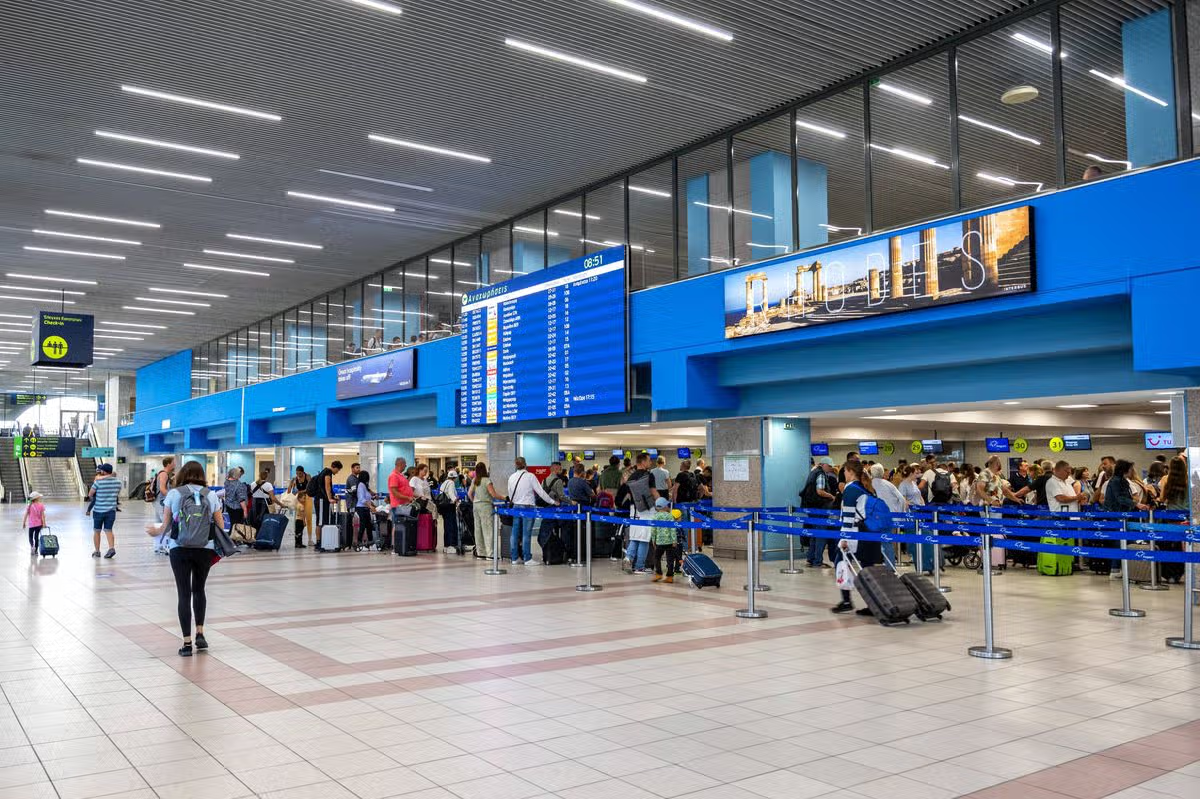
Greece has suspended EU fingerprint and facial scans for British holidaymakers. The country has chosen to abandon the new biometric security measures over concerns about queue chaos sweeping across the continent. Queues have been hitting the country with four hours reported in many destinations, including Greece.

All travellers from the UK and other non-EU countries are supposed to be photographed and fingerprinted at EU airports and border crossings under the new entry and exit system (EES) introduced by Brussels.

Holidaymakers have been cautioned that the new security measure, which is now fully operational, could trigger airport delays of up to four hours. Eleni Skarveli, director of the Greek National Tourism Organisation in the UK, stressed that the decision would “ensure a smoother and more efficient arrival experience in Greece” and would “significantly reduce waiting times” while alleviating congestion at airports.

The EES is intended to replace manual passport stamping and better monitor the 90-day visa-free limit, but its introduction has caused havoc at some of Europe’s busiest airports.

A statement on the website of the Greek Embassy and posts on official social media channels said: “Update for British passport holders travelling to Greece. “In the framework of the implementation of the Entry/Exit System, as of 10 April 2026, British passport holders are exempt from biometric registration at Greek border crossing points.”

There was no further detail of how long the exemption would last, and FCDO travel advice for Greece has not been updated.

Luke Petherbridge, director of public affairs at travel trade organisation Abta, said: “While for many the travel experience remains smooth, we’re disappointed and frustrated to see some passengers being caught up in delays due to EES.

“Abta has been warning destinations and the (European) Commission for some time about the need for proactive steps to be taken to avoid delays, including the full use of contingency measures to stand down biometric checks at busier times, and adequate staffing especially at peak times.”

A total of 122 passengers were reportedly unable to board the flight from Milan Linate to Manchester on Sunday because of delays at passport desks caused by the ramp up of the EU’s Entry Exist System (EES).The 11am departure was held for 59 minutes before departing with the majority of seats empty.

One of the affected easyJet passengers, Kiera, 17, from Oldham, Greater Manchester, said she and her boyfriend arrived at Milan Linate airport at 7.30am on Sunday. She told the BBC: “We got to Border Control and it was a massive queue of people. I wasn’t feeling great anyway because I think I’d got food poisoning.

READ MORE: Full list of airports as easyJet warns of ‘longer queues’READ MORE: Major airline cancels hundreds of flights as ‘last resort’ over Iran fuel crisis

“At about 10.50am they brought some water over for people, and when we got to the front of the queue someone asked us if we were going to Manchester, and told us our flight had just gone.”

Vicky Chapman, 26, from Wirral, Merseyside, was booked on the flight with her family, including her five-year-old son.

She told the Liverpool Echo they arrived at the airport “with more than enough time” but were “refused entry through passport control”.

She continued: “We were then told that we are a ‘no show’ on our flight because we did not get to the gate on time, even though passport control had issues and they would not let us through.

“We were passed from pillar to post for three hours and no-one helped us. “It was so hot in the airport, people were vomiting, people were almost passing out.

“We’re being told that Tuesday is the earliest we can get back, and that we have to fly to Gatwick. We’ve had to pay out of pocket for an Airbnb.”

An easyJet spokesman said: “Due to delays in EES processing by border authorities, some passengers departing from Milan Linate on Sunday experienced very long waiting times at passport control.

“We held flight EJU5420 from Milan to Manchester for nearly an hour to give passengers extra time but it had to then depart due to crew reaching their safety regulated operating hours.

“Customers who missed the flight have been offered a free flight transfer.

“We continue to urge border authorities to ensure they make full and effective use of the permitted flexibilities, for as long as needed while EES is implemented, to avoid these unacceptable border delays for our customers.

“While this is outside of our control, we are sorry for any inconvenience caused.”

Of the 156 passengers reportedly booked on the return flight to Manchester, just 34 made it on board – leaving a staggering 122 stranded in Italy. EasyJet subsequently issued an apology over the incident.

At three of the UK’s “juxtaposed” border controls in Dover, Folkestone and London St Pancras, the pricey EES kiosks remain unconnected to the French police aux frontières IT system. These issues are not expected to be resolved until September, according to the Independent.

Greece is heavily dependent on British tourism, particularly at its bustling island hotspots such as Corfu, Crete and Rhodes, which can welcome upwards of 2,000 UK passengers daily during peak season.

The decision by Athens is widely regarded as a move to offer reassurance to British holidaymakers, and could encourage other Mediterranean nations to follow its lead. Greece is yet to confirm an end date. for its EES exemption for British travellers.

Holidaymakers are already considering switching their summer holiday plans this year, according to travel industry experts.

“Because of the war in the Middle East, Europe is seeing a big increase in interest as a holiday destination this year,” an ABTA spokesman said.

ABTA added that Greece was anticipated to be the fifth most-visited destination by Britons this summer, trailing behind Spain, France, Italy and the USA.

The spokesman said: “I think it’s too early to say what this change might mean for the number of people visiting, particularly as decisions on where to go are based on a number of factors.”

It’s thought travellers now weighing up a continental break may pivot towards Greece to sidestep potential headaches caused by the new scheme. “Greece for me this summer then, was thinking of Tenerife, but no way I’m putting up with those queues and chaos,” one man posted on X.

Another person added: “I work in the travel industry, already had customers worried about this new system believe me, Greece will benefit from this stand!” While a third chimed in: “Perfect – off to the Greek islands this summer – common sense prevails!”

Source link

Can Hungary wean itself off Russian energy, as its new leader has promised? | Explainer News

Hungary’s newly elected leader, Peter Magyar, stormed to power last weekend after campaigning to, among other things, take a step back from Russia.

Instead, Magyar has promised voters he will steer Hungary back towards the European Union, following the 16-year rule of far-right Prime Minister Viktor Orban, who went to great lengths to deepen ties with Russia.

Recommended Stories

list of 3 itemsend of list

Under Orban, Hungary opposed most of the European Union’s stances against Russia and  blocked sanctions and obstructed military aid for Ukraine.

Above all, he and his Fidesz party entrenched Hungary’s reliance on Russian oil.

Now, following a massive electoral turnout and a landslide victory, Magyar – once a devotee of Orban and now leader of the centre-right Tisza party – has promised to end Russian oil imports by 2035. But how realistic a goal is that? And can he achieve it?

Magyar
Peter Magyar celebrates after Prime Minister Viktor Orban conceded defeat in the parliamentary election in Hungary, April 12, 2026 [File: Leonhard Foeger/Reuters]

How much does Hungary depend on Russia for energy?

Hungary has been central to keeping Russian oil and gas flowing into the EU, even as Europe and the US banned some imports and imposed sanctions on anyone paying more than $60 a barrel for Russian oil.

Following Russia’s invasion of Ukraine, the EU banned seaborne imports of Russian oil but kept land flows legal. That allowed Hungary to continue importing most of its crude by pipeline via Ukraine.

The EU first announced plans to phase out Russian energy imports in May 2022, shortly after Russia’s invasion of Ukraine. In December 2025, a binding agreement was made for member nations to completely phase out Russian oil and gas imports by late 2027. But, instead of diversifying from Moscow, Hungary increased its dependency.

According to a 2026 report by the Center for the Study of Democracy (CSD), Hungary had expanded its reliance on Russian crude from 61 percent in 2021 to 93 percent by 2025.

Much of the crude oil Hungary imports from Russia comes via the Druzhba pipeline. It is one of the key pipelines that ensures the continued flow of Russian crude to both Hungary and Slovakia. At 5,500 km (3,420 miles) long, it begins in Almetyevsk in western Russia and runs into Belarus. It splits at Mozyr, with one branch going to Poland and Germany and the southern branch goes through Ukraine into Slovakia, Hungary and Czechia.

pipeline
The Druzhba oil pipeline from Russia at the Danube Refinery in Szazhalombatta in Hungary, May 18, 2022 [File: Bernadett Szabo/Reuters]

In January, the section of the pipeline running through Ukraine suffered significant damage. Ukraine blamed a Russian airstrike – Moscow denies that.

Hungary and Slovakia have complained that Ukraine has been deliberately slow to repair the damage. As a result, in March, Orban vetoed a 90 billion euro ($106bn) loan from the EU to Ukraine until the pipeline reopens.

On Tuesday this week, Ukraine’s President Volodymyr Zelenskyy said oil will flow again through the conduit by the end of April as he expects the new Hungarian leadership to lift its veto on the loan by then.

As for gas, Hungary remains one of the most dependent EU member states on Russian natural gas, accounting for roughly three-quarters of its annual imports, the CSD report shows.

Since the start of Russia’s invasion, Hungary has imported an estimated 15.6 billion euros ($18.4bn) worth of Russian gas. Long-term contracts with Russia’s state-owned Gazprom, the continued reliance on TurkStream – a natural gas pipeline running from Russia to Turkiye – and “the weak use of alternative interconnectors have locked the country into Russia’s reconfigured gas export system”, the CSD report states.

Nuclear energy dependency is yet another issue. Hungary granted Rosatom, the Russian state nuclear energy corporation, the construction contract for the expansion of its Paks atomic plant, 100km (62 miles) southwest of Budapest on the Danube River. Russia, in turn, provided Hungary with a state loan to finance most of the development of new reactors. The European Commission approved the plan in 2017 and construction started in February.

Now, Magyar says he intends to reassess the project’s financing. But the Paks plant provides 40 to 50 percent of all electricity generated in Hungary. The expansion plans will increase that to between 60 and 70 percent, which would cut reliance on imported energy, but keep Hungary tied to Russia. 

According to a 2025 joint research paper by the Center for the Study of Democracy and the Center for Research on Energy and Clean Air, Hungary could potentially diversify its energy supply by importing non-Russian oil via alternative sources such as the Adria pipeline. It transports crude from the Adriatic Sea to refineries in Croatia, Serbia, Hungary and Slovakia. Their refiners, which are controlled by Hungarian oil and gas company MOL, are capable of processing non-Russian crude, the research paper said.

Russian oil has been coming in at a discounted rate as a result of Western sanctions, so any diversification will likely be more expensive.

Can Hungary wean itself off its dependence on Russian oil?

It won’t be easy, and Magyar knows it. “The geographical position of neither Russia nor Hungary will change. Our energy exposure will also be here for a while,” he said before last weekend’s election. And in an interview with the Financial Times, Magyar insisted that Russian imports should remain an option. “This does not mean that by ending dependence on someone you no longer continue to buy from them,” he said.

Magyar will seek to strike a balance between respecting current contracts with Moscow to ensure Hungary’s energy security, while establishing political distance, said Pawel Zerka, a senior policy fellow at the European Council on Foreign Relations.

“I would expect this government not to be pro-Russia in the sense of going to Moscow and keeping ties with the Russian government, but they don’t have easy options to replace Russian fuel with something else, especially considering the international situation with the Middle East,” Zerka said, referring to the closure of the Strait of Hormuz in the Gulf which has blocked the shipping of 20 percent of the world’s oil and LNG supplies.

Zerka added that the newly elected leader will not have political room to be particularly cordial with Russian President Vladimir Putin, considering the disapproval of Russia by his electoral base. A recent poll by the European Council on Foreign Relations shows that a majority of Tisza’s voters see Russia as an adversary or rival to compete with.

“It will be interesting to see how he combines this with energy needs,” Zerka said.

How does the EU view Hungary’s energy ties to Russia?

The strong energy ties between Russia and Hungary have long caused friction with the EU. Following Moscow’s invasion of Ukraine in 2022, the European bloc has worked to cut imports of Russian oil and gas. Budapest has done the opposite.

In January, the EU passed legislation to completely phase out Russian gas and LNG imports by late 2027.

Orban’s government had called for all restrictions on Russian oil to be lifted as a result of the global energy crisis triggered by the war in the Middle East. While Trump has made some concessions on Russian oil already loaded on tankers at sea – causing several heading for China to head to India instead – EU leaders have maintained they will hold firm on sanctions.

In the lead-up to last weekend’s election, Magyar’s manifesto called the dependence on Russian energy a “systemic risk” and he would wean Hungary off its reliance by 2035. But whether he can do that in time to beat the EU’s 2027 deadline is likely to provoke discussion in Brussels.

Source link

TUI update for passengers worried about risk of ‘fuel shortages’

The airline responded to a passenger who asked for an update on upcoming flights

TUI has shared a message to passengers worried about possible ‘fuel shortages’. The travel company issued advice on social media, responding to a customer with concerns.

The update comes as experts have warned Europe could face jet fuel shortages if the Strait of Hormuz is not fully reopened in the coming weeks. Airports Council International (ACI) Europe, the trade body for European airports, previously said: “At this stage, we understand that if the passage through the Strait of Hormuz does not resume in any significant and stable way within the next three weeks, systemic jet fuel shortage is set to become a reality for the EU.

“The fact that we are entering the peak summer season… is only adding to those concerns.” On Thursday, the head of the International Energy Agency (IEA) warned Europe has “maybe six weeks of jet fuel left”.

Ryanair boss Michael O’Leary has also said disruption could begin in May. He previously told Sky News: “Fuel suppliers are constantly looking at the market.

“We don’t expect any disruption until early May, but if the war continues, we do run the risk of supply disruptions in Europe in May and June, and we hope the war will finish sooner than that and the risk to supply will be eliminated.”

Content cannot be displayed without consent

In response to the developments, a TUI passenger contacted the airline on X to ask if it could share an update for any flights booked after May 1. The social media user wrote: “TUIUK, with the reported jet fuel shortages, are you expecting holidays from May 1st to be affected?”

Replying to the message on April 16, a customer service team member answered on behalf of the airline. She wrote: “Hey, we’re closely monitoring the developing situation in the Middle East and its potential impact on global aviation fuel supplies.

“At present, we’re not anticipating any immediate disruption to our flight schedules or holiday programmes from fuel shortages.”

Other airlines have faced similar questions from passengers. In an X post shared with easyJet Holidays last week, a customer asked: “How concerned should we be that, given the potential aviation fuel shortages from end May, that our July flights Gatwick Bordeaux will be cancelled? Do you have surety of supply from Canada for example?”

In a response on April 10, an employee told the passenger they would be notified if any changes were made to the booking. easyJet Holidays said: “Hi there, thanks for reaching out. We do appreciate your concerns.

“Please be assured, we are monitoring the situation closely and if there were to be any changes to your booking at all, our dedicated pre-travel team would be in touch to advise on your options.”

Source link

Hungary’s Political Shift Ends Orbán Era but EU Reset Faces Deep Political Fault Lines

The election victory of Hungary’s Tisza party on April 12 marks the end of the 16 year rule of Viktor Orbán, a figure who has long defined Hungary’s contentious relationship with the European Union. His tenure reshaped Hungary’s domestic institutions and repeatedly placed the country at odds with EU norms, laws, and political consensus.

The incoming leadership under Péter Magyar now inherits not only a domestic mandate for change but also the complex task of rebuilding trust with the EU after years of institutional confrontation.

A fractured relationship with Brussels

Under Orbán, Hungary frequently clashed with EU institutions over rule of law, judicial independence, media freedom, and migration policy. One of the most controversial measures was the lowering of the retirement age for judges and prosecutors, which critics argued enabled political reshaping of the judiciary.

Tensions escalated further after 2022, when Hungary’s stance on sanctions against Russia and support for Ukraine created repeated deadlocks within EU decision making processes.

Financial pressure also became a key tool of EU leverage. The European Commission suspended billions of euros in funding to Hungary, citing concerns over corruption and democratic backsliding, deepening the political divide.

Allegations and escalating mistrust

Relations deteriorated further following leaked reports alleging that senior Hungarian officials coordinated with Russian counterparts during sensitive EU discussions. These claims intensified accusations within parts of the EU that Hungary had undermined collective decision making during a period of heightened geopolitical tension.

While Budapest has rejected many of these allegations, they contributed to a climate of mistrust that severely weakened Hungary’s position within the bloc.

A new government with a reform mandate

The Tisza party’s victory signals a clear domestic demand for change, particularly around governance and corruption. The new administration has strong incentives to restore relations with the EU, not least because of the approximately 17 billion euros in suspended funding that could be unlocked if conditions are met.

EU leaders, however, have made it clear that financial normalization will depend on compliance with a wide set of governance and legal reforms. These include anti corruption measures, judicial independence safeguards, and adjustments to policies affecting migration and minority rights.

Structural constraints on reform

Despite political momentum for rapprochement, significant obstacles remain. Hungarian society remains more socially conservative and more sceptical of the EU than many of its Western counterparts. This limits the political space for rapid liberal reforms, particularly in sensitive areas such as LGBTQ+ rights and asylum policy.

Economic pressures further complicate the situation. The new government will inherit fiscal strain linked to years of disputed EU funding and broader geopolitical uncertainty, including the economic effects of the ongoing war involving Iran, which has disrupted global energy markets and increased financial volatility.

Ukraine and the Russia question

One of the most sensitive areas in Hungary’s future EU relationship will be its position on Ukraine. While Péter Magyar has signaled a willingness to improve relations with Ukraine and align more closely with NATO and EU policy, key ambiguities remain.

His stated openness to continuing Russian energy imports for the foreseeable future, combined with proposals for a referendum on Ukrainian EU membership, suggests that strategic continuity with aspects of the previous government may persist.

Given public scepticism toward Ukraine within Hungary, any referendum could significantly complicate EU enlargement plans.

Analysis

The end of Orbán’s long tenure represents a clear political inflection point in EU Hungary relations. It removes a persistent source of institutional confrontation and opens the possibility of renewed cooperation with Brussels.

However, the assumption that relations will automatically normalize is overly optimistic. The structural sources of tension between Hungary and the EU extend beyond one leader. They include divergent political cultures, competing interpretations of sovereignty, and deep disagreements over migration, rule of law, and foreign policy alignment.

The new government’s dependence on EU funds gives Brussels significant leverage, but also creates domestic political risk if reforms are perceived as externally imposed. This creates a delicate balancing act between compliance and legitimacy.

On foreign policy, Hungary’s position on Russia and Ukraine will remain the most consequential test. Even partial continuity with previous policies could reintroduce friction at a time when EU unity is under pressure from multiple geopolitical crises.

Ultimately, Orbán’s departure may mark the end of one chapter, but it does not resolve the underlying tensions that have defined Hungary’s relationship with the European project. The reset, while possible, will be gradual, conditional, and politically contested.

With information from Reuters.

Source link

From Insider to Insurgent, Péter Magyar Topples Orbán’s Illiberal System

The rise of Péter Magyar marks one of the most significant political shifts in Hungary’s modern history. His victory over Viktor Orbán ends a 16 year era defined by centralized power and strained relations with the European Union.

What makes Magyar’s ascent particularly striking is that he did not emerge from outside the system, but from within it.

From insider to challenger

Magyar was once closely associated with Orbán’s ruling Fidesz party and initially echoed many of its political themes, including nationalism and scepticism toward liberal European norms.

His turning point came in 2024, when he publicly broke with the government and sharply criticised corruption and the concentration of power. This positioned him as a credible reformist with insider knowledge of how the system operated.

Dismantling an illiberal model

Orbán’s “illiberal democracy” was built on gradually consolidating control over key state institutions, including the judiciary and media. Over time, checks and balances weakened, allowing the ruling party to dominate political life.

Magyar’s understanding of this structure allowed him to directly challenge its foundations, particularly by focusing on corruption and institutional accountability, issues that resonated with voters.

Building a broad coalition

Over two years of campaigning, Magyar evolved politically. He travelled extensively, engaging with voters across the country and broadening his appeal beyond a narrow ideological base.

According to Zsolt Enyedi, Magyar became a unifying figure for pro democracy forces, offering a platform that different groups could rally around. This ability to bridge divides proved crucial in defeating a deeply entrenched political machine.

A more pragmatic approach to Europe

Magyar is not an uncritical supporter of the European Union, but he is expected to take a more constructive approach than his predecessor. Economic realities, particularly the need to unlock suspended EU funds, will push his government toward cooperation with Brussels.

This creates a pragmatic dynamic where reform is driven not only by political vision but also by financial necessity.

A difficult transition ahead

The transition of power is likely to be complex. Magyar has already expressed concern about actions taken by elements of the outgoing administration, suggesting resistance within the system he now seeks to reform.

Rebuilding institutions, restoring trust, and dismantling entrenched networks will take time and political capital.

Analysis

Péter Magyar’s victory highlights a key dynamic in political change within entrenched systems: transformation often comes from insiders who understand the machinery of power.

However, electoral success is only the first step. The deeper challenge lies in restructuring institutions that have been shaped over more than a decade. This process is inherently slow and politically sensitive.

Magyar must navigate competing pressures. Domestically, he faces a conservative and somewhat eurosceptic electorate. Internationally, he is expected to repair relations with the European Union and align more closely with its standards.

This balancing act will define his leadership. While his victory opens the door to democratic renewal, the outcome will depend on whether he can convert political momentum into lasting institutional change.

With information from Reuters.

Source link

Spain airport delays update as one group hit with longest waits over April ‘change’

Many passengers are facing waits of up to three hours at Spanish airports due to the new controls

Travellers in Spain are experiencing significant delays at airports. And experts are warning that one particular group is bearing the brunt of new border controls, according to a Spanish travel organisation.

There have been widespread reports of waiting times of up to three hours. New regulations have been introduced, with some passengers in particular facing very long waits.

Spanish media reports indicate waiting times of up to three hours at Palma airport alone, with similar delays reported in France, Greece, Italy and beyond. Travel group Aviba is now calling for urgent measures to prevent chaos this coming summer.

Pedro Fiol, president of the travel association, is demanding immediate action to avert disruption this summer, and has revealed he has been pushing for such measures for months, according to Ultimata Hora. The new system has only just been introduced, having fully launched on April 10, following a trial period that began late last year.

The EU’s new Entry/Exit System (EES) initially began operations on 12 October 2025, with a phased rollout across 29 European countries. Now it is fully in place.

The system replaces passport stamping with digitally recorded entries, exits or refusals of entry of non-EU nationals arriving for short stays. Travellers’ facial images, fingerprints and personal data from the travel document will also be recorded.

Mr Fiol said: “The implementation of the new European Border and Security System (EES) is already beginning to be felt at the Balearic airports, especially at Son Sant Joan, the main gateway to Mallorca, where we are still operating with a hybrid model. At certain times, it is causing some slowdowns in the controls, particularly for non-EU passengers.”

He warned that “we are facing a structural change in how borders are managed across Europe: biometric registration is replacing manual passport stamping, and this means more time for the passenger’s first contact with their destination.” In his view, so far “the experience has been inconsistent: some days the operation runs relatively smoothly, while others, according to agencies and tour operators, can take more than two hours from the moment the plane lands until the traveller collects their luggage, and even nearly three hours in some specific cases.”

Ultima Hora reports that the National Police have acknowledged the delays, though they say they have seen no evidence of prolonged hold-ups. Sources close to the security forces have told Spanish media that additional staff have been deployed during peak hours in a bid to ease any difficulties that may occur during periods of heavy passenger congestion at checkpoints.

Travellers passing through airports in countries including France, Germany, Belgium, Italy, Spain and Greece are facing waits of several hours at border controls, according to the Airports Council International (ACI). Olivier Jankovec, the director of the ACI European division, told the Financial Times: “This situation, in the coming weeks and certainly over the peak summer months, is going to be simply unmanageable.

“We are seeing those queueing times now, at peak times, when traffic is just starting to build up.” A spokesperson for the European Commission told the Guardian: “What we can see from the first days of full operation is that the system is working very well. In the overwhelming majority of member states there are no issues.”

The commission said that the average registration of a passenger was 70 seconds, although the ACI has claimed that it can take up to five minutes. The spokesperson said there were a “few member states where technical issues have been detected” but that they “are being addressed”.

They said: “It is up to member states to ensure the proper implementation of the EES on the ground.” Luke Fitzpatrick, from independent travel agency Perfect Getaways, told the BBC this week that travellers should plan ahead to make border checks as smooth as possible.

“It’s about being as prepared as you can be,” Fitzpatrick told BBC Radio Merseyside. “There is a lot of uncertainty at the moment as people are getting used to the new system.”

While he said the advice was to arrive at the airport “at least three hours early”, he said it could be more difficult for people booked on a package holiday. “If you’re on a shared transfer back, everyone’s coming together at the same time,” he said.

EES changes and the impact on transfer and pick-ups

Pedro Fiol told Ultima Hora that “this situation is forcing a restructuring of transfer and pick-up operations at destinations to better co-ordinate exact times, avoid additional downtime, and guarantee the smoothest possible service.” Given this situation, he says that “travel agencies are concerned that if resources are not properly allocated at airports with such high tourist pressure as those in the Balearic Islands, significant queues and a negative first experience for visitors are possible.”

What do Brit tourists need to do with EES rules?

The govuk website states that “if you are travelling to a country in the Schengen area for a short stay using a UK passport, you may be required to register your biometric details, such as fingerprints and a photo, when you arrive. You do not need to take any action before you arrive at the border, and there is no cost for EES registration.

“EES registration is replacing the current system of manually stamping passports when visitors arrive in the EU. EES may take each passenger extra time to complete so be prepared to wait longer than usual at the border.”

The countries in the Schengen area are: Austria, Belgium, Bulgaria, Croatia, Czechia, Denmark, Estonia, Finland, France, Germany, Greece, Hungary, Iceland, Italy, Latvia, Liechtenstein, Lithuania, Luxembourg, Malta, Netherlands, Norway, Poland, Portugal, Romania, Slovakia, Slovenia, Spain, Sweden, and Switzerland.

Source link