Elections

West Bank scepticism as Palestinians doubt local elections will change much | Israel-Palestine conflict News

Ramallah, occupied West Bank – Hani Odeh has spent four and a half difficult years as mayor of Qusra, southeast of Nablus.

Surrounded by illegal Israeli settlements and outposts, the small Palestinian town of approximately 6,000 in the northern West Bank faces relentless settler attacks that left two residents killed last month.

Recommended Stories

list of 4 itemsend of list

Many are unable to access their agricultural fields as settlers repeatedly damage the village’s water pipes. But when his Palestinian neighbours go to the polls for municipal elections on Saturday, he will not be on the ballot.

“The resources are limited, the demands are many, there’s the settlers, the army – the problems don’t stop,” he says. “You can’t do anything for them. I’m exhausted. I just want to rest, honestly.”

Only three months ago, the Palestinian Authority (PA) announced that there would be local elections on April 25 for municipalities and village councils, the first such elections in nearly five years. There have been no national elections since 2006, keeping the Fatah-ruled PA in power in the West Bank more than 17 years after its initial mandate expired.

Odeh, who will be stepping down, doesn’t believe there is much point to the vote. “It won’t change the reality,” he says, pointing out that the gate to enter Qusra has been shut by the Israeli military for two years.

Meanwhile, the PA civil servants that Odeh relies on to run Qusra receive salaries of just 2,000 shekels ($670), a fraction of what they are owed, as Israel continues to withhold tax revenues earmarked for the Palestinians.

According to the Palestine Elections Commission, 5,131 candidates are competing across 90 municipal councils and 93 village councils on April 25, with nearly a third of the electorate between the ages of 18 and 30.

Across the West Bank, many agree with Odeh, and express doubts that these elections can move the needle on anything that actually matters.

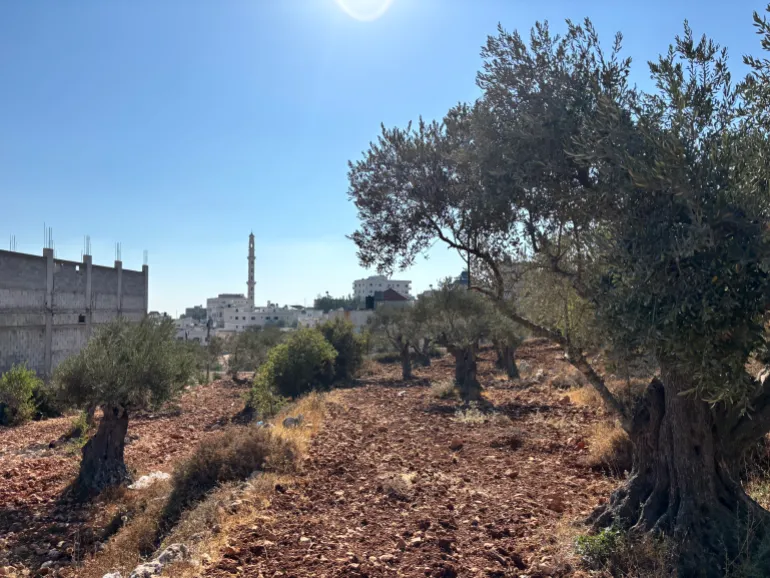
olive trees with buildings in the background
The gate to enter Qusra has been shut by the Israeli military for two years [Al Jazeera]

‘Sense of futility’

In the days leading up to the vote in Ramallah, there have been no campaign posters hanging along the streets. That is because Ramallah – the city where the PA is headquartered – is not holding competitive elections this Saturday. Neither is Nablus, another major city in the West Bank.

Instead, both cities are being decided through a process known as acclamation, in which a single list of candidates is elected without a formal vote. Across the West Bank, 42 municipal councils and 155 village councils will be filled this way – a majority of local administrative authorities.

Historically used in small villages where extended families agreed on candidates, the process is now being applied in major cities that are PA strongholds – such as Ramallah and Nablus – where Fatah mobilisation has discouraged challengers.

“There is definitely a sense of futility in certain places,” says Zayne Abudaka, cofounder of the Institute for Social and Economic Progress (ISEP), which regularly surveys Palestinian sentiments and views, “and I think that makes it easier for places to just not have an election.”

Fatima*, a businesswoman who runs an education centre in el-Bireh, says she hasn’t voted in an election since the last Palestinian national election 20 years ago – and she doesn’t plan to this time, either. “They will choose a new group of decisionmakers, and I believe they will do the same according to the old decisionmakers,” says Fatima. “We don’t see any difference between them. It is not fair.”

Sara Nasser, 26, a pharmacist who commutes to Ramallah for work from the village of Deir Qaddis, west of the city, says she has simply grown accustomed to elections not happening and will not vote. “It’s been since before I was aware that there were significant elections,” she says. “We’ve always lived like this.”

Man sits at a desk
Muhammad Bassem, a restaurant owner in Ramallah [Al Jazeera]

Some hopeful, others less so

Not everyone is so pessimistic. Iyad Hani, 20, works at a children’s store and is enthusiastic to vote for the first time in his life in el-Bireh. “Hopefully, the one coming is better than the one who left,” he says. “There should be construction in the town and fixing the streets – that’s the most important thing.”

Muhammad Bassem, who is a restaurant manager in Ramallah, is also showing up to the polls, optimistic for what change may bring. “It is the new faces that bring about change for the better – always for the better,” he says. “We want our country to be beautiful, clean and to offer plenty of comfortable employment opportunities, tourism and development.”

Others are not so sure. Amani, who is from Tulkarem but works in Ramallah as a receptionist, watches the campaigns play out on her phone, though she does not plan to vote. “Right now, they keep saying, ‘we’re going to do this, we’re going to do that,’” she says. “But I don’t know if any of it will actually yield results.”

The Tulkarem issues she is thinking of, such as inadequate waste management, no parks for children and roads in disrepair, fall squarely into the kinds of changes that local elections might have an impact on, she suggests. “I just hope that something genuinely new and positive comes out of this.”

Sunset over Ramallah
The Palestinian Authority is based in Ramallah [Al Jazeera]

‘There isn’t a credible setup’

Underlining the question of these specific elections is a broad disillusionment with the PA that colours nearly every conversation about Palestinian political life.

Fatima says she and her whole family are politically aligned with Fatah, the effective governing party of the PA. “We don’t hate Fatah,” she says. “We hate the decisions they are taking right now.” While she says her business has contracted 85 percent in recent years, the PA still charges her 16 percent VAT.

That same disillusionment extends even to the elections in small localities like Qusra, which Mayor Odeh calls “a family affair, not a political affair”.

“People have lost faith in the parties, lost faith in the [Palestinian] Authority, lost faith in the whole world,” he says, expecting low turnout on Saturday. While most candidates in Qusra are politically aligned with Fatah, Odeh says no candidates in Qusra’s election this Saturday are doing so officially. “If they run under political affiliations, no one will support them.”

According to the Palestine Elections Commission, 88 percent of those on the ballots this year are doing so as independent candidates.

While polling suggests roughly 70-80 percent of Palestinians distrust the PA as an institution, Obada Shtaya resists framing this simply as a PA problem, considering the PA’s hobbled finances and its shrinking autonomy in Areas A and B under Israeli occupation. Israel continues to expand settlements and military raids in the West Bank, and the PA has no power to respond, with the prospect of a Palestinian state increasingly distant.

“Pessimism, lack of hope, helplessness – it is beyond the classical distrust in the PA,” he says. “It is looking at the PA and potentially understanding that these people also don’t have much that they can do to help themselves.”

A new amendment to the local elections law, requiring all candidates to affirm their commitment to agreements signed by the PLO – widely understood as a measure to exclude Hamas and other opposition factions – now threatens to taint how people perceive these elections. “If you want to run, you need to pre-agree to things at the national level,” says Shtaya. “But this is about local service delivery. Why am I having to sign things that deal with agreements between the PA and Israel?”

Despite the many naysayers in this election, “Palestinians are thirsty for democracy,” says the pollster, including those in Gaza. What is missing is not the will, he says, but the proper architecture for it: elections announced years in advance, a functioning legislature, and accountability that extends beyond voting day.

“There isn’t a credible setup that shows people their vote makes a difference,” says Shtaya. Without that, sporadic elections take place at what he calls the surface level: real enough that some people show up, but shallow enough that not much changes underneath.

Soon to be relieved of his mayoral duties, Hani Odeh plans to open a toy shop and set up a house for himself. “Let people breathe,” he says. “We’re here. We’re not going anywhere.”
Source link

Police raid Peru’s election authorities after outcry over slow vote count | Elections News

Anticorruption police gathered material from the homes of election officials including former office leader Piero Corvetto.

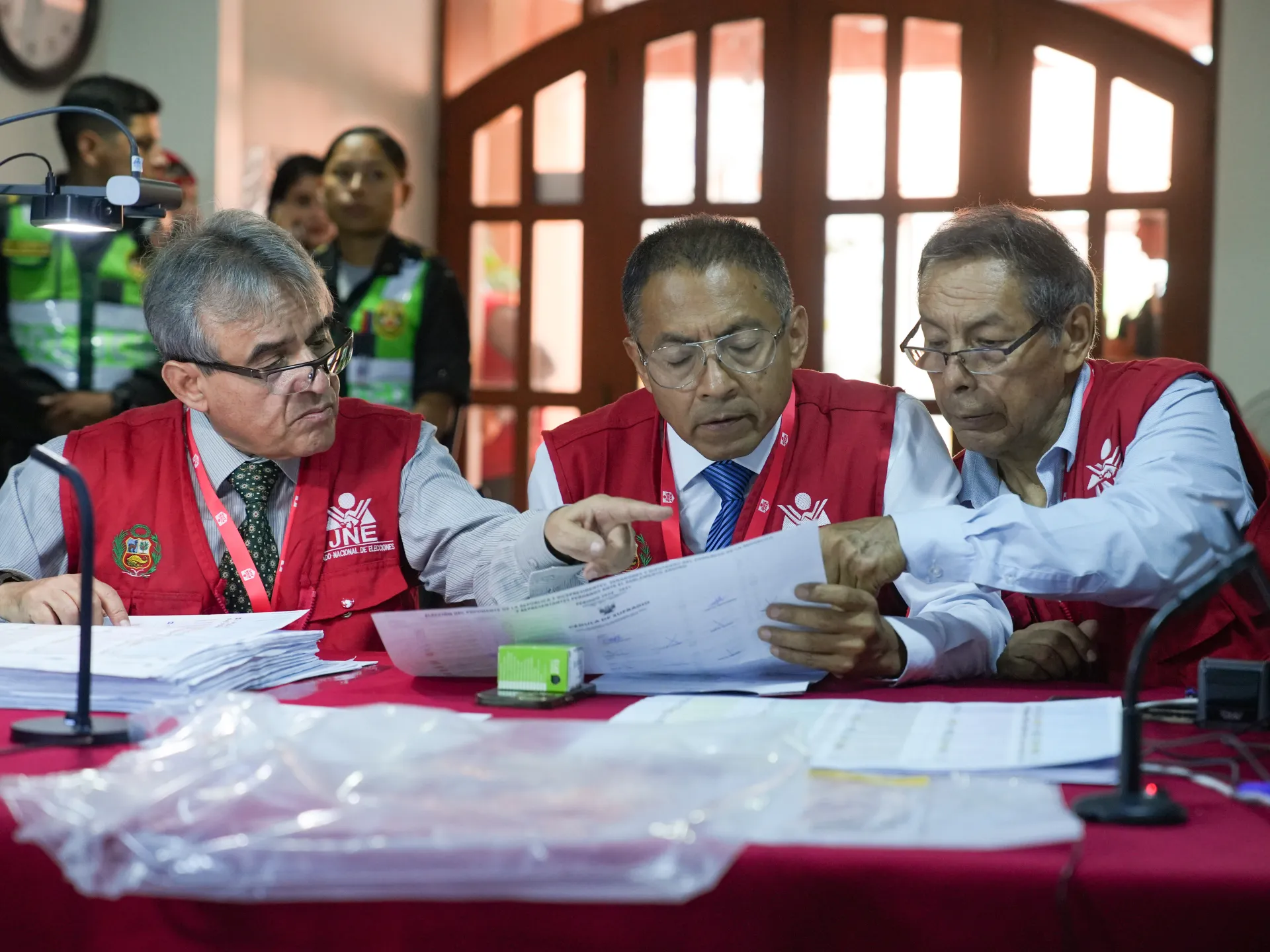
Police in the Peruvian capital of Lima have raided a home belonging to the former head of its national election agency, amid growing frustration in the aftermath of the country’s presidential election.

As of Friday, results still had not been finalised for the presidential race, which took place on April 12.

Recommended Stories

list of 3 itemsend of list

Delays in ballot deliveries forced the voting in some areas to be extended by an extra day, and the slow vote count has led to accusations of wrongdoing. But the European Union’s election mission to Peru found no indication of fraud.

Law enforcement was seen entering the home of Piero Corvetto, the former head of Peru’s National Office of Electoral Processes (ONPE), on Friday as part of a judicial warrant.

The officers with the local anticorruption police unit were tasked with removing mobile phones, laptops and documents, according to local broadcaster RPP.

The homes of five other officials were also targeted by police raids, as were offices belonging to Galaga, a private company that transports election ballots.

Corvetto resigned on Tuesday, though he denied any wrongdoing or irregularities in the election process. In a statement, he said he hoped his departure would boost public confidence.

On Friday, his lawyer, Ricardo Sanchez Carranza, told the news agency Reuters that a judge authorised the raid but denied prosecutors’ request to put Corvetto in preliminary detention.

But one of the leading presidential candidates, Lima’s former far-right mayor, Rafael Lopez Aliaga, has accused Corvetto of being a “criminal” and pledging to pursue him “until he dies”.

Lopez Aliaga is currently in a narrow race for second place in the presidential election.

With 95 percent of the ballots tallied, right-wing candidate and former First Lady Keiko Fujimori is in first place with 17 percent of the vote. She is all but assured of proceeding to the run-off on June 7.

Lopez Aliaga, meanwhile, is in third place with 11.9 percent, behind left-wing Congress member Roberto Sanchez at 12.03 percent.

Roughly 20,000 votes separate Sanchez from Lopez Aliaga, who has increasingly denounced the election as illegitimate, though he has yet to provide evidence to support that claim. Still, he has called the vote tally an “electoral fraud unique in the world”.

The final results are expected on May 15.

Source link

Will another film star be able to sway the election in India’s Tamil Nadu? | Elections News

Tamil Nadu, India – Standing on top of a customised van on a hot and humid afternoon in Tirunelveli, about 600km (373 miles) south of Tamil Nadu’s capital Chennai in southern India, C Joseph Vijay tells his supporters his opponents have joined hands to stop him from becoming the state chief minister.

“My rivals might appear different from outside, but they have only one aim: that Vijay should not become the chief minister,” says the 51-year-old actor-turned-politician to a mammoth crowd that begins to chant his name, which means “victory” in Tamil, in unison.

Tamil Nadu, one of India’s most developed states with impressive human development indices, also has a long history of electing film stars as leaders, some of whom are still revered by people as demigods years after their deaths.

As Tamil Nadu votes on Thursday to elect its 234-member state legislative assembly, Vijay’s bid for power is the latest addition to the state’s trend of film star-politicians, turning a traditionally bipolar battle into a triangular contest.

Vijay Tamil Nadu India
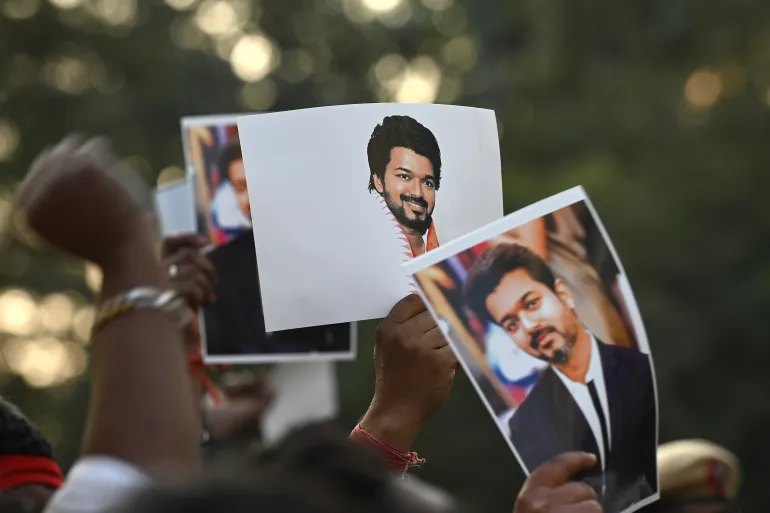
Riding on personal charisma, Vijay has attracted millions of supporters to his rallies [File: Sanchit Khanna/ Hindustan Times via Getty Images]

‘A blessing and a curse’

Vijay entered politics with much fanfare when he launched the Tamilaga Vettri Kazhagam (TVK) party in 2024, promising to end the decades-old dominance of the governing Dravida Munnetra Kazhagam (DMK) and the main opposition All India Anna Dravida Munnetra Kazhagam (AIADMK).

Incumbent Chief Minister MK Stalin leads the DMK and its 14-party Secular Progressive Alliance, in which the Indian National Congress is a junior partner. On the other hand, opposition leader Edappadi K Palaniswami of the AIADMK heads the 10-party National Democratic Alliance, which also includes Prime Minister Narendra Modi’s Bharatiya Janata Party (BJP).

The DMK and the AIADMK identify themselves as Dravidian parties, which derive their names from a powerful political and social justice movement in Tamil Nadu that opposed caste inequalities, championed social reforms, and rejected perceived attempts by India’s more dominant north Indian parties to impose Hindi – and upper-caste Hindu values – on the non-Hindi speaking southern states.

Dravidian parties have held power in Tamil Nadu continuously since 1967, with national parties like the Congress and the BJP playing secondary roles. While the BJP is contesting 27 seats in alliance with the AIADMK, the Congress is fighting for 28 seats as part of the DMK-led coalition.

More than 87 percent of Tamil Nadu’s 72 million people are Hindu, followed by Christians at 6.1 percent and Muslims at 5.8 percent, according to the last census conducted in 2011.

Among Hindus, the so-called “backward” or less-privileged castes constitute 45.5 percent, “extremely backward” castes 23.6 percent, while Dalits are at 20.6 percent. Dalits, formerly referred to as “untouchables”, fall at the bottom of India’s complex caste hierarchy and have faced marginalisation and violence for centuries.

Vijay, son of a Christian filmmaker father and a Hindu mother who is a background singer in films, belongs to the Vellalar community, an affluent agrarian group in Tamil Nadu with both Hindu and Christian members.

Vijay started his film career as a child actor in movies directed by his father. His 1992 debut as a hero, however, in Naalaiya Theerpu (Tomorrow’s Verdict), flopped. Following the setback, his father cast him alongside popular star Vijayakanth — who later founded his own political outfit, Desiya Murpokku Dravida Kazhagam (DMDK) — in Senthoorapandi (1993), which gave his career a new lease of life.

It was the 2004 film Ghilli (Gutsy), which carried a subtle political undertone, that catapulted Vijay to superstar status. He dropped hints about his political ambitions in the 2013 hit Thalaivaa (Leader), which was launched with the tagline “Time to Lead”.

Soon, political messaging became central to many of Vijay’s subsequent films. Even the title of his yet-to-be-released Jana Nayagan (People’s Leader) — which he claims will be his final film — alludes to his political aspirations.

Riding on personal charisma, Vijay has attracted millions of supporters to his rallies, despite allegations of poor crowd management, which caused a stampede at one such gathering in September last year, killing 42 people.

He is expected to draw a share of Dalit and minority Christian votes that would have otherwise flowed to the DMK-led coalition. He is also banking on anti-incumbency votes that could have benefitted the AIADMK alliance.

Yet analysts say Vijay’s ambition of becoming the next chief minister will not be as easy as the scripted blockbusters he has built his career on, since he faces two opponents with decades of experience in real politics.

That leads political commentator R Kannan to describe Vijay as “both a blessing and a curse” for the two Dravidian coalitions.

“When the AIADMK joined the BJP-led NDA, many predicted the Dravidian party would lose heavily, with minorities and Dalits flocking to the DMK. Vijay’s entry, however, has offered the AIADMK a ray of hope — he is expected to draw a decent share of votes that would otherwise have gone to the DMK,” he said.

“At the same time, he works in the DMK’s favour by siphoning off anti-incumbency votes that might not entirely have gone to the AIADMK. For both Dravidian parties, he is at once a blessing and a curse.”

Tamil Nadu’s tryst with stars

Vijay is aiming to follow the path of illustrious predecessors: Maruthur Gopalan Ramachandran, popularly known as MGR, and his protege, Jayaram Jayalalithaa – Tamil Nadu’s most beloved on-screen pair.

Born into poverty, MGR’s rise to stardom was nothing short of phenomenal. He captured the imagination of Tamil Nadu’s working class, who idolised him in return. From his first superhit, Rajakumari (Princess) in 1947, his films cast him as a champion of the masses, battling oppression and corrupt authority.

MGR launched the AIADMK in 1972 after breaking away from the DMK and served as Tamil Nadu’s chief minister from 1977 to 1987. He introduced several welfare programmes, the most significant being the Puratchi Thalaivar MGR Nutritious Meal Scheme, which provided free meals to schoolchildren to eliminate malnutrition and boost school enrolment.

His political heir, Jayalalithaa, was a six-time chief minister between 1991 and 2016, when she became India’s first female state leader to die in office. She is remembered for launching several women-centric programmes, including all-women police stations and subsidised two-wheelers for working women, apart from her work in curbing female infanticide.

India Jayalalithaa
Jayalalithaa offering flowers to a portrait of AIADMK founder MG Ramachandran in Chennai, May 20, 2016 [Arun Sankar/AFP]

The DMK also has a history of film personalities, including the party’s founder, CN Annadurai, who rose to fame as a pathbreaking scriptwriter with films like Velaikkari (1949), and MGR as the party’s star campaigner and leader before he founded the AIADMK.

Soon, Muthuvel Karunanidhi emerged as another prominent writer, poet and screenwriter with films like Parasakthi (1952), meaning Supreme Power, often cited as a turning point in Tamil cinema. Directed by Krishnan-Panju and written by Karunanidhi, then 28 years old, the film fiercely attacked casteism and social inequality, while propelling the spread of the Dravidian ideology.

Karunanidhi, popularly known as Kalaignar (artist), wrote scripts for more than 75 films that resonated with the struggles of the working class, championing rationalism and social equality.

He won the Tamil Nadu Legislative Assembly election for a record 13 terms and served as the state’s chief minister for five terms between 1969 and 2011. He died at the age of 94 in 2018, when his son, Stalin, took over as chief minister and DMK chief.

Film star-politicians who embraced Tamil identity politics flourished, while those who did not fell by the wayside.

“Successful leaders such as MGR, popularly known as Puratchi Thaalaivar [Revolutionary Leader], Jayalalithaa, who earned the monikers Puratchi Thalaivi [Revolutionary Female Leader] and Amma [Mother], embraced identity politics. Another popular film actor, Sivaji Ganesan, by contrast, could not make the same mark in politics even after he tried,” said Kannan, who has written biographies of MGR and Annadurai.

Narendra Modi and the chief minister of Tamil Nadu state M.K. Stalin
Indian PM Narendra Modi, left, and MK Stalin, chief minister of Tamil Nadu, gesture during the foundation stone laying ceremony of various infrastructure projects, in Chennai, May 26, 2022 [Arun Sankar/AFP]

In 2005, popular actor Vijayakanth added to the starry mix by launching his DMDK party, another Dravidian political outfit. He made every attempt to position his party as an alternative to the DMK and the AIADMK, but failed. The party won just one seat in 2006 — Vijayakanth’s own — and drew a blank in 2009. Though he went on to become the leader of the opposition in the assembly in 2011, the election reverses forced him to seek alliances. The DMDK, now led by his wife Premalatha, is contesting 10 seats in alliance with the DMK.

Which is where, say analysts, Vijay’s pitch for power is unlikely to make an impact in this election. They say his TVK party does not fall in the long line of Dravidian parties that have a distinct political ideology and programme that appeals to their voters.

“Tamil Nadu is an ideologically and politically evolved state. Issues such as social justice, centre-state relations, and linguistic and cultural identity are paramount here. People will not back a politician without a clear ideology,” Ramu Manivannan, former professor of political science at the University of Madras, told Al Jazeera.

Manivannan said large crowds at Vijay’s rallies should not be mistaken for potential votes. “Film stars always attract crowds. To assume all of them will translate into votes is unfair.”

Vijay’s TVK is rooted in his fan clubs, which thrive on masculine aggression, said S Anandhi, retired professor at the Madras Institute of Development Studies.

“Vijay’s populist rhetoric — defying all authority — appeals strongly to the youth. But he never clarifies what he will actually do in power. He frames it as all established forces being arrayed against young men, and youngsters see this as an opportunity for a new kind of collectivisation. I would call it a dangerous class,” she told Al Jazeera.

Appeal to young, female voters

Vijay appears to be banking heavily on two voter blocs: younger voters between 18 and 39 years, who number 23 million of the state’s 57 million voters, and women, who account for more than half of them.

At his rallies packed with young people and women, Vijay has alleged that Stalin’s true allies are “bribery and corruption”, framing the contest as a personal battle between himself and the chief minister.

Stalin, for his part, has largely brushed off Vijay’s attacks. “Newly-formed parties have a wrong notion that they can survive by criticising DMK,” he said in a recent interview.

Instead, Stalin has focused his attacks on the Modi government, accusing it of depriving Tamil Nadu of its share of federal funds, and framing the election as a contest between Tamil Nadu and New Delhi – a ploy that simultaneously targets the AIADMK for allying with an “adversary”, the BJP.

The AIADMK’s Palaniswami has countered by saying Stalin raises the centre-state issue only because he has “no achievements of his own to show”.

Despite their ideological differences, all parties are competing heavily on welfare promises in a state known for freebies during elections.

The DMK has pledged to double the monthly women’s allowance to 2,000 rupees ($21), offer 8,000 rupees ($85) in home appliance coupons, and build one million homes for the poor over five years. The AIADMK, also promising a monthly allowance of 2,000 rupees for women, has additionally offered free refrigerators to the poor and a one-time family grant of 10,000 rupees ($106).

Vijay’s TVK, hoping to cash in on the ongoing global fuel crisis, has promised six free LPG cylinders annually, 2,500 rupees ($26.5) monthly support for the female heads of a household, 8gm gold and a silk saree for poor women getting married, 4,000 rupees ($42.5) stipend for unemployed college graduates, and interest-free education loans of up to 2 million rupees ($21,257).

Still, Kannan feels Vijay can at best be a disruptor in the three-cornered contest.

“Vijay’s campaign gained momentum in the final lap. He turned what was a bipolar contest into a three-cornered one. But apart from his personal charisma, he lacks proper organisational machinery. Many of his party’s candidates are unknown faces,” he said.

Source link

Can fish hook voters in India’s West Bengal elections? | Elections News

Waving a big Catla fish in his hands, Sharadwat Mukherjee went door to door canvassing for votes before Thursday’s election to the state legislature in the eastern Indian state of West Bengal.

Mukherjee is a candidate from Prime Minister Narendra Modi’s Bharatiya Janata Party (BJP), which rules nationally but has never come to power in the state, which has a greater population than Germany: more than 90 million people.

When he folds his hands to greet voters, the Catla just swings with a hook in its mouth. The big question: Can the fish also swing the election’s outcome?

Bengalis’ love for fish is legendary — on both sides of the border, in India and in Bangladesh. So much so that when a student-led uprising led to the ouster of then-Bangladesh Prime Minister Sheikh Hasina, some of the protesters who broke into her residence after she fled were seen raiding her refrigerator and walking away with fish.

But as West Bengal votes for its next government, fish has now leapt from kitchen slabs to the campaign trail, as leaders cosy up to voters in a variety of ways — and in some cases try to distance themselves from suspicions that their wins could hit the Bengali diet adversely.

Bengal election
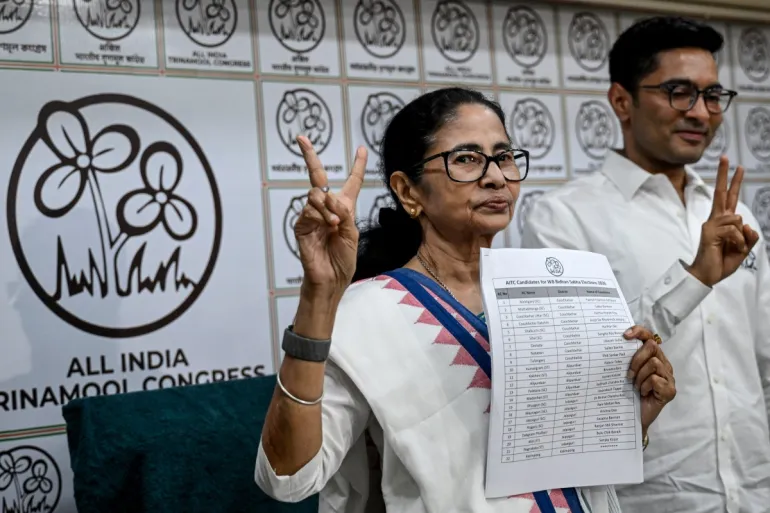
Trinamool Congress (TMC) chairperson and chief minister of West Bengal state Mamata Banerjee, left, along with General-Secretary Abhishek Banerjee, gestures as they announce the party’s candidate list for the upcoming legislative assembly elections, in Kolkata on March 17, 2026 [Dibyangshu Sarkar/AFP]

What’s happening in the West Bengal election?

Nearly 68 million people in West Bengal are expected to vote for their candidate of choice on April 23 and 29, to elect 294 lawmakers to the state assembly.

The results will be declared on May 4 in the crucial state vote, which the Hindu majoritarian BJP has never governed.

A revision of the electoral list, which controversially swept away a total of 9.1 million names from the register before polling, and has been criticised for disenfranchising minorities, was among the major polling issues. Some 2.7 million people have challenged their expulsions.

Another is identity politics.

On the campaign trail, in rallies, and in interviews, the chief minister of Bengal, Mamata Banerjee, a firebrand, centrist regional leader — who has been sometimes touted as a contender for Modi’s job in New Delhi, if the opposition were to win — has doubled down on identity politics to corner the BJP, analysts say.

BJP-led governments in several states have imposed bans or restrictions on the sale of meat. Far-right mobs have carried out lynchings of Muslims in BJP-ruled states over accusations that they were transporting beef.

Banerjee, who is seeking a fourth consecutive term, has time and again warned that if the BJP were to come to power, they would “ban fish, meat, and even eggs” — effectively labelling them as outsiders, unaware of Bengali culture. The BJP has rejected these allegations.

Biswanath Chakraborty, a psephologist and political analyst in West Bengal who has authored several books on voting behaviour, told Al Jazeera that the whole issue surrounding fish had been “constructed by Mamata Banerjee.”

“For long, she has peddled that fish is parallel to Bengali politics,” he said. “In election campaigning, every issue is constructed, and Mamata is the champion of that.”

Chakraborty argued that by fiercely pushing back against these allegations, the BJP had ended up helping the governing party in Bengal make sure the debate over fish remained a campaign highlight with voters.

“They [the BJP] are entering, or rather trapped, into the discourse set by Mamata,” the analyst said.

Fish bengal
A fishing boat is anchored in the waters of the Bay of Bengal as fish are hung out to dry along the beach at Dublar Char in the Sundarbans, November 10, 2011 [Andrew Biraj/Reuters]

Why fish, though?

“Fish is very crucial in Bengal, very crucial,” said Utsa Ray, an assistant professor at Jadavpur University, in West Bengal’s capital Kolkata. She also authored a 2015 book on Bengal’s culinary evolution in colonial India, titled Culinary Culture in Colonial India: A Cosmopolitan Platter and the Middle-Class.

“First of all, due to Bengal’s geographical location itself – along the Bay of Bengal – [and as] a place situated near rivers and streams, fish have been the most available item,” she told Al Jazeera.

Fish has also been an integral part of many rituals in Bengal on auspicious days for both Hindus and Muslims, Ray said, adding, however, that there were sects of people in Bengal who refrain from eating fish.

A 2024 study found that nearly 65 percent of people in West Bengal consume fish weekly.

Against that backdrop, Ray told Al Jazeera that Banerjee’s party was looking to leverage “regional identity or the Bengali identity”.

Banojyotsna Lahiri, a social activist and voter in West Bengal, described the BJP’s response, with candidates like Mukherjee campaigning with fish, as a “gimmick”.

“In Bengal, [the BJP] have suddenly realised that they appear as aliens with their vegetarian posturing because both fish and meat are integral to the Bengal culinary choices, caste or religion notwithstanding,” she told Al Jazeera. ”

Fish bengal
A labourer wears a plastic sheet as it rains, while he carries Hilsa fish in a bamboo basket at a wholesale market in Diamond Harbour, in the Indian state of West Bengal, September 10, 2024 [Dibyangshu Sarkar/AFP]

What’s up with the BJP and food choices?

In the run-up to the voting on Thursday, the BJP rushed to find a senior leader who could eat a fish in front of the cameras. They finally managed to get Anurag Thakur, a member of parliament from Himachal Pradesh, to do that on Tuesday.

“Questions of what food people will eat, especially non-vegetarian [food], have been associated with the BJP’s politics to impose restrictions and dictate food options,” said Neelanjan Sircar, a senior visiting fellow at the think tank Centre for Policy Research, in Delhi.

The BJP has been dictating food choices in northern India’s Hindi-speaking belt, with its “hyper masculine, Hindutva, and vegetarianism,” said Ray. “There have been cases of lynching for eating non-vegetarian food.”

However, that falls flat in Benga.

Still, both Sircar and Ray agreed that the display of fish on the campaign trail was a novelty — even in the often-bizarre world of Indian politics.

“Creating these new images for the BJP is important,” said Sircar. “So, to create another image in voters’ minds leads to these outlandish displays.”

Source link

Democrats up in Virginia, but US voters may pay price for redistricting war | US Midterm Elections 2026 News

Washington, DC – The latest battle in United States congressional redistricting has been decided, with voters in Virginia approving redrawing the state’s electoral map.

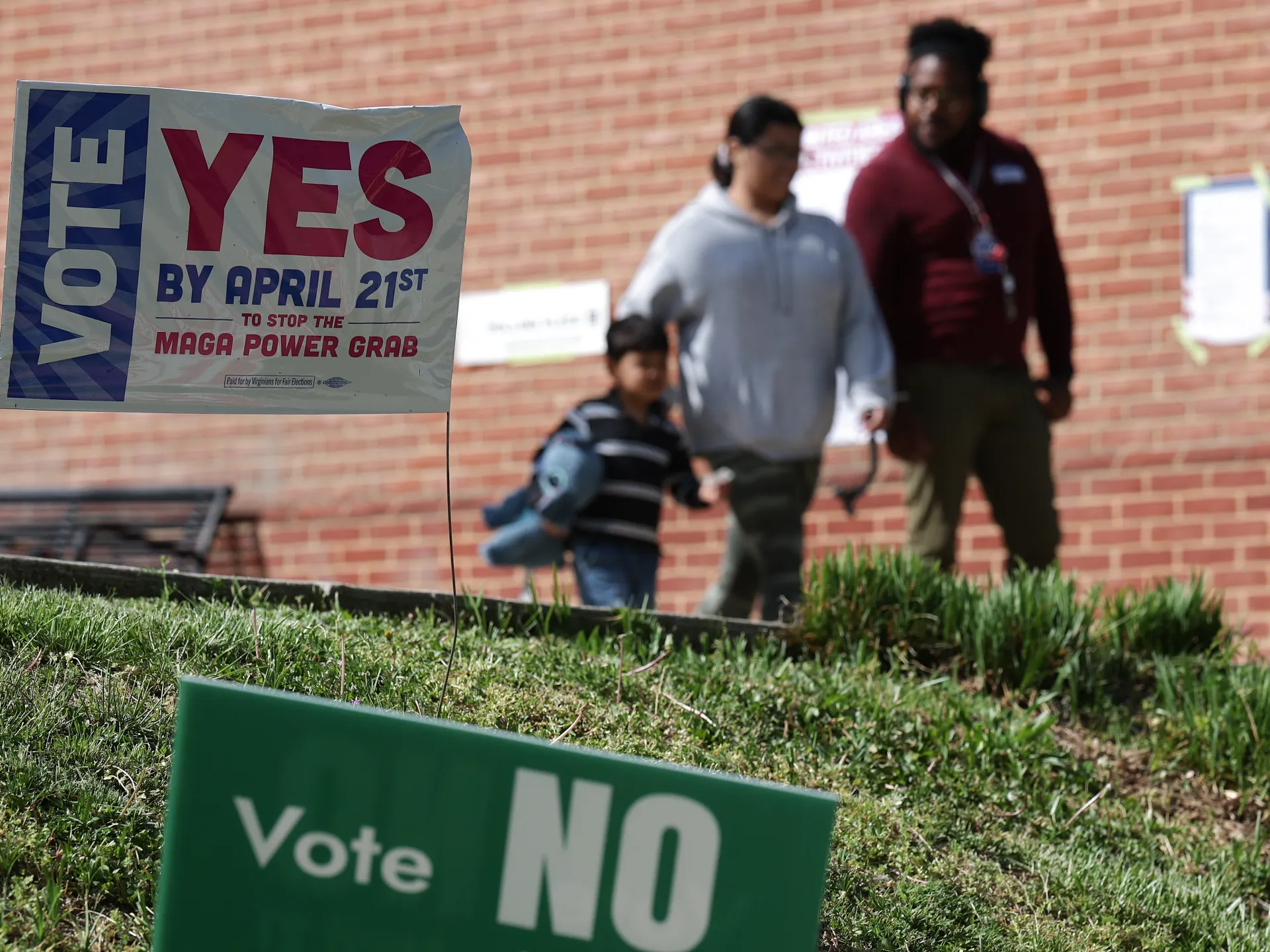
The result of Tuesday’s referendum on Virginia redistricting is widely expected to benefit Democrats in their fight to retake control of the slimly Republican-controlled US House of Representatives in the midterm vote in November.

Recommended Stories

list of 4 itemsend of list

While redistricting is typically conducted every 10 years, following the US Census count of the country’s population, the election season has seen an unprecedented flurry of states moving to redraw their legislative maps early, initially spurred by pressure on US President Donald Trump to urge his fellow Republicans in Texas to do the same.

Democrats may be up at the moment, but several scenarios – including a redistricting push in Florida – could soon spoil those gains.

Experts, meanwhile, warn of the long-term implications of the election season’s norm-busting political manoeuvres, which they say could transform how and when electoral maps are drawn for years to come.

“Virginia’s unorthodox redistricting isn’t just a map redraw, it’s a mid-decade power play in a national arms race,” Rina Shah, a political adviser and strategist, told Al Jazeera.

“In a cycle defined by retaliation over reform, this sets a precedent: when one side bends the rules, the other follows, until courts or voters draw the final line.”

Democrats gain – for now

Trump has not been timid about his desire to redraw state congressional maps to benefit his Republican Party.

In July 2025, he confirmed the plan to reporters: “Texas would be the biggest one,” he said. “Just a very simple redrawing, we pick up five seats.”

By August, Texas’s Republican-controlled State House had passed a new map favouring Republicans, setting the party on course to secure five more seats in the US House of Representatives compared to the earlier map.

The move was soon followed by changes in Missouri, whose new maps are expected to net Republicans one additional seat, while redistricting in North Carolina and Ohio is expected to give the party two to three new Republican-dominated districts.

Democrats in several states responded in kind, pushing for redistricting in California and Utah that resulted in about six new Democrat-dominated districts. Virginia’s victory largely neutralised Republican gains, adding between two and four seats for Democrats.

“This could shift Virginia from a 6-5 split to something like 10-1 Democratic,” political adviser Shah said, referring to Virginia’s 11 congressional districts and noting this would result in “delivering up to four net seats and dramatically tightening the fight for House control in the 2026 midterms”.

This comes as Republicans are already expected to face a punishing election season, with wariness over the US-Israeli war in Iran and the stubbornly high cost of living in the US.

Democratic control of either chamber of Congress – or of both – would give the party the ability to largely curtail Trump’s agenda in the final two years of his presidency.

As of Wednesday, Sabato’s Crystal Ball, a midterm predictor published by the University of Virginia’s Center for Politics, rated 217 Congressional districts across the country as leaning towards Democrats, with 205 leaning towards Republicans and 13 rated toss-ups.

Good for Democrats, ‘terrible’ for democracy

In the short term, Democrats are “winning” from the redistricting battle, according to Samuel Wang, a professor of neuroscience at Princeton University who runs the Princeton Gerrymandering Project.

“But from a non-partisan good government standpoint, it’s just a terrible event,” Wang told Al Jazeera.

He explained the “incredible” flurry of redistricting in recent months opens the possibility of a new age of heightened gerrymandering, the process by which congressional boundaries are drawn to benefit one political group.

Prior to this election cycle, there had been just three instances of mid-decade redistricting over the last five decades. Wang described the recent spurt as a “complete busting of norms”.

“It’s bad in the sense of reducing competition. Gerrymandering on both sides, basically, removes voters from the equation everywhere it happens,” he said.

Top Democrats have largely argued their hands were forced in mirroring the Republican strategy, rather than yield to the opposing party ahead of a consequential election.

“We fought back,” Hakeem Jeffries, the top Democrat in the House, told the Associated Press after Virginia’s vote. “When they go low, we hit back hard.”

But some Democrats have echoed concerns over the new precedent being set.

John Fetterman, a Democrat from Pennsylvania who has regularly sided with Republicans, told Newsmax on Wednesday, “Whether it’s a red state or whether it’s a blue state, our democracy is degraded.”

Attention turns to Florida

To be sure, while opportunities for further redistricting are diminishing following the vote in Virginia, the final congressional maps ahead of the midterms may not yet be set.

The Virginia vote now shifts pressure on Republicans in Florida, where Governor Ron DeSantis is set to hold a special legislative session on April 28 to discuss possible redistricting.

A new map could add up to five Republican-dominated congressional districts in the state, but could be scuttled by strict language in Florida’s constitution related to the process.

Democrat Jeffries, in a statement on Wednesday, vowed to surge resources to the state to take down Republican incumbents if the map is redrawn. “Maximum warfare, everywhere, all the time,” he pledged.

Several challenges to Virginia’s redistricting ballot measure are also currently being heard before the state’s Supreme Court, which could hinder the implementation of the new map.

Trump on Wednesday decried the Virginia vote as “rigged”, without providing any evidence to back up the claim.

Meanwhile, a case pending before the US Supreme Court could beckon in another slate of redistricting in the US South.

In Louisiana v Callais, the justices will determine whether the creation of two Black-majority congressional districts is in line with the Voting Rights Act, which seeks to assure minority representation in states with a history of racist election policies.

A ruling could open the door to redrawing maps in several states that would have previously been banned due to so-called “racial gerrymandering”, a process of drawing congressional lines based on racial makeup to dilute the electoral power of a minority group.

A pathway to reform?

A handful of states have created independent commissions to oversee redistricting, in an effort to assure the process remains non-partisan.

But the vast majority rely on their state legislatures to draw the maps, which can lead to outsized influence over the party in control, barring legal challenges. That largely remains true whether redistricting is conducted every decade or, as the current election season could portend, more frequently.

But amid the current cavalcade of congressional map changes, Princeton’s Wang, who is himself running in the Democratic primary for Congress in New Jersey’s 12th district, sees a rare opportunity for federal reform.

That could take the form of Congress creating independent commissions to oversee redistricting.

“Now that mid-decade redistricting is backfiring on Republicans, it creates the possibility that both parties can see clearly that gerrymandering is a zero-sum game,” Wang said.

“It opens a path for possible bipartisan action.”

Source link