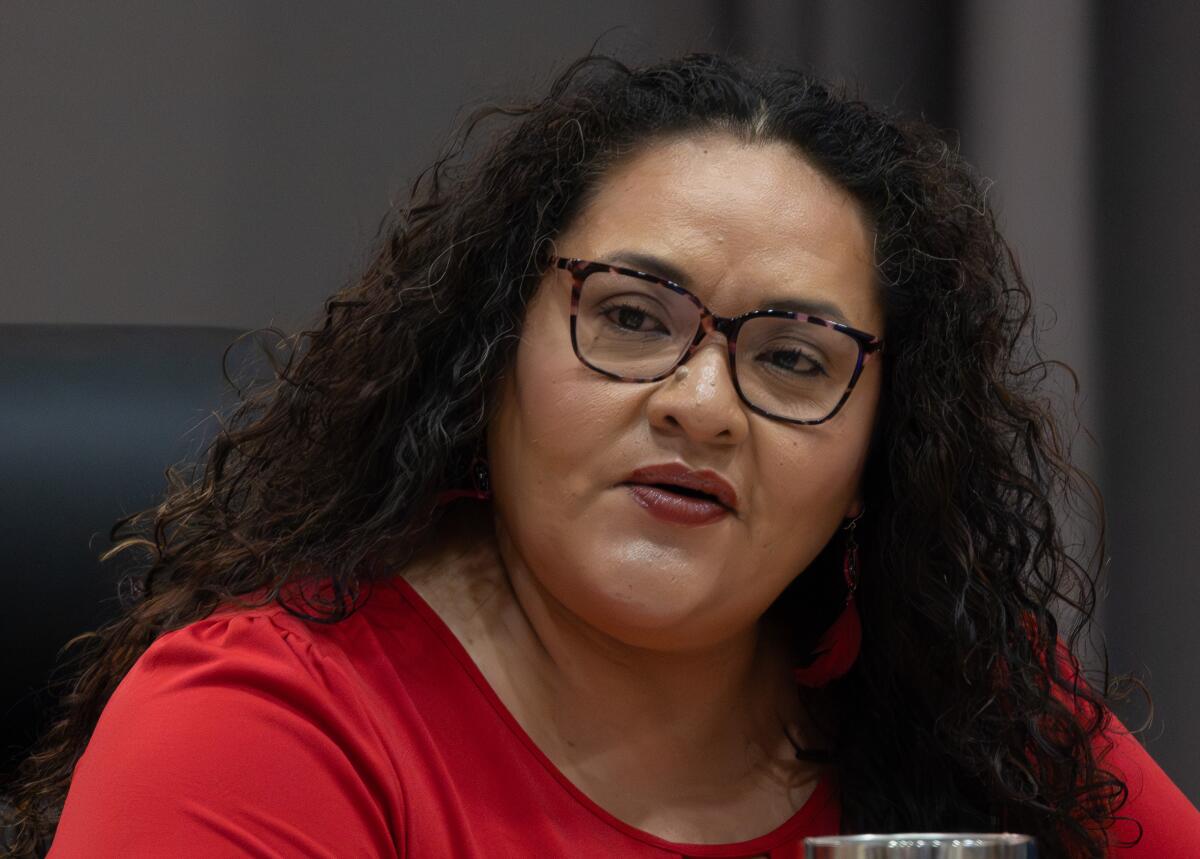
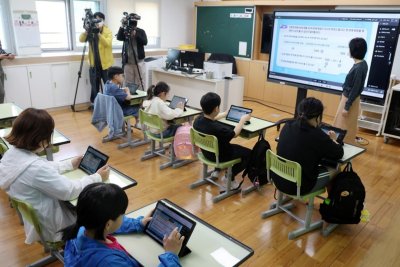
Pupils learn how to do division as they attend an open math class utilizing digital versions of print textbooks, provided on tablet computers with additional video and audio information, at Namsan Elementary School in Chuncheon, Gangwon Province, South Korea. Photo by YONHAP / EPA
June 18 (Asia Today) — South Korea is again considering changes to a local education funding system that automatically receives a fixed share of national tax revenue, as a semiconductor-driven rise in government receipts is expected to increase grants despite a shrinking student population.
The debate centers on local education finance grants, the main source of funding for elementary, middle and high schools administered by regional education offices.
The grants have risen to about 76 trillion won ($50 billion) under this year’s supplementary budget, according to the National Assembly Budget Office and education officials.
Some projections suggest the total could exceed 80 trillion won ($52.6 billion) if stronger tax revenue from the semiconductor industry is fully reflected.
The grant system receives 20.79% of internal tax revenue along with part of the national education tax. That means the amount increases when tax receipts rise, regardless of changes in student enrollment.
The number of elementary, middle and high school students fell from 5.96 million in 2016 to 4.92 million this year, a decline of 1.04 million, or 17.4%.
Over the same period, local education grants increased from 43 trillion won ($28.3 billion) to 76 trillion won, an increase of 33 trillion won ($21.7 billion), or 76.7%.
Budget officials and public finance experts say the automatic link to tax revenue makes government spending less flexible.
They argue that funding for primary and secondary education continues to expand despite falling enrollment while early childhood, higher education and lifelong learning programs face comparatively greater financial constraints.
Proposals include adjusting the percentage of internal tax revenue allocated to the grants or incorporating changes in the school-age population and nominal economic growth into the funding formula.
Education officials have strongly opposed reducing the grants based mainly on student numbers.
Superintendents-elect from South Korea’s ninth nationwide local elections issued a joint statement Monday warning that students would ultimately bear the cost of a funding overhaul driven primarily by fiscal considerations.
“Personnel expenses for teachers and other employees, school operating costs and facility safety and maintenance expenses arise at the school and classroom level, not simply on a per-student basis,” they said.
Schools also face growing fixed costs for meal services, after-school care and administrative support.
Personnel costs for permanent contract employees at public schools, including cafeteria workers, care staff and administrative assistants, reached 5.74 trillion won ($3.77 billion) last year.
That was a 61% increase from 2021. The figure is expected to exceed 6 trillion won ($3.94 billion) this year.
Three major teachers’ organizations also rejected claims that regional education offices have excess money.
They said the combined initial budgets of special education accounts fell by about 1 trillion won ($657 million) this year.
Funding for teaching and learning support declined 14.9%, while spending on school facility improvements fell 22.4%, they said.
The groups described education office reserve funds as a financial safeguard rather than unused money.
The Education Ministry is reportedly considering alternatives to immediately lowering the legally mandated allocation rate.
Possible measures include retaining the link to internal tax revenue while placing a ceiling on annual increases or allowing regional education offices to use more of the money for early childhood, higher education and lifelong learning.
The approach is intended to avoid a sudden reduction in primary and secondary school funding while directing more resources toward other parts of the education system.
Park Nam-gi, an emeritus professor at Gwangju National University of Education, said many necessary programs remain underfunded despite claims that schools have surplus resources.
“There are many things schools cannot do because they lack funding,” Park said.
He cited the expansion of special education, separate spaces and personnel needed to protect teachers and investment in education suited to the artificial intelligence era.
“It is wrong to conclude that education funding is excessive without properly supporting these needs,” Park said.
He said cash assistance programs introduced by some superintendents should be corrected where necessary, but that such concerns should not be used to justify reducing the overall education budget.
“Unlike welfare spending for the present, education funding is an investment in the country’s future,” Park said.
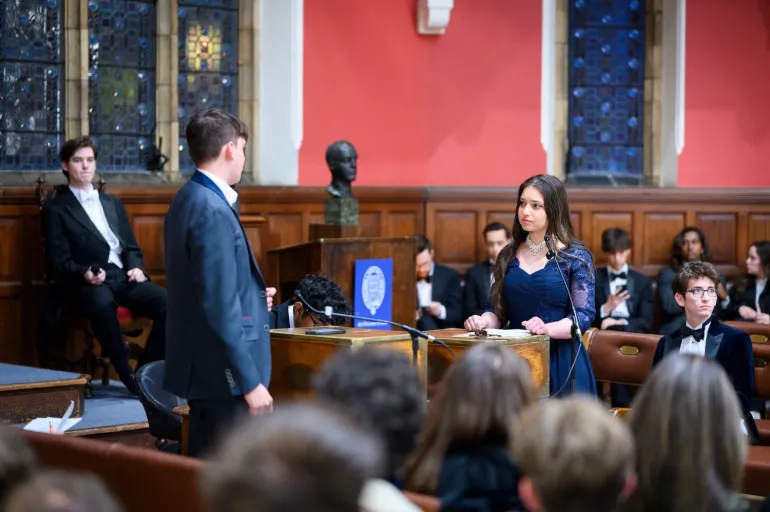
At a motion for a vote of no confidence against Arwa Elrayess, the first Palestinian president of the University of Oxford’s debating society, Oxford Union, she was accused by a 20-year-old student of contributing to “an atmosphere of hostility and harassment”.
In a video of the forum last week at the prestigious university, which was shared with Al Jazeera, Elrayess is seen replying to Ben Ashworth, “Not just in my career within the union but in my existence as a Palestinian, there seems to always be this post-mortem vilification of Palestinians.”
Recommended Stories
list of 4 itemsend of list
The room was full of onlookers as Elrayess, who became the head of the Oxford Union late last year, stood tall in a green sequinned dress.
“Palestinians, when they talk, are for some reason a danger. Our very existence is something that is scary,” she added.
The motion was filed after screenshots of text messages from Elrayess were quoted in outlets including The Telegraph and the BBC as saying that the Hamas-led incursion into southern Israel on October 7, 2023 was “proportional”.
The text also said groups branded as terrorists were often later “lauded as heroes”.
Ashworth cited the Sunday Telegraph directly in his accusation. The newspaper’s political editor, Camila Turner, whose father serves as chief executive of UK Lawyers for Israel, had carried the claim that Elrayess said Hamas would be “lauded as heroes”.
But Elrayess did not make any statement of support for Hamas.
Nine months ago – before Elrayess was president – she was in a group chat of students meant to discuss politics.
In the group chat, October 7 and Palestine – and broader conversations on resistance groups – were discussed.
“Analysing something is not giving it moral legitimacy,” she told Al Jazeera. “Even though I described explicitly in all the messages that I’m not describing this as legitimate or morally justified, I’m just providing analysis; all of this was stripped away when it was reported in The Telegraph or the Daily News.”
The full quote in question on the group chat read: “Any resistance group will inevitably be deemed a terrorist organisation by the West until they achieve their liberation, by which time they’ll be lauded as heroes as history has historically proven.”
‘Entirely misquoted’
The messages were not meant as commentary on Hamas specifically, she argued.
“It was entirely misquoted; I believe it was entirely intentional to frame as having said something that I simply did not say,” she told Al Jazeera.
To the Jewish Chronicle, though, Elrayess reiterated her position by saying, “I condemn Hamas’ targeting of innocent civilians, just as I condemn the targeting of innocent civilians by the [Israeli army] or any other actor.”
After refuting the allegation and misquotations, Ashworth is seen in the video yelling at Elrayess, asking whether she condemns Hamas again.
Ashworth, who is not Jewish, has faced criticism for recently visiting Israel with the Pinsker Centre, a think tank formerly known as the Pinsker Centre for Zionist Education.
The motion for a vote of no confidence overwhelmingly failed, receiving 126 votes, 116 of which were online signatures, far below the 150 needed to proceed to a poll.
This is not the first misinformation campaign against Elrayess.
In October 2025, just before her election as president of the debating society, falsified minutes were ratified by an unnamed member of the union, alleging that Elrayess “argues that alumni members shouldn’t be allowed to vote, reiterating her claims that they are incapable of making a rational judgement”.
Elrayess believes that the minutes were made up and spread to “paint me as someone who hates alumni of this institution”.
After an internal disciplinary process, the person who falsified the minutes was suspended from office and the minutes were de-ratified.
Shortly after her win, opposition within the Union brought forward a number of charges against Elrayess, ranging from misuse of social media to antisemitism. In January, it was found that the charges were un-evidenced. By this point, however, Elrayess had lost two months of her presidency.
Alongside this, an article was published in the Oxford Standard alleging that she was related to a leader of Hamas who happened to share the same surname as her, and that she had created and shared a cartoon of herself stepping on a lizard and a hook-nosed anti-Semitic caricature to celebrate her victory.
The claims, again, were false. The cartoon linked to an anonymous meme page that Elrayess had nothing to do with, and she had no family ties to Hamas. The article had no author attributed to it, and the Oxford Standard did not contact Elrayess or reply to her emails, fact-checking the article.
Within days, Elrayess had emails from journalists at The Jerusalem Post, Jewish Chronicle and The Telegraph, asking her to clarify her family affiliation with Hamas and her views of Jewish people, stemming from the stark untruths shared in the nameless Oxford Standard article.
Arwa Elrayess said she is the victim of a smear campaign after media outlets selectively quoted and misinterpreted some of her text messages [Courtesy of Arwa Elrayess]
The only cause for the allegations, some have observed, appeared to be Elrayess’s Palestinian identity.
A colleague and friend of Elrayess, who wished to remain unnamed, described to Al Jazeera a sense of distress among Elrayess and her friends.
“The level of attacks that Arwa and her friends received was astounding,” he said.
The Oxford Standard, which no longer exists, deleted both the article and their website altogether. But the rumours they began, with no facts to back them up, have snowballed into national news headlines of Oxford Union’s first Palestinian president being a supporter of Hamas and a proud anti-Semite.
Tweets by prominent Zionist influencers like Eylon Levy, former spokesperson for Israel, sharing the lie that Elrayess is a Hamas heiress, with now-broken Oxford Standard links and no factual corrections.
‘I’m a very proud Palestinian’
Elrayess’s dedication to debate and free speech has brought controversy to her tenure. She invited prominent Israel supporter Tommy Robinson to a debate, triggering widespread protest in Oxford, and has engaged with conservatives and Zionists in her union and her own appointed committee.
Oliver Jones-Lyons, director of finance of the Oxford Union, works alongside Elrayess and describes himself as a “pretty public Zionist”.
Still, despite their diametric positions, Lyons-Jones does not endorse the growing smear campaign against Elrayess.
“I have never felt oppressed, abused or discouraged from sharing my views openly, quite the opposite in fact,” said Jones-Lyons in a statement to Al Jazeera. “Me and Arwa obviously vehemently disagree on a lot of issues; however, our conversations about issues that are deeply personal to both of us have never once been aggressive and have always been productive, in fact I can certainly say Arwa has changed my mind on issues I never thought I would.”
Oxford Union member Oliver Goldstein said, “Personally, I like Arwa. I don’t agree with many of her comments, but do I feel unsafe as a Jewish student at the Oxford Union? No … I don’t think she’s an anti-Semite.”
Despite the inundation of misinformation, Elrayess remains determined.
“My father is from Gaza,” she said. “He would always tell me, ‘It doesn’t really matter what you say or do not say; people will always find a way to spin it in such a way that you become a target, because you’re already a target.”
She said she lives by her father’s words.
“I’m not resigning from my position. They can throw 1,000 different letters in 1,000 different articles. I’m very vocal, and I’m a very proud Palestinian.”
Mum-of-one, Melanie is taking the plunge to leave the UK as she claims she feels stuck in an infinite cycle of ‘rise and repeat’ with the country sucking the soul out of her
A mum is fleeing the UK to travel the world with her son as the country just makes her ‘miserable’ (Image: Kennedy News/meltheastrologer)
A mum is selling all of her possessions in the UK to travel the world with her five-year-old son, as she said the country makes her “miserable”, claiming: “There is something about England energy-wise that is just so off.”
This isn’t the first time Melanie Bentley-Moore, 33, has decided to leave the UK for Asia, as she first left in 2017 with the intention of a brief trip.
“I used to live in Asia for two years so I’m very familiar with that area of the world,” she said. “I was only meant to go for three months but I ended up staying out there for a couple of years travelling around Asia.”
The mum-of-one spent two years in Asia with Vietnam being her main base. But, her long-extended trip came to a halt as she missed a British staple – a local chippy. She added: “My main base was Vietnam, I did some English teaching out there and came back home because, it’s something random, I really wanted chippy and Nando’s.”
She then decided to settle in the UK, after having her son, Antares Moore, in 2023. But the desire to go back has never left Melanie. She says the UK made her miserable and believed that it’s not an isolated feeling.
“The energy just feels heavy, it’s dark – there’s no room to grow, [the] majority of people are miserable because of all the [stuff] that’s going on, the cost of living, everything’s rising,” she said, “I just don’t feel alive here and I think that’s not just a ‘me’ problem either, everyone that I’m speaking to just feels soulless.”
In April 2026, Melanie’s landlord said he was selling her flat, which prompted the mum-of-one to take the same risk she took all those years ago, and leave the UK.
Melanie told her TikTok followers: “Just hearing everyone else complain, that weakens my spirit. Most people are miserable and they’re always complaining, it seeps into everything.”
“It’s like an infinite cycle of ‘rinse and repeat’ complaining. It’s just a feeling, I just don’t feel alive. It sucks the soul out of me.”
Ahead of her relocation, Melanie took her son out of school as she admired the Scandinavian education system which saw children beginning compulsory school between the ages of 6 and 7. In the UK, children start school from the age of 4.
“In Scandinavia there’s a reason why their children are the happiest and more successful because they don’t start school till they’re seven.”
Melanie hoped to show her son ‘real life’ as she preferred the values of life in Asia.
She said: “I’m going to go to Indonesia and then probably back to Vietnam, it just depends on the weather. See where life takes us, I’m very ‘flowy’.
“With the values and stuff, life’s just better over there. It’s slower, it’s sunny, the scenes are beautiful and you realise there is so much more to life than what I’m used to.”
By speaking up, Melanie hoped to inspire others to follow their dreams and see “there’s more to life”.
“I’m here to inspire people to follow their heart, go after what they want and that there’s more to life,” she said, “It’s no good talking, there’s a lot of talkers out there – I ‘do’.”
“I want to show my son real life as well. I’m going to do some charity work and volunteering with him. There is no better learning than real life.”
Teachers in north-eastern Nigeria held protests, demanding stronger protection for learning institutions.
The outcry comes after the abduction of dozens of school children in Borno State last month. Al Jazeera’s Felix Niwara explains.
Sonja Shaw — a Trump-aligned conservative Republican whose public profile rose as she became identified with culture-war causes, including banning transgender athletes from girls’ sports — has emerged as the leading vote-getter in the June primary for California’s superintendent of public instruction.
With more than 80% of precincts at least partially reporting, Shaw was well ahead of Democrat Richard Barrera, holding a lead that would be difficult to surmount.
Both Shaw and Barrera are school board presidents.
Shaw heads the elected Board of Education for Chino Valley Unified in San Bernardino County, a diverse but substantially conservative inland portion of Southern California.
Barrera heads the school board of San Diego Unified, the state’s second largest school district, serving an area with liberal leanings, but that is also politically diverse.
In the primary Shaw was greatly helped by a candidate field that included seven Democrats — most with a voter and financial base that would make them competitive. Incoming results show they divided votes among themselves.
Shaw managed to consolidate the Republican vote, which put her on top for the primary. A second Republican candidate finished far behind her.
On Tuesday night, Shaw sounded hopeful and confident that her campaign themes were resonating beyond her conservative roots.
“I am humbled and grateful that Californians from every corner of our state have rallied behind this campaign,” Shaw said in a statement. “What we’ve built is more than a campaign. It’s a diverse movement of communities who believe our schools can do better and who are determined to make that happen.”
Among its high-profile actions, the Chino Valley board majority put forward a policy that would require parents to be notified if their child expressed gender-identity issues at school. Shaw and her allies also approved a policy that allows parents to challenge the content of library books.
Positioned in a runoff against one Democrat — in a state where Democrats dominate — makes for a challenging campaign.
“Tonight is not the finish line,” Shaw said. “It’s the beginning of the final stretch.”
Barrera, who was not available for comment late Tuesday night, benefited immensely from a $5 million independent expenditure campaign from the California Teachers Assn., which, in the recent past, has seemed determined to spend whatever it takes to get an ally into the state superintendent’s office.
Barrera, besides his work as a longtime public official, has been a senior aide to current state Superintendent Tony Thurmond. Thurmond could not run again because of term limits and instead mounted an unsuccessful campaign for governor.
The state superintendent has limited authority over school districts, which are locally managed. The officeholder instead manages the California Department of Education. This agency guides local school districts and also provides partial oversight. The state superintendent also typically takes advantage of the bully pulpit on education issues.
The office has an uncertain future because Gov. Gavin Newsom is pushing a proposal to reimagine the office and redistribute some of its duties.
Los Angeles Unified School District incumbents — Rocio Rivas, Kelly Gonez and Nick Melvoin — surged strongly ahead in early returns Tuesday night for three seats on the Board of Education.
The first reported results were trending toward one-sided outcomes because the major political forces of recent years declined to do battle against each other: The teachers union supported Rivas, who represents a largely Eastside district; a charter-friendly retired businessman supported Melvoin, whose district is centered on the Westside. And the largest union representing nonteaching employees all but avoided the fray.
The third incumbent, Gonez, was the only candidate on the ballot in District 6, and faced one write-in challenger, Jose Sagredo. Thus, Gonez is poised to continue to represent a district centered in the east San Fernando Valley for a third and final term.
With no challengers boosted by high special-interest funding, the three incumbents had a virtually unobstructed campaign path.
If the early returns hold as expected, the Los Angeles Board of Education will continue to lean against charter schools and would stand in general agreement on most policies — including assertive support for immigrants and a continued holding pattern on the future of Supt. Alberto Carvalho, who remains on administrative leave as a federal investigation proceeds.
District 4, Westside
Well ahead in District 4 was two-term incumbent Melvoin. His challenger was Ankur Patel.
The funding advantage in Melvoin’s campaign was sizable through just before election day: Melvoin, $378,803; Patel: $22,662.
In addition, Melvoin benefited from an independent expenditure of $367,093 on his behalf by retired businessman Bill Bloomfield, who has been a major funder in recent campaigns, typically for candidates who also are acceptable to charter-school advocates.
Charters are privately operated public schools, most of which are nonunion. About 1 in 5 L.A. public-school students is enrolled in an independent charter operating within L.A. Unified.
District 2, downtown and Eastside
Also with a huge funding advantage was Rocio Rivas, who was headed toward a second term in District 2.
LAUSD Board Vice President Rocio Rivas was headed toward a second term in District 2. Her major funding source was $889,469 in an independent-expenditure campaign on her behalf, nearly all of it from the United Teachers Los Angeles union.
(Myung J. Chun / Los Angeles Times)
Rivas’ own campaign raised $66,218. But the major funding source was $889,469 in an independent-expenditure campaign on her behalf, nearly all of it from the United Teachers Los Angeles union. The union also spent more than $4,000 in communications to its members about the election.
These figures compare with $2,525 raised by challenger Raquel Zamora, who reported spending $5,089.
In Rivas’ successful 2022 run, her main funding opponent was Local 99 of the Service Employees International Union, which backed Maria Brenes for an open seat. Historically, Local 99 has not been inclined to oppose an incumbent, which Rivas has become. And, true to history, Local 99 has endorsed Rivas, but without spending money on her behalf.
An end to charter school wars
More broadly, this election cycle marks the end to a generation of bitterly contested Los Angeles school board races that became the most expensive in the country, with the L.A. teachers union and charter school advocates slugging it out to advance their vision for public education.
Charter school supporters — who had poured tens of million of dollars into races to elect board members sympathetic to their cause — largely stepped aside, a reflection of their diminished resources and evolving strategy.
The bottom line is that, if current vote-count trends hold, the board will be unchanged for the next two years.
This situation is less than ideal for charter schools. Charters with a mixed record face a tough review when they come up for renewal — about once every five years. Charter opponents want the board majority to move more aggressively to shut down charters when possible and to force them off district campuses — where, under state law, they have a legal right to operate.
Big board decisions looming
Big decisions before the board include how to manage a projected structural deficient — with union leaders calling the dire predictions an accounting mirage.
Meanwhile, Supt. Alberto Carvalho remains in limbo after a February FBI raid of his home and office. The investigation relates at least in part to a failed district chatbot project.
Carvalho maintains his innocence and would like to return to work. The board, however, has turned the reins over temporarily to acting Supt. Andres Chait.
This election cycle marks the end to a generation of bitterly contested Los Angeles school board races that became the most expensive in the country, with the L.A. teachers union and charter school advocates slugging it out to advance their vision for public education. Above, LAUSD headquarters in downtown Los Angeles.

![Arwa Elrayess [Courtesy of Arwa Elrayess]](https://i0.wp.com/occasionaldigest.com/wp-content/uploads/2026/06/original-1C35F445-DBD0-445D-9835-200DAAC9C332-1781175489.jpeg?w=640&ssl=1)