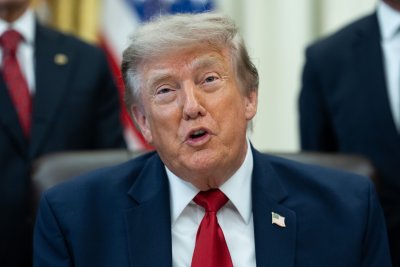
Donald Trump

US Fed keeps interest rates steady amid economic, geopolitical uncertainty | Banks News

The United States Federal Reserve will hold interest rates steady as the labour market cools and prices on goods and services surge following the US and Israel’s joint strikes on Iran.

The central bank will maintain its benchmark rate at 3.5–3.75 percent, consistent with the Fed’s decision last month, when it also held rates steady.

Recommended Stories

list of 4 itemsend of list

“The Committee seeks to achieve maximum employment and inflation at the rate of 2 percent over the longer run. Uncertainty about the economic outlook remains elevated. The implications of developments in the Middle East for the US economy are uncertain,” the central bank said in a statement announcing its policy decision and referring to its Federal Open Market Committee.

“The Committee is attentive to the risks to both sides of its dual mandate.”

Holding rates steady was in line with estimates. CME FedWatch, a tool that tracks monetary policy decisions, forecast that there was a 99 percent chance that rates would hold steady.

The stall comes after three rate cuts in 2025.

Global gripes

Consumers are also facing the repercussions of US President Donald Trump’s trade and military policies in their daily expenses.

“Despite meaningful progress on inflation in 2024, Trump’s tariffs have stalled progress and kept inflation persistently above the Fed’s target. Wholesale prices are running hot as service prices surge, and now, Trump’s war in Iran is rocking commodity markets around the globe,” Elizabeth Pancotti, managing director of policy and advocacy at Groundwork Collaborative, an economic think tank, said in comments provided to Al Jazeera.

Last month, the US Supreme Court ruled against the president for his use of the International Emergency Economic Powers Act (IEEPA). The high court said the president exceeded his authority and that the tariffs imposed under that order must be refunded. However, the president then imposed new tariffs not covered by IEEPA.

The White House announced a 15 percent tariff through Section 122, which allows the president to impose tariffs for 150 days. Those changes were reflected in the producer price index report released by the US Department of Labor’s Bureau of Labor Statistics on Wednesday.

Wholesale prices rose by 0.7 percent for the month, marking the biggest one-month surge in a year. Goods prices rose 1.1 percent overall after tumbling for two months. Energy prices rose by 2.3 percent, with the cost of gas or petrol rising by 1.8 percent. Those costs are expected to get higher as tensions rise in the Strait of Hormuz following joint US-Israel strikes on Iran in late February and the subsequent retaliation.

“In the near term, higher energy prices will push up overall inflation; however, it is too soon to know the scope and duration of the potential effects on the economy,” Fed Chair Jerome Powell told reporters.

In the last month, petrol prices have jumped for US consumers. The average price for a gallon of regular gasoline is $3.84, up from $2.92 this time last month.

“The Fed’s inflation worries extend beyond weathering a fleeting wave of one-off price hikes associated with tariffs and, more recently, an energy price spike,” Stephen Stanley, chief US economist at Santander US Capital Markets, told the Reuters news agency.

Labour market stalls

Holding rates steady also comes as the job market stagnates. The latest jobs report, which was released earlier this month, showed that the US economy lost 92,000 jobs, with unemployment rising to 4.4 percent.

Meanwhile, the Job Openings and Labor Turnover Survey, or JOLTS report, which came out last week, showed 6.9 million open jobs in the US, unchanged from the month prior. That shows that employer hiring has stalled and that those who have jobs are seldom leaving for new ones.

“This might be one of the toughest moments in recent memory for the Federal Reserve’s Open Market Committee,” Michael Linden, Senior Policy Fellow at the Washington Center for Equitable Growth, said in remarks provided to Al Jazeera. “Recent data has revealed that economic growth in the back half of last year was extremely weak, the labour market seems to be on the precipice of disaster, and prices keep rising faster than anyone feels comfortable with.”

Political undercurrents

Wednesday’s decision is the second-to-last one of current Fed Chair Powell, whose term is up in May. Powell, who was first appointed by Trump during his first administration, has been a target of Trump’s scorn and criticisms for not cutting interest rates fast enough.

“When is ‘Too Late’ Powell lowering INTEREST RATES?” Trump posted on his social media platform Truth Social on Wednesday morning ahead of the decision.

Previously, Trump said he would not nominate someone to lead the central bank unless the nominee agreed with his position.

“Anybody that disagrees with me will never be the Fed Chairman!” Trump said in a post on Truth Social in December.

“We at the Fed will continue to do our jobs with objectivity, integrity and deep commitment to serve the American people,” Powell told reporters.

Trump’s nominee to succeed Powell, Kevin Warsh, has his nomination in flux as Republican Senator Thom Tillis said he would not vote to advance any of Trump’s nominees to the central bank until a criminal probe into the current chairman, Powell, is closed.

Tillis sits on the Senate Banking Committee, which vets nominees for the central bank, including Warsh. He said he will not approve Trump’s Fed nominees until the probe of Powell is closed. The criminal probe of Powell centres on Fed building renovations after a judge quashed grand jury subpoenas and called the investigation a pretext to pressure the central bank to lower interest rates.

If Warsh has not been confirmed by the Senate in time for the Fed’s June 16–17 meeting, Powell would continue to lead the rate-setting Federal Open Market Committee.

“If my successor is not confirmed by the end of my term as chair, I would serve as chair pro tem until he is confirmed. That is what the law calls for,” Powell said.

“On the question of whether I will leave while the investigation is ongoing, I have no intention of leaving the board until the investigation is well and truly over with transparency and finality.”

Source link

U.S. eyes Chile’s dominant global rhenium supply

SANTIAGO, Chile, March 18 (UPI) — The United States is continuing efforts to secure supplies of critical minerals deemed vital to national security. Alongside copper, lithium and silver, one lesser-known metal is drawing increased attention: rhenium.

Used primarily in the aerospace, energy and petrochemical industries, rhenium plays a key role in high-performance applications. Experts say it also holds potential in the global energy transition because it can act as a catalyst in producing green hydrogen.

Chile is the world’s largest rhenium producer, accounting for about 50% of global output. The metal is atomic No. 75 on the Periodic Table of Elements.

Since Friday, Chilean officials have held consultations on critical minerals and rare earth elements with the administration of President Donald Trump, seeking a bilateral agreement to strengthen supply chains and promote strategic investment.

“Chile controls nearly half of a mineral that the United States and China cannot produce in sufficient quantities. Washington reinstated rhenium to its critical minerals list in 2025 and explicitly included it in the bilateral mining agreement with Chile. That makes it a genuine geopolitical asset, not just a mining one,” mining market specialist Víctor Pérez, an engineering professor at Adolfo Ibáñez University, told UPI.

Manuel Reyes, a mining engineering professor at Andrés Bello University, said the United States considers rhenium a national security priority because of its critical role and a lack of substitutes in aerospace and defense.

“Although rhenium does not carry the financial weight of copper or lithium, it functions as a reputational asset that keeps Chile on global strategic radars. More as a necessary logistics partner than as a decision-making power,” he said.

Pérez said Chile’s rhenium exports are expected to range between $100 million and $200 million this year, compared with an estimated $60 billion in copper exports. Still, he said its strategic importance is unique “because it has no real substitute in aerospace and defense applications.”

Chile holds the world’s largest reserves at 1,300 metric tons, followed by the United States with 400 metric tons, Russia with 310 metric tons and Kazakhstan with 190 metric tons, according to Reyes.

Rhenium trades at about $2,000 per kilogram, though prices have climbed in 2026 to roughly $6,000 per kilogram, he said.

About 70% to 80% of global rhenium is used in superalloys for aviation and defense turbines. “It is the metal that allows aircraft engines and military turbines to withstand extreme temperatures without deforming,” Pérez said.

Rhenium is known as a by-product mineral because it is not found alone, but rather extracted from copper-related ores, which makes production complex. Chile’s large-scale copper mining operations enable its recovery, as processing captures gases released during molybdenum concentrate roasting and chemically extracts the metal.

Reyes said Chile remains highly dependent on external demand.

“Reserve management and supply continuity depend on the technical and national security requirements of powers such as the United States, which ultimately drive demand,” he said.

Source link

How Los Angeles’s Iranian diaspora is confronting the US war on Iran | US-Israel war on Iran News

Concerns over US involvement

The war has reignited a debate within the Iranian diaspora about what role the US should play in Iran’s future.

This question is more than a distant geopolitical issue for Iranians in Los Angeles.

Many residents explained that their family histories had been shaped by US involvement in the region, whether it was through US support for Iran’s fallen monarchy or through the US decision to back Iraq’s invasion of Iran in 1980.

Aida Ashouri, a human rights lawyer who is running to be Los Angeles city attorney, was among those publicly condemning the latest US campaign in Iran at the city hall protest on February 28.

“This is a US imperialist war, and we have to make that clear,” she said. “Call a spade a spade. This war is not to liberate the women of Iran or the people of Iran.”

Ashouri was born during the Iran-Iraq war in the 1980s. Her hometown, Isfahan, was also bombed in June last year during the US and Israel’s 12-day war with Iran.

For Ashouri, it was telling that the US and Israel once again launched the first strike in the current conflict. For many legal experts, that made the conflict an unprovoked war of aggression, in violation of international law.

“A war implies two sides are actively engaged, but Iran has done nothing to be involved,” Ashouri said.

“This is a unilateral military invasion, an aggression of the United States and Israel. They are the ones with the power to end it by stopping the bombing.”

She and other protesters drew parallels between the current Iran war and the US-led wars in Iraq and Afghanistan, launched in 2003 and 2001, respectively.

“I lived through the shadow of the war on terror, all the propaganda talking points,” said Shany Ebadi, an Iranian American antiwar organiser with the ANSWER Coalition. “What the Trump administration is saying reminds me a lot of the Iraq war.”

As someone who follows the news closely, Ebadi remembers feeling alarm when the first strikes were launched in February.

“When I got the breaking news notification of the initial attack, my whole body felt paralysed. I felt anger and frustration,” she said.

She and Ashouri both said they fear the military operation in Iran could spark a regional war that might further destabilise not just Iran, but the entire Middle East.

“I fear that war will repeat the disasters seen in Palestine, Iraq, Libya, and Afghanistan,” Ashouri said, listing countries targeted in the US’s “war on terror” over the past two and a half decades.

The question of whether bombs can pave the way to freedom in Iran is a simple one for Ashouri and her fellow antiwar activists. The answer, they say, is simply no.

Source link

How Iran defied Trump threats to emerge as Strait of Hormuz gatekeeper | US-Israel war on Iran News

As United States President Donald Trump tries to build a coalition of navies willing to open the Strait of Hormuz, some countries are negotiating safe passage directly with Iran, underscoring a new de facto reality, analysts say: Regardless of military results, Tehran is calling the shots on who gets to use the world’s most important energy waterway.

After US-Israeli strikes on Iran began on February 28 and killed Supreme Leader Ali Khamenei, the Iranian military leadership responded by focusing on its most potent form of leverage – Iran’s geography. The country controls the northern shore of the Strait of Hormuz, through which 20 percent of global crude oil and natural gas supplies pass. It is 33km (20 miles) wide at its narrowest point, so any naval force that wants to cross it becomes easy prey for Iranian attacks coming from the mainland.

Recommended Stories

list of 3 itemsend of list

Considering insurance companies’ low appetite for risk, it took relatively few attacks on vessels in the strait – or just the threat of them – to undermine market confidence and send insurance premiums shooting up, causing a near paralysis in maritime traffic. About 20 vessels have been attacked since the start of the war.

“Iran has effectively proven that it dictates the terms of passage through the strait. They have now shown they are the gatekeeper of this important chokepoint. This will elevate the status of Iran in the geography of the Gulf,” said Andreas Krieg, an associate professor in Security Studies at King’s College London and a fellow at King’s Institute of Middle Eastern Studies. This will be the new reality for the foreseeable future, he added.

Meanwhile, crude prices have risen above $100 a barrel, more than 20 percent higher than pre-war prices, forcing countries to make the biggest releases of emergency reserves in history. Gas prices have risen by more than 40 percent since the war began.

Trump initially floated the idea of ordering the US Navy to escort vessels through the waterway. He then appealed to some countries to send warships and warned NATO members they would face “a very bad” future if these allies failed to help in opening the strait. But the appeal was either turned down or received noncommittal responses. Japan said it had no plans to deploy naval vessels. Australia ruled out sending ships. The United Kingdom said it would not be drawn into the wider war. Germany sent a clear message: “This is not our war”.

Others decided to take action – but not of the kind that Trump asked for. On Saturday, two India-flagged gas tankers passed through the strait after days of negotiations between New Delhi and Tehran, including a phone call between Indian Prime Minister Narendra Modi and Iranian President Masoud Pezeshkian. Ships from Pakistan, Turkiye and China also have transited through the Strait of Hormuz. The Financial Times has reported that Italy and France have also reached out to Iran for deals although Italian authorities have rejected making such an overture.

Meanwhile, Windward, a maritime intelligence tracking group, said that while traffic in the strait on Tuesday remained 97 percent below average, a growing number of ships have been passing through Iran’s territorial waters, suggesting that Tehran is allowing “permission-based transit”.

‘It is up to us to decide’

There is a precedent for US naval forces to escort convoys through the strait dating back to the Iran-Iraq War in the 1980s. But today’s scenario is different, experts said. Back then, the US, while it was backing Iraqi leader Saddam Hussein, was not a direct party to the conflict. Iran was still in a post-revolutionary process of consolidating power, and its Islamic Revolutionary Guard Corps was nowhere near as organised as it is today.

Today, Iran has drones that its factories are capable of producing on a large scale and has been using them. Iranian forces could also use small boats to assault tankers, deploy mines and engage in other guerrilla-style tactics. While there are conflicting reports on whether Iran has placed mines in the strait, experts said it would be a counterproductive move for Tehran because it would disrupt the passage for any ships – Iranian vessels included – and it would take away from Tehran the power to choose who may pass.

Iranian officials are aware of their geographic advantage. “This is up to our military to decide,” Iranian Foreign Minister Abbas Araghchi said on Sunday, referring to who will be allowed to use the strait.

Pro-government figures increasingly frame the Strait of Hormuz as a strategic bargaining tool beyond the war itself, suggesting the waterway could be used to extract compensation, sanctions relief or broader economic concessions after the war, Hamidreza Azizi, an expert on Iran and visiting fellow with the German Institute for International and Security Affairs, commented on X.

Recent attacks seem to suggest that Iran wants to increase its pressure on the energy market.

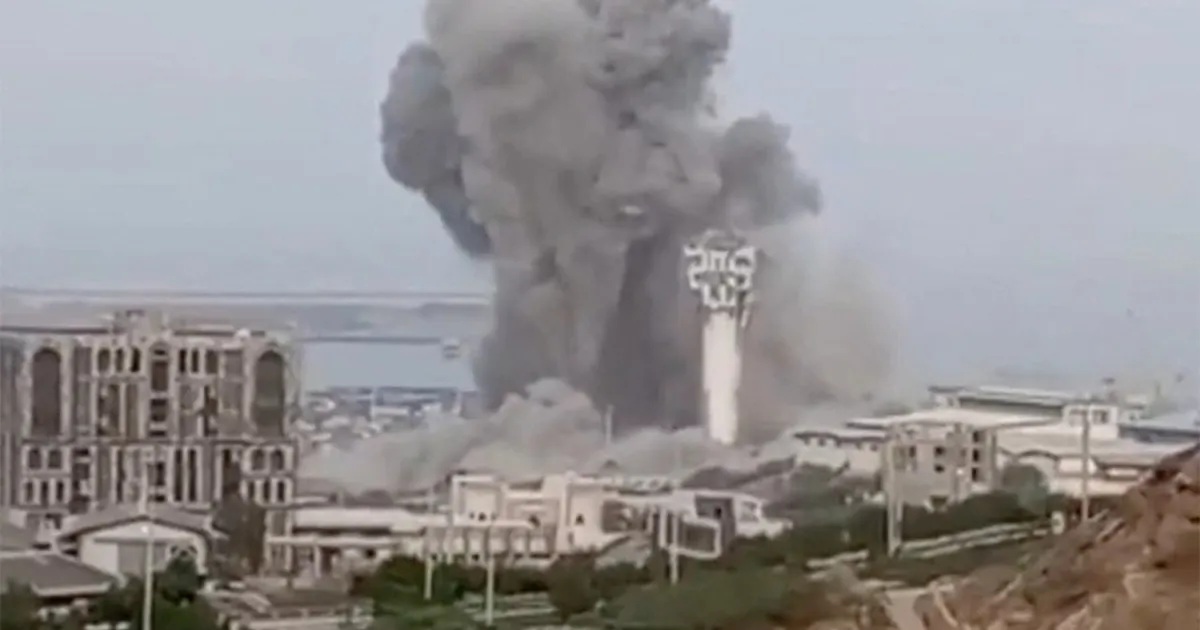
On Tuesday, a drone attack caused a fire at the port of Fujairah, the United Arab Emirates’s only crude export terminal. It is located outside the eastern entrance of the Strait of Hormuz, allowing its exports to circumvent it. The Iran-backed Houthis in Yemen could also further squeeze oil prices by disrupting the Bab al-Mandeb strait. That would force the US to operate across multiple maritime theatres. So far, the Houthis have not carried out such attacks, but this month, they said they were ready to strike at any ‌moment.

Still, the US is focused on applying maximum pressure on Tehran and forcing it to open the Strait of Hormuz. The US Central Command, the US military’s combat command responsible for operations in the Middle East, said early on Wednesday that its forces had used 2,270kg (5,000lb) bunker-busting munitions against antiship missile sites along Iran’s coastline near the Strait of Hormuz.

Trump has also ordered amphibious ships carrying thousands of US Marines to move to the Middle East, and some experts believe the US might try to seize Kharg Island, a tiny piece of land in the northern Gulf where 90 percent of Iranian crude oil is exported from. The US has already bombed what it said were military sites on the island.

Such an operation, however, might do little to force Iran into opening the Strait of Hormuz, Krieg said. The island is 500km 310 miles) from the strait, and should the US take control of it, it would expose US Marines to Iranian fire. Should Iran see its key terminal being seized, it could also opt to mine the strait outright, having fewer reasons to allow some vessels to pass through.

“The issue with the Strait of Hormuz is really not a military one. … It’s a market issue, and confidence cannot be restored by the military. Confidence can be restored through diplomacy only,” Krieg said.

Source link

Illinois primary: Lt. Gov. Stratton wins Democratic race for Senate seat

March 18 (UPI) — Illinois Lt. Gov. Juliana Stratton claimed victory late Tuesday in a close race to be the Democratic Senate nominee in November, as voters headed to the polls to cast ballots in primary elections.

Dozens of local and federal contests were held throughout the state on a busy election Tuesday that included 17 U.S. House races but only one for the Senate — a seat being left vacant by the retiring Dick Durbin, the six-term senator and the No. 2 Democrat in the Senate.

Stratton claimed victory in a packed race for the Democratic nomination for Durbin’s seat.

“We did it,” she told supporters in her victory speech in Chicago.

“Tonight, we showed what’s possible when you listen to the people and give the people what they want.”

Stratton ran on a progressive platform of securing a single-payer healthcare system and a $25 minimum wage, while rejecting all corporate Political Action Committee funding during her campaign.

U.S. Reps. Raja Krishnamoorthi and Robin Kelly emerged as her main political rivals.

Krishnamoorthi told his supporters in a brief speech Tuesday night at the Westin Hotel in Chicago’s River North neighborhood that he had called Stratton to congratulate her on winning the primary.

“I offered her my full support on the road ahead,” he said.

Krishnamoorthi positioned himself as the anti-President Donald Trump Democrat, often railing against the Republican leader and campaigning on his so-called Trump accountability plan of reforms to rein in presidential power to prevent abuses of power.

“Obviously, this is not the result we sought, but unlike Donald Trump, I’m not going to question the outcome,” he said.

“Now we must come together as Democrats and as Americans to make sure that we return to principles that made us a beacon of freedom and opportunity for the world.”

Kelly conceded online.

“Tonight’s isn’t the outcome we wanted, but I am so proud of us, and I still believe in putting people over profits,” she said in a statement.

“You want to know that your elected leaders are fighting for YOU, not distracted by outside noise. I’ll continue that fight in the U.S. house. I still have your back.”

As of early Wednesday, when an estimated 92% of the ballots had been counted, Stratton had secured about 40.1% of the vote share to Krishnamoorthi’s 33.2% and Kelly’s 18.1%, CNN and CBS News reported.

In a statement, Durbin, who did not endorse any candidate in the race, said he looked forward to “passing the torch” to Stratton when his term ends, while congratulating Krishnamoorthi and Kelly.

“Now our attention must turn to ensuring Juliana wins the general election on November 3,” he said. “With Donald Trump in the White House for another two years, the challenges facing our country and state will continue to be historic and unprecedented. We need Juliana Stratton fighting alongside Sen. [Tammy] Duckworth every day.”

On the GOP side, Don Tracy, former Illinois Republican Party chairman, was poised to seek Durbin’s vacant Senate seat as his party’s nominee.

Tracy campaigned in the blue state by positioning himself as a center-right candidate at a time of extremism in his party, stating on his website that he would seek “common sense solutions over extreme agendas.”

He also argued to be a voice for the entire state, voicing concerns that all federal elections had become contests for Chicago and Cook County.

“It’s time to make Illinois a two-party state again,” he said in a statement claiming victory on Facebook, while bashing Stratton as “the most extreme far-left U.S. Senate candidate this state has ever seen.”

“I will push for common sense solutions that make life more affordable for working families. I will work for everyday Illinoisans, not special interests or extreme agendas.”

Tracy was poised to win early Wednesday with nearly 40% of the vote share compared to lawyer Jeannie Evans’ nearly 23%, the closest runner-up, CNN and CBS News reported.

Evans campaigned on being a political outsider and a conservative Republican, while championing lowering costs and fighting crime.

In the governor’s race, Illinois is poised to have a rematch of 2022, when Gov. JB Pritzker, a Democrat, beat Republican farmer Darren Bailey.

While Pritzker ran uncontested, Bailey was seemingly coasting to the GOP nomination in a landslide.

With 94% of ballots counted, Bailey had won 53.5% of the vote share to runner-up Ted Dabrowski’s 28.8%, according to CNN and CBS News tallies.

“The first fight has been won, but make no mistake, we are just getting warmed up,” he said in his victory speech.

“Best birthday ever.”

Bailey ran on a law-and-order campaign that included lowering property taxes, cutting government spending and cracking down on repeated criminal offenders.

Source link

Trump administration defends Anthropic blacklisting in US court | Science and Technology News

The US defence secretary designated the AI company a ‘supply chain risk’ after it refused to remove guardrails on its technology.

The administration of United States President Donald Trump has said in a court filing that the Pentagon’s blacklisting of Anthropic was justified and lawful, opposing the artificial intelligence company’s high-stakes lawsuit challenging the decision.

The administration made its comments in a court filing on Tuesday.

Recommended Stories

list of 3 itemsend of list

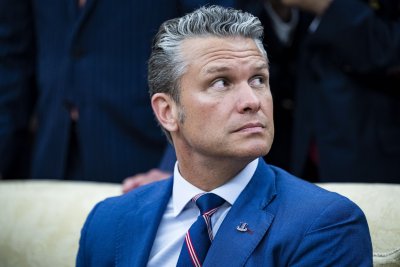
Defense Secretary Pete Hegseth designated Anthropic, the maker of popular AI assistant Claude, a national security supply chain risk on March 3 after the company refused to remove guardrails against its technology being used for autonomous weapons and domestic surveillance.

The Trump administration’s filing says Anthropic is unlikely to succeed in its claims that the US government’s action violated speech protections under the US Constitution’s First Amendment, asserting that the dispute stems from contract negotiations and national security concerns, not retaliation.

“It was only when Anthropic refused to release the restrictions on the use of its products — which refusal is conduct, not protected speech — that the President directed all federal agencies to terminate their business relationships with Anthropic,” the administration’s legal filing said. The filing, from the US Justice Department, said that “no one has purported to restrict Anthropic’s expressive activity”.

Anthropic’s lawsuit in California federal court asks a judge to block the Pentagon’s decision while the case plays out. Some legal experts say the company appears to have a strong case that the government overreached.

In a statement, Anthropic said it was reviewing the government’s filing. The company said that “seeking judicial review does not change our longstanding commitment to harnessing AI to protect our national security, but this is a necessary step to protect our business, our customers, and our partners.”

The White House did not immediately respond to a request for comment.

Supply chain risk

Trump has backed Hegseth’s move, which excludes Anthropic from a limited set of military contracts. But it could damage the company’s reputation and cause billions of dollars in losses this year, according to its executives.

The designation came after months of negotiations between the Pentagon and Anthropic reached an impasse, prompting Trump and Hegseth to denounce the company and accuse it of endangering American lives with its use restrictions.

Anthropic has disputed those claims and said AI is not yet safe enough to be used in autonomous weapons. The company said it opposes domestic surveillance as a matter of principle.

In its March 9 lawsuit, Anthropic said that the “unprecedented and unlawful” designation violated its free speech and due process rights, while running afoul of a law requiring federal agencies to follow specific procedures when making decisions.

The Pentagon separately designated Anthropic a supply chain risk under a different law that could expand the order to the entire government.

Anthropic is challenging that move in a second lawsuit in a Washington, DC, appeals court.

Source link

Trump delays trip to China to focus on Iran

President Donald Trump and China’s President Xi Jinping arrive at a state dinner at the Great Hall of the People in Beijing in 2017. Trump announced Tuesday that he is delaying his planned trip to visit Xi. File Photo Thomas Peter/EPA

March 17 (UPI) — President Donald Trump told reporters Tuesday that he has delayed his trip to China for “five or six weeks” to focus on the war against Iran.

Trump told the Financial Times Sunday that he would postpone the trip if Chinese President Xi Jinping wouldn’t help secure the Strait of Hormuz.

“It’s only appropriate that people who are the beneficiaries of the Strait will help to make sure that nothing bad happens there,” Trump said. He said that 90% of China’s oil comes from the Middle East.

“We’re resetting the meeting, and it looks like it’ll take place in about five weeks,” Trump said. “We’re working with China. They were fine with it.”

The trip was scheduled for March 31 to April 2 and focused on trade.

Treasury Secretary Scott Bessent said Monday that “we will see whether the visit takes place as scheduled,” adding that if the trip were delayed, “it wouldn’t be delayed because the president’s demanded that China police the Straits of Hormuz,” NBC News reported.

After Bessent’s comments, White House press secretary Karoline Leavitt told Fox News that the president’s “utmost responsibility right now as commander in chief is to ensure the continued success of Operation Epic Fury, as he’s doing 24/7 here at the White House and here at home.”

Official Chinese customs data show that in 2025, China got less than half of its oil from the Middle East. Russia supplied just under one-fifth of China’s oil, and sanctioned Iranian oil accounted for 11.5 %.

President Donald Trump meets with Taoiseach of Ireland Micheal Martin in the Oval Office of the White House on Tuesday. They will both attend a Friends of Ireland luncheon on Capitol Hill for St. Patrick’s Day. Photo by Yuri Gripas/UPI | License Photo

Source link

Rubio says Cuba needs to ‘get new people in charge’ as US ratchets pressure | Donald Trump News

Washington continues to block fuel to island nation, as Trump floats ‘doing something with Cuba very soon’.

United States Secretary of State Marco Rubio has said that Cuba “has to get new people in charge,” and the administration of US President Donald Trump continues to heap pressure on the island nation.

Rubio made the comment on Tuesday during an Oval Office event, saying Cuba “has an economy that doesn’t work in a political and governmental system”.

Recommended Stories

list of 3 itemsend of list

He spoke as the US has continued to impose a de facto fuel embargo on Cuba since the abduction of Venezuelan leader Nicolas Maduro. The threat of sanctions against any country that delivers fuel to the island has worsened a years-long economic crisis and stoked humanitarian fallout.

Rubio said that Cuba’s decision announced this week to let citizens living in exile invest and own businesses in the country did not go far enough.

“What they announced yesterday is not dramatic enough. It’s not going to fix it. So they’ve got some big decisions to make,” he said.

Rubio further said Cuba has survived “on subsidies” since the Cuban revolution in the 1950s, adding “the people in charge, they don’t know how to fix it”.

“So they have to get new people in charge,” he said.

Trump floats imminent action

For his part, Trump, who on Monday said he could “take” Cuba, and has previously floated a “friendly takeover” of the country, said on Tuesday that a new action was imminent.

“We’ll be doing something with Cuba very soon,” he said.

Last week, the US and Cuba announced they had entered into talks to end the pressure campaign.

Several US media outlets have since reported that the Trump administration is calling for President Miguel Diaz-Canel to step down, although no details have emerged about his possible replacement.

The US has maintained a decades-long trade embargo against Cuba and its communist government.

On Monday, a national power outage further underscored the dire situation on the island, where periodic blackouts have long been common.

By early Tuesday, power had been restored to two-thirds of the country, including to 45 percent of the capital Havana, which is home to 1.7 million people.

Source link

Irish PM Micheál Martin visits White House for St. Patrick’s Day

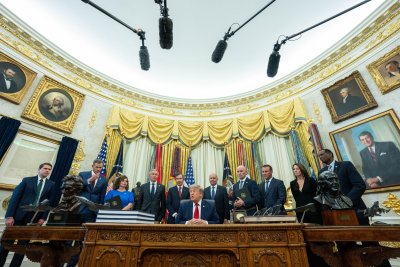
March 17 (UPI) — President Donald Trump hosted Irish Prime Minister Micheál Martin at the White House on Tuesday during their annual St. Patrick’s Day visit.

Taoiseach Martin thanked the president for “affirming the tremendous bonds” between the two countries at the Oval Office.

Trump said there is a “tremendous trade relationship” between Ireland and the United States.

“We have a tremendous trade relationship with Ireland, and we’ll keep it that way. I think it’s going to be expanded very quickly,” Trump said. “Probably they want to talk a little bit about tariffs, but I won’t mention that – you might want to be discussing that a little bit.”

Vice President JD Vance also hosted a breakfast in honor of Martin at the vice president’s residence in the U.S. Naval Observatory in Washington, D.C.

A reporter asked Trump what his message was to Irish people who are paying high energy prices because of the war with Iran.

“I have a lot of friends from Ireland, they’re very happy that I’m getting rid of … a nuclear power, a nuclear terrorist,” Trump said. “And as soon as that war is over, which will be soon, your prices are going to drop like a rock. You watch.”

Martin said the connection between the two countries is important.

“The Irish have helped to build America,” he said. “We’re very proud of that connection, and we think you hosting us here in the White House is affirmation to all the Irish-Americans out there and to our diaspora in this country for what they’ve contributed to America.”

He also said he wants to develop a legal path for migration between the two countries.

Some Irish politicians have boycotted the trip.

Sinn Féin President Mary-Lou McDonald and Northern Ireland First Minister Michelle O’Neill are boycotting the St Patrick’s Day events in the United States because of the Trump administration’s policies in Gaza, the BBC reported.

Revelers wearing green cheer as the St. Patrick’s Day Parade marches through Fifth Avenue in New York City on March 17, 2026. Photo by John Angelillo/UPI | License Photo

Source link

US confirms 157 killed in maritime strikes experts call ‘extrajudicial’ | Military News

Defence official tells Congress that 47 alleged drug-trafficking vessels have been struck since campaign began.

The United States military has confirmed that at least 157 people have been killed in lethal strikes against alleged drug-trafficking boats off Latin America, described as a campaign of extrajudicial killings by legal experts.

Senior defence official Joseph Humire said that 47 “narco-trafficking vessels” have been struck in the Caribbean and Eastern Pacific since the campaign began in September, in a written statement to members of the US Congress.

Recommended Stories

list of 3 itemsend of list

Asked by lawmakers on Tuesday whether the quantity of drugs entering the US has gone down, Humire stated that the movement of drug-trafficking vessels had decreased by 20 percent in the Caribbean.

“We’ve measured the decrease in the movement of the vessels,” said Humire.

“But that’s a no in terms of the drugs actually getting into the US,” Representative Adam Smith responded.

Experts have expressed scepticism that the strikes are having any significant impact on the drug trade, and legal scholars have said that the campaign is a clear violation of international law and is blurring the distinction between armed conflict and criminal activity. Under international law, military force is permitted for the former, but not the latter.

The Inter-American Commission on Human Rights (IACHR) is holding hearings on the strikes, and advocates hope that the hearings could open the door to possible legal accountability for those responsible.

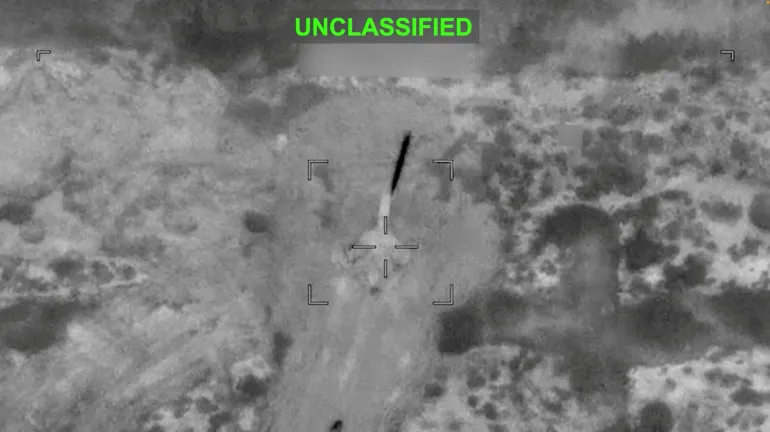
The Pentagon has shared videos on social media showing strikes on the vessels, but has provided few details about those killed or evidence of their status as drug vessels.

The administration of US President Donald Trump has embraced a militarised approach to combatting drug trafficking that has allowed the US to expand its military footprint across the region.

The US has stepped up collaboration with friendly governments such as Ecuador and threatened military strikes against countries like Mexico and Colombia if they do not do more to accommodate US demands.

Source link

Trump says it’s a ‘good thing’ counterterrorism director resigned over Iran | Nuclear Energy

NewsFeed

US President Donald Trump has reacted to the resignation of the US National Counterterrorism Centre’s director, Joe Kent, saying that he couldn’t work with somebody who didn’t believe Iran was a threat. Trump also said his decision to bomb Iran avoided a ‘nuclear holocaust’.

Source link

U.S. gas prices up 27% since start of Iran attacks

March 17 (UPI) — U.S. gasoline prices have surged by 27% and diesel by 34% since the start of U.S. attacks on Iran last month, fuel costs reported Tuesday indicate.

AAA reported that the national average cost for a gallon of gas in the United States was $3.79 Tuesday morning. Diesel was $5.044 per gallon, topping the $5 threshold for the first time in three years, CNBC reported.

A year ago, those prices were $3.078 and $3.592, respectively. A month ago, they were $2.917 and $3.651.

Fuel prices have been on the rise globally since the United States and Israel launched attacks on Iran on Feb. 28 amid negotiations over Iran’s nuclear program. The attacks, which killed Iran’s supreme leader, Ayatollah Ali Khamenei, prompted Tehran to effectively close down the Strait of Hormuz by banning ships linked to the United States or Israel. About 20% of the world’s oil runs through the waterway that separates Iran and Oman.

Brent Crude, the benchmark price for oil worldwide, rose about 2% to $102 a barrel Tuesday, The New York Times reported. The West Texas Intermediate, the U.S. benchmark, rose to $95 a barrel.

Diesel prices are particularly tied to the U.S. economy, which depends on it for the transportation of goods via trucks, trains and barges. Recent surges in prices could have a cascading effect.

Andy Lipow, president of Lipow Oil Associates, said Tuesday that trucking and rail companies have begun increasing their fuel surcharges in response to the fuel hikes.

“One should really be worried about higher diesel prices,” he said in a note published by CNBC.

President Donald Trump this week put pressure on other nations that rely on oil shipped through the Strait of Hormuz to join a coalition to police the transit route and reopen traffic.

Speaking aboard Air Force One on Sunday, Trump said the United States doesn’t need to be involved in reopening the Strait of Hormuz because little of its oil passes through the waterway. About 7% of the United States’ crude oil and condensate imports passed through the strait in the first half of last year, the U.S. Energy Information Administration said.

He said the United States was protecting it “almost like we do it for habit” and to help “some very good allies that we have in the Middle East.”

Patrick De Haan, head of petroleum analysis at GasBuddy, said Monday, “until we see a meaningful resumption of oil flows through the Strait of Hormuz, upward pressure on fuel prices is likely to persist.”

Iranians attend a funeral for a person killed in recent U.S.-Israel airstrikes at Behesht-e Zahra cemetery on the southern outskirts of Tehran in Iran on March 9, 2026. Photo by Hossein Esmaeili/UPI | License Photo

Source link

Earthquake hits Cuba as nationwide blackout deepens crisis

Women chat in Havana on Monday. Cuba’s national electrical grid has suffered a total collapse after a three-month halt in foreign oil shipments. Photo by Ernesto Mastrascusa/EPA

March 17 (UPI) — A magnitude 5.8 earthquake struck eastern Cuba early Tuesday, hours after the island’s national power grid collapsed, leaving nearly the entire country without electricity and compounding an already severe economic and social crisis.

The U.S. Geological Survey reported the quake at magnitude 5.8, while Cuba’s National Seismological Research Center measured it at 6.0. The epicenter was located off the coast of Guantánamo province and was widely felt across eastern Cuba.

State local newspaper Granma reported no fatalities or significant material damage.

The tremor followed the total disconnection of Cuba’s National Electric System shortly before 2 p.m. Monday, the sixth nationwide blackout in roughly 18 months. The Ministry of Energy and Mines said on X that the causes remain under investigation.

The outage left nearly 10 million people without electricity, disrupting water pumping, telecommunications and Internet service. Residents relied on candles, torches and battery-powered radios, according to a report by Mexican broadcaster TV Azteca.

The ministry said the failure affected the entire country, including Havana. The U.S. Embassy in Cuba issued a security alert saying no information was available on when power would be restored.

Energy Minister Vicente de la O Levy said on X that authorities are following established protocols and working to restore electricity to the country’s largest generating units.

Independent outlet Diario de Cuba reported that the government has yet to explain the collapse, which coincided with renewed protests in Havana and growing signs of public discontent.

Officials initially said service was being partially restored through localized “microsystems” in several provinces, prioritizing essential facilities while attempting to restart major thermoelectric plants. Full recovery could take time, especially due to fuel shortages that have limited distributed generation since January.

Frequent blackouts have slowed industrial activity and strained public services nationwide. Recent demonstrations in several cities have resulted in arrests.

Official figures show the Cuban economy has contracted more than 15% since 2020. Much of the state-run industrial sector remains idle and essential services have deteriorated sharply.

Independent experts estimate that fully restoring the power system would require between $8 billion and $10 billion, sums widely seen as beyond the reach of the Cuban economy.

Days after President Miguel Díaz-Canel acknowledged talks with the United States to address longstanding disputes, the government announced measures to allow greater entry of private capital, including from U.S. companies and Cuban expatriates in Miami.

In an interview with state-run Canal Caribe, Vice Prime Minister Óscar Pérez-Oliva Fraga said investors could own private companies on the island and access the financial sector. He confirmed that Cuban emigrants may become partners or owners of private businesses without living in Cuba and may associate with local firms under the Foreign Investment Law.

They also would be allowed to enter the national financial system, open foreign currency accounts and create cooperation and investment funds with authorization from the Central Bank.

Pérez-Oliva Fraga said the measures respond to demands from the diaspora and aim to expand its role in economic development as the government seeks to attract foreign capital and diversify the private sector.

He said “Cuba’s doors are open” to foreign investment, including U.S. companies, while again blaming the U.S. embargo for the island’s energy crisis and fuel shortages.

On Monday, President Donald Trump said he would have “the honor of taking Cuba,” describing the country as weakened after decades of rule by what he called violent leaders.

“You know, all my life I’ve heard about the United States and Cuba. When will the United States have the honor of taking Cuba? That would be a great honor,” Trump said from the Oval Office, according to CNN.

“Taking Cuba in some way, yes, taking Cuba. I mean, whether you free it or take it, I think I can do whatever I want with it,” he added.

His comments came as senior administration officials have repeatedly said a conflict with Iran could end within days and after Trump suggested that Cuba could be next on his agenda.

Source link

US envoys meet Hamas in Cairo to salvage fragile Gaza truce | Donald Trump

In a devastated enclave where more than two million Palestinians remain crammed into a shrinking strip of land under the overwhelming shadow of Israeli military occupation and bombardment, daily survival is tethered to a fragile October “ceasefire”.

But as Israeli and US bombs rain down on Iran, and Tehran retaliates across the region, that battered truce faces a breaking point, prompting an unprecedented diplomatic manoeuvre: direct talks between United States President Donald Trump’s “Board of Peace” and Hamas.

Recommended Stories

list of 4 itemsend of list

Envoys from the new body, personally headed by Trump to oversee post-war Gaza, but with more far-reaching designs, met with Hamas representatives in the Egyptian capital over the weekend, according to the Reuters news agency.

The meetings aimed to safeguard the “ceasefire”, which has been under even more severe strain since the regional war began on February 28.

Following the talks, Israel announced it would partially reopen the Rafah border crossing between Gaza and Egypt on Wednesday. The crossing, Gaza’s sole pedestrian lifeline outside direct Israeli control, was shut when the Iran offensive began.

Despite the diplomatic push, violence in the enclave persists. Israeli strikes on Sunday killed at least 13 Palestinians including two boys, a pregnant woman, and nine police officers, serving as a stark reminder of Israel’s all-encompassing military grip on the territory.

A pragmatic shift or tactical ploy?

While the talks mark a notable engagement by Washington, analysts view the move not as a legitimisation of the Palestinian group, but as a calculated tactic underpinned by the threat of renewed violence.

Abdullah Aqrabawi, a Palestinian political analyst, noted that Washington’s willingness to meet Hamas reflects a stark reality on the ground. “There is a comprehensive, realistic acknowledgement that the main military, political, and social actor in the Gaza Strip is Hamas,” Aqrabawi told Al Jazeera.

However, he warned against viewing the meetings as a fundamental shift in US policy. In the era of the Trump administration, diplomatic meetings do not equate with political recognition. Instead, Aqrabawi argued, the approach is framed by the constant threat of a return to a “war of extermination”.

The ultimate goal of these talks, he explained, is to empower a newly formed technocratic committee in Gaza to build a social base capable of challenging the armed group.

The illusion of ‘reverse blackmail’

Initial reports suggested that Hamas had threatened to abandon the “ceasefire” if Gaza border restrictions continued, purportedly using the regional chaos of the Iran war to force Israel’s hand.

Aqrabawi dismissed this assessment, noting that Hamas has consistently expressed a desire to avoid a return to full-scale war. Rather than a successful Palestinian pressure campaign, he said the reopening of the Rafah crossing serves a different strategic purpose for Washington and Tel Aviv.

“Any facilities, whether the Rafah crossing or allowing aid entry, come through the “Board of Peace” and the new technocratic committee formed in the Gaza Strip,” Aqrabawi said. “It is not a response to negotiations or Palestinian pressure, but rather in the context of allowing this committee to penetrate Palestinian society.”

He added that this aims to establish a security foundation that allows for the disarmament of the resistance, even if it leads to internal Palestinian civil conflict.

Disarmament and the 20-point plan

Prior to the regional escalation, Trump’s flagship Middle East initiative – a 20-point plan for Gaza – had partially halted the mass killings and secured the release of Israeli military captives and some Palestinian prisoners. In exchange, Hamas accepted a ceasefire that left the Israeli military occupying more than half of the enclave.

But the second phase of Trump’s plan, which hinges on Hamas laying down its weapons in exchange for amnesty and reconstruction, remains deadlocked. While some might assume the regional conflict gives Hamas leverage to scrap the disarmament clause entirely, Aqrabawi suggested the opposite is unfolding.

The US and Israel, heavily engaged in Iran, are likely intensifying pressure on the Palestinian group to secure a swift, enforceable victory in Gaza. “The pressure happening today on the occupation government and the American perspective of the war with Iran may push them to pressure Hamas to accomplish this task as quickly as possible,” Aqrabawi said.

Yet, Hamas remains resolute. The group views its weapons as essential for resisting the occupation and forming the foundation of future Palestinian security institutions.

As Washington and Tel Aviv attempt to use the spectre of renewed genocide to engineer Gaza’s political future, the reality for the Palestinians trapped inside the enclave remains unchanged. For them, the partial reopening of a single border crossing is not a diplomatic breakthrough, but a fleeting gasp of air in a besieged Gaza Strip where daily survival is held hostage to the demands of the military occupation.

Source link

White House chief of staff Susie Wiles diagnosed with breast cancer

1 of 5 | President Donald Trump speaks with White House chief of staff Susie Wiles during a meeting with trustees of the John F. Kennedy Center for Performing Arts in the East Room of the White House in Washington, D.C., on Monday. Photo by Aaron Schwartz/UPI | License Photo

March 16 (UPI) — White House chief of staff Susie Wiles has been diagnosed with breast cancer and has an “excellent” prognosis, President Donald Trump announced Monday.

In a post on Truth Social, Trump said Wiles has “early stage breast cancer” and will be undergoing treatment “immediately.”

“She has a fantastic medical team, and her prognosis is excellent!” Trump wrote. “During the treatment period, she will be spending virtually full time at the White House, which makes me, as President, very happy!”

Wiles confirmed her diagnosis hours later in a statement on X.

“Nearly one in eight women in the United States will face this diagnosis. Every day, these women continue to raise their families, go to work and serve their communities with strength and determination,” she said.

“I now join their ranks.”

The diagnosis was made last week, she added, while expressing her gratitude to the doctors who “detected the cancer early.”

“I am encouraged by a very good prognosis,” she said.

“I am also deeply thankful for the support and encouragement of President Trump as I undergo treatment and continue serving in my role as White House chief of staff.”

The Hill reported that Wiles was seated next to Trump during Monday’s John F. Kennedy Center for the Performing Arts board meeting at the White House.

Vice President JD Vance also voiced his support for Wiles in a post on X.

“The Vance family is praying for our dear friend as she takes on her next fight!” he wrote.

Trump ally Elon Musk said he was “hoping for the best,” while rapper Nicki Minaj said, “God will get the glory for your testimony, my sister.”

Source link

Pro-Palestine protester Leqaa Kordia freed from US immigration detention | Donald Trump News

The 33-year-old Columbia University protester had been held in immigration detention centre for a year.

Leqaa Kordia, a Palestinian woman detained in the United States after taking part in pro-Palestine demonstrations in 2024, has been released after a year in custody.

The 33-year-old, who grew up in the occupied West Bank before moving to the US in 2016, was held at a detention facility in the state of Texas since March last year.

“I don’t know what to say. I’m free! I’m free! Finally, after one year,” a smiling Kordia told reporters after leaving the detention centre on Monday.

An immigration judge had ruled Kordia was eligible to be released on bond three times. Immigration officials appealed the first two rulings but Kordia was freed on $100,000 bond after government lawyers did not challenge the third.

After her release, Kordia said she was looking forward to going home and hugging her mother “so hard.” But she also said she would keep fighting on behalf of people still being held at the detention centre

“There is a lot of injustice in this place,” she said. “There is a lot of people that shouldn’t be here the first place.”

Kordia, who lost nearly 200 members of his family during Israel’s genocidal war against Palestinians in the Gaza Strip, was among several protesters targeted by immigration officials for taking part in pro-Palestine demonstrations at Columbia University in 2024.

Until Monday, she was the only person targeted in connection with the demonstration who was still in immigration detention after the release of others, including Mahmoud Khalil and Mohsen Mahdawi.

Kordia, who was held at Prairieland Detention Center in Alvarado, was recently hospitalised for three days following a seizure after fainting and hitting her head at the privately run detention facility.

At a hearing on Friday, Kordia’s lawyers said she had a neurological condition that had worsened while in custody, putting her at an elevated risk of seizure. They reiterated that she could stay with US citizen family members and did not pose a flight risk.

The immigration judge, Tara Naslow, agreed.

“I’ve heard testimony. I’ve seen thousands of pages of evidence presented by the respondent, and very little evidence presented by the government in any of this,” Naslow said.

Source link

Trump claims strikes on Iran prevented nuclear war | Donald Trump

NewsFeed

Offering another rationale for the US-Israeli war on Iran, Donald Trump claimed he ordered strikes to prevent a nuclear conflict that would have turned into World War III. He also said not even the “greatest experts” thought Iran would retaliate with attacks on Gulf states.

Source link

‘Fourth world nation’: Trump slams Somalia, Ilhan Omar | Migration

NewsFeed

Speaking at the Oval office, US President Donald Trump stated that Somalia is a “fourth world nation” while repeating claims without evidence that Congresswoman Ilhan Omar had illegally entered the country by marrying her brother. Omar has consistently denied the “sick” allegations.

Source link

Kennedy Center board to vote on 2-year shuttering for renovations

March 16 (UPI) — The board of trustees for the John F. Kennedy Center for the Performing Arts in Washington, D.C., is set to attend a meeting Monday to determine whether to shutter the facility to carry out renovations that some critics worry could result in a structural overhaul akin to the White House’s East Wing.

The agenda for Monday’s meeting, obtained by The New York Times, indicates the board will vote on whether to begin renovations starting July 6. President Donald Trump announced last month that he wants to close the Kennedy Center for two years for construction amid artist cancellations and boycotts over his cultural agenda.

Trump said the decision to close the facility came after a yearlong review in consultation with contractors, musical experts, arts institutions, and advisers and consultants. He had initially considered a partial project that would permit shows to continue, but decided the best option for the venue was a temporary closure.

Rep. Joyce Beatty, D-Ohio, an ex officio member of the board who sued to have access about the details of renovations, said she believes Trump wants to shutter the Kennedy Center in response to dozens of individuals and cultural organizations who have canceled appearances there in response to Trump trying to rename the center after himself. Beatty said the documents she received about the renovations were “inadequate.”

She said “the documents prove that there is absolutely no basis to shutter this precious living memorial and beloved institution,” she said in a statement. “It certainly looks like President Trump is shutting down the center because he is embarrassed that ticket sales are down and artists are fleeing since his illegal renaming.”

Beatty’s lawyers said she was concerned Trump might use his hand-selected board to push through wholesale changes at the Kennedy Center to design a facility more to his liking. In October, Trump had the East Wing of the White House demolished to make room for a $250 million ballroom.

In a post on Truth Social on Friday, Trump shared renderings of what he expected the so-called Trump-Kennedy Center to look like after the renovations. He said he’s not planning to rip out the facade.

“I’ll be using the steels. So we’re using the structure, we’re using some of the marble, and some of the marble comes down,” he said.

A Washington Post analysis of the renderings show very few changes to the exterior of the building, including altered cornices, updated roof and some windows, painted columns, new signage and landscaping changes.

The group Hands Off the Arts has held weekly protests outside the Kennedy Center over the changes. A participant, drag queen Tara Hoot, said “there’s no need for it to close.”

“The carpet’s brand new, right? They already have some things planned in the works to redo the Kennedy Center and parts of it, maintenance, so there’s no reason to close it,” Hoot said, according to WUSA-TV in Washington, D.C.

“There are jobs, lots of jobs, and people are going to lose their jobs. The economy is terrible right now. Why do we want more people to lose their jobs?”

President Donald Trump speaks during an event celebrating Women’s History Month in the East Room of the White House on Thursday. Photo by Bonnie Cash/UPI | License Photo

Source link