US Vice President JD Vance is leaving Pakistan after 21 hours of talks with Iran, saying Tehran chose not to accept their ‘final and best offer’. Here’s his full press conference in Islamabad.
A bill laying out plans to return the Indian Ocean archipelago, home to the US-UK Diego Garcia base, has been paused.
Published On 11 Apr 202611 Apr 2026
The United Kingdom is setting aside a bill to return the Chagos Islands to Mauritius amid a lack of support from United States President Donald Trump.
“We have always said we would only proceed with the deal if it has US support,” a UK government spokesperson said in a statement, according to the Reuters and AFP news agencies on Saturday.
Recommended Stories
list of 4 itemsend of list
This followed reports in the UK media that said a bill laying out plans to cede sovereignty of the 60-plus Indian Ocean islands had been dropped from the next parliamentary agenda.
Last May, the UK and Mauritius jointly announced a deal that would return full sovereignty of Chagos to Mauritius, which is some 2,000 kilometres (1,200 miles) away from the archipelago.
Britain would then pay to lease Diego Garcia – the largest island and a strategic location in the middle of the Indian Ocean between Asia and Africa, which is home to the military base – on a 99-year lease to preserve US operations there.
But Trump opposed the move, calling it an “act of great stupidity” in January.
“Diego Garcia is a key strategic military asset for both the UK and the US. Ensuring its long-term operational security is and will continue to be our priority – it is the entire reason for the deal,” the UK government spokesperson added in his statement.
“We are continuing to engage with the US and Mauritius.”
The statement added that the UK “continue[s] to believe the agreement is the best way to protect the long-term future of the base”.
‘Big mistake’
After Trump’s initial opposition, he appeared to momentarily back down in February after speaking with UK Prime Minister Keir Starmer, saying Starmer had made the “best deal he could make”.
But he then attacked the prime minister again on Truth Social weeks later.
“He is making a big mistake,” Trump wrote, adding that ceding the Chagos Islands would be “a blight on our Great Ally”.
Over the last six weeks, relations between Trump and Starmer have been further strained by the US-Israel war on Iran.
The UK is now leading a coalition of more than 30 countries to protect vessels in the Strait of Hormuz, without US participation in the initial talks.
Britain has controlled the Chagos since 1814, including after Mauritius gained independence in the 1960s. The Diego Garcia base has played a key role in US military operations in Vietnam, Iraq and Afghanistan.
Chagossians – thousands of whom were forcibly evicted to make way for the base – have brought compensation claims to British courts, culminating in a 2019 International Court of Justice recommendation that the archipelago be returned to Mauritius.
Islamabad, Pakistan – With key differences in the Iranian and American positions seemingly intact, Pakistan is aiming for what officials describe as a realistic – if modest – outcome from the negotiations between the two warring nations set to commence in Islamabad on Saturday.
The aim: to get the United States and Iranian negotiators to find enough common ground to continue talks.
On Friday, US Vice President JD Vance left Washington for Islamabad, where he will lead the American team, which will also consist of President Donald Trump’s chief negotiator Steve Witkoff and son-in-law Jared Kushner. While Iran has not formally confirmed its representatives at the talks, Foreign Minister Abbas Araghchi and Parliament Speaker Mohammad Bagher Ghalibaf are expected to lead Tehran’s team.
These high-level talks follow days after the US and Iran agreed to a Pakistan-mediated two-week ceasefire, and will be held exactly six weeks after the US and Israel launched their war on Iran with the killing of Iranian Supreme Leader Ayatollah Ali Khamenei on February 28.
Experts and sources close to the mediation effort said there was little expectation that a major breakthrough would be reached on Saturday. But by setting a more realistic ceiling – an agreement in Islamabad to continue deeper negotiations aimed at finding a lasting peace deal – Pakistan is hopeful it can help build on a truce that led to a collective sigh of relief globally.
“Pakistan has succeeded in getting them together. We got them to sit at a table. Now it is for the parties to decide whether they are willing to make the sacrifices necessary to reach an eventual solution,” Zamir Akram, Pakistan’s former ambassador to the United Nations, told Al Jazeera.
Now, he added, it will aim to secure an agreement for the US and Iran to continue dialogue.
The ‘proximity format’
The US and Iranian delegations will land at the Nur Khan airbase outside Islamabad and then drive to the Serena Hotel, where they will stay, and where the talks will be held.
Though the two teams will be in the same hotel, they will not come face to face for the negotiations, officials said.
Instead, they will sit in two separate rooms, with Pakistani officials shuttling messages between them.
In diplomatic jargon, such negotiations are known as proximity talks.
Pakistan’s experience with such a dialogue is not new. In 1988, Islamabad itself participated in the Geneva Accords negotiations on the Soviet withdrawal from Afghanistan, where UN-mediated indirect talks between Pakistan and Afghanistan produced a landmark agreement.
Akram, who has represented Pakistan at the UN in Geneva from 2008 to 2015, said that history was relevant.
“Proximity talks have been used before. Pakistan itself participated in one in Geneva in 1988 on the Afghan issue,” he told Al Jazeera. “If the parties did not trust Pakistan, they would not be here. The metric of success should be an agreement to continue this process in search of a solution. It will not happen in a couple of days.”
Building diplomatic momentum
In the days between the ceasefire announcement on April 7 and the arrival of the delegations in Islamabad, world leaders moved quickly to register support.
UN Secretary-General Antonio Guterres welcomed the ceasefire and expressed appreciation for Pakistan’s role. Kazakhstan, Romania and the United Kingdom also issued statements endorsing Islamabad’s mediation.
French President Emmanuel Macron called Prime Minister Shehbaz Sharif to congratulate him, while Turkiye’s President Recep Tayyip Erdogan also spoke to the Pakistani leader.
Analysts say these calls were not only expressions of goodwill but signals of international backing, aimed at strengthening Pakistan’s hand in pushing both Washington and Tehran to deliver results.
Sharif spoke with eight world leaders, including the emir of Qatar, the presidents of France and Turkiye, the prime ministers of Italy and Lebanon, the king of Bahrain and the chancellors of Germany and Austria.
Foreign Minister Ishaq Dar, who is also deputy prime minister, engaged with more than a dozen counterparts over the past two days and held an in-person meeting with China’s ambassador in Islamabad.
In total, Pakistan’s leadership made or received more than 25 diplomatic contacts in roughly 48 hours.
Salma Malik, a professor of strategic studies at Quaid-i-Azam University, said the scale of engagement reflected confidence in Pakistan’s role.
“The two main parties showed confidence in Pakistan to act as a neutral agent, that is the first and most critical litmus test for any mediating country, and Pakistan passed it,” she told Al Jazeera.
The Lebanon problem
The most immediate threat to Saturday’s talks lies outside the negotiating room.
Iran has framed Israeli strikes on Lebanon as a direct challenge to the ceasefire. Iranian President Masoud Pezeshkian, who spoke to Sharif earlier this week, warned that continued attacks would render negotiations meaningless.
Hours after the ceasefire was announced, Israel launched its most widespread bombardment of Lebanon since the start of the conflict, killing more than 300 people across Beirut and southern Lebanon in a single day.
Rescuers stand at the site of an Israeli strike carried out on Wednesday, in El-Mazraa in Beirut, Lebanon, on April 9, 2026 [Raghed Waked/Reuters]
Foreign Minister Abbas Araghchi said Tehran could abandon the ceasefire entirely if the strikes continued.
Sharif, in a call with Lebanese Prime Minister Nawaf Salam on April 9, strongly condemned Israel’s actions.
Whether Lebanon is covered by the ceasefire remains contested. Pakistan has maintained that the truce extends across the wider region, including Lebanon, as reflected in Sharif’s statement earlier this week.
Washington has taken a different view. US Vice President JD Vance, who will lead the American delegation, said in Budapest that Lebanon falls outside the ceasefire’s terms, a position echoed by President Donald Trump and the White House.
Seema Baloch, a former Pakistani envoy, said the issue ultimately rests with Washington.
“Lebanon is key and Israel will use it to play the spoiler role,” she told Al Jazeera. “It is now the US decision whether it will allow Israel, which is not seated at the negotiating table, to play that role.”
There are, however, signs of limited de-escalation.
Israeli Prime Minister Benjamin Netanyahu said on Thursday that Israel was ready to begin direct negotiations with Lebanon “as soon as possible”, focusing on disarming Hezbollah and reaching a peace agreement.
The announcement followed US pressure. Trump told NBC he had asked Netanyahu to “low-key it” on Lebanon.
However, Netanyahu made clear there was no ceasefire in Lebanon, saying Israel would continue striking Hezbollah even as talks proceed.
Salman Bashir, a former Pakistani foreign secretary, said Lebanon remains within the ceasefire’s scope.
“Lebanon is very much part of the ceasefire, as was mentioned in the prime minister’s statement,” he told Al Jazeera. “The Israelis may be inclined to keep the pressure on Lebanon, but not for long if the US is keen on a cessation of hostilities, as it seems.”
Stumbling blocks
Beyond Lebanon, several other obstacles remain.
Washington is expected to push for verifiable restrictions on Iran’s nuclear programme, including limits on enrichment and the removal of stockpiled material.
Tehran, in turn, is demanding full sanctions relief, formal recognition of its right to enrich uranium and compensation for wartime damage.
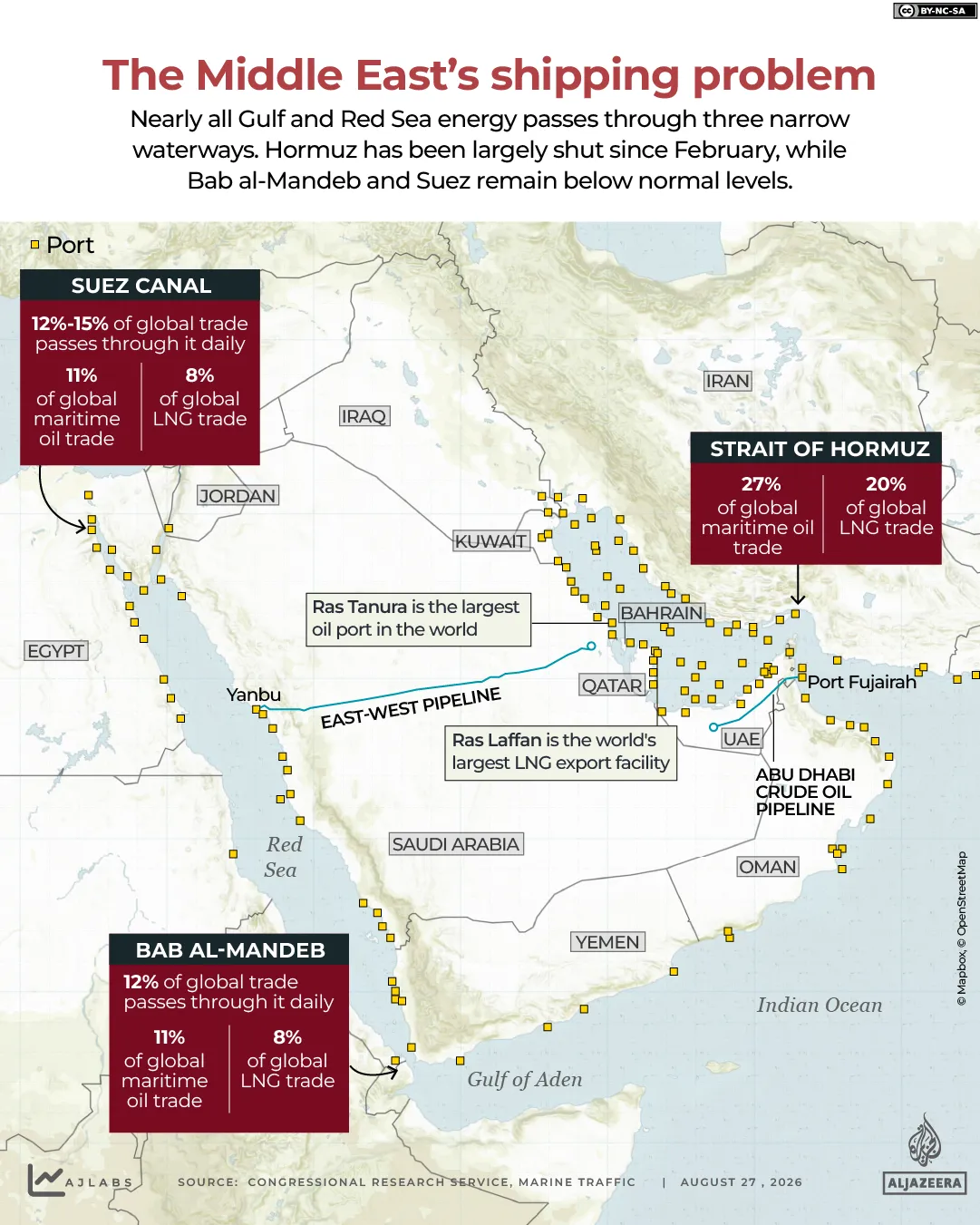
The Strait of Hormuz, through which roughly a fifth of the world’s oil and gas passes in peacetime, remains a key pressure point, with Iran retaining the ability to disrupt maritime traffic.
Bashir said there could be movement on some of these issues.
“There may be an opening on the Strait of Hormuz, under Iranian control. Iran will not give up on the right to enrichment. If nothing else, there should be an extension of the ceasefire deadline,” he told Al Jazeera.
Muhammad Shoaib, a professor of international relations in Islamabad, said progress would depend on movement on core issues.
“Both parties agreeing on the need to continue or even extend the ceasefire, while in principle agreeing on crucial points such as the Strait of Hormuz, Iran’s right to enrichment and respect for sovereignty, will suggest that the first round is meaningful and successful,” he told Al Jazeera.
The regional atmosphere has also been shaped by sharp rhetoric from some of Iran’s Gulf neighbours.
The United Arab Emirates, which faced hundreds of missile and drone attacks during the conflict, has been among the most vocal.
Its ambassador to Washington wrote in The Wall Street Journal that a ceasefire alone would not be sufficient and called for a comprehensive outcome addressing Iran’s “full range of threats”.
Bahrain, meanwhile, presented a United Nations Security Council resolution on April 7 calling for the reopening of the Strait of Hormuz. The measure received 11 votes in favour but was vetoed by Russia and China, with Pakistan and Colombia abstaining.
Saudi Arabia, Turkiye and Egypt are not expected to have a formal presence at the talks, despite being closely involved in pre-negotiation diplomacy. The four countries held meetings in Riyadh and later in Islamabad aimed at securing a pause in hostilities.
Israel, a party to the conflict, will also not be represented. Pakistan, like most Muslim-majority countries, does not recognise Israel and has no diplomatic relations with it.
A slight easing
There are, however, tentative signs of easing tensions ahead of Saturday’s talks.
On Friday, as he was departing from Washington, Vance said that the US team was “looking forward to the negotiations”.
“We think it’s going to be positive. We’ll, of course, see. As the president of the United States said, if the Iranians are willing to negotiate in good faith, we are certainly willing to extend an open hand,” the US vice president said. “If they try to play us, they’re going to find that the negotiating team is not that receptive. So we’ll try to have a positive negotiation.”
He also said that Trump had given the US team “some pretty clear guidelines”.
Earlier this week, Saudi Arabia’s foreign minister spoke with his Iranian counterpart for the first time since the war started.
And Iran’s Supreme National Security Council said on April 8 that discussions could continue for up to 15 days, suggesting readiness for a prolonged process.
Akram, the former envoy, said the benchmark for success was clear.
“What they need to agree is that they will find a solution, and that in itself would be a step in the right direction,” he told Al Jazeera. “Finding a long-term solution will take time. It will not happen in a couple of days.”
Malik, the academic in Islamabad, said Pakistan’s expectations remained modest.
“What Pakistan expects is breathing space, an opportunity for peace. It is not expecting anything big. It is a small wish, but realising it will be very difficult,” she told Al Jazeera.
WASHINGTON — A day after the United States and Iran agreed to a two-week ceasefire, the truce showed signs of strain Wednesday as Iranian leaders accused Americans of violating the agreement and reports emerged that Tehran had moved to restrict traffic through the Strait of Hormuz.
The developments tested President Trump’s ability to parlay a fragile pause in fighting into a lasting peace deal with a country he has spent weeks threatening to destroy, and raised questions about whether the Trump administration had the diplomatic leverage to hold the deal together.
The White House sought to project confidence about the ceasefire, but the fragile deal grew shakier after Israel carried out its largest attack against Hezbollah in Lebanon since the conflict began. Iran said the strikes by the U.S. ally amounted to a breach of the ceasefire terms, even as Trump and Israeli Prime Minister Benajmin Netanyahu maintained that Lebanon was not subject to the agreement.
“The big issue seems to be that the two sides can’t agree on what the agreement is,” said Michael Rubin, an expert on Iran at the American Enterprise Institute. At best, he said, the two sides had secured a “tactical pause.”
Iranian Foreign Minister Abbas Araghchi said the United States must choose between a ceasefire or “continued war via Israel.
“It cannot have both,” Araghchi wrote on X. “The world sees the massacres in Lebanon. The ball is in the U.S. court, and the world is watching whether it will act on its commitments.”
Whether Iran will draw a red line over Lebanon could become a key question. The Wednesday back-and-forth represented “threshold-testing” of Iran and whether it will be willing to reengage the United States in conflict over the issue, said Ross Harrison, senior fellow at the Middle East Institute.
The parties’ prospects for reaching an agreement — and what Trump’s options become for declaring success — will depend on how the ceasefire goes in the coming days, Harrison said.
“There’s some room here … if [the Iranians] see that negotiations are real and not a pretext for further attacks,” he said. “A lot of what the United States can get depends on what the United States is willing to give — not just in terms of the points of their plan, but also in terms of the signaling that they too have an interest in de-escalating.”
Reports that Iran had moved to restrict traffic through the Strait of Hormuz, a crucial waterway whose opening was central to the truce negotiations, further complicated the ceasefire.
“Any vessel trying to travel into the sea … will be targeted and destroyed,” the Iranian navy told shipping vessels, Fars News reported. The news agency is aligned with the Islamic Revolutionary Guard Corps.
At a news briefing Wednesday, White House Press Secretary Karoline Leavitt said Trump was aware of reports that the Strait of Hormuz had been closed, a move she called both “completely unacceptable” and “false.” She added that the president expects the waterway will be “reopened immediately, quickly and safely” during the ceasefire.
Leavitt sidestepped questions about who currently controls the oil route.
Earlier in the day, at a Pentagon briefing, Defense Secretary Pete Hegseth told reporters that “commerce will flow” through the strait, but did not say whether U.S. warships would be escorting vessels through the waterway. Joint Chiefs of Staff Chairman Gen. Dan Caine, who stood next to Hegseth, was asked whether the strait was open. He said: “I believe so.”
Hegseth emphasized that Iran should keep its end of the bargain or face the consequences.
He said the U.S. military plans to maintain a presence in the region to ensure Iranian compliance, saying American troops are ready to “go on offense and restart operations at a moment’s notice” if the truce broke down.
“We’ll be hanging around,” Hegseth said. “We are going to make sure Iran complies with this ceasefire and then ultimately comes to the table and makes a deal.”
The warning came as several Persian Gulf nations reported Iranian missile and drone attacks on their territories despite the ceasefire. Kuwait said its air defenses intercepted drones, while Bahrain reported that an Iranian attack has sparked a fire at one of its facilities.
Hegseth downplayed the continued Iranian attacks in the region, saying that “it takes time sometimes” for ceasefires to take hold, but advised Iran to “find a way to get a carrier pigeon to their troops in remote locations” and ensure compliance moving forward.
Israel, meanwhile, carried out its largest strike against Hezbollah since the militant group began launching rockets in solidarity with Iran last month. Lebanese health authorities said hundreds were killed and wounded in the Israeli strikes.
Trump and Israeli Prime Minister Benjamin Netanyahu have maintained that Lebanon is not subject to the ceasefire agreement. Leavitt reiterated that stance, telling reporters that “Lebanon was not part of the ceasefire” and that it had been relayed to all parties.
Asked whether Trump would want to add Lebanon to the agreement in the future, Leavitt said that the matter “will continue to be discussed but that “at this point in time they are not included.”
More than a dozen European heads of state called on “all sides” to cease fire, including in Lebanon. In a Wednesday statement, they urged the parties to move quickly in diplomatic talks.
“The goal must now be to negotiate a swift and lasting end to the war within the coming days,” they said in the statement, which was signed by French President Emmanuel Macron, Italian Prime Minister Giorgia Meloni and German Chancellor Friedrich Merz, along with Japanese Prime Minister Sanae Takaichi as well as other European leaders.
Pakistani Prime Minister Shehbaz Sharif, who helped broker the ceasefire, wrote on X that ceasefire violations had been reported at “a few places across the conflict zone” and urged all parties to exercise restraint. He did not detail the violations but said the attacks “undermine the spirit of the peace process.”
The situation in the Strait of Hormuz underscores how much remains uncertain about the agreement between the United States and Iran. The full terms of the ceasefire have not been publicly disclosed, and Trump wrote on his social media website that the “only group of meaningful ‘POINTS’ that are acceptable to the United States” will be discussed behind closed doors.
Trump also seemed to take issue with the 10-point peace plan that Iran publicly released Wednesday. He said that there are terms being floated by people who have “absolutely nothing to do” with the negotiations between the United States and Iran. He said that “in many cases, they are total Fraudsters, Charlatans, and WORSE.”
Leavitt declined to offer details about the working proposal being negotiated, saying the talks will take place privately. Both Leavitt and Hegseth, however, mentioned that the U.S. wants to ensure Iran does not have stockpiles of enriched uranium, the fissile material that is key in developing nuclear weapons.
“This is on the top of the priority list for the president and his negotiating team as they head into the next round of discussions,” Leavitt said.
Hegseth told reporters earlier in the day that Iran may “hand it over.” If they don’t, he said, “we will take it out, or if we have to do something else ourselves like we did [with] Midnight Hammer or something like that, we reserve that opportunity.” He was referring to the 12-day war against Iran in June.
Leavitt reiterated that administration officials “hope it will be through diplomacy,” but left open the possibility that the uranium could be retrieved through ground operations.
There is probably negotiating room over enrichment, said Harrison of the Middle East Institue, while Iran may be less flexible on the Strait of Hormuz. The United States needs a resolution more quickly than Iran, he added.
“Time is their friend, not a friend of Donald Trump’s,” Harrison said.
Paramount President Jeff Shell is expected to exit the company after being entangled in a legal battle with a controversial Las Vegas gambler and self-styled “fixer.”
Shell has been negotiating his exit and is expected to leave imminently after just eight months on the job, said two people familiar with the matter who were not authorized to comment publicly.
The veteran entertainment executive officially joined the media company with David Ellison’s takeover in August, though he had been a key member of Ellison’s team for nearly two years as the group worked to assemble the pieces of the tech scion’s growing empire. Ellison’s Skydance Media acquired Paramount and then pulled off a stunning $111-billion deal to buy Warner Bros. Discovery in late February.
Shell brought substantial experience running a media company to Ellison’s inner circle, a group that included former investment bankers and others who haven’t run a large-scale enterprise. Shell also served as a member of Paramount’s board and is expected to leave that role, too.
His exit comes after the high-roller, Robert James “R.J.” Cipriani, sued Shell in Los Angeles County Superior Court on March 9, alleging fraud and breach of an oral contract. Cipriani claimed that he provided Shell with “sophisticated, high-value crisis communications services,” according to his suit. He alleged Shell spilled corporate secrets, which Shell has denied, and also failed to deliver on a verbal pledge to help Cipriani develop an English-language version of a Roku TV Spanish music show.
Shell maintains Cipriani fictionalized the two men’s dealings, then spread “false and salacious lies to extract a massive payday.” Cipriani has been seeking $150 million in damages. Shell filed a counterclaim, saying the two men met only twice and that Shell owed him nothing.
The legal skirmish cast a cloud over Shell’s tenure helping lead the company because the Ellisons wanted to stay focused on their Warner Bros. takeover and lining up regulators approvals in the U.S. and abroad. The Cipriani controversy made Shell’s future at Paramount untenable, the sources said.
NBCUniversal-owner Comcast hired a law firm to investigate him after a CNBC anchor filed an internal sexual harassment claim against him. Shell stepped down, acknowledging that he’d had an “inappropriate relationship” with the journalist, who has since left the company.
The job at Paramount was envisioned to be his second act.
Shell’s dealings with Cipriani began with an August 2024 meeting at litigator Patty Glaser’s Century City office. At the time, Glaser represented both men and urged Cipriani to “cease” his efforts to drum up damaging stories about Shell, who was trying to recover from the scandal that cost him his job at NBC.
Jeff Shell, Paramount Skydance president.
(Paramount / Skydance)
The most serious of Cipriani’s allegations was that he made a report about Shell to the U.S. Securities & Exchange Commission that Shell had discussed highly sensitive Paramount information with him: Paramount’s proposed $7.7-billion deal with the UFC owner to bring the mixed-martial arts fights to CBS and other Paramount outlets. Shell, in his lawsuit, denied the allegation.
Robert James “R.J.” Cipriani in Amazon Prime Video’s 2025 series, “Cocaine Quarterback.”
(Courtesy of Prime)
Paramount’s brass hired the Gibson Dunn law firm to investigate Shell’s surreptitious dealings with Cipriani. Investigators have been reviewing whether Shell had divulged any secrets. The review is still pending.
“Nobody believed me,” Cipriani said Wednesday. “The best thing I did was cooperate with Gibson Dunn and showed them that the texts were real.”
It’s unclear whether Ellison will look to bring in other experienced media executives or look to senior Warner Bros. Discovery executives following Paramount’s proposed takeover of that company.
The Democratic Republic of Congo is expecting to receive ‘third-country’ deportees after a deal with the US. Some people are unhappy with the deal, arguing that conflict and insecurity make life difficult enough without the added consequences of more arrivals.
SACRAMENTO — A federal judge appears willing to block a $6.2-billion merger of two large TV station groups as he evaluates whether Nexstar Media Group’s takeover of a rival violates U.S. antitrust laws.
At the conclusion of a two-hour hearing in Sacramento on Tuesday, U.S. District Court Chief Judge Troy L. Nunley signaled he was preparing to issue a preliminary injunction that would prevent Nexstar and Tegna from combining operations amid an ongoing legal challenge.
Nunley said he would draft a written order, which is expected by Friday.
Previously, Nunley had issued a temporary restraining order to pause the merger.
Last month, Nexstar raced to finalize its blockbuster purchase of Tegna — despite a lawsuit filed by California Atty. Gen. Rob Bonta and seven other state attorneys general. The state officials, all Democrats, claimed the massive merger would give Nexstar too much control over local TV stations, ultimately hurting consumers by diminishing the diversity and quality of their newscasts.
California Deputy Attorney General Laura Antonini argued that when news consolidates, it results in a loss of diverse viewpoints.
“That’s extremely harmful to democracy and to the citizens of this state,” she said at the hearing.
President Trump has championed the Nexstar-Tegna merger, suggesting it would diminish the clout of the major TV networks, including those he often gripes about: ABC and NBC. Nexstar, based in Irving, Texas, owns dozens of network affiliate stations.
Nexstar, which also owns KTLA-TV Channel 5 in Los Angeles, already is the nation’s largest station group. The deal was expected to reshape the local television industry by extending Nexstar’s reach to 265 television stations, up from 164.
If the acquisition is finalized , Nexstar stations would cover 80% of the U.S. population, exceeding a 39% ownership cap set by Congress.
El Segundo-based DirecTV separately sued, alleging the combination of the nation’s two largest television station groups would do irreparable harm to its pay-TV business by raising prices and potentially increasing programming blackouts.
Representatives of Nexstar, DirecTV and Bonta’s office declined to comment after Tuesday’s hearing.
During the hearing, Nexstar attorney Alexander Okuliar, argued against an injunction, saying the plaintiffs had failed to demonstrate that the merger posed an immediate threat to the public. He said DirecTV and the attorneys general had only offered proposed financial harms.
In court documents, the state attorneys general and DirecTV alleged the deal would give Nexstar multiple TV stations in dozens of markets. That raised concerns about layoffs in an industry that has sustained significant downsizing in recent years as viewers and advertisers migrate to streaming options and social media platforms like TikTok.
Nexstar could “shut down local newsrooms in dozens of markets, reducing the amount, variety, and quality of local broadcast news that Americans rely on for trusted information about their communities,” DirecTV alleged.
For example, Nexstar owns the Fox station in Sacramento, while McLean, Virginia-based Tegna owns the ABC affiliate.
Okuliar pushed back, saying there was no evidence that local newsrooms would be shuttered.
“One of the reasons for this deal is to protect local broadcasters, to protect local journalism,” he told the judge.
Nexstar contends the deal would strengthen TV station economics, allowing stations to bolster their news gathering and expand the number of newscasts. The company cited dozens of awards won by Nexstar journalists, including in Oklahoma City.
In addition to Bonta, the plaintiffs include state attorneys general in Colorado, Connecticut, Illinois, New York, North Carolina, Oregon and Virginia.
Nearly two dozen lawyers attended the hearing on behalf of the other plaintiffs. Eight lawyers represented Nexstar and Tegna.
Nexstar Chief Executive Perry Sook and Chief Operating officer Michael Biard also attended.
In its complaint, DirecTV argued that it would suffer financial harm because Nexstar would use its increased heft to demand significantly higher fees for the rights to carry its network-affiliate stations, which carry local news, primetime shows and professional sports, including NFL football. Such programming disputes can lead to blackouts which infuriate customers.
Nexstar’s lawyers disputed such allegations, telling the judge the merger would ultimately increase the value of content. The company suggested the deal could lower prices for distributors like DirecTV, which has about 10 million customers nationwide.
Nunley recently combined the DirecTV and state attorneys general lawsuits into one.
The judge, who was elevated to the federal bench by President Obama, had already expressed concerns about the merger.
In his March 27 order granting the temporary restraining order, Nunley said DirecTV had demonstrated that it could prevail at a trial due to the merits of its arguments.
He then instructed Nexstar to “immediately cease all ongoing actions relating to integration and consolidation of Nexstar and Tegna.”
Instead, the Tegna unit must continue to operate independently as “an ongoing, economically viable, and active competitor,” the judge wrote.
The Nexstar-Tegna merger took on political overtones in early February after Trump threw his weight behind it, writing in a post on Truth Social that the proposed union was among the “good deals,” because it would provide competition against “THE ENEMY, the Fake News National TV Networks.”
“GET THAT DEAL DONE!” Trump wrote.
The state attorneys general sued to block the merger on March 18, when the transaction was still pending at the U.S. Justice Department, which is tasked with conducting anti-trust reviews, and the Federal Communications Commission, which oversees TV station licenses.
The DOJ and FCC blessed the deal the following day.
Within an hour, Nexstar announced that it finalized the transaction and that Tegna had been disbanded.
“It’s very rare to do what Nexstar did here,” DirecTV’s attorney Glenn Pomerantz said.
Nexstar had asked the judge to require the plaintiffs to post a $150 million bond to compensate it for damages it would suffer from any delays in closing the deal.
Billionaire investor Bill Ackman has launched a $65 billion bid to purchase Universal Music, the label representing some of music’s biggest names like Taylor Swift, Kendrick Lamar and Bad Bunny.
As part of the proposed deal, UMG would merge with Ackman’s investment firm, Pershing Square Capital Management, and the company’s stock listing would be relocated from Amsterdam to the New York Stock Exchange.
Pershing Square already holds more than 4.5% of the music giant’s shares. Ackman said the move to a U.S.-based stock exchange would increase the value of UMG .
“UMG’s stock price has languished due to a combination of issues that are unrelated to the performance of its music business and importantly, all of them can be addressed with this transaction,” said Ackman in a statement.
The proposed deal includes Universal Music merging with Pershing Square SPARC Holdings, an acquisition company approved by the Securities and Exchange Commission in 2023. If agreed upon, the proposed transaction could close at the end of the year, according to the company.
Universal Music Group currently has its corporate headquarters in the Netherlands and a local L.A. office in Santa Monica. The label was founded in 1996. Over the years, it’s cemented its reputation as one of the music industry’s “Big Three,” alongside Warner Music Group and Sony Music Entertainment. Universal also controls smaller labels like Republic Records, Interscope Geffen A&M, Capitol Music Group, and Def Jam Recordings.
The news has drawn a level of skepticism, as Ackman will need two-thirds of UMG’s investors to approve the proposed deal, including French billionaire Vincent Bolloré, who is UMG’s largest shareholder with a morethan 18% stake, according to Bloomberg.
If finalized, UMG shareholders would receive €9.4 billion in cash, around €5.05 per share, or roughly $10.9 billion and $5.84 per share.
Investors would receive 0.77 shares in the new merged company. This would value the total consideration package of cash and stock estimated to be worth €30.40 per share, a 78% premium to UMG’s stock price. The transaction will also include the cancellation of 17% of UMG outstanding shares. The new UMG will have 1.541 billion shares outstanding.
UMG’s stock price has jumped over 11% to €19.05 Tuesday morning, due to this potential acquisition.
Weekly insights and analysis on the latest developments in military technology, strategy, and foreign policy.
Iran has rejected a ceasefire proposal from the United States, but says it sees a need for a permanent end to the war, its official news agency has reported. As of Monday, the United States and Iran were considering a framework aimed at ending their five-week conflict, as Tehran stressed its desire for a durable resolution and resisted pressure to quickly reopen the Strait of Hormuz under a temporary ceasefire.
According to the official IRNA news agency, Iran delivered its response to the U.S. proposal via Pakistan, rejecting the idea of a ceasefire and underscoring the need for a permanent conclusion to the war.
The response outlined 10 provisions, including ending regional hostilities, lifting sanctions, and supporting reconstruction efforts, IRNA reported.
According to a report from Axios that cites “four U.S., Israeli, and regional sources with knowledge of the talks,” the two-tier plan was to start with a 45-day ceasefire, planned to lead into a longer-term peace deal.
A senior Iranian official confirmed to the Reuters news agency that Tehran had received the ceasefire plan from Pakistan.
April 6 (Reuters) – Iran and the U.S. have received a plan to end hostilities that could come into effect on Monday and reopen the Strait of Hormuz, a source aware of the proposals said on Monday.
A framework to end hostilities has been put together by Pakistan and exchanged…
Pakistan has been playing a leading role in negotiations, with its Army chief, Field Marshal Asim Munir, reportedly in contact throughout the night with U.S. Vice President JD Vance, special envoy Steve Witkoff, and Iranian Foreign Minister Abbas Araqchi.
Pakistan’s army chief, Field Marshal Asim Munir, was in contact “all night long” with U.S. Vice President JD Vance, special envoy Steve Witkoff and Iranian Foreign Minister Abbas Araqchi, a source told Reuters.
One major sticking point appears to be Iran’s refusal to reopen the Strait of Hormuz in exchange for a “temporary ceasefire.” Around a fifth of the world’s oil supply usually passes through the strait, which Iran has effectively blocked.
The same Iranian official told Reuters that the United States is not ready for a permanent ceasefire. Tehran will not be pressured into accepting deadlines and making a decision, the official added.
Iran and the United States have received a plan to end hostilities that could come into effect on April 6 and reopen the Strait of Hormuz, a source aware of the proposals said https://t.co/i98nhEFDcr
Over the weekend, U.S. President Donald Trump threatened to obliterate Iranian power plants and bridges if it doesn’t agree to fully reopen the Strait of Hormuz by 8:00 p.m. Tuesday (U.S. Eastern Time). “If they don’t come through, if they want to keep it closed, they’re going to lose every power plant and every other plant they have in the whole country,” Trump said in an eight-minute interview with The Wall Street Journal on Sunday.
Today, Trump reiterated that the Tuesday deadline is final.
(Reuters) – U.S. President Donald Trump said on Monday the Tuesday deadline he has set for Iran to make a deal is final, adding that Iran’s proposal was significant but not good enough.
Trump also issued an expletive-laden warning on his Truth Social website: “Tuesday will be Power Plant Day, and Bridge Day, all wrapped up in one, in Iran. There will be nothing like it!!! Open the Fuckin’ Strait, you crazy bastards, or you’ll be living in Hell – JUST WATCH! Praise be to Allah. President DONALD J. TRUMP.”
Trump reiterates his demands to Iran: “Open the Fuckin’ Strait, you crazy bastards, or you’ll be living in Hell” pic.twitter.com/aZb8sSjGBU
Iran’s parliament speaker responded with a warning that the US president’s “reckless moves” would mean “our whole region is going to burn”.
Iran’s deputy foreign minister said that those threats could amount to war crimes. “The American president, as the highest official of his country, has publicly threatened to commit war crimes,” Kazem Gharibabadi said on X, citing provisions of international law.
“The threat to attack power plants and bridges (civilian infrastructure) is a war crime under Article 8(2)(b) of the Rome Statute of the International Criminal Court,” he said, cited by AFP. Gharibabadi also warned that Iran would “deliver a decisive, immediate and regret-inducing response to any aggression or imminent threat.”
Iran has itself attacked civilian infrastructure on the Arabian Peninsula, including desalination plants critical to providing water to people living there.
Iran’s parliamentary speaker, Mohammad Baqer Qalibaf, condemned Trump’s threats and argued that he was being misled by Israel’s Prime Minister Benjamin Netanyahu. “Your reckless moves are dragging the United States into a living HELL for every single family, and our whole region is going to burn because you insist on following Netanyahu’s commands,” Qalibaf posted on X.
Iran’s central military command also responded to the latest threats, promising “much more devastating” retaliation if the U.S. military starts to hit civilian targets.
According to Barak Ravid, global affairs correspondent for Axios, the 45-day ceasefire is “one of many more ideas” being discussed.
🚨🇺🇸🇮🇷A White House official told me the plan for a 45-day ceasefire between the U.S. and Iran is “one of many ideas” being discussed at the moment. “The President has not signed off on it. Operation Epic Fury continues. President Trump will speak more at 1pm”, the White House… https://t.co/gKzZ30ZMaL
Author’s note: We will be updating our readers on what we know about the F-15E WSO recovery in a separate piece.
UPDATE: 4:15 PM EDT –
A recent post on X by the U.S. Central Command shows U.S. Marines preparing an example of the M142 High Mobility Artillery Rocket System (HIMARS) during Operation Epic Fury.
UPDATE: 4:10 PM EDT –
Reutersreports that four Iranian army ground force officers were killed on Sunday during an operation to counter U.S. aircraft in Isfahan, citing the semi-official Fars news agency. It is unclear if this is connected to the F-15E WSO recovery operation, which was taking place in the same region at that time.
Four officers of the Iranian army’s ground forces were killed during clashes with US aircraft in the central Isfahan province on Sunday, the state-affiliated Fars news agency reports, saying they died while engaging attacking warplanes, helicopters and drones. pic.twitter.com/l46hpCwyKr
Temporary markings in the form of Easter eggs appeared on the nose of this U.S. Air Force U-2S spy plane, seen departing RAF Fairford, in England, for a mission this morning.
U.S. Secretary of War Pete Hegseth says the United States will step up its strikes on Iran under Trump’s orders.
“Per the president’s direction, today will be the largest volume of strikes since day one of this operation. Tomorrow, even more than today. And then Iran has a choice.”
UPDATE: 3:40 PM EDT –
Trump today repeated his familiar assertions about the success of the war and the performance of the U.S. military (it has performed “unbelievably well,” he said), while also praising the “very historic” rescue of the second crew member from the Air Force F-15E shot down over Iran last week.
Shifting to his latest deadline for Tehran to reopen the Strait of Hormuz (8:00 p.m. ET on Tuesday), he added:
“The entire country can be taken out in one night, and that night might be tomorrow night.”
Trump warned that if Iran failed to meet his deadline, it would be left with “no bridges” and “no power plants,” saying the country would be reduced to “the Stone Ages,” reiterating his previous threat to send Iran “back to the Stone Ages.”
He later reinforced that warning, saying strikes on Iran’s bridges and power plants could begin from 8:00 p.m. ET tomorrow and suggesting the operation could be completed in as little as four hours.
“Every power plant in Iran will be out of business, burning, exploding, and never to be used again … I mean complete demolition by 12 o’clock. And it will happen over a period of four hours if we wanted to. We don’t want that to happen.”
.@POTUS: “We have a plan, because of the power of our military, where every bridge in Iran will be decimated by 12 o’clock tomorrow night, where every power plant in Iran will be out of business…it’ll happen over a period of 4hrs if we want it to. We don’t want that to happen.” pic.twitter.com/965HCIV9HB
— Rapid Response 47 (@RapidResponse47) April 6, 2026
UPDATE: 3:45 PM EDT –
In a surprising disclosure, Trump today suggested that Washington armed (Kurdish) Iranian opposition groups during the January demonstrations.
Trump:
We sent some guns; they were supposed to go to the people of Iran. You know what happened? The people we sent them through kept them.
I am very upset with a certain group of people, and they will pay a big price for that. pic.twitter.com/dACg5aZyMS
“President Trump told me the United States sent guns to the Iranian protesters,” Trump told Trey Yingst on the Fox News channel.
“He told me, ‘We sent them a lot of guns. We sent them to the Kurds.’ And the president says he thinks the Kurds kept them. He went on to say. ‘We sent guns to the protesters, a lot of them.’”
As well as lending credence to Iran’s claims that the protests were foreign-inspired, the disclosure would appear to put Kurds in an even more dangerous position. For their part, Kurdish groups have denied the claims.
This puts Kurds in such a dangerous position, particularly with the threat at the end. (Kurdish groups have denied Trump’s claims.) Yesterday, a lot of people blamed the journalist who reported Trump’s comments, hard to do that in this case. https://t.co/Wz6ogQbnCf
Trump today implied that the widening rift between the United States and NATO began when he floated the idea of taking over Greenland.
“It all began with, if you want to know the truth, Greenland. We want Greenland. They don’t want to give it to us. And I said, ‘bye, bye.’”
He made the comments ahead of a scheduled visit to the White House later this week by NATO Secretary-General Mark Rutte — whom Trump, for what it’s worth, describes as a “wonderful guy” and a “great person.”
“NATO is a paper tiger. We didn’t need them, obviously, because they haven’t helped at all.”
Trump on NATO:
It all began with Greenland. We want Greenland, and they don’t want to give it to us, and I said, “Bye-bye!” pic.twitter.com/Jhp0izwfht
Earlier today, U.S.-Israeli strikes killed the intelligence chief of Iran’s Revolutionary Guards, according to Iran’s Islamic Revolutionary Guard Corps (IRGC).
“Major General Majid Khademi, the powerful and educated head of the Intelligence Organisation of the Islamic Revolutionary Guard Corps, was martyred in the criminal terrorist attack by the American-Zionist enemy… at dawn today,” said the Guards in a post on their Telegram channel.
BREAKING: Majid Khademi, the head of the Iranian Revolutionary Guards’ Intelligence Organisation, has been killed, according to state media. pic.twitter.com/NaMHbNx6Hm
The IDF has continued airstrikes against Iranian targets, including further attacks on Mehrabad International Airport in Tehran, a major hub for commercial flights, which is also used by the government of Iran, and is one of the bases of the Islamic Republic of Iran Air Force (IRIAF). A video released by the IDF shows multiple Mi-8/17 Hip-series helicopters being targeted on the ground at Mehrabad. The IDF claims that “dozens” of aircraft were hit.
The IDF says it destroyed dozens of Iranian aircraft during strikes on three airports in the Tehran area overnight.
According to the military, the strikes were aimed at causing a blow to the Iranian air force and IRGC air force.
— Emanuel (Mannie) Fabian (@manniefabian) April 6, 2026
U.S. forces located on Bubiyan Island, Kuwait, were targeted by Iran, Ebrahim Zolfaghari, the spokesperson of Iran’s Khatam al-Anbiya Central Headquarters, said in a video statement shared by state media on Monday. Bubiyan is the largest of Kuwait’s coastal island chain, located in the northwest of the Gulf. Zolfaghari said that Iran targeted satellite equipment and munitions on the island with drones, adding that U.S. forces had relocated there from Arifjan camp in Kuwait after that base was repeatedly struck by Iran.
BREAKING: Iran targeted US forces relocated on Kuwait’s Bubiyan island, the spokesperson for Iran’s Khatam al-Anbiya Central Headquarters Ebrahim Zolfaghari said in a video statement shared by state media. pic.twitter.com/GLwEkjLJFX
Israeli rescue teams were searching through debris on Monday for two people still missing after a missile strike in the northern city of Haifa, authorities said. The projectile, reportedly launched from Iran, hit a residential building, killing two people.
Officials said the direct impact on the seven-storey structure caused severe damage, leaving parts of it partially collapsed. Videos showed rescuers combing through the rubble with flashlights, navigating broken concrete and debris as the search continued.
“We have a major destruction site,” said Elad Edri, chief of staff of Israel’s home front command. Israel’s fire and rescue services said later that two of four people trapped under the rubble had been found dead.
A senior Home Front Command search and rescue officer describes the 18-hour effort to recover the four bodies at the site of an Iranian ballistic missile impact in Haifa as one of the “most complex” rescue operations of the war.
— Emanuel (Mannie) Fabian (@manniefabian) April 6, 2026
The International Atomic Energy Agency (IAEA) has warned that strikes near Iran’s Bushehr nuclear power plant pose a serious risk to nuclear safety and must cease.
Located in the country’s south, the facility, which is home to a 1,000-megawatt reactor, has reportedly been targeted four times since the start of the latest conflict.
Rafael Grossi, director of the IAEA, said that any strikes around the area “could cause a severe radiological accident with harmful consequences for people and the environment in Iran and beyond.” He added that one strike hit just 250 feet from the plant perimeter. “A nuclear facility and surrounding areas should never be struck,” he said.
The International Atomic Energy Agency said it can confirm recent impacts of military strikes close to Iran’s Bushehr nuclear power plant, but said that the plant itself was not damaged https://t.co/REx5AQ76kr
Israel has struck a major petrochemical facility at Iran’s massive South Pars natural gas field, according to multiple news agencies.
Israel’s defence minister, Israel Katz, confirmed what he described as “a powerful strike on the largest petrochemical facility in Iran,” which accounts for roughly half of the country’s petrochemical output. Meanwhile, Israeli military spokesperson Lt. Col. Nadav Shoshani said there would be “no immunity” for Iran as negotiations continue.
Israeli Defense Minister Israel Katz:
The IDF forcefully struck Iran’s largest petrochemical plant. This key facility accounts for about 50% of Iran’s petrochemical output. This follows an attack on Iran’s second-largest facility last week.
Katz’s remarks followed an earlier report from the FarsNews Agencystating that “several explosions” were heard at the South Pars petrochemical complex in Asaluyeh.
The development raises doubts about ongoing efforts to secure a ceasefire between the United States and Iran. The field, which Iran shares with Qatar, is the largest natural gas reserve in the world and lies beneath the Persian Gulf. The latest strikes come just weeks after widespread international criticism of Israel’s March 18 attack on the same South Pars gas field.
Airstrikes hit petrochemical facilities at Iran’s South Pars gas field a short while ago, Iranian state media reports.
The Fars news agency says there was an “enemy attack” on “South Pars Petrochemical in Asaluyeh.”
Israel bombed gas infrastructure in the area last month.
— Emanuel (Mannie) Fabian (@manniefabian) April 6, 2026
Iran widened its attacks on Gulf energy infrastructure over the weekend, carrying out drone and missile strikes on petrochemical sites in Kuwait, Bahrain, and the United Arab Emirates. The Revolutionary Guards also said they had targeted an Israeli-linked vessel at Dubai’s Jebel Ali port.
BREAKING: Iran’s IRGC has claimed it fired a missile at an Israel-linked ship in a channel leading to Dubai’s Port of Jebel Ali, causing it to catch fire.
There was no immediate confirmation from Emirati authorities.
Authorities in the emirate of Sharjah said on Sunday that they were responding to an incident involving Khor Fakkan Port, one of the United Arab Emirates’ largest container hubs. No injuries were reported, and officials provided no additional details in a statement released by the Sharjah media office.
Earlier, the United Kingdom Maritime Trade Operations (UKMTO) reported that the captain of a container ship at the port had observed several splashes from unidentified projectiles landing close to the vessel.
A container ship at the UAE’s Khor Fakkan Port reported several projectiles were fell in the water near the ship while conducting loading operations, UKMTO reports. pic.twitter.com/HvvWGUCA7Q
— Ariel Oseran أريئل أوسيران (@ariel_oseran) April 5, 2026
An Indian-flagged, Japan-owned tanker has crossed the Strait of Hormuz. A spokeswoman for Mitsui O.S.K. Lines told AFP that the Green Asha, owned by its subsidiary, had passed through the strait and was en route to India. The vessel, a liquefied petroleum gas tanker, is the third Japan-linked ship to transit the strait. “Both the crew and the cargo are safe,” the spokeswoman said.
Two more Indian-flagged liquefied petroleum gas tankers, Green Asha and Green Sanvi, have exited the Gulf carrying the fuel for the South Asian nation, according to ship tracking data on LSEG and Kpler.https://t.co/DDCq4ZWgwh
North Korea appears to be stepping back from its longstanding ties with Iran and is carefully shaping its public messaging to keep open the possibility of improved relations with the United States after the Iran conflict, South Korean lawmakers told Reuters on Monday, citing intelligence officials.
North Korea appears to be distancing itself from longtime partner Iran and carefully managing its public messaging to preserve the possibility of a new relationship with the US after the Iran war, South Korean lawmakers said, citing the spy agency https://t.co/0Ju5su12yR
There are unconfirmed reports, based on publicly available flight-tracking data, that a U.S. Air Force F-35 fighter flying in an area in southern Iraq, close to the Kuwaiti border, has squawked 7700. This is the universal, international transponder code used by aircraft to immediately alert Air Traffic Control (ATC) of a general emergency.
A U.S. Air Force F-35A Lightning II declared an emergency while flying over Iraq about two hours ago, squawking 7700.
That code is the universal signal for a general in-flight emergency, indicating the crew is dealing with a serious situation. pic.twitter.com/qa4Dh54JTo
While we had previously seen Iranian satellite imagery that purported to show the extent of the Iranian attack on Prince Sultan Air Base in Saudi Arabia that occurred on March 27, the destruction of an aircraft maintenance shelter now appears to have been verified by commercially available Sentinel-2L imagery. The attack also destroyed a prized E-3 Sentry Airborne Warning and Control System (AWACS) as well as damaging other aircraft and injuring several American service members, as you can read more about here.
Iranian satellite imagery has once again been confirmed as authentic.
Sentinel-2L imagery confirms the destruction of the Large Area Maintenance Shelter (LAMS) used by U.S. forces at Prince Sultan Air Base in Saudi Arabia, likely as a result of an Iranian attack that occurred… https://t.co/VFQXcho2UNpic.twitter.com/B1RLeyvZom
An IDF spokesperson disclosed recently that an Iranian underground complex used for storing ballistic missiles had been targeted.
Based on open-source intelligence, this appears to have been a relatively new and sizable missile base, constructed within the past two years along the Tehran–Qazvin road. It features at least five large access points designed for missile transporters and launch systems.
It also seems that the site was put into operation before construction was fully completed.
לפני מספר ימים, דובר צה”ל חושף כי הותקף מתחם אחסון תת-קרקעי לטילים בליסטיים.
מדובר בבסיס טילים חדש וגדול שנבנה ממש בשנתיים האחרונות על כביש טהראן-קזוין. המתחם כולל לא פחות מחמישה פתחים רחבים עבור מובילי טילים ומשגרים. אין הרבה תשתיות עיליות בשטח, מה שאומר שהאיראנים פעלו בשנים… pic.twitter.com/rzZtWj6fFF
— Ben Tzion Macales (@BenTzionMacales) April 6, 2026
In recent days, imagery has emerged showing the reported aftermath of an Iranian drone strike on Camp Buehring in Kuwait, which appears to have destroyed at least one U.S. Army CH-47F Chinook helicopter.
Further signs of an attack on Camp Buehring are provided by infrared imagery from the NASA FIRMS portal.
More evidence has emerged of the use of cluster bombs in U.S. airstrikes on Iran. Last week, photos appeared showing Israeli Air Force F-16I Sufa fighters apparently carrying cluster munitions. Now, U.S. Air Force F-16s have also been photographed with cluster bomb units underwing. The kinds of submunitions that might be inside remain unknown. However, Iranian officials previously accused the United States of employing air-dropped BLU-91/B anti-tank mines, which are delivered via cluster bomb. This seems most likely to be part of a limited-use area denial strategy to contain long-range missile launches, as you can read about in our previous reporting here.
Armed with cluster bombs, a U.S. Air Force F-16 flies over the U.S. Central Command area of responsibility, April 2, 2026. U.S. Air Force photo U.S. Central Command Public Affa
Pakistan has proposed a two-stage plan to end the US-Israel war on Iran and reopen the Strait of Hormuz, with both sides now mulling the framework, a source has told the Reuters news agency.
Esmaeil Baghaei, spokesman for Iran’s Ministry of Foreign Affairs, on Monday acknowledged diplomatic efforts by Pakistan, which has shared a plan with Iran and the United States to end hostilities, according to Reuters.
Recommended Stories
list of 3 itemsend of list
Baghaei added that Iran is focused on its security amid the latest attacks from the US and Israel.
A top university in Tehran and the South Pars Petrochemical Plant in Asaluyeh were bombed on Monday, killing at least 34 people in Iran.
Axios first reported on Sunday that the US, Iran and regional mediators were discussing a potential 45-day ceasefire as part of a “two-phased deal” that could lead to a permanent end to the war, citing US, Israeli and regional sources.
The source told Reuters that Pakistan’s army chief, Field Marshal Asim Munir, has been in contact “all night long” with US Vice President JD Vance, Special Envoy Steve Witkoff, and Iranian Foreign Minister Abbas Araghchi.
“All elements need to be agreed today,” the source said, adding the initial understanding would be structured as a memorandum of understanding finalised electronically through Pakistan, the sole communication channel in the talks.
Under the proposal, a ceasefire would take effect immediately, reopening the Strait of Hormuz, with 15 to 20 days given to finalise a broader settlement.
The deal, tentatively dubbed the “Islamabad Accord”, would include a regional framework for the strait, with final in-person talks in the capital of Pakistan.
The final agreement is expected to include Iranian commitments not to pursue nuclear weapons in exchange for sanctions relief and the release of frozen assets, the source said.
‘No reopening of Hormuz’
Tehran has responded by stating that it will not reopen the strait as part of a temporary ceasefire, a senior Iranian official told Reuters on Monday, adding that it will not accept deadlines as it reviews the proposal. Washington also lacks the readiness for a permanent ceasefire, the official said.
The US has not yet responded to Pakistan’s plan.
“Pakistan officials tell me that Islamabad is involved in ‘frantic diplomacy’, as they put it,” said Al Jazeera’s Osama Bin Javaid.
“The problem they’re facing, as one official put it, is essentially that it’s a schoolboy brawl that they are dealing with. It is egos that they have to manage, and it is also a sea of distrust over which they have to build bridges.”
One source told Javaid that Pakistan is speaking to Iran’s clergy, diplomats, and military commanders, but the level of distrust is still high.
“You heard the Iranian Foreign Ministry spokesman mention that they have come under attack multiple times by the US and Israel. And then, if there is some sort of rapprochement, if there is some sort of agreement, what are the guarantees that their leaders are not going to be targeted?” said Javaid.
US’s 15-point plan ‘illogical’, says Tehran
Baghaei, the Foreign Ministry spokesman, said on Monday that Tehran would never accept a 15-point plan put forward by the US last month. He stated that Tehran had finalised its demands amid recent proposals to end the war, but would reveal them only when appropriate.
He stressed that Iran would not bow to pressure, the IRNA news agency reported.
“A few days ago, they put forward proposals through intermediaries, and the 15-point US plan was reflected through Pakistan and some other friendly countries,” Baghaei said. “Such proposals are both extremely ambitious, unusual, and illogical.”
Baghaei underlined that Iran has its own framework.
“Based on our own interests, based on our own considerations, we codified the set of demands that we had and have,” he said.
The Foreign Ministry spokesman also rejected the idea that engaging with mediators signals weakness.
The latest diplomatic push by Pakistan comes amid escalating hostilities that have raised concerns over disruption to shipping through the Strait of Hormuz, a critical artery for global fuel supplies. More than 20 percent of the world’s oil and gas passes through the waterway, which remains under a de facto Iranian blockade.
Trump, in an expletive-laden post on Sunday, threatened to rain “hell” on Tehran if it did not make a deal by the end of Tuesday that would reopen the strait.
More than 2,000 people have been killed in Iran since the war began on February 28, according to Iranian authorities.
Israel has also invaded southern Lebanon and struck Beirut, where Lebanese authorities say 1,461 people, including at least 124 children, have been killed. More than 1.2 million Lebanese have been displaced.
The Writers Guild of America and major entertainment companies have reached a provisional agreement on a new contract, easing fears of another industry-wide disruption, according to media reports.
The deal, which still requires ratification by union members, would run for four years, slightly
The Writers Guild of America and the Alliance of Motion Picture and Television Producers have reportedly reached a tentative four-year deal for a new contract.
Puck co-founder and reporter Matt Belloni first reported news of the tentative deal Saturday. The agreement represents a departure from standard practice, adding one more year to the WGA’s usual three-year contract. Additionally, it includes health plan and pension increases, bumps in streaming pay and protections that will police licensing for AI training.
The new contract is still subject to ratification following a vote by union members. The WGA and AMPTP did not immediately respond to requests for comment.
This tentative deal is a promising signal that the Writers Guild could avoid a strike after 2023’s historic work stoppage that lasted 148 days.
Separately, the Writers Guild of America West’s staff union has been on strike since mid-February.
The union’s current contract is set to expire May 1. WGA is the first of the Hollywood unions to reach a deal. SAG-AFTRA and the Directors Guild of America still need to reach an agreement with the studios.
The actors’ union began negotiations with the studios in February and extended those talks in March, but paused in order for the AMPTP to finish negotiations with the writers’ union. SAG-AFTRA and DGA’s contracts each expire June 30.
United States President Donald Trump has issued another threat to Iran, writing that it has two days to “make a deal or open up the Hormuz Strait”.
Saturday’s brief, three-sentence post on Truth Social did not reference the ongoing search for a US pilot who is believed to have ejected over Iran after an F-15 fighter jet crashed in the country. Iran has taken responsibility for the downing, the first of its kind since the US and Israeli launched attacks on Iran on February 28.
Recommended Stories
list of 3 itemsend of list
A separate incident on Friday saw Iran claim it shot down an A-10 Warthog near the Strait of Hormuz, raising questions about Trump’s earlier assertion that the US has established dominance over Iran’s airspace.
Rather than remark on the recent crashes, Trump’s post focused on a 10-day deadline he announced on March 26.
He had called on Iran to open the Strait of Hormuz to international traffic, or else face the “destruction” of its energy plants. That 10-day period is set to expire on Monday.
“Remember when I gave Iran ten days to MAKE A DEAL or OPEN UP THE HORMUZ STRAIT,” Trump wrote. “Time is running out – 48 hours before all Hell will reign down on them. Glory be to GOD!”
Stalled negotiations
While Trump did not provide further details about Saturday’s threat, in a series of posts this week, he pledged to attack Iran’s power plants, oil facilities and “possibly all desalinization plants”.
During a national address on Wednesday, he also threatened to bomb Iran “back to the Stone Ages”, and on Friday, he cheered a strike on a bridge that connects Tehran to the Caspian Sea.
Just this week, more than 100 international law experts published an open letter, warning that targeting civilian infrastructure is a violation of the Geneva Convention and could constitute war crimes.
The Trump administration has also offered shifting objectives and plans for ending the war.
Administration officials have repeatedly said that the US prefers a diplomatic solution. Trump, meanwhile, has touted “victories” even as he has hinted at more weeks of attacks.
At the same time, Iran and the US have sent contradictory messages on the progress of peace talks.
On Saturday, Iranian Foreign Minister Abbas Araghchi said Tehran remained open to diplomacy, after Iran rejected an “unreasonable” 15-point plan put forward by the Trump administration.
“What we care about are the terms of a conclusive and lasting END to the illegal war that is imposed on us,” Araghchi said in a post on X.
The US, however, has argued that Iran’s demand that it maintain “sovereignty” over the Strait of Hormuz is a non-starter.
Pakistan has indicated it will continue to try to support ceasefire negotiations despite the ongoing “obstacles”.
No mention of downed pilot
While Trump has not publicly addressed the ongoing search for the US pilot, NBC News reported on Friday that he did not believe the incident would affect any negotiations with Iran.
“No, not at all. No, it’s war,” he reportedly told the network in a phone call.
Nevertheless, experts have warned that the possible Iranian capture of the pilot could create a crisis for Washington, giving Tehran a major leverage point that could snarl any diplomatic resolution.
The incident could also undermine US claims it has a dominant position in negotiations.
Marina Miron, a researcher at King’s College London, said the shooting down of the F-15 undercuts statements from Trump and Pentagon chief Pete Hegseth that the US has established complete control over Iranian airspace.
“Now we have a visible example that Iran still has the capability to target and successfully shoot down US aircraft, making this, of course, very important for Iran to demonstrate the capability to resist,” Miron told Al Jazeera.
“Most likely, the kinds of air defences that Iran is using, such as man-portable air defences, will be much more difficult to locate.”
Any US efforts to rescue the pilot would risk US casualties, Miron added, heightening the risk of further military escalation.
“It’s a race for time, because right now we have this critical window of up to 72 hours where both sides are trying to get hold of the pilot for both military and political purposes,” she said.
FANCY a day at the theme park over Easter? Well, how about two days out for the price of one?
Drayton Manor has launched a brand-new offer for the month of April where visitors can buy one ticket and return again at no extra cost.
Sign up for the Travel newsletter
Thank you!
You can go to Drayton Manor twice for the price of one ticket in AprilCredit: AlamyYou can go on all the rides again at no extra costCredit: Alamy
Fans of the theme park in Tamworth won’t want to miss its newly launched free return deal.
If you buy a standard day ticket between now and April 19, 2026, you can return for no extra cost on or before April 30, 2026.
From just £29.50, guests can go on more than 50 rides and attractions at the park – and then do it all again before the end of April for free.
Drayton Manor has plenty of thrilling rollercoasters, as well as family-friendly rides, and a zoo with over 500 animals like red pandas, bears, reptiles and birds of prey.
The theme park is the only one in Europe with a dedicated area for Thomas the Tank Engine.
Thomas Land has lots of attractions including a rollercoaster, water ride, drop tower and of course train rides with Thomas, Percy and Rosie.
Throughout the Easter holidays, until April 19, is a Care Bear takeover with character meet-and-greets.
At the end of the day, there’s even a Care Bears end-of-day show on the lake.
In 2024, Drayton Manor opened its Wild West themed world called Frontier Falls.
Inside is a new rollercoaster called Gold Rush where visitors are whisked away in a runaway mining cart.
It’s the first of its kind in the UK to have a backward launch into an outdoor gravity track.
The rollercoaster has a two-minute ride time, with Drayton Manor claiming it to be the longest track length for a family coaster in the country.
Drayton Manor has Europe’s only Thomas LandCredit: Drayton Manor
This Spanish hotel is right next to a huge theme park with over 40 attractions…
*If you click on a link in this box, we will earn affiliate revenue
Hotel Best Punta Dorada, Salou
The Spanish resort is a popular destination near PortAventura World, a theme park with over 40 attractions and huge rollercoasters. It’s also close to sandy beaches like Platja de Llevant, and the scenic Camí de Ronda coastal walk. The hotel itself has an outdoor swimming pool to enjoy, as well as two bars along with evening entertainment and shows.
The awards were organised by ThemeParks-UK.com, and winners were announced after a series of votes made by 330,000 members of British public along with scores from expert judges.
Drayton Manor scooped up the award for Best Value Theme Park.
It also came in second place for Best (Large) Theme Park for Families, and for Best Theme Park for Toddlers.
Drayton Manor came in first place for Best New Accessibility Initiative, and third for Best Use of IP in an Attraction.
WASHINGTON — In his first formal address to the nation since launching a war on Iran more than a month ago, President Trump on Wednesday night repeated a familiar list of claimed successes — and brushed aside setbacks — while providing little clarity on a clear path to ending the conflict.
“We are going to finish the job, and we’re going to finish it very fast. We are getting very close,” the president said from the White House.
Trump said Iran is “no longer a threat,” yet spoke of potentially needing to escalate the conflict and increase bombings on Iran’s energy and oil infrastructure if it continues to fight back.
“If there is no deal, we are going to hit each and every one of their electric generating plants, very hard and probably simultaneously,” he said. “We have not hit their oil, even though that’s the easiest target of all, because it would not give them even a small chance of survival or rebuilding. But we could hit it, and it would be gone, and there’s not a thing they could do about it.”
In his speech, Trump did not lay out a specific timeline for an exit strategy, but said the the U.S. is “on track to complete all of America’s military objectives shortly, very shortly.”
“We are going to hit them extremely hard over the next two to three weeks. We are going to bring them back to the Stone Ages, where they belong,” he said. “In the meantime, discussions are ongoing.”
He also repeated his assertions, made for weeks, that the U.S. has basically already defeated Iran and won the war, which he characterized as a “decisive, overwhelming victory.”
He also stressed that it is “very important that we keep this conflict in perspective,” before listing out — by month and day — the length of World War I, World War II, the Korean War, the Vietnam War and the Iraq War.
Prior to Wednesday night’s formal address, Trump had only spoken of the war — which U.S. and Israel launched against Iran on Feb. 28 — in less formal settings, during media gatherings and other public events.
The speech was a key messaging moment for the president, who, 33 days into the war, has struggled to clearly explain the scope and objectives of a conflict that has killed thousands of people in Iran and neighboring countries and disrupted global markets.
Trump repeatedly insisted that the U.S. is doing great, is “in great shape for the future,” and doesn’t need the oil that Iran has put a stranglehold on in the Strait of Hormuz, ignoring the clear effects of the war and those disruptions on the U.S., including on gas prices.
Those effects are already contributing to fractures within Trump’s base. Some have expressed frustration with the administration’s decision to enter a new conflict in the Middle East, concerns that could become a political liability for Republicans ahead of the high-stakes midterm elections in November.
In his remarks, Trump appeared to be speaking to those who have criticized him for deviating from his campaign promises by entering the war, saying he had promised to never allow Iran to have a nuclear weapon “from the very first day” he announced his first presidential campaign in 2015.
Trump has repeatedly downplayed the economic pressure the war has placed on Americans, including rising gas prices, arguing that the short-term financial strain is necessary for national security. He has also promised that gas prices will “come tumbling down” when the conflict ends.
“Gas prices will rapidly come back down,” Trump repeated on Wednesday. “Stock prices will rapidly go back up. They haven’t come down very much. Frankly, they came down a little bit, but they’ve had some very good days.”
Trump appeared less energetic during his evening speech than during some of his previous daytime events, where he has consistently maintained an upbeat tone about the war, while offering inconsistent accounts of what his administration aimed to achieve, or how long and what it would take to meet those objectives.
Those inconsistencies were evident even hours ahead of the address. In an interview with Reuters, he said he was not concerned about the enriched uranium held by Tehran — a statement that appeared to undercut a central justification for the war.
“That’s so far underground, I don’t care about that,” Trump said, adding that the U.S. military will be “watching it by satellite.”
In public remarks ahead of the address, Trump said the war was launched to prevent Iran from developing a nuclear weapon, but also that the U.S. had completely obliterated Iran’s nuclear capabilities months prior, in separate attacks over the summer. He also said he was worried about Iran’s enriched uranium, wanted the U.S. to take it, and would even consider sending U.S. forces inside Iran to collect it.
There have also been mixed messages about the U.S.’s intentions for Iran’s leadership since Iran’s Supreme Leader Ayatollah Ali Khamenei was killed at the start of the conflict, leaving a leadership vacuum that was filled by his son, Mojtaba Khamenei, a 56-year-old hard-line cleric who Trump initially called an “unacceptable choice.”
As Iran’s clerical rulers maintained a firm grip on the country, Trump administration officials, such as Secretary of State Marco Rubio, argued that U.S. war objectives had “nothing to do” with Iran’s leadership. But Trump in recent days has repeatedly talked about how “regime change” was achieved.
On Wednesday, Trump said a deal remained within reach with Iran’s new leaders, who he called “less radical and much more reasonable.”
Hours before Trump was to deliver his speech, Rubio posted a video which he began by saying, “Many Americans are asking, ‘Why did the United States have to attack Iran now?’” — an apparent acknowledgment that Trump’s own answers to that question in recent days may have failed to resonate.
Rubio also pushed another rationale for the war that the administration has floated on and off for the past month — saying Iran was building up an arsenal of missiles and drones to shield its nuclear ambitions, and that the war was the “last best chance” for the U.S. to eliminate those weapons capabilities before it was too late.
“We were on the verge of an Iran that had so many missiles and so many drones that nobody could do anything about their nuclear weapons program in the future,” Rubio said. “That was an intolerable risk.”
Others also tried to frame the war narrative Wednesday.
Prior to Trump’s speech, Iran President Masoud Pezeshkian issued a public letter denouncing what he described as “a flood of distortions and manufactured narratives” from the U.S., and arguing Iran is not a threat and has only ever defended itself against U.S. aggression.
He called on the American people to “look beyond the machinery of misinformation” from the Trump administration and reach their own conclusions about the war and its purpose, at one point echoing a question also being asked by some in Trump’s base: “Is ‘America First’ truly among the priorities of the U.S. government today?”
He noted Iran was in the midst of nuclear negotiations with the U.S. when the U.S. attacked it “as a proxy for Israel,” and accused U.S. leaders of committing a “war crime” by targeting Iran’s energy and industrial facilities.
“Exactly which of the American people’s interests are truly being served by this war?” he asked.
Weekly insights and analysis on the latest developments in military technology, strategy, and foreign policy.
President Donald Trump claims that Washington and Tehran have had “very good and productive conversations regarding a complete and total resolution of our hostilities in the Middle East.” On the back of this development, the U.S. leader said today that he would order a five-day pause in all U.S. airstrikes against Iranian power plants and energy infrastructure. Iran has denied any knowledge of these talks, however. Over the weekend, the Trump administration had also given 48 hours for Tehran to lift its blockade of the strategic Strait of Hormuz, or to face the consequences.
Speaking to reporters today, Trump reaffirmed his claim that discussions were taking place with Iran about ending the war and that there were “major points of agreement” between the two parties. He said he expects a deal to be agreed on very soon, adding “I didn’t call, they called — and they wanted to make a deal.”
Trump on Iran:
We have major points of agreement and we both want to make a deal.
On Saturday, Trump had threatened to bomb Iran’s power plants after 48 hours unless Iran agreed to fully reopen the Strait of Hormuz, the strategic oil shipping route that Iran has effectively blocked.
As of today, however, Trump says he has instructed the Pentagon to postpone all airstrikes against Iranian power plants and energy infrastructure for a five-day period, which he said reflected the progress made on a possible deal.
BREAKING: Trump:
I HAVE INSTRUCTED THE DEPARTMENT OF WAR TO POSTPONE ANY AND ALL MILITARY STRIKES AGAINST IRANIAN POWER PLANTS AND ENERGY INFRASTRUCTURE FOR A FIVE DAY PERIOD, SUBJECT TO THE SUCCESS OF THE ONGOING MEETINGS AND DISCUSSIONS. pic.twitter.com/HmCFLFYSa1
LONDON, March 23 – Oil prices fell by over 13% on Monday after U.S. President Donald Trump said he would order the military to postpone any strikes against Iranian power plants and energy infrastructure.
In a post on Truth Social, Trump added that his latest instruction to the Pentagon is subject to the “success” of ongoing “meetings and discussions.”
“We’re doing a five-day period, and we’ll see how that goes. If it goes well, we’re going to end up with settling this,” Trump told reporters, referring to earlier comments about the bombing pause. “Otherwise, we’ll just keep bombing our little hearts out.”
A U.S. Air Force B-1B bomber takes off on a sortie from RAF Fairford, England, on March 14, 2026. Photo by Christopher Furlong/Getty Images Christopher Furlong
Trump has said that the latest talks took place on Sunday and involved his Middle East envoys, Jared Kushner and Steve Witkoff. Trump claims they were talking to a “respected” Iranian leader, but that it was not the new supreme leader, Ayatollah Mojtaba Khamenei.
The status of Mojtaba Khamenei remains unclear, after U.S. War Secretary Pete Hegseth last week said that the new supreme leader was wounded and “likely disfigured,” presumably as the result of an airstrike.
Trump says he has not heard from Iran’s Supreme Leader, but does not want him killed.
For its part, Tehran has denied that it has conducted talks with Washington and instead has said that the U.S. president’s comments show that he has “backed down.”
Iran’s Fars News Agency, which is linked to the Islamic Revolutionary Guard Corps (IRGC), quoted a source as saying there has been “no direct or indirect” contact between Iran and Trump.
March 23 (Reuters) – Iran’s Fars news agency, citing a source, said there are no direct or indirect communications with the United States, despite U.S. President Donald Trump’s recent statement about “productive” talks with Tehran.
Iran continues to warn that it will “irreversibly destroy” essential infrastructure across the Middle East, a message that it began to push in response to U.S. threats to hit Iranian power plants. Iran said it would hit power plants in all areas that supply electricity to American bases, “as well as the economic, industrial, and energy infrastructures in which Americans have shares.”
An IRGC-affiliated news outlet recently listed 29 ‘tech targets’ Iran plans to strike across the Middle East. How should the U.S. help these countries & protect their own data assets?
More from CSIS’s Intelligence, National Security, & Technology Program: https://t.co/lt1dMG1CVu
The U.S. president also said that “we’re gonna get” the “nuclear dust,” referring to the enriched uranium in Iran. Asked how, he said, “We’re going down, and we’re going to take it ourselves.”
Trump has said that ending Iran’s nuclear program is critical for any deal and has now claimed that Iran has agreed to that.
“We are very willing to make a deal. It’s got to be a good deal, and it’s got to be no more wars, no more nuclear weapons. They’re not going to have nuclear weapons anymore. They’re agreeing to that. Any of that stuff, there is no deal,” Trump said when asked about the Iranian nuclear program.
It should be recalled that Iran has always insisted it was not going to pursue the development of nuclear weapons, and that its uranium-enrichment efforts were entirely peaceful.
Iran’s foreign ministry hit back at Trump’s statements, saying they were “part of efforts to reduce energy prices and buy time to implement his military plans,” which could still involve a possible occupation or blockading of Iran’s strategically crucial Kharg Island — a prospect that we have discussed in detail in the past.
Iran’s Foreign Ministry says that they are not talking with the US.
“[Trump’s] statements are part of efforts to reduce energy prices and buy time to implement his military plans.”
“Yes, there are initiatives from regional countries to reduce tensions, and our response to all of them is clear: We are not the party that started this war, and all these requests should be referred to Washington,” the Iranian Foreign Ministry was quoted as saying.
UPDATES:
We have ended today’s rolling coverage.
3:50PM EST—
Iranian officials have repeatedly threatened the United States and Israel with secretive new super-weapons, the details of which are notably thin.
The latest such threat comes from Major General Ali Abdollahi Aliabadi, who heads up the unified combatant command headquarters of the Iranian Armed Forces. “The use of a new, secret weapon will begin soon, and it will bring an end to the enemy’s operations,” he claimed.
Iranian Major General Abdollahi:
“The use of a new, secret weapon will begin soon and it will bring an end to the enemy’s operations.” pic.twitter.com/GCX8PK0r7p
The U.K. Royal Navy’s Type 45 destroyer HMS Dragon has arrived on station in the eastern Mediterranean. The U.K. government faced criticism for the slow pace of response, three weeks after an Iranian-made drone hit the British base of RAF Akrotiri in Cyprus. U.K. Defense Secretary John Healey said that the destroyer will begin “operational integration into Cyprus’s defense” starting on Monday night.
3:45PM EST—
Abigail Hauslohner, Washington-based correspondent for the U.K. Financial Times, reports that Trump today claimed the idea of launching a war against Iran came from the U.S. War Secretary Pete Hegseth.
“Pete, I think you were the first one to speak up, and you said: ‘Let’s do it because you can’t let them have a nuclear weapon’,” Trump is quoted as saying.
Trump suggests it was actually @secwar Pete Hegseth’s idea to launch the war against Iran. “Pete, I think you were the first one to speak up, and you said: ‘Let’s do it because you can’t let them have a nuclear weapon'” – Trump just now in TN
There are signs, too, that Hegseth may be lined up as a negotiating partner with Iran. Abas Aslani, a journalist and senior research fellow at the Center for Middle East Strategic Studies (CMESS), reports that Washington has suggested that Vance take part in talks with Iran’s Parliament Speaker Mohammad Bagher Ghalibaf. Iran has not yet responded to the idea, which apparently derives from Iranian distrust of Steve Witkoff.
3:35PM EST—
Barak Ravid, global affairs reporter with Axios, writes that U.S. Vice President JD Vance spoke today with Israeli Prime Minister Netanyahu, updating him on plans for negotiations between the United States and Iran. Ravid cites an unnamed source who says that Vance and Netanyahu discussed the components of a possible agreement to end the war with Iran. Such a development would seem to suggest that Trump’s talk of an imminent deal with Iran may be premature.
🚨סגן נשיא ארה״ב ג׳יי-די ואנס שוחח בטלפון היום עם ראש הממשלה נתניהו ודן עמו בנסיון לפתוח במו״מ בין ארה״ב לבין איראן, כך לפי מקור שמעורה בפרטים. המקור ציין כי ואנס ונתניהו דנו על המרכיבים של הסכם אפשרי לסיום המלחמה עם איראן https://t.co/ObparWASYR
A video circulating on social media this evening shows apparent Israeli airstrikes targeting what is reported to be an Iranian missile complex in Isfahan. Iran’s largest missile production and assembly facility is in Isfahan, and the plant has manufactured solid and liquid rocket fuels as well as various missile components. Also located close to Isfahan city is the Isfahan Nuclear Research Center, formerly known as the Uranium Conversion Facility.
Open-source intelligence sources have collated more information pointing to the ongoing deployment of U.S. forces from the Continental United States. Based on this, at least 35 C-17 transport flights to the Middle East have been identified since March 12, with 11 more flights on the way. Among the origins of these flights are key CONUS military installations, including Fort Bragg, North Carolina, and Fort Campbell, Kentucky. Fort Bragg is notably the home of the 82nd Airborne Division. Reported destinations of these flights include airbases in Israel and Jordan.
A significant movement is underway from US Army, Navy and Air Force bases in CONUS to the Middle East comprised of at least 35 C-17 flights since March 12th, with 11 more flights on the way.
Origins: 12-Hunter Army Air Field/Fort Stewart, GA 8-Unknown 7-JB Lewis-McChord, WA… pic.twitter.com/iqU9Wq3K3G
Additional details about the talks with Iran, as reported by Barak Ravid, global affairs reporter with Axios:
Turkey, Egypt, and Pakistan are the countries that conveyed messages between the US and Iran in the last two days
Senior officials from the three countries held separate talks with White House envoy Steve Witkoff and Iranian Foreign Minister Abbas Araghchi
“The mediation continues and is progressing. The discussion is about ending the war and resolving all remaining open issues. We hope to receive answers soon,” the source said
🚨טורקיה, מצרים ופקיסטן הן המדינות שהעבירו מסרים בין ארה״ב לאיראן ביומיים האחרונים 🚨בכירים משלוש המדינות קיימו שיחות נפרדות עם שליח הבית הלבן סטיב וויטקוף ועם שר החוץ האיראני עבאס עראקג׳י 🚨“התיווך נמשך ומתקדם. הדיון הוא על סיום המלחמה ופתרון כל הסוגיות שנותרו פתוחות. אנחנו… https://t.co/8HytxRWHYx
This is in line with other reporting, including from the British Financial Times, that suggests that Pakistan is taking an increasingly important role in brokering talks between Tehran and Washington.
Iranian police say they have arrested 68 people for filming areas hit by airstrikes. It also says 67 were basically anti-regime individuals. Regardless, arrests for doing similar activities are also happening in allied Arab countries.
Iranian police said 68 people were arrested for allegedly filming locations hit by Israeli and US missiles and sending the images to what authorities called hostile media.
Police said 67 of those detained were “operational elements” linked to monarchists and one was accused of… pic.twitter.com/XeHPPegzMI
— Iran International English (@IranIntl_En) March 23, 2026
If the war explodes into a focus on targeting basic infrastructure, desalination plants would be among the most troubling targets, as they provide clean water to populations and industry.
MAP: Desalination plants are the lifeline of the Gulf. From Saudi Arabia’s massive Ras Al Khair (~1M m³/day) to the UAE’s Taweelah RO, this map shows the critical infrastructure securing water for the region’s cities and industries. pic.twitter.com/FskrFhn9en
Prime Minister of the U.K. Keir Starmer says it is totally unclear if Diego Garcia was targeted by Iranian ballistic missiles, which has been the prevailing narrative of the strange long-range missile attack by Iran.
UK’s Keir Starmer:
There were no missiles that hit the Chagos Islands (Diego Garcia).
B-52s are now launching from the United Kingdom with full loads of GBU-31 JDAMs equipped with BLU-109 bunker buster warheads. This indicates that the bombers are now making direct attacks on targets in Iran, although these would still be in the lowest threat areas, and especially not deep into the eastern part of the country. Up until now, B-52s, which are the most vulnerable type within the U.S. bomber force, have been burning through stealthy AGM-158 JASSM cruise missiles for standoff strikes in Iran, as air supremacy has not been in place across the country, which you can read all about in our past report here.
בי 52 ממריא מפיירפורד אתמול רק חימושי סטנד אין האמריקנים מרביצים לאיראנים עם הצד המעליב של היד pic.twitter.com/j1VLJgNS6n
Some tankers are trickling through the Strait of Hormuz:
An oil supertanker hauling two-million barrels of Iraq’s crude got through the Strait of Hormuz, the first vessel observed moving Baghdad’s barrels through the the vital waterway https://t.co/ZoSlo8X96c
Iran’s missile technology continues to be quite impressive, with more advanced types still being fired at Israel and eluding air defenses. We have seen multiple occasions where Iranian maneuverable reentry vehicles (MaRVs) have been able to pierce interceptor barrages during the terminal stage.
“The attacks on QatarEnergy’s Ras Laffan complex involved sophisticated missiles that were manoeuvrable and able to evade US-made Patriot air-defence systems, according to an official briefed on the attack.”
The U.S. and Israel continue to strike at Iran’s ability to quickly restart production of standoff weaponry.
The damage done to energy production infrastructure in the Middle East is becoming more clear. AFP states at least 40 energy assets have been destroyed or badly damaged in nine countries. The long-term economic fallout from Iran’s strikes on these targets remains unclear, but economists are warning that the damage done, as well as the Strait remaining closed for a prolonged period, could spark a global recession.
BREAKING The head of the International Energy Agency says at least 40 energy assets have been “severely or very severely damaged across nine countries” in the Middle East due to the war in the region pic.twitter.com/VbUpTUE5Xm
BREAKING The war in the Middle East could see the world face its worst energy crisis in decades, International Energy Agency chief Fatih Birol warns, describing the situation as “very severe” pic.twitter.com/CxLA1PmF5W
Iran has released a new video showing its underground ‘missile cities,’ this time showcasing air defense weapons still stored there. Clearly, this is intended to convey that air supremacy is not achieved and won’t be achieved, although many of these facilities have had their entrances collapsed by strikes, trapping everything inside from being used.
Iran’s Revolutionary Guard Corps (IRGC) has released new footage showing an underground facility housing intact meduim-to-long range air‑defense systems, including the Iranian‑built Khordad‑15 surface‑to‑air missile (SAM) system alongside stockpiles of interceptor canisters. pic.twitter.com/uhjwzPtsU6
South Korea’s military is active in the UAE and has supplied air defense assets to help counter the Iranian barrages, according to The Diplomat.
South Korea maintains special forces on UAE soil, has supplied air defense systems that are actively engaged in combat, and has conducted emergency resupply operations under fire. Seoul has thus accumulated a stake in the Iran War – whether it wanted to or not.… pic.twitter.com/xsNj5v2ueZ
NATO Secretary Rutte says 22 nations are working together to reopen the Strait. Currently, this appears to be a diplomatic endeavor not a military one.
NATO Secretary General Mark Rutte said that 22 countries, including NATO members along with allies such as South Korea and Japan, are coordinating efforts to reopen navigation through the Strait of Hormuz pic.twitter.com/eRi0IBjMxg
Data centers continue to be new high-profile targets in the age of AI and cloud computing.
An IRGC-affiliated news outlet recently listed 29 ‘tech targets’ Iran plans to strike across the Middle East. How should the U.S. help these countries & protect their own data assets?
More from CSIS’s Intelligence, National Security, & Technology Program: https://t.co/lt1dMG1CVu
In a further effort to put pressure on the United States, Iran’s defense council today threatened to lay sea mines to block the entire Gulf if Iran’s coasts or islands are attacked.
The fact that two U.S. Navy Independence class Littoral Combat Ships (LCS) configured for minesweeping duties — representing a substantial portion of the Navy’s mine countermeasures capacity for the Middle East region — were last reported thousands of miles away in a completely different part of the world is something TWZ has already reported on.
Oman, which has emerged as a key player in terms of its efforts to mediate between Tehran and Washington, is also seeking a way to reopen the strait.
The Omanis are “working intensively” to “put in place safe passage arrangements” for the strait, Omani Foreign Minister Badr Albusaidi wrote on X.
“Whatever your view of Iran, this war is not of their making. This is already causing widespread economic problems, and I fear they promise to get much worse if the war continues,” Albusaidi added.
Whatever your view of Iran, this war is not of their making. This is already causing widespread economic problems and I fear they promise to get much worse if the war continues. Oman is working intensively to put in place safe passage arrangements for the Strait of Hormuz.
— Badr Albusaidi – بدر البوسعيدي (@badralbusaidi) March 23, 2026
The U.S. military’s recent use of the new Precision Strike Missile (PrSM) short-range ballistic missiles against Iran was the longest field artillery strike launched by the U.S. Army in its history. This is the claim of Adm. Brad Cooper, commander of U.S. Central Command (CENTCOM), in his latest update on Operation Epic Fury.
The PrSM strike, on March 19, “took out Iranian military infrastructure, demonstrating the U.S. military’s unmatched reach and lethality,” Cooper said. The CENTCOM chief said that Iran “has lost significant combat capability,” with U.S. forces having destroyed “thousands” of Iranian missiles, advanced attack drones, and “all of Iran’s Navy.”
Cooper also said that the U.S. military has struck a total of 130 Iranian vessels, which constitutes “the largest elimination of a navy over a three-week period since World War II,” Cooper said.
“Their navy is not sailing, their tactical fighters are not flying, and they’ve lost the ability to launch missiles and drones at the high rates seen at the beginning of the conflict,” Cooper added. He also claimed that the U.S. military has been able to “maintain air superiority over Iran’s skies” in the course of over 8,000 combat flights. The reality of the air picture over Iran is somewhat different, as we have discussed in the past, and the continued risk to U.S. and Israeli aircraft appears to have been underscored by the emergency landing of a U.S. Air Force F-35A fighter after a mission over Iran last week.
The F-35 in question was apparently hit by ground fire, and, while the incident is still under investigation, the U.S. military has confirmed that the pilot suffered shrapnel wounds.
Iran’s IRGC posted a video on March 19 purporting to show an F-35 being targeted and struck by an Iranian air defense system. The authenticity of the video has not been confirmed.
Still yet to hear any official denial that this F-35 video is exactly what it purports to be, and the disclosure that the pilot suffered shrapnel wounds only seems to back this up. That the pilot was wounded shows the blast was closer than many have said, and again speaks volumes… https://t.co/8T7tC93zFq
There are signs that the storied 82nd Airborne Division of the U.S. Army could be headed to the Middle East. Based on the movement of cargo flights between Fort Bragg in North Carolina and the Middle East, the Pentagon could be moving elements of the elite paratrooper unit into the region.
There had been earlier signs that the 82nd Airborne was at least being prepared for a possible deployment, with the cancellation of a major training exercise in which its headquarters unit would have been involved.
The division includes a brigade combat team of between 4,000 and 5,000 soldiers that are on constant alert for rapid deployment anywhere in the world within hours. They can be assigned various high-priority missions, including seizing critical objectives, reinforcing U.S. embassies, and enabling emergency evacuations.
It is also quite possible that at least part of the deployment was scheduled in advance of the war.
There are indications, based on plane spotters, that elements of the 82nd Airborne Division—likely the alert brigade—have arrived in the Middle East via cargo flights from Fort Bragg and likely Fort Campbell.
The Israel Defense Forces (IDF) today said they have launched another wave of strikes in Tehran. Among the claimed targets were a Quds Force base used as a command post, an IRGC aerial defense headquarters, a Ground Forces headquarters, a Quds Force intelligence headquarters, and a naval cruise missile manufacturing site.
🎯STRUCK: Several Iranian terror regime headquarters in Tehran
Dozens of IAF fighter jets used 100+ munitions in the strikes that targeted:
• A Quds Force base used as a command post for coordinating and overseeing intelligence & operational activity • An IRGC aerial defense… pic.twitter.com/tTur69j2EO
While unconfirmed, it appears that the IDF is on board with the U.S.-announced five-day pause on strikes against Iranian energy infrastructure.
A source told Reuters that Israel was kept informed of U.S.–Iran talks and would likely follow Washington in halting attacks on Iranian energy infrastructure. https://t.co/Lj3g2qu57w
Yesterday, the IDF issued details of its overnight airstrikes, claiming to have struck several Iranian weapon production sites and various headquarters of the regime. The IDF said that Israeli Air Force fighters had hit targets including an Iranian Army training base that included a storage site for anti-aircraft missiles; a weapons production and storage site of the Iranian defense ministry; a weapons production site of the IRGC Air Force; a headquarters of the Iranian intelligence ministry; and a headquarters of Khatam-al Anbiya, the Iranian military emergency command.
During a wave of overnight airstrikes in Tehran, the IDF says it struck several Iranian weapon production sites and various headquarters of the regime.
According to the military, the targets hit by Israeli Air Force fighter jets included: an Iranian army training base that… pic.twitter.com/B1kLaV0NgT
— Emanuel (Mannie) Fabian (@manniefabian) March 22, 2026
Meanwhile, Israel continues to fight on a second front in Lebanon. Among the targets that have been struck repeatedly are bridges across from the Litani River in southern Lebanon. The video below purportedly shows an Israeli Air Force strike on the Qasmiya Bridge yesterday. The IDF says strikes like these are meant to prevent Hezbollah from moving operatives and weapons into southern Lebanon.
The Israeli Air Force struck the Qasmiya Bridge on the Litani River in southern Lebanon a short while ago, hours after warning it would bomb the crossing.
Footage shows the moment the bridge, located on the coastal highway, was struck.
— Emanuel (Mannie) Fabian (@manniefabian) March 22, 2026
The U.S. State Department has issued a “worldwide caution” to all Americans. “The Department of State advises Americans worldwide, and especially in the Middle East, to exercise increased caution. Americans abroad should follow the guidance in security alerts issued by the nearest U.S. embassy or consulate,” the State Department said in a statement.
The U.S. State Department has issued a “worldwide caution” to all Americans.
“Groups supportive of Iran may target other U.S. interests overseas or locations associated with the United States and/or Americans throughout the world.” pic.twitter.com/iiZaBXUkrj
Over the weekend, remarkable footage emerged showing the apparent interception of an Iranian medium-range ballistic missile. The video was reportedly captured in the Deir ez-Zor governorate of eastern Syria. While its authenticity cannot be confirmed, it bears the hallmarks of an exoatmospheric interception, of the kind that could be carried out by a Standard Missile-3 (SM-3) fired by a U.S. Navy Arleigh Burke class destroyer. It is important to remember that Israel’s own Arrow 3 anti-ballistic missile interceptors are also capable of engaging threats outside of the Earth’s atmosphere and use kinetic kill vehicles to destroy their targets.
Exoatmospheric interception of an Iranian medium-range ballistic missile seen earlier tonight over Al-Asharah in the Deir ez-Zor Governorate of Eastern Syria, likely carried out by an SM-3 fired by a U.S. Navy Arleigh Burke-class guided-missile destroyer positioned in the Eastern… pic.twitter.com/CwkMO7W5pi
Iranian missiles continue to threaten the air defense umbrella over Israel, as the video below confirms. In this case, an apparent cluster munition delivered by an Iranian missile, or otherwise debris from an intercepted missile, struck a car in the city of Tel Aviv.
Footage shows the moment a cluster munition struck a car in Tel Aviv during Iran’s ballistic missile attack this morning. pic.twitter.com/1FcN2LowwO
— Emanuel (Mannie) Fabian (@manniefabian) March 22, 2026
Footage has emerged showing the immediate results of apparent airstrikes on Yazd, in central Iran. The site has been struck by the United States and Israel on multiple occasions this month and is considered one of the most significant underground missile-launch facilities in the country. The fact that the base has been targeted repeatedly suggests that it is proving tricky to render inoperational.
Iran’s Yazd missile base was seen suffering a series of major secondary explosions after a series of U.S.-Israeli strikes tonight. pic.twitter.com/t8gAeRieP7
According to a recent CNN investigation, satellite images from 27 Iranian underground bases indicate that the U.S.-Israeli campaign has struck 77 percent of the tunnel entrances that could be imaged. However, construction equipment was seen appearing at bombed sites typically within 48 hours. This would be used for digging out blocked entrances and restoring access to the tunnel systems below, likely making the sites operational again.
More analysis of that abortive attack is now emerging. This airbase has hosted a significant build-up of U.S. military aircraft, although not, so far, long-range bombers. This would be an option, however, since the United Kingdom gave the go-ahead for the United States to use the island for strikes on Iran. The threat posed to Diego Garcia by Iranian long-range attack drones and missiles is something we have discussed in the past.
In his analysis of the attempted attack, missile and drone expert Fabian Hinz outlines the various weapons that Iran could have called upon, as well as their various advantages and disadvantages.
While we have seen similar footage before, it is interesting to note that U.S. Navy F/A-18E/F Super Hornets continue to use their onboard 20mm cannons to strafe targets along the Iranian coast.
A photo from the perimeter fence at RAF Fairford in England confirms that U.S. Air Force bombers — and planespotters — have been busy in recent days.
WASHINGTON — For several hours Friday, in the stillness before dawn, the Senate appeared to have finally figured out how to fund most of the Department of Homeland Security before it faced the longest partial shutdown in U.S. history.
Senators handed House Speaker Mike Johnson (R-La.) their deal and headed for the airports, seemingly confident of success.
Then it collapsed. Spectacularly.
An incensed Johnson marched out of his office Friday afternoon. He angrily denounced the plan that the Senate had unanimously agreed to as a “joke.”
“I have to protect the House, and I have to protect the American people,” Johnson told reporters.
It was a dramatic denunciation of a deal that his counterpart, Senate Majority Leader John Thune (R-S.D.), had negotiated after weeks of effort, and was the latest abrupt turn in a funding saga that has bedeviled top Republicans for much of the year.
The collapse of the deal leaves Congress, now on a two-week spring break, with no easy way out of the impasse that has put the Homeland Security Department into a shutdown since mid-February. It also has exposed a rare rupture between the two Republican leaders in Congress, testing their alliances as they labor to move another set of President Trump’s priorities into law before the November elections.
Nothing ahead is likely to be easy.
How the deal collapsed
Thune had a deal with Democratic senators after negotiating for weeks on their demands for new restrictions on the department’s immigration enforcement work. Offers were traded several times. The talks moved along at a stop-start pace. Votes failed again and again.
Out of time and patience, senators essentially settled on a draw for the bill: They would not include funding for U.S. Immigration and Customs Enforcement and for U.S. Border Patrol, as Democrats had proposed repeatedly in the last week, but while setting aside all the Democratic demands for new limits on the agencies.
Thune pointed out that Congress had allotted money for immigration enforcement and he told reporters that “we can get at least a lot of the government opened up again and then we’ll go from there.”
Asked if he had cleared the compromise with Johnson, Thune said the two had texted.
“I don’t know what the House will do,” the senator said early Friday as the deal came together.
But as House Republicans woke up to the news, their outrage was swift.
Rep. Nick LaLota (R-N.Y.) said that on a GOP conference call that morning to discuss their path forward, a few dozen members ranging from moderates to hard-line conservatives spoke in opposition to what the Senate had done.
“The Senate chickened out,” he said. “The cowards there, only a few of them in the middle of the night with I think only three to five senators present on the floor, chickened out because they wanted to go home for two weeks. We need to raise the bar.”
What’s next for Republicans?
The bitter split threatens to make the job for Republican leaders more difficult as they try to advance their priorities while they still have guaranteed control of both chambers. Trump has said that legislation to impose strict new proof of citizenship requirements on voting is his top priority, but there is no real path for that plan in the Senate with its 60-vote threshold for advancing legislation.
Some Republicans have pushed instead for a budget package that could potentially put some parts of the voting law in place. Republicans are also contemplating how to pass an expected request from the White House to fund the war with Iran that could total more than $200 billion, among other priorities.
Meanwhile, the flop of the funding deal has given Democrats another chance to pin the partial shutdown on House Republicans.
“They know this is a continuation of the shutdown because the Senate is gone,” said Massachusetts Rep. Katherine Clark, the No. 2 Democratic leader. “So they know fully well what they’re doing.”
It is not clear what the Senate will do next. A quick resumption of talks is unlikely. Negotiations ended acrimoniously on both sides, with each blaming the other as moving the goalposts along the way.
Senate Democratic leader Chuck Schumer of New York said he was proud of his caucus for “holding the line.” But Republican Sen. Susan Collins of Maine, who leads the Senate Appropriations Committee, said Democrats were “intransigent and unreasonable.”
Thune said he believed that Democrats never wanted a deal and would not vote for ICE funding under any circumstances.
“I felt like from the beginning, they just didn’t want to get to ‘yes,’” Thune said after the vote.
The dynamic left senators convinced that the deal was the only way to move past their disagreements and reopen the Homeland Security Department.
But House Republicans on Friday night seemed to revel in the fact they had defied the wishes of the Senate. GOP members said that they work from a perspective that is closer to the will of their constituents.
To Rep. Virginia Foxx (R-N.C.), the Senate’s proposal was “nothing more than unconditional surrender masquerading as a solution.” She said the House ”will not bend itself into submission by acquiescing.”
Those searching for a way out of the shutdown seemed discouraged.
“This takes two chambers to get the job done,” said Pennsylvania Rep. Brian Fitzpatrick, a moderate Republican. “Apparently, there’s not enough communication between those chambers.”
Groves, Jalonick and Cappelletti write for the Associated Press. AP writer Kevin Freking contributed to this report.
US President Donald Trump said Iran is ‘being decimated’ and signaled that talks are underway, claiming Tehran is seeking a deal while praising the strength of the the US military.