deal

EU clinches new trade deal with Mexico to bolster its foothold in Latin America

European Commission President Ursula von der Leyen and European Council President António Costa signed on Friday a revamped trade deal with Mexico as part of the EU’s efforts to expand its influence in Latin America, shortly after the Mercosur pact entered into force.


ADVERTISEMENT


ADVERTISEMENT

The deal was signed at an EU–Mexico summit in Mexico, with von der Leyen and Costa joined by the country’s President Claudia Sheinbaum, amid rising geopolitical tensions and shifting global alliances following the return of US president to the White House.

The economic partnership between the two medium-sized powers reflects efforts on both sides to reduce their dependence on the US — the EU’s and Mexico’s largest trading partner—and on China, for which Mexico has become a hub for electric vehicle production.

“The EU and Mexico are committed to a close strategic partnership,” von der Leyen said, adding: “Today’s modernised Agreements set out our shared vision of the future and will deliver many benefits for both sides.”

The EU–Mexico trade deal strengthens the EU’s diversification strategy by updating a 20-year-old agreement that had already eliminated tariff barriers on bilateral trade.

Under the new deal, the EU will access new markets for products, such as agri-food (pork, dairy, cereals, fruit and pasta), pharmaceuticals and machinery.

EU tightens trade ties in Latin America

Mexico is the EU’s second-largest trading partner in Latin America and the EU is Mexico’s second-largest export market. Trade between both sides reached €86.8 billion in goods in 2025, alongside €29.7 billion in services in 2024.

The figures remain far smaller than Mexico’s trade with its neighbour, the US, which exceeded $900 billion in goods and services in 2024. But the deal comes as Mexico faces mounting pressure from a more protectionist White House.

For its part, the EU has been grappling with repeated tariff threats from Trump despite a trade deal clinched in 2025.

“At a time of growing global uncertainty, the EU and Mexico are choosing openness, partnership and ambition,” EU trade Commissioner Maroš Šefčovič, who was also in Mexico City, said. He pointed out that more than 43,000 European companies export to Mexico, while over 11,000 EU companies operate in the country.

On agriculture, the pact will open up new markets for Mexican products such as coffee, fruit, chocolate and agave syrup.

A total of 568 European and 26 Mexican geographical indications will also be protected, alongside the opening of public procurement markets, according to the Commission.

With this new deal, the EU also wants to signal its strengthened presence in Latin America, where China has expanded its influence.

“97% of the GDP of Latin America and the Caribbean will be covered by sophisticated preferential agreements with the European Union,” a senior EU official said, adding: “There is no other region in the world that has such a dense and connected network of agreements.”

The EU has already built new trade ties with Argentina, Brazil, Paraguay and Uruguay through the Mercosur trade agreement, which provisionally entered into force on 1 May and liberalises trade flows between the EU and those countries.

However, its signing has faced strong opposition from EU farmers, who fear unfair competition from Latin American imports, and ratification was suspended after MEPs challenged the agreement before the EU Court of Justice.

Brussels argues the Mexico agreement should avoid the backlash faced by Mercosur because sensitive agricultural imports remain capped through tariff quotas.

Source link

Olivia Attwood signs HUGE seven figure beauty deal after it’s revealed she’s cracking US with podcast

OLIVIA Attwood has signed a huge seven figure beauty deal after it’s revealed she’s cracking US with her podcast.

Olivia, 35, was announced as a new brand ambassador for beauty giant Lookfantastic last month.

Olivia Attwood has signed a huge seven figure deal with Lookfantastic Credit: Splash
Olivia was announced as a brand ambassador last month and stepped out in London on Friday to support the brands new pop up Credit: Splash

Today, the former Love Island star stepped out in London for a new pop up event in the capital as part of her new role.

Now, The Sun Online can reveal Olivia’s deal with Lookfantastic is worth seven figures.

A source said: “Olivia’s lookfantastic deal is worth a high seven figures and she also signed an exclusive deal with La Roche Posay as part of it.

“Olivia loves the brand and they love working with her so it’s a perfect fit. She’s got so many deals on the table right now”.

DACK-ED OUT

Olivia Attwood takes swipe at ex and reveals reason why she stayed in marriage


FIRED UP

Olivia Attwood shares snaps from getaway – & fans spot sign Pete was with her

Olivia is making great strides into cracking the US with her podcast, Olivia’s House Credit: YouTube
Olivia has spoken about her fan base in the US and working across the pond more Credit: Getty

Olivia, who rose to fame on series three of Love Island in 2017, has also featured in a Maybelline campaign for its Sky High mascara in recent weeks.

That’s alongside her fashion collaboration with River Island, her TV and radio work and her popular podcast, Olivia’s House.

Olivia launched the podcast in the US last year, telling Deadline at the time: “I wanted to do something that felt like a real extension of who I am.

“When I’m doing television and radio, people ask, ‘Why a podcast?’. The podcast is a connection with my audience that’s so direct.

“I also wanted it to aesthetically represent the vibe that I feel like it reflects me and my style more.”

She also added to Mail Online in March after her ITV series Getting Filthy Rich and The Price Of Perfection were picked up by Disney+: “Love Island is huge in America, the UK one so I feel really lucky there was already quite a large US audience on my Instagram, they are definitely happy to have the shows available, also in Australia as well.

“I’m very happy with my career as it is right now. I mean I’ve had offers, I’m not looking to jump ship right now, but yes, at some point I’m sure we’ll do something over there.”

Source link

How David Ellison is confronting a Hollywood image problem

A year ago, David Ellison was viewed as a white knight poised to save Paramount.

Hollywood embraced billionaire Larry Ellison’s son, figuring he had the means and the mettle to revive the faded studio after decades of neglect.

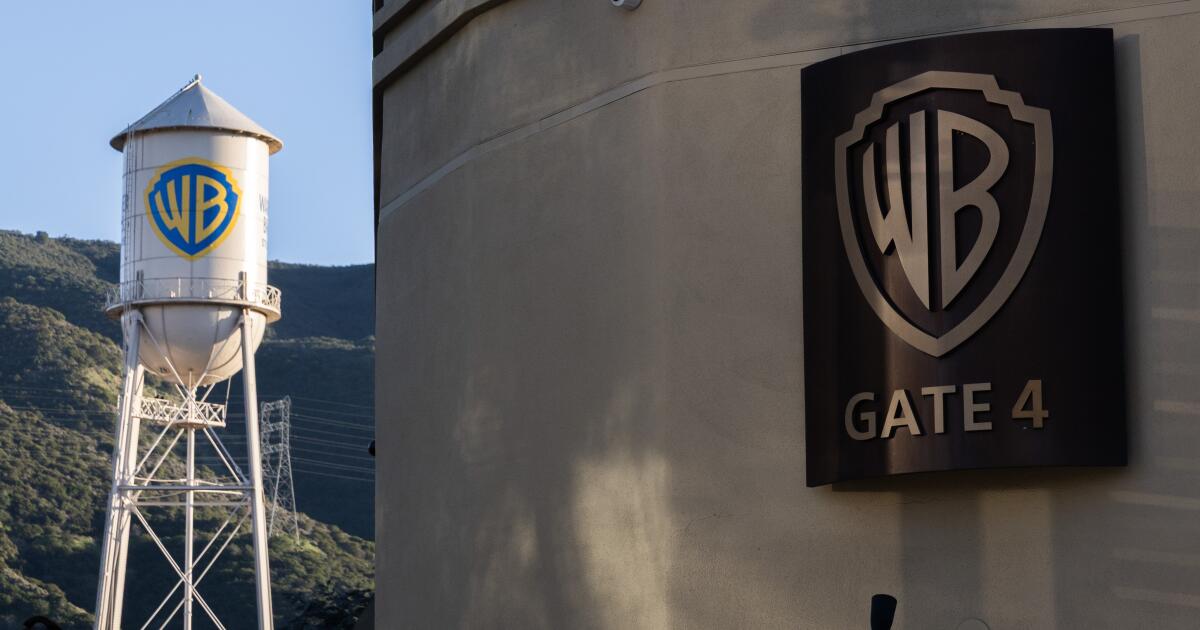
But now, as the 43-year-old tech scion works to close his $111-billion deal to buy Warner Bros. Discovery — which would mark his second major studio acquisition in less than a year — a large swath of Hollywood has soured on the budding mogul and his audacious bid to build a new media colossus.

More than 5,000 artists and industry workers — including J.J. Abrams, Javier Bardem, Lin-Manuel Miranda, Kevin Bacon and Tiffany Haddish — have signed an open letter opposing the union of two century-old studios.

“Our industry is already under severe strain,” the group wrote.

Many anticipate the U.S. Justice Department will rubber-stamp the deal because President Trump is friendly with Larry Ellison, co-founder of software giant Oracle. Trump and his team want David Ellison to make sweeping changes at CNN, one of Warner Bros. Discovery’s premier properties.

David Ellison has spent the last year courting the president and his allies, including hosting a black-tie gala to honor Trump and attending state dinners and the president’s State of the Union address.

Ellison’s perceived coziness with the administration, along with controversial changes at CBS, has sullied his reputation in a town where image is everything.

Should the merger clear its regulatory hurdles, the Ellison family would control CNN and CBS News in addition to holding a significant stake in TikTok, the hugely influential social media app.

“When power is concentrated in fewer and fewer hands, the stories that get told and the livelihoods of the people who tell them become hostage to whoever that power serves,” Jane Fonda, the Oscar-winning actor who is helping lead the opposition, told The Times. “We are not going quietly.”

Paramount declined to comment. Ellison previously has pushed back on fears that Paramount’s takeover of Warner Bros. would be bad for Hollywood. Instead, Ellison envisions building a stronger company to boost the industry, including movie theaters.

If the Warner Bros. Discovery deal is finalized, Ellison would control two legendary news organizations and two iconic studios. His determined White House outreach to speed approval of the Warner Bros. deal has aroused deep suspicion among many in Hollywood, which has long been considered a liberal bastion.

“They got too close to Trump,” said Norm Eisen, executive chairman of Democracy Defenders Fund, one of the groups coordinating the opposition campaign. “People in Hollywood are concerned that the Ellisons are going to do to CNN what they did to CBS.”

One of Ellison’s first moves after taking over Paramount was to hire journalist Bari Weiss, who had no TV news experience, as CBS News editor-in-chief. Weiss, who built her reputation being a contrarian voice, along with her recently installed evening news anchor Tony Dokoupil got off to a rocky start.

During his inaugural week, Dokoupil awkwardly saluted Secretary of State Marco Rubio (a fellow Floridian). “CBS Evening News” viewership fell 9% this season. The program, which attracts 4.1 million viewers, musters less than half the audience for ABC’s “World News Tonight with David Muir.”

Ellison is aiming to get his deal done by September.

“The projected merger timeline would have Ellison in control of CNN before November,” Fonda said, noting the high stakes this fall because the midterm elections will decide control of Congress.

“If this merger goes ahead, the administration will have yet another lever to cast doubt on results it does not like,” Fonda said. “This is about corruption, not optics.”

Her group has urged California Atty. Gen. Rob Bonta to file a lawsuit to try to block the merger. Bonta has said his team is reviewing potential antitrust concerns with the deal, which he said has “red flags everywhere.”

Some in Hollywood favor Ellison’s takeover, saying it would lift two middling players to create more robust competition to Netflix, Disney and Amazon.

“This deal will set up an environment where we will have four competitive streaming services, and that’s a good thing for the creative community,” said Ari Emanuel, executive chairman of WME Group and Ellison’s agent.

Ellison is pressing ahead, working to secure government approvals in Britain, Europe and the U.S. Prominent Democrats in Congress have decried the deal and Ellison’s proposed ownership structure, which would include the royal families of Saudi Arabia, Qatar and Abu Dhabi as significant, but passive, investors.

Paramount leaders have tried to keep their heads down by focusing on their businesses. This year, the company has signed deals with Kim Kardashian, Neil Patrick Harris, Tituss Burgess and Kinetic Content, the reality TV firm behind Netflix’s “Love Is Blind.”

Hollywood opposition

But the “block the merger” campaign has picked up prominent Paramount and Warner Bros. talent, including Oscar-winning filmmaker Adam McKay (“The Big Short”); “South Park” co-creator Trey Parker; and Emmy Award-winning actors Noah Wyle (“The Pitt”) and Mark Ruffalo, a stalwart of critically acclaimed HBO productions, including “Task.”

Some filmmakers have privately discussed whether to steer clear of Paramount, according to people knowledgeable of the discussions who were not authorized to comment. Taylor Sheridan, the prolific producer behind “Yellowstone” and “Landman,” last fall opted to switch teams. He eventually will make new shows for NBCUniversal instead of Paramount.

CBS late-night host Stephen Colbert’s sign-off Thursday night has added to the hand-wringing.

Colbert learned he was getting the boot in July, two days after he called Paramount’s $16-million settlement with Trump “a big fat bribe” during a show monologue. Paramount had agreed to pay the money to end Trump’s lawsuit over edits to a “60 Minutes” interview, a payout blasted by 1st Amendment advocates who viewed the Trump suit as frivolous.

Paramount settled because it needed Federal Communications Commission approval as part of its sale to the Ellison-owned Skydance Media. Paramount’s CBS has blamed declining revenues for its decision to oust Colbert, which came just before Ellison officially took the keys to Paramount.

This week, for the first time in 18 years, CBS will fall short of claiming the largest live audience in broadcast TV. NBC snagged the ratings crown, thanks to its sports-heavy lineup, prompting NBC late-night comedian Seth Meyers to crow about his network’s victory.

“We have taken down CBS,” Meyers told advertising buyers last week in New York. “Well, the Ellisons did, but I like to think we helped.”

Ellison’s supporters view the anti-merger campaign as politically motivated.

“So much of the criticism and negative sentiment originates from [Ellison’s] apparent relationship with Trump,” said one observer who was not authorized to speak publicly about the topic.

But interviews with numerous industry insiders reveal that concerns over Paramount’s proposed purchase of Warner go well beyond anti-Trump sentiment — or worries about CNN’s future.

The merger comes during an existential crisis for the industry, and for Los Angeles, as the shift to streaming has upended established business models.

“Whether it’s Ellison, Amazon, Apple or Netflix, these are essentially tech companies that are gaining increasing control over what has been a cultural and entertainment sector,” said Dominic Asmall Willsdon, executive director of the International Documentary Assn.

Amazon founder Jeff Bezos and Apple’s outgoing Chief Executive Tim Cook also have openly embraced Trump, which some see as a pragmatic move to curry favor in Washington to advance their sprawling businesses, which include film and TV operations in Culver City.

Much of the angst over the Ellison deal is driven by economic uncertainty. L.A.’s film industry has been decimated by a flight of production to other locations.

“L.A. has already had a taste of things to come,” Eisen said. “There’s less competition so the artists get hurt, and so do the working people who have long been an integral part of Hollywood.”

A combined Warner-Paramount would instantly become the largest employer for union writers, said Michele Mulroney, president of the Writers Guild of America West. It would control HBO, CBS, CNN, Comedy Central, HGTV, Animal Planet and two of the largest film and television studios.

“This media behemoth would have enormous leverage to reduce content, raise prices, increase control of production, suppress our members’ compensation and silence the voices of our members,” Mulroney said.

Jessica J. González, the L.A.-based co-chief executive of the 1st Amendment group Free Press, said: “This isn’t just about David Ellison. It’s about what David Ellison did with his last merger and how he uses his power.”

Ellison’s wealth and privilege have also fueled resentment among the rank and file who are struggling amid America’s growing economic disparity. Said one veteran executive: “We’re living in a new gilded age.”

For many, the prospect of more job losses is most unsettling.

Ellison and his team have vowed to make $6 billion in cuts following the merger. Those cuts are expected to include sizable layoffs on top of nearly 2,000 in job cuts at Paramount since last fall.

Hollywood has a troubled track record with mergers, including two failed takeovers of Warner Bros.

AT&T misfired with its 2018 acquisition of Time Warner, and within four years, the phone company had unloaded the firm to David Zaslav’s smaller Discovery. That transaction saddled Warner with more than $50 billion in debt, and Zaslav and his team laid off thousands of workers and cut dozens of projects to dramatically reduce the company’s debt and keep the company solvent.

Walt Disney Co.’s $72-billion acquisition of much of Rupert Murdoch’s 21st Century Fox in 2019 led to thousands of layoffs as one of the industry’s original studios all but disappeared.

“We have seen from that merger the earnings and employment numbers for screenwriters significantly reduced,” Mulroney said.

Emanuel, the power agent, pointed to Ellison’s commitment to keep the Warner and Paramount studios largely intact, with each entity releasing about 15 films into theaters each year.

“He’s going to be making a minimum of 30 movies a year for theatrical release plus content for both their own and other platforms because that’s the only way to generate revenue,” Emanuel said.

Still, critics question whether Ellison will be able to keep his commitment due to the $79-billion debt load he will take on.

“I’m sure [Ellison’s] intentions are genuine,” Mulroney said. “But a promise like that’s not enforceable, and there are no consequences if you don’t meet the quota that you’ve set for yourself.”

On Wednesday, S&P Global Ratings agency said Paramount Skydance will remain on a negative credit watch due to balance sheet concerns.

S&P also cited worries about Ellison’s prospects “given the immensely complicated endeavor of combining two of the largest global media companies and the limited track record of PSKY’s management team in integrating and transforming such companies.”

Emanuel and others say Ellison’s image won’t suffer long-term damage.

The two sides, he predicts, will eventually work together.

“Here’s a guy who’s willing to put a lot of money on the line and take huge risks to make our environment more competitive,” Emanuel said. “The one thing about David is that he’s not a vindictive person. He always does what’s best for the project.”

Source link

Column: Obama’s strong terms curbed Iran. Trump struggles to secure even a weak deal

President Trump, it’s well known, is into gold. Every day brings new evidence that he’s thoroughly enjoying the “golden age” he pronounced in his inaugural address — as few other Americans are — with stock trades, crypto profiteering and much more, even a new taxpayer-financed slush fund to reward his allies.

As for me, I’ve gone into silver. That is, I constantly look for the silver linings in Trump’s heinous acts.

One silver lining, of course, is his cratering job-approval numbers in the polls, especially among the young and Latino voters who made his reelection possible. But here’s another: By his humiliating failure to bring Iran to heel, nearly three months after starting a war that he said would last weeks at most, Trump has brought new, more positive attention to what he again this week derided as “Barack Hussein Obama’s Iran nuclear deal.” (The emphasis on “Hussein” is Trump’s, always.)

The president, along with his Republican cheerleaders, counts his first-term abrogation of the 2015 Iran nuclear agreement, the Joint Comprehensive Plan of Action, as a signature achievement. This week, yet again, he falsely claimed that had he not done so, Iran would have a nuclear weapon. In fact, his action in 2018 taking the United States out of the multinational deal subsequently led to Iran’s rebuilding of its nuclear program, the emboldening of the Iranian hard-liners now in power and the Middle East morass in which the United States is now mired.

That quagmire has left Trump seeming desperate for a deal — almost certainly a worse deal than the one Obama struck. Call it JCPOA Lite.

If he were able to get Iran’s sign-off on the sort of detailed, restrictive agreement that Obama and other world leaders won 11 years ago, he’d be trumpeting himself as the world’s greatest dealmaker. (He does that anyway, but his record proves otherwise.) Instead, by his own failure to date, Trump has invited reconsideration of the very agreement he decried as the “worst deal ever” on his march to election and reelection.

No sooner was the 2015 deal signed than Trump and Republicans succeeded in defining it as a giveaway to Iran that assured, not hindered, its development of a nuclear weapon to threaten Israel and the world. Opponents condemned the agreement for not addressing Iran’s other threats, notably its support for militant proxies throughout the Mideast. Some Democrats, notably Senate Minority Leader Chuck Schumer of New York, were among the foes. Other Democrats, cowed by opposition to the agreement by Benjamin Netanyahu’s Israeli government and pro-Israel lobbyists, were all but mute in the pact’s defense.

Now some Democrats are belatedly finding their voice (and, post-Gaza, some willingness to defy Israel). Along with nonpartisan experts, those Democrats are drawing comparisons between the 2015 agreement, flawed yet successful, and Trump’s promised yet ever-elusive alternative. What’s ironic for Israel and Netanyahu, still implacably against negotiating with Tehran, is that they could end up, under Trump, with a nuclear deal that gives Iran more leeway than the hated JCPOA did.

As Americans are being reminded, the 2015 deal wasn’t just between Iran and Obama, as Trump has long suggested; other signatories were China, Russia, Britain, France, Germany and the 27-nation European Union. Reconstituting that group would be all but impossible today.

The pact’s 159 highly technical pages and five appendices — a far cry from the short-lived one-pager that Trump officials teased earlier this month — required Iran for 15 years to limit its nuclear program to civilian purposes, forfeit more than 97% of its enriched uranium and submit to intrusive monitoring by the International Atomic Energy Agency to ensure compliance. In return, Iran gradually got relief from some, but not all, international economic sanctions and access to Iranian funds that were frozen after the 1979 Islamic revolution. Presumably, after 15 years, the agreement would have been extended somehow.

By all accounts, including those of Trump’s first-term intelligence and national security officials, Iran was complying when he abandoned the deal. Its “breakout time” for building a nuclear weapon was about a year — time enough for the world to intervene — instead of two to three months. Now, though the president boasts he barred Iran from having that weapon by breaking the Iran nuclear deal, he incessantly tells Americans that he went to war against Iran on Feb. 28 because it was on the brink of a bomb — never mind that he also said he had “obliterated” Iran’s nuclear program last summer, a program that was in a well-monitored box until he first took office.

If you’re confused, you’re paying attention.

A month ago, Trump posted online that he was close to a deal “FAR BETTER” than the 2015 accord. “I am under no pressure whatsoever, ⁠although, it will all happen, relatively quickly!” To several reporters, he suggested he in fact had a deal and that Iran had agreed both to suspend its nuclear activities and to forfeit all of its enriched, near-weapons-grade uranium.

Preposterous claims, given Iran’s current government, and Tehran promptly denied them. It was a sign of Trump’s squandered credibility that few, if anyone, believed him in the first place. Nor have folks believed his more recent talk of imminent success; oil markets, too, have learned not to trust the president, as prices at the pumps attest.

On Tuesday at the White House, amid a noisy tour of the billion-dollar-ballroom construction site, Trump told reporters he’d been “an hour away” from striking Iran again that very day but Mideast leaders asked for more time for negotiations.

Don’t hold your breath.

But for the tragic consequences, Obama might be enjoying some justifiable schadenfreude about Trump’s travails.

“We pulled it off without firing a missile. We got 97% of the enriched uranium out,” he told Stephen Colbert in an interview last week. Both U.S. and Israeli intelligence agreed that Iran was abiding by the nuclear limits, Obama added, “and we didn’t have to kill a whole bunch of people or shut down the Strait of Hormuz.”

That sure doesn’t sound like the “worst deal ever.” It wasn’t.

Bluesky: @jackiecalmes
Threads: @jkcalmes
X: @jackiekcalmes

Source link

Trump says he’ll speak with Taiwan’s president about stalled arms deal

May 21 (UPI) — President Donald Trump has said he will speak with Taiwanese President Lai Ching-te about a stalled $14 billion arms deal, a call that would be precedent-setting for a sitting U.S. president and likely anger China.

“I’ll speak to him,” Trump said Thursday from the tarmac of Joint Base Andrews in Maryland.

The president was responding to a reporter’s question on whether he planned to call Lai before making a final decision on the Congress-cleared weapons deal, the future of which remains uncertain following Trump’s visit last week to Beijing for meetings with Chinese leader Xi Jinping.

Taiwan has requested the weapons package as it faces an aggressive China, which claims sovereignty over the self-governing island it views as a breakaway province and has said it will take it back by force if necessary.

The weapons deal was pre-approved by Congress in January 2025, and Taiwan’s legislative body earlier this month approved a special defense budget of $25 billion to buy weapons from the United States. The package now requires Trump to sign off on it.

But Trump on Friday told reporters aboard Air Force One while en route back to the United States following his visit with Xi in Beijing that they had “talked a lot about Taiwan” and that he would “make a determination over the next fairly short period” on whether to give the arms deal final approval.

Taiwan was a significant topic during the trip, with Xi warning Trump that the island was “the most important issue” in bilateral ties and that, if mishandled, could trigger “clashes and even conflicts.”

Amid the uncertainty, Lai issued a Facebook post Sunday night stating Taiwan-U.S. security cooperation and arms sales “are key elements in maintaining regional peace and stability” and that the island’s security is the region’s security.

Trump did not say Wednesday when he would speak with Lai or discuss specifics concerning the arms deal.

“We have that situation very well in hand,” he said, adding that he had an “amazing” meeting with Xi.

“We’ll work on that,” he said.

Trump spoke with Taiwan’s then-President Tsai Ing-wen in 2016, when he was the president-elect, but no sitting U.S. president is known to have spoken with the leader of Taiwan since Jan. 1, 1979, when the Carter administration formally severed diplomatic ties with the Republic of China, the official name of Taiwan’s government, and established relations with the People’s Republic of China in Beijing.

Spokeswoman Zhu Fenglian of Beijing’s State Council Taiwan Affairs Office gave reporters a standard answer during a press conference Wednesday, stating: “We firmly oppose the United States conducting any form of official exchanges with China’s Taiwan region, and we firmly oppose the United States selling weapons to China’s Taiwan region.”

“This position is consistent and clear,” she said.

UPI has contacted Taiwan’s Foreign Ministry for comment.

Democrats and some Republicans have urged Trump to approve the arms deal and expressed concern over its future as the president was in Beijing.

“Trump must not sell out Taiwan, period,” Senate Minority Leader Chuck Schumer, D-N.Y., said in a social media statement.

The Republic of China, the current government of Taiwan, once governed mainland China but retreated to the island following its defeat by the Chinese Communist Party in the Chinese Civil War in 1949.

The Chinese Communist Party views Taiwan as part of China under its One China principle and seeks reunification with the island — an act Taiwan says would amount to an illegal annexation.

Source link

James Murdoch to buy half of Vox Media in multimillion-dollar deal

Lupa Systems, the media and tech holding company owned by James Murdoch, is set to acquire nearly half of Vox Media.

As part of the deal, Murdoch’s company will own Vox Media’s podcast network, Vox.com and New York Magazine, once an asset of his father, industry giant Rupert Murdoch. Terms of the deal were not disclosed, but the price tag was reportedly over $300 million, the New York Times reported citing people familiar with the deal. The goal of the investment is to bring “influential journalists, top-rated podcasts, and digital brands with large social footprints” to Lupa and help grow its media portfolio, the company announced Wednesday.

“This acquisition aligns well with our existing holdings and investments and reflects both our interest in the forward edge of culture and our deep commitment to ambitious journalism and agenda-setting conversations,” Murdoch said in a statement.

The three new assets will function as a subsidiary of Lupa Systems and will keep the name Vox Media. The deal includes New York Magazine’s popular verticals like The Cut, Vulture and Intelligencer, as well as Vox’s most successful podcasts like “Today, Explained” and “Pivot with Kara Swisher and Scott Galloway.” Jim Bankoff, Vox Media’s current CEO, will continue to lead the company.

The other Vox Media properties, which Murdoch did not purchase, include websites like Eater, The Dodo and The Verge. These platforms will be run under an unnamed new company by the current president of Vox Media, Ryan Pauley.

This investment strengthens Lupa Systems’ position in the evolving media landscape. The business has other holdings including the parent company of Tribeca Film Festival, the owner of Art Basel, Robert DeNiro and Jane Rosenthal’s entertainment company Tribeca Enterprises, and Bodhi Tree Systems, an investment platform behind a popular Indian streaming service.

This is one of the largest deals Murdoch has closed since he and his family resolved a $3.3-billion dispute last year. The conflict centered on the future of the family’s media empire, which includes Fox News, The New York Post and The Wall Street Journal. In the settlement, James Murdoch received roughly $1 billion and his elder brother, Lachlan, assumed power over the family’s assets.

Before the legal blowout, Murdoch previously served as the chief executive of major global media companies like 21st Century Fox and Europe’s Sky Group.

The billionaire told the New York Times that, with this new acquisition, he didn’t want a “daily news business.” He wanted “longer-form, thoughtful journalism that can really speak to the culture.”

Source link

Xi, Putin resurrect Siberia gas pipeline talks but fail to reach deal

Despite a raft of unrelated agreements resulting from talks between President Vladimir Putin (L) and Chinese President Xi Jinping on Wednesday, the pair failed to make progress on a long-planned 1,615 mile second pipeline from Siberia to supply China with natural gas. Photo by Alexander Kazakov/EPA

May 20 (UPI) — Talks between Russian President Vladimir Putin and Chinese President Xi Jinping on Wednesday failed to make progress on a long-planned 1,615-mile pipeline to supply China with an annual 50 billion cubic meters of natural gas from Russia’s Yamal field in Siberia.

The Power of Siberia 2 project negotiations on the final day of Putin’s two-day state visit to Beijing stalled due to differences over the timetable, financing and cost of the gas with Beijing holding out for a price of around 12-13 cents per cubic meter, in line with the cost in the domestic Russian market.

Moscow and Beijing signed a binding contract to develop the project during Putin’s last visit to China in September but left the details to be ironed out down the line.

Russia wants a similar deal to that for Power of Siberia 1, which experts projected would mean the price of the gas would be at least double the 12-13 cents figure.

The talks yielded 20 other trade and technology agreements and while a joint leaders’ statement talked of boosting their “comprehensive partnership” and shared vision “for a multipolar world and a new type of international relations,” the summit produced no breakthroughs of any great significance.

Analysts said the power imbalance in the Sino-Russia relationship — one where Russia needed China more than China needed Russia — was on full display during Putin’s visit.

Putin said that as one of China’s largest energy suppliers, Russia was ready to “reliably” meet fast-growing Chinese demand for oil, gas and coal.

“Russia and China are actively cooperating in the energy sector. Our country is one of the largest exporters of oil, natural gas, including liquefied gas, and coal to China. We are, of course, ready to continue to reliably ensure uninterrupted supplies of all these fuels to the rapidly growing Chinese market,” Putin said in comments that made no reference to the pipeline.

Kremlin spokesman Dmitry Peskov said the sides had “reached an understanding on the project’s main parameters” in Wednesday’s talks but that “some nuances remain to be ironed out.”

Beijing, which is looking to Russia to ameliorate the energy shock from the severe disruption to its supplies of oil and LNG caused by the Iran war and the closure of the Hormuz Strait, has already imported 35% more Russian oil in the January to March quarter than in the same period in 2025.

“Both China and Russia need each other, but Russia clearly needs China more than before at the global stage. Given today’s international environment, deep co-operation with China is extremely important for Russia in dealing with many of its current challenges,” Zheng Runyu, of the Centre for Russian Studies in Shanghai, told the BBC.

Wreathes are seen amongst the statues at the Korean War Veterans Memorial during Memorial Day weekend in Washington on May 27, 2023. Memorial Day, which honors U.S. military personnel who died while in service, is held on the last Monday of May. Photo by Bonnie Cash/UPI | License Photo

Source link

Contributor: Trump has left himself only bad options on Iran

Nearly three months after the United States and Israel launched their large-scale bombing campaign against Iran and about six weeks since the April 8 ceasefire took effect, President Trump faces an inflection point. Does he return to war? Maintain the ceasefire and U.S. blockade on Iranian ports in the hope of cutting a deal on American terms? Or drop his maximalist negotiating stance?

Sen. Lindsey Graham (R-S.C.), an informal foreign policy advisor for the White House, continues to press for more aggressive U.S. military action. Trump’s political advisors would prefer that the war end as soon as possible to minimize political repercussions against the Republican Party in a midterm election year.

Trump seems conflicted. Despite weeks of U.S. bombardment and an ongoing naval blockade, Tehran is as protective of its nuclear program today as it was before the war began. “For Iran, the Clock is Ticking, and they better get moving, FAST, or there won’t be anything left of them,” Trump wrote on Truth Social over the weekend. A day later, Trump took to the social media platform again to announce he suspended planned U.S. attacks on Iran to give talks more time.

Unfortunately for Trump, he’s proved to be his own worst enemy on this subject. Iran’s stockpile of highly enriched uranium and Tehran’s effective control of the Strait of Hormuz, the regime’s two biggest cards, are a byproduct of Trump’s own policy decisions.

The first is a clear indictment of Trump’s first-term order to withdraw the United States from the Obama-era Joint Comprehensive Plan of Action, a highly technical accord that put Iran’s nuclear work in a box by restricting the number and quality of centrifuges it could use, capped the amount of enriched uranium it could produce and compelled Tehran to ship 97% of its stockpile out of the country. When the Trump administration scrapped that hard-won deal, Iran responded by enriching more nuclear material at a faster pace and accumulating the very stockpile the Trump administration is now seeking to neutralize.

The Strait of Hormuz, Iran’s second card, would not even be an issue today if the Trump administration had refrained from going to war in the first place. On Feb. 27, the day before the conflict began, more than 150 tankers and vessels traveled through the strait. The international waterway was open for business.

Not so today. On Thursday, a grand total of three crossings were registered in the waterway. This collapse of commerce is a consequence of Iran’s ability to harass civilian tankers so much that shipping companies no longer view the journey as worth the cost. As Adm. Brad Cooper, the top U.S. commander in the Middle East, testified to the Senate Armed Services Committee on Thursday: “The Iranian capability to stop commerce has been dramatically depleted through the strait, but their voice is very loud. And those threats are clearly heard by the merchant industry and insurance industry.”

By virtue of his own actions, Trump is now left with a series of policy options that range from least bad to terrible. None of them are ideal, and all of them carry some risk.

For starters, Trump could resume the war. Any renewed U.S. bombing campaign would probably expand the U.S. military’s original set of targets to include a portion of Iran’s energy infrastructure, which Trump has threatened repeatedly to hit. A U.S. invasion of Kharg Island, where 90% of Iran’s oil processing takes place, might also be up for discussion. The aim would be to destroy Iran’s remaining military capabilities and further squeeze its oil revenue until Tehran’s strategic calculus on the war shifts to Washington’s liking.

Yet there are no guarantees that doubling down on military force will work. Trump’s entire strategy has relied on a baseline assumption: The more punitive the United States is, the more likely Tehran will be to cave. Yet that simply hasn’t occurred. If anything, Iran is more dug in now than it was in the opening days of the conflict. For the regime, capitulating to Trump is as dangerous as losing the war. Why would more bombing succeed where previous bombing failed?

The risks of additional U.S. military action are considerable as well. Before the ceasefire, Iran was launching ballistic missiles and attack drones across multiple gulf Arab states, hitting Qatar’s largest natural gas processing facility, Saudi Arabia’s east-west oil pipeline and Dubai’s luxurious high-rises. As the Iranians have stated, such attacks will not only resume if Trump orders a resumption of the war but will expand to new targets, including desalination facilities and nuclear power plants. Such strikes would raise global oil and gas prices to even more absurd levels, adding to the extra $40 billion the American people are already paying for fuel since the war began.

What about continuing the status quo? While this contingency would be less costly than another round of bombing or a U.S. ground invasion, it’s unclear whether it would help or hurt negotiations toward a settlement. There’s a possibility that extending the U.S. blockade of Iranian ports could merely reaffirm the regime’s earlier decision to preserve its own shutdown of the strait. Iran is now urging Washington to end its blockade before talks on the nuclear file can be held. And it’s a mystery whether Trump’s blockade is working anyway; the U.S. intelligence community assesses that Iran could withstand this pressure point for three to four more months, which may be too long for Trump to sustain given the oil disruptions that are bound to get worse.

Striking an agreement to end the war, return the strait to open traffic and restrict Iran’s nuclear program would be the most beneficial policy for the United States with the least amount of cost attached — not quite undoing the harm from Trump’s first-term decision to scrap the nuclear deal and his second-term decision to start a war. U.S. and Iranian negotiators are passing proposals back and forth as we speak. But as of now, Trump can’t stomach agreeing to a deal that covers some of Iran’s terms, including but not limited to a shorter suspension of enriched uranium and some kind of Iranian role in the management of the strait. Even if Trump did reassess his position, he would be forced to confront the hawks in his political coalition who would consider anything short of Iran’s total surrender a failure.

In short, Trump is in an unenviable position. He’s got nobody to blame but himself.

Daniel R. DePetris is a fellow at Defense Priorities and a syndicated foreign affairs columnist.

Source link

EU approves trade deal with the US despite uncertainty in transatlantic relations

Published on Updated

Diplomats and MEPs reached an agreement late on Tuesday to implement the contentious EU-US agreement, which eliminates duties on most US industrial goods imported into Europe.


ADVERTISEMENT


ADVERTISEMENT

The negotiations concluded two weeks after US President Donald Trump threatened to impose 25% tariffs on EU cars if Europeans did not implement the agreement — clinched by Trump and European Commission President Ursula von der Leyen in Turnberry, Scotland, last summer — by 4 July.

The so-called “Turnberry Agreement,” criticised by MEPs as unbalanced, raises US tariffs on EU goods to as much as 15%.

“The EU and the United States share the world’s largest and most integrated economic relationship. Maintaining a stable, predictable and balanced transatlantic partnership is in the interest of both sides,” Cyprus trade Minister Michael Damianos said, adding: “Today, the European Union delivers on its commitments.”

MEPs had kept the deal frozen for several weeks following Trump’s threats over Greenland earlier this year. They also suspended it after the US adopted new tariffs following a Supreme Court ruling that declared illegal the tariffs imposed by the White House since Trump’s return to power.

Demanding clarity from the Americans, EU lawmakers finally agreed to enter into negotiations with the EU Cyprus presidency — representing EU member states — after the Commission assured them that the US would honour its side of the agreement and cap its tariffs at 15%, as agreed.

Fragile EU-US relations

However, EU-US relations remain fragile and there is concern in Brussels that the US administration could still use tariffs to put political pressure on the EU if the bloc does not comply with the White House’s demands on other issues.

Trump’s threats over EU cars two weeks ago also targeted Germany, whose Chancellor Friedrich Merz has criticised the war in Iran launched by the Americans alongside Israel.

Trump has repeatedly called on European countries to deploy ships to help secure the Strait of Hormuz, a move Europeans have been reluctant to make.

Many disagreements also continue to strain EU–US relations over Ukraine — including the recent US extension of a sanctions waiver allowing purchases of Russian oil — and over NATO, which Trump has repeatedly threatened to leave.

On Tuesday night, MEPs tried to secure the deal by attaching conditions, risking US anger with additional provisions to which Washington had not agreed.

Under the Turnberry Agreement, the EU also committed to investing $600 billion across strategic sectors in the United States through 2028 and to purchasing $750 billion worth of US energy.

Source link

In deal with business leaders, $30 minimum wage for L.A. hotel and airport workers will be delayed

A $30 minimum wage for hotel and airport workers will be delayed after Los Angeles elected officials persuaded a group of business leaders to drop a ballot measure that would have devastated the city budget.

On Tuesday, the City Council approved the 18-month delay, which will postpone the wage increase until after the 2028 Olympics and fend off the business-backed initiative to eliminate the gross receipts tax, which is the city’s second-largest revenue stream.

The minimum wage will still increase to $25 in July and continue in increments until reaching $30 in January 2030.

Because the 11 to 4 vote was not unanimous, the new pay schedule will head to a second vote next week. Councilmembers Eunisses Hernandez, Ysabel Jurado, Nithya Raman and Hugo Soto-Martínez cast the “no” votes.

In May 2025, the council approved a proposal that would have increased the minimum wage to $30 in July 2028 and also raised an hourly payment for healthcare coverage.

In response, a coalition of airline and hotel businesses gathered enough signatures to place a measure on the Nov. 3 ballot that took aim at the city’s gross receipts tax, which is imposed on a vast array of businesses, including entertainment companies, child-care providers, law firms, accountants, healthcare businesses, nightclubs and many others.

If approved by voters, the measure would have stripped $740 million from the city’s general fund over the first year, according to city officials, and over five years would have amounted to a $860 million loss annually on average.

City officials, hotel and airport businesses and labor unions had been in continuous negotiations since last Wednesday, when the council narrowly approved an initial postponement of the wage increase to allow time to reach an agreement. The business coalition agreed to withdraw the measure if the council permanently approved the delay.

In addition to delaying the $30 minimum wage, the council on Tuesday pushed back the hourly healthcare payment to start at $8.15 an hour for airport workers in July 2027 and $4.25 for hotel workers July 1 of this year.

The council also voted to set up a committee to study possible changes to the business tax structure.

“Imposing wages and benefits without bringing business to the table is not reasonable,” said Nella McOsker, president and CEO of the downtown business group Central City Assn., at the council meeting. “It is reasonable to ask us to partner together to be on the other side of the table and negotiate, but it is not OK to do so without that process.”

Kurt Petersen, president of Unite Here Local 11, which represents the hotel workers, accused city officials of giving “into blackmail.”

“They now have a playbook. The next time workers win something, they’ll threaten to blow up the city,” Petersen said of the business coalition. “It’s a bad day for workers.”

Council President Marqueece Harris-Dawson described the process as painful but nearing a conclusion.

“I think we walked away from the negotiating table, like many negotiating tables, where no one was happy about the outcome, but everybody came away better than when we started off,” he said.

Shortly before the council vote, Mayor Karen Bass issued a statement that said she was called in by both business and labor leaders to close the deal.

She called the proposed repeal of the gross receipts tax “an existential threat to the city budget and the services it supports,” including street repairs, public safety and efforts to clean the city.

“This agreement ensures workers are paid fairly and that businesses that create jobs can continue serving LA and hiring Angelenos,” Bass said.

On Tuesday, the council chamber was filled with union workers in red, purple and yellow shirts.

Laura Esquivel, a janitor at Los Angeles International Airport, expressed frustration that council members were not standing by their earlier commitment.

“We’re sick and tired of being exploited. Some members of the council that are here, now we know, do not stand with workers,” Esquivel said. “We are not giving up, we will continue to fight and we’ll be back here in 2028.”

Before voting against the delay, Soto-Martínez, a former Unite Here organizer, called it sad and enraging.

“I cannot support anything that is going to take away money from workers,” he said.

Councilmember Imelda Padilla, who spoke in Spanish, was critical of the way the negotiations unfolded.

“If this thing about the gross tax receipts passes, we don’t have a city,” Padilla said. “The business community has us by our necks.”

She said workers deserve the wage increase, though she voted for the delay.

“Next time, let’s negotiate, and let’s negotiate well,” she said.

Times staff writer Suhauna Hussain contributed to this report.

Source link

Why has FIFA not signed a World Cup broadcast deal in India? | World Cup 2026 News

New Delhi, India — When Argentina’s Gonzalo Montiel converted a penalty to seal his country’s third FIFA World Cup title in December 2022 in Qatar, Lionel Messi fan Vishwas Banerjee celebrated the Albiceleste’s triumph with abandon in Bangalore, a football-crazy city in southeastern India.

Unable to hold back his excitement, Banerjee screamed and tossed his shirt away as he watched the match on a big screen at a street crossing close to midnight.

“It was one of the best nights, watching Messi lift the World Cup,” he told Al Jazeera.

“Everyone went crazy. We danced on the streets,” Banerjee said, reminiscing about the excitement felt more than 3,000 kilometres (1,900 miles) away in an otherwise cricket-mad country.

While Messi is expected to make his World Cup swan song at the upcoming tournament in North America, football fans in India, the world’s most populous nation, are set to miss out on watching the biggest sporting event.

With just over three weeks to the tournament’s kickoff in Mexico, organisers FIFA have not found any buyers for broadcasting its most coveted product in India.

Here’s what we know about the World Cup broadcast rights crisis in the South Asian nation:

How many people watch the FIFA World Cup in India?

When the World Cup was played in Qatar nearly four years ago, India trailed only China in overall engagement figures, with more than 745 million fans following the action across all media platforms in the country, according to figures released by FIFA.

In television viewing numbers, India was among the top 10 countries – ahead of World Cup participants Germany, France and England – with nearly 84 million viewers.

Digital viewership numbers were also significant in India. For the final alone, an unprecedented 32 million viewers tuned in on Reliance’s JioCinema – a subscription video-on-demand over-the-top streaming service – as the tournament clocked 40 billion minutes of watch time on the platform.

Reliance’s Jio paid $60m for tournament rights in 2022, while Sony Sports secured broadcasting rights for the 2014 and 2018 FIFA World Cups, as well as the Euro 2016 championship, for around $90m in 2013.

So when FIFA began selling media rights for the 2026 tournament and the 2027 Women’s Cup, it expected plenty of takers for an estimated price of $100m.

But with 23 days until the tournament and the asking price reportedly slashed significantly, FIFA is still struggling to find buyers in one of its biggest markets.

Why are there no buyers for the World Cup 2026 in India?

Experts say the kickoff times for the majority of the matches are the biggest concern for Indian broadcasters.

With the tournament being staged in the United States, Canada and Mexico, many games will be played at odd hours for the Indian audience, with a 10-12 hour time difference between the host cities and the South Asian nation.

Only 14 out of the total 104 World Cup games will begin before midnight for fans in India.

The final will be held in New Jersey on July 19, beginning at 12:30am in India (19:00 GMT). By comparison, 98.4 percent of matches at the 2018 World Cup started before midnight, and 82.5 percent at the following edition in Qatar.

Karan Taurani, executive vice president at investment firm Elara Capital, sees TV as a “struggling” medium in India.

“When you have these kinds of sporting events, effectively it is mostly digital that is monetising and raising big money,” Taurani told Al Jazeera. “That is a big reason why no one’s showing interest in the FIFA World Cup.”

Taurani explained that cricket leads the sports economy market in India.

“Only a small fraction of people who watch the Indian Premier League [IPL] will watch the FIFA World Cup,” he said, adding that an even smaller fraction tune in past midnight to watch a match.

For broadcasters and advertisers, Taurani explained, these factors shrink the target audience.

He also pointed out that a recent ban by the Indian government on fantasy real-money betting apps had reduced the macro form of money in the sports entertainment industry.

The World Cup begins 10 days after cricket’s IPL 2026 final, one of the most-watched sports events in India and one where major prime-time advertisers focus the majority of their annual sports spending.

The price of football streaming in India has been going down anyway. The English Premier League rights, which were sold for $145m for three seasons between 2013 and 2016, went for $65m for 2025-28. There are no major takers for La Liga matches in India.

FIFA appears increasingly concerned that weak broadcaster interest in India could dent both revenues and its long-term ambition to grow football in one of the world’s largest media markets.

Indian supporters of Argentina celebrate after Argentina won FIFA World Cup final match against France in Qatar, in Kolkata, India, Monday, Dec. 19, 2022. (AP Photo/Bikas Das)
Indian supporters of Argentina celebrate after the Argentina vs France World Cup 2022 final as they watch Lionel Messi during the match at a screening in Kolkata, India [File: Bikas Das/AP]

In the capital New Delhi, the high court is hearing a plea on the lack of a tournament broadcast deal and has sought responses from India’s information and broadcasting ministry and Doordarshan, India’s state-owned public television broadcaster.

“Without timely judicial intervention by this court, the petitioner and millions of Indian citizens will be irreparably deprived of their fundamental rights with no adequate alternative remedy,” the petitioner, a lawyer and football fan, has said in the plea.

He claims that missing out on the tournament violates the constitutional protections of freedom of speech.

“It is important to note that by denying access to the information in question or by not taking necessary steps to broadcast the FIFA World Cup, the respondents have directly infringed the petitioner’s fundamental right to acquire and receive information, which is an integral part of freedom of speech and expression under the constitution,” the petitioner argued in the plea.

India
A boy plays next to a mural of Brazil’s footballer Neymar in Kolkata, India [File: Rupak De Chowdhuri/Reuters]

With China’s state broadcaster signing a late World Cup deal with FIFA last week, there’s still hope and time for football fans in India. However, if no deal is signed, all eyes will turn to Doordarshan, which last beamed the tournament in 1998.

The continuing uncertainty is chipping away at the excitement of the football World Cup. “I’m heartbroken that we will not have any reliable way to watch the World Cup this year,” said Banerjee, the Messi fan from Kolkata.

“But we will tune to pirated streams anyway,” he added. “No one can stop that.”

INTERACTIVE-Football FIFA World Cup 2026 group stage schedule-1776670775
(Al Jazeera)

Source link

India’s Tata and Dutch giant ASML sign semiconductor deal during Modi visit | International Trade News

Prime Minister Narendra Modi says his talks with the Dutch PM also focused on expanding cooperation in defence and security.

India’s Tata Electronics has signed a deal with Dutch technology giant ASML to build a major semiconductor plant in western India, as Prime Minister Narendra Modi visited the Netherlands during his European tour.

The agreement, announced on Saturday, will support the development of Tata’s semiconductor facility in Dholera, Gujarat – Modi’s home state.

Recommended Stories

list of 4 itemsend of list

ASML, Europe’s largest technology company by market value, manufactures advanced lithography machines used to produce high-end microchips found in products ranging from mobile phones to cars.

The Dutch company said it would help “establish and ramp up” production at the plant by supplying its cutting-edge chipmaking tools.

Tata Electronics plans to invest $11bn in the facility, which is expected to manufacture chips for artificial intelligence, the automotive industry and other sectors.

ASML chief executive Christophe Fouquet said the company saw “many compelling opportunities” in India’s growing semiconductor industry.

“We are committed to establishing long-term partnerships in the region,” Fouquet said in a statement.

The deal comes as India and the Netherlands move to deepen economic ties, with New Delhi seeking foreign technology and investment to boost manufacturing and create jobs.

The European Union has increasingly viewed India – the world’s most populous country and one of its fastest-growing economies – as a key future market.

During his visit, Modi held talks with Dutch Prime Minister Rob Jetten and met King Willem-Alexander.

“My conversations with Prime Minister Rob Jetten were extensive and covered a wide range of topics,” Modi wrote on X.

“One of them was defense and security. I spoke about the possibility of drawing up an action plan for the defense industry as quickly as possible. We can also collaborate in sectors such as space travel, maritime systems, and maritime security.”

Modi also addressed members of the Indian diaspora and is expected to inspect centuries-old Chola copper plates being returned to India by Leiden University.

Indian and Dutch officials are also discussing a more flexible visa arrangement for Indian students and workers in the Netherlands.

Modi will next travel to Sweden for talks with Prime Minister Ulf Kristersson focused on trade, innovation and green technology cooperation. The visit marks his second trip to the country since attending the first India-Nordic summit in 2018.

Source link

Deal or No Deal contestant says £600-a-week cocaine habit began at show’s hotel

After Connor Cooper, 33, appeared on ITV’s Deal or No Deal, he said feeling like a ‘TV star’ lead him to become addicted to cocaine, with the contestant spending up to £600 a week on the substance

A former Deal or No Deal contestant has blamed becoming a “TV star” for him developing a £600-a-week cocaine habit. Connor Cooper, 33, claims to have come across a “huge pile” of the drug while partying near to the hotel he and the rest of the contestants of the ITV game show were staying in.

Connor explained that one night, he had been out drinking with the rest of the contestants, and after drinking shots and cocktails all night, decided to give the drug a go. But after taking it, he couldn’t sleep – having got back to his hotel room at 7am, he was picked up at 8am to film the show.

READ MORE: ‘I was on Stephen Mulhern’s Deal or No Deal and one moment made me feel physically sick’

He and some of the other contestants were exhausted, with Connor admitting he was “completely wired” during filming. But it didn’t put the dad-of-one off, with Connor saying he went on to become hooked, saying he was “living in the moment” and had a taste of “the showbiz life”.

Speaking to the Sun, Connor explained: “I was dreading that show going out. I was still completely wired when we filmed and we recorded three games that day.”

Contestants on Deal or No Deal can be living with each other for up to a month, as they return in their bid to win big on the game show. Connor said that this lead to him and the others drinking together, with the “party culture” sucking him in.

He said he would order it secretly to keep himself going, but then he wouldn’t sleep again and have to return to the studios to film the day after. Then they would drink again that evening and he would “do it all over again”, with each contestant allowed two free drinks per day.

But then when he started drinking he would continue out of his own money, adding: “I just thought I was a TV star and dived in with both feet. It was really stupid.”

Connor went on to win £13,500 on Deal or No Deal, and returned to Portsmouth where he worked as a tarmac layer. A month after returning, when Connor was still buying and using cocaine, he found out his long-term partner was pregnant with twins, something he describes as a “wake-up call”

He told her everything and with her support he managed to seek professional help to kick his dangerous and expensive habit. Connor said he didn’t seek help with ITV’s mental health services. The Mirror has contacted Banijay for comment.

In response to the paper, a Deal Or No Deal spokesperson said: “We have a zero-tolerance policy on drug use on all our productions. Contestants stay at the hotel for short periods of time whilst filming and are closely monitored by a specialist welfare team throughout. Having reviewed logs of activity and welfare assessments, we can find no record of any behaviour that would cause concern.”

Like this story? For more of the latest showbiz news and gossip, follow Mirror Celebs on TikTok , Snapchat , Instagram , Twitter , Facebook , YouTube and Threads .


Source link

Immigration authorities detain former Kansas mayor who voted illegally

The former mayor of a conservative Kansas town was taken into custody by immigration authorities after acknowledging last year that he had voted in elections despite not being a U.S. citizen.

Joe Ceballos, who was born in Mexico and is a legal permanent U.S. resident, was detained Wednesday during a meeting at a U.S. Immigration and Customs Enforcement office in Wichita, Kan., according to his attorney, Jess Hoeme. He said Ceballos now fears he could be deported.

The 55-year-old resigned as mayor of Coldwater in December while facing state charges over voting as a noncitizen. While seeking citizenship in 2025, Ceballos admitted during an interview that he had voted, not knowing that green card holders don’t qualify, Hoeme said.

Ceballos was charged with voting illegally but pleaded guilty in April to misdemeanors in a deal with the Kansas attorney general. His case has drawn attention from the Trump administration and inspired supporters in his community, some of whom held signs reading “We Support Mayor Joe” and “ICE Out” as Ceballos walked into the federal building in Wichita.

“Let Joe go!” the crowd yelled.

“Thinking what could happen — it’s just kind of crazy,” Ceballos told reporters. “Obviously nervous. I don’t know what’s going to happen. I don’t know where they’re going to take me and what I can and can’t do inside there.”

An email seeking comment from the Department of Homeland Security was not immediately returned.

Trump and other Republicans have been warning of the dangers of noncitizens voting in elections since the beginning of the 2024 presidential election. Research, even by Republican election officials, show the problem is rare.

This year, Trump has been pushing Republicans in Congress to pass the SAVE Act, which among other things would require documented proof of U.S. citizenship to register and vote.

The administration also has significantly upgraded a program within Homeland Security that checks citizenship. At least 25 states, most of them controlled by Republicans, have used that system to check their voter rolls.

Ceballos was brought to the U.S. from Mexico by family when he was 4 years old. Hoeme said lawyers would next try to get an immigration judge to release him on bond.

He said Ceballos, at age 18, was encouraged to register to vote on the spot during a school field trip to the Comanche County courthouse. Ceballos has previously said in interviews with reporters that he voted for Republicans.

He was twice elected mayor of Coldwater, population 700, and also served on the city council. Ceballos won a new term in November but resigned after state Atty. Gen. Kris Kobach charged him with voting without being qualified and election perjury.

Kobach’s office, however, reached a deal with Ceballos. He pleaded guilty to disorderly election conduct, which Hoeme described as a misdemeanor similar to disturbing the peace.

“He has not been convicted of any kind of voter fraud. It should not have impacted his immigration status,” Hoeme said. “The Trump administration and ICE have doubled down on nonsense that he is a criminal.”

Ceballos has been a popular figure in Coldwater, where an advertisement in the Western Star newspaper encouraged people to support him.

“He’s kind of got to live the American dream, to come from absolutely nothing and build up — I don’t know about wealth — but to build up a business and have a job and be a productive part of society,” longtime friend Ryan Swayze told Wichita station KAKE-TV.

White writes for the Associated Press.

Source link

Belarus authoritarian leader welcomes U.S. evangelist Franklin Graham to hold massive gathering

Belarus’ authoritarian leader on Friday greeted U.S. Rev. Franklin Graham, who arrived in the tightly controlled country to hold the largest evangelical Christian gathering in its history.

Belarusian President Alexander Lukashenko asked Graham to convey warm greetings to President Trump and tell him that he has “reliable friends and supporters in Belarus.”

Since Trump returned to the White House, Lukashenko has released hundreds of political prisoners as part of U.S.-brokered deals that lifted some U.S. sanctions, part of the isolated leader’s efforts to improve ties with the West.

“Without the U.S. president, it might have been more difficult for us to establish our relations,” Lukashenko told Graham, president of Samaritan’s Purse and the Billy Graham Evangelistic Assn. Graham was accompanied by Greta Van Susteren, the anchor for Newsmax TV who is married to Trump’s special envoy for Belarus, John Coale.

Lukashenko has ruled the nation of 9.5 million with an iron fist for more than three decades, and the country has been sanctioned repeatedly by Western countries — both for its crackdown on human rights and for allowing Moscow to use its territory in the full-scale invasion of Ukraine in 2022.

Graham is set to hold the largest gathering of evangelicals ever in Belarus’ history, with thousands expected to attend what the organizers called the Festival of Hope at an indoor sports arena in Minsk, the capital.

Lukashenko’s rule was challenged after a 2020 presidential election, when hundreds of thousands took to the streets to protest a vote they viewed as rigged. In an ensuing crackdown, tens of thousands were detained, with many beaten by police. Prominent opposition figures fled the country or were imprisoned.

Five years after the mass demonstrations, Lukashenko won a seventh term last year in an election that the opposition called a farce.

As part of a deal in March that Washington helped broker, Lukashenko ordered the release of 250 political prisoners, while the U.S. agreed to lift sanctions from two Belarusian state banks and the country’s Finance Ministry, and to remove the top Belarusian potash producers from a sanctions list.

Another deal in April released prominent journalist Andrzej Poczobut in a swap with Poland that saw a total of 10 people freed.

However, Belarus still has 845 political prisoners, including 22 journalists, according to the Viasna human rights center.

Belarus opposition leader-in-exile Sviatlana Tsikhanouskaya voiced hope that Graham’s visit will help the release of all political prisoners. “We continue to push for a complete end to the harsh political repressions in Belarus,” Tsikhanouskaya told the Associated Press.

Belarusian authorities’ permission for the massive gathering of evangelicals marks a shift, following years of crackdown on clergy — Catholic, Orthodox and Protestant — which saw dozens jailed, silenced or forced into exile for protesting the 2020 election. In the country of 9.5 million, about 80% are Orthodox Christians; nearly 14% are Catholics, residing mostly in western, northern and central parts of the country; and about 2% belong to Protestant churches.

A 2024 law required all religious organizations to reregister with authorities or face being outlawed if their loyalty to the state is in doubt.

The U.S. Commission on International Religious Freedom has listed Belarus among countries with religious freedom violations, particularly noting its restrictive legislation.

Natallia Vasilevich, coordinator of the Christian Vision monitoring group, noted that even as Graham’s visit to Belarus was a “mega-important event” for evangelicals in the country, they continue to face a repressive environment.

“Some believers view Graham’s visit as a miracle and a window of opportunity, while others see a risk that they will have to turn a blind eye to repression and take part in something that makes the regime look nice,” Vasilevich said.

Karmanau writes for the Associated Press.

Source link

After Trump’s pledge to ‘open up’ China, low expectations for trade deal | Business and Economy News

Before arriving for his high-stakes summit with Chinese leader Xi Jinping, United States President Donald Trump aimed to set expectations high.

He said he would urge Xi to “open up” China’s economy and announced a delegation of top business executives, including Tesla’s Elon Musk, Apple’s Tim Cook and Nvidia’s Jensen Huang, to accompany him.

Recommended Stories

list of 4 itemsend of list

As Trump and Xi prepare to wrap up two days of meetings on Friday, the expectations for their summit’s outcome among observers generally are modest at best.

While Trump and Xi are anticipated to extend the one-year pause in their trade war agreed to in South Korea in October, the expectations are for a stabilisation – not revitalisation – in ties between the world’s two largest economies, which are locked in a rivalry that spans everything from trade and artificial intelligence to the status of Taiwan.

“It is important to be clear-eyed about the state of relations here,” Claire E Reade, a senior counsel at Arnold & Porter who previously worked on China at the Office of the US Trade Representative (USTR), told Al Jazeera.

“China does not trust the US, and China wants to beat the US in what it sees as long-term global competition,” Reade said.

“This limits what can be agreed.”

While Trump and Xi have yet to announce the final contours of any trade agreement, the US side has flagged various business deals in the pipeline.

In a pre-recorded interview with Fox News that aired on Thursday, Trump said that China would invest “hundreds of billions of dollars” in companies run by the CEOs in his delegation, without providing further details.

Trump also said that Beijing had agreed to purchase US oil and 200 Boeing aircraft.

Trump administration officials have said that the sides are also discussing the establishment of a “Board of Investment” to manage investments between the countries.

“A realistic ‘opening up’ of the Chinese market would likely focus first on sectors where the economic complementarity is most obvious,” Taiyi Sun, an associate professor of political science at Christopher Newport University in Newport News, Virginia, told Al Jazeera.

“Agricultural goods such as soybeans and beef, as well as high-value-added manufacturing products like Boeing aircraft, are natural areas for expansion because they match existing Chinese demand with American export strengths.”

Sun said a “gradual” opening for US firms in sectors such as financial services could also be possible.

“But those areas are politically and institutionally more sensitive inside China, so progress would likely be incremental rather than immediate,” he said.

Gabriel Wildau, a senior vice president at global business advisory firm Teneo, said both sides will be seeking to address supply-chain vulnerabilities exposed by their trade war.

“The Iran war has likely increased the US’s vulnerability to export controls on rare earths, given the need to rebuild the munition stocks depleted in that war,” Wildau told Al Jazeera.

“Washington will therefore be willing to offer tariff relief – or at least assurances not to impose new tariffs – in exchange for Beijing’s commitment to keep rare earth exports flowing.”

While Trump and Xi agreed to roll back some trade barriers at their summit in South Korea, US-Chinese business and trade remain severely constrained after a decade of tit-for-tat economic salvoes between the sides.

The average US tariff on Chinese goods stood at 47.5 percent after the South Korea summit, up from 3.1 percent before Trump’s first term, according to the Peterson Institute for International Economics.

China’s average tariff on US goods stood at 31.9 percent, up from 8.4 percent in 2018, according to the think tank.

Two-way goods trade amounted to about $415bn in 2025, down sharply from its 2022 peak of $690bn.

Carsten Holz, an expert on the Chinese economy at the Hong Kong University of Science and Technology, said China has less incentive to make concessions to the US than before, amid the rise of its domestic industries.

“Across many industrial sectors, PRC [People’s Republic of China] firms hold leading or controlling positions,” Holz told Al Jazeera.

“As a result, the PRC economy has little to gain from opening further to the US and is likely to only offer largely symbolic gestures.”

Deborah Elms, head of trade policy at the Hinrich Foundation in Singapore, voiced similar sentiments about the limits of US leverage.

“Basically, Trump expects China to buy more stuff from America and let US companies operate more freely in China,” Elms told Al Jazeera.

“What is he offering?” Elms said. “Very little, largely because Trump sees the bilateral relationship as one where the US has been fair and China has not.”

Reade, the former USTR official, said Xi would not agree to any measures that “harm Chinese interests in any way.”

“Instead, China will potentially give the US no-cost ‘gifts,’” Reade said, suggesting such measures could include the removal of trade barriers it placed on US beef.

“It may buy US goods it needs,” Reade said.

“If it allows purchases of US tech products, it will only be because it needs them right now,” she added, “But this does not interfere with China’s strategic plans to eliminate dependence on US technology over the longer term.”

Source link

Hiltzik: Why does Trump hate wind power?

Trump is shelling out $2 billion of taxpayer money to kill wind power projects, but his hatred for the technology is based on myths

Picking the wildest fantasy promoted by President Trump as a basis for public policy is increasingly challenging — is it his yarn about schoolchildren being secretly abducted from their classrooms and given sex-changing operations? The notion that the vaccines given to children are like “a vat, like a big glass, of stuff pumped into their bodies?”

Here’s one that has disrupted the economics of renewable energy generation and will cost Americans billions of dollars: It’s Trump’s “completely weird war on wind power in the United States,” based on a sheaf of “fact-free arguments.”

That judgment comes from Steven Cohen, a climate policy expert at Columbia University, who points out that wind already accounts for 10.5% of U.S. energy generation, that it’s destined to continue growing — and that most of it is generated today in red states such as Texas, Oklahoma, Iowa and Kansas.

Fifty years from now, people are going to be amazed that we burned these rare, useful hydrocarbons for fuel, when the sun was just sitting up there providing an essentially infinite source of energy.

— Steven Cohen, Columbia University

There is no question that Trump’s weird war against wind is full blown. On the day of his second inauguration, he issued an executive order shutting down all new permits for offshore wind farms and ordered the Interior Department to review existing permits.

A federal judge in Massachusetts blocked the executive order in December, and his orders suspending work on existing offshore wind projects have been halted by other federal judges. The Trump administration has blocked or delayed as many as 165 wind projects on private land, citing “national security” concerns, according to the American Clean Power Assn.

Get the latest from Michael Hiltzik

Commentary on economics and more from a Pulitzer Prize winner.

Most recently, Trump has reached agreements with offshore wind firms in which the government will pay them a combined $2 billion to abandon their U.S. projects.

At some level, this crusade resembles Trump’s misguided effort to revive the American coal industry, which is on the glide path to inevitable extinction. In that case, Trump is waging an explicitly partisan and ideological battle. “We’re ending Joe Biden’s war on beautiful, clean coal,” he declared last April.

Trump’s anti-wind program is part of his campaign to dismantle U.S. renewables policy because of its roots in the Biden administration.

Additionally, multiple commentators conjecture that his hostility to wind originated in 2011, when he groused that an offshore wind farm would be visible from one of his golf courses in Scotland. He sued to thwart the “ugly” project, and lost.

But Trump has mustered other arguments against wind, on- and offshore, none of which holds water.

During a cabinet meeting in July 2025, he called wind “a very expensive form of energy.” In fact, on average it’s cheaper than natural gas, coal and nuclear generation. Perhaps more important, the cost has been coming down sharply as technology improves and the sector reaches critical mass: falling to eight cents from 21 cents per kilowatt-hour from 2010 to 2024 for offshore projects, and to 3.4 cents from 11.3 cents for land-based wind farms over the same period.

Trump blamed wind turbines for mass killing whales and birds. Neither assertion is correct.

The National Oceanic and Atmospheric Administration, a federal agency, says “there are no known links between large whale deaths and ongoing offshore wind activities.”

The Audubon Society reported in January that although wind turbines can present hazards to birds, “developers can effectively manage these risks without significantly increasing project costs.” The biggest risks to birds come from the climate: “Two-thirds of North American birds are at increasing risk of extinction from global temperature rise,” the society reported — a threat that wind power can ameliorate.

Trump spokeswoman Taylor Rogers didn’t respond to my questions about the derivation of his anti-wind stance, but told me by email only that “President Trump has been clear: hard-earned taxpayer dollars shouldn’t be wasted on unreliable and costly wind farms that pose serious threats to our national security. Instead, we should be strengthening and expanding our infrastructure that produces reliable, affordable, and secure energy like natural gas plants.”

That brings us to the recent deals with offshore wind developers. The largest single deal, signed in March, was with the French firm TotalEnergies, which is to receive approximately $1 billion from the federal government to abandon all of its U.S. offshore wind projects and invest instead in oil and gas projects, including a liquefied natural gas export facility in Texas.

In his March 23 announcement of the deal, Interior Secretary Doug Burgum called offshore wind “one of the most expensive, unreliable, environmentally disruptive, and subsidy-dependent schemes ever forced on American ratepayers and taxpayers.”

This is what Huck Finn would call a “stretcher,” given the decades of subsidies spooned out to the oil and gas industry, reaching more than $30 billion a year in federal and state tax credits, indulgent regulation of pollution and low-cost access to federal lands. Indeed, the investment firm Lazard recently reported that renewables, including wind, are a cost-competitive form of generation even without subsidies. (Lazard’s calculation is of the “levelized cost of energy,” meaning the average cost over a generating plant’s lifetime.)

TotalEnergies fell into lockstep with the Interior Department in its own announcement, explaining its willingness to renounce U.S. offshore wind power because “offshore wind developments in the United States, unlike those in Europe, are costly,” echoing the agency’s position that “the development of offshore wind projects is not in the country’s interest.” Never mind that one factor that makes U.S. offshore wind development costly compared with Europe is the Trump administration’s opposition.

The government subsequently reached an agreement to pay the French company Ocean Winds $885 million to walk away from two offshore wind projects, including one in the waters off California. Ocean Winds described the deal as one driven chiefly by economics, but hinted at pressure from the White House.

“We welcome the opportunity to engage constructively with the administration on this agreement and acknowledge the clarity they have provided with this decision and deal,” Michael Brown, the chief executive of Ocean Winds North America, said when the deal was announced last month. “Our priority remains disciplined capital allocation and delivering reliable energy solutions that create long-term value for ratepayers, partners, and shareholders.”

The TotalEnergies deal, which the government has described as a “refund” of money the firm paid for its offshore leades, raised the hackles of congressional Democrats, who assert that it violates the law and constitution in multiple ways.

“We will hold you accountable for this billion-dollar ripoff,” Reps. Jamie Raskin (D-Md.), ranking member of the House Judiciary Committee and Jared Huffman (D-San Rafael), ranking member of the House Committee on Natural Resources, warned TotalEnergies CEO Patrick Pouyanné in an April 29 letter.

Among other infirmities Raskin and Huffman alleged, the government’s national security rationale for canceling offshore wind leases looks “fabricated”; the payout violates the statutory formula for compensation for canceled leases; the money is to come from a fund designed only to pay court-ordered judgments and settlements of lawsuits, which don’t exist in this case; and includes a provision preventing the deal from being reviewed by a court.

The last of those provisions would have to be authorized by Congress, the letter states, asking for documents and a response from the company by Wednesday. Committee spokespersons weren’t available to say whether they received a response from TotalEnergies, and the company didn’t respond to my request for comment. I received no response from the Department of the Interior.

The California Energy Commission has opened an investigation into the Ocean Winds deal.

“The Trump Administration is recklessly spending billions of taxpayer dollars on backroom deals that would turn back the clock on innovation” CEC Chair David Hochschild said. “Taxpayer dollars should be used to build a sustainable energy future, not to pay to make projects disappear.”

What’s especially wasteful about Trump’s crusade against wind power is that it’s almost certain to be time-limited.

It’s hardly debatable that renewables such as solar and wind will be our principal sources of energy in the future; holding back the clock achieves nothing but injecting uncertainty into investment decisions that need to be made now, at a time when the price of oil is on the upswing thanks to Trump’s Iran adventure and Europe and China are racing to transition away from fossil fuels, while the U.S. remains becalmed by ideology.

“In the long run, fossil fuels will be used for petrochemicals and not for burning,” Cohen told me. “Fifty years from now, people are going to be amazed that we burned these rare, useful hydrocarbons for fuel, when the sun was just sitting up there providing an essentially infinite source of energy.”

Source link

Exclusive: EU negotiators find deal on key clauses of the EU-US deal

Published on

EU lawmakers have reached a provisional deal to make the EU-US trade agreement suspendable in the event of a market disruption caused by a surge in US imports, Euronews has learned from two sources close to the talks.


ADVERTISEMENT


ADVERTISEMENT

Intense negotiations have been underway between EU governments and the European Parliament over the implementation of the deal, which would cut EU tariffs on US goods to zero, under pressure from the Trump administration.

The US has suggested it will double tariffs on European cars if an agreement to swiftly implement the deal is not approved by the European Parliament by 4 July

MEPs have been pushing for tougher conditions since the agreement was clinched last summer between Trump and European Commission President Ursula von der Leyen, arguing that it must not become a vehicle for extortion of the EU.

The deal sees tariffs tripling on EU goods entering America, although the duties are not stackable, while US industrial goods are reduced to zero. Members of the European Parliament have been delaying a vote to implement the accord, arguing that it needed to be rebalanced and include clauses to protect the EU’s interests.

In recent days, a provisional compromise was found on a safeguard mechanism allowing the EU to reimpose tariffs on US industrial goods if a surge in imports disrupts the European market. The details of the wording of the clause are still under discussion.

Negotiators also agreed in principle to include a “sunset clause” that would automatically terminate the deal unless renewed. Parliament initially sought an expiry date of March 2028, though the final timeline remains under negotiation, the sources said.

‘Sunrise’ clause sparks tensions

However, talks remain at a standstill over a proposed “sunrise clause” defining when the agreement would begin to apply. The EU Parliament wants the implementation date to start only once Washington complies with the 15% tariff cap, while the Commission opposes the condition and wants it done immediately, one source said.

The sunrise clause was introduced by MEPs after a US Supreme Court ruling in February declared the 2025 US tariffs illegal, prompting Washington to introduce new duties on EU goods that now average above the agreed ceiling, therefore in violation of the deal.

The European Commission is also pushing to remove references to the EU’s Anti-Coercion Instrument, seen as the EU’s trade bazooka that could curtail US access to the European single market in unprecedented ways.

The Commission is also pushing back against provisions allowing the suspension of the deal if Trump were to threaten the bloc’s territorial integrity again, one of the source said.

Following Trump’s threats earlier this year to target EU countries refusing to support a US acquisition of Greenland, MEPs also added provisions allowing the suspension of the deal in the event of threats to the EU’s territorial integrity.

The Anti-Coercion Instrument is one of the EU’s strongest market defence tools, designed to counter economic pressure from third countries through measures including restrictions on licenses and intellectual property rights. Its use was repeatedly discussed at the height of transatlantic trade tensions last year, but never approved.

EU negotiators are aiming to finalise the agreement by June ahead of a plenary vote in the European Parliament the same month, in time for the 4 July deadline set by Trump.

Source link

LeBron James unsure if he’ll return for 24th season or retire

As LeBron James sat at the podium following the Lakers’ season-ending loss to the Oklahoma City Thunder in Game 4 of the Western Conference semifinals on Monday night, he was asked about his future.

He had just completed his 23rd season in the NBA at 41 years old and he will become a free agent this summer.

James has been asked about retirement all season — and if he would return to the Lakers next season or play for another team.

So after finishing with 24 points and 12 rebounds in the 115-110 loss, James addressed the situation again.

“With my future, I don’t know, honestly,” James said. “It’s still fresh from obviously losing. And I don’t know. I don’t know what the future holds for me, obviously. As it stands right now, tonight, I got a lot of time. I’ll sit back, like I think I said last year after we lost, I think to Minnesota, to go back and recalibrate with my family and talk with them, and spend some time with them. And then when the time comes, then obviously you guys will know what I’ve decided to do.”

James said he’ll talk to his wife, Savannah, his daughter, Zhuri, and his son, Bryce.

James was asked what his decision process will be like.

“I don’t know,” he said. “If I can commit to still being in love with the process of showing up to the arena five-and-a-half hours before a game to start preparing for a game, giving everything I got, diving for loose balls and doing everything that you know that it takes to go out and play. Showing up to practices, 11 o’clock practice, I’m there at eight o’clock preparing my body, preparing my mind, preparing to practice, to put the work in.

“So I think for me, I’ve always been in love with the process and not the aftermath of, OK, we won that game, or we won a championship. I’ve always enjoyed the process and not the outcome. So, I think that would be a big factor.”

LeBron James, center, celebrates with his Lakers teammates after winning the 2020 NBA title.

LeBron James, center, celebrates with his Lakers teammates after defeating the Miami Heat for the NBA title on Oct. 11, 2020.

(Wally Skalij / Los Angeles Times)

James has been with the Lakers for eight seasons. He helped the team win an NBA championship in 2020 in the COVID-19 bubble in Orlando, Fla.

James was asked what has stood out during his time with the Lakers.

“Obviously winning a championship in 2020 would stand at the top,” James said. “That was the reason why I came here, to restore that level of play and restore this franchise back to what it was known for, winning championships and playing at a high level. … So that would be at the top.”

After the loss to the Thunder, James shook hands with All-Star guard Shai Gilgeous-Alexander, Alex Caruso, Lou Dort before walking off the court.

James was asked if those were the last handshakes of his career.

“Last handshakes? No, I don’t know. ‘Cause I don’t, I have no idea,” James said. “None of us even know what the future holds. None of us.”

The Lakers know that they could have eight unrestricted free agents in their immediate future.

After James, the next biggest potential free agent is Austin Reaves. He is expected to opt out of his deal that will pay him $14.8 million and become a free agent, according to people familiar with the situation not authorized to comment. The Lakers can pay Reaves a maximum deal of $241 million over five years, with a starting salary of about $41.5 million next season.

The Lakers value Reaves and are expected to meet his demands. Reaves could sign with another team that has salary-cap space, but that deal would be for four years and about $178 million.

“I take life day by day and I’m just blessed to have an opportunity to play for this organization, play a kid’s game,” Reaves said. “I make good money. But like I said, don’t think about what I’m really going to do in the future. Just day by day.”

Center Deandre Ayton had an inconsistent season, averaging 12.5 points on 67.1% shooting and 8.0 rebounds. He can opt out of his deal that pays him $8.1 million next season and become a free agent. But Ayton hasn’t yet made a decision, according to people familiar with the situation not authorized to comment.

Lakers star Austin Reaves celebrates after shooting a three-pointer against the Thunder on Monday.

Lakers star Austin Reaves celebrates after shooting a three-pointer against the Thunder on Monday.

(Robert Gauthier / Los Angeles Times)

Marcus Smart, a locker room leader and their best defensive player, also has a player option for next season at $5.3 million. He hasn’t made a decision yet on whether he’ll test the free-agent market. According to several NBA executives, a few teams probably will show interest in him.

The deadline to exercise or decline an option is June 29.

Rui Hachimura’s ($18.2 million), Luke Kennard ($11 million), Maxi Kleber ($11 million) and Jaxson Hayes ($3.4 million) are also in the final year of their deals.

Doncic, who missed the playoffs and the last five games of the regular season with a Grade 2 left hamstring strain, signed a three-year, $165-million extension last summer, keeping him under contract through the 2027-28 season.

Jarred Vanderbilt ($12.4 million), Jake LaRavia ($6.0 million), Dalton Knecht (4.2 million), Bronny James ($2.2 million) and rookie Adou Thiero ($2.1 million) are under contract for next season.

Source link

Arcadia mayor, accused of being Chinese foreign agent, strikes plea deal

Eileen Wang, an Arcadia city leader facing charges of acting as an illegal foreign agent of China, resigned Monday after reaching an agreement to resolve the federal case.

Wang, who served as mayor of the San Gabriel Valley suburb, entered into a plea agreement with prosecutors over charges that she acted under the control of the People’s Republic of China to promote propaganda in the U.S. between 2020 and 2022, according to court filings.

Wang, who was previously elected to the City Council in November 2022, stepped down as mayor on Monday hours after the plea agreement was unsealed. Arcadia officials and Wang’s attorneys said the conduct described by federal authorities occurred before Wang was elected.

Wang appeared in federal court in downtown Los Angeles during a brief hearing Monday, where a judge instructed her lawyers to set a date when she would formally enter a guilty plea.

The maximum sentence for the charge is 10 years in prison.

Dressed in a blue suit jacket and skirt and accompanied by four lawyers, Wang listened to the proceeding through a Mandarin interpreter. She sniffled throughout the hearing, wiping at her eyes and her nose with her hand and a tissue.

The magistrate judge ordered a $25,000 bond and for her to surrender all of her passports and travel documents. Assistant U.S. Attorney Amanda B. Elbogen asked that the judge order Wang to refrain from any communication with the Chinese government, including consular officials in the U.S.

“Individuals in our country who covertly do the bidding of foreign governments undermine our democracy,” said First Assistant U.S. Attorney Bill Essayli in a statement Monday. “This plea agreement is the latest success in our determination to defend the homeland against China’s efforts to corrupt our institutions.”

In a statement, Wang’s attorneys, Brian A. Sun and Jason Liang, said “she apologizes and is sorry for the mistakes she has made in her personal life.”

“Her love and devotion for the Arcadia community have not changed and did not waver. She asks for the community’s understanding and continued support,” her attorneys said.

The city of Arcadia’s website said Wang was “vacating her position” and the process of selecting someone to step in as mayor would begin at the next City Council meeting.

“We understand this news raises serious concerns, and we want to be direct with our community about what we know and where we stand,” City Manager Dominic Lazzaretto said in a statement. “The allegations at the center of this case, that a foreign government sought to exert influence over a local elected official, are deeply troubling. We take them seriously.”

From late 2020 through at least 2022, Wang worked with Yaoning “Mike” Sun, her former fiance, to run a website called U.S. News Center that branded itself as a news source for Chinese Americans, according to the plea agreement unsealed Monday. Both Wang and Sun “executed directives” from Chinese government officials, posting requested articles and reporting back with screenshots showing how many people viewed the stories, the agreement says.

On June 10, 2021, the agreement says, Wang received a message from a government official about “China’s Stance on the Xinjiang Issue,” which included a link to a letter to the editor in the Los Angeles Times from the consul general of the People’s Republic of China in Los Angeles. The consul general had been responding to a Times editorial supporting a boycott of products made with cotton produced in the Xinjiang region of China.

At the time, news reports were highlighting the Chinese government‘s campaign of incarceration, persecution and “reeducation” of Uyghurs in the Xinjiang province.

“There is no genocide in Xinjiang; there is no such thing as ‘forced labor’ in any production activity, including cotton production. Spreading such rumor is to defame China, destroy Xinjiang’s safety and stability,” read the message from the Chinese government official, according to the plea agreement.

Minutes after receiving the link, Wang posted the article on her website and responded to the Chinese government official with a link to the article on her website, according to the court filing.

“So fast, thank you everyone,” the government official responded, the court records show.

Prosecutors also say Wang edited articles at the request of officials and shared information showing the reach of the posts.

“Thank you leader,” she wrote on Aug. 20, 2021, after being complimented for a post that was viewed more than 15,000 times, according to the plea agreement.

Wang never disclosed that the Chinese government had directed her to post the content, according to court documents.

Wang’s attorneys stressed in their statement “that the conduct underlying the information and the agreement with the government relates solely to Ms. Wang’s personal life — i.e., a media platform that she once operated with someone whom she believed to be her fiancé — and not to her conduct as an elected public official.”

Prosecutors charged Sun, a resident of Chino Hills, in December 2024 with conspiracy and acting as an illegal agent of a foreign government. Wang said her relationship with Sun ended in the spring of 2024.

Sun had also served as campaign manager for her City Council campaign to lead Arcadia, a landing spot for many Chinese and Taiwanese immigrants. Prosecutors accused Sun and his Chinese government contacts of cultivating Wang in hopes that she would rise in politics and help them strengthen China’s influence in California.

“We broke up the fiance relationship,” Wang told the City Council after he was charged. “We keep the friendship.”

Sun was sentenced in February to four years in federal prison after pleading guilty in October 2025 to one count of acting as an illegal agent of a foreign government.

Sun worked as an illegal agent for the People’s Republic of China, submitting reports to high-level government officials about work he was doing on the government’s behalf, according to a federal sentencing memorandum. This activity included combating Falun Gong, a spiritual practice banned in China, and supporters of Taiwanese independence. Sun also was accused of monitoring the then-president of Taiwan during her April 2023 trip to the U.S.

Facing calls for her resignation on the heels of her former fiance’s indictment, Wang vowed at the time not to step away from the council, emphasizing that she was “not responsible for the action of others.”

Wang said in a 2024 interview that she moved to Southern California from China 30 years ago. Her mother was a Chinese medicine and acupuncture doctor and her father was a physician in Sichuan province before working at USC, she said.

Wang appeared as usual at last week’s city council meeting, shepherding along discussions on street paving, the upcoming budget and a potential e-bike ordinance. Lazzaretto, the city manager, said in his statement that the city has conducted an internal review related to the charges and found no wrongdoing.

“We can confirm that no City finances, staff, or decision-making processes were involved,” Lazzaretto said in a statement. “We have found no actions that require reconsideration or that are invalidated as a result of these developments.”

Clara Harter contributed to this report.

Source link