Ten years after Colombia’s landmark peace agreement, former president Juan Manuel Santos assesses its legacy. The Nobel Peace Prize laureate discusses renewed violence, political divisions and what Colombia’s experience can teach a world facing growing conflict.
In 1973, Tom Bradley became L.A.’s. first Black mayor by assembling Black, Jewish, white and Latino liberals into a coalition that ended decades of conservative white rule at City Hall.
Bradley’s election transformed Los Angeles politics and began what has been, for the most part, a 50-year reign of moderate Democrats. Year after year, the election map has changed, but liberal centrists have usually remained on top.
But as Mayor Karen Bass seeks reelection, she is struggling to unite her traditional base as she faces attacks from Democratic Socialists of America Councilwoman Nithya Raman on the left and Republican reality TV star Spencer Pratt on the right.
Some political experts in L.A. say mainstream Democrats are floundering as they try to patch together their coalitions in an era when poll after poll shows the city’s residents frustrated with the status quo.
“Overwhelmingly, Angelenos feel Los Angeles doesn’t work,” said Fernando Guerra, founding director of the Center for the Study of Los Angeles at Loyola Marymount University. “You have this liberal regime that has dominated from ‘73 to ‘26 and it’s stagnant.”
Traditional voting patterns, political experts agree, are unraveling as L.A.’s mounting housing costs create new political fault lines in this city of 3.9 million. The devastating 2025 wildfires, along with enduring problems of homelessness, declining city infrastructure and traffic, have exacerbated discontent.
It’s still possible Bass can pull off reelection in the nonpartisan mayoral race and some coalition of centrist Democrats can survive. But the fact that she is unlikely to avoid a runoff when U.S. incumbents typically win at a 90% rate, Guerra said, shows that L.A.’s mainstream Democratic institutions are hollowing out.
“The problem is not Bass,” Guerra said, adding: “Any regime that lasts for that long begins to fall upon itself. … It stagnates and stops being innovative, and just becomes protective of the ingrained interests that have nurtured that coalition.”
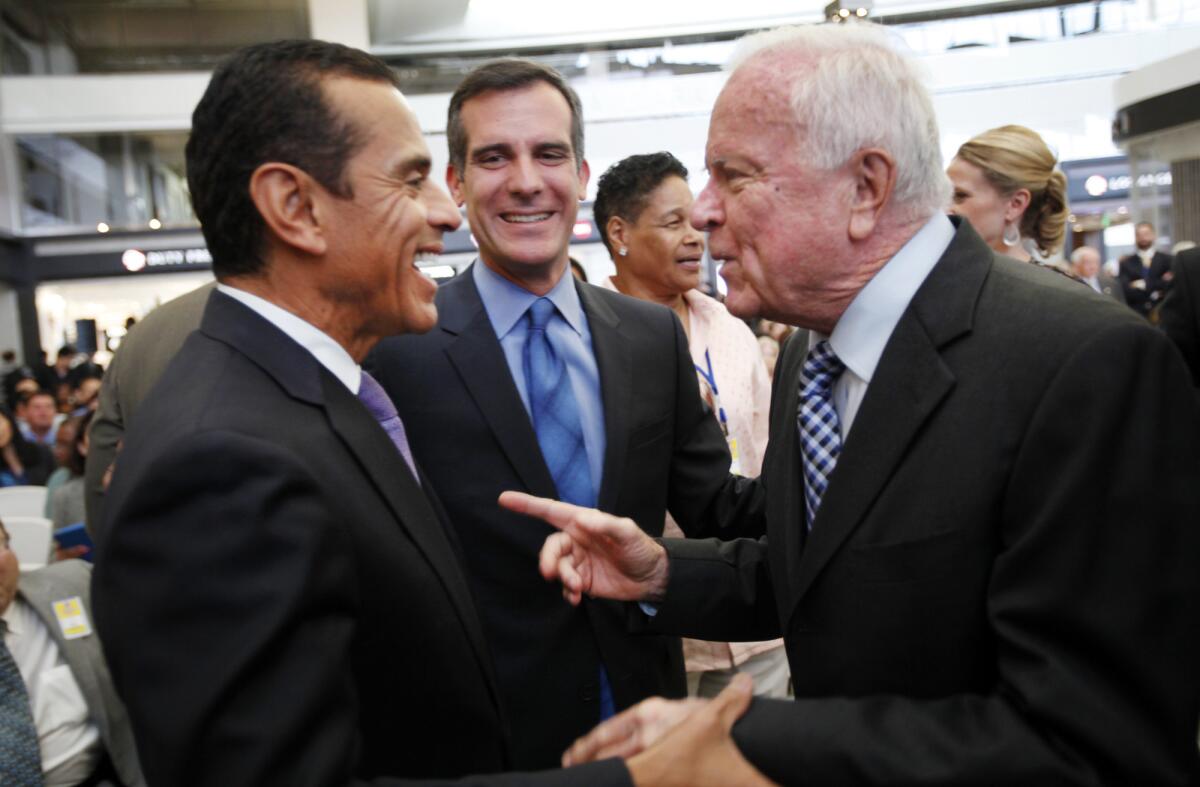
Former L.A. Mayors Antonio Villaraigosa, Eric Garcetti and Richard Riordan.
Most political observers in L.A., however, are confident that the city’s future is not conservative.
The DSA, a decentralized anti-capitalist group, has made inroads in L.A. as it advocates for rental protections, defunding the police and a Green New Deal. Over the last six years, Angelenos have elected four DSA-backed City Council members and a DSA-recommended city controller.
“L.A. is clearly a city that is steadily moving to the left,” said Jim Newton, executive director of UCLA Blueprint magazine and a veteran political journalist who worked for the L.A. Times for 25 years.
“People are unhappy, but they’re not unhappy enough to vote for a Republican,” Guerra agreed. “They have been looking at the other alternatives: the Democratic Socialist party that is the challenge to the establishment.”
Some caution, however, that it is too early to map out Los Angeles’ political future.
“I think everything is up for grabs,” Sonenshein said, noting that he expected more competition for Latino and Asian voters, young voters and even older Democrats. “Certainly, younger voters are completely up for grabs. It’s just hard to know where they’re going to end up. … Small shifts in the primary can make a very big difference.”
L.A. rose as the Republican stronghold of California.
As a massive influx of white Midwesterners descended on L.A. after the 1885 opening of the Santa Fe railroad, conservative white civic leaders — including the owners of the L.A. Times — touted the city as the GOP counterpart to progressive, union-friendly San Francisco. Liberal Black and white Angelenos were shut out of citywide power.
The purpose of the Bradley coalition, Sonenshein said, was to “break open the stranglehold of a city establishment that was … unresponsive to the diversity of the community.”
Bradley, an even-keeled attorney and former police officer, was well positioned to bridge L.A.’s racial divides. As a police community relations officer, he had cultivated relationships with Jewish business owners. He was an early supporter of L.A.’s first Latino City Council member, Edward Roybal, and had already united Black and Jewish Angelenos in the 10th District as the city’s first Black City Council member.
L.A. City Councilman Tom Bradley and Mayor Sam Yorty in a TV studio just before the start of a debate during their 1973 campaign for mayor.
(Los Angeles Times)
After his 1973 win, as waves of new immigrants moved to L.A., Bradley brought more Latinos and Asian Americans into the fold. A conscious alliance of minority communities reelected Bradley, helping him become the longest-serving mayor in L.A. history.
But by the 1990s, frustration had swelled over L.A.’s crime, pollution and poverty. Bradley’s popularity plummeted after Black motorist Rodney King was brutally beaten by LAPD officers in 1991 and riots erupted across the city the next year when a largely white jury acquitted the officers. More than 60 people were killed.
As Bradley prepared to step down, Democrats struggled to find a successor who could unite liberal Black, white, Latino and Asian Angelenos.
Still, some were skeptical that Richard Riordan, a Republican venture capitalist, would win. Riordan was a moderate, easygoing philanthropist, Newton said, and Republicans at the time made up 30% of L.A.’s registered voters, double their number now. Even so, he noted, “there were people who thought this is just not what this city is, the city doesn’t need a multimillionaire white guy Republican.”
Voters thought differently. After securing the support of San Fernando Valley Republicans and Democratic centrists and making small inroads among Latinos, Riordan became the first Republican L.A. mayor elected in 36 years.
The Bradley coalition was “a spent force,” Sonenshein said. “But new players were emerging in prominent roles, working to forge new types of alliances and, at times, temporary coalitions.”
When California voters in 1994 passed the anti-immigrant Proposition 187, which barred undocumented immigrants from receiving many public services, Latino participation in L.A. politics surged. Asian Americans also began to rise.
But after Bradley, there was no single Democratic coalition in the city.
When Antonio Villaraigosa challenged James Hahn in 2001 and 2005, Sonenshein said, Hahn drew support from the Black community and the Valley, Villaraigosa from Latinos and liberals. When Eric Garcetti defeated Wendy Greuel in 2013, Greuel had strong support in Black South L.A., but Garcetti managed to win with the white and Latino vote.
“People have to piece it together, because the Democrats have such a larger edge in L.A. than they did in Bradley’s age,” he said. “It’s almost a kind of entrepreneurial thing: You’ve got to go out and build a majority each time, and those alliances shift.”
There were still challenges from the right. But in 2022, when billionaire real estate developer Rick Caruso ran against Bass on a centrist law-and-order platform, he switched his party affiliation from Republican to Democratic. Some saw that as a recognition that a Republican could not win in L.A.
Like Bradley, Bass is a pragmatic politician with a long record of forging relationships behind the scenes.
In the 1990s, she founded the grassroots Community Coalition to combat the public health crises that plagued South L.A. amid the crack-cocaine epidemic.
But as Bass presides over a City Hall that is almost entirely dominated by Democrats, discontent is spreading. Polls show a substantial portion of the electorate views her unfavorably because of her handling of the Palisades fire.
Guerra said the lack of affordable housing had created a unique moment: Even after the King riots, the Northridge earthquake and the O.J. Simpson trial, he said, Angelenos were still invested in living in the city.
“You could still buy a home. You could still see yourself nurturing L.A., but also L.A. nurturing you,” Guerra said.
For Guerra, centrist Democrats have been so successful at inclusion they have struggled to identify priorities.
“There are too many members of the coalition and there are too many of the members who have veto power, which then leads to paralysis,” Guerra said. “The paralysis is what’s led to the lack of innovation, the failure to pursue policies that make sense for the greater good.”
The dysfunction, he said, is particularly clear on housing.
“Every NIMBY in every neighborhood, in every council district, is like, ‘We want housing, but not here,’” Guerra said. “That, replicated everywhere, leads to paralysis and no housing.”
It has also led to renters becoming a rising political constituency — a big shift from the Bradley era, when homeowners were the city’s dominant voters.
But that doesn’t mean working-class Angelenos have a bigger voice now in L.A. politics. Instead, the middle class is splintering along generational lines.
“Middle-class young folks graduating from college, who have extraordinary amounts of debt, cannot buy homes,” said Sara Sadhwani, a politics professor at Pomona College. “The city still has issues with food insecurity and low-wage worker protections, but those are not the issues dominating anymore.”
While L.A. Democrats have long focused on assembling coalitions of Black, Latino, Asian American and other minority activists, Sadhwani said, what was often not spoken about was the role of the city’s “nonprofit industrial complex.”
“Nonprofits have a huge role,” she said, noting that Bass came of that world. “Their politics are shifting.” Before 2020, she said, progressives focused on racial justice, immigration reform, and creating an economy that respects the work of immigrants; now, the focus is largely on homelessness and policing.
“What it means to be a progressive today,” Sadhwani said, “is actually quite different from what it was to be a progressive even just five years ago.”
Even as L.A. is clearly still a Democratic stronghold, Republicans say there are signs that some Angelenos are not in lockstep with liberal activists.
Donald Trump’s share of the vote in L.A. in the last three presidential elections, they note, climbed from 16% in 2016 to 21% in 2020 and 27% in 2024. And there is evidence that voters, at least at the county level, are questioning some criminal justice reforms.
Los Angeles Mayor Antonio Villaraigosa, pictured here on the cover of Newsweek, helped reshape the city’s Democratic coalition
(David McNew / Getty Images)
With Republicans making up about 15% of L.A.’s registered voters, Rob Stutzman, a GOP strategist, said Pratt might win enough independent voters and disaffected Democrats to make it past the primary. But he would then struggle to get more than 50% in the runoff.
“The math just isn’t there, but in addition to that it’s the stink of Trump,” Stutzman said. “The tribal politics of today make a Republican victory in L.A. very difficult.”
Raman stunned L.A.’s political establishment in 2020 when she was elected L.A.’s first DSA-backed City Council member.
As she runs for mayor, the Los Angeles chapter of the DSA hopes to expand its power as it endorses a new slate of 2026 candidates for City Council, city attorney and L.A. school board.
Richard Riordan, the last elected Republican mayor of Los Angeles.
(Los Angeles Times)
Raman is clearly betting that a big, viable part of the electorate is to Bass’ left, Newton said.
The DSA, Newton said, had done a good job in recent years of identifying renters’ interests and advancing them to usher in a “newer, younger, probably more progressive edge to the city’s politics.”
But so far, Raman, who has aligned herself with the DSA on issues such as renter protections but deviated on police spending, is struggling to unite the organization.
The Harvard and MIT graduate caught the DSA and her fellow City Council members off guard when she entered the mayoral race just before the filing deadline.
After building momentum, the DSA’s failure to rally around a 2026 mayoral candidate could hurt the movement for several election cycles, Guerra said.
“This dissension is setting them back,“ Guerra said. “They really do have an opportunity to elect a DSA mayor.”
Bass has seized on Raman’s lack of support in City Hall to critique her coalition-building skills.
“If you want to be the mayor and you can’t get along with people who are your colleagues on council,” Bass said recently, “I don’t know how you’re supposed to govern at all.”
In the end, the outcome of L.A.’s mayoral race may not depend so much on Bass’ ability to inspire her traditional Democratic coalition. The question is whether a new generation can find a way to represent a mass of Angelenos with bold new visions and coalitions of their own.
A Palestinian doctor has been killed and three people injured in an Israeli attack in central Gaza, as Israeli settlers attacked Palestinian homes and property in northern and southern parts of the occupied West Bank.
The attacks across Palestine on Saturday, the fourth day of the Muslim holiday of Eid al-Adha, came amid continued Israeli violations of a United States-backed “ceasefire” implemented in October aimed at halting Israel’s genocidal war on Gaza.
Recommended Stories
list of 3 itemsend of list
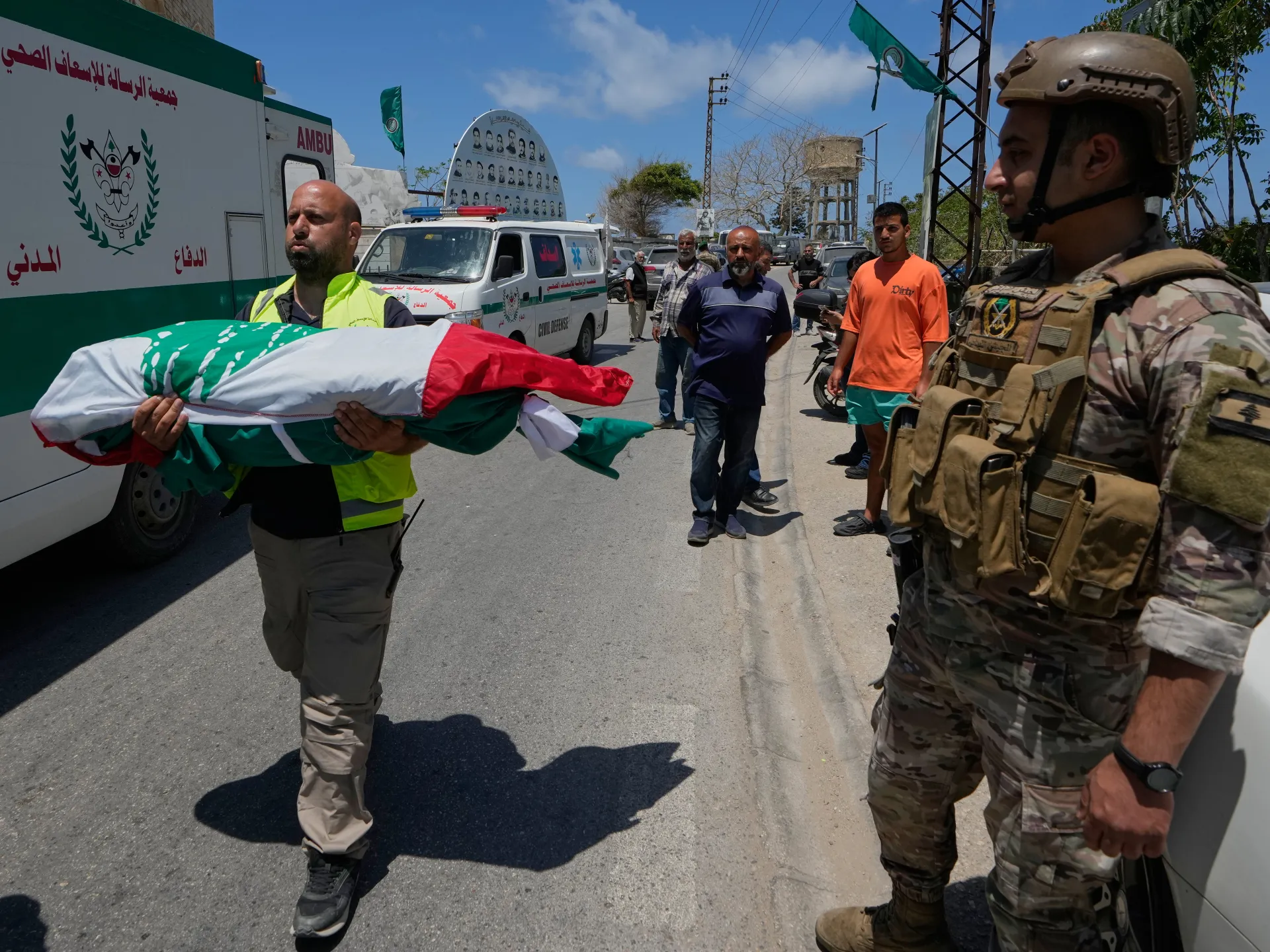
Dr Jamal Abu Aboun, the head of anaesthesia at Al-Yafa Medical Hospital in central Gaza’s Deir al-Balah, was killed in an Israeli strike near the Al-Aqsa Martyrs Hospital, also in Deir al-Balah on Saturday.
“The body of Jamal Abu Aoun and three injured people, including a child, had arrived at the hospital following an Israeli drone strike that targeted a group of civilians near the hospital,” a medical source at Al-Aqsa hospital told the Anadolu news agency.
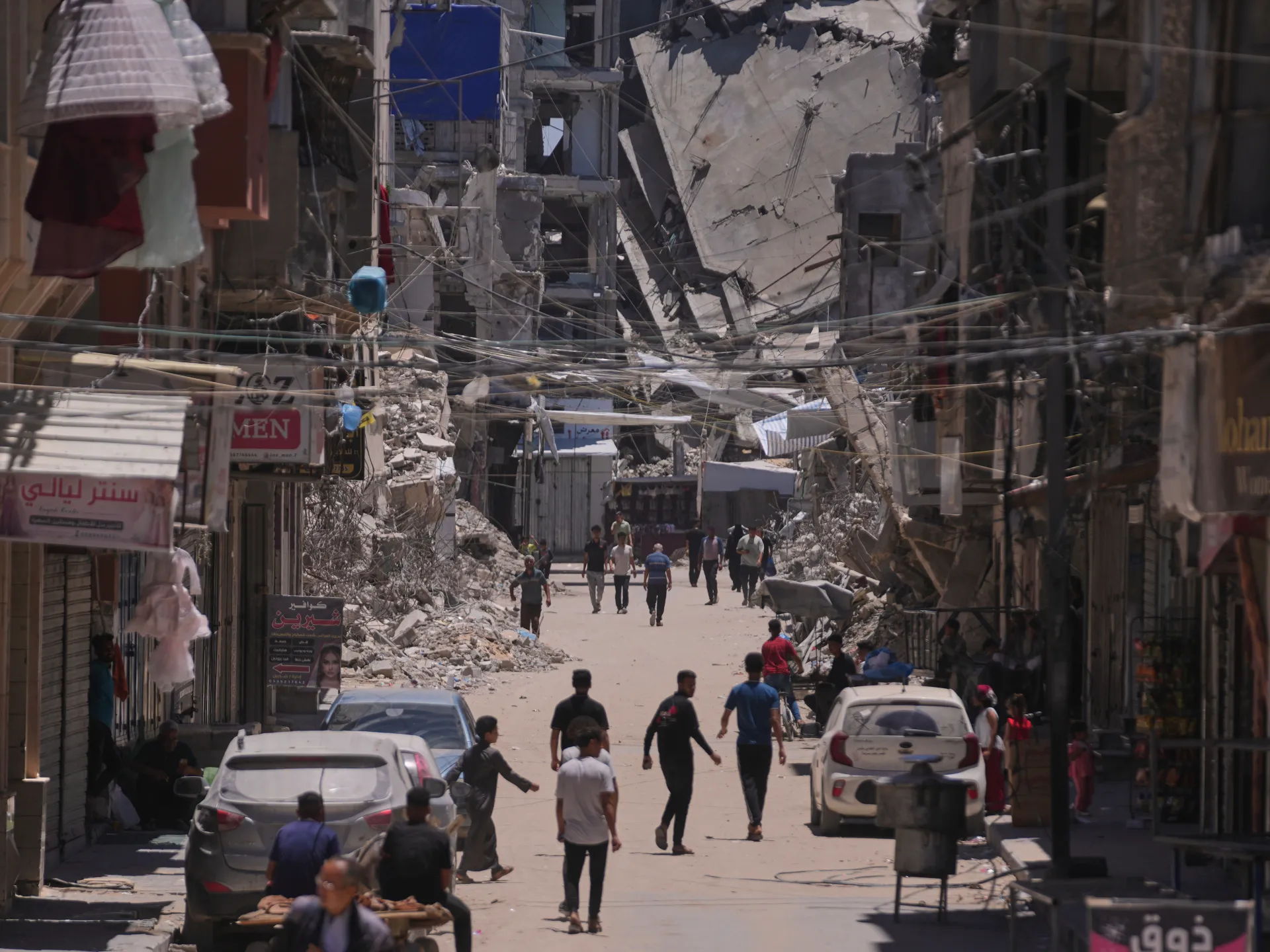
Earlier, Israeli artillery shelling targeted areas east and south of Khan Younis city in southern Gaza. Another artillery strike targeted al-Bureij refugee camp in central Gaza.
At least 922 Palestinians have been killed and 2,786 others injured in Israeli attacks since the October “ceasefire”, according to the Gaza Media Office.
Israel launched its genocidal war on Gaza in October 2023, killing at least 72,000 Palestinians and injuring over 172,000 others, according to Palestinian figures.
In testimonies to The Associated Press news agency, Israeli soldiers described a climate of dehumanisation, permissive rules of engagement and the routine killing of Palestinians during the “ceasefire”.
Reservists who served in Gaza between last October and January said Israeli troops frequently opened fire on Palestinians approaching or crossing the so-called “Yellow Line”, an often poorly marked boundary separating Israeli-occupied areas from the rest of the enclave.
One soldier said that fellow troops celebrated after a strike on a vehicle carrying Palestinians killed everyone inside. “It was a jungle,” the soldier told AP. “After the ceasefire, the order was: If someone crosses the line, you shoot them.”
Another reservist said commanders repeatedly emphasised holding territory at all costs. “There was a general feeling that human lives are not valuable,” he said.
Settler attacks in occupied West Bank
Elsewhere in occupied Palestine, Israeli settlers attacked several homes early on Saturday in the town of Beita, south of the city of Nablus in the northern West Bank, according to Palestinian news agency, Wafa.
They threw stones at houses and smashed several vehicles, Wafa reported.
State-run Voice of Palestine radio reported Israeli forces firing light bombs into the sky over the town.
In the southern West Bank, settlers attacked Palestinian farmland and damaged several trees in Khirbet el-Muraq in Masafer Yatta, activist Osama Makhamra, who follows Israeli violations south of Hebron, told reporters.
Israeli settlers carried out at least 540 attacks in April against Palestinians and their property in the occupied West Bank, including Jerusalem, according to a monthly report by the Palestinian state-run Wall and Settlement Resistance Commission.
The attacks ranged from “direct physical violence, uprooting trees, burning fields, preventing farmers from accessing their land, seizing property, as well as demolishing homes and agricultural structures”.
Israeli army raids, arrests and settler attacks have intensified across the West Bank since the start of the genocidal war in Gaza.
According to Palestinian figures, Israeli forces and settlers have killed 1,168 Palestinians, injured 12,666, displaced about 33,000, and detained nearly 23,000 in the West Bank since October 2023.
On Sunday, voters in the South American country of Colombia are facing a choice.
Four years ago, they elected the first left-wing president in the country’s modern history, Gustavo Petro. Now, they must decide whether to continue with Petro’s leftist push — or restore the political right to power.
Recommended Stories
list of 3 itemsend of list
Fourteen candidates will be on the ballot for the first round of voting in Colombia’s presidential election. The packed field includes contenders from the left, right and centre, who are slated to face off over issues like security and the cost of living.
But Petro will not be among them: Presidents in Colombia are limited to a single four-year term.
The right wing is expected to have the advantage, particularly if the race proceeds to a second round. Petro is struggling with low poll numbers, and voters have expressed frustration with crime and violence, driven in part by the country’s six-decade-long internal conflict.
But leftist candidate Ivan Cepeda has surprised observers, consistently placing at the top of the polls ahead of the first round.
When is the election, who are the candidates, and which issues are top of mind for voters? We look at those questions and more in this brief explainer.
When is the election?
The first round of voting is set to take place on May 31, 2026.
Will there be a second round of voting?
A candidate would need to win more than 50 percent of the vote in the first round to avoid a run-off.
If no single candidate meets that threshold, a run-off will be held between the top two finishers on June 21.
Why is this election important?
In recent years, across Latin America, long-entrenched left-wing governments have met defeat at the ballot box.
Last year alone, right-wing candidates have been elected to replace left-wing presidents in Bolivia, Chile and Honduras.
But Colombia does not have a long history of left-wing presidents. Petro was the first. That makes this race one to watch, according to Gimena Sanchez, a Colombia expert at the Washington Office on Latin America (WOLA), a human rights nonprofit.
“This is the first election to be held after the first-ever leftist administration in Colombia’s 200-year history,” Sanchez explained.
Colombia now stands at a fork in the road. One of the dominant issues in the election is how to resolve the country’s internal conflict, which forced more than 235,619 individuals from their homes in 2025.
Another 87,069 people were caught up in mass displacement events due to the fighting, according to the International Committee of the Red Cross.
Petro has embraced negotiation as a tool to end the conflict, which has seen government forces, criminal networks, left-wing rebels and right-wing paramilitaries all battling one another.
But the political right has advocated a return to the more militarised approach backed by the United States, according to Sanchez.
“The leading candidates fall into two camps: continuity with the leftist government of Petro and an approach to security that focuses on negotiations with armed groups, and right-wing candidates who very much want to go back to a hardline security model that Colombia had in the past,” Sanchez said.
“You have polar opposite visions for the country.”
Who is the main candidate on the left?
Senator Ivan Cepeda has emerged as the primary candidate of the political left, running as the head of the governing coalition, known as Historic Pact.
Cepeda has largely pledged continuity with Petro’s platform, including social and economic policies meant to reduce inequality.
He has also embraced Petro’s “Total Peace” approach, which aims to resolve the country’s internal fighting by negotiating with armed groups and criminal networks, as opposed to solely relying on military force.
Confronting state-backed violence has become a hallmark of Cepeda’s life and career.
His father, who was also a senator, is believed to have been assassinated by a government-backed paramilitary. For years, Cepeda was also embroiled in a legal battle for accusing former President Alvaro Uribe of connections to right-wing paramilitaries.
Presidential candidate Ivan Cepeda speaks to supporters during his final campaign rally in Barranquilla, Colombia, on May 24 [Vanessa Romero/AFP]
Who are the main candidates on the right?
While Cepeda has become the standard-bearer for the left, the political right has had to contend with a more fractured field of candidates.
Running on the far right is Abelardo de la Espriella, a lawyer for the Defenders of the Homeland Party who has generated comparisons with Salvadoran President Salvador Bukele and Argentina’s Javier Milei.
Like those leaders, de la Espriella has offered a hardline vision for his country’s security. If elected, he says he would end negotiations with armed groups, bomb rebel camps, and resume the aerial fumigation of coca crops, which produce the raw material for cocaine.
Senator Paloma Valencia, a candidate with the Democratic Centre Party, is running as a more moderate alternative to de la Espriella. She too has promised a stricter approach to crime. Her platform involves expanding the police and armed forces, while cutting taxes and promoting pro-business policies in the economic realm.
Their election-season competition has become a source of acrimony for Valencia and de la Espriella, who have accused each other of paving the way for a leftist election victory.
“There is a more familiar, establishment right, represented by Valencia, and a far right in the form of de la Espriella, who pitches himself as an outsider,” said Sanchez.
Valencia, for her part, has criticised de la Espriella as two-faced, defending criminals in his legal practice but advocating for tighter security on the campaign trail.
De la Espriella, meanwhile, has dismissed Valencia as a member of the country’s political establishment and chided her in a social media post, stating that the presidential election is “not for little games”.
Paloma Valencia of the Democratic Centre Party speaks to supporters during her final campaign rally in Bogota on May 24 [Raul Arboleda/AFP]
What are the polls saying?
Polls generally show Cepeda ahead of his rivals, with de la Espriella in second place and Valencia in third.
A May 24 poll from the National Consulting Centre (CNC) and the publication Cambio suggested that Cepeda had drawn 33.4 percent of voter support, the most of any candidate.
But de la Espriella was on the upswing with 30.9 percent. Valencia, meanwhile, trailed with 12.6 percent.
The same surveys, however, suggest that Cepeda would struggle to win a run-off against either of the two right-wing candidates, with de la Espriella eking out about three points in a head-to-head contest, and Valencia coming within a percentage point of victory.
Undecided voters could play a key role in deciding the outcome, though. An analysis cited by the Spanish paper El Pais estimates that undecided voters could account for as much as 28 percent of the electorate.
Presidential candidate Abelardo de la Espriella, of the Defensores de la Patria party, speaks behind bulletproof glass during his closing campaign rally in Medellin, Colombia, on May 24, 2026 [Jaime Saldarriaga/AFP]
Which issues are front and centre?
Concerns over crime, security and economic issues like unemployment and affordability have dominated the election.
In a poll from the firm Invamer, the highest proportion of voters — 37 percent — identified security as the top issue facing the country.
Basic needs and unemployment ranked second and third, with 17 percent and 16 percent, respectively. Eleven percent of voters, meanwhile, named corruption as a leading concern.
The threat of violence has lingered over the presidential campaign over the past year.
Two political staffers with de la Espriella’s campaign were killed by gunmen on motorbikes earlier this month. And in June 2025, presidential candidate Miguel Uribe Turbay was shot while leaving a campaign rally. The 39-year-old died two months later from his injuries.
Political violence is a serious concern in Colombia, and all of the frontrunners in the race travel with heavy security.
Israel’s military has advanced beyond Lebanon’s Litani River for the first time since 2006.
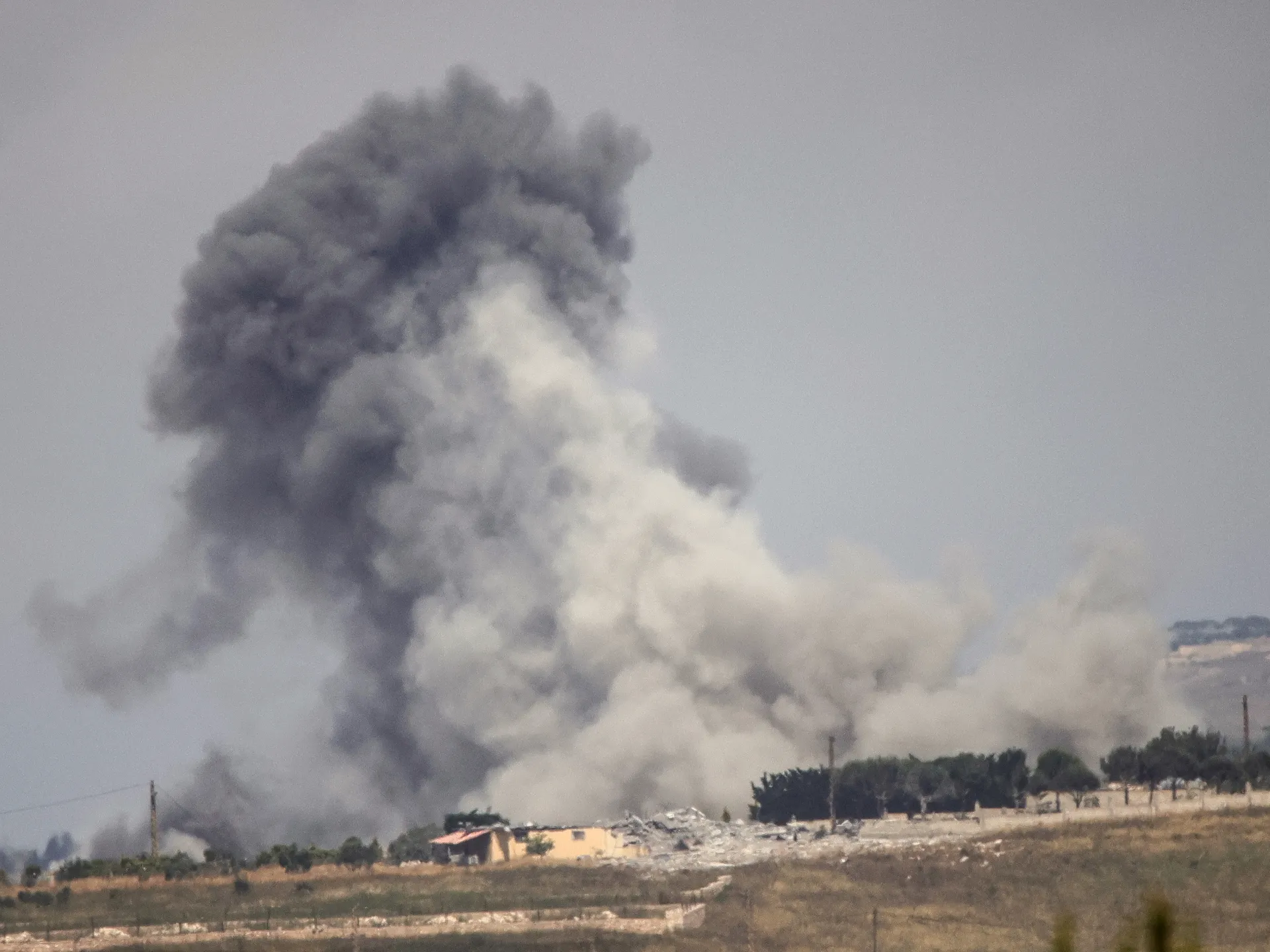
Israel’s military has advanced beyond the Litani River in southern Lebanon for the first time since 2006 and appear poised to encircle the major city of Nabatieh.
Senior Lebanese military sources on Saturday told the Turkish state news agency Anadolu that Israeli forces had crossed the Litani River, which Israel has declared the perimeter of its unofficial buffer zone.
Recommended Stories
list of 3 itemsend of list
Israeli forces are now on the outskirts of Nabatieh, a city that is key to southern Lebanon’s economy and a cultural hub for the region. If the Shia-majority city were to fall, it would mark a significant development in the war on Lebanon, which began in October 2023 and subsequent official ceasefire.
Nabatieh is viewed by many Lebanese as a symbol of resistance due to its historic role on the frontline of Israeli assaults.
Reporting from the southern city of Tyre, Al Jazeera’s Obaida Hitto said Israel was expanding its air campaign in southern Lebanon and encircling Nabatieh in preparation for a potential assault on the city.
“It looks like Israel is trying to make this final push to encircle Nabatieh, breaking through the second and third lines of defence of Hezbollah and isolating the western Bekaa Valley from the south of the country,” Hitto said.
Israel has issued evacuation orders for at least 10 villages in southern Lebanon, as it expands its invasion, despite being engaged in ongoing peace talks with Lebanese officials.
The Israeli army’s Arabic spokesperson, Avichay Adraee, instructed residents in several Lebanese villages to evacuate immediately, warning they could be killed if they remained.
The order came the day after officials from both countries met in Washington to discuss a permanent end to the war. It began in early March when Iran-backed Hezbollah began attacking Israel following the assassination of Iran’s Supreme Leader, Ali Khamenei.
Hitto said people fleeing their homes have few options, with more than 20 percent of the population — around 1.2 million people — displaced by fighting.
“Those options are turning into basically people living with relatives if they have that option, or people living in makeshift camps in public parks and public spaces. I’ve seen many families living in their vehicles for long periods of time,” Hitto said.
“Some of these families have been continuously displaced since 2023,” Hitto added.
The latest forced displacement orders are a further test to the nominal “ceasefire” in place since mid-April and repeatedly violated by Israel. It justifies its actions by saying it is targeting Hezbollah as part of efforts to disarm the group.
On Friday, at least 14 people were killed in Israeli air raids in southern Lebanon.
Lebanese officials are working to disarm Hezbollah, but the task has proved extremely difficult.
Lebanese and Israeli officials are currently engaged in negotiations to end the war, marking the first time the two sides have spoken directly in decades.
The talks are being facilitated by the United States, and a new round is expected in Washington next week.
Lebanon’s President, Joseph Aoun, held talks with Prime Minister Nawaf Salam on Saturday to discuss the security situation and ongoing negotiations with Israel. According to the state-run National News Agency, they agreed to intensify efforts to end the war, which has triggered a humanitarian crisis.
Aoun also spoke by phone with US Secretary of State Marco Rubio and stressed the importance of Israel respecting the current ceasefire.
Trump weighs next steps on Iran deal as Tehran insists negotiations are continuing and no final agreement exists.
Published On 30 May 202630 May 2026
Prospects for a US-Iran agreement to end the conflict remained uncertain on Friday, with President Donald Trump saying he would make a “final determination” on a deal, while Iranian officials stressed that no understanding had yet been reached.
Iran’s chief negotiator, Mohammad Bagher Ghalibaf, said Tehran would judge any agreement by actions rather than words, adding that no steps would be taken unless Washington acted first.
Meanwhile, fighting continued elsewhere in the region. Israeli Prime Minister Benjamin Netanyahu said Israeli forces had advanced beyond Lebanon’s Litani River, as Israeli attacks across Lebanon on Friday left dozens more civilians reportedly killed or wounded.
Here is what we know:
In Iran
Iran says talks continue, but no deal yet: Iranian Foreign Ministry spokesperson Esmaeil Baghaei said exchanges with the United States are continuing but stressed that no final agreement has been reached. He rejected Trump’s demands-based approach and described the US naval blockade as illegal, adding that Tehran would judge any easing of restrictions by actions rather than words.
War diplomacy
CENTCOM highlights ongoing regional patrols: US Central Command (CENTCOM) said its forces remain “present and vigilant” across the region, sharing an image of an F-16 fighter jet conducting a patrol over the Middle East.
US pushes allies to boost defence spending: Speaking at the Shangri-La Dialogue in Singapore, US Defense Secretary Pete Hegseth said Trump plans a $1.5 trillion investment in defence and described it as part of a historic expansion of America’s military-industrial base. Hegseth urged allies to spend at least 3.5 percent of gross domestic product (GDP) on defence, warning that countries that fail to do so could face changes in their relationship with Washington. He also reiterated that the US remains committed to preventing Iran from obtaining a nuclear weapon.
Washington praises Israel-Lebanon security talks: The US Department of Defense described military-to-military talks between Israeli and Lebanese delegations in Washington as “productive”, saying they focused on regional security and stability. The Pentagon also reaffirmed support for Lebanon’s sovereignty and territorial integrity.
In the US
Uncertainty remains after White House talks: Reporting from the White House, Al Jazeera’s Alan Fisher said there was still no clarity after Trump’s Situation Room meeting on whether a final agreement with Iran had been reached. Fisher said any easing of restrictions around the Strait of Hormuz could signal progress, but officials are still waiting for concrete details from the White House.
In Israel
Air raid sirens sound in northern Israel: The Israeli military said it intercepted several projectiles launched from Lebanon, while another landed near Kiryat Shmona in northern Israel. The military reported no casualties and did not specify whether the projectiles were rockets or drones.
In Lebanon
Netanyahu says Israeli troops have crossed the Litani River: Israel’s Netanyahu said Israeli forces have advanced north of the Litani River near Nabatieh, signalling an expansion of operations in southern Lebanon. The move comes amid ongoing Israel-Lebanon talks and could be followed by further strikes on Beirut and the western Bekaa Valley.
US President Donald Trump posted online that he’s heading into the Situation Room at the White House to make a “final determination” on potentially finalising a peace deal with Iran. Al Jazeera’s Patty Culhane reports from the White House.
A digital register of land ownership in the West Bank is seen as an escalation of Israel’s occupation.
Published On 29 May 202629 May 2026
Occupied East Jerusalem, Palestine – A controversial Israeli plan to digitally register property ownership in the occupied West Bank is a “dangerous colonial occupation step that represents a direct assault on the historical and legal rights of the Palestinian people to their land and property”, the Palestinian Land Authority has said.
The Palestinian Jerusalem Governorate and the Colonization and Wall Resistance Commission (CRRC) have urged Palestinians in the West Bank not to engage with any Israeli “entities, committees, platforms, or procedures” of lands and property.
Recommended Stories
list of 4 itemsend of list
Israel reportedly launched the online “Land Registry and Settlement of Rights” platform on which it plans to “update” property ownership in the occupied West Bank on Wednesday this week.
The Jerusalem Governorate and the CRRC have called on the international community, the United Nations, the International Criminal Court and all international human rights and legal institutions to “take their urgent responsibilities to stop these illegal procedures and hold the occupying state accountable for its continuous violations against the Palestinian people, their land, and their resources”, they said.
Moayad Shaaban, head of the CRRC, which is part of the Palestine Liberation Organization, said the move reveals “the occupation’s transition from traditional policies of field control to digital and administrative colonial engineering aimed at imposing permanent legal realities on the occupied Palestinian territory”.
‘Annexation’ by land registry
In May 2025, the Israeli Security Cabinet launched a new, aggressive land settlement process throughout the West Bank, with the aim of “completing the legal and administrative annexation of the occupied territories through fully registering the lands under Israeli authority”, the Jerusalem Governorate said.
Then, in July 2025, Israel’s parliament approved a symbolic measure calling for the annexation of the occupied West Bank. The move was first tabled in 2024 by Israel’s far-right Finance Minister Bezalel Smotrich, who himself lives in an illegal Israeli settlement.
On February 15, 2026, the permanent acquisition and registration of approximately 58 percent of Area C – the part of the West Bank over which Israel exerts total control – began.
(Al Jazeera)
Under that decision, Palestinian land registration in the Israeli “Tabu” – the land registry extract – began for the first time since the occupation of the West Bank in 1967. It is a final measure that will be difficult to challenge in Israeli courts, the Israel Hayom newspaper reported in February.
With the onset of land settlement, the Israeli Land Registry unit will take over the regulation and registration of land ownership in Area C. It also has the power to issue sales permits and to collect fees. Israel aims to complete the full settlement of 15 percent of the West Bank by the end of 2030.
Some 700,000 Israeli settlers already live in the West Bank and East Jerusalem, as illegal settlement has expanded under the government of Prime Minister Benjamin Netanyahu.
Rights groups say settlement approvals, along with rising settler violence against Palestinian communities, have accelerated since Israel launched its genocidal war on Gaza on October 7, 2023.
EU says the sanctioned individuals and groups violated a range of rights, from the right to physical and mental integrity, to the right to education.
Published On 28 May 202628 May 2026
The European Union has sanctioned four entities and three individuals it says are “extremist Israeli settlers” responsible for “serious” human rights abuses against Palestinians in the occupied West Bank.
The EU said they had violated a range of rights, including the rights to physical and mental integrity, privacy and family life, freedom of religion and education.
The sanctions include the Nachala Settlement Movement and its director, Daniella Weiss. The EU says the group “encourages and facilitates coercive acts that lead to the forced displacement of Palestinians”.
Israeli NGO Regavim and its director, Meir Deutsch, are also on the sanctions list for lobbying “for the demolition of Palestinian property” in order to expand Israel’s control over the entirety of the West Bank, plus the demolition of an EU-funded Palestinian primary school.
Also sanctioned is the Hashomer Yosh NGO and its president, Avichai Suissa for supporting “at least 28 violent outposts and settlements”. It also recruits armed volunteers and provides guards who engage in violent attacks, the EU added.
The Amana cooperative association of the settler movement Gush Emunim was also sanctioned, the EU stating it had likewise “played a key role in initiating, financing, and facilitating at least 30 violent outposts and settlements”.
Long-awaited sanctions
With Thursday’s additions, the EU said it now sanctions 136 persons and 41 entities from a range of countries under its Global Human Rights Sanctions Regime.
The regime was created in 2020, and applies to acts such as genocide, crimes against humanity and other serious human rights violations or abuses.
The measures targeting Israeli settlers because of violence against Palestinians were long-awaited, having been blocked by the self-styled illiberal government of Hungary’s former premier Viktor Orban.
However, the appointment of new Prime Minister Peter Magyar saw the veto quickly lifted earlier this month.
Israel earlier condemned the sanctions, asserting that Jews have the right to settle in the occupied West Bank, despite that being in violation of international law.
In 2025, the expansion of Israeli settlements reached its highest level since at least 2017, when the United Nations began tracking data.
Since the start of Israel’s genocidal war on Gaza, the West Bank has been gripped by almost daily violence involving Israeli troops and settlers. More than 1,000 Palestinians have been killed in the territory, according to the UN.
The Israeli army has already expanded its control of Gaza by 11 percent over the ‘Yellow Line’, beyond the terms of the ‘ceasefire’.
Published On 28 May 202628 May 2026
Prime Minister Benjamin Netanyahu has instructed the Israeli army to expand its control of the Gaza Strip to 70 percent, according to remarks aired by Israeli media.
“At this point, we are fully in control of 60 percent of the territory of the Gaza Strip … and my directive is to get to … 70 percent,” Netanyahu said in footage recorded by Channel 12 and aired on Thursday.
Recommended Stories
list of 3 itemsend of list
When someone in the audience shouted that Israel should take the entire besieged enclave, the prime minister said “we are going in order”, according to The Times of Israel. “First 70 percent,” he said without disputing that a complete takeover could take place. “We’ll start with that.”
The Israeli army had in mid-March quietly sent maps to aid organisations showing it had already expanded its control to about 11 percent beyond the so-called “Yellow Line” demarcating areas of the enclave occupied by Israeli troops. That line was agreed in a United States-brokered “ceasefire” in October 2025. That meant it controlled 64 percent of the Palestinian territory, instead of 53 percent.
Due to the Israeli army occupation, Palestinians cannot access about two-thirds of Gaza. A further seizure of the territory would force two million of them, already living in disastrous conditions, into an even smaller territory after enduring two years of genocidal war.
Despite the nominal truce reached last year, Israeli bombing in Gaza continues with near-daily attacks. An Al Jazeera tally from October to April counted at least 2,400 Israeli violations. Earlier on Thursday, health authorities said an Israeli air raid killed at least 10 people, including four children, and wounded 20 others.
According to the United Nations Office for Humanitarian Affairs’ (OCHA) latest report, the humanitarian situation for civilians in Gaza remains critical, with displaced families living in overcrowded tents, schools or damaged structures. Clean water is scarce, and poor waste collection is increasing health risks, including the spread of rats and insects. Many neighbourhoods across Gaza are also still dangerous, with frequent air strikes, shelling and shootings happening in or near residential areas, the report said.
Last week, the high representative overseeing the US-founded Board of Peace for Gaza, Nickolay Mladenov, warned that the deteriorating status quo in the enclave risks becoming “permanent”. Speaking to the UN Security Council, he urged the international body to use “every means at its disposal” to press Hamas to disarm and to push Israel to uphold its commitment under the October ceasefire, pointing to its continued killings and restrictions on humanitarian flow.
The war that Israel launched following the October 7, 2023, attacks on southern Israel by Hamas and other armed Palestinian groups has killed more than 72,775 Palestinians. The Israeli military continues to maintain a strict security regime, and many hundreds more have been killed in the past seven months. Conflict monitors warn that since the US-Israel war on Iran started in February, Israeli bombardment of Gaza has accelerated.
Israeli ambassador to the UN says Tel Aviv will cut ties with UN chief Antonio Guterres over the upcoming report.
Published On 28 May 202628 May 2026
The United Nations has “added Israel to the blacklist of sexual violence in conflict zones”, prompting Israel to cut ties with UN chief Antonio Guterres, the country’s ambassador to the UN says.
“We are done with this secretary-general,” Israeli ambassador Danny Danon added in a video posted on X on Thursday, denouncing the upcoming report from Guterres’s office.
Recommended Stories
list of 3 itemsend of list
The UN secretary-general’s annual report on conflict-related sexual violence is customarily presented to relevant states before publication. Last August, the report warned that Israel could be added to the list of parties suspected of, or responsible for, sexual violence in situations of armed conflict.
“The decision to blacklist Israel and accuse us of using sexual violence as a weapon of war is an outrageous decision,” Danon said.
“The secretary-general and his team continue to spread lies against Israel. To put us and Hamas terrorists on the same list, that’s unacceptable.”
The Israeli mission to the UN said in a statement that it will have no contact with the secretary-general’s office as long as Guterres serves as head of the organisation.
The country’s foreign ministry also expressed anger over the upcoming report.
“The shameful and absurd UN decision to include Israeli entities in the annex to the CRSV (conflict-related sexual violence) report is further proof of the UN’s true nature: a politicised and corrupt organisation that has abandoned its founding principles and systematically targets Israel as its primary mission,” Oren Marmorstein, a spokesperson for the Israeli foreign ministry, said on X.
Guterres’s spokesperson said they were aware of Danon’s remarks.
“For our part, the secretary-general’s door remains open,” Stephane Dujarric said.
Systematic pattern of abuse
Last August, the UN cited “credible information” regarding sexual violence committed by Israeli security forces against Palestinian detainees in prisons and other detention centres, and said UN inspectors had been denied access to the facilities.
“We invited the representative of the UN to come to Israel to check those ridiculous allegations. They chose not to come,” Danon said.
Palestinians detained in Israeli prisons, especially those taken from Gaza during Israel’s brutal war since 2023, have long revealed how they suffer dehumanising treatment by guards and soldiers, including torture and sexual violence. According to international human rights organisations, these testimonies are part of a broader and systematic pattern.
Furthermore, a report from the West Bank Protection Consortium last month found that sexual violence and other forms of gender-based abuse committed by Israeli settlers and soldiers are spurring Palestinians to leave the occupied West Bank.
Even foreigners, namely those on board a recent Gaza-bound aid flotilla, say that freed activists who were abducted from international waters faced abuse while in Israeli detention, including at least 15 separate cases of sexual assault or rape.
Earlier this month, Israel also rejected accusations of rape by its forces, which were detailed in a column by longtime New York Times journalist Nicholas Kristof. The Israeli government had responded to the report by stating that it would take the extraordinary step of suing the paper. Kristof’s reporting was based on the accounts of 14 male and female Palestinian victims.
Relations between the UN and Israel are fraught and have reached an all-time low since October 7, 2023, when Hamas launched an attack that preceded Israel’s genocidal war on Gaza, which has killed more than 72,000 Palestinians.
Israeli authorities have criticised Guterres and other UN officials for their condemnation of its brutal conduct in Gaza. The UN chief was declared “persona non grata” in Israel in 2024.
A top US official says Oman should know that Washington ‘will aggressively target’ actors that facilitate tolls in waterway.
Published On 28 May 202628 May 2026
The United States has warned that it would “aggressively” impose sanctions on Oman if it helps Iran establish a tolling system in the Strait of Hormuz, intensifying President Donald Trump’s threats against the Gulf ally.
US Treasury Secretary Scott Bessent said on Thursday that Washington will “not tolerate” either country imposing fees on commercial ships in the strategic waterway.
Recommended Stories
list of 3 itemsend of list
“Oman, in particular, should know that the US Treasury will aggressively target any actors involved — directly or indirectly — in facilitating tolls for the Strait and any willing partners will be penalized,” Bessent said in a social media post.
“All nations should reject outright any efforts by Iran to disrupt the free flow of commerce. Tehran’s days of terrorizing the region and the world are over.”
The statement comes less than 24 hours after President Trump threatened to bomb Oman, a key US ally known for its neutrality and mediation efforts in regional crises, including the war between the US and Iran.
While Iran has suggested that the governments in Tehran and Muscat could jointly manage the Hormuz Strait, Oman has not said that it is seeking control over the waterway, parts of which flow through its territory.
It is not clear what is driving Washington’s recent posture toward Oman. It is highly unusual for the US to threaten sanctions and military action against a close security and economic partner.
Since the US and Israel started bombing Iran without direct provocation on February 28, Iran has closed the strait and claimed sovereignty over it.
Around 20 percent of the world’s oil flowed through Hormuz before the conflict, so the Iranian blockade has put a major strain on energy supplies, sending prices soaring.
The US and Iran have been indirectly negotiating to reach an agreement for a comprehensive end to the war, and control over the Hormuz Strait has emerged as a major point of disagreement.
Trump has stressed that the strait must be a free passageway.
When asked whether he would accept joint Iranian-Omani control over the strait in the short term, the US president told reporters on Wednesday: “Nobody is going to control it. It’s international waters, and Oman will behave just like everybody else, or we will have to blow them up.”
Ali Bagheri, deputy secretary of Iran’s Supreme National Security Council, said on Thursday that Tehran will not allow Hormuz to be a source of insecurity for the country.
“The powers that have used this passage against Iran’s security must be held accountable,” he was quoted as saying by Iran’s public television.
Bagheri added that Iran seeks to “establish a just order that negates hegemony and domination and strengthens trust and cooperation” in the region.
The war that Donald Trump declared won last month looks rather different from the inside of the Pentagon. The resulting stalemate has drained American military stockpiles, emboldened Iranian commanders, and left the US with far worse options than before the conflict began.
The administration’s triumphalist framing has struck a jarring note among those who have spent careers studying the Iranian military and the limits of American power projection. Declaring victory when the enemy is still standing, still armed, and still controlling the waterway you went to war over is not a strategy. It is a wish dressed up as a press release.
At the heart of the impasse are two demands that Tehran has consistently and categorically rejected. Iran will not surrender what it regards as its sovereign right to develop its uranium program, and it will not yield control of the Strait of Hormuz. Those two positions were Iran’s red lines before the fighting started. They remain Iran’s red lines now. Nothing in between has changed.
What has changed is the arithmetic of munitions. The United States entered this conflict with a military built around expensive, technologically sophisticated weapons systems, precision instruments that take years to design, years more to manufacture, and that have now been expended at a rate the American defense industrial base is poorly positioned to replenish. Iran, by contrast, relies on a dispersed network of robotic small boats, undersea mines, tactical ballistic missiles, and unmanned systems. These weapons are cheap, simple, and easy to produce at scale.
The United States essentially deployed a Ferrari into a demolition derby. The Iranians didn’t need high-end technology; they just needed a relentless volume of cheaper assets to overwhelm the defense.
Trump, for his part, has shown no appetite for nuance. “We have totally obliterated their military capacity, there’s nothing left, believe me, nothing,” he told supporters at a rally in Georgia. Pentagon planners reviewing the same battlefield data have reached a rather different conclusion.
The American strikes produced mixed results. Iran does not maintain a conventional naval fleet or a modern air force in the Western sense. Its control of the strait rests not on destroyers or fighter wings but on a distributed, resilient system of asymmetric capabilities. The Iranian systems that dispersed into the terrain absorbed the strikes and began reconstituting almost immediately. Defense analysts point out that the Iranians have adapted from what they observed, replenished their stocks, and may now be better positioned than when the conflict began.
The strategic picture is further complicated by the political pressures that shaped the original decision to go to war. Analysts describe a decision driven less by tactical opportunity than by commitments made to Israeli leadership and to influential pro-Israel donors whose support was central to Trump’s political coalition. The result was a military campaign calibrated to political timetables rather than operational logic.
Senator Tim Kaine of Virginia, a member of the Armed Services Committee, called the conduct of the conflict “a case study in how not to use military force.” Representative Thomas Massie of Kentucky, before his defeat in his primary, was more pointed: “We went in without a declaration of war, without a clear objective, without an exit strategy, and now we’re supposed to celebrate because we used up half our missile inventory and the Iranians are still there.”
The regional picture adds further complexity. Saudi Arabia and the smaller Gulf monarchies are acutely aware of their own exposure. A major Iranian strike on above-ground oil and desalination plants could critically impede the GCC’s government’s ability to maintain economic prosperity. The GCC states have no appetite for an escalation that leaves their vital water infrastructure in ruins. While they favor the containment of Iran, preventing a regional war is a matter of sheer survival.
The broader strategic damage extends well beyond the Gulf.
The conflict has exposed, with uncomfortable clarity, the brittleness of an American military model that prioritized theoretical sophistication over the practical demands of sustained combat. The long-overlooked vulnerability of the missile supply chain has now emerged as the primary constraint on future American options. Restoring that capacity, according to officials, will require years of industrial retooling.
Washington has come to realize that Iran acutely recognized US vulnerabilities, designing asymmetric systems specifically to deplete America’s most expensive capabilities with its cheapest assets. This is not a temporary setback; it is a structural crisis.
For now, President Trump appears caught between the political cost of acknowledging stalemate and the military risk of a second round of strikes that the Pentagon itself doubts would achieve different results. The operational pause is not a logistical necessity. The forces are forward-deployed and ready. The pause is a search for a rationale, a way to resume the fight that does not require the White House to explain why the first attempt failed.
By most accounts, the search has not yet succeeded.
WASHINGTON — Ethnic war in Kosovo is provoking a kind of civil war inside the Republican Party.
In rapid fashion, the conflict in the Balkans is widening a fissure in the GOP over America’s role in the world. While Democrats mostly have supported President Clinton’s course, Republicans are being torn in diametrical directions as Yugoslav President Slobodan Milosevic’s forces systematically expel hundreds of thousands of ethnic Albanians from Kosovo.
On one side, a band of traditional GOP internationalists–led by Sen. John McCain of Arizona–is urging Clinton to escalate the campaign against Milosevic, even to the point of sending ground troops to drive the Serbian forces from Kosovo.
On the other side, an assertive group of conservative nationalists–led by presidential hopeful Patrick J. Buchanan, but extending into Congress–is arguing that the United States should bring its forces home now and leave the problem to the Europeans. “I think . . . we should tell our partners, ‘Look, we’ve expended, almost exhausted our resources. . . . Now on May 1st, we’re going to be out of there and then you take over from there,”’ Sen. James M. Inhofe (R-Okla.) argued Sunday.
This dispute marks the first real division in the Republican presidential campaign and, more importantly, a continued shift in the GOP’s center of gravity away from the internationalism that defined it through the Cold War.
Many in the GOP now appear increasingly drawn to an updated version of the old “fortress America” doctrine in which the United States increases its spending on defense but reduces its commitments abroad. Supporters describe this impulse as hard-headed nationalism. Critics, in both parties, deride it as isolationism.
“Republican foreign policy is now mired in pathetic incoherence,” the conservative Weekly Standard magazine said in an editorial last week.
In the first half of the century, the GOP was closely divided between internationalists and isolationists. When the Cold War dawned after World War II, that balance of power tilted toward the internationalists–whose victory was sealed by Dwight D. Eisenhower’s triumph over isolationist Sen. Robert A. Taft of Ohio for the GOP presidential nomination in 1952.
For nearly the next four decades, internationalists dedicated to containment of the Soviet Union held the upper hand in the GOP–even while isolationist sentiment in the Democratic Party grew after the Vietnam War.
A Role Reversal for Democrats, GOP
But the collapse of the Soviet Union eliminated the central rationale for engagement abroad among conservatives and has precipitated something of a role reversal between the parties during Clinton’s presidency. That process has reached a peak in the last few weeks with Republicans leading the opposition to U.S. involvement in Kosovo and Democrats (including many who opposed Vietnam) insisting on America’s obligation to ensure stability abroad.
When the Senate voted last month to authorize airstrikes in Kosovo, 70% of Senate Republicans voted no. Earlier, three-quarters of House Republicans voted against the use of American troops as part of an eventual North Atlantic Treaty Organization peace-keeping force in Kosovo. Virtually all Democrats in both chambers backed Clinton.
Those figures partly reflect Republican skepticism about Clinton’s ability to manage a military conflict and their sheer distrust of the president. But most analysts also see larger forces at work.
“It’s a complex fabric that’s giving us this situation here, from congressional feelings toward this president to the post Cold War fault lines,” said Marshall Wittmann, director of congressional relations at the conservative Heritage Foundation.
It is possible that tensions could sharpen among Democrats, too, if Clinton eventually asks for ground troops. But so far Democrats have offered little dissent from the president’s course.
On the other hand, the outbreak of fighting has widened the disagreement among Republicans. Overshadowed during congressional debates on Kosovo last month, internationalist Republicans have raised their voices since the bombings began.
Most ubiquitous has been McCain. Last week, McCain put off the formal announcement of his bid for the GOP presidential nomination in 2000, saying that it was inappropriate while NATO was at war in Kosovo. But he has been inescapable on television arguing for an escalation against Milosevic, including the use of ground troops if necessary.
“For us to rule out any capability we have to bring this war to a successful conclusion is a mistake,” McCain said.
Others in this camp include Republican Sens. Richard G. Lugar of Indiana and Charles Hagel of Nebraska, 1996 GOP presidential nominee Bob Dole and–more gingerly–Elizabeth Hanford Dole, who has not explicitly backed ground troops but said last week that “no options should be taken off the table.”
In a slightly different place are Republicans–led by former Secretary of State Henry A. Kissinger–who opposed the original decision to intervene in Kosovo but now say that NATO must do whatever it takes to defeat Milosevic to maintain its credibility.
Yet it remains unclear how much support these internationalists still command in the GOP.
Apart from McCain and Elizabeth Dole, the only other Republican contender who has accepted the possible use of ground troops is Texas Gov. George W. Bush–though his comments have been so tangled and conditional that the conservative Wall Street Journal editorial page labeled them “Clintonian.”
Half of the GOP contenders–including former Vice President Dan Quayle and Ohio Rep. John R. Kasich–have opposed the bombing mission from the outset.
On Sunday, Inhofe and Buchanan raised the ante by calling for Clinton to cut off the military action already underway. Jack Kemp, the GOP’s 1996 vice presidential nominee, last week also urged Clinton to call off the attack and reopen negotiations. Rep. Tom Campbell (R-San Jose), who has criticized the mission, plans to introduce a resolution shortly that would require an up or down vote in Congress on whether to end American involvement.
Republicans opposed to the Kosovo mission extend beyond isolationist figures like Buchanan toward leaders with previously unquestioned credentials as internationalists–like Kemp and Quayle. But the GOP case against involvement is resurfacing arguments that echo earlier generations of isolationist thinking on the right.
One line of thought revives pre-Cold War conservative skepticism about excessive U.S. involvement in Europe. Quayle and Sen. Kay Bailey Hutchison (R-Texas) have argued over the last week that, if troops are required in Kosovo, European nations alone should provide them.
Most foreign policy analysts consider that an impractical prescription since the European governments have made clear that they will not commit troops unless the United States does.
Concerns About U.S. Military Deployments
A related line of Republican thinking on Kosovo echoes earlier “fortress America” thinking. This argument holds that Clinton has invested U.S. forces in too many conflicts–from Bosnia to Haiti to Kosovo–that do not truly threaten America’s vital interests.
By making so many deployments, these conservatives insist, Clinton is depleting the U.S. ability to respond to a true crisis–especially because they believe he has not provided enough funds for defense. As Kasich put it recently: “The United States has to maintain its strength and power so it can preserve stability in the world.”
Much like Clinton, the GOP internationalists think that argument is almost exactly backward. They argue that the United States cannot hold its position of world leadership if it walks away from a crisis of this magnitude.
The test of strength for these competing arguments could come in the weeks ahead if Clinton decides to seek congressional support for ground troops.
Iranian and US forces have continued to exchange strikes despite an April ceasefire, fuelling tensions across the Gulf and the Strait of Hormuz, while raising fears the fragile truce could unravel as mediation efforts continue in Doha.
On Monday, the United States Central Command (CENTCOM) said it carried out new strikes on southern Iran, targeting missile sites and boats allegedly attempting to place naval mines. It said the attacks had been carried out in “self-defence” to protect US troops from threats posed by Iranian forces.
Recommended Stories
list of 4 itemsend of list
On Tuesday, the Islamic Revolutionary Guard Corps (IRGC) said it had downed a US drone and fired at a jet and another drone that entered Iranian airspace, according to state media. Iran also said it retained the “legitimate and definite” right to respond to any violations of the ceasefire.
Since a temporary ceasefire was announced on April 8, Iran has continued to control shipping through the Strait of Hormuz, through which one-fifth of the world’s oil and natural gas supplies are shipped in peacetime, while US forces have enforced a corresponding blockade on Iranian ports. Negotiations for a long-term ceasefire are ongoing, but repeated military flare-ups in the meantime underscore the deep mistrust between the two sides, experts say, as Iran and the US jostle for leverage amid a back-and-forth of peace proposals from both sides.
Here is what has happened since the ceasefire:
April 8: Ceasefire announced after 40 days of war
The US and Israel launched strikes on Iran on February 28, as negotiations between Washington and Tehran progressed via mediators, amid claims that Iran was developing nuclear weapons. While the US and Israel provided no evidence to support their allegation, Iran continued to deny. It responded with missiles and drones targeting Israel and US military and infrastructure assets in the Gulf region and the wider Middle East.
On April 8, following mediation by Pakistan, the two sides agreed to a two-week pause in fighting to allow for further negotiations. Delegations from both countries met in Islamabad on April 11 and 12, but failed to reach a broader agreement, with draft proposals exchanged through Pakistani mediators in an attempt to end the conflict. The ceasefire was extended to allow for more proposals to be exchanged.
At least 3,468 people – aged between eight months and 88 years – have been killed in US-Israeli attacks on Iran since February 28, according to its Ministry of Health. They included seven infants, 376 children and 496 women.
At least 26 Israelis have been killed and 7,791 wounded in Iranian attacks, while the US military has confirmed 13 combat-related deaths across the region. Dozens of people were also killed in the Gulf countries. Lebanon remains the worst hit in the region, where, despite a ceasefire, Israel continues to carry out attacks amid its ground invasion. More than 3,200 people have been killed, according to the Lebanese Ministry of Public Health.
April 10: Kuwait accuses Iran of drone attacks
The ceasefire faced near-immediate strain when Kuwait said seven drones entered its airspace on April 10. It accused Iran and allied armed groups of the attacks.
Kuwait’s Ministry of Foreign Affairs condemned what it described as violations of its sovereignty and airspace. Separately, the US Department of State accused Iran-linked armed groups in Iraq of launching attacks from Iraqi territory. However, Iran denied any role in the attacks, saying it had not targeted any Gulf country since the ceasefire began.
April 12: US naval blockade deepens tensions
Four days into the ceasefire – and following the collapse of direct talks in Islamabad – the US announced a naval blockade targeting maritime traffic entering and leaving Iranian ports, after talks mediated by Pakistan collapsed. The US argued that Iran had benefitted from continuing to export oil, while the Strait of Hormuz was closed to nearly all other shipping.
The blockade formally came into effect the following day, although Washington said vessels travelling to non-Iranian ports would be allowed past.
Iran condemned the move as “illegal”, warning that ports in the Gulf region would not be safe if Iranian ports were threatened.
The blockade came after Iran tightened its control over shipping in the Strait of Hormuz, restricting some foreign ships while allowing passage to countries it viewed as friendly.
The International Maritime Organization has said no country has the right to block shipping in international transit straits.
April 18-22: Ship seizures, attacks at sea
On April 18, Iranian forces fired on two Indian ships in the Strait of Hormuz, which it said did not have permission to pass.
Maritime tensions escalated further on April 20, when US forces seized an Iranian container ship near the Gulf in a move Iran described as an “act of piracy“. CENTCOM and US President Donald Trump said the vessel, the Iran-flagged Touska, had ignored orders to withdraw from its route through the Strait of Hormuz.
Days later, on April 22, the IRGC fired on three ships in the strait and seized two foreign container vessels, the Panama-flagged MSC Francesca and the Liberian-flagged Epaminondas, saying they lacked authorisation to transit the waterway.
The incident came the day after Trump extended the ceasefire while maintaining the US naval blockade on Iranian ports.
May 4: UAE refinery fire blamed on Iran
On May 4, the United Arab Emirates accused Iran of launching missiles and drones at the country, triggering a fire at an oil refinery in Fujairah and wounding three Indian nationals.
The UAE said its air defences had intercepted 12 ballistic missiles, three cruise missiles and four drones launched from Iran. Abu Dhabi condemned what it described as “unprovoked Iranian attacks” on civilian infrastructure.
The UAE said the attacks were the first on its territory since the ceasefire had commenced on April 8. The strikes came as Trump launched a new effort to escort stranded oil tankers through the Strait of Hormuz, much of which had remained closed since the war began.
Iran’s military warned commercial vessels against accepting US escorts and threatened to attack if they entered the strait. Trump abandoned the effort after one day.
May 14: Commercial vessels targeted again
On May 14, an Indian cargo ship transporting livestock from Africa to the UAE sank off the coast of Oman, while the United Kingdom Maritime Trade Operations reported that “unauthorised personnel” boarded another vessel near Fujairah and redirected it towards Iran.
India condemned the attack, saying commercial shipping and civilian sailors continued to be targeted despite the ceasefire.
May 17: Drone strike close to UAE’s Barakah nuclear plant
A drone strike has sparked a fire on the perimeter of the Barakah Nuclear Energy Plant in the United Arab Emirates (UAE), raising new concerns over a potential new regional escalation amid a fragile ceasefire between Iran and the United States.
Authorities in Abu Dhabi said the blaze broke out at an electrical generator outside the plant’s inner perimeter in the Al Dhafra region on Sunday. No injuries were reported, and officials said radiation levels remained normal. The UAE did not specifically blame Iran, but said the drones had been launched from the “western border”.
May 17: Drones intercepted in Saudi Arabia
Saudi Arabia also said it intercepted three drones fired from Iraqi airspace. The Saudi defence ministry said it would take “necessary operational measures” in the event of any attempt to violate its sovereignty and security.
Talks continue despite distrust
Diplomatic efforts to secure a broader peace agreement are continuing. Senior officials from Iran travelled to Qatar this week for negotiations aimed at ending the US-Israel war on Iran, with discussions reportedly focused on the release of frozen Iranian assets.
Iran is also seeking sanctions relief for its oil and petrochemical exports during a proposed 60-day period to hold talks about its nuclear programme. A further proposed 30-day timeframe would see the US lift its blockade of Iranian oil ports while Tehran restores commercial shipping through the Strait of Hormuz.
Tehran is also seeking guarantees related to a ceasefire in Lebanon, where Israel continues to strike and occupy towns and villages in the south of the country. Meanwhile, Trump is reportedly attempting to link the negotiations to efforts for Saudi Arabia, Qatar and Pakistan to normalise ties with Israel under the Abraham Accords.
Analysts say any agreement remains politically sensitive, with deep distrust persisting as all sides seek leverage to secure a deal they can present domestically as a victory.
Tehran, Iran – “The fundamental principle is distrust towards America” – this is how senior lawmaker Abbas Moghtadaei described the situation to state television on Tuesday afternoon.
It came after an Iranian delegation, led by Parliament Speaker Mohammad Bagher Ghalibaf, returned to Tehran from Qatar amid efforts to reach an understanding with the United States on ending the nearly three-month-long war on the country.
Hours earlier, the Ministry of Foreign Affairs accused Washington of committing a “blatant violation” of the shaky ceasefire reached on April 8 by attacking the southern province of Hormozgan on Monday night. It added that the strikes validated the “deep suspicion” Iran harboured towards the US.
The Islamic Revolutionary Guard Corps (IRGC) said Iranian armed forces fired back and shot down a US-made RQ-4 drone, using a domestically-made air defence system called Arash-e Kamangir – named after a hero in Persian mythology. State television aired footage of the remains of a downed drone.
The US military said it was hitting missile launch sites and Iranian boats attempting to lay sea mines in a “defensive” move, but IRGC commanders said they have the right to retaliate.
On Tuesday afternoon, a tanker reported an external explosion and fuel leak some 60 nautical miles (about 111 kilometres) east of Oman’s capital city Muscat, according to British maritime intelligence. Iranian officials did not comment on the incident.
The escalation comes as the two sides try to hammer out the final details of a Memorandum of Understanding (MoM) that could potentially facilitate increased transit through the Strait of Hormuz, which has largely frozen since the US and Israel launched a wave of strikes on Iran on February 28.
The deal would also grant Iran access to some of its own overseas funds that have been frozen due to US sanctions and offer a pathway for a future agreement over the country’s nuclear programme.
Nicole Grajewski, an assistant professor at Sciences Po’s Center for International Research, said many in the Iranian leadership appear concerned that an agreement could simply provide operational pause, intelligence access or political cover before the US and Israel launch another round of large-scale attacks on the country.
“For the deal to be politically sellable internally, Tehran likely needs to frame it not as capitulation under military pressure but as a managed stabilisation that preserved core sovereign red lines,” she told Al Jazeera.
“That probably means maintaining some form of enrichment capability for now, avoiding immediate surrender of the stockpile, securing meaningful sanctions or asset relief, and preserving regional deterrence structures, at least formally outside the agreement.”
‘Negotiating with the enemy is pure loss’
From relatively moderate Iranian politicians in the government to the most hardline military-security factions, all have pledged that the Islamic Republic will not accede to a deal that amounts to “surrender”.
President Masoud Pezeshkian told state television earlier this week that he wants to assure the international community “we are not after nuclear weapons, we are not after insecurity in the region”.
But Majid Mousavi, the influential aerospace commander of the IRGC, wrote in a post on X, in reference to former Supreme Leader Ayatollah Ali Khamenei: “As our martyred imam said, negotiating with the enemy is pure loss.”
Mousavi said he would follow the orders of the country’s new supreme leader, Khamenei’s son Mojtaba, who said in a message to mark the Muslim festival of Eid al-Adha on Tuesday, that “nations and territories of the region will no longer be the shield of American bases”. He also predicted that Israel would no longer exist in 15 years’ time, as foreshadowed by his slain father.
Ali Abdollahi, the commander of the Khatam al-Anbiya Central Headquarters and a leading figure in the war, made a first public appearance on Monday to urge the Iranian armed forces to make the “defeat” of the enemy a priority.
“The Americans talk too much and keep changing their story in a moment. We’ve said many times that we will show on the battlefield what we are capable of,” he told state television on the sidelines of a ceremony in Tehran to commemorate Iranian leaders killed during the war.
In his first public message as the secretary of the Supreme National Security Council, released on Monday, Mohammad Bagher Zolghadr, who is also a top IRGC general, pledged, “there will be no retreat”.
IRGC commander Ahmad Vahidi has also expressed readiness to resume military confrontations with the US if necessary.
Alex Vatanka, senior fellow at the Middle East Institute, said decision-makers in Tehran are not just concerned about a ‘bad deal’ but also one that could force Iran to give up key leverage in the event of future disputes.
“Hardliners are especially alarmed by any discussion involving Hormuz, sanctions sequencing or nuclear concessions because they increasingly view coercive leverage, especially maritime pressure, as Iran’s main post-war bargaining asset,” he told Al Jazeera. That is why the debate inside Tehran has shifted from ‘should we negotiate?’ to ‘what exactly are we giving up?” he told Al Jazeera.
For a deal to succeed, the Iranian leadership will need to believe that some sanctions relief will be tangible and fast, he added.
Iran will also seek to preserve enough of a deterrence mechanism and symbolic dignity to avoid looking defeated, and ensure that the agreement prevents another war from breaking out in the future.
But as it stands – and there is scant information on it – Vatanka said the emerging memorandum “looks less like a historic peace settlement and more like a ceasefire-management mechanism designed to buy time, reduce immediate war risks, reopen parts of Hormuz, and defer the hardest nuclear questions into later rounds”. This would mean lingering suspicion and uncertainty would persist.
Concern for assassination
Iranian state media pundits have also claimed that senior Iranian figures would be vulnerable to assassination if military operations resume.
“If the US, at any point during the current agreement talks, gains access to our supreme leader, it will strike without any consideration for its other interests or consideration for intermediaries like Pakistan and Qatar,” Nima Akbarkhani, an IRGC-linked pundit, said on state television on Tuesday.
Ali Samadzadeh, another state-linked analyst, claimed the emerging US-Iranian agreement could even be a “honeypot” scheme to draw out leaders.
According to US media outlets, Khamenei, who has not been seen or heard from in public since the start of the war, except for written messages attributed to him, is hiding in an undisclosed secure location where even many government officials have no access to him. US officials have said this has slowed the process of talks.
Sciences Po’s Grajewski said over the next few days, the key issue for the Islamic Republic will be securing internal approval. Hardline factions will also scrutinise any concessions made to the US, even those made as part of a crisis-management memorandum that leaves more difficult issues to be faced at a later date.
“So, the realistic outcome in the near term is probably an unstable interim arrangement rather than a comprehensive settlement,” she said.
“Whether it evolves into something more durable depends almost entirely on whether the follow-on nuclear negotiations produce concrete mechanisms both sides can live with.”
It has been almost nine months since rebel groups imposed a fuel blockade on Mali’s capital Bamako. In late April, the conflict escalated further. The Al-Qaeda-affiliated Jama’at Nusrat al-Islam wal-Muslimin (JNIM), along with members of Tuareg separatist movements, launched a coordinated attack on the Malian army and its Russian allies, the African Corps (formerly Wagner), which killed the Malian Defence Minister Sadio Camara.
The rebels seized control of military camps, recaptured the largest northern city of Kidal, and tightened the blockade on Bamako. This latest offensive is part of a long series of rebellions in what the Tuareg call Azawad, an area comprising the regions of Timbuktu, Taoudenit, Kidal, and Gao, which is predominantly populated by Tuareg communities.
The present crisis is compounded by the weakening of the Malian state following the 2021 coup and foreign intervention. In the absence of any serious effort to address it, instability could spill over across the whole Sahel region.
Ever since the country announced independence from France in 1960, Mali’s north has seen repeated upheaval as local Tuareg communities have demanded self-determination. Fourteen years ago, Tuareg groups allied with groups affiliated with al-Qaeda launched yet another rebellion. They managed to seize several cities in northern Mali, and had it not been for a French military intervention in 2013, they could have marched on Bamako.
Two French operations resulted in the weakening of the Tuareg movements and groups affiliated with al-Qaeda. This helped persuade them to participate in negotiations with the government, which ultimately ended with the signing of the Algiers Accords in 2015.
One of the most prominent clauses of this agreement was decentralisation in the Azawad region, which gave local leaders more power. Through this agreement, the Malian government secured the country’s territorial integrity in return for promises like the enhancement of development in the Azawad region, the integration of separatist fighters into the army, and the appointment of their leaders to political positions.
These accords helped maintain relative stability in Mali and the Sahel region by containing the sources of tension and secessionist calls. However, peace did not last long. Several challenges emerged, the most important of which was the failure of the government to honour its commitments to implement development projects in the north.
The situation got worse after the 2021 military coup led by General Assimi Goita. France, Algeria, and members of the Economic Community of West African States (ECOWAS) refused to recognise the new authorities in Bamako. As a result, in 2022, the military government expelled French troops, and in 2024, abolished the Algiers Agreement. Thereafter, instead of diplomacy and dialogue, it adopted a militarised approach to controlling the restive north.
These steps strained Mali’s relations with Mauritania, Algeria, and France, with Bamako accusing them of providing logistical support to the rebels and interfering in its internal affairs. Consequently, the Malian state was weakened militarily and economically, as military coordination and trade with neighbours declined.
JNIM and the separatist movements exploited the situation. They sought to choke the capital by attacking key transport arteries where most imports and exports are routed. They disrupted supplies of gasoline and diesel coming from Senegal and the Ivory Coast, and began attacking Moroccan trucks carrying food supplies via Mauritania.
Like in 2012, the alliance between the Tuareg movements and al-Qaeda affiliates has proven successful. It has routed the Malian military, capturing more territory and operating freely close to Bamako.
This time, foreign forces have not been able to help the Malian army, as its Russian allies were forced to withdraw following the attack in late April. Meanwhile, Turkiye has seen its involvement in Mali grow amid growing instability. In early May, following the attacks on the Malian military, Ankara signed several defence agreements with the Malian military government.
The danger here is that the Malian crisis may not be contained only within the political crisis between the government and the separatist movements. It could also invite more foreign intervention as regional and global rivalries transfer onto Malian territory.
There is also the issue of the alliance between Azawadi movements and al-Qaeda affiliates, which could prove to be a ticking time bomb. There are clear contradictions within this relationship, as the two sides have no common ground except the agreement to overthrow the military regime in Bamako. This is why a future war in the north between the Azawadi movements and the Islamist groups is quite likely.
The Malian crisis inevitably has regional repercussions. The ongoing humanitarian crisis could trigger a major migration wave towards Europe and North America. Continuing instability in the north could open more space for the growth of extremist movements, which can expand their attacks across the region. Consequently, the Malian crisis can become a direct security threat to neighbouring countries, the region, and the world.
As the situation stands now, no warring side is able to achieve a decisive military victory. Therefore, a resolution of the conflict can only be achieved through dialogue and negotiation. Bamako needs to seriously consider the grievances of Tuareg communities in the north and their demands.
It is in the collective interest of neighbouring countries and regional powers to bring the parties to the negotiating table and seek peaceful solutions to this crisis. Under the threat of a regional spillover, there is no time to waste.
The views expressed in this article are the author’s own and do not necessarily reflect Al Jazeera’s editorial stance.
Mexican President Claudia Sheinbaum has announced that her country will host the Iranian national football team during the upcoming FIFA World Cup, due to tensions with the United States.
On Monday, Sheinbaum said that FIFA, the global football governing body, had approached Mexico about hosting Iran, after the US said it did not wish to do so.
Recommended Stories
list of 3 itemsend of list
“We have no reason to deny them the possibility of staying in Mexico,” Sheinbaum said during her daily media conference.
Previously, Iran had been scheduled to play all three of its group matches in the US.
But the administration of US President Donald Trump has previously said it is not “appropriate” for Iranian team members to be in the country, “for their own life and safety”.
It has yet to grant the Iranian team the necessary visas to travel to the US, despite Trump’s assertion that players and staff would be “welcome”.
Since February 28, the US and Israel have been at war with Iran, and peace negotiations are tense but ongoing.
The head of Iran’s football federation, Mehdi Taj, confirmed on Sunday that the team planned to move its training base from Tucson, Arizona, to the Mexican border city of Tijuana.
Taj explained that team leaders got approval for the move after meeting with FIFA officials in Istanbul, as well as holding an online conference with FIFA’s Secretary General, Mattias Grafstrom.
Switching the team’s base to Mexico, Taj said, would help avoid visa complications, with the team able to travel directly to Mexico aboard Iran Air flights.
But the US-Israeli war against Iran has cast a pall over the World Cup, making the Iranian team’s participation uncertain.
Roughly 3,468 people have been killed in Iran since February’s war began, and more than 26,500 have been injured. Further fatalities have been reported across the region.
The war has also thrown the global economy into turmoil, driving up the costs of fuel and agricultural fertiliser, among other goods.
Iran’s football team has long been a top squad in its region: It currently ranks near the top of the Asian Football Confederation. Its participation in the 2026 tournament marks its fourth straight World Cup qualification.
Trump, however, has sent mixed messages about Iran’s presence at the World Cup, suggesting at times that Iran should sit out the tournament. At other moments, he has expressed ambivalence.
In March, for instance, Politico asked Trump about Iran’s presence at the World Cup. Trump reportedly responded, “I really don’t care”, before calling Iran a “badly defeated country”.
The US, Mexico and Canada are co-hosting the games, with 78 matches in the US alone, including the final. Kick off is on June 11.
Iran is set to play its first two Group G matches in Los Angeles against New Zealand on June 15 and Belgium on June 21, before facing off against Egypt in Seattle on June 26.
The Trump administration’s hardline approach to immigration has raised additional concerns about whether the US will be a welcoming host for fans from around the world.
Already, Trump has moved to suspend visa processing for applicants from nearly 75 countries, including Iran, Brazil, Colombia, Ivory Coast and Senegal, which have teams at the World Cup.
Residents from some of those countries, however, are not required to receive visas to enter the US for short-term visits.
On Monday, Sheinbaum explained that she had been approached by the Iranian team and FIFA officials for help hosting players and staff.
“The United States doesn’t want the Iranian team to spend the night,” Sheinbaum said. “So they asked us, ‘Can we stay the night in Mexico?’ We said sure, no problem.’”
At least 24 people were killed and more than 50 injured when a suicide car bomb detonated on a train carrying soldiers in Quetta, capital of the southwestern Pakistani province of Balochistan, on Sunday.
The attack came amid Pakistan’s Prime Minister Shehbaz Sharif’s four-day visit to China, and the day before his meeting in Beijing with China’s President Xi Jinping, marking 75 years of diplomatic ties between the two nations.
Pakistan is among an exclusive group of countries China regards as an “all-weather strategic partner”, with ties featuring close economic, trade and security cooperation.
Responsibility for the train attack was claimed by the Balochistan Liberation Army (BLA), an armed Baloch separatist group which, apart from calling for an independent state, also strongly objects to large-scale Chinese investment in the region.
While the BLA has long carried out attacks that have killed civilians and members of the security forces in Balochistan and beyond, there has been a recent uptick in such incidents.
We examine what is behind this increase in attacks:
What happened in Sunday’s attack?
Reporting from the scene, Al Jazeera’s Kamal Hyder said several houses and buildings adjacent to the railway line were severely damaged in the blast, which caused train carriages to overturn and catch fire.
According to local media reports, a state of emergency was declared at public hospitals in Quetta, with doctors and other medical staff ordered to remain on duty.
Footage shared online showed charred vehicles and train carriages lying on their sides, with thick plumes of black smoke rising into the sky.
Pakistan has experienced several attacks by separatist groups in recent months. The attacks have increased in ferocity and have also targeted Chinese workers amid protests over Beijing-backed infrastructural projects in Balochistan.
As part of the China-Pakistan Economic Corridor project – one of the main arms of China’s “Belt and Road Initiative” designed to improve trading routes – China’s Xinjiang region has been connected to Pakistan’s deep-sea Gwadar port on the Arabian Sea in Balochistan.
Pakistani Prime Minister Sharif condemned Sunday’s train attack in Quetta in a post on X.
“Such cowardly acts of terrorism cannot weaken the resolve of the people of Pakistan. We remain steadfast in our determination to eliminate terrorism in all its forms and manifestations,” he said.
He added that while initial reports indicated a suicide bombing, this has not been officially confirmed. If it is, Yunas Samad, an emeritus professor of South Asian Studies at the University of Bradford in the UK, told Al Jazeera, “this would reflect tactics that insurgent organisations in the region have increasingly adopted over recent years”.
“There are also persistent claims regarding the circulation of sophisticated weaponry originating from stockpiles left behind after the US withdrawal from Afghanistan,” he said.
Are we seeing a new phase of armed separatist attacks in Balochistan?
According to research gathered by the independent, Islamabad-based think tank Pakistan Institute for Peace Studies, Balochistan recorded at least 254 attacks in 2025 – roughly 26 percent more than in 2024.
A December 2025 report published by independent conflict monitor Armed Conflict Location and Event Data (ACLED) found that separatists had also intensified attacks and pressure on security forces. The report said the number of attacks using improvised explosive devices (IEDs) and grenades, mainly targeting convoys and police stations, grew by more than 65 percent in the first 11 months of 2025, compared to the same time period in 2024.
The Global Terrorism Index (GTI) report this year found that there has been more Baloch armed group activity in Pakistan in 2025 as well. The GTI is an annual report published by the Australia-based independent think tank Institute for Economics and Peace (IEP).
Its 2026 report states that the BLA was responsible for Pakistan’s largest terror attack of 2025 – when the Jaffar Express, a train travelling from Quetta to Peshawar, was hijacked in March.
The BLA claimed responsibility and reported that six military personnel had been killed. Hundreds of people were taken hostage from the train, which was carrying 400 passengers.
“What can reasonably be said is that, following the earlier coordinated attack on the Jaffar Express, the Pakistani authorities appear to have intensified security measures around transport infrastructure, military personnel and key lines of communication,” Samad, of Bradford University, told Al Jazeera.
“The fact that this latest incident nevertheless occurred may suggest that militant groups retain a significant operational capability despite those efforts,” he noted.
The group stunned Pakistan’s security establishment in 2022 when it stormed army and navy bases. In August 2024, militants carried out coordinated attacks across Balochistan, including highway assaults in which passengers were pulled from buses and shot after identity checks.
“While statistics in such conflicts are always contested and should be treated cautiously, they do indicate that the intensity of the conflict has not significantly diminished,” Samad said.
“Whether this constitutes an entirely ‘new phase’ is perhaps too strong a conclusion at present. However, it does appear to indicate a degree of resurgence in militant capability and confidence among sections of the Baloch insurgency.”
Who are the BLA and major Baloch armed groups?
The BLA, which has a suicide squad called the Majeed Brigade, says it is fighting for the independence of Balochistan, a province located in Pakistan’s southwest and bordering Afghanistan to the north and Iran to the west.
It is the largest of several ethnic separatist groups that have been fighting the federal government for decades. Balochistan’s mountainous border region serves as a safe haven and training ground for both Baloch separatist fighters and Islamist armed groups.
The BLA often targets infrastructure and security forces in Balochistan, but has also struck in other areas – most notably the southern port city of Karachi.
The BLA has deployed women suicide bombers, including in an attack on Chinese nationals in Karachi, and was designated a “foreign terrorist organisation” by the United States in August 2025 in a move welcomed by the Pakistani government. Analysts say BLA is particularly known for its ability to recruit young, often well-educated fighters.
The group, separately, was at the centre of tit-for-tat strikes in 2024 between Iran and Pakistan over what each said were armed group bases on each other’s territory, which brought the neighbours to the brink of war.
What is the Baloch cause?
Home to about 15 million of Pakistan’s roughly 240 million people, according to the 2023 census, Balochistan is the country’s poorest region despite its wealth of natural resources, including coal, gold, copper and gas.
These resources generate significant revenue for the federal government – unfairly, according to the BLA, which wants Balochistan’s natural wealth to belong to its people and rejects federal control over resource extraction and security.
The province is Pakistan’s largest by area, but smallest by population. It has a long Arabian Sea coastline, not far from the Gulf’s Strait of Hormuz oil shipping lane.
Balochistan is also home to one of Pakistan’s major deep-sea ports at Gwadar, a crucial trade corridor for China’s $65bn investment in the China-Pakistan Economic Corridor (CPEC), a wing of President Xi Jinping’s Belt and Road initiative.
The province is home to key mining projects, including Reko Diq, which is operated by Canadian mining giant Barrick Gold and is believed to be one of the world’s largest gold and copper mines.
China also operates a gold and copper mine in Balochistan.
The province – which was annexed by Pakistan in 1948, six months after partition from India in August 1947 – has a long history of marginalisation. It has since experienced at least five separatist uprisings.
Separatist sentiment was particularly high in the 2000s, around the time the BLA emerged. Analysts of Baloch resistance movements say it was led by Balach Marri, the son of veteran Baloch nationalist leader Nawab Khair Bakhsh Marri.
After the government of military ruler Pervez Musharraf killed prominent Baloch nationalist leader Nawab Akbar Bugti in 2006, the separatist movement escalated.
Rebel fighters have targeted Pakistan’s army and Chinese interests, in particular the strategic port of Gwadar on the Arabian Sea, accusing Beijing of helping Islamabad to exploit the province. Fighters have killed Chinese citizens working in the region and attacked Beijing’s consulate and language centre in Karachi.
More recently, the BLA has also attacked civilians and migrant labourers from other provinces, a shift that officials say marks an escalation in tactics.
Pakistan accuses India and Afghanistan of backing Baloch armed fighters, an allegation both countries deny.
“Baloch separatist groups themselves have, at times, sought to internationalise their cause and last year publicly appealed for diplomatic recognition by India,” Samad said.
“However, establishing clear evidence of direct state support is considerably more difficult, and much of the discussion in this area remains politically contested.”
Hundreds of Baloch activists, many of them women, have protested in Islamabad and Balochistan over alleged abuses by security forces – accusations the government denies.
Over time, the BLA has set itself apart as a group explicitly committed to Balochistan’s full independence from Pakistan. Unlike more moderate Baloch nationalist parties, which press politically for greater provincial autonomy, the BLA has consistently rejected compromise.
Why is this significant now?
Regional stability and international investment
The attack comes as Prime Minister Sharif meets with China’s President Xi in Beijing to discuss economic and security cooperation – something the BLA is strongly opposed to.
The movement could pose a challenge to Pakistan’s attempts to retain Chinese and American investment, experts say, if it reveals a deeper instability.
The Baloch separatist movement is one of the major unresolved questions over Pakistan’s statehood. It is a constant reminder of the challenges of the Pakistani state to stay united, they say.
“More broadly, the persistence of insurgency has had implications for Pakistan’s wider political system,” Samad explained. “Security concerns in Balochistan have increasingly shaped governance and political discourse, strengthening the role of the military and security establishment in national affairs and undermining the democratisation process.”
“Internationally, the issue matters because Pakistan remains a nuclear-armed state of enormous strategic importance,” Samad told Al Jazeera.
“While speculation about state fragmentation is highly premature, any significant escalation in internal instability in a country with nuclear capabilities inevitably attracts international concern. For that reason alone, developments in Balochistan are likely to remain closely watched both regionally and globally.”
Rare-earth metals
Another major issue is that geological assessments suggest Balochistan contains 12 of the 17 rare-earth minerals on the periodic table. Rare earths are critical minerals used to manufacture a vast array of modern items, including batteries, clocks, wiring, military hardware, smartphones and semiconductors, among other technological products.
Since the start of his second term, US President Donald Trump has repeatedly pushed plans to diversify Washington’s stockpile of critical minerals in order to reduce reliance on China, which currently dominates the supply and processing of the world’s rare-earth minerals.
When Pakistan’s Prime Minister Sharif met with Trump at the White House in September 2025, he offered the US access to critical minerals and rare earths.
Then, in December 2025, the US announced a $1.25bn investment in critical minerals mining at Reko Diq to drive “economic growth in Balochistan”.
Tehran, Iran – Iran and the United States have evoked historical and geographical references to the MENA region as the world awaits the announcement of a possible deal to end the conflict between the two countries.
Iranian officials have revived key moments in the nation’s history to drive forward a message of a David-versus-Goliath battle between the two sides, with the underdog ultimately victorious.
This comes as US President Donald Trump announced that a deal with Iran had been “largely negotiated”, with Tehran also indicating there could be an agreement soon. Both sides have been keen to portray any deal to end their 66-day conflict as a victory.
Historic messaging
Iran’s Foreign Ministry spokesman Esmaeil Baghaei drew parallels to the march of the Romans against the Persians in the third century, with the invading party ultimately being forced to “come to terms” with the latter.
Baghaei also posted an image of Roman Emperor Valerian after he was captured by Persia’s King Shapur I in the year 260. It is an illustration repeatedly drawn on by Iranian authorities in recent months to evoke nationalist sentiments and promote the idea that the country is again bravely standing up to another invading force.
Sunday also happened to mark the anniversary of a more recent conflict, when Iran – under a new revolutionary government still in place today – fought an eight-year war with its neighbour, Iraq, from 1980 to 1988.
Every year, the Islamic Republic celebrates the 1982 recapture of Khorramshahr, a city with an Arabic-speaking majority in the western Iranian province of Khuzestan.
Khorramshahr marked a turning point for the Iranian side in a protracted war that killed hundreds of thousands from both sides, with that battle being one of the bloodiest.
It has been used in government discourse and messaging during the latest war with the US and Israel to symbolise the country’s long history of resistance and determination to maintain the sovereignty of its lands.
Iraqi troops stand guard over shipping at the dockside in occupied Khorramshahr, Iran, October 7, 1980 [AP Photo]
Ahmad Vahidi, the commander-in-chief of Iran’s Islamic Revolutionary Guard Corps (IRGC), used the battle to signal that Tehran would continue to fight the US and Israel in the region.
“The liberation of Khorramshahr is a lasting model for victory in future Khorramshahr, and the liberation of Quds sharif [Jerusalem], and the destruction of the evil Zionist regime by the axis of resistance and the fighters of the Islamic world,” he said, in reference to Israel.
Masoud Pezeshkian, Iran’s relatively moderate president, linked the event to the current standoff.
“Iran’s Khorramshahr today is the Persian Gulf and the Strait of Hormuz,” he wrote on X. “Resistance, sacrifice and fighting off aggression are rooted in the culture of this land.”
Preparing for peace
Mohammad Mokhber, an adviser to Iran’s slain Supreme Leader Ayatollah Ali Khamenei, said both former Iraqi leader Saddam Hussein and US President Donald Trump failed to fully recognise Iran’s power when starting a war.
“The first was buried in the trenches of Khorramshahr, while the second has been afflicted with a political crisis in a quagmire created by the Zionist regime,” he wrote on X.
Kazem Gharibabadi, a member of Iran’s negotiating team and its deputy foreign minister for international affairs, linked the issue of Khorramshahr with the United Nations Charter and the country’s current concerns.
“Any nation that falls victim to aggression and occupation has an intrinsic right for legitimate defence to safeguard its territory, independence and integrity,” he said.
Gharibabadi added that Tehran is currently following the same logic of “peace-seeking paired with power, diplomacy paired with integrity and decisive defence”.
First Vice President Mohammad Reza Aref said the recapture of the city in 1982 showed that the new government could defeat aggression on its own terms.
Tehran now aims to “overcome our savage enemy” through holding its ground, he wrote on X.
The latest barrage of messaging from leaders in Tehran came after Trump appeared to suggest that he wanted to take control of Iran.
On his Truth Social account on Saturday, the US president posted a photo of the US flag covering the map of Iran, with the question: “United States of the Middle East?”
In response, the X accounts of multiple Iranian embassies abroad posted a US map covered with the flag of the Islamic Republic, with the question: “United States of Iran?”
The Trump administration has emphasised that it wants a long-term suspension of uranium enrichment in Iran and the extraction of high-enriched nuclear material from the country.
It also wants the Strait of Hormuz – through which one-fifth of the world’s oil shipments normally pass, but which Iran has blockaded – reopened fully without any tolls from Iran, officials have said.
Israeli officials have remained largely silent about a US deal with Tehran, but have reportedly been pushing to resume the war.