


change

Noncitizen voting was gaining steam in L.A. Then fears of Trump backlash scuttled the plan

It was a traumatic moment for much of Southern California, as federal immigration agents snatched undocumented workers from car washes, garment factories and Home Depot parking lots.

Angelica Salas, who heads one of Los Angeles’ most influential immigrant rights groups, met regularly last summer with City Councilmember Hugo Soto-Martínez — himself the son of Mexican immigrants — as they formulated a response. The two kept circling back to a singular issue: the lack of political power wielded by noncitizens.

“A lot of this is happening because immigrants don’t have the right to vote,” said Salas, executive director of the Coalition for Humane Immigrant Rights.

Those conversations helped fuel Soto-Martínez’s decision in late April to push for a ballot proposal aimed at giving noncitizens the right to vote in city and school district elections. The proposal quickly gained momentum, with two-thirds of the council voting in mid-June to draft a measure for the Nov. 3 ballot.

Los Angeles City Council member Hugo Soto-Martínez attends a City Council meeting

Los Angeles City Council member Hugo Soto-Martínez attends a City Council meeting following elections at City Hall June 3.

(Etienne Laurent / For the Times)

But the effort collapsed on Tuesday, with the council reversing course and sending the proposal to a committee for more study. Before the vote, Soto-Martínez acknowledged that he had not performed sufficient outreach, particularly to the city’s Black community leaders.

By then, critics were accusing the council of failing to do its homework, leaving voters to fill in the blanks on such questions as whether undocumented immigrants would be covered by the expanded franchise. Some worried the proposal would endanger the very people it was designed to help, making them a fresh target for the Trump administration.

Even community leaders who have worked on civil rights issues were urging the council to slow down.

Mobilizing Preachers and Communities, a national nonprofit that represents clergy and civil rights advocates, asked for a delay, citing concerns about President Trump. Rev. K.W. Tulloss, the group’s western regional director, said he was also hearing concerns from Black residents and their religious leaders about the potential for weakening Black voting representation.

That, in turn, could reduce the overall number of Black elected officials in Los Angeles, he said.

“That’s a major concern among our community,” Tulloss said. “And we can’t be afraid to have that dialogue.”

In L.A., Black residents make up about 8% of registered voters, according to the Sacramento-based firm Political Data, Inc. That figure has been gradually declining over the past few decades. An influx of noncitizen voters — Latinos, Asians and others — could cause it to shrink even more.

At the end of the year, L.A.’s 15-member City Council will have two Black representatives, down from three, all in South L.A.-based districts. Two Latinos are running in this year’s election to replace Councilmember Curren Price, who is Black and retiring after serving the maximum three terms.

The county’s five-member Board of Supervisors has one Black member. Voters have given the go-ahead to add four more members, which some fear could leave the board with one Black member out of nine.

Tulloss said his organization supports creating a pathway to citizenship for the city’s undocumented immigrants. At the same time, he worried that Soto-Martínez’s proposal could in the short term divide Black and brown residents, who share a common struggle on a wide range of issues.

“At the end of the day, we don’t want any type of deal that will be divisive in the community,” he said.

Soto-Martínez, who represents an Echo Park-to-Hollywood district, said in an interview Wednesday that noncitizen voting was part of his platform when he first ran for City Council in 2022. He said he first thought about the issue seriously a decade ago, when San Francisco voters passed a measure allowing noncitizen parents to cast ballots in school board elections.

Since its formation, the United States has repeatedly redefined the right to vote, broadening it to include women, Black people and other groups, he said.

“To me, it just seemed very natural to expand it,” he said. “It’s part of our history.”

The idea of noncitizen voting has been circulating in L.A. for years. School board member Kelly Gonez persuaded her colleagues to begin exploring it in 2019. But the effort was set aside after the onset of COVID-19, which caused massive disruptions across the Los Angeles Unified School District, said Michael Trujillo, a political strategist for Gonez.

Last summer, as the Trump administration was launching immigration raids across Southern California, the city was convening a 13-member citizens commission to come up with proposals for rewriting the City Charter, L.A.’s governing document.

The commission took up noncitizen voting in March, narrowly rejecting it. Several commissioners said they were worried about unintended consequences, like the Trump administration taking aim at newly registered voters, said Raymond Meza, who served as the commission’s chair.

“I thought those concerns were not fully addressed,” Meza said, “so I actually switched my vote” and opposed the proposal.

A month later, with the deadline for placing items on the Nov. 3 ballot fast approaching, Soto-Martínez introduced a motion calling for a two-step process for expanding voting rights. First, voters would be asked to give the City Council the authority to grant noncitizens the right to vote.

The council would then examine the details surrounding the change before passing an ordinance expanding those voting rights.

Soto-Martínez said his motion was based on a simple idea: Those who live in the city, raise their families there and pay taxes “deserve to have a voice” in local decision-making. He did not offer many specifics, saying those would be worked out at a later date.

Critics, and even some supporters, said Soto-Martínez was making his move at the wrong time. Councilmember Monica Rodriguez, who voted against the proposal in mid-June, voiced fears that the list of noncitizen voters would immediately be seized by federal immigration authorities.

Former Los Angeles Mayor Antonio Villaraigosa said he opposes noncitizen voting in city elections. He does favor it for L.A. Unified — but only for parents of children attending those schools.

Villaraigosa, who led the city from 2005-13 and recently ran for governor, argued that this is not the right time to make even that change.

“With Trump ferreting through every record he can find looking for undocumented people, I just think it’s the wrong time,” he said. “I think these people would be exposing themselves to deportation, and the well-intentioned would be exposing them as well.”

Soto-Martínez portrayed such arguments as “fear mongering,” saying undocumented immigrants take risks every day in their quest to create a better future for their families.

Salas, the head of CHIRLA, echoed that idea.

“At end of day, we are already targets,” she said. “This is not going to make it worse. Don’t tell me voting against this was for the protection of immigrants.”

The Trump threat was not the only reason council members hesitated.

Rodriguez, who has expressed some interest in the proposal, said city leaders had not determined how county election officials would issue separate ballots for voters who would be barred from state and national contests. They also had not determined the cost of such a service, she said.

Twenty-two local jurisdictions across the country have approved and implemented noncitizen voting, according to Megan Dias, who is co-author of “Immigrant Voting and the Movement for Inclusion in San Francisco,” a report examining that city’s push to allow immigrants to vote in school board elections.

Dias said that backers of noncitizen voting need to build a broad coalition — grassroots organizations, election officials, lawyers for the city — before taking the proposal to voters.

Council President Marqueece Harris-Dawson said he is confident that noncitizen voting will get a much more extensive review in the coming months, and make the ballot in 2028. First, he said, the council will need to provide voters with specifics on how the changes would work.

Harris-Dawson said he heard from people who wanted more time to understand the proposal, to “make sure that it was done in a way that protected Black voting districts in particular.”

During the deliberations on the proposal, it also was not clear whether the change would apply to green card holders, recipients of Deferred Action on Childhood Arrivals or other categories of noncitizens.

“When something goes to the ballot, we need the details to be figured out — like how much something is going to cost, exactly how it’s going to work, and what the parameters are,” Harris-Dawson said. “All of that needs to be defined.”

Source link

A grand jury indicts Louisiana’s attorney general in a fight over changes to New Orleans courts

Louisiana’s attorney general has been indicted over accusations she threatened the jobs of New Orleans leaders who fought a Republican-led overhaul of local courts in the heavily Democratic city.

The 16-count indictment against Republican Liz Murrill, handed up Thursday by a New Orleans grand jury, charges Louisiana’s first female attorney general with intimidation and malfeasance.

At the center of the case are deepening rifts between state leaders in Louisiana, which is heavily Republican, and Democrats who control the state’s most prominent city.

Republican Gov. Jeff Landry promised a swift pardon, saying Murrill would not have her reputation tarnished by an “Orleans kangaroo court.” Mayor Helena Moreno, a Democrat, was among those who had accused the state’s top law enforcement official in May of making threats against public officials.

Murrill called the case against her “retaliatory, meritless, and unconstitutional.” Late Thursday, Murrill said she had filed for an emergency stay with the Louisiana Supreme Court.

“I will not back down. I will continue enforcing the law, fighting corruption, and doing the job the people of Louisiana elected me to do,” she wrote on X.

For months, political tensions intensified between Louisiana Republicans and New Orleans officials over a new law that abolished a court clerk office won by an exoneree, Calvin Duncan, who spent nearly three decades in prison. The change consolidated that job with another clerk’s office, which Republican supporters said would make the local judicial system more efficient.

The change was staunchly opposed by New Orleans leaders, and in May, the City Council set a special election that would have given Duncan a chance to win the newly combined job. Murrill responded by warning local officials in letters that they could lose their offices for violating state “usurper” laws, which forbid support for an unauthorized officeholder.

“We’re very interested in elected officials in New Orleans not being intimidated or threatened by letter or any other way,” special prosecutor Laurie White told reporters.

Bond for Murrill was set at $400,000 on Thursday, according to court records.

Landry said he was ordering state police to investigate what he called “alleged improprieties” of the grand jury and those who ran it.

“The criminal justice system is a circus at its finest in Orleans and we will not have any of that!” he wrote on X.

The Republican Attorneys General Assn. said that making statements to local officials — in writing — was simply “issuing a legal opinion and warning public officials about the law” as part of her official duties. It called the indictment “as outrageous as it is dangerous.”

Moreno, who was elected in January and was defiant after Murrill sent the letters, on Thursday called it a “matter for the courts” and did not directly address the allegations.

“My focus, as always, remains on fulfilling the responsibilities the people of New Orleans elected me to carry out,” Moreno said.

Duncan has said he believes state officials were retaliating against him in eliminating the job he won with 68% of the vote. Murrill and Landry have long refused to acknowledge his innocence, though he’s listed on the National Registry of Exonerations.

Republicans have said the change was not personal and supporters have noted that the offices of criminal and civil clerks of courts are combined in other parishes.

Duncan was a jailhouse lawyer who later graduated from law school. He founded a nonprofit dedicated to expanding incarcerated people’s access to the court system and was the driving force behind a 2020 U.S. Supreme Court decision that ended nonunanimous jury convictions.

Duncan spent more than 28 years in prison over a fatal shooting during a robbery in 1981.

The night before a 2011 hearing to consider new evidence, prosecutors offered to reduce Duncan’s sentence to the time he’d already served in prison if he pleaded guilty to manslaughter and armed robbery. Duncan took the deal and was freed but didn’t give up on clearing his name.

In 2021, a judge agreed that Duncan had been unjustly convicted and vacated his sentence altogether. Landry and Murrill have pointed to the 2011 plea deal in objecting to Duncan calling himself exonerated.

Riddle and Hanna write for the Associated Press. Associated Press reporter Jack Brook in New Orleans contributed.

Source link

Facing setbacks and resistance, Trump presses bid to reshape elections on multiple fronts

President Trump has spent months waging an unusually aggressive campaign to reshape how states run elections, leveraging federal agencies in ways no previous president has attempted.

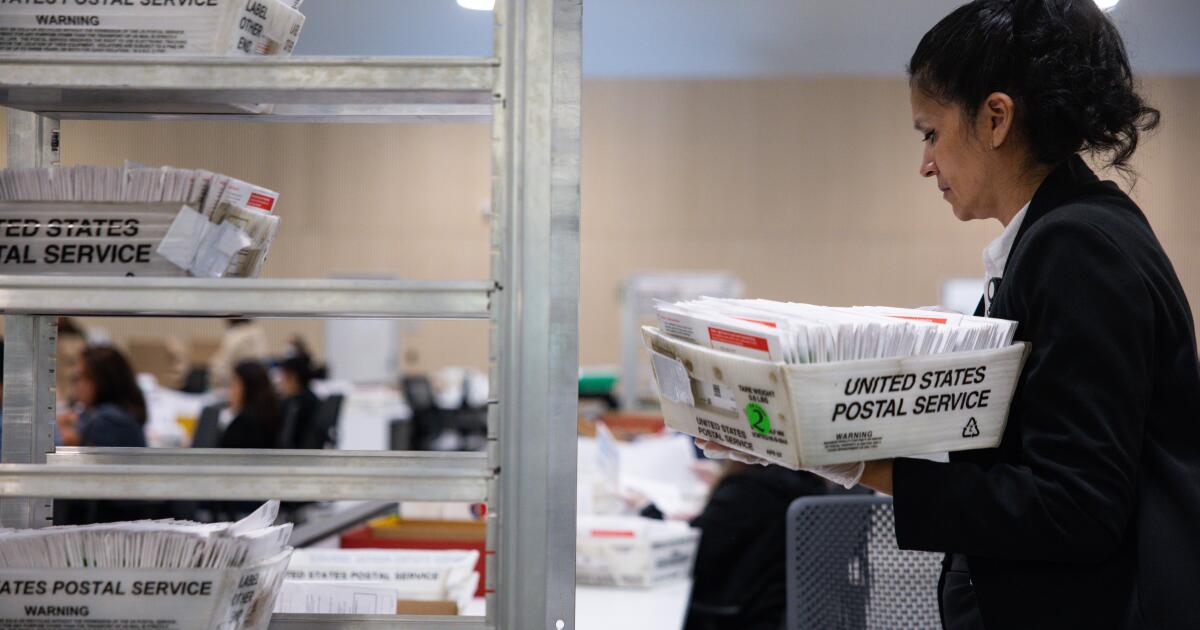
He has pushed the Department of Homeland Security to compile a list of citizens in each state to help determine voter eligibility. He is seeking to give the Postal Service a role in deciding who can receive mail ballots. He has threatened to withhold federal funding from states unless they phase out electronic voting machines. And he is pressuring Republican lawmakers to overhaul voting laws, claiming without evidence that elections are being rigged.

The efforts have run into resistance in court and within his own party. They have also left postal workers and local election officials bracing for an election cycle marked by deepening doubts about election integrity, and uncertainty about how the federal government may challenge the post-election results.

“It’s an unprecedented power grab to reshape how our elections work so that he and his allies can maintain and expand power,” said Eric Kashdan, director of federal advocacy at the Campaign Legal Center, a nonpartisan government ethics organization.

The White House defends the effort as fulfilling a campaign promise, and argues the administration is “lawfully enacting the agenda President Trump was elected to enact.”

One of Trump’s defining efforts to assert some federal control over state elections has been his insistence on passing the SAVE America Act, which would require voters to provide proof of citizenship when they register, require Americans to show identification when casting a ballot and require states to send voter data to the Department of Homeland Security.

His relentless push for the measure has prompted him to derail a bipartisan housing bill and threaten to forgo signing any piece of legislation unless the voting measure is approved. He says he considers the matter a “national emergency.” Despite the pressure campaign, Senate Republican leaders maintain there is not enough support to pass the measure.

The political stakes ahead of the midterms have been laid out more bluntly by House Speaker Mike Johnson (R-La.), whose chamber has approved the SAVE America Act. Last month, Johnson warned conservatives gathered at the Faith & Freedom Coalition that if Democrats win back control of the House, they will “go after the president’s family, the Cabinet, his donors, friends,” and supporters.

“I run the protection program,” Johnson said. “I will take care of you.”

Setbacks in court

The administration’s ambitions have hit numerous snags in court in the last month, with judges reaffirming in many cases that the Constitution gives states — not the federal government — primary authority over elections.

In one case, U.S. District Judge Sparkle L. Sooknanan, who was appointed by President Biden, went further.

She said a federal immigration database the Department of Homeland Security was compiling to determine voter eligibility violated privacy laws. She added that the database has resulted in states actively removing U.S. citizens from voter rolls based on inaccurate information.

“All in all, the federal government has knowingly trampled on the privacy rights of American citizens in a manner that threatens the sacred right to vote,” Sooknanan wrote. “This Court cannot stand idly by while that happens.”

James Percival, the general counsel for Homeland Security, said the ruling was the latest example of “how hard the Left will fight to stop us from solving problems they insist do not exist.”

The Supreme Court’s conservative majority this week also dealt a blow to the GOP and upheld state laws that allow for counting mail ballots that are postmarked by election day but arrive late.

The decision left Trump fuming. He said it was a “a little bit surprising” to see the court’s decision, claiming without evidence that the result will inevitably give “people more time to vote illegally.”

Democrats, in turn, saw the ruling as a necessary check on the Trump administration’s efforts.

“While we continue to see unprecedented efforts to interfere with elections from the Trump administration, it is a relief to see federal courts make clear that these attacks on mail and absentee voting are clearly illegal and unconstitutional,” Sen. Alex Padilla (D-Los Angeles) said in a statement after the ruling.

Trump is still eyeing changes to voting by mail. In March, he issued an executive order that seeks to limit who can receive mail ballots. Under the proposed rule, the Postal Service would not deliver mail ballots to states that don’t turn over sensitive voter data to the federal government, Postmaster General David Steiner told a Senate panel last month.

The admission drew immediate condemnation from Democratic lawmakers. They argued the regulation is an illegal attempt to coerce states into handing over their voter rolls.

“Please push back on being a pawn in this authoritarian playbook,” Sen. Elissa Slotkin (D-Mich.) told Steiner. “The Postal Service is one of the most important institutions in our country. Don’t taint it with the obsession of this one man.”

A day after that back-and-forth, U.S. District Court Judge Indira Talwani, who was nominated by President Obama, blocked those plans — at least for now.

“The Constitution does not grant the President any specific powers over elections,” the judge wrote, while adding that the Postal Service does not have the legal authority to determine who can vote by mail and how.

The White House said Wednesday that the administration remains confident the executive order will be in place by the November election.

Taken together, the administration’s efforts are unprecedented, UCLA law professor Rick Hasen said. That’s because the Constitution puts control over elections in the hands of the states and grants Congress the ability to pass laws, he said.

“The president really only has authority through federal statutes that have already been passed,” Hasen said. “It’s not surprising that many courts have struck down or stopped him from doing things to try to interfere with how elections are being run.”

Postal workers waiting for clarity

The legal setback for the Postal Service proposed rule was welcome news to the union representing postal workers.

“We believe that what we’re being asked to do is in violation of the oath that we took,” said Jonathan Smith, the president of the American Postal Workers Union, which represents more than 200,000 postal workers.

Following the ruling, the union called on the agency to abandon the rule, arguing it “will crush mailers’ trust in the Postal Service” and undermine “one of the most important functions the Postal Service and postal workers perform in service of the United States and its remarkable democracy.”

In several states, the union has run ads promoting mail voting as safe and a needed option for Americans. The ads were planned before Trump signed his executive order in March seeking to limit who can receive mail ballots, Smith said.

Now, the ads are taking a different meaning. Smith argued that “sometimes God works in mysterious ways.”

“The ad was then and is now intended as a piece to educate America about how good vote by mail is, how much it has been working out,” Smith said. “It’s an educational piece, not a response to the White House.”

Ahead of the election, Smith said postal workers are waiting for clarity on how their duties may change. But right now, he says, there isn’t much.

Orange County Registrar Bob Page said his office is monitoring any changes to existing federal and state election laws to ensure any changes, if needed, are implemented without disruptions. But he acknowledged the timing crunch could create some hurdles the closer the election gets.

“In many ways, any change to how California voters cast their ballots made between now and election day would create a challenge and may even be disruptive,” Page said.

He said many counties have ordered outgoing and return ballot envelopes for the election to ensure envelopes for more than 23 million California voters are ready to use by the Oct. 5 mailing deadline. Any change to how ballots should be prepared or mailed could present an issue.

“Our office has received calls from voters asking about potential changes to vote-by-mail procedures usually tied to media coverage about proposed changes,” he said. “We inform these voters that our procedures have not changed because the law has not changed and that we will mail their 2026 General Election ballots by Oct. 5.”

L.A. County prepares for possible voting changes

In Los Angeles County, election officials are also in a battle to bring clarity to the process as the administration ushers in a series of proposed changes to the election.

Dean Logan, the head of the Los Angeles County registrar-recorder/county clerk’s office, said his office is fighting to contain a wave of election misinformation, including some that is amplified by the White House.

“It’s not something that we’ve seen happen before, and certainly not at the level we’ve seen,” Logan said.

Rather than respond to every claim, Logan says his office picks its battles, intervening only when a falsehood appears likely to reach a wide audience. Even then, the office tries to avoid engagement with whoever is spreading it.

If the administration imposes a new rule closer to the election, Logan said his office is ready to follow the law.

“It’s really been about finding this balance of staying alert and prepared for the possibility [of change] but also not getting sucked into the political distraction,” he said.

Last month, Trump claimed without evidence that Democrats have cheated to win California’s primary elections, and boasted about federal prosecutors in Los Angeles investigating the matter.

Trump has also continued to claim Democrats are trying to rig or cheat in the upcoming election, remarks that have faced rebukes from members of his own party.

“I think it is ironic that we control the House, Senate, Supreme Court and the White House and we are yelling election fraud. I mean, we won all the damn elections,” Rep. Thomas Massie (R-Ky.) told reporters last month.

At the national level, Senate Democrats have said they plan to send election observers to polling places on behalf of Congress in reaction to Trump’s efforts.

“We are not waiting for chaos to arrive,” Senate Minority Leader Chuck Schumer (D-N.Y.) said last month. “We are preparing now.”

Times staff writer Justine McDaniel contributed to this report from Washington.

Source link

Legal correspondent Paula Reid expected to join MS NOW after CNN departure

As CNN prepares for change under a new owner, the network’s chief legal affairs correspondent, Paula Reid, is heading for the exit and expected to jump to MS NOW.

The Washington-based Reid’s contract with CNN is up in several months and she has told the network she does not plan to renew. She is expected to sign on with CNN competitor MS NOW, according to people familiar with her plans who were not authorized to comment publicly.

A representative for MS NOW said the network does not comment on personnel matters but added, “as everyone in Washington knows, Paula Reid is an exceptional reporter, and any news organization would be fortunate to showcase her journalism.”

Reid‘s planned departure comes ahead of the impending merger of CNN parent Warner Bros. Discovery and Paramount. The combination has led to speculation over who will run CNN, and the uncertainty is said to have played a factor in Reid’s decision.

Reid joined CNN from CBS News in 2021.

CNN and Paramount’s CBS News will be combined after the merger, but the management structure is still under discussion. Paramount put Bari Weiss, founder of the heterodox digital news site the Free Press, in charge of CBS News in October, with a mandate to move the network’s coverage more to the political center. Based on the chaos that has ensued at CBS News under her watch, many CNN insiders are concerned over her possible stewardship of an even larger and more complex organization.

CBS News executives and on-air talent have pushed back at Weiss’ efforts to make changes at the division, which many insiders have viewed as an attempt to placate the Trump White House while Paramount seeks regulatory approvals needed ahead of closing the $111-billion Warner Bros. Discovery deal.

Internal resistance to Weiss has been strongest at the venerable news magazine “60 Minutes.” The program’s star correspondent Scott Pelley was fired last month after he confronted management over the dismissals of executive producer Tanya Simon and his on-air colleagues Sharyn Alfonsi and Cecilia Vega.

Weiss’ overhaul of the “CBS Evening News” with her handpicked anchor Tony Dokoupil has failed to improve the third-place program’s competitive position in the ratings. The program has also been criticized for some of its editorial decisions and logistical snafus.

CNN anchor Anderson Cooper has reportedly told colleagues he does not want to work for Weiss if the cable network is put under her purview. He already rejected an offer from Weiss to anchor the “CBS Evening News” and declined to renew his deal as a “60 Minutes” contributor after nearly two decades with the program.

The chaos at CBS has given pause to people at CNN. Larry Ellison, the tech billionaire and father of Paramount Chief Executive David Ellison, has reportedly promised Trump there will be sweeping changes to CNN after the merger.

Reid, 43, is among the many TV news correspondents and anchors that Trump has disparaged over the years, claiming they are unfair in their coverage. As White House correspondent for CBS News, Reid was known for asking tough questions of Trump during his White House briefings on the coronavirus.

Reid was a lawyer before becoming a journalist at CBS News in 2010. In addition to serving as White House correspondent for the network, she covered the Justice Department and the Supreme Court.

Reid would be another significant hire for MS NOW, the progressive-leaning channel that is rebuilding its roster after separating from NBC News and its parent, Comcast. The network formerly known as MSNBC is now part of Versant, a company with a stable of cable networks spun off by Comcast.

Peter Alexander, former chief White House correspondent for NBC News, is joining MS NOW as a morning anchor later this year. The network also hired former “CBS Mornings” executive producer Shauna Thomas as political director.

Source link

Many indie festival films struggle to get distribution. Alamo Drafthouse is trying to change that.

Dine-in movie theater chain Alamo Drafthouse Cinema is launching a new initiative to show unreleased independent films that had successful festival runs, a move that comes as specialty films have struggled to gain distribution.

The Alamo Exclusives program, announced Wednesday, will give limited theatrical runs to films that showed at festivals including Sundance, the Toronto International Film Festival, Tribeca Festival and South by Southwest festival, as well as Alamo’s own Fantastic Fest.

The idea is to help showcase films that received critical acclaim, but did not secure distribution or acquisition deals. The chain will not acquire these films, but instead will enter into agreements with filmmakers to exhibit their films on Alamo Drafthouse screens. By showing these films to audiences on the big screen, these films could get the momentum they need for further opportunities.

The program’s first film will be the documentary “Butthole Surfers: The Hole Truth and Nothing Butt,” which debuted last year at South by Southwest and chronicles the history of the punk rock band.

The film will be shown in Alamo Drafthouse theaters for a limited time later this summer.

The Austin-based chain, which is owned by Sony Pictures, has a long history of curating indie films for its audiences, giving Alamo Drafthouse confidence that its viewers want to see these kinds of movies, company chief executive Michael Kustermann said in a statement.

“Time and again, they’ve shown they’ll come out to support bold, original films when given the opportunity,” he said. The new Alamo Exclusives “gives us another way to champion filmmaker-driven films that deserve to be discovered and connect them with the wider Alamo Drafthouse audience.”

The initiative comes at a difficult time for indie films. Since the pandemic upended the movie business, traditional studios and distributors have had less appetite for risk, including betting on smaller indie films out of festivals.

And as the 2023 dual writers’ and actors’ strikes thinned out theatrical lineups, that aversion to uncertainty became a push for reliable and profitable hits.

“Too many incredible films premiere at festivals and then never receive the theatrical life they deserve,” Lisa Dreyer, director of Fantastic Fest and film innovation at Alamo, said in a statement. “We are actively searching for films across all genres, from horror to comedy, to everything in-between, to champion in this new, exciting way.”

Source link

State budget deal strips power from elected schools chief

The just-approved state budget strips authority from the elected state superintendent of public instruction, transferring power in January to an appointee of the governor, dramatically changing the oversight and management of a public school system serving more than 6 million students from preschool through 12th grade.

The change was pushed through by Gov. Gavin Newsom at the urging of academics and education reformers who have long criticized how the state’s $149 billion public education system is governed.

In essence, the change consolidates increased power within the governor’s office — streamlining and largely replacing a diffuse system in which the state superintendent has significant influence, but no direct control over budget and policy.

Supporters hail the move as bringing accountability and coherence — through the governor — to all the departments and agenices involved in education.

“The approval of education governance reform, over a century in the making, is a monumental victory for California’s students that finally establishes a sensible system to best support them,” said Ted Lempert, president of Children Now, an Oakland-based research and advocacy organization. “We commend Governor Newsom for his leadership in making this much needed change a reality.”

Critics called the change an unjustified, undemocratic side-stepping of the state constitution and the will of voters.

“California’s constitutional architecture deliberately established an independent schools chief to ensure that public education answers directly to the voters,” wrote a labor coalition that included the two largest statewide teacher unions. “Replacing an elected constitutional officer with a partisan bureaucrat serving strictly at the pleasure of the executive branch breaks that model, permanently muting the public voice when democratic transparency matters most.”

The critics noted that voters have defeated every attempt to eliminate the elected state superintendent.

The latest effort bypasses the ballot box by keeping the elected position, but stripping most of its powers. The bill did not go through the typically lengthy legislative process; it was instead folded as a trailer bill into the state budget.

School district management groups, such as the one representing county superintendents, were more supportive of the changes.

Diffuse authority and accountability

Authority over education has long been distributed among different officeholders.

The Legislature passes laws related to education. The governor chooses which to sign. The governor also proposes what to pay for in education through his budget plan. The Legislature can amend the plan and has the responsibility to approve it.

The elected state superintendent runs the state Department of Education and serves as the administrative lead for the state Board of Education, whose members have been appointed by the governor to four-year terms. The superintendent does not have a vote on the board and must follow board authority in some areas but not others.

The board approves state education policy and curriculum.

“The current state system of support and accountability for local districts is uneven,” resulting in “islands of high quality surrounded by deserts where nothing much has improved,” said former State Board of Education President Michael Kirst, an emeritus Stanford professor of education. Instruction across the entire state was “unlikely to improve” under the status quo, he said.

How the office will change

All of the state superintendent’s authority will transfer to the education commissioner, who will be named by the governor and then approved by the state Senate.

That means the next governor will gain direct control or control through appointees over developing and spending the education budget — including state and federal grants — and developing education policies.

Under the old system, the state superintendent has overseen grants while also interpreting state education law and making sure schools complied.

The new law sets out the superintendent’s role instead as the “independently elected nonpartisan voice for the public interest in the governance of the state’s educational systems.” This role includes reporting to the Legislature “on the condition of education based on statewide engagement and travel to identify significant trends, challenges, and emerging issues.”

Critics worry that amounts to a whole lot of nothing.

That may be literally the case initially, as the new law gives governor’s new education commissioner until Oct. 1, 2027 to propose further reforms including “the future role and staffing” of the elected superintendent.

Until then, the new law provides for the superintendent to have several deputies and a skeleton clerical staff.

The superintendent also becomes one of 11 members of the state Board of Education and one of 19 members of the Board of Governors of the California Community Colleges.

Change opposed by candidates for the office

The overhaul occurs as two candidates vie to become the elected superintendent in November. Both have strongly opposed the change.

The race pits Republican Sonja Shaw, who finished first in the primary, against Democrat Richard Barrera.

Shaw, who decried the change as a “blatant power grab” that “silences voters,” said she had a game plan for how she intended to use the previous powers of the office if elected.

Sonja Shaw, a candidate for state schools superintendent

Sonja Shaw candidate for state superintendent

(Photo courtesy of Sonja Shaw)

“An outsider serving as state superintendent who refuses to simply defer to Sacramento could use the office’s authority over grants, contracts, federal programs, accountability systems, fiscal standards, parent resources, and administrative functions to prioritize results over ideology,” Shaw said.

“In practice, that could mean focusing resources on proven reading and math instruction, increasing transparency, fostering increased parental involvement, protecting fairness and safety for girls in sports,” she said.

If elected, Barrera said he hopes to work immediately to fill in the blanks with a meaningful role for the superintendent and to bring in important education voices that he said have been left out so far.

Richard Barrera, a candidate for state schools superintendent

Richard Barrera, a candidate for state schools superintendent

(Sam Hodgson/The San Diego Union-Tribune)

“The whole purpose of this restructuring is bringing people into alignment, with the focus on goals for student learning, and I’d say we have a long way to go,” Barrera said.

Both candidates said there was potential grounds for a legal challenge to the rewritten duties.

California Teachers Assn. President David Goldberg also was among the opposing voices.

“There’s always tons of issues going on for a governor, and education issues are likely to be put on the back burner.” State voters, he added, “have really wanted an independent voice around public education,” someone willing at times to stand up to the governor.

Supporters of the change counter that the governor — who has to answer to a broad base of interests — would be less susceptible to education special-interest groups, including teacher unions.

The central tenets of the new framework are based on a December 2025 report from Policy Analysis for California Education, a nonpartisan center that brings together researchers from Stanford, UC Berkeley, UCLA, UC Davis and USC.

Source link

Inside Soap Awards nominations revealed as ceremony makes major change

The Inside Soap Awards are back and they have announced a major change to this years’ event to mark the 30th anniversary

The Inside Soap Awards are back – and are making the move up North for the first time ever.

This year’s event will take place in Manchester and will be the only soap awards ceremony held this year.

Coronation Street, EastEnders, Emmerdale and Hollyoaks will all go head to head whilst Australian soap Home and Away has also been nominated as well as dramas like Casualty and Waterloo Road.

Up for nomination this year is the epic Coronation Street and Emmerdale crossover episode – Corriedale – as well as Nigel’s sad death in EastEnders, amongst other dramatic and heartbreaking scenes.

“The Inside Soap Awards are still going strong after 30 years, and we’re proud to be championing all the wonderful work the soaps produce day in, day out. Our readers are just as passionate and loyal now as they were back in 1996, with over 90,000 of them voting each year – and the Inside Soap Awards remain the only accolades of their kind to be voted for entirely by the true experts, the soap fans themselves,” Inside Soap magazine editor Sarah Ellis said.

To mark the awards’ 30th anniversary, there will be their very own Hall of Fame and the first inductee will be announced during the ceremony. She added: “The soap star who receives this prestigious accolade will be someone who’s been closely associated with the Inside Soap Awards since they began in 1996.

“In addition, fans will also be able to nominate their Soap Superstar of 2026, a person they feel has gone above and beyond the call of duty when it comes to providing entertainment.”

Voting opens midday on Tuesday 30 June, and the winners will be revealed in Manchester in September.

The full list of nominations are as follows:

Best Actress

Sue Devaney (Debbie Webster, Coronation Street )

Vicky Myers (Lisa Connor-Swain, Coronation Street )

Tina O’Brien (Sarah Platt, Coronation Street )

Emma Barton (Honey Mitchell, EastEnders )

Karen Henthorn (Julie Bates, EastEnders )

Diane Parish (Denise Fox, EastEnders )

Emma Atkins (Charity Dingle, Emmerdale )

Olivia Bromley (Dawn Fletcher, Emmerdale )

Natalie J Robb (Moira Barton, Emmerdale )

Alex Fletcher (Diane Hutchinson, Hollyoaks )

Nadine Mulkerrin (Cleo McQueen, Hollyoaks )

Anna Passey (Sienna Blake, Hollyoaks )

Ada Nicodemou (Leah Patterson, Home and Away )

Sophea Pennington (Lacey Miller, Home and Away )

Emily Weir (Mackenzie Booth, Home and Away )

Best Actor

Rob Mallard (Daniel Osborne, Coronation Street )

Vinta Morgan (Ronnie Bailey, Coronation Street )

Gareth Pierce (Todd Grimshaw, Coronation Street )

Paul Bradley (Nigel Bates, EastEnders )

Colin Salmon (George Knight, EastEnders )

Aaron Thiara (Ravi Gulati, EastEnders )

Ryan Hawley (Robert Sugden, Emmerdale )

Jeff Hordley (Cain Dingle, Emmerdale )

Joshua Richards (Bear Wolf, Emmerdale )

Louis Emerick (Donny Clark, Hollyoaks )

Danny Mac (Dodger Savage, Hollyoaks )

Nick Pickard (Tony Hutchinson, Hollyoaks )

Ethan Browne (Tane Parata, Home and Away )

Tristan Gorey (Levi Fowler, Home and Away )

James Stewart (Justin Morgan, Home and Away )

Best Comic Performance

Amy Robbins (Christina Boyd, Coronation Street )

Jack P Shepherd (David Platt, Coronation Street )

Pierre Counihan-Moullier (Oscar Branning, EastEnders )

Harriet Thorpe (Elaine Peacock, EastEnders )

Chris Coghill (Kev Townsend, Emmerdale )

Shebz Miah (Kammy Hadiq, Emmerdale )

Nicole Barber-Lane (Myra McQueen, Hollyoaks )

Jorgie Porter (Theresa McQueen, Hollyoaks )

Emily Symons (Marilyn Chambers, Home and Away )

Shane Withington (John Palmer, Home and Away )

Best Villain

James Cartwright (Theo Silverton, Coronation Street )

Beth Nixon (Megan Walsh, Coronation Street )

Ronni Ancona (Bea Pollard, EastEnders )

Christopher Fairbank (Eddie Knight, EastEnders )

Joe Absolom (Ray Walters, Emmerdale )

Ned Porteous (Joe Tate, Emmerdale )

Gemma Bissix (Clare Devine, Hollyoaks )

Anna Passey (Sienna Blake, Hollyoaks )

Lachlan Miller (Holden Dwyer, Home and Away )

Sara Wiseman (Kerrie Matheson, Home and Away )

Best Young Performer

Lucas Hodgson-Wale (Will Driscoll, Coronation Street )

Jude Riordan (Sam Blakeman, Coronation Street )

Sonny Kendall (Tommy Moon, EastEnders )

Max Murray (Joel Marshall, EastEnders )

Amelia Flanagan (April Windsor, Emmerdale )

Fred Kettle (Dylan Penders, Emmerdale )

Charlie Behan (Charlie Dean, Hollyoaks )

Oscar Curtis (Lucas Hay, Hollyoaks )

Austin Cutcliffe (Casey Sharpe-Braxton, Home and Away )

Nathan Murray (Cohen Luthor, Home and Away )

Best Newcomer

Olivia Frances-Brown (Jodie Ramsey, Coronation Street )

Junade Khan (Idris Nazir, Coronation Street )

Indeyarna Donaldson-Holness (Jasmine Fisher, EastEnders )

Pierre Counihan-Moullier (Oscar Branning, EastEnders )

Casey Al-Shaqsy (Serena Sugden, Emmerdale )

Chris Coghill (Kev Townsend, Emmerdale )

Tisha Merry (Gemma Johnson, Hollyoaks )

Naledi Rapotu (Kathleen-Angel McQueen, Hollyoaks )

Maddison Brown (Jo Langham, Home and Away )

Jeremy Lindsay Taylor (David Langham, Home and Away)

Best Exit

Daniel Brocklebank (Billy Mayhew, Coronation Street )

James Cartwright (Theo Silverton, Coronation Street )

Nicholas Bailey (Anthony Trueman, EastEnders )

Paul Bradley (Nigel Bates, EastEnders )

Joe Absolom (Ray Walters, Emmerdale )

Jaye Griffiths (Celia Daniels, Emmerdale )

Alex Fletcher (Diane Hutchinson, Hollyoaks )

Tamara Wall (Grace Black, Hollyoaks )

Matt Evans (Theo Poulos, Home and Away )

Lynne McGranger (Irene Roberts, Home and Away )

Best Family

The Driscolls ( Coronation Street )

The Platts ( Coronation Street )

The Brannings ( EastEnders )

The Watts-Fowlers ( EastEnders )

The Dingles ( Emmerdale )

The Sugdens ( Emmerdale )

The Hutchinsons ( Hollyoaks )

The Maalik-Clarkes ( Hollyoaks )

The Fowlers ( Home and Away )

The Langhams ( Home and Away )

Best Partnership

Alison King & Vicky Myers (Carla & Lisa Connor-Swain, Coronation Street )

Jack P Shepherd & Julia Goulding (David & Shona Platt, Coronation Street )

Steve McFadden & Paul Bradley (Phil Mitchell & Nigel Bates, EastEnders )

Heather Peace & Balvinder Sopal (Eve & Suki Panesar-Unwin, EastEnders )

Jeff Hordley & Natalie J Robb (Cain & Moira Dingle, Emmerdale )

Danny Miller & Ryan Hawley (Aaron Dingle & Robert Sugden, Emmerdale )

Jennifer Metcalfe & Jamie Lomas ( Mercedes McQueen & Warren Fox, Hollyoaks )

Kieron Richardson & Jonny Labey (Ste Hay & Rex Gallagher, Hollyoaks )

Nicholas Cartwright & Stephanie Panozzo (Cash Newman & Eden Fowler, Home and Away )

Ada Nicodemou & James Stewart (Leah Patterson & Justin Morgan, Home and Away )

Best Storyline

Todd’s abuse at the hands of Theo ( Coronation Street )

Will groomed by predator Megan ( Coronation Street )

Denise’s cancer diagnosis ( EastEnders )

Nigel’s dementia & final goodbye ( EastEnders )

Bear’s modern slavery nightmare ( Emmerdale )

Charity’s baby bombshell ( Emmerdale )

Diane’s ovarian cancer ( Hollyoaks )

Cleo’s postpartum psychosis ( Hollyoaks )

Mackenzie & Levi’s fertility journey ( Home and Away )

Irene’s Alzheimer’s diagnosis ( Home and Away )

Best Showstopper

(Awarded to a soap event that had the audience on the edge of their seats)

Corriedale ( Coronation Street & Emmerdale )

Murder mystery flash forward: who dies? ( Coronation Street )

Kat & Zoe’s Reunion ( EastEnders )

Nigel’s 90’s Special ( EastEnders )

Ray’s killer revealed ( Emmerdale )

Return to Brookside Close ( Hollyoaks )

Clare & Sienna’s final showdown ( Hollyoaks )

The Train Crash ( Home and Away )

Tane flees to Western Australia ( Home and Away )

Best Drama Star

William Beck (Dylan Keogh, Casualty )

Elinor Lawless (Stevie Nash, Casualty )

Kirsty Mitchell (Faith Dean, Casualty )

Olly Rix (Flynn Byron, Casualty )

Lindsey Coulson (Stella Drake, Waterloo Road )

Jon Richardson (Darius Donovan, Waterloo Road )

Maisey Robinson (Portia Weever, Waterloo Road )

Adam Thomas (Donte Charles, Waterloo Road )

Best Soap

Coronation Street

EastEnders

Emmerdale

Hollyoaks

Home and Away

Like this s tory? F or more of the latest showbiz news and gossip, follow Mirror Celebs on TikTok , Snapchat , Instagram , Twitter , Facebook , YouTube and Threads .



Source link

South Korean president, ex-players, fans demand change after World Cup exit | World Cup 2026 News

South Korea’s dismal World Cup first-round exit has prompted fury at home, and calls for a complete overhaul at the top have not been silenced by coach Hong Myung-bo’s resignation.

South Korea, World Cup semifinalists as cohosts in 2002, limped out of the tournament after failing to squeeze into the knockout rounds as one of the top eight third-place finishers.

They had the last 32 within their reach only to suffer a shock 1-0 loss to lower-ranked South Africa.

Their early exit prompted coach Hong to quit on Sunday and cast doubt over the international future of captain Son Heung-min.

It also earned the team a rebuke from the country’s president, Lee Jae Myung, who pointed the finger at “incompetent people” and apologised to the nation.

The president’s comments reflect public anger that has reached a boiling point after years of simmering discontent with South Korean football chiefs.

South Korean fans react after their team lost the 2026 World Cup football match against South Africa at Gwanghwamun Square in Seoul on June 25, 2026. (Photo by Jade GAO / AFP)
South Korean fans at the Gwanghwamun Square in Seoul react after their team lost against South Africa [Jade Gao/AFP]

Former captain Park Ji-sung said, “We may have expected this outcome years ago.

“We have to look back and ask ourselves why things have come to this,” the former Manchester United player said after the team’s elimination was confirmed.

“Even after spending a decade learning how to prepare for the World Cup and develop Korean football, we have forgotten those lessons once again.”

South Korea was expected to emerge from Group A that included cohosts Mexico, South Africa and Czechia.

They started with a 2-1 win over the Czechs but lost 1-0 to Mexico before bowing out against South Africa.

The team were expected to arrive home on Tuesday morning, but local media reported that the Korea Football Association (KFA) were not planning to organise an event to welcome them back.

In 2014, angry fans pelted the team with Korean candies – seen as a deeply offensive insult – when they returned from the World Cup in Brazil, where they went out in the group stage during Hong’s first spell as coach.

South Korea's head coach Hong Myung-bo gestures as he gives a press conference at Chivas Verde Valle in Guadalajara, Mexico on June 25, 2026, during the 2026 World Cup football tournament. (Photo by Ulises RUIZ / AFP)
South Korea’s head coach Hong Myung-bo stepped down after the team failed to reach the World Cup 2026 knockouts [Ulises Ruiz/AFP]

‘Message to change’

Hong has been a lightning rod for criticism since he returned to the job in July 2024, five months after his predecessor, German World Cup-winner Jurgen Klinsmann, was axed.

The KFA came under fire for the process that led to Hong’s reappointment, with questions asked over its transparency and fairness.

Hong, who was regularly booed by fans, did himself no favours at the World Cup by dropping star player Son for the South Africa game, in which South Korea needed only a point to progress.

Hong admitted afterwards that he was struggling to understand what had gone wrong, as the nation nervously waited for results in other games to decide their fate.

Soccer Football - FIFA World Cup 2026 - Group A - South Africa v South Korea - Estadio Monterrey, Monterrey, Mexico - June 24, 2026 South Korea's Son Heung-min warms up on the sidelines REUTERS/Eloisa Sanchez
Son Heung-min was benched against South Africa, a game South Korea went on to lose and ultimately exit from the World Cup [Eloisa Sanchez/Reuters]

Lee Chun-soo, a member of the 2002 World Cup team, said he “felt pathetic and frustrated rooting for Uzbekistan” against the Democratic Republic of the Congo in the hope that the result would send South Korea through.

“This is a message to change,” Lee said on his YouTube channel. “Everyone should be ready to step down.”

South Korean fans reserved a sizeable chunk of their anger for KFA President Chung Mong-gyu.

Chung said before the World Cup that he would quit after the tournament, blaming his “lack of virtue” following fierce criticism of his 13-year tenure.

The 65-year-old, who is in his fourth term as KFA president, came under fire for trying to pardon former players who were banned for life for match-fixing.

Chung and Hong might not be the only ones to bow out, with captain Son yet to comment on his future.

The skipper, who turns 34 next month, had previously hinted at retiring from international football.

Former captain Park said South Korea needed to learn from the past.

“It’s unfortunate that this kind of cycle keeps repeating,” he said.

“We must dream of and shape a better future, and move forward step by step so that we don’t repeat these mistakes.”

Source link

All tourists urged to change 1 phone setting or risk ‘major problem’ at airports

Tourists have been told they need change a key phone setting before travelling to airports. Failing to do so could land them with a “major problem”, so it’s best to act

There’s so much to think about when you travel abroad, but something that probably slips your mind is safely using your phone during your journey. It’s something you need to pay attention to, as you are required to follow a few rules to keep safe.

While it may be something that rarely crosses your mind, it should actually be on the top of your travel list, as making some simple mistakes can be super costly when you’re on a holiday adventure. We all use our mobile phones when we’re at airports but, little you may know, some dangers can come with making the decision to use them in certain ways.

This isn’t the first time such matters have been brought to people’s attention either. Previously, some other hidden dangers were outlined to aid travellers.

Free airport Wi-Fi feels like a small win when you’re killing time before a flight. However, William Thackray, IT expert at AGT Computer Services, claims it’s one of the riskiest things you can do on your phone.

What you need to know

William explained: “The biggest threat isn’t the airport’s actual network. It’s the fake ones sitting right next to it.

“Criminals can set up a hotspot called something like ‘Heathrow Free Wi-Fi’ or ‘Gatwick Passenger Network’ that looks completely legitimate. The moment you connect, they can intercept your data including passwords, emails, anything you’re sending or receiving.”

This technique, known as an “evil twin” attack, is increasingly common in busy public spaces and airports and, with thousands of distracted travellers all hunting for a signal, they are prime targets.

You may not realise, but connecting to airport Wi-Fi can leave your personal data exposed to hackers in seconds. Criminals can set up fake networks designed to look identical to the real thing.

Airport Wi-Fi is rarely considered completely safe. While it is generally fine for browsing the news or checking your flight status, public networks leave you vulnerable to hackers, phishing attempts and rogue “evil twin” hotspots.

You should avoid online banking or entering passwords without taking precautions. This is why the guidance is so essential.

However, one simple phone setting can keep you protected without costing you a penny. It’s easy to sort out once you know what to do.

How to avoid a problem

The fix is straightforward. Before you leave for the airport, go into your phone’s Wi-Fi settings and turn off “Auto-Join” or “Auto-Connect” for public networks. On iPhone, you can also go to Settings > Wi-Fi and toggle off “Ask to Join Networks”.

That way your phone won’t go hunting for a signal without your say-so. “Better still, use your mobile data if you have it,” added William.

“It costs a little more, but it’s your own private connection. If you do need to use airport Wi-Fi, avoid logging into anything sensitive like banking, work email, anything with a password – until you’re somewhere you trust.”

The rule of thumb? If you didn’t set up the network yourself, treat it with caution. This is a rule that’s really worth paying attention to, as failing to follow it could lead to major problems.

Source link

Climate change the culprit for Europe’s ‘most severe’ heatwave: Report | Climate News

The extreme June temperatures would have been ‘virtually impossible’ 50 years ago, says the World Weather Attribution group.

The historic heatwave gripping Europe is part of a dangerous weather trend that can only be explained by human-caused climate change, scientists have said.

The extreme temperatures sweeping across much of Europe mark the region’s “most severe” heatwave ever tracked for the month, and would have been “virtually impossible” half a century ago, the World Weather Attribution group of scientists said in a report released on Friday.

Recommended Stories

list of 3 itemsend of list

Millions in France, Italy, Spain, the United Kingdom and elsewhere in Europe have been experiencing blazing heat this week, with daytime temperatures topping 40 degrees Celsius (104 Fahrenheit) in many places.

The heatwave was reported on Friday to be moving eastwards, threatening Germany and central Europe with similar conditions to those which killed dozens in the western reaches of the continent, strained medical services and stressed the economy.

The World Weather Attribution estimated that a heatwave with similar characteristics occurring in the climate of June 1976 – when Europe was also hit by persistently high temperatures – would have been about 3.5 degrees Celsius cooler.

During another episode in 2003, temperatures would have been about 2 degrees Celsius cooler, the research suggests.

The analysis shows that intense heat is increasing rapidly, even within living memory, “with such events tens to hundreds of times more likely since only 2003 and virtually impossible just 50 years ago,” the study says.

“This event would not have been possible in June without climate change,” the study’s lead author, Theodore Keeping from Imperial College London, told reporters.

Phasing out fossil fuels ‘critical’

The planet has warmed about 1.4C above pre-industrial times, driven by the burning of coal, oil and gas.

Scientists agree this is making extreme weather events like heatwaves more frequent and intense, and that limiting warming is vital to avoid the worst impacts of climate change.

Of the nearly 850 cities the World Weather Attribution’s study analysed in Europe, some 45 percent had broken – or were expected to break – their all-time heat stress records in June.

“The weather pattern itself is not particularly unusual, but the temperatures are – or at least they used to be without human-induced climate change,” said Friederike Otto, the cofounder of World Weather Attribution.

The June heatwave in Europe is the second such episode this year. An early-season period of heat in May brought temperatures more typical of high summer to central and western parts of the continent.

World Weather Attribution said the rapid phase-out of fossil fuels is “critical if we are to avoid even higher temperatures and their consequences in the future”.

Source link

Could the Hormuz Oil Shock Change the Future of Global Energy?

The reopening of the Strait of Hormuz has restored the flow of oil and natural gas after more than 100 days of disruption, but the crisis has already left a lasting mark on global energy markets. The prolonged closure exposed the vulnerability of the world’s energy supply chain and has prompted governments to reconsider how they secure fuel supplies.

Analysts say the crisis mirrors the impact of the 1973 Arab oil embargo, which transformed global energy policy by encouraging conservation, diversification, and strategic stockpiling. While today’s energy system proved more resilient, the Hormuz disruption may accelerate a broader shift away from fossil fuels.

What Happened?

The Strait of Hormuz, through which nearly 20 percent of global oil and liquefied natural gas supplies normally pass, remained effectively closed for more than three months during the US Israeli conflict with Iran.

Despite the disruption, global markets avoided a severe supply crisis through rapid rerouting of cargoes, the release of strategic reserves, reduced Chinese imports, and shifting demand patterns.

However, analysts say these emergency measures were only temporary. Energy inventories fell sharply during the crisis, and markets were approaching a critical point before shipping resumed.

Why the Crisis Matters

The Hormuz disruption demonstrated that even today’s highly interconnected global energy system remains vulnerable to geopolitical conflict.

Unlike previous crises, the world avoided a complete energy collapse because governments, traders, and shipping companies quickly adapted. Nevertheless, the episode exposed the limits of those emergency responses and reinforced concerns about overreliance on a single strategic chokepoint.

The crisis is expected to influence long term energy investment decisions far beyond the Middle East.

Lessons From the 1973 Oil Embargo

The 1973 Arab oil embargo fundamentally changed global energy policy after oil producing nations restricted exports to countries supporting Israel during the Yom Kippur War.

The embargo caused oil prices to surge, triggering inflation and prompting governments to adopt fuel efficiency standards, develop domestic oil production, establish strategic petroleum reserves, and create the International Energy Agency.

Rather than ending fossil fuel use, the crisis encouraged countries to consume energy more efficiently while reducing dependence on imported oil.

A New Energy Strategy Emerges

The Hormuz crisis appears to be driving another major strategic shift, particularly across Asia.

Countries heavily dependent on Middle Eastern oil and gas are increasingly prioritizing energy security over low fuel costs. Governments are expected to expand strategic petroleum reserves while accelerating investment in domestic renewable energy, nuclear power, and alternative fuel sources.

India, Pakistan, Japan, and South Korea are among the countries reviewing long term strategies aimed at reducing exposure to overseas energy disruptions.

Europe Continues Its Energy Transition

Europe entered the Hormuz crisis after already reshaping its energy system following Russia’s invasion of Ukraine in 2022.

The loss of Russian energy supplies forced European countries to cut gas consumption, diversify imports, and rapidly expand renewable energy capacity.

The latest Middle East disruption is expected to reinforce that trend by encouraging further investment in clean energy and energy efficiency while reducing dependence on imported fossil fuels.

Global investment patterns already suggest that energy markets are evolving.

According to the International Energy Agency, worldwide energy investment is projected to reach 3.4 trillion dollars this year, with much of the growth directed toward renewable energy, electricity infrastructure, battery storage, and grid resilience rather than new oil production.

Electric vehicle sales continue to rise rapidly across Europe, Latin America, and Asia Pacific, while Chinese solar panel exports have surged across Africa and Southeast Asia.

Governments are also increasing spending on energy efficiency, with around 20 countries introducing new conservation measures directly in response to the Hormuz crisis.

Why It Matters

The Hormuz crisis has reinforced that energy security is becoming just as important as energy affordability.

Rather than relying solely on global oil markets, governments are increasingly pursuing diversified energy systems that combine fossil fuels with renewables, nuclear power, strategic reserves, and domestic production.

This transition is expected to influence investment, industrial policy, and international trade for years to come.

Future Outlook

Oil and natural gas are expected to remain central to the global economy for decades, particularly in transportation, manufacturing, aviation, and power generation.

However, future growth in fossil fuel demand may become significantly slower as governments invest more heavily in renewable energy, electric vehicles, battery storage, and efficiency improvements.

The Hormuz crisis may ultimately be remembered not as the event that ended the oil era, but as the moment many countries accelerated preparations for a more diversified energy future.

Implications

The Hormuz crisis is likely to have consequences that extend far beyond the immediate recovery in oil and gas flows. Governments that experienced supply disruptions are expected to place greater emphasis on energy security, even if it comes at a higher economic cost. This could accelerate the expansion of strategic petroleum reserves, diversify import sources, and increase investment in domestic energy production, including renewables, nuclear power, and critical energy infrastructure.

For oil exporters in the Gulf, the crisis may strengthen the case for developing alternative export routes that bypass the Strait of Hormuz, reducing dependence on a single maritime chokepoint. Import dependent economies, particularly across Asia, are also likely to rethink long term procurement strategies by securing more flexible supply contracts and expanding storage capacity.

Financial markets are also expected to assign a higher geopolitical risk premium to energy prices. Even after shipping has resumed, investors may continue to price in the possibility of future disruptions, increasing volatility across oil, gas, shipping, and insurance markets. The crisis could also accelerate capital flows into technologies that reduce dependence on imported fossil fuels, including electric vehicles, battery storage, hydrogen, and energy efficiency.

Analysis

The Hormuz crisis may ultimately prove more significant for what it revealed than for the physical disruption it caused. Although global energy markets demonstrated remarkable resilience, that resilience depended on temporary measures such as drawing down inventories, rerouting cargoes, reducing consumption, and relying on spare production capacity. These mechanisms bought time rather than solving the underlying vulnerability of the global energy system.

Unlike the 1973 Arab oil embargo, which primarily forced consuming nations to improve efficiency while expanding fossil fuel production elsewhere, today’s crisis occurred at a time when commercially competitive alternatives to oil and gas already exist. Renewable energy, electric vehicles, battery storage, and advanced power grids have matured into viable strategic assets rather than purely environmental investments. As a result, governments are increasingly viewing clean energy not only as a climate policy but also as a national security priority.

Another important distinction is the shift in investment behavior. Historically, supply disruptions often encouraged greater investment in oil exploration and production. Following the Hormuz crisis, however, a growing share of capital is moving toward energy diversification instead of simply increasing fossil fuel output. This suggests policymakers increasingly see reducing oil dependence as a more sustainable way to improve resilience than expanding strategic reserves alone.

The crisis also exposed a structural imbalance in global energy markets. While production remains concentrated in politically sensitive regions, demand growth is increasingly centered in Asia, leaving major importers highly exposed to geopolitical instability. Countries such as India, Pakistan, Japan, and South Korea may therefore pursue parallel strategies of securing diversified hydrocarbon supplies while rapidly expanding domestic renewable generation, nuclear power, and energy storage.

Perhaps the most important takeaway is that energy security has overtaken cost as the dominant driver of policy decisions. For decades, governments largely optimized their energy systems for affordability and efficiency. The Hormuz disruption demonstrated that the cheapest energy source can quickly become the most expensive if geopolitical events interrupt supply. That realization is likely to reshape government policy, corporate investment, and global energy trade for years to come.

The crisis does not signal the immediate end of the oil era. Oil and natural gas will remain indispensable for transportation, petrochemicals, aviation, heavy industry, and electricity generation in many regions. However, it may represent an inflection point where the trajectory of fossil fuel demand begins to flatten as countries systematically reduce their strategic dependence on imported hydrocarbons. In that sense, the Hormuz crisis could be remembered less as an energy supply shock and more as the catalyst that accelerated the next phase of the global energy transition.

With information from Reuters.

Source link

Huge change at Ryanair as airline DROPS hated hidden charges for families

An image collage containing 1 images, Image 1 shows Ryanair plane on the tarmac

BIG news for families who travel on Ryanair flights.

The airline has announced that it has changed its policy so that families can sit together free of charge.

An image collage containing 1 images, Image 1 shows Ryanair plane on the tarmac
Ryanair has changed its policy so adults can sit with their children with no extra charges Credit: Alamy

In a statement made today, Ryanair said that there will be free parent and child seats available together in the rear of its planes for families.

For adults travelling with children who choose this new seating option, they will be told of their seat allocation after they have checked in for their flight.

This is the case with most other airlines in Europe.

Families who opt for this are likely to be seated towards the back of the plane.

TOP SEA-CRET

Locals’ guide to UK’s top seaside counties… best beaches & pubs and £15 stays


CHEAP DATE

Our fave cheap European destinations with flights under £20 & hotels from £24pp

It’s still an option for families to choose their seats in advance, but this does require a seat reservation fee.

Previously, Ryanair’s Ts&Cs required at least one parent to sit with their children aged 2-11 when they fly.

This was done through what Ryanair calls a “mandatory family seat”, which the parent must pay for in order to secure a seat next to them for their child.

For all other passengers, reserving a seat is optional.

This fee applies to both outbound and return flights and typically costs around £8 each way.

Ryanair’s website refers to “Free reserved seats for kids under 12”, but the parents and guardians had to pay a booking fee to access these seats.

Typically, other airlines offer to seat children with a parent or guardian without the need for a paid-for adult seat reservation, or allocate seats together automatically during booking for free.

The new policy comes in on new bookings made from today.

The airline is facing investigation by the CMA to determine whether the practice is “in line with consumer law”.

On the policy change, a CMA spokesperson said: “Ryanair claims its seating policy now complies with the law, and we’ll test that thoroughly. If true, it’s a win for families – who will no longer have to pay to sit with their children – and it shows the impact our new powers are having.

“But it doesn’t change the fact families have been paying for ‘mandatory family seats’. Our investigation remains ongoing.”

Ryanair boss Michael O’Leary commented on the changes…

Ryanair CEO, Michael O’Leary, said: “Turning a blind eye to the high fares charged by airlines on routes with no Ryanair competition, the CMA has now targeted our family seating policy which has been universally embraced by consumers as the most progressive and transparent in Europe.

“Instead of promoting competitiveness and lower fares for consumers, the CMA is on a mission to force Ryanair to adopt the less transparent and less consumer-friendly family seating policy applied by most other airlines – just because it’s the industry standard.”

He said that the airline will “reluctantly adjust” to the industry standard.

Michael explained that “families may have to wait until after they have checked in to find out their seat allocation”.

And that these seats are likely to be at the “rear of the cabin”


Source link

Ashley Cain breaks silence after BBC axe for historic ‘abusive’ posts as reality TV star says ‘I cannot change the past’

ASHLEY Cain has spoken out for the first time since he was axed by the BBC after allegedly making degrading comments about women online.

The reality TV star penned an apology on Instagram, addressing “language I used many years ago that I am not proud of”.

Ashley Cain, 35, has spoken out for the first time since he was dropped by the BBC Credit: Splash
The Ex on the Beach star had made derogatory comments about women Credit: Instagram/mrashleycain

The 35-year-old was dropped by the Beeb last week after historic social media posts came to light which were deemed “offensive” to women.

His BBC Three documentary Into The Danger Zone has been shelved for its second season.

In response to a disastrous day as he was dropped by his management, Cain took to Instagram to address the controversy.

“You may have seen a recent article concerning language I used many years ago that I am not proud of.

TWEET SHAME

Ashley Cain under fire as posts calling women ‘s**ts’ & sex video row resurface


FRESH BLOW

Ashley Cain ‘dropped by management’ after BBC axe & ‘abusive’ posts about women

The reality star has featured on programmes including Celebrity Masterchef on the BBC Credit: BBC
He said he wanted to take ‘accountability’ for his past comments Credit: BBC

“I don’t deny it. I don’t excuse it. And I certainly don’t condone it,” he began.

Cain blamed the loss of his football career as one of the factors which caused him to feel “lost, frustrated and unsure of where my life was heading”.

He went on: “The reality is that growth doesn’t happen overnight. It happens through experience.

“Through mistakes. Through hardship. Through being forced to look in the mirror and ask yourself whether you’re willing to become better.”

Yesterday, the Daily Mail reported that Ashley had been dropped as a client by his management company Off Limits amid recent events.

“Ashley has been dropped by Off Limits, who also represent stars such as Jimmy Bullard, Jesy Nelson and Harry Redknapp,” an insider told the publication.

“They have a roster of talent who are household names, they don’t want to be associated with him after the vile posts came to light.

“Ashley is now pretty much blacklisted in the industry, and it’s doubtful he will ever be on television again.”

The second season of Ashley Cain: Into the Danger Zone has been shelved Credit: BBC
Cain said the tragic loss of his daughter Azaylia in 2021 after a battle with leukaemia Credit: miss_safiyya_/Instagram

Ashley no longer appears on Off Limits website as a listed client.

The Ex on the Beach star’s Twitter posts made in 2011 and 2013 are said to have referenced extreme sex acts and appeared to make light of consent.

He reportedly used offensive, sexualised and aggressive language about women.

Derogatory terms allegedly written in 2014 and 2015 include “sl**s”, “b***hes” and “psychos”.

He also said he’d like to “choke slam” and “spit in the face” of Love Island star Jessica Hayes while commenting on the ITV2 reality show.

Cain’s apology post said he has learnt lessons from fatherhood over the past decade.

His daughter Azaylia Cain sadly died in 2021 of a rare form of acute myeloid leukaemia.

She was just eight months old when she died after a battle with the aggressive disease.

“Losing my daughter changed me forever,” Cain wrote.

“Since then, I have dedicated my life to trying to honour my daughter’s legacy and help others wherever I can.”

The reality star added: “I cannot change what I said over a decade ago. What I can do is take responsibility for it.

“What I can do is continue striving every day to be a good father, a good human and a positive force in the lives of others.”

Cain’s shock slurs sit uncomfortably alongside his more recent work as a BBC presenter exploring masculinity and gangs in dangerous locations around the world.

A BBC spokesperson said: “We are very clear we expect the highest standards of behaviour from everyone who works with or for the BBC.

“When allegations are brought to our attention we take them seriously. We will consider this information carefully and do not intend to comment further at this stage.”

The BBC were reportedly unaware of the offensive content prior to recruiting Cain as a host.

Dad-of-three Cain was a professional footballer at the time of his oldest offensive tweets.

Following contracts at Coventry City and non-league Barwell, he was forced to retire from the game in 2014 due to the effects of a serious achilles injury.

He turned to reality TV and starred in the first series of Ex on the Beach. More recently he appeared on Celebrity SAS, The Real Full Monty and Celebrity MasterChef.

Cain was left devastated in 2021 when his daughter Azaylia died from leukemia aged just eight months.

He set up The Azaylia Foundation in her name and has tackled gruelling endurance challenges to raise money and awareness.

Source link

How Did the Iran War Change Global Energy Security Strategies?

The disruption caused by the Iran war and the temporary closure of the Strait of Hormuz has prompted countries around the world to reconsider their energy security strategies. Governments that suffered economic damage from supply shortages and soaring prices are now looking to build larger strategic oil and gas reserves, potentially creating demand for hundreds of millions of additional barrels over the coming years.

Hormuz Crisis Exposed Energy Vulnerabilities

The near-total closure of the Strait of Hormuz disrupted around one-fifth of global oil and liquefied natural gas supplies for more than three months, sending shockwaves through energy markets.

Brent crude prices surged to nearly $120 a barrel as import-dependent economies faced rising fuel costs, supply uncertainty and growing inflationary pressures.

Emergency Reserves Helped Stabilize Markets

One of the key factors preventing a deeper energy crisis was the release of strategic petroleum reserves.

All 32 members of the International Energy Agency agreed to a record release of 400 million barrels from emergency stockpiles, helping offset supply disruptions and ease pressure on global markets.

The coordinated action highlighted the importance of maintaining large emergency reserves during major geopolitical crises.

China’s Stockpile Strategy Pays Off

China emerged from the crisis in a stronger position than many other major importers due to its massive strategic petroleum reserve.

The country has spent years building what is believed to be the world’s largest emergency oil stockpile, estimated at more than one billion barrels.

During the conflict, China significantly reduced crude imports, allowing it to avoid buying large volumes of oil at elevated prices and limiting the economic impact of the disruption.

Import-Dependent Economies Face Greater Pressure

Countries with limited strategic reserves faced much greater challenges.

Several Asian economies relied on emergency measures such as:

  • Fuel subsidies
  • Consumption restrictions
  • Reduced working hours
  • Energy-saving programs

The experience exposed vulnerabilities among countries heavily dependent on Middle Eastern energy supplies without substantial emergency stockpiles.

India Eyes Larger Strategic Reserves

India is among the countries most likely to expand its emergency storage capacity.

As the world’s third-largest oil importer and one of the fastest-growing energy consumers, India currently holds reserves covering only a small fraction of its import needs.

Meeting International Energy Agency standards would require hundreds of millions of additional barrels of storage capacity.

Recent plans under consideration suggest New Delhi is moving toward expanding its strategic petroleum reserve network.

Pakistan Also Reviewing Energy Security

Pakistan, which relied heavily on Middle Eastern oil and LNG imports before the conflict, is also examining ways to increase domestic storage capacity.

The Hormuz disruption underscored the risks facing countries that lack sufficient reserves to absorb prolonged supply interruptions.

Australia Moves to Address Reserve Gap

Australia, long criticized for failing to meet International Energy Agency stockpile requirements, has announced plans to significantly increase fuel reserves.

The move reflects a broader recognition that energy security has become a national security issue amid growing geopolitical uncertainty.

Europe Considers Additional Gas Storage

Europe already maintains extensive gas storage infrastructure to manage winter demand.

However, the war has renewed concerns about dependence on imported LNG, particularly as the region increasingly relies on overseas suppliers.

Additional government-controlled gas storage facilities may become part of future energy security planning.

Gulf Producers Seek Overseas Storage

The lessons of the Hormuz disruption are also influencing major energy exporters.

National oil companies in the Gulf are exploring opportunities to expand storage capacity outside the region to maintain export flexibility during future crises.

Additional overseas storage could help producers continue serving customers even if regional shipping routes face disruptions.

Oil Market Impact

The expansion of strategic reserves worldwide could create substantial new demand for crude oil and refined products.

At the same time, emergency reserves that were depleted during the conflict will need to be replenished.

Together, reserve rebuilding and new storage programs could generate demand for roughly one billion barrels over the coming years, providing support for global oil prices even if overall supply growth remains strong.

What It Means for Global Energy Security

The Hormuz crisis has reinforced a lesson many governments learned during previous energy shocks: supply security can be just as important as supply availability.

Countries are increasingly viewing strategic reserves not as emergency assets to be used rarely, but as a core component of economic and national security planning. The crisis has also demonstrated how large stockpiles can provide governments with flexibility to reduce imports during periods of market stress and extreme prices.

Analysis

The most significant consequence of the Iran war may not be the temporary spike in oil prices but the long-term shift in how countries manage energy security. The conflict exposed a clear divide between nations with large strategic reserves and those forced to absorb the full impact of supply disruptions. China emerged as a model for energy resilience, while countries such as India and Pakistan were reminded of their vulnerability to geopolitical shocks.

If governments follow through on plans to expand storage capacity, the global oil market could gain a major new source of structural demand. Reserve construction and replenishment may help absorb future supply surpluses and provide a floor for prices, particularly during periods of weak economic growth.

At the same time, larger strategic stockpiles could make future oil shocks less severe. Countries with substantial reserves are better positioned to reduce imports during crises, dampening demand spikes and limiting extreme price volatility. In the longer term, the world could emerge from the Hormuz crisis with a more resilient energy system, but one in which strategic stockpiles play a much larger role in shaping oil demand, trade flows and government policy.

With information from Reuters.

Source link

There might be one advantage to climate change. More home runs at Dodger Stadium

Not much good comes to mind when you think about the effects of climate change.

Wildfires, floods, melting ice caps, heat waves, the bleaching of ocean reefs.

But then there’s baseball, and one possible silver lining.

Has global warming turned Dodger Stadium into a home run launching pad?

I was watching Monday night’s ESPN telecast of the L.A. game against Tampa Bay when the play-by-play announcer said that once upon a time, it was an article of faith that fly balls didn’t carry far in the heavy night air of Chavez Ravine.

However, the announcer continued, a Dodger executive had told him that over the last several years, “in general, the marine layer is gone, and the ball has started to carry at night, and you can see it now in the numbers. It is a great home run hitters park.”

This is statistically true. Between 2020 and 2025, Dodger Stadium had more home runs than any other major league park, although this year’s total is lagging behind last year’s pace. In all of Major League Baseball, home run totals have fluctuated but gradually increased over the years, with this year’s pace running slightly ahead of last year’s.

That can’t all be attributed to climate change, as retired Dodger great Steve Garvey is going to explain in a minute. When considered city by city and decade by decade, there are lots of factors in home run totals, from ballpark dimensions to playing strategies to the number of long ball hitters in each lineup.

But with Dodger Stadium, the marine layer angle jumped out at me because I’m always on the lookout for relatable ways to tell the climate change story. In the past, I’d written about the gradual demise of Joshua trees, the effect of receding fog and higher heat on the California wine industry, the growing nuisance of backyard bug bites and the gradual migration of juvenile great white sharks up the coast.

And now we have to ask ourselves: Is global warming producing more home runs than steroids did?

The warm-up is real, but it isn’t new. In Game 2 of the 2017 World Series, the temperature at Dodger Stadium topped 100 when the first pitch was thrown, and the ballpark was like a popcorn machine. The Dodgers and Astros combined for a record eight home runs, and The Times’ story quoted a NASA climate scientist who noted that the marine layer was a no-show.

While watching Monday night’s game, I emailed Dodger fan Edgar McGregor, the meteorologist who warned neighbors about the catastrophic weather conditions that resulted in the Eaton fire. I asked what he thought about this theory of a link between a diminished marine layer and the number of home runs.

“There is absolute truth to that,” said McGregor, explaining that “when oceanic temperatures are warmer, the marine layer is weaker.”

McGregor broke down the aerodynamics: “Cold air is dense, so a baseball has to push more atoms out of the way as it travels deep. Warm air has lower density, so balls travel farther.”

UC climate scientist Daniel Swain said this pattern will accelerate “for the rest of our lives as air continues to warm and baseballs continue to meet less and less resistance.”

This doesn’t mean that an infield pop-up will become a home run, but Swain said balls travel four inches farther per 1 degree Fahrenheit increase, “meaning that the average hit goes about 1-2 feet further than it would have in the early 20th century.”

That doesn’t sound like a staggering difference, but with thousands of batted balls over the years, that’s a lot of outs turning into doubles, triples and home runs. Swain sent me a 2023 study from the American Meteorological Society journal titled “Global warming, home runs, and the future of America’s pastime.”

Researchers reviewed data between 2010 and 2019, finding that “higher temperatures substantially increase home runs,” with about 50 per year “attributable to historical warming.” That adds up to about 500 more home runs.

The scientists concluded: “Each degree of global warming is associated with an additional 95 home runs per baseball season.”

Home runs bring fans to their feet, as in Monday night’s game, when Kyle Tucker pumped one that made it just over the right field wall and Miguel Rojas popped the game-winner with a shot that barely cleared the left field fence. So I don’t want to sound like a party pooper, but there is no bigger story in the world than the accelerating destruction of the only sandlot we’ve got.

If the right team hits a homer, feel free to go ahead and cheer. But if the wrong team hits one, you can remind friends and loved ones that each homer is like a fossil fuel bugle call signaling the end of the world as we know it.

Thankfully, the marine layer has not yet disappeared entirely. We still got some May gray this year and some June gloom as well. I wondered, though, if there were any retired Dodgers out there who might be thinking they’d have walloped more home runs if they’d had the advantage of warmer air.

“I do remember some balls just not traveling far, especially compared to day games,” said James Loney, who played first base for the Dodgers from 2006 to 2012 and had 106 career homers with three teams.

Today’s Dodgers hit a lot of home runs primarily because the lineup is stacked, Loney said. But he said he recalled players from visiting teams hammering a long ball and passing him at first base, thinking “they had a home run, and then making a right turn back to the dugout.”

Garvey, also a first baseman, slugged 272 home runs in his 18-year career and told me that if he were playing in this era, “I probably would have hit another 40 or 50 home runs.”

But Garvey, who started with the Dodgers in 1969, said weather is just one of many factors that have led to more home runs in today’s game, which has abandoned finesse in favor of brute force.

Garvey said the bats are harder, the balls are livelier, the pitchers throw harder (more velocity means more pop for batters) and launch angles are talked about more in baseball than at Cape Canaveral.

“We never heard the term ‘launch angle,’” said Garvey, who told me he went up to the plate trying to hit a line drive, not a moon shot.

“My goal used to be a .300 average, 200 hits, 100 RBIs and 20-plus home runs,” said Garvey, who hit 20 or more homers six times, with a high of 33 in 1977.

Today’s Dodgers have plenty of swat in their lineup, ranking behind only the Yankees in home runs so far as they chase a third straight World Series ring. They’re in first place even though one of their biggest bombers, Shohei Ohtani, is about a dozen homers shy of last year’s pace.

But Swain has good news for Ohtani, for Dodger fans and for manufacturers of short-sleeved shirts.

“This year, there is going to be exceptionally high humidity for most of baseball season in SoCal due to the developing very strong El Niño event and record warm coastal ocean temperatures,” he said.

“So, it’s indeed plausible,” Swain continued, “that the combination of long-term warming from climate change, plus shorter-term warming and humidity increase from El Niño and near-shore ocean warming, might increase the number of home runs this season.”

One can only hope the home team does the most celebrating.

Go Dodgers.

steve.lopez@latimes.com

Source link

Martin Lewis confirms ‘5 per cent’ energy price change after US-Iran deal

The money-saving expert said earlier in the week that he expected energy prices to drop soon in some rare ‘good news’ for hard-pressed Brits

US and Iran sign initial deal promising to end war in 60 days

Martin Lewis says that energy deals are already becoming more affordable following an agreement between the US and Iran. The money-saving expert stated earlier this week that he anticipated prices would fall soon in some rare ‘good news’ for financially stretched British households concerning energy costs.

This followed an announcement of an accord between the US and Iran to cease hostilities and reopen the crucial Strait of Hormuz. The memorandum of understanding, which is now active, was signed on Wednesday by Donald Trump and Iranian president Masoud Pezeshkian.

This has seen the cost of oil and natural gas decline, resulting in a reduction in energy prices. At the time of writing, Brent crude has fallen by approximately $7 a barrel and UK natural gas by roughly 14 per cent.

Mr Lewis confirmed that fixed energy deals were already being made available that were around 5 per cent more affordable. He stated: “Energy fixes have started to get cheaper, now 5% below April price cap.”

Content cannot be displayed without consent

However, Mr Lewis cautioned earlier this week that people shouldn’t anticipate a substantial reduction in the next price cap, which runs from October to December.

The next price cap is expected to be announced on August 26 by energy regulator Ofgem. Approximately 60 per cent of households in England, Scotland, and Wales remain on a standard variable tariff, meaning their costs are governed by the price cap.

The current energy price cap is due to increase on July 1 by 13 per cent. This means that a home with typical energy consumption paying by direct debit will face charges of £1,862 annually.

That marks a rise of £221 compared to the previous price cap – and Mr Lewis cautioned it could climb even higher, despite the cessation of hostilities.

He stated: “The US and Iran signing a framework deal has pushed natural gas prices down. These wholesale prices are a key driver of UK gas and electricity bills. As the six-month graph shows, though, prices still have a long way to fall before returning to pre-conflict levels.

“The good news is that this could lead to slightly cheaper fixed tariffs being launched in the coming days. However, without substantial further drops the October price cap still looks likely to be significantly higher than it is today.”

He was subsequently questioned about why he believed the price cap would increase from October. He responded: “It’s the same reason the energy Price Cap HASN’T yet risen due to the Middle East crisis. It is time-lagged. So slow to rise, slow to fall.”

Source link

US must ‘force’ Israel to change its policy on Lebanon | Israel attacks Lebanon

NewsFeed

Israel may ‘symbolically’ pull back its troops from southern Lebanon after the US and Iran signed a peace deal which included an end to Israel’s war on Lebanon, according to analyst Rami Khouri. But he attests, real policy change will only happen when the US forces Israel’s hand.

Source link

Trump administration ordered to restore national park signage on climate change, slavery

A federal judge has ordered the Trump administration to restore signs related to topics such as climate change, slavery and Indigenous and LGBTQ+ history that were removed under an executive order to purge language at national parks that allegedly cast America in a negative light.

The order has prompted the removal of mentions of President Washington’s slaves at Independence National Historical Park in Philadelphia, signs regarding climate threats at Fort Sumter in South Carolina and a pride flag at the Stonewall National Monument in New York City, according to the lawsuit challenging the action.

In California, language related to the internment of Japanese Americans at the Manzanar National Historic Site, as well as the history of Indigenous people in Death Valley and Muir Woods came under scrutiny.

A preliminary injunction was issued Friday by U.S. District Judge Angel Kelley in Boston, who sided with a coalition of conservation and historical groups and ordered all language removed under the order to be reinstated before the Fourth of July. Earlier this year, another federal judge ordered the signage related to Washington’s slaves restored.

In Friday’s injunction, Kelley accused the Trump administration of seeking “to rewrite the Nation’s history with a white-out pen,” and said that national parks play an important role in telling the multifaceted history of America, including “the good, the bad, and the ugly.”

“Because Defendants deemed it important to strip the parks of these undeniable truths in anticipation of the 250th Anniversary of our great Nation,” she wrote, “it is equally important that our shared history be honestly told and fully restored by the 250th Anniversary to properly honor the remarkable achievements of the United States.”

A spokesperson for the U.S. Department of the Interior dismissed the ruling as the work of a “liberal activist judge.”

“The Department will look at our appeal options while we celebrate UFC Freedom 250 on the South Lawn of the White House this weekend in honor of our nation’s 250th with the greatest president in the history of our country — President Donald J. Trump,” the spokesperson said in a statement.

Trump initially signed the executive order in March 2025, arguing that a revisionist movement is seeking to undermine American history by replacing objective fact with a distorted, ideologically driven narrative.

“Under this historical revision, our Nation’s unparalleled legacy of advancing liberty, individual rights, and human happiness is reconstructed as inherently racist, sexist, oppressive, or otherwise irredeemably flawed,” the order stated.

Under the order, more than 430 sites under the purview of the National Park Service were told to review language on monuments, memorials, statues and markers to ensure they didn’t disparage Americans past or present, with a close eye on language added during former President Biden’s administration. QR codes were also added at sites encouraging visitors to report any signs they believed violated the order.

In February, a coalition including the National Parks Conservation Assn., American Assn. for State and Local History, Assn. of National Park Rangers and Union of Concerned Scientists filed a lawsuit in federal court in Boston alleging that the order was erasing American history and science.

“National parks serve as living classrooms for our country, where science and history come to life for visitors,” Alan Spears, senior director of cultural resources at the parks conservation association, said in a February statement. “As Americans, we deserve national parks that tell stories of our country’s triumphs and heartbreaks alike. We can handle the truth.”

The Associated Press contributed to this report.

Source link

Major Ryanair change could impact millions of passengers

Ryanair is threatening to withdraw five aircraft and cancel 20 routes

A major Ryanair move could impact millions of passengers, with 20 routes axed and around 150 jobs lost.

The budget airline could withdraw planes from its Charleroi base as soon as this winter if Belgium goes ahead with plans to double its tax on airline tickets. “But we are not going to completely close the Charleroi base,” said Ryanair CEO Michael O’Leary during a press visit to the company’s headquarters in Dublin. The federal government is looking to double the airfare tax on flights exceeding 500 kilometres from next year, pushing it up from 5 to 10 euros.

This would bring the levy in line with that applied to short-haul flights, although the tax on these is also set to rise to 11 euros. Finance Minister Jan Jambon made clear this week that he has no plans to reverse the decision.

As a result, Ryanair would remove five of its 19 aircraft currently operating out of Charleroi from this winter. Twenty routes would be scrapped, 15 at Charleroi and five at Zaventem representing a loss of two million passengers per year, Mr O’Leary confirmed.

Ryanair warns that scaling back its Charleroi operations would also put approximately 150 jobs at risk, though affected pilots and cabin crew, many of whom are foreign nationals, would be offered positions at alternative bases. However, “we want to grow in Belgium,” Mr O’Leary said.

“Ryanair aims to increase passenger numbers from 208 million in 2025 to 300 million in the coming years. We want to achieve some of this growth at Charleroi and Zaventem, but for that to happen, the tax on airline tickets must be eliminated, and airport fees must be reduced.”

According to Ryanair’s chief executive, if the tax on airline tickets is not raised, no aircraft will be withdrawn from Charleroi Airport and the situation will remain unchanged. Should the tax be scrapped entirely, it would open the door to further expansion across Belgium.

Ryanair has put forward a growth strategy projecting almost 50% more passengers in Belgium by 2030, pushing the total to 16 million. The Irish carrier would then reopen its base at Brussels Airport, a hub it continues to operate from but where it no longer stations any aircraft, and would even weigh up flights to and from Liège.

This ambitious expansion plan will only come to fruition, however, if all of Ryanair’s demands are met, most notably a loosening of restrictions on night flights in Brussels. On the flip side, any hike in the airline ticket tax would result in a scaling back of operations.

The closure of the Charleroi base isn’t under consideration, though. “Normally, we would never close Charleroi,” said O’Leary. “We’re not going to threaten to close Charleroi. It’s one of our largest bases, and we’ve invested a lot of time and effort in developing this airport over the last thirty years. But in the long term, we could reduce the base to, say, 10 aircraft.”

O’Leary also touched on the soaring cost of aviation fuel, a result of the conflict in the Middle East. The airline has locked in 80% of its fuel requirements until next March at an average cost of $67 per barrel, while the current rate stands at $100 or above.

“We aren’t hedging for the following period yet, as we anticipate prices falling in the coming months. But we could be wrong. If prices haven’t fallen by September, we’ll start to worry.”

With consumer uncertainty prevailing, O’Leary doesn’t expect any fare rises this summer. “Fares should remain stable. We need to incentivise people to travel by offering slightly lower prices” than the 3% to 5% increase that had been forecast.

Source link

Shirley Ballas tells Strictly fans to brace for ‘change’ as she breaks silence on line-up

Shirley Ballas has broken her silence on the new Strictly Come Dancing hosts, teasing an ‘exciting’ season ahead.

Strictly: Shirley Ballas looks forward to 2026 series

Shirley Ballas has shared her thoughts on the “extraordinary” changes coming to Strictly Come Dancing, after Emma Willis, Josh Widdicombe and Johannes Radebe were unveiled as the new hosts.

The trio were confirmed to be replacing Claudia Winkleman and Tess Daly at the helm of the BBC One competition when the next series kicks off in September.

During an appearance on Good Morning Britain, Shirley – who has been part of the judging panel since 2017 – spoke for the first time about the new arrivals, and the “excitement” behind the scenes.

Sharing her thoughts on the new presenters, the 65-year-old raved: “I know they took lots of chemistry tests – as did everybody. Those chemistry tests have brought these three people together, and I believe it’s absolutely unbelievable.

“Everybody is going to be excited, we’re excited, the judges are excited. We’re on a WhatsApp group together, and I’m very excited to see what they bring.”

Many names were linked to the job, including Zoe Ball and Rylan Clark, before Emma, Johannes and Josh were announced last month.

Touching on the chemistry test that they passed with flying colours, she continued: “I think it’s important that everybody gets along with each other, and those personalities can come together as one.”

During the chat, Susanna, who was a runner-up alongside professional dancer Kevin Clifton in 2013, couldn’t resist attempting to get some details over who will be competing for the glitterball when the series returns later this year.

“I knew you were going to ask me that,” Shirley laughed. “We do [know]. It’s quite extraordinary. There are going to be some people on there where you’re going to go, ‘Wow!’

“I can’t tell you the names, obviously, but you know the BBC always pick the incredible chemistry between all of the celebrities. The whole thing, for me, actually, is quite extraordinary.”

While there are few details about who will be taking a spin around the dancefloor, Lacey Turner and Jeff Brazier are among the names who have been tipped to take part.

Teasing the huge changes ahead for viewers, Shirley revealed that there would be “tweaks” to the set before the new set of celebrities arrive.

“New dancers, new presenters. I heard there was supposed to be a new set but don’t believe everything you read,” she added. “I don’t think they’ll change it, maybe tweaks here and there but no major changes.

“You should be way excited for this series, that I can assure you.”

Good Morning Britain continues on weekdays at 6am on ITV.

Like this story? For more of the latest showbiz news and gossip, follow Mirror Celebs on TikTok , Snapchat , Instagram , Twitter , Facebook , YouTube and Threads .



Source link

California’s slow vote count faces changes as Supreme Court decision on late ballots looms

California’s slow vote counting process — still underway and causing friction after last week’s primary — may be forced to change before November’s midterm elections, as the U.S. Supreme Court prepares to rule on whether mail ballots must be received by election day to count.

Whether those changes will speed things up — and help tamp down baseless claims from President Trump and others that the slow count is evidence of fraud — will depend on a variety of factors, election experts said, including how the high court rules, how state lawmakers and local elections officials respond, and whether they push any additional steps to quicken the count.

“We’re all on the edge of our seats, waiting to see what the Supreme Court does,” said Kim Alexander, president of the California Voter Foundation.

“We’re certainly planning for a bad Supreme Court decision in this case, but we don’t really know all of our options for how to respond until we see the court’s decision,” said Assemblymember Gail Pellerin (D-Santa Cruz), chair of the Assembly Elections Committee and a former top elections official in Santa Cruz County.

Pellerin said she has been working on contingency plans with other state officials — including some from the offices of Gov. Gavin Newsom, Secretary of State Shirley Weber and Atty. Gen. Rob Bonta — and has requested $35 million in state funds to educate voters on any new midterm deadlines, though that funding has not been appropriated.

Federal law has, since 1872, set “election day” as the first Tuesday following a Monday in November, and gives Congress oversight over elections for the president and members of Congress. However, most authority for running elections falls to the states.

California currently provides a grace period for ballots to be counted as long as they are postmarked by and received within seven days of election day. More than a dozen states have similar laws that allow for counting late-arriving ballots, and most states accept such mail ballots from members of the military who are stationed overseas.

In March, the nation’s high court heard arguments about a five-day grace period in Mississippi, with the court’s conservative majority appearing skeptical. Many observers expect from those arguments that the high court will rule, by the end of this month, that ballots — at least for federal races — must be received by election day to count.

That outcome — in the case Watson vs. Republican National Committee — is considered likely but not assured, and some elections experts believe the high court has little legal precedent to support such a conclusion.

“That is a bogus interpretation of the statute,” said Rick Hasen, an election law expert and director of the Safeguarding Democracy Project at UCLA Law. “It violates what the statute says as a matter of text and history, and just how it’s been understood since the Civil War basically.”

Hasen and others also doubt that such a change would have much impact on the speed of California’s vote counting process, given that huge volumes of mail ballots that are placed in ballot drop boxes or arrive at processing facilities on or just before election day would still count — and would still drag the counting process out for days after the election.

In 2024, California counted more than 406,000 late-arriving mail ballots, but they represented only about 2.5% of the statewide total.

“The main bottleneck is really not ballots that arrive after election day. The bottleneck is ballots arriving before or on election day,” Hasen said. “So I don’t think the Watson case — however it comes out — is going to appreciably change California’s timing on when they’ll get enough ballots counted in a close race for it to be able to be called by news organizations.”

Nonetheless, state and local elections officials are preparing for changes — and looking for other ways to speed up the vote count, which, as of Monday, had resulted in more than 7.7 million ballots counted from last week’s primary, but more than 1.7 million left to process.

State plans unclear

If the Supreme Court were to rule that votes cast in federal elections must be received by election day, California would need to respond quickly.

It would need to craft a messaging campaign to inform millions of voters of the new rules, and determine when to tell voters they must mail their ballots by in order for their votes to count, experts said. That calculation may be shaped in part by efforts by the Trump administration to assert federal control over the mail ballot process through the U.S. Postal Service, which California and other states are fighting in court.

California officials may also need to determine whether they will create a “bifurcated counting process” with different rules for primary and general elections and different rules for federal races and state and local races on the same ballots, Alexander said, as a narrow Supreme Court ruling may not apply to them all equally.

“That’s a big policy decision that lawmakers will need to make, and I’m not sure how that would go,” Alexander said, citing a lack of detailed public plans from state and local elections officials.

Weber — who urged voters to cast ballots early in last week’s election — did not respond to a request for comment.

Brandon Richards, a spokesperson for Newsom, said the governor’s office doesn’t comment on “hypotheticals,” but that Newsom “is planning for all eventualities, including but not limited to attacks on our democracy and disruptions in our elections.”

Bonta’s office said it is “in communication with election officials and actively preparing for the possibility that the U.S. Supreme Court could require changes to California’s election procedures,” but that it could not provide details.

Dean Logan, head of the L.A. County Registrar-Recorder/County Clerk’s office, said he was “not in a position to discuss specific contingency planning details” given the high court has yet to rule, but that his office “is closely monitoring the case and has begun evaluating potential impacts to election administration.”

If changes are required by the court, Logan said his office “is prepared to undertake a comprehensive voter education and outreach effort to ensure voters understand any new requirements, deadlines, or voting options,” which would be “multilingual, multi-channel, and designed to reach voters directly across Los Angeles County, particularly in communities that rely heavily on voting by mail and those that have historically done so.”

Funds needed for faster count

Alexander’s group has backed Pellerin’s request for $35 million for a marketing campaign to encourage voters to send midterm ballots in early, and advocated for another $55 million in state funding to support county efforts to build up their vote processing capabilities.

H.D. Palmer, a spokesperson for the California Department of Finance, said it would be “premature” to comment on those requests, but “discussions have been underway and are continuing.”

Both Alexander and Hasen said California should be investing more in its ballot processing capabilities even if the current process is fair and secure and the claims of fraud are baseless, because those claims have succeeded in diminishing trust.

“On the one hand, this is a manufactured crisis. There is nothing that is intrinsically bad about a slow count for a race,” Hasen said. “On the other hand, we live in an era of profound distrust in institutions and in the integrity of elections, in no small part because of Donald Trump.”

In 2012, slightly over half of all California votes were cast via mail ballots. However, that number has increased dramatically since, thanks in part to an expansion during the COVID-19 pandemic, and nearly 89% of ballots were cast by mail in last year’s special election.

Alexander said that throughout that same period, California lawmakers have passed new laws to expand access to the ballot but have not provided counties with the necessary funding to keep up with the volume — meaning “counties are left holding the bag.”

Alexander said California should fix that by providing consistent state funding for new ballot counting machines, more modern and efficient county processing facilities, and an expansion of a program backed by Pellerin and available in some counties already that allows voters dropping off ballot envelopes in person to essentially convert those ballots into in-person votes on the spot — which Alexander called a “hybrid” option that saves counties a huge amount of processing time.

She said the state spent millions to educate voters on new COVID-related vote-by-mail protocols and deadlines in 2020, and it led to both record turnout and a faster count — proving access and speed are not mutually exclusive.

“We’re being asked to make a false choice,” Alexander said. “It is possible to have accessible, secure, reliable and verified elections, and also an accelerated vote count.”

Times staff writer David G. Savage in Washington contributed to this report.

Source link

Disability rights advocates protest proposed cuts to in-home support services

Disability rights advocates on Monday gathered outside the state Capitol to push back on Gov. Gavin Newsom’s proposed cuts to in-home supportive services.

“These aren’t just numbers in a budget; these are real people,” said Assemblymember Jeff Gonzalez (R-Indio). “These are children, seniors, veterans and individuals with disabilities whose independence and quality of life depend on these services every single day.”

The In-Home Supportive Services program helps disabled and elderly people remain in their houses by providing in-home care. It pays assistants to help with tasks such as showering, cooking or attending doctor appointments. Newsom’s revised budget proposal, which was unveiled last month, would cut $367.7 million from the program and shift some of that financial burden onto counties.

Gonzalez explained that the issue hits close to home for his family. He said his son has cerebral palsy and a seizure disorder, and relies on assistance to live with dignity.

“Families should not have to wonder every budget season whether the support they rely on will be taken away,” Gonzalez said. “These services should not be treated as bargaining chips in budget negotiations.”

Assemblymember Laurie Davies (R-Laguna Niguel) questioned why a successful state like California would need to enact such cuts.

“It’s hard to go a day without hearing the governor or the administration brag about how we are the fourth-largest economy in the world and yet we can’t fully fund [this program for] the most vulnerable?” Davies said.

The governor has previously explained that difficult decisions must be made as the state could soon face an economic downturn. The budget proposal relies on a tax windfall, largely attributed to the stock market success of artificial intelligence companies, to erase California’s deficit — but some analysts have warned that the AI bubble could burst.

H.D. Palmer, deputy director for external affairs for the California Department of Finance, on Monday said some of the proposed cuts are a byproduct of the federal government’s changes in funding and eligibility for health and human services programs.

The so-called “Big, Beautiful Bill” signed by President Trump last year shifted federal funding away from safety-net programs, he said.

Palmer stressed that state budget negotiations are ongoing.

“Until we land on an agreement, speculation regarding the resolution of any specific differences between the Governor’s budget plan or the Legislature’s respective budget proposals would be premature,” he stated by email.

Monday’s event drew some bipartisan support. Brody Fernandez, communications director for Assemblymember Esmeralda Z. Soria (D-Fresno), said the legislator had been fighting for In-Home Supportive Services funding since she was elected.

Fernandez said his daughter has special needs and her mother had to give up her career to become a full-time caregiver. “This is personal for us and for many of the incredible individuals standing behind me,” he said.

Graham Knaus, chief executive of the California State Assn. of Counties, told The Times that he appreciated efforts to raise awareness about the burden these changes would place on counties.

“We applaud the Senate and Assembly for recognizing counties’ concerns and rejecting this proposal,” he said. “We ask them to hold the line in final negotiations.”

Elizabette Guecamburu, a bookkeeper who has a rare neuromuscular disorder, spoke at Monday’s rally and implored the governor to remember the teachings of their shared alma mater Santa Clara University, a Jesuit-led private school.

“I want him to remember where he came from,” she said, adding that students were taught to value compassion and community. “Don’t forget your Jesuit roots.”

Source link