Ifugao, Philippines – At first light, the village of Batad begins to stir to life beneath the towering cliffs surrounding its amphitheatre-like rice terraces, a UNESCO World Heritage Site.
Apu Penneng, an Ifugao elder who owns one of the village’s largest tracts of ricefields, struts with youthful confidence along a narrow and steep path in this highland community 1,100 metres (3,608ft) above sea level.
Dressed in a traditional loincloth, shawl and headgear, he is heading for the Tanig, an elaborate morning ritual before the harvest begins. At a courtyard next to rows of huts, dozens of village women also gather for the Bullogan chi Munbotoh, the procession to the harvest site.
Against the glow of the rising sun, the centuries-old terraces finally come in full view as if cascading from the sky. The fields of Tinawon rice grains, moist from the drizzle the night before, glimmer like morsels of gold ready for picking.
But the otherwise majestic landscape is punctuated by the sight of collapsed earth and boulders, right in the middle of the terraces.
Village elder Apu Penneng, who is regarded as the custodian of his family’s vast rice paddies in Batad, heads to the harvest site during this year’s Tinawon rice harvest festival [Ted Regencia/Al Jazeera]
In November last year, Super Typhoon Fung-wong triggered a landslide that killed two locals and demolished one of the centuries-old canals irrigating the rice paddies. About 2.2 hectares (5.4 acres) of rice fields were damaged, affecting 150 farmers.
“It was the worst we’ve seen here,” Apu Penneng calmly said, as he pointed to a deforested patch of land above the terraces. From afar, it looked like it had been slashed with a giant blade.
The wreckage has been an unwelcome reminder for villagers of the destructive nature of extreme weather conditions, which have been increasing in frequency in recent years.
Batad was also struck with landslides in 2011, 2023 and 2025. With the emerging threat of this year’s Super El Nino, a climate phenomenon that increases global temperatures and drives more extreme weather and rainfall patterns, the Ifugao people worry about more damage to come.
A wide crack marking the path of a deadly landslide in November 2025 remains visible in the upper left corner of the terraces, as dozens of female residents of Batad join in the Bullogan chi Munbotoh, the traditional procession to the harvest site [Ted Regencia/Al Jazeera]
Across the world, 80 percent of UNESCO’s World Heritage Sites are facing climate-induced stress, according to an August 2025 study published in the scientific journal Nature.
The study found that UNESCO sites in low and middle-income countries receive the least conservation support, making them even more vulnerable to harsh climatic conditions. It added that in tropical monsoon areas, those conditions include record-breaking heatwaves, extended droughts and sudden drenching rainfall – much like what struck Batad in November 2025.
“Climate change is really aggravating the situation on the ground,” said lawyer Marlon Martin, head of the Save the Ifugao Terraces Movement (SITMO).
For the rice terraces to stay intact and stable, the soil needs to maintain a certain level of moisture year-round. But because of recent bouts of dry spells, deep cracks have developed, making the terraces prone to erosion, said Martin.
“When sudden bursts of rain occur, the water would seep into the cracks too abruptly, resulting in erosion” and even soil collapse, he added, warning that the Super El Nino could only mean more trouble ahead.
Batad resident Joel Langihon, 52, arranges piles of rocks and mud to fortify a damaged portion of his family’s rice paddy that was washed out as a result of Super Typhoon Fung-wong last November [Ted Regencia/Al Jazeera]
According to Steve Baccay, head of Ifugao’s Provincial Agriculture and Environment Office, an equivalent of $500,000 is needed for the restoration work in Batad following last November’s landslide.
Since the disaster, Batad residents themselves have come together a few times to do voluntary communal work called bachang to fix the demolished irrigation canal.
The social welfare and labour departments have also extended emergency food and cash assistance to affected farmers. However, additional national government aid is unlikely until the next fiscal year.
Climate change is nothing new, and for centuries people in Ifugao have adapted to the changes using Indigenous engineering techniques to protect the terraces, said Martin. But for Batad to withstand more frequent and more extreme weather, national intervention is needed, he added.
Batad village chairman Romeo Heppog (standing left) said it is crucial for the Philippine government to allocate enough funds to speed up the repair of the rice terraces [Ted Regencia/Al Jazeera]
For Batad village chief Romeo Heppog and his family, the rice terraces are not just a source of their livelihood, but part of their identity and their way of life.
Organising the annual rice harvest festival is his way of honouring their ancestors and renewing their “sacred oath” to preserve the terraces for the generations to come, he said.
At the Tanig pre-harvest sacred ritual, Heppog watches closely alongside Apu Penneng as Apu Buy-a Nadyug, Batad’s chief Indigenous priest known as Mumbaki, leads the harvest rituals, including the pouring and drinking of fresh rice wine.
Tinawon, meaning ‘once a year’, is Batad’s heirloom organic rice harvested only once annually [Ted Regencia/Al Jazeera]
Hunched on the ground next to a pair of wooden Bulul, which embody invisible spiritual beings of the Ifugaos, the octogenarian Apu Buy-a Nadyug recites verses seeking blessings and protection for the harvest.
With the help of another village elder, Apu Penneng then leads the slaughter of chickens as a symbolic offering to Ifugao ancestors and the spiritual beings.
In one of the final acts of the hour-long sacred ritual, Mumbaki Apu Buy-a Nadyug then scrutinises the guts of the chicken, and pronounces another year of “bountiful harvest”.
Apu Penneng and Heppog then lead the banging of gongs signifying merriment and the start of the joyful harvest.
Apu Buy-a Nadyug [centre], the chief Indigenous priest of Batad, joins two other village elders during the Tanig, a blessing ritual before the start of the harvest festival [Ted Regencia/Al Jazeera]
For a moment, the worries of the villagers of Batad are drowned out by the loud rhythmic sound that has been passed from generation to generation.
Apu Penneng then proceeds to his ricefield for the harvest. Amid the uncertainties for his community, his face beams with pride as he gazes at the panoramic view of Batad.
From a distance, the 2,702 metres (8,865ft) Mount Amuyao, the country’s 10th highest peak, towers over Batad, as if guarding it from the threats of nature.
“We will get through this,” said Apu Penneng.
Marlon Martin, head of the Save the Ifugao Terraces Movement, said Batad farmers need regular subsidies to encourage them to continue farming while also financially sustaining their families [Ted Regencia/Al Jazeera]
President Trump ordered his administration Friday to install signs in front of the Smithsonian Institution’s U.S. history museum telling visitors that some of the exhibits are inaccurate, his latest move to reshape how the story of the United States is told.
Trump’s move follows a report released July 4 by his Domestic Policy Council saying leaders of the Smithsonian and its National Museum of American History don’t tell history “in a way that is inspiring, unifying, and worthy of our great republic.”
The president lacks authority to quickly fire the Smithsonian leadership or to order changes to exhibits, so his executive order targets the sidewalks out front, which are maintained by the National Park Service. The order calls for signs telling visitors about the White House report and directing them to resources for what he calls “accurate information regarding America’s history.” It also calls for a temporary exhibit that corrects information he deems inaccurate.
Smithsonian officials declined to comment on Trump’s order.
Anthea M. Hartig, director of the National Museum of American History, challenged the White House report during congressional hearings last week.
“As we continue to fact-check the report, we unwaveringly attest that it does not fairly or accurately characterize the full body of work at the museum,” she told lawmakers. “There is always room for improvement. But I also know the beauty and the inspiration and the expertise that lies in our collections, our exhibits, and our programming.”
The Smithsonian operates outside the executive branch, and museum directors report to Smithsonian Institution Secretary Lonnie Bunch, who is subject to oversight from its Board of Regents.
Trump’s escalating effort to force changes at the Smithsonian marks the president’s latest move to transform cultural pillars of society, such as universities and art, that he considers out of step with conservative sensibilities. Trump had himself installed as chairman of the John F. Kennedy Center for the Performing Arts with the aim of overhauling programming, and his handpicked board voted to add his name to the building, only for a federal judge to later order the signs to be removed.
Trump has also imposed changes on historical sites beyond Washington, including in Philadelphia, where the administration won a court ruling this month allowing it to reinstall interpretive panels that critics say whitewash the history of slavery at the site of President Washington’s home. Advocates, academics and officials have been concerned for months that the version that complies with Trump’s order could give a history that plays down the pain in the nation’s past in favor of a more triumphant view.
Trump in March revealed his intention to force changes at the Smithsonian Institution with an executive order that targeted funding for programs that advanced “divisive narratives” and “improper ideology.”
A major incident has been declared by Police Scotland as emergency services continue to tackle a wildfire which has been burning in the Cairngorms National Park for 10 days.
The force said it followed “a significant change in weather conditions” which has increased the risk of fire spreading towards the village of Nethy Bridge.
All Nethy Bridge residents have been evacuated as a precaution to allow emergency services to continue their response.
But a local resident told the BBC the wildfire should have been declared a major incident sooner and the lack of communication from authorities had been “pretty poor”.
The BBC has contacted the Scottish government and Police Scotland for comment.
First Minister John Swinney, who held a meeting of the Scottish government’s resilience room early on Saturday, said additional police resources were being deployed to assist with the Nethy Bridge evacuation.
He urged people to “respect the exclusion zone that’s been put in place”, adding that the change in weather conditions illustrated “the scale and difficulty of the situation that we are managing”.
Supt Judy Hill said weather conditions “experienced within the Cairngorms over the last 24 hours have added further complexities to this situation”.
“With evidence suggesting the fire is spreading towards Nethy Bridge, the decision has been taken to declare a major incident and evacuate residents as a precaution.”
She said additional police resources were being deployed to help contact those who need to leave their properties.
In 1936, there were no video games keeping children inside. Most households didn’t have televisions.
Amid concern that kids playing in the streets would get hit by cars, Los Angeles made it a misdemeanor to play baseball, basketball, soccer or any other ball game on a street or sidewalk.
Nearly a century later, when kids spend half as much time outside as their parents did, City Councilmember Bob Blumenfield wants to cut the obscure law from the books.
Blumenfield, who authored a motion to start the process, called the law, along with its punishments of a $1,000 fine and up to six months in jail, “uncommonly silly.”
It’s illegal for a parent to play catch on the sidewalk with a child in front of their home, said Blumenfield, who represents the southwest San Fernando Valley. Nor can a group of children kick a soccer ball on a quiet residential street without violating the law.
The law also prohibits throwing a “stone, pellet, bullet, arrow or any other missile, in, over, across, along or upon any street or sidewalk or in any public park.” It prohibits playing ball games in public parks, except on designated courts or fields.
“Let kids play,” said Olsen Ebright, who is on the Los Feliz Neighborhood Council. “Why in God’s name would we be having the city try to curb playing soccer or throwing a football? “
The benefits of exercising on public land, when done safely and under supervision, outweigh the risks of injury or property damage, such as a baseball going through a neighbor’s window, Ebright said.
Blumenfield’s motion, introduced last August, was supported unanimously by the City Council in a January vote, for which only Blumenfield was absent, as well as by the Los Feliz Neighborhood Council. For it to move forward, the city attorney’s office needs to draft language codifying the change.
Blumenfield’s staff unearthed the 1936 law while researching public rights of way, said Kristine Cajulis, a communications deputy for the council member. Cajulis said she is unaware of anyone who has been penalized under the law.
One instance of enforcement occurred in 2006, when a former city council field deputy reported her Sherman Oaks neighbors for having basketball hoops near their curbs, according to the Los Angeles Daily News.
In addition to the anti-ball playing ordinance, the neighbors were accused of violating an ordinance prohibiting structures on sidewalks or grassy strips next to curbs.
Nate Brogin had set up a basketball hoop that drew neighborhood kids for pickup games and helped his then-18-year-old son lose 30 pounds.
Brogin, who said at the time that the law was akin to fascism, fought the city, unsuccessfully. He said he never paid his fine — he doesn’t remember how much it was — but he eventually pulled the hoop down.
“That’s a long time to let something so backwards go on,” Brogin, now 77, said of the law.
In newspaper stories from the 1930s, local officials warned parents to keep their children from playing in the streets to avoid being struck by cars.
Children should be allowed play in vacant yards or empty spaces but should not be permitted “to risk injury by playing their games in the path of moving vehicles,” said George Hjelte, then-superintendent of Los Angeles playgrounds, in a Feb. 3, 1936 Daily Breeze article.
In today’s L.A., the road safety groups Streets For All and Streets Are For Everyone see Blumenfield’s proposal as a positive step. Safety starts with drivers paying attention to people in the streets, whether biking, walking or playing, they said.
Some drivers in Los Angeles believe the road belongs to them, said Michael Schneider, founder and chief executive of Streets For All.
“Changing that takes a lot more than repealing a law,” he said.
Kids still play in the streets in Brogin’s Sherman Oaks neighborhood. He said that fewer than 10 cars pass through in a typical hour, and drivers stop for children to pause their games and move out of the way — just as he did when he was a boy.
“It’s a great social exercise,” Brogin said. “I don’t see any negative to it.”
A BON Jovi tribute singer has been forced to change his name from One Jovi after a legal threat from the rockers’ lawyers.
Andy Hearn, 53, trademarked the jokey moniker after other performers tried to copy it.
Bon Jovi tribute singer, Andy Hearn, 53, pictured with his wife, has been forced to change his One Jovi name after a legal threat from the band’s lawyersCredit: SWNS80s hitmakers Bon Jovi are named after their lead singer Jon Bon Jovi, picturedCredit: Getty – Contributor
But he then got a cease-and-desist letter from the ’80s hitmakers, named after lead singer Jon Bon Jovi, saying the tag was too similar.
Engineering fitter Andy, of Rotherham, South Yorks, has been in the band for six years but was worried about the costs of tackling the Livin’ On A Prayer stars in court.
Sign up for the Showbiz newsletter
Thank you!
He said: “I was disappointed a multi-billion-pound company would be bothered about someone doing pubs and clubs for a few pennies.
“I said, ‘If you think I’m a threat, then thank you — it’s a compliment’.”
The band’s lawyers claimed the One Jovi tag was too similar to the originalCredit: SWNSAndy insists it has not soured his love for the band, whose music he first discovered as a teenagerCredit: SWNS
Andy said they claimed a tribute band name had to be at least 20 per cent different.
He said the exchange took place around three years ago and was resolved after several emails.
Andy was allowed to keep rocking Bon Jovi classics with his band – and at solo shows – under the ‘One Jovi’ name.
But he now releases his own songs under the tweaked moniker ‘Mr One Jovi’.
Andy insists it has not soured his love for the band, whose music he first discovered as a teenager.
He said: “It didn’t affect the way I feel about them.
“I remember listening to them when I was 14 and just absolutely loving it.”
Andy is now stepping out of Jon Bon Jovi’s shadow and chasing chart success with original music of his own.
Ben Earl has called for a change to the Nations Championship format after England’s “brutal” schedule in the summer leg of the inaugural competition.
England had to play three Tests in three different continents on successive weekends and accumulated 25,000 miles of travel.
Victory over Argentina on Saturday keeps Steve Borthwick’s team in the hunt for a place in the final on 29 November at Twickenham’s Allianz Stadium.
However, four long haul and four short haul flights in the past four weeks have contributed to players losing sleep and a reduced training schedule.
“It’s been brutal, there’s no two ways about it,” England number 8 Earl said.
“We’ve been speaking about it – why would we not all be playing in one country? So you just don’t travel, you go to one nation and have that festival feel.
“I’m not paid to make those decisions but it has been tough. It’s been tough coming at the end of what’s been quite a long season anyway for most of us.
“It’s been back and forth, coming back to England, seeing your families and then going away again.
“It has seemed a bit weird but it’s just something we’re going to have to get used to because I think it’s just the beginning.”
The competition resumes later in the year for the autumn leg with England next in action against Australia on 8 November.
Wilfredo Engalla, a 51-year-old Filipino immigrant, alleged in a medical malpractice case that Kaiser doctors misdiagnosed him with colds and allergies for years before eventually informing him he had terminal lung cancer.
He died before his complaint could be heard by an arbitrator, which his Kaiser policy required. His case prompted a withering rebuke from the California Supreme Court, which said Kaiser’s system of arbitrating legal disputes was subject to long delays and unfair to its members. The year was 1997.
Nearly three decades after the landmark decision, the HMO giant — which made a series of sweeping reforms after the ruling — is once again facing questions over whether its arbitration system is stacked against the interests of its members.
Plaintiffs attorneys, legislators and patients say Kaiser’s private and confidential process for arbitrating legal disputes over medical care still has key flaws that favor Kaiser over patients bringing malpractice cases. The company insures about 25% of Californians, including some employees of the Los Angeles Times.
“Kaiser has really lost its way,” said Assemblyman Robert Garcia (D-Rancho Cucamonga). Garcia, who is a longtime Kaiser member, recently introduced a bill to require the California attorney general to oversee arbitrations mandated by any health plan.
Kaiser defended its arbitration system, saying in a statement that it was fair for both patients and the nonprofit.
Many companies and other organizations, including some hospitals, HMOs and physician groups, require their customers or patients to take their complaints to private arbitration rather than to court.
But unlike most other companies, which send claims to large arbitration firms, Kaiser created its own system back in 1971.
Under Kaiser’s system, once a neutral arbitrator is selected, either party can opt to disqualify that person without cause. There is no limit on the number of disqualifications.
Although the health plan designed the system to be fair, patients and their lawyers have alleged that in reality Kaiser’s greater knowledge of arbitrators’ past rulings and its ability to veto arbitrators give it an advantage to pick favorable judges.
Critics such as Arlan Cohen, a physician and attorney who has brought more than two dozen cases against the health plan, say the system also provides a financial incentive to arbitrators to rule in Kaiser’s favor in order to be selected for future cases.
While Kaiser has access to all the decisions made by arbitrators in its system, the patient’s family gets a more limited disclosure of an arbitrator’s history of cases, lawyers say, adding that it’s not easy to see which arbitrators have ruled frequently for Kaiser.
Kaiser said it disagreed that the system allowed it to select favored arbitrators.
“The appointment process is not influenced by whether the arbitrator has ruled for or against KP or has a record of ruling against Kaiser Permanente,” its statement said.
“As required by law, both parties receive information about potential arbitrators and can decline to move forward with any they are not comfortable,” the statement said.
One problem is what experts call the “repeat player effect,” in which a large company appearing repeatedly before the same panel of arbitrators allegedly gains an advantage over the individual bringing a single complaint.
David Allen Larson, past chair of the American Bar Assn.’s dispute resolution section, said the repeat player effect happens because the patient will likely be choosing an arbitrator on the health plan’s system just once, while “Kaiser is selecting them every single day.”
“They know the system. They know the rules,” Larson said of Kaiser. “The entire process gives them an advantage.”
Alan Kang, a lawyer, in a recent petition filed in L.A. County Superior Court, contends that the fees the arbitrators earn from hearing cases — as much as $2,000 an hour — give them an incentive to rule in Kaiser’s favor so they are chosen to hear more cases.
“When a judge’s future income is at stake, it is impossible to be impartial,” Kang wrote in the petition.
The petition seeks to void the December decision of an arbitrator who ruled against the family of Evangelina Aquino, a Kaiser employee who died of cancer at age 40.
Kang, the Aquino family and the medical experts they hired for the case say her cancer would have been treatable if Kaiser doctors had found it with a test they said her symptoms called for. Kaiser argued it was a different kind of cancer that was aggressive and untreatable. The arbitrator agreed with Kaiser in the December decision.
After the ruling, Kang began analyzing data from Kaiser’s system.
His review of dozens of cases in the last six years found that judges overseeing the most cases nearly always ruled for Kaiser.
“The message is clear: deliver wins for Kaiser and you will get additional business,” Kang wrote in his court petition.
The Oakland-based health plan declined to answer questions about its arbitration system and Kang’s claims, but said in a statement that its “arbitration process is designed to be fair, impartial, and accessible to all members. While some arbitrators may handle multiple Kaiser Permanente-related cases, they are not employed by Kaiser Permanente, and they are selected by both parties, in accordance with the law.”
“We recognize that arbitration cases often involve difficult and deeply personal experiences for patients and families,” the statement said, “and we take all concerns raised through these processes seriously.”
Kaiser’s unique arbitration system
Arbitration can have advantages over the court system, including allowing Kaiser to save on legal costs, which otherwise would raise the price of premiums it charges to families, employers and governments.
Kaiser offers to pay the arbitrators’ fees, which can save families tens of thousands of dollars.
Arbitration may also lead to faster outcomes, possibly avoiding years of litigation. Unlike civil litigation, arbitration decisions are especially difficult to appeal.
After the criticism by the state Supreme Court in 1997, Kaiser reformed the system by creating the Office of the Independent Administrator. The office is funded by a Kaiser trust and the $150 fee each patient filing a claim must pay, said Marcella Bell, who serves as the independent administrator.
Bell said the office works independently from Kaiser.
The office selected 195 retired judges and lawyers to serve on a panel that patients and Kaiser can choose from when selecting a neutral arbitrator to oversee and decide a malpractice case.
Rules written by the independent administrator, in consultation with the health plan and an advisory board, allow Kaiser and the family to cut an arbitrator they don’t like, at multiple steps in the process.
The administrator’s office randomly selects 12 members from its panel. Both sides can each remove any four of those arbitrators. The two sides then rank the remaining arbitrators in order of preference. The administrator selects the top-ranked arbitrator to hear the case.
The two parties then still have the ability to disqualify that selection without cause.
Members of the United Nurses Assns. of California and Union of Healthcare Professionals strike outside Kaiser Permanente in Oakland on Jan. 28.
(Jessica Christian / San Francisco Chronicle)
Last year, Kaiser’s arbitration system closed 529 arbitration cases.
The arbitrators threw out 14% of the cases, ruling in favor of Kaiser’s motion for summary judgment, and dismissed an additional 5% of cases on technical or procedural grounds.
Only 23 cases, or 4% of the total, went to a hearing. Among those, the arbitrator decided for Kaiser in 17, with the patient winning the remaining six.
Patients and their families withdrew their claim in 20% of the cases. About half of those patients did not have a lawyer and had tried to represent themselves.
The parties settled for an undisclosed sum in 57% of the cases. The settlements are confidential.
Patient safety questions
Those who have studied the use of arbitration by Kaiser and other HMOs for medical malpractice claims say the secrecy of the settlements and the closed hearings could keep safety problems from coming to light.
“The secrecy of arbitration proceedings may prevent publicity that could reveal poor doctors,” the California Research Bureau warned in a report in 2000 that analyzed Kaiser’s system. That compares with public court cases that could deter “bad behavior” in the future, the researchers wrote.
In December 2023, 53-year-old Francisco Delgadillo arrived at the Kaiser ER in Vallejo with severe chest pain. After an initial assessment, he waited eight hours for care, according to state regulators.
He died in the lobby. A state and federal investigation found multiple violations, including that Kaiser failed to have a licensed nurse monitoring the dozens of patients in the ER’s waiting room.
The Delgadillo family filed an arbitration claim. Their lawyer Jeff Mitchell said the case settled for a confidential sum and he could not discuss it.
Mitchell agreed that the secrecy raised patient safety concerns.
“They love the system, otherwise they would not be so hellbent to keep it,” Mitchell said of Kaiser’s repeated efforts to dispel criticism. “They don’t want these cases to get in front of juries.”
A licensed practical nurse attends to a patient at a Kaiser Permanente in Culver City in September.
(Allen J. Schaben / Los Angeles Times)
Calls for reform
Despite the changes Kaiser made after the 1997 court decision, patients and their families have continued to complain.
According to the administrator’s 2025 annual report, the “most common” complaint the office heard last year was about the neutral arbitrator.
“Most complained that the arbitrator was biased, partisan, unjust, and in Kaiser’s favor,” the report said.
Stephen Martinez, a retired aerospace engineer from Bellflower, is leading the effort to pass the state bill introduced by Garcia.
At an April hearing in the state Assembly, Martinez spoke about how his wife had found a lump in her breast and asked for an appointment with her longtime caregiver at Kaiser to examine it. Instead she was sent to a physician assistant, who dismissed it, he said.
“The PA prescribed warm compresses, a sports bra, and limited chocolate,” Martinez testified. “We would later find that Lindalee did have breast cancer that had already spread.”
Martinez and his wife said they spent $175,000 on lawyers and medical experts to bring that arbitration case. A chief breast surgeon at Kaiser and another surgeon who had retired from that job both testified that the Kaiser physician assistant failed to follow the health system’s guidelines.
Kaiser’s expert argued that the physician assistant did an appropriate exam and that his low suspicion of breast cancer was reasonable. The neutral arbitrator concurred and ruled against the couple.
After passing the Assembly, Assembly Bill 1770 is now in the state Senate for consideration. The bill lets the attorney general decide what actions they will take to ensure health plan arbitrations are handled fairly and transparently. If the bill passes, the state would add four deputy attorneys general, a legal analyst and three legal secretaries to do that work, according to a legislative analyst’s report.
Kaiser says it has concerns about the bill, including that it would “create overlapping state oversight and duplicative reporting requirements.”
Kaiser Permanente’s corporate offices in downtown Oakland in January 2025.
(Jane Tyska / East Bay Times via Getty Images)
Questions of a missed diagnosis
When Janene Fowler was 22, her body seemed to turn against her. She grew weak, pain shot through her hands and feet, her heart raced. She soon required a wheelchair.
Fowler’s medical chart detailed what could have caused her disabling problems. A test eight years before had found a deficiency of vitamin B12, according to the chart. Over the years, Kaiser doctors noted problems such as depression, unexplained pain, shortness of breath, a sore tongue and an abnormal gait — all possible symptoms of vitamin B12 deficiency.
In February 2022, after her family complained about her not being able to see a neurologist, she got an appointment. The specialist noted her vitamin deficiency, telling the nurse to start her on a supplement at once. But the treatment did not begin because the paperwork was lost, her medical records show.
Two weeks later, Fowler left Kaiser to see a doctor at UCLA. A doctor there quickly started injections of B12.
Her symptoms gradually got better, but her new doctors say the years-long deficiency left permanent damage. She still can’t walk without help.
The arbitrator, a retired judge, sided with Kaiser’s doctors and experts, who questioned whether Fowler’s problems were caused by a deficiency of vitamin B12. While one test showed a deficiency, he noted that a second test failed to confirm it. He wrote that Fowler and her lawyers had failed to prove that Kaiser “breached its duty of care.”
Cohen, Fowler’s lawyer, asserted that the retired judge’s decision was contrary to UCLA medical records, which detail her deficiency and treatment.
Fowler now spends most of her time at home. She can’t drive. She often falls when she tries to get around with a cane. She loves to cook, but said she burns herself when she tries.
“My hands don’t really do what I tell them,” she said.
Kaiser declined to answer questions about her case, citing patients’ privacy rights.
Fowler said she’s angry about how the health plan’s doctors and its arbitration system treated her.
“I thought I was going to die, and no one at Kaiser seemed to care,” she said. “What justice can you have in a system that is run by those you are trying to sue?”
BILLINGS, Mont. — The U.S. Interior Department on Friday canceled a rule meant to protect plants and animals that are determined to be threatened with extinction, the latest step by the Trump administration to dismantle key provisions of the landmark Endangered Species Act at the behest of industry.
Instead of receiving automatic protections, imperiled species will need individualized protection plans once they are added to the threatened species list. That’s a potentially lengthy process in which companies could seek exemptions for oil and gas drilling, mining and other development where those species live.
Opponents said it would make it harder to save wildlife awaiting federal protections and in danger of disappearing, such as monarch butterflies and alligator snapping turtles.
Interior Secretary Doug Burgum said in a statement that the Endangered Species Act had been used for too long “to stop almost any new project in America, driving up costs for families, weakening our competitiveness, and undermining our national security.”
“Success should be measured by species recovery and delisting, not by adding more species to the list,” Burgum added.
A second change finalized Friday requires officials to analyze economic effects when deciding whether habitat is critical to a species’ survival. Critics say it gives corporations an opportunity to put their thumb on the scale so officials will allow development in those areas.
“If you’re exempting certain industries that cause habitat destruction, in many instances you’ll be exempting the main threat to those species,” said Noah Greenwald with the environmental group Center for Biological Diversity.
Officials made similar changes during Trump’s first term, but they were reversed under the Biden administration.
The rules that gave what some consider “blanket protections” to threatened species were first adopted for wildlife in 1975 and for plants in 1977.
Two groups, the Rocky Mountain Elk Foundation and the Property and Environment Research Center, sued the Biden administration in 2024 after officials restored the blanket protections rule. They argued the rule unfairly imposed the same restrictions on landowners when a species’ status improves from endangered, which is more dire, to threatened.
That removed incentives for landowners to participate in species recovery, said Jonathan Wood, vice president at the Montana-based research center.
Wood said the Trump administration’s approach allows officials to “better reward progress and encourage proactive conservation.”
There have been no species added to the endangered or threatened lists in Trump’s second term. By comparison, more than 20 species were added in Trump’s first term, and about 60 under President Biden.
About 30 species are currently proposed to be listed as threatened. Besides monarchs and alligator snapping turtles, they include California spotted owls and various snakes, fish, clams and insects.
Changes to government policies for endangered plants and wildlife have come faster and extended further in Trump’s second term than in his first.
The administration in March exempted oil and gas drilling in the Gulf of Mexico from the Endangered Species Act after Defense Secretary Pete Hegseth said environmentalists’ lawsuits threatened to hobble domestic energy supplies as the U.S. wages war against Iran.
A week before the latest rule change, Interior officials sharply narrowed the definition of what constitutes “harm” to a species. The change would allow development in critical wildlife habitat so long as the animals themselves are not immediately killed or injured.
Officials this week sharply reduced the amount of critical habitat in the Rocky Mountains designated for Canada lynx, forest-dwelling wildcats that are threatened by climate change and other pressures.
Also this week, Burgum said in a visit to Montana that the U.S. Fish and Wildlife Service would turn over more management authority for grizzly bears to states where the bruins live. That’s been a long-standing priority for the Republican governors of Wyoming, Idaho and Montana.
The Endangered Species Act is credited with bringing back animals including the California condor, the bald eagle and the American alligator from the brink of extinction.
Burgum noted Friday that 97% of the species that have been given protections still have them. That’s a frustration for Republican lawmakers who say species should be taken off the endangered and threatened lists more quickly once they’ve recovered.
TV station ownership groups may finally get their wish to own more outlets.
Federal Communications Commission Chairman Brendan Carr announced Wednesday that the agency will vote next month to end the rule that allows companies to own no more than two TV stations in a single market. The cap also limits the national coverage of any station owner to 39% limit of the U.S.
Carr said the agency will consider a “case by case” review on station merger and acquisition deals that would result in exceeding the current limits. The commission, which has two Republicans and one Democrat, will vote on Aug. 6.
“Previously, the cap operated as a blanket prohibition on any and all deals that would combine stations in [excess] of the 39% limit — regardless of whether it was a good deal or bad deal for the country,” Carr wrote on the right-wing website Breitbart. “Our new proposal would allow the FCC to approve deals that exceed the 39% cap, but only if doing so would promote the public interest.”
TV station owners and its lobbying group the National Assn. of Broadcasters have been clamoring for a change in the rule, citing the changes in technology that have occurred since the ownership limit. The 39% threshold was set in 2004 when streaming video was still a nascent business.
The station groups say the ability of tech companies such as Google and Netflix to reach every consumer in the U.S. puts them at a disadvantage. At the same time, streaming now accounts for more than 40% of all viewing, according to Nielsen, pulling consumers away from traditional TV. TV stations are also seeing their share of carriage fees from cable and satellite companies shrink due to cord-cutting.
But proposed changes to the cap limits have been met with push back from consumer groups and state government officials. They have said station consolidation will result in journalist layoffs and fewer voices for the communities they serve.
Earlier this year, a group of attorneys general filed suit to block Nexstar Media Group’s proposed $6.2-billion acquisition of Tegna, arguing it violates a 112-year-old U.S. antitrust law by knocking out a major competitor. The deal would give Irving, Texas-based Nexstar control of 265 television stations across the country, up from 164. And, in dozens of markets, including San Diego and Sacramento, Nexstar would own multiple TV network affiliates.
U.S. District Court Chief Judge Troy L. Nunley issued a preliminary injunction in April that forbids Nexstar — which owns KTLA-TV Channel 5 in Los Angeles — and Tegna, from combining operations. Nexstar is appealing.
Carr’s proposal would largely put the FCC in charge of picking winners and losers on a case-by-case basis.
When faced with a merger proposal, Carr said the commission would consider such issues as commitment to local journalism and “viewpoint diversity.”
Carr also questioned whether ABC’s daytime show “The View,” where negative Trump commentary is rampant, should qualify as a bona fide news program that is exempt from giving equal time to qualified candidates.
Carr’s Breitbart column also reiterated his view that large media companies such as Disney and NBCUniversal parent Comcast hold too much sway over their affiliates.
“New York and Hollywood interests have steamrolled those local TV stations and the broader media market in recent years in ways that run directly counter to the regulatory framework that Congress and the FCC put in place,” he wrote. “Their national programs naturally reflect the values of the New York and Hollywood executives that produce them. This power imbalance has contributed to a steady decline in locally produced news — and with it, a weakening of the public’s trust in the media.”
How owning more stations would give groups leverage in their dealings with networks is unclear. The networks control the rights to the NFL — the No. 1 TV ratings attraction for broadcast television by a mile. Stations pay the networks compensation for those games, which they use when negotiating the carriage fees they receive from cable and satellite companies.
Times staff writer Meg James contributed to this report.
England reached their fourth World Cup semi-final with an extra-time victory against Norway in the quarter-finals, and were victorious in the Atlanta stadium in the last 32, when they came from behind again to defeat DR Congo.
Meanwhile, reigning champions Argentina have managed to score three times in each of their knockout matches so far, with Lionel Messi set to face England for the first time in his career.
Mark was joined by regular pundits Wayne Rooney, Joe Hart and Micah Richards during the build-up to the anticipated match, with BBC viewers quickly noticing a huge change.
Up until now, BBC stars Mark, Kelly Cates and Gabby Logan have hosted the coverage live from a state of the art immersive studio in Salford, which transported viewers to 16 cities across three host nations.
But for the latest encounter, the team travelled to Atlanta Stadium in person, after the BBC announced that it would be leaving its domestic studio to head across the pond.
Viewers were quick to share their verdict on X (formerly Twitter), as Mark introduced the coverage from inside the spacious stadium for the first time.
“The BBC finally arrive at the World Cup. Only about a month late,” one person wrote, with another adding: “I see that the BBC pundits have finally bothered to travel out for the World Cup.”
A third said: “Remember all that nonsense about the BBC presenting the World Cup from Salford while ITV1 was actually IN one of the host countries?! Tonight, one of them presents LIVE from a stadium for the first time. What one? Yes, the BBC!”
Someone else wrote: “BBC actually made it to the World Cup. Crazy.”
Mark began the coverage by saying: “Evening, don’t look back in anger. Sometimes it’s hard not to.”
A montage of some of England’s most devastating footballing moments against Argentina was then played, including Diego Maradona’s Hand of God moment and David Beckham’s 1998 red card.
Some viewers weren’t impressed with the negative start to the coverage, with one angry fan writing: “The BBC could not hate us more! We play Argentina tonight in the World Cup semi-final and how does the [BBC] open its coverage?
“Some inspiring footage of England’s past triumphs? Of course not. They open with a montage of some of our most devastating footballing moments. With the soundtrack of a post apocalyptic horror movie playing in the background.”
Someone else wrote: “The rest of the build up is just one big [Lionel] Messi love in! It’s sickening, FFS if I was Kane or Bellingham I’d be fuming, let’s have some god damn positivity please BBC.”
Meanwhile, former Football Focus host Dan Walker praised the BBC team’s build-up, writing on X: “Brilliant build-up from the BBC. Pundits all on it, Chappers superb, in the stadium, on the pitch… best of the World Cup so far.”
Coverage of the FIFA World Cup 2026 airs on the BBC and ITV
The travel expert has a message to anyone who has booked easyJet flights
Simon Calder has issued a message to anyone flying with easyJet(Image: Ashley Cooper/Getty)
Travel expert Simon Calder has issued a message to anyone with flights booked with easyJet. Last week, it was reported that the budget British airline has agreed to be bought by a US investment giant for £5.7billion.
EasyJet announced it had reached an “agreement in principle” with Apollo Global. It comes after a series of approaches by another American giant, Castlelake, which could come back with a counter offer.
It is unclear what the deal, if it happens, would mean for easyJet customers and employees. However, Simon has given his expert verdict on the situation.
Explaining the deal on the Travel Expert with Simon Calder podcast, he said: “easyJet for a fair while was the biggest budget airline in Europe, then Ryanair gradually overtook.
“We are now at the stage where Ryanair is almost twice as big as easyJet but its market capitalisation, in other words what investors think it is worth, is about five or six times easyJet.”
If the deal goes through, Simon explained the best case scenario would be if not much changes.
He said: “That easyJet continues on its trajectory which is one of steady growth and of course, offering great service, incredible safety standards and delivering very good value for the traveller.”
Many passengers are worried about what the potential deal could mean for flights and holidays already booked, especially in the coming weeks as we enter peak summer travel season.
Simon’s co-host Greg Dickinson urged: “Let us stress that if you have a holiday booked with easyJet this summer or a flight with easyJet, it is going ahead as normal.
“These changes are going to take months to get the deal completed, and it will be a year until we start seeing anything different.”
Simon agreed as he said: “I think that is absolutely right, do not fret. I’ve had some people say to me, ‘Is it alright to book with easyJet?’ Well, of course it is.”
The travel expert said that if you have flights booked next year and the potential takeover means the flight won’t run, passengers are entitled to ask the airline to find them an alternative at the airline’s expense.
He added: “It would not be a problem, carry on booking easyJet and the interesting element will be whether it goes through.”
A stock market statement said: “Apollo has followed easyJet for many years and continues to regard it as one of the most attractive businesses in the global aviation sector and a highly differentiated franchise with significant long-term growth potential.”
It added: “Apollo places a high value on people and believes that identifying and retaining key staff within the easyJet Group will be of paramount importance.” It also said other investments by Apollo in airlines had led to it “growing the employee bases”.
EasyJet was founded by entrepreneur Sir Stelios Haji-Ioannou in 1995 to offer low-cost fares in Europe. The first inaugural flights took off in November 1995, flying from Luton to Glasgow and Edinburgh. Sir Stelios and his family still own 15.3% of the airline.
Aarin Chiekrie, equity analyst at Hargreaves Lansdown, said: “EasyJet shareholders are strapping in for an exciting ride as Apollo enters the race to land the orange airline company.
“Apollo’s offer is now the preferred option and the one that easyJet’s management would recommend to shareholders. But the deal’s not off the runway yet, with Apollo having until August 7 to decide whether to make a formal bid. In that time, rival bidder Castlelake could still come to the table with improved terms.”
Delta Air Lines Inc. Chief Executive Ed Bastian said travelers care more about their seat than extras like lounge access or limousine shuttles often thrown into costly tickets, as he defended a stripped-down premium product that has irked some customers.
“Consumers want different value decisions to take,” Bastian said in a Bloomberg Television interview on Monday. “If you can give people the opportunity to sit in first class, they may not want different elements and they may not need to go in the lounge.”
Delta is bringing the basic-economy playbook to Delta First, Delta Premium Select and Delta One, offering passengers the same onboard seats, meals and service at a lower price in exchange for fewer benefits. Depending on the product, restrictions can include reduced mileage earnings, lower checked-bag allowances, fees for changes or cancellations and limits on lounge access and advance seat selection.
“What consumers care more about than anything is the seat,” Bastian said. “All the other things are nice, but it’s the seat and the comfort of the seat that’s most important.”
Bastian’s comments contrast Delta’s recent investments in its ground amenities. The airline has spent years opening and expanding swanky Sky Clubs and Delta One lounges, which remain in such high demand that crowding and lines have prompted tighter access rules.
Delta last month opened the first phase of a second Delta One Lounge at Los Angeles International Airport, a 4,000-square-foot space with table-service dining, showers and a premium bar. By 2028, Delta plans to operate four lounges at LAX spanning 60,000 square feet and seating more than 1,000 guests, part of a global network that now includes five Delta One Lounges and more than 50 Sky Clubs.
“One of the things we’re disappointed about is the continued segmentation of the fare structure,” Jefferies analyst Sheila Kahyaoglu said in an interview with Bloomberg Television, referring to how Delta has refined its premium offering into different, sometimes hard-to-follow groups. “You could accidentally get locked out of a lounge if you don’t pick that main business fare.”
Delta last week reported second-quarter earnings that beat Wall Street expectations despite recording the highest quarterly fuel expense in its history. The airline earned an adjusted $1.56 a share, topping analysts’ estimate of $1.51, while revenue rose 14% from a year earlier and capacity increased just 1%. Delta also reaffirmed its full-year profit guidance.
Bastian said strong demand for premium, corporate and international travel helped offset the surge in fuel prices caused by fighting in the Middle East. Although fuel costs eased as the war in Iran appeared to be winding down, renewed US military strikes have raised the risk of another escalation and kept energy markets volatile.
The CEO reiterated that Delta would continue pricing tickets to recover those higher costs and did not expect airfares to decline. The new basic premium fares give the airline another way to appeal to price-conscious travelers without broadly discounting its most valuable seats.
The strategy also allows Delta to widen the pool of passengers who can afford premium cabins while still charging more to corporate travelers and frequent fliers who value flexibility, loyalty benefits and lounge access. It reflects how airlines are increasingly selling each component of the travel experience separately.
But it risks alienating premium and loyalty travelers by introducing complexity or making it seem harder to get the same level of access.
“Delta’s change to its premium-seating offerings suggests competition is weighing on pricing at the front of the cabin, a negative for earnings,” Bloomberg Intelligence analyst George Ferguson said.
Despite being close to terming out of office, and also otherwise occupied with his ever-emerging presidential run, Gov. Gavin Newsom last week found time to announce a consequential, if controversial, move that has the potential to vastly improve educational outcomes for California kids: switching out an independent, voter-chosen leader for a hired gun.
In legislation signed last week, Newsom basically eviscerated the role of the elected superintendent of public instruction and instead shifted oversight of our K-12 schools to a newly created education commissioner — to be appointed by the governor.
It’s to Newsom’s credit that he’s setting up his successor to helm a system that at least has a chance at coherence, even if it raises the stakes for the next governor to deliver.
For years — decades, really — streamlining the governing structure of schools “has been proposed by Republicans and Democrats and bipartisan and nonpartisan commissions,” Linda Darling-Hammond told me. She’s a professor emeritus at Stanford University, an advisor to the governor and, by any measure, one of the preeminent education policy experts in the country.
“It’s not at all political. It is really about making the system run well,” she said. “The world is changing, the economy is changing. There’s just a need to be very efficient and effective in making policy and then implementing that policy.”
“Run well” is the key there. California operates the biggest and most diverse school system in the country. We’ve got roughly 10,000 regular schools (depending on how you count), including about 1,200 charter schools, around 1,00 school districts and 58 counties, each with their own slice of local control over those schools, according to the Department of Education.
That’s about 5.7 million students, nearly 300,000 teachers and $150 billion in costs (counting the new funding in the next budget).
To be kind, this system does not always run well. That’s in no small part because oversight and control are fragmented, overlapping and confusing. Currently, the State Board of Education sets policies, but the elected superintendent implements them through the Department of Education. Then control runs downhill to individual school districts, filtering through local school boards and even principals.
The board can’t control how the superintendent does their job, and vice versa. In fact, they don’t always agree, despite (or because of) the shotgun wedding nature of their relationship. At times, it can feel like they are working against each other. Never mind the complexities of local control.
This has been especially true in recent years as Newsom and the Legislature have pushed through big changes, such as the new prekindergarten grade, that have required massive coordination and effort. At the local level, administrators often complain there is little clarity on what is expected of them and, too often, outright conflict.
“The idea of having policy in one place and implementation in the other is really crazy,” Michael Kirst told me. He’s professor emeritus of education at Stanford and the longest-serving president of California’s State Board of Education, serving under both of Jerry Brown’s gubernatorial stints.
Newsom’s proposed system promises “much clearer, cleaner accountability,” Kirst said.
Expertise counts
It also has the benefit of putting an actual education expert in charge of schools. Because the superintendent role is elected, it has too often been coveted by career politicians looking for a landing spot. Its incumbent, Tony Thurmond, had a background in social work before running for various offices, but that kind of experience isn’t always the case. Neither is experience running a major organization with thousands of employees.
While Newsom’s plan leaves many, if not most, of the details to be ironed out later (a frustrating strategy he’s used more than once to keep the ball rolling on policy without having the drag of actual detail), it does promise to put in someone with the kind of high-level educational policy experience that should be required when managing this vast and important endeavor.
Kirst points out that this will be a “powerful position” charged with making sure our schools are indeed run well, and at the end of the day, it gives us one person to blame if they don’t: the governor.
So if schools don’t improve and our kids don’t learn, voters will know exactly who failed.
You’re reading the L.A. Times Politics newsletter
George Skelton and Michael Wilner cover the insights, legislation, players and politics you need to know. In your inbox Monday and Thursday mornings.
By continuing, you agree to our Terms of Service, which include arbitration and a class action waiver. You agree that we and our third-party vendors may collect and use your information, including through cookies, pixels and similar technologies, for the purposes set forth in our Privacy Policy such as personalizing your experience and ads.
Palm Beach International Airport has officially been renamed President Donald J. Trump International Airport, with new signage installed throughout the terminal. The move has prompted mixed reactions, with supporters welcoming the tribute while critics argued it was ‘in poor taste.’
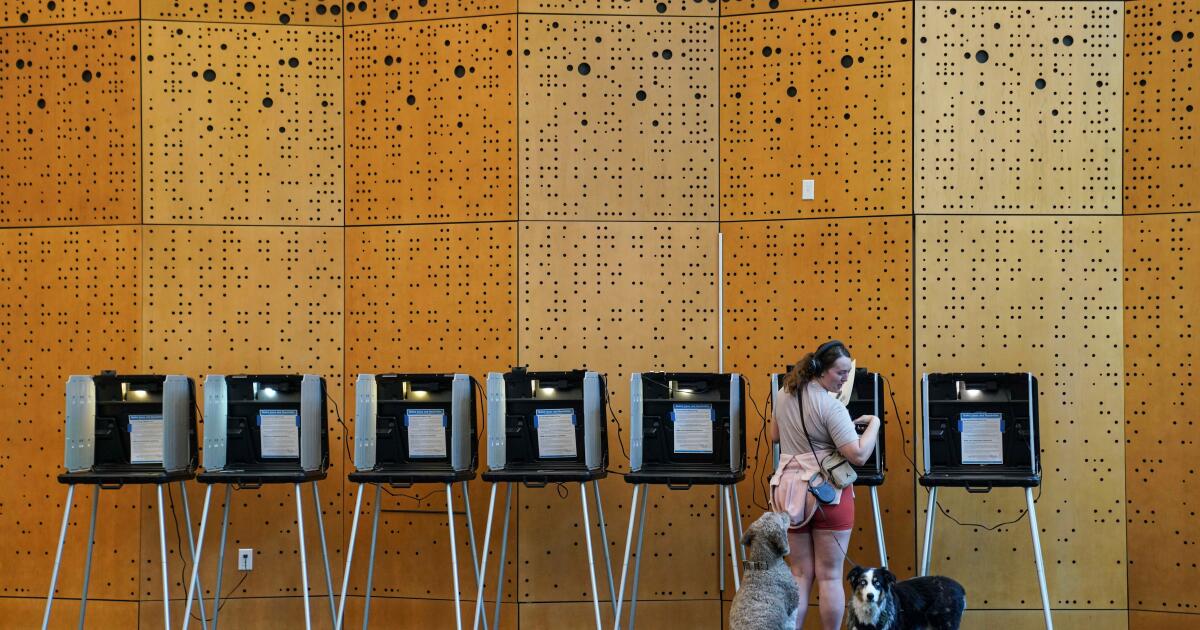
President Trump’s administration is threatening to withhold some federal funding from states that don’t make changes to voting practices and is warning state election officials that they face arrest if they don’t remove noncitizens from voter rolls.
Letters to states and grant application details are the latest in a line of actions by Trump’s administration to shape details of running elections that have long been the job of states.
Courts have largely rejected the administration’s previous efforts, which reflect untrue claims about widespread voting fraud and come less than four months ahead of crucial midterm elections where Democrats seek to take control of one or both chambers of Congress and check Trump’s power.
“The overall point is that Trump is trying to use whatever levers of power and persuasive power that he might have to try to interfere with how states and localities are going to conduct the 2026 election,” said Rick Hasen, a UCLA law professor and the director of the Safeguarding Democracy Project. “Some of this is aimed at changing how the rules are conducted. Some of it appears to be aimed at undermining voter confidence in the integrity of the election process.”
Justice Department warns election officials of prosecution
In letters sent Tuesday, to election officials for all 50 states and the District of Columbia — often secretaries of state — the Department of Justice’s Civil Rights Division said they and other election administrators could face criminal charges if they knowingly allow nonvoters to vote or remain on voting rolls.
It also called on the states to tell the federal government within five days how they intend to comply with the law.
Derek Muller, a law professor at the University of Notre Dame who specializes in election law, said it’s not clear the 50-state letter means anything except to restate some parts of the law, with a request to follow up, “which I’m sure many states will ignore.”
The letter also warns that anyone who knowingly and willfully gives false information in registering to vote or voting would face criminal prosecution.
Antiterrorism grants include election requirements
A Federal Emergency Management Agency antiterrorism grant announcement in June includes a list of election-related requirements, saying that 20% of grants for states and urban areas would be withheld until they comply.
The program includes more than $1 billion for states and local and tribal governments for a variety of programs aimed at preventing terror at crowded places, online, with border security — and around elections. FEMA expects to award 56 grants.
“Recipients can ensure that their efforts contribute to a secure, transparent, and resilient electoral process, thereby reinforcing public trust and the integrity of democratic institutions,” the grant announcement says, noting that securing election infrastructure is a national security priority.
The list of items for states includes verifying the citizenship of all registered voters and election workers.
Places that use electronic voting systems that use bar codes or QR codes to count votes would have to submit plans to switch to hand-marked paper ballots. Every jurisdiction would have to show it audits results.
UCLA’s Hasen said it could be difficult even for states that want to comply. It’s too close to the midterm election to make some of the changes, he said, and some would require state legislatures to pass new laws.
The White House on Wednesday referred questions to FEMA, which did not immediately respond to an interview request.
Response from states appears to be partisan
Some states are pushing back, while others are defending the latest actions.
They seem to be breaking along party lines.
Oregon’s secretary of state, Democrat Tobias Read, accused the Justice Department of “knocking on our door again with more threats and no evidence to back up their fever dreams about non-existent voter fraud.”
Oregon elections are secure, accurate, and fair, he said, adding that he isn’t “intimidated by political threats or manufactured controversy.”
The Michigan secretary of state’s office, headed by Democrat Jocelyn Benson, said it has discussed its work repeatedly with the Justice Department and in public statements, congressional hearings and court testimony — information that it said “is either in the DOJ’s possession or easy reach.”
“We will be happy to provide it again to help address any confusion,” the office said in a statement.
In a statement, Ohio Republican Secretary of State Frank LaRose defended the Justice Department’s missive to states, saying it’s reminding them of their legal obligation regarding election integrity. A lot of states aren’t taking it seriously, he said without giving examples or citing evidence. He said Ohio has worked with the federal government to ensure that its voter rolls are accurate and that only U.S. citizens vote.
Georgia’s secretary of state’s office says the state has already taken many of the actions required in the FEMA grant, including a citizenship audit of voter rolls.
Several of Trump’s election actions have faced resistance
Trump has repeatedly and wrongly asserted that fraud cost him reelection in 2020, and his administration has put forth a series of policies and actions aimed at how elections are run.
In recent days, courts have rejected the Justice Department’s effort to collect the names and contact information for every election worker in Georgia in the 2020 election and others trying to force New Hampshire and Pennsylvania to turn over detailed information about registered voters. With those rulings, the federal government has lost similar cases more than 10 times around its requests for details from 30 states and the District of Columbia.
Last week, a group of Democratic governors asked the U.S. Postal Service to withdraw its proposed rule seeking to implement an order from Trump to create a list of eligible voters — and potentially limit who can receive a ballot in the mail. A court previously put the order on hold, saying it was unconstitutional.
Also last week, the Supreme Court rebuked Trump and ruled that states can count mailed ballots that arrive after Election Day.
Mulvihill and Levy write for the Associated Press. AP writers Gabriela Aoun Angueira, Bill Barrow, Kate Brumback and Josh Kelety contributed to this report.
Travellers have reacted with anger after the change was made to services on flights
09:38, 09 Jul 2026Updated 10:40, 09 Jul 2026
TUI passengers have been told their bookings have changed – and offered a small refund(Image: Getty)
TUI has emailed passengers telling them of an ‘important change’ to holidays already booked. Travellers have reacted with anger after the change was made to services on the flight – with alcoholic drinks off the menu.
In messages posted on Facebook pages from holiday travel companies, it emerged TUI is making the change from November 1. Anyone travelling long-haul with the company has been told that complimentary drinks will no longer be service in economy class.
Instead travellers will receive one complimentary beer or wine with the main meal. All other drinks will now have to be paid for – however, passengers travelling in Premium will continue to receive complimentary alcoholic drinks as part of their experience.
Anyone already booked is being offered a small amount of money back: “If you’ve already booked and paid for a long-haul holiday departing after 1st November, TUI has announced a £12.50 per person, each-way goodwill refund for affected customers.” Many have been sent an email with the subject in caps saying ‘IMPORTANT NEWS REGARDING A CHANGE TO YOUR HOLIDAY’.
The travel operator said: “Everyone will have their own opinion, but for some travellers this could take away a little of that ‘holiday starts on the plane’ feeling.”
Jamie thought it was a good thing: “Probably a good thing with the number of alcohol related incidents onboard these long-haul holiday flights. “ However, Nigel was taking his trade elsewhere: “Plenty saying book with another airline, good luck with that, particularly if you do not have easy access to London airports.” One user said: “That is a tiny amount of refund.”
Some have not had nice experiences. Charlotte said: “Last time we did long haul paid premium it wasn’t loads of drinks it was moderated and disappointing for the amount of money we spent and rudeness of staff.” A user added: “It would make me consider another airline first. But I’ve had issues with TUI when we were supposed to go to Jamaica last year so already not in my good books. If the £12.50 was ongoing, that’s actually reasonable, but to have to pay for drinks moving forward sucks a bit.”
Graeme added: “This is a total joke.” Olive said: ”TUI can ram that nonsense. The whole idea of long haul is getting smashed.”
June added: “The drinks were never ‘free’…they were complimentary. There’s a difference. The complimentary drinks were meant to be limited, but people just take the proverbial’ **** Not surprised it’s been pulled.”
TUI responded to one user: “Thank you for your comment. We’re sorry to hear of your disappointment with the changes to our long-haul service. This change helps us focus on the things that matter most, like keeping fares competitive, maintaining great value overall, and giving customers more flexibility in how they spend onboard.
“Soft drinks will remain free, customers will still get a complimentary beer or wine with their main meal, and there’ll be a wider range of alcoholic drinks available to buy, so people can choose exactly what they want during their flight. Thanks!”
Last month, it emerged that TUI Airways was ranked among the worst airlines for UK flight punctuality, with one route having an average delay of more than three-quarters of an hour.
The leisure carrier’s departures from UK airports were an average of 20 minutes and 24 seconds behind schedule in 2025, according to analysis of Civil Aviation Authority (CAA) data.
The least punctual of its routes with at least 100 flights was from Birmingham to the Greek island of Zante, which had an average delay of 46 minutes.
Rory Boland, editor of consumer magazine Which? Travel, said it was “unacceptable” that airline passengers “continue to face unreliable service” amid fare rises. He went on: “Airlines must do more to support travellers during delays, including clearly communicating their rights and eligibility for compensation.
“It’s worth putting in a claim with your airline if you think it’s responsible – and escalating the complaint if it refuses to pay.” TUI Airways is owned by TUI Group, which also operates the UK’s second-largest package holiday company.
Many of its holiday customers use the airline, which serves more than 20 UK airports.
The punctuality analysis took into account all scheduled and chartered departures from UK airports by the 34 airlines which operated more than 2,500 of these flights last year. Cancelled flights were not included.
Aage Dunhaupt, TUI Group’s director of communications, said: “We fully understand that for holidaymakers, every minute counts. Minimising delays remains a top priority, and our teams work continuously to improve operational performance across our network.”
Mr Dunhaupt said the airline makes “a conscious choice” to operate flights “wherever possible, even if they are delayed, rather than cancelling them”, as this ensures passengers reach their destination “rather than facing the risk of extended disruption”.
He added: “If we were to follow broader industry practices of cancelling flights more readily, our punctuality ranking would improve significantly.
“However, this would come at the expense of our customers.”
The police marksman who shot Chris Kaba may no longer face misconduct proceedings after the government changed the rules on how officers’ use of force is judged.
Sgt Martyn Blake shot 24-year-old Kaba in Streatham, south London, in 2022 after he tried to ram his way past police cars.
Blake was cleared of murder following a trial in 2024 but was subject to a separate disciplinary hearing, which the Independent Office for Police Conduct (IOPC) paused while it waited for the changes to be published.
The legal test for misconduct in officers’ use-of-force cases has been raised to the same used in criminal law, meaning conduct that would not amount to a crime should not amount to misconduct either.
After Blake’s acquittal, then home secretary Yvette Cooper said she would raise the legal test used to decide whether to charge officers over use of force.
On Wednesday, the watchdog said it now believes the case should not go ahead. It will consult the Kaba family, who argue there are exceptional circumstances why it should still proceed.
Dozens of other non-fatal use-of-force cases could also be affected if forces take the same approach.
IOPC director of strategy and policy Andrew Johnson said: “We carefully considered the law change and its stated intent to address the perceived unfairness and lack of proportionality of the civil law test.
“We believe this position provides consistency across impacted cases and is fair to officers who are facing potential dismissal for misconduct, which if it occurred now, would not amount to misconduct under the new law.
“We expect the number of relevant cases that are affected by this law change to be relatively small.”
Metropolitan Police deputy commissioner Matt Jukes, referring to Blake by his cypher NX121, said: “We have consistently said since the criminal trial that there is no basis for further action against this officer and that remains our position.
“That is why I welcome the recent changes to the law, introducing a presumption of anonymity for firearms officers during court proceedings until conviction, and restoring the criminal test for the use of force in misconduct cases.”
The family of Chris Kaba said the decision had a damaging impact on bereaved families in cases involving use of force by the police, and that “it gives every appearance that the IOPC has a closed mind on this specific case”.
Temi Mwale and Kayza Rose from the Justice for Chris Kaba Campaign said they were “appalled” by the IOPC’s decision.
They added: “The only just approach would have been to conclude all existing cases under the rules that were in place when those proceedings began.
“Instead, the rules have been changed mid-process to ensure that Martyn Blake will face no professional accountability.”
The campaigners described the decision as a blow to public confidence and said Britain was “moving backwards on police accountability”.
On the night Kaba died, police had followed and boxed in the Audi he was driving because it had been linked to three firearms incidents in the previous five months.
Officers did not know his identity at the time. He was later reported by police to have links to a street gang and to two shootings in the six days before his death.
Imagine Cruising has launched its new Americas Collection for 2027-28, featuring five luxury tailor-made holidays combining cruises with land excursions to destinations including New York, South America and Antarctica – with prices starting from £2,999 per person including flights, accommodation, transfers and tours.
If you want to get a sense of the fuel crisis gripping Russia, all you need to do is spend a day driving around Moscow. At almost every petrol station we passed there was a queue of cars and lorries. Some lines were long, some short; some static, others moving steadily.
If there was no queue, that meant the garage had run out of fuel entirely and was closed.
Remember: this is Moscow, the wealthy, populated capital that draws in so much of Russia’s vast resources. Even here the authorities cannot ensure there is enough petrol and diesel to keep Muscovites on the road.
Yet, in the queues, the mood was more frustrated than angry. Yekaterina told us she was “not happy” and there was “panic because everybody thinks there will be no oil”. But it would OK, she said, “we just need to reorganise the oil distribution”.
The situation according to Elmar was “very bad” and he complained prices were going up as fuel stocks ran low. “You are wasting hours to fill up,” he said. “At the moment I am planning a trip to Dagestan but I don’t know if I should drive there or not because there are so many problems with petrol.”
I asked him who was to blame. “In our country, you can’t say what is to blame and who is to blame,” he said, with a knowing smile.
In Russia, criticism of the president, or even the Kremlin, is not something most feel they can do in public.
Valery said it was strange having to queue in a country that extracts so much oil. He blamed the lack of Russian preparedness as much as Ukrainian missiles. “I have no desire to get used to queues,” he said. “I hope the situation will change soon and won’t be continued.”
So the war is coming closer to home for many across Russia.
President Vladimir Putin has worked hard to insulate most people from the consequences of what he calls his special military operation, now well into its fifth year. On the streets of Moscow, one can see little sign of the war, just a few posters about heroic soldiers.
NEW YORK — A White House report brands the leadership of the Smithsonian Institution, especially at the National Museum of American History, as radical activists who cannot be trusted, indicating that President Trump may be preparing to install his own team.
The report released late on Independence Day by the White House Domestic Policy Council comes in the midst of Trump’s aggressive campaign to overhaul some of Washington’s most sacred cultural and historic institutions. Trump in March revealed his intention to force changes at the Smithsonian Institution with an executive order that targeted funding for programs that advanced “divisive narratives” and “improper ideology,” as he continued a broadside against culture he deems too liberal.
“The Smithsonian Institution, and the National Museum of American History in particular, under its current leadership and current interpretive ideology, cannot be trusted to tell America’s story honestly and in a way that is inspiring, unifying, and worthy of our great republic,” according to the report by the council, which is led by a former top Trump speechwriter.
The authors added: “As this report shows, confirmed in the words of Museum leadership, this ideological capture has moved the Museum’s mission away from straightforward historical education and scholarship toward an extreme political activism that seeks to transform our country.”
The Smithsonian did not immediately respond to requests for comment Sunday.
Historian Lonnie Bunch, the Smithsonian’s current secretary, is the first African American to lead the institution. In an unrelated interview that aired Sunday on NBC’s “Meet the Press,” Bunch said “the notion of being a more perfect union, not the perfect union, is really what motivates me.”
“I think what I want people to understand is that there is a responsibility to continue to make those aspirations available, accessible, meaningful to a whole range of people,” Bunch said. “And that, in essence, America’s greatest strength, it’s not running away from its history, but it’s understanding how that history shaped us and continues to shape us.”
Historian Anthea M. Hartig is the first woman to serve as director of National Museum of American History.
Trump’s escalating effort to force changes at the Smithsonian marks the Republican president’s latest move to transform cultural pillars of society, such as universities and art, that he considers out of step with conservative sensibilities. Trump had himself installed as chairman of the John F. Kennedy Center for the Performing Arts with the aim of overhauling programming, and his handpicked board voted to add his name to the building, only to have a federal judge later order the signage to be removed.
The administration also forced Columbia University to make a series of policy changes by threatening the Ivy League school with the loss of several hundred million dollars in federal funding.
Trump has also imposed changes on historical sites beyond Washington, including in Philadelphia, where the administration won a court ruling last week allowing it to reinstall interpretive panels that critics say whitewash the history of slavery at the site of President George Washington’s home. Advocates, academics and officials have been concerned for months that the version that complies with Trump’s order could give a history that plays down the pain in the nation’s past in favor of a more triumphant view.
Gov. Josh Shapiro, D-Pa., accused Trump and his allies of trying to “rewrite history.”
“There’s not one individual narrative that a president gets about our history,” Shapiro, a potential presidential prospect, said in an interview that aired Sunday on CNN’s “State of the Union.” “And any president should want to make sure that that full history is shared, that the American people are able to draw their own conclusions.”
Shapiro added, “If we understand where we came from, we’re going to have a better path forward.”
Trump’s Domestic Policy Council does not necessarily agree.
The National Museum of American History “confronts visitors with materials intended to undermine faith in American institutions and the longstanding shared ideals of the American people,” the council’s report said. “We must be committed to restoring truth and sanity in how American history is presented and taught.”
In seeking to fulfill Trump’s order, which he called “Restoring Truth and Sanity to American History,” the review concluded by finding that the museum “by the intention and at the direction of current Museum and Smithsonian leadership, has become subject to institutional capture by a radical, activist ideology that is fundamentally opposed to telling the noble, honest story of the great country we know and love.”
Heathrow Airport has issued a reminder to travellers
Heathrow is the country’s busiest airport(Image: Jason Alden/Bloomberg via Getty Images)
A major UK airport has issued a reminder to travellers ahead of what is anticipated to be an exceptionally busy summer period for international travel.
Hundreds of thousands of people transit through Heathrow Airport daily, and a message on the airport’s official X account is encouraging those with upcoming trips to “just remember”. The social media post reads: “With over 100 touchless water stations at Heathrow, you’re never too far from staying hydrated. Just remember to empty your reusable metal or double-walled water bottle before security, and top it up before you fly.”
Heathrow scrapped the 100ml rule earlier this year, meaning travellers passing through the nation’s largest airport can now keep liquids in containers up to two litres in their bags while going through security, following the completion of its deployment of new advanced CT scanners.
Content cannot be displayed without consent
Electronics such as laptops can also remain in luggage, while transparent plastic bags for liquids are no longer required. The regulation change only applies to departures from Heathrow, and travellers must verify restrictions on baggage at the airports they are flying back from before boarding flights to the UK.
Back in January a DfT spokesperson said: “Heathrow is the latest UK airport to complete its rollout of next-generation security equipment for passengers, helping ensure security checks remain robust and can be completed smoothly.
“Airports are responsible for the installation and operation of security equipment. Passengers should continue to check security requirements with airports before they travel and come prepared with liquids in containers no larger than 100ml in hand baggage unless advised otherwise.”
But England do not have to remove direct play from their game entirely.
By managing the space and speed of the game, they can pick their moments to release the likes of Noni Madueke, Anthony Gordon, Marcus Rashford and Jude Bellingham.
If England do opt to play more slowly, they will also be hoping these ‘boring’ spells of play work to silence the Mexican home crowd.
The decision to pick a squad of similar profiles might be one of the more astute decisions Tuchel has made as England boss when it comes to this game too.
With a tactical plan in mind, making five substitutions that do not alter the dynamic of the game greatly, but instead reinforce the plan with freshness and energy as Mexico begin to tire could be the difference.
This could indeed be a match full of mini-games and picking moments in which to change things will be key.
Tuchel, as we’ve seen throughout his club career, and most recently against DR Congo, has a knack for getting mid-game tweaks right but the many variables of the game against Mexico make this one of his toughest challenges yet.



![Batad village chairman Romeo Heppog [standing left] said it is crucial for the national government of the Philippines to allocate enough funds in order to speed up the repair of the rice terraces following the November 2025 landslide.](https://i0.wp.com/www.aljazeera.com/wp-content/uploads/2026/07/PHOTO5-1784532889.jpg?w=640&ssl=1)

![Apu Buy-a Nadyug [centre], the chief indigenous priest of Batad, joins two other village elders during the Tanig, a blessing ritual before the start of the harvest festival.](https://i0.wp.com/www.aljazeera.com/wp-content/uploads/2026/07/PHOTO2-1784532893.jpg?w=640&ssl=1)