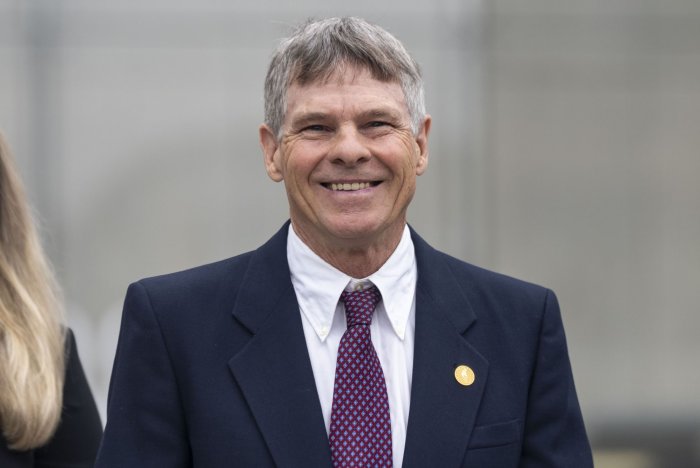
Chilean President Jose Antonio Kast has seen Congress approve most of the economic and tax reforms he promoted Photo by Adriana Thomasa/EPA
SANTIAGO, Chile, July 22 (UPI) — Chile’s Congress approved most of the economic and tax reforms promoted by President José Antonio Kast — one of the flagship initiatives of his government agenda.
The reforms include a gradual reduction in the corporate tax rate from to 23% from 27% to encourage investment and revive economic growth.
The Chamber of Deputies on Tuesday passed the National Reconstruction and Economic and Social Development bill, which also establishes tax incentives for the repatriation of capital, creates compensation mechanisms for companies when courts overturn projects that have already received Environmental Qualification Resolution approval and eliminates the tax on a first home for older adults.
Finance Minister Jorge Quiroz said the initiative seeks to “restore tax competitiveness” and provide greater certainty for investment.
“We have approved measures to restore certainty for investment in Chile, remove permitting barriers that have kept investment projects and economic activity stalled, and provide security for those who decide to invest,” he said.
The approval represents one of Kast’s main legislative victories since taking office in March, and allows him to advance one of the pillars of his economic agenda — reducing the tax burden to stimulate private investment and accelerate growth.
Jorge Berríos, academic director of the Graduate Diploma in Finance at the Faculty of Economics and Business of the University of Chile, told UPI that the reform is intended to restore investor confidence and create conditions for the country to return to growth above 3%.
“A reduction of several percentage points in the corporate tax rate has positive effects on companies and the economy, although those results are generally seen over the long term,” he said.
Berrios said some effects could be felt sooner in the labor market because of the subsidies included in the initiative, as well as through an improved perception of Chile among domestic and foreign investors.
“The Chilean market is returning to a structure similar to that of the 1990s, with market-oriented reforms that allowed the country to achieve strong growth and stand out in Latin America,” he said.
Berríos said the Chilean economy experienced several years of uncertainty marked by increased regulation and higher taxes — factors that he believes damaged the country’s standing among investors.
The Confederation of Production and Commerce, the country’s leading business organization, welcomed approval of the bill. Its president, Susana Jiménez, said the initiative represents “an important step toward restoring the economy’s dynamism and returning to growth.”
The only provision still awaiting approval is the compensation mechanism for municipalities, which will lose part of the revenue generated by the tax on residential properties.
South Korea’s per capita household net assets rose more than 9 percent from a year earlier in 2025, the central bank said Wednesday. This photo, taken July 19, shows apartment complexes in Seoul. Photo by Yonhap
South Korea’s per capita household net assets rose more than 9 percent from a year earlier in 2025 on higher housing and securities prices, the central bank data showed Wednesday.
The average value of net assets held by households per capita stood at 274.7 million won (US$185,600) last year, up 9.1 percent from the previous year, according to the national balance sheet from the Bank of Korea (BOK).
The figure was calculated by dividing the total assets of households and nonprofit organizations — 14,200 trillion won — by the country’s population of 51.6 million, according to the BOK.
It marked a sharp acceleration from the 3 percent growth tallied in 2024.
“Last year, South Korea’s main bourse and overseas stock markets were bullish, contributing to the gains,” a BOK official said. “Housing prices also rose, leading to an asset increase.”
The BOK said the latest figure translates into $193,000 when applying the average exchange rate for 2025.
At the end of 2024, the figure for the United States stood at $514,000, followed by Australia, Canada and Germany at $422,000, $297,000 and $267,000, respectively. Japan’s figure came to $172,000.
The average household net assets came to 634.3 million won, up 7.9 percent over the cited period.
South Korea’s total national net worth, meanwhile, reached 24,561 trillion won at the end of 2025, up 2.2 percent from a year earlier. The growth slowed from a 5 percent rise posted in 2024.
Non-financial assets, such as land and housing, came to 23,291 trillion won, up 3.8 percent from a year earlier, on the back of higher property prices.
The combined value of property assets in the country came to 17,836 trillion won, up 4.1 percent from the previous year.
Net financial assets, on the other hand, fell 20.4 percent to 1,271 trillion won.
The BOK said that while financial assets rose 11.4 percent to 2,794 trillion won, debt increased at a faster pace, rising 13.6 percent to 3,120 trillion won.
By sector, households and nonprofit organizations held the largest amount of net assets, worth 14,200 trillion won, followed by the government with 6,194 trillion won, non-financial corporations with 3,657 trillion won and financial corporations with 510 trillion won.
Copyright (c) Yonhap News Agency prohibits its content from being redistributed or reprinted without consent, and forbids the content from being learned and used by artificial intelligence systems.
The Argentine president is backing a bill that would eliminate most restrictions that have limited foreign ownership of rural land since 2011 — an effort to attract investment and strengthen legal certainty. File Photo by Hector Rio/EPA
BUENOS AIRES, July 21 (UPI) — President Javier Milei’s government is backing a bill that would eliminate most of Argentina’s restrictions that have limited foreign ownership of rural land since 2011 in an effort to attract investment and strengthen legal certainty.
The plan also has reignited debate over sovereignty and control of a resource considered strategic.
The proposal is part of the Private Property Inviolability Act, and it would substantially amend the framework established a law enacted during the administration of Cristina Fernández de Kirchner that set limits on the amount of rural land that foreign individuals and companies could own.
Presidential spokesman Adrián Ravier said the initiative seeks to strengthen property rights protected under Argentina’s Constitution. Speaking at a news conference, he said the country had endured decades of legal uncertainty that discouraged investment and hindered opportunities for economic growth and job creation.
“What we are seeking is to remove the general restrictions on the acquisition of rural land by foreigners,” Ravier said.
He also argued that Argentina historically grew thanks to immigrants who invested and became landowners, and that maintaining broad restrictions on foreign investors no longer makes sense. He added that the bill instead strengthens oversight of foreign governments and their state-owned companies.
The initiative also removes one of the central principles of the current law, which states that purchasing rural land by foreigners does not constitute an investment because the land is a nonrenewable natural resource that belongs to the country.
Former Agriculture, Livestock and Fisheries Minister Julián Domínguez, who promoted the law during Fernández de Kirchner’s administration, had rejected proposed reform.
He told UPI that when Congress approved the legislation, it established that “the acquisition of rural land shall not be considered an investment because it is a nonrenewable natural resource contributed by the recipient country.”
Domínguez contended the proposal contradicts the objective of protecting a strategic resource.
“It is paradoxical. The grandly titled ‘Private Property Inviolability Act’ ends up being, precisely, a violation of Argentines’ rights over their land,” he said.
The former minister also rejected the government’s argument that the current law discouraged foreign investment.
“Our producers are recognized around the world for their ability to adapt and innovate. So does the government believe a foreigner will do a better job than an Argentine producer? The debate is about something else,” he said.
The issue goes beyond economics. Domínguez said.
“In Congress, what is at stake is our identity as Argentines and our relationship with our territory. Every country is very careful about who can buy its land,” he said.
Attorney Enrique Viale, president of the Argentine Association of Environmental Lawyers, also criticized the bill, saying it should instead be called the “foreignization of land law.”
He told UPI that the proposal repeals the provisions that establish acreage limits, ownership caps and protected areas for foreign purchases of rural land.
“It repeals the provisions establishing acreage limits, ownership percentages and protected areas. It fully liberalizes land purchases, including in border areas and without ownership caps,” he said.
Viale said foreigners already own large portions of Argentine land, adding that without restrictions, the trend could accelerate.
He said reform would benefit large international investors who seek to develop artificial intelligence-related data centers, as well as foreign landowners who already hold extensive properties in Patagonia and Argentina’s Littoral region.
“I see no benefit in this bill. What it does is consolidate permanent control of land by foreign capital and increase the risk of losing sovereignty,” he said.
From the real estate sector, José Rozados, director of consultancy Reporte Inmobiliario, said easing restrictions could encourage large-scale investment.
“Anything that removes restrictions on the inflow of capital, especially for investments that require large amounts of money and long payback periods, is important,” he said.
Rozados said greater openness would facilitate productive projects that require large tracts of land and significant investment to develop economic activities.
“Whatever legislation is enacted regarding the permissibility and protection of those investments could allow foreign investors, or even local investors partnered with foreign capital, to be willing to invest in large areas of land,” he said.
The law, known as the National Protection Regime for the Ownership, Possession and Tenure of Rural Land, mandates that foreign individuals and companies may not own more than 15% of the country’s rural land — a limit that also applies within each province and municipality.
It also provides that citizens of the same nationality may not account for more than 30% of that quota, equivalent to 4.5% of the total rural land within a given territory.
The legislation also limits to 2,471 acres the amount of land that may be acquired by a single foreign owner in the country’s core agricultural zone, or its equivalent in other regions, and prohibits the sale of land located in border security zones or containing significant permanent bodies of water, such as rivers, lakes and glaciers.
The government’s bill amends several of those provisions to relax the current framework while maintaining restrictions on foreign governments and their state-owned companies.
The ruling coalition failed to secure enough support to move the initiative forward, and the bill will return to the Senate for debate in August.
Azerbaijan’s relationship with Germany is shifting beyond energy, with the two countries deepening ties across industry and logistics as Europe works to diversify its supply chains away from Russia.
ADVERTISEMENT
ADVERTISEMENT
“Azerbaijan is gradually ceasing to be perceived by Germany solely as an energy supplier and is increasingly becoming part of a new Eurasian industrial and logistics architecture,” said Orkhan Yolchuyev, director of the CASPIA Analytical Center.
Bilateral trade between the two countries reached around €1.7 billion in 2025, driven by German exports of industrial equipment, machinery and transport systems, Yolchuyev said.
Over 250 German companies now operate in Azerbaijan, spanning manufacturing, construction, logistics and energy.
The shift has accelerated since Azerbaijan began supplying gas directly to Germany and Austria in early 2026, part of a wider European push to reduce dependence on Russian energy following Moscow’s full-scale invasion of Ukraine.
Beyond energy
The real change, Yolchuyev said, is not in the trade figures but in what they represent.
“[They] indicate that bilateral relations are evolving toward a higher level of industrial cooperation,” he said, pointing to Germany’s need for new export markets and more resilient supply networks.
German companies already active in Azerbaijan could soon be drawn into its reconstruction programmes and expanding industrial zones, particularly in engineering, transport, renewable energy and advanced manufacturing.
Much of this shift runs through the Middle Corridor, the transport route linking China and Central Asia with Europe via the Caspian Sea, Azerbaijan, Georgia and Turkey.
Russia’s war in Ukraine has given the route new urgency, as European firms hunt for alternatives that insulate their supply chains from disruption.
Azerbaijan sits at its logistical centre, with sea and rail links increasingly central to the transcontinental route.
Yolchuyev said the corridor’s value lies less in cargo volumes than in what it carries.
“The higher the share of high value-added products, such as automotive components, industrial machinery, electrical equipment, electronics or chemical products, the greater the economic efficiency of the route,” he said, pointing to the expansion of the Port of Baku and the Alat Free Economic Zone as drivers of new manufacturing and logistics investment.
Energy still at the core
Energy remains central despite the widening scope of cooperation. Azerbaijan has positioned itself as a dependable gas supplier and, since early 2026, has been sending gas directly to Germany and Austria.
Farid Shukurlu, a non-resident fellow at the Research Institute for European and American Studies, said Russia’s invasion marked a turning point.
“Traditionally, economic relations between Azerbaijan and Germany were concentrated in a limited number of sectors, including heavy machinery, automobiles and pharmaceuticals,” he said.
“However, Russia’s full-scale invasion of Ukraine fundamentally reshaped the bilateral economic relationship.”
Within five months of Azerbaijan’s first crude shipment to Germany, the country had exported 360,300 tonnes of crude oil and petroleum products worth approximately $210.9 million (€196mn), Shukurlu said.
He believes Azerbaijan could eventually become a transit route for Kazakh oil and Turkmen gas bound for Germany and other European markets.
Germany’s shift carries weight given its past reliance on Russian gas. Italy remains the largest European buyer of Azerbaijani gas via the Trans Adriatic Pipeline, but Germany is now moving in the same direction.
Manfred Scherer, mayor of the Verbandsgemeinde Sprendlingen-Gensingen, a collective municipality in Germany’s Mainz-Bingen district, recalled meeting Azerbaijan’s current energy minister, Parviz Shahbazov, during his time as ambassador to Germany.
“Economic relations between Germany and Azerbaijan have developed positively in recent years. There is strong potential to further strengthen cooperation,” Scherer said.
“I have fond memories of the visit of the current minister of energy, Parviz Shahbazov, to our municipality during his time as ambassador of Azerbaijan to Germany,” he continued.
“At that time, we discussed opportunities to deepen our relations through a municipal partnership and to strengthen cooperation between our regions.”
A wider European shift
Germany’s pivot fits a broader European turn toward the South Caucasus and Central Asia, partly in support of the Armenia-Azerbaijan peace process, which could unlock further energy diversification and regional connectivity.
The high-level visits have piled up. European Commission President Ursula von der Leyen said the partnership with Azerbaijan “matters greatly to the European Union” and had “real momentum”.
European Council President António Costa travelled to Baku for talks on deeper EU re-engagement, while EU foreign policy chief Kaja Kallas visited in May.
Italian Prime Minister Giorgia Meloni and Slovak President Peter Pellegrini have also held high-level talks with President Ilham Aliyev.
A section of Sunset Boulevard remained closed on Sunday because of last week’s destructive water main break, with officials saying they didn’t know when repairs to the 110-year-old pipe would be completed or the street reopened.
“While there is no set completion date yet, our crews remain dedicated to finishing the repairs as quickly and safely as possible,” the Los Angeles Department of Water and Power said in a Sunday release.
Some West Hollywood residents remained displaced Sunday from apartments where underground garages were flooded by Thursday’s water main rupture. And some businesses near the scene remained indefinitely closed.
An aerial view of workers viewing a broken water main at Sunset Boulevard and Holloway Drive in West Hollywood that sent water gushing down many streets, closing several of them Thursday.
(Allen J. Schaben / Los Angeles Times)
Vanessa Lopez, an LADWP spokeswoman, said that two other water pipe ruptures on Saturday — one in Venice and another in Hollywood — had been repaired.
The city received a report of yet another break on an 8-inch water main at 1501 Lincoln Blvd. on Sunday morning, she said, which crews were still working to repair.
Lopez said those breaks were not related to each other or to Thursday’s fracture of the far bigger pipe in West Hollywood, which was constructed in 1916.
Officials said Sunday that Sunset Boulevard remains closed between Sherbourne Drive and San Vicente Boulevard, with limited local access on nearby streets including Cynthia and San Vicente.
City officials urged the public to avoid the area.
LADWP said tap water in West Hollywood remains safe to drink, but officials encouraged residents to conserve.
With the 36-inch water transmission line undergoing repairs, West Hollywood is currently being served by an 8-inch distribution pipe. Residents may notice low water pressure, especially those living in upper-floor apartments, officials said.
Book Soup, a popular bookstore on Sunset Blvd, was one of the shops and restaurants forced to close after streets were flooded.
“For the safety of staff and the community, we’re keeping the store closed for the time being,” an employee said in a recording on its answering machine Sunday.
“We want to reassure everyone that the store is completely fine and our books are safe and dry,” she added.
Thursday’s fracture was on a steel pipe that forms the major arteries for water delivery from reservoirs and tanks to smaller distribution lines across Los Angeles. That section of the Sunset Trunk Line had been slated for replacement in 2031, according to the utility.
In 2019, LADWP said roughly 29% of the city’s pipes were over 80 years old, nearing their typical 100-year lifespan.
When the trunk line ruptured early Thursday morning, millions of gallons of water gushed down Holloway Drive, inundating businesses and flooding underground parking garages.
Repairs to a water main on Sunset Boulevard Saturday in West Hollywood.
(Myung J. Chun / Los Angeles Times)
West Hollywood Mayor John Heilman estimated that between 150 and 200 cars were damaged or destroyed in the flood.
The leak was stopped after a few hours, leaving a giant sinkhole in the middle of Sunset Boulevard.
On Saturday, city crews replaced a 25-foot section of the line. Workers have refilled the pipe with water and are now working to repressurize it, officials said Sunday.
The workers must then disinfect the pipe with chlorine and test the water’s quality for safety. The hole in Sunset Blvd. will then be filled and the street repaired, officials said.
Residents and businesses who lost property and suffered damages can find information about filing claims at www.LADWP.com/Claims.
California has some of the nation’s toughest gun laws, but state lawmakers are concerned that a new technology is allowing criminals to obtain firearms by building them from scratch. By using 3-D printers, they warn, lawbreakers are able to make key components of untraceable “ghost guns” with the press of a button.
Ghost guns, which authorities say make it more difficult to investigate shootings because they lack serial numbers, have been a growing problem for law enforcement nationwide. According to federal data, the number of privately made firearms recovered in crimes surged from more than 1,600 in 2017 to nearly 27,500 in 2023. California leads the nation in recoveries over that period.
In response, legislators are seeking to mandate that all 3-D printers sold in the state come equipped with software that prohibits users from making triggers and other gun parts. A bill passed the Assembly in May and is advancing through the Senate.
But the proposal has drawn opposition from a diverse coalition, which includes civil liberties groups, tech companies and 3-D printing enthusiasts as well as Hollywood effects studios, who argue that “firearm blocking software” will also prohibit legitimate designs and expose makers to government or corporate surveillance.
Share via
Inside a San Fernando workshop, Samuel McBride makes movie monsters come to life for the camera. One of his latest creations, an animatronic hand, clutches when he pulls a trigger that he built using a 3-D printer.
McBride says the technology has transformed the work at Legacy Effects, where he is a lab manager, but he’s worried it will soon be off-limits because of a proposed change in California law.
McBride fears the law would interfere with the making of devices like the one that activates his lifelike hand.
“If I just took apart this trigger and put it on a printer, how is anyone, computer or human, going to tell me how I intend to use it?” he asked.
Backers of the proposed law say it has the potential to help save lives.
“As gun violence continues to devastate our communities, we cannot allow 3-D printing technology to become a new pipeline for untraceable weapons,” said Assemblymember Rebecca Bauer-Kahan, the bill’s author.
Critics of the proposed California law note that 3-D printed guns represent a small subset of ghost guns recovered by law enforcement at crime scenes. According to the federal Bureau of Alcohol, Tobacco, Firearms and Explosives, most “privately made firearms” recovered by police are assembled from mail-order kits or unfinished parts rather than printed at home.
Jorge Perez of Monster City Studios holds a sculpture made with a large, industrial 3-D printer.
(Ronaldo Bolaños / Los Angeles Times)
“This fight is not over whether ghost guns are dangerous,” said David Tobin, an independent creator leading the coalition. “It is over whether the state can or should require a consumer tool to surveil a person’s designs before they are allowed to make something.”
Everytown for Gun Safety, a national nonprofit that advocates for gun control and has pushed for the passage of California’s bill, pointed to rising 3-D printed firearm recoveries across 20 major cities and warned that homemade plastic parts can help people bypass background checks or turn handguns into automatic weapons.
Krystal LoPilato, who advocates for policy at Everytown, said the group has successfully guided a similar bill through the New York state Legislature.
A handgun frame made using a 3-D printer is held for display at the office of the federal Bureau of Alcohol, Tobacco, Firearms and Explosives.
(Alex Brandon / Associated Press)
LoPilato said the policy aims to be proactive, rather than allowing more violence to take place before regulating the problem. Opponents counter that California already bars unlawful firearm manufacturing with 3-D printers, and that ghost gun recoveries have declined since the state adopted a series of new laws and enforcement efforts.
A June 1 letter to lawmakers, signed by a group of 3-D printing companies, stagecraft and prop-making studios and industry stakeholders, argued that AB 2047 raises 1st Amendment concerns and would harm businesses. The letter was signed by a wide variety of companies and individuals, including Prusa Research, a prominent 3-D printer manufacturer.
“To an algorithm, a gun barrel and a piece of pipe are the same grooved cylinder,” Jakub Kmošek, head of public affairs at Prusa, said in a statement to The Times. “This bill will only make it harder to build, repair, experiment, and innovate in California.”
Alan Scott, Legacy Effects’ co-founder, said 3-D printing has become central to the company’s survival in an industry where budgets are tighter and deadlines are shorter.
“Everything’s just got to be done faster these days. You don’t get to reduce the quality. We couldn’t stay in business if we weren’t 3-D printing,” Scott said.
To solve this problem, Bauer-Kahan put an entertainment industry exception in the bill, exempting “printers manufactured for and sold exclusively to entertainment industry stagecraft and propmaking studios” from the software requirement.
McBride, Legacy’s 3-D lab manager, said those printers do not really exist.
Legacy uses the same general-purpose machines available to other businesses willing to invest in the equipment, and no printers are marketed exclusively for Hollywood, he said.
1
2
1.A 3-D printed sculpture concept at Monster City, a special effects studio in Santa Clarita.(Ronaldo Bolaños / Los Angeles Times)2.3-D printing advocate David Tobin showcases a robotics kit at Monster City.(Ronaldo Bolaños / Los Angeles Times)
Legacy also worries about privacy. Major studios require strict secrecy before a movie or show is released. To accommodate this, the company shares design files through encrypted servers and protected internal systems.
“We’ve invested hundreds of thousands of dollars to bring all that technology here under the umbrella of our NDAs and our IP protection,” McBride said.
Bauer-Kahan noted at a Senate hearing that she is working to address concerns raised by 3-D printing users and industries that rely on the technology.
Paul Powers, chief executive of Physna, a company whose technology could be used to block gun parts on 3-D printers, said the strongest criticisms of AB 2047 “misunderstand how the software works.”
“Something that vaguely looks like a gun part is not considered to be a match,” he said.
Powers also responded to surveillance concerns by clarifying that his company’s software only blocks the printer from making prohibited parts — it doesn’t flag them to authorities or log users’ intellectual property.
“There’s no communication with anyone; it doesn’t go anywhere,” he said.
But Marleen Vogelaar, chief executive of Thangs3D, a platform for independent creators to share and sell 3-D printable designs, said that answer does not resolve her broader concerns about how AB 2047 would work in practice.
“These databases will always lag behind innovation and can be easily circumvented and generate false positives that block legal designs and wrongly flag everyday makers,” she said at a Senate hearing this month. “The bill also creates serious privacy and security risks by giving third parties access to analyze designer’s files. That threatens intellectual property and adds digital surveillance in a state that values data privacy.”
If the bill passes, the state’s Department of Justice would publish a roster of compliant printers. Printers not on the list would be banned from sale or transfer in California beginning in December 2029.
Aubrey Rodriguez, a legislative advocate with American Civil Liberties Union California Action, an advocacy organization formed by the ACLU’s three affiliates in the state, said the bill would ask ordinary users, schools and businesses to accept a new layer of control based on software they still do not trust.
Rodriguez said the proposal risks creating “a permanent back door into the privacy of our own homes, ripe for exploitation.”
“Once this new infrastructure exists, it is a simple software update away from tracking political dissent or preventing 3-D printing designs deemed inappropriate,” Rodriguez said.
SINCE stepping out of the stand-up spotlight, Johnny Vegas has embraced a calmer life running an antiques business – and now his long-term partner is getting involved.
In a new interview, the Benidorm star has opened up about Vikki Jones in a rare glimpse int his love life.
Johnny Vegas says girlfriend Vikki is now ‘on the books’ at his antiques businessCredit: RexHis antiques venture featured in the Quest series Johnny Vegas’ Little Shop Of AntiquesCredit: Warner Bros
Johnny, 55, has been dating Vikki for three years and says the pair love working together.
He told The Times: “They say never work with your partner, but it’s great. She and Bev make fun of me most of the time.”
Sign up for the Showbiz newsletter
Thank you!
Bev is Johnny’s self-described “long-suffering” childhood friend and assistant, who appears alongside him in his Quest series Johnny Vegas’ Little Shop Of Antiques.
Explaining why he rarely speaks about Vikki publicly, Johnny said: “I wasn’t keeping it under cover, but I don’t share much about it on social media.”
Johnny admitted the nerves of stand-up comedy eventually took their tollCredit: AlamyThe comic admitted he has ‘a very dangerous bit of knowledge’ about collectablesCredit: johnnyvegasofficial/ Instagram
His antiques venture, Vintage Vegas, began as a pop-up shop at Dagfields Craft and Antique Centre near Nantwich, Cheshire.
It featured in his eight-part TV series, which followed Johnny and Bev as they hunted for unusual treasures to sell.
Johnny describe his business venture as “collectable things of all sorts, really.
“I have a very dangerous bit of knowledge on lots of things. I couldn’t tell you about 18th-century furniture or anything, but I have to think I like it and hopefully I have an eye for this stuff.”
The Benidorm star admitted he was initially unsure whether customers would visit just to get a selfie.
He said: “It’ll be an interesting experiment to see if people come in not just to see me.
“We’ll find out if it’s viable down the line when the circus has left town, so to speak. We’re learning as we go. I never thought I’d see myself as a shopkeeper.”
Johnny has also opened up about stepping away from stand-up comedy after years of struggling with nerves.
He said: “Stand-up was great, but it was manic. The nerves took their toll. Never say never, but I just see that as a project that needs to rest.”
Johnny was previously married to Kitty Donnelly from 2002 until 2008, and they share an adult son, Michael.
He wed his second wife, Irish broadcaster Maia Dunphy, in 2011.
The former couple, who share 11-year-old son Tom, announced their separation in 2018 and later briefly reconciled before splitting again.
The deals include rebuilding the long-defunct Iraq-Syria crude oil pipeline, which could bypass the Strait of Hormuz.
Published On 18 Jul 202618 Jul 2026
Iraq has struck dozens of agreements and partnerships with American companies, many in the oil sector, during a visit to the United States by Prime Minister Ali al-Zaidi.
“A total of 48 agreements, memoranda of understanding, cooperation agreements and partnership declarations were signed between public and private sector entities in Iraq and the United States,” the Iraqi leader’s media office said on Saturday.
Recommended Stories
list of 3 itemsend of list
They include “cooperation and partnerships involving the ministries of oil and electricity … with ExxonMobil, KBR, GE Vernova, Shell and Halliburton”, as well as several deals related to the construction of a major crude oil pipeline between Iraq and Syria.
Iraq also signed a deal with Starlink, which dominates the global satellite communications sector, to introduce services to the country.
Iraq and Syria signed a cooperation agreement to reconstruct the long-defunct Iraq-Syria oil pipeline, which runs from the oil-rich Kirkuk region in northern Iraq to Syria’s Mediterranean port of Baniyas.
Iraq’s state news agency reported that major US energy company Chevron would carry out the project under the agreement.
The US Department of State said it welcomed Iraq and Syria’s plan to rehabilitate the pipeline, for which a “US-led international consortium” would “execute the technical and financial aspects”.
“Upon rehabilitation, this groundbreaking project will have an initial transport capacity of two million barrels per day of crude oil,” the department’s statement said. It described the pipeline as “a critical energy corridor linking Iraqi oil production to Mediterranean export markets and beyond”.
‘Make Hormuz an afterthought’
The US ambassador to Turkiye, Tom Barrack, said Iraq’s latest oil pipeline agreements would lead to a programme “that will make the Strait of Hormuz an afterthought”.
In addition to the Syria pipeline project, Chevron signed two other agreements with Iraq focused on boosting oil production, according to the company’s president of corporate business development, Jake Spiering.
In total, Iraq’s initial agreements with US firms, spanning the energy, healthcare and technology sectors are worth more than $60 billion, Reuters reported.
“We are using an open-door policy,” al-Zaidi said at the business summit. “Everybody who has a project can come and talk to us. We will not make it difficult for anyone.”
Corporate flight from the Golden State has increased in recent years, with many California-based companies fleeing for lower taxes and more lax business regulations. For the first time this year, California was not the state with the most Fortune 500 companies, after Texas dethroned it in June.
In a July 2 letter to Paramount Chief Executive David Ellison, Tennessee Deputy Gov. Stuart McWhorter pitched a relocation of the studio’s Hollywood headquarters to the Volunteer State. In the middle of a brutal legal battle with California regarding the proposed Warner Bros. merger, Tennessee may appear more appealing to Ellison. Paramount relocated its headquarters from New York to Los Angeles in August of last year.
“As Paramount Skydance writes its next chapter, Tennessee offers a compelling proposition: a state where creativity and technology converge, where talent is developed intentionally, and where innovation is embraced,” said McWhorter in the letter viewed by The Times. “We would welcome the opportunity to share our vision for how Tennessee could help shape the future of Paramount Skydance and its talented team.”
Though many in Hollywood have giggled at the idea of a major studio moving to the South, it isn’t totally ridiculous.
Ellison has backing from his father, tech billionaire and Oracle co-founder Larry Ellison. Oracle, once a California-based company, is now moving its headquarters to Nashville.
In December of 2020, the software tech company left California, where it was founded in 1977, to relocate to Texas. In April 2024, it chose Nashville as the home for Oracle’s “world headquarters,” which began construction in February.
Have other companies moved to Tennessee?
Oracle isn’t the first company to set up in Tennessee. Nissan, which had operated its U.S. headquarters out of Gardena since 1960, left the state in 2005 for Franklin. Nissan chose Tennessee for its drastically lower operational costs.
Mitsubishi Motors also moved its headquarters to Franklin from Cypress in 2019. Mitsubishi moved for lower operational costs and to be in a state with less-strict business regulations than California‘s.
Two beloved California burger chains moved to Tennessee.
In 2018, CKE, the parent company of Los Angeles-founded Carl’s Jr., also left California for Tennessee. CKE consolidated Carl’s Jr. and its St. Louis chain, Hardee’s, under its headquarters in Franklin.
In-N-Out — arguably California’s most iconic burger spot known for its animal fries and double doubles— began a transition out of California in 2023. It established a corporate office in Franklin, and last summer, owner and Chief Executive Lynsi Snyder announced her own move to Tennessee.
Last year, Snyder said pandemic-era restrictions and California policy motivated her decision to leave, but she has no plans for In-N-Out to expand farther East. The majority of In-N-Out locations are still in California.
“There’s a lot of great things about California, but raising a family is not easy here. Doing business is not easy here,” Snyder said.
What is so special about Tennessee?
The southern state’s highly business-friendly tax incentives make it an extremely desirable location. Businesses and billionaires are drawn to Tennessee by its lack of state income and property taxes. Instead, the state relies on a 7% sales tax as its main source of tax revenue. Tennessee also offers a number of tax credits and grants for businesses, including many designed to support newly relocated businesses, cover costs of training new employees, and construction.
Tennessee’s central location and well-connected infrastructure support supply chain logistics. Seven interstate highways run through Tennessee, and six of the United States’ class 1 rail lines operate there, allowing companies to cut transportation costs dramatically. Memphis is also home to the busiest cargo airport in the country.
Tennessee Gov. Bill Lee attributes the success to the state’s competitive tax policy, workforce, and quality of life.
“Companies choose Tennessee because they recognize the strength of our workforce, our strategic location and our ability to support long-term growth,” Lee said in an emailed statement. “Tennessee’s success comes from our commitment to helping businesses thrive.”
Brazilian Foreign Minister Mauro Vieira participates in a press conference in Brasilia on Thursday after the announcement of new U.S. tariffs on Brazilian goods. ‘It is clear that what bothers the U.S. government is that Brazil did not give in to the excessive demands and unreasonable requirements made during the negotiations,’ Vieira said. Photo by Andre Borges/EPA
BRASILIA, Brazil, July 17 (UPI) — Brazil’s government has delayed plans to invoke its Reciprocity Law after the United States imposed a 25% tariff on Brazilian exports. It opted instead for a more cautious strategy aimed at avoiding a broader trade conflict.
After meetings between the government’s economic team and the country’s leading industrial groups, President Luiz Inacio Lula da Silva‘s administration paused previous plans for immediate retaliatory measures.
According to Brazilian media reports, officials are concerned that reciprocal tariffs could trigger a trade war, increase the cost of imported inputs and drive up consumer prices in Brazil.
Industrial associations argued that the production chains of both countries are highly integrated, and that making U.S. imports more expensive would also hurt Brazilian manufacturers, CNN Brasil reported.
The Brazilian government also announced a support program for companies affected by the U.S. tariff.
“We already have mechanisms to protect our companies and our jobs,” Deputy Finance Minister Dario Durigan said. He added that, in coordination with affected industries, the government will strengthen the Brazil Sovereign Plan, which supports businesses “unfairly harmed by the increase in U.S. tariffs,” according to G1.
Analysts say Lula’s administration is expected to exhaust all negotiation channels before escalating the dispute, although they acknowledge that the prospects for direct bilateral negotiations with Washington are limited.
The Office of the U.S. Trade Representative has concluded its Section 301 investigation, determining that Brazil maintains “unfair trade practices.” That finding has left Brazilian diplomats with little room to continue technical negotiations.
Brazilian Foreign Minister Mauro Vieira on Thursday rejected Washington’s demands as “excessive and unreasonable.” He said U.S. negotiators had sought concessions that would undermine Brazil’s economic sovereignty in sensitive areas, including the country’s Pix instant payment system and environmental regulations.
Brazil’s manufacturing sector, particularly higher value-added industries, is expected to suffer the greatest impact from the 25% tariffs scheduled to take effect July 22. The measure will affect about 3,000 Brazilian products, representing nearly 18% of Brazil’s exports to the U.S. market, according to O Globo.
To limit the impact on everyday consumer goods in the United States, the Trump administration excluded products such as coffee, oranges and concentrated orange juice, beef and grains from the new tariffs.
With little indication that the White House will soften its position, Brazil has shifted its strategy away from direct bilateral negotiations and toward legal challenges before the World Trade Organization and the gradual use of its Reciprocity Law.
The government’s primary legal strategy will be to challenge the legality of the unilateral tariffs before the World Trade Organization.
Brazil has not ruled out using the Reciprocity Law, which was unanimously approved by Congress. The legislation authorizes Brazil to impose tariffs on the 76% of U.S. products that currently enter the country duty-free and even suspend intellectual property rights.
However, officials said implementation will be delayed while the government evaluates the economic impact of the U.S. measures.
“It is important to emphasize that we have the Reciprocity Law, unanimously approved by the National Congress, and the government will know how to implement it at the appropriate time,” Vice President Geraldo Alckmin said.
He said the law is not intended as retaliation but rather as a measure “that defends the national interest, the interests of Brazilians and the Brazilian economy.”
July 16 (UPI) —SpaceX on Thursday scrubbed the planned 13th test light of its massive Starship megarocket just seconds before it was set to lift off from the company’s Texas Starbase.
The launch was abruptly canceled just before the “Super Heavy” booster was about to ignite its multiple engines.
“Standing down from today’s flight test attempt,” launch commanders posted on X, without immediately offering a further explanation.
It remained unclear when another launch would be scheduled.
In the build-up to the planned launch, the company says it is aiming to fine-tune the performance of third version of the most powerful rocket ever built with Thursday’s mission — specifically the Super Heavy booster.
During the 12th test flight May 22 it encountered several hiccups, including slight differences in engine startup at separation stage causing the directional flip of the booster to be off by approximately 90 degrees.
The booster was supposed to perform a sustained burn to a controlled landing in the gulf, but the engine failure meant it fell back to Earth instead in a “hard splashdown,” SpaceX said in its launch report.
The Federal Aviation Administration said there were no reports of public injury or damage to public property from the mishap.
In response, SpaceX said in a blog post that “the startup sequence has been modified to be more robust to timing variability and more reliably flip in the desired direction, which is done to increase overall performance.”
Also during Flight 12, the Super Heavy booster encountered problems when attempting its boostback burn in which five of its 33 engines malfunctioned when attempting to re-light. This caused the boostback burn to end early.
“The Super Heavy on this upcoming flight has hardware modifications to improve re-light reliability along with updates to engine alarms and aborts to match the conditions seen in the multi-engine flight environment,” Space X said.
The Starship system has two parts: the Super Heavy booster and the spacecraft itself, also called Starship, or sometimes just “Ship.”
Flight 12 was the first launch of the third version of the system, which is the first capable of deep-space flight. Plans call for Starship to carry Artemis 4 astronauts to the surface of the moon in a mission set for late 2028.
In another notable element of Thursday’s Flight 13, Starship for the first time will carry V3 Starlink satellites to space as the company aims to “greatly expand” its communications network’s capacity and user speeds.
As part of this initial test, Starship is set to deploy 20 satellites which will extend solar arrays and antennas in a bid to connect with the larger Starlink constellation via high-capacity lasers as they will be on the same suborbital trajectory as Starship.
Those satellites are designed to burn up on reentry into the Earth’s atmosphere approximately 20 minutes after deployment.
The SpaceX Falcon 9 rocket launches 29 of its Starlink satellites on mission 6-99 from Launch Complex 39A at the Kennedy Space Center in Florida on December 17, 2025. Photo by Joe Marino/UPI | License Photo
July 16 (UPI) — U.S. retail spending was weaker than expected while tourists from around the world came to the country for the World Cup.
Retail sales rose 0.2% in June from a revised 1% in May, and up 6.7% from June 2025, the U.S. Census Bureau said Thursday. Expectations from the data firm FactSet were at 0.3%.
The World Cup and Amazon‘s Prime Day helped boost spending, but lower gas prices slowed the rise. Excluding gas sales, June spending rose 0.7% after 0.9% in May.
A measure of retail spending that removes sales of building materials and gasoline rose 0.5% in June, which is down from 0.8% in May, but slightly higher than the expected 0.4% increase, CNN reported. It shows consumer demand continued steadily in June.
Strong economic growth along with rising inflation means that the Federal Reserve is less likely to lower interest rates. For the Fed to cut rates, inflation would need to slow to toward the 2% annual target or signs of a slowing economy, CNN said.
“Despite challenges, consumers are still spending and the labor market shows no signs of cracking,” Ellen Zentner, chief economic strategist at Morgan Stanley Wealth Management, wrote Thursday.
“This type of data won’t move the Fed’s needle either way, but it underscores the ongoing resilience of the U.S. economy.”
Another economist said the second half of the year’s economy could slow even more.
“A renewed slowdown in spending, however, beckons over the second half of this year,” Oliver Allen, senior economist at Pantheon Macroeconomics, wrote in an analyst note Thursday.
“The lift to cashflow from tax refunds now has faded, leaving consumers far more exposed to the real income shock from the jump in gas prices.”
July 16 (UPI) — The European Commission has ordered Google to share its Android features and search data with competitors on Thursday.
The European Union has placed these requirements on Google under the Digital Markets Act. It said that Google sharing features and data with competitors will allow fair competition for third-party AI developers.
“Today’s decision will ensure that users can activate their preferred AI assistant via voice commands, similar to the ‘Hey Google’ command,” the announcement by the European Commission said of sharing Android services. “Users will be able to use third-party AI assistants to perform actions in apps on their behalf. Importantly, the measures incorporate robust safeguards to ensure that the privacy of users, device integrity and security are protected.”
As for Google sharing search data, the commission said data sharing is “crucial for the development and optimization of third-party search engines.” It added that Google’s data sharing has been ineffective, necessitating new requirements.
Google is required to begin sharing search data with “eligible search engine providers” beginning in January. Users will begin to see changes to Android in July 2027. The commission notes that these specification requirements are legally binding.
“The aim of these measures is to allow companies to be able to offer European users a wider and more feature-rich range of options to choose from, both when it comes to their AI services on Android and to search services,” the commission said.
Astronaut Buzz Aldrin walks on the surface of the Moon during the Apollo 11 mission on July 20, 1969. Photo by NASA/UPI | License Photo
This photo, taken Thursday, shows the trading room of Hana Bank in Seoul as South Korean stocks fell by more than six percent on tech stock losses amid Middle East tensions. Photo by Yonhap
Seoul shares again plummeted Thursday, led by steep losses in technology heavyweights, as escalating tensions in the Middle East weighed on investor sentiment. The Korean won rose against the U.S. dollar.
After opening 4.45 percent lower, the benchmark Korea Composite Stock Price Index (KOSPI) extended its losses to close at 6,820.60, down 463.81 points, or 6.37 percent from the previous session, after falling as low as 6,730.87.
The Korea Exchange, the country’s bourse operator, activated a sell-side sidecar on the KOSPI for 20 minutes at around 9:10 a.m. after the benchmark index fell more than 5 percent.
The decline came after the index surged 6.24 percent Wednesday as softer-than-expected U.S. inflation data eased concerns about near-term Federal Reserve interest rate hikes.
Adding to investor jitters, the Bank of Korea (BOK) raised its benchmark interest rate by a quarter percentage point to 2.75 percent earlier in the day, the first increase in 3 1/2 years, to curb inflation amid escalating tensions in the Middle East.
The U.S. launched fresh strikes on Iran, escalating tensions in the Middle East and renewing concerns over potential disruptions to regional energy supplies.
“Profit-taking followed sharp gains in technology stocks a session earlier, while persistent concerns over the semiconductor industry kept the index under pressure,” Kang Jin-hyeok, an analyst at Shinhan Securities Co., said.
Institutional and foreign investors sold a net 2.37 trillion won (US$1.6 billion) and 1.38 trillion won worth of shares, respectively, while retail investors bought a net 3.66 trillion won.
Technology stocks led the decline.
Market bellwether Samsung Electronics plunged 8.77 percent to 255,000 won, while rival chipmaker SK hynix tumbled 11.53 percent to 1,842,000 won.
Top automaker Hyundai Motor fell 2.07 percent to 425,000 won, while steelmaker POSCO Holdings slipped 0.95 percent to 311,500 won.
Among gainers, shipbuilder Hanwha Ocean rose 5.73 percent to 86,700 won, while leading beverage firm Hitejinro gained 2.47 percent to 14,910 won.
The Korean won was quoted at 1,480.4 won against the U.S. dollar at 3:30 p.m., up from 1,484.7 won the previous session.
Copyright (c) Yonhap News Agency prohibits its content from being redistributed or reprinted without consent, and forbids the content from being learned and used by artificial intelligence systems.
A federal judge has halted California’s groundbreaking “Truth in Recycling” law, which aims to reduce consumer confusion about which packaging can be recycled.
California’s recyclable packaging law prohibits manufacturers from using a “chasing arrows” recycling symbol on products or materials unless they are actually being recycled in a meaningful way, which the law quantifies. The bill was signed by Gov. Gavin Newsom in 2021 and was to go into effect on Oct. 4.
A coalition of farming, forestry, restaurant and packaging organizations sued the state in March, arguing the law violates their right to free speech. They argued that Senate Bill 343 operates as “government-imposed censorship.”
Judge William Hayes agreed that their challenge has merit, and on Tuesday ordered California Atty. Gen. Rob Bonta, the defendant in the case, to pause enforcement of the law “until further order of the Court.”
The industry trade groups, which include the Dairy Institute of California, the Flexible Packaging Assn. and the Western Growers Assn., applauded the decision.
The coalition “will continue to press the case that California can strengthen recycling without censoring truthful information on packaging and without adding unnecessary and significant costs for California families and businesses,” Californians for Affordable Packaging said in a statement.
The “ruling is a significant win, not just for our members, but for every business that wants to give consumers accurate information about the products they buy,” said Julie Landry, vice president of government affairs at the American Forest & Paper Assn. “The Court recognized what we’ve said from the beginning: California cannot fix consumer confusion by restricting truthful speech.”
Advocates of reducing the use of plastic disagreed.
“The court got it wrong, and I’m confident that the state will ultimately prevail,” said Nick Lapis, director of advocacy for Californians Against Waste. “SB 343 does not violate the First Amendment; it requires companies to tell the truth when they make recyclability claims. Suggesting that the First Amendment protects misleading environmental marketing is inconsistent with the basic principles of consumer protection that states like California have implemented for decades.”
In January, CalRecycle, the state’s waste agency, issued a report showing that less than 10% of most single-use plastic materials in the state were being recycled.
Even yogurt containers and margarine tubs — made of ubiquitous polypropylene, or #5 plastic — are being recycled at a rate of only 2% in the state, the report said. Only 5% of colored shampoo and detergent bottles, made from polyethylene, or #1 plastic, are getting recycled.
Plastic materials that can’t be recycled are typically sent to landfills or sometimes illegally shipped overseas, where they are burned or end up in landfills, rivers and waterways.
A report by the Natural Resources Defense Council shows that nationwide, taxpayers, governments and businesses are spending between $9.8 billion and $13.3 billion per year cleaning up plastic litter, and almost $3 billion is spent by local governments on landfilling plastic.
According to one state analysis, 2.9 million tons of single-use plastic and 171.4 billion single-use plastic components were sold, offered for sale or distributed in California in 2023.
“It is a terrible decision which denies consumers basic information needed to make informed choices,” said Judith Enck, former Environmental Protection Agency regional administrator and president of the nonprofit Beyond Plastics. “Given the long history of the plastics industry deceiving the public about plastics recycling, this is an especially bad outcome. It is a reminder that the plastics industry has enough money to fight even the most modest policy designed to protect people and the planet.”
As if the college sports world weren’t crazy enough with roster limitations and rising numbers in the transfer portal, a new trend that isn’t really new but is accelerating involves coaches telling players they will have little chance to play as motivation for the player to leave and open up a roster spot.
That’s how a coach escapes bad publicity for chasing off a player. But maybe the coach is being honest in their evaluation? It’s all part of the strange happenings taking place.
When one door closes, opportunity knocks on another. I want to thank all my family, friends, teammates and coaches who have reached out to me since learning of my involuntary decommittment. I know I will find a new home soon and it will be better than before.@IowaPremierFP
Check out social media to see the growing number of high school and junior college players suddenly searching for new schools this summer by saying, “My recruitment is back open” or announcing an “involuntary decommitment.”
Just this week, Ole Miss is facing criticism after a longtime high school baseball commit from Iowa who has been battling cancer for three years, Brett Harris, said he had his baseball scholarship pulled.
College baseball, in particular, is being disrupted. Members from the high school class of 2027 are being forced to reopen their recruitment as schools take into consideration a new NCAA rule giving players five years of eligibility across five years.
Braden Ruiz, a Mater Dei High graduate who played shortstop at Cypress College, signed with Oregon last January. Last month he asked for his release from Oregon.
“It was the vibe I was getting,” Ruiz said. “They said I could still go up there and give it a shot. The conversations were they didn’t seem interested as before. I decided to decommit. The coach who recruited me ended up leaving Oregon a week later.”
Ruiz played with a hamstring injury at Cypress College last season.
“It’s all about performance,” he said. “If you’re not performing, it makes the coaches think differently.”
Ruiz has come to understand how college sports has become a business.
“They pretty much can do whatever they want,” he said. “They can pull your offer or in the conversations tell you you’re not wanted anymore. But it’s part of their job. They need to win to keep their job.”
Mater Dei coach Richard Mercado said he’s advising parents and players “if a school is giving out NIL money, it’s a business. You’re not going there to be friends with the coach. It’s a business relationship. They have to win immediately and with limited roster spots. They can’t be wrong.”
Players being pushed away to open a scholarship spot is not new. It’s happened in all sports. College baseball coaches have been engaged in a balancing act for years. Remember the days when Division I schools were limited to 11.7 scholarships. Players were being given partial scholarships and coaches had to project who might leave or stay after the amateur draft. Now college programs can offer full scholarships (think SEC), but rosters dropped to a maximum 34 players last season, forcing coaches to revise and regroup.
Add the impact of no more transfer restrictions and it’s understandable there’s uncertainty. The word loyalty is going to cease to exist in many programs.
So what’s the advice to players and parents?
Betting on yourself still works. If someone doesn’t want you, find someone who does.
“Everybody’s journey is different,” Ruiz said. “You can commit early or late. I would say people who commit now will make it on campus. Their past season was probably good. People performing better more recently have a better chance of playing.”
Do research to find programs that stick with old-fashioned rules and commitments and maybe mention academics.
On Thursday, Ruiz signed with New Mexico State. He’s one of the fortunate ones finding a school with a roster opening this summer before Saturday’s amateur draft begins. He’ll have three years of eligibility left. He’s finally healthy and can’t wait for the day he gets to play against Oregon.
If he becomes a standout, who knows, maybe the Ducks will want him again in this new world of college athletics.
July 14 (UPI) — Billionaire investor Warren Buffet left the Gates Foundation out of his annual charitable stock gifts and said he would give all his stock for the year to his charities run by his children.
Berkshire Hathaway said that Buffet, 95, will donate 9 million Class B shares of the company to the Susan Thompson Buffett Foundation and 1 million shares each to the Susie Buffet-run Sherwood Foundation, the Howard G. Buffett Foundation and the NoVo Foundation, which was founded by Peter and Jennifer Buffet. “My goal is to dispose of all of my Berkshire shares within about eight years,” Buffett said in a statement announcing the gifts. “As I explained last year, my children are unfortunately growing older. I have every hope that the three of them are able to carry out the disposal of my shares by Dec. 31, 2034.”
In previous years, the Gates Foundation was the largest recipient of his Berkshire donations. Buffett has donated more than $47 billion of Berkshire stock to the Gates foundation. The Wall Street Journal reported that Buffett was waiting for the outcome of a probe into the foundation’s involvement with Jeffrey Epstein, the sex offender who died by suicide while awaiting trial for sex trafficking charges.
In March, Buffett told CNBC that he hadn’t spoken to Gates “at all since the whole thing was unveiled.”
Forbes values Buffett’s net worth at $147 billion, making him the 10th wealthiest person in the world.
July 14 (UPI) — New York Gov. Kathy Hochul signed an executive order Tuesday putting a moratorium on building large data centers for one year.
Hochul, a Democrat, signed the executive order pausing environmental permits and said that the delay would give the state legislature time to create new laws that protect the electrical grid, environment and communities.
The order is the first statewide ban in the United States.
“As data center development threatens to hike up utility bills, deplete our natural resources, and create uncertainty for New Yorkers, it’s my responsibility to take action and lead,” Hochul said in a statement. “New York will lead the way in creating the strongest standards in the nation for data center development, ensuring that when companies succeed because of New York, New Yorkers succeed, too.”
The order will temporarily block the state from approving permits for data centers that use 50 or more megawatts of power. During that time, the state will create a regulatory framework for assessing how the projects affect the environment.
The ban won’t delay projects that already have the needed permits.
Hochul also called on lawmakers Tuesday to repeal sales tax exemptions for data centers.
New York has fewer data centers than some other states, such as Texas and Virginia. But some projects have sparked local battles around the state.
Though states once courted the artificial intelligence companies’ investment, sentiment has since soured. Data centers use an enormous amount of electricity and are adding a huge burden to the electrical grid.
A May Gallup poll showed that more Americans would rather live near a nuclear power plant than a data center.
In Monterey Park, Calif., voters recently blocked data center construction permanently. But in April, Maine Gov. Janet Mills vetoed legislation that blocked construction of data centers because she said it could block a project in a town that supported a local data center.
The Seminole Nation passed a complete moratorium that bans development on its tribal land.
Hochul’s team didn’t say how many proposed data centers the moratorium would affect, but Cleanview lists 25 proposed facilities in the state, and a planned 300-megawatt facility near Ithaca has seen protests and backlash from locals, The Washington Post reported.
Lawmakers in New York recently passed a bill that called for a one-year moratorium but Hochul’s action allows the governor to move quickly while she reviews the legislation, the office said.
“This is an important victory for the thousands of New Yorkers who demanded that their government take action to put a pause on hyperscale data centers,” said Mitch Jones, managing director for policy and litigation at environmental group Food & Water Watch.
Olympic canoeist David Hearn departs the Moultrie Courthouse after pleading not guilty to damaging the Lincoln Memorial Reflecting Pool on Thursday. Hearn was indicted on July 2 on one count of destruction of property of more than $1,000 for allegedly damaging the Reflecting Pool, carrying a maximum penalty of 10 years in prison if convicted. Photo by Bonnie Cash/UPI | License Photo
A proposal to make daylight saving time the year-round default nationwide is once again coming before Congress.
And, as in the past in both California and nationally, proponents and opponents of the switch cite the potential effects (good or bad) on health, business and agriculture as reasons to support or oppose the plan.
The House is expected to vote on the Sunshine Protection Act this week, according to the office of Rep. Vern Buchanan (R-Fla.), the bill’s author.
The Senate version of the bill, SB 29, is sponsored by Sen. Alex Padilla (D-Calif.). In a statement last year he said, “More daylight after work means more business and more active, safer California communities.”
Most of the U.S. went on daylight saving time in the spring, moving clocks one hour ahead of standard time. The bill would end the “fall back” to standard time that typically takes place in November. The change would mean darker mornings and later sunsets. President Trump has indicated that he supports the plan.
It won’t be the first time the debate over timekeeping has made its way to Capitol Hill. In 2022, a bill to make daylight saving time permanent was approved by the Senate, but the effort stalled in the House.
“It’s clear that year-round daylight saving time is a popular, commonsense reform that will improve everyday life for millions of Americans,” Buchanan said in a statement to The Times. “Passing my bipartisan Sunshine Protection Act will bring us one step closer to ending the outdated and unpopular practice of changing our clocks twice a year.”
Areas that already do not observe daylight saving time would be able to stay on permanent standard time, according to the bill text. For example, Arizona and Hawaii do not move their clocks forward or backward.
Lawmakers in California and other states could opt out making daylight saving time permanent, but would need to decide before the law takes effect, Josh Gregory, a senior advisor to Buchanan, said in an email.
The effort has drawn support from both sides of the aisle. In California, Reps. Jay Obernolte (R-Big Bear Lake), Ken Calvert (R-Corona) and Young Kim (R-Anaheim Hills) are cosponsors of H.R. 139.
The proposal also has bipartisan opposition.
Sen. Tom Cotton (R-Ark.) has also been a vocal opponent of permanent daylight saving time. In a speech last year, Cotton argued that while year-round daylight saving time might benefit some activities and areas — such as golfing in Florida and Alabama — residents of northern states and on the western sides of time zones might not see the sun rise until 9 a.m. in the winter.
Cotton raised concerns that students would need to walk to school in the dark and risk being struck by drivers, as was the case in 1974 when the U.S. briefly adopted year-round daylight saving time to combat an energy crisis.
“The darkness of permanent daylight saving time would be especially harmful for schoolchildren and working Americans,” Cotton said.
Rep. Nanette Diaz Barragán (D-San Pedro) told The Times in a statement that she plans to vote against the bill because “medical experts have warned that permanent daylight saving time is bad for our health.”
She supports a different proposal, the Sunshine for Our Kids Act, which seeks to make permanent standard time the default nationwide but gives states the option to opt out. The bill, HR 9638, has been endorsed by the American Academy of Sleep Medicine.
Stanford professor Jamie Zeitzer, a physiologist who studies circadian cycles and how humans respond to light, supports ending the twice-a-year time changes.
The “spring forward” shift results in a loss of sleep and has been associated with a number of negative health effects, he said. The spring clock change has also been linked to more car accidents and cardiovascular incidents, he added.
Zeitzer’s research found that the darker mornings and brighter evenings of permanent daylight saving time weaken the circadian clock for many people.
“The abundance of biological evidence is clear that permanent standard time is a better solution,” Zeitzer said. “When you have a more robust light signal early in the morning, that will help keep your internal circadian system synchronized to the day.”
A 2025 AP-NORC survey found that the current system of changing the clocks twice a year is unpopular. According to the poll of nearly 1,300 U.S. adults, only 12% of respondents favored the current system, while 47% were opposed and 40% were neutral.
In the business world, there’s no consensus on making daylight saving time permanent. Many chambers of commerce and businesses that want to lure customers later in the day generally support it, while agricultural interests and some industries oppose it.
As for making standard time permanent, that faces opposition too. Among the opponents: golf course owners.
Jay Karen, the chief executive officer of the National Golf Course Owners Assn., testified at a congressional hearing in November that losing extra evening daylight could cost the industry $1.6 billion in green fees alone because so many Americans tend to golf in the afternoon or evening.
Buchanan’s office said in a statement that the “well-documented benefits of having more sunshine later in the day after school and after work will be beneficial for millions of Americans’ health and well-being.”
There have been previous attempts to put an end to the twice-annual clock adjustments in California.
In 2018, California voters approved Proposition 7, which was supposed to give the Legislature the authority to impose year-round daylight saving time — but only if the federal government allowed states to do so. It has not yet led to any meaningful change.
Earlier this year, state Sen. Roger Niello (R-Fair Oaks) introduced SB 1197, which seeks to “ditch the switch” by moving the state to permanent standard time.
A spokesperson for Niello’s office said that because his previous efforts failed to gain traction, his current proposal includes a provision requiring California to conform if the federal government adopts permanent daylight saving time.
South Korea revised its 2026 growth projection to 3 percent based on strong exports and a semiconductor boom, officials said Tuesday. This July 1 photo shows containers stacked at a port in Pyeongtaek. File Photo by Yonhap
The South Korean government on Tuesday revised up its economic growth projection for 2026 to 3 percent, up 1 percentage point from its previous outlook, citing a semiconductor supercycle and easing uncertainties surrounding the Middle East.
The Ministry of Finance and Economy released its economic policy plan for the second half of 2026, presenting a forecast above the 2.6 percent estimates issued by the International Monetary Fund (IMF), the Organization for Economic Cooperation and Development (OECD) and the Asian Development Bank (ADB).
“This is the first year in which the Lee Jae Myung administration is taking full responsibility for the country’s economic management,” First Vice Finance Minister Lee Hyoung-il said during a press conference held in the central city of Sejong.
“On the back of the government’s prompt response to the Middle East war and robust export performance, the economy is maintaining a stable growth trend,” the first vice finance minister said, adding that the revised 3 percent growth forecast reflects those developments.
Lee said the revised growth forecast, which is significantly higher than those presented by major international institutions, remains achievable because it reflects the latest data.
“I think the outlooks from other organizations were based on data from March and April,” Lee said. “We made our assessment based on the latest data, with the major changes including stronger exports driven by the semiconductor boom. Tensions in the Middle East have eased further since then.”
“We believe such developments will exert downward pressure on consumer prices and inflation, positively affecting both exports and consumption,” he added.
In the report, the finance ministry said the policy vision for the remainder of 2026 is to mark the first year of a major economic leap toward establishing an “irreplaceable Republic of Korea,” referring to South Korea’s official name.
Seoul also unveiled the so-called 3-4-5 vision, under which the country will seek to achieve a potential growth rate of 3 percent, become one of the world’s top four exporters, and raise gross national income (GNI) per capita to US$50,000. The GNI per capita came to US$36,850 in 2025.
The finance ministry said the growth momentum, which began to expand in the second half of 2025, is expected to further accelerate this year on the back of the continuing semiconductor boom, along with policy measures, including an extra budget aimed at shielding the country from the impact of the Middle East war.
The country will also seek to successfully implement three mega projects aimed at fostering the semiconductor, AI data center and physical AI industries, the report said.
South Korea will additionally focus on maintaining an unwavering supply chain based on lessons learned from the Middle East war, including offering tax benefits for the domestic production of strategically important items.
On exports, the finance ministry said South Korea’s outbound shipments are expected to jump a whopping 40 percent on-year in 2026 on the back of the global artificial intelligence (AI) boom.
Non-IT products, such as ships, biohealth and secondary batteries, are also expected to remain robust, it added.
South Korea’s monthly exports reached a record $102.25 billion in June, surpassing the $100 billion mark for the first time after jumping 70.9 percent on-year.
The current account for 2026 was expected to reach a $290 billion surplus, marking a record high, buoyed by the surge in overseas demand and an increase in the number of foreign tourists.
In 2027, however, the current account surplus was expected to narrow to $245 billion following a rise in imports on the back of increasing domestic consumption.
Facility investment for 2026 could expand 5 percent on-year due to the robust performance of semiconductor manufacturing equipment, although growth will be limited by sluggish machinery and petrochemical sectors.
The policy report also projected inflation of 2.6 percent in 2026, up from the previous 2.1 percent estimate, citing the lingering impact of the Middle East war, which led to higher petroleum prices.
Core inflation, which excludes volatile food and energy prices, is expected to remain at around 2 percent.
“In the second half of 2026, as tensions surrounding the Middle East war ease and global crude oil prices decline, consumer price growth is expected to slow,” the ministry said.
“However, uncertainties also linger amid the progress of Middle East war negotiations and weather conditions, which could lead to volatility in energy and agricultural product prices,” it added.
Looking ahead to 2027, the ministry projected annual inflation to reach 2.2 percent despite lower global crude oil prices due to demand-led inflationary pressure.
The government said it will continue to focus on rolling out a post-Middle East war strategy by pursuing stable macroeconomic policies while maintaining a stable supply chain.
“In response to the changing economic environment, we plan to establish a comprehensive response system to maintain market stability across the macroeconomy, financial markets, the foreign exchange market and the real estate market,” the first vice finance minister said. “Based on favorable tax revenue conditions, we will continue active fiscal management.”
Copyright (c) Yonhap News Agency prohibits its content from being redistributed or reprinted without consent, and forbids the content from being learned and used by artificial intelligence systems.
Josh Grisetti, the Broadway actor who charmed audiences with roles in “Something Rotten!” and TV’s “The Marvelous Mrs. Maisel,” has died, a family member confirmed to The Times on Monday. He was 44.
Grisetti died by suicide Friday, his “Something Rotten!” co-star Rob McClure first announced Sunday on Instagram, adding he is heartbroken and “not ready to even attempt to understand.” McClure also expressed his condolences to Grisetti’s wife and family. The Instagram post included photos of Grisetti and McClure over the years, including at Grisetti’s wedding. The actor married Mackenzie Perpich in 2020.
“Communities around the world will never be the same without him. We love you Josh,” McClure wrote in his caption. “Just a cataclysmic loss.”
On Broadway, Grisetti was best known for starring as Bottom brother Nigel alongside McClure’s Nick. The play follows the pair of brothers as they strive for success in the theatrical world amid William Shakespeare’s unstoppable rise. Grisetti portrayed Nigel Bottom from 2017 to 2018 for the show’s national tour. Grisetti also starred in musical comedies “It Shoulda Been You” and “Broadway Bound.” He appeared in award-winning off-Broadway productions including “Rent,” “Peter and the Starcatcher” and “Enter Laughing,” among others.
Grisetti’s regional credits also include “Spamalot” in Las Vegas, “How to Succeed in Business Without Really Trying” at the Reprise Theatre, “Beauty & the Beast” and “Peter Pan Goes Wrong” in La Mirada.
“Thank you, Josh, for sharing your beautiful energy and immense talent with us,” the La Mirada Theatre said on Instagram.
The actor, in what would be his final Instagram post, announced he departed a production of “Legally Blonde” at the Trentino Music Festival for “personal reasons” before the show’s opening.
The festival also mourned Grisetti in an Instagram post Monday: “Josh was a loving and caring person who was deeply dedicated to his friends, his students, and his colleagues. He was beloved by all who knew him, and he will be deeply missed by our students, faculty, and staff.”
Grisetti, born in December 1981 in Roanoke, Va., acted throughout childhood and performed in a variety of productions, including a kindergarten production of “Peter Rabbit” and high school productions of “Anything Goes” and “Flowers for Algernon.” He officially earned his Actors’ Equity card in 2004 for a production of “Where’s Charley?” at the Goodspeed Opera House, he told Playbill in 2009.
He also pursued a career in TV and film, most notably appearing in the Emmy-winning series “The Marvelous Mrs. Maisel.” He appeared as comedy writer Ralph Emerson in the series’ fifth season. He also had roles in shows “The Knights of Prosperity,” “Nurse Jackie” and “The Good Fight.”
He appeared in the film adaptation of Jhumpa Lahiri’s “The Namesake,” “The Immigrant,” “The Revolutionary Road” and “Men in Black 3,” among other movies, according to IMDb.
Grisetti, who also directed various musical productions, notably brought his talent and experience to Cal State Fullerton and Loyola Marymount University, teaching acting, musical theater and business. He also authored “God in My Head” in 2016, an “irreverent spiritual memoir” that details his accidental meeting with God through a “hallucinogenic journey.”
During his time on “Price of Broadway” in 2015, Grisetti reflected on luck and breaking into the industry. “Luck is required to kind of spark some things in this business a lot of the time, but then talent is what keeps you there,” he told Playbill.
“You start making your own luck, you start forging your own connections and making it happen.”