Rising goods and fuel costs are cited as key factors in the sharp drop in consumer confidence.
Published On 29 Sep 202629 Sep 2026
United States consumer confidence has fallen to its lowest level since 2014, just over one month before the congressional midterm elections.
Consumers pointed to higher costs for goods and services as the primary reason for the decline, according to The Conference Board, which released its monthly report on Tuesday.
Recommended Stories
list of 4 itemsend of list
“The Consumer Confidence Index deteriorated notably in September, following two prior months of softening,” Dana M Peterson, chief economist at The Conference Board, said in a release announcing the report.
Consumers pointed to higher prices at the pump as one of the driving factors. The average price for a gallon (3.78 litres) of petrol has jumped 37 cents over the past month, according to the American Automobile Association (AAA), which tracks daily petrol prices. The average price stood at $4.45 on Tuesday, compared with $4.08 a month ago.
“Oil and gas prices in particular rose to new heights, reflecting September’s surge in fuel costs. Comments about war/conflict eased this month but remained elevated,” Peterson said.
The consumer confidence report comes a day ahead of a key inflation report that the Federal Reserve uses to gauge the state of inflation, the personal consumption expenditures (PCE) index, which was up 3.7 percent in June from a year earlier.
The US central bank raised interest rates for the first time in three years earlier this month, driving up costs of credit cards and car and bank loans. It is set to make another decision on interest rates at its October 27-28 meeting, putting pressure on Republicans as consumer sentiment tumbles across political affiliations.
Consumer confidence fell among all political affiliations, according to the report, the second-to-last major consumer confidence reading before the midterm elections, which will determine the balance of power in Washington, DC.
US consumers think the Democratic Party would handle the economy better than their Republican counterparts, with 42 percent saying Democrats would do a better job compared with 34 percent for Republicans, according to a recent Marist poll.
US markets are only slightly lower as the trading day comes to a close. The tech-heavy Nasdaq closed down 0.08 percent, the Dow Jones Industrial Average declined 0.2 percent and the S&P 500 was down 0.1 percent.
Trump retaliated against Canada’s counter-tariffs on $20bn worth of US imports by banning $1bn of Canadian goods.
Published On 29 Sep 202629 Sep 2026
The United States is implementing a ban on nearly $1bn in imports from Canada, including alcoholic beverages, dairy products and motorcycles.
The ban took effect early Tuesday and is likely to further strain already-tense relations between the two neighbours.
Recommended Stories
list of 4 itemsend of list
Ottawa and Washington DC have long been allies and trade partners, with approximately $880bn worth of annual two-way trade. That relationship has been upended during US President Donald Trump’s second term as he unleashed tariffs on most trading partners, including Canada, and referred to the northern neighbour as the 51st state of the US.
Most recently, the US slapped 50 percent levies on Canadian goods worth $20bn, including dairy and motorcycles, on August 22 after trade negotiations failed. Canadian Prime Minister Mark Carney retaliated, saying Ottawa will match US tariffs “dollar for dollar in order to protect Canadian workers, farmers, families and businesses”. Canada levied tariffs of 15 percent, 25 percent and 50 percent on US exports of a similar value.
Tuesday’s ban was Trump’s punishment for Canada’s retaliatory tariffs.
“The impact of such a ban will be minor, it is only $1bn while we trade hundreds of billions with Canada,” Professor Gary Shields at Wayne State University’s School of Business told Al Jazeera. “It is, however, rather astonishing how President Trump treats our allies in Canada and Europe, while rolling out the red carpet for China’s dictator when he visited the US last week”.
“It is a tit-for-tat. It will not reduce people’s taxes and won’t put money in their pockets. It is kind of personal and a way of showing off toughness,” Shields added.
Canada’s economy grew by an estimated 0.2 percent in August after remaining unchanged in July, according to Statistics Canada. But the new US-Canada tariffs, tighter financial conditions and a shrinking population should further weaken growth in late 2026 and early 2027, Michael Davenport, senior Canada economist at Oxford Economics, said in a note provided to Al Jazeera.
Fincantieri Marine Group, which developed the cancelled Constellation class frigate for the U.S. Navy, says it sees a possible new opportunity in the service’s latest small surface combatant plans. At least three foreign frigate designs are already under review for possible Navy service, as is the prospect of having them built overseas, as part of a study expected to wrap up next month. Fincantieri wants to once again add the FREMM design, which the Constellation was based on, to the Navy’s options. The shipyard, which is a subsidiary of its Italian namesake, made significant investments in shipyard infrastructure in the United States and supply chains as part of the Constellation debacle, but it is not clear if that will be enough to make a new pitch attractive.
USNI News first reported on the possibility of a new Fincantieri frigate pitch to the Navy yesterday after an interview with CEO George Moutafis. TWZ also spoke at length with Moutafis about the failure of the Constellation class program earlier this year, and we have reached back out to the company for more information about new prospects now.
“Right now the Navy and the [Trump] administration could find the right type of dialog with us to set [development] up in a way that enables quick setup and swift construction without letting design spirals get in the way,” Moutafis told USNI News. “Accept the design that is and works well, and start work on it to get units out there for the fleet.”
This is FREMM, this is Fincantieri | Fincantieri
In addition, “Moutafis said the supply chain the shipyard built during the Constellation could be applied to Fincantieri’s FREMM EVO design with few modifications to avoid the design churn that led to the cancellation of the Constellation,” according to USNI News.
The Constellation class was derived from the Franco-Italian FREMM, a multi-purpose frigate designed to offer a mix of anti-air, anti-submarine, and anti-surface warfare capabilities. The explicit intent of the program had been to acquire a frigate based on an established, in-production ‘parent’ design, to which only relatively minor changes would have to be made, helping to reduce cost and risk. In the end, Constellationonly had 15 percent design commonality with FREMM, causing delays and other issues that directly contributed to its cancellation. However, the Navy’s demand for smaller surface combatants has not gone away. We will come back to this all in a moment.
As designed, the FREMM EVO is close to 472.5 feet (144 meters) long, is some 64.6 feet (19.7 meters) at its widest, and displaces 6,500 tons with a full combat load, according to Fincantieri’s website. Its hull dimensions and displacement are essentially unchanged from the Italian subvariant of the baseline FREMM. The EVO will have a new superstructure configuration and a host of new capabilities.
Renderings of the FREMM-EVO. FincantieriAn Italian Navy FREMM frigate, or Bergamini class, in front, sails together with a US Navy Arleigh Burke class destroyer. USN
The most notable new feature on the EVO version is set to be a new Leonardo Kronos Dual-Band Radar (DBR). The Kronos DBR combines the C-band Kronos Quad and the X-band Kronos StarFire into a single system with four paired sets of active electronically scanned arrays (AESA) positioned around the superstructure. In general, combining radars in this way can offer advantages for performing a variety of different tasks and doing so simultaneously. The ability to fuse data from both arrays together can help produce high-fidelity target tracks and other benefits. At the same time, DBRs have historically presented complexities that can cause serious difficulties with both integration and operation.
Among other things, the DBR is set to give the FREMM EVO expanded capability to knock down incoming ballistic missiles in the terminal phase of flight using Aster 30 surface-to-air missiles. Anti-ship ballistic missiles have become a threat that navies globally could realistically encounter in future conflicts, even against smaller nation states or non-state actors. There is a trend emerging worldwide now in the development of new anti-ballistic missile defenses to protect individual warships, as well as help defend other naval assets and interests ashore. Baseline FREMM frigates can already fire Aster 30 missiles, as well as Aster 16s, from any of their 16 Sylver vertical launch system cells at the bow end of the ship. EVO has space allotted for the integration of additional VLS cells, but it is unclear whether any current customers are pursuing that option.
Lancio Aster 30
In terms of armament, like the baseline FREMM, the EVO configuration will also have deck-mounted launchers for eight anti-ship cruise missiles, two triple torpedo tubes, two turreted 76mm guns, and various smaller automatic cannons and machine guns.
FREMM EVO is to feature improvements to other parts of its sensor package, as well as electronic warfare and communications suites, compared to the baseline design. This will all be tied into a SADOC 4 combat management system (CMS) from Leonardo.
On top of all this, this new FREMM configuration will have a new dedicated suite of counter-drone capabilities, another threat category that is very real now, and that only continues to expand in scale and scope.
“FREMM EVO represents a milestone both in confirming the ability to combine maturity and innovation in its EW systems that will be on board, and for the first naval supply of an advanced anti-drone counter capability,” ELT Group, which is supplying components for the counter-drone suite, said in a statement back in 2024, according to Naval News. “The latter will allow both the detection, recognition and identification of drones and their soft-kill counter. The project of a naval CUAS arises from the expertise acquired by Elettronica in this capacity for several years now, which have led to the development of sophisticated Artificial Intelligence algorithms developed specifically for countering the threat posed by drones.”
When it comes to a new pitch to the U.S. Navy, FREMM EVO does have the benefit of being an in-production design. As mentioned, Fincantieri had also been working to expand its facilities at the Marinette Marine shipyard in Wisconsin to build similarly-sized Constellation class frigates before that program was cancelled. The shipbuilder has relevant established supply chains to feed into that yard, as well, as Moutafis highlighted to USNI News.
A Naval Sea Systems Command (NAVSEA) briefing slide from 2022 detailing work Fincantieri had been doing to expand its physical infrastructure to support the production of the Constellation class. USN
In speaking to us earlier this year, Moutafis also talked about important lessons learned from the Constellation program, which he felt were already having a positive impact the U.S. Navy way of doing business.
“Some of those lessons learned out of Constellation are being manifested in the things that the Navy has been rolling out the past few months – a new approach that empowers PAEs [Navy Portfolio Acquisition Executives] to make decisions, to minimize change, to embrace innovation and new technologies,” he said. “All these elements that we see now being rolled out, I think to a certain degree, connect back to lessons that have been learned out of the Constellation class journey.”
“Figure out what you want to prioritize, to what extent you want to prioritize schedule, and what’s the best way to say this,” he added when asked for specific examples of what he was talking about. “When you know when you need something delivered and at what pace, then enable the right level of decision-making. Because otherwise – I don’t want to sound this the wrong way – but perfection sometimes is the enemy of more than good enough.”
“Going beyond the Constellation class, now the needs are for vessels to be out there for the warfighter as soon as possible. For sure, we will see many cases where it will be considered that a vessel with these capabilities – even though potentially, in some areas, it may not have enough tons of steel on its sides, or whatever – it will be good enough to assist the warfighter as they head into harm’s way,” he also added at that time. “Those trade-offs are now being placed at the PAE level, allowing Navy leaders at that level to make the right decisions – figuring out whether to continue going down a design spiral versus just moving out with production and enabling us to have the right capabilities on time for the warfighter.”
When Moutafis spoke with us, the Navy had already unveiled a new FF(X) frigate program and announced plans to buy examples of a design derived from the Huntington Ingalls Industries’ (HII) Legend class National Security Cutter for the U.S. Coast Guard. Those frigates will notably lack a VLS array, at least initially, along with other features that were seen as critical to Constellation class. The Navy has outlined plans to offset the more limited baked-in capabilities of the FF(X)s with add-on containerized weapon systems and companion fleets of uncrewed surface vessels. All of this has already prompted significant debate about the operational utility of these small surface combatants, as TWZ has previously explored in detail.
A rendering of the FF(X) frigate. USN
In August, President Trump put out a memo that, in part, directed then-Acting Secretary of the Navy Hung Cao to “submit a plan … that includes timelines and resourcing requirements, for a new competitive acquisition approach for surface combatants with sufficient inherent capabilities to perform anti‑submarine warfare, surface warfare, and convoy escort duties.” The memo also outlined an acquisition strategy referred to as the “Finland Model,” in which foreign shipbuilders would have to make major investments in U.S. enterprises and hire American workers as part of any future contract, even if an initial tranche of vessels is built overseas. This, in turn, has led to the aforementioned foreign warship study ongoing now, which is reportedly exploring the merits of Japan’s Mogami class, the South Korean Chungnam class, and the Istanbul class from Turkey, in-depth profiles of which you can find here.
Examples of the Japanese Mogami class (at bottom), the South Korean Chungnam class (at top left), and the Turkish Istanbul class (at top right). Yuichi Yamazaki-Pool/Getty Images/HD Hyundai Heavy Industries/Anadolu Shipyard
Whether or not the U.S. Navy will pursue the acquisition of any of the ships it is studying now, or whether it might be willing to consider additional pitches from Fincantieri or other shipbuilders, remains to be seen. If it is to be successful, any new attempt to leverage an in-production foreign frigate design will have to take concrete steps to avoid falling into the same design change pitfalls as the Constellation class. The Navy’s struggles with solidifying designs early and keeping changes to a minimum during development and initial production have impacted several domestic naval shipbuilding efforts, too.
For Fincantieri, while the Navy played a central role in the failure of the Constellation program, there is the additional matter of whether the service is interested in any way in the optics of not only going back to the same shipbuilder, but the same underlying parent design (FREMM).
A rendering of Dutch shipbuilder Damen’s LST-100 landing ship, the basis for the Navy’s new LSMs. Damen
It’s also unclear what any additional frigate procurement program might mean for the existing FF(X) frigate program, and what level of additional competition there might be for shipbuilding resources, as a result.
“In terms of which path we go – I’m not going to get ahead of that process – but [studying all options is] essentially what we’re doing,” Navy Rear Adm. Casey Moton, head of the Portfolio Acquisition Executive Maritime (PAE-M) office, also said at the American Society of Naval Engineers Fleet Maintenance and Modernization Symposium last week, according to USNI News. “I am not going to get ahead of what we are doing in response to the presidential memo.”
“We just went through CDR [the critical design review] on the Flight I [of FF(X)], and so we’re doing some pre-production activities with HII to help prepare for that material,” Moton also noted. The Navy has said in the past that it is aiming to have the first FF(X) frigate in the water by 2028.
The Navy’s fleet of Arleigh Burke class destroyers “gets used with a very high demand signal combatant commanders. The Navy can’t operate with only one size of ship,” Rear Adm. Brian Metcalf, Deputy PAE-M, also said in an official video in June, further underscoring the general demand for these new smaller surface combatants. “The [FF(X)] frigate will fill that gap. They can be used in less contentious waters. They can be used as high-value escorts. There are all kinds of things the frigate can fill the gap for and allow destroyers to execute the high-end mission set.”
Signs that a new foreign-designed frigate could be in the Navy’s future have already been growing. The service may have a clearer vision for how to proceed, and whether there might be room for additional pitches from Fincanterai and others, after the review it is working through now is complete.
Reserve Bank of Australia lifts benchmark rate to 4.6 percent amid stubborn inflation.
Published On 29 Sep 202629 Sep 2026
Australia’s central bank has raised interest rates to a 15-year high, spelling higher mortgage payments for millions of Australian households.
The Reserve Bank of Australia (RBA) on Tuesday lifted the benchmark rate by 0.25 percent to 4.6 percent, its highest since 2011.
Recommended Stories
list of 4 itemsend of list
The RBA said inflation remained elevated and that previously flagged “upside risks” had materialised, including higher energy prices due to the United States-Israel war on Iran and rising tech costs.
“There continue to be heightened uncertainties about the outlook for domestic economic activity and inflation,” the bank’s monetary board said in a statement.
“The Middle East conflict remains unresolved, and there are scenarios where inflation is higher and activity lower than forecast,” it said.
“Global oil supply disruptions are maintaining upward pressure on global and domestic energy prices and inflation. A period of prolonged uncertainty may also cause growth to be lower overseas and in Australia.”
Australia’s annual rate of inflation stood at 3.5 percent in July, well above the central bank’s 2–3 percent target.
Central banks typically raise their benchmark interest rate when policymakers believe prices are rising too fast.
Higher interest rates raise the cost of borrowing, including mortgages, cooling consumer demand and bringing down inflation.
The latest hike is set to heap further strain on Australian households already grappling with three previous increases this year.
In a research report earlier this month, Roy Morgan said nearly one-third of Australian mortgage holders, or nearly 1.8 million people, were at risk of “mortgage stress” – where households spend 25-45 percent of after-tax income on payments – as of July.
Australia’s Treasurer Jim Chalmers, who is not responsible for setting interest rates, acknowledged that the hike would mean greater hardship for many Australians.
“We know a lot of Australians are under pressure and this will make things harder,” Chalmers said in a post on X.
“Inflation and interest rates are going up around the world but we know that doesn’t take the sting out of today’s decision.”
Chalmers said the government would take responsibility for “our part of the fight against inflation”.
“That means continuing to manage the budget responsibly, rolling out tax cuts and cost of living help, and addressing the longer term challenges in our economy in an uncertain global environment,” he said.
Gold hits seven-week low; silver follows suit and records a nearly 5 percent loss.
Published On 28 Sep 202628 Sep 2026
Gold prices are falling as concerns of rising fuel prices stoke inflation worries on the back of the war between the United States and Iran.
Spot gold prices fell by 3.3 percent to reach a more than seven-week low at $4,146.51 per ounce on Monday.
Recommended Stories
list of 4 itemsend of list
Rising oil prices, a higher US dollar and Treasury yields stoked inflation concerns, creating further headwinds for the metal.
This is the lowest level for gold values since August 5. US gold futures also fell by 3.3 percent to $4,178.40.
Although gold is traditionally considered an inflation hedge, higher interest rates dent its appeal as investors prefer yield-bearing assets.
“There might be no notable direct impact on regular people due to that. However, investors who had turned to gold will see a hit, especially under the current high inflation rates,” Sherif Othman, CEO of the Maryland-based Poise Investment Advisors, told Al Jazeera.
“Gold does not yield interest, so when Treasury yields go up, investors turn away from gold, impacting its value”, he added.
The Fed lifted benchmark rates by a quarter percentage point earlier this month and flagged that at least one more hike is likely in the coming months.
The US dollar was steady near a two-month high, and oil prices spiked about 3 percent as US President Donald Trump rejected an Iranian offer to resolve the conflict and reopen the Strait of Hormuz.
Such factors triggered several policymakers to warn that inflation risks remain elevated and that interest rates may need to rise, with Cleveland Fed President Beth Hammack among the latest officials to reiterate that view.
Higher Treasury yields and the US dollar are “creating a perfect storm to push the metals prices sharply lower,” according to Jim Wyckoff, a market analyst at American Gold Exchange.
Spot silver also fell by 4.7 percent to $61.27 per ounce, platinum declined 2.9 percent to $1,726.30 and palladium lost 4.4 percent to $1,211.45.
California jury finds Apple infringed two Taction patents but did not willfully violate them; Apple plans to appeal.
Published On 28 Sep 202628 Sep 2026
Apple has been ordered to pay more than $5.7bn for using patented technology from Taction Technology to power haptic feedback, the vibrations users feel when they receive a notification or press a button.
A jury in federal court in the Southern district of California found that the iPhone maker infringed two patents owned by the San Diego-based company.
Recommended Stories
list of 4 itemsend of list
“We’re happy the jury found for Taction and vindicated its patent rights,” said Taction attorney Lance Yang following the verdict on Friday.
The verdict is the culmination of a legal battle that began in 2021, when Taction first filed its lawsuit against Apple. In 2023, a federal judge ruled that Apple had not infringed Taction’s patents, but an appeals court revived the case last year.
“Apple is capitalising on Taction’s innovation and success by selling devices that infringe Taction’s patents. Apple is utilising Taction’s patented inventions without license or authority from Taction. Taction has brought this action to remedy Apple’s infringement,” Taction said in the original 31-page complaint.
It also claimed that Apple “at a minimum believed there was a high probability that the accused products were covered by Taction’s patents, but willfully blinded itself to Taction’s patents and the infringing nature of the Accused Products”.
The jury, however, found that Apple did not wilfully infringe the patents.
Apple said it plans to appeal the verdict.
“Apple’s Taptic Engine is fundamentally different from Taction’s technology, which Taction’s own testing of Apple’s products confirmed during trial,” Apple said in response.
The verdict comes at a pivotal moment for the company, amid transitions in its C-suite. In September, John Ternus took over as CEO from Tim Cook, who led Apple for 15 years. The leadership change comes as the Cupertino, California-based tech giant lags behind other major technology companies in rolling out its artificial intelligence products.
Apple shares fell on Monday, declining about two percent as trading got underway.
Five months after pulling back from most of its Los Angeles soundstage business, production services company Quixote is selling much of its equipment operation.
Equipment rental house Cinelease recently announced that it had acquired Quixote’s grip and lighting and production supplies assets in Los Angeles and New York. The transaction resulted in roughly 60 layoffs, Quixote said. Most of the affected employees were based in L.A. with a few in New York.
The production supplies business will operate as Cinelease Pro Supplies.
“Our sales team is reaching out directly to clients with active or upcoming rentals from these businesses and will work with Cinelease to help ensure a smooth transition,” the company said in an email on Sept. 15 to its clients. “It has been our privilege to serve you, and we look forward to continuing to be your source for production and events transportation.”
Quixote has also closed its production services operation in Atlanta, following earlier closures in New Orleans and Albuquerque. Quixote’s Griffith Park studio will remain open.
Cinelease, a Los Angeles lighting and grip rental company founded in 1977, has been expanding in recent months. It has added rigging and fencing businesses and is pursuing work in live events and sports alongside film and TV.
Quixote was founded in 1995. Los Angeles-based real estate company Hudson Pacific Properties Inc. bought it in 2022 for $360 million, saying at the time that the acquisition would help address growing demand for soundstage space.
Quixote’s retreat comes amid a major slowdown in Hollywood production, as many productions leave California in pursuit of tax incentives around the world. The downturn has hit studio real estate hard. Radford Studio Center, which sold for $1.85 billion in 2021, was seized by lenders after its previous owner defaulted on its debt. Netflix agreed to buy the lot for between $330 million and $400 million. The Television City lot is also up for sale.
On Thursday, a bipartisan group of congressional leaders introduced a bill to create a federal film and television tax credit, the Motion Picture, Television and Entertainment Revitalization Act. It would establish a 20% tax credit on U.S. labor for eligible film and TV productions. Its path is uncertain, however. The House is in recess until after the midterm elections, and supporters hope to pass the bill at the end of the year.
“As we enter this next chapter, our Fleet team remains committed to providing the service, expertise and support our clients have come to expect from Quixote,” the company wrote in an email. “We look forward to continuing to work with you to make your visions a reality.”
Times staff writer Samantha Masunaga contributed to this report.
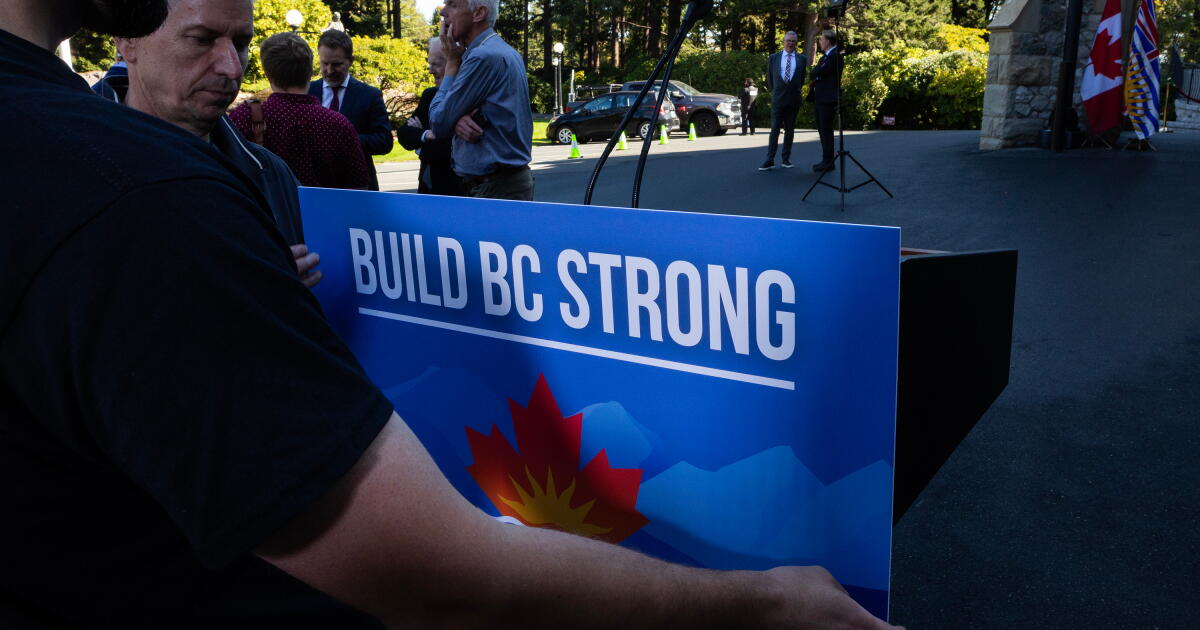
VICTORIA, British Columbia — A Canadian provincial premier called a snap election Tuesday, saying President Trump’s attacks on Canada are threatening jobs, businesses and the country’s ability to determine its own future.
The provincial election comes after U.S.-Canada trade talks broke down, deepening a dispute that has brought steep tariffs. British Columbia Premier David Eby effectively put Trump on the ballot, arguing the election offers British Columbians a choice between his government’s efforts to resist U.S. economic pressure and opponents he accused of embracing “MAGA-style politics.”
“Join us saying hell no to Trump and to his politics,” Eby said in announcing the Oct. 24 election.
Eby said Trump’s trade war and threats against Canada have changed conditions in British Columbia enough to justify an election two years early.
“Donald Trump is attacking our workers, he’s targeting our businesses, and he is threatening our sovereignty,” Eby said. “He’s threatening our ability to make decisions for ourselves.”
The left-leaning New Democratic Party leader said British Columbia needs to build a “firebreak” against Trump’s economic policies by protecting workers and businesses, reducing its dependence on the United States and finding new markets for Canadian products.
“This isn’t just a trade dispute,” Eby said. “It’s about the life that you and your family are building.”
Eby said British Columbia’s exports to the United States have fallen 4% while exports to other markets have risen 16%.
He also vowed to keep American alcohol off provincial shelves, saying “not one drop of Jack Daniels” would return until Canada gets a fair deal with the United States.
The New Democrats won a narrow majority in the 2024 provincial election, giving Eby enough seats to govern without relying on another party, and he was not required to call another election until 2028.
The election call also comes amid turmoil among the opposition British Columbia Conservatives. Kerry-Lynne Findlay resigned as party leader Sunday following a wave of defections and expulsions from her caucus. Lorne Doerkson was named interim leader.
A member of Donald Trump’s political party has issued a rare call for a congressional investigation into the foreign dealings of the United States president’s eldest son.
US Senator John Curtis, a Republican from the state of Utah, on Tuesday said “questions have arisen” about Donald Trump Jr’s relationships with foreign business figures and acceptance of “significant gifts”, alleging he may have personally benefited from his relationship with the president.
Recommended Stories
list of 3 itemsend of list
In a letter to the Republican and Democratic leaders of the US Senate Judiciary Committee, Curtis referenced a ProPublica report that found Trump Jr’s Bahamian wedding party in May was funded by a Russian oligarch.
“These reports raise legitimate questions about foreign access to members of a sitting president’s family and whether such relationships can create actual or perceived expectations of favorable treatment,” Curtis wrote. “They also may create expectations of a returned favor that would not be in the best interests of the American people or our allies, and could even create national security vulnerabilities.”
The letter comes as a small but slowly growing number of Republicans have spoken out against Trump, who has largely avoided criticism from members of his own party. But record-low approval ratings sparked by the war in Iran and concerns over the cost of living in the US have forced some Republicans to reconsider that support as they face growing prospects of major losses in the congressional midterm elections.
If Democrats retake one, or both, chambers of the US Congress in November, investigations into Trump, including his family’s dealings, are likely. But those probes are less likely under Republicans wary of the president’s wrath.
A spokesperson for the Senate Judiciary Committee, which is under Republican control, told the Associated Press that it had received Curtis’s letter but did not say whether there would be an investigation.
Trump vs Biden
Curtis, who isn’t up for re-election until 2030, also called on the chamber’s panel to subpoena Trump Jr, as well as the son of former US President Joe Biden, a Democrat.
“The country should not have to accept one standard for the family of a Republican president and another for the family of a Democratic president,” Curtis wrote, referencing the scrutiny and investigation Biden’s son Hunter faced from Republicans.
Hunter Biden responded to Curtis’s letter in a post on social media, calling for the Senate committee to “bring it on” as he vehemently denied any foreign business dealings while his father was president.
“I’ll sit next to Don Jr. and testify any time, any place,” Biden wrote on X as he called for the president’s youngest son, Eric, and son-in-law, Jared Kushner, who serves as a US envoy, to testify as well. “No need for a subpoena. Let’s all do it tomorrow.”
After the ProPublica report, Trump Jr and his wife, Bettina, released a joint statement on social media saying the Russian oligarch, Umar Kremlev, was a “dear friend” who “very generously hosted two incredible nights of celebrations for us AFTER our wedding”.
The president, who did not attend the wedding, said his son had reimbursed Kremlev.
“It’s totally allowed, and a lot of people give parties and things like that — but it’s totally allowed,” Trump said. “But as I understand it, he paid him back. He didn’t want it.”
US Senator Dick Durbin, the ranking member on the Senate Judiciary Committee, said that while Biden’s son “has already given a sworn deposition to Congress”, Trump Jr “has not”.
“For the committee to ignore this matter is to run the risk of being complicit in a coverup,” Durbin said. “I will join in supporting Senator Curtis’ request of the Senate Judiciary Committee.”
Curtis’s office did not immediately reply when asked by Al Jazeera what prompted the senator’s letter and whether any fellow Republicans have indicated if they would support an investigation into the president’s family.
Amid the US-Israel war on Iran, the country’s economy has suffered a sharp contraction, with its crucial oil and gas sector taking the biggest hit as the United States tightens its economic and military pressure on Tehran.
Data released by the government-administered Statistical Center of Iran showed gross domestic product (GDP) shrank by 10.1 percent year-on-year between March 21 and June 20, the first quarter of the Persian calendar.
Recommended Stories
list of 3 itemsend of list
The period covers the opening months of the US-Israel war on Iran, which began on February 28.
The economic downturn has come as Iran struggles to export its oil, one of its most important sources of foreign currency, while also contending with high inflation, a weakening rial, and disruptions to trade and industry.
Here is what you need to know:
What does the economic data say?
The headline GDP number masks an even steeper decline in Iran’s energy industry. Crude oil and natural gas activity contracted by 26.4 percent compared with the same period a year earlier. GDP excluding oil, by comparison, fell by 4.6 percent.
The damage has spread beyond the energy sector. Industry and mining contracted by 14.7 percent, services declined by 4.8 percent, and manufacturing contracted by 2.5 percent. Agriculture was the exception, growing at 2.3 percent.
Those figures come amid an already difficult economic situation in the country. Earlier this month, Iran’s 12-month average inflation reached 69.9 percent, while food, beverage, and tobacco prices rose at nearly twice that rate. Official unemployment climbed to 9.1 percent in the spring.
The rial, meanwhile, fell from about one million to the US dollar a year earlier to more than 2.2 million in early September.
What is the latest with Iran’s oil exports?
Iran’s ability to sell crude has been dramatically curtailed by the US naval blockade, imposed for most of the war.
Iranian crude and condensate loadings collapsed from about two million barrels per day in March to roughly 740,000bpd in July and just 220,000-255,000bpd in August, according to estimates from Kpler and Vortexa.
TankerTrackers.com told the Reuters news agency that 29 tankers, carrying 36.11 million barrels of crude, were trapped in the Strait of Hormuz. Meanwhile, Vortexa estimated total Iranian crude afloat had fallen from 135 million barrels at the end of July to 107 million barrels by late August.
Is Trump winning the economic war on Iran?
By several economic measures, Washington’s pressure campaign is inflicting damage on Iran’s economy.
On September 6, total trade had fallen by 25 to 35 percent, President Masoud Pezeshkian said, with imports hit harder than exports. The US blockade of the Strait of Hormuz has made it hard for ships carrying imports to reach Iranian ports.
Tehran has also explicitly linked the end of the war to economic relief. Iran’s security chief Mohsen Rezaei told Al Jazeera on Saturday that its conditions include “the release of our frozen funds and an end to the naval blockade”.
In addition to the naval blockade, US Treasury Secretary Scott Bessent last month announced an economic pressure campaign against Iran, pledging to target its financial interests across the world. He said the US would target all of Iran’s sources of revenue, including oil, to prevent other countries and companies from doing business with Tehran.
The US-Israeli attacks and Iran’s retaliations have disrupted Tehran’s trade with one of its main economic partners, the United Arab Emirates.
The UAE last month announced an indefinite trade embargo on Iran after accusing its forces of carrying out several ballistic missile attacks, which Tehran denied, calling it a “false flag operation” by Israel and the US.
Chris Beauchamp, market analyst at IG Group, said, “Most wars are contests of stamina more than anything else.”
“The 10 percent drop in Iranian GDP is a sign that the US is succeeding in putting pressure on its foe. But the question rests, as it has done since March, on whether Iran can weather the fall in economic activity better than the US can stand the surge in energy costs,” he told Al Jazeera.
“For a regime prepared to do anything to stay in power, this news will make little difference, so long as the security forces remain loyal,” he added.
What is the latest with diplomatic efforts to end the war?
While Iran has taken a defiant stance against US economic and military pressure, it has indicated repeatedly that it remains open to diplomatic means to end the nearly seven-month-old war.
On Saturday, Rezaei told Al Jazeera that Iran conveyed a formal set of conditions to Washington through Qatari mediators for ending the war.
Iranian state media outlet IRNA reported on Monday that Pakistani Interior Minister Mohsin Naqvi was set to visit Tehran, without specifying the agenda or other details.
Mediators Qatar and Pakistan have been working to re-establish negotiations between the two sides since their memorandum of understanding (MoU) expired last month.
Meanwhile, Iranian Foreign Minister Abbas Araghchi will stop briefly in Qatar before going to New York for the UN General Assembly, IRNA reported.
Iran has repeatedly said it remains ready for any new strikes by Washington.
Rezaei said on Saturday Tehran did not rule out a new US strike against Iran, calling the possibility “very much on the cards” based on his country’s military assessments.
Mark Pfeifle, a Republican strategist and former White House and national security official, said Iran and the US are still willing to strike a deal.
“Sometimes in diplomacy it’s what’s taken off the table,” he told Al Jazeera.
Pfeifle said when Rezaei reiterated his demands for talks with the US, he spoke of “ending the blockade, releasing the frozen funds [and] stopping the attacks”.
“But he left off reparations and reconstruction money, which tells me that there’s a concrete sign that amongst all the rhetoric, which is still very strident, that the pressure campaign that the US is putting on Iran is having some effect,” he said.
“And it tells me that both sides are still looking for room to negotiate in the coming weeks.”
Thousands of protesters took to the streets of Buenos Aires for the ‘March of Anger’, organised largely by left-wing groups opposing the Milei government’s austerity policies. Protesters say the cuts are hurting working families.