Asia

India’s severe monsoon season causes more than 100 deaths since July | Weather News

Monsoon downpours cause floods and landslides as climate change and El Nino disrupt rainfall patterns.

Floods and landslides triggered by monsoon rains have killed more than 100 people across India since July, according to official data, with thousands forced to flee flooded homes.

The annual monsoon brings rain that farmers depend on, but scientists say climate change is making it increasingly deadly across South Asia.

Recommended Stories

list of 3 itemsend of list

This year’s toll spans several states. Assam has been hit hardest, with at least 87 dead, and Sivasagar district alone accounting for 47.

Kerala has recorded at least 15 deaths and seven missing after days of heavy rain, Chief Minister VD Satheesan said, with more than 10,000 people sheltering in more than 300 relief camps in the state.

A report by the public state broadcaster said that Indian-administered Jammu and Kashmir has seen at least 31 killed by intense rain bursts.

Lightning strikes have killed at least 14 people in Jharkhand, most of them farm workers caught in open fields. Jharkhand saw more than 200 deaths in 2025, mainly attributed to “lightning associated with thunderstorms”, the India Meteorological Department said in January.

FILE PHOTO: People wade through a flood-affected area with their belongings in Sivasagar, Assam, India, July 23, 2026. REUTERS/Hafiz Ahmed/File Photo
People wade through a flood-affected area with their belongings in Sivasagar, Assam, India, on July 23, 2026 [Hafiz Ahmed/Reuters]

Monsoon-related deaths are an annual occurrence across India after the region’s long summers when many parts of the country face water scarcity and drought.

The pattern extends beyond India’s borders. In Sri Lanka, at least eight deaths and 12,000 displaced from monsoon flooding have been recorded. This happened while the country’s eastern regions were in the grip of a severe drought, with authorities having to transport drinking water for residents in tanker trucks.

Sri Lanka’s government said last month that the extreme weather stems from this year’s El Nino, a climate pattern that warms surface temperatures in the central and eastern equatorial Pacific. It occurs when normal east-to-west trade winds weaken or reverse, pushing warm water eastward and significantly disrupting global weather and rainfall.

Source link

Bangladesh Truth Seeker | Petro Poroshenko

Amid political upheaval in Bangladesh, a journalist debunks fake news in a fight for his nation’s democratic future.

Bangladeshi journalist and fact-checker Qadaruddin Shishir investigates extrajudicial killings and disinformation following the student-led protests that ousted former Prime Minister Sheikh Hasina in 2024.

As Bangladesh continues a political transition under new governance, he turns his focus towards debunking fake news and misleading narratives spreading online. Determined to safeguard his nation’s democratic integrity, he launches an independent organisation to expand his work and mentor a new generation of fact-checkers.

As Bangladesh struggles to rebuild trust after political turmoil, Shishir pins his hopes on a new generation willing to defend the truth.

Source link

Trump says new round of Iran talks will begin Monday | Conflict News

The US president says Gulf allies and Tehran urged him to delay planned strikes.

United States President Donald Trump has said that negotiations with Tehran are set to begin on Monday after he decided to hold off on new strikes on Iran in pursuit of a deal.

Trump said on Sunday that a plan was in place for the US to launch “the biggest attack since World War II” against Iran but that he halted it to give diplomacy a chance.

Recommended Stories

list of 3 itemsend of list

“Obviously, they don’t want to be attacked. They knew the extent of the attack because they saw it forming,” Trump told reporters on board Air Force One on Sunday.

“Now what we’re doing is talking to them in the form of a negotiation. It begins tomorrow afternoon.”

He gave no details about the venue or participants in the talks.

Trump pulled back from threats of an attack on Saturday after saying the “perimeter” of a deal was in place.

In his latest comments, Trump said Iran and US partners Saudi Arabia, the United Arab Emirates and Qatar had urged him to hold off on the strikes.

“When the allies asked to call it off, you’ve got to sort of say, ‘Well, let’s see.’ And the reason they ask is they think there’s a deal,” he said.

“There’s a deal on [the Strait of] Hormuz, and then there will be a deal on the nuclear, or you might call it the denuclearisation of Iran.”

He said Saudi Arabia’s Crown Prince Mohammed bin Salman had also urged against the strikes, warning of possible unintended consequences.

“I mean, will they be flooded with people pouring into their country and disaster? A lot of bad things can happen,” Trump said.

Regional diplomacy intensifies

Trump’s announcement came hours after Iranian Minister of Foreign Affairs Abbas Araghchi held a second phone call with Saudi Foreign Minister Prince Faisal bin Farhan Al Saud, joined by Pakistani Army Commander Asim Munir, to discuss recent diplomatic efforts.

The officials exchanged views on the current situation and on “initiatives aimed at maintaining and strengthening security and stability” in West Asia, Araghchi said in a Telegram post. They also stressed the need to use regional cooperation and political solutions, he added.

Earlier on Sunday, Iran’s official news agency IRNA reported that negotiations between Tehran and Oman over the Strait of Hormuz were in their final stages, citing Araghchi.

Iranian Ministry of Foreign Affairs spokesperson Esmaeil Baghaei said the negotiations focused on agreeing to a new route through the strait, adding that this had “no link to the Strait of Hormuz being opened or closed. That is a separate discussion”.

The war began on February 28, when the US and Israel launched surprise strikes against Iran, although months of on-and-off diplomacy have led to periods of relative calm.

A previous ceasefire deal, which included the reopening of the Strait of Hormuz, a vital conduit for global energy supplies, fell through. Iran has since tightened its control over the waterway as the two countries resumed attacks against each other in recent weeks.

Oil prices fall as escalation fears ease

Oil prices dropped sharply in early trading after Trump abandoned plans for a new military operation against Iran, easing fears of further disruption to Gulf energy supplies.

Brent futures were down $4.08, or 4.64 percent, at $83.85 a barrel on Sunday. West Texas Intermediate lost $4.01, or 4.74 percent, to trade at $80.66, according to the Reuters news agency.

The decline reversed part of last month’s surge, when both benchmarks gained more than 20 percent as renewed US-Iran fighting and attacks on commercial vessels near Oman intensified concerns over shipping through the region.

Source link

Japan and US confirm rare joint intervention to prop up yen | Business and Economy News

Japan and the United States have confirmed a rare, coordinated yen-buying intervention to halt the Japanese currency’s slide to 40-year lows, with Tokyo signalling it is willing to take further action if needed.

The Japanese Ministry of Finance confirmed the joint intervention after a statement by US President Donald Trump on Sunday announced that Washington was helping to prop up the yen as a sign of friendship and to support the global economy.

“They have a weakening yen, and they wanted a little bit of help. And we’re always there for Japan,” Trump said in response to a reporter’s query about why the US is helping to support the currency.

The yen leapt after the announcement, leaving traders on high alert for further intervention from authorities. The Japanese currency gained as much as 1.4 percent to hit a nearly three-month high of 155.20 per US dollar, compounding a 3.8 percent surge over the previous two sessions. The yen also advanced broadly against other major currencies, including the euro and sterling.

The latest bout of aggressive yen-buying heavily pressured the US dollar. In early Asian trading on Monday, the euro climbed to a 1.5-month high of $1.1559, while sterling hovered near a two-week top at $1.3476.

However, the rapid appreciation of the currency immediately weighed on the equity market. The Nikkei share average tumbled, reversing course from the one-week high it had achieved in the previous session.

Analysts say the intervention underscores both countries’ resolve to prevent global spillovers from a sell-off in the yen and Japanese government bonds, including by adding pressure on already rising US Treasury yields.

Japan has been struggling to curb a relentless drop in its currency that has pushed up import prices and stoked broader inflation, hitting household wallets and Prime Minister Sanae Takaichi’s approval ratings.

In its statement, Japan’s Finance Ministry said Friday’s yen-buying intervention with the US Treasury Department “countered excessive volatility and disorderly movements in the Japanese yen in recent months”.

“The Japanese Ministry of Finance remains attentive and in close communication with our counterparts at the U.S. Treasury,” it added. “We will not hesitate to conduct further joint intervention.”

The joint intervention is the first since a 2011 coordinated action to weaken the yen after the devastating earthquake in eastern Japan.

Tokyo may have sold as much as $58.97bn to buy yen when it intervened in New York markets on Thursday, Bank of Japan data indicated, before Friday’s confirmed joint intervention with Washington.

US Treasury Secretary Scott Bessent also confirmed Friday’s effort, noting on Sunday that Washington “will not hesitate to participate in further joint intervention”.

“We strongly support Japan’s decisive market and monetary steps to correct the substantial undervaluation of the yen,” Bessent said in a separate statement on X, repeating his calls for further interest rate hikes by the Bank of Japan.

In line with Bessent’s repeated calls for higher Japanese interest rates, the Bank of Japan on Friday offered its most explicit signal to date of an early rate hike, even as it kept monetary policy steady.

In a sign of broader policy coordination, South Korea also stepped in to buy its won currency on Thursday.

Japan intervened in April and May, buying yen, but the move triggered only a brief rebound. The Bank of Japan’s June rate hike to a 31-year high of 1 percent also gave the struggling currency little lasting boost.

Source link

Suicide bombing kills at least 14 people in Pakistan’s Swat Valley | Newsfeed

NewsFeed

Footage shows blast victims hurried into a hospital in northwestern Pakistan, after a suicide bombing at a police station in Kabal near the Afghan border killed at least 14 people. Crowds of people had been protesting nearby when the bomb exploded.

Source link

How Davutoglu helped shape Erdogan’s Turkiye but failed to challenge it | Politics

Ahmet Davutoglu was once one of Turkiye’s most powerful figures: The academic who helped shape the country’s ambitious foreign policy after the turn of the century, served as foreign minister and prime minister, and was chosen by President Recep Tayyip Erdogan to lead the governing Justice and Development Party, or AK Party.

But later, he became a critic of the political system he had helped build.

Recommended Stories

list of 3 itemsend of list

Now, after announcing that his opposition Future Party would cease political activities, Davutoglu is withdrawing from party politics. He described the decision not as surrender but as an effort to distance himself from what he called Turkiye’s “polluted political climate”.

His departure leaves a contested legacy – that of an intellectual who transformed Tukiye’s diplomatic outlook, but struggled to turn his ideas and prominence into an independent political movement.

From professor to foreign minister

Born in 1959 in Taskent, in the central province of Konya, Davutoglu studied economics and political science at Bogazici University before becoming an academic.

He taught in Malaysia and at universities in Turkiye, with students calling him “Hoca”, or the professor – a title that followed him into government.

Davutoglu became widely known for his so-called “strategic depth” doctrine, the argument that Turkiye’s geography, Ottoman history and connections across the Balkans, Middle East, Caucasus and Central Asia could make it a central diplomatic power rather than a country confined to Europe’s periphery.

After the AK Party came to power in 2002, he became Erdogan’s chief foreign policy adviser. He was appointed foreign minister in 2009 and entered parliament in 2011.

His early years in government coincided with an expansion of Turkish influence.

Ankara opened embassies, strengthened its presence in Africa and the Middle East, mediated regional disputes and promoted trade and visa-free travel with neighbouring countries. The approach became known as “zero problems with neighbours”.

Tarik Celenk, a writer and analyst familiar with Turkiye’s conservative intellectual tradition, said Davutoglu altered the country’s diplomatic culture.

“Davutoglu brought a change of mentality to the Foreign Ministry cadres,” Celenk said, crediting him with opening diplomacy to businesses and civil society.

Celenk noted that Davutoglu sought to position Turkiye as a country capable of communicating with otherwise incompatible actors. “Davutoglu was able to have good relations with Hamas, with Russia, and also to have good relations with the US,” he added.

Davutoglu called this intensive and multidirectional engagement “rhythmic diplomacy” – an effort to maintain dialogue across competing regional and global power centres.

But the Arab uprisings, particularly the war in Syria, exposed the limits of that vision, analysts said. Turkiye supported the Syrian opposition and anticipated that President Bashar al-Assad’s government would fall quickly. Instead, the conflict brought mass displacement, security threats and prolonged instability.

“His principal mistake in foreign policy was that he was very emotional, very romantic,” said Celenk, arguing that Davutoglu struggled to establish boundaries between “idealism, romanticism and realism”.

ANKARA, TURKEY - MAY 22: Turkey's PM Ahmet Davutoglu (R) greets Transport and Comunication Minister Binali Yildirim and his wife Semiha Yildirim (L) during the Extraordinary Congress of the ruling AK Party (AKP) to choose the new leader of the party on May 22, 2016 in Ankara, Turkey. Turkey's Transport and Communication Minister Binali Yildirim is the sole candidate to head AK Party and as the new Prime Minister of Turkey. (Photo by Gokhan Tan/Getty Images)
Davutoglu, right, greets Transport and Communication Minister Binali Yildirim during an AK Party congress on May 22, 2016 in Ankara [File: Gokhan Tan/Getty Images]

Erdogan’s chosen successor

When Erdogan moved from the prime minister’s office to the presidency in 2014, he selected Davutoglu to succeed him as AK Party leader and prime minister.

The arrangement contained a fundamental contradiction. Under Turkiye’s parliamentary system at the time, Davutoglu formally headed the government. But Erdogan continued to dominate the governing party and exercise authority from the presidency while advocating an executive presidential system.

Davutoglu led the AK Party through two elections in 2015. After losing its parliamentary majority in June, the party regained it in November with nearly half the national vote. Yet the victory did not give Davutoglu an independent power base.

According to Celenk, Davutoglu entered politics imagining a forest without “wolves, foxes, jackals or snakes” – but discovered while prime minister “that this forest did not exist”.

Amid disagreements over appointments, governance and Erdogan’s efforts to expand presidential authority, Davutoglu stepped down in 2016. He remained in the AK Party for another three years before resigning and establishing the Future Party in 2019.

An opposition party without a base

The party sought to attract conservative voters disillusioned with Erdogan while advocating parliamentary democracy, the rule of law and accountable government. It never developed substantial electoral support.

Political scientist Berk Esen said opposition parties face structural disadvantages in Turkiye, where the governing party has extensive access to state resources and much of the media.

But those conditions did not fully explain the failure of Davutoglu’s party, he added. “For one thing, the Future Party was already half stillborn by its very foundation,” argued Esen.

Davutoglu and Ali Babacan, another former senior AK Party figure, established separate opposition parties, dividing an already limited pool of disaffected conservative voters. Both also struggled to confront the records of the governments in which they had served.

In the 2023 elections, Future Party candidates entered parliament on the lists of the Republican People’s Party, or CHP, then Turkiye’s main opposition party. The arrangement delivered seats but exposed the party’s dependence on a larger organisation.

Esen said pursuing guaranteed representation prevented the Future Party from fielding its own candidates across Turkiye and building local networks.

“In order to achieve a small success in the short term, they squandered the party’s institutional identity in the medium term,” he said. “And that is already why this party closed.”

Celenk offered a similar assessment: “You could say that the Future Party was never the party of the future. It became stuck in the past.”

Yet he distinguished between Davutoglu, the unsuccessful party leader, and Davutoglu, the intellectual.

“Let us criticise Ahmet Davutoglu the politician together, all the way to the end,” he said.

“But Ahmet Davutoglu’s intellectual production capacity within the conservative community was belittled and not taken seriously,” added Celenk, referring to sections of Turkiye’s conservative political and religious establishment which, according to him, benefited from Davutoglu’s ideas and intellectual framework but did not sufficiently acknowledge his contribution.

Esen said he doubts Davutoglu could exercise significant political influence while Erdogan remains in power. “But I think, in practice, his political career appears to be over,” he said.

Yet the analysts found substance in Davutoglu’s explanation for withdrawing. Celenk said his four-page letter offered a serious diagnosis of “the state the country, its politics and its society have reached”, including the risk that Turkiye was “losing its character as a nation”. Esen agreed that “Turkish politics has become very polluted and authoritarian”, adding that some of Davutoglu’s criticisms were therefore well grounded.

Davutoglu exits party politics without establishing the conservative democratic alternative he promised. But some of the ideas and diplomatic practices he introduced survived his loss of power, ensuring that debate over his legacy will outlast the party he founded.

“At least as Davutoglu leaves politics and withdraws from institutional politics, this must be remembered,” said Celenk.

Source link

India cracks down on protesters accused of ‘abusing’ Modi | Censorship News

NewsFeed

Police cases, social media takedowns and online abuse have followed many who took part in India’s Cockroach Janta Party-led demonstrations that ended on July 25. Prime Minister Narendra Modi says he forgives ‘misled children’ who abused him during the protests.

Source link

Omani legend, US novice: Pakistan recovers bodies from Broad Peak | News

Rescuers are still looking for other missing climbers swept away in an avalanche on the world’s 12th largest peak.

Rescuers continue the search for six climbers still missing after an avalanche hit Pakistan’s Broad Peak, as officials identified one of the four recovered bodies as Nadhira Al Harthy, the first Omani woman to summit Mount Everest.

Pakistani authorities recovered three of the bodies on Friday in harsh weather that hampered flights by search and rescue helicopters, officials said, and identified them as Nepalese climber Pur Bahadur Gurung and American climber Sarah Mallory Geis, as well as Harthy.

Recommended Stories

list of 4 itemsend of list

The officials did not immediately identify the fourth body that was found.

The expedition comprised five Nepali climbers, the Omani and American climbers, Pakistani climber Sohail Sakhi, a Chinese climber identified only as Wang, and one other foreign climber, according to the Alpine Club of Pakistan.

The expedition leader was the renowned mountaineer Nirmal Purja, a Nepal-born former soldier in the British army widely known as Nims Dai. He climbed the world’s 14 highest peaks in a record 189 days in 2019, an achievement featured in the Netflix documentary, 14 Peaks: Nothing is Impossible. His record was surpassed in 2023.

A file photo of Nirmal Purja, one of the team member of the all-Nepalese mountaineering team that became the first to scale Mount K2 in winter, gestures as the team arrives at Tribhuwan International airport in Kathmandu, Nepal on Jan. 26, 2021. [Niranjan Shrestha/AP Photo]
A file photo of Nirmal Purja, one of the team members of the all-Nepalese mountaineering team that became the first to scale Mount K2 in winter, gestures as the team arrives at Tribhuvan International Airport in Kathmandu, Nepal on January 26, 2021 [Niranjan Shrestha/AP Photo]

The climbers were swept away in an avalanche on the 8,051-metre (26,414ft) peak, the world’s 12th-highest mountain, about midday on Thursday. The area in which the search is taking place is “remote and difficult”, said Sajid Hussain, deputy director of the tourism department in Gilgit-Baltistan.

Of the world’s 14 highest peaks, eight are in Nepal, five in Pakistan and one in Tibet. Climbing experts say barely more than three dozen mountaineers have climbed all 14 peaks to date. Broad Peak is considered one of Pakistan’s most challenging climbs.

Nepal’s Gurung, known to his friends as Yukta, climbed Everest more times than anyone else from the Gurung community, with 10 successful ascents to his name, Nepal’s Online Khabar noted. He also successfully climbed 12 of the world’s 8,000-metre (26,246ft) peaks.

Yukta had also set a record by summiting Pakistan’s K2, the world’s second-highest peak, within 24 hours. He was regularly involved in rescue operations for tourists stranded in the mountains.

Oman’s Al Harthy held a master’s degree in geography and previously served as director of the Citizenship Department at Oman’s Ministry of Education, Gulf News reported. In 2019, she became the first Omani woman to reach the summit of Mount Everest, and then the first Omani to climb K2, the world’s second-highest mountain.

For the US’s Geis, it was her first try at an 8,000-metre peak in Pakistan.

Geis, 39, lived in San Antonio. She announced on social media earlier this year that she was closing her Pilates studio to take “a giant leap of faith into the unknown to see where life goes. I have a sneaking suspicion there will be lots of helmets, harnesses, and crampons involved.”

Sakhi was a guide for the company, as well as a geographer and high-altitude photographer who had climbed several of the world’s major peaks.

Source link

Protesters detained at rally in support of Pakistan-administered Kashmir | Protests

NewsFeed

Police detained several protesters in Lahore, Pakistan as they rallied in solidarity with Pakistan-administered Kashmir. A banned Kashmiri activist group says that at least 30 people have been killed in clashes during regional elections this past week.

Source link

Ten climbers led by renowned Nepali mountaineer ‘missing’ on Pakistan peak | Environment News

Mountaineer Nirmal Purja among those feared missing after avalanche hit Broad Peak, Pakistan alpine club says.

Ten climbers, led by renowned Nepali mountaineer Nirmal Purja, are feared missing after an avalanche in northern Pakistan where they were on a climbing expedition, the country’s alpine club said.

“The Alpine Club of Pakistan (ACP) has received deeply concerning reports of an avalanche that struck a team of climbers on Broad Peak (8,047m) in the Karakoram mountain range,” the club said late on Thursday, adding that the team was led by Purja and could not be reached since the incident.

Broad Peak is the 12th-highest mountain in the world.

The ACP said the expedition comprises 10 people, including five from Nepal, one from Pakistan, one from Oman, one from China, one from the United States, and another foreign climber whose nationality it did not disclose.

“The entire team has reportedly been out of communication since the avalanche,” the club said.

“Every possible effort is being made to ensure that helicopter support and all available rescue resources are mobilised at the earliest opportunity, subject to weather and operational conditions,” it added.

Purja, 43, also known as Nims Dai, has broken multiple climbing records since becoming a full-time mountaineer and tour guide in 2018, after leaving the British military.

He climbed all 14 “eight-thousanders” (peaks above 8,000 metres, or 26,000 feet) in six months and six days between April and October 2019, a record at the time.

In 2021, Purja completed the first winter ascent of K2 as part of a team of nine other Nepalese climbers.

Source link

UEFA to boycott World Cup as CONCACAF and Asia denounce FIFA sale

European nations agreed Thursday to boycott the World Cup and all other FIFA competitions to protest Gianni Infantino’s plan to sell stakes in soccer’s biggest tournament to private equity investors. The North American soccer body rejected his plan later the same day.

“UEFA and its national associations will not participate in FIFA competitions,” the European soccer body said after an urgent online meeting of its 55 member nations.

The next scheduled FIFA tournament is within weeks in Europe — the Women’s Under-20 World Cup hosted by Poland from Sept. 5 — and the four British federations comprise FIFA’s only bidder to host the 2035 Women’s World Cup. That decision is due Nov. 23.

“Some things are simply too important to sell,” UEFA said in a statement. “The FIFA World Cup belongs to football. It always will. And so long as Europe has a voice, it will never be for sale.”

The strategy meeting was called to counter FIFA president Infantino’s offer of $20 million to each of FIFA’s 211 global members that has to be accepted by mid-September.

Later Thursday, the 41-member Confederation of North, Central American and Caribbean Assn. Football (CONCACAF) met and announced it rejected Infantino’s plan.

In a statement, CONCACAF said members “expressed deep concerns about the lack of due process surrounding the proposal, the artificially short deadline imposed, and the absence of any review or approval by the relevant FIFA governance bodies.” It also questioned the need for outside investment “following the most profitable FIFA World Cup in history.”

Infantino’s secret project was revealed Tuesday to spin off its commercial operations in a new $20-billion subsidiary called FIFA Forward Enterprise (FFE) 20% owned by private investors. The core investor would be a New York investment firm created by Joshua Kushner, the brother of U.S. President Trump’s son-in-law Jared Kushner.

Infantino wrote Tuesday to the 211 members — already the effective owners of FIFA as a nonprofit association under Swiss law — that if they approve FFE their promised $10-million basic funding for the next four years will double to $20 million. He projected their FIFA funding through 2038 would be $86 million each, instead of about $36 million.

“This is not merely a profound failure of leadership, but an abdication of FIFA’s duty as the custodian of world football,” said UEFA, where Infantino was a longtime staffer and its CEO-like general secretary when he was first elected to lead FIFA in 2016.

Infantino’s presidency at risk?

Infantino’s high-stakes financial gambit now could threaten his previously secure 11-year presidency of FIFA as anger and frustration with him rises among soccer stakeholders including three of the six continental bodies.

FIFA has set a Nov. 18 deadline for potential candidates to declare in a presidential vote of the 211 members scheduled next March in Rabat, Morocco.

Infantino had seemed — 11 days ago after the World Cup final in East Rutherford, N.J. — to have a clear path to being reelected unopposed for a fourth and final term in office through 2031, despite a furor over letting United States forward Folarin Balogun play against Belgium despite a red card in his previous game.

Soccer officials have said privately Infantino has eyed a lucrative commissioner-like role at the FFE spinoff beyond 2031.

“Game over, Gianni #InfantinOUT,” the Football Supporters Europe group, which advises UEFA on fan issues such as ticket prices, posted after the boycott threat.

Soccer’s concern at investor pressure

UEFA detailed Thursday why soccer officials fear external investors owning a stake of the global game’s biggest events, including World Cups and Club World Cups for men and women.

“The moment external investors acquire ownership interests in FIFA competitions, football changes forever,” UEFA said. “Commercial return becomes a permanent obligation. Investor expectations become a daily pressure.”

Infantino has presented the private equity offer as a chance to “turbocharge” funding development of soccer across the world, where a majority of the 211 FIFA members rely on its funding.

Officials from about 40 UEFA members spoke at the urgent meeting, with anger expressed that FIFA is not using some of its multi-billion reserves to fund extra development programs.

“As a result of today’s discussion, no UEFA national teams will participate in any FIFA competition for so long as these proposals remain alive,” the European soccer body said, “unless this proposal has been abandoned in its entirety and binding assurances have been given that FIFA will never again open its governance or competitions to private ownership.”

Asia adds rare criticism of Infantino

On a seismic day in soccer politics, a traditional bedrock of support in Asia for FIFA and Infantino had earlier Thursday been shaken.

“FIFA’s unilateral actions appear to undermine the very foundations of continental football,” the Asian Football Confederation president Sheikh Salman bin Ibrahim Al Khalifa said in a letter to its 46 members of FIFA, warning of risks to their own competitions.

Sheikh Salman, an ally to Infantino since losing the FIFA presidential election to him in 2016, wrote “such an initiative will not succeed without the support of all the confederations, which is not the case now.”

In a video message published Wednesday by FIFA, Infantino insisted spinning off its money-making operations was “an offer, not an obligation.”

A FIFA presentation for its members, co-written with its banking advisors from J.P. Morgan and seen by the Associated Press, set a goal for FFE as “commercial rigor and expertise to better capitalize on broadcast rights, sponsorships and a growing tournament portfolio.”

FIFA squeeze on continental games

That growing portfolio probably would include adding more teams to FIFA competitions such as the World Cup and Club World Cup for men and women, and potentially staging them more often than every four years, including in the U.S.

FIFA adding teams, games and competitions would squeeze the value, status and space in the congested global fixture calendar for those that fund and are organized by the six continental soccer bodies like UEFA and the AFC. Those include World Cup qualifying games, continental tournaments and Champions Leagues.

“It is important that the AFC family has a complete understanding,” Sheikh Salman wrote, “of how such an initiative may affect key areas of global and Asian football, including the sustainability of confederation and [domestic] competitions, as well as the organization and commercial landscape surrounding the AFC’s activities.”

UEFA’s previous boycott threat

A threatened World Cup boycott from Europe helped derail Infantino’s plan in 2021 to play World Cups every two years instead of four.

Dunbar writes for the Associated Press.

Source link

Is Pakistan ‘using India’s playbook’ in Kashmir? | Politics

NewsFeed

Pakistan is facing accusations that its security forces have killed dozens of unarmed protesters in the past week of demonstrations in Pakistan-administered Kashmir. Al Jazeera’s James Bays asked panellists on Inside Story if Islamabad is borrowing tactics from Indian-administered Kashmir.

Source link

Why Is China Avoiding Major Economic Stimulus Despite Slowing Growth?

China’s top leaders pledged on Thursday to support the country’s slowing economy by accelerating spending on already-approved infrastructure projects instead of rolling out large-scale stimulus measures. The decision came after recent economic data showed second-quarter growth slowed to 4.3%, the weakest pace in more than three years and below the government’s annual target range of 4.5% to 5.0%.

The commitment followed a meeting of the Communist Party’s Politburo, where policymakers acknowledged mounting economic challenges but signaled confidence that existing fiscal resources would be sufficient to stabilize growth through the remainder of the year.

Infrastructure Spending Takes Center Stage

Rather than introducing fresh stimulus packages, Beijing plans to speed up implementation of projects that have already been budgeted. Analysts said the government still has significant fiscal room because infrastructure spending and bond issuance progressed more slowly than planned during the first half of the year.

Economists expect much of the spending to focus on China’s “six networks” initiative, covering investments in water systems, logistics infrastructure, underground pipelines, electricity grids, telecommunications and computing power centers. State media has previously indicated that roughly $1 trillion has been allocated for these projects.

Stay ahead of the geopolitical week.

MD Briefing delivers expert analysis across five global fronts — the Indo-Pacific, energy, geoeconomics, European security, and the Middle East — every Monday morning. Free.

Analysts viewed the Politburo’s statement as confirmation that Beijing intends to support growth without significantly expanding its fiscal deficit.

Concerns Over Overcapacity Remain

Chinese leaders continue to avoid aggressive stimulus partly because they remain focused on tackling industrial overcapacity and encouraging local governments to maintain fiscal discipline.

The Politburo reiterated its commitment to addressing what it described as “involution competition”—a term referring to intense price wars among manufacturers competing for market share at the expense of profitability. While many economists argue that excess industrial capacity is driving these price wars, Beijing continues to reject claims that overcapacity is a structural problem.

Weak Consumer Demand Continues to Weigh on Growth

Although manufacturing exports and advances in artificial intelligence have supported parts of the economy, domestic consumption remains weak.

China’s prolonged property downturn, sluggish wage growth and a challenging labor market have reduced household confidence. Millions of workers have shifted into lower-paying gig economy jobs with limited social protections, encouraging higher savings rather than consumer spending.

This imbalance has increased China’s reliance on exports to sustain growth, raising concerns among trading partners that Chinese manufacturers are flooding global markets while domestic demand remains subdued.

Employment Support Remains a Priority

The Politburo pledged to strengthen domestic demand by expanding employment support, particularly for flexible workers and those in newer forms of employment. However, officials did not announce specific policies aimed at boosting household incomes.

Economists noted that while Beijing continues to emphasize consumption, its strategy remains focused on improving the supply of goods and services rather than directly increasing consumer purchasing power through large-scale income support or cash stimulus.

Outlook

The latest policy signals suggest Beijing is seeking to balance economic stability with long-term structural reforms. Rather than relying on broad stimulus, China’s leadership is betting that faster implementation of existing infrastructure investments and targeted employment measures will be enough to keep the economy on track while avoiding a surge in debt and further industrial overcapacity.

With information from Reuters.

Source link

Protest group says 30 dead in Pakistan-administered Kashmir vote unrest | Elections News

Deadly clashes reported in Pakistan-administered Kashmir amid first round of voting for regional elections on July 27.

Watchdogs have raised concerns over mounting reports of deadly clashes during regional elections in Pakistan-administered Kashmir, where a banned activist group has boycotted the vote and staged protests.

The clashes between police and protesters earlier this week killed more than 30 people in the region, according to the leaders of the Joint Awami Action Committee (JAAC).

Recommended Stories

list of 3 itemsend of list

In a video statement on Wednesday shared by Arab News Pakistan, JAAC committee member Sardar Umar Nazir claimed 20 of the group’s supporters had been killed during a march on Monday, when the first round of voting took place.

He listed reports of at least 10 other protesters being killed the following day in the towns of Rawalakot, Mirpur and elsewhere, including during sit-ins.

“Our demand was peaceful, it was peaceful, we tried to keep it non-violent and bullets were fired at it,” said Nazir in the video statement.

Pakistani authorities said a member of the security personnel was killed and five more were injured in clashes on Monday.

Rights group Amnesty International called the reports of lethal force against protesters in the area “disturbing” and urged an investigation.

Pear Pandya, a senior analyst at conflict monitor ACLED, said the violence in Pakistan-administered Kashmir “is bound to overshadow the legitimacy of the entire electoral exercise”.

Monday’s first-round vote – covering the districts of Mirpur, Kotli and Bhimber – will be followed by two more rounds on August 2 and August 10.

Pakistan’s primary governing party, ⁠the PML-N, won nine out of the 13 seats that were up for election on Monday.

No justification to ‘mete out violence’

JAAC was banned by the local government under “anti-terrorism laws” in June, causing deadly protests to erupt in Pakistan-administered Kashmir.

Banking, roads and internet services have largely been disrupted since then, hindering the flow of information.

Pakistani officials have justified the crackdown by alleging that armed and India-backed fighters joined the Kashmiri protesters. India has rejected similar accusations in the past.

Amnesty has called the ban on JAAC unlawful and said it does not provide justification for authorities to “mete out deadly violence against protesters”.

The rights group has also urged Pakistani authorities to ”restore all communications access and allow media and independent observers into the area”, its acting regional director for South Asia, Isabelle Lassee, said.

‘Controversial’ seats

One of JAAC’s central demands regarding the regional elections is the abolition of 12 assembly seats reserved for Kashmiri refugees.

JAAC supporters say the seats are used by major Pakistani political parties to tip the composition of the local parliament in their favour with those who mostly live outside the region.

To form a regional government, the PML-N would likely need the support of some of the 12 representatives, said Hasan Askari, ‌a political analyst.

“But when their government is dependent on those 12 controversial seats, how would it be able to find a solution for this issue?” Askari told the Reuters news agency.

Even among the candidates that did not boycott the vote on Monday, the results were contested. Parties accused each other of ballot ‌box ‌stealing and vote rigging.

Source link

Indian student in Russia says he’s been wrongly charged over Bihar protests | Politics

NewsFeed

An Indian student from Bihar says he has been charged over ‘Cockroach’ protests despite being in Russia for the last four months. Hundreds of students across India have faced arrest for participating in the youth-led demonstrations.

Source link

Jayden Seales takes five wickets as West Indies beat Pakistan in first Test | Cricket News

West Indies take a 1-0 lead in the two-Test series after Jayden Seales dominates with the ball on day 4 in Trinidad.

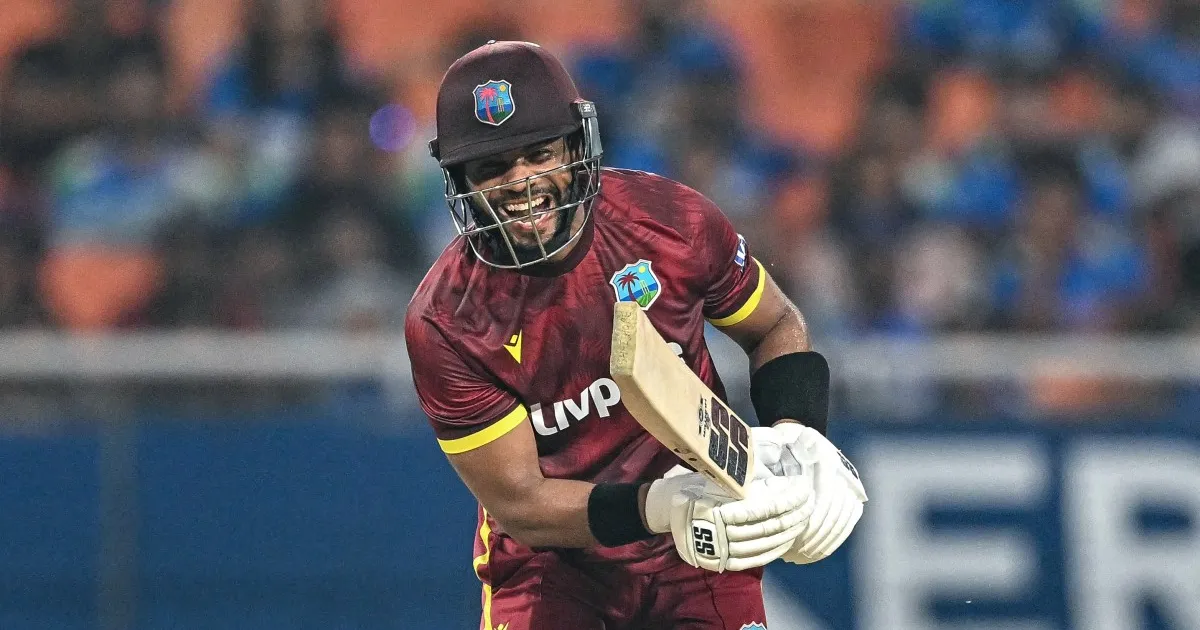
Paceman Jayden Seales ‌claimed his fourth five-wicket haul to bowl the West ⁠⁠Indies to ⁠a 90-run victory over Pakistan in the opening Test match in Tarouba, Trinidad and Tobago.

After eking out a 29-run first-innings ⁠lead, the West ⁠⁠Indies made 181 in their second innings to set Pakistan a target of 211 on Tuesday, the fourth day of play.

Recommended Stories

list of 2 itemsend of list

Seales (5-20) and his pace ⁠colleagues returned to produce a superb fast-bowling display at the Brian Lara Stadium, routing Pakistan for 120 in a little over 40 overs, with one day of play remaining.

Pakistan captain Babar Azam made an unbeaten 58 and combined ‌with number 11 Mohammad Abbas (23) in a brief resistance, but the West ⁠⁠Indies’ victory appeared a formality after the tourists slumped to 71-9.

Pakistan number three Shan Masood, who fractured his finger during his first-innings knock of 109, batted at number eight in the second innings. He made three before ⁠Seales dismissed him.

Captain Roston ⁠Chase dedicated the victory to West Indies great Garry Sobers, who died earlier this month.

“We wanted to make him proud and had a chat about it ⁠before the match. I hope he is smiling down on us,” Chase said afterwards.

“I ⁠love the direction this team is ⁠heading. We’re not relying on one or two players; everyone is chipping in at crucial moments.”

Babar said Pakistan’s lack of partnerships proved costly.

“Today, as a batting ‌unit, we weren’t up to the mark. We kept losing wickets back-to-back, and the batting failed. That’s something we’re working ‌on,” ‌he said.

The second and final Test match in Port of Spain begins on Sunday.

Seales took five wickets for 20 runs in the second innings against Pakistan
Seales took five wickets for 20 runs in the second innings against Pakistan [Randy Brooks/AFP]

Source link

India’s youth have broken Modi’s spell | Opinions

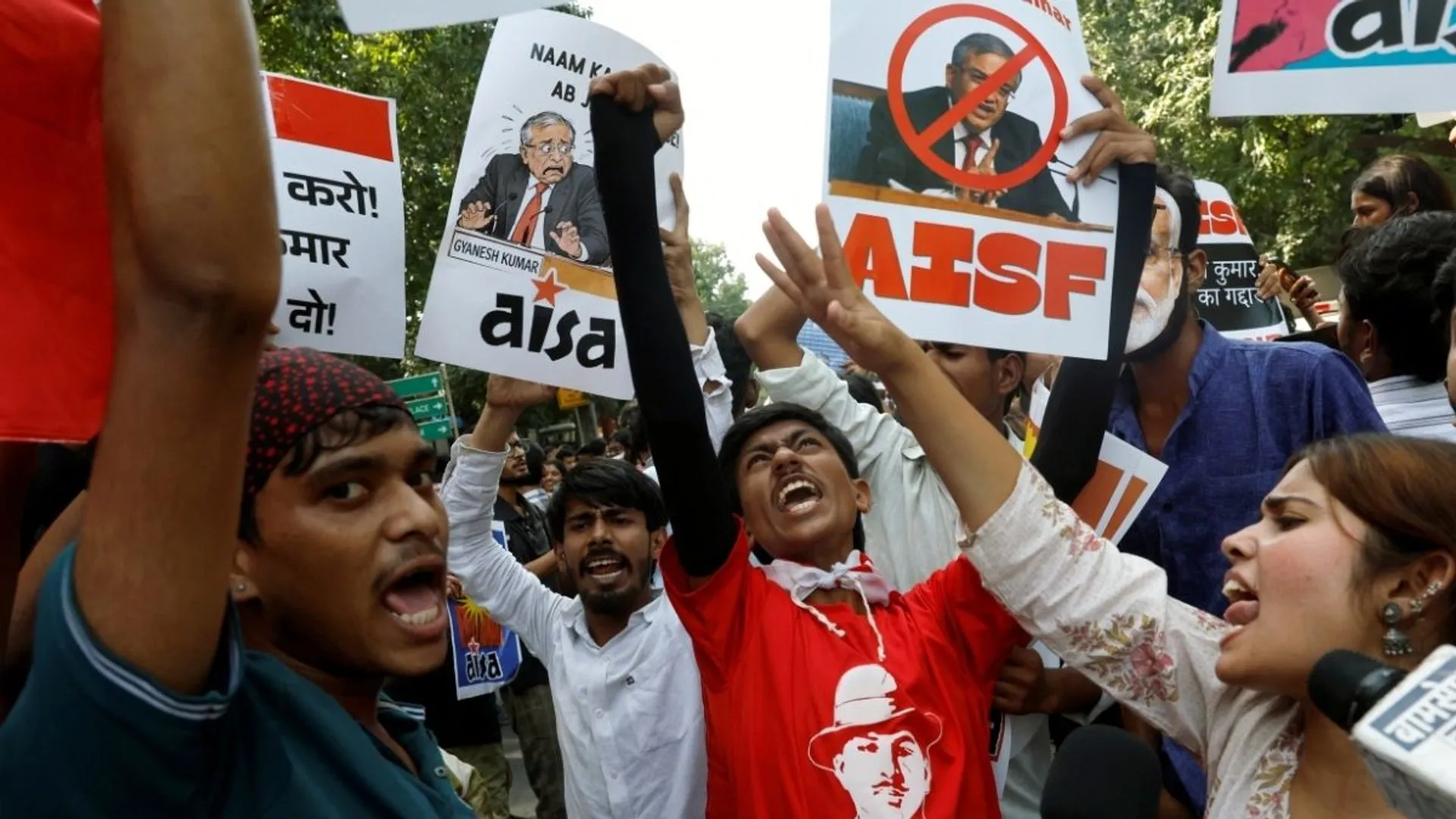
The recent uprising of the youth in India might seem to have subsided after forcing Dharmendra Pradhan, the education minister of India, to resign. Still, he was never the true target of this historic youth revolt. The slogans, the placards, the irreverent digital art and the collective anger of the young were directed at one man alone: Narendra Modi.

There exists a pervasive prejudice among the intelligentsia that young Indians today are politically indifferent, consumerist and unconcerned with politics or the erosion of democratic norms. The events at Jantar Mantar have laid bare the shallowness of this assumption. The young harboured no illusions about the nature of this regime. They understood with absolute clarity that in the present constitutional setup, no minister possesses independent agency.

The Indian state today has been reduced to a single face, a single voice and an unyielding hub of authority: Narendra Modi. To demand the resignation of a minister, therefore, was not an administrative plea; it was a deliberate act to compel the supreme leader himself to yield.

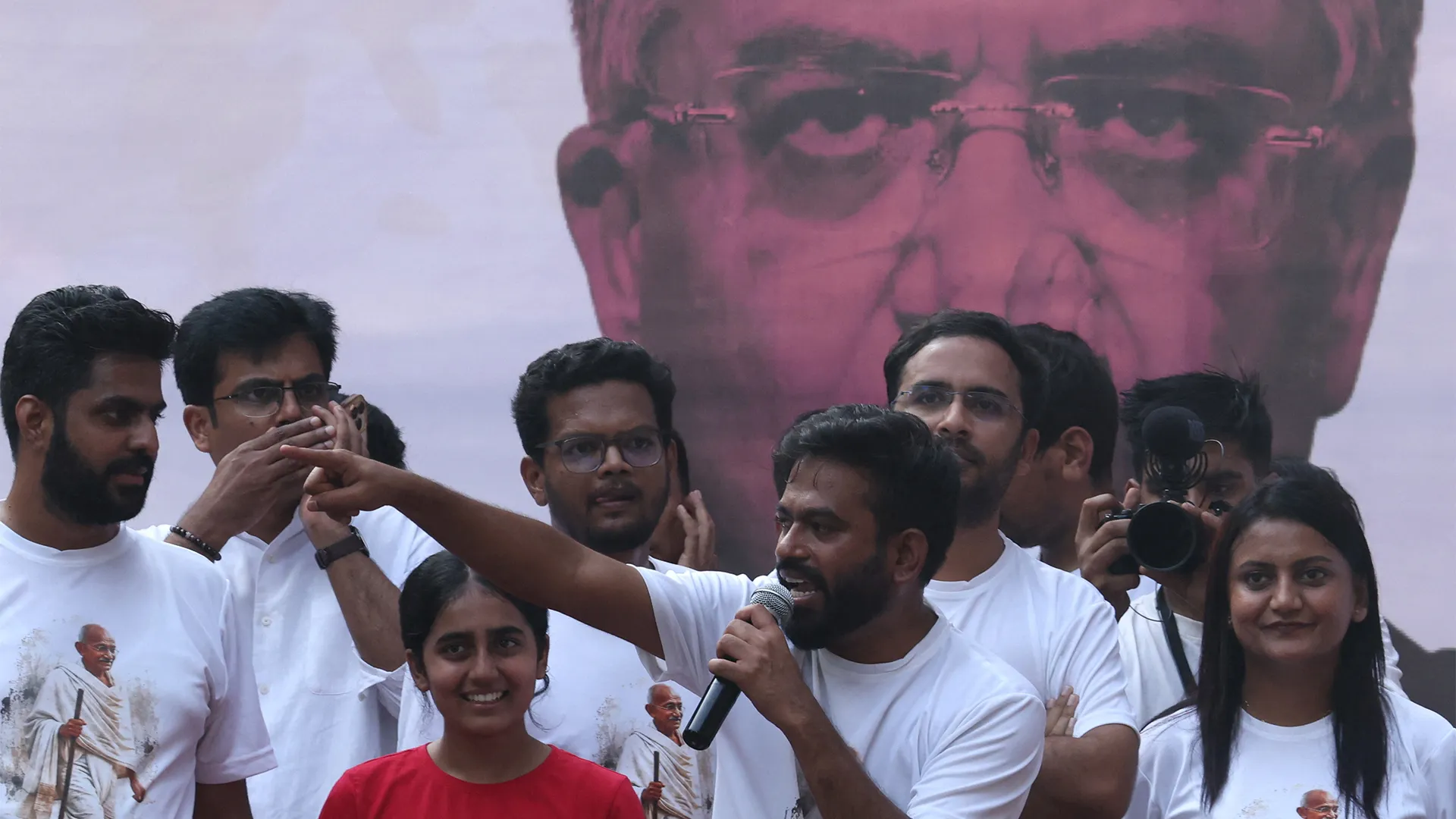
Walking through Jantar Mantar, the protest site in central Delhi, occupied by thousands of young people for weeks, one could not escape this truth. What these young people achieved was nothing short of the iconoclasm of our times: the systematic demolition of the carefully curated, mythic public persona that this regime has spent a decade building as the sole visage of the nation.

What was most remarkable about this uprising was its radical decentralisation.

There were no high-budget, professionally printed banners. There was no vanguard organisation dictating the visual language of the protest or distributing uniform slogans for the benefit of television cameras. Scraps of cardboard, discarded paper and cheap marker pens sufficed. Each placard bore the unmistakable, authentic imprint of individual moral agency.

Yet, beneath this extraordinary heterogeneity, there remained an unwavering thematic unity.

Everything revolved around Modi.

The prime minister was mocked, caricatured and systematically stripped of the sacral aura that had been constructed around him for more than 10 years. In a matter of weeks, this generation transformed an imposing figure of state authority into a subject of collective laughter.

The young were outraged, above all, by the sheer, unbridled arrogance of power.

This uprising did not spring from material grievances alone; it arose from a profound sense of humiliation. The immediate symbolic spark was the deeply insensitive remark made by the chief justice of India, who publicly compared unemployed young people to “cockroaches”.

Coming after years in which the higher judiciary has increasingly appeared less like an independent guardian of the Constitution and more like an extension of executive power, the remark was understood as an articulation of the regime’s own contempt for its youth.

The formation of the “Cockroach Janta Party” (CJP) was an act of counter-humour born of deep injury. The already unfolding scandal over irregularities in the NEET examinations provided the movement with a concrete institutional focal point. The scandal became the occasion to demand accountability not just for a single test, but for an entire culture of governance.

The regime, meanwhile, suffered from its own hubris. It had persuaded itself that Indian society was thoroughly managed. Preoccupied with engineering electoral outcomes through the manipulation of rolls, managing parliamentary majorities through party defections, and consolidating its hold over state institutions, it failed to notice the quiet, gathering storm beneath the surface.

Those who possessed platforms, prestige and the power to shape public discourse were engrossed in celebrating the grand narrative of national glory. Television studios debated the nation’s civilisational destiny and its global standing. The mainstream press sang panegyrics to a “New India”. Scarcely anyone looked towards the young who found every avenue of mobility blocked. Their anxieties were rendered invisible because the state and its allied media did not consider them worthy of serious democratic attention.

Deprived of traditional spaces, they constructed their own. Their smartphones became their public square; social media platforms became their political assemblies; and satire became their primary democratic vocabulary.

The ruling ideology had convinced itself that the project of cultural hegemonisation was complete: once the majority was mobilised around a politics of religious identity and grievance against minorities, material realities would cease to matter. The aspirations, anxieties and dignity of an entire generation simply did not figure in this political imagination.

It was against this backdrop of institutional indifference that Sonam Wangchuk began his fast at Jantar Mantar. The government’s initial response was its standard weapon: calculated silence. As Wangchuk’s health deteriorated, the refusal to even acknowledge his presence generated profound moral outrage. Then came the fateful decision to forcibly remove him.

It proved to be a fatal miscalculation. The young perceived the treatment of Wangchuk as an insult to their own citizenship. What was done to him could be done to anyone who dared to stand up. His humiliation became their collective provocation. The response was immediate: Jantar Mantar was flooded by thousands of young bodies.

When the young marched towards parliament on July 20, the state relied on its familiar playbook: barricades, prohibitory orders and violent suppression. It had deployed these very methods against the anti-CAA protesters and the farmers’ movement. But this time, the internal mechanics of fear failed to operate. The blows they received did not shatter their spirit; they deepened their moral clarity.

Their struggle was not merely about securing a policy change or extracting a routine administrative concession. They set out to breach that institutional arrogance. When the Delhi police rained blows on the protesters on July 20, beating young citizens with a ferocity typically reserved for enemy combatants, the protesters did not view those batons as the instruments of an indifferent police force. They recognised them as the direct expression of Narendra Modi’s political will.

Yet, fear failed to perform its intended historic function. Many returned to Jantar Mantar carrying their wounds like badges of honour. Some returned barefoot. Their injuries became symbols of moral persistence rather than reasons for retreat. Their resolve was remarkably simple: they would force Modi to sacrifice one of his own.

Crucially, the protesters refused to yield to the temptation of violence. Their weapons remained language, images and satire. Armed with their phones, they launched an unrelenting assault on the prime minister’s public image, the very asset he has guarded most fiercely throughout his political life. For the first time, Modi was drawn onto a battleground where he could not dictate the rules.

When the prime minister attempted to intervene directly on social media, addressing the youth as “friends”, the rebuttal was instant and devastating:

“We are not your friends.”

It was more than a clever slogan; it marked the psychological collapse of a carefully cultivated paternalistic relationship. For years, Modi had sought to speak directly to the populace, bypassing mediating institutions and independent media. The young rejected that calculated intimacy in a single sentence. The authority of the patriarch dissolved into the irreverence that a free people reserve for their elected officials. The spell of fear was broken.

The assault on Modi’s public image appears to have shaken the regime far more deeply than any routine electoral setback ever could. For more than a decade, his authority has rested not merely on the coercive power of the state, but on the illusion of invulnerability: an image of a leader who never retreats, never admits error and never compromises.

The movement had to be contained before the satire hardened into permanent collective memory and the laughter of the young became the common language of the republic.

Pradhan’s resignation must be read precisely in this light. It is not the sacrifice of a minister; it is a desperate attempt to construct a firewall around the prime minister himself. The government will undoubtedly frame this as evidence of its responsiveness and democratic sensitivity. But the young understand it differently. For them, the resignation is a political concession extracted from an authority that had run out of options.

Before arriving at this point, the state had exhausted its standard repertoire of delegitimisation. It ignored the movement, questioned its motives, accused the youth of being proxies for opposition parties and deployed its media networks to allege foreign plots. When these slurs failed to stick, it resorted to force. Having endured all of this, the young do not view the minister’s exit as an act of state benevolence; they see it as the reluctant admission of a defeat that could no longer be disguised.

Ordinarily, the vocabulary of victory and defeat should not dominate a constitutional democracy. A government is expected to listen to its citizens, not view them as adversaries to be crushed. Dissent is not treason. But when a state consistently treats criticism as hostility and peaceful protesters as enemies of the state, it transforms democratic dialogue into a confrontation. When that happens, it cannot complain if citizens celebrate its retreat as a democratic victory.

The ultimate significance of this movement lies in its moral and creative form. The young answered state coercion with speech, wit, art and an extraordinary mastery of contemporary cultural forms. Their elders have often lamented that a generation raised on short-form content lacks political depth and endurance. Jantar Mantar has demolished that patronising assumption.

The meme was elevated to a potent instrument of political resistance. Laughter accomplished what solemn political rhetoric often fails to do: it punctured fear, dismantled false authority and deprived power of the uncritical reverence upon which authoritarian politics depends.

Authoritarianism requires not just obedience, but awe. It survives as long as people believe the ruler is beyond challenge, beyond satire and beyond defeat. The young at Jantar Mantar refused to grant Narendra Modi that sacral status. They restored him to the position he must occupy in a constitutional republic: an ordinary, accountable political leader, subject to the scrutiny, criticism and satire of the citizenry.

The protest site at Jantar Mantar may now be empty. The barricades have been moved aside and the crowds have returned to their hostels, campuses and homes. But movements of this nature do not end when the physical space is vacated. The critique inaugurated on the streets will continue in countless quiet spaces: university libraries, rented rooms, bus rides and millions of illuminated screens. The language that has been discovered cannot easily be unlearned.

If this youth uprising leaves behind an enduring lesson for the republic, it is a simple, fundamental truth: democracy begins the moment a people recover confidence in their own voice.

The views expressed in this article are the author’s own and do not necessarily reflect Al Jazeera’s editorial stance.

Source link

FIFA proposes plan to sell stakes in the World Cup, angering UEFA | Football

Football’s world governing body announces plans to sell stakes of up to 20 percent in the World Cup and other events.

FIFA has proposed a plan to sell stakes in the World Cup and other events to private investors, provoking a furious response from the European football governing body, UEFA.

Under the plans announced by FIFA on Tuesday, a $20bn subsidiary would be created to run the World Cup and other events.

Recommended Stories

list of 4 itemsend of list

World football’s governing body said it would retain a majority share in the new FIFA Forward Enterprise, offering minority stakes to external investment to raise up to $4.2bn.

The plan still needs to be voted on by FIFA’s 211 member nations.

If successful, the proposed investor group is expected to be led by a vehicle founded by Joshua Kushner, the brother of US President Donald Trump’s son-in-law, Jared Kushner, FIFA said.

UEFA said the proposal “crosses a line that football’s governing institutions should never cross”.

Reinvested in the game

FIFA has just held a 48-team World Cup across the United States, Canada and Mexico – the biggest in the tournament’s history.

It is one of the world’s wealthiest sporting organisations, generating billions of dollars, largely from broadcasting rights, sponsorship and other commercial deals linked to the World Cup.

But it says this proposal can increase funds to widen access to the sport and strengthen global participation, with all net benefits to be reinvested in football.

“Football is the world’s most popular sport,” FIFA President Gianni Infantino said in a statement.

“Parts of the game have turned that popularity into remarkable commercial value – and we celebrate that success and want it to continue, because it lifts the whole game.

“Our job is to make sure the rest of football grows with it: FIFA exists to support sustainable, inclusive development in every corner of the world.”

FIFA said that in addition to retaining sole control of the subsidiary, it would retain authority over football governance, competitions, match calendars and regulatory and sporting decisions.

‘World Cup is not a product’

The proposal deepens the divide between FIFA and UEFA, with Europe positioning itself as football’s custodian, while FIFA, a not-for-profit organisation, says it is focused on broadening access with financial largesse.

In a statement, UEFA said it takes the new proposals “extremely seriously”.

“So should every National Football Association. So should every stakeholder: leagues, clubs, players, supporters, governments and everyone who cares about the future of the game.

“The soul and governance of football are not assets to trade – especially with zero transparency as to who gains financially. None of us are the owners of football. It is not FIFA’s to sell.”

The United Kingdom’s new prime minister, Andy Burnham, joined critics, saying on social media that the sport does not belong to investors.

“The World Cup is not a product. It is the greatest competition in world sport, and it was never anyone’s to sell,” Burnham wrote on X.

“Dress the deal up however you like. Once you have sold a piece of it, you have sold out.”

Source link

FIFA World Cup: For India, qualification is still just a distant dream | Football News

As the FIFA World Cup 2026 reached its final week, Gourav Roy, an Indian software engineer living in San Francisco, drove more than 9,650 kilometres (6,000 miles) across the United States to attend both the semifinals and the final.

For Roy, it was the next best thing to what he had grown up dreaming of: seeing India play in the World Cup.

Recommended Stories

list of 4 itemsend of list

But the possibility of that dream coming true is looking ever more distant as deep-rooted systemic issues and the failure to implement reforms have left the country of 1.45 billion ranked a lowly 138th in the world, failing to even qualify for the 2027 Asian Cup.

“I’ve learned to love without expectation. That’s the burden of the Indian football fan,” said Roy.

While countries with tiny populations like Curacao and Cape Verde qualified for the 2026 World Cup, India remains a prime example of wasted potential in the planet’s most popular sport.

Those working in Indian football say the problems range from poor youth development systems, a lack of popularity, and a national federation (the All India Football Federation) struggling to implement a uniform vision with a loose patchwork of state associations.

“If you ask me, to clean up the system and reorganise it will take a full cycle of four years,” Ravi Puskur, the CEO of Indian Super League (ISL) club FC Goa, told Reuters.

“Then it’s another 20-25 years to get us to the World Cup.”

Children play football in front of cutouts of Portugal’s Cristiano Ronaldo and Brazil’s Neymar Jr put up by supporters ahead of the 2026 FIFA World Cup, in Kozhikode, India, on June 9, 2026
Children play football in front of cutouts of Portugal’s Cristiano Ronaldo and Brazil’s Neymar Jr put up by supporters ahead of the 2026 FIFA World Cup, in Kozhikode, India, on June 9, 2026 [CK Thanseer/Reuters]

Confined to pockets

In cricket-mad India, football remains popular only in a handful of states like West Bengal, Goa, Kerala, Mizoram and Manipur.

The ISL, launched in 2014 with the backing of Reliance Industries, one of India’s biggest conglomerates, tried to change that with limited success.

In 2025, the AIFF and Reliance did not renew their partnership as negotiations stalled amid a Supreme Court case to implement a new constitution for the federation.

This year, under new management led by clubs, the ISL is yet to finalise a broadcaster and announce fixtures.

NorthEast United CEO Mandar Tamhane, who previously led Bengaluru FC, said clubs alone cannot fix Indian football.

“You’re talking about the government, corporate India… it has to be a collective effort,” he said.

“The federation has to make sure the clubs, state associations, the corporates and other stakeholders all work together.”

Weak youth development

AIFF executive committee member and Mizoram’s sports minister Lalnghinglova Hmar said the government can help with infrastructure, but for Indian football to improve, the country’s youth development system needs a drastic overhaul.

“In South Korea and Japan, kids play over 40 competitive matches per season. This is missing in India,” he said.

“We start developing players too late. Most under-15 players get only 12 to 15 competitive games yearly. Some get called up to the youth national camp after playing less than 20 competitive games.

“We’re short on qualified coaches. Many states don’t even have a youth league… we just can’t compete like that.”

But India’s size, the very thing that makes it an attractive sports market and led to the huge success of cricket’s Indian Premier League, also makes it difficult for the AIFF to implement widespread reforms.

“If even half the states were doing a proper job at grassroots, things would grow,” Hmar added.

The uncertainty over the ISL, which forced some teams to suspend player salaries last year, also dealt a blow to the clubs’ development programmes.

“If you can provide stability, gradually the investment will increase,” Puskur said.

Global football stars like Lionel Messi of Argentina (centre) – seen here at the Arun Jaitley Stadium, New Delhi, India on December 15, 2025 – have a high fan profile in India, despite the national team’s underwhelming on-field performance
Global football stars like Lionel Messi of Argentina (centre) – seen here at the Arun Jaitley Stadium, New Delhi, India on December 15, 2025 – have a high fan profile in India, despite the national team’s underwhelming on-field performance [Adnan Abidi/Reuters]

A limited window

With India bidding to host the 2036 Olympics, the government is considering the launch of a “sports passport” that allows Indian-origin athletes to represent the country.

The AIFF leadership has backed the initiative, believing it will help improve the national team’s performances. But the proposal is still far from becoming law, and Hmar said Indian football needs to act fast.

“The other nations aren’t sitting idle… if we don’t match them, even if we improve, we will remain where we are,” he said.

While Indian football hangs in limbo, fans like Roy can only live in hope.

“They are talking about a 64-team World Cup,” he said. “It won’t gift us anything, but more places mean more hope.”

Source link

World’s most beautiful buildings revealed

THE most beautiful buildings in the entire world have been named and one surprising estate from the UK has made the list.

However, if you want to visit the pretty British attraction book to go as soon as possible is set to close for a multi-million pound revamp.

The most beautiful buildings in the world have been revealed with the Taj Mahal at the top Credit: Alamy
Coming in second place was The Barbican in London Credit: Alamy

The Barbican in London has taken second place to India‘s grand Taj Mahal as Time Out’s 26 ‘most beautiful buildings’ to see in 2026.

The free-to-visit landmark attracts over a million visitors each year and is set to undergo a huge upgrade to save it falling into disrepair.

At the estimated cost of £231million, The Barbican will upgrade its indoor rainforest in its Conservatory which is home to 1,500 species of plant.

Also included in the plans is to protect Barbican’s brutalist foyers and lakeside terrace.

PARK UP

Epic UK holiday parks with waterparks, theme parks & Spoons pubs from £3pp a night


HOL YES

Cheapest summer for holidays in YEARS – with August breaks still on sale for £188pp

Outside in the courtyard, the pond will be revamped to stop water leaking onto the Metropolitan Line below – there will be new fountains and seating outside too.

The visitor destination is already free to visit, and this will continue once the revamp is complete.

The refurbishment project is set to start in 2028 when it will close until 2029.

The Barbican was pipped to the post by the Taj Mahal, a picture-perfect landmark in India built in the 1600s – it’s not hard to see why it got top spot.

Coming in third place was the Hallgrímskirkja in Iceland which is a church standing at 244 feet.

Not only is it a place of worship, but it has an observation tower where visitors can get incredible city views.

The Maggie’s Centre at St James’s Hospital in London also made the list Credit: Hufton and Crow
Collage of travel items including a plane, sunscreen, passport, suitcase, and plane tickets, advertising The Sun's travel Instagram account.

In Europe, other honourable mentions go to the Sagrada Familia in Spain which is very near completion after 140 years.

The outside of Gaudi’s basilica was completed in February, but there is some work still to do before it’s officially finished.

The Twist in Norway came in twelfth position and is a spectacular art gallery that is also used as a bridge.

It’s part of the Kistefos Sculpture Park and sits across the Ranselva River.

Another UK building did make the list coming in at number 21 – and it’s the Maggie’s Centre at St James’s Hospital in London.

The publication described it as having “mushroom-shaped forms grow from the floors to form the tiered roofs, and the stems are deep enough to contain loos and lifts.

The Hallgrímskirkja is a 244 foot church in Iceland Credit: Alamy
Santuario de Las Lajas in Colombia came in at number 19 Credit: Alamy

“The space is decorated with mostly natural materials – think cork-topped tables, resin floors and cascading potted plants.”

Some more classic monuments and structures on the list include The Pyramids of Giza in Egypt, the Pantheon in Italy and Ad-Dayr in Petra, Jordan.

Colombia‘s impressive Santuario de Las Lajas comes in at number 19.

The enormous basilica sits on a bridge over the Guáitara River – it has been a pilgrimage destination since the eighteenth century and now gets up to 900,000 visitors each year.

Here’s the full list of Time Out’s ‘world’s 26 most beautiful buildings to see in 2026’…

  1. Taj Mahal, India
  2. The Barbican Estate, UK
  3. Hallgrímskirkja, Iceland
  4. Sagrada Familia, Spain
  5. Museum SAN, South Korea
  6. The Pyramids of Giza, Egypt
  7. Fallingwater, USA
  8. Ad-Dayr (The Monastery), Petra, Jordan
  9. Fondation Louis Vuitton, France
  10. Trinity College Library, Ireland
  11. Great Mosque of Djenné, Mali
  12. The Twist, Norway
  13. Nasir Ol Molk Mosque, Iran
  14. Jatiya Sangsad Bhaban, Bangladesh
  15. Pantheon, Italy
  16. Palmenhaus at Schönbrunn Palace, Austria
  17. Bát Tràng Ceramic Community House, Vietnam
  18. Museum at Eldridge Street, USA
  19. Santuario de Las Lajas, Colombia
  20. Museum of Old and New Art (MONA), Australia
  21. Maggie’s Centre (St James’s Hospital), UK
  22. Baháʼí Temple of South America, Chile
  23. Futuna Chapel, New Zealand
  24. National Holocaust Monument, Canada
  25. Komera Leadership Centre, Rwanda
  26. Enryaku-ji, Japan


Source link