Arab

Arab News | Months after ceasefire, Israel and Hezbollah battle over a strategic hill in Lebanon

BEIRUT: Since a ceasefire went into effect between Israel and Hezbollah more than two months ago, fighting has stopped in much of Lebanon, but not on a strategic hill overlooking parts of a main southern city.

In recent weeks, Ali Taher hill has been the scene of daily shelling and airstrikes by Israel’s military. Hezbollah, a militant group backed by Iran, has repeatedly attacked Israeli forces in the area with drones.

The United States, which is mediating talks between Lebanon and Israel, had wanted Hezbollah to hand over the hill to the Lebanese army as part of larger plan to disarm the militant group and dismantle its infrastructure. But Hezbollah has refused.

Lebanon and Israel reached a framework agreement in June stating Israel will withdraw from Lebanon as Hezbollah is disarmed. The militant group was not a party to the negotiations and has rejected calls to disarm in areas north of the Litani river, which is where Ali Taher is located.

A full-on battle over this hill near the city of Nabatiyeh could escalate fighting across the country, and unrest in Lebanon complicates efforts to resolve the war in Iran.

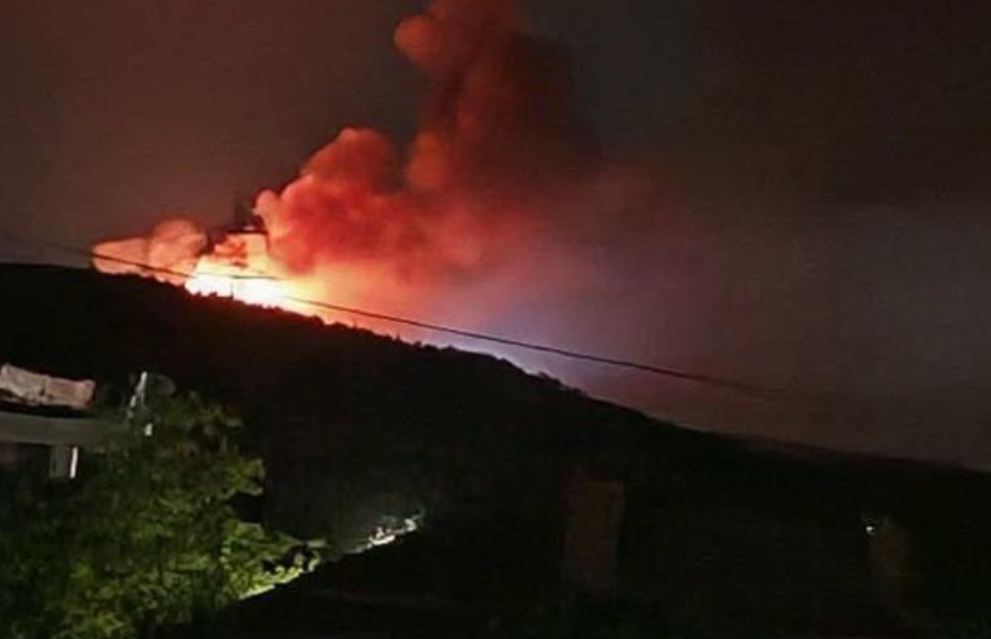
On Thursday night, Israel’s military announced it had taken “operational control” of Ali Taher and a network of tunnels beneath it that Hezbollah uses to shelter its fighters and weapons. It is unclear how far Israel’s control extends. Just before Israel’s announcement, its air force was still targeting the hill, according to Lebanese state media.

There has been no official statement from Hezbollah since Israel’s announcement.

US pushes Lebanon to pressure Hezbollah

Hezbollah firmly rejected a proposal from the Lebanese government to hand over Ali Taher to the country’s army. It fears Israel would then seize control of the hill from the Lebanese army and then demand the handover of more territory.

Israel had occupied Ali Taher for 18 years before it withdrew from Lebanon in 2000.

The hill has a strategic location overlooking several villages as well as main roads leading to Nabatiyeh. Losing full control of it would disrupt Hezbollah’s presence and supply lines in the area.

The Israeli military says the site is also important to Hezbollah because of tunnels it built there, with funding from Iran.

Israel said in its statement Thursday that the hill housed underground command centers, weapons storage rooms, generators, living quarters, showers and a kitchen. Israel said it cleared Ali Taher of Hezbollah fighters and was working to “neutralize underground infrastructure sites.”

Hezbollah legislator Ihab Hamadeh questioned why the Israeli military was still attacking the hill if it was really in control of the area, according to the Arabic-language version of Russia’s state-funded news outlet Sputnik. An Associated Press photographer who visited the nearby village of Kfar Rumman on Friday saw no sign of Israeli military presence on the hill.

The hill, topped with a shrine to a Muslim scholar, sits north of the Litani river, which has become the de facto boundary of the area captured by Israel since its latest war with Hezbollah began in early March.

Fighting in the area has heated up in recent weeks

Israel has been conducting military operations around Ali Taher since July, said Nasser Khdour, a Middle East researcher at the Armed Conflict Location & Event Data Project, or ACLED, a US-based group that tracks conflicts around the world.

Hezbollah official Mahmoud Qamati told a Lebanese podcaster in late August that the group’s fighters were repelling attempts by Israeli troops to take Ali Taher. But he, and others, downplayed the significance of the site should Israel take it.

“Ali Taher is important, but if it is lost it does not mean the end of Hezbollah,” Qamati said.

In mid-August, Israel carried out a series of airstrikes on southern Lebanon that it described as retaliation for a Hezbollah drone attack on Ali Taher that seriously wounded three soldiers. The Israeli strikes, which killed 11 people, including women and children, were the deadliest since the US-brokered ceasefire went into effect in late June.

On Aug. 27, Israel carried out a series of airstrikes, killing one person and wounding six, after the military said Hezbollah fired two explosive drones at Israeli troops in the area. Hezbollah did not claim responsibility for any of the attacks.

Lebanon says Israel is hindering its army

Lebanon’s Deputy Prime Minister Tarek Mitri told an Arab TV station in late August that the Lebanese army was ready to take over Ali Taher.

He accused Israel of blocking the army due to its own political considerations ahead of Israeli national elections on Oct. 27.

“The problem is not in the Lebanese army’s readiness but in Israel’s stance,” he said.

Lebanese and Israeli officials are set to meet for negotiations in Rome later this month. Meanwhile, Hezbollah, which has always refused to speak directly to the US, appears to be changing its policy after the major setbacks it has suffered during its wars with Israel since 2024.

A Lebanese official told The Associated Press that indirect contacts are going on between the US and Hezbollah, but refused to give any details. He spoke on condition of anonymity in line with regulations.

The US ambassador to Lebanon, Michel Issa, said recently that Washington is ready to speak with Hezbollah if the group agrees to disarm.

Still, Hezbollah is not likely to take any move forward regarding talks with the US without a green light from its main backer, Iran. While talks with the US over their war have stalled, Iran has sought guarantees that Israel will halt its attacks on Hezbollah as part of any permanent deal.

Capture of Ali Taher could lead Israel to other Hezbollah strongholds

The capture of Ali Taher would open the way to Nabatiyeh and also lead to the nearby Apple Province and Rihan Mountain, where Hezbollah has been building up its presence since the late 1990s.

Israeli leaders have repeatedly pledged to leave troops in Lebanon and threatened to escalate military pressure until Hezbollah disarms.

“Israeli control of the area is an operational and military setback for Hezbollah,” said Khdour of ACLED. He said clearing these sites helps Israel protect towns in the northern part of its country, and increases pressure on Hezbollah.

“This will strengthen Israel’s position in any future negotiations over its withdrawal,” said Khdour.


Source link

Arab News | Athletic Bilbao crush Simeone’s flat Atletico

BILBAO, Spain: Athletic Bilbao thumped Atletico Madrid 3-0 in La Liga on a miserable Saturday afternoon for Diego Simeone’s side.

Nico Williams, Robert Navarro and Oihan Sancet’s goals gave the Basque hosts a resounding victory at their San Mames stadium.

Elsewhere promoted side Deportivo La Coruna earned an exciting 3-2 win at Villarreal to climb provisionally fourth.

Athletic secured back-to-back wins under former Borussia Dortmund coach Edin Terzic, after losing their first two matches of the campaign.

Simeone’s Atletico fell to their first defeat of the season, putting up little fight in the second half after Athletic made the breakthrough with two quick strikes from Williams and Navarro.

“Their two goals, in the blink of an eye, did us a lot of damage,” Atletico’s Pablo Barrios told Movistar.

Atletico must pick themselves up for Wednesday’s visit to face Liverpool in the Champions League at Anfield.

“(We had) two minutes of inattention and poor decision-making in situations we should have handled better,” said Simeone. “Bilbao capitalised on that lapse.”

Striker Julian Alvarez, who tried to leave the club to join Barcelona this summer, returned as a substitute after illness in an ineffective second half appearance.

The visitors had the better of the opening period, although they failed to create many clear-cut chances after an early opportunity for Lee Kang-In.

The South Korean international struck a shot against the post in the third minute after the hosts were carved open.

Athletic goalkeeper Unai Simon saved from Alex Baena as Atletico threatened, while Sancet came close at the other end with a blast into the side-netting.

Pablo Barrios hit the post before the break for Atletico, who were sucker-punched early in the second half by Terzic’s side.

The Williams brothers combined for Athletic’s first, with Inaki’s deflected shot headed home by younger sibling Nico after 46 minutes.

Navarro doubled Athletic’s lead in the 48th minute, steering home after Inaki Williams played him in.

“We were good in the first half but the game got away from us in those (couple of) minutes,” said Simeone.

“We lacked in the second half everything that we had in the first.”

No impact for Alvarez

Simeone rang the changes, including sending on want-away striker Alvarez to little effect.

The Argentina international struggled to get involved in the game, and produced just one shot from the edge of the box, saved comfortably by Simon.

Sancet wrapped up Athletic’s victory in the 90th minute when he stroked home a loose ball after a blocked cross.

“It’s always good to win games, especially at home,” said Terzic.

“Today we are happy and we are going to be very satisfied when we go to bed tonight, and then from tomorrow onwards we’ll prepare everything to go for the next (game).

“We have six points from the last two games, but this won’t help us to reach all our targets by the end of the season.”

Pierre-Emerick Aubameyang scored for the fourth match running and set up two more as the former Arsenal and Barcelona striker excelled in Depor’s surprise win at Villarreal.

Another ex-Arsenal attacker Nicolas Pepe put the hosts ahead but Luismi Cruz levelled for the Galicians before the interval.

Adama Traore’s own goal gave Villarreal the advantage once more but Zakaria Eddahchouri and Aubameyang, 37, struck to claim Depor a superb victory.

Sergio Camello netted twice for Rayo Vallecano in an entertaining 3-2 win over Racing Santander.

On Sunday, La Liga leaders Barcelona visit Valencia looking to move clear of Real Madrid, who lost 1-0 at Real Betis on Friday, among other fixtures.


Source link

Arab News | UN agrees text on lethal autonomous weapons

GENEVA: Nearly 130 countries on Saturday agreed on a text defining lethal autonomous weapons systems (LAWS) — “killer robots” to their critics — a first step toward talks on a possible international treaty to regulate them.

The text agreed upon has not yet been made public — but campaign groups following the talks have already criticized leading countries for dragging their feet on the issue.

Dutch Foreign Minister Tom Berendsen announced the agreement, by 128 countries, on Saturday. The Netherlands has been overseeing the talks.

Countries are already developing and using weapons capable of selecting targets and using force against them without human intervention.

But the International Committee of the Red Cross warned in a statement that “the unconstrained development and use of autonomous weapon systems pose serious legal, ethical and humanitarian challenges.”

The ICRC and several campaigning groups have called for international legally binding rules to restrict and regulate their use.

Nicole van Rooijen, executive director of Stop Killer Robots, an international alliance of campaign groups, accused the United States, Russia and their allies of trying to weaken the agreed text.

Lex International, a Geneva-based philanthropic group funding work on key policy issues, also criticized some nations’ position.

“The United States, Russia, India and Israel are among the key opponents of negotiations,” it said.

“The governments of Brazil, Ireland, and Norway are leading efforts to get such negotiations started in November,” it added.

UN member states will decide at November talks of the Convention on Certain Conventional Weapons whether to move toward an international treaty regulating such weapons.

Source link

Arab News | Stabbing of Saudi visitor highlights need for vigilance among Arab tourists in London

LONDON: The stabbing of a Saudi visitor during an attempted robbery in one of London’s wealthiest districts this week has sparked new discussions about the safety of Gulf tourists in the British capital and the precautions travelers should take in major European cities.

The man, in his 40s, was stabbed in Berkeley Square, Mayfair, on Thursday. Metropolitan Police officers and London Ambulance Service crews attended the victim, who was treated and taken to hospital. His injuries are said to be not life-threatening.

A 58-year-old man was arrested at the scene on suspicion of grievous bodily harm, possession of an offensive weapon and attempted robbery.

“This appears to be an isolated incident and there is currently nothing to suggest an ongoing risk to the wider public,” a Met spokesman told Arab News. “We recognize that this will cause concern among the community. Tackling knife crime and serious violence remains a priority for the Metropolitan Police.”

The Saudi embassy in London said it was coordinating with British authorities, supporting the victim and monitoring his condition until he is discharged.

The Saudi Arabian embassy in London, featuring its distinctive green flag, is seen through the surrounding trees, highlighting its architectural elegance amidst the urban landscape.

It called for the investigation to be completed swiftly and for those responsible to be held accountable, while urging Saudi citizens in Britain to exercise caution and avoid carrying valuable possessions openly in public.

Arab News understands the embassy is expected to release the victim’s name shortly.

Reports indicate the attempted robbery may have been motivated by a luxury watch inside the man’s backpack, although it was not visible and nothing was ultimately stolen.

The incident has nevertheless resonated among Gulf travelers for whom London has long been a home-away-from-home and one of their favorite European destinations.

Jocelyne Elia, travel editor at Asharq Al-Awsat, said high-profile incidents could influence how visitors perceive the city even when they are statistically rare.

“Incidents like the recent stabbing are understandably concerning and can affect how safe Gulf visitors feel when travelling to the UK,” she told Arab News. “The Gulf is an extremely important tourism market for Britain, so repeated incidents could damage confidence and influence people’s decisions about where they travel, stay and shop.

The Mayfair stabbing means travelers should take extra precautions in areas known for luxury shopping, restaurants and nightlife. (AFP file)

“It is important that UK authorities respond strongly to these crimes while making clear that they are isolated incidents and that the UK remains a welcoming destination for Gulf visitors.”

Saudi tourism alone is a significant market for Britain.

The UK received a record 344,000 visits from the Kingdom in 2024, during which Saudi travelers spent about £771 million — an average of more than £2,200 per visit according to VisitBritain, citing data from the Office for National Statistics’ International Passenger Survey.

Figures obtained from the Metropolitan Police provide a partial picture of the crimes experienced by Saudi and other Gulf nationals in London. Records show 35 Saudi nationals were recorded as crime victims in 2021, rising to 65 in 2022 and 85 in 2023 — a total of 185 over the three years. Of those cases, 97 involved theft, 41 violence against the person and 12 robbery.

Across the six Gulf Cooperation Council nations, 498 people were recorded as victims during the three-year period, including 219 involving theft and 137 violence against the person.

The Met says some 92 percent of total recorded victims do not have a first nationality recorded. The figures also do not distinguish tourists from residents, students or other people, and so cannot be used to calculate the risk of a Saudi or Gulf visitor becoming a crime victim.

The Mayfair attack also comes little more than a year after the death of a Saudi national in Britain in another stabbing attack, although the circumstances were very different.

Mohammed Yousef Algasim, 20, was attending a 10-week English-language course in Cambridge when he was stabbed in the neck in an unprovoked attack outside his accommodation on Aug. 1, 2025.

His killer, Chas Corrigan, was convicted of murder in March and sentenced in June to life imprisonment with a minimum term to be served of 22 years and six months.

CCTV showed Corrigan, who had been drinking and had taken drugs, approach Algasim before walking away, turning back and stabbing him with a kitchen knife.

Police cordon off a street in central London as officers respond to an unspecified incident, drawing a crowd of onlookers nearby.London remains highly ranked for overall tourist safety and several forms of street crime are falling after intensive enforcement. (AFP file)

Such cases have contributed to concerns over violent crime, while the much more common experiences of pickpocketing, phone snatching and theft has increasingly shaped tourists’ perceptions of some European capitals.

The picture, however, is more nuanced than individual incidents might suggest.

Berkshire Hathaway Travel Protection’s 2026 ranking of the safest cities for travelers places four European cities among its top five; in order, they are Reykjavik, Copenhagen, Zurich, Amsterdam and Honolulu. London is ranked 13th safest overall and eighth specifically for safety from violent crime.

The company cautions that the survey measures conditions and traveler perceptions at a particular point in time rather than providing a guarantee that visitors will not encounter crime.

At the opposite end of the spectrum, a 2024 Forbes Advisor study of 60 international cities ranked Caracas as the riskiest destination for tourists, followed by Karachi, Yangon, Lagos and Manila.

Its assessment went beyond street crime to consider personal and health security, infrastructure, natural-disaster exposure, digital safety and government travel advisories.

However, a city can rank comparatively highly for overall safety while still experiencing particular forms of crime at levels noticeable to visitors. In London, mobile-phone theft is perhaps the most visible example.

A Metropolitan Police data series recorded 117,211 mobile phones stolen in London in 2024, the highest annual figure in the series and equivalent to about 321 phones a day. That followed 115,261 recorded stolen phones in 2023 and 90,810 in 2022.

The Met said it moved to a new crime-recording system in February 2024, meaning care must be taken when making direct comparisons. A newer offence series recorded 81,365 mobile-phone theft offences in 2024 and 71,391 in 2025, a decline of 12.3 percent. The difference reflects different police datasets and recording methodologies.

Police have since mounted their largest crackdown on phone theft to date. Earlier this summer, the Met released footage showing officers pursuing suspected phone thieves on high-powered e-bikes, conducting raids, arresting alleged handlers and recovering stolen devices as part of Operation Reckoning.

One raid on a shop in northwest London recovered more than 1,000 suspected stolen phones.

An earlier four-week phase of the operation resulted in 248 arrests and the recovery of 770 devices, while another investigation dismantled what the Met described as the UK’s largest mobile-phone smuggling network, responsible for trafficking as many as 40,000 stolen devices to China during 2024 and 2025.

Police said the network was handling the equivalent of about 40 percent of phones stolen in London at the time.

The crackdown appears to be having an effect, something London Mayor Sadiq Khan has been quick to capitalize on.

Across London, the Met said theft-from-the-person and robbery offences involving stolen mobile phones fell by 18 percent in the 12 months to May, representing around 14,000 fewer offences. Those falling figures provide an important counterpoint to perceptions of London as a city experiencing an unchecked crime wave.

But Elia said the Mayfair stabbing demonstrated why travelers should still take practical precautions, particularly in areas associated with luxury shopping, restaurants and nightlife.

She rejected the suggestion that Arab visitors should change traditional clothing or conceal their nationality because of safety concerns.

The attack in London’s upscale Mayfair district presents a dilemma familiar to visitors to many of Europe’s largest cities. (AFP file)

“The advice should simply be to be discreet with expensive watches, jewelry and designer bags, and phones, particularly in crowded areas or late at night,” Elia said.

“Keep valuables covered where possible, stay aware of your surroundings and avoid openly displaying expensive items. This is sensible advice for all tourists, not just Arabs.”

She added: “Saudi-British relations are strong, but the British government must do more to tackle rising crime, especially phone theft and robberies.”

For Gulf travelers, the latest attack presents a dilemma familiar to visitors to many of Europe’s largest cities.

London remains highly ranked for overall tourist safety and police data suggest several forms of street crime are falling after intensive enforcement.

At the same time, the stabbing of a Saudi visitor in the heart of Mayfair — coupled with the prevalence of phone and luxury-item theft — is a reminder that relative safety does not eliminate individual risk.

For the hundreds of thousands of Saudi visitors who travel to Britain each year, the message from both the embassy and travel experts is therefore one of vigilance rather than avoidance: London remains open to them, but valuables, surroundings and personal security cannot be taken for granted.

The recent stabbing of a Saudi visitor in London has raised safety concerns among Arab tourists, as the Met Police report a significant rise in crime against Gulf nationals, including theft and violent incidents.


Source link

Arab News | Moroccan media slam Spanish police report on Ceuta migrant influx

RABAT: Moroccan media have criticized a Spanish police report that accused Morocco’s security forces of failures as tens of thousands of migrants crossed into the Spanish territory of Ceuta.

More than 70,000 migrants entered Ceuta from Morocco on July 30 and 31 in an unprecedented, chaotic surge that left scores dead and sparked European Union infighting over the touchy issue of migration.

The Spanish police report seen by AFP flagged a Moroccan police response of “total permissiveness” that it said facilitated the rush, with some officers directing migrants toward the water.

Moroccan police numbers around the border post were “clearly smaller than usual” and officers “made no serious attempt” to stem the surge, said the report.

But Spain’s Prime Minister Pedro Sanchez has consistently avoided blaming Morocco, noting that there was no “solid proof” that the North African country orchestrated the migrant rush.

Sanchez’s leftist government has tried for years to improve the countries’ historically delicate relations — notably over the status of Ceuta and Spain’s other north African territory, Melilla.

Moroccan authorities have yet to comment on the leaked police report, but several Moroccan media outlets have weighed in on its allegations.

Moroccan news site Hespress on Friday called it “particularly weak,” saying it lacked material evidence and contained “glaring contradictions.”

Hespress said the police report sought to make Morocco “the scapegoat” in Spanish political and judicial disputes.

Moroccan news site Le Desk on Thursday described the report as “botched,” pointing to factual errors including a reference to June 30 instead of July 30.

And TelQuel said that claims by some media that the report directly accused Morocco of “planning and executing” the influx were false, adding that the allegations did not name any Moroccan official as responsible.

News site Medias24 challenged the “permissiveness” claim by arguing that it was based solely on one satellite image that was “obviously just a snapshot.”

Last month, a senior Moroccan official told AFP on condition of anonymity there had been no Moroccan security failures during the influx.

Source link

Arab News | Alcaraz excited to face ‘dangerous’ Paul for US Open quarter-final berth

NEW YORK: Defending champion Carlos Alcaraz will be under the microscope again on Sunday taking on 20th-seeded American Tommy Paul for a place in the US Open quarter-finals.

The Spaniard, playing his first tournament since a four-month absence with a wrist injury, acknowledges he has yet to play his best but says he’s “getting there” with both the sharpness of his shots and his on-court decision making.

He headlines a day that also features women’s two-time defending champion Aryna Sabalenka and third-ranked American Jessica Pegula — just one of the players with a chance to supplant Sabalenka atop the world rankings in New York.

Surprise Wimbledon champion Linda Noskova will try to continue her progress toward another Grand Slam against dangerous Ukrainian Marta Kostyuk while US hope Frances Tiafoe faces the always tricky former champion Daniil Medvedev.

AFP Sport looks at three matches to watch on Day 8 of the US Open:

Tommy Paul (USA x20) v Carlos Alcaraz (ESP x2)

Alcaraz leads head to head 6-2

— Although Alcaraz has dominated their meetings — Paul’s last win over the Spaniard was back in 2023 — the defending champion said the American is “really dangerous for everyone on the tour.

“The way he plays, the way he hits the ball, it’s really complicated to dominate the ball, dominate the points,” said Alcaraz, who won their last meeting in the Australian open quarter-finals on the way to the title that made him the youngest man to claim a career Grand Slam.

Alcaraz said he was looking forward to another great battle — and having some fun.

“We pull off great points, great shots,” he said. “It’s going to be really fun to watch, fun to play, as well.”

Ben Shelton (USA X8) v Stefanos Tsitsipas (GRE)

Tsitsipas leads head to head 1-0

— A resurgent Tsitsipas has Shelton’s attention. The former top-five player from Greece upset red-hot Arthur Fils in the first round and ousted 18th-seeded Jiri Lehecka in the third and is deeper into a Grand Slam than he’s been in more than two years.

Playing pain free after back problems derailed his 2025 campaign, the two-time Grand Slam finalist is also working with a new coach, having replaced his father Apostolos in that role.

“I have been watching his matches,” Shelton said. “I think he’s playing great. I think that his style of tennis can be very, very effective on all surfaces, all-court game, great athlete.”

Shelton said his three four-set wins in the first three rounds — against Tallon Griekspoor, Hubert Hurkacz and Denis Shapovalov — had him well prepared for anything Tsitsipas might throw at him.

“I think this is a great way to start the tournament in terms of variety. I have dealt with a lefty, dealt with a big hitter, dealt with a feel guy, dealt with a massive server, dealt with a spot server, serve and volleyer.”

Aryna Sabalenka (BLR x1) v Taylor Townsend (USA)

First meeting

— Sabalenka knows she’ll be in hostile territory when she takes on 96th-ranked American Townsend on Arthur Ashe Stadium.

“I think I’m ready for the crowd situation,” Sabalenka said. “She’s, I’d say, tricky player, because she brings the variety — comes to the net, really make you think during the game.”

Townsend is in the fourth round for a second straight year, but it has been anything but a straightforward 12 months for the 30-year-old, who says she has “been through a lot over this past year.” It hasn’t dimmed her desire to win, and Townsend said she was “pumped” to take on Sabalenka in a quest for a first Grand Slam singles quarter-final.

“I’m built for these moments,” Townsend, a three-time Grand Slam doubles winner, said. “I’m ready to take it. I’m ready to go.”

Source link

Arab News | Nearly 2,000 fall ill in suspected food poisoning linked to Indonesia’s free school meals program

JAKARTA, Indonesia: Nearly 2,000 people, most of them students, fell ill in suspected food poisoning outbreaks linked to President Prabowo Subianto ‘s flagship Free Nutritious Meals program this week, raising fresh concerns about food safety as the government rapidly expands the multibillion-dollar initiative nationwide, officials said Saturday.

The incidents, reported between Tuesday and Thursday in East Java, Central Java, West Sumatra, Aceh and South Sulawesi, affected about 1,950 students, teachers and Islamic boarding school pupils who became sick after consuming meals distributed under the government program, known by its Indonesian acronym MBG.

The outbreaks are the latest setback for Prabowo’s signature free meals program, which has been rolled out across the archipelago despite repeated food poisoning incidents and corruption allegations.

The largest outbreak was reported in Central Java’s Rembang regency, where 752 students and 25 teachers at State Senior High School 1 Lasem, suffered diarrhea, nausea, vomiting and stomach pain after eating meals provided through the program, according to Rembang Health Office head Ali Syofi’i.

In Sidoarjo, East Java, 730 people, most of them students at the Manbaul Hikam Islamic boarding school, were affected in another suspected food poisoning incident linked to the program. Sidoarjo health office chief Lakhsmie Herawati Yuwantina said 706 victims had been discharged and were recovering at home.

Authorities also reported 276 suspected cases involving students and teachers in Agam regency, West Sumatra, where food distribution from the local nutrition service center was suspended pending an investigation. In Aceh’s Bener Meriah regency, 15 elementary school students and a school principal were treated after experiencing dizziness, nausea and other symptoms following a school meal.

Another 152 students from two junior high schools in Tana Toraja, South Sulawesi, were treated at three hospitals after developing symptoms consistent with food poisoning. Regent Zadrak Tombeq ordered hospitals and health centers to prioritize treatment for the victims.

No deaths have been reported, and authorities are investigating the causes of the outbreaks.

The latest incidents add to a growing number of food poisoning cases linked to the program since its launch in January 2025. According to Health Ministry surveillance data as of Sept. 2, food poisoning incidents associated with MBG have affected 50,059 people in 560 cases across 245 districts and cities in 36 provinces.

In a hearing with the House’s Commission IX overseeing health issues, National Nutrition Agency chief Sudaryono said internal reviews found that roughly 80 percent to 90 percent of previous food poisoning incidents were linked to failures to follow food safety procedures, including rules governing food storage, receipt of ingredients, temperature control and consumption deadlines.

“The recent incidents in Sidoarjo, Agam, Rembang and other areas have been a major blow for us,” said Sudaryono, who like many Indonesians uses a single name.

He said the agency was tightening oversight of meal providers and reviewing about 27,000 meal distribution centers nationwide. Inspectors have found hundreds of allegedly fictitious facilities, while at least 833 kitchens have been shut down for failing to meet hygiene and sanitation standards.

The free meals program aims to combat malnutrition and reduce childhood stunting by providing meals to nearly 90 million students, toddlers and pregnant women. The initiative, expected to cost about $28 billion through 2029, is a cornerstone of Prabowo’s administration and one of his key campaign promises.

Source link

Arab News | Parents of San Diego mosque gunman say a mental health facility failed to heed FBI warning

LOS ANGELES: Just days before two teenagers carried out a mass shooting at a San Diego mosque, federal law enforcement officials warned the parents of one of the shooters that their son was making concerning comments about school shootings on the dark web, according to new details included in a recently filed lawsuit.

The mother of Caleb Vazquez alleges in her lawsuit that Park Mental Health Treatment of San Diego failed to intervene despite signs that her 18-year-old son posed an imminent threat to himself and others. Vazquez was living there and receiving treatment for a range of mental health conditions, including depression and psychotic episodes, the lawsuit says. The court filings follow a number of high-profile convictions of guardians who provided teenagers with weapons that were later used in mass shootings.

The FBI called Vazquez’s mother on the evening of May 14, and she said she immediately left a message with the treatment facility to notify its staff, according to the lawsuit, filed in a San Diego court on Aug. 31. Vazquez’s mother again shared the FBI’s warnings with her son’s therapist on May 15 and with a program director later that night.

On May 18, the morning of the shooting, employees at the facility contacted Vazquez’s mother to tell her that he was missing. Video surveillance footage subsequently showed Vazquez leaving the property at 8 p.m. the night before.

Vazquez’s parents were driving around looking for him on the morning of the shooting. Vazquez and another teenager killed three people at the San Diego mosque that day before taking their own lives.

It is unclear whether Vazquez was allowed to leave the previous evening or whether he broke facility rules by doing so. Park Mental Health offers a range of treatment options, some of which advertise 24-hour surveillance, while others provide more limited counseling.

The center did not immediately respond to an emailed request for comment Saturday afternoon. In a previous statement to radio station KPBS, Park Mental Health disputed the assertions in the lawsuit.

“While it is understandable that his parents might seek to blame someone in their time of loss, this lawsuit is misguided in that neither Park nor its employees are responsible for Mr. Vazquez’s actions,” the statement to KPBS read. “Only he and his coconspirator bear responsibility for their conduct and, ultimately, his death.”

An FBI spokesperson declined to comment Saturday, citing agency policy.

The FBI’s alleged contact with Vazquez’s parents was not the first sign of his mental deterioration.

Vazquez had been hospitalized for roughly three days in January 2026 after telling a classmate that he wanted to carry out a school shooting.

Almost exactly a year earlier, Vazquez was flagged to law enforcement for exhibiting alarming behavior and idolizing Nazis, prompting police to confiscate 26 guns from his father under a 2014 California law allowing firearms to be taken from people considered dangerous.

Authorities have said Vazquez met the other shooter, Cain Clark, 17, online and that both were radicalized there. Police have not shared more details about how they knew each other or specified whose weapons were used in the shooting.

The lawsuit was filed on the same day that North Carolina authorities announced the indictment of a 17-year-old in connection with the shooting.


Source link

Arab News | Iran military vows ‘more severe’ reprisals if US attacks continue

TEHRAN: Iran said Sunday that its forces attacked a US naval drone trying to enter the Strait of Hormuz, hours after targeting ships in retaliation for American strikes on three oil tankers.

The latest round of clashes, which began with US raids last week, comes amid a deadlock in their six-month war.

Iran has maintained its stranglehold on the strategic Strait of Hormuz while Washington continues a counter-blockade of Iranian ports.

Washington is also seeking to choke Iran’s economy, rolling out sanctions on entities with financial links to the Islamic republic in a bid to force it into submission.

The Islamic Revolutionary Guard Corps, the ideological arm of Iran’s military, said Sunday it “attacked an American military unmanned surface vessel” attempting to enter the strait, according to a statement carried by state television.

Hours earlier, the IRGC said its naval forces “targeted three oil tankers on the unauthorised route of the Strait of Hormuz and three vessels affiliated with the child-killing America in other areas”.

Iran’s top negotiator Mohammad Bagher Ghalibaf threatened on Sunday to launch swifter and more forceful responses to US attacks.

“The Americans must have understood that the era of proportionate responses has come to an end,” said Ghalibaf in a speech carried by state media, adding that “any aggression against Iran’s interests and security will receive a faster, more intense and more painful response”.

It warned ships not to attempt to transit by unapproved routes.

On Saturday, US Central Command (CENTCOM), which oversees American military operations in the region, said it struck tankers linked to the Iranian Guards, accusing the most powerful arm of the Iranian military of unsuccessfully firing at American warships.

“Following Iran’s failed attacks, CENTCOM permanently disabled the IRGC crude oil carriers M/T Downy off the coast of Kharg Island and M/T Stark 1 near Jask,” it said.

“American forces also completely destroyed the unladen crude oil carrier M/T Kylo… in the Gulf of Oman, striking the vessel in multiple critical locations to render it inoperable after the crew was directed to abandon ship.”

Video posted by CENTCOM showed large fireballs and billowing flames after projectiles slammed into the ships.

The three vessels were “part of a multibillion-dollar shadow network that funds the IRGC and its regional proxies”, it said.

‘Higher economic cost

The Guards meanwhile claimed the two American warships they targeted had been “forced to retreat” after “suffering damage”, but CENTCOM said those ships successfully evaded Iranian attacks.

CENTCOM commander Admiral Brad Cooper said after the operation: “If you shoot at two of our ships, we will impose an even higher economic cost — taking out three of yours.”

The Iranian foreign ministry hit out at Washington over the strikes on oil tankers, calling them “illegal and aggressive actions”.

A correspondent for Iranian state TV in Jask in the southern province of Hormozgan said one of the tankers was empty and the second was carrying oil. The crews were transported to shore on lifeboats, they said.

Another state TV correspondent on Kharg Island said the attack there caused no casualties.

Iran’s Khatam-al Anbiya central military command warned that if the US continued its attacks, then Tehran’s retaliation against US warships would be “more severe than before, and there is a possibility of their expansion”.

The administration of US President Donald Trump has tried to downplay the significance of the six-month conflict, which has proven increasingly unpopular at home as midterm elections near.

US Vice President JD Vance went so far as to say that he “wouldn’t call it a war”.

Trump reiterated that view on Friday, calling the war “small potatoes” for Washington.

Iran’s Security Chief Mohsen Rezaei warned this week that the Islamic republic had adopted a “new strategy” against Washington that “will shatter your foundations”.

The US has been trying to step up pressure on Tehran in a bid to wrestle control of the Hormuz strait, through which one-fifth of world oil supplies previously flowed.

A fragile ceasefire between the two sides collapsed in July after attacks on commercial ships in the strategic waterway.

Trump has in recent weeks repeatedly threatened to claim sovereignty over the strait, even posting a map showing it as “new US territory”.

Vance has insisted the US will not reopen talks with Iran until it ends attacks on commercial shipping in Hormuz.


Source link

Arab News | EU chief due in Greenland to boost Arctic ties

COPENHAGEN: EU chief Ursula von der Leyen heads to Greenland on Sunday for a two-day visit aimed at reaffirming the bloc’s support for the Danish autonomous territory coveted by US President Donald Trump.

On Monday, she is due to sign a joint declaration between the European Union and Greenland.

“Greenland is becoming increasingly important to the EU as a gateway to the Arctic and because of its geopolitical location, critical raw materials and role in Arctic security,” Marc Jacobsen, a researcher at the Royal Danish Defence College, told AFP.

Trump was adamant earlier this year about Washington’s need to control the vast Arctic island for reasons of national security, though he ultimately ruled out annexing it by force.

A Danish-Greenlandic-US working group has since met regularly to find an agreement on cooperation going forward.

Following Trump’s threats, European countries broadly backed Denmark and Greenland, and in January von der Leyen vowed “massive” EU investment in Greenland to step up security in the Arctic.

Greenland is not a member of the bloc though Denmark is.

Brussels has also proposed doubling direct EU aid to Greenland to 530 million euros ($616 million) under the bloc’s next budget for the 2028-2034 period.

According to the Financial Times, von der Leyen is expected to propose an additional 200 million euros in support during her visit on Sunday and Monday.

Her visit coincides with the start of NATO’s Arctic Shield military exercise, bringing together soldiers from 10 countries.

Mikaa Blugeon-Mered, a geopolitics researcher at the University of Quebec, called the timing a “not insignificant coincidence”.

The Trump administration has repeatedly accused Denmark of neglecting Greenland and Arctic security.

Copenhagen has since reinvested in the region, as has NATO, which launched its Arctic Sentry mission at the start of the year.

“The EU cannot provide Greenland with a military security guarantee in the way NATO can, but it can provide something politically important: a clear signal that Greenland is not standing alone,” Jacobsen said.

Pressure

The message is all the more important as the US has kept up pressure on Greenland — though Trump has been less vocal since a May visit by his special envoy Jeff Landry.

“We’ve been getting ‘postcards’ from Trump or those close to him about Greenland every month, showing that they haven’t forgotten,” noted Blugeon-Mered.

One such image Trump posted on Truth Social in May showed him peering over the island, with the headline “Hello, Greenland!”.

In August, media reports of an American oil company’s preparatory operations in a remote region of eastern Greenland rekindled concerns on the island.

The project, run by a Texas-based company with licenses granted before a 2021 moratorium on oil and gas exploration and extraction, has left locals and authorities uneasy.

Authorities have yet to grant the company approval for exploratory drilling, citing procedural reasons.

Greenland is also struggling to develop its mining industry, which could help it fund its independence from Denmark.

In this area, Greenlandic and European interests are “highly complementary”, Jacobsen said.

“Greenland needs investment, infrastructure and markets if it is to realise its mining ambitions, while the EU is looking for more secure and diversified access to critical raw materials,” he said.

But turning Greenland’s geological potential into reality is proving more difficult than expected.

Some 135 mining permits are held by more than 60 companies, but only two mines are currently in operation.

“The question is whether the current geopolitical momentum will ultimately be a game-changer,” Jacobsen said.

Blugeon-Mered said von der Leyen’s visit to Greenland — her second in two years — was a strong signal that European investment is long-term.

The EU chief is scheduled to hold talks during her visit with Greenland Prime Minister Jens-Frederik Nielsen, Danish Prime Minister Mette Frederiksen, and the head of government of Denmark’s other self-governing territory, the Faroe Islands.

Source link

Arab News | KSrelief at forefront as Saudi Arabia marks International Day of Charity

RIYADH: Saudi Arabia marked the International Day of Charity on Saturday by highlighting a global humanitarian, development and charitable footprint spanning 9,030 projects worth more than $145 billion across 175 countries, the Saudi Press Agency reported.

The Kingdom ranked second globally and first among Arab nations in providing humanitarian and relief assistance in 2025, according to the United Nations Financial Tracking Service, SPA said.

A central role in those efforts has been played by the King Salman Humanitarian Aid and Relief Center, or KSrelief, which was established in May 2015 under royal directives as Saudi Arabia’s dedicated international aid arm.

Since its inception, KSrelief has implemented 4,457 relief projects in 113 countries, with funding exceeding $8 billion, according to SPA.

The center has also overseen specialized humanitarian programs, including the Saudi Program for Conjoined Twins, which has reviewed 158 cases and successfully carried out 72 separation operations involving twins from 28 countries across five continents.

ince its inception, KSrelief has implemented 4,457 relief projects in 113 countries, with funding exceeding $8 billion. (SPA)

Saudi Arabia’s initiative also led the United Nations to officially designate Nov. 24 as World Conjoined Twins Day in 2024.

Through the Saudi Portal for External Volunteering, 84,388 volunteers have taken part in 1,446 medical and training missions in 59 countries, benefiting more than 2.85 million people and carrying out 273,350 surgical procedures, SPA said.

Meanwhile, the electronic donation platform Sahem has raised more than SR1.701 billion from over 9.82 million donors to support humanitarian operations.

ince its inception, KSrelief has implemented 4,457 relief projects in 113 countries, with funding exceeding $8 billion. (SPA)

Aid operations continue across crisis-hit regions

The figures highlighted on International Day of Charity come as KSrelief continues relief operations across several countries facing conflict, displacement and food insecurity.

In Yemen, the agency has distributed thousands of food baskets in recent days, including 3,000 baskets in Shabwah Governorate, 1,440 in Al-Jawf and 1,160 in Abyan. It also launched the second phase of a project to distribute 12,000 cartons of dates across several districts of Taiz.

Humanitarian aid trucks arrive in Al Hawtah District, Lahj governorate, Yemen,  on Sept. 2, 2026, carrying 3,960 food baskets as part of KSrelief’s second phase of the emergency food intervention project in Yemen. (SPA)
Humanitarian aid trucks arrive in Al Hawtah District, Lahj governorate, Yemen, on Sept. 2, 2026, carrying 3,960 food baskets as part of KSrelief’s second phase of the emergency food intervention project in Yemen. (SPA)

In the Gaza Strip, KSrelief’s central kitchen distributed 24,850 hot meals to vulnerable people in central and southern areas on Wednesday, following the provision of 24,000 meals a day earlier.

The agency also pumped 500,000 liters of safe drinking water across several Gaza governorates as part of its emergency humanitarian response.

Volunteers prepare largWorkers of KSrelief’s central kitchen prepare hot meals for vulnerable individuals across the central and southern Gaza Strip, part of Saudi Arabia’s continuing humanitarian relief efforts in the war-ravaged Palestinian territories. (SPA)

Elsewhere, KSrelief distributed 1,050 food baskets to displaced people and returnees in Sudan’s North Kordofan State, benefiting 7,110 people, while 506 food baskets were provided to vulnerable families in Syria’s Rif Dimashq.

SPA said the initiatives reflected Saudi Arabia’s continuing efforts to support vulnerable and crisis-affected populations worldwide through KSrelief, in line with the Kingdom’s broader humanitarian commitments under Vision 2030.


Source link

Arab News | Jakarta Airport Extends Closure Amid Anak Krakatoa Eruptions

Jakarta: Indonesia halted operations at its main international airport outside Jakarta on Sunday after ash spewed from the Anak Krakatoa volcano more than 150 kilometres away, impacting thousands of passengers. Mount Anak Krakatoa erupted on Saturday, producing a fountain of lava and booming sounds that could be heard up to 700 kilometres (435 miles) away, the geology agency said in a statement. Two new eruptions were recorded on Sunday, the volcanology agency warned.

Ash from the volcano was detected in the airspace surrounding Soekarno-Hatta International Airport, prompting authorities to suspend operations from 01:30 am Sunday (Saturday 1830 GMT). “The latest paper test…showed positive results indicating the spread of volcanic ash in the Soekarno-Hatta International Airport area, consequently the airport closure was extended until Sunday at 09:30 am (0230 GMT),” the transport ministry said in a statement Sunday.

The suspension was later extended by four hours “due to increased eruptive activity”, the airport said on social media. More than 22,000 passengers have been impacted by the suspension, the transportation ministry said, adding that 209 flights were affected, in particular to and from Singapore. Other affected international routes included Doha, Sydney, and Kuala Lumpur. At least 16 domestic flights to Bali were also cancelled, local airport authorities said.

Anak Krakatoa, which means Child of Krakatoa, sits in a strait that separates the islands of Java and Sumatra. Ships passing through the strait should increase vigilance for possible disruption to navigation safety due to volcanic activities and are prohibited to approach within the exclusion zone of a 3-kilometre radius from the volcano, local port authorities said in a statement. The volcano has been sporadically active since it emerged from the sea at the beginning of last century in the caldera formed after the 1883 eruption of Mount Krakatoa. That disaster was one of the deadliest and most destructive in history, with an estimated 35,000 people killed.

Extended Closure and Heightened Alert

Jakarta’s main airport and three others have extended their closures to 6:00 pm on Monday, affecting tens of thousands of passengers. Eight airports halted operations over the weekend, disrupting hundreds of flights and leaving more than 170,000 passengers stranded, the transport ministry reported. Soekarno-Hatta International Airport, in particular, extended its closure from Monday morning to 6:00 pm (1100 GMT), according to airport operator Angkasa Pura.

“In connection with the increasing eruption activity of Mount Anak Krakatau, flight operations at several airports have been suspended; passengers are advised to regularly monitor their flight status with the respective airlines,” the operator stated. The probability of an eruption remains high until Monday morning, the country’s geology agency noted, highlighting threats from incandescent rocks and heavy ashfall, while lava flows present potential hazards if the eruptions persist.

A 2018 tsunami triggered by a collapse of parts of Anak Krakatoa resulted in 429 fatalities and thousands displaced. Indonesia, a Southeast Asian archipelago nation, sits on the Pacific Ring of Fire, where the meeting of continental plates causes high volcanic and seismic activity.

Source link

Arab News | Lebanon president calls for US help as Israeli strikes kill 7

ARAB SALIM: Lebanese President Joseph Aoun urged Washington and the international community to help stop Israeli attacks, which killed at least seven people on Sunday despite a truce and a framework deal aimed at halting the violence.

Israel said it had targeted Hezbollah operatives and sites in response to a drone attack a day earlier by the Iran-backed group on its troops in the vicinity of a strategic south Lebanon ridge.

It reported no casualties but accused Hezbollah of a “blatant violation.”

Israel this week said it had captured the Nabatieh-area Ali Al-Taher ridge, which it considers part of its self-declared “security zone” in south Lebanon.

Hezbollah, which has not claimed any attacks for weeks, has not commented on Israel’s declaration of control over the site.

Aoun said Sunday’s strikes, which damaged government premises and destroyed an out-of-service hospital, were “a dangerous escalation… reaching Lebanese state institutions” and health facilities.

He called on the international community — particularly the United States, which has sponsored direct Israel-Lebanon talks and a framework agreement between the sides in June — “to urgently act to stop these violations.”

Lebanon’s health ministry said two people were killed in strikes on south Lebanon’s Nabatieh Al-Fawqa, with two women also killed in nearby Arab Salim.

It said 20 other people including several women and three children were wounded there, as well as in the city of Nabatieh and town of Kfar Rumman.

The ministry later reported that a strike on a parking lot near Nabatieh killed three more people.

Hospital hit

The ministry said one of the strikes in Nabatieh Al-Fawqa “totally destroyed” the out-of-service Ghandour hospital, decrying “another grave violation of international humanitarian law.”

Israel’s army said it targeted Hezbollah operatives and infrastructure, including “weapons storage facilities and terrorist structures,” as well as “a Hezbollah command center that had been established inside a building previously used as a hospital.”

It had earlier issued its first evacuation notice in Lebanon in a month, warning residents near a building it called a Hezbollah facility in Arab Salim to leave ahead of an attack on the site.

It did not issue warnings for other areas where strikes were reported.

Lebanon’s state-run National News Agency (NNA) said that after the Israeli warning for Arab Salim, “enemy warplanes launched a strike on another house, destroying it” and killing the two women.

It said the Israeli military subsequently carried out a strike on the building threatened in the evacuation warning.

At the scene of the second strike, an AFP correspondent saw the ruins of a devastated villa, with large decorative columns laying on their side next to stairs littered with rubble.

Haidar Haidar, the brother of the building’s owner, told AFP that nobody had been living inside.

At the other site in Arab Salim where the two women were killed, a mattress, furniture and other items including a Hezbollah flag were strewn among the rubble, while neighboring buildings were also damaged.

‘Take action’

The NNA also reported a strike on a motorcycle in the Nabatieh area, and said that another in the city itself targeted a historical building and damaged offices belonging to finance and agriculture authorities.

An AFP correspondent there saw rubble and extensive damage to adjacent buildings, shops and vehicles, as heavy machinery cleared the road. Dust and debris covered chairs and desks in the regional ministry offices.

Nabatieh Mayor Abbas Fakhreddine said “the Lebanese government must take action… and at the least defend its institutions,” adding that it was the second time the official buildings had been damaged by strikes.

Lebanon was drawn into the wider Middle East war in March after Hezbollah attacked Israel in support of its backer Iran.

Israel responded with airstrikes and a ground invasion of Lebanon that Beirut says have killed more than 4,300 people.

Violence has decreased since a US-Iran memorandum of understanding on the broader regional conflict in June and the Israel-Lebanon framework agreement later that month.

Israeli forces are operating inside a self-declared “security zone” around 10 kilometers (six miles) deep inside Lebanon along the border.


Source link

Arab News | Saudi nature reserve authority calls for curbs on overgrazing to protect Saudi rangelands

RAFHA: Saudi Arabia’s Imam Turki bin Abdullah (ITBA) Royal Nature Reserve Development Authority has warned that overgrazing is degrading rangelands within its boundaries and called for stricter adherence to sustainable grazing practices.

In a report carried by the Saudi Press Agency (SPA), the nature reserve said uncontrolled grazing strips vegetation before plants can mature and produce seed, triggering soil erosion, reduced water retention and rangeland degradation, it said.

Left unchecked, these effects speed up desertification and sand encroachment, reduce food and shelter available to wildlife, and threaten historic sites located within the reserve, the authority said.

Describing rangeland conservation as a shared responsibility, it urged herders and other stakeholders to give vegetation sufficient time to recover to preserve the ecosystem’s long-term balance.

The appeal builds on a broader regulatory push by the authority.

Uncontrolled grazing strips vegetation before plants can mature and produce seed, triggering soil erosion, reduced water retention and rangeland degradation. (ITBA photo)

In March, it introduced an updated, fifth edition of its grazing regulations, first rolled out in January 2022, as part of a wider strategy to protect vegetation cover and biodiversity across the reserve.

Under the rules, grazing is permitted only with official authorization.

It is restricted to designated zones, time periods and livestock quotas calibrated to each pasture’s carrying capacity, the authority has said.

The regulations also expand grazing areas around villages and settlements inside the reserve and establish buffer grazing belts on its periphery, in response to requests from local communities.

They bar tree-cutting, logging and off-road vehicle use.

The authority has said it enforces the rules through patrols and monitoring systems, with legal action taken against violators.

The reserve authority has pointed to improving environmental indicators as evidence its conservation programme is taking effect.

It reported a 76.2% drop in the frequency of dust storms within the reserve during 2026 compared with previous levels.

The Imam Turki bin Abdullah Royal Nature Reserve Development Authority has reported a sharp drop in the frequency of dust storms within the reserve in 2026,]. It attributed the decline to expanded vegetation cover, reduced soil erosion and broader land-restoration efforts. (ITBA photo)

The authority attributed the decline to expanded vegetation cover, reduced soil erosion and broader land-restoration efforts.

Established by royal decree in 2018, the Imam Turki bin Abdullah Royal Reserve spans some 91,500 square kilometers in northeastern Saudi Arabia.

It stretches across parts of the Jawf, Qassim, Hail, Northern Borders and Eastern regions. Prince Turki bin Mohammed bin Fahd bin Abdulaziz chairs the authority’s board of directors.

Source link

Arab News | Sudan’s war-driven blackouts push residents toward solar power but high costs shut many out

OMDURMAN: For almost a year, Randa al-Mansour, a 31-year-old Sudanese housewife, has relied on solar energy panels installed on the rooftop of her building to survive the recurrent blackouts triggered by the war-torn country’s deteriorating electricity grid.

“We are suffering big time,” said al-Mansour, who lives with her three children in Omdurman, just outside the capital of Khartoum.

“When kids arrive at school in the morning, they find no electricity there, so they are forced to head back home, where there is none either. It is very hard for them to study under such a high temperature.”

The Sudanese military and the paramilitary Rapid Support Forces have been fighting since April 2023, killing at least 59,000 people, though aid groups say the number could be higher, and displacing some 13 million.

The conflict also has strained an already weak power infrastructure, forcing many Sudanese to seek alternative energy sources, especially during scorching summer heat. The United Nations Development Program has estimated the damage inflicted on the electricity grid at $3 billion.

“We resorted to solar energy as a way of adapting to this situation. However, not everyone in Sudan can afford this solution,” said al-Mansour, who supports her family with remittances from her husband working in Saudi Arabia.

In recent months, billboards advertising solar panels, batteries, and inverters have expanded in the capital as more Sudanese consider transitioning to solar energy.

“For a low-income family, installing a solar panel system is a huge sacrifice but an inevitable choice,” said Mohey Eddin Abu-Bark, owner of a solar systems business in Khartoum, adding that a typical household 10-kilowatt solar system costs nearly $5,000.

Manahel Madany, a 43-year-old diabetic civil servant, cannot afford the transition, despite needing steady electricity for her fridge for her insulin.

“Every three to four days, I am forced to throw away all my insulin stock after it goes bad due to heat and power outages,” said Madany.

She lives in a two-bedroom house with her mother and sister in Omdurman, and like many Sudanese, the three are forced to sleep in their house courtyard to escape the searing heat indoors.

“Not all pharmacies can afford to install solar panels for medical storage, and that’s why most medications have become unavailable,” Madany said.

The Sudan Doctors’ Network, which tracks violence across the country, warned that the continued electricity cuts could impact patients in hospitals, especially kidney patients who need constant care.

At least 30% of Sudan’s population has no access to electricity, with rural areas bearing the brunt, according to the World Bank. Conditions in grid-connected urban centers have also deteriorated, with power outages reaching up to 16 hours in many parts of the country in recent months, according to two electricity department officials who spoke to The Associated Press.

Electricity production has dropped from 4,400 megawatts before the war to 1,100 megawatts as many power plants were hit by drones launched by the RSF, while nearly half of Sudan’s best electricity engineers and technicians have also left the country since 2023, the officials said, citing a survey by a local labor union.

The two spoke on condition of anonymity because they were not authorized to brief the media.

Sudan has limitless potential to generate solar energy given the long hours of sunshine that often exceed 4,000 hours per year, according to the U.N. However, the high upfront cost of imported solar energy systems and a depreciating local currency derail the transition to clean energy.

Source link

Arab News | A fuel tanker explosion in west Iran kills 11 and injures 7

TEHRAN: A fuel tanker exploded in western Iran, killing 11 people and injuring seven others, state media said.

IRNA reported late Saturday that the tanker hit other cars before bursting into flames near a traffic police station close to the Kurdish city of Sanandaj, some 400 kilometers (248 miles) west of the capital, Tehran. The report cited a faulty brake system.

The injured were transferred to hospitals.

In 2018, a similar road accident between a fuel tanker and an intercity passenger bus near Sanandaj killed 15 people and injured four.

Road and traffic accidents annually leave more than 17,000 dead in Iran. Experts blame the high fatality rate on unsafe vehicles, disregard for traffic rules, and inadequate emergency services.


Source link

Arab News | Iran arrests alleged opposition supporters after video circulates

Tehran: Iranian authorities have arrested a number of people accused of appearing in a rare video waving the flag of an outlawed opposition group, state television said Sunday.

Videos circulating online in recent days showed individuals riding motorbikes on empty streets in Iran while waving the white-and-red banner of the banned People’s Mujahedin Organisation of Iran (MEK).

On Sunday, state television said authorities had identified and arrested “all the individuals who appeared in this clip” and that they were “associated” with MEK, without specifying how many.

It said the motorcade had been travelling near the city of Karaj, west of Tehran, but it was not clear when the footage was recorded.

Founded in the 1960s in opposition to Iran’s then Western-backed shah, the MEK was outlawed after the 1979 Islamic revolution and later fought alongside Saddam Hussein’s forces during the Iran-Iraq war.

The group has for decades advocated regime change in Iran from abroad, while Tehran has accused its members of cooperating with its arch-enemy, Israel.

Iran has been at war with the United States since February 28, when US-Israeli strikes killed the Islamic republic’s supreme leader Ayatollah Ali Khamenei along with senior military officials.

Iran retaliated with attacks across the region as the conflict spread.


Source link

Arab News | US envoys hold ‘important’ talks in first trip to Kyiv

KYIV: US envoy Steve Witkoff said he and fellow emissary Jared Kushner held “important” talks Sunday with Ukrainian President Volodymyr Zelensky on ending the war with Russia — but offered no sign of a breakthrough.

The envoys met with the Ukrainian leader on their first trip to Kyiv, a day after meeting with Russian President Vladimir Putin in the Kremlin.

Witkoff, President Donald Trump’s business ally, and Kushner, Trump’s son-in-law, have been to Moscow several times, but had never held talks in the Ukrainian capital — hit by deadly Russian strikes for more than four years.

“We’ve had a very meaningful discussion, substantive, important, and we are very encouraged and we look forward to continuing this as long as it takes,” Witkoff said after the talks.

“Hopefully this trip has come out with some new ways to advance forward. I think we’ve learned a lot from the trip,” Kushner said after the meeting with Zelensky.

Witkoff and Kushner traveled to the region hoping to revive the Trump administration’s push for peace in Europe’s worst conflict since World War II, after a summer of escalation.

Another round of talks in the presence of British, French and German representatives was still ongoing.

“We are grateful that the Europeans are with us today and that we are in such a coalition of countries,” Zelensky said.

“Here we are all on the same side.”

‘Peace Express’

Like all visiting officials, the American delegation arrived by train, with “Peace Express” written on the platform at Kyiv Central Station.

Zelensky said Kyiv had “prepared everything to make our airports operational,” but that Russian strikes made arriving by plane impossible.

Ukrainian airspace has been closed since Russia launched its invasion in 2022.

Russia and Ukraine have vowed not to strike each other’s capitals during the US envoys’ trip.

‘Substantive plans’

Moscow’s invasion of Ukraine has killed hundreds of thousands of people and displaced millions.

A White House official said in a statement to AFP that in Moscow the envoys had “discussed substantive plans which will be announced in the coming weeks.”

The Kremlin said the Americans “put forward a number of ideas on possible routes to a settlement,” but did not elaborate.

Putin has repeatedly said Moscow intends to seize the rest of eastern Ukraine, and Russia increased deadly strikes this summer.

Since Putin launched the invasion in February 2022, the war has dragged on with no end in sight.

In Kyiv, many welcomed the fact the Americans even made it to Ukraine, but few believed in a breakthrough.

Nataliia Lipekh, 67, said it was “absolutely necessary (for them) to be here” and to see that “our land is already soaked with this blood and that we need some help.”

“At the moment, I have no grounds for hope,” said 29-year-old Yaroslav, saying he had seen “far too many of these negotiation processes.”

‘Idea for peace’

Putin on Saturday told the US envoys that Moscow would ensure their safety in Kyiv.

Just days ago, Russia struck the headquarters of the SBU security building in central Kyiv.

Trump has said his envoys were bringing a “proposal” to end the fighting.

“We have an idea for peace,” he said, without elaborating.

Undercutting Trump’s vow to end the war quickly, US peace efforts have stalled, in part because of Washington’s war with Iran.

‘Deceived us’

Despite the ceasefire pledges for the capital cities, fighting continued elsewhere.

Ukraine’s air force said Russia had attacked overnight with 108 drones and missiles, while Moscow said it had shot down 258 drones.

Ukraine said Saturday that 10 people were killed by Russian strikes, including an 11-year-old boy.

With the war in its fifth year and thousands dead, peace seemed out of reach for most.

Yulia, a 41-year-old who came from a town now occupied by Russia and worked as a cleaner in Kyiv, said it was a “positive step” the Americans were in Kyiv.

“But taking our opponent into account… I can’t put my hopes on this, because for thousands of years they have deceived us with their empire and imperial habits,” she said, adding:

“We want to believe in it, but it’s very difficult.”

Source link

Arab News | Al Rajhi Bank completes $600m Tier 2 social sukuk offering 

RIYADH: Al Rajhi Bank has completed a $600 million Tier 2 social sukuk offering, with the 10.5-year certificates carrying an annual return of 6.23 percent. 

Settlement is scheduled for Sept. 10, according to the bank’s Saudi Exchange filing. 

The latest offering comprises 3,000 trust certificates, each with a par value of $200,000. The instruments are callable after 5.25 years. 

The transaction marks the Saudi lender’s second international Tier 2 social sukuk issuance, following a $1 billion offering completed in September 2025. 

The issuance comes as Saudi banks increasingly tap international debt markets to diversify their funding sources and bolster regulatory capital, while strong credit growth and the kingdom’s economic transformation continue to drive demand for financing. 

“The Trust Certificates may be redeemed in certain cases as detailed in the offering circular in relation to the Trust Certificates,” the statement said. 

The certificates will be listed on the London Stock Exchange’s International Securities Market and may be sold in reliance on Regulation S under the US Securities Act of 1933. 

The offering was directed at eligible investors in Saudi Arabia and international markets. Al Rajhi Bank announced its intention to issue the certificates and commenced the offering on Sept. 3. 

Al Rajhi Capital, Arqaam Capital, Banco Bilbao Vizcaya Argentaria and Citigroup were among the joint lead managers and bookrunners for the offering. Intesa Sanpaolo’s London branch, Morgan Stanley, SMBC Bank International, Standard Chartered and Warba Bank also held the role. 

Previous issuance  

Al Rajhi Bank’s $1 billion Tier 2 social sukuk issued in September 2025 marked its first Tier 2 transaction in international debt markets, according to the lender’s 2026 allocation and impact report.  

That issuance carried a 5.65 percent annual return, had a 10.5-year maturity and was callable after five years. It was also listed on the London Stock Exchange’s International Securities Market.  

The bank said the earlier instrument was issued under its sustainable finance framework and structured to support capital adequacy while advancing social objectives.  

The latest transaction follows a 14.2 percent annual increase in Al Rajhi Bank’s first-half net profit to SR13.76 billion ($3.67 billion), according to a separate Saudi Exchange disclosure.  

The lender reported assets of SR1.05 trillion at the end of June, while its financing portfolio reached SR762.1 billion and customer deposits stood at SR688.4 billion.  

Source link

Arab News | Review: In Deena Helm’s debut, a haunted house carries generations of Palestinian trauma

JEDDAH: “Our Cut of Salt” is an extraordinary debut partly because it understands that the haunted-house story has always been most effective when it is, at heart, a story about people and the fears they carry with them.

Under Palestinian American writer Deena Helm’s pen, a haunted house in Haifa that once was home to a Palestinian family is not merely the site of a ghost story; it is itself a record of displacement, violence and belonging, as well as an indictment of military occupation.

Forthcoming from US publisher Tor’s horror imprint Tor Nightfire on Sept. 22, the gothic horror novel follows three generations of Palestinian women and the history embedded in their ancestral home, Dar Sayadi.

After Nuhad’s death, her granddaughter Marina in Chicago becomes determined to visit the house she has inherited that she only knows of through her grandmother’s stories. Her mother, Haifa — named for the city her family lost and carrying inherited trauma herself — reluctantly agrees to let her go to Palestine.

Nuhad had not returned to the house since the Nakba of 1948, but she continued to carry it in her heart until death. Rania, her childhood friend, becomes a guide and a bridge connecting Marina to her ancestry.

Helm’s characters feel remarkably full and vibrant even when they appear only briefly. The debut author’s measured prose moves deftly between the poetic and the clear-eyed. At times, her language is lyrical and atmospheric, giving the house and its haunting an almost dreamlike quality; at others, it becomes restrained and precise, allowing scenes to speak without being weighed down by narration.

In “Our Cut of Salt,” the supernatural elements expose the inadequacy of ordinary language to describe the psychological consequences of forced expulsion and Israeli military occupation.

Locals and cats alike avoid Dar Sayadi’s perimeter; strange sounds and screams sometimes emanate from within; and any Israeli settlers who occupy it either die or disappear. Even as they keep coming, the house “refuses” to become a sanctuary for the Israeli settlers.

More significantly, Dar Sayadi is a “painful, festering” wound, and as Marina digs into the family past, the illness — symbolizing the Israeli occupation — becomes increasingly physical.

By placing the supernatural alongside the very real horrors that have continued to reverberate since the Nakba of 1948, Helm takes the machinery of the American gothic haunted-house story — the ominous building, unexplained noises, apparitions, a family entering a space where it should not be — and turns it toward a history for which the word “haunting” is more than literal.

Within the architecture of Palestinian belonging, a house is never only walls, windows and a roof: It is also the place from which a family was expelled. Helm’s narrative is tightly wound around the understanding that to lose such a place is not merely to lose property.

A Palestinian home lost to colonization becomes an archive of domestic life, forever tethered to the family that once cared for it, that it continues to belong to. They are rooms in which children grew up, where meals were eaten, arguments took place, prayers were said.

Dar Sayadi’s “sickness,” anger and violation become a way of exposing the inhuman conditions that Israeli occupation has allowed to fester across generations, a violence that continues to reproduce itself in the present.

Beneath the apparitions and hauntings, “Our Cut of Salt” is about inheritance: what mothers transmit to daughters, what displacement severs, and how a place can remain an emotional time capsule even when generations have been physically separated from it.

Source link

Arab News | Saudi Arabia opens September ‘Sah’ sukuk with 4.8% annual return 

RIYADH: Saudi Arabia has opened subscriptions for its September “Sah” savings sukuk, offering a fixed annual return of 4.80 percent, up from 4.70 percent in August’s issuance. 

The window opened at 10 a.m. Saudi time on Sept. 6 and closes at 3 p.m. on Sept. 8, according to the National Debt Management Center, or NDMC. 

The Shariah-compliant sukuk is denominated in Saudi riyals, carries a one-year maturity and pays a fixed return at maturity. The issuance is part of the NDMC’s 2026 calendar and reflects the Kingdom’s efforts to boost household savings and advance financial inclusion. 

The Shariah-compliant sukuk is denominated in Saudi riyals, carries a one-year maturity and pays a fixed return at maturity. The issuance is part of the NDMC’s 2026 calendar and reflects the Kingdom’s efforts to boost household savings and advance financial inclusion. 

In a post on X, the NDMC said the minimum subscription is SR1,000 ($266), while the maximum is capped at SR200,000 per individual across the program period. 

The sukuk is available only to Saudi citizens aged 18 or older through approved platforms, including SNB Capital, Aljazira Capital, Alinma Investment, SAB Invest and Al Rajhi Capital.  

Issued monthly, “Sah” sukuk returns are set according to prevailing market conditions. The program is issued by the Ministry of Finance and arranged by the NDMC and is designed to encourage personal savings and expand financial inclusion. 

Launched under Vision 2030’s Financial Sector Development Program, “Sah” aims to raise the Kingdom’s national savings rate to 10 percent by 2030, up from about 6 percent currently. 

International sukuk 

On Sept. 2, the Kingdom raised $3.25 billion through a two-tranche international sukuk issuance that drew about $16.5 billion in orders, the NDMC said. 

The order book was about five times the size of the offering, as the Kingdom tapped international Islamic debt markets through its Global Trust Certificate Issuance Program. 

Separately, Saudi Arabia’s non-oil private sector grew at its fastest pace in six months in August, with the Riyadh Bank Purchasing Managers’ Index rising to 53.8, driven by stronger business activity and domestic demand. 

The reading came as the non-oil economy continued to show resilience amid a sharp downturn in oil activity. 

Source link

Arab News | Saudi foreign minister, Pakistani counterpart discuss bilateral ties and regional developments

RIYADH: Saudi foreign minister Prince Faisal bin Farhan bin Abdullah received a phone call from Muhammad Ishaq Dar, Deputy Prime Minister and Foreign Minister of Pakistan, official ministry statements said Sunday.

Officials from both countries reviewed the state of bilateral relations and discussed recent regional developments, including the ongoing crisis in the region.

The ministries stated that the conversation addressed efforts to contain the crisis and promote peaceful solutions through dialogue and negotiation, with the aim of reducing tensions and preserving security and stability in the region.


Source link