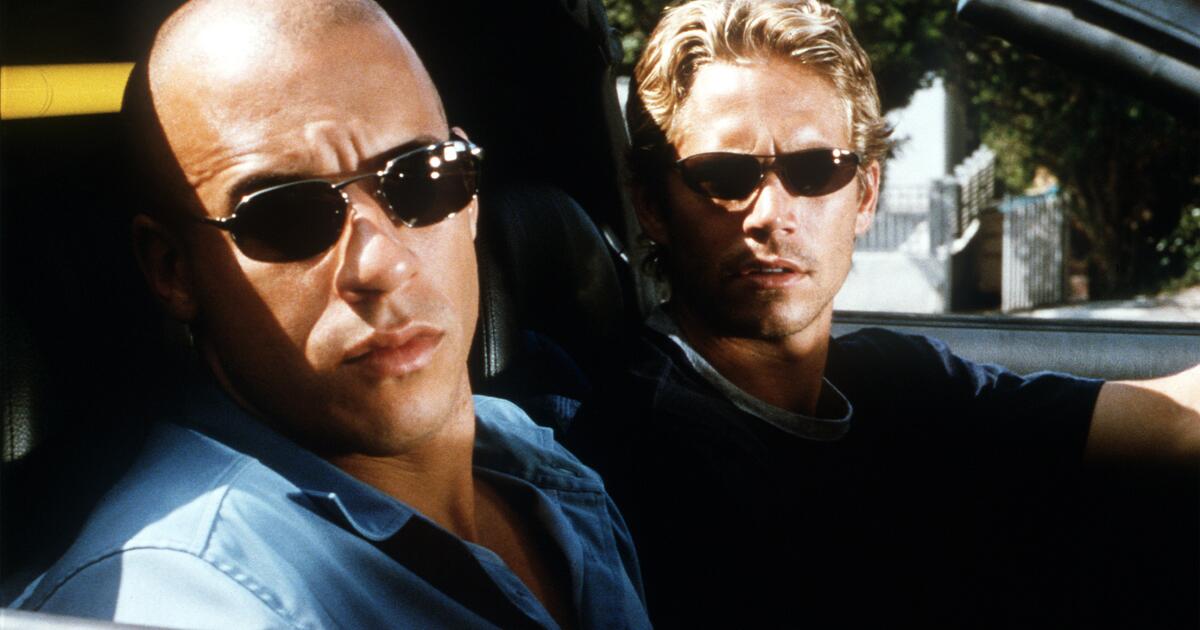
Ariana Grande was announced for American Horror Story’s next all-star cast on Halloween 2025.
Hayley Anderson Screen Time TV Reporter
21:27, 10 Jul 2026
Singer Ariana Grande was announced for American Horror Story last year. (Image: GETTY)
American Horror Story is coming very soon with fans desperate to know of Ariana Grande ’s involvement.
FX announced yesterday, Thursday, July 9, that American Horror Story would be returning for season 13, on Thursday, September 24, in the US with no fixed date yet on its UK debut.
But going by the last series, American Horror Story could very well land on Disney Plus also in September or early October.
Excitement has been building for the anthology drama’s return since Halloween last year when it was revealed that singer and Wicked star Ariana Grande was set to star.
At the time, she was confirmed alongside American Horror Story regulars such as Sarah Paulson, Angela Bassett, Jessica Lange, Emma Roberts and Billie Lourd.
Will Ariana Grande star in American Horror Story season 13?
Unfortunately, Ariana Grande will no longer star in season 13 of American Horror Story, despite the initial casting announcement.
It has been reported that Ariana won’t make her debut because of conflicts with timing changes to the production dates of the horror series which are happening simultaneously with her Eternal Sunshine tour.
The 33-year-old hadn’t filmed any scenes for the new series with fans noticing her absence when the cast was previously spotted shooting exterior scenes.
Ariana rescheduled her Eternal Sunshine tour July concert dates at the end of June, shifting shows in Brooklyn and Boston to a couple of days later.
The star will continue her tour with upcoming stops including Canada, New York and London.
Unlike Ariana, previously announced stars Six Feet Under’s Frances Conroy and model Alex Consani were spotted shooting.
So far though, there has been no word on what American Horror Story season 13 will be about with details still under wraps.
American Horror Story is available to watch on Disney Plus.
Iran said on Thursday it had targeted U.S. military infrastructure across the Gulf in retaliation for fresh American strikes on Iranian territory, marking the latest escalation in a conflict that is increasingly testing a fragile ceasefire brokered just weeks ago.
The renewed exchange of attacks came as Iran prepared to bury its late Supreme Leader Ayatollah Ali Khamenei at the holy city of Mashhad following a week of nationwide funeral processions.
Although oil prices eased after surging on fears of wider disruption, investors and governments remained focused on whether the latest violence represented a temporary escalation or the beginning of a broader collapse of efforts to end the conflict.
Iran retaliates after U.S. strikes
Iranian armed forces said they targeted U.S. military facilities in neighbouring Gulf states after American forces struck military infrastructure across Iran’s southern coast and eastern provinces.
Stay ahead of the geopolitical week.
MD Briefing delivers expert analysis across five global fronts — the Indo-Pacific, energy, geoeconomics, European security, and the Middle East — every Monday morning. Free.
According to Iranian officials quoted by state media, the latest U.S. attacks killed 14 people and wounded 78 others across five provinces on July 8 and 9.
The semi-official Fars news agency reported that one strike hit a railway bridge used for trade links with Russia and China.
Explosions were also reported on Thursday morning in Bushehr province, home to Iran’s only operational nuclear power plant, though authorities did not immediately provide details on the cause.
Gulf military installations targeted
Iran’s military said it launched drone and missile attacks against several U.S.-linked military facilities across the Gulf region.
According to Iranian state media, the targets included:
U.S. Patriot missile systems in Kuwait
An early-warning installation in Qatar
A U.S. military fuel storage facility in Bahrain
Kuwaiti authorities said their air defences intercepted a cruise missile, three ballistic missiles and ten drones. Officials reported one person was injured by falling debris.
Qatar, which hosts the largest U.S. military base in the Middle East, called for restraint and urged all sides to return to diplomatic negotiations.
During a phone call with Iranian Foreign Minister Abbas Araqchi, Qatari Prime Minister Sheikh Mohammed bin Abdulrahman al-Thani also condemned attacks on commercial shipping in the Strait of Hormuz.
Strait of Hormuz remains at the centre of tensions
The latest military confrontation follows attacks on commercial tankers in the Strait of Hormuz, one of the world’s most important energy shipping routes.
The U.S. military said Wednesday’s strikes were designed to protect international navigation after blaming Iran for attacks on three commercial vessels.
Although Tehran has not officially claimed responsibility for those attacks, analysts say Iran has increasingly used pressure around the Strait of Hormuz as leverage in negotiations with Washington.
Before the war began in late February, roughly one-fifth of global oil supplies passed through the narrow waterway.
Iran has since exercised significant control over maritime traffic in the strait, giving it considerable strategic influence over global energy markets.
The U.S. Central Command (CENTCOM) said American forces struck around 90 Iranian military targets.
According to CENTCOM, the operation targeted:
Air defence systems
Coastal surveillance infrastructure
Missile and drone storage facilities
Naval assets
Military logistics centres along Iran’s coastline
“The United States is holding Iran accountable for recent unjustified aggression against commercial shipping and civilian crews freely navigating a vital international waterway,” CENTCOM said.
President Donald Trump defended the operation on Wednesday, writing on Truth Social: “This is in retribution for yesterday’s bombing of ships by Iran. If it happens again, it will get much worse.”
Trump says ceasefire agreement is effectively over
While attending the NATO summit in Ankara, Trump said he believed the memorandum of understanding signed with Iran to halt the fighting had effectively collapsed.
Asked whether the agreement remained in force, Trump replied:”It’s a very interesting question. To me, I think it’s over. I don’t want to deal with them.”
He later added that even if another agreement were reached, he doubted Tehran would honour it.
Despite the renewed military exchanges, Trump said he did not expect the confrontation to develop into another prolonged war.
“Anything that happens is going to be over very quickly… and will only make it safer, including for oil,” he told reporters.
Iran vows continued retaliation
Iranian officials condemned the latest U.S. military operation as another breach of understandings reached after the ceasefire.
Parliament Speaker Mohammad Baqer Qalibaf warned Washington that future attacks would receive a military response.
“The U.S. has yet to learn that bullying and breaking its commitments no longer come without a cost,” he wrote on social media.
“The Strait of Hormuz will be reopened only under Iranian arrangements, not through U.S. threats.”
Oil markets remain on edge
Oil prices retreated on Thursday after jumping sharply a day earlier, as traders assessed whether the latest fighting would significantly disrupt Gulf energy exports.
Shipping also remains under close watch.
One of the vessels struck this week the Qatari LNG tanker Al Rekayyat remains stranded off Oman after suffering an engine-room fire following a projectile strike.
Industry sources said its liquefied natural gas cargo appears secure and that the immediate risk of explosion remains low.
Future outlook
The latest exchange of strikes has significantly weakened confidence in the U.S.-Iran ceasefire, even if neither side appears ready for a return to full-scale war.
Attention is now focused on whether further attacks occur around the Strait of Hormuz, where any prolonged disruption could quickly tighten global energy supplies and drive oil prices higher.
Diplomatic efforts led by Gulf states are likely to intensify, but Trump’s declaration that the interim agreement is “over” and Iran’s vow to continue retaliating have raised doubts over whether negotiations can still produce a lasting settlement.
The Autry’s current exhibition,“Life, Liberty, and Los Angeles” is an excellent show that takes a deep regional dive pegged to its 250th American anniversary programming. Of all the pieces, See Lee’s meticulously stitched “Hmong Story Cloth” (circa 1980) is a poignant chronicle of making the journey to an unknown future in the United States. Utilizing the traditional paj ntaub embroidery format, the textile documents Lee’s family fleeing war-torn Laos and resettling in Long Beach during the 1970s. The narrative unfolds in sequential sections depicting military violence at a chaotic crossing of the Mekong River; lower panels remember Thai refugee camps, a rescue airplane and a Greyhound bus. This visual testimony shares striking cross-currents with Latin American arpilleras and paños Chicanos, linking disparate diasporic traditions through the shared language of quietly political, deeply personal needlework — in this case, preserving a crucial chapter of Southeast Asian migration to Southern California.
LONDON — During a weekend that celebrates life, liberty and the pursuit of happiness, Wimbledon offers an American variation in the pursuit of Grand Slam glory.
Sunday’s fourth-round clash on the No. 1 Court between Jessica Pegula, the top-ranked American and veteran standard-bearer, and Iva Jovic, the brightest young American star since Coco Gauff, is a compelling intergenerational showdown between the present and future of U.S. women’s tennis.
It’s the kind of matchup worthy of a holiday complete with fireworks.
“I know she’s going to come after me hard,” the 32-year-old Pegula said following her clinical 6-1, 6-3 third-round defeat of Jessica Bouzas Maneiro of Spain on Friday.
“Everyone kind of wants to be the top American, I guess,” agreed Jovic, an 18-year-old from Torrance who toughed out a 6-3, 3-6, 6-4 win over Ekaterina Alexandrova of Russia on Friday to reach the fourth round at Wimbledon for the first time. “There is a little bit extra competition there.”
Pegula and Jovic are hardly unfamiliar opponents, and not just because people frequently told a young Jovic to model her game after Pegula. The two have met three times before, including twice this year, on hard courts in Dubai and on clay in Charleston, S.C. Pegula won all three matches.
American Jessica Pegula serves the ball during a win over Spain’s Sara Sorribes Tormo at Wimbledon on Wednesday.
(Kirsty Wigglesworth / Ap Photo/kirsty Wigglesworth)
“There is a lot of things we do well, and we do similar, but a couple of differences too,” Jovic noted of their baseline-centric, tactical styles.
Pegula is expecting nothing less than a mirror-like baseline duel from the player she affectionately dubbed “mini-me” after beating her in February.
Their career arcs have taken different paths to their first Grand Slam meeting. Pegula spent years grinding away on the Women’s Tennis Assn.’s lower tier before becoming a late-blooming major contender and top-10 mainstay. The experience gap remains enormous: Pegula owns 11 career singles titles to Jovic’s one and has amassed more than 500 tour-level wins compared with just over 100 for the teenager.
Jovic, a top-ranked junior in just her second Wimbledon, quickly has made her presence felt on tour, becoming the youngest player to win a WTA title last season at 17 before backing it up with her breakout quarterfinal run at the Australian Open in January. She is the youngest player in the top 20 and the youngest remaining in the Wimbledon singles draw.
After watching Jovic’s rise this season, Pegula praised her competitive instincts and rapid adjustment to grass.
Jovic “competes like an animal,” Pegula said.
Their relationship to grass, however, couldn’t be more different.
Pegula historically has not been a force at Wimbledon, reaching the quarterfinals only once in 2023. She acknowledges battling her own instincts on the surface.
“I feel like sometimes years in the past I’ve really fought against how to move on it, fought against all the intangibles, all the slices,” she said.
This year she’s relaxed her approach, improved her balance and added more pop to her serve, a major asset on grass.
Jovic, by contrast, has been a quick study when it comes to adapting to the tricky footing, sliding and occasional tumbles on grass. She’s taken to the lawns of London like a natural despite growing up in Los Angeles County, where grass courts are virtually nonexistent.
Jovic credits playing left wing in local soccer leagues from about ages 6 to 13 for her exceptional, low-to-the-ground footwork. That cross-training has paid dividends. She won her first professional title on grass in England last year and recently reached the semifinals at the prestigious Queen’s Club warmup event.
“It’s very closely related to the movement that we do in tennis,” Jovic said of soccer.
Jovic, who’s of Serbian and Croatian descent, also has been keeping tabs on the World Cup, though rooting for the U.S. during late starts has proved challenging in Europe.
Hall of Fame analyst Pam Shriver says the age gap adds a fascinating dimension to the grass-court chess match.
“It’s interesting when rivalries can develop generations apart from the same country, and I think they have a really good respect for each other,” Shriver said.
Torrance native Iva Jovic, left, congratulates fellow American Jessica Pegula after Pegula won their match during the Charleston Open on April 4 in Charleston, S.C.
(Matthew Stockman / Getty Images)
Shriver added that Jovic can learn from Pegula’s cerebral approach, while veterans like Pegula can tap into a fresh mindset from the younger generation’s unflinching energy.
“It goes by so fast,” Pegula acknowledged of the creeping sense of urgency in pursuit of her first major title.
Jovic is aware Sunday’s match is a massive opportunity to prove her rapid ascent is no fluke and flip the script on her head-to-head deficit.
“Hopefully, this will be the one I get her,” she said.
Through the first week in London, Pegula has been in sharper form. She hasn’t dropped a set in three matches, gliding into the fourth round and looking more and more like the favorite in her quarter. She also feasts on fellow Americans. Since 2023, Pegula is an impressive 34-3 against her compatriots.
“I’m always motivated to beat the other Americans in a way that’s different,” Pegula said. “Excited again to challenge myself against someone who is much younger, who is playing with nothing to lose and no fear.”
Still, reaching next weekend’s final will require either player to navigate a brutal top half of the draw. It includes four-time major winners Aryna Sabalenka and Naomi Osaka, two-time major champion Gauff and the last Wimbledon champion left in the field, 2024 winner Barbora Krejcikova.
On a weekend devoted to celebrating the U.S., at least one American will be celebrating at Wimbledon when the fireworks fade.
On a recent summer day at Crossroads School for Arts & Sciences, students ambled through yawns, braces and acne into their creative writing class. The day’s lesson tackled “style,” that elusive, ultra-subjective choice of expression.
“Who was the first author you encountered to do something different on the page?” asked the teacher, Clarke E. Andros.
They named Dr. Seuss, Shel Silverstein and Lemony Snicket before moving on to a précis of Joy Williams’ flash fiction. “These stories are weird — she’s weird,” Andros warned.
In some ways, high school looks much the same as it did 20, even 100 years ago: sleepy eyes either light up or glaze over when a teacher poses a Socratic question. Nervous laughs and unexpected insights emerge as young people use stories to make sense of themselves and the world around them.
(Fingerprint; Penguin Classics; Pantheon)
The idea of the “Great American Novel” took shape in the aftermath of the Civil War, when a fractured nation looked to literature to define itself. As classrooms evolved, so did the canon that reflected America’s changing identity.
But the syllabus today is at a tipping point. Forces — some visible, some harder to see — are upending literature and education itself. American students are in a decade-long reading recession, while fewer students are reading for pleasure than in previous generations.
Reading scores among high school seniors are at their lowest in decades, according to federal testing data, while schools across the country are grappling with how to respond to waning attention spans and artificial intelligence. The Los Angeles Unified School District has begun a course correction, voting to limit student use of laptops and tablets during class — the first major American school system to do so.
We spoke with five high school English teachers across the city — three from LAUSD, one from a charter and one from a private school — to find out what literature belongs in today’s classroom, and which stories can help us understand America, past and present.
Interviews have been edited and condensed for clarity.
Raquel Olvera, Roosevelt High School, Boyle Heights
What books in the American literary canon are you teaching (old and new)?
In 11th-grade American Literature, as part of the LAUSD-approved Odell curriculum, we read four book options: “Friday Night Lights,” “Beloved,” “The Great Gatsby” and “The Warmth of Other Suns.” For my 10th-grade World Literature course, I like “Antigone” and “Things Fall Apart.” I also teach “In Cold Blood,” using it to explore Americans’ fascination with true crime and what the genre reveals about race, gender, class and the justice system.
(Simon & Schuster; Sky Publishing; Vintage)
What’s one work from the canon adults should revisit today?
“The Great Gatsby.” When I read it in high school, I wasn’t engaging with its undercurrents of racism, xenophobia, antisemitism, gender or sexuality in the way I do now. Its themes of power, wealth, consumerism and American identity remain as relevant as ever.
What are English teachers up against in the classroom in 2026?
Besides large class sizes and underfunding, I think public educators are largely battling apathy. Students and young people aren’t engaging with books like they used to. A side effect of that is a lack of empathy and curiosity. At the very least, you can model what it means to be a reader and a writer, and hope that years later, students remember that one nerd English teacher who showed them what humanity can look like.
Schehrezade Lodhy, Da Vinci Schools, El Segundo
What books in the American literary canon are you teaching (old and new)?
Students really enjoy Arthur Miller’s “The Crucible” — it’s all about the human condition and cancel culture, forbidden love and lies and deceit, with witches in the forest. In poetry, we explore a range of American voices, from Walt Whitman and Langston Hughes to Amanda Gorman, and sometimes even song lyrics. I also use “The Moth: Storytelling” podcast when students are working on personal essays. The goal is to make literature, poetry and storytelling as accessible as possible. At a charter school, we have quite a bit of autonomy with what we teach.
What’s one work from the canon adults should revisit today?
James Baldwin’s “Giovanni’s Room” and “Go Tell It on the Mountain.” I read Baldwin a few summers ago, and that was quite an education for me. Unfortunately, some of the content is a bit too mature for high school, but I do talk about Baldwin a bit in my classes when we cover African American authors.
(Reader’s Library Classics; W. W. Norton & Company; Simon & Schuster)
What are English teachers up against in the classroom in 2026?
Artificial intelligence, big time. I really pared back technology in my class, and we’ve pivoted back to paper and pencil. Going into my 18th year of teaching, my biggest goal is re-creating that experience of thinking critically for oneself and studying literature through a critical lens. We’re in this era of going back to the basics. With decreased attention spans, teachers are being forced to become even more creative. It feels like we’re reinventing ourselves every year.
Aiden Brown, John F. Kennedy High School, Granada Hills
What books in the American literary canon are you teaching (old and new)?
From an educationally traditional background, I still believe in canon disruption — mixing the new and old. In American Lit, I’ve taught “Their Eyes Were Watching God” 11 times now. It’s a hard one to get on the first try because the vernacular is so particular, but when we read it physically while also listening to the audiobook, it’s such a great novel to hear. I pair it with bell hooks’ “All About Love.” I teach “Macbeth” from a performance-based lens, making it less intimidating. My favorite book is “Frankenstein,” written by a teenage girl who invented science fiction. My ninth-graders’ favorites were “Fahrenheit 451,” “The Odyssey” (Emily Wilson translation) and “Persepolis,” a graphic novel about a girl discovering punk rock and rebelling against the established order.
What’s one work from the canon adults should revisit today?
All of the lonely young men need to reread “The Great Gatsby,” and anyone freaked out by the state of the world should read “Parable of the Sower.” One quote from the book hangs on a poster board in my classroom: “A community’s first responsibility is to protect its children — the ones we have now and the ones we will have.”
What are English teachers up against in the classroom?
Teenagers are still the funniest people on the planet. As the world around them becomes more atomized, I find that they’re increasingly interested in connection. In the classroom, we are seeing skill loss and a decreased ability to focus on a task. I don’t think that’s just because of AI or the pandemic — it’s also phones, screens and the world kids are growing up in. One thing teachers seem to agree on is a return to pen and paper.
Clarke E. Andros, Crossroads School, Santa Monica
What books in the American literary canon are you teaching (old and new)?
A newer addition I would recommend is “Hunger: A Novella and Stories” by Lan Samantha Chang. Especially in California, we have a lot of great Asian American literature, including works by Amy Tan, but I enjoy the writing level in Lan’s — it’s accessible to students but pushes them, all about intersectional identity and the first-gen experience. A lot of the Latino students I’ve taught in Los Angeles also connect with that book.
(Penguin Classics; Grand Central Publishing; Mariner Books Classics)
What’s one work from the canon adults should revisit today?
“Of Mice and Men.” Revisiting it today opens up deeper conversations about labor, social conciousness and power. Steinbeck creates a microcosm of American society, where disability, gender, race and class are all represented and shaped by an economic hierarchy. The characters are left navigating a world where people often turn on each other rather than challenge the systems around them. It’s novella-length, so you could read it in a Sunday morning.
What are English teachers up against in the classroom in 2026?
We’re up against systems that often prioritize ed-tech and third-party vendors over smaller class sizes and more teachers. When I was at LAUSD, it was clear from our superintendent — who just stepped down over his fraud investigation — was just in bed with tech. It’s hard for me to imagine the folks in power didn’t look at [the failed AI chatbot venture] and see it as a grift.
On the flip side, at hyper-competitive, elite schools like this, students are approaching high school with college in mind rather than with high school in mind. When students understand the value of the process, they’re less likely to look for an easy shortcut like AI.
Adam Tan, Los Angeles Center for Enriched Studies, Mid-City
What books in the American literary canon are you teaching (old and new)?
With independent reading, memoirs are big, like “Crying in H Mart” and Sylvia Plath’s fictionalized “The Bell Jar.” Younger kids gravitate to “Musashi,” a celebrated epic based on a famous samurai. We have a lot of Korean American students here, so they like “Pachinko,” dealing with racism and the Korean population in post-World War II Japan. I’ll also throw in “The Bluest Eye.”
In ninth grade, we read “Slaughterhouse-Five,” “Of Mice and Men,” “The Thief and the Dogs” and “Romeo and Juliet,” with the film adaptations to use media literacy. In American Literature, the major texts are “The Great Gatsby,” “The Things They Carried” and “The Crucible.” We also read nonfiction articles, including pieces on AI and robots, while focusing on rhetorical devices.
(Blackstone Publishing; Knopf; Little, Brown and Company)
What’s one work from the canon adults should revisit today?
“The Catcher in the Rye” benefits from the distance of adulthood. It’s a novel about disillusionment and the search for identity, but when you revisit it, you also see that it’s very much a love story. I often encourage students to look for forms of love beyond romance — love for family, friends and fellow human beings. Even today, students can tell you that the biggest phony in the book is Holden himself. The novel reminds us that while literature may not have answers to the world’s problems, it can help us examine our wounds and find solace in art.
What are English teachers up against in the classroom in 2026?
A lack of accountability in the modern world. In general, we have a school district focused on 100% graduation rates, no F’s. [LAUSD] wanted everything on computer, and now they want less computer time, which is great, but not everyone at top management is on the same page. Teachers are often trying to balance what the district wants with what we know our students need.
What I try to instill instead is an intrinsic desire to grow as a thinker. How do you make sure students are reading without taking the joy out of it? A lot of us are going back to pen and paper. Despite all the concerns about AI, I still think the soul and spirit of young people is as strong as ever. The core is not rotting.
Pope Leo XIV greets migrants at the Favaloro Pier to bless a plaque dedicating the pier to late Pope Francis during his pastoral visit to the island of Lampedusa, Italy, Saturday. Photo by Ciro Fusco/EPA
July 4 (UPI) — Pope Leo XIV, the first American pope, spent his second Fourth of July as the pontiff at Lampedusa, Italy, an island at the forefront of the European migrant crisis, and appealed to Americans to treat immigrants with “compassion and generosity.”
Leo visited Lampedusa, an Italian island in the Mediterranean Sea between Tunisia and Malta, instead of celebrating the day in the United States.
Soon after his arrival, he released a letter to Americans about the 250th Anniversary of the country’s birth, reflecting on the principles that have shaped the United States for two and a half centuries, particularly religious freedom and human dignity.
In the letter Leo said that, “among the principles that have guided the development of this country is the God-given dignity of every human life, each person being endowed with an inherent worth that calls for reverence, protection and care … and of building a society in which the vulnerable, the suffering and the forgotten are always met with compassion, solidarity and love.
“Defending human life also includes welcoming, protecting and assisting immigrants, whose hopes, sacrifices and contribution have formed part of the history of this country from its very beginning. In every generation, those who have arrived seeking freedom, opportunity and a place to belong have helped to shape the nation’s character. To receive them with compassion and generosity is not only an act of charity, but also a recognition of the dignity that belongs to every human person,” Leo said.
He said he hopes Americans “honor the courage and vision of those who came before them by strengthening their communities, respecting their differences and working together toward a more perfect union.”
Upon landing at Lampedusa, the pope visited the “Door to Europe,” a piece of art that is a memorial to thousands of migrants who died or disappeared trying to cross the sea.
He also visited the Cemetery of the Nameless in Cala Pisana to pray over the graves of migrants who died at sea. The graves are marked with crosses made from the wood of boats that sank off the island’s coast, Euro News reported.
Leo then visited Molo Favaloro, a site where migrant boats are brought to shore. He unveiled and blessed a plaque dedicated to Pope Francis there. The quay there will now be named Molo Francisco. Francis visited the island in 2013.
The pope met and shook hands with 15 migrants brought from a migrant housing center run by the Red Cross. It now houses 138 people, including 51 unaccompanied minors. On Friday night, the Italian coast guard rescued 17 people aboard a small boat, Euro News said.
“By deciding to name Molo Favaloro after Pope Francis you are giving a sign of the bond my predecessor forged with your community and with migrant brothers and sisters: the Pope has stood by you in these very demanding times. And today I am here to tell you that the Pope continues to walk alongside you, to support you and encourage you,” Leo wrote in a letter to the mayor of Lampedusa.
On Friday, Leo gave a virtual speech to Philadelphia when he was awarded the Liberty Medal. The medal has been awarded since 1989 and was managed by the Philadelphia Foundation until 2006, when it became part of the National Constitution Center in Philadelphia.
People attend the “Great American State Fair” on the National Mall in Washington, D.C., on Wednesday. The Freedom 250-backed event was temporarily shut down Friday due to extreme heat. Photo by Bonnie Cash/UPI | License Photo
July 3 (UPI) — The Great American State Fair was temporarily shut down Friday due to extreme heat as temperatures in Washington, D.C., reached 100 degrees.
Freedom 250 announced Friday afternoon that the event on the National Mall was suspended until 5 p.m. Friday due to the heat, which reached 100 degrees at 2 p.m. Friday with a heat index of 111.
“The safety and well-being of our guests, volunteers, performers, vendors, and staff is our highest priority. Conditions are expected to improve later this afternoon, and we look forward to welcoming everyone back at 5:00 p.m. as preparations continue for this evening’s festivities,” Freedom 250 said on social media just before 1:30 p.m.
A follow-up post confirmed the gates would reopen at 5 p.m.
Friday evening’s events at the fair include performances by Hugo Castillo, Mickey Smith Jr. and Grace Moody Miller.
“Complimentary water distribution stations will be available throughout the fair site, with food and beverages available for purchase,” organizers wrote.
The country will celebrate its 250th birthday Saturday, and it seems nobody quite knows how to feel about it. Being a thoughtful American in 2026 has become an art form unto itself — a balancing act two-and-a-half centuries in the making. Marking the anniversary of the signing of the Declaration of Independence requires the acceptance of a paradox so profound that it feels almost insurmountable: The great American experiment has failed; and it is also a triumph.
I’m writing this at near midnight on a muggy night in Pennsylvania — about 300 miles from Philadelphia, where in 1776 the Continental Congress adopted a document bearing one of the most famous and idealistic lines ever written: “We hold these truths to be self-evident, that all men are created equal, that they are endowed by their Creator with certain unalienable Rights, that among these are Life, Liberty and the pursuit of Happiness.”
Hundreds of years later, the course of human events has once again made it necessary for us to dissolve certain bonds, only the resulting revolution has been metaphorical and waged largely online. We have become a people pitted against one another in thought and in action. In the words we write on social media, the news we choose to consume on our siloed feeds, and the way we treat those who believe differently than we do.
How do we come together to celebrate the monumental achievement of this improbable democracy, which should be made stronger through our respectful disagreements and ability to compromise in search of a higher truth? It may be foolish to say we must lead with kindness when so much raw anger abounds, but that is all we can do. It is what we must do.
Art can help — the music, paintings, dances and plays that remind us in myriad ways that we are not alone. You’ll have access to plenty of such sustenance on this highly anticipated anniversary weekend. So if you are, like me, facing the fireworks with trepidation, find a way to lock into a favorite song, or read a poem that moves you, and the worry will pass. It always does.
I’m Arts editor Jessica Gelt, watching the fireflies. This is your arts and culture news for the week.
You’re reading Essential Arts
Our critics and reporters guide you through events and happenings of L.A.
By continuing, you agree to our Terms of Service, which include arbitration and a class action waiver. You agree that we and our third-party vendors may collect and use your information, including through cookies, pixels and similar technologies, for the purposes set forth in our Privacy Policy such as personalizing your experience and ads.
The week ahead: A curated calendar
SATURDAY
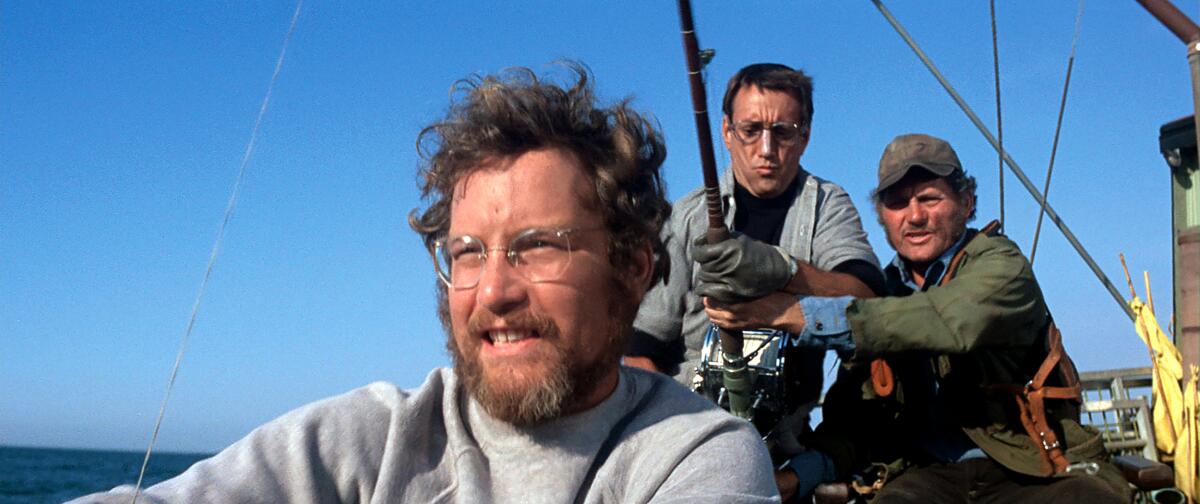
Richard Dreyfuss, left, Roy Scheider and Robert Shaw in the 1975 movie “Jaws.”
(Universal Pictures)
Jaws Just when you thought it was safe to go back to the theater, a series of shark attacks are expected across the city Saturday afternoon as Steven Spielberg’s 1975 blockbuster screens at the Academy Museum’s David Geffen Theater (in 4K), the American Cinematheque’s Aero Theatre (in 35 mm) and Vidiots’ Eagle Theatre. 2:30 p.m. Saturday. Academy Museum, 6067 Wilshire Blvd. academymuseum.org; 3 p.m. Saturday. Aero Theatre, 1328 Montana Ave., Santa Monica. americancinematheque.com; 1 and 4:30 p.m. Vidiots Eagle Theater, 4884 Eagle Rock Blvd., Eagle Rock. vidiotsfoundation.org
TUESDAY
National Museum of the Aftermath screening series Kevin Jerome Everson and Claudrena N. Harolds’ short film “Foosball: U. of Virginia Charlottesville, VA 1976” (2013), inspired by a photograph of two students playing a game, examines Black life at UVA; and Andrea Fraser’s feature documentary “This meeting is being recorded” (2022) gathers a group of a self-identifying white women to discuss unconscious racism and their own roles in white supremacy. 6 p.m. Oxy Arts, 4757 York Blvd. oxyarts.oxy.edu
WEDNESDAY
Brian Quijada, left, and Nygel D. Robinson in “Mexodus.”
(Thomas Mundell)
Mexodus Direct from an award-winning off-Broadway run, this new musical created and performed by Brian Quijada and Nygel D. Robinson illuminates a lesser-known fork of the Underground Railroad, one that branched south across the Rio Grande. Previews, 8 p.m. Wednesday, 7 p.m. Thursday, 8 p.m. July 10, 2 and 8 p.m. July 11; continues through Aug. 2. Pasadena Playhouse, 39 S. El Molino Ave. pasadenaplayhouse.org
New Swan Shakespeare Festival.
(New Swan Shakespeare Festival)
New Swan Shakespeare Festival The annual summer-long event, featuring professional theater artists, UC Irvine alums, current graduate and undergraduate drama students and faculty, returns for another repertory season of classics under the stars at its intimate, 130-seat, portable, mini-Elizabethan space. “Romeo & Juliet,” directed by Rachael VanWormer, resets the tragic romance to the American Dust Bowl; “The Merry Wives of Windsor Cove,” adapted by Anna Fitzgerald & Eli Simon, with music by Zachary Dietz and directed by founding Artistic Director Eli Simon, brings the rollicking comedy to a 1950s SoCal surf town, powered by a live skiffle band. “Romeo & Juliet,” 8 p.m. Tuesday and Thursday, and various dates through Aug. 29. “Merry Wives,” 8 p.m. Wednesday, and various dates through Aug. 30. UC Irvine campus, 4000 Campus Drive. newswanshakespeare.com
Wilkins Conducts Bernstein & Ellington Thomas Wilkins guides the L.A. Philharmonic in a program of classical Americana featuring selections from Valerie Coleman, William Grant Still, a newly arranged song cycle from Shaina Taub’s Broadway hit “Suffs,” Leonard Bernstein and Duke Ellington. 8 p.m. Hollywood Bowl, 2301 N. Highland Ave. hollywoodbowl.com
Zoot Suit Join writer-director Luis Valdez and star Edward James Olmos for a 45th anniversary screening of the film, an adaptation of Valdez’s groundbreaking play, the truly L.A. story of the 1942 Sleepy Lagoon case and Zoot Suit Riots. Audiences are encouraged to come in costume and arrive early for the “Pachuco Boogie!” Produced in partnership with the Los Angeles Latino International Film Festival, Self Help Graphics and Pachuco Car Club. 8 p.m. The Ford Ampitheatre, 2580 Cahuenga Blvd. East. theford.com
THURSDAY
Randal Goosby.
(L.A. Phil)
The Classical World Cup Tito Muñoz conducts the L.A. Phil in a salute to “the beautiful game” (soccer to Americans) with works spanning the Americas by Alberto Ginastera, Samuel Barber (with Randal Goosby on violin), Silvestre Revueltas and Aaron Copland; plus the world premiere of “The Art of the Goal,” an original mixed-media concept film by director Josh Kahn and composer Adam Schoenberg. Commissioned by the L.A. Phil, the piece blends footage of elite training and match play featuring the Los Angeles Football Club with orchestral music. 8 p.m. Hollywood Bowl, 2301 N. Highland Ave. hollywoodbowl.com
The SoCal scene
(Matt Chase / For The Times)
Celebrations for the country’s 250th birthday have been muted thus far (at least compared to the bicentennial 50 years ago), but our Entertainment and Arts team noted the moment by examining the ways the artists we cover have interpreted the nation’s complex history. Times theater critic Charles McNulty wrote that a “cohort of playwrights, breathtakingly diverse demographically as well as aesthetically, has been rejuvenating American theater.” Contributor Shana Nys Dambrot looked to local museums and identified nine works of art “exploring and expounding upon, in celebration and critique, what it means and what it feels like to be an American.” Times classical music critic Mark Swed compared the artistic and institutional responses of 2026 to the past, lamenting that “None of this comes close to comparing with the attempted civic zest of 1976.” Check out the rest of the collection of stories and essays, including Mary McNamara’s column reminding us that even in troubled times 250 years is worth celebrating because “the Constitution was written ‘in order to form a more perfect union.’ Not ‘perfect,’ but ‘more perfect.’ As in better,” and a list of 10 essential movies that capture crucible moments in U.S. history; find out what Times pop music critic Mikael Wood calls the “quintessential American song,” and which books are being read in L.A. high schools and which classics remain relevant.
Carene Rose Mekertichyan , left, and Brent Charles in “Coriolanus” at the Griffith Park Free Shakespeare Festival.
(Grettel Cortes)
It’s summer and that means that outdoor theater is upon us and McNulty reviewed the Independent Shakespeare Co.’s Griffith Park Free Shakespeare Festival production of “Coriolanus.” “It’s hard to love ‘Coriolanus,’ but it’s equally hard not to be impressed by its ambition, originality and dramatic rigor,” wrote McNulty. This “production isn’t going to win awards for subtlety, but the storytelling is crisp and vivid. And even those unfamiliar with the tale — the vast majority of attendees, in all likelihood — should find it engrossing.”
It’s hard to believe that the ABBA jukebox musical “Mamma Mia!” premiered 25 years ago. Times staff writer Eloise Rollins-Fife went backstage at the Ahmanson Theatre to visit with the behind-the-scenes crew who put so much joy into the sequin-bedazzled extravaganza on display in the show’s anniversary tour — many of whom worked on the original production and tours.
Hollywood set painters whose work in the Tinseltown dream machine often went overlooked and uncredited are getting their due in “Staging California in Early Hollywood” at the UC Irvine Langson Orange County Museum of Art in Costa Mesa. Times staff writer Julius Miller spoke with museum director Kathryn Kanjo and assistant curator Michaëla Mohrmann about the institution’s first exhibition since UC Irvine acquired OCMA last September and Kanjo’s appointment in December.
Enjoying this newsletter? Consider subscribing to the Los Angeles Times
Rosalie Tucker, executive director of Pieter Performance Space (standing left); Andrew Pearson of Bodies in Play (second from left); Lena Martin (second from right) and Mandolin Burns (right) of Crawlspace; Dani Burd of Indigo Dance Company (bottom left); and Adie San Diego (bottom right).
The Centre Theatre Group announced that a world tour of the acclaimed stage adaptation of Hayao Miyazaki’s Academy Award-winning animated film “Spirited Away” will open the Ahmanson Theare’s 2027-28 season. “We are honored to bring the wonder of ‘Spirited Away’ to the Ahmanson Theatre for an exclusive US engagement, offering our community the gift of experiencing one of the most cherished stories of our time, reimagined for the stage in a once-in-a-generation theatrical experience,” said Douglas C. Baker, Center Theatre Group producing director, in a statement. The production, from Toho Co., will open at the National Theater in Taipei on Dec. 16, before continuing on a national tour of Japan from March-August 2027, followed by stops at the Princess of Wales Theatre, Toronto (May-August 2027), and the Ahmanson (September–October 2027). The tour will conclude with a return to the London Coliseum (March-July 2028), where it had its European premiere in 2024 following a sold-out tour of Japan in 2022. Casting will be announced at a later date.
The British theater lost two stalwarts this week. Penelope Keith, best known for the sitcoms “The Good Life,” which aired on PBS in the U.S. as “Good Neighbors,” and “To the Manor Born,” has died at age 86. Keith joined the Royal Shakespeare Co. in 1963, won a BAFTA Award in 1977 for “The Good Life” and continued her stage career into her 80s. The New York Times reported that Michael Byrne, a noted actor of stage and screen, also died this week at 86. Byrne created the role of the suspected torturer Dr. Miranda in the premiere production of Ariel Dorfman’s 1991 play “Death and the Maiden” in London. Other notable theater roles were with Siân Phillips in “Juliet and Her Romeo,” Polonius in “Hamlet,” Cassius in “Julius Caesar” and Prince Hal in “Henry IV.” The actor also appeared in films such as “Force 10 from Navarone,” “Indiana Jones and the Last Crusade,” “Braveheart,” “Gangs of New York” and “Harry Potter and the Deathly Hallows: Part 1.”
— Kevin Crust
And last but not least
If pyrotechnics (or drone shows!) are your thing and you’d like to celebrate the Fourth of July with a bang, Times staff writer Christopher Buchanan compiled 52 places and favorite spots to watch the festivities in Southern California.
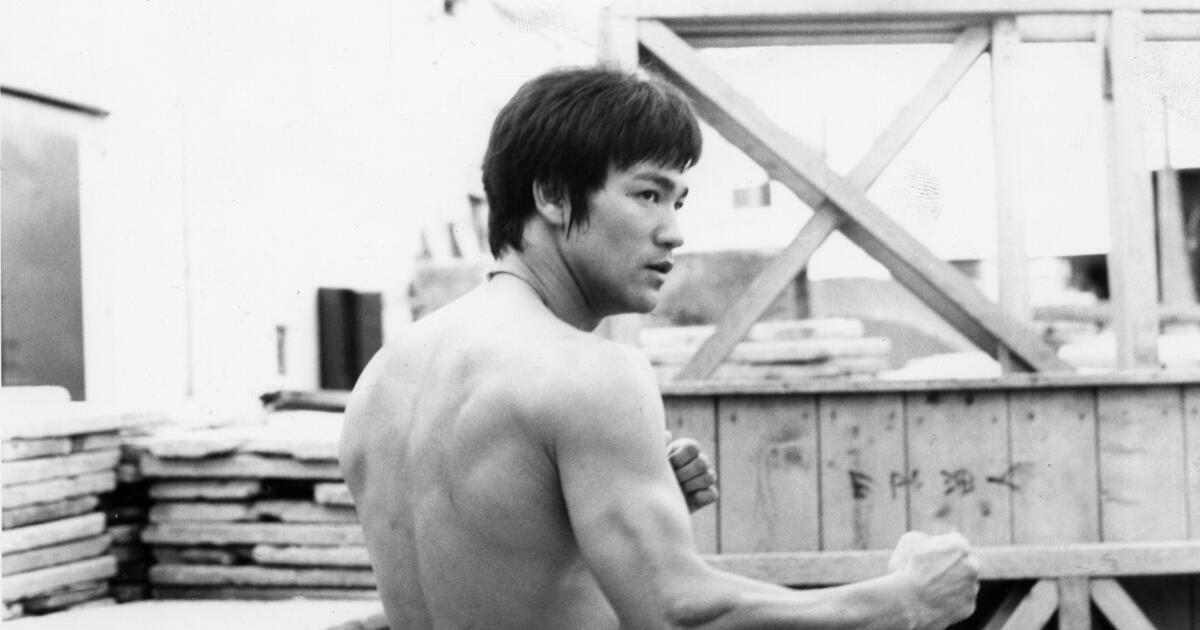
Cut to a seedy alley behind a Chinese restaurant in Rome: A dozen mobsters menace a slight young man who suddenly pulls out a pair of nunchucks. He swings the traditional stick-and-chain weapons and makes quick work of his enemies, who fall one by one, groaning in pain.
The comedic, legendary action scene is from the 1972 film “The Way of the Dragon,” written, directed and starring Bruce Lee. The martial arts star was a trailblazer, allowing Asian Americans to see themselves represented in a strong, positive light on-screen.
And now he has secured a place in California history, becoming the first Chinese American in state history to have a day designated in his honor.
Lee was born in 1940 in San Francisco. His mother was of European descent and his father was a Cantonese opera star who was on tour in the city, affording his son birthright citizenship.
Lee grew up in Hong Kong, where he followed his father’s path as a performer, acting in more than a dozen films as a child and studying the close-quarters southern Chinese martial art Wing Chun.
On May 17, 1959, an 18-year-old Lee returned to San Francisco and eventually made his way to Hollywood. He went on to influence an industry that was at the time bereft of Asian American talent, and helped to popularize the genre of martial arts films and ignite Western interest in Hong Kong action cinema.
In recognition of his contributions, state Assemblymember Matt Haney (D-San Francisco) introduced a bill designating May 17 as “Bruce Lee Day” in California. The bill, signed into law Tuesday by Gov. Gavin Newsom, encourages schools and communities to honor Lee’s life and cultural impact.
Haney has described Lee as a “symbol of pride, resilience and possibility for generations who rarely saw themselves reflected with strength and dignity.”
Lee, who saw himself not only as an actor but also as a poet and philosopher, encountered repeated barriers. Up for the main role in the 1970s television series “Kung Fu,” for example, he was rejected in favor of white actor David Carradine.
In 2020, filmmaker Bao Nguyen sought to show how Lee dispelled anti-Asian sentiment and long-held stereotypes of emasculated Asian men in his ESPN documentary “Be Water.”
“The Asian male was the face of the enemy to many Americans,” Nguyen told The Times in 2020. “It was this vicious cycle of society reflecting media and culture, and media and culture reflecting society. There had to be some kind of intervention there and Bruce, in a way, was that intervention. He was the hero that we hadn’t seen before.”
Lee learned much about the systemic oppression that Black Americans faced from his first student, Jesse Glover, who had been a victim of police brutality.
And scholars have pointed out that, although his films had far-from-perfect politics, they touched on themes of fighting oppression. The 1971 movie “The Big Boss” showed Lee battling alongside laborers. “Fist of Fury” saw him opposing Japanese colonialism and discrimination.
Lee died young in 1973, at age 32 — before he was able to witness the full extent of his stardom. He died just one month before the release of “Enter the Dragon,” which was a box-office sensation and is considered a masterpiece of martial arts filmmaking.
DETROIT — Jerry Esters proudly displays the American flag each day on his Detroit home. A few miles away, Yvonne Pistochini says there is no scenario under which she would allow the Stars and Stripes to cast its shadow where she lives.
Both are Black.
For Esters, the flag represents the opportunities that allowed the great-great-grandson of slaves to find success and flourish. Pistochini, 79, simply says the America identified by the flag is not the same country she saw growing up.
Republicans and older, white adults are especially likely to say they fly the American flag, while younger Democrats and Black adults are more likely to say they don’t fly it. Views of the flag — and whether it’s a unifying or divisive symbol — track with other deep divisions among Americans, who see their country’s history and accomplishments very differently.
“A lot of Black Americans see the flag as a symbol of both inclusion and exclusion,” said Matthew Delmont, professor of American history at Dartmouth College. “Black Americans, more so than white Americans, also understand the flag can be used to justify a version of patriotism that is rooted in exclusion, with the flag being used to say ‘you don’t belong here.’”
The survey of 2,596 adults was conducted April 16-20. It suggests that older white Americans, especially Republicans, are more likely to see the flag as unifying.
About half of U.S. adults said they display the flag at home throughout most of the year, or during holidays. About 7 in 10 Republicans and about 6 in 10 Americans ages 60 and older fly the flag at least during holidays.
About 6 in 10 Democrats and independents, on the other hand, say they “never” fly the U.S. flag. That includes the vast majority, 75%, of Democrats under 45.
Opportunities worth fighting for
Esters, a 64-year-old retired clay sculptor for a Detroit automaker, flies three American flags at his Sherwood Forest home on the city’s west side.
“When these homes were built, Black men like me, my mother and my family … we couldn’t even buy these homes,” he said. “To me, that’s one reason I fly the flag. We went through a lot to be able to own nice homes, and this is what we fought for.”
The other reason is Moriah Martin, Esters’ great-great-grandmother, who was born into slavery.
“I’m kind of living out her dreams — what I did for a living, having a business, having a nice home,” he said. “I think that’s the American way, but we got to fight for it and we, as Blacks, fought for it.”
He’s in the minority among Black adults, according to the survey, which found that only about 3 in 10 Black adults say they ever display the American flag, compared with about half of white and Hispanic adults.
Pistochini says current divisions over political leanings and perspectives, and inequality of opportunities for the poor and people of color are not what she believes the flag should stand for. People confuse flying it with being patriotic, she added.
“Just because you fly a flag doesn’t make you a patriot,” Pistochini said. “If there was patriotism, we would not have all this. We can’t look at (what’s going on) and say this is America.”
For country and freedom
Ben Gaskins, chair of political science at Lewis & Clark College in Portland, Oregon, says the flag is an important symbol of patriotism for many Americans.
“It is those who are older people, who are white and people who are more conservative,” Gaskins said. “They take it as more central to their identity.”
Nancy Hansen, a 73-year-old retired Customs and Border Protection clerk in Culvertson, Montana, believes “you have to be for the country, no matter what” and that the flag means “freedom.”
“Freedom to live where we want to live, travel where we want to travel, raise our kids where we want to raise our kids,” said Hansen, who is white and identifies as Republican.
Each year around July 4, the American Legion posts flags outside businesses and homes in Culvertson, including Hansen’s home.
Linda and Greg Cunningham also equate the flag with freedom.
The white, conservative Pontiac, Michigan, couple are going all out this summer. The exterior of their home northwest of Detroit is awash in red, white and blue. The flag sits atop a flagpole just feet from their door.
“It’s no political thing, at all,” said Linda Cunningham, 63. “It’s our freedom. I love the American flag. I love the whole concept of it. I love America. I know there’s so much going on in the world, right now, and I know everyone has their own views, and I’m just sad that politics have to be brought into the flag.”
Flag as a ‘painful reminder’
Of those who took the survey, 47% see the flag as a “more unifying” symbol. About 16% call it a “more divisive” icon, while 36% say it’s neither divisive nor unifying.
Only 22% of Black adults see the flag as a unifying symbol, compared with 55% of white adults and 42% of Hispanic adults.
“It’s a painful symbol. It’s a reminder of what we could be and how it’s failed to live up to that for Black people, for Indigenous people and people of color,” said Allison Wiltz, a Black author and founder of Writers and Editors of Color.
Paul Walthour, 71, occasionally flies the flag outside his Minneapolis-area home on special occasions and some holidays. Walthour says that when he’s away from home and at his cabin, the flag goes up each morning and is taken down at the end of the day.
“This is antiquated, perhaps,” said Walthour, who is white and a retired advertising agency creative director. “I feel it’s a symbol that you’re proud to be an American.”
“Unfortunately, I kind of think it’s kind of a symbol of dividing more than uniting,” added Walthour, who identifies as a Democrat. “The people who fly it on the far right have one kind of feeling about it, and the people who fly it on the left have a different kind of feeling about it.”
The AP-NORC poll of 2,596 adults was conducted April 16-20 using a sample drawn from NORC’s probability-based AmeriSpeak Panel, which is designed to be representative of the U.S. population. The margin of sampling error for adults overall is plus or minus 2.6 percentage points.
Williams, Sanders and Parwani write for the Associated Press. Sanders and Parwani reported from Washington.
British American Tobacco (BAT) is to cut nearly a fifth of its global workforce as part of a major cost-cutting drive.
The company, which makes Lucky Strike and Dunhill cigarettes, is cutting 5,500 roles and outsourcing 3,500 more.
BAT did not say where the jobs being cut were located, but added that the US was not affected.
The cost-cutting programme is expected to save about £600m a year by 2028, it added.
The tobacco giant, which currently employs 47,000 people globally, had previously announced a savings drive that would involve making it “more digital and AI-focused”.
Traditional cigarette sales are shrinking as smokers increasingly switch to vapes and nicotine pouches.
BAT is shifting its focus to smoking alternatives such as its Vuse vapes and Velo nicotine pouches to drive growth, but its sales and profit margins have been sluggish in recent years.
Sales in the US — its biggest market — have also been hit by the cost of living, as smokers swap for cheaper brands.
Additionally, the company is battling rising duties and stricter regulations in some markets.
BAT said the job cuts, which have already started, are set to be completed by the end of this year.
Chief executive Tadeu Marroco said the cuts would make the company “more agile, cost disciplined and technology enabled”.
“These changes affect many of our colleagues, and we are focused on supporting them through this transition with care and respect, as we position the business for the future.”
For my 50th birthday, I bought a Toyota Corolla. Wait. Is my midlife crisis car really a Corolla, the best selling and most boring model of all time?
Well, yes. And no.
I have “modded” it, or in layman’s terms, modified the stock components and tuned the engine. This is not your aunt’s Corolla. When I hit the gas, the car pulls hard and the engine buzzes as if it’s powered by a hive of killer bees.
I get thumbs-ups from Mustang drivers and cool head nods from Challenger owners. My favorite is when kids at red lights ask me to rev the engine like I’m F1 driver Lewis Hamilton.
Probably a lot of my drive-by admirers are fans of the movie “The Fast and the Furious,” which was released 25 years ago this month. Fans of modified Japanese import cars, like me, have a love-hate relationship with the $7 billion “Fast and Furious” franchise. On one hand, the movies helped popularize modified Japanese cars. People all over the world fell in love with them and the import car culture they publicized.
On the other hand, the movies left out so, so much of the story.
In Southern California in the mid-1990s and early 2000s, people lived, for the most part, phone-free. The internet was nascent — a repository for flyers and ’zines — and most websites looked like Tetris.
The fashion was baggy everything for guys and short shorts, midriffs and little backpacks for girls. The hair was outrageous. And the cars, especially Japanese import cars, had reached the pinnacle of automotive engineering.
During this era, I was in college at UCLA. I saved up and bought a red 1989 Honda CRX Si. It also had a slick five-speed manual transmission, peppy engine and nimble steering. That car got me to work and through college, and from the mountains of California to the border of Oregon. It probably helped me get girlfriends. It consoled me through breakups. It helped me move to the San Francisco Bay Area for my first grown-up job.
And then, stupidly, I sold it, and all the precious memories it carried.
Now when I hit a loopy freeway interchange at night and my GR Corolla carves through the turns, it’s 1996 and I’m cruising in my CRX, getting pho in San Gabriel or rushing to a flyer party at Naga in Long Beach. That’s the magic of certain cars. A regular car takes you from place to place. A special car takes you back in time.
To be completely honest, I bought the CRX to fit in.
The ’90s import car scene was as diverse as Southern California. But there’s no doubt it started with Asian Americans (specifically Japanese Americans in the South Bay city of Gardena) who were influenced by modified car culture in Japan. Soon, Asian American kids all over the region were taking their inexpensive, underpowered four-cylinder, front-wheel-drive Honda Civics (our parents preferred Japanese reliability over American muscle) and turning them into street rockets.
Not only were they building race cars from scratch, they were also building one of my first experiences with a collective Asian American identity: one that wasn’t overtly about politics and activism, or immigration and assimilation. It was about Asian American joy. It was Chinese, Japanese, Korean, Filipino and Vietnamese Americans building cool-looking, fast cars. It was kids stereotyped as nerds going to parties where the awful stereotype of Long Duk Dong from “Sixteen Candles” was shredded into rubber and obliterated by exhaust blasts.
At the time, the Asian Americans we saw in the mainstream media were negligible or offensive, especially for Vietnamese Americans like me. But in import car culture, I saw, for maybe the first time, Asian guys and Asian girls in a centered and even glamorous light.
We made our own cars and our own car shows. We raced each other and then got fast (with turbos, superchargers and nitrous oxide) and raced others. And we won. We published our own magazines, built our own automotive businesses and, for good and bad, promoted our own outlaw street racer image and our own beauty standard. In those 1990s clubs and car shows, you could see and feel that Asian Americans weren’t assimilating culture. We were creating it.
“The Fast and the Furious” picked up on that. Based on a 1998 Vibe magazine article about street racing import cars in New York, the film was transplanted to Southern California. But it got so many details glaringly wrong. Its street races looked like street raves on major, four-wide roads packed with pedestrians. The races of our scene were clandestine, underground events in industrial, under-policed areas, where cars faced off two at a time.
But the most egregious and inexcusable Hollywood crime to me is that “The Fast and the Furious” whitewashed Asian Americans, the creators of this world, out of starring roles. The Korean American actor Rick Yune appears in the movie, sure — but he plays the villain, Johnny Tran, a guy who hates Vin Diesel’s Dominic Toretto for a crime deal gone bad (understandable) and for sleeping with his sister (ditto). Of course, in a tradition that goes back to “Madame Butterfly” and “Miss Saigon,” Tran dies at the end, shot dead by the blond-haired, blue-eyed hero, Paul Walker’s Brian O’Conner.
A few months ago, seeking a mechanic to mod my Corolla, I was referred to an auto shop in Garden Grove aka Little Saigon. The guy who sent me asked me, “Do you even know who’s working on your car?”
“No,” I replied.
He told me the name, and I Googled it.
Apparently, back in the ’90s, this Vietnamese American mechanic from Orange County had one of the fastest Honda Civics in the world. A true OG of the import car scene modified my car with his own hands. What an honor, and what a connection to the past.
This import car story ends in a full poetic justice circle. As a pioneer and legend of the real-life import car scene, my mechanic wasn’t the villain. He was the hero. He was the fastest, and his car was the most furious.
That’s the heart of my GR Corolla journey. Asian Americans created import car culture. We all deserve to be the hero of our own story.
An unruly airline passenger allegedly bit a fellow flyer aboard a flight from Charlotte, N.C., to Philadelphia on Sunday, according to pilot audio. File Photo by Stephen Shaver/UPI | License Photo
June 21 (UPI) — An unruly passenger bit a fellow flyer and started throwing punches aboard an American Airlines flight on Sunday, according to audio of a pilot’s conversation with air traffic controllers.
A recording first obtained by CBS News and then posted online by aviation industry monitors shows the incident happened aboard American Airlines flight AA3046 from Charlotte, N.C., to Philadelphia.
In it, the pilot of the Airbus A320 tells controllers to have emergency medics and law enforcement personnel ready meet the aircraft on arrival at Philadelphia International Airport due to a disturbance onboard allegedly created by a male passenger in his 70s.
“I don’t know… if he’s hallucinating or whatever, but he just bit a passenger and he’s trying to fight everybody,” the pilot is heard saying.
The crew of American Airlines A320 N111US, operating flight AA3046 from Charlotte to Philadelphia, requested law enforcement and EMTs to meet the aircraft on arrival after a passenger in his 70s reportedly bit another passenger and began “trying to fight everybody.”
After getting confirmation from the control tower, the pilot adds, “What a day, huh?”
The controller responds, “Happy Father’s Day!”
American Airlines told CBS the passenger was experiencing a medical emergency and that he was “assisted” before the flight landed but did not confirm if police were present upon arrival.
Several senior executives sold shares in American Express, Dell, Lowe’s, Take-Two Interactive, and Broadcom, while directors and executives at Broadcom, Taiwan Semiconductor Manufacturing, SoFi Technologies, Abbott Laboratories, and MercadoLibre made purchases, potentially signaling varied insider sentiment across these companies.
MOLLIE’S is the brand that’s making budget travel chic.
There’s only one problem with its new Manchester site… it’s so fun that you won’t want to leave. So here’s everything you need to know about staying there.
Sign up for the Travel newsletter
Thank you!
There are several room styles including bunks and doublesCredit: Unknown
Where is Mollie’s Manchester?
Unlike its two sister hotels in Oxfordshire and Bristol – both of which sit roadside and a short drive from the main hub of the city – the Manchester joint is slap bang in the city centre, close to the upmarket Deansgate area.
It’s a 15 or so minute walk from Manchester Piccadilly train station.
What’s it like?
This is the first hotel in the budget-luxe chain not to operate as a motel and has a slightly more sophisticated feel to it.
You’ll likely spot locals popping in for coffee on their way to the shops, or mooching about in the very stylish lobby-cum-cafe where the atmosphere is reminiscent of a cool, unstuffy members club.
All have the exact same Scandi-esque look no matter which county you’re staying in – think light wooden panels and eccentric lamps.
The Manchester hotel features a couple of roomier options like the Studio, which comes with a lounge and freestanding tub, and several giant suites that boast a proper kitchen and living room plus an in-room Peloton bike.
Other options include doubles, twins and four-person bunk rooms.
Mollie’s diner serves American grub including fricklesCredit: Supplied
What is there to eat and drink?
The American-style motel theme runs strong in the kitchen, with a knock-out menu of burgers, hot dogs and milkshakes at the onsite diner.
Dishes are filling so make sure to come hungry.
I tried the frickles – fried pickles – which came with a zingy dipping sauce and reminded me of the ones I ate in America’s Deep South.
Brekkie is a similar affair: pancakes stacked high and dripping in maple syrup and fry-ups that are piled with some of the best hash browns I’ve ever eaten – fluffy inside, wonderfully crispy on the outside.
What else is there to do?
The hotel has a cool, unstuffy members club feel to itCredit: Supplied
Don’t forget to book yourself into the downstairs cocktail bar where the atmosphere is sexy and sultry.
Studio IV rather accurately describes itself as a “lively living room” – plush velvet sofas are framed around a stage where DJs and jazz musicians perform.
It’s got somewhat of a secret speakeasy vibe to it, with dark corners to cosy up in and space for people to boogie.
The cocktails are very fun and staff are extremely attentive.
How much is Mollie’s Manchester?
Rooms cost from £90 per night.
Rooms are well decorated in a Scandi styleCredit: Supplied
Is it family friendly?
Yes, very much so.
There are plenty of adjoining rooms with twin and double options, as well as bunk rooms that are great for families with more than two kids.
There’s a children’s menu at the diner and games in the lobby that kids will love
Is there access for guests with disabilities?
Yes there are accessible rooms and toilets in the public areas, as well as lifts to all floors.
The recent wet weather in London has prevented much practice on grass, so Quayle has been helping to source indoor courts at venues like the Hurlingham Club and the National Tennis Centre.
“The practices we have been having have been pretty special,” Quayle continued.
“She’s not lost it – she’s still operating at a very high level. She is just the ultimate professional.
“For me, she’s the greatest of all time, and you see that in the way she does things on the court.
“It’s incredible to just be a part of and witness – never mind to actually be learning from her and seeing her as a friend and an opponent.”
Despite being a well-established hitting partner on the professional tour – and with a job already lined upat Wimbledon – Quayle says his first few practice sessions with the 23-time Grand Slam singles champion made him “a little bit nervous”.
“It’s a funny thing to see someone that you have watched their serve on TV for so many years, and then all of a sudden that serve is coming at you,” he explained.
“You’re fighting between admiring some of the shots and actually playing them. She’s got that kind of aura and it’s hard sometimes not to feel a little bit nervous.
“I’m starting to getting a little bit more used to seeing her over the other side of the net, but every day is special.”
Quayle, who would one day like to move into coaching, is encouraged to speak up if he has observations about the way Williams is training.
He praised the environment around her, saying the team are “easy to get along with”.
“She’s got a lot going on off the court so we don’t spend a lot of time outside of the gym or the practice court, but when we’re together, she’s so nice,” Quayle said.
“She’s so welcoming. We’re always cracking jokes and we’ve got a similar sense of humour.
“Everyone in that team makes it such a nice environment for everyone.”
Quayle has been asked to head on to Berlin next week, where Williams will play the second tournament of her comeback with a partner yet to be announced.
He says he does not yet know whether his boss will be playing at Wimbledon, which begins on Monday, 29 June, but he is at least relieved he no longer needs to be quite so vague to friends about his movements.
“I feel like I can breathe and relax a little now the secret is out there,” he added.
An aide to Sen. Eric Schmitt holds up a sign Wednesday depicting the radicalization of Mirsad Ramic, a naturalized U.S. citizen who was convicted in 2024 of providing material support to ISIS after traveling to Syria to join the terrorist organization. The hearing was held at the at the Dirksen Senate Office Building in Washington. Photo by Senate judiciary Committee
WASHINGTON, June 3 (UPI) — As the Justice Department increases efforts to strip some naturalized Americans of their U.S. citizenship, U.S. senators on Wednesday debated whether such efforts violate the Constitution.
Republicans argued during a Judiciary Subcommittee on the Constitution that it has been too hard to take away citizenship of naturalized citizens. But Democrats oppose increasing denaturalization and said it reflects President Donald Trump‘s broader anti-immigrant agenda.
“When someone lies during that [naturalization] process, conceals material facts, hides criminal conduct, masks allegiance to a foreign enemy or swears loyalty with mental reservation, he commits fraud against the United States,” said Sen. Eric Schmitt, R-Mo., chairman of the subcommittee.
Countered Sen. Mazie Hirono, D-Hawaii, a naturalized citizen. “It’s more than astounding, it should be unconstitutional. Let’s be clear. This has never been about law and order for the Republicans. This is all about getting immigrants. It’s about terrorizing immigrant communities.”
The Trump administration has significantly increased denaturalization efforts since the beginning of the president’s second term. Between 1990 and 2017, the government opened 11 denaturalization cases, on average, every year, according to the Immigrant Legal Resource Center.
Since January, the government has opened 34 denaturalization cases and revoked citizenship of 11 people. This is part of a larger, unprecedented push led by the United States Citizenship and Immigration Services to review 100 to 200 denaturalization cases per month.
“The Trump administration is right to revive denaturalization,” Schmitt said. Democrats, however, raised alarms that the push will have far-reaching consequences for naturalized Americans who are accused of crimes after becoming citizens.
Sen. Peter Welch, D-Vt., the top Democrat on the subcommittee, said he has no issue denaturalizing citizens who have committed fraud or misled officials during their naturalization process.
“I support that, but I don’t agree that naturalized citizens should be punished for something that happens after they become a citizen,” he said. “It’s the view of the Supreme Court. So, we do not have to reach too far back in our nation’s history to see that a familiar cycle is unfolding.”
The denaturalization campaign has marked a significant shift from previous administrations, which mainly targeted those with links to terrorist organizations or found guilty of war crimes.
But a June 2025 memo from the Department of Justice told government attorneys to expand the campaign to those involved in fraud or sex crimes. The memo later added a broad instruction that attorneys should pursue “any other cases … that the division deems to be sufficiently important.”
A law professor and an attorney pushed back against that tactic.
“The idea is to try to normalize the idea of denaturalization so that they can focus efforts against people who are kind of universally condemned,” said Cassandra Robertson, a law professor at Case Western Reserve University. “Then it’ll be a smaller step to start using denaturalization against other people.”
Robertson said that she had spoken to many naturalized citizens who now fear their citizenship may be revoked over actions like criticizing the government. She cited growing attacks from lawmakers to denaturalize public figures like New York Mayor Zohran Mamdani.
“If they’re threatening these high level people, what protection does an ordinary person have?” Robertson asked rhetorically.
David Leopold, an immigration attorney in Cleveland and former president of the American Immigration Attorney’s Association, said he sees similar fears among many of his naturalized clients. He said some have been stopped at airports and asked about their immigration history, despite having U.S. citizenship.
“This administration has succeeded in doing what a lot of authoritarian governments do, and that is spreading fear,” Leopold said.
Democrat Welch said the Trump administration’s denaturalization push seeks to advance the president’s deportation goals.
“The administration has — it is absolutely clear — a very radical goal. And that is mass deportation of immigrants from our country,” Welch said. “It’s doing real damage to our country, and as part of that effort, we’ve seen the abusive lengths that this administration is willing to go to.”
In January, Schmitt, supported by Majority Whip Tom Emmer, R-Minn., introduced the SCAM Act, which would amend the Immigration and Nationality Act to clarify the denaturalization process.
One notable expansion of the Act would lengthen the statute of limitations from five to 10 years for being able to revoke the citizenship status of naturalized Americans. The bill has yet to face votes.
“I’m proud to co-sponsor the Scam Act because I believe citizenship must be grounded in conduct that confirms rather than contradicts the promises made in connection with the naturalization process,” said Sen. Mike Lee, R-Utah.
When Craig Ferguson left CBS’ “The Late Late Show” in December 2014, fulfilling a pledge made public the previous April, it was assumed by some that it had something to do with not being offered the chair being vacated by his illustrious lead-in, David Letterman. (Stephen Colbert, you may be aware, was named the new “Late Show” host.) Others simply couldn’t believe anyone would just walk away from such a job, which Ferguson had held for two weeks shy of 10 years, because, even in the less prestigious 12:30 time slot it seemed like a prize — but mostly because he was so good at it.
“That’s one of the odd things about that particular genre of television,” he told me in 2016. “The minute I started at 12:30, the question became when and do you want and how are you going to get 11:30? But I never wanted 12:30, never mind 11:30. Why is that a thing?”
Ferguson went on to other things. He’s hosted game shows (currently the CW’s “Scrabble,” with puckish energy); toured as a stand-up (he’s on the road into June); hosted a history-themed panel show, “Craig Ferguson: Join or Die”; launched “Joy, a Podcast,” which is as close as he’s come to the confessional freestyling of “The Late Late Show”; and published “Riding the Elephant: A Memoir of Altercations, Humiliations, Hallucinations & Observations.”
His latest show, premiering Saturday on CNN, is “American on Purpose,” which shares a title with his first memoir, a reference to the Scottish-born Ferguson becoming an American citizen. Timed generally to the 250th anniversary of the United States, it finds Ferguson in a five-episode crazy quilt of observations, interviews, inquiries, stunts, games and documentary vignettes forming a comical, but not unserious, somewhat wayward look at American ideas and ideals — freedom of speech, capitalism, patriotism, individualism and immigration. It’s a vision wide enough to include monster trucks, lowriders, underground comedy, Miami street art, Texas barbecue and haggis tacos, dreamed up by Ferguson and executed by celebrity chef Marcus Samuelsson.
Ferguson, a Scotsman, having haggis tacos on “American on Purpose.”
(CNN)
“You know me,” Ferguson said when we spoke over video call recently. “Less format is better for me always.”
His caveat to the producers was that he wouldn’t “make an anti-American show. I wouldn’t make a show pointing out everything that’s wrong. I feel that’s a market that’s heavily catered to. I’m not a f—ing idiot, I’m not making propaganda, I won’t make a jingoistic show. But I want to make a show which is celebratory,” Ferguson says. “And I want to be clear that the show I make for CNN will be the same as if I was making it for Fox News. It has to be my point of view, which is upbeat without being dumb — I hope. I feel like we got pretty close.” This conversation has been condensed and edited for clarity.
A good friend of mine, an Englishman, recently became an American citizen and had only wonderful things to say about the naturalization ceremony, the diversity of his fellow new Americans, and the graciousness of the people conducting it. What was your experience?
My ceremony was in Pomona fairgrounds in 2008. And I think it was 2,000 of us; I think it was 1,999 new Mexican Americans and one new Scottish American. And it was f—ing wonderful. And it is moving. I kind of wish it for my friends who are born here, American citizens, because you have to remove your everyday, “Oh my God, did you see the news today” cynicism, and remember what this place is about — freedom, second chances, third chances, escape, representation, individualism, different ideas coexisting in one country, wildly different points of view somehow managing to get along. That is f—ing beautiful. What I still feel as an immigrant American is a certain gratitude that doesn’t leave you. I’m not blind to the faults of the United States. Show me a country that doesn’t have faults. We talk about the bloody past. Show me a country that doesn’t have a bloody past. Humans have a bloody past. I’m not saying there’s nothing wrong, but I’m not looking at that in this show. I’m looking at what makes me feel great about this place, and it is a great place, an aspirational place. To my mind, we are still the big foam finger number one. I don’t think there’s anyone can touch us for … unusualness. We’re really unusual.
It’s a very optimistic show. Is that how you feel personally about the future of the country, and humanity?
Like most people, I have my moods. I got a real boost of optimism [hanging out] with very clever academics who kind of guard the Declaration of Independence in Philadelphia. And you say to them, “People say the country’s never been this divided.” They always laugh. They laugh at the idea it’s never been as bad as this, the rhetoric has never been this hateful. They’re like, “It’s always been like this. It’s always been an argument. The whole point of this place is that it is an argument.” The guys who started this country, some of them hated each other with just as much venom and outrage and indignance as political players hate each other today. I find that quite encouraging. Like I said, I’m not blind to the fact that there are issues and faults and deep things to worry about. But that’s not what this show’s about. It’s as if I was a musician, and I decided to write a happy song. People say, “Why aren’t you sad?” I’m like, “Well, I get that sometimes, but this song is a happy song, this is a rock song. I’ll do a power ballad later on.” It’s not terrible to to do something upbeat every now and again.
What did you discover in the course of making the show?
There were many things, actually. In L.A., I did a kind of run around with the guys who make the lowrider cars, and the community and the story of how that came about are really fascinating, a kind of parallel run of the rise of the automobile in America, but how it was taken on by the Mexican culture. Another that really stuck with me was in the Everglades, when I was with the Gladesman there, finding out that a large percentage of them [were descended from] displaced Scottish peasants, cleared out of the Highlands to make room for sheep for the landowners; they went to Canada, and they drifted all the way down to the southern tip of the United States. These guys there could trace their ancestry back to 100 miles from where I grew up. Americans would be kicked out of most of the countries of the world. So it makes us awesome. I mean, 40% of this country can trace themselves through Ellis Island, through that administration building in New York. That’s insane.
Ferguson at Venice Beach in a segment on the show.
(CNN)
When did you get interested in history?
In Scotland, we’re surrounded by it all the time. There’s a lot of stuff still lying around from a long time ago. American history became interesting to me because it was so attached to Scotland. The Scottish Enlightenment is really kind of the origin story of the Declaration of Independence. Knowing that the philosophy that was coming out of Edinburgh in the 1700s was directly feeding into what these guys were doing, it felt like the continuation of a certain strain of Scottish history. It didn’t end with “Highlander” or “Shrek.”
There’s a road movie element to the series. Do you take trips around the country on your own time?
All the time. I don’t think you can know the United States unless you’ve driven across it at least a couple of times. If you can take a car from New Orleans to Northeastern Maine, Florida to Washington state, it’s worth doing. One of the things that was in the engine for me when I started this [series] was, I’ve seen over the years a lot of — probably more in Britain than in America — lazy kind of pseudo-intellectual documentaries where somebody will say, “Well, you know, the thing about America is…” Well, which America are you talking about? And they will go and get some guy that lives on his boat in Fort Lauderdale with a hat that’s got “Who Farted?” written on it and tell you that’s America. That guy’s there and he’s awesome, but it’s not the whole story. You know what I mean? It’s like saying “Well, you know, Hitler was a vegetarian.” That’s true, he was. But it’s not really the whole f—ing story, is it?