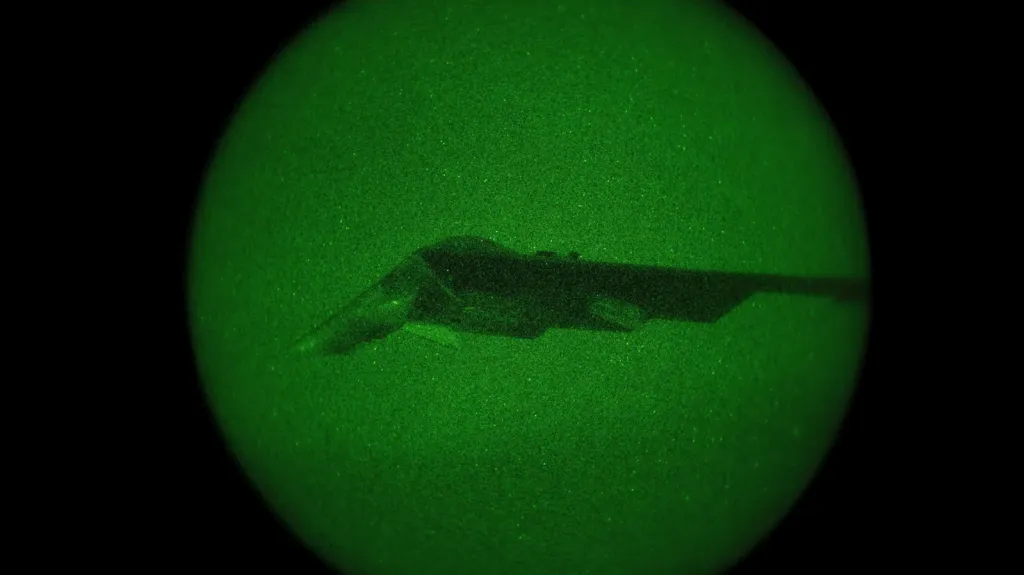
Iran’s ability to launch missiles and drones at U.S., Israeli, and other allied targets in the Middle East has been severely degraded, two top American military leaders said Wednesday morning. Partly as a result, War Secretary Pete Hegseth and Air Force Gen. Dan Caine, Chairman of the Joint Chiefs of Staff, also downplayed concerns about the magazine depth of U.S. offensive and defensive munitions.
You can catch up with our latest coverage of ongoing operations against Iran here. All of the other latest updates can be found lower on the page.
“Iran’s theater ballistic missile shots fired are down 86% from the first day of fighting, with a 23% decrease just in the last 24 hours, and their one-way attack drone shots are down 73% from the opening days,” Caine told reporters, including from The War Zone, at a Wednesday morning press conference. “This progress has allowed CENTCOM to establish localized air superiority across the southern flank of the Iranian coast and penetrate their defenses with overwhelming precision and firepower. We will now begin to expand inland, striking progressively deeper into Iranian territory and creating additional freedom of maneuver for U.S forces.”
Caine did not break down the numbers of Iranian missiles and drones fired. However, on Tuesday, the head of CENTCOM provided some statistics.
“The Iranian regime has launched over 500 ballistic missiles and over 2,000 drones,” Adm. Brad Cooper said in a video message.
As we have previously mentioned, one of the big concerns about Epic Fury is whether Iranian missile and drone barrages would outlast the ability of the U.S. and allies to defend against them. Despite four days of intensive attacks, Tehran still possesses thousands of missiles and drones, though a significant number of these weapons and their launchers — specifically the longer range ballistic missile types —have been destroyed or prevented from being accessed by crews.
In a closed-door Congressional hearing on Tuesday, Hegseth and Caine “told lawmakers…that Iran’s Shahed attack drones represent a major challenge and US air defenses will not be able to intercept them all, according to a source in the briefing,” CNN reported.
However, both military leaders also “made an attempt to downplay concerns about the drones and noted that Gulf state partners had been stockpiling interceptors,” CNN reported.
During Wednesday’s press conference, both Caine and Hegseth stated that the U.S. has the weapons it needs.
“More bombers and more fighters are arriving, just today,” Hegseth said. “And now with complete control of the skies, we will be using 500-pound, 1,000-pound and 2,000-pound GPS and laser-guided precision gravity bombs, of which we have a nearly unlimited stockpile.”

“We used more exquisite standoff munitions at the start, but no longer need to,” the secretary proclaimed. “Our stockpiles of those, as well as Patriots [air defense interceptors], remain extremely strong. The enemy can no longer shoot the volume of missiles they once did. Not even close.”
Another big factor in the reduction in Iranian missile launches could be how CENTCOM has concentrated striking command and control (C2) nodes, degrading Tehran’s ability to communicate and direct fires.
Iranian (C2) “structures in a bad way,” Caine posited. “Admiral Cooper has been continuing to pressure the [Islamic Revolutionary Guard Corps] IRGC C2 and other military elements, and will continue to do so.”

As a result of how the operation has unfolded, “CENTCOM is now shifting in day four already from large deliberate strike packages- using standoff munitions at range outside an enemy’s ability to shoot at us – now into stand-in precision strikes overhead Iran.”
Caine said the U.S. is now using “joint direct attack munitions [JDAMs], which are GPS-aided free-fall weapons and other things like [AGM-114] Hellfires, etc. This will allow the joint force to deliver significantly increased precision effects on the target.”
TWZ has frequently described how important it is for the U.S. to move as quickly as possible from standoff to direct attacks on Iranian targets, which will significantly increase the number of strikes that can occur and widen the range of effects that can be realized via the employment of more varied weaponry. This is especially true for going after fortified targets with bunker buster munitions.
Hegseth further explained that “we moved the vast majority of American troops – over 90% of Americans that were on our bases – off the X out of the range of Iranian fire. Our defensive shield is equally formidable. The most sophisticated air and missile defense network ever fielded. Thousands of Iranian missiles and drones have been intercepted and vaporized, tens of thousands of American allied lives protected. We have pushed every counter-UAS [uncrewed aerial systems] system possible forward, sparing no expense or capability.”
“I know there have been a lot of questions about munitions,” Caine acknowledged. “We have sufficient precision munitions for the task at hand, both on the offense and defense, but I want to tell you teammates, as a matter of practice, I don’t want to be talking about quantities, and I know there’s been a great debate about that, and I appreciate the interest, but just know that we consider that an operational security matter.”
Regardless of the public stance taken by Hegseth and Caine, the Trump administration “plans to meet with executives from the biggest U.S. defense contractors at the White House on Friday to discuss accelerating weapons production, as the Pentagon works to replenish supplies after strikes on Iran and several other recent military efforts,” Reuters reported, citing “five people familiar with the plan.”
As we have noted repeatedly in the past, concerns about America’s stockpile of munitions, especially air defense interceptors, have been exacerbated by U.S. donations to Ukrane as well as massive expenditures during the fight against the Houthis off Yemen, an Iranian proxy.
Still, Trump has gone out of his way to present a problem he has mentioned as being concerning many times before, as a non issue:
“The United States Munitions Stockpiles have, at the medium and upper medium grade, never been higher or better,” Trump said Tuesday on his Truth Social platform. “As was stated to me today, we have a virtually unlimited supply of these weapons. Wars can be fought “forever,” and very successfully, using just these supplies (which are better than other countries finest arms!). At the highest end, we have a good supply, but are not where we want to be. Much additional high grade weaponry is stored for us in outlying countries…”
So, as it sits today, there is still a race against who will run out of munitions first when it comes to Iran’s long-range strike capabilities, but it seems as if the tide is turning in favor of the U.S., Israel, and the Arab Gulf states based on the information we are seeing. With direct attacks now ramping up on Iranian targets deeper and farther east in Iran, the momentum will more likely than not continue in that direction. This does not address the stockpile’s concerning state in regard to a potential conflict with China or even Russia. It is in a far worse state than it was at the start of this war, and these weapons take years and huge sums of money to build.
The two military leaders also discussed several other topics, including:
- “Yesterday, the leader of the unit who attempted to assassinate President Trump has been hunted down and killed,” said Hegseth. “Iran tried to kill President Trump, and President Trump got the last laugh.”
- “Over the next 24 to 48 hours, CENTCOM will continue to strike infrastructure and naval capability and will continue to assess our progress against the military objectives,” said Caine.
- “Our partners are answering the call to defend themselves right alongside us,” Caine noted. “Jordan, Bahrain, Saudi Arabia, the UAE, Qatar and Kuwait, are all defending their people with their own combat capability, with precision and restraint.”
- “We’ve got a lot of autonomous systems, or systems that are that – drones and others incorporated with smart AI aspects to them, but a lot of which I can’t talk about here,” Hegseth stated.
- Hegseth addressed Iranian claims that the U.S. struck a girl’s school in southern Iran, killing more than 175 people. “All I can say is that we’re investigating that,” he avowed. “We. of course, never target civilian targets, but we’re taking a look at investigating.”
- “I am not going to comment on U.S. boots on the ground,” Caine said. “I think that’s a question for policymakers, and I don’t make policy. I execute policy.”
The rest of our ongoing coverage of the conflict continues below, with the latest updates at the top.
UPDATE: 4:12 PM EST –
U.S. Central Command has issued another set of denials regarding claimed U.S. losses in the ongoing conflict, including that U.S. naval vessels and aircraft have been destroyed by enemy fire.
In another new data point about the apparent slowing pace of Iranian missile launches, the IDF’s Home Front Command says it is easing restrictions on public gatherings and movements imposed at the start of the conflict. Another reassessment is now set to occur on Saturday, which could lead to further easements.
Iranian-backed militants in Iraq have threatened to attack the interests of France, Germany, the United Kingdom, and other NATO nations if they “interfere in Iraq or the region,” according to Reuters. Pro-Iranian militants also reportedly carried out a drone attack on a majority Christian neighborhood in Erbil, the capital of Iraq’s northern Kurdish autonomous region.
UPDATE: 3:20 PM EST –
White House press secretary Karoline Leavitt addressed Operation Epic Fury on Tuesday.
“Well, they’re not part of the plan for this operation at this time, but I certainly will never take away military options on behalf of the president of the United States or the commander in chief, and he wisely does not do the same for himself,” she said in response to a question about whether the U.S. military could commit ground troops to the operation. “I know there’s many leaders in the past who liked to take options off of the table without having a full understanding of how things could develop. So again, it’s not part of the current plan, but I’m not going to remove an option for the president to act that is on the table.”
“I don’t want to commit to a timeline, but certainly it’s something that is being calculated actively by both the Department of War and the Department of Energy. They’re working very closely. Both secretaries are in all of the briefings on this subject with the president, and this is again something they’re monitoring,” she also said when asked when U.S. Navy ships might begin escorting commercial vessels through the Strait of Hormuz. “And if and when necessary, the United States Navy will provide assistance to escort oil tankers through the Strait.”
“Obviously, as the president has said numerous times, do we want to see Iran being led by a rogue terrorist regime? No, of course, not,” she said on the topic of regime change. “So any day the United States of America is taking out a terrorist is a good day for our country and a good day for our people.”
When it comes to what role the United States could have after the conflict ends, “I think it’s something the president is actively considering and discussing with his advisors and his national security team,” she added. “But again, right now, the focus minute-by-minute, hour-by-hour, day-by-day, is on ensuring the quick and effective success of Operation Epic Fury.”
“I don’t have any updates for you on congressional asks from the president. As you know, under this president, we have significantly increased our defense budget, which is a good thing for the United States, for our national security and for protecting our homeland,” when asked about concerns about stocks of anti-air interceptors. “With respect to munitions, ammunition, weapons stockpiles, the United States of America has more than enough capability to not only successfully execute operation Epic Fury, but to go much further. And we have weapons stockpiles in places that many people in this world don’t even know about.”
“I will also add, President Trump has rightfully been calling on defense contractors in this country to rapidly and aggressively produce American-made weapons because they are the best in the world,” she added.
The Israeli Air Force has released pictures showing F-16I jets heading out for strikes on Iran carrying stand-in munitions.
The IDF continues to target Iranian ballistic missile capabilities in the central and western parts of the country.
The IDF has pushed back on the suggestion that attacks from Iran and Iranian-backed Hezbollah militants in Lebanon today were directly coordinated.
“It is true, there was fire at the same time, more or less, you can say simultaneously, from Iran and Lebanon,” IDF Spokesman Brig. Gen. Effie Defrin said at a press conference, according to The Times of Israel. “I don’t possess any intelligence information that says this was coordinated.”
New satellite imagery from Planet Labs shows damage resulting from strikes on an Iranian missile base in Kermanshah.
Axios has reported that the White House denied reports of back-channel communications with the regime in Iran in response to queries from Israeli authorities.
“We need to act with clarity, with purpose, and with a cool head. The protection of U.K. nationals is our number one priority,” U.K. Prime Minister Keir Starmer said today. “American planes operating out of British bases, that is the special relationship in action… hanging on to President Trump’s latest words is not.”
Spanish authorities have denied White House claims that they agreed to support current U.S. operations in the Middle East following economic threats from President Donald Trump. Yesterday, Trump had threatened to cut off all trade with Spain after authorities in Madrid blocked the use of bases in the country to support strikes on Iran.
French President Emmanuel Macron has issued a statement after speaking with the leaders of Israel and Lebanon. Macron called on Hezbollah to cease attacks on Israel and for Israel to preserve Lebanon’s territorial integrity.
Israeli Air Force Commander Maj. Gen. Tomer Bar has written that his service’s “special units are currently carrying out extraordinary missions that could ignite the imagination” in a letter, according to Ynet News. No further details about the letter’s origins or how it was obtained are provided. This comes amid other unconfirmed reports of unusual military activity in the Najaf Desert in Iraq. Israeli special operations forces have conducted spectacular raids in the past, including one targeting an Iranian-linked underground missile production facility in Syria in 2024. TWZ noted at the time that this sent a signal to Iran that its critical underground facilities were not untouchable.
UPDATE: 2:18 PM EST –
The Israel Defense Forces (IDF) say they have now dropped 5,000 munitions on targets in Iran since the start of the current conflict, and that operations “continue to deepen air superiority throughout Iran, with an emphasis on the Tehran area.” The IDF also continues to release footage from those strikes.
The IDF has also released the video clip below showing a strike on what looks to be one of Iran’s Russian-made Mi-17 Hip helicopters. However, there are questions about whether it may have been a decoy.
The IDF has also provided details about targets struck during another round of strikes on Iran’s capital, Tehran.
Israeli forces are also continuing to conduct ground operations in southern Lebanon, ostensibly targeting Iranian-backed Hezbollah militants.
U.S. Central Command also continues to release footage from strikes on targets in Iran.
CENTCOM has also now explicitly confirmed the use of Precision Strike Missile (PrSM) short-range ballistic missiles in strikes on Iran. This detail had already emerged, as TWZ previously reported.
Israeli authorities are still planning around one to two more weeks of operations against Iran, at least, according to the Times of Israel.
Imagery continues to emerge, said to show strikes on targets in Iran’s capital, Tehran.
The satellite images below show the aftermath of strikes on an Iranian missile base in Tabriz.
The video below is said to show the crew of a commercial vessel somewhere in the Middle East watching as U.S. Tomahawk land attack cruise missiles pass overhead toward targets in Iran.
The Telegraph newspaper in the United Kingdom has reported that U.S. Air Force B-2 bombers could soon be flying strikes on Iran from RAF Fairford in that country, as well as Diego Garcia in the Indian Ocean. There were reports in the lead-up to the current conflict, that British authorities had denied use of those same bases to support any future operations against Iran.
“Based on analysis of [the] latest available satellite imagery, IAEA [International Atomic Energy Agency] sees no damage to facilities containing nuclear material in Iran and therefore no radiological release risk at this time,” according to a new statement from the Agency today. “Near [the] Isfahan nuclear site, damage is visible at two buildings. No additional impact detected at Natanz after previously reported damage at entrances, and no impact at other nuclear sites, including [the] Bushehr NPP [nuclear power plant].”
CNN has reported again on the possibility of armed Iranian Kurdish groups launching a ground incursion in support of the current U.S.-Israeli operation, citing an unnamed source. That outlet has also reported that the U.S. Central Intelligence Agency has been working to arm those groups.
Saudi Arabian authorities say they intercepted two Iranian cruise missiles in the vicinity of Al Kharj, a city situated near Prince Sultan Air Base. That base has been a major hub for U.S. air operations in the current conflict.
The New York Times says satellite imagery that it has reviewed shows damage to several radars, as well as communications systems and other facilities, at multiple military bases in the region as a result of Iranian retaliatory attacks.
Qatar has reportedly fully halted gas liquefaction in the country, according to Reuters. It could take up to a month for production to return to normal levels once the decision is made to do so, as well.
The United Kingdom Marine Trade Operations (UKMTO) organization, which is managed by the Royal Navy, says it has received reports of another ship coming under attack in the Strait of Hormuz.
Dutch authorities are reportedly considering a request from France to deploy military assets to help safeguard commercial shipping, according to The New York Times. There are also reports that a Dutch warship could take up station in the Eastern Mediterranean to bolster defenses against Iranian threats.
“EUNAFOR [European Naval Forces] ASPIDES assets in the area of operation monitors the situation, remain on high alert and stand ready to contribute within means and capabilities to protect lives at sea, contributing to freedom of navigation and enhancing Maritime Security through one of the most vital and vulnerable sea trade corridors,” a spokesperson for the European Union-led Operation Aspides has told TWZ. “ASPIDES conducts daily assessments of potential risks, making necessary operational adjustments where required.”
In the event of a resumption of Houthi attacks – which remains a possibility – we are present and ready to implement our mandate,” they added, referring to Iranian-backed militants in Yemen. “There [is] no such tasking (escort ships through or near the Strait of Hormuz) for ASPIDES.”
“We expect significantly higher costs i.e. for bunker, insurance, container storage at different ports due to closed or unreachable ports” and “delays have to be expected especially in the Middle East, but also in other trades,” German shipping company Hapag-Lloyd has also told TWZ. “All ports within [the] Persian Gulf can not be served. This is why we need to find alternates [sic] in the region. Many other ports [are] not being served as well. We have a booking stop for all import/export cargo in the region.”
Danish shipping company Maersk is also “suspending most cargo bookings in and out of the United Arab Emirates, Oman, Iraq, Kuwait, Qatar, Bahrain and Saudi Arabia until further notice,” according to Reuters.
All of this follows comments yesterday from U.S. President Donald Trump about the possibility of U.S. Navy ships escorting commercial vessels through the Strait of Hormuz, which you can read more about here.
The American Jewish Committee has compiled data from open sources regarding total Iranian ballistic missile launches at countries in the region. Though the full tallies may be incomplete, the indication is that the United Arab Emirates has been most heavily targeted so far.
Turkish Authorities say that “NATO air and missile defense elements” intercepted a “ballistic munition” that had been tracked passing over Iraq and Syria in the direction of the Eastern Mediterranean. Debris subsequently fell inside Turkish territory.
There are reports that the weapon was aimed at Cyprus, but went off course. Turkish Foreign Minister Hakan Fidan subsequently spoke by phone with his Iranian counterpart, Foreign Minister Abbas Araghchi, and warned against “any steps that could lead to the spread of the conflict.”
Local media in Cyprus has reported that Greek F-16 fighters now operating in the country intercepted two incoming drones earlier today.
The New York Times has reported that there have been back-channel, indirect talks between U.S. and Iranian officials, including members of the respective intelligence services, about possible off-ramps to the current conflict. That report also says that American authorities are so far skeptical. Iran’s quasi-official Tasnim News Agency says the country’s Intelligence Ministry has denied that any such talks are taking place.
“Iran’s future must not be decided outside its borders” and the international community’s support should “go to the people, not to geopolitical calculations,” Farah Pahlavi, widow of Mohammad Reza Pahlavi, the last Shah of Iran, has said in an interview with AFP in France.
She has also said that the death of Iranian Supreme Leader Ayatollah Ali Khamenei is “a moment of historic significance,” but “does not automatically mean the end of a system.”
“The government of the Republic of Korea, with grave concern, is closely monitoring the developments in the Middle East involving the United States, Israel, and Iran, and is actively undertaking multifaceted efforts to ensure the safety and protection of Korean nationals currently in the region, as well as to safeguard our economic security, including the stable supply of energy resources,” that country’s Ministry of Foreign Affairs has said in a statement.
Contact the author: howard@thewarzone.com