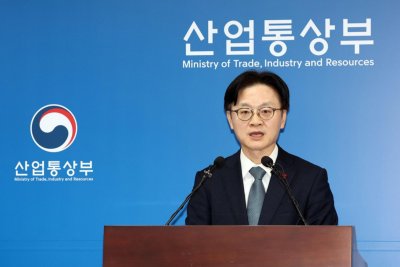

Trade, Industry and Resources Minister Kim Jung-kwan attends a press conference at the government complex in Sejong, central South Korea. Photo by YONHAP / EPA
April 16 (Asia Today) — South Korea will begin receiving 27 million barrels of alternative crude oil in June, part of a broader effort to stabilize energy supplies and diversify import sources amid disruptions linked to conflict in the Middle East.
The Ministry of Trade, Industry and Energy said the shipments are part of crude secured by a presidential envoy team, with additional policy measures being introduced to support refiners facing supply uncertainty.
A senior ministry official said the envoy team secured about 223 million barrels of alternative crude, excluding 50 million barrels previously allocated from Saudi Arabia. Of that, 27 million barrels are scheduled for shipment beginning in June.
The earlier 50 million barrels are expected to be shipped in April and May through the Red Sea port of Yanbu, with confirmation from Saudi Aramco that deliveries will proceed as planned, the ministry said.
South Korean refiners had faced disruptions despite existing contracts, as shipments were affected by instability and constraints linked to the Strait of Hormuz, a key global oil transit route.
The envoy delegation has secured a total of about 273 million barrels of crude from countries including Kazakhstan and Saudi Arabia. Of that, roughly 250 million barrels from Saudi Arabia – which accounts for about one-third of South Korea’s crude imports – are expected to be delivered by the end of the year.
Officials said the government has already secured about 118 million barrels for April and May combined, indicating no immediate risk to domestic supply. Remaining volumes are expected to be shipped sequentially through the end of the year.
In parallel, the government is introducing measures to help refiners diversify import sources. For crude imported between April and June, authorities will ease requirements for refunds of the petroleum import levy and temporarily expand refund limits.
The ministry said it simplified freight cost calculations using an international benchmark index and removed restrictions on shipment volume, duration and frequency. It also temporarily lifted caps on freight cost compensation for diversified imports to expand financial support.
The program is backed by about 127.5 billion won (approximately $95 million) in funding, based on estimated demand from domestic refiners.
Officials said broader reforms may be considered if the situation persists.
The ministry also pushed back against claims that fuel consumption has increased following the introduction of a price cap. Data showed that weekly gasoline and diesel sales fell in five of seven weeks from late February to mid-April compared to the same period last year.
From mid-March to mid-April, after the price cap took effect, total fuel sales declined 12.4% year-over-year, the ministry said, urging observers to focus on overall trends rather than short-term fluctuations.
— Reported by Asia Today; translated by UPI
© Asia Today. Unauthorized reproduction or redistribution prohibited.
Original Korean report: https://www.asiatoday.co.kr/kn/view.php?key=20260416010005112