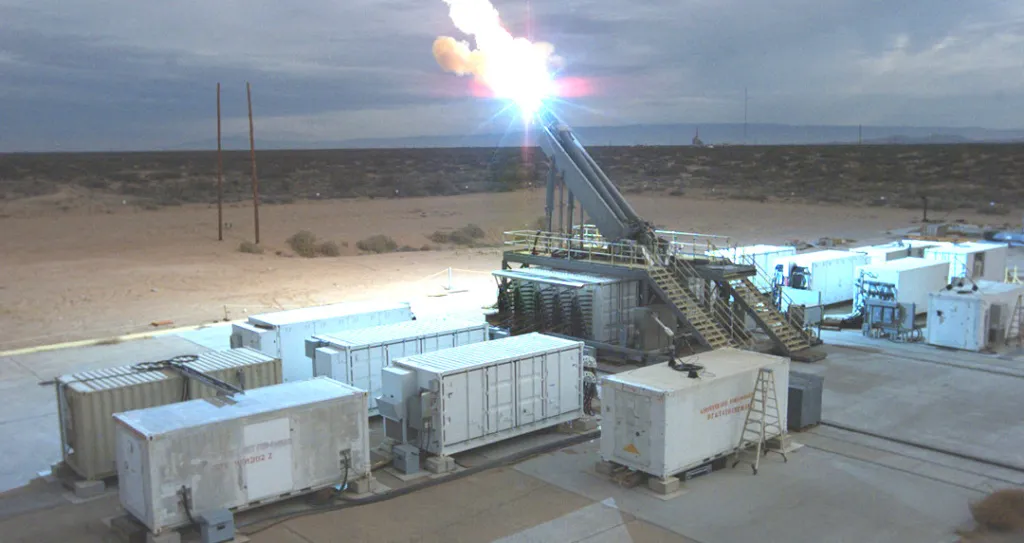
The U.S. Navy has conducted at least one new round of live-fire tests of its prototype electromagnetic railgun at the White Sands Missile Range (WSMR) in New Mexico. The service had shelved its railgun effort in the early 2020s, at least publicly, after work that had shown promise ran into technical hurdles. A railgun is now set to be a key feature on the future Trump class “battleships.”
A brief mention of the new railgun testing is included in a document highlighting achievements by the Naval Surface Warfare Center, Port Hueneme Division (NSWC PHD) in 2025. NSWC PHD, which is part of Naval Sea Systems Command (NAVSEA), primarily operates from Port Hueneme in California, but it also maintains a detachment at White Sands. The U.S. Army manages the WSMR, which other branches of the U.S. military also use for a wide variety of research and development and test and evaluation activities.
The “WSD [White Sands Detachment] tested a railgun to collect critical information about high-velocity firing during a three-day campaign at White Sands Missile Range (WSMR) in New Mexico,” the year-in-review document says. “The testing in February [2025] was a joint effort between WSD and NSWC Dahlgren Division in Virginia and conducted for Naval Sea Systems Command (NAVSEA)’s Joint Hypersonics Transition Office.”

The railgun had originally been installed at a land-based test site belonging to NSWC Dahlgren in Virginia. The Navy announced in 2019 that it had moved the weapon to the WSMR. Plans to conduct at-sea testing of the weapon were repeatedly delayed and never materialized.
TWZ has reached out to NAVSEA for more information about the three-day test campaign last year and its objectives, and to ask whether any other live-fire testing of the prototype railgun at WSMR has occurred since 2021. That year, the Navy had announced its intention to close out work on the railgun and effectively put what was left of the program into storage.
“Railgun hardware will be realigned to maximize its sustainability to facilitate potential future use,” the Navy had said at the time. However, there do not appear to have been any disclosures of further testing of the weapon before now.
The video below shows the prototype railgun being fired at the test site in Virginia in 2016.

Electromagnetic Railgun – First shot at Dahlgren’s new Terminal Range
Without more information, it is hard to say what the purpose of the February 2025 tests may have been. That the testing was done in support of the Joint Hypersonics Transition Office (JHTO) could point to the railgun having been used for work unrelated to the weapon itself. Established in 2020, the JHTO is broadly tasked to facilitate the development of new hypersonic technologies and help transition that work into formats that could lead to operational capabilities. As a pure test asset, the railgun might offer an additional way to launch suitably sized payloads at extremely high speeds, but there are other ways available to do that kind of work, and it is not clear that using the weapon in this way makes sense. The U.S. military has been working to expand various aspects of its hypersonic test infrastructure, in general, in recent years amid a surge in new development efforts in that space.
At the same time, as noted, the Trump class “battleship” effort, also known as BBG(X), has also now breathed new life into the prospect of an operational U.S. naval railgun. President Donald Trump rolled out plans for new large surface combatants, which are expected to displace around 35,000 tons and also be armed with a mix of missiles (including hypersonic types), traditional 5-inch guns, and laser directed energy weapons, as you can read more about here.

Whether the Navy has any plans to pick up where it left off with the railgun prototype currently at WSMR, which was developed by BAE Systems, or pursue a new design, is unclear. General Atomics, which has done railgun development work for the U.S. Army in the past, has expressed interest in being involved in helping arm the Trump class warships. Construction of the lead ship in the Trump class, to be named USS Defiant, is not expected to begin until the early 2030s.

General Atomics – Multi-Mission Medium Range Railgun Weapon System [1080p]
Railguns, which use electromagnets rather than chemical propellants to fire their projectiles at very high velocities, have historically presented significant technological challenges. They have significant power and cooling requirements, especially if the intent is to be able to fire multiple shots in relatively rapid succession. This, in turn, has generally meant that railgun installations are physically bulky due to the need for large energy storage batteries and cooling systems. Firing projectiles at very high speeds at any kind of sustained rate also imparts significant wear on the barrel. A worn-out barrel reduces range and accuracy, and creates potential safety hazards.

Electromagnetic Railgun Firing Hypervelocity Projectile @ Mach 7
At the same time, a practical operational electromagnetic railgun offers the promise of a very capable and flexible weapon that can be employed against a wide variety of targets at sea, on land, and even in the air, and do so at considerable range. This includes being able to intercept incoming threats, including ones that may themselves be moving at hypersonic speeds. A railgun also offers magazine depth and cost benefits compared to traditional surface-to-air and surface-to-surface missiles, given the smaller size and unit price of its rounds.

As an aside, just in the past year, Japan has announced significant progress with its naval railgun program, including the first known instance of a railgun mounted on a ship being fired at sea at a real target vessel. In 2024, it was reported that Japanese authorities had met with U.S. Navy representatives to discuss leveraging the latter’s previous railgun work, which raised the possibility of further collaboration in the future. Japan’s Acquisition Technology & Logistics Agency (ALTA) also has a formal agreement with the Franco-German Research Institute of Saint-Louis (ISL) to cooperate on the development of railgun-related technologies.

The ATLA video below shows previous live-fire testing of a prototype railgun at a facility on land.

試作レールガンの射撃
Other countries have also been pursuing railguns, particularly for naval use. A prototype railgun mounted in a large turret notably appeared on a People’s Liberation Army Navy (PLAN) ship in 2018, though the exact status of that program is now unclear. There has also been a very public naval railgun development program underway in Turkey in recent years.


Turkish electromagnetic railgun unveiled to experts – Anadolu Agency
If nothing else, the test firing of the Navy’s prototype railgun at the WSMR last year shows that it remains functional, at least to a degree, as the service now looks ahead to fielding an operational weapon of this type on the Trump class.
Special thanks to user @lfx160219 on X for bringing the railgun entry in the NSWC PHD 2025-year-in-review document to our attention.
Contact the author: joe@twz.com