Navy

Leonardo DRS’s Plan To Counter Drones For The U.S. Navy

Leonardo DRS has for the first time shown its Maritime-Mission Equipment Package (M-MEP) integrated on an autonomous unmanned surface vessel (AUSV). The M-MEP is a platform-agnostic suite of systems that are collectively designed to protect vessels from attacks involving single or multiple small to medium-sized unmanned aerial systems (UAS). M-MEP was demonstrated on a Sea Machines Stormrunner USV at the Navy League’s Sea Air Space 2026 trade event just outside Washington D.C.

Leonardo DRS has adapted its range of ground-based Counter-UAS (C-UAS) systems for sea-based operations under the M-MEP project. The modular design, coupled with an open system architecture, allows for the integration of multiple kinetic and non-kinetic effectors, software-definable sensors, and communication packages. Leonardo DRS says this flexibility ensures that the M-MEPs remain platform-agnostic, capable of being configured across a range of small-to-large USVs of varying sizes from 14 feet in length. The C-UAS sensors and effectors are designed to complement existing naval capabilities.

The M-MEP system utilizes active and passive radars and electro-optical/infrared (EO/IR) systems, with situational awareness facilitated through real-time data processing and threat assessment, enabling faster decision-making and response. Leonardo DRS says that M-MEP employs a range of non-kinetic electronic warfare systems for the active disruption and neutralization of UAS guidance systems, while integration of machine learning and artificial intelligence (AI) is intended to help predict and mitigate emerging threats.

TWZs Jamie Hunter spoke with Bo Mancuso from Leonardo DRS about the M-MEP program.

SAS Leonardo DRS v1 for review thumbnail

SAS Leonardo DRS v1 for review


Source link

U.S. Navy MH-60S Pilot Talks Multi-Mission Roles During Tour Of The Seahawk

U.S. Navy Helicopter Sea Combat Squadron (HSC-21) “Blackjacks” gave TWZ a personal tour of one of its MH‑60S Seahawk helicopters and filled us in on some of key capabilities during the Dubai Air Show in November 2025. 

The MH-60S is a versatile multi-mission, medium‑lift maritime helicopter that is designed for a broad range of missions, such as vertical replenishment (VERTREP) at sea, search‑and‑rescue, airborne mine countermeasures, anti‑surface warfare, and electronic warfare.

The U.S. Navy operates both the MH-60S and the MH-60R variants of the H-60 and the two share a common airframe, General Electric T700 powerplants and many avionics, enabling streamlined logistics, maintenance and training across the fleet while allowing each variant to be customized for distinct operational roles. The MH-60R is primarily configured for anti-submarine warfare (ASW) but it too has anti-surface warfare (ASuW) capabilities and has been used to shoot down drones.

The MH-60S features a modern glass cockpit, twin General Electric T700‑GE‑401C engines and a flexible, modular, mission‑systems suite that supports interchangeable payloads, internal fuel tanks, and advanced mission packages.

“Sikorsky is leveraging its global MH-60R and MH-60S Seahawk users to constantly iterate while we operate, ensuring the aircraft is mission ready and evolves. This commitment to production, sustainment and modernization enables the MH-60R to stay ahead of emerging threats and maintain its position as the premier global ASW platform,” the company commented to TWZ.

Check out the full MH-60S walk-around video below:

U.S. Navy MH-60S Pilot Talks Multi-Mission Roles Of The Seahawk thumbnail

U.S. Navy MH-60S Pilot Talks Multi-Mission Roles Of The Seahawk


Contact the editor: Tyler@twz.com

Source link

Iranian Attacks Change Way Navy Refuels Its Ships In Middle East

After Iranian missile and drone barrages disrupted U.S. Navy’s logistics by destroying port infrastructure and putting ships at risk, the service turned to a fleet of specially equipped commercial vessels to deliver fuel to warships away from the danger zone. These vessels proved so effective that one top Navy official said this week that he wants to see more of them pressed into service.

“Epic Fury has been a PhD course in logistics,” said Robert Hein, Director of Maritime Operations for the Navy’s Military Sealift Command (MSC), said during the Sea-Air-Space 2026 (SAS) exposition near Washington, D.C.  

“So traditionally, for 25 years, we’ve been at war in the Middle East and that war was effectively fought in the parking lot of a giant gas station,” Hein explained. “Iran has effectively shut down that gas station. So we’ve had to come up with really creative ways of, ‘how do we replenish the fleet?’”

MANAMA, BAHRAIN - FEBRUARY 28: Smoke rises after Iran carried out a missile strike on the main headquarters of the U.S. Navyâs 5th Fleet in Manama in retaliation against US-Israeli attacks, in Bahrain February 28, 2026. (Photo by Stringer/Anadolu via Getty Images)
Smoke rises after Iran carried out a missile strike on the main headquarters of the U.S. Navy’s 5th Fleet in Manama in retaliation against US-Israeli attacks, in Bahrain February 28, 2026. (Photo by Stringer/Anadolu via Getty Images) Anadolu

The answer was shifting from having fleet oilers call on ports to executing at-sea replenishment of those oilers by using consolidated cargo operations (CONSOL) tankers – vessels leased by MSC that are specially equipped to offload fuel at sea. The concept isn’t new. After shifting away from using chartered ships to refuel oilers at sea in favor of conducting the transfers at port facilities, MSC reintroduced the CONSOL process in 2015, “as a way to utilize a flexible platform that allows MSC to operate worldwide in a variety of missions,” according to the Navy. Having a CONSOL tanker provide fuel to oilers means they don’t have to return to a port, reducing costs and increasing time on station to support the fleet. During a time of conflict, that can also mean less risk to the oiler, which is a critical asset that would be in very high demand.

The way the chartered tankers have been used in the Middle East during Epic Fury has taken this process to a new level.

The Navy created what Hein called a system of “tanker treadmills” at sea with “tankers cycling in and out” to replace the fixed infrastructure no longer available due to Iranian attacks.

“There are no more logistics hubs they’re going to,” Hein proffered. “All those nodes are now remaining at sea.”

In addition to the CONSOL tankers’ ability to refuel oilers at sea, “we’re putting an additional fuel delivery system on those tankers so they’ll be able to replenish destroyers and ships other than oilers,” Hein added. He did not provide details about what kind of system, however, the Navy has previously discussed developing what is called a Modular CONSOL Adapter Kit (MCAK).

“By installing it on the deck of a tanker, it can refuel other ships through the receiving ship’s fuel delivery hoses,” the Navy explained.

PHILIPPINE SEA—Military Sealift Command (MSC) dry cargo ship USNS Matthew Perry (T-AKE 9) connects fuel lines with MSC chartered ship motor tanker Badlands Trader during a consolidated cargo replenishment operation in the vicinity of Okinawa, Japan, Dec. 15. (Courtesy photo)
Military Sealift Command (MSC) dry cargo ship USNS Matthew Perry (T-AKE 9) connects fuel lines with MSC chartered ship motor tanker Badlands Trader during a consolidated cargo (CONSOL) replenishment operation in the vicinity of Okinawa, Japan, Dec. 15. (Courtesy photo) Grady Fontana

There are currently 15 CONSOL tankers available to the Navy worldwide. Rear Adm. Chris Stone, Director of Strategic Plans, Policy, Logistics and Warfighting Development for U.S. Transportation Command, said that’s not enough.

“If there’s one thing that I had the power to stroke a check on today, it would be to create more CONSOL tankers – those consolidated cargo replenishment at sea vessels,” he said at the same SAS panel. 

“We probably need something more than 15, because when there’s a crisis or a conflict around the world, the first thing that a geographic combatant commander asks TRANSCOM for is a CONSOL vessel, and we don’t have enough of them today without trade offs that create risk in other areas.”

Off the coast of Southern California Military Sealift Command’s long-term chartered motor tanker ship Empire State (T-AOT 5193) conducted connected at-sea refueling operations (CONSOL) with three MSC Combat Logistics Fleet ships July 11-14. Empire conducted five CONSOL events with MSC dry cargo ammunition ships USNS Matthew Perry (T-AKE 9) and USNS Washington Chambers (T-AKE 11) and the MSC fleet replenishment oiler USNS Henry J. Kaiser (T-AO 187), delivering nearly 4 million gallons of diesel ship fuel.
Off the coast of Southern California Military Sealift Command’s long-term chartered motor tanker ship Empire State (T-AOT 5193) conducted connected at-sea refueling operations (CONSOL) with three MSC Combat Logistics Fleet ships July 11-14. (USN). Sarah Cannon

“We’ve proven CONSOL capability during Operation Epic Fury,” Stone added. “We have a treadmill of vessels where one is on the front line, one is topping off, and they’re continually rotating to ensure that we’ve got support for the warfighter.”

CONSOL tankers, Stone posited, “are no longer supply ships. They’re not logistics ships. They’re force projection platforms that support our warfighters. They allow us to support the joint force and refuel them underway. It extends our operational reach and endurance, while reducing the reliance on predictable, vulnerable port visits. In less than two years, we’ve increased the capacity dramatically, and we’ll continue to do so.”

191028-N-LQ653-1474 PACIFIC OCEAN (Oct. 28, 2019) Henry J. Kaiser-class underway replenishment oiler USNS Yukon (T-AO-202, right, prepares to conduct a consolidated loading with commercial tanker MT Empire State. The evolution provided the Military Sealift Command (MSC) Pacific Commander the opportunity to exercise a training opportunity at sea with the two ships. (U.S. Navy photo by Mass Communication Specialist 1st Class Patrick W. Menah Jr./Released)
Henry J. Kaiser class underway replenishment oiler USNS Yukon, right, prepares to conduct a consolidated loading (CONSOL) with commercial tanker MT Empire State. (U.S. Navy photo by Mass Communication Specialist 1st Class Patrick W. Menah Jr./Released) Petty Officer 2nd Class Patrick Menah

While a boon to the system, the CONSOL tankers are not without their issues. The main one being time. It takes about two hours for an oiler to refuel a destroyer, said Hein, while it takes about six hours for a tanker to get the job done.

“Unlike a quick trip to the gas pumps for a car, CONSOLing can take hours to complete,” the Navy noted in a story about the tankers. “This creates a unique set of challenges for the ships conducting the operations. CONSOLing is a dance between two ships. Each must maneuver alongside the other, and maintain a consistent speed and course. Because of their size, tanker maneuverability becomes a challenge.”

“We simply do not maneuver like the [oilers] do. They are graceful, gliding through the water,” said Capt. Michelle Laycock, Maersk Peary’s master. “There’s not a lot of ‘grace’ to a fully loaded tanker. We don’t glide, we plow through the water.”

Military Sealift Command (MSC) dry cargo ship USNS Matthew Perry (T-AKE 9) connects fuel lines with MSC chartered ship motor tanker Badlands Trader during a consolidated cargo replenishment operation in the vicinity of Okinawa, Japan, Dec. 15. (Courtesy photo) 

The increased time and effort is worth it, Hein said.

“This is a capability that is needed that will help mitigate the lack of oilers right now,” Hein suggested. 

He wants to take the concept a step further.

“So while we can CONSOL for fuel, I’d like to get to a point where you CONSOL for food as well,” he stated. 

While CONSOL has provided a lifeline for vessels during Operation Epic Fury, its utility would be dramatically magnified during a war in the vast Pacific, one where ports at much farther distances would be under threat as would ships of all kinds over huge swathes of that theater. There have been consistent concerns about the size of the oiler fleet being a point of weakness for the Navy’s ability to project power in a near-peer conflict. Doubling-down on CONSOL and giving those vessels the ability to directly refuel surface combatants, carriers and amphibious warships could go a long way to buying down risk and fortifying operational planning.

Contact the author: howard@thewarzone.com

Howard is a Senior Staff Writer for The War Zone, and a former Senior Managing Editor for Military Times. Prior to this, he covered military affairs for the Tampa Bay Times as a Senior Writer. Howard’s work has appeared in various publications including Yahoo News, RealClearDefense, and Air Force Times.


Joseph has been a member of The War Zone team since early 2017. Prior to that, he was an Associate Editor at War Is Boring, and his byline has appeared in other publications, including Small Arms Review, Small Arms Defense Journal, Reuters, We Are the Mighty, and Task & Purpose.


Source link

Navy Rushing To Arm Carrier Strike Groups With Hellfire Missiles

The U.S. Navy has shared details about what looks to be a previously undisclosed effort to rapidly arm ships in two carrier strike groups with radar-guided Longbow Hellfire missiles to protect against drones. This reflects a larger push to expand shipboard defenses against uncrewed aerial threats, which now includes four Arleigh Burke class destroyers sailing with new launchers to fire Coyote interceptors. TWZ was first to report on the appearance of one of these launchers on the USS Carl M. Levin, with Naval News subsequently sharing more information.

The dangers drones pose, including to Navy warships, are not new. Still, the service’s experiences in recent years during operations in and around the Red Sea, as well as against Iran, have firmly driven home the critical need for more shipboard defenses against uncrewed aerial threats.

“Supplemental funding was provided to rapidly field CUAS [Counter-Unmanned Aerial Systems] solutions for the Gerald R Ford Carrier Strike Group (CSG) which included the procurement of Longbow Hellfire launchers, Coyote launchers, and the installation/integration work,” according to a line item in the Navy’s 2027 Fiscal Year budget request, which the service rolled out in full earlier this week. “Funding was also provided to rapidly field CUAS solutions on the Theodore Roosevelt CSG to include Longbow Hellfire Launchers, Coyote launchers, and the installation/integration work.”

A stock picture of the Navy’s supercarrier USS Gerald R. Ford. USN

“FY2024 and FY2025 [Fiscal Years 2024 and 2025] funding utilized to rapidly field CUAS solutions for the Gerald R Ford Carrier Strike Group (CSG) and the Theodore Roosevelt CSG, which included the procurements of Longbow Hellfire launchers, procurements of Coyote launchers, installations, and integration work,” the newly released budget documents also note.

The same line item is present in the Navy’s proposed budget for the 2026 Fiscal Year, but makes no mention of the Hellfire or Coyote integration efforts. An early type of naval launcher for Coyote was first seen on Arleigh Burke class destroyers assigned to the Gerald R. Ford Carrier Strike Group last year, and we will come back to developments on that front later on.

The Navy’s latest budget documents do not say which ships in the Gerald R. Ford and Theodore Roosevelt CSGs may have received the Longbow Hellfire launchers, or whether they are currently installed. TWZ has reached out to Naval Sea Systems Command (NAVSEA), as well as the Long Hellfire’s prime contractor, Lockheed Martin, for more information about this integration work and what it has entailed to date.

The millimeter-wave radar-guided Longbow Hellfire, which also carries the designation AGM-114L, has a demonstrated counter-drone capability, as well as the ability to strike targets on land or at sea. The Navy previously announced modifications to its Freedom class Littoral Combat Ships (LCS) to allow them to engage uncrewed aerial threats with AGM-114Ls fired from launchers specifically designed for those vessels. However, LCSs are not a component of a typical carrier strike group. On the surface, Navy carriers are usually escorted by a mix of Ticonderoga class cruisers and Arleigh Burke class destroyers.

The Freedom class Littoral Combat Ship (LCS) USS Milwaukee fires an AGM-114L Longbow Hellfire. USN

In June 2025, Naval News did report that two Arleigh Burke class destroyers – the USS Jason Dunham and USS The Sullivans – had previously been involved in testing of various new capabilities, including Longbow Hellfire in the counter-drone role. Neither of those ships were assigned to the Gerald R. Ford or Theodore Roosevelt CSGs at that time. No specific details were available then about what the integration of AGM-114L had consisted of, either.

In March, Lockheed Martin did unveil a containerized Hellfire launcher called Grizzly, development of which started last year. At the time, the company said Grizzly could be adapted for shipboard use.

A picture showing a test of Lockheed Martin’s Grizzly containerized Hellfire launcher. Lockheed Martin

As an aside, the Navy has talked about a containerized counter-drone launcher able to hold up to 48 Hellfires as being a future armament option for its forthcoming FF(X) frigates. There has been no indication, though, that this is an operational capability now.

Lockheed Martin has also been developing a ship-based launch capability for its AGM-179 Joint Air-to-Ground Missile (JAGM), which is derived from the laser-guided AGM-114R variant of the Hellfire. For more than a year now, the company has been publicly displaying a model of an Arleigh Burke class destroyer fitted with six four-cell JAGM Quad Launchers (JQL; pronounced jackal). At the same time, there have been no signs so far that the Navy is actively moving to field those launchers on ships of this class.

A close-up look at the JQLs on Lockheed Martin’s Arleigh Burke class destroyer model, as seen at the Navy League’s Sea Air Space 2026 exposition. Jamie Hunter

Hellfire, in general, does have a long history at this point of being integrated onto a wide variety of platforms, including helicopters and ground vehicles. A tripod launcher even exists for laser-guided variants of the missile.

With all this in mind, it is not surprising that Longbow Hellfire in some configuration would be an attractive immediate option for the Navy to help bolster shipboard defenses against ever-growing drone threats.

As the Navy’s latest budget documents note, the service has also been working to add other counter-drone interceptors to its ships, such as the combat-proven Coyote. The USS Carl M. Levin, as well as the USS John Paul Jones, the USS Paul Hamilton, and the USS Decatur, have all now received new eight-cell Coyote launchers. All of those warships are currently assigned to the Harry S. Truman Carrier Strike Group. This builds on the integration of the earlier four-cell launchers on at least two other ships in the class, the USS Bainbridge and the USS Winston S. Churchill.

An annotated image highlighting the new eight-cell Coyote anti-drone interceptor launcher as seen on USS Carl M. Levin. USN
Another annotated image highlighting the earlier Coyote installation as seen on the USS Bainbridge. A stock image of a Coyote Block 2 interceptor is also seen at top right. USN

“This is the first deployment of this launcher which increases the cell count from four to eight and provides increased marinization,” a Navy spokesperson told TWZ when asked for more information after Carl M. Levin emerged with the new Coyote capability. “We are working [on] plans for future carrier strike group deployments to install these and potentially other containerized launchers.”

“This is a non-permanent change; launchers can be removed after the completion of a deployment and transferred to other ships—accelerating the deployment of advanced capabilities throughout the Fleet,” that spokesperson added.

The Navy has previously confirmed plans to integrate Anduril’s Roadrunner-M counter-drone interceptors on additional surface warships. The service has also been working with the Pentagon’s Defense Innovation Unit (DIU) on the development of Roadrunner-M, as well as another interceptor called White Spike from Zone 5 Technologies, under a project called Counter Unmanned Aerial Systems – NEXT, or Counter-NEXT.

Roadrunner successfully deploys from prototype launch enclosure.

In 2024, @DIU_x selected Anduril to develop cUAS for the @DeptofWar’s Counter NEXT program. Today, we’ve been awarded additional funding to move into the next phase of development and ultimately deliver these… pic.twitter.com/PAScfvIRHZ

— Anduril Industries (@anduriltech) September 29, 2025

Zone 5 White Spike Counter UAS drone interceptor flight tests thumbnail

Zone 5 White Spike Counter UAS drone interceptor flight tests


Navy plans for additional shipboard counter-drone capabilities go beyond physical interceptors, as well. Just this week, the service disclosed a live-fire test of a palletized version of the AeroVironment LOCUST laser counter-drone system onboard the Nimitz class aircraft carrier USS George H.W. Bush. You can read more about that test, which occurred in October 2025, here.

Demand within the Navy, as well as the rest of the U.S. military, for an array of layered counter-drone capabilities is likely to remain high for the foreseeable future. As noted, these threats are not new and are continuing to expand in scale and scope, driven now in large part by advances in artificial intelligence and machine learning. Automated targeting and fully networked swarming capabilities are not only proliferating, but the barrier to entry, even for non-state actors, is low.

More launchers for counter-drone interceptors, whether they are loaded with Longbow Hellfires, Coyotes, or something else, are only likely to continue appearing on Navy warships as the service works to further address this threat.

Contact the author: joe@twz.com

Joseph has been a member of The War Zone team since early 2017. Prior to that, he was an Associate Editor at War Is Boring, and his byline has appeared in other publications, including Small Arms Review, Small Arms Defense Journal, Reuters, We Are the Mighty, and Task & Purpose.


Source link

Pentagon says Navy Secretary John Phelan is leaving, in latest departure of a top defense leader

The Pentagon announced Wednesday that the Navy’s top civilian official, Secretary of the Navy John Phelan, is leaving his job.

In a statement posted to social media, Pentagon spokesman Sean Parnell said Phelan was “departing the administration, effective immediately.”

Navy Undersecretary Hung Cao will become acting secretary of the Navy, Parnell said.

The sudden departure comes just a day after Phelan addressed a large crowd of sailors and industry professionals at the Navy’s annual conference in Washington, and spoke with reporters about his agenda.

Phelan’s departure also comes just weeks after Defense Secretary Pete Hegseth fired the Army’s top officer, Gen. Randy George, as well as two other top generals in the Army.

Phelan had not served in the military or had a civilian leadership role in the service before President Trump nominated him for secretary in late 2024.

Phelan was a major donor to Trump’s campaign and founded the private investment firm Rugger Management LLC. According to his biography, Phelan’s primary exposure to the military came from an advisory position he held on the Spirit of America, a nonprofit that supported the defense of Ukraine and the defense of Taiwan.

Toropin and Finley write for the Associated Press.

Source link

Navy veteran charged in series of Atlanta-area shootings dies in jail

A man charged in a string of shootings near Atlanta that left three people dead, including a Department of Homeland Security employee who was walking her dog, died in jail Tuesday night, authorities said.

Olaolukitan Adon Abel, 26, was found unresponsive in his cell, according to a statement from the DeKalb County Sheriff’s Office. Officials provided medical treatment to the U.S. Navy veteran, but he was later pronounced dead.

The official cause of death has not been determined, but officials don’t suspect foul play, according to the office. Officials are conducting an internal review.

Adon Abel was accused of killing Prianna Weathers, 31, and Homeland Security auditor Lauren Bullis, 40, in last week’s attack. Authorities also had been seeking an additional murder charge for Tony Mathews, 49, who was injured in the attack and died Sunday.

Authorities haven’t offered a potential motive for the shootings. It’s unclear if Adon Abel knew any of the victims. Police have said they believe at least one was targeted at random.

Adon Abel was represented by a public defender, and the state council overseeing defenders’ work said Wednesday in a statement that his death denies him “the opportunity to contest the charges in court.”

“We also regret that the families, friends, and colleagues of the victims may now be left without the fuller answers a public legal process might have provided about how these deaths occurred,” the statement said. “That is a painful and sobering reality for everyone affected.”

Adon Abel faced state malice murder, aggravated assault and gun charges over last week’s attacks, court records show. He also faced a federal charge of illegally possessing the gun as a person previously convicted of a felony, which was filed Friday.

His roommates told the Associated Press that shortly before the shootings, he got in an intense argument over the air conditioning in their home and stormed out. He lived with six others in separate units of the home.

The United Kingdom native was granted U.S. citizenship in 2022 while serving in the U.S. Navy and stationed in the San Diego area.

The attacks in Georgia quickly drew the Trump administration’s attention, with Homeland Security Secretary Markwayne Mullin raising concern that Adon Abel was granted U.S. citizenship when Democrat Joe Biden was president. Mullin cataloged a litany of Adon Abel’s previous alleged crimes, but it is unclear whether any of them occurred before he became a citizen.

Military records show the Adon Abel enlisted in the Navy in 2020, last serving in the Helicopter Maritime Strike Squadron in Coronado, Calif., and as a petty officer received a Navy “E” Ribbon for superior performance for battle readiness.

Adon Abel pleaded guilty in October 2024 to assaulting two police officers with a deadly weapon and attacking another person when he was stationed in Coronado, near San Diego, according to California court records.

The attorney who represented him in that case, Brandon Naidu, has described him as polite, calm and soft-spoken in their interactions. He said Wednesday that his obligation to protect the confidentiality of their conversations limits what he can say publicly but, “Mental health was absolutely at the center of his San Diego case.” ““t was fueled by suicidal ideation as a result of mental health that he was self-treating with substances,” he said.

He added: “Nobody wins in this. We’ll never know the motives, what could have been done beforehand or even afterward. Nobody gets proper closure on this.”

Hanna and Golden write for the Associated Press. Hanna reported from Topeka, Kan., and Golden, from Seattle.

Source link

Patriot PAC-3 Missiles To Arm Navy Arleigh Burke Class Destroyers

The U.S. Navy has handed Lockheed Martin a formal contract to integrate the Patriot PAC-3 Missile Segment Enhancement (MSE) surface-to-air missile with the Aegis Combat System. The Navy’s main Aegis-equipped ships today are its Arleigh Burke class destroyers. The service is also seeking just over $1.73 billion to order its first-ever tranche of PAC-3 MSEs, 405 in total, as part of its proposed budget for the 2027 Fiscal Year.

The idea of combining PAC-3 MSE and Aegis, as well as the Mk 41 Vertical Launch System (VLS), first emerged in 2023. Since then, TWZ has highlighted how this offers the Navy a valuable alternative source of anti-air interceptors, and maybe even eventually a replacement for the venerable Standard Missile-2 (SM-2).

A rendering of an Arleigh Burke class destroyer firing a PAC-3 MSE missile. Lockheed Martin

Lockheed Martin announced it had received the PAC-3 MSE/Aegis integration contract, said to be a multi-million dollar deal, earlier today, around the Navy League’s annual Sea Air Space exposition, at which TWZ is in attendance. The Navy has separately shared more details about its PAC-3 MSE acquisition plans as part of the full rollout of the Pentagon’s budget request for Fiscal Year 2027, which also occurred today.

Per the Navy’s Fiscal Year 2027 budget request, the service sees PAC-3 MSE integration with Aegis as providing an additional means of intercepting “a wide range of threats, including tactical ballistic missiles, air-breathing threats, cruise missiles, and unmanned aerial systems.” As mentioned, Arleigh Burke class destroyers make up the vast majority of American warships equipped with the Aegis Combat System today. There are also a steadily shrinking number of Ticonderoga class cruisers with this combat system.

PAC-3 MSE has been in full-scale production since 2018. Pairing it with Aegis “has been in the works, I probably think, close to 10 years,” Chandra Marshall, Vice President and General Manager of the Multi-Domain Combat Solutions business unit within Lockheed Martin’s Rotary and Mission Systems division, told our Jamie Hunter on the floor of Sea Air Space. She added that the goal now is for the Navy to achieve initial operational capability (IOC) with this combination in approximately 18 months, or by the end of 2027 if the clock starts now.

A briefing slide offering a general overview of the PAC-3 MSE missile, as well as its improvements over the previous PAC-3 CRI surface-to-air interceptor. Lockheed Martin An overview of the improvements found on the PAC-3 MSE variant over its predecessors, including a “New LE [lethality enhancer].” Lockheed Martin

“So, there’s two pieces of it. So the PAC-3 missile, there’s a small update to it to be able to communicate with S-band radar. So, currently it communicates with X-band [radars]. So, now with this update, it will be able to communicate both with S and X-band,” Marshall explained. “And then we have to integrate PAC-3 as a missile type with the Aegis Combat System.”

“We have a very open architecture [with Aegis], so the way that we componentize everything, we feel like it’s a very short putt for the Aegis integration of the PAC-3 missile,” she added. “So, it’ll just be another missile in the inventory for the Navy to be able to diversify based on the threat.”
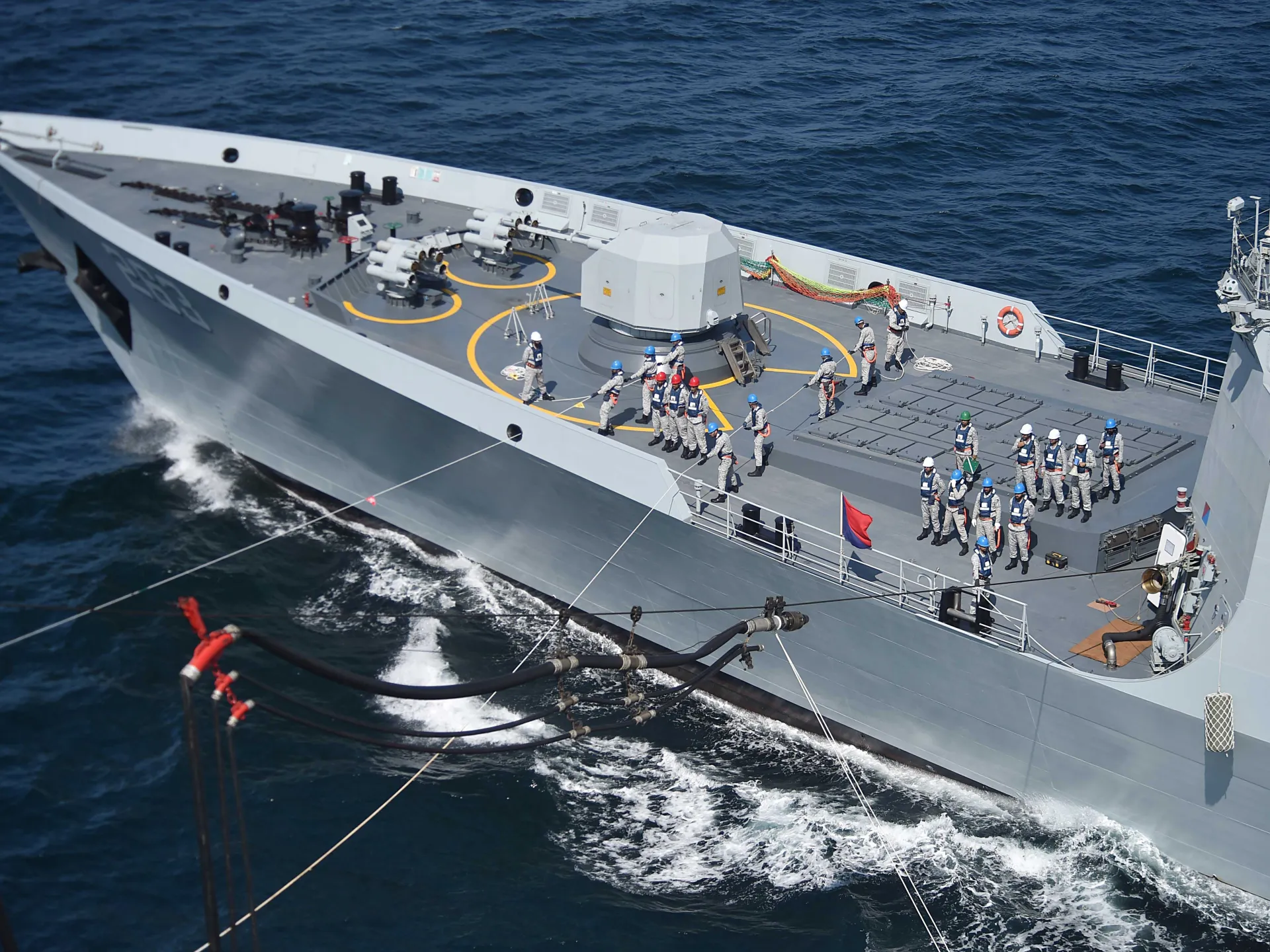
You can read more about the Aegis Combat System and how it has evolved to adopt a modular, open architecture approach, specifically to make it easier to add new capabilities and functionality, in this previous TWZ feature. Lockheed Martin has already demonstrated the ability of a modular and scalable version of the system, called the Virtualized Aegis Weapon System, to fire a PAC-3 MSE from a containerized Mk 41-based launcher on land.

Aegis: Capable. Proven. Deployed. thumbnail

Aegis: Capable. Proven. Deployed.


No changes to the Mk 41 VLS – another Lockheed Martin product – are planned or required as part of the PAC-3 MSE integration. Work has been ongoing on adapting the interceptors into launch canisters, allowing them to slot right into existing Mk 41 cells. At just over 17 feet long, PAC-3 MSE should fit in shorter so-called tactical length versions of the Mk 41, as well as one with longer strike-length cells.

A graphic showing existing missiles compatible with tactical and strike-length versions of the Mk 41 VLS. Lockheed Martin A graphic showing various missiles already compatible with the tactical and strike-length versions of the Mk 41. Lockheed Martin

Lockheed Martin has said in the past that each canister will contain a single PAC-3 MSE missile. At around 11 inches wide, the PAC-3 MSE is just over half the maximum diameter available in a Mk 41 cell. This raises the question of whether future canisters could be designed to hold multiple interceptors, which would give ships valuable additional magazine depth.

From a capability standpoint, PAC-3 MSE is generally discussed in comparison to SM-2 surface-to-air missiles in the Navy’s arsenal today. In terms of missiles that can be fired via the Mk 41, SM-2 is a middle-tier anti-air capability that sits between shorter-range RIM-162 Evolved Sea Sparrow Missiles (ESSM; which can also be quad-packed into a single cell) and upper-tier SM-6s and SM-3s. The SM-6 is a multi-purpose weapon that can also be employed against targets on land and at sea. SM-3s, of which there are multiple variants in service today, are specifically designed as anti-ballistic missile interceptors.

“A lot of places the Navy has said ‘I got red or yellow challenges that I can’t deal with.’ This missile does a really good job at that. When you marry them all together, it is very complimentary to SM-6,” Chris Mang, Vice President of Strategy & Business Development at Lockheed Martin’s Missiles and Fire Control, told TWZ at last year’s Sea Air Space conference. “You’d always want a layered defense, right? I’ll pick the longest shot I can get, but then at a certain point, MSE really starts to outperform in certain envelopes.”

An SM-6 seen at the moment of launch. USN

For the Navy, PAC-3 MSE also presents important logistics, cost, and supply chain benefits. The latest conflict with Iran has only underscored now long-standing concerns about U.S. munition expenditure rates, especially when it comes to anti-air interceptors. A large-scale, high-end fight with a near-peer adversary like China would put much more pressure on munition stockpiles and the U.S. industrial base working to restock them. As such, it would be a boon for the Navy to have an additional stream of interceptors to arm its warships.

As noted, the Navy is already moving to buy hundreds of what documents currently refer to as the “PAC-3 MSE / Navy” missile, as well as launch canisters. The service’s Fiscal Year 2027 budget request puts the unit cost for each missile at $4.05 million. The canister adds another $200,000 to the price tag. The Army’s Fiscal Year 2027 proposed budget says the unit cost for standard PAC-3 MSEs has risen now to $5.3 million. The exact reasons for the cost discrepancy between the Army and Navy versions are unclear.

A PAC-3 MSE missile seen being fired from a ground-based launcher. US military A Patriot launcher fires a newer PAC-3-series missile during a test. DoD

“Both quantities and unit cost are estimates based on U.S. Army contract pricing. Both quantities and unit cost will adjust based on award of DoN CLINs [Department of Navy Contract Line Item Numbers] on ARMY contract in execution and final cost of the Navy components (radio, canister, etc),” per the Navy’s latest budget request.

At $4.05 million, the Navy’s PAC-3 MSEs will be slightly cheaper per missile than the Block IA version of the SM-6. The service’s latest budget request puts the unit cost of the latter missiles at $4.348 million. The cost of a current-generation Block IIICU variant of the SM-2 is unclear, given that they have often been procured as upgrades of existing Block IIICs rather than new-production missiles. Historically, the average price point for an SM-3 Block IIIC has been around $3.6 million.

“By leveraging the high-volume Army PAC-3 MSE production contract, the Navy achieves significant cost avoidance through economies of scale, as unit price decreases with larger quantities,” the Navy’s latest budget documents also note.

Lockheed Martin announced in January that it had reached an agreement with the U.S. government to ramp up annual PAC-3 MSE production, for domestic and foreign customers, from 600 to 2,000 missiles. Last week, the company received a contract to help further accelerate production of these missiles. This could all help drive down the unit cost of the missiles going forward, as well as speed up their delivery.

Lockheed Martin Receives Contract to Accelerate PAC-3® MSE Production thumbnail

Lockheed Martin Receives Contract to Accelerate PAC-3® MSE Production


It is worth pointing out here that PAC-3 MSE’s performance in the Middle East, as well as in Ukraine in recent years, has also prompted a significant increase in demand from the U.S. Army, as well as foreign Patriot operators. The overall Patriot user base is also expanding.

Adding the Navy to the mix will add to that demand, even with the production ramp-up, and could add to already growing concerns about production backlogs now. Integrating PAC-3 with Aegis and the Mk 41 VLS could also spur additional interest from other navies globally that have ships with that combat system and/or launchers.

Reuters reported just last week that U.S. officials had informed allies and partners in Europe that deliveries of unspecified munitions could now be delayed due to American needs in relation to the war with Iran. When it comes to PAC-3 MSE, the budget documents the Army released today, at least, do not appear to show any changes to the delivery schedule for foreign customers.

🇺🇸 Is the US re-sequencing scheduled PAC-3 MSE deliveries away from FMS customers to the US Army’s inventory?

The J-books say no. In fact, FMS customers are scheduled to receive the majority of production.

Delivery schedule unchanged from last year. Only 252 missiles from… pic.twitter.com/iZdXlAYQ82

— Colby Badhwar (@ColbyBadhwar) April 21, 2026

Regardless of any of these issues, the Navy is now pushing full steam ahead on integrating PAC-3 MSE with Aegis and the Mk 41 VLS.

Jamie Hunter contributed to this story.

Contact the author: joe@twz.com

Joseph has been a member of The War Zone team since early 2017. Prior to that, he was an Associate Editor at War Is Boring, and his byline has appeared in other publications, including Small Arms Review, Small Arms Defense Journal, Reuters, We Are the Mighty, and Task & Purpose.


Source link

Navy Fires Drone-Frying LOCUST Laser From Supercarrier USS George H.W. Bush

The U.S. Navy has disclosed the test of an AeroVironment LOCUST laser counter-drone system, which has been in the news recently, aboard the Nimitz class aircraft carrier USS George H.W. Bush. As far as TWZ is aware, this looks to be the first time a laser weapon has been fitted to a carrier. Earlier this year, Chief of Naval Operations Adm. Daryl Caudle, the Navy’s top officer, said his goal was for directed energy weapons to eventually be the go-to choice for the crews of American warships when facing close-in threats.

The Navy has shared three pictures of the LOCUST system onboard USS George H.W. Bush, seen at the top of this story and below. They were all taken on October 5, 2025, but released today. This coincides with the start of the Navy League’s annual Sea-Air-Space exposition, at which TWZ is in attendance.

An AeroVironment LOCUST laser counter-drone system aboard the USS George H.W. Bush during a test in October 2025. USN

The captions to each of the images include the following: “During the live-fire event, [the] LOCUST LWS [laser weapon system] effectively detected, tracked, engaged, and neutralized multiple unmanned aerial vehicles marking a milestone toward fielding operational directed energy capabilities.”

TWZ has reached out to the Navy for more information.

Another view of the LOCUST system on USS George H.W. Bush’s flight deck during the test last year. USN/Chief Petty Officer Brian Brooks

“The successful demonstration of its palletized LOCUST Laser Weapon System (LWS) aboard the USS George H.W. Bush (CVN-77) in October 2025″ was conducted “in collaboration with the U.S. Navy and the U.S. Army Rapid Capabilities and Critical Technologies Office (RCCTO),” according to a press release from AeroVironment.

A stock picture of the supercarrier USS George H.W. Bush. USN

“During the live-fire event, the Palletized High Energy Laser (P-HEL) system tracked, engaged, and neutralized multiple target drones – marking a major milestone toward fielding operational directed energy capabilities across all domains and platforms,” the release adds. “This achievement validates that the LOCUST LWS is truly platform-agnostic, seamlessly transitioning from fixed-site and land-based mobile platforms, such as the Joint Light Tactical Vehicle (JLTV) and Infantry Squad Vehicle (ISV), to the dynamic and demanding environment of a maneuvering aircraft carrier.”

A P-HEL version of LOCUST seen during US Army testing in 2022. US Army

The central element of LOCUST is a laser directed energy weapon in a turret, which also includes built-in electro-optical and infrared video cameras for target acquisition and tracking. Tertiary sensors, including small-form-factor high-frequency radars and passive radio frequency signal detection systems, can also be used to cue the laser. The JLTV and ISV-based configurations mentioned in AeroVironment’s release both feature small radars.

A JLTV-based LOCUST system. AeroVironment
LOCUST mounted on an ISV. US Army

LOCUST’s power rating is generally understood to be in the 20-kilowatt range at present. When it comes to laser directed energy weapons, this is at the lower end of the power spectrum, fully in line with a system intended to defeat smaller drones. LOCUST has also been demonstrated with a 26-kilowatt power rating, but how much more it could be scaled within the existing form factor is unclear.

As of December 2025, the U.S. Army was known to have taken delivery of palletized LOCUST systems, as well as ones mounted on JLTVs and ISVs. The Army has at least deployed the palletized versions overseas operationally in the past. One of the service’s LOCUST systems was also at the center of a widely criticized and controversial shutdown of airspace around El Paso, Texas, in February of this year, as you can read more about here. The system had been on loan to U.S. Customs and Border Protection (CBP) at the time. Earlier this month, the Pentagon signed an agreement with the Federal Aviation Administration (FAA) regarding the continued use of anti-drone laser systems along the southern border with Mexico.

The U.S. Marine Corps has also moved to acquire JLTV-based LOCUST systems in the past. In addition to appearing to be the first instance of a laser-directed energy weapon going aboard a carrier, last year’s test aboard USS George H.W. Bush also looks to be the first known instance of the Navy even evaluating LOCUST for use on ships or in any other context.

Quadcopter-type drones seen after being hit by the P-HEL version of LOCUST in testing. US Army

Navy interest in using LOCUST to defend ships, especially very high-value ones like aircraft carriers, is not surprising. For years now, the service has been very active in pursuing shipboard laser and microwave directed energy weapons with a particular eye toward providing additional layers of counter-drone defense.

Experience gained in recent years from operations in and around the Red Sea, as well as against Iran, has only underscored the critical importance of bolstering the ability of U.S. warships to protect themselves against uncrewed aerial threats. The Navy has also been adding counter-drone systems that use physical interceptors as their effectors to a growing number of ships to help address this reality.

In general, lasers like LOCUST offer the promise of functionally unlimited magazine depth, which could be exceptionally valuable in the counter-drone role when faced with large volumes of incoming threats. The dangers that uncrewed aerial systems pose are only set to increase as artificial intelligence and machine learning-driven capabilities, including automated targeting and fully networked swarming, continue to improve while the barrier to entry steadily drops.

Palletized and containerized systems like the P-HEL version of LOCUST can also be employed with more flexibility on a wide variety of ships, as long as sufficient deck space and available power. The test aboard USS George H.W. Bush involved simply lashing the system to the flight deck. This also means the systems can be installed and/or removed more readily depending on mission requirements. The Navy also has a demand for counter-drone capability on land to protect key facilities and assets abroad and at home, where LOCUST would also be relevant.

LOCUST Laser Weapon System thumbnail

LOCUST Laser Weapon System


At the same time, especially when it comes to employing lasers on ships, there are also potential pitfalls. As TWZ has previously written:

“A single laser can only engage one target at once. As the beam gets further away from the source, its power also drops, just as a result of it having to propagate through the atmosphere. This can be further compounded by the weather and other environmental factors like smoke and dust. More power is then needed to produce suitable effects at appreciable distances. Adaptive optics are used to help overcome atmospheric distortion to a degree. Altogether, laser directed energy weapons generally remain relatively short-range systems.”

“In addition, laser directed energy weapons, especially sensitive optics, present inherent reliability challenges for use in real-world military operations. Shipboard use adds rough sea states and saltwater exposure to the equation. There is also the matter of needing to keep everything properly cooled, which creates additional power generation and other demands.”

Over the years, the Navy has faced continued and significant hurdles in attempting to field operational laser weapon systems more broadly across its fleets. U.S. military officials have often sought to temper expectations, while also being open about their frustrations with the lack of greater progress, in recent years.

Still, the Navy, in particular, has persisted in its pursuit of these capabilities, given the benefits mentioned earlier. Lasers are set to be a particularly important component of the full arsenal aboard the future Trump class “battleships.”

A rendering depicting the first planned Trump class “battleship,” to be named USS Defiant, firing its lasers and other weapons. USN

“My thesis research at [the] Naval Post Graduate School was on directed energy and nuclear weapons,” Adm. Caudle told TWZ and other outlets at a roundtable back in January. “This is my goal, if it’s in line of sight of a ship, that the first solution that we’re using is directed energy.”

In particular, “point defense needs to shift to directed energy,” the admiral added, emphasizing that “it has an infinite magazine.”

“What that does for me is it improves my loadout optimization, so that my loadout, my payload volume is optimized for offensive weapons,” Caudle added at the time. Furthermore, “as you increase power, the actual ability to actually engage and keep power on target, and the effectiveness of a laser just goes up.”

Laser directed energy weapons with higher power ratings could potentially defend ships against other threats, including certain types of incoming missiles.

Whether or not the Navy decides to acquire and field LOCUST operationally on its ships, the service’s general demand for more counter-drone capabilities across the board does not look set to decrease any time soon.

Contact the author: joe@twz.com

Howard is a Senior Staff Writer for The War Zone, and a former Senior Managing Editor for Military Times. Prior to this, he covered military affairs for the Tampa Bay Times as a Senior Writer. Howard’s work has appeared in various publications including Yahoo News, RealClearDefense, and Air Force Times.


Joseph has been a member of The War Zone team since early 2017. Prior to that, he was an Associate Editor at War Is Boring, and his byline has appeared in other publications, including Small Arms Review, Small Arms Defense Journal, Reuters, We Are the Mighty, and Task & Purpose.


Source link

Iran claims drone strikes on U.S. Navy, peace talks hang in balance

The 965-foot-long Iranian container ship Touska, seen here in 2017 after it ran aground off Hong Kong’s main island, remained in the custody of the U.S. Navy on Monday after it was boarded and seized by U.S. Marines. File photo by Jerome Favre/EPA

April 20 (UPI) — Iran said that it carried out drone strikes on Monday against U.S. military vessels blockading its ports after the U.S. Navy attacked an Iranian-flagged container ship in the Gulf of Oman.

The state-run Tasnim News Agency said the Iranian military “launched drone strikes toward several U.S. military vessels in the area” in retaliation for the boarding and seizure of the Touska on Sunday night while it was en route to Iran from China.

“We caution that the Armed Forces of the Islamic Republic of Iran will soon respond to and retaliate for this act of piracy and armed aggression by the US military,” Khatam al-Anbia Central Headquarters, the Iranian military’s central command, said in a statement

Khatam al-Anbia Central Headquarters said the Iranian Armed Forces had held off from delivering “a decisive response” to “blatant aggression by U.S. terrorist commandos” due to concerns for the safety of family members of the ship’s crew who were on board the Touska.

“Iran’s operational action was delayed in order to protect their lives and security, which were in constant danger,” the statement added.

The U.S. military did not immediately comment on Iran’s claim it conducted drone strikes.

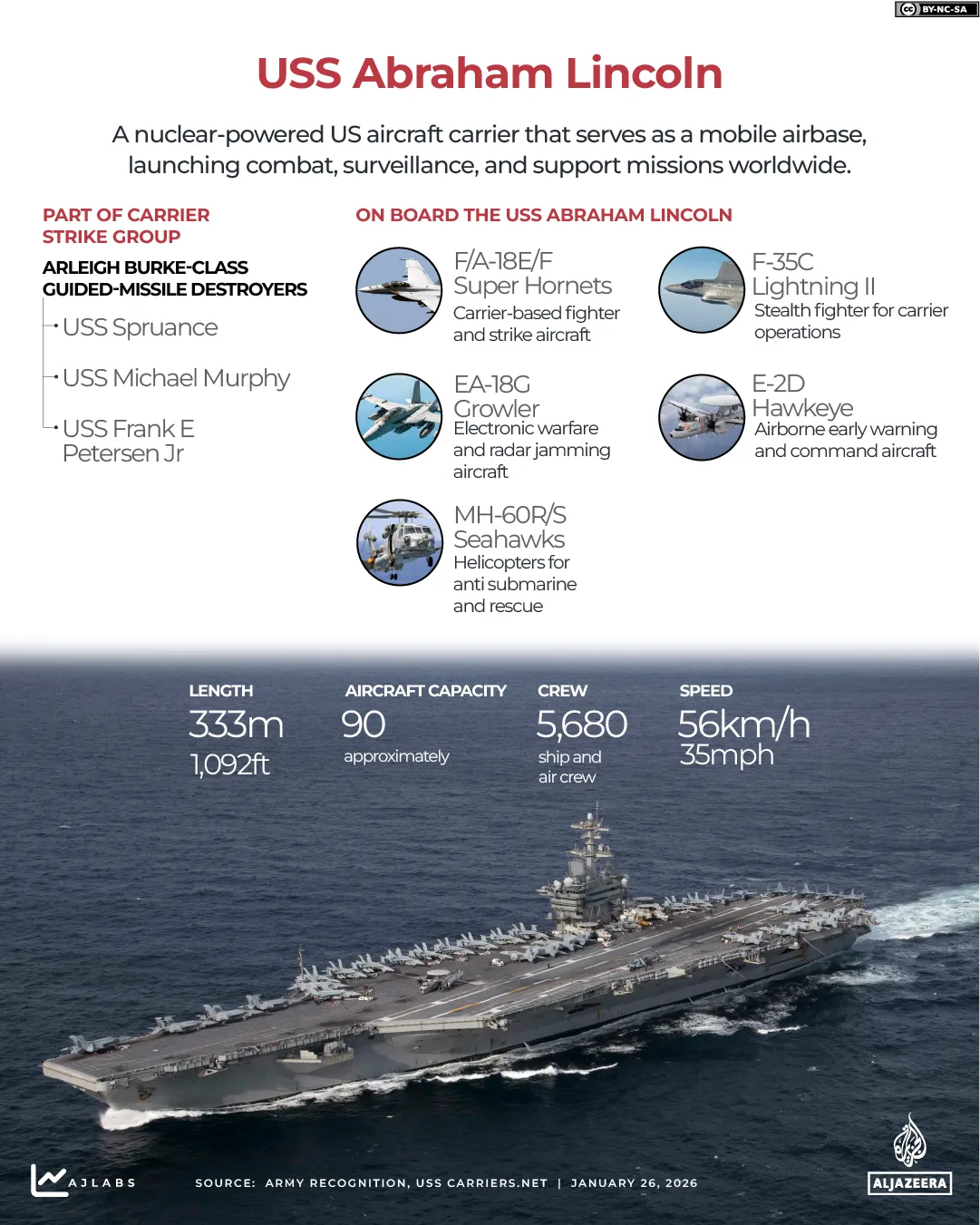
However, U.S. Central Command posted video of the guided-missile destroyer USS Spruance warning the Touska to “vacate your engine room” because it was about to open fire and, some time later, night-vision footage of helicopter-borne U.S. Marines from USS Tripoli conducting an amphibious assault operation to take over the vessel.

CENTCOM said the Spruance intercepted Touska as it was steaming toward the Iranian port of Bandar Abbas, issuing multiple warnings over a six hour period that it was in violation of the U.S. blockade. When it refused to stop, the Spruance fired several rounds from its 5-inch gun hitting the engine room and disabling the vessel.

U.S. Marines from the 31st Marine Expeditionary Unit later boarded the vessel and took control of the vessel, which remains in U.S. custody.

CENTCOM said U.S. forces had ordered 25 commercial vessels to turn back, or return to an Iranian port, in the week since the United States implemented its blockade of Iranian ports on April 13.

However, Sunday was the first time that the U.S. military is known to have opened fire on merchant shipping since the war started Feb. 28.

The escalation came after a rollercoaster weekend that began with Tehran declaring that the Strait of Hormuz was fully open to all commercial shipping for the remainder of the 14-day cease-fire currently in place, which is due to expire on Wednesday.

The move was welcomed by the United States, but the administration of U.S. President Trump made it clear its blockade would remain in place. That prompted Tehran to accuse the United States of violating the cease-fire and by Saturday it declared the strait closed again and at least one tanker was fired on by two Iranian gunboats as it attempted to enter the sea lane.

The developments have cast doubt over peace talks, which are due to resume in Islamabad, Pakistan, later Monday or first thing Tuesday.

Trump said in a post on his Truth Social platform that U.S. negotiators would arrive in the Pakistani capital on Monday night, with the White House later confirming that Vice President JD Vance would again head up the U.S. delegation, picking up from where he left off from in an initial round of talks on April 11 that failed to produce a breakthrough.

Tehran said Monday it had not yet decided whether it would attend.

“As of now, while I am speaking to you, we do not have a plan for the next round of negotiations, and no decision has been taken in this regard,” Foreign Ministry spokesperson Esmaeil Baqaei said at a press conference in Tehran.

Referencing the ongoing U.S. blockade and seizure of the container ship, Baqaei accused the United States of actions that “are in no way indicative of seriousness in pursuing a diplomatic process.”

However, the comments do not mean Iran will not show in Islamabad.

The Iranian side only confirmed participation in the first round of negotiations at the last minute.

Global oil prices, which fell sharply on Friday after Iran said the Hormuz Strait was open, rose again over the weekend but were holding steady in late morning trade in London where Brent crude for June delivery contract was changing hands at $95.24 a barrel and West Texas Intermediate for May delivery was changing hands at $88.89 a barrel.

Secretary of Health and Human Services Robert F. Kennedy, Jr. speaks during a House Appropriations Subcommittee on Labor, Health and Human Services, Education, and Related Agencies hearing on the budget for the Department of Health and Human Services in the Rayburn House Office Building near the U.S. Capitol on Thursday. Photo by Bonnie Cash/UPI | License Photo


Source link

Navy Turns Around Ships Trying To Run Blockade Of Iran (Updated)

A day into the U.S.-imposed military blockade of the Strait of Hormuz, several ships have apparently transited the narrow waterway, including at least two that reportedly had previously stopped at Iranian ports. However, U.S. Central Command (CENTCOM) is pushing back against claims that vessels ran the blockade. As we noted yesterday, CENTCOM said the maritime exclusion operation would be “enforced impartially against vessels of all nations entering or departing Iranian ports and coastal areas, including all Iranian ports on the Arabian Gulf and Gulf of Oman.”

Meanwhile, there are indications that the U.S. and Iran may continue seeking a diplomatic offramp to the crisis, which began Feb. 28 when America and Israel began bombarding the Islamic Republic. We will discuss that in greater detail later in this story.

Strait of Hormuz (Google Earth)

Christianna, a Liberia-flagged cargo ship, “exited the Persian Gulf through the strait on Monday night, after leaving the Iranian port city of Bandar Imam Khomeini,” The New York Times reported, citing the global trade intelligence firm Kpler. It said the ship was not carrying any cargo.

In addition, Elpis, a methanol carrier, “traversed the strait roughly around the time that the U.S. blockade began, according to ship-tracking data,” the newspaper added, “Kpler said that the vessel had been at the Iranian port of Bushehr. The United States had placed sanctions on the ship last year under an earlier name, Chamtang, over its connections to the Iranian oil trade.”

It is unclear if these two ships fell within CENTCOM’s “grace period” around the deadline, had gained permission to pass or had somehow bypassed the blockade, the Times noted. We have reached out to CENTCOM and the White House for more details.

CENTCOM stated on X that during “the first 24 hours, no ships made it past the U.S. blockade and 6 merchant vessels complied with direction from U.S. forces to turn around to re-enter an Iranian port on the Gulf of Oman.”

“The blockade is being enforced impartially against vessels of all nations entering or departing Iranian ports and coastal areas, including all Iranian ports on the Arabian Gulf and Gulf of Oman,” the command reiterated. “U.S. forces are supporting freedom of navigation for vessels transiting the Strait of Hormuz to and from non-Iranian ports.”

All told, more than “10,000 U.S. Sailors, Marines, and Airmen along with over a dozen warships and dozens of aircraft are executing the mission to blockade ships entering and departing Iranian ports,” CENTCOM explained.

More than 10,000 U.S. Sailors, Marines, and Airmen along with over a dozen warships and dozens of aircraft are executing the mission to blockade ships entering and departing Iranian ports. During the first 24 hours, no ships made it past the U.S. blockade and 6 merchant vessels… pic.twitter.com/dpWAAknzQp

— U.S. Central Command (@CENTCOM) April 14, 2026

Several other Iranian-linked ships also exited the Strait, however, there was no indication they stopped at any Iranian port and thus would not have been subject to the blockade.

The Rich Starry, “sanctioned by the US for Iran-related trade, sailed east from Sharjah in the UAE through the strait overnight, data shows,” according to BBC. “The tanker Murlikishan, which is also under US sanctions for Iran-related trade, sailed from Lanshan in China and headed west through the strait overnight.”

BREAKING: US-sanctioned tanker, Chinese-owned Rich Starry, transited through the Strait of Hormuz on Tuesday despite a US blockade of the vital oil chokepoint, shipping data from LSEG showed. pic.twitter.com/yrIRltDvrI

— Al Jazeera Breaking News (@AJENews) April 14, 2026

Overall, shipping in the region has largely remained at a standstill. There are concerns this could exacerbate economic woes across the globe sparked by Iran’s near total closure of the Strait in the wake of U.S. and Israeli attacks. At the moment though, Brent Crude, a petroleum benchmark, was trading at just over $95 a barrel as of Tuesday at 11 a.m. EDT. That’s down from a high of nearly $110 a barrel on April 6, according to OilPrice.com.

“Little traffic is entering and leaving Iranian ports in the Persian Gulf and the Gulf of Oman on the first full day of the US-declared blockade,” CNN reported, citing ship-tracking data. “Shipping through the Strait of Hormuz also remains severely curtailed, with just a handful of tankers and bulk carriers transiting the waterway in the last day.”

Traffic deflates further after US blockade takes effect

Commercial traffic through the Strait of Hormuz remains well below typical levels, with just six vessels crossing on 13 April compared with 14 the previous day. While a ceasefire and the US naval blockade are now in place,… pic.twitter.com/swZQ6OYgPh

— Kpler (@Kpler) April 14, 2026

“Maritime activity in the Strait of Hormuz is entering its first full day under active U.S. enforcement, with early vessel behavior indicating a fragmented response to the blockade,” according to the latest report from Windward Maritime Intelligence

Initial movements “show a mix of continued transit, route deviation, and potential blockade evasion,” Windward explained. “Sanctioned and falsely flagged vessels remain active, with some proceeding through the Strait while others delay, reverse, or shift routing patterns.”

At the same time, “Iranian oil flows continue to rely on indirect distribution networks, with significant volumes accumulating offshore rather than moving directly through the Strait,” the company continued. “Taken together, the operating environment is shifting from uncertainty to active enforcement dynamics, where compliance, evasion, and selective movement are all occurring simultaneously.”

Activity in the Strait of Hormuz is intensifying as sanctioned dark fleet vessels navigate the newly imposed blockade.

Two critical movements unfolding this morning:

• Starry Rich: A U.S.-sanctioned, falsely flagged tanker signaling laden. After reversing course yesterday, it… pic.twitter.com/lzBSBHljnL

— Windward (@WindwardAI) April 14, 2026

Amid all this, Iran “is considering a short-term pause to shipments through the Strait of Hormuz to avoid testing a US blockade and scuppering a fresh round of peace talks,” Bloomberg reported, citing a person familiar with Tehran’s deliberations.

“The potential pause reflects a desire to avoid immediate escalation at a sensitive diplomatic juncture as Washington and Tehran sort logistics for another face-to-face meeting, the person said.”

China’s Foreign Ministry strongly condemned the blockade on Tuesday.

“The US’s targeted blockade and its increased military deployment are dangerous and irresponsible,” said ministry spokesperson Guo Jiakun. “At a time when the parties concerned have reached a temporary ceasefire arrangement, the blockade will only aggravate tensions, further destabilize the situation, undermine the already fragile ceasefire, and further jeopardize navigational security in the Strait of Hormuz.”

The US’s targeted blockade and its increased military deployment are dangerous and irresponsible, said a spokesperson for China’s Foreign Ministry on April 14, 2026.

Chinese FM Spokesperson Guo Jiakun was speaking on Tuesday, a day after the US military announced a blockade of… pic.twitter.com/81zAizEHUN

— China Military Bugle (@ChinaMilBugle) April 14, 2026

As the blockade continues, several countries have called for the Strait and by implication surrounding waterways to be reopened. Several hundred miles of Iran’s coastline sits along the Gulf of Oman, which is also included in the CENTCOM blockade.

“We have been clear from the outset that the security of the Strait of Hormuz must not be harmed by any escalatory moves,” said Majed Al-Ansari, a spokesman for the Qatari Foreign Ministry. “We reject any attempt to politicize the Strait and call for the immediate resumption of maritime activity without pre-imposed conditions, given its importance to the global economy. We are engaging with regional and international partners toward a solution. Regarding the talks in Islamabad, we remain in contact with Pakistan and support their mediation efforts, while focusing on strengthening regional coordination around this process.”

Dr. @majedalansari , Advisor to the Prime Minister and Spokesperson for the Ministry of Foreign Affairs, during the weekly media briefing:

We have been clear from the outset that the security of the Strait of Hormuz must not be harmed by any escalatory moves. We reject any… pic.twitter.com/4IEhz8bBl5

— Ministry of Foreign Affairs – Qatar (@MofaQatar_EN) April 14, 2026

French President Emmanuel Macron called for the Strait to “be reopened unconditionally, without restrictions or tolls, as soon as possible. Under these conditions, negotiations should be able to resume quickly, with the support of the key parties concerned.”

He added that “France and the United Kingdom will also host a conference in Paris this Friday, bringing together by videoconference non-belligerent countries ready to contribute, alongside us, to a multilateral and purely defensive mission aimed at restoring freedom of navigation in the strait when security conditions allow.”

Yesterday, I spoke with Iranian President Massoud Pezeshkian, as well as with U.S. President Donald Trump.

I urged the resumption of the negotiations suspended in Islamabad, the clearing up of misunderstandings, and the avoidance of any further escalation.…

— Emmanuel Macron (@EmmanuelMacron) April 14, 2026

UPDATES

We have concluded our coverage for the day.

UPDATE: 5:26 PM EDT –

To execute the blockade, American naval assets are not lingering near Iranian ports or in the Strait of Hormuz itself, The Washington Post noted

“Iranian forces mined the strait, one of several flash points in negotiations, soon after hostilities began more than six weeks ago,” the newspaper reported. “The narrow, shallow corridor also leaves any vessels there vulnerable to attack.”

“Our net is the Gulf of Oman,” said one of the officials, who explained that the U.S. warships involved wait for an opportune moment — after observing vessels leave Iranian facilities and clear the strait — before intercepting the merchant ships and forcing them to turn around.

“There’s one way in and one way out,” the official said. “We’ve got the whole thing on lockdown.”

.@USNavy is watching each ship — and waiting for them to exit the Strait of Hormuz where more than a dozen U.S. warships await. “Our net is the Gulf of Oman,” one official said. Whether a vessel is stopped or not depends on it it was in an Iranian port after 10 am EST April 13.…

— Tara Copp (@TaraCopp) April 14, 2026

UPDATE: 4:52 PM EDT –

There have been no indications yet reported during the CENTCOM blockade, but more than 20 commercial ships have passed through the Strait of Hormuz recently, The Wall Street Journal reported. The publication added that it marks “an improvement in the flow of vessels through a critical chokepoint.”

WSJ: More than 20 commercial ships have passed through the Strait of Hormuz in the past 24 hours, according to two U.S. officials… Ships that aren’t visiting Iran’s ports aren’t subject to the blockade and are being allowed to transit freely.

— Annmarie Hordern (@annmarie) April 14, 2026

UPDATE: 4:08 PM EDT –

Following today’s trilateral meeting with Israel’s Ambassador to the U.S., Yechiel Leiter, said his country won’t allow Hezbollah to fire missiles into Israel.

Israeli Ambassador to U.S.:

“We will not allow a terror organization to continually fire missiles into our population centers,” after his meeting with Rubio and the Lebanese Ambassador, in Washington D.C.. pic.twitter.com/fEdmkyvgyI

— Open Source Intel (@Osint613) April 14, 2026

UPDATE: 3:58 PM EDT –

UN Secretary-General Antonio Guterres stated that it’s “highly probable” talks to end the war will resume. He spoke after meeting with the Deputy Prime Minister of Pakistan.

UN Secretary-General Antonio Guterres says it’s “highly probably” talks to end the US-Israel war on Iran will resume.

He spoke after meeting with the Deputy Prime Minister of Pakistan. pic.twitter.com/hAhjVztKAc

— Al Jazeera Breaking News (@AJENews) April 14, 2026

UPDATE: 3:35 PM EDT –

CENTCOM offered some additional details about its blockade of Iran.

“An F-35B stealth fighter jet is prepared for flight aboard USS Tripoli (LHA 7) as the amphibious assault ship sails in the Arabian Sea,” CENTCOM stated on X. “Tripoli and its 3,500 Sailors and embarked Marines are executing the mission to blockade ships entering and departing Iranian ports. The blockade is being enforced impartially against vessels of all nations.”

An F-35B stealth fighter jet is prepared for flight aboard USS Tripoli (LHA 7) as the amphibious assault ship sails in the Arabian Sea. Tripoli and its 3,500 Sailors and embarked Marines are executing the mission to blockade ships entering and departing Iranian ports. The… pic.twitter.com/TrrT8qKT5t

— U.S. Central Command (@CENTCOM) April 14, 2026

UPDATE: 3:09 PM EDT –

The U.S. State Department provided some details of the trilateral meeting between the U.S., Israel and Lebanon. This meeting “marked the first major high-level engagement between the governments of Israel and Lebanon since 1993. The participants held productive discussions on steps toward launching direct negotiations between Israel and Lebanon,” the department stated.

“The United States congratulated the two countries on this historic milestone and expressed its support for further talks, and for the Government of Lebanon’s plans to restore the monopoly of force and to end Iran’s overbearing influence,” the State Department said in an email. “The United States expressed its hope that talks can exceed the scope of the 2024 agreement and bring about a comprehensive peace deal. The United States expressed its support for Israel’s right to defend itself from Hizballah’s continued attacks. The United States affirmed that any agreement to cease hostilities must be reached between the two governments, brokered by the United States, and not through any separate track. The United States underscored that these negotiations have the potential to unlock significant reconstruction assistance and economic recovery for Lebanon and expand investment opportunities for both countries.”

The State of Israel “expressed its support for disarming all non-state terror groups and dismantling all terror infrastructure in Lebanon and expressed its commitment to working with the Government of Lebanon to achieve that goal to ensure security for the people of both countries,” the message added.  “Israel expressed its commitment to engage in direct negotiations to resolve all outstanding issues and achieve a durable peace that will strengthen security, stability and prosperity in the region.“

UPDATE: 3:01 PM EDT

Stepping up the pressure on Tehran in what it calls Economic Fury, the Treasury Department said the short-term authorization permitting the sale of Iranian oil already stranded at sea is set to expire in a few days and will not be renewed.

Treasury is moving aggressively with Economic Fury, maintaining maximum pressure on Iran. Financial institutions should be on notice that the department is leveraging the full range of available tools and authorities and is prepared to deploy secondary sanctions against foreign…

— Treasury Department (@USTreasury) April 14, 2026

UPDATE: 2:41 PM EDT –

The New York Post said Trump informed them during a phone interview that additional US-Iran peace talks “could be happening over next two days” in Pakistan’s capital.

Trump initially claimed that discussions were “happening, but, you know, a little bit slow” before indicating that a second round of direct negotiations to end the seven-week war would likely happen somewhere in Europe, the newspaper added.

About half an hour later, Trump called back with an update.

“You should stay there, really, because something could be happening over the next two days, and we’re more inclined to go there,” he said of Islamabad. “It’s more likely, you know why? Because the field marshal is doing a great job.”

Trump was referring to Pakistan Field Marshal Gen. Asim Munir.

BREAKING: President Trump tells a New York Post journalist to stay in Pakistan, saying peace talks are so close they could break at any moment.

Peter Doocy says the president believes a deal is now within reach over the next couple of days.

DOOCY: “Good afternoon, President… pic.twitter.com/quxaTfRXt4

— Overton (@overton_news) April 14, 2026

Days after in-person peace talks between the U.S. and Iran ended with no agreement, the two sides are still talking. There are also reports that there may be another round of meetings later this week.

“The United States and Iran have traded proposals for a suspension of Iranian nuclear activities but remain far apart on the length of any agreement,” The New York Times reported, citing Iranian and U.S. officials.

During the negotiations in Islamabad, “the United States asked Iran for a 20-year suspension of uranium enrichment,” the newspaper added. “The Iranians, in a formal response sent on Monday, said they would agree to up to five years, according to two senior Iranian officials and one U.S. official. Mr. Trump rejected Iran’s offer, according to a U.S. official.”

NYT: The US proposed a 20-year “suspension” of all nuclear activity. That would allow the Iranians to claim they had not permanently given up their right, under the Nuclear Nonproliferation Treaty, to produce their own nuclear fuel.
In response, Iran renewed a proposal that it…

— Annmarie Hordern (@annmarie) April 14, 2026

Still, despite the impasse and the U.S. imposed blockade on Iranian ports, “U.S. officials are discussing details for a potential second in-person meeting with the Iranians,” CNN noted.

Trump administration officials are discussing another meeting with Iranian negotiators before the ceasefire ends, with possible dates and locations under review, CNN reports. pic.twitter.com/vS6F3Ik1ll

— Open Source Intel (@Osint613) April 13, 2026

Meanwhile, as the fighting continues in Lebanon between Israel and Hezbollah, Jerusalem and Beirut are scheduled to hold talks in Washington today. The first direct diplomatic discussion between the two nations in more than 30 years is aimed at preparing negotiations to end the conflict. However, there is little hope of any quick resolution.

Lebanon’s pre-condition is a full ceasefire, something Israel is refusing to do, CBC noted. Hezbollah’s chief Naim Qassem has called the discussions “pointless” and said just talking to Israel is akin to surrendering. 

Hezbollah is a separate entity from the Lebanese government and is fighting Israel, not that nation. However, Beirut called for the meeting to discuss “the announcement of a ceasefire” between the warring parties “and the date for starting negotiations between Lebanon and Israel under American sponsorship,” The Washington Post explained.

The State Department said the talks will focus on “how to ensure the long-term security of Israel’s northern border and to support the Government of Lebanon’s determination to reclaim full sovereignty over its territory and political life,” the publication added.

“We’re not about to release the peace doves,” an Israeli official told The Times of Israel. As Israel prepares for its most senior in-person engagement with Lebanon in its 78-year history, expectations are being managed.

There is one problem preventing the flight of those… pic.twitter.com/gke7Ew7mrO

— Amit Segal (@AmitSegal) April 14, 2026

On the battlefield, the Israeli Defense Forces (IDF) and Hezbollah continue to attack each other.

The IDF claimed that “three soldiers were severely injured, and an additional soldier was moderately injured in a close-quarters encounter in southern Lebanon.”

It also said it struck more than 150 Hezbollah targets across southern Lebanon.

🎯⏰24HR RECAP: ~150 Hezbollah targets were struck in numerous areas across southern Lebanon.

Accomplishments:
– Rocket launchers & UAVs struck
– Military structures, anti-tank missile launch points & terror command centers were targeted
– Terrorist cells that attempted to carry… pic.twitter.com/FYbntP7ml6

— Israel Defense Forces (@IDF) April 13, 2026

Hezbollah said it struck the Yiftah military barracks in northern Israel.

Hezbollah has released footage showing the targeting of the Yiftah Barracks in northern Israel using Sayyad-2 (also known as T2 and Sayyad-107) loitering munitions. pic.twitter.com/5vsNJlXDCJ

— OSINTWarfare (@OSINTWarfare) April 14, 2026

Mossad operated “in the heart of Tehran” during the recent US-Israeli campaign against Iran, the Israeli intelligence agency’s Director David Barnea said at a Holocaust Remembrance Day ceremony.

“We brought precise intelligence to the Air Force, and we hit missiles that threatened Israel,” he explained.

“But our mission has yet to be completed,” the spy chief added. “We didn’t think that this mission would be completed immediately with the end of the battles. But we planned intensively for our campaign to continue and achieve results even in the period after the strikes in Tehran.”

Mossad Director David Barnea:

Our mission will only be complete when the extremist regime in Iran is replaced.

We did not believe the mission would be finished immediately after the fighting subsided, but we did plan—indeed carefully—that our campaign would continue and be… pic.twitter.com/WvIaNQX54N

— Clash Report (@clashreport) April 14, 2026

Chinese President Xi Jinping weighed in on the tense situation in the Middle East, issuing “four propositions on safeguarding and promoting peace and stability” in the region, according to Mao Ning, spokesperson for the Chinese Foreign Affairs ministry.

Xi is calling for commitments to preserving “peaceful coexistence…the principle of national sovereignty…the rule of law” and “a balanced approach to development and security.” 

President Xi Jinping made four propositions on safeguarding and promoting peace and stability in the Middle East.

1️⃣ Stay committed to the principle of peaceful co-existence. The Gulf states in the Middle East are close neighbors that cannot move away. It’s important to support… pic.twitter.com/dBfGZCV9TF

— Mao Ning 毛宁 (@SpoxCHN_MaoNing) April 14, 2026

The Chinese MFA took a much harsher stance in response to Trump’s threat to impose a 50% tariff on Chinese imports if it provides arms to Iran. Trump issued that warning in an interview on Sunday with Fox News. He was reacting to reports that U.S. intelligence determined Beijing was providing military support to Tehran.

“China always acts prudently and responsibly on the export of military products, and exercises strict control in accordance with China’s laws and regulations and due international obligations,” the MFA proclaimed on X. “Media reports accusing China of providing military support to Iran are purely fabricated. If the U.S. goes ahead with the tariff hikes on China on the basis of these accusations, China will respond with countermeasures.”

The MFA did not specify what those countermeasures might be.

China always acts prudently and responsibly on the export of military products, and exercises strict control in accordance with China’s laws and regulations and due international obligations.

Media reports accusing China of providing military support to Iran are purely… pic.twitter.com/cMW2EDhEZP

— CHINA MFA Spokesperson 中国外交部发言人 (@MFA_China) April 14, 2026

Author’s Note: We have adjusted the headline to better reflect the story.

Contact the author: howard@thewarzone.com

Howard is a Senior Staff Writer for The War Zone, and a former Senior Managing Editor for Military Times. Prior to this, he covered military affairs for the Tampa Bay Times as a Senior Writer. Howard’s work has appeared in various publications including Yahoo News, RealClearDefense, and Air Force Times.


Source link

Navy MQ-4C Triton Surveillance Drone Crash In The Middle East Finally Confirmed

The U.S. Navy has finally confirmed that an MQ-4C Triton surveillance drone crashed back on April 9. The circumstances that led to the loss of the uncrewed aircraft remain unknown, but the incident has now been described as a mishap. The uncrewed aircraft had vanished unexpectedly from online flight tracking sites while flying over the Persian Gulf, but where exactly where it went down is unclear.

You can read more about what was already known about the fate of the MQ-4C in our initial reporting here.

Naval Safety Command’s latest publicly available mishap summary report, which appears to have been published today, includes the following brief entry:

“9 Apr 2026 (Location Withheld – OPSEC [Operational Security]) MQ-4C crashed, no injury to personnel.”

Not surprisingly, this is categorized as a Class A mishap, which is defined as one that causes more than $2 million in damages, results in one or more individuals dying or being permanently disabled, or any combination of the above. Navy budget documents last pegged the unit price of an MQ-4C at just over $238 million. As of 2025, the Navy had 20 of these drones in service in total, with plans to acquire seven more.

A list of recent Class A mishaps included in the Naval Safety Command’s latest publicly available mishap summary report. USN

TWZ reached out to the Navy and CENTCOM for comment. The Navy directed us to contact CENTCOM, and the command declined to comment.

The MQ-4C was widely assumed to have gone down last week. Right before the flow of online tracking data stopped, a huge and sudden loss of altitude, from a typical cruising altitude of around 50,000 feet down to below 10,000 feet, was recorded. At the time, the drone looked to be heading back to its base at Naval Air Station Sigonella in Italy after completing a surveillance mission over the Persian Gulf and Strait of Hormuz.

The drone’s transponder had also been broadcasting (or “squawking”) the code 7700, which is a general declaration of an in-flight emergency, at the time. However, as TWZ noted at the time, the code, by itself, does not provide details about the nature or severity of the emergency. There were also reports that the Triton had initially squawked 7400, a different code used to declare the drone had lost its connection with controllers on the ground.

On its way back to base, the US Navy MQ-4C Triton reconnaissance drone that had been patrolling the Strait of Hormuz took a turn towards Iran, squawked code 7700 (general emergency), and started descending, falling off ADS-B as it dropped under 10k feet. pic.twitter.com/1Ki8OsEk9k

— OSINTtechnical (@Osinttechnical) April 9, 2026

As noted, where exactly the drone went down is not clear. It was last tracked flying in international airspace over the Persian Gulf in the direction of Iran, but there is no evidence it went down in that country.

It is also unknown what steps may have been taken, or still be underway, to recover the downed MQ-4C. Each one of the drones carries a powerful active electronically scanned array (AESA) multi-mode radar, electro-optical and infrared video cameras in a turret under the nose, and electronic support measures systems for collecting electronic intelligence passively. The Navy, in cooperation with prime contractor Northrop Grumman, has also been working to upgrade the signals intelligence suites on these drones in recent years.

A stock picture of an MQ-4C. USN

If an adversary could recover any of these systems largely intact, it could represent a significant intelligence loss. Though there are no indications whatsoever that the MQ-4C went down due to hostile fire, recovery of the wreckage could still be of benefit for propaganda purposes, especially for Iran in the context of the latest conflict.

Iran did shoot down a Navy RQ-4 Broad Area Maritime Surveillance-Demonstrator (BAMS-D) drone while it was flying over the Gulf of Oman in 2019, and promptly put what remained of the uncrewed aircraft on display. The BAMS-D was a precursor to the MQ-4C. The Triton is derived from the core RQ-4 Global Hawk design, but is optimized for long-duration overwater missions.

As an aside, another MQ-4C was tracked flying a routine mission over the Persian Gulf today. This was the first such sortie visible online since April 9, which could reflect a pause in operations following the crash. Last week, TWZ pointed out that Tritons were likely to play an important role in surveilling the Persian Gulf, as well as the Strait of Hormuz, amid a fragile ceasefire between the United States and Iran. The capabilities the drones offer are likely to be even more important now as the U.S. military works to enforce a blockade of Iranian ports and to reopen the Strait of Hormuz to regular maritime traffic to and from other countries in the region.

We will provide additional details about the crash of MQ-4C if and when they become available.

Contact the author: joe@twz.com

Joseph has been a member of The War Zone team since early 2017. Prior to that, he was an Associate Editor at War Is Boring, and his byline has appeared in other publications, including Small Arms Review, Small Arms Defense Journal, Reuters, We Are the Mighty, and Task & Purpose.


Source link

Flurry Of Navy Minesweepers Appear To Be Heading Toward The Middle East

A pair of Avenger class mine-hunters homeported in Japan have been tracked sailing westward out of the Pacific Ocean in recent days. This comes as President Trump and other officials say an operation is taking shape to clear Iranian mines from the Strait of Hormuz, which will be essential to fully reopening that critical waterway. The United States has also now announced a blockade of all of Iran’s ports.

Until last year, the Navy had four Avenger class ships forward-deployed in the Middle East for exactly this mission. A trio of Independence class Littoral Combat Ship (LCS) configured for minesweeping duties subsequently took their place. However, those ships were redeployed from Bahrain ahead of the latest conflict with Iran, and two of them then emerged unexpectedly in Southeast Asia last month. While getting them out of the Persian Gulf was a prudent security measure, it remains unclear why the decision was made to send them literally to the other side of the globe amid the obvious threat of Iran mining the highly strategic Strait of Hormuz. One of them, the USS Tulsa, was also recently spotted sailing west after weeks in port in Singapore.

The Avenger class USS Chief and USS Pioneer were spotted arriving in Singapore on April 8, and they were seen leaving heading west on April 10. This represents half of the Avenger class ships still in Navy inventory, all of which are forward-deployed in Sasebo, Japan.

USS Chief (MCM-14) and USS Pioneer (MCM-9) Avenger-class mine countermeasures ships leaving Singapore – April 10, 2026 SRC: INST- yplanesonly pic.twitter.com/49unSU9nuf

— WarshipCam (@WarshipCam) April 10, 2026

USS Chief (MCM-14) and USS Pioneer (MCM-9) Avenger-class mine countermeasures ships coming into Singapore – April 8, 2026 SRC: INST- yplanesonly pic.twitter.com/TTxElngGLu

— WarshipCam (@WarshipCam) April 9, 2026

Online ship tracking site MarineTraffic subsequently showed both Avenger class ships heading northwest through the Strait of Malacca. There are unconfirmed reports that Chief and Pioneer arrived at Ao Makham port in Phuket, Thailand, earlier today. Their final destination is unknown, but USNI News had reported over the weekend that they had been “dispatched toward U.S. Central Command.”

A stock picture of USS Pioneer, in front, and USS Chief, behind, sailing together in 2020. USN

USS Tulsa was also tracked sailing northwest in the Strait of Malacca on April 3, which we will come back to in a moment.

USN TRACKING: Pushing MCM Capabilities West
Checking in on the US Navy’s LCS footprint using recent imagery and AIS data.

🇸🇬Sembawang: Only the USS Santa Barbara (LCS-32) remains pierside in Singapore.
🇲🇾Reviewing historical AIS, her sister ship, USS Tulsa (LCS-16), went dark on… pic.twitter.com/hiIROvC0QO

— MT Anderson (@MT_Anderson) April 11, 2026

“U.S. Central Command (CENTCOM) forces began setting conditions for clearing mines in the Strait of Hormuz,” the command had said in a press release on April 11. The Arleigh Burke class destroyers “USS Frank E. Peterson (DDG 121) and USS Michael Murphy (DDG 112) transited the Strait of Hormuz and operated in the Arabian Gulf as part of a broader mission to ensure the strait is fully clear of sea mines previously laid by Iran’s Islamic Revolutionary Guards Corps.”

US Central Command (CENTCOM) released this picture after announcing that the USS Frank E. Peterson and USS Michael Murphy had sailed through the Strait of Hormuz on April 11. CENTCOM Sgt. 1st Class Michael Hunnisett

Questions have been raised about the exact purpose of sending USS Frank E. Peterson and USS Michael Murphy through the Strait, and whether either ship actually made a full transit. Michael Murphy was tracked online sailing on the Persian Gulf side, at least briefly. Neither of the destroyers are outfitted for mine clearance missions, though they do have powerful sonars that might be able to help spot mines.

If the move not being coordinated with Iran is true, it’d be the geopolitical equivalent of trying to sneak someone in/out the back of a hostage standoff when the hostage-taker is distracted talking to a negotiator.

Sounds very high risk, but I have my doubts: why ping AIS then? https://t.co/vr7WHyAKgD pic.twitter.com/SGUIFQuW7p

— Evergreen Intel (@vcdgf555) April 11, 2026

“Additional U.S. forces, including underwater drones, will join the clearance effort in the coming days,” CENTCOM’s release over the weekend added, but did not further elaborate.

“We’re also bringing in more traditional minesweepers” as part of efforts to clear the Strait of Hormuz, President Trump told Fox News yesterday. He also said several times this weekend that mine-clearing operations were already underway in some form.

U.S. President Donald J. Trump has told Fox News that the UK and a number of other nations are set to send minesweepers to aid in securing the Strait of Hormuz, following his announcement that the U.S. will blockade the strait and interdict all vessels that pay a toll to Iran for… pic.twitter.com/oizgfMqLse

— OSINTdefender (@sentdefender) April 12, 2026

U.S. President Donald J. Trump said earlier that the U.S. is now in the process of clearing the Strait of Hormuz of mines, following reports that U.S. naval vessels transited the strait this morning. According to President Trump, during Operation Epic Fury, 28 Iranian mine laying… pic.twitter.com/fQGHDAmOES

— OSINTdefender (@sentdefender) April 11, 2026

CENTCOM declined to comment when we reached out today for more details about the planned force package for the mine clearance mission. TWZ has also reached out to the Navy’s main headquarters in the Pacific for more information about the movement of the Avenger class ships.

Before the latest conflict with Iran broke out in February, the Navy had three Independence class LCSs outfitted for mine countermeasures missions – Tulsa and Santa Barbara, along with the USS Canberra – forward-deployed in Bahrain. The arrival of those ships last year was tied to the long-planned decommissioning of four Avenger class vessels that had been homeported in that Middle Eastern country for decades beforehand. It is unclear how many LCSs the Navy otherwise has that are currently configured for minessweeping missions.

The Independence class Littoral Combat Ship (LCS) USS Canberra, in the foreground, sails together with the heavy lift ship M/V Seaway Hawk on January 20, 2026. The latter ship is seen here carrying four decomimssioned Avenger class mine-hunters back to the United States. USN

As noted, Tulsa and Santa Barbara subsequently emerged in Southeast Asia, first in Malaysia and then in Singapore, last month. USS Canberra‘s location remains uncertain, but it was reported to be sailing in the Indian Ocean as of March 19.

It should also be stated that the Independence class LCS is a much more modern ship than the Avenger class. When configured for the minesweeping mission, the LCSs also bring new standoff mine countermeasures capabilities, including Common Unmanned Surface Vehicle (CUSV) drone boats and helicopter-borne systems. Still, questions continue to be raised about whether the Independence class vessels are adequate replacements for the older, but purpose-built Avengers. You can read more about this here.

CUSV®


Airborne Laser Mine Detection System (ALMDS) Video


It is possible that the USS Chief and the USS Pioneer are in Southeast Asia now for exercises or other reasons. Japan-based Avenger class ships have traveled to Thailand, specifically, as well as other countries across the Pacific, to train with allied and partner forces in the past.

USS Pioneer is seen in the background during a controlled mine detonation as part of the Cooperation Afloat Readiness and Training (CARAT) exercise in Thailand in 2019. USN

That being said, the movements of Chief and Pioneer in the region, as well as Tusla‘s departure from Singapore, did come right around CENTCOM’s explicit statement that more U.S. forces were heading to the Middle East to help with mine-clearing efforts. Furthermore, as already mentioned, the quartet of Avenger class ships in Japan, as well as LCSs that have been in Singapore recently, represent the bulk of vessels specifically outfitted for minesweeping duties that the Navy has available anywhere globally. Any mine-clearing operation in and around the Strait of Hormuz will include other naval vessels, as well.

As an aside, the Navy’s Lewis. B. Puller class Expeditionary Sea Base (ESB) ship USS John L. Canley, which is homeported in the U.S. Pacific territory of Saipan, was also spotted heading west past Singapore on March 23. That ship was subsequently tracked sailing in the Indian Ocean, raising questions about whether it might be headed to the Middle East, as well. None of the Navy’s three other ESBs has been observed heading toward that region recently.

USNS John L Canley and USNS Alan Shepherd passing Singapore just now heading to the Middle East

John L Canley is at Expeditionary Transfer Dock, seemingly carrying an Osprey and 3 Seahawk helicopters on top and then the Alan Shepherd is a dry Cargo vessel

Photo by me pic.twitter.com/anLsxJJDT1

— Singapore Ship Spotting (@sgshipspotting) March 23, 2026

A crisis scenario in and around the Persian Gulf, especially one involving Iran mining the Strait of Hormuz or otherwise threatening that critical waterway, was central to the Navy’s decision to acquire the ESBs in the first place. From the start, a key mission for the sea base ships has been serving, in part, as launch platforms for MH-53E Sea Dragon mine-hunting helicopters. At the same time, the Navy MH-53E fleet has dwindled in recent years to a single squadron, and the type is set to be completely retired by the end of 2027. Canley was seen with an apparent load of V-22 Osprey tiltrotors and MH-60 Seahawk helicopters on its deck as it passed by Singapore last month.

The USNS (now USS) Lewis. B. Puller with four MH-53E Sea Dragon helicopters on its deck. USN

There has been talk in the past about ESBs acting as motherships for Avenger class mine-hunters. Canley be used to launch and recover uncrewed surface vessels (USV) and uncrewed underwater vehicles (UUV) as part of minesweeping and other operations, as well. In the context of the current blockade of Iranian ports, the ship could have a separate role as a valuable platform for staging visit, board, search, and seizure (VBSS) operations and otherwise supporting the current blockade of Iranian ports.

When it comes to the mission to clear Iranian naval mines, additional warships, as well as aircraft, will be needed just to provide critical force protection. This was already underscored by CENTCOM sending the two Arleigh Burke class destroyers through the Strait of Hormuz over the weekend. In February, before the war with Iran erupted, TWZ also called attention to the importance of force protection in these operations after A-10 Warthog ground attack aircraft conducted an exercise with the USS Santa Barbara in the Persian Gulf. A-10s have been prowling the Strait of Hormuz as part of operations against Iran.

An A-10 flies past the USS Canberra in the Persian Gulf during an exercise in 2026 before the war with Iran erupted. USN

How many naval mines Iran has actually laid, and of what types, is murky. In March, CBS News reported Iranian forces had seeded a number of Maham 3 and Maham 7 mines in and around the Strait of Hormuz. The Maham 3 is a so-called “influence mine,” designed to be triggered by the acoustic and/or magnetic signatures of a passing vessel, and that is moored in place. The Maham 7 is also an influence mine, but that sits on the seabed, and is therefore intended to be employed in shallower waters where it can still be set off by a ship sailing above. Naval analyst H. I. Sutton has more details on these and other Iranian naval mines here. Last Friday, The New York Times reported that Iran had lost track of the disposition of at least some of the mines it had laid, and that this was hampering efforts to reopen the Strait, citing unnamed U.S. officials.

Sweeping for naval mines is a slow-going and complex affair, in general, that carries significant risks even in benign environments. The dangers in case of the Strait of Hormuz are magnified now by the U.S. blockade of Iranian ports and the potential for the full resumption of hostilities with the regime in Tehran. U.S. and Iranian officials met this weekend in Pakistan following the announcement of a ceasefire last week. However, those talks ended after a day without any substantive progress toward a diplomatic resolution of the current conflict.

In the meantime, despite extensive U.S. and Israeli strikes over the past six weeks, Iran is still understood to have a significant array of capabilities, including anti-ship ballistic and cruise missiles, kamikaze drones, and uncrewed explosive-laden boats, that it could also use to turn the Strait of Hormuz into a super weapons engagement zone. TWZ previously explored these threats in greater detail in the context of past discussions about U.S. warships escorting commercial ships in and out of the Persian Gulf.

More about the mission to clear Iranian naval mines, including whether Japan-based Avenger class ships will take part and if the LCSs will finally return from the Pacific Theater, should become clearer in the coming days.

Contact the author: joe@twz.com

Joseph has been a member of The War Zone team since early 2017. Prior to that, he was an Associate Editor at War Is Boring, and his byline has appeared in other publications, including Small Arms Review, Small Arms Defense Journal, Reuters, We Are the Mighty, and Task & Purpose.


Source link

U.S. Navy to blockade Iranian ports on both sides of Hormuz Strait

April 13 (UPI) — The U.S. military said it will begin blocking all ships from leaving or entering Iran’s ports on Monday morning in line with a maritime blockade ordered by U.S. President Donald Trump to cut off Iranian oil exports.

U.S. Central Command said in a news release Sunday that the blockade would be enforced equitably against vessels of all nations sailing to or from Iranian ports, including all those on the Persian Gulf and Gulf of Oman, but stressed vessels serving ports in neighboring countries would be left alone.

“CENTCOM forces will not impede freedom of navigation for vessels transiting the Strait of Hormuz to and from non-Iranian ports,” said the news release, which instructs the masters of all ships to monitor “Notice to Mariners” broadcasts and make radio contact with U.S. naval forces on bridge-to-bridge channels in Gulf of Oman and Strait of Hormuz approaches.

The blockade would effectively cut off Iran’s international trade by preventing it from importing or exporting anything by sea, in particular its energy exports on which it is reliant for hard currency.

Further details would be communicated in a formal notice that would be provided to commercial ships and operators prior to the start of the blockade, due to come into force at 10 a.m. EDT, CENTCOM said.

The statement clarified comments by Trump early Sunday in which he appeared to announce a total blockade of the Strait of Hormuz in response to the failure of peace talks in Pakistan at the weekend.

Trump had said the U.S. Navy “will begin the process of BLOCKADING any and all Ships trying to enter, or leave, the Strait of Hormuz.”

On Saturday, CENTCOM announced that the U.S. Navy guided-missile destroyers USS Frank E. Peterson USS Michael Murphy had transited the Strait of Hormuz and operated in the Persian Gulf, preparatory to clearing Iranian mines and reopening the shipping route to commercial vessels.

Tehran responded to the development with unspecified threats against the ports of its neighbors and raised the specter of widening the conflict to the Red Sea, the other sea passage in the region that is critical to the global economy.

“Security in the Persian Gulf and the Sea of Oman is either for everyone or for NO ONE. If Iran’s ports are threatened, NO PORT in the region will be safe,” the Iranian military’s central command said in a statement carried by state-run broadcaster IRIB.

“Naval blockade of Iran? Bab al-mandeb Coming soon?!,” IRIB said earlier in a post referencing the narrow strait at the southern entrance to the Red Sea, which leads to the Suez Canal, where Iran-backed Houthi rebels attacked around 100 commercial ships November 2023 through September 2025.

Oil prices rose in response to the developments while stock markets retreated.

The benchmark Brent crude and West Texas Intermediate both climbed back above $100 a barrel with the Brent contract for June delivery changing hands at $102.31 per barrel in mid-morning trade in London while the WTI contract for May was trading at $104.44.

The FTSE 100 in London was down 0.33%, the DAX in Frankfurt fell almost 1.2% and France’s CAC 40 was off by almost 1%.

Former U.S. special envoy to the region David Satterfield expressed concerns over the blockade, warning that if shipping continued to be affected current supply disruption would widen beyond oil, with serious implications for Gulf countries’ exports of many other critical materials from aluminum and helium to polymers and fertilizer feed stocks.

“The Gulf is a critical global supply point, far beyond hydrocarbons — and the impact if this goes on for several more weeks is going to become quite profound, beyond just the cost of petrol and diesel at the pump,” Satterfield told the BBC.

Secretary of Defense Pete Hegseth speaks during a press briefing at the Pentagon on Wednesday. Yesterday, the United States and Iran agreed to a two-week ceasefire, with the U.S. suspending bombing in Iran for two weeks if the country reopens the Straight of Hormuz. Photo by Bonnie Cash/UPI | License Photo

Source link

Trump says U.S. Navy will block Strait of Hormuz after peace talks fail

President Donald Trump on Sunday said that the U.S. Navy would block the Strait of Hormuz to prevent Iranian ships from transiting it unless Iran opens the Strait and agrees to a peace deal with the United States. File Photo by Ali Haider/EPA-EFE

April 12 (UPI) — President Donald Trump on Sunday said the U.S. Navy will block the Strait of Hormuz to cut off Iran’s shipping lanes after peace talks in Pakistan failed to produce a deal.

Vice President J.D. Vance, who Trump sent to negotiate a deal to end the U.S.-Israeli war in Iran, said Saturday that the talks were not successful because the two sides cannot agree on what to do about the Iranian nuclear stockpile and who will control the Strait, CNN and The Washington Post reported.

Trump told Fox News’ Maria Bartiromo that the United States was going to block the Strait — it will “take a little while, but it’ll be effective pretty soon,” he said — and that nations in the Gulf region have agreed to help in the effort.

The blockade, he said, will prevent “any and all ships” from entering or leaving the the waterway, including vessels belonging to Iran, which have been shipping its oil to other countries and reportedly been bringing weapons parts from China to the Middle Eastern nation.

Vance told reporters early Sunday morning that while Iran had not yet accepted the United States’ “final and best offer,” he expressed optimism that a deal can be reached.

“We just could not get to a situation where the Iranians were willing to accept our terms,” Vance said. “I think that we were quite flexible.”

In a post on X, Mohammad Bagher Ghalibaf, who is Iran’s leading negotiator in the talks, said that he and his colleagues had “raised forward looking initiatives, but the opposing side ultimately failed to gain the trust of the Iranian delegation in this round of negotiations.”

“Before the negotiations, I emphasized that we have the necessary good faith and will, but due to the experiences of the two previous wars, we have no trust in the opposing side,” he said.

Secretary of Defense Pete Hegseth speaks during a press briefing at the Pentagon on Wednesday. Yesterday, the United States and Iran agreed to a two-week ceasefire, with the U.S. suspending bombing in Iran for two weeks if the country reopens the Straight of Hormuz. Photo by Bonnie Cash/UPI | License Photo

Source link

Navy Calls It Quits On Attack Submarine USS Boise’s Never Ending Overhaul

The U.S. Navy has abandoned plans to return the Los Angeles class attack submarine USS Boise to active duty. This brings an end to the saga of a still-incomplete major overhaul of the boat, which has lasted more than a decade now. In that time, it has become a poster child for the Navy’s worrisome struggles to tackle huge maintenance backlogs, as well as larger concerns about the availability, or lack thereof, of naval shipyard capacity in the United States.

The Navy announced its decision to inactivate Boise, which was first commissioned into service in 1992, earlier today.

“After a rigorous, data-driven analysis, we’ve made the tough but necessary decision to inactivate the USS Boise,” Navy Adm. Daryl Caudle, Chief of Naval Operations, the service’s top officer, said in a statement. “This strategic move allows us to reallocate America’s highly-skilled workforce to our highest priorities: delivering new Virginia and Columbia class submarines and improving the readiness of the current fleet. We owe it to our Sailors and the nation to make these tough calls to build a more capable and ready Navy.”

A picture of USS Boise sitting idle in Norfolk, Virginia, in the late 2010s. USN

“The move is part of the Navy’s broader, data-driven initiative to optimize the fleet’s composition, ensuring that every dollar is invested in capabilities that directly contribute to maintaining a decisive warfighting advantage,” the service also said in a press release. “Funds and personnel associated with the planned overhaul of USS Boise will be redirected to support other Navy priorities, including the timely delivery of America’s submarine capability.”

To date, the Navy has spent approximately $800 million on Boise’s overhaul, which is still only 22 percent complete, the service separately told Semafor. The total estimated cost to complete the overhaul had risen to $3 billion, according to Fox News.

“At some point, you just cut your losses and move on,” Secretary of the Navy John Phelan also told Fox News in an interview ahead of today’s announcement. “The Boise represents 65% of the cost of a new Virginia class submarine, yet it only delivers 20% of the remaining service life.”

The Navy had originally planned for Boise to begin its overhaul in 2013, but the timetable was repeatedly delayed, primarily due to a lack of shipyard availability. The submarine has not been to sea since it returned from its last cruise in January 2015. The boat was deemed unable to conduct normal operations by 2016, and it formally lost its dive certification the following year.

The Navy moved Boise from its home port in Norfolk, Virginia, to Newport News Shipbuilding’s facilities in 2018. Newport News Shipbuilding is a division of Huntington Ingalls Industries (HII).

The submarine returned to Norfolk the following year amid competing funding priorities. It went back to Newport News in 2020, but did not actually enter a dry dock there until 2021, after which limited maintenance work began. The full overhaul was then further set back due to budgetary issues, with a formal contract only signed in 2024.

The USS Boise seen arriving at the Newport News Shipbuilding yard in 2018. HII

As of last year, the Navy was still pushing to complete Boise‘s overhaul and return it to the fleet, which was expected to occur in 2029. By that point, the submarine would have spent more than a third of its service life in port.

The overall size of the Navy’s Los Angeles attack submarine force has been steadily declining for years now already, as the service has acquired more modern and capable Virginia class types. The Navy commissioned 62 Los Angeles class boats between 1976 and 1996, and 23 remain in service today.

As noted, the Navy’s struggles with Boise are reflective of larger and more serious issues that have long challenged the service’s ability to meet even its peacetime operational demands. Back in 2018, the Government Accountability Office (GAO) published a report saying that the Navy had more than two decades’ worth of operational time across its submarine fleets due to maintenance shortfalls.

The Los Angeles class attack submarine USS Helena arrives at Norfolk Naval Shipyard for major maintenance in 2015. USN

These are concerns that would only be magnified if a large-scale conflict, especially one with China in the Pacific, were to break out. For years now, TWZ has also been sounding the alarm on the interrelated issue of dwindling U.S. naval shipbuilding capacity, in general, where the disparity with Chinese state-run enterprises has become enormous.

The Navy, with support from Congress, has been trying to take steps in recent years to reverse these trends, including moving to increasingly leverage foreign shipyard capacity. The second Trump administration, through Navy Secretary Phelan, has been particularly open about its efforts to shake up how the service acquires and maintains ships, and otherwise does business across the board. This has notably already included the cancellation of the Constellation class frigate program, which had become beset by huge delays and ballooning costs, as you can read more about in detail here. The Navy has been touting efforts to try to avoid similar pitfalls with new shipbuilding programs like the FF(X) frigate and Medium Landing Ship.

“I think, by killing these programs, it’s sending a message that we’re not going to continue to send good money after bad investments, and that we’re going to try to make prudent economic decisions that are in the best interest of the fleet and the force,” Phelan said, speaking generally around today’s anouncement about Boise, according to Semafor.

How the Navy fares in its broader efforts to turn things around when it comes to shipbuilding and maintenance remains to be seen, but the USS Boise‘s increasingly sad story is now coming to an end.

UPDATE: 2:10 PM EDT –

Todd Corillo, an HII spokesperson for the Newport News Shipbuilding division, has now provided TWZ with the following statement:

“We have been notified of the U.S. Navy’s decision to discontinue engineered overhaul (EOH) work on USS Boise (SSN 764). We will work with the Navy to execute this decision in an efficient, cost-effective way. We anticipate there will be no impact to our workforce and will transition shipbuilders currently assigned to USS Boise to other work underway at Newport News Shipbuilding.”

“We understand the importance of a strong submarine force to our national security. While our work on USS Boise will end, our commitment to ensuring our nation maintains our undersea maritime supremacy will not.”

Contact the author: joe@twz.com

Joseph has been a member of The War Zone team since early 2017. Prior to that, he was an Associate Editor at War Is Boring, and his byline has appeared in other publications, including Small Arms Review, Small Arms Defense Journal, Reuters, We Are the Mighty, and Task & Purpose.


Source link

Mystery Launcher Appears On U.S. Navy Destroyer

A new and not immediately recognizable launcher has emerged on the U.S. Navy’s Arleigh Burke class destroyer USS Carl M. Levin. Last year, launchers for Coyote counter-drone interceptors appeared in the same general location on two other Burkes, the USS Bainbridge and the USS Winston S. Churchill. The Navy is currently known to be exploring several other options for integrating lower-cost anti-drone interceptors on various warships to bolster their defenses against this ever-growing threat. The new launcher could also be for deploying other kinds of munitions, drones, and/or decoys.

The Arleigh Burke class destroyer USS Carl M. Levin (DDG-120) is seen here in a picture taken on March 29, 2026, from the deck of the Whidbey Island class amphibious warfare ship USS Comstock. USMC Sgt. Trent A. Henry

The Carl M. Levin and its new launcher can be seen in the background of a picture that the U.S. Marine Corps released on April 8, which is seen in parts throughout this story. The image was taken on March 29 at Pearl Harbor in Hawaii. The Levin, also known by the hull number DDG-120, is homeported there. A Japanese-language blog called OSINFO was the first to notice the launcher in the image and posted it to social media.

USS Carl M. Levin (DDG 120) got a new Hellfire/JAGM launcher improving C-UAS capability.

はてなブログに投稿しました
米海軍DDGへのC-UAS用Hellfire/JAGM発射機搭載 – OSINFO https://t.co/R8hyf4B6L6#はてなブログ

— おるか (@hone_hone_bone_) April 8, 2026

The new launcher is seen installed on the deck at the aft end of the Levin’s superstructure, between the destroyer’s port-side torpedo tubes and its rear Mk 41 Vertical Launch System (VLS) array. From what we can see of the launcher itself, it appears to have multiple cells. Whether or not it can rotate or is fixed in place is not perfectly clear, but the latter seems likely, especially given what appears to be a circular mount. It looks like it would swivel upwards for firing.

A close-up look at where the launcher, seen at center, is installed at the Levin‘s aft end. USMC
An even closer look at the launcher itself. USMC

What the launcher fires and what purpose it serves are unknown. It was not seen on Levin at least as of December 2025. A cursory search at the time of writing does not now show it on any other Burkes, and it is not known whether the Navy currently plans to field it more widely on that class or any others. TWZ has reached out to the Navy for more information.

One distinct possibility is that this is a launcher for the White Spike counter-drone interceptor from Zone 5 Technologies. The launcher that Zone 5 has shown so far for White Spike is a four-cell design that is different from the one now installed on the USS Carl M. Levin. At the same time, it is also very similar in many respects, both in terms of form and likely function. The trapezoidal shape of its front is an especially prominent similarity as well as its overall configuration.

A side-by-side comparison of the launcher on the USS Carl M. Levin, at left, and the launcher Zone 5 has so far shown for the White Spike interceptor. USN/Zone 5 Technologies

Zone 5 White Spike Counter UAS drone interceptor flight tests


White Spike has been under evaluation as part of a project called Counter Unmanned Aerial Systems – NEXT, or Counter-NEXT, which the Pentagon’s Defense Innovation Unit (DIU) has been running since 2024. Its appearance on a Navy destroyer now would make sense given that Counter-NEXT has had a particular eye toward naval applications.

Anduril’s Roadrunner-M counter-drone interceptor has also been under evaluation as part of Counter-NEXT. However, the launchers that Anduril has publicly shown so far for those interceptors do not align with what is seen on the Levin. Furthermore, Roadrunner-M is designed to be launched vertically and recovered in the same way for reuse if it does not actually prosecute a target in the course of a mission, as you can read more about here.

Roadrunner successfully deploys from prototype launch enclosure.

In 2024, @DIU_x selected Anduril to develop cUAS for the @DeptofWar’s Counter NEXT program. Today, we’ve been awarded additional funding to move into the next phase of development and ultimately deliver these… pic.twitter.com/PAScfvIRHZ

— Anduril Industries (@anduriltech) September 29, 2025

Last year, the U.S. Navy had said that it planned to integrate launchers for Anduril’s Roadrunner-M counter-drone interceptors, as well as Raytheon’s Coyote, on an unspecified number of Arleigh Burke class destroyers. As already noted, the launcher on Levin is in the same general spot as the Coyote launchers that have been installed on the USS Bainbridge and the USS Winston S. Churchill.

A look at the launcher for Coyote counter-drone interceptors on the USS Bainbridge. USN

There is certainly demand from the Navy for more counter-drone capabilities for its ships, in general, which grew substantially in the wake of the service’s experiences during operations in and around the Red Sea in recent years. The latest conflict with Iran has only further underscored the still-expanding scope and scale of uncrewed aerial threats.

Lockheed Martin has also previously shown a concept for installing four-cell launchers capable of firing AGM-179 Joint Air-to-Ground Missiles (JAGM) in the same general location at the aft end of an Arleigh Burke class destroyer. As its name indicates, JAGM was originally developed for use against surface targets, but Lockheed Martin has been looking to evolve it into the counter-drone space. JAGM is derived from the AGM-114 Hellfire. The millimeter-wave radar-guided AGM-114L variant, in particular, has already emerged as a counter-drone weapon in recent years, including for shipboard use. JAGMs fired from warships could also be used for close-in defense against other targets, including swarms of small crewed or uncrewed boats.

Lockheed Martin has previously displayed this model of an Arleigh Burke class destroyer with several four-cell launchers for AGM-179 JAGMs installed at the aft end. Joseph Trevithick
A test of JAGM Quad Launcher (JQL; pronounced ‘jackal’) at a site on land. Lockheed Martin

There is still a possibility that the launcher now integrated on the USS Carl M. Levin could have other purposes beyond the counter-drone role.

A launcher for drones, including types configured as loitering munitions or decoys, could be another possibility. In recent years, the Navy has notably been experimenting with long-endurance drone-like decoys to help lure incoming anti-ship cruise missiles away from friendly ships and otherwise confuse opponents. In February, DIU put out a call for containerized drone launcher designs that could be employed at sea or on land. TWZ has previously laid out a detailed case for the many benefits that could come along with integrating launchers for swarms of drones configured to perform a variety of different tasks onto Navy ships.

Levin‘s new launcher could be used to fire shorter-range decoys and/or other kinds of countermeasures, as well.

Broadly speaking, the Navy has a long history of integrating new and improved capabilities, including weapon systems and countermeasures, on small numbers of Burkes. In some cases, those modifications have then begun to make their way onto more ships of the class, or have otherwise informed larger upgrade programs. The Arleigh Burke class is set to be the workhorse of the Navy’s surface fleets for years to come, and the ships will require continual updating as new threats and other developments emerge.

Whatever its purpose, the new launcher at the aft end of the USS Carl M. Levin is the latest example of how the capabilities of the Navy’s Burkes continue to evolve.

Contact the author: joe@twz.com

Joseph has been a member of The War Zone team since early 2017. Prior to that, he was an Associate Editor at War Is Boring, and his byline has appeared in other publications, including Small Arms Review, Small Arms Defense Journal, Reuters, We Are the Mighty, and Task & Purpose.


Source link

Navy MQ-4C Triton’s Fate Unknown After Disappearing From Flight Tracking Over Persian Gulf

A U.S. Navy MQ-4C Triton surveillance drone disappeared abruptly and unexpectedly from online flight tracking sites after declaring an in-flight emergency while flying over the Persian Gulf today. The uncrewed aircraft was also tracked rapidly losing altitude right beforehand, prompting widespread questions about its fate. This comes just two days after the United States and Iran agreed to a still very fragile ceasefire, which is heavily contingent on the reopening of the highly strategic Strait of Hormuz.

Online flight tracking data shows the MQ-4C had just completed a roughly three-hour-long flight over the Persian Gulf and the Strait of Hormuz and appeared to be returning to base at Naval Air Station Sigonella in Italy. The online tracking shows the Triton had just crossed into Saudi Arabian airspace before making a sudden turn to the northeast in the direction of Iran. Available data also shows the drone rapidly descended from a typical cruising altitude of around 50,000 feet down to below 10,000 feet.

The MQ-4C’s transponder was broadcasting (or “squawking”) the code 7700, which is a general declaration of an in-flight emergency, at the time. The code, by itself, does not offer any indication of what that the emergency might be or how serious the situation is. There are also unconfirmed reports that the Triton initially sent out another code, 7400, which is used to declare a loss of connectivity between a drone and its controllers on the ground.

On its way back to base, the US Navy MQ-4C Triton reconnaissance drone that had been patrolling the Strait of Hormuz took a turn towards Iran, squawked code 7700 (general emergency), and started descending, falling off ADS-B as it dropped under 10k feet. pic.twitter.com/1Ki8OsEk9k

— OSINTtechnical (@Osinttechnical) April 9, 2026

A US Navy MQ-4C Triton surveillance drone just conducted a 3-hour surveillance mission over the still Iranian-closed Strait of Hormuz. pic.twitter.com/XQJef4zYhu

— OSINTtechnical (@Osinttechnical) April 9, 2026

The MQ-4C had otherwise been publicly visible online from the moment it left Naval Air Station Sigonella in Italy. Tritons have been flying sorties over the Middle East, as well as other locales, from Sigonella regularly since 2024.

As of 2025, the Navy had 20 of these drones in service in total, with plans to acquire seven more. The service received funding to purchase the final pair of drones in Fiscal Year 2024, at which time the estimated unit cost for each one was pegged at just over $238 million.

When reached for more information by TWZ, the office of the Chief of Information (CHINFO), the U.S. Navy’s main public affairs office, declined to comment. We have also reached out to the U.S. Navy’s regional commands in the Middle East and Europe, as well as U.S. Central Command (CENTCOM).

At the time of writing, there does not appear to be any official comment about the MQ-4C from Iranian authorities.

An MQ-4C Triton seen sitting in front of a hangar at Naval Air Station Sigonella in Italy in 2024. USN

The MQ-4C is a derivative of the RQ-4 Global Hawk surveillance drone optimized for long-duration overwater missions. The Navy actually operated a small number of RQ-4A drones in a service-specific configuration called the Broad Area Maritime Surveillance-Demonstrator (BAMS-D). When the program started in 2003, BAMS-D’s main task was to help pave the way for Triton’s arrival. However, the Navy ended up flying the drones operationally in the Middle East and out into the Indian Ocean for 13 years. Iran notably shot down a BAMS-D drone as it flew over the Gulf of Oman in 2019.

One of the RQ-4A BAMS-D drones. USAF

The Triton’s original sensor package was centered on an active electronically scanned array (AESA) radar with surface search and synthetic aperture modes. A synthetic aperture radar (SAR) capability allows for the capturing of satellite-like images, day or night, in virtually any atmospheric conditions, which is not possible with optical sensors. The drones do also have electro-optical and infrared video cameras in a turret under the nose, as well as electronic support measures systems for collecting electronic intelligence passively.

More recently, the Navy has been working with prime contractor Northrop Grumman to expand the MQ-4C’s electronic and signals intelligence (ELINT/SIGINT) capabilities.

The drones can work in concert with P-8A Poseidon crewed maritime patrol planes, which have their own extensive sensors and networking suites, and carrier strike groups down below.

Tritons are likely to play an especially important role in monitoring activity in and around the Persian Gulf amid the current ceasefire with Iran. As noted, the safe transit of commercial ships in and out of the Gulf through the Strait of Hormuz is a central factor in the continued stability of that arrangement. It is also expected to be a major topic of discussion in future diplomatic negotiations between the United States and Iran. So far, Iran is still severely throttling maritime traffic through this critical waterway.

2/2
Inbound: From the Gulf of Oman northward via Larak Island to the #PersianGulf (per map).

Outbound: From the Persian Gulf, passing south of Larak Island toward the Gulf of Oman (per map).

— Consulate General of the I.R. Iran in Mumbai (@IRANinMumbai) April 9, 2026

LONDON, April 9 (Reuters) – Iran’s Islamic Revolutionary Guard Corps (IRGC) warned ships to keep to a route passing through its territorial waters when crossing the Gulf’s Strait of Hormuz as traffic on Thursday remained well below 10% of normal volumes.

— Idrees Ali (@idreesali114) April 9, 2026

As mentioned, MQ-4Cs have already been flying regular surveillance patrols in the region for years now. There were separate rumors of a Triton going down in the Gulf of Oman back on February 22. That also followed the disappearance of one of the drones from online flight tracking sites after squawking 7700. However, no rapid loss of altitude was recorded in that case.

A U.S. official subsequently told TWZ that reports of an MQ-4C loss on or about February 22 were “not true.” Open-source flight-tracking site Flightradar24 also posted a pointed statement on X on February 27 saying that they had tracked the Triton returning to a base in the United Arab Emirates (UAE). The very next day, U.S. and Israeli forces launched their combined operation against Iran.

US official told me this morning those claims were “not true.”

— Howard Altman (@haltman) February 27, 2026

Flightradar24’s post on February 27 also highlighted general gaps in tracking coverage in the region. Deliberate GPS jamming and other types of electronic interference are also common in the region, and even more so in the context of the latest conflict with Iran.

As noted, Iran has demonstrated an ability to target higher-flying U.S. drones in the past with the shootdown of the BAMS-D. That incident prompted significant questions about the survivability of Global Hawk and its derivatives, though these drones were never designed for missions into contested territory.

Smoke Trail From Shot Down Global Hawk


After some five weeks of U.S. and Israeli strikes, Iran’s air defense capabilities have been substantially degraded, but they do still present real threats, at least in certain envelopes. That being said, to be clear, there are no hard indications whatsoever that hostile fire was in any way a factor in whatever happened to the MQ-4C flying over the Persian Gulf today. The status of that drone, in general, remains unknown.

Still, incidents like this are likely to continue to draw immense attention, at least for the immediate future, amid the shaky ceasefire between the United States and Iran. That arrangement is currently set to remain in place for two weeks, and there is great uncertainty about what may happen afterward. Negotiations about a more lasting end to the recent hostilities are set to begin in Pakistan this weekend.

We will continue to provide more details about the fate of the MQ-4C if and when they become available.

Contact the author: joe@twz.com

Joseph has been a member of The War Zone team since early 2017. Prior to that, he was an Associate Editor at War Is Boring, and his byline has appeared in other publications, including Small Arms Review, Small Arms Defense Journal, Reuters, We Are the Mighty, and Task & Purpose.


Source link

A look at the U.K.’s Royal Navy, which has faced jibe after jibe from Trump and Hegseth

President Trump and his Defense Secretary Pete Hegseth have been damning of the U.K.’s naval capabilities. Their jibes may have stung in a country with a long and proud maritime history, but they do carry some substance.

The U.K. has been at the forefront of Trump’s ire since the onset of the Iran war on Feb. 28, when British Prime Minister Keir Starmer refused to grant the U.S. military access to British bases.

Though that decision has been partly reversed with the decision to permit the U.S. to use the bases, including that of Diego Garcia in the Indian Ocean, for so-called defensive purposes, Trump is adamant he was let down.

He has repeatedly lashed out at Starmer and branded the Royal Navy’s two new aircraft carriers as “toys.”

“You don’t even have a navy,” he told Britain’s Daily Telegraph in comments published Wednesday. “You’re too old and had aircraft carriers that didn’t work.”

The HMS Queen Elizabeth and the HMS Prince of Wales are the largest and most powerful vessels ever constructed for the Royal Navy, though smaller and less capable than the U.S. Navy’s main fleet carriers. However, they are widely considered to be highly capable, especially for coalition warfare, despite some technical issues that have afflicted them in their first years of service.

Hegseth, meanwhile, said sarcastically that the “big, bad Royal Navy” should get involved in making the Strait of Hormuz safe for commercial shipping.

For numerous reasons, the Royal Navy is not as big and bad as it used it to be when Britannia ruled the waves. But it’s not as feeble as Trump and Hegseth imply and is largely similar with the French navy, with which it is often compared.

“On the negative side, there is a grain of truth, with the Royal Navy being smaller than it has been in hundreds of years,” said Professor Kevin Rowlands, editor of the Royal United Services Institute Journal. “On the positive side, the Royal Navy would say that it’s entering its first period of growth since World War II, with more ships set to be built than in decades.”

Capabilities and preparedness

It’s not that long ago that Britain could muster a task force of 127 ships, including two aircraft carriers, to sail to the south Atlantic after Argentina’s invasion of the Falkland Islands, a British overseas territory. That 1982 campaign, which then-U. S. President Reagan was lukewarm about, marked the final hurrah of Britain’s naval pedigree.

Nothing on that scale, or even remotely, could be accomplished now. Since World War II, Britain’s combat-ready fleet has declined substantially, much of it linked to changing military and technological advances and the end of empire. But not all.

The number of vessels in the Royal Navy fleet, including aircraft carriers, destroyers frigates and submarines has fallen from 166 in 1975 to 66 in 2025, according to the Associated Press’ analysis of figures from the Ministry of Defense and the House of Commons Library.

Though the Royal Navy has two aircraft carriers at its command, there was a seven-year period in the 2010s when it had none. And the number of destroyers has halved to six while the frigate fleet has been slashed from 60 to just 11.

Diminished state

The Royal Navy faced criticism for the time it took to send the HMS Dragon destroyer to the Middle East after the war with Iran broke out. Though naval officials worked night and day to get it shipshape for a different mission than the one it was readying for, to many it symbolized the extent to which Britain’s military has been gutted since the fall of the Berlin Wall in 1989.

For much of the Cold War, Britain was spending between 4% and 8% of its annual national income on its military. After the Cold War, that proportion steadily dropped to a low of 1.9% of GDP in 2018, fuel to Trump’s fire.

Like other countries, Britain, largely under the Labour governments of Tony Blair and Gordon Brown, sought to use the so-called “peace dividend” following the collapse of the Soviet Union to divert money earmarked for defense to other priorities, such as health and education.

And the austerity measures imposed by the Conservative-led government in the wake of the global financial crisis of 2008-09 prevented any pickup in defense spending despite the clear signs of a resurgent Russia, especially after its annexation of Crimea and parts of eastern Ukraine.

No quick fix

In the wake of Russia’s full-blown invasion of Ukraine in 2022, and with another Middle East war underway, there’s a growing understanding across the political divide that the cuts have gone too far.

Following the Ukraine invasion, the Conservatives started to turn the military spending tide around. Since the Labour Party returned to power in 2024, Starmer is seeking to ramp up British defense spending, partly at the cost of cutting the country’s long-vaunted aid spending.

Starmer has promised to raise U.K. defense spending to 2.5% of gross domestic product by 2027, and the updated goal is now for it to rise to 3.5% of GDP by 2035, as part of a NATO agreement pushed by Trump. That, in plain terms, will mean tens of billions pounds more being spent — a lot more equipment for the armed forces.

The pressure is on for the government to speed that schedule up. But with the public finances further imperiled by the economic consequences of the Iran war, it’s not clear where any additional money will come.

The jibes will likely keep coming even though the critiques are unfair and far from the truth, said RUSI’s Rowlands, who was a captain in the Royal Navy.

“We are dealing with an administration that doesn’t do nuance,” he said.

Pylas writes for the Associated Press.

Source link

Samsung joins U.S. Navy project as Korean shipbuilders expand

The christening ceremony of South Korea’s 500th liquid natural gas carrier for export at Samsung Heavy Industries Co. on the southeastern Geoje Island, South Korea. File. Photo by YONHAP / EPA

April 1 (Asia Today) — Samsung Heavy Industries has joined a U.S. Navy vessel development project, marking another step forward for South Korea’s shipbuilding industry in the American defense market following similar moves by Hanwha.

Samsung Heavy Industries said Wednesday it has begun conceptual design work for the Navy’s Next-Generation Logistics Support Ship program in partnership with U.S. shipbuilder General Dynamics NASSCO and Korean engineering firm DSEC. The project is scheduled to run through March 2027.

The program involves developing small, highly maneuverable vessels to support the Navy’s distributed maritime operations strategy, which emphasizes dispersed forces and flexible logistics. More than 13 ships are expected to be built under the initiative.

Samsung Heavy Industries will focus on hull design and technical support, using a 400-meter test tank at its research facility to improve efficiency and performance.

The announcement follows a move by Hanwha’s shipbuilding unit, which recently confirmed its participation in a separate U.S. Navy program. Industry analysts say a broader Korea-U.S. shipbuilding cooperation framework is beginning to take shape as major South Korean companies expand their presence in U.S. defense projects.

A company official said the NGLS program will serve as a foundation for expanding cooperation with the U.S. partner shipyard and accelerating efforts to secure tangible results in the American market.

In parallel with the design project, Samsung Heavy Industries is preparing to bid jointly with a U.S. shipyard for maintenance, repair and overhaul contracts. The company is also pursuing certification under the Navy’s ship repair agreement program, which would allow it to compete for future maintenance work.

The company is further strengthening collaboration in advanced manufacturing technologies, including artificial intelligence-based automation and robotics, through a research center established with San Diego State University. Plans include expanding cooperation to build a shipbuilding supply chain in the United States and train skilled workers.

The latest developments suggest South Korea’s shipbuilders are moving beyond commercial vessels into defense-related projects in the United States, broadening their global footprint and deepening bilateral industrial ties.

— Reported by Asia Today; translated by UPI

© Asia Today. Unauthorized reproduction or redistribution prohibited.

Original Korean report: https://www.asiatoday.co.kr/kn/view.php?key=20260401010000142

Source link

Mexican navy: Missing humanitarian aid boats found near Cuba

The two missing sailboats were delayed on their trip to Cuba by adverse weather conditions. Photo courtesy the Mexican navy

March 28 (UPI) — Two missing aid boats en route to Cuba that were reported missing have been found, the Mexican navy announced Saturday.

The navy said aerial search crews spotted the two sailboats — the Friendship and Tiger Moth, operating as part of Our America Convoy — about 80 nautical miles northwest of Cuba on Friday.

The two boats with a total of nine crew members departed Isla Mujeres, Quintana Roo, on March 20 to transport 2 tons of humanitarian aid to Cuba. They failed to confirm their arrival in Cuba on the scheduled dates — between Friday night and Saturday morning — sparking a search operation.

Once found, the captain of one of the vessels told the Mexican navy that the delay was due to unfavorable weather conditions. All crew members were found to be in good health.

A Mexican navy ship was expected to escort the two sailboats the rest of the way to Cuba to ensure a safe arrival.

A representative for Our American Convoy confirmed to CNN that the crew members were safe.

“The convoy continues its course to complete its mission: to deliver urgent humanitarian aid to the Cuban people,” the representative said.

Source link

Private F-5 Adversary Jets Taking The Fight To Navy Fighter Pilots

On this episode of TWZ: Special Access, Jamie Hunter visited TacAir to learn about their heavily upgraded F-5AT fighters and how they replicate enemy aircraft to keep U.S. fighter aircrews sharp.

Tactical Air Support, better known as TacAir, is a Reno, Nevada-based private ‘red air’ commercial adversary support contractor that aims to efficiently simulate enemy capabilities to better prepare U.S. and allied aircrews for future conflicts. They support all branches in various training and testing events, but they’re most known for the contract they fulfill out of NAS Fallon in Nevada, where Topgun is based and where air wings spin-up for deployments.

TacAir’s fleet is made up of ex-Jordanian and Saudi F-5E/Fs airframes that have been equipped with tailored upgrades to create a “4th generation adversary platform with 3rd generation economy,” as described by the company. The latest configuration includes an AESA radar, datalink, Garmin wide-area display open architecture avionics, Scorpion helmet mounted display, and internal IRST. You can read more about TacAir and their F-5ATs here: https://www.twz.com/category/tac-air

Watch the full video here:

Private F-5 Adversary Jets Taking The Fight To Navy Fighter Pilots


Contact the host: Jamie.Hunter @teamrecurrent.io

Source link