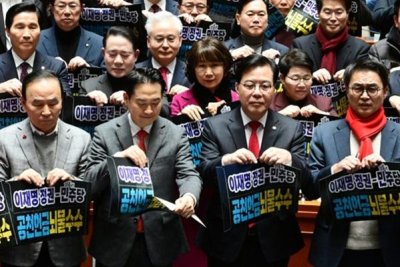

People Power Party leader Jang Dong-hyuk and lawmakers tear up protest placards during a party meeting at the National Assembly in Seoul on Tuesday. Photo by Asia Today
Jan. 13 (Asia Today) — South Korea’s People Power Party has shown little sign of regaining support despite an apology and a reform package tied to the Dec. 3 emergency decree, with polls showing the gap widening between the conservative party and the ruling Democratic Party of Korea.
Political observers said Tuesday that public sentiment appears to be moving in favor of President Lee Jae-myung and the Democratic Party, while the People Power Party has stagnated or slipped in successive surveys.
In a poll commissioned by the Energy Economy Newspaper and conducted by Realmeter from Sunday through Thursday among 2,530 voters nationwide age 18 and older, party support stood at 47.8% for the Democratic Party and 33.5% for the People Power Party. The Democratic Party rose 2.1 percentage points from the prior week, while the People Power Party fell 2.0 points, the poll found.
Analysts cited what they called a “Yoon Suk-yeol factor” as a key reason the conservative party has struggled to draw a positive response. While People Power Party leader Jang Dong-hyuk’s reform plan included an apology over the martial law declaration, critics said it did not clearly address how the party would define its relationship with former President Yoon Suk-yeol.
They said the plan offered no direct message on accountability, political separation or future ties beyond expressing regret and leaving past issues to the courts and “history’s judgment.”
Some observers also questioned whether Jang’s personal reform push has enough political impact to shift voter views. The measures he announced last week focused on an apology over martial law, a youth-centered party vision and a proposed party name change, but did not spell out what the party would abandon or where it would draw clear lines.
Political commentator Park Sang-byeong said an apology alone is not the same as taking responsibility, adding that he saw no visible political decision-making behind the message.
— Reported by Asia Today; translated by UPI
© Asia Today. Unauthorized reproduction or redistribution prohibited.