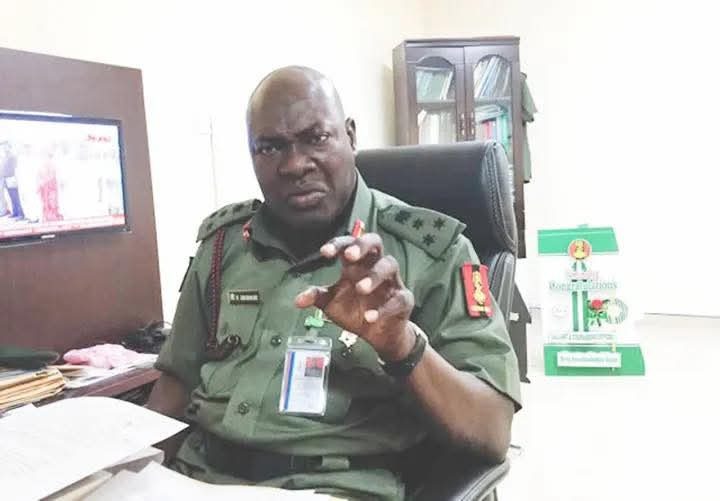
For two weeks, the fate of Major General Rabe Abubakar (rtd) had become a barometer for testing whether Nigerian authorities could secure the release of a high-ranking military officer from the hands of terrorists operating in the northwestern region.
The answer came on Saturday, June 13, in a press statement by Nasiru Muazu, Katsina’s Commissioner for Internal Security and Home Affairs. The retired general could not be rescued, the Katsina government itself said. Rabe, who served as the Director of Defence Information at Nigeria’s Defence Headquarters between 2015 and 2017, died while in detention at the hands of the terrorists who abducted him.
Rabe was abducted alongside his wife, Hajia Amina, on May 30. A native of Batsari from Katsina State, he was kidnapped on the Matazu–Sayaya road, a road that has now become one of the most volatile in the North West.
“It is with profound sadness that we confirm the General’s death while in bandits’ captivity. Despite the relentless and concerted efforts of the State Government and various Security Agencies to secure his safe release, the situation ended in this tragedy. The deceased Retired General died a natural death from complications of diabetes and hypertension,” Nasiru said in the statement.

The abduction of the general had exposed how deeply terrorism has eaten into the fabric of Nigeria, especially the North West, where criminals have turned into full-time armed gangs that engage in kidnapping, pillaging, and other forms of terrorism.
For over a decade, Katsina and other states in the region have faced incessant attacks from these terrorists, forcing local authorities to consider a “reconciliation” with the armed groups to restore peace. Some local government areas in Katsina, such as Jibia, Batsari, Kurfi, Safana, Danmusa, Matazu, Musawa, Kankara, Faskari, Malumfashi, and Bakori, have agreed to establish peace accords with terrorists in their areas.
However, while some of these areas have seen relative calm, the situation in Matazu, Bakori, Musawa, Kankia, and Malumfashi has only deteriorated. The Marabar Musawa – Musawa – Matazu – Kafin Soli road (where the General was abducted) became volatile after the peace deal broke.
Even before May 30, there were several cases of abduction on the road as well as attacks on communities and towns in the area. HumAngle reports that Muhammadu Fulani, the terrorists’ leader in the Matazu – Musawa area, is accusing the state government of arresting three of his men and seizing his livestock.
Ambush on a wedding road
Rabe was travelling with his driver and wife to Katsina for a wedding ceremony when the terrorists emerged near a village called Zakin Baure, blocked the road, and opened fire on his vehicle, a red coloured Peugeot 406 car, according to media reports. That forced the vehicle to a halt, enabling the terrorists to abduct him and his wife and push them into a nearby forest. His driver, however, escaped with gunshot injuries and was later admitted to a hospital.

They were heading toward Katsina city for a family wedding through the perilous corridor, Marabar Musawa–Musawa–Matazu–Kafin Soli, which sits at the fault line of a regional peace architecture that has become increasingly fragile.
Abduction timeline
June 6: The terrorists released a video clip of the couple begging for the government to rescue them. The wife, who spoke, asked the government to facilitate the release of some three terrorists arrested by security agents in exchange for the couple’s freedom.
June 8: The terror group leader, Muhammadu Fulani, said he would not release the wife of the General, Amina, as promised, after the government dispatched security agents to the area to fight him.

June 11: A video clip of the General, his wife and four others went viral on social media. HumAngle checks revealed that the other four persons in the video were members of the All Progressive Congress (APC) from Danja Local Government Area of the state who were abducted last month on the same road.
June 12: A special prayer session was organised at the Sa’ad Bin Abi Waqqas Mosque in Barhim Estate, Katsina city, at 5 p.m.. Several relatives and friends of the Major General attended the prayer session, where the Imam called on the government to ensure the safe return of Rabe, his wife, and all abducted victims.
June 13 (morning): A WhatsApp message began circulating, especially in Katsina. The message said the General had died Friday night, June 12. “Innalillaihi wa ina ilaihil rajiun. This is to announce on a sad note. The death of General Rabe Abubakar last night at the hands of the bandits.” A HumAngle reporter also received a message from a retired civil servant asking for confirmation.
June 13 (afternoon): The Katsina State government, through the Ministry of Internal Security and Home Affairs, confirmed the General’s death, saying that he died “a natural death from complications of diabetes and hypertension”.
A symbol, and a warning
General Rabe’s death has reverberated through Nigeria’s security establishment and social media platforms precisely because of who he was: a man who had once stood before cameras explaining the state’s fight against terrorism. It also brings renewed attention to Nigeria’s growing terrorism and persistent security challenges facing several northern states despite ongoing military operations against the armed groups.
Dikko Umaru Radda, the Katsina State governor, called the episode a “dark moment,” saying it highlighted the urgent need for a stronger, more coordinated security response, while pledging that those responsible would be pursued.
For residents of Katsina’s volatile corridors, Rabe’s death is a confirmation of what many have long understood: on the state’s insecure roads, rank, fame, and a lifetime of service offer no immunity at all.
His wife’s status was not addressed in Saturday’s statement, and her deceased husband was buried according to Islamic rites, but sources told HumAngle she was released alongside her husband’s remains.
Major General Rabe Abubakar, a retired officer from Nigeria’s Defense Headquarters, was abducted along with his wife on May 30, 2023, by terrorists in the volatile northwestern region of Nigeria. Despite efforts from the government and security agencies, he died in captivity on June 12 from complications of diabetes and hypertension. His death underscores Nigeria’s persistent battle with terrorism, especially in the North West, where areas have seen increasing attacks and failed peace agreements.
The abduction occurred as the couple traveled to a wedding, bringing attention to the terror threats on roads like the Marabar Musawa-Matazu-Kafin Soli corridor. Nigerian authorities have been criticized for their inability to secure his release, highlighting the deep-rooted insecurity facing the region. Rabe’s death, confirmed by the Katsina State government, signals urgent needs for coordinated security efforts, as eloquently stated by the Katsina State governor, Dikko Umaru Radda. Rabe’s abduction and demise spotlight the widespread and growing terrorism despite ongoing military interventions in northern Nigeria.