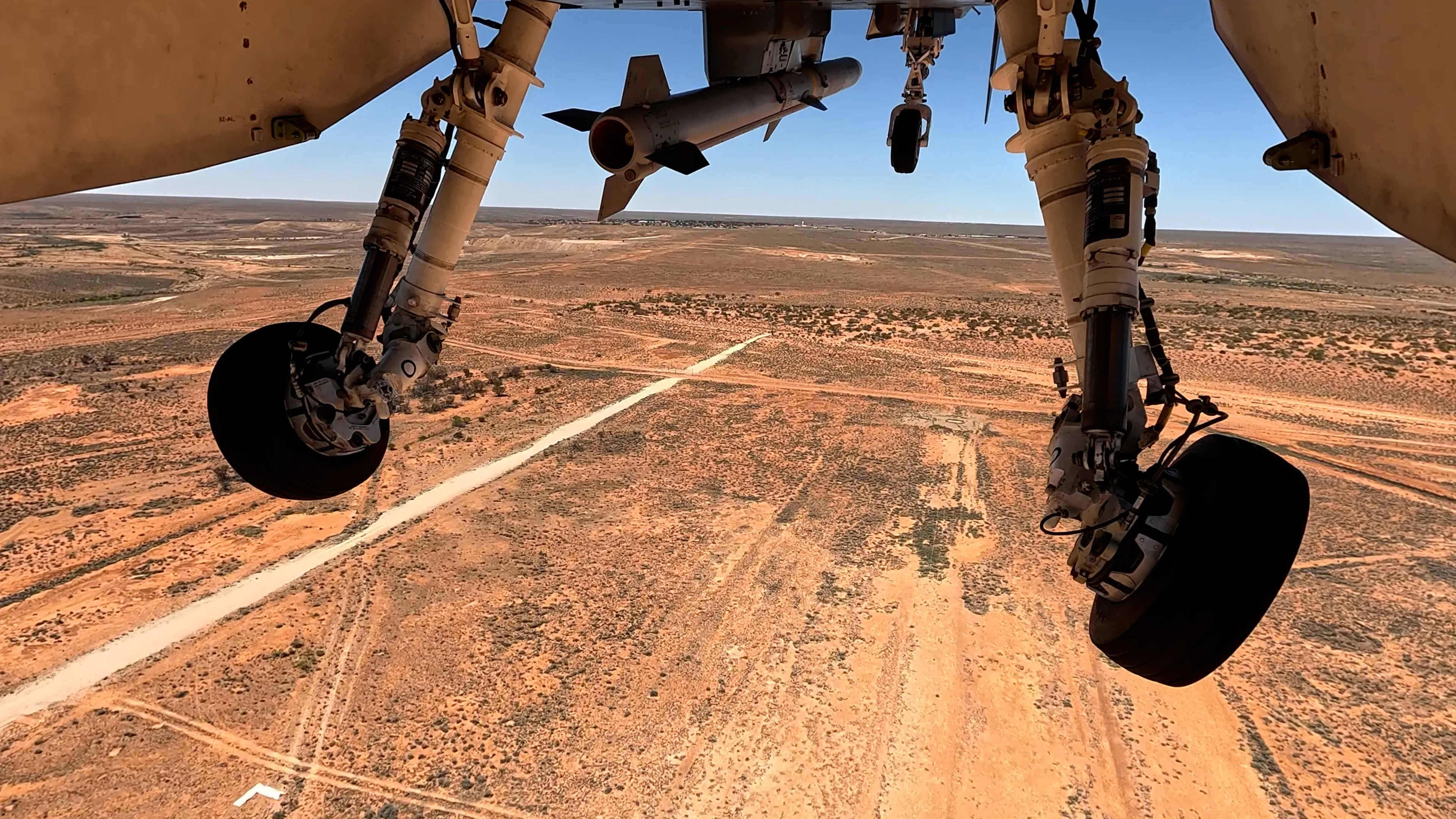
Boeing has made good on its promise of completing a first live-fire weapons shot from its MQ-28A Ghost Bat drone, with an AIM-120 Advanced Medium-Range Air-to-Air Missile (AMRAAM) launched over the sprawling Woomera Range Complex (WRC) in southern Australia. The milestone event comes as the Australian government commits further to the Ghost Bat program, with an investment of around $930 million in collaborative air capabilities.


The AIM-120 shot, part of the ongoing Trial Kareela 25-4, took place on December 8, and the engagement saw the MQ-28 teamed as a loyal wingman with a Royal Australian Air Force (RAAF) E-7A Wedgetail airborne early warning and control (AEW&C), with “support” provided by an F/A-18F Super Hornet. A live AMRAAM was used to “successfully engage and destroy” an Australian-made Phoenix jet-powered target drone.
The MQ-28 was fitted with a single AMRAAM carried on a prominent external pylon mounted on the left-hand underside of the drone, directly below the engine air intake. In its current configuration, Ghost Bat lacks an internal weapons bay, something that may well be addressed in the future.


According to a media release from the Australian Defense Force, “This landmark demonstration proves that the MQ-28A is a world-leading Collaborative Combat Aircraft (CCA) capability and underlines the MQ-28A’s growing potential to deliver an operational capability for the Royal Australian Air Force.”
Few other details of the engagement have so far been made available, but Boeing had previously said it would reflect “a tactically relevant scenario.”
At this stage, we don’t know how the drone found and tracked the target, i.e., whether it did this using its own sensors, or via datalink from another platform.


As we observed before, one option would have been to use the infrared search and track (IRST) sensor seen fitted in the nose of at least two MQ-28s. However, photos from Trial Kareela 25-4 don’t show the IRST — which is understood to be a Selex system — fitted. The MQ-28 is a highly modular design, meaning various munitions, sensors, and other payloads can be integrated; the entire nose can be swapped out to accommodate different payloads.
It is also worth noting that the MQ-28 used in the live-fire trial has a prominent radome with a serrated edge, something that we have seen on at least one of the drones in the past. The Ghost Bat is designed to be capable of housing an onboard radar, at least in future variations.
Using the MQ-28 as a loyal wingman to an E-7 in Trial Kareela 25-4 suggests that target telemetry may have been provided by the radar plane.


Boeing and the RAAF have already conducted some important collaborative work using these two platforms.
“We’ve been sort of testing out some of these capability demonstrations,” Parker said last month. “[The] Wedgetail has already controlled two live MQ-28s with a digital, virtual MQ-28 in the pattern, as well, [and] with a target. We’ve already been doing this. So, we’ve already been doing a bunch of multi-ship activities.”

MQ-28A Ghost Bat Milestone
Potentially, the target may have been handed over to the MQ-28 by the F/A-18F, with the drone very much seen as an adjunct to crewed fighters. In a statement after the live-fire test, Australian Minister for Defense Industry Pat Conroy said: “The Ghost Bat transforms a single fighter jet into a formidable team — capable not only of surveillance but also of engaging adversaries. This delivers a vital layer of protection for our aviators, who remain our most valuable asset.”
The plan to conduct the AMRAAM shot sometime in December was announced by Steve Parker, president and CEO of Boeing Defense, Space, and Security, at a media roundtable ahead of the 2025 Dubai Airshow last month, at which TWZ was in attendance. Boeing officials had said on various occasions earlier this year that the live-fire test could come in late 2025 or early 2026.


We had anticipated that the AMRAAM shot would be not only a first for the MQ-28, but also the first for any CCA-type drone, at least that we know about.
In any event, the Turkish Kizilelma uncrewed combat air vehicle (UCAV) reached this milestone first, using a Turkish-made radar-guided Gökdoğan air-to-air missile to destroy a target drone, as you can read about here.
The Australian government today also announced its latest tranche of funding for collaborative air capabilities, the centerpiece of which involves “transitioning the MQ-28A Ghost Bat into a fully operational war-fighting asset for the Australian Defense Force.”
The latest investment includes new contracts with Boeing Defense Australia (BDA) for six operational Block 2 MQ-28A aircraft and the development of an enhanced Block 3 prototype. In the past, there have been hints that the Block 3 version might include internal weapons carriage, which would ensure the drone retains its low-observable characteristics.


Australia has already acquired eight MQ-28s, all pre-production prototypes, also referred to as Block 1 aircraft. The service previously awarded Boeing a contract to deliver at least three more examples in the improved Block 2 configuration.
While the Block 2 drones are seen as a pathway to an operational capability, when that might actually materialize remains unclear.
Nevertheless, in its announcement today, the Australian government said that the new orders, once fulfilled, “will lay the foundation for an operational Air Combat Platform capability within the Royal Australian Air Force.”


The latest funds, roughly $930 million, constitute just a part of the Australian government’s investment in various different drones over the next decade, under the 2024 National Defense Strategy. This should amount to more than $6.6 billion in all, which will include at least $2.8 billion for uncrewed aerial systems.
Meanwhile, outside of the Australian Defense Force plans, Boeing has recently talked up the possibility of new customers for Ghost Bat, including the U.S. Navy and Poland. Overall, the MQ-28 would appear uniquely well placed for potential export, since it is not only the most mature (known) CCA of Western design, but it is also relatively independent of U.S. export restrictions.

In terms of U.S. Air Force involvement, Boeing was cut from its Collaborative Combat Aircraft (CCA) drone program last year in a down-select. The company did take part in the initial stages of the first phase of that program, or Increment 1, and the Air Force has utilized at least one Ghost Bat in the past to support test work related to the CCA program. Since this is structured around multiple iterative development cycles, Boeing could return to compete in the next cycle, or Increment 2, perhaps with a version of the MQ-28 design.
For the time being, the MQ-28 is very much flying the flag for Australia, with that country now being one of the global leaders when it comes to the development of collaborative combat aircraft.
Contact the author: thomas@thewarzone.com