AIM120

YFQ-44A Fury ‘Fighter Drone’ Has Fired Its First AIM-120 AMRAAM Missile

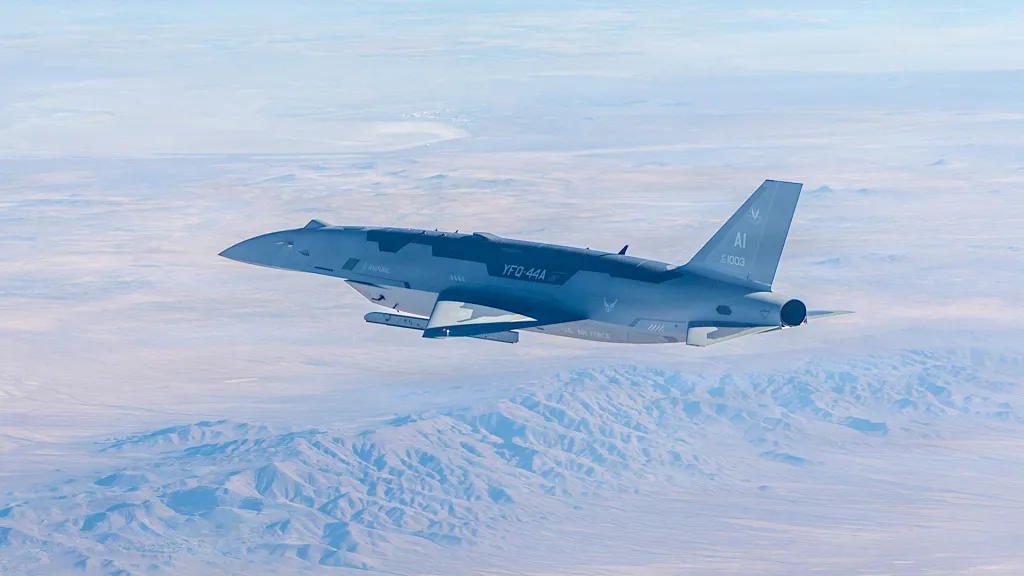
Anduril’s YFQ-44A Fury Collaborative Combat Aircraft (CCA) has live-fired a munition at a simulated target for the first time in a test conducted from Edwards Air Force Base in California. The launch of the AIM-120 Advanced Medium Range Air-to-Air Missile (AMRAAM) is also a first for any U.S. CCA-type drone. This is an important step forward in the development of Fury and for the U.S. Air Force’s CCA program.

The YFQ-44A is one of two drones in development as part of the first phase, or Increment 1, of the Air Force’s CCA program. The other is General Atomics’ YFQ-42A Dark Merlin. Last month, the service announced orders for production versions of both designs, which will form a mixed initial operational CCA fleet.

“The live-fire test was performed in coordination with the 412th Test Wing’s Air Dominance Combined Test Force, a team consisting of active-duty military, government civilians, and government contractors, who worked to refine and validate the models required for a safe live-fire execution,” according to a press release the Air Force put out today. “This latest milestone continues the rapid pace of developmental testing for safe and effective CCA operations.”

The Air Force’s release also says the AIM-120 missile was fired “in secluded airspace over the Mojave Desert” at what is described as a “digital target.” In its current configuration, the YFQ-44 carries stores externally on either of two hardpoints, one under each wing.

The YFQ-44A is seen flying somewhere over the Mojave Desert after the live-fire AIM-120 launch. USAF

“We executed the first weapons shot from YFQ-44A, an important milestone in turning CCA into an operational capability,” Mark Shushnar, Anduril’s Vice President of Autonomous Airpower, also said in a statement. “This was more than a simple weapons release test – it demonstrated an end-to-end, beyond-line-of-sight strike against a simulated target. YFQ-44A took off from Edwards Air Force Base, our Lattice software ingested a target track, an operator tasked the aircraft to engage the target, and YFQ-44A fired an AIM-120 as instructed.”

Lattice for Mission Autonomy: An Unfair Advantage for Unrivaled Deterrence thumbnail

Lattice for Mission Autonomy: An Unfair Advantage for Unrivaled Deterrence


The Air Force had announced in February that the CCA program had entered the weapons integration and captive carry testing phase. A picture of a YFQ-44A carrying an inert AIM-120 was released at that time. To date, General Atomics YFQ-42A has not been seen carrying a munition, inert or live. The Air Force and General Atomics have said the YFQ-42A is on track to conduct a live-fire launch later this year, according to Breaking Defense.

“This [new live-fire] event is part of a deliberate, phased test progression that began with inert carriage evaluations earlier this year,” per the Air Force’s release today. “The initial inert weapons captive carry flights focused on collecting in-flight data to verify the aircraft’s handling. Subsequent evaluations validated the data link integration between the aircraft and the weapon system, ensuring operator commands were executed precisely by the platform in a simulated environment.”

The Air Force released this picture of a YFQ-44A carrying an inert AIM-120 in February. USAF

“Moving from inert carriage earlier in the year to this weapon release demonstrates program maturity, allowing us to validate our digital integration models with actual data,” Air Force Gen. Dale White, Direct Reporting Portfolio Manager for Critical Major Weapon Systems, also said in a statement. “These tests provide operational validation that Collaborative Combat Aircraft can execute the weapon employment sequence autonomously within pilot-defined parameters, accelerating capability delivery to the warfighter.”

The Air Force is not the first to conduct a live-fire munitions launch from a CCA-type drone. In December 2025, a Turkish Kizilelma drone launched a pair of domestically-produced Gökdoğan air-to-air missiles. One of those missiles was fired at a physical target drone. You can read more about the test here.

Bayraktar #KIZILELMA | GÖKDOĞAN Füzesi Atış Testi thumbnail

Bayraktar #KIZILELMA | GÖKDOĞAN Füzesi Atış Testi


Later in December 2025, the Royal Australian Air Force (RAAF), in cooperation with Boeing, test-fired an AMRAAM from an MQ-28 Ghost Bat drone, as you can read more about here. The missile successfully engaged an Australian-made Phoenix jet-powered target drone.

Uncrewed MQ-28 Ghost Bat showcases its combat capability thumbnail

Uncrewed MQ-28 Ghost Bat showcases its combat capability


The U.S. Air Force has long said that air-to-air combat will be the main mission for its initial CCA fleet. The drones will also help increase the sensor reach of crewed fighters they’re teamed with. These drones, as well as other designs acquired through future iterative development cycles, could take on additional missions down the line. The Air Force sees CCAs, in general, as providing vital extra capacity, or ‘mass,’ during future operations, especially potential high-end fights against opponents such as China. By extension, they will also help reduce risk to crewed platforms and open up new tactical possibilities.

“This live-fire test is an important next step in the development of Collaborative Combat Aircraft,” Air Force Chief of Staff Gen. Ken Wilsbach said in a statement today. “We’re one step closer to delivering capabilities to the warfighter.”

With the Air Force aiming to begin fielding its first CCAs before the end of the decade, we can expect weapons and other testing to continue ramping up.

Contact the author: joe@twz.com
Joseph is TWZ’s Deputy Editor, helping to oversee the site’s highly experienced and dedicated team, while also writing informative and impactful defense and national security content. He lives right in the thick of it in the Washington, D.C. area.


Source link

Boeing’s New Larger Ghost Bat Can Carry AIM-120 AMRAAMs Internally

Boeing has provided details of the latest iteration of its MQ-28 Ghost Bat collaborative combat aircraft (CCA). Already, the Ghost Bat was the most mature known CCA, but the enhanced version of the drone, the Block 3, has various new features. These include a larger wing and a pair of internal weapons bays, which means it can carry munitions without diminishing its low-observable characteristics.

The MQ-28 Block 3 was revealed today at the ILA Berlin airshow, taking place this week in the German capital. The unveiling was conducted by officials from both Boeing Australia and Germany’s Rheinmetall. The German firm is partnered with Boeing to offer the drone to the German military, as well as to tap into the potentially very lucrative European CCA market.

“This is the aircraft that we are offering to Germany,” MQ-28 Global Program Director, Glen Ferguson, said at the rollout. “This is the third iteration of design now, and we are on point to build out first [Block 3] aircraft next year.”

The previous Block 1 and Block 2 variants have completed more than 150 test sorties in Australia and the United States.

Australia has already acquired eight Block 1 MQ-28s, which are configured as pre-production prototypes.

The first nine Block 2 drones, now in production, are seen as a pathway to an operational capability, which is fully realized in the Block 3.

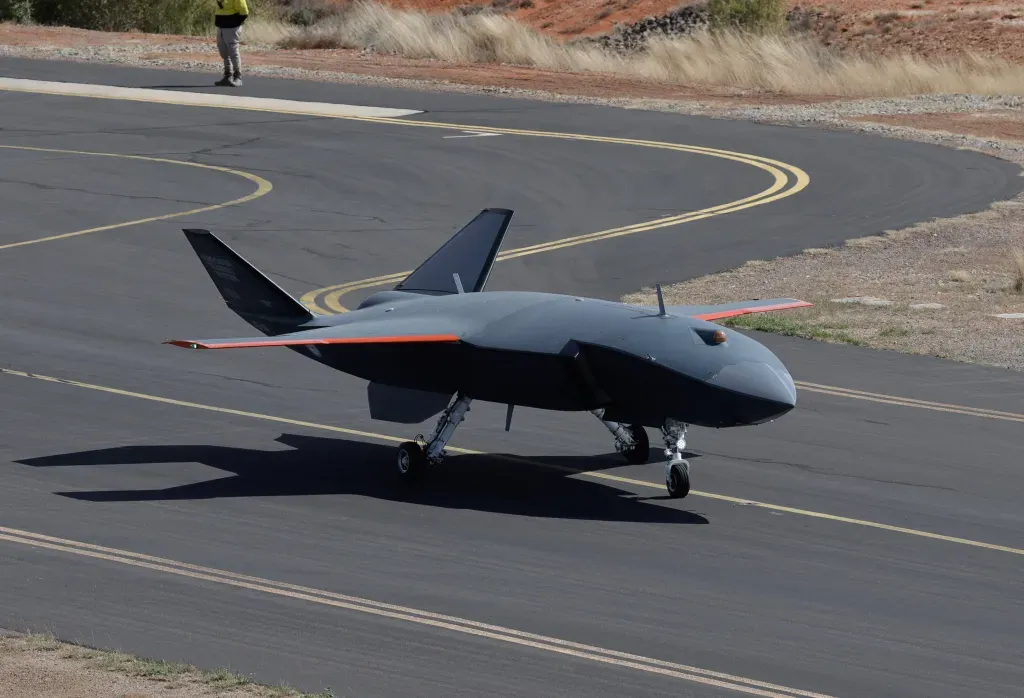
An MQ-28A Ghost Bat taxis prior to flight at Woomera, South Australia, in September 2025. Australian Department of Defense

The Block 3 aircraft features a wing that is 25 percent larger, combined with a thrust increase from 10,000 pounds to 12,000 pounds. It’s not immediately clear how that thrust increase will be achieved, but coupled with greater wing area, it will confer an increased payload capability. This translates into an additional 2,000 pounds of fuel, stores, and mission payloads.

“That additional capacity gives operators freedom to balance payload and endurance to configure for the mission at hand, whether that means carrying extra fuel for longer-range operations, increasing weapons carriage, or any combination of both,” Ferguson said.

The latest iteration of the drone also adds beyond-line-of-sight (BLOS) control. Introduction of BLOS communication links means the MQ-28 can be operated at unlimited standoff distances, whether from a ground station, a naval vessel, or a crewed aircraft. With its range of over 2,000 nautical miles, adding BLOS to the drone also ensures that it can conduct independent operations when not controlled by a crewed aircraft, which was always envisioned as a potential role for Ghost Bat. Having a SATCOM option also opens up better resiliency for control in electronic warfare combat environments.

“Inclusion of features such as BLOS capability is a direct result of our learnings to date along with feedback from air forces as they understand more about the role and integration of CCAs into joint force operations,” Ferguson explained.

As for the critical internal weapons bays, these are added within each side of the slab-side fuselage, shown in a video released by Boeing.

A screencap from a Boeing video showing a CG version of the Block 3 drone with one weapons bay open, to reveal SDBs. Boeing screencap

Each bay can carry a single AIM-120 Advanced Medium-Range Air-to-Air Missile (AMRAAM) or two Small Diameter Bomb (SDB) precision-guided munitions. These can comprise either the GBU-39/B SDB I or the GBU-53 SDB II, also known as StormBreaker. The Ghost Bat is the first CCA we have seen capable of carrying AIM-120s internally, a significant development in itself. The option for internal stores carriage is also a huge deal at this point, with Boeing having recently validated its radar cross-section (RCS), proving that the CCA is harder to detect and better able to operate in contested environments.

Elevation, or pitch, is one angle engineers analyze to validate MQ-28’s radar detectability inside Boeing’s test chamber. Other positions used in radar cross-section testing include azimuth (measure from nose to tail) and roll (rotation around the aircraft). Above left: Views of MQ-28 on the flight line. Boeing

“The combination of a highly capable platform, stealth features and advanced autonomy provides unprecedented ability for air forces to extend their mission effectiveness and operational flexibility,” said Brad Thompson, director for Phantom Works Australia, after the completion of the RCS trials.

The drone also has provision for three external weapons stations. At least one of these has already been tested, during an end-to-end engagement in which a target drone was brought down by an AMRAAM. The air-to-air role is notably relevant since the drone is also envisaged as a force-protection asset, to defend airborne early warning aircraft and tankers, etc, as well as working with fighter aircraft. Combined with more thrust and larger wings, the external pylons would appear to open up the possibility of flying with as many as five AMRAAMs, and at least four, or with a mixed load of air-to-air and air-to-ground weapons.

An AIM-120 is launched from an MQ-28A Ghost Bat during Trial Kareela at RAAF Base Woomera, South Australia. Australian Department of Defense

For Block 3, Boeing is also known to be working on three or four alternative sensor payloads. Integration of these would be facilitated by the fact that the entire nose can be swapped out to accommodate different payloads.

A quartet of MQ-28s, the two in the middle having IRST sensors on top of their noses. Boeing

Bringing the MQ-28 Block 3 from Australia to Berlin reflects the relationship between Boeing Australia and Rheinmetall and the fact that the German Air Force — the Luftwaffe — is being pitched to for its CCA requirement.

“At the moment, we are still in negotiations with the German government, but if they want to have the plane by 2029, my expectation is that by at least next year, we have to go into the final stage of negotiating the contract,” Rheinmetall CEO Armin Papperger told Breaking Defense.

In expectation of a German CCA requirement, the ILA Berlin airshow featured a heavy presence of combat drones.

Also making its public debut was a full-scale model of the Airbus U760 Ravenstorm, a combat drone designed to operate alongside fighter aircraft in air-to-air combat, strike missions, and electronic warfare roles. The new uncrewed aircraft is part of a revamped drone portfolio from the company, and you can read more about it here.

A rendering of the U760 Ravenstorm. Airbus

As well as Ravenstorm, Airbus is also offering a Europeanized version of the stealthy XQ-58A Valkyrie, which is apparently being pitched as a lower-cost aircraft and one that offers the option of runway-independent operations.

From the United States, General Atomics Aeronautical Systems presented a full-size model of a drone from its Gambit family, with the company also confirming that it has been in talks with Germany regarding its CCA requirements.

Meanwhile, German firm Helsing revealed a new version of its CA-1 Europa drone — which looks remarkably similar to Ghost Bat. The CA-1EA (for Electronic Attack) follows the CA-1KA (Kinetic Attack) and reflects the high priority Germany attaches to its need for a CCA to accompany its forthcoming Eurofighter EK electronic warfare jets, as well as other combat aircraft.

Helsing says the CA-1KA is planned to begin flight testing early next year. To get around issues of testing this class of drone in European airspace, the first flying prototype will feature a cockpit for a safety pilot.

Even if the MQ-28 Ghost Bat loses out in Germany, in the face of stiff competition, the Block 3 version already has the support of Australia, which also wants to upgrade earlier aircraft to the same standard.

“These features, developed in partnership with the Royal Australian Air Force, will be progressively released to the fleet through a spiral upgrade program, and are available to interested allied countries,” Ferguson said.

The Boeing official added that the MQ-28 will be in service with the Royal Australian Air Force in 2028, and he is “fairly certain that it will be the first operational CCA anywhere in the world.”

When Boeing and Rheinmetall announced their strategic partnership back in March of this year, they said that the MQ-28 could be provided to the German Armed Forces by 2029.

It should also be noted that Boeing is now conducting test flights of the Ghost Bat from the U.S. Navy’s base in Point Mugu, California. The company says its main goals in doing this are to demonstrate the maturity of the design and promote export sales, but the trials could well also point to potential U.S. military interest.

A lot could change before then, and it is unclear to what degree Germany’s CCA requirements have been defined, while any procurement will also have to navigate decision-makers in the government.

In the meantime, the MQ-28 Ghost Bat continues to evolve. The unveiling of the Block 3 version today underscores how rapidly the collaborative combat aircraft market is maturing.

Contact the author: thomas@thewarzone.com


Source link