MQ28

Australian MQ-28 Ghost Bat Fighter Drones Could Be Commanded By U.S. Pilots

The U.S. Air Force is “threaded in tight” with the work Australians are doing with the MQ-28 Ghost Bat uncrewed aircraft, according to the service’s top officer in the Pacific. This was underscored by the MQ-28’s participation at a major exercise earlier this year, lessons from which are feeding into the Air Force’s evolving plans for its forthcoming Collaborative Combat Aircraft (CCA) drone fleets. Deep integration between the U.S. Air Force and the Royal Australian Air Force (RAAF) opens the door to American personnel potentially ordering Australian MQ-28s around in the future, too.

Air Force Gen. Kevin Schneider, head of Pacific Air Forces (PACAF), discussed the importance of the inclusion of the MQ-28 in Exercise Valiant Shield 2026, as well as other topics, earlier today. Schneider’s remarks came during a talk the Air & Space Force Association’s Mitchell Institute for Aerospace Studies hosted online.

“Grateful that we were able to incorporate some of this in Valiant Shield or to be a part of it. I’d say most of the interaction in Valiant Shield was within our test community,” Schneider said when asked about the involvement of the MQ-28 in the exercise. “The experimental operations squadron that we have looking at U.S. Air Force CCA platforms was really threaded in tight with what the Australians were doing. So the cross flow of information within the test and development effort is really strong.”

MQ-28 Ghost Bat Makes Its Debut — F-2, F-35B & P-8 Join Valiant Shield 2026 thumbnail

MQ-28 Ghost Bat Makes Its Debut — F-2, F-35B & P-8 Join Valiant Shield 2026


The experimental squadron Schneider mentioned here is formally called the Experimental Operations Unit (EOU), and is headquartered at Nellis Air Force Base in Nevada. The EOU was first established in 2023 and expanded into a full squadron-sized formation last year. The unit is specifically tasked with supporting the development of new concepts of operations for fielding and employing CCAs, as well as tactics, techniques, and procedures to go with them. The Air Force’s initial CCA force is set to consist of a mixture of General Atomics FQ-42 Dark Merlin and Anduril FQ-44 Fury drones. These are the two types now in development as part of the initial phase, or Increment 1, of the program.

The MQ-28, which Boeing has been developing for the Royal Australian Air Force (RAAF) since the 2010s, is not formally part of the Air Force’s CCA program at present, at least as far as we know. The Air Force has said in the past that it has used at least one of these drones to support work on advanced autonomous capabilities and other related developments. To date, the RAAF has received eight Ghost Bats, all in pre-production Block 1 configuration. Boeing is now working on the first batch of Block 2 MQ-28s, an improved version that is seen as a direct stepping stone toward the now-in-development Block 3 type. The Block 3 will be substantially different from its predecessors, with a longer main wing, internal weapons bays, and other new design elements, as you can read more about here.

At Valiant Shield, the MQ-28 flew together with one of the U.S. Air Force’s new F-15EX Eagle II fighters, among a host of other American and allied aircraft. Whether any of those platforms issued any direct commands to the Ghost Bat during the exercise is unclear. Boeing and the RAAF have previously demonstrated airborne control of the drone via an E-7A Wedgetail airborne early warning and control plane.

A rendering of a RAAF E-7A Wedgetail flying together with a pair of MQ-28s. Boeing

“As that continues to play out and evolve, then we can start looking at operator-to-operator, between the RAAF and the PACAF and USAF, to look at command and control architectures, authorities, exactly how we would use this,” Gen. Schneider continued. “I’m really impressed with how that program, the Ghost Bat program, is going, and what it sets as an example for others that are going down this road with CCAs.”

Being able to pool CCA-like drone capacity, even during a heated and complex fight, based on common architectures, rather than necessarily common platforms, would be of major benefit to all involved. This would extend beyond the tactical realm to maintenance and logistics. TWZ previously laid out a detailed case for exactly this level of deep cooperation, particularly between the United States and Australia, as well as the United Kingdom, as part of the trilateral AUKUS defense cooperation agreement.

A quartet of RAAF MQ-28s. Boeing

Schneider was also asked later in the talk to elaborate on the current state of the Air Force’s own CCA plans in light of his comments about the MQ-28.

“I’m going to give you an unsatisfactory answer. I would say that of my many flaws, one of them is I am somewhat trapped in the present and the here and now. So my sight picture is from today to about three to five years in the future,” the PACAF commander said. “Where CCAs are sitting right now in terms of their development, that’s kind of the edge of my radar scope.”

“Headquarters Air Force is thinking long and hard about this, and especially as they look at future [force] design,” he continued. “So there are others that are more certainly thinking the big thoughts, trying to understand what it is that we need going forward, especially as we look at what are the Increment 2, the second generation of CCAs, what those requirements are, and then how we would incorporate those.”

“I absolutely do see value and opportunity,” Schneider added. “There’s discussion about what are the specific use cases and and how we would employ them. But I would say the better people to pose those questions to are probably sitting in the Pentagon and sitting in Headquarters A5/7 [the office of the Deputy Chief of Staff for Air Force Futures] right now.”

A pre-production YFQ-44A Fury drone seen during a test to demonstrate how CCAs can be deployed and sustained in a contested environment earlier this year. USAF

The Air Force has been working to refine the CCA Increment 2 requirements for some time. Officials have said in the past that the service is leaning toward lower-cost and less complex designs for this second tranche of drones. Novel capabilities, including the ability to be launched from other aircraft, could also be on the table.

“Platforms are important, the high-end exquisite platforms, but rails and munitions, and just in a broad sense, I owe the combatant commander options on how to deal with operational problems,” the head of PACAF also said, talking more generally. “I don’t want to be in a position to go, boss, [and say] ‘I can only offer you this one solution to a operational problem set.’”

“I do think our ability to mass fires and to do a lot of things at at once is also required,” he continued. “You know there is a mix, and we are having the conversation in the Air Force: is what’s the right mix of exquisite to to to exquisite capabilities and mass capabilities, and we’re taking a hard look at all of that.”

It’s also worth noting here that the Air Force already has a formal agreement with the U.S. Marine Corps and the U.S. Navy to develop common control architectures that will enable the seamless transfer of control of CCAs between the services during future operations. Gen. Schneider’s comments today point to the possibility of a similarly deep level of future interoperability with the RAAF, if that isn’t already on the official agenda. There is already direct foreign participation in the Air Force’s CCA program, with the service formalizing a partnership with the Netherlands earlier this year.

Australia is a major U.S. ally, and Gen. Schneider highlighted the especially deep level of integration that already exists between his service and the RAAF during today’s talk.

“Jumping back to [Exercise] Southern Cross in Australia, I am watching American F-35 pilots, not exchange pilots, but American F-35 pilots from an operational unit get into Australian F-35s,” Schneider said. “The Australian air chief [Australia’s Chief of Air Force Air Marshal Stephen Chappell] signed an interfly agreement allowing U.S. Air Force line pilots to fly his airplanes.”

A US Air Force pilot sits in the cockpit of an Australian F-35A Joint Strike Fighter during Exercise Talisman Sabre 25 under the interfly agreement. USAF

“There’s a little bit of a risk associated with that, I’m sure. There’s a burden with that, but you know allies and partners are stepping up at all levels to share that burden. And I was tremendously impressed with Chaps [Air Marshal Chappell] and his team for their willingness to do that,” the PACAF commander continued. “We’re getting towards interchangeability where we can do each other’s jobs, and in this case, the Australians letting us fly their airplanes, which again is tremendous work.”

Gen. Schneider was also asked about the Air Force’s Agile Combat Employment (ACE) concepts of operations. At its core, ACE is centered on rapid and irregular deployments to far-flung operating locations, often with limited logistics support. The concept has been baked into the service’s CCA requirements from the start. This was underscored by an exercise involving both Increment 1 designs that the EOU ran out of Creech Air Force Base in Nevada just last week, which TWZ was first to report on. ACE is also seen as especially critical for future operations in the Indo-Pacific region, particularly during a high-end fight with China. The concept has been evolving now for more than a decade.

Visualizing ACE thumbnail

Visualizing ACE


“To see how much we had evolved from that initial conversation [about ACE] that I was aware of in 2015 to where we are today has been revolutionary, more than evolutionary,” Schneider said. “I give great credit to the units. When we task the units to go out to do exercises, they have really refined how they operate, what they need to operate, how they get down to the minimum amount of kit to do this.”

“There are lessons from existing conflicts, and I would say how Ukraine has been able to operate over the four -plus years of that fight, still to be able to generate air power, has been informative to us. How they collect information, how their I&W [indications warning] of incoming attacks, dispersal, moving around,” he added. There have also been “observations from how Israel over months and years has continued to generate air power in the wave [sic; face of waves] of high-intensity attacks.”

“Again, not going into details, but we do pay attention to that, and that has shaped us,” the PACAF commander explained. “There’s an indication and warning piece, there’s a dispersal piece, there’s camouflage, and concealment and deception, all of which we pay attention to. And we’re looking to continue to build out those capabilities within our formations.”

“And then there’s the active defense piece,” he continued. “You know, as the Air Force continues to look to field systems, sensors, and effectors, PACAF has a large voice in what that looks like, and is able to have influence in the Air Force as we pursue those capabilities.”

Schneider said that physical hardening is part of the equation, too, but did not offer more granular details in that regard. The optimal mix of active and passive defenses to best protect air bases and other critical installations from a growing array of aerial threats that range from ballistic missiles to drones continues to be a very hot topic of debate. This is something TWZ has been following very closely for years now. This discussion is set to become complex in new ways as the Air Force moves to take on additional base defense roles and responsibilities that have historically been assigned to the U.S. Army. The service is very much in the early stages of determining what that will entail and what force posture changes this will require.

A US Air Force F-16 fighter sits inside a hardened aircraft shelter. USAF

New capabilities, including CCAs, and evolving concepts of operations, as well as the growing threat ecosystem, have also prompted questions about how the Air Force expects to perform its central mission of providing air superiority in the future.

“Air superiority is never going to go away. It is a core function of the United States Air Force. Those who seek to change it or redefine it, I would question their doctrinal foundation or their understanding of history,” Gen. Schneider said today. “Air superiority is absolutely essential, and the flexibility that air superiority allows for every other mission to happen is enduring. That is not going to go away.”

“While I certainly appreciate and desire long-range kill chains, there will be vulnerabilities with data paths in whatever we do. I think there’s organic capability that is always going to be important and required for us to have,” he added, speaking more generally. “It’s difficult to predict how a fight is going to go or what capabilities that we will have to face, but our ability to sense our environment organically and to be able to employ [capabilities] based off that information is, I think, a requirement – step one for anything that we do going forward.”

“The long-range kill chain, tremendously important, but if that goes away or is affected or impacted somehow, we have to be able to do what we do based on the information that we can generate ourselves,” he added.

Gen. Schneider noted in passing here in this context that he agreed with Chief of Staff of the Air Force Gen. Kenneth Wilsbach’s assessment that the MQ-9 Reaper has been a key asset in the current conflict with Iran, despite heavy combat losses. “I have desires and designs on that platform, as well, for use in the Pacific.”

A stock picture of a US Air Force MQ-9 Reaper. USAF

It should be pointed out here that the Air Force is now pursuing yet another effort to acquire a direct MQ-9 replacement, with a heavy emphasis on lower costs and modular capabilities, as you can read more about here. This is distinctly separate from the CCA program.

Overall, during today’s talk, Gen. Schneider made clear that a mix of capabilities, and flexible concepts of operations, will be essential for success in future conflicts, especially across the broad expanses of the Pacific. In that context, CCAs and close cooperation with allies and partners, including drones they operate, like MQ-28, will be especially vital.

Contact the author: joe@twz.com

Joseph is TWZ’s Deputy Editor, helping to oversee the site’s highly experienced and dedicated team, while also writing informative and impactful defense and national security content. He lives right in the thick of it in the Washington, D.C. area.


Source link

MQ-28 Ghost Bat Drone Debuts In Large-Force Combat Exercise In The Pacific

The MQ-28 Ghost Bat drone will gain a valuable opportunity to prove its relevance in a high-end coalition environment as part of Valiant Shield 26, the sprawling U.S.-led military exercise spanning Japan, Guam, Hawaii, and Australia, which began this week. It is also, as far as we know, the first time that the MQ-28 has taken part in a multinational large-force exercise of any kind. The participation of the collaborative combat aircraft (CCA) comes soon after Boeing confirmed it was conducting a separate series of test flights of the drone off the coast of southern California, part of efforts to validate autonomous operations and demonstrate rapid deployment from an allied location.

While Australia’s contribution to Valiant Shield includes a P-8A Poseidon maritime patrol aircraft and around 80 personnel, one of the more notable aspects is the involvement of Australian Defense Forces (ADF) aviator observers alongside a U.S.-led MQ-28 component. The arrangement will allow Australian personnel to work with operators and planners as the uncrewed aircraft is employed in a complex, multi-domain operational environment for the first time.

A Boeing Defence Australia’s MQ-28 Ghost Bat, a production representative test aircraft, prepares to conduct a taxi test during Exercise Valiant Shield 2026 at Rota, Commonwealth of the Northern Mariana Islands, June 21, 2026. The Department of the Air Force and its partners will analyze the aircraft’s contribution as a force multiplier that extends the reach, awareness and survivability of crewed platforms in contested environments.
An MQ-28 prepares to conduct a taxi test during Exercise Valiant Shield 2026 at Rota, Commonwealth of the Northern Mariana Islands, June 21, 2026. U.S. Air Force Senior Airman Adrien Tran U.S. Air Force photo by Senior Airman Adrien Tran

Directed by the U.S. Indo-Pacific Command, Exercise Valiant Shield 2026 kicked off on Monday and continues through July 1.

“Valiant Shield demonstrates our enduring commitment to a free and open Indo-Pacific,” Adm. Steve Koehler, commander of U.S. Pacific Fleet, said in a media release. “Exercising advanced multidomain capabilities with our allies ensures we continue to seamlessly innovate and operate together, project combat power together, and prevail over any challenge — together.”

A Boeing Defence Australia’s MQ-28 Ghost Bat, a production representative test aircraft, returns from a taxi test during Exercise Valiant Shield 2026 at Rota, Commonwealth of the Northern Mariana Islands, June 21, 2026. Valiant Shield is a biennial, multinational, joint exercise focused on integrating the joint force in a multi-domain environment. (U.S. Air Force photo by Senior Airman Adrien Tran)
An MQ-28 returns from a taxi test during Exercise Valiant Shield 2026 at Rota, Commonwealth of the Northern Mariana Islands, June 21, 2026. U.S. Air Force Senior Airman Adrien Tran

The U.S. Air Force today released a series of photos showing an MQ-28 taking part in Valiant Shield. The drone was photographed at Rota, in the Northern Mariana Islands, on June 21. Accompanying captions state that the Ghost Bat will be used to advance human-machine teaming, including flying in concert with crewed fighters.

“The Department of the Air Force and its partners will analyze the aircraft’s contribution as a force multiplier that extends the reach, awareness, and survivability of crewed platforms in contested environments,” the U.S. Air Force adds.

The MQ-28 involved in the exercise is configured with an infrared search and track (IRST) sensor system in the nose. The Ghost Bat is a highly modular design, with the nose section designed to be readily swappable.

A Boeing Defence Australia’s MQ-28 Ghost Bat, a production representative test aircraft, undergoes preflight checks during Exercise Valiant Shield 2026 at Rota, Commonwealth of the Northern Mariana Islands, June 21, 2026. During the exercise, the uncrewed MQ-28 will fly in concert with crewed fighter platforms. (U.S. Air Force photo by Senior Airman Adrien Tran)
An MQ-28 undergoes preflight checks during Exercise Valiant Shield 2026 at Rota, Commonwealth of the Northern Mariana Islands, June 21, 2026. Note the IRST sensor mounted above the nose. U.S. Air Force Senior Airman Adrien Tran

The Ghost Bat’s participation in Valiant Shield comes as Australia continues efforts to mature collaborative combat aircraft concepts, an increasingly important component of future air warfare, with the Royal Australian Air Force (RAAF) currently very much at the forefront. Designed to operate alongside crewed fighters and other assets, like tankers and airborne early warning and control aircraft, the MQ-28 is intended to extend sensor coverage, serve as a weapons platform, and perform a variety of other missions while reducing risk to human pilots.

Valiant Shield offers a particularly relevant proving ground for the MQ-28. The exercise brings together forces from the United States, Australia, Japan, Canada, and New Zealand to train in responding to coordinated threats across the maritime, air, land, cyber, and space domains. Participants will be required to detect, track, and engage shared threats while operating across a vast geographic area and under realistic conditions.

For the Ghost Bat program, exposure to this type of coalition environment is significant. Future conflicts in the Indo-Pacific will require seamless integration between allied forces, crewed aircraft, and increasingly sophisticated autonomous systems. Observing how the MQ-28 is incorporated into a large-scale multinational exercise should provide valuable insights as Australia moves toward making its collaborative combat aircraft capabilities operational. Currently, the MQ-28 is slated to be in service with the RAAF in 2028, which would likely make it the first operational CCA anywhere in the world.

A Boeing Defence Australia’s MQ-28 Ghost Bat, a production representative test aircraft, conducts a taxi test during Exercise Valiant Shield 2026 at Rota, Commonwealth of the Northern Mariana Islands, June 21, 2026. Collaborative Combat Aircraft are semi-autonomous aircraft that operate under the oversight of human operators. (U.S. Air Force Senior Airman Adrien Tran)
An MQ-28 conducts a taxi test during Exercise Valiant Shield 2026 at Rota, Commonwealth of the Northern Mariana Islands, June 21, 2026. U.S. Air Force Senior Airman Adrien Tran

The exercise also reflects growing allied interest in integrating uncrewed systems into complex command-and-control architectures and air defense networks. As autonomous aircraft move from experimentation toward operational service, events such as Valiant Shield are becoming important venues for testing how these systems contribute to the broader fight rather than operating as standalone assets. Valiant Shield has served as a diverse test crucible in recent years, with advanced capabilities being put through their paces in a realistic, joint-force environment.

According to defense reporter Carter Johnston, the Ghost Bat’s Indo-Pacific deployment will include operations from an austere airfield led by the U.S. Air Force. This will be conducted under the Agile Combat Employment (ACE) concept, something that is seen as fundamental to survival in a future conflict with China in the Indo-Pacific region. It is also notable that the U.S. Air Force’s new CCA drones are being developed from the ground up around concepts for distributed and disaggregated operations.

The exact status of the MQ-28 with the U.S. military testing community is somewhat unclear, as we have discussed before. There have been indications of Ghost Bat flight testing in the United States in the past, and the U.S. Air Force previously said it had made use of at least one MQ-28 to support advanced uncrewed aircraft and autonomy development efforts. Regardless, the Air Force, at least, has test units set up to explore exactly how to use CCAs operationally, including in an ACE-type environment. This kind of testing is now also involving the first two Air Force Increment 1 CCAs, with the YFQ-44 Fury ‘fighter drone’ prototype notably having been tested out of Edwards Air Force Base, California, helping to demonstrate how CCAs can be deployed and sustained in contested environments.

Other U.S. participants in Valiant Shield 2026 include the George Washington Carrier Strike Group, based around the aircraft carrier USS George Washington with the embarked Carrier Air Wing 5, the cruiser USS Robert Smalls, and the destroyers USS Benfold and USS Shoup.

U.S. Navy aircraft, attached to Carrier Air Wing (CVW) 5, and U.S. Air Force F-35A Lightning IIs fly during joint operations with U.S. Navy George Washington Carrier Strike Group and Japan Maritime Self-Defense Force, as part of Valiant Shield 2026 while underway in the Philippine Sea, June 21, 2026. Valiant Shield is a biennial, multilateral field training exercise conducted by the U.S. Armed Forces and partner nations in the Western Pacific focusing on joint, cross-combatant integration operating seamlessly across sea, air, land, and cyberspace. Exercises like Valiant Shield allow U.S. Pacific Command the opportunity to integrate forces from all branches of service and with our allies to conduct precise, lethal, and overwhelming multi-domain effects that demonstrate the strength and versatility of the Joint Force and our commitment to a free and open Indo-Pacific. (U.S. Navy photo by Mass Communication Specialist 3rd Class Estrella Velarde)
U.S. Navy aircraft, attached to Carrier Air Wing 5, and U.S. Air Force F-35As during joint operations with U.S. Navy George Washington Carrier Strike Group and Japan Maritime Self-Defense Force, as part of Valiant Shield 2026, while underway in the Philippine Sea, June 21, 2026. U.S. Navy photo by Mass Communication Specialist 3rd Class Estrella Velarde Petty Officer 2nd Class Bruce Morgan

Valiant Shield 2026 will also see the deployment of the containerized Typhon missile system in Japan. According to the Japan Ministry of Defense, the Typhon and the High Mobility Artillery Rocket System (HIMARS) will participate in Joint Integrated Anti-Ship Warfare training carried out in the waters around Kanoya and Amami Oshima Island. However, no live firing is scheduled.

The U.S. Army’s Typhon was first deployed to Japan last year, as you can read about here. The system, which can fire Tomahawk cruise missiles and SM-6 multi-purpose missiles, is a growing feature of U.S. military activities in the wider Indo-Pacific region.

U.S. Marines and Sailors observe and familiarize themselves with the U.S. Army’s Typhon missile system during a training opportunity at Marine Corps Air Station Iwakuni, Japan, Sept. 12, 2025. The hands-on session allowed personnel from various units to learn about the system’s capabilities as part of Resolute Dragon 25, an annual bilateral exercise across Japan, including the Southwest Islands, that strengthens the command, control and multi-domain maneuver capabilities of the III Marine Expeditionary Force and the Japan Ground Self-Defense Force’s Western Army personnel with a focus on controlling and defending key maritime terrain. (U.S. Army photo by Sgt. Perla Alfaro)
U.S. Marines and sailors observe and familiarize themselves with the U.S. Army’s Typhon missile system during a training opportunity at Marine Corps Air Station Iwakuni, Japan, September 12, 2025. U.S. Army photo by Sgt. Perla Alfaro Sgt. Perla Alfaro

Returning to the Ghost Bat, it now seems that the test flights of the MQ-28 off the coast of southern California from the U.S. Navy’s base in Point Mugu, California, were an important precursor to Valiant Shield. In fact, the same drone that was flown out of Point Mugu, ATS-008, is the example now involved in Valiant Shield.

Boeing had previously said its main goals of those flights were to demonstrate the maturity of the design and promote export sales. As we noted at the time, the choice of testing location also seemed to be relevant given Boeing’s involvement in the Navy’s still-evolving carrier-based CCA plans.

As for the MQ-28’s previous test campaigns, the drone has been flying in Australia since 2021, with the RAAF having received eight Ghost Bats in the pre-production Block 1 configuration.

Boeing is now building the first of a batch of nine Block 2 drones for the RAAF, which will provide an intermediate stepping stone to the fully operational Block 3 version. The Block 3 aircraft is expected to be substantially larger and have a greater range. It will also feature an internal weapons bay that can accommodate a single AIM-120 Advanced Medium Range Air-to-Air Missile (AMRAAM), two GBU-39/B Small Diameter Bombs (SDB), or equivalently sized stores.

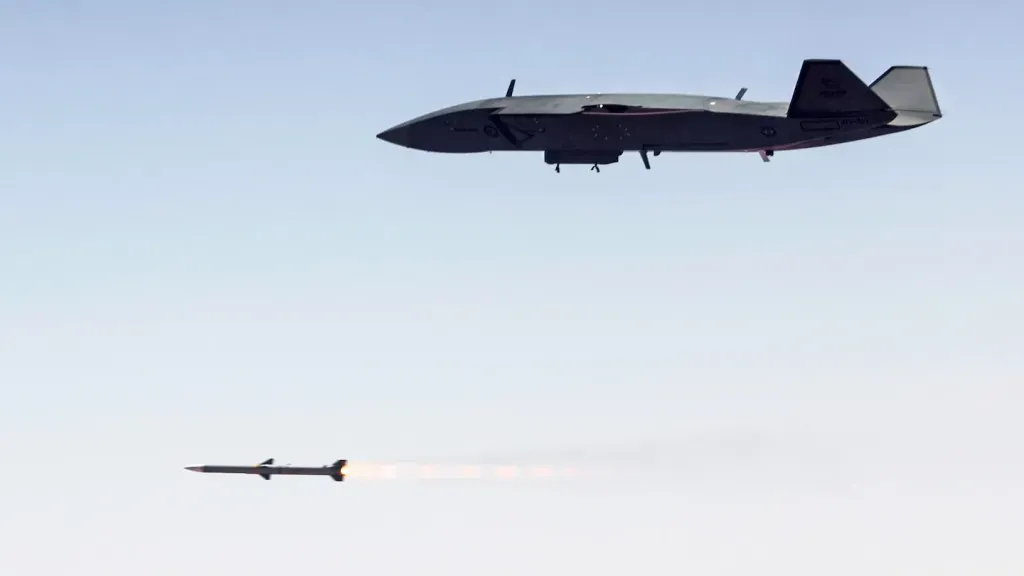
An AIM-120 is launched from a Block 1 MQ-28 Ghost Bat during Trial Kareela at RAAF Base Woomera, South Australia. Australian Department of Defense

The RAAF has employed Block 1 MQ-28s to demonstrate some important capabilities in testing so far. This includes crewed-uncrewed teaming with RAAF E-7A Wedgetail airborne early warning and control aircraft and F/A-18F Super Hornet fighters.

When it comes to potential export sales, participation in Valiant Shield will give Japan, Canada, and New Zealand a closer look at the drone and its capabilities. Of these, Boeing has already publicly named Japan as a potential customer and has said it is exploring potential opportunities with other unnamed countries in the Indo-Pacific region.

MQ-28 Engineering Manager, Wing Commander Rupert Walker, briefs the personnel from the Indian Air Force about the MQ-28A Ghost Bat during a visit to RAAF Base Amberley, Queensland. *** Local Caption *** Deputy Chief of Air Force, Air Vice-Marshal Steven Pesce, AM, hosted Air Vice-Marshal Sanjeev Taliyan of the Indian Air Force during a bilateral visit aimed at strengthening Australia's defence relationship with India through professional dialogue on air operations. The engagement highlighted Australian capabilities in air logistics support, airborne and special operations, VIP transport, air-to-air refuelling, search and survivor assistance, and aeromedical evacuation, with participation from representatives from the Heavy Air Lift Systems Program Office (HALSPO) and 86 Wing Units 33 Squadron and 36 Squadron. The visit reaffirms India is a top tier defence partner for Australia. It highlights the hard work between our aviators to foster and strengthen relationships in pursuit of deepening interoperability. This includes supporting shared understanding, trust-building between subject matter experts, and identifying opportunities for enhanced cooperation. Such engagements strengthen our defence partnership in support of regional security.
Personnel from the Indian Air Force receive a briefing about the MQ-28 Ghost Bat during a visit to RAAF Base Amberley, Queensland. Australian Department of Defense

Valiant Shield should offer the clearest indication yet of how the Ghost Bat can contribute to a coalition fight. As the United States and its allies increasingly embrace autonomous combat aircraft, the MQ-28’s performance in one of the Indo-Pacific’s largest and most complex military exercises will be watched closely as an indicator of how collaborative combat aircraft could be employed across the region in the future.

Contact the author: thomas@thewarzone.com

Thomas Newdick is a staff writer at TWZ, where he covers military aviation, defense technology, weapons systems, and international security. Based in Berlin, Germany, he reports on conflicts, military modernization efforts, and emerging aerospace technologies around the world, with a particular interest in airpower and its role in contemporary warfare. His reporting is informed by deep expertise in modern and historical airpower, particularly in Europe, with a focus on military aviation, air campaigns, and aerospace developments across the continent and beyond.


Source link

MQ-28 Ghost Bat Now Flying Over The Pacific From U.S. Navy Base

Boeing is now conducting test flights of its MQ-28 Ghost Bat drone out over the Pacific from the U.S. Navy’s base in Point Mugu, California. The company says its main goals are to demonstrate the maturity of the design, originally developed for Australia, and promote export sales. The specific choice of testing location also seems notable given Boeing’s involvement in the Navy’s still-evolving carrier-based Collaborative Combat Aircraft (CCA) plans.

The MQ-28 has now flown at least three times within the Point Mugu Sea Range off the coast of southern California, according to a Boeing press release. The expansive range is routinely used for a wide array of research and development and test and evaluation activities, as well as training. Naval Air Station Point Mugu, part of Naval Base Ventura County, sits right on the coast, surrounded by farmland, with direct access to the range and minimal risk to bystanders. Its location makes it well suited for uncrewed aircraft operations, and it already has a major role in this regard in relation to the MQ-4C Triton and managing target drones.

MQ-28 first international flights thumbnail

MQ-28 first international flights


“This testing shows the MQ-28’s ability to operate seamlessly from allied facilities, which helps Boeing demonstrate the aircraft’s maturity and potential export opportunities to international customers outside Australia,” per the press release from Boeing. “Tests at Point Mugu validate autonomous systems while following required airspace, range safety and regulatory approvals.”

Boeing also described this as “MQ-28’s first international operation in allied airspace,” but it is unclear when the first sortie from Point Mugu occurred.

In December, the Pentagon released a video of Secretary Pete Hegseth visiting Naval Air Station Point Mugu with an MQ-28 clearly visible in the background. However, the drone seen in that footage also had an early-style paint scheme with high-visibility orange trim. Pictures and video that Boeing released along with its announcement of the Point Mugu Sea Range flight testing show a Ghost Bat with a two-tone gray livery. It also has an infrared search and track (IRST) sensor system in the nose, something not seen on the example in the Hegseth video. The MQ-28 is a highly modular design, with the nose section designed to be readily swappable.

A comparison of the MQ-28 seen in the video of Secretary Hegseth at Point Mugu, at top, and the Ghost Bat in the video Boeing released as part of its announcement about the flight testing. US Military/US Navy

There have also at least been indications of Ghost Bat flight testing in the United States in the past. The U.S. Air Force previously said it had made use of at least one MQ-28 to support advanced uncrewed aircraft and autonomy development efforts.

Boeing itself released a picture of an MQ-28, again with the early paint scheme and no IRST, at MidAmerica Airport outside of St. Louis, Missouri, back in 2023. In that instance, the Ghost Bat was displayed alongside the demonstrator the company had been using to support the development of the MQ-25 Stingray tanker drone for the Navy.

The picture Boeing released of an MQ-28, at left, and the MQ-25 demonstrator, at right, at MidAmerica Airport in 2023. Boeing

How many Ghost Bats are currently in the United States is unknown. TWZ has reached out to Boeing for more information.

The MQ-28 has been flying in Australia since 2021, two years after the design was first shown publicly. Boeing’s subsidiary in Australia had already been working on the design before then under the Royal Australian Air Force’s (RAAF) Airpower Teaming System (ATS) program. To date, RAAF has received eight Ghost Bats in a pre-production Block 1 configuration.

Boeing is now working to build the first of a batch of nine Block 2 drones, which are seen as an intermediate stepping stone to an operational Block 3 version. The Block 3 type is expected to be substantially larger and have greater range. It will also feature an internal weapons bay that could accommodate a single AIM-120 Advanced Medium Range Air-to-Air Missile (AMRAAM), two GBU-39/B Small Diameter Bombs (SDB), or equivalently sized stores.

A group of four Block 1 MQ-28s. Boeing

Boeing and the RAAF have already conducted at least one live-fire AIM-120 launch from a Block 1 Ghost Bat, with the missile having been carried aloft on an external pylon under the drone’s fuselage.

Uncrewed MQ-28 Ghost Bat showcases its combat capability thumbnail

Uncrewed MQ-28 Ghost Bat showcases its combat capability


Block 1 MQ-28s have also been used to demonstrate other important capabilities in testing to date. This includes crewed-uncrewed teaming with RAAF E-7A Wedgetail airborne early warning and control aircraft and F/A-18F Super Hornet fighters. The ability to operate from allied facilities that Boeing says the Point Mugu sorties demonstrate could be valuable just for Australia for future coalition operations.

MQ-28, Wedgetail, Super Hornet: Drone Intercept Behind-the-Scenes thumbnail

MQ-28, Wedgetail, Super Hornet: Drone Intercept Behind-the-Scenes


Boeing has also been open about its interest in pursuing sales of the MQ-28 outside of Australia. The company has publicly named Japan as a potential customer and has said it is exploring potential opportunities with other unnamed countries in the Indo-Pacific region. In March, Boeing Australia announced a partnership with Rheinmetall in Germany to pitch the Ghost Bat to that country’s armed forces. A carrier-capable version of the design with a tail hook has been pitched to the United Kingdom in the past, as well.

This latter point brings us to what is largely absent in Boeing’s announcement about MQ-28 flight testing from Point Mugu: the U.S. Navy.

In September 2025, the Navy confirmed that it had awarded Boeing, as well as Anduril, General Atomics, and Northrop Grumman, contracts to develop “conceptual” carrier-based CCA drone designs. At that time, the service also announced that Lockheed Martin was under contract for work on an accompanying common control architecture.

In April 2025, Navy Capt. Ron Flanders, public affairs officer at the Office of the Assistant Secretary of the Navy for Research, Development & Acquisition (RDA), had also told TWZ directly that “the U.S. has expressed strong interest in leveraging the MQ-28’s AI-driven autonomy and modular design for future air combat operations.”

As mentioned, Boeing is also developing the MQ-25, a production representative version of which just flew for the first time in April. Beyond the important aerial refueling and other capabilities the Stingray is set to bring to the Navy’s carrier air wings, the service routinely describes it as a “pathfinder” to future uncrewed aviation capabilities.

MQ-25A Stingray First Flight thumbnail

MQ-25A Stingray First Flight


All this being said, the Navy’s CCA plans are still very much evolving. The service, by its own admission, has been trailing behind the U.S. Air Force and the U.S. Marine Corps in the development of CCA-type drones.

Flight testing now from Point Mugu is certainly an important development for the MQ-28 program as a whole, and one Boeing hopes could open the door to new opportunities for the Ghost Bat. Whether or not that includes deeper U.S. Navy involvement remains to be seen.

Contact the author: joe@twz.com

Joseph has been a member of The War Zone team since early 2017. Prior to that, he was an Associate Editor at War Is Boring, and his byline has appeared in other publications, including Small Arms Review, Small Arms Defense Journal, Reuters, We Are the Mighty, and Task & Purpose.


Source link