ghost

UK’s picture-perfect ‘ghost village’ with pretty cottages but not a single resident

The residents of this village fled in 1943 and never came back, leaving abandoned buildings that have been suspended in time, and access to this spooky area is still restricted during certain times

Imagine waking up one day to a letter telling you that your home is being turned into a military zone and that you need to leave within a month. It’s a fate that befell the 225 residents of Tyneham one winter morning.

In November 1943, Britain was still in the depths of World War 2, and needed a strategic location for military testing. The idyllic Dorset village was close to a military firing range, and its peaceful rural location was deemed perfect for D-Day preparation.

Letters were sent to the 102 occupied properties giving them just a month to move out, with the deadline set just before Christmas, with assurances were made that the evacuation was just a temporary measure.

But, decades later, the village is still uninhabited, and increasingly being lost to nature, as its stone cottages and buildings crumble. You can still visit Tyneham to see this old homes up close, but there are restrictions that still need to be followed to this day.

The village is still owned by the Ministry of Defence and is close to an active military firing range, making it inaccessible at certain times. Walkers will need to check the Gov.UK website to see closure dates, and keep in mind that the village is only available to explore from 9am until dusk.

While many of its buildings have fallen into ruin, the church and school were preserved and have become museums dedicated to telling the unique story of Tyneham. You can see photos of the residents and find out about the families who lived in this village through the years.

Tyneham Farm, which was abandoned for many years, is also in the process of being restored, and you can see the remains of the humble cottages where labourers and shepherds once lived in this peaceful, rural spot. However, the reminders of the end of the idyll are all around; some buildings have bullet holes and shell damage scarring their solid stone walls.

About a 20-minute walk away is Worbarrow Bay, an unspoilt shingle beach on the sweeping Jurassic Coast. It has clear, deep blue waters, making it popular with wild swimmers and snorkellers. At low tide, rock pools full of sea creatures can be explored.

At times such as weekends and school holidays, you can often explore Lulworth Ranges which lie within an Area of Outstanding Natural Beauty overlooking the coast. Carry on along the iconic South West Coastal Path and you’ll reach Flower’s Barrow Hillfort, which was built during the iron age. You can still see hut circles where these settlements used to lie.

Nearby, Pondfield Cove is a hidden gem with sand and shingle shores covered in lush green marine vegetation. The sea here is calm and clear, although the sudden depths mean only experienced wild swimming enthusiasts take to the water. However, it’s the perfect place to visit for peaceful fossil hunting away from the crowds.

Have a story you want to share? Email us at webtravel@reachplc.com

Source link

MQ-28 Ghost Bat Now Flying Over The Pacific From U.S. Navy Base

Boeing is now conducting test flights of its MQ-28 Ghost Bat drone out over the Pacific from the U.S. Navy’s base in Point Mugu, California. The company says its main goals are to demonstrate the maturity of the design, originally developed for Australia, and promote export sales. The specific choice of testing location also seems notable given Boeing’s involvement in the Navy’s still-evolving carrier-based Collaborative Combat Aircraft (CCA) plans.

The MQ-28 has now flown at least three times within the Point Mugu Sea Range off the coast of southern California, according to a Boeing press release. The expansive range is routinely used for a wide array of research and development and test and evaluation activities, as well as training. Naval Air Station Point Mugu, part of Naval Base Ventura County, sits right on the coast, surrounded by farmland, with direct access to the range and minimal risk to bystanders. Its location makes it well suited for uncrewed aircraft operations, and it already has a major role in this regard in relation to the MQ-4C Triton and managing target drones.

MQ-28 first international flights thumbnail

MQ-28 first international flights


“This testing shows the MQ-28’s ability to operate seamlessly from allied facilities, which helps Boeing demonstrate the aircraft’s maturity and potential export opportunities to international customers outside Australia,” per the press release from Boeing. “Tests at Point Mugu validate autonomous systems while following required airspace, range safety and regulatory approvals.”

Boeing also described this as “MQ-28’s first international operation in allied airspace,” but it is unclear when the first sortie from Point Mugu occurred.

In December, the Pentagon released a video of Secretary Pete Hegseth visiting Naval Air Station Point Mugu with an MQ-28 clearly visible in the background. However, the drone seen in that footage also had an early-style paint scheme with high-visibility orange trim. Pictures and video that Boeing released along with its announcement of the Point Mugu Sea Range flight testing show a Ghost Bat with a two-tone gray livery. It also has an infrared search and track (IRST) sensor system in the nose, something not seen on the example in the Hegseth video. The MQ-28 is a highly modular design, with the nose section designed to be readily swappable.

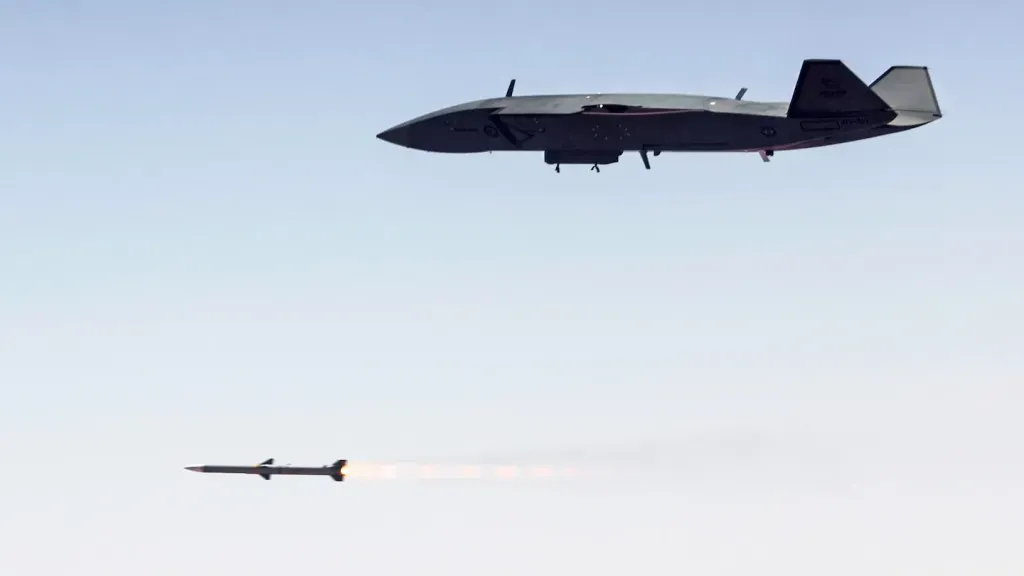
A comparison of the MQ-28 seen in the video of Secretary Hegseth at Point Mugu, at top, and the Ghost Bat in the video Boeing released as part of its announcement about the flight testing. US Military/US Navy

There have also at least been indications of Ghost Bat flight testing in the United States in the past. The U.S. Air Force previously said it had made use of at least one MQ-28 to support advanced uncrewed aircraft and autonomy development efforts.

Boeing itself released a picture of an MQ-28, again with the early paint scheme and no IRST, at MidAmerica Airport outside of St. Louis, Missouri, back in 2023. In that instance, the Ghost Bat was displayed alongside the demonstrator the company had been using to support the development of the MQ-25 Stingray tanker drone for the Navy.

The picture Boeing released of an MQ-28, at left, and the MQ-25 demonstrator, at right, at MidAmerica Airport in 2023. Boeing

How many Ghost Bats are currently in the United States is unknown. TWZ has reached out to Boeing for more information.

The MQ-28 has been flying in Australia since 2021, two years after the design was first shown publicly. Boeing’s subsidiary in Australia had already been working on the design before then under the Royal Australian Air Force’s (RAAF) Airpower Teaming System (ATS) program. To date, RAAF has received eight Ghost Bats in a pre-production Block 1 configuration.

Boeing is now working to build the first of a batch of nine Block 2 drones, which are seen as an intermediate stepping stone to an operational Block 3 version. The Block 3 type is expected to be substantially larger and have greater range. It will also feature an internal weapons bay that could accommodate a single AIM-120 Advanced Medium Range Air-to-Air Missile (AMRAAM), two GBU-39/B Small Diameter Bombs (SDB), or equivalently sized stores.

A group of four Block 1 MQ-28s. Boeing

Boeing and the RAAF have already conducted at least one live-fire AIM-120 launch from a Block 1 Ghost Bat, with the missile having been carried aloft on an external pylon under the drone’s fuselage.

Uncrewed MQ-28 Ghost Bat showcases its combat capability thumbnail

Uncrewed MQ-28 Ghost Bat showcases its combat capability


Block 1 MQ-28s have also been used to demonstrate other important capabilities in testing to date. This includes crewed-uncrewed teaming with RAAF E-7A Wedgetail airborne early warning and control aircraft and F/A-18F Super Hornet fighters. The ability to operate from allied facilities that Boeing says the Point Mugu sorties demonstrate could be valuable just for Australia for future coalition operations.

MQ-28, Wedgetail, Super Hornet: Drone Intercept Behind-the-Scenes thumbnail

MQ-28, Wedgetail, Super Hornet: Drone Intercept Behind-the-Scenes


Boeing has also been open about its interest in pursuing sales of the MQ-28 outside of Australia. The company has publicly named Japan as a potential customer and has said it is exploring potential opportunities with other unnamed countries in the Indo-Pacific region. In March, Boeing Australia announced a partnership with Rheinmetall in Germany to pitch the Ghost Bat to that country’s armed forces. A carrier-capable version of the design with a tail hook has been pitched to the United Kingdom in the past, as well.

This latter point brings us to what is largely absent in Boeing’s announcement about MQ-28 flight testing from Point Mugu: the U.S. Navy.

In September 2025, the Navy confirmed that it had awarded Boeing, as well as Anduril, General Atomics, and Northrop Grumman, contracts to develop “conceptual” carrier-based CCA drone designs. At that time, the service also announced that Lockheed Martin was under contract for work on an accompanying common control architecture.

In April 2025, Navy Capt. Ron Flanders, public affairs officer at the Office of the Assistant Secretary of the Navy for Research, Development & Acquisition (RDA), had also told TWZ directly that “the U.S. has expressed strong interest in leveraging the MQ-28’s AI-driven autonomy and modular design for future air combat operations.”

As mentioned, Boeing is also developing the MQ-25, a production representative version of which just flew for the first time in April. Beyond the important aerial refueling and other capabilities the Stingray is set to bring to the Navy’s carrier air wings, the service routinely describes it as a “pathfinder” to future uncrewed aviation capabilities.

MQ-25A Stingray First Flight thumbnail

MQ-25A Stingray First Flight


All this being said, the Navy’s CCA plans are still very much evolving. The service, by its own admission, has been trailing behind the U.S. Air Force and the U.S. Marine Corps in the development of CCA-type drones.

Flight testing now from Point Mugu is certainly an important development for the MQ-28 program as a whole, and one Boeing hopes could open the door to new opportunities for the Ghost Bat. Whether or not that includes deeper U.S. Navy involvement remains to be seen.

Contact the author: joe@twz.com

Joseph has been a member of The War Zone team since early 2017. Prior to that, he was an Associate Editor at War Is Boring, and his byline has appeared in other publications, including Small Arms Review, Small Arms Defense Journal, Reuters, We Are the Mighty, and Task & Purpose.


Source link

Abandoned UK island where disease left behind a ghost town

This remote island was once a thriving town – but now all that remains are ruins.

Hidden away in a far-flung Scottish archipelago lie the remains of a once-bustling settlement, deserted by all who called it home. The island of Hirta in the Outer Hebrides was occupied for 2,000 years, but during the 1930s, its final inhabitants evacuated due to health concerns.

It’s so isolated that it’s often omitted from maps altogether and can only be reached by boat – weather permitting.

It’s one of 40 islands in the St Kilda archipelago and now hosts the world’s largest gannet colony alongside some of the biggest puffin populations. During its inhabited years, islanders depended heavily on these seabirds – not merely for sustenance but for commerce.

They traded every component of the birds from feather to flesh.

Today, the population has vanished but a handful of military structures remain scattered across the island, overshadowing the crumbling stone cottages that once housed the community.

The structures line what was formerly Hirta’s main thoroughfare – now occupied solely by sheep, reports the Express.

Existence there was extraordinarily harsh, with severe weather conditions and scarce resources available.

To stay warm throughout the lengthy winters, inhabitants would bring livestock inside their basic stone dwellings and allow the waste from cattle and sheep to serve as insulation.

At its height in 1851, Hirta was inhabited by 112 people but this number rapidly dwindled over subsequent years.

Medical provision on the island had always been severely restricted, and as visitors began arriving on the isolated outpost as tourists, they introduced unfamiliar illnesses that the islanders were poorly prepared to combat.

During the 1930s, following the death of a young woman from appendicitis and pneumonia — conditions that might have been treatable on the mainland — the inhabitants of Hirta took the difficult decision to abandon the island.

The residents were evacuated by vessel in August that year and transported to mainland Scotland.

Following their local custom, islanders left a plate of oats and an open bible in every dwelling before stepping aboard the ship.

The final surviving former inhabitant of St Kilda, who was eight years old when the island was evacuated, passed away in 2016.

Source link

‘I was gutted Hollyoaks killed me off but I’d consider returning as a ghost’

Ali Bastian played Becca Hayton in Channel 4 soap Hollyoaks for six years before the character was brutally murdered in a heartbreaking storyline

A Hollyoaks legend has opened up on being killed off unexpectedly by Channel 4 bosses.

Ali Bastian joined the cast of the popular soap opera back in 2001 as Becca Hayton. At the time, the show was attracting millions of viewers and she found herself at the centre of some of its biggest storylines.

After deciding to leave the show in 2007, the actress admits she initially worried she’d made a huge mistake by walking away at the height of its success. However, she was soon rewarded with a regular role in ITV crime drama The Bill.

Opening up about her time on the soap to new online bingo brand Zingo Bingo, Ali recalled: “I was 19 when I started Hollyoaks, and it was a huge break for me. I’d always really wanted to be an actress. It was something that was just kind of in me.

“Becca went through loads of highs and lows in those six years and as an actor, I got to try loads of different things: comedy and heartbreak! My character, in the end, went through a lot of heartache, but it really challenged me as an actor and the speed as well that soap works at is insane.”

Fans will remember Becca was brutally murdered by her prison cellmate, Fran Hathaway in 2007. She had been sentenced to two years imprisonment for sexual activity with a minor, but the claimant, Justin Burton (Chris Fountain), admitted to lying.

Becca was stabbed shortly after being released, and died in hospital. She was officially exonerated posthumously in July 2007. Opening up on a storyline fans didn’t get to see before her emotinal exit, Ali explained: “If I hadn’t left at that point, I think that the plan was for Becca to return [to Hollyoaks village] and end up with Jake.

“This was a plan that was floated by me, but it was never sort of officially down on paper. By that point, I was also just really ready to go home as well. I’d been in Liverpool for six years and I felt that I was ready for a new start. At that point, I made the decision to leave. That is why that storyline ended how it ended [with Becca being killed off].

“I went home and I had about a month of thinking, ‘Oh my God have I made the biggest mistake here? What’s going to happen?’ Then I got an audition for The Bill. I went in as a guest and actually managed to get a regular role. I got a phone call that night saying, ‘You didn’t get the job, but they want you to come back tomorrow because they’re casting for a new regular’.

“I was like, ‘oh my God!’ I went back to that audition and I got the job and then I started as a regular on that and was there for three years. Our industry is so bonkers. You never know what’s around the corner. One door closes, another opens.”

Over the years, Hollyoaks bosses have brought back several iconic characters from the dead and Ali isn’t ruling out a return as Becca, saying: “I was ready [to leave], but I don’t think I would have chosen to die. I remember when I heard that I was like, ‘Oh, great. That is really the end of that. I’m never coming back’. I was a bit gutted, because I had that sense of knowing there was no way back.

“At the same time, it gave such a strong ending to that storyline and to her journey. I am quite glad I didn’t just disappear into a cupboard and never come out again. I did get a cracking final story. You hope for that, of course, but it did make it feel final!

“I mean, If they wanted me to go back as a ghost, I would definitely consider it. I feel like [Becca’s son] Charlie Dean (Charlie Behan) could do with some guidance. I’d be right in there to be like, ‘what’s going on here?’ That phone call never came. In some ways it’s like it kept me moving forward and kept me doing new things and different things and I’m glad for that too.”

Hollyoaks airs Monday to Wednesday on E4 at 7pm and first look episodes can be streamed Channel 4 from 7am

Source link