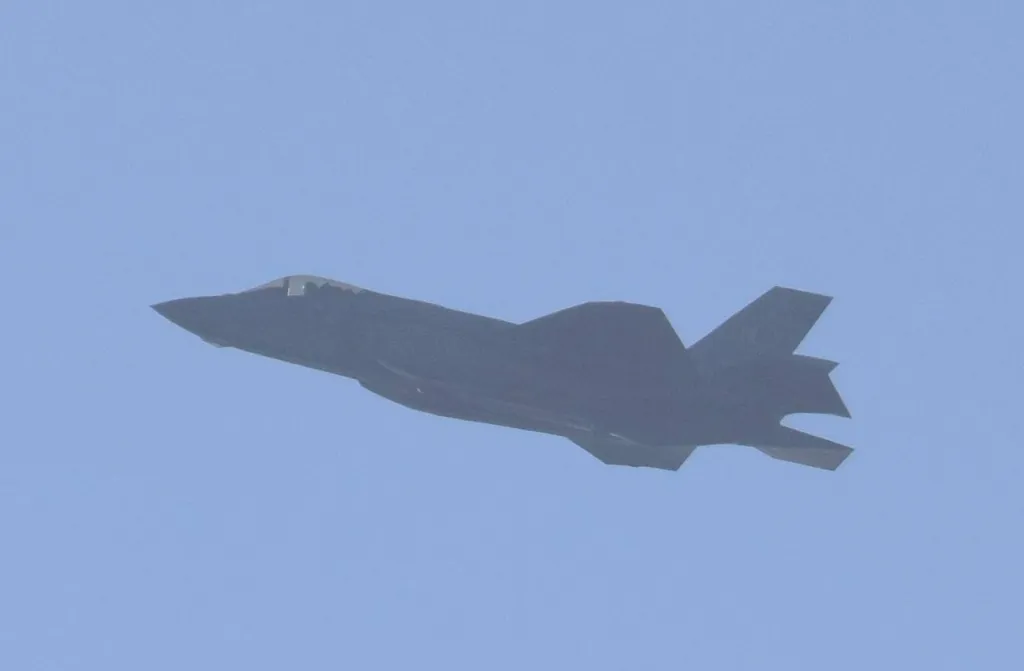
Four days into Operation Epic Fury, the joint American-Israeli attack on Iran, the U.S. is moving more tactical jets to the Middle East. On Tuesday, additional F-35A Lightning II stealth fighters and F-15E Strike Eagle multirole fighters took off from Lakenheath Air Base in the U.K, according to flight trackers and spotters. The jets are joining the large number of fighters already engaged in the war effort. The aircraft will be a welcome sight for CENTCOM, which just lost three F-15E Strike Eagles to friendly fire.
You can catch up with our latest coverage of Epic Fury here.
These movements come in the wake of statements made by Air Force Gen. Dan Caine, Chairman of the Joint Chiefs of Staff, that the U.S. is plussing up its Middle East aviation force.
In his opening remarks during a Monday morning press conference at the Pentagon, Caine said that the commander of U.S. Central Command, Adm. Brad Cooper, “will receive additional forces.”
“Even today, this rapid buildup of forces demonstrated the joint forces’ ability to adapt and project power at the time and place of our nation’s choosing,” Caine said, declining to provide many additional details.
“I don’t want to talk specifics, because that would tip the enemy off,” Caine explained. “We have more tactical aviation flowing into theater just based on the time it took to get it out there. I think we’re just about where we want to be in terms of total combat capacity and total combat power.”
That could change depending on what happens in the fight against Iran.
“For Admiral Cooper…he’ll consistently assess the trajectory of the campaign is the ON or OFF trajectory, and then make an ask of the joint force, which will then develop options for consideration by the secretary and the president to either increase or, in some cases, decrease the amount of combat capabilities that we have over there.”
The open-source intelligence (OSINT) @DefenceGeek X account tracked a dozen F-35As, originally from Hill Air Force Base in Utah, heading to the Middle East.
Aviation photographer Eugenia Golding, who lives under the RAF Lakenheath’s airbase flight path, shared some photos with us of F-35As after taking off from Lakenheath.

She also provided photos of the F-35As accompanied by a KC-135 Stratotanker aerial refueling jet.


Aviation photographer Paul Field, who lives near RAF Lakenheath, also shared images of F-35As.

The @ArmchairAdml X account tracked additional F-15Es heading to the Middle East.
Golding also shared a photo of three F-15Es heading out of Lakenheath accompanied by a KC-135 Stratotanker aerial refueling jet.

The fighters leaving Lakenheath today join a wide array of fighters, electronic warfare aircraft, surveillance aircraft, communications planes, maritime patrol jets and tankers deployed to the region.
In addition, CENTCOM confirms that in addition to B-2 Spirit stealth bombers, B-1 Lancer and B-52 Stratofortress bombers have also taken part in Epic Fury, flying from the U.S. to strike targets in Iran. There have also been scores of transport jets hauling air defense systems and other war materiel transiting to the region on a daily basis.
In the first three days of the operation, CENTCOM has hit more than 1,700 targets, including command and control centers, Islamic Revolutionary Guard Corps facilities, air defense systems, ballistic and anti-ship missile sites and naval bases. In addition to attacks from manned aircraft, these strikes have come from drones, ground base rocket artillery systems as well as from the sea with Tomahawk Land Attack Cruise missiles launched from Arleigh Burke class guided missile destroyers.

As we have noted in the past, a large number of these aircraft have flown to Muwaffaq Salti, in central Jordan, which has become a central hub for U.S. tactical jets and other aircraft.
The war, as we noted earlier in this story, has already taken a toll on U.S. fighters. As we previously reported, three Strike Eagles were mistakenly shot down by Kuwaiti air defenses on March 1. All six crew members survived, but the incident showed that the battlespace is extremely complex. Given how many missiles and drones Iran is firing and all the tactical aircraft coming and going, the threat of friendly fire incidents like this is very real.
The U.S. is not alone in providing airpower. Israel has the largest and most advanced Air Force in the Middle East and has been hitting hundreds of targets, including a major new wave of Israeli strikes going after leadership targets in Tehran today.
Meanwhile, aircraft from the U.K. and France have been deployed to the Middle East as well, while Greek fighters have been sent to Cyprus to protect facilities on the island.
On Tuesday, the British Defense Ministry (MoD) confirmed that one of its F-35Bs downed an Iranian drone over Jordan.
France deployed Rafale fighters to the United Arab Emirates for protection of “its naval and air bases against Iranian attacks, French Foreign Minister Jean-Noël Barrot said on Tuesday,” according to Le Monde. “France has hundreds of navy, air force and army personnel based in the United Arab Emirates. Its Rafale aircraft are stationed at the Dhafra base near Abu Dhabi.”
It remains unknown how long Epic Fury will last. U.S. President Donald Trump has offered various timelines, the most recent being an operation that could last “four to five weeks.”
As we have reported in the past, though a large number of aircraft have been pushed to the Middle East, that still might not be enough for a sustained campaign lasting more than a month. As the war drags on, we will very likely see more allied aviation assets pouring into the region, something we will continue to monitor.
Contact the author: howard@thewarzone.com