fighter

F/A-XX Stealth Fighter Selection To Finally Come By August: Navy’s Top Admiral

Driven by a race to get ahead of quickly evolving enemy capabilities, the U.S. Navy is now aiming to enter the next step of contracting for its 6th-generation crewed fighter – known as F/A-XX – by August. Despite intervention from Congress, the next-generation carrier-based fighter has remained in limbo since the Pentagon moved to effectively shelve the program last year.

That’s according to Chief of Naval Operations (CNO) Adm. Daryl Caudle, who spoke with reporters Monday at the Sea-Air-Space 2026 exposition near Washington, D.C. In response to a question from TWZ, Caudle acknowledged the uncertainty that has kept F/A-XX in a holding pattern, even as the Air Force’s future fighter, dubbed the F-47, has forged ahead. The current competitors for the F/A-XX are Boeing, which is also the F-47’s prime contractor, and Northrop Grumman.

A rendering of Boeing’s proposed F/A-XX design. Boeing

“One of the challenges we’re seeing is, not only [are] our peer competitors improving their capability for anti-air, either air-to-air or surface-to-air, but the lower cost of entry of very capable weapons is also making more players on the field in which that level of stealth and technology is required,” Caudle, the Navy’s top officer, said. “So this is not about the need for a peer adversary. This is just having an aircraft that can operate with a level of uncertainty and with the acceptable level of risk.”

This is in line with arguments Caudle made in favor of moving ahead of F/A-XX in January, where he cited growing threats posed by smaller nation-state adversaries, including Iran, as well as non-state actors.

Today, Caudle again emphasized that he nevertheless had been “very vocal” on the need for a carrier-based next-generation fighter, and had expressed “many times” to Deputy Secretary of War Steve Feinberg that the service had to secure the aircraft. It’s important, Caudle said, for both the future carrier air wing and collaboration and planning with the MQ-25 Stingray, the Boeing-made carrier refueling drone set to reach initial operational capability later this year.

“It ties to our MQ-25 for stealth refueling. It ties to our reach. It ties to the work we’re doing for making the carrier air wing something that remains very effective into the future based on the range in which you can operate safely,” Caudle said. “So the need’s clearly there.”

MQ-25A Stingray first taxi test thumbnail

MQ-25A Stingray first taxi test


While it was recently reported that the Navy, bolstered by funding from Congress for the new F/A-XX, planned to award a contract for the program by year end, Caudle said August was now the likely timeframe.

As noted, the Pentagon had moved to essentially shelve F/A-XX in its Fiscal Year 2026 budget request, with the Navy only requesting a relatively meager $74 million for the program. U.S. officials said at the time this decision had been driven largely by concerns about the ability of the U.S. industrial base to support work on two sixth-generation fighters, the other being the F-47, simultaneously.

Congress subsequently interceded, appropriating $1.69 billion for F/A-XX through a combination of regular spending bills and the One Big Beautiful Bill Act. From a budgetary perspective, the Navy’s next-generation fighter program remains well behind the F-47, which has already received billions in funding and could be in line to get approximately $5 billion more in Fiscal Year 2027. The Navy only appears to be requesting an additional $140 million for its new carrier-based combat jet in the $1.5 trillion proposed defense budget for the next fiscal cycle.

“We’ve got a lot of airframes out there. We’ve got an F-35 program. We’ve got a F-47 program. You know, we’re still building the [F/A-18 Super Hornet] … there’s a lot of airplanes being built,” Adm. Caudle said today. “The Air Force has got a lot of demand on the system. The Navy’s got a lot of demand … One of the contractors who would make this plane for us is in a place where they really can’t deliver in the timeframe we need it. So there was, you know, a check twice, cut once, kind of mentality here on this decision. And now there, I think we’re all on the same page on the reason why the hard look needed to be done. I’m good with it.”

A rendering of the US Air Force’s F-47 sixth-generation fighter. USAF

As noted, Boeing and Northrop Grumman are in competition to produce the F/A-XX, a program that first took shape as a Navy request for information in 2012. An earlier down-select reportedly eliminated Lockheed Martin in March 2025. Last August, Northrop Grumman released a rendering of its concept for the aircraft, showing a streamlined nose and landing gear on the front of a carrier with the tagline, “Project Power Anywhere.” Boeing’s concept, released the same month, drew visual comparisons to its F-47 Next-Generation Air Dominance fighter for the Air Force.

Citing classification, Adm. Caudle said today he couldn’t provide any information on design or payload details that give the Navy confidence in pursuing F/A-XX despite the adversary threats he mentioned. However, he suggested speed was increasingly essential to having a chance at maintaining overmatch.

“We monitor very closely, red-team that very hard, and assess that threat with a predicted trajectory of whether or not the existing designs we’ve seen will still overmatch that,” he said. “So I think we’re okay there, but we do know that our existing airframes could become vulnerable to some of those threats by the time [it’s fielded] … because it takes time to deliver that, that our existing airframes could be vulnerable to some of those threats, and we want to make sure the air wing of the future can still participate.”

Despite Caudle’s comments today, it should be remembered that this is not the first time that major progress on the Navy’s next-gen fighter has supposedly been imminent. Last October, Reuters reported the program had been greenlighted by Secretary of War Pete Hegseth, with a contract expected to follow in short order. 

Aside from funding moves from Congress to ensure the survival of the F/A-XX program, no public steps have been taken to advance the program since.

Contact the editor: Tyler@twz.com

Source link

F/A-XX Next Gen Naval Fighter Concept Video Emerges From Northrop Grumman

On the same day that the Chief of Naval Operations answered our question about the future of the F/A-XX sixth-generation naval fighter program, stating a final selection between the offerings from Boeing and Northrop Grumman will be coming in August, the latter of the two firms has released a new teaser video. Previously, we only had one rendering of Northrop’s notional F/A-XX concept. Now we have a more detailed panning video and a new head-on perspective view.

The video clip, posted on Northrop Grumman’s X account this evening, as seen below, states: “We’re bringing tomorrow’s horizon into focus, faster, stronger, and ready when the warfighter needs it.”

What we see in the clip is the same general design we saw in the still image earlier, but much more of it. This includes a head-on shot, showing the aircraft’s stealthy and efficient tailless design and rear-set dorsal inlets, as well as its very broad nose and canopy.

Northrop Grumman capture

The aircraft in the new stylized video clip has some interesting proportions. The size of the landing gear and especially the canopy give it something of a smaller overall appearance than what one would expect from a heavy sixth-generation naval fighter that will be stuffed with fuel and weapons. Of course, this could be due to the somewhat ‘cartoonish’ nature of this new glitzy clip, and how accurate this rendering is to the actual Northrop Grumman F/A-XX is still unknown. At the very least, some of the aircraft’s features (such as its inlets) will have been significantly changed for security issues pertaining to its sensitive design elements.

We also see the wings, which look like they have a bit of camber on the outer sections and possibly a bit of ‘crank’ too. We also see the wings folded in the first part of the clip.

Screenshot

What could be a weapons bay with its doors open is also visible in some of the angles seen in the clip. At first glance, this appeared to be for the jet’s very stout-looking landing gear, but they are curved inward. There are additional doors on the centerline, as well, pointing to two separate bays.

Overall, because of the size of the canopy, it is hard to tell if this is a single-seat or a two-crew aircraft. The canopy is so large in these renders that a side-by-side crew arrangement may even be possible, although that seems unlikely.

Once again, we don’t know how close this computer-generated model is to the real thing, but considering this aircraft will have to carry a sizable weapons load and have something approaching a combat radius of 1,000-miles, while still fitting well within the confines of a supercarrier, it should be firmly in the heavy fighter class.

Maybe Northrop Grumman will share more on its F/A-XX at the annual Sea-Air-Space convention in Washington this week, and we will be ready to report it from the scene if they do.

We have reached out to Northrop Grumman with questions, and we will update this post if we hear back.

Contact the author: Tyler@twz.com

Tyler’s passion is the study of military technology, strategy, and foreign policy and he has fostered a dominant voice on those topics in the defense media space. He was the creator of the hugely popular defense site Foxtrot Alpha before developing The War Zone.


Source link

Top ministers quit after Peru’s president postpones F-16 fighter jet deal | Government News

Two cabinet-level ministers in Peru have resigned after interim President Jose Maria Balcazar announced he would defer a decision to buy F-16 fighter jets from the United States company Lockheed Martin.

Defence Minister Carlos Diaz and Foreign Minister Hugo de Zela cited their opposition to the move in their resignation letters on Wednesday.

Recommended Stories

list of 3 itemsend of list

“A strategic decision has been taken in the area of national security with which I have a fundamental disagreement,” Diaz wrote.

The fighter jets have long been a source of controversy in Peru, where critics have questioned whether the purchase is a sign of deference to US President Donald Trump.

Last week, the left-wing Balcazar — Peru’s ninth president in a decade — announced he would leave the decision about whether to invest $3.5bn in the purchase to the country’s next elected leader.

Balcazar himself had only been in office since February, selected by Congress to replace the latest in a string of impeached presidents.

Last week, he abruptly cancelled a signing ceremony for the F-16 deal, which would have seen an initial batch of 12 new planes added to Peru’s ageing air force. The country aims to acquire 24 jets overall.

Balcazar explained he was not pulling out of the deal, but that he felt the next presidential administration should be involved in making such a hefty financial commitment.

“For us to commit such a large sum of money to the incoming government would be a poor practice for a transitional government,” Balcazar said at the time.

“We remain firm in respecting all agreements that may have been reached at the level of the armed forces, or in this case, with the relevant ministry of the air force, to carry out the corresponding negotiations.”

His decision, however, was met with pushback, both domestically and from the US. The US ambassador to Peru, Bernie Navarro, responded on April 17 with a warning posted on social media.

“If you deal with the U.S. in bad faith and undermine U.S. interests, rest assured, I, on behalf of
[President] Trump and his administration, will use every available tool to protect and promote the prosperity and security of the United States and our region,” Navarro wrote.

Critics of the deal, however, have argued that Peru has received more competitive offers from French and Swedish aircraft makers like Dassault Aviation and Saab AB, respectively.

But Navarro on Wednesday denied that the US had been outcompeted. In a statement, he wrote that the “bid was made at a high level of competitiveness” and called the plane fleet “the most technically advanced fighter jets ever built”.

He also denounced the delay as an unreasonable stoppage on a deal he characterised as already signed.

“In planning the delivery of a product of this calibre, there is no such thing as an inconsequential delay,” he wrote.

“Every delay results in significant costs. The same package cannot be available in a couple of months, or even weeks.”

The decision to spend the $3.5bn on 24 fighter jets was made in 2024 under former President Dina Boluarte. The purchase was to be financed by $2bn in domestic borrowing in 2025 and $1.5bn in 2026.

In September, the US Department of Defense approved a potential sale of F-16s to Peru.

But Boluarte was removed from office in October, and her successor, Jose Jeri, lasted just four months in office before he too was impeached.

The instability in Peru’s presidency comes at a time when the Trump administration is seeking greater influence over Latin America, as part of what the US president has called his “Donroe Doctrine”.

Already, the Trump administration has pushed Peru to distance itself from Chinese investment. In February, for instance, it publicly protested against Chinese ownership in the Pacific port of Chancay.

“Peru could be powerless to oversee Chancay, one of its largest ports, which is under the jurisdiction of predatory Chinese owners,” the Trump administration wrote in a social media post.

“We support Peru’s sovereign right to oversee critical infrastructure in its own territory. Let this be a cautionary tale for the region and the world: cheap Chinese money costs sovereignty.”

Just this week, one of Trump’s allies, Representative Maria Elvira Salazar, warned that the Chinese-owned port was a danger to the US.

“That’s a direct threat in our hemisphere, right in the country of Peru,” she told a congressional committee. “For that reason, the new Peruvian government, which will be elected next June, must take it back.”

She added that, if the Peruvian government responded accordingly, “the United States will help them under the Trump administration”.

The country, however, is enmeshed in a messy presidential race replete with vote-counting delays and accusations of malpractice.

Election experts have said there is no evidence of voter fraud. But the slow vote count has left the race’s outcome undetermined, more than a week after the ballots were cast on April 12.

Right-wing leader and former First Lady Keiko Fujimori is all but assured of progressing to a run-off in June. But who will join her is uncertain.

Left-wing Congress member Roberto Sanchez is currently in the lead in the race for second place, with 12 percent of the votes tallied, but far-right candidate Rafael Lopez Aliaga, a former mayor, is close behind with 11.9 percent. Lopez Aliaga has been a vocal supporter of the Trump administration.

The final vote count for the first round of the election is expected to be delivered in May.

Traditionally, Peru’s new president should be sworn in on July 28, the country’s independence day.

Source link

X-BAT Autonomous VTOL ‘Fighter’ Looks Dramatically Different

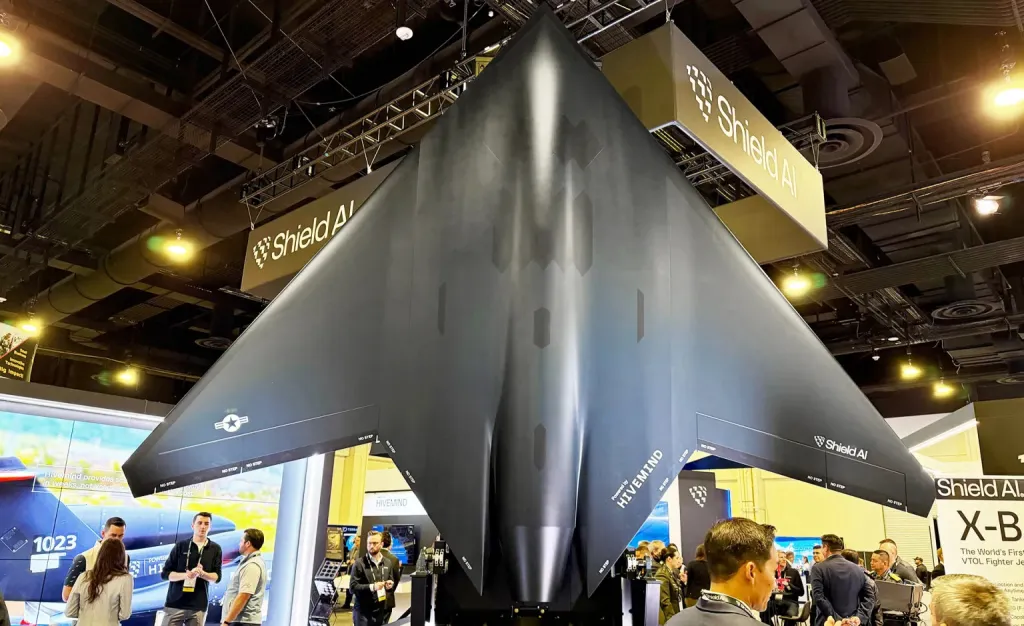
Shield AI and General Electric have revealed more details about X-BAT, the jet-powered autonomous stealth ‘fighter’ drone designed to take off vertically and land the same way, tail first, after completing its mission. With the extremely ambitious aircraft concept planned to start vertical takeoff and landing (VTOL) testing before the end of this year, the companies have also shown off a roughly half-size model that includes significant design changes.

The new details came when officials — J.J. Cummings and Armor Harris from Shield AI, and Steve Russell from GE’s Edison Works — spoke with reporters, including The War Zone, at the Sea-Air-Space 2026 exposition near Washington, D.C.

Make sure to get up to speed on everything we previously knew about X-BAT in our exclusive feature from when the aircraft was unveiled, linked here, as well as its forthcoming flight testing here.

A major redesign

When we discussed the X-BAT in our in-depth coverage of the program in the past, the drone had a ‘cranked kite’ planform, which has now given way to a straight leading edge with a more dramatic sweep as part of a distinctive arrowhead-shaped profile. We saw the same on the Boeing X-45C Phantom Ray UCAV prototype, and it has since been adopted by the Chinese GJ-11 Sharp Sword, among others. This new configuration looks better optimized for higher-speed flight.

According to X-BAT’s chief designer, Armor Harris, “We’ve taken an iterative approach to development and made improvements to the design based on test data.”

A scale model of the X-BAT on display at the Sea-Air-Space 2026 exposition near Washington, D.C, this week. Jamie Hunter
The original planform design featured a cranked-kite like arrangement. Shield AI

Raiding the past to realize the future

Of all the new details we received about X-BAT, where the jet’s critical thrust vectoring capability will come from is perhaps the most intriguing. GE says that the engine nozzle is the Axisymmetric Vectoring Exhaust Nozzle (AVEN), which comes from a specialized thrust-vectoring F-16 that was tested out of Edwards Air Force Base, California, back in the 1990s. The AVEN nozzle — taken direct from the warehouse, “Indiana Jones-style,” according to the officials — will be used for the initial testing.

F-16 MATV Axisymmetric vectoring in the early 1990's. thumbnail

F-16 MATV Axisymmetric vectoring in the early 1990’s.


Multirole platform: including tanker

Officials confirmed that the X-BAT can be operated as a tanker, making use of its two external hardpoints. Both of these are plumbed to the internal fuel tanks, so they can support ‘buddy’ refueling pods, which trail a hose and drogue.

The companies stress that aerial refueling tanker is “definitely not a primary mission,” but this option does reflect the multirole nature of the platform. Meanwhile, drone tankers are a growing area of interest for different U.S. military services, with efforts currently spearheaded by Boeing’s MQ-25 Stingray, although, since it is larger than the X-BAT, this would also offer much greater internal capacity.

For expeditionary operations, in particular, drone tankers are seen as a viable solution, although by no means the only one. X-BAT acting as a launch tanker could be especially of interest for tactical jets that require long runways. This would allow them to takeoff in short distances with heavy weapons loads and get fuel immediately from the X-BAT tanker before heading on their missions. X-BAT tankers could also act as unpredictable refueling platforms that are forward deployed for enroute combat aircraft, launching from virtually anywhere to refuel jets making their way from longer distances to their target areas. These are just some of the less traditional theoretical ways a tanker-configured X-BAT could be used.

Interestingly, based on the current concept of operations, Shield AI sees less interest in having the X-BAT take on fuel while airborne itself, although there is a “holding place” for a refueling probe in the nose, if required.

Overall, and beyond tanking, the X-BAT’s multirole capability implies “significant air-to-ground capability, maritime strike capability, and electronic warfare capability,” Shield AI says.

GE F110 engine

Last year, TWZ broke the news that General Electric was working with Shield AI on the powerplant side of the X-BAT, specifically its F110 turbofan, the same as used in many F-16s and F-15s. The choice of the F110 was driven by size and thrust requirements, including the demanding VTOL cycle that’s at the heart of the X-BAT concept.

Significant thrust is also a prerequisite of the X-BAT’s multirole capability, which Shield AI says sets it apart from other Collaborative Combat Aircraft (CCA) and uncrewed combat air vehicle (UCAV) type drones now flying or in development.

X-BAT: Earth Is Our Runway thumbnail

X-BAT: Earth Is Our Runway


As well as offering what Shield AI describes as the best power-to-weight ratio in its class, the F110 was selected for its fuel economy. The engine is also widely available. With roughly 3,400 in the world, several “certified pre-owned engines” have been obtained for the program, as well as new-build ones.

While the partnership between Shield AI and General Electric was announced relatively recently, they have been working together for longer, with “tremendous progress on adapting the F110 engine” made in the last six to 12 months, according to officials.

Payload and range

According to Shield AI, X-BAT is around twice the size of all the other CCAs that are on the market today, which allows it to have a pair of payload bays that are roughly the same size as those found on the F-35. This means that any store that fits in an F-35 can theoretically also be accommodated internally in an X-BAT. These presently include 2,000-pound-class weapons.

At the same time, the X-BAT “goes twice as far” as an F-35, meaning double the combat radius. The drone’s manufacturers give a combat radius figure of 1,000 nautical miles. In the past, Shield AI told TWZ that the drone would also have a maximum range of 2,000 nautical miles and a service ceiling of around 50,000 feet.

Of course, the aircraft’s weight is a major factor in providing range. Company officials say they are “not really doing anything super-novel on the design of the air vehicle” in terms of weight reduction. However, with no landing gear and no auxiliary power unit (X-BAT uses an external lithium-ion battery pack to start the engine), and with other items moved from the air vehicle to the trailer-based launch recovery vehicle, all of this helps make the drone lighter.

Jamie Hunter

VTOL flight profile

For vertical takeoff, the F110 engine is put into afterburner to get the required thrust-to-weight ratio needed for takeoff, although the aircraft returns to land on military power (without afterburner).

Various modifications are needed to the F110 for use in a vertical takeoff application: as a tail-sitting aircraft, the X-BAT spends a lot of its time in this attitude. As such, the engine has been exposed to significant subscale and full-scale testing at GE facilities. Shield AI says it plans to build the prototype aircraft at a facility in Frisco, Texas, this summer.

An F110 engine from an F-16 jet in max power during a test at Hill Air Force Base, Utah. U.S. Air Force photo by Alex R. Lloyd

Interestingly, one important part of the tests so far has been to explore just how far the F110 can be throttled back for the delicate VTOL and transition phases. Previously, the limits were set by the cabin pressurization requirements of crewed aircraft: essentially, how much fan speed was needed to generate enough bleed air to pressurize the cabin for the pilot. Since the X-BAT is uncrewed, the F110 can be throttled back farther and operate in different regimes.

Thrust-vectoring nozzle

While the aforementioned AVEN nozzle will be used for the initial testing, the companies are meanwhile working on redesigning and updating the design and building more nozzles. The control system and software are also completely different from those used on the original AVEN and are tweaked to work with today’s F110.

“It actually has worked really well,” Steve Russell says of the nozzle. “We’ve done testing where we’ve reversed it, we’ve integrated it, we’ve run the control system … you put all those things together and put it into such a cool platform that’s really going to present a unique dilemma for our potential adversaries.”

So far, testing has shown that the rigors of VTOL actually result in less fatigue and vibration compared to a typical F-16 profile.

A mockup of the X-BAT in its original configuration. Shield AI

The current nozzle doesn’t have low-observable (LO) attributes, but that is something that will be introduced after prototype testing. There is also the possibility of the X-BAT vectoring its nozzle in forward flight to increase its agility. The companies stress that this capability will depend on customer requirements, but the nozzle will be fully vectorable across the flight regime.

The focus for now is more about actuation and integration of the F110 with the Shield AI airframe and flight control system. A key factor is mitigating against exhaust gas ingestion and ensuring the engine is fed with clean air during the transition phases of flight. However, this is not something the developers are overly concerned about, and the F110 is also judged particularly stall-resistant.

Air intakes and blast deflector

Shield AI’s air intake system is specifically engineered to handle these demanding phases of flight and includes an auxiliary inlet on the back of the aircraft. This is concealed beneath a panel when the aircraft is not in VTOL mode.

Just as important is the engine exhaust, especially when it comes to mitigating the risk of foreign object damage (FOD) and kicking up debris that could damage other assets on the ground during VTOL operations. This would be especially critical on the tight confines of a ship’s flight deck.

The air intake system under test. Shield AI

For the launch, a blast deflector built into the X-BAT’s custom trailer is designed to direct the exhaust plume away rather than recirculating it back to the engine. The fact that the aircraft is suspended relatively high in the air for takeoff means that the issue of rocks and other debris being kicked-up at the aircraft is reduced. The deflector also channels the blast in a known direction.

For the landing phase, the aircraft’s approach profile helps avoid FOD and exhaust gas ingestion. Instead of coming straight down to land, the X-BAT approaches the launch-recovery trailer from the side, makes contact with it, and then powers up into a latch that secures it. The aircraft also leans slightly into the incoming airstream to help ensure the intake is always being fed with cleaner air.

A close-up of the blast deflector for X-BAT. Jamie Hunter

Open system architectures

With open system architectures baked into the design, it should also be easier to upgrade the X-BAT than previous aircraft, meaning it is getting “a lot closer to plug and play.” Shield AI talks about swapping in and swapping out different radiofrequency and infrared sensors for upgrades or potentially for different missions.

The companies remain generally tight-lipped about the electronic warfare (EW) packages that will be installed in the X-BAT. They did say that the EW gear will be unique to this aircraft and that they were able to leverage a lot of the sixth-generation systems that have been developed for the NGAD programs, in both their Air Force and Navy iterations.

Testing pathway

Looking in more detail at what comes next for the program, Shield AI and General Electric confirm that the first stage of testing is already underway, using the adapted F110 on GE test stands. Step two will see the propulsion system integrated into the prototype aircraft. It will then be run horizontally and then vertically, while still attached to the launch-recovery trailer.

An earlier mock-up of the cranked-kite X-BAT on its launch trailer. One of Shield AI’s V-BAT drones is also seen at left. Shield AI

The next step will involve a very large crane, which will hold the aircraft vertically, with engine tests being run while the X-BAT is tethered for safety. This phase will see the propulsion system tested in proximity to the ground, in proximity to the launch and recovery trailer, and under different inlet conditions.

The final step will see the tether taken off, allowing the X-BAT to perform free flights. The aircraft will take off from the launch and recovery trailer, go up, come around, and reattach to it, all in vertical mode. If things go well, company officials say, this milestone will be targeted before the end of 2026.

In the process, Shield AI and General Electric are realistic about the possibility of mishaps in what is really groundbreaking technology. Company officials describe a “hardware-rich approach to test,” which means building several prototype test aircraft that will be pushed to the limit. They “fully expect to lose one in testing,” since the program is stressing the delivery of capability to the operators as quickly as possible. In this respect, zero failures mean the program is going too slow, the officials say.

Market prognosis

Shield AI and General Electric confirm that there is “tremendous interest internationally” in the X-BAT, across all regions.

Their business case rests on the X-BAT providing “fifth and sixth-gen type capabilities” at a price point much cheaper than an equivalent crewed combat jet. Part of the cost equation also relates to the VTOL flight mode, which means operators can “delete a lot of the lifecycle cost associated with having a conventional air force.” With no conventional airbase required, there is no need for expensive airbase defenses or hardened aircraft shelters. The concept of operations involves a much-reduced need for tanker support, since the X-BAT can be forward stationed and has a large combat radius. Of course, there is also no conventional pilot-training pipeline. Shield AI and General Electric officials describe the resulting air power employment, in life-cycle terms, as costing around a tenth that of an equivalent fifth or sixth-gen type.

Earlier concept artwork showing three X-BATs, with the original planform, launching with external weapons fitted. Shield AI

Compared to those fifth/sixth-gen platforms, the lower cost of the X-BAT means that it doesn’t have to be as survivable. Shield AI and General Electric talk about the aim of having an aircraft that is “just survivable enough that you can do the mission.” Meanwhile, it should avoid the “exponential costs for incremental return” that are inevitable in other, more exquisite platforms. Instead, the companies are looking at the possibility of an operator buying 10 to 20 X-BATs for the price of something like a B-21. The Air Force previously specified an average unit cost of roughly $550 million for the B-21.

With this in mind, Shield AI is sizing a factory that will be able to produce 150 X-BATs annually, with employees working single shifts.

Clearly, the ambition of creating a vertical takeoff and landing ‘autonomous fighter’ that is capable of countering an adversary’s air defenses at a fraction of the price of a crewed platform is incredibly bold. Some would even call it outright far-fetched. Yet the comparisons to Space-X and how they disrupted the space access market by doing something many thought would not work — also a VTOL solution — also can’t be denied.

With testing of the X-BAT and its F110-based propulsion system now well underway, and first flights planned before the end of the year, we are getting closer to seeing whether this radical vision can actually be realized.

Contact the author: thomas@thewarzone.com

Thomas is a defense writer and editor with over 20 years of experience covering military aerospace topics and conflicts. He’s written a number of books, edited many more, and has contributed to many of the world’s leading aviation publications. Before joining The War Zone in 2020, he was the editor of AirForces Monthly.


Source link

F-35s Quarterbacking Drones Seen As Gateway To USMC’s 6th Gen Fighter

The U.S. Marine Corps says it is making good progress toward fielding Collaborative Combat Aircraft (CCA) type drones, starting with a landing gear-equipped version of Kratos’ XQ-58 Valkyrie. The service sees those aircraft, and potentially other CCAs, paired with its F-35s as a “bridge” to an entire family of next-generation air combat capabilities, which could include a sixth-generation crewed fighter.

Marine officials discussed the service’s CCA plans and broader future aviation vision during a panel discussion at the Navy League’s Sea Air Space 2026 exhibition, at which TWZ is in attendance. The Corps’ CCA efforts currently fall under a program called Marine Air-Ground Task Force (MAGTAF) Uncrewed Expeditionary Tactical Aircraft (MUX TACAIR). The MAGTAF is the primary organizing concept around which the service deploys air and ground forces.

“So, with the MUX TACAIR effort, I think we’re meeting our testing goals. I would say that it’s on track,” Marine Col. Dan Weber, the Unmanned Aerial Systems Branch Head in the office of the Deputy Commandant for Aviation, said. “From a funding and demand power perspective, I think we’ve got great support. We’ve got good partners. We’ve got good relationships right now to keep that program on track, and I expect that we’re going to meet all of our milestones and goals.”

A landing gear-equipped version of Kratos’ XQ-58 Valkyrie, like one seen rendered here, is set to be the Marine Corps first operational CCA-type drone. Kratos

“From the F-35 side, the vision ultimately is we want the F-35 to be a quarterback with CCAs as attritable mass, as enablers to ensure the MAGTAF can project power, the sensing, the lethality, [and] all of the intangibles that kind of go along with that,” Marine Col. Thomas Bolen, the Tactical Aviation (TACAIR) Branch Head, another one of the panelists, also said. “How we integrate with CCAs is going to be extremely important, and that will bridge us down the road to kind of the sixth-generation family of systems.”

One of the “main things in our portfolio that will be enduring and developing over the next couple years” is “man-unmanned teaming,” Marine Col. Richard Rusnok, head of the Cunningham Group, who was also on the panel, added. “We’re laying the foundation for that with our first foray into Collaborative Combat Aircraft, the MQ-58.”

The Cunningham Group, which also falls under the office of the Deputy Commandant for Aviation, is charged with plotting out the overarching future vision for Marine Corps aviation.

MQ-58 refers to Marine-specific variants of Kratos’ Valkyrie now in development. Last year, the Corps announced that it was transitioning what had originally been experimental work with a small fleet of XQ-58s into a full program of record to acquire an operational platform. Kratos has since partnered with Northrop Grumman to deliver these uncrewed aircraft.

A Marine XQ-58 flies together with a pair of US Air Force F-35As during a test. USAF

Marine Valkyries will have built-in landing gear, unlike the original version of the drone, but will still be capable of making rocket-assisted takeoffs from static launchers. This means the uncrewed aircraft will retain a valuable degree of runway independence, but that there will also be tradeoffs, as TWZ has previously explored here.

In January, Kratos told TWZ it was hoping to see the first flight of a landing gearing-equipped Valkyrie in early 2026, but there has been no official announcement yet of that milestone being reached. The Marine Corps’ unclassified 2026 Aviation Plan presents the MQ-58 as a capability arriving in the 2026 to 2030 timeframe.

The Marine Corps included this graphic in its 2026 Aviation Plan showing general timelines for various planned capabilities, including multiple tranches of MUX TACAIR drones. USMC

The Marines have also said previously that they expect the MQ-58 to be just the first in a planned series of CCA “increments,” which might entail the future acquisition of completely different types of drones. The service has said in the past that MUX TACAIR, broadly speaking, “will enhance Marine Corps Aviation’s lethality and ability to support the Stand-in Force (SiF) by delivering air-to-ground, reconnaissance, and Electronic Warfare (EW) capabilities.”

The Corps has also already chosen to use General Atomics’ YFQ-42A Dark Merlin at least as a surrogate to test new autonomy technologies and other mission systems under the umbrella of the MUX TACAIR program. The YFQ-42A is also one of two drones under development as part of Increment 1 of the U.S. Air Force’s CCA program. Dark Merlins have been flying since August 2025, but General Atomics announced an indefinite pause in flight activities earlier this month after one of the drones suffered an accident on takeoff.

A YFQ-42A seen during a flight test. General Atomics

Speaking on the panel today, Col. Thomas Bolen did not elaborate on what the Marine Corps’ “sixth-generation family of systems” might consist of. However, Marine Lt. Gen. William Swan, the Deputy Commandant for Aviation, said his service was beginning to explore what it might want in a future sixth-generation crewed combat jet during a press roundtable last week, as first reported by Breaking Defense.

“Last year’s Av[iation] Plan didn’t have six-gen on there, and I made the team put it on, because we need to think about that,” Swan said at that time. “We’re not there yet. We’re fast following with the Air Force, right? They got the F-47. The Navy’s looking at F/A-XX, and they’re just starting on that. So we are going to watch.”

A rendering of Boeing’s submission for F/A-XX. Boeing is also the prime contractor for the US Air Force’s F-47. Boeing

“We want to be an all Block 4 F-35 fleet, and that’s probably going to take another 10 years. So we’re probably five to 10 years away from ultimately making that decision. And we’ll see what they have, see what the threat looks like,” Swan continued. “I think right now, if you had to say, ‘hey, what is it going to look like?’, I think it’ll look a lot more like what the Navy’s doing, because we still fly off the carriers, we’re part of the Department of the Navy.”

“I don’t know that we’re going to get high-end, and that’s really not a Marine Corps mission; it’s the Air Force,” he added. “So I think if I had to – if you said, make a decision right now, it would be yes, some amount to augment the fifth-gen [F-35] force, and it would probably look something like the F/A-XX, or whatever the Navy ends up being [sic; acquiring].”

A rendering of Northrop Grumman’s F/A-XX proposal. Northrop Grumman

Lt. Gen. Swan, who served as the moderator for today’s panel at Sea Air Space, as well as Col. Bolen, again stressed the importance of the Block 4 upgrades for the F-35, including for future teaming with CCAs. The Block 4 effort has been mired in delays and cost growth, even after a revision in the fielding strategy last year to focus first on a truncated portion of the planned capability improvements. The full package for all three Joint Strike Fighter variants is eventually expected to include a new AN/APQ-85 radar and electronic warfare suite, replacements for the AN/AAQ-37 Distributed Aperture System (DAS) and Electro-Optical Targeting System (EOTS), and a host of other improvements. A particular point of concern now is that new production F-35s might soon start being delivered without any radars at all, as a result of issues tied to the development of the APG-85.

As the Marine’s top aviation officer noted last week, it could be 10 years before his service at least sees all of its F-35s fully upgraded to the Block 4 standard. That, in turn, could have serious impacts on the service’s broader plans to acquire and field new crewed and uncrewed aircraft.

A view of the F-35 production line. Lockheed Martin

Marine Corps interest in whatever the Navy chooses for F/A-XX could be an important factor for the future of that program, as well. In response to a question from TWZ at a roundtable on the sidelines of Sea Air Space this morning, Chief of Naval Operations Adm. Daryl Caudle said he is now hoping to see the selection of the winning design in the F/A-XX competition by August. The program has been in bureaucratic purgatory since the Pentagon moved to effectively shelve it indefinitely last year, with Congress subsequently intervening to keep it funded. How the Navy’s next-generation carrier-based fighter plans will proceed now still very much remains to be seen.

If nothing else, the vision the Marines have put forward today clearly frames Block 4 F-35s ‘quarterbacking’ fleets of CCAs as a key stepping stone to the service’s next-generation aviation capabilities.

Contact the author: joe@twz.com

Joseph has been a member of The War Zone team since early 2017. Prior to that, he was an Associate Editor at War Is Boring, and his byline has appeared in other publications, including Small Arms Review, Small Arms Defense Journal, Reuters, We Are the Mighty, and Task & Purpose.


Source link

YFQ-44 Fury Fighter Drone Wraps Contested Operations Test That Could Accelerate Its Fielding

  • YFQ-44 Fury drone completes critical test. The U.S. Air Force concluded a key exercise with a YFQ-44 Fury prototype at Edwards Air Force Base to test its deployment in contested environments.
  • Warfighting Acquisition System aims for speed. The exercise tested a framework to accelerate CCA deployment, allowing operators to refine tactics early.
  • Operators used Menace-T system. The system enabled autonomous operations from a simulated forward base, aligning with Agile Combat Employment concepts.
  • CCAs to enhance combat capabilities. The Air Force sees CCAs as vital for extending sensor coverage and adding combat mass in high-end conflicts.

Bottom line: The YFQ-44 Fury drone’s recent test at Edwards Air Force Base marks a significant step in the Air Force’s efforts to rapidly field combat-ready CCAs. This exercise focused on operational integration and logistical challenges, aiming to enhance the Air Force’s capabilities in contested environments.

The U.S. Air Force has concluded what it describes as a “critical exercise” with Anduril’s YFQ-44 Fury ‘fighter drone’ prototype, flown out of the base that is the heart of flight testing, the legendary Edwards Air Force Base, California. The drills involved the Air Force’s Experimental Operations Unit and were intended to demonstrate how CCAs can be deployed and sustained in a contested environment. For the exercise, the YFQ-44A flew from Edwards back to Anduril’s Southern California test site.

As well as the Experimental Operations Unit (EOU), which falls under Air Combat Command (ACC), the exercise involved personnel from Air Force Materiel Command’s (AFMC) 412th Test Wing. This wing is headquartered at Edwards Air Force Base, and the squadrons attached to it are responsible for flight testing of virtually all the aircraft in the Air Force’s inventory.

A YFQ-44A takes off from the runway at Edwards Air Force Base, California, during a Collaborative Combat Aircraft exercise. U.S. Air Force photo by Ariana Ortega Ariana Ortega

Multiple sorties were flown — we have asked Air Combat Command for more details on exactly how many and their scope. The exercise took place last week, according to Anduril’s vice president of autonomous airpower, Mark Shushnar.

The YFQ-44 is one of two designs now being developed as part of the first phase, or Increment 1, of the Air Force’s CCA program. The other is General Atomics’ YFQ-42A Dark Merlin. We have reached out to Edwards to see whether the YFQ-42 was originally expected to take part in the exercise before its recent takeoff accident.

Imagery published by the Air Force shows a YFQ-44A carrying inert AIM-120 Advanced Medium Range Air-to-Air Missiles (AMRAAM) on pylons under the wings, something that we first saw earlier this year, during captive-carry evaluations, as you can read about here. It should be noted that the Fury, at least as it exists now, does not have an internal munitions bay.

MSgt Ricardo Villalva, EOU removes fins
Master Sgt. Ricardo Villalva Jr., with Air Combat Command’s Experimental Operations Unit, performs pre-flight checks on an inert AMRAAM at Edwards Air Force Base, California. U.S. Air Force photo by Ariana Ortega Ariana Ortega

The primary function of the exercise was to explore the practicalities of what the Air Force calls the Warfighting Acquisition System. This framework is intended to speed the delivery of CCAs to operational units by enabling operators to get their hands on the drones earlier in the program. In this way, they can refine tactics and procedures before deliveries to the front line.

ACC has stressed in the past how it wants CCAs to operate seamlessly within the existing command structures and legal frameworks that govern all Air Force weapons systems.

“This experimental operations event was executed by EOU members from start to finish. Every sortie generated and flown was done with a warfighter, not an engineer or test pilot, kicking the tires and controlling the prototypes,” explained Lt. Col. Matthew Jensen, EOU commander. “We are learning by doing, at a speed and risk tolerance accepted by the USAF’s most senior leaders, to ensure CCA is ready to operate and win in the most demanding combat environments.”

A YFQ-44A flies over Edwards Air Force Base, California, during a Collaborative Combat Aircraft exercise. U.S. Air Force photo by Ariana Ortega Ariana Ortega

Above all, the sorties stressed operational and logistical procedures for using CCAs in a contested environment. The issue of logistics is a critical one, including how CCAs will get to the area of operations and how they will be maintained in the field.

According to Shushnar, Anduril’s Menace-T command, control, communications, and compute (C4) solution was used as the main ground element for YFQ-44A flight operations during the exercise. “EOU operators used Menace-T’s ruggedized laptop to upload mission plans, initiate autonomous taxi and takeoff, task the aircraft while in flight, and manage post-flight data ingestion and checks,” he explained. “That enabled the EOU to conduct operations out of a simulated forward operating base, successfully launching, recovering, and turning YFQ-44A without the infrastructure of a large, established base.”

This is entirely in line with the Air Force’s drive toward short-notice and otherwise irregular deployments, often to remote, austere, or otherwise non-traditional locales. Agile Combat Employment (ACE) is the term the service currently uses to describe a set of concepts for distributed and disaggregated operations.

While the warfighters of the EOU were at Edwards to carry out the practical aspects of CCA employment, exploring tactics, techniques, and procedures, the 412th Test Wing, meanwhile, was on hand to gather data from the test events.

“By uniting the distinct test authorities of AFMC and the operational authorities of ACC, officials were able to fast-track the event, enabling groundbreaking, hands-on experimentation by operators at a uniquely early stage of development,” the Air Force explained in a media release.

An earlier photo, in which the Air Force gave us our first look at a YFQ-44 carrying an inert AIM-120 Advanced Medium-Range Air-to-Air Missile (AMRAAM). U.S. Air Force

“The collaboration we saw in this exercise is the cornerstone of our acquisition transformation. By embedding the operators from the EOU with our acquisition professionals, we create a tight feedback loop that lets us trade operational risk with acquisition risk in real-time,” said Col. Timothy Helfrich, portfolio acquisition executive for fighters and advanced aircraft. “This isn’t just a test; it’s a demonstration of how we are adopting a more agile process. An 85 percent solution in the hands of a warfighter today is infinitely better than a 100 percent solution that never arrives.”

The CCA program is viewed as a pathfinder for the Warfighting Acquisition System, and success with this could lead to the same approach being employed to get other systems into operational service much more quickly than in the past.

The Air Force has not yet determined whether it will procure one or both Increment 1 CCA designs at scale. Whichever option it selects is expected to become its first operational “fighter drones,” built to carry live munitions into combat alongside crewed aircraft.

Three examples of the YFQ-42A Dark Merlin. General Atomics

CCAs will also extend the sensor coverage of the crewed fighters they accompany. More broadly, the Air Force views them as a way to add vital combat mass and unlock new tactical options, particularly in high-end conflicts against adversaries like China. Back in late 2024, Brig. Gen. Douglas “Beaker” Wickert, commander of the 412th Test Wing, told TWZ that, “[the-then Secretary of the Air Force Frank Kendall] “has been very clear that we are out of time, that our Air Force has never been older or smaller than it is right now, and that the People’s Liberation Army has been specifically designed to defeat us.”

“The investments we’re making right now in modernization and testing for the USAF are designed for success and aimed at changing Chairman Xi’s calculus about pushing back aggressively against the international rules-based order. What we are doing here and across USAF flight-testing is extremely consequential.”

Since then, Wickert has moved on to become Director of Air, Space and Cyberspace Operations at AFMC, but the test wing’s remit remains the same. Meanwhile, the People’s Liberation Army Air Force has doubled down on its rapid expansion, including many of its own CCA programs.

If all goes to plan, the completion of this recent exercise at Edwards could well be a key milestone in fielding a combat-ready force of CCAs and go some way toward realizing the Air Force’s ambition for a new capability that should extend the reach and the survivability of its crewed aircraft.

Contact the author: thomas@thewarzone.com

Thomas is a defense writer and editor with over 20 years of experience covering military aerospace topics and conflicts. He’s written a number of books, edited many more, and has contributed to many of the world’s leading aviation publications. Before joining The War Zone in 2020, he was the editor of AirForces Monthly.


Source link

Iran shoots down U.S. fighter jet; one pilot rescued, one missing

The Iranian military shot down a U.S. F-15E similar to the one pictured on Friday. File Photo by Senior Airman Mitch Fuqua/U.S. Air Force.

April 3 (UPI) — The U.S. forces rescued at least one crew member after Iran shot down a U.S. F-15E fighter jet Friday, unnamed U.S. military sources told multiple media outlets.

Officials confirmed the rescue to CBS News but said search-and-rescue operations were still taking place. CNN reported they were looking for one other pilot before Iranian forces could reach them. The F-15E has a standard crew of two pilots, The New York Times reported.

Iran’s state-run Tasnim news agency reported that Iranian officials’ efforts to locate the two U.S. pilot had “so far been unsuccessful.” Another Iranian news outlet, Fars News, said the government was offering a reward to anyone who captured an “enemy pilot or pilots.”

The New York Times reported that amid the search-and-rescue efforts, Iranian ground fire also hit a U.S. Air Force UH-60 Black Hawk helicopter. Officials told the news outlet that the crew was able to fly the aircraft back to safety in Iraq.

The Times also reported that another aircraft, an A-10 Thunderbolt, or Warthog, crashed near the Strait of Hormuz around the same time as the F-15E fighter jet. Two U.S. officials told the outlet that the only pilot on board the aircraft was rescued.

Iranian media outlets published photos of what appears to be a shot-down F-15 fighter jet.

White House press secretary Karoline Leavitt told CNN that President Donald Trump had been briefed on the incident.

This is the first U.S. aircraft to be shot down by Iran since the start of U.S. and Israeli bombing on Feb. 28. Three other F-15 jets were shot down by mistake in Kuwait.

President Donald Trump delivers a prime-time address to the nation from the Cross Hall in the White House on Wednesday. President Trump used the address to update the public on the month-long war in Iran. Pool photo by Alex Brandon/UPI | License Photo

Source link

U.S. rescues pilot who ejected after fighter jet was shot down by Iran, officials say

A crew member was rescued after an American aircraft went down Friday in Iran, the Associated Press reported, citing U.S. and Israeli officials.

U.S. forces launched a rescue mission in southwestern Iran after at least one American crew member ejected from a fighter jet downed by Iranian defenses, according to a U.S. official and news outlets.

The downing of the jet, an F-15E, was confirmed to The Times by a U.S. official who was not authorized to speak publicly. That type of jet reportedly carries a standard crew of two, but it was not clear if more than one crew member ejected.

Defense Secretary Pete Hegseth has maintained for weeks that the U.S. has “complete, uncontested control of Iranian airspace” after destroying the country’s air defenses.

“Iran has no air defenses, Iran has no air force,” he said at a March 13 Pentagon news conference. “Today, as we speak, we fly over the top of Iran and Tehran, fighters and bombers all day, picking targets as they choose, as our intelligence gets better and better and more refined.”

But the Islamic Revolutionary Guard Corps claimed that a new type of Iranian air defense system deployed for the first time in recent days had shot down a warplane on Friday.

The statements stirred a flurry of conflicting instructions from Iranian state-affiliated broadcasters. One local television channel initially encouraged viewers to search for the downed pilot and “shoot them as soon as you see them.”

It then changed the instructions, according to the Associated Press, after local police issued a statement asking the public to capture and turn in American pilots alive to security agencies to “receive a precious prize.”

On social media, Iranian accounts posted videos purporting to show helicopters searching for downed pilots in Iran’s western and southern provinces, according to a report from Fars News.

Fars also reported officials in Iran’s southwest were offering a “valuable reward” to anyone “who captures the American pilot alive.”

Images of a tail section posted on social media had markings indicating it was from the 48th Fighter Wing, which is based at RAF Lakenheath in the United Kingdom, according to Peter Layton, a visiting fellow at the Griffith Asia Institute in Australia, in an interview with NBC News.

U.S. and Israel escalate attacks on infrastructure

The development came as U.S. and Israeli forces escalated attacks on civilian sites and key infrastructure across Iran Friday, including strikes on residential buildings, health centers and Iran’s largest bridge, with President Trump warning that the U.S. “hasn’t even started destroying what’s left in Iran.”

On his social media, the president posted dramatic images of the smoldering B1 bridge, a towering cable-suspended viaduct that was severed in U.S.-Israel strikes late Thursday.

“The biggest bridge in Iran comes tumbling down, never to be used again — Much more to follow!” Trump wrote.

Connecting Tehran to the city of Karaj, the $400-million bridge was Iran’s largest, and was often regarded as one of the most prominent, expensive and complex engineering endeavors in the Middle East.

Iranian Foreign Ministry spokesperson Esmail Baghaei labeled the attack a “war crime in the style of ISIS terrorism.” Foreign Minister Seyed Abbas Araghchi called the act a sign of moral collapse by “an enemy in disarray,” stating that such actions will not compel Iranians to surrender.

“Every bridge and building will be built back stronger. What will never recover: damage to America’s standing.”

The attacks come after Trump announced what he described as a two- to three-day “off-ramp” from hostilities, while simultaneously warning he would bring Iran “back to the Stone Ages” if it didn’t cede to U.S. demands.

Reports from Iranian state media and international monitoring groups indicate strikes have also hit homes, religious centers, universities and municipal infrastructure across multiple provinces, raising concerns among humanitarian organizations about the widening scope of targets.

World Health Organization Director-General Tedros Adhanom Ghebreyesus said Friday that the U.S. and Israel have carried out routine attacks on Iranian healthcare facilities since March 1.

“WHO has verified over 20 attacks on health care in Iran, resulting in at least nine deaths, including that of an infectious diseases health worker and a member of the Iranian Red Crescent Society,” Tedros wrote on X.

Iran’s health ministry estimated about 2,076 people have been killed and 26,500 wounded by U.S.-Israeli attacks since fighting broke out Feb. 28. An estimated 1,300 have been killed in Lebanon, according to its health ministry, while more than two dozen people have died in Gulf states and the occupied West Bank.

Thirteen U.S. service members have been killed, and 19 Israeli service members have been reported dead in a five-week-old war that has triggered growing unease stateside.

A recent Pew Research Center survey conducted in late March found that most Americans opposed direct U.S. military involvement in a war with Iran. A separate Gallup poll reported declining approval for the administration’s handling of foreign policy.

Lawmakers in both parties have raised concerns about Israel’s influence in the Trump administration’s decision to enter a lengthy conflict, stoking debates over military aid and executive war powers.

Rep. Alexandria Ocasio-Cortez (D-N.Y.) said Wednesday that she plans to oppose future military aid to Israel, including for its Iron Dome defense systems. She argued that the Israeli government recently funded a $45-billion defense budget and is “well able” to bankroll its war without U.S. help.

“I will not support Congress sending more taxpayer dollars and military aid to a government that consistently ignores international law and U.S. law,” she said on X.

Iran hit desalination plant and oil refinery

Iran returned fire, again aiming at infrastructure targets operated by its Gulf neighbors. A series of airstrikes set Kuwait’s Mina al-Ahmadi oil refinery on fire, the Associated Press reported, as Kuwaiti firefighters were working to knock down several blazes there.

Kuwait also reported that an Iranian attack significantly damaged a desalination plant, which supplies drinking water to the region.

Bahrain, Saudi Arabia and Israel all scrambled to intercept incoming Iranian missiles Friday, according to reports, despite the Pentagon’s assurances that Iran’s military facilities and missile capacity have been largely wiped out.

Meanwhile, the United Arab Emirates shut down a gas field after a missile interception reportedly rained debris on it and started a fire, the Associated Press reported.

The war has pushed Iran to tighten its grip over the Strait of Hormuz, sending oil prices soaring 50%, upending stock markets, and stirring supply chain disruptions that threaten to destabilize global food markets.

Americans felt the oil rally again this week, after Trump’s Wednesday address dashed investors’ hopes of a swift end to the conflict, sending U.S. crude prices up 11% Thursday and another half point on Friday.

Source link

Private F-5 Adversary Jets Taking The Fight To Navy Fighter Pilots

On this episode of TWZ: Special Access, Jamie Hunter visited TacAir to learn about their heavily upgraded F-5AT fighters and how they replicate enemy aircraft to keep U.S. fighter aircrews sharp.

Tactical Air Support, better known as TacAir, is a Reno, Nevada-based private ‘red air’ commercial adversary support contractor that aims to efficiently simulate enemy capabilities to better prepare U.S. and allied aircrews for future conflicts. They support all branches in various training and testing events, but they’re most known for the contract they fulfill out of NAS Fallon in Nevada, where Topgun is based and where air wings spin-up for deployments.

TacAir’s fleet is made up of ex-Jordanian and Saudi F-5E/Fs airframes that have been equipped with tailored upgrades to create a “4th generation adversary platform with 3rd generation economy,” as described by the company. The latest configuration includes an AESA radar, datalink, Garmin wide-area display open architecture avionics, Scorpion helmet mounted display, and internal IRST. You can read more about TacAir and their F-5ATs here: https://www.twz.com/category/tac-air

Watch the full video here:

Private F-5 Adversary Jets Taking The Fight To Navy Fighter Pilots


Contact the host: Jamie.Hunter @teamrecurrent.io

Source link

First Series-Produced KF-21 Fighter Rolled Out In South Korea

South Korea today rolled out the first series-produced example of its homegrown KF-21 fighter. This major milestone in the program also underscores just how quickly it has progressed, with the rollout coming a little over five years since the first prototype of the fighter was unveiled. The development schedule is especially impressive when compared with other new-generation fighter programs, although Seoul has taken some notable shortcuts to meet this aggressive timeline.

An official Republic of Korea Air Force video commemorates the rollout of the first series-produced KF-21:

KF-21 양산 1호기 출고 | 불모의 땅에서 항공 강국으로


The first series-production KF-21 — also known as the Boramae, meaning hawk in Korean — is a two-seater, unveiled in a ceremony today at the Korea Aerospace Industries (KAI) headquarters in Sacheon, southeast of Seoul.

President Lee Jae Myung told guests that the fighter symbolized South Korea’s “aspirations for self-reliant defense,” and said he was committed to establishing the country as one of the world’s top four defense powers.

“South Korea has finally secured weapons to protect peace with its own technology, not only on land and sea but also in the air,” Lee added.

Rollout of the first series-production KF-21 at the Korea Aerospace Industries (KAI) headquarters in Sacheon, southeast of Seoul, today. Office of the President of South Korea

There is no doubt that South Korea is fast emerging as a major player when it comes to defense manufacturing, and, increasingly, this is reflected in high-profile exports, too.

As well as the KF-21, Lee also took time to mention the country’s K9 self-propelled howitzer and Cheongung surface-to-air missile system, both of which have secured lucrative foreign sales. In the military aircraft sector, KAI’s T-50/FA-50 advanced jet trainer/light combat aircraft has also proven a force to be reckoned with in terms of global sales.

President Lee Jae Myung speaks at the rollout of the first series-production KF-21 today. Office of the President of South Korea

Returning to the KF-21, the jet was developed to replace South Korea’s now-retired F-4E Phantom II and still-active F-5E/F Tiger II fighters.

The program was formally launched in 2016, followed by the roll-out of the first prototype in April 2021, and the first flight of a prototype in July 2022. In May 2023, the KF-21 was provisionally judged “fit for combat.”

A pilot disembarks the first prototype KF-21 at the rollout ceremony in Sacheon in April 2021. MBC News Screencap

A total of six prototypes have been built and flown, two of these being completed in the two-seat version of the jet.

Previously announced plans call for the Republic of Korea Air Force (ROKAF) to receive 40 KF-21s by 2028 and have a full fleet of 120 aircraft deployed by 2032.

As to how South Korea got to this stage so fast, it has adopted a notably different approach from other next-generation fighter programs.

The KF-21 has never been billed as a fifth-generation fighter with all of the advanced features and capabilities that this entails. Instead, Seoul refers to it as a “4.5-generation fighter jet,” using nomenclature that’s more commonly used to define the new or significantly modernized fighters that appeared from the 1990s onward.

Unlike a ‘true’ fifth-generation fighter, the airframe design of the KF-21 is not primarily driven by stealth, and its level of sensor fusion is at a notably less advanced level than found in the F-35, for example.

For the ROKAF, a more austere fighter is less of an issue, since it is already receiving the U.S.-supplied F-35A.

A Republic of Korea Air Force F-35A fighter. U.S. Air Force

At the same time, the KF-21 will bring a host of advanced features that wouldn’t be out of place on a more ambitious design.

These include an active electronically scanned array (AESA) radar and infrared search and track (IRST). Its armament will also include beyond-visual-range MBDA Meteor air-to-air missiles with ramjet propulsion and, reportedly, locally produced long-range cruise missiles, too.

Concept artwork of a KF-21 armed with four semi-recessed Meteor air-to-air missiles, IRIS-T self-defense missiles, and a pair of JDAMs. MBDA

There is also scope for further improvements, which would bring the KF-21 up to a standard much closer to a fifth-generation jet.

In its initial form, the KF-21 carries its weapons externally or semi-conformally, although the future Block 3 version of the jet is planned to feature internal weapons bays.

Other advanced versions of the jet are also being considered, including an escort jamming platform, a concept for which was revealed at the rollout ceremony today.

🇰🇷KF-21EJ (Escort Jammer) / KF-21EX (true 5th-generation variant with internal weapons bay) Concept.These concepts were introduced in the rollout ceremony video of the first mass-produced KF-21, showcasing potential future evolutions of the platform—ranging from dedicated… https://t.co/j7BvtoZQ39 pic.twitter.com/PRaAJHZWbW

— 笑脸男人 (@lfx160219) March 25, 2026

South Korea is also embracing the concept of crewed/uncrewed teaming to further enhance the capabilities of the KF-21.

Seoul expects to have its KF-21s working closely with homegrown stealth drones, as a means of boosting the potential of the crewed fighter as well as maximizing “combat mass.” In this regard, the existence of a two-seat version should have particular benefits, with the rear cockpit accommodating a dedicated drone controller. You can read more about the concept here.

An official video shows a heavily armed KF-21 (complete with an external targeting pod) flying a mission with three stealthy drones. DAPA screencap

In terms of raw performance, the KF-21 is no slouch, either, with claims of better kinematic performance than an F-16C.

By avoiding some of the aspects of fighter development that traditionally consume exorbitant time and funds, KAI has managed to leapfrog many other potential rivals. At the same time, a gap of five years between the rollout of the prototype and the first series-produced example compares to roughly 11 years between the first flight of the prototype X-35 Joint Strike Fighter and the first flight of the first full-production airframe, F-35A AF-6.

On this day in 2011, AF-6 took off. 🚀 #DYK: AF-6, the first production F-35, completed its first flight on Feb. 25, 2011.

Today, this fifth-generation fighter continues to evolve, ensuring allied forces stay ahead of any threat. pic.twitter.com/3Dj2mz1ss7

— F-35 Lightning II (@thef35) February 26, 2025

For Russia, too, there was a full 10 years between the first flight of the prototype T-50 in 2010 and the first flight of the first full-production Su-57 Felon airframe in 2020.

That’s not to say that the KF-21 hasn’t faced any problems. In particular, there has been a tricky relationship with Indonesia, which joined the program as a junior partner before becoming locked in disputes over costs and workshares.

According to the latest reports, Seoul plans to sign a deal to export 16 KF-21s to Indonesia. Today, President Lee also said that South Korea would seek other partner nations to further strengthen the competitiveness of its defense industry, perhaps also including the KF-21.

A KF-21 fighter jet conducts a test flight during the Seoul International Aerospace and Defense Exhibition (ADEX 2025) at Seoul Air Base in Seongnam, Gyeonggi Province, South Korea, on October 17, 2025. The eight-day event runs through October 24 at both Seoul Air Base and KINTEX in Ilsan and features more than 600 companies from 35 countries showcasing cutting-edge aerospace and defense technologies. (Photo by Chris Jung/NurPhoto via Getty Images)
A KF-21 prototype conducts a test flight during the Seoul International Aerospace and Defense Exhibition (ADEX 2025) at Seoul Air Base in Seongnam, Gyeonggi Province, South Korea, on October 17, 2025. Photo by Chris Jung/NurPhoto Chris Jung

Increasingly, South Korea is developing a wide range of locally made air-launched weapons, avoiding reliance on arms imports and, at the same time, allowing Seoul to offer these for export itself without facing potential restrictions like the U.S. government’s International Traffic in Arms Regulations (ITAR).

With South Korea’s growing pedigree as a supplier of higher-end arms, the KF-21 could well become a very attractive export prospect. In the meantime, however, the rollout of the series-produced jet brings the first delivery to the ROKAF a step closer and, with it, underscores the continued modernization of the air arm.

Contact the author: thomas@thewarzone.com

Thomas is a defense writer and editor with over 20 years of experience covering military aerospace topics and conflicts. He’s written a number of books, edited many more, and has contributed to many of the world’s leading aviation publications. Before joining The War Zone in 2020, he was the editor of AirForces Monthly.


Source link

UFC London: Fighter pay debate laid bare as Conor Benn deal described as ‘heartbreaking’

Some of the most impressive performances at UFC London came on the undercard.

Nathaniel Wood overcame the odds yet again to beat Losene Keita, while Mason Jones overwhelmed Axel Sola in a bruising back and forth fight of the year encounter.

Jones and Sola were covered in blood and breathing heavily by the end of their contest, with both fighters swinging until the final bell, using every last drop of energy.

Jones’ performance was the type that can have a lasting effect on a fighter’s career but he and Wood roused the fans on a night when the atmosphere was sometimes flat at the O2 Arena.

Fighters on the prelims like Wood and Jones don’t get as much media attention or promotion from the UFC – and strikingly less money than their headlining peers.

But in a sport that demands so much from the flesh and mind, there are arguments the athletes should be better looked after amid a changing landscape in combat sports.

Fighter pay has been questioned by athletes and the media recently after boxer Conor Benn secured a reported £11m one-fight deal with Zuffa Boxing.

Zuffa Boxing is owned by UFC president Dana White, so critics have asked why the 56-year-old isn’t paying similar amounts to his MMA fighters under contract.

The UFC gives about 20% of revenue to fighter pay, compared with boxers who get about 60% of revenue from their events.

London’s Wood, who has won 11 of 14 fights in the UFC, says he hopes the Benn deal will spark a change because he was “heartbroken” when he saw how much he would be earning.

“When you think I’ve been in the UFC for eight years, but I’m not on that, I”m not even on 1% of that,” Wood told BBC Sport before UFC London.

“Especially when I believe MMA is the tougher sport as well, but again I just try and control what’s in my hands and it’s got nothing to do with me.

“It was definitely heartbreaking to see someone is getting paid that much.”

Source link

India Joining One Of Europe’s Fighter Programs Is Anything But Easy

As part of its seemingly never-ending search for new fighters, the Indian Ministry of Defense says it wants to team up with one of the two rival European next-generation combat aircraft programs. Faced by the twin challenges of China and Pakistan’s modernizing air arms, Indian defense officials are now looking at sixth-generation fighters, although buying into either of these programs would be fraught with difficulties.

The development was revealed in a report on 2026 defense budget plans tabled in India’s parliament yesterday. Such a move would provide an alternative to India’s domestically developed next-generation fighter, the Advanced Medium Combat Aircraft (AMCA), which looks entirely unlikely to meet its timeline.

BREAKING ⚠️

India will join either the Tempest or FCAS 6th generation fighter programs, Indian MoD tells Parliamentary Standing Committee on Defence pic.twitter.com/EC9N4d8zSS

— Livefist (@livefist) March 18, 2026

The two European efforts identified by the IAF are the British-led Global Combat Air Program (GCAP), the centerpiece of which is the Tempest next-generation stealth fighter, and the pan-European Future Combat Air System (FCAS) program, at the heart of which will be the crewed New Generation Fighter (NGF). Both are expected to be in service by 2035, although that target is questionable in both cases.

As well as the United Kingdom, Italy, and Japan have joined the GCAP program, and other potential partners have been mentioned. Meanwhile, the pan-European FCAS program is led by France and Germany, with Belgium and Spain on board as junior partners. This may well change, however, with the program riddled by infighting.

The budget report states that the Indian Ministry of Defense has told the parliament’s Standing Committee on Defense that the Indian Air Force (IAF) wants to join one of these programs “right away.”

The result of such a partnership, the defense ministry contends, would help the IAF “ensure that they do not lag behind in achieving the target for advanced aircraft.”

First of all, it’s worth noting that the IAF badly needs new fighter equipment and has for some time. Multiple efforts to procure interim combat aircraft have either collapsed entirely or failed to deliver in terms of the required numbers.

As we described at the end of last year, the Indian government has said that the IAF needs at least 42 squadrons of combat aircraft. Currently, it has just 29, meaning the service is operating its smallest combat force since it went to war with China in 1962. This problem has been exacerbated by the retirement of the veteran MiG-21 Fishbed.

The upgraded MiG-21 Bison was the last version of the iconic Fishbed in Indian Air Force service. Indian Air Force

Meanwhile, the Tejas Light Combat Aircraft program, which should have provided a successor to the MiG-21, has been mired by delays.

An initial-production version of the Tejas Mk 1 during air combat maneuvers. Indian Ministry of Defense

In the background, India faces the dual threats of China and Pakistan.

On the one hand, China is ramping up its military development programs to a breathtaking degree, with combat aircraft at the forefront. Most spectacular has been the emergence of the tailless J-XDS and J-36 tactical jets, and ever sub-variations of them, as well as a navalized stealth fighter for its new carrier. Already well established are the J-20 stealth fighter, while development of the land-based J-35A continues.

Shenyang Aircraft Corporation’s (SAC) J-XDS, also referred to unofficially as the J-50. via X

The question of how the IAF shapes up against the Pakistan Air Force (PAF) has long underpinned its status and planning. After the brief conflict last year, both services claimed success with contradictory reports from official channels and rampant speculation across social media.

More importantly, the PAF continues to develop its homegrown JF-17 Thunder fighter and appears to be lining up more advanced Chinese-made combat aircraft, specifically the stealthy FC-31, alongside acquiring highly capable air-launched weapons from the same source.

Pakistani Air Force personnel stand guard in front of fourteen Dual-seat JF-17B multi-role aircraft rolled out at a ceremony which coincided with the launch of JF-17 Block-III aircraft at the Pakistan Aeronautical Complex in Kamra, west of the capital Islamabad on December 30, 2020. (Photo by Aamir QURESHI / AFP) (Photo by AAMIR QURESHI/AFP via Getty Images)
Pakistan Air Force personnel in front of 14 dual-seat JF-17B fighters rolled out at a ceremony which coincided with the launch of JF-17 Block III aircraft at the Pakistan Aeronautical Complex in Kamra, in December 2020. Photo by AAMIR QURESHI/AFP via Getty Images AAMIR QURESHI

All of this piles on the pressure to modernize the IAF’s aging combat fleet.

At one point, the IAF appeared set on a fifth-generation fighter.

The twin-engine AMCA is planned to feature low-observable characteristics and — in later versions — a supercruise capability, among other advanced features. Bearing in mind that construction is yet to begin, the possibility of putting this aircraft production by 2035, as has been suggested, seems entirely far-fetched. The saga of the Tejas program, in particular, must cast doubt on the future of the AMCA, at least in terms of meeting schedules.

A full-scale model of India's Advanced Medium Combat Aircraft (AMCA) aircraft is displayed during the 15th edition of Aero India 2025 at Yelahanka Air Force Station in Bengaluru on February 14, 2025. (Photo by Idrees MOHAMMED / AFP) (Photo by IDREES MOHAMMED/AFP via Getty Images)
A full-scale model of the Advanced Medium Combat Aircraft (AMCA) is displayed during the 15th edition of Aero India 2025 at Yelahanka Air Force Station in Bengaluru in February 2025. Photo by Idrees MOHAMMED / AFP IDREES MOHAMMED

In the meantime, both the United States and Russia have pitched alternative fifth-generation fighters to India.

Last year, in something of a surprise announcement, U.S. President Donald Trump offered the F-35 to India, while Russia has long sought India as a customer for its Su-57 Felon. As long ago as 2003, the Prospective Multirole Fighter (PMF) was planned as an India-specific version of the Su-57, before New Delhi exited the program, as you can read about here.

A Russian Sukhoi Su-57 (L) and U.S. Air Force's F-35 fifth-generation fighter aircrafts are pictured at the tarmac during Aero India 2025, a military aviation exhibition at the Yelahanka Air Force Station in Bengaluru on February 11, 2025. Air traffic is booming in India, even though only a tiny fraction of its people fly each year, and manufacturers are seeking lucrative deals at the flagship Aero India exhibition from February 10. (Photo by Arun SANKAR / AFP) (Photo by ARUN SANKAR/AFP via Getty Images)
A Russian Su-57 (left) and a U.S. Air Force F-35A during Aero India 2025, a military aviation exhibition at the Yelahanka Air Force Station in Bengaluru. Photo by Arun SANKAR / AFP ARUN SANKAR

The budget report indicates that the Indian Ministry of Defense would like to at least have the option of leapfrogging fifth-generation fighters like the AMCA, F-35, and Su-57, and move directly to the sixth generation.

In terms of keeping pace with China and Pakistan, that is an understandable aspiration.

On the other hand, joining either GCAP or the FCAS program would bring challenges of its own.

At this point, GCAP — involving the United Kingdom, Italy, and Japan — might look more promising. Compared to FCAS, the relationship between the three partners is relatively peaceful. There has been talk of Saudi Arabia possibly joining in some capacity, and, more recently, Poland has been reported as being interested in buying the aircraft, too.

But the possibility of India participating more directly in GCAP/Tempest is somewhat remote, since workshare arrangements have already been agreed between the three partners. The IAF would likely be forced to buy the aircraft off the shelf.

The latest concept configuration for the Tempest reveals a design tailored for long-range performance combined with a significant payload capacity. Leonardo

And that is if the British-led program survives the considerable challenges, both technical and political, that lie ahead.

After all, the process of creating an all-new fighter, especially one incorporating stealth technologies, brings very lengthy development times and high costs. The prospect of the Tempest entering service long after 2035 is likely, and the IAF needs new fighters sooner rather than later.

The same goes for the FCAS program, of course.

With FCAS, however, the chances of the program actually making it as far as operational hardware currently seem much slimmer.

For months now, there have been reports of significant rifts between France and Germany on the course that FCAS should take, especially when it comes to workshare, which has yet to be resolved.

French and German officials have repeatedly tried to get the program back on track, in the face of a bitter standoff between the two primes, France’s Dassault Aviation and Germany’s Airbus Defense and Space.

Concept artwork of the NGF fighter that is the centerpiece of the pan-European FCAS. Dassault Aviation

Most recently, it has been reported that France and Germany will have one more go at finding common ground on the program in April.

In the meantime, Germany has raised the possibility of taking its own path to developing a future combat aircraft, something it hasn’t done for decades, and which France has campaigned against.

Whatever happens next month, India’s joining FCAS would be a big risk. Some Indian media reports have suggested that, as a Dassault customer (for the Rafale multirole fighter), India might be able to take Germany’s place in the FCAS program, although it’s equally unclear whether it would be able to negotiate the kind of workshare deal it might want.

An Indian Air Force Rafale. Dassault Aviation

In the best-case scenario, it might be able to buy a much-delayed aircraft that is not necessarily tailored to its own requirements. In the worst case, the program may fall apart entirely and force the various partners to start again from scratch or look for alternatives.

If there is a way for India to enter GCAP or FCAS, that could bring a huge financial windfall for either program. This is what each program needs more than anything else, while increased production rates would mean lower unit costs, preventing the program from entering a death spiral should it mature.

Then there is the future of the AMCA to consider. If India genuinely wants to push ahead with a fifth-generation fighter, which can be developed according to its own particular needs, and over which it retains sovereignty, this program will need to be urgently kick-started. It seems unlikely that it would be possible if India had one foot in either the GCAP or FCAS camps.

There is also the wild card of how an advanced uncrewed aircraft could affect these developments. India is already starting to work on such programs, and drones could make up some of the Indian fighter shortfall. This is especially the case for high-end Collaborative Combat Aircraft (CCAs) and uncrewed combat aerial vehicles (UCAVs), to achieve a higher combat mass.

Finally, it needs to be acknowledged that it is the Indian Ministry of Defense — acting upon the IAF’s wishes — that wants to join GCAP or FCAS, not necessarily a reflection of what the government wants. As one long-standing Indian defense observer told TWZ, “the standing committee has no teeth.” Until the government signs off on it, the Indian Air Force joining an existing sixth-generation fighter program remains just an aspiration.

Contact the author: thomas@thewarzone.com

Thomas is a defense writer and editor with over 20 years of experience covering military aerospace topics and conflicts. He’s written a number of books, edited many more, and has contributed to many of the world’s leading aviation publications. Before joining The War Zone in 2020, he was the editor of AirForces Monthly.


Source link