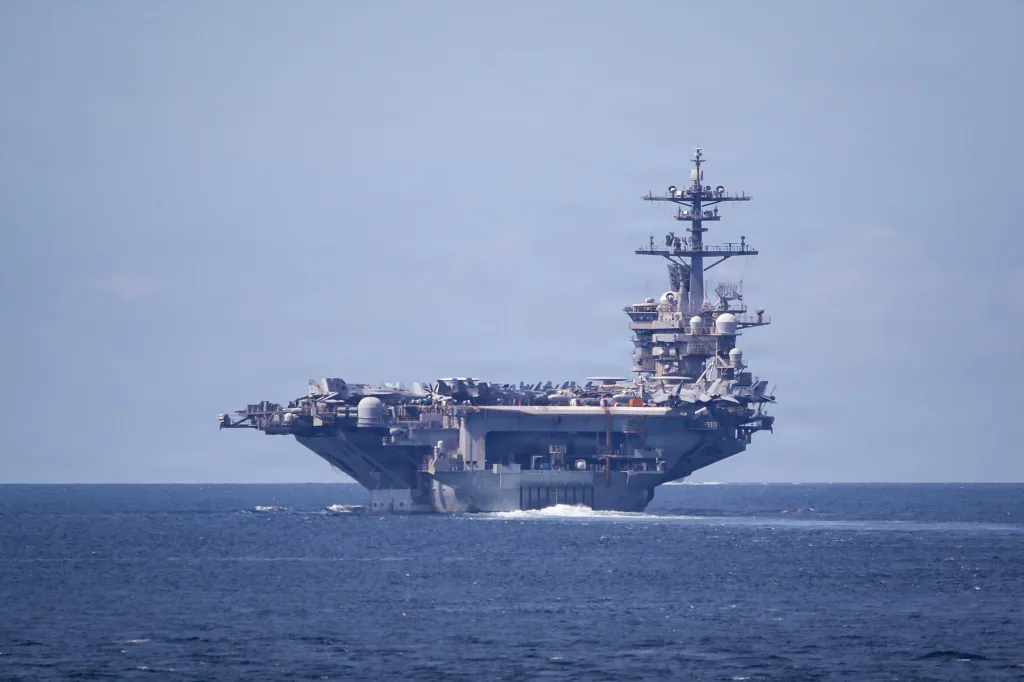
The U.S. military buildup for a possible attack on or from Iran took another step forward Monday as the USS Abraham Lincoln Carrier Strike Group (CSG) entered the U.S. Central Command region, a U.S. official confirmed to The War Zone Monday morning. Meanwhile, Iran on Monday said it was “prepared to defend itself against any new aggression” while its proxies in Yemen and Iraq have vowed to enter the fight on Tehran’s behalf. The Houthis on Monday released a video suggesting an attack on the Lincoln. More on that later in this story.
Elements of the Lincoln CSG were dispatched to the region from the South China Sea by U.S. President Donald Trump, who has repeatedly threatened to strike Iran over its brutal crackdown on anti-regime protests, resulting in thousands killed. The carrier, along with three Arleigh Burke guided missile destroyers escorting it (and usually a fast attack nuclear submarine), is currently located in the Indian Ocean, a U.S. Navy official confirmed to The War Zone.

The arrival of the Lincoln CSG to the region follows a U.S. Air Force Central (AFCENT) announcement on Sunday that it will be conducting Agile Spartan, “a multi-day readiness exercise to demonstrate the ability to deploy, disperse, and sustain combat airpower across the U.S. Central Command area of responsibility.” AFCENT told us that Agile Spartan is “part of its regular exercise schedule and not in response to current tensions.” However, the optics of the timing are hard to avoid.
All these moves come amid a large surge of offensive and defensive assets to the Middle East. As we have previously reported, at least a dozen additional F-15E Strike Eagle fighters have been deployed to Muwaffaq Salti Air Base in Jordan, along with cargo jets and aerial refueling tankers across the region. In addition, online flight tracking indicates the movement of new air and missile defense systems to the Middle East as well. As we projected, the U.S. is sending additional Patriot and Terminal High Altitude Area Defense (THAAD) systems to the Middle East for increased protection from any Iranian attack, The Wall Street Journal reported.
Despite the buildup, it remains unclear what orders Trump will issue. Aside from threatening to strike Iran, Trump on Jan. 13 also promised those taking to the streets that help was on its way.
However, he relented after being told the killings would stop and reportedly called off a strike against Iran last week. According to some accounts, Trump does not want to become involved in a protracted battle with Iran while still contemplating regime change. There are lingering concerns in Washington and Jerusalem about not having enough assets in the region to defend against an expected Iranian response, which in part led Israel to urge Trump to hold off any attack. This was also our analysis at the time.
Regardless of his intent, the influx of additional assets to the region will give Trump a greater range of potential action and allow for the ability to defend against an Iranian attack, whether in response to U.S. military actions or not.
The Lincoln CSG would boost U.S. striking power in the region. Its embarked CVW-9 Carrier Air Wing consists of eight squadrons flying F-35C Lightning II, F/A-18E/F Super Hornets, EA-18G Growlers, E-2D Hawkeyes, CMV-22B Ospreys and MH-60R/S Sea Hawks. Its escorts, the Arleigh Burke class guided-missile destroyers USS Frank E Petersen Jr., USS Michael Murphy, and the USS Spruance of Destroyer Squadron (DESRON) 21 bring a large number of missile tubes that could be used to strike Iran. These vessels could also be used in the defense of U.S. and allied targets during a reprisal.

The presence of Strike Eagles in the region, especially those coming from RAF Lakenheath, is in itself not new. These jets have maintained a steady presence at Muwaffaq Salti Air Base in Jordan for nearly a decade, and their recent arrival in the Middle East was largely expected due to the current instability and saber-rattling. F-15Es played a key role in defending against multiple Iranian drone and cruise missile barrages on Israel and they are now more capable of that mission than ever. Beyond its offensive capabilities, if Iran were to launch a major attack on Israel and/or U.S. assets in the region, preemptive or in retaliation, the F-15Es would play a key part in defending against those attacks.
In addition to U.S. assets, the Royal Air Force’s “joint Typhoon squadron with Qatar, 12 Squadron, has deployed to the Gulf for defensive purposes, noting regional tensions as part of the UK-Qatar Defense Assurance Agreement, demonstrating the strong and enduring defense relationship between the U.K. and Qatar,” the U.K. Defense Ministry (MoD) announced on Thursday.
While these are significant additions to the standing force posture in the region, more fighter aircraft would be expected for a major operation against Iran. We have not seen evidence of those kinds of movements just yet, although some movements are not identified via open sources.
Beyond tactical combat aircraft in the region, the U.S. can fly bombers there from the continental United States, as was the case when B-2 Spirits attacked Iran’s nuclear facilities during Operation Midnight Hammer last June. However, satellite imagery observed by The War Zone shows that no aircraft have arrived for a sustained operation in the Middle East.
As U.S. assets pour into the region, the U.S. Embassy in Baghdad highlighted a warning Trump delivered to Iran last week.
“We have a big flotilla going in that direction, and we’ll see what happens,” Trump told reporters Thursday afternoon aboard Air Force One. “We have a big force going toward Iran. I’d rather not see anything happen, but we’re watching them very closely.”
Israel, for its part, is preparing for both offensive and defensive actions toward Iran, its longtime archenemy.
IDF Northern Command chief Maj. Gen. Rafi Milo said Sunday that the military is preparing for the possibility that a US strike on Iran could trigger Iranian retaliation against Israel, according to Israeli media.
“We don’t know where this is heading,” Milo said in remarks broadcast by Channel 12 News, as tensions continue to mount,” the Times of Israel noted. “We see the force buildup the Americans are carrying out, both in the Persian Gulf and throughout the Middle East.”
Milo said the military is on heightened alert for any escalation, should the US decide to attack Iran.
“We are prepared and ready so that if the U.S. decides to strike Iran, we understand it could affect Israel, with part of the Iranian response possibly reaching here,” he said.

“The IDF is preparing for a possible American strike this coming weekend,” a high-ranking IDF official told us on Monday. “But again, there is no certainty.”
“Everything depends on the mind of one man,” he added, referring to Trump.
In another sign of a potential new conflict, Israel’s civil authority has told foreign airlines that Jan. 31 and Feb. 1 could be a period of security sensitivity, a likely reference to a U.S. military strike on Iran. If Israeli airspace is closed, foreign airlines will be given priority of exit.
CENTCOM commander Adm. Brad Cooper was recently in Jerusalem to talk about regional security issues. Israel’s Channel 14 news, a right-wing outlet closely aligned with Prime Minister Benjamin Netanyahu, claimed that Cooper and IDF officials have yet to come up with an attack date, that the U.S. “will need time to build up a significant force,” but will strike immediately if needed.
The U.S., according to the news outlet, wants “a clean, swift, and inexpensive operation” to “focus on those who harmed civilians and protesters. America is “ready to replace the regime in Iran,” Channel 14 added.
The War Zone could not independently verify these claims. Neither CENTCOM nor the IDF put out official statements on these conversations.
Iranian officials maintain that they are prepared to fight both the U.S. and Israel.
Iran’s Defense Ministry spokesperson Gen. Reza Talaei-Nik warned Israel and the U.S. over any potential attack, saying it would “be met with a response that is more painful and more decisive than in the past.” Talaei-Nik was likely referring to the limited response Iran took in June 2025, attacking Al Udeid Air Base in retaliation for the Midnight Hammer strike.
“Iran is fully prepared to defend itself in the event of any renewed aggression,” said First Vice President Mohammad-Reza Aref. He stressed that “comprehensive forecasts have been made and a structured economic plan has been designed to confront a potential future war.”
Any U.S. or Israeli military action would come without the tacit support of the United Arab Emirates.
“The UAE affirms its commitment to not allowing the use of its airspace, territory, or waters in any military operations against Iran,” the UAE Foreign Affairs Ministry announced on X. “The Ministry of Foreign Affairs affirmed that the UAE is committed to not allowing the use of its airspace, territory, or waters in any hostile military operations against Iran, and not providing any logistical support in this regard. It renewed its affirmation of the UAE’s belief that enhancing dialogue, reducing escalation, adhering to international laws, and respecting state sovereignty represent the optimal foundations for addressing current crises, emphasizing the UAE’s approach based on the necessity of resolving disputes through diplomatic means.”
Iran is not the only threat facing the U.S. and Israel. Iranian proxies like the Lebanese Hezbollah, the Houthis of Yemen and Iraq’s Kataib Hezbollah paramilitary group have all vowed to respond to any strike on Iran.
The Houthis, who waged a campaign against U.S. and allied military and commercial shipping from Nov. 2023 to May 2025, released a new video on Monday suggesting a missile and drone strike on the Lincoln.
The Israeli Air Force is stepping up attacks on Hezbollah targets in Lebanon, partly to blunt the group’s ability to join any Iranian retaliation. Hezbollah is already a shadow of prior self after Israel executed a protracted campaign to decimate the group.
The death toll from the unrest that began in Iran on Dec. 28 over rising prices, devalued currency that saw the rial crater now to basically nothing, a devastating drought, and brutal government crackdowns may be in the tens of thousands.
“As many as 30,000 people could have been killed in the streets of Iran on Jan. 8 and 9 alone,” TIME reported, citing two senior officials of the country’s Ministry of Health. “So many people were slaughtered by Iranian security services on that Thursday and Friday, it overwhelmed the state’s capacity to dispose of the dead. Stocks of body bags were exhausted, the officials said, and eighteen-wheel semi-trailers replaced ambulances.”
As U.S. military assets continue to flow into the region, this remains an increasingly tense situation that could erupt without notice. We will continue to monitor it and provide updates.
Contact the author: howard@thewarzone.com