Lincoln

Don’t tell this California lawmaker the GOP won the redistricting push

One thing Anne Smull, a retired feedstore owner, was looking forward to on election day was voting for the man who currently represents her in Congress, conservative Rep. Kevin Kiley. Now she can’t.

That’s because California Democrats sliced Kiley’s district six ways as payback for Republican redistricting in Texas and elsewhere. The chunk of the district that Smull, who identifies as a conservative, lives in is now grafted onto an overwhelmingly Democratic seat based in the state’s wine country.

During a recent lunch at a cafe in Lincoln, a onetime agricultural town that has morphed into a bedroom community on the edge of Sacramento’s exurban sprawl, Smull was heartbroken to hear she can no longer vote for Kiley.

“He believes in the same things I do,” Smull said. “It feels sneaky and underhanded.”

Republicans started the redistricting competition. Democrats might finish it

Democratic voters in several other states know how Smull feels.

President Trump last year told GOP-controlled states to redraw their maps before this year’s midterm elections to increase the number of winnable seats for Republicans in order to help the party hold on to the U.S. House. The effort was turbocharged by a U.S. Supreme Court decision in the spring of this year that neutralized a key provision of the Voting Rights Act and cleared the way for Republicans to redraw more seats across the South that had elected Black Democrats.

Democratic-leaning and heavily minority communities from Texas to Tennessee have been split into multiple congressional districts that dilute the Democratic vote by stretching deep into conservative areas.

In the future, it is likely that more Republican voters in other states will go through what Smull and other conservatives in Northern California are facing. Democrats in Maryland, New York, Illinois and other strongholds have pledged to retaliate in time for the 2028 elections and split Republican-leaning districts the way their California counterparts did Kiley’s.

Democrats have been hindered nationally by stricter rules against partisan line-drawing in their states, but California showed a way around that. California Democrats won voter approval last year to redraw the state’s congressional map, originally made by an independent commission, and formed five new Democratic-leaning seats.

‘We have zero voice,’ says voter angry at the Democratic drive for a new political map

Kiley’s is one of them. The reworked political lines led the two-term congressman to leave the Republican Party and run as an independent in the slightly Democratic-leaning district that now includes his home.

He spoke out against partisan gerrymandering, even unsuccessfully trying to force the Republican-led House to allow a vote on a bill to ban mid-decade redistricting.

“We’ve seen partisan divisions really spin out of control in really harmful ways, and I think Exhibit No. 1 is the redistricting wars,” Kiley recently told a group of voters in the suburb of Citrus Heights.

Democrats contend Kiley’s party switch is purely a political trick to survive in a more liberal district. They note that he still caucuses with House Republicans and has voted for many of the GOP’s priorities, including Trump’s sweeping budget and tax cut bill last year, and that political organizations run by House Republicans are spending money to back his reelection.

Even some of Kiley’s supporters think the election was a factor in the congressman’s decision to become an independent.

“My original thinking was he did it because of redistricting — maybe it’d help him get reelected,” said John Coburn, a 68-year-old retired business owner, at the Citrus Heights event.

Coburn is furious at the Democrats’ redistricting and hopes Kiley wins. Coburn does not care that they did it in retaliation for Texas, where Republicans at Trump’s directive revised that state’s map to carve out up to five new winnable conservative seats.

“I don’t care about Texas, I live in California,” Coburn said, adding that “40% of the state is Republican, and we have zero voice. Zero. It’s not how our Founding Fathers intended.”

For Democrats in the district, a rare political opportunity

In an interview, Kiley said his switch to independent was no political gambit. If he wanted to stay in the House, he argued, he could have had an easier time staying in the GOP, moving to a more conservative district that included parts of his old one and running in a Republican primary there.

“I could have gone there and run and played the same game these other politicians are playing,” he said.

Kiley said that he is caucusing with Republicans to avoid losing his seats on committees and that in the next Congress he will try to change rules so independent members do not lose committee seats because they do not caucus with one of the two major parties.

Among his backers, he noted, is onetime Democratic presidential hopeful Andrew Yang, a former technology entrepreneur who co-founded a centrist party for independents.

The Democrat running against Kiley, former state Sen. Richard Pan, scoffs at his rival’s newfound independent status.

“He was a MAGA champion when he first ran for Congress, and now he’s trying to say ‘I’m not,’” Pan told a crowd at a senior community in Roseville, referring to Trump’s “Make America Great Again” movement.

Earlier that day, Pan swung by the Placer County Democratic Party office, tucked away on the second story of a brick shopping arcade in Lincoln’s compact downtown.

Placer is a Republican county that stretches from the Sacramento suburbs to the northwestern shores of Lake Tahoe. The entire county is in Kiley’s current district, but it will be divided among three districts in the new map.

Kathleen Crawford, chair of the county Democratic Party, was enthusiastic about the county getting carved up.

“It’s worth it, because we have an opportunity to get Democratic representation, which has been missing from our county,” Crawford said. “I’ve been here 15 years, and this is my first real opportunity to elect a Democrat.”

A never-ending cycle that cuts out ‘the little people’

Lincoln’s downtown is flanked by fruit, vegetable and flower farms, as well as new subdivisions. The community and its neighboring suburbs have become a destination for people fleeing the San Francisco Bay Area’s housing prices. That has helped change the once solidly conservative area into a political battleground where skilled mapmakers can draw winnable seats for Democrats.

Ed Church, a 61-year-old risk manager, was eating lunch at Simple Pleasures cafe in Lincoln when he contemplated Kiley’s shift. A Democrat, Church has not been a Kiley fan and he was bemused by the congressman’s move.

“If that’s how he’d been initially and not so MAGA, I probably could have supported him,” Church said of Kiley’s independent status. Now Church, as a Lincoln resident, is in a purely Democratic district and will not have a say in Kiley’s fate in November. His main criteria in the election will be “who’s going to stand up to Trump?”

Across the street at a gun store, Wesley Johnson, 43, who considers himself a conservative independent, said he was dispirited by the state’s redistricting.

“I feel Northern California is not represented fairly,” Johnson said. “San Francisco, Sacramento and Los Angeles control everything.”

He acknowledged Republicans were doing the same thing in states they controlled and said he did not know how it could stop.

“You’re just cutting out the little people,” Johnson said.

Riccardi writes for the Associated Press.

Source link

USS Lincoln crisis: How it compares to past aircraft carrier deployments | US-Israel war on Iran News

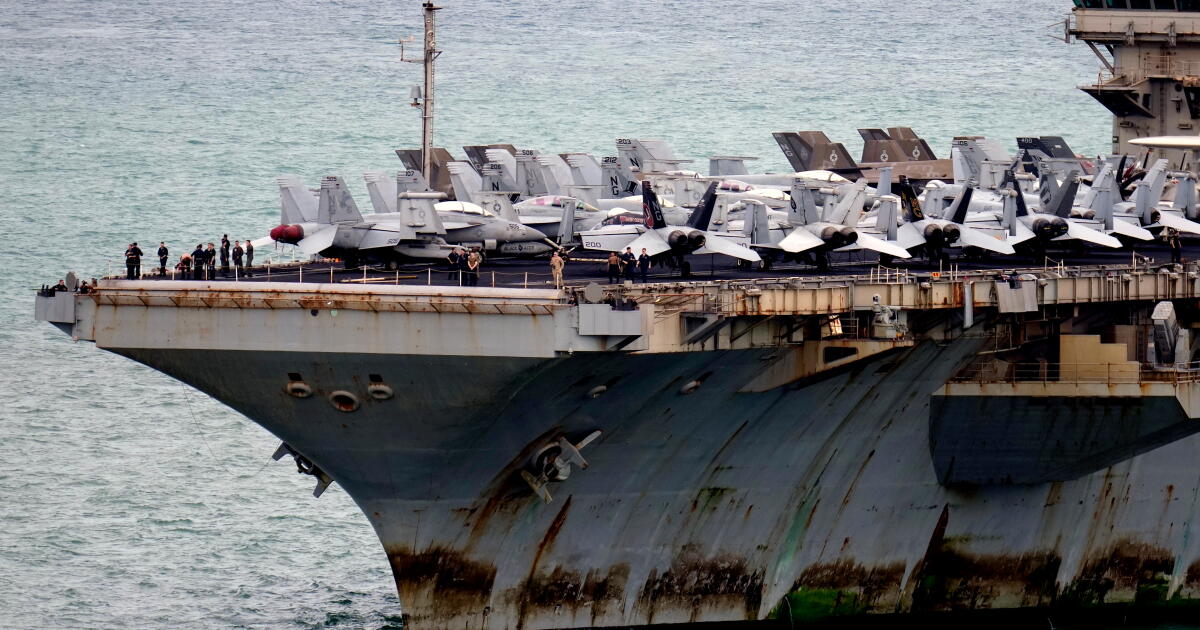
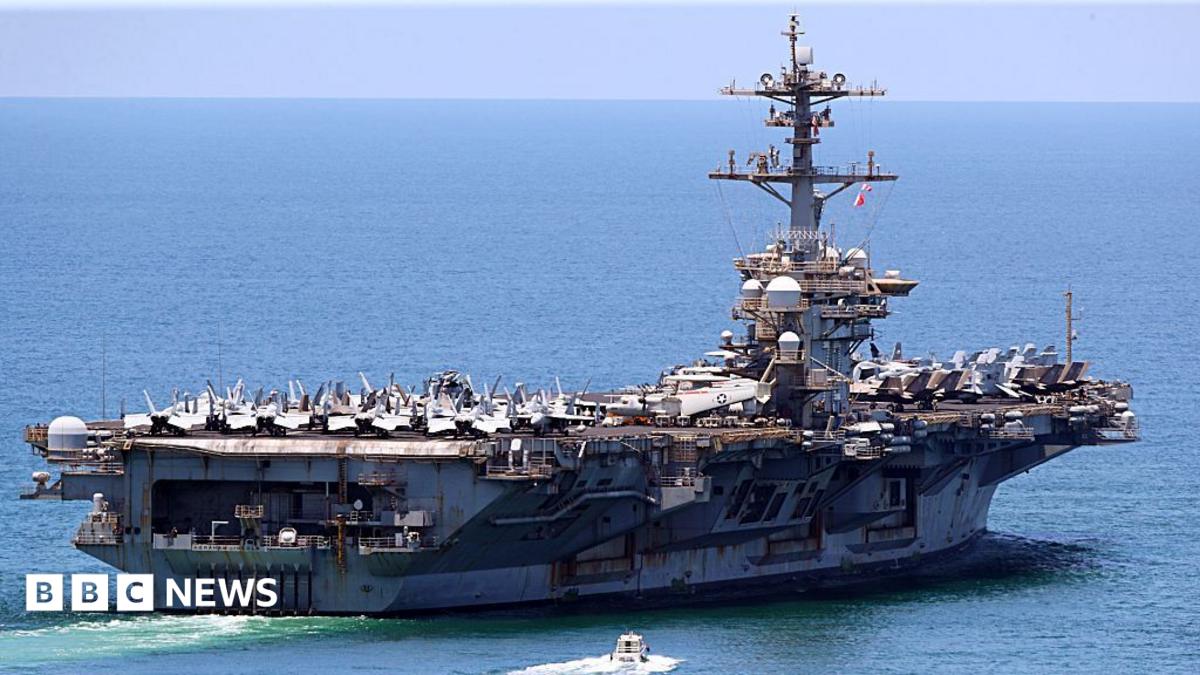
The nearly nine-month extended deployment of the USS Abraham Lincoln in the Middle East has triggered a mental health crisis among the crew so intense that some sailors have tried to jump overboard, according to some US media reports.

Family members of the exhausted military crew on board the flagship aircraft carrier, reportedly located in the Gulf region, say there are food shortages, while broken toilets and showers have contributed to unsanitary conditions and poor health.

Recommended Stories

list of 3 itemsend of list

More than 5,000 staff members have been on board the vessel, which has been conducting maritime security and blockade operations at present around the Strait of Hormuz, for that time. It set sail on November 21, 2025 from its homeport of San Diego for an extended deployment to the Asia Pacific and the Middle East.

Since then, the ship has made just one single-day port stop at Naval Base Guam from December 11-12. The lack of port stops is a major issue for a ship the size and complexity of the USS Abraham Lincoln, experts say.

As US President Donald Trump and his defence secretary, Pete Hegseth, declare the United States is ready to continue an “indefinite” blockade on Iranian ports in the Gulf, we look at how this compares with other lengthy aircraft carrier deployments.

What is happening on board the USS Abraham Lincoln?

Reports by two US publications that cover military affairs, the Navy Times and Stars and Stripes, last week quoted family members of military personnel on board the vessel who said they were suffering from declining mental health and morale, and cases of suicidal ideation.

The Navy Times spoke on record with one sailor’s wife, identified as Annabelle Loma, who said he had attempted to jump overboard amid what she described as “severe burnout”.

The reports prompted urgent questions from US lawmakers. On Sunday, Admiral Brad Cooper, commander of US Central Command (CENTCOM), reportedly visited the USS Lincoln.

He praised the crew and stated on social media that “service at sea for long periods isn’t for everyone, while claiming the ship has the lowest number of mental health-related cases of the navy’s 11 active aircraft carriers. “It is uniquely challenging and tough, and every single one of us, including me, reacts to stressors in different ways,” he said.

But there is growing concern among Republican and Democratic lawmakers over what they see as a lack of accountability after Hegseth dismissed mental health reports last week as “completely misrepresented”.

When Trump was asked last week whether the USS Lincoln had been at sea for too long, he told reporters: “No, not nearly long enough.”

The USS Lincoln mission was supposed to end in May but has been extended repeatedly since then.

Last week, it emerged that another ship, the USS George Washington, has been rerouted from its position in the Pacific and will arrive in the Gulf within a week to take over duties from the Lincoln.

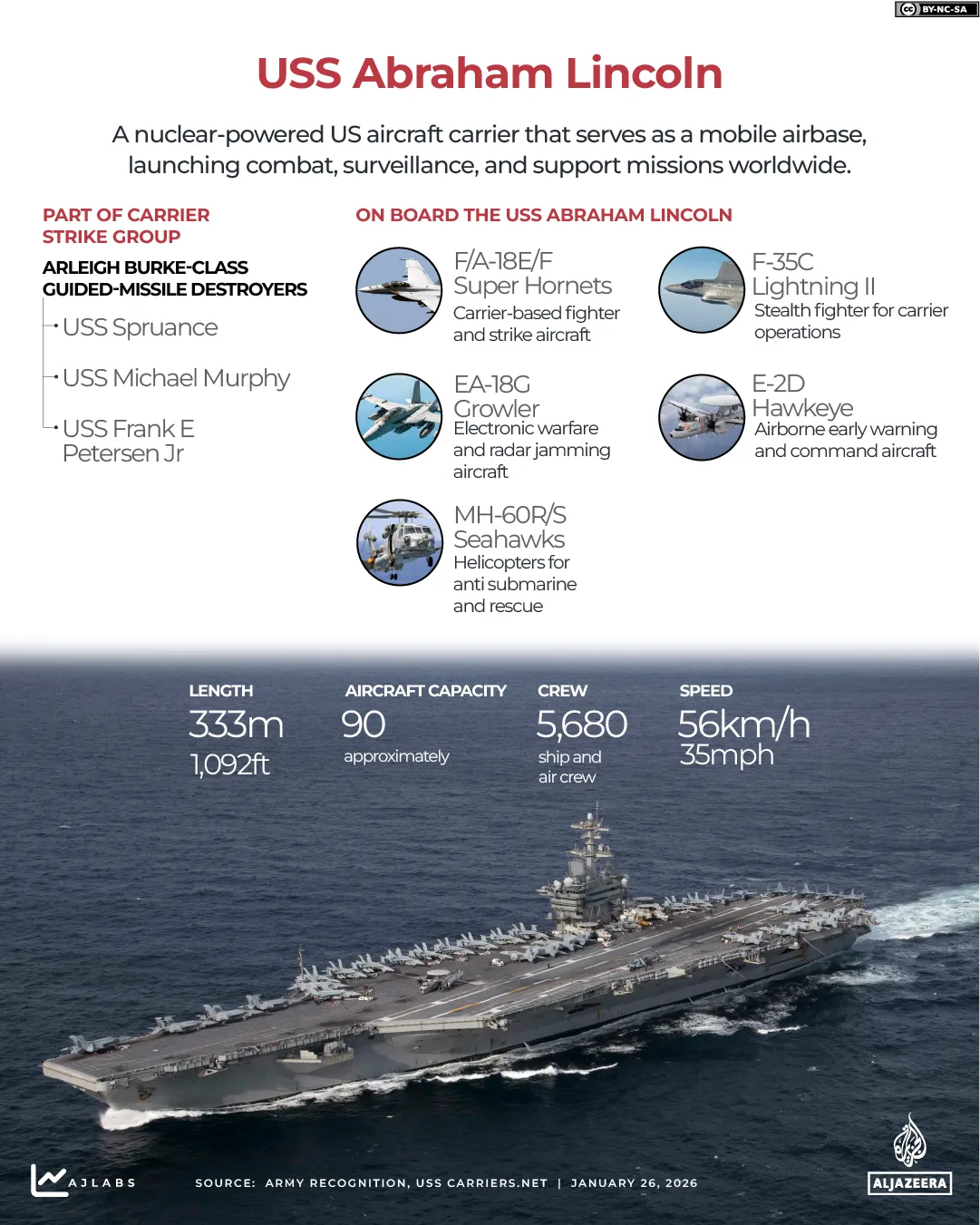
INTERACTIVE - USS Abraham Lincoln - JAN 26, 2025-1769422995

How long can US aircraft carrier deployments be?

The longest aircraft carrier deployment since the Vietnam War was the USS Gerald R Ford’s 326-day mission, which began in June 2025, under Trump’s second term in the White House.

That mission included NATO exercises in the Mediterranean, support for the US military operation that captured Venezuelan President Nicolas Maduro, and operations in the Red Sea during the US-Israel war on Iran.

After beginning its mission as a routine deployment to the Asia Pacific region, the Ford then moved into the South China Sea for security operations, before being deployed to the Arabian Sea and the Gulf of Oman to help the US enforce its naval blockade of the Iranian ports.

During this time, the USS Ford met several technical problems, including an onboard fire, which also triggered congressional scrutiny back home.

Lengthy deployments during the Vietnam War

Some of the longest aircraft carrier deployments in US history took place in and around the Gulf of Tonkin during the Vietnam War, with the USS Midway operating for 332 days, the USS Coral Sea operating for 329 days and the USS Saratoga operating for 308 days.

Similar to the USS Lincoln, they faced issues as well. Reports said the intense flight schedule of the active air combat during the Vietnam War pushed crew and operations to their limits.

While there are a number of lengthy aircraft carrier deployments from other countries, they pale in comparison to the US Navy’s record.

Russia’s Admiral Kuznetsov conducted a five-month mission to the Syrian coast which began in October 2016, but suffered several technical breakdowns, including aircraft losses.

The United Kingdom’s HMS Queen Elizabeth completed a seven-month deployment in 2021, which included combat strikes on targets in Iraq and Syria, despite significant breakdowns due to engineering issues.

Why is this issue so critical?

Many lawmakers have raised questions over whether the US can maintain an “indefinite” blockade in the Gulf if conditions on board a flagship aircraft carrier are so dire.

In a letter to Hegseth last week, Democratic Senator Richard Blumenthal raised the alarm over reports of deteriorating mental health on board, as well as shortages of basic supplies, water contamination, an increase in safety incidents and even disruptions to mail services, through which those on board receive care packages.

“These reports warrant immediate attention, but they also raise a broader question: whether the Navy can sustain the operational tempo now being demanded of its carrier force, particularly as this administration repeatedly commits US forces to conflicts of its own choosing and increasingly relies on aircraft carriers to sustain those operations,” Blumenthal wrote.

Experts say the lack of port stops is a major issue for the USS Abraham Lincoln.

Harlan Ullman, a retired senior naval officer and chairman of the strategic advisory firm Killowen Group, told Al Jazeera that ships require onshore care to keep advanced technology operational over long periods.

“Ships need maintenance, particularly ships that are extremely complicated with very advanced weapon systems such as nuclear-powered carriers with very advanced systems, and there are things that you cannot do in terms of maintenance under way,” Ullman said.

“There are lots of things that you can do at sea, but there are far more things that can only be done in port,” he pointed out.

Ullman noted that extended deployments “erode the readiness and capability of that ship the longer it’s at sea, and it lacks the ability to repair and extend maintenance”.

He added that the Trump administration must prioritise naval readiness over politics, saying “this is a national issue, not a local one; and the administration should not be so defensive. It should say, ‘OK, we’ll see what’s going on, and then if there are some issues, we’ll take care of them.’”

What are the drawbacks of deploying aircraft carriers?

Aircraft carriers are built to be on deployment for many months at a time. However, that comes with a high cost, as extended cruises increase the risk of technical breakdowns and can also lead to reduced staff morale and mental health concerns.

Large aircraft carriers are expensive. The USS Abraham Lincoln cost $2.2bn to build in 1989, and it costs tens of millions of dollars to operate on a daily basis.

INTERACTIVE - USS Abraham Lincoln arrives in the Arabian Sea - JAN 27, 2026-1769503500

Recent conflicts in the Red Sea have also underscored the vulnerability of large aircraft carriers. Houthi rebels, who do not possess a formal navy, have nevertheless managed to put significant pressure on large US Navy aircraft carriers operating near the limits of their missile range.

At one point during the US-Israel war on Iran, the USS Gerald Ford was forced to sail hundreds of miles away from the Iranian coast to reduce the risk of being hit by missiles, limiting its effectiveness.

Source link

Centcom head visits USS Abraham Lincoln amid concerns about conditions

An E-2D Hawkeye prepares to launch from the flight deck of the Nimitz-class aircraft carrier USS Abraham Lincoln in 2018. U.S. Central Command Adm. Brad Cooper visited the ship on Saturday. U.S. File Photo by Mass Communication Specialist 3rd Class Jeff Sherman/Navy

Aug. 16 (UPI) — The commander of U.S. Central Command visited the USS Abraham Lincoln days after the aircraft carrier drew public attention over reports of poor conditions on board and attempted suicides of sailors.

Adm. Brad Cooper visited the ship as part of a 10-day tour of the Middle East, U.S. Central Command said in a statement. Cooper also met with senior civilian and military leadership in Bahrain, Iraq, Iran, Israel, Jordan, Saudi Arabia, and the United Arab Emirates.

The Lincoln, which is based in San Diego, has been at sea for a record of more than 260 days after being deployed to Venezuela and then the Middle East, where it is currently.

Families of sailors serving on the ship have told media outlets several crew members have tried to jump overboard or have been stopped from doing so in recent months. There have also been reports of a lack of fresh food on board and moldy showers, among other issues.

“Unfortunately, the media are trying to paint our warriors as victims,” Navy Secretary Hung Cao said in a statement on Friday. He later said that Lincoln would return home and be replaced with the USS George Washington.

Senate Democrats have been pressing the Trump administration about the conditions on the Lincoln as well as its planning for its conflict with Iran.

“I was just speaking to a spouse just about three days ago and this is the current problem right now,” U.S. Sen. Ruben Gallego, D-Ariz., said on ABC News’ This Week on Sunday. “It really goes to the deep, deep, deep problem here is that this administration did not plan for this war, did not plan how to get out of this war, did not really understand how this war was going to escalate.”

Defense Secretary Pete Hegseth has said media reports have “completely misrepresented” the situation, while President Donald Trump told reporters that the deployment’s length is “not nearly long enough.”

Members of the National Guard patrol near the Washington Monument on Tuesday. Photo by Bonnie Cash/UPI | License Photo

Source link

US aircraft carrier expected to relieve USS Lincoln in Middle East | Donald Trump News

A United States aircraft carrier, the USS George Washington, has begun to depart the western Pacific Ocean, leaving its port in Da Nang, Vietnam, for an anticipated deployment to the Middle East.

The ship is expected to replace the USS Abraham Lincoln, which is currently participating in the US-Israeli war against Iran.

Recommended Stories

list of 3 itemsend of list

The vessel’s movement on Saturday comes amid mounting concerns about the conditions on board the USS Lincoln, sparked by reports of sailors attempting to jump overboard.

The USS Lincoln has been deployed without a port stop for more than 266 days, a record duration for the Navy. It houses about 5,000 sailors and Marines.

In the wake of reports about supply shortages and mental health strain on the ship, US President Donald Trump and acting Secretary of the Navy Hung Cao indicated that the vessel would be rotated. The Pentagon has not confirmed, however, that the USS Lincoln will be replaced by the USS Washington.

The department historically has not commented on movements of key military assets, citing security concerns.

Analysts note that the USS Washington’s departure from the Pacific leaves no US aircraft carrier in the strategically significant region, where the US has long acted as a bulwark against China’s might.

Back-and-forth over conditions

Members of the Trump administration have spent much of this week batting away reports about deteriorating conditions on the USS Lincoln.

US media outlets have carried reports not only of sailors attempting to leap from the vessel, but also of diminishing hygiene supplies and paltry food, as well as issues with plumbing and waste disposal.

Several US senators have called for more information about the conditions on board and the reason for its record-setting deployment.

Since leaving San Diego, California, last November, the USS Lincoln has been sent to support military operations in Venezuela, before leaving for the Middle East shortly thereafter.

Its deployment was supposed to end in May. But after the US and Israel launched a war against Iran in February, its mission was extended indefinitely.

The war with Iran has shown no signs so far of ending, though fighting has remained largely subdued in recent days. Talks have stalled over issues including control of the Strait of Hormuz, a strategic waterway for global trade.

Speaking to reporters on Friday, Trump downplayed concerns about the ship, saying instead the length of the aircraft carrier’s deployment was “not nearly enough”.

A day earlier, Pentagon chief Pete Hegseth said conditions on board had been “completely misrepresented”.

In a separate statement on Friday, Cao maintained the issues on board the ship were not dire, but he acknowledged “a small number of mental health cases were treated with no loss of life”.

He added that meal plans had been adjusted “when fresh resupply was unavailable”, but not a single meal had been missed.

“There is no question our young men and women have been pushed to their limits  — but they have never broken,” he said.

Still, some analysts say Iranian attacks have taken a toll on US military assets across the region, particularly a US Navy base in Bahrain. That has likely complicated typical resupply and maintenance procedures for aircraft carriers like the USS Lincoln.

Concerns about China

News of the USS Washington’s shift from the Pacific has spurred concern that its departure may further harm US deterrence against China. It was not clear if or when another carrier would be deployed to the region.

Bryan Clark, a former Navy submariner and defence analyst at the Hudson Institute, a think tank, told The Associated Press that Beijing may try to project strength in the aircraft carrier’s absence to unnerve US allies in the region.

“They’re using this as part of the narrative to demonstrate to the Philippines, to Japan, to Indonesia and others that the US is not the big dog in the western Pacific any more,” Clark said.

“They would just prefer that countries in the region decide that China is the bigger power and the US is not able to guarantee their security any more.”

Clark added he did not believe the change would in and of itself embolden China to launch an attack on Taiwan, the self-governing island it claims as its own.

Still, the shift comes as the US contends with a reported depletion in both its offensive and defensive weapon supplies as a result of the war with Iran.

Those shortages have already piqued concerns of a declining US ability to serve as deterrence against military aggression. Critics point out that a country like China, unlike Iran, has advanced military technology and a sprawling air force, which could pose a challenge to the US military.

Like the USS Lincoln, the USS Washington is a Nimitz-class nuclear-powered aircraft carrier. It has the capability to carry more than 6,000 passengers and about 90 aircraft.

Source link

USS Abraham Lincoln ending long deployment amid health concerns

An F-35C Lightning II prepares to launch from the flight deck of the Nimitz-class aircraft carrier USS Abraham Lincoln in 2018. Naval officials announced Friday the warship is ending its record-breaking deployment following reports of the deteriorating mental health of its crew. U.S. Navy File Photo by Mass Communication Specialist 1st Class Brian M. Wilbur

Aug. 14 (UPI) — The aircraft carrier USS Abraham Lincoln is returning home after a lengthy, record-breaking deployment which some crew members’ families said caused their loved ones to attempt suicide, Navy officials announced Friday.

The vessel will be replaced in the Middle East by another aircraft carrier, President Donald Trump later told reporters, while dismissing concerns over the mental well-being of its sailors and Marines during its 266-day deployment.

The USS Abraham Lincoln “crushed their deployment and will return home soon as part of a planned rotation,” acting Secretary of the Navy Hung Cao said in a social media statement. “Details will come but let me be clear: the safety and security of our Sailors and Marines always comes first.”

The Lincoln’s time at sea “was extended because the mission demanded it. Deployments are hard,” he added, while criticizing what he called a “dishonest” portrayal of the crew’s health situation by media allegedly attempting to “paint our warriors as victims.”

Families of sailors serving on the ship have told reporters several crew members have tried to jump overboard or have been stopped from doing so in recent months as the Lincoln’s deployment reached record-setting proportions.

This prompted Senate Armed Services Committee member Richard Blumenthal, D-Conn., to voice “serious concerns” about the length of the warship’s deployment as well as additional reports of supply shortages and contaminated water.

Cao on Friday admitted that “a small number of mental health cases were treated with no loss of life” and that meal plans “were adjusted” when fresh resupply was unavailable “without a single meal being missed.

“There is no question our young men and women have been pushed to their limits-but they have never broken,” he said. “They are rightly tired — but have never been out of the fight.

“However, it is clear, knowing the whole story, our force and their families are not victims. They are the epitome of American strength and resilience.”

The Abraham Lincoln will be replaced in the Middle East by the USS George Washington, the Wall Street Journal reported.

Trump, meanwhile confirmed another carrier is on its way, telling reporters that the Lincoln “is moving right now or very shortly and it’s being replaced with another very similar ship.”

He responded, “no, they’re not,” when asked if sailors’ families are concerned, and questioned whether the 266-day deployment was too long, he answered, “No, no, no. Not nearly long enough.”

Source link

Trump dismisses mental health concerns on USS Lincoln aircraft carrier | Military News

Members of the US Congress have called for a probe into conditions amid reports of sailors attempting to jump ship.

United States President Donald Trump has dismissed concerns about conditions on board the USS Abraham Lincoln during its lengthy deployment as part of the US-Israel war with Iran.

Speaking to reporters on Friday, Trump rejected the assertion that the families of those on board the aircraft carrier are worried about their loved ones. “No, they’re not,” Trump said.

Recommended Stories

list of 3 itemsend of list

When asked if the aircraft carrier had been deployed too long, Trump replied: “No, no, no, not nearly enough.”

His remarks follow a series of reports this week, documenting supply shortages and mental health strain on the USS Abraham Lincoln. That includes accounts of individuals attempting to jump from the ship.

The aircraft carrier left in November from a base in San Diego, California, and it has since been involved in January’s military operation against Venezuela and, more recently, the war against Iran.

Its deployment was expected to end in May, but that timeframe has been extended. It has spent more than 250 days at sea without a port stop, setting a record for the US Navy. More than 5,000 sailors and Marines are housed on board.

Several US lawmakers have since called for an inquiry into conditions on board the ship. One Democratic senator, Ruben Gallego, has also called on the Navy to allow a bipartisan delegation to visit the ship to assess the state of affairs.

Still, the Trump administration has repeatedly denied worsening conditions on the USS Abraham Lincoln.

On Friday, a US official told Al Jazeera the Navy had “not observed an increase in suicidal ideations or attempts aboard the ship”.

The official added that there were five chaplains, one psychologist, one social worker, three “behavioral health technicians”, and one “embedded integrated prevention coordination (EIPC) counselor” on board the vessel. There is also an emotional support dog on board.

‘What military objective?’

While Trump downplayed the length of the deployment, he did confirm reports that the aircraft carrier will be swapped out in the near future.

“That ship is moving right now or very shortly, and it’s being replaced with another very similar ship,” Trump said on Friday.

In a letter to Secretary of Defense Pete Hegseth earlier this week, Senator Richard Blumenthal, a Democrat, asked for information on conditions on the boat, including what metrics the Navy was using to measure the mental health of the crew.

“What military objective is the continued deployment of the Lincoln intended to achieve in Iran, and how does the Department assess whether the carrier’s continued presence is necessary to accomplish that objective?” he asked.

The focus on conditions aboard the USS Abraham Lincoln come as diplomatic efforts to end the US-Israeli war in Iran show no signs of breakthrough. The war began with a US and Israel-led offensive on February 28.

In June, the US and Iran signed a memorandum of understanding (MoU) that called for an immediate pause to the fighting.

But last month, the memorandum collapsed amid a dispute over the Strait of Hormuz, a key waterway for trade.

The subsequent escalation saw the US re-impose its naval blockade on Iranian ports and Iran constrict traffic through the strait once more.

Iran has since focused its diplomatic efforts on reaching an agreement with Oman over travel routes in the waterway, which is a key artery for oil, natural gas, fertiliser and other goods.

Source link

Trump says USS Abraham Lincoln deployment ‘not nearly long enough’

Democratic lawmakers and military families are pressing the Pentagon for answers after reports emerged that thousands of sailors aboard the USS Abraham Lincoln have endured food shortages, plumbing failures and severe fatigue during deployment that has stretched more than 260 days.

The roughly 5,000-person crew, which left San Diego in November and has been stationed in the Middle East to support the U.S. war against Iran, has spent a record amount of uninterrupted time at sea. Now, families of those on board have begun speaking out publicly, describing concerns about mental health and supply issues aboard the aircraft carrier.

Since those reports — which Defense Secretary Pete Hegseth characterized as “completely misrepresented” — the U.S. military announced plans to send the USS George Washington, a Pacific-based aircraft carrier, to relieve the USS Abraham Lincoln.

But when asked Friday for a reaction, Trump downplayed families’ concerns and characterized the length of the deployment as “not nearly long enough.”

The president’s remarks stand in contrast to the concerns raised by lawmakers and military families, including reports by the Military Times and the Stars and Stripes that sailors tried to jump overboard as the deployment kept going.

“The plans in the works to relieve the USS Lincoln are not enough,” Rep. Mike Levin (D-San Diego) wrote in a letter to Hegseth on Thursday. “We need clear and honest information from the Department of Defense about the operational failures that led to the problems aboard the USS Lincoln to ensure this never happens again.”

Morale aboard a nuclear-powered aircraft carrier already is difficult to maintain without a record-breaking stint, said Julie Roland, a retired veteran Navy lieutenant commander who worked briefly on the USS Lincoln.

Between the lack of sun below deck for some nonpilot personnel and rooms packed with triple-bunk beds, the conditions on vessels like the Lincoln can be difficult to bear. Although service members expect such difficulties, the situation on the USS Lincoln raises additional concern among sailors, Roland said.

“I know what months at sea does to a person even when the ship has hot chow and working plumbing,” Roland said. “The warrior ethos shouldn’t have to include bravely facing water contamination. … Even warfighters need basic care.”

Roland added that she was not surprised to hear complaints of poor living conditions from sailors on board, given that their few days of reprieve for port call constantly were being delayed. She said she received videos showing trash being tossed overboard because of broken incinerators, heard stories of a lack of proper medical supplies and kept in touch with one sailor who detailed his mental health deterioration as days dragged on aboard the Lincoln.

“The magnitude of difference between official information from the Department of Defense and firsthand reports from the crew should be troubling, and may have serious implications about what else the Pentagon may be withholding regarding the conflict in Iran,” Roland added.

In his letter to Hegseth, Levin said the Trump administration needs to answer concerns from military families and loves ones about the conditions aboard. He said he heard concerns about moldy showers, broken toilets, lack of hot water, lack of access to fresh produce and supply shortages.

Rep. Sara Jacobs (D-San Diego), who serves on the House Armed Services Committee, also demanded answers from U.S. military leaders on what she called “horrific” reports of the conditions aboard the ship.

Tensions over the situation also prompted military leaders to hold in-person and virtual meetings last week with the families of the sailors and Marines. Both meetings were combative, according to a recording obtained by MS NOW.

During the in-person meeting at the Naval Air Station North Island in San Diego, Navy leaders were unable to tell families when their loves ones would be relieved from duty. Spouses, in turn, asked what was being done to address issues of mental health and exhaustion, MS NOW reported.

Concerns about mental health deteriorating on these types of deployments are well-founded.

A study of nearly 1,000 sailors published in the journal Military Medicine in January 2025 found that service members aboard Navy ships suffer the highest rates of “serious psychological distress” compared to other branches of the U.S. military. Among the reasons are “unique stressors, such as poor habitability, noise and demanding scheduled that leave inadequate time for sleep and rest,” the study found.

Sen. Richard Blumenthal (D-Conn.), a member of the Senate Armed Services Committee, said the USS Abraham Lincoln was not an “isolated case” and demanded an inquiry.

“Recent carrier deployments have repeatedly stretched beyond their original anticipated duration, suggesting that extended deployments may be becoming a feature rather than an exception of the Navy’s force-generation model,” Blumenthal wrote.

Hegseth told reporters on Thursday that “some deployments are longer than others.”

“What they do in those high seas and those austere conditions with less port calls, it’s incredible. And Americans don’t understand what it’s like to do that,” he said, while adding that he wants “folks rotated as quickly as possible.”

In a message to the crew aboard the USS Abraham Lincoln, Hegseth said: “We’re going to do everything we can for you. We are so grateful for the dedication of that crew and others.”

Source link

Times of Troy: Is this the year Lincoln Riley has a good defense at USC?

Welcome back to the Times of Troy newsletter, where we are just deep enough into USC’s fall football camp to ask the same question we ask every year around this time:

Might this be the year that Lincoln Riley actually fields a good defense at USC?

Fight on! Are you a true Trojans fan?

Get our Times of Troy newsletter for USC insights, news and much more.

Under D’Anton Lynn, the Trojans had unequivocally improved on that side of the ball. Lynn took the disaster that was USC’s defense under Alex Grinch and turned it into a respectable outfit, albeit one with limitations. There was no dominant, or even consistent, pass rusher. The run defense was regularly run over by good teams. And too often, in the biggest moments, there were mental lapses or self-inflicted mistakes on the back end of Lynn’s defense.

At the time, he pointed to the team’s youth as the problem.

“This team is more talented, but they’re just young,” Lynn said last November. “It’s just guys who haven’t played before. There are certain mistakes you have to live through.”

Almost a year later, USC has a new defensive coordinator. And kind of the same problem.

There are two things I think we can safely assume about this defense, compared to its 2025 counterpart: That Gary Patterson, as a newly minted College Football Hall of Famer, should be a significant upgrade from Lynn. And that the influx of five-star talent on USC’s defense should be too.

Because the hard truth, from the past four seasons, is that the Trojans just haven’t had enough talent on defense. Say what you will about the defensive coaching — and it has ranged from above average to horrendous during Riley’s tenure — but outside of Tuli Tuipulotu, who was only with Riley in 2022, USC just hasn’t had any true difference-makers capable of blowing up drives or taking over games on that end.

That’s beginning to change. The 2025 class had one defensive player I believe to be truly special in defensive tackle Jahkeem Stewart, plus a couple others who have flashed some potential, such as defensive back Alex Graham and defensive tackle Floyd Boucard.

The 2026 class could be a different animal, if early reviews are to be believed. Five-star Luke Wafle already looks the part of a dominant defensive end and doesn’t have much standing in his way if he decides to take over this season. Elbert “Rock” Hill should be a starting cornerback in short order, either this season or next, and guys such as linebacker Talanoa Ili and defensive tackles Tomuhini Topui and Jaimeon Winfield look like future starters too.

But are any of those players poised to make a difference this season? They may have to, if USC has any hope of taking a real step forward on that side of the ball.

Otherwise, the Trojans are going to need some other defenders to make the leap in their second or third seasons, guys such as linebacker Desman Stephens or defensive linemen Jide Abasiri and Kameryn Crawford who have the potential but have never delivered on it consistently. They’re also going to need the secondary to stay healthy and top corners Jontez Williams and Chasen Johnson to live up to their billing from the portal.

But while all that might seem like reason to believe USC’s defense won’t be better in 2026, I actually think there are more such reasons than in recent years.

The front is clearly deeper, and if Wafle and Stewart can break through, USC could have two difference-makers along the defensive line for the first time in years. The secondary has two possible shutdown corners for the first time too.

The main cause for concern comes at linebacker, where USC still doesn’t have much in the way of high-level options. But if Stephens and Jadyn Walker can stand up better against the run in their third seasons, which Patterson seems convinced they can do, then those long standing problems could be at least somewhat mitigated this season.

The truth is there’s no real way of knowing how USC’s defense will look when it rolls out later this month. Patterson hasn’t coached since 2021. He has told us on several occasions that his defense will look different, blending concepts from other schools he observed and from USC’s previous defense.

But on paper, at least, the potential is at least there for Patterson to put together the best defense Riley has had as USC’s coach, complete with difference-makers in the defensive front and defensive backfield. Which, when paired with a top-10 offense, could be a pretty powerful thing.

The USC Bloom Football Performance Center.

The USC Bloom Football Performance Center.

(Allen Schaben / Los Angeles Times)

It’s extremely … functional. I know that’s not the sexiest answer. But it’s not the sexiest building.

And I mean that as a compliment!

It’s clear how much the design reflects the input of Riley and his staff, as well as others who understand what USC has been dealing with for years at the John McKay Center. Eighty percent of that facility was underground. So it’s notable when you see the natural light pouring in through the atrium from the ground floor or the 30-foot garage doors opening from the weight room to the practice field.

Amenities such as pickleball courts or infrared saunas or sensory deprivation tanks are cool, but I was more impressed by the heavy emphasis put on player recovery. Which was something else that Riley trumpeted in talking with reporters after our tour. The players themselves said that their favorite part so far was the zero-gravity recliners at their lockers.

The most impressive part, to me, is how everything withing Bloom feels so big, even as space had for so long been seen as a major problem on USC’s campus. For years, administrators told me and other reporters that they’d never be able to build a new facility on campus. But Bloom checked in at three floors and 163,000-square feet and at no point does any of it feel cramped.

In fact, there’s extra space in the building. Designed for the program to have room to grow.

“My goal with this building,” Riley said Thursday, “is I hope 50 years from now, when I’m really, really, really old, that whoever is in this thing, it’s still one of the top facilities and still is the home of USC football and still gives this program every possible advantage it could.”

USC’s starting center from 2025 is out for the season. What now?

Fifth-year senior Kilian O’Connor went down with a non-contact injury last Wednesday, ending his season and presumably his tenure with the Trojans. On an emotional level, it’s a tough pill for the team to swallow.

“[He’s] certainly one of the leaders and kind of heartbeats of this program,” Riley said Thursday of the former walk-on.

But from a football standpoint, the offensive line is one of the few places where USC may actually be able to weather a loss such as O’Connor. It’s possible that he might not have started the whole season at center, anyway.

With O’Connor out, Tobias Raymond, who took reps at center in the spring, could shift there full time. That would open up another spot at guard, where the best combination of Alani Noa, Hayden Treter, Breck Kolojay or even Justin Tauanuu could fit in.

There are options. Which is not a luxury USC has at a lot of other positions. It has offensive line coach Zach Hanson to thank for that.

—USC transfer center Eric Reibe is out for the foreseeable future after foot surgery. A Trojan transfer with high expectations got hurt before playing a single game at USC? You don’t say? Once again, USC starts a season stricken with the worst injury luck. It wasn’t clear yet this week how long Reibe will be out, but I expect it’ll be a while. The Trojans have already been in the mix for former Villanova center Duke Brennan, who got an extra, fifth year of eligibility after the NCAA changed its rules, and they could go after others if he goes elsewhere. USC only has one other true center on the roster, freshman Darius Ratliff. And while he — and his brother — are very talented, the ideal trajectory for both would’ve been to bring them along slowly behind more established players.

—Alani Noa was away from the team last bowl season “to deal with some personal stuff” at home. But the Trojans incumbent starting guard said last week that “there was never a question whether I was going to play at USC” and that the staff was totally supportive at the time. Whether Noa is able to return his starting spot at guard may be another story. As noted above, he’ll have a lot of worthy competition.

—Lincoln Riley has offered a quarterback from the 2028 class. Riley doesn’t usually offer more than one, meaning his choice for 2028 is Lone Star (Texas) High dual threat Trey Wright. Wright is 5 foot 11, 180 pounds as a sophomore and already has offers from the likes of Oregon, Oklahoma and Michigan, among several others.

What I’m Watching This Week

Robert Pattinson and Zendaya in a scene from "The Drama."

Robert Pattinson and Zendaya in a scene from “The Drama.”

(A24)

Robert Pattinson is on a truly epic run this year, and after recommending one of his films last week (“The Odyssey”), I’m bringing us back to the Pattinson well this week with a very, very different movie and very, very different role for the long-ago Twilight vampire.

The Drama” stars Pattinson and Zendaya as a couple on the verge of getting married, who decide, one night, to confess with their two closest friends the worst thing they’d done in their lives. One of their answers, let’s just say, isn’t received all that well. And what follows is a cringy, funny, tense, propulsive roller coaster that’s definitely worth your time. Especially since it’s now available on HBO Max.

In case you missed it

USC’s Gary Patterson out to prove college football hasn’t passed him by

From napkin sketch to crown jewel: Inside USC’s ‘magical’ football training center

New NCAA eligibility rules should help USC — and its No. 1 freshman class — flourish

USC, Notre Dame rivalry series renewed with key detail Trojans would not compromise

Until next time …

That concludes today’s newsletter. If you have any feedback, ideas for improvement or things you’d like to see, email me at ryan.kartje@latimes.com, and follow me on X at @Ryan_Kartje. To get this newsletter in your inbox, click here.
Source link

Times of Troy: To unlock USC’s full potential on offense, Lincoln Riley must lean on the run

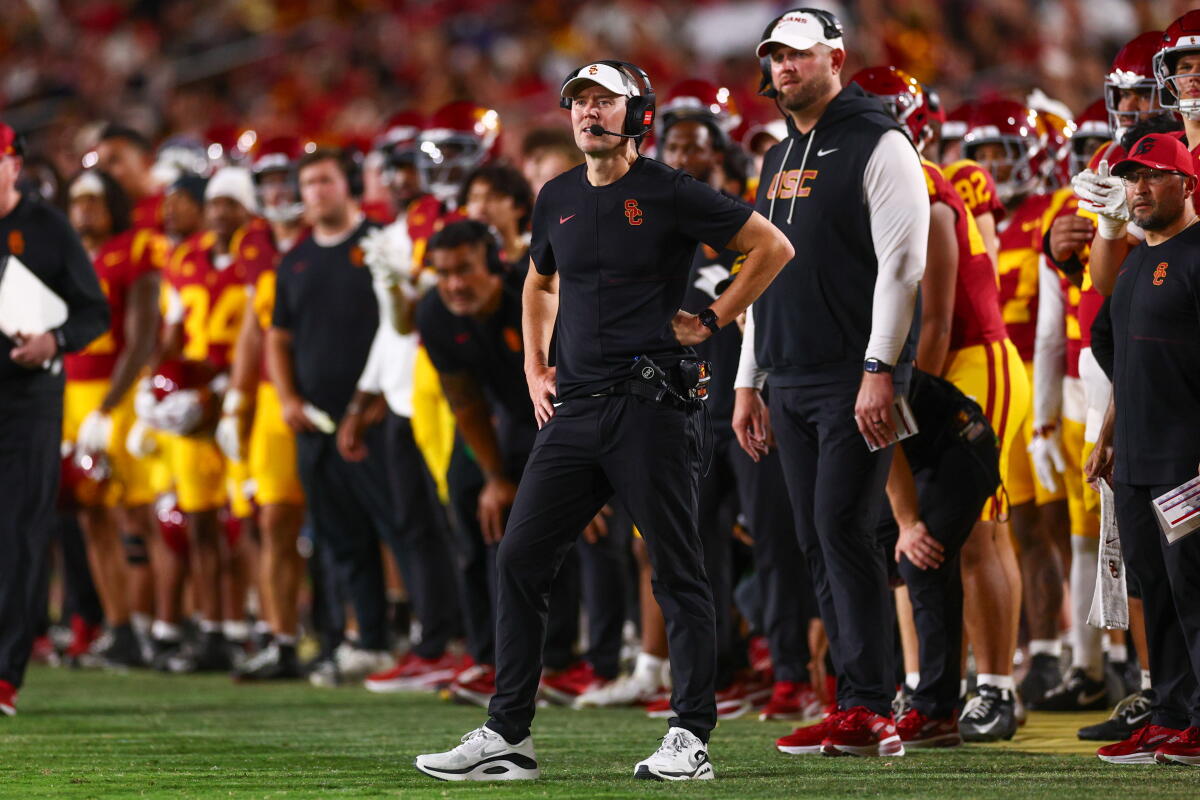
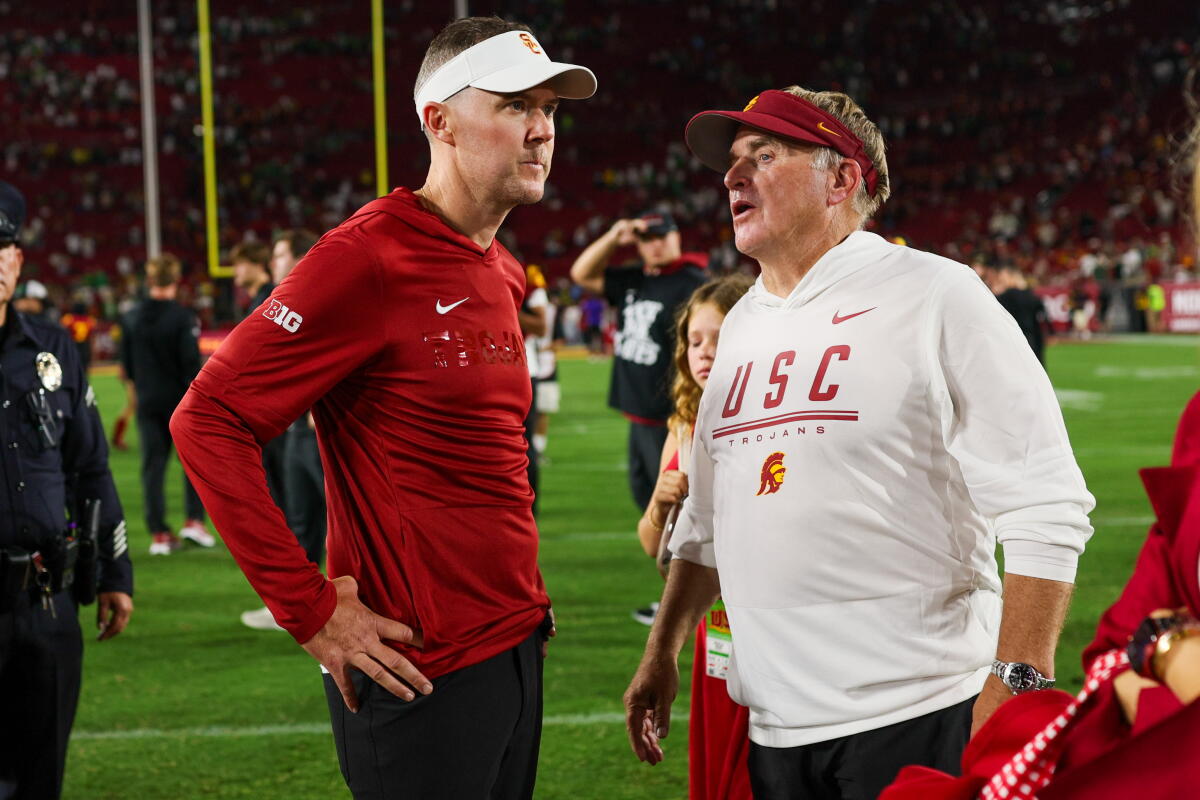
Welcome back to the Times of Troy newsletter, where summer break is over, USC’s preseason camp is underway and we are officially back in your inbox with news, notes and analysis on the Trojans every Monday morning from now through football season and beyond. I hope you had a lovely, peaceful summer. Because this fall, the stakes will have never been higher for Lincoln Riley, who’s entering his fifth and most consequential season yet as USC’s football coach, one that could decide the direction of the Trojan football program for years to come.

We’ve got a lot planned for the Times of Troy this season, including a very exciting announcement to come later this month. But over the next four weeks, before USC kicks off the 2026 season, we’ll take a close look at the team and season ahead.

Fight on! Are you a true Trojans fan?

Get our Times of Troy newsletter for USC insights, news and much more.

This week, we start with the Trojans’ offense, which, in four years with Riley as coach, has consistently remained among the best in the sport. Say what you will about Riley as a play-caller or an overall CEO type, but only one team in college football ranks better in average opponent-adjusted efficiency (FEI) on offense over the course of Riley’s tenure (sorry, it’s Oregon). And only once, in four seasons with Riley, has USC fallen out of the top seven nationally in that efficiency rate.

USC finished third in the nation in offensive FEI last season. And there’s a legitimate case to be made that the offense should be even better in 2026. Two cases, really.

The first path is probably obvious and will no doubt be the source of every preseason TV segment about USC. The road to success for Riley has always run through the quarterback. And Jayden Maiava has all the tools necessary to be that guy. He took a huge step forward last offseason, and if he continues that trajectory, he should be one of the best quarterbacks in the country this season.

But Maiava has also been surrounded by seasoned receivers the last two seasons, including one who just got picked in the first round of the NFL draft. His top returning receiver, Tanook Hines, is sitting out with an injury to start camp, while the rest of the pass-catcher two-deep is made up of either freshmen or transfers. We don’t know how long Hines will have to sit out, but any amount of time isn’t ideal. It’ll be on Maiava to build chemistry in the room and make it all work on the fly.

I suspect he’ll do just fine in that regard. But if USC is really going to reach its offensive potential this season, I believe it’ll be the run game that gets them there.

Riley earned his reputation as a passing savant at Oklahoma for good reason. He had two Heisman Trophy-winning passers and one runner-up in his first three seasons with the Sooners, and all three are now starting NFL quarterbacks. There’s no college coach with a resume even close to comparable when it comes to passing. But what’s often lost about those Riley teams is that Oklahoma also had a stellar rushing attack, one that had to be accounted for at all times, and, in turn, made the passing attack all the more explosive.

USC’s run game hasn’t been bad since Riley took over, not by any stretch. In fact, in terms of expected points added per rush play, the Trojans have ranked among the 15 most efficient run games in college football in each of Riley’s four seasons. They just haven’t run the ball nearly as much as that efficiency suggests they would.

This season would be a great time to shift that ratio. Because this is the best backfield Riley has had at USC.

Before he got hurt last season, Waymond Jordan was on his way to being seen as one of the best backs in the Big Ten, if not the country. He averaged 6.55 yards per carry, which ranked 15th among qualifying running backs in the country, but better yet, he picked up more yards on average after contact (5.15) than all but one other running back in the nation.

Assuming he’s fully healed from his ankle injury last October, Jordan should immediately remind everyone that he’s bound for stardom. And his backfield mate may not be that far behind.

King Miller scores on a 41-yard run against UCLA last season.

King Miller scores on a 41-yard run against UCLA last season.

(Gina Ferazzi / Los Angeles Times)

King Miller didn’t get regular carries until Week 6 last season, after Jordan went down. But he ended up busting 26 rushes of 10 yards or more anyway. That’s once every six carries. That’s bonkers, even before you consider that Miller is formerly a walk-on.

The pairing of those two backs, plus the threat of Maiava’s legs, gives USC a varied backfield capable of breaking a big play at any moment. Better yet, in the Big Ten, it gives Riley and his offense the ability to extend drives and wear down opposing defenses. That’s too often been missing from USC’s offense since coming to the Big Ten.

But there’s no excuse not to lean more on the run this season. Throw in the fact that USC is deeper and more talented on the offensive line than at any other point in Riley’s tenure, and it’s not hard to envision a Trojan offense dynamic enough to dominate teams on the ground and through the air.

Offense has never been a problem for Riley at USC. But we also haven’t seen Riley’s offense at the full extent of its powers just yet. And if USC is going to make the Playoff for the first time under Riley, that’s going to have to change this season.

Preseason MVP pick (non-QB): Waymond Jordan … Back from injury, I’m betting Jordan is better than ever.

Breakout pick: Kayden Dixon-Wyatt, freshman wide receiver … Take your pick of top prospects at the receiver position, but I think Dixon-Wyatt could be the big-play threat USC needs alongside Hines.

Biggest question mark: Wide receiver/tight end … So much talent, but so little of it is proven. Don’t be surprised if someone you’re not expecting breaks out at the position.

Bold prediction: Freshman tight end Mark Bowman leads the team in touchdown catches.

—USC‘s top projected cornerbacks are both cleared ahead of camp. We didn’t see Jontez Williams all spring, and we haven’t really seen Chasen Johnson at all since he was injured almost a year ago. So it’s easy to forget how touted both cornerbacks were coming out of the transfer portal. I’m particularly high on Williams, who was clearly the team’s top target in the portal this offseason. I expect both will start on the outside, unless Marcelles Williams makes a serious push to play there in camp.

Riley is strongly in favor of the 24-team College Football Playoff. That’s been the official Big Ten Conference stance for months, so it’s no surprise to hear Riley echo those feelings. “This is something that’s not going to diminish the game in any way,” Riley said. “Having more teams in a tournament to determine a champion is not going to make it worse.” Of course, Riley’s concern isn’t the overall health of the game, but rather the fact that more playoff spots mean more chances for him to check that box. I don’t blame any coach for feeling that way. But there’s a reason why they shouldn’t be in charge of these decisions.

—Some weight fluctuations … The biggest change since spring belonged to offensive tackle Elijah Vaikona, who lost 25 pounds to open the fall at 360, while two players, tight end Walter Matthews (now 305) and defensive back Carrington Pierce (now 185) each added 20 pounds to their frames. A couple other notable changes: Veteran defensive lineman Jide Abasiri is down to 280 and could play more on the outside this season, while young edge rusher Jadyn Ramos bulked up to 250, after joining USC at (generously) 220 pounds last spring. Freshman five-star tight end Mark Bowman is also up to 245, which should help keep him on the field.

—Grant Govel spurned the Pittsburgh Pirates to return as USC’s ace. The Trojans were one of the big winners of the MLB draft deadline, as their No. 2 starter will now return to take over the top of the rotation. Govel had a 2.87 ERA and an opponent batting average of .203, which made him one of the better pitchers in the Big Ten. But Mason Edwards’ amazing year overshadowed, in some regard, the success Govel was having. That won’t be the case in 2026-27.

—Bloom Football Performance Center is having its grand opening this week. The football team already moved in a couple weeks ago, but the new state-of-the-art facility will get its close-up later this week. The media will be doing a tour Thursday, so be sure to follow along on social media for photos and videos from inside the facility.

The Best Thing I Watched This Summer

Anne Hathaway and Tom Holland in "The Odyssey."

Anne Hathaway and Tom Holland in “The Odyssey.”

(Melinda Sue Gordon / Universal Pictures)

It’s not exactly an original take to sing the praises of a movie that’s become a global phenomenon. But “The Odyssey,” more than any blockbuster in recent memory, is worthy of piling on. I caught the film in its intended 70mm IMAX format, and I can confidently say it was the most amazing cinematic experience I’ve ever had.

The sheer scale of the movie is something to behold, even before you consider just how difficult it is to adapt an ancient epic poem into an interesting movie script. And on both counts, Christopher Nolan does not disappoint. The performances are outstanding, the score is beautiful, and the themes that Nolan pulls from the poem somehow manage to give a fresh take on a 3,000-year-old story.

I look forward to watching it again, as soon as I can, in IMAX 70mm. Though, judging by the current ticket situation, that might have to be at 3 a.m. on a Tuesday.

In case you missed it

New facility, new receivers give Lincoln Riley new hope as USC opens fall camp

Lincoln Riley says Trojans are ‘well-equipped’ to win consistently

Big Ten commissioner pushes back on talk of breaking away from NCAA with SEC

Long frustrated donor Brian Kennedy sues USC over practice field naming rights

‘Athlete of the century’ LeBron James pays tribute to USC staff members who saved Bronny three years ago

USC and Nike agree to extend apparel deal for 10 years

Until next time …

That concludes today’s newsletter. If you have any feedback, ideas for improvement or things you’d like to see, email me at ryan.kartje@latimes.com, and follow me on X at @Ryan_Kartje. To get this newsletter in your inbox, click here.

Source link

New receivers give Lincoln Riley hope as USC opens fall camp

At the start of his fifth fall camp at USC, Lincoln Riley found himself enamored with all that felt new around him. Namely the state-of-the-art, $200-million facility towering over one end of the Trojans’ practice field, with all the luxuries any football coach could ask for.

“This building is magical,” Riley said. “It’s hard to explain how different, how fantastic it is.”

On the field, in front of that gleaming facility, the Trojans also were breaking in something entirely new on Saturday: their receiving corps.

USC opened training camp this week without the services of its top returning wideout, Tanook Hines, after the sophomore underwent an offseason surgical procedure that has yet to revealed. Riley said the injury affecting Hines, who missed the spring, isn’t “overly serious” and that he’s expected back for the start of the season. But his absence leaves the Trojans with a totally new and unproven group to catch passes; many of them are getting their first experience of college football, and of quarterback Jayden Maiava.

“A lot of new bodies. Fortunately he had spring and all summer with all these guys to start developing that chemistry and that confidence,” Riley said of Maiava. “But that’s going to be something we have to work at every single day.”

Among those new players is a host of top receiver recruits expected to contribute right away. Partly, out of necessity.

Freshmen wideouts Trent Mosley and Kayden Dixon-Wyatt already made a strong impression and should immediately step into roles on offense. Tron Baker is another who presumably could carve out a place. And joining them this week at practice, after just enrolling this summer, is a freshman wideout who some believe will be the best of the bunch, top-60 recruit Boobie Feaster.

It may take Feaster time to get up to speed. Hines stepped into a similar position last season, having just arrived on campus for the summer. He proceeded to start eight games anyway.

But Hines was 19 years old by the start of his freshman season. Feaster just turned 17 in late May — and presumably would be one of the youngest players ever to suit up for USC.

Receiver isn’t the only position at which the Trojans are trending young. USC should get key contributions out of freshmen at tight end (five-star Mark Bowman), on the defensive line (five-star Luke Wafle), in the secondary and, at some point, on the offensive line.

That sort of impact should be expected after bringing in a 35-player class that ranked No. 1 in the nation. It also helps, Riley said, that so much of that class has been enrolled for seven months.

“Having as many midyears made a massive difference; I mean, there’s no question about it,” Riley said. “You can feel some of the confidence level.

“And so the less that we can have new as we go on, the more these guys settle in off the field, the better they play.”

That’s the primary goal over the next four weeks of fall camp. One that Riley already has spent plenty of time focused on, while breaking in the Bloom Football Performance Center

“These first few days in here have honestly been a little bit of a dream,” Riley said. “It’s honestly been hard to get players to go home. I haven’t left this place in five days. I haven’t left the compound.”

Source link

Lincoln Riley says Trojans are ‘well-equipped’ to win consistently

The stage was set this past summer, and Lincoln Riley was a ball of nerves.

The USC coach should’ve been used to weathering pressure by that point. After all, his previous four seasons spent coaching the Trojans had been nothing short of a powder keg, filled with ups and downs, as well as a constant undercurrent of tension and uncertainty. But in this particular case, success was out of Riley’s control. He wasn’t even near a football field.

Rather, he was sitting in the audience of a local dance recital, waiting on his two young daughters, Sloan and Stella, who were each making their solo dancing debut with their company.

“This was the first year, stepping out on their own, no one else to rely on,” Riley said. “But they told me, ‘Dad, we’ve got it.’”

Entering his fifth and most pivotal season yet at USC, their father can relate to that sentiment. While the spotlight burns brighter than ever and the collective college football world is spinning 2026 as a make-or-break moment for Riley, the coach had never sounded so confident that his Trojans had turned a corner than he did Tuesday.

“I’ve felt the pressure to win every single year here,” Riley said during Big Ten media days. “What does feel different is that I think our opportunity to do that is greater than what it has been. It just flat out is. The things you need to win, we have more of than we had in the first four years.”

Riley, of course, has made that case before. After each of the last two seasons, in fact. But it’s never been quite as compelling as it is now.

As the coach sees it, USC now boasts more depth on both sides of the ball than at any point in his tenure, in large part because of bringing in the No. 1 recruiting class in the nation in January. Riley also added a Hall of Fame coach at defensive coordinator in hopes of stabilizing matters on that side of the ball. And 10 days earlier, the program moved into its new, state-of-the-art football facility, with all the amenities anyone could ask for.

“It’s just a culmination of all of it, you know?” Riley said. “It is just so much more well-equipped to win consistently right now. It’s so different.”

That’s never been a question for Riley’s offenses at USC, and this year should be no different, with third-year starter Jayden Maiava returning at quarterback and a two-pronged backfield in Waymond Jordan and King Miller leading the way in the run game. The offensive line also looks like Riley’s strongest unit yet in five seasons.

The doubts, per usual, are on defense, where the Trojans are not the most seasoned group.

“The entire defense is just very young compared to last year,” defensive tackle Jide Abasiri said.

Riley is also now working with his third defensive coordinator in five seasons. And one who hasn’t coached in five years, at that.

Gary Patterson does have an impressive resume, with years of top-tier defenses at Texas Christian. And he continues to get rave reviews from Riley, who called the Hall of Famer “one of one” on Tuesday.

“You really have somebody that is like a head coach in that room,” Riley said. “The guy’s one of the most experienced, accomplished coaches in the game. Like, it just is what it is.

“I think just my confidence level and, you know, what’s being handled, how it’s being handled, how we’re developing, how we’re using our roster … is just really, really high right now.”

It better be at this point, considering all that USC has invested in Riley and his total teardown and rebuild of the Trojan football program. Across the city, billboards declaring “THE TIME IS NOW” make abundantly clear just how urgent this season will be at USC.

At the start of his fifth season, Riley is convinced the Trojans are right on schedule.

“All the things that help you win are better,” Riley said. “And that’s gonna give us more chances to win. That’s where my optimism comes from.”

Source link

Crews are draining the Lincoln Memorial Reflecting Pool again as part of Trump’s troubled revamp

Crews are again draining the Lincoln Memorial Reflecting Pool as President Trump’s problem-plagued efforts to revamp the waterway pushes well past his initial goal of having it ready by July 4 to mark the nation’s 250th birthday.

The president at first suggested his renovations would last a century. But within weeks of the project originally reaching completion last month, the water was beset by an algae bloom and pieces of the new coating appeared to be peeling off the bottom.

Trump has blamed the peeling on vandals, though critics allege it’s from shoddy repair work.

Interior Secretary Doug Burgum, whose agency oversees the National Park Service, told conservative podcaster Katie Miller in an interview released earlier this week that the new round of draining was planned. He also said that the water might still contain debris from an extensive Independence Day fireworks display over the National Mall.

“Drain the water, clean up the fireworks stuff,” Burgum told Miller, who is the wife of deputy White House chief of staff Stephen Miller. “Repair the vandalism that was done. Fill it back up again.”

The work on the Reflecting Pool is just one of a number of projects Trump has spearheaded across the nation’s capital. Most prominently, he demolished the White House’s East Wing to build a $400-million ballroom and plans to build a towering arch between the Lincoln Memorial and Arlington National Cemetery.

He initially announced his intentions to beautify the Reflecting Pool this spring, saying he wanted it completed before the nation’s 250th birthday celebrations.

Water was drained and Trump directed that the bottom be painted what he called “American flag blue.” In May, the president posted on his social media site of the pool: “The goal is to have it done, at this higher level, prior to July 4th — We are ahead of schedule!”

But problems began quickly after the initial work was finished. Trump blamed vandals, and court documents later showed that the National Park Service reported to the U.S. Park Police a June 9 incident in which a sharp knife or razor cut the pool’s new liner.

On Thursday, former Olympic canoe racer David Hearn pleaded not guilty in D.C. Superior Court to deliberately damaging the Reflecting Pool. Hearn has said he reached inside the pool to examine the peeled sealant and let go of a chunk when he was told to by a park worker.

His attorneys and other Trump administration critics have derided the case as an abuse of prosecutorial power and maintain he is being scapegoated for the poor job done fixing up the Reflecting Pool.

At least three other people have been charged in the same court with misdemeanors for allegedly removing pieces of paint from the Reflecting Pool, according to online court records. All three pleaded not guilty during their initial court appearances Wednesday.

The pool was closed for the Independence Day celebration, which featured what Trump said was the largest fireworks display in the world. The president had said that the pool would have to be drained anew as part of the new round of repairs.

Burgum has also said that the Trump administration won’t seek bids for the new rounds of repairs. He told CNN’s “State of the Union” last weekend: “We’ll use the same company because they did a fantastic job.”

Ohio-based Green Water Solutions, also known as Greenwater Services, was given a $1.7-million contract to install a water-purification system in the Reflecting Pool, while Virginia-based Atlantic Industrial Coatings was awarded $14.7 million to repaint and waterproof the pool’s concrete floor.

Democratic senators and House members are investigating the pool project, including seeking answers about how much taxpayer funding is involved.

Weissert writes for the Associated Press.

Source link

Supercarrier USS Abraham Lincoln Passes 200 Consecutive Days At Sea Mark

The U.S. Navy’s Nimitz class aircraft carrier USS Abraham Lincoln has been underway for 210 straight days – well over half a year – in support of Operation Epic Fury and the subsequent blockade of Iran. This looks to be a record-setting milestone. Lincoln, the flagship of Carrier Strike Group 3 (CSG-3), is currently operating in Middle Eastern waters.

U.S. Sailors observe aircraft, attached to Carrier Air Wing 9, fly over the flight deck of Nimitz-class aircraft carrier USS Abraham Lincoln (CVN 72), June 28, 2026. Abraham Lincoln is deployed to the U.S. 5th Fleet area of operations to support maritime security and stability in the Middle East. (U.S. Navy photo)
Aircraft attached to Carrier Air Wing 9 fly over the flight deck of USS Abraham Lincoln, June 28, 2026. U.S. Navy photo U.S. Central Command Public Affa

Abraham Lincoln, the fifth Nimitz class supercarrier and self-styled “most capable CSG in the fleet,” departed Naval Base Guam on December 12, 2025, after a quick one-day port call. Port calls, or temporary visits to friendly countries, allow the crew to disembark for “liberty” – to step on solid ground – and break up the grueling, nonstop schedule experienced during deployments. However, the stop in Guam, a strategic U.S. territory in the Western Pacific, was so brief that much of the crew likely never went ashore.

APRA HARBOR, Guam (Dec. 11, 2025) - Nimitz-class aircraft carrier USS Abraham Lincoln (CVN 72) pulls into Naval Base Guam for a scheduled port visit, Dec. 11. Abraham Lincoln Strike Group is on a scheduled deployment in the U.S. 7th Fleet area of operations to enhance interoperability through alliances and partnerships while serving as a ready-response force in support of a free and open Indo-Pacific region. (U.S. Navy photo by Valerie Maigue)
USS Abraham Lincoln pulls into Naval Base Guam for a scheduled port visit, Dec. 11, 2025. U.S. Navy photo by Valerie Maigue Valerie Lynn Maigue

Lincoln and CSG-3, made up of more than 5,000 Sailors and Marines, quietly left Naval Base San Diego three weeks earlier on November 21, 2025. At the time, the U.S. military buildup in the Caribbean was the focus of public attention, and Lincoln was expected to conduct a routine Pacific patrol. An Iran contingency was on the table following Operation Midnight Hammer, when B-2 bombers struck nuclear targets deep inside Iran, and Lincoln’s Composite Training Unit Exercise (COMPTUEX) included preparing for a fight in the Middle East. COMPTUEXs are weeks-long capstone training events for carrier strike groups that come right before they deploy.

U.S. Navy Aviation Ordnanceman 3rd Class Gabriel Edens, left, and U.S. Navy Aviation Ordnanceman 3rd Class Sergio Vela prepare to shift colors on the flight deck of Nimitz-class aircraft carrier USS Abraham Lincoln (CVN 72) on Nov. 21, 2025. Abraham Lincoln is currently moored at Naval Station North Island. (U.S. Navy photo by Mass Communication Specialist 3rd Class Mario Castro Gamez)
Abraham Lincoln pulls out of San Diego on November 21, 2025. U.S. Navy photo by Mass Communication Specialist 3rd Class Mario Castro Gamez Petty Officer 3rd Class Mario Castro Gamez

After leaving Guam, Lincoln conducted operations in the South China Sea before entering the Indian Ocean and arriving in the northern Arabian Sea in late January. Aircraft from Carrier Air Wing (CVW) 9 launched sorties in the opening salvo of Operation Epic Fury, and the CSG was instrumental in enforcing the naval blockade that followed. Since the Memorandum of Understanding (MOU) was signed on June 17, Lincoln has remained in the northern Arabian Sea, launching retaliatory strikes during the recent skirmishes.

An F-35C Lightning II, attached to Marine Fighter Attack Squadron (VMFA) 314, is staged for flight operations on the flight deck of Nimitz-class aircraft carrier USS Abraham Lincoln (CVN 72) in support of Operation Epic Fury, Mar. 3, 2026. (U.S. Navy photo)
F-35C Lightning II, attached to Marine Fighter Attack Squadron (VMFA) 314, staged for flight operations on the flight deck of USS Abraham Lincoln in support of Operation Epic Fury, Mar. 3, 2026. U.S. Navy photo U.S. Central Command Public Affa

The CSG has been deployed for more than seven months now and would likely be among the first naval assets to rotate out of the theater if an agreement is reached between the U.S. and Iran. The details and scale of the drawdown of forces in the U.S. Central Command (CENTCOM) AOR, as per the MOU agreed to by American and Iranian officials last month, are to be determined within 30 days if a final deal is reached before the deadline in mid-August. A new spate of tit-for-tat strikes just this week has created serious uncertainty around future talks between Washington and Tehran. More than 20 U.S. Navy surface combatants are still operating in the region.

“We’ve officially claimed the title for most consecutive days at sea for any modern aircraft carrier,” Lt. Commander Alexis Travis, an officer currently serving aboard Lincoln, wrote on Instagram on June 16.

We have reached out to the Navy to confirm whether this is indeed a record-breaking period at sea. However, we have not received a response as of the time of publication.

In June 2020, the U.S. Navy did announce that the Nimitz class carrier USS Dwight D. Eisenhower and the Ticonderoga class cruiser USS San Jacinto had set a new record after spending 161 days consecutively operating at sea. Eisenhower did not make a stop in port until the next month, having been at sea for 206 consecutive days in the end. This was, in part, due to the COVID-19 pandemic, when port access was severely limited due to quarantine restrictions. The carrier had left Norfolk in January 2020 for a deployment to the Middle East and launched combat sorties during Operation Freedom’s Sentinel in Afghanistan, returning home nearly seven months later without a single stop. Prior to that, USS Theodore Roosevelt held the record in 2002, supporting the post-9/11 response. Roosevelt left Norfolk in September 2001 to participate in Operation Enduring Freedom and spent 160 days at sea before anchoring in Bahrain for a reprieve in February the following year.

USS Dwight D. Eisenhower transits the Arabian Sea on June 12, 2020, during a record-setting deployment. U.S. Navy photo by Mass Communication Specialist 1st Class Aaron Bewkes

In April, USS Gerald R. Ford, the newest American carrier and largest in the world, logged the longest deployment on record at 326 days. Ford, while deployed for nearly eleven months, was operating primarily in the U.S. European Command-6th Fleet area of responsibility (AOR) and U.S. Southern Command-4th Fleet AOR, which is relatively friendly territory, and made at least nine port calls in Marseille, Oslo, Palma de Mallorca, Split, St. Thomas Island, and Souda Bay. Between port calls and stops to refuel and make emergent repairs, Ford averaged a visit to port every 36 days.

NAVAL SUPPORT ACTIVITY SOUDA BAY, Greece (Feb. 23, 2026) The world’s largest aircraft carrier, Ford-class aircraft carrier USS Gerald R. Ford (CVN 78) arrives at the NATO Marathi Pier Complex in Souda Bay, Crete, Greece, during a scheduled port visit on Feb. 23, 2026. NSA Souda Bay is an operational ashore installation that enables and supports U.S., Allied, Coalition, and partner nation forces to preserve security and stability in the European, African, and Central Command areas of responsibility. (U.S. Navy photo by Mass Communication Specialist 3rd Class Hannah Donahue)
USS Gerald R. Ford arrives at the NATO Marathi Pier Complex in Souda Bay, Crete, Greece, during a scheduled port visit on Feb. 23, 2026. U.S. Navy photo by Mass Communication Specialist 3rd Class Hannah Donahue Petty Officer 3rd Class Hannah Donahue

The Lincoln CSG, which also includes guided-missile destroyers from Destroyer Squadron (DESRON) 21, served as the tip of the spear in Operation Epic Fury. DESRON 21 fired dozens of Tomahawk Land Attack Missiles (TLAMs) against Iran, and provided defensive measures for the CSG, using Standard Missiles and other armaments to intercept incoming threats. The embarked “air wing of the future,” CVW 9, launched thousands of sorties and pressured Iran’s southern axis during the 40-day war, successfully escorted commercial ships through the contested Strait of Hormuz, and hunted and disabled Iranian-affiliated vessels attempting to run the blockade. The carrier’s air wing notably includes F-35C Joint Strike Fighters assigned to Marine Fighter Attack Squadron 314 (VMFA 314), giving it better penetrating capabilities. The CSG has proven its ability to blend and interoperate high, medium, and low-end naval and joint capabilities, for offensive and defensive purposes, as well as integrate across platforms, including manned and unmanned systems, conventional and unconventional, surface and subsurface, overt and covert, and more, during nonstop combat operations.

USS Abraham Lincoln, USS Michael Murphy, USS Frank E. Petersen Jr., USNS Henry J. Kaiser, USNS Carl Brashear, USCGC Robert Goldman, and USCGC Clarence Sutphin. Jr. sail in formation in the Arabian Sea, Feb. 6, 2026. U.S. Navy photo by Mass Communication Specialist 1st Class Jesse Monford

The destroyers escorting Lincoln were able to make port calls before the war began, but some have been at sea for over four months. USS Frank E. Petersen Jr., the Integrated Air and Missile Defense (IAMD) Commander, moored at Navy Terminal in the Port of Duqm, Oman, for two days in mid-February. USS Michael Murphy, the last destroyer to leave the Persian Gulf before the first shots were fired, docked in Dubai, UAE, from February 25-27, and left the day before the city was targeted in the initial waves of Iran’s counterattack. Satellite imagery reviewed by TWZ at the time showed Murphy’s precise location the day prior was targeted. USS Spruance, the only San Diego-based destroyer operating with CSG-3, deployed on the same day as Lincoln, and has been at sea for just as long, with one port call in December in Guam. Spruance was spotted firing a black TLAM on the first day of Epic Fury.

Arleigh Burke-class guided-missile destroyer USS Spruance (DDG 111) fires a Tomahawk Land Attack Missile (TLAM) in support of Operation Epic Fury, Feb. 28, 2026. (U.S. Navy photo)
Arleigh Burke-class guided-missile destroyer USS Spruance fires a Tomahawk Land Attack Missile (TLAM) in support of Operation Epic Fury, Feb. 28, 2026. U.S. Navy photo NAVCENT Public Affairs

“Literally no one signed up for this,” Lt. Commander Travis also wrote on Instagram. “And yet here we are, still doing it safely and successfully. Just a strong group doing tough stuff, breaking records and then waking up and doing it again.”

When the crew serving tirelessly aboard Lincoln will next set foot on land is unknown, and with the fate of the U.S.-Iran MOU similarly uncertain, it may be some time.

Contact the author: ian.ellis-jones@teamrecurrent.io

Ian executes TWZ’s full-spectrum social media strategy, brings his interpretive graphics skills to our editorial team as an OSINT analyst and researcher, and maintains the weekly carrier tracker and newsletter.


Source link

A Jefferson for every era, from Lincoln to Trump, and the contradictions that endure

He’s a prize-winning presidential historian who wrote an entire biography of Thomas Jefferson. But even Jon Meacham needs to think for a moment before defining what it means to be a “Jeffersonian.”

“Well for a long time, before the civil rights movement, it meant to be more inclined toward states’ rights and limited government,” says Meacham, the National Constitution Center’s Semiquincentennial Scholar. He then pauses, and asks to start over, recalling how President Franklin Delano Roosevelt evoked Jefferson as an “apostle of liberty” who would have supported the U.S. fighting the Nazis in World War II.

You could define it in so many ways. Historians may argue over the “greatness” of individual founders, but as the country’s 250th anniversary approaches many agree that no one’s life and work resonates like Jefferson’s. He embodied the “very best and the very worst” of the United States, Meacham says.

And a great deal in between.

America’s birth is rooted in his most profound contradiction — the man who proclaimed that “all men are created equal” while being a slaveholder to the end of his life. But Jefferson advanced and explored both sides of so many issues and world views that have defined the country’s path: agrarian self-sufficiency and worldly innovation, pluralism and separatism, limited government and dreams of an “empire of liberty.”

“There is no more malleable figure in early America than Jefferson,” says Andrew Burstein, a professor of history at Louisiana State University who has summed up Jefferson’s legacy in a book he published a decade ago: “Democracy’s Muse: How Thomas Jefferson became an FDR Liberal, a Reagan Republican, and a Tea Party Fanatic, All the While Being Dead.”

“There have been times in American history when just about everyone would have considered themselves ‘Jeffersonian,’” says historian Peter S. Onuf, author of numerous works on Jefferson. “Yet even at those moments, he was a controversial figure.”

It’s an argument without end

Jefferson’s legacy is debated even in settings that owe their existence to him.

On the campus of the University of Virginia, the college he founded and regarded as a signature achievement, stands a memorial to thousands of enslaved people who lived and worked there.

At Monticello, the mountaintop estate and plantation outside of Charlottesville where Jefferson lived when not in public office, a banner near the entrance features the Declaration and the caption, “After all, our guy wrote it.” But once on the grounds, reminders of his enslavement of hundreds are found throughout, from its “Burial Ground for Enslaved People” that includes dozens of graves to an exhibit dedicated to Sally Hemings, the enslaved woman with whom Jefferson is widely believed to have had six children.

Monticello’s director of historic interpretation and audience engagement, Brandon Dillard, cites the staff’s mission “to tell unflinching stories of America’s complex origins and fitful progress toward the ideals Jefferson articulated in the Declaration of Independence.”

Jefferson regarded Monticello as a refuge from the times, but the times inevitably find their way here. A guide on the gardens and grounds tour points out that a foldable plant Jefferson tried and failed to grow — the “Mimosa Pudica,” or “sensitive plant” — now thrives because of climate change. The visitors’ center is LEED Gold-certified for green energy, Dillard says, and geothermal systems have been installed in other buildings for temperature control.

Monticello raises questions old and new about race. Virtually all of the guides are white, an issue Dillard notes is prevalent nationwide. A recent survey released by the American Association for State and Local History found that around just 10% of workers at museums, historic sites and historical societies were nonwhite and that many “Latino/a/x, and multiracial respondents reported higher rates of discrimination and harassment.” (Dillard declined to answer in detail the experience of guides of color at Monticello.)

There is a Jefferson for every occasion

Jefferson’s contradictions date back through much of American history; he was claimed by both sides of the Civil War and both sides of the civil rights movement.

Nineteenth-century Confederates and 20th-century segregationists cited his defense of states’ rights, while Abraham Lincoln and civil rights leaders emphasized Jefferson as the author of the Declaration of Independence. In the space of a few months in 1963, he would be invoked in the inaugural speech of Alabama Gov. George Wallace as he vowed defiance of federal efforts to integrate the state’s schools and by the Rev. Martin Luther King as he delivered his “I Have a Dream” speech during the March on Washington.

Roosevelt enlisted Jefferson as an ideological ally for the New Deal (the Thomas Jefferson Memorial in Washington, D.C., began as a New Deal project) and a former New Dealer-turned conservative, President Reagan, held up Jefferson decades later as a foe of wasteful spending. Jefferson has been cited often by free-speech advocates for his crucial support for the Bill of Rights, while President Trump has quoted Jefferson’s 1807 lament that “Nothing can now be believed which is seen in a newspaper” as an implicit endorsement of his modern war against “fake news.”

Jefferson has also been placed on either side of today’s divide over immigration. Ibram X. Kendi, author of “How to Be an Anti-Racist,” cites his well-documented belief in colonization for Black people as inspiration for contemporary scapegoating and xenophobia. Meanwhile, at a time when the Trump administration is aggressively trying to restrict immigration and even denaturalize some citizens, Monticello continues its decades-old July 4 naturalization ceremonies, with Virginia Gov. Abigail Spanberger scheduled as this year’s keynote speaker.

“As new citizens share their personal stories every Fourth of July,” Dillard says, “we are reminded that the values uplifted in that Declaration are values toward which people from all backgrounds aspire.”

Many Monticello visitors, many reasons to visit

Monticello attracts hundreds of thousands of visitors each year. They come for many reasons.

Erin Porter is a Virginia native in her 40s who until recently had never been to Monticello and wanted to cross it off her bucket list, while Nathan Jaycox of Connecticut is a former nuclear engineer now seeking to absorb history for a class he hopes to teach. Duane Cromwell, a longtime resident of Vancouver, was here on a very personal mission.

Cromwell, 70, grew up in Greenville, S.C., where she was taught that slavery was “an economic necessity” and learned nothing about Jefferson’s history of enslavement. In town last month for a family reunion, she arrived at Monticello anxious to get past the “whitewashed Southern version” and the myths of evil “yankees” and the victimized rebels who defied them.

“Did you (ever) notice kudzu growing up over trees and buildings while in the South? It is an invasive plant brought to the region to control erosion. Well, it is like racism. It is pervasive, part of the horizon, always there but soon you don’t notice it,” she says.

“Having said that, I do think that people do go along better, there is more interactions, relationships than when I was growing up. Everyone needs each other and in the South, there is a great sense of humor and friendliness that help people navigate the awkward moments.”

For Cromwell, Monticello was a chance to educate herself, to become a better person — and, like countless others before her, using Thomas Jefferson as a prism.

“Isn’t that what it’s all about?”

Italie writes for the Associated Press.

Source link

Shakira and Lincoln Lawyer hunk Manuel Garcia-Rulfo spark dating rumors as pair is spotted together at L.A. hotel

SHAKIRA has sparked dating rumors with hunky actor Manuel Garcia-Rulfo.

The pair were seen leaving a hotel together in Los Angeles on Monday, days after Shakira turned up the heat at the World Cup opening.

Shakira and the Lincoln Lawyer hunk were seen looking friendly in West Hollywood on Monday Credit: BackGrid
Manuel Garcia-Rulfo was ever the gentleman for the singer Credit: BackGrid

Hips Don’t Lie singer Shakira and Manuel, who is known for starring in Lincoln Lawyer, were waiting at a valet stand outside the Sunset Tower Hotel.

As they waited for their vehicle in West Hollywood, the pair were seen smiling and chatting.

The photographs show that once their car arrived, Manuel proved chivalry isn’t dead.

He was ever the gentleman and politely opened Shakira’s door and waited for her to get in before he closed it.

The pair were waiting at a valet for their car Credit: BackGrid
Manuel helped Shakira into the car by opening the door Credit: BackGrid
He drove them away as the pair smiled Credit: BackGrid
They left the Sunset Tower Hotel looking content and happy Credit: BackGrid

Mexican hunk Manuel then walked around to the driver’s side and got in before driving off.

Shakira, 49, wore a simple outfit comprising of a black tank top with some blue jeans and some black boots.

Meanwhile, 45-year-old Manuel wore blue jeans, a black T-shirt and a matching jacket.

The couple looked incredibly content in one another’s company, and as they drove off they were both beaming.

Most read in Entertainment

The snaps were quick to circulate online, with fans rushing to react.

“Truth is, the dude really is hot. Even if it’s casual, I’m glad. Good for Shaki,” said one person on X.

“Omg what an upgrade,” penned a second.

While a third wrote: “The way those photos look like they’re from 2000 omg Shakira ages like wine.”

Someone else then echoed: “If you tell me it’s from 2002, I’ll believe you.”

And a fifth said: “Baby, doesn’t it feel like you’re seeing an old photo? It looks the same.”

Shakira has most recently been romantically linked to Lucien Laviscount.

Back in February, she took to Instagram to hard launch her relationship with the actor.

The relationship began after they met in early 2024 on the set of her music video for Puntería, in which he played her love interest.

But ahead of the World Cup, Shakira noted that she has “no space or time” for a relationship.

“Oh no, no romance for me for now,” Shakira told The Times recently, hinting she and Lucien were no longer an item.

“There’s no space or time in my life for that. My plate is quite full.

“My kids are my priority. And my career. Strangely enough, I’m in love with my career like I’ve never been in my life. I’m enjoying my time alone as well.”

Source link

USC paid Lincoln Riley nearly $12 million in lackluster 2024 season

His 7-6 record at USC in 2024 would go down as the worst mark of Lincoln Riley’s career as a head football coach. But in his third and rockiest year at the helm of the Trojans, Riley was still compensated like one of the kings of the sport.

Riley was paid more than $11.8 million in total compensation during the fiscal year 2024, according to USC’s latest federal tax returns, which were obtained by The Times. That total includes a $100,000 bonus and $10.4 million in base pay, believed to be more than all but three college football coaches that season: Georgia’s Kirby Smart, Clemson’s Dabo Swinney and Ohio State’s Ryan Day. All three have won a national title.

For Riley, his pay in 2024 marks just a slight increase from the 2023 season, when USC paid Riley more than $11.5 million in total compensation. The coach’s base pay increased by $145,143 between fiscal years 2023 and 2024, slightly less than it rose following his debut season in 2022 ($168,000).

At least in 2024, USC only had to pay one football coach, after paying Clay Helton a combined $9 million not to coach over the two previous years.

The school would, however, have to pay up a bit to bring in a new men’s basketball coach.

After Andy Enfield left to coach Southern Methodist after the 2023-24 season, USC shelled out more than $6.1 million total in 2024 to lure coach Eric Musselman from Arkansas, according to the university’s latest federal tax records. One million of that was paid to Arkansas to buy out Musselman’s contract.

That puts Musselman at a reported $5.1 million in total pay and benefits from the school in 2024, according to the school’s tax records. That total likely includes additional costs unique to a coaching change. But altogether, it would have ranked Musselman among the highest-paid coaches in the Big Ten for the 2024-25 season.

Musselman didn’t exactly deliver on that investment during the 2024-25 season, as USC bottomed out during its first Big Ten men’s basketball slate. The Trojans finished 17-18 and 7-13 in the Big Ten.

After including her information in tax forms from the previous year, the university did not disclose compensation figures from 2024 for USC athletic director Jennifer Cohen. Federal tax returns filed last May had credited Cohen with more than $3 million in reportable compensation in her first year on the job, $1 million of which was used to buy out Cohen from her Washington contract.

Source link

Bristol City: Robins edging towards appointing Lincoln boss Michael Skubala

Bristol City are close to appointing Lincoln boss Michael Skubala as their new manager.

The Robins have moved quickly for the 43-year-old after failing to convince Bournemouth assistant Tommy Elphick to join.

Nothing has been signed yet but it is now expected Skubala will move to the Championship side.

It will cost Bristol City over £1m in compensation with Skubala understood to have signed a new contract at Sincil Bank after initially missing out on the job to Elphick.

Skubala won the League Managers’ Association League One manager of the season after taking the club to the second tier for the first time in 65 years by winning the title.

He is close with Bristol City sporting director James Ellis, only formally appointed at the Robins this month, with the pair having worked together in the Great Britain Universities setup.

The former Leeds Under-21 boss was one of the leading contenders before the Robins initially chose Elphick, 38.

The former Brighton and Aston Villa defender had positive talks and was impressed with the club and its personnel but decided against making the move on Wednesday.

With Marco Rose replacing Andoni Iraola at the club, sources have told BBC Sport Elphick wants to assess his options further.

Bristol City, who finished 12th in the Championship, are looking for a permanent manager after appointing former England boss Roy Hodgson as an interim replacement following Gerhard Struber’s sacking in March.

Source link