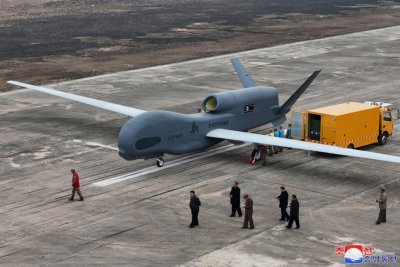

North Korean leader Kim Jong Un (2-L) inspecting what appears to be a large reconnaissance drone at an undisclosed location in North Korea. According to state media KCNA, Kim reviewed newly developed reconnaissance and suicide drones by the Unmanned Aeronautical Technology Complex and electronic warfare research group and oversaw their performance test on 25-26 March 2025. Photo by KCNA / EPA
April 9 (Asia Today) — Drones have emerged as a game changer that is reshaping modern warfare, from the Russia-Ukraine war to the U.S.-Israel conflict with Iran in the Middle East.
Scenes of suicide drones costing only a few thousand dollars knocking out tanks worth millions have sent shockwaves through defense officials around the world. As South Korea’s defense industry sweeps global markets with tanks and self-propelled howitzers, a pressing question is coming into focus: How competitive is the country’s drone technology, and is it ready for the next war?
South Korea strong in hardware, weak in software
According to defense experts and military officials, South Korea’s drone platform design capability has already reached a world-class level. Large unmanned aircraft developed by Hanwha Aerospace and Korean Air, including medium-altitude unmanned aerial vehicles, have demonstrated strong global competitiveness.
But the picture looks very different beneath the surface.
Among smaller drone manufacturers, the localization rate for flight controllers and core software – the brains of the drone – remains low. In many cases, companies still modify and use Chinese-made Pixhawk systems despite persistent security concerns. In the supply chain as well, South Korea has been slow to reduce dependence on China for critical parts such as motors, gearboxes and communication modules, raising red flags over supply chain security.
Industry officials say government regulation remains another major obstacle. Complaints that “the technology exists, but there is no market” continue to spread through the sector. Strict testing requirements and rigid procurement procedures have created bottlenecks that keep civilian innovation from quickly turning into military capability.
A defense industry expert said drones that are domestic in name only could remain fully exposed to data theft or remote disablement in wartime. The expert said the localization of core components directly tied to security must be the top priority for South Korea’s drone industry.
South Korea’s drone sector is often described as having a strong information technology foundation, but facing an urgent need to localize critical parts and secure battlefield readiness. Experts say the next decisive turning points will be whether the country can localize motors and transmission systems and take the lead in standards for artificial intelligence-based autonomous flight.
North Korea’s asymmetric drone threat evolves with AI and swarming
While South Korea struggles to close those gaps, North Korea’s drone threat is rapidly evolving beyond simple surveillance.
Analysts say the unmanned aircraft recently unveiled by Pyongyang are advancing toward suicide attack capabilities and AI-based autonomous flight. One military expert, speaking on condition of anonymity, warned that North Korea is trying to overcome its weakness in hardware through three forms of low-cost, high-volume drone warfare backed by AI technology.
The first is the suicide drone, or kamikaze drone, which poses a severe threat in cost-effectiveness because a cheap drone can destroy military assets worth vastly more. The second is the swarm drone tactic, in which dozens of drones attack at the same time to overload radar and air defense networks. The third is the AI-equipped autonomous drone, which can ignore GPS jamming, recognize terrain on its own and press toward its target.
North Korea has also unveiled drones modeled after U.S. systems such as the Global Hawk and Reaper, emerging as a new source of threat. In peacetime, such aircraft could be used for surveillance of the Seoul metropolitan area and frontline units near the Demilitarized Zone. In wartime, they could become a serious asymmetric threat capable of striking mechanized ground forces through low-altitude penetration, even if South Korea and the United States secure control of the skies.
Unhappily for South Korea, the military’s shield against such threats remains in its infancy. Laser-based air defense weapons are being fielded, but experts say they are still not enough to completely stop ultra-small, low-flying drones.
Defense specialists and drone manufacturers say that if South Korea wants to rise as a true drone power, it must now place its bet on AI-based manned-unmanned teaming systems and anti-drone technology.
Modern warfare, they say, is now an age of evolutionary acquisition. Rather than waiting for a weapon to become 100% perfect, militaries must field systems that are 80% ready, learn from feedback and build them into something stronger. If enemy drones are using AI overhead to choose targets while South Korea remains tied down by regulation and dependence on Chinese-made parts, the outcome could become painfully clear.
Experts say the government and military must recognize that drone sovereignty is survival. They argue that a fast track must be opened so civilian innovation can cross immediately into military service before the gap becomes a battlefield liability.
— Reported by Asia Today; translated by UPI
© Asia Today. Unauthorized reproduction or redistribution prohibited.
Original Korean report: https://www.asiatoday.co.kr/kn/view.php?key=20260409010002881